Well, that was fun. You can be mad that the Phillies didn’t sign Bo Bichette or you can be grateful for all the takes you heard along the way. However things turn out for the 2026 Phillies, you’ll always have those two weeks in winter when you could dream of a better tomorrow. No amount of money and opt-outs can take that away from you. Don’t you forget that.
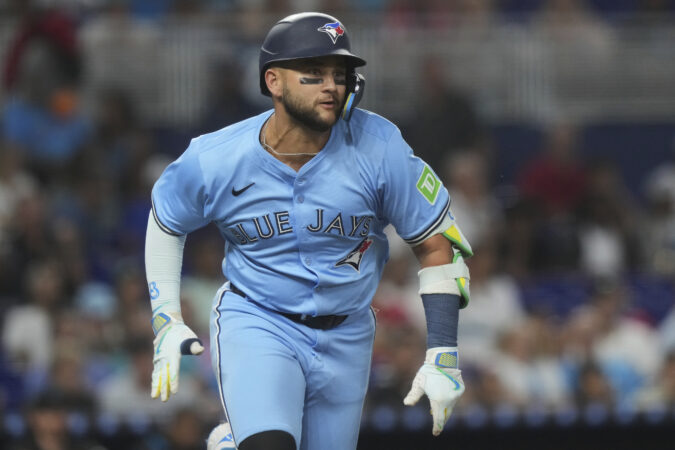
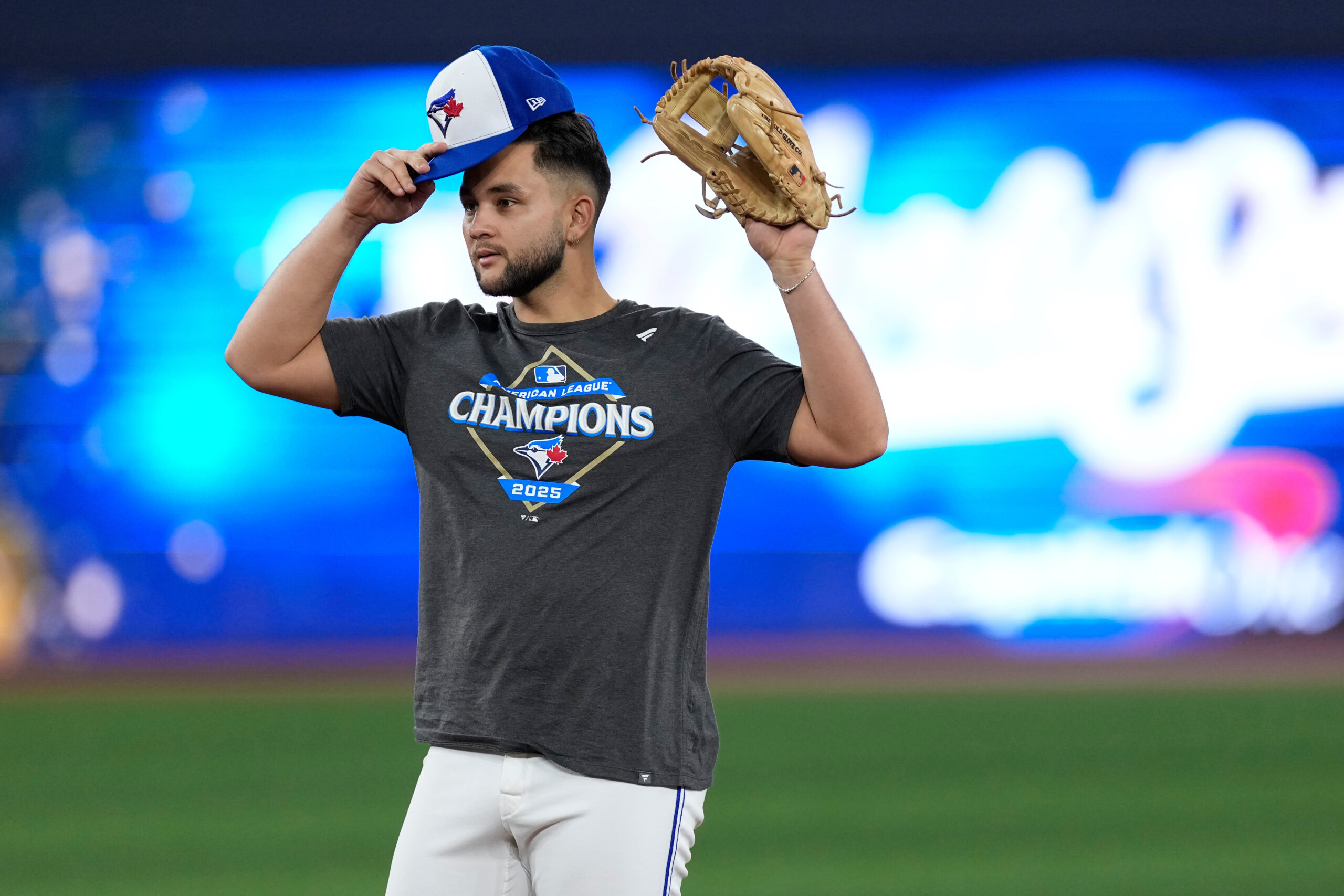
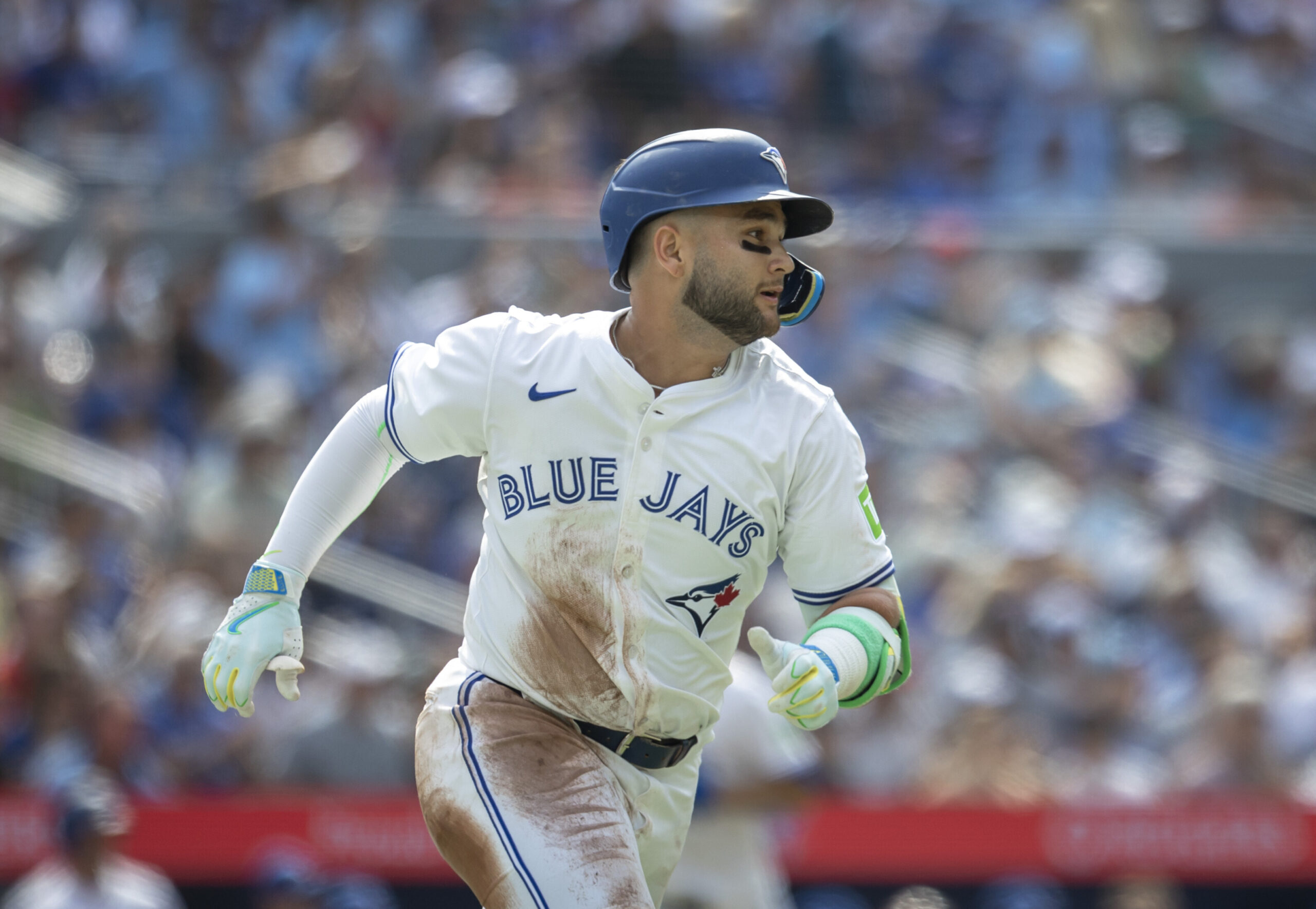
Truth is, Bichette was always likely to turn out to be an illusion. The narrative won’t be spun that way. The reports emerging in the immediate aftermath of the Mets’ agreement with the former Blue Jays star on a three-year, $126 million contract suggest the Phillies thought they were on the verge of signing Bichette to a seven-year, $200 million deal. But that’s more a misreading of the state of play than it is reality.
If the Mets were willing to offer Bichette these kinds of terms, and Bichette was intent on taking the best deal for his personal finances, the Phillies weren’t going to sign him. Both of those outcomes were more likely to be the case than Bichette accepting a long-term deal that the Phillies felt made fiscal sense.
That’s true — and always was true — for two reasons. The Mets are operating with a different definition of fiscal sense. They are also operating with a different level of urgency, given the departures of Pete Alonso, Jeff McNeil, and Edwin Diaz and their failed pursuit of Kyle Tucker. The Phillies could fail to sign Bichette and still have more or less the same roster that won 96 games last season. For the Mets, Bichette might have been their only hope at coming out of this offseason with a roster that looks to have improved over last year’s disappointment. Necessity plus wherewithal equals motivation. It’s tough to win a bidding war from a weaker position.
That’s not to say the Phillies were played for fools. If three years and $126 million with two opt-outs is what it took to prevent Bichette from signing with the Phillies, then the Phillies had a very real chance. Because three years and $126 million and two opt-outs is a borderline irresponsible deal. So much so that the Phillies couldn’t even think about structuring a long-term deal that would have beaten it.
Even if Bichette doesn’t opt out, he will reenter free agency at the age of 30 needing to sign a four-year, $75 million deal to come out ahead of where he would have been had he accepted the Phillies’ reported seven-year, $200 million offer. If he opts out after next year, he’ll need six years and $159 million, heading into his 29-year-old season. Kyle Schwarber just landed five and $150 million heading into his 33-year-old season.
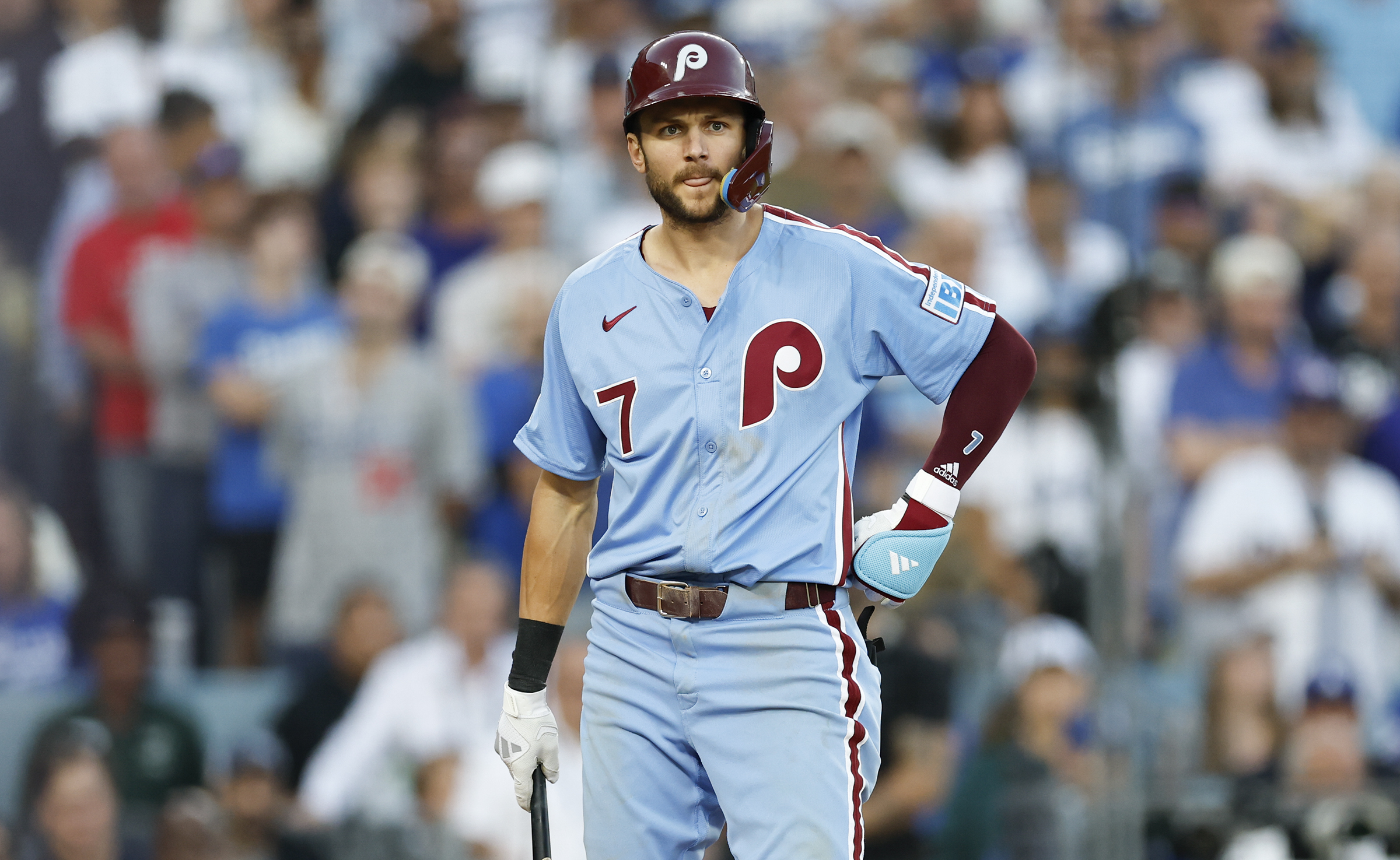
Bo Bichette is expected to move from shortstop to third base with the Mets.
The one silver lining for the Phillies is the price their division rivals will pay for very little upside. A lot of Bichette’s value is his youth — but the Mets aren’t getting any of that value given that he can become a free agent after next season. They are only getting the downside risk that Bichette’s value craters, in which case he won’t have been worth anywhere close to $42 million for one season and they’ll also owe him an additional two years and $84 million.
There is a reason the Phillies don’t like to include opt-outs in deals. They pretty much eliminate the ability to recoup value on your investment. Imagine if Zack Wheeler had opt-outs in his original five-year, $118 million deal with the Phillies. Basically, the Mets either win a World Series this season because of Bichette or they are right back where they started.
The Phillies can hardly stand on principle when it comes to fiscal moderation. But they are clearly in a different realm from the Mets or the Dodgers. I guess you can feel good about the fact that they will need to win games the old-fashioned way, relative to the competition. Let’s go, J.T. Realmuto!
There isn’t a whole lot of literal truth you can glean in most press conference settings. That’s especially true in the NFL, where the shield on the logo carries more than a little metaphorical weight. They are messaging platforms, not intelligence briefings. It can be frustrating. It can also be instructive, in certain moments.
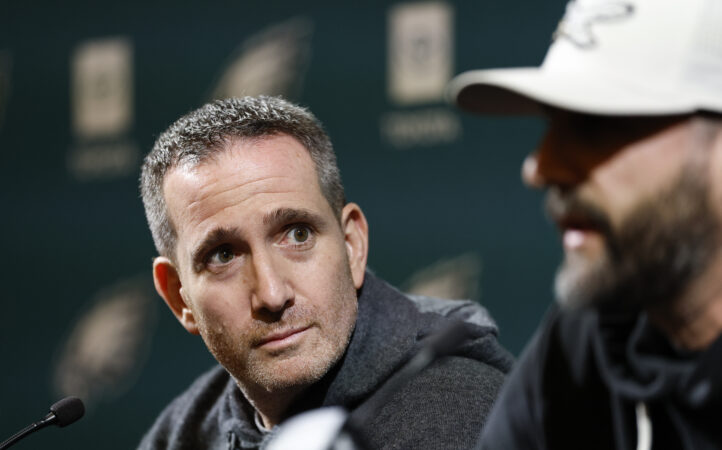
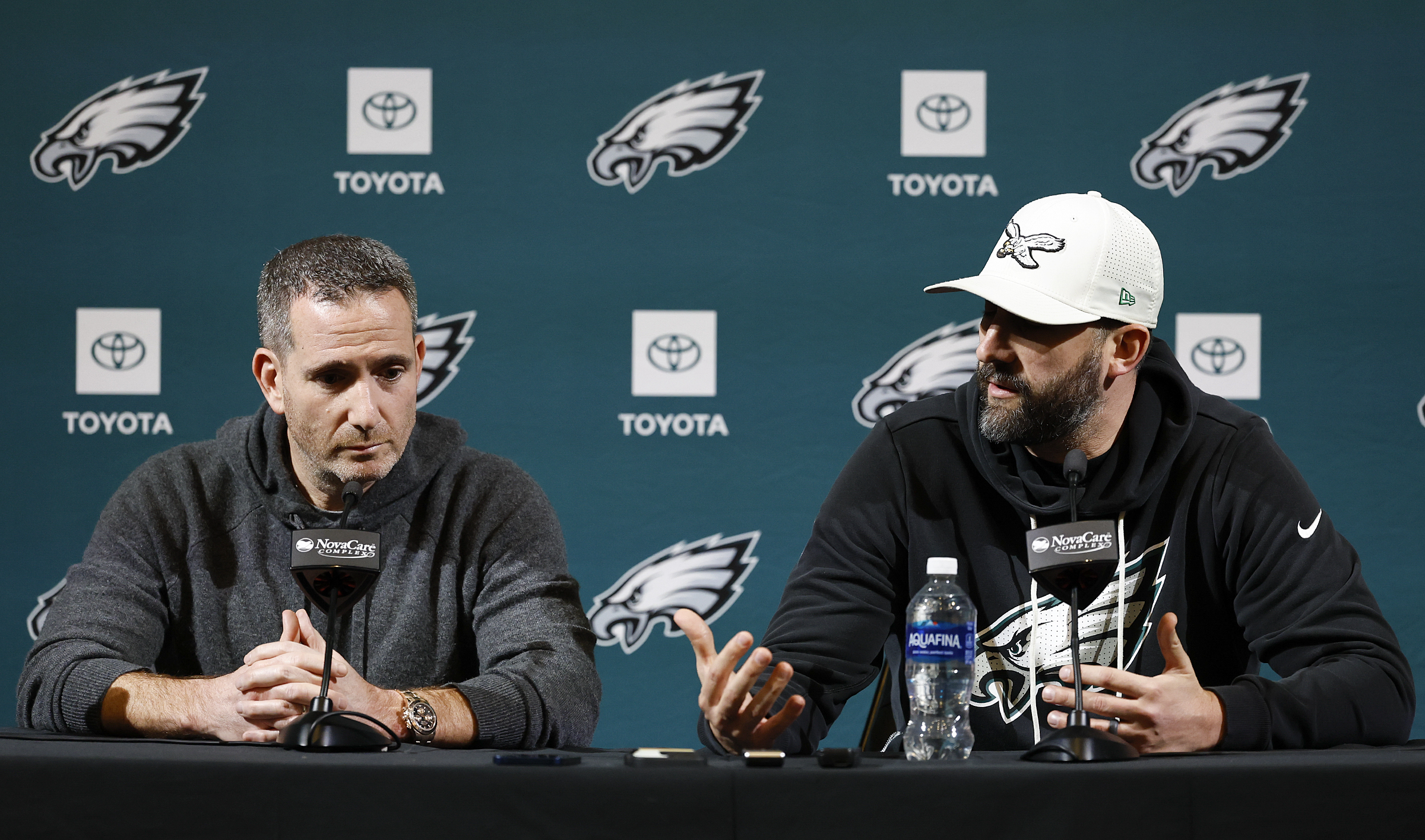
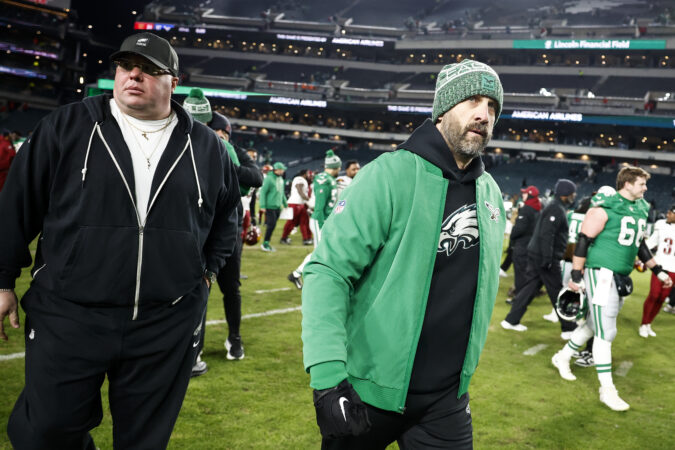
Take Howie Roseman, for instance. On Thursday afternoon, the Eagles general manager was sitting next to Nick Sirianni listening to the head coach wind down an answer to a question about the team’s search for a new offensive coordinator. As soon as Sirianni finished speaking, several reporters began talking over each other to ask the next question. But Roseman had something he wanted to add, and jumped in.
“I’ve got a lot of things I could say about coach and the job that he’s done here,” the general manager said. “I’m incredibly proud of him. He’s shown that when we bring people in he’s open to doing whatever’s best for this football team. That’s all he cares about is winning. When he’s brought in people he’s given them the flexibility to put their own spin on things. Obviously I sit here and I feel incredibly grateful that I’m working with someone who as a head coach is elite at being a head coach, elite at building a connection with our team, elite about talking about fundamentals, game management, situational awareness, bringing the team together, holding people accountable, and when you’re looking for a head coach those are really the job descriptions.”
The strongest votes of confidence are usually the unsolicited ones. It would be hard to interpret Roseman’s statement as anything else. Two years ago, the Eagles did Sirianni a disservice with the way they handled the fallout from their late-season collapse and one-and-done showing in the 2023 playoffs. From their decision to wait nine days to announce that Sirianni would return amid rampant speculation that his job was in jeopardy, to their external hunt for an offensive coordinator, the Eagles left the impression that the coach was being Office Spaced out of power. Not only was it an indignity, it led to an offseason full of distractions that easily could have metastasized during the Eagles’ 2-2 start to the 2024 season.
This time, Roseman made it a point to eliminate any doubt. As he should have. The Eagles are about to embark on an offensive coordinator search that could see them bring in any of a number of big name former head coaches who have their own schemes and, potentially, their own assistant coaches. During Thursday’s press conference, there were several questions about the level of autonomy the new offensive coordinator will have, including the one that prompted Roseman’s unsolicited amicus brief. If the Eagles felt like a clarification of the record was in order, now was the time to provide it.
It speaks volumes that Roseman took advantage of the opportunity, and that he did it forcefully. A coach needs all the political capital he can get, especially a coach who suffers from perception problems. Sirianni has brought some of those on himself with his occasional emotional regulation issues on the sidelines. But it was always a silly and unrealistic narrative to suggest he was the NFL coaching equivalent of a guy who stayed at a Holiday Inn Express last night. It was also willfully ignorant in a league where John Harbaugh and Mike Tomlin had been two of the most successful coaches of the modern era.
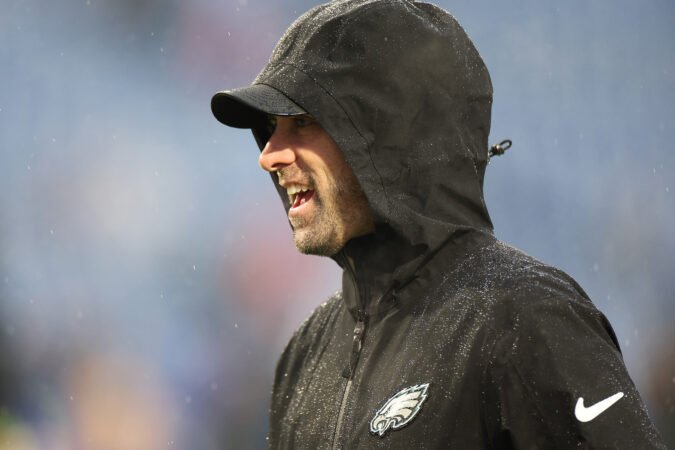
Howie Roseman and Nick Sirianni are charged with finding answers after the team fell short of its Super Bowl goal.
As for the exact nature of the Eagles coaching search, and their offseason personnel strategy, you’ll have to rely on your own deductive reasoning. There was little in the way of concrete answers from either Roseman or Sirianni regarding their vision for the Eagles offense.
— Roseman said the Eagles won’t necessarily be targeting an OC who they think could remain with the team for an extended period of time.
“It’s a great compliment when guys get head coaching jobs from here because it means that we’re having success,” he said.
— Sirianni was noncommittal when asked about his role — and his current assistants’ roles — in the future offense. Which is common sense. If the Eagles hire Mike McDaniel, in whom they reportedly have some interest, they will clearly hire him to be Mike McDaniel the same way they hired Vic Fangio to be Vic Fangio. That said, in most cases, game-planning and play-calling is a far more collaborative process than a lot of people seem to think. The Eagles have always valued that collaborative spirit, especially in the wake of the Chip Kelly era.
“I know that I want to be the head football coach and I think that’s what the team needs,” Sirianni said. “Everything that I’m doing isn’t because it’s what I want to do, it’s because it’s what’s best for the football team and I think it’s best for the football team when I’m the head football coach.“
— Speaking of reading between the lines, I’ll leave it to you, dear reader, to evaluate Roseman’s comments when asked about the possibility of trading star wideout A.J. Brown.
“It’s hard to find great players in the NFL and A.J.’s a great player,” Roseman said. “That’s what we’re going out and looking for, when we go out in free agency and the draft, is trying to find great players who love football and he’s that guy. So that would be my answer.”
I would qualify that wording as “careful” rather than explicit and definitive. But I do think it points to a general truth about the situation. It wouldn’t make a whole lot of sense for the Eagles to trade Brown unless they can somehow do it in a way where they replace him with an equal or better talent. The cost savings and draft pick return almost certainly won’t be enough to legitimize the move on that front. But if they can reap some sort of asset in a deal and also use the $7 million or so they’d clear with a post-June 1 move to add some other pass-catcher, it could make sense. But those are my words, not Roseman’s.
The worst kind of mob is the one that is displacing its aggression. Then again, maybe every mob is that kind of mob. The more unhinged the vitriol, the more concentrated its direction, the more likely it is driven by fears and frustrations that are much more difficult to reconcile than the ones that have bubbled to the surface. The easier the target, the more likely it is the wrong one. Because the fixes are rarely easy.
Kevin Patullo isn’t the first person to experience the downside of this city’s manic emotional instability when it comes to professional sports. He might be the first one to have his house egged, and he almost certainly is the first one to have his image offered as a target by a golf simulator company. But the general phenomenon is something that we see any time a Philly sports team underperforms expectations to the extent that the Eagles offense did this season. Frustration is a lot easier to process if you can convince yourself that it would not exist but for the gross incompetence of one person. It is even easier when that person has a job that is relatively easy to replace.
My point here isn’t to shame anybody. Actually, my point is to lobby the Eagles to spend whatever it takes to hire Mike McDaniel as their offensive coordinator. It’s a move that would give them a radical upgrade in play-calling and game-planning expertise and that would give them a fighting chance at reinventing a scheme that has stagnated under Patullo and Nick Sirianni and may be obsolete due to some serious personnel regression. But I also feel a little bit guilty expressing an opinion that legitimizes or adds to the unrestrained and oftentimes unthinking pile-on of poor Patullo that we’ve witnessed here over the last month-plus. It should be possible to criticize and/or question a person’s professional performance without disregarding the person part of it, especially when that person is someone who lives among us in the community and whose kids attend our schools.
I’m not suggesting that everybody, or even most people, have crossed the line into gratuitous abuse/humiliation. It sure feels that way in the aggregate, though. I don’t have a personal relationship with Patullo. If I did, I would certainly apologize to him on the city’s behalf. I actually think most people would do the same if they randomly found themselves talking to him one-on-one, maybe in an airport bar, or at their kid’s CYO game. I suppose that’s another funny characteristic of mobs.
I wasn’t going to bring up any of this. Mostly because I don’t want a mob to come after me. I know I’ll be accused of saying something I’m not actually saying, a common mob tactic that serves to stake out a defensible rhetorical position and reframe an argument into one that can actually be won. So, although it won’t matter, I will say it again. I agree with a lot of the criticisms of the Eagles’ offense, and that Sirianni’s decision to make a change at offensive coordinator is both warranted and necessary.
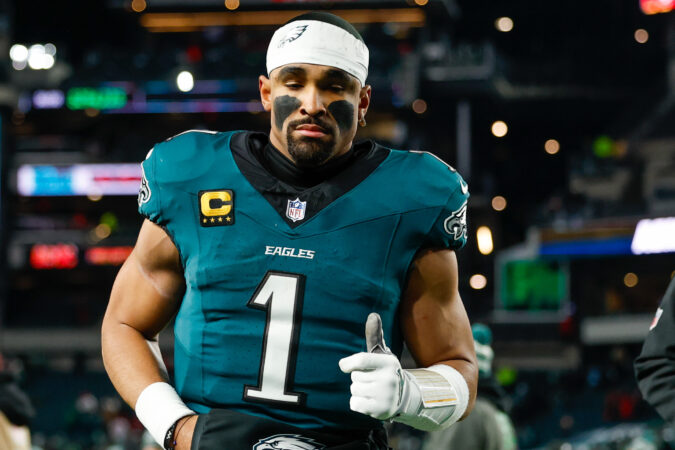
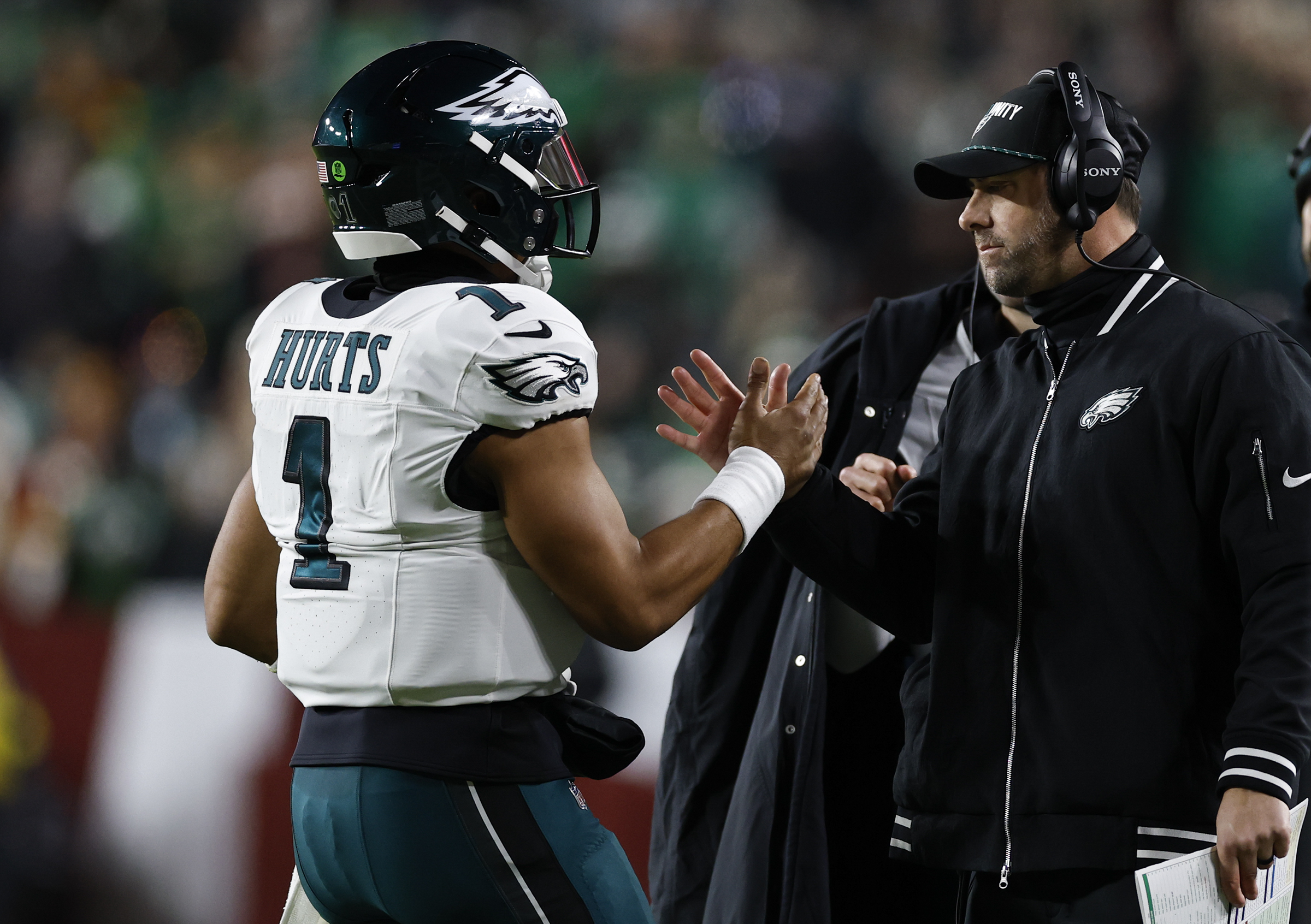
Kevin Patullo (center) talks with quarterback Jalen Hurts on Sunday in what was his final game calling plays for the Eagles.
That said, Eagles fans and media will be setting themselves up for a self-perpetuating cycle of offseasons like this one if they will not acknowledge the very obvious structural problems that exist well below the play-calling level on this Eagles offense. Even when this unit was at its best, it was trying to score points the same way it did under Patullo this season. The formula is the same as it was under Sirianni or Shane Steichen or Brian Johnson or Kellen Moore. The scheme and the personnel structure are built to stay ahead of the sticks with dominant run-blocking and to fill in the blanks with big plays from their elite talent at wide receiver and running back.
Listen to what DeVonta Smith said on Sunday when somebody asked him if the Eagles’ scheme needed to change after their season-ending loss to the 49ers.
“This the scheme that we’ve been in the whole time [since I’ve been here],” the receiver said. “Whatever anybody thinks, nothing changed. It’s the same scheme.”
Other players and coaches have said it countless times. Nobody seems to want to accept it. Yes, the Eagles have had four offensive coordinators in four seasons. And, yes, the offense was markedly worse this season than it was in the past. But it was the same scheme. It was the same philosophy.
The biggest difference between the Eagles offense this season and last season? On Sunday against the 49ers, Eagles running backs had eight carries that gained zero or negative yards. They had 20 such carries all last postseason, over four games. Eight on 30 carries against the dilapidated 49ers defense vs. 20 on 108 carries against the Rams, Packers, Chiefs, and Commanders last year.
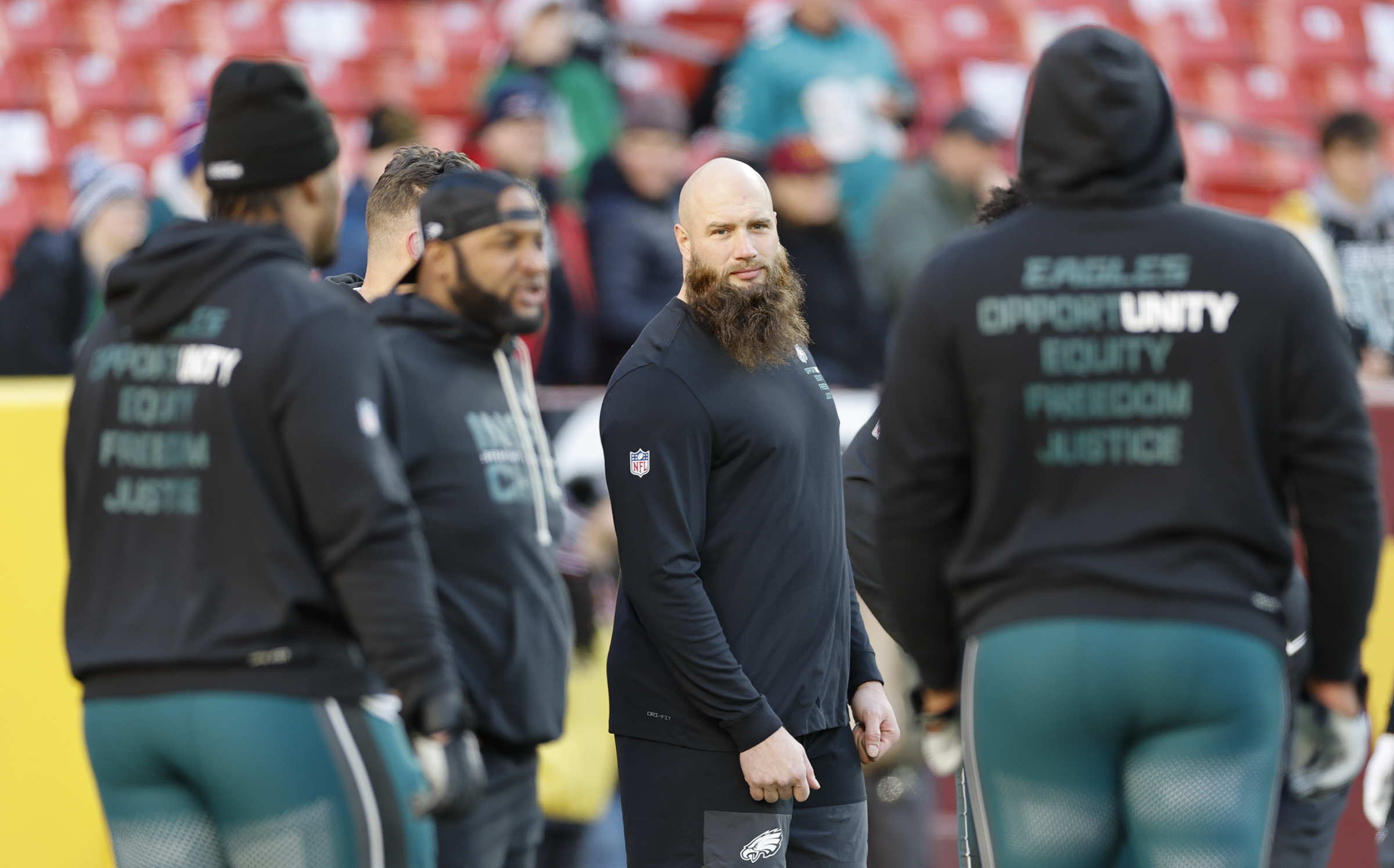
Lane Johnson, one of the NFL’s ultimate warriors, is battling a foot injury that kept him from playing Sunday. Landon Dickerson basically shrugged when somebody asked him if he could get his body back to where it was last season. Cam Jurgens was pushed around all afternoon against the 49ers.
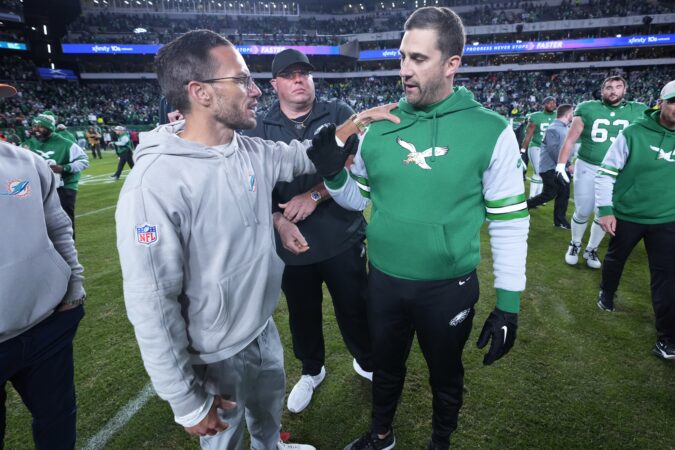
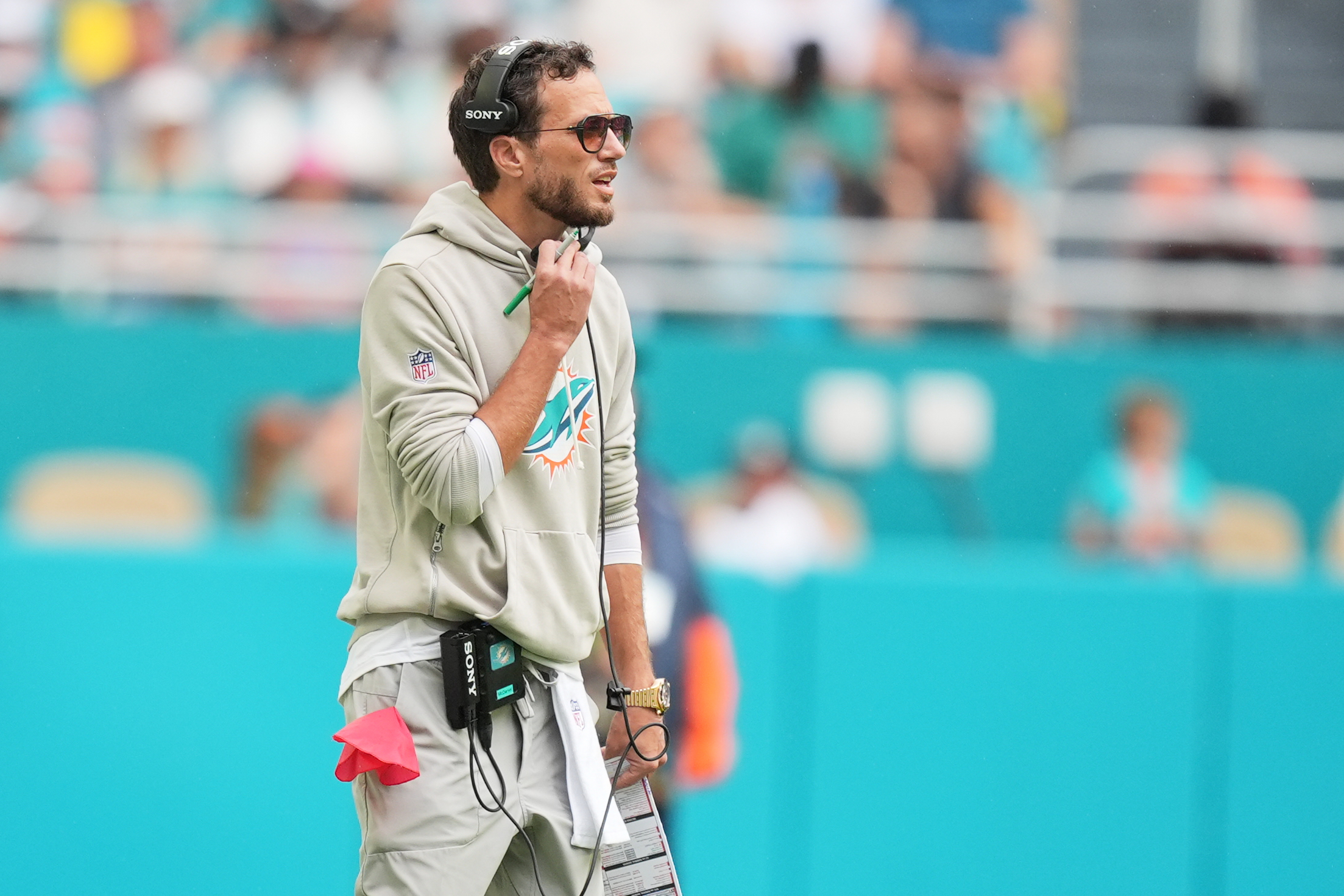
Mike McDaniel spent four seasons as Miami’s head coach and is a highly coveted candidate for several head coaching and offensive coordinator openings.
The Eagles’ only option is to bring in a fresh set of eyes and a proven track record of inventive run-scheming. They need to reinvent this offense, and McDaniel is the perfect mind to do it. Since he arrived in Miami in 2022, the Dolphins rank sixth in rushing average at 4.5 yards per attempt. He did this while also calling an offense that saw quarterback Tua Tagovailoa throw for 4,624 yards and go 11-6 in 2023.
There are all kinds of reasons to think it won’t happen. McDaniel is an eccentric personality who has spent the last four seasons with total control. Vic Fangio lasted less than one season as his defensive coordinator. McDaniel already reportedly has an interview scheduled with the Lions, who can offer him a good offensive line, excellent pass-catchers, and a running back that has the Devon Achane mold in Jahmyr Gibbs. That’s if McDaniel doesn’t land one of the remarkable nine head-coaching jobs that are currently open.
All the more reason for the Eagles to be aggressive. Howie Roseman and Jeffrey Lurie pride themselves on being ahead of the curve. They’d rather be a year early than a year late. Right now, it is getting late early. McDaniel or not, they need a new voice, an inventive mind, and a fresh set of eyes. Anybody else will end up right where Patullo is. And that’s not fair to anybody.
Multiple things can be true at the same time. They usually are when a team’s season ends the way the Eagles’ did on Sunday.
It takes a special kind of bad to lose this limply. It is a collective bad, an existential bad, a bad that raises all kinds of hard questions that a team must confront head-on and wrestle with in the darkness. That is true even of a team that is less than a year removed from winning a Super Bowl. In fact, it is especially true for such a team.
The bad that the Eagles were in a 23-19 loss to the 49ers is a disconcerting bad. It is a bad that shakes you to your core, a bad so bad that you spend an entire season desperate to disbelieve it.
More than anything, it is a bad that is nearly impossible to achieve if your quarterback is doing the things he needs to do.
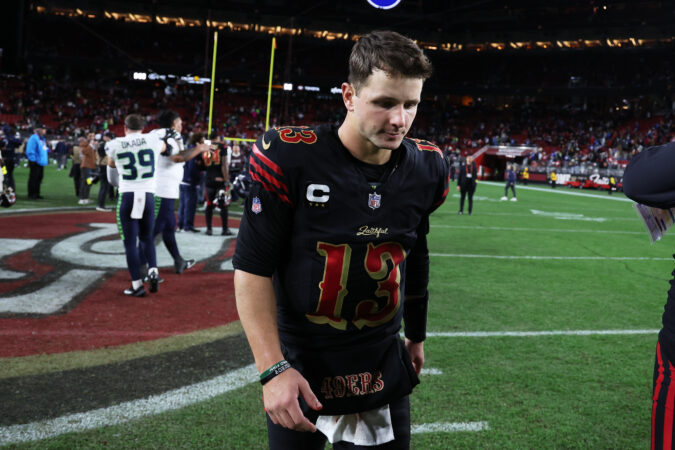
Jalen Hurts did not do those things for the Eagles on Sunday. His counterpart did them for the 49ers. That is why the Eagles are headed home. It is why the 49ers are headed to Seattle. The difference in this particular playoff game was the same as it is in most of them. One team had a quarterback who rose above his circumstances. The other did not.
“It starts with me and ends with me,” Hurts said afterward.
Whether or not he truly believed those words, he was correct.
A team that cannot, or will not, put pressure on a defense in the intermediate-to-deep part of the field is a team whose luck will eventually run out. Whether Hurts can’t or won’t doesn’t matter at this point. He didn’t, and that’s that. He completed just three passes that traveled more than 10 yards in the air, on 11 attempts. Those three completions gained a total of 38 yards. He was 17-for-20 on his short throws.
Compare that to Brock Purdy, who was dealing with an offense that lost its last blue-chip pass-catching weapon when tight end George Kittle tore his Achilles tendon with six minutes left in the second quarter. The game should have been over then, one of several moments when that was the case. That it wasn’t is largely a testament to Purdy, whose poise and patience and intentionality were on display against an Eagles defense several calibers above that of the practice-squad Niners.
San Francisco’s game-winning 66-yard touchdown drive late in the fourth quarter featured a 16-yard completion to Demarcus Robinson and a 5-yard scramble, both for first downs, to help set up his 4-yard touchdown pass to Christian McCaffrey with just under three minutes remaining. A couple of possessions earlier, he found fullback Kyle Juszczyk of all people for a 27-yard gain that set up a trick play touchdown on an end-around pass from wide receiver Jauan Jennings to McCaffrey.
There was a 14-yard pass to backup tight end Jake Tonges on third-and-14 late in the second quarter, a 45-yarder to Jennings earlier in the period, and a 61-yarder to Robinson that set up a touchdown on the 49ers’ opening drive.
Purdy’s numbers on throws longer than 10 yards: 8-of-13, for 178 yards. His two interceptions were the cost of doing business.
“You’ve got to be able to be explosive,” Eagles coach Nick Sirianni said. “It’s really hard to dink and dunk down the field. It’s really hard to get behind sticks with negative plays. You’ve got to be able to create explosives. Again, at the end of the day, there were a lot of elements [where] you end up with a loss, and we haven’t had this feeling of ending our season since 2023 with the loss. That’s why it hurts because it’s been a while. But yeah, at the end of the day, we need to find ways to be more explosive. Again, that starts with me.”
Sirianni is right. Everything starts with him. But it ends wherever the quarterback takes it. The ball is in his hands. The clock is in his head. He is the one who decides how long to continue looking down the field. Whatever the game plan, whoever the play-caller, a quarterback almost always has the ability to force the issue. That’s especially true for a quarterback with Hurts’ ability to buy time and gain yards with his legs. He gained 14 yards on five carries against the 49ers. Purdy gained 24 on nine.
“Well, I think finding a rhythm and whatever you define aggression as, maintaining the fluidity and the flow throughout four quarters of the game, so I think there’s opportunity for us to improve in that,” Hurts said. “Just finding a rhythm. Ultimately it is just all something that you either learn from it or you don’t.”
One thing people lose sight of while focusing on the play-calling is that the quarterback sets the rhythm. He is the orchestra conductor. The great offenses are almost always a reflection of their quarterback. It wasn’t Tom Moore’s offense or Todd Haley’s offense or Charlie Weis’ offense: it was Peyton Manning’s and Ben Roethlisberger’s and Tom Brady’s. It’s no coincidence that the energy of this Eagles offense as a collective often resembles Hurts’ individual demeanor.
Nobody should have to apologize for pointing out these things. High standards are not unfair. The only way to fix an offense as bad and boring and listless as the Eagles’ is to be unflinchingly honest about its component parts. The quarterback is inseparable from the play-caller. The right guy for the second job is a guy who can make it work with the guy in the first one. The next Eagles play-caller will be getting a quarterback who does not have elite size, or arm strength, or pocket presence, and who no longer makes up much of that difference with his ability to create on the run.
Hurts didn’t get much help from his pass-catchers on Sunday. He didn’t get as much help from his play-caller as Purdy got from his. The Eagles will need to fix both of those things this offseason. Hurts isn’t, and shouldn’t be, going anywhere.
That said, Hurts is who he is. Who he was on Sunday is the guy he has been all season, and most of the last 2½ seasons, if we’re being honest. It worked when the Eagles had an overwhelming talent advantage at all of the other positions. If that is no longer the case, they need to figure out a new formula.
With all due respect to Ralph Waldo Emerson, a door can be a wall sometimes, too.
Take poor Kevin Patullo, for instance.
The goal of every NFL assistant on either side of the football is to eventually land a coordinator gig. It can be a tough slog. In addition to the long hours and relative anonymity, a position coach must contend with the weight of the knowledge that his fate is only partially within his control. There are a lot of positions on a football team, and only so many ways to distinguish oneself from his peers. At times, a promotion to play-calling duties can feel more like a function of internal politics and personal relationships than good old-fashioned gridiron merit.
Last February, after climbing the coaching ranks for two decades, Patullo finally got his chance to hold the laminated play sheet and talk into the magic microphone. Two of the last three men to hold the position with the Eagles had landed head coaching gigs within a year. His door had finally opened. All Patullo had to do now was repeat as Super Bowl champion and make sure a historically great running game didn’t take a step backward despite a short offseason and a tougher schedule and another year of age tacked on to a veteran core that had remained uniquely healthy in 2024.
Jalen Hurts and the Eagles offense have sputtered under coordinator Kevin Patullo.
I’ll pause here to acknowledge the counterargument from Eagles fans.
Boooooooooooooooo!
Point taken. I’m not trying to paint Patullo as Gavroche in a headset. But I do wonder sometimes if he feels a little bit like Wile E. Coyote trying to run through a tunnel.
The Eagles offense took a lot of well-deserved heat during the regular season. Patullo has overseen a unit that fell from seventh in the league in scoring under Kellen Moore in 2024 with 463 points to 19th with 379 points. The Eagles likewise saw a significant drop in total yards, from eighth in the NFL to 24th, and yards per play, from 11th to 22nd. But the numbers also say that the bulk of the decline in overall production is attributable to something other than the passing concepts that have become the rage bait of choice of every amateur internet film sleuth with an NFL+ subscription. The Eagles offensive line was unsustainably dominant last season. This year, that dominance has not been sustained.
You can see it with your eyes. The numbers will back them up. Last season, Eagles rushers averaged 3.2 yards before contact, as good of a common statistical measure as there is for judging run-blocking. This year, they have averaged 2.6 yards. The difference between those two numbers is basically the difference between their overall yards-per-carry average last season and this year. They averaged 1.7 yards after contact in 2024, and 1.6 yards after contact in 2025.
Once can certainly argue that the selection and sequencing of plays can have an impact on an offensive line’s ability to block. One can also argue that the best coordinators are counterpunchers. What worked for a team last year, against last year’s opponents, may require adaptation in order to fit the present reality. But one can’t argue that the best coordinators can turn Fred Johnson into Lane Johnson, or Tyler Steen into Mekhi Becton. Nor can they fix whatever physical ailments have limited players like Landon Dickerson and Cam Jurgens.
The absence of star tackle Lane Johnson with a foot injury has not helped the Eagles offense.
Patullo certainly has a role in overcoming these things. I’m just not convinced that this year’s offense would look any different if Moore had remained at coordinator.
The pertinent question for Patullo and the Eagles now is what the offense will look like moving forward. This is a weird time of year. Sunday’s wild-card game against the 49ers could be the start of a month of football that leaves us memory-holing our four months of angst. Or, it could be the start of the offseason, and a litany of questions that sound way closer to January 2024 than January 2025.
The 49ers are something of a fresh start for Patullo. A new opportunity. The offensive line is rested. Lane Johnson is expected to be back. The Eagles have essentially had two weeks to prepare for the playoffs after their conscious mailing-in of Week 18. The opponent is ripe for a statement. The 49ers defense is a legacy unit that right now looks a lot closer to Hewlett Packard than Apple.
The Niners are a lot worse than even those of us who know how bad they’ve been probably realize. They finished the regular season with one of the NFL’s 10 worst defenses in yards per play (5.6, 22nd), net yards per pass attempt (6.5, 23rd) and turnover percentage (8.4, 23rd). The overall numbers looked good in Week 18 against the Seahawks, but Seattle punted once and twice had the ball inside the 10-yard-line and walked away with no points. All told the Seahawks left at least nine points and more accurately closer to 13 on the field. This, in a game when they only really had seven possessions.
Over the last four weeks, the 49ers have allowed 138 yards on 17 carries to Tony Pollard and Tyjae Spears, 92 on 17 to D’Andre Swift and Kyle Monangai, and 171 on 33 to Kenneth Walker and Zach Charbonnet. Bryce Huff is starting for them. Enough said.
Patullo needs this one.
Potential replacements are no doubt keeping a keen eye. Mike McDaniel, the former 49ers offensive coordinator recently fired by the Dolphins, is one of the best run-game schemers in the league. Since he arrived in Miami in 2022, the Dolphins rank sixth in the NFL rushing average at 4.5 yards per attempt. Kliff Kingsbury, who recently parted ways with the Commanders, led an offense that ranked third in the NFL in yards per carry in his two seasons at the helm. That includes 5.4 yards per attempt this year, despite missing Jayden Daniels for much of it.
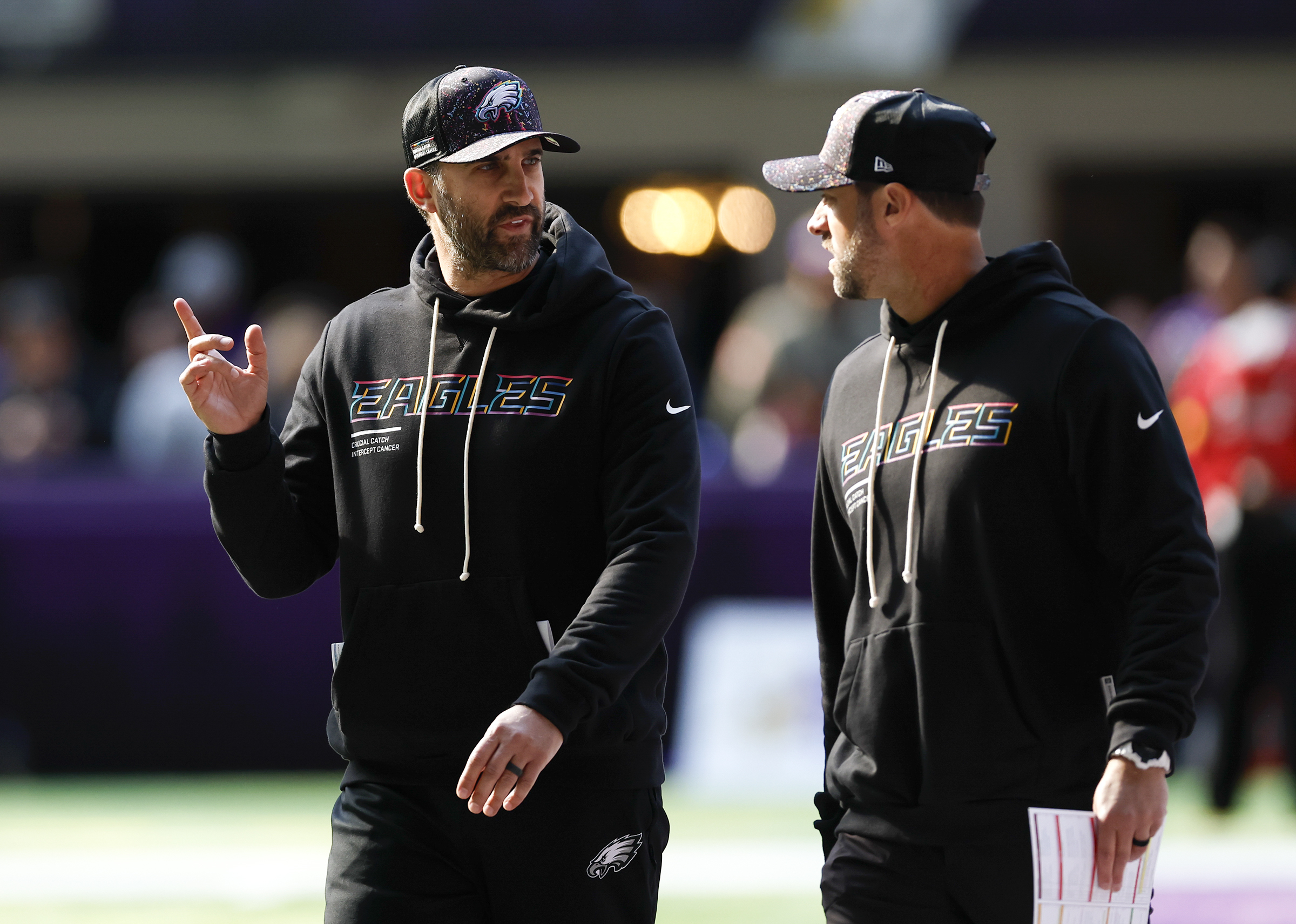
Coach Nick Sirianni with offensive coordinator Kevin Patullo before the Eagles played the Minnesota Vikings on Oct. 19.
The Eagles moved decisively at the coordinator position in 2023. With four losses in their last seven regular-season games and a wild-card loss, 2025 would look different only in the level of drama that accompanied a late-season swoon.
The Eagles are better than the 49ers. They need to be a team that scores plenty of points against this sort of opponent, in this sort of situation. This is a time of year when the scoreboard matters much more than individual coaching careers. Sunday will matter for both.
There is a long list of reasons that you shouldn’t waste your daydreams on visions of Bo Bichette wearing red pinstripes and hitting behind Bryce Harper. The Phillies’ reported interest in the Blue Jays star only barely distinguishes them from the 29 other major league teams that likewise are interested in signing very good baseball players at the right price. Interest is not a differentiator. You can’t buy a Bentley with affection.
Circumstance, context, and logic suggest that Bichette will end up signing elsewhere. And that’s great if you’re into those things. The rest of us will be over here indulging ourselves. On the 12th day of Christmas, the New York Post’s Jon Heyman gave to us a vaguely worded, thinly sourced report connecting the Phillies to a big-ticket free agent. What are we supposed to do? Underreact?
The least we can do is try to proceed with some level of dignity and decorum. This often is easiest to do under the guise of asking questions. There are no dumb questions, only dumb questioners, right? So let’s fire away.
The Phillies already have a shortstop in Trea Turner. Presumably, Bo Bichette would move to second base in any scenario that brought him to Philadelphia.
Only a few weeks ago, Dave Dombrowski sounded like a man who didn’t expect any more major additions to his roster. What would have caused that to change? Is Bitcoin about to spike again?
This is the however-many-million-dollar question. Five weeks out from pitchers and catchers reporting, the roster looks pretty close to set. Ken Rosenthal of The Athletic reported Monday that the Phillies still were in the market for another right-handed-hitting outfielder, which is encouraging, because they really could use a viable Plan B in case Justin Crawford turns out to be late-stage Juan Pierre or Ben Revere. They don’t need anything major. Veteran Randal Grichuk, whom the report mentioned specifically, would make a lot of sense. Otherwise, there isn’t an obvious opening that would compel the Phillies to make an offer with the sort of necessity premium that often distinguishes a winning bid from the rest.
One thing that may have changed is Dombrowski’s evaluation of the market. Not much has happened since the last time he spoke. Not only do most of the major free agents remain unsigned, we aren’t even seeing smoke. Bichette, Cubs outfielder Kyle Tucker, Red Sox third baseman Alex Bregman, Yankees outfielder Cody Bellinger, Mariners third baseman Eugenio Suárez, not to mention Ranger Suárez and the rest of the starting pitchers … the complete lack of movement at the top of the market is abnormal.
We’ve seen slow-moving markets before. But there is some reason to believe that this one is reaching a point of collapse. The money may not be out there this year. Virtually all of the big-market teams already are at or above the luxury tax threshold with the money on their books. Last year, the Phillies were at a disadvantage because teams like the Mets, Red Sox, and Cubs were in payroll expansion mode. Other teams simply had more money to spend than they did. That may not be the case this year.
The Cubs still are a potential market maker, with roughly $80 million in space before the first luxury tax threshold. It shouldn’t surprise anybody if they make a flurry of moves that alters the current narrative about the NL landscape. Same goes for the Mets, who presumably have whatever money they would have paid to Pete Alonso and Edwin Díaz before both signed elsewhere. The Orioles are always lingering. The Blue Jays are pushing $300 million but seem to be operating with the taste of blood in their mouths. So there still is plenty of reason to doubt that the Phillies can win via aggression.
But there are a lot of players out there. And there don’t seem to be the usual dark-horse lurkers among the midmarket clubs. It’s worth noting the situation in Minnesota, where the Twins are shedding payroll as if they need to make rent. The middle class might be content to sit this one out, especially with next year’s labor talks looming.
Bo Bichette was an MVP-level hitter after he broke out of an extended slump last season.
So Bichette might be more affordable than the Phillies thought?
Yes and no. It’s awfully hard to project a contract for a player who is an anomaly in terms of his age (only 28 this season), career production (24 home runs per 162 games and 121 OPS+) and pedigree (Dante Bichette’s kid), but who also is less than a year removed from a brutal 18-month stretch in which he posted a .651 OPS in 651 plate appearances. Trea Turner’s career numbers were nearly identical (minus the steals) when the Phillies signed him to an 11-year, $300 million contract heading into his 30-year-old season. FanGraphs had Bichette projected at seven years and $189 million entering the offseason. ESPN recently updated its projection to five years and $150 million. If that second number is close to reality, the Phillies may well readjust their expectations.
What’s this about Bichette posting a .651 OPS in 651 plate appearances? Isn’t that a concern?
It is. But it also might be an opportunity, if other teams are worried. Once he snapped out of his funk early last season, Bichette was an MVP-level hitter. In his last 102 games, he hit .325/.372/.528 with 17 home runs. From the right side of the plate. While playing middle infield. He has always had the kind of skill set scouts drool over. Bichette’s contact rate ranked in the top 20% of qualified hitters last season. At 83.2%, it would have ranked third among Phillies regulars, behind Alec Bohm (87%) and Bryson Stott (86.1%). His chase rate also ranked at the high end of the spectrum — in a bad way. Only 18 qualified hitters chased more often: Bichette’s 37.9% ranked just behind Bryce Harper (38.1%).
That said, Bichette did make some steady progress last season. It’s fair to wonder if he emerged from his slump as a different hitter. Only 10 hitters in baseball had a lower strikeout rate after the All-Star Break — his 11.1% was a dramatic improvement over an already-solid roughly 15%. He coupled that with a huge boost in his walk rate, from an anemic 5.5% to a slightly-better-than-average 8.8%. If the Phillies think they can get a $250 million player for $175 million, that might change things.
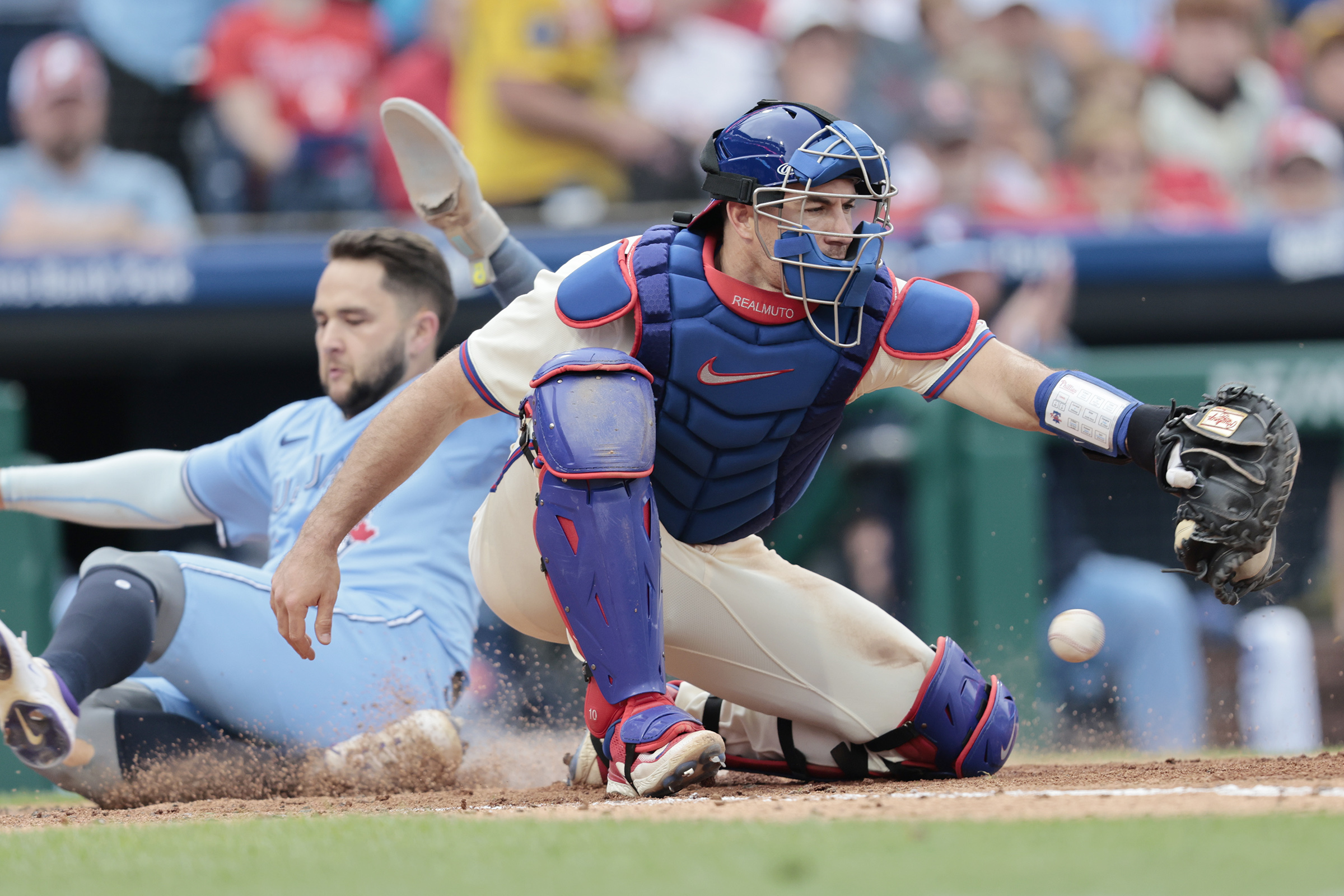
Bo Bichette scoring a run for the Blue Jays in June as Phillies catcher J.T. Realmuto tries to catch the throw.
Why wouldn’t the Blue Jays just match any offer?
I guess Christmas is over, isn’t it? Assuming Bichette likes Toronto, which seems to be the case, and the Blue Jays are willing to spend, which seems to be the case, the Phillies presumably would need to land Bichette the old-fashioned way: by guaranteeing him more than anybody else is willing to guarantee him. They have close to $60 million coming off the books next season and theoretically would be able to accommodate another big deal, biting the bullet on the luxury tax this season while freeing up $15 million to $20 million by trading Bohm and Edmundo Sosa and finding someone to pay a little bit of Nick Castellanos’ salary.
But, then, we’d be back where we started. Realizing that Bichette probably won’t be here.
You can rationalize it all you want. No, really, you can. There are lots of reasons to believe the Eagles won’t live to regret the decisions they made in Week 18.
To shrug their shoulders at the No. 2 seed.
To go against everything that Nick Sirianni and his coaches have preached throughout their tenure with the Eagles: that the most important Sunday is the current one.
To do what no other team chose to do this weekend and rest their starters when a potential home playoff game was on the line.
Sure, there are reasons. If the Eagles can’t beat an injury-depleted 49ers team at home like the Seahawks did on Saturday and then beat an inexperienced Bears team on the road like the Lions did on Sunday, then they don’t deserve to be in the Super Bowl. Even with the No. 2 seed, they would have lost somewhere along the line … probably not to the Packers or Bears at Lincoln Financial Field, but certainly to the Seahawks in Seattle or the Rams at home.
Right?
The more you talk it out, the sillier it sounds, which is why all the rationalizations in the world can’t change the cold, hard truth. If the Eagles would have beaten the Commanders on Sunday, their odds of repeating as Super Bowl champions would have been better than they are now. Now, after an ugly 24-17 loss to Washington that should quell all that talk of Tanner McKee being traded for premium draft capital, the Eagles will enter the postseason as the third-seeded team in the NFC. They will play the depleted but pedigreed 49ers instead of the depleted and not pedigreed Packers. Then, they will likely either travel to Chicago or host the dangerous Rams, instead of hosting the Bears.
Could everything break in their favor? Sure. If the Packers upset the Bears next weekend, and if the Panthers upset the Rams next weekend, the Eagles would essentially be where they would have been as the No. 2 seed. In that case, the top-seeded Seahawks would host the seventh-seeded Packers and the Eagles would host the Panthers for the right to advance to the NFC championship. But, then, if the Packers upset the Bears and the Rams beat the Panthers, the Eagles would be hosting the Rams in a rematch of their Week 3 game, which saw the Rams jump out to a 26-7 lead and eventually lose on a blocked field goal.
Essentially, the result of the Eagles’ loss to the Commanders on Sunday was to bring into play the possibility of a second-round matchup with the Rams, in addition to the possibility of traveling to frigid Soldier Field rather than hosting the Bears.
If chalk prevails elsewhere — the Rams opened as 10.5-point favorites against the Panthers, the Bears as 1.5-point favorites against the Packers — the Eagles have a manageable road to the NFC championship. There’s a decent chance they’ll be the betting favorite in any situation other than a road game in Seattle or a home game against the Rams. And they might also be favored against the Rams. The difference now is that, barring upsets, there is no easy road. They are a better team than the Bears on a neutral field, their Black Friday loss notwithstanding. But their offensive struggles have been exacerbated in suboptimal conditions — at Buffalo, at Green Bay, home against the Lions. The conditions at Soldier Field in January are rarely optimal. The Eagles will be better than they were, assuming they have a healthy Jalen Carter and a healthier Lane Johnson. But playing on the road creates far more uncertainty.
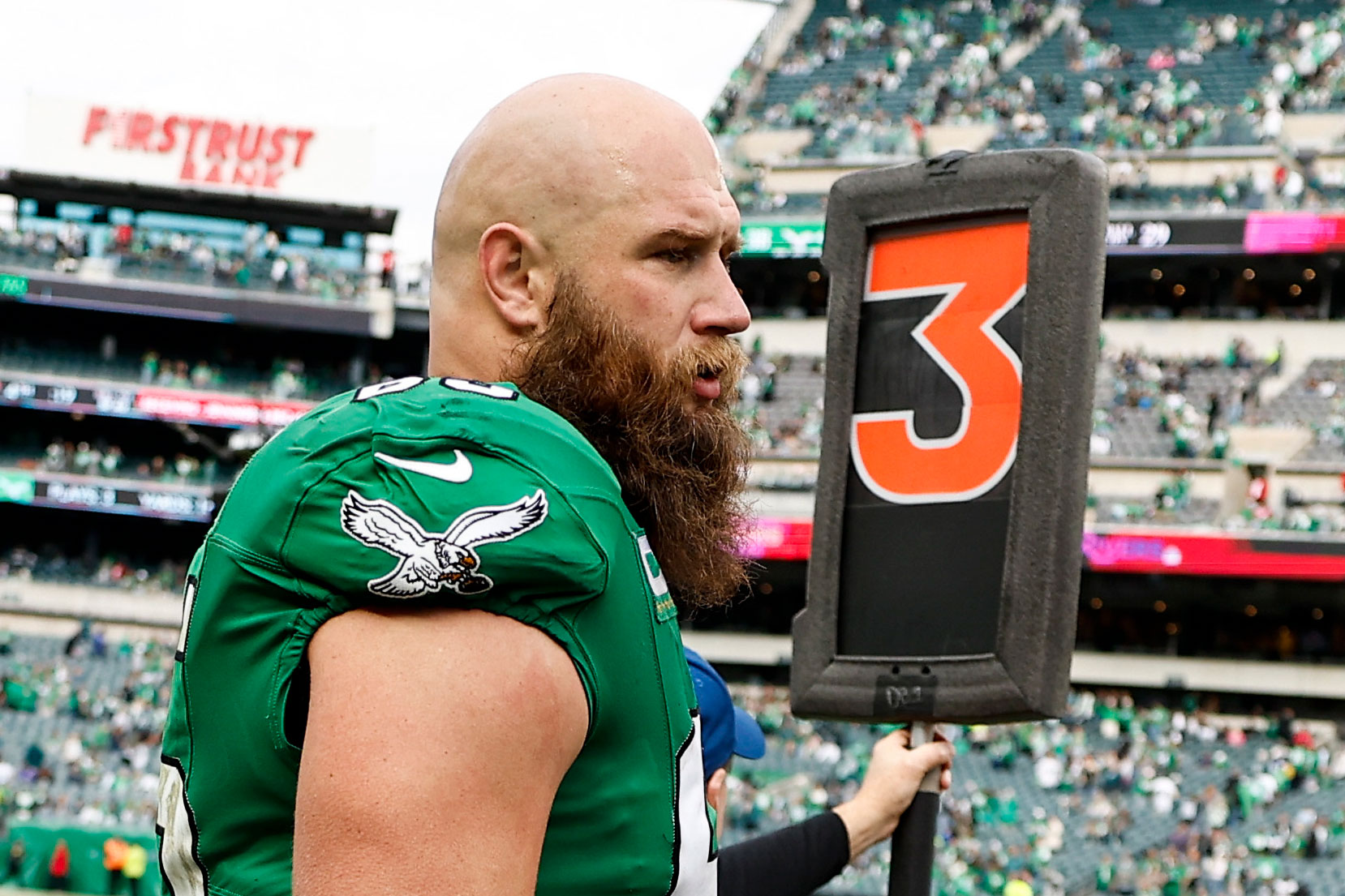
The expected return of tackle Lane Johnson gives the Eagles plenty of optimism for a repeat.
As for the 49ers, well, they figure to be a tougher test than the Packers. Kyle Shanahan is one of the brightest offensive minds in recent NFL history. He, Brock Purdy and the rest of the 49ers will derive plenty of motivation from the memory of their quarterbackless playoff loss to the Eagles three years ago. That being said, this 49ers team is far different from the one that destroyed the Eagles — and catapulted Dom DiSandro to celebrity status — at Lincoln Financial Field late in 2023 en route to its own Super Bowl. The defense is in shambles, absent longtime stalwarts Fred Warner at linebacker and Nick Bosa on the edge. The Niners have little pass-catching talent outside of tight end George Kittle and running back Christian McCaffrey. As long as the Eagles can stop the run, they should be fine.
At the end of the day, the Eagles are still a team that everybody must take seriously. Even as the No. 2 seed, they would have likely needed to beat Seattle on the road or the Rams at home in order to advance to the Super Bowl. They still have the third-best odds at winning the NFC, according to the online sportsbooks.
You just have to wonder. If Sirianni knew that the Lions would beat the Bears on Sunday, and that his Eagles only needed to beat the Commanders to secure the No. 2 seed, would he have done anything differently?
These aren’t the Niners of old. They aren’t even the Niners of two years ago.
That’s good news for the Eagles, who moved one step closer to facing San Francisco in the opening round of the playoffs after the 49ers fell to the Seahawks, 13-3, on Saturday night. Seattle’s victory in the first batch of Week 18 games brought the NFC playoff picture into clearer focus. The Seahawks have clinched the No. 1 overall seed, thus earning themselves an opening round bye and a home game in the divisional round against the lowest-seeded team to survive. That team will not be the Eagles, who cannot face Seattle until the NFC championship game.
This was the outcome Birds fans should have been rooting for on Saturday night. Had the 49ers won, the Eagles would be standing on the precipice of an opening-round matchup against the Seahawks or the Rams, the two most impressive teams in the NFC during the regular season. The only other scenario would have required them to beat the Commanders and the Bears to lose to the Lions, thereby giving the Eagles the No. 2 seed and an opening round matchup against the seventh-seeded Packers. (That scenario remains on the table entering play on Sunday.)
The Eagles could still face the Rams, who outplayed them in the regular season before the Eagles pulled out a 33-26 win on Jordan Davis’ blocked field-goal return for a touchdown at the buzzer. In order to avoid them, they need the Rams to beat the Cardinals today, thereby clinching the No. 5 seed and knocking San Francisco down to No. 6. A Rams loss to the Cardinals would mean an Eagles-Rams rematch at Lincoln Financial Field next weekend. Keep in mind, the Cardinals have lost eight straight games and 13 of 14 since a 2-0 start.
To recap the three scenarios in play:
Scenario 1: If the Eagles win and Bears lose, the Eagles get the No. 2 seed and an opening-round game against the Packers.
If the Eagles lose OR the Bears win, then the Eagles get the No. 3 seed and …
Scenario 2: If the Rams beat the Cardinals, the Eagles face the 49ers.
Scenario 3: If the Cardinals beat the Rams, the Eagles face the Rams.
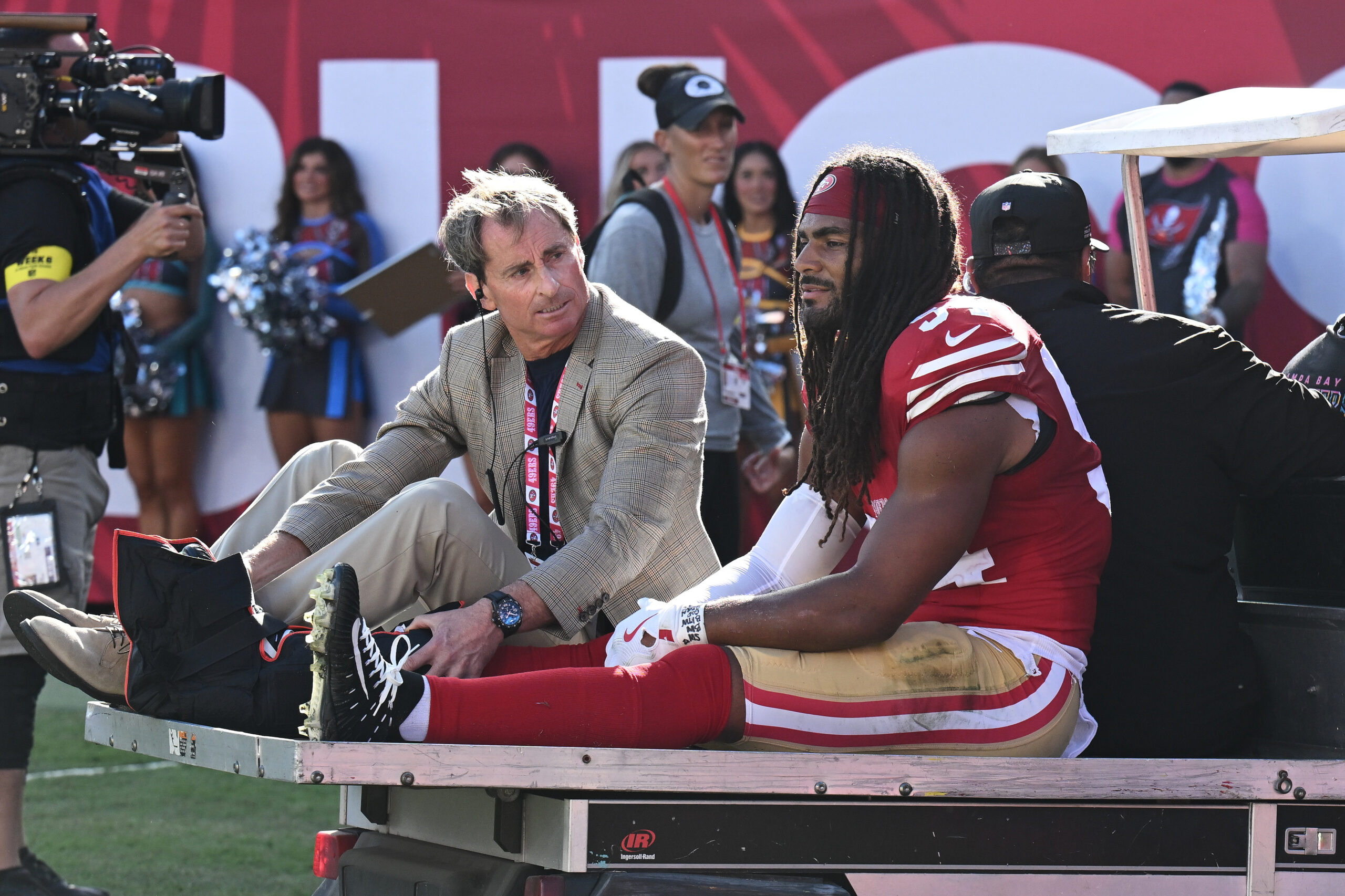
The 49ers are the clear preference over the Rams. San Francisco has been ravaged by injuries on the defensive side of the ball, with all-world linebacker Fred Warner and defensive end Nick Bosa both lost for the season. The Niners suffered two more injuries Saturday night, in fact, with linebackers Dee Winters and Tatum Bethune both leaving and not returning.
Middle linebacker Fred Warner is among the key 49ers who are injured with the playoffs set to begin.
The 49ers are still dangerous. They showed that with their 42-38 shootout win over the Bears in Week 17. But they also showed Saturday night that they can struggle against a top-tier defense. San Francisco gained just 173 yards and posted nine first downs against the Seahawks. A big variable is All-Pro tackle Trent Williams, who missed Saturday’s game with a hamstring injury after being questionable to play.
The 49ers were no match for the Seahawks’ power running game, allowing 180 yards on the ground. It was the sixth time this season they allowed an opponent to gain at least 360 yards of total offense.
The Eagles certainly wouldn’t be looking past a playoff game against the 49ers. But it was and is the best of the likeliest options.
You never see the biggest stories coming. That’s kind of by definition, isn’t it?
The year 2025 was relatively quiet one as far as seismic activity goes. The Sixers’ arena switcheroo probably was the biggest pure news story next to the Eagles’ Super Bowl win. Compare that to 2024, in which Saquon Barkley and Paul George signed, Jason Kelce retired, Matvei Michikov arrived, and the Sixers went belly-up. That, in addition to Carter Hart being arrested, Cutter Gauthier forcing a trade, and Haason Reddick being traded.
It’s impossible to say whether the earth will shake in 2026. But if it does, here is how it could happen:
1. Lane Johnson announces his retirement after 13 NFL seasons and leaves the Eagles scrambling.
At this point, nothing suggests that Johnson will seriously consider retiring after the season. The contract extension he signed last year tacked on $40 million in guarantees in 2025 and 2026. That’s a pretty good reason for Eagles fans to take comfort, especially if Johnson returns to the field for the postseason, as is expected. He’d be walking away from some serious money if he retired this offseason.
At the same time, we’d be foolish not to at least acknowledge the possibility, given the dramatic implications it would have on the Eagles’ roster. Johnson has been the single biggest reason the Eagles have seamlessly bridged their competitive teams through a rotating cast of quarterbacks and head coaches. There will be no replacing him, at least not immediately.
Johnson has been open about the punishment that the NFL has inflicted upon his body over the years. That’s worth noting after a regular season in which he missed seven games because of injury for the first time since 2020 and just the second time in his career.
At 35 years and 239 days, Johnson is the second-oldest offensive lineman to play at least 300 snaps this season. Only Kelvin Beachum has him beat at 36 years, 207 days. Since 2015, only seven offensive linemen have a season of 12-plus starts at age 36 or older.
Eagles wide receiver A.J. Brown shown after making a catch against the Bills on Sunday in Buffalo.
2. A.J. Brown gets traded for a conditional 2027 second round pick that can become a first; Eagles immediately invest in a replacement.
Forget about Brown’s public grumbling for a moment. Consider instead this fact: In the 10 games in which Brown has seen eight or more targets, the Eagles are 5-5. In the five games in which he has seen fewer than eight targets, the Eagles are 5-0. Kind of strange, isn’t it?
Correlation doesn’t equal causation, but Brown’s on-field performance clearly has dipped this season. In his first three years with the Eagles, he looked like a receiver who belonged in the conversation for best in the sport. That hasn’t been the case this season. The explosiveness, the burst, the strength at the point of attack and in the air appear to be diminished. The numbers reflect it. His 8.3 yards-per-target is down nearly 20% from 2022 to 2024 (10.3), as is his yards per reception (12.9, down from 15.4) and his catch percentage (52.1, down from 56.3).
Brown is at an age at which decline can come fast at the wide receiver position. Cooper Kupp hasn’t broken 850 yards in a season since turning 29. Same goes for Brandin Cooks and Odell Beckham Jr.
DeAndre Hopkins averaged 1,380 yards per season from 25-28 years old and 644 yards at 29-30 years old. Adam Thielen averaged 6.4 catches and 82.8 yards per game at 27-28 and 4.2 catches and 53.7 yards at 29-30.
Alshon Jeffery, Allen Robinson, Michael Thomas, Tyreek Hill … the list goes on. For Antonio Brown, Julio Jones, Amari Cooper, Stefon Diggs, and Antonio Brown, the drop-off came at 30 or 31.
There are exceptions: Davante Adams, Keenan Allen, Mike Evans. But they are very much exceptions.
To justify trading Brown, the Eagles almost certainly would have to have a replacement lined up. Jahan Dotson clearly isn’t a suitable second option. In the four regular-season games Brown has missed over the last two seasons, Dotson has a total of five catches for 25 yards. In those four games, the Eagles’ total wide receiver production outside of DeVonta Smith was 20 catches for 94 yards.
The Eagles would save about $7 million against the cap if they traded Brown after June 1. They might be able to accommodate a free-agent offer to somebody like Alec Pierce, the Colts deep threat whose all-around game took an intriguing step forward this season. But there are a lot of teams that will be in the free-agent market this season, with the Patriots and dream quarterback Drake Maye at the top of the list.
Even if Brown isn’t the player at 29 years old that he was at 27, he would still be difficult to replace. Combined with the limited financial upside of moving him, we’ll have to see this story to believe it.
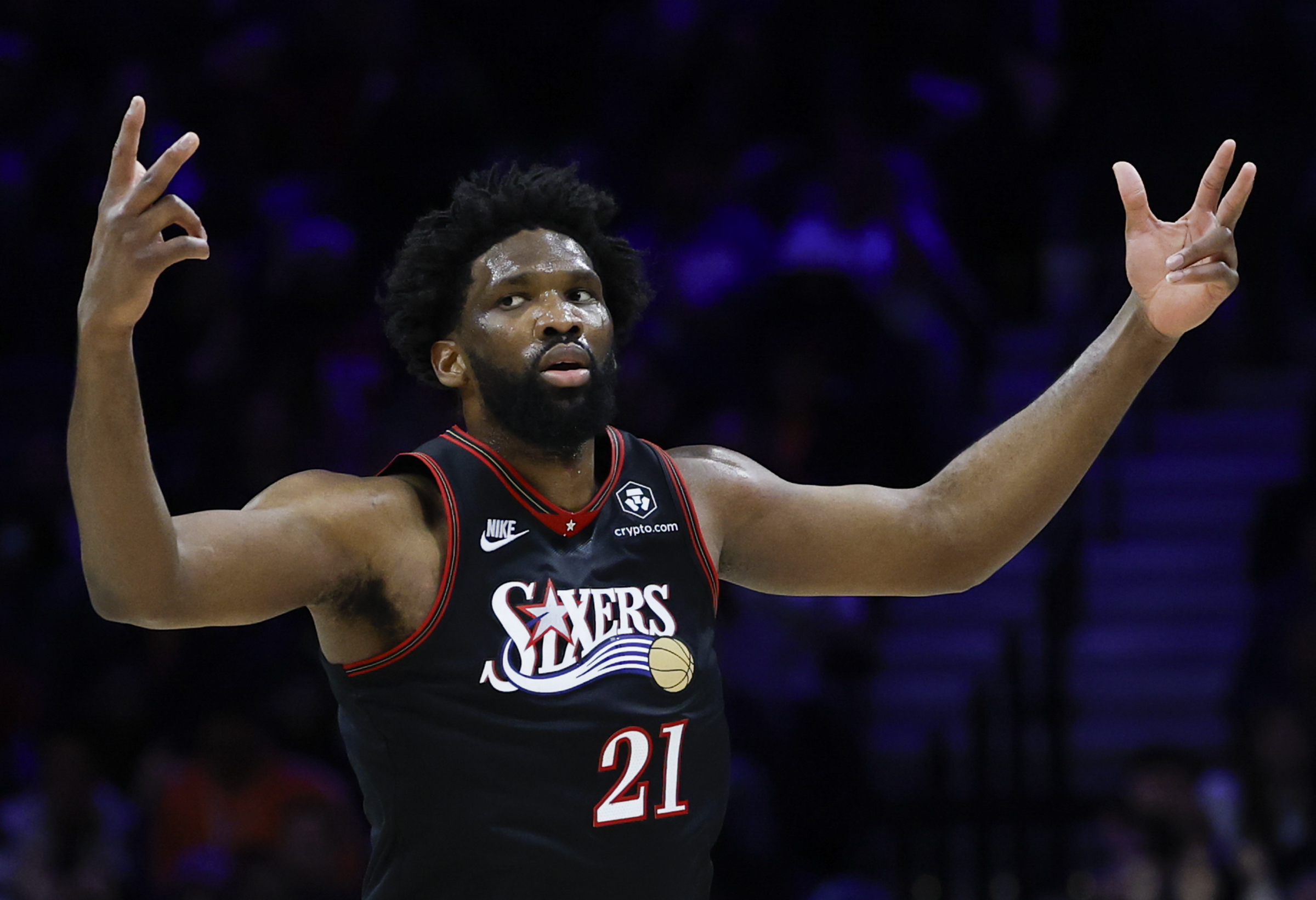
Sixers center Joel Embiid has scored 27 or more points in his last three games.
3. Joel Embiid helps to lead the Sixers to a first-round playoff upset and sparks trade interest among teams desperate to catch the Thunder and Spurs.
Embiid entered the new year having scored 27-plus points in three straight games. That counts as an accomplishment these days. He looked like an empty husk of his former self in his first nine games of the 2025-26 season, averaging just 18.2 points on a woeful .441 effective field goal percentage.
Question is, what if Embiid’s recent uptick in minutes and production is a signal that he has more left in the tank than we’ve given him credit for? He still needs to show a lot more defensively. And he has yet to play more than 71 minutes in a seven-day span. But he just logged 38 minutes in an overtime win over the Grizzlies, four days after playing a season-high 32 minutes in a loss to the Bulls.
With three years and $188 million left on his contract after this season, Embiid would probably have to be playing at his prime MVP level to have positive trade value. A more realistic question is whether he can play well enough to change the Sixers’ short-term narrative.
4. Eagles hire Shane Steichen or Mike McDaniel as offensive coordinator.
The Colts would be foolish to fire Steichen, who has somehow managed to put together a 25-25 record with the following starting quarterbacks: Gardner Minshew (7-6), Daniel Jones (8-5), Anthony Richardson (8-7), Joe Flacco (2-4), and Philip Rivers (0-3). But here is what owner Carlie Irsay-Gordon told the Athletic recently:
“Most people don’t like change,” said Irsay-Gordon, who has been patrolling the sidelines with a clipboard all season. “I think there’s something wrong with me, but I feel like it is the one thing that is a guarantee. I think it can be exciting.”
Even if the Colts part ways with Steichen, a team like the Giants could easily snatch him up. I can’t imagine Nick Sirianni would demote himself from head coach in order to restore Steichen as the play-caller. It definitely would be a heck of a story.
McDaniel might be a more realistic option, although he may be in the process of saving his job by leading the Dolphins to five wins in seven games.
5. Bryce Harper takes another step backward, as do the Phillies.
There has been enough passive-aggressive weirdness percolating between Harper and management that we have to at least flag him as the main character in a potential major story. Dave Dombrowski rankled Harper when he mused about Harper’s eliteness, but it is a legitimate question. At 32 years old, Harper is coming off his worst season in a decade. Another step backward would raise some serious concerns. And create some serious headlines.
Quinyon Mitchell isn’t one of those cornerbacks who speaks as if he is paid by the word. That’s a good thing. Brevity is often a sign of a man with more important things on his mind. It also suffices, more often than not.
For anybody who walked away from the Eagles’ 13-12 victory over the Bills on Sunday with an even greater sense of trepidation regarding the postseason, it might be helpful to consider the three short declarative sentences that Mitchell offered up as his interpretation of the proceedings.
“We’re battle-tested,” the Eagles’ second-year cornerback said as he stood in the postgame swirl of a cramped visitor’s locker room at Highmark Stadium. “Just look at our schedule. Look at our opponents.”
The sentiment is equal parts encouraging and maddening. Which is fitting, because the Eagles themselves are both of those things. It is their yin and their yang, their two mystical tadpoles, one of them midnight green, the other kelly green, chasing each other in a circle. The thrill of victory and the exasperation of trying to feel good about it.
On the one hand, the scoreboard is the ultimate judge. On the other hand, why does the scoreboard have to say 13-12? And why does it have to feel so fitting?
To anybody who possesses both a functioning brain and a reasonable amount of prior exposure to playoff football, the Eagles look like a team whose luck is destined to run out well before Super Bowl Sunday. The quarterback has not been good enough. Not even close. The play-calling has not been good enough to make up for the quarterback’s deficiencies. The defense has been good enough to make up for both of those things. But only barely.
On Sunday, the result was the second time this season that the Eagles failed to complete a pass in the second half. Yet it was also the second time this season where they failed to complete a pass in the second half and still won the game.
Yin and yang.
Sunday was also the third time this season when the Eagles won a game in which they scored fewer than 17 points. They are just the fifth team to accomplish that feat over the last 15 seasons. Of the four teams that did it previously, three went on to lose in the wild card round. Yet the one exception was the 2012 Ravens, who went on to win the Super Bowl.
Yin and yang.
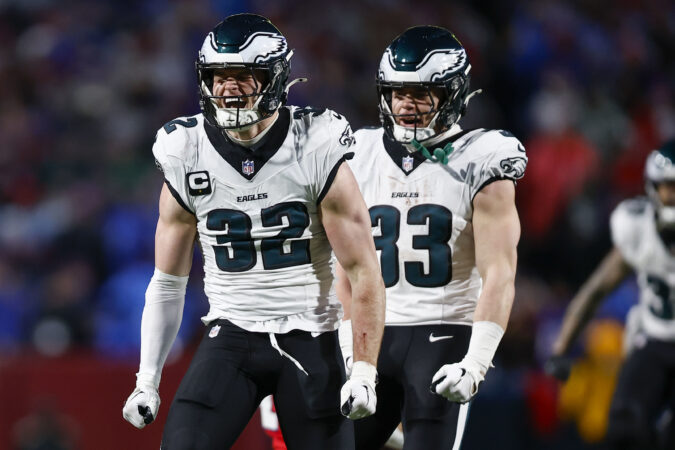
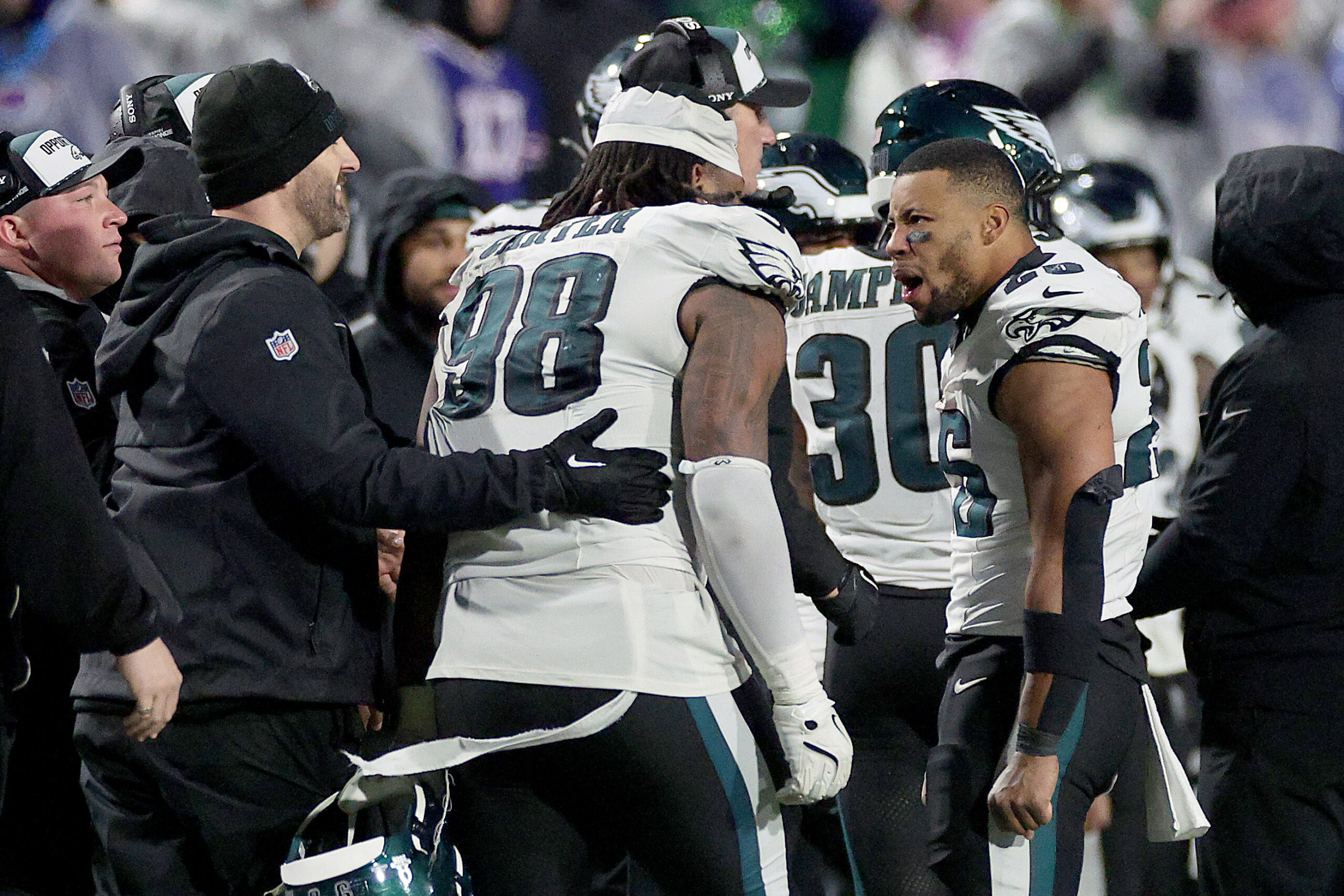
Defensive tackle Jalen Carter (98) and running back Saquon Barkley celebrate after the Eagles stopped the Buffalo Bills on a two-point conversion attempt late in the fourth quarter Sunday.
“I’ve never really been on a playoff team, but I can tell the difference just in the sense of these crunch time moments, being able to bend but don’t break,” said defensive end Jaelan Phillips, who had one of the Eagles’ five sacks against the Bills. “Obviously they had a little bit of a surge toward the end, but we were able to do what we needed to do offensively, defensively, and special teams wise to come out with the win. Gritty games like that are things you need to have to prepare yourself for the long haul.”
The Eagles may not be the most dynamic team heading into the postseason, but they will be the most prepared.
They have faced 10 of the top 13 quarterbacks in the NFL in terms of passing yards with a 3-1 record against the top three. They are 4-1 against the top seven QBR leaders. They have won games against five of the six quarterbacks who, along with Jalen Hurts, lead the NFL in wins over the last four seasons.
Sunday was the 10th time in 16 games that the Eagles faced a team that ranked in the top 10 in the NFL in either offensive or defensive yards per play (as of Sunday).
They have faced four of the NFL’s five highest-scoring offenses. They’ve faced five of the six quarterbacks who entered Sunday with the most passing yards, and three of the four who entered with the highest passer ratings. They have faced five of the seven defenses that entered Sunday with the highest rating, according to Pro Football Reference’s rating system.
These have been the Eagles’ hallmarks throughout Hurts’ tenure at quarterback and Nick Sirianni’s at head coach. Sunday’s win over the Bills only added to a road record that is the best in the NFL since Sirianni’s arrival.
“I think that’s a product of really good players and good coaches, and so it’s everything that goes into that, but good mental toughness,” Sirianni said Monday. “I think that really signifies your mental toughness, too.
“We experienced some highs and some lows [on Sunday], and we were able to continue to be relentless in our approach handling ups and downs. They ended up making a critical mistake in the game and we didn’t, which ended up being the difference in that game. So again, coming down to fundamentals. Just great resilience by the guys in there, and we prepare for that as coaches and players.”
Resilience is great. But even better is playing well enough to avoid the situations that test your resilience. That tension of opposites will determine the Eagles’ ultimate fate in the playoffs.