Author: David Murphy

  • Jalen Hurts needs another weapon. The Eagles need to prioritize one in the draft.

    Jalen Hurts needs another weapon. The Eagles need to prioritize one in the draft.

    Eight days out from the draft, and the biggest question of the offseason has yet to be answered.

    What is the Eagles’ plan for the post-A.J. Brown Era?

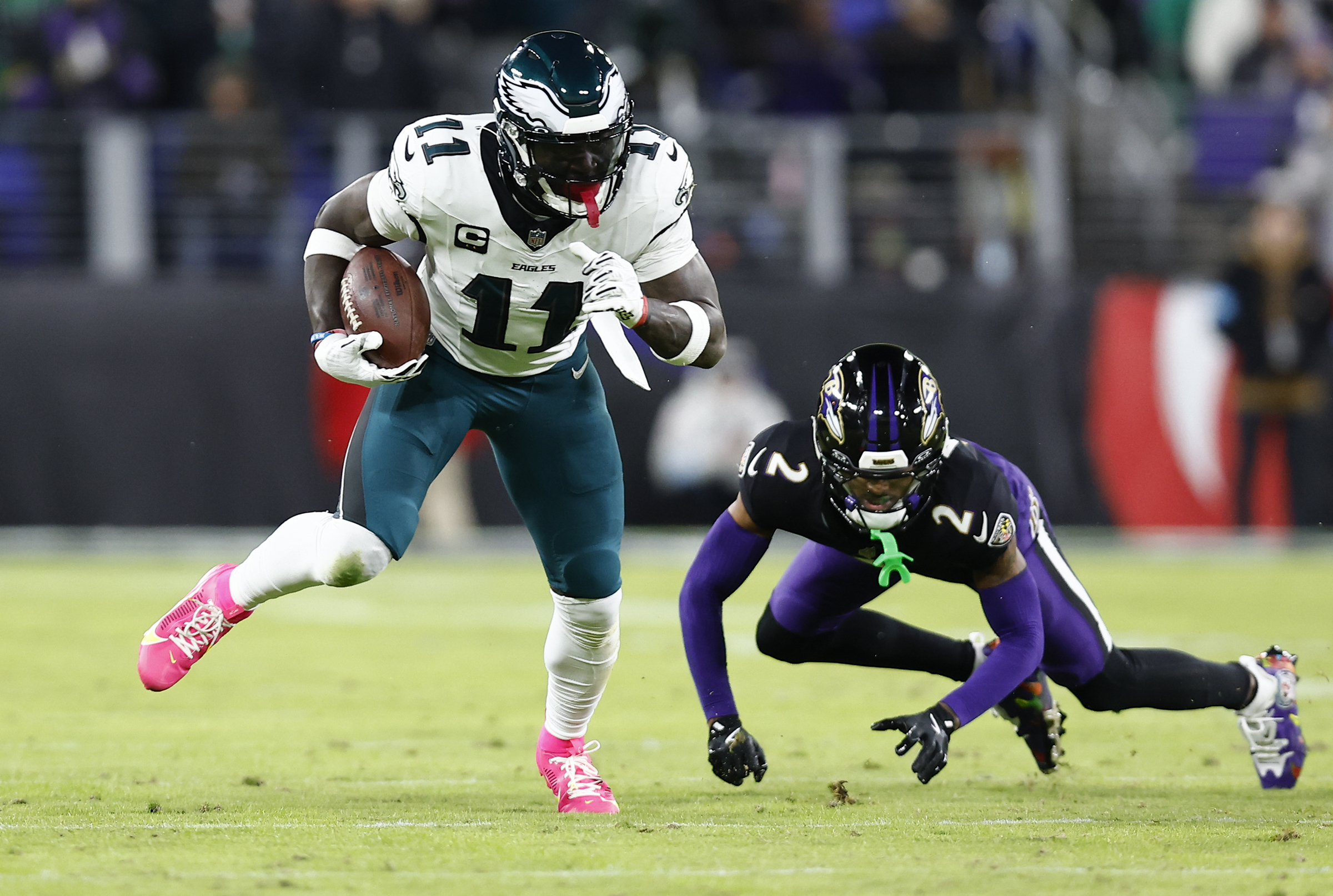
    This isn’t a question that you can shrug off. It would be just as pressing if Brown were guaranteed to return in 2026. He and Dallas Goedert almost certainly won’t be with the team in 2027 or beyond. Even if they are, they are highly unlikely to be anywhere close to the players they were when the Eagles’ offense was at its best. The chapters are short in the NFL. The pages must be turned.

    The story of this year’s draft better be the pass catchers. Even if the Eagles somehow think their passing game can tread water with Dontayvion Wicks and Marquise Brown as their second and third options out wide, and with a 31-year-old and clearly diminished Goedert at tight end, those aren’t long-term solutions. The Eagles desperately need to find at least one in this year’s draft after going four years without selecting a pass catcher higher than 152nd.

    A few points of emphasis:

    You don’t find a lot of franchise-level offensive tackles in the second half of the first round.

    Not since 2017 has a future All Pro tackle been drafted between picks No. 17 and 49. Even multiyear Pro Bowlers are few and far between. The Cowboys nabbed left tackle Tyler Smith at No. 24 in 2022. Before that, Garrett Boles was the biggest success story, going to the Broncos at No. 20 in 2017. Boles was the first offensive lineman off the board that year, thanks in part to a confluence of circumstances. Going before him were three quarterbacks, two unicorn running backs, and the first three members of a loaded cornerback class (Marshon Lattimore, Marlon Humphrey, Adoree’ Jackson).

    The Eagle know first hand how hard it is to find a fixture in the second half of the first round. The last two offensive linemen they drafted there were Andre Dillard and Danny Watkins. There simply isn’t a lot of logic in the idea that the Eagles will be prioritizing an eventual Lane Johnson replacement at No. 23.

    “If you’re forcing something, you’re not really filling the need anyway,” general manager Howie Roseman said on Tuesday.

    The Texans went 4-12 in 2020. And while Deshaun Watson put up the best numbers of his career — 4,823 yards, 33 touchdowns, seven interceptions, a 70.2 completions percentage — the game script had something to do with them.
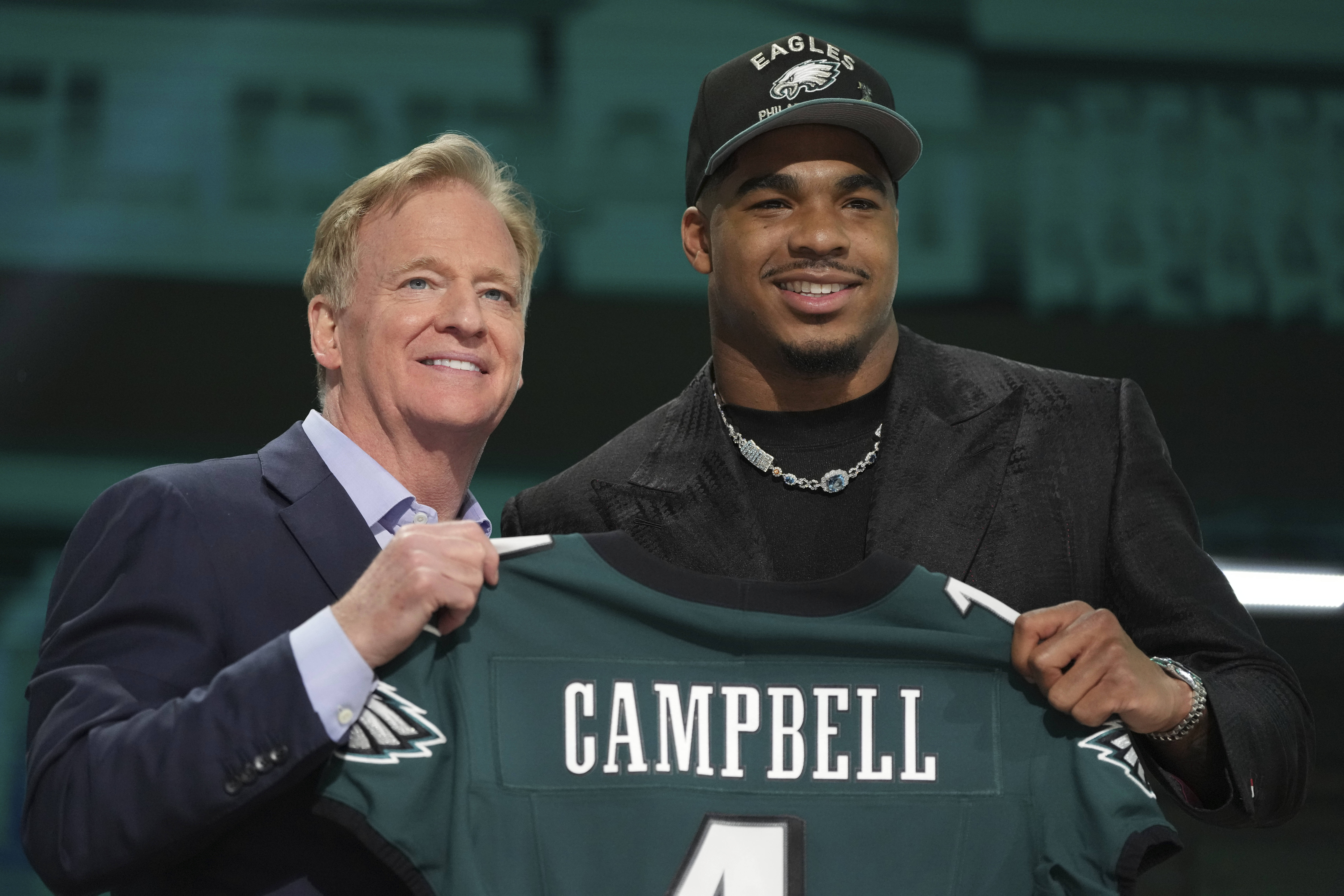
    Jihaad Campbell was the Eagles’ pick at No. 31 overall during the 2025 draft.

    The Eagles have spent a lot of draft capital on the defensive line over the last several seasons.

    Again, that’s not to say that they’d turn down an opportunity to draft an edge rusher they have graded as a potential elite talent who can start immediately. Chances are, anybody who fits that profile will be long gone by the time the Eagles are on the clock. They used the No. 31 pick on Jihaad Campbell last season. They drafted Nolan Smith at No. 30 in 2023. Of the last 11 picks that the Eagles have made inside the Top 115 overall, 10 have come on the defensive side of the football.

    Jalen Hurts is a quarterback who needs an elite weapon that a defense can’t shade coverage to on every play.

    DeVonta Smith counts as an elite weapon. But people need to pump the brakes on the idea that he is Jaxon Smith-Njigba in waiting. Several different media outlets have mentioned the construct in their reporting on the Brown situation. The theory goes something like this: with Brown gone, Smith will be better than he ever has been, similar to how Smith-Njiba blew up in 2025 after the Seahawks traded away D.K. Metcalf.

    The problem with that reasoning is that Metcalf’s departure was the least significant of three major variable changes in the Seahawks offense last season. The first two were a new quarterback and a new offensive coordinator.

    In fact, you might consider it four variable changes if you include Geno Smith’s departure in addition to Sam Darnold’s arrival. Jakobi Meyers’ decreased production year-over-year after Smith’s arrival at quarterback looks suspiciously similar to Smith-Njigba’s increased production in the wake of Smith’s departure. Meyers saw a 23% drop in his targets and a 36% drop in his receiving yardage on a per-game basis in his seven weeks with Smith compared to his 2024 output. And Meyers didn’t have to play in the shadow of Metcalf, either.

    The real yin to Smith-Njigba’s yang was Justin Jefferson. In 2024, he caught 103 passes for 1,533 yards with Darnold as starter. This, despite the presence of Jordan Addison, whose numbers were practically identical to Metcalf’s. Addison was still there last year. Darnold wasn’t. Jefferson caught 84 passes for 1,048 yards.

    A tidier summation:

    • Jefferson without Darnold vs. ’24: 13 less targets, 19 less receptions, 485 less yards.
    • Smith-Njigba with Darnold vs. ’24: 26 more targets, 19 more receptions, 663 more yards

    Fairly symmetrical, no?

    Smith-Njigba’s breakout happened because he had a quarterback who could make all of the throws, including those in traffic in the middle of the field. Hurts hasn’t shown to be that quarterback.

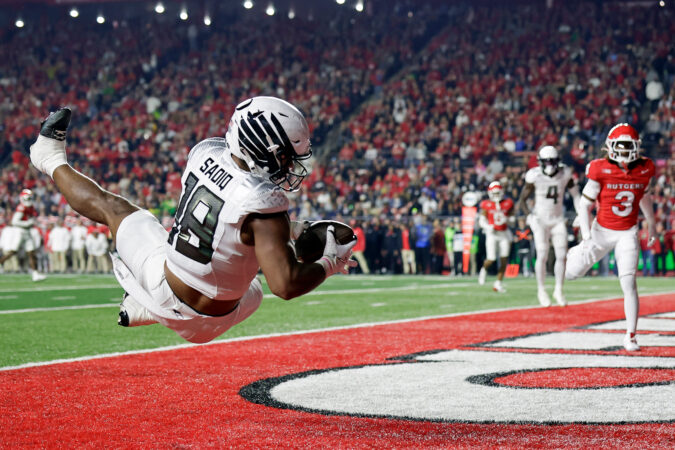
    Oregon tight end Kenyon Sadiq should be at the top of the Eagles draft board. But don’t bet on him falling close to their range.

    I’m still a bit puzzled that the majority of mock drafts have Sadiq falling into the second half of the first round. He is a physical specimen who tested off the charts at the combine. The only guy in his class over the last 20 years was future All-Pro Vernon Davis. The college production wasn’t eye-popping, but it also wasn’t much different from Colston Loveland, who went 10th overall to the Bears last season. All it takes is one team higher than the Eagles to fall in love with him. I’ll be surprised if he falls beyond No. 15.
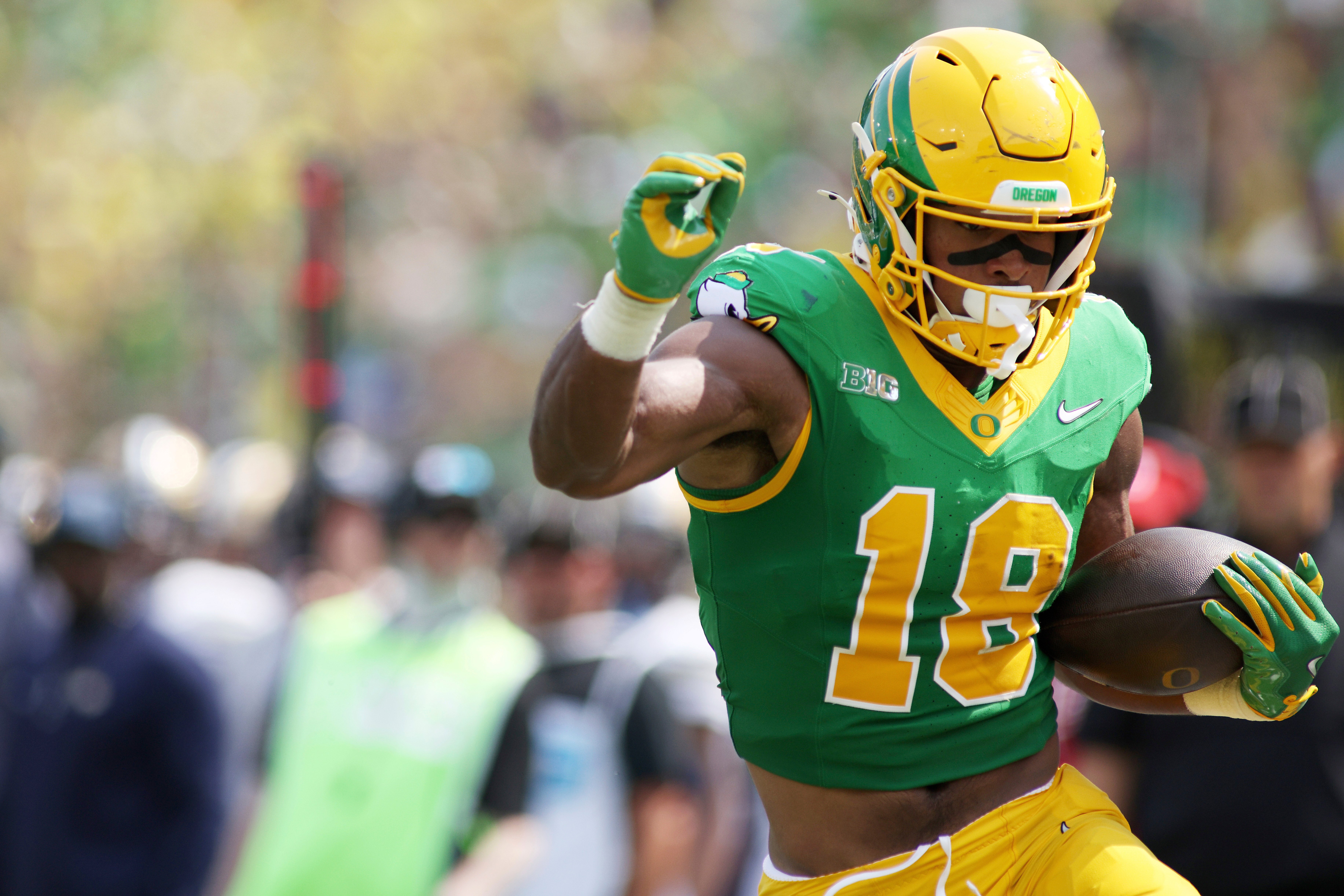
    Oregon’s Kenyon Sadiq is the top projected tight end in the NFL draft.

    That being said, if the Eagles somehow find a way to get themselves in position to draft Sadiq, they would have a tidy answer to their question of where to go after Brown (and Goedert). Sadiq is the one player in this draft outside the projected Top 5 who has the potential to immediately fix a lot of the Eagles’ offensive question marks, run-blocking included.

    Even if Sadiq isn’t an option, the Eagles have good reason to hope they can nab a player who can help them in both the short and long-term.

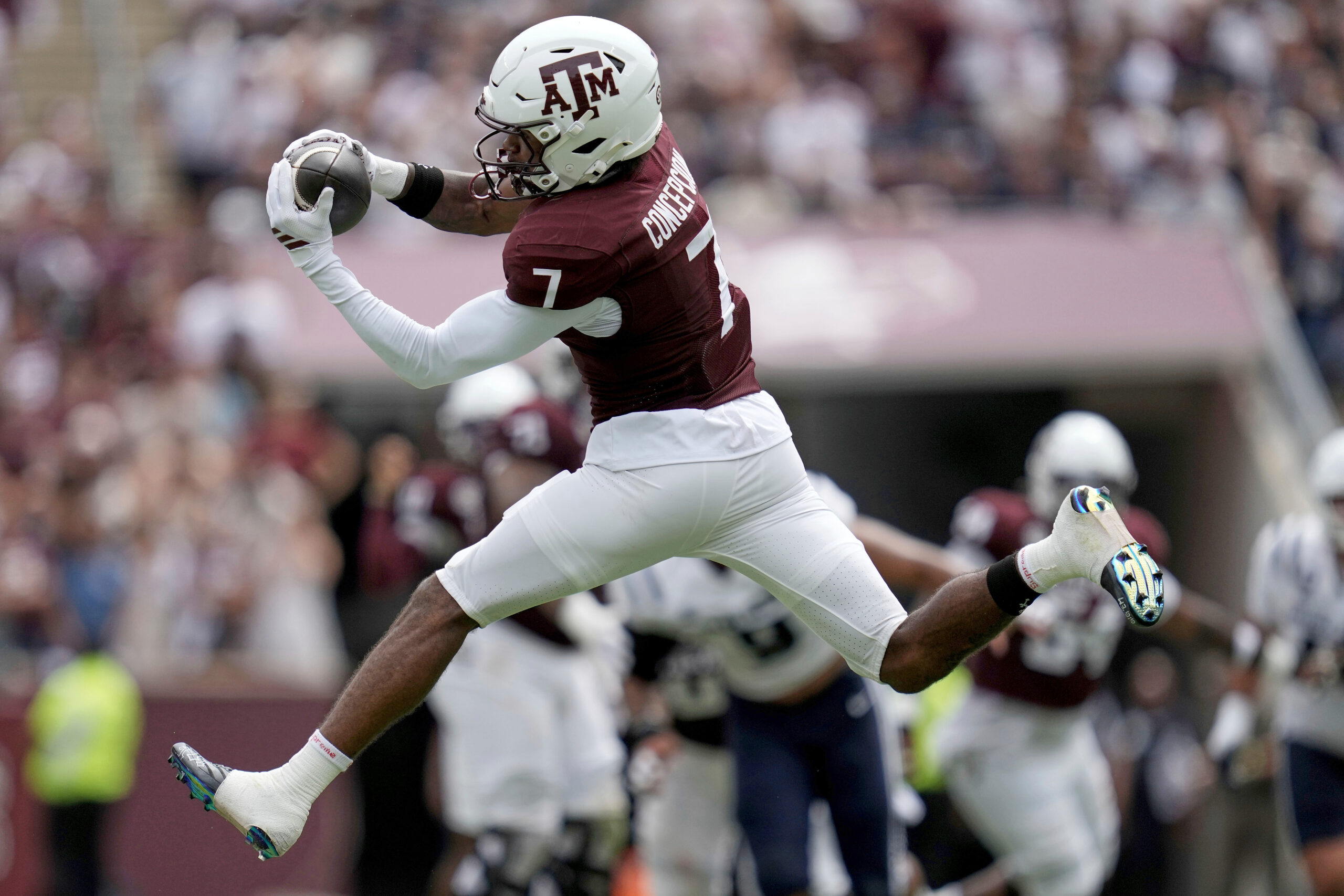
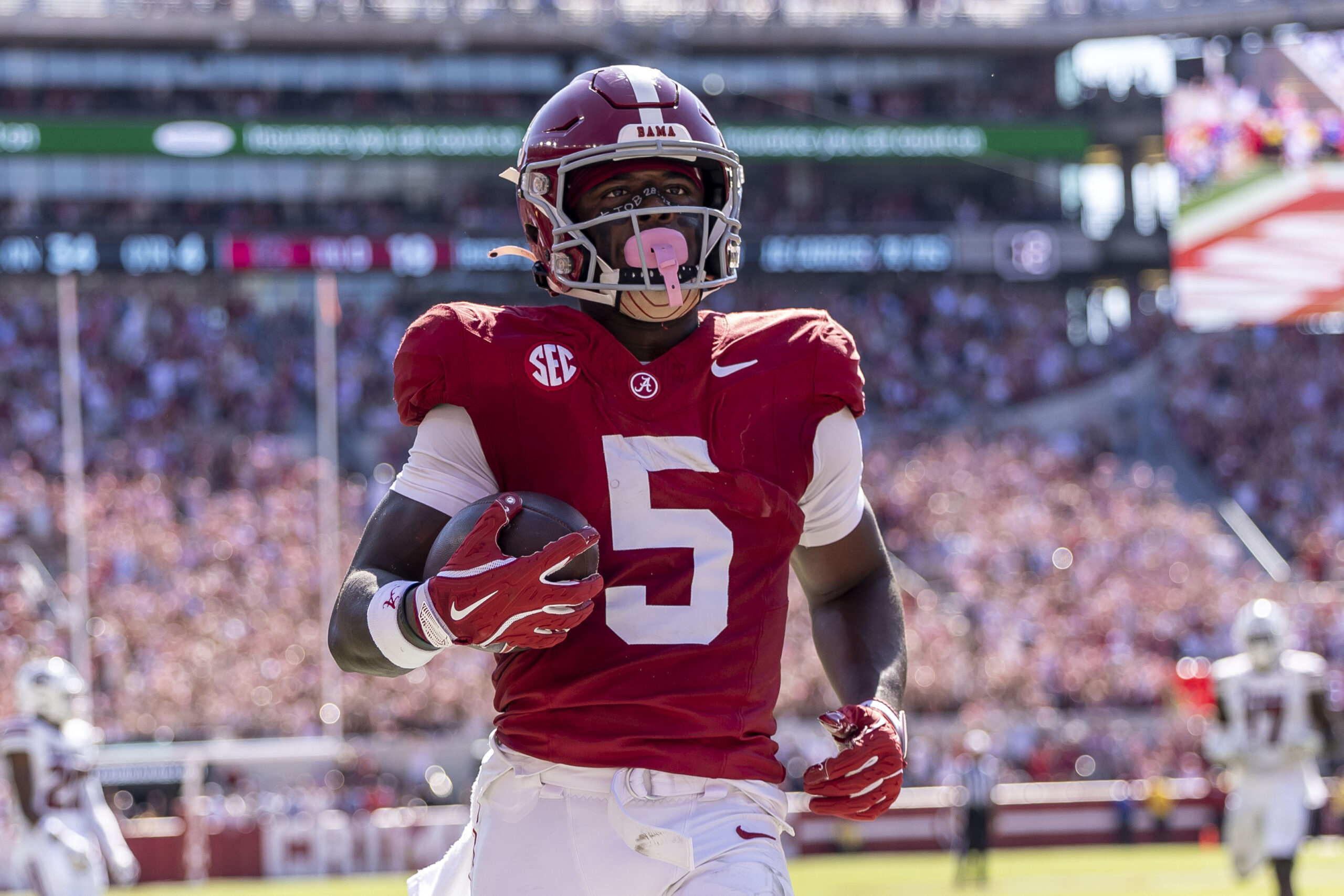
    Neither Texas A&M’s K.C. Concepcion nor Alabama’s Germie Bernard profile as the sort of outlier that Brown is/was. But both have skill sets and polish that would pair nicely with DeVonta Smith. Both are players who could exploit whatever attention defenses pay to Smith. Concepcion has a lot of Stefon Diggs to his profile, while Bernard looks like a potential Deebo Samuel with the frame and rushing ability to go with his hands. I’ve seen a few mock drafts that have Bernard on the board when the Eagles pick at No. 54. That would be a stroke of luck on the level of Cooper DeJean.

    The moral of the story is simple. The Eagles can’t afford to force a pick at any position. But they also aren’t in a situation where they can afford to go purely for the best player available. They need to factor in their future salary cap and talent distribution. You can’t have too many All-Pro cornerbacks, but you can have too many who you need to pay.

    Further, you can have too few players at positions that have shown themselves to be just as important to the Eagles’ success over the last several seasons.

    Roseman shouldn’t get trapped into picking the best pass-catcher available. But he does need to hope a viable one is there.
  • A.J. Brown’s pool of trade suitors is smaller after the Bills’ D.J. Moore move. The Eagles must demand a first-round pick for Brown.

    A.J. Brown’s pool of trade suitors is smaller after the Bills’ D.J. Moore move. The Eagles must demand a first-round pick for Brown.

    The biggest Eagles-related takeaway from the D.J. Moore trade?

    A lot of NFL general managers are a lot less capable than Howie Roseman.

    As for A.J. Brown, the impact of the Bills’ acquisition of Moore is being overstated.

    Roseman may get the first-round pick he reportedly is seeking in exchange for Brown, but it’s no more likely now that the Bears have somehow managed to finagle a second-round pick out of the Bills for Moore. If anything, Roseman might deserve credit for driving up the price for Moore, who was the Bears’ fourth receiving option by the end of a season in which he caught just 50 passes for 682 yards. Buffalo had a clear need for a primary receiver. Dealing a second-round pick for Moore might sound more reasonable when your other option is trading a first- and second-round pick for Brown. What we know for sure is that the small pool of teams that made obvious sense as a trade partner for the Eagles just shrunk by one.

    Here’s what else we know:

    The Trent McDuffie trade could be just as much of a harbinger in the opposite direction.

    A two-time All-Pro at a premium position (cornerback) entering his age-26 season, McDuffie is headed to the Rams for the No. 29 pick in this year’s draft, a future third, and change. I don’t think it’s accurate to say that the McDuffie deal is an indication of the elite cornerback market, at least not relative to Brown. Keep in mind, the Colts traded away two first-round picks and Adonai Mitchell for Sauce Gardner at the deadline. One of those picks ended up at No. 16 this year. Who knows what next year’s will be. That’s the elite cornerback market.

    The McDuffie trade does give us a neat and tidy for-instance. Given the sacrifice the Chiefs just made at a more premium position, would they then be willing to turn around and trade the No. 29 pick they received for McDuffie to the Eagles for Brown? Maybe they would. Hey, maybe they will. They sure do need a wide receiver. That said, it seems far more likely that they are looking at that No. 29 pick the same way the Eagles would in justifying a trade of Brown: as a chance to add another five years of well-below-market-rate production in the form of a rookie.

    The overall point is that you can talk yourself silly trying to project the market based on one deal. The Moore deal can just as easily be construed as the price a team is willing to pay to not pay the price the Eagles are asking for Brown.

    Chiefs cornerback Trent McDuffie (left) was traded to the Rams for the 29th pick in this year’s draft. Could Eagles wide receiver A.J. Brown fetch a similar haul?

    The Eagles are justified in asking for a first- and second-rounder for Brown, assuming what they really expect is a first-rounder and an assortment of mid-to-late-round picks.

    There are plenty of comps.

    • The Raiders acquired 29-year-old Davante Adams from the Packers for No. 22 overall and No. 53 overall in 2022.
    • The Bills acquired 26-year-old Stefon Diggs for No. 22 overall and change from the Vikings in 2020.
    • The Chiefs acquired No. 29 overall, No. 50 overall and change from the Dolphins for 28-year-old Tyreek Hill in 2022.

    It’s easy to see the genesis of Roseman’s current reported asking price. It’s also easy to see why that asking price has drawn snickers.

    Consider:

    • The first-round pick the Bills traded to the Vikings turned out to be Justin Jefferson.
    • The second-rounder that the Raiders traded to the Packers turned out to be Alec Pierce (after Green Bay traded the pick to draft Christian Watson). The first-rounder was Quay Walker, a four-year starter at linebacker.
    • The Chiefs used the No. 29 pick they landed for Hill to trade up to draft McDuffie at No. 21.

    On the other side of these deals were two of the worst organizations in the NFL (Dolphins, Raiders), and the team that just traded a second-round pick for Moore and has the second-most expensive wide receiver room in the NFL without a true WR1 to show for it.

    There aren’t many other for-instances. The Texans traded away DeAndre Hopkins for No. 40 overall in 2020, but that deal included running back David Johnson in the return and was universally panned regardless. Last offseason, the Steelers traded away No. 52 overall for 27-year-old DK Metcalf, whose four-year averages were worse than Brown’s 2025.

    There aren’t many teams that can give the Eagles what they need.

    I use the word “need” for a reason. The Eagles need a first-round pick to justify trading Brown. The only way they might otherwise justify it is by landing a future first plus a 2026 second, i.e. the “Ravens Scenario.” We’ll get to that in a second. First, let’s explain what we mean when we say the Eagles “need” a first-rounder.

    This is not abstract. Concretely, the Eagles need to be able to replace Brown. The best way to do it is via the draft, where there happens to be a number of players who could help them and who are projected to be within striking distance of No. 23. But the Eagles need plenty else besides a replacement for Brown. We saw that this year, when they had Brown. To justify trading Brown, they need to at least end up with a pick that maximizes their odds of replacing him (even if they end up “replacing” him with a star at another position). Bare minimum is a top-50ish pick. But only if they feel like they need to trade him for the best offer. Right now, their best leverage is their willingness to bring him back. Which is why they are making that willingness known.

    Not many teams are in a position to give them what they need. Cross off the Bills. Presumably the Chiefs, unless Andy Reid and Brett Veach have radically changed the philosophy under which they traded away Hill to pave the way for McDuffie. Nobody is giving up a top-10 pick for Brown, so cross them off too.

    Could the Ravens be in the market to trade for Eagles wide receiver A.J. Brown?

    The Dolphins (No. 11) are more likely to trade Jaylen Waddle for a Brown-type package than to trade for Brown. The Cowboys (No. 12) don’t need a wide receiver, nor do the Rams (No. 13), who just traded their expendable first-rounder to the Chiefs for McDuffie. The Bucs (No. 15) are brimming with wide receivers, including last year’s first-rounder Emeka Egbuka. The Lions (No. 17) have a lot of needs more pressing than the skill positions. Same goes for the Vikings (No. 18). The Panthers (No. 19) spent significant draft capital on Tetairoa McMillan last year. Brown doesn’t fit their timeline.

    Next up is Dallas again at No. 20, then the Steelers, who just traded for Metcalf and like to build from within. The Chargers don’t have the luxury of trading No. 22 for Brown. Forget the Browns (No. 24). We’ve already covered the Bears (No. 25). Cross off the Texans (No. 28), who have Nico Collins and youth around him.

    That leaves us with the Ravens at No. 14, the 49ers at No. 27, the Broncos at No. 30, the Patriots at No. 31, and the Seahawks at No. 32.

    If the Eagles are reluctant to trade Brown to a fellow NFC contender, that would leave three teams: Ravens, Broncos, Patriots. Denver and New England would need to offer their first-rounder, because the next best 2026 picks are No. 62 and No. 63, which isn’t nearly good enough. The Ravens are in the opposite boat. Their No. 14 overall pick is too high. Their second-rounder (No. 45) is borderline, and would only make sense if coupled with a high future pick.

    The Eagles’ ability to land a first-rounder is contingent on the Ravens’ willingness to give up a future first or the Patriots/Broncos (or Seahawks/49ers) belief in the players who will be on the board at the end of this year’s first round.

    None of that is impacted by the cost of trading for Moore. The Ravens and the Patriots are the two obvious teams, assuming we remove the Chiefs and the NFC contenders. The Ravens aren’t going to give up No. 14 for Brown, and No. 45 is only worth it for the Eagles if they have 45 players they love on their draft board. A future first from Baltimore would give them an opportunity to move up. The Pats’ first-rounder would work if coupled with a pick that also gives the Eagles ammo to move up from No. 23 or No. 31 to draft a guy they covet.

    This is a pass-fail sort of thing. There is a bare minimum return the Eagles need in order to justify the competitive hit they’d take without Brown in 2026. It is a return where only a team’s best available draft pick is good enough. There are only a few teams that might consider it. That was the case before the Bills traded for Moore. It remains the case now.

  • Johan Rojas’ potential PED suspension leaves Phillies no choice but to act (again)

    Johan Rojas’ potential PED suspension leaves Phillies no choice but to act (again)

    The news that is coming down the pipe wouldn’t be a huge deal for some teams.

    The Phillies are not one of those teams.

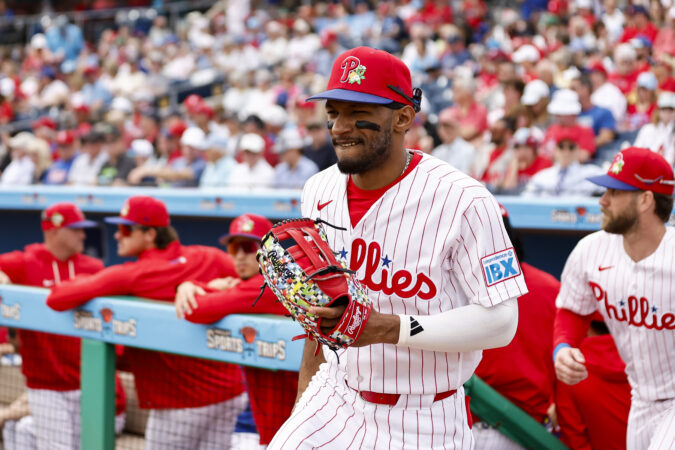
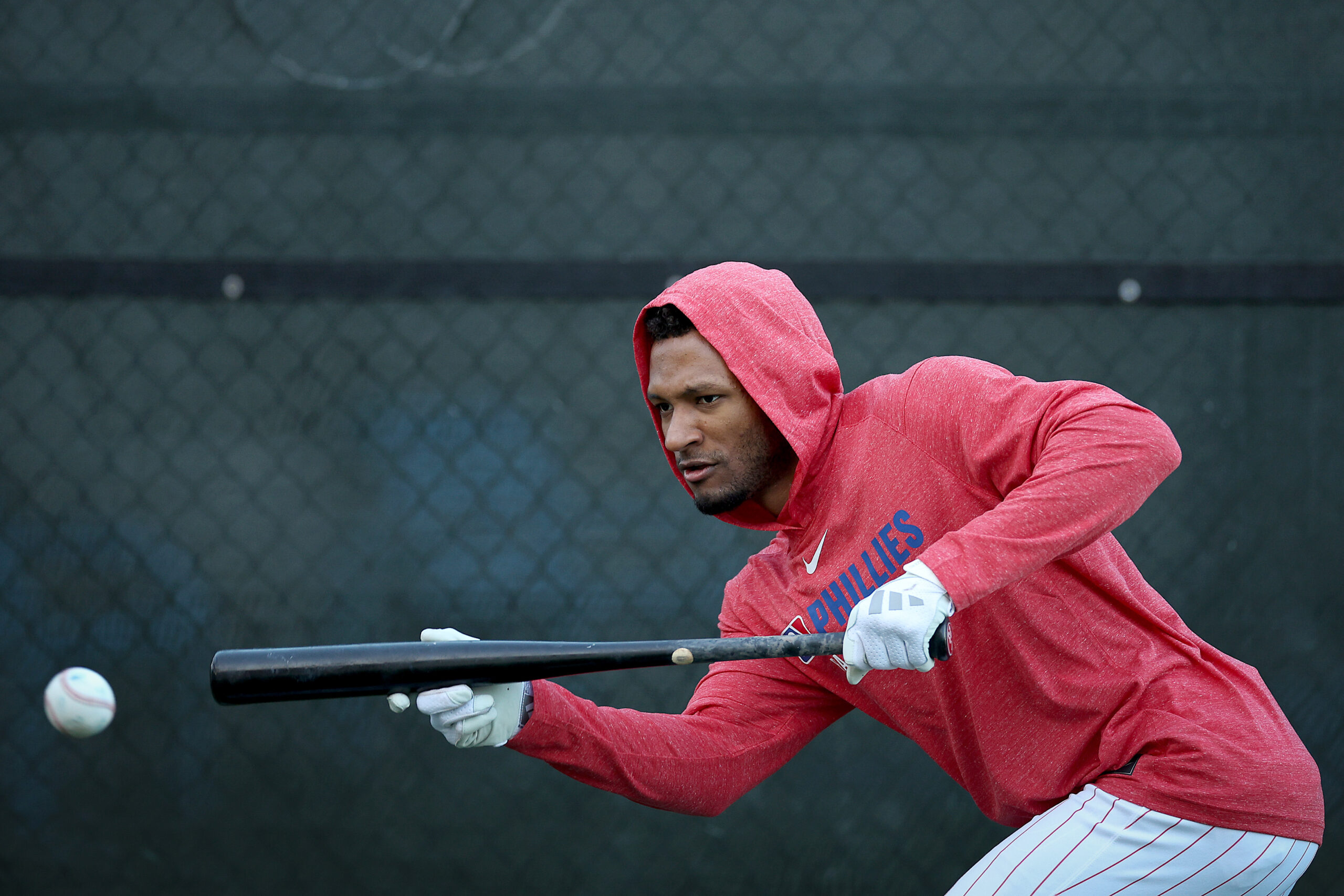
    Johan Rojas might be a third-string center fielder who forces you to play with an eight-man batting order, but he is a man without an obvious replacement right now. The Phillies are going to need to figure one out soon, assuming the formality of the 25-year-old’s pending appeal of an 80-game performance-enhancing drug suspension that an Inquirer source says he faces.

    Bryan De La Cruz? The 29-year-old nonroster invitee offers enough of a profile at the plate to suspend disbelief. But he hasn’t played center field in the big leagues since 2023, and even then, he did it in only seven games.

    Dylan Moore? He played a couple of innings in center field last season but has only 105 in a seven-year big league career as a utility man. The 33-year-old nonroster invitee would make some sense as the third option in any given game. But it’s a stretch to think he’d make sense as a long-term sub.

    Or, there is Pedro León, a 27-year-old who went 2-for-20 with 10 strikeouts in 2024 for the Astros. Houston waived him in November.

    There aren’t any other options on the spring training roster, unless you count Edmundo Sosa in an emergency.

    There is a reason the Phillies traded for Harrison Bader last July. It’s the same reason they were open to re-signing him early in an offseason that ended with him settling for a two-year, $20.5 million contract with the Giants. The Phillies are thin on center fielders and right-handed hitters, and even thinner on guys with both skill sets.

    It’s a shame the Bader situation played out as it did. The Phillies’ offseason would look a lot different if they’d been able to sign him to something like a two-year, $25 million extension before he exercised his end of a mutual opt-out. There would have been more than enough at-bats to go around between righties Bader and Adolis García and lefties Brandon Marsh and Justin Crawford, as well as a better combination of depth and platoon ability. And if Bader came at the price of García going elsewhere, no worries. You can get a right-handed-hitting corner outfielder easier than you can a right-handed-hitting center fielder, and a lot of them cost less than García’s $10 million for the same amount of cross-your-fingers-and-pray.

    Alas, here we are. It would betray a misunderstanding of the inner workings of the business of baseball to interpret Bader’s contract with the Giants as an unwillingness to match by the Phillies. They moved on and he moved on, and nobody would be thinking twice if the Mets didn’t offer an outlandish contract to Bo Bichette. None of that matters now.

    The Phillies don’t have a choice but to scour the earth for someone who at least looks like a center fielder when you squint. Marsh has never played in more than 135 games in a big league season, which is 135 more than Crawford has ever played. That’s not a comfortable situation. The only unsigned free agent of note is Manuel Margot, who would leave everyone pining for Rojas.

    Keep in mind, Rojas appeared in 71 games last season. At the start of that season, the organization’s depth chart looked pretty much as it does now. If you’d forgotten Rojas got that much playing time, it’s because he didn’t offer a lot to remember him by.

    Johan Rojas’ .569 OPS last season ranked among the bottom 10% of MLB hitters with at least 170 plate appearances.

    His .569 OPS ranked among the bottom 10% of MLB hitters with at least 170 plate appearances. He is one of only three center fielders out of 46 total to have an OPS lower than .600 while garnering at least 500 plate appearances over the last two seasons. His average exit velocity ranks second to last.

    That would lead to an obvious question, if we hadn’t already covered the answer. Why did Rojas get so many at-bats? Because the Phillies didn’t have any better options. Sure, some wishful thinking factored in, as did an overemphasis on center-field defense. The math is a little more complicated than subtracting the surplus doubles a better defender robs from the surplus doubles a better hitter would have given you at the plate. But the fundamental logic holds, and Rojas failed it. Reality is, the Phillies were a better team last season with Rojas on the bench and Marsh in center field, even against lefties.

    You can argue that they are no worse off for losing Rojas. It might be true, to a certain extent. Moore and De La Cruz could be as good as it gets unless someone shakes loose on cutdown day (local product Chas McCormick is in camp with the Cubs on a minor league contract). If finding a center fielder was easy, we wouldn’t be having this conversation.

  • Why Eagles should target Kenyon Sadiq, KC Concepcion, and Germie Bernard — even if it means trading A.J. Brown

    Why Eagles should target Kenyon Sadiq, KC Concepcion, and Germie Bernard — even if it means trading A.J. Brown

    The next two months will be franchise-defining for Howie Roseman and the Eagles. That’s partly a function of how much they need to accomplish in order to get their offense on a sustainable footing. But it’s also a function of how much opportunity they have to do so. In fact, they have more of it than most teams in their situation can hope to have.

    The decision-making revolves around the draft, as it always does. The most honest thing anybody can say about the draft is that the best decisions are primarily a result of what’s available. Roseman deserves a ton of credit for projecting Quinyon Mitchell as an elite cornerback. But he gets credit for drafting him only because he lasted until the 22nd pick. Same goes for Cooper DeJean in the second round at No. 40. Who knows what this Eagles defense looks like if Mitchell and DeJean weren’t on the board.

    I see a lot of parallels between that 2024 draft and this year’s. The Eagles’ offense is at a similar juncture, particularly in the pass-catching department. DeVonta Smith is great. He’s also the only guy on the depth chart at wide receiver and tight end, if we’re assuming that A.J. Brown is potentially on the way out. The best way to get yourself into trouble when you are on the clock is to focus on immediate needs over expected future value. The Eagles’ opportunity is that this year’s draft looks like it aligns with their needs.

    If the mock drafts are to be trusted, the Eagles could have their choice of one of at least three potential difference-makers at No. 23 and perhaps a second if they can move up in the second round. Last year, I was beating the drum for Missouri receiver Luther Burden III, who ended up going No. 39 to the Bears. This year’s trio is even better.

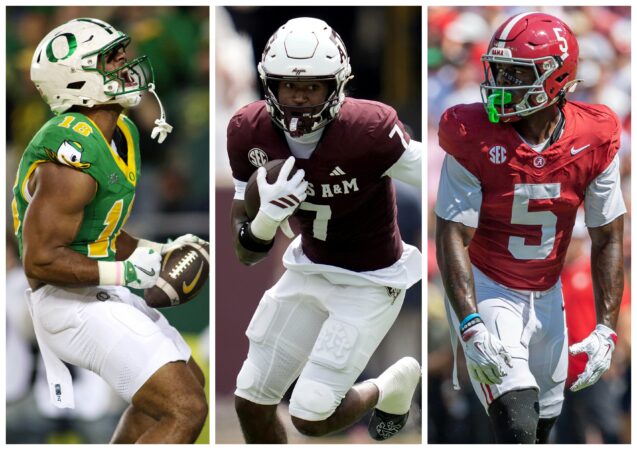
    Oregon tight end Kenyon Sadiq. Texas A&M wide receiver KC Concepcion. Alabama wide receiver/utility man Germie Bernard.

    The comps are Vernon Davis, Antonio Brown/Stefon Diggs, and Deebo Samuel.

    I’m not going to sit here and pretend I have an opinion on any of the linemen who could be on the board in the late first round. If the Eagles have a chance to draft one with a Lane Johnson or Jalen Carter grade, they should obviously do it. What I do know is that the pass-catchers should be a priority, and that there are three guys who could offer the value that Mitchell and DeJean did on the defensive side.

    This draft is better than people are giving it credit for, particularly in the range where things start to look realistic for the Eagles. The precombine consensus had Sadiq going No. 19, Concepcion going No. 27, and Bernard going No. 69. The Eagles have picks No. 23 and 54, but I’m skeptical that they’ll be in position to pick two of the three.

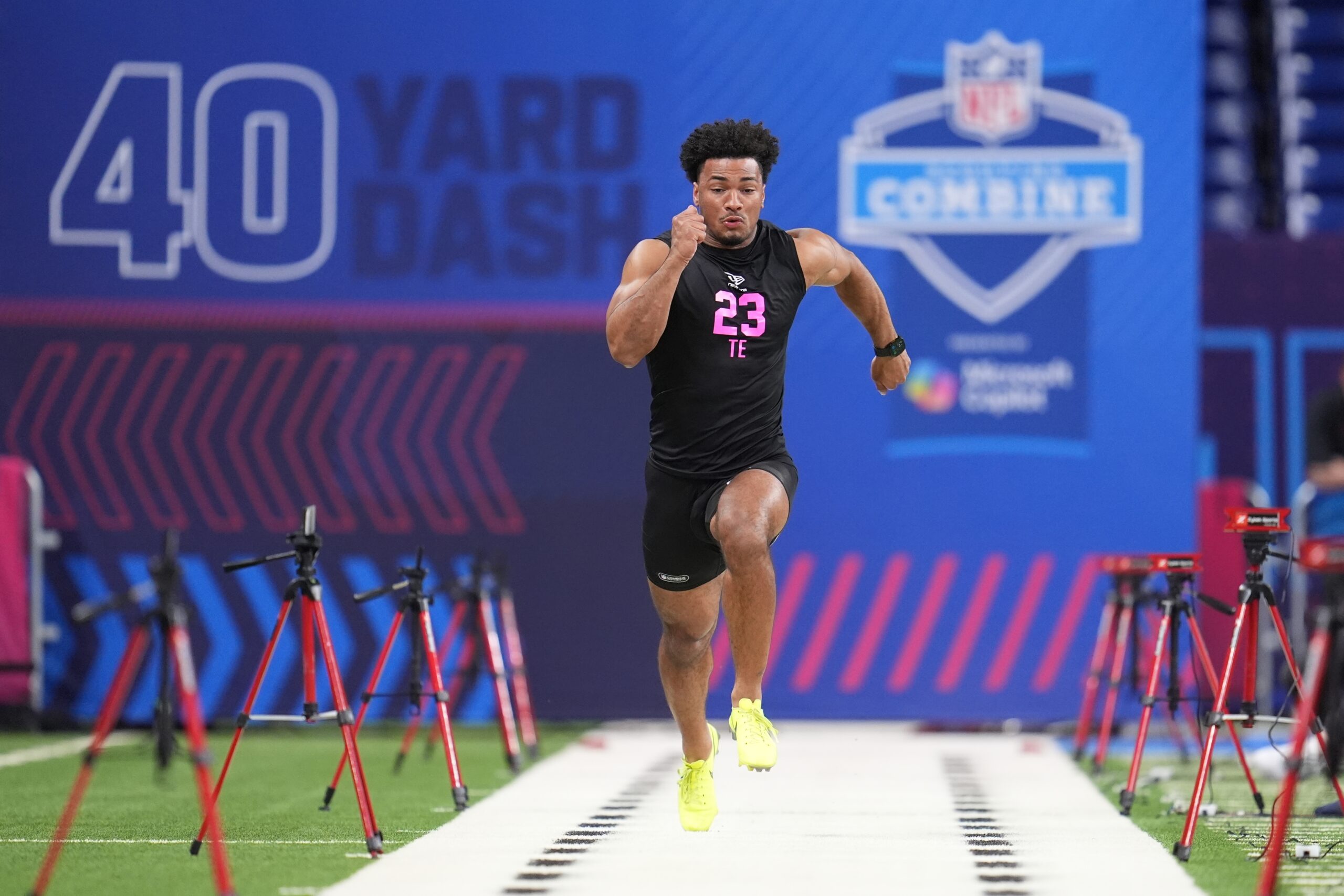
    The idea that Sadiq will last anywhere close to No. 23 always seemed detached from reality. That’s especially true after a combine performance unlike any we’ve seen at the tight end position in recent memory. Sadiq’s 40-yard dash time of 4.39 seconds was the fastest by a tight end since converted quarterback Matt Jones in 2003. His 1.54-second 10-yard split would have ranked him among the Top 12 wide receivers at this year’s combine. He also put up wideout-like numbers in the broad jump and vertical leap.

    It would be one thing if Sadiq’s measurements were at odds with his game tape. But they aren’t. The game speed and explosiveness are there. Most notable is the way they show up off the ball. His combination of acceleration and compact strength allowed Oregon to use him in all sorts of ways in their blocking schemes: out wide on wide receiver screens, across the formation on running plays, etc. It is impressive to watch. This isn’t Kyle Pitts. I have to imagine every cutting-edge play designer in the NFL would love to have Sadiq’s skill set at his disposal. Don’t listen to the folks who try to compare him to fellow workout warrior Eli Stowers. The Vanderbilt tight end is a worthy late-second-round gamble. But watch both of their cut tapes and you’ll quickly realize one of these things is not like the other.

    Kenyon Sadiq’s 40-yard dash time of 4.39 seconds was the fastest by a tight end since converted quarterback Matt Jones in 2003.

    To be clear, Sadiq’s isn’t a conventional skill set. He isn’t anything close to your classic tackle-adjacent receiver-lineman tweener tight end. Which might be one reason why the draft industry rates him where it does. At 6-foot-3 with 31½-inch arms, he is at the negative extreme in terms of length at the position. Of the 14 tight ends who had a 1,000-yard season since 2010, only one was listed at 6-3 or shorter, according to Pro-Football-Reference.com (Delanie Walker, 2015). Sadiq’s arm length measurement ranks in the bottom 10% of tight ends at the combine since 2010. Combined with his chiseled 246-pound frame, he looks more like an H-back than a prototypical pass-catching tight end. That’s only a problem for a scheme that lacks imagination.

    If anything, Sadiq’s overall pass-catching numbers are at odds with his game tape. His 892 career receiving yards in three years at Oregon would be the lowest for any tight end drafted with a top-28 pick since at least 2010. Every tight end drafted in the top 15 since 2010 had at least one season with 58-plus receiving yards per game. O.J. Howard at No. 19 in 2017 averaged 40.1 yards, which is about what Sadiq averaged this season (51 catches, 560 yards, 14 games).

    Thing is, Sadiq looks the part on film. The guy pops in all phases of the game. Look at his two touchdown catches against USC in October. On goal-to-go from the 8-yard line, he beat USC safety Christian Pierce on a perfect in-breaking route and then was in the process of running away from him when he made the catch in the back of the end zone. On the second, he got behind a late rotation on a seam route and then made a great catch in traffic in front of the deep man before being sandwiched. Sadiq finished the season as one of two major conference tight ends in the last five years to have five TD catches of 20-plus yards.

    Sizewise, I see Vernon Davis. The more intriguing comp is George Kittle. Sadiq may never be the blocker that Kittle is, i.e., one of the best ever at the position. But that’s not the point. The point is Kittle as a pass-catcher. In four years at Iowa, he had 48 catches for 737 yards, topping out at 22 catches for 314 yards as a senior. The 49ers drafted him in the fifth round. He would go higher in a redraft.

    No position in the NFL draft is less contingent on college production than tight end. Jimmy Graham played one year at Miami, caught 17 passes, and was drafted in the third round. Antonio Gates never played college football. When Travis Kelce turned 23 years old, he was a senior at Cincinnati who’d caught 19 passes for 247 yards in 25 career games. They are the exceptions, sure. But name another position where three such exceptions went on to become three of the greatest of all time (four if you count Kittle).

    Let’s reiterate our point here. It isn’t that Sadiq is the same type of prospect as the guys I just mentioned. He’s on a much higher level. It isn’t that he is going to become those guys. The point is that Sadiq’s relatively paltry receiving numbers shouldn’t make him fall in the draft. Chances are, they won’t.

    KC Concepcion had 61 catches for 919 yards and nine touchdowns as a junior at Texas A&M.

    Concepcion is more likely to be there at No. 23. He’s a bit slight at 6-foot, 196 pounds. He didn’t run the 40 or take part in any of the other athleticism tests at the combine. Silence in a court of law, etc. But none of that should matter when you see the film. The ability to create change-of-direction separation is elite. It shows up in the numbers. In addition to his 61 catches for 919 yards and nine touchdowns as a junior at Texas A&M, and his 70 carries for 431 yards and three touchdowns in three collegiate seasons, he is coming off a season where he averaged 18.2 yards with two touchdowns on 25 punt returns after returning just five in his first two seasons. Whatever the physical measurements, his is an NFL frame, and an NFL game.

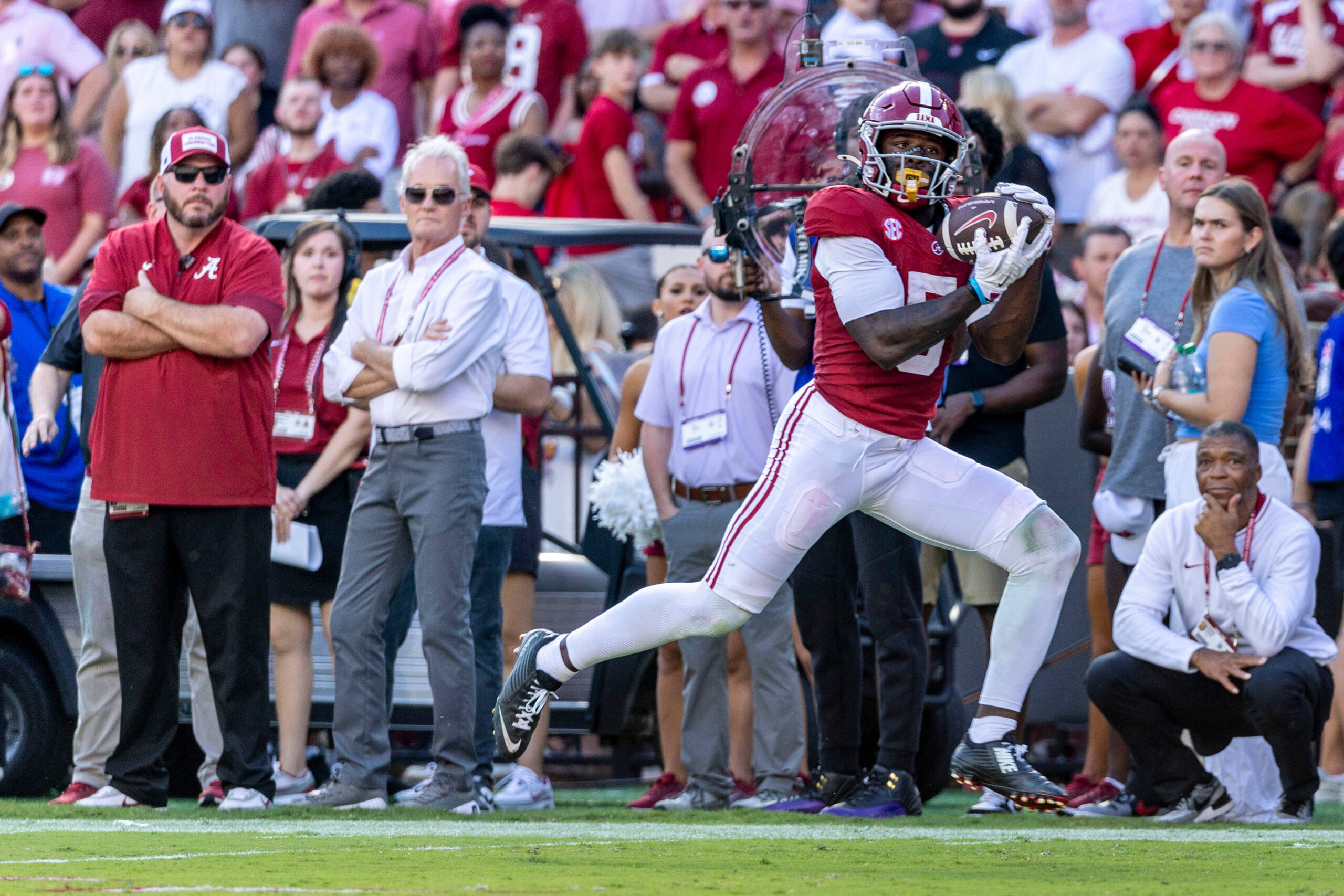
    Bernard is the DeJean of this year’s draft. Midway through his rookie season everyone will look back and say, how did this guy fall as far as he did? Assuming the current projections are correct and he won’t be a first-round pick. Comps are usually fuzzy things. Man, does he look a lot like Deebo Samuel did during his peak with the 49ers. At 6-1, 206 pounds with a low center of gravity and ballcarrier instincts, Bernard could easily pass for a third-down back. But he is a wide receiver, one who averaged 57 catches for 828 yards over his last two seasons at Alabama. He has as high of a floor as anybody can have at his position. Too many GMs chase upside in a draft. The real test is projecting a player’s probability of achieving that upside. Bernard plays the game with a fluidity and instinct that will translate in some meaningful capacity. So much so that the Eagles shouldn’t hesitate to draft him at No. 23 rather than gambling he’ll still be there beyond.

    There is an elephant in the room here, one so large that he has already been mentioned. The Brown thing is simple. Even if he is here next year, he won’t be here much beyond that. Jalen Hurts isn’t one of the rare quarterbacks who makes the pass-catching talent around him better. The Eagles will fail and fail miserably if Smith is his only pass-catcher who is above replacement level. They would be wise to trade Brown if it lands them a draft pick that facilitates the acquisition of someone with the ability to help replace him.

    “If someone is going to give you something you didn’t anticipate and you won’t even have the conversation, I don’t think you’re necessarily doing your job or really servicing the team you’re with,” Roseman said at the combine last week. “You never know what someone is willing to do.”

    The perfect draft for the Eagles is Sadiq first and then one of Concepcion or Bernard second. Given the value that teams place on the trenches, it’s hard for me to believe in a worthwhile certainty/upside ratio with any lineman who would also be available.

    Germie Bernard had 64 catches for 862 yards and seven touchdowns at Alabama last season.

    I’m skeptical that Sadiq will last anywhere close to where the current mock drafts have him going. At this time last year, Daniel Jeremiah and Pro Football Focus both had Colston Loveland going in the 18-20 range. In 2024, PFF had Brock Bowers going 18th. Loveland ended up going 10th and Bowers 13th. Both were among the top nine non-quarterbacks off the board. So, I wouldn’t put too much stock into the current projections, which have Sadiq lasting into the 20s and potentially reaching the Eagles at No. 23. I also don’t think the Eagles can bet on Concepcion being there. Nor can they with Bernard at 54.

    The idea of trading Brown makes a lot more sense from that perspective. It’s only true if Roseman can somehow finagle something like the No. 31 overall pick from the Patriots. Maybe by swapping No. 54 and No. 68 for the Pats’ No. 63. So, the Eagles trade Brown in order to move up 23 spots from No. 54 to No. 31 while moving down nine spots from No. 54 to No. 63.

    There are at least three prospects who would make it worth it.

  • Kyle Schwarber is too good to bat cleanup. That, and other conclusions from last year’s lineups.

    Kyle Schwarber is too good to bat cleanup. That, and other conclusions from last year’s lineups.

    What if I told you that Alec Bohm offered more protection to Bryce Harper than Kyle Schwarber?

    What if I told you the Phillies’ best batting order is the one they rode to the NL East title, and that Rob Thomson shouldn’t change a thing?

    I can’t say either of these things with any degree of certainty. All I can tell you is what the numbers added up to last season. If you don’t like numbers, what you are about to read probably isn’t for you. But a surprising number of people emailed me after Tuesday’s column and suggested that I compare Harper and Schwarber’s numbers when hitting back-to-back in the lineup.

    As a refresher, the topic du jour — or however you say the topic of that day in French — was Harper’s struggles to score runs after reaching base. It was a pertinent topic, given that it sat at the intersection of issues people rightfully have with the Phillies’ odd-fitting and top-heavy batting orders.

    But the ramifications of Dave Dombrowski’s roster construction are much broader than the infrequent sound of Harper’s cleats clacking on home plate. The weight is disproportionately borne by Thomson. The dam has more holes than he has fingers. Baseball would be a lot more fun if he could use Harper and Schwarber twice each time through the batting order. Until he can, the lineup will always leak somewhere.

    The question remains. What is the optimal (legal) combination? Specifically, at the top of the order, seeing that Thomson has used a number of different combinations of Harper, Schwarber, and Trea Turner, with or without another hitter mixed in.

    I used Retrosheet’s play-by-play data and borrowed Will Hunting’s chalkboard and did some figurin’. Harper behind Schwarber, Schwarber behind Harper, neither behind the other. The sample sizes are too small to render any definitive judgments, especially given other confounding variables in play.

    There were some surprises.

    How do you like these apples:

    Observation 1: Harper didn’t get any benefit from batting in front of Schwarber.

    In fact, he was his least productive self with Schwarber behind him in the order. The splits are pretty drastic. Harper’s OPS was nearly 100 points higher when batting in front of Bohm vs. Schwarber. And it wasn’t just because he walked more. His extra-base hit percentage was higher, thanks in part to five home runs in 126 plate appearances in front of Bohm compared with seven in 200 in front of Schwarber.

    The numbers, please.

    Harper in front of …

    • Schwarber: .796 OPS, .355 OBP, 18.0 K%, 12.5 BB%, 9.0 XBH%, 7 HR, 200 PA
    • J.T. Realmuto: .810 OPS, .332 OBP, 20.9 K%, 10.2 BB%, 8.6 XBH%, 11 HR, 187 PA
    • Bohm: .881 OPS, .381 OBP, 23.8 K%, 13.5 BB%, 11.1 XBH%, 5 HR, 126 PA

    Observation 2: Harper was at his best when hitting behind Schwarber.

    He also was pretty good when hitting behind Turner.

    The numbers:

    Harper, when hitting behind …

    • Schwarber: .858 OPS, .352 OBP, 22.0 K%, 11.1 BB%, 10.8 XBH%, 17 HR, 332 PA
    • Turner: .831 OPS, .373 OBP, 18.8 K%, 14.8 BB%, 9.4 XBH%, 9 HR, 244 PA

    Here’s the interesting part: Harper was much better hitting behind Turner when Schwarber wasn’t hitting directly behind him, specifically when Bohm split the lefties in the No. 3 spot, with Harper batting second and Schwarber fourth. In fact, Harper and Schwarber were both pretty darn good in those situations — again, in tiny sample sizes.

    Harper behind Turner, and nonconsecutively with Schwarber: 9-for-37, five extra-base hits, two home runs, 11 walks, .903 OPS.

    Schwarber in those situations: 9-for-38, six extra-base hits, four homers, eight walks, 1.014 OPS.

    All of Harper’s plate appearances in front of Schwarber came in the first three months of the season. The last time Thomson used a Harper-Schwarber lineup was those back-to-back losses in Toronto when the Blue Jays outscored them, 11-2.

    Phillies manager Rob Thomson has quite the number of decisions to make when it comes to where Bryce Harper and Kyle Schwarber end up in his batting order.

    After Harper returned from the injured list in late June, Thomson switched to the lineup that carried the Phillies through the rest of the season. Schwarber in the two-hole, followed by Harper. Only twice did he deviate from that batting order when both players were in the lineup. Understandably so. The Phillies averaged five runs per game in their last 79 games, putting together a team OPS of .789.

    There is a question of correlation vs. causation here. Were the Phillies better as a team because Harper’s numbers were better behind Schwarber? Or were Harper’s numbers better behind Schwarber because that’s where he was hitting when he and the rest of the team found its stride?

    All sorts of variables could be in play: the quality of pitching the Phillies faced in the last three months vs. the first three months, the weather, etc.

    That being said …

    The numbers show Kyle Schwarber should not bat in the cleanup spot behind Bryce Harper.

    Observation 3: Schwarber should not bat cleanup. The optimal lineup is either Turner-Schwarber-Harper or Schwarber-Turner-Harper.

    The Phillies were at their best when Schwarber and Harper were batting in the top three. This is obvious. Schwarber may look like the prototypical table-clearer until you see what happens when Bryson Stott and Turner are getting it set.

    No offense to either player. But the goal is to get your elite players the most at-bats. It doesn’t get more prototypical than Aaron Judge, and the Yankees bat him leadoff.

    It comes down to this, really: Down by one in the bottom of the ninth with the top of the order due up, you want a lineup that guarantees Harper and Schwarber a chance at tying the game. The data from last season doesn’t prove anything, but it is always smarter to err on the side of what the data suggests when what it suggests is the same as one’s intuition.

    We can argue about Bohm vs. Adolis García vs. Realmuto. Hopefully, we’ll end up arguing about Aidan Miller. But there isn’t much of an argument for batting Schwarber or Harper lower than third.

    Just ask any opposing pitcher what he would prefer.

  • Bryce Harper and Scott Boras are right. Here’s a wild stat that makes their point.

    Bryce Harper and Scott Boras are right. Here’s a wild stat that makes their point.

    No man is an island. Unless that man is Bryce Harper and he has just reached base.

    Last season, there wasn’t a lonelier lot in life than to be a Phillies superstar standing on first, second, or third. Only four players in the majors reached base as many times as Harper did and scored fewer runs. The 72 runs he did score were the fewest of his career in a season with at least 500 plate appearances. Only one player in the majors last year failed to score more than 72 runs while posting an OPS of at least .800 in 580-plus plate appearances. It was Harper. In fact, he was the only player to do it since 2023. That’s not some hocus-pocus bit of cherry-picked math. Fifty-nine players meet our criteria (.800 OPS, 580 PAs). Harper’s 2025 campaign ranked dead last in runs scored.

    Not since E.T. have we seen someone with such otherworldly attributes struggle this hard to get home.

    We’ve heard a lot of chatter about lineup protection this offseason. Scott Boras broached the topic back in October. Harper himself weighed in last week. Their focus was on pitchers pitching around Harper in order without the threat of reprisal from those due up next.

    “I think the four spot has a huge impact,” Harper said when he arrived in Clearwater, Fla., for spring training. “I think the numbers in the four spot weren’t very good last year for our whole team. I think whoever’s in that four spot is going have a big job to do, depending on who’s hitting three or who’s hitting two.”

    Neither Harper nor his agent spoke much about the issue of him rotting on base like an unsold ham on Easter Monday. But it’s just as important, if not more so.

    Last season, Phillies hitters had 366 plate appearances when Harper was on base. That’s not including his home runs. We’re limiting ourselves to the plate appearances when Harper was physically standing on base, hoping for a teammate to drive him home. In those 366 plate appearances, the hitters behind Harper combined for a whopping .227 batting average, .290 on base percentage, and .342 slugging percentage. Of the 180 times he reached base without driving himself in (i.e., without hitting a home run), he ended up crossing home just 45 times.

    In 366 plate appearances (not including home runs), the hitters behind Bryce Harper combined for a whopping .227 batting average, .290 on base percentage, and .342 slugging percentage.

    That’s a remarkably low percentage. Three out of four times that Harper reached base, the inning ended with him jogging back to the dugout. That’s a remarkably low percentage compared to most other hitters of his ilk. Even more troublesome is the fact that Kyle Schwarber’s percentage wasn’t much better. But we’ll get to that in a second.

    First, let’s remind ourselves of the real-world situations that these numbers tabulate. Harper didn’t have a great NLDS against the Dodgers. But he did reach base six times. That was tied for second on the team behind Alec Bohm. Bohm reached base 10 times and scored three runs. J.T. Realmuto reached base six times and scored three runs. Harper reached base six times and scored one run.

    It’s an imperfect example. In the NLDS, Harper mostly expired on first base after arriving there with two outs. You could write it off to circumstance if not for the body of evidence. In the 2025 regular season, no player in the majors was stranded as often as Harper, once you account for where he hits in the order. His driven-in percentage (25%) ranked dead last among players who regularly hit in the top-third of the order (minimum 500 plate appearances).

    The table below shows the 34 players who had at least 500 plate appearances in an average batting order position between the two-hole (2.0) and three-hole (3.0). Their run percentage is the number of times they reached base and later scored.

    Just as concerning as Harper in dead last is Schwarber a mere two spots ahead of him. Of the 34 qualified hitters, Schwarber and Harper ranked 32nd and 34th in scoring percentage. Put another way, Schwarber and Harper’s teammates ranked dead last in their ability to drive them in.

    Between Schwarber and Harper is Cal Raleigh, whose Mariners advanced to last year’s ALCS and put up a sporting effort. Meanwhile, Toronto’s Bo Bichette scored at a below-average rate. The Blue Jays made the World Series. It isn’t completely unheard of for upper-middle-of-the-order hitters to drive in more runs than they score, given the drop-off in quality behind them. But the Phillies have two players at the bottom of the list. We’re talking about the upper two-thirds of their order. And they aren’t just below-average. They are virtual outliers. The only other team that has two players in the bottom half of this list is the Angels. Nobody wants to be mentioned in the same breath as the Angels. If you are comparable to the Angels in a certain regard, it’s a sure sign the regard needs fixing.

    If Harper sounds a little cranky this spring, think about how it feels to reach base and not score. And then think about the fact that the Phillies still don’t have a viable solution. Is it any wonder that Harper is acting like he woke up on the wrong side of the red-light therapy sleeping bag?

  • The 2026 breakouts the Phillies need, starting with Aidan Miller

    The 2026 breakouts the Phillies need, starting with Aidan Miller

    Aidan Miller on the Phillies roster on opening day? Don’t count on it. But don’t completely rule it out. And don’t mark your calendar too far into the future. The April showers could bring a lot more than flowers this year.

    Two weeks into spring training, the Phillies aren’t going out of their way to disguise their hopes for their top prospect. The whole organization seems to understand that a certain degree of aggression is required in order to overtake the Dodgers in the National League and survive the Mets and Braves in the NL East. Bryce Harper made some news Sunday in an interview with Tom McCarthy and Ruben Amaro Jr. during the broadcast of the Phillies’ Grapefruit League game against the Pirates. Harper implied that Miller is battling an injury, jokingly saying that he wants to see the prospect “get off his butt and get in the game, that’d be nice. I need him to get healthy.”

    It was later revealed that Miller has been battling some back soreness. But the important part of Harper’s comment was his overarching point.

    “He could help us by the end, obviously,” the Phillies superstar said.

    The path of least resistance is the wisest path for now. Start Miller in the minors. Get him some time at second and third base in addition to shortstop. Evaluate the big league lineup over the first couple of months of the season, with a particularly keen eye paid toward Alec Bohm and Bryson Stott. Let the facts on the ground make the decisions for you.

    The important thing for the Phillies is not to fight those decisions should they become obvious. Miller is a special enough bat to warrant stepping outside your defensive comfort zones. He’ll be 22 years old by June 9. Over the last three seasons, 49 hitters have logged at least 200 plate appearances at the age of 22 or younger. That includes game-changers like Julio Rodríguez, Elly De La Cruz, James Wood, Corbin Carroll, and Gunnar Henderson.

    Miller is in the same class of prospects as those hitters. If he starts this season the way he finished 2025 — hitting .356 with 23 extra-base hits in his last 39 games — the Phillies will need to find a spot for him. Every day they wait will be a wasted one. They are at a point in their trajectory where they will need something unforeseen to happen in order for their lineup to produce at even 2022 levels. Miller is both the most likely candidate and the one who can move the bar the furthest north.

    Some others who still have some degree of upward mobility:

    Brandon Marsh

    Marsh is an interesting case. The gap between public perception and actual production is wider than for any player on the Phillies roster. In fact, it might be wider than for any athlete in the city. Look at Marsh’s final 2025 numbers compared with some randomly selected players:

    • Jackson Chourio: .270/.308/.463, 112 OPS+, 21 HRs, 589 PAs
    • Jackson Merrill: .264/.317/.457, 112 OPS+, 16 HRs, 483 PAs
    • Harrison Bader: .277/.347/.449, 117 OPS+, 17 HRs, 501 PAs
    • Steven Kwan: .272/.330/.374, 96 OPS+, 11 HRs, 693 PAs
    • Marsh: .280/.342/.443, 114 OPS+, 11 HRs, 425 PAs
    Brandon Marsh figures to platoon in left field with the righty-hitting Otto Kemp.

    Most interesting is the side-by-side comparison to Kwan, who was a hot trade-deadline name connected to the Phillies last summer. Marsh outproduced the Guardians’ veteran in virtually every category. Yet people would feel a lot differently about the Phillies’ outfield outlook for 2026 if it was Kwan in there instead of Marsh.

    This isn’t a one-year phenomenon, either. In the three years since the Phillies acquired Marsh from the Angels, his 115 OPS+ ranks 28th out of 106 MLB outfielders with at least 800 plate appearances. That’s higher than Chourio and Kwan and also Jazz Chisholm, Jurickson Profar, and Taylor Ward, to name a few.

    The lack of enthusiasm for Marsh isn’t entirely irrational. In the last two postseasons, he has reached base three times in 28 plate appearances over eight games. His left-handed bat is an inconvenience when attempting to construct a batting order around Harper and Kyle Schwarber. He hasn’t been the plus defender in center field that many expected when the Phillies acquired him. With a middling 39 home runs in 1,373 plate appearances over the last three seasons, he doesn’t bring prototypical corner-outfield power. Long story short, he hasn’t been the player the Phillies are sorely missing: a right-handed power bat who can hit behind Harper and/or Schwarber.

    Marsh can’t do anything about the fact that he hits left-handed. But he does bring some positive uncertainty on the upper end of the range of outcomes. He made some noticeable improvements in his bat-to-ball game in 2025, raising his contact rate from 74.7% to 78.3%, according to FanGraphs. Much of that jump came out of the zone. He swung at more pitches out of the zone (30.5%, up from 26.1% in 2024) but also connected on more of those pitches (56.3%, up from 51.4%). The result was less power and fewer walks, but also fewer strikeouts and more base hits. All in all, the tradeoff was positive one vs. 2024. The question now is whether he can add on a little more power in the zone.

    Marsh finished last season on a serious upswing. After a brutal first six weeks of the season, he hit .299 with an .835 OPS over his last 107 games. His last two months were especially spicy, with a .325/.367/.584 batting line and eight home runs in 166 plate appearances from July 28 to the end of the regular season. During that stretch, he ranked seventh among outfielders in weighted on-base average (.401) and sixth in slugging percentage (.584) with a home run pace of about 25 per 162 games.

    Justin Crawford slashed .334/.411/.452 in triple A last season.

    Justin Crawford

    Obvious, yes, especially now that it seems he has a spot locked up on the opening day roster. It would be a huge boost if Crawford could somehow bring his .334/.411/.452 triple-A batting line to the majors without much drop-off. Hello, leadoff spot. We’ll worry about lefties later.

    But that’s not the real game-changer of a scenario. No, the one the Phillies can dream of is the one Crawford hinted at in his first at-bat of the spring, a double off the center-field wall off of big league lefty Eric Lauer. What if Crawford finally starts to develop the power suggested by his frame and his pedigree?

    It’s awfully hard for a big league hitter to swing his way on base as routinely as Crawford did in the minors. But the Phillies would gladly sacrifice some of that average for some of the pop that his papa had during his prime. Carl Crawford’s power started to come at the age of 22, in his third season in the majors. That was his first All-Star season for the Rays, when he led the majors with 19 triples and also hit 11 home runs for a .450 slugging percentage that would continue to improve throughout his early 20s.

    Justin has his dad’s frame. He has a similar swing. He finished last season with just 34 extra-base hits in 506 plate appearances. But the jump is going to come, as long as he can make big-league contact.

    The moral of the story: There is upside on this Phillies roster. It only means so much. We’ve seen that with Bohm and Stott over the last few seasons. But Miller and Crawford offer plenty of reason to hope. At the very least, the Phillies seem to understand that they could be necessities.

  • Alec Pierce? Mike Evans? Germie Bernard? How would the Eagles replace A.J. Brown?

    Alec Pierce? Mike Evans? Germie Bernard? How would the Eagles replace A.J. Brown?

    Everyone is asking the wrong question with regard to A.J. Brown.

    It isn’t, “Should the Eagles trade him?”

    It’s, “Who will replace him?”

    You have to start there. It is the independent variable. You have to define it in order to solve the rest of the equation. You can’t have an opinion on how the Eagles should proceed with their All-Pro wide receiver if you don’t first have an opinion on what they should do without him.

    Feel free to take as much time as you need. Just make sure that you don’t dwell too long on the internal options. Right now, there aren’t any.

    Almost literally.

    Aside from DeVonta Smith, the Eagles have exactly two pass-catchers under contract who had a target for them last season. Darius Cooper and Britain Covey combined for 11 catches on 112 yards. Other than that, your options are limited to 2024 sixth-round pick Johnny Wilson, who missed last season with a knee injury. The tight end room doesn’t even have anyone to turn on the lights.

    So … what’s the plan?

    The draft is not a serious option. Not where the Eagles are picking, at least. Last year’s draft yielded 11 wide receivers and tight ends who played at least 50% of their team’s snaps. Four of those players were selected before pick No. 23. Five others played for the Titans, Browns or Jets. Maybe they’ll be in a position to draft this year’s Emeka Egbuka (No. 19 to the Bucs in 2024). But they could just as easily end up with this year’s Matthew Golden (No. 23 to the Packers). The best way to get yourself in trouble on draft day is to try to solve this year’s problems.

    It isn’t outlandish to think Alabama wide receiver Germie Bernard might be capable of what Deebo Samuel did as a rookie when the 49ers drafted him in 2019.

    That’s not to say they shouldn’t be looking. Nor that they won’t find some help. Alabama’s Germie Bernard would make a worthy target, even at No. 23. Whatever he measures at the combine, the game speed is there, as is the hybrid 6-foot-1, 204-pound frame. It isn’t outlandish to think he could do what Deebo Samuel did as a rookie after the 49ers drafted him at No. 36 overall in 2019: 57 catches, 802 yards, 14 carries, 159 yards. But to feel comfortable trading Brown, you need a lot more certainty than “isn’t outlandish.”

    Free agents? Sure, let’s talk. Alec Pierce would be a no-brainer. At 25 years old, the Colts wideout caught 47 passes for 1,003 yards with Daniel Jones, Philip Rivers and Riley Leonard at quarterback. He isn’t anywhere close to Brown as a singular talent. Still, if you combine him with a draft pick like Bernard, he could be part of a radical and positive identity shift in both the short- and long-term.

    Only one problem: The Eagles are one of 32 teams that can bid on free agents. A team like the Patriots can offer more cap room and a better quarterback and an acute need at the position. I’m skeptical the Eagles would win out.

    The free agent crop is interesting even beyond Pierce and presumptive Cowboys franchisee George Pickens. Jauan Jennings and Mike Evans could replace some of Brown’s physicality in traffic and in 50/50 situations. Again, though, you have to wonder. Will players who have multiple options err on the side of a team with a run-heavy approach and Jalen Hurts at quarterback?

    The conundrum is the same as it was three months ago, when the annual pre-trade-deadline nonsense reached its crescendo. The dream that the Eagles might part ways with their WR1 died in a head-first collision with reality. However disgruntled Brown was, however diminished his skills were, nobody else on the roster would have done enough in his stead to survive such a move. To suggest otherwise was to betray a fundamental misunderstanding of how this Eagles passing offense works. It would not have functioned without him.

    Colts wide receiver Alec Pierce had his first 1,000-yard season with Daniel Jones, Philip Rivers, and Riley Leonard throwing to him.

    True, the Eagles barely functioned with Brown. But that only matters if you think they should have given up on the season at the trade deadline. That’s what they would have been doing by trading Brown. Look at their track record without him. Brown missed four (meaningful) games in his first three seasons with the Eagles. The Eagles lost three of them, and they scored 15 points in the game that they won. In 2025, the Eagles scored 38 points against the Giants without Brown. They also threw the ball 20 times. Smith was the only wide receiver to catch more than one of them.

    Plenty of NFL teams have managed to win without two WR1 types. But we’ve never seen Hurts have to do it. Right now, the Eagles don’t even have a WR2 who is better than replacement level. Keep in mind, the Eagles already have a hugely pressing need at tight end. They could need to spend big bucks to retain Jaelan Phillips, or to sign a replacement. In the draft, they will be hard-pressed to turn down an opportunity to add another offensive lineman to their feeder system.

    The preponderance of the circumstances says the Eagles probably shouldn’t trade Brown. Life would be a lot easier if they didn’t need to. The onus is on the case for how they can do so and survive. If you can make one, I’m sure they’d love to hear it.

  • What Bryce Harper said, what he couldn’t say, and how it reflects on Dave Dombrowski

    What Bryce Harper said, what he couldn’t say, and how it reflects on Dave Dombrowski

    The best way to understand Bryce Harper is to think about all the things he can’t say.

    He can’t say that Alec Bohm is a seven-hole hitter at best. He can’t say that Adolis García is much closer to Nick Castellanos than he is a legitimate four- or five-hole hitter. He can’t say that J.T. Realmuto isn’t the guy he was three years ago. He can’t say that he’d swing at fewer pitches out of the zone if he had more confidence that the guys behind him would get the job done.

    Given all of those things, Harper also can’t say that Dave Dombrowski has not been an elite personnel boss for at least a couple of years. He can’t say that Dombrowski’s lack of eliteness is chiefly to blame for the Phillies’ run-scoring struggles. Harper can’t say that he was much closer to the hitter the Phillies needed in 2025 than Dombrowski was to being the roster-constructor they needed.

    To throw shade at Dombrowski would be to implicitly throw shade at teammates whose “underperformance” is mostly a function of Dombrowski needing them to be something they aren’t.

    Harper could have gone deeper. He could have said that the Phillies lost to the Dodgers last season because Dombrowski cobbled together a playoff roster that didn’t allow Rob Thomson to pinch-run for Castellanos. He could have said that the Phillies have finished the last three seasons one reliever short. That they lost to the Diamondbacks in 2023 because Gregory Soto, Craig Kimbrel, and Orion Kerkering were pitching in roles where the Phillies should have had a prime high-leverage arm.

    Harper could have pointed to Austin Hays, to Whit Merrifield, to Max Kepler, to David Robertson. He could have asked why he, or we, should have any faith in the decisions to sign García or trade away Matt Strahm when those decisions were made by the same man who made all the previous ones.

    But Harper didn’t say those things. He couldn’t say those things. Instead, he said things that could lead one to conclude that he is a little too sensitive, a little too close to the prima donna archetype, a man in possession of emotions triggered by even the faintest whiff of criticism.

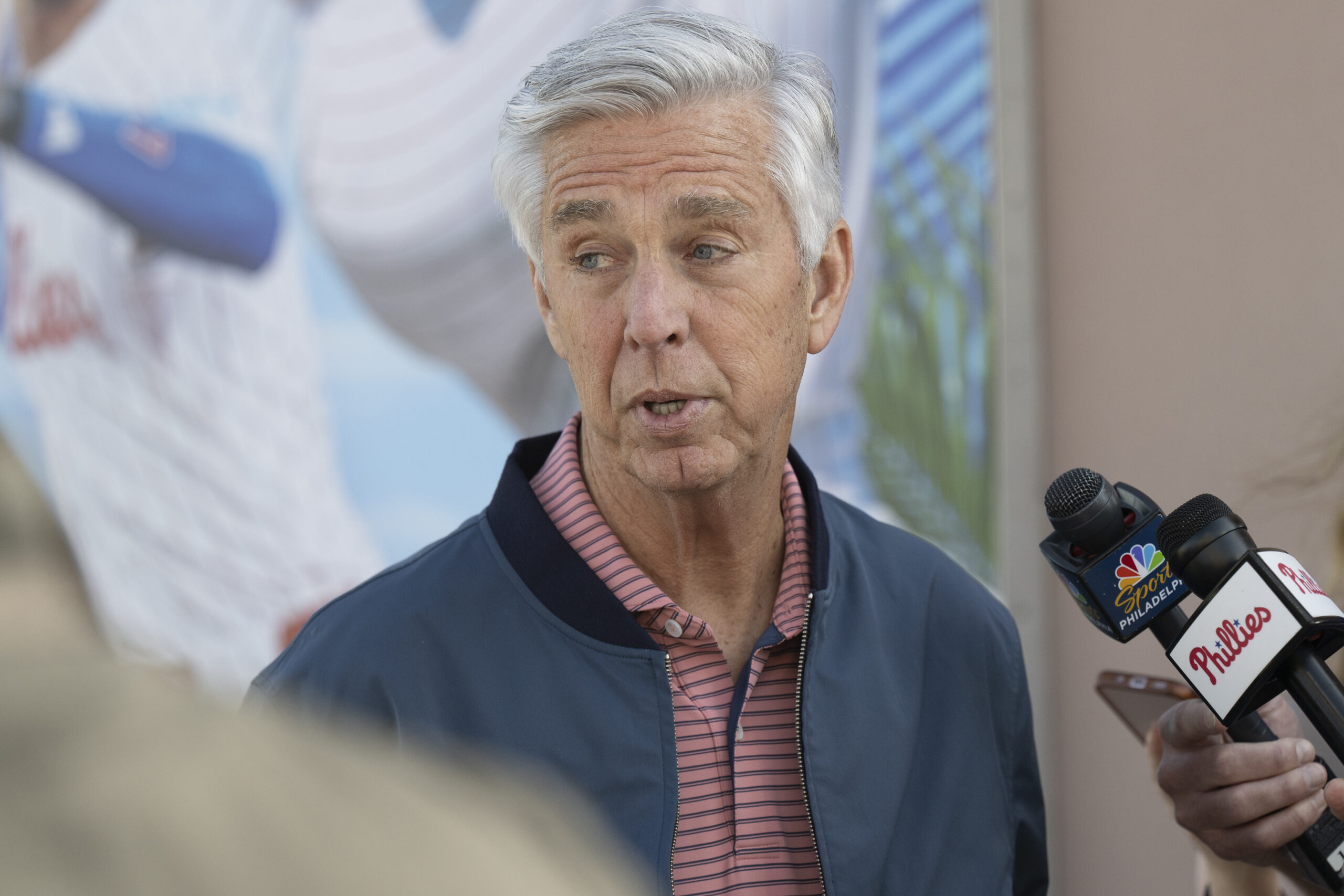
    Phillies president of baseball operations Dave Dombrowski at BayCare Ballpark last week.

    When Dombrowski raised the question of whether Harper would ever be the elite player he’d once been, Harper could have raised a question of his own:

    Who are you to talk, suit?

    Instead, he said things like this:

    “It was kind of wild, the whole situation,” Harper said Sunday when he arrived at spring training. “I think the big thing for me was, when we first met with this organization, it was, ‘Hey, we’re always going to keep things in-house, and we expect you to do the same thing.’ When that didn’t happen, it kind of took me for a run a little bit. I don’t know. It’s part of it, I guess. It’s kind of a wild situation, you know, that even happening.”

    It only makes sense in conjunction with the other things we heard from Harper and his camp. In October, in an interview with MLB.com, agent Scott Boras pointed to the number of pitches Harper saw in the zone (43%, fewest out of 532 qualifying players). On Sunday, Harper riffed on that theme, pointing out the paltry production the Phillies got out of the lineup spot directly behind his usual place in the three-hole.

    Look at last season’s Mount Rushmore of hitters and you’ll see the source of Harper’s frustration.

    One of the common bonds for Aaron Judge, Shohei Ohtani, and Cal Raleigh was the talent that followed them in the batting order.

    Hitting behind Judge were Cody Bellinger, Ben Rice, Jazz Chisholm, and Giancarlo Stanton. Each of those players finished the season with at least 24 home runs and an .813 OPS.

    Ohtani’s supporting cast needs no introduction. Mookie Betts and Freddie Freeman are both former MVPs. Will Smith has been an All-Star in three straight seasons.

    Raleigh was most often followed directly by Julio Rodriguez, Josh Naylor, Eugenio Suárez, and Jorge Polanco. Three of those players finished 2025 with at least 26 home runs.

    Each of those three superstars — the three leading vote-getters on AL and NL MVP ballots — were followed in the batting order by at least three players who finished the season with at least 20 home runs. Compare that to Harper, who usually had two players behind him with more than 12 home runs, neither of whom is on the roster this season (Kepler 18, Castellanos 17).

    If anything, Harper was underselling the situation when he met with the media Sunday in Clearwater. The two-time MVP limited his focus to the Phillies’ struggles in the cleanup spot, where they ranked 20th in the majors in OPS last season.

    “I think the four spot has a huge impact,” Harper said. “I think the numbers in the four spot weren’t very good last year for our whole team. I think whoever’s in that four spot is going to have a big job to do, depending on who’s hitting three or who’s hitting two.”

    Bryce Harper fist-bumps Phillies teammates Sunday ahead of the team’s workout in Clearwater, Fla.

    But the issues behind Harper — and/or Kyle Schwarber, depending on the configuration — are deeper than the next-man-up. As we saw last season, pitchers are more than willing to pitch around two hitters when those hitters are Harper and Schwarber, especially when the guys behind them allow for an extended period of exhalation. Lineup protection is a cumulative thing.

    We saw that in 2022, didn’t we? A big reason the Phillies thrived with Schwarber leading off and Harper batting third was the presence of Rhys Hoskins (30 homers, .794 OPS) and Realmuto (22 homers, .820 OPS) behind them. Even in 2023, they had some combination of Castellanos (29 homers, .788 OPS), Realmuto (20 homers, .762 OPS), and Bohm (10 homers, .765 OPS).

    Boras and Harper have zeroed in on the number of pitches he sees out of the zone. It’s part of the story, no doubt. Over the last three seasons, he has seen a lower percentage of pitches in the zone than any previous three-year stretch of his career. When he was NL MVP in 2021, he saw a career-high 46.7% of pitches in the zone.

    At the same time, Harper was pretty darn good in 2023, when he saw 41.2% of pitches in the zone, the second-lowest of his career, according to FanGraphs. Just as important is what Harper chooses to do with the pitches he sees.

    Last year, his chase rate was 36%. In 2021, it was 25.5%. But he wasn’t necessarily chasing more pitches. His swing percentage on pitches in the zone was 78.3%, up from 72.1% in 2021.

    Protection is a mindset as much as it is an externality. The more protected a hitter feels, the more comfortable he is waiting for his pitch rather than trying to do too much. Pitchers won’t necessarily approach Harper differently if they feel more danger from the hitters behind him. But Harper will absolutely feel more comfortable taking whatever pitchers give him.

    The Phillies acknowledged as much with their openness about their failed pursuit of Bo Bichette. Dombrowski knows what the Phillies need. They need what they had in 2021 and 2022 in prime Hoskins and prime Realmuto (and company).

    They will need to get lucky to have it this season. Their decision-making will need to be filtered through this context. Aidan Miller, Justin Crawford, the trade deadline. Bohm and García will get the first chances. Dombrowski’s future as the bossman will be determined by how they perform, and then by what happens if they don’t.

  • What might Daryl Morey and the Sixers have in mind for this offseason?

    What might Daryl Morey and the Sixers have in mind for this offseason?

    It was a little jarring to see the reaction that Jared McCain got the other night when he checked into a game against the Rockets for his first minutes as a member of the Thunder. The home crowd sure didn’t sound like one that thought the Sixers had sold high on McCain, as Daryl Morey contended the previous day when defending his decision to trade the second-year guard to Oklahoma City for a (presumably) late first-round pick in June’s draft. While the wisdom of NBA crowds probably shouldn’t dictate personnel strategy, the ovation awarded McCain by his new fan base at least served to validate the prevailing sentiment back here in Philadelphia. Given that the defending NBA champs are plenty excited to add McCain to a roster that already had an overabundance of talent, it’s tough to accuse Sixers fans of overreacting if they feel let down by the move.

    Time will be the ultimate judge. Morey admitted as much on Friday as he laid out the rationale for the Sixers’ somewhat surprising decision to trade McCain without receiving any sort of established NBA talent in return. The veteran executive said that he made the McCain move with the thought that the draft capital it returned would eventually facilitate the addition of such talent, but that nothing sensible presented itself before Thursday’s 3 p.m. trade deadline.

    “We thought that the draft picks we got would help us more in the future — and could’ve helped us this deadline,” Morey said. “The picks we got were offered to many teams and nothing materialized for a player that we thought could move the needle with those picks now. But we feel like going forward, those picks will help us build the team in the future in a good way.”

    What might that look like?

    It’s a sensible question to consider even now.

    Sixers president Daryl Morey intimated that he could use the draft picks from the Jared McCain trade in a deal for a veteran down the line.

    The Sixers still have plenty they can accomplish this season. Whatever they do with the McCain draft capital won’t help them in those endeavors. At 30-22, they are 3½ games behind the second-place Knicks and Celtics, part of a group of six or seven teams jockeying for playoff position in an Eastern Conference that lacks a bona fide powerhouse. Yet their third-best player is a rookie, and their second-best player is only now looking something like the player who single-handedly made them a contender for so many years.

    Even in a conference where Jayson Tatum and Tyrese Haliburton are out for the season and the first-place Pistons have the sixth-best championship odds, it’s difficult to picture a Big Three of Tyrese Maxey, Joel Embiid, and VJ Edgecombe winning a title in 2025-26. Especially with Paul George in the early stages of a 25-game suspension for violating the league’s anti-drug policy. Which makes next year a viable consideration.

    On Friday, Morey sounded a lot like the guy who entered the 2022 offseason planning on trading away the club’s first-round pick for a win-now player. That year, the Sixers ended up trading the No. 23 pick for De’Anthony Melton (technically, they drafted David Roddy and then shipped him to the Grizzlies). Likewise with the McCain trade. Morey didn’t make it in order to position the Sixers to draft a player in June.

    “That wasn’t the main focus,” he said. “I think it’s a nice focus, because we do think this draft is a good draft, but we’re not necessarily using the pick in this draft. It could be used for moves around the draft. The three seconds that we got with it, we think those could be used to move up in this draft. Obviously, myself and our front office have done a lot of deals over the years, and this just gives us more tools to make the moves that we think will help our future more than we saw with Jared, who we gave up. But that’s not a comment on Jared.”

    A few things are worth pointing out. The Melton deal is a relevant example of the sort of player the Sixers could potentially acquire in a one-for-one deal. Then 24 years old, Melton was a nice player, but hardly a needle-mover. He was coming off a season in which he averaged almost 23 minutes per game in a playoff rotation, shooting .374 from three-point range and contributing lots of the little things. He ended up averaging nearly 28 minutes and 10.1 points for the Sixers in 2022-23, then missed the second half of 2023-24 with a back injury. Then Melton moved on, signing a free-agent contract with the Warriors.

    So, it’s worth noting that Melton spent only two years with the Sixers, which is the same amount of time McCain had left before the team would have needed to make a decision on a contract extension.

    That said, the Sixers have more draft capital to play with this time around. They are also heading into an offseason when teams could be looking to accrue draft capital in order to facilitate an offer for Bucks superstar Giannis Antetokounmpo, which could shake loose some opportunities for the Sixers (assuming Antetokounmpo himself isn’t a target).

    Perhaps Thunder standout Luguentz Dort will be a good fit for the Sixers in the offseason.

    It isn’t hard to dream up deals that would lend some new and Sixers-affirming perspective to the decision to trade McCain. One scenario in particular involves the team that just acquired the young guard. The Thunder are fast approaching a point where they could need to make some tough decisions with regard to their roster. One player in particular who would fit nicely with the Sixers — or with any contender — is 26-year-old wing Luguentz Dort, who has an $18.2 million team option next season, his last before free agency. If the Thunder don’t think they can accommodate a market-rate contract for Dort, it would make a lot of sense for them to explore moving him this summer. A defensive dynamo and good shooter, Dort would surely attract plenty of interest on the trade market.

    Should the potential for such a move present itself, the Sixers will be in a better position to make a competitive offer. The McCain draft capital could also help them shed the last two years of George’s contract should they have the opportunity to sign or acquire a player using the cap space they would free up by parting ways with George’s salary. Those are just a couple of for-instances.

    Again, time will tell. McCain played 14 minutes for the Thunder the other night. He didn’t add much to the stat sheet: five points, a couple of turnovers, 1-for-3 from three-point range. But he did finish with a plus-12 in a game the Thunder lost by six. The Sixers hope they will end up parlaying the McCain trade into a player who can contribute to a championship team. The Thunder hope that’s what McCain is.