A woman who waved a gun at officers died after being shot by police early Sunday in Hunting Park, officials said.
Patrol officers responded to reports of a person with a gun on the 900 block of West Erie Avenue shortly after 4 a.m. The officers said they encountered a 35-year-old woman holding a handgun to the right side of her head.
Police say the distraught woman ignored repeated commands to drop her weapon and seemed unaffected by an officer’s Taser. The woman fled across Erie Avenue, pointing her gun in the direction of two 25th District officers who opened fire, striking her three times, police said.
Police transported the wounded woman to Temple University Hospital.
The woman was pronounced dead at 4:42 p.m., police announced Sunday evening. Police said they would release her name after her family was notified.
At the scene, investigators said they discovered a .22-caliber handgun that had an obliterated serial number, with one round in the chamber and 19 more in the gun’s magazine.
The woman had been charged with aggravated assault on police.
Body-worn cameras captured the incident, police said. Per department policy, the officers who fired their weapons — both have been on the force for less than three years — have been placed on desk duty pending an investigation.
The case is being investigated by the department’s Officer-Involved Shooting Investigation Unit, Internal Affairs Bureau, and the Philadelphia District Attorney’s Office.
Staff writer Andrew Kitchenman contributed to this article.
State police are investigating an early-morning shooting on I-95 that left one person wounded and partially shut down traffic for several hours.
The shooting occurred around 7 a.m. Sunday, in the northbound lanes of the highway approaching the Cottman Avenue exit, a Pennsylvania State Police spokesperson said.
The victim sustained a non-life-threatening injury to the shoulder. The suspected shooter was taken into custody, police said.
Portions of I-95 northbound remained closed until just before noon Sunday, the spokesperson said, while investigators gathered evidence from the crime scene.
Police have yet to release a motive or any charges in the incident. The identities of the victim and alleged shooter were not immediately available.
One man died in a fire at a Strawberry Mansion home Friday, officials said.
Firefighters responded about 4:45 p.m. to a three-story rowhouse on the 3200 block of Ridge Avenue that was engulfed in flames. The fast-moving fire had already spread to another home, while rescuers received reports of people trapped inside, officials said.
After battling the blaze for 45 minutes, about 80 firefighters finally contained the flames. Two occupants escaped the home where the blaze started, but firefighters discovered a man dead at the top of a flight of stairs on the second floor, officials said.
On Saturday, fire department officials had yet to publicly identify the victim.
The fire marshal’s office is investigating the cause of the fire, a department spokesperson said. The medical examiner’s office will determine the cause of death.
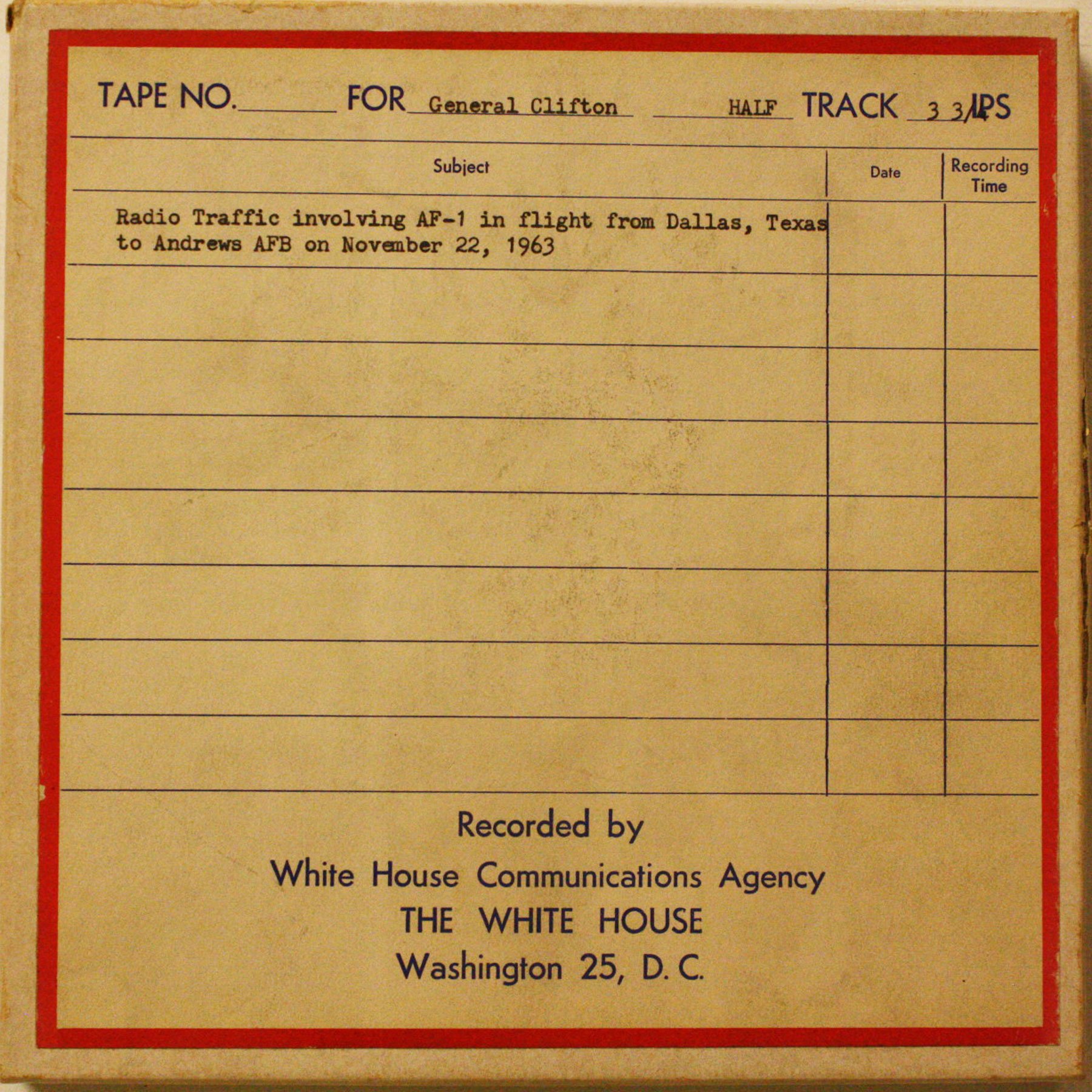
Listed at $750,000 by the Raab Collection, the tape captures more than two hours of shocked radio conversations between Kennedy aides and military officials during the fateful flight home on Nov. 22, 1963.
An original recording of Air Force One radio traffic has been listed for sale in Philadelphia for $750,000.
Discovered at the bottom of a box of JFK memorabilia at a private auction in 2011, the tape represents the earliest and most complete recording of Air Force One radio traffic from the day of the assassination.
In staticky conversations, Kennedy aides, bearing the casket home to Washington, and White House officials awaiting them discuss grim logistics after a presidential killing — arranging the removal of the coffin; transportation for the blood-soaked first lady, Jacqueline Kennedy, and the new president, Lyndon Johnson; and an autopsy for the slain leader.
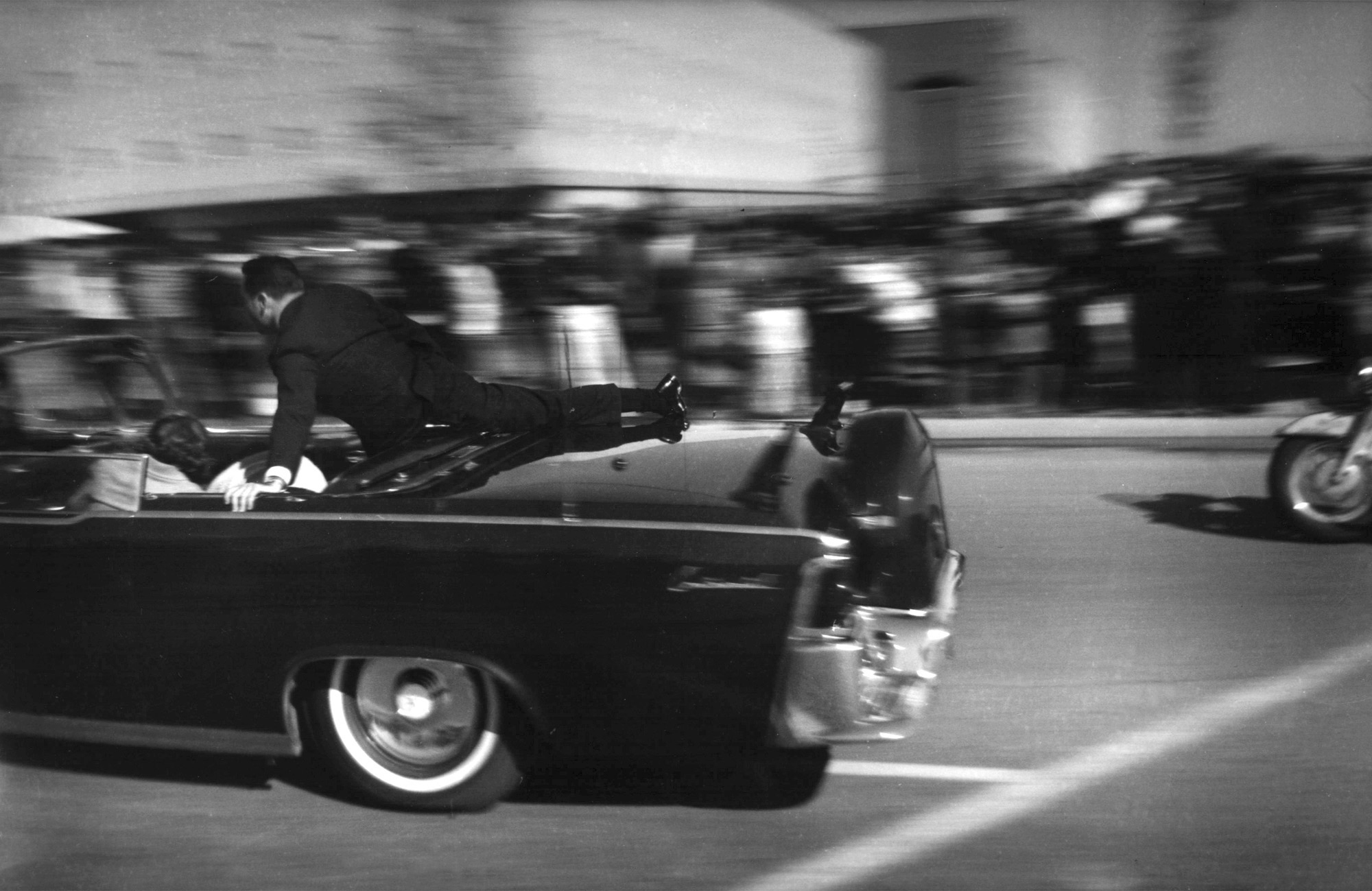
Hours earlier, Kennedy, 46, had been fatally shot in a Dallas motorcade by Lee Harvey Oswald.
One of a pair of identical tapes, the finding had caused a stir of controversy in JFK assassination research. Snippets from a heavily edited version of the tape had previously been released by President Johnson. No other recordings were thought to exist.
At the time of their discovery, historian Douglas Brinkley described the tapes as a “serious find” and critical listening for all Kennedy researchers.
Raab recently donated the other remaining recording to the National Archives as part of a settlement that allowed the collection to keep one.
The tapes had long belonged to a senior military aide, Gen. Chester Clifton, who rode in the fateful motorcade and was aboard Air Force One. Raab had the tapes digitized from reel-to-reel form.
“This is a powerful moment in American history,” said Nathan Raab, president of Raab Collection, which has offices in Ardmore and Center City. “It is an incredible object, a unique discovery, and a reminder of our journey as a nation.”
To see the sale listing, visit www.raabcollection.com/presidential-autographs/jfk-original-tape-air-force-one
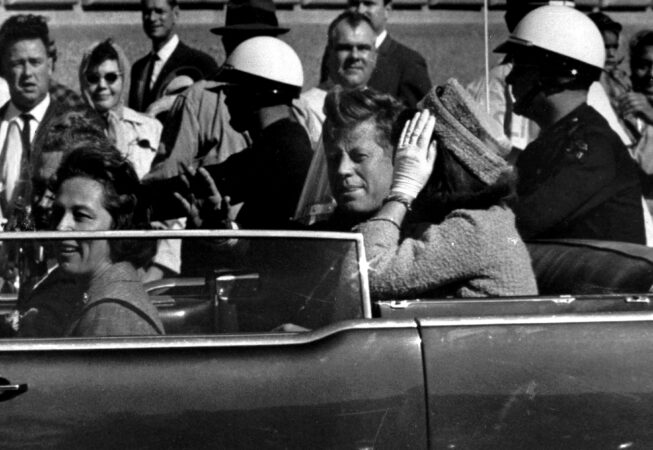
FILE – The limousine carrying mortally wounded President John F. Kennedy races toward the hospital seconds after he was shot, Nov. 22, 1963, in Dallas. The 60th anniversary of President Kennedy’s assassination, marked on Wednesday, Nov. 22, 2023, finds his family, and the country, at a moment many would not have imagined in JFK’s lifetime. (AP Photo/Justin Newman, File)
The Founding Fathers never suffered sobriety. When they weren’t sweating out independence at Independence Hall, they were bending elbows at City Tavern — pretty much around the clock.
George Washington developed such a hankering for a rich, malty, Philly-brewed Robert Hare’s porter, he had kegs of the stuff shipped to Mount Vernon.
John Adams, once virulently anti-tavern, effusively extolled the Philly bar scene in letters to his wife, Abigail. At one “most sinful feast,” Adams recalled sipping what would become his favorite Philly cocktail, the “Whipped Sillabubs.” A popular choice of the colonial-era Philly cocktail set, the boozy, creamy concoction was made from sherry, wine, and lemons.
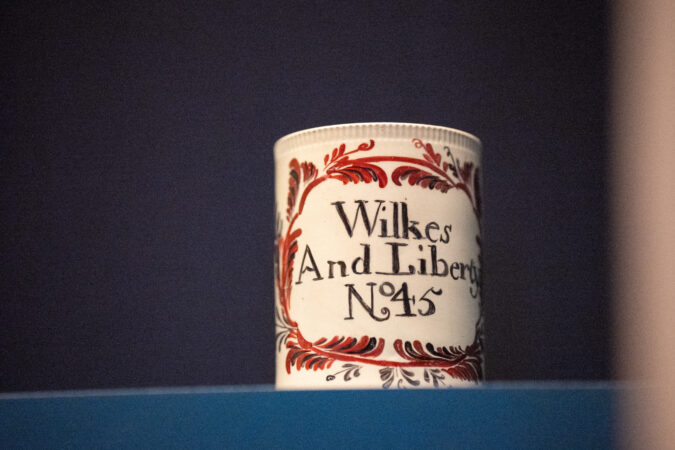
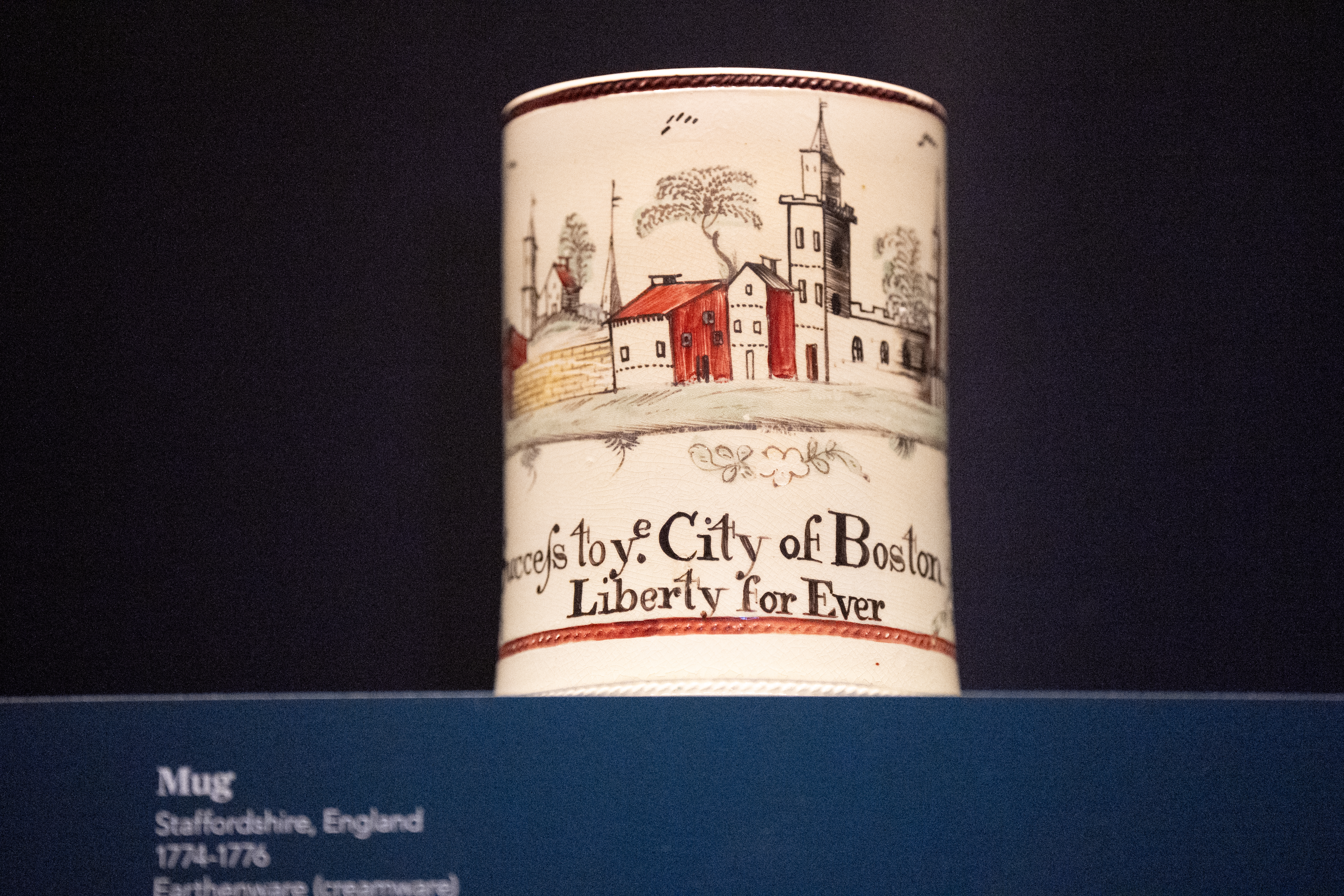
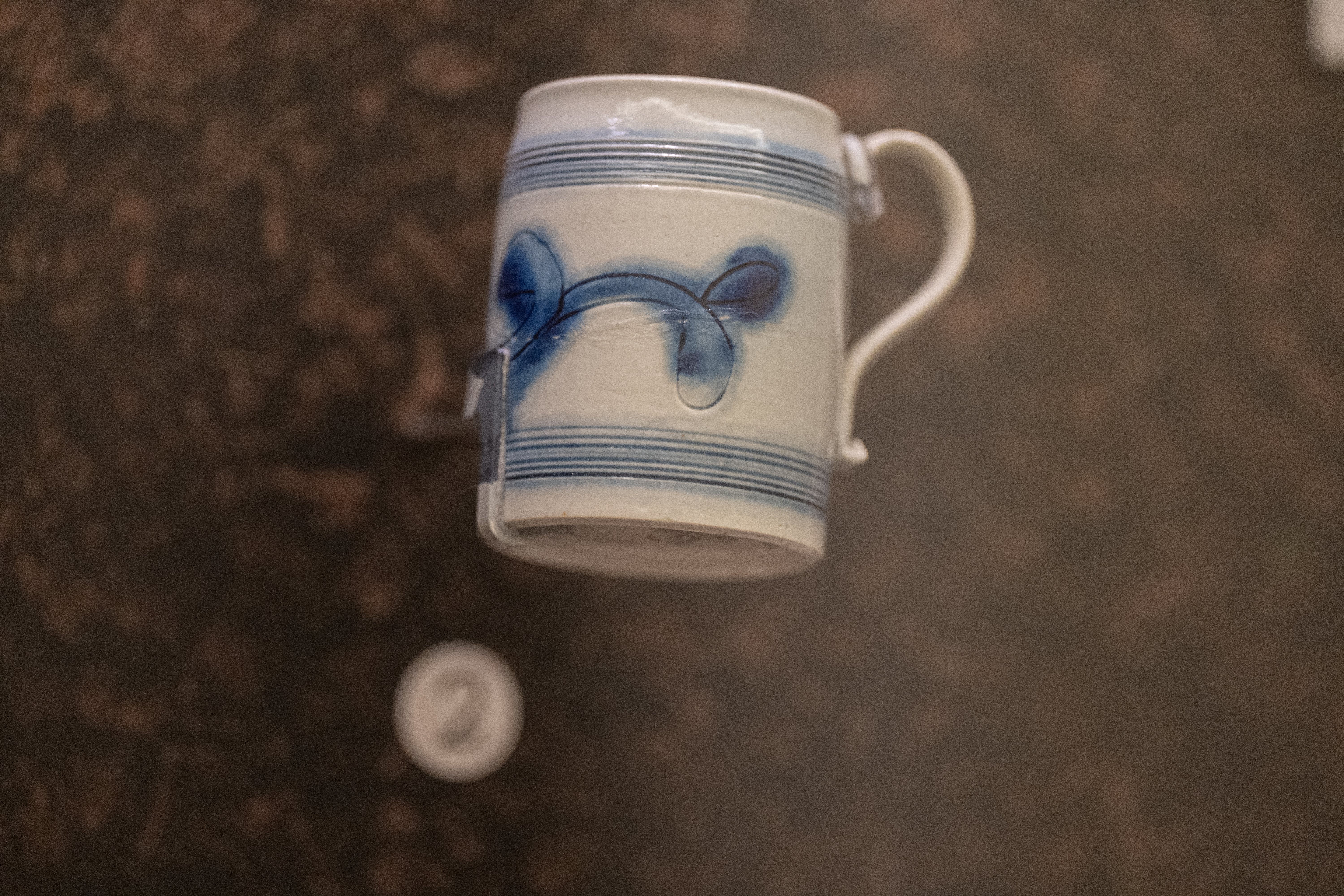
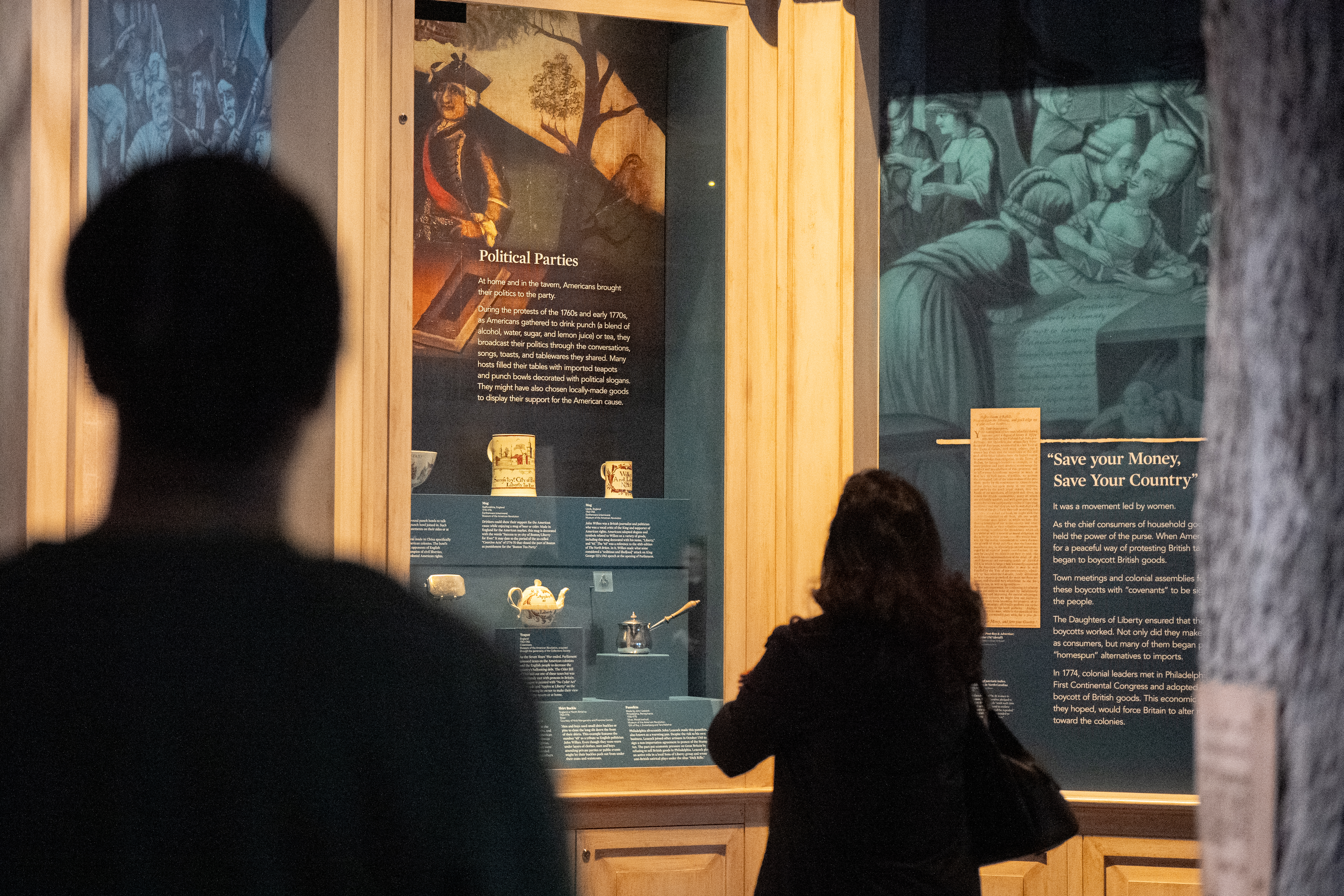
Items related to drinking at the Museum of the American Revolution, in Philadelphia, PA, November 18, 2025,
Thomas Paine, the working-class poet, whose thunderous pamphlet Common Sense helped roar in a revolution, oiled up his writing hand with Philly rum.
It has long been accepted that Thomas Jefferson spent those sweltering summer weeks of 1776 drafting the Declaration from the favored Windsor chair of his Market Street lodgings. But records show he actually spent more time than ever at City Tavern at Second and Walnut. A minor, if tantalizing, historical development, which hints that perhaps the world’s most famous freedom document came fortified by fortified wine.
Benjamin Franklin, polymath of the Revolution, inventor, scientist, printer, statesman, and lover of French wine (if in moderation), affectionately penned a Drinker’s Dictionary. The tippling tome contained 229 of Franklin’s favorite phrases for drunkenness, including buzzy, fuddled, muddled, dizzy as a goose, jambled, halfway to Concord, and Wamble Cropped.
‘Boozy business of revolution’
Franklin and his ilk were not ringing up 18th-century expense accounts for the hurrah of it. They were doing the boozy business of revolution.
Revolutionary-era Americans consumed staggering amounts of alcohol compared with today, said Brooke Barbier, historian and author of the forthcoming book Cocked and Boozy: An Intoxicating History of the American Revolution.
By the end of the 18th century, when beer and spirits were a staple of daily life, the average colonist swilled about 3.7 gallons of hard liquor per year. A dizzying amount, not counting beer and cider, that must’ve set many a patriot’s tricorn hat spinning.
By comparison, Americans now consume about 2.5 gallons of all alcohol, from beer to whiskey to wine, per year, said Barbier.
Historians believe booze and bar life played an outsize role in stoking the embers of insurrection.
Items related to drinking at the Museum of the American Revolution, in Philadelphia, PA, November 18, 2025,
“Tavern culture was essential to the American Revolution,” said Barbier. “It was not a part of the sideshow. It was part of where the discussions about revolutionary ideas happened. Where spies met. And where others, who weren’t directly involved in politics, gathered to discuss the growing political crisis. Opinions were formed in taverns.”
Nowhere was this work done more than in Philadelphia.
By 1776, Philadelphia boasted roughly 200 licensed and illegal watering holes — or about one for every 150 citizens, said Tyler Putman, senior manager for gallery interpretation at the Museum of the American Revolution.
Revolution with a twist
The fare of colonial-era drinking spots was as diverse as the budding port town.
There were posh spots like the newly constructed City Tavern, located blocks from the waterfront, and where the delegates of the First and Second Constitutional Congress drank nightly like fish. Ensconced in an upstairs space, known as the “Long Room,” the Founding Fathers debated liberty over libations late into the night, while imbibing copious amounts of Madeira, whiskey, punch, and everybody’s favorite Robert Hare porter.
There were taverns and flophouses, where tradesmen and sailors learned of Britain’s newest outrage from newspapers read aloud, or the latest traveler. And there were scores of unlicensed disorderly houses, grungy forebears of the modern dive bar.
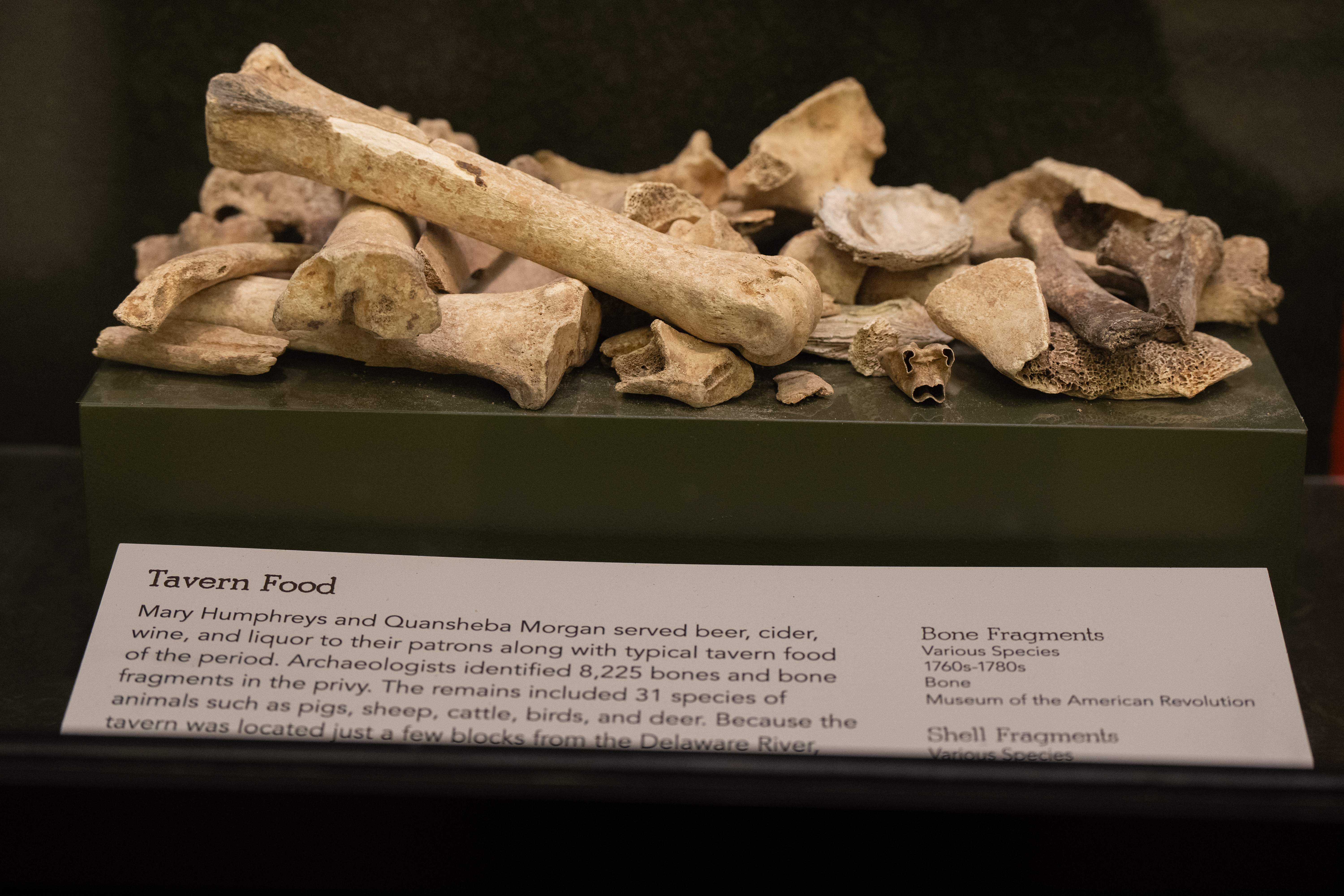
In 2014, three years before opening, the Museum of the American Revolution conducted a large archaeological dig, discovering thousands of artifacts from a Revolutionary-era disorderly house buried beneath its future Old City home. Among the mounds of mutton bones, glassware, and broken bottles unearthed from the privy of Benjamin and Mary Humphreys’ living room tavern was a broken windowpane inscribed with the initials and names of customers.
Bones from Tavern food at the Museum of the American Revolution, in Philadelphia, PA, November 18, 2025,
In what can only be the earliest example of Philly barroom graffiti, one dreamy patriot etched a quote attributed to the ancient Roman senator Cato into the clouded glass: “We admire riches and are in love with idleness.” The etching was meant as a barb toward the British, Putman said.
“They were obsessed with ancient Rome,” he said, of the American revolutionaries. “They were thinking a lot about, ‘How do you go back to some sort of idealized republic?’”
A nation born in taverns
Just as the nation strived to become democratic, its taverns became more undemocratic.
“In Philadelphia, the elites who are cooking up one version of the revolution are not drinking with the rabble who are cooking up what maybe would become a different version,” Putman said.
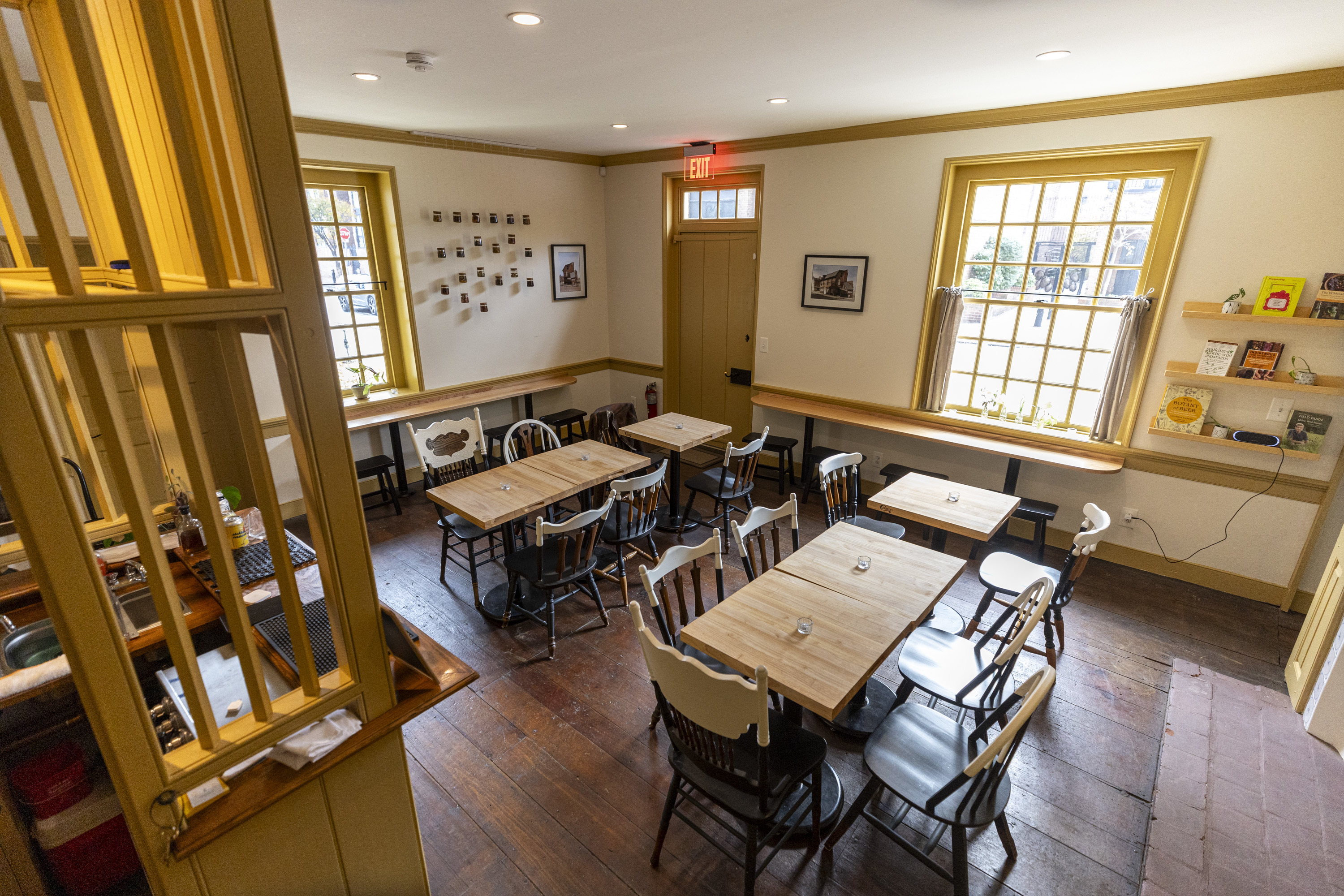
The newly-renovated Man Full of Trouble Tavern in Society Hill on Saturday Dec. 7, 2024.
Revolutionary-era drinking and tavern life, and its role in America’s founding 250 years ago, will be explored in full at a Nov. 21 after-hours event at the Museum of the American Revolution. Dubbed “Tavern Night,” the sold-out cocktail reception and boozy symposium serves as a twist to the museum’s grand exhibition celebrating the national milestone, also known as the Semiquincentennial, “The Declaration’s Journey.”
“Unlike today’s bars, taverns were meeting places at a time when few others were available,” said Dan Wheeler, who last year reopened Philly’s only remaining colonial-era tavern, A Man Full of Trouble, and will join Barbier in speaking at the event. “Revolutionary thoughts were conceived and refined in taverns, and a nation was born.”
Colonial keggers and the bonds of liberty
Booze was the social lubricant of the Revolution, said Barbier, a Boston-based historian who also runs tours of Revolutionary-era taverns, who pored over the Founding Fathers’ diaries and account books in recreating their raucous time in Philly.
The historical record provides no evidence that the nation’s founders were fully loaded — or “cock-eyed and crump-footed,” as Franklin might’ve said — as they went about forming the republic, she said.
“When you hear someone accusing someone of being drunk, it’s in an overly negative way,” she said.
Still, she was surprised by just how much the Founding Fathers drank.
Items related to drinking at the Museum of the American Revolution, in Philadelphia, PA, November 18, 2025.
Hard cider and small beer, the 18th-century version of light beer, more or less, accompanied breakfast, she said. The midday meal, known as dinner, boasted cider, toddy, punch, port, and various wines. When their workday wrapped up in the late afternoon, the delegates’ drinking began in earnest.
“There’s certainly a lot of drinking happening in these taverns,” said Barbier, whose book includes recipes of the Founding Fathers’ preferred aperitifs. “I don’t drink and not eventually feel tipsy. Certainly the same would be true for people in the past.”
Barbier notes the downside of all the drinking, like booze-fueled mob violence that spilled into the streets. And neither will she say that Jefferson, who kept all his receipts, actually penned the Declaration at City Tavern.
“He was there more frequently than ever during this time,” she said. “Maybe he needed to take a break from his writing, and go there. And sometimes when you’re on break, you develop your best ideas.”
The Founders’ endless toasting of tankards — including a rager for the ages marking Paul Revere’s arrival in Philly, and held in 1774, the night before a critical vote toward independence — provided crucial trust-building, Barbier said.
The men who founded America arrived in Philly as strangers, agreeing on little. After so much boozing, they bonded as brothers in liberty, and left a new nation in their wake.
“Ultimately, this comradery and social bonding leads to the consensus that leads to the Declaration of Independence,” Barbier said.
Dyresha Harris is a Halloween enthusiast. Every year, Harris, 43, of Cobbs Creek, and her partner, Eo Trueblood, go all out. Over the years, they’ve decorated the house with everything from a 20-foot scary robot, a reenactment of the Netflix show Stranger Things, and as an underwater cave.
And every year, Harris hears the same things from her proud Philly neighbors: “See,” they say, “you don’t have to go out to the suburbs to have a good Halloween.”
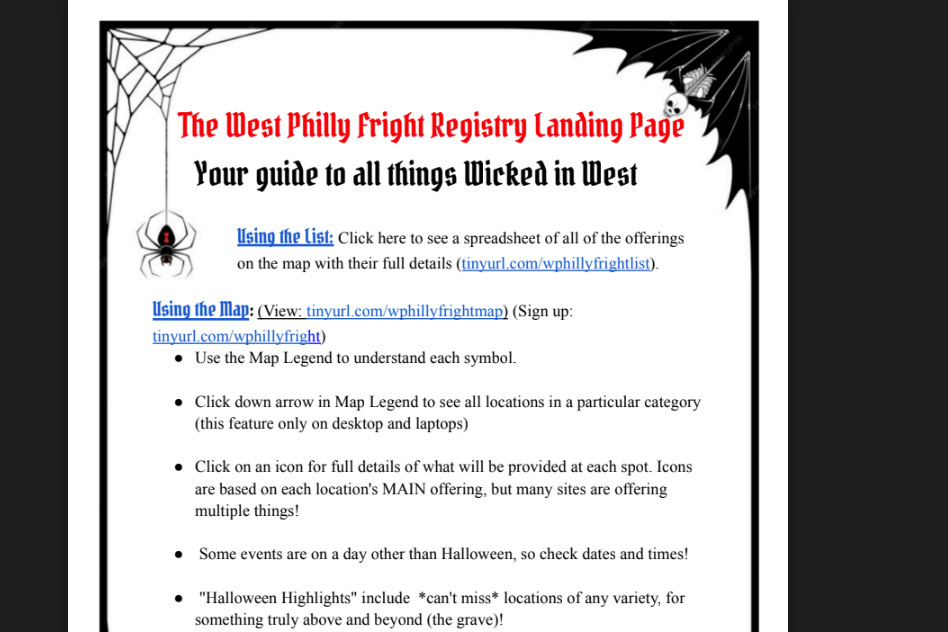
This year, Harris, who works as a summer camp director, is making sure of it. She’s organized the West Philly Fright Registry, a webpage and map dedicated to everything “Wicked in West,” as it advertises, with a directory of nearly 100 businesses and homes offering tricks or treats, decorations, or Halloween events for families.
Screen image of the West Philly Fright Registry website, which maps out nearly 100 homes and businesses for families to enjoy on Halloween.
“Halloween is the only American holiday that has this element of interacting with your neighborhood and specifically going door-to-door interacting with the folks who live all around you. And no one does creativity, joy, and community quite like the folks in West do!”
To make the point, Harris biked up and down the neighborhood cataloging all the homes and businesses worthy of Halloween shout-outs, making sure to get their permissions before adding them to the directory.
Mind you, this is no directions-scrawled-on-the-back-of-a-Halloween-napkin map that Harris has created. A map legend with ghoul and pumpkin icons highlights what spots will be decorated and handing out candy treats. The directory highlights special neighborhood Halloween events, with times and details.
“I thought a map would be a fun way to hype each other up, promote block pride, and showcase the creativity of our neighborhood while helping trick-or-treaters get the most fun out of their Halloween season,” she said.
Early on a recent sky-blue Saturday, 12 people stood rapt at Sixth and Washington, gazing up at a flock of pigeons perched along a telephone wire.
“What do you see?” a guide posed, as the pigeons cooed, contently.
The docent’s cheerful query loosened a chorus of replies and conversation, including enthusiastic observations on the birds’ shimmering iridescent hues and micro-feather structure, to discussions on the airfoil-like curvature of their wings, obsessive preening, and seasonal molting.
Just then, a white-speckled feather drifted down from the high wire.
“Here’s a feather floating down right here to make a point,” another guide interjected to laughter.
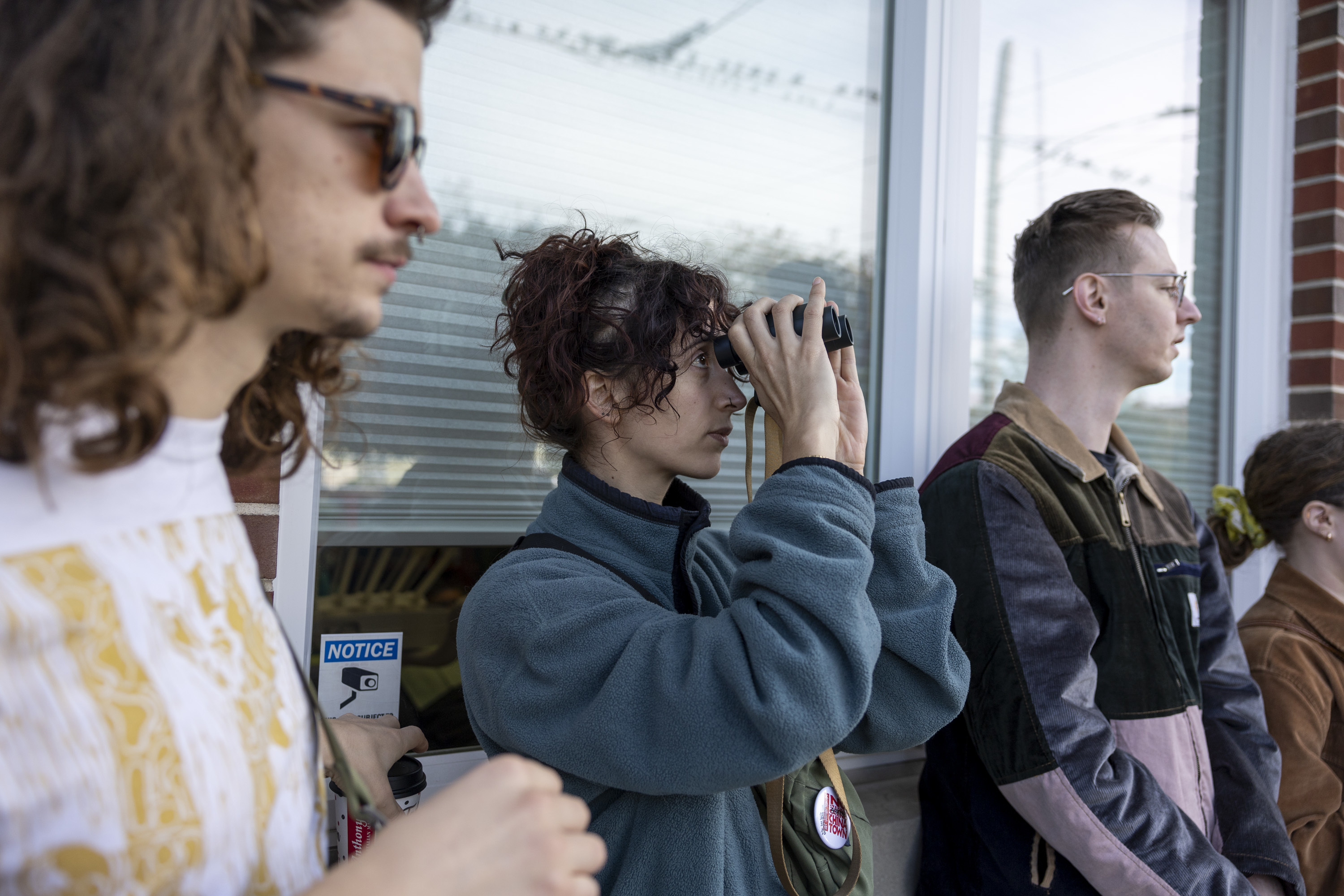
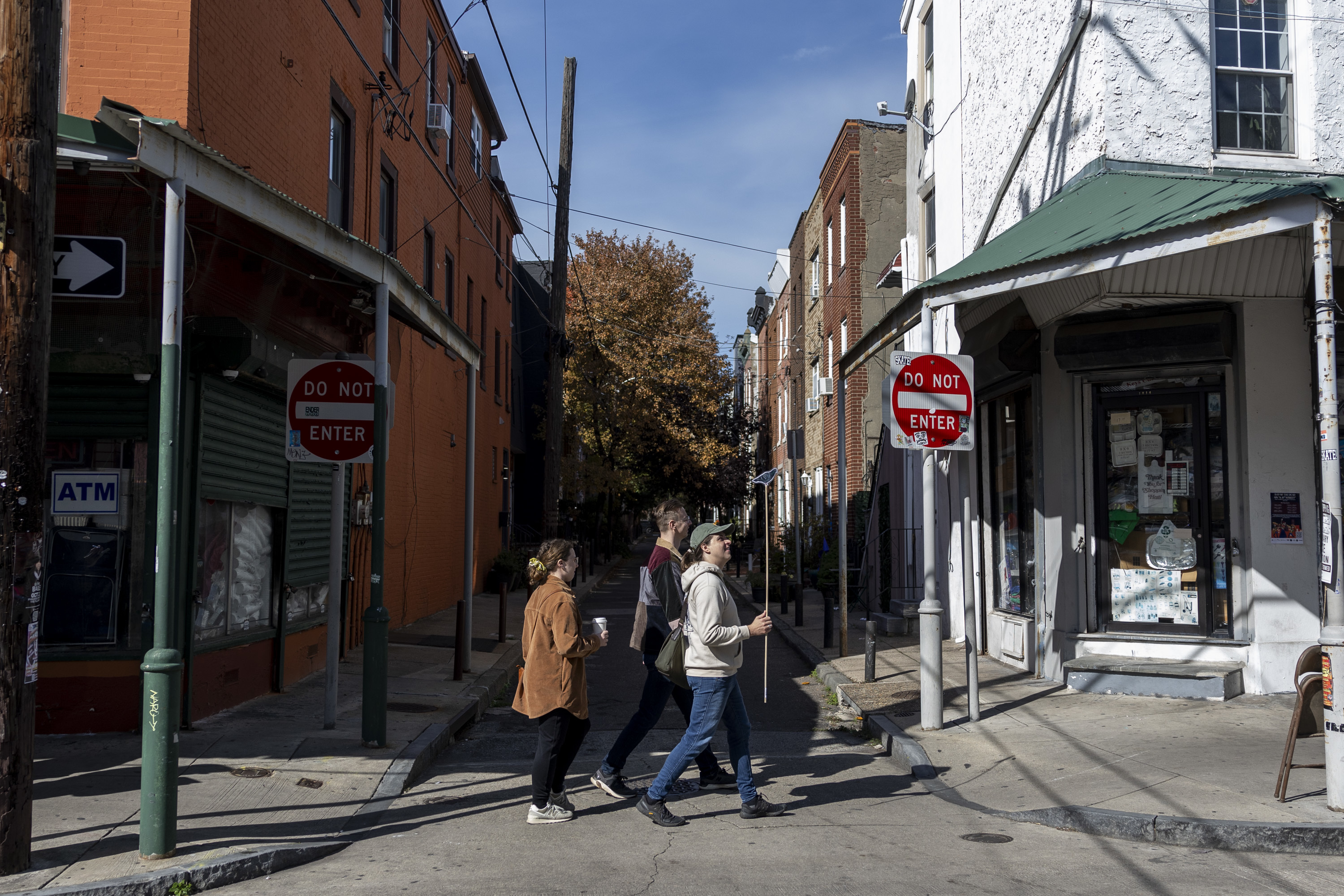
Avery Breyne-Cartwright, of West Philadelphia, uses binoculars to look at a flock of pigeons on the power lines along Sixth Street and Washington Avenue during a tour.
Welcome to South Philly’s hottest new excursion: Philly Pigeon Tours. A weekly, 90-minute morning stroll to several of the Italian Market’s most established flocks, offering an engaging and enlightening glimpse into the long-revered — and more recently rocky — relationship between humans and rock doves, the fancy term for urban pigeons. It’s a look at South Philly through a pigeon’s eyes.
5,000 years of pigeon history
Founded by partners and pigeon owners (more on that in a moment) Hannah Michelle Brower, 34, and Aspen Simone, 36, Philly Pigeon Tours have quickly transformed into a hot ticket. In June, the pair’s first tour, organized as a one-off, sold out all 25 slots. The crowds keep flocking.
Casually covering 5,000 years of pigeon history — from the rock doves’ esteemed status in ancient times as symbols of love, sexuality, and war to their more thorny present-day urban existence, dodging hungry hawks and alley cats, and navigating anti-pigeon netting and spikes — the pair ask tour takers to challenge skewed cultural narratives.
“We teach people everything we know about pigeons,” said Brower, originally from New Orleans, who first moved to Philly to attend Haverford College, and then returned after earning a master’s degree in epidemiology from the Harvard School of Public Health. Earlier this year, federal cuts eliminated her job as a public health consultant.
In August, Simone closed Birdhouse Gelato, after DOGE cuts cost them their day job at an agency that helped improve federal digital efficiency — a gig that helped fund the popular Bella Vista shop.
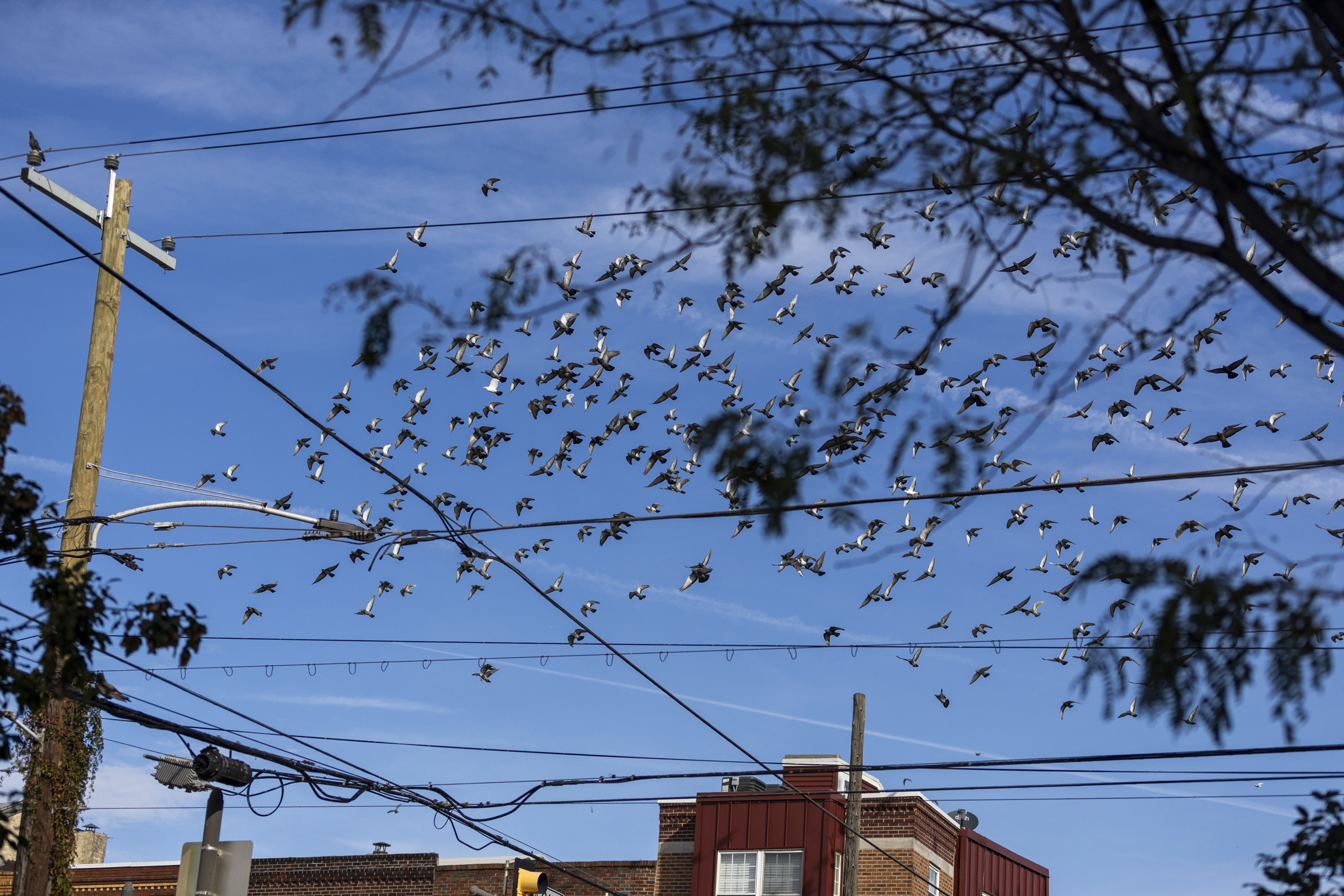
Pigeons flying in the sky along Sixth Street and Washington Avenue during a pigeon tour.
“We debunk a lot of pigeon misinformation and replace it with facts,” Brower said of the tours.
Having seemingly cornered the Philly pigeon-tour market — the pair will soon start tours in West Philly, with Old City walks coming in the spring, and a podcast just dropping — the outings no doubt appeal to secret pigeon-lovers everywhere. But much of the charm of the pleasant pigeon rambles is found in Brower and Simone’s sincere and catchy love for birds derided by many as “rats with wings.”
“We often talk about how hating pigeons is a choice,” said Simone.
Primrose the Pet Pigeon
The couple weren’t always pigeon boosters themselves.
Brower had never cared much for pigeons until three years ago, when a neighborhood woman caring for an ailing pigeon called out to her.
“I was really like, ‘I don’t understand why we have to care about this,’” she recalls. “I figured that the pigeon could be a tasty snack for some city hawk or cat.”
Convinced by the woman to seek help for the malnourished bird, Brower fell in love with the pigeon before she made it home.
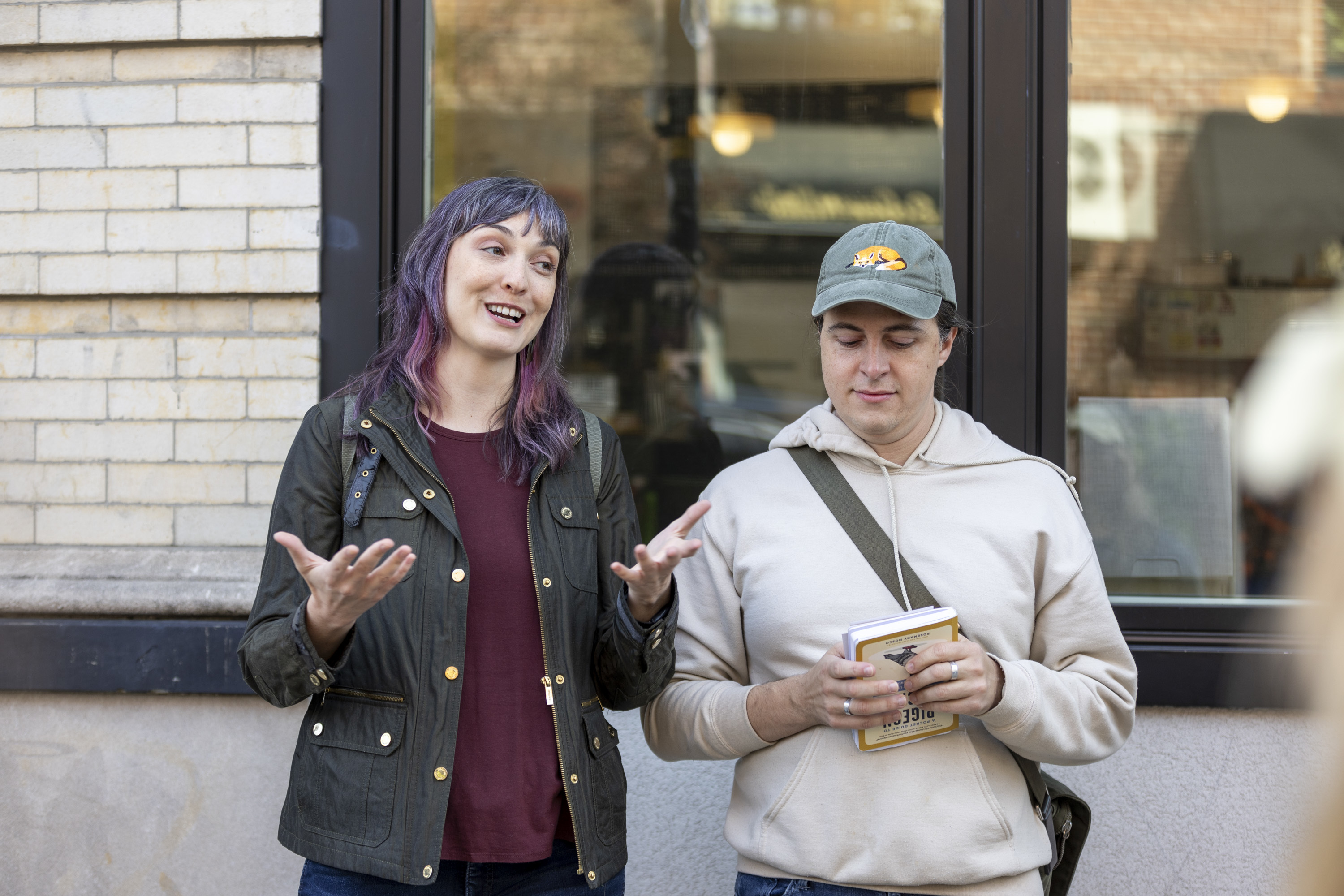
Hannah Michelle Brower (left) and Aspen Simone do some introductions before heading out for a Philly Pigeon Tour.
“I remember thinking, ‘Don’t name the pigeon. You’re gonna become attached.’ But then I said, ‘Primrose is her name.’ She just wanted to be close to me. She was very cuddly, and I just completely fell in love with her.”
Simone recoils when recalling their thoughts upon finding a pigeon stowed in a cardboard box that first night in the couple’s South Philly apartment.
“That’s kind of gross,” they said. But Primrose quickly won Simone over, too.
“It turns out she was a baby and might have been left a little too soon by her parents,” Brower said. “The rehabilitator said, ‘This is the sweetest, most cuddliest pigeon I ever met. I don’t think she’s going to survive on the streets. Do you want a pet pigeon?’”
Pigeon behavior and croissant crumbs
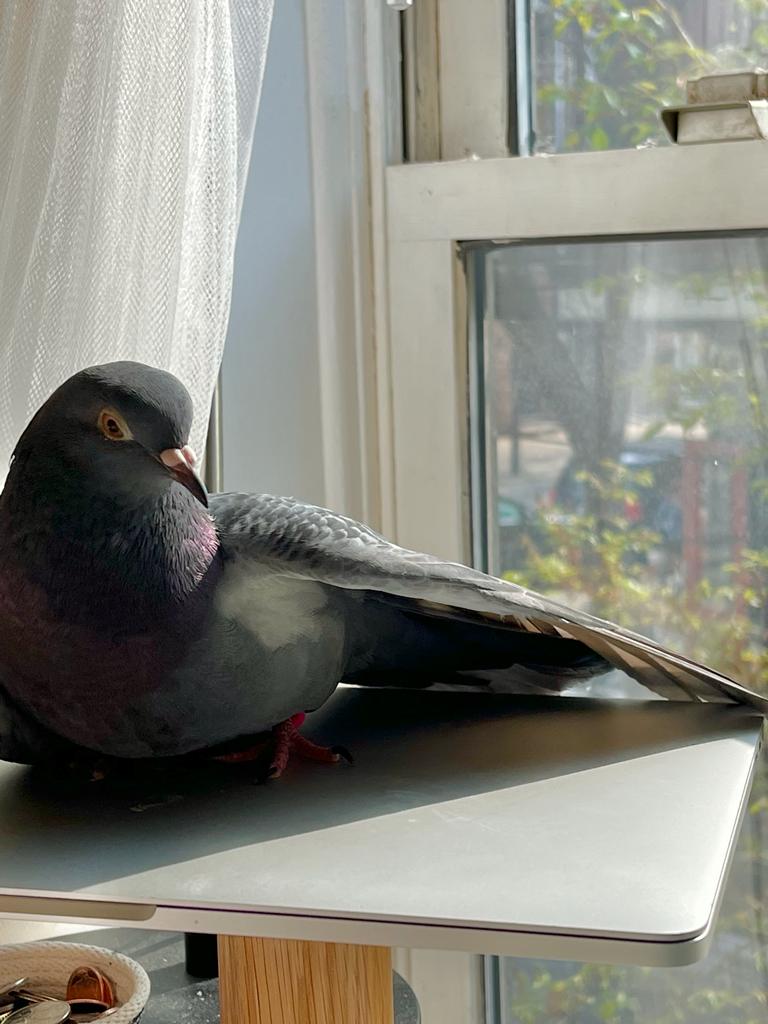
“She’s very much like a cat or a dog,” Brower said with a smile of Primrose, who favors a sunny spot on a guest-bedroom blanket. “She’s a free-roaming indoor pigeon. People always ask about the poop. She has her favorite spots in the house, so we just put down cage paper and it catches the poop. It doesn’t smell.”
Primrose the pet pigeon relaxing at home in a favorite sun spot.
(They are searching the internet for Philadelphia Eagles-themed pigeon poop pants that Primrose can don for guests.)
Regal and stout, with a scarf of green and purple neck feathers and striking orange eyes, the affectionate pigeon quickly made herself at home, perching on the couple’s shoulders and heads during work-from-home Zoom meetings — and whenever the couple prepare to head out the door, wanting to stay with the family flock.
“She likes to sit on our laps and we just pet her,” Brower said, adding that Primrose does the same with company.
Conscientious pigeon owners, Brower and Simone became keen observers of pigeon behavior. Like when Primrose perches near the sink to signal bath time, before luxuriating in a warm bowl of water. Or when she interrupts a TV show or work call to perform a pigeon’s elaborate mating dance, cooing, walking in circles, and running close to the ground, before bowing and elegantly fanning her tail feathers. How she sits atop the unfertilized pigeon eggs she lays, for weeks, until she is confident they will not hatch. Her sweet tooth for croissant crumbs.
Soon, they couldn’t help but spot the same sorts of behaviors among the pigeons they encountered around the neighborhood. They pored over pigeon books.
“We began to look a bit more into the science behind it and learned more about pigeon group dynamics,” said Simone.
Misconceptions based on fear
Holding aloft guide sticks with small cardboard cutouts of Primrose (a decided homebody, Primrose does not join the strolls), Brower and Simone share their newfound pigeon truths one tour at a time.
In ancient Mesopotamia rock doves were associated with gods — and viewed as signs of safety in Abrahamic religions, and symbols of status before the French Revolution, Brower said.
Aspen Simone, of South Philadelphia, leads a Philly Pigeon Tour in the Italian Market.
By the 1960s, the urban pigeon’s reputation was roundly sullied after a media-fueled panic blamed their droppings for causing meningitis in New York City, she said.
“Woody Allen repeated the phrase ‘rats with wings’ in Stardust Memories, and that’s when it spread and took hold,” Simone said of the 1980 film.
A recent tour included two young biologists, a pair of pigeon enthusiast sisters, and a group of young friends. They had all seen advertisements for the tours tacked up in the neighborhood or on Instagram.
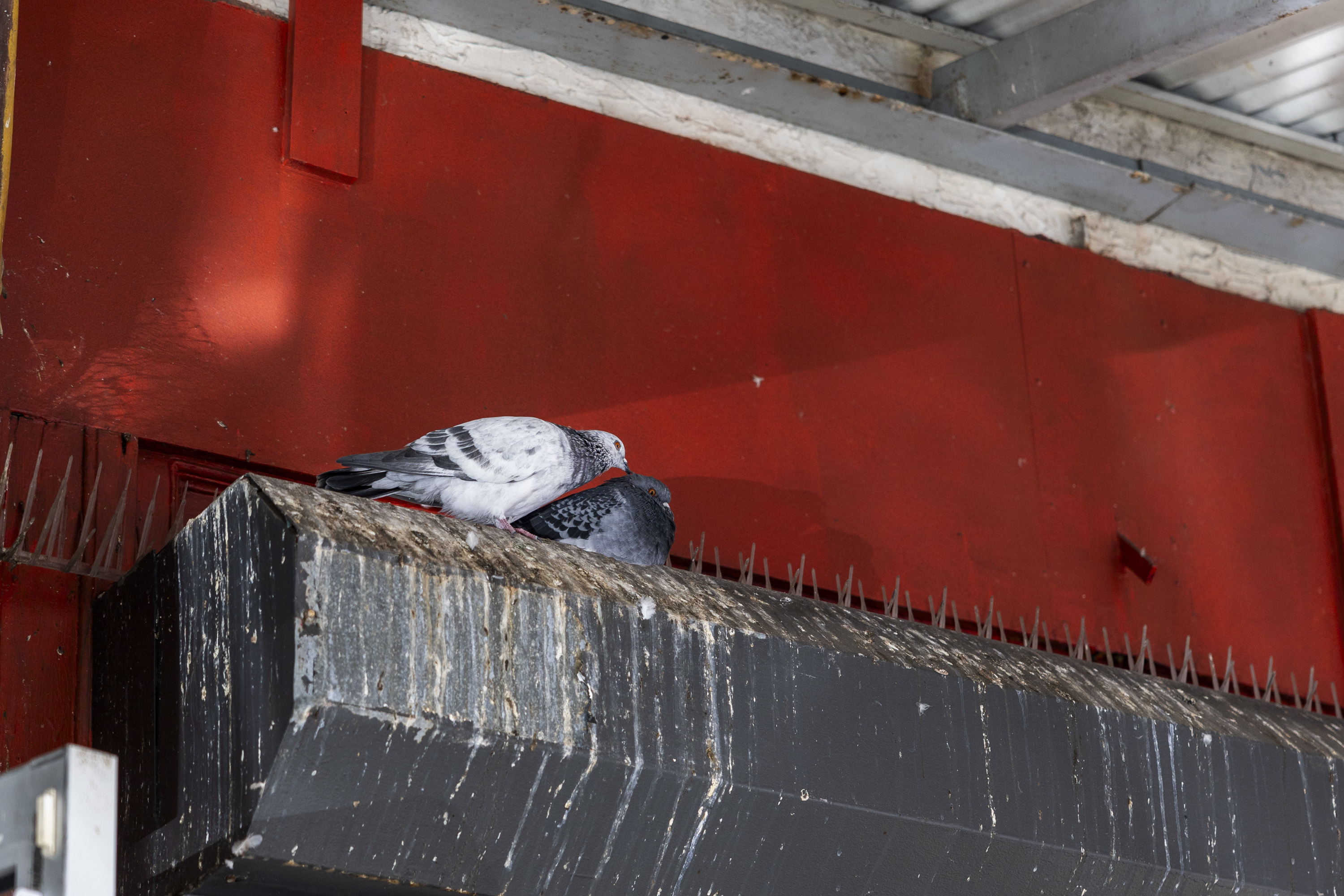
A mated pair of pigeons seen resting on top of a storefront in the Italian Market.
“We were talking about how pigeons make us feel emotional,” said Tess Cronin, on why she and her friends signed up for the tour. “How pigeons were bred by human beings, and now we think of them as rats and pests.”
Near Ninth Street, where businesses are outfitted with spikes to keep birds from roosting, Brower and Simone preached pigeon empathy. Starting with the lessons they learned from Primrose.
Like with all things, Brower said, it’s never just about pigeons.
“Our misconceptions originated with fear,” she said. “And I think we’ve really been able to catch ourselves better when we notice ourselves maybe stereotyping.”
With that, the tour set out to find more pigeons.
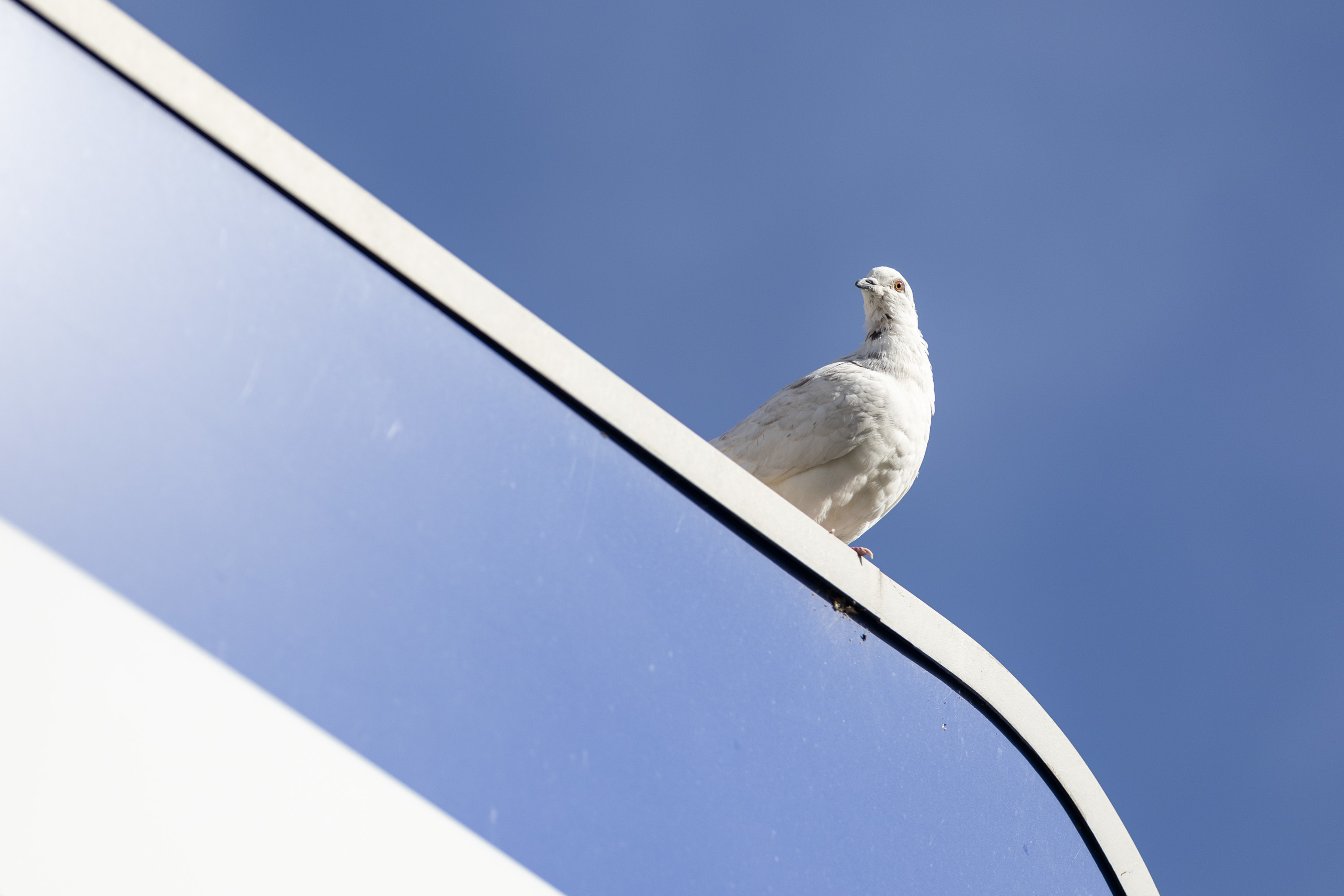
A white pigeon seen resting on a sign during the Philly Pigeon tour in Philadelphia, Pa., on Saturday, Oct. 18, 2025.
Sure, Philly’s the birthplace of the nation. But we’re also the site of the first hot-air balloon ride (1793), the first selfie (1839), and the first pencil with an attached eraser (1858). So why not celebrate these Philly firsts and many more?
That’s the idea behind the Philadelphia Historic District 250th Committee’s “52 Weeks of Firsts” in 2026. Every week, all year, there will be a party somewhere in the city honoring a different “Philly-born” first, replete with a “first-ival,” storytelling, giveaways, scavenger hunts, and an oversized #1 sculpture made of foam to mark the exact spot, or closest thing to it, of the milestone.
On Thursday, during a festive gathering at the Constitution Center featuring circus performers, Mummers, Once Upon A Nation storytellers, and ice cream sodas from Franklin Fountain, officials announced the complete schedule for “52 Weeks of Firsts.”
“Philadelphia has always been a city of firsts — from the founding of our nation to innovations that shaped everyday life,” said Amy Needle, president and CEO of Historic Philadelphia Inc. “It’s an opportunity for residents and visitors alike to go and explore and find these firsts and learn about all the amazing history and innovation that has happened in Philadelphia in the last 250 years.”
Fitting with planners’ promise to bring the 250th celebration to the neighborhoods, the 52 Weeks festivities will take place across at least 16 different sections of the city, Needle said. In compiling the list, a partnership of representatives from 22 Philly museums and cultural institutions adhered to a strict definition of first from Merriam Webster: “preceding all others in time, order, or importance.”
Some Philly firsts are known to every schoolchild. Like the first American flag (thanks, Betsy: 1777). And first naming of the United States (1776.) Others may stump even the most ardent Philly booster. Like the country’s first public showing of a motion picture (1870), first U.S. weather bureau office (also 1870), and first electronic computer (1945).
The 52 Weeks of First aims to capture all that has made Philly first in the nation throughout the years, Needle said.
“There are so many things that Philadelphia has to be excited about,” she said.
Here is the full list, with the schedule for the whole year.
52 Weeks of Firsts: Week by week
First Hot Air Balloon Flight in America: 1793
The Athenaeum, Jan. 3, 2026
First Folk Parade: 1901
Mummers Museum, Jan. 10, 2026
First Volunteer Fire Company: 1736
Fireman’s Hall Museum, Jan. 17, 2026
First Professional Basketball League: 1898
Location TBD, Jan. 24, 2026
First Public Girl Scout Cookie Sale: 1932
Location TBD, Jan. 31, 2026
First African Methodist Episcopal Congregation: 1794
Mother Bethel A.M.E. Church, Feb. 7, 2026
First Abolitionist Society in America: 1775
The African American Museum in Philadelphia, Feb. 14, 2026
First Authentic Chinese Gate Built in America: 1984