Author: Chris Palmer

  • Two men who set a building on fire, leading to the death of a Philly fire lieutenant, displayed ‘depraved indifference’ to life, judge says

    Two men who set a building on fire, leading to the death of a Philly fire lieutenant, displayed ‘depraved indifference’ to life, judge says

    Two men who set a Fairhill building on fire in 2022 in hopes of collecting a six-figure insurance payout — but who instead caused the structure to collapse, killing a responding Philadelphia Fire Department lieutenant — were each sentenced Wednesday to decades in federal prison.

    U.S. District Judge Cynthia M. Rufe said the actions by Al-Ashraf Khalil and Isaam Jaghama, which led to the death of Lt. Sean Williamson and left five other first responders injured, were made “out of pure self-interest” and displayed “depraved indifference to human life.”

    “Neither of the defendants considered at all the consequences of their actions, which proved to be far-reaching, devastating, and deadly,” she said.

    She sentenced Khalil — who owned the building on the 300 block of West Indiana Avenue that he set ablaze — to serve 40 years in prison. And she said Jaghama, who participated in the arson alongside Khalil, would serve a term of 25 years behind bars. Both men are 32.

    Both men had faced the potential of life sentences. And both apologized for their actions before being sentenced.

    Jaghama, in a letter read by his attorney, said: “No words can describe the depth of my regret and pain.”

    Khalil, meanwhile, cried as he said he wished he could take back decisions that he called selfish and weak.

    “I was desperate. I was a coward. And the families of the victims are the ones to suffer for a lifetime,” he said. “I am ashamed beyond words. I pray for your forgiveness, although I know I will never deserve it.”
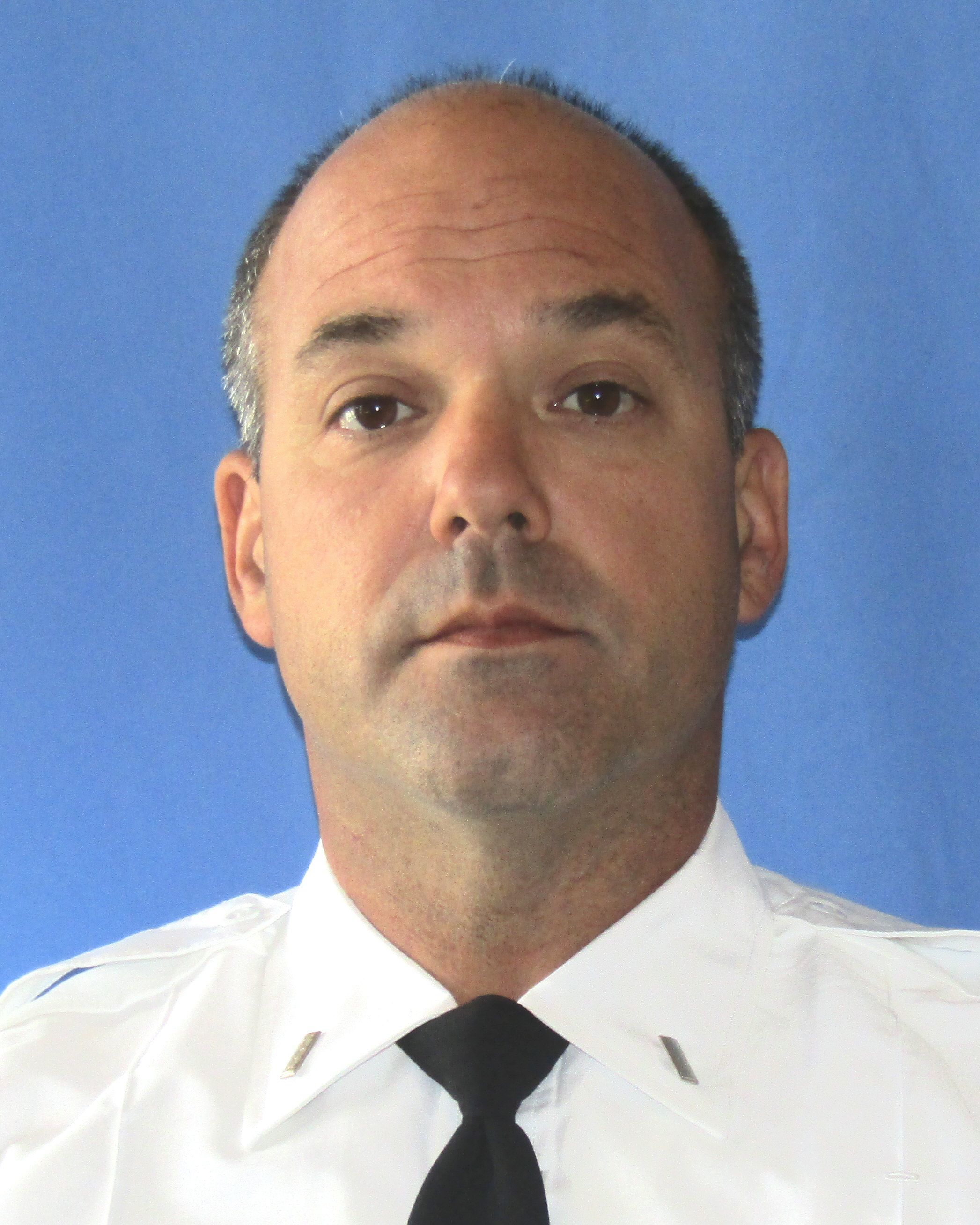
    Lt. Sean Williamson, 51, was killed during a building collapse after a fire in Fairhill in 2022. He was a 27-year veteran of the Fire Department.

    Assistant U.S. Attorney Amanda Reinitz said Khalil and Jaghama were too late in expressing remorse. Both men lied to authorities after the blaze, she said, Khalil tried to flee the country, and both then took their case to trial, where they tried to convince jurors that fire officials shared blame in the disaster for sending first responders into a century-old building shortly after the flames had been extinguished.

    Williamson’s sister, Erin Williamson, said she viewed that as an attempt by Khalil and Jaghama to avoid accountability for causing a tragedy. A second-grade teacher, Williamson said even her 7-year-old students know that fires are dangerous and deadly.

    Khalil and Jaghama “only thought about themselves,” she said, “and what they could gain.”

    The fire was set early in the morning of June 18, 2022. Khalil, who co-owned a pizza shop in Juniata Park, had bought the Indiana Avenue building months earlier and was hoping to renovate it and turn a quick profit.

    But when that plan appeared destined to fail, prosecutors said, he began plotting to set it ablaze, hoping that he could instead collect on an insurance policy worth nearly $500,000.

    Surveillance footage discovered after the crime showed Khalil and Jaghama entering the building’s basement shortly before the blaze began, around 1:30 a.m., then leaving not long after flames erupted.

    Khalil had leased apartments in the upper floors to two employees at his pizza shop, and they were inside with their young children as the fire spread. All of the tenants managed to escape unharmed, prosecutors said, but they lost nearly all of their possessions.

    First responders were not so lucky.
    Philadelphia fire officials honored Lt. Sean Williamson at his funeral in 2022.

    Although firefighters were able to extinguish the blaze, the building was heavily damaged from smoke and water when crews were sent inside to inspect it. The building then collapsed, and Williamson, 51 — a 27-year veteran of the department — died after being trapped under the rubble. Four other firefighters and an inspector from the Philadelphia Department of Licenses and Inspections were also injured but survived.

    The day after the disaster, Khalil filed a claim with his insurance company. In the ensuing days, he also tried to flee for Jordan, prosecutors said, but was arrested at John F. Kennedy Airport in New York City.

    Jaghama was arrested about a year after Khalil. Reinitz, the prosecutor, said Jaghama repeatedly misled authorities while seeking to avoid being prosecuted.

    Jaghama, born in the West Bank, was a legal permanent resident, meaning he is likely to be deported after his prison term.

    Khalil’s wife said in court Wednesday that he was a great husband, a loving father to their three children, and a caring person whose actions in this case were not consistent with how he lived his life.

    Reinitz, however, said the men’s decisions and actions were not only senseless, they were damaging for countless people whose lives were upended by a callous — and illegal — attempt to make money.

    “They had absolutely no need to do this,” she said, “other than pure greed.”

  • The Trump administration’s push to deport pro-Palestinian activist Mahmoud Khalil landed before a Philly-based appeals court

    The Trump administration’s push to deport pro-Palestinian activist Mahmoud Khalil landed before a Philly-based appeals court

    President Donald Trump’s administration on Tuesday asked a federal appeals court in Philadelphia to overturn an order that has, for the moment, blocked authorities from deporting pro-Palestinian activist Mahmoud Khalil — the latest development in a complex legal saga that began when the administration was seeking to crack down on anti-Israeli college campus protests earlier this year.

    During a hearing before a three-judge panel in a Center City courtroom, Deputy Assistant Attorney General Drew Ensign said the earlier order, issued by a federal judge in New Jersey, was “indefensible” for several reasons — including that it was issued in the wrong jurisdiction, and that it was effectively helping Khalil’s lawyers improperly “fragment” the various legal proceedings against him and seek venues that might issue favorable rulings.

    Khalil’s attorneys, however, said the judges should uphold the lower court’s ruling because the government had illegally targeted the 30-year-old for removal over his political views — something they called a clear First Amendment violation and a situation that could have wider implications amid Trump’s push to increase deportations.

    Speaking outside the courthouse after the hearing, Khalil, a legal permanent resident who was born in Syria, told a crowd of supporters he planned to continue his legal fight to remain in the United States.

    “This shows how my case is actually just a test for everyone’s right’s here across the country,” he said. “Not only one place, not only for specific people, for immigrants or documented or undocumented people, it’s for everyone across the country.”

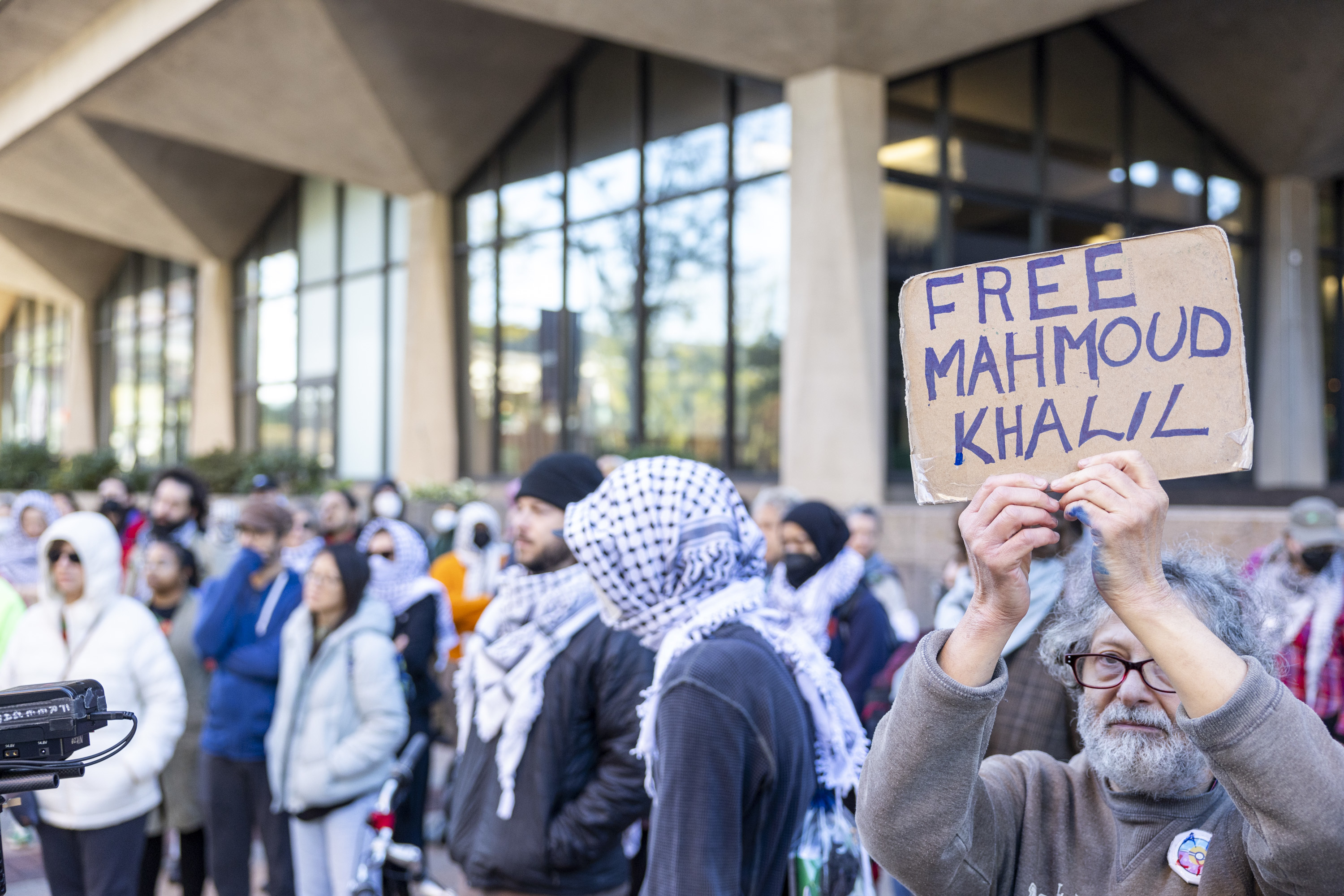
    Eric Hamell, of West Philadelphia, holds up a sign saying Free Mahmoud Khalil during a rally outside the James A. Byrne U.S. Courthouse in Philadelphia on Tuesday.

    The case against Khalil began in March, when he was arrested by immigration authorities at Columbia University, where he had recently completed a master’s degree and had become a prominent figure at pro-Palestinian protests. Authorities detained Khalil and then pushed to deport him, with Secretary of State Marco Rubio citing an obscure legal statute in contending that Khalil’s rhetoric and continued presence in the country could undermine U.S. foreign policy interests.

    Khalil’s lawyers quickly challenged the administration’s actions in court — first in New York, where he lived and was arrested, then in New Jersey, where he was detained in the immediate aftermath of his arrest.

    Within days, however, Khalil was transferred to a detention facility in Louisiana, where he was held for more than three months (he was living there this spring when his wife, an American citizen, gave birth to their son in New York).

    The issue of where Khalil was located was something Ensign, the government attorney, said was important for the appellate judges to consider: Because Khalil was primarily detained in Louisiana, Ensign said, any legal challenge seeking to have him released should have taken place in that jurisdiction.

    And in Ensign’s view, that meant the June ruling by a judge in New Jersey that ordered Khalil released — and temporarily blocked his deportation — should be overturned.

    Several judges appeared skeptical of the jurisdictional aspect of Ensign’s argument. Circuit Judge Stephanos Bibas, a Trump appointee, pointed out that authorities were moving Khalil to various jurisdictions over a weekend — and suggested attorneys couldn’t be forced to wait until the work week to file emergency challenges to what they viewed as wrongful detention.

    “The lawyers didn’t know” where Khalil was, Bibas said. “They had to do their best.”

    The judges seemed more receptive to another of Ensign’s arguments: That Khalil is currently the subject of a complex web of legal cases, with various claims being weighed in various courts.

    In addition to the matter being argued in Philadelphia on Tuesday, his immigration case remains pending in Louisiana because of a separate issue: In September, an immigration judge there ruled that Khalil be removed to Syria or Algeria because he failed to disclose information about his past work with pro-Palestinian groups on his green card application.

    While his attorneys have appealed that ruling, the appellate panel on Tuesday questioned whether it was appropriate for different jurisdictions to be weighing different aspects of his various cases — particularly when many of the legal issues in them are generally similar.

    Circuit Judge Thomas M. Hardiman asked whether doing so would give Khalil a “second bite at the apple” to challenge rulings that don’t go his way.

    It remained unclear Tuesday how or when the judges might rule.

    Khalil, meanwhile, said outside the courthouse afterward: “We are in the fight until the end.”