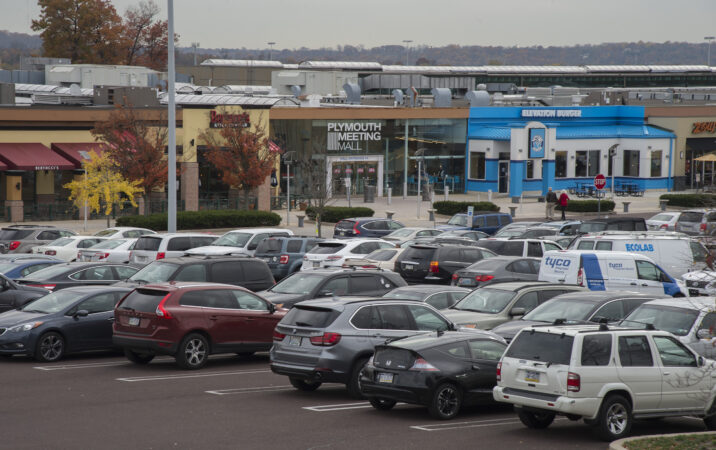
The mall’s current owner, PREIT, plans to sell the property to LA Partners, previously known as Lubert Adler Real Estate Funds, PREIT leadership confirmed Thursday, noting that the sale is still pending. PREIT did not disclose the price of the sale.
PREIT, which is based in Philadelphia, also sold the Exton Square Mall to Abrams Realty & Development in March. PREIT also owns the Cherry Hill and Moorestown Malls.
PREIT CEO Jared Chupaila said in a statement that the sale reflects the company’s “commitment to disciplined balance sheet management and liquidity generation.”
“We believe LA Partners is uniquely positioned to build on the multipurpose hub we have laid the groundwork for, which has long served as a central part of Plymouth Township and the surrounding communities,” said Chupaila.
PREIT has faced financial challenges in recent years. The business has filed for bankruptcy twice since 2020, and most recently emerged from bankruptcy as a private company in 2024 helmed by a group of investment firms.
The Plymouth Meeting Mall, for its part, has tried to undergo a makeover in the last few years, following the 2017 closure of its anchor, a215,000 square-foot Macy’s. Amid PREIT’s plans to “diversify the tenant mix” at the mall, nearly half the tenants there were either dining or entertainment businesses in 2018.
Lubert Adler’s other properties include the Bellevue in Center City, which recently underwent extensive renovations, and the Battery, a former power plant in Fishtown redeveloped into a multipurpose complex.
A spokesperson for LA Partners did not immediately respond to a request for comment Thursday.
Peter Abrams, managing partner for Elkins Park-based Abrams Realty & Development, said the Plymouth Meeting Mall site “is the best-located large parcel of real estate in the Delaware Valley.”
“There’s a lot of dead and dying malls in this country, and some of us, like myself and Dean Adler, understand the opportunity and aren’t afraid of the challenges, which are many,” said Abrams, who is behind proposed development plans at the Exton Square Mall.
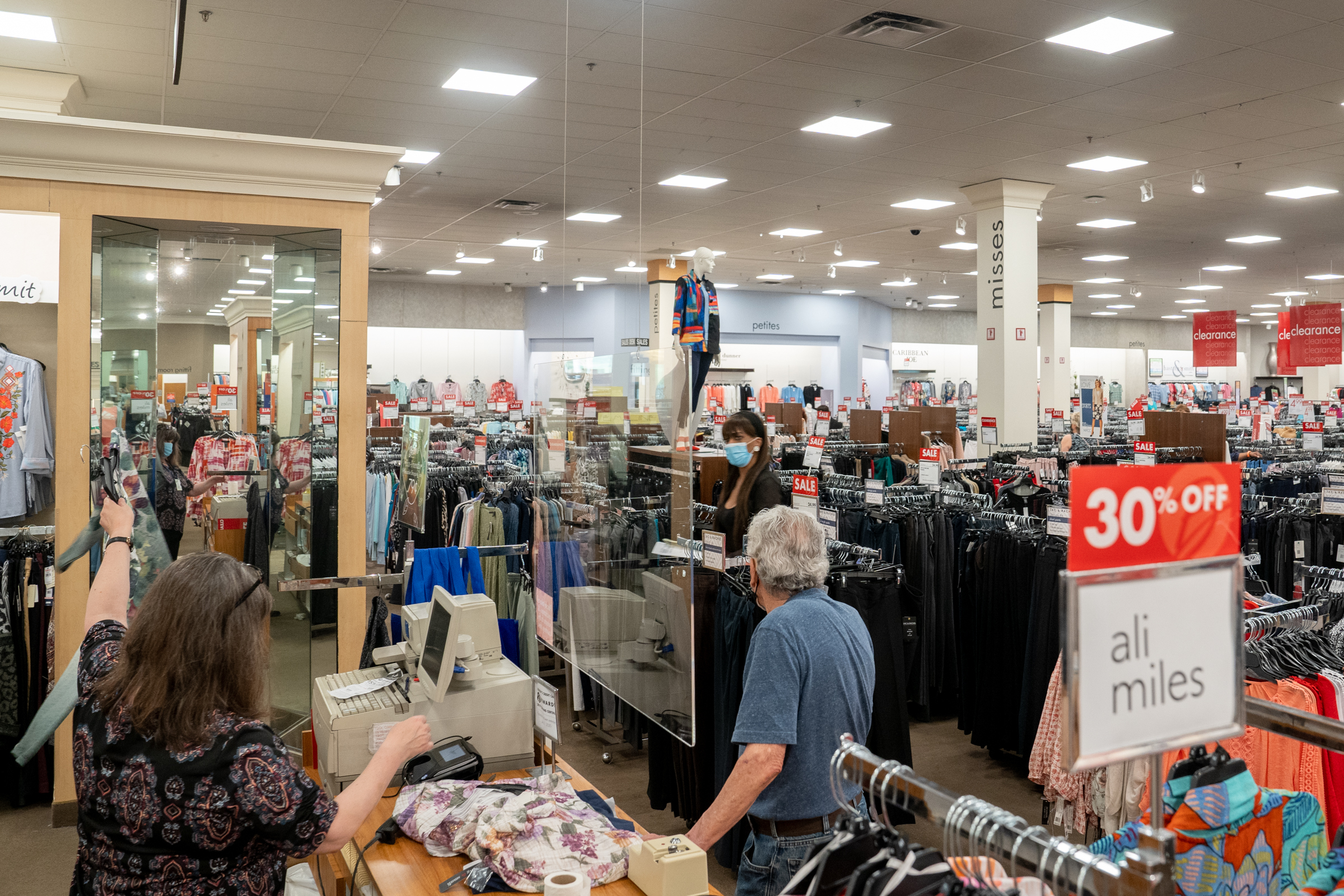
Boscov’s at Plymouth Meeting Mall on June 6, 2020.
Consumers had already been shifting toward e-commerce before the pandemic. But as COVID forced nationwide shutdowns in 2020, some of PREIT’s tenants were forced to close, couldn’t pay rent, or didn’t want to, intensifying issues for the mall owner.
Prior to the pandemic, PREIT sold off malls and tried to transform others by adding supermarkets, movie theaters, and apartments.
Through the most recent bankruptcy process, PREIT shed $800 million in debt and gave up its stake in the Fashion District in Center City. When it emerged from bankruptcy last year, PREIT owned 13 malls across Pennsylvania, New Jersey, Maryland, and Virginia.
It’s a time of struggle and transition for many malls across the country, including several in the region that havesurvived beyond their heyday. In the Philadelphia suburbs, plans are in the works to redevelop mall sites including the Exton Square Mall and the former Echelon Mall in Voorhees.
Debra Andrews’ marketing firm, Marketri, gets mail and phone calls out of a Market Street address in Center City. But none of her employees work in the Philadelphia area. Neither does she.
When she started the business in 2004, having a small office in Doylestown gave the new firm a feeling of “legitimacy,” she says. Butshe gave up the space in 2008 when she learned the building would be converted into homes.
“I only really at that time had one employee based in Philly and decided, well, let’s just do this remote,” said Andrews. Now she has 15 employees working across 11 states.
The share of employees working remotely in Philadelphia has declined, according to U.S Census data, and several large employers in the region have been pushing for more in-office time.But for employers that have remained remote, some are finding that it can provide positive returns.
For Andrews, offeringremote work has allowed her to hire the best person for a role regardless of where they live, but it doesn’t mean workers get to set their own hours — they’re expected to be on from roughly 8:30 a.m. to 4:30 p.m. in their time zones, she says.
“We run very much like a normal business, we just happen to work from our homes,” said Andrews.
The National Board of Medical Examiners (NBME), which has been based in Philadelphia for over 100 years and owns a building on Market Street, redesigned its space to have more collaborative areas and fewer offices, as the organization committed to allowing more remote work. It’s also leased part of the building.
“An empty building is not a problem — it’s a challenge to solve. It’s not a reason to bring people back,” said Janelle Endres, NBME’s vice president of human resources.
The nonprofit creates tests for healthcare professionals, and employs about 575 people, most of whom are in Pennsylvania, Delaware, New Jersey, and Maryland. Prior to the pandemic, NBME offered a hybrid work model to most employees, and it has since “doubled down” on remote work, said Endres, adopting a “remote first” approach in 2024 — as many other employers were stiffening or increasing their requirements for in-office work.
Staff was as productive or more so when working remotely during the pandemic, and employees appreciated the setup, Endres said. Going back to pre-pandemic work norms could have created “an employee satisfaction problem,” she said.
Some 60% of NBME employees are eligible for remote positions and choose to work remotely. Others chose to be hybrid.
“Nobody’s raking in big bonuses here, so we have to think about: What are the things that really set us apart and make us a unique employer?” said Endres. “Work-life balance and flexible schedules [are among] those things.”
In exchange for flexibility, Endres said, “We expect that you will contribute in really strong ways, that you’ll perform well, that you’ll give back just as much as we’re giving.”
“Give the people what they want, and they’re going to be like, ‘I better do a good job. I don’t want to lose this job,’” Endres said.
But committing to a remote workplace didn’t mean “everyone’s just automatically happy,” said Endres. The organization plans some in-person days throughout the year as well as digital programming to foster culture, said Jenna Mierzejewski, manager of employee experience.
Endres acknowledged that NBME has encountered some instances where an employee seemsunderproductive or distracted: “We say that’s a management challenge. That’s not a remote-work challenge.”
Remote work ‘before it was cool’
Casey Benedict, CEO and founder of Maverick Mindshare, says her agency has been remote since “before it was cool.”
She has a P.O. Box in Malvern so she doesn’t have to list her home address as her business location. Beyond privacy, it’s also for professionalism, she said.
“It’s to create a little bit of a buffer between home life and business life,” said Benedict, who leads an agency focused on influencer marketing that has been remote since it launched in 2010.
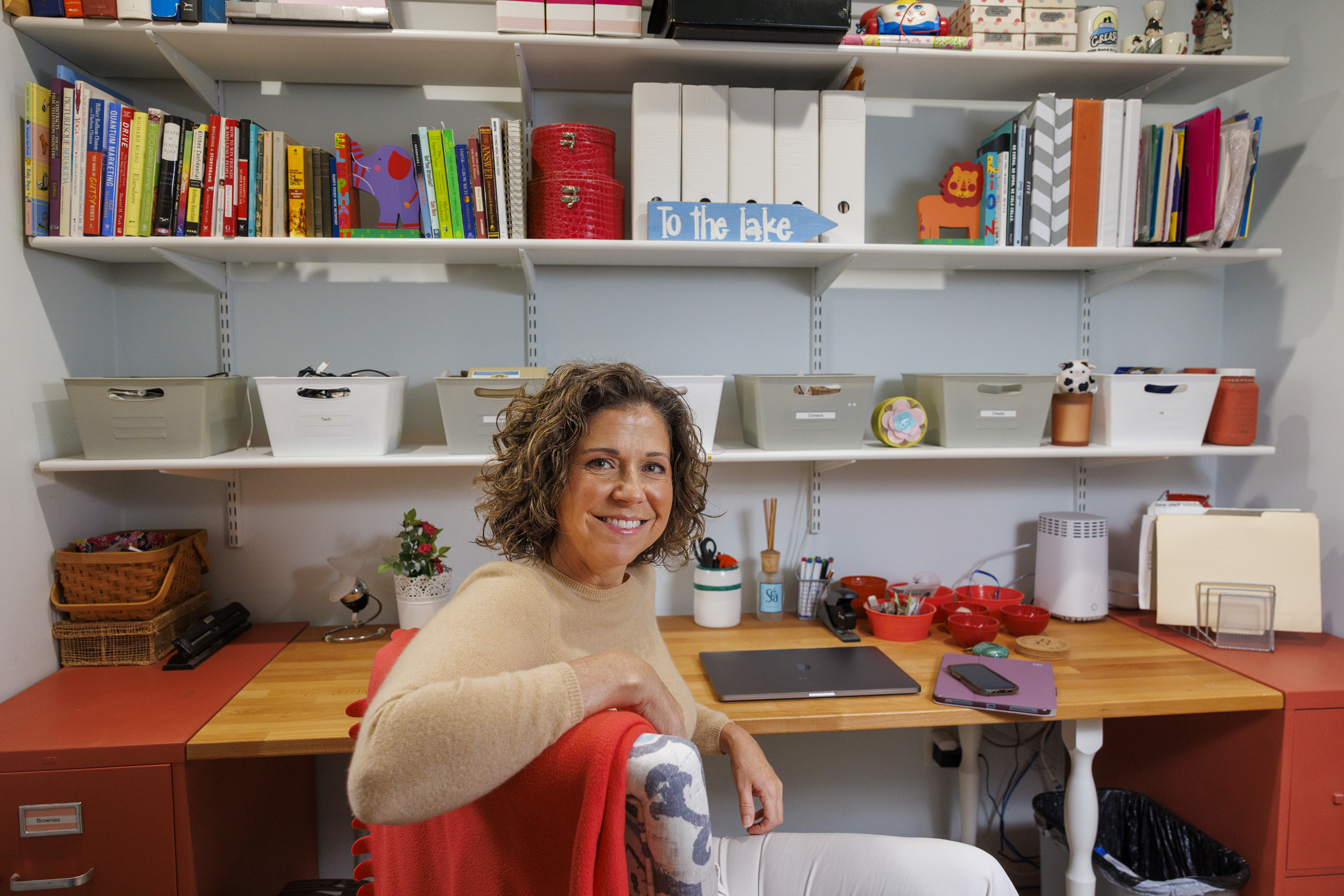
Casey Benedict, CEO and founder of Maverick Mindshare, works from her home office.
She wants her staff to feel like they can attend to their personal needs, whether that’s picking up a child from the bus stop or going to a doctor’s appointment, says Benedict. She has three employees who are “core to the organization.”
“They can fully show up when they have more ownership and more control over the other parts of their lives that may pull them away from their desk,” she said.
Allowing that kind of flexibility avoids conflict, she says. And, it pays off for the company.
“The result is my team really does overdeliver and they enjoy what they do,” said Benedict. “They bring so much of themselves into it because they know that the structure is set up in a way to support them fully.”
Losing the commute
Three years before the pandemic started, three of Wendy Verna’s employees asked if they could work remotely. They told her there wasn’t enough in-person collaboration to make the commute to their South Street office worthwhile, she said.
Verna, president and founder of marketing firm Octo Design Group, initially said no. But six months later, they started trying out remote work.
“It wasn’t working for me,” said Verna, a self-ascribed “type A” person who likes to get out of the house and go to work. But she stuck with it because her employees were happy, and the remote setup worked for the company.
Ultimately she figured out why she was miserable leading a remote team. “It was a control thing for sure,” she said. “I felt like, if I don’t know where you are, what are you doing?”
She has established clear expectations for what remote work should look like at her firm. Cameras should be on for video calls, and employees should be ready to work during business hours, she says. And if employees plan to be out of town, they should let Verna know so she can determine how in-person tasks get done.
“They’re at home, but they cannot look like they rolled out of bed, because it’s just not my brand,” said Verna.
Verna is in the office three to four days a week, but 98% of the time, her five full-time employees, who live in the Philadelphia area, work remotely.
Wendy Verna’s employees asked her to go remote three years before the pandemic. While she still goes to the office often, her employees spend most of their time working remotely.
While she and her company have adjusted, Verna is still concerned about what employees lose by working remotely.
A commute can be useful to prepare for the workday in the morning or process the day in the evening, she says. During pandemic-related office closures she would walk around the block a few times before and after work to get a similar effect.
“When they sign off and you’re working from home, you run downstairs, well, all of a sudden, you’ve got chicken in the oven,” said Verna. “You don’t have time for that kind of debrief to yourself.”
She’s also concerned about how the remote lifestyle will affect young people looking for jobs, saying, “You’re only as good as your network.”
“This remote work is eliminating role models, and is eliminating mentors,” Verna said, “because I can’t mentor you behind a screen.”
Women filled more of the top leadership positions at large public companies in the Philadelphia area in fiscal year 2024 than they did the previous year. But workplace parity remains to be achieved.
“We’re showing measurable but slow progress,” said Meghan Pierce, president and CEO of the Forum of Executive Women, which this week released its annual report measuring women in CEO positions and on corporate boards. “As we look at this data year to year, we are definitely discouraged by how slow progress is.”
The Forum counted women in leadership positions in fiscal 2024 across the region’s largest 100 public companies by revenue, using data from U.S. Security and Exchange Commission filings.
Pierce says the forum is using its platform to highlight some factors holding women back in the workforce, such as the lack of paid family leave in Pennsylvania and lack of pay transparency. These are “structural issues that might prevent someone from getting to where they deserve to be,” she said.
Who are the region’s female CEOs?
Still, the number of women CEOs in the Philadelphia area more than doubled last year, from four in 2023 to nine last year.
Mojdeh Poul of Integra LifeSciences Holdings Corp.
Suzanne Foster of AdaptHealth Corp.
Natalia Shuman of Mistras Group Inc.,
Nicholle Taylor of Artesian Resources Corp.
Carole Ben-Maimon, of Larimar Therapeutics, was included on the list last year and remains CEO of that company, but Larimar is no longer among the top 100 local public companies by revenue.
Getting more women in to CEO roles, Pierce said, will require “making long-term investments in women and putting them in the pipeline for those top jobs.”
More female board members
On the boards of 100 Philly-area businesses in 2024, women occupied 15 more seats than the previous year, bringing women’s representation on boards up to 30%.
Despite that progress, six companies still have no women on their boards, an increase from three last year.That number has not increased since 2013.
“We have to call that out,” said Pierce. “A company with no women on their boards is troubling for us.”
In 2013, 35 of the 100 companies didn’t have women on their boards.
window.addEventListener(“message”,function(a){if(void 0!==a.data[“datawrapper-height”]){var e=document.querySelectorAll(“iframe”);for(var t in a.data[“datawrapper-height”])for(var r,i=0;r=e[i];i++)if(r.contentWindow===a.source){var d=a.data[“datawrapper-height”][t]+”px”;r.style.height=d}}});
A “troubling” decline in DEI reporting
This year’s report noted that fewer area companies had chosen to report their DEI policies, racial and ethnic makeup of their boards, and/or of their workforce. In 2023, 87% of the region’s top 100 companies had shared at least some of this information, but that dropped to 62% a year later.
Pierce said this is “troubling.” She said she expects that number to continue dropping amid President Donald Trump’s curtailing of DEI efforts, “just given the environment that we’re operating in — but maybe I’ll be pleasantly surprised.”
A recent Gallup and Bentley University report also indicates that fewer people believe DEI should be a top business priority. This year, 69% of people thought DEI was “extremely or somewhat important for businesses to promote,” down from 74% in 2024, the report said.
Editor’s note: A previous version of this story contained a percentage that could not be verified. It has been removed.