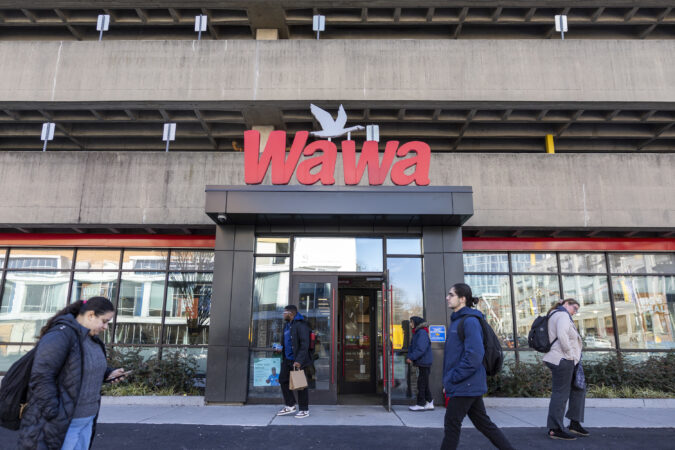
Wawa is closing a store on Drexel University’s campus, nearly three years after remodeling to a digital-order-only concept with no products on shelves.
The 3300 Market St. location, which has been open since 2018, is set to close Jan. 21.
It was remodeled in 2023 to test the new store format, which required customers to order all items on a touch screen, with no shelves of product to browse. The pilot was not a success, leading to the store’s planned closure, said a company statement shared by Wawa spokesperson Lori Bruce Tuesday.
Prior to the pandemic, this store saw more food-service than any other Wawa, CEO Chris Gheysens previously told the Philadelphia Business Journal.
“Over the years, we have made several attempts to address business and operational challenges at this location,” said the company statement shared by Bruce, which did not provide details about those challenges.
That effort “includes partnering with property owner, Drexel University, in an attempt to address some of these issues, and most recently making investments in our store design to test a fully digital format. Unfortunately, this test did not adequately improve performance or deliver an enhanced customer experience, which ultimately led to the decision to close the store‚” Wawa’s statement said.
Wawa had informed Drexel about its plans to close the location, university spokesperson Niki Gianakaris confirmed Tuesday in a statement from the university. Drexel did not respond to a question about what will occupy the space going forward.
Employees will be offered positions at other nearby Wawas. Nearby stores include those at 36th and Chestnut Streets, and 38th and Spruce Streets.
The Wawa at the corner of 34th and Market Streets near Drexel University will close this month.
Wawa has closed a number of stores in the city in recent years.
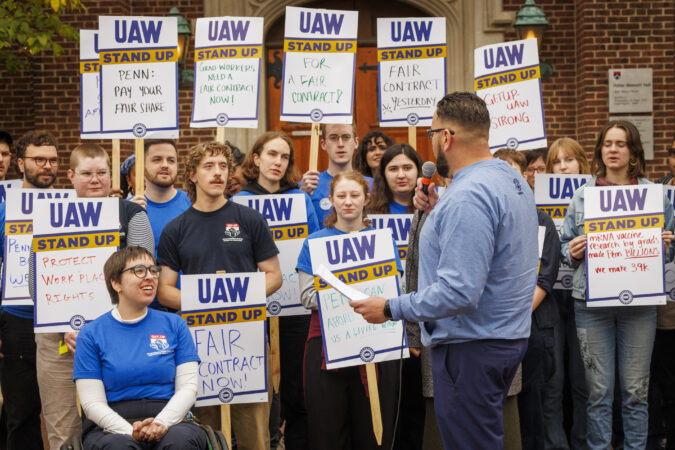
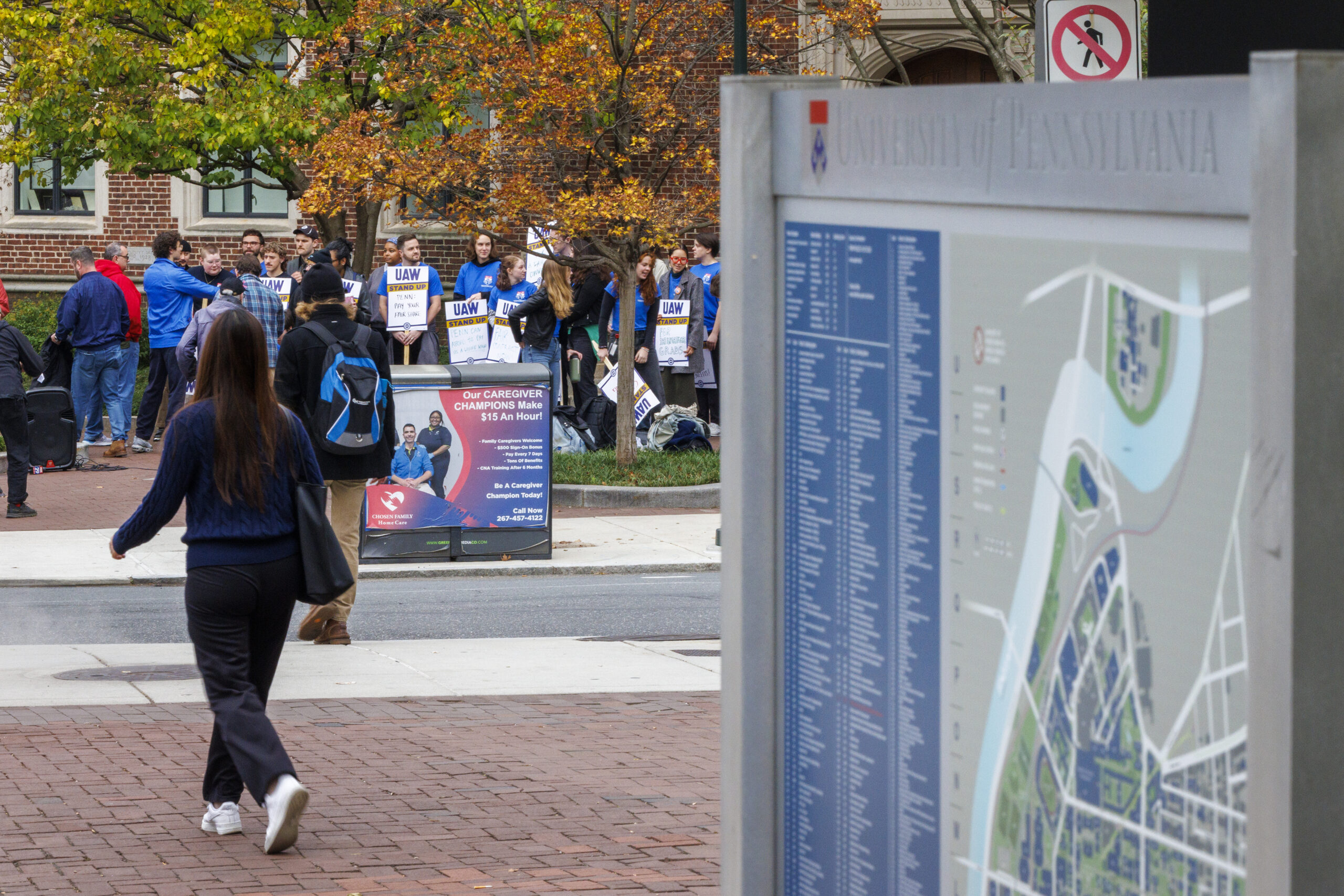
The union that represents about 3,400 University of Pennsylvania graduate student workers says they will go on strike Feb. 17 if they do not reach a contract deal with the university by then.
“We love our jobs, but Penn’s administration is leaving us no choice but to move forward with a strike,” said Nicolai Apenes, a Ph.D. candidate and research assistant in immunology, in a statement shared by the union Tuesday. “We are ready to stand up and demand that our rights are respected.”
Penn’s graduate student workers voted to unionize in 2024. The union has been negotiating with the university since October 2024 for a first contract, and some tentative agreements have been reached on a number of issues.
Sticking points in bargaininginclude wages, healthcare coverage, and more support for international student workers.
In November the teaching and research assistants voted to authorize a strike if called for by the union, which is known as Graduate Employees Together-University of Pennsylvania (GET-UP) and is part of the United Auto Workers (UAW).
A spokesperson for the University of Pennsylvania said in a statement Tuesday that Penn has engaged in good faith negotiations with the union, and has reached 23 tentative agreements through 39 bargaining sessions with additional sessions planned.
“We believe that a fair contract for the Union and Penn can be achieved without a work stoppage, but we are prepared in the event that the Union membership strikes,” said the Penn spokesperson. “Efforts are underway to ensure teaching and research continuity, and the expectation is that classes and other academic activities will continue in the event of a strike.”
“While we hope that Penn comes to the table and negotiates a fair contract for these essential workers, we know that these workers are a powerful force that Penn cannot break,” said Daniel Bauder, Philadelphia AFL-CIO president, in a statement Tuesday. “We are proud to stand with them and the broader Coalition of Workers at Penn as they fight the biggest employer in the region and bring union power to the University of Pennsylvania.”
The region has also seen a couple other university strikes in recent years. In 2023 graduate workers at Temple University walked off the job for 42 days amid contract negotiations, and in a separate action at Rutgers University, educators, researchers, and clinicians went on strike for a week.
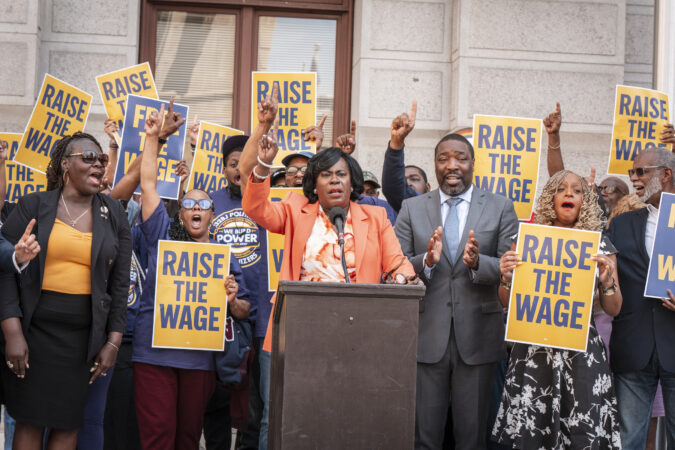
University of Pennsylvania graduate students hold a press conference and rally calling for a strike vote against the university at the corner of South 34th and Walnut Street, Monday, Nov. 3, 2025.
American Airlines, the largest carrier out of Philadelphia International Airport, is bringing free Wi-Fi to its fleet for members of its rewards program. The service is sponsored by AT&T and launches this month, the airline announced Tuesday.
“Free high-speed Wi-Fi isn’t just a perk; it’s essential for today’s travelers,” said Heather Garboden, American’s chief customer officer. “Once rollout is completed, every AAdvantage member can stay connected, stream, and share almost anywhere their journey takes them for free.”
American is not the first PHL airline to tout free onboard Wi-Fi for travelers with reward memberships. Southwest Airlines started doing so last year through a partnership with T-Mobile, and Delta announced a similar offering in 2023. United offersWi-Fi to rewards members on some planes, provided by Elon Musk’s Starlink, and announced in October that it plans to install the service on several more aircrafts.
American Airlines estimates that by early spring, free Wi-Fi will be available on “nearly every” one of its flights.
Travelers need an AAdvantage account, which is free to join, to access the free Wi-Fi. The membership also allows customers to earn points and miles toward flights. Onboard, travelers must log in at aainflight.com and select the “Free Wi-Fi” option.
Previously, all passengers using Wi-Fi had to pay for a pass or subscription. Non-AAdvantage members can still do so, said company spokesperson Bri Harper.
Philadelphia International Airport is a hub for American Airlines, PHL’s largest airline by passenger volume, which carried nearly 20 million passengers through the airport in 2024. That’s more than five times the second largest carrier, Frontier.
The Eastern Atlantic States Regional Council of Carpenters plans to relocate its headquarters and two local training centers to the Philadelphia Navy Yard.
“We’re extremely excited about the prospects and what this facility is going to transform into over the next few years,” William Sproule, executive secretary-treasurer for the Carpenters, said on Tuesday. “It’s really only the beginning of the story, and we’re going to be doing a lot of neat things down there.”
The council had outgrown its Spring Garden Street facility, Sproule said, and started seeking a new property 2½ years ago. Philadelphia buildings continue to have vacancies as a result of the pandemic, he said, and the current state of the real estate industry represented an opportunity.
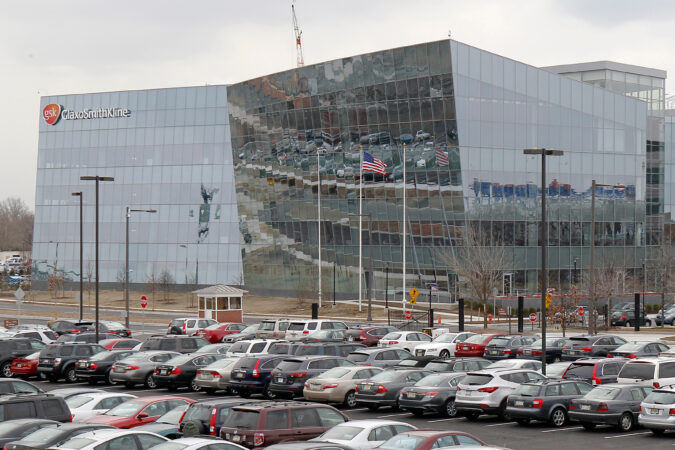
The council purchased the Navy Yard building for $52.5 million, said Sproule, and the deal closed on Dec. 19. The building at 5 Crescent Dr. previously sold for $130.5 million in 2018.
The pharmaceutical company moved its operations to the Navy Yard from Center City in 2013.
Although GSK was a remote-friendly company since before the COVID-19 pandemic, the building remained well used until 2020.
Then, in 2022, GSK moved its operations out of the then-lightly used Navy Yard office to a 50,000-square-foot office in University City’s FMC Tower. In an unusual move the company continued to pay rent at the former location, and did not seek to sublease the space.
That left the building at 5 Crescent Dr. in a tricky position: it is difficult to get new financing on a vacant building, even if rent is still being paid, because it is clear that when the lease is up the tenant will not renew. As a result, the building owner, Korea Investment Management Co., ran into financial problems on the property which went into foreclosure.
Special servicer Rialto Capital Management has been handling the day-to-day care of the building in recent years. Neither Rialto nor GSK immediately replied to requests for comment.
Office space in the Navy Yard is in high demand, with no official vacancy thanks to GSK’s continued rental of their former space. According to the official website, it hosts over 16,500 workers from 150 companies.
Carpenters union’s plans for the Navy Yard
Plans for the Navy Yard site include constructing a training facility adjacent to the purchased building that would eventually replace the council’s Northeast Philly and New Castle training centers, said Sproule. He estimated that it could cost $30 million to build out “on the low end,” and take at least 24 months to complete.
The move to the Navy Yard will also improve accessibility for some, said Sproule. When apprentices who live in the city are first starting out, they might not have access to a car, he said, adding that the new site is conveniently located near the NRG SEPTA stop.
“I think it’s going to be extremely convenient for members doing journeyman upgrade classes that live within the city limits as well as apprentices that live within the city limits that may not drive as much as folks that live out in the suburbs,” he said.
Sproule said employees of the union could be working out of the Navy Yard site as soon as the end of April, with initially up to 125 people based out of the building’s fourth floor.
The council has also already identified some potential tenants to lease out parts of the Navy Yard building.
Sproule said the council is considering selling the Spring Garden facility, or getting it “zoned for a mid-rise, multifamily structure.”
“We may try to build something similar to what’s across the street, or we may sell it to an interested party. We haven’t made those decisions yet,” he said. “I guess it’s just going to be a matter of what’s more practical and feasible.”
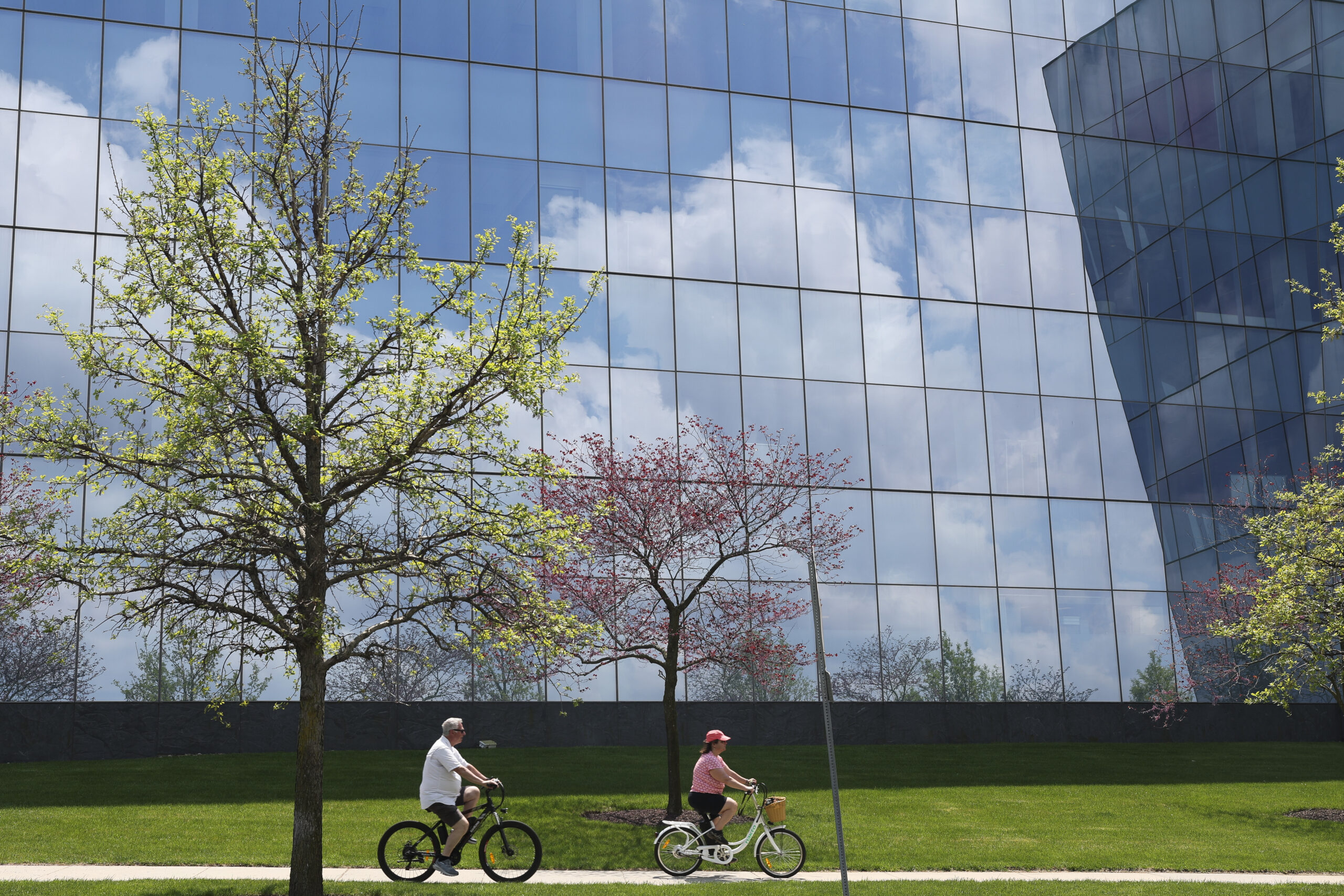
Cyclists ride past 5 Crescent Dr. at the Navy Yard in Philadelphia, Pa., on Monday, April 29, 2024.
Sproule said the purchase of the Navy Yard site seemed from the start like “a really good deal.” Then when he learned from an article in the Philadelphia Business Journal that the building at one time had sold for roughly $130 million, he said, “knowing that somebody actually invested that kind of capital for that building back then — which wasn’t that long ago, when you think about it — makes me really feel good about our endeavors that we’re about to embark on.”
“Aside from our pension funds and all the investments that we do on that end to make sure that they are strong and secure for generations to come, we do have general fund assets that our Regional Council uses for operational purposes. We just hit a spot in time where we had an opportunity to possibly look at an investment of this size and magnitude, and it was just a matter of being at the right time, at the right place,” he said.
Navy Yard neighbors
The Carpenters are not the first building trades union to move to the Navy Yard from Spring Garden.
In 2023, International Brotherhood of Electrical Workers Local 98 announced that it would be relocating its headquarters from 1719 Spring Garden St. The union purchased two properties for $18.5 million.
“We’re excited to be their neighbors,” said Sproule.
The Regional Council of Carpenters and Local 98 are among the most powerful building trades unions in Philadelphia, and they have strong membership bases in South Jersey and South Philadelphia, making the Navy Yard location at the edge of the city ideal for many members.
The spacious property at the Navy Yard also allows room for training facilities, which could be difficult to co-locate with a headquarters office in other parts of the city.
On the other side of Philadelphia is another concentration of building trades infrastructure in the Far Northeast. Near the Bucks County line, this hub provides similar advantages for union locals that include the Steamfitters, Ironworkers, and Bricklayers.
Giant is changing how it handles online orders as customers demand fast grocery delivery.
The supermarket chain, which got its start in 1923 in Carlisle, Cumberland County, is closing five e-commerce fulfillment centers in Pennsylvania as it transitions to a new business model.
“We’ve learned over the past few years that there isn’t a one-size-fits-all approach to our e-commerce business, particularly our fulfillment model,” said company spokesperson Ashley Flower. “With customers expecting faster delivery, we need to ensure we are operating as efficiently as possible to meet their ever-changing needs.”
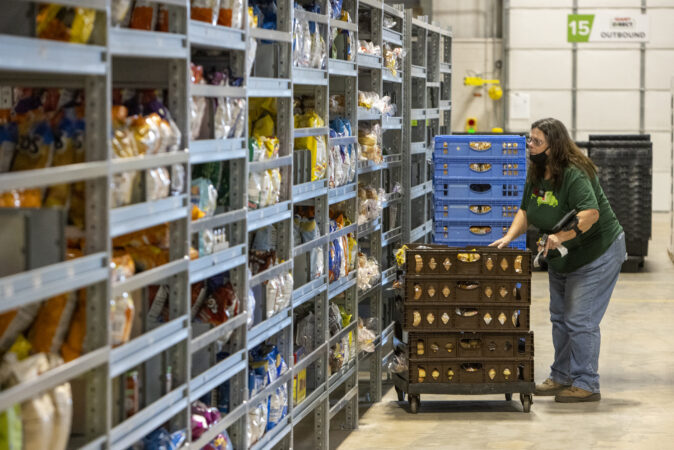
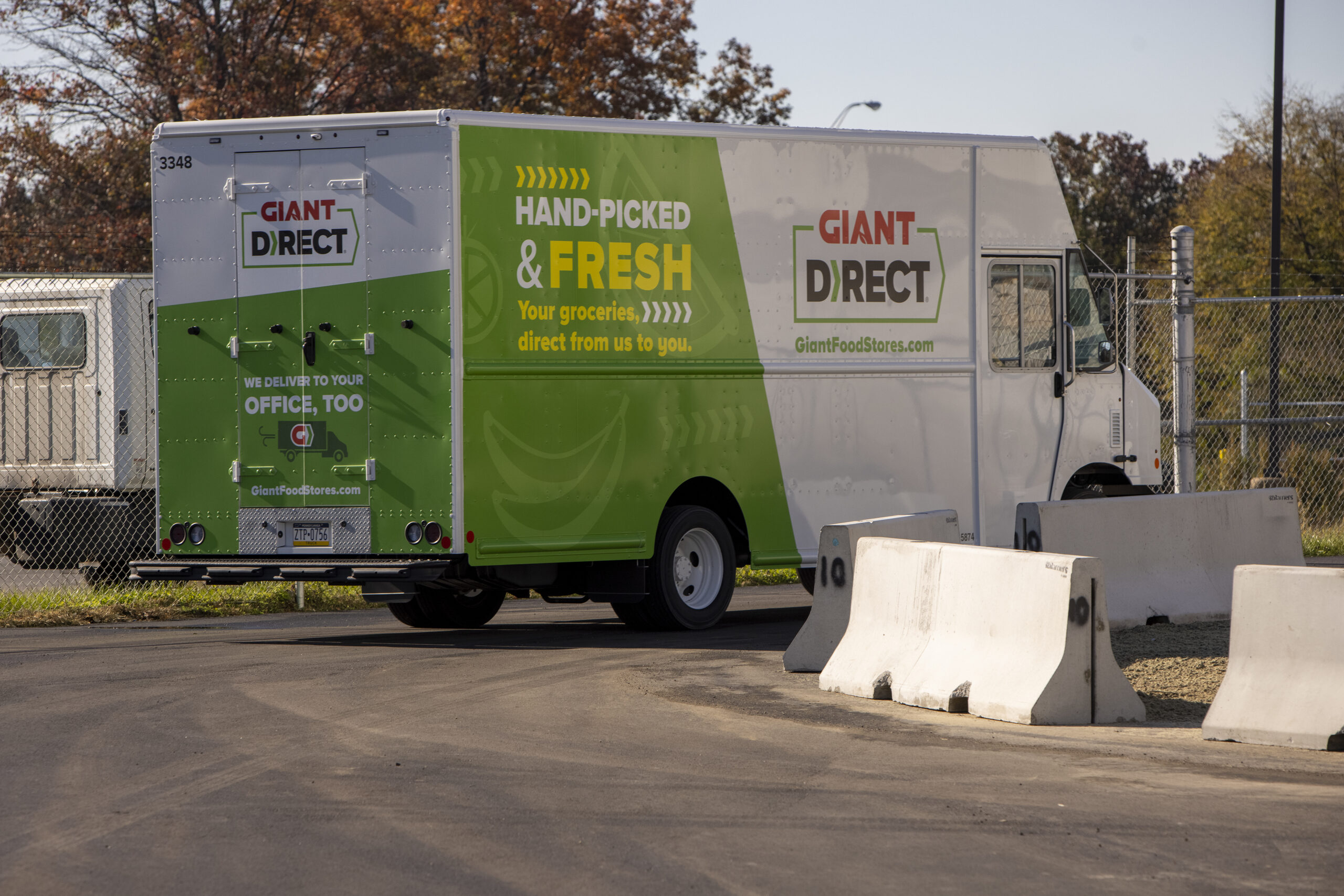
Under the new model, Giant employees will select the items for customers’ orders at Giant stores, instead of fulfillment centers, and the groceries will then be delivered by Instacart or DoorDash instead of GIANT Direct drivers.
The company will transition to the new model by the end of April and customers can continue to place their orders through the Giant app, said Flower.
The new model is intended to allow faster delivery, more product variety, and one-hour delivery windows, said Flower.
Customers will also be able to make changes to their orders closer to the scheduled delivery time.
Trucks leave the Giant Company e-commerce fulfillment center in Eastwick in November 2021, when the center had just opened. Going forward under the new delivery model, grocery orders will be delivered by a third-party company instead.
During the pandemic, more consumers turned to online shopping for their groceries. Today, consumers in the Philadelphia area are able to shop from several supermarkets through the Instacart and DoorDash digital platforms, including ShopRite, Aldi, and Sprouts. Customers have been able to shop for Giant groceries with third-party providers prior to the announced e-commerce model change.
Giant will close its five area fulfillment centers, Flower said. They are at: 3501 Island Ave. in Philadelphia, 315 N. York Rd. in Willow Grove, 216 E. Fairmont St. in Coopersburg, 86 Glocker Way in Pottstown, and 235 N. Reservoir St. in Lancaster.
Some fulfillment centers share their address with a supermarket site but are not accessible to shoppers at those locations. At those sites, the fulfillment center will close, but there will be no change to store operations, said Flower.
The e-commerce facilities employ 493 workers, who will be offered “equivalent jobs within our stores, with the same pay and benefits.” But drivers who take on a new position at a store will no longer receive tips, noted Flower.
When Giant’s 124,000-square-foot Southwest Philadelphia fulfillment center opened in 2021, it allowed the company to expand online order delivery to South Jersey. That was part of a $114 million expansion.
Meanwhile, Giant has been expanding its store footprint with a new South Philly location opening in 2024, and a Jenkintown supermarket in 2025.
“E-commerce remains an important segment of our business strategy and key to our future omnichannel growth,” said Flower. “We remain committed to providing an outstanding experience to our customers by offering speedy delivery, more delivery windows, broad product assortment, and value.”
Philadelphia is often referred to as an “eds and meds” economy — the region’s colleges, universities, and health systems employ hundreds of thousands.
But Sean Vereen, president and CEO of Heights Philadelphia,doesn’t want the city to just be defined by those employers. The nonprofit he leads helps connect young people with education and career opportunities.
“I often say Philly should be a city for working-class people. We have a lot of working-class sensibilities, but we don’t have an economy that works for working-class people,” said Vereen. “We are going to have to be much more dedicated across all kinds of sectors to really try to create that kind of city and region.”
The Inquirer spoke with Vereen about recent unemployment data released by the Bureau of Labor Statistics, and the opportunities available to young adults. He says companies should have a vested interest in employing and training these entry-level workers — it’s a savvy business decision.
“Companies are not doing this out of charity. They’re doing it because they need a better workforce, and they cannot just be dependent on people who have done everything right, or have had access to all the opportunities,” said Vereen.
The following conversation has been edited for length and clarity.
U.S. unemployment is at the highest level since 2021. What does that mean for workers and those looking for work in Philadelphia and across the country?
Entry-level work is getting harder for people to find and have. Whether it’s [because of] tariffs or it is economic trends with hiring in general, it’s clear that the labor market is weakening. I think that’s particularly true for families of color, particularly Black folks seeking employment.
Then, I think the other piece is that the cost of living increases. There’s a ton of pressure for people through their employment to be able to maintain lifestyles. As much as [the Philadelphia area] is a great place to live, economically we’re not producing enough jobs that can sustain people in a working-class, middle-class lifestyle.
I recently wrote about how college graduates are facing one of the toughest job markets in recent years. What can young people expect when they’re entering the workforce? How can they prepare?
When you’re looking at the employment rates of people without a college degree, or even without a high school degree, the employment rates are much worse. So … it’s still the best bet that you’re going to have to get access to employment, particularly in this region because we are very much an “eds and meds”-driven economy in the five counties. We have to diversify and build up what the economic opportunities are here, but that’s also a reality that young people are facing.
Particularly first-generation-to-college students, they need networks and support systems, because they don’t have the connections that other folks from higher-income groups may have. We’re never gonna get people who have experience unless we give young people an opportunity and a chance. Employers have to be more dedicated to that entry-level work and paying fair and decent wages for that.
Scene from Rowan University’s College of Education graduation ceremony at Rowan University in Glassboro.
Tell me a bit about underemployment. Have we seen a change in how many people are employed part-time who would like to have more work?
It is clear that the cost of living has increased significantly over the last four or five years since the pandemic, and people are doing a lot of different things to try to supplement what their income is.
Everybody has got some kind of side hustle. Now, the question I would have is: Does it add up to actually real economic prosperity?
Are there many people who are in jobs that don’t match the amount of education they have? What can be done about that?
I think that is happening, one, because [there are] just more college graduates, period.
We need institutions and universities more dedicated to giving opportunities to low-income and first-generation students. We don’t have this connection between education and employment as much as we need to.
We’re really trying to push [for] kids to go to institutions that have the support and ability for kids to be able to graduate. We think Temple [University] is one of those places.
Some people … in their economic status [have] built-in networks that allow them to be connected to industries and professions. They may know somebody who’s already an investment banker … or does government work. For everybody else who does not have those connections, we need to have stronger networks. We need to have more people in career fields who are willing to mentor and engage people who are not their cousin, or their sibling, or a family member, but people who are different from them, but will benefit the industry, and the field, and all of us.
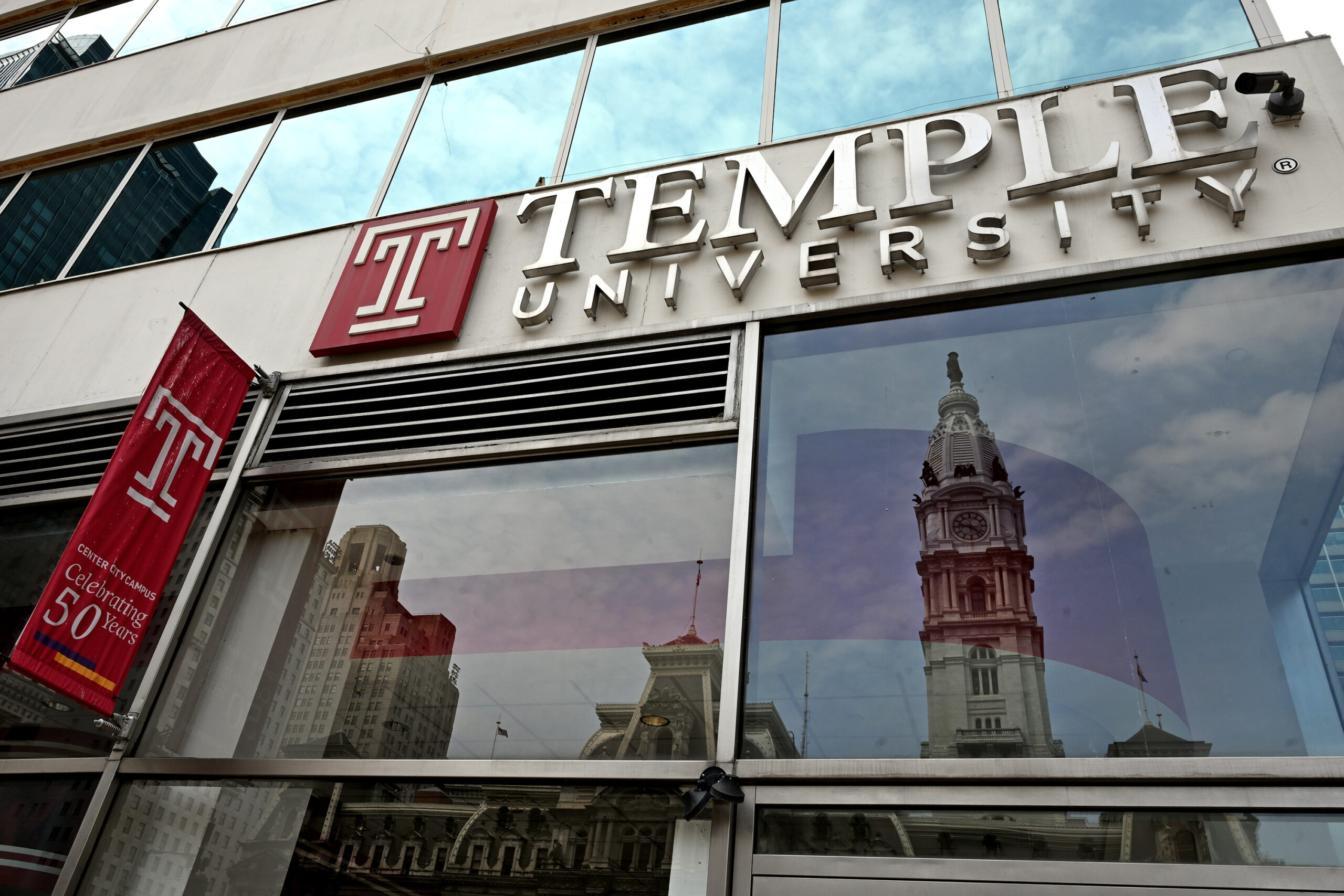
City Hall is reflected in glass of Temple University Center City Campus at 1515 Market St. on Jun. 5, 2025.
It’s the canary in the coal mine. What we saw during the pandemic, and coming out of the pandemic, was enormous amounts of opportunity for low-income, lower-wage workers … and now that’s wearing out. Then we think about the cutbacks in government work, cutbacks that are happening across many industries, that often Black folks are the folks who are first to be hitting those headwinds.
We still need to create long-term careers. We need to be thinking in this system. Even after the end of diversity, equity, and inclusion, we need to be creating opportunities in communities where that has not been the case. That’s both really thinking about lowering the cost of education … [and] making a stronger connection to what happens to you at the end of your educational journey.
We’re trying to press universities to be thinking harder about what happens to kids once they graduate. We’re trying to press the School District of Philadelphia to be thinking more about what happens, not just to get a kid to graduation, but have we connected them to an opportunity?
We cannot just be a place of “eds and meds” and Comcast. There has to be more economic opportunity for more people.
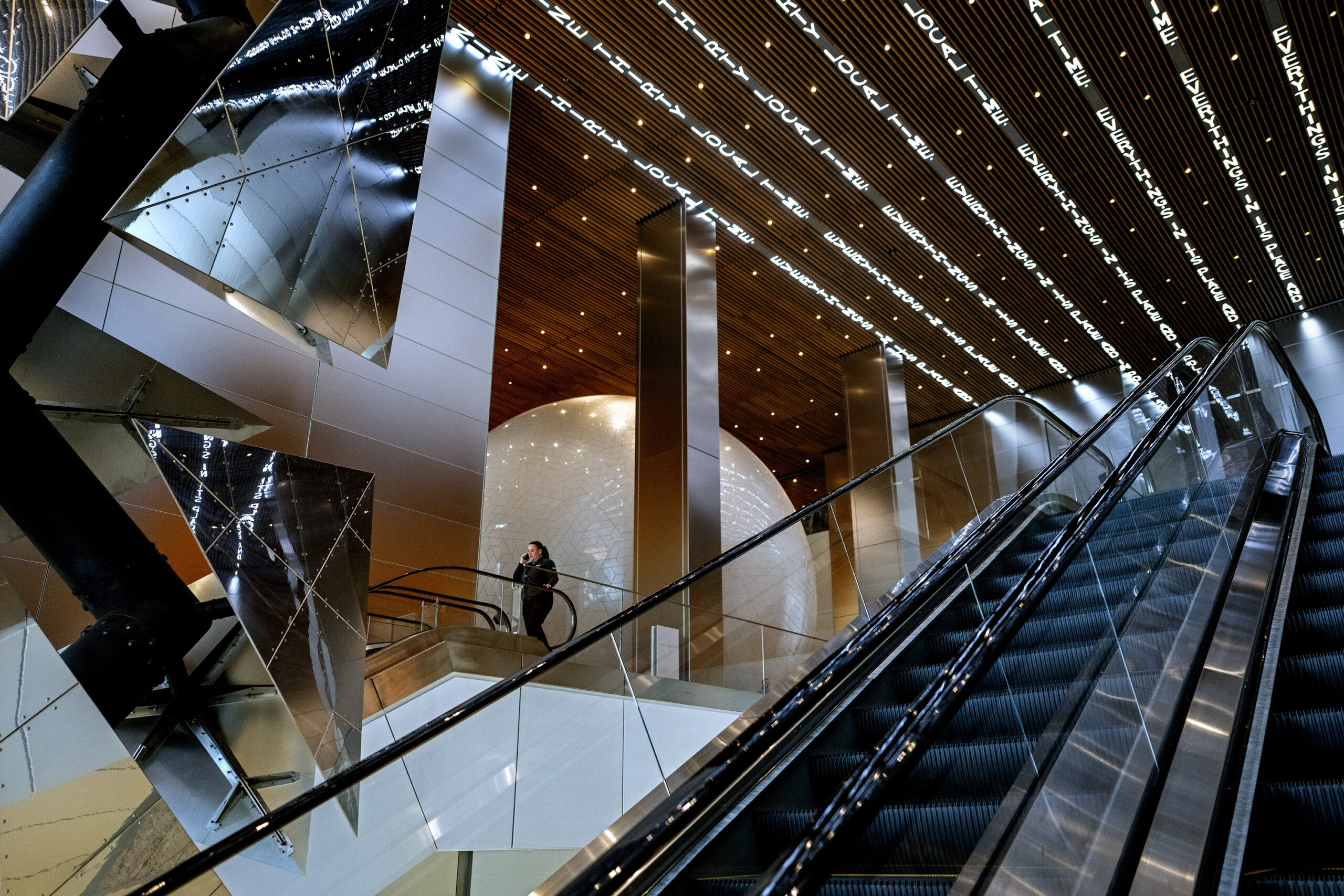
Public art “For Philadelphia” (top) by Jenny Holzer and “Exploded Paradigm” (left) by Conrad Shawcross and the Universal Sphere (rear) in the second-floor lobby of the Comcast Technology Center, Monday, March 17, 2025.
How should workforce development programs help people in Philadelphia secure good jobs? What kind of industries, skills, or training should they be focused on right now?
Whether you’re going to be a welder, or whether you’re going to be an electrician, or whether you’re going to work in a hospital, your reading and math skills still matter.
The other piece is just understanding what a field is. A med technician, they make, actually, good living wages. It is a job that you can do without a college degree, happening in many of the hospitals and research labs around the region. Kids don’t know about those things. No one is waking up in the morning and being like, “I want to be a med technician, [or a] sterilization technician.”
We have to do a better job of actually, at scale, introducing young people to fields and what opportunities are [available]. When they think about medicine, it’s not just about being a nurse or a doctor. There are thousands of jobs and opportunities there.
We have a ton of jobs that are going unfilled while we have employment going up, for example, in some of the hospitals. We’ve got to be better about trying to get people connected to opportunities. And that is possible to do. We just haven’t really looked at it, I think, in the right way.
New Jersey’s minimum wage will increase on Thursday.
The new rate of $15.92 an hour is a $0.43 increase from the previous standard, which was set in 2025.
“Eight years ago, Governor Murphy pledged a stronger, fairer economy, and we’re delivering on this commitment by raising New Jersey’s minimum wage again,” Robert Asaro-Angelo, commissioner of the state’s Department of Labor and Workforce Development, said in October. “This increase will provide vital support to all Garden State workers by making the dream of a livable wage reality.”
window.addEventListener(“message”,function(a){if(void 0!==a.data[“datawrapper-height”]){var e=document.querySelectorAll(“iframe”);for(var t in a.data[“datawrapper-height”])for(var r,i=0;r=e[i];i++)if(r.contentWindow===a.source){var d=a.data[“datawrapper-height”][t]+”px”;r.style.height=d}}});
In 2019, New Jersey lawmakers passed legislation to increase the standard to $15 by 2024, joining California, Massachusetts, New York, and the District of Columbia which were also progressively introducing the new standard. At the time, the minimum wage in New Jersey was $8.85 per hour.
A single adult without a child needs to make $26.20 per hour in New Jersey to afford their basic needs as of February 2025, according to a living wage calculator developed at the Massachusetts Institute of Technology.
Agricultural workers in New Jersey have a separate wage standard and will see an increase from $13.40 to $14.20 in January.
For tipped workers, the minimum hourly wage will increase from $5.62 to $6.05. But when combined with their tips, these workers should have a total hourly wage of at least $15.92.
Employees at seasonal and small businesses will see wages rise from $14.53 to $15.23. The state has a different scale for these employers to lessen the impact of the raises.
What’s the minimum wage in Pennsylvania?
Pennsylvania’s minimum wage has gone unchanged since 2009, despite efforts to increase it. The federal minimum wage was last increased in 2009 to $7.25.
In Pennsylvania, a single adult without a child needs to make $22.91 per hour to afford their basic needs, according to the MIT calculator.
As of July, other states following the federal minimum wage were: Idaho, Utah, Kansas, Oklahoma, Texas, North Dakota, Iowa, Wisconsin, Indiana, Kentucky, North Carolina, and New Hampshire.
Advocates have also sought legislation to allow Philadelphia to set its own minimum wage separate from the state’s. That’s currently prohibited by law.
The Trump administration made sweeping changes in 2025, leading to layoffs, resignations, and early retirements.
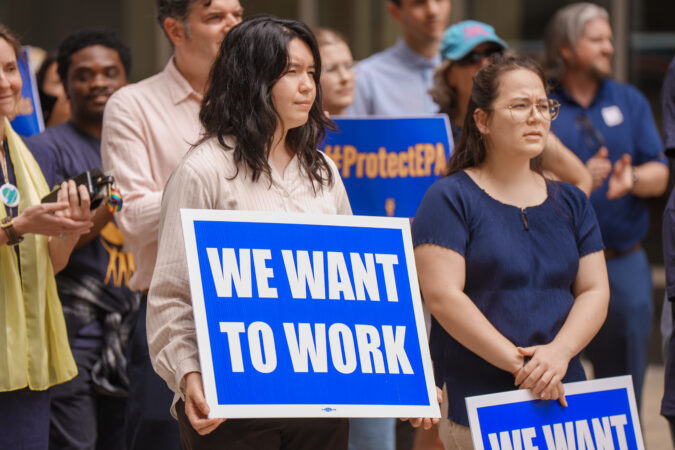
Employees and supporters at a Philadelphia rally for EPA workers being put on leave after signing a letter critical of the Trump administration on July 9, 2025.Jessica Griffin / Staff Photographer
For many federal workers, 2025 has been a year of massive change in the workplace. And for thousands of them, it was the year they quit working for the U.S. government.
That’s the result of the Trump Administration’s efforts to shrink and reshape the federal workforce through a deferred resignation program called “Fork in the Road.” First offered in January, it allowed employees to resign and stay on government payrolls through Sept. 30.
If they didn’t resign, they were told, there was no assurance their job would still be around.
After the “Fork in the Road” offer, President Donald Trump’s administration continued to shake up the federal workforce, with moves including layoffs, dismantling federal worker unions, and overhauling workplace policies.
Here’s a look back on how these changes have impacted Philadelphia-area federal employees this year.
President Donald Trump signs executive orders in the Oval Office at the White House on Jan. 20 after his inauguration. Credit: Jabin Botsford/The Washington PostJabin Botsford
Elon Musk during a trip with President Donald Trump to the NCAA Division I Men’s Wrestling Championship at the Wells Fargo Center in Philadelphia.Elizabeth Robertson / Staff Photographer
DOGE was tasked with reducing government spending and streamlining bureaucracy by July 4, 2026, encouraging mass layoffs and upheaval within the federal government.
Jan. 28
Trump administration offers a new resignation program
Federal workers received an email directly from the U.S. Office of Personnel Management (OPM), the government’s human resources agency, offering the opportunity to resign while continuing getting paid for several months. The agency encouraged federal workers to go from “lower productivity jobs in the public sector to higher productivity jobs in the private sector.”
Protestors hold signs at the Save Our Services day of action event at Independence Mall in Philadelphia on Feb. 19. They gathered to protest Elon Musk's push to gut federal services and impose mass layoffs.Elizabeth Robertson / Staff Photographer
Local workers and supporters gathered in subfreezing temperatures near Independence National Historical Park to protest the layoffs and other workforce shakeups.
On Feb. 26, a memo from OPM and the Office of Management and Budget gave agencies a March 13 deadline for submitting additional layoff and reorganization plans.
Musk said in a post on X that not responding to the email would be seen as a resignation, but some members of the Trump’s administration later said responding was voluntary.
March 5
Pa. government looks to hire federal workers
Gov. Josh Shapiro signed an executive order to streamline the hiring process for former federal employees. Nearly two weeks later, hundreds had applied.
Gov. Josh Shapiro delivers his budget address in February 2025.Tom Gralish / Staff Photographer
story continues after advertisement
March 7
Trump administration starts stripping union rights
The Department of Homeland Security canceled union rights for Transportation Security Administration employees. TSA union leaders and workers at the Philadelphia International Airport said the change caused morale to plummet.
TSA worker Devone Calloway at the Philadelphia International Airport soon after DHS revoked TSA employees' collective bargaining rights.Jose F. Moreno / Staff Photographer
A few weeks later, Trump issued an executive order to end union rights for federal workers across agencies, and union dues stopped being deducted from worker paychecks.
April 2
State officials express concerns over federal layoffs in Pa.
“What we’re seeing right now, in the last 72 days, is an unprecedented assault on organized labor, on working people, on working families and on Pennsylvanians of all different political stripes, from every single corner of our commonwealth,” said state Rep. Malcolm Kenyatta (D., Philadelphia) at a hearing. “It is an attack on their ability to have access to the necessary government services that they depend on every single day.”
Andrew Kreider, an environmental protection specialist at the EPA's Region 3 office, holds a sign reading “Thank You EPA” at a solidarity march around City Hall on March 25.Tyger Williams / Staff Photographer
In a late Friday email, the IRS asked employees to share their resumes so leaders could “determine [their] qualifications.” That included over 3,600 employees from the agency’s office at 30th and Market Streets.
IRS Union Rep. Alex Jay Berman, in front of the Philadelphia IRS building at 30th and Market Streets in April 2025.Jessica Griffin / Staff Photographer
April and May
Philly’s understaffed National Park Service faces “workforce optimization”
NPS workers were asked in late April to upload their resumes amid plans for “workforce optimization.” But administrative staff had already left the regional office in Philadelphia, leaving others to take on their work. At Independence National Historical Park, staffing was an issue even before the start of the second Trump administration, workers said.
At Independence National Park, a ranger casts shadow as they walk along S. 6th Street at Market Street in June.Alejandro A. Alvarez / Staff Photographer
“To work well, to perform, you have to be happy, you have to enjoy what you’re doing,” said Ed Welch, president of AFGE Local 2058, which represents employees at the NPS in Philadelphia. “There’s a horrible oppressiveness in government now, and it‘s unnecessary.”
story continues after advertisement
May 5
Philly-based VA workers return to offices full-time
Following orders from the VA, employees started coming in to work in-person full time but found challenges including insufficient parking and concerns about the confidentiality of work in a shared space.
Theresa Heard attends a rally of VA employees at the VA Medical Center in West Philadelphia in June 2025.Jessica Griffin / Staff Photographer
During a February protest in Philadelphia, retired federal worker Roseanne Sarkissian of Philadelphia holds a sign showing Elon Musk and the phrase “This man is not our boss.”Elizabeth Robertson / Staff Photographer
DOGE, Musk said, is “like a way of life.” The agency remains part of Trump’s government.
Late May
Laid-off employees return to work
Workers who’d been laid off across agencies were reinstated and placed on administrative leave following court rulings. As of late May, the “vast majority” of several hundred Philly-area IRS workers, who lost their jobs in the probationary worker layoff were back at work, union leader Alex Jay Berman estimated.
Yolanda Cowan, Mayra Gonzalez, and Michael Rosado were among the Philadelphia IRS workers who lost their jobs when probationary employees were laid off in February. Here, in February, they posed for a selfie outside the IRS offices.Tom Gralish / Staff Photographer
June 1
Over 100 federal workers find work for the Pa. government
By the first week of June, the state had hired 119 former federal employees across 22 agencies, according to Daniel Egan, a spokesperson for the Pennsylvania Office of Administration.
July 7
VA cancels mass layoffs after many employees leave voluntarily
The VA said it would forgo plans to cut the workforce by 15% after about 17,000 people left through the deferred resignation program, retirement and other attrition. The agency was on pace to have 30,000 fewer employees by the end of the 2025 fiscal year.
A rally of VA employees at the VA Medical Center in West Philadelphia on June 5, 2025.Jessica Griffin / Staff Photographer
August
Federal agencies cancel union contracts
Employees at the VA, the EPA, the U.S. Citizenship and Immigration Services, the Department of Agriculture (USDA), and the Federal Emergency Management Agency (FEMA) are stripped of their union contracts.
Brad Starnes, president of American Federation of Government Employees Local 3631, which represents EPA employees in Pennsylvania, Delaware and several other mid-Atlantic states.Jessica Griffin / Staff Photographer
story continues after advertisement
September
Thousands have left federal government employment
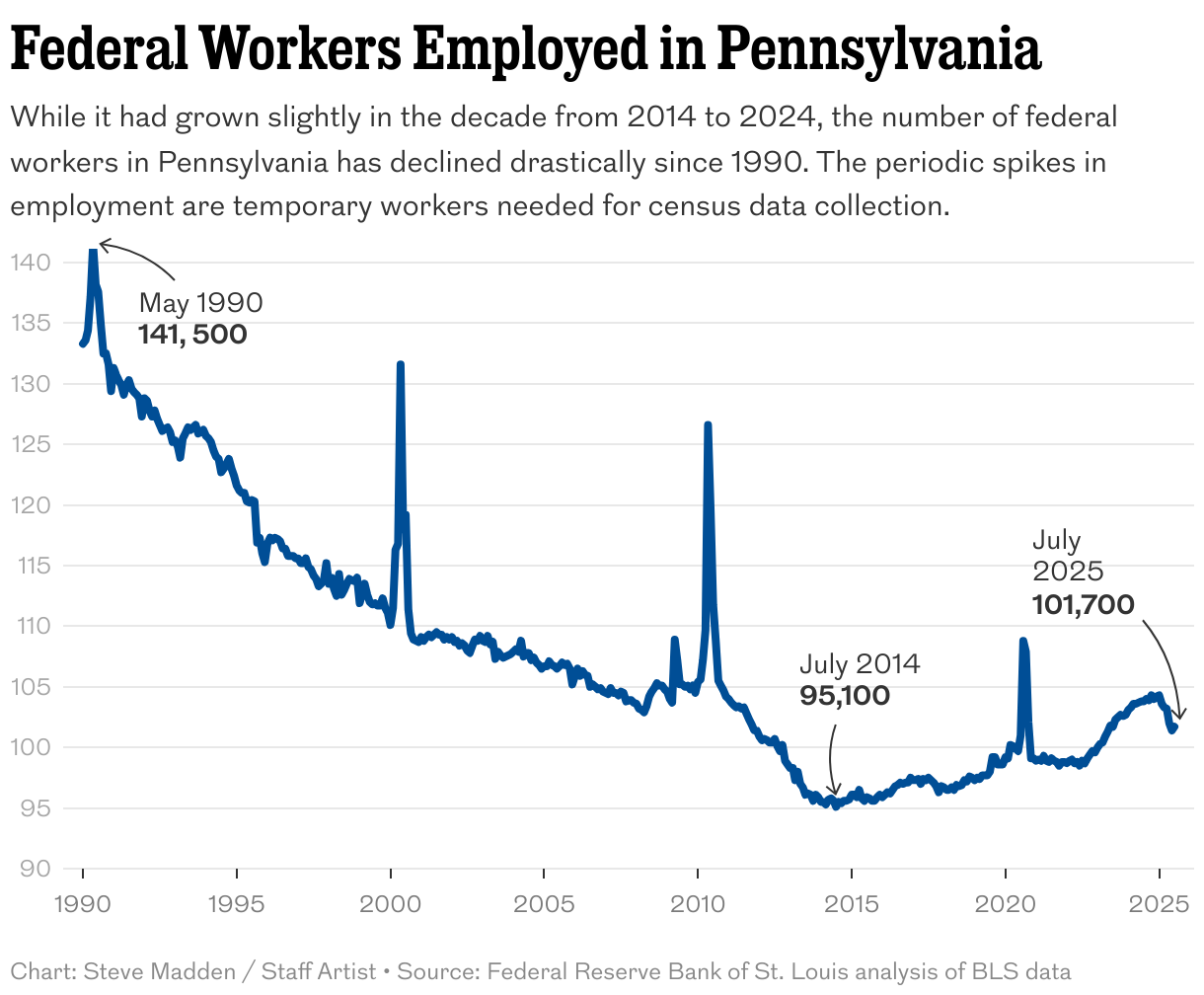
A few weeks before deferred resignations were expected to drop off payroll, new data showed the scope of the workforce shrinkage through mid-2025. In Pennsylvania, there were 2,600 fewer federal workers by the end of July than at the start of 2025.
Meanwhile, media reports said the government planned to call back some employees who took the deferred resignation program at the IRS and the U.S. Department of Labor.
Sept. 24
White House threatens mass firings if shutdown occurs
Federal agencies were asked to prepare plans to fire workers if legislation is not passed to keep the government open past Oct. 1. Philadelphia-area union leaders said they would push back on this effort, even as the Trump administration has moved to curtail their collective bargaining rights.
Oct. 1
A federal government shutdown begins
Lawmakers were unable to reach a deal to keep the government open, causing a shutdown. Agencies shared plans for how many employees were expected to continue working without pay and how many would be sent home on furlough. Air traffic controllers and TSA agents at Philadelphia International Airport, continued to work and so did employees at Philadelphia’s Social Security Administration building at Third and Spring Garden.
The Liberty Bell Center is closed Oct. 1, 2025 in Independence National Historical Park due to the federal government shutdown.Tom Gralish / Staff Photographer
Mid to late October
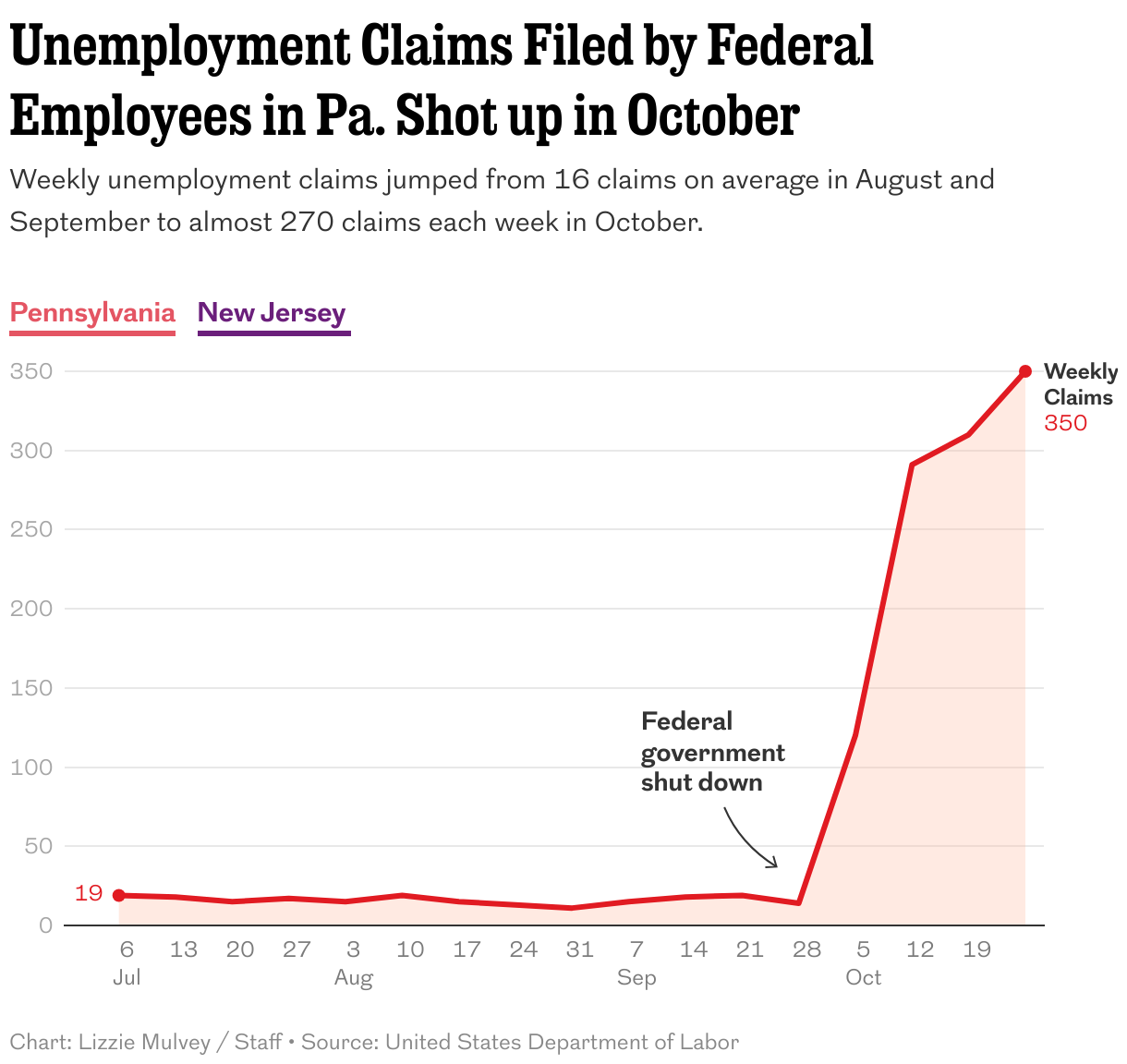
Unemployment claims increase in Pa. and N.J.
Uncertain when their next paycheck would arrive, federal workers applied to SNAP, put their mortgage payments on hold, negotiated with utility companies, and cut back on costs. At PHL, a food pantry was set up for airport government employees impacted by the shutdown. It served some 250 employees in its first two days.
Many federal workers in Pennsylvania and New Jersey filed for unemployment benefits.
Nov. 12
The end of the longest shutdown in history
Lawmakers reached a deal to reopen the government and keep it funded through Jan. 30, and President Donald Trump signed the legislation. The shutdown lasted 43 days, making it the longest in the country’s history.
The deal included protections from mass layoffs through Sept. 2026, and reversal of firings made during the shutdown — the administration sent 4,000 layoff notices during that time. Still, some worried about another potential government shutdown after Jan. 30.
December
Data on impact of resignations is still to come
Workers who took the government’s deferred resignation offer were expected to drop off federal payroll after Sept. 30, and be reflected in employment data from the Bureau of Labor Statistics.
Amid the shutdown, federal data releases were canceled or delayed. Insight on how many people have left the federal government since September is now expected in January.
story continues after advertisement
Staff Contributors
Reporting: Ariana Perez-Castells and Fallon Roth
Editing: Lizzy McLellan Ravitch and Erica Palan
Digital editing: Lizzy McLellan Ravitch
(()=>{var K=(e,t)=>()=>(t||e((t={exports:{}}).exports,t),t.exports);var A=K(r=>{var Q={0:”Jan.”,1:”Feb.”,2:”March”,3:”April”,4:”May”,5:”June”,6:”July”,7:”Aug.”,8:”Sept.”,9:”Oct.”,10:”Nov.”,11:”Dec.”};function L(e){return e===void 0&&(e=new Date),Q[e.getMonth()]}var X={0:”Jan”,1:”Feb”,2:”Mar”,3:”Apr”,4:”May”,5:”Jun”,6:”Jul”,7:”Aug”,8:”Sep”,9:”Oct”,10:”Nov”,11:”Dec”};function b(e){return e===void 0&&(e=new Date),X[e.getMonth()]}function s(e){return e==null}function T(e){return typeof e==”number”&&isFinite(e)}function f(e){return T(e)&&Math.floor(e)===e}var ee=[“one”,”two”,”three”,”four”,”five”,”six”,”seven”,”eight”,”nine”],te=[“million”,”billion”,”trillion”,”quadrillion”,”quintillion”,”sextillion”,”septillion”,”octillion”,”nonillion”,”decillion”],S=[“th”,”st”,”nd”,”rd”,”th”,”th”,”th”,”th”,”th”,”th”],ne=[11,12,13];function M(e){if(s(e))return””;var t=+e;return f(t)?ne.indexOf(t%100)>-1?S[0]:S[t%10]:””}var oe=[“first”,”second”,”third”,”fourth”,”fifth”,”sixth”,”seventh”,”eighth”,”ninth”],ie=new RegExp(/s+([^s]*)s*$/);r.apdate=function(e){return e===void 0&&(e=new Date),L(e)+” “+e.getDate()+”, “+e.getFullYear()},r.apdatetab=function(e){return e===void 0&&(e=new Date),b(e)+” “+e.getDate()+”, “+e.getFullYear()},r.apmonth=L,r.apmonthtab=b,r.apnumber=function(e){if(s(e))return””;var t=+e;return f(t)?t=10?e.toString():ee[t-1]:e.toString()},r.aptime=function(e){e===void 0&&(e=new Date);var t,n,o=e.getHours(),i=e.getMinutes(),u=i===0;if(u){if(o===0)return”midnight”;if(o===12)return”noon”}return o0?o:12):(t=”p.m.”,n=o===12?o:o-12),u?n+” “+t:n+”:”+(i<10?"0"+i:i)+" "+t},r.capfirst=function(e){if(s(e))return"";var t=String(e);return""+t.charAt(0).toUpperCase()+t.slice(1)},r.intcomma=function(e){if(s(e))return"";var t,n=+e;return T(n)?((t=n.toString().split("."))[0]=t[0].replace(/B(?=(d{3})+(?!d))/g,","),t.join(".")):e.toString()},r.intword=function(e){if(s(e))return"";var t=+e;if(!f(t))return e.toString();var n=Math.abs(t);if(n<1e6)return e.toString();var o=Math.ceil(Math.log(n+1)/Math.LN10)-1,i=o-o%3,u=t/Math.pow(10,i);return(u=Math.round(10*u)/10)+" "+te[Math.floor(i/3)-2]},r.ordinal=function(e,t){if(t===void 0&&(t=!1),s(e))return"";var n=+e;return f(n)?t&&n/Android|webOS|iPhone|iPad|iPod|BlackBerry|IEMobile|Opera Mini/i.test(navigator.userAgent);var g=(e,t=null,n=null)=>{n||(n=document.querySelector(“head”));let o=document.createElement(“script”);o.type=”text/javascript”,o.src=e,t&&(o.onload=t),n.appendChild(o)},q=()=>(window.PMNdataLayer?.[0]!==void 0&&window.PMNdataLayer[0])?.analytics?.user?.state===”Subscribed”,k=()=>{let t=(window.PMNdataLayer?.[0]!==void 0&&window.PMNdataLayer[0])?.analytics?.user?.state;return window.location.host.includes(“zzz-systest”)||window.location.host.includes(“pmn.arcpublishing.com”)||window.location.host.includes(“stage.fusion.inquirer.com”)||typeof t>”u”},j=()=>{let t=(window.PMNdataLayer?.[0]!==void 0&&window.PMNdataLayer[0])?.analytics?.user?.hasAdsFreeReading;return!!(t&&t==1)},v=()=>window.location.host.includes(“localhost”);var re=()=>{j()&&document.querySelectorAll(“.js-adbox”).forEach(t=>{t.classList.add(“is-hidden”)})},H={init:()=>{re()}};var a,y=!1,se=()=>{a=document.querySelector(“.js-appendix”)},C=()=>{let e=document.querySelector(“.js-appendix-static-content”),t=e.querySelector(“.js-appendix-static-items”).getBoundingClientRect().height;e.classList.remove(“is-collapsed”),e.style.maxHeight=t+”px”},B=()=>{a.classList.contains(“js-appendix-sticky”)&&(a.getBoundingClientRect().top{y=document.querySelector(“.js-appendix-static-content”).getBoundingClientRect().bottom{y&&document.querySelector(“body”).classList.toggle(“is-open-appendix”)},ae=()=>{window.addEventListener(“scroll”,()=>{B(),D()}),window.addEventListener(“resize”,()=>{B(),D()}),document.querySelector(“.js-appendix”).addEventListener(“click”,()=>{P()}),document.querySelectorAll(“.js-appendix-expand-static”).forEach(e=>{e.addEventListener(“click”,()=>{C(),window.addEventListener(“resize”,()=>{C()})})}),document.querySelectorAll(“.js-appendix-link”).forEach(e=>{e.addEventListener(“click”,()=>{P()})})},N={init:()=>{se(),ae()}};var m,ce=(e,t)=>{m=m||window.PMNdataLayer,m?m.push({event:”misc_event”,eventAction:e,eventLabel:t}):window.location.hostname.includes(“localhost”)?console.log(“Analytics event:”,e,t,”(not actually being sent due to localhost)”):console.log(“Failed to push analytics event”,e,t)},I={event:(e,t)=>{ce(e,t)}};var le=()=>{document.querySelectorAll(“.js-card-show-more”).forEach(e=>{e.addEventListener(“click”,()=>{de(e)})})},de=e=>{let t=e.closest(“.js-card”),n=t.querySelector(“.js-card-body”),i=n.querySelector(“.js-card-body-content”).getBoundingClientRect().height;t.classList.remove(“is-collapsed”),n.style.maxHeight=i+”px”,setTimeout(()=>{n.style.maxHeight=”none”},1e3),I.event(“expand_card”,`${t.dataset.id}`)},F={init:()=>{le()}};var c,$,ue=()=>{c=document.getElementById(“js-inno-toast”)},pe=e=>{if(!c)return;c.innerHTML=e,c.classList.add(“is-active”);let t=()=>{c.addEventListener(“transitionend”,fe,{once:!0}),c.classList.remove(“is-active”)};clearTimeout($),$=setTimeout(t,5e3)},fe=()=>{c.innerHTML=””},l={init:()=>{ue()},showToast:pe};var h,z=!1,me=async()=>new Promise(e=>{setTimeout(()=>{console.log(“simulating createShareLink for localhost”),e(“https://inquirer.com/interactives”),he()},100)}),he=()=>{let e=document.querySelector(“.js-gift-toast-receiver”);!e||!(e instanceof HTMLElement)||setTimeout(()=>{let t=e?.querySelector(“span”);t&&(t.innerHTML=”Gift link copied to clipboard“)},20)},ge=()=>{let e=window.services?.createShareLink;e&&(h=e),v()&&(h=me),h&&ye()},ve=async e=>{let t=”text/plain”,n=async()=>{try{return await h(window.location.pathname)}catch{e.dataset.state=”error”,l.showToast(“Hmm, we couldn’t generate a gift link…”)}},o=new ClipboardItem({[t]:n()});await navigator.clipboard.write([o]).catch(i=>{console.log(i),l.showToast(“Couldn’t copy to clipboard, try again?”),e.dataset.state=”error”}),l.showToast(“Gift link copied to clipboard!”),e.dataset.state=”complete”},ye=()=>{document.querySelectorAll(“.js-gift”).forEach(t=>{(q()||v()||k())&&t.classList.add(“is-available”)}),document.querySelectorAll(“.js-gift-button”).forEach(t=>{t instanceof HTMLButtonElement&&t.addEventListener(“click”,()=>{t.classList.contains(“disabled”)||(t.dataset.state=”loading”,z=!0,ve(t),setTimeout(()=>{t.dataset.state=”ready”},2e3))})});let e=document.querySelector(“.js-gift-toast-receiver”);!e||!(e instanceof HTMLElement)||we(e)},we=e=>{new MutationObserver(n=>{for(let o of n){let i=[…o.addedNodes].at(0);if(!(i instanceof HTMLElement))return;z&&l.showToast(i.outerHTML)}}).observe(e,{subtree:!0,childList:!0})},O={init:()=>{ge()}};var xe=()=>{window.addEventListener(“message”,e=>{if(e.data[“datawrapper-height”]){let t=e.data[“datawrapper-height”];for(let n in t)document.querySelector(`#datawrapper-chart-${n}`).setAttribute(“height”,t[n])}})},Le=()=>{document.querySelectorAll(“.js-datawrapper-graphic”).forEach(e=>{g(`https://datawrapper.dwcdn.net/${e.dataset.id}/embed.js`,null,e)})},be=()=>{window.addEventListener(“message”,e=>{let t=e.data;document.querySelectorAll(`iframe[src*=”${t.id}”]`).forEach(o=>{o.style.height=`${t.height}px`})},!1)},Se=()=>{document.querySelectorAll(“.js-pym-graphic”).forEach(e=>{if(typeof window{new window.pym.Parent(e.id,e.dataset.iframe)};typeof window.pym>”u”?g(“https://pym.nprapps.org/pym.v1.min.js”,t):t()}})},R={init:()=>{xe(),Le(),Se(),be()}};var p,Me=()=>{document.querySelectorAll(“.js-hover”).forEach(e=>{e.addEventListener(“click”,()=>{J(e)}),e.addEventListener(“mouseenter”,()=>{J(e)}),e.addEventListener(“mouseout”,()=>{V(e)})}),window.addEventListener(“scroll”,()=>{p!==null&&Te()})},Te=()=>{(p>window.scrollY+100||p{V(e)})},J=e=>{e.classList.add(“is-visible”),p=window.scrollY},V=e=>{e.classList.remove(“is-visible”),p=null},G={init:()=>{Me()}};var d,w,x=!0,Ae=()=>{d=document.querySelectorAll(“.js-video-autoplay”)},Ee=()=>{window.addEventListener(“resize”,()=>{W()}),window.addEventListener(“scroll”,()=>{W()}),d.forEach(e=>{e.addEventListener(“volumechange”,t=>{e.muted!==x&&!E()&&(x=e.muted,qe())})})},W=()=>{let e;d.forEach((t,n)=>{let o=t.getBoundingClientRect(),i=o.height/2;o.y-i&&(e=t)}),e!==w&&(w=e,d.forEach(t=>{t.pause()}),e?e.play():w=null)},qe=()=>{d.forEach(e=>{e.muted=x})},Y={init:()=>{Ae(),d&&Ee()}};var _={init:()=>{H.init?.(),N.init?.(),F.init?.(),O.init?.(),R.init?.(),G.init?.(),Y.init?.(),l.init?.()}};var ke=()=>{},U={init:()=>{ke()}};var je=document.querySelector(“.js-inno”),Z=()=>{_.init(),U.init()};je?Z():new MutationObserver((t,n)=>{if(document.querySelector(“.js-inno”)){n.disconnect(),Z();return}}).observe(document,{attributes:!0,childList:!0,subtree:!0});})();
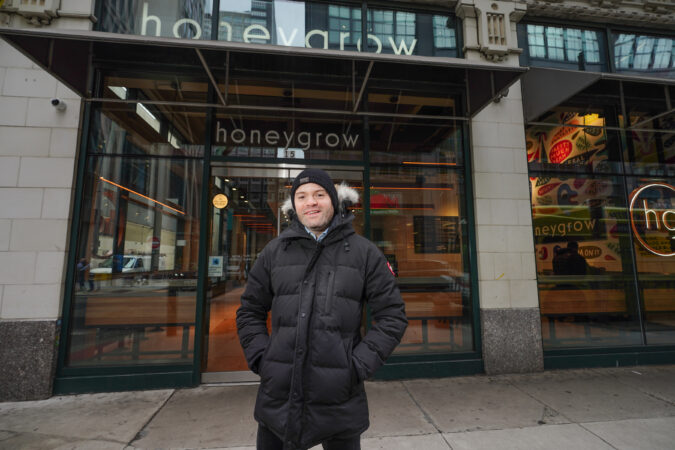
The fast-casual eatery, based in Center City, plans to open up to 18 new locations next year, following 17 new outposts in 2025, founder and CEO Justin Rosenberg told The Inquirer on Monday.
“It was definitely a good year,” said Rosenberg, adding that the company is “just continuing to build the pipeline for 2026 and beyond.”
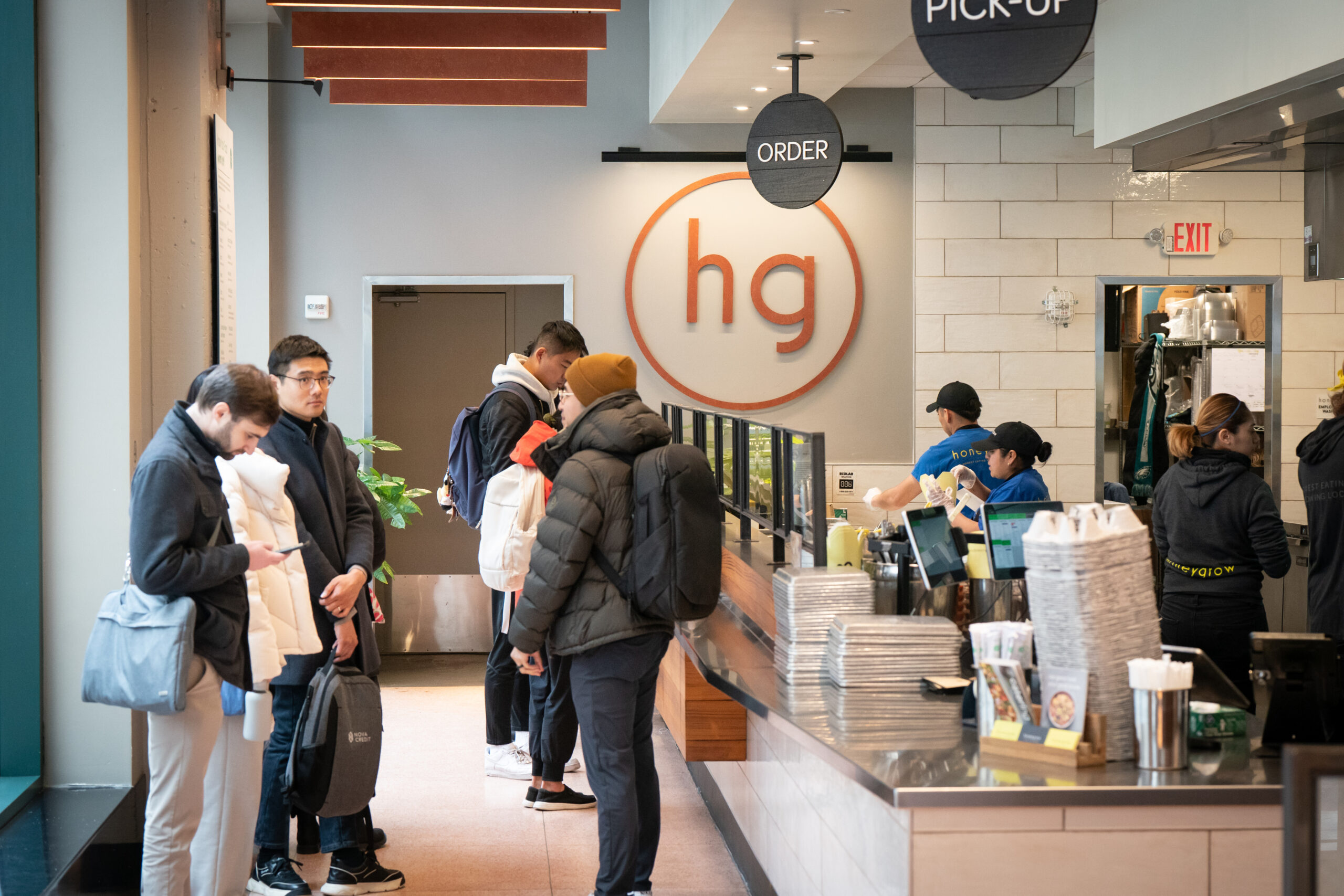
Honeygrow sells made-to-order stir-fries as well as salads and desserts. Since launchingin 2012, the company has grown to 71 locations across several states, including Ohio, Massachusetts, Virginia, Maryland, Delaware, and New York.
Philadelphia-area stores include Center City, Kensington, University City, North Philadelphia, Bala Cynwyd, and Cherry Hill.
The company’s expansion plans include adding locations in Ohio and New Jersey, as well as in Boston. The eatery is also currently in negotiations to bring Honeygrow to the Detroit metropolitan area, a new market, said Rosenberg.
Honeygrow also aims to open a location in Middletown, Del.
“Saleswise, it’s kind of neck and neck between certain Philly stores and our two Boston stores,” Rosenberg said.
Further expansion in Philadelphia is also possible.
“We are always looking at Philly,” Rosenberg said. “We’ve been poking around South Philly for a while. We just haven’t found the right opportunity.”
Honeygrow, at 11th Street in Center City, in 2024.
The company typically seeks 2,500-square-foot locations for new stores, but Rosenberg says it’s a competitive market for that kind of real estate.
“One of the things that has made us successful — and I give credit to my team for this — is that we’ve been very disciplined on growth, just saying, look, if we can’t get the deal we need in terms of underwriting, let someone else take it,” he said.
The company employs roughly 2,000 people, and each new store adds some 30 new hires, Rosenberg said.
Some of the considerations when looking at new markets include what other fast-casual concepts are in the area, and how they’re doing, Rosenberg said.
“If a Starbucks is underperforming in that market, that’s certainly going to spook us. Or a Chick-fil-A, if it’s below average unit volume, it’s probably not the right market for us,” he said.
On the flip side, if a Chipotle, Chick-fil-A, Starbucks, Raising Cane’s, or another brand is doing well in an area, Rosenberg said, “We feel that those would be very similar customers to ours. We’re willing to put a restaurant in there and see what happens.”
The plans for new locations come as the company shuttered some stores in Chicago, Washington, and New York in 2018 after rapid expansion plans. Some stores were “dragging down profitability,” Rosenberg has said, and he hasattributed closures to growth that happened too quickly as well as poor real estate.
Since then, the company has roughly tripled in size, said Rosenberg, adding “you just keep learning with every opening that you have.”
“My mission remains the same,” he said. “I want to build something that’s from Philadelphia — make this a national, if not international, brand that we can be proud of.”
Chicken Parm Stir-fry at Honeygrow at the 11th Street location in Philadelphia in 2024.
Crowds of last-minute shoppers, customers looking for seasonal ingredients, sappy hands from tying Christmas trees to cars, and of course, hours and hours of cheery holiday music playing on a loop.
Such is the life of a grocery worker during the holidays.
“Everyone wants to get, like, the biggest tree on, like, the smallest car,” said Edward Dupree, who has worked at the Center City Whole Foods for over nine years.
Working at a grocery store during the holiday season can be hectic and intense, requiring a lot of patience, he said.
“It’s, I think, definitely under-appreciated,” said Dupree.
Grocery employees from across the region say this time of year brings a surge of stressed shoppers making larger purchases, even in the age of DoorDash, grocery delivery, and curbside pickup.
Customers rush into the store for their last-minute shopping, said Erika Keith, who works at the Fox Street ShopRite in Nicetown. And they’re often hurried as they fill their carts, said Charletta Brown, of the Acme in Trooper, juggling year-end demands at work and pressures at home as they prepare for the holidays.
“Those three days moving into Thanksgiving are just insane,” said Dupree. He said the store starts getting busier in September as students return to the area, and it stays hectic through the end of the year.
Customers aren’t just getting their regular groceries and Christmas trees. They’re looking for specialty seasonal items including cranberries, decorative gourds, chestnuts, eggnog, and black-eyed peas for the New Year.
“Even in spite of the current economy — we do hear a lot that things are a little rougher than they have been in past years — people still want that tradition,” said Brown.
Specific holiday wishes
As the holidays approach, the Philadelphia Whole Foods bakery makes hundreds of pies and a slew of custom orders, said baker Jasmine Jones. During the holidays, they said, “the cakes get bigger.”
Many are seeking out pie crusts and fillings, as well as phyllo dough to make hors d’oeuvres, said Brown, of Acme. These freezer items are hidden “way in the back” for most of the year, but they get the star treatment, “front and center” for the holidays.
Keith, of ShopRite, said the holidays bring in more business for the store’s Western Union service, as people send money to loved ones as gifts.
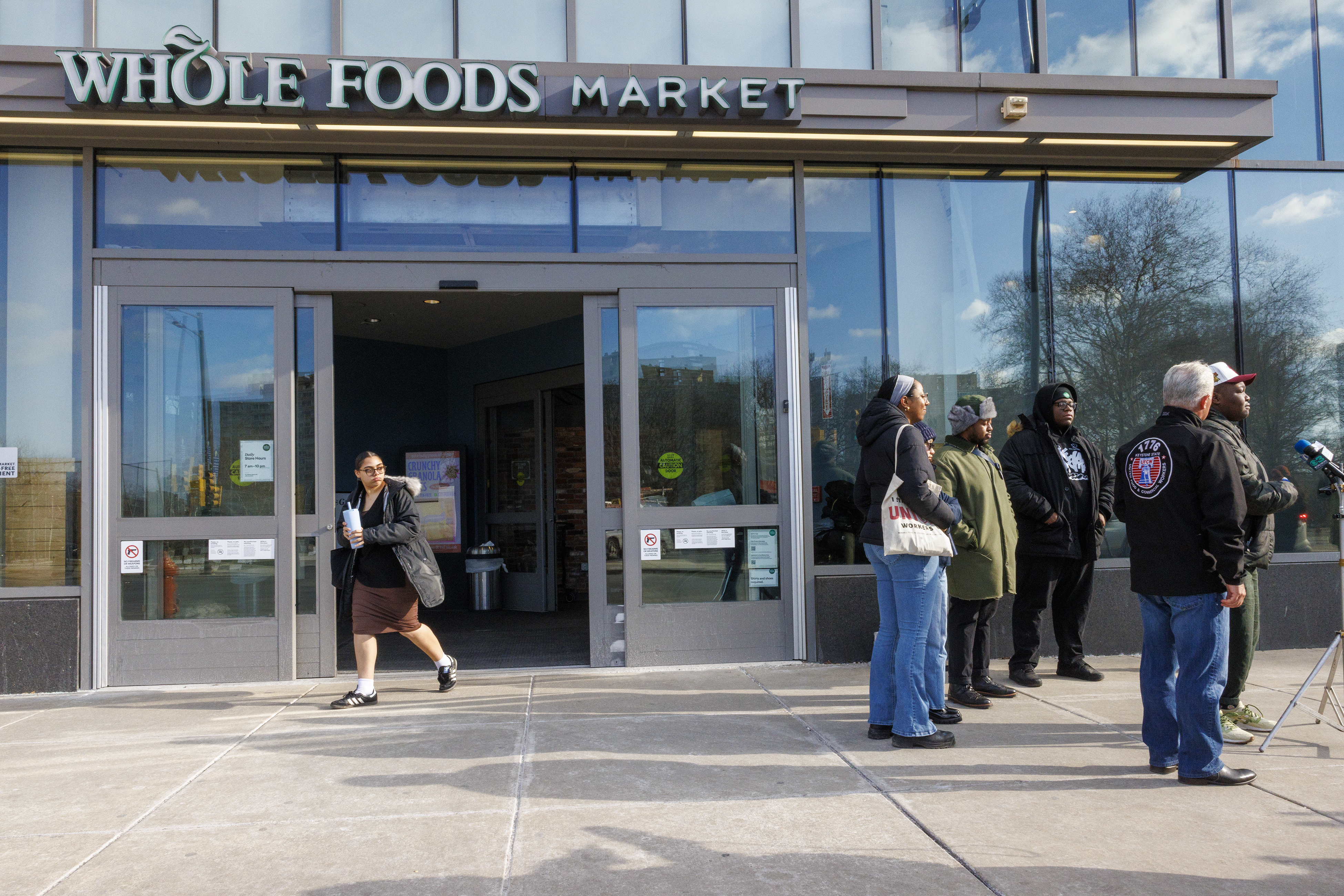
Union workers gather outside the Center City Whole Foods Market in January.
At the Trooper Acme, Brown said, shoppers start looking for Ivins Famous Spiced Wafers starting around Halloween, and as the holiday season progresses, they’re looking for specific nostalgic sweets to fill their candy dishes — minty After Eight chocolates or the multicolored, straw-shaped Plantation hard candies, for example.
“Some people say, ‘We don’t eat them, but we just want them to sit out in the candy dish, because I had that as a kid, and my mother and father always had it out,’” she said.
Holiday gripes
For Jones, Whole Foods is a second job on weekends. They said they’re “stretched kind of thin” during the holidays as they juggle another full-time job. Jones sometimes volunteers to work extra hours for the money during the holidays, but they don’t like losing the time with loved ones.
And, Jones added, the holiday music is not a perk.
“It kind of makes me angry,” said Jones, adding that they’re “still an overworked worker.”
“It kind of just reminds me that I could be home if you paid me more.”
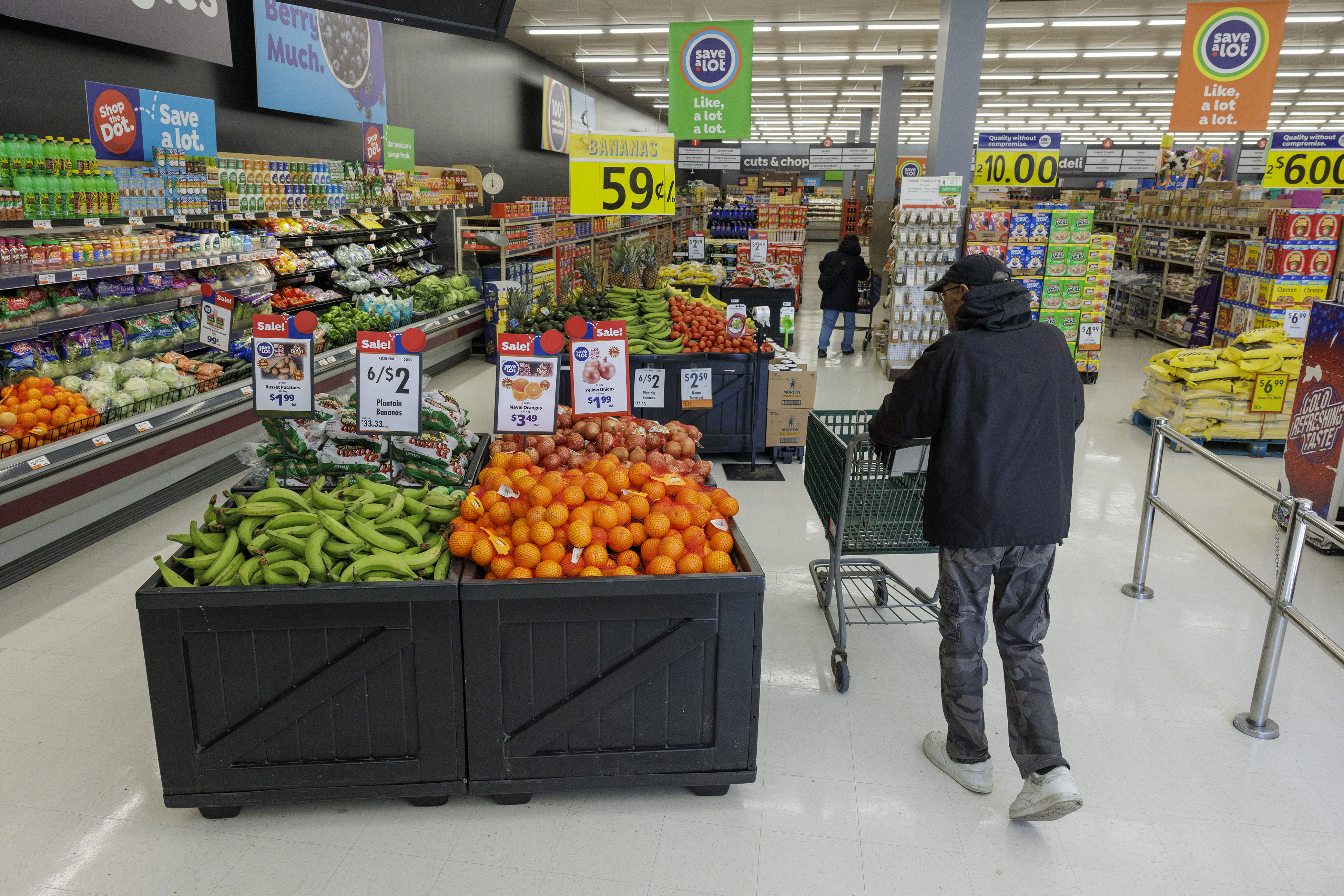
Shoppers peruse the Save-a-Lot grocery store in Atlantic City in this Jan. 2024 file photo.
Dupree, also of Whole Foods, isn’t a fan of the constant seasonal music either.
“If I want to go listen [to the song] ‘This Christmas,’ I’ll listen to it on my own — don’t play it 82 times a day,” he said. “It’s a bit intrusive.”
The customers
Some customers, for their part, avoid the busiest times at the grocery store.
In Wayne, Lisa Goldschmidt has become dependent on Instacart grocery deliveries most of the year. But when it’s time to shop for her holiday dinners, she makes a couple in-person trips to her local Acme. For her sanity, she keeps to a personal code, she said: “Avoid the weekends and the after-work times when it typically gets crazy.”
Goldschmidt, a 58-year-old attorney who works from home, said she’s fortunate that she can run out midday on weekdays to buy her holiday essentials, which include an expansive antipasto assortment that her family eats on Christmas Eve and the prime rib they make on Christmas Day.
April Beatty, 51, of Broomall, also tries to avoid peak shopping times at her go-to stores — Wegmans, Trader Joe’s, and Gentile’s produce market. She aims to pick up all her groceries at least a couple days before Christmas, and she also buys more this time of year with her two children home from college.
But her job, too, keeps her busy during this season — she works in supply-chain logistics — so shopping the way she prefers, at “off times, just because it’s more efficient,” isn’t always an option.
This year, her Wegmans trip for Thanksgiving happened during a shopping rush: “aisles packed, parking lot packed,” she said. During the holidays, she added, “at least people are polite.”
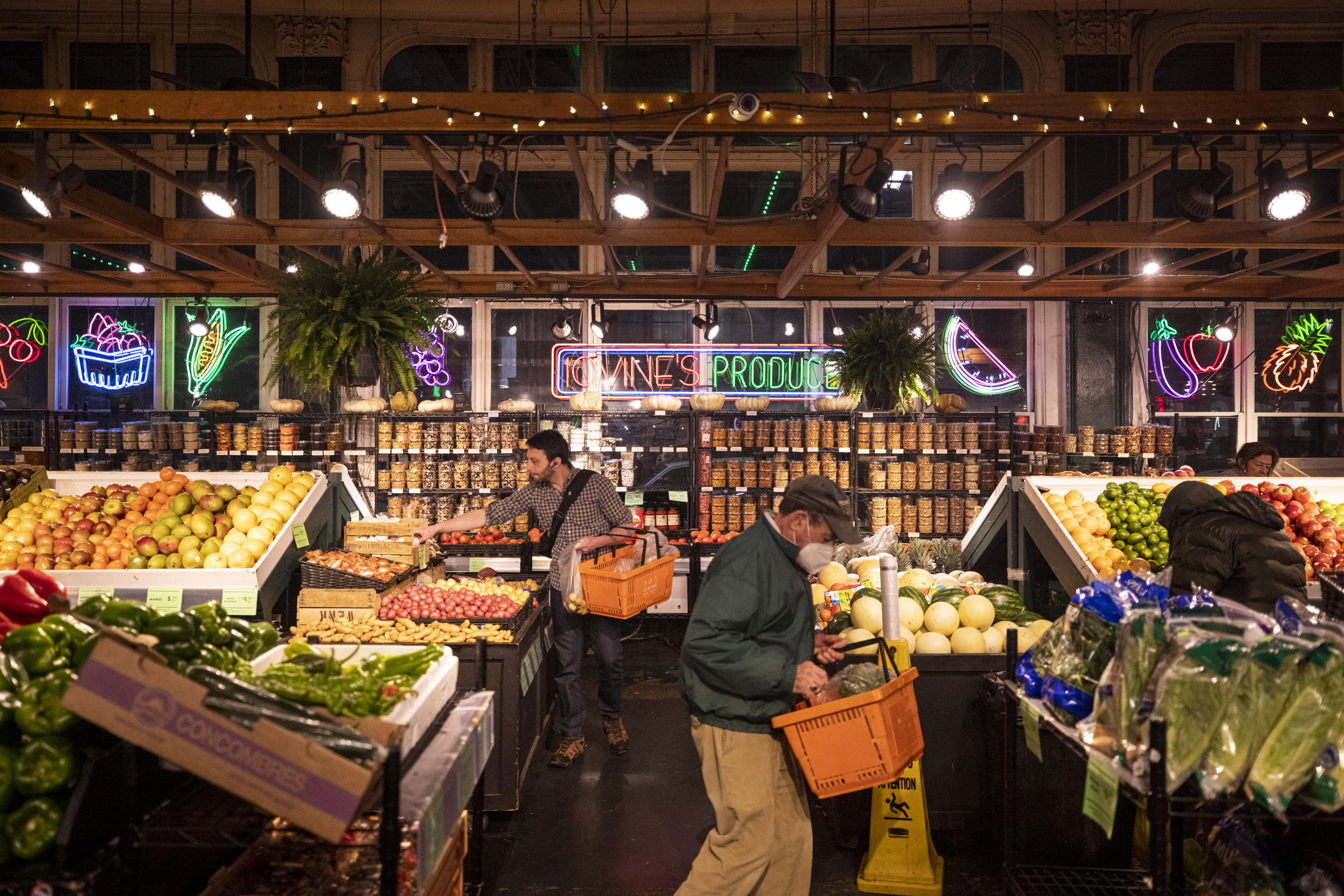
Customers browse Iovine Brothers Produce at Reading Terminal Market in this 2022 file photo.
Customers at Whole Foods are more outgoing during the holidays, said Dupree, part of a kind of jolly Christmas mentality around this time of year.
The days leading up to Thanksgiving are usually the busiest — more so than Christmas — but he didn’t notice quite as much Thanksgiving hustle this year.
“I wonder if this is because, you know, people’s pockets are hurting,” Dupree pondered aloud.
At ShopRite, Keith said, some of the busiest shopping days she recalls are the day before Thanksgiving and Christmas Eve.
“We have our last-minute shoppers — and, you know, I get it. I get the busy life,” she said.
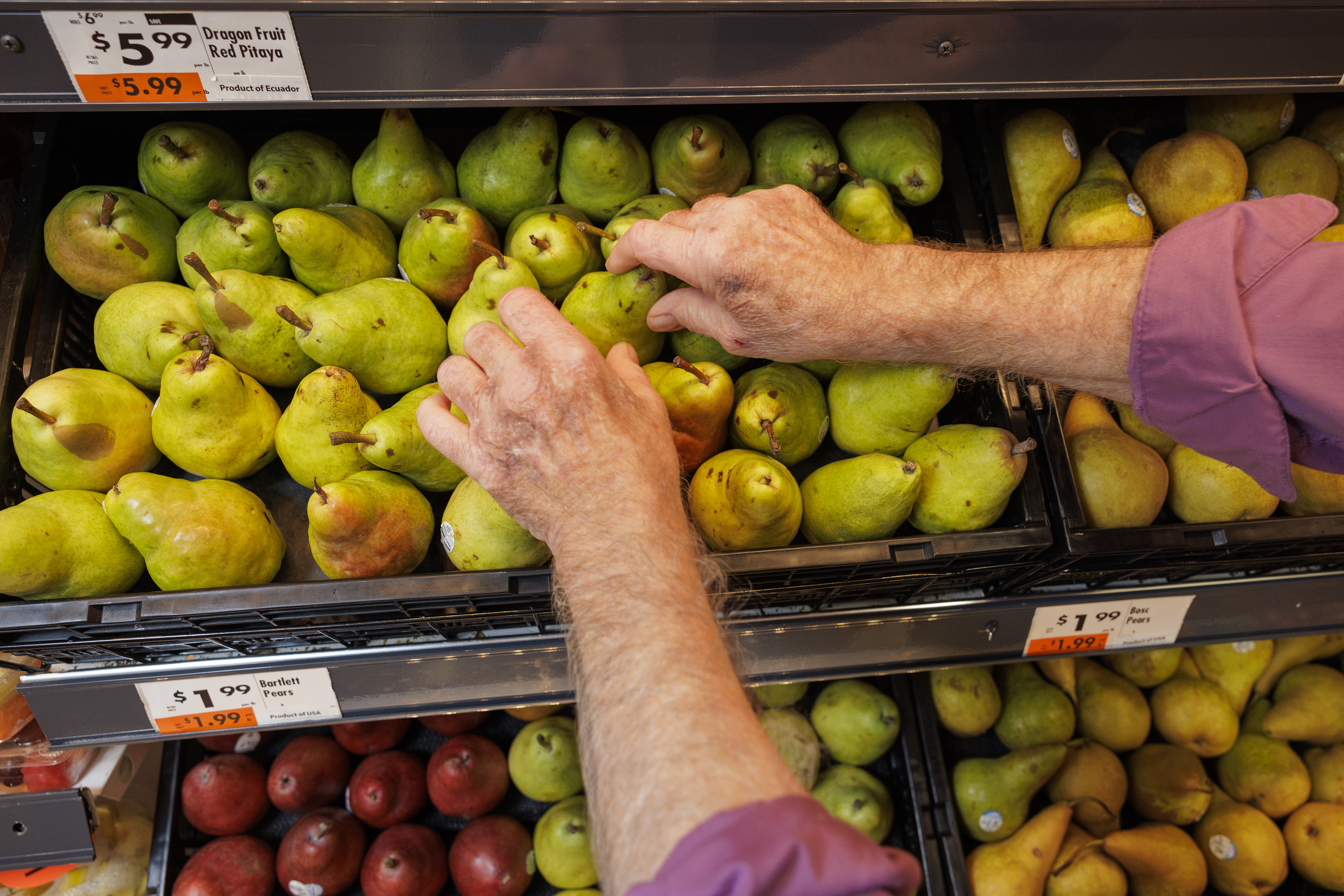
A Save-a-Lot supermarket employee arranges pears at the chain’s Camden store in this January 2024 file photo.
At Acme, Brown sees pressure and stress on some customers.
“Being sympathetic to that, listening to them, is probably half the battle of dealing with any stresses or strain that I might be under — and also what they might be under,” she said.
Brown said she tries to get a head start on her own holiday decorating and planning each year because there isn’t a lot of downtime once the store gets busy.
“I have to manage that time effectively in order to be able to really decompress and enjoy the holidays myself,” she said.
This year, for the first time in a while, she won’t be working on Christmas Eve because it‘s on a Wednesday, her usual day off.
But Brown said she actually loves working Christmas Eve, “because it just seems to me like everybody’s just so happy.”