American Airlines is planning a new route to Porto, Portugal, from Philadelphia.
The route is expected to become available in summer 2027, pending government approval, the airline noted in a news release Thursday.
The flight will be offered on a new aircraft — the Airbus A321XLR — that American just began operating in December. According to PHL chief commercial officer Kate Sullivan, having that aircraft is key to the new route availability.The aircraft will feature “Flagship Suite” seats, which were recently introduced on some PHL flights.
“Not only is seeing a summer 2027 route announced so early exceptional, the A321XLR will enable American to serve markets like Porto that have strong demand but may not support daily flights from wide-body aircraft,” Sullivan said. “Porto is just the beginning of what this aircraft will unlock for our region’s residents and visitors.”
This will be the first time that Porto is offered as a direct route out of PHL, airport spokesperson Heather Redfern confirmed Friday. Sullivan said the addition is “outstanding news for PHL.”
“Porto is exactly the type of new market the Airbus A321XLR enables us to serve,” Brian Znotins, a senior vice president at the airline, said this week at a conference.
American has recently added several other direct flights from PHL to Europe. In 2024, the airline launched routes connecting Philadelphia to Copenhagen, Denmark; Nice, France; and Naples, Italy.
The airline also launched a bus service in 2022 to shuttle passengers from airports in the region to PHL to take a flight. And it opened new lounges at PHL last year, featuring two bars, private phone rooms, and showers.
American was among the top 10 largest employers in Philadelphia in 2025 and is the largest airline by passenger volume operating out of PHL. In 2024, the airline carried nearly 20 million passengers through the airport.
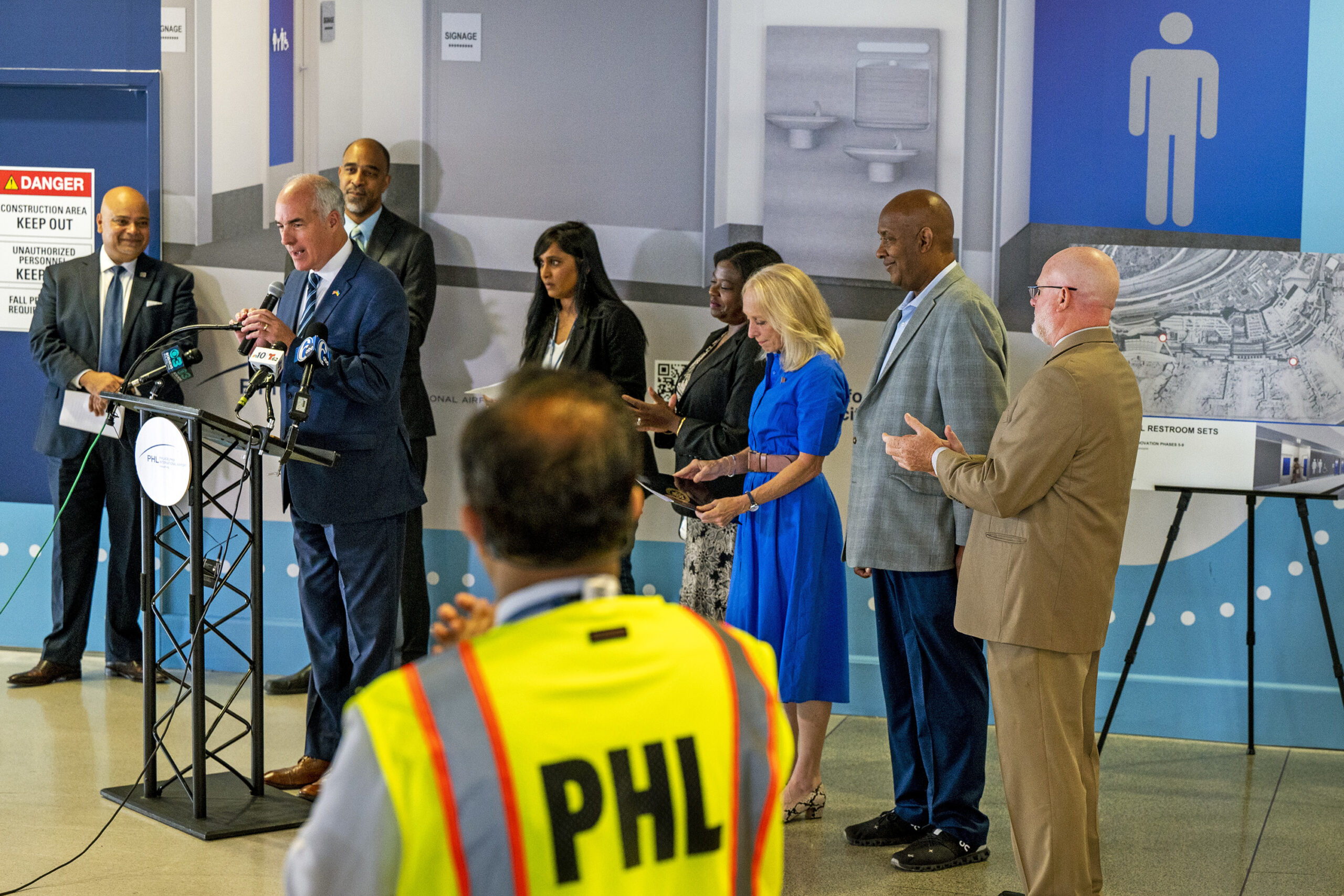
Philadelphia International Airport CEO Atif Saeed is stepping down, just as Philadelphia prepares for an expected influx of tourists this year.
Saeed has led the city’s Department of Aviation, which also includes the Northeast Philadelphia Airport, since 2022, and plans to step down Feb. 27. He is heading west to be president and CEO of the San Diego County Regional Airport Authority.
“Under his direction, our airports emerged stronger from the pandemic, advanced critical modernization efforts, and positioned Philadelphia to welcome the world in 2026 and beyond,” Mayor Cherelle L. Parker said in a statement Thursday.
“We are grateful for his contributions and wish him continued success in this next chapter,” Parker said.
The city plans to hire a new CEO following a national search. Tracy Borda, PHL’s chief financial officer, will be interim CEO.
Saeed’s departure comes as Philadelphia expects to be inundated with visitors this year for the United States’ 250th anniversary, the MLB All-Star Game, and the FIFA World Cup games.
“I will always look back at my time at PHL and PNE fondly,” Saeed said in a statement Thursday. “I am confident that our airports are ready to welcome the world for the events of 2026 and beyond.”
“From the start, by addressing the unhoused situation at PHL with a caring, multiagency approach, this team was committed to ensuring that through strategic investments and thoughtful planning, PHL and PNE are in a position of strength to continue to enhance airport operations for an even brighter future,” Saeed said Thursday.
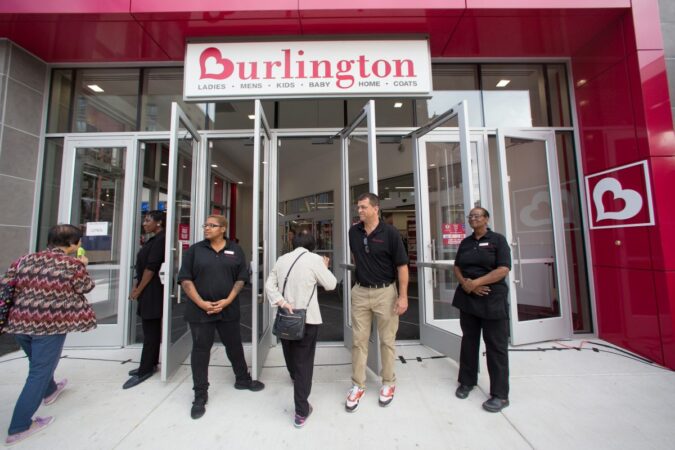
A new Burlington Stores location is coming to South Philadelphia.
The New Jersey-based discount retailer on Monday announced plans to open a store this spring in a shopping center on South 24th Street, with discount retailers Five Below and Ross Dress for Less nearby.
Burlington got its start in 1972, opening its first store on Route 130 in Burlington Township under the name Burlington Coat Factory. Since then, it has grown to over 1,000 locations and has shed “coat factory” from its name, reflecting the larger product line it carries including apparel, shoes, and home decor.
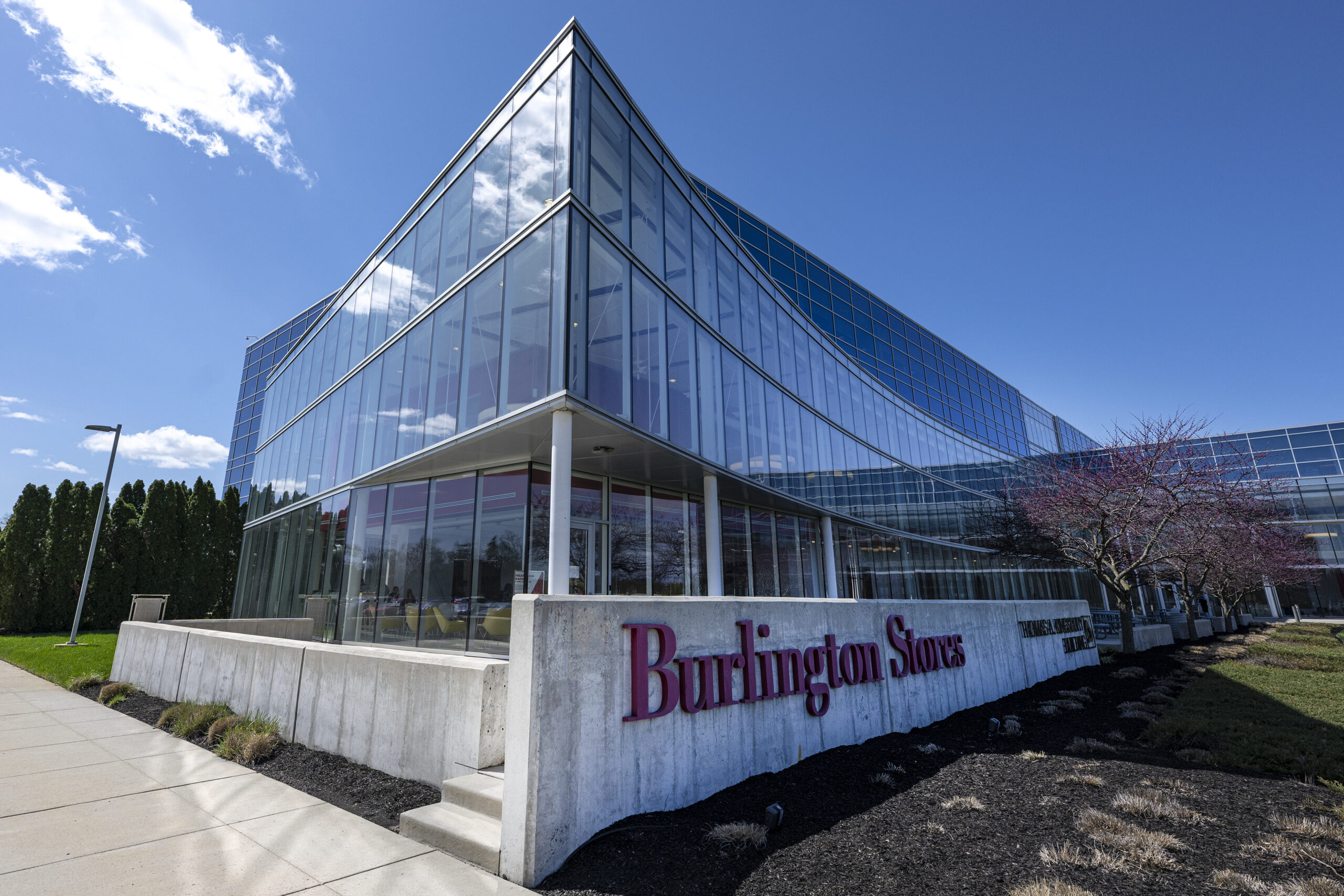
Burlington headquarters is shown last year in
Burlington City.
Burlington started implementing a smaller store model in 2017. About a decade ago its stores were roughly three times larger than the 20,000-square-foot new ones.
New stores feature a “refreshed format, including wider, more organized aisles and bold signage,” according to a company news release this week. Many existing stores have been remodeled to fit this format, and all sites are expected to have transitioned by the end of the year.
The discount retailer has over 40 stores in Pennsylvania, including seven stores in Philadelphia and several more in the surrounding counties. Another South Philly Burlington is located at Whitman Plaza on Oregon Avenue, roughly two miles from where the new site will open.
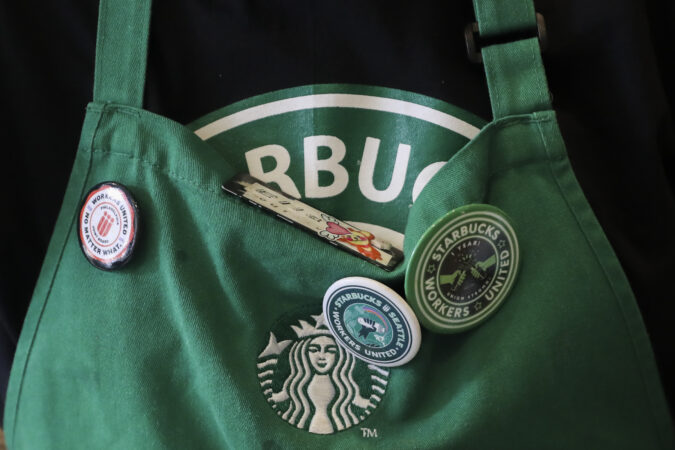
Another Starbucks has unionized in Philadelphia, after a vote at the Schuylkill Yards location last week.
“I see a need for improvements and am optimistic that this win will make great change,” shift supervisor Asia Wright-Wilson said in a union statement. “When problems are not well addressed through the traditional Starbucks channels the greatest strength lies in the collective action of our coworkers.”
The Schuylkill Yards location has 18 union-eligible workers. All participated in the election, with 10 voting to join, according to the union.
The first group of Starbucks workers to unionize did so in 2021 at a Buffalo, N.Y., store. Workers across the country have since joined the Starbucks Workers United union, which has been negotiating a first contract.
“We respect our partners’ right to choose, through a fair and democratic process, to be represented by a union or not to be represented by a union,” said Starbucks spokesperson, Jaci Anderson, via email on Monday. “Any agreement needs to reflect the reality that Starbucks already offers the best job in retail.”
Anderson said Starbucks’ hourly employees’ pay and benefits equate to over $30 an hour on average.
BREAKING: Last night, the Schuylkill Yards Starbucks location won their union… officially making EVERY Starbucks in West Philadelphia unionized!
CONGRATULATIONS to the baristas who are organizing to win a better future for workers everywhere ✊🔥 pic.twitter.com/MI0v1s6wyh
Starbucks has several dozen stores in Philadelphia and more in the surrounding counties. Several city and suburb locations are unionized, including nearby West Philadelphia locations at Penn Medicine, 39th and Walnut Streets, and 34th and Walnut Streets.
The union has reached multiple tentative agreements as they negotiate a contract, but pay has been a sticking point. Workers also want more staffing, and resolution to hundreds of unfair labor practice charges against Starbucks.
Sara Kelly, Starbucks’ chief partner officer, said in December, citing information from the union, that employees from 166 of the 215 strike locations wanted to return to work.
A union spokesperson acknowledged on Tuesday that while some striking workers have returned to their jobs, more than 1,000 remain on strike.
“The nationwide unfair labor practice strike that began in November is still ongoing and has become the longest in company history,” said Michelle Eisen, a Workers United spokesperson and 15-year Starbucks barista.
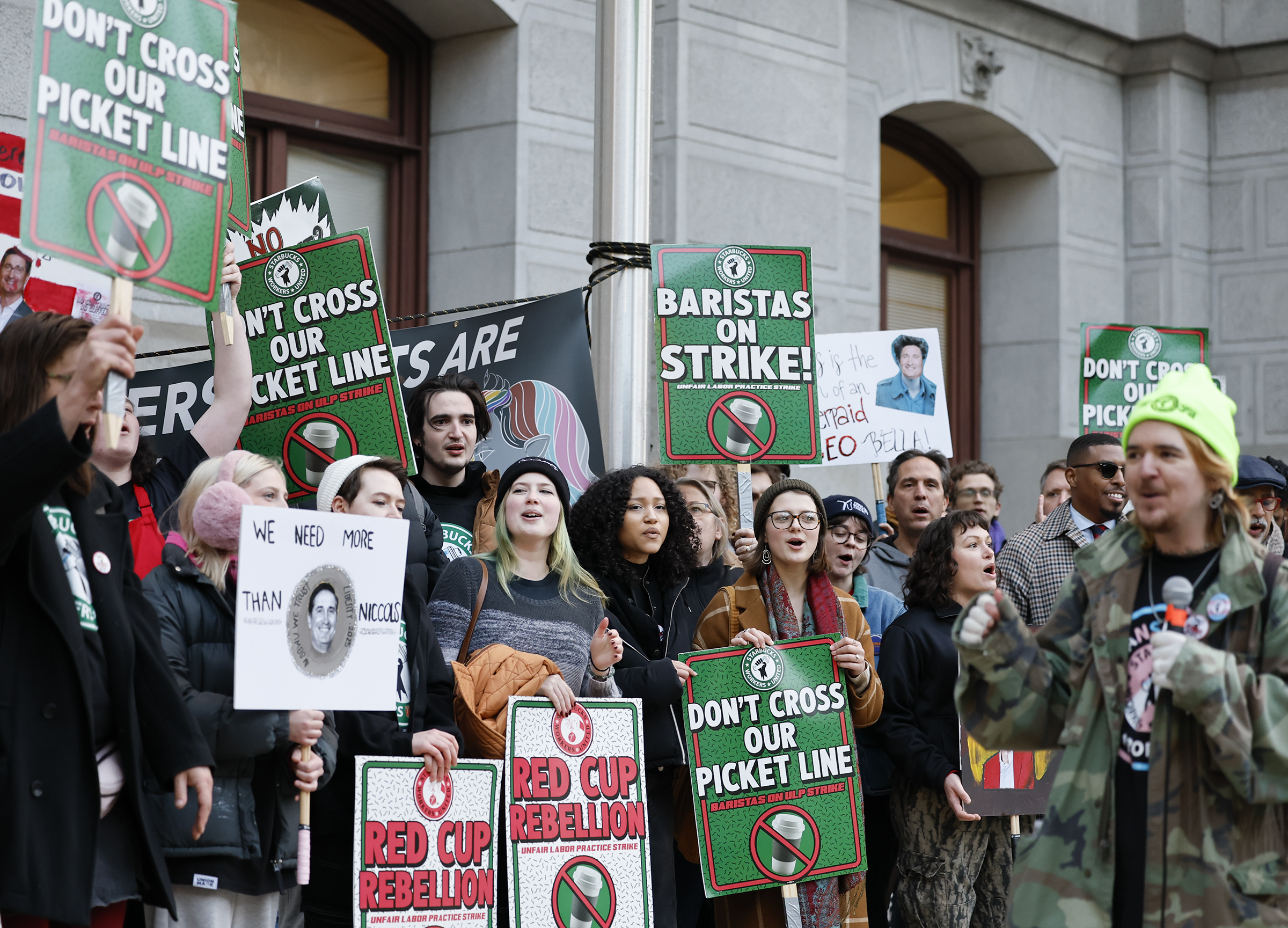
Starbucks Workers United members cheer during a rally at City Hall on Thursday, Nov. 13, 2025.
Foreign nationals are facing increasing challenges to working and studying in the U.S., but their contributions to the Philadelphia economy are critical, local business leaders say, painting a grim picture of Philadelphia’s future with fewer of them.
In Philadelphia, “immigrants are not a side factor when it comes to our economy. They are a main driver,” Alain Joinville, from the city’s Office of Immigrant Affairs, said at a panel discussion, hosted last week by the Economy League of Greater Philadelphia, in partnership with immigration-reform organization FWD.us.
The foreign-born population has supported Philadelphia’s workforce growth in recent years. Between 2010 and 2022, the immigrant workforce grew by 50% from 105,600 to 158,300, according to the Pew Charitable Trusts. In 2022, the foreign-born population represented 15.7% of the total Philadelphia population.
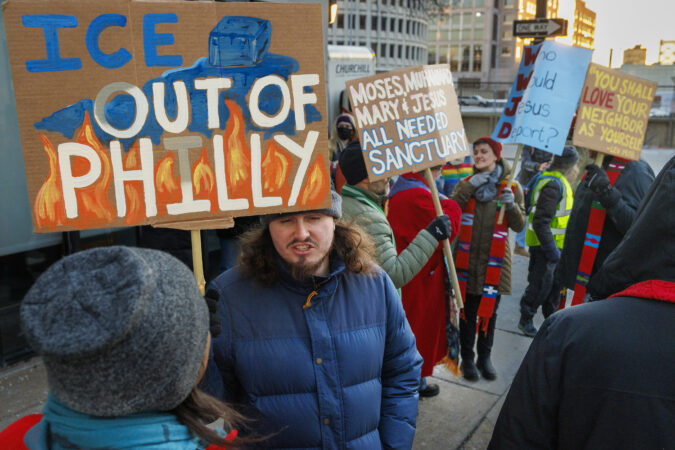
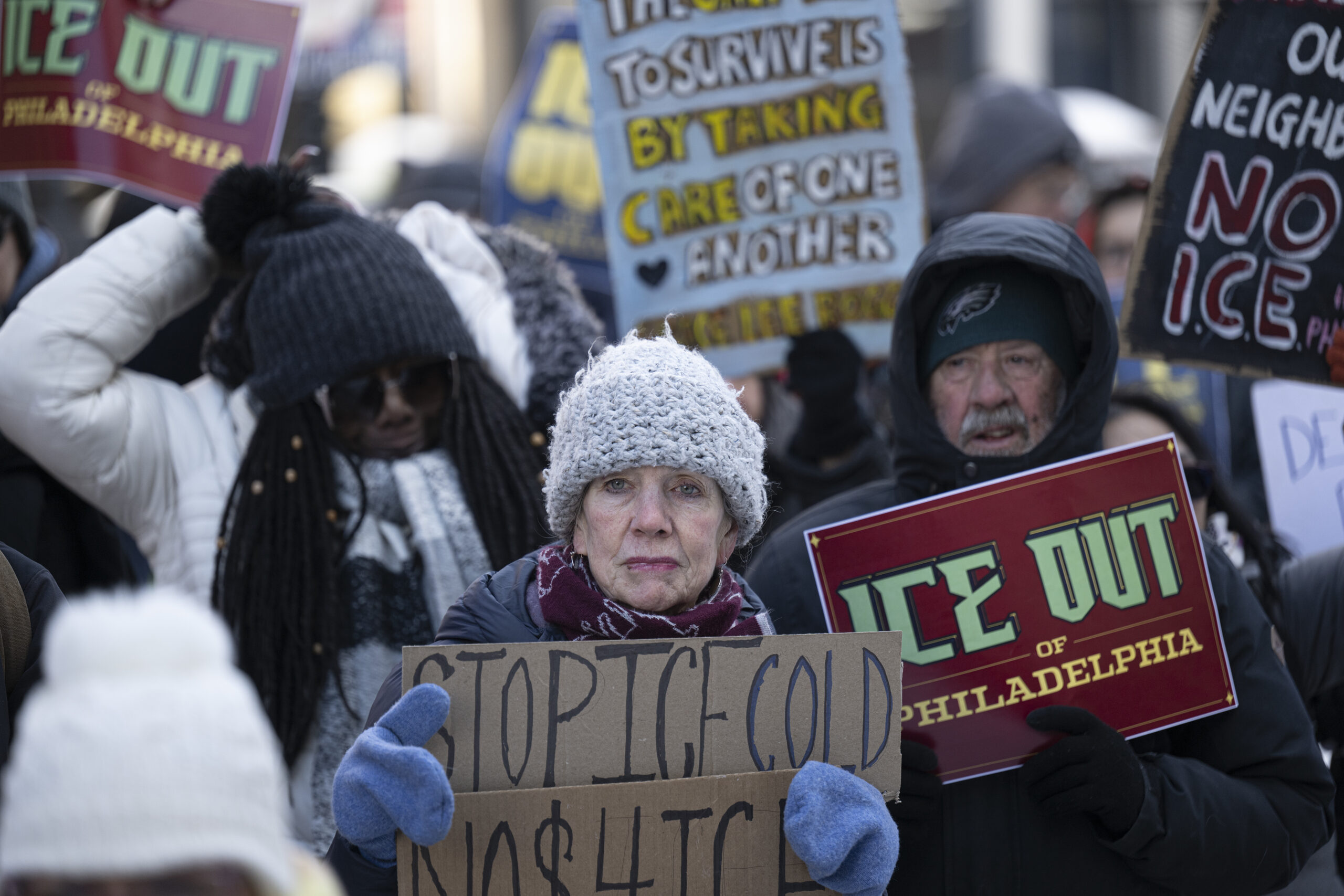
Anti-ICE activists demonstrate outside U.S. Sen. John Fetterman’s Philadelphia office on Jan. 27, 2026, calling for an end to federal immigration enforcement policies.
“If we have policies that are disrupting families, detaining people, sending people back, that’s a huge part of our economy that impacts manufacturing, transportation of all the goods and services that we manufacture,” said Elizabeth Jones, of immigrant-support nonprofit the Welcoming Center. “The ripple effect is scary in terms of how it’s going to impact the economy.”
While the U.S is a global leader in research universities, it could be losing that grip, said Amy Gadsden, from the University of Pennsylvania’s Global Initiatives. Having the best research universities in the world requires the best talent — namely international students that also become faculty, she noted.
Penn has roughly 9,000 international students and an additional 2,000 faculty, postdoc students, and others who “drive a lot of economic activity, both for Penn and for the city of Philadelphia — for the country, for that matter,” she said.
“There is not a guidance counselor around the world who is advising their student not to hedge their application to the United States with an application to another country,” she said.
A view over Walnut Street on the University of Pennsylvania campus, with the Philadelphia skyline at left rear.
Penn, Philadelphia’s largest employer, depends on international students, said Gadsden. “When we think about what is going on with visa policy in the United States, what we see is a decrease in international students, a decrease in international faculty, a decrease in research output, that will ultimately lead to a decrease in our position as a leading research university in the world,” she said.
Jennifer Rodriguez, president and CEO of the Greater Philadelphia Hispanic Chamber of Commerce, highlighted the challenge employers can face under the new fee for H-1B visas.
“Immigrants and the foreign-born population in general is one that is critical for the economic health of the city of Philadelphia and the region,” she said.
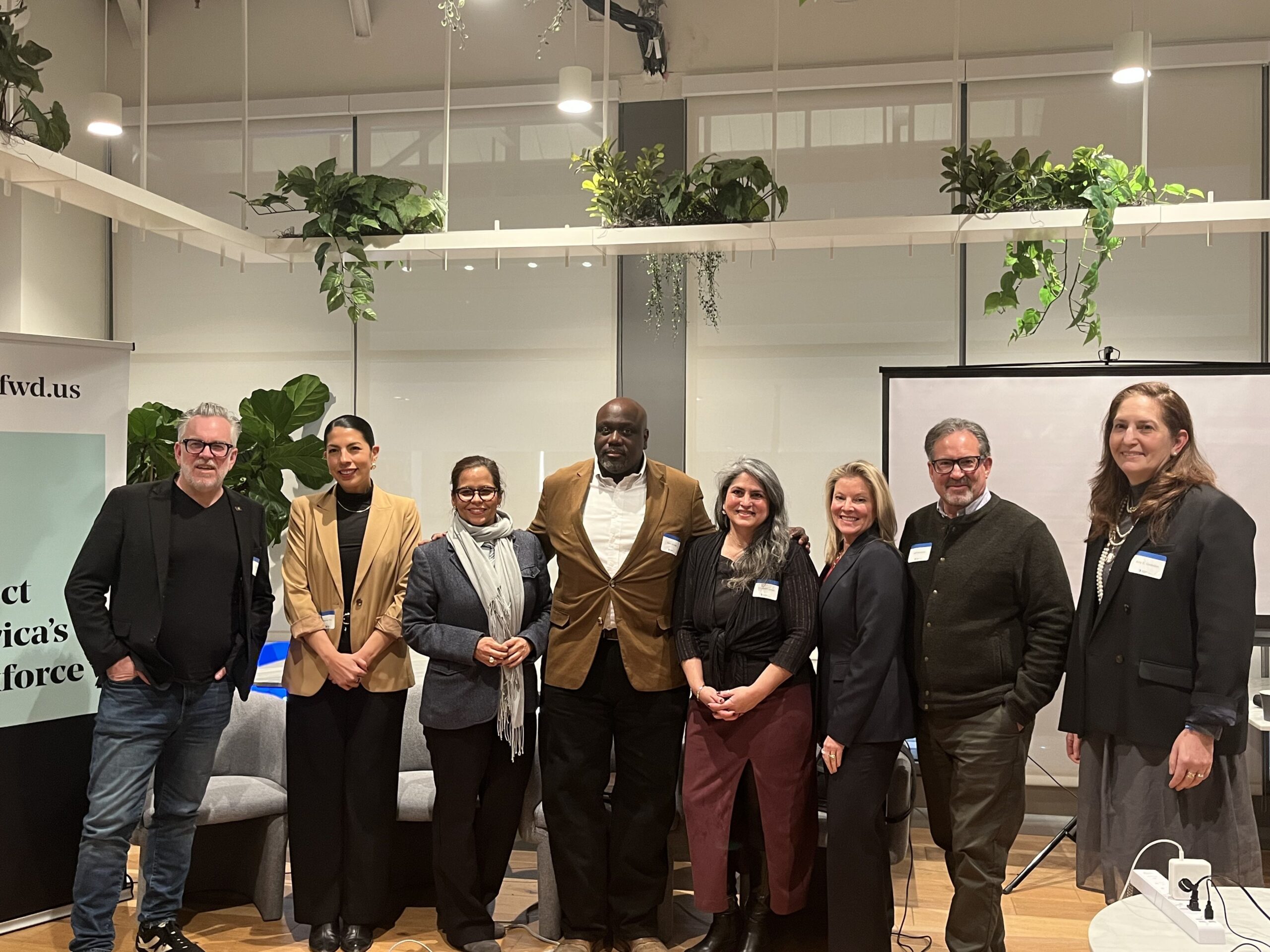
The Economy League of Greater Philadelphia held a panel discussion in collaboration with FWD.us. From left are Ben Fileccia, Pennsylvania Restaurant & Lodging Association; Maria Praeli, FWD.us; Jennifer Rodriguez, Greater Philadelphia Hispanic Chamber of Commerce; Alain Joinville, Philadelphia’s Office of Immigrant Affairs; Elizabeth Jones, the Welcoming Center; Tracy Brala, University City Science Center; Jeff Hornstein, the Economy League of Greater Philadelphia; Amy Gadsden, University of Pennsylvania.
Rodriguez described the additional $100,000, which is on top of other expected visa processing costs, as exorbitant. While some large businesses might have resources to handle it, she said, middle-market companies will be more challenged.
“Philadelphia is desperate to get more of those businesses to establish here, and now you’re making it that much harder,” said Rodriguez. “We are really curtailing the ability of these businesses to innovate, to hire, to really be the contributors to the economy that we want them to be.”
Immigrants in Philadelphia are of prime working age, noted Joinville, from the city’s Office of Immigrant Affairs.
“Without immigrants, we have a smaller workforce to drive and support our businesses locally,” he said, adding that immigrants start small businesses at a high rate in Philadelphia.
“As a child of immigrants, focusing on the economy can be a little tricky for me, because we’re not just data or money or economy,” said Joinville. “Yes, immigrants have an economic impact, but they are cultural leaders, civic leaders, and, yeah, just good people.”
New flights will take off soon from Atlantic City International Airport.
Breeze Airways, an airline launched in 2021, is adding two direct flights from Atlantic City to Charleston, S.C., and Raleigh-Durham, N.C. A flight with a stopover is also being added to Tampa, Fla.
“Atlantic City is not only a great destination for travelers but also a gateway to many other metro areas,” David Neeleman, founder and CEO of Breeze Airways, said in a statement Wednesday. “We know Atlantic City will be a welcome addition to our guests in Charleston, Raleigh, and Tampa, and we look forward to introducing our new guests in Atlantic City to Breeze.”
Breeze, which is focused on underserved markets, will start flying to the new destinations this spring. The Charleston route will begin May 6 and operate on Wednesdays and Saturdays. Raleigh-Durham and Tampa routes will begin June 11 and be offered on Thursdays and Sundays.
Travelers can book their flights at the Breeze Airways website. The airline ranks its ticket tiers from a “No Flex Fare” to “Nice” to “Nicer” to “Nicest” depending on flexibility to change or cancel travel, as well as bags included in the fare, legroom, and other features. A roundtrip ticket to Charleston from June 17 to June 20 costs $118 with no changes and no carry-on bag as of Jan. 29.
“For an airport of our size, expanding service in a way that directly benefits our passengers is especially meaningful, and this announcement reflects our continued focus on delivering a simple, accessible, and customer-friendly travel experience,” Stephen Dougherty, executive director of the South Jersey Transportation Authority, said in a statement.
Breeze has over 170routes including seasonal and year-round flights. The airline’s founder, Neeleman, is also the founder of JetBlue. Breeze reported its first full quarter of operating profit in 2024, the Wall Street Journal reported last year.
Atlantic City’s airport is also serviced by Spirit Airlines, American Airlines, and Allegiant.
American launched a program in 2022 to shuttle passengers on a bus from the Atlantic City airport to Philadelphia International Airport to catch flights. Spirit has seen a decrease in scheduled flights from Atlantic Cityin recent years and announced in 2024 that it would close its crew base there but continue servicing the airport. Allegiant started offering flights out of Atlantic City last year.
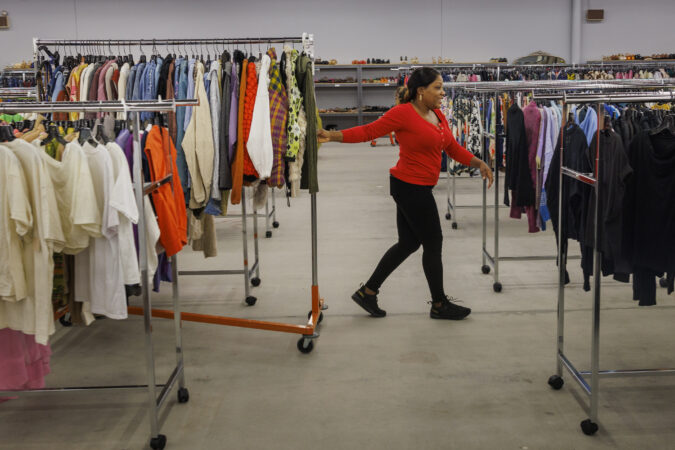
Reclectic, URBN’s discountstore, is moving from one Philly-area mall to another.
The 40,000-square-foot site which opened in 2023 at the Franklin Mall (still widely known to locals by former name Franklin Mills) will relocate to a larger space in Willow Grove Park Mall next month, into the first floor of the former Sears store.
The movecomes as Reclectic’s Franklin Mall lease nears its end and as the store has seen an “overwhelming increase in demand,” said Kevin Dorfmeyer, executive director of strategy, corporate development and Reclectic at URBN.
Reclectic sells items typically 50% to 60% off the ticket price and includes new, slightly damaged inventory, or items that have cycled through URBN’s clothing rental service, Nuuly. The store sells shoes, clothing, home furnishings, and accessories.
The Franklin Mall location will close on Feb. 21, and the new site at Willow Grove Park Mall will open on Feb. 27.
The Reclectic store at the Franklin Mall opened in 2023.
The company is also looking to expand locations this year, said Dorfmeyer, who described the Franklin Mall store as “extremely successful.”
To date, URBN has opened Reclectic locations in North Carolina, Illinois, Texas, New York, and Arizona.
“We’re actively working on expansion into new metro regions across the U.S.,” Dorfmeyer said. “It’s too early to tell now where we’re headed, but, [we’re] looking to expand further.”
Shoppers are traveling upwards of 30 to 60 miles to visit Reclectic stores, Dorfmeyer said.
“Our customer loves the thrill of the hunt,” he said. “They’re coming to us to discover new brands, to experiment and play and, quite honestly, just to uncover the possibility with a new type of inventory that we offer in Reclectic.”
URBN, which was founded in Philadelphia, is the parent company of Anthropologie, Free People, and Urban Outfitters. The business launched Nuuly, a clothing rental subscription, in 2019.
An assortment of colorful couches and other furniture for sale at Reclectic in the Franklin Mall in August 2023.
Job hunters beware: Some of the hard-earned skills listed on your resume are going unnoticed by potential employers.
Workers’ profiles on job posting websites often feature general abilities, like leadership, communication, teamwork, and problem-solving, a recent report from the Wharton School says. But they’re not highlighting the “specialized, execution-oriented skills,” employers are seeking. That’s created a “skills mismatch economy.”
“People are not representing their skills in a way that’s necessarily resonating with the skills that employers want,” said Eric Bradlow, the vice dean of artificial intelligence and analytics at the Wharton School, who co-authored the report.
Meanwhile, AI has been speeding the shift from a “role-based labor market to a skills-based economy,” the report outlines, making it all the more poignant to know what skills employers actually want.
Bradlow says generative AI has been “a positively destructive bomb on roles and titles,” by making workers able to carry out tasks that they didn’t know how to do in the past. So “having a specific job title is becoming less relevant.”
The Wharton School worked in partnership with Accenture, a professional services firm, to analyze millions of job postings and worker profiles for the report. The study useddata from Lightcast, a labor market data provider, andthe U.S. Bureau of Labor Statistics. Bradlow spoke with The Inquirer about their findings.
This conversation has been edited for length and clarity.
What are some skills included on resumes that don’t make much difference to employers, because everyone seems to have them?
Do we think it’s important to communicate? Well, yeah, of course, it is. Do we think it’s important to have leadership skills and manage teams well? Yeah, of course. Last time I checked, those were really important parts of the job — but everybody puts that down.
We’re not saying in the report that those skills aren’t important. What we’re saying is there’s an over supply of people stating those skills, as opposed to companies saying these skills are what’s going to get you the job.
Companies are realizing that depth of skill is what’s going to be really important.
Do people lack the specialized skills employers are looking for? Or are they just failing to highlight them on their resumes?
That’s something, trust me, I wish I could answer.
If we had people’s transcript data, or if we knew what courses someone had taken, then we could try to get an understanding of what skills people actually have.
I think two things are going to happen, based on this Wharton-Accenture Skills Index gap report. Number one is, you will see a migration where people [will say,] “I need to acquire those skills, if I don’t have them, if I want a job.” Second, you’ll see [organizations] — whether it’s an academic institution or a for-profit institution — saying, “Wait a second, here, we need more people with this skill. We’ll create a certification program.”
You found that some skills are actually tied to higher-paying jobs. Was that surprising?
I’m not sure I had hypotheses about which skills would be paid higher or lower.
I think maybe the part that surprised me a little bit was that there wasn’t massive swings and variation like “if you have this skill, your salary doubles.” That’s not what we found in the data.
What advice would you give someone crafting their resume?
One is talk about the specific skills you have. Every resume I read says “I’m an effective communicator, experienced leader.” That’s fine, but that’s not what’s going to stick out and become differentiated, because everyone’s going to say that. To the degree that you have specific expertise and depth or skills, those are the kinds of things to put on the resume.
The second thing I would say is that … we should be in the skills acquisition business, be a lifelong learner. Skills will always be valued. Jobs in a particular workflow can go away. People with skills will be hired.
Take, for instance, a customer-support agent in a customer-satisfaction group. If you’re someone with exceptional problem-solving skills, you’re hearing your customer, and you’re able to tie it to some remedy; that skill is not going to go away even if the job you’re currently in happens to go away.
What skills are needed more or needed less because of the adoption of AI recently?
I don’t view it as AI replacing humans. I view AI as that decision-support tool you should use for every decision.
If I were an employer today, I wouldn’t even consider hiring someone that didn’t recognize the power of artificial intelligence as a decision-support aid. I don’t know what business decision — pricing decision, product launch decision, product design decision, possibly even hiring decision — [for which] I wouldn’t use artificial intelligence as a decision-support tool.
I would also say, equally, I’m very concerned about the agentic use of AI — in some sense totally handing over high-stakes decisions.
From where you stand, is AI coming for people’s jobs, as we often hear, or is it coming for their skills? What’s the difference?
Go through the history of mankind.
The train engine came. So you mean we don’t need as many horses? Electricity came. You mean we don’t need as much coal? Green energy came, and so now we don’t need as much nuclear fusion?
Doesn’t technology always come and translate one set of jobs to another set of jobs? It’s not AI is coming for your job. What companies are realizing about AI is there are certain roles and functions that AI can do extraordinarily well, with high accuracy, and in some cases better than humans can do. These tend to be functions, by the way, that many humans don’t like doing anyway.
I don’t see AI coming for your job any more so than any set of technology. This is an extraordinarily disruptive technology, but we’ve lived through periods of extraordinarily disruptive technology.
Can you make $100,000 a year in the Philadelphia area without a four-year college degree?
Yes. But it’s not common.
“There is no magic wand to get to a six-figure salary,” said Cynthia Figueroa, who leads workforce development nonprofit JEVS Human Services. “There’s a lot of steps that have to happen along the way.”
Companies including IBM, Delta, and Google have dropped degree requirements in recent years. Locally, Pennsylvania Gov. Josh Shapiro slashed college degree requirements for most state jobs in 2023, and Mayor Cherelle L. Parker has advanced an effort to do the same for some city jobs. Meanwhile, more are pursuing vocational training, the Wall Street Journal reported, as some in Gen Z turn to the trades amid the rising cost of college.
But who actually makes $100,000 or more in the Philadelphia area without a four-year degree and what does that path look like? The Inquirer took a look at the data.
Cynthia Figueroa poses for a portrait in Philadelphia in 2019. She is the CEO and president of JEVS Human Services.
What industries pay $100,000-plus without a bachelor’s degree?
Among the Philadelphia metro area’s 3.97 million workers, the vast majority who make a six-figure salary have at least a bachelor’s degree, according to Census data compiled by IPUMS USA at the University of Minnesota. The metropolitan area includes 11 counties in Pennsylvania, New Jersey, Delaware, and Maryland.
Roughly 159,000 people made $100,000 or more without a four-year college degree in 2024, the data indicates. (That includes people with an associate’s degree.)
window.addEventListener(“message”,function(a){if(void 0!==a.data[“datawrapper-height”]){var e=document.querySelectorAll(“iframe”);for(var t in a.data[“datawrapper-height”])for(var r,i=0;r=e[i];i++)if(r.contentWindow===a.source){var d=a.data[“datawrapper-height”][t]+”px”;r.style.height=d}}});
“There is potential” for high earning without college, but it’s not typical, said Sean Vereen, president and CEO of career-focused education nonprofit Heights Philadelphia.
“We know that not everybody wants to go to college, but particularly the way the economy in this region is constructed, that college degree still is very useful,” said Vereen.
But the majority of the workforce in the Philadelphia metro area lacks a bachelor’s degree. Only about 7% of them reach the high-earning $100,000-plus bracket.
It’s more common in jobs where salaries overall tend to be higher, such as management, business, and finance. About 51,000 Philly-area people in those jobs with less than a bachelor’s degree earned $100,000 or more in 2024.
window.addEventListener(“message”,function(a){if(void 0!==a.data[“datawrapper-height”]){var e=document.querySelectorAll(“iframe”);for(var t in a.data[“datawrapper-height”])for(var r,i=0;r=e[i];i++)if(r.contentWindow===a.source){var d=a.data[“datawrapper-height”][t]+”px”;r.style.height=d}}});
What industries are adding more $100,000 jobs?
Still, more opportunities for people without a four-year degree could be on the horizon.
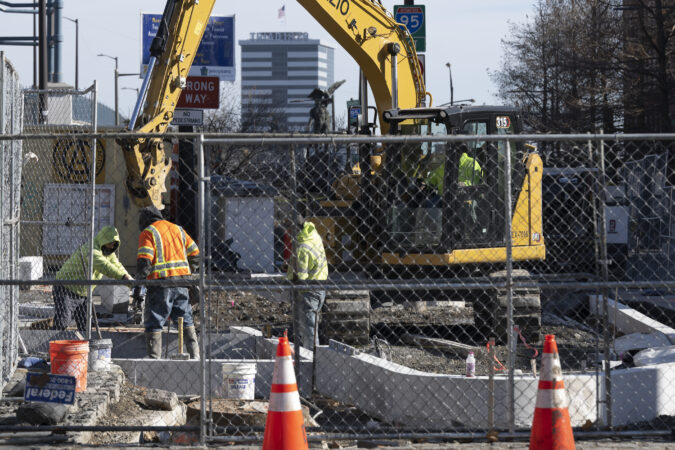
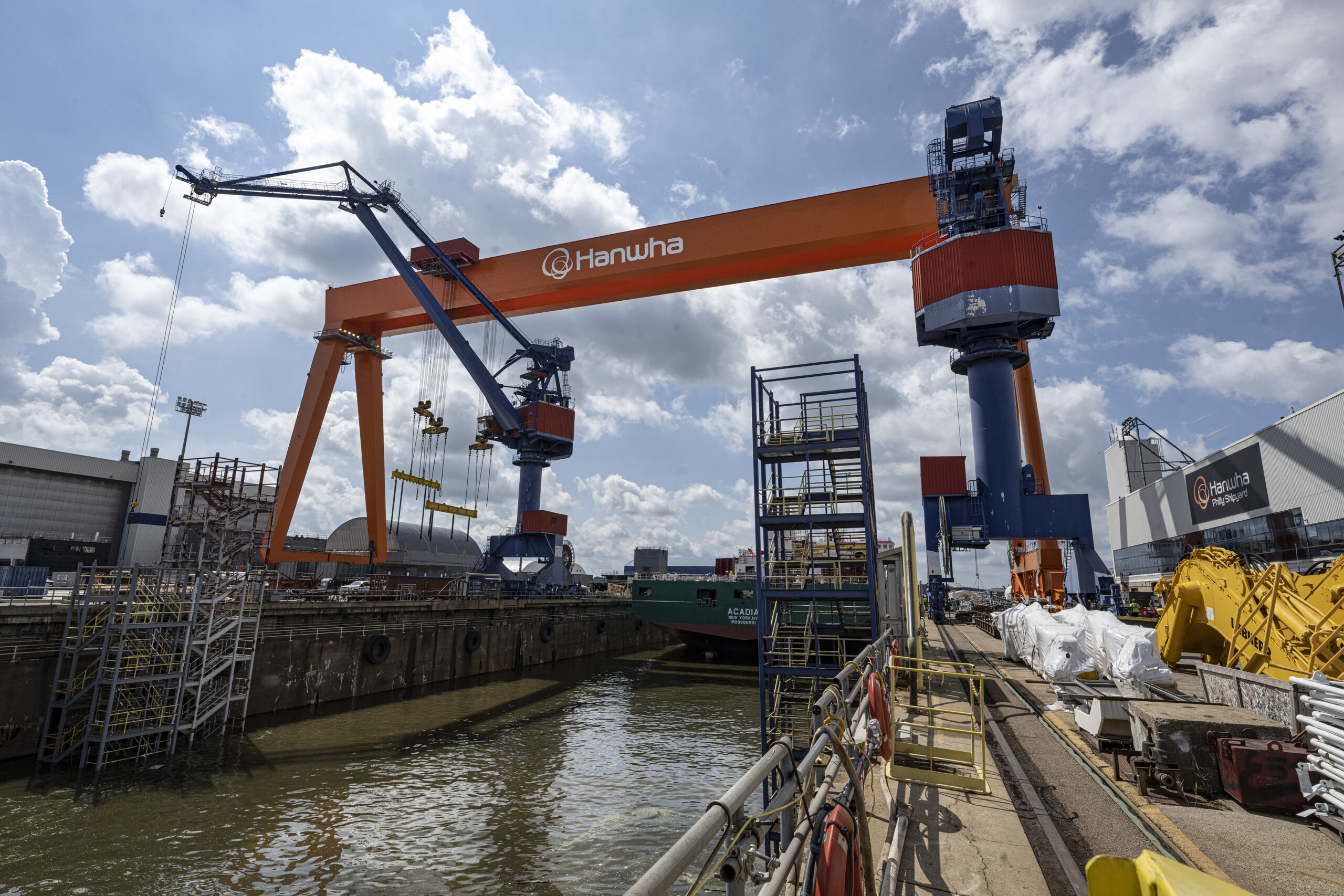
Shipbuilding is having a resurgence in Philadelphia’s Navy Yard, and more electricians, carpenters, and welders will be needed, said Figueroa.
Among Philadelphia construction workers, including carpenters and welders, more than 11,000 do not have a bachelor’s degree and make at least $100,000 annually.
Hanwha plans to expand its shipbuilding operations in Philadelphia and will need to hire. That includes positions requiring considerable math skills, said Figueroa, of JEVS. The organization is currently figuring out how to get job-training graduates into opportunities.
Philadelphia Works, the city’s workforce development board, is working closely with Hanwha, CEO and president H. Patrick Clancy said.
“Our goal is to do more of the pre-apprenticeship,” Clancy said. “They have a lot of people interested in applying for their roles, but not all of them are passing the math and reading [requirements].”
The newly repainted Goliath Crane is shown July 16, 2025, at the Hanwha Philly Shipyard in Philadelphia.
Last year, a Brookings Institution report highlighted enterprise digital solutions (business software), specialized manufacturing (like producing parts for medical devices or industrial electronics), and biomedical commercialization (life sciences businesses) as areas where Philadelphia residents should be able to find good jobs. Many jobs in those sectors don’t require a college degree.
“We need to be focused on creating the right kinds of jobs,” said Chellie Cameron, CEO and president of the Chamber of Commerce for Greater Philadelphia, which is now focusing on the areas Brookings identified.
The right kinds of jobs, Cameron said, are not minimum-wage positions. They “start at a place where people can earn a family-sustaining wage and have access to pathways for promotion and making more money over the course of their career.”
Paths and training for high-earning jobs
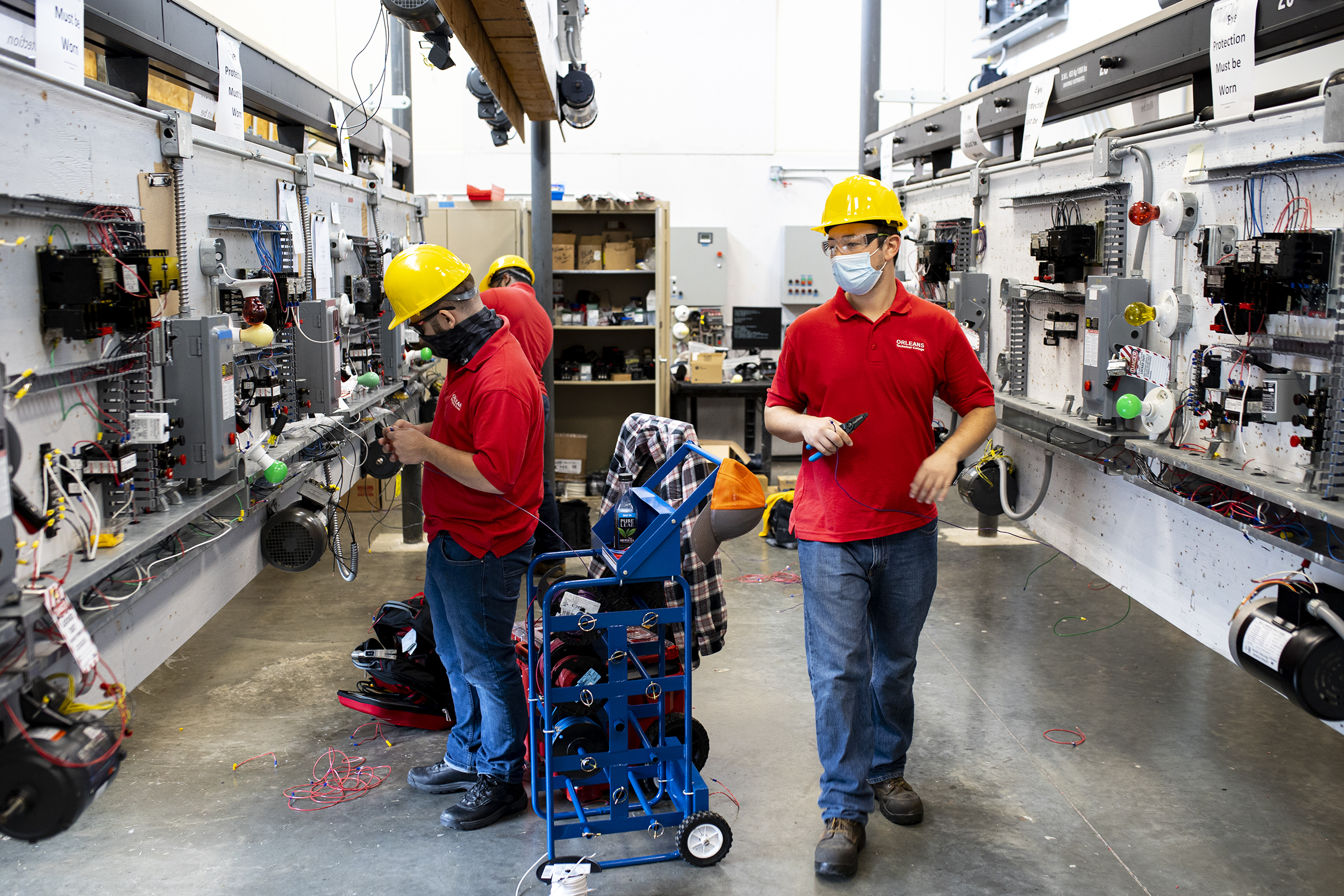
Orleans Technical College in Northeast Philadelphia, run by JEVS, trains people for building trades and healthcare professions. It had 379 students last year. Tuition ranges from roughly $13,000 to $25,000, but most students get financial assistance and typically leave with $6,000 or less in debt.
Residential and commercial electrician Dan Finke, 25, of Abington, (right), is learning about motor controls with fellow classmates at Orleans Technical College, in Northeast Philadelphia on a Friday in September 2020.
“There’s still very much the physical application of running wire, bending metal,” said Figueroa, and many medical tasks seem to be AI-proof for now. “At the end of the day, you need somebody who is taking the blood pressure next to the bed, and who is drawing the blood.”
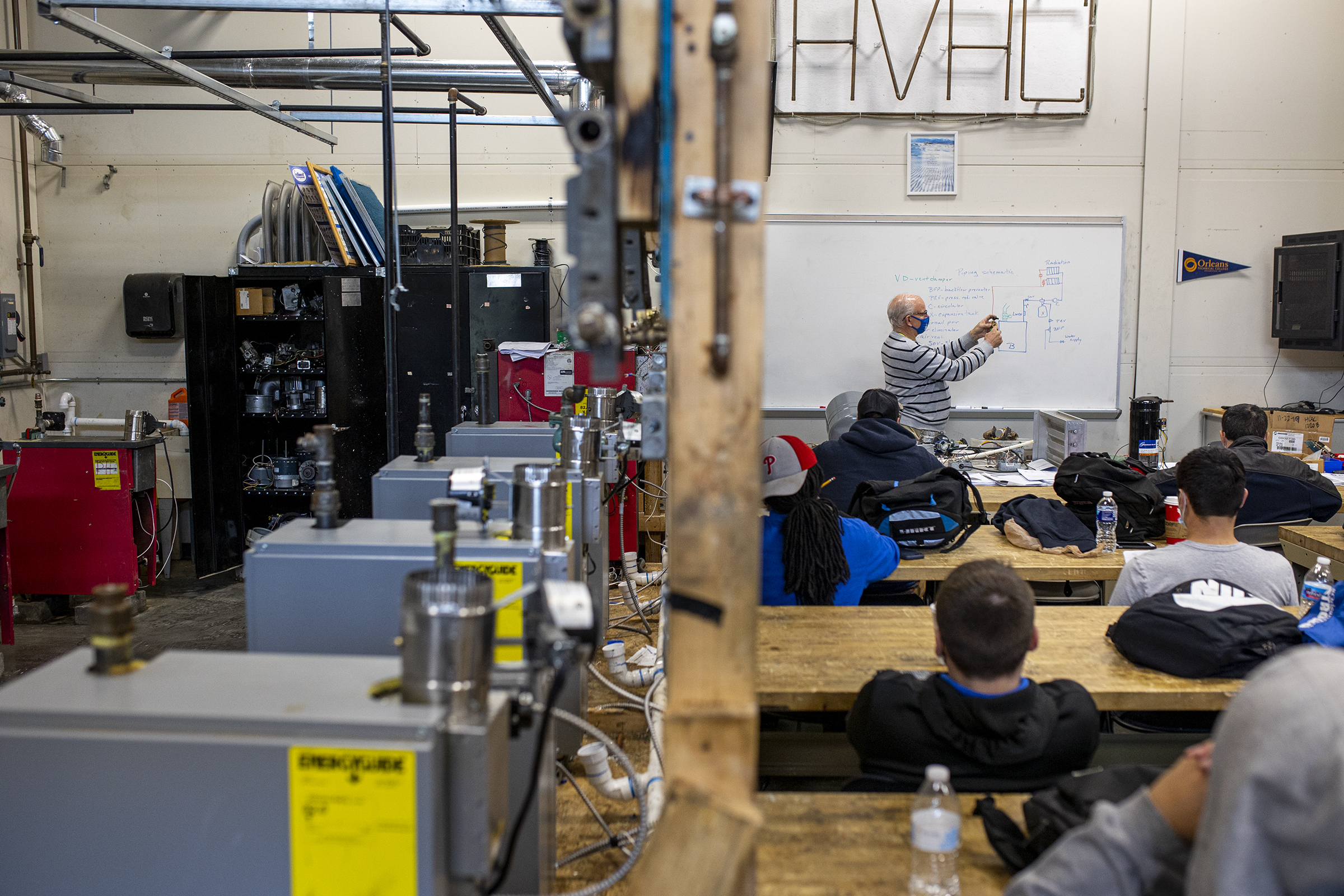
Construction management and HVAC students can expect starting salaries around $75,000 and $60,000 respectively. Those who work overtime can make even more, Figueroa noted, and pay also increases over the course of a career.
That’s not a six-figure salary on Day One, she acknowledged. But college graduates can make a similar amount in their first job, and “they have this enormous debt” from their schooling.
Lou Abruzzese, HVAC Instructor, is teaching his class about hydronics at Orleans Technical College, in Northeast Philadelphia on Friday, Sept. 25, 2020.
Orleans also offers healthcare training for clinical medical assistants and practical nursing. Starting salaries for those jobs are generally around $44,000 and $64,000 respectively.
“Going from an hourly wage — at like a Target, McDonald’s, Walgreens, what have you — to salaried, hopefully with benefits, is a huge first step,” Figueroa said.
Connecting people to employment also means addressing barriers like lacking a driver’s license, needing childcare, financial literacy, or housing support, says Clancy. Pursuing training might mean going without paid work for weeks or months, which can be a challenge. Philadelphia Works has some funds available to pay people during their training.
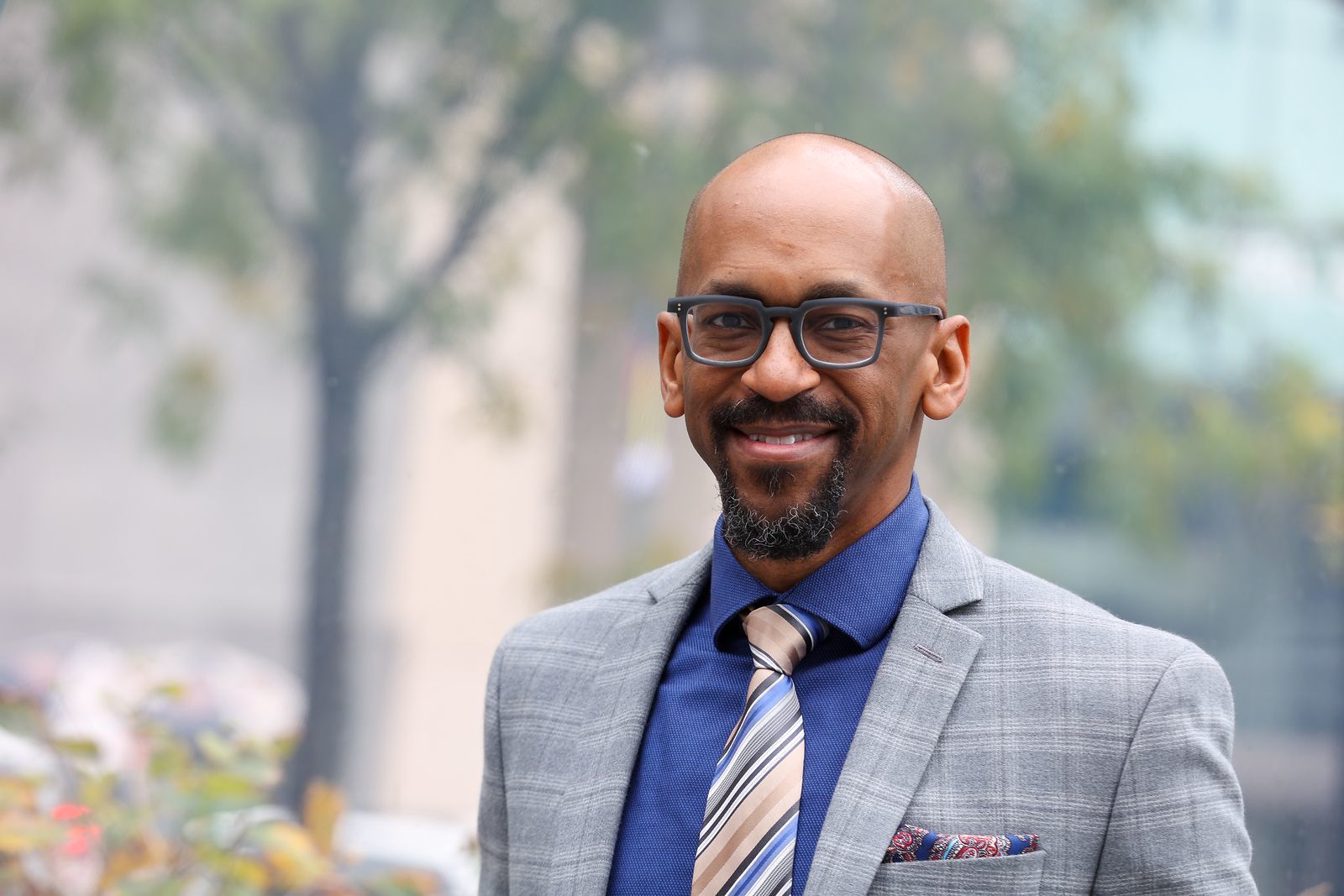
Sean Vereen is the president and CEO of Heights Philadelphia.
Young adults need to be aware of opportunities, too, said Vereen. For instance, he said, sterilization technician is a good job within a hospital, but young people may not know it’s a path available to them without going to college.
And sometimes young people need to catch up before training for jobs in the trades, Vereen says. “We’ve heard things like, ‘The kid coming from the school district doesn’t have strong enough math skills to take the test for the building trades,’” he said.
“You need basic academic skills that are about math and reading and reading comprehension,” he said. “We don’t get away from giving kids basic knowledge.”
AI has already replaced some workers at Philly-area firms, a new report says. But the bulk of the AI-related job loss is yet to come, the Federal Reserve Bank of Philadelphia CEO and president Anna Paulson said.
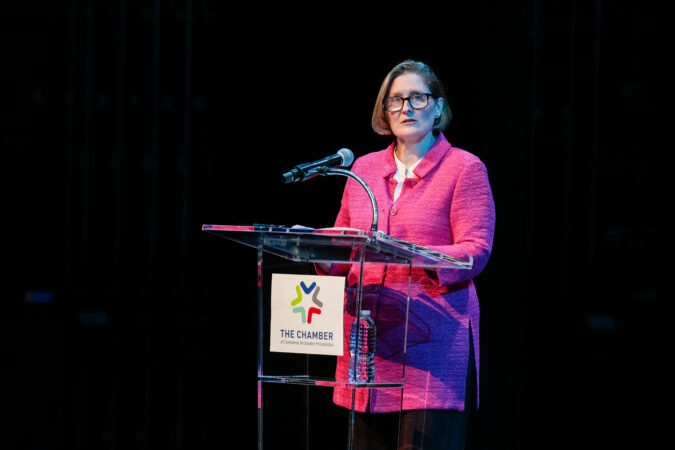
Paulson, speaking Wednesday at the Chamber of Commerce for Greater Philadelphia’s State of the Economy event, said AI could further reduce demand for workers in the years ahead.
Also Wednesday, the Fed released its annual report, which surveyed 54 Chamber businesses on the past year and what lies ahead. They found that the biggest concern area businesses faced in 2025 were uncertainty about regulations and government policies, and that nearly 39% of respondents expected better business conditions overall in this coming year.
Amid a slow labor market, a central topic of Wednesday’s event was jobs.
Job growth slowed, but healthcare helped Philadelphia
Last year, the majority of private-sector jobs created were in healthcare and social assistance, Paulson noted. Philadelphia has a larger-than-average share of workers in this sector, which means the region has “been somewhat insulated from the national slowdown in job creation,” she said.
But in other sectors, AI and immigration trends have contributed to a hiring slowdown.
“On the supply side, the sharp drop in immigration has slowed the growth of labor supply,” said Paulson. “On the demand side, firms — both nationally and here in Philadelphia — tell us that uncertainty is holding back hiring as they consider a range of factors: trade policy and the potential for artificial intelligence to transform the need for workers.”
AI is just starting to replace jobs, and isn’t creating many
AI has been widely adopted by companies in the region, the Chamber’s survey found. Nearly 76% of respondents said they used AI for their work.
That’s changing what kinds of human work firms need.
Among those surveyed, 9.5% said generative AI had decreased the need for workers at their firm, while 23.8% said it changed the kinds of workers they needed but not the number.
Only 4.8% reported needing more workers because of generative AI.
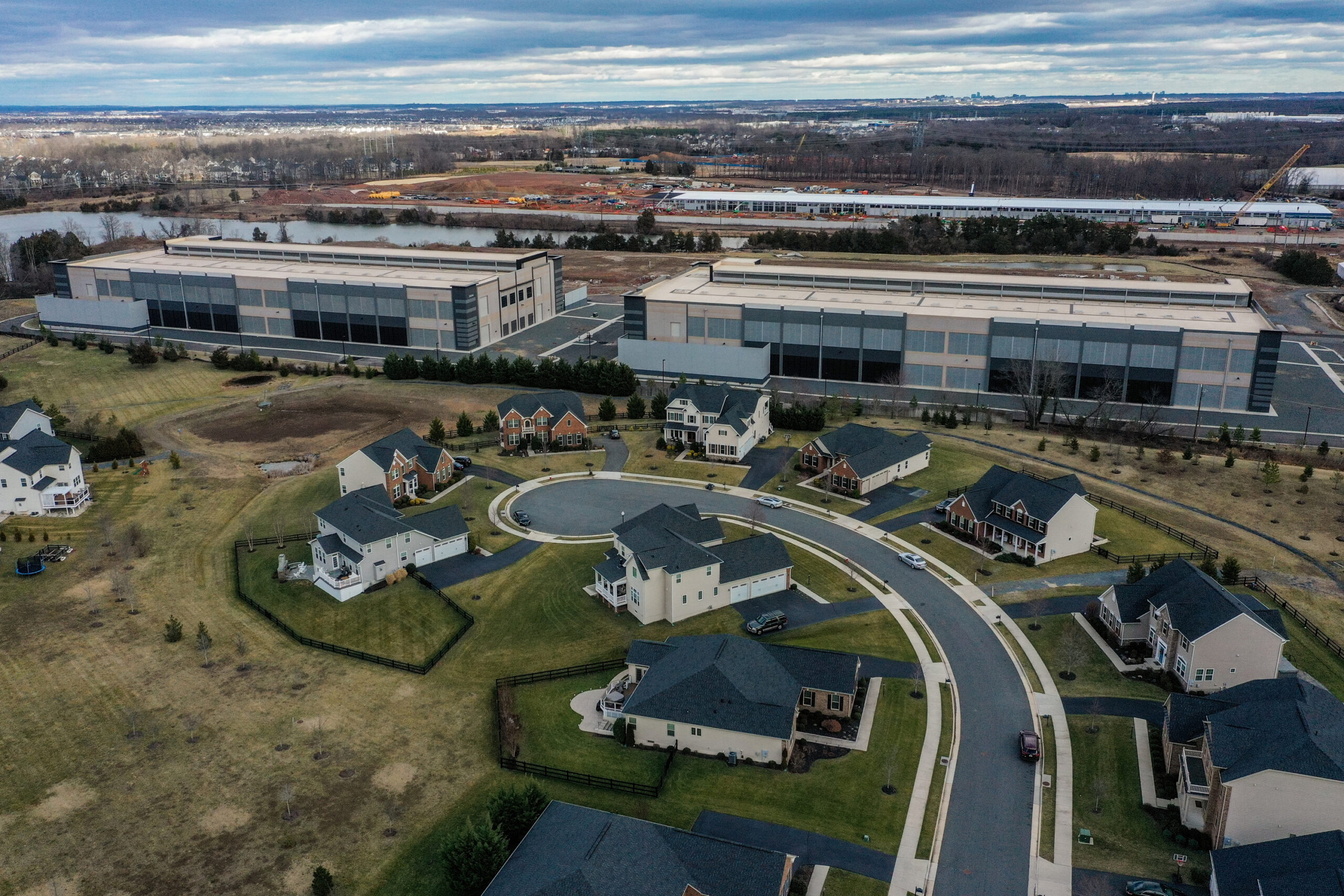
The AI boom has brought plans for more data center development in the region. But those kinds of facilities don’t require a lot of workers, says Paulson.
“Going forward, we can see a period of strong growth where relatively few jobs are created as AI becomes fully embedded,” she said.
Amazon data centers loom over houses at the edge of the Loudoun Meadows neighborhood in Aldie, Va., in 2023.
Some Philadelphians are spending money cautiously
As uncertainty slows hiring on the business side, it seems to be influencing consumer trends as well.
Paulson noted that low-income households are struggling due to high prices and worries around job security.
Individuals with discretionary income are being careful of how they spend their money, noted Paulson. “A retailer who is active in the Philadelphia area told us they are seeing a lot of headwinds for the consumer, especially for lower-income individuals,” she said.
While people in Philadelphia continue to eat at restaurants, “contacts tell us that less expensive options on the menu are becoming more popular,” she said. Upscale restaurants are an exception, she noted, adding that “high-income households, bolstered by a strong stock market, appear to be driving elevated consumption growth.”
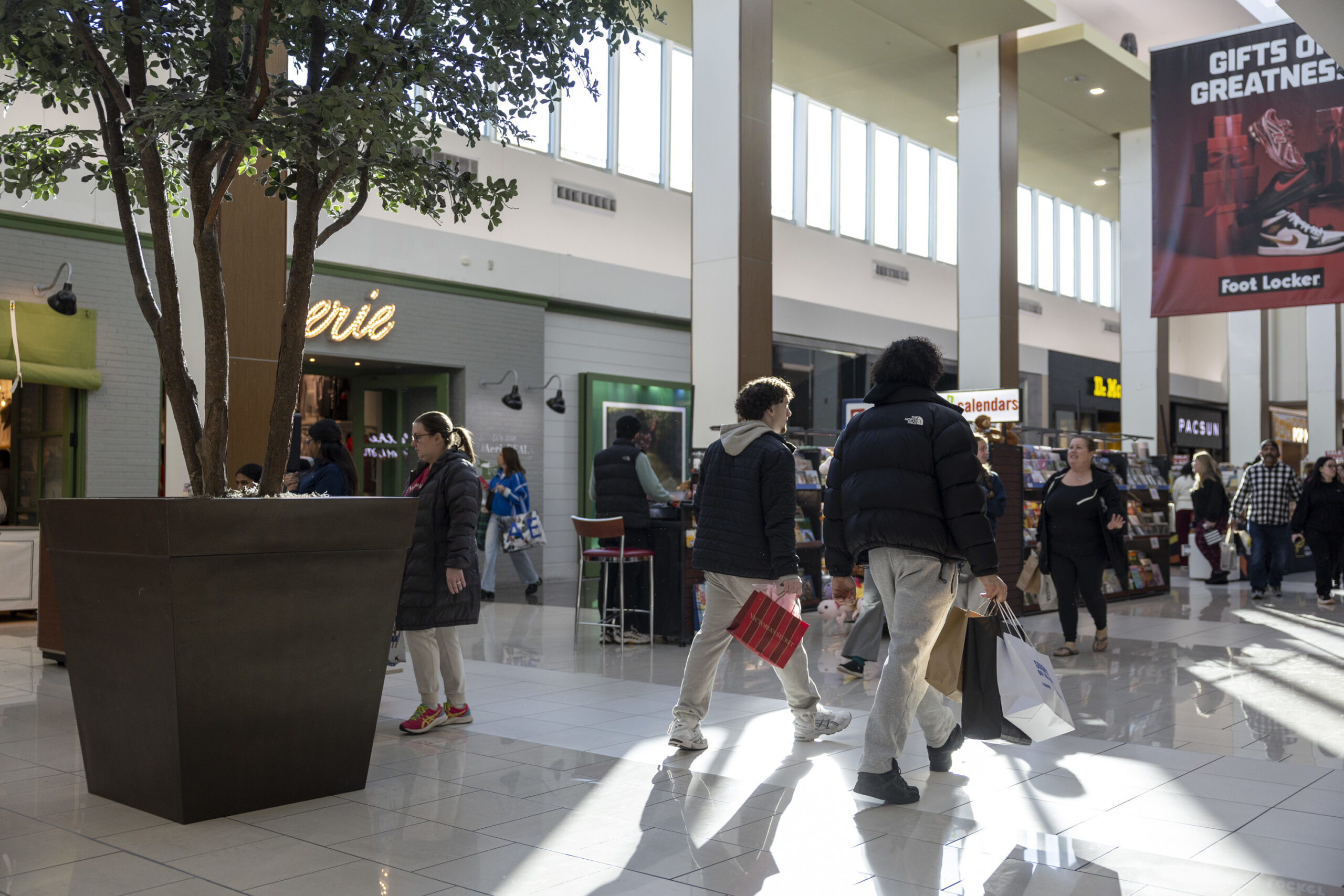
People shop on Black Friday at Cherry Hill Mall on Nov. 28, 2025. Philadelphia Fed CEO Paulson said people are being more careful with their discretionary income amid economic uncertainty.
Some employers want better applicants. Working people want better jobs.
When they are hiring, companies are often challenged to find the right candidates. About 30% of employers surveyed struggled to hire last year because they lacked applicants, or lacked qualified applicants, the Chamber’s report said.
Comcast executive Bret Perkins, who leads the company’s external and government affairs, noted at Wednesday’s event that the Philadelphia area is “just not creating enough opportunity jobs,” that lend workers upward mobility. He pointed to Philadelphia ranking 50th among 50 metro areas for upward economic mobility recently.
The Philadelphia Fed recently partnered on a survey of Philadelphians in the city’s lower-income zip codes, in which roughly one-third said “a better-paying job is the single thing that would be most helpful to them,” said Paulson.
But getting that job is a challenge, Paulson said. Health, caretaking responsibilities, and reliable transportation are among the barriers these Philadelphians are facing, the survey found.