Author: Denali Sagner

  • Lower Gwynedd man charged with attempted murder of a police officer

    Lower Gwynedd man charged with attempted murder of a police officer

    A Lower Gwynedd man has been charged with the attempted murder of a law enforcement officer after authorities say he struck a Plymouth Township police officer with his car multiple times before fleeing the scene.

    Dalton Lee Janiczek, 21, faces multiple felony charges, including attempted murder of a law enforcement officer, aggravated assault, and fleeing or attempting to elude a police officer.

    Around 10:19 a.m. on Friday, Janiczek fled in a white Mercedes-Benz G-Wagon from an attempted traffic stop by Springfield Township police officers, according to police. The officers did not pursue but instead broadcast information about the incident to neighboring police departments.

    Around noon, Sgt. Jon Bleuit of the Whitpain Township Police Department was out on patrol when he heard a radio transmission about the attempted stop, police said.

    Earlier that day, Bleuit had received information that Janiczek had been involved in an incident in Chester County where he “threatened to blow up a police department,” police said. Bleuit and the Whitpain Township Police Department were “familiar with Janiczek” and his SUV, according to police. There was no warrant out for Janiczek’s arrest at the time.

    Several minutes after Bleuit heard the radio transmission, he saw Janiczek driving and attempted to stop him for a traffic violation, police said. Janiczek allegedly drove over a center concrete median barrier and drove off again. Bleuit did not attempt to follow Janiczek and also relayed the information to neighboring departments.

    At 12:39 p.m., a Plymouth Township police officer, whom police did not identify, responded to the Doubletree Hotel in the township, where he saw the Mercedes G-Wagon driven by Janiczek, police said.

    The officer turned on his emergency lights. Within seconds, police said, Janiczek reversed his SUV, hitting the police officer’s car several times. The officer got out of his car, drew his firearm, and started yelling at Janiczek to stop the car and show his hands.

    In response, Janiczek allegedly accelerated directly at the officer, trying to strike him. The officer discharged his firearm at least five times toward the front windshield of Janiczek’s car, police said. Janiczek struck the officer, causing him to fall to the ground and start bleeding out of his leg, police said. Janiczek then drove away briefly before allegedly striking the officer three more times as the officer lay on his back attempting to apply a tourniquet.

    The officer was airlifted to a hospital in Philadelphia with severe leg injuries. As of Saturday afternoon, he was in intensive care and would require multiple surgeries for his injuries, police said.

    The incident was captured by bodycam footage and video taken by a bystander at the hotel, police said.

    After leaving the Doubletree lot, officials say, Janiczek fled the area and began traveling southbound on Walton Road. A Plymouth Township police car with its emergency lights on approached northbound on Walton Road. Janiczek allegedly crossed the double yellow line, striking the police car and causing it to strike another police car. Janiczek continued to travel southbound in the northbound lane, where he struck a stopped Plymouth police car head-on, injuring a Plymouth Township police sergeant.

    The sergeant, who was not identified, was taken to a local hospital for injuries to his legs. Both injured officers are in stable condition, according to a news release from the Montgomery County District Attorney’s Office.

    Janiczek was taken into custody after striking the sergeant’s car. According to police, Plymouth Township Officer Mike Watts said he heard Janiczek say, “Put me in the car or I will kill you,” as officers took him into custody. Janiczek was treated at Jefferson Abington Hospital for injuries, including a graze wound to his head.

    Janiczek was arraigned on Saturday by Judge Thomas P. Murt, who denied bail. A preliminary hearing before Judge Jodi L. Griffis is scheduled for Nov. 4.

    Before Friday’s incident, Janiczek had been charged with driving violations multiple times in both Pennsylvania and Arizona, including careless driving, driving without a license, and driving an unregistered vehicle. Authorities say Janiczek had been involved in several traffic incidents within the last week where he had fled from police.

  • Dinner, dancing, and political power: Cherry Hill’s ‘Golden Age Prom’ harnesses the electoral energy of senior citizens

    Dinner, dancing, and political power: Cherry Hill’s ‘Golden Age Prom’ harnesses the electoral energy of senior citizens

    At the 12th annual Golden Age Prom in Cherry Hill, Shirley Temples were flowing, the buffet line stretched across the room, and seniors — both senior citizens and high school seniors — danced the night away to the Bee Gees’ “Stayin’ Alive” and Gloria Gaynor’s “I Will Survive.”

    The event, hosted by the Cherry Hill Education Association, brings Cherry Hill’s older residents together for a night of food, dancing, and celebrating the prom king and queen.

    “Prom is a very memorable moment for a lot of people, and it makes them feel young again,” said Waleska Batista-Arias, the president of the Cherry Hill Education Association. “Just because the body ages, doesn’t mean you lose your youthful spirit.”

    Though celebration is the centerpiece of the Golden Age Prom, the annual event offers Cherry Hill’s teachers union an opportunity to build support for public education among seniors, a powerful, yet sometimes overlooked, voting bloc.

    According to Kathy Kiehner, 78, a retired reading specialist who has attended the prom for years, it’s about harnessing “the energy of senior citizens that forgets to get tapped.”

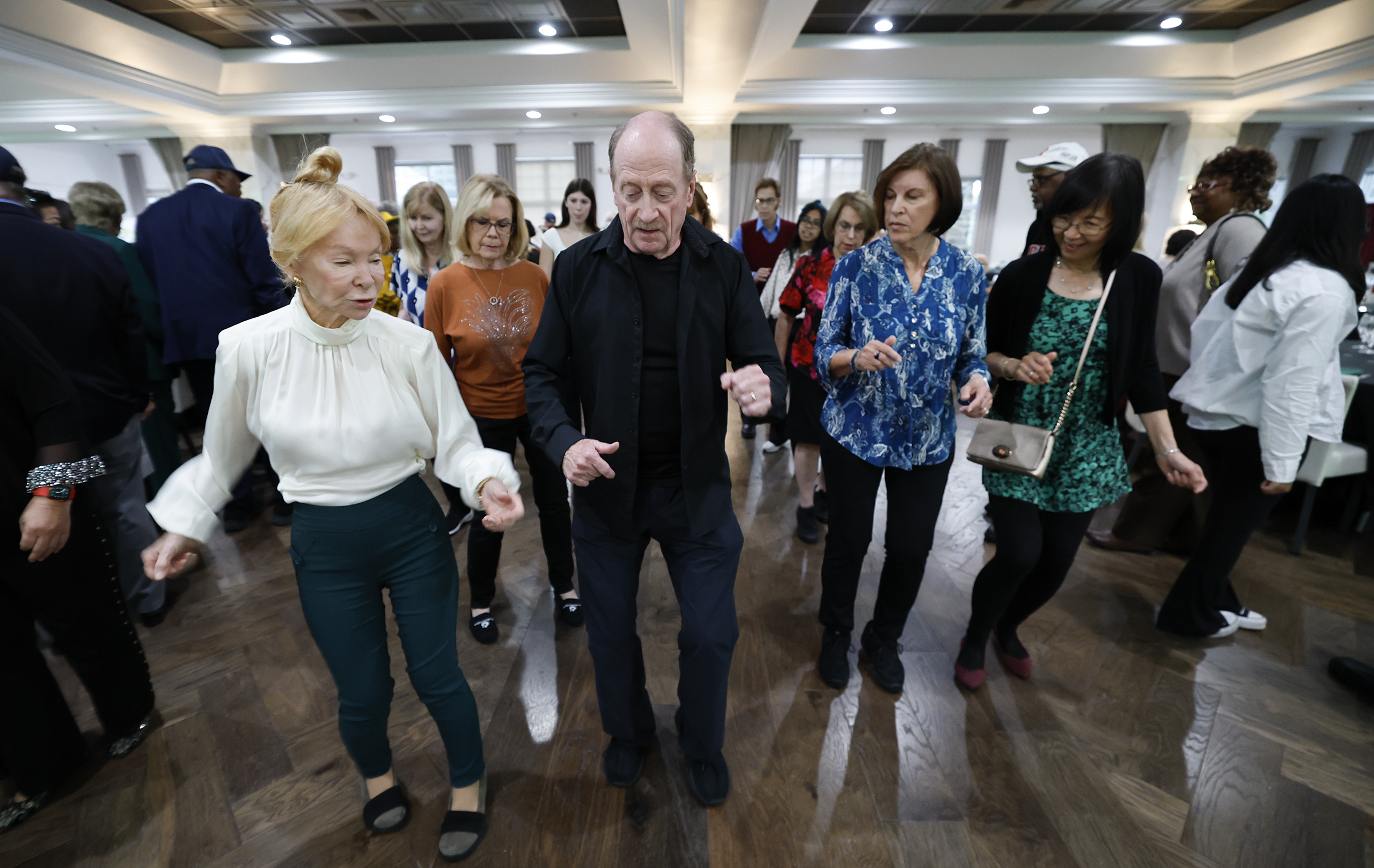
    Attendees dance during the Golden Age Prom sponsored by the Cherry Hill Education Association at the Legacy Club in Cherry Hill on Thursday, October 23, 2025.

    Dispatch from the dance floor

    Though the prom has historically been held at one of Cherry Hill’s schools, the education association had to upgrade to the Legacy Club this year to meet rising demand. Even still, they had to turn people away.

    Jeanne Kiefner, a retired school nurse, adjunct professor, and longtime Cherry Hill resident, said the prom “makes people healthy,” offering socialization that can be hard to come by in one’s 70s, 80s, and 90s. Many sources did not share their age with the reporter.

    As the night went on, attendees enjoyed the buffet — one remarked that there’s nothing seniors love more than free food. They posed in the photo booth and line danced with student volunteers from Cherry Hill’s two high schools.

    Seated by the dance floor, Cathy Jenkins, 76, and Emma Waring, 72, said they’ve been friends for longer than they can count. After doing some quick math, the two deduced they had met about 35 years ago while working in the Camden City School District. The retired educators are now involved in the Cherry Hill African American Civic Association, which uplifts Black history education and supports local students.

    When the Golden Age Prom announcement drops every year, Waring said she and her friends start calling and texting each other right away. Waring likes that the event is lively and cross-cultural, bringing together seniors from across Cherry Hill’s diverse communities.

    “This is something we look forward to,” she said.

    Attendees stand in the dinner buffet line during the Golden Age Prom sponsored by the Cherry Hill Education Association at the Legacy Club in Cherry Hill on Thursday, October 23, 2025.

    ‘These people vote’

    The Cherry Hill Education Association hosted the first Golden Age Prom over a decade ago at Kilmer Elementary School to help bring attention to much-needed infrastructure improvements in the district. While teachers and parents understood the district’s dire building needs, many Cherry Hill residents, including seniors who were no longer attached to the schools through their children, did not. In order to pass a bond to pay for the repairs, the education association knew it would have to physically bring voters into the schools.

    “The idea was that these people vote, so if you want them supporting anything in the school system, you have to have them be a part of it,” said Kiehner, the former reading specialist.

    The first bond referendum failed. But in 2022, a $363 million bond, one of the largest in New Jersey history, passed, allowing the Cherry Hill school district to make improvements to all 19 of its schools. It was the first time in 23 years that Cherry Hill voters approved a school bond.

    “Thank you for your support so that we could improve our school facilities for our students and future generations,” Batista-Arias told attendees, an expression of gratitude that was met with roaring applause.

    Batista-Arias said the association wanted to continue the intergenerational prom tradition and bring attention to upcoming elections. Candidates for Cherry Hill school board pitched voters from the dance floor, and some even stuck around for the “Cupid Shuffle.”

    The Cherry Hill Education Association does not make endorsements in local races, but it is supporting the New Jersey Education Association’s endorsement of Democratic gubernatorial candidate Mikie Sherrill, which Batista-Arias announced to attendees (the Sherrill endorsement also received some applause).

    The majority of this year’s prom was funded by the New Jersey Education Association’s PRIDE in Public Education campaign, an effort to build support for public education across New Jersey. The Golden Age Prom is free to attendees.

    Kathy Kiehner wears her hat and sunglasses while talking to friends during the Golden Age Prom sponsored by the Cherry Hill Education Association at the Legacy Club in Cherry Hill on Thursday, October 23, 2025.

    Bringing seniors out of isolation

    Emerging from the photo booth in ankle-length, bedazzled dresses, Ann Alfano and Norma Galosi explained that they met just a few months ago at square dancing class and decided to come to prom together. Alfano never went to her own school dances as a teenager, so this prom was her first. When asked how their first hangout outside of dance class was going, they agreed: “Well.”

    Joyce Layer, 84, moved to Cherry Hill 41 years ago after getting married. At the time, she knew no one. Line dancing classes, she thought, would be a good way to meet people. Four decades later, she dances on Tuesdays and Fridays, and she showed up to The Legacy Club ready to show off her moves.

    “I’m just a person who likes people, who likes to dance,” Layer said.

    “It’s a fun night,” she added. “It’s nice to do it for the seniors because so many of us are isolated.”

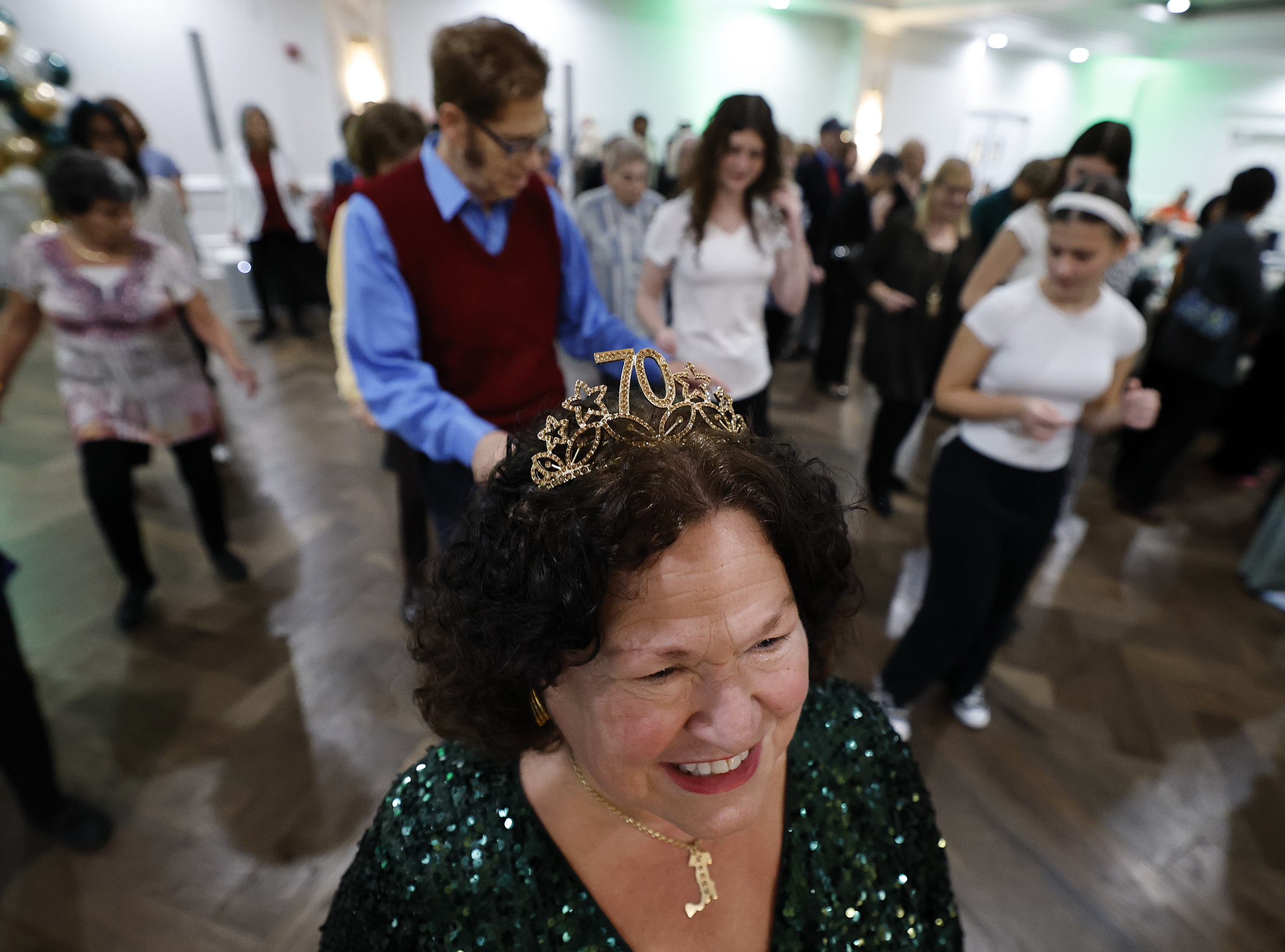
    Joanie Broglin dances wearing her tiara during the Golden Age Prom sponsored by the Cherry Hill Education Association at the Legacy Club.

    This suburban content is produced with support from the Leslie Miller and Richard Worley Foundation and The Lenfest Institute for Journalism. Editorial content is created independently of the project donors. Gifts to support The Inquirer’s high-impact journalism can be made at inquirer.com/donate. A list of Lenfest Institute donors can be found at lenfestinstitute.org/supporters.

  • Swarthmore Borough drops income tax proposal after contribution from Swarthmore College

    Swarthmore Borough drops income tax proposal after contribution from Swarthmore College

    Swarthmore Borough is tabling a proposal to implement an earned income tax after Swarthmore College stepped up to cover a funding gap left by the closure of Crozer-Chester Medical Center.

    Under a memorandum of understanding passed by Swarthmore Borough Tuesday, Swarthmore College will contribute $638,000 to the borough to help cover rising emergency service costs.

    The contribution allows the borough to drop a proposal to implement an earned income tax, which faced pushback from residents and some members of borough council.

    In a message to the community, Rob Goldberg, Swarthmore College’s vice president for finance and administration, said, “We’re happy we were able to work with the borough to avoid a new tax being imposed on College employees. We also value our long-standing partnership with the borough and remain committed to supporting the community we share. We’re grateful for the constructive dialogue that led to this outcome and for the continued collaboration that benefits both the borough and the College.”

    In a presentation given last month, the borough projected a 1% earned income tax would bring in at least $3.13 million in the second year of collection (some collection lags would occur in the first year). This would include $760,000 to $1.5 million in taxes collected from nonresidents who work in Swarthmore.

    An earned income tax is a local tax on salary, wages, and tips, but not on passive income like interest, dividends, capital gains, pensions, and Social Security benefits. These taxes are generally capped at 1%.

    If a taxpayer lives in a community with an earned income tax, they pay into their home community’s income tax base. If their home community does not have an earned income tax and the community where they work does, they pay into their work community’s income tax base. One major exception is Philadelphia’s wage tax, which overrides local earned income taxes. This means if a person works in Philadelphia and lives in a suburban municipality with an earned income tax, they would pay Philadelphia’s wage tax rather than their home community’s earned income tax.

    Cindy MacLeod, chair of the borough council’s finance committee, said the borough’s financial outlook is starkly different this year after the loss of Crozer’s ambulance services both increased the borough’s costs and brought down its revenue.

    In April, the borough adopted a declaration of disaster emergency following the closures of Crozer-Chester Medical Center in Chester and Taylor Hospital in Ridley Park. The closures resulted in “significant impacts” to emergency services in the region, the declaration said, including burdening remaining medical centers and increasing wait times for patients.

    According to preliminary estimates, the borough’s public safety costs are set to increase by 41% next year — from $3.1 million to $4.3 million. In addition to the loss of Crozer’s ambulance services, the borough is staring down steep fire equipment repair costs and a drop in the number of volunteer firefighters.

    “The cost assumptions around all these emergency services is a real and meaningful change,” said councilmember Scarlett McCahill at a Sept. 8 meeting. “It’s not that all of a sudden, surprise, we weren’t minding the shop and now we’re really behind and need to do a catchup. The actual costs to the community have changed significantly.”

    In addition to emergency service needs, Swarthmore officials say the borough has not been immune to more general inflationary pressures. Costs are rising for community services that the borough doesn’t want to cut, MacLeod said.

    Though the earned income tax is off the table for now, the borough is considering implementing an emergency services tax, a specific type of property tax that would be earmarked just for emergency services.

    “We hope we don’t have to do an emergency services tax, but we haven’t ruled that out,” MacLeod said.

    Budget discussions will continue at the borough’s Oct. 27 finance committee meeting.

    This suburban content is produced with support from the Leslie Miller and Richard Worley Foundation and The Lenfest Institute for Journalism. Editorial content is created independently of the project donors. Gifts to support The Inquirer’s high-impact journalism can be made at inquirer.com/donate. A list of Lenfest Institute donors can be found at lenfestinstitute.org/supporters.