Author: Mike Sielski

  • In a Public League hoops debacle between E&S and Constitution, the adults squander a chance to be leaders

    In a Public League hoops debacle between E&S and Constitution, the adults squander a chance to be leaders

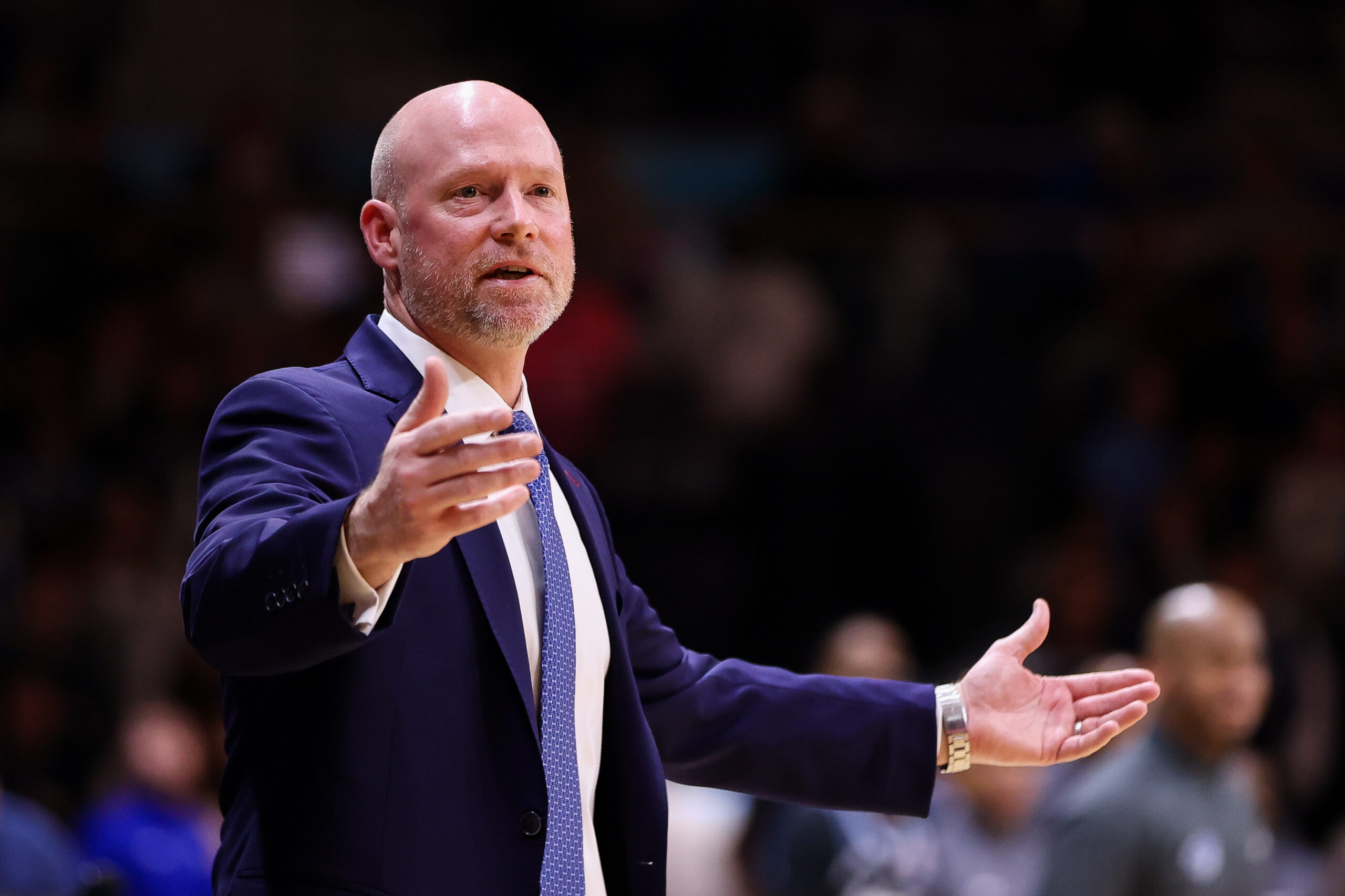
    Inside a half-empty John E. Glaser Arena on La Salle’s campus Tuesday night, Robert Moore lounged at the end of the Constitution boys’ basketball team’s bench, head back, arms folded, legs crossed, as if he had resigned himself to being powerless to stop the blowout before him. He wasn’t. He could have. He hadn’t.

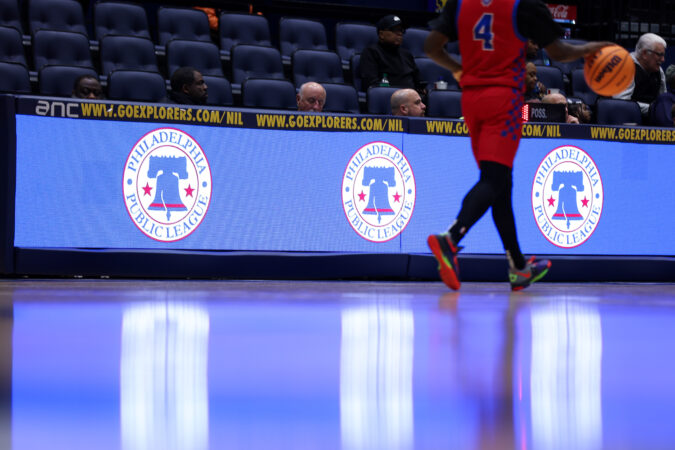
    The second game of the Public League semifinals was a rout from the start, a 73-41 Imhotep Charter victory that was never close, was never in doubt, and never should have been played. Constitution was there only because its previous opponent, Carver Engineering & Science, had been forced to forfeit their quarterfinal matchup when an altercation marred the game’s final minutes. With his team down by 12 points, with 71 seconds left in regulation, a Constitution player had shoved an E&S player, sparking an on-court confrontation among athletes, coaches, and fans. E&S’s bench had emptied, which, according to Public League rules, disqualified E&S from the tournament, allowing Constitution to move on to face Imhotep.

    From that ugly set of circumstances, Moore, his team, and Constitution’s administration received a gift that they never should have accepted. Constitution was on its way to losing in the quarterfinals until one of its players committed the act that ignited the chaos. And even if the Public League was following the letter of the law by confirming that E&S had to forfeit — “Constitution did the right thing,” league president Jimmy Lynch said, “by not entering the floor during the incident” — Moore and Constitution still could have done the honorable thing and declined to play in the semis, too.

    It would have sent a powerful message to Constitution’s players, and to the league as a whole, that certain principles are more important than playing a game. It would have turned this fiasco into a teachable moment, a cautionary tale that Constitution’s kids hadn’t earned the right to compete against Imhotep, against the Public League’s dominant program. It would have been a better resolution than the scene Tuesday night at La Salle, where security and city police officers stood poised at the corners of the court and the public-address announcer admonished spectators to stay off the floor and let the referees do their jobs.

    “We didn’t feel like it would be a great look for the league,” Moore said, “not having a team here to play in a semifinal game, [having] rented out an arena.”

    Sorry, it would have been an admirable stand for the Public League and its leaders to take. And while Moore deserves credit for facing some questions about the incident and Constitution’s and the league’s courses of action, his explanations sounded more like excuses for the failure to make the difficult but correct decision here. The price of renting Glaser, for instance, was already a sunk cost. That money was gone one way or another, so why not use that second semifinal game as a stage to show everyone what class and responsibility look like?

    “It’s really an administrative thing,” Moore said. “Honestly, after reviewing everything, we felt like the people who needed to be suspended were suspended.”
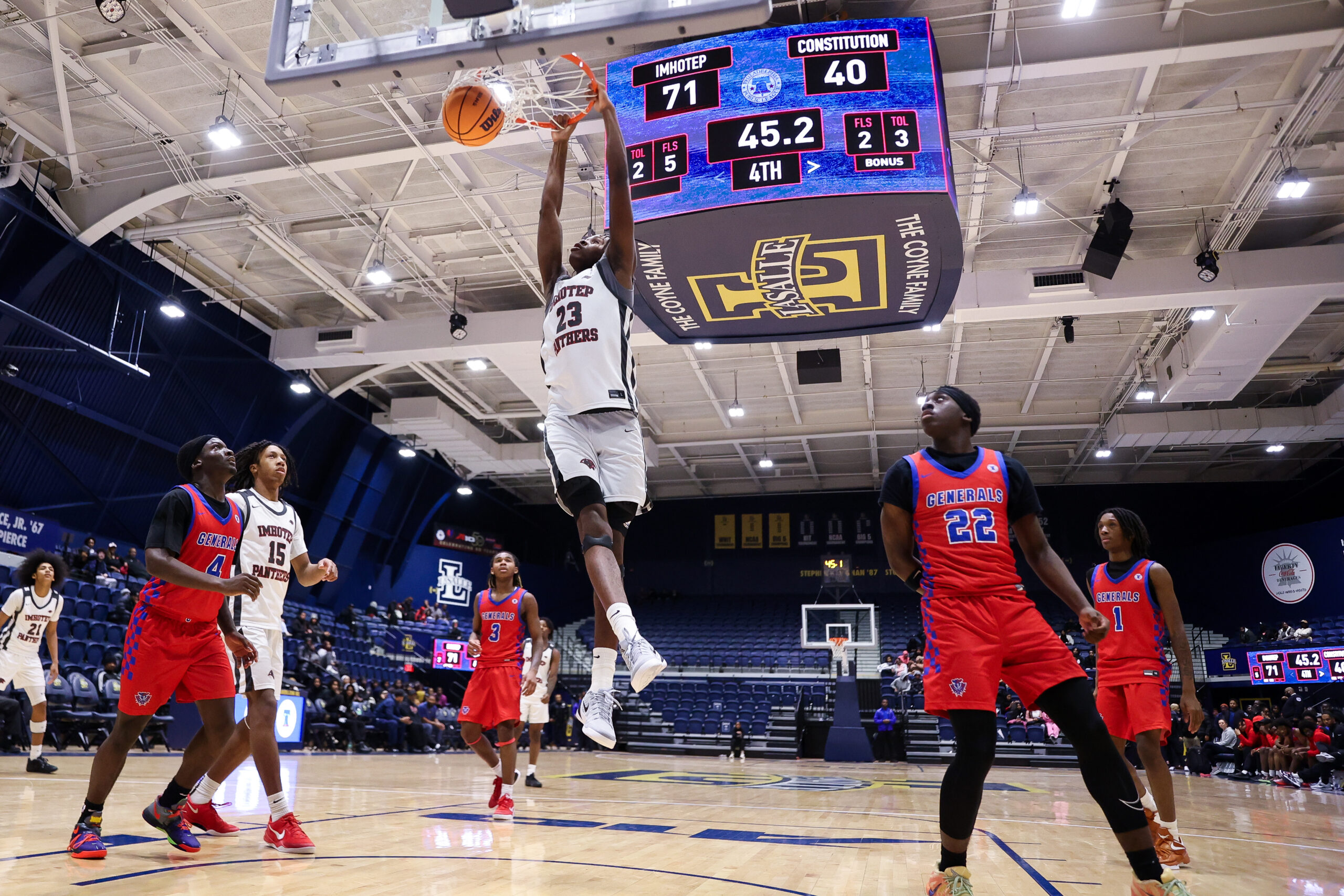
    Imhotep defeated Constitution, 73-41, in the Public League boys’ basketball semifinal on Tuesday.

    Yes, the Public League suspended two Constitution players for their roles in the melee, but that was the minimum discipline for an embarrassing situation that those young athletes had created and escalated. The incident happened last Thursday. By Friday afternoon, someone from Constitution, from the Public League, from District 12, or from the PIAA should have been on the phone, arranging a meeting, getting the right people in the same room or on a Zoom call to settle on a solution that didn’t let Constitution benefit from its own mistakes.

    Instead, Moore called coaches around the league, starting with Imhotep’s Andre Noble: “I said, ‘What do you want?’ He said, ‘I want to play a game. … I kind of left it up to the kids as well.” Except this wasn’t Noble’s call to make, and it certainly wasn’t the kids’. Of course an opposing coach wouldn’t want an important postseason game canceled. Of course teenagers would want such an incident to be wiped away with few consequences. And of course, E&S’s parents and players have been lobbying for absolution and justice for themselves, as if anyone comes out of a mess like this with clean hands.

    “To be fair, we’ve tried to take the high road, but we felt like we’ve been basically scapegoated as we were in the wrong with everything that happened,” Moore said. “In actuality, with all the facts the district had to deal with, it just wasn’t the case. …

    “There were a lot of moving parts, and we evaluated everything when we looked at it. Obviously the district and the PIAA had all of this information, so what you’re getting is — and I completely understand — parents who are unhappy about the situation. I completely understand that.

    “I’m a coach and an athletic director. I answer to a principal, who answers to an assistant superintendent. There are so many people above me.”

    From Congress to college sports, through virtually every institution in American society, there’s a deep and desperate need for someone in a position of authority to be a genuine leader, to stand up and stand firm and say, This is who we’re expected to be. This is the right thing for those we’re supposed to serve. This is what we’re supposed to do, and this is how and why we’re going to do it. Yet here was another example where no one put the greater good and a larger lesson above appearances and self-interest. Here was another occasion where no one bothered to be an adult.

    Moore and Constitution and the Public League had a chance, a real chance, to teach young people the value of accountability and the power of grace. They had an opportunity to be true educators, and they passed up that opportunity. They decided it was more important to play a game whose result was all but certain and would be quickly forgotten, and by the fourth quarter Tuesday night, Robert Moore was stretched out in his seat at the end of the bench, striking that posture that suggested he was content to have taken the easy way out. His team lost by 32 points. Hope it was worth it.
  • Is Tyler Perkins Villanova’s new Josh Hart? He might be close enough.

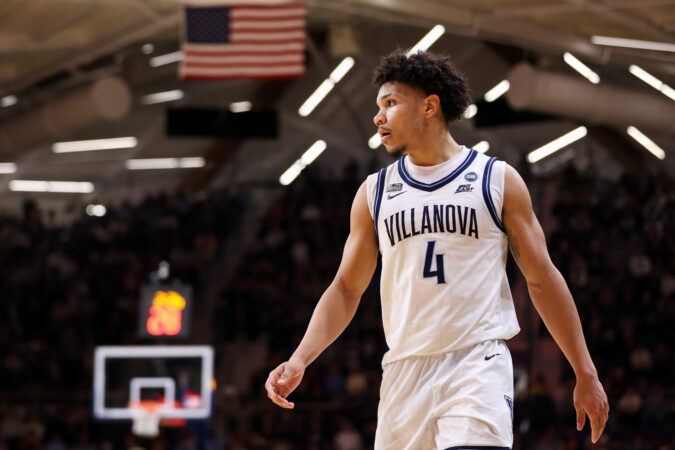
    Is Tyler Perkins Villanova’s new Josh Hart? He might be close enough.

    In the rotunda of the Finneran Pavilion late Tuesday night, the longest tenured Villanova player paused to crane his head toward the ceiling, toward the national championship, Final Four, and Big East championship banners that hang there in V formation, like a flock of birds in flight. On this Wildcats team, he’s the one whose name is called last in the pregame introductions.

    He’s the one everyone knows a little better than everyone else on the roster. For a program once accustomed to having its stars stay for three years, four years, sometimes even five, it has to be jarring that Tyler Perkins, a junior who transferred from Penn in 2024, is the closest thing to a keeper of that flame.

    “I take pride in it,” he said. “Last year, I was able to learn a lot about this place from guys like Eric Dixon, Jordan Longino, guys who have been here for three years, five years. I was able to pick their brains. Just walking these halls, looking at these banners, it makes you hungry. You want to bring it back to this place.”

    The whole idea of a player recognizing and appreciating a particular program’s history and culture seems quaint in this era of college basketball. It certainly doesn’t have the pull and power that it once did.

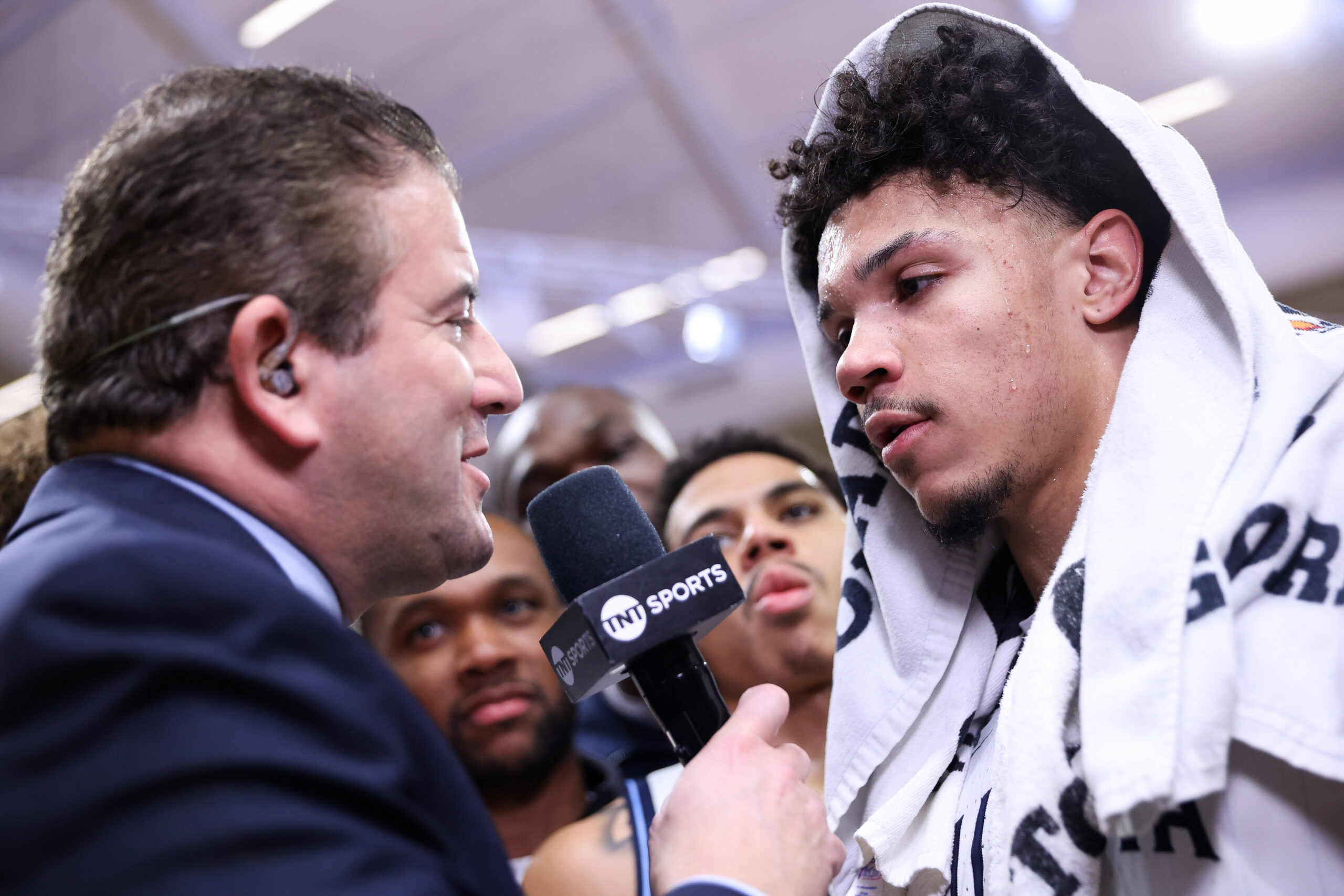
    Tyler Perkins (right) is interviewed by Andy Katz after Villanova’s 77-74 win against Marquette at the Finneran Pavilion on Tuesday.

    Now, paying players is an above-board course of action, athletes pass through the transfer portal like it’s an open doorway, and the story that played out at the Pavilion on Tuesday, in Villanova’s 77-74 victory over Marquette, showed just how much everything has changed.

    Perkins pretty much saved the Wildcats, now 19-5 and on track for their first NCAA Tournament appearance in four years, from losing a Big East game to a lesser opponent. He scored a team-high 22 points, hit three late three-pointers to help ’Nova quickly wipe out a nine-point deficit, grabbed six offensive rebounds, and blocked a three-point attempt by the Golden Eagles’ Adrien Stevens on the game’s final possession.

    It was the kind of performance that a savvy upperclassman — Josh Hart, Mikal Bridges, Collin Gillespie, Dixon — once would have delivered for Villanova … except in this case, the savvy upperclassman is a kid who has been on campus less than two years, and he was having a lousy defensive game until he snuffed Stevens’ shot at the end.

    “Once he figures out he can affect the game without shooting or having to shoot, that’s when he’s going to take a monster step,” Wildcats coach Kevin Willard said. “And he’s starting to get there. He is.”

    Willard is so certain that Perkins will become a great player that, after the Wildcats’ win over Seton Hall last week, he didn’t back away from comparing him to Hart — a first-team All-American and a national champion at ’Nova, a nine-year NBA vet and an invaluable piece of a New York Knicks team that could reach the Finals.

    During Tuesday’s postgame media availability, Willard playfully chided Perkins for his mostly poor defense against Marquette, then pointed out that Hart’s all-around game is what made him such a headache when Willard, while at Seton Hall, was coaching against him.

    “I tell the story all the time,” Willard said. “One of the last times we played against him, I called timeout, and I cursed out my team. I was like, ‘Can somebody please stop Josh Hart?’ And he hadn’t taken a shot. He hadn’t taken a shot, and they’re all looking at me like, ‘Well, he’s not shooting.’ He’s got three steals. He’s got four offensive rebounds. He’s got five assists. And he didn’t take a shot. That’s why he’s in the NBA.

    Villanova coach Kevin Willard believes Tyler Perkins shares many of the same qualities as former Wildcats guard Josh Hart.

    “He” — he tipped his head to the right, toward Perkins — “can do that. He just has to figure it out at times, ‘I don’t need to shoot the ball to be out here and be effective.’ Because he does so many other things.”

    Perkins has met Hart just once — last September, when Hart and Jalen Brunson returned to campus to record an episode of their podcast, The Roommates Show. Their on-paper profiles are practically identical. Both are from the Washington area.

    They are about the same height (6-foot-4) and roughly the same weight (210-215 pounds). The biggest difference, at the moment anyway, might be that the conditions that allowed Hart to develop over his four seasons at Villanova, from 2013 to 2017, are harder to replicate. These days, it takes a welcoming atmosphere; a rewarding athletic, academic, and social experience … and, of course, a big, fat check.

    Make no mistake: The money is and will be the major motivator for keeping a promising basketball player on any campus. A program that wants to keep a star into his senior season is going to have to pony up accordingly. But those first two factors still matter some, at least some of the time, and apparently to Perkins.

    “I don’t really care about all the extra stuff that’s going on in college basketball right now,” he said. “I find joy in playing the game, and I felt like this place was the most comfortable place for me to play.”

    Imagine the comfort he’ll feel a year from now, two years from now, three, if he can stand inside the Pavilion, look up at that ceiling, and see a banner he helped to hang.

  • No wonder Flyers fans are irrational about Matvei Michkov. Have you looked at this team’s draft history?

    No wonder Flyers fans are irrational about Matvei Michkov. Have you looked at this team’s draft history?

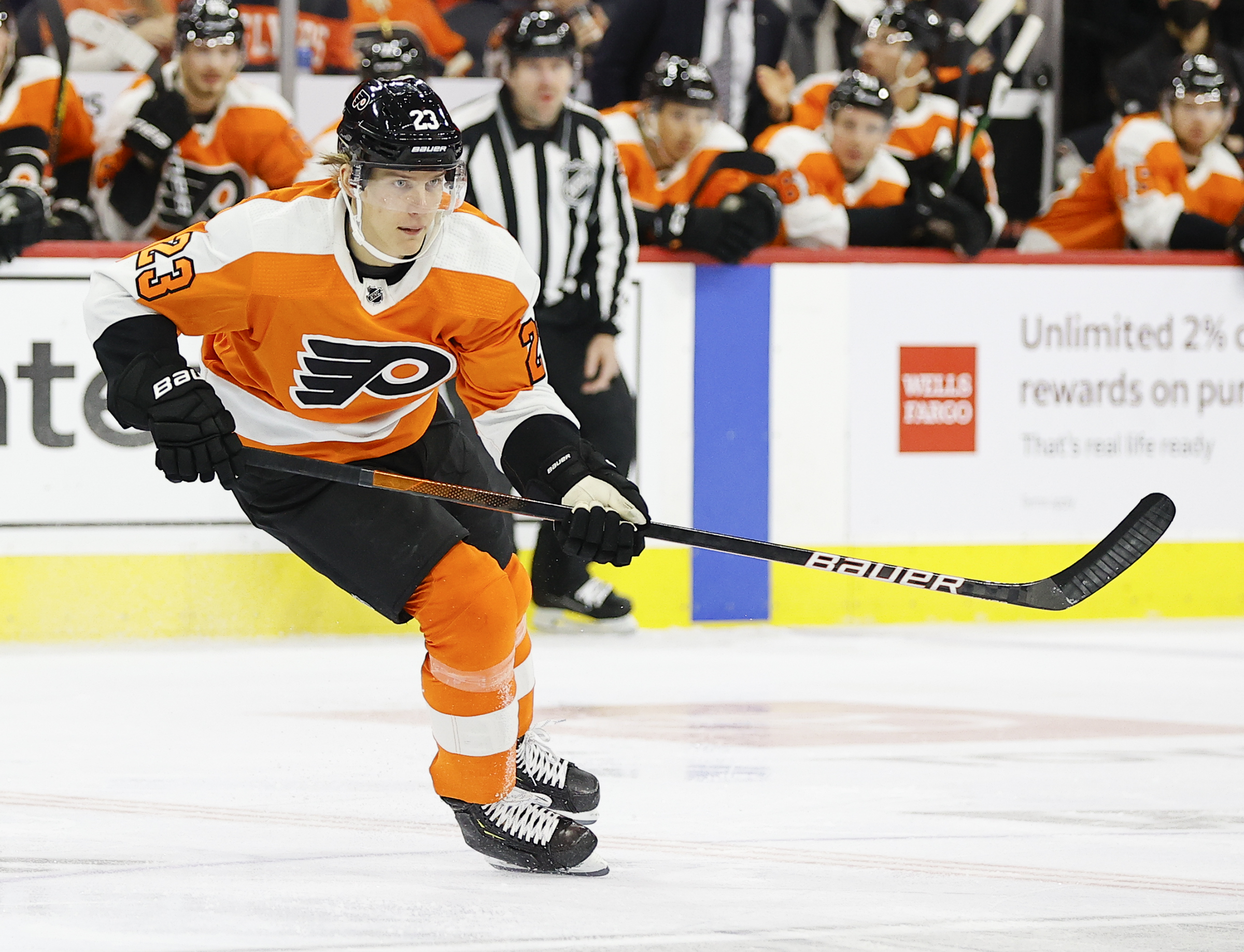
    Because of the Winter Olympics, the Flyers won’t play again for another two-and-a-half weeks, not that anyone is all that broken up about their impending absence. They’ve been a lousy hang for a while, losing 12 of their last 15 games, falling out of the playoff picture, and drawing attention primarily for the six degrees of debate around Matvei Michkov’s playing time.

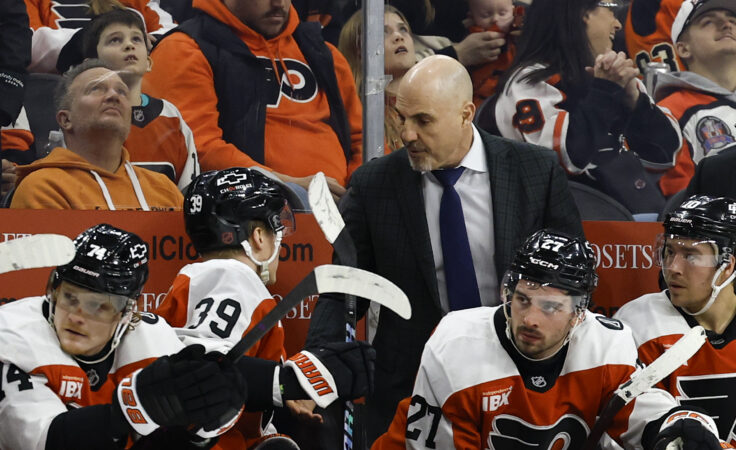
    The Michkov issue has been fascinating and revealing. Everyone acknowledges that, after his often-impressive rookie season, he came into training camp out of shape. That reality has precipitated a months-long discussion about how he has played, when he has played, how much he has played, and whether coach Rick Tocchet might be mishandling him and sabotaging Michkov’s career before the kid has a chance to become the star the Flyers and their fans hope he will be.

    Tocchet, general manager Danny Brière, and team president Keith Jones have made it clear that they are taking, or trying to take, the long view about Michkov’s development. They have also made it clear that they consider it valuable to put him through a kind of rite of passage, to compel him to learn and practice good habits on and off the ice.

    One can make a case that such an approach is too old school, won’t be effective, and risks angering and alienating Michkov. That’s possible, I suppose, but it’s just as reasonable to think the Flyers’ methods are correct and will work.

    There are plenty of 76ers fans and former members of the franchise, for example, who wish their team had treated Joel Embiid and other since-departed players with a firmer hand earlier in their careers.

    It’s safe to say, though, that within at least a portion of the Flyers’ fan base, a measure of paranoia has arisen when it comes to Michkov and the organization’s handling of him.

    Earlier this season, anodyne comments about him, by team captain Sean Couturier, were taken out of context and treated as a major controversy. Tocchet then offered a frank assessment of Michkov’s conditioning and performance during a recent interview with PHLY Sports. And while it wasn’t the smartest media-relations strategy for the head coach to criticize such an important player so brusquely, the reaction to Tocchet’s comments suggested that people were afraid Michkov would be so offended that he would catch the first flight to Little Diomede and hike the Bering Strait back to Putinland.

    That fear is irrational, of course, and it’s easy to chalk it up to the longtime overzealousness of the Benevolent Order of the Orange and Black. But in this case, it’s understandable that those fans who have stuck with the Flyers over the last 15½ years — that’s how long it has been since that 2010 run to the Stanley Cup Final — would be a little on edge about Michkov. Even more than a little.

    All anyone has to do is look at the Flyers’ draft history over the last quarter century to understand why their fans want Michkov treated like a prince and shielded from any emotional boo-boos. Because that history is … ugh.

    • Let’s start with 2001. The Flyers’ first-round pick that year, defenseman Jeff Woywitka, played 278 NHL games in his career, none with the Flyers. Their third-round pick, Patrick Sharp, turned out to be a terrific player … after they traded him to the Chicago Blackhawks.
    • With the fourth-overall pick in 2002, the Flyers took defenseman Joni Pitkänen. Eh. Their subsequent six picks in that draft played a combined total of one game in the NHL.
    • The 2003 draft was a red-letter one: Jeff Carter and Mike Richards in the first round. After those two, the Flyers took nine other players. Alexandre Picard, a third-round defenseman, turned out to be the best of the bunch.
    • If, in 2004, the Flyers were actually trying to tank the draft, no one could tell. They picked 11 players who appeared in a total of 23 NHL games.
    • Over the ‘05 and ‘06 drafts, they selected 16 players, two of whom had lengthy NHL careers: Claude Giroux and … Steve Downie.
    • For three straight drafts, 2008 through 2010, the Flyers picked 17 players. Just nine made it to the NHL and two others played only one game. The player who played the most games for them was Zac Rinaldo.
    • The Flyers took Couturier with the No. 8 overall pick in 2011. Excellent. They found Nick Cousins in the third round. OK. None of their other four picks that year played for them.
    Left wing Oskar Lindblom was drafted by the Flyers in 2014.
    • From 2012 to 2014, the Flyers drafted Travis Sanheim, Scott Laughton, Shayne Gostisbehere, Anthony Stolarz, Oskar Lindblom, and Robert Hägg. They did not draft anyone who could reasonably be called a star.
    • When the Flyers took Ivan Provorov and Travis Konecny in the first round, 2015 looked like a draft they could take pride in. But Provorov’s gone, and goalies Felix Sandström and Ivan Fedotov couldn’t cut it.
    • Two words about the 2016 draft: German Rubtsov. Two more words: Carter Hart.
    • With the No. 2 pick in the 2017 draft, the Flyers selected Nolan Patrick. There are no words for how that decision turned out. But hey, Noah Cates!
    • The Flyers’ crown jewels from the 2018 draft were Joel Farabee and Sam Ersson.
    • In 2019 and 2020, the Flyers got Cam York (cool), Tyson Foerster (promising but injured), Bobby Brink (we’ll see), and Emil Andrae (don’t you need more from a second-rounder by now?).
    • So far, the Flyers’ best pick in the 2021 draft has been Aleksei Kolosov. Which tells you all you need to know about the Flyers’ 2021 draft.
    • We’re up to 2022. The Cutter Gauthier draft. Best to move on quickly and quietly …
    • The Jones-Brière regime has overseen the 2023-25 drafts, and yes, it’s early yet to judge the results, and yes, the Flyers were bold in ’23 in taking Michkov. But it’s worth noting that, of the 26 players the Flyers picked over those three years, just three have suited up for them so far: Michkov, Denver Barkey, and Jett Luchanko.

    It’s not just that the Flyers have had opportunities to mine the draft for elite talent and failed. It’s that they haven’t even stumbled into a late-round pick or two who ended up becoming cornerstones.

    A team that does not draft well cannot win. The Flyers have been proving that maxim true for a long time. No wonder their fans are so protective of the one player who represents even a glimmer of possible greatness.

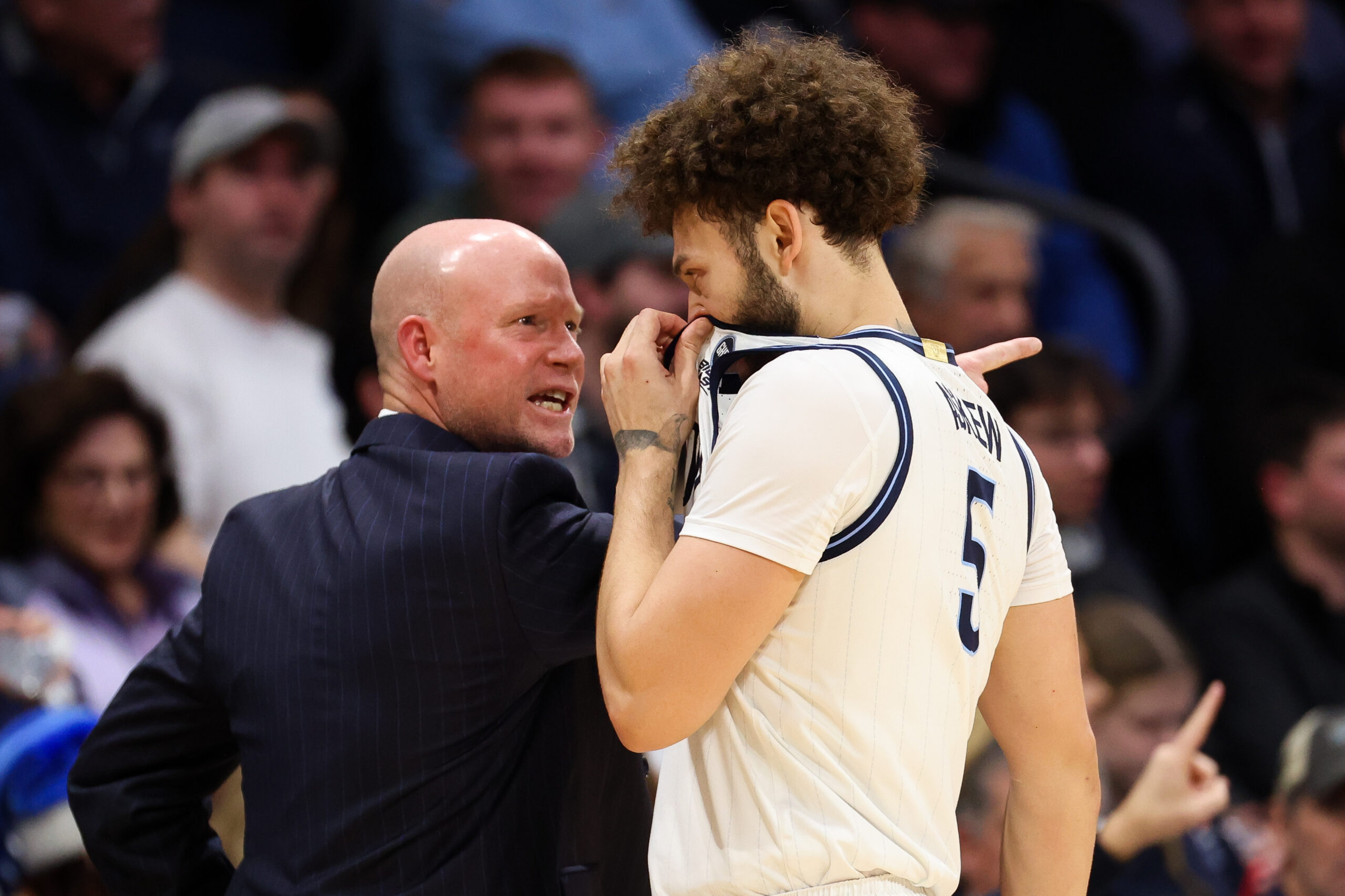
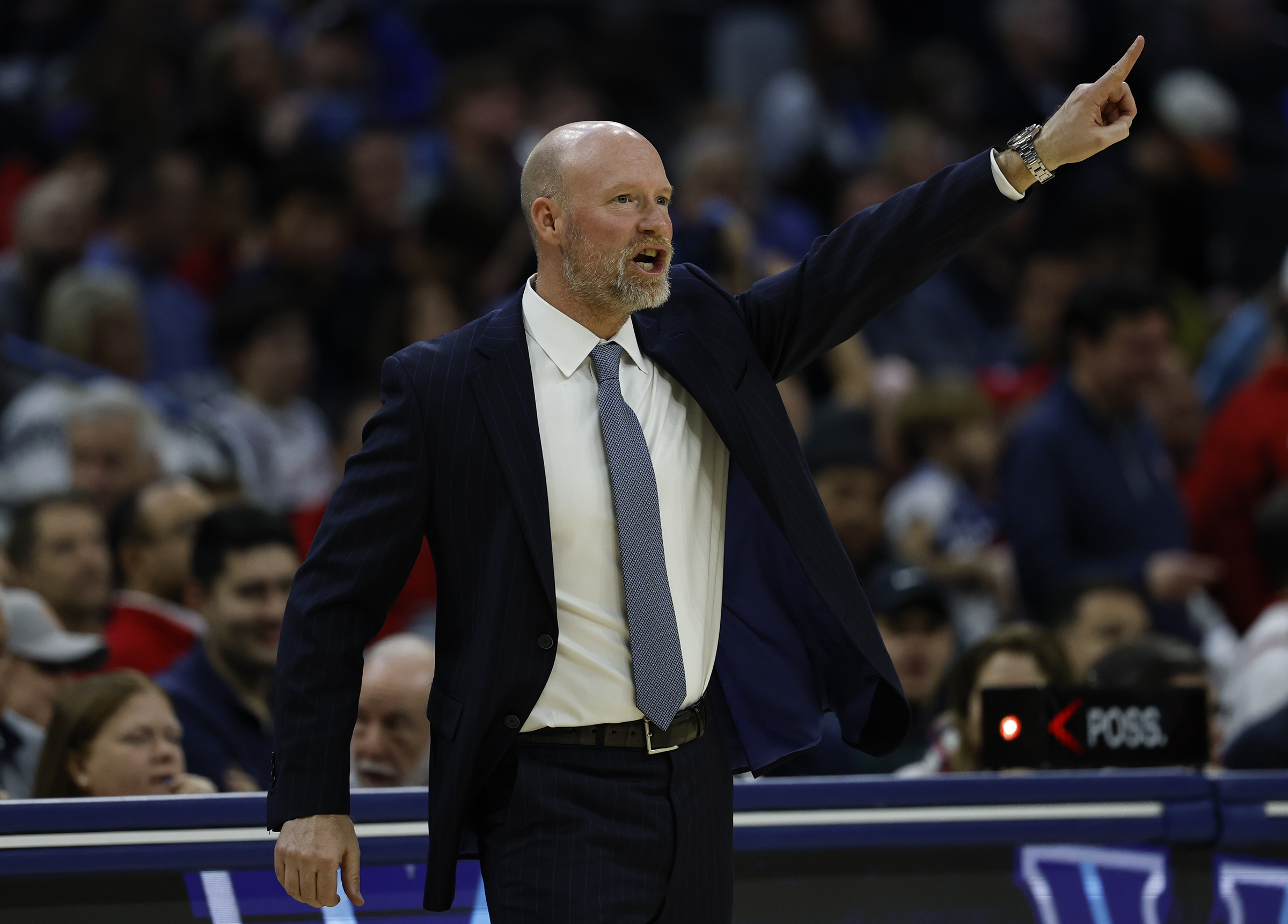
  • Kevin Willard wants to push Villanova into the future — without casting Jay Wright into the past

    Kevin Willard wants to push Villanova into the future — without casting Jay Wright into the past

    Over his 12 years coaching at Seton Hall and against Jay Wright, Kevin Willard figured that he knew Villanova as well as any outsider could, especially one who would eventually become the university’s men’s basketball coach. His next-door neighbors in Westfield, N.J., were ’Nova alumni, as were three of his golfing buddies at Plainfield Country Club, and there were all those Big East battles between his teams and Wright’s at the Finneran Pavilion, at the Prudential Center in Newark, and at Madison Square Garden in March.

    Then he went to Maryland. Maryland wasn’t the northeast. It wasn’t Jersey. It wasn’t Philly. It wasn’t even the Main Line. It was the Big Ten. The Big Ten has big-time football, and more importantly, it has football money and a football mindset, even for its basketball programs. The Big Ten also has 18 member schools, so Willard stopped watching Big East basketball altogether. He had 17 conference opponents to study, after all. Then he returned to the Big East this season, replacing Kyle Neptune at Villanova.

    He doesn’t feel comfortable there yet, he said. Too much to do. Too much change so quickly. Too much of a whirlwind.

    “The comfort won’t happen until Year 3,” he said. “When I came, I definitely had rose-colored glasses. I had a perception of what this was, not remembering it had been three years since Jay had left.”

    The Wildcats are 17-5 following their 72-60 victory Wednesday night over Willard’s former team, Seton Hall. And Villanova’s strong season so far might allow its donors and alumni to regard the last three years as just a blip — a small stint in purgatory before Willard got the program back to where those who support it presumed it should and would always be. During an hourlong interview in his office late Tuesday afternoon, though, Willard made it clear where he comes down on Villanova’s future … and its recent past.

    No matter Wright’s intentions, his tenure and presence loomed over Neptune as an ever-present reminder of his 21 years as head coach and nerve center, of two national championships and four Final Fours and the status as the top program in the country. Neptune, who had a single season at Fordham as a head coach and had spent 12 years at Villanova on Wright’s staff, couldn’t escape that shadow or the comparisons, and he couldn’t win enough to buy himself more time. Willard doesn’t want to fall into the same trap, and he thinks he knows how to avoid it, believing his three years at Maryland and in the Big Ten, that experience elsewhere, will be vital to understanding how Villanova has to evolve.

    “It’s so important,” he said. “My 12 years at Seton Hall, I did it my way. You get very isolated, and Jay was here for so long, and they were winning. But it was Jay. And I know this because I went against him. It was Jay. It was Jay’s way. It was the way it was. They didn’t need to change anything. They didn’t need to worry about anything because they had Jay. Once Jay left, you need to go, ‘All right, what’s everyone else doing? Where has everyone else made gains where maybe this place didn’t because they had Jay?’”

    Kevin Willard doesn’t want to erase all of the Wildcats’ basketball history, rather use it as a valuable resource.

    For Willard, the caution and smaller-time approach that worked under Wright — that worked because of Wright, and because Villanova was operating in a pre-NIL/transfer portal/pay-for-play world — won’t fly anymore. It would be foolish for Willard to try. He’s a Villanova outsider still, rougher around the edges than Wright, than the man who was the most polished coach in the country, and the circumstances in this wild, wild west era of college hoops are different and more challenging.

    The luxury of redshirting players such as Mikal Bridges and Donte DiVincenzo, for instance, allowing them to get acclimated and mature, won’t necessarily be available to Willard. The way to make up for Wright’s departure isn’t to operate as if his successors will be able to replicate his methods or even his culture. It’s to pay the cost of acquiring big-time players and tout their skills as part of social-media branding campaigns and recognize that this isn’t anything like amateur basketball anymore.

    “It’s like growing up in a small town and going to their amusement park, and then you go to Disney World,” Willard said. “You can’t say, ‘We just need to make the roller coaster better.’ Everything’s got to get better, bigger — fairy dust everywhere. It’s not even a money thing or a structural thing. It’s more about a mentality. Jay was monstrous. Jay was Villanova basketball. But we don’t have Jay anymore. …

    “Everyone else is being Disney World. We can’t be the small, little amusement park. We’re not the small, little amusement park, but the mentality a little bit is. ‘We can do it like this because we’ve always done it that way.’”

    Willard insisted he doesn’t intend to erase all of the Wildcats’ basketball history, that he can’t ignore or disregard what Villanova is as a university or how Rollie Massimino, Steve Lappas, Wright, and Neptune did their jobs and why. “If you just go against 60 years of tradition,” he said, “you’re going to get [expletive] blown out of the water.” So he views Wright’s presence as an asset, his knowledge and success as valuable resources.

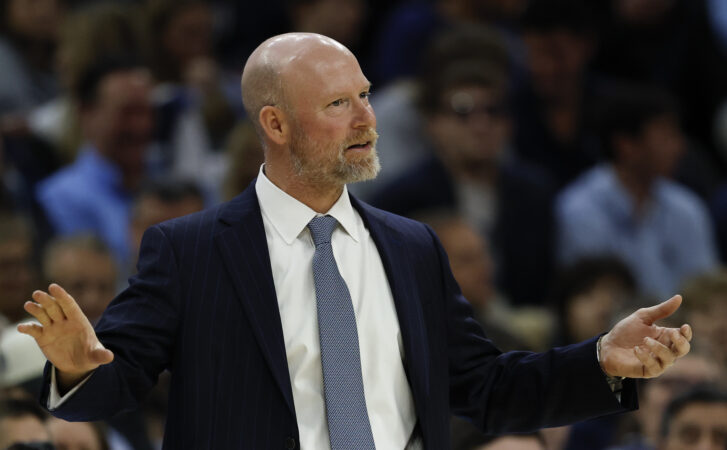
    Kevin Willard said he won’t feel comfortable coaching on the Main Line until year three.

    “If I was in my third year of coaching, I wouldn’t feel the same way,” he said. “I’m 20 years a head coach. I’m not cocky, but I feel pretty confident that I know what I’m doing at this point. I love the fact [that] I have Jay around. It’s only going to help. If I was younger and was coming here after three years at Seton Hall, I would be like, ‘What the [hell]? Why is he at the game? This is [expletive] crazy.’ But I love that he comes to practice. I love that he’s at games. I love that I can text him or call him or go out to dinner with him because he built this. He knows this place better than anybody.”

    He likely always will. It’s a standard, though, that Kevin Willard doesn’t have to exceed or even meet yet. It’s still just Year 1 for him. Check back in Year 3. He doesn’t have to know Villanova as well as Jay Wright did. He just has to do his part in this new time of college basketball. He just has to know it well enough.

  • The Eagles hired a young, green OC in Sean Mannion. Just like they did with Jon Gruden.

    The Eagles hired a young, green OC in Sean Mannion. Just like they did with Jon Gruden.

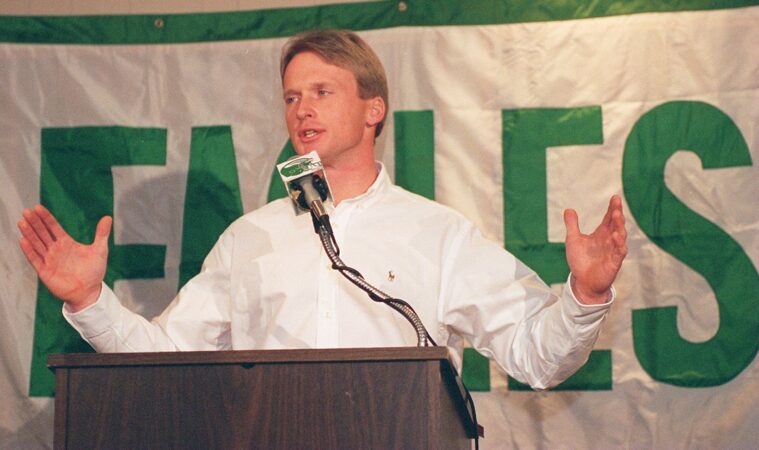
    Sean Mannion, the Eagles’ new offensive coordinator, is 33 years old, has been a coach — not just an NFL coach, but a coach of any kind — for only two years, and reportedly will call plays next season even though he has never called plays before. If it sounds like the Eagles have entered uncharted territory here, if it seems they’ve brought on board a neophyte who’s too green to succeed in such an important role at such an important moment for the team, rest easy. Mannion’s youth and inexperience are nothing compared to the first OC the Eagles hired during Jeffrey Lurie’s ownership tenure.

    Because that guy, in his first week in town, tried to buy a beer one night at a hotel bar. And got carded.

    “I said, ‘Huh?’” Jon Gruden told the Daily News in February 1995. “I know I look young, but that young?”

    Gruden was 31 when Ray Rhodes picked him to oversee and orchestrate the Eagles’ offense. The two of them had worked together in Green Bay, and though Gruden had coached in the NFL for four years — twice as long as Mannion has — he had never been a coordinator or called any plays with the Packers. Plus, Gruden was right. With his boyish face and while wearing his ever-present backward visor at practice, he looked like he might still be in college. He was younger than some of the Eagles’ offensive players, including two starting linemen — center Raleigh McKenzie and guard Guy McIntyre — and quarterback Randall Cunningham.

    “Age is not the issue,” Gruden said back in ‘95. “The issue is, ‘Can you do the job?’ … I’m not one of these guru kinds of guys who thinks he has all the answers. I’m just a guy who tried to learn as much football as he could in hopes that someday I’d get a chance to use it. And this is my shot.”

    Mannion is in a similar situation — a better one, in fact. The notion that he is stepping out from under the safe cover of being the Packers’ quarterbacks coach into the tropical storm of serving as the Eagles’ OC has some truth to it, sure. The pressure that Mannion will feel from Lurie and Howie Roseman will equal or exceed any that the Eagles’ fan base might apply. But he is still accepting a plum job with an organization that won a Super Bowl last year and is coming off a season that was a disappointment by the standard that the Eagles have established for themselves.

    They won 11 games. They finished first in their division. They have talent to spare on offense. “If I’m an offensive play-caller,” Fox analyst and former Pro Bowl tight end Greg Olsen said recently on the New Heights podcast, “I’m doing everything in my power to get that job.” This ain’t a bad gig.

    Gruden’s was, or at least it wasn’t as good as Mannion’s. And it’s worthwhile to remind those Eagles fans and observers who either have forgotten or never bothered to familiarize themselves with the team’s history that yes, a relatively lengthy search for a new coordinator is not exactly a new low point for the franchise.

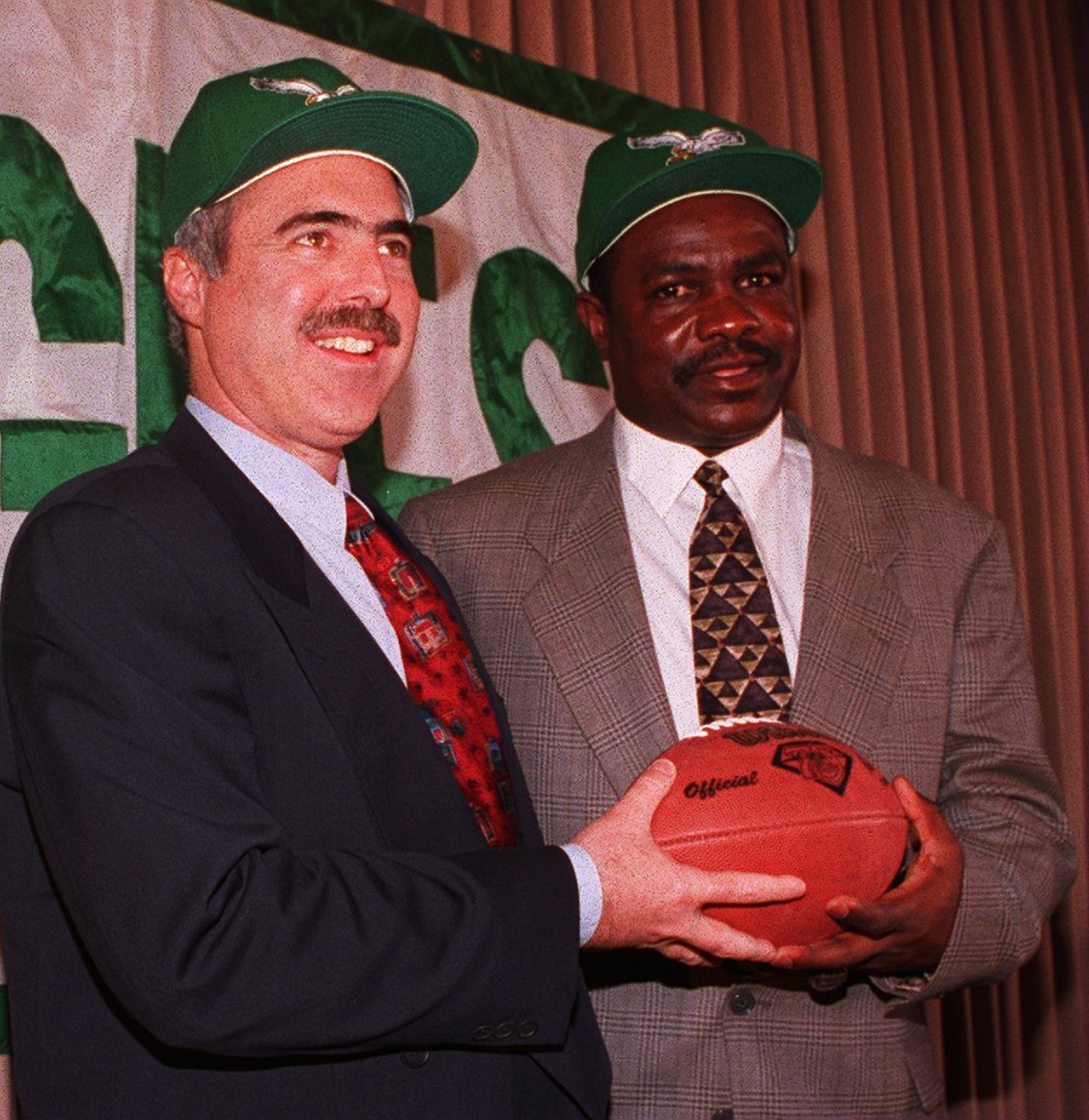
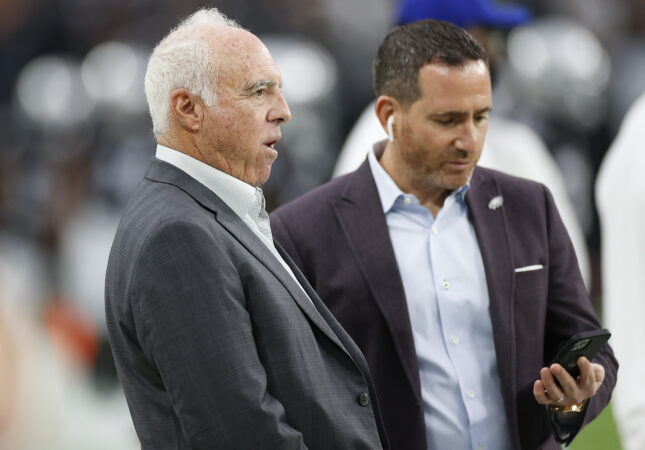
    New owner Jeffrey Lurie (left) and coach Ray Rhodes were viewed with skepticism, and not just in their OC hire.

    When Gruden was hired, Lurie had assumed control of the Eagles just eight months earlier. Rhodes not only had never been a head coach before, but he was the team’s first Black head coach, a distinction that in 1995 presented its own fierce set of pressures, expectations, and obstacles. The Eagles had not reached the Super Bowl in 14 years and had not yet won one. Veterans Stadium was decrepit, a dangerous place to play for its treacherous artificial turf, a horrible work environment for any coaching staff.

    Cunningham’s skill set was not a fit for Gruden’s version of the West Coast Offense — a system based on three-step drops, perfect timing, and precision accuracy on short and intermediate passes — so backup Rodney Peete eventually replaced him as the starter. And still the Eagles went 10-6 in each of Gruden’s first two seasons as their OC, and in ‘96, they ranked fourth in the league in total offense and in passing yards, with Ty Detmer and Peete as their QBs. If Mannion can come close to matching that measure of productivity — even with Jalen Hurts, with Saquon Barkley, with DeVonta Smith, with (presumably) A.J. Brown — he’ll be doing just fine.

  • The NFL is primed to open up passing offenses again. The Eagles’ new coordinator had better be ready.

    The NFL is primed to open up passing offenses again. The Eagles’ new coordinator had better be ready.

    There’s a lot of anxiety in the ether these days about the Eagles, particularly about the fact that they haven’t hired an offensive coordinator yet to replace Kevin Patullo.

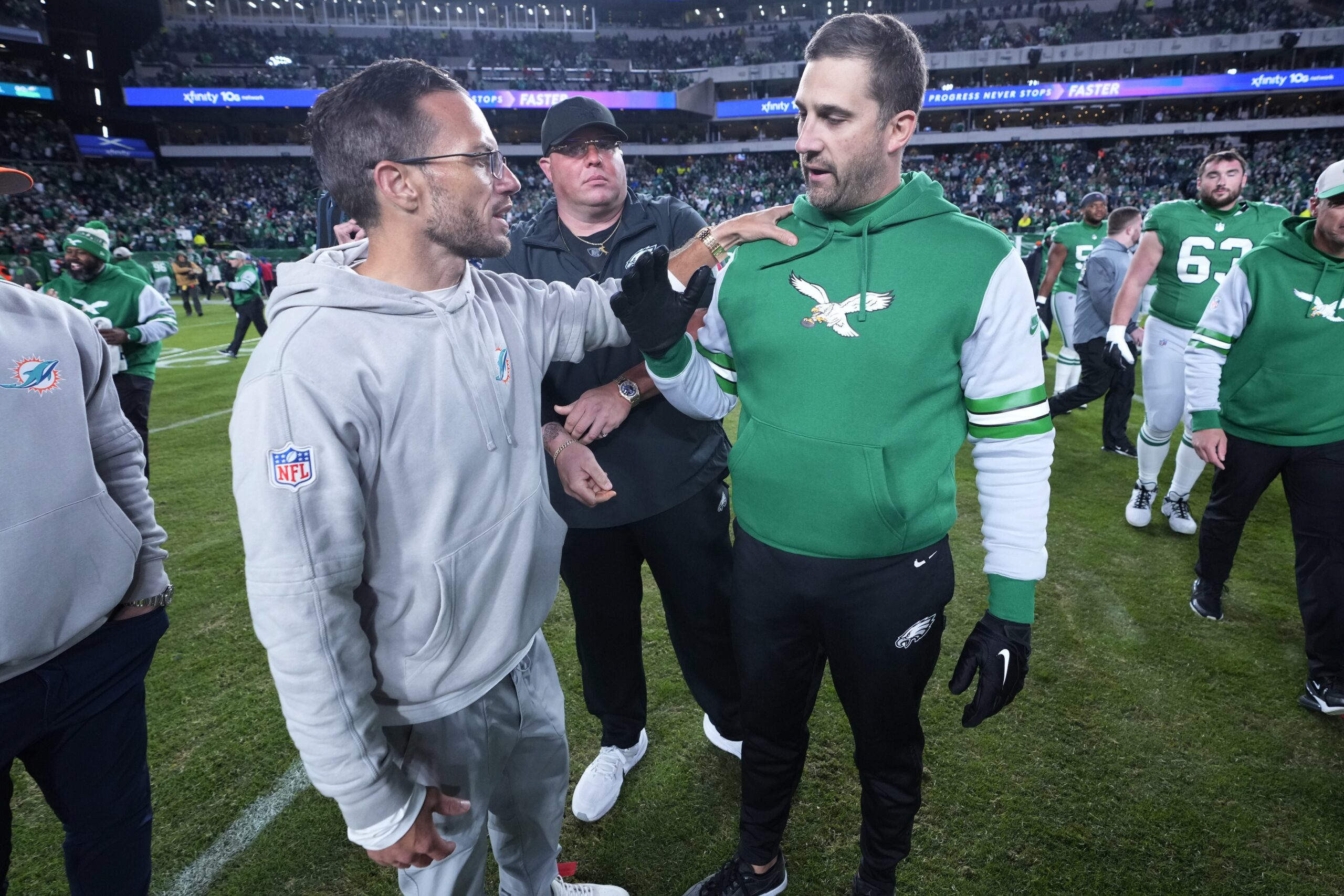
    Just look at some of the candidates who have been scooped up elsewhere or who decided to stay where they were: Mike McDaniel, Brian Daboll, Joe Brady, Mike Kafka, and Charlie Weis Jr.

    We can call this group the “Guys We’ve Heard Of” group, and they’re the biggest drivers of this collective worry that the Eagles will end up hiring some nincompoop who can’t call plays or, worse, calls the same kinds of plays Patullo did. I don’t know much about McDaniel other than he digs capri pants and tinted sunglasses. But I recognize his name, which means he must be smart, and the Eagles must be stupid for not hiring him.

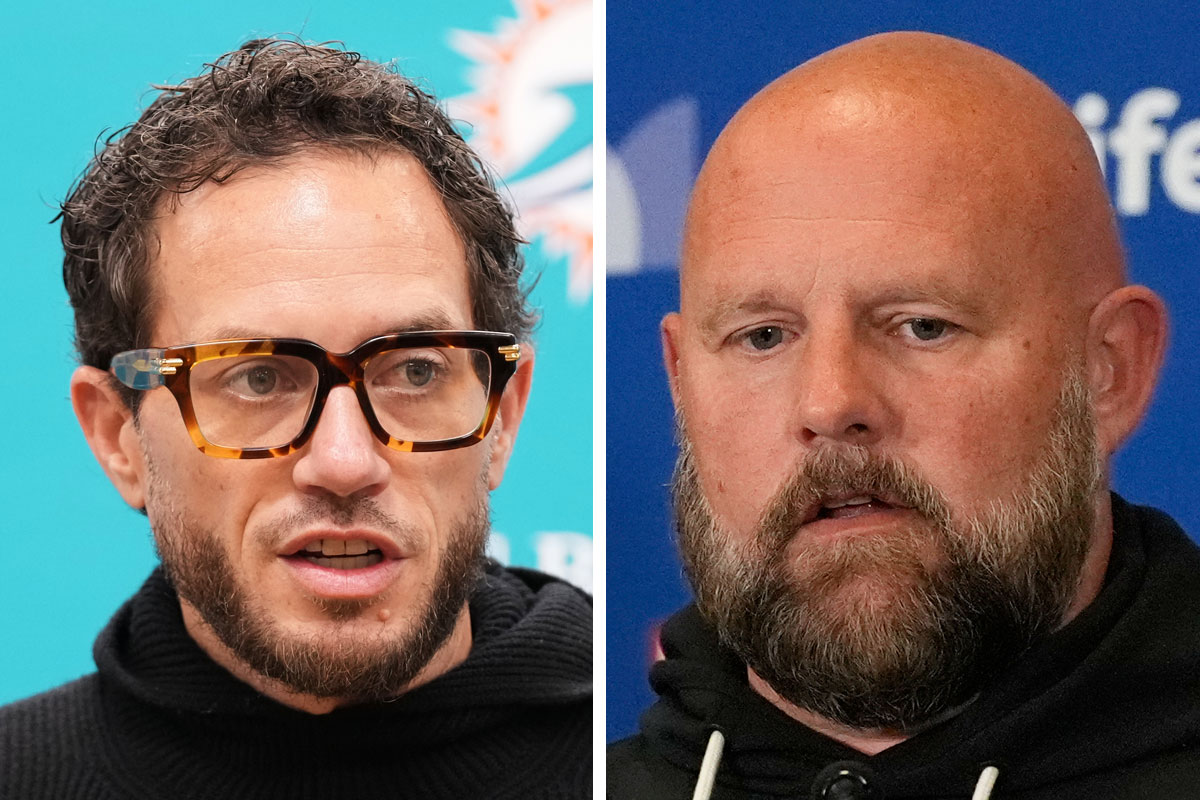
    Mike McDaniel (left) was a player high on the list of potential replacements for Kevin Patullo as offensive coordinator. Until he accepted the role with the Chargers.

    Then there’s the “Guys I’m Googling” group. They’re the up-and-coming coordinators and quarterback coaches who aren’t as well known to the casual NFL follower but who aspire to become branches on the Sean McVay tree or the Kyle Shanahan tree or whatever metaphorical foliage the Eagles happen to prefer. The way the Eagles’ search is shaping up — the time they’re taking, the three still-vacant head coaching jobs around the league — they’re likely to settle on someone from this group.

    Hiring such a candidate, one with relatively little experience and no discernible track record, could turn out to be a problem for the Eagles, who might end up with another play-caller who isn’t quite ready for the role. But it would be a boon for the team’s fans and media, who could start second-guessing and complaining about the guy as early as Week 1.

    No matter who the Eagles bring on board, they would do well to take a big-picture factor into consideration when they make their choice. In the short term, sure, the new coordinator’s primary concerns will be centered on improving an offense that may or may not have A.J. Brown, may or may not have Lane Johnson, may or may not have a decent tight end or two, and could use a bounce-back season from Jalen Hurts. But in the longer term, they should be mindful that they’ve been part of a strategic shift across the NFL, and they should be prepared in case Roger Goodell and the league’s owners try to shift things back.

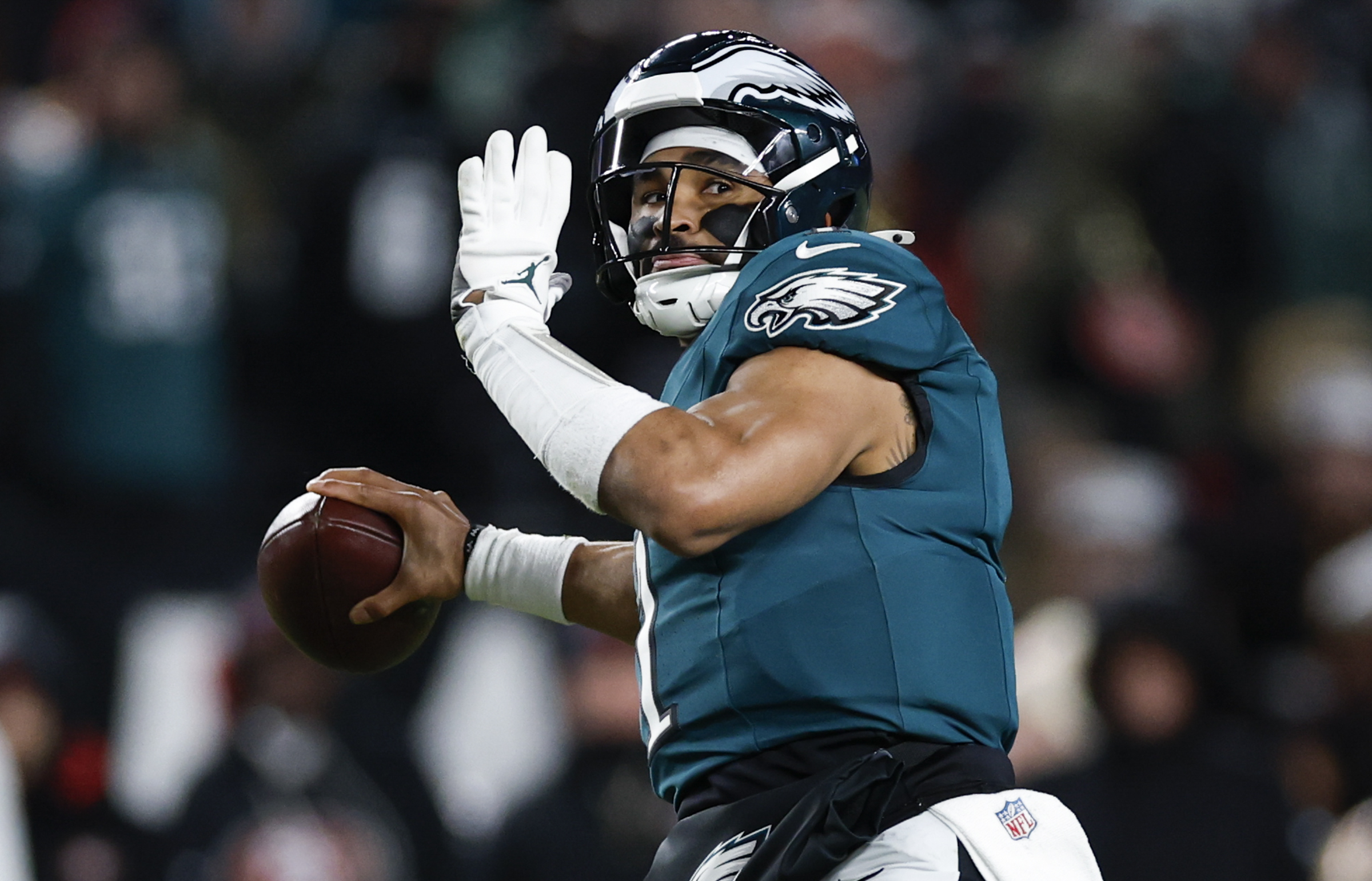
    Here’s what I mean: During this regular season, the average NFL team passed for 209.7 yards a game. That figure represents the lowest such average since 2006. It has been two decades, in other words, since NFL passing offenses were as anemic (or as conservative, depending on how you want to look at it) as they were this season.

    Eagles quarterback Jalen Hurts was among an NFL passing collective that accounted for an average of just 209.7 yards per game, the lowest since 2006.

    Why? You don’t have to be Bill Walsh to figure it out. After years of franchises chasing franchise quarterbacks and brilliant scheme designers and elite wide receivers — and tight ends who could catch and run like wideouts — a funny thing started happening: Certain teams geared up to counteract their opponents’ dynamic passing games and to exploit smaller, faster defenses. That is, certain teams won championships because of their defenses and/or their run games.

    The 2023 Kansas City Chiefs had Patrick Mahomes, yes, but they ranked 15th in scoring offense and second in scoring defense. The story of the 2024 Eagles is practically gospel around here: the dominance of Saquon Barkley and the offensive line, a stout defense overseen by Vic Fangio and built from the secondary in, the reality that the team didn’t want to and didn’t have to rely on Hurts’ arm to win.

    Now we have the New England Patriots and Seattle Seahawks in Super Bowl LX. Drake Maye had a great second season, and Sam Darnold is a great story. But both the Patriots’ and Seahawks’ defenses finished among the league’s top four in fewest points allowed and among the top eight in fewest yards allowed.

    Simply put, the passing game — the aspect of football that leads to high scores, general excitement, and the rise of the sport’s biggest celebrities and product-movers (i.e., star quarterbacks) — ain’t what it used to be. Hell, we were three points away from having a Super Bowl with Darnold and Jarrett Stidham as the starting QBs … not exactly an electrifying matchup of two all-time greats/household names.

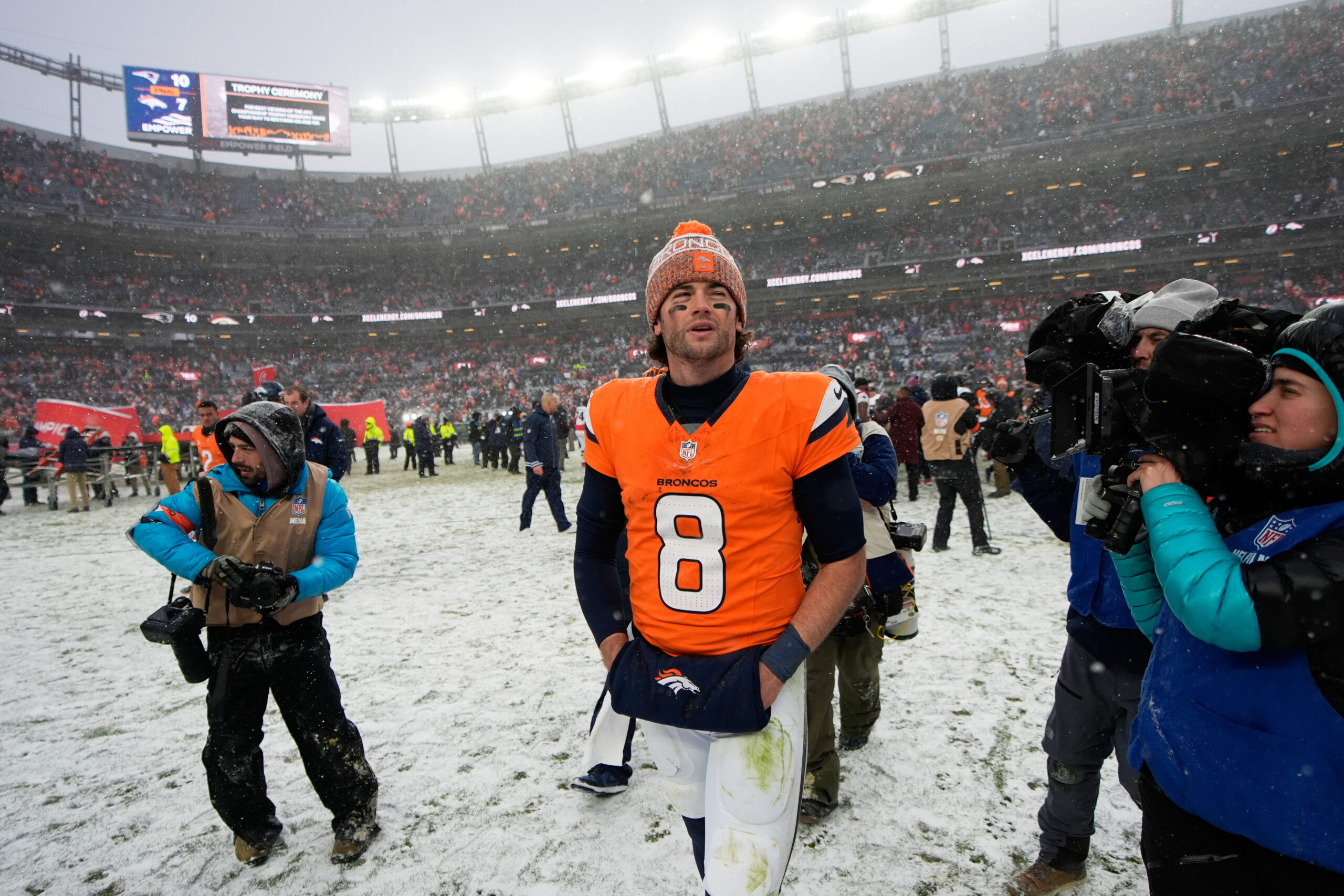
    Broncos backup quarterback Jarrett Stidham leaves the field after the team’s loss in the AFC championship against the New England Patriots.

    For all the moaning that Sunday’s Patriots-Broncos game was boring and unwatchable because of the snow at Empower Stadium, for all the silly calls for holding conference-title games in domes from now on, the weather wasn’t what made it dull. What made it dull was that Maye played as if he was trying not to lose the game (sound familiar, Eagles fans?), and Stidham wasn’t capable of winning it.

    The last time the NFL went through a stretch similar to this one was a quarter-century ago, when four consecutive Super Bowls were won by teams primarily defense-oriented: the 2000 Baltimore Ravens, the 2001 and 2003 Patriots, and the 2002 Tampa Bay Buccaneers. Consider some of the quarterbacks, too, who were reaching those Super Bowls back then: Trent Dilfer, Kerry Collins, Brad Johnson, Rich Gannon, Jake Delhomme, and a rookie named Tom Brady.

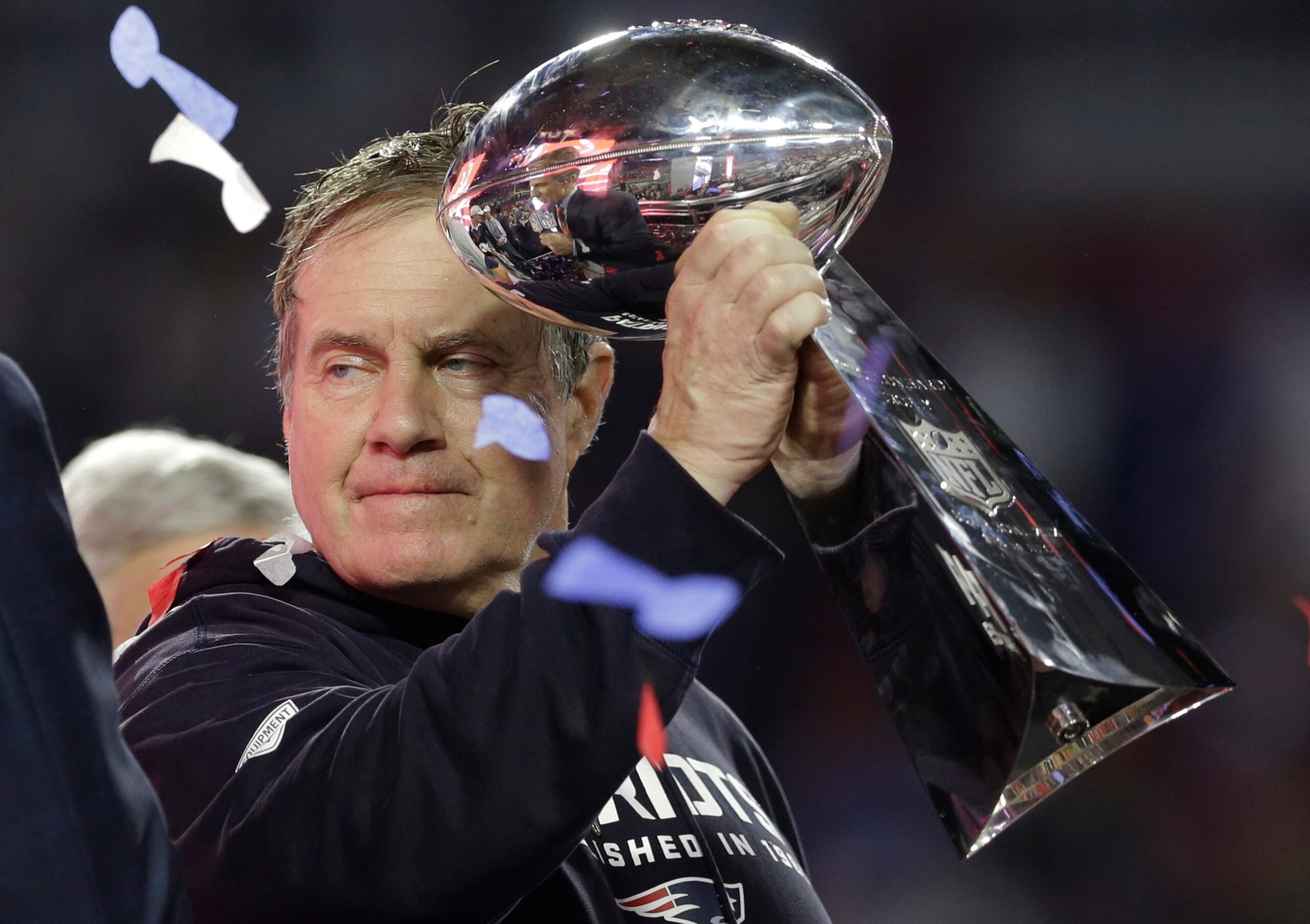
    Former Patriots coach Bill Belichick might have had Tom Brady for the Super Bowls he racked up, but he also boasted some good defenses as well.

    In the aftermath of that ’03 Patriots run — Bill Belichick’s defensive backs manhandled the Indianapolis Colts’ receivers in the AFC title game — the NFL decided to crack down on illegal contact, defensive holding, and pass interference infractions. In 2003, NFL teams averaged 200.4 passing yards. In 2004, that average jumped by more than 10 yards, to 210.5, and it kept rising for years thereafter.

    That surge has stopped. The game has slowed down, and it’s a safe bet that the NFL won’t allow it to stay this way for too much longer. The Eagles were among those applying the brakes, but the sport is poised to open up again, and they and their new man at the wheel, whoever he might be, need to be ready.

  • There’s a mystery candidate for the Eagles’ offensive coordinator job. Here’s how the interview went.

    There’s a mystery candidate for the Eagles’ offensive coordinator job. Here’s how the interview went.

    “Hey, Howie, thanks for making the time.”

    “You got it. Have a seat. How’s your day been so far?”

    “Good. Just finished up with Mr. Lurie. I’m very appreciative that you all were willing to have me in to talk.”

    “Of course!”

    “I mean, it’s not often you see an NFL FRANCHISE SEEKING OFFENSIVE COORDINATOR posting on LinkedIn. And I wasn’t even sure if that Easy Apply link actually worked!”

    “Hey, you never know where you’ll find the right candidate. We like to cast a wide net. So why don’t you tell me why you think you’re the right person to be the next offensive coordinator of the Philadelphia Eagles.”

    “Sure. Well, I think I have the experience necessary to thrive in the position.”

    “How so?”

    Mike McDaniel (left) is off the board and Brian Daboll seems unlikely, but head coach experience might still be on the Eagles’ OC checklist.

    “I mean, my resumé kind of speaks for itself. I’ve been a quarterbacks coach, a wide receivers coach, and an offensive coordinator. I’ve called plays. I’ve been part of winning organizations. I know you respect the coaches and offensive minds I’ve worked for and learned from.”

    “True. That’s absolutely true.”

    “And, to be frank, Howie, I’m open to exploring a new role that will allow me to flex my coaching muscles in a way that I haven’t in a long time.”

    “Totally get that.”

    “And the idea of taking on this particular role with the Eagles would be a challenge that I’d relish.”

    “You want to take on all the challenges and problems and obstacles that come with this job?”

    “Definitely.”

    “We have a quarterback who seems like he doesn’t want to run the ball anymore, even though running the ball was a big part of what has made him really good — even great — when he has been really good.”

    Can the Eagles’ mystery OC candidate devise a plan to get the most out of Jalen Hurts’ legs?

    “I know. I’ve been watching Jalen. I think I can help him. I think someone has to help him.”

    “He doesn’t throw the ball over the middle of the field, either.”

    “Seen it. Thought about it. Have plans to change it.”

    “What about the pressure that comes with this job? I mean, you saw what happened to the last guy, right?”

    “I did. Hey, Philadelphia is a passionate sports town. Nothing better. My kids and I already have tons of Phillies and Sixers apparel. We’re in.”

    “As I’m sure you know, we cannot guarantee you egg-free housing.”

    “I know.”

    “It’s one of the … charming consequences, I guess you’d call it … of being an Eagles coach.”

    Have the Eagles found the offensive coordinator candidate with a proper understanding of the fan base’s passions?

    “Oh, you don’t have to tell me. I’ve coached at the Linc often enough to get a sense of it. Even had some spirited conversations with some fans about it. The atmosphere around here can be intimidating, I know, and man, those folks can say some things that get your back up. But I’m at the stage of my career where I think I can handle it.”

    “All right. Well, as you know by now, I’m sure, we operate a bit differently from a lot of other teams around the league.”

    “You sure do.”

    “We view the head coach as more of a conduit between those of us at the top of the leadership pyramid and the locker room.”

    “Yep.”

    “Our head coach doesn’t call plays, for instance. That will be the new OC’s responsibility.”

    “Well aware.”

    “I mean, we’re not inherently opposed to the idea of having a head coach call the plays for the offense. But we’ve realized over the last few years that investing our coordinators with a lot of say-so over the direction of their units is the way to go. Look at Vic. Look how that’s worked out. Our goal is to find someone who fits that mold. There’s a certain … gravitas … that comes with being a coordinator here in 2026. You call the formations and plays. You oversee that side of the ball with near-unfettered discretion. In some ways, whoever we end up hiring as our new OC will have more power than our head coach.”

    “That’s one of the reasons I want the job.”

    “I can understand that. And I have to say, your resumé and experience show that you’re willing to be flexible. You definitely do what’s asked of you.”

    “I try.”

    “OK. So, Jeffrey and I will talk. We’ll ‘confab,’ as it were. Lots to get to in the meantime, of course. Draft prep. Free agency prep. Super Bowl week — San Fran! Are you going? The chowder in a bread bowl at Hog Island is a must-do. And don’t fret. When we reach our decision, we’ll let you know.”

    “I understand. Thanks so much for the time, Howie. I’ll talk to you soon, I hope.”

    “You got it, Nick.”

  • Fran Dunphy speaks for the first time about how the NCAA point-shaving scandal touched La Salle

    Fran Dunphy speaks for the first time about how the NCAA point-shaving scandal touched La Salle

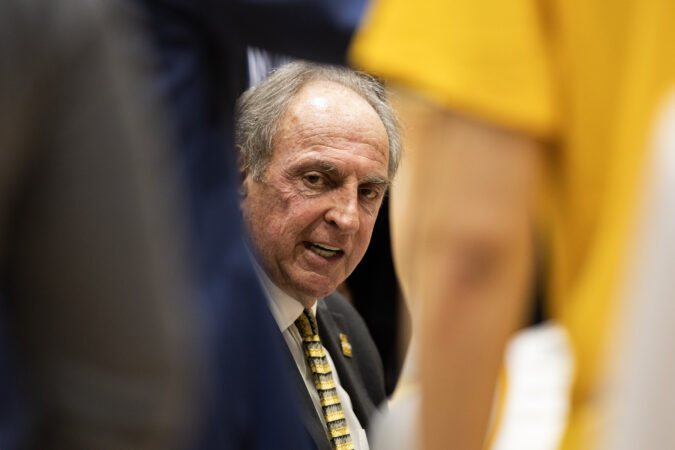
    Fran Dunphy sat at a long table inside La Salle University’s athletic center early Monday afternoon, his body turned toward a wide window on the other end of a conference room, as if the difficult discussion topic pained him and he was trying to shield himself from the hurt.

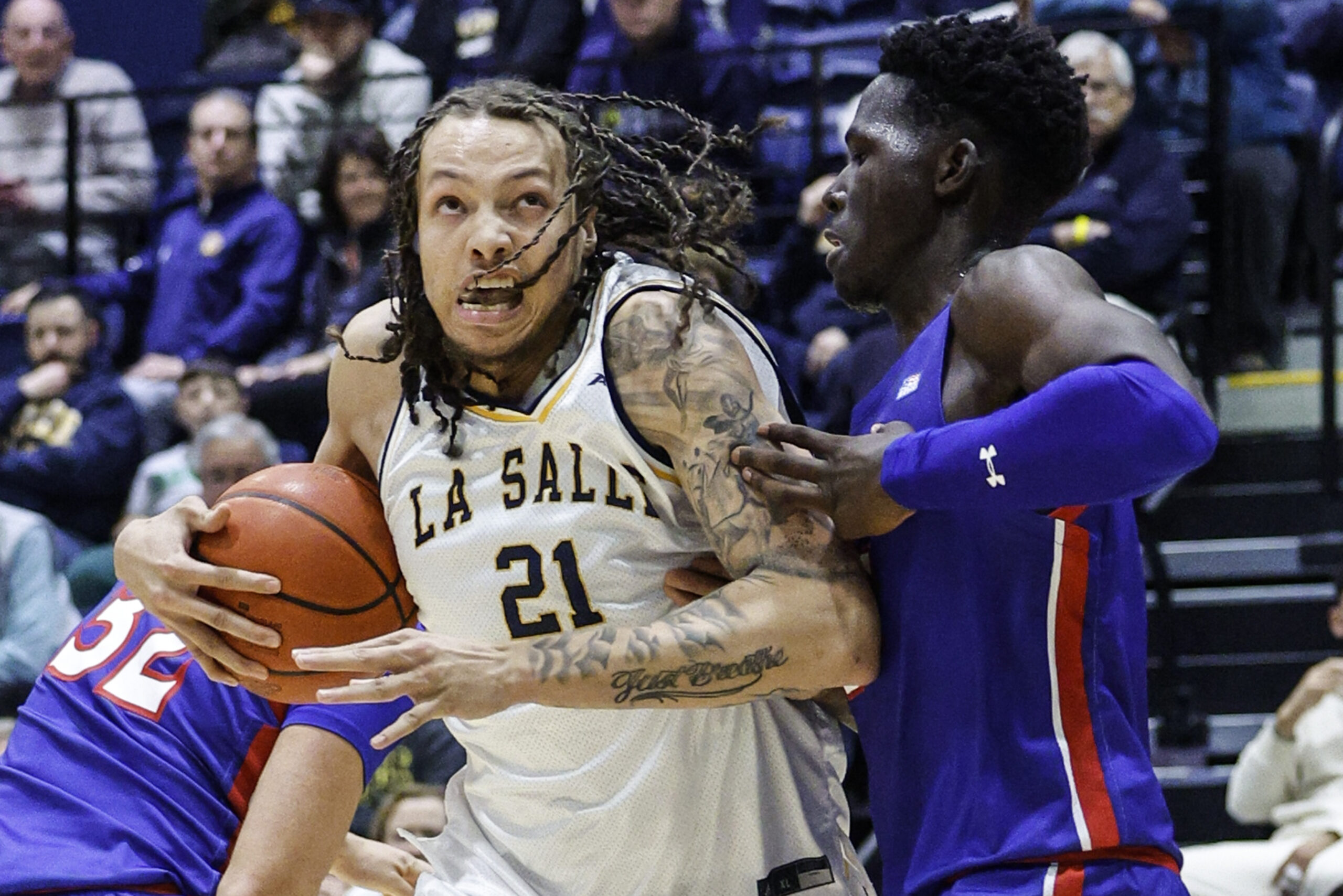
    A 70-page federal indictment had dropped Thursday accusing more than 39 college basketball players of fixing games and shaving points during the 2023-24 and 2024-25 seasons. Dunphy had read in disbelief as La Salle was mentioned more than once. One of his team’s games was the target of an alleged fix, and one of his former players, Mac Etienne, appeared in the indictment 28 times for shaving points at DePaul University in ’23-24, the season before he came to La Salle. Etienne reportedly reached a plea agreement with prosecutors on Dec. 8.

    La Salle released a statement Thursday noting that no one now connected to the university was charged and that the school would cooperate with any investigation. No one has accused the university’s administrators or coaches of any wrongdoing, and everyone who knows Dunphy knows that his integrity is beyond reproach. Still, there’s no getting around the disturbing implication of the La Salle-related details within the indictment.

    Two of the alleged fixers, Jalen Smith and Antonio Blakeney, “attempted to recruit” La Salle players to shave points in a Feb. 21, 2024, game against St. Bonaventure. The Bonnies were favored in the game’s first-half spread by 5.5 points, and the fixers “placed wagers with various sportsbooks totaling at least $247,000 on St. Bonaventure to cover” that spread. The Explorers led, 36-28, at halftime and won, 72-59.

    “We did our job that day,” Dunphy, who retired from coaching after last season, said in his first public comments since the indictment’s release. “I felt good about that — that there was nothing there, that we had won the game. I truly liked coaching those guys on that team. That was a good win for us.”

    But the fact that the bets failed and the fixers lost doesn’t answer an unsettling question: Why would the defendants have wagered nearly a quarter of a million dollars on a middling Atlantic 10 game if they didn’t already have reason to believe they’d win the bet — if they didn’t think they had someone inside working to help them?

    “I couldn’t tell you,” Dunphy said. “Again, I didn’t go down that path even a little bit. I just thought about my team, the fact that we had played fairly well that day, and I was just surprised and disappointed that anybody even thought we were involved in any of that. That was my disappointment.”

    Has he been thinking about that team, that season, and asking himself if such a scenario — one or more of his players shaving points — was possible?

    “Well, we were about a .500 team,” he said. “It wasn’t like we were superstars. But we had a good group of guys who wanted to work their ass off. That’s how I looked at it. Did I go back to the guys who played a lot of minutes? Yeah. That wasn’t their M.O. That would have been really surprising to me if any of those guys thought that [shaving points] would be something beneficial to them or anybody. …

    “Just surprise, disappointment, a bit shocking. Just, how did this happen? Where do we go with it?”

    Mac Etienne (21), who began his career at UCLA before transferring to DePaul and then to La Salle, reached a plea agreement with prosecutors on Dec. 8.

    As of Monday afternoon, he had neither rewatched the St. Bonaventure game nor reviewed the box score for anything curious or alarming. He hadn’t thought about the incident in those terms, he said, and perhaps he could not bring himself to think about it that way. How many times had he watched one of his players make a silly, stupid mistake during a game, and how many times had he yelled, What the hell are you doing? “I didn’t think twice about it,” he said. Was he supposed to have considered that a player screwing up like that was doing it on purpose, that the kid was on the take?

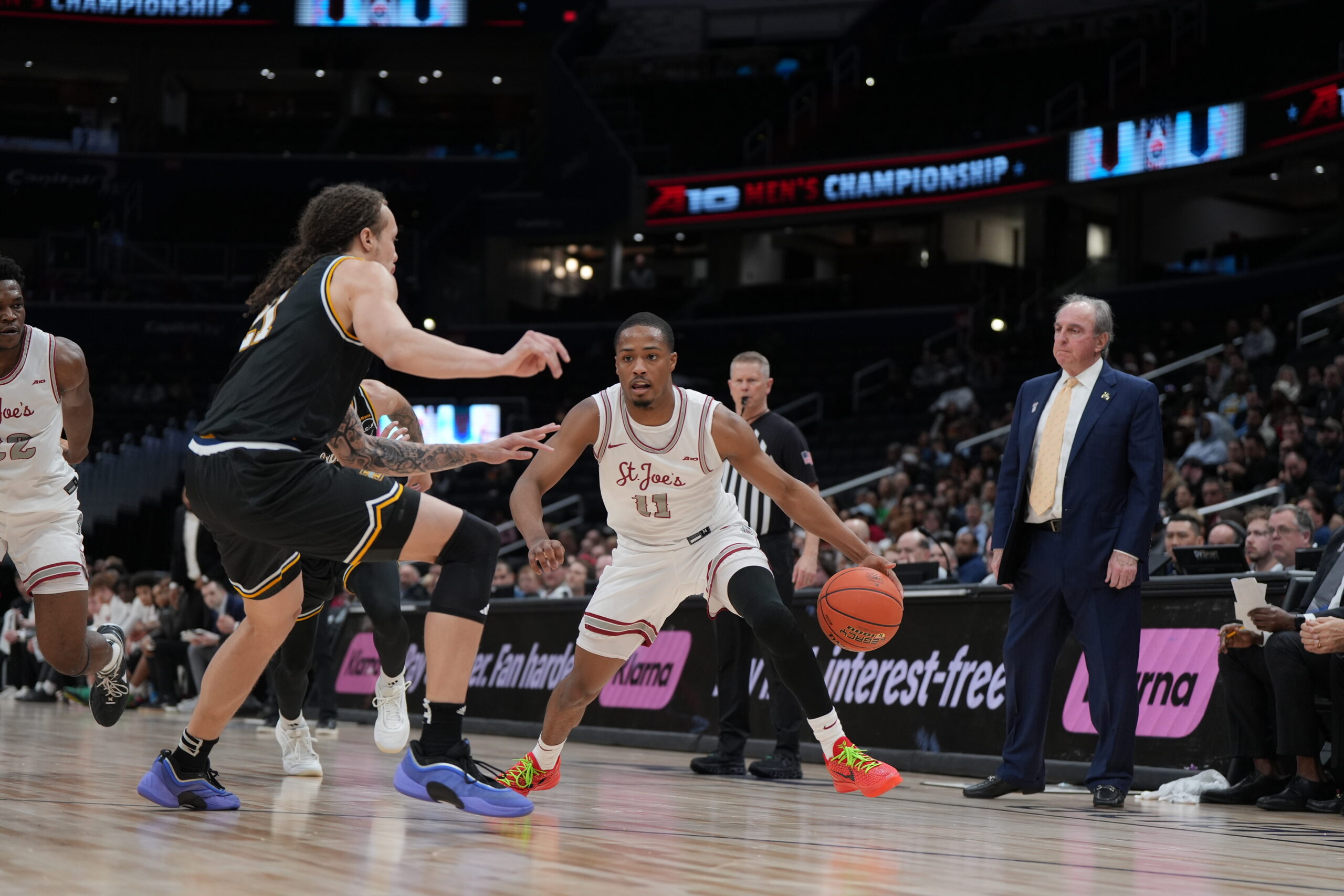
    Hell, in the Explorers’ 81-74 victory last March over St. Joseph’s, in the final win of Dunphy’s career in his final home game, Etienne had scored 13 points and grabbed 11 rebounds in 36 minutes. “Just a phenomenal game for us, and he was very much a part of it,” Dunphy said. “He was a very interesting guy to coach. Talented. A worker. And he seemed to care very much about his teammates. … He never complained about minutes or any of that.” But now Dunphy was remembering Etienne’s recruitment, the coaxing it took to get him to transfer from DePaul to La Salle, with the hindsight that Etienne had thrown games before he ever showed up and settled in at 20th and Olney. Now Dunphy was searching for signs and tells in retrospect.

    “You’re running through every guy who’s hitting the portal,” he said. “‘What do we need? This guy, does anybody know him?’ Some of the staff members knew him, knew about him.

    “Years ago, the portal wasn’t like it is. You’d recruit a kid in his sophomore, his junior year. You’d get to him. You’d get to know the parents, get to know his coaches. The coaches tell you what the kid is like, some of the idiosyncrasies. We don’t study that much anymore. There’s not as much vetting in today’s world. But that’s the way it is. It’s a challenge, and you try to meet that challenge.”

    Fran Dunphy (right) described Mac Etienne (defending St. Joseph’s guard Xzayvier Brown on March 13) as “a worker” in the time he coached him.

    College basketball has had plenty of point-shaving scandals throughout its past, of course; one of the biggest, in 1961, involved St. Joe’s. But it’s so easy now for gamblers to contact players and for anyone to place a bet — just a few taps and swipes on a smartphone — that even if law enforcement authorities keep catching the fixers, the credibility of college basketball and sports overall still will be in peril. The more arrests, the less the public will trust what it sees on the field and the court. The corruption can appear total and endless, yet so many stay strangely silent about it.

    Look around. Listen. Who are the giants of college basketball, the big-name coaches, who are speaking out about this scandal, who are sounding bells and alarms about the sanctity of their sport? “Nobody ever talked about this among my fellow coaches. Nobody,” Dunphy said. “It’s just not something that you talk about because you don’t believe it’s happening. You hear these stories that tell you it is, but you just say to yourself, ‘I don’t know how this could happen.’”

    The rot may have spread to his program, and Fran Dunphy doesn’t have to be the loudest voice calling for everyone to open their eyes, including his own. He just had to do what he did Monday. He just had to be one of the first.

  • Nick Sirianni may have figured out how to last as the Eagles’ head coach. Here’s his secret.

    Nick Sirianni may have figured out how to last as the Eagles’ head coach. Here’s his secret.

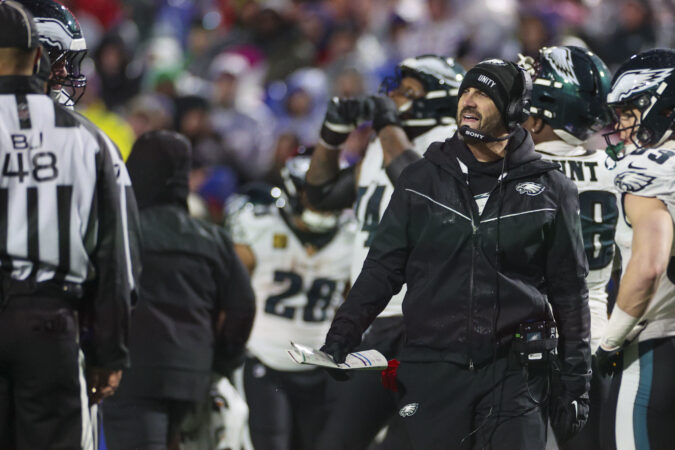
    Nick Sirianni is the son of a high school football coach and a mentee of a Division III football coach. Everyone knows this about him.

    When he speaks publicly, he frequently sprinkles in references to his father, Fran, and his nine years in charge of the program at Southwest Central High School in western New York. He talks of lessons learned from his years as a player and assistant under Larry Kehres at the University of Mount Union (it was Mount Union College when Sirianni was there) in northeast Ohio.

    If one of Sirianni’s greatest weaknesses as an NFL head coach is that he’s often too impulsive and emotional, maybe it’s because there’s a fine line between small town and small-time, and he can’t help himself from crossing it. Still, he ain’t changin’ now, and in an honest appraisal of Sirianni’s five years with the Eagles, one can make the case that his background might be one of his greatest strengths.

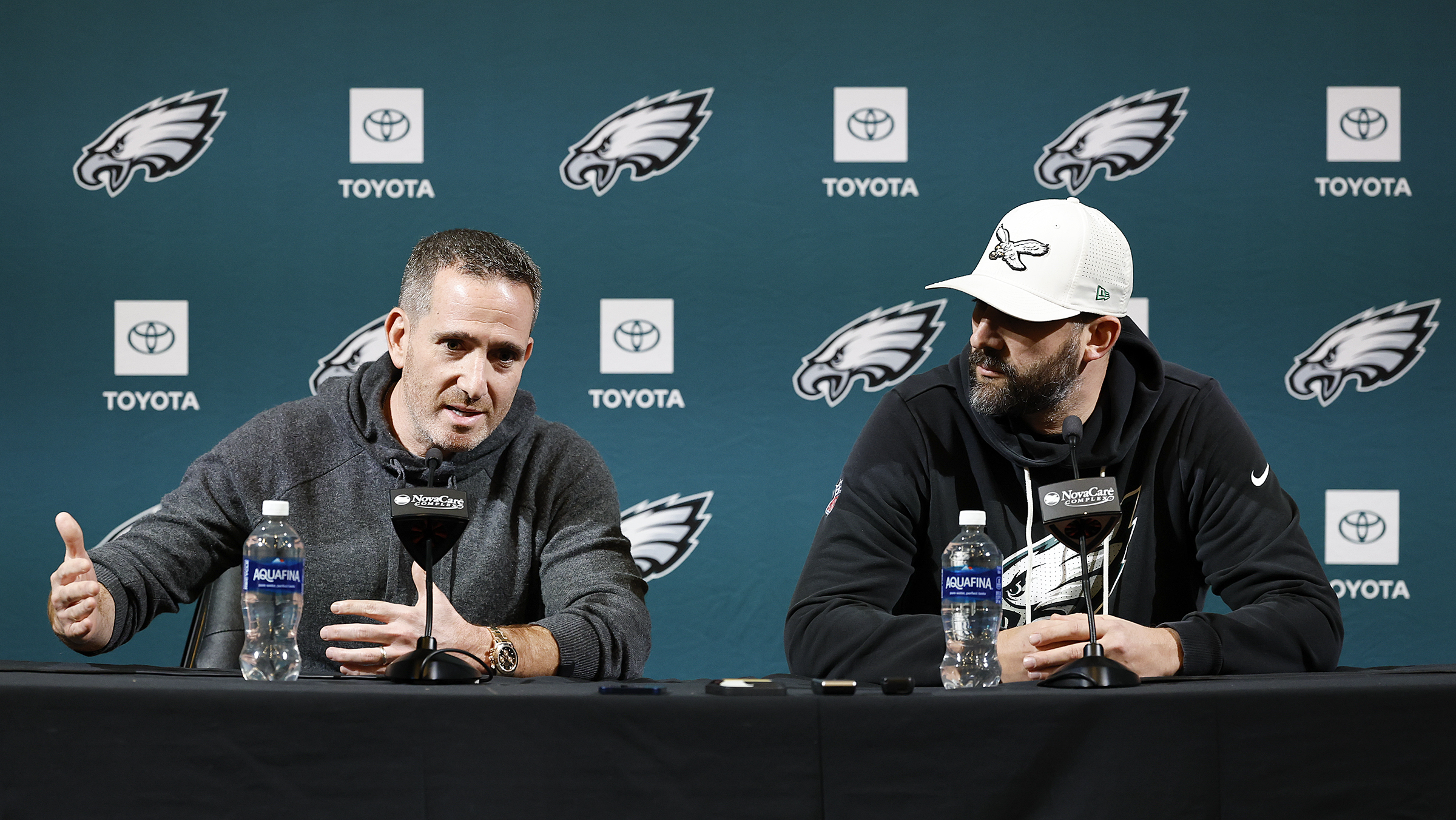
    Eagles executive vice president and general manager Howie Roseman (left) says the Eagles are fortunate to have an “elite” coach in Nick Sirianni.

    If nothing else, it might be one of the reasons that he’s still in this position and, if Howie Roseman was to be believed Thursday, will be for more than a minute.

    “Obviously,” Roseman said, “I sit here, and I feel incredibly grateful that I’m working with someone who … is elite at being a head coach, elite at building connections with our team, elite talking about fundamentals, game management, situational awareness, bringing the team together, holding people accountable. When you’re looking for a head coach, those are really the job descriptions.”

    They’re not much different from the job descriptions of a head coach at any level of football, and for all the suggestions that Sirianni is nothing but an empty hoodie, those qualities still matter at the sport’s highest level.

    What’s more — and this is the important part as far as Sirianni’s future is concerned — they allow him to be flexible, to contour himself both to what the team needs in a given season … and what he needs to do to survive.

    Think about Sirianni for a moment in contrast to his predecessor, Doug Pederson. It’s no secret that Roseman and Eagles chairman Jeffrey Lurie want a head coach who aligns with their thinking on how to win games. Boiled down, a head coach here doesn’t have much independence or power relative to others around the NFL. (The last time Lurie gave a coach such freedom, Chip Kelly started making holiday party-related demands, and Pat Shurmur ended up coaching the 2015 season finale.)

    Pederson had been hired as an offensive guy, and he accepted that label and that arrangement right up until he and his team won Super Bowl LII in February 2018. Six months later, his memoir hit stores. At the end of the 2019 season, he asserted in a news conference that embattled assistants Mike Groh and Carson Walch would return — only to have Lurie say, Not so fast, Dougie.

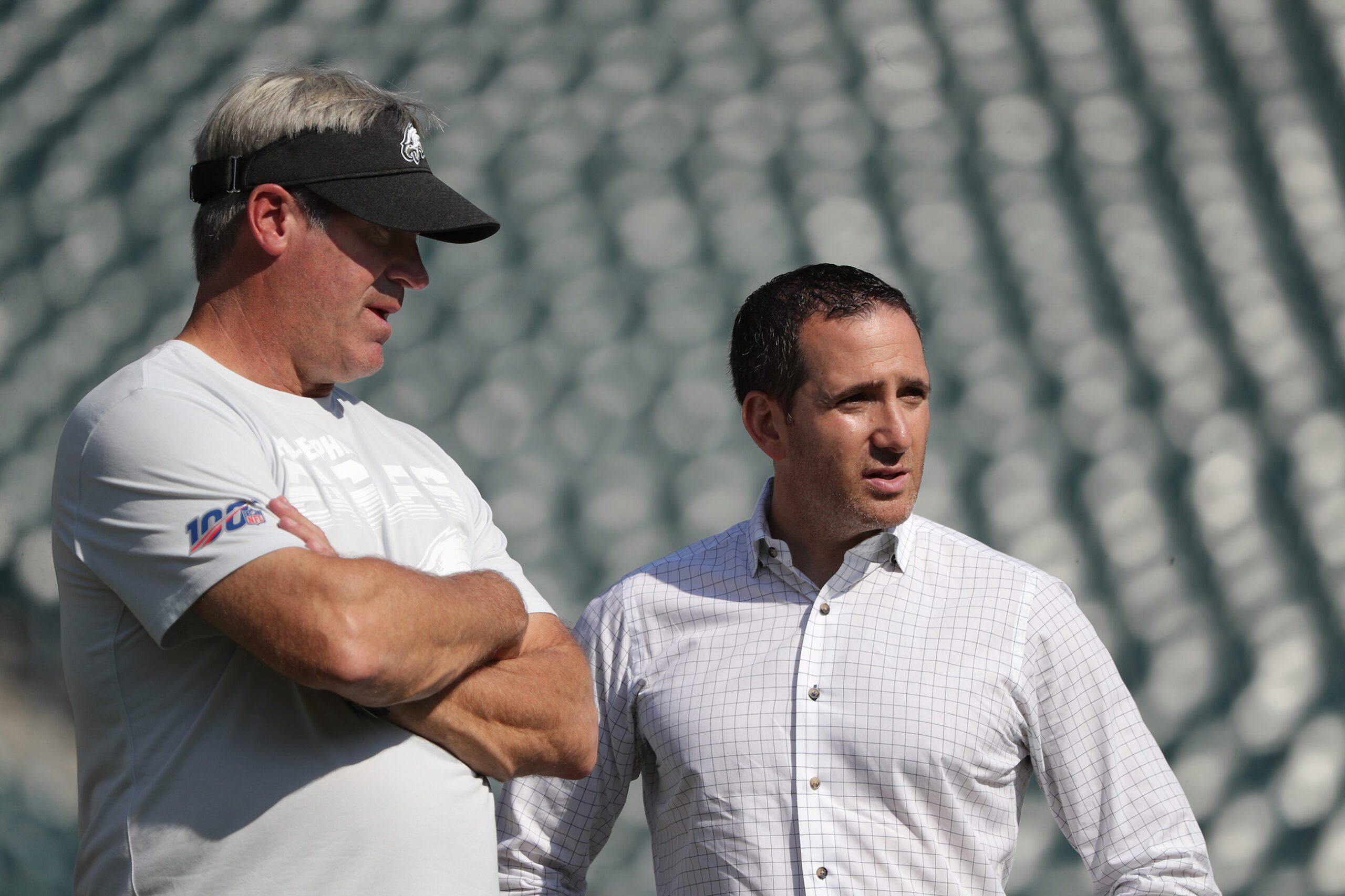
    The Eagles relationship with former coach Doug Pederson (left) shares contrasts to Nick Sirianni’s time as head coach.

    One day after Pederson endorsed them, Groh and Walch were gone. A year later, after a 4-11-1 season, so was Pederson. So much for assertiveness, and so much for the notion that Pederson’s status as the orchestrator and often the lead play-caller for the Eagles’ offense would preserve his job. Once Carson Wentz and the offense collapsed, what reason was there to keep Pederson?

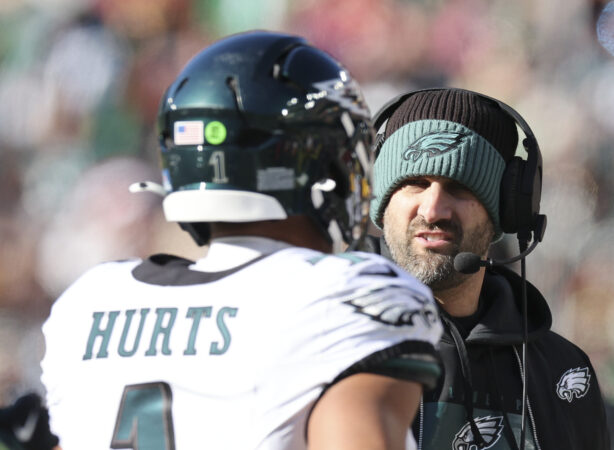
    Because Sirianni’s personality is more tempestuous than Pederson’s, it was always fair to wonder whether, if he ever found himself in the same post-championship situation, he might try to flex a little bit, too. But he did the opposite Thursday, explaining why his close friend Kevin Patullo was no longer the offensive coordinator, suggesting that he would be open to having the new OC have the kind of say-so over the unit that Vic Fangio has over the defense.

    “You’re looking to continue to evolve as an offense,” he said, “and I’m looking to bring in the guy [who is] going to best help us do that. I think that there are many different ways to be successful on offense, and everybody has different styles. Everybody has different players. And there’s many different ways to be successful.”

    The cynical way to look at this, of course, is that A) Sirianni is acting out of self-preservation; and B) his presence acts as a Kevlar vest for Roseman, protecting him from any public-relations damage if he messes up the assembling of the Eagles’ roster. As great a general manager as Roseman has been, he still makes mistakes. And on those rare occasions when he makes more than his share, the perception that Sirianni is handed an outstanding team every year and that all he can do is screw it up sure takes a lot of heat off the guy who is calling the player-personnel shots.

    There’s another prism through which to view Sirianni, though: that he doesn’t have to control every aspect of a team, or even one specific aspect of a team, to do his job and do it well. He doesn’t need to pick the players, design the offense, call the plays.

    He’ll delegate responsibility, trust his people, fill in the gaps where he can and should. He’ll take the guys who happen to be on his team that particular year and play that particular hand. Sounds like what a high school or small-college coach does. Sounds like a formula to last a while with this particular franchise.

  • From Lane Johnson’s worth to a fan base’s anger, here’s what we learned about the 2025 Eagles

    From Lane Johnson’s worth to a fan base’s anger, here’s what we learned about the 2025 Eagles

    In the final scene of Burn After Reading, the Coen brothers’ brilliant comedy about government espionage and … divorce, a CIA administrator, played by J.K. Simmons, listens as a subordinate named Palmer lays out a wild sequence of events. To sum it up: Tilda Swinton is married to John Malkovich but has been having an affair with George Clooney, who himself is married but has been dating Frances McDormand, who is friends with both Brad Pitt, who gets shot in the face by Clooney, and Richard Jenkins, who is in love with McDormand but gets hacked to death with an ax by Malkovich, who is left in a coma after getting shot by a CIA agent. At the end of the story, a dumbfounded Simmons finally rolls his eyes and asks, “What did we learn, Palmer?”

    I don’t know about you, but that scene makes me think of the 2025 Eagles.

    So, what did we learn from this season? Here’s what:

    The offensive line has been the key to the Eagles’ success for years. This year, they lost that key.

    The debates around Jalen Hurts, Nick Sirianni, Kevin Patullo, and A.J. Brown — and around what Jalen Hurts, Nick Sirianni, Kevin Patullo, and A.J. Brown might have said to one another on the sideline during the Eagles’ loss Sunday night to the San Francisco 49ers — are all, to a large degree, academic. If the team’s offensive line had played at the level that it did in 2024, or anywhere close to that level, the entire scope of the season, let alone Sunday’s result, would have been different. One statistic clarifies how great the falloff was: Last season, Saquon Barkley averaged 3.8 yards before contact. This season, he averaged 1.4, according to TruMedia.

    Eagles linemen (from left) Tyler Steen, Cam Jurgens, and Landon Dickerson had their ups and downs this season.

    There are obvious explanations for the line’s regression: injuries, general wear and tear, replacing a road-grading guard in Mekhi Becton with a lesser run-blocker in Tyler Steen. Demoting Patullo, as the Eagles did Tuesday, was the predictable and correct move. Still, there’s no getting around the reality that one of the reasons few people complained about Kellen Moore’s play-calling in 2024 is that the 2024 OL could create holes and lanes for Barkley anytime, anywhere. Patullo did not have that luxury, and it’s unlikely the next conductor of the Eagles offense will, either, because …

    … Lane Johnson has been the franchise’s most important player for a long time, and his future is murky. He turns 36 in May. He didn’t play after mid-November because of a Lisfranc sprain in his right foot. He is a surefire Hall of Famer. Since the Eagles drafted him in 2013, their record with him is 110-57-1, and their record without him is 18-27. The end of a great career is approaching, perhaps not next season but certainly sometime soon, and the franchise has to start making plans to replace him or to mitigate the effect of his absence. One way would be to draft some promising offensive linemen. Another would be …

    … for the Eagles to set themselves up as a defense-first team. That’s where their best young players are, and there are such players at every tier of the unit: Jalen Carter, Jordan Davis, and Moro Ojomo at tackle; Jalyx Hunt and Jihaad Campbell on the edge; Zack Baun and Nakobe Dean (if they can keep him) at linebacker; Quinyon Mitchell and Cooper DeJean in the secondary. Plus, well, Vic Fangio. And the Eagles are going to need that defense to be elite, or as close as possible, because …

    … the questions about Jalen Hurts aren’t going away. The biggest of them, ahead of the 2025 season, was whether the Eagles could rely on him more than they once did. In ’24, their running game was so dominant that they could get away with throwing the ball less often than any other team in the NFL and still win the Super Bowl. This season — without Barkley ripping off 6 yards every carry, with Hurts himself running less frequently and without the same explosiveness he had in the past — the offense sputtered and stalled. Given that Hurts will turn 28 in August and has absorbed his share of punishment over his five years as the Eagles’ starter, it’s fair to wonder whether that dynamism with his legs is gone forever.

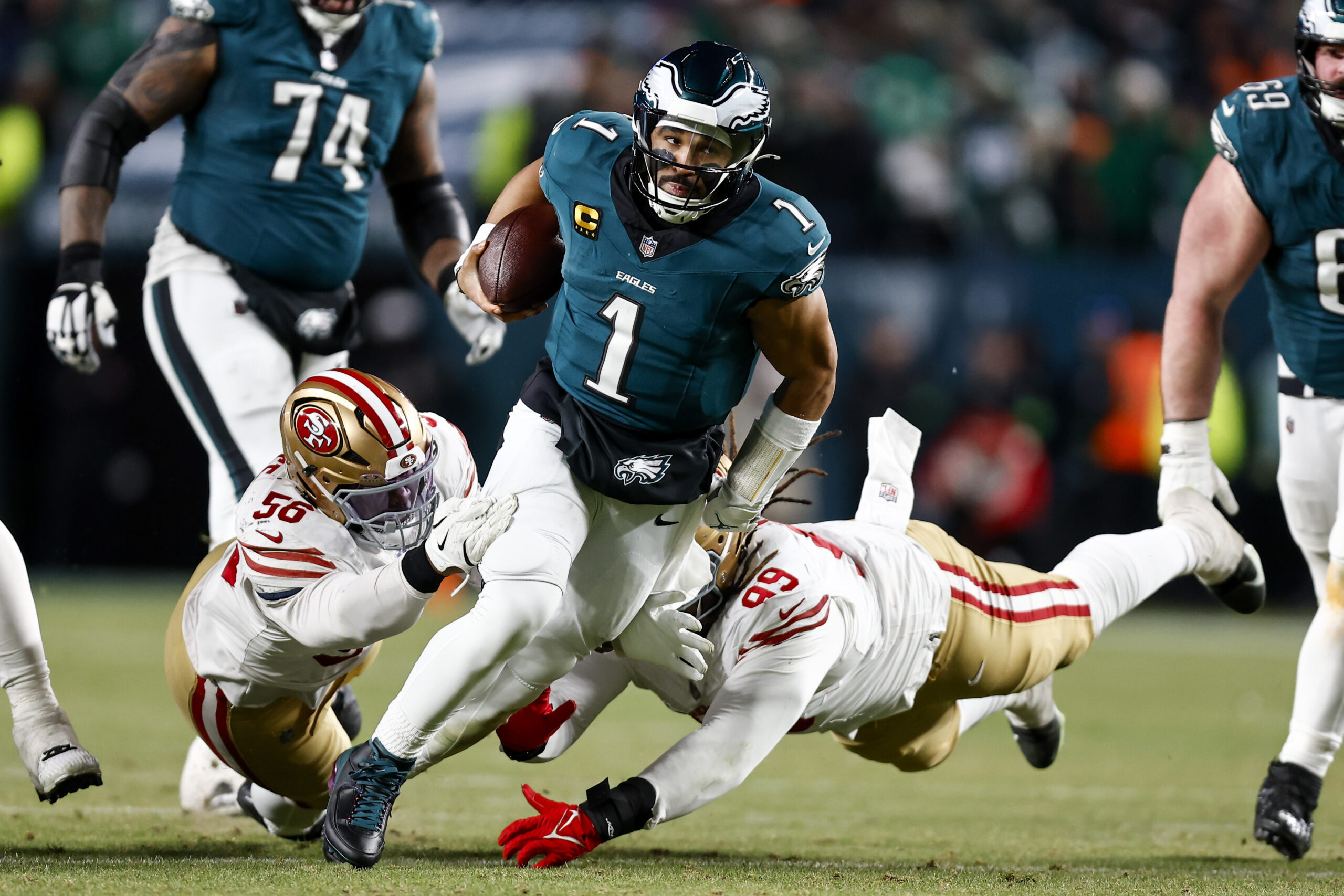
    Jalen Hurts is tackled by San Francisco’s Keion White and C.J. West during the fourth quarter of the playoff loss on Sunday.

    It’s not that the Eagles can’t win a championship with Hurts. Of course they can. They did. It’s that they have to ask themselves, What conditions do we have to create to ensure that Hurts will be at his best, and can we create them? The Eagles and everyone around them have to set their expectations for Hurts and the entire franchise accordingly, for these last five-plus months proved that …

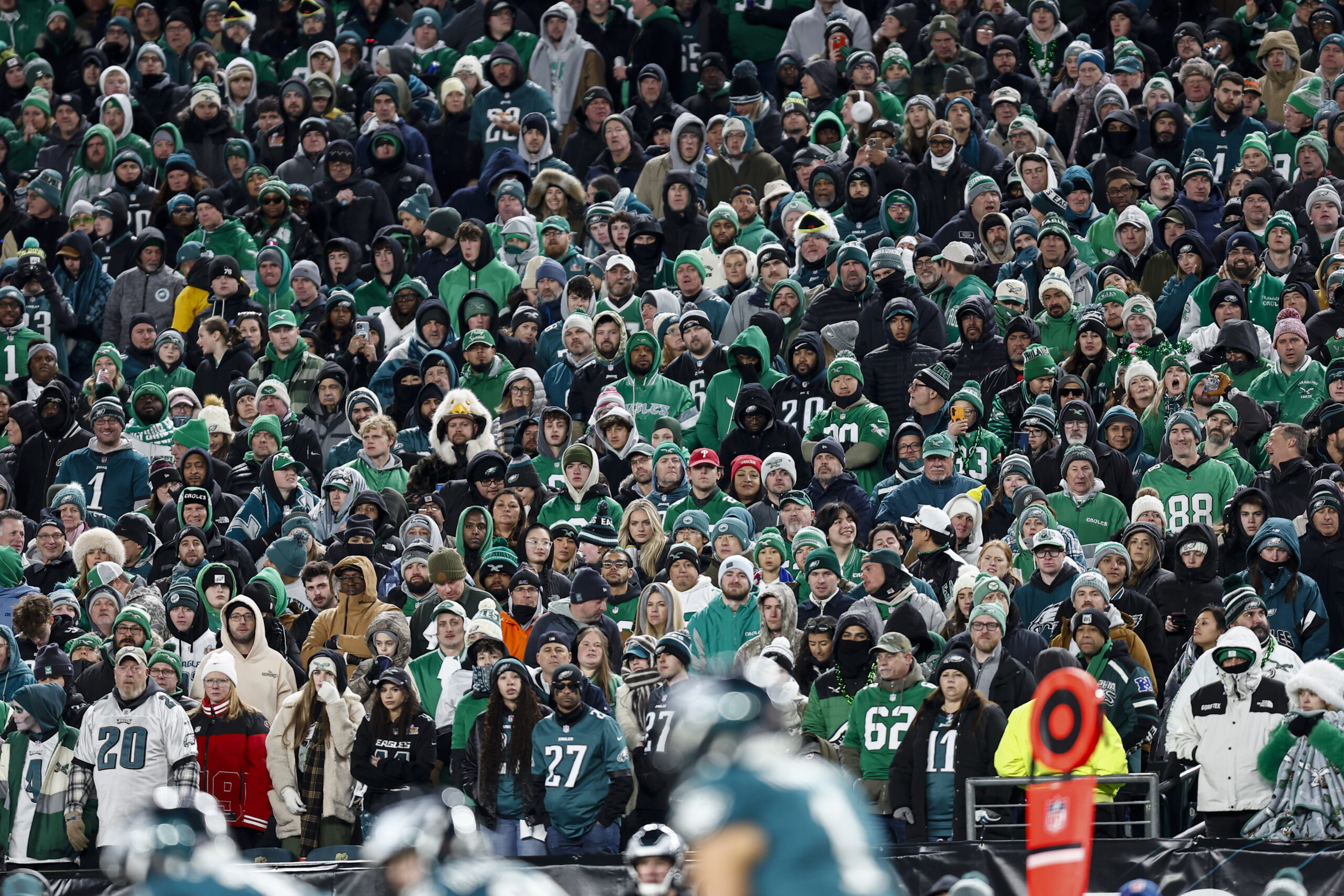
    … Philly fans are at their worst when their teams don’t meet expectations. Based on the collective outrage since Sunday’s game, you’d never know that the Eagles won a Super Bowl less than a year ago and haven’t had a losing season in five years.

    Eagles fans react during the wild-card playoff loss to San Francisco.

    There seems to be a repulsive sense of entitlement and hair-trigger anger growing within the fan base, symbolized by a Bucks County indoor golf course whose owners allowed customers to drive balls at a projection of Patullo’s face. Patullo already had someone chuck eggs at his house in November, and if that incident could be dismissed as dumb kids doing dumb things, this one had a calculated maliciousness to it, especially considering the way it spread over social media.

    You want to be a jerk in the privacy of your own home? Go for it. But a business or anyone else doing something like this for the likes and the attention is lousy, and it has the potential to snowball into something worse. It doesn’t matter how bad a play-caller Patullo was or wasn’t. Cut out the juvenile crap. The Eagles lost. Grow up and get over it.