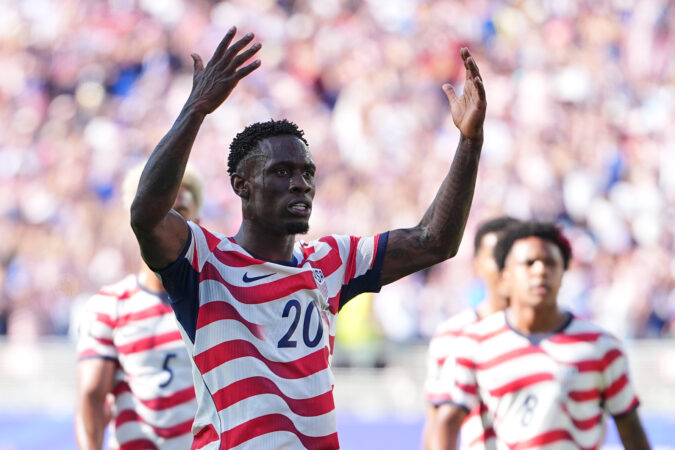
SEATTLE — Folarin Balogun still isn’t happy about the red card he was given in Wednesday’s U.S. World Cup win, but he isn’t lingering on it.
“I feel calm right now, I feel OK,” the striker said at Friday’s practice, his first time speaking with the media since the ejection. “We’re going to go out to practice, and always, being on the practice fields just helps me to take my mind off things. So, yeah, for me, you know, it’s another day.”
FIFA’s rules don’t allow appeals of red cards, and the nature of the incident meant an appeal very likely would not have won despite Balogun’s lack of intent. At least there won’t be any additional suspension, which U.S. Soccer and FIFA confirmed Friday.
“If you played the game, you would understand, there’s scenarios that you simply can’t avoid, and it has to be taken into context when it’s being reviewed,” Balogun said. “I felt it wasn’t on this occasion. I think, as you all saw, there’s nowhere else to put your leg — it’s going to be unavoidable.”
He acknowledged the wide range of opinions out there, and concluded that “a yellow card would have been fair. It’s something that’s happened, so we have to move forward, and I have to accept it, but the most important thing is just to focus on the bigger picture, which is Belgium.”
Balogun also admitted he had “a roller coaster” of emotions in the wake of the incident, but he returned to the goal of staying calm in a heated moment.
“I’ve been upset, I’ve been happy — it’s been surreal, to be honest,” he said of a game where he also scored the opening goal. “But for me, I think it was just important to stay calm. I never want to react out of anger and out of emotion. There’s still lots of people we’re inspiring, little kids, boys and girls who are watching, and we have to show them the correct way to handle things, even when you think it’s unjust.”
After the final whistle Wednesday, Balogun returned to the field to shake hands with Brazilian referee Raphael Claus. That was a nice gesture of sportsmanship, and one Balogun said he tries to make after every game he plays.
Flo Balogun on the field with his USMNT teammates after the match and shook the hands of all referees. Didn’t linger or seem to protest.
“Even though you can feel like something unjust has happened to you, it’s not an excuse to be disrespectful, or to not do the right thing,” he said. “The most important thing for me is to give the correct example to people watching. I’m aware that the World Cup might be the first time a lot of American viewers are tuning in, so it’s important just to show people, whether things happen to you good or bad, just to continue to be yourself.”
For now, he will be the team’s biggest fan, hoping that Ricardo Pepi or Haji Wright can step in and help the Americans topple Belgium in Monday’s round of 16 contest — the biggest game in U.S. men’s soccer history (8 p.m., Fox29, Telemundo 62).
“Just to support the boys, support the team,” Balogun said. “I love seeing how engaged the country is in our journey, and what we’re doing. So I think my role is just to continue to support everybody, to keep morale high.”
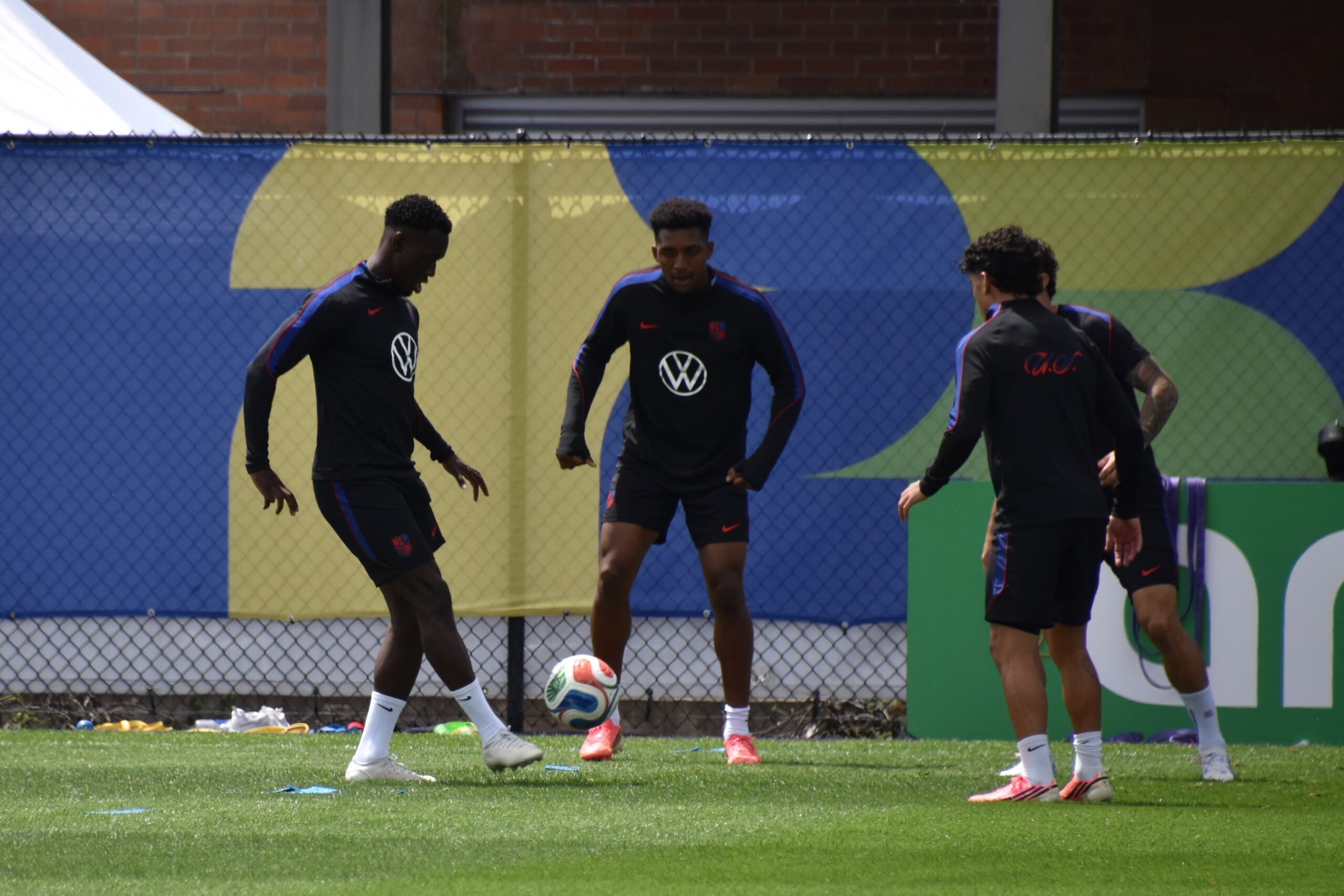
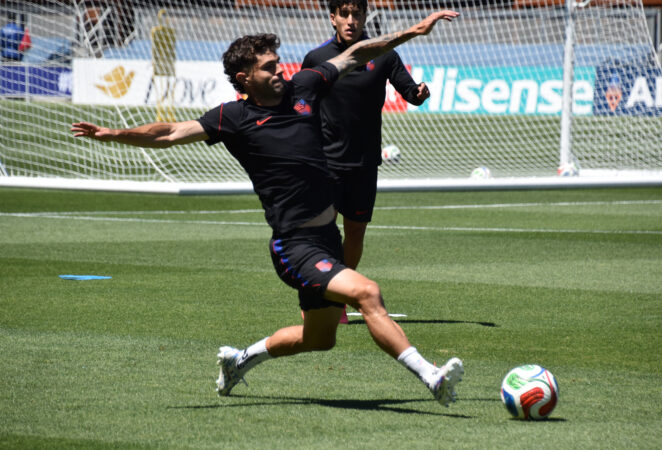
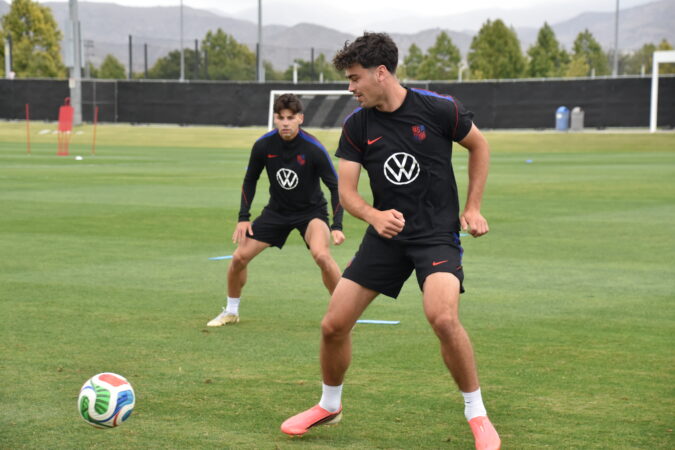
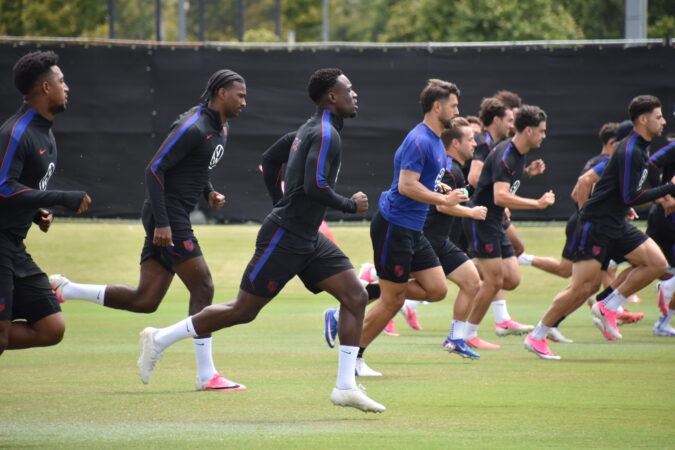
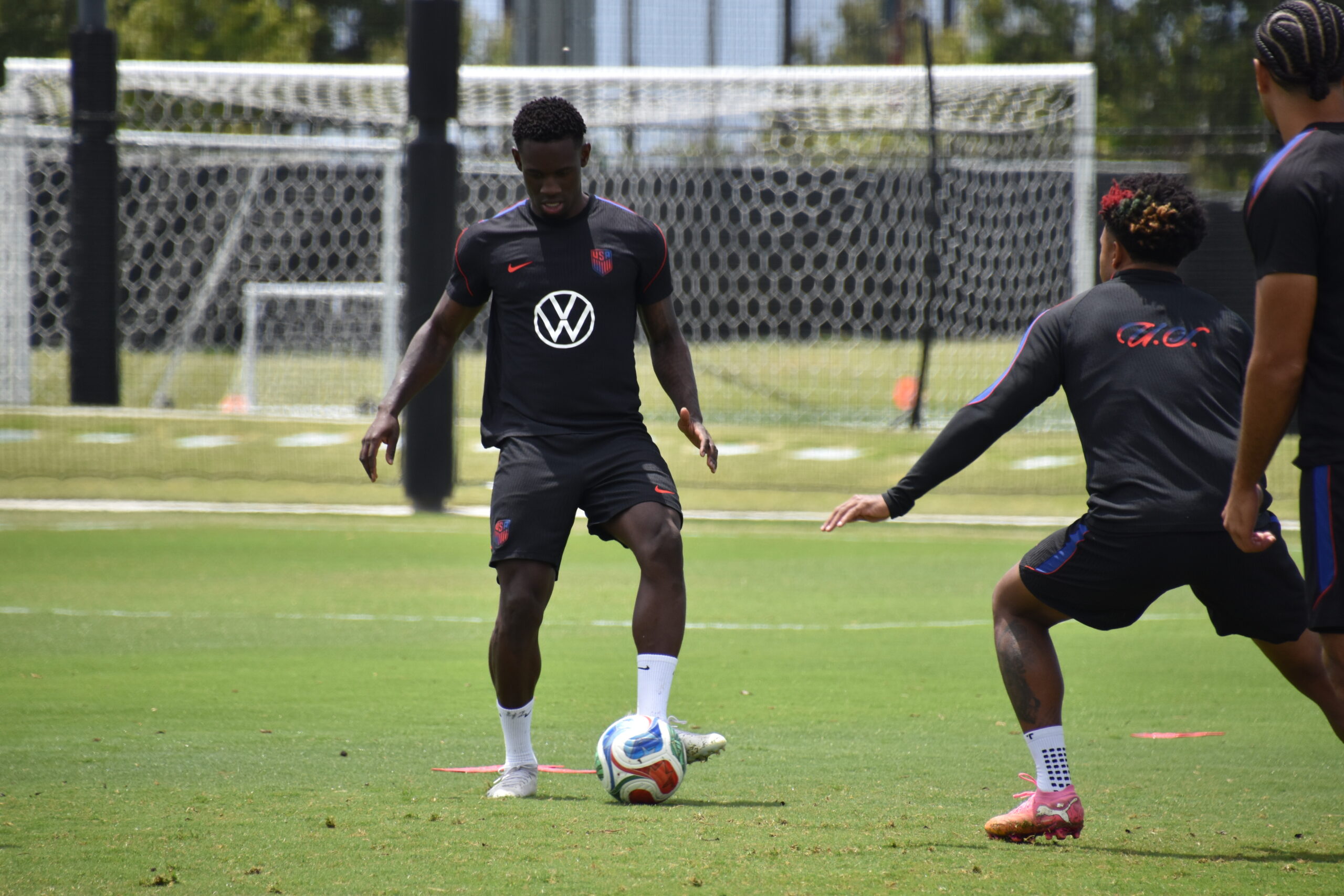
Folarin Balogun (left) working out at Friday’s U.S. practice.
A baseball diversion
The U.S. team was to be honored at Friday night’s Seattle Mariners game, with manager Mauricio Pochettino throwing out the first pitch.
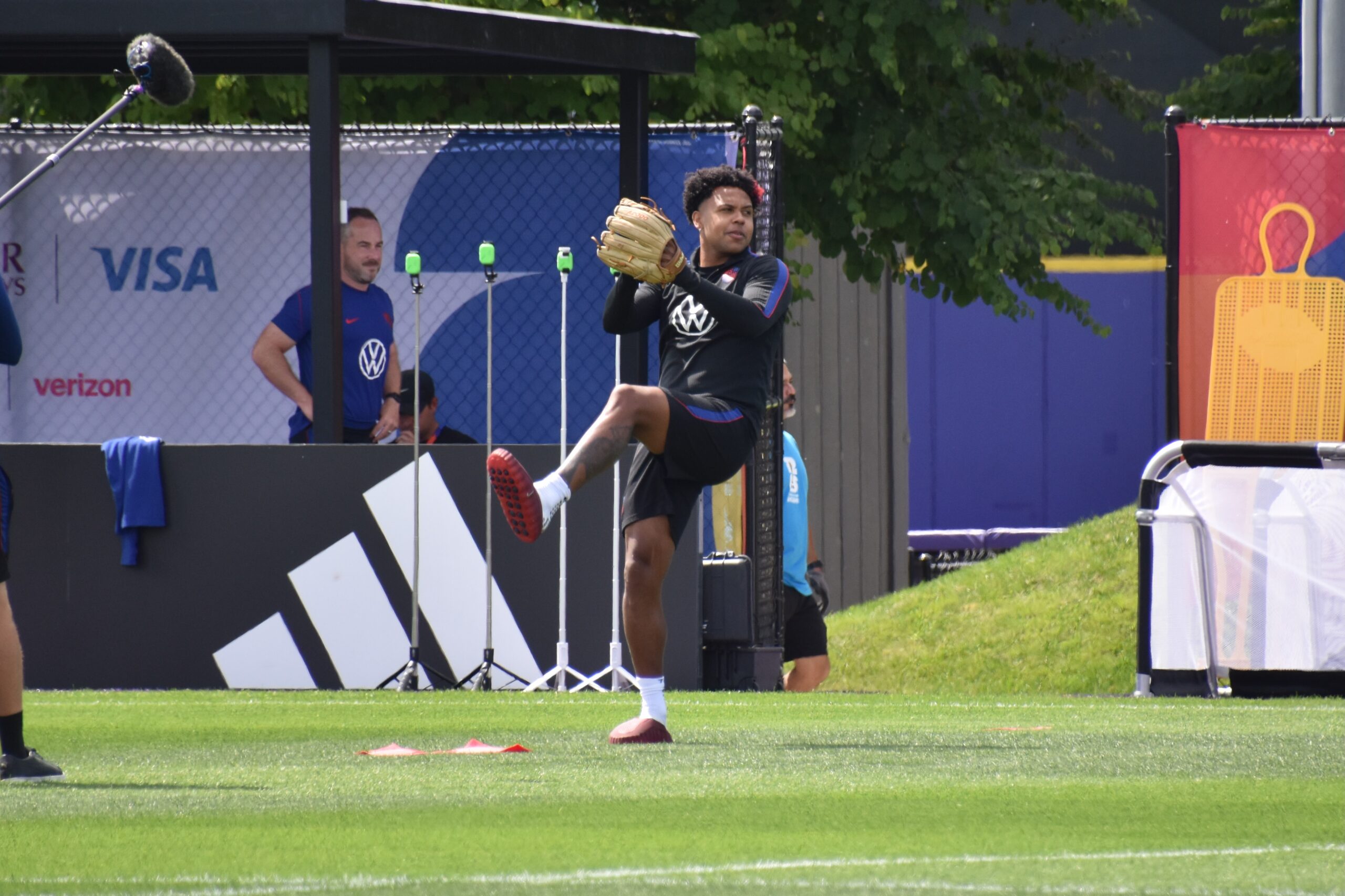
With that in mind, one of the first warmup exercises at U.S. practice was a round of long toss among some of the players. Tim Ream, Matt Turner, Weston McKennie, and Alejandro Zendejas passed around balls and gloves provided by the University of Washington’s baseball program, whose stadium is next door to the soccer field where the Americans trained.
Texas natives McKennie and Zendejas hammed it up a bit for the cameras, the former doing his best Nolan Ryan impression with windups and throws to the latter. Zendejas tried his luck at a catcher-style crouch for a while, then thought better of it and took the rest on one knee.
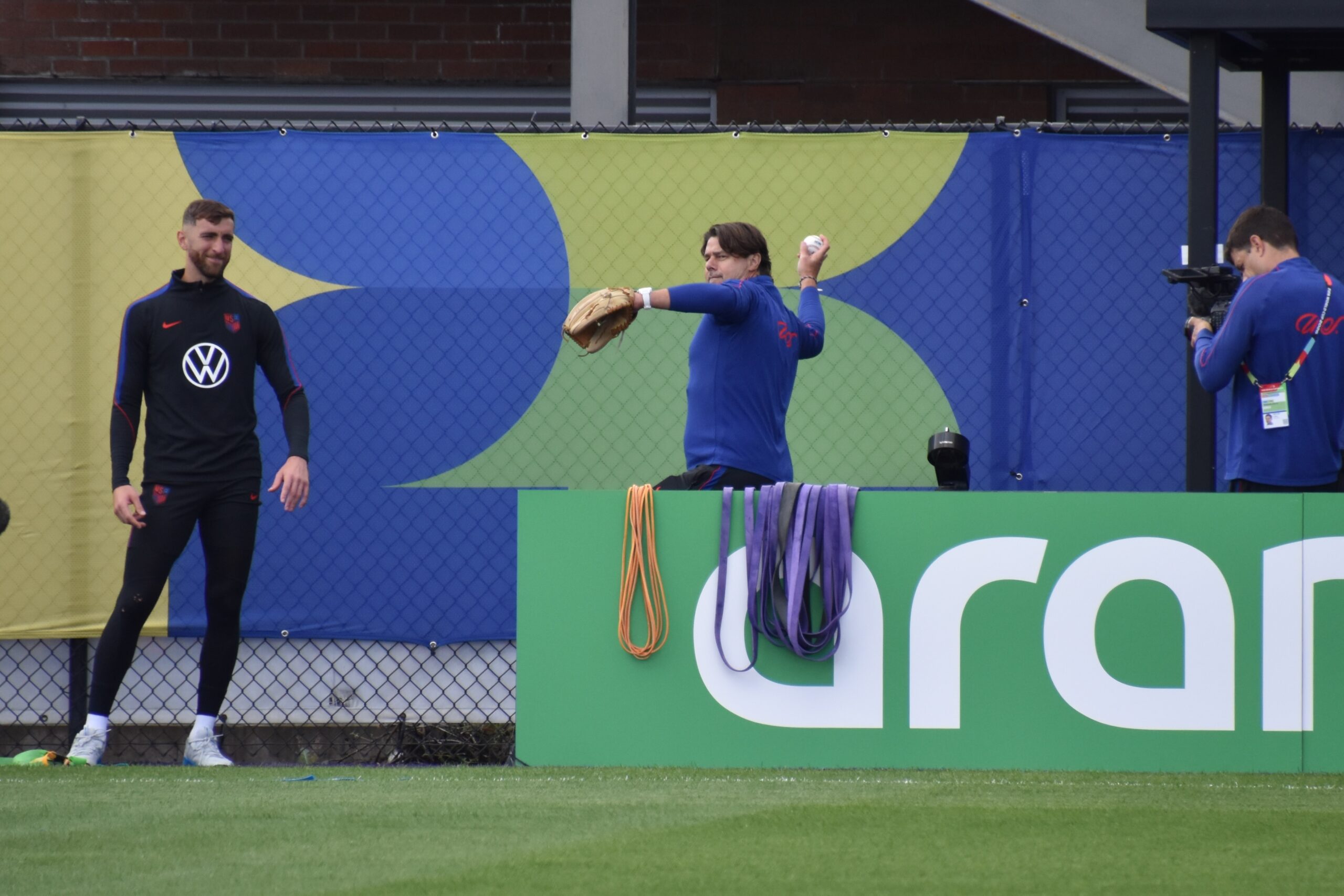
Pochettino also got some practice in Friday morning, with Turner offering some tips on technique.
Mauricio Pochettino (center) practices throwing a baseball during the United States men’s national soccer team’s practice at the University of Washington.
Balogun was born in New York but grew up in London, so he likely knows more about cricket than America’s bat-and-ball sport. But he certainly relished the invitation to take in this country’s pastime, and the chance for a little fun in a serious week.
“I think that sort of stuff can only happen in America,” he said. ” I’m very, very proud — this is a very unique experience for me, being in the World Cup in your home nation. And yeah, I think you’re seeing, we’ve been able to be so focused, but at the same time have so many things we can do to distract ourselves, and to take our mind off the high-pressure environment.”
SANTA CLARA, Calif. — Malik Tillman’s shoe was broken.
He’d been stepped on by a Bosnian player, not hard enough to need to leave the game but enough to need a replacement cleat from the bench.
The new one didn’t have any magic dust, but it didn’t need it. Tillman practices free kicks a lot, so he was ready when the moment came.
His team was a goal up, a man down, and fighting with every ounce it had to secure its first men’s World Cup knockout win in 24 years. In the 82nd minute, the chance to regain momentum finally arrived.
Bosnia’s Stjepan Radeljić held back Sergiño Dest, earning the U.S a free kick just outside the 18-yard box. Tillman, with a bloodied sock underneath that new shoe, stepped up to score the goal that clinched the 2-0 win.
“I’ve been dreaming about this game. I’ve been dreaming about maybe taking a free kick and scoring a free kick,” he said. “I practiced this in training, and today I think I showed what I can do.”
Soccer now has its own version of Curt Schilling’s bloody sock saga in the American sports history books — though Tillman is much more soft-spoken than the former pitcher who played for the Red Sox, Phillies, and more.
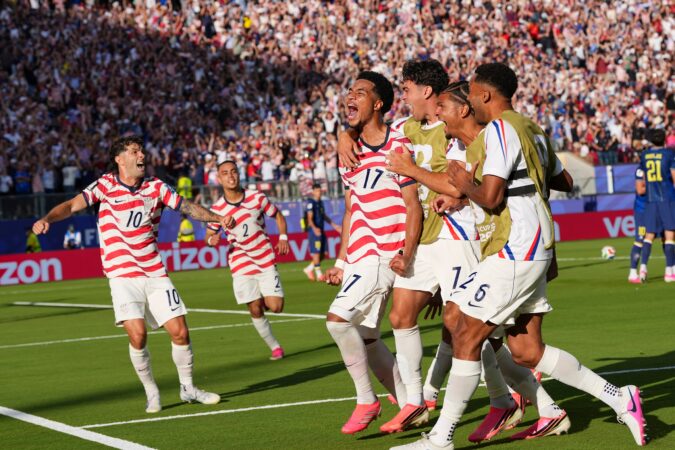
As Tillman ran toward the end line to celebrate, his teammates joined him in a joyous mass, fusing its energy with a crowd that had dug in just as much down the stretch. That energy came through loud and clear all night, in hopes of seeing a new chapter in a story that began when the Bay Area hosted the U.S. men’s soccer team’s first World Cup knockout game of its modern era in 1994.
“I’m a different type of person on the pitch,” Tillman said. “Of course, maybe you don’t really see my emotions, but if you score a goal like this, you guys saw my emotions. It’s a great feeling, and, of course, a very proud moment for me.”
It’s easy to say that the Americans don’t face the kind of pressure as the world’s traditional powers like Brazil, Argentina, England, and Germany. Even next-door neighbor Mexico deals with more, thanks to a rabid fan base that spans both sides of the Rio Grande.
But this time, the weight on the U.S. was massive. A squad of players long hyped as a golden generation had to win this game, or else they’d be tarred as failures in the big moment.
The stakes rose even higher when cohosts Canada and Mexico won their round of 32 contests first. Imagine the reaction in the soccer world had the U.S. failed to match them.
— FIFA World Cup 26 Philadelphia™ (@FWC26Philly) July 2, 2026
There still will be plenty at stake when the Americans play Belgium in the round of 16 on Monday in Seattle. This team still hasn’t beaten a really good opponent in this World Cup, or in general for a while. Nor has anyone forgotten that the ninth-ranked Red Devilsthumped the U.S., 5-2, in March in Atlanta, even if that was a friendly with different squads.
The U.S. also still has a poor all-time record against European teams in World Cups. Wednesday’s win was just the fourth win in 26 such games, against 15 losses and seven ties. Raising the win total to five now would make an all-time impact.
The call certainly was controversial, and by the letter of the law, referee Raphael Claus might have relied too much on slow-motion replay footage instead of watching at real-time speed.
But the decision was not totally wrong. First and foremost, any time a replay shows a player dragging his studs down an opponent’s calf and landing on the foot almost certainly will be a red.
An obvious counter to that is that Lionel Messi wasn’t sent off in Argentina’s group game against Algeria for landing his studs in an opponent’s calf even more directly.
This is life in the sport, and every player knows it. Had Balogun been hit in a similar way, even though the initial collision was 50/50, U.S. fans surely would have brayed for the opponent’s dismissal.
Also, if Balogun had been given a yellow card right away, the odds might have decreased that a video review would upgrade the call to a red.
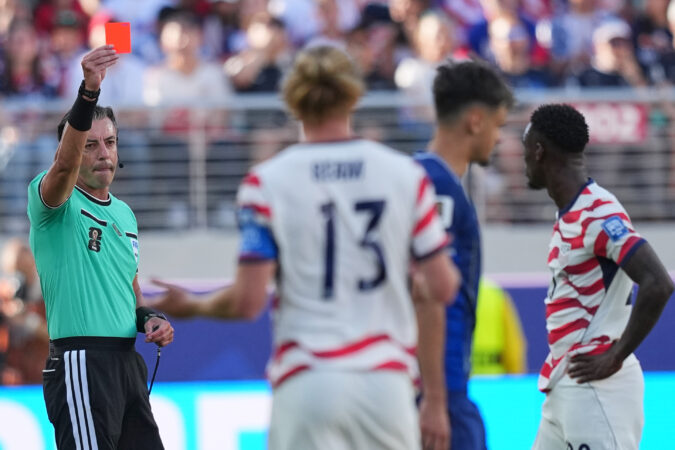
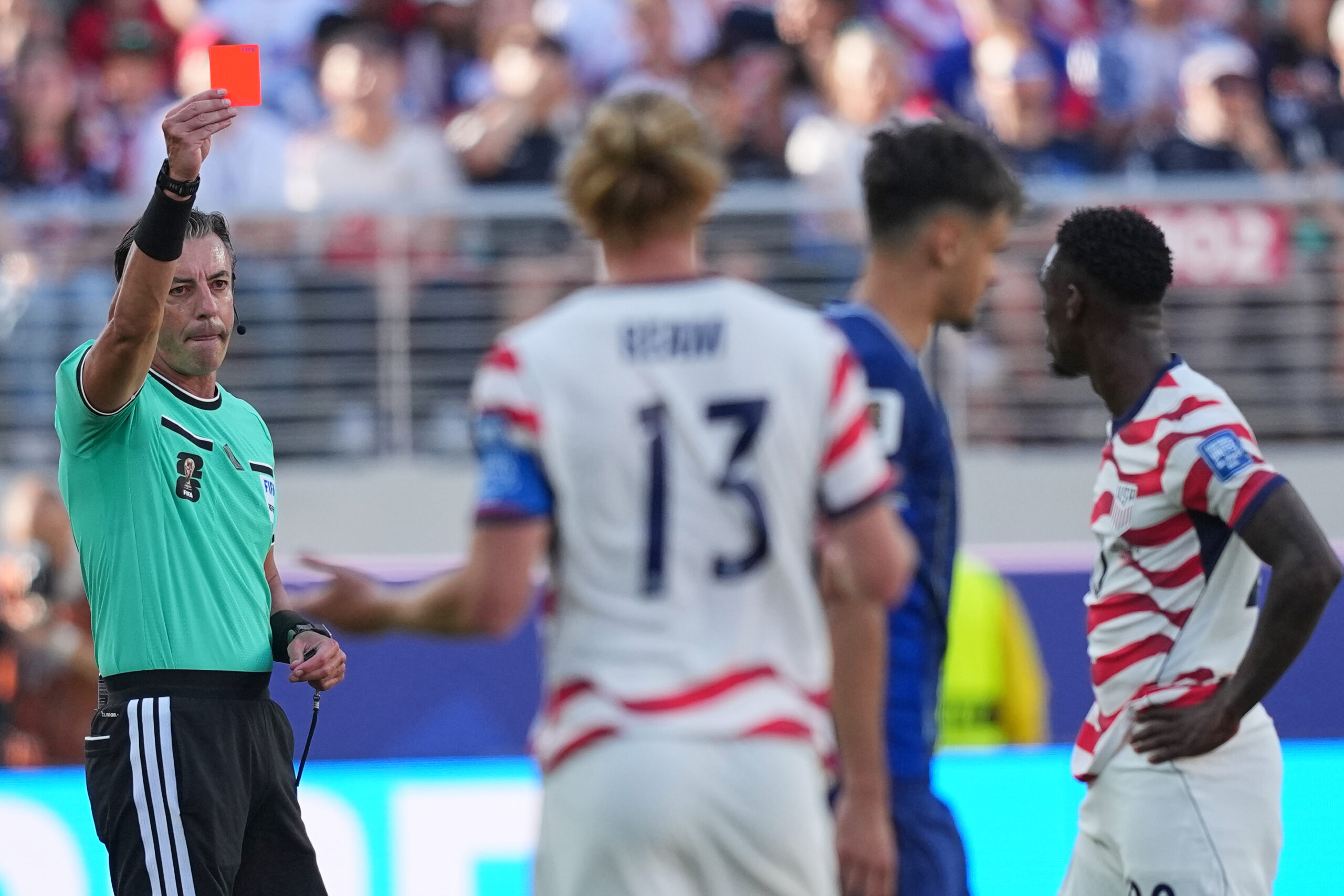
Referee Raphael Claus (left) showing the red card to Folarin Balogun.
Because there was no card initially, when Claus went to the monitor, all he could do was give a red or let it go. The rules mandate that a video review of a call with no card can’t lead to a yellow. FIFA’s rules also mean U.S. Soccer can’t appeal the decision, though it almost certainly would have lost.
“Typical FIFA,” U.S. veteran Tyler Adams said of the rule book. But he didn’t totally argue with the call.
“You’re asking the wrong person, with how I tackle,” he said. “I think it’s a yellow card. I think when you slow everything down, it’s always going to look worse. I don’t want to say too much.”
It definitely will sting the U.S. to face Belgium’s stars without the striker who has more than justified the hype around his talent. Ricardo Pepi presumably will start, with Haji Wright coming off the bench.
Ricardo Pepi (right) subbed on in the 87th minute to help close out the game.
Pepi didn’t stop to talk with the media after Wednesday’s game, but Wright did. The last U.S. striker to score in a World Cup before Balogun’s three this summer declared himself “always ready and always prepared to give my best for the team.”
There also was lots of support for Balogun from his teammates.
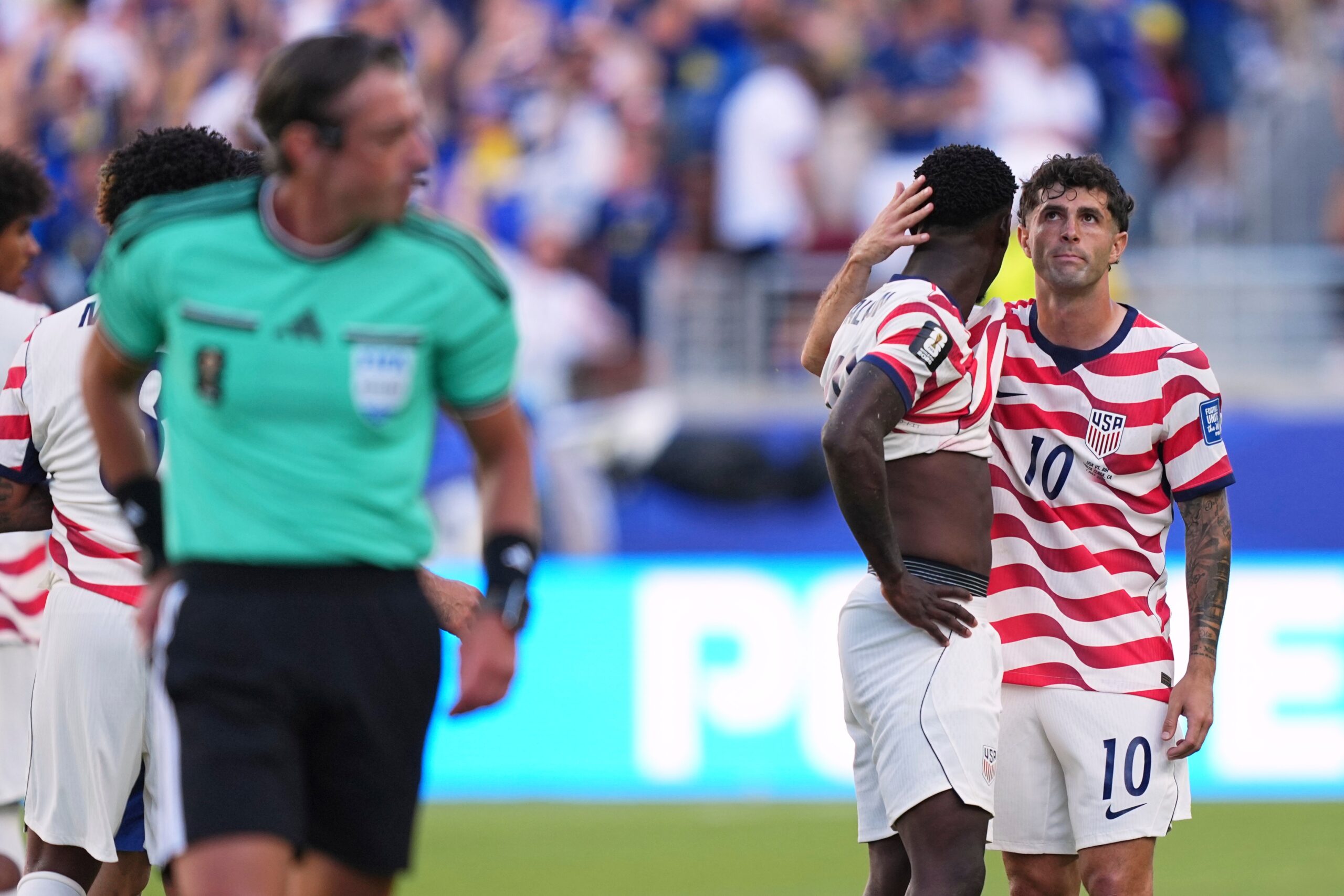
“He’s done so much for us, and now we’ve got his back,” Christian Pulisic said, and Chris Richards said nearly the same words.
Christian Pulisic (right) consoles Folarin Balogun after the striker’s ejection.
Freese’s satisfaction
Let’s close this piece on a positive note.
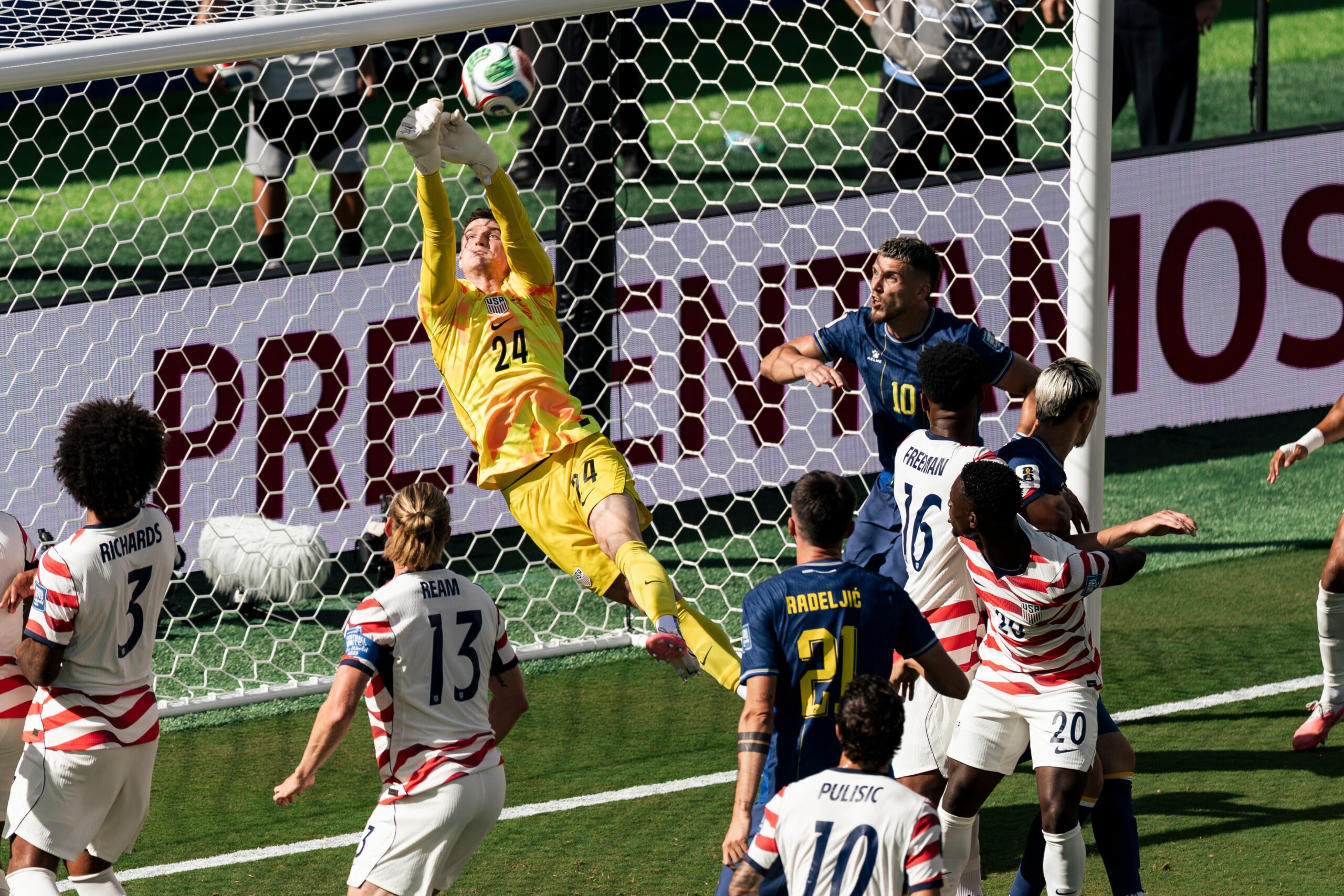
Matt Freese grew up in Wayne idolizing Tim Howard, the U.S. Hall of Famer who cemented his legend with 16 saves in the 2014 World Cup’s 2-1 loss to Belgium. Freese didn’t have to be that busy against Bosnia, but his three stops and command of his box still were plenty to confirm his status as the No. 1 in net.
Now he has a historic reward: being the goalkeeper of record for the first World Cup knockout win in so long.
“It means, really, more than I can say,” Freese said. “You dream of putting your name up there with the guys that you watched growing up. And there’s a lot more to do, but it’s an honor and a privilege to be in goal for this team.”
Matt Freese (center) making one of his big stops in Wednesday’s game.
SANTA CLARA, Calif. — The U.S. men’s soccer team finally ended its 24-year wait to win a World Cup knockout game, though it came at a cost.
Wednesday’s 2-0 win over Bosnia and Herzegovina featured goals by Folarin Balogun and Malik Tillman, but also a red card to Balogun that means he’ll miss the round of 16 matchup against Belgium in Seattle on Monday (8 p.m., Fox29, Telemundo 62).
When the 11th minute passed, the U.S. had gone the longest it had in any game of this World Cup without scoring a goal. That was a low bar to clear in the big picture, but there also definitely were nerves on both sides of the field. Matt Freese had to make two big stops early, but it took until the 18th minute for the Americans to really test Bosnian goalkeeper Nikola Vasilj.
Balogun was the first player to find the back of the net, in the 31st minute, and not long after he’d gone down inside Bosnia’s 18-yard box, though without enough contact to earn a penalty kick. He was then frustrated a second time by the offside flag, and that call was also correct.
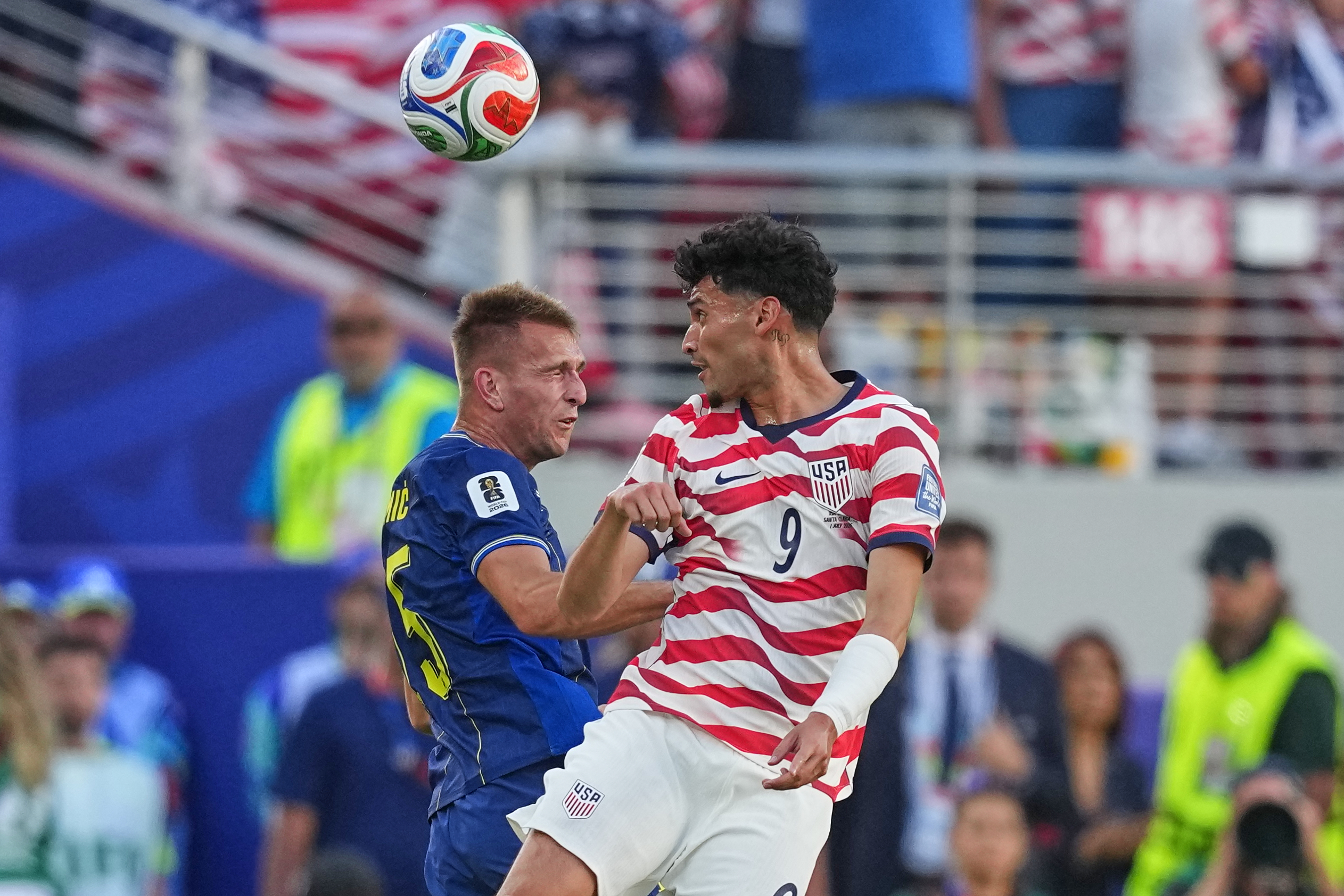
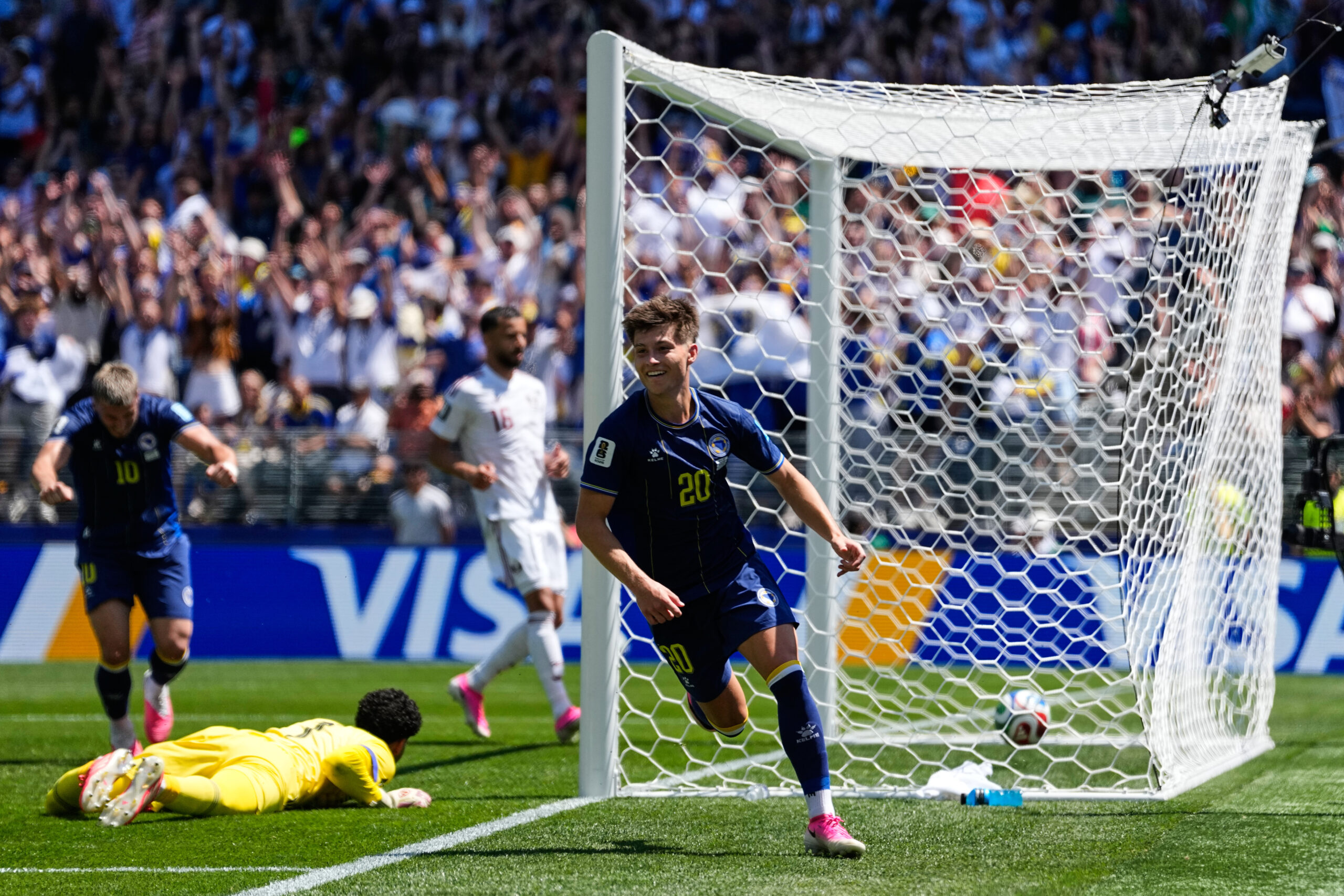
The breakthrough finally came in the 45th minute. Tim Ream intercepted a Vasilj clearance and knocked the ball forward to Tyler Adams, who made a backheel flick into space. The ball rolled to Tillman, who turned and played the ball forward toward Balogun. He had some work to do, but a misplay by Bosnian centerback Tarik Muharemović gave the striker room to collect the ball and slot it home.
As the crowd of 68,827 roared, Balogun celebrated with LeBron James’ “Silencer” dance move. The basketball star — quite a soccer fan himself — returned the compliment on social media right away.
LFG!!!!!! THE 🤫 HAS 🛬 at the World Cup! Helluva goal there Young 🤴🏾! 🫡. GO 🇺🇸 https://t.co/8wb2t2F6oq
Balogun then came inches from doubling the lead in first-half stoppage time, at the end of a lovely teamwide sequence. Alas, his close-range flick hit the crossbar and flew out of bounds.
The U.S. held a 5-1 advantage in shots halftime, a sign of how they’d come into the game but also how many nerves there were.
The game’s first substitutions came in the 51st minute, in a triple-move from Bosnia manager Sergej Barbarez, one of which was star striker Edin Džeko, after pulling up lame. The other moves were tactical, including the much-anticipated arrival of winger Esmir Bajraktarević — a 21-year-old winger who grew up in Wisconsin to parents who fled the Bosnian war of the 1990s.
Balogun’s ejection came in the 64th, after the video review officials watched him rake the studs of his right cleat down the back of Muharemović’s right calf in a tussle. It looked like a 50/50 challenge at first, but the replays clearly showed a cardinal sin for a soccer player — even if he didn’t intend it. By the time Raphael Claus left the monitor, it wasn’t too surprising that he pulled the red card out.
The ejection meant Balogun would miss not just the rest of this game, but will miss the U.S.’s round-of-16 showdown with the Belgians.
Now, it was about playing defense, and every U.S. player did his part. Even Tillman, usually much more of an attacking player, got stuck into a loose ball in the 77th.
Soon after that, the U.S. broke free on a counterattack and Christian Pulisic forced the ball in, but he was clearly offside when Tillman passed to him.
The biggest break finally came in the 82nd. Stjepan Radeljić held back Sergiño Dest, Claus booked the Bosnian defender, and the U.S. had a free kick on the edge of the 18. Tillman spun it right past Bosnia’s defense and into the net, unleashing a huge celebration from U.S. players and fans alike.
MALIK TILLMAN FREE KICK GOLAZO AND THE @USMNT IS UP 2-0 🇺🇸
U.S. manager Mauricio Pochettino finally made his first substitutions in the 88th minute, sending in Ricardo Pepi and Sebastian Berhalter for Pulisic and Dest. In stoppage time, Gio Reyna replaced Weston McKennie.
There were still plenty of nerves from there, including 10 minutes of stoppage time. But the Americans held on, with the crowd cheering every save, block, and sequence of passes — and exhaling as two Bosnian shots in the final moments went inches wide of Freese’s net.
Then, at the final whistle, there was the biggest unleashing of all. Thirty-two years after the U.S. men played the first World Cup knockout game of their modern era in the Bay Area, they finally delivered the sight that everyone here had waited so long for.
This generation of American players finally has its biggest World Cup win.
From the moment the World Cup draw was announced in December, Philadelphia and the soccer world started dreaming of a potential France-Germany showdown on July 4.
Alas, that dream did not come true, thanks to Germany’s upset loss to Paraguay on Monday. But the other half of the equation has delivered, as the city already saw in the group stage. France will return to town as the favorite to win it all, with its superstar attacking core firing on all cylinders.
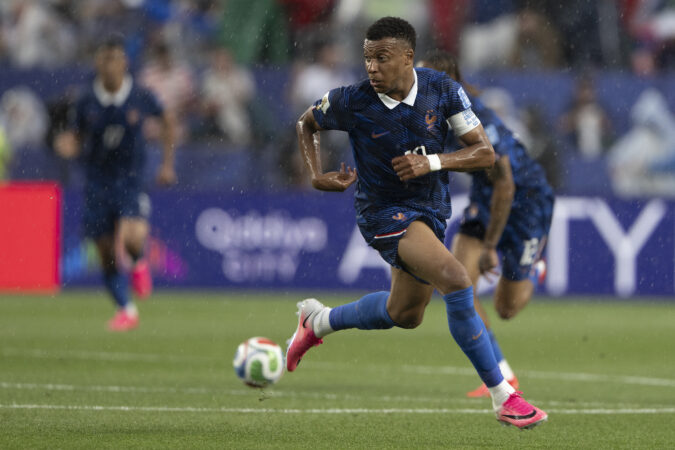
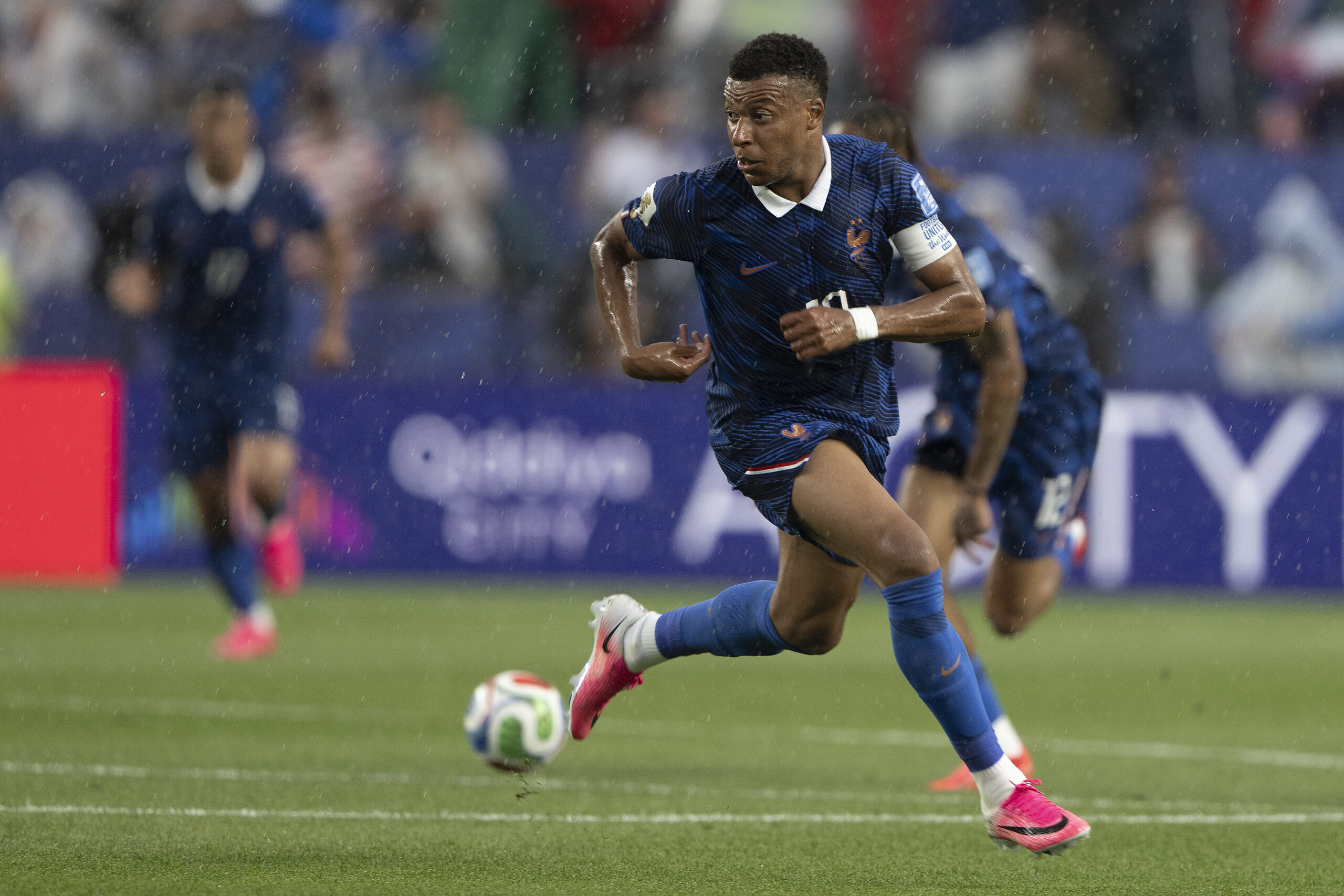
After scoring 10 goals in the group stage, the most of any of the 48 teams in the tournament, Les Bleus laid a 3-0 hammering down on Sweden in the Meadowlands on Tuesday. Kylian Mbappé scored twice to match Lionel Messi’s six goals in the tournament to date, and Bradley Barcola struck his second goal of the summer.
WHAT A GOAL FOR MBAPPÉ 🇫🇷
He slices through the Sweden defense to score his 5th goal of the tournament! pic.twitter.com/JePc6FZQJ4
Ousmane Dembélé, the reigning world player of the year with the Ballon D’Or award, has four goals, and Desiré Doué has one. The fifth superweapon, winger Michael Olise, has a team-leading five assists — and came inches from a spectacular first World Cup goal on Tuesday when a bicycle kick attempt hit the post.
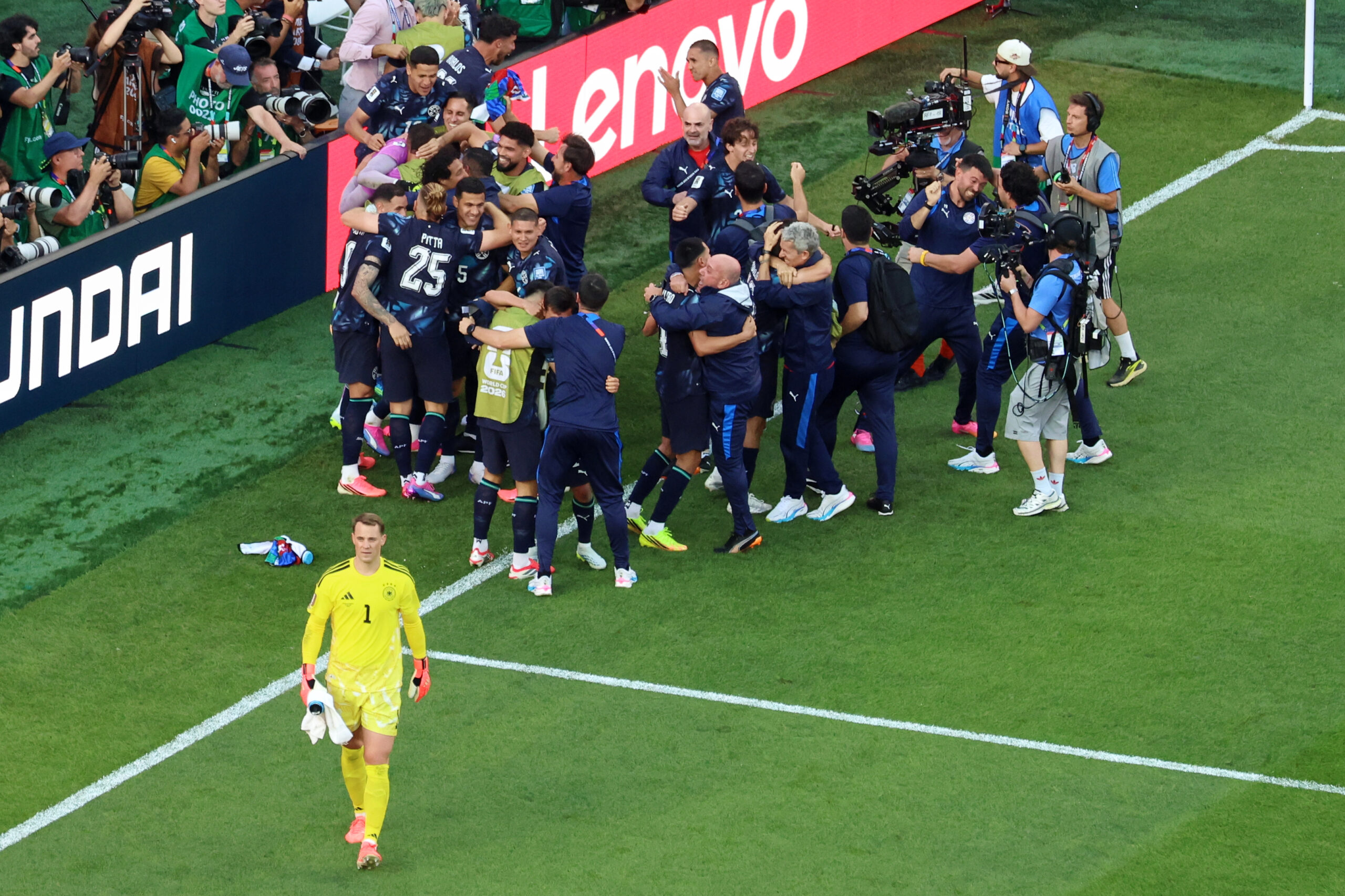
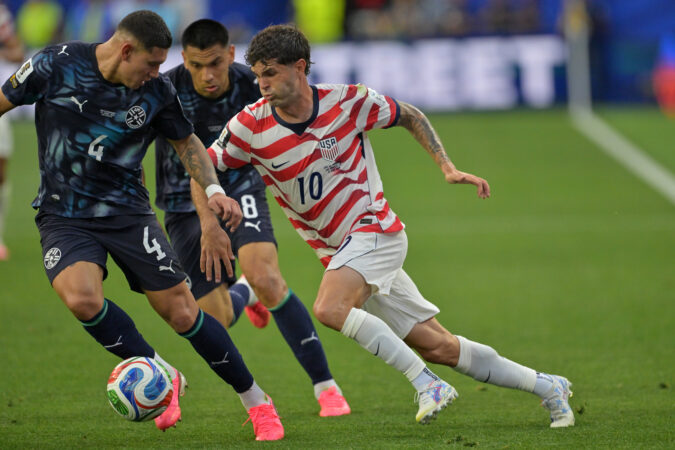
Paraguay will arrive in town after overcoming its 4-1 loss to the United States in its group stage opener. La Albirrojabeat Turkey, 1-0, held Australia to a scoreless tie, then toppled Germany in a penalty kick shootout after a 1-1 tie.
This was the team that looked much more like the one that rode a stingy defense to its first World Cup berth in 16 years, finishing sixth in South America’s 10-team round robin with the second-lowest goals allowed total (10).
Paraguay’s roster has many familiar faces to fans of MLS. Miguel Almirón (Atlanta United), Andrés Cubas (Vancouver Whitecaps), and Braian Ojeda (Orlando) play in the league now, and three others used to: Matías Galarza (Atlanta), Diego Gómez (Inter Miami), and Alejandro “Kaku” Romero Gamarra (New York Red Bulls).
Paraguay’s celebrations after upsetting Germany in a penalty kick shootout on Monday.
It’s easy to say the matchup is offense vs. defense, but France is also plenty stingy. It has allowed just two goals in four games so far, one each to Senegal and Norway. That’s what manager Didier Deschamps has always demanded in his 14-year tenure, just as he did as a player: the midfield anchor and captain of France’s 1998 World Cup and 2000 Euros champions.
Sometimes, over the years, it has felt like that approach has stifled France’s constellation of stars. But the results have ultimately come: Euros runner-up in 2016, World Cup champion in 2018, UEFA Nations League champion in 2021, and runner-up to Lionel Messi’s Argentina in 2022’s all-time classic final.
This time, this team is all in for Deschamps’ final tournament on the bench. Even Mbappé, often criticized for not playing enough defense at his club, Real Madrid, is doing his part.
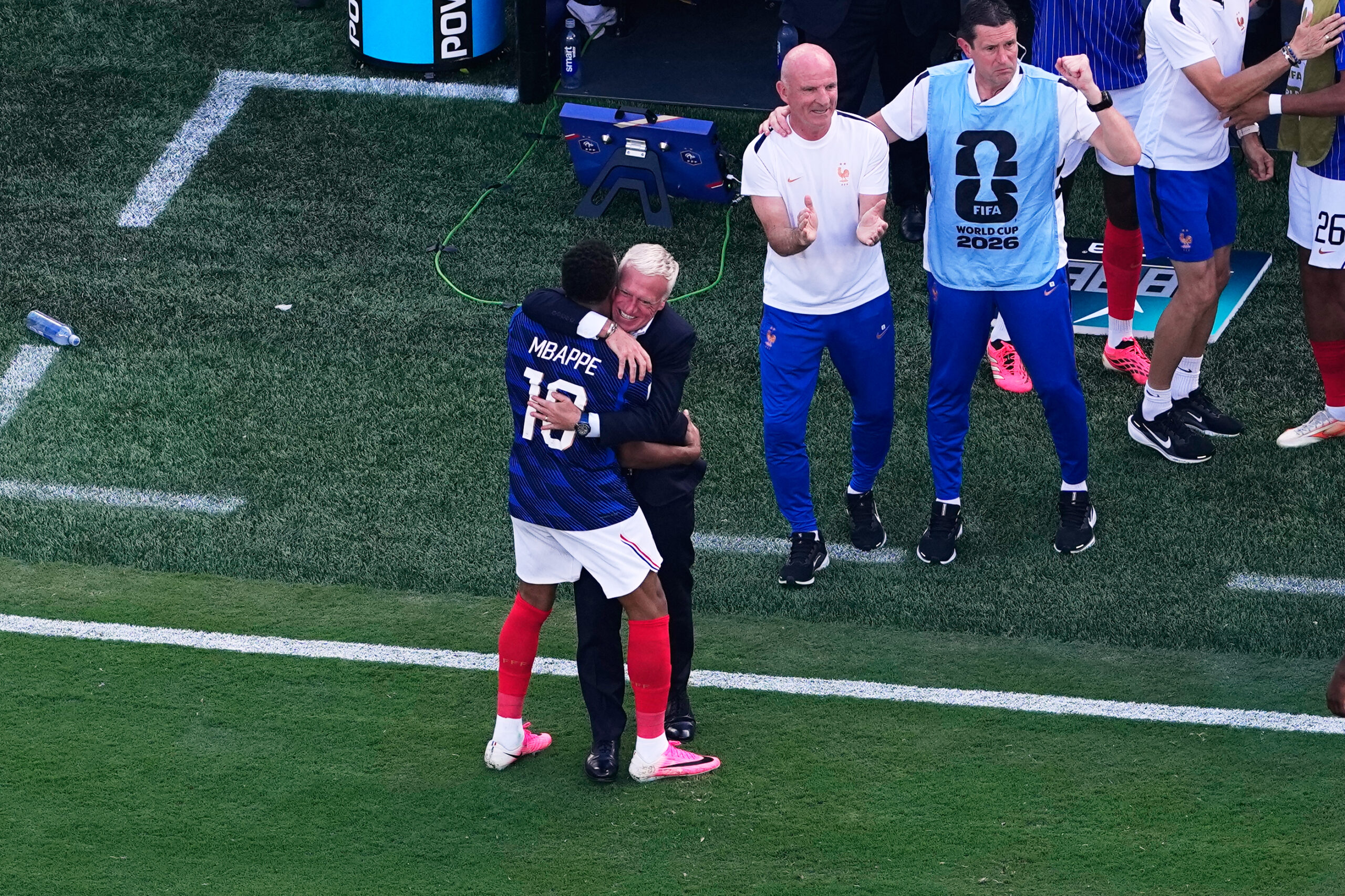
They’re also in for Deschamps himself, as his mother died recently. He left the tournament for a few days to attend to that and returned in time for Tuesday’s contest. When Mbappé opened the scoring, he ran over to give his manager a big hug.
Deschamps looked just as thrilled, no matter how much of Mbappé’s sweat landed on his suit on a hot day.
Kylian Mbappé (left) embracing Didier Deschamps after scoring France’s opening goal against Sweden.
Now France is aiming to become just the third team in men’s World Cup history to make three straight finals. Brazil did it in 1994, ‘98, and ‘02, winning the first and third (and losing the second to France); and Germany did it in 1982, ‘86, and ‘90, winning the last of them.
The world is watching and waiting to see how far this team goes. Philadelphia already had a front-row seat once, the 3-0 win over Iraq where Mbappé scored a spectacular strike and Dembélé scored his first major-tournament goal after many years of trying. Now the city gets a second turn.
France’s first visit also made headlines for the thunderstorms that delayed the start of the second half by two hours. Saturday’s game could land in Mother Nature’s crosshairs again, with the heat dome expected to crack that day and send the sky exploding. It’s just a question of what time, and whether it happens early enough to pass by kickoff.
With that big caveat, the countdown is on. Clashes between European and South American teams have defined World Cups for generations, and this one will add another chapter to the history.
The knockout rounds are here! Lisa Carlin and Jonathan Tannenwald preview the USMNT’s path, break down the biggest Round of 32 matchups, and Round of 16 match coming to Philly. Watch Here.
SAN JOSE, Calif. — No one needed the reminder at this point, but it came anyway.
While the U.S. men’s soccer team’s charter flight from Orange County to the Bay Area was in the air, a lightning bolt struck the World Cup when Paraguay toppled Germany.
Germany undoubtedly wasn’t good enough, and not for the first time in this tournament. There must have been kegs worth of angst in the air at Brauhaus Schmitz on South Street, Philadelphia’s most famous fussball destination, among fans who’d dreamed of seeing the four-time champions come to town on July 4.
But to lose to the same Paraguay squad that the U.S. ran off the field in their tournament opener? That was a shock and the latest of many lessons in this World Cup.
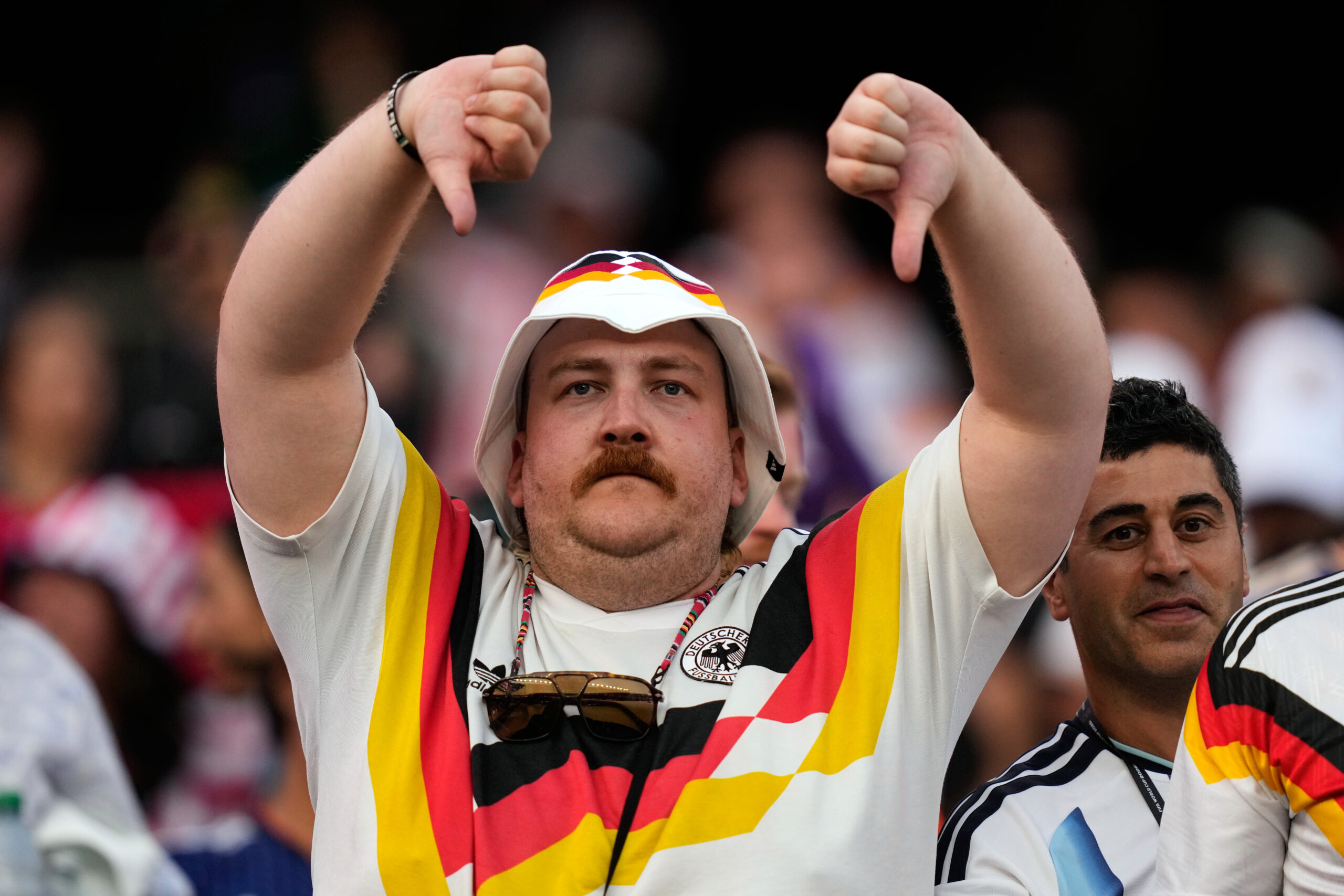
A Germany fan at Monday’s game offers his opinion of the four-time World Cup champions’ upset loss to Paraguay.
Yes, anyone can get a result against anyone else these days. Which means the 64th-ranked Bosnia and Herzegovina team the U.S. faces on Wednesday night has more than a chance against the cohosts, who return to the site of an infamous loss in the 2016 Copa América and a triumph in the Gold Cup final a year later.
There’s no taking any World Cup game for granted these days, especially when it’s a knockout contest. Nor can you take a moment off, as all three of Monday’s games proved. Before Paraguay-Germany, Japan gave up a 95th-minute winner to Brazil. Afterward, the Netherlands played a lot of ugly soccer, gave up a 90th-minute equalizer to Morocco, then lost on penalties.
“Hopefully we can get it done in regular time — the extra 30 minutes plus pens can get a little bit dangerous,” U.S. centerback Chris Richards said. “We saw the upset yesterday, so us going into this game, [it’s] making sure that we take care of business and go on.”
The point really should have been hammered home in the American camp by the last-kick-of-the-game loss to Turkey in the group stage finale. But if it was your youth soccer team, Little League baseball team, or CYO basketball team, wouldn’t you make one last nudge before the big game?
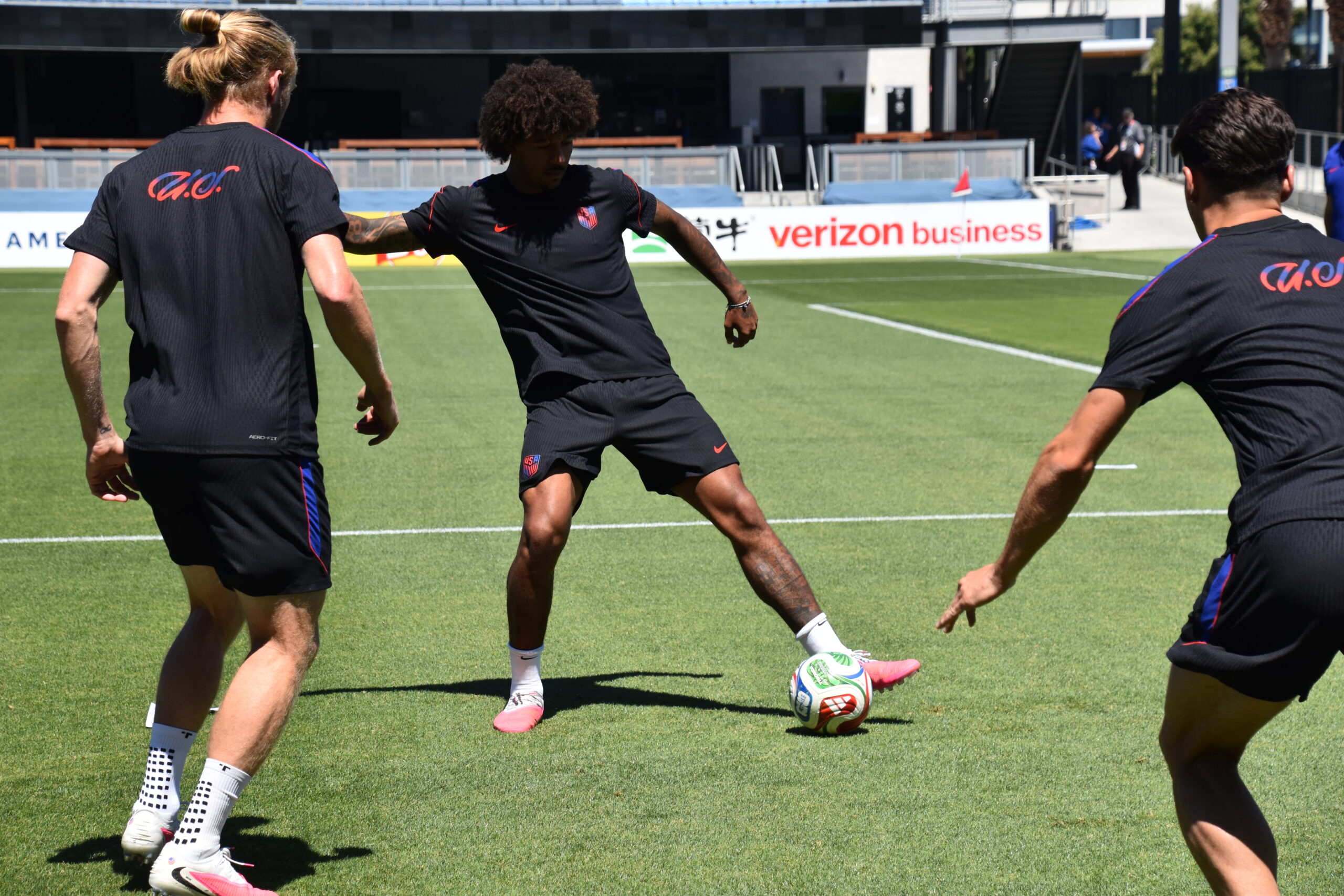
Chris Richards (center) on the ball during a drill at Tuesday’s practice.
“It’s a World Cup. You’re never going to get the so-called favorite winning every single time,” said playmaker Christian Pulisic, who called himself “definitely ready” to start after coming off the bench against Turkey.
“This is soccer. This is the way things go: you can defend all game and win in a penalty kick shootout, and that’s the beauty of the game,” he continued. “So we have to be ready for whatever’s to come tomorrow. We don’t think it’s going to be easy by any means, so we have to put on a really high-level performance.”
If it feels like this point has been overstated this week, it’s because it ranks so much higher than everything else there is to say.
Sure, there’s a tactical analysis to write about how Richards will fare against 40-year-old Bosnian striker Edin Džeko, a veteran of big clubs including England’s Manchester City, Italy’s AS Roma and Inter Milan, and Germany’s Wolfsburg and Schalke. Or how young right winger Esmir Bajraktarević will fare against U.S. defender Antonee Robinson.
Esmir Bajraktarević celebrates one of Bosnia’s goals against Qatar in their group stage finale last Wednesday.
He spent a season in the Chicago Fire’s youth academy (2019-20), then moved to the New England Revolution, where he turned pro and spent three seasons before a move to Dutch club PSV Eindhoven — and is now teammates with U.S. veterans Ricardo Pepi and Sergiño Dest and formerly Malik Tillman.
Along the way, Bajraktarević played for U.S. youth national teams at the under-19 and under-23 levels, and earned one cap for the senior U.S. squad in a January 2024 friendly. But because that wasn’t in an official competition, he could change nationality.
When Bosnia called a few months later, he made the switch, and debuted in the fall. A year and a half later, he scored the shootout penalty kick that qualified the Dragons for this World Cup with a playoff upset of Italy.
But if the U.S. team has its way, that story will become just a sidebar when the opening whistle blows. At that point, the motto will become one that’s well-known at the other end of San Francisco Bay from here, in Oakland: Just win, baby.
Even Tillman, who was born in Germany and has grown into understanding American sports, gets the point.
“Yeah, it’s true,” he said, when asked his opinion. “In the end, the win is the most important. And I think after, of course, you can analyze the game, but if you go to the next round, this is the most important.”
I asked Mauricio Pochettino what he thinks of the "Just win, baby" slogan – and whether his saying "it's the final of the World Cup tomorrow" means more focus on winning at all costs, and less on tactics.
Pochettino gave a long answer. Here it is in video form:
IRVINE, Calif. — The assertion on these pages of the importance of this World Cup’s first knockout round for the U.S. men’s soccer team drew a noteworthy response from a history-minded reader.
“Just because they changed how to make it from 32 to 16 doesn’t automatically make doing it more meaningful,” it said. “Not to be too ‘Bluesky reply guy’ but portraying it otherwise empowers FIFA’s money grab imo. On Wednesday the USMNT will try to do something they’ve done 5 of the last 8 men’s World Cups.”
Those are fair points, especially the one about FIFA grabbing money. The U.S. men have indeed been among the last 16 teams standing at five of the eight World Cups they played in from 1990-2022: ‘94, 2002, 2010, ‘14, and ‘22.
So the point that was made here is worth clarifying. It’s not just about being able to claim a title of being one of the best 32, 16, or any fewer national teams based on World Cup finish. It’s about the mentality of knockout soccer on the sport’s biggest stage, and how different it is from anything else.
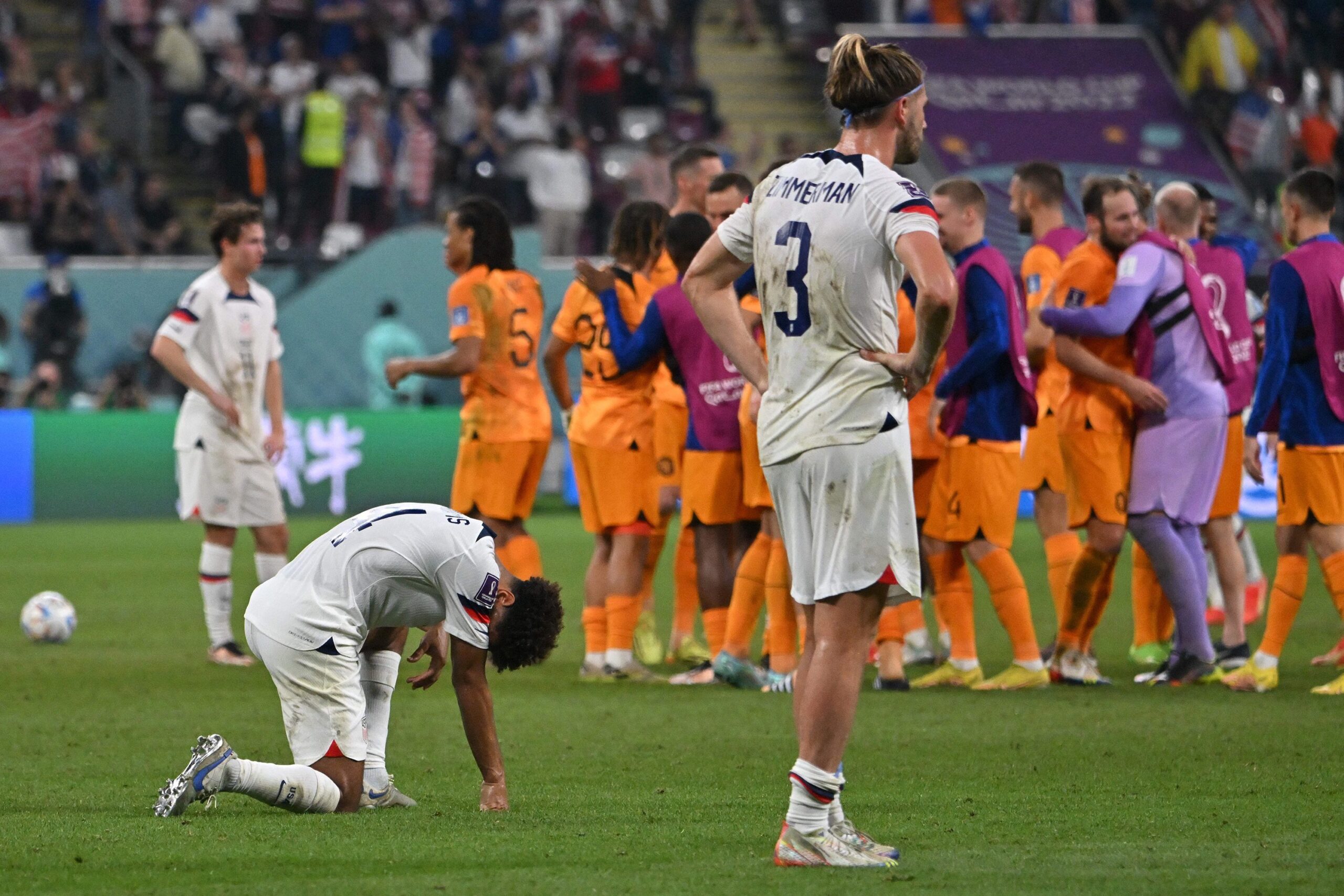
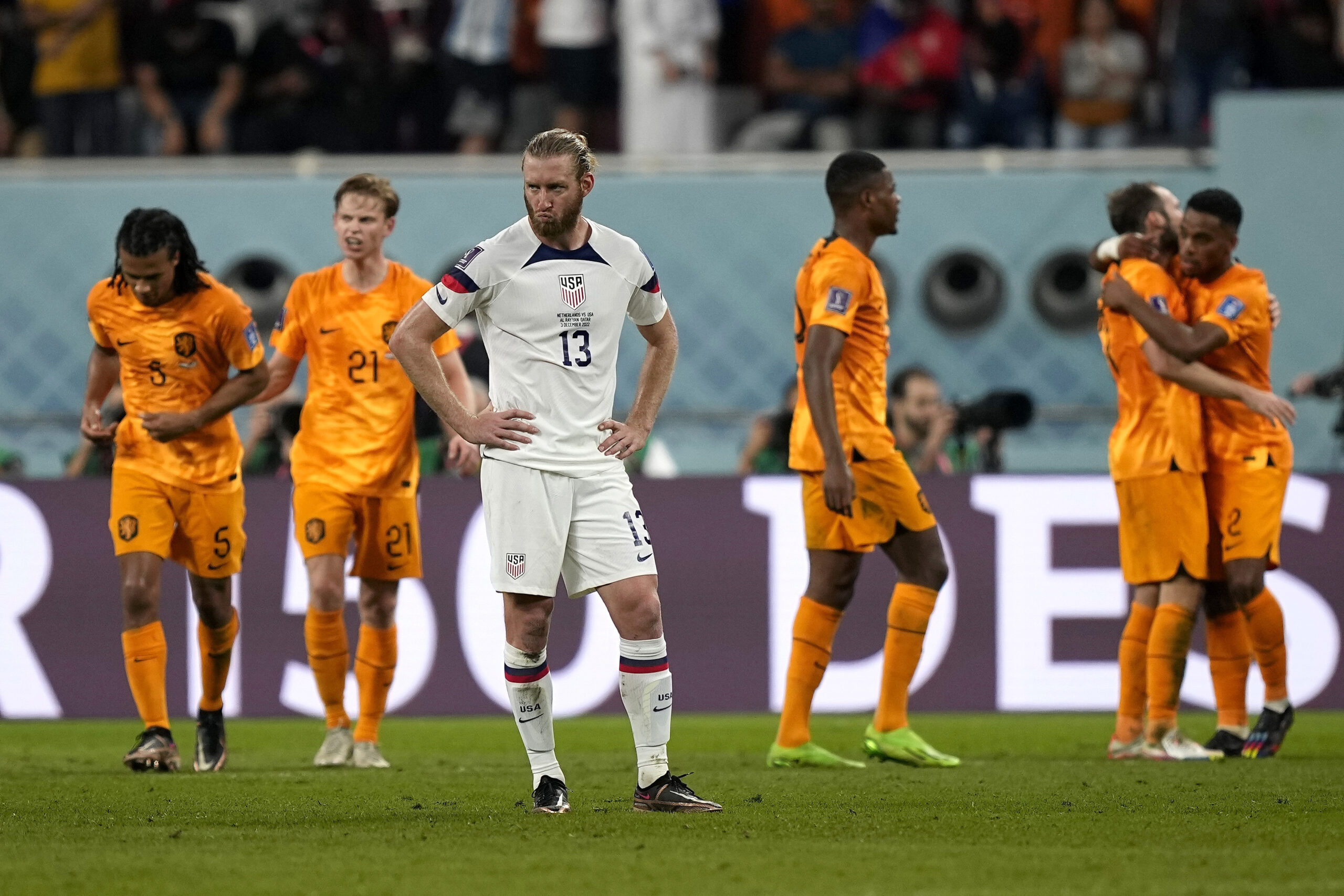
Tyler Adams (left) and Walker Zimmerman on the field at the end of the U.S.’ loss to the Netherlands that knocked them out of the 2022 World Cup in the round of 16. This year’s tournament is the first with a round of 32.
It’s also about whether U.S. players of this era can prove themselves in the way they’ve long told us they can. Lose the round of 32 contest to Bosnia & Herzegovina on Wednesday (8 p.m., Fox29, Telemundo 62), and all the promises go up in smoke.
That pressure might not be the same as the kind the superstars of Brazil, Argentina, England, and so on face every day. But it’s still a significant burden, and a particular kind for a team with DNA built on fighting for respect.
“I think everyone knows in the back of our minds what this could do for this country,” attacking midfielder Gio Reyna said before Monday’s practice, the last before the U.S. team headed north to the Bay Area for Wednesday’s game in Santa Clara.
“Not that we’ve really spoke about it or thought about it much — we’re pretty much just focused on each game in front of us at this moment, as it is win or go home,” he continued. But they don’t have to.
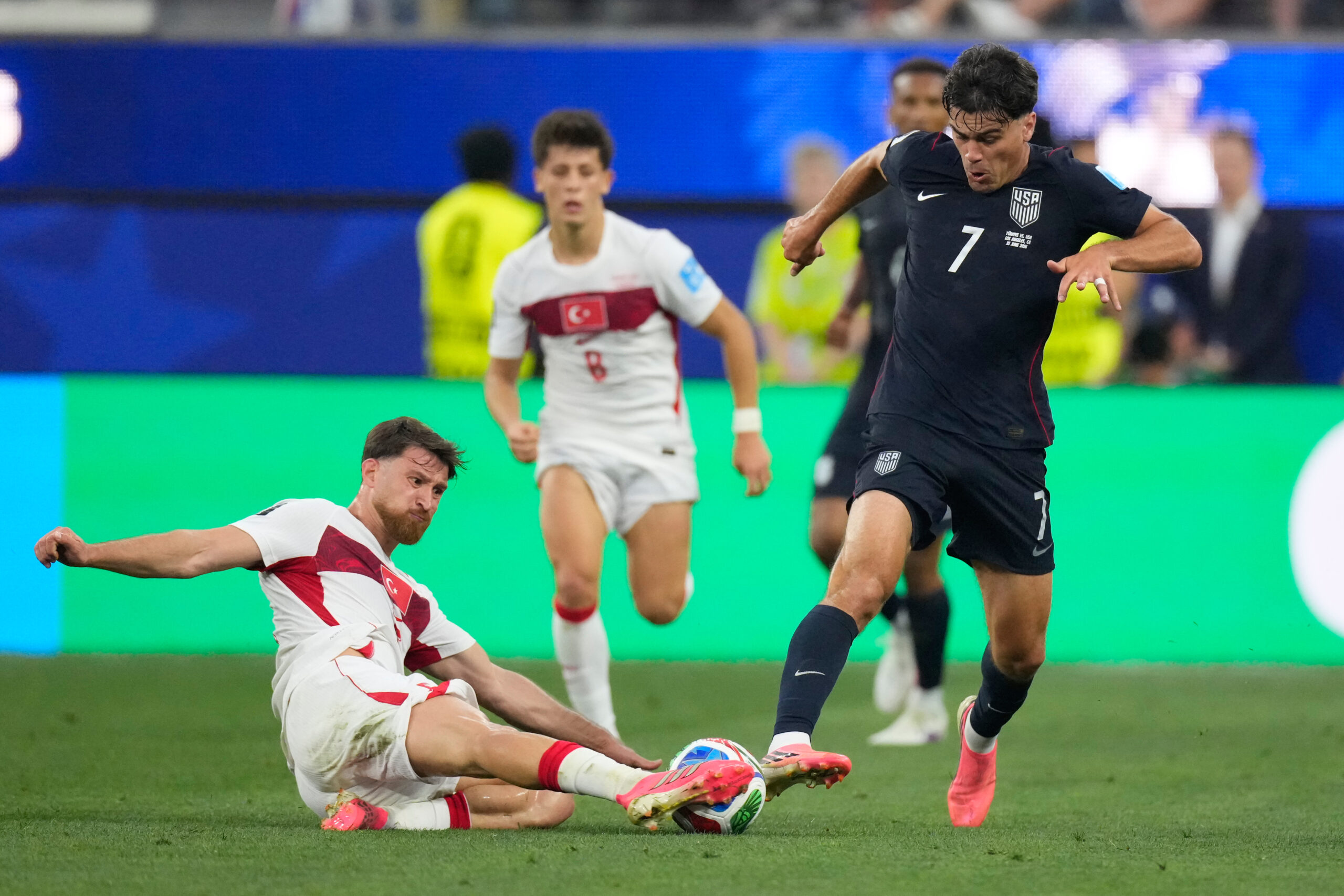
Gio Reyna (right) in action during the U.S.-Turkey group stage finale.
“We feel the country rallying around us,” he said. “We see the momentum it’s bringing to the sport in this country just through the group stage. But we also understand that if we make a nice run in the tournament, what it could really do for the sport.”
Reyna and centerback Tim Ream were the two players who spoke Monday. Both were part of the 2022 team that took the U.S. back to the men’s World Cup after failing to qualify for 2018. Now Ream is this team’s captain, and its oldest player.
“Would it be weird if I told you I don’t really feel too much pressure at this minute?” he said. “I just think there’s so much pressure that we put on ourselves.”
He acknowledged in his next breath that “it feels very different this time around than 2022, I will say that,” though “not because of the round of 32 or because that was a round of 16.”
Tim Ream (center) on the field after the Netherlands scored its third goal against the U.S. in 2002.
Instead it’s because of what is already in the players’ minds.
“I think we put so much expectation on ourselves as players — and I said this at the beginning of the tournament — but I think we felt more pressure for that first game against Paraguay than anything,” Ream said. “And that’s coming from ourselves, not from anything on the outside.”
The burden might weigh a little extra on Reyna, too, and not just because of the scandal that engulfed him and his family four years ago. Even if everything back then had been clean-cut, he’d still be the son of U.S. legend Claudio Reyna, who played for the U.S. at the 1998, 2002, and 2006 World Cups — but not in 1994 because of a hamstring injury.
“I always like to say it’s just another game of football, but at the end of the day, I think everybody knows what this game is,” Gio said. “World Cups only come around every four years, and especially on home soil, this opportunity will really never come back.”
IRVINE, Calif. — Right now is a good time to remember that the U.S. men’s soccer team has won just one World Cup knockout game in its history.
In fact, every day for the rest of this tournament is a good time to remember that, especially leading up to Wednesday’s round of 32 contest with Bosnia & Herzegovina (8 p.m., Fox29, Telemundo 62).
This is the moment that the players have dreamed of, whether since growing up or since leaving Qatar four years ago. This is the moment Mauricio Pochettino was hired for, with U.S. Soccer bringing in hedge fund billionaires to help fund the famed manager’s salary.
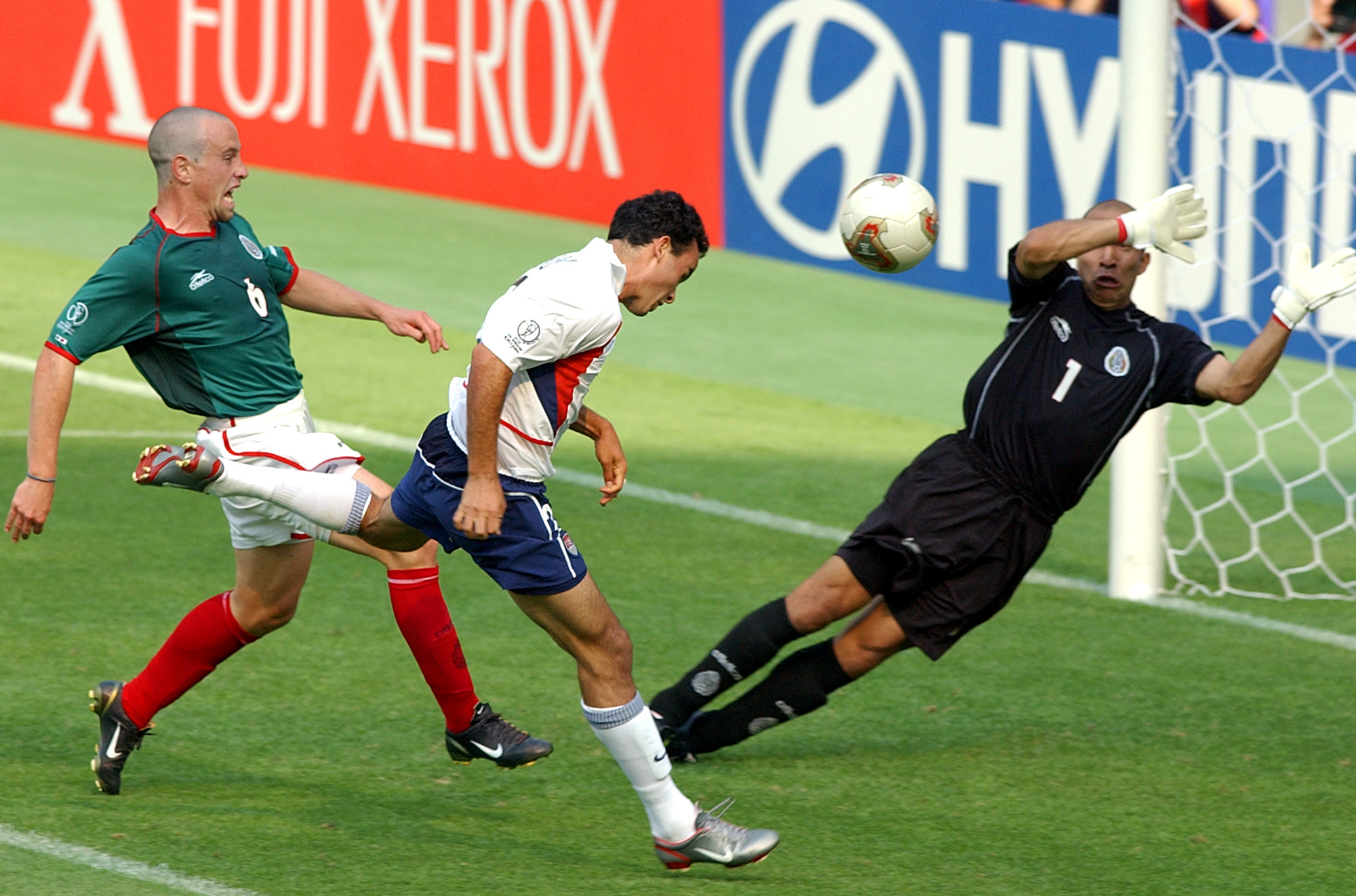
And this is the moment when history echoes. The U.S. men have played eight World Cup knockout games all-time, from their first in 1930 (a 6-1 loss to Argentina) to their latest in 2022 (a 3-1 loss to the Netherlands). Their lone victory came in 2002, 2-0 over Mexico.
Landon Donovan (center) heads in one of the U.S.’ goals in its win over Mexico in the 2002 World Cup round of 16.
Beyond that? 7-1 to Italy in 1934, 1-0 to Brazil in 1994 (more on that in a moment), 1-0 to Germany in the 2002 quarterfinals, 2-1 in extra time to Ghana in 2010, and 2-1 in extra time to Belgium in 2014.
If reading that opens some old wounds, apologies. But it’s necessary to explain why one of the most tense moments of any World Cup, the start of the knockout rounds, is especially tense for this program. There is no sterner test of a national team’s quality than whether it can win the do-or-die contests that live longest in the memory.
The last time the U.S. men played a World Cup knockout game on home soil was 1994 at the old Stanford Stadium — just down the road from the 49ers’ NFL palace in Santa Clara where Wednesday’s game will take place.
It was a stroke of coincidence, if not quite fortune, that the Americans landed in a July 4 matchup with Brazil after finishing third in their group. Finishing second would have sent them to Washington to play Spain, and finishing first would have had them at the Rose Bowl (where they already were) to play Argentina.
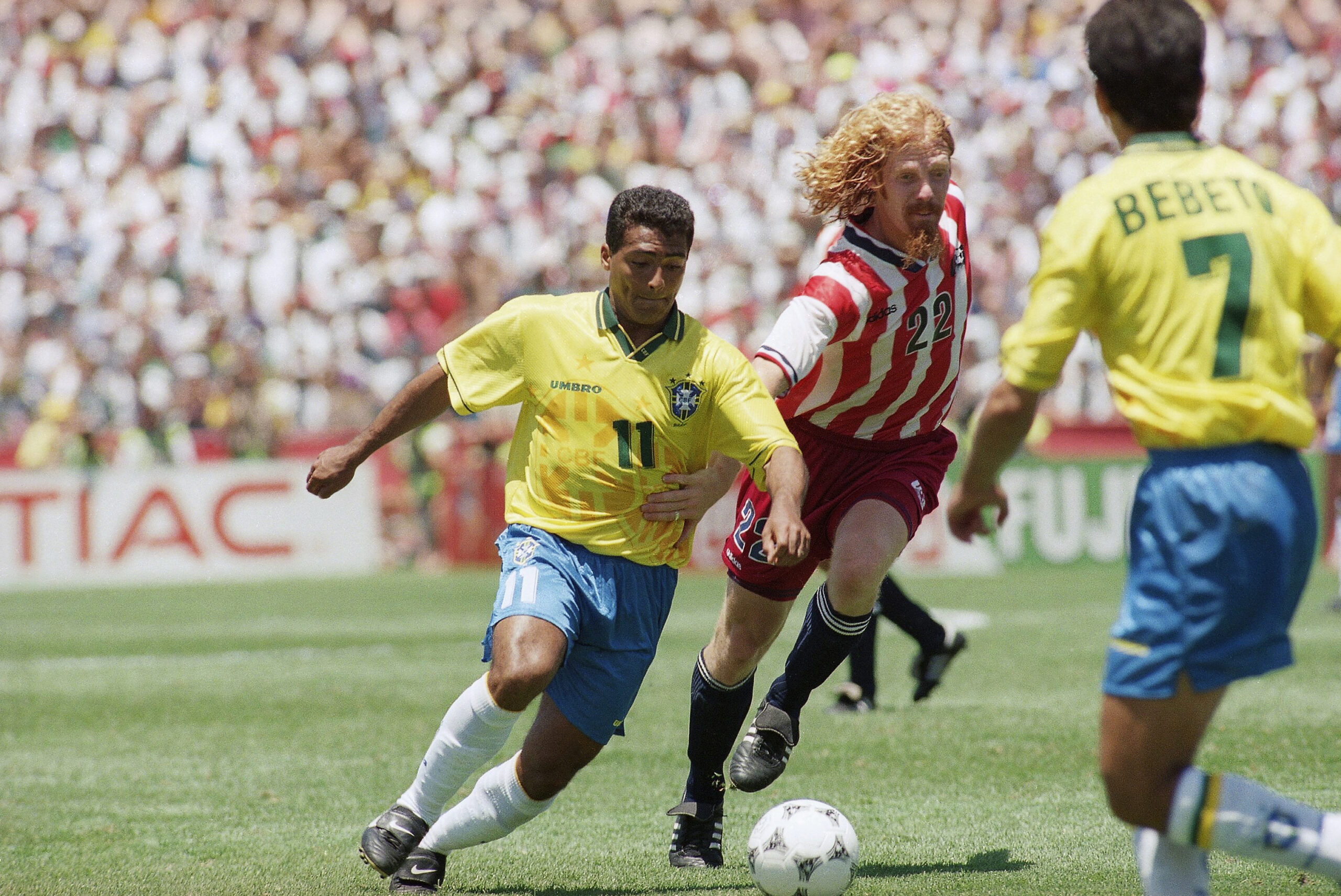
Brazilian superstar Romário (left) dribbling past Alexi Lalas in the 1994 U.S.-Brazil World Cup game.
Challenging the team that would go on to win the title was always going to be a mountain of a task. But the U.S. battled gamely, losing 1-0 to a Seleçao squad that saw defender Leonardo sent off in the first half for a nasty elbow to American star Tab Ramos.
This time, the U.S. is favored, and not just by the bookies. Bosnia & Herzegovina is No. 64 in FIFA’s global rankings, well below the U.S.’ No. 17.
The Dragons are also the lowest of the five third-place teams across the field that the U.S. could have faced, depending on which eight groups’ third-place finishers advanced. The opponent could have been from Group E, F, I, or J in other circumstances, and those teams turned out to be No. 23 Ecuador, No. 38 Sweden, No. 15 Senegal, and No. 28 Algeria.
On top of that, Bosnia is the second-lowest-ranked team of all eight. Only No. 73 Ghana is lower. (The others not named yet are No. 28 Paraguay and No. 46 Democratic Republic of the Congo.)
Bosnia & Herzegovina’s Esmir Bajraktarević was born in Appleton, Wisconsin, to parents who emigrated to the United States after escaping the Bosnian war of the 1990s.
Still, an American sports fan watching soccer in the summer needs only to think of any given March to know it’s never so easy.
The players know this, even someone like Balogun who has spent almost his entire life in Europe.
“I can feel the difference in the atmosphere,” he said. “So for me, there’s a change in my mindset and mentality as well. Not that I wasn’t taking it seriously before, but you can go to another gear. Because you want it more, and I don’t want the journey to end.”
Another point he made about himself might feel especially resonant to a U.S. fan base that has seen Balogun prove his worth as the striker the program long craved.
Folarin Balogun (left) during a United States men’s national soccer team practice at Great Park in Irvine, California on Sunday.
“This the business end,” he said, “and this is the stage where, in my opinion, the big players step forward and the big players carry the pressure and make things happen.”
The growing strength of the U.S. player pool is a project that has taken decades to fulfill, and could still take many more years to deliver a true World Cup contender. But a tournament on home soil is an opportunity unlike any other to make a statement, whether to the soccer world or to the non-soccer American public.
So while it may feel cliché to say this is one of the biggest moments in U.S. men’s program history, it’s also true.
“From my personal experience, the best way to break history is not to think about what hasn’t been done,” Balogun said. “It’s just to think about what you need to do and just to think about what needs to be done in order to progress. And as I said, that’s just to win on Wednesday.”
IRVINE, Calif. — For Philadelphians new to seeing a World Cup in person, it might feel like the road to this point began when FIFA picked the city to host games in 2022.
For others, it might feel like the first steps were taken when the U.S.-Canada-Mexico joint hosting bid won the formal vote in 2018, or when the bid was filed the year before.
In fact, the process began much longer ago than that, in 2007. That’s when U.S. Soccer Federation officials started seriously thinking about bringing the men’s World Cup back to the United States for the first time since 1994.
Nineteen years is a long time in American sports, and especially American soccer, where so much changes from year to year, not just decade to decade. So as the 2026 spectacle unfolds, it’s worth taking a moment to step back and turn to the history books.
There aren’t too many Americans who’ve been on the entire ride. In fact, there’s barely anyone at U.S. Soccer who has been, in part because the presidency has changed hands twice since 2007.
One who has and who knows Philadelphia well is Sunil Gulati. The longtime economics professor at Columbia University led U.S. Soccer from 2006-18 and has also served on the FIFA Council and the former FIFA Executive Committee.
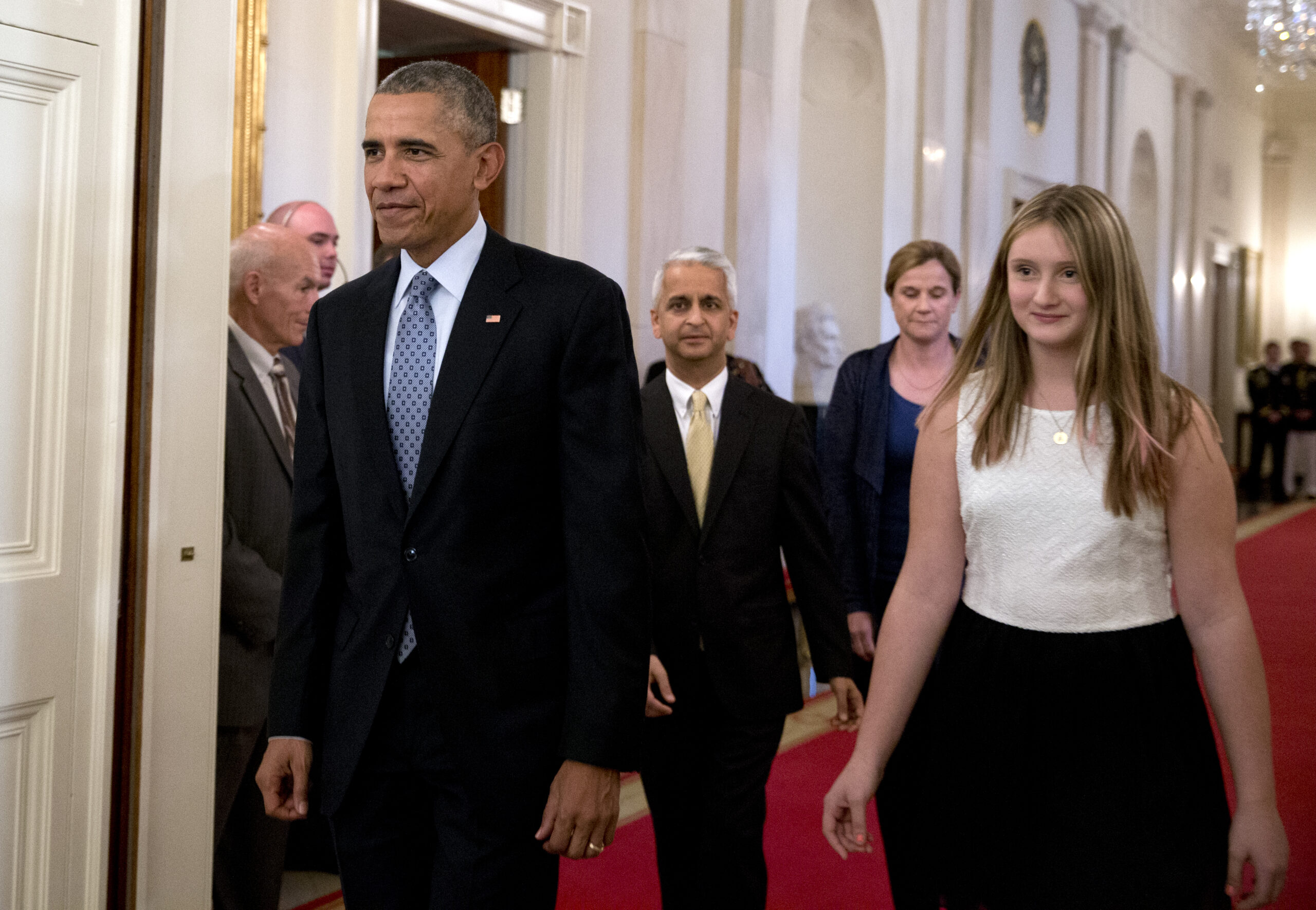
Sunil Gulati (center) walking behind Barack Obama in 2015 at a White House ceremony to honor the U.S. women’s soccer team’s World Cup win.
Few people have seen more of soccer’s growth in this country up close, not just in his years as president but in a variety of roles across Major League Soccer, FIFA, and recently as the chair of European soccer confederation UEFA’s Club Financial Control Body.
Gulati has a lot of stories to tell, and not all of them are allowed to see the light of day. But he was happy to share some with The Inquirer as he enjoys this tournament just like the rest of us.
‘The day after’
When U.S. Soccer took those first steps in 2007, Gulati had been president for less than a year, and it was only 13 years since the 1994 tournament — not too long in World Cup terms. But some flickers of the afterglow were still there, and he knew how long it would take to bring the fire back.
“The ’94 World Cup had been highly successful, and hosting an event like the World Cup generates a lot of positive benefits — and they’re not pure economic benefits, including this [2026] World Cup,” he said. “It was never about the financial returns to the federation, or federations, in this particular World Cup, and there are three of them.”
In his view, “it was always about trying to increase the demand for the game, [and] accelerate the growth of the game in the United States. It’s [wondering] what does the sport look like the day after?”
That acceleration included building the foundations of a soccer infrastructure in this country. Many future power brokers had launchpad moments in 1994: future U.S. Soccer CEO Dan Flynn, promoter and media personality Charlie Stillitano, broadcaster Derek Rae, and future women’s World Cup, Olympics, and NWSL executive Marla Messing.
Above all, that World Cup produced Major League Soccer, as FIFA required the U.S. to launch a top-level league as a condition of hosting.
“All the people that worked in senior positions or in entry-level positions that became part of the landscape in the sport … those people became important players in the growth of the game in different ways,” Gulati said. “And obviously, then if you talk about MLS, the development of the league leads to huge changes in infrastructure, the stadiums in particular, training facilities.”
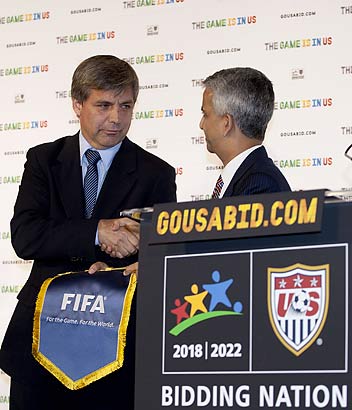
Harold Mayne-Nicholls (left), the head of the FIFA Inspection Delegation, exchanges a FIFA banner with then U.S. Soccer president Sunil Gulati at the conclusion of FIFA’s bid inspection for the 2018 and 2022 World Cups.
Gulati believed another World Cup could do even more. So the long road began, with U.S. Soccer going in on 2022 when it became clear 2018 was going to Europe.
For some time, it seemed like effort would pay off. But in December of 2010, a day came that will live in soccer’s infamy.
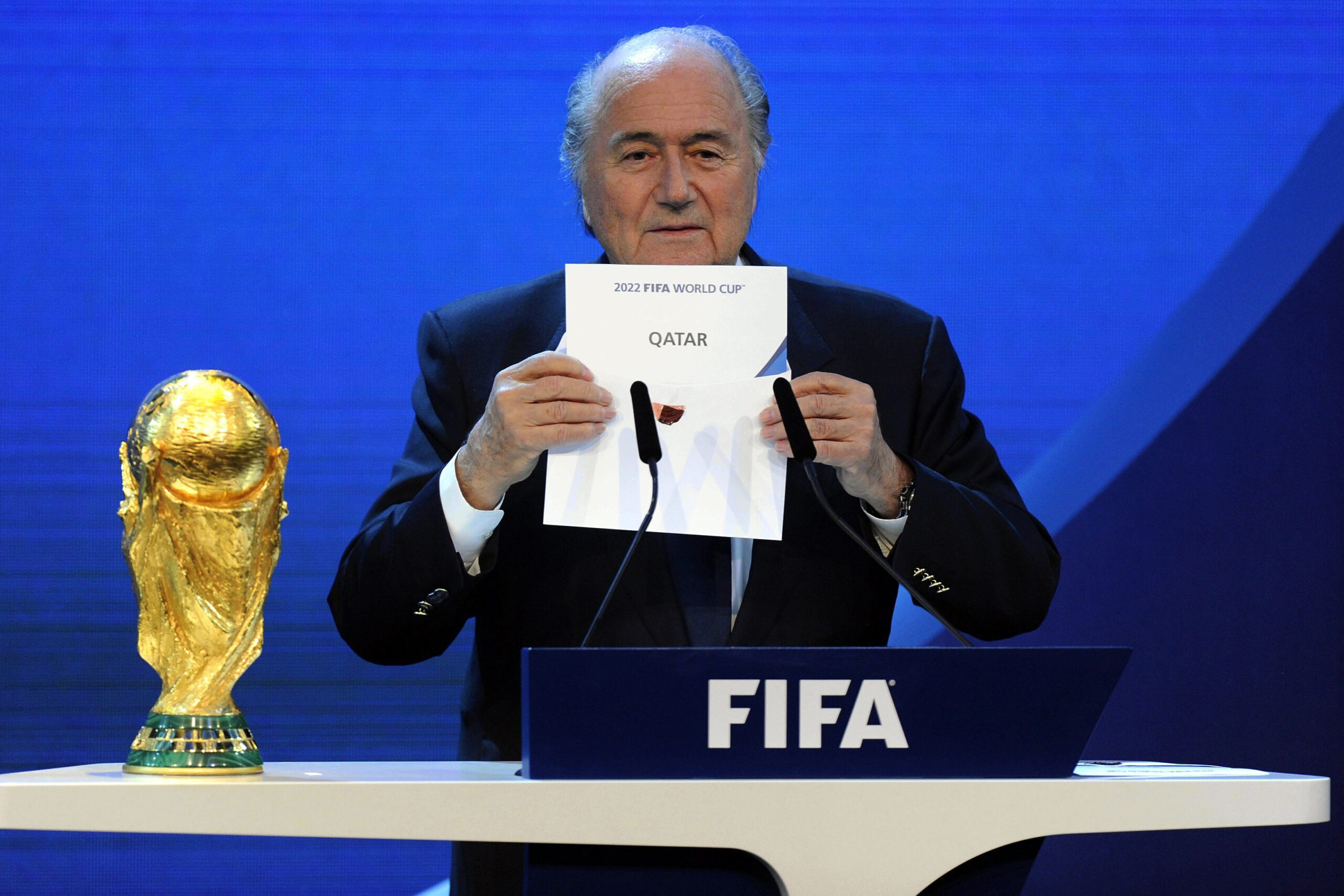
So many people around the sport remember where they were when then-FIFA president Sepp Blatter pulled Qatar’s name out of the envelope instead of the United States’. It hurt as much as any loss on the field, perhaps even more to some people.
But Gulati was ready for the gut punch because he sensed it might be coming.
Perhaps the most infamous day in FIFA’s modern history: when then-president Sepp Blatter announced on Dec. 2, 2010, that Qatar would host the 2022 men’s World Cup.
“I had a better inkling, I think, than members of my team that it was going to go the wrong way for us,” he said. “Because we had a pretty accurate vote count, and that vote count relied on three European votes. And I had a pretty good idea that we weren’t going to get those — the votes that the weeks earlier, I was quite confident that we were going to get.”
Had those three votes on FIFA’s executive committee gone the U.S.’ way in the final round of voting, it would have been an 11-11 tie, and Blatter would have broken it in America’s favor.
“It didn’t shock me, but I think it probably shocked some other members of the team who maybe weren’t quite as close to the vote count,” Gulati said. “And it was obviously a huge disappointment, but not a shock.”
“Right after the decision, I wasn’t sure if I ever wanted to go near this process again, or if I wanted to start right away,” he said, and he referred to an even stronger version of that line he gave to France’s Le Monde newspaper earlier this month.
“On the one hand, I wanted to immediately jump into our next bid,” that version went, “and on the other, I told myself that I never again wanted to have anything to do with that kind of thing, or with those people.”
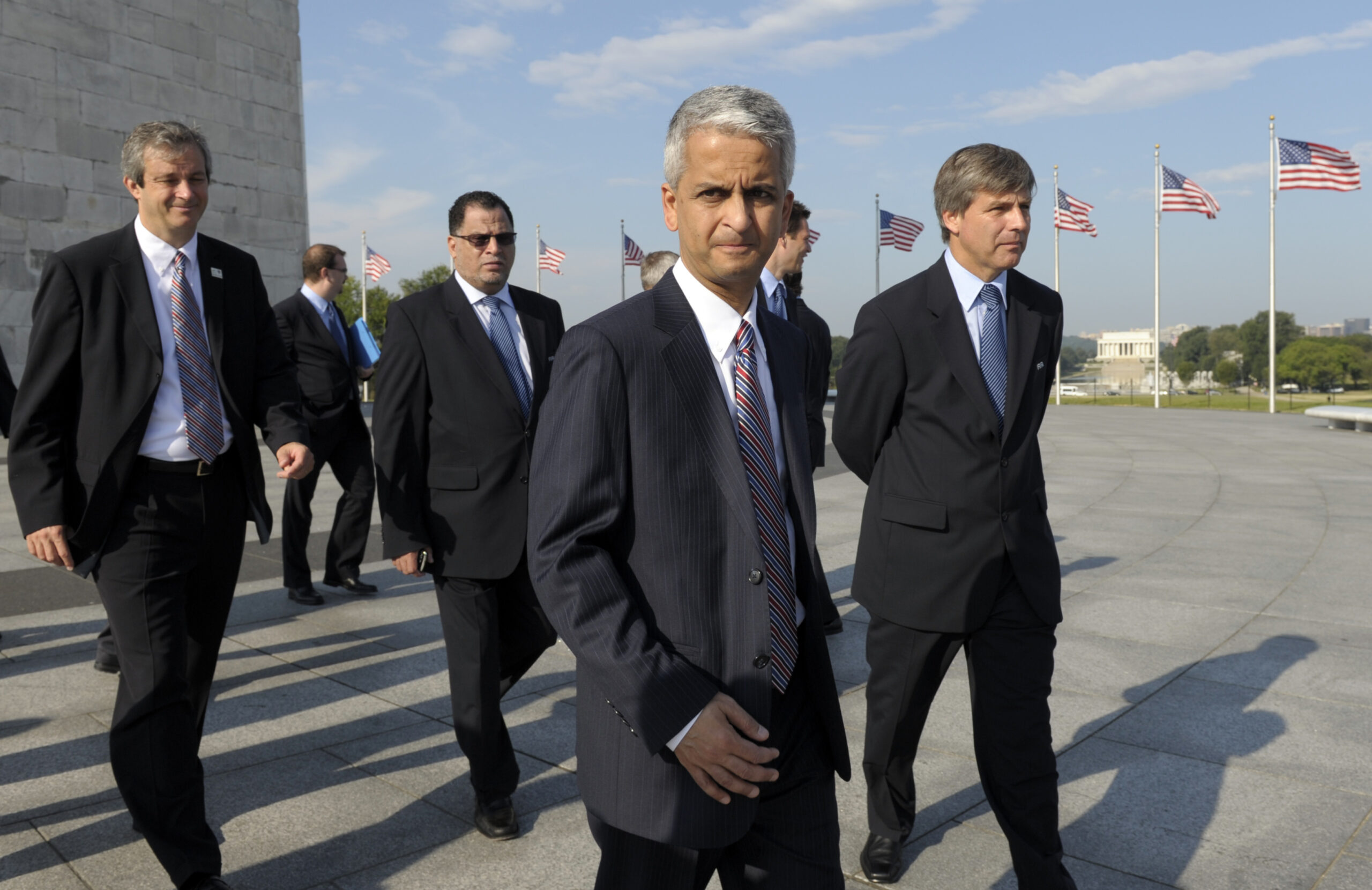
Sunil Gulati (center) with various international soccer officials at the Washington Monument in D.C. in 2019.
As allegations that Qatar bribed FIFA officials to win the bid piled up, it would be a few years before the winner of Gulati’s internal battle emerged. When it did, the soccer landscape had changed in an even more epic way.
On May 27, 2015, the U.S. Department of Justice raided the Baur au Lac hotel in Zurich, Switzerland, and arrested a slew of international soccer officials. A few hours later in Brooklyn, N.Y., the department formally announced the charges and the people charged.
That day would lead to Blatter’s resignation and a pile of other impacts, including reforms to the World Cup bidding process.
Since Gulati was on the FIFA Executive Committee at that point, he had a role in those reforms. He acknowledged to The Inquirer that he wanted “to try to influence what the rules of the competition, in terms of the bidding process, would be. And those changed, which then allowed us to be more comfortable bidding again.”
By the end of that year, the wheels were in motion, and in 2016, Gulati started pushing for a multicountry plan. It started with just the U.S. and Mexico, as Gulati worked with the then-chairman of the powerful TV network Televisa, Emilio Azcárraga Jean. Then Canada joined the fold.
“There were some cultural reasons, frankly, that I wanted to do it with Mexico, about Hispanic relations, Mexico-U.S. relations, and so forth,” Gulati said. “And then we’re having a parallel set of discussions with Victor Montagliani, who was the president of the Canadian federation, and it eventually came to the three of us doing it together.”
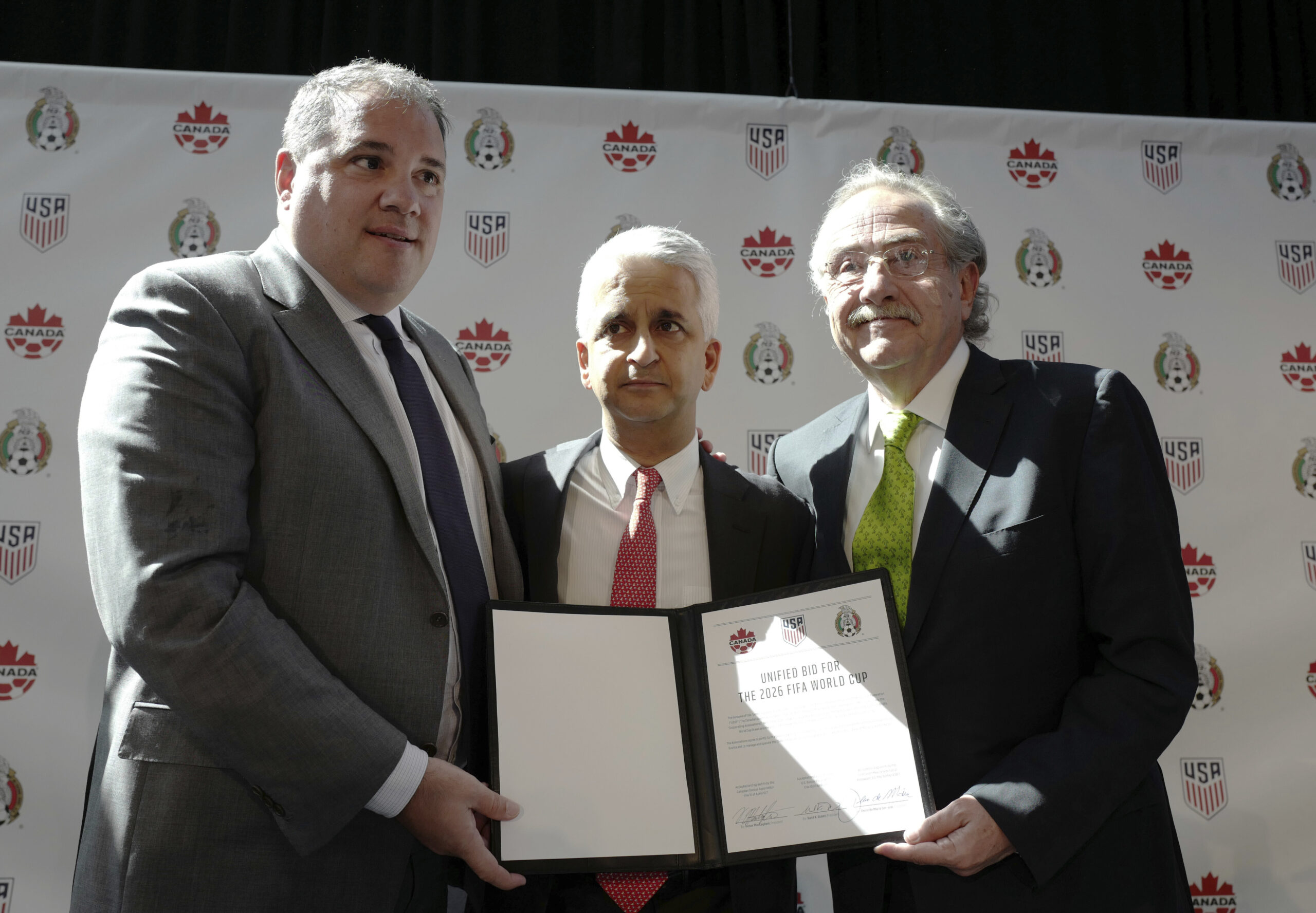
From left, Victor Montagliani Sunil Gulati, and then-Mexican soccer federation president Decio de Maria presenting their joint bid to host the 2026 men’s World Cup.
Gulati knew a multicountry bid would look better to FIFA, but it would take convincing U.S. Soccer’s board first.
“I preferred having a 90% chance of winning 75% of the World Cup games than a 75% chance of hosting it all,” he said.
He also preferred the new FIFA president. Gulati played a key role in getting Gianni Infantino elected. During the election vote at the 2016 FIFA Congress, Fox’s TV broadcast repeatedly showed him working the hall.
Another aspect doesn’t attract big headlines but has had a huge impact behind the scenes. This is the first men’s World Cup where FIFA hasn’t had a national-level local organizing committee, run by domestic staff in the host countries, that handles marketing, venue deals, political relationships, and so on.
Instead, FIFA has tried to do almost everything itself. And as even casual soccer fans have seen by now, it has not gone well — especially just north of here in New Jersey.
Gulati didn’t want to go too far down that road in public, but he opened the door enough to sense what was beyond it.
“Some of the key figures in this World Cup are people that work for FIFA, which is fine, but it’s different, certainly,” he said.
Asked if FIFA was told that they weren’t going to be able to unilaterally rule over North American governments, he said: “They understood that. And that’s obviously posed a bunch of challenges … Not just state, local, federal, but three countries in this case.”
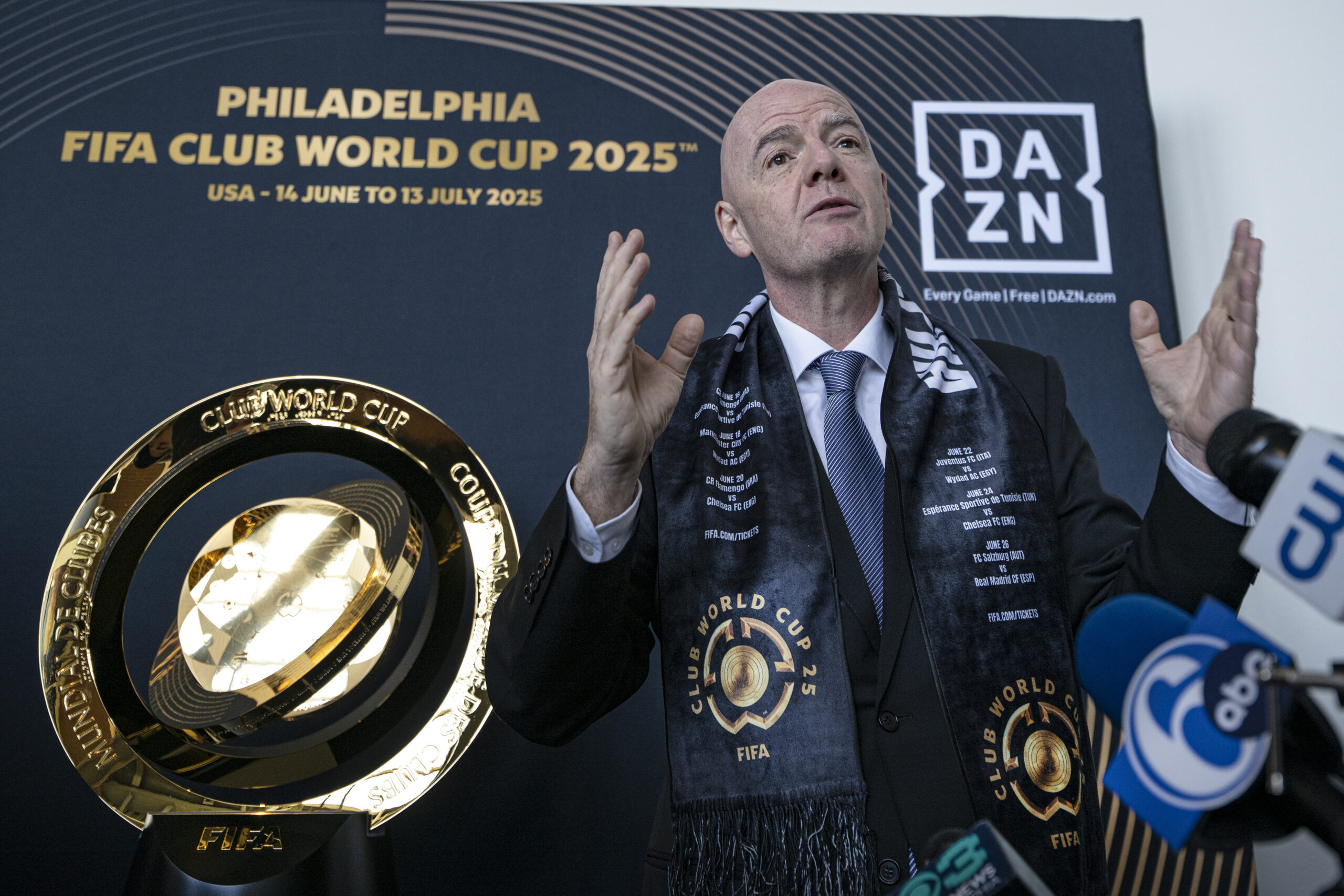
FIFA president Gianni Infantino (left) on a visit to Philadelphia last year to promote the Club World Cup.
And asked in particular about dealing with state and local governments that don’t exist in other countries, Gulati said: “That’s obviously come up, and I get it. But look, there’s always some issues that come up in these things, whether it’s immigration or taxes, or who’s going to pay for what, or exclusivity, all those things — those are kind of par for the course in World Cups.”
A moment later, he added: “Maybe it’s a little bit easier given the obvious differences in governance that exist in other countries.”
In the end, Gulati is an optimist about this World Cup’s long-term potential, including for Philadelphia specifically. He knows the city well, and knows the spotlight it’s in this summer.
“I think what it can do is bring greater attention to the sport and greater attention to the city if it becomes an important attraction, and games go well, and people feel at home, and it’s welcoming, and so on,” he said. “Philadelphia, it’s a great sports city, it’s got great venues. And hopefully, some of the teams that are playing there — and the fans more importantly — come, and they talk about it, and there’s more people that want to visit in the future.”
After 72 games over 17 days in the group stage, the first 48-team World Cup has officially reduced to the 32 that will contest the knockout rounds.
If that doesn’t feel like much of a reduction, you aren’t alone. The old adage that the World Cup is really two tournaments in one, the group stage and the knockouts, feels more true than ever this summer.
But now the drama kicks up another gear, as it’s win or go home for every team left standing. Here’s what to know about the 32 games remaining before the July 19 final in North Jersey.
All games are televised on Fox29 in English and Telemundo 62 in Spanish, except for two in the round of 32 on FS1: Belgium vs. Senegal on July 1 and Switzerland vs. Algeria on July 2. All times listed are local to Philadelphia.
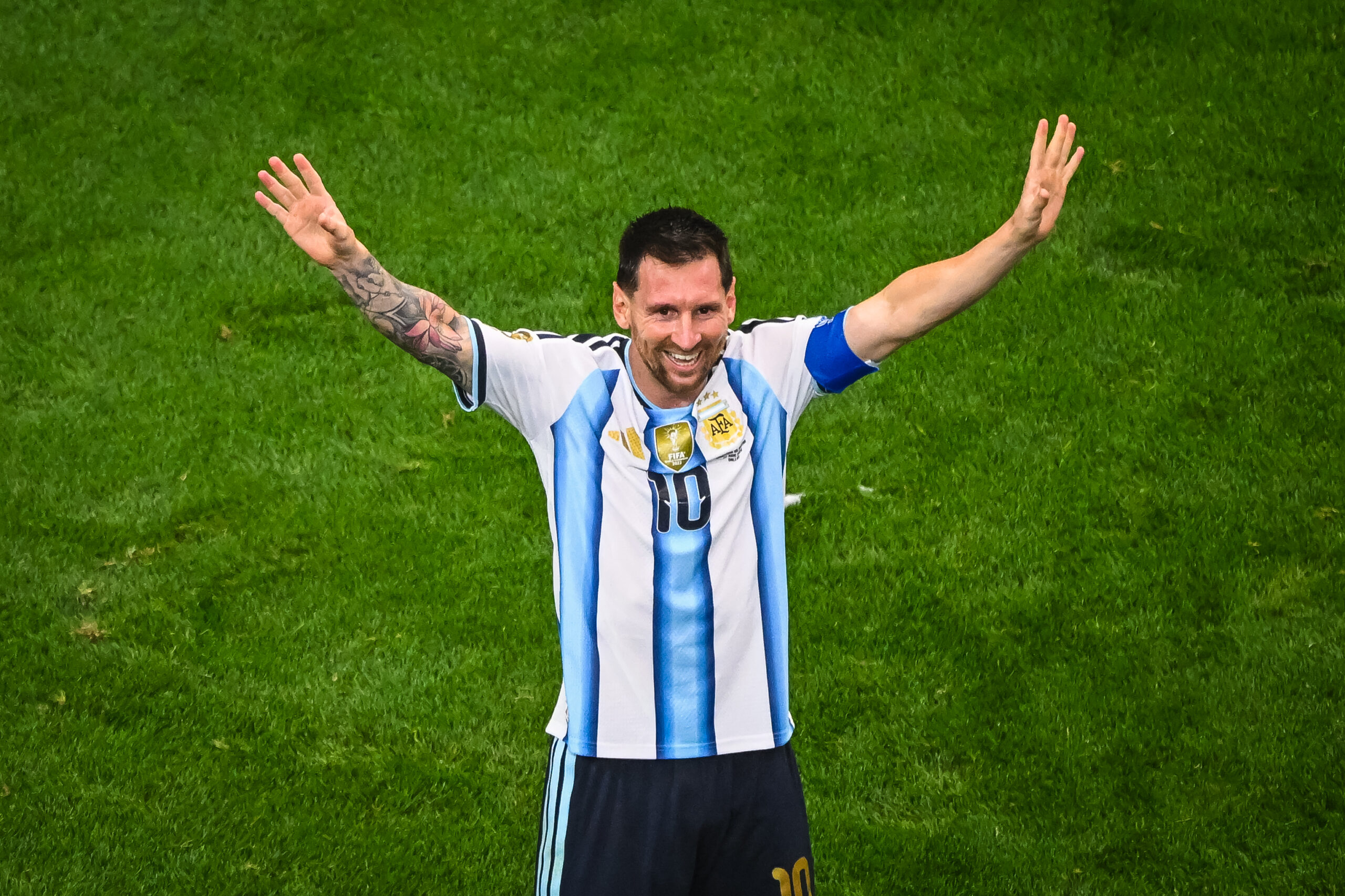
Lionel Messi hopes to help Argentina become the first back-to-back men’s World Cup champion since Brazil in 1958 and 1962.
Round of 32 schedule
The number and letter next to each country denotes where it placed in its group during group stage games.
Sunday
3 p.m.: 2A. South Africa vs. 2B. Canada in Inglewood, Calif.
Noon: Argentina or Cape Verde vs. Australia or Egypt in Atlanta
4 p.m.: Switzerland or Algeria vs. Colombia or Ghana in Vancouver, B.C.
If the U.S. can make the round of 16, it will hope for another big home-field advantage in Seattle.
Quarterfinals
July 9
4 p.m.: Germany, Paraguay, France, or Sweden vs. South Africa, Canada, Netherlands, or Morocco in Foxborough, Mass. (winner goes to semifinal 1)
July 10
3 p.m.: Portugal, Croatia, Spain, or Austria vs. United States, Bosnia & Herzegovina, Belgium, or Senegal in Inglewood, Calif. (winner goes to semifinal 1)
The Meadowlands will host a World Cup final for the first time, after the 1994 men’s and 1999 and 2003 women’s finals were played in the Los Angeles area.