Some snow is possible in the Philly region during the holiday weekend, but about the only thing certain is that schools will be closed until Tuesday.
Snow — not a whole lot of it — is expected Saturday morning, and possibly again during the day Sunday.
“Definitely something,” said Ray Martin, a lead meteorologist at the National Weather Service Office in Mount Holly, “maybe not a lot of something.”
In short, he added, expect a “100% chance of forecast uncertainty.”
How much for Philly?
(function () {window.addEventListener(‘message’, function (e) { var message = e.data; var els = document.querySelectorAll(‘iframe[src*=”‘ + message.id + ‘”]’); els.forEach(function(el) { el.style.height = message.height + ‘px’; }); }, false); })();
Some snow is expected in the early morning hours of Saturday, said Dan Pydynowski, senior meteorologist with AccuWeather Inc., and “sidewalks and streets could be slick for a time” in the Philly region.
However, temperatures in the afternoon are expected to approach 40 degrees and that should melt any snow. If the precipitation lingers, it likely would turn to rain.
That snow would be associated with a system from the west, and more significant amounts are expected well north and west of Philly.
On Sunday when it will be colder, the source would be a coastal storm that has been befuddling computer models the last three days. On Wednesday, the U.S. model was seeing a significant snowstorm for the I-95 corridor. On Thursday, it said never mind and fell in line with other guidance that kept the storm offshore.
On Friday, models were bringing the storm closer to the coast, but the model consensus was that it would be more of threat at the Shore and perhaps throw back a paltry amount to the immediate Philly region.
“On the other hand, a slight shift … in the track could bring 1-2 inches into the urban corridor,” the weather service said in its afternoon discussion.
Said Martin, “It’s always tricky with these offshore lows. It’s also possible that both systems pass us and we get basically nothing.”
Far more certain is a rather big chill
A Philadelphia firefighter spreads salt to control icing at a fire scene on Friday.
That the region was about to experience its coldest weather of the season to date was all but certain.
High temperatures on Monday, Martin Luther King Jr. Day, probably won’t get out of the 30s, and no higher than the mid 20s Tuesday and Wednesday, forecasters say.
Overnight lows are due to tumble into the teens, with wind chills approaching zero early Wednesday.
No more precipitation is forecast at least through Thursday, but with odds favoring continued below-normal temperatures through Jan. 29 and above-normal precipitation, it should be a robust period for virtual snow threats, if not actual snow.
As it approaches halftime, the meteorological winter around here so far has been about as inconsistent as the Philadelphia Eagles’ offense, but it is about to get decidedly colder, if not snowier.
Temperatures on Thursday are due to hover around freezing with a brisk westerly wind gusting up to 30 mph (sympathies to all bikers and runners and those who are navigating those Center City wind tunnels), and then drop into the 20s after sunset with windchills in the teens.
Then, after a modest warmup Friday and Saturday, the forecast turns decidedly colder and potentially more intriguing, as computer models have been going back and forth on snow potential for the Philly region.
Philly’s coldest stretch of the winter so far to begin Sunday
Readings are expected to warm into the 40s on Saturday, but then drop off dramatically during the holiday weekend and may not reach freezing again until Thursday.
They may not get out of the 20s on Tuesday — when wind chills could fall to 0 in Philly — and Wednesday, with overnight lows in the teens.
A few alarm bells went off Wednesday afternoon when the main U.S. computer model suggested potential major snowstorms along the coast all the way to the I-95 corridor on Sunday.
However, other computer guidance wasn’t buying it, nor were forecasters. The computer food fight continued Thursday.
The U.S. model, said Paul Pastelok, longtime seasonal forecast specialist with AccuWeather Inc., “goes wacky all the time.” Maybe not all the time, but a subsequent run of the European model kept the storm offshore.
“We’re kind of in a waiting game,” said Pastelok.
Opined the National Weather Service Office in Mount Holly in its afternoon forecast discussion, the potential system has “high-end potential but also could end up being nothing.”
In other words, situation normal.
The winter so far in Philly and United States
Oddly, the raw stats for the first half of the meteorological winter — that’s the Dec. 1-Feb. 28 period — are not too far from normal for snowfall and temperature.
December temperatures finished at 3.6 degrees below normal at Philadelphia International Airport. And in the first two weeks of 2026, they were 3.6 degrees above normal. Snowfall in December was about an inch above average, but with a paltry 0.3 inches so far this month, the 4.8 total is very close to where it should be.
The early season coolness in Philly and much of the rest of the East was a surprise, said Owen Shieh, warning coordination meteorologist with NOAA’s Weather Prediction Center, in College Park, Md. The West, conversely, was quite warm.
The contrasts were the result of “pattern persistence,” said Tony Fracasso, a weather center meteorologist.
In the East, “This winter started quite strong,” he added, compared with recent winters. “It was not record cold,” but, “it sure felt cold for us.”
What’s ahead the rest of the winter of 2025-26
That likely will be the case early next week, and NOAA’s Climate Prediction Center has chances favoring below normal temperatures and above-normal precipitation in the Jan. 22-28 period.
Pastelok said that upper-air patterns are aligning in such a way that favors importing cold air from northwestern Canada.
The Climate Center’s Laura Ciasto said she does not see a major invasion of the polar vortex in the next few weeks. The vortex circles the Arctic, imprisoning the planet’s coldest air. But on occasion, the winds weaken, the freezer opens, and the contents spill southward.
She said the vortex winds are slightly weaker than normal but are expected to strengthen.
It is possible that lobes of the vortex may stretch on occasion, resulting in short-lived periods of cold in the Northeast, said Judah Cohen, research scientist with the Massachusetts Institute of Technology.
A period to watch would be the first week in February, when a significant disruption of the vortex is possible, Pastelok said.
A sudden stratospheric warming in the high atmosphere in the Arctic, which can lead to cold outbreaks in the contiguous United States “is not out of the question” late in the winter, Ciasto said.
Philadelphia’s peak snow season typically occurs in late January through mid-February.
Of the 10 biggest snowfalls in the city’s history, only three have occurred before Jan 22.
The winds evidently won’t be taking sides: The stadium’s orientation is more or less north-south, and the winds will be blowing from the west and then “swirling around in the Linc,” said Matt Benz, a senior meteorologist with AccuWeather Inc.
In any event, they won’t be much help to the quarterbacks or the kickers — San Francisco’s Eddy Piñeiro or Elliott, whose 74.1% field goal percentage this season was the second-lowest of his nine-year career. Piñeiro hit on 28 of 29 attempts.
Temperatures at the 4:30 p.m. kickoff are expected to be in the mid-40s and drop into the upper 30s during the game, and steady winds of 20 mph may drive wind chills into the upper 20s.
“At least it will be dry,” said Benz.
That won’t be the case around here Saturday.
The winds are to follow some drought-easing rains
After temperatures again climb well into the 50s on Friday, showers are possible at night, but the rains will be more “widespread” on Saturday, said Zach Cooper, a meteorologist with the National Weather Service office in Mount Holly.
No severe weather is expected, although rumbles of thunder are at least possible, he said.
Said Benz, “It’s going to be soaking rain Saturday afternoon into the evening.”
While rainfall amounts remain uncertain, about an inch was likely, the weather service said. Given the local rain deficits and the low water levels in the streams, no flooding was expected.
The only precipitation measured this month at Philadelphia International Airport, all of 0.1 inches, came from a dusting of snow on New Year’s Day.
Snow prospects are not exactly robust
Rain is possible the middle of next week, but the extended forecast remains flakeless, in least in the reliable range.
Temperatures on Monday will top out near 40 degrees, close to normal for the date, and reach the mid and upper 40s Tuesday and Wednesday. Another cooldown is expected late next week.
NOAA’s Climate Prediction Center has chances favoring below-normal temperatures in the Northeast in the Jan. 16-22 period, which would be approaching the season’s climatological peak snow season.
As for winter storm potential, its Thursday afternoon discussion that accompanied the extended outlook foresaw “an overall more active pattern.”
Robinson, a Rutgers University professor and snow expert, said he was aware at the time of the 122-inch total measured at High Point in North Jersey during the eventful winter of 1995-96.
The findings, released Tuesday, were published in a 60-page memorandum authored by Chris Stachelski, an official with the National Weather Service’s Eastern Regional Headquarters.
The report included several pages of images and discussion of the 1995-96 winter during which Philadelphia experienced its biggest snow in its 140-year period of record.
As state climatologist, Robinson said he long had intended to vet the 122-inch figure.
He said he was well familiar with the observer who was measuring all that snow and that he is “someone who is meticulous.”
Robinson said one might ask why he didn’t seek to verify the record sooner.
“I didn’t. It was too far on the back burner for far too long.”
Robinson said the impetus was a national effort a few years back to assemble snowfall records for every state, and that prompted him to look again at the High Point record.
He said the weather service ultimately took the lead in the investigation, and after a meeting with Stachelski, the committee decided 10 feet of snow truly fell upon High Point that winter.
The plows and shovels haven’t had a whole lot of action in the region in recent winters, and it looks like the rulers will be at rest at least for a while. It may even hit 60 degreesFriday.
Perhaps the atmosphere over the I-95 corridor is still catching its breath and awaiting a second wind after an unprecedented sequence of megastorms that began 30 years ago.
It was on Jan. 7-8, 1996, that an unreal 30.7 inches of snow fell officially* (we’ll come back to that asterisk) at Philadelphia International Airport, the biggest snowfall on record, and a total so astounding it precipitated a federal investigation. The region wasn’t shut down so much as entombed in road-closing heaps of snow.
Philly snow records date to the winter of 1884-85, and in the first 100 years, the city would experience a single snowfall of 20 inches or more only twice.
This, during a time when planetary warming was picking up steam. Rather than paradox, some atmospheric scientists see symmetry.
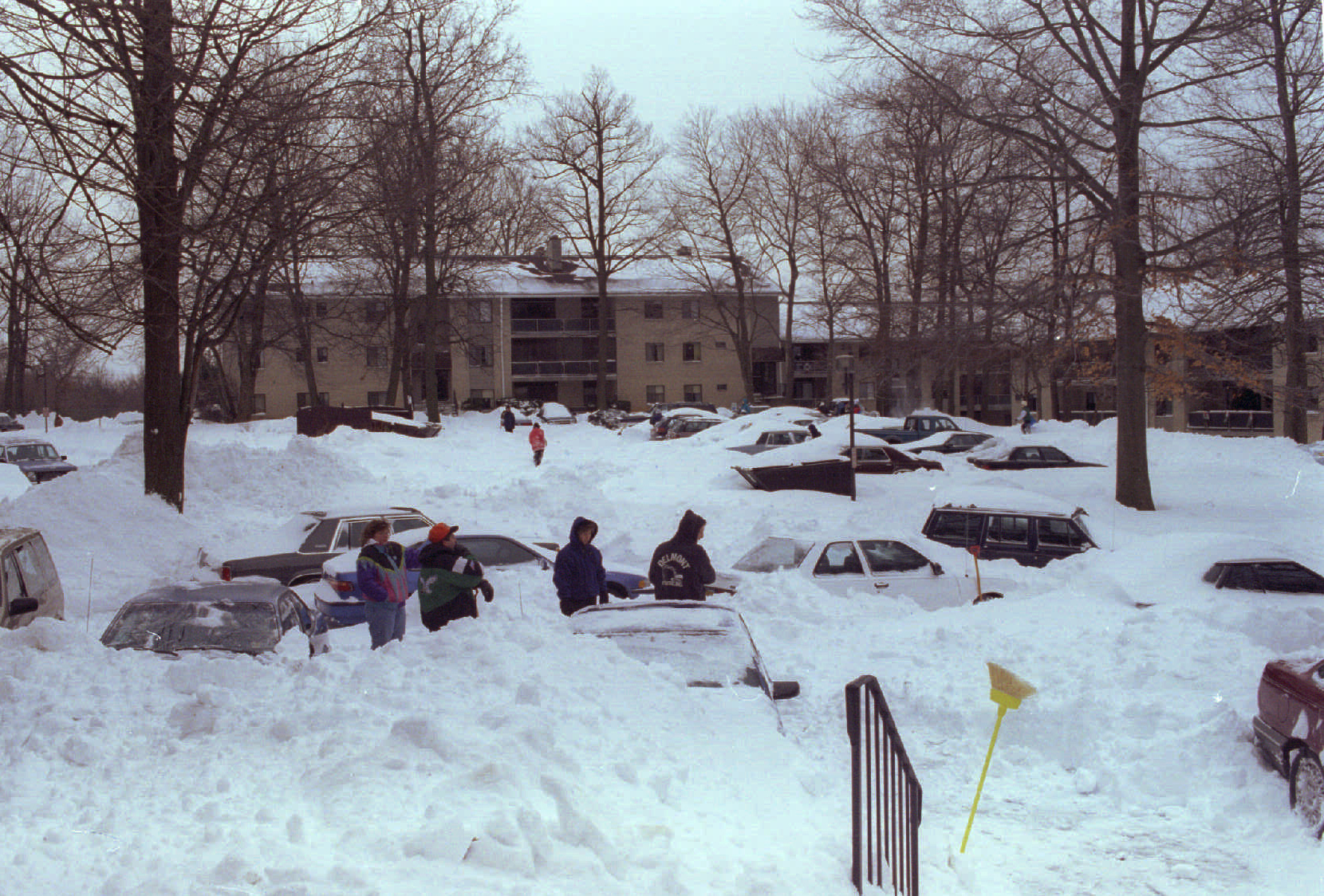
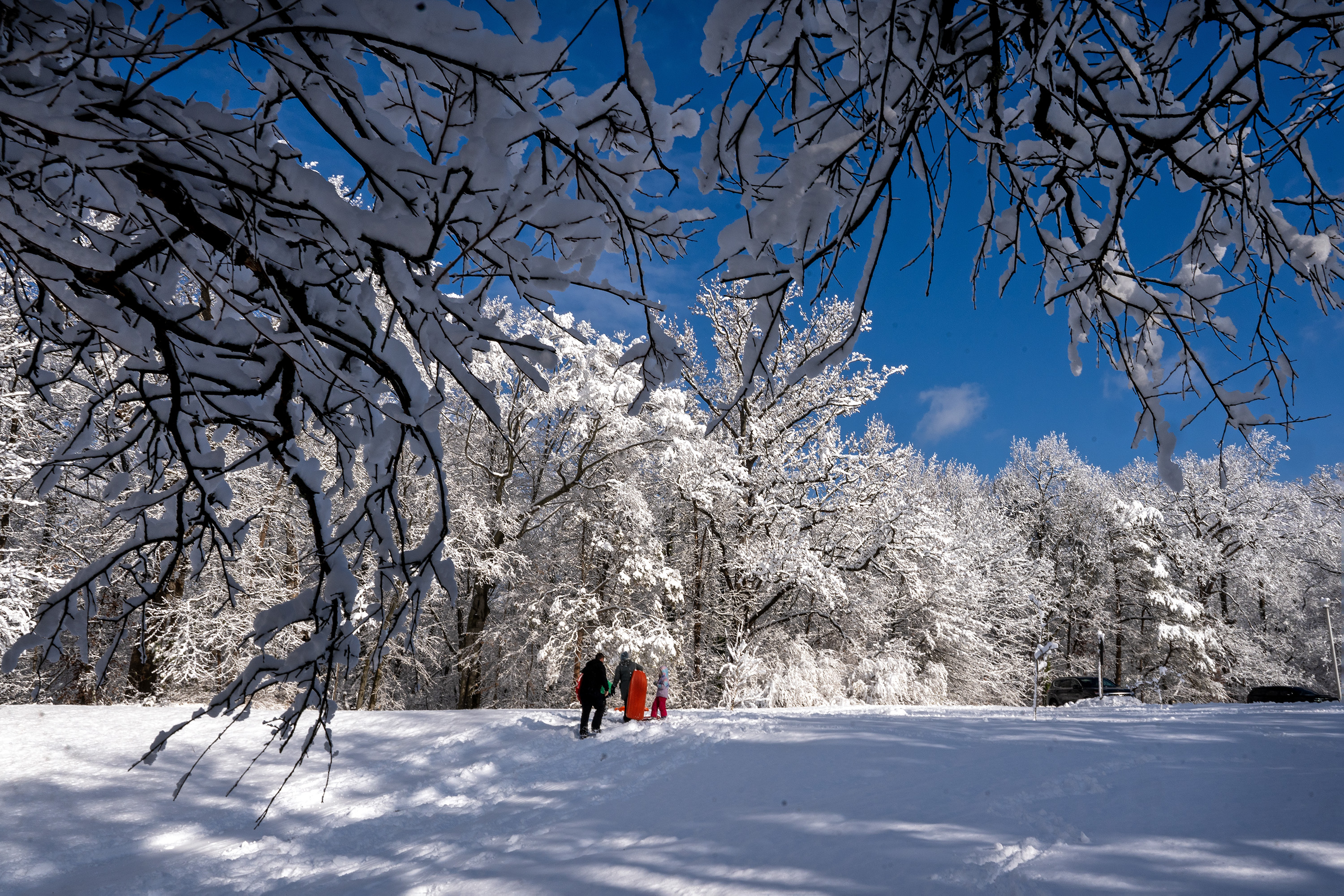
A view looking out over the snow covered parking lot in Malvern.
How warming may be affecting snowstorms
Warming has resulted in more evaporation, filling the air with more moisture, “and the potential for more extreme precipitation,” said Kyle Imhoff, a Pennsylvania State Universityprofessor who is the state climatologist.
Said Louis Uccellini, former head of the National Weather Service and one of the nation’s most prominent storm experts, “if conditions are right … that would include the potential for more snowfall within an individual storm.”
Proximity to bodies of water, primary sources of moisture, may be making a difference, said Imhoff. In Erie, in recent decades warming appears to be prolonging the lake-effect snow season as waters have been less prone to freezing.
In recent decades, snowfall from coastal lows has “become more frequent,” he said. Philly’s biggest snows typically are generated by nor’easters that import moist air from the Atlantic, where sea-surface temperatures have been above normal consistently. That warmth may be giving a jolt to coastal storms, according to a paper published in July by a group of researchers, including the University of Pennsylvania’s Michael E. Mann.
It ain’t necessarily snow
That wouldn’t necessarily mean more snow. Ocean temperatures typically are several degrees above freezing in winter, and onshore winds often have turned snow to rain in Philly.
“The trick is getting enough cold air for snowfall,” said Imhoff.
Snowfalls of a foot or more require a highly unlikely alignment of circumstances, a meeting of opposites: Cold air that holds its ground near the surface, forcing warm moist air to rise and generate snowflakes.
Philly’s normal seasonal snowfall is 23.1 inches, but a “normal” season is hardly the norm. The totals have varied from nothing (1972-73) to 78.7 (2009-10). The region has experienced decades of robust snow totals, and snow scarcity.
Sarah Johnson, the warning coordination meteorologist in Mount Holly says she hasn’t yet seen the fingerprints of climate change on snowfall patterns.
“My hypothesis: It’s probably just the luck of the draw,” she said.
Tony Gigi, retired weather service meteorologist, said he wondered if some overarching pattern might explain the decadal variability of snowfall in the region.
About the 1996 storm
Gigi was working the overnight on the morning of Jan. 7, a Sunday, when the snow began. Hesomehow made it to his Mount Laurel home after work, only to be called back Monday to relieve stranded colleagues.
Overall, the storm was a forecasting triumph, but Gigi said the European model well outperformed its U.S. counterpart. But no one was predicting 30 inches for Philly.
It was an astounding total for a variety of reasons, including the fact that it predated the region’s peak snow season by about three weeks. Of the total, 27 inches fell on the 7th; the previous record for the date was 5 inches.
The 30.7 total became a source of controversy. The reason: “The snow wasn’t measured,” said Gigi.
The total was inferred from a formula using the melted liquid equivalent of the snow and the air temperatures, which were in the teens and 20s during the snowfall. “It was in the realm of possibility,” said Gigi.
But that’s not quite the standard method, said Johnson. Ideally, she said, snow should be measured once with a ruler (or yardstick) at the point that the snow stops.
In this case, the total was so suspect that it wasn’t entered into the climate record for four years. The weather service commissioned then-Franklin Institute meteorologist Jon Nese and New Jersey state climatologist Dave Robinson, an international snow expert, to conduct a forensic investigation. They concluded the total was legitimate, given similar nearby snow reports.
It remains unclear whether it was truly an all-time record, since no official measurements are available before 1884. The late weather historian David Ludlum quoted a visiting Swedish author as having witnessed snow “a yard deep” in Philadelphia in March 1705. However, Ludlum pointed out that it was unclear whether that was the result of a single snowfall.
The future of snow
As of Wednesday, at 4.8 inches, Philly’s official seasonal snowfall total is exactly “normal.”
Highs are expected to climb into the 50s through Saturday, perhaps reaching 60 on Friday before a cool-down early next week. Not a flake sighting is in the extended outlooks.
One factor in the lack of snow in recent years has been consistently cool waters in the tropical Pacific that tend to affect west-to-east upper-air patterns that are unfavorable to East Coast storms.
With a predictable precision that may forever elude meteorology, at 10:03 a.m. Philadelphia time Sunday, the sun will beam its most direct light of the year on the Tropic of Capricorn and the astronomical winter will begin in the Northern Hemisphere.
Sunday indeed is going to be the shortest day of 2025, with just over nine hours and 23 minutes between sunrise and sunset.
On the bright side for those who have about had their quotas of premature darkness, the day length would be a mere one second shorter than Saturday’s, and on Monday, we gain two more seconds. On the dark side, Sunday’s sunset is a full three minutes earlier than that of Dec. 12. (And don’t ask about sunrise.)
Whether the brightness would be enhanced by snow cover is another matter: Meteorology has a long way to go to catch up to astronomy in terms of predictability.
In the early going, Philly is more than halfway to last winter — with 4.2 inches of snow, vs. 8.1 for the entire winter of 2024-25.
In the short term, this is a peak time for a perennial question.
Is it going to be a white Christmas?
“No” almost always is a safe answer in Philly, and all along the Northeast Corridor from Washington to Boston. And “no” it is this year, says Bob Larsen, senior meteorologist at AccuWeather Inc.
With a white Christmas defined as an inch of snow on the ground at Philadelphia International Airport on Dec. 25, the National Oceanic and Atmospheric Administration officially posts about a 1-in-10 chance that it will happen in any given year in Philly.
So why the fascination? Blame Irving Berlin, composer of “White Christmas,” and Bing Crosby, who crooned the most famous version, but probably a bigger impetus was the poem “A Visit from St. Nicholas,” published in 1823 and credited to Clement Moore.
The poem cast Santa Claus as personally delivering gifts via his sleigh. This predated Amazon Prime. That pretty well cemented the Christmas/snow relationship.
Philly gets most of its major bigger snowstorms from nor’easters, which tap the moisture of the Atlantic Ocean. The onshore winds can also import warm air from the ocean, and this time of year ocean temperatures still are well into the 40s. That’s why snow changes to rain so often around here early in the winter. It takes time for the ocean and the snow-making upper atmosphere to cool, and the snow season peaks in late January into February.
It was so unbelievable that the record wasn’t verified officially until four years later, after NOAA commissioned a federal investigation. It turned out that the snow was not actually measured, but inferred from the liquid content of the melted snow and the air temperatures.
The investigators — David Robinson, the Rutgers University professor who is the longtime New Jersey state climatologist and an international snow authority, and Jon Nese, who then was the Franklin Institute meteorologist — affirmed the total.
They concluded that the snow reports in neighboring towns were close enough to support PHL’s.
Snow is a weighty matter
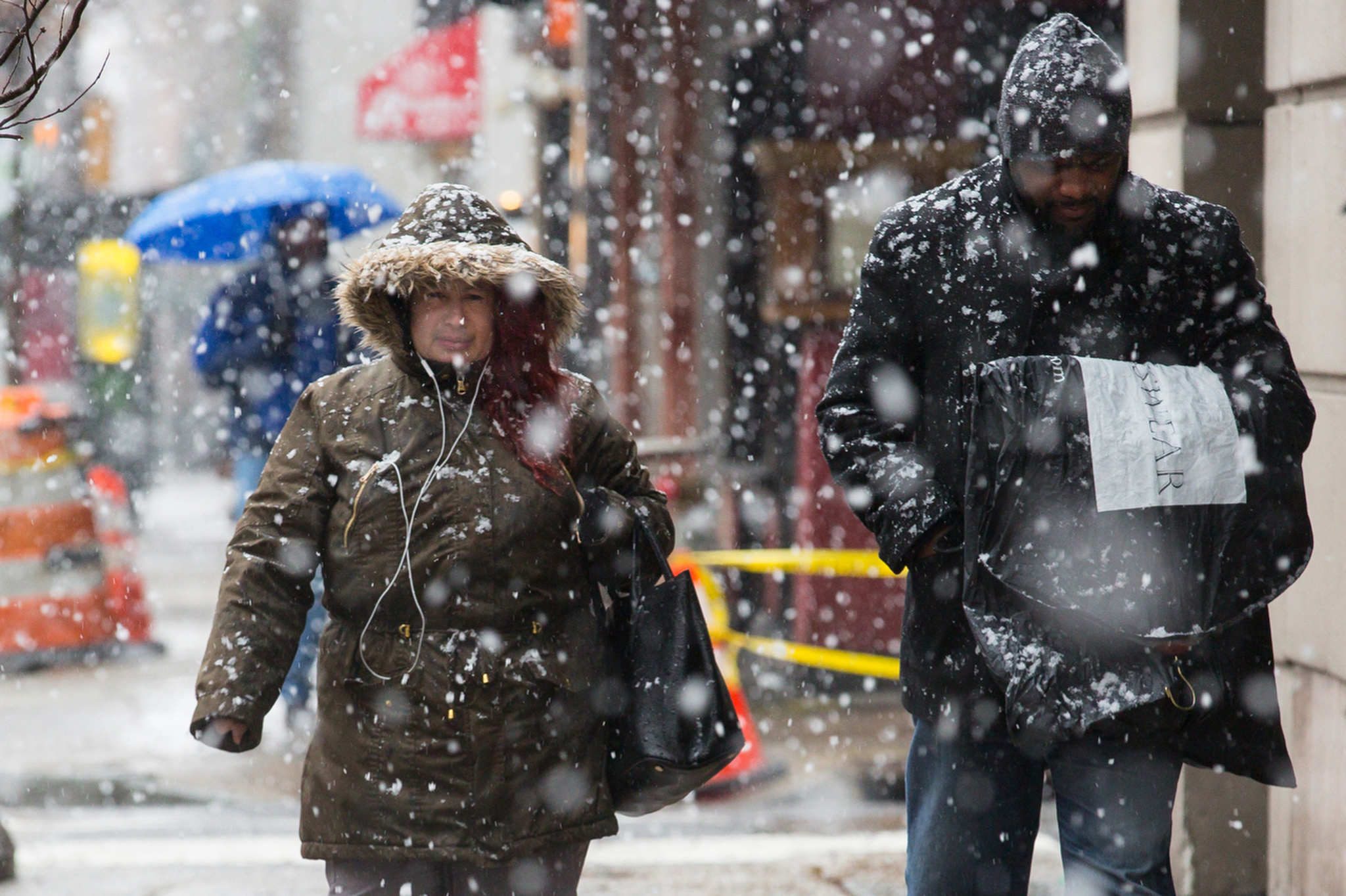
Large snowflakes fall as pedestrians make their way in Center City. Flakes come various shapes and sizes … and weights.
In the standard language used by the National Weather Service and commercial outfits, that certainly qualified as a “heavy” snowfall.
However, when temperatures are close to freezing as they were last Sunday, the snow has a higher liquid content and is thus heavier. On Sunday, 5 inches may have felt more like 8 to the average shovel. That’s heavy snow.
When it’s cold, as it was on Jan. 7, 1996 — temperatures were in the teens during the day — the flakes are way drier. The ratio for the storm was closer to 20-1, and overall the flakes were a whole lot lighter.
“Heavy” snow “applies to visibility ratios,” said Jim Eberwine, longtime meteorologist with the National Weather Service local offices, adding it might be time to reconsider the use of that adjective.
“Some things should be updated,” he said.
How about: Snowfall rates can be intense at times?
Snow: It’s a Northern Hemisphere thing
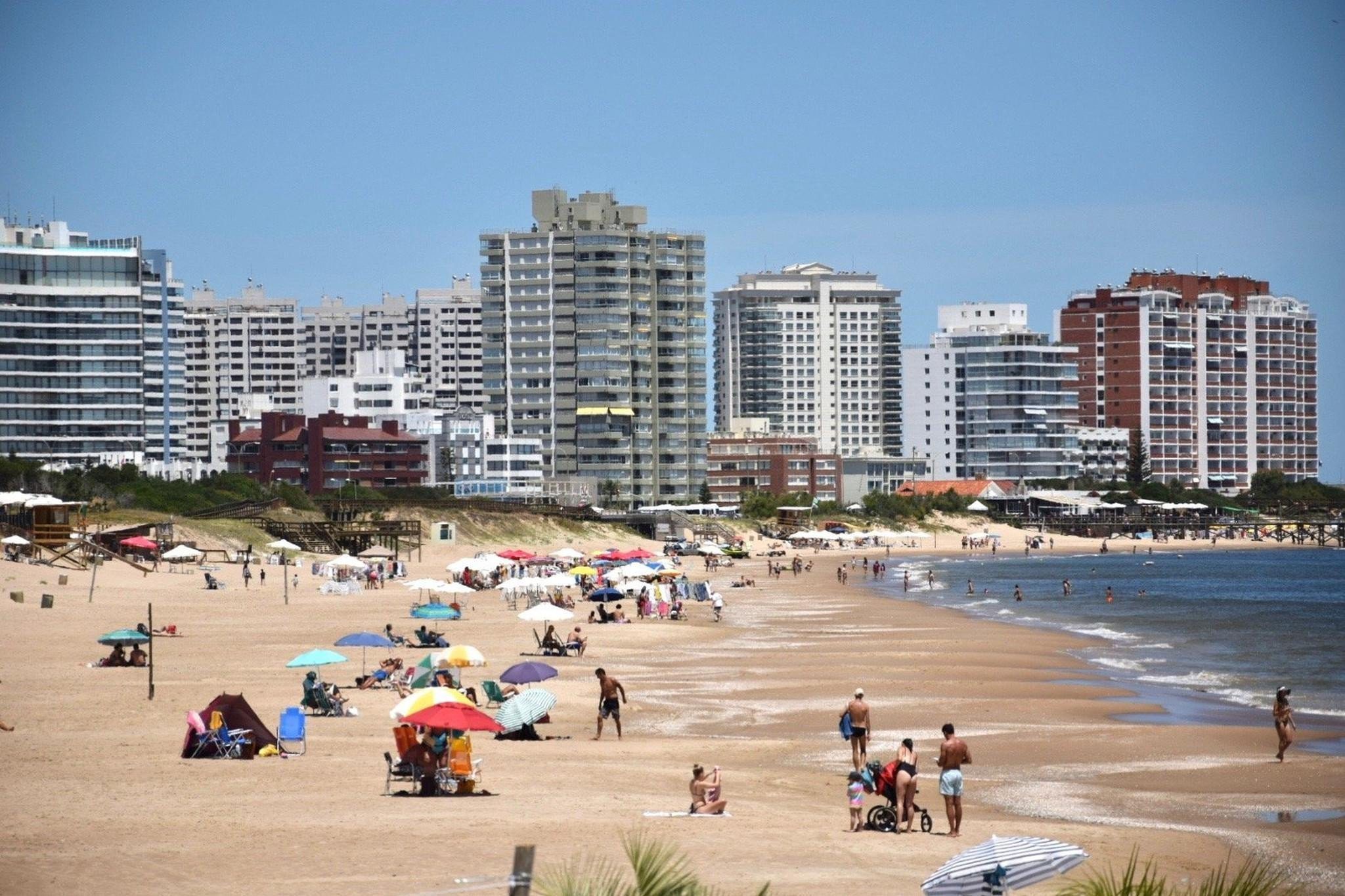
It’s Janaury in the Miami of South America, Punta del Este, Uruguay. It doesn’t snow much there in their winter either.
The solstice also marks the beginning of the astronomical summer in the Southern Hemisphere, so residents south of the equator probably won’t be using snowblowers for the next several months.
In fact, they won’t be seeing a whole lot of snow there during the winter. It snows robustly in the Andes and other mountain regions, but not in major population centers, the AccuWeather people note.
NOAA’s National Center for Environmental Information doesn’t bother to track snow cover in the Southern Hemisphere, for a couple of reasons, including that it’s 80% covered by climate-moderating water.
Plus its major cities are located at latitudes where snow is scarce.
How much for Philly this winter?
The Butler family finds a (small) hill to sled on in Wallworth Park in Cherry Hill after last Sunday’s snowfall. The 4.2 inches meashred in Philly was more than half of what fell all last winter.
Making seasonal snow forecasts in this region isn’t quite like picking lottery numbers, but reasonably close. Seasonal totals have varied from 78.7 inches in 2009-10 to nothing in 1972-73. NOAA’s Climate Prediction Center doesn’t touch the stuff.
The guesses for this year are in, and here is a partial list with what’s out there: The “normal” season total is 23.1 inches.
What’s left of the season’s first snowfall is all but gone with the wind — and the heftiest rains since October. And having done its best to disrupt Friday’s morning commute, the weather evidently is executing an afternoon encore.
After backing off for a few hours, the winds came back with a vengeance Friday afternoon. A thunderstorm gust of 62 mph was recorded at Philadelphia International Airport at 2:35 p.m.
The weather service’s wind advisory for the entire region remains in effect until 1 a.m. Saturday, and conspiring with snow melt to saturate the soils, SEPTA is particularly concerned about the potential for uprooted trees along its Regional Rail lines, said media relations director Andrew Busch.
“The recipe for problems is there,” he said. “We will have crews stationed across the system to respond quickly.”
Peco heard the rumors, and while the utility is “not expecting impacts, we’re going to continue to monitor conditions,“ said Candice Womer, senior communications specialist.
The deciduous trees are mostly bare, so winds can sail through branches that are not weighed down with leaves, but the weather service advises that “some power outages” are possible.
About 16,500 outages were reported at midafternoon.
An additional concern was the predicted wind shift during the day, from southerly in the morning to westerly in the afternoon, and how that might stress vulnerable trees, Womer said.
The strongest winds will occur during the afternoon
The gusts are likely to be “widespread” during the afternoon, said Paul Fitzsimmons, a lead meteorologist at the weather service’s Mount Holly office. That would be after the rain-producing front crosses through the region and winds become westerly, peaking in time for the afternoon commute. Gusts to 50 mph are possible.
Rain totals in the Philly area are expected to be in the 1-to-1.5-inch range, Fitzsimmons said.
Water levels are so low that computer models show only about a 10% chance of streams reaching even the preflood “action” phase.
In the interagency U.S. Drought Monitor map posted Thursday morning, most of Philadelphia, adjacent South Jersey, and Chester County were in the “severe drought” category, along with portions of Bucks, Delaware, and Montgomery Counties.
Most of Pennsylvania and New Jersey were in at least “abnormally dry” conditions.
The forecast for the weekend
After the winds die down Friday evening, the region should be in for a dry but chilly weekend.
Temperatures during the day Friday are forecast to dive from a high in the 50s in the morning to the 30s by nightfall, and they won’t get out of the 30s on Saturday.
Sunday’s forecast high in the mid-40s would be close to normal for the date.
That icy glaze that has appeared on streets, sidewalks, and driveways this week reappeared Wednesday and will make an encore Thursday morning as water continues to ooze from the snowpack by day and freeze at night.
So-called black ice — ice that masquerades as harmless wetness — is especially dangerous, officials warn, and conditions are ripe for a harvest, given the generous snowpacks.
“Refreezing and black ice are definitely a concern,” said PennDOT spokesperson Brad Rudolph. “We will continue to treat areas as needed.”
SEPTA advised commuter to watch out for ice on platforms, walkways, and in parking lots.
Temperatures early Wednesday fell into the teens throughout the region — save for Philadelphia International Airport where the low was 26 — and on Thursday are due to drop into the 20s region-wide.
But along with that winter landscape, the atmosphere over the region is going to undergo radical changes by the end of the workweek, forecasters say, with a rapid but short-lived warmup, and something that’s been missing around here lately — a soaking rain.
As for more snow, the atmospheric scientists are saying it’s probably safe to put away the shovels for a while, and not just in the Philly region.
“In my opinion, cold looks hard to come by for most of the United States through the remainder of December,” said Amy Butler, research scientist at the NOAA Chemical Sciences Laboratory.
In short, prepare for a more typical Philadelphia December.
“With the pattern changing, we’re kind of getting closer to where we should be this time of year,” said Mike Lee, a lead meteorologist at the National Weather Service Office in Mount Holly.
The forecast for the rest of the week
Wednesday should be at least partially sunny with some substantial melting as temperatures are due to crack 40 degrees by early afternoon.
Then after one more overnight with readings dropping into the melt-freezing 20s, Thursday is forecast to become the first day with above-normal temperatures in Philadelphia since the Wednesday before Thanksgiving.
As temperatures rise through the 40s, several hours of soaking rain are forecast to begin in the early evening with the potential for up to an inch.
Throughout the region the snowpack contains about a half inch of water that will be heading to local storm sewers and local waterways, said the weather service’s Lee.
In addition to the rain, the high moisture content of the air is one of nature’s most-efficient snow-removal tools. When warm, moist air comes in contact with snow, it gives off a latent heating effect that accelerates melting.
“We’ll have to watch for the possibility of some localized flooding,” said Paul Dorian, a meteorologist with Arcfield Weather.
For now, Lee said, the weather service isn’t contemplating flood advisories. Precipitation the last 90 days has been substantially below normal throughout the region, and a drought warning remains in effect for New Jersey.
The outlook for the weekend and beyond
Friday’s forecast high in the mid-50s is likely to occur in the early morning hours, and then temperatures are forecast to crash, with wind gusts to 40 mph possible.
Saturday is expected to be dry but chilly, with readings in the low 40s, warmer than it’s been but still several degrees below normal, and in the mid-40s Sunday, closer to the long-term averages.
The polar vortex, the persistent low pressure system that spins around the Arctic and confines the cold air to the ice box of the planet, has been strengthening, said Butler.
It’s possible that it would undergo “stretching” and allow cold air to sink into parts of the contiguous United States, but “it’s not a signal that is very robust,” she said.
For now, she said no obvious dominant feature is emerging that would define the winter.
La Niña conditions continue in the tropical Pacific, where vast expanses of the sea surfaces are about a degree below normal. La Niña can have powerful effects on west-to-east winds that ferry weather to the United States.
In this case, however, La Niña is currently weak, meaning that its influence over global seasonal patterns is also weak, said Emily Becker, scientist with the University of Miami/Cooperative Institute for Marine & Atmospheric Studies.
For now, it would be prudent to savor what’s left of the snow cover, and it wouldn’t hurt to spread a little sand or gravel on the driveway or the front steps before going to bed.
What have become the glacial remnants of a picturesque and a meteorologically unusual snowfall that tufted the trees and bushes with a cottony whiteness are likely to stay around for a few more days.
In what has been quite a chilly December, with not a single day of above-normal temperatures, readings tumbled into the teens for the second consecutive morning on Tuesday and not make it out of freezing in the afternoon.
Expect more ice and stealth “black ice,” re-frozen snow melt that forms on driveways, sidewalks and other surfaces, again Wednesday morning.
But if you’re getting tired of salting and chipping ice after those overnight freeze-ups, you’re about to get some help.
A warm-up is forecast to get underway Wednesday, and come Thursday, which is slated to be the warmest day since before Thanksgiving, the atmosphere is expected to train its snow-removal guns on the region.
Forecasters see a surge of snow-erasing warmth and a significant — and badly needed — rainfall Thursday night that should restore the landscape to a condition more familiar to Philadelphians and ease precipitation deficits.
As for the prospects of a winter-wonderland encore, nothing is on the horizon in the near term, said Nick Guzzo, meteorologist with the National Weather Service in Mount Holly.
Said Matt Benz, senior meteorologist with AccuWeather Inc, “For folks looking for more snow, this might have been it.”
At least for now and perhaps until after Christmas, or later. But, “Winter’s not done yet,” Benz said.
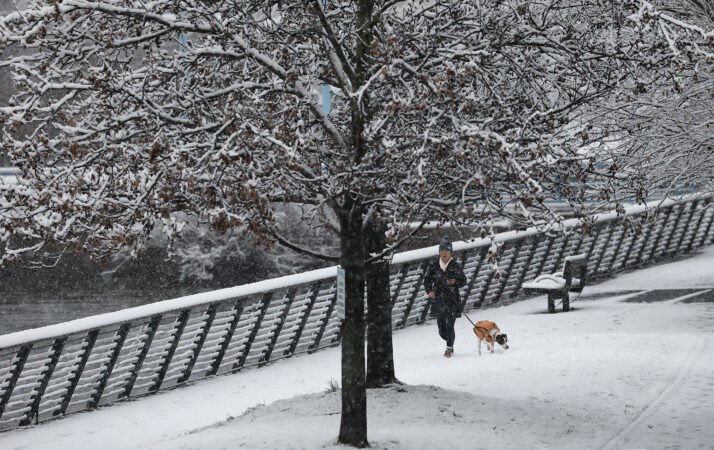
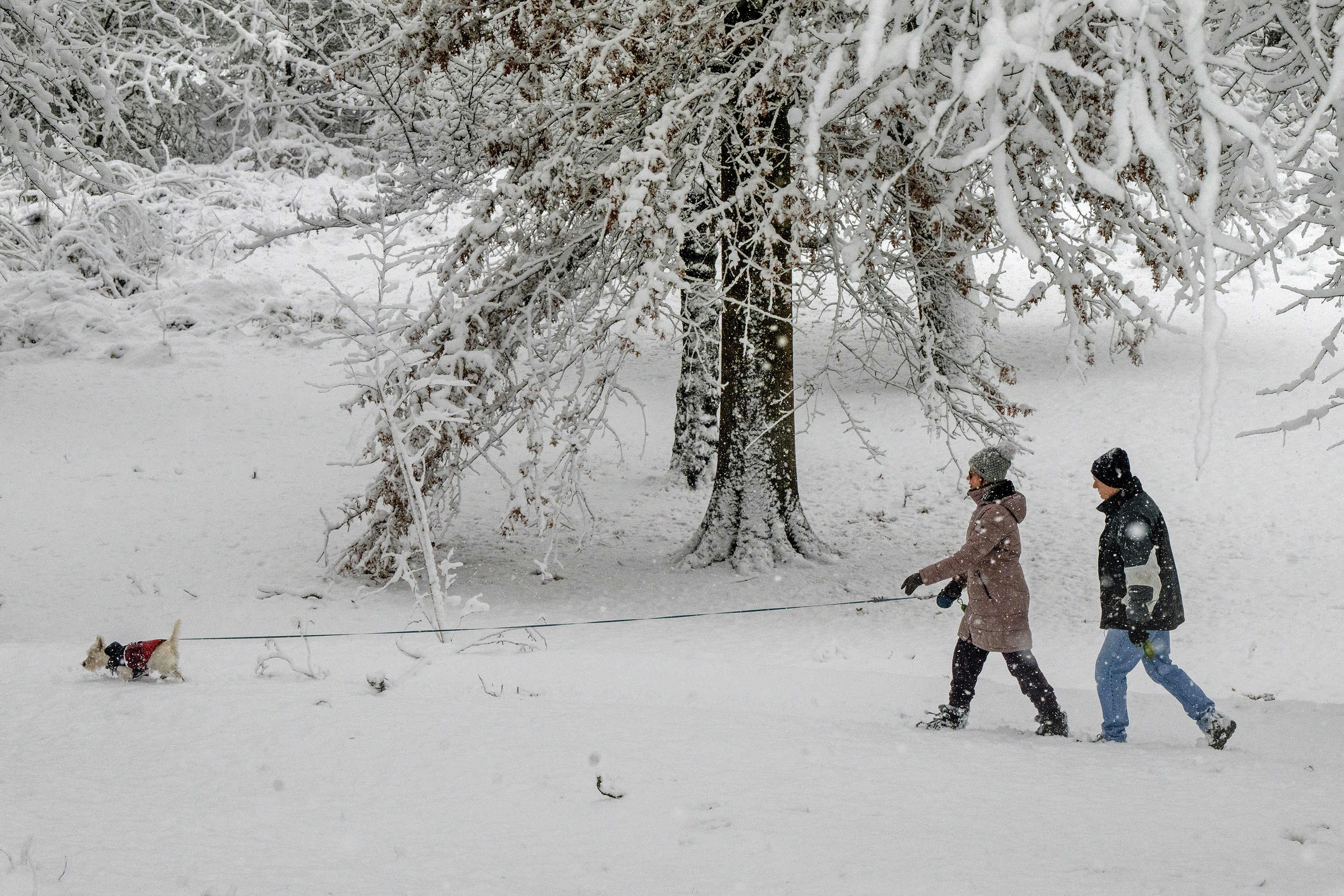
Willow, a West Highland, is with Amanda and David York on a walk in Maria Barnaby Greenwald Memorial Park in Cherry Hill on Sunday morning.
The warmup in Philly is expected to be brief
Temperatures could go as high as 55 degrees Thursday, Benz said. Then after a cold front passes through, temperatures will fall during the day Friday.
This won’t be an Arctic front like the one that gave Philly its coldest day of the season on Monday, with a high of 28. However, the forecasts call for readings to be no higher than the 30s on Saturday, and mid-40s on Sunday, which is close to the longer-term normal high, followed by several degrees chillier on Monday.
What’s expected for the next two weeks
In its updated extended outlooks on Monday, NOAA’s Climate Prediction Center had just about the entire country with above-normal temperatures through Dec. 29, with a notable exception — the Northeast, including Philadelphia.
Predicted upper-air conditions in the Arctic and the North Atlantic would argue against above-normal temperatures around here during the period, climate center forecaster Thomas Collow said.
Regardless of what happens the rest of the way, the winter of 2025-26 will be snowier than at least seven others in the period of snow records that date to the winter of 1884-85.
The 4.2 inches measured officially at Philadelphia International Airport Sunday is a half-inch above the long-term average for the season to date.
Granted almost any substantial snowfall would seem exceptional these days around here, but this one truly was, said the weather service’s Zach Cooper, a meteorologist in the Mount Holly office.
Most of Philly’s significant snows are the result of coastal storms that mine moist air from the ocean.
That wasn’t the case Sunday.
”In some ways it was a bit of a unique situation for us, especially to get the amounts that we did,” he said.
The snow was generated by a weak “clipper system,” a storm that dives out of southwestern Canada and usually has minor impacts around here, and a disturbance in the upper atmosphere.
Totals generally ranged from 4 to 8 inches across the region. Totals were less around the city in part because temperatures took their good, old time dropping below freezing.
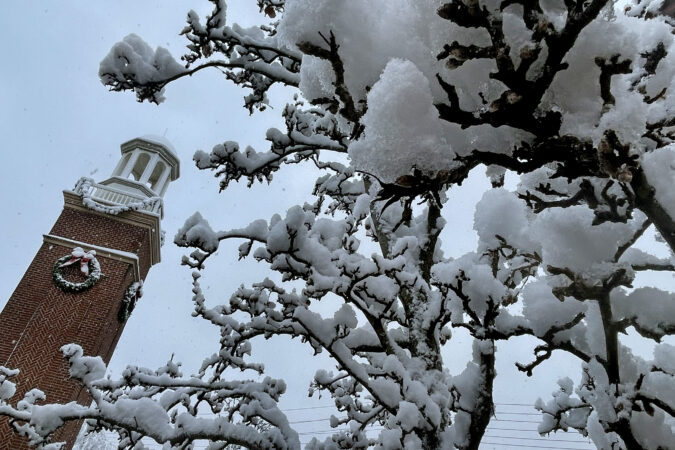
Marginal temperatures also were a factor in the spread of accumulations. They added some extra weight and heft to the flakes that glommed on the branches and what remains of the foliage with tenacity.
While the show will have a limited run, the region learned anew that snow and ice may be a pain, but nothing decorates like nature.
The Philadelphia region’s first snowfall of the season ended up having quite a March-like quality.
Totals generally ranged from 4 to 8 inches, but the snow literally was so heavy that the average shoveler may have had a hard time discerning the difference.
“When I was shoveling my car out, it felt rough,” said Michael Silva, meteorologist at the National Weather Service Office in Mount Holly. Silva lives in Mount Laurel, where an unofficial 7 inches was reported.
The snow was so weighty because it had a high liquid content, the result of temperatures close to the freezing mark, as so often happens in March. The borderline temperatures also would help explain the range in accumulations, he said.
The snow glommed onto the trees, weighing down branches. In fact it took down a branch outside the Mount Holly office that damaged a federal car (sorry, taxpayers).
The highest amounts, just over 8 inches, were recorded in Chester and Bucks Counties.
Officially, at Philadelphia International Airport, where temperatures didn’t get below freezing until midmorning Sunday, 4.2 inches was measured.
By contrast, Boston has measured only 3.1 inches so far.
Here are the snowfall totals posted by the weather service as of 10 a.m. Monday.
window.addEventListener(“message”,function(a){if(void 0!==a.data[“datawrapper-height”]){var e=document.querySelectorAll(“iframe”);for(var t in a.data[“datawrapper-height”])for(var r,i=0;r=e[i];i++)if(r.contentWindow===a.source){var d=a.data[“datawrapper-height”][t]+”px”;r.style.height=d}}});