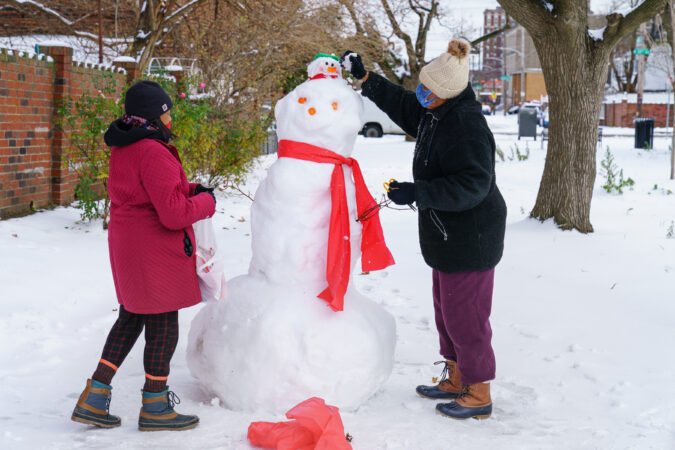
The first measurable snowfall of the winter of 2025-26 evidently is all but a done deal for Philly this weekend, and it has a chance to be the biggest in two winters — not that the bar is ultra-high in a period when snow has been mightily lacking.
The National Weather Service has issued a winter storm warning for 3 to 5 inches of snow across the region, with a near 100% likelihood of at least an inch of snow.
That was in line with the AccuWeather Inc. outlook.
The weather service has a 76% chance of at least 4 inches and 43% of 6 or more.
With the caveat that timing and duration of precipitation aren’t in the wheelhouse of atmospheric science, the weather service is expecting snow or snow mixed with rain to start late Saturday night.
If it’s a mix at the outset it would quickly become all snow as temperatures fall below freezing, and continue into midmorning.
The snow would be generated primarily by an upper-air disturbance, said Matt Benz, senior meteorologist for AccuWeather. It’s possible that the storm may regroup off the coast, however, that “probably will form too late to have any impact.”
In a forecast discussion, the weather service said inch-an-hour snowfall rates are possible early Sunday.
“There is a potential for a concentrated area of 4-5 inches of snowfall somewhere near the I-95 corridor and immediately south and east,” the forecasters said.
They noted a 20% to 30% chance that some places get over 5 inches.
And the snow is likely to stick around until at least midweek, with high temperatures Sunday, Monday, and Tuesday expected to be around freezing or lower and the sun angles about as low as they get.
After that February storm, the temperature climbed to near 50 a day later, and the strengthening sun made quick work of the snow cover.
That February snow turned out to be the biggest of a season in which the 8.1-inch total at Philadelphia International Airport barely bested the 8 inches of New Orleans. That winter, the I-95 corridor found itself in a snow hole, and Philly a snow hole within a snow hole. The highest total in the winter of 2023-24 was 4.6 inches during a snowy January week.
Snow fell to the north, west, and south, and that trend has continued in the early going. With 6 inches so far this winter, Richmond, Va., now has measured 22.8 inches since last December, nearly triple the Philly total.
Official totals at Philadelphia International Airport have been less than half of normal for four consecutive winters. The normal for a season is 23.2 inches.
The meteorological winter, which began Dec. 1, certainly is off to a wintry start, with temperatures averaging more than 6 degrees below normal.
It is not off to a particularly wet start, however, and whatever falls this weekend isn’t expected to exceed a half inch of liquid.
In its long-term outlooks through Dec. 26, NOAA’s Climate Prediction Center is on the fence regarding whether precipitation will be above or below normal.
With high confidence it is calling for a national warm-up.
In any given year, the odds are greatly against Christmas snow in Philly or elsewhere along the I-95 corridor.
But it does look like the region is about get a white Sunday.
The first measurable snowfall of the winter of 2025-26 evidently is all but a done deal for Philly this weekend, and it has a chance to be the biggest in five winters — not that the bar is ultra-high in a period when snow has been mightily lacking.
The National Weather Service Saturday has issued a winter storm warning for 3 to 5 inches throughout the region, listing a 98% likelihood of at least an inch.
The AccuWeather Inc. forecast was similar.
The weather service foresaw a 76% chance of 4 inches in the immediate Philly area, and a 43% chance of 6 or more.
With the caveat that timing and duration of precipitation aren’t in the wheelhouse of atmospheric science, the weather service is expecting snow or snow mixed with rain to start late Saturday night.
If it’s a mix at the outset it would quickly become all snow as temperatures fall below freezing, and end around daybreak. As the weather service pointed out, the timing couldn’t be much better for minimizing disruption.
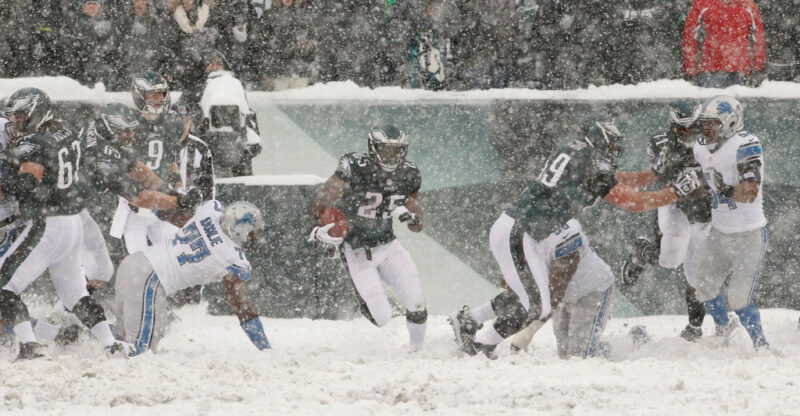
However, snow showers and wind chills in the teens are expected when the Eagles host the Oakland Raiders in South Philly.
The accumulating snow would be generated primarily by an upper-air disturbance, said Matt Benz, senior meteorologist with AccuWeather. It’s possible that the storm may regroup off the coast; however, that “probably will form too late to have any impact,” Benz said.
The weather service said inch-an-hour snowfall rates are possible in the early morning hours of Sunday.
And the snow is likely to stick around until at least midweek, with high temperatures Sunday, Monday, and Tuesday expected to be around freezing or lower and the sun angles about as low as they get.
After a 3.1-inch snowfall in February, the temperature climbed to near 50 a day later, and the strengthening sun made quick work of the snow cover.
That February snow turned out to be the biggest of a season in which the 8.1-inch total at Philadelphia International Airport barely bested the 8 inches of New Orleans. That winter, the I-95 corridor found itself in a snow hole, and Philly a snow hole within a snow hole. The highest total in the winter of 2023-24 was 4.6 inches during a snowy January week.
Last season, snow fell to the north, west, and south, and that trend has continued in the early going. With 6 inches so far this winter, Richmond, Va., now has measured 22.8 inches since last December, nearly triple the Philly total.
Official totals at Philadelphia International Airport have been significantly below normal for four consecutive winters. The normal for a season is 23.1 inches.
The meteorological winter, which began Dec. 1, certainly is off to a wintry start, with temperatures averaging more than 6 degrees below normal.
It is not off to a particularly wet start, however, and whatever falls this weekend isn’t expected to exceed a half inch of liquid.
In its long-term outlooks through Dec. 26, NOAA’s Climate Prediction Center is on the fence regarding whether precipitation will be above or below normal.
With high confidence it is calling for a national warm-up.
In any given year, the odds are greatly against Christmas snow in Philly or elsewhere along the I-95 corridor.
But it does look like the region is about to get a white Sunday.
The odds are almost always stacked against a white Christmas around here, but it is looks like the region will experience a white Dec. 14.
The National Weather Service on Friday said Philadelphia was all but certain to get at least an inch of snow during the weekend, with a general 2 to 4 inches expected, said Joe DeSilva, a meteorologist in the Mount Holly office.
The weather service issued a winter-weather advisory for the entire region from 7 p.m. Saturday through 1 p.m. Sunday.
A storm forming along an Arctic front combined with a strung idsturbance in the upper atmosphere were forecast to begin shaking out snowflakes very late Saturday night or early Sunday. It’s possible that the snow may be mixed with rain, at least at the outset, especially south and east of the city.
And while this may be shocking, computer models continue to tweak outcomes, leaving “still a little bit of uncertainty how this low is going to track,” said DeSilva’s colleague Eric Hoeflich.
However, recent model runs overall have been a shade more bullish on snow amounts than they had been, and the U.S. model has bumped up amounts slightly, said DeSilva.
Timing and duration issues remained to be resolved, and snow could cause commuting issues in the morning. In addition to church-goers, tail-gaters will be commuting commuting to the Eagles game at Lincoln Financial Field in South Philly, and supermarkets typically experience brisk traffic in the run-up to Eagles’s games.
The snow, however, is forecast to end well before kickoff at the Linc, scheduled for 1:15 p.m., DeSilva said.
Some flakes were evident Thursday in the region, with Philadelphia International Airport, where winds gusted past 30 mph, reporting its third “trace” of the season.
The renegade flakes were flying from lake-effect snows, said Bill Deger, senior meteorologist with AccuWeather Inc.
The winds have shut off, and both Friday and Saturday were expected to be tranquil with daytime temperatures mostly in the 30s.
And this time, that holiday least-favorite, the “wintry mix,” wouldn’t be in the mix.
How much snow for Philly?
AccuWeather Inc. was calling for up to 3 inches.
If the storm is a quick mover, expect the inch, but if slows down and ripens a bit, it could be as much as 3, said AccuWeather senior meteorologist Bill Deger.
The weather service was pretty much on board with that estimate.
It painted 3 nches for Philly on its Friday morning snow map.
One near-certainty: This will change.
What time would the snow start?
It is likely to begin very late Saturday night or very early Sunday and continue until mid- or late morning, forecasters say.
Temperatures throughout the day are not expected to get past 30, with wind chills in the teens.
It might feel even colder if the Eagles lose to the lowly Las Vegas Raiders.
Regardless, everyone should be able to make it home.
“We’re not talking a major snowstorm,” Hoeflich said.
But this would be something a little bit different compared with recent local snow history.
Hoeflich noted that, as happened last winter, generous snow has fallen to the north, south, and west, leaving “a giant snow hole” over the Philadelphia area.
It’s December, by far the coldest week of the season to date and due to get colder, but to Jeff Hulbert, the Brandywine Valley these days evoke July — July at the Jersey Shore, that is.
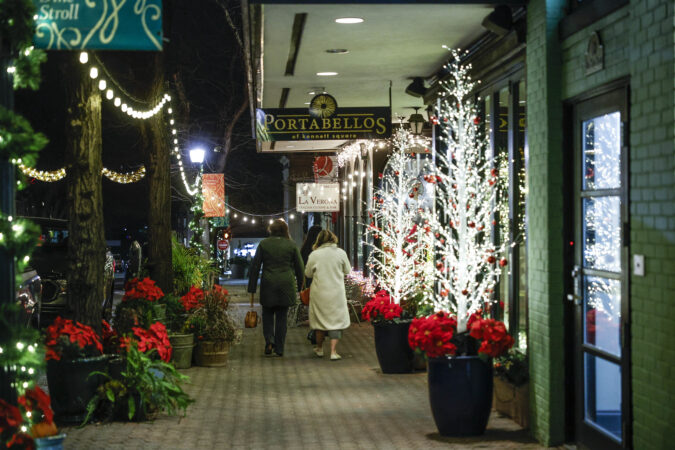
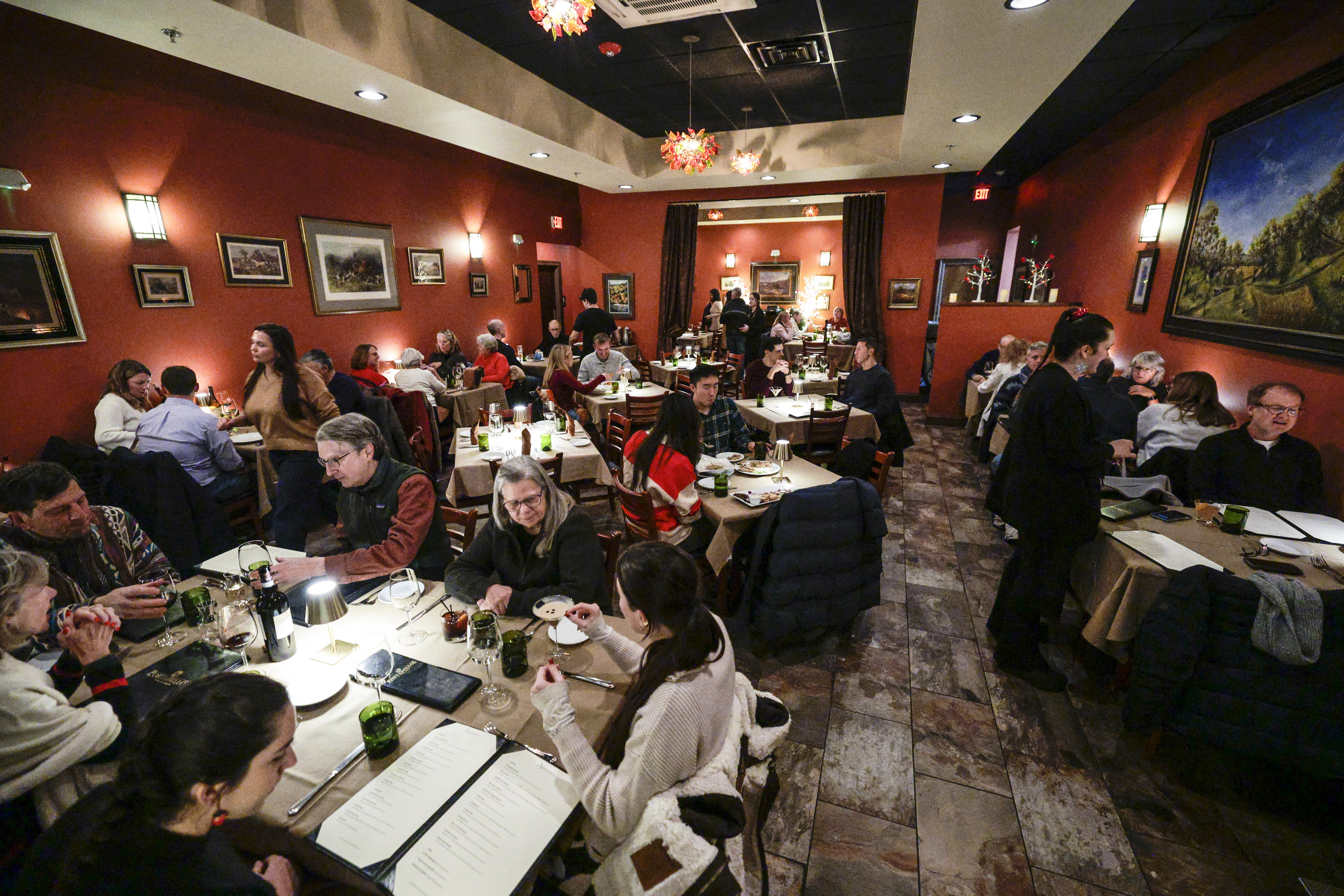
Business has been brisk, and the human traffic thick along State Street, where he and partner Sandra Morris own and operate the popular Portabello’s of Kennett Square restaurant.
Like the peak summer weeks at the Shore, where Hulbert used to work in Atlantic City, this time of year, the Kennett Square area “is twice as busy.” The reason, in a word, is “Longwood.”
Specifically, the annual “Longwood Christmas” festival, an “economic engine” not only for Kennett but for other towns in the region, said Cheryl B. Kuhn, CEO of the Southern Chester County Chamber of Commerce.
Longwood has played a “significant role in the area’s growth,” said Nancy Toltain, director of hotel operations at the Hilton Garden Inn in Kennett. Some guests book their reservations a year in advance, she said.
This year, the merchants on Kennett Street got a jump on the season by turning on the holiday lights and staging the July Fourth-style parade — complete with Mummers and a marching band — on Nov. 22, a week earlier than usual.
Diners at Portabello’s on Friday evening.
It was no coincidence that the event coincided with the first weekend that Longwood, four miles to the northeast and about twice the size of the borough, was throwing the switch to illuminate about 500,000 lights for its annual “Longwood Christmas” festival.
The exuberance is understandable. The Longwood light show is a cause for celebration among the merchants in downtown Kennett Square, a time when business, shall we say, mushrooms in the so-called Mushroom Capital of the World.
Longwood Christmas is a huge draw — 650,000 people visited last season, which ran from Nov. 22, 2024, to Jan. 11, 2025 — one-third of the annual total. And a whole lot of those who bonded with the plants and the lights ended up in downtown Kennett eating or shopping.
Moving up the Kennett fest paid immediate dividends, said Daniel Embree, executive director of the Kennett Collaborative, a nonprofit development group that works with Kennett businesses.
Downtown merchants reported “record-breaking” sales Thanksgiving week, he said, and it gave them five pre-Christmas weekends to make hay, rather than four. They’re planning an encore early start next year.
Sandra Morris said she and Hulbert will be ready, that in the run-up to the Longwood Christmas, “We know that we need to be staffed up and ready.”
Local business people and tourism officials say the region’s diverse population and attractions, in addition to Longwood, are tourist draws.
The Brandywine Museum in Chadds Ford, famous for its Wyeth family paintings, not to mention its elaborate toy train set, and northern Delaware’s Winterthur, with a museum renowned for its Americana collection and its walking paths winding through 1,000 pastoral acres, have long lured holiday crowds.
But if the area could be likened to a decorated room, Longwood would be the lighted tree with the star on top.
“If there were no Longwood Gardens, there would be no Portabello’s,” said Hulbert.
About the Gardens and the Longwood effect
The theme for Longwood Christmas in 2021 was Fire and Ice, a study in contrasts.
Longwood Gardens, located on land that Pierre DuPont opened to the public in 1921, is one of the nation’s preeminent horticultural attractions.
It covers about 1,100 acres, the majority of which is in East Marlborough Township, with the rest in Kennett and Pennsbury Townships. (It has a Kennett Square postal address, but none of it is in the borough, popular perception notwithstanding.)
About 1.78 million people visited in the fiscal year that ended Sept. 30, said spokesperson Patricia Evans, more than double the total of 15 years ago. According to its tax filing for the previous fiscal year, it generated about $35 million in admission and restaurant revenue.
Longwood’s $250 million investment in new buildings and landscaping, part of the “Longwood Reimagined” project, was completed just before last season’s Longwood Christmas, and that likely contributed to a 7% increase in the holiday traffic, compared with last season, Evans said.
All the land and its building are worth about $160 million, according to Chester County tax records.
Close to 90% of that is tax exempt, Longwood having won a landmark case in the late 1990s, but local officials and business people say the region has reaped significant economic benefits from the gardens.
“Longwood is an excellent regional partner,” said Chester County Tourism’s Nina Kelly.
While the biggest impacts have been on local tourism and hotels, the presence of Longwood probably has given a boost to property values in the area, at least indirectly, said Geoffrey Bosley owner of the local real estate concern LGB Properties & The Market at Liberty Place, a food court and event space on State Street.
In Kennett Square, aggregate commercial property values have increased nearly 30% in the last 20 years, adjusting for inflation,state tax records show.
Longwood and Kennett Square
Portabello’s Restaurant with the owners, Sandra Morris and Brett Hulbert.
Kennett Square, literally a square mile, is home to many of those who work in the local mushroom industry. Latino residents constitute about half the borough’s population.
Its median household income, about $75,000, according to Census figures, is among the lowest in Chester County and about half that of some of its wealthier neighboring towns.
Tourism, particularly Longwood-related, has been a huge boon to the businesses by any measure.
While the town has just under 6,000 residents, it has a total restaurant seating capacity of 2,000, said Hulbert.
In all, the downtown has about 150 businesses, said Embree. Part of the allure is Kennett Square’s quaintness and unaffected small-town atmosphere, but Longwood is a huge factor. “That’s why they want to be here,” he said.
Said Hulbert, “When Longwood Gardens is slow, we are slow. When they are busy, we are busy.”
While moving up the Kennett Square’s holiday parade gave sales a healthy boost, “I don’t want to overstate the significance of the date,” Embree said.
Longwood has supported the Kennett Collaborative financially and in other ways, said Embree. The illuminated decorative bunting on State Street was donated by Longwood, a highlight in the conservatory during the 2023 display.
Said Geoffrey Bosley, “I don’t think you would have as robust a town if we didn’t have a Longwood that would drive so much traffic, especially during the holiday season.”
The city experienced its coldest morning since at least Feb. 19 with low temperatures in the teens, even at Philadelphia International Airport, as for the second straight year December is off to quite a chilly start.
And also for the second straight year, those looking forward to that first generous coating of white in Philly, or viewing the possibility with a certain trepidation, may be in for a wait.
Readings dropped into single digits in Pottstown and Doylestown, and in the teens elsewhere. As usual, Philadelphia International Airport was the regional hotspot, bottoming out at 18.
Temperatures are due to top out in the mid-30s Tuesday, more than 10 degrees below normal. A midweek warmup is due as rain approaches, followed by a late-week cooldown, and a deeper chill over the weekend into next week as the Arctic continues to share a generous supply of cold air to the central and eastern United States.
Flake sightings are possible this week in Philly, but don’t expect a rash of school closings.
The city and areas to the north and west may see a few snowflakes at the onset of general rainfall Wednesday, said Robert Deal, the science and operations officer at the National Weather Service Office in Mount Holly. And a dusting or less is possible in the region Friday with a cold frontal passage, he said.
So, while folks around Doylestown had to dig out from a whole three-tenths of an inch of snow during the weekend, and the likes of Atglen, Chester County, and Avalon at the Shore were buried under a tenth of an inch, the vigil goes on for Philly’s first ruler-worth snowfall.
With an unusual degree of certainty, in its Monday update, NOAA’s Climate Prediction Center said it was very likely that temperatures in Philadelphia and the rest of the Northeast would be below normal in the Dec. 13-17 period, with odds favoring below-normal readings through the solstice.
Deal pointed out that since the 2019-20 season, Philly’s official snowfall is more than 80 inches below normal — that’s a total of 56.7 inches measured, vs. 139.4 inches that constitute the normal.
The last several winters generally have been mild, but snow doesn’t always correlate well with cold, and atmospheric scientists caution that snow is a lousy climate indictor.
Last season, for example, the Dec. 1-Feb. 28 meteorological winter finished about a degree below normal with plenty of cold air for snow, but snowfall was a paltry 8.1 inches — beating New Orleans by a mere 0.1 inches. The seasonal normal as measured at Philadelphia International Airport is 22.3 inches.
Tuesday officially would be Philadelphia’s 13th consecutive day of below-normal temperatures, and 13th without measurable snow.
Why the absence?
Snow around here typically falls near the battlegrounds of cold, heavy air from the north country and warmer moist air off the Gulf and Atlantic Ocean, which can rout the cold.
“We generally need a high-pressure system anchored to the north so it keeps the cold air locked in place,” Deal said. “Lately, most of the high-pressure systems have been more transient, shifting offshore.”
If they are too strong and persistent, those same cold high-pressure systems can repel moisture.
The climate center outlooks favor below-normal precipitation in the Northeast in the six-to-10-day and eight-to-14-day periods.
The lack of snow to date is by no means unusual,Deal points out. On average Philly doesn’t measure an official inch until Dec. 10.
“Right now,” he said, “normal is next to nothing.”
Brightening prospects
The winter solstice doesn’t occur until Dec. 21, but if you have had it with these early sunsets, your prospects are brightening considerably.
Monday’s sunset, just before 4:37 p.m., was a second later than Sunday’s. Tuesday’s will be 4 seconds later than Monday’s, and the sun will call it a day four whole minutes later on Dec. 21.
That will still be the shortest day, however, since daybreak will be later, but feel free to sleep through it.
Wilmington received its first measurable snow of the season — a mighty 0.4 inches — and snow coated roads in parts of southern Chester County Friday.
But Philly once again had to settle for a “trace,” as the flakes that appeared at Philadelphia International Airport failed to meet the minimum requirements for a snowfall — a tenth of an inch.
Yes, PennDot was aware of the potential flake invasion, and crews and trucks were on standby, said spokesperson Krys Johnson. But evidently they can save that salt for another day.
It is possible that the city may see a few flurries this evening, or perhaps freezing rain, said Eric Hoeflich, meteorologist at the National Weather Service in Mount Holly.
But you aren’t going to pull a back muscle shoveling. Philadelphia stayed to the north of the snow line as the dry, cold air refused to give it up.
Snow in early December does happen around here, but lack of it is the norm. The “normal” value for snowfall through a Dec. 5 is 0.4 inches at PHL.
Philly’s snow season typically peaks in late January into February as the prime moisture source — the Atlantic Ocean — has a chance to chill, and the cold air in the upper atmosphere ripens.
It’s certainly cold enough for snow. Lows overnight fell into the 20s, officially 25 degrees at PHL. Mount Pocono set a Dec. 5 record with a reading of 4 below zero. That’s Fahrenheit.
Temperatures may not get above freezing Friday, and no higher than the low 40s Saturday and Sunday, which would be several degrees below the long-term daily averages. Another cold front is due Sunday, and readings likely won’t get out of the 30s on Monday and Tuesday.
The region is experiencing a classic Philadelphia early winter storm — a touch of ice and snow, rinsed away by plenty of ice water.
Some light freezing rain, sleet, and random snowflakes were reported across the region around daybreak Tuesday, and several school districts in Chester and Montgomery Counties opted for two-hour delays.
Small accumulations of freezing rain, under a tenth of an inch, were measured in the Doylestown and Pottstown areas.
For the record, the National Weather Service in Mount Holly reported that the city recorded its second official “trace” of snow, defined as a trained spotter’s sighting at least one flake at Philadelphia International Airport.
That duly noted, Philly’s chances for its first measurable snowfall of the season remained minimal or less.
“It’s cut and dried,” said Tyler Roys, senior meteorologist with AccuWeather Inc.
Quite wet, actually. As temperatures rise quickly above freezing, plain, old liquid rain, possibly heavy at times, is expected to persist into the afternoon throughout the region.
PennDot anti-icing crews have been mobilized, said spokesperson Krys Johnson, but they are also clearing leaf-clogged drains to mitigate road flooding.
The precipitation should shut off well before the peak afternoon commuting period. However, it appears that the meteorological winter, which began officially Monday, is going to get off to a livelier start than last year’s.
“We’re changing the script already,” said Roys, noting another storm threat later in the week. “It’s definitely an active start.”
NOAA’s Climate Prediction Center has the odds favoring below-normal temperatures and above-normal precipitation in the Northeast in the Dec. 7 through 15 period.
What time will any snow and ice change to rain?
The changeover to rain should proceed quickly, forecasters say, and it should be raining everywhere by midmorning.
Winds are from the east, and that is importing warm air off the ocean, where sea-surfaces temperatures off Atlantic City were in the upper 40s on Tuesday morning.
How much for Philly?
For Philly, Johnson’s reading of the forecast — “A chance of one snowflake” — was essentially correct. In fact, from King of Prussia eastward, said Roys, “You’re looking at nothing.”
What is the outlook for the rest of the week?
The weather community divides the seasons into tidy three-month increments, with Dec. 1 as opening day for winter.
It will feel that way, with temperatures several degrees below normal into the weekend, with daytime highs Tuesday and Wednesday mostly in the 30s and lows in the 20s.
A wild card would be the arrival of an Arctic front Thursday morning, said Roys, which might set off snow squalls in parts of the region.
Another winter storm is possible on the weekend, however computer guidance has been showing just about everything and not much, said Zach Cooper, a weather service meteorologist in the Mount Holly office.
Late on a stormy September night, Katie and Anthony Young were watching a horror show. In this instance, it wasalso a reality show.
A surveillance camera showed 8-footfloodwaters drowning the generator in the rear of their restaurant, Hank’s Place. The water crashed into the dining and kitchen areas, tossing around furniture and emptying the contents of refrigerators.
The remnants of Hurricane Ida in 2021 had overwhelmed the Brandywine Creek at Chadds Ford, one of the region’s most picturesque locales, made famous by a frequent Hank’s customer, artist Andrew Wyeth.
“I don’t think either one of us was anticipating it being that catastrophic,” Katie Young said.
In a region where flooding is a perennial threat, an Inquirer analysis of the area’s most flood-prone waterways found the Brandywine ranks among the elite, based on available U.S. Geological Survey data.
(function() {
var l2 = function() {
new pym.Parent(‘area_floods’,
‘https://media.inquirer.com/storage/inquirer/projects/innovation/arcgis_iframe/area_floods.html’);
};
if (typeof(pym) === ‘undefined’) {
var h = document.getElementsByTagName(‘head’)[0],
s = document.createElement(‘script’);
s.type = ‘text/javascript’;
s.src = ‘https://pym.nprapps.org/pym.v1.min.js’;
s.onload = l2;
h.appendChild(s);
} else {
l2();
}
})();
A total of 61 major and moderate floods have occurred since 2005 at Chadds Ford and three other gages on the main stem of the Brandywine and its branches. The Brandywine East Branch near Downingtown has registered more major and moderatefloods, with 33 combined, than any gage point in the region.
No. 2 on the list was the Delaware River at Burlington, with seven major and 19 moderate floods, although that is not quite the same as stream flooding. Technically, flooding measured on the five Delaware River gages south of Trenton, including the one at Washington Avenue in South Philly, is “tidal,” since it is influenced by the behavior of the Atlantic Ocean and the Delaware Bay.
The chaotic behavior of the atmosphere may forever be elusive; however, more flooding along the Brandywine, the Delaware, and the rest of the region’s waterways is an absolute certainty.
Various studies have documented increases in extreme precipitation events with the warming of the planet. But humans are affecting the flood calculus immeasurably by hard-topping rain-absorbent vegetation.
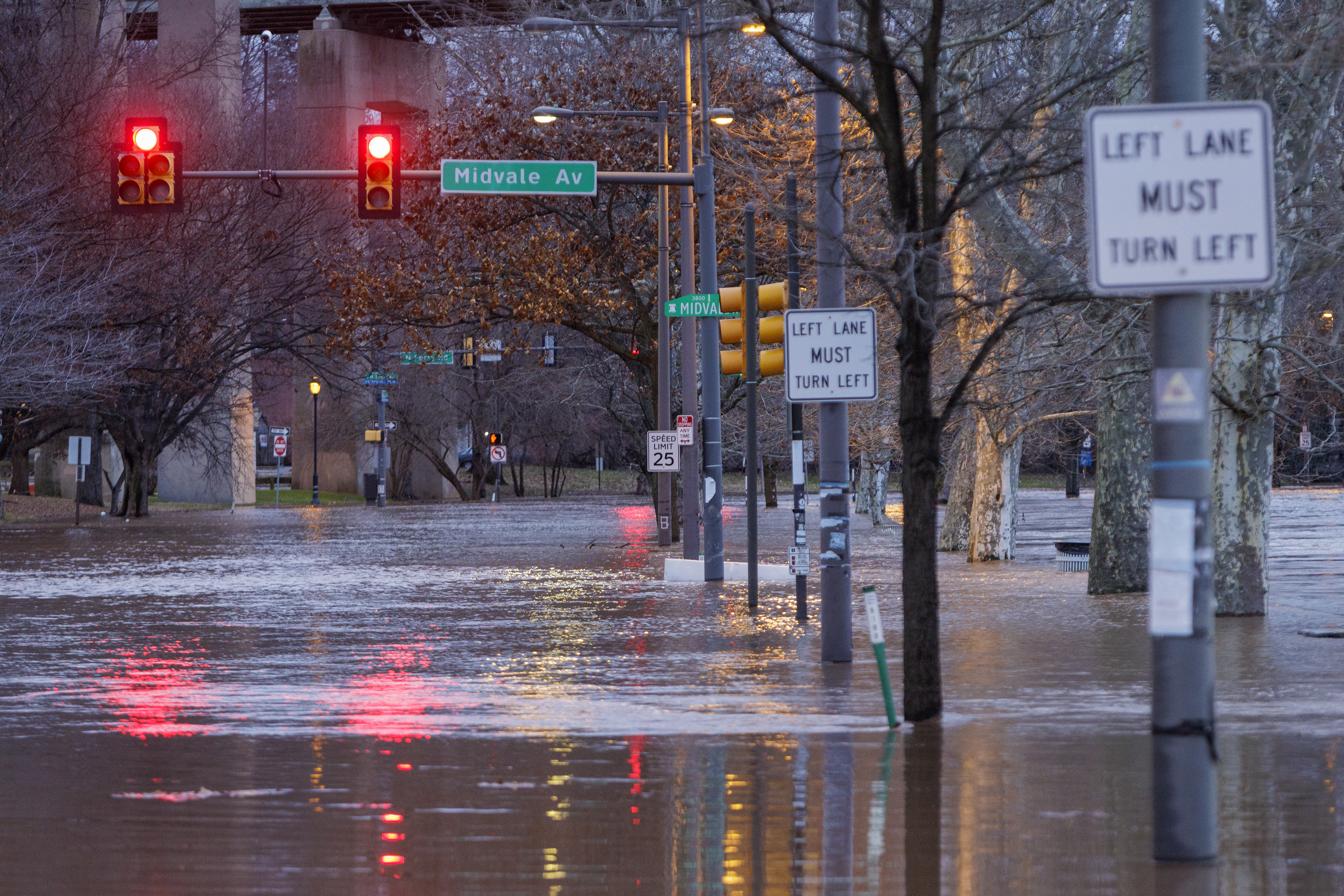
Schuylkill River floods onto Kelly Drive at Midvale in the East Falls section of Philadelphia on Wednesday, Jan. 10, 2024.
A comprehensive analysis of the Brandywine watershedpublished in April reported that impervious surfaces increased by 15% along the Great Valley’s Route 30 corridor from 2001 to 2020.
Those increases are “significant,” said Gerald Kauffman, director of the University of Delaware’s Water Resources Center, which coauthored the study along with the Brandywine Conservancy and the Chester County Water Resources Authority.
Municipalities welcome tax-generating development. Conversely, Kauffman said: “You get more value if you build next to a greenway. It’s the eternal debate.”
From 2001 to 2020, the population in the Brandywine watershed grew nearly 25%, to 265,000 people, with 150,000 more expected by the end of the century. That’s a lot of rooftops and driveways feeding water into the stream, which empties into the Delaware River.
Along the Delaware, the rising water levels of the Atlantic Ocean and the Delaware Bay are forecast to generate more flooding. The National Oceanic and Atmospheric Administration estimates that sea levels have been rising about an inch every five years.
While the oceanic salt line— the boundary between ocean and freshwater — usually stays well south of Philly, the tidal pulses contribute to flooding in the city and areas to the north, where the channel narrows, said Amy Shallcross, water resources operations manager at the Delaware River Basin Commission.
The five tidal gages along the Delaware from Newbold Island to Marcus Hook have registered more than 90 significant floods since 2005, according to the Inquirer analysis.
The study was limited to the 33 USGS gages that had a period of record of at least 20 yearsand list designated flood stages.
Along with the Delaware River sites, other stream gages that appeared in the top 10 list for major and moderate flooding were those on the Perkiomen, Chester, Neshaminy, and Frankford Creeks.
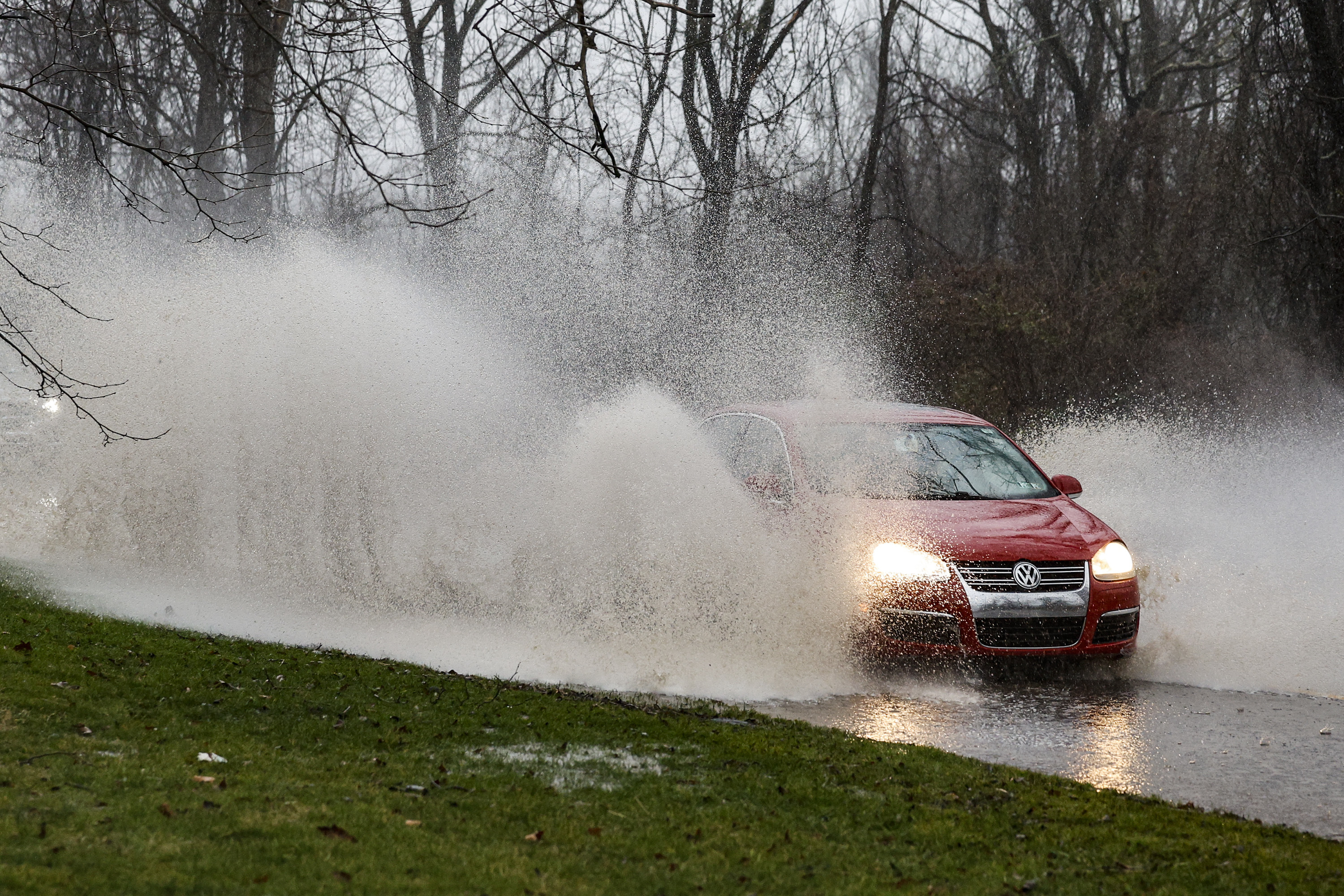
Motorists brave the heavy rain and deep puddles along Creek Road in Chadds Ford during a nasty flood event in January 2024.
The gage network cannot capture all the episodic flooding from the likes of thunderstorm downpours.
Flood frequency is not the only consideration for siting a gage, said Tyler Madsen, a hydrologist with NOAA’s Middle Atlantic River Forecast Center, in State College. For example, the gages have to be located in areas free of unnatural barriers, such as bridge abutments.
Plus, a major consideration is funding. They are costly to monitor and operate, serving multiple purposes such as measuring water quality and streamflow.
They rely on a variety of funding sources, including state and local governments, that are not available everywhere.
The Brandywine study’s suggested remedies included adding flood-control structures and beefing up warning systems all along the watershed, but warned: “Even with unlimited financial and technological resources, it would be impossible to eliminate all flood risks.”
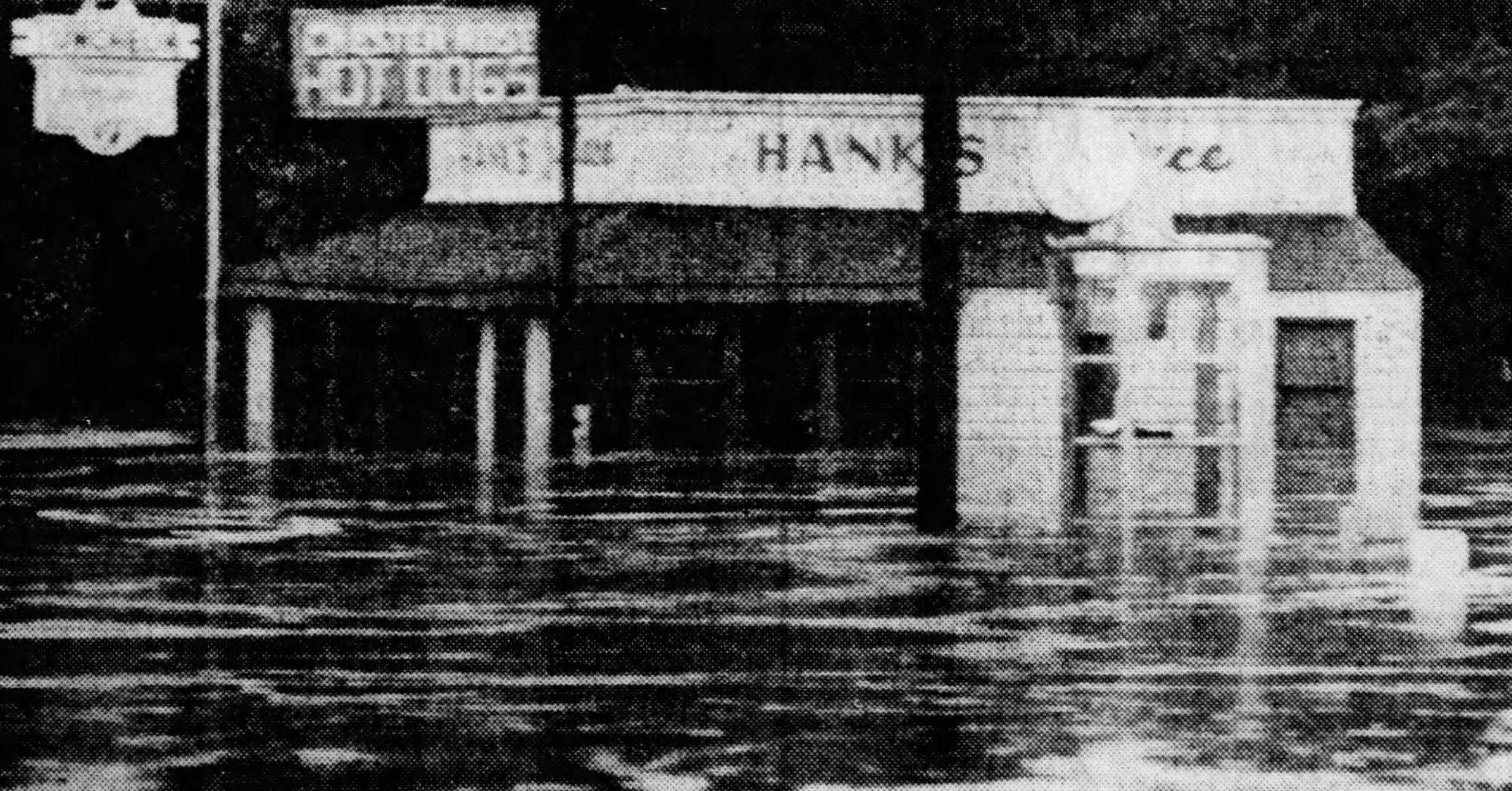
Hank’s Place, on Routes 1 and 100 in Chadds Ford, was swamped by water from the rains of Tropical Storm Agnes in June 1972. The area has a long history of flooding, and the restaurant was reconstructed after it was flooded and damaged by Ida in 2021.
The Youngs are prepared to live with those risks, come storms or high water.
The snow rumors notwithstanding, the Philadelphia region and most of the rest of the Northeast can pretty well rule out a white Thanksgiving, nor will Black Friday turn white.
However, the upper atmosphere evidently is in a state of upheaval with a potentially rare event unfolding, and forecasters say something resembling winter may arrive around here before the holiday weekend ends.
The National Oceanic and Atmospheric Administration’s Climate Prediction Center has chances favoring below-normal temperatures and above-normal precipitation from Thanksgiving Day through Dec. 1.
However, the meteorologists who have grappled with longer-range outlooks are cautioning against taking social media snow forecasting too seriously.
“The observed snowfall is inversely proportional to the hype,” said Judah Cohen, research scientist with the Massachusetts Institute of Technology. He is among those who have noticed the snow mentions that have popped up on X accounts and popular websites.
The next week should generally be uneventful save for rain Tuesday night possibly into getaway Wednesday, when highs are forecast to reach the 60s.
Then a developing pattern change is predicted to import colder air into the Northeast. “I do believe it will get colder as the Thanksgiving week wears on,” said Bob Larson, senior meteorologist with AccuWeather Inc.
A rare event may chill December
What has the attention of Cohen and others in the meteorological world is the potential for a “major” stratospheric warming event in the upper atmosphere over the Arctic sometime in the next several days, a disruption that could allow significant cold air to pour into the United States.
Major events have occurred on average about six times a decade, according to NOAA researchers; however, having one so early would be a rarity.
If one occurred, it would be only the second time in records dating to the early 1950s that it has happened this early, said NOAA meteorologist Laura M. Ciasto.
While computer models have been debating over just what is going to happen, Cohen, chief of seasonal forecasting for the Janus Research Group, said that such an early date has given him pause about forecasting it will happen.
What causes a stratospheric warming event?
On occasion, upward-moving waves from the troposphere, 5 to 9 miles over the Arctic, crash into the stratosphere, 10 to 30 miles up. That has the effect of compromising the polar vortex, the west-to-east winds that lock cold air in the places where the sun disappears for the winter, Ciasto said.
When the winds slacken, the vortex can weaken and allow frigid air to spill southward. In some cases it might “stretch,” or split into pieces that deliver cold air to regions of the Northern Hemisphere.
A major disruption would have longer-lasting impacts, Cohen said.
The European forecast model has consistently predicted a major event, Ciasto said, while the U.S. model has not been as impressed.
What is likely to happen if the warming event occurs?
A major warming in January 2021, when temperatures in the stratosphere suddenly jumped 65 degrees Fahrenheit, resulted in quite a snowy February in the Philadelphia region.
After a warming event, “there’s a greater chance that the jet stream will become more disrupted and dip down” over the continuous United States, Ciasto said, “bringing cold air with it.”
As for timing, the effects may show up anywhere from two to several weeks after the event.
In the meantime, she noted that “several other factors,” including patterns over the North Pacific, favor a chilling for the Northeast.
Don’t be surprised to see snow appear in an actual forecast, but not necessarily on the ground.
Assuming the sports scientists have it right, the temperatures should be near the performance sweet spots for the runners participating in the Philadelphia Marathon Weekend races on both Saturday and Sunday morning.
At showtimes, 6:55 a.m., just moments after daybreak, temperatures Saturday are expected to be in the upper 40s to near 50 degrees for the half-marathoners, and in the upper 30s to around 40 for Sunday’s main event.
Light rain is expected through the early-morning hours Saturday, and forecasters have been on the fence about when it will shut off. Nick Guzzo, a meteorologist at the National Weather Service said Friday afternoon that rain was likely at the start of the race, but that probabilities would drop precipitously once the event was underway.
AccuWeather Inc. and weather.com were posting about a 50-50 shot that the rain would continue through the morning. The hedging isn’t surprising; timing the onset and end of precipitation has been a longstanding forecast problem.
Nor would it be surprising for those running the 13.1-mile race to experience conditions different from those logging 26.2 miles the following day, points out Kathleen Titus, the race director and runner who has been involved with the marathon for 20 years.
This time of year is a busy one for frontal passages, this being a transition period when the atmosphere isn’t quite sure what season it wants to be. The temperature has reached 74 degreeson Nov. 22 (1883), and plunged to 14 (1880), and snowed 4.6 inches on Nov. 22-23, 1989.
However, nothing momentous is expected this weekend.
Like the rains, winds are forecast to be light, under 10 mph, from the north on Saturday, and northwest on Sunday, although runners allow that on the course, the wind can be way more capricious than the temperatures.
Various studies have concluded that temperature is the most important weather variable in runner performance and that the ideal range for marathoning is 39 to 50 degrees Fahrenheit — give or take a few degrees.
“Your body is always competing between a couple of different things,” said Philip Skiba, sports medicine specialist at ThomasJefferson UniversityHospital, who helped train Eliud Kipchoge, the Kenyan who became the world’s first runner to complete a marathon in under two hours.
During exercise, muscles demand blood to work, while for the body to stay cool, blood has to flow to the skin. If it’s too hot, more blood flows to the skin. When it’s cold, blood is diverted to heat the body’s core.
With temperates in that 39-to-50 range, the blood flow can more easily serve both the muscles and skin. Said Titus, racers love that temperature range because, “It regulates your body. It just works.”
Skiba said the temperature ranged from 51 to 55 degrees on the October 2019 day Kipchoge broke the two-hour barrier in a Vienna event that wasn’t held under record-eligible conditions.
Had the temperatures been lower, Kipchoge could have shaved a few more seconds off his time,Skiba said.
The wind also is a player in marathons
While not as dominant as temperature, “wind resistance … is worth a few seconds per mile,” said Skiba, a former triathlete.
“The more you stay out of the wind, you can save considerable energy,” he said.
“It’s really important to learn how to draft,” that is, get behind a group running close to your pace and using them for wind-breakers,he said. (Not sure how the wind-breakers feel about that.)
On the Philly course, the winds can be wild cards, especially on Kelly Drive, Titus said.
One instant, the wind “hits in your face. Now it’s at my back!”
Titus said she actually likes running uphill into the wind — and she is believed to be a member of a distinct minority — but agrees that “it is nice to have it at your back when you’re coming into the home stretch. Because it does give you a little boost.”