Category: Arts & Culture

  • Albert C. Barnes loved Henri Rousseau’s ‘honesty of approach.’ So he built one of the world’s largest Rousseau collections.

    Albert C. Barnes loved Henri Rousseau’s ‘honesty of approach.’ So he built one of the world’s largest Rousseau collections.

    Lions, and tigers, and bare women.

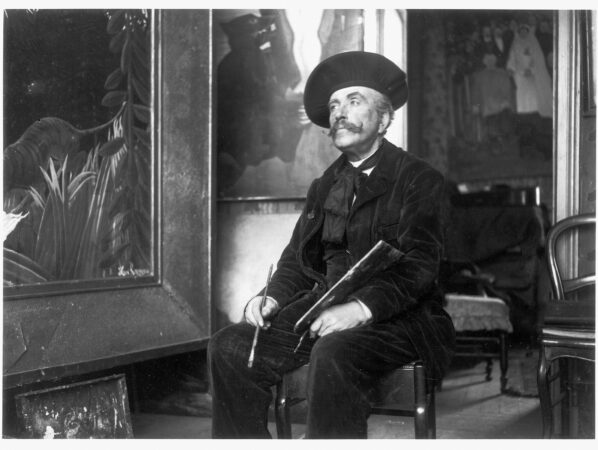
    These are some of the figures in the iconic jungle pictures by Henri Rousseau (1844-1910), a self-taught French artist who strove to realize financial and critical success as a professional painter.

    He also had a criminal record of embezzlement and bank fraud.

    Despite a lack of formal art training, Rousseau was confident he was a significant artist who deserved official recognition. Nicknamed “Le Douanier” (the customs officer) by Alfred Jarry, a playwright who was also a family friend, Rousseau did collect tariffs on goods coming into Paris.

    In 1893 at age 49, he retired early with a modest pension to devote himself to full-time painting.
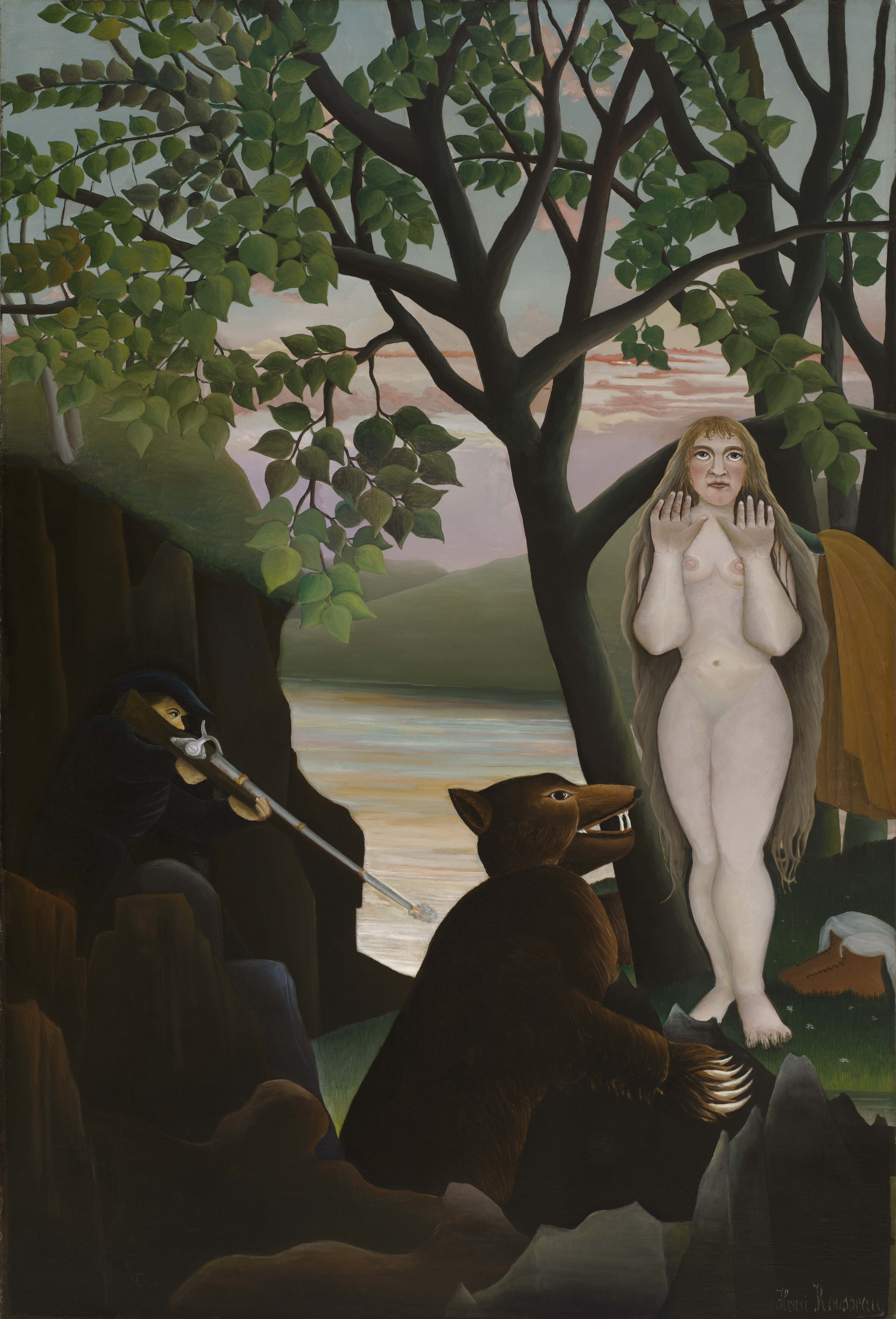
    Henri Rousseau. Unpleasant Surprise, 1899–1901. Oil on canvas.

    Whether portraits, landscapes, or the uniquely imagined jungle scenes, Rousseau’s pictures reveal features common to an artist with no academic art instruction: anatomical inaccuracies, flatness, scale distortion, outlined forms, and repetitive patterning. Some of his canvases defy logic, mixing fact and fantasy like Tropical Landscape — An American Indian Struggling with a Gorilla (1910).

    At the Barnes’ ongoing “Henri Rousseau: A Painter’s Secrets,” Rosseau’s art is arranged in seven thematic sections.

    The curators — Nancy Ireson, the deputy director of collections and chief curator at the Barnes, and Christopher Green, professor emeritus at the Courtauld Institute of Art in London — have assembled 56 works including major loans from museums around Paris, to showcase an artist with “entrepreneurial energy in marketing,” as Green put it in a recent press preview.

    The compact exhibition offers a glimpse at Rousseau’s journey from an outsider artist to a modern master, revealing, as the exhibition notes say, “the thoughts and intentionality behind some of his most famous works.”

    Henri Rousseau. Fight between a Tiger and a Buffalo, 1908. Oil on canvas.

    Interestingly, an ongoing show at the Philadelphia Art Museum is titled “Dreamworld: Surrealism at 100.” Rousseau’s visionary work was admired by Andre Breton, who wrote the Manifesto of Surrealism in 1924. Although Rousseau deals with such similar matters as childlike imagination, eroticism, and dreamy scenarios, no recognition of his role as an inspirational precursor is presented in this survey of about 180 artworks up the Parkway.

    Yet, Le Douanier was certainly on that road to surrealism.

    Between 1923 and 1929, Albert C. Barnes, the voracious collector of modern art, acquired 18 paintings to form the world’s largest group of Rousseau canvases under one roof. (Eleven are displayed in this show, nine of which will travel overseas for the first time in 40 years when the show goes to the Musée de l’Orangerie in Paris next year.) Barnes admired Rousseau’s “honesty” of approach, saying, in 1925, “his pictures have the charm of a child’s fairy-tale.”

    “But there is nothing childish or untutored in the skill with which they are executed,” he maintained.
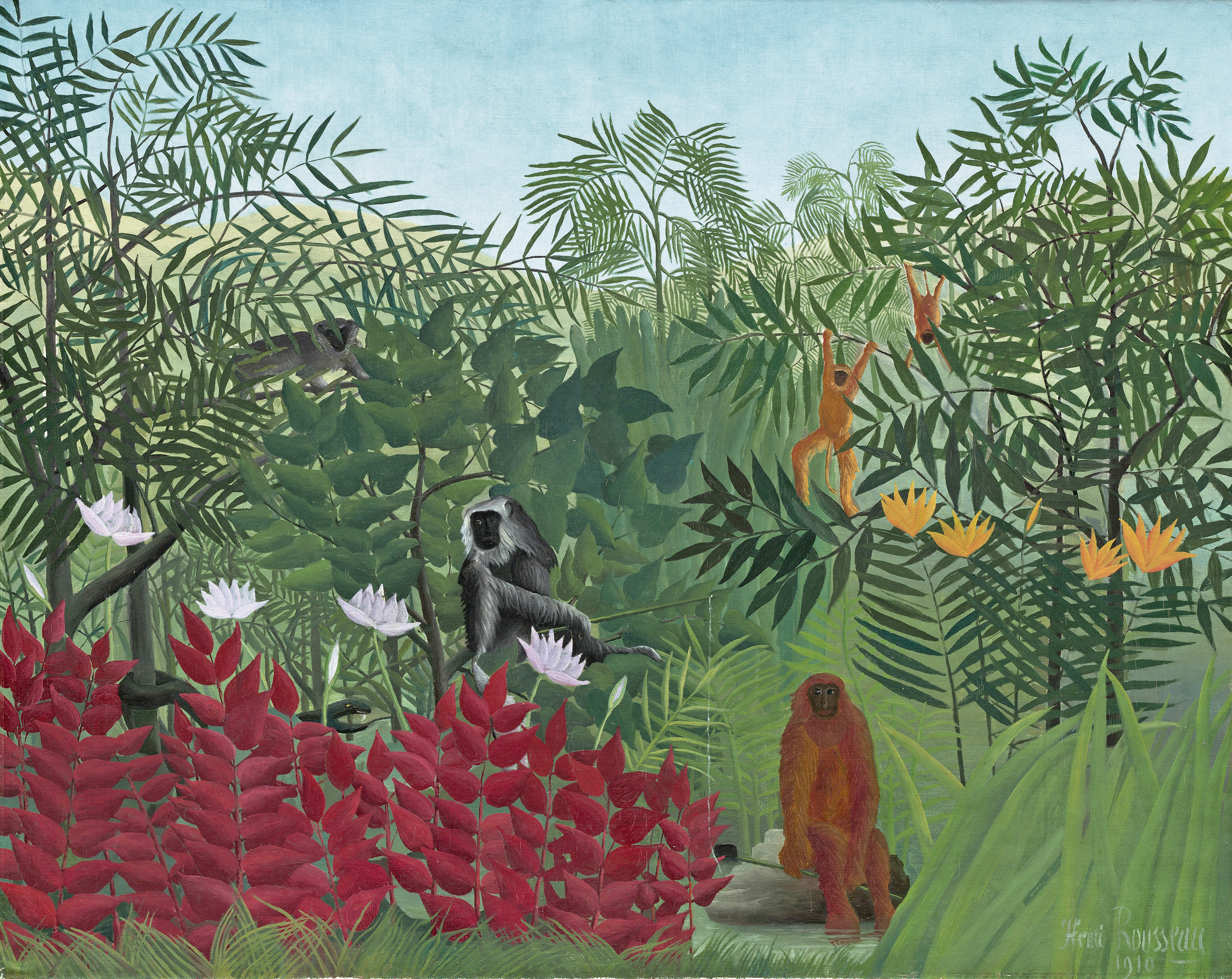
    Henri Rousseau. Tropical Forest with Monkeys, 1910. Oil on canvas.

    Rousseau did not begin painting until he was in his 40s. He submitted work to the recently established Salon des Indépendents, the nonjuried annuals that required only a modest fee and provided a venue to anybody to have work on public display.

    The 1894 painting The War, an allegorical image, raised his profile and elicited enthusiastic as well as derisive responses. The central figure is strangely positioned not on but in front of the galloping horse as it leaps across a battlefield strewn with bodies and scavenging black crows.
    Henri Rousseau. Scouts Attacked by a Tiger (Éclaireurs attaqués par un tigre), 1904, Oil on canvas.

    A decade later, Scouts Attacked by a Tiger (1904), a large jungle picture of impending danger, attracted considerable notice. Rousseau’s rather novel tropical scenes like this one began to gain some notoriety among a circle of talented bohemian personalities that included Pablo Picasso.

    Louis Vauxcelles, the young art critic who coined the terms fauvism and cubism, acknowledged that Rousseau was becoming “a celebrity in his own way.”

    The artist, however, never left France.

    His jungle paintings are pure fantastic compositions of faraway places created in his Parisian studio. For visual reference, he used sundry postcards and photographs and made repeated visits to the Jardins des Plantes with its botanical gardens and zoo. Rousseau found his niche painting such “imaginative voyages” during the late years of his career.

    When the artist was on trial for participation in a bank fraud scheme in late 1907, his lawyer brought to court a tropical painting depicting monkeys (the exact canvas is not known). Based on the visual evidence of the picture, the defense maintained that Rousseau was too naive to know that he was committing a crime.

    It worked. The artist only received a suspended sentence.
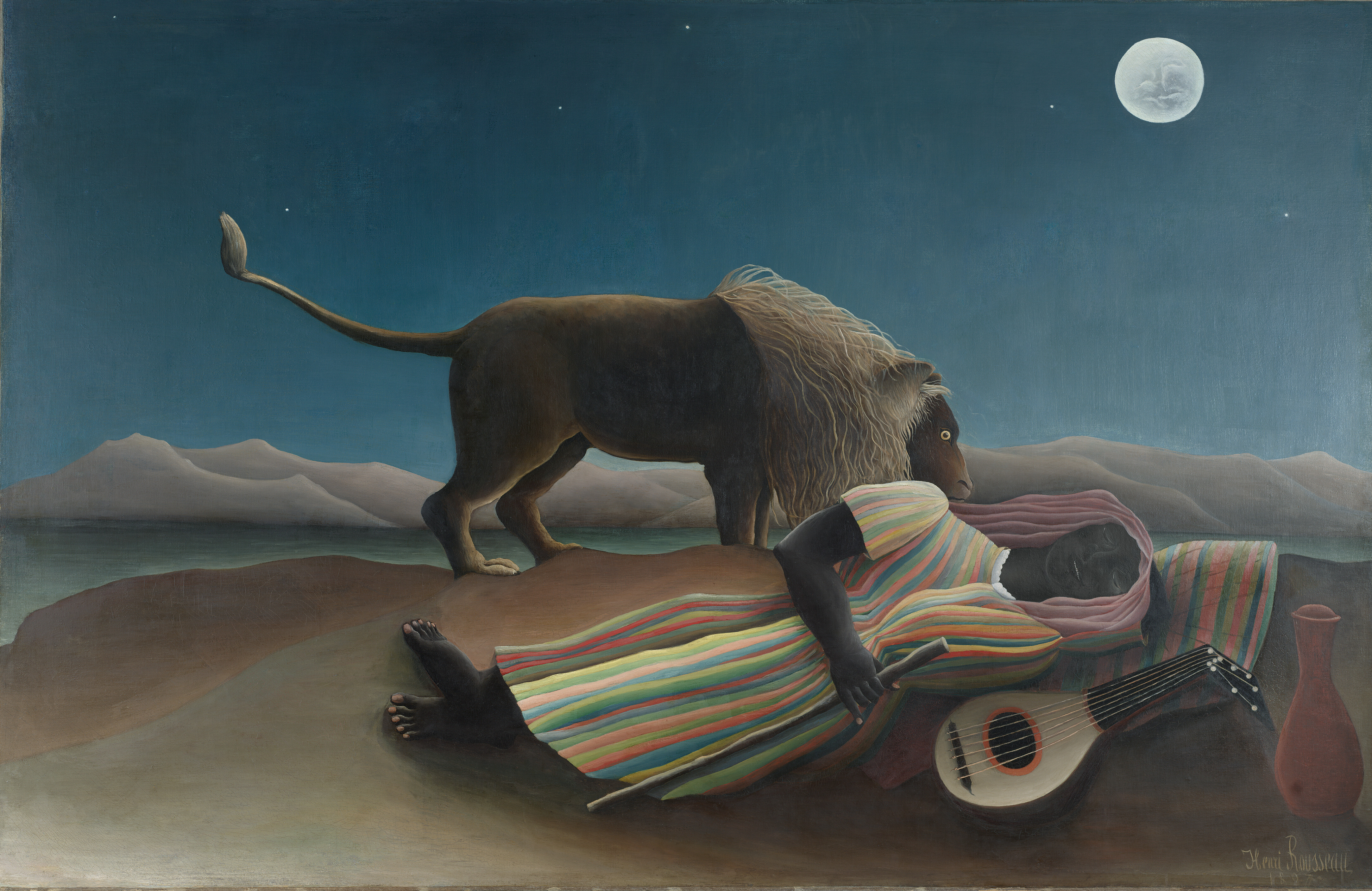
    Henri Rousseau. The Sleeping Gypsy, 1897. Oil on canvas.

    The piece de resistance of the Barnes exhibition is the last gallery where three key works by Rousseau have been brought together for the first time: The Sleeping Gypsy (1897), from the Museum of Modern Art in New York; Unpleasant Surprise (1899-1901), in the Barnes collection; and The Snake Charmer (1907), from the Musée d’Orsay, which entered the Louvre in 1936, giving Rousseau the official state recognition he had hoped to realize in life.

    With striking light effects and subtle tonalities, these fantasy scenes remain poetic, mysterious, and beguiling. They certainly raise more questions than answers. It is understandable why Green described Rousseau as a “story giver not a storyteller.”
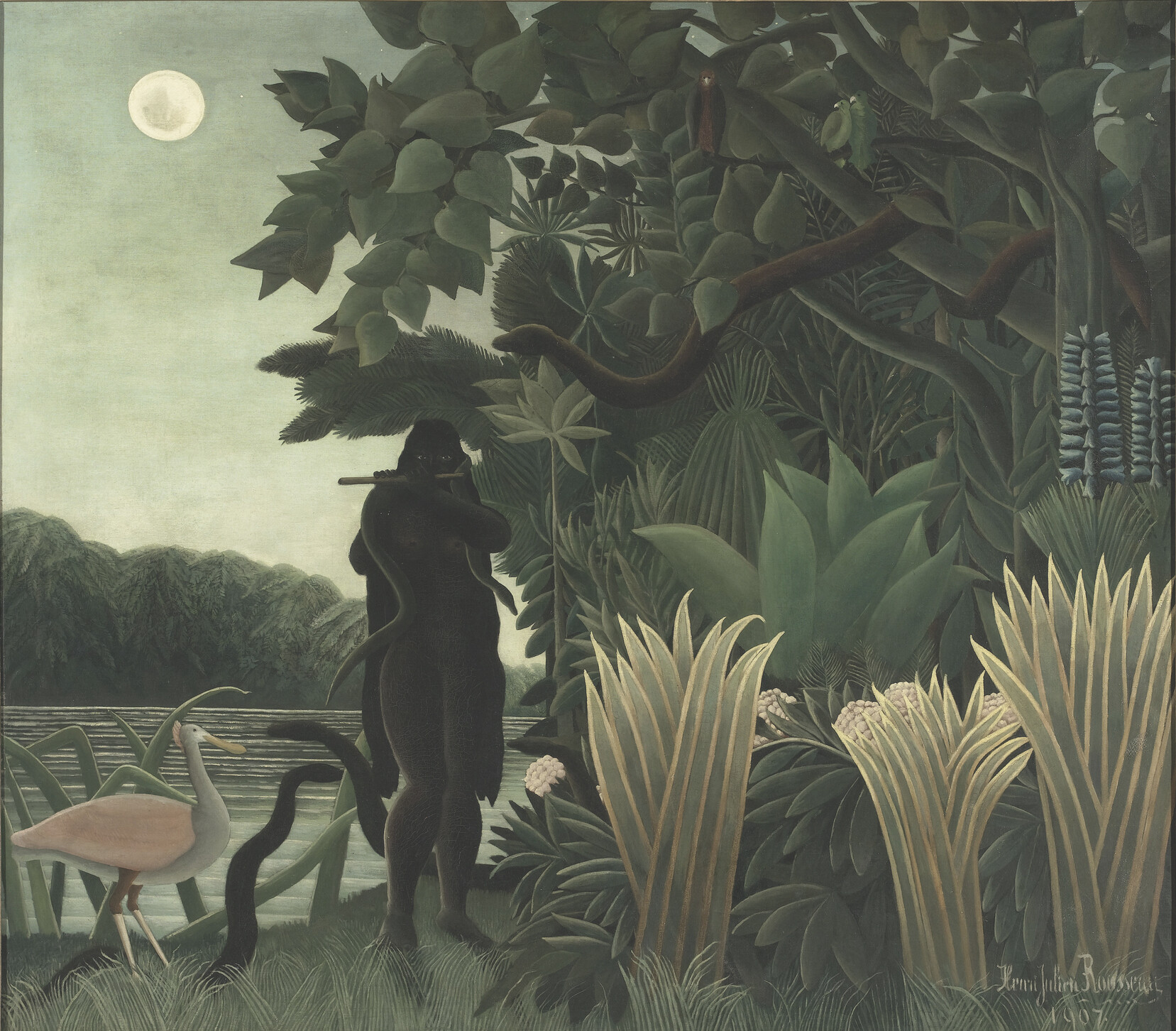
    Henri Rousseau. The Snake Charmer, 1907. Oil on canvas.

    In 1908, Picasso shined a spotlight on Rousseau when he bought The Portrait of a Woman (1895) for a few francs. The formidable portrait depicts a woman (believed to be a Polish lover of Rousseau), who stands in front of a balcony and curiously holds an upside-down branch like a cane. Though it came from a secondhand dealer who was selling the canvas for reuse, Picasso always spoke “movingly about this picture, keeping it with him all his life,” said Green.

    That large Rousseau picture is here on loan from the Musée National Picasso-Paris.

    To celebrate his newly acquired Rousseau, Picasso organized a dinner party with the painting as the centerpiece in his Montmartre studio. In front of an illustrious circle of Picasso’s avant-garde artist friends as well as Gertrude and Leo Stein, Rousseau toasted with unabashed chutzpah his host: “We are the great painters of our time, you in the Egyptian style, I, in the modern style.”

    Guillaume Apollinaire, an influential figure of the Parisian avant-garde who was also invited to that Picasso party, prophetically saluted the guest of honor: “Vive, Vive, Rousseau!”


    “Henri Rousseau: A Painter’s Secrets” through Feb. 22, Barnes Foundation, 2025 Benjamin Franklin Parkway, barnesfoundation.org

    “Dreamworld: Surrealism at 100″ through Feb. 16, Philadelphia Art Museum, 2600 Benjamin Franklin Parkway, visitpham.org
  • How to have a perfect Philly day, according to author Diane McKinney Whetstone

    How to have a perfect Philly day, according to author Diane McKinney Whetstone

    For the most part, award-winning author Diane McKinney Whetstone’s characters live their complicated lives in between El stops in early to mid-20th-century West Philly.

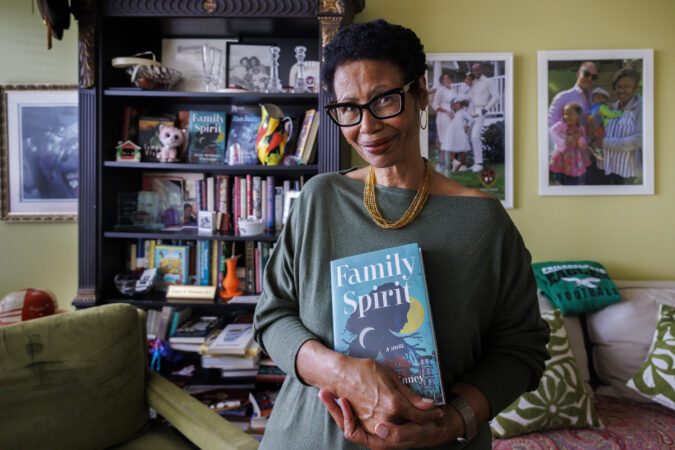
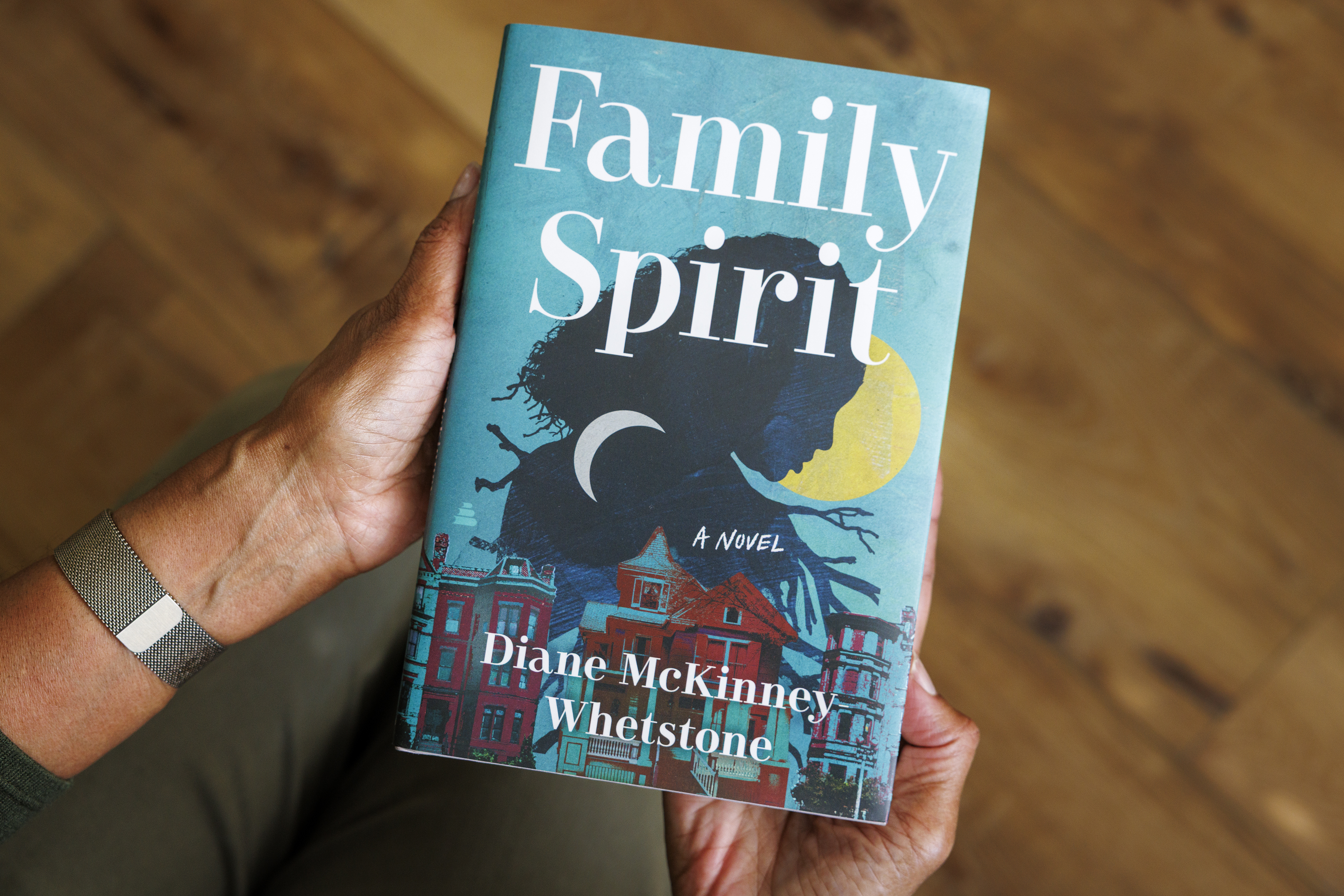
    In her new book Family Spirit, released by Amistad earlier this fall, her protagonist Ayana works at a fictional West Philly coffee shop in 2019.

    And Ayana is clairvoyant.

    Whetstone packs a lot of Philadelphia in this 229-page book. Ayana weaves in and out of downtown office buildings. Her aunt Lil flashes back to 1970s Philly when she was shopping at Wanamakers and up for a gig on The Mike Douglas Show, when the variety show was filmed in Old City.

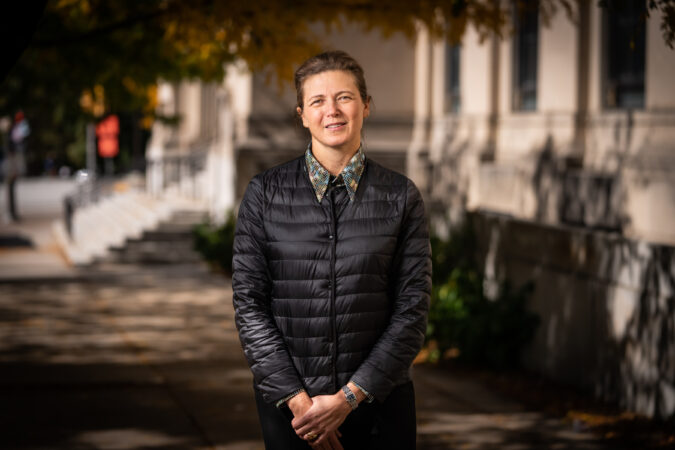
    Diane McKinney Whetstone, author of newly published book Family Spirit at her home in Wynnewood, PA., Thursday, October 23, 2025.

    But the majority of the story takes place in Southwest Philly at the Mace family house, where women on Ayana’s paternal side have gathered for 100 years to take part in rituals that reveal the future.

    We talked to Whetstone, a lifelong Philadelphian, about her perfect Philly day.

    5 a.m.

    I get up early and make really strong coffee. Every day I spend a couple of hours writing. I have to, that’s my best time of the day. Sometimes I will write for three hours. Other times, I write until noon. Sometimes, I write the whole day if the spirit hits me.

    8 a.m.

    If it’s not a writing day, and I’m done for the day, my husband and I will go out for breakfast. Sometimes we will go to Sabrina’s Cafe in Wynnewood.

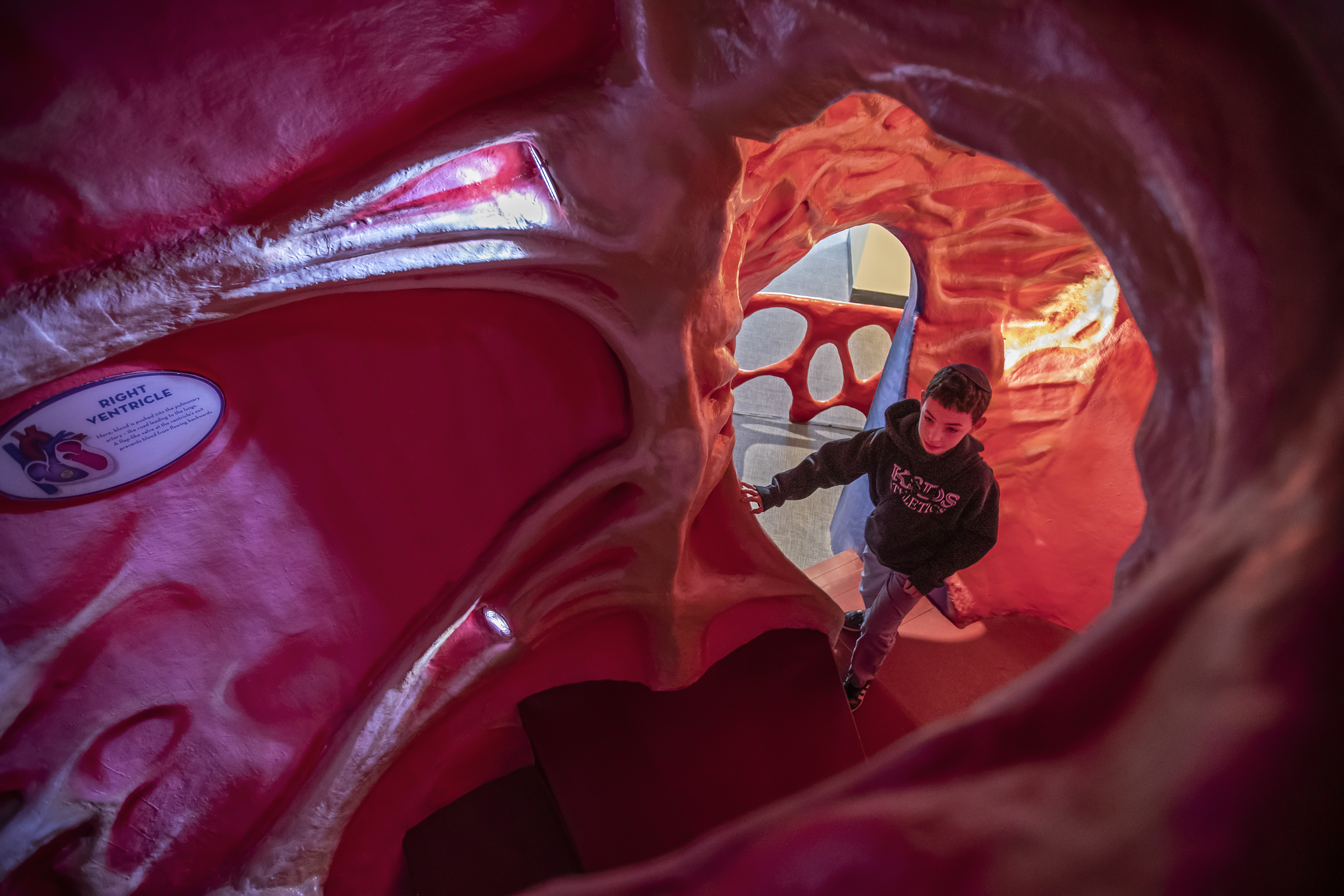
    A student from the Krieger Schechter Day School of Baltimore, MD, on a field trip to the Franklin Institute on February 12, 2020, enters the right ventricle of the Giant Heart.

    But lately, I’ve really liked going to Boutique River Falls off Kelly Drive, near Midvale. They have the best pancakes and fried fish. If my grandkids are with me, we will go to the Frankie [The Franklin Institute] and go through “Body Odyssey,” especially the “Giant Heart.” They love it.

    If we have a lot of time, we take a nice long walk on Kelly Drive. I’m a big walker.

    11 a.m.

    Both my husband and I are from Philadelphia and we like to drive around our old neighborhoods. On some days we will head down Lancaster Avenue where it intersects with Haverford and reminisce about the days it was a central shopping district like Center City.

    Sometimes we will drive down to 52nd Street. When I’m over there, the sounds of the El train, the way the houses are situated on the street, it takes me immediately back to my childhood.

    1 p.m.

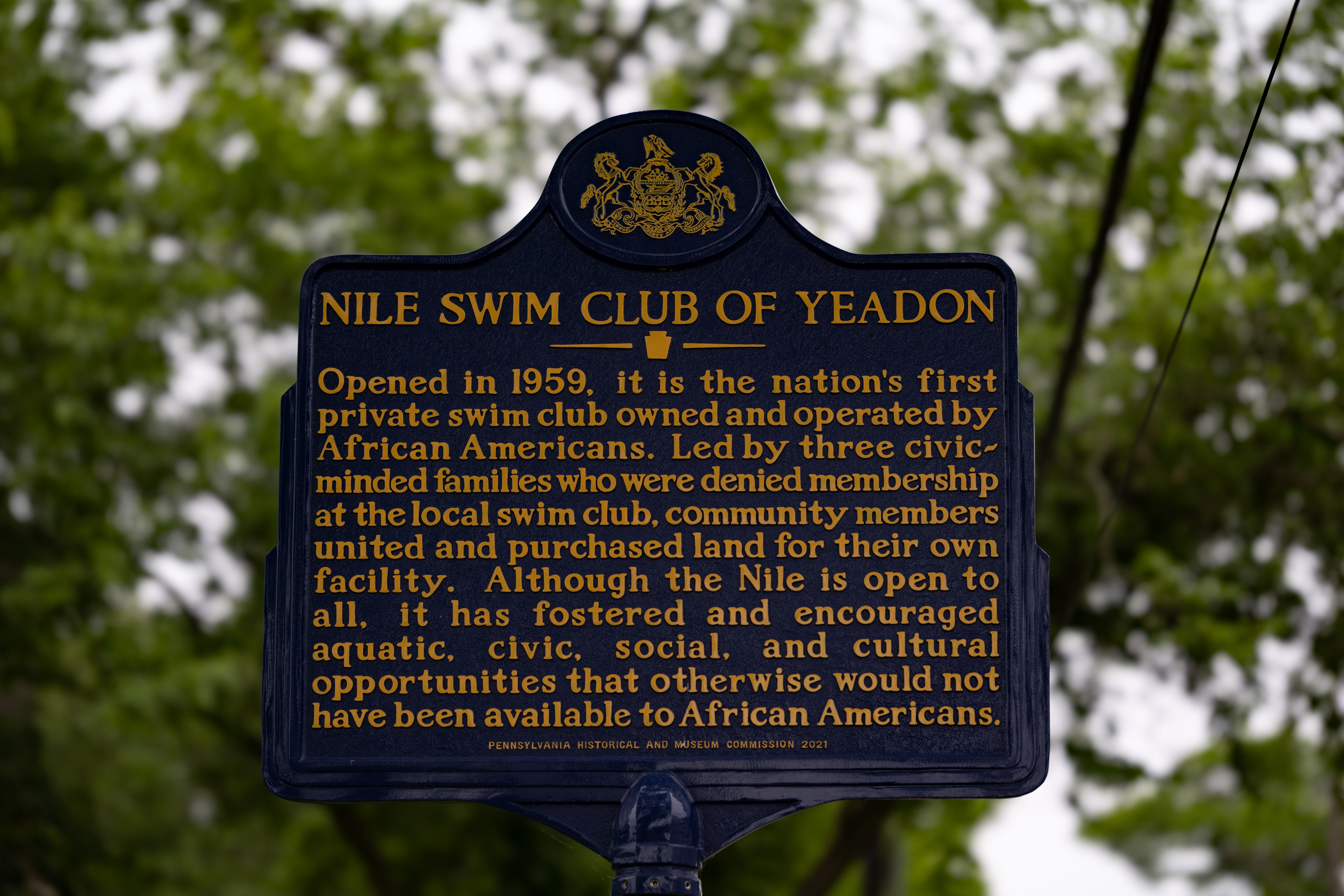
    If it’s a nice day in the summer, we may go to the Nile Swim Club in Yeadon. My sister has a membership there. On any given day there are families there relaxing, sharing stories. It’s a really nice place to relax.

    A historical marker is pictured ahead of the opening for the summer season at Nile Swim Club in Yeadon, Pennsylvania, U.S., May 27, 2022.

    2 p.m.

    Again, if my grandkids are in town, we may go to a matinee at the Academy of Music in Philadelphia. We saw The Wiz. It was so good. Then we went around the corner to Samurai Japanese Restaurant. I’m not a real big fan of raw fish, but the teriyaki there is just so good.

    4 p.m.

    I cook a lot at home and especially a lot of fish. I eat salmon three times a week and I love it fresh. I really enjoy going down to Fairmount to pick up my order from Small World Seafood. I love that I get to cook restaurant-quality food.

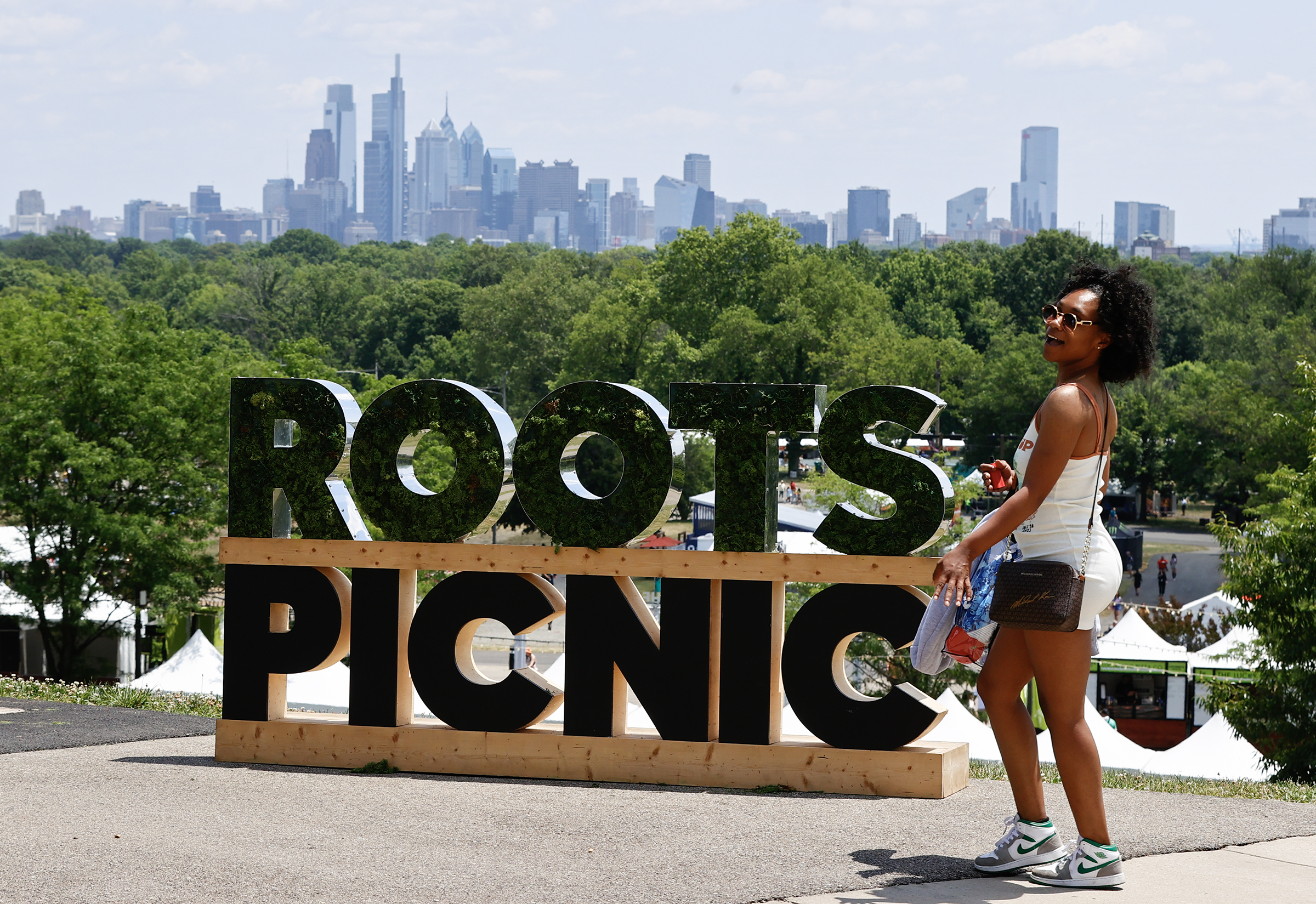
    Bri Smith of West Philadelphia poses by the Roots Picnic sign with the city skyline in the background before the start of day 2 of the Roots Picnic at the Mann Center for the Performing Arts on Sunday, June 4, 2023.

    8 p.m.

    I would end my day at a concert at the Highmark Mann Center for the Performing Arts. I saw Cynthia Erivo there in June and it was incredible. She sang Roberta Flack’s “The First Time Ever I saw Your Face” and I nearly cried. The view of Philadelphia’s skyline is amazing. It’s just a wonderful way to end a day.

  • Art Museum’s former HR, DEI director charged with theft after police said she put $58k in personal expenses on company card

    Art Museum’s former HR, DEI director charged with theft after police said she put $58k in personal expenses on company card

    The former head of human resources and diversity initiatives for the Philadelphia Art Museum was charged with theft earlier this year. The police said she racked up more than $58,000 in personal expenses on a company credit card, then failed to pay back the funds, court records show.

    Latasha Harling, 43, was arrested in July and charged with theft by unlawful taking, theft by deception, and related crimes about six months after she quietly resigned from her job as the chief people and diversity officer for the museum.

    The charges against Harling — which had not previously been reported or made public by the museum — are the latest chapter in a six-week stretch of turbulence for the prominent institution, and raise new questions about the financial oversight and controls of its senior executives.

    On Nov. 4, the museum fired its director and CEO, Sasha Suda, after an investigation by an outside law firm flagged the handling of her compensation. Suda filed a lawsuit on Nov. 10 against her former employer claiming that she was the victim of a “small cabal” from the board that commissioned a “sham investigation” as a “pretext” for her “unlawful dismissal.”

    The Art Museum on Thursday responded to the lawsuit in Philadelphia Court of Common Pleas with a petition saying Suda was dismissed after an investigation determined that she “misappropriated funds from the museum and lied to cover up her theft.” Her lawyer, Luke Nikas of Quinn Emanuel Urquhart & Sullivan, called the museum’s accusations false.

    “These are the same recycled allegations from the sham investigation that the museum manufactured as a pretext for Suda’s wrongful termination,” he said.

    A sign shows the recent rebranding of the Philadelphia Art Museum.

    Harling declined to comment on the charges filed against her Friday, as did her lawyers at the Defender Association. A spokesperson for the Philadelphia Art Museum also declined to comment on the matter.

    Harling was hired by the museum as a senior member of its executive staff in November 2023, according to her LinkedIn profile. In that role, she oversaw human resources for the museum, implemented policies to promote diversity, equity, and inclusion, and managed budgetary responsibilities, among other duties, per her profile.

    As part of her job, Harling had access to a corporate credit card for business-related expenses, according to the affidavit of probable cause for her arrest.

    In January 2025, museum staff noticed that Harling’s December credit card statement contained “several large, and apparently personal expenses,” the affidavit said.

    The museum’s chief financial officer conducted an audit and found that, over the course of Harling’s tenure, she charged $58,885.98 in personal expenses to the company’s credit card, the document said. She had not filed an expense report since July 2024, according to the affidavit.

    Museum officials confronted Harling about the charges in January, the filing said, and proposed that she repay $32,565.42. She resigned from her role soon after “without resolution,” according to the affidavit.

    The museum continued to negotiate with Harling, and in February, she signed a promissory note agreeing to pay back $19,380.21 over the course of three months that spring, the record said.

    But in April, per the filing, a lawyer for the museum contacted the police to say that two months had passed and Harling had not repaid any of the funds. They said that, according to their agreement, she should have paid back about $13,000 by then.

    After the museum provided investigators with copies of their emails with Harling, her expenses, and its travel and expense policy, prosecutors agreed to charge her with theft.

    The case remains ongoing in Philadelphia’s criminal court.

    Staff writer Jillian Kramer contributed to this article.

  • Philadelphia Art Museum accuses Sasha Suda of ‘theft’ in new filing

    Philadelphia Art Museum accuses Sasha Suda of ‘theft’ in new filing

    The Philadelphia Art Museum’s trustees fired back at a lawsuit filed by recently ousted director and CEO Sasha Suda, saying she was dismissed after an investigation determined that she “misappropriated funds from the museum and lied to cover up her theft.”

    In Thursday’s filing with the Philadelphia Court of Common Pleas, the museum said that Suda repeatedly asked for raises, and when she was denied them by the museum board’s compensation committee, she took matters into her own hands.

    “Suda took the money anyway,” the petition alleges, defying the board and violating her contract.

    “Given Suda’s misconduct, no responsible board member could have done anything other than vote to remove Suda for cause,” says the petition, which asks the court to compel arbitration of the dispute. Suda had requested a trial by jury.

    Suda was fired Nov. 4 for what the museum at the time called cause, and she filed her wrongful-dismissal suit less than a week later.

    “The museum’s accusations are false,” Suda’s lawyer, Luke Nikas of Quinn Emanuel Urquhart & Sullivan said Friday.

    “The motion, as well as its false narrative, fits the Philadelphia museum’s longstanding pattern of trying to cover up its misconduct and mistreatment of staff. We expected the museum would prefer to hide the sordid details about its unlawful treatment of Sasha Suda in a confidential arbitration. If the museum had nothing to hide, it would not be afraid to litigate in state court where we filed the case.”

    The money in question came as increases to Suda’s compensation, and these increases were “authorized” and “budgeted” cost-of-living increases that were “fully approved” and “disclosed,” and amounted to about $39,000 over two years, a source close to Suda stated previously.

    Another source with knowledge of the petition said the raises mentioned in the petition are, in fact, the same as the cost-of-living adjustment the first source refers to.

    Sasha Suda at the Philadelphia Art Museum, Jan. 30, 2024.

    Suda was in the third year of a five-year contract when she was dismissed.

    The museum on Friday named Daniel H. Weiss, a veteran leader of nonprofits, including the Metropolitan Museum of Art, to be its new director and CEO.

    Thursday’s court filing by the museum said that the board formed a seven-member special committee after documents showed that Suda was “receiving far more than the $720,000 in annual base salary” authorized by her contract.

    According to the petition, the special committee “was authorized to investigate issues including whether Suda had engaged in self-dealing by increasing her annual base salary and engaged in any improprieties with respect to her museum-related expenses.”

    The special committee hired law firm Kirkland & Ellis to conduct an investigation, which interviewed 20 current and former museum board members and employees.

    Suda was among those interviewed, and during that interview, she “lied about her actions, claiming, among other things, that her subordinates had advised her that she was entitled to receive these increases,” the court filing says.

    The special committee met with Kirkland & Ellis in October to review the evidence, and, as stated by the filing, the museum’s “executive committee determined that the evidence overwhelmingly established that Suda violated her agreement by misappropriating museum funds and engaging in repeated acts of dishonesty.”

    The petition alleges that Suda requested, and was denied, a salary increase from the compensation committee on Feb. 8, 2024. She then “awarded herself the salary increase” effective March 1, 2024, followed by a second “unauthorized” increase in July of that year. In July 2025, Suda “awarded herself a third unauthorized pay increase, which she once again failed to disclose to the board,” according to the museum’s petition.

    Suda, in her complaint, claims she was “terminated when her efforts to modernize the museum clashed with a small, corrupt, and unethical faction of the board intent on preserving the status quo.”

    She seeks two years’ salary plus damages.

    Thursday’s response from the museum said her complaint was “laden with false, dishonest, and irrelevant allegations.”

    Inquirer staff writer Abraham Gutman contributed to this article.

  • Colman Domingo will deliver Temple University’s commencement speech next May

    Colman Domingo will deliver Temple University’s commencement speech next May

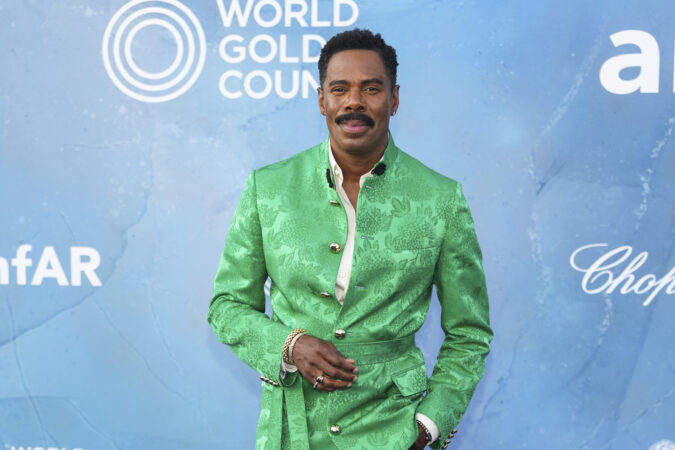
    Emmy Award-winning actor and self-confessed dandy Colman Domingo will deliver the commencement address at Temple University this spring, the university announced Thursday.

    Domingo, a native of West Philadelphia, will also receive an honorary degree during the ceremony that will be held at the school’s Liacouras Center on May 6, 2026. Domingo went to Overbrook High School before coming to Temple University in the late 1980s to study journalism.

    It was at Temple that Domingo developed a love for theater after a teacher told him he had a special gift. In 1991, with only 50 credits to go, he dropped out and moved to California to pursue a career in acting.

    Domingo said returning to Temple for the university’s commencement ceremony will be a full circle moment for him.

    “I am beyond grateful and humbled to receive an honorary doctorate from Temple University,” he said in a statement. “As a journalism student who struggled with the balance of working two jobs … this degree is very meaningful to me.”

    Domingo stars in the action movie The Running Man, in theaters now. He received consecutive nominations for the Academy Award for best actor in 2023 and 2024 and this year he was one of the co-chairs for the Met Gala, celebrating the opening of The Metropolitan Museum of Art’s groundbreaking fashion exhibit, “Superfine: Tailoring Black Style.”

    Domingo was named one of Time magazine’s 100 most influential people in 2024.

    Past commencement address speakers and honorary award recipients at Temple include fellow West Philadelphian Quinta Brunson, Bishop Desmond Tutu, and North Philly native basketball coach Dawn Staley, among others.

  • Yes, flying cars are great, but ‘Back to the Future’ could do with a little heart too

    Yes, flying cars are great, but ‘Back to the Future’ could do with a little heart too

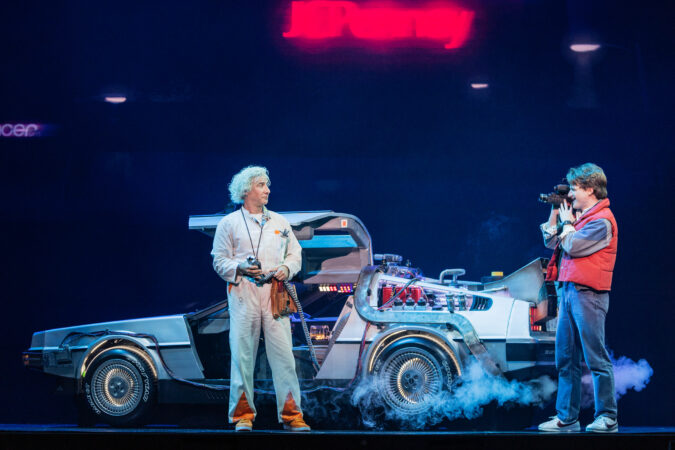
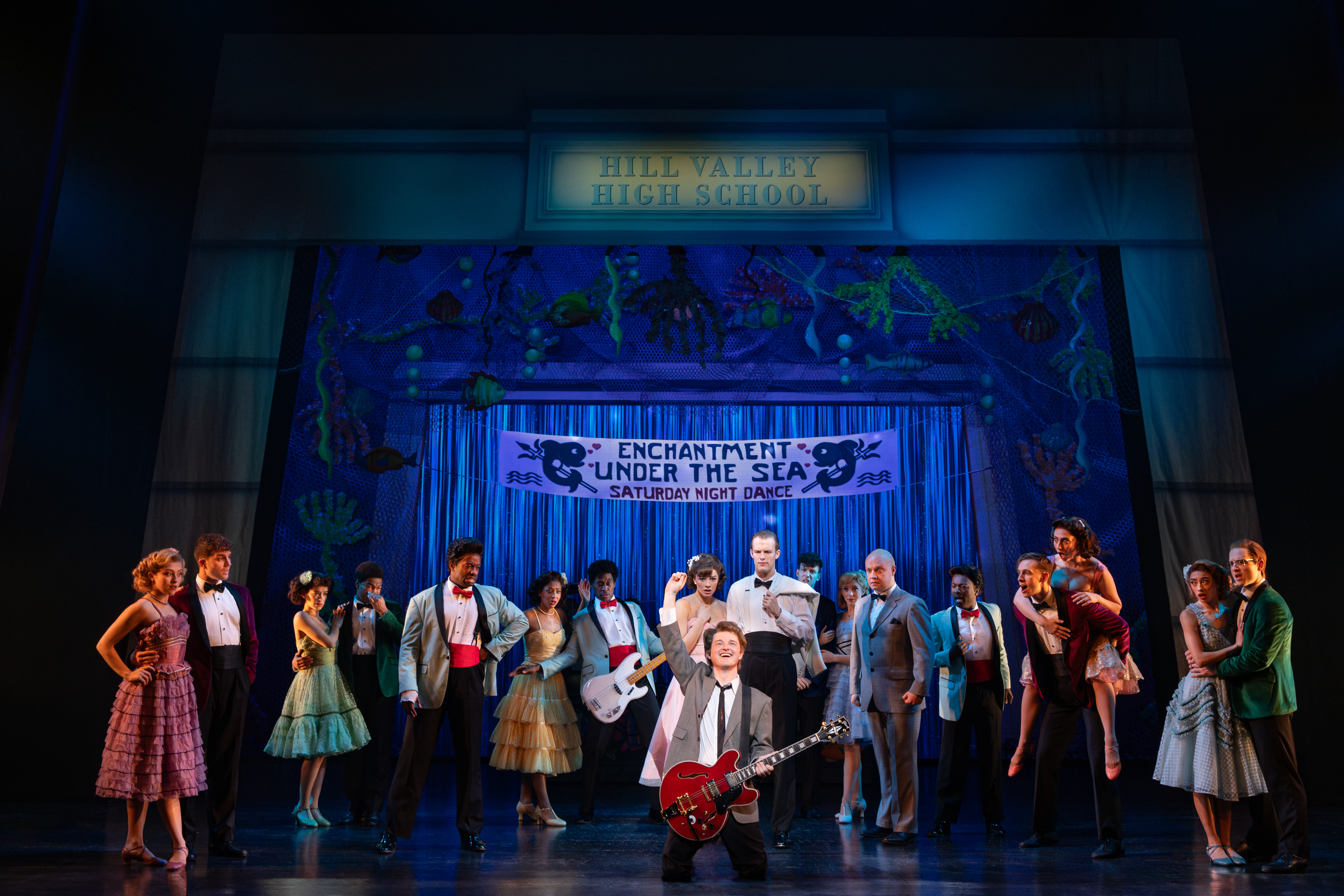
    Audiences apparently are shelling out money for tickets to Back to the Future: the Musical, now at the Academy of Music, just for a glimpse of the time-traveling DeLorean. But the rush from those high-action sequences is not unlike the thrills of a Universal Studios theme park ride — short-lived and emotionally hollow.

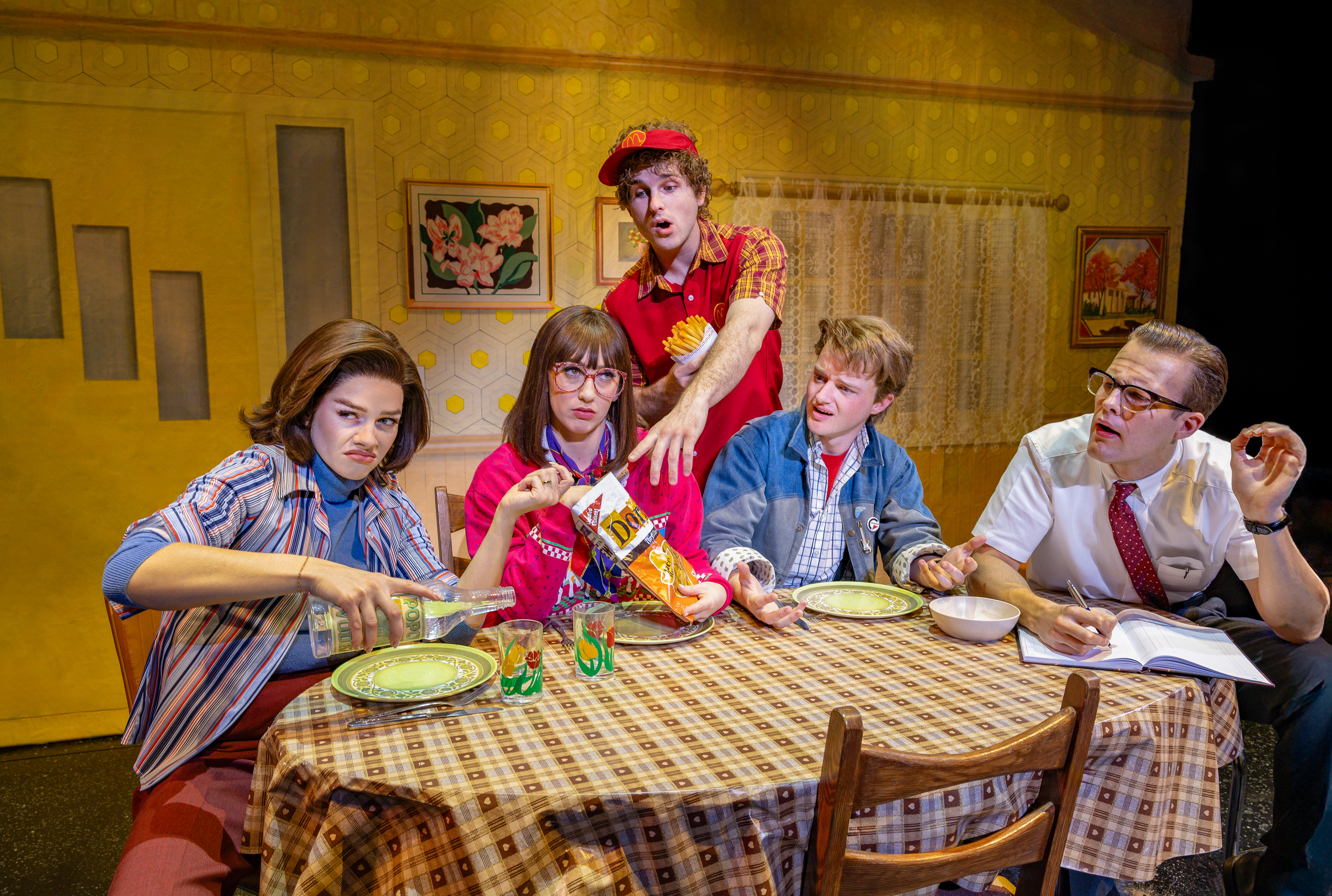
    That is perhaps less a fault of the movie-to-musical pipeline, but more of the plot of Back to the Future. Marty McFly, high school boy of the 1980s, wants nothing more than to rise above his “loser” family and become a rock star. But when he accidentally transports himself back through time to the 1950s, he must help his parents fall in love to ensure his own survival.

    Oh yeah, and his mom has the hots for him now and his father is a peeping Tom.

    The First National Touring Company of “Back to the Future: The Musical.”

    While these morally gray and otherwise two-dimensional characters are a product of the original source material, now in the medium of musical theater, their story falls flat with audiences. Characters sing because they have to — it’s a musical — and audiences grin and bear it until the next action sequence.

    It is unfortunate, too, that even the dancers’ incredible execution of choreographer Chris Bailey’s lively interpretation of both ’80s and ’50s dance styles is not enough to save these long numbers. There is hardly a hummable tune in the bunch, and the plot rarely moves forward through a song.

    There are bright spots, though.

    Lucas Hallauer (Marty McFly) and Sophia Yacap (Jennifer Parker) in the First National Touring Company of “Back to the Future: The Musical.”

    Cartreze Tucker (Goldie Wilson/Marvin Berry) is a joy to watch sing and dance. Goldie is perhaps one of the only characters that gives audiences the musical theater warm and fuzzies as he dreams of becoming the mayor. Zan Berube (Lorraine) shines with her adept comedic timing and truly lovely voice. Overall, the cast, led by Lucas Hallauer (Marty McFly) and David Josefsberg (Doc Brown), does a wonderful job playing into the fan service element of the show. Audiences, clad in red puffer vests, are looking to hear their favorite lines and see their favorite moments and that, the show delivers.

    David Josefsberg (Doc Brown) in the First National Touring Company of “Back to the Future: The Musical.”

    Tim Hatley’s design is sleek and economical. The downstage scrim allows for inventive solutions to some of the more difficult action sequences. The DeLorean sequences in particular are aided by truly amazing work from video designer Finn Ross and illusion designer Chris Fisher. While at times those tricks could feel a bit smoke-and-mirrors with some conveniently timed blackouts, the work gives audiences a glimpse into the future of high-tech, commercial theater.

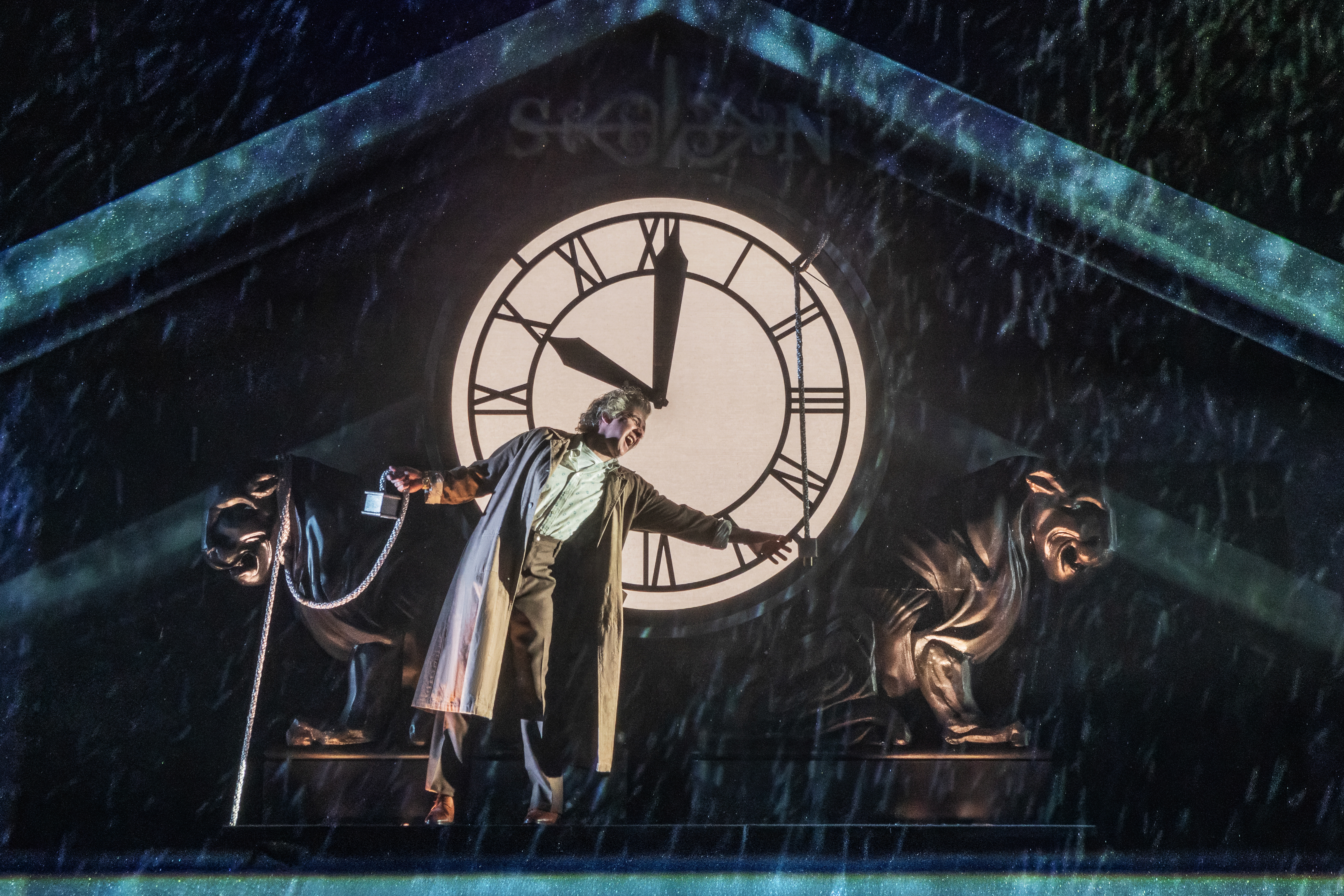
    That is perhaps why the lack of heart in the book and lyrics feels so disappointing. The show does its best work when it leans into the campy, almost-parodic nature of the adaptation, using savvy theatrical solves to some of the harder scenes to reinterpret, like Doc climbing the bell tower with the clever use of projections.

    Lucas Hallauer (Marty McFly) and the First National Touring Company of “Back to the Future: The Musical”

    It is when the production turns its attention back to the musical theater genre that it feels like a drag.

    It seemed even Hallauer could feel the dead air when he called out “Philly, how you feeling?” during his rendition of “The Power of Love,” and there was no reply. It takes a lot for a Philly audience not to respond to the simple mention of Philadelphia.

    But then, when the car flies, it’s pretty incredible.

    ‘Back to the Future: The Musical’

    (Community/Arts)

    In the latest big IP movie-to-musical pathway pipeline production, some truly amazing video and illusion work wow the audience. The cast does a wonderful job playing to the red puffer-vested fans.

    ⌚️ Through Nov. 30, 📍 240 S Broad St, Philadelphia 🌐ensembleartsphilly.org

    Theater reviews are produced independently by The Inquirer without editorial input by their sponsor, Visit Philadelphia.

  • Philadelphia Art Museum names a new director and CEO

    Philadelphia Art Museum names a new director and CEO

    The Philadelphia Art Museum, seeking to calm the waters after a turbulent six-week stretch, has named an experienced hand, Daniel H. Weiss, as director and CEO.

    Weiss, 68, was president of Haverford College starting in 2013 and left the post in 2015 to lead the Metropolitan Museum of Art in New York, staying eight years. Prior to Haverford, he was president of Lafayette College.

    The decision was approved Friday morning by the Art Museum’s trustees with a unanimous vote, a spokesperson said.

    Weiss’ appointment comes as something of a surprise. The museum had been expected to name an interim director while it searched for a permanent one. Right now, Weiss is set to remain in the post only through the end of 2028, though his tenure could be extended.

    He takes over an institution left shaken by the Nov. 4 firing of its director and CEO, Sasha Suda, after an investigation by an outside law firm flagged the handling of her own compensation. She filed a wrongful termination lawsuit against the museum less than a week later.

    Weiss said Friday that despite the recent turmoil, the museum had all of the important required ingredients it needed for its future — a great collection, staff, buildings, and mission.

    “What we have to do is clean things up and reaffirm our commitment to that mission,” he said. “I don’t think the challenges are so steep. They have to be addressed, they are real, but they are not overwhelming.”

    The first thing he will do, he said, is to sit down with the staff, board, donors, and other constituents, and through these conversations the museum’s priorities would emerge.

    “I know less about these issues than anybody else does at this point, so I need to listen and to learn,” he said.

    Art Museum board chair Ellen T. Caplan was not available for comment, a spokesperson said, but she said in a statement that the museum was “extraordinarily fortunate to have someone of Dan Weiss’s caliber and experience step into this critical role.”

    His proven track record of museum leadership, along with his “deep understanding of the field, and his ability to navigate complex institutional challenges,” she said, “make him ideally suited to provide stability and strategic direction during this critical period for the art museum.”

    Weiss comes to his new post with both substantial art and business credentials. An art historian, he holds a master’s degree in medieval and modern art and a Ph.D. in western medieval and Byzantine art, both from Johns Hopkins University. He previously earned an MBA from Yale School of Management and worked for consulting giant Booz Allen Hamilton.

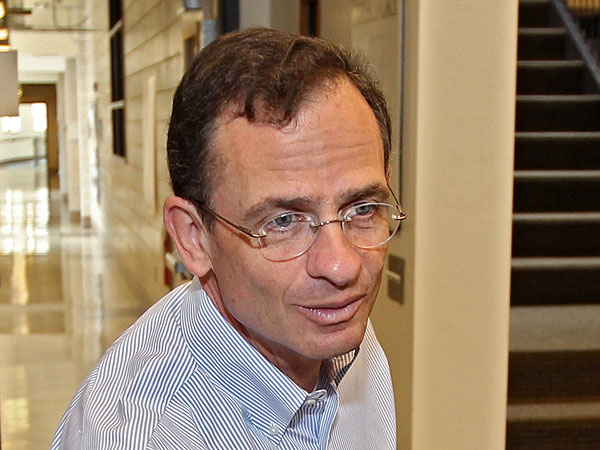
    Daniel Weiss at Haverford College after being named the college’s president in 2013.

    He was at Haverford College for a little less than two years before being hired away to lead the Met along with director Thomas P. Campbell. With Campbell’s departure in 2017, he took on the title of chief executive. He worked alongside Max Hollein after Hollein became director in 2018. Weiss left the Met in 2023.

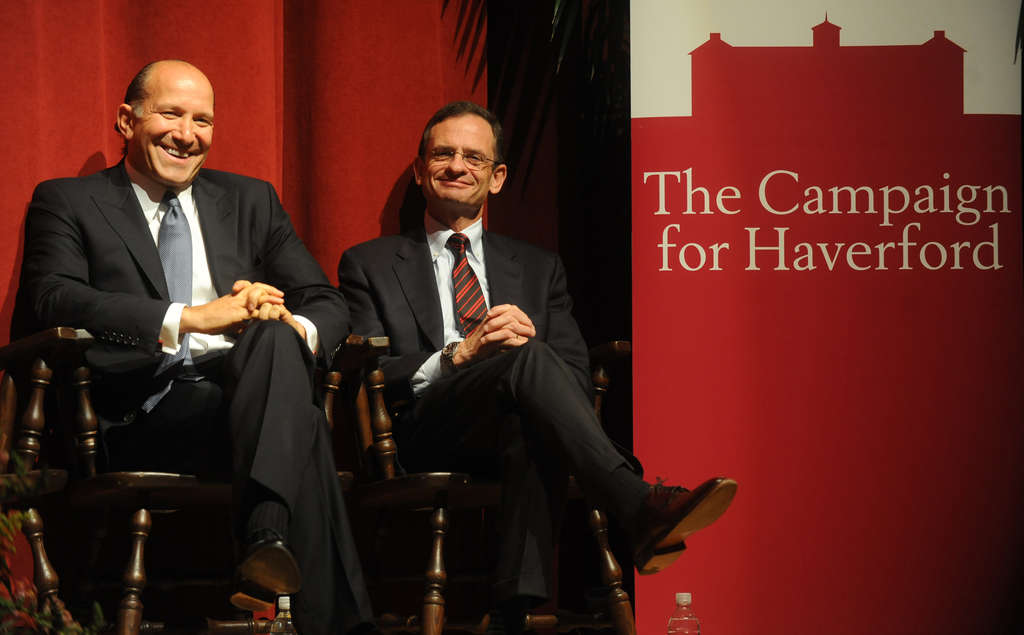
    He was the head of Haverford College in 2014 when it received its largest single gift to date at the time — $25 million from Howard Lutnick, then-chairman of the college’s board of managers and a Haverford graduate. (Lutnick is currently U.S. secretary of commerce.)

    Weiss brings to the Art Museum another storehouse of knowledge. He recently worked as a consultant to the museum’s board, a museum spokesperson said.

    He is no stranger to controversy. At the Met, he helped the museum grapple with decisions such as the end of its longtime pay-as-you-wish admission policy, as well as the question of whether to cut ties with the Sackler family, whose company, Purdue Pharma, manufactured and marketed the opioid painkiller OxyContin.

    The museum in 2019 announced it would stop accepting gifts from the Sacklers, and in 2021 it removed the family’s name from a number of exhibition spaces, including the wing that houses the popular Temple of Dendur.

    Weiss was also at the Met when the museum faced a set of circumstances not unlike some of those the Philadelphia Art Museum is facing now. In 2017, struggling with a deficit, the Met decided to pause plans for a $600 million expansion. Instead, it focused on more mundane, if important, projects, like work on the roof and skylights.

    Howard Lutnick (left) with Haverford College then-president Daniel Weiss for the 2014 announcement of Lutnick’s $25 million gift to the school.

    Most recently, for the past two years, Weiss has been a humanities professor and senior advisor to the provost for the arts at Johns Hopkins University.

    Suda filed a lawsuit on Nov. 10 against her former employer. Her lawyer said that she was the victim of a “small cabal” from the board that commissioned a “sham investigation” as a “pretext” for her “unlawful dismissal.”

    The Art Museum on Thursday responded to the lawsuit in Philadelphia Court of Common Pleas with a petition saying Suda was dismissed after an investigation determined that she “misappropriated funds from the museum and lied to cover up her theft.” Her lawyer called the museum’s accusations false. “These are the same recycled allegations from the sham investigation that the museum manufactured as a pretext for Suda’s wrongful termination,” he said.

    The Art Museum has a list of short- and long-term challenges with which it must grapple. Among them is the question of whether to roll back the recent name change and rebrand, which have been widely mocked and disliked.

    It also has several big pieces of the operational, facilities, and financial puzzle to prioritize. The Perelman annex was closed to the public during the pandemic and has not reopened; a planned expansion of gallery space beneath the museum’s east steps is in limbo; deferred maintenance on the main building awaits attention; the endowment is considered inadequate for an institution of its size.

    In addition, the museum is challenged by an operating deficit and visitorship numbers that have not recovered post-pandemic.

    Weiss — who is expected to take over the museum Dec. 1 — is the author of several books, including a recent one that explores the place of the art museum in society throughout history and examines its challenges today in the larger culture. Its title suggests the case he will need to make as the museum’s 15th director: Why the Museum Matters.

    “This is a great museum with a bright, important future,” said Weiss, “and our ability to fulfill our mission requires everyone’s involvement.”

  • Leon Thomas shows why he is a Grammy favorite at Fillmore show

    Leon Thomas shows why he is a Grammy favorite at Fillmore show

    R&B star Leon Thomas’ star is on the rise. After spending his childhood working as an actor, he released his acclaimed sophomore album, Mutt, which has received six Grammy nominations, including a nod for best new artist and album of the year.

    His child actor days now feel like a thing of the past. The singer-songwriter has entered new territory.

    Thomas’ fan base is drawn to his funk, soul, and rock-infused iterations of R&B music. That was evident Wednesday night at the Fillmore.

    Leon Thomas headlined The Fillmore as part of his “Mutts Don’t Heal Tour” on Wednesday, Nov. 19, 2025.

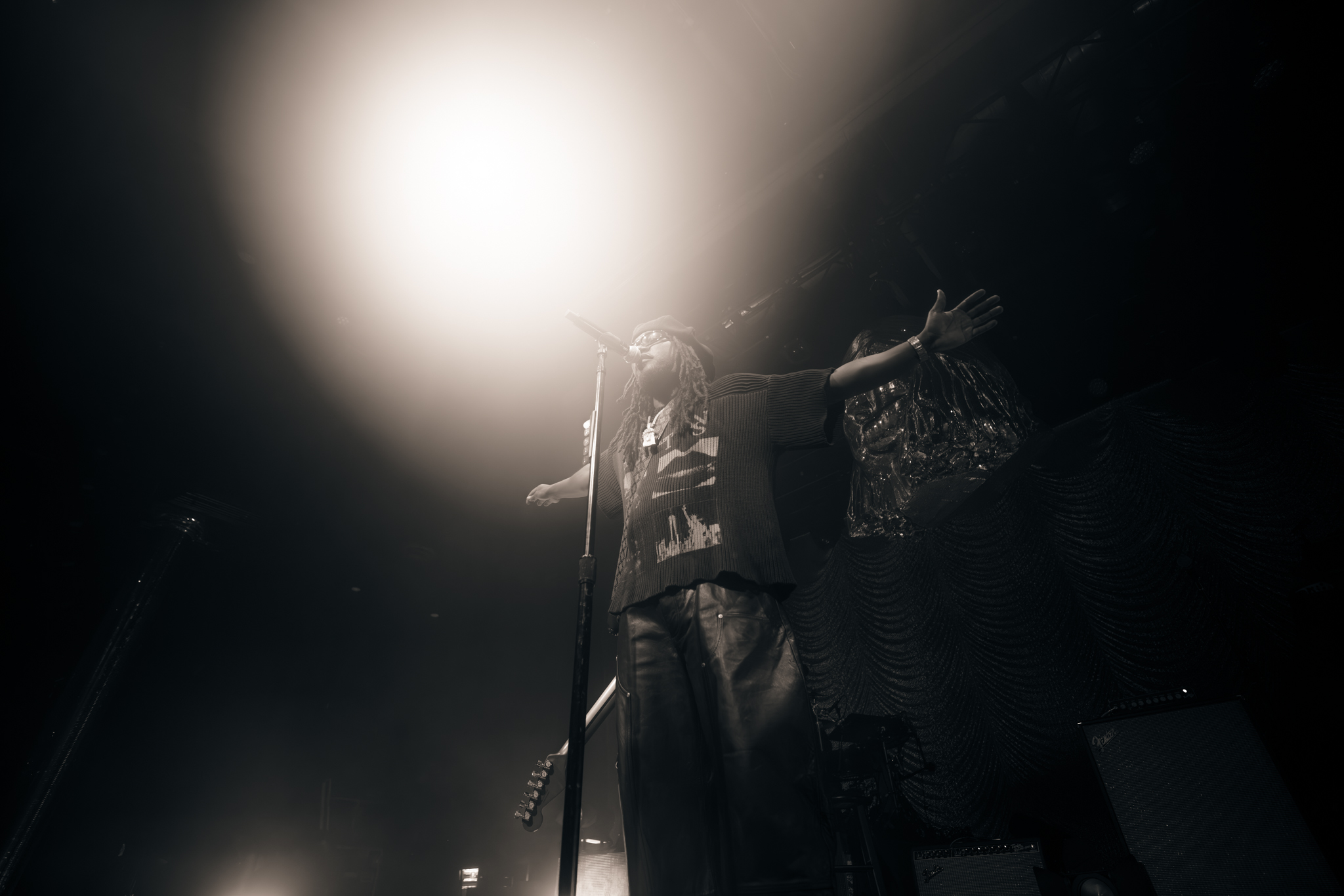
    As amber and emerald lights lit the stage, with a glimmering replica of his head floating over the elevated platform, Thomas kicked things off with the high-paced “How Fast,” a record shining a light on his ride to mainstream success and the inescapable fears of losing his grip.

    “Feel like I just got off the stage at the Grammys,” Thomas sang while backed by the thundering drums of his stage band. “Feel like I just bought a new house for my mama. Feel like I’m racing through the streets of Miami. I’m in a Lamborghini, you in a Honda. How many zeros can a young … count up?”

    He went on to perform a short medley of his brooding R&B jams from Mutt, before welcoming a surprise guest. As the momentous half-break on “Far Fetched” arrived, the unmistakable voice of fellow R&B star Ty Dolla $ign blared through the speakers.

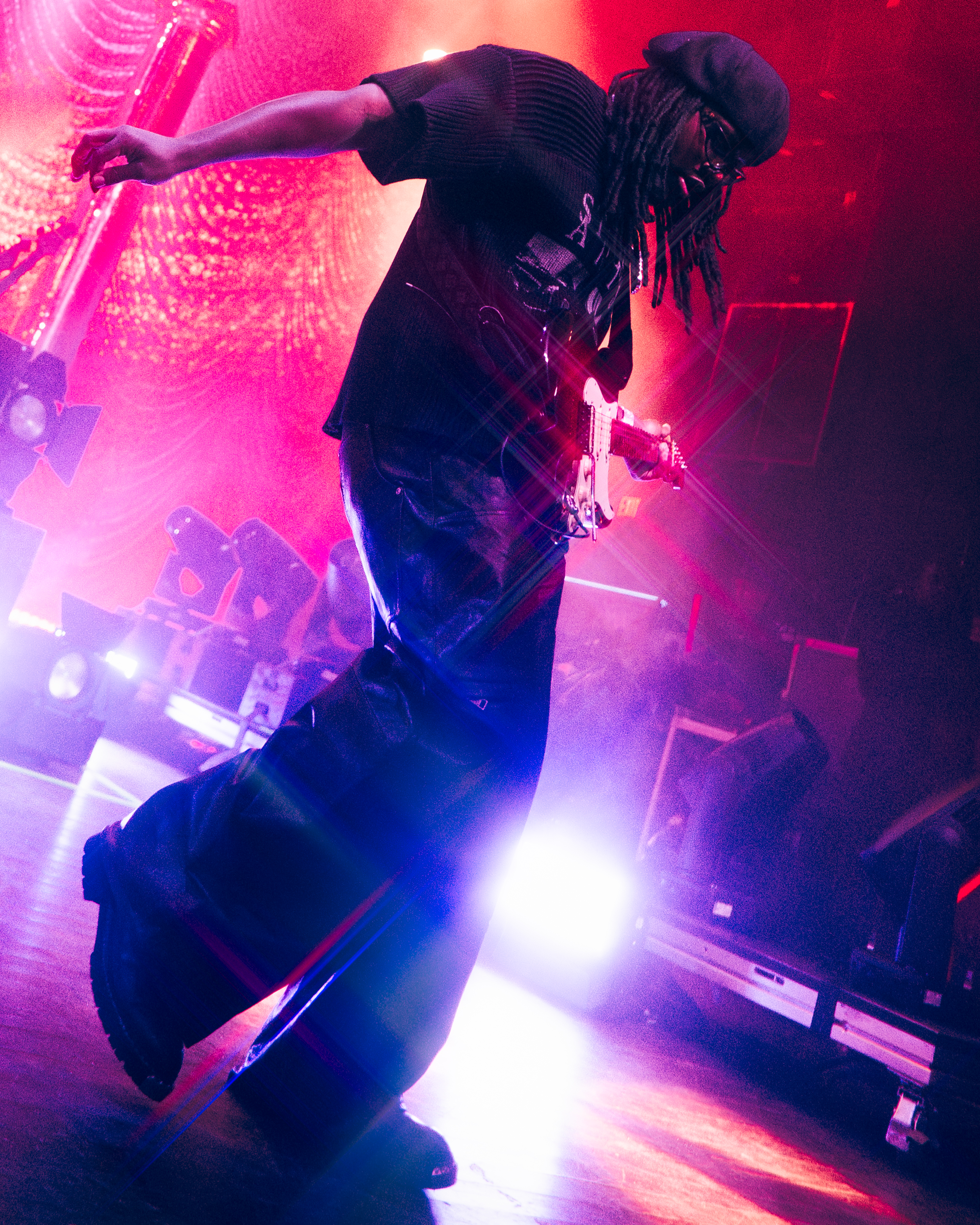
    Ty performed the Mutt cut alongside Thomas, who ripped from his electric guitar. Then the two transitioned to Ty’s 2024 smash, “Carnival” with Kanye West.The cameo ignited the crowd, from the standing room floor to the balcony rows.

    Leon Thomas performed alongside surprise guest Ty Dolla $ign at The Fillmore Philadelphia on Wednesday, Nov. 19, 2025.

    Thomas continued performing favorites from Mutt and his 2023 debut Electric Dusk, showcasing his magnetic voice and musicianship through impromptu vocal runs and zippy guitar blends.

    “Philly, I want you to sing with me tonight,” said Thomas, before performing “Vibes Don’t Lie” and “All I Do.”

    “I ain’t done with you yet.”

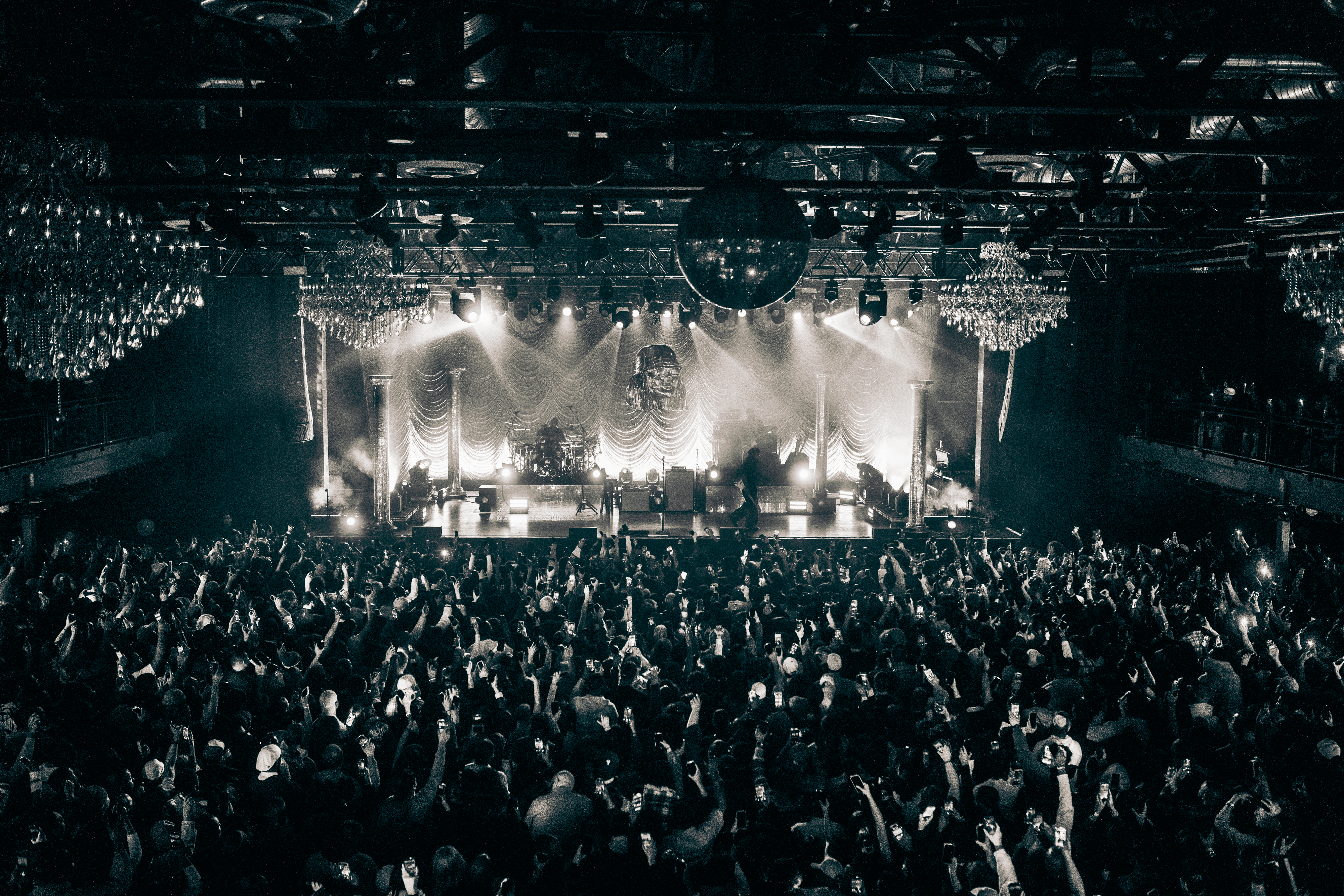
    All of Thomas’ musical gifts were on display, but not all of them resonated with the sold-out crowd.

    As he transitioned from his more familiar R&B jams to the rock and soul-drenched records he’s produced in the past and on his new EP, Pholks, the momentum began to slow down.

    Leon Thomas headlined a sold-out show at The Fillmore Philadelphia on Wednesday, Nov. 19, 2025.

    With records like “Blue Hundreds” and “Baccarat,” the crowd appeared disengaged from Thomas’ garage rock-inspired songs and influences. What felt like an R&B concert morphed into a momentary rock show, with Thomas’ band backing him at every measure.

    The crowd’s energy, however, was soon revived once Thomas transitioned back to hip-swaying records like “Love Jones,” “Crash & Burn,” and the radiantly soulful “Yes It Is,” which he followed with a cover of iconic neo-soul group Floetry’s “Say Yes.”

    He closed the 90-minute show with “Mutt.”

    “This song changed my life,” Thomas said.

    Leon Thomas headlined The Fillmore as part of his “Mutts Don’t Heal Tour” on Wednesday, Nov. 19, 2025.

    Wednesday’s concert made one thing clear: Thomas is a man of many musical talents and even if they all don’t land, they are undeniable.

    He’s a true talent, cosigned by fellow artists like Ty Dolla $ign, that will hopefully be validated by golden gramophones on the forthcoming biggest night in music.

    And rightly so.


    Setlist for Leon Thomas’ “Mutts Don’t Heal Tour” at The Fillmore in Philadelphia on Nov. 19, 2025.

    “How Fast”

    “Dancing With Demons”

    “Far Fetched” (with Ty Dolla $ign)

    “Carnival” (with Ty Dolla $ign)

    “Lucid Dreams”

    “Vibes Don’t Lie”

    “Party Favors”

    “I Do”

    “My Muse”

    “Just How You Are”

    “Blue Hundreds”

    “Baccarat”

    “Sneak”

    “Slow Down”

    “Love Jones”

    “Yes It Is”

    “Say Yes” (Floetry cover)

    “Crash & Burn”

    “Treasure In The Hills”

    “I Used To”

    “Breaking Point”

    “Not Fair”

    “Mutt”

  • Why the lunar module is leaving the Franklin Institute

    Why the lunar module is leaving the Franklin Institute

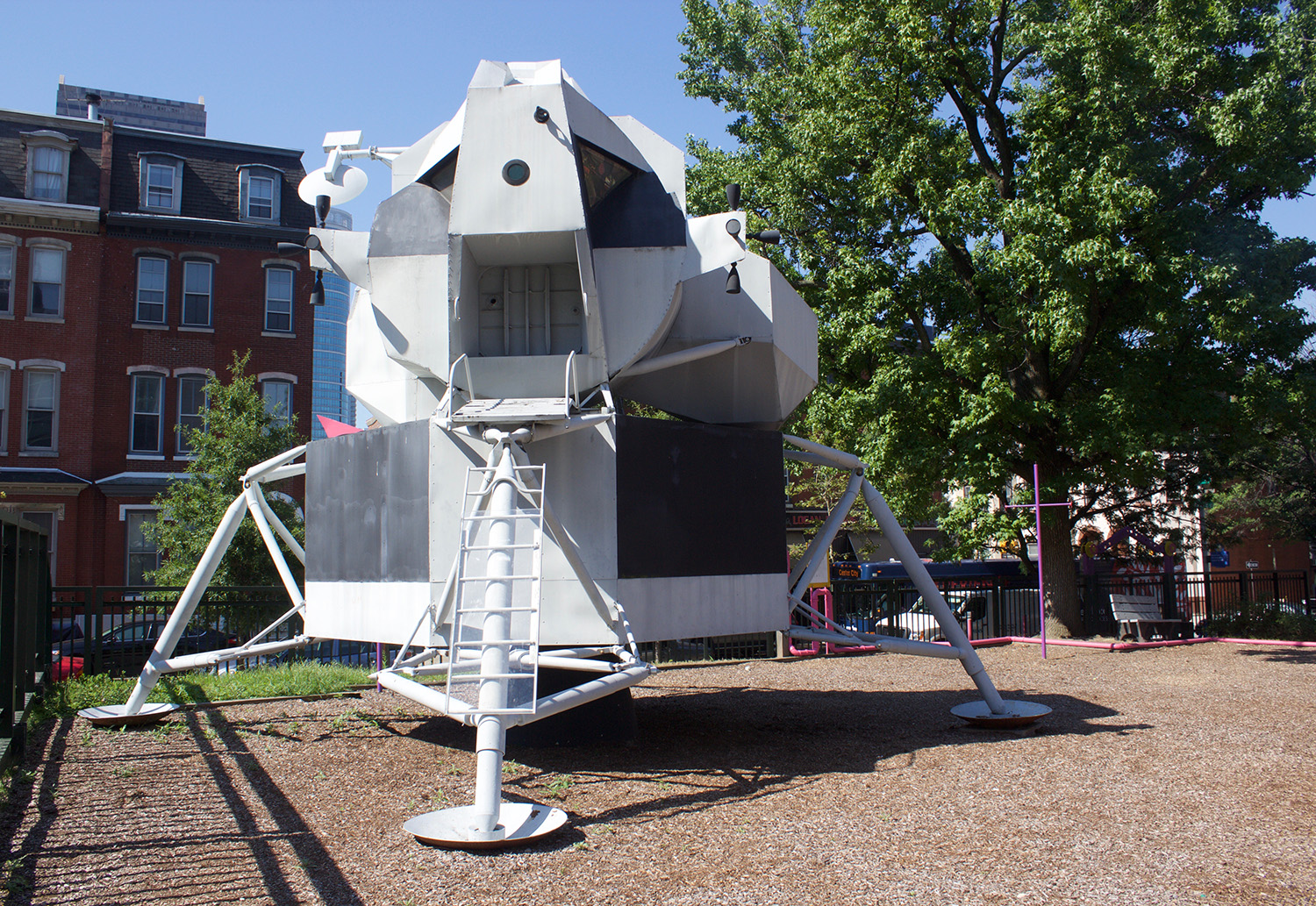
    Bill Piccinni, 67, was riding his bike by the Franklin Institute when something halted his pedaling. The lunar module looked as if King Kong had ripped it in half, he said.

    Concerned, he asked Curious Philly, The Inquirer’s forum for questions about the city and region: What is going on with the Apollo-era lunar module? Is the Franklin Institute getting rid of it?

    » ASK US: Have something you’re wondering about the Philly region? Submit your Curious Philly question here.

    “It’s been there for so long; it’s like a part of the city almost,” Piccinni said. “If it disappears, it would just be a shame.”

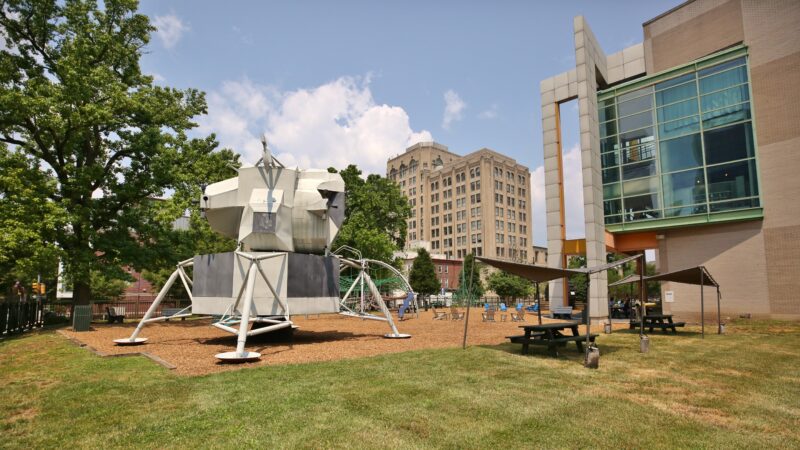
    Sadly for Philly space lovers, the disjointed module does signal a farewell. After 49 years at the museum, it is returning to its previous orbit — Washington.

    Neil Armstrong’s ride look-alike, a prototype used in preparations for several Apollo missions, was loaned by the Smithsonian’s National Air and Space Museum in 1976, according to Derrick Pitts, the Franklin Institute’s chief astronomer. Now, that museum has asked for the module’s return.

    “All museums, when they are keeping track of their artifacts … set a period of time for how long it’s gonna be borrowed, and then they will ask for it back,” Pitts said.

    The Lunar Module was loaned by the Smithsonian’s National Air and Space Museum in 1976.

    The chief astronomer is not sure what awaits the Grumman structural engineering test module near D.C. The engineering prototype served to test how the parts and pieces would fit together in preparation for the real Apollo 11 lunar module that took Armstrong to the moon.

    To Pitts, that doesn’t make it any less special. On the contrary, he views the equipment as an epitome of the height of space exploration technology at the time. It’s proof that “we successfully sent explorers to the moon and brought them back safely,” Pitts said.

    For future generations of Philadelphians, this means no longer being able to see the module up close without leaving the city. People in Washington won’t be seeing this particular module either. There are currently no plans for it to be displayed at the National Air and Space Museum, according to spokesperson Marc Sklar.

    For now, the Franklin Institute is considering an array of options for replacing the module in the backyard, but nothing is set in stone, Pitts said. In the meantime, the museum’s Wondrous space continues to be an option for folks wanting to learn about space.

    “I am just really appreciative that people have paid attention to the lunar module enough to wonder what is going on with it,” Pitts said. “We are really very glad that you are aware that it has been here and that you are going to miss it.”

  • The artist behind the ‘Boob Garden’ and ‘Rave Coffin’ strikes again with ‘Crab Couch’ in South Philly

    The artist behind the ‘Boob Garden’ and ‘Rave Coffin’ strikes again with ‘Crab Couch’ in South Philly

    For the last two years, Rose Luardo has been exceedingly generous with her art, installing it for all to see in a vacant triangular lot in South Philly that was once home to Capt. Jesse G’s Crab Shack.

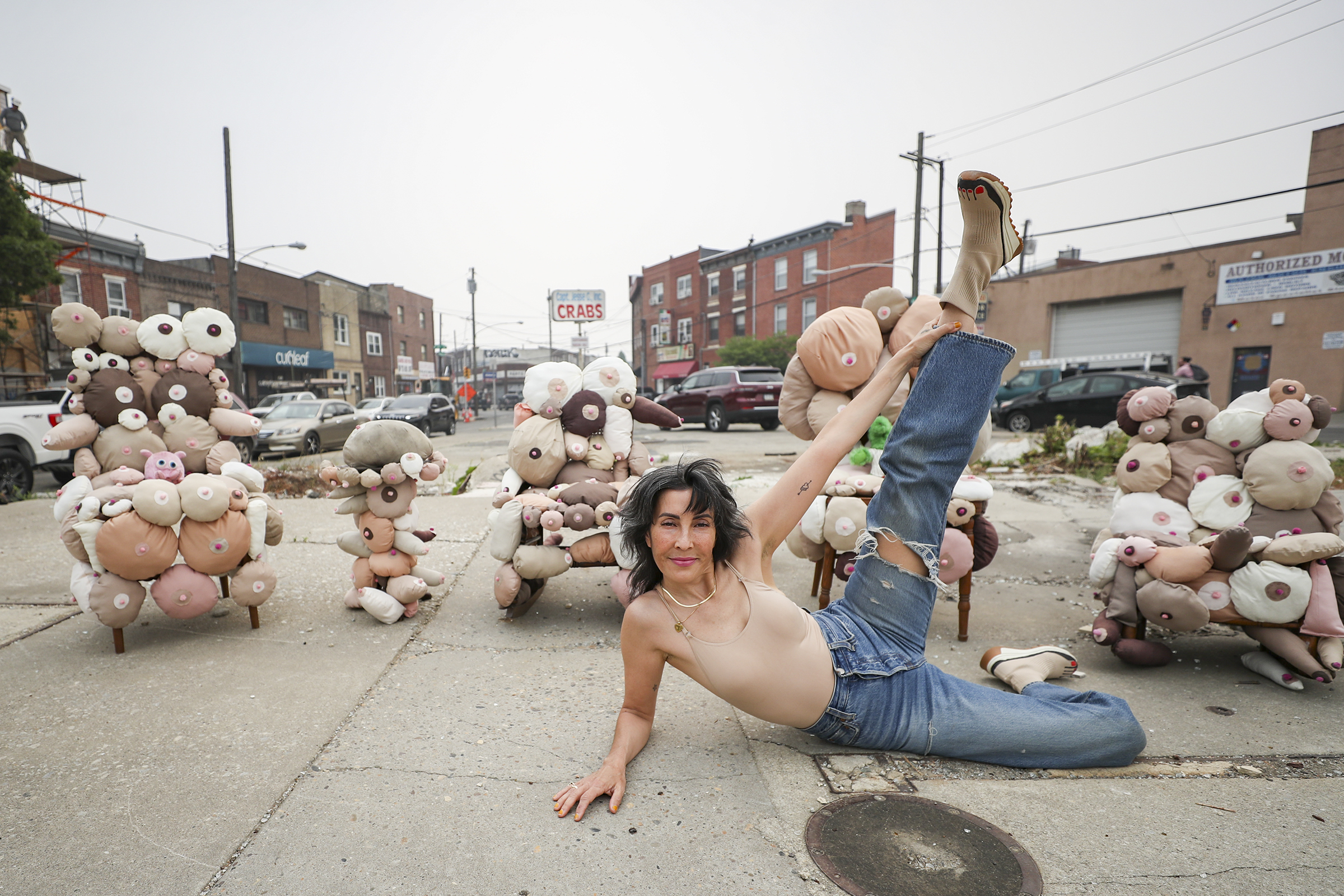
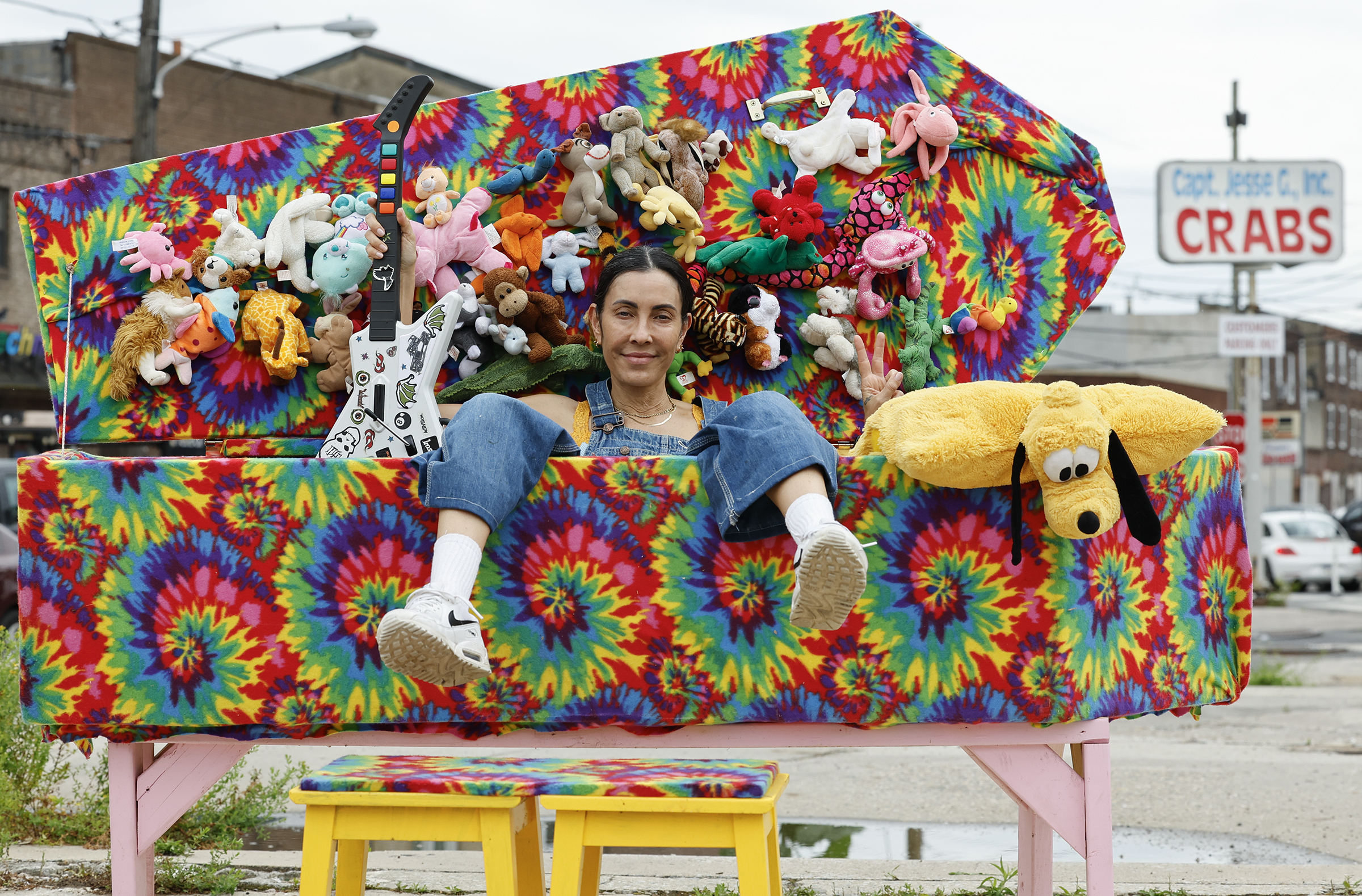
    In 2023, she gifted the people of Philadelphia with the Boob Garden, a furniture set covered in handmade breast plushies, and the following year she gave us the Rave Coffin, a casket covered in tie-dyed felt that passersby could lie down inside of.

    Rose Luardo strikes a pose at her “Boob Garden” art installation in 2023.

    Luardo struck again Sunday night at the cement triangle at the intersection of Washington Avenue, Passyunk Avenue, and Eighth Street, but this time around, her guerrilla art installation was totally shellfish.

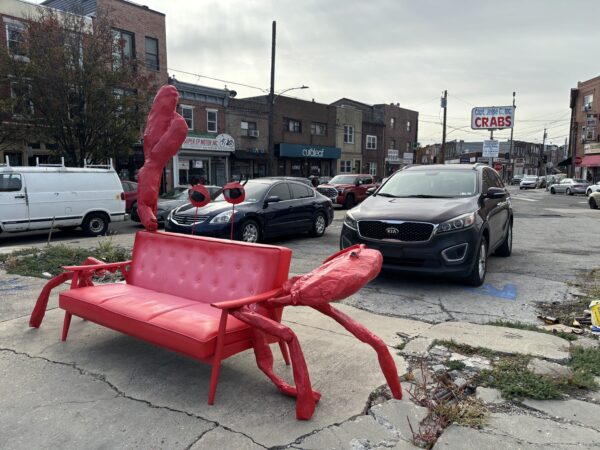
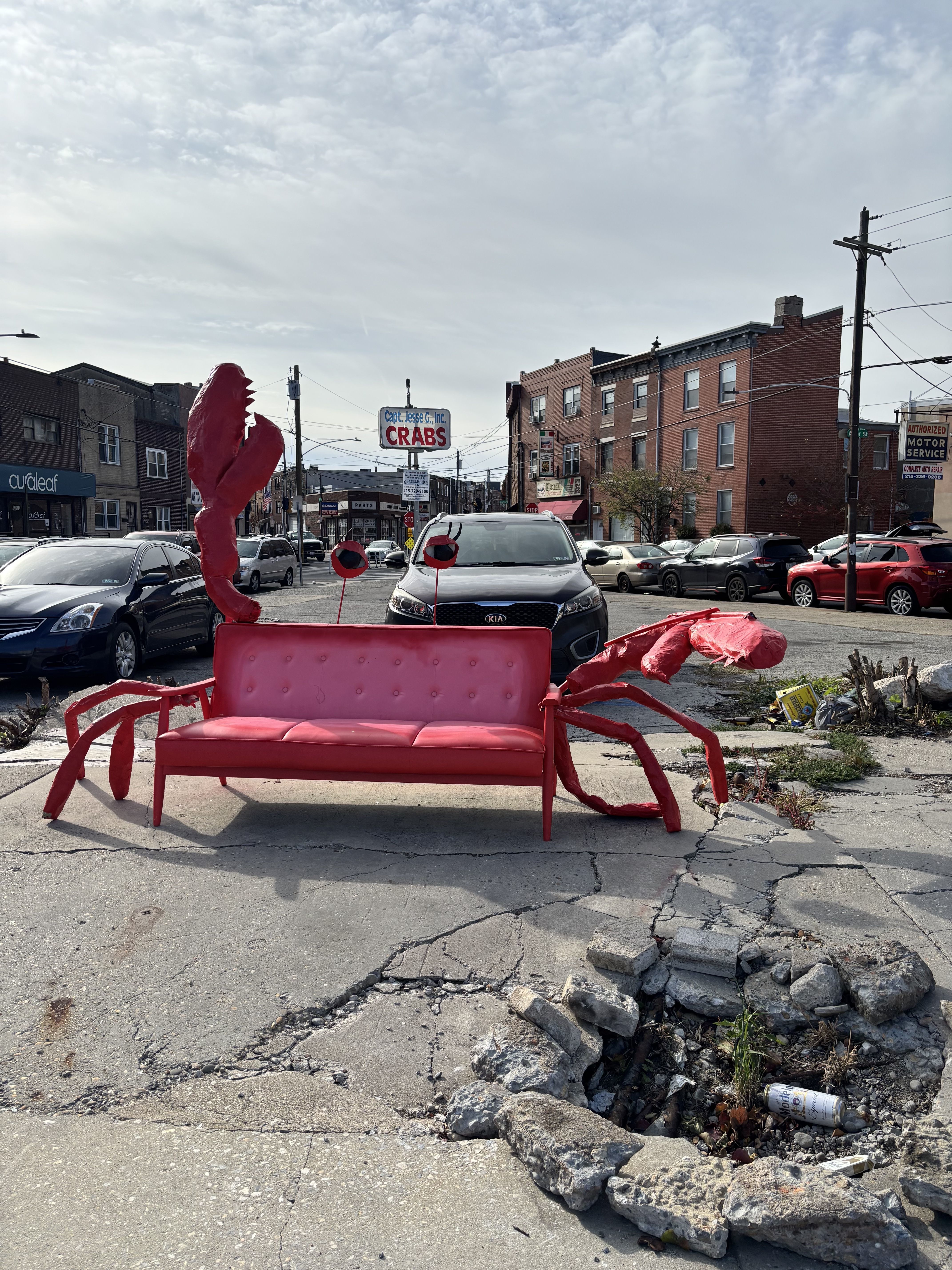
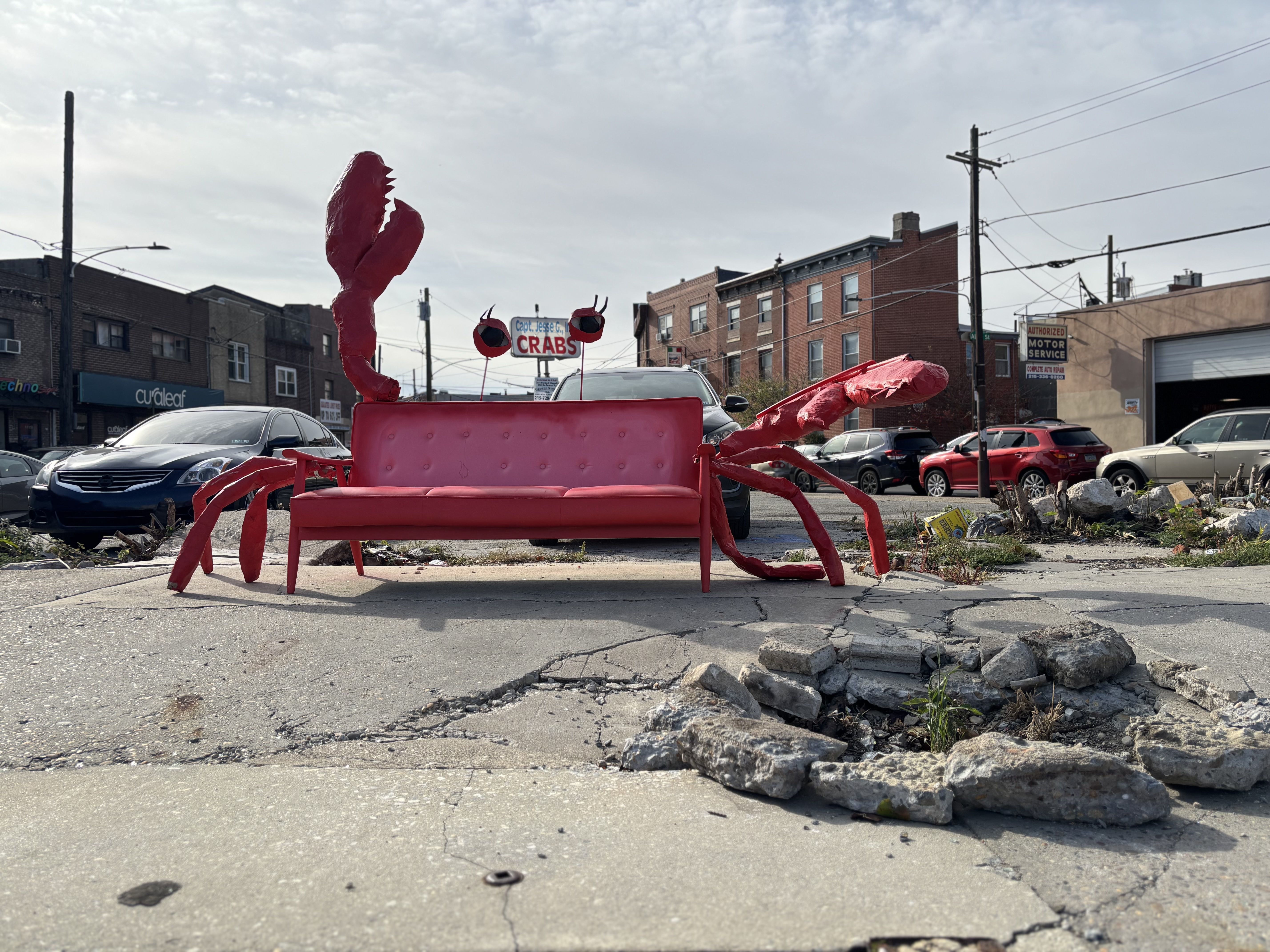
    Crab Couch — which is exactly what it sounds like unless you’re thinking of the other kind of crabs, which it is not — is the latest work Luardo set up at what she calls Capt. Jesse G’s Crab Shack Gallery. That’s because the shuttered business’ sign inexplicably remains lording over the lot on a freestanding pole, even though the building was long-ago demolished.

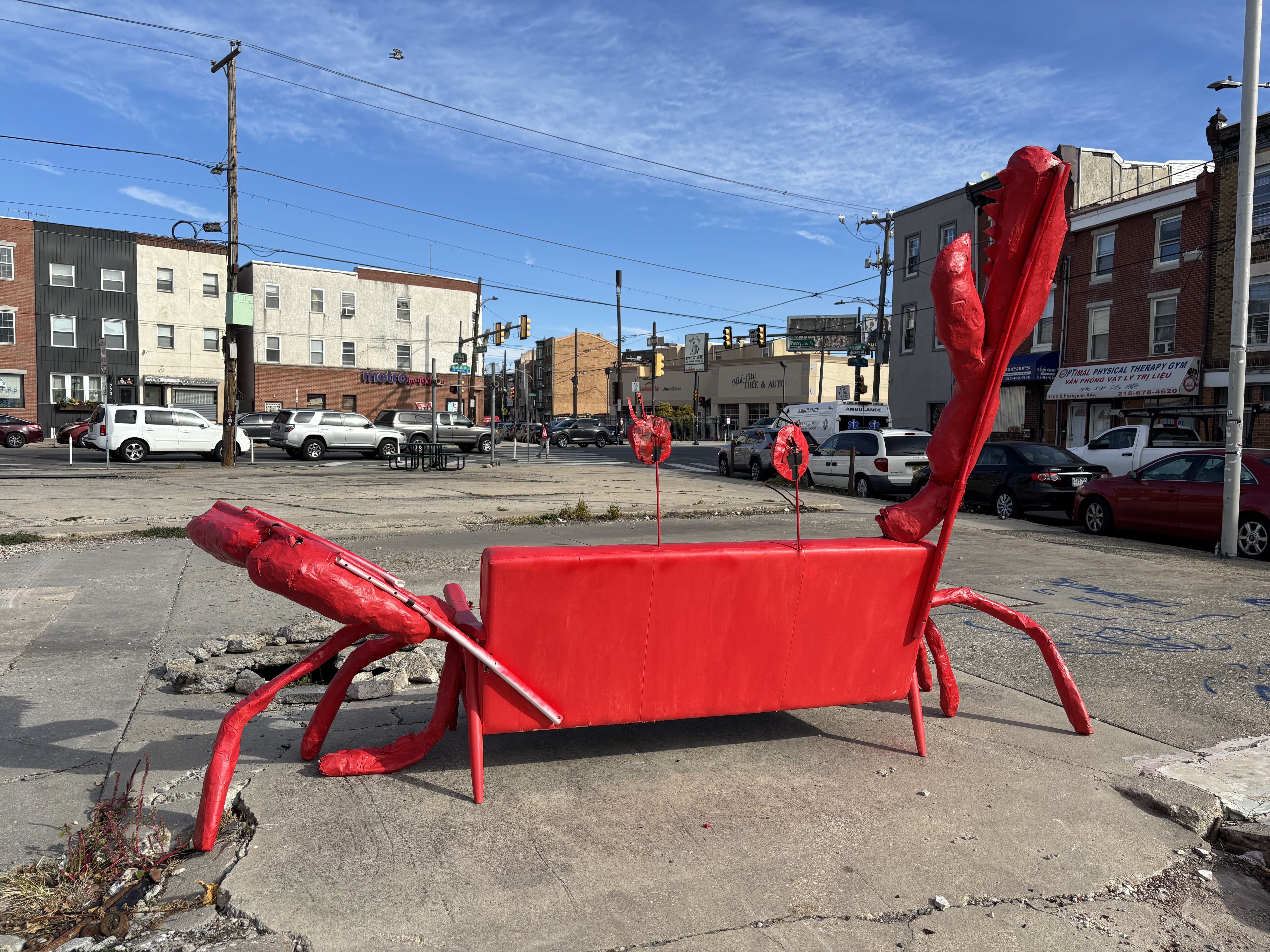
    Once just a regular white sofa that was looking for a new home on Facebook Marketplace, Luardo — a provocateur of the peculiar — rescued the couch and Frankenstein-ed that piece of furniture into a comfy crustacean.

    With some papier-mâché, red house paint, and the help of her niece, Ingrid Rose Koppisch, and their friend, Simply Val, Luardo gave the couch six legs, a pair of judgey eyes, and two hulking claws, with one clamping down on a giant cigarette.

    She first put the crabby patio furniture in a gallery show she had in September.

    “I just had a feeling that this was not going to sell, but it would be a fun thing to make and eventually put out in my own personal art gallery at Capt. Jesse G’s,” Luardo said.

    On Sunday night, she and her husband put Crab Couch on one of his skateboards and wheeled it up the street to the vacant lot.

    Luardo noticed, as did I, that since the time of her installation last year, a taco truck has stationed itself at the edge of the lot and someone has bashed a small hole into the cement and created a modest fire pit, which Luardo placed the Crab Couch in front of. When I stopped by on Tuesday, the pit held an empty can of Modelo and an empty pack of Marlboro Lights.

    Artist Rose Lurado placed her latest work, “Crab Couch,” in front of a fire pit someone smashed into the cement at the vacant South Philly triangle she calls “Capt. Jesse G’s Crab Shack Gallery.”

    “I was so psyched that was there!” Luardo said of the pit. “This is the dream coming true, which is that the space is becoming activated, people are hopefully hanging out, eating a taco, drinking a Modelo, and sitting on the couch.”

    In the days since it was installed, the wind has done some damage to Crab Couch’s claws, which Luardo said neighbors came out to valiantly fix with drills. But its giant cigarette is nowhere to be found. It has become the ultimate Philly loosie.

    Otherwise, all is good with Crab Couch.

    “Crab Couch” is an old bae but a good one.

    I asked Luardo why she continues to put her art in such a hardscrabble lot, where it’s subject not only to weather but to something even more unpredictable — the whims of Philadelphians.

    “It was built for this kind of experience and nobody has claimed it,” she said. “It’s just this … s— lot and I know there’s people walking by and it’s so much fun to see something crazy and delightfully weird. It puts a hitch in your giddy-up.”

    According to city records, the lot is owned by 1100 Passyunk Partners LLC, which purchased the property for $2.85 million in 2020. A number for the group was not able to be located.

    South Philly artist Rose Luardo sits in her “Rave Coffin” at the triangular cement lot between Washington Avenue, Passyunk Avenue, and Eighth Street in 2024.

    To whomever owns this eyesore — which has been a vacant lot since at least 2016 — I beseech you to gift it to Luardo, who’s shown more interest in it and has done more to improve it than you ever have.

    The world is coming to Philadelphia next year and instead of having an empty, crumbling lot on one of the city’s busiest corridors, why not let Luardo show the world just how weird Philly can be?

    I hear she’s been eyeing an inflatable nightclub on Temu.

    “Crab Couch” looks out over the vacant triangle lot where it’s currently clawing out its existence next to busy Washington Avenue.