Category: Arts & Culture

  • Piffaro presents ‘exuberant’ Christmas music but with hurdy gurdy, theorbo, bagpipes, and more

    Piffaro presents ‘exuberant’ Christmas music but with hurdy gurdy, theorbo, bagpipes, and more

    NEW YORK — Christmas concerts are God’s gift to early music groups such as Piffaro (Philadelphia’s Renaissance wind band). Audience love taking refuge in holiday exuberance from what we imagine as a better, centuries-ago past.

    The Thursday concert of 17th-century German music titled “Ein Kind Geborn” (A Child is Born) ― the first in a string of performances that includes Philadelphia and Wilmington ― had Piffaro fruitfully collaborating with New York’s Tenet Vocal Artists, whose finely-etched sound and deep musical comprehension make their concerts drop-everything-and-go occasions.

    The partnership with Piffaro’s recorders, theorbo, and bagpipes (gentle ones) was a sound feast ― of and for a particular sort.

    The question is: Are audiences ready for the kind of uncommercialized, predominantly devotional Christmas concert that many say they long for? It was exuberance without brass, flash, or modern Santa Claus mythologies, and from an era when the loudest human-made sound was church bells. One’s ears must adjust.
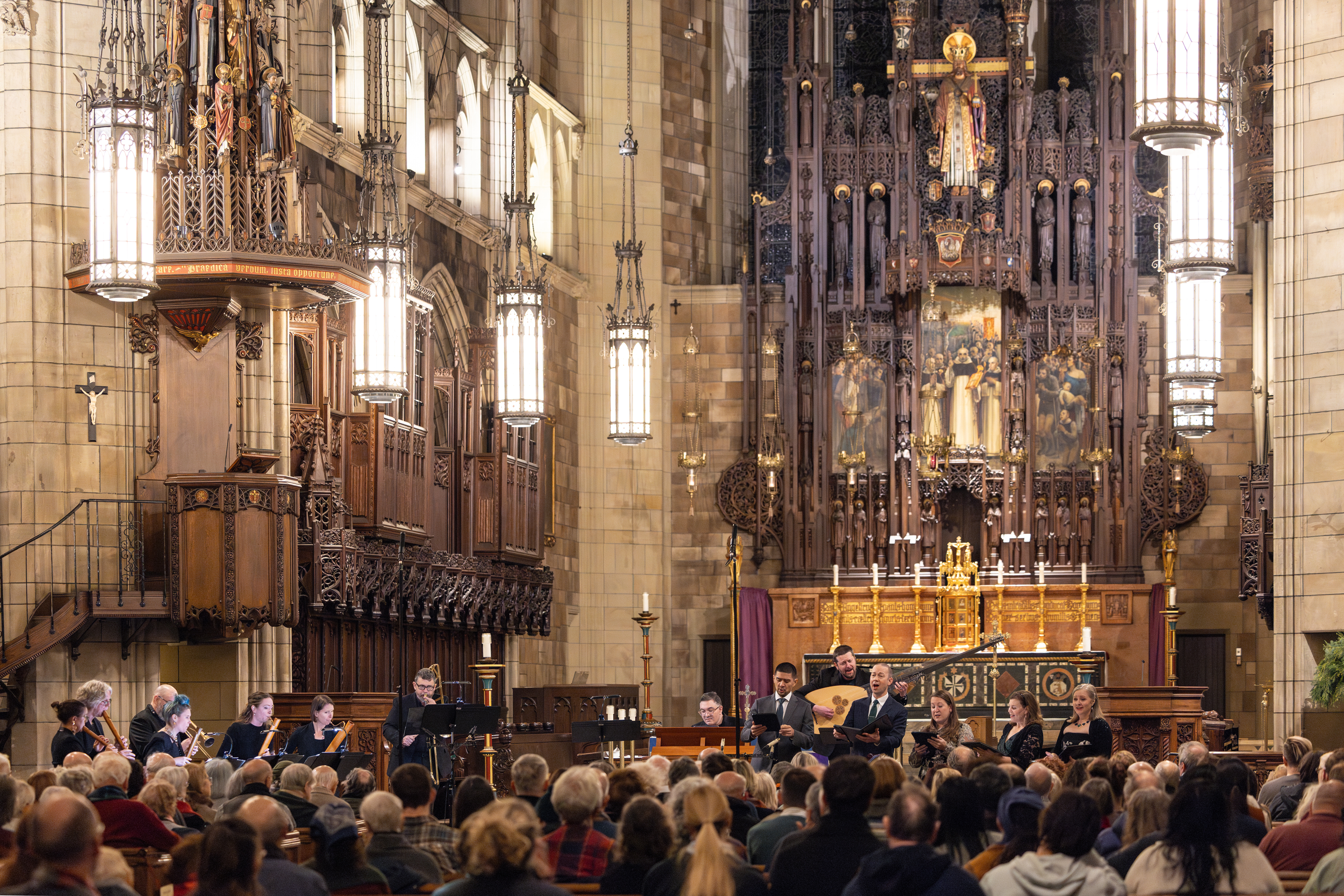
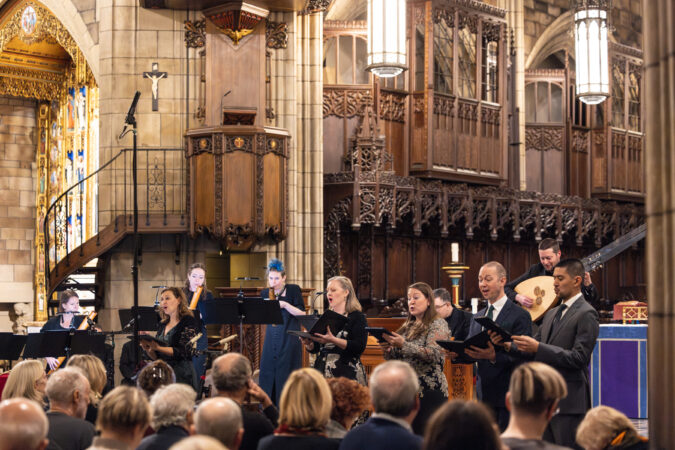
    Tenet Vocal Artists performing “Ein Kind Geborn” with Philadelphia’s Renaissance wind band, Piffaro, at New York City’s Church of St. Vincent Ferrer on Thursday, December 4, 2025.

    The brainy crowd Thursday at Church of St. Vincent Ferrer definitely took to it, with side conversations like “I wanted to hear more dulcians” (an arcane woodwind) or asking why 17th-century German texts “are so stingy with their vowels.” (Who knows.)

    Composers included Michael Praetorius (1571-1621), and his durable “In dulci jubilo,” plus lesser-known contemporaries (Johann Walter, Melchior Schärer, etc.)

    Devised by Piffaro artistic director Priscilla Herreid, the 75-minute intermissionless program had 18 shortish vocal/instrumental pieces, both in German and in Latin, arranged under subheadings such as “From Silence to Singing” and “Sweet Jubilation.”

    Some selections were hymns, such as the famous “Von Himmel hoch” (the audience was invited to sing along); others, in a more sophisticated form known as “sacred concertos.” Composer Praetorius encouraged diverse adaptations of his music, and in that spirit, no two pieces had the same manner of expression.

    Some had the five-member Tenet Vocal Artists unaccompanied (they can do that and stay perfectly in tune) or the nine-member Piffaro players (who alternate between a dozen different instruments, including dulcians) in purely instrumental works. Multi-stanza pieces were built and sustained beautifully, progressing from different pairings of voices and varied interactions with the instruments — though within a richly textured 17th-century sound envelop.

    Always a highlight in Tenet concerts are sopranos Jolle Greenleaf (Tenet artistic director) and Clara Rottsolk, whose rather different voices create a compelling blend, whether positioned for antiphonal effects across church spaces, leapfrogging in counterpoint, or coming together in ways that create a shifting highlight of composite sound.
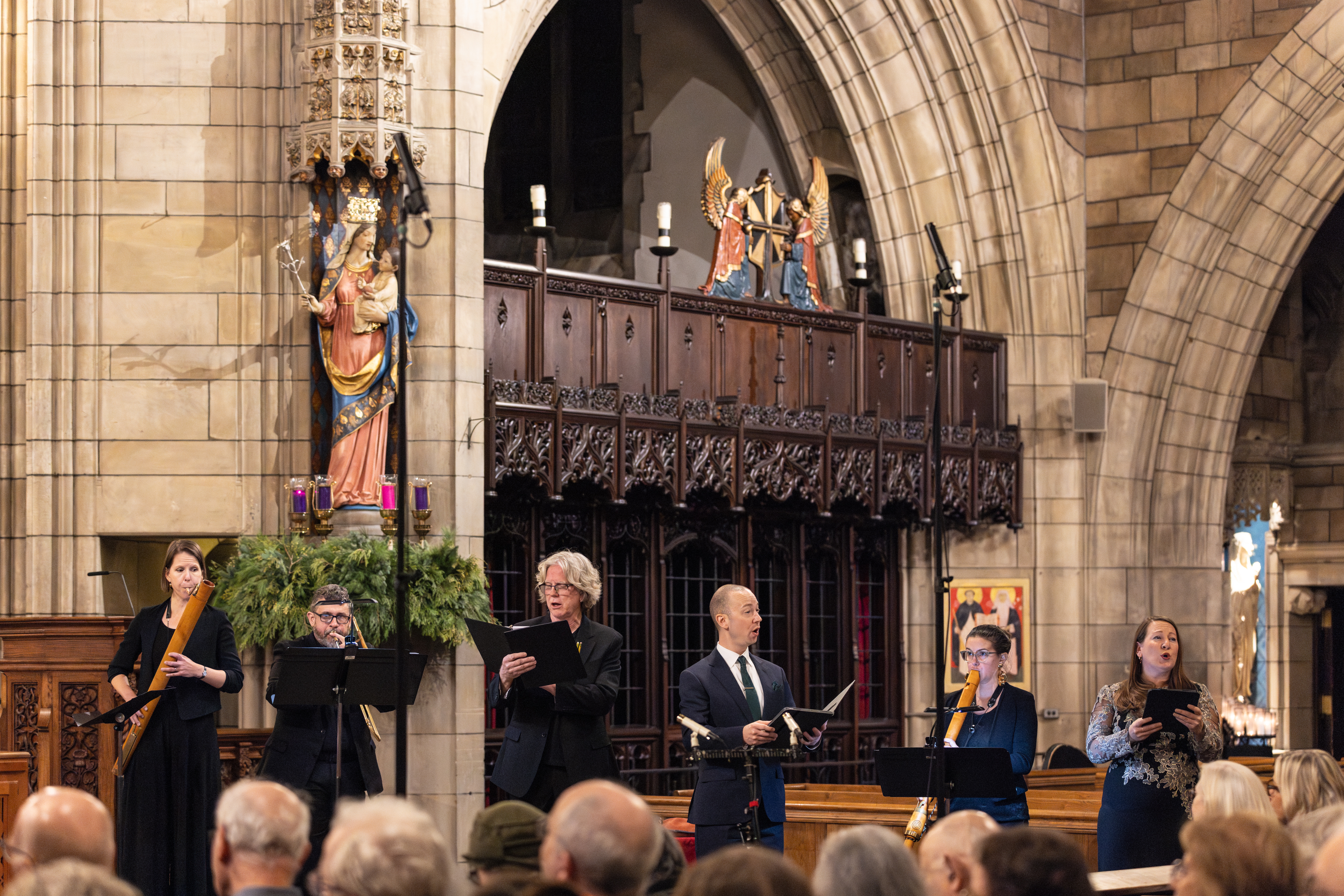
    Tenet Vocal Artists performing “Ein Kind Geborn” with Philadelphia’s Renaissance wind band, Piffaro, at New York City’s Church of St. Vincent Ferrer on Thursday, December 4, 2025.

    When not blending, the other Tenet voices invite one’s ears in low-key ways. This is a long way from Metropolitan Opera singing and is a relief as well as a pleasure.

    In other respects, the performances were excellent though the fusion of elements is likely to be better in Philadelphia-area concerts.

    There were moments when a particular member of the ensemble would poke out of the texture to lead others to the right musical destination — sometimes necessary in conductorless ensembles.

    In general, Piffaro continues to evolve nicely under Herreid’s leadership. Renaissance repertoire is far less standardized than music of later centuries, and the wide possibilities constantly reveal new sounds, both ethereal and with underlying grit — thanks to Piffaro’s inclusion of folky instruments such as hurdy gurdy, the guitarlike cittern and, of course, bagpipes.


    “Ein Kind Geborn,” Dec. 5, 7:30 p.m., Church of the Holy Trinity, Rittenhouse Square; Dec. 6, 7.30 p.m., St. Martin-in-the-Fields, Chestnut Hill; Dec. 7, 3 p.m., Westminster Presbyterian Church, Wilmington. $25-$49.

    The program will stream online Jan. 15-18 at piffaro.org or tenet.nyc. $18.
  • The family of dancers that has danced the Philadelphia Ballet ‘Nutcracker’ for at least a dozen years

    The family of dancers that has danced the Philadelphia Ballet ‘Nutcracker’ for at least a dozen years

    The Nutcracker is about family. It centers around a girl named Marie, her parents and little brother, and the magical things that happen after they throw a Christmas party.

    At Philadelphia Ballet, it’s more than just that.

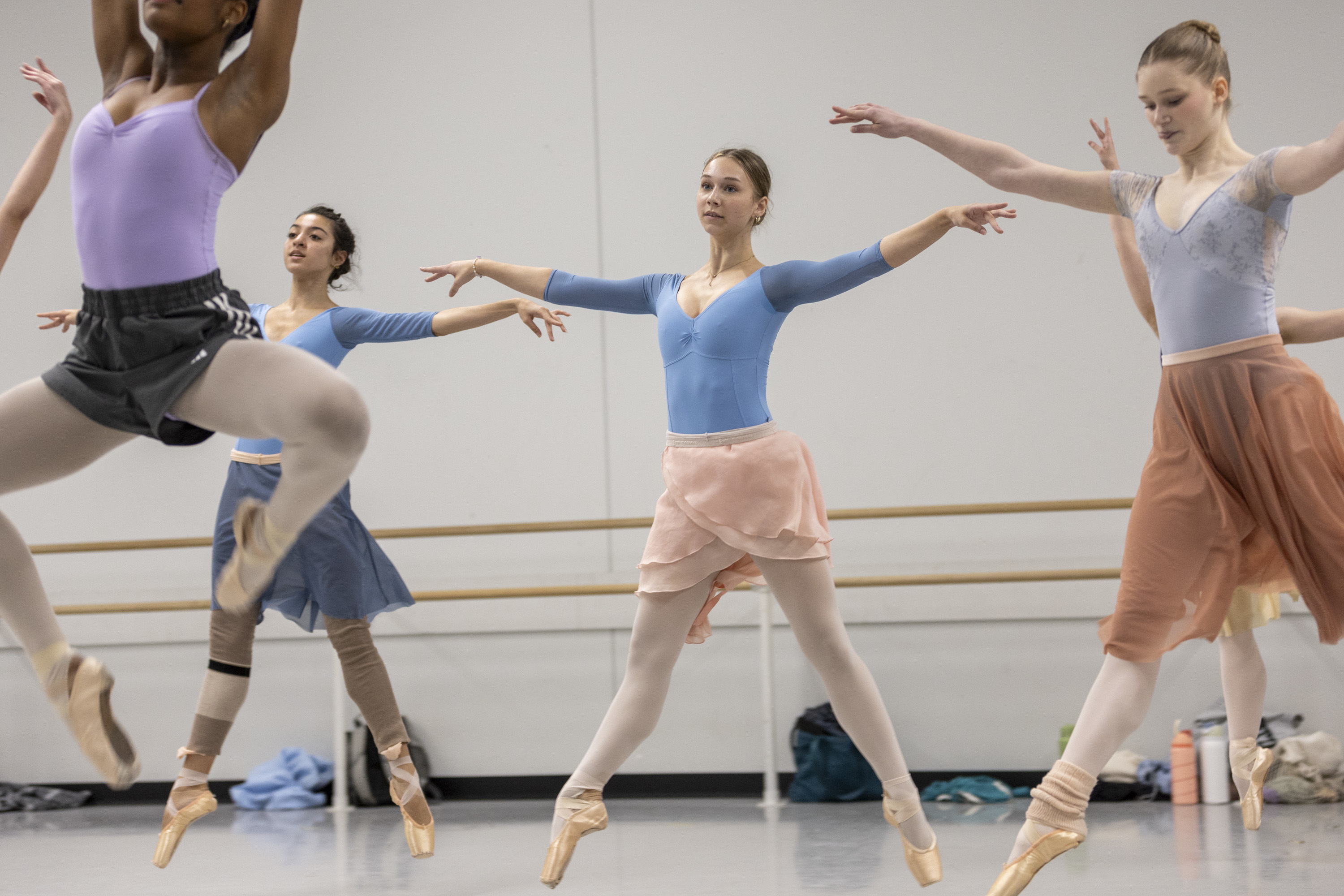
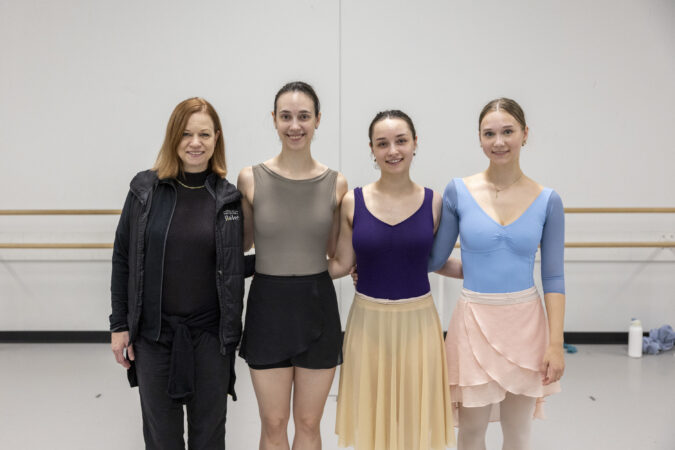
    Four members of a dancing family make Nutcracker magic onstage together. Sisters Isabella, 21, Ava, 19, and Olivia DiEmedio, 16, are all members of the company. Isabella is in the corps de ballet, Ava an apprentice, and Olivia in Philadelphia Ballet II.

    When the company opens its annual production of George Balanchine’s The Nutcracker this weekend at the Academy of Music, the sisters will perform as snowflakes, flowers, parents, maids, and a variety of sweet treats.

    Olivia DiEmedio, 16, (center) rehearses “The Nutcracker” with Philadelphia Ballet.

    The sisters are still on the rise in the company, and are yet to explore most of the principal roles. But they’ve filled most of the children’s, many of the corps, and some soloist roles. In fact, there has been a DiEmedio in one scene or another of The Nutcracker for at least a dozen years.

    Even their mother is sometimes onstage alongside them.

    Charity Eagens, who grew up in East Norriton, Montgomery County, was in the company, then known as Pennsylvania Ballet, for 10 years, starting in 1996. Now she is a teacher in the School of Philadelphia Ballet and the children’s ballet stager. She is also the grandmother in some performances of The Nutcracker.

    Eagens has taught all three of her daughters throughout their training, and she continues to do so once a week, when she teaches company class.

    In ballet class, she is their teacher. As soon as they step outside the studio, she is Mom.

    “It would be really awkward for all my friends to see me calling you Miss Charity,” Ava said to her mother on Zoom, gathering around a table at Philadelphia Ballet.

    “I would never say ‘Miss Charity,’” Olivia added. “I would just say what I needed to say and, like, just raise my hand.”

    The DiEmedio sisters grew up on Philadelphia Ballet.

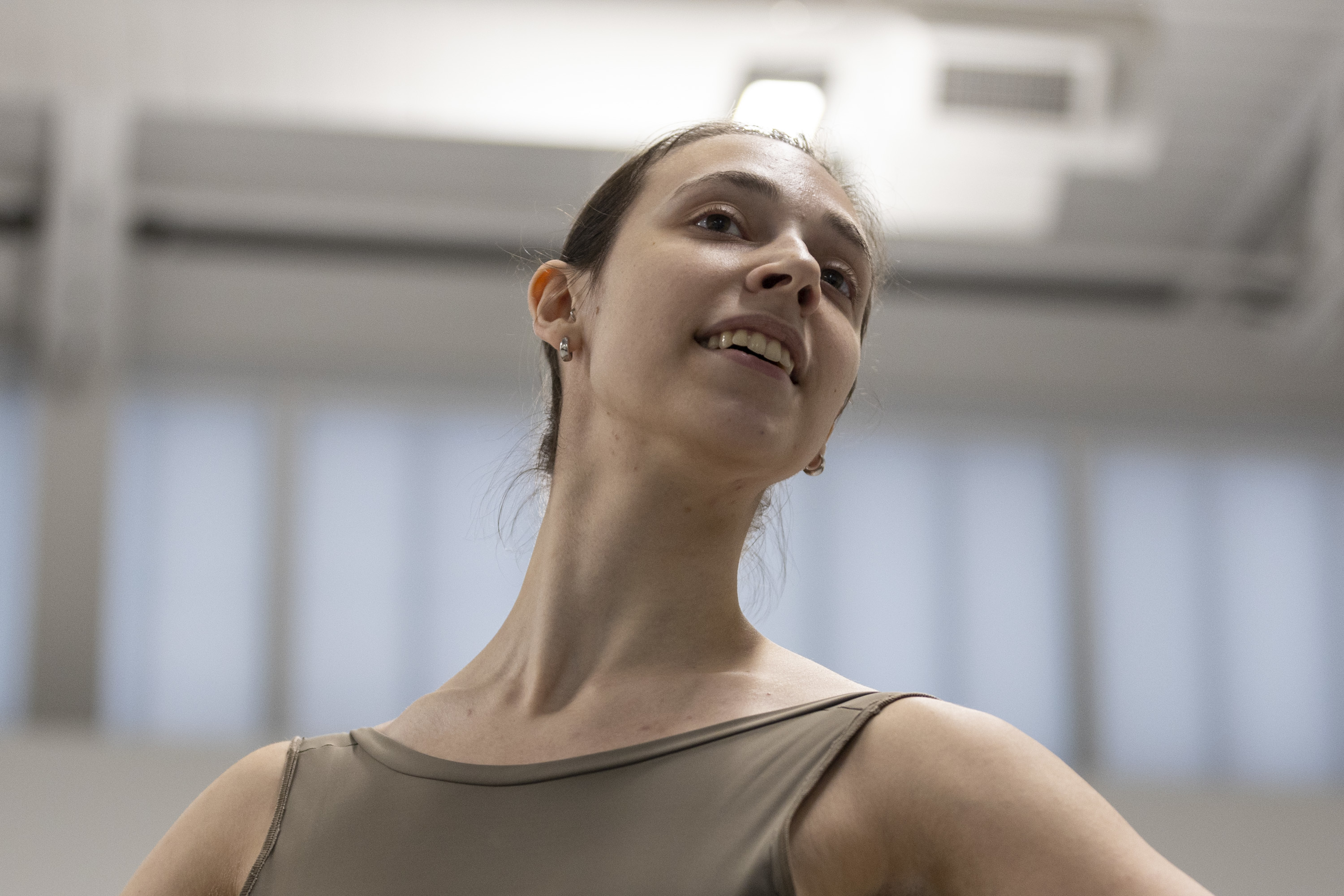
    Isabella DiEmedio, 21, rehearses “The Nutcracker” with Philadelphia Ballet.

    “I took Isabella to see her first ballet [when] she was 2 years old, which is a little bit too young,” Eagens said. “But a lot of my friends were still in the company, and I took her. I thought, ‘Let me just see how long she sits.’”

    It was Sleeping Beauty, which is well over two and a half hours.

    “So it’s probably not the best one,” said Eagens. “However, she sat on the edge of her seat for the whole thing.”

    In 2007, when she was 3, Isabella started ballet classes in a local school where Eagens taught.

    When she was 4, Isabella went to her mother and said, “I want to dance on the same stage as you, Mom,” Eagens said.

    In 2012, when Isabella was 7, the company reopened its school (after becoming the Rock School for Dance 20 years earlier, when it looked like the troupe might fold), and Eagens signed her up.

    Her sisters followed in the same pattern: local classes at 3, moving over to the School of Philadelphia Ballet for more serious training when they were 7. They tried gymnastics, too, but ballet is what stuck for all of them.

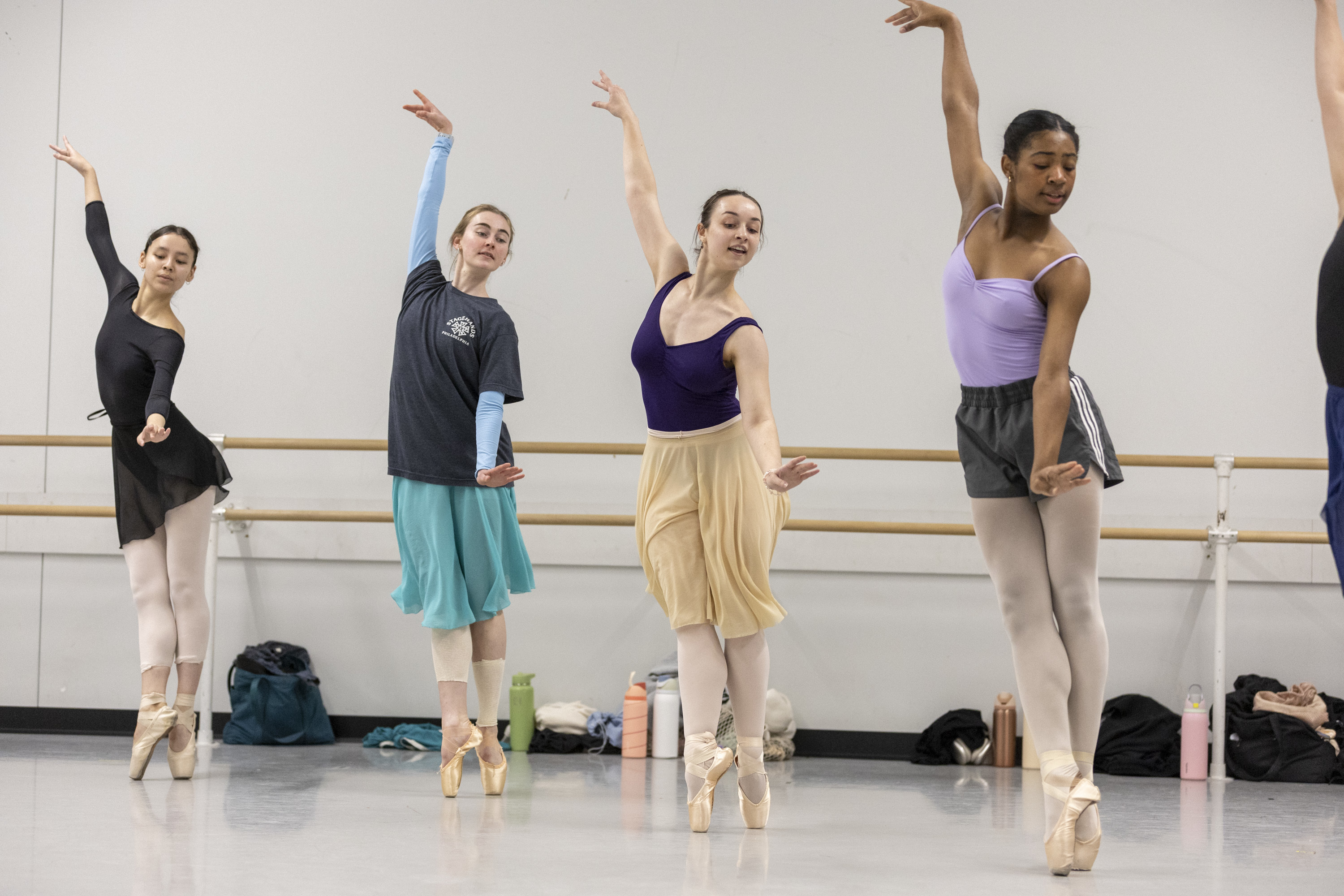
    Ava DiEmedio, 19, (second from right) rehearses “The Nutcracker” with Philadelphia Ballet.

    The Nutcracker was a staple in their lives. Ava and Olivia both danced the role of Marie. Isabella was too tall when it might’ve been her turn, putting the top child’s role out of her reach.

    These days, Isabella lives independently, sharing an apartment with another dancer in the company. Ava is considering moving out as well, but her father is encouraging her to stay put and save money. Meanwhile, she and Olivia split their time living with Eagens in Worcester, Montgomery County, and with their father in Philadelphia, which is convenient for getting to the studio and theater.

    At 16, Olivia is a junior in high school, doing her academic work online through the Brandywine Virtual Academy, which is affiliated with the Methacton School District she used to attend in person.

    “I never had to withdraw them from school,” Eagens said.

    At different stages of their burgeoning careers, the sisters continue to support one another.

    “In combined company class with the men and women, I’ll stand behind Isabella,” Ava said. “And then in the ladies class, I stand behind Olivia. Sometimes I’ll tell [Olivia] little things I noticed about her technique.”

    Their boss has his eye on them.

    “Isabella, Olivia, Ava, and their mother Charity each bring their own artistry and dedication to Philadelphia Ballet,” said artistic director Angel Corella, “and watching them share the stage is incredibly moving.”

    The sisters are all eager to improve and get opportunities.

    “I want to be the best that I can and see how far I can take it,” Isabella said.

    Ava agreed. “I want to be able to branch out of corps roles.”

    As the youngest, Olivia knows she may have to wait her turn, although in ballet even the youngest professionals can get big roles.

    “Technically, I’m still in training,” as a second company member, she said. “So I have to always keep in mind and have a good mindset about it and keep working hard every day.”

    But, she added, “I really want to become someone who is, like, the star.”

    Philadelphia Ballet in “George Balanchine’s The Nutcracker.” Dec. 5-31, Academy of Music. $28-$282, 215-893-1999 or ensembleartsphilly.org

  • Library Company shareholders have voted for its merger with Temple University

    Library Company shareholders have voted for its merger with Temple University

    The proposed merger of Temple University and the Library Company of Philadelphia moved closer to reality this week with a nod from the library’s shareholders.

    Shareholders voted Tuesday 174 to 33 in favor of the deal, and the action was followed Thursday with approval by the executive committee and finance and investment committees of Temple’s board of trustees.

    Its new name will be the Library Company of Philadelphia at Temple University, a division of Temple Libraries.

    But for that to happen, they must get approval for the merger from the Pennsylvania attorney general’s office and Philadelphia Orphans’ Court.

    “We are delighted to help preserve one of Philadelphia’s most important educational and historical institutions through this partnership,” Temple President John Fry said in a statement. “This will help bring stability to the Library Company while also ensuring that its legacy does not just live on but also thrives. For Temple, this is also an opportunity to further enrich our academic and research resources.”

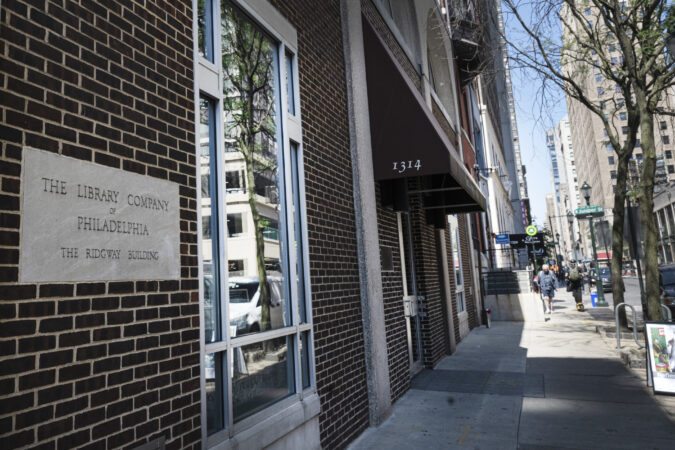
    Not much will change for the Library Company’s day-to-day operations, at least immediately. It will remain at its 1314 Locust Street location in Center City and keep its collections, staff, identity, mission and programming, Temple said. It will operate as its own division within Temple Libraries and maintain its own board of visitors.

    The Library Company will gain access to Temple’s research arm, grant-writing help, facilities and administrative functions, the university said.

    “The Library Company has been an important resource for Philadelphians for nearly 300 years, ever since Benjamin Franklin first envisioned a shared library as a tool for advancing the self-education of his circle of artisans and tradesmen,” John Van Horne, Library Company director, said in a statement. “I am certain that Franklin would heartily approve of our expanded education mission over the last few centuries, and I have no doubt that he would also approve of this partnership with a university dedicated to serving his city and beyond.”

    The move comes after the Library Company, faced with a string of operating deficits, began exploring merger possibilities with a number of other institutions. Financial data given to shareholders showed substantial operating deficits for most years since 2017, as well as projections for deficits continuing into 2030.

    Officials estimated that in order to remain independent, the company would need to raise $23 million to add to existing endowment.

    Van Horne previously said that raising that kind of money would be “an incredibly steep hill to climb, and probably unrealistic.”

    The library houses more than 500,000 rare books, manuscripts, prints, photographs, works of art, ephemera, and other objects. It boasts items once owned by Benjamin Franklin and William Penn, and has a concentration in African American and women’s history.

    Some shareholders strongly preferred that the library ― founded in 1731 as the first subscription library in the U.S. ― would have remained independent, even as they recognized the current financial bind.

    Shareholder Joel Gardner was philosophical about the merger.

    “I think it’s the only solution the Library Company could find. We all have to keep our fingers crossed that it works out,” he said while declining to add how he voted.

    It didn’t seem likely that the Library Company would be able to raise the money required to remain independent, he said, “in a city that is not notable for having a large number of philanthropists and depends on just a few of them.”

    Michelle Flamer, a shareholder who in an Inquirer opinion piece mourned the impending loss of the company’s “historical identity,” said Thursday that the deal “seemed like it was a fait accompli, and there was not very much we could do about it.”

    The Library Company also will be incorporated into the university’s fundraising plans, Temple said, though the merger agreement made no promises. It calls for including the Library Company in Temple’s upcoming capital campaign, “with the goal of raising $25 million in new endowed funds to permanently and exclusively support the LCP Division.”

    “This is especially significant as the Library Company will soon celebrate its 300th anniversary in 2031, which presents a major opportunity for fundraising,” the university said in its announcement.

  • This graphic designer is creating a new art piece after all 82 Sixers games

    This graphic designer is creating a new art piece after all 82 Sixers games

    Lydia Hope Victor often jokes about how much worse off she’d be if she’d grown up in Ohio instead of Philadelphia.

    Her parents arrived there from India before settling in Philly. Her father learned about American culture through Ohio State and then Eagles football. He came to love the brutal sport and passed his fandom down to his children, but who knows what would have happened if the family had been forced to root for the Cleveland Browns.

    “Obviously, thankfully [he] became a Birds fan,” she said.

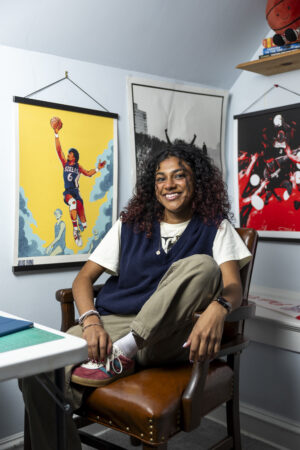
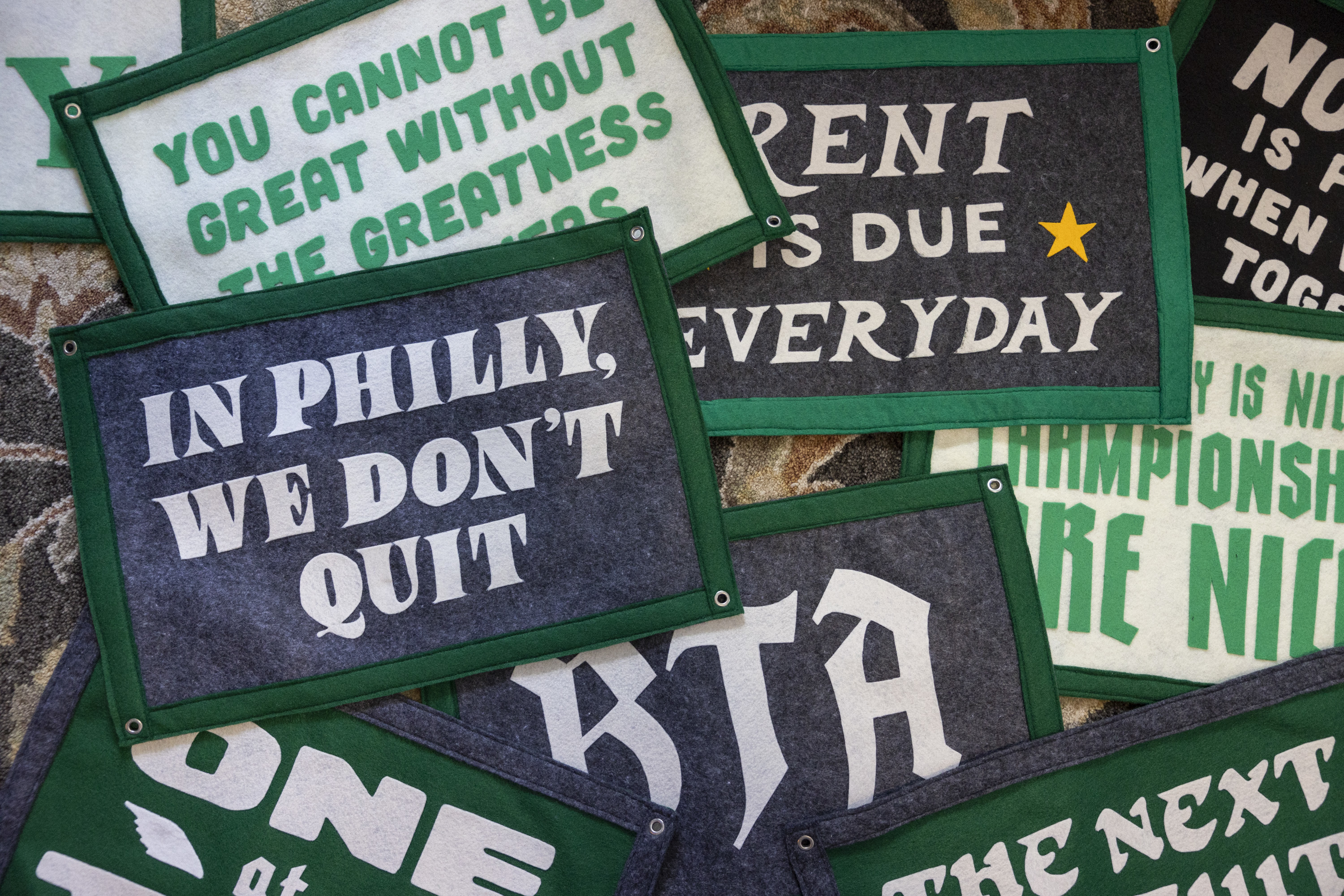
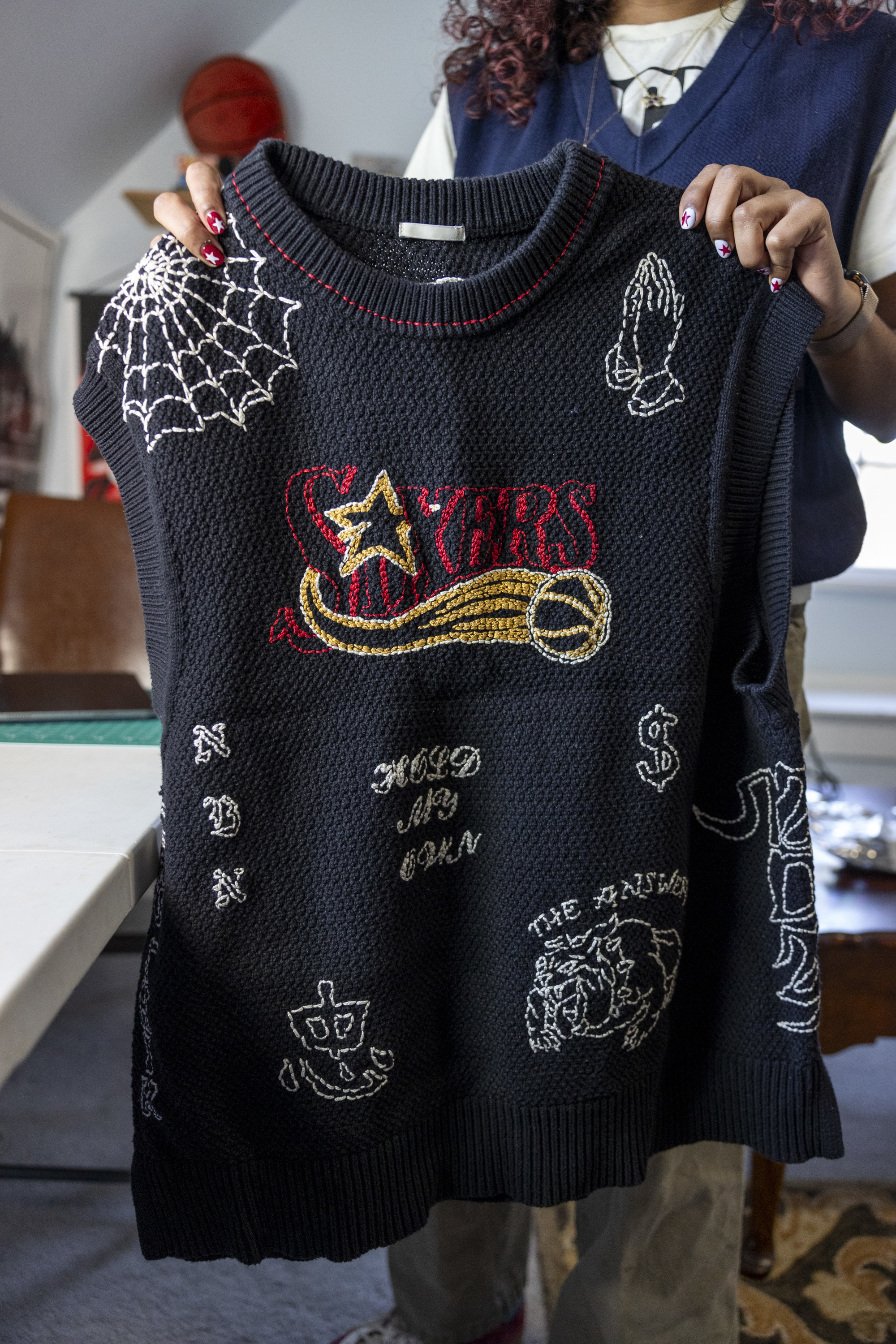
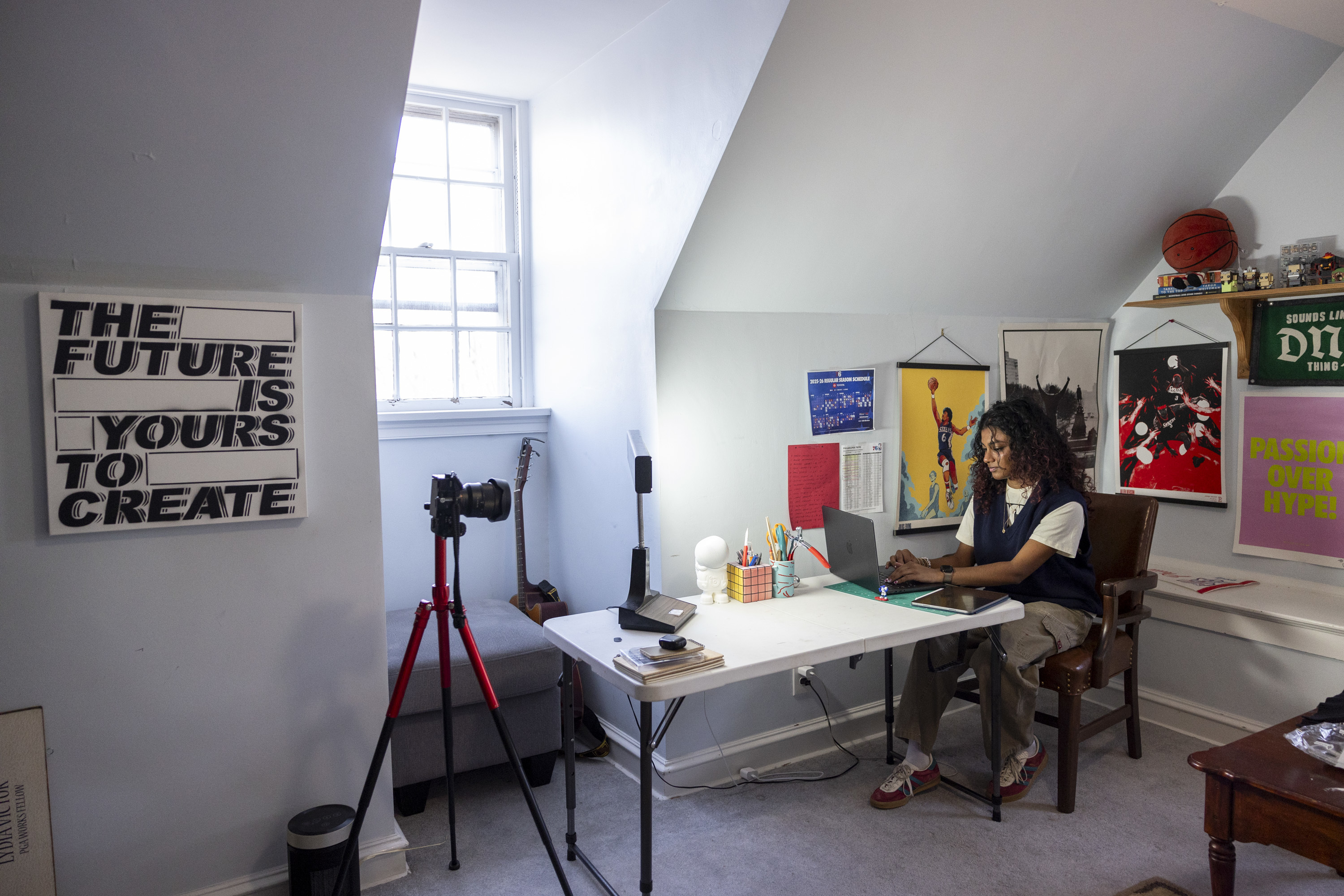
    Victor, 22, is a graphic designer and multimedia artist based in Elkins Park whose work is focused on sports and the overlooked elements that shape them. Her work across mediums is for the casuals and diehards alike, including an Allen Iverson sweater vest, fan zines, and banners reading, “Find a New Slant” and “I’m Sorry I Just Wanted a Frosty”.

    She’s in the middle of a season-long Sixers project that she’s sharing on social media called 82 Games. After every contest, Victor is creating an illustration based upon what happened on the court, with easter egg references, too.

    @thisislydia

    ummm trust the process ?? game sixteen of illustrating every @Philadelphia 76ers game this szn 🙂‍↕️🙂‍↕️ #nba #sixers #76ers #basketball #basketball

    ♬ Cozy Day (Lofi) – The Machinist Beats

    Victor’s passion for basketball was molded by post-The Process-era Sixers and Allen Iverson YouTube highlights, despite being born after his 2001 MVP season. She was raised on Philly talk radio car rides with her dad, and her fondest sports memory is watching people flood the streets from her brother’s Temple University dorm after the Eagles’ first Super Bowl win.

    “It’s hard to live in Philly and not be an insane Philly sports fan,” she said.

    Victor spoke with The Inquirer about her 82 Games project and how it represents relentless Philly fandom and community, being a Joel Embiid truther, and aspiring to consume sports a little more healthily.

    This conversation has been edited for length and clarity.

    This is an endurance art project. How do you come up with a new design every game? And how do you stay committed to it, even when the Sixers are more or less a fringe playoff team?

    I think that’s the fun of it, pushing myself to think of new ways to interpret the story. Some of the joy of it is also being able to look back and be like, I committed to doing that, I was able to finish it.

    I originally did this project in high school, it was honestly to teach myself how to draw. [Now] I have a lot more experience in design and illustration, and I’m just seeking out some of the community again. I think that’s what really brought me back to it. Even the most niche reference I try to make in games, someone will understand it somewhere.

    Victor shows off one of her illustrations for the 82 Games series, featuring Tyrese Maxey.

    That fandom is so important to finding a community of people.

    Philly fans are all a little crazy, we’re all so committed to support our teams. Even if we’re in a slump. I think Philly fans have a reputation — oh we booed Santa. But it’s coming from a place of — I’m still here and I’m gonna show up no matter what.

    A through-line of your work is holding a player-centric point of view. Why do you feel like that’s an important perspective to emphasize? What do you think of the way sports are typically covered in media or online?

    It’s kind of just rage-baiting. They want people to engage, but there’s no intention to do it through healthy conversation. People watch sports because they enjoy it at some level and sometimes those perspectives take away from that joy.

    It’s easy to center the fan, but none of these things would exist without the player, too.

    Victor’s custom-made banners with various Jalen Hurts quotes made after the Eagles’ Super Bowl victory.

    I’m a Joel Embiid truther ‘til the day I die. People give him a lot of flack for not giving his all for the team, and I don’t think you can really point to his history and in good faith say that about him. He was playing with a mask. He was playing with [Bell’s palsy].

    You made a sweater vest inspired by Allen Iverson and his tattoos. How did that project come to be?

    I’m 4’11, so I immediately connected to Allen Iverson and his story and just the way he played. I remember watching his Hall of Fame speech and crying. When you think about how the media treated him or general narratives about him as a player, it all seemed negative. And I think it’s exciting to see him get his flowers.

    I just love experimenting with different mediums. If I have an idea in my head, I wanna get it out into the world. Last season I was like, a jersey looks just like a sweater vest, what is something I could do to explore that? I immediately was like, do something about Allen Iverson.

    Victor displays her Allen Iverson sweater vest, modeled after his iconic Sixers jersey. The embroidered designs mimic several of A.I.’s tattoos.
    What are some of other ways you’ve focused your work on player perspectives and other overlooked parts of sports?

    I try to think of things from systems point of view. I think there’s really a story behind every single thing in sports.

    The project I’m working on right now is about the Women’s Basketball League, which was the first women’s basketball league in America in the 1970s. It only lasted for three seasons, but there was a team that was based in Philadelphia called the Philadelphia Fox, which only lasted for 10 games.

    Victor is working to tell more multimedia stories about the subtle structures that impact sports.

    Some of those people are doctors and lawyers and basketball coaches, their lives took such a different turn. Title IX was just starting, so there weren’t a lot of [opportunities] for women to play sports in general. I’ve been interviewing some of those women which is pretty cool, getting to hear their stories.

    So just thinking about how these systems exist and operate and how to make them more equitable. Understanding where we started is so important.

    Who are your Letterboxd-style four favorite Philly athletes of all time?

    Allen Iverson, Nick Foles, Joel Embiid, and Michael Vick.

  • A vocal Jeffrey Epstein accuser is urging judges to unseal his court records

    A vocal Jeffrey Epstein accuser is urging judges to unseal his court records

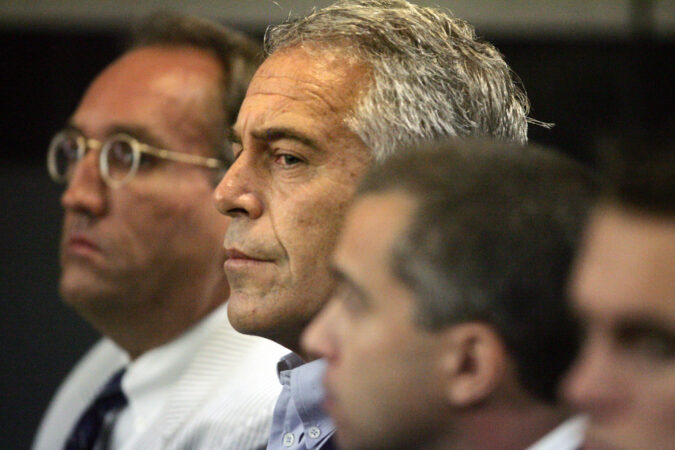
    NEW YORK — One of Jeffrey Epstein and Ghislaine Maxwell‘s most vocal accusers urged judges on Wednesday to grant the Justice Department’s request to unseal records from their federal sex trafficking cases, saying “only transparency is likely to lead to justice.”

    Annie Farmer weighed in through her lawyer, Sigrid S. McCawley, after the judges asked for input from victims before ruling on whether the records should be made public under a new law requiring the government to open its files on the late financier and his longtime confidante, who sexually abused young women and girls for decades.

    Farmer and other victims fought for the passage of the law, known as the Epstein Files Transparency Act. Signed last month by President Donald Trump, it compels the Justice Department, FBI and federal prosecutors to release by Dec. 19 the vast troves of material they’ve amassed during investigations into Epstein.

    The Justice Department last week asked Manhattan federal Judges Richard Berman and Paul Engelmayer to lift secrecy orders on grand jury transcripts and other material from Epstein’s 2019 sex-trafficking case and a wide range of records from Maxwell’s 2021 case, including search warrants, financial records, and notes from interviews with victims.

    “Nothing in these proceedings should stand in the way of their victory or provide a backdoor avenue to continue to cover up history’s most notorious sex-trafficking operation,” McCawley wrote in a letter to the judges.

    The attorney was critical of the government for failing to prosecute anyone else in Epstein and Maxwell’s orbit. She asked the judges to ensure that any orders they issue do not preclude the Justice Department from releasing other Epstein-related materials.

    Farmer “is wary of the possibility that any denial of the motions may be used by others as a pretext or excuse for continuing to withhold crucial information concerning Epstein’s crimes,” McCawley wrote.

    Epstein, a millionaire money manager known for socializing with celebrities, politicians, billionaires, and the academic elite, killed himself in jail a month after his 2019 arrest.

    Maxwell was convicted in 2021 by a federal jury of sex trafficking for helping recruit some of Epstein’s underage victims and participating in some of the abuse. She is serving a 20-year prison sentence.

    In a court filing Wednesday, Maxwell’s lawyer again said that she is preparing a habeas petition in a bid to overturn her conviction. The lawyer, David Markus, first mentioned the habeas petition in court papers in August as she fought the Justice Department’s initial bid to have her case records unsealed. The Supreme Court in October declined to hear Maxwell’s appeal.

    Markus said in Wednesday’s filing that while Maxwell now “does not take a position” in the wake of the transparency act’s passage, doing so “would create undue prejudice so severe that it would foreclose the possibility of a fair retrial” if her habeas petition succeeds.

    The records, Markus said, “contain untested and unproven allegations.”

    Engelmayer, who’s weighing whether to release records from Maxwell’s case, gave her and victims until Wednesday to respond to the Justice Department’s unsealing request. The government must respond to their filings by Dec. 10. The judge said he will rule “promptly thereafter.”

    Berman, who presided over the Epstein case, ordered victims and Epstein’s estate to respond by Wednesday and gave the government until Dec. 8 to reply to those submissions. Berman said he would make his “best efforts to resolve this motion promptly.”

    Lawyers for Epstein’s estate said in a letter to Berman on Wednesday that the estate takes no position on the Justice Department’s unsealing request. The lawyers noted that the government had committed to making appropriate redactions of personal identifying information for victims.

    Last week, a lawyer for some victims complained that the House Oversight Committee had failed to redact, or black out, some of their names from tens of thousands pages of Epstein-related documents it has released in recent months.

    Transparency “CANNOT come at the expense of the privacy, safety, and protection of sexual abuse and sex trafficking victims, especially these survivors who have already suffered repeatedly,” lawyer Brad Edwards wrote.

  • Yo, Adrian, 2026 will be a very ‘Rocky’ year for Philadelphia. In a good way.

    Yo, Adrian, 2026 will be a very ‘Rocky’ year for Philadelphia. In a good way.

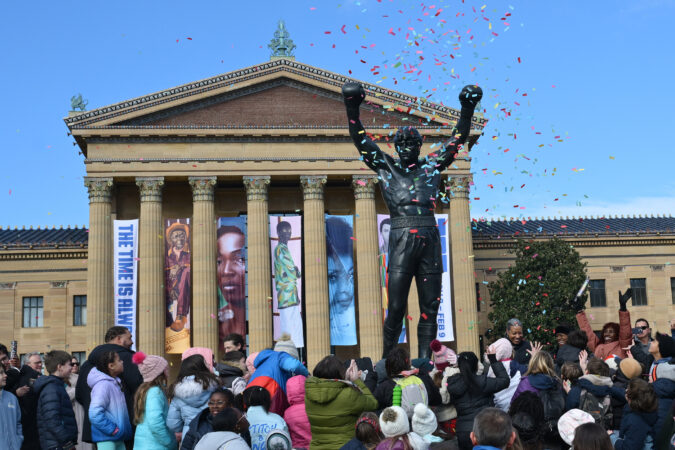
    2026 marks the 50th anniversary of the release of the first Rocky film. To coincide, the Philadelphia Art Museum announced on Wednesday there will be an exhibition exploring how the Rocky statue, at the foot of the museum, brings people together..

    “Rising Up: Rocky and the Making of Monuments” will open in April in the museum’s Dorrance Galleries.

    The exhibition, curated by Monument Lab cofounder Paul Farber, will showcase over 150 works from more than 50 artists including Reading native Keith Haring, Rashid Johnson, Andy Warhol, Carrie Mae Weems, and Hank Willis Thomas, the artist behind the All Power to All People sculpture that stood on Thomas Paine Plaza in 2017. They will be joined by artists from Mural Arts Philadelphia’s Restorative Justice Program.

    “Rising Up” will examine the changing role of monuments in creating spaces of recreation across time, with the Rocky statue by sculptor A. Thomas Schomberg at the heart of the exhibition.

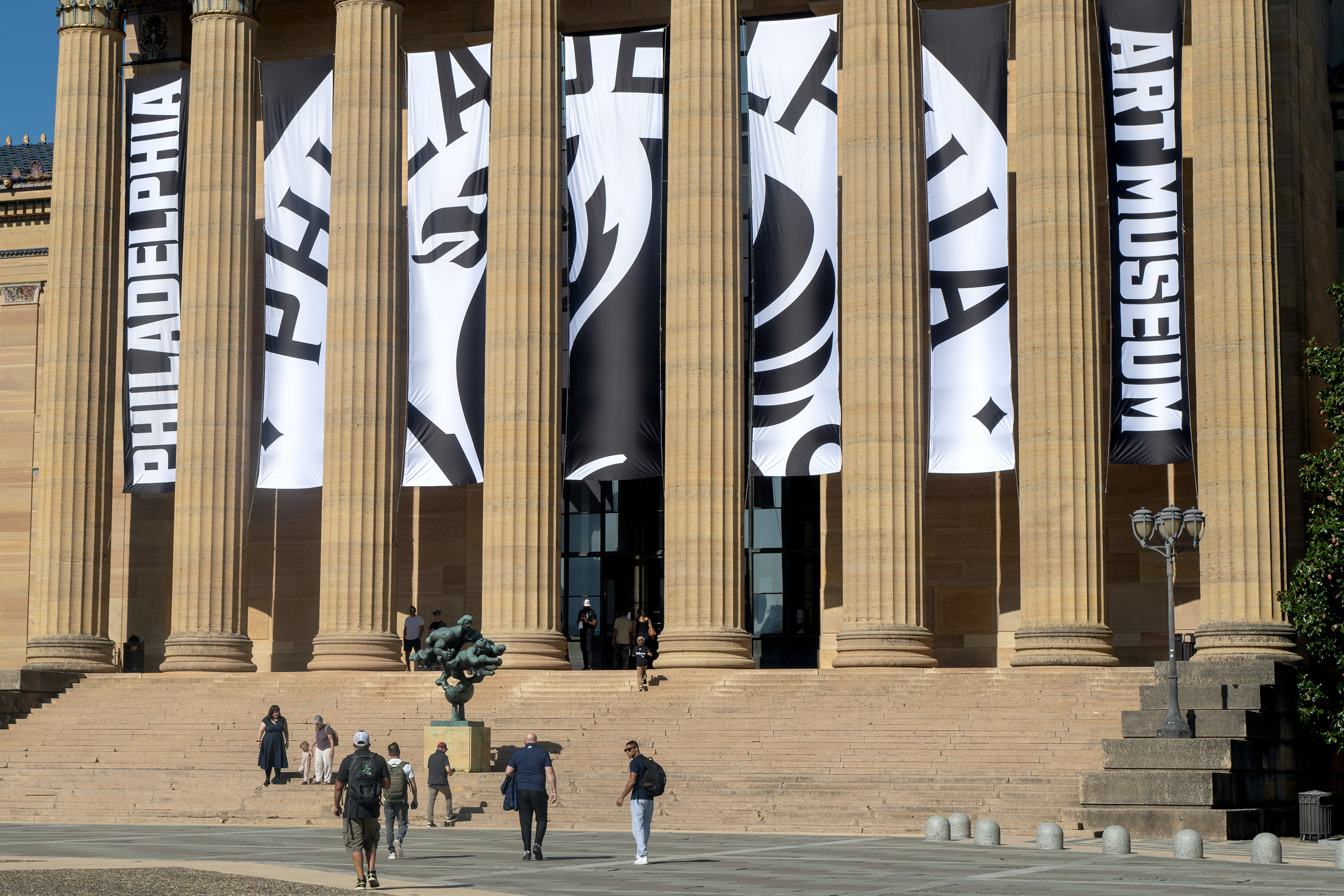
    Signage at the east entrance to the Philadelphia Museum of Art Monday, Oct. 6, 2025, now called the Philadelphia Art Museum, or PhAM. The rebranding is part of changes in both style and substance as the museum aims to be more accessible to regular folks and revive attendance, which is still far below pre-pandemic levels.

    Farber hopes the display will broaden conversations about identity, power, memory, and community, themes central to public art and Philadelphia’s cultural history.

    “We have a statue that 4 million people visit a year. That’s extraordinary. It’s a statue of the most famous Philadelphian that never lived, in a city full of boxers who were legendary champs. How do we reconcile both of those thoughts? Well, we have to dive into it and understand it,” Farber said.

    The Rocky statue and Philadelphia Art Museum steps are visited by about 4 million people every year, the Philadelphia Visitor Center reported last year. The Art Museum averages about 800,000 yearly visitors, per the museum.

    Researched for over five years and in development for two,Rising Up” will include sculptures, paintings, video performances, film, photographs, prints, drawings, participatory experiences, new commissions, and other works.

    “This show is a testament to the vitality and passion of Philadelphia’s arts, culture, and sports communities,” Mayor Cherelle L. Parker said in a statement. “It is more than timely as we approach our monumental Semiquincentennial year.”

    A publication, edited by Farber to accompany the exhibit, will include essays by Philadelphia artist Alex Da Corte, former Inquirer film critic Carrie Rickey, and newly-enshrined Philadelphia Eagles Hall of Famer Malcolm Jenkins, among others.

    “Rising Up” will be on view through Aug. 2, 2026.

    The Art Museum announcement comes at a not-so-celebratory moment for fans of RockyFest, the celebration instituted last year by the Philadelphia Visitor Center.

    Sylvester Stallone poses with Philadelphia Mayor Jim Kenney in front of the “Rocky” statue at the Philadelphia Art Museum for a “Creed II” photo op, on Friday, April 6, 2018, in Philadelphia. (AP Photo/Michael Perez)

    A year after the festival’s first run, organizers have canceled 2025’s festival and will pivot to a yearlong celebration in 2026, rather than offering a week of bus tours and fan experiences.

    “Throughout 2026, we will highlight a series of major milestones and activations commemorating this iconic moment in Philadelphia and film history,” Kathryn Ott Lovell, president & CEO of the Visitor Center, said in a statement.

    Lovell said next year’s “Rocky 50″ will include events currently in development, some of which will accompany the May release of Sylvester Stallone’s upcoming memoir, The Steps.

    A full 2026 calendar of events will be released at a later date, Lovell said.

  • Philadelphia athletes, social media influencers, and ‘Shark Tank’ winners among those on the 2026 Forbes 30 Under 30 list

    Philadelphia athletes, social media influencers, and ‘Shark Tank’ winners among those on the 2026 Forbes 30 Under 30 list

    The 15th class of Forbes 30 Under 30 has some major Philadelphia connections, from Shark Tank winners to social media influencers, and Super Bowl champions.

    A total of 18 people with ties to the Philadelphia area were recognized on the 2026 Forbes 30 Under 30 list in categories such as sports, social media, education, aerospace, and venture capital, among others.

    Awardees who attended Philadelphia universities or based their businesses in the city appeared in all 20 categories.

    Among the 600 honorees chosen for this year’s class, the local representatives include Philadelphia Eagles Saquon Barkley, 28, and Jalen Hurts, 27. Along with carrying the Eagles to a Super Bowl LIX win earlier this year, Hurts and Barkley have landed major brand partnerships and endorsement deals, which have elevated their profiles beyond the gridiron.

    Social media influencer Brandon Edelman (aka Bran Flakezz), 29, popular for his humorous TikTok videos about Philly culture and insights into influencer marketing, has also landed on the coveted list.

    University of Pennsylvania alums Alexandre Imbot, 27, and Eli Moraru, 25, who founded Philadelphia’s the Community Grocer, are on the list. With partnerships with M&T Bank and FMC Corp, the leaders of the food-justice nonprofit have provided nutritious food to more than 10,000 Philadelphians, including recipients of the Supplemental Nutrition Assistance Program.

    Another honoree is fellow Penn alum Kausi Raman, 28, cofounder of ChompSaw, a kid-safe power tool for cardboard cutting. Raman’s company has produced nearly 76,000 ChompSaws since 2022. In 2024, Raman joined cofounder Max Liechty on Shark Tank, where they secured $250,000 in a deal with Lori Greiner and Mark Cuban.

    Another Philly-area honoree is John Huddleston, 27, the cofounder of Albacore Inc. The defense and space manufacturing company develops underwater vehicles to deter maritime invasions. Albacore has raised $6.5 million from backers including Z-Fellows, Outlander VC, Liquid 2, and Brave Capital.

    Other Forbes 30 Under 30 honorees with Philadelphia ties

    David Waltcher, 29, Penn alum and principal at New York-based venture capital firm FirstMark.

    Salaar Kohair, 29, Penn grad and cofounder of L.A.-based gaming studio CAGE Studios.

    Yejin Yeoum, 29, a Penn alum and principal at New York-based alternative investment manager BC Partners.

    Tristan Fogt, 28, cofounder of Cincinnati-based Sensory Robotics and a Penn alum.

    Jason Kaufmann, 26, Penn grad and cofounder of San Francisco-based Maritime Fusion.

    Farah Otero-Amad, 29, Penn grad who’s a video producer and host at the Wall Street Journal.

    Crystal Yang, 18, Penn student and founder of Audemy, a nonprofit assisting blind video gamers.

    Katherine Sizov, 29, Penn alum and founder of the life science company Strella, which designs technology to reduce food waste and improve quality.

    Cindy Ji Won Lim, 29, Penn grad and director of brand marketing at Dallas’ Match Group. She’s also the cofounder of Korean American streetwear company Sundae School.

    Andre Hamra, 28, Penn grad and founder of the recruiting platform Refer.

    Kara Rosenblum, 28, Penn grad and co-owner of Bar Next Door in West Hollywood.

    Maggie Tang, 25, Penn graduate and founder of Magic Technologies, an AI company specializing in hospitality services.

    For the full list of honorees, visit forbes.com.

    The article has been updated with the correct name for Kara Rosenblum’s organization.

  • The Wanamaker Christmas concert took a defeat and turned it into a party, in the most Philly way possible

    The Wanamaker Christmas concert took a defeat and turned it into a party, in the most Philly way possible

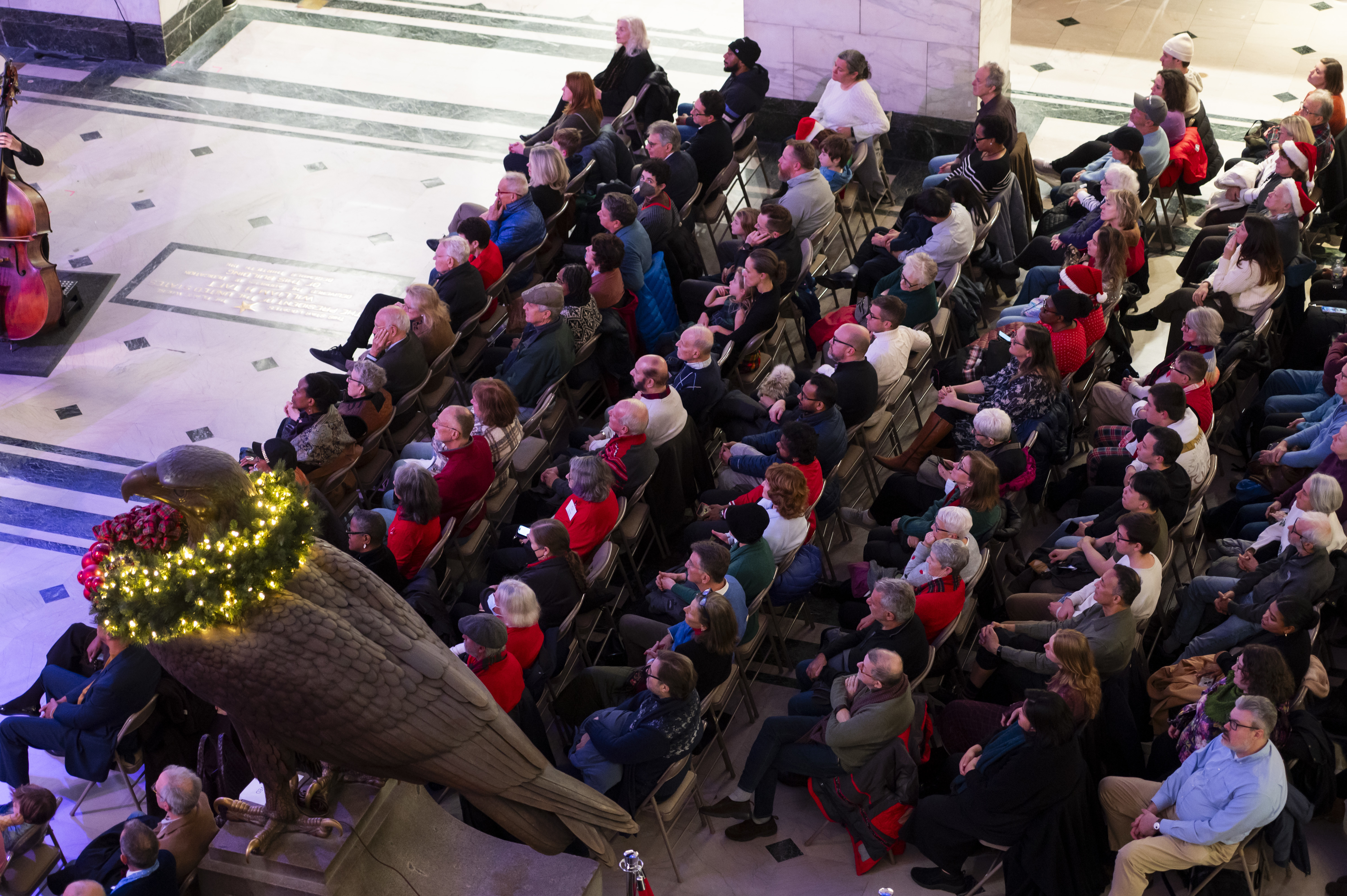
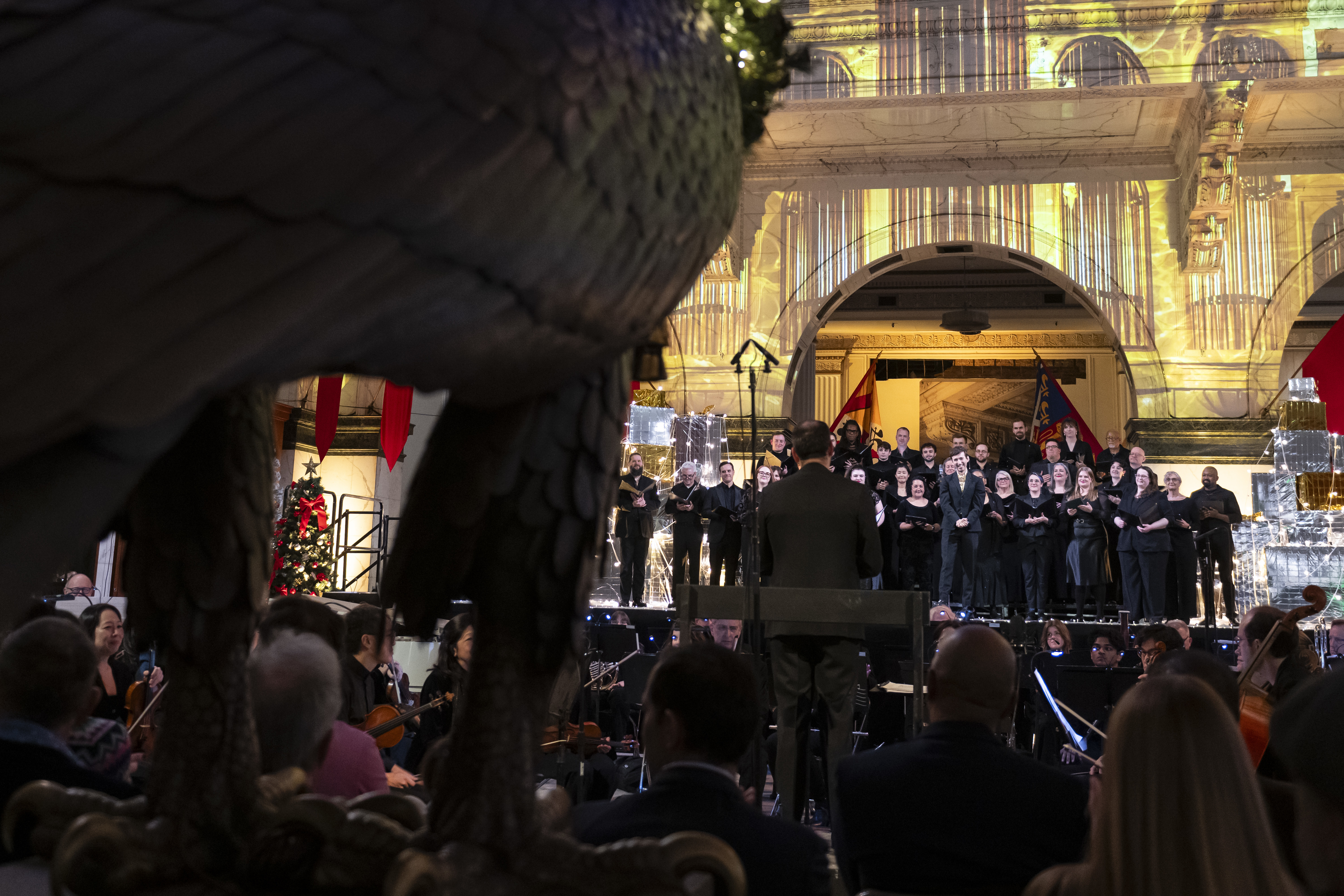
    The Christmas tree was indeed magical and the music, in turns, brilliant and warmly enveloping. Even the Wanamaker Eagle got into the act, crowned for the occasion with a lit Christmas wreath hung around its neck.

    A certain misty, nostalgic conjuring of Christmas past has reached its apotheosis in the Wanamaker Grand Court, and now the bittersweet countdown begins. Tuesday night’s “Home for the Holidays” concert is done, the Bearded Ladies Cabaret checks in next week, the Light Show and Dickens Village attractions run through Christmas Eve, and then the space closes for perhaps a couple of years while the building undergoes renovations.

    The Wanamaker Eagle donned a lighted wreath for Tuesday night’s concert.

    The one-night-only concert in the former Center City Macy’s did exactly what it should have. In the best gritty Philadelphia tradition, it took a defeat — the departure of a major retailer and the imperilment of the beating heart of Christmas in the city — and turned it into a party.

    Opera Philadelphia was the creative director behind the event, which swung from sincere and spiritual (chorus members running their fingers around the wet rims of glasses to produce an ethereal shimmer) to the head-scratching (a couple of dancers in dinosaur suits moving to an excerpt from Philip Glass’s 1000 Airplanes on the Roof).

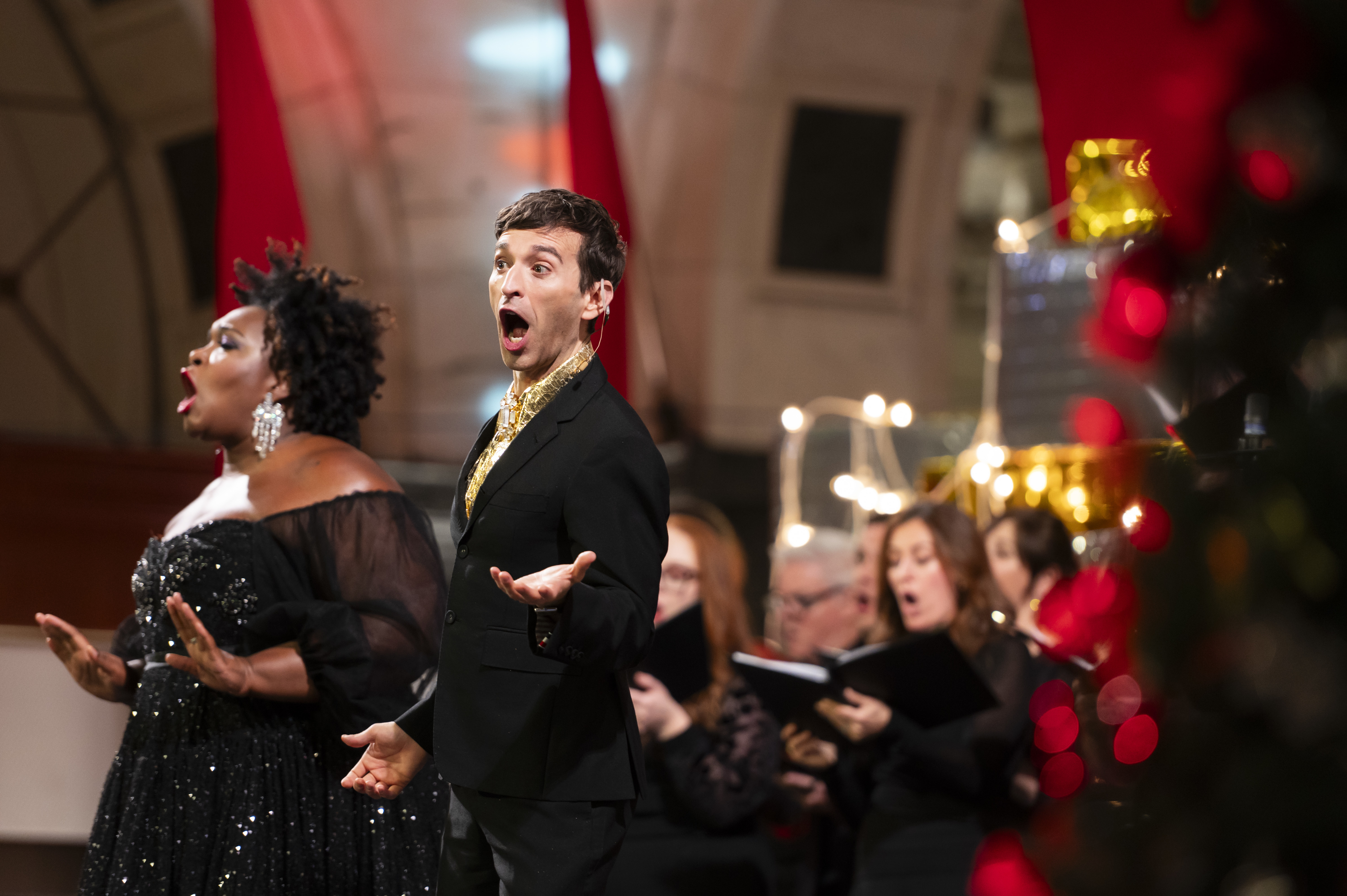
    Anthony Roth Costanzo (right), countertenor, and Leah Hawkins (left), soprano, perform during “Home for the Holidays” on Tuesday at the Macy’s Center City.

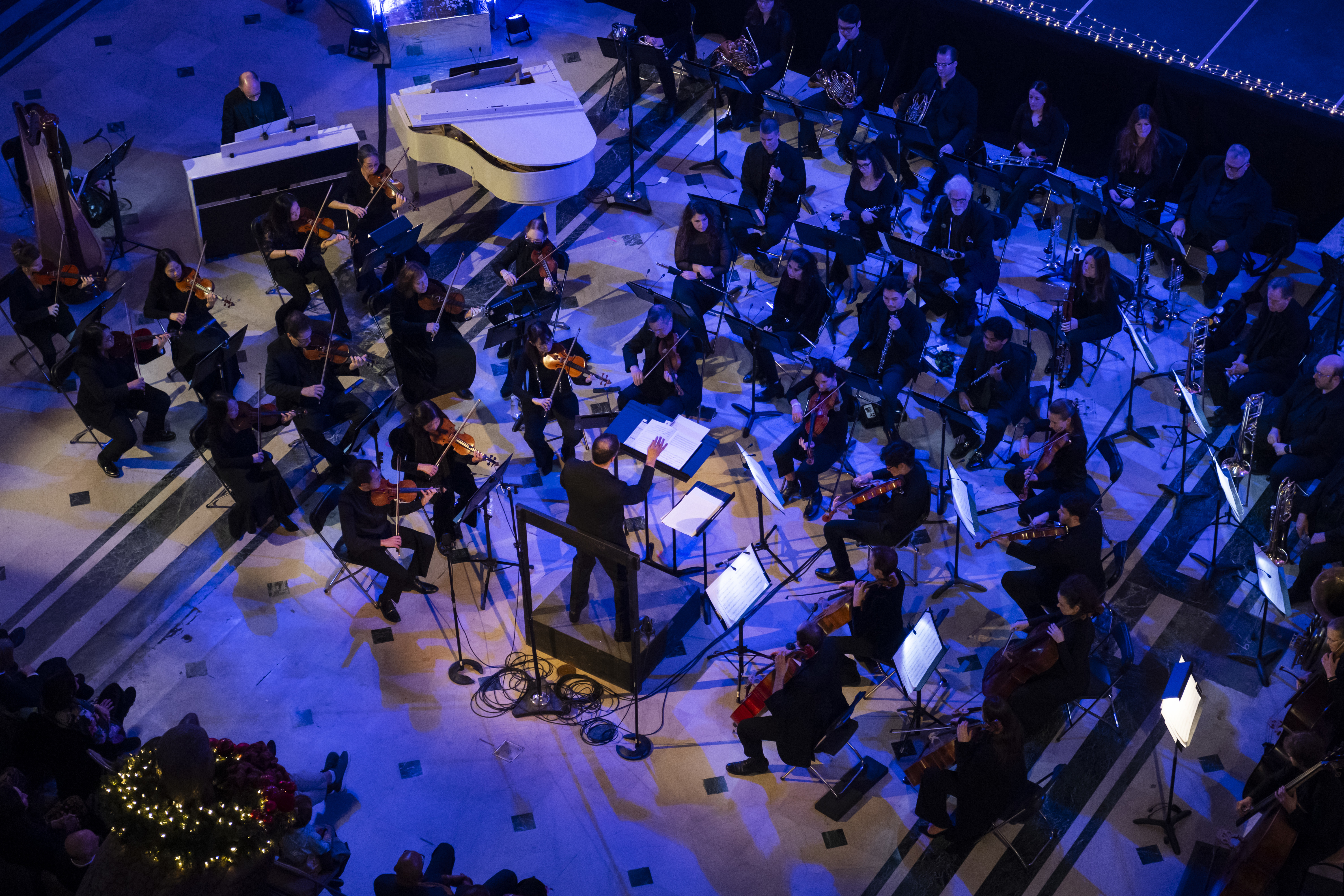
    The forces — orchestra, chorus, dancers, superb soprano Leah Hawkins, and clarion-countertenor (and Opera Philadelphia chief) Anthony Roth Costanzo led by conductor Geoffrey McDonald — delivered a variety-hour-plus celebration a la “Radio City Christmas Spectacular,” if in miniature.

    But the best vibe of the evening came from above via the hands and foot-peddling feet of organist Peter Richard Conte. He showed how a musician, instrument, and their space can seem made for each other, and why the Wanamaker Grand Court Organ is not one instrument, but many. The highly inventive organist called upon fat French horns and muted trumpets in his own arrangement of Victor Herbert’s “March of the Toys.”

    Pure joy.

    The Opera Philadelphia chorus performs in “Home for the Holidays” at the Wanamaker Building’s Grand Court on Tuesday, Dec. 2, 2025.

    Christmas in this space triggers memories unique to each one of us, but it was a nice stroke by 10th Floor Productions to animate the marbled expanses around the courtyard’s arches with projected images of marching bears and soldiers for anyone who remembers the store as the source for holiday toys.

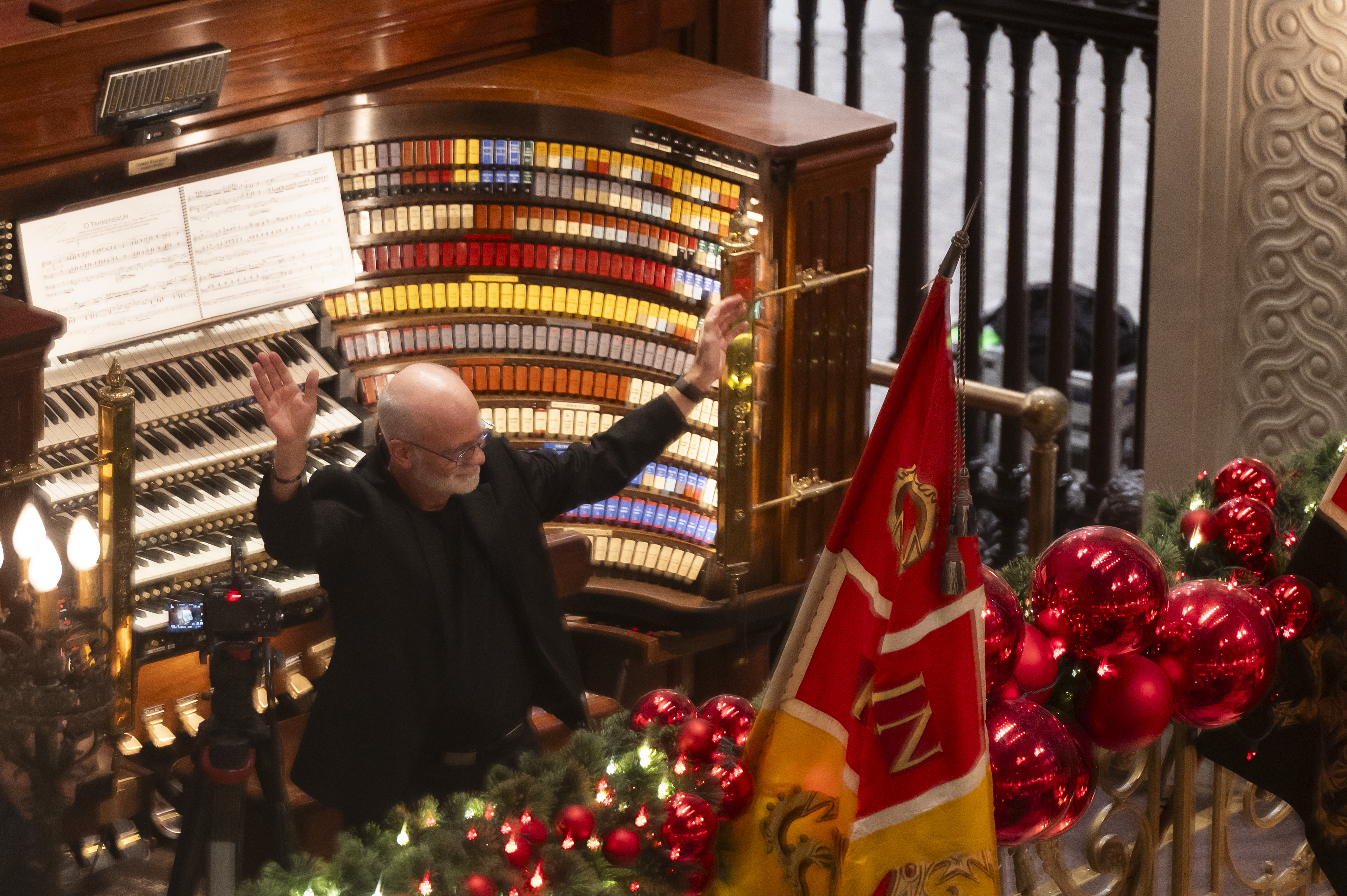
    Frederick R. Haas, philanthropist and organist, waves to the crowd during “Home for the Holidays” in the Wanamaker Grand Court.

    That the organ is still being played in this sliver of a post-Macy’s era is largely due to a $1 million donation from philanthropist Frederick R. Haas for the Pipe Up! series (as well as many previous gifts to the organ).

    Rarely have a donor and his cause been more personally intertwined. Haas is himself a trained organist who could sometimes be heard playing in the space in its department store days. On Tuesday, he played his medley A Christmas Improvisation, tapping into a supply of enormous, overtone-rich bells in “Silent Night” and beautiful, unusual harmonizations in “Carol of the Bells.”

    Conductor Geoffrey McDonald leading the Opera Philadelphia Orchestra in the Wanamaker Grand Court.

    If the evening had a theme beyond Christmas, it was nostalgia.

    Sub rosa, though, this and every event in the Pipe Up! series in the past few months has been about the future — about making the case for the Wanamaker Grand Court as a space that should survive as a public right of way no matter its next life.

    TF Cornerstone, the building owner, has been generous and respectful of preserving public access so far. As the developer renovates and cuts deals with prospective tenants, access and the future of the organ as a daily presence hang in the balance.

    The Opera Philadelphia orchestra, chorus, and vocal soloists in the Wanamaker Grand Court Tuesday night.

    One piece on Tuesday night was a reminder of the special dynamic at risk.

    When Opera Philadelphia flash-mobbed Macy’s with the “Hallelujah Chorus” from Handel’s Messiah in 2010, it packed a punch because of the surprise of it. Music was suddenly in the best place of all: somewhere you’d never expect it. That’s also the secret superpower of the organ.

    It was great to hear the “Hallelujah Chorus” here again. But heard now, it seems like a challenge issued, illustrating what the space once was and might one day be again.

    “Home for the Holidays” will be broadcast Dec. 23, 8 p.m. on WHYY TV12, WHYY radio (90.9 FM), and via whyy.org.

    The Pipe Up! series continues with the Bearded Ladies Cabaret’s “It’s Giving Cabaret” in the Greek Hall at the Wanamaker Building, 13th and Market Sts., Dec. 10-14. operaphila.org.

    The Wanamaker Light Show and Dickens Village run through Christmas Eve. visitphilly.com.

  • Nothing is ever a coincidence in ‘The Greatest Play in the History of the World’

    Nothing is ever a coincidence in ‘The Greatest Play in the History of the World’

    How random are moments in our lives that we define as “coincidence?” Perhaps, not so much.

    A basic premise of Ian Kershaw’s The Greatest Play in the History of the World is that fortunate moments present themselves under the guidance of time and space. And the potential for life-changing outcomes lies in our recognizing such opportunities and seizing them.

    A joint production of the Inis Nua and Tiny Dynamite theater companies, The Greatest Play is a warm and endearing tale of love lost and rediscovered. Directed by Kathryn MacMilllan, it makes parallel use of male-female relationships and science-fantasy motifs — equal dollops of James Thurber and Ray Bradbury.

    The story and all its characters are told entirely by one actor … and a litany of shoes. More on that later.

    Set in a quaint British neighborhood and, more grandly, the universe itself, the play begins with 31-year-old Tom awakening to a world frozen in time. But through his bedroom window he spots one person — staring back from her window — 26-year-old Sarah, who lives across the street. Tom, who’s writing The Greatest Play in the History of the World, is obsessed with words, and Sarah is a traveler enamored of numbers. Both have lost at love and feel their lives ending.

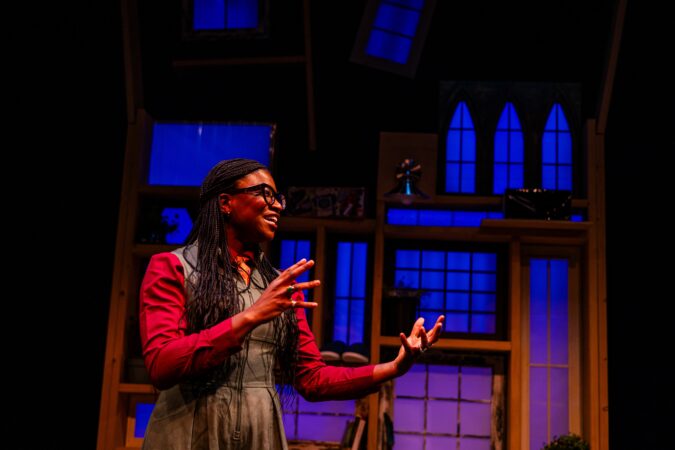
    Brett Ashley Robinson in Ian Kershaw’s “The Greatest Play in the History of the World.” A joint production of the Inis Nua and Tiny Dynamite theater companies, it is playing in Philadelphia through Dec. 14, 2025.

    We’re soon introduced to the Forshaws, their elderly neighbors — also named Tom and Sarah, also aged five years apart, and also feeling life has stopped. Mrs. Forshaw, in the last stages of life, recalls teaching her former students about Carl Sagan’s Golden Record, an audio-visual collection included in NASA’s 1977 Voyager launch, offering a taste of our world to aliens who might stumble upon it.

    The denouement of the play asks what we would choose as a personal remembrance in that vastness of space.

    Barrymore awardee Brett Ashley Robinson narrates the monologue, and projects an unmistakable charm, maintaining a brisk pace throughout the 80-minute evening, a challenge for any actor. Her empathy is unmistakable, sustained with a smile that virtually never leaves her face.

    Kershaw’s narrator leans exclusively into tale-telling, not role-playing. As such, our experience is that a novella is being read to us.

    As for the shoes, Kershaw uses them to represent each character, and Robinson uses them to build rapport through audience interaction, demonstrating admirable improvisational skills.

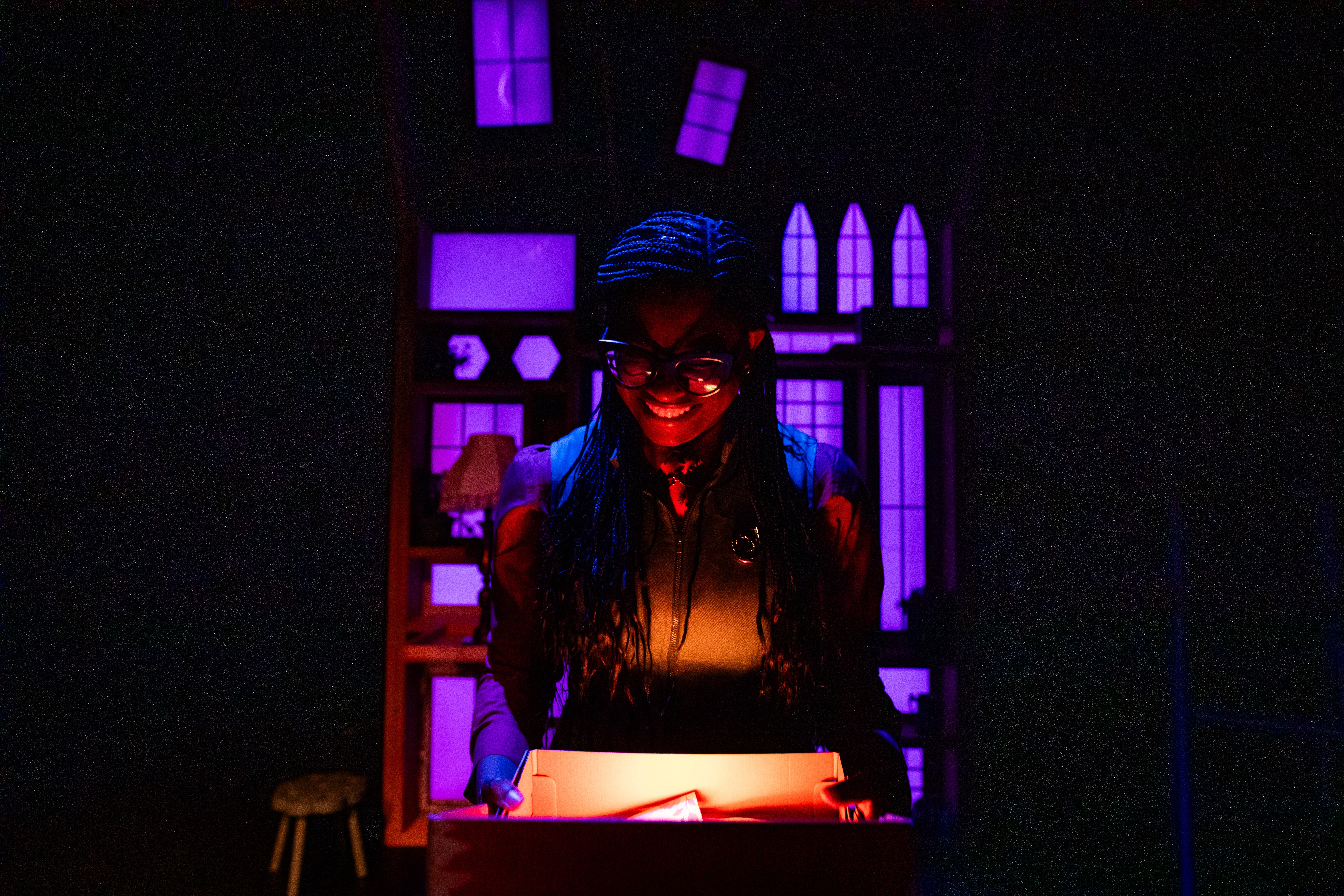
    Shannon Zura’s set/light design is inspired. A backdrop suggesting a cozy cottage gives way to an enchanting series of lighting effects. These create a sense of mystical science and the two-way power of windows. Adiah D. Hicks’ sound design includes voiceovers about the Voyager journey, interrupting Robinson’s narration with compelling contrast: the expanse of space versus the intimacy and love we require.

    Brett Ashley Robinson in Ian Kershaw’s “The Greatest Play in the History of the World.” A joint production of the Inis Nua and Tiny Dynamite theatre companies is playing in Philadelphia through Dec. 14, 2025

    Told with wry humor and eccentric details specific to both personalities and environment, the play moves toward an emotional conclusion. Can we capture those connections that may escape our awareness?

    The current challenging environment for the arts shows the wisdom of the Inis Nua/Tiny Dynamite partnership. The commitment to bring recent plays from the United Kingdom here provides an opportunity for Philly audiences to see the human experience through distant yet familiar cultures. As warm holiday entertainment, The Greatest Play is one with that mission.

    ‘The Greatest Play in the History of the World’

    (Community/Arts)

    A story love, loss, and reunion told through the eyes of an omnipresent narrator, spacecraft music, and shoes.

    ⌚️ Through Dec. 13, 📍 Louis Bluver Theatre at the Drake, 302 S. Hicks St. 🌐 tinydynamite.org

    Theater reviews are produced independently by The Inquirer without editorial input by their sponsor, Visit Philadelphia.

  • A surgeon father and an artist son discover a common love: robots

    A surgeon father and an artist son discover a common love: robots

    Jake Weinstein and his dad, Gregory Weinstein, both spend a lot of time thinking about robots.

    Jake, an art student, has been drawing robots since he was young, inspired after watching Star Wars films like A New Hope and Return of the Jedi with Gregory, an avid sci-fi fan. The idea of a friendly robot like C-3PO or R2-D2 stuck with the curious kid who was constantly doodling.

    His parents were “signing me up for arts classes as soon as I could walk,” said Jake, who grew up in Gladwyne. Robots were a frequent subject in his drawing, sculpture, and illustration pursuits.

    That passion may have developed partially through osmosis.

    Gregory Weinstein is a pioneer of robotic surgery for addressing head and neck cancer at the University of Pennsylvania. He regularly operates an advanced machine’s tiny, precise arms to remove tumors from patients’ throats.

    “Jake heard about robots from the very beginning because my wife [Penn radiologist Susan Weinstein] and I were constantly talking about it,” said the surgeon, who now lives in Wayne.

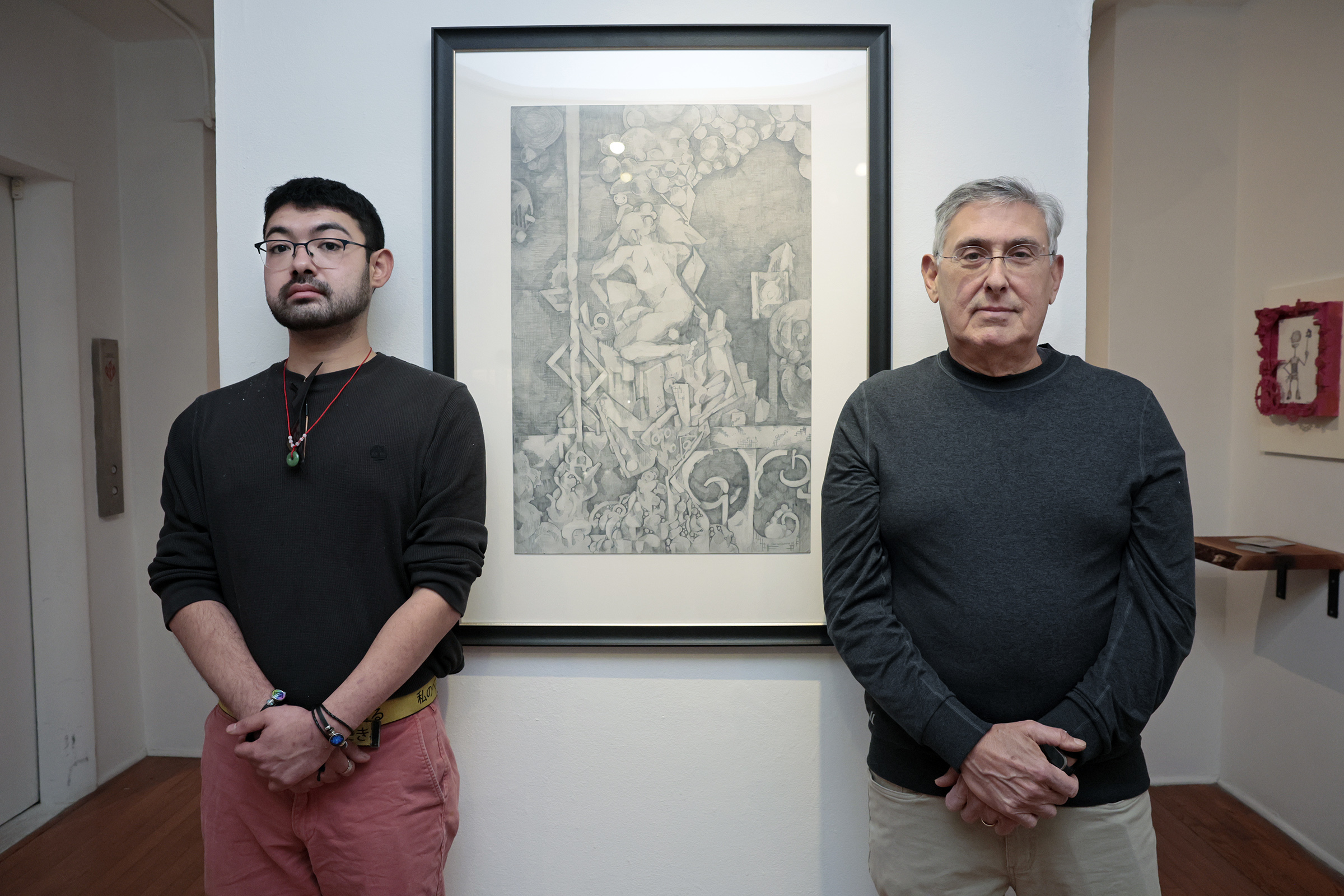
    Jake Weinstein and his father Gregory Weinstein at Works on Paper Gallery in Center City.

    By the time Jake got to high school, he couldn’t wait to try robotics to see if the technology he imagined matched up with reality. But the experience was deflating.

    “I was a little annoyed that the robots didn’t look pretty enough, and the goal was to shoot a ball into a net. Who cares?” said the now 24-year-old Penn student who lives in University City. “I want to see something walking and talking. It was an arm on wheels and no personality. They put me to sleep.”

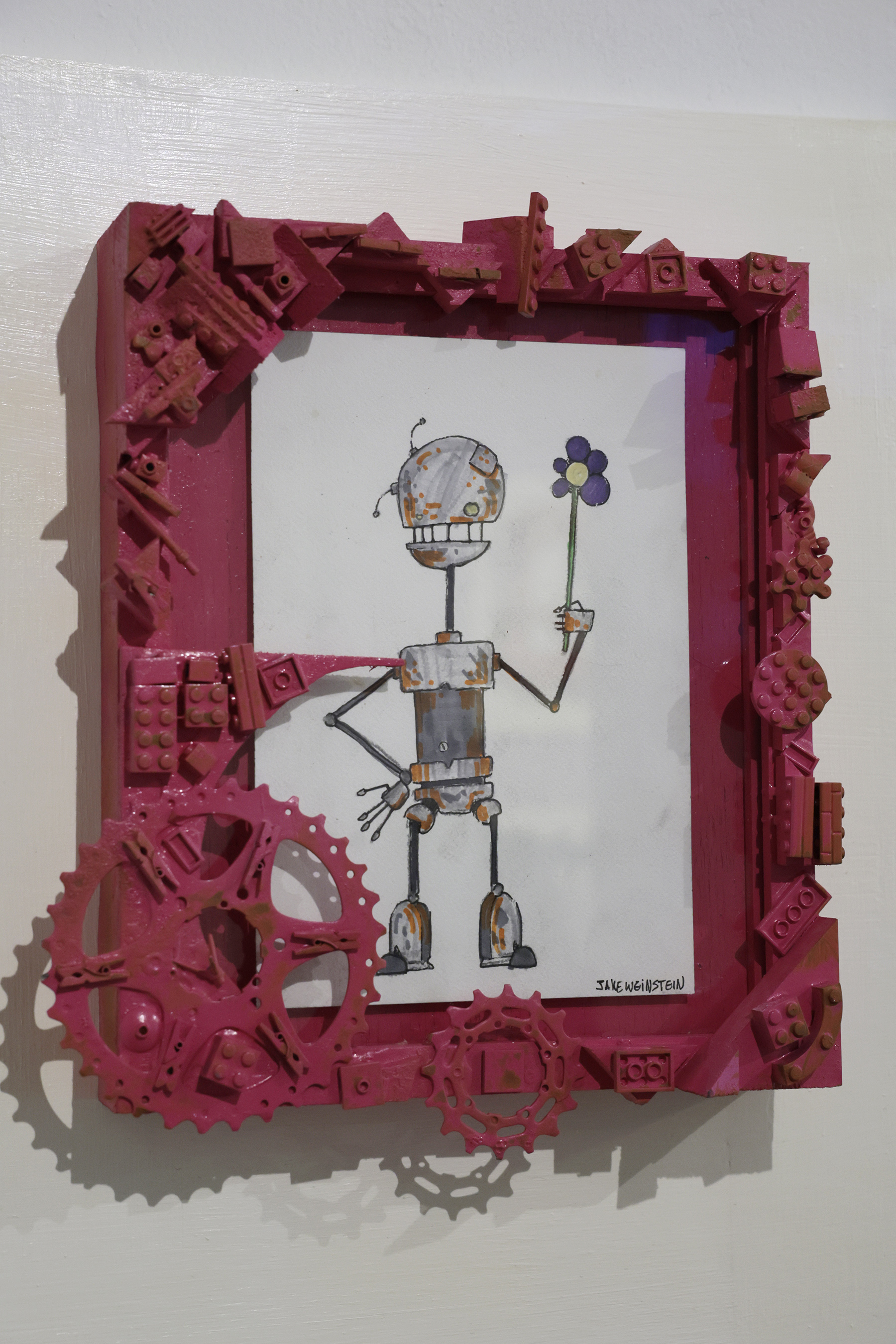
    Enrolling in a joint program with the Pennsylvania Academy of the Fine Arts, Jake designed his own machines on paper. They were humanistic and expressive; a tender dome-headed machine holding a purple flower or a goofy dancer squatting as if mid-“Thriller.” Another appears with one green eye, surrounded by industrial clouds of meticulous, minimalist lines — the giant may seem intimidating, but it’s focused on the smaller robot in its palm; Jake named the piece The Caretaker.

    CR4DL3-11 is artist Jake Weinstein’s favorite. It is an ink, pencil and marker on paper, in a “Cradle” frame made from wood, paint and objects mounted to a painted wood base.

    His work soon caught the attention of Evan Slepian, who runs the Works on Paper Gallery in Rittenhouse and often features PAFA students. (Robots have also been a subject of his previous shows.)

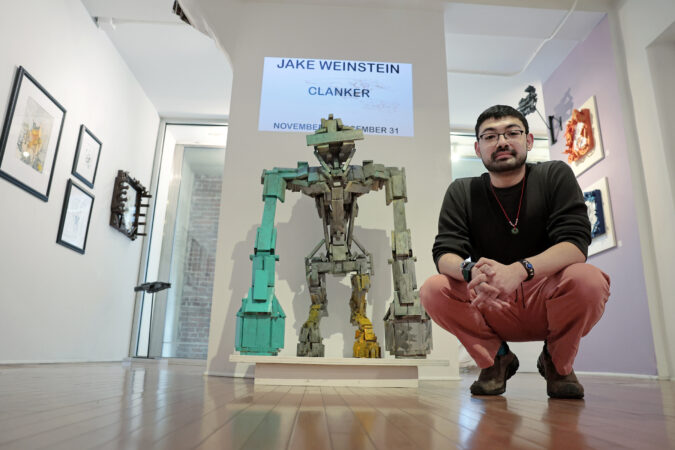
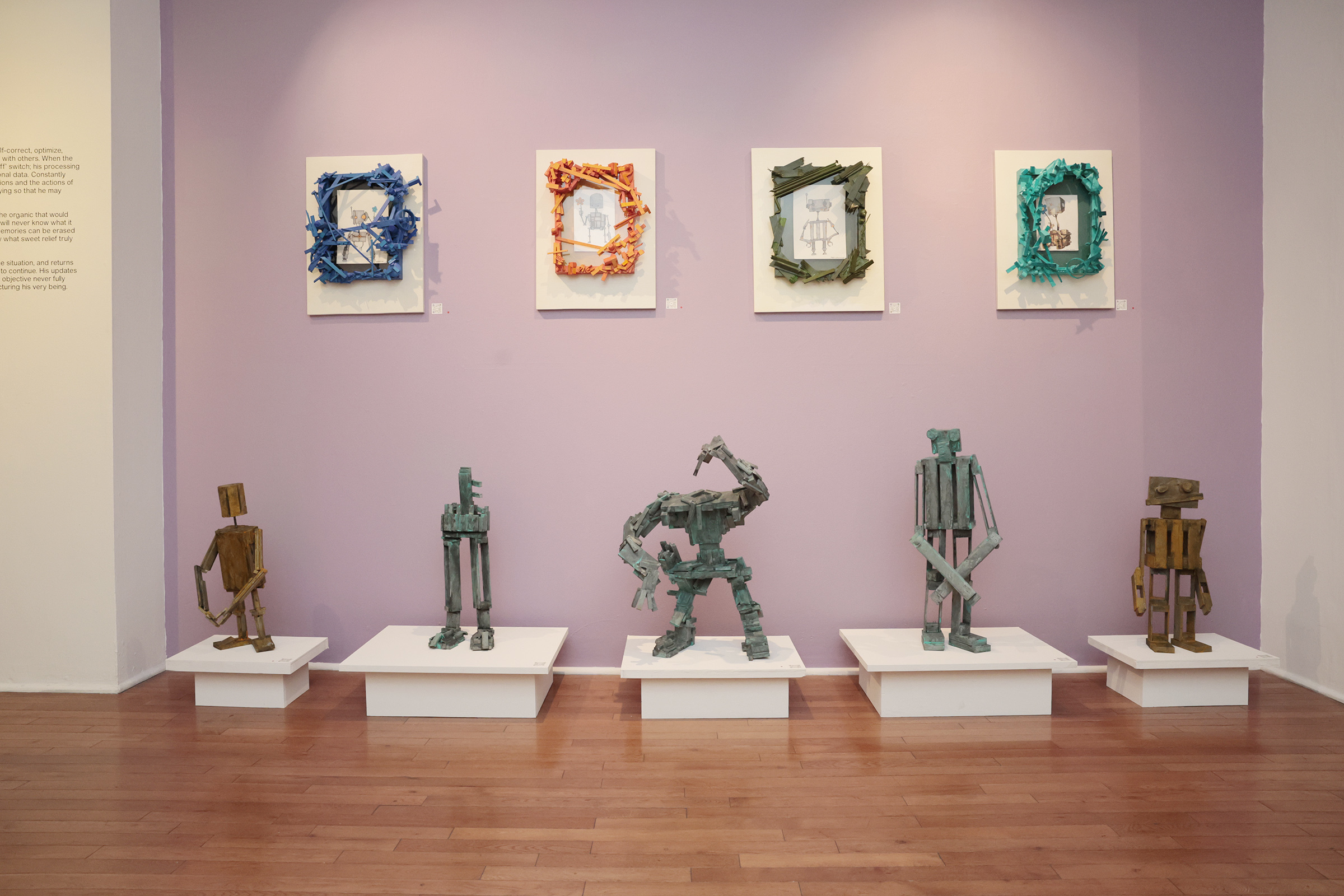
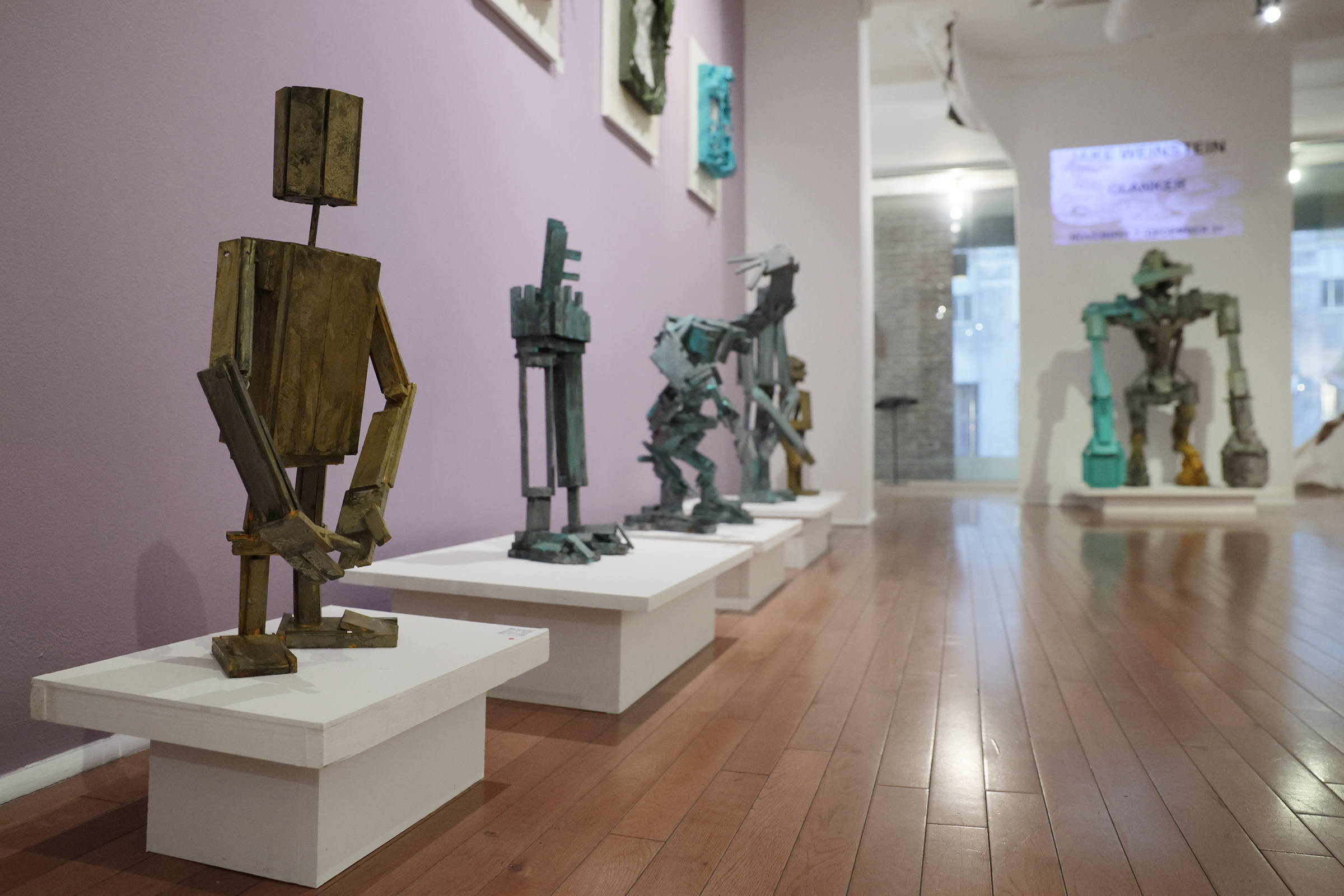
    The gallerist has served as a mentor to Jake over the past four months as they developed his first solo exhibit “Clanker,” running through Dec. 31. (The derogatory term for robots — derived from Star Wars, too — has become a frequent punchline across the internet.)

    The show spotlights Jake’s sculpture work, too, with elaborate frames made from found wood and recycled objects that frame his drawings as well as toddler-size painted wooden and aluminum robots. Slepian says the show is performing well, with sculptures selling around $1,300 and framed ink drawings, around $2,100.

    A few of Jake’s drawings pull directly from his dad’s surgery work, depicting centimeter-long metal arms conducting surgery to replace the lungs and brain with machines.

    Weinstein uses found wood and recycled materials to frame his ink drawings like a cradle.

    Gregory finds his son’s creative visions delightful. The surgeon — a third-generation doctor from Staten Island — has fond memories of his own art classes in youth. He even contributed his own artistic efforts along his medical career: His first academic paper featured his own illustrations of an operation his colleague from Paris conducted on a cadaver.

    “You would have been the fourth generation of doctors … but as you grew up, I thought, ‘Well, that’s a silly idea.’ I just want you to do work you’re going to be happy from,” Gregory said to Jake on a recent Thursday at the gallery, adding that his grandfather dabbled in art, too.

    “My grandfather was an incredibly good artist. He wanted to study art when he and my grandmother met,” Gregory recalled, chuckling. “My grandmother said, ‘Unless you become a doctor, I won’t marry you.’”

    Gregory, however, always encouraged his son’s artistry.

    “We did lots of Legos together. That was like a father-son thing, so I guess he did introduce me to some form of sculpture,” said Jake.

    Painted wood sculptured by Jake Weinstein.

    Beyond his gallery show, Jake is also one of the artists helping to build a new arts venue in a historic bank in Old City called the Ministry of Awe, led by Philly muralist Meg Saligman.

    Jake’s art has resonated at a time when artificial intelligence has become widely accessible and the prospect of advanced robotics seems to inch ever closer to the futuristic world of The Jetsons. Still, he remains optimistic about the future.

    “Through this narrative [in the show], it’s like, ‘Let’s try and be friends with the robots. Let’s work with them. Let’s not work against them,’” he said.

    His plans for the forthcoming holiday season? Another ambitious Lego project with dad.

    “Jake Weinstein: Clanker” is on view through Dec. 31 at Works on Paper Gallery, 1611 Walnut St., Mezzanine, Philadelphia, Pa. 19103, 215-988-9999 or wpartcollection.com.