As Philadelphia rings in 2026 on Thursday, Jan. 1, knowing what’s open and closed can help you plan your day. From city services and trash collection (delayed one day) to grocery stores, pharmacies, and retailers, many places will operate on modified hours or be closed.
Whether you’re knocking out errands, grabbing last-minute essentials, or easing into the new year, here’s what to know about New Year’s Day across the region.
City government offices
❌ City of Philadelphia government offices will be closed Thursday, Jan. 1.
Free Library of Philadelphia
❌ The Free Library will be closed Thursday, Jan. 1.
Food sites
✅ / ❌ Holidays may impact hours of operation. Visit phila.gov/food to view specific site schedules and call ahead before visiting.
Trash collection
❌ No trash or recycling collection on New Year’s Day, Jan. 1. Collection will be picked up one day behind the regular schedule all week. To find your trash and recycling collection day, go to phila.gov.
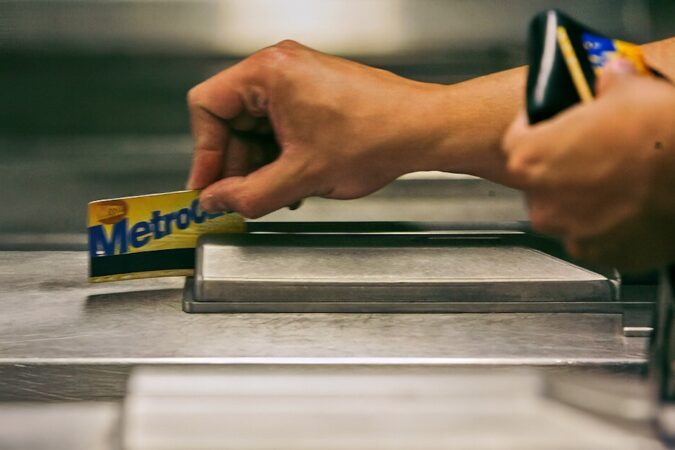
NEW YORK — When the MetroCard replaced the New York City subway token in 1994, the swipeable plastic card infused much-needed modernity into one of the world’s oldest and largest transit systems.
Now, more than three decades later, the gold-hued fare card and its notoriously finicky magnetic strip are following the token into retirement.
The last day to buy or refill a MetroCard is Dec. 31, 2025, as the transit system fully transitions to OMNY, a contactless payment system that allows riders to tap their credit card, phone, or other smart device to pay fares, much like they do for other everyday purchases.
Transit officials say more than 90% of subway and bus trips are now paid using the tap-and-go system, introduced in 2019.
Major cities around the world, including London and Singapore, have long used similar contactless systems. In the U.S., San Francisco launched a pay-go system earlier this year, joining Chicago and others.
MetroCards upended how New Yorkers commute
The humble MetroCard may have outlasted its useful life, but in its day it was revolutionary, says Jodi Shapiro, curator at the New York Transit Museum in Brooklyn, which opened an exhibit earlier this month reflecting on the MetroCard’s legacy.
Before MetroCards, bus and subway riders relied on tokens, the brass-colored coins introduced in 1953 that were purchased from station booths. When the subway opened in 1904, paper tickets cost just a nickel, or about $1.82 in today’s dollars.
“There was a resistance to change from tokens to something else because tokens work,” Shapiro said on a recent visit to the museum, housed underground in a decommissioned subway station. “MetroCards introduced a whole other level of thinking for New Yorkers.”
The Metropolitan Transportation Authority launched public campaigns to teach commuters how to swipe the originally blue-colored cards correctly, hoping to avoid the dreaded error message or lost fares. Officials even briefly toyed with the idea of an quirky mascot, the Cardvaark, before coming to their senses.
The cards quickly became collectors items as the transit system rolled out special commemorative editions marking major events, such as the “Subway Series” between baseball’s New York Mets and the New York Yankees in the 2000 World Series. At the time, a fare cost $1.50.
Artists from David Bowie and Olivia Rodrigo to seminal New York hip hop acts, such as Wu-Tang Clan, the Notorious B.I.G., and LL Cool J, have also graced the plastic card over the years, as have iconic New York TV shows like Seinfeld and Law & Order.
“For me, the most special cards are cards which present New York City to the world,” said Lev Radin, a collector in the Bronx. “Not only photos of landmarks, skylines, but also about people who live and make New York special.”
Perfecting the correct angle and velocity of the MetroCard swipe also became something of a point of pride separating real New Yorkers from those just visiting.
During her failed 2016 presidential campaign, Hillary Clinton, a former U.S. Senator from New York, took an excruciating five swipes at a Bronx turnstile. In fairness, her chief Democratic opponent at the time, U.S. Sen. Bernie Sanders of Vermont, a native Brooklynite, didn’t even appear to realize tokens had been discontinued.
Cost savings and lingering concerns
Unlike the MetroCard rollout, OMNY has required little adjustment.
Riders reluctant to use a credit card or smart device can purchase an OMNY card they can reload, similar to a MetroCard. Existing MetroCards will also continue to work into 2026, allowing riders to use remaining balances.
MTA spokespersons declined to comment, pointing instead to their many public statements as the deadline approaches.
The agency has said the changeover saves at least $20 million annually in MetroCard-related costs.
The new system also allows unlimited free rides within a seven-day period because the fare is capped after 12 rides. It’ll max out at $35 a week once the fare rises to $3 in January.
Still, new changes come with tradeoffs, with some critics raising concerns about data collection and surveillance.
Near Times Square on a recent morning, Ronald Minor was among the dwindling group of “straphangers” still swiping MetroCards.
The 70-year-old Manhattan resident said he’s sad to see them go. He has an OMNY card but found the vending machines to reload it more cumbersome.
“It’s hard for the elders,” Minor said as he caught a train to Brooklyn. “Don’t push us aside and make it like we don’t count. You push these machines away, you push us away.”
John Sacchetti, another MetroCard user at the Port Authority stop, said he likes being able to see his balance as he swipes through a turnstile so he knows how much he’s been spending on rides.
“It’s just like everything else, just something to get used to,” he said as he headed uptown. ”Once I get used to it, I think it’ll be OK.”
Corporate bankruptcies surged in 2025, rivaling levels not seen since the immediate aftermath of the Great Recession, as import-dependent businesses absorbed the highest tariffs in decades.
At least 717 companies filed for bankruptcy through November, according to data from S&P Global Market Intelligence. That’s roughly 14% more than the same 11 months of 2024, and the highest tally since 2010.
Companies cited inflation and interest rates among the factors contributing to their financial challenges, as well as Trump administration trade policies that have disrupted supply chains and pushed up costs.
But in a shift from previous years, the rise in filings is most apparent among industrials — companies tied to manufacturing, construction, and transportation. The sector has been hit hard by President Donald Trump’s ever-fluid tariff policies — which he’s long insisted would revive American manufacturing. The manufacturing sector lost more than 70,000 jobs in the one-year period ending in November, federal data shows.
Consumer-oriented businesses with “discretionary” products or services, such as fashion or home furnishings, represented the second-largest group. This contingent usually tops the list and includes many retailers, and its retrenchment is a signal that inflation-weary consumers are prioritizing essentials.
The S&P data reflects both Chapter 11 and Chapter 7 filings. In the former, also known as a reorganization, the business goes through a court-administered process to restructure its debts while it continues to operate. Under Chapter 7, the company closes down and its assets are sold off.
Economists and business experts say the trade wars have pressured import-heavy businesses, which are reluctant to raise prices by too much for fear of alienating consumers. The White House did not respond to requests for comment.
Though inflation is currently lower than many economists expected — prices climbed at an annual pace of 2.7% in November — many businesses still are eating new costs themselves to hold the line on prices for buyers, experts say. That’s leading to a certain culling of the herd as already-fragile companies struggle to keep up.
“These companies are acutely aware of the affordability crisis confronting the average American,” said Jeffrey Sonnenfeld, a professor at Yale University’s School of Management. “They are doing their best to offset the cost of tariffs and higher interest rates but can only do so much. Those with pricing power will pass on the costs over time. … Others will fold.”
Among the total was a surge of “mega bankruptcies,” or filings by companies with more than $1 billion in assets, during the first half of 2025. According to the economic consultancy Cornerstone Research, there were 17 such bankruptcies from January through June, the highest half-year number since the COVID-19 outbreak in 2020. Consumer discretionary businesses, including retailers At Home and Forever 21, accounted for several of those filings.
Matt Osborn, a principal at Cornerstone who wrote the September report, said these large companies cited high inflation and interest rates among the factors that have impinged on consumer demand and made it harder to raise capital. Changing federal policies around renewable energy and international trade also were contributors, he wrote.
Among industrials, bankruptcies spanned a mix of manufacturers and suppliers, as well as transportation-oriented firms and renewable energy companies. Many of those companies had specific preexisting problems unrelated to tariffs and the economy.
Louisiana-based PosiGen is among several residential solar companies that filed for Chapter 11, which it attributed to changes in renewable energy policy. The Trump administration has de-prioritized the tax incentives that make solar panels more affordable to homeowners, and imposed “steep tariffs on imported materials that are necessary to construct solar projects, including solar modules, inverters, racking, and structural steel,” the company said in a Nov. 25 filing in U.S. Bankruptcy Court in the Southern District of Texas.
The effective tariff rate for imported solar cells and panels climbed to roughly 20% after May 2025, compared with less than 5% in prior years, according to federal data analyzed by Jason Miller, a business professor at Michigan State University. U.S. solar importers paid close to $70 million a month in import duties in the second half of the year for the most common type of panel, Miller said.
“That places a lot of strain on cash flow, especially for smaller importers,” Miller said. “You then combine this with reduced federal incentives that have to be negatively impacting demand, and you have a perfect storm for elevated rates of bankruptcy.”
In late February, Nikola Corp., an Arizona-based maker of electric trucks, filed for Chapter 11 protection. It started producing battery-powered trucks in 2022 and scaled up to ship more than 200 vehicles last year. But a battery recall resulting from what it called a “battery pack thermal event” cost it an estimated $56 million, according to its February bankruptcy filing. It also agreed to pay an unrelated $125 million civil fine to the Securities and Exchange Commission.
Spirit Airlines, the budget carrier known for its rock-bottom prices and bare-bones amenities, filed for Chapter 11 bankruptcy in August — its second such filing in less than a year. Verijet, a private jet company based in Florida, filed to liquidate.
Bankruptcies within this sector reflect the effect tariffs have had on imported raw materials, as well as broader consolidation within the transportation and freight sectors, said Meagan Martin-Schoenberger, senior economist at KPMG.
Though the government has made some tariff exemptions, they’ve primarily benefited the tech sector, specifically those connected to artificial intelligence, she said, leaving behind some lower-tech industries.
Surveys have shown consumer sentiment worsening throughout the year. A widely followed survey of consumer sentiment from the University of Michigan tumbled around 28% year over year in November. Many are reticent to spend on nonessentials.
Retailers have felt this acutely, especially those selling discretionary items such as costume jewelry, crafts, and furniture, which consumers often forgo to afford groceries, utilities, and rent. By one estimate, Americans will spend an additional $1,800 a year because of tariffs.
The Trump administration’s frequent tariff changes during the peak holiday-ordering period also left some companies off-kilter. Because many rely on imports from China and other Southeast Asian countries, some businesses ended up spending more than they’d budgeted to swiftly move manufacturing and materials to countries with lower tariff rates.
Others had to cut orders for fear of not having enough cash to pay the levies when their inventory arrived in the United States.
Claire’s, the mall chain known for its teen and tween accessories, filed for Chapter 11 bankruptcy in August and has moved to shutter hundreds of stores. It, too, faced tariff headwinds, with the majority of its products — including earrings, headbands, and key chains — coming from China, Cambodia, and Indonesia. In September, a private holding company acquired the chain’s North American operations for $140 million and said it would keep as many as 950 stores, or nearly 80% of the chain’s U.S. and Canadian locations.
Meanwhile, specialty retailers have been struggling for years to keep up with big box chains and online marketplaces as consumers look for convenience and a one-stop-shop for certain items. Fabric and craft chain Joann, for example, went out of business early this year, unable to keep up with online retailers offering lower prices.
Martin-Schoenberger, the KPMG economist, said the bankruptcies reflect contradictions in the economy. Government data released Tuesday showed the U.S. economy grew at the fastest pace in two years from July through September, with an annualized rate of 4.3%.
Still, economists caution that this growth is driven by more affluent consumers and corporate spending around artificial intelligence.
“We have an economy that looks strong on paper, but that might not necessarily be reflected in every single industry,” Martin-Schoenberger said.
An acute global shortage of memory chips is forcing artificial intelligence and consumer-electronics companies to fight for dwindling supplies, as prices soar for the unglamorous but essential components that allow devices to store data.
Japanese electronics stores have begun limiting how many hard-disk drives shoppers can buy. Chinese smartphone makers are warning of price increases. Tech giants including Microsoft, Google, and ByteDance are scrambling to secure supplies from memory-chip makers such as Micron, Samsung Electronics, and SK Hynix, according to three people familiar with the discussions.
The squeeze spans almost every type of memory, from flash chips used in USB drives and smartphones to advanced high-bandwidth memory (HBM) that feeds AI chips in data centers. Prices in some segments have more than doubled since February, according to market-research firm TrendForce, drawing in traders betting that the rally has further to run.
The fallout could reach beyond tech. Many economists and executives warn the protracted shortage risks slowing AI-based productivity gains and delaying hundreds of billions of dollars in digital infrastructure. It could also add inflationary pressure just as many economies are trying to tame price rises and navigate U.S. tariffs.
“The memory shortage has now graduated from a component-level concern to a macroeconomic risk,” said Sanchit Vir Gogia, CEO of Greyhound Research, a technology advisory firm. The AI build-out “is colliding with a supply chain that cannot meet its physical requirements.”
This Reuters examination of the spiraling supply crisis is based on interviews with almost 40 people, including 17 executives at chipmakers and distributors. It shows industry efforts to meet voracious appetite for advanced chips — driven by Nvidia and tech giants like Google, Microsoft, and Alibaba — created a dual bind: Chipmakers still can’t produce enough high-end semiconductors for the AI race, yet their tilt away from traditional memory products is choking supply to smartphones, PCs, and consumer electronics. Some are now hurrying to course-correct.
Details of the global scramble by tech firms and price increases described by electronics retailers and component suppliers in China and Japan are reported here for the first time.
Average inventory levels at suppliers of dynamic random-access memory (DRAM) — the main type used in computers and phones — fell to two to four weeks in October from three to eight weeks in July and 13 to 17 weeks in late 2024, according to TrendForce.
The crunch is unfolding as investors question whether the billions of dollars poured into AI infrastructure have inflated a bubble. Some analysts predict a shakeout, with only the biggest and financially strongest companies able to stomach the price increases.
One memory-chip executive told Reuters the shortage would delay future data-center projects. New capacity takes at least two years to build but memory-chip makers are wary of overbuilding for fear it could end up idle should the demand surge pass, the person said.
Samsung and SK Hynix have announced investments in new capacity but haven’t detailed the production split between HBM and conventional memory.
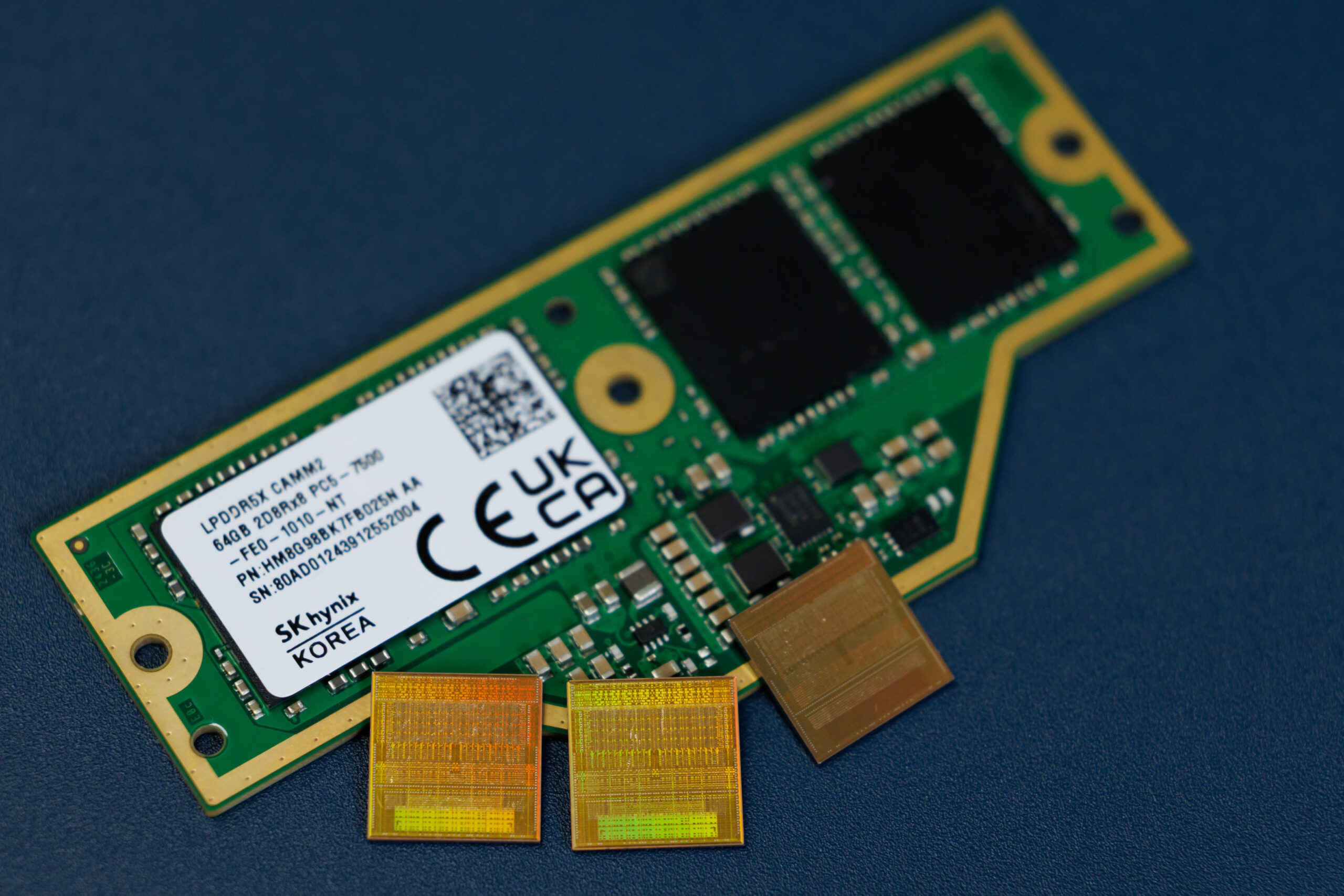
SK Hynix Inc. 12-layer HBM3E memory chips and a LPDDR5X CAMM2 memory module. MUST CREDIT: SeongJoon Cho/Bloomberg
SK Hynix has told analysts that the memory shortfall would last through late 2027, Citi said in November.
“These days, we’re receiving requests for memory supplies from so many companies that we’re worried about how we’ll be able to handle all of them. If we fail to supply them, they could face a situation where they can’t do business at all,” Chey Tae-won, chairman of SK Hynix parent SK Group, said at an industry forum in Seoul last month. OpenAI in October signed initial deals with Samsung and SK Hynix to supply chips for its Stargate project, which would require up to 900,000 wafers per month by 2029. That’s about double current global monthly HBM production, Chey said.
Samsung told Reuters it is monitoring the market but wouldn’t comment on pricing or customer relationships. SK Hynix said it is boosting production capacity to meet increased memory demand.
Microsoft declined to comment and ByteDance didn’t address questions about the chip strain. Micron and Google didn’t respond to comment requests.
‘Begging for supply’
After ChatGPT’s release in November 2022 ignited the generative AI boom, a global rush to build AI data centers led memory makers to allocate more production to HBM, used in Nvidia’s powerful AI processors.
Competition from Chinese rivals making lower-end DRAM, such as ChangXin Memory Technologies, also pushed Samsung and SK Hynix to accelerate their shift to higher-margin products. The South Korean firms account for two-thirds of the DRAM market.
Samsung told customers in May 2024 that it planned to end production of one type of DDR4 chips — an older variety used in PCs and servers — this year, according to a letter seen by Reuters. (The company has since changed course and will extend production, two sources said.) In June, Micron said it had informed customers it would stop shipping DDR4 and its counterpart LPDDR4 — a type used in smartphones — in six to nine months.
ChangXin followed suit in ending most DDR4 production, one source said. The firm declined to comment.
This shift, however, coincided with a replacement cycle for traditional data centers and PCs, as well as stronger-than-expected sales of smartphones, which rely on conventional chips.
In hindsight, “one could say the industry was caught off-guard,” said Dan Hutcheson, senior research fellow at TechInsights. Samsung raised prices of server memory chips by up to 60% last month, Reuters has reported. Nvidia CEO Jensen Huang, who in October announced deals awith Samsung Electronics Chairman Jay Y. Lee during a trip to South Korea, acknowledged the price surge as significant but said Nvidia had secured substantial supply.
Google, Amazon, Microsoft, and Meta in October asked Micron for open-ended orders, telling the company they will take as much as it can deliver, irrespective of price, according to two people briefed on the talks.
China’s Alibaba, ByteDance, and Tencent are also leaning on suppliers, dispatching executives to visit Samsung and SK Hynix in October and November to lobby for allocation, the two people and another source told Reuters.
“Everyone is begging for supply,” one said.
The Chinese firms didn’t address questions about the chip crunch. Nvidia, Meta, Amazon, and OpenAI didn’t respond to requests for comment.
In October, SK Hynix said all its chips are sold out for 2026, while Samsung said it had secured customers for its HBM chips to be produced next year. Both firms are expanding capacity to meet AI demand, but new factories for conventional chips won’t come online until 2027 or 2028. Shares in Micron, Samsung, and SK Hynix have rallied this year on chip demand. In September, Micron forecast first-quarter revenue above market estimates while Samsung in October reported its biggest quarterly profit in more than three years.
Consultancy Counterpoint Research expects prices of advanced and legacy memory to rise by 30% through the fourth quarter and possibly another 20% in early 2026.
Smartphone sticker shock
Chinese smartphone makers Xiaomi and Realme have warned they may have to raise prices.
Francis Wong, Realme India’s chief marketing officer, told Reuters the steep increases in memory costs were “unprecedented since the advent of smartphones” and could force the company to lift handset prices by 20% to 30% by June.
“Some manufacturers might save costs on imaging cameras, some on processors, and some on batteries,” he said. “But the cost of storage is something all manufacturers must completely absorb; there’s no way to transfer it.”
Xiaomi told Reuters it would offset higher memory costs by raising prices and selling more premium phones, adding that its other businesses would help cushion the impact.
In November, Taiwanese laptop maker ASUS said it had about four months of inventory, including memory components, and would adjust pricing as needed.
Winbond, a Taiwanese chipmaker with around 1% of the DRAM market, was among the first to announce a capacity expansion to meet demand. Its board of directors approved a plan in October to sharply boost capital expenditure to $1.1 billion.
“Many customers have been coming to us saying, ‘I really need your help,’ and one even asked for a six-year long-term agreement,” Winbond’s President Pei-Ming Chen said.
Traders rush in
In Tokyo’s electronics hub of Akihabara, stores are restricting purchases of memory products to curb hoarding. A sign outside PC shop Ark says that since Nov. 1 customers have been limited to buying a total of eight products across hard-disk drives, solid-state drives, and system memory. Ark declined to comment.
Clerks at five shops said shortages had pushed prices sharply higher in recent weeks. At some stores, one-third of products were sold out.
Products such as 32-gigabyte DDR5 memory — popular with gamers — were over 47,000 yen, up from around 17,000 yen in mid-October. Higher-end 128-gigabyte kits had more than doubled to around 180,000 yen.
The hikes are driving customers to the secondhand market — benefiting people like Roman Yamashita, owner of iCON in Akihabara, who said his business selling used PC parts is booming.
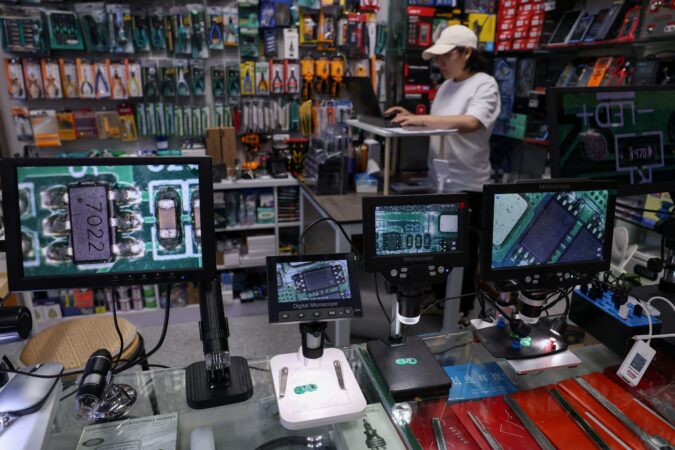
Eva Wu, a sales manager at component trader Polaris Mobility in Shenzhen, said prices are changing so rapidly that distributors issue broker-style quotes that expire daily — and in some cases hourly — versus monthly before the crunch.
In Beijing, a DDR4 seller said she had hoarded 20,000 units in anticipation of further increases.
Some 6,000 miles away in California, Paul Coronado said monthly sales at his company, Caramon, which sells recycled low-end memory chips pulled from decommissioned data-center servers, have surged since September. Almost all its products are now bought by Hong Kong-based intermediaries who resell them to Chinese clients, he said.
“We were doing about $500,000 a month,” he said. “Now it’s $800,000 to $900,000.”
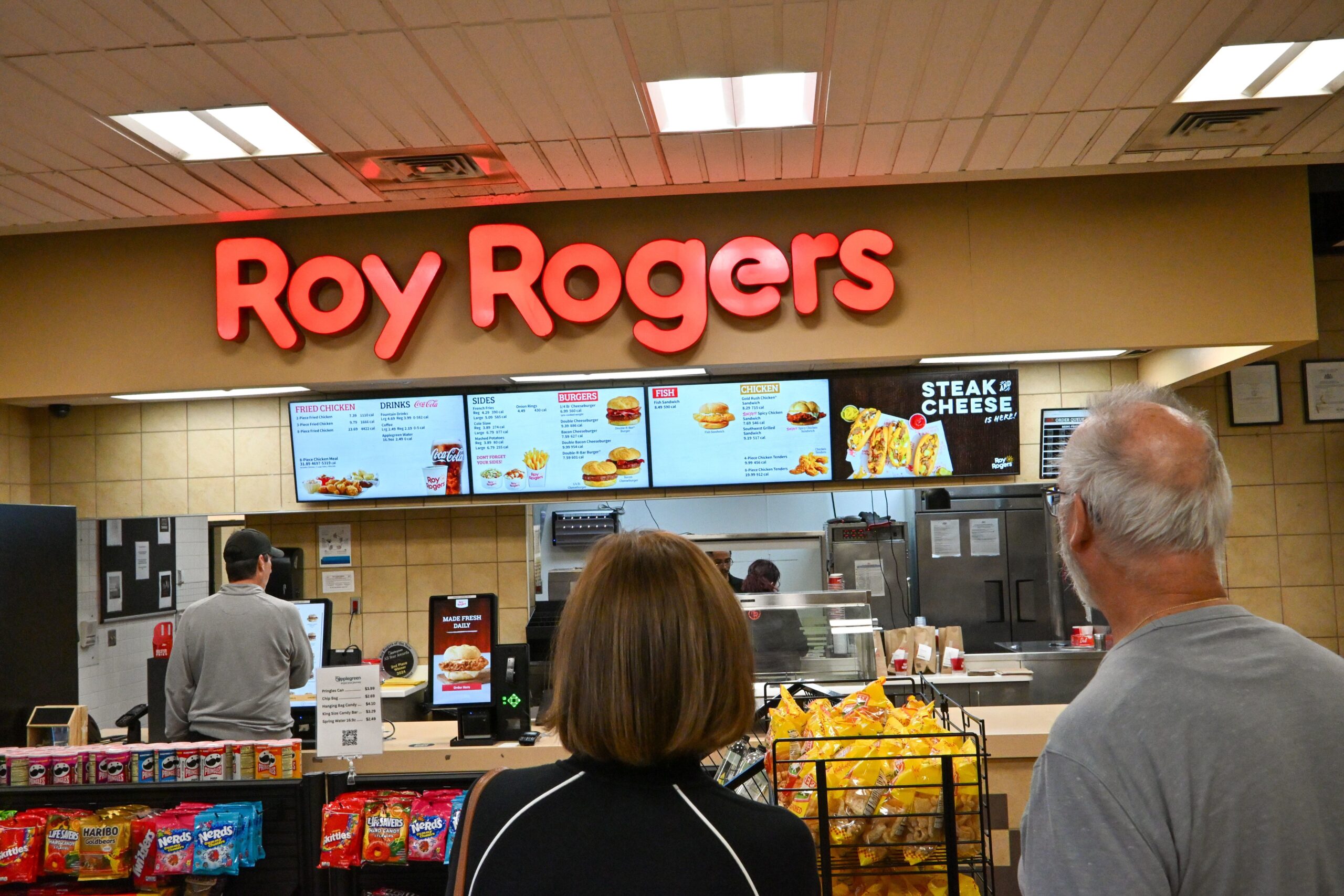
Driving west on the Pennsylvania Turnpike, Mary Wright was hoping for a Chick-fil-A. But as she watched the limited options on road signs pass, fond memories of roast beef sandwiches lured her to Roy Rogers.
“My mother liked Roy Rogers,” said Wright, who is in her 60s and from Collingswood. “That’s how long it’s been around.”
That’s pretty typical of the food offerings on the Pennsylvania Turnpike, where old-school brands such as Auntie Anne’s, Baskin-Robbins, and Sbarro dot many of the 17 service plazas.
That puts the turnpike behind the times compared with similar toll roads in New Jersey and New York, where travelers can hold out for newer brands like Chick-fil-A, Pret a Manger, and Shake Shack.
“I think the older generation likes Roy Rogers and all that, but younger people are more likely to like Shake Shack, for example,” said John Zhang, professor of marketing at the University of Pennsylvania’s Wharton School of Business.
Once on the toll road, people are faced with dining options decided almost entirely by one company. It’s what Zhang called a “captive consumer” environment. The reasons for this involve state policy, a corporate contract, and a little business history.
Mary Wright and Rich Misdom of Collingswood consider their options at the Roy Rogers located in the Peter J. Camiel Service Plaza on the Pennsylvania Turnpike in late November.
‘Applegreen determines the food concepts’
The commercial stakes are significant:More than 550,000 people drive on the turnpike every day, according to the Pennsylvania Turnpike Commission, and about 7.4 million travelers are expected to have used the toll road around the Christmas and New Year’s holidays.
Though the turnpike commission oversees the operation, a company called Applegreen primarily decides which restaurants fill the state’s 17 service plazas, according to turnpike commission spokesperson Marissa Orbanek.
Applegreen runs travel plazas in 12 states, including New Jersey and New York. The company, based in Ireland, was taken private for $878 million in 2020 and is majority-owned by the large private equity firm Blackstone Inc. Applegreen did not respond to requests to comment for this story.
For access to the service plazas, Applegreen pays the turnpike commission 4% of its gross food and beverage sales, amounting to about $2.4 million per year, Orbanek said.
“Applegreen determines the food concepts and seeks approval from the commission,” Orbanek said. “So the turnpike is certainly involved in this process.”
Of the 15 restaurant chains Applegreen lists on its website, nine appear on the Pennsylvania Turnpike. There are nine Auntie Anne’s, eight Burger Kings, one Cinnabon, seven Dunkin’s, two Popeyes, seven Roy Rogers restaurants, four Sbarros, 10 Starbucks outposts, and one Subway restaurant, according to the turnpike commission website. Pennsylvania also has six Baskin-Robbins locations, it shows.
In other states, Applegreen’s brands include Chick-fil-A, Nathan’s Famous Hot Dogs, Panda Express, Panera, Pret a Manger, and Shake Shack.
The service plaza contract dates back to 2006, when the turnpike commission signed a 30-year lease agreement with HMS Host Family Restaurants, giving the company “exclusive rights” to food and drink sales, Orbanek said.
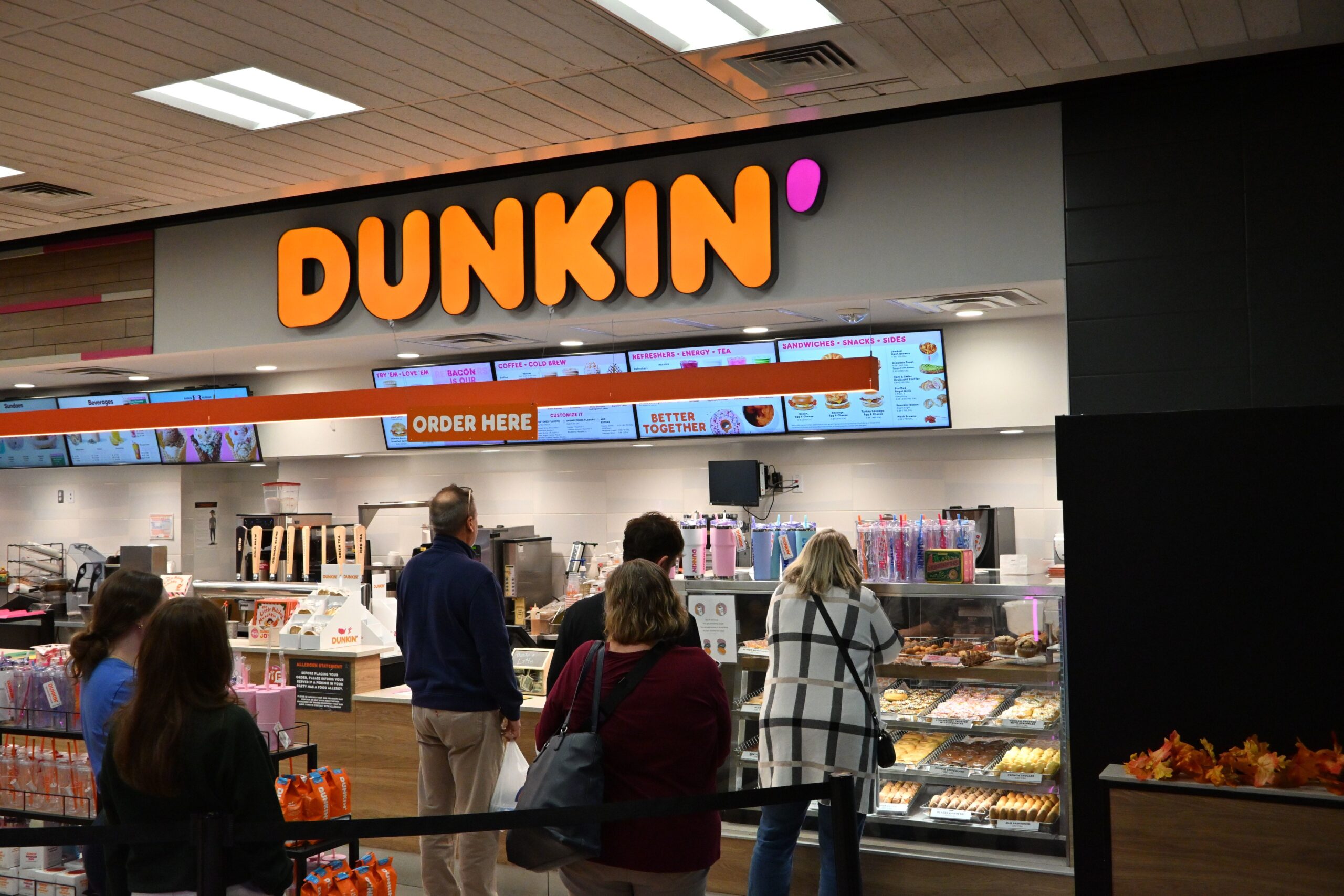
Seven Dunkin’ locations dot the Pennsylvania Turnpike.
Until then, Applegreen decides which eatery goes where.
What’s with all the Roy Rogers restaurants?
When Applegreen bought HMS Host, it became the franchisee of the Roy Rogers restaurants on the turnpike, said Jim Plamondon, who co-owns the Frederick, Md.-based Roy Rogers brand with his brother.
Plamondon wants to keep the restaurants on the turnpike past 2036 — a decision that will depend in part on whether Applegreen sticks with the restaurants it acquired when it bought HMS Host.
“It’s all about developing relationships and hoping to grow with our operators,” Plamondon said.
As for Roy Rogers’ prominent position on the turnpike, that dates back to the 1980s, when Marriott Corp. managed the service plazas, Plamondon said. Back then, the restaurant was owned by Marriott — it had a licensing agreement with the showbiz cowboy of the same name — and Plamondon’s dad was an executive in the company.
These days, Plamondon said, nostalgia and curiosity for something a bit different have driven the restaurant chain’s modest growth: It has opened a few new locations in recent years, including one in Cherry Hill, and has a devoted fan base.
Fast-food restaurants are facing a number of challenges in the current economic climate. Wages and tariffs have pushed prices up, and low-income consumers in particular have started to reduce spending. Even McDonald’s, the largest fast-food chain in the U.S., has seen nearly double-digit decreases in traffic among low-income Americans, the company said in its third-quarter earnings report last month.
McDonald’s CEO Christopher Kempczinski told investors on a call announcing the third-quarter results that low-income consumers were having to absorb significant inflation, which was affecting spending behavior.
Roy Rogers has seen some of these challenges as well, Plamondon said. Costs have gone up, margins are thin, and people’s tastes are always changing. People are eating more chicken and want spicier options, he added. .
“It’s a really good menu, it’s great quality food, and I think our brand absolutely has a future to it, because at the end of the day, it’s about the food.”
Changing tastes
The Wharton School’s Zhang agreed that consumers’ tastes have shifted. “People increasingly want ethnic foods, and younger people want spicier food,” he said. “And people want to go upscale nowadays.”
Zhang noted a number of older brands on the Applegreen roster, such as Sbarro, the pizza restaurant that has faced two bankruptcies in the years since the turnpike commission approved the 30-year lease.
In terms of market forces, Zhang said, turnpike service plazas are “an aberration.” Unlike those in most suburban or urban areas, service plaza customers are willing to settle for what’s available, and pay more to get in and out, he said.
“If you’re a traveler on a holiday, you tend to be less price sensitive,” Zhang said. “You just want to have your food very quickly.”
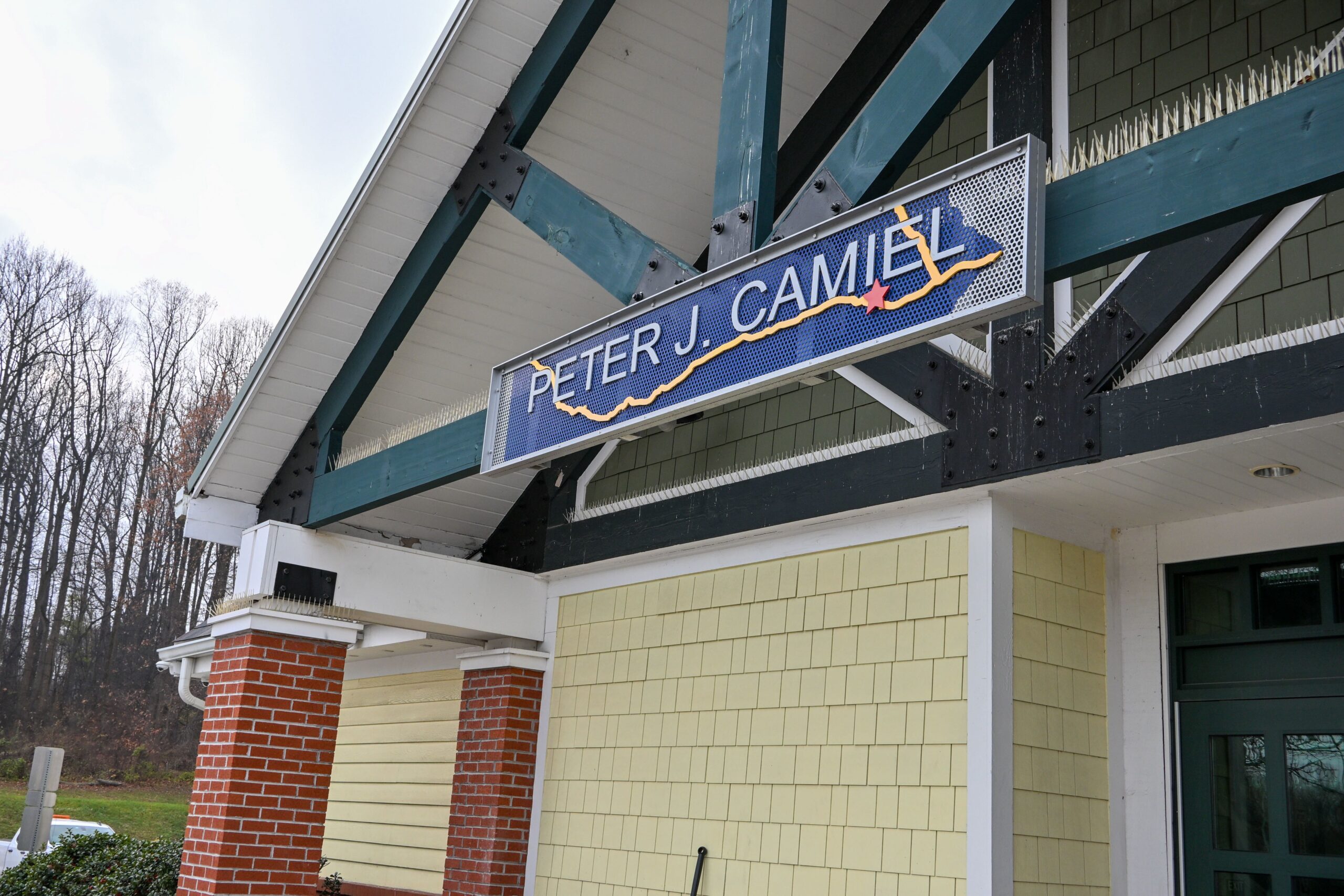
A sign at the Peter J. Camiel service plaza on the Pennsylvania Turnpike.
That puts turnpike service stops at odds with the shifting consumer preferences that have bedeviled the fast-food industry over the last couple of decades, Zhang said, including the addition of food delivery services like DoorDash and GrubHub.
Zhang said that the lack of order-ahead options at turnpike eateries is puzzling. For people traveling down a strip of highway, it seems like calling ahead would make sense.
“For them, the customers just pass by once,” he said.
For Mary Wright and her traveling companion, Rich Misdom, their recent Roy Rogers visit did not exactly ignite enthusiasm.
“This is, like, old-school kind of stuff,” Misdom said, adding he was disappointed that this Roy Rogers restaurant was not serving roast beef. He settled for a cheeseburger, while Wright got a chicken sandwich.
“We don’t come here to fine dine,” Misdom said, between bites. “Let’s put it that way.”
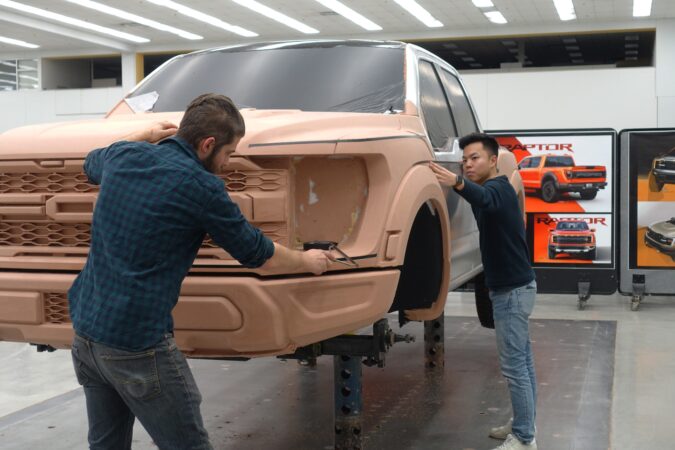
Often found hidden behind two or three levels of locked doors, accessible only to a chosen few with the right credentials, they’re expansive, well-lit, and full of wonder. Mood boards filled with fashion photos, pictures of landscapes and architectural iconography inspire the team. Models of cars sculpted from clay — in various shapes and sizes — fixate the designers.
Then you smell the sulfur.
Traditional modeling clays contain sulfur, a reliable binding agent for the waxes and oils used during the sculpting process, and exudes a pungent smell of rotting eggs. For decades, designers just dealt with the smell until their computers started failing.
“Over 15 years ago, all computer circuit boards switched to a silver compound from lead solder,” said Mark Malewitz, president at Clay Warehouse. “They found out pretty quickly, as any modeler that wore silver jewelry already knew, that sulfur corrodes silver.”
Over the years, some companies such as Chavant and Staedtler have created different formulations without sulfur to try to eliminate the concomitant odor, but new technology such as augmented and virtual reality is significantly reshaping the auto development process. Virtual reality headsets, when combined with digital modeling software, allow designers and engineers to collaborate more quickly and easily. Besides saving money, the technology also reduces the need to sculpt full-size models of cars with clay.
“Before we had virtual reality we were building, for a major project, let’s say a new architecture, around about 80 to 100 vehicles,” said Karsten Garbe, plant director at GM’s Artisan Innovation Center in Warren, Mich. Today, that number is closer to 30 or 40 vehicles, and virtual reality is used in the development of every new car.
From gaming headsets to 3D printing
Like many other auto manufacturers, General Motors first started experimenting with the computer-gaming-focused HTC Vive headsets in the late 2010s. Today, manufacturers use everything from consumer-grade headsets, like Meta’s $499 Quest 3, to more professional units like the Varjo XR-4, which can cost more than $10,000.
Garbe’s team is responsible for piecing GM’s prototype cars together for brands such as Chevrolet and GMC, making sure not only that everything fits but that it can be assembled and serviced in a safe, repeatable way. It’s a little like assembling the world’s most complicated model kit, long before the instructions get written.
Before GM invested in virtual reality, engineers had to wait for prototype components to be manufactured and delivered. Now, they can work from early digital 3D models, checking fit and feasibility months before the first part is cast. Garbe said that this identifies problems early, flagging components that can’t physically be maneuvered into place or that don’t fit properly, dramatically reducing the number of prototype vehicles needed. This process was used to develop GM’s latest electric vehicles, including the Chevrolet Blazer EV and Cadillac Escalade IQ.
When it comes to visual design — the outright style and appearance of the car — there are considerable advantages, too.
Jim Conner, director of 3D process delivery at Ford Design, cited the important task of finding the right wheels. He said designers might go through as many as 35 potential wheel designs for a major model like the Mustang. In the old days, all 35 would have to be crafted by hand from plastic, foam, and paint for evaluation.
Using augmented and virtual reality, designers can narrow it down much more quickly, changing colors, finishes, and shapes instantly. “We’re really getting down to five or six critical ones that really resonated. And then we’ll actually make very nice prototypes of those,” Conner said
Other technologies, like 3D printing, are changing the game, too, speeding up prototyping and the creation of parts out of plastic, resin, or even metal that previously would be meticulously hand-sculpted. “We used to hand model, in clay, seats, including stitches,” Conner said. “You can imagine the technique and the expertise it takes to model a stitch on a seat in clay.”
Larger digital designs can also be brought into reality via milling machines that hone giant slabs of clay into a rough shape. The artisan modelers then come in to finesse the final shapes and details.
“The ability to rapidly mill full-size physical models provides significant advantages in the product development process, primarily by enabling a more dynamic approach to design iteration and validation,” said John Krsteski, senior chief designer for Genesis North America.
“We still do hand modeling, but we’ve taken our clay modelers and put a lot of technology in their hands now, and basically given them different tools,” Ford’s Conner said. “We’re trying to not say that people are clay modelers. They’re actually a model maker where clay is one thing they’re using.”
“A lot of the studios were saying, ‘Let’s just go digital,’” Malewitz said. But the results, he continued, weren’t good, with plenty of “angular lines that don’t have the human touch.”
While the engineers can create near-photo-realistic renderings of objects in augmented and virtual reality, a key part of the process was missing: “The one thing you cannot replace with virtual reality is sunlight,” Malewitz said, echoing a common sentiment among designers that, while they may be investing in fewer models than before, nothing beats a real, full-size clay sculpture for final approvals.
“Virtual and augmented reality are really fantastic developmental tools, but I do believe there will always be a point where you’re going to see a physical thing,” Conner said. “I don’t think virtual reality will replace that.”
Since returning to the White House in January, President Donald Trump has overturned decades of U.S. trade policy — building a wall of tariffs around what used to be a wide open economy.
His double-digit taxes on imports from almost every country have disrupted global commerce and strained the budgets of consumers and businesses worldwide. They have also raised tens of billions of dollars for the U.S. Treasury.
Trump has argued that his steep new import taxes are necessary to bring back wealth that was “stolen” from the U.S. He says they will narrow America’s decades-old trade deficit and bring manufacturing back to the country. But upending the global supply chain has proven costly for households facing rising prices. The taxes are paid by importers who typically attempt to pass along the higher costs to their customers. That includes businesses and ultimately, U.S. households.
And the erratic way the president rolled out his tariffs — announcing them, then suspending or altering them before conjuring up new ones — made 2025 one of the most turbulent economic years in recent memory.
Here’s a look at the impact of Trump’s tariffs over the last year, in four charts.
Effective U.S. tariff rate
A key number for the overall impact of tariffs on U.S. consumers and businesses is the “effective” tariff rate — which, unlike headline figures imposed by Trump for specific trade actions, provides an average based on the actual imports coming into the country.
In 2025, per data from the Yale Budget Lab, the effective U.S. tariff rate peaked in April. But it’s still far higher than the average seen at the start of the year. Before finalizing shifts in consumption, November’s effective tariff rate was nearly 17% — seven times greater than January’s average and the highest seen since 1935.
Tariff revenue vs America’s trade deficit
Among selling points to justify his tariffs, Trump has repeatedly said they would reduce America’s longstanding trade deficit and bring revenue into the Treasury.
Trump’s higher tariffs are certainly raising money. They’ve raked in more than $236 billion this year through November — much more than in years past. But they still account for just a fraction of the federal government’s total revenue. And they haven’t raised nearly enough to justify the president’s claim that tariff revenue could replace federal income taxes — or allow for windfall dividend checks for Americans.
The U.S. trade deficit, meanwhile, has fallen significantly since the start of the year. The trade gap peaked to a monthly record of $136.4 billion in March, as consumers and businesses hurried to import foreign products before Trump could impose his tariffs on them. The trade gap narrowed to $52.8 billion in September, the latest month for which data is available. But the year-to-date deficit was still running 17% ahead of January-September 2024.
Import shifts with America’s biggest trading partners
Trump’s 2025 tariffs hit nearly every country in the world — including America’s biggest trading partners. But his policies have had the biggest impact on U.S. trade with China, once the biggest source of American imports and now No. 3 behind Canada and Mexico. U.S. tariffs on Chinese imports now come to 47.5%, according to calculations by Chad Bown of the Peterson Institute for International Economics.
The value of goods coming into the U.S. from China fell nearly 25% during the first three-quarters of the year. Imports from Canada also dropped. But the value of products from Mexico, Vietnam, and Taiwan grew year-to-date.
Market swings
For investors, the most volatile moments on the stock market this year arrived amid some of the most volatile moments for Trump’s tariffs.
The S&P 500, an index for the biggest public companies in the U.S., saw its biggest daily and weekly swings in April — and largest monthly losses and gains in March and June, respectively.
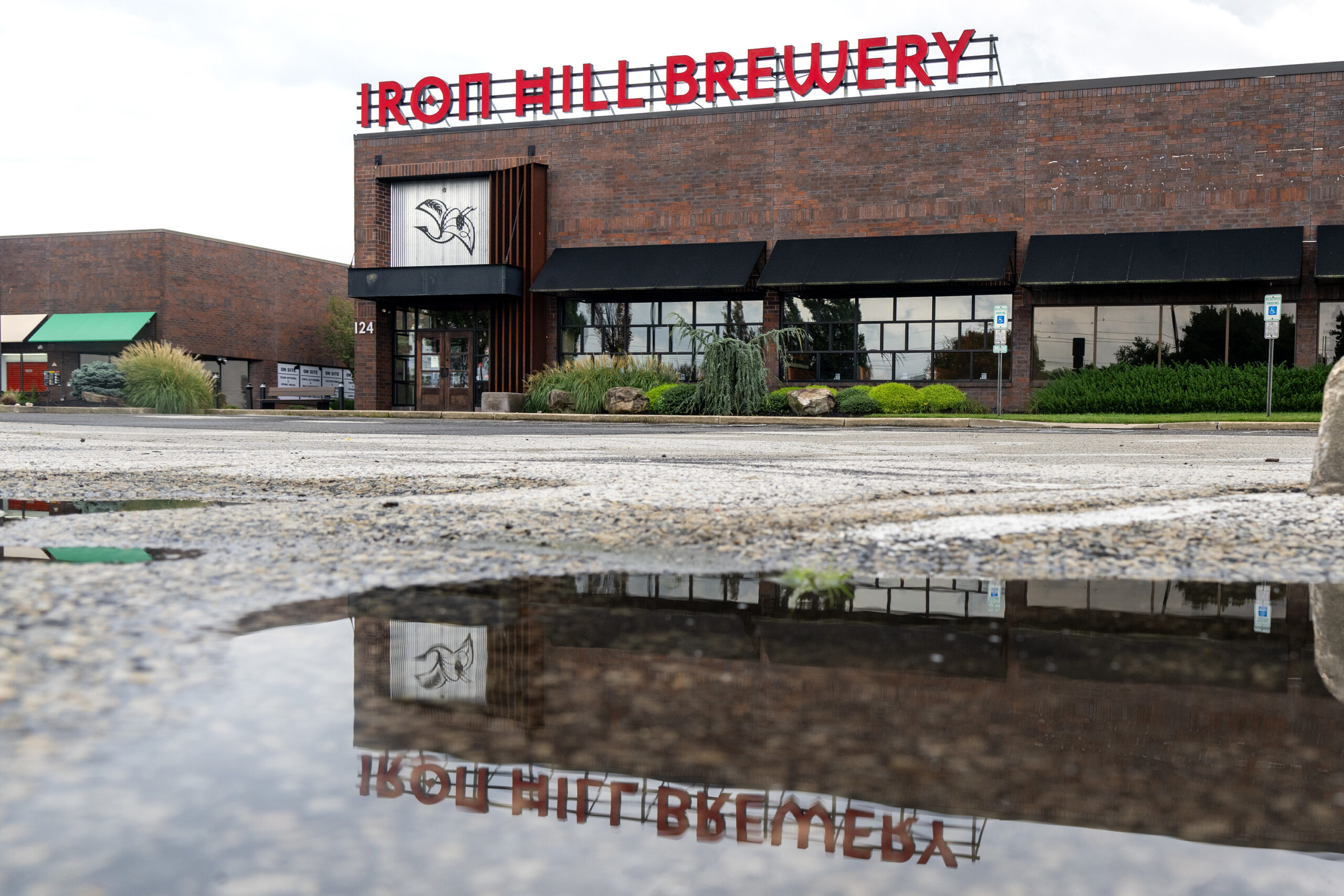
The search is on for a new restaurateur to take over the shuttered Iron Hill Brewery in West Chester, after the building’s owner bought the assets from the former CEO of Famous Dave’s BBQ.
John Barry, a Massachusetts-based real estate investor who owns the building, and Jeff Crivello, the ex-CEO of Famous Dave’s, said Friday that Barry purchased the liquor license and all assets inside the former West Chester Iron Hill, one of 16 locations that closed abruptly this fall when the regional chain filed for bankruptcy.
In November, Crivello had said he intended to revive the West Chester Iron Hill, under the same name or as a new concept, after a bankruptcy judge approved his offer to buy the assets of the location and nine others in Pennsylvania, Delaware, and South Carolina.
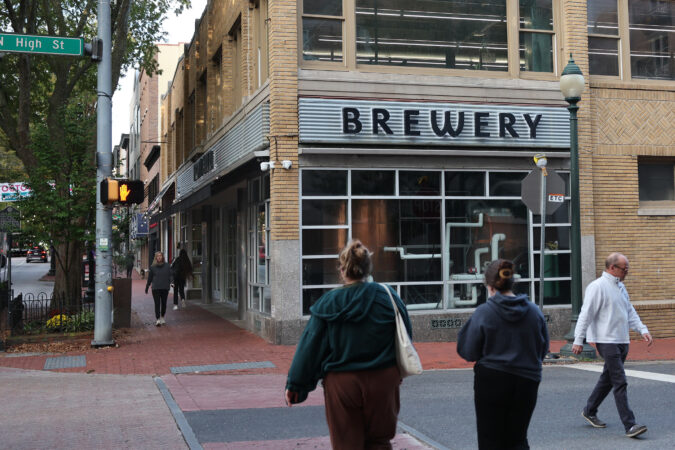
A view from the outside looking in of the closed Iron Hill Brewery in West Chester in October.
Both Barry and Crivello declined to disclose financial details of the West Chester deal, which was finalized on Christmas Eve. It was first reported Wednesday by Hello, West Chester, a local news website.
“As a landlord, I was hoping to have a chance to purchase the assets,” Barry said Friday in an interview. “I wanted to buy and keep the liquor license with the building. It allows me to get a better tenant in there that is probably going to pay a little bit more in rent.”
Situated at West Chester’s central corner of High and Gay Streets, Iron Hill had a 30-year lease, with a 15-year extension, Barry said.
Barry, a West Chester native who now lives outside Boston, purchased the nearly 30,000-square-foot building for $8.25 million in 2022, according to Chester County property records.
Barry said the next anchor tenant would take over a new lease for the now-vacant 10,000-square-foot space that can seat 300 people. He declined to specify what the lease terms might be.
“It will not be reopening as Iron Hill Brewery,” said Barry, who didn’t buy the rights to the name. “My goal would be to find something similar,” though not necessarily a brewery.
In buying the assets, Barry said the restaurant is essentially turnkey, with all the furniture and kitchen and brewing equipment still inside. A new tenant, however, may want to redesign, he said, or the space could even be subdivided for a restaurant and a retail space.
A view from the outside looking in the now closed Iron Hill Brewery in West Chester in October.
“It’s really important to me that we find the right tenant for the West Chester community,” Barry said. “It’ll take a little bit of time.”
But, he added, “my hope is we get somebody in there and operating by the summer.”
Elsewhere, Crivello said there is still hope that the Iron Hill brand could get another life.
“We’re working with a couple buyers that want to reopen [closed breweries] as Iron Hill,” Crivello said. He declined to say which locations could be resurrected.
In November, Crivello got the OK to acquire the assets of former Iron Hill brewpubs in Center City, Huntingdon Valley, Newtown, Wilmington, Lancaster, Hershey, and Rehoboth Beach, as well as West Chester and the two locations in South Carolina.
Crivello said Friday that he has since sold the assets of the former Iron Hills in Columbia and Greenville, S.C., to Virginia-based Three Notch’d Brewing Co. He said plans for the other locations were still in the works.
The answer to this question is a big deal for the approximately one-third of well-to-do Americans who own most of the stock. However, it also matters to the broader economy and thus by extension to the majority who don’t.
All of the ingredients that go into making a bubble are evident. Most important, stock prices have been on a tear. Prices never move in a straight line, but they’ve rocketed more or less straight up over the past decade, more than doubling since the COVID-19 pandemic.
This amount of price growth has happened in only three other decades since the late 1800s, when the Dow Jones Industrial Average index, comprising the 30 largest publicly traded companies, was first published. Those decades were the 1920s, the 1950s, and the 1990s.
The roaring 1920s, of course, ended terribly in the 1929 stock market crash, which ushered in the Great Depression of the 1930s. That was clearly a bubble.
In the 1950s, stock market gains were powered by U.S. companies’ dominance of the global economy after World War II. This included companies such as General Electric, AT&T, General Motors, U.S. Steel, and DuPont. That wasn’t a bubble.
And then there was the 1990s internet craze, which ended soon after Y2K with a dramatic decline in stock prices. No question: That was a bubble.
The internet was a game-changing technology that resulted in enormous productivity gains and ultimately generated significant profits. However, investors had discounted all this and much more. Stock market valuations — stock prices relative to corporate earnings — surged.
Valuations aren’t quite as lofty today as they were in the late 1990s, but they are close. And they are still on the rise. My favorite valuation measure is the ratio of the value of all publicly traded stocks, as measured by the Wilshire 5000, to economy-wide corporate profits from the Bureau of Economic Analysis.
In the 75 years for which this valuation measure can be calculated, stock prices have averaged 12 times corporate profits, a 12-1 ratio. Currently, the ratio is 20-1. The only other time valuations have been higher was at the height of the Y2K bubble, when the measure briefly spiked to 24-1.
But perhaps today’s extraordinary stock market valuation is justified. After all, this largely reflects the investors’ optimism about the large artificial-intelligence companies. These so-called hyperscalers are nothing like many of the fly-by-night internet companies (think Pets.com) that inflated the Y2K bubble.
This is undoubtedly the case, but like those internet companies, the stock prices of today’s AI companies are being juiced up by investor speculation. That is, an increasing number of investors are piling into these stocks, driven by the simple logic that since their prices have risen a lot, they will continue to rise. This momentum will continue, and if it doesn’t, they will be smart enough to recognize this and find other unwitting investors to buy their stocks before the bottom drops out.
Another form of arguably accidental speculation may also be taking hold in the stock market via the fast-growing index funds. These funds passively track a market index, like the Standard & Poor’s 500, by holding stocks in the same proportion as the index. The goal is to match the market’s performance. Index funds offer the benefits of diversification and low fees but aren’t based on an analysis of the underlying companies’ strengths.
Thus, if the stock price of a company is rising, it will attract more investments from index funds, and its price will rise even further. There is no argument that AI-chip juggernaut Nvidia’s stock price should be up significantly, for example, but it has increased substantially more due to this self-reinforcing dynamic.
The soaring stock market has been a powerful tailwind to the entire economy.
The wealthy, who own the bulk of the stocks, are now much wealthier and spending accordingly. In the past year alone, stock wealth has increased by nearly a staggering $10 trillion. This newfound wealth supports a significant amount of spending, which, in turn, supports a substantial number of jobs.
This brings into clear relief a significant threat to the economy. If the stock market is a bubble and it bursts, wiping out this wealth, consumer spending will suffer a significant blow, triggering a recession. This is precisely what happened after the bursting Y2K bubble.
So, is the stock market a bubble?
Well, if it isn’t, it soon will be if the current trends continue for much longer. The final ingredient for a bubble is that nearly all the naysayers are silenced. That happens when they’ve called out the bubble for so long, they are no longer considered credible. Any skepticism is thrown to the side, and the bubble inflates more.
We aren’t there yet. There are still too many naysayers like me.
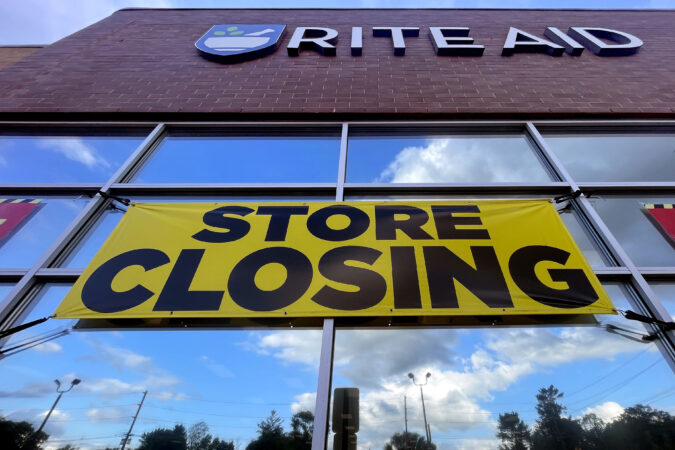
In filing for bankruptcy again, Rite Aid announced that it would be closing or selling all locations. At the time, it had about 1,000 stores nationwide, including about 100 in the Philadelphia region.
The closures further exacerbate pharmacy access issues, especially for lower-income Philadelphians who don’t have cars. People in more isolated rural areas are also impacted: The 46,000 residents of Perry County, west of Harrisburg, lost half their pharmacies when their three Rite Aids closed.
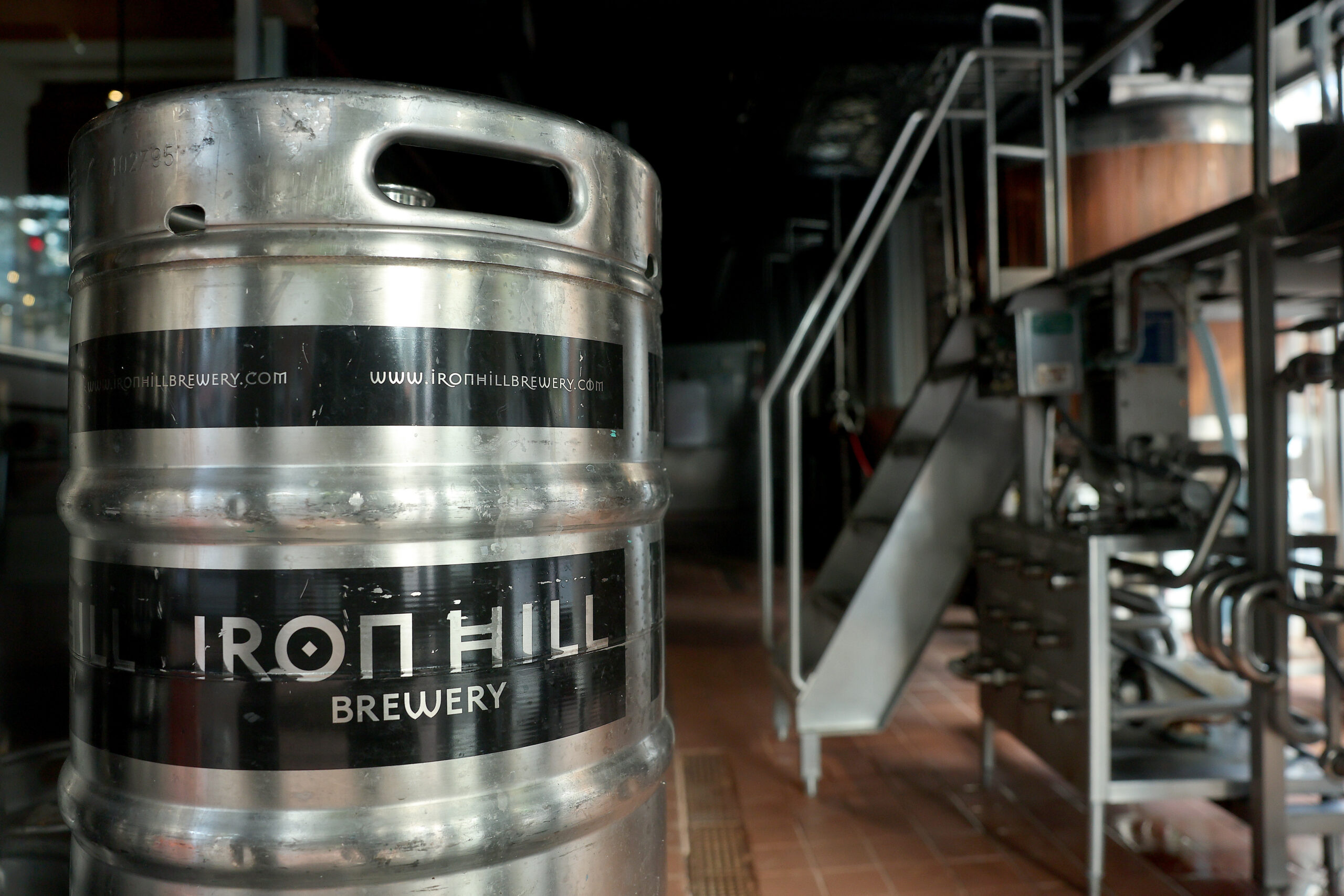
Adieu to Iron Hill Brewery
A view from the outside looking in of a shuttered Iron Hill Brewery in West Chester in October.
On a Thursday morning in late September, the nearly 30-year-old company, considered by many to be a pioneer of the local craft-brewing scene, announced that its brewpubs had closed their doors for the last time.
The closed Iron Hill Brewery in Maple Shade in September.
Bankruptcy filings shed more light on the Exton-based company’s financial straits: Iron Hill owed more than $20 million to creditors and had about $125,000 in the bank.
In November, a bankruptcy judge approved an offer by Jeff Crivello, the former CEO of Famous Dave’s BBQ, to resurrect 10 Iron Hills, including in Center City and West Chester, pending landlord negotiations. The restaurants could be reopened as Iron Hills or as other brands.
Crivello said he plans to reopen the Rehoboth Beach brewpub — as well as the Iron Hill restaurants in Columbia and Greenville, S.C. — as locations of Virginia-based Three Notch’d Brewing Co.
The fates of the other ex-Iron Hills will be determined in the bankruptcy process. Brewing equipment, furniture, and other items from the closed restaurants were auctioned off earlier this month.
Mainstays say goodbye in the Philly burbs
Gladwyne Market as pictured in October.
Local chains weren’t the only business casualties of 2025.
In South Jersey, the Bistro at Cherry Hill, a beloved restaurant that operated in a 1,200-square-foot mall kiosk for 27 years, closed abruptly in July.
At the time, the restaurant’s president, Andy Cosenza, said the closure was due to a communication “breakdown” that had resulted in his voluntary Chapter 11 bankruptcy petition being converted to a Chapter 7, or liquidation, without his knowledge. Since then, however, Cosenza has been indicted on charges of tax fraud. The Bistro has remained closed.