Shirley Spillane’s holiday shopping list is decidedly no-frills this year: cutting boards, coffee, and socks.
The Los Angeles-based school counselor used to spend big for Christmas. But this year, with stubbornly high prices, rent, and utilities, as well as a 6-month-old baby, she’s paring back. Spillane is buying a car duster for her husband and jam for her aunt — all within her $200 budget, made up almost entirely of gifts she can pick up grocery shopping at Sam’s Club.
“This season looks different than usual,” the 26-year-old said. “With the economy the way it is and a new baby, we’re keeping it small.”
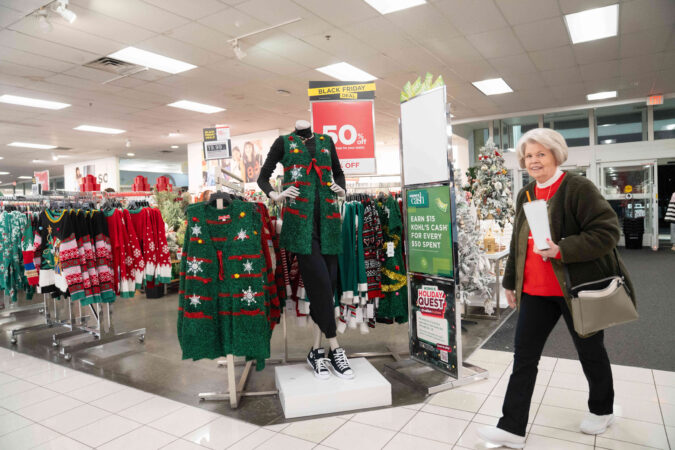
Across the country, Americans are putting a practical spin on holiday shopping. Another year of stubborn inflation and new tariffs that have lifted the prices of appliances, shoes, and toys has led many families to think twice about what they’re buying, and why. Early holiday spending data shows people are scooping up more necessities like appliances, clothing, and furniture than they did last year.
On Cyber Monday alone, online sales of refrigerators and freezers rose 1,700% from average levels in October, according to data from Adobe Analytics. Other run-of-the-mill products in high demand included vacuum cleaners (up 1,300%), small kitchen appliances (up 1,250%), cookware (up 950%), power tools (up 900%), and jackets (up 850%).
“These are items that are, in many instances, absolutely essential,” said Vivek Pandya, director of Adobe Digital Insights. “Consumers are cognizant of the broad environment and they’re being very strategic about purchases, whether it’s for themselves or gift-giving.”
While inflation has risen modestly this year, five years of price increases have led to deepening dissatisfaction with how much things cost. That sentiment helped cement political wins last month for Democrats in Virginia, New York, and New Jersey and spurred President Trump to kick off an “affordability tour” touting what his administration has done for the economy. “Our prices are coming down tremendously from the highest prices in the history of our country,” he said at a Pennsylvania casino last week.
But in interviews with nearly a dozen shoppers around the country, the Washington Post found that almost all of them said they had become more strategic about their holiday shopping this year. They were looking for discounts and comparing prices. Many were buying fewer gifts, and for fewer people.
Some parents, like Meghan Orr in Austin, said they’d begun wrapping everyday items like diapers and baby shampoo to fill the space under their Christmas trees. “At this point we’re just being silly, but it’s fun to unwrap things.”
When it came to their own wish lists, several said they wanted to do away with gifting conventions and ask family for help paying the bills — though very few thought the approach would work.
Alecia Bencze, director of career services for a law school in Akron, Ohio, has had a good year financially. Still, she’s spending about half of the $1,000 she usually does on Christmas gifts, and is sticking to items she knows will come in handy: golf balls for her father, a barbecue set for her brother, and shoes for her sister-in-law. Her own wish list includes a skillet and measuring cups.
“I’m not feeling the pinch as much as other people are, but this is the least I’ve ever spent on Christmas,” Bencze, 35, said. “I just went through and got one thing from each person’s list.”
Early holiday shopping data shows a discernible shift in spending patterns, with lower- and middle-income Americans pulling back, and the wealthy trading down from luxury stores to lower-priced retailers. Although Black Fridaysales were unexpectedly strong, those gains were largely concentrated at discounters, dollar stores, off-price department stores, and online marketplaces such as Amazon and eBay, according to Consumer Edge, which tracks transactions from more than 100 million credit and debit cards. The firm’s data showed that purchases between Black Friday and Cyber Monday tumbled 10% at high-end department stores, while luxury clothing brands saw a 5% decline from the same period last year, as even the most well-off looked for deals.
At Twiggy, a small business that sells tote bags and other gifts in Oahu, Hawaii, more customers are veering toward everyday items like kitchen towels, reusable snack bags, and sticky notes this holiday season, owner Jessica Leong-Thomas said.
“It started during the government shutdown, when people became hesitant to buy frivolously,” she said. “Since then I’ve seen a real shift. People come in and say, ‘I want to buy something that will be useful.’” (Leong-Thomas understands the impulse: “Personally, what I want for Christmas is for someone to buy me toilet paper and dish soap,” she said.)
When they do shop, data shows Americans are increasingly turning to off-price retailers such as TJ Maxx, and warehouse discounters such as Costco and Sam’s Club, for discounts on basic items, according toMary Brett Whitfield, senior vice president for shopper insights at the data analytics firm Kantar. Overall, she said, Americans appear to be spending more than they did last year, but on fewer items.
“You look at what’s happening with prices, tariffs, and other inflationary pressures, and it definitely seems like people have a more practical mindset,” she said. “I see it with my own adult children: One of them asked for socks.”
In all, holiday sales are expected to grow about 4% this year, slightly less than last year’s 4.3% increase and a notable slowdown from 13% growth in 2021, according to the National Retail Federation.
When JoEllen Barnes’s refrigerator broke down in mid-November, she and her family made do until they could scoop up a discounted replacement on Black Friday. With food and utility costs up this year, the mother of two says it’s been tougher to cover everyday costs. Instead of splurging on a Nintendo Switch for her sons like she did last year, she’s been scouring neighborhood Facebook groups for lightly used toys.
“I usually ask my husband for jewelry but that doesn’t feel appropriate now, given the extra cost of things,” said Barnes, a 43-year-old educator in Charlotte. Instead of their usual wish lists, they’re sticking to the utilitarian this year. She got him a discounted iPad on Black Friday; he’s already bought her gift too, though she doesn’t know what it is.
“Part of me is like, ‘Please don’t let it be an appliance or pots,’” Barnes said. “Although, well, it would be nice to get new pots.”
The Trump administration is seeking to boost U.S. companies as they compete for dominance in the burgeoning air-taxi sector — with an eye toward showcasing the technology at the 2028 Olympics in Los Angeles.
Through executive orders — as well as a new effort to gather data that could help fast-track adoption of these aircraft — the administration has embraced it as part of its transportation agenda.
In September, Transportation Secretary Sean P. Duffy announced the launch of a pilot program aimed at exploring ways to integrate these technologies — including air taxis, more formally known as electric vertical takeoff-and-landing aircraft — as well as hybrid-electric and battery-powered planes into the nation’s aviation system.
For decades, the dream of flying above traffic-clogged roadways has been just that — a dream. But companies such as Archer Aviation, Joby Aviation, and BETA Technologies are pitching their battery-powered aircraft, which take off and land vertically, as a way to revolutionize the way people travel. Meanwhile, Wisk, a Boeing subsidiary, and Reliable Robotics are working on versions that can operate without a pilot — an innovation that could improve the economics of air service and cargo delivery to smaller and more isolated communities.
BETA Technologies raised more than $1 billion when it went public on the New York Stock Exchange last month, and investors have poured millions into the sector. However,questions remain about whether it will live up to the hype. A plan for air taxis to transport spectators during the 2024 Paris Olympics fizzled, while other high-profile ventures have faltered. Lilium, a German eVTOL company, received an infusion of cash after filing for bankruptcy last year, but was still unable to continue operations, filing for bankruptcy again earlier this year.
Experts say one key to financial success is making the leap from anovelty for the rich to a transportation option for the masses. Skeptics say the technology is still too unproven to merit government support.
“We’re talking about spending taxpayer money on something that’s not here yet,” said Rep. Scott Perry (R., Pa.) at a House hearing last week. “The private sector is free to chase this enterprise. As I see it, it can’t beat the physics of a 1960 helicopter.”
Pilot program hopes
The public may soon see how these new types of aircraft could change how people and goods move.
Dec. 19 is the deadline for submissions to the administration’s Electric Vertical Takeoff and Landing Integration Pilot Program (eIPP). Modeled after a similar initiative for drone operations launched during President Donald Trump’s first term, it seeks to explore how quieter, cleaner, battery-powered aircraft that take off and land like helicopters can transform aviation. At least five applicants will be chosen.
“This program represents the launch of a new era of American aviation,” said Greg Bowles, chief policy officer at Joby Aviation, which has been working for more than a decade to bring its aircraft to market. He predicted it will “introduce Joby aircraft into the skies over major U.S. cities” starting next year.
Sapan Shah, senior director of portfolio management for Advanced Mobility at Honeywell Aerospace, said he expects significant interest from state and local governmentsacross the country that are eager to explore how these new types of planes can benefit their residents. The data collected from the program will offer participants an early look at how these aircraft operate in real-world conditions, and what changes will be needed to incorporate them into existing transportation systems, he said.
Major players in the industry, including BETA Technologies and Joby Aviation, have already said they plan to apply for the pilot program. In September, Archer Aviation said it hoped to participate in the program alongside United Airlines, an early investor in the company. The selections are expected to be made in March, with operations anticipated within 90 days. The pilot programs are expected to run for three years; Joby and Archer alsoaimto have a fleet of air taxis flying Olympic spectators around Los Angeles in 2028.
The state of Michigan also plans to apply, said Bryan Budds, aeronautics director for the Michigan Department of Transportation. As part of a partnership with BETA Technologies, it has installed a network of chargers for electric aircraft at four airports. While much of the focus around air taxis is on how they can move people in dense urban areas, Budds said one potential use in Michigan is moving pharmaceuticals and medical goods to the state’srural areas.
There’s also been movement in Congress, which included several provisions aimed at bolstering air taxis in last year’s Federal Aviation Administration reauthorization bill. The industry received another major boost that year when the FAA released standards for air-taxi pilot training and certification.
To supporters, a main case for investing in these technologies is to ensure the U.S. continues its dominance more broadly of the global aviation industry. China, for example, has already certified an air taxi capable of carrying passengers.
At the House hearing last week, lawmakers emphasized the importance of ensuring that lead.
“Either we choose to embrace and unleash American innovation, or we carry on with the status quo and watch as other nations surpass us in new and emerging technology,” said Rep. Troy E. Nehls (R., Texas).
Even in the early stages, experts say, such programs can yield valuable information.
With a demonstration program, “we’re getting technology out into the actual markets,” said Laurie Garrow, a civil engineering professor at Georgia Institute of Technology who has followed developments in advanced air mobility.
These real-world projects will help communities and the FAA understand how these aircraft operate in the existing air traffic system and where the pain points might be, and the data gathered will help policymakers as they attempt to scale up to larger operations, she added.
Savanthi Syth, an aviation analyst with Raymond James, said giving manufacturers and communities an early opportunity to “try out” the technology in controlled environments means that by the time the aircraft are fully certified, they won’t be starting at square one — they’ll already have information allowing them to move into the next phase of operations.
Said Syth: “This is a better way than ‘Oh, you have a certified aircraft but now you have to get community buy-in.’”
We’re in the thick of the holiday shopping season, and U.S. residents are expected to shatter the spending record again this year. The National Retail Federation forecasts that 2025 will be the first time we collectively spend more than $1 trillion on year-end gifts.
A lot of materials, energy, packaging, and gasoline have gone into making and moving those gifts. All of those processes release planet-warming gases into the atmosphere.
But a lot of that environmental impact is avoidable. Making, baking, thrifting, and avoiding traditional wrapping paper are all more planet-friendly ways to give. We’ve got tips on how to do them all.
Homemade doesn’t have to be difficult
Sure, if you’ve got the skill to turn a wooden bowl or needlepoint a Christmas stocking, those gifts are guaranteed to be unique and meaningful. But not all of us have the knowledge or time.
Sandra Goldmark, associate dean of Columbia Climate School’s Office of Engagement and Impact, said one of her favorite options is an act of service for a loved one. One year, for example, her husband organized all her passwords for her.
“It was not something easy to wrap and put under the tree, but believe me, it was meaningful and really helped me more than any additional object cluttering up my home could have,” she said.
Another winner: food. If, say, you have a long list of recipients, buy ingredients in bulk and pack them in Mason jars. Cookie mix, soup mix, sourdough starter, and spice mixes are all easily sealed and transported that way. Add some ribbon and a sprig of cedar, and it’s festive. Homemade baked goods and snacks are other options.
“It’s inexpensive, but it takes care and time and attention,” said sustainable-living educator Sarah Robertson-Barnes.
Give experiences instead of buying more stuff
The advice here starts out simple: Buy less stuff. The best way to give gifts more sustainably is to buy fewer new things, said Goldmark.
Stockings can be a common spot for toys that break quickly before going straight to the landfill. Instead, you can fill stockings with things that your friends or family need anyway, like toothbrushes or body wash, or traditional treats like fruit and chocolates.
Giving someone an experience is another popular option. That might mean a pair of concert tickets, a spa day, a gift card to a favorite local restaurant, a local news subscription, or a membership to a local garden or zoo that the recipient can use over and over. Research has indicated that experiences strengthen relationships better than material gifts do.
“There is so much that you could do by just saying, ‘I would prefer if you just made me a nice meal or took me out for some sort of adventure,’” said Atar Herziger, environmental psychologist and assistant professor at Technion — Israel Institute of Technology.
Experiences also come with less packaging. Herziger cautions, though, that travel can have a high impact especially if it involves planes. So she recommends local options such as a nearby hike or a staycation.
And if you’re unsure what experience your loved one would prefer? Herziger said don’t overcomplicate it — just ask.
Go vintage
Secondhand gifts are easier on the planet because they involve less manufacturing, packaging, and shipping. Robertson-Barnes looks to Facebook Marketplace or her local Buy Nothing group to find items that she would have otherwise bought new.
“I bet somebody has the thing that you’re looking for and they would love to get rid of it,” she said.
Still, for some recipients, secondhand gifts are taboo.
“We do have a weird cultural thing where new is better and used is gross,” said Robertson-Barnes, who suggested reframing used gifts as “vintage.”
Similarly, Herziger said secondhand options might be received better when they’re items that can’t be bought new, such as a family heirloom or a collectible that isn’t produced anymore.
Goldmark looks to thrift stores for smaller toys or mugs. Record stores, used book stores, furniture stores, and antique shops are other options. And of course big names like eBay and Goodwill can have rare and unique finds, too.
If buying secondhand simply won’t work for a recipient, Goldmark said to focus on items that are high-quality, long-lasting, repairable, and really needed. That ensures that it’s worth investing in and reduces the chance that it gets returned. Look to buy locally, rather than ordering online, to reduce how far it travels.
The wrapping matters, too
Millions of pounds of wrapping paper end up in the landfill every year. Much of it is blended with plastic to make it shiny or sparkly, so it can’t be recycled.
Not sure whether your wrapping paper is recyclable? Check your local recycler’s website for guidelines, or try a simple test by crumpling it into a ball. If it holds its shape, it’s more likely recyclable. Also, if it rips as easily as printer paper or gets soggy like a saturated brown grocery bag, those are good signs it’s recyclable, too.
Robertson-Barnes said if you already have wrapping paper on hand, you should use it rather than waste it. But once it’s gone, she recommends reusable wrapping cloths such as furoshiki, a traditional Japanese fabric for presenting gifts.
Some experts also recommend gift bags as long as they’re reused — and not tossed.
Another cheaper and more planet-friendly alternative to wrapping paper is newspaper or brown paper bags. Tie them off with reusable ribbon, a couple pinecones or a candy cane, and suddenly it’s festive.
Plus, brown paper is a blank canvas with endless opportunities for customization. “If you’ve got kids, then their drawings are wonderful packaging materials. They make the best wrapping paper,” Herziger said.
ATLANTIC CITY — The journey through Atlantic City is bumpy these days, and not only because Atlantic Avenue is desperately in need of paving.
Ducktown Tavern owner John “Johnny X” Exadaktilos has one wish for Atlantic City that has nothing to do with the gut-jarring avenue that runs in front of his bar.
“Just normal,” says Exadaktilos. “I just want things to be normal.”
Atlantic City, a place of historic mayoral misdeeds, multimillionaire overreach, and chronic unwanted attention, has managed in this waning year, even as its workers string up holiday decorations, to come up with a new plot twist: Its newly reelected Democratic Mayor Marty Small Sr. is on trial for alleged physical abuse of his teenage daughter.
The trial has left Small untethered from his cell phone as new casinos have been green lit in New York City, and the state moves to tighten its authority over the town. Another trial, of Small’s wife, La’Quetta Small, who is the superintendent of schools, is set for Jan. 12.
With Small reporting to an Atlantic County courthouse each day to face his daughter, who spent seven hours testifying against him on Tuesday, a bit of a hush has fallen on the city as it awaits the outcome, which could come this week.
The sentiment in City Hall, where many employees owe their jobs to Small, leaned toward the assumption that Small would beat this charge like he’s beaten two previous indictments on voter fraud charges.
But will the city emerge unscathed?
“Every day, people who live in Atlantic City want to know what those of us are elected are doing to make their lives better and respond to their issues and concerns,” said council member Kaleem Shabazz, who was going from a planning board meeting to a mayor-less City Hall last week. “Whatever will happen will happen. The city still has to function. People have to be responsible.”
On Dec. 1, as Small readied for jury selection in Mays Landing, New York City approved three casinos, two for Queens and one for the Bronx, a development long feared in Atlantic City.
On Dec. 5, with the jury picked, the iconic Peanut World on the Boardwalk erupted in flames. On Dec. 9, with the mayor listening to his daughter, legislators in Trentonwere proposing more state oversight of A.C. including a surprise provision that would give the state the power to pick developers for major projects.
The biggest threat may come from the New York casinos, which some in the industry estimate could threaten as much as 30% of A.C.’s business and lead to the shuttering of one casino, if not more.
Small could face jail time and be forced to step down as mayor under New Jersey law, if convicted. He and his wife, who has been attending her husband’s trial, taking notes in the back, have resisted calls to relinquish their powerful roles as mayor and superintendent.
“It’s not ideal obviously,” said Shabazz. “If you had to pick a multiple choice question what would you want to be happening in your public schools, that wouldn’t be something you would pick, if you’re a parent or a taxpayer.”
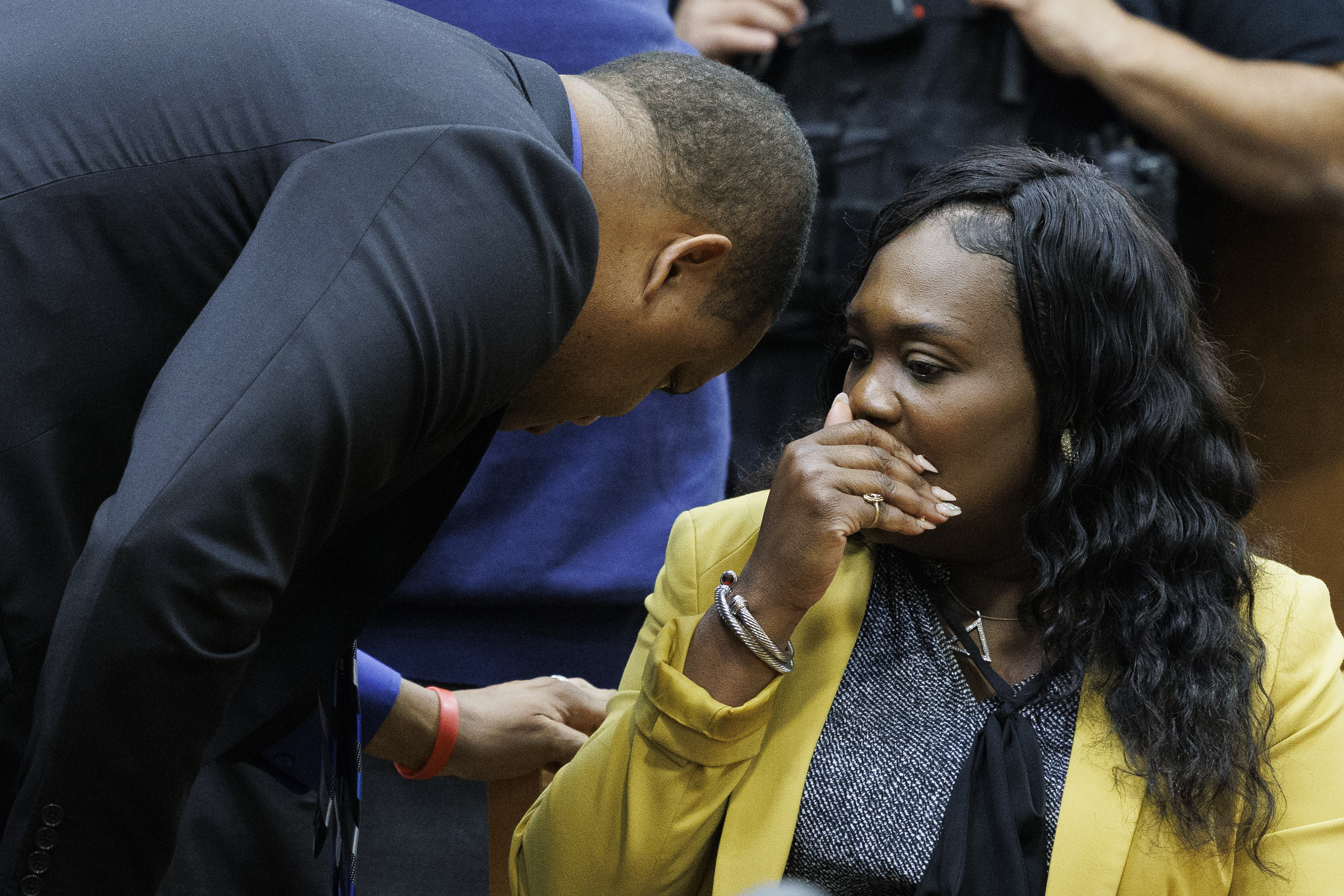
Atlantic City Mayor Marty Small and his wife, Superintendent of Schools La’Quetta Small, chat before the start of arraignment on Oct. 10, 2024. Mayor Small stood trial last week in Mays Landing. Cameras were barred from the courtroom during the trial.
‘A wake-up call’
Early one morning last week, having just come from a planning board meeting, Shabazz said the city was going about its business. “I’m not at the trial, I’m on my way to City Hall,” he said. “The work of government has to go on.”
Shabazz, who’s been focused for years, even decades, on some of the same intractable problems of the resort, remains optimistic. It’s a city where it can be hard to read the scorecard: progress seems to be there, but not there, at the same time.
The city’s only full-size supermarket, the beleaguered Save A Lot is under new management, and the adjacent nuisance liquor store is expected to close. High-profile developers like Jared Kushner and K. Hovnanian appear to be going forward with residential projects in the city’s Inlet section. There are new restaurants, like the Byrdcage in Chelsea and Simpson’s, relocating next month to Atlantic Avenue.
Shabazz is hoping the state will return zoning authority back to the city after years of the Casino Reinvestment Control Authority overseeing planning and zoning in the city’s tourism district.
Kaleem Shabazz, president of the local chapter of the NAACP in Atlantic City, and Maryam Sarhan, a community organizer, stand in front of mural honoring civil rights leaders. “The city still has to function,” he said, while its mayor is on trial for alleged child abuse. “People have to be responsible.”
But last week, as the mayor listened to his daughter testifying that he struck her in the head with a broom, after she threw detergent at him and refused to go to a community march, the state went in the opposite direction: a bill to renew the state’s takeover of Atlantic City for another six years that would allow the state to pick a “master developer” to oversee big projects, the Press of Atlantic City reported.
“We have to be competitive,” Shabazz said. “We have to let people know that we’re open for business and we’re safe and secure. Crime is down significantly.”
Like others interviewed, he believes Atlantic City can sell itself as a safe and affordable seaside destination. “We still have a free beach,” he said. “We have to let people know what we have.”
Atlantic City Mayor Marty Small arriving for his arraignment before Judge Bernard DeLury at the Atlantic County Criminal Courthouse in Mays Landing on Oct. 10, 2024. Small testified in his own defense Friday during his trial. Cameras were barred from the courtroom.
Small has defended himself by describing this latest situation as a private family problem, not related to his job performance. He has called the prosecution politically motivated and an overreaction. A jury will now weigh in.
John Boyd Jr., a principal in the Boyd Co., which advises companies on where to locate, said many developers (and homeowners) continue to balk at Atlantic City, despite the upward pressure on Jersey Shore real estate that has left the city as arguably the last affordable seashore town in the entire Northeast.
He called the three New York City casino licenses “a wake-up call” for New Jersey, and advocates a plan where the state allows casinos at the Meadowlands and/or Monmouth Park but shares the revenue with Atlantic City.
“If you ask national developers their opinion of Atlantic City, it wouldn’t be a very positive one for a myriad of reasons,” he said.
“Good governance is fundamental to economic development success. Companies want to minimize risk. It’s more than the mayor being on trial. It’s the uncertainty.”
Meanwhile at the slots
Inside Hard Rock casino during a blustery stretch last week, people were three deep at the holiday-branded Mistletoe Bar in the lobby, and nine guitars had become a menorah in the atrium.
Gamblers were locked in as names were called for a random spin-the-wheel drawing every half hour. A convention of real estate agents brought lines to the check-in desk. The trial was off in the distance, invisible to most.
“I do love coming to Atlantic City,” said Adam Druck, 33, a Realtor from York, Pa. “I hope the trial doesn’t make too much difference to what’s going on here.”
Asked about New York casinos, Joe Pendle, 71, a retired police officer from North Jersey, said he was comfortable with his routines at Hard Rock, where free rooms and meals anchored his pleasant stays. (Hard Rock itself has one of the three licenses in New York City, an $8.1 billion project near Citi Field in Queens, which it projects will result in $1 billion a year in tax revenue.)
“I have a three-room suite upstairs,” noted Pendle. “I like the beach.”
Arthur Austin, 70, of Old Bridge, said he had worked for decades on Wall Street and had no desire to travel to New York for a casino weekend.
“I worked in the city for 20 years,” he said. “I only go into the city if I have to.”
Adam Druck, 33, of York, Pa., and Eric Moeller, 36, of Reading, inside Hard Rock casino on Dec. 9, where they were staying as part of Triple Play Realtor Convention and Trade Expo in Atlantic City.
Out-of-towners like Austin hadn’t heard about Small’s trial, but the local gamblers at Hard Rock sure had.
“Atlantic City is a crooked place, and it’s always gonna be crooked because of what everybody’s into,” said a 57-year-old woman who lives locally and was playing the slots. She did not want her name used so that she could speak her mind in a small town.
“People want their guy to stay in there,” said the woman. “He gives everybody a job. You could flourish, but only if you are with the right people.”
“I don’t think that it hurts Atlantic City,” said Seng Bethia, 40, of Atlantic City, who was at the slots. “His daughter is such a sweet girl. It was bad, just the whole thing.”
‘Are you kidding me right now?’
Exadaktilos, the Ducktown Tavern owner who is Small’s loudest detractor, said he had taken things down a notch of late, putting aside his popular weekly Facebook live rants that he said had started consuming him.
Still, last week, as the prosecution wound up its case, the city sent out a contractor to do some temporary filling in of cracks on Atlantic Avenue in advance of the city’s holiday parade, and Exadaktilos found himself back on Facebook live.
“Are you kidding me right now?” he said over footage of the roadway. “What happened to Atlantic Avenue is going to be paved? Horrible.”
Boyd, the location consultant, points to bright spots. The national developers are a vote of confidence, as is the Septemberopening of the SeaHaus boutique hotel on the Boardwalk, a Marriott property. Showboat and the Sheraton near the Convention Center are converting rooms to residences.
Boyd sees potential for Atlantic City to follow the likes of Coney Island, which has seen a renaissance, to attract film business, to market itself as a live-work-play destination.
Outgoing council member George Tibbitt looks at the Kushner plan, a 180-unit apartment complex, as another missed opportunity. “No vision there,” he said. “That’s desperate development.”
“New York City definitely makes me afraid,” said Tibbitt. “There’s only so many gambling dollars to go around. Adding more casinos is going to be devastating. We have to clean the city up. We have to get the neighborhoods filled back up.”
One industry the city bet heavily on was cannabis: Its midtown quickly filled with 16 dispensaries. But after complaints from the cannabis entrepreneurs themselves, city council capped the number at 16, leaving many that have been approved but have yet to open (including one that necessitated the demolishing of a historic church) in limbo.
Atlantic City is a place where things can seem to be finally coming together, while simultaneously unraveling. Big plans vaporize, like the highly touted gym and nightclub outside Showboat, where last summer, the owner set up couches, DJ booths, and exercise machines, got stalled by permitting issues, and quietly dismantled them.
Miguel Lugo, general manager at AC Leef, which held out for a strategic spot on Albany Avenue, said his cannabis business has been good. He looks forward to the dispensary running financial literacy classes for the community, and getting its cultivation license.
“On this side of the town, everything’s been phenomenal,” Lugo said. “I’m super focused on AC Leef. I don’t know what’s going on with the mayor.”
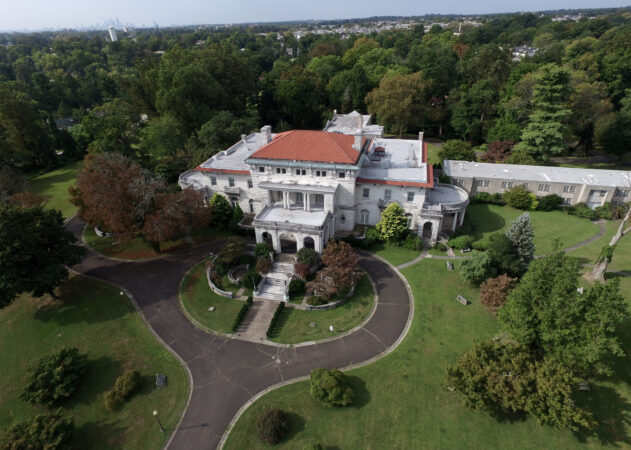
The Elkins Estate, which already hosts weddings in its main mansion, is set to add a boutique event space and a distillery in the new year.
In the fall, the Tudor-style Chelten House will open for smaller gatherings of 100 or fewer people, and include 16 guest rooms, said Jeanne Cretella, cofounder of By Landmark hospitality.
“We’re really looking forward to our next phase,” Cretella said, noting that the Chelten House “will be the perfect setting for those much more intimate events, whether it’s seminars or retreats or business meetings.”
In 2019, Jeanne and Frank Cretella’s company, By Landmark, bought the sprawling Cheltenham property for $6.5 million from the Dominican Sisters of St. Catherine de Ricci, who had used the grounds for religious retreats. At the time, the couple said they intended to spend $20 million to restore six historic buildings on the site.
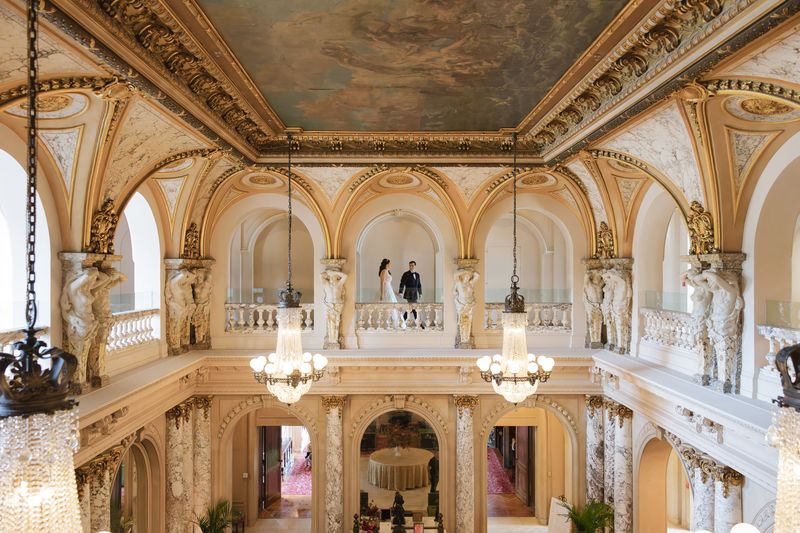
A couple walks through a room in the Elstowe Manor at Elkins Estate.
By Landmark’s final investment numbers were not available Friday, according to a spokesperson, as renovations are ongoing.
The Cretellas initially envisioned a luxury boutique hotel with more than 100 guest rooms, a spa, a restaurant, and other amenities. At one point, they even considered installing a heliport on the site.
Then the pandemic happened, Jeanne Cretella recalled Friday.
Despite the challenges of that time, “we are so proud that we were able to open up Elstowe Manor,” the estate’s 70,000-square-foot centerpiece that required extensive plumbing, electrical, heating, and ADA upgrades to be brought up to code, Cretella said.
A room at the Elkins Estate’s Elstowe Manor, its main mansion, set up for a wedding reception.
“We made the decision after COVID that it would be best … to have the rooms only open to event guests,” she said.
With 50-foot frescoed ceilings and a grand ballroom with a glass skylight, Elstowe Manor can host 300-person events and includes 69 guest rooms.
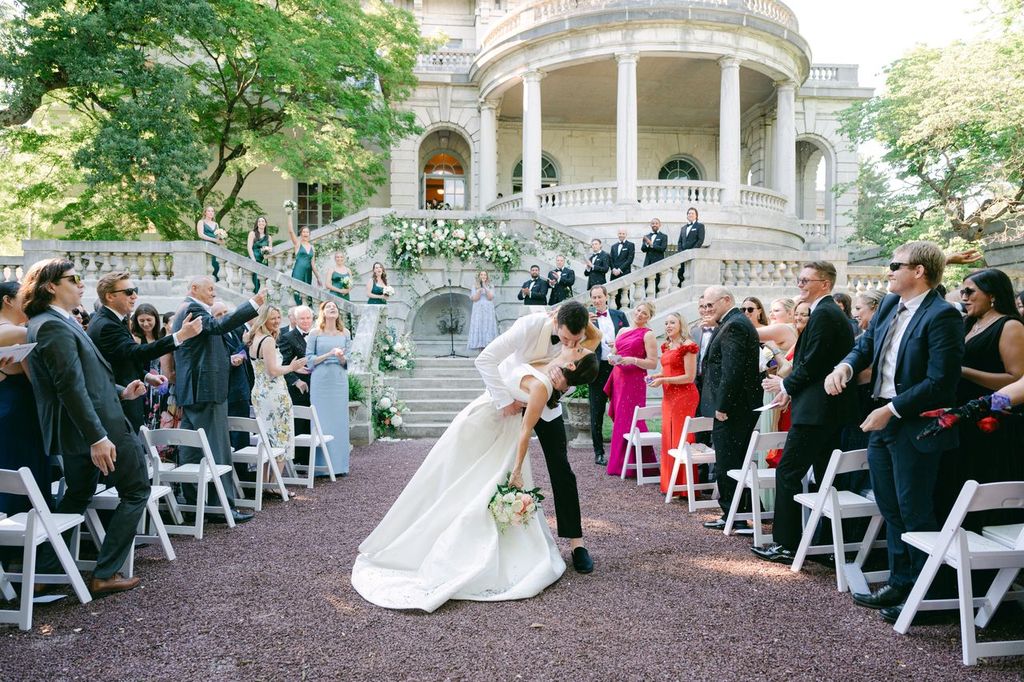
More than 100 weddings and events have been held at the manor in the past two years (The venue also hosted weddings in the early 2010s when it was briefly owned by a nonprofit that went bankrupt).
A couple kisses during their wedding ceremony outside the Elkins Estate’s Elstowe Manor.
At the estate these days, couples and their guests feel like they “are somewhere really special, and have the ability to really enjoy utilizing the estate for the whole weekend,” Cretella said.
With its more intimate setting, the Chelten House is meant to complement the Elstowe Manor, Cretella said. The home features Italian Renaissance Revival designs, with terracotta roof tiles, large arched windows, wood-paneled rooms, and marble fireplaces.
While each part of the property is set apart and has its own entrance, Cretella said she foresees the Chelten House being busy during the week (when most corporate retreats occur) and the Elstowe Manor bustling with wedding festivities on the weekends.
Some larger weddings may use both the manor and the Chelten House for their events and accommodations, she said.
Cretella said they don’t foresee adding more amenities to the property in the near future.
“The original plan to have a restaurant was definitely in conjunction with having a hotel that was open to the public,” not just event guests, she said. So “opening up a restaurant is not on the horizon.”
But, she added, “we won’t say never.”
For now, Cretella said they are focused on their events, including opportunities to welcome the public onto the historic site.
Earlier this year, the estate opened a podcast recording studio and demonstration kitchen, which Cretella said they hope local school students can use. They are also looking to bring professional actors and creators into the space.
In November, By Landmark opened the estate up for paid public tours. A tour in early January, which costs $30 a person, is already sold out.
Cretella said the estate plans to host a Valentine’s Day dinner, open to the public, with an optional overnight stay after the meal.
For the Chelten House, booking for small private events will open in the new year, Cretella said.
Based in North Jersey, By Landmark operates nearly 30 venues in Pennsylvania and New Jersey. They include the Hotel du Village and the Logan Inn in New Hope.
In the late 1800s, the Elkins Estate was built as a countryside retreat for railroad magnate William Lukens Elkins, who is credited with helping to form what would eventually become SEPTA and the Philadelphia Gas Works.
WASHINGTON — This holiday season isn’t quite so merry for American shoppers as large shares are dipping into savings, scouring for bargains, and feeling like the overall economy is stuck in a rut under President Donald Trump, a new AP-NORC poll finds.
Roughly half of Americans say it’s harder than usual to afford the things they want to give as holiday gifts, and similar numbers are delaying big purchases or cutting back on nonessential purchases more than they would normally.
It’s a sobering assessment for the Republican president, who returned to the White House in large part by promising to lower prices, only to find that inflation remains a threat to his popularity just as it did for Democrat Joe Biden’s presidency. The poll’s findings look very similar to an AP-NORC poll from December 2022, when Biden was president and the country was grappling with higher rates of inflation. Trump’s series of tariffs have added to inflationary pressures and generated anxiety about the stability of the U.S. economy, keeping prices at levels that many Americans find frustrating.
The president has insisted there is “no” inflation and the U.S. economy is booming, as he expressed frustration that the public feels differently.
“When will people understand what is happening?” Trump said Thursday on Truth Social. “When will Polls reflect the Greatness of America at this point in time, and how bad it was just one year ago?”
Most U.S. adults, 68%, continue to say the country’s economy is “poor,” which is unchanged from December 2024, before Trump returned to the presidency.
Americans are feeling strained as they continue to see high prices
White House officials plan to send Trump barnstorming across the country in hopes of bucking up people’s faith in the economy before next year’s midterm elections. But the president this week in Pennsylvania defended the price increases tied to his tariffs by suggesting that Americans should buy fewer dolls and pencils for children. His message is a jarring contrast with what respondents expressed in the poll, even among people who backed him in the 2024 election.
Sergio Ruiz, 44, of Tucson, Ariz., said he is using more buy now, pay later programs to spread out over time the expense of gifts for his children. He doesn’t put a huge emphasis on politics, but he voted for Trump last year and would like to see lower interest rates to help boost his real estate business. He believes that more Americans having higher incomes would help to manage any affordability issues.
“Prices are up. What can you do? You need to make more money,” Ruiz said.
The poll found that when they do shop, about half of Americans are finding the lowest price more than they would normally. About 4 in 10 are dipping into their savings more than at other times.
Democrats are more likely than Republicans to say they’re cutting back on expenses or looking for low prices, but many Republicans are budgeting more than usual as well. About 4 in 10 Republicans are looking for low prices more than they usually would, while a similar share are shopping for nonessential items less than usual.
Views are largely similar to when Biden was president
People felt similarly dismal about holiday shopping and the economy when Biden was president in 2022. Inflation had spiked to a four-decade high that summer. Three years later, inflation has eased substantially, but it’s still running at 3%, a full percentage point above the Federal Reserve’s target as the job market appears to have entered a deep freeze.
The survey indicates that it’s the level of prices — and not just the rate of inflation — that is the point of pain for many families. Roughly 9 in 10 U.S. adults, 87%, say they’ve noticed higher than usual prices for groceries in the past few months, while about two-thirds say they’ve experienced higher prices than usual for electricity and holiday gifts. About half say they’ve seen higher than normal prices for gas recently.
The findings on groceries and holiday gifts are only slightly lower than in the 2022 poll, despite the slowdown from an inflation rate that hit a four-decade peak in the middle of that year.
Consumer spending has stayed resilient despite the negative sentiments about the economy, yet Trump’s tariffs have caused changes for shoppers such as Andrew Russell.
The 33-year-old adjunct professor in Arlington Heights, Ill., said he used to shop for unique gifts from around the globe and buy online. But with the tariffs, he got his gifts locally and “this year, I only bought things that I can pick up in person,” he said.
Russell, who voted Democratic in last year’s election, said he worries about the economy for next year. He thinks the investment in artificial intelligence has become a bubble that could burst, taking down the stock market.
Little optimism about an economic rebound in 2026
Few people expect the situation to meaningfully improve next year — a sign that Trump has done little to instill much confidence from his mix of tariffs, income tax cuts, and foreign trips to attract investments. Trump has maintained that the benefits from his policies will begin to snowball in 2026.
About 4 in 10 U.S. adults expect next year will be economically worse for the country. Roughly 3 in 10 say conditions won’t change much. Only about 2 in 10 think things will get better, with Republicans being more optimistic.
The belief that things will get better has slipped from last year, when about 4 in 10 said that 2025 would be better than 2024.
Millicent Simpson, 56, of Cleveland, said she expects the economy to be worse for people like her who rely on Medicaid for healthcare and the Supplemental Nutrition Assistance Program. Simpson voted Democratic last year and blames Trump for the greater economic pressures that she faces going into the winter.
“He’s making it rough for us,” she said. “He’s messing with the government assistance for everybody, young and old.”
The AP-NORC poll of 1,146 adults was conducted Dec. 4-8 using a sample drawn from NORC’s probability-based AmeriSpeak Panel, which is designed to be representative of the U.S. population. The margin of sampling error for adults overall is plus or minus 4 percentage points.
As shoppers flood stores across the country during the year’s biggest shopping season, retail workers are bracing for what many describe as the most demanding — and often demoralizing — stretch of the job.
“It magnifies everything,” said Nick Leighton, host of the podcast Were You Raised by Wolves?, which he cohosts with comedian Leah Bonnema. Together, they dissect etiquette and the subtleties of social behavior.
“People are stressed, they’re busy, they’re frazzled,” he said. “When that happens, we tend to forget other people exist.”
Whether it’s gridlocked parking lots or shelves picked clean, the holiday retail environment can become a pressure cooker where manners evaporate quickly.
November and December have long driven retail sales, prompting companies to hire large numbers of seasonal workers to manage the surge. These workers often absorb the brunt of shoppers’ frustration. Some customers treat employees as extensions of a corporation rather than as people.
This year, there might be even fewer employees to handle crowds of holiday shoppers. Companies say they could cut back on seasonal workers because of economic uncertainty, while at the same time, shoppers are expected to spend more than they did last year.
“Yelling at a worker isn’t doing anything,” Leighton noted. “Everyone else is busy, too. … Your shopping isn’t more important than the next person’s.”
Here are some expert suggestions on how customers can be kinder, more polite, and more empathetic toward the people helping to execute all those holiday lists.
Manners apply everywhere
People who behave courteously generally do so everywhere, while those who are rude in stores often have similar issues in their personal lives, etiquette consultants say.
“We do not pay retail workers to be a therapist, a social worker, or a punching bag. It’s not appropriate, and it’s not fair,” said Jodi R.R. Smith, president of Mannersmith Etiquette Consulting in Massachusetts. Long before she advised companies on etiquette, Smith worked several holiday seasons at a Hallmark store.
Plan your shopping trip and leave time
Smith advises shoppers to plan ahead — knowing who is on their list, which stores they need to visit and when they will go. “Set yourself up for success,” she said. “Bring water or a snack. Do not go hungry.”
Timing matters as well. “Ask yourself, ‘When is the best time to go?’” she said. “Weekends are busier, lines are longer, and parking is tighter. If possible, go on a Wednesday morning when the store opens.”
Establish a little rapport
Smith suggests making friendly eye contact with workers, offering a greeting, and using humor to diffuse tense moments. If someone in line becomes irritable, she said, a gentle joke about needing a nap can reset the mood.
“We don’t have control over others’ behavior, but we certainly do over ours,” she said.
Shoppers can help reduce frustration by asking questions — and recognizing that workers may not have all the answers, said Elizabeth Medeiros, 59, who spent more than 35 years in retail in New York and the Boston area.
Some companies are acting preemptively. Delta Air Lines is encouraging kindness between customers and employees with a “Centennial Cheer” program. It says it will recognize “100,000 acts of kindness” with Holiday Medallion cards, which can be redeemed for gifts.
Manage expectations
Customers often assume store employees can control everything from inventory and discounts to restocking speed and even the behavior of other shoppers, she said.
They can’t.
“Customers are focused, especially during the holidays,” said Medeiros, a former district sales manager and longtime store manager. “They’re checking off lists and looking for deals, and anything that interferes with that throws them off.”
Holiday work is already tough for staff under the best of circumstances, she noted. “Everyone is often stretched thin. Breaks get skipped, shifts get extended unexpectedly, and six-day workweeks become common.”
As Smith puts it: “Clerks are not the CEO. Don’t expect someone making hourly wages in December to change a store policy you don’t like.”
Training workers to defuse tension
Adam Lukoskie, executive director of the National Retail Federation Foundation, emphasized that most customer interactions remain positive.
“In the news you might see a couple of incidents, but most experiences are OK,” he said. “We work hard to provide a high-quality environment.”
The foundation’s RISE Up skills-training courses now reach more than 80,000 people annually. “It gives associates the tools to provide customer service and to understand that an angry customer is usually mad at the problem, not at them,” he said.
Above all, he said, shoppers should reframe how they view the person behind the counter.
“Act as if the person helping you is your daughter or son, or your mother or father. Not just someone there to do a task for you.”
It’s no secret that times are tough for landlords around Temple University.
An eight-bedroom rowhouse at 1734 N. Gratz St., for example, languished on the real estate market after being listed for sale, like many dormlike apartments left in the wake of a rental boom that fizzled amid declining student enrollment.
The property went up for sale in April 2024 for $475,000 — $40,000 less than the owner had paid two years prior. It sat on the market for one year with no takers.
Then real estate agent Patrick C. Fay got involved.
In April 2025, the Gratz Street rowhouse was re-listed for $875,000. The very same day, it was listed as a pending sale, with Fay representing the buyer, according to real estate data from the Realtors Multiple Listing Service.
An Inquirer review of 33 other sales Fay brokered over the last year showed a similar pattern.
After properties went unsold at lower prices, Fay stepped in as the buyer’s agent and almost immediately arranged a sale for anywhere from $290,000 to nearly $550,000 more than sellers originally asked for.
On average, Fay’s clients have paid about double the original listing.
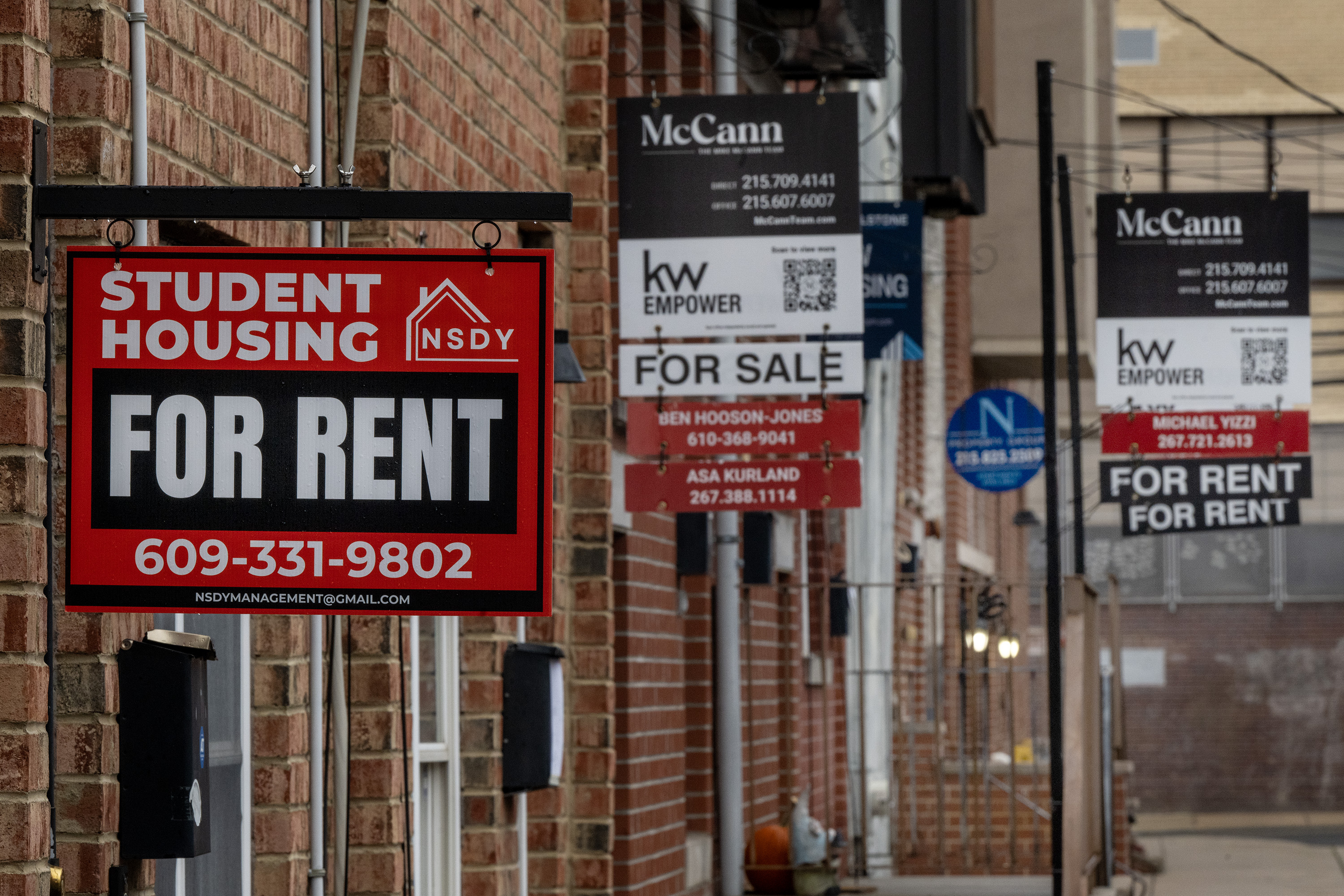
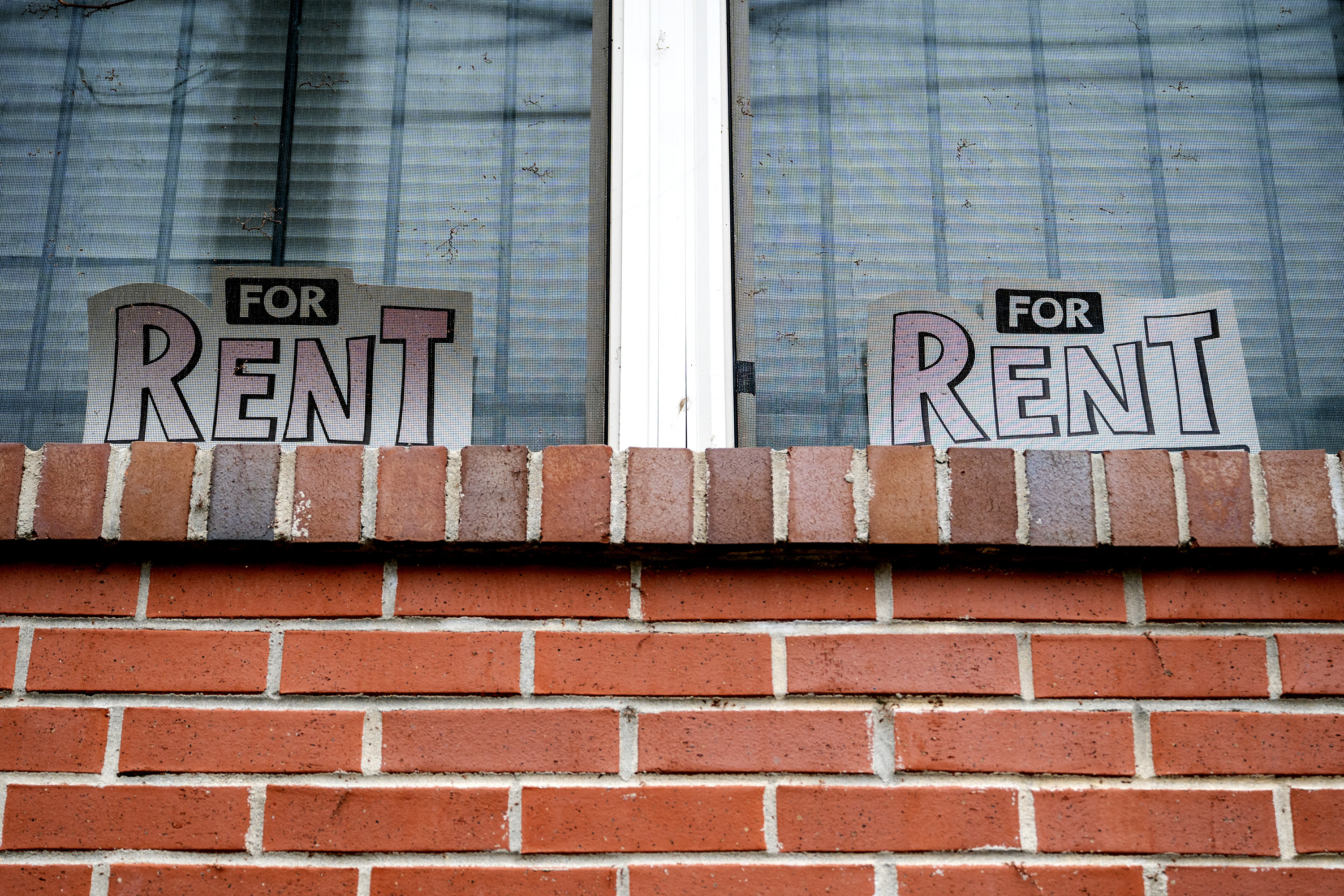
The value of rental properties around Temple has dipped in recent years. Many property owners have sold. Some blocks, like the 1700 block of Arlington St., are lined with for-rent and for-sale signs.
Fay, who worked out of Coldwell Banker’s offices in Old City and Moorestown, Burlington County, has now represented buyers in at least $40 million worth of settled or pending real estate deals involving multifamily properties around Temple.
(After this article published online Friday, the real estate firm cut ties with Fay and his biographical page was removed from its site. “The agent is no longer affiliated with Coldwell Banker Realty,” a company spokesperson said by email.)
Of about a dozen properties in the area that sold for more than $750,000 over the last 90 days, every one listed Fay as the buyer’s agent.
The Inquirer’s examination of the deals found the sales involve a small group of repeat buyers, including two linked to an earlier prosecution over a 2000s-era mortgage fraud scheme. In that case, federal investigators found that the group was involved with purchasing distressed homes using artificially inflated mortgages, pocketing the excess money and allowing the properties to lapse into foreclosure.
Fay, who is one of the top agents in his Coldwell office, said his transactions were all aboveboard. He credited the high sale prices to rebounding demand for student housing in the Temple University area.
“I think it’s a desirable area for sure,” said Fay, who lives in Moorestown. “They just had their biggest enrollment of all time.”
Pat Fay has been one of the top real estate agents this year in Coldwell Banker’s Old City office. His clients have been purchasing properties around Temple University, but at steep markups.
Actually, Temple’s head of admissions resigned last month after the university missed its annual enrollment goal. Its student population remains below 30,000, down from a high eight years ago of more than 40,000.
“This is not a good time for being a property owner around Temple,” said Nick Pizzola, vice president of the Temple Area Property Association, a group that represents many landlords and was formed to “encourage responsible development and property management” in the area.
“Rents are down, vacancies are up,” he said. “It’s a buyer’s market.”
The financing on Fay’s sales is provided by higher-risk private lenders, which grew in popularity as conventional bank lending contracted in the wake of the 2008 real estate crash.
Jon Hornik, head of the National Private Lenders Association, a trade group that represents firms like the ones that lent to Fay’s clients, recently flagged sales around Temple on a watch list the group maintains for suspicious transactions.
He had a simple explanation for these market-defying sales.
“These are bad actors inflating the value of the real estate through the sale structure, and therefore borrowing more money than they really should be able to,” Hornik said in an interview. “There’s real estate there. There’s a borrower there. But the values are off.”
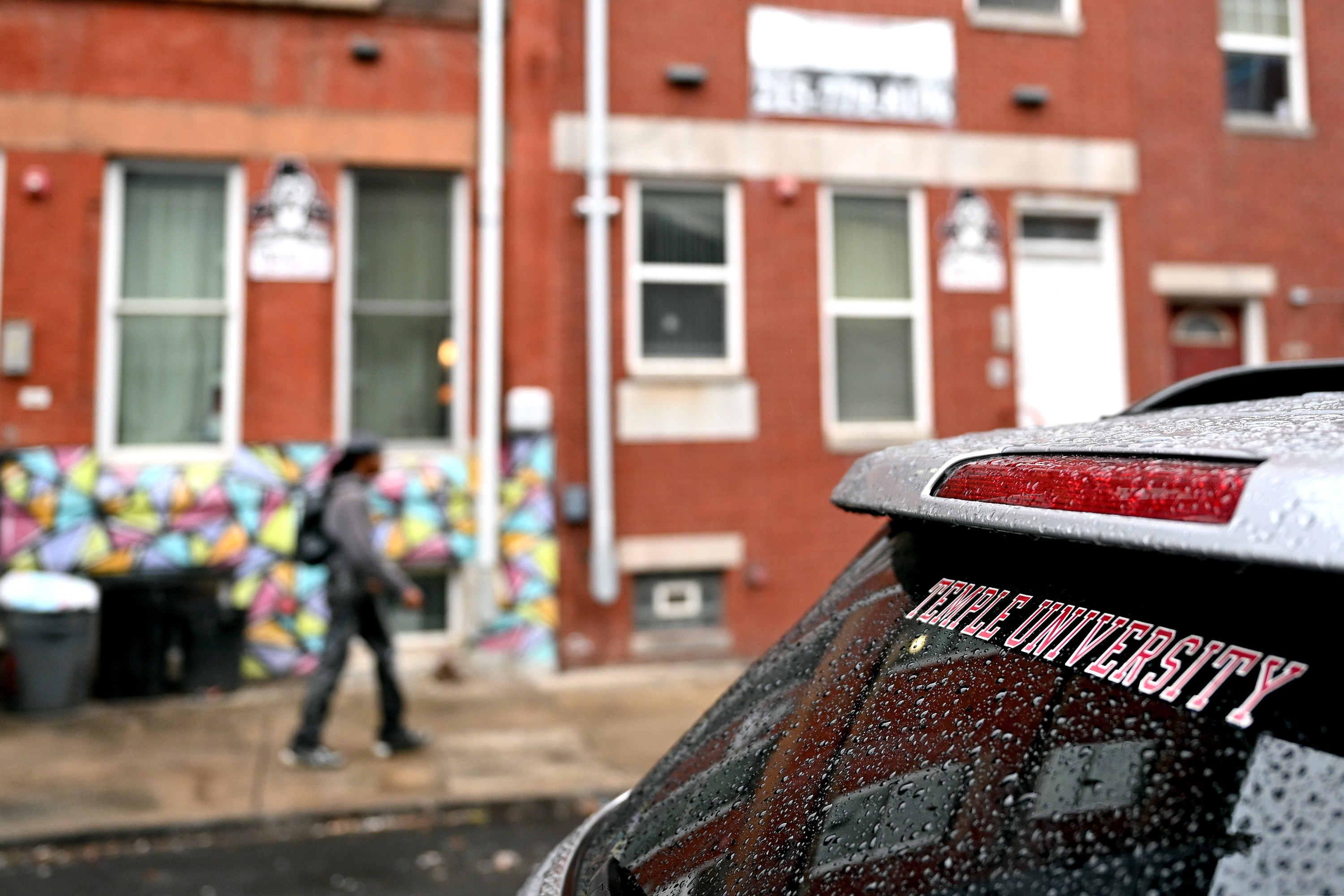
Off-campus housing in North Philadelphia is still popular among some Temple students, but university President John Fry recently announced plans for a new dorm.
Fay, who describes himself on Instagram as a partnerin the upscale Center City Irish bar the Mulberry, has been pursued in New Jersey Superior Court by seven credit card companies or lenders in connection with roughly $57,000 in debts. Most were linked to unpaid credit card bills, and most have ended in default judgments.
Business records show Fay is listed as debtor to an Atlanta-based company called Real Commissions, which lets real estate agents tap into cash based solely on the promise of a forthcoming commission, so long as they have a signed agreement of sale in hand.
In an email Thursday, Fay cited several 2022 student rental sales in the $800,000 to $900,000 range to support his sale prices, insisting that “at no point did either party set or influence those values.” He did not respond to questions about why his clients would pay twice what a seller had initially been asking.
The real estate agent’s narrative of a booming rental market around Temple was also disputed by a recent seller in one of his deals.
The former property owner, who asked not to be named because he feared legal repercussions, acknowledged that he tried to unload his rental property last year but found no takers. He said his real estate agent then brought him Fay’s offer to broker a sale for $875,000, which he said was actually just the amount that would be recorded on the deed.
In reality, he said, he made the sale for only $385,000, or $15,000 less than what it was originally listed for.
The seller said he knew the deal was suspicious, but his agent advised him that he was unlikely to find a better deal.
“I had a mortgage, but I couldn’t get any renters,” the seller explained. “It’s called desperation.”
He took the deal, recording an official sale price that was more than $250,000 higher than any comparable properties recently sold on that block.
Then, anotherproperty across the street sold in June for the exact same price — $875,000 — shortly after being re-listed from $475,000.
The real estate agent on that sale: Pat Fay.
‘Strange stuff’
Historically a commuter school, Temple has long had room for just a fraction of its total student body in traditional dorms. But as Philadelphia’s fortunes improved in the 20th century and more students sought to live on or near campus, the housing shortage intensified.
Private developers stepped in. Blocks that had long served as home to mostly Black working-class residents transformed into rows of student housing units, sometimes prefabricated.
But during the pandemic, the boom in rentals came to a grinding halt. Classes went virtual, driving student renters away. Surging homicide rates — including the 2023 shooting death of a Temple police officer — drove a public-safety crisis for the university.
Recently, Temple president John Fry announced a plan to steer more students back to campus with the university’s first new dorm in years.
Today, even with homicide rates now at historic lows and enrollment creeping up again, many of the blocks once flooded with student housing are underpopulated.
For-rent and for-sale signs line both sides of the 1700 block of Arlington Street. Around the corner, on 18th Street, mailboxes overflow with unopened letters, and the chirps of dying smoke detector batteries in vacant units create an eerie birdsong.
Landlords on the 1900 block of N. 18th St and elsewhere are looking for renters. It is unclear why a small network of buyers is overpaying for nearby properties.
Pizzola said membership is down in the Temple Area Property Association as building owners have looked to get out of the rental business.
“Since COVID hit, it just turned the market upside down,” he said. “If you’re an investor who was buying off-campus housing right before COVID, you got slaughtered.”
Bart Blatstein, a developer who was heavily involved in the mid-2000s Temple-area housing boom, said the recent transactions are highly unusual.
“I’ll give you a commission if you can get twice what my properties are worth,” Blatstein joked.
Officially, more than 40 different corporations have purchased student rental buildings in sales brokered by Fay. But those companies trace back to a handful of purchasers, according to Pennsylvania corporate registries.
Some of these buyers, contacted by The Inquirer, described Fay more as a participant among a loose but unnamed group of “real estate investors,” rather than a mere agent.
Stephen L. Johnson, a Montgomery County resident, was linked to companies involved in six purchases, totaling $5.2 million. Several of the companies were registered to the home of Johnson’s mother, although in an interview she said she was unaware her rowhouse was being used as a nominal corporate headquarters and referred questions to her son.
Reached by phone, Johnson echoed Fay’s enthusiasm for the future of the real estate market around Temple, predicting a surge in values if the university seeks to expand.
“The investment was all about Temple buying up everything and making it better,” Johnson said of his purchases. “In 10 or 20 years, they’ll probably own all of North Philly.”
Johnson could not explainwhy one of his companies, 17th Street Estates LLC, had paid so much for properties like 2113 N. 17th St., which was listed for $475,000 but sold for $900,000.
“I’d have to talk to Patrick about that,” said Johnson, who referred to Fay as “the main guy.”
“It’s like a team,” he added. “We all help each other out.”
Another one of Fay’s clients, Tanjania Powell-Avery of Pottstown, Montgomery County, is a former real estate agent charged in 2010 by the U.S. Attorney’s Office as part of a mortgage fraud ring.
Prosecutors said Powell-Avery aided two men who “purchased distressed properties at low prices, found buyers for the properties at a much higher price, and submitted false documents to the mortgage lender in support of mortgage applications,” according to the federal indictment. She pleaded guilty and was sentenced to five years’ probation and nine months’ house arrest.
Despite this, and a 2012 bankruptcy, companies linked to Powell-Avery appeared in at least two recent sales around Temple, both brokered by Fay. These companies tapped $1.3 million in mortgages to close sales with a combined value of $1.6 million — each for about double its initial listing price.
Powell-Avery did not respond to a request for comment.
Her two codefendants in the 2010 federal indictment, Joseph Tookes and Othniel Tookes, also pleaded guilty. Both men are relatives of Abigail Tookes, a resident of a Norristown apartment complex who was pursued by creditors in 2020 after defaulting on a loan, leading to a $46,067 court judgment against her.
Even so, companies tied to Abigail Tookes were linked to at least $3.4 million in mortgages to finance the acquisition of at least five properties in sales involving Fay. In all five purchases, Tookes’ company recorded sale prices at double the original values.
Reached by phone, Tookes insisted the sales were “totally legitimate transactions.”
“There’s no fraudulent activity. It’s just an investment group,” she said. “There’s no story here. These are real estate transactions between the buyers and sellers. They all agreed to the sale. It doesn’t matter why.”
Other people linked to companies in Fay’s sales — Patrick M. Williams, Miles Fambro, and Angel Rodriguez — did not return calls for comment.
Many of the Temple-area sales featured the same mortgage broker: Viva Capital Group.
Reached by email, Viva president Juan Arguello said his Florida-based company operated “in full accordance with state and federal guidelines, rules, and regulations” and does “not have any contact with the sellers or their agents.”
He also said his company relied on an outside appraisal management company to approve mortgage values. He did not respond to questions about which appraiser had been used to support the Philadelphia sales.
Pizzola, who owns student-rental properties in the area, said these recent sale prices would eventually start driving up neighborhood property assessments, leading to higher tax bills, particularly on blocks where Fay’s clients have purchased multiple properties.
He said he suspects there is fraud involved.
“The fact that you’re seeing multiple sales at twice the average market value, it doesn’t pass the smell test,” he said.
Uncertain future
A prospectus for a property on Cecil B. Moore Avenue, listed for sale at $850,000 in October by several other real estate agents, included a string of Fay’s recent sales as comparable sales to justify the high asking price.
That property has yet to sell.
Over the last three weeks, at least three more properties near Temple have gone under contract — all with Fay as real estate agent.
Fay had been listed as an agent on a large apartment complex on the 1300 block of North Broad Street that was listed for sale at just under $6 million in late October. In November, the property was re-listed for $12 million.
The city has begun placing liens for unpaid water bills on the buildings in some of the earliest deals Fay arranged. Many of the properties have skipped out on biannual commercial trash hauling fees imposed by the city.
Some of the buildings do not appear to be occupied.
Someone appeared to have busted open a door, which was ajar with broken locks. A Temple sticker was on an upstairs window.
Hornik, from the NPLA, said that unless Fay’s purchasers figure out a way to extract enough rental income from these properties to cover mortgage costs, a mass foreclosure by lenders was likely in North Philadelphia — leaving the ownership of dozens of properties up in the air.
“If the loan goes negative, the lender has to foreclose,” he said, “and they’re not going to recover that money.”
On Thursday, a three-coin set of the final pennies minted for circulation sold at auction for $800,000. Another of the sets sold for $180,000.
In all, the final pennies sold for a combined nearly $17 million.
Sold by Stack’s Bowers Galleries, the sets represented the 232 years since the penny was first minted in Philadelphia in 1793. Each included some of the last pennies struck for circulation at the U.S. Mint’s facilities in Philadelphia and Denver, plus a 24-karat gold penny minted in Philadelphia. Each coin bears a unique omega symbol (Ω), marking the end of the penny.
The Philadelphia U.S. Mint struck the final circulating one-cent coins in November after President Donald Trump ordered the Mint to stop producing new pennies earlier this year. The last small-change coin the government canceled was the half-cent in 1857.
Costly to produce and displaced by digital payment, the penny had grown almost as irrelevant as the half-cent. Still, pennies aren’t disappearing soon. Americans have hoarded 300 billion pennies, which remain legal tender, officials say. Killing penny production is estimated to save around $56 million a year, experts believe.
Thursday’s auction had been closely watched by collectors and numismatics, who had expected bidding to be high. None more than for the final lot, which eventually topped out at $800,000. The special lot came with the three origin dies used to strike the coins.
“This set represents the VERY LAST cents struck in the classic circulating finishing, the true Omega,” read for the listing for the final pennies. “It is impossible to overstate the historic nature of these three pieces, which are likely the most significant coins to emerge from the United States Mint this century.”
The average commute in Philadelphia takes longer than in most large U.S. cities — and it’s gotten slightly worse recently.
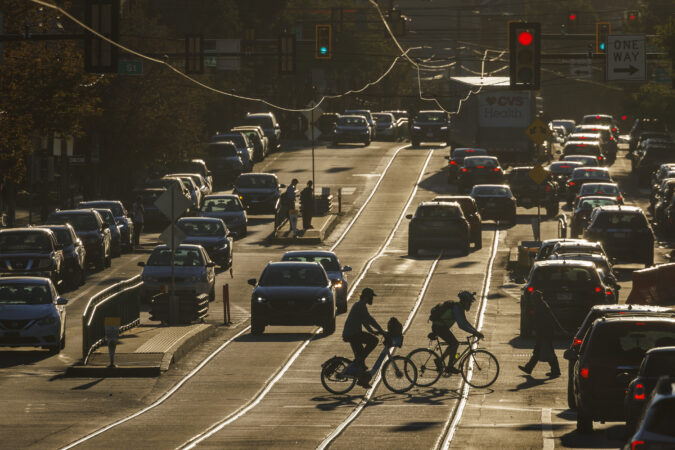
In 2024, commuters spent on average 33.2 minutes getting to work in the city, according to a new report from Yardi Kube, a digital management platform for coworking spaces. That’s more than the national average and a 2.1-minute increase from the previous year.
The increase in Philadelphia also reflects a larger national trend, according to the report. The average American’s commute time inched up in 2024 by nearly half a minute, to 27.2 minutes. Still, that’s less time than the average worker spent in transit to their job in 2019.
Meanwhile, Philadelphia faced some of the worst traffic congestion in the country last year, and public transit has confronted several challenges this year that caused disruption for commuters.
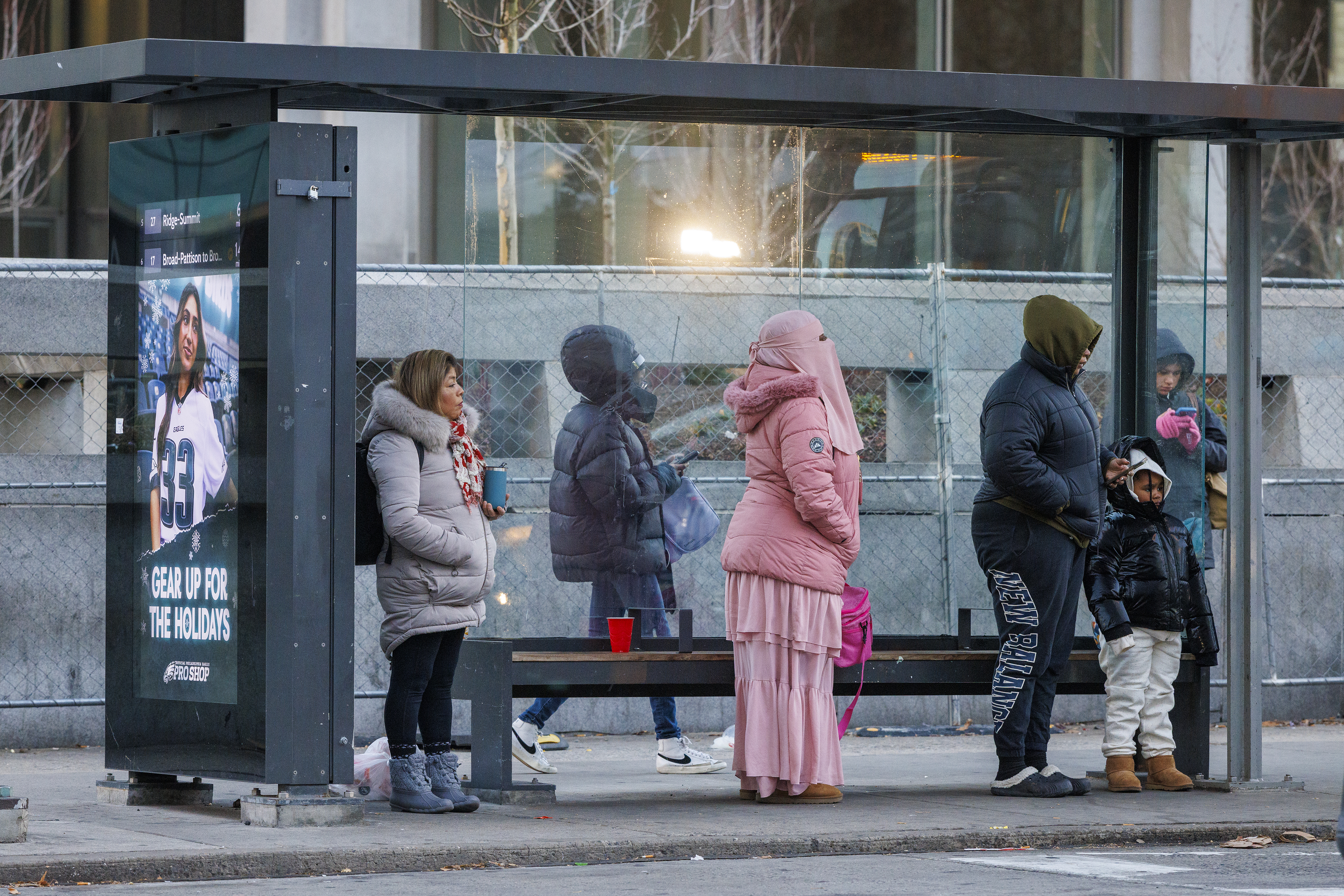
Commuters at a bus stop at 15th Street and JFK Boulevard on a cold December morning in Philadelphia.
The increase in Philadelphia and beyond comes as employers have increasingly called workers back to in-person work, reversing trends toward hybrid or remote arrangements during the pandemic. The report notes that as the number of Americans working from home has decreased, the average time spent commuting has inched up.
“Across the United States, how people get to work — and how often they do — continues to evolve,” the report reads.
“The rise of remote and hybrid work dramatically reshaped commuting habits, leading to sharp declines in travel times during the pandemic years,” it said. ”Yet as more employees return to the office, commute durations are climbing again, in some cases more quickly than before.”
The report is based on data from the U.S. Census Bureau’s American Community Survey. It took into consideration the 50 largest cities based on the size of their population and evaluated the time spent commuting for a one-way trip, regardless of mode of transportation.
window.addEventListener(“message”,function(a){if(void 0!==a.data[“datawrapper-height”]){var e=document.querySelectorAll(“iframe”);for(var t in a.data[“datawrapper-height”])for(var r,i=0;r=e[i];i++)if(r.contentWindow===a.source){var d=a.data[“datawrapper-height”][t]+”px”;r.style.height=d}}});
While Philadelphia’s average commute lengthened from 2023 to 2024, it’s still shorter than the average of 34.3 minutes in 2019.
But the region’s public transit system has seen a series of significant challenges this year, rankling commutes for many.
And SEPTA‘s Regional Rail system has encountered significant disruption and delays this fall, as the transit authority was ordered to inspect all of its 50-year-old Silverliner IV train cars following five train fires this year.
This week, SEPTA averted a worker strike, after coming to an agreement with Transport Workers Union Local 234 over improvements to the employee contract. The union represents some 5,000 SEPTA employees including operators of buses, subways, and trolleys.
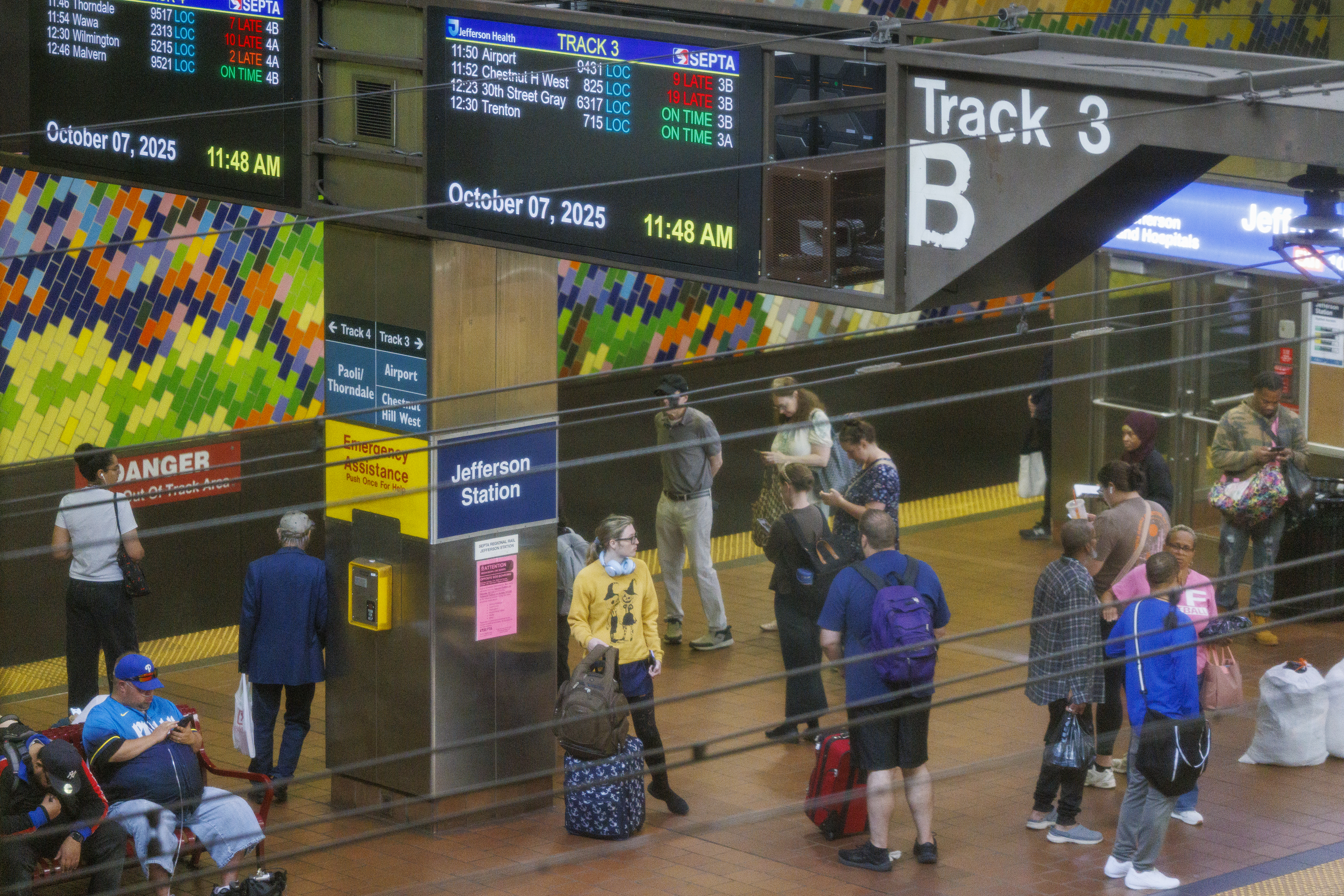
Commuters waiting for SEPTA Regional Rail at Jefferson Station on Oct. 7.
Other cities with long commutes last year include New York, Chicago, San Francisco, Los Angeles, and Boston. New Yorkers spent an average of 40.6 minutes getting to work in 2024, nabbing the worst commute time in the country. Chicago ranked second, with an average of 33.5 minutes in transit last year.
All of those cities saw an uptick in their commuting time in the past year.
Among the 50 most populous cities in the country, the places with the shortest commutes are Tulsa, Okla.; Omaha, Neb.; Memphis; Tucson, Ariz.; and Kansas City, Mo. Those cities had average commute times between 19.7 and 21.8 minutes last year.