Category: Business

Business news and market updates

  • The wife of Par Funding’s founder was sentenced to one day in prison — the last prosecution of people tied to the fraudulent firm

    The wife of Par Funding’s founder was sentenced to one day in prison — the last prosecution of people tied to the fraudulent firm

    The wife of the founder of Par Funding, a fraudulent and now-defunct Philadelphia-based lending firm, was sentenced Thursday to one day in jail and 60 days of house arrest for dodging about $1.6 million in taxes she should have paid on income derived from the scheme.

    Lisa McElhone apologized for her conduct during a sentencing hearing before U.S. District Judge Mark A. Kearney, saying the spectacular implosion of her husband’s business — and the criminal prosecution of people associated with it — was the “most painful and transformative period of my entire life,” causing her to lose her home and her future, and watch her husband get sent to prison.

    “It’s difficult, if not impossible, to express how overwhelming and life-altering this has been,” she said.

    Prosecutors acknowledged that McElhone — the owner of an Old City nail salon — had almost nothing to do with Par’s day-to-day operations. And the crimes she was charged with paled in comparison to those of others associated with the business — particularly her husband, Joseph LaForte, who ran the cash-advance firm as a Mafia-style criminal enterprise that defrauded investors out of hundreds of millions of dollars, and resorted to loan shark-style tactics in efforts to collect on debts.

    Still, Kearney said, McElhone, 46, did bear some responsibility by failing to question aspects of the life she was afforded that she should have known were too good to be true.

    “These things only stop when good people … stop and say, ‘Hey, you’re asking me to go a step too far,’” he said. “That’s the only way these things stop. Because otherwise, if everyone falls in line, everyone goes to jail.”

    Kearney said McElhone’s one-day prison stint would be Thursday. She will then serve a three-year term of supervised release, he said, and her 60 days of house arrest will begin in January 2026.

    McElhone’s sentencing was notable as the final criminal proceeding for about a half-dozen people charged in connection with Par Funding, which prosecutors have called one of the biggest financial frauds in Pennsylvania history.

    LaForte received the stiffest sentence: a 15½-year prison term that Kearney imposed earlier this year. LaForte founded Par to offer quick loans at high interest rates to borrowers deemed too risky to secure financing from traditional banks, but lied to investors about the company’s financial health to raise more money, used thuggish tactics to threaten borrowers who fell into default, and hid tens of millions of dollars from the IRS for his personal use.

    Others charged included LaForte’s brother, who also received a lengthy prison term for participating in various aspects of the firm’s crimes. And earlier this week, two financial professionals, Rodney Ermel and Kenneth Bacon, were ordered to serve 2½ years and 6 months, respectively, behind bars for helping devise the fraudulent tax structures connected to the crimes.

    Assistant U.S. Attorney Matthew Newcomer said it was perhaps fitting that McElhone’s penalty was the last to be imposed, given her limited connection to the business.

    “But I think it does speak to the breadth and severity” of Par’s misdeeds, he said, “that even the least-culpable person is still on the hook for a $1.6 million tax loss.”

    Par was founded in 2012 by LaForte, who was legally barred from selling securities because of previous felony convictions for financial crimes.

    One way he got around that was to list McElhone as Par’s chief executive on official documents. Then, LaForte and others he recruited to work for him — including experienced financial professionals — ran radio ads and staged fancy solicitation events to raise more than $500 million, all as they portrayed the business as legitimate and lucrative.

    In reality, prosecutors said, it was losing tens of millions of dollars a year. But to keep the fraud going, some of Par’s executives lied about the business’ financial health to keep raising money, and others threatened to harm or even kill borrowers who fell into default.

    Still, prosecutors said McElhone was effectively uninvolved in the business, spending her workdays instead running the Old City nail salon Lacquer Lounge.

    That doesn’t mean McElhone did not benefit from her husband’s grift. LaForte and his partners extracted cash from Par and spent it on things like a private jet, boats, paintings, expensive watches and jewelry, and homes in the Philadelphia area, Florida, and the Poconos.

    And in the single count to which McElhone agreed to plead guilty last year, prosecutors said she knowingly signed a tax form claiming she and LaForte were living in Florida — where there is no state income tax — even though they spent most of their time that year in their $2.5 million Haverford home.

    That deception led her to avoid paying about $1.6 million in taxes, prosecutors said, an amount she will now be forced to help repay.

    Kearney, the judge, said that others might have been more responsible for the wide array of Par’s wrongdoing — but that she needed to be held accountable for failing to stop the wrongs that unfolded before her.

    “When you get in a relationship with people,” he said, “make sure you keep your identity. Because you don’t want to be the person going to jail for their crimes.”

  • New Sixers and Flyers partnership with Bank of America will include community initiatives

    New Sixers and Flyers partnership with Bank of America will include community initiatives

    It’s the Bank of America Club Level now.

    The Flyers, Sixers, and Xfinity Mobile Arena on Thursday announced a new partnership with Bank of America, which will serve as the arena and teams’ banking partner this season. In addition to naming rights for the Club Level, the deal includes community efforts aimed at benefiting small businesses and youth sports.

    “It just is historic on many levels, in that we’re three iconic brands coming together,” said Comcast Spectator chairman and CEO Dan Hilferty. “We’re focused on being key players in Xfinity Mobile Arena, and Bank of America will partner with us on doing some really, really fun things in the community.” Comcast Spectacor owns both the arena and the Flyers.

    The deal, for which financial details were not disclosed, is “the most significant partnership” Bank of America has undertaken in its 20-plus years in the Philadelphia market, said Bank of America Greater Philadelphia president Jim Dever. Among its focuses is serving as a presenting partner in the Sixers’ small-business initiatives, such as the Spirit of Small Business Program and the Enrich Program, which benefit independent local businesses with aid and promotion.

    “This is an area that’s a prime focus to us, to be able to drive further economic mobility through small business and amplify their mission, and draw more patronage their way,” Dever said.

    The company will also head a youth-hockey-focused initiative in which it plans to donate up to $250,000 worth of hockey equipment to Philadelphia-area schools. Additional programs aimed at youth development and small business support will also be established, the organizations said in a statement, but details remain forthcoming.

    Tad Brown, CEO of the Sixers and Harris Blitzer Sports & Entertainment, said the partnership would allow the organizations to come together to “amplify all of our resources to benefit our fans and the region.”

    Despite its new banking partner, however, Xfinity Mobile Arena will likely remain cashless, and Dever said the organizations were not envisioning ATMs on the premises. Though, the partnership may create a small change for Hilferty.

    “I’m going to have to go elsewhere to get my cash,” he joked. “But that’s OK.”

  • Google unveils quantum computing breakthrough on Willow chip

    Google unveils quantum computing breakthrough on Willow chip

    Alphabet Inc.’s Google ran an algorithm on its “Willow” quantum-computing chip that can be repeated on similar platforms and outperform classical supercomputers, a breakthrough it said clears a path for useful applications of quantum technology within five years.

    The “Quantum Echoes” algorithm, detailed in a paper published Wednesday in the science journal Nature, is verifiable, meaning it can be repeated on another quantum computer. It also ran 13,000 times faster than previously possible on the world’s best supercomputer, Google said. Taken together, the advances point to a broad range of potential uses in medicine and materials science, Google said.

    “The key thing about verifiability is it’s a huge step in the path toward a real world application,” said Tom O’Brien, a staff research scientist at Google Quantum AI who oversaw the completion of this work. “In achieving this result we’re really pushing us toward finding mainstream.”

    Alphabet shares rose as much as 2.4% Wednesday in New York trading before closing up 0.5%.

    The breakthrough brings Google a step closer to harnessing the processing power promised by quantum computing, also being pursued by rivals Microsoft Corp., International Business Machines Corp., and numerous start-ups. It follows Google’s announcement in December that Willow had solved a problem in five minutes that would have taken a supercomputer 10 septillion years.

    Quantum computers use tiny circuits to perform calculations, like traditional computers do, but they make these calculations in parallel, rather than sequentially, making them much faster. While firms have boasted of building quantum platforms that surpass classical computers, their challenge has been to find a useful application.

    Computer scientist Scott Aaronson, who wasn’t involved in the study, wrote in an email that he was “thrilled” by Google’s progress toward outperforming supercomputers in a way which could be efficiently repeated, and thus proved, on a second quantum computer — which had been “one of the biggest challenges of the field for the past several years.” Still, he warned that there was a lot of work ahead.

    “Getting from here to anything commercially useful, and/or to scalable fault-tolerance (which wasn’t used for this demonstration), will be additional big challenges,” wrote Aaronson, who serves as the Schlumberger Centennial Chair of computer science at the University of Texas at Austin.

    The Google team, which includes 2025 Nobel Prize in Physics winner Michel H. Devoret, said it plans to continue to move toward real-world applications by scaling up and improving the accuracy of its machines.

  • A vacant South Philly Walgreens is set to become a supermarket

    A vacant South Philly Walgreens is set to become a supermarket

    South Philadelphia is set to get a new supermarket in early 2026.

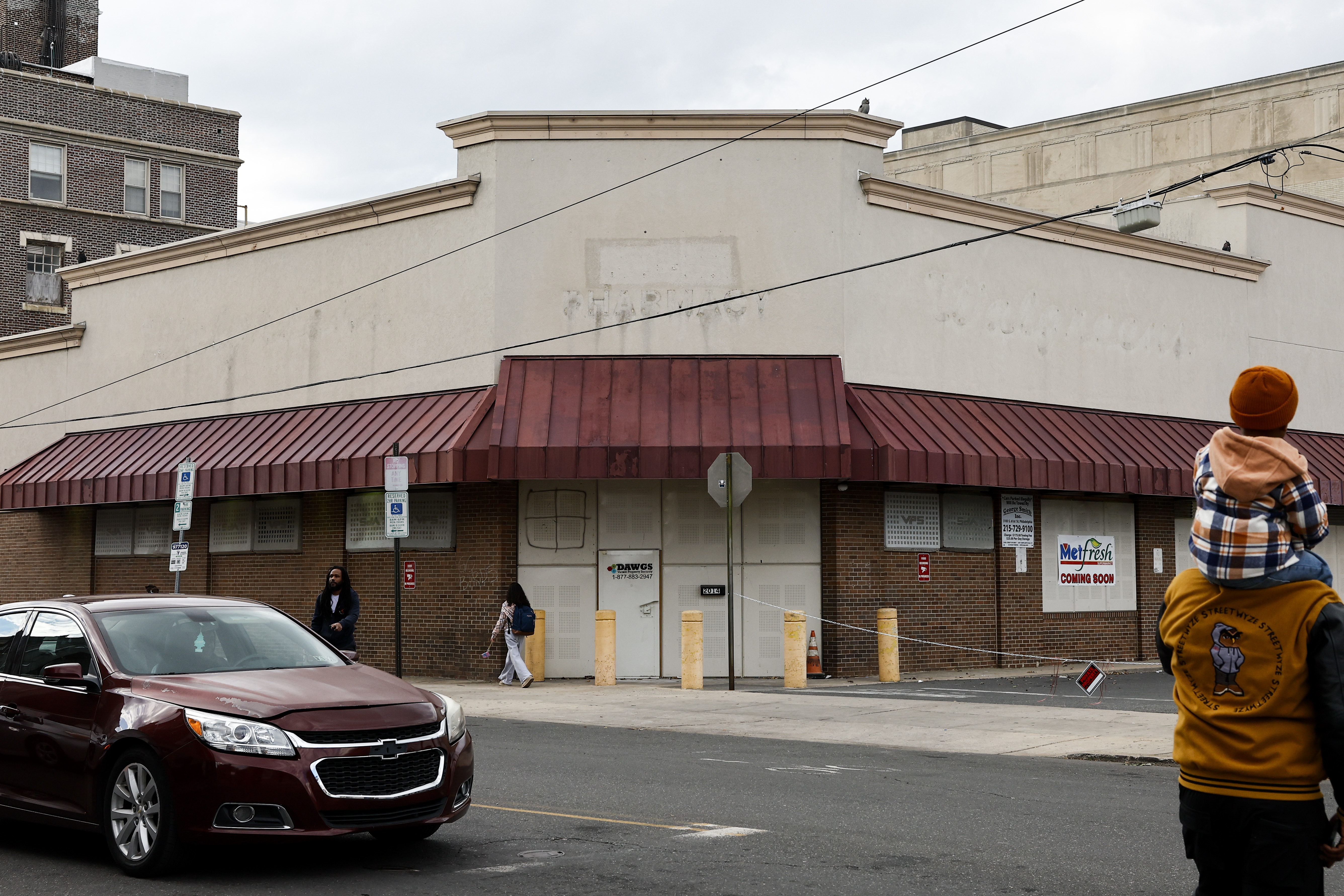
    New York-based Met Fresh is on track to open its first Philly location in January inside the former Walgreens at Broad and Snyder Streets, said owner Omar Hamdan.

    The 13,000-square-foot supermarket will include a pharmacy, a fresh-cut produce department, and a deli counter, Hamdan said, and will offer free grocery and prescription delivery to area seniors. It is also applying for a license to sell beer and wine.

    The former Walgreens at 2014 S. Broad St., where Met Fresh’s first Philly location is set to open in early 2026, photographed on Wednesday.

    “We try to bring the human factor back into the market,” Hamdan said, adding that the company’s philosophy hearkens back to a simpler time: “That store owner who had the apron and was sweeping outside of his store, who said ‘good morning’ to everyone? That is what we do.”

    Met Foods, a family-owned company, has been operating markets in New York City for 15 years, Hamdan said. It currently has locations in the Bronx, Brooklyn, Queens, Staten Island, and northern New Jersey.

    When the South Philly grocer opens, it will mark Met Fresh’s first location outside the New York City area, Hamdan said.

    In 2019, Met Fresh had been in talks to move into a mixed-use development in Philadelphia’s Mantua section, but Hamdan said those plans fell through.

    Since then, Hamdan said they continued to look for potential Philadelphia locations. The store at 2014 S. Broad Street seemed like “a perfect fit,” he said, due to the area’s walkability, dense population, and a demand for more grocery stores and pharmacies.

    The “pharmacy” lettering is seen on a former Walgreens on South Broad Street, where Met Fresh plans to open a supermarket in early 2026 after “extensive” renovations, its owner said.

    From the Broad Street store, the nearest supermarket is seven-tenths of a mile away. As for chain pharmacies, the Walgreens closed last year, and a Rite Aid across the street shuttered this summer as the Philly-based company went out of business. So the nearest large drugstore is a CVS off Passyunk Avenue, also seven-tenths of a mile away.

    The Met Fresh will soon start hiring in South Philly, with Hamdan noting that his stores typically need 30 to 40 part- and full-time employees from the surrounding communities. The new location will open after “extensive” renovations, Hamdan said, and once the team gets ahold of refrigeration equipment, which has been impacted by tariffs on steel and aluminum.

    Hamdan said he’s excited for Philly consumers to be introduced to Met Fresh, calling the Broad Street spot “a test pilot to see how we do in the Philly market.”

  • 2025 Toyota Corolla: One way to stay under $30K

    2025 Toyota Corolla: One way to stay under $30K

    2025 Toyota Corolla FX vs. 2025 Buick Envista Avenir: Two options to avoid being spendy.

    This week: Toyota Corolla

    Price: $29,089 as tested. Convenience Package added blind-spot monitor and cross-traffic alert for $530; black roof, $500; and connected services trial, $325.

    Conventional wisdom: Motor Trend liked the “$27,785 base MSRP, cool black accents, and bigger, more readable screen”; on the down side, it was “not particularly quick,” the “engine drones,” and it’s a “dated cabin.”

    Marketer’s pitch: “Introduce fun to every day.”

    Reality: You’re going for the fun angle, Toyota? Really, now?

    What’s new: The Corolla adds a new FX model for 2025, which pays homage to the old FX16, something I’d never heard of before writing this. Still, I feel I can say with confidence, it doesn’t live up to that.

    Not so new: How thankful I am to have two small, inexpensive cars to test. They’re a rare treat among model lineups and even rarer among vehicles I get to test, and readers are clamoring for them. Manufacturers want to make money selling you expensive things we don’t really need.

    The Corolla is a sedan and the Envista is a crossover, so very different directions indeed.

    Competition: Honda Civic, Hyundai Venue, Hyundai Elantra, Kia Niro, Kia Soul, Mazda 3, Nissan Kicks, Subaru Impreza, Toyota Prius, to name just a few.

    Up to speed: The Corolla is not winning any races. The 2.0-liter four-cylinder engine creates 169 horsepower and gets to 60 mph in 8.2 seconds, according to Motor Trend.

    Still, I was pleased enough with most of the performance, though I was traveling solo through almost all of it. A packed car would suffer a bit of malaise under the extra strain.

    Shiftless: The continuously variable transmission in the Corolla saps power as much as any. The gearless setup offers infinite ratios in theory but in actuality some examples make hill-climbing and hard acceleration something you’d just rather avoid. The Corolla’s version sits about in the middle, not the worst or the best.

    On the road: The Corolla has never been anything like fun, although the XSE version gets close. The FX model doesn’t get there, though, although handling is small-car good. Still, you won’t confuse it with a Golf or Mazda3.

    Driver’s Seat: Sturgis Kid 1.0 once purchased a new Scion iM (the Corolla Hatchback before it was called that) based solely on the dreamy front seats. Every time I borrowed that car, I noted how comfortable it was.

    The Corolla FX tested had sport fabric-trimmed seats with orange stitching that matched that feel. They were soft but supportive seats and made all the Schuylkill Expressway stop-and-go feel lots better.

    The Corolla also benefits from the simple gauge setup that Toyota offers in its base models. Changing the screen to fit your needs is simple with the steering wheel controls.

    The interior of the 2025 Toyota Corolla adds a 10.5-inch infotainment screen, and the seats remain among the most comfortable among all sizes of vehicles, not just small cars.

    Friends and stuff: The rear seat is pretty good for a small car. Headroom is dear — my head doesn’t hit the ceiling but it’s close — while legroom and foot room are nice. The door requires care when getting in and out because it’s a bit of a squeeze.

    The middle seat passenger will be perched on a narrow cushion and a tall floor hump, and will be permitted to throw small food items at everyone else, or to at least choose the evening’s movie later.

    Cargo space is 13.1 cubic feet. The seat folds to create a pass-through.

    Play some tunes: The new 10.5-inch touchscreen helps with navigating through the sources and whatnot. But somewhere a designer is patting themselves on the back for the sleek control panel, which trades a volume dial for pushbutton -/+ system. Boo!

    The stereo offers pretty good playback, especially by Toyota standards, about an A- or B+.

    Keeping warm and cool: Kudos for the simplest controls I’ve seen in a long time — one dial for air speed, another for temperature, and silver buttons for everything else.

    Fuel economy: I averaged about 32 mpg in an unusual array of Mr. Driver’s Seat testing. A very stop-and-go round trip to Center City figured mightily into the week. Otherwise it was mostly highway and side roads.

    Where it’s built: Blue Springs, Miss.

    How it’s built: Consumer Reports predicts the Corolla reliability to be a 5 out of 5. (Like, duh.)

    Next week: Buick Envista Avenir

  • N.J. sues Amazon twice in three days over treatment of workers

    N.J. sues Amazon twice in three days over treatment of workers

    New Jersey officials have sued Amazon twice in three days, saying that the e-commerce giant has exploited delivery drivers and discriminated against warehouse workers who are pregnant or have disabilities.

    The first lawsuit, filed Monday, marked the Garden State’s latest move to dispute companies’ classification of drivers as independent contractors, not employees who are legally entitled to certain benefits and rights, including minimum wage, overtime pay, earned sick time, and family leave.

    At the heart of the latest suit are Amazon’s “Flex” drivers, who use their personal vehicles to deliver packages, according to court documents filed in Superior Court of Essex County.

    New Jersey Attorney General Matthew Platkin and Department of Labor and Workforce Development Commissioner Robert Asaro-Angelo began investigating after some Flex drivers applied for unemployment and disability benefits, toward which Amazon has not been contributing.

    “Amazon calls its drivers ‘Delivery Partners,’ but they are simply Amazon’s employees,” the complaint reads. “Drivers are workers who, in exchange for remuneration from Amazon, perform the discrete, repetitive work of picking up and delivering packages from Amazon’s warehouses, or other Amazon locations such as Whole Foods stores, to their final destinations — a necessary function for Amazon’s business operations. “

    Amazon spokesperson Mary Kate Paradiso said the lawsuit “is wrong on the facts and the law” and misrepresents how Flex works.

    “For nearly a decade, Amazon Flex has empowered independent delivery partners to choose delivery blocks that fit their schedules, giving them the freedom to decide when and where they work,” Paradiso said in a statement. “This flexibility is one of the main reasons many drivers say they enjoy the program.”

    Amazon advertises the Flex program as a way for people to make money on their own schedules. On the Flex website, Amazon says most drivers earn $18 to $25 an hour. A disclaimer underneath reads “actual earnings will depend on your location, any tips you receive, how long it takes you to complete your deliveries, and other factors.”

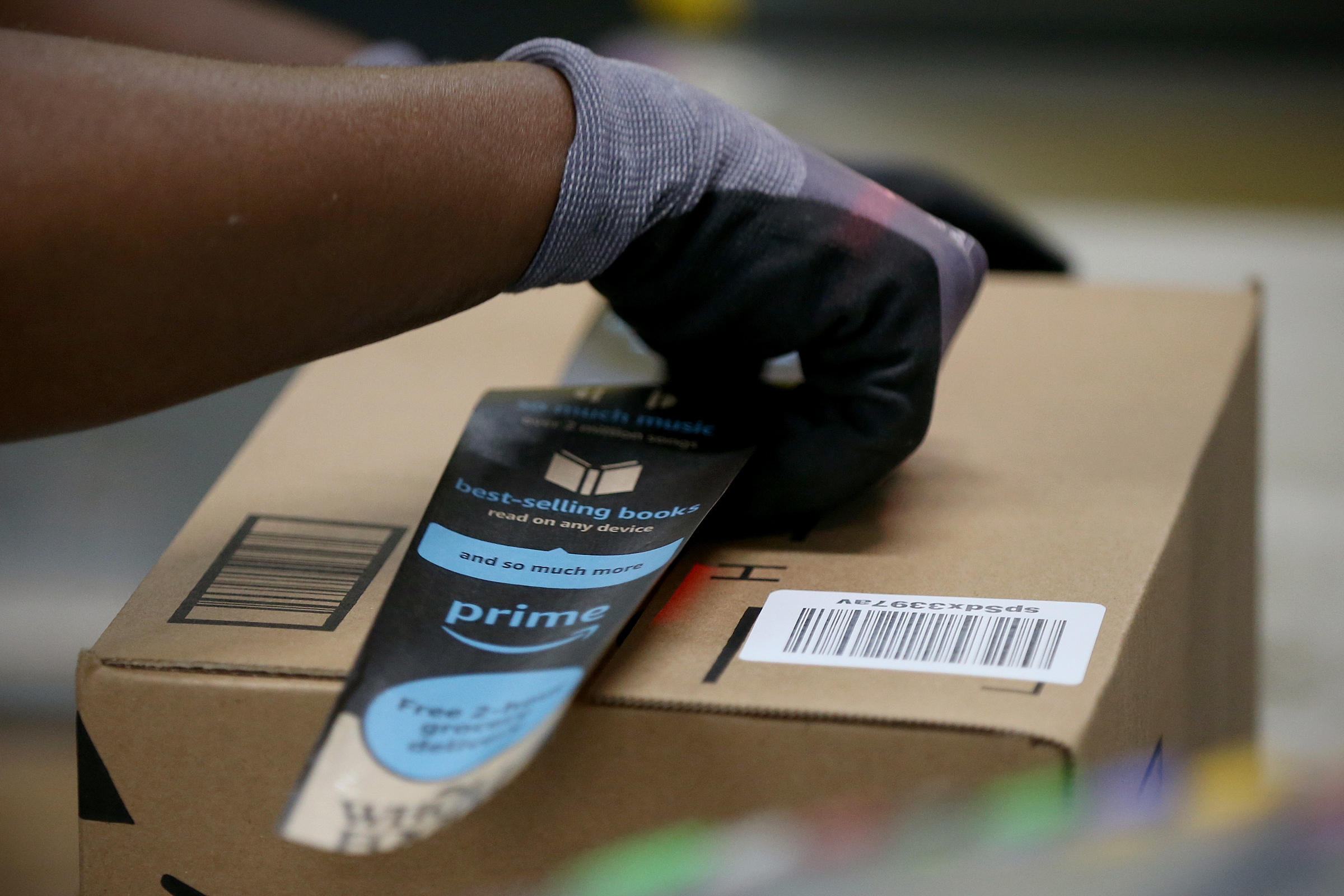
    A worker boxes up an order to be shipped at the Amazon Fulfillment Center in West Deptford in this 2019 file photo.

    Since at least 2017, thousands of Flex drivers have worked in New Jersey, according to state officials.

    “Amazon is taking advantage of Flex drivers and enriching its bottom line by failing to obey our labor laws and offloading its business expenses for the benefit of shareholders,” Platkin said in a statement.

    New Jersey is stricter than some other states when it comes to independent contractors, and outgoing Gov. Phil Murphy has made combating worker misclassification a priority of his administration.

    In a similar case, Lyft recently paid $19.4 million to the New Jersey Department of Labor & Workforce Development after it found the rideshare service had misclassified 100,000 drivers as independent contractors.

    In a separate lawsuit filed Wednesday, Platkin and the state’s Division on Civil Rights say that Amazon discriminated against pregnant workers and workers with disabilities, including by putting them on unpaid leave or firing them after they requested reasonable accommodations. The lawsuit was the result of a yearslong investigation into the working conditions of about 50,000 workers at dozens of Amazon warehouses across New Jersey.

    State officials said they found that sometimes workers’ accommodation requests were accepted, but then those workers were terminated for not meeting productivity goals.

    “Amazon has exploited pregnant workers and workers with disabilities in its New Jersey warehouses,” Platkin said. “In building a trillion-dollar business, Amazon has flagrantly violated their rights and ignored their well-being — all while it continues to profit off their labor.”

    An Amazon spokesperson did not respond Wednesday afternoon to a request for comment on the second lawsuit.

  • Massive Bucks data center spurs call to protect consumers from getting hit with power grid costs

    Massive Bucks data center spurs call to protect consumers from getting hit with power grid costs

    An independent monitor has asked federal officials to ensure consumers don’t get stuck with the bill if the electric grid can’t handle power needs of a massive data center planned for Bucks County.

    The monitor, Joseph Bowring, filed comments with the Federal Energy Regulatory Commission (FERC) last week, asking that a Sept. 23 transmission service agreement between Peco and Amazon Data Services be rejected.

    The agreement is regarding the 2 million-square-foot “digital infrastructure campus” Amazon plans for the Keystone Trade Center, an 1,800-acre property once owned by U.S. Steel, according to Falls Township. The data center, meant to handle computing needs of the wildly increasing demand for AI, has been heralded by Pennsylvania Gov. Josh Shapiro and the Trump administration.

    But Bowring, the independent market monitor for the region’s grid operator PJM, questioned the agreement, which is designed to protect power customers from economic risks associated with the cost of upgrading systems to handle the new load.

    In the agreement, Peco sought to ensure, among other things, that consumers don’t get stuck with the bill for grid upgrades if Amazon never builds the data center.

    However, Bowring said that the agreement does not “address the key question of whether there is sufficient capacity to serve the identified large new data center load without imposing significant and unacceptable reliability- and capacity-related cost impacts on all PJM customers.”

    He’s not alone in concerns about the cost data centers could impose on homeowners and other power customers. Many have already seen utility bills rise rapidly in the past few months.

    PJM, Peco, and the grid

    Montgomery County-based PJM manages the electric grid for all or parts of 13 states and the District of Columbia. PJM is responsible for maintaining grid reliability, coordinating electric flow, and assessing capacity. It is the largest regional transmission organization in the U.S.

    The data center lies in Peco’s service territory within the PJM grid.

    The capacity and reliability of electrical grids across the United States has emerged as a major issue as data centers rush to go online.

    David Mills, chair of the PJM Board of Managers, wrote in an August letter to stakeholders that PJM is forecasting peak load growth of 32 gigawatts by 2030. Of that, 30 gigawatts is projected to come from data centers.

    Grid operators and power companies like Peco are scrambling to evaluate whether they can provide continuous electricity with the massive new loads without expensive upgrades such as new transmission lines and substations — costs that advocates fear will be passed onto consumers.

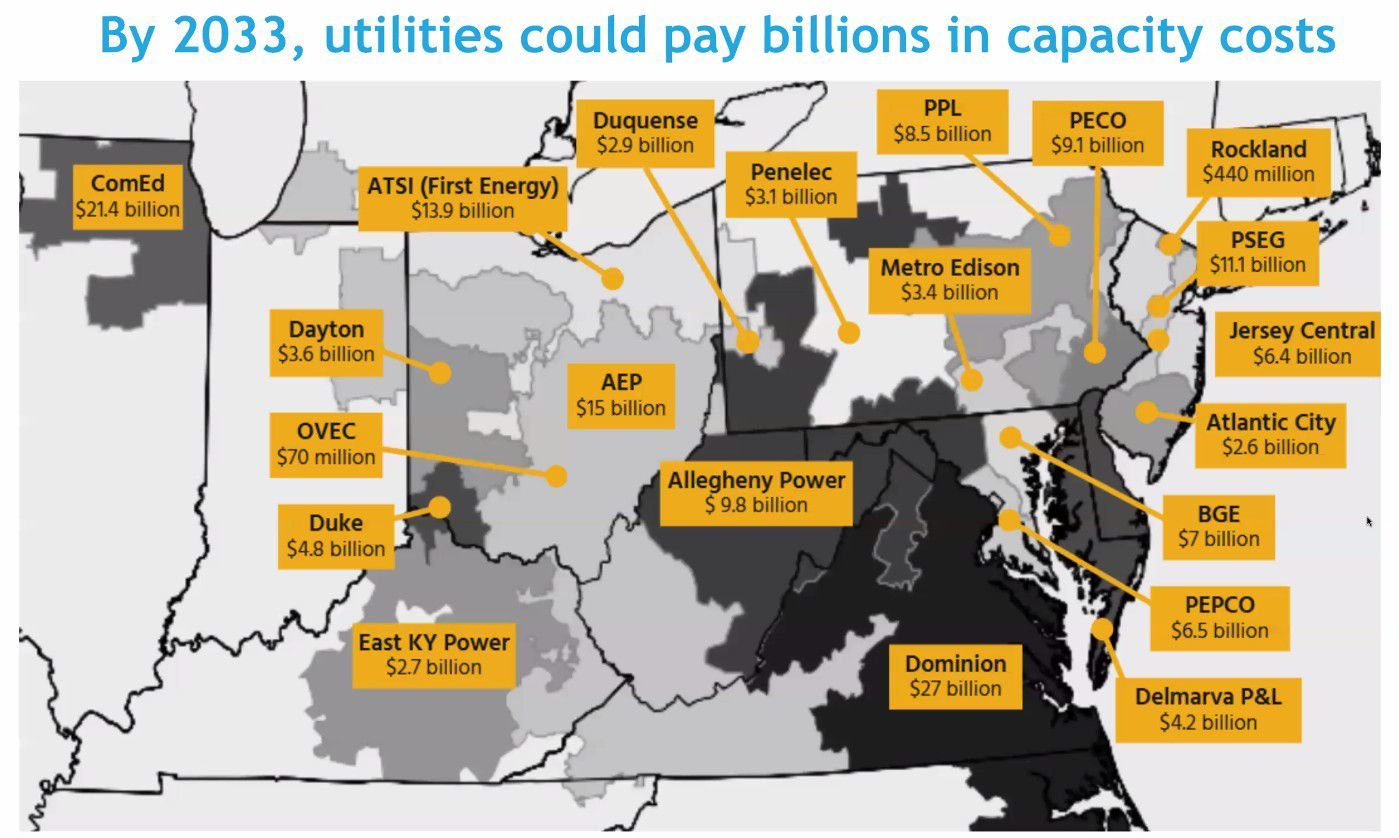
    Map produced by the National Resources Defense Council estimates electricity capacity costs to utility companies based on PJM forecasts through 2032.

    Protecting consumers

    Making sure power consumers don’t get stuck with the cost of upgrades has been a key point of consumer advocates.

    Bowring wrote that while the agreement does include some important provisions to protect energy customers from risk, it does not go far enough.

    “The Market Monitor recommends that the agreement not be approved unless Peco can demonstrate that the referenced new data center load can be served reliably and economically,” Bowring wrote to FERC.

    The Falls Township data center is one of two big projects Amazon has planned in Pennsylvania, Shapiro announced in June.

    The company plans to invest at least $20 billion in the construction of data center complexes in Pennsylvania, in what officials called the largest private-sector investment in the state’s history. The second complex would be built alongside a nuclear power plant in Luzerne County.

    Both would require enormous amounts of power.

    For example, FERC has already rejected one Amazon “behind-the-meter” power connection of 480 megawatts for the Luzerne County data center. That’s more power than is consumed by some small cities.

    Bowring addressed the data centers during a summit on PJM at the National Constitution Center in September that was attended by multiple governors, including Shapiro.

    “PJM has a problem: Capacity,” Bowring said at the summit. “There’s no extra capacity, and there’s lots of data centers that want to join. … It cannot be handled by the market as it exists.”

    PJM has said it does not have the authority to deny the interconnection of new data center loads even if it does not have the capacity. Bowring disagrees but is asking FERC to clarify the matter.

    Peco’s ‘extensive planning’

    Greg Smore, a Peco spokesperson, said the utility is working with Amazon.

    “We have done extensive planning to ensure we can deliver the energy needed to power this data center through our transmission and distribution system,” Smore said. “That data center, like any other large customer, is responsible for procuring electric supply, through an energy supplier or the existing PJM energy market.”

    Smore said that knowing there’s “an adequate supply of energy to serve all our customers at a reasonable price is a real concern.”

    So Peco, which is owned by Exelon, is working with stakeholders, he said, to add more generation to the grid while ensuring reliability and help address rising energy supply costs.

    He said the agreement with Amazon “protects all customers in Southeastern Pennsylvania from bearing greater transmission service costs if the data center does not make the sizable contribution to our system costs that would be expected.”

    Advocates fear costs to public

    The nonprofit Natural Resources Defense Council (NRDC), an environmental advocacy group, estimates Peco could pay $9.1 billion in costs by 2033 related to the need for greater capacity.

    “The projected demand from data centers is vastly outstripping the amount of new supply in PJM,” said Claire Lang-Ree, an advocate with NRDC.

    “It will cause power bills to rise and stay high for the coming decade, mainly through capacity cost increases,” Lang-Ree said.

    The NRDC estimates cumulative costs could result in a $70 monthly rise in average electric bills in coming years across the PJM grid.

    In addition, she said it would lead to a decline in reliability and an increased risk of blackouts for the general public. And, she said, the power demand could undermine states’ clean energy and air quality goals.

    “It’s really hard to overstate what’s at stake here,” Lang-Ree said.

    Clara Summers of Consumers for a Better Grid, a nonprofit watchdog, said states should impose tariffs to be paid by data centers to support the large power loads they require and ensure that costs of new utility infrastructure doesn’t fall unfairly on consumers. And data centers should provide their own electric supply.

    Summers likened not taking action to allowing the wealthiest acquaintances at a restaurant gathering to order the most expensive food, then, “dining and dashing.”

    “Unless something is done, everyday people will be left holding the check for some of the wealthiest companies in the world, and that’s unacceptable,” Summers said.

    This story has been updated to reflect comments from Peco.

  • Health insurance sticker shock begins as shutdown battle over subsidies rages

    Health insurance sticker shock begins as shutdown battle over subsidies rages

    Millions of Americans are already seeing their health insurance costs soar for 2026 as Congress remains deadlocked over extending covid-era subsidies for premiums.

    The bitter fight sparked a government shutdown at the start of October. Democrats refuse to vote on government-funding legislation unless it extends the subsidies, while Republicans insist on separate negotiations after reopening the government. Now lawmakers face greater pressure to act as Americans who buy insurance through the Affordable Care Act are seeing, or about to see, the consequences of enhanced subsidies expiring at the end of the year.

    Healthcare.gov — the federal website used by 28 states — is expected to post plan offerings early next week ahead of the start of open enrollment in November. But window shopping has already begun in most of the 22 states that run their own marketplaces, offering a preview of the sticker shock to come.

    Premiums nationwide are set to rise by 18 percent on average, according to an analysis of preliminary rate filings by the nonpartisan health policy group KFF. That, combined with the loss of extra subsidies, have left Americans with the worst year-over-year price hikes in the 12 years since the marketplaces launched.

    Nationally, the average marketplace consumer will pay $1,904 in annual premiums next year, up from $888 in 2025, according to KFF.

    The situation is particularly acute in Georgia, which recorded the second-highest enrollment of any state-run marketplace this year and posted prices for 2026 earlier in October. About 96 percent of marketplace enrollees in Georgia received subsidies this year, according to the Center on Budget and Policy Priorities, a liberal think tank that supports extending the subsidies.

    Now Georgians browsing the state website are seeing estimated monthly costs double or even triple, depending on their incomes, as lower subsidy thresholds resume.

    “We have people saying they will have to choose between their monthly premiums and mortgage,” said Natasha Taylor, deputy director of Georgia Watch, a consumer advocacy group.

    For example, a family of four earning $82,000 a year in Georgia could see their annual premium double to around $7,000 for a plan with midrange coverage, according to a CBPP analysis. If that family earned at least $130,000, they would have to pay the full cost of the annual premium, about $24,000 instead of $11,000.

    It’s a similar story in other states, where people in higher income tiers will see especially big premium increases as they become ineligible for subsidies. A 60-year-old couple earning $85,000 may have to pay $31,000 for a plan in Kentucky, $28,000 for a plan in Oregon and $44,000 for a plan in Vermont, according to CBPP.

    If Congress doesn’t extend the extra subsidies, Georgia could lose around 340,000 people from its 1.5 million-person marketplace, according to an estimate by nonpartisan advocacy group Georgians for a Healthy Future.

    The enhanced subsidies had fully covered monthly premiums for millions of lower-income people in the marketplaces. Many of them will have to start kicking in some of their own money starting Jan. 1, while people with higher incomes will see their monthly subsidies shrink. People earning more than 400 percent of the federal poverty line will no longer be eligible for subsidies at all.

    The political fallout in Georgia has already begun to reverberate. Rep. Marjorie Taylor Greene (R-Georgia) broke with her party to demand an extension of subsidies, noting her adult children’s premiums are set to double. Greene’s office didn’t respond to a request for comment.

    Sen. Jon Ossoff, considered the most vulnerable Democratic incumbent in next year’s midterms, has seized on the issue of rising premiums. An Ossoff spokesman said the senator wants the subsidies extended, pointing to polling showing a majority of Georgians feel the same.

    Republican Gov. Brian Kemp, who championed the state’s marketplace, didn’t respond to a request for comment.

    Atlanta resident Jody Fieulleteau, 31, said she has been paying $160 a month for a subsidized plan on Georgia’s marketplace. She makes about $40,000 a year styling hair and providing behavioral therapy. She has yet to complete an application to see quotes for plans next year, but her monthly premium is likely to nearly double based on her age, income and Zip code.

    Fieulleteau said she rushed to schedule a surgery next week for a problem related to menstruation because she’s concerned about having insurance.

    “I’m feeling like I need to get everything done this year because I don’t know what next year is going to look like,” she said in a phone interview.

    Taylor, of Georgia Watch, said she finds that consumers often don’t understand that their plans are subsidized, which makes it difficult to explain that the pricey plans they see now could become cheaper if Congress votes to extend the subsidies.

    “For your average consumer, they look at the bottom line. What’s my out-of-pocket max,” Taylor said. “I don’t think they’re looking at the minutiae of why their premium is what it is.”

    The rising insurance costs highlight the political difficulties faced by Washington lawmakers.

    The Congressional Budget Office, the legislature’s nonpartisan bookkeeper, has estimated nearly 4 million fewer people will have marketplace plans a decade from now if the extra subsidies expire.

    Republicans say the premium assistance — intended to help people be insured during the coronavirus pandemic — are just a Band-Aid for a failure of the Affordable Care Act to rein in the costs of plans. They also say the subsidies were so generous they incentivized fraud, pointing to a CBO estimate that 2.3 million enrollees improperly claimed a subsidy this year.

    But 13 House Republicans who face competitive reelection campaigns next year wrote to House Speaker Mike Johnson (R-Louisiana) on Tuesday asking him to consider extending premium assistance.

    “Millions of Americans are facing drastic premium increases due to shortsighted Democratic policymaking,” they wrote. “While we did not create this crisis, we now have both the responsibility and the opportunity to address it.”

    Sen. Patty Murray (D-Washington) said in a news conference that she heard from families whose premiums are doubling as window shopping started in her state Tuesday. She said she heard similar stories from Idaho and Montana, noting most people who rely on premium assistance live in red states.

    “Families are logging on, looking for health coverage for next year, and coming face to face with massive price hikes because Republicans downright refuse to work with us to do something about it,” Murray said.

    Insurers have partially blamed the premium hikes on the expiration of the subsidies, saying they’ll cause healthy people to drop coverage, leaving a sicker, more expensive pool of customers behind. Insurers have also cited higher drug and hospital prices, expensive weight-loss drugs and medical inflation as reasons for raising premiums.

    But if Congress acts to extend the subsidies, even after open enrollment begins Nov. 1, some plans may be willing to lower premiums, said David Merritt, senior vice president of external affairs at the Blue Cross Blue Shield Association, whose member plans are sold in all marketplaces. Adjusting rates lower would get more complicated after Dec. 31, he said.

    Even if Congress does extend the subsidies, consumer advocates say damage has already been done.

    Many people will visit the insurance marketplaces and decide to forgo coverage after seeing pricey 2026 plans, they said, and not revisit their decision even if subsidies are restored.

  • As Trump limits federal college loans, a new private lender specializes in lending to families desperate for a student to graduate

    As Trump limits federal college loans, a new private lender specializes in lending to families desperate for a student to graduate

    Colleges and universities expect the Trump administration’s new limits on government-backed student loans will drive more families to higher-cost private lenders. John Witter, CEO of industry leader Sallie Mae, expects his company will attract around $5 billion in new private loans, thanks to lifetime limits on taxpayer-backed student borrowing in President Donald Trump’s Big Beautiful Bill.

    Investors, meanwhile, are betting that private college loans will balloon under the Trump rules. But less than half of families who apply qualify for mainstream lenders’ private student loans.

    So a group of executives who used to work at Sallie Mae, which is based in Wilmington, have organized a start-up company, GradBridge, to make loans at higher interest rates to students who max out on scholarships and government loans but still hope to finish college or graduate school.

    On Wednesday, GradBridge said it had raised $20 million to speed its growth before the new loan limits begin next summer.

    The money was raised from private investors led by Acorn Investment Partners, which is managed by Los Angeles-based Oaktree Capital Management. Oaktree’s investors include the Pennsylvania public schoolteachers’ (PSERS) and state workers’ (SERS) pension funds.

    GradBridge will be a “second-look” lender for families turned down by mainstream private college lenders, said Jen O’Donald, GradBridge founder and CEO.

    O’Donald, who lives in Chester County, is a former head of products for Sallie Mae and the mother of two college students. Her top lieutenants include chief financial officer Brian Carp and chief operations officer Lisa Kaplan, also Sallie Mae veterans. Advisers include Sallie Mae Bank’s former president, Paul Thome, and former chief credit officer Dan Hill.

    After Trump’s election last year, O’Donald said, she and former colleagues reviewed the “massive disruption” the Trump platform promised in college financing and looked for business opportunities.

    Even if only some of the changes were enacted, “only about 35% to 45% of private college loans get approved,” and many students’ families are not able to get a private student loan after they have exhausted federal grant and loan programs, she said in an interview.

    With the lifetime limits on student loans enacted by the Trump administration, O’Donald sees an “overwhelming shift” away from government programs to private loans over the next few years, as students grandfathered under earlier programs graduate and new students borrow up to the new program limits.

    GradBridge expects to get referrals from colleges and mainstream lenders of borrowers who don’t fit the high-end ability-to-pay profile.

    While mainstream lenders could charge an annual interest rate from the mid-single digits to as much as 18% a year, GradBridge might charge less-bankworthy borrowers an additional 3% or 4% on top of the mainstream rate, driving monthly payment up by $30 or $40 for every $10,000 owed.

    O’Donald said GradBridge offers an alternative to “credit cards, personal loans, parents’ 401(k) accounts, home equity loans” and other costly alternatives families use to help their children stay in college.

    Federal student loans are made to applicants who apply to government-approved, mostly four-year colleges, without the kind of traditional loan underwriting used to evaluate if borrowers are likely to repay home, auto, or small-business loans.

    Not surprisingly, those student loans suffer a high loss rate, the justification lenders used to get the government to agree to prevent federal student loan debtors from having their loans discharged in bankruptcy.

    But private lenders like Sallie Mae and GradBridge consider family income and other factors that affect whether the loan will likely be paid, O’Donald said.

    Most private college loans require adult cosigners. Because they rely mostly on family income to ensure they get paid back, lenders typically don’t worry about what majors or graduate degrees a borrower pursues, she added.

    “GradBridge’s approach addresses a real market gap” for students who “fall just outside of traditional credit underwriting models,” Yadin Rozov, Acorn’s chief investment officer, said in a statement.

    GradBridge employs around half a dozen people. It plans to increase to around 30 by 2027.

    O’Donald said the Wilmington area is a national center for student lending and a good place to hire for a loan start-up.

    Besides Sallie Mae, it is home to College Avenue, another student lender founded by Sallie Mae veterans; Navient, a student-loan servicing company; and other consumer payment companies.

    With college enrollments flat or declining, O’Donald said schools are eager to forge ties with private lenders.

    “The first big impact will be next summer,“ she said. ”It will take a few years before the full impact will be seen, but schools are starting to be concerned about how they will keep kids enrolled.”

  • How three Philadelphia-area health systems changed accounting practices and boosted profits

    How three Philadelphia-area health systems changed accounting practices and boosted profits

    Amid persistently higher costs, three Philadelphia-area health systems have cut expenses over the last two years by changing how they account for investments in facilities and equipment. The change significantly boosted operating income in all three cases.

    ChristianaCare and Main Line Health are now spreading the cost of buildings and building improvements over as many as 80 years, they said in their fiscal 2025 audited financial statements. That is double the maximum number of years they previously used to calculate what accountants call depreciation expense. Thomas Jefferson University made a similar change last year.

    All three health systems use PricewaterhouseCoopers LLP as their auditor. The firm, which did not respond to a request for comment, also has Philadelphia health-system clients that have not extended their depreciation schedules.

    The term depreciation expense refers to the way hospitals and other businesses allocate the cost of a building, a piece of equipment such as an MRI machine, or even software to manage patient records across the number of years the asset is likely to be used.

    It’s a noncash expense because the money used to make the purchase is recorded elsewhere in the financial statements. Several financial and accounting experts said the change could be seen as cosmetic.

    “It’s not affecting operations. It’s not increasing their revenues. It’s not decreasing their cash expenditures. It is purely a bookkeeping entry,” said Steven Balsam, a professor of accounting at Temple University’s Fox School of Business.

    Main Line Health

    At Main Line, the extended depreciation schedule reduced the expense by an estimated $37.5 million. That helped the system achieve a small, $4 million operating profit for the first time since fiscal 2021, when federal COVID-19 aid buoyed hospitals.

    Without the depreciation savings, Main Line would have had an operating loss of $33.5 million in the year that ended June 30, compared to a $61 million operating loss in fiscal 2024.

    Asked for comment, Main Line’s chief financial officer Leigh Ehrlich noted that the system’s financial performance had improved, thanks to “increased patient volumes and continued focus on expense management.”

    Excluding noncash depreciation and amortization in each of the last two years, Main Line’s operating income improved to $127.8 million from $96.7 million.

    ChristianaCare

    ChristianaCare reviewed the depreciation schedules of fixed assets “as part of our ongoing commitment to maintain accurate and reliable financial reporting,” the nonprofit’s chief financial officer Rob McMurray said in an email. The result was a $24.4 million reduction in depreciation expense.

    The review also resulted in a $9 million write-off of unspecified assets, which meant that in fiscal 2025 the benefit to operating income was $15 million, McMurray said.

    ChristianaCare’s operating income in the year that ended June 30 was $35.5 million, or $20.5 million without the accounting change. The organization had $126.2 million in operating income in fiscal 2024.

    Thomas Jefferson University

    Last year, Thomas Jefferson University opened its $762 million Honickman Center in Philadelphia. Normally, taking a building like that into service would increase depreciation expense.

    Instead, Jefferson’s depreciation expense fell by $68 million, according to its audited financial statement for the year that ended June 30, 2024. The decline happened after Jefferson opted to spread the cost of all buildings and building improvements over as many as 70 years, according to the depreciation schedule in its financial statement.

    Even with the depreciation change, Jefferson’s operating income in fiscal 2024 was extremely narrow, at $1.34 million on nearly $10 billion in revenue that year.

    The benefit of lower depreciation expense continued in fiscal 2025, as it will in future years for ChristianaCare and Main Line.

    Depreciation expense at other local systems

    Most Philadelphia-area health systems use a schedule for depreciating buildings and building improvements that maxes out at 40 years, an Inquirer review of financial statements found.

    “You’re constantly modernizing your facilities to allow for the delivery of medicine based on current times,” Temple University Health System chief financial officer Jerry Oetzel said in an interview. “Who knows 15 years from now? We don’t have clear insight, but it’s probably going to be more home care.”

    That’s why Temple hasn’t adopted a longer depreciation schedule. “It’s just a savings in operating expenses without the benefit of any cash behind it,” Oetzel said.

    Editor’s note: This article has been updated to remove a reference to American Hospital Association guidelines.