Category: College Sports

  • What to know about Penn State’s 2026 class on national signing day

    What to know about Penn State’s 2026 class on national signing day

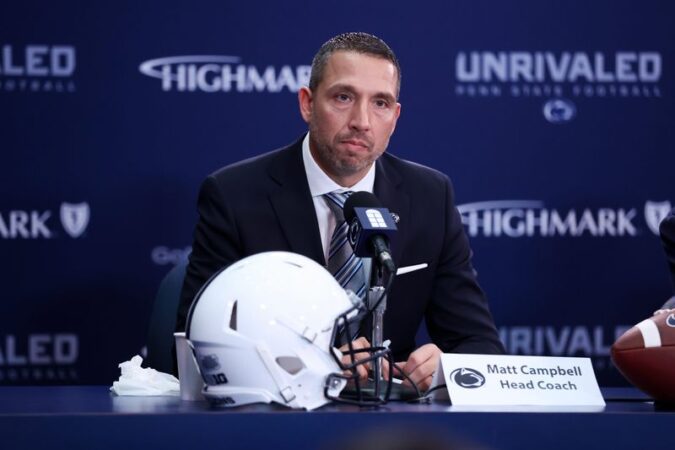
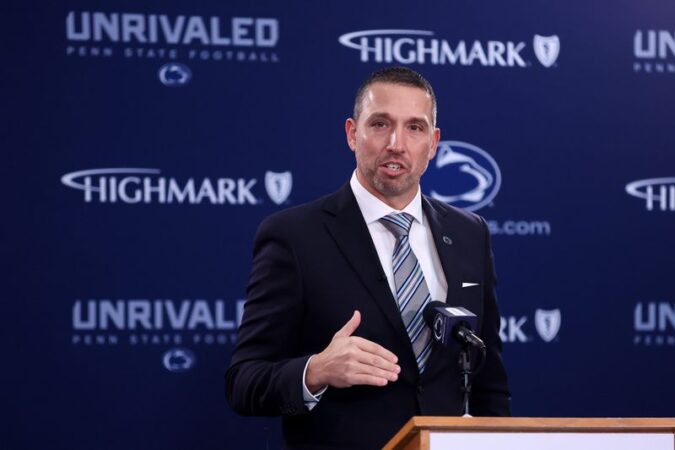
    Matt Campbell completed his first recruiting class as the head football coach at Penn State, and the team welcomed 55 newcomers, including 15 recruits in the class of 2026, four of whom put pen to paper on national signing day.

    Penn State’s class is ranked No. 41 nationally and No. 10 in the Big Ten, according to 247Sports. Many of the players in Campbell’s class were signed before Wednesday’s national signing day. He landed 40 players from the transfer portal, 24 of whom came from Iowa State.

    “I feel like we went with a mentality of not wavering from who we want this football team to be,” Campbell said at a news conference. “Young men that love the sport of football, young men that love Penn State, and I would say, most importantly, young men also that know, they understand the value of an education from this institution. Those core values were really critical for us to kind of build this football team forward.”

    2026 class

    Penn State’s class took a hit during the early signing period while the program continued its search for a head coach. Eleven pledges flipped to Virginia Tech to join James Franklin. Malvern Prep edge rusher Jackson Ford and Nazareth’s Peyton Falzone, a three-star quarterback, were the only two to sign early with the Nittany Lions.

    Since then, Penn State had an additional nine recruits sign, and each of Wednesday’s signees, which included Elijah Reeder, Keian Kaiser, Pete Eglitis, and Lucas Tenbrock, were originally committed to play for Campbell at Iowa State.

    Reeder, a Bayville, N.J., native, is a four-star edge rusher and the fourth-best prospect in New Jersey, according to 247Sports. In his senior season at Central Regional High School, Reeder recorded 50 tackles and eight sacks. Reeder is listed at 6-foot-6 and 210 pounds.

    The defensive lineman’s other FBS offers came from Iowa State and Missouri.

    Eglitis, an offensive lineman, is from Columbus, Ohio. The three-star 6-7 prospect earned all-Ohio honors in 2024 and 2025, as he helped lead Bishop Watterson High School to back-to-back state championships. In addition to flipping from Iowa State, Eglitis also chose Penn State over Louisville, Georgia Tech, Kentucky, and Missouri, among others.

    Kaiser is a linebacker from Sidney, Neb. The three-star recruit was a multisport athlete at Sidney High School, participating in the high jump and the discus. In his junior year, the 6-4 Kaiser recorded 127 tackles and two interceptions.

    A native of St. Charles, Ill., Tenbrock is the sixth-best punter in this year’s recruiting class, according to the composite rankings of ESPN, Rivals.com, and 247Sports. Tenbrock’s only offer came from Campbell at Iowa State.

    While most of the four- and five-star recruits are already committed to schools by national signing day, Penn State was on the losing end of one recruiting battle on Wednesday. The Nittany Lions made a late push to persuade Samson Gash to come to Happy Valley instead of Michigan State, but the four-star wideout and Michigan native chose to stay closer to home.

    Ford is the only Philadelphia-area talent in the class of 2026.

    Transfers

    The majority of Penn State’s roster in 2026 will be transfers.

    Campbell signed 40 players from the portal. The Nittany Lions likely will need the veteran presence, as they lost 47 members of last year’s team to the portal after finishing 7-6 and firing Franklin in the middle of the season.

    Ethan Grunkemeyer perhaps was the most impactful of the outgoing transfers. Grunkemeyer took over after starting quarterback after Drew Allar suffered a season-ending ankle injury in October. Grunkemeyer, who passed for 1,339 yards and eight touchdowns in 2025, followed Franklin to Virginia Tech.

    Campbell turned to a familiar player to fill the hole at quarterback in Rocco Becht.

    Becht spent three seasons as the starter under Campbell at Iowa State. He logged two 3,000 passing-yard seasons and chose to follow his old coach for his final year of eligibility.

    “What I believe Penn State football is — integrity, character, class, excellence, grit — [Becht] embodies every one of those traits,” Campbell said. “And so to me, I just felt like that was such a critical opportunity for him to finish his career with us.”

    Becht is not the only former Cyclone expected to have a major impact.

    Benjamin Brahmer, a 6-7 tight end who led the Cyclones with 37 catches and six touchdowns last season, will spend his senior season at Penn State. The Nittany Lions also will get Brett Eskildsen and Chase Sowell, last year’s leading receivers at Iowa State. They finished with 526 and 500 yards, respectively. Campbell added the Cyclones’ leading rusher, Carson Hansen (952 yards on 188 carries), to the roster as well.

    The Nittany Lions hope the veteran Cyclones can replace the offensive production they lost after running backs Kaytron Allen and Nick Singleton declared for the NFL draft.
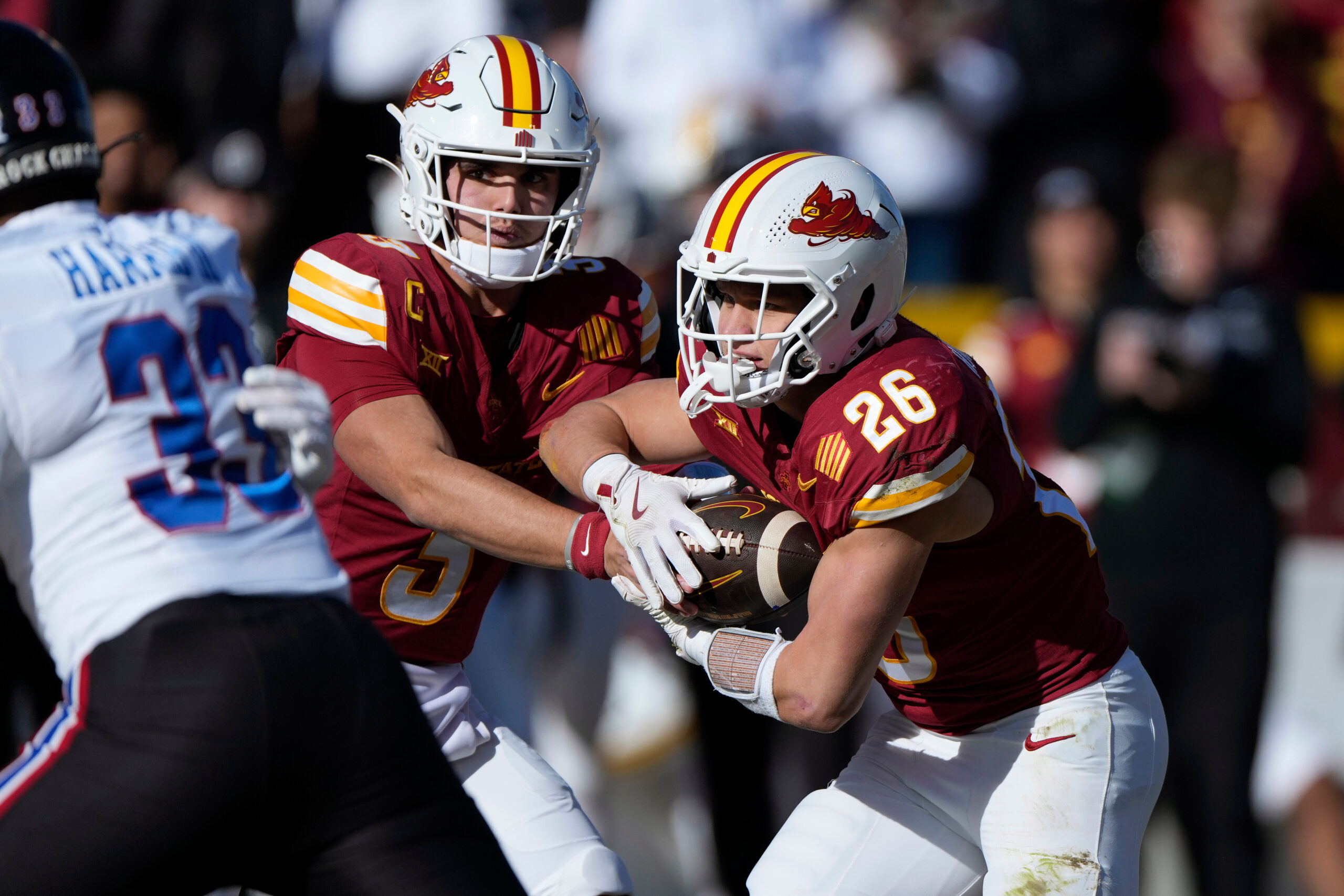
    Former Iowa State quarterback Rocco Becht hands off to running back Carson Hansen, who led the team in rushing yards last season. Both will play at Penn State in 2026.

    “[Hansen is] durable, he’s tough, he’s physical,” Campbell said. “He’s got great vision. He’s got the ability that if you need him to carry the ball 40 times in a game, he can do it. … And so I think what you’ll get from Carson is a guy that’s about as trusted as you’re going to find.”

    Former Cyclones will also impact the defensive side. Campbell landed Iowa State’s leading tacklers in Marcus Neal, a junior defensive back, and Kooper Ebel, a senior linebacker. Both finished last season with 77 tackles, with Neal adding a team-high 11 tackles for loss and two interceptions.

    Caleb Bacon, a redshirt senior linebacker who led Iowa State with three sacks last season, also will join Penn State.

    While the number of transfers who followed Campbell to Penn State from Iowa State should provide Campbell some proven talent, the first-year coach noted that players will still have to navigate change to be successful in Happy Valley.

    “I think there’s competition and there’s the ability to grow, but we’ve got to go grow,” Campbell said. “Every coach in America is going to tell you how great their team is. I’m saying the opposite. We’ve got really great talent, but we’ve got to grow forward. We’re all going through change. We have to figure out who can do it the most consistently.”
  • Kevin Willard wants to push Villanova into the future — without casting Jay Wright into the past

    Kevin Willard wants to push Villanova into the future — without casting Jay Wright into the past

    Over his 12 years coaching at Seton Hall and against Jay Wright, Kevin Willard figured that he knew Villanova as well as any outsider could, especially one who would eventually become the university’s men’s basketball coach. His next-door neighbors in Westfield, N.J., were ’Nova alumni, as were three of his golfing buddies at Plainfield Country Club, and there were all those Big East battles between his teams and Wright’s at the Finneran Pavilion, at the Prudential Center in Newark, and at Madison Square Garden in March.

    Then he went to Maryland. Maryland wasn’t the northeast. It wasn’t Jersey. It wasn’t Philly. It wasn’t even the Main Line. It was the Big Ten. The Big Ten has big-time football, and more importantly, it has football money and a football mindset, even for its basketball programs. The Big Ten also has 18 member schools, so Willard stopped watching Big East basketball altogether. He had 17 conference opponents to study, after all. Then he returned to the Big East this season, replacing Kyle Neptune at Villanova.

    He doesn’t feel comfortable there yet, he said. Too much to do. Too much change so quickly. Too much of a whirlwind.

    “The comfort won’t happen until Year 3,” he said. “When I came, I definitely had rose-colored glasses. I had a perception of what this was, not remembering it had been three years since Jay had left.”

    The Wildcats are 17-5 following their 72-60 victory Wednesday night over Willard’s former team, Seton Hall. And Villanova’s strong season so far might allow its donors and alumni to regard the last three years as just a blip — a small stint in purgatory before Willard got the program back to where those who support it presumed it should and would always be. During an hourlong interview in his office late Tuesday afternoon, though, Willard made it clear where he comes down on Villanova’s future … and its recent past.

    No matter Wright’s intentions, his tenure and presence loomed over Neptune as an ever-present reminder of his 21 years as head coach and nerve center, of two national championships and four Final Fours and the status as the top program in the country. Neptune, who had a single season at Fordham as a head coach and had spent 12 years at Villanova on Wright’s staff, couldn’t escape that shadow or the comparisons, and he couldn’t win enough to buy himself more time. Willard doesn’t want to fall into the same trap, and he thinks he knows how to avoid it, believing his three years at Maryland and in the Big Ten, that experience elsewhere, will be vital to understanding how Villanova has to evolve.

    “It’s so important,” he said. “My 12 years at Seton Hall, I did it my way. You get very isolated, and Jay was here for so long, and they were winning. But it was Jay. And I know this because I went against him. It was Jay. It was Jay’s way. It was the way it was. They didn’t need to change anything. They didn’t need to worry about anything because they had Jay. Once Jay left, you need to go, ‘All right, what’s everyone else doing? Where has everyone else made gains where maybe this place didn’t because they had Jay?’”

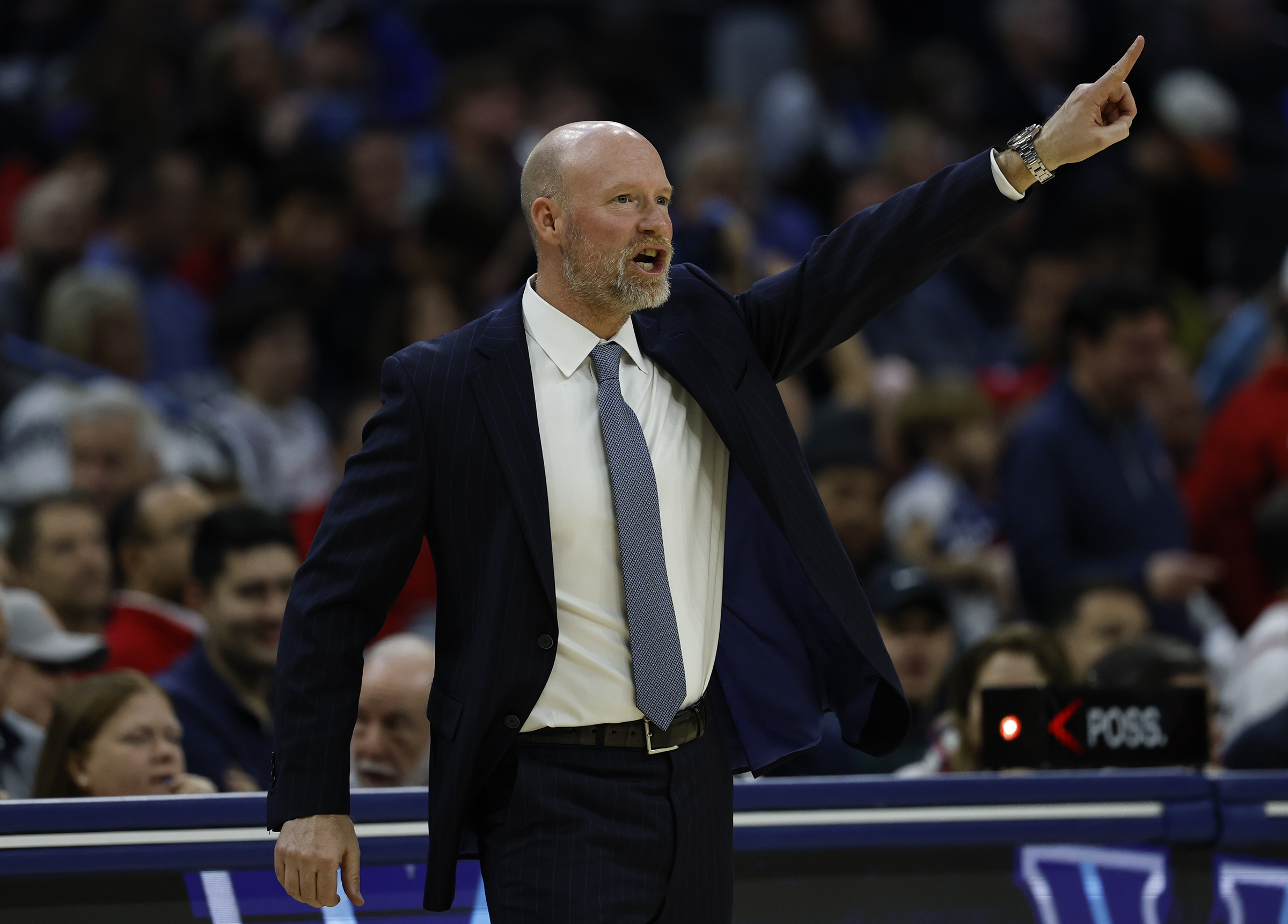
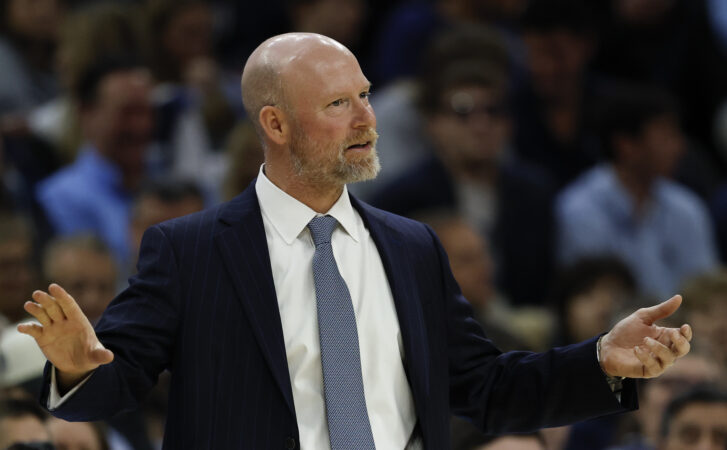
    Kevin Willard doesn’t want to erase all of the Wildcats’ basketball history, rather use it as a valuable resource.

    For Willard, the caution and smaller-time approach that worked under Wright — that worked because of Wright, and because Villanova was operating in a pre-NIL/transfer portal/pay-for-play world — won’t fly anymore. It would be foolish for Willard to try. He’s a Villanova outsider still, rougher around the edges than Wright, than the man who was the most polished coach in the country, and the circumstances in this wild, wild west era of college hoops are different and more challenging.

    The luxury of redshirting players such as Mikal Bridges and Donte DiVincenzo, for instance, allowing them to get acclimated and mature, won’t necessarily be available to Willard. The way to make up for Wright’s departure isn’t to operate as if his successors will be able to replicate his methods or even his culture. It’s to pay the cost of acquiring big-time players and tout their skills as part of social-media branding campaigns and recognize that this isn’t anything like amateur basketball anymore.

    “It’s like growing up in a small town and going to their amusement park, and then you go to Disney World,” Willard said. “You can’t say, ‘We just need to make the roller coaster better.’ Everything’s got to get better, bigger — fairy dust everywhere. It’s not even a money thing or a structural thing. It’s more about a mentality. Jay was monstrous. Jay was Villanova basketball. But we don’t have Jay anymore. …

    “Everyone else is being Disney World. We can’t be the small, little amusement park. We’re not the small, little amusement park, but the mentality a little bit is. ‘We can do it like this because we’ve always done it that way.’”

    Willard insisted he doesn’t intend to erase all of the Wildcats’ basketball history, that he can’t ignore or disregard what Villanova is as a university or how Rollie Massimino, Steve Lappas, Wright, and Neptune did their jobs and why. “If you just go against 60 years of tradition,” he said, “you’re going to get [expletive] blown out of the water.” So he views Wright’s presence as an asset, his knowledge and success as valuable resources.

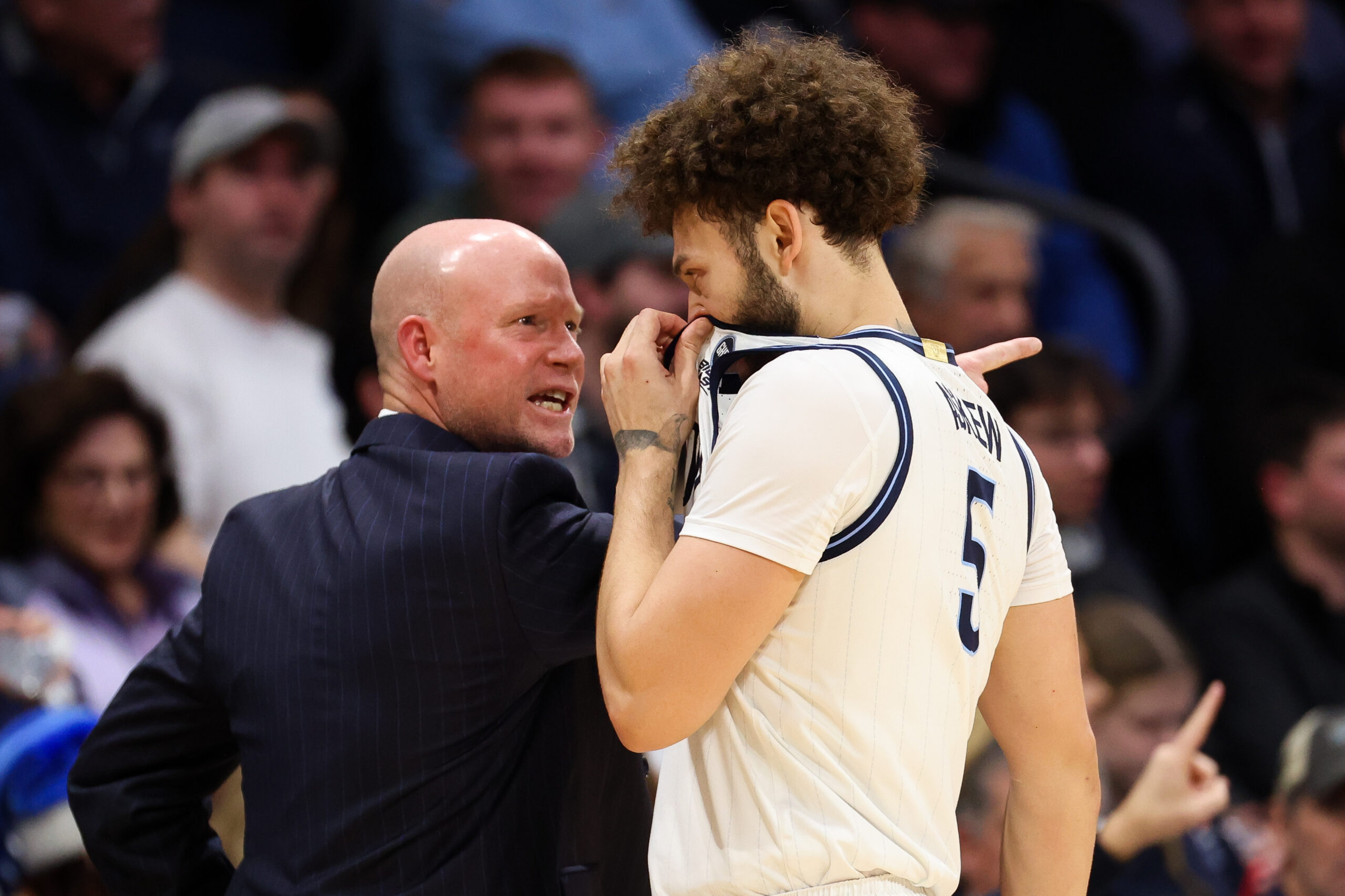
    Kevin Willard said he won’t feel comfortable coaching on the Main Line until year three.

    “If I was in my third year of coaching, I wouldn’t feel the same way,” he said. “I’m 20 years a head coach. I’m not cocky, but I feel pretty confident that I know what I’m doing at this point. I love the fact [that] I have Jay around. It’s only going to help. If I was younger and was coming here after three years at Seton Hall, I would be like, ‘What the [hell]? Why is he at the game? This is [expletive] crazy.’ But I love that he comes to practice. I love that he’s at games. I love that I can text him or call him or go out to dinner with him because he built this. He knows this place better than anybody.”

    He likely always will. It’s a standard, though, that Kevin Willard doesn’t have to exceed or even meet yet. It’s still just Year 1 for him. Check back in Year 3. He doesn’t have to know Villanova as well as Jay Wright did. He just has to do his part in this new time of college basketball. He just has to know it well enough.

  • Philly’s Don Bitterlich scored the first points in Seahawks history. But he made his name playing the accordion.

    Philly’s Don Bitterlich scored the first points in Seahawks history. But he made his name playing the accordion.

    Don Bitterlich’s Chevy Caprice was loaded with everything he needed for his gig that night at an Italian restaurant in Northeast Philly: an accordion, a speaker, and a pair of black slacks.

    He learned to play the accordion as a 7-year-old in Olney after his parents took him to a music shop on Fifth Street and he struggled to blow into a trumpet. His father pointed to the accordion, and Bitterlich played it everywhere from his living room on Sixth Street to Vitale’s on Saturday nights.

    The owner of Vitale’s — a small restaurant with a bar near Bustleton and Cottman Avenues — paid Bitterlich $175 every Saturday. It was a lot of money for a college student in the 1970s. First, he had to finish football practice.

    Bitterlich went to Temple on a soccer scholarship before football coach Wayne Hardin plucked him to be the placekicker. He never even watched a football game, but soccer coach Walter Bahr — the father of two NFL kickers — told Hardin that Bitterlich’s powerful left leg was fit for field goals.

    Bitterlich went to football camp in the summer of 1973, while also playing soccer for Bahr and trying to keep up with his accordion. He had yet to officially make the football team that August, so there was no use in canceling his 10 p.m. Saturday gig at Vitale’s. Bitterlich was due to play there in 90 minutes, but the Owls had yet to include their kicker in practice. He was hoping to leave practice by 8:45 p.m., and it was almost time.

    “I’m watching the clock,” Bitterlich said.

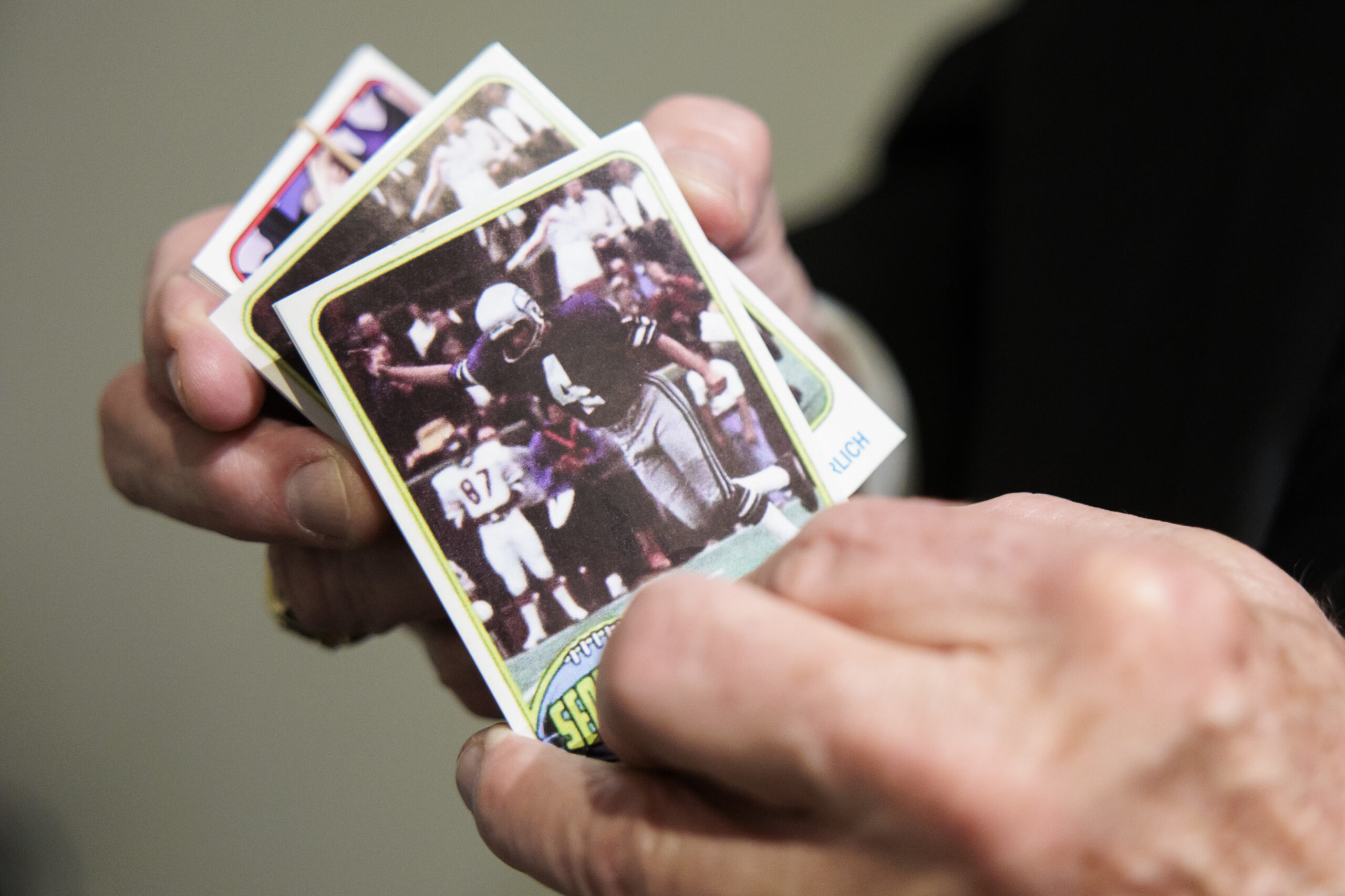
    Don Bitterlich holds his Seahawks football card. He scored the first points in Seahawks history as a kicker.

    He asked an assistant coach if the team was going to kick, and the coach shrugged him off. A half-hour later, he asked again. He had to go, Bitterlich said.

    “He said, ‘Go where?’” Bitterlich said.

    Bitterlich set records at Temple, played in an all-star game in Japan, was in his dorm when he was selected in the 1976 NFL draft, and scored the first-ever points for the Seattle Seahawks, who play Sunday in Super Bowl LX against the New England Patriots.

    He made it to the NFL despite knowing little about football until he became Temple’s kicker. It was a whirlwind, he said.

    He really made his name with the accordion, the instrument he’s still playing more than 50 years after he had to rush to a gig from football practice.

    He has long been a regular at German festivals, restaurants, banquets, and even marathons. A German club in the Northeast called Bitterlich “the hardest working accordion player in the world.” He played a gig on Sunday night in South Philly and another on Monday morning near Lancaster.

    Bitterlich, 72, who worked as a civil engineer until retiring last year, said he played more than 100 gigs in 2025. Football stopped years ago, but the show rolls on.

    “These days,” he says, “most people around hear me playing the accordion, and they don’t know that I kicked in the NFL.”

    Becoming a kicker

    Bitterlich was home in Warminster — his family moved from Olney just before his freshman year at William Tennent High — when Bahr called. The Temple soccer coach had been a star on the U.S. team that upset England in the 1950 World Cup and was one of the best players to come out of Philadelphia.

    “He had this raspy voice,” Bitterlich said. “He smoked cigars during practice and basically chewed and ate half of it as well. He always called me ‘Bitterlich’ but called me ‘Donald’ if I screwed up.”

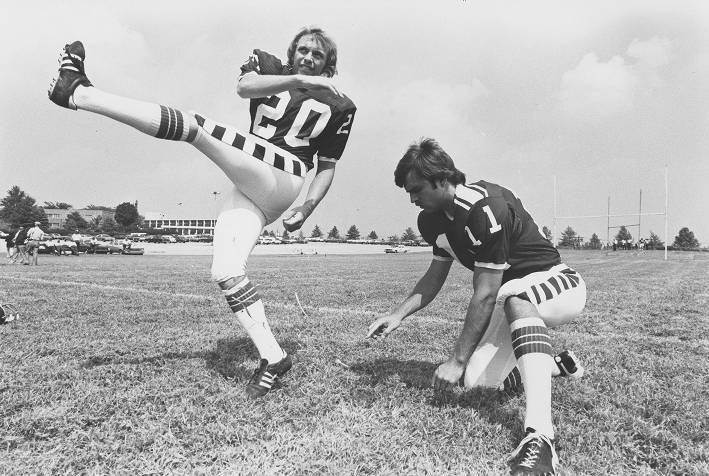
    Don Bitterlich (20) at Temple, likely during the 1975 season.

    So Bitterlich figured he was in trouble when his coach called him “Donald” on the phone.

    Bahr asked Bitterlich whether he knew who Hardin was. Yes, he said. Bahr said he had just talked to the football coach and told him Bitterlich could kick. The coach had watched Bitterlich since he played soccer for Vereinigung Erzgebirge, a German club his grandfather founded off County Line Road. He told Bitterlich he could do it.

    “So I said, ‘No soccer?,’” said Bitterlich, who was also the mascot at basketball games in the winter. “‘No, you’re my starting left midfielder.’ I was thinking, ‘How is this going to work?’”

    Bahr told Bitterlich to call the football office, get a bag of balls, and start kicking. He kicked every day at the German club and tried to figure it out. He was soon splitting his day between football camp in Valley Forge and soccer camp at the old Temple Stadium on Cheltenham Avenue in West Oak Lane. Each sport practiced twice a day and Bitterlich found a way to make them all.

    He played a soccer game that season in Pittsburgh, flew home with the team, and then took a taxi from the airport to Temple Stadium to kick for the football team. He was studying civil engineering and balancing two sports plus his accordion.

    It eventually became too much. Hardin told Bahr that he would give the kicker a full scholarship to play football. That was it.

    “With the football scholarship, I got room and board,” Bitterlich said. “So I was living on campus after commuting from Warminster. It was insane. I was so worn out.”

    Making history

    Bitterlich kicked a game winner in October 1973 against Cincinnati as time expired, made three kicks at Temple longer than 50 yards, and was the nation’s top kicker in 1975. The soccer player made a quick transition.

    “Coach Hardin always said, ‘If I yell ‘field goal,’ I expect three points on the board,’” said Bitterlich, who was inducted into the Temple Hall of Fame in 2007. “He expected that. The point of that was that he trusted you. That was his way of saying, ‘I’m not asking you to do anything that I don’t think you can do.’”

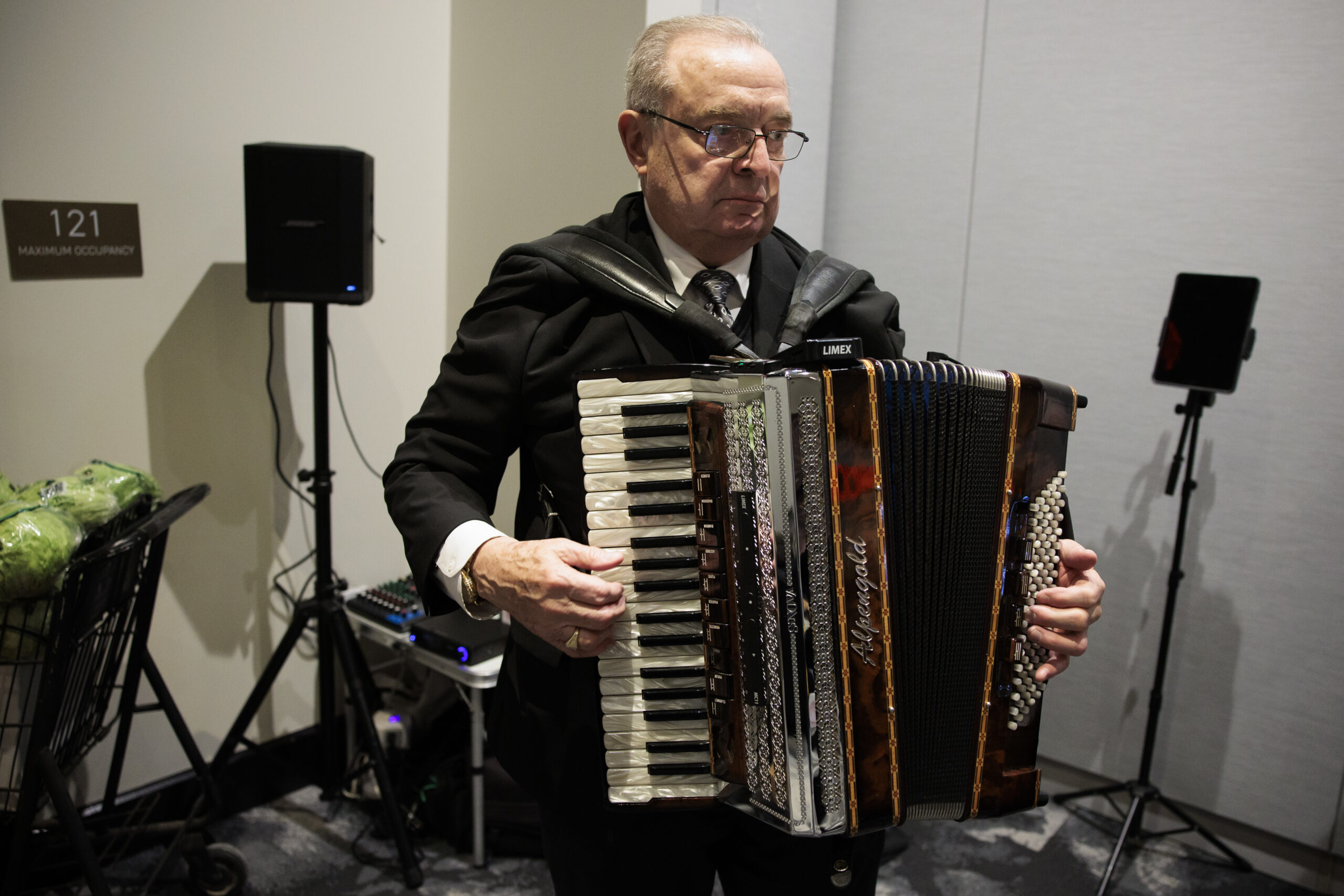
    Don Bitterlich performs with his accordian on Sunday during The Tasties at Live! Casino.

    The coach helped Bitterlich understand the mental side of kicking, challenging him in practice to focus on the flagpole beyond the uprights. Try to hit the flag, he said.

    “That had a huge mental impact on me,” Bitterlich said. “You have that image, and then when you do your steps back and you’re set, that’s all you can see. It made all the difference in the world for me. Once you have that image, you zone out any of the noise. You’re just focused on that image.”

    It helped him focus in September 1976 when the Seahawks opened their inaugural season at home against the St. Louis Cardinals. They drafted Bitterlich five months earlier in the third round. The Kingdome’s concrete roof made the stadium deafening, but Bitterlich felt like he was back in North Philly practicing at Geasey Field as he focused the way Hardin taught him to.

    He hit a 27-yard field goal in the first quarter, registering the first points in franchise history. The Seahawks had quarterback Jim Zorn and wide receiver Steve Largent, but it was the soccer player who scored first.

    Bitterlich’s NFL career didn’t last long, as the Seahawks cut him later that month after he missed three field goals in a game. He tried out for the Buffalo Bills, but a blizzard hindered his chances. He signed with the Eagles in the summer of 1977, missed a field goal in a preseason game, and was cut.

    He landed a job as a civil engineer in Lafayette Hill. He received a call on his first day from Eagles coach Dick Vermeil, who said the San Diego Chargers wanted to try him out. Bitterlich flew to California the next day but turned down a three-year NFL contract that would pay him only slightly more than his new job back home.

    “Plus, the real reason I turned down their offer was that they couldn’t hold for a left-footed kicker,” Bitterlich said. “Their holder just couldn’t get the ball down. I didn’t want to sign that contract. ‘What’s going to happen in two days when that guy can’t get the ball down?’”

    A week later, the San Francisco 49ers called. He flew back to California, tried out against another kicker, and was told he won the job. But the 49ers decided to sign Ray Wersching, who had been cut the previous season by the Chargers. Bitterlich turned down the chance to replace Wersching in San Diego, and now Wersching was swooping in for the job Bitterlich wanted in San Francisco.

    “I went back home and said, ‘That’s enough,’” said Bitterlich, who played three NFL games. “It started to get disappointing.”

    “I love to play,” Bitterlich says of his accordion. “I usually don’t take breaks. Most bands will play 40 minutes on, 20 minutes off. I just play through.”

    Still playing

    His NFL journey was hard to imagine that day at practice as he watched the clock at Temple Stadium and thought about how long it would take to drive to Vitale’s. Bitterlich told the assistant coach that it was almost time to play his accordion. That, the coach said, was something he would have to talk to Hardin about. Fine, Bitterlich said.

    “I didn’t know if I was going to make the team or not, and I knew I was going to play soccer,” Bitterlich said. “So I just went over and told Coach.”

    Hardin heard his kicker say he had to leave football practice to play the accordion and laughed.

    “He said, ‘Yeah, I heard something about that,’” Bitterlich said.

    The coach stopped practice and let Bitterlich get in the mix. He nailed six field goals and the other kicker shanked a few. The job felt like his. He hit a 47-yarder and looked over at Hardin.

    “He’s like, ‘Yeah, yeah. Go ahead. Go,’” Bitterlich said.

    Bitterlich was soon in his Chevy Caprice, heading down Cottman Avenue on his way to Vitale’s. He wasn’t late to his accordion gig that night. His football career would end a few years later, but the music has yet to stop.

    “I enjoy it,” Bitterlich said. “I love to play. I usually don’t take breaks. Most bands will play 40 minutes on, 20 minutes off. I just play through. I really don’t take a break. I love it.”

  • Villanova recruited Devin Askew in high school. Six years and five schools later, he’s fueling the Wildcats.

    Villanova recruited Devin Askew in high school. Six years and five schools later, he’s fueling the Wildcats.

    Devin Askew was covered in sweat when he sat down in a room inside the practice facility at Villanova on Monday, fresh off an on-court workout with development coach JayVaughn Pinkston that followed a weightlifting session.

    Askew, Villanova’s sixth man, is on a tear as of late, averaging 15.8 points during a six-game stretch in which the 23-year-old guard has made 17 of 29 three-pointers. Sessions with Pinkston, a former Villanova player, have helped. Pinkston’s role is exactly that, to do the little things to get the most out of every player. But with Askew, Pinkston’s presence also is a reminder of the past and the winding journey Askew has traveled to put himself in the running for Big East Sixth Man of the Year.

    There are few connections remaining to the Villanova program of old, and Pinkston, who played for the Wildcats from 2011 to 2015, is one of them. Which gives him the right to playfully rib Askew about 2019, when, as a top recruit in the class of 2020 from California, he chose Kentucky over Villanova (and others).

    “He’ll always tell me I should have been here five years ago,” Askew said. “I should’ve always been a Villanova Wildcat.”

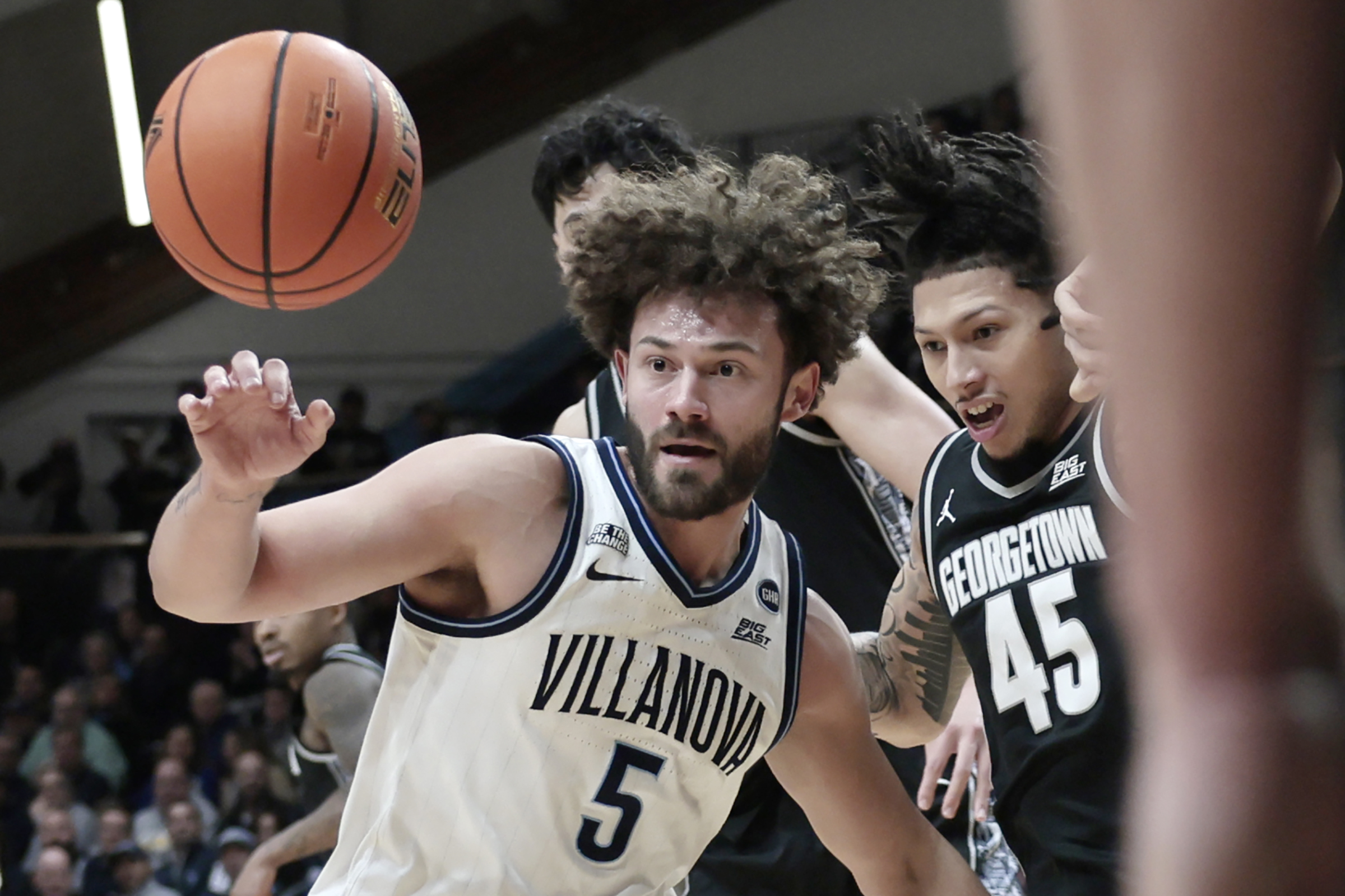
    Devin Askew is making a strong case for Big East sixth man of the year.

    He is here now almost by accident. His college journey has traveled more than 8,000 miles from Mater Dei High School in California to Lexington, Ky., to Austin, Texas, to Berkeley, Calif., to Long Beach, Calif., and, finally, to the Main Line. Five schools in six years. Which made him just another sign of the times when Kevin Willard plucked him out of the transfer portal to give his roster a much-needed experienced ballhandler and shooter.

    He was, to the outside world, another mercenary college basketball player passing through a random place on a map and collecting a paycheck to bridge his way to wherever professional hoops takes him.

    But for Askew, his time at Villanova has been a “full-circle” experience. Like in most people, his past explains the present, and it’s fitting the journey ends here, where his future is being determined during a critical turning-point season for him and Villanova.

    ‘It’s why we brought him here’

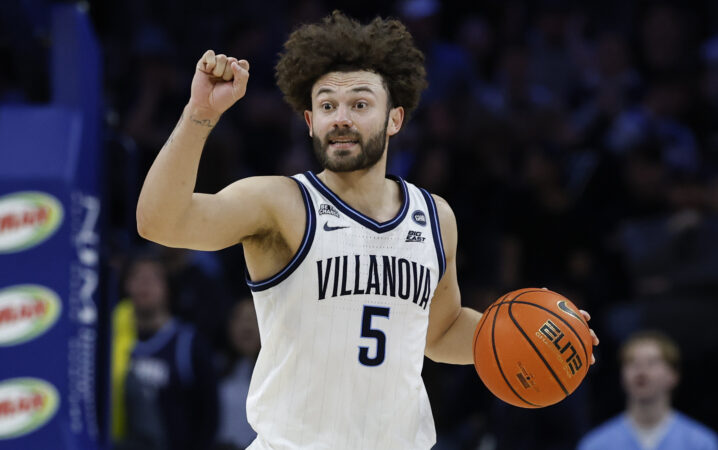
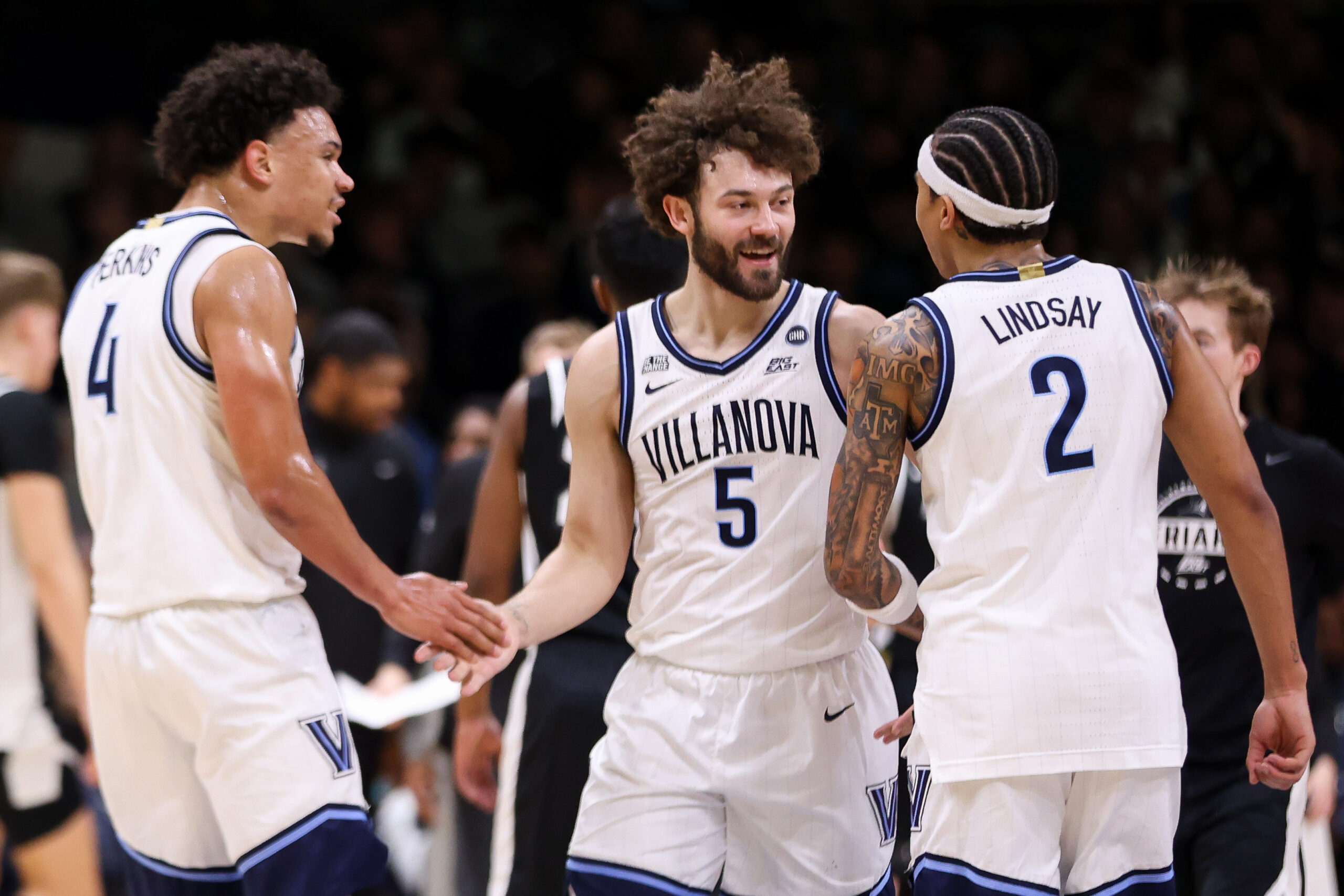
    This recent stretch is what Willard imagined when Villanova recruited Askew this time around. It’s a young Villanova roster, especially at guard. Freshman Acaden Lewis and sophomore Bryce Lindsay have had breakout seasons with the Wildcats, but Askew lately has been a steady presence, and his experience has allowed him to compete on both ends during the physical demands of a Big East schedule.

    Before the last six games, Askew reached double figures just three times in 15 contests. It took a little bit longer for it all to come together because he suffered a knee injury during the lead-up to the season. His injury history followed him. A sports hernia injury ended his junior season at California after 13 games, and a foot injury ended his following season, the 2023-24 campaign, after just six.

    That injury gave him a redshirt season, but also extra perspective to get through his first few months at Villanova, when he missed nearly two months of practice and was not 100% when the season started.

    “I’m tough, and I’m not going to quit,” Askew said when asked what he has learned about himself along his college journey.

    Were past versions of him not as tough?

    “The true test of knowing that is to go through something,” he said. “I’m willing to go through it and deal with anything that comes to me because I love the game, I love the sport of basketball. I don’t want to stop playing.”

    Villanova has needed Askew to be a stabilizing force at times, and it also has needed him to take over games offensively, like against St. John’s and Connecticut, two of the more experienced teams in the conference.

    “I don’t view it as they need me to take over,” Askew said. “There are so many things going on within a game, taking over a game could be a defensive stop.”

    Devin Askew scored a team-high 20 points off the bench against Providence on Friday.

    Willard credited a recent run of strong practices after Askew made five three-pointers and scored 20 points in Friday’s win over Providence. The coach has talked recently about how critical it is to have Askew’s experience. He’s a big reason the Wildcats are 16-5 overall and 7-3 in the Big East as they head into Wednesday night’s home game vs. Seton Hall.

    “It’s why we brought him here,” Willard said. “This is the type of player he is. When you go into the portal, you really have to evaluate and watch film and see what he has. When he was on his visit, I think the best part about it was I just loved his maturity. He’s a terrific, terrific person.

    “He’s getting rewarded for being a hard worker and a terrific person.”

    A piece from all the places

    There is a part of every stop that make up the player and person Askew is.

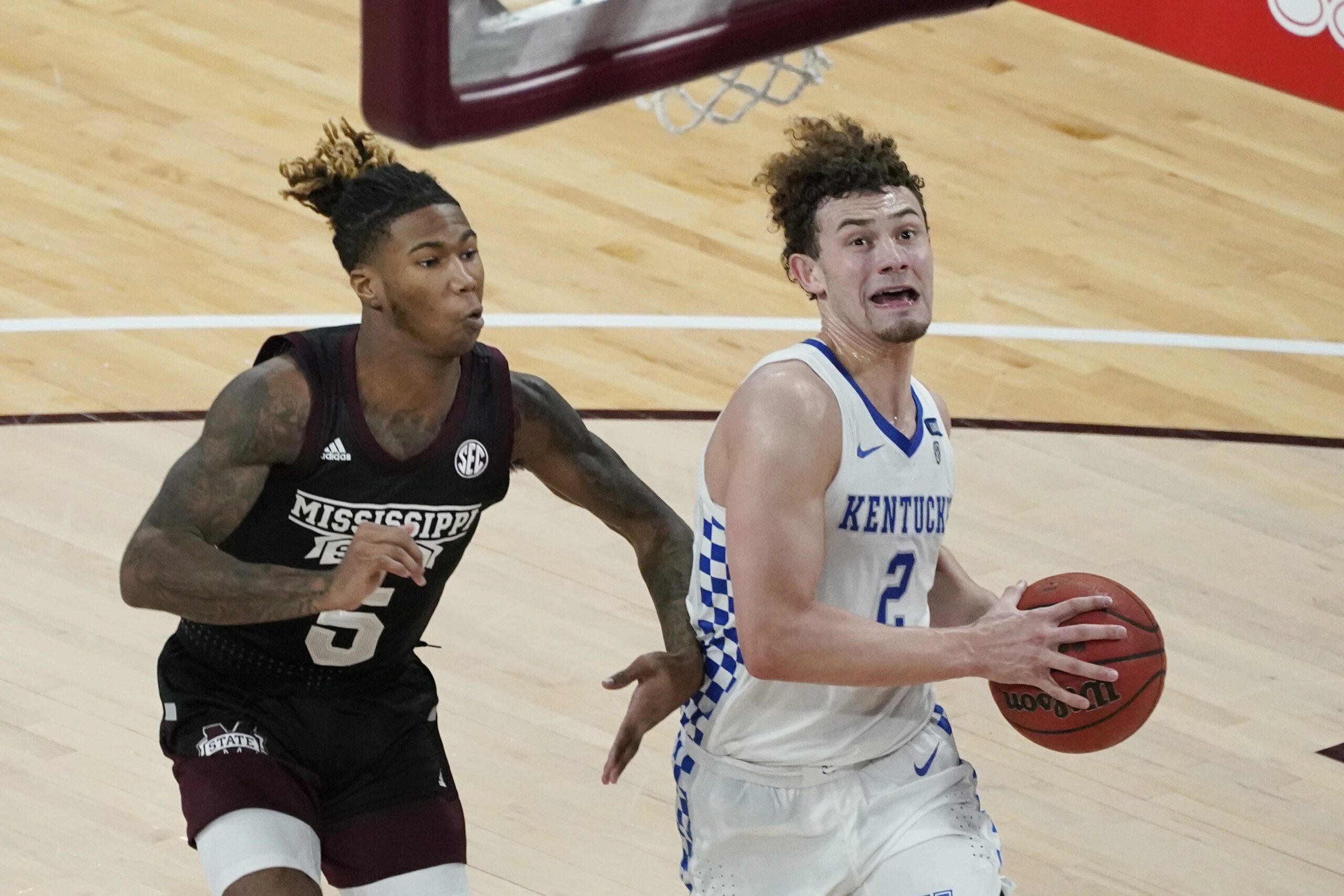
    He chose Kentucky as a 17-year-old top-40 prospect because who wouldn’t want to play for John Calipari and follow in the footsteps of top guards like Shai Gilgeous-Alexander and Tyrese Maxey?

    What did he learn from each stop? Askew went through them one by one.

    Devin Askew said his time at Kentucky “taught me patience and to be even-keeled.”

    At Kentucky, he learned how to go from being the guy on a high school team to being one really good player on a team of other really good players. It wasn’t an easy learning experience. “It actually taught me patience and to be even-keeled,” he said. “There’s going to be ups and downs, and you can’t get too high or too low. I was just an emotional kid.” He had high expectations for himself and didn’t meet them. He started losing his love of basketball.

    Enter Texas, which may be the most important stop of the five. “That brought back all that love for me,” Askew said. “No, you still love this game. Chris Beard and that coaching staff saved my career.” Askew averaged 14.9 minutes off the bench and was a role player on a team that reached the NCAA Tournament. He fell back in love with basketball, but he wanted a place where he could start, so he went back home to California.

    At Cal, it was time to “go show it,” Askew said. “I was ready. And the seasons just got cut short to injuries both years, and that’s where we kept learning and kept growing. … This is the life we chose.”

    Cal allowed him to be closer to his family. He has leaned heavily on his two brothers and his parents over the years. Cal also gave him his undergraduate degree in interdisciplinary studies. But entering the 2024-25 season, he was an oft-injured journeyman with two seasons of eligibility left — one redshirt year, one COVID year — looking to prove he could still play. To the portal, and to Long Beach State, he went.

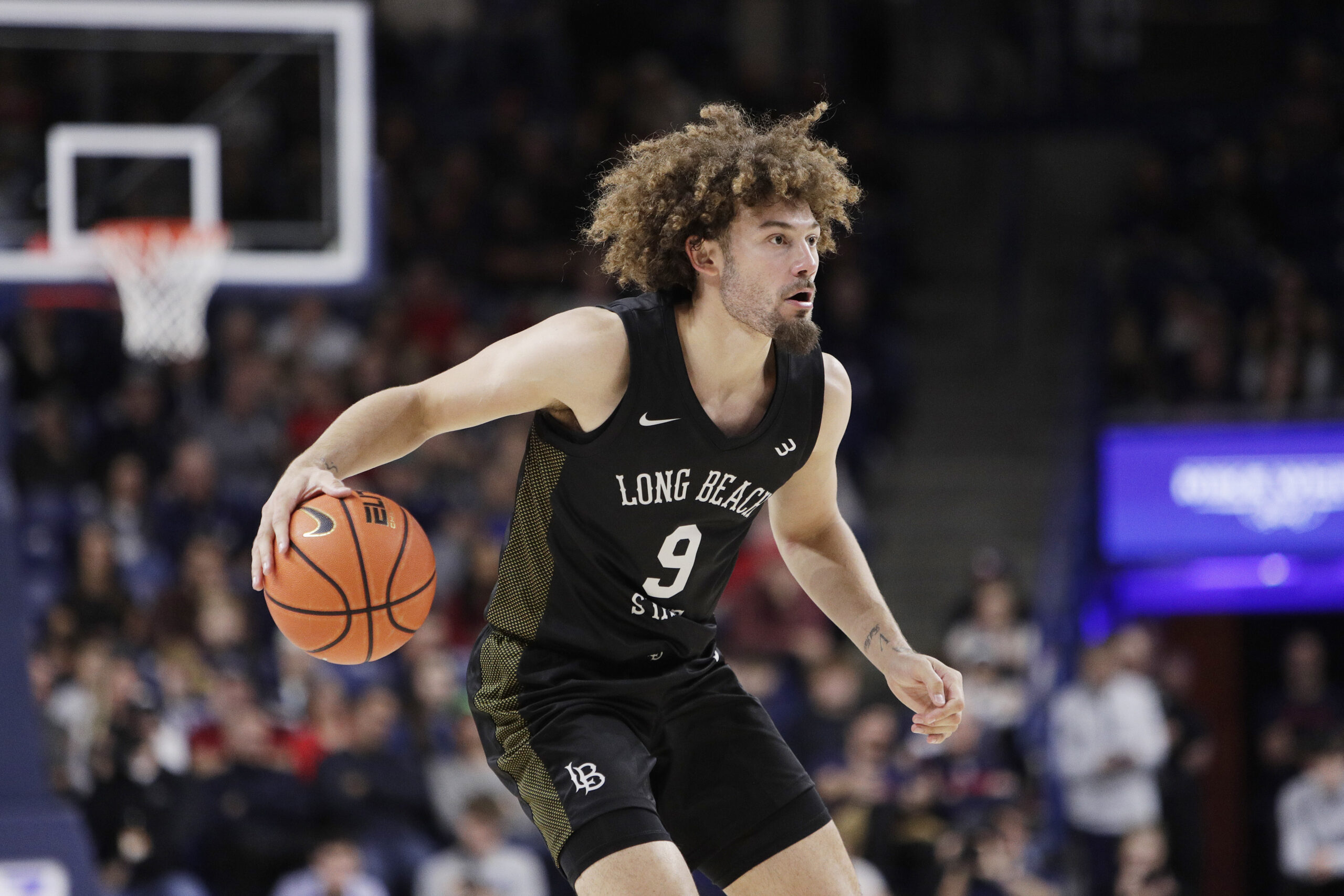
    “Go do it,” Askew said of Long Beach. “It wasn’t go show everyone, because I wasn’t into showing everyone. But it was prove to yourself again.” He scored 18.9 points per game and shot 37.6% from three-point range on a team that won seven games and ended the season by losing its last 15.

    At Long Beach State, Devin Askew averaged 18.9 points.

    “Not a lot of people believed in me and believed I could play still,” Askew said. “They gave me the platform to show what I could still do.”

    He found a believer in Willard, who needed another guard in late April to fill out his roster. Villanova, Askew said, is the place to put all of those experiences together.

    There are a lot of reasons to gripe about the state of college basketball, and a player going to five schools in six years is one of them. Askew is, in a sense, a one-year rental who helped Willard get Villanova back on track in his first season.

    Off the court, Askew is taking classes toward a master’s certificate in Villanova’s public administration program, a year after earning a certificate in communications at Long Beach. On the court, Askew is helping Villanova get back to the NCAA Tournament.

    When the topic of the tournament came up, Askew shook his arms and said he got chills.

    “That would mean everything to me,” he said. “I kind of get emotional thinking about it. As a kid you always want to play in the tournament. You go to college and want to play college basketball to make the tournament.”

    A continuation of his current form will go a long way toward making that possible, and helping him raise his own profile. The NBA probably isn’t in his future, but there is a country or league out there for a lot of players like him.

    “I don’t know what this year will do for me,” Askew said. “And I don’t like to hope, because what will happen will happen. I’m just thankful wherever this game takes me, thankful and grateful.”

    Sometimes it takes you to the place where maybe you were always supposed to be.

  • Born in The Inquirer’s newsroom, the AP women’s basketball poll ‘has stood the test of time’

    Born in The Inquirer’s newsroom, the AP women’s basketball poll ‘has stood the test of time’

    Paging through the bulky Sunday Inquirer on Nov. 28, 1976, readers encountered a sports section that might have been compiled in Mount Athos, the tiny Greek republic that’s been off-limits to women for centuries.

    It was stuffed with man’s-world staples — stories, stats, and standings on the NFL, NHL, pro and college basketball. There were columns on hunting, golf, boys’ high school sports; features on boxing, men’s cross-country, minor league hockey; an entire page devoted to horse racing.

    The ads were no less macho-flavored, promoting car batteries, rifles, tires. A prominent one hyped January’s U.S. Pro Indoor Tennis Championship at the Spectrum with its lineup of “50 of the world’s top male pros.”

    About the only indications that women participated in sports were an account of a West Chester State field hockey game and, buried on the gray scoreboard page, a truncated leaders’ list from that weekend’s LPGA tournament.

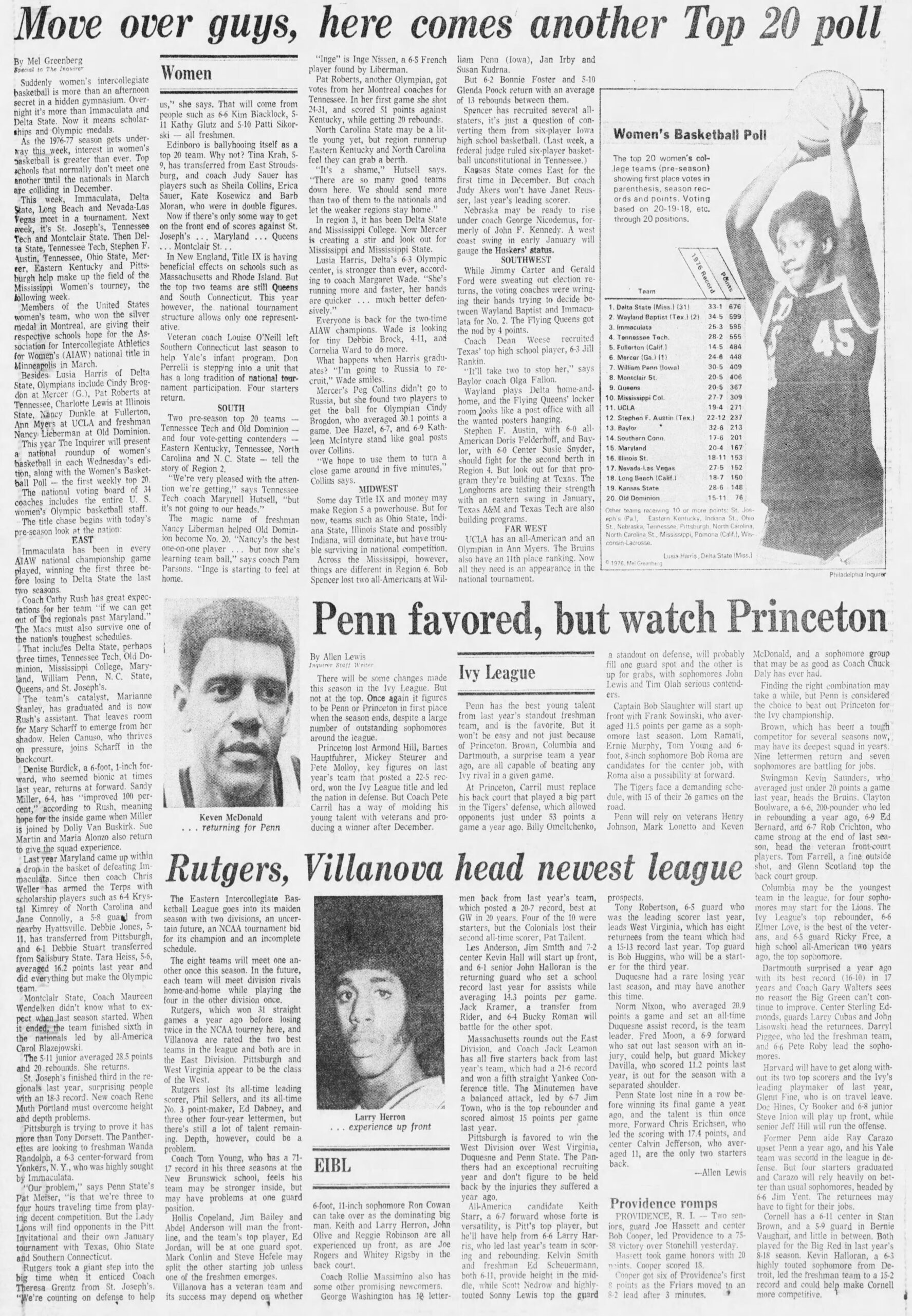
    But for those who reached Page 16, a strange interloper awaited. Sandwiched between two men’s basketball previews, as if editors thought it incapable of standing alone, was one of the earliest and most consequential harbingers of a bubbling sports revolution — the first women’s college basketball poll.

    Conceived by then-Inquirer sports editor Jay Searcy and obsessively nurtured by a Temple-educated newspaper clerk named Mel Greenberg, its headline read like a polite plea for recognition: “Move over guys, here comes another Top 20 poll.”

    A clipping from the Nov. 28, 1976, edition of The Inquirer that features the first installation of what became the AP women’s basketball poll.

    It came. And it stayed. Week after week, year after year, Greenberg’s poll accumulated popularity and heft, becoming a building block in the growth of women’s basketball. A sport that had been widely ignored and loosely governed by the Association for Intercollegiate Women’s Athletics now had validation, a common sense of purpose, and unity.

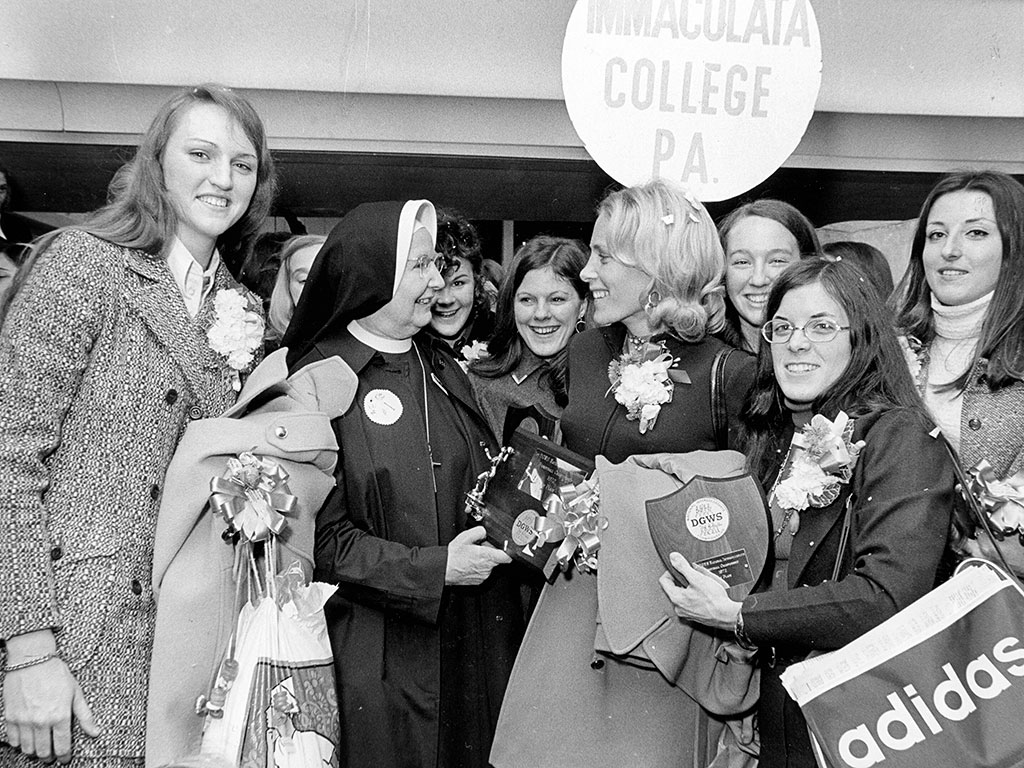
    “That poll gave coaches and others around the country an opportunity to know what was going on everywhere with women’s college basketball,” said Marianne Stanley, a star on Immaculata’s 1970s championship teams and later a successful college and WNBA coach. “Prior to that, there was only word-of-mouth. Newspapers didn’t cover it, and no one was tracking what was happening nationally.”

    Revisiting that debut poll in this, its 50th anniversary year, is eye-opening. Its top 10 might today be mistaken for a ranking of Division III field hockey teams — Delta State, Wayland Baptist, Immaculata, Tennessee Tech, Fullerton, Mercer, William Penn, Montclair State, Queens, and Mississippi College.

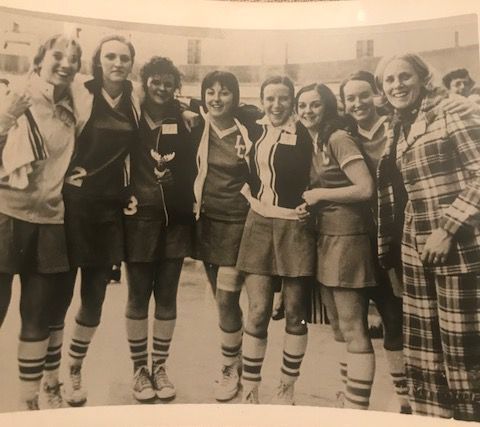
    Theresa Grentz (second from left) and Marianne Stanley (fourth from right) with Immaculata teammates and coach Cathy Rush at right. Immaculata was one of women’s college basketball’s first powers.

    The large state schools that dominate in 2026 mostly were absent.

    But not for long.

    Motivated by the mandates of 1972’s Title IX and by a desire to see themselves in the new rankings, many started to invest in the sport.

    By 1981, when the NCAA replaced the AIAW as the game’s overseer, there were 234 women’s Division I programs. That jumped to 284 in 1991, 317 in 2001. Last season there were 325 D-I programs, and more than 1,000 when Division II and III are included.

    “The fact that so many schools where women’s basketball was nonexistent or an afterthought went all in is a credit to Mel and his poll,” said Jim Foster, the retired women’s coach at St. Joseph’s, Ohio State, and elsewhere.

    Deirdre Kane, the retired West Chester University coach, said that “until Mel’s poll, the NCAA wasn’t even acknowledging our existence. That poll made people realize, some of them for the first time, that women’s collegiate basketball was being played.”

    Greenberg built a national network of coaches and administrators, contacting them weekly for information and input. As newspapers beyond Philadelphia added his poll, its significance deepened.

    “We were all fighting for recognition, but none of us were getting much,” said Geno Auriemma, the Norristown-raised, spectacularly successful coach at Connecticut. “Mel came along, and he was one of the few who gave us a little. His poll helped us all grow the game.”

    It grew so widely that in 1996 the NBA launched a women’s pro league, stocked with the stars of the college game. The WNBA now has a national TV contract, recognizable superstars, and a lineup of big-city franchises that in 2030 will include Philadelphia.

    “When Philadelphia gets that team,” Foster said, “they ought to call it the Philadelphia Mels.”

    Philadelphia roots

    It took 28 years after the inception of the Associated Press’ men’s college basketball poll for the women to get one. In 1976, Searcy, who before arriving at The Inquirer had covered women’s sports for the New York Times, decided the time had come. His motivation likely sprang from developments in that Bicentennial year.

    Women’s basketball made its Olympic debut that summer in Montreal. A few months earlier, Immaculata had appeared in its fifth straight AIAW national title game. The Mighty Macs, who in 1971 played in the first nationally televised women’s game, had won the first three and were runners-up the next two years.

    Searcy reached out to Greenberg, an editorial clerk who by then was the de facto Immaculata beat writer.

    “Jay called me into his office and said, ‘What do you think of the idea of a women’s basketball poll?’” Greenberg said. “And I said, ‘I think you’re nuts.’”

    As Greenberg prepared for the poll’s November launch, Searcy promoted it. He revealed his plan to Temple students during a campus visit. In that audience was Foster, then a physical education major who also coached Bishop McDevitt High School’s girls.

    “It was really exciting news for anyone interested in the sport,” Foster said. “He told us he was going to start a women’s basketball poll that would be just like the men’s.”

    Still, many scoffed. Women’s basketball, after all, existed deep in the shadows. Most newspapers and TV stations ignored it. With few exceptions, games were played before tiny crowds, often in substandard gyms. Rules weren’t standardized, qualified coaches and referees were in short supply, and, until the AIAW’s 1971 founding, there was no universally accepted end-of-season tournament.

    “The only people who followed women’s basketball then were the people involved in the game,” Kane said.

    But if there was a hotbed, it probably was the Philadelphia area. Numerous elementary schools, high schools, and colleges here had teams. West Chester State, with its strong physical education program, gained prominence in the 1960s under coach Carol Eckman, now known as “the mother of women’s college basketball.” And it was a West Chester grad, Cathy Rush, who turned Immaculata into the nation’s best team in the early 1970s.

    “There was always a huge basketball presence in Philadelphia,” Stanley said. “But it wasn’t until Immaculata that many people noticed the women. Then, the AIAW was formed, and that was big. Now, here comes the poll, and suddenly we’ve got a way to track and pay attention to what was happening not just here but across the country.”

    Members of the Immaculata College basketball team gather around their coach as they return after winning the first women’s collegiate national championship in 1972. From left in the foreground are Theresa Shank, college president Sister Mary of Lourdes, coach Cathy Rush, and Janet Ruch.

    Despite Greenberg’s occasional stories on the Mighty Macs, few readers knew much of the women’s basketball world beyond. And few sports editors and writers besides Searcy and Greenberg saw its potential.

    “I loved women’s basketball,” said Dick Weiss, a veteran sportswriter who then was covering men’s college basketball for the Philadelphia Daily News, “but most of us never saw it becoming a regular beat. All our energy went into the Sixers with Julius Erving and the Big 5, which still had NCAA teams filled with local talent.”

    Launching the poll proved problematic. If women’s programs were second-class on most campuses, so were their support staffs. Gathering schedules and stats was nearly impossible. When Greenberg reached out to the AIAW for help, the organization balked.

    “They told me women’s sports shouldn’t get involved in things like newspaper polls because that would lead to the evils of men’s athletics,” he said.

    So he built a Rolodex of contacts, then he and some basketball contacts painstakingly collected information over the phones.

    “Mel based the poll operation in our sports department,” said Gene Foreman, then The Inquirer’s managing editor. “His volunteer helpers were several tall women.”

    Coaches telephoned in their votes on Sunday nights. One, N.C. State’s Kay Yow, provided an early indication of the poll’s impact.

    On Jan. 2, 1977, Immaculata visited N.C. State, which typically played before small gatherings. But the new rankings promised a compelling matchup. The Wolfpack were ranked No. 15; Immaculata, which triumphed, 95-90, was No. 2.

    “I remember Yow calling and talking about how excited she was,” Greenberg said. “It was snowing before the game, but there was a long line of fans outside the arena waiting for tickets.”

    In 1978, the Associated Press began distributing the poll, giving most news outlets access. Then, in 1994, Greenberg ceded its compilation to the AP, and media members replaced coaches as the voters.

    The poll was a cornerstone of the game, and in 2000, another Sunday Inquirer spotlighted women’s basketball’s maturity.

    Philadelphia was hosting that year’s Final Four. Its lineup of Connecticut, Tennessee, Rutgers, and Penn State revealed the game’s progression from the days when little Immaculata could win three straight titles. Its two sessions attracted nearly 40,000 fans. Millions more watched on ESPN.

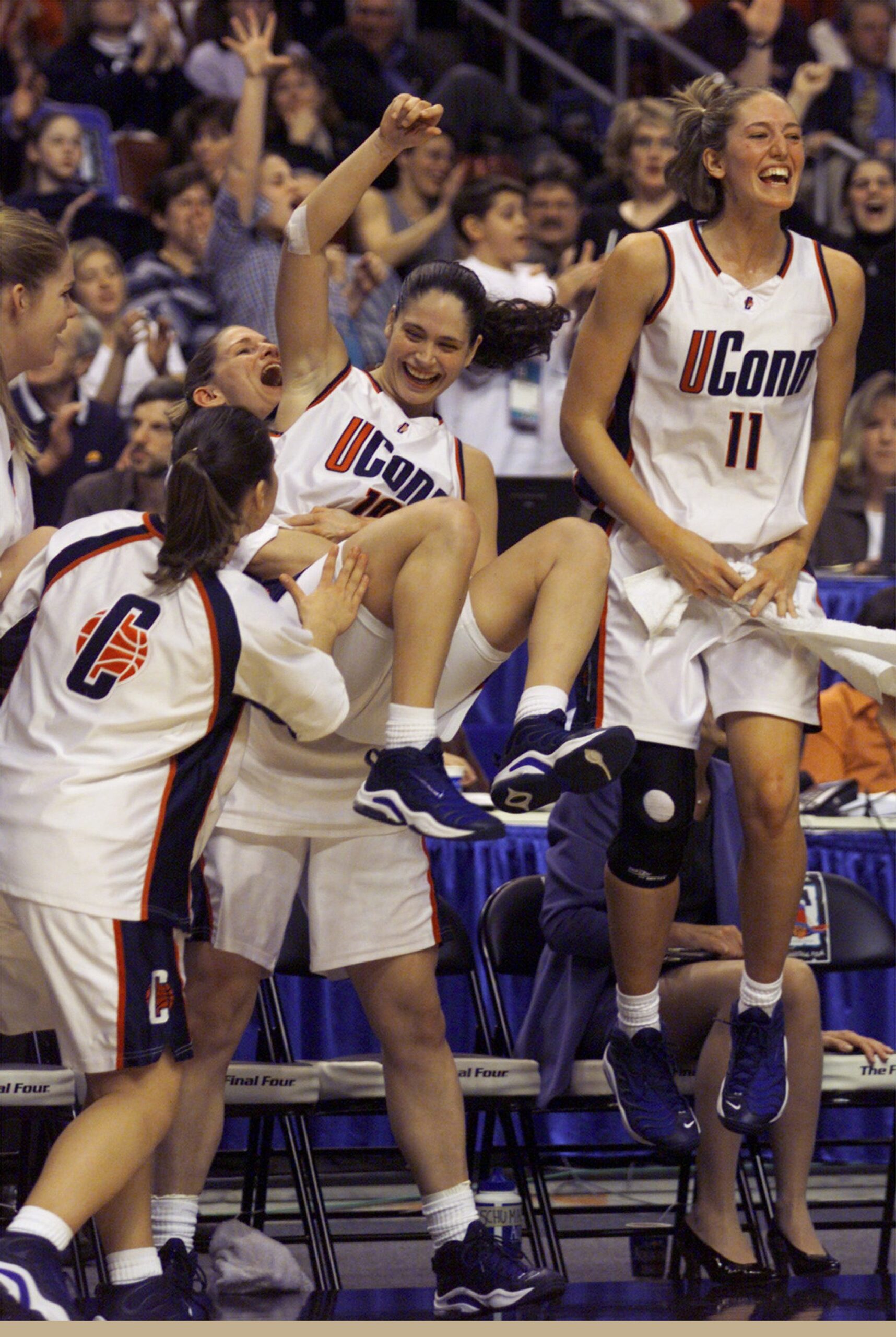
    Stacy Hansmeyer, Sue Bird, and the UConn bench celebrate after Swin Cash makes a breakaway layup late in the second half of UConn’s Final Four game against Penn State on March 31, 2000, at what then was called the First Union Center.

    The April 2 Inquirer ballyhooed that night’s title game on Page 1. Inside was an entire section previewing the event from every angle. There were profiles of coaches, players, even the referees. There were analyses, features, columns, statistics, photos and predictions.

    And the poll?

    Well, the championship game itself proved just how plugged in it was. Connecticut, the No. 1 team in the regular season’s final rankings, defeated No. 2 Tennessee.

    Greenberg retired from The Inquirer in 2010 but still compiles a widely read blog. Organizations, including the Naismith Basketball Hall of Fame, have recognized him and his poll’s contributions.

    “Mel was a gift to the women’s game,” Stanley said. “He was so passionate, and so dedicated and so single-minded. Who knows how long it otherwise would have taken for anything of substance to occur? Not many news outlets gave a crap about it, but Mel and The Inquirer decided to do something about women’s basketball. And that poll has stood the test of time.”

  • Penn State’s 2026 schedule: A trip to the Linc and a visit to Northwestern in debut of new stadium

    Penn State’s 2026 schedule: A trip to the Linc and a visit to Northwestern in debut of new stadium

    Matt Campbell’s first season as Penn State’s football coach will feature five away games, including a visit to Lincoln Financial Field to face Temple in early September.

    Penn State’s full 2026 football schedule was released last week. Three of the Nittany Lions’ first four games will be at Beaver Stadium against Marshall (Sept. 5), Buffalo (Sept. 19), and Wisconsin (Sept. 26), which will open Big Ten play for the team.

    The Nittany Lions will face K.C. Keeler’s Owls on Sept. 12, the first matchup between the schools since 2016. Penn State holds a 40-4-1 advantage in their series history, which dates back to 1931.

    Penn State will visit Northwestern on Oct. 2 for a Friday night matchup at the Wildcats’ newly renovated Ryan Field. The game was moved after originally being scheduled for Oct. 3. Penn State has not played a Friday night game since 2019, when it beat Maryland in College Park, 59-0.

    After facing Northwestern, Penn State will host Southern California (Oct. 10), then travel to Ann Arbor to face Michigan (Oct. 17). After a bye week, the Nittany Lions welcome Purdue (Oct. 31), then travel to Seattle to face Washington (Nov. 7) for the first time since the Huskies joined the conference in 2024.

    Penn State will round out the schedule with Minnesota (Nov. 14) and Rutgers (Nov. 21) at home before traveling to Maryland to end the regular season against the Terrapins (Nov. 28).

    Times and television coverage for each game will be announced later.

  • Temple coach K.C. Keeler didn’t lose any starters to the transfer portal: ‘They saw the vision’

    Temple coach K.C. Keeler didn’t lose any starters to the transfer portal: ‘They saw the vision’

    When K.C. Keeler was hired as Temple’s football coach in 2024, his goal was to make the Owls into American Conference contenders.

    In his first season, Temple finished 5-7 (3-5 in the American). The Owls missed a bowl game for the sixth consecutive season but showed they are heading in the right direction.

    Now, it’s back to the drawing board. Keeler said the first step was to get Temple’s key players from this season to remain on the roster. The Owls have lost serval starters to the transfer portal in years past, but that wasn’t the case this offseason.

    Temple didn’t lose a single starter to the transfer portal and kept its core group of players to ensure some continuity heading into 2026.

    “We’re probably one of the only [Group of Five] schools in the country that didn’t lose a single starter,” Keeler said. “And that was a lot of work in terms of making sure that they saw the vision moving forward and we were all comfortable with getting this thing done in the world of revenue share we now live in — you have to work through some things. But to get all of our starters to come back … and there’s a number of our starters that were highly coveted prizes out there in the open market.”

    Temple was close to making its first bowl game appearance since 2019, under coach Rod Carey. This time, the Owls were a few points away from being 7-5.

    Temple lost to Navy, 32-31, after Midshipmen quarterback Blake Horvath ran 51 yards for a touchdown with 39 seconds remaining. The Owls lost to Army, 14-13, when the Black Knights held the ball for the final nine-plus minutes.

    “We’re building something special around here,” guard Eric King said. “We were two points away from being 7-5 and being in a bowl game. So, a completely different culture in the facility and throughout the organization. In order to keep building on that, you don’t want to have to bring in 60 people in the portal. You want to keep the guys who have played and who have been through the system and who understand what this new brand of football is about.”

    King is one of the main players returning to Temple next season. He had no intention of leaving, either.

    The Owls kept the offensive line intact. Alongside King, left tackle Giakoby Hills, who initially was the backup to Kevin Terry, became a starter after Terry suffered a sprained knee ligament on Aug. 9. Hills never gave up the job.

    After the redshirt freshman started every game this past season, Hills was on the radar of some Power Four schools. However, Hills and Temple worked out a multiyear deal in December, which made him one of the highest-paid players in the Group of Five.

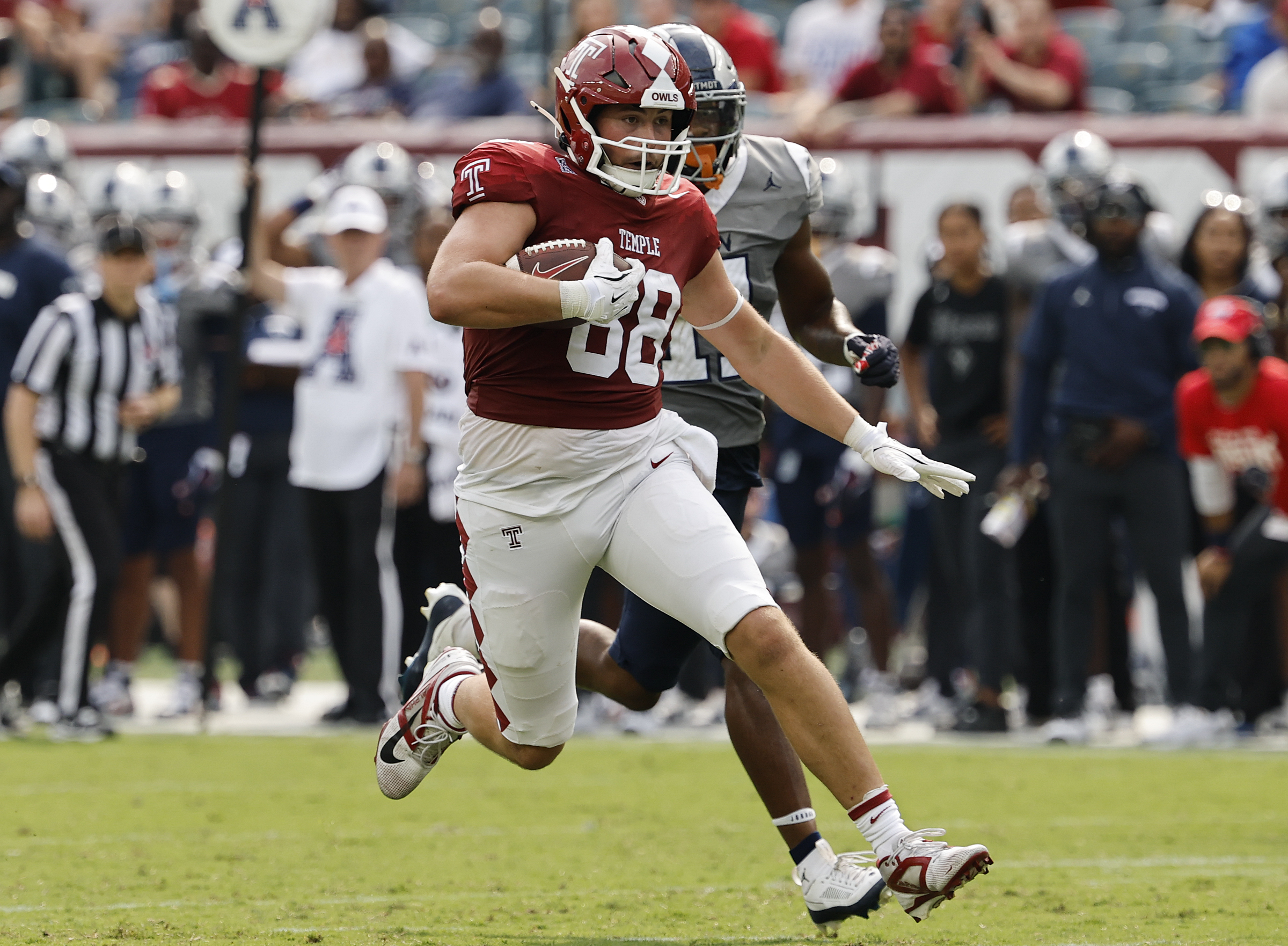
    Temple’s biggest returner, though, is tight end Peter Clarke, a London native who finished with 483 receiving yards and six touchdowns and earned a second-team all-conference nod in 2025. Clarke wanted to stay with the same team that gave him a chance three years ago.

    “I had nothing before I came to Temple,” Clarke said. “I’m a foreign guy who a lot of schools didn’t want to take a chance on. Temple gave me hope. They promised me a dream that I could chase here, and they fulfilled every single promise.”

    Clarke became an instrumental part of Temple’s retention plan, hosting recruits on visits and speaking about his journey to the team at alumni events. It has given him the chance to connect with potential teammates and higher-ups at the university.

    Temple tight end Peter Clarke finished with 483 receiving yards in 2025.

    The tight end had been a highly coveted player, with Power Four programs attempting to sign him. However, Clarke rejected those offers, which came with more money, to remain an Owl.

    “When a guy like [Clarke] chooses to stay, maybe another guy who could make another $5,000-$10,000, somewhere else [will stay as well],” general manager Clayton Barnes said. “When someone’s leaving thousands of dollars on the table, that really sends a message to the rest of the locker room: ‘There’s a reason why I stayed. There’s reason why you should stay.’”

  • Flyers draft: Penn State’s Gavin McKenna is once again stating his case to be the No. 1 overall pick

    Flyers draft: Penn State’s Gavin McKenna is once again stating his case to be the No. 1 overall pick

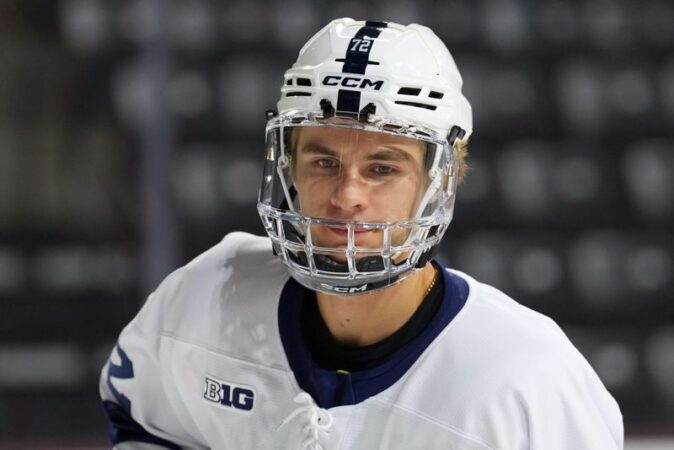
    STATE COLLEGE, Pa. — Gavin McKenna is an 18-year-old prospect who plays like a seasoned NHL veteran. He sports a rare combination of vision and speed that takes most teenagers years to develop.

    It’s why he’s drawn comparisons to future Hockey Hall of Famers Patrick Kane and Nikita Kucherov. It’s also why, before McKenna even played a game for Penn State, coach Guy Gadowsky said he planned to “let Gavin be Gavin.”

    NHL teams have been queuing up for a chance to select McKenna in June’s NHL draft and to “let Gavin be Gavin.” But they will likely need a top-three selection, and maybe the No. 1 overall pick, to land the prolific winger.

    The Flyers, who not long ago occupied a playoff spot, could be among them. Losers of 11 of their last 13 games, the Orange and Black are tied for the ninth-lowest point total in the NHL and are firmly back in the McKenna sweepstakes.

    With 29 games remaining, the Flyers have just a 12.5% chance to make the playoffs, according to Hockey Reference’s latest playoff probabilities report. And according to Tankathon, they currently have a 7.4% chance of landing the first or second pick in the draft lottery. While McKenna is a winger, and Philadelphia’s priorities are center and defense, if the Flyers get some long-overdue lottery luck, could they afford to pass on such an offensive talent, especially given their 21st-ranked offense?

    Here’s a quick scouting report on McKenna and what the prospect could bring to the table at the next level.

    A great manipulator

    Gadowsky has praised McKenna’s “elite” skating and puck skills. But to the longtime Nittany Lions coach, McKenna’s ability to “manipulate the pace” tops all else.

    “[McKenna’s] work ethic is excellent,” Gadowsky said. “He’s extremely quick. He thinks the game differently. And you can see when there are drills that are game-specific, he uses time and space in a very unique way. … When you think [he’s] out of time and space, he manipulates it, and that’s what is really amazing to watch.”

    Major expectations followed McKenna, who was viewed as the consensus No. 1 pick in the 2026 NHL draft, to Happy Valley when he committed to the Nittany Lions in July. Many questioned whether the then-17-year-old, who racked up 41 goals and 129 points last season in the Western Hockey League with Medicine Hat, could handle the physicality and rapid pace after making the step up to college hockey.

    Through 24 games, McKenna has answered those questions. Among Division I skaters, the freshman is tied for 13th in points (32), and ranks 11th in both assists (21) and points per game (1.33). He’s been especially hot lately, having scored seven goals and tallied 14 points in eight games since returning from the World Juniors with Canada.

    McKenna can see plays before they develop. He passes his teammates open rather than passing to open teammates — a skill set showcased on several of his team-high 21 assists.

    “He does everything that the team wants and that the coaches want,” Gadowsky said. “He’s a big-moment player. He’s an incredible talent. But his desire to help the team is what I love most about him.”

    Passing the test

    The native of Whitehorse, Yukon, is a pass-first forward. He plays an unselfish game that sometimes teeters on being too unselfish. But that doesn’t mean he’s not aggressive when necessary, nor does it mean he can’t score.

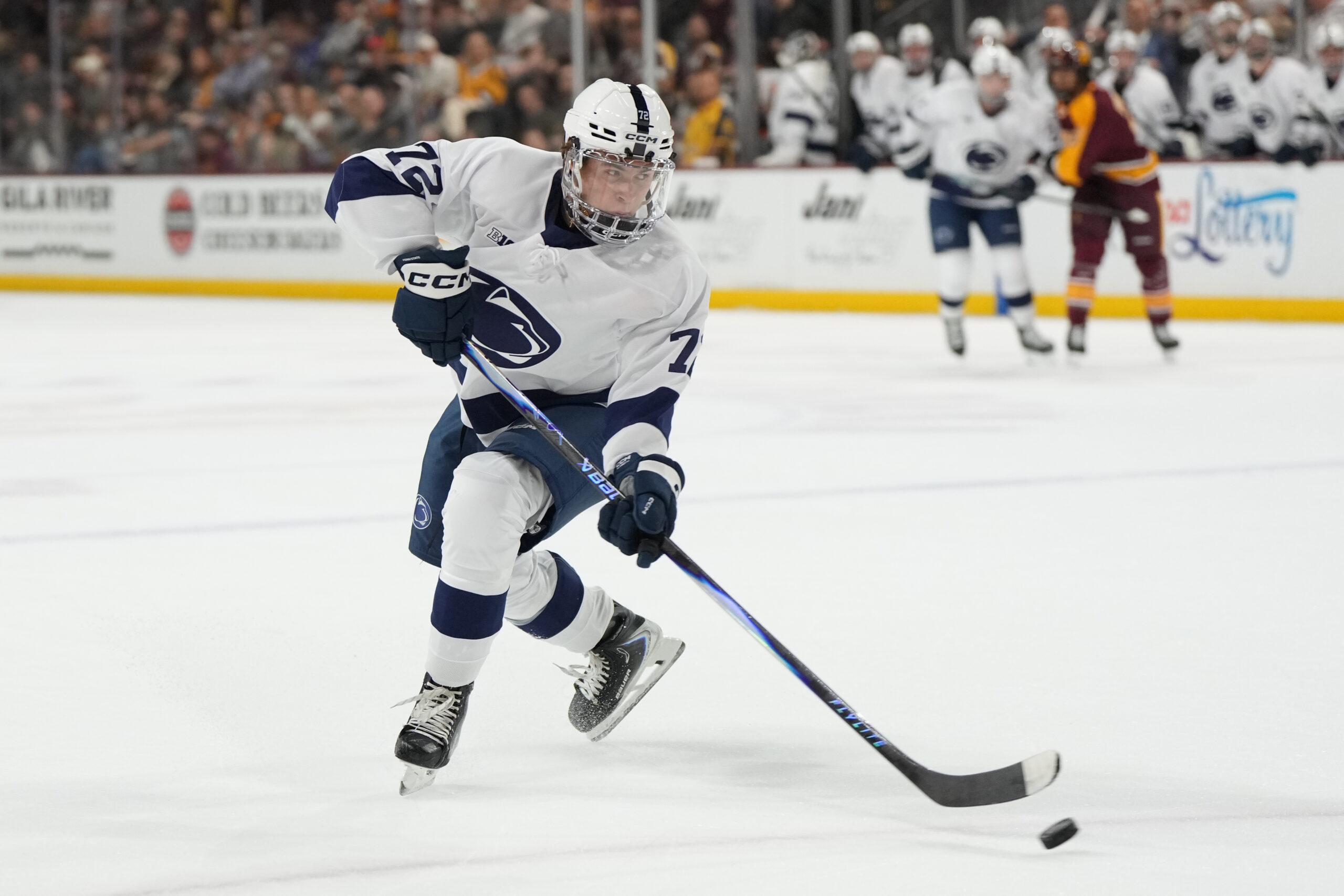
    McKenna tallied his first collegiate hat trick on Jan. 23 against Wisconsin. With Penn State sporting a two-goal lead, McKenna batted down an airborne puck, turned and skated into the offensive zone, and fired a perfectly placed wrist shot through traffic to complete the achievement.

    McKenna’s shot isn’t the fastest, but it’s accurate. What his shot lacks in strength, he makes up for with a quick release and deft placement.

    The left-handed forward showcased that accuracy in No. 5 Penn State’s 5-4 overtime loss to No. 2 Michigan State on Saturday at Beaver Stadium. After receiving a slot feed, McKenna settled the puck and beat Detroit Red Wings prospect Trey Augustine to tie the contest at 2-2.

    “I kind of blacked out on that one,” McKenna said of his goal. “I think just the emotions in that game — the crowd, the atmosphere, how tight of a game it was — it was pretty easy to get excited like that.”

    McKenna wasn’t done. With the game tied in the second period, the speedy winger pinpointed a pass around two Michigan State defenders and onto the blade of Aiden Fink, who snapped one far side to give the Nittany Lions a 3-2 lead. McKenna scored or assisted on three of Penn State’s four goals on Saturday.

    “Gavin is a super smart player. I know any time he has the puck, I always [have] to be ready,” Fink said. “I saw him have the puck in the corner, and I kind of knew he saw me. I knew he was going to give it to me.”

    While McKenna sports a relatively polished game, his physicality, or lack thereof, is one of his weaknesses and something he’s working on. Standing 6-foot and 170 pounds, the left winger prefers to play a finesse game, which means using his speed to dodge hits and skate into space rather than fighting through contact.

    But that doesn’t mean he’s afraid to get physical when necessary. After totaling just four penalty minutes across his first 21 collegiate contests, McKenna tallied 30 over his next two.

    When Fink tumbled to the ice after taking a blindsided check in the Nittany Lions’ 6-3 loss to Michigan State on Friday, McKenna delivered a retaliatory cross-check on Cayden Lindstrom.

    He received a five-minute major and a game misconduct. But teammates Reese Laubach and Jarod Crespo praised McKenna’s willingness to stand up for his linemate. And in the NHL, plays like that, especially from players not typically known for being physical, go a long way toward earning your teammates’ respect.

    McKenna has the intangibles — elite speed, maturity, impressive playmaking — that make up a No. 1 pick. He’s the type of prospect who could change a franchise.

    Think Matthew Schaefer, who’s on track to guide the New York Islanders to a playoff berth in his rookie season. Or Macklin Celebrini, who has his San Jose Sharks eyeing their first playoff berth since 2019. With some similar lottery luck, McKenna could be the spark the Flyers need to bring playoff hockey back to Philadelphia.

    Penn State’s Gavin McKenna has seven goals and 14 points in his last eight games.
  • Steve Donahue has St. Joe’s ‘blending’ together at the right time

    Steve Donahue has St. Joe’s ‘blending’ together at the right time

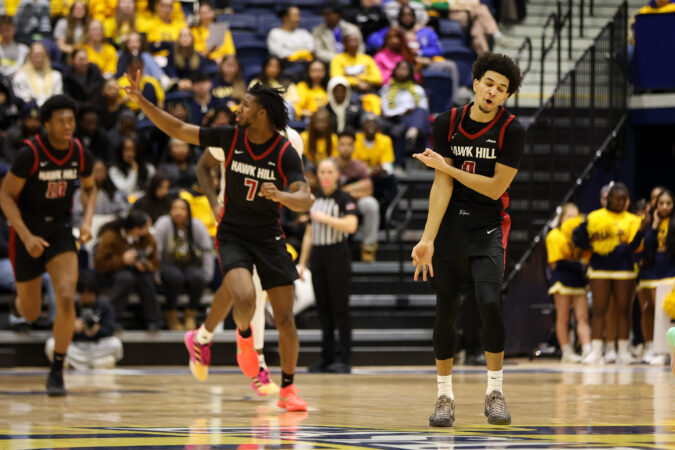
    Steve Donahue sat back in his chair, a smile stretched across his face. St. Joseph’s had just beaten La Salle, 67-58, on Saturday, the Hawks’ sixth win in their last seven, and Dasear Haskins, who made six three-pointers and tied a career high with 20 points, was talking about the “A to B mentality” Donahue has drilled into his team.

    “I told my mom I will A to B to practice the other day,” said Haskins, a redshirt sophomore who played at Camden High. “It’s like a lifestyle to me now. I think the guys are treating it like that.”

    The motto is simple enough: “Whatever A is, you have to get to B,” Donahue said later. A can be something good. A can be something bad. St. Joe’s has just gotten a lot better at the getting to B, and it’s not surprising that it took a couple of months for that to happen, for the Hawks to look like the sum of all their parts, considering all that has happened since September.

    Former coach Billy Lange abruptly left for the NBA. The roster that he worked hard to build would be playing for a new coach, Donahue, whom Lange brought on as his top assistant after the Delaware County native was fired following his ninth season at Penn. New coach, new roster, awkward timing. The Hawks started 2-3, had some ups and downs, then by mid-December their leading scorer, Deuce Jones, was no longer with the program.

    They started Atlantic 10 play by losing their first two games. Then came a team meeting. Then came six wins in seven tries, a stretch that could be a perfect 7-for-7 if not for late-game execution on the road against a good VCU team.

    Zoom out a little bit, and on a macro level this version of the Hawks is the B to whatever A was after they allowed Davidson to leave Hagan Arena with a 62-56 win on Jan. 3. The season could have gone sideways then, but it hasn’t. St. Joe’s is 14-8 overall and 6-3 in the A-10 and in fourth place in the conference.

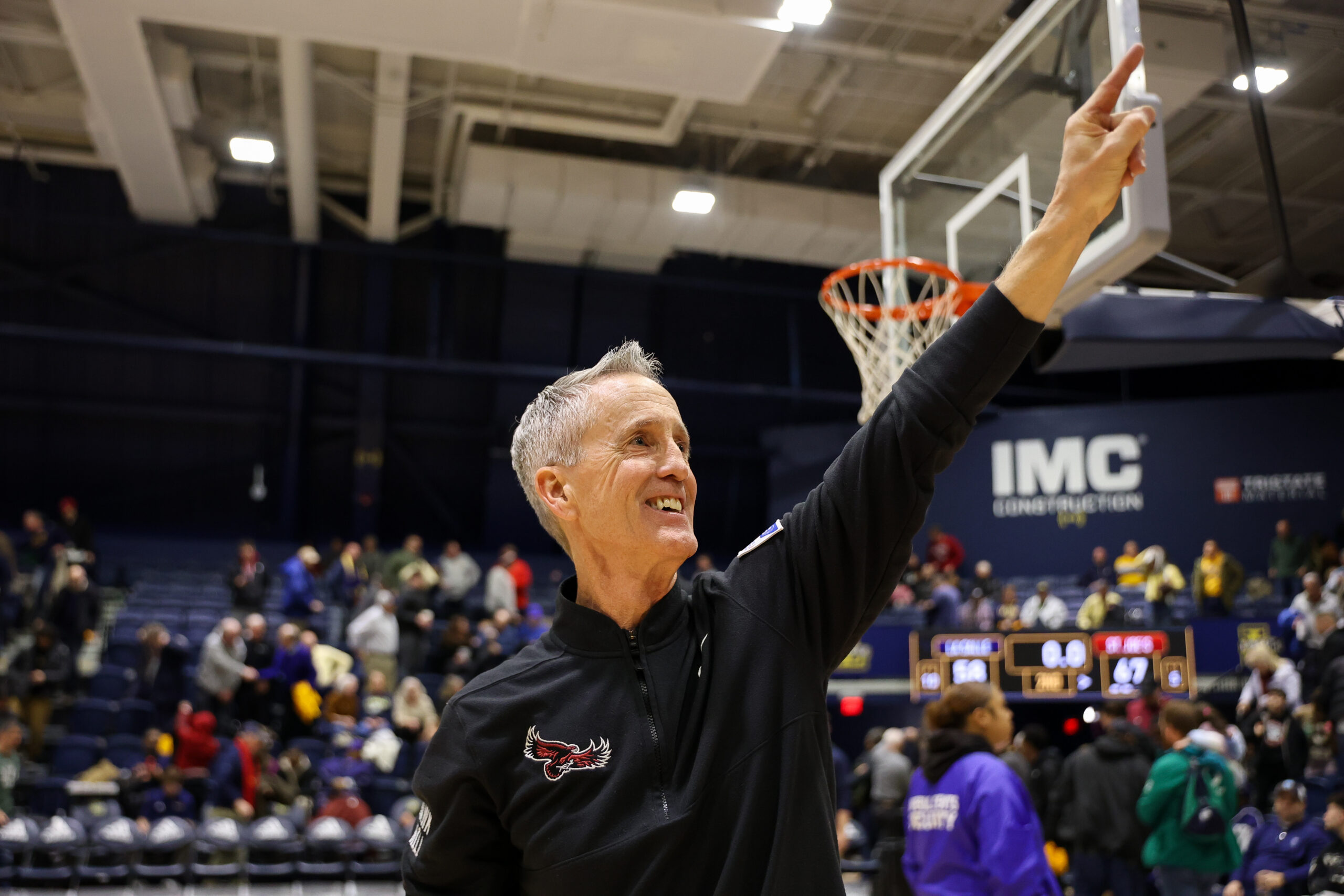
    St. Joseph’s coach Steve Donahue points to the student section after a 67-58 win against La Salle.

    Perhaps, finally, Donahue’s team is taking on a little bit of his own personality, playing the way Donahue wants the Hawks to play.

    “I like to think that,” Donahue said Saturday. But he also wanted to credit Lange for laying a foundation. Lange, Donahue said, “built a really good program here with really good people.” He pointed to the consecutive 20-win seasons and the program’s footing in the A-10.

    “I’m grateful that I walked into this and have guys like [Haskins],” Donahue said. “That being said, I saw things that bothered me.”

    Like?

    “We lost three games where we were tied or up against good opponents with eight minutes left, and we didn’t get from A to B,” Donahue said. “We allowed the circumstances to change who we are. We’ve been through a lot, and since then I just see their ability to forget about personal expectations and figure out what needs to be done in that game.”

    Saturday, Donahue said, was living proof.

    La Salle did everything it could to take Derek Simpson out of the game. Simpson has been on a tear during this recent run, but the shooting lanes weren’t there, so the Hawks found Haskins on the weak side and the lefty made La Salle pay with six threes on seven attempts. Simpson still more than made his mark on the game with 13 points, six rebounds, and seven assists.

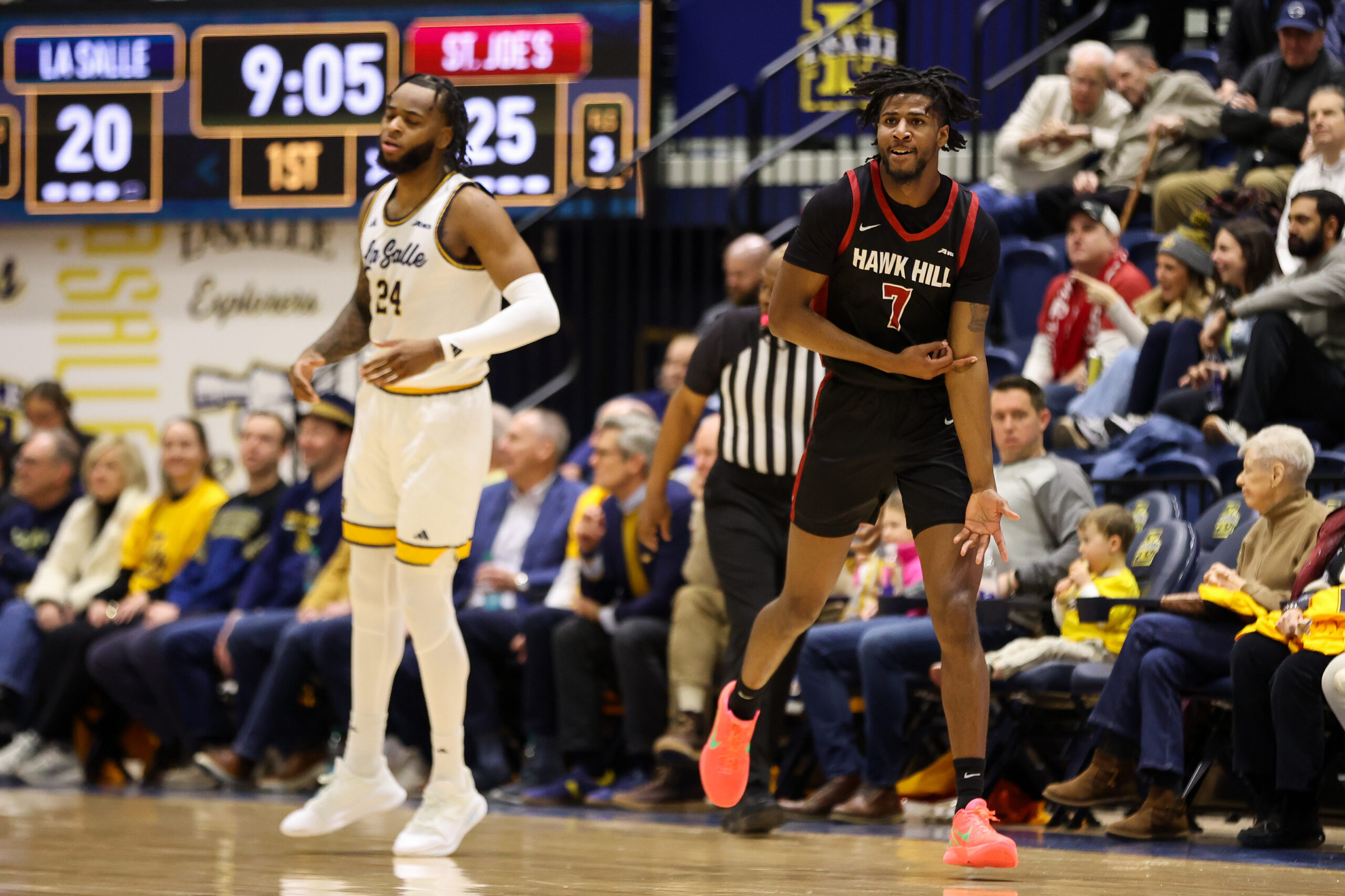
    Hawks guard Dasear Haskins (7) reacts after a made three-pointer against Jerome Brewer and La Salle.

    The feisty Explorers used an 11-0 run to make the game interesting late, but St. Joe’s battled through a couple of turnovers and closed the game with its free-throw shooting.

    “When a game gets closer, we just want to get closer,” Haskins said. “We just come together, listen to our coaches, trust in our game plan, and just come together as a unit.”

    Words that make Donahue smile.

    “There’s a mentality now that we’re not going to be affected if something is going right for the other team and wrong for us,” Donahue said. “We’re going to move on and figure out how to win this game.”

    Some of this recent success has a simpler explanation. It’s just a natural part of a team growing together. Simpson and Justice Ajogbor, both seniors, have been steady. Simpson, Donahue said, is the “heart and soul” of the team, and is no longer looking over his shoulder. But the other components of the team needed time. Jaiden Glover-Toscano barely played at St. John’s last season. Haskins is playing his second season of college basketball. The Hawks rely a lot on two freshmen, Austin Williford and Khaafiq Myers, and a backup center, sophomore Jaden Smith, who had a limited role at Fordham last year.

    “The youth is catching up to the older guys and we’re blending,” Donahue said.

    It’s the right time for it, considering the calendar just flipped to February. The Hawks have nine games left before the conference tournament in Pittsburgh. They have shown the ability to play with and beat some of the conference’s best, like Dayton and Virginia Commonwealth. There will, of course, be no trip to the NCAA Tournament without running the table in Pittsburgh, and doing so means getting through those teams and the juggernauts, St. Louis, which beat St. Joe’s by 23, and a George Mason squad the Hawks play on the road on Saturday.

    That stuff will sort itself out when it’s supposed to. For now, the Hawks can just enjoy the ride.

    “Winning is so fun,” Haskins said. “I love winning so much.”

  • Reserve center Mohamed Keita comes up big in the clutch for Temple

    Reserve center Mohamed Keita comes up big in the clutch for Temple

    Temple center Mohamed Keita entered the game against South Florida on Saturday with 5½ minutes left and the Owls clinging to a four-point lead. Forwards Babatunde Durodola and Jamai Felt had both fouled out, leaving the 7-foot-1 big man as Temple’s only option for the rest of the game.

    Keita delivered. He knocked down two free throws with 30 seconds left, then came through with the decisive bucket for the Owls (14-8, 6-3 American).

    Derrian Ford missed a jumper and Keita flew in for the tip-in with six seconds left. USF (14-8, 6-3) had a chance, but a desperation heave by Isaiah Jones wasn’t enough as Temple held on for a 79-78 win at the Liacouras Center.

    “It was Coach [Adam Fisher] who told me to crash the board when [Ford] shot it,” Keita said. “So I just crashed, and then I’m happy it came my way and then scored.”

    The Owls went nearly six minutes without a field goal at the end of the game, but Keita’s heroics helped them stay in the conference race. Temple is in a three-way tie for third place in the American with Florida Atlantic and USF.

    “We all know if your shots are not falling, keep shooting and just keep playing defense,” said guard Aiden Tobiason, who scored a game-high 22 points. “That’s something we harp on the most, because that’s something you can control.”

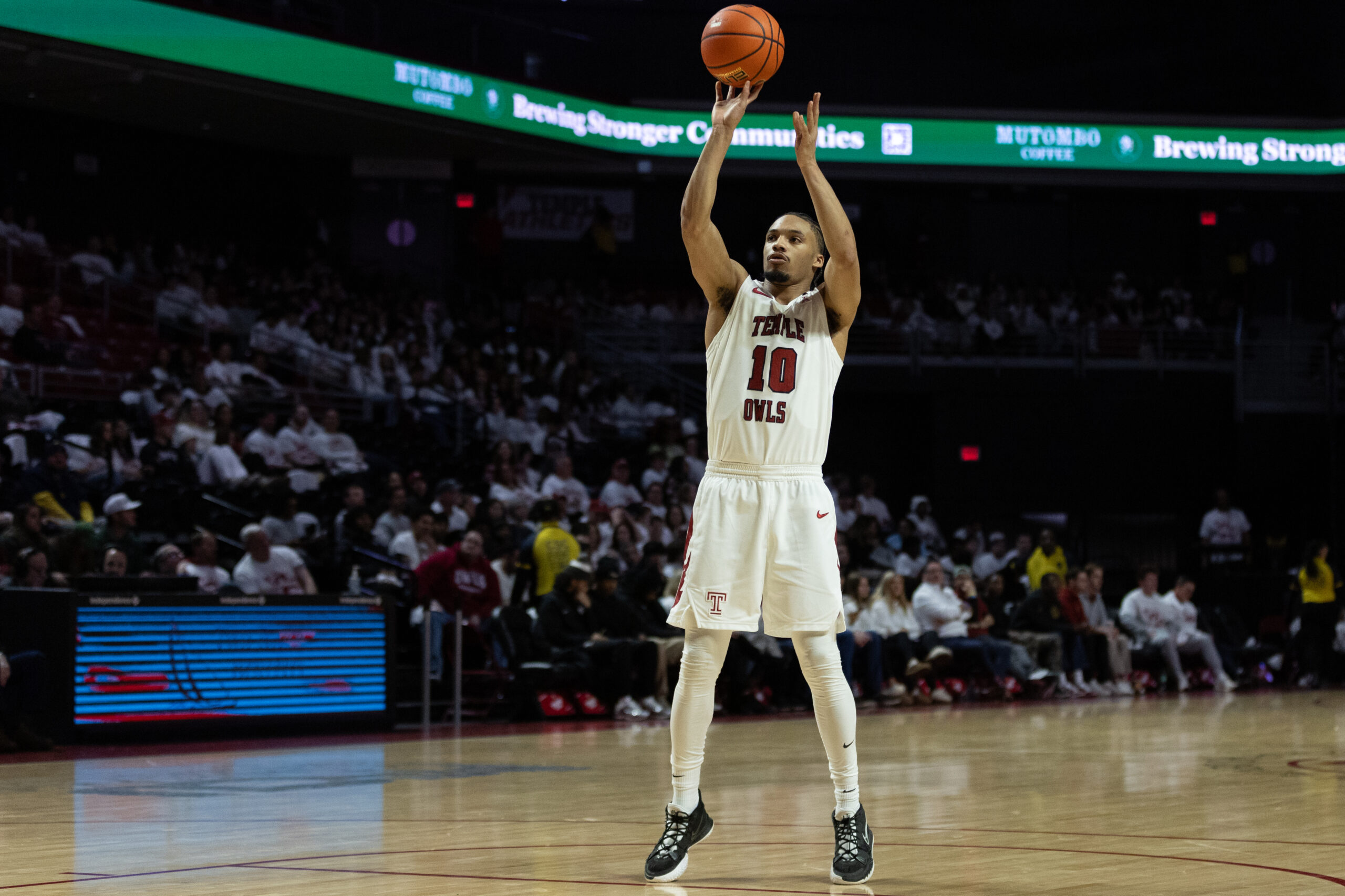
    Owls guard Masiah Gilyard shoots the ball against South Florida.

    Temple’s depth has been tested, but the Owls rely on guard Masiah Gilyard and the 6-8 Durodola, with Keita coming in sparingly.

    Those three helped Temple stay afloat on Saturday. Gilyard scored 11 of his 13 points in the first half and Durodola finished with seven points, seven rebounds, and a team-high five assists.

    “[Gilyard] is a guy that does a lot of dirty work, getting offensive rebounds,” Fisher said. “I think any time you’re a player and you see the ball go in early on, an easy one, it makes the basket look a little bigger to you. I thought he’d made some big shots. But again, there’s just a trust like our guys, whoever’s out there, we believe in. I thought his minutes tonight were fantastic.”

    Next up

    Temple visits East Carolina (6-15, 1-7) on Saturday (noon, ESPNU).