2025 Toyota Corolla FX vs. 2025 Buick Envista Avenir: Two options to avoid being spendy.
This week: Toyota Corolla
Price: $29,089 as tested. Convenience Package added blind-spot monitor and cross-traffic alert for $530; black roof, $500; and connected services trial, $325.
Conventional wisdom:Motor Trend liked the “$27,785 base MSRP, cool black accents, and bigger, more readable screen”; on the down side, it was “not particularly quick,” the “engine drones,” and it’s a “dated cabin.”
Marketer’s pitch: “Introduce fun to every day.”
Reality: You’re going for the fun angle, Toyota? Really, now?
What’s new: The Corolla adds a new FX model for 2025, which pays homage to the old FX16, something I’d never heard of before writing this. Still, I feel I can say with confidence, it doesn’t live up to that.
Not so new: How thankful I am to have two small, inexpensive cars to test. They’re a rare treat among model lineups and even rarer among vehicles I get to test, and readers are clamoring for them. Manufacturers want to make money selling you expensive things we don’t really need.
The Corolla is a sedan and the Envista is a crossover, so very different directions indeed.
Up to speed: The Corolla is not winning any races. The 2.0-liter four-cylinder engine creates 169 horsepower and gets to 60 mph in 8.2 seconds, according to Motor Trend.
Still, I was pleased enough with most of the performance, though I was traveling solo through almost all of it. A packed car would suffer a bit of malaise under the extra strain.
Shiftless: The continuously variable transmission in the Corolla saps power as much as any. The gearless setup offers infinite ratios in theory but in actuality some examples make hill-climbing and hard acceleration something you’d just rather avoid. The Corolla’s version sits about in the middle, not the worst or the best.
On the road: The Corolla has never been anything like fun, although the XSE version gets close. The FX model doesn’t get there, though, although handling is small-car good. Still, you won’t confuse it witha Golf or Mazda3.
Driver’s Seat: Sturgis Kid 1.0 once purchased a new Scion iM (the Corolla Hatchback before it was called that) based solely on the dreamy front seats. Every time I borrowed that car, I noted how comfortable it was.
The Corolla FX tested had sport fabric-trimmed seats with orange stitching that matched that feel. They were soft but supportive seats andmade all the Schuylkill Expressway stop-and-go feel lots better.
The Corolla also benefits from the simple gauge setup that Toyota offers in its base models. Changing the screen to fit your needs is simple with the steering wheel controls.
The interior of the 2025 Toyota Corolla adds a 10.5-inch infotainment screen, and the seats remain among the most comfortable among all sizes of vehicles, not just small cars.
Friends and stuff: The rear seat is pretty good for a small car. Headroom is dear — my head doesn’t hit the ceiling but it’s close — while legroom and foot room are nice. The door requires care when getting in and out because it’s a bit of a squeeze.
The middle seat passenger will be perched on a narrow cushion and a tall floor hump, and will be permitted to throw small food items at everyone else, or to at least choose the evening’s movie later.
Cargo space is 13.1 cubic feet. The seat folds to create a pass-through.
Play some tunes: The new 10.5-inch touchscreen helps with navigating through the sources and whatnot. But somewhere a designer is patting themselves on the back for the sleek control panel, which trades a volume dial for pushbutton -/+ system. Boo!
The stereo offers pretty good playback, especially by Toyota standards, about an A- or B+.
Keeping warm and cool: Kudos for the simplest controls I’ve seen in a long time — one dial for air speed, another for temperature, and silver buttons for everything else.
Fuel economy: I averaged about 32 mpg in an unusual array of Mr. Driver’s Seat testing. A very stop-and-go round trip to Center City figured mightily into the week. Otherwise it was mostly highway and side roads.
Where it’s built: Blue Springs, Miss.
How it’s built:Consumer Reports predicts the Corolla reliability to be a 5 out of 5. (Like, duh.)
How much Russian humiliation can Donald Trump swallow before conceding that Vladimir Putin is making him look like a fool?
On Tuesday, the White House was forced to announce the cancellation of a supposed Trump-Putin summit the president had recently stated would take place in Budapest, Hungary, in around two weeks.
Russian Foreign Minister Sergey Lavrov effectively told Secretary of State Marco Rubio by phone that the U.S. president hadn’t kowtowed sufficiently to Moscow to justify a summit. There are “no plans” for Trump to meet Putin “in the immediate future,” the White House admitted.
In past weeks and months, Trump has bowed down so deeply to Russia’s leader it’s a wonder his head hasn’t banged on the ground. Yet, the Kremlin keeps playing him and disrespecting the self-declared champion of global peacemaking.
It won’t be surprising if Trump chooses to blame the summit fiasco on Kyiv’s refusal to surrender to Moscow — rather than recognize Putin’s total disinterest in a peace deal. If he doesn’t want to go down in history as Putin’s lapdog, the president needs to recognize that carrots won’t bring peace if they aren’t backed up by sticks.
Ironically, Trump appeared to have grasped that truth when he finally pressured a reluctant Benjamin Netanyahu to accept a ceasefire in Gaza in return for Hamas’ release of living and dead Israeli hostages.
But with Putin, Trump’s tactic has been all carrots. So far, the president seems blind to the reasons why his peacemaking efforts with the Kremlin have failed, again and again.
A red-carpet summit in Alaska in August was a dismal disaster, even though POTUS dropped his support for a ceasefire in favor of Putin’s demand to negotiate while fighting.
When Putin rewarded Trump’s faith by massively ratcheting up air attacks on Ukrainian civilians, the president seemed to recognize he was being played. He began hinting he would sell Kyiv long-range Tomahawk missiles that could take out Russian missile bases at the source, and was set to meet Ukrainian President Volodymyr Zelensky to discuss the missiles on Friday.
Putin, knowing his man, called the White House on Thursday and said nyet. Trump immediately dropped all talk of delivering Tomahawks.
Instead, the president angrily urged Zelensky to accept Putin’s demands that Ukraine surrender the entire Donetsk region to Russia, including a large chunk that Kyiv still holds, which is a critical “fortress belt” preventing further Russian advances toward major cities. Trump reportedly berated Ukraine’s leader in foul language to accept the Russian demand (on the false presumption it would end the war). Otherwise, he claimed, Putin would “destroy” Ukraine.
Ukraine’s President Volodymyr Zelensky speaks to reporters in Lafayette Park across the street from the White House on Friday, following a meeting with President Donald Trump.
Needless to say, Zelensky refused this suicidal proposal. Trump then resurrected a call for Russia to agree to a ceasefire in place in Ukraine. Kyiv and America’s NATO allies supported this idea.
Russia refused, and continued to demand Ukraine’s complete capitulation, including the handover of unoccupied Donetsk, Ukraine’s demilitarization, a change of government (meaning installing a pro-Putin puppet regime), and a cutoff from any NATO member support.
Which brings us to now, and what comes next for Ukraine.
Much depends on whether an egotistical Trump can sense how weak he is being made to look by Putin. It also depends on whether the president has the guts and smarts to pressure Putin sufficiently to convince him the war has become too costly.
It is hard to imagine such a presidential self-awakening. But were it to happen, it would require recognition of certain facts that Trump has failed to grasp until now.
First, the Ukraine war is not about territory. I cringed when Trump told Fox News onSunday he was confident he could end the conflict, but Putin was “going to take something, he’s won certain property.”
That is the equivalent of claiming that American patriots waged the Revolutionary War up and down the Eastern Seaboard over waterfront footage, not for their independence from imperial rule. As former Ukrainian Defense Minister Andriy Zagorodnyuk told me by phone from Kyiv, “This is not a territorial war, it is an existential war about the existence of the Ukrainian state.”
Nor is Putin fighting for land. He is waging an imperial war to destroy Ukraine’s existence as an independent country, eradicating its religion, culture, language and civic freedoms. Such Russian cruelty is already the norm in Ukrainian territory that Moscow has seized.
Until Trump and his Putin-bedazzled negotiator Steve Witkoff grasp this, they will never understand why Ukrainians continue to fight.
Second, Putin does not want peace, no matter what platitudes he feeds Trump. He is angling to see how many carrots Trump will offer him in return for nothing. That is why it is past time for sticks — including secondary sanctions on Russia, and Tomahawks and Patriot air defenses for Ukraine.
Third, the portion of Donetsk that Ukraine still controls contains key cities and critical fortifications that prevent Russian troops from entering vast flat steppes which would give them open access to major Ukrainian cities such as Dnipro. The Russians have been struggling for three years to take this area, with huge losses of man power, and still haven’t succeeded.
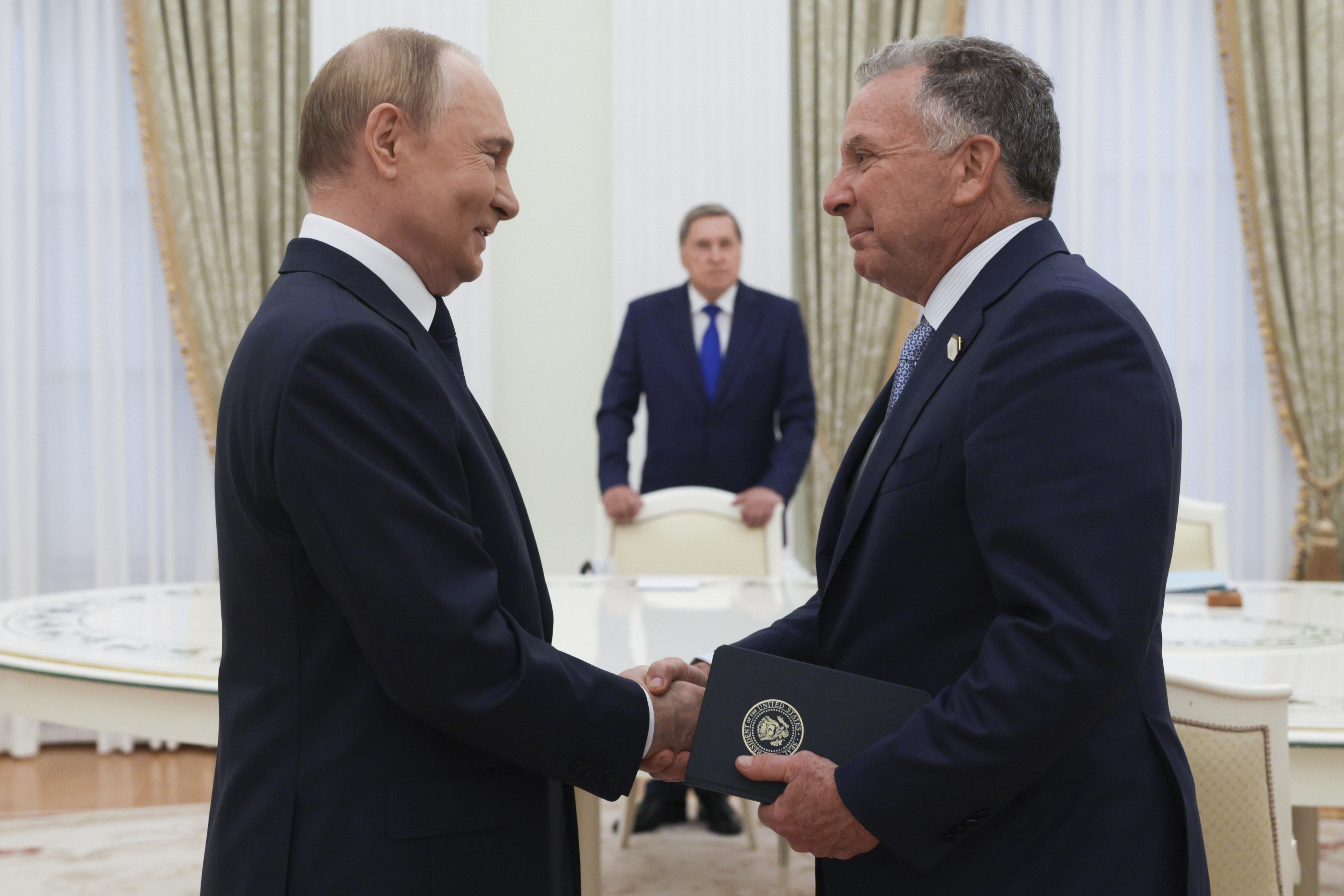
Russian President Vladimir Putin and President Donald Trump’s special envoy Steve Witkoff (right) shake hands during their meeting in Moscow in August.
Nor did they yearn for Kremlin overlordship because they were Russian speakers, a Putin talking point Witkoff keeps repeating. Most Ukrainians were bilingual or Russian speakers before Moscow’s invasion because of the long-term impact of prior Soviet rule.
Fourth, Putin won’t be able to “destroy Ukraine” if Kyiv refuses to capitulate. Contrary to Putin’s lies to Trump and Witkoff, his economy is ailing, and his massive losses of soldiers are being felt. Were it not for aid from Iran, China, and North Korea, Moscow could not keep up.
“Putin won’t be able to destroy us,” Zagorodnyuk told me. “He is selling himself as the leader of a superpower, but he isn’t. He is much weaker than he is perceived. Most of the world sees this, but unfortunately, he still seems able to communicate this message to the United States.”
Fifth, forging peace requires U.S. toughness. If Trump truly wants peace in Ukraine, it’s time to recognize Putin’s weakness and Ukraine’s strength, born from painful knowledge that Putin intends to turn their country into a Soviet-style satellite ruled by terror. Trump’s weakness will only encourage further attacks on Europe and aggression against other U.S. allies by a Chinese-Russian-North Korean entente.
Handing over Donetsk would only feed Putin’s appetite for more. “He would just take the territory and move on,” said Zagorodnyuk, rightly.
If Trump is the tough guy his followers claim, and not Putin’s patsy, it’s past time for more sanctions, Tomahawks, and air defenses for Ukraine.
The sense of loss that has permeated 2025 struck again this weekend when we learned of the sudden death of a Philly journalism legend, Michael Days, who guided the Philadelphia Daily News during most of its last dozen freewheeling and Pulitzer-winning years before we merged with The Inquirer in 2017. He was just 72, far too young. The top-line of Mike’s obituary was how, as the first African American to lead a newsroom in America’s founding city, he paid it forward by mentoring the next generation of rising Black journalists. But people like me who worked for him remember him more simply as the wisest and mostempathetic human being we ever had as a boss. He leaves right when the nation’s newsrooms need decent souls like Mike Days more than they ever did.
What a $10M bribe rumor says about Trump, Middle East peace, and America’s fall
President Donald Trump talks with Egypt’s President Abdel-Fattah el-Sissi during a summit to support ending the more than two-year Israel-Hamas war in Gaza after a breakthrough ceasefire deal, Oct. 13 in Sharm El Sheikh, Egypt.
The thing about being a 79-year-old president is that sometimes you just blurt stuff out, with no filter as to whether your words might be embarrassing, undiplomatic — or potentially incriminating.
Consider the case of Donald John Trump, the 47th U.S. president and the oldest one on the day of his election. Last week, in what may prove to be a fleeting moment of triumph as Trump celebrated a Gaza peace deal that included the release of 20 Israeli hostages, POTUS arrived at an Egyptian resort town for a Middle East summit. He kicked off the day with a one-on-one sit-down with Egypt’s strongman ruler, Abdel-Fattah el-Sissi.
“There was a reason we chose Egypt [for the summit] because you were very helpful,” Trump said as a gaggle of reporters and photojournalists entered their meeting room.
Really? Helpful in what way?
“I want to thank you,” the American president told Sissi, who seized power in a 2013 coup. “He’s been my friend right from the beginning during the campaign against Crooked Hillary Clinton. Have you heard of her?”
Here Trump was pushing, ever so absurdly, for the Nobel Peace Prize, and then he had to spoil it all by saying somethin’ stupid like, you bribed me. Well, he almost spoiled it, if more journalists — aside from MSNBC’s brilliant Rachel Maddow, who seized on the remark hours later — had grasped the potential import of this presidential prattle.
It’s certainly legal, if gross, for Trump to be close pals with Sissi, even if Human Rights Watch reports that the Egyptian dictator is “continuing wholesale repression, systematically detaining and punishing peaceful critics and activists and effectively criminalizing peaceful dissent.” What would not be legal is the Middle Eastern nation interfering in the 2016 election, in which Trump narrowly defeated Clinton in the handful of swing states that tipped the Electoral College.
What made Trump’s comments last week so jaw-dropping is that U.S. federal investigators worked for several years trying to prove exactly that scenario. In August 2024, days after Trump was nominated by the GOP for his second reelection bid, the Washington Post reported that the Justice Department investigated a tip that Sissi’s Egypt provided Trump with $10 million the candidate desperately needed in the 2016 homestretch to defeat Clinton. That happened right before Trump, as 45th president, reopened the spigot of foreign aid that had been halted because of Sissi’s human rights abuses.
It’s known that Trump did put $10 million into the campaign, which he listed as a loan. The Post in 2024 offered a tantalizing, if circumstantial, piece of evidence — that the Cairo bank had received a note from an agency believed to be Egyptian intelligence to “kindly withdraw” nearly $10 million in two, 100-pound bags full of U.S. $100 bills, five days before Trump took the oath of office.
But the investigative trail ran cold. In 2019, then-special counsel Robert Mueller turned the matter over to Trump’s appointees in the Justice Department, who of course didn’t pursue the president’s bank records. Neither — inexplicably — did Joe Biden’s attorney general, Merrick Garland, as the statute of limitations expired in January 2022. That’s where things stood last week before Trump started blathering in Sharm El Sheikh.
One reason I’m writing about this is the sheer frustration that Trump — yes, allegedly, possibly — might have gotten away with bribery to the point where he’s almost bragging about it in public. But I also think the mysterious case of the Egyptian bags of cash speaks to the present, dire American moment in a couple of ways.
For one thing, it casts a light on what’s really behind what Trump hopes will be viewed as the signature achievement of his second presidency. That would be the fragile peace deal that aims to end the last two years of bloodshed in Gaza that started with the Hamas terror attack of Oct. 7, 2023 and has resulted in at least 67,000 dead Palestinians and the utter destruction of their seaside homeland.
How did Trump get a deal that had eluded his predecessor Biden, in a region that has vexed every American president from both parties? It certainly helped that most of the power brokers with the clout and the cash to help end the fighting in Gaza are repressive strongmen — or, as Trump might call them, role models. And they all seem to speak the same language of corrupt back-scratching.
If those bags with $10 million in greenbacks did make their way to Trump in 2017, it looks like small change in today’s cross-Atlantic wheeling-and-dealing. After all, a key go-between in the negotiations — Qatar, which has good relations with Hamas and has hosted its exiled leaders — gifted America a $400 million jet that Trump plans to use not just as Air Force One but in his post presidency, while his regime has promised to protect the Qatari dictators if they are ever attacked.
Another key supporter of the plan is the United Arab Emirates, which also backs the UAE firm that recently purchased a whopping $2 billion in cryptocurrency from a firm owned by Trump’s family as well as the family of Steve Witkoff, the regime’s lead Middle East negotiator. At the same time, Trump’s U.S. government allowed UAE to import highly sensitive microchips used in artificial intelligence.
Witkoff’s negotiation end–game brought in Trump’s son-in-law, Jared Kushner, who forged close ties during his father-in-law’s first term with Saudi Arabia’s murderous de facto ruler Prince Mohammed bin Salman, who pulled the levers for a $2 billion investment in a hedge fund created by Kushner despite no prior expertise.
Those Saudi ties could prove critical to future stability in the region, and in a joint interview with CBS’ 60 Minutes Sunday night, Kushner and Witkoff made no apologies for mixing billion-dollar deals with the pursuit of world peace. “What people call conflicts of interest,” Kushner said, “Steve and I call experience and trusted relationships.”
OK, but those “trusted relationships” are built on a flimsy mountain of cash that could collapse at any minute. Look, I’m thrilled like everyone else that 20 Israeli hostages are finally reunited with their loved ones, and to the extent Trump and his regime deserve any credit, I credit them. But the art of the deal that the president is bragging about is all about the Benjamins — more worthy of applause on the floor of the New York Stock Exchange than a Nobel Peace Prize.
Real peace is based on hard work and trust, not Bitcoin — so is it any wonder that the ceasefire is already collapsing with two dead Israeli soldiers and fresh, lethal airstrikes in Gaza? The only thing with any currency among a rogues’ gallery of world dictators is currency, and that transactional stench has fouled everything from Cairo to K Street.
Is it any surprise that a regime whose origin story allegedly includes bags of Egyptian cash would do absolutely nothing when it was told that its future border czar, Tom Homan, was captured on an audiotape accepting $50,000 in a fast-food bag from undercover FBI agents who said they wanted government contracts?
In hindsight, the failure to pursue that report of the $10 million Egyptian bribe opened up a floodgate of putrid corruption, wider than the Nile. It signaled a sick society where everything is for sale — even world peace — but nothing is guaranteed.
Yo, do this!
The 1970s and ‘80s are having a cultural moment right now, and this boomer is here for it! On Apple TV (they’ve dropped the “+,” probably after paying some consultant $1 million for that pearl of wisdom) comes the long-awaited five part docuseries about the life and times of filmmaker Martin Scorsese, the savior who rose from NYC’s mean streets to give us Goodfellas, Raging Bull, Taxi Driver, and so much more. Watching Mr. Scorsese is going to make the eventual death of the baseball season so much easier to take.
The earthy, urban musical equivalent of Scorsese would have to be Bruce Springsteen, who has been marking the 50th anniversary of his breakthrough Born to Run LP with all kinds of cool stuff, capped with Friday’s long-awaited release of the first-ever biopic about “The Boss,” Deliver Me from Nowhere. Staring The Bear’s Jeremy Allen White as Springsteen, the film’s unlikely narrative — focusing on the making of 1982’s highly personal and acoustic Nebraska as the rock star seeks release from a bout of depression — sounds like exactly the uplift that America needs right now.
Ask me anything
Question: As someone living in Ireland and looking across the ocean. Trump won’t be in power forever, but how is anyone going to deal with the MAGA crowd that helped elect him? That level of stupidity, hatred and racism cannot be fixed. How is [t]he USA ever going to heal? — Stephen (@bannside@bsky.social) via Bluesky
Answer: That’s a great question, Stephen, and like most great questions there’s no easy answer. Although I’m optimistic that the 2026 midterms and the 2028 presidential election will happen and that the anti-Trump coalition that we witnessed at “No Kings” will prevail, I agree with you that it’s only a partial and temporary fix. I’d fear an Iraq-level resistance could rise up in the regions we call “Trump country.” My long-term solution would be along the lines of what I proposed in my 2022 bookAfter the Ivory Tower Falls: Fix higher education — broadly defined as from the Ivy League to good trade schools — to made it a public good that reduces inequality instead of driving it. And promote a universal gap year of national service for 18-year-olds, to get young people out of their isolated silos. There are ways to prevent the next generation from becoming as stupid or hateful or racist as the Americans who came before them, but it will take time and patience that we seem to lack right now.
What you’re saying about…
Remember the Philadelphia Phillies? When I last saw you here two weeks ago, their annual postseason collapse and the fate of manager Rob Thomson was a hot topic. As expected, there was minimal response from you political junkies, and opinions were split — even before the team defied the conventional wisdom and announced he’ll be returning in 2026. Thomson’s supporters were more likely to blame the Phillies’ inconsistent sluggers, with John Braun asking “who could you hire who could guarantee clutch hits?” Personally, I’m with Kim Root: “I follow the Philly Union, who just won the Supporters Shield — that is all.”
📮 This week’s question: Back to the issue at hand: I’m curious if newsletter readers attended the “No Kings” protest last Saturday, and what you see as the future of the anti-Trump movement. Are more aggressive measures like a nationwide general strike needed, or is the continued visibility of nonviolent resisters enough? Please email me your answer and put the exact phrase “No Kings future” in the subject line.
Backstory on who the “No Kings” protesters really were
Demonstrators gather for a ’No Kings’ rally in Philadelphia on Saturday.
They clogged city plazas and small-town main streets from San Diego to Bangor on Saturday, yet the more than 7 million Americans who took part in the massive “No Kings” protest — the second-largest one day demonstration in U.S. history, behind only the first Earth Day in 1970 — seemed to mystify much of the befuddled mainstream media. Just who were these people protesting the Donald Trump presidency, and why are they here?
Instead of a journalist, it took a sociologist to get some answers. Dana Fisher — the Philadelphia-area native who teaches at American University and is the leading expert on contemporary protest movements — was out in the field Saturday at the large “No Kings” march in Washington, D.C., collecting data with a team of researchers. She’s shared her early top-line results with me, aiming to both give a demographic and ideological snapshot and also compare Saturday’s crowd with her findings at other recent rallies.
If you were among the 7 million on Saturday, some of this data won’t surprise you. The protesters were, on the whole, older than the average American, with a median age of 44 (compared to 38 for the nation as a whole.) Once again, the “No Kings” participants were overwhelmingly white (87%) with women (57%) in the majority. But it’s also worth noting that men (39%) were more likely to take part than earlier protests tracked by Fisher, and the 8% who identified as Latino is double the rate of Hispanic participation in the 2017 Women’s March.
That last finding may reflect the passions of the “No Kings” protesters, who listed immigration as a key motivation at a rate of 74%, second only to their general opposition to Trump (80%, kind of a no brainer). That certainly jibed with the demonstrators at the rally I attended in suburban Havertown, who again and again mentioned the sight of masked federal agents grabbing migrants off the street as what compelled them to come out.
Fisher’s most telling findings may have been these: The people out in the streets are mad about what they see happening to America, with 80% listing “anger” as an emotion they are feeling, trailed closely by “anxiety” at 76%. Yet few of those who spoke with her team believed that will translate into violence. The number of demonstrators who agreed with the statement that “because things have gotten so off track, Americans may have to resort to violence in order to save our country” was only 23% — lower than other protests her team has surveyed. It seems like the larger the public show of resistance to Trump’s authoritarianism, the more optimism that the path back to democracy can be nonviolent.
What I wrote on this date in 2021
I hate to say I told you so but… On this date four years ago, Joe Biden was still clinging to dreams of a presidential honeymoon after ousting Donald Trump in the 2020 election, but there were dark clouds on the horizon. On Oct. 21, 2021 I warned that sluggish action on key issues was starting to hurt his standing with under-30 voters. I wrote that “while the clock hasn’t fully run out on federal action around issues like student debt or a bolder approach on climate — the disillusionment of increasingly jaded young voters could change the course of American history for the next generation, or even beyond.” How’d that turn out? Read the rest: “From college to climate, Democrats are sealing their doom by selling out young voters.”
Recommended Inquirer reading
I returned from a much-needed staycation this weekend by leaving the sofa and spending a glorious fall morning at the boisterous “No Kings” protest closest to home in Delaware County, which lined a busy street in Havertown. I wrote about how the protests are winning back America by getting under the skin of Donald Trump and the GOP, who can no longer pretend to ignore the widespread unpopularity of their authoritarian project.
Every election matters, even the ones that are dismissed as “off-year” contests. In today’s heated and divisive climate, even what used to be a fairly routine affair — the retention of sitting judges on the state and local level — has taken on greater importance. Here in Pennsylvania, the state’s richest billionaire, Jeff Yass, is spending a sliver of his vast wealth to convince voters to end the tenure of three Democrats on the state Supreme Court. The Inquirer’s Editorial Board is here to explain why that’s a very bad idea. On the other hand, some judges up for retention in the city of Philadelphia — where jurists haven’t always lived up to the promise of America’s cradle of democracy — deserve closer scrutiny. The newsroom’s Samantha Melamed revealed a leaked, secret survey detailing what Philadelphia attorneys think of some of the judges on the November ballot, and it is not pretty. The bottom line is that you need to vote this year, and subscribing to The Inquirer is the best way to stay informed. Sign up today!
By submitting your written, visual, and/or audio contributions, you agree to The Inquirer‘s Terms of Use, including the grant of rights in Section 10.
Professors and students at the University of Pennsylvania— where I teach — breathed a sigh of relief on Thursday when the university rejected a compact that would have given us preferential treatment in federal funding. All we needed to do in exchange was comply with the Trump administration’s demands around teaching, student costs, and much else.
As our faculty senate warned, the compact asked universities to “surrender their institutional autonomy.” I’m delighted — and proud — that Penn joined four other institutions — MIT, Brown, the University of Southern California, and the University of Virginia — in rejecting the offer, which the White House sent to nine schools earlier this month.
Now comes the hard part: to institute the goals of the compact on our own. The problem wasn’t with the demands of the Trump administration. It was with the mechanism of enforcement, which would have let it determine if we were satisfying them.
Consider the compact’s requirement that we foster “a vibrant marketplace of ideas” and abolish “institutional units” that “belittle” conservative ideas. Of course, we should aim for a full and free dialogue of all ideas, including conservative ones.
But do you trust Donald Trump and his disciples to determine — fairly and impartially — whether universities are belittling conservatives? I certainly don’t.
Trump’s vice president, JD Vance, has already declared that “the universities are the enemy.” The only way to make friends with Trump is to echo his own ideas, which is what the compact would have required us to do.
University of Pennsylvania students at graduation, at Franklin Field, in May.
But if we’re honest, we’ll also admit that we have indeed belittled — or suppressed — conservatives, via the cultures we have created on our campuses. We talk a good game about the free exchange of ideas. If you think we’re living that ideal, however, you haven’t talked to right-leaning students.
I have. They come out to me in my office, with the door shut, because they’re afraid of being canceled by their peers or their professors. In a 2024 survey, 12% of Penn students said they planned to vote for Trump. That’s a small fraction, but Penn is a big place; we have about 12,000 undergraduates, which means more than 1,000 students probably backed Trump.
We almost never hear from them, which harms everyone. We won’t understand the Trump phenomenon if they are biting their tongues. I want my conservative students to speak their minds, especially in class, so they can teach the rest of us.
They don’t. “When we act as though virtually everything that gets turned in is some kind of A — where A is supposedly meaning ‘excellent work’ — we are simply being dishonest to our students,” Yale philosopher Shelly Kagan told the New York Times in 2023.
And earlier this month, the Times reported that Harvard students routinely skip classes, and even register for two courses that meet at the same time. When they do show up, they often spend the class period surfing on their phones or laptops.
Again, though, I don’t want the federal government monitoring our “commitment to grade integrity” — to quote the Trump compact — or penalizing us if we fall short. That would give the White House another cudgel to use against a school that said or did something Trump didn’t like. We should instead address the problem on our own, by instituting grade curves and making effective teaching a requirement for tenure and promotion.
Ditto for college costs, which the Trump compact properly identifies as a huge burden on our students. But the answer is not to freeze tuition for five years, as the compact demands, even as it instructs us to limit our enrollment of international students. Cutting the number of students from other countries — most of whom pay our full sticker price — would make it even harder for us to keep that price down.
Rather, we need to make a stronger argument for public assistance to all our universities. Over the past four decades, as state governments slashed their aid to higher education, students and their families have had to finance college on their own. What began as a public good — to serve all Americans, and to sustain our democracy — has become a private one.
But we’ll never make the case for more government dollars unless we can show we’re doing well with what we already have. That will require us to put good teaching — and the free exchange of ideas — front and center. I’m glad we rebuffed Trump’s effort to impose his will on us. Now we’ll find out if we can muster the will — and the courage — to do the job ourselves.
Jonathan Zimmerman teaches education and history at the University of Pennsylvania. He is the author of “The Amateur Hour: A History of College Teaching in America” and nine other books.
Outlined against a blue, gray October sky on a perfect fall morning, Carol Otis, in her Obama-Biden T-shirt, joined more than 1,000 people Saturday who lined both sides of the busy Eagle Road thoroughfare in Havertown to yell, wave signs, and provoke an endless cacophony of car horns against an authoritarian Donald Trump regime.
“I could probably name 7,000 reasons why,” the 77-year-old recent retiree from Drexel Hill told me, “because every day there are 18 things that happen that are just what Trump says — and then there’s the GOP talking about this ‘hate rally.’”
So Otis didn’t make a sign and chose instead — like many in this protest in the heart of suburban Delaware County — to wave an American flag, “because people who carry the flag do not hate America, and as you can see, there are a lot of flags.”
She laughed, then added sarcastically, parrying one of the more absurd GOP talking points: “We’re all paid protesters! George” — Soros, the liberal billionaire — “where are you? I don’t see you. I’m waiting for my handout.”
Carol Otis, 77, a retiree from Drexel Hill, at the “No Kings” protest Saturday in Havertown.
There is a famous quote about mass protest movements — with murky origins (misattributed frequently to Gandhi) — that says, “First they ignore you, then they laugh at you, then they fight you, then you win.” Saturday’s massive “No Kings” protest that filled Main Streets and public squares from New York and Washington, D.C., to smaller burgs like Havertown showed that the effort to halt and reverse dictatorship in mid-2020s America has already prompted a half-laughing, half-fighting response from an increasingly unpopular White House and its allies.
Ignored at first, the “No Kings” protest movement is rapidly accelerating toward the then-you-win phase. Indeed, the over-the-top alarmism from Republicans like House Speaker Mike Johnson, who called it a “hate America rally,” or Texas Gov. Greg Abbott — who called up his state’s National Guard in Austin to pump up a ridiculous narrative about rock-throwing radicals instead of the peaceful, joyous events in 2,700 different locales — proved that “No Kings” struck a raw nerve.
The day was not only nonviolent but also historic. The estimated nearly seven million who showed up across America marked the second-largest one-day protest in U.S. history, surpassed only by a very different type of event: the first Earth Day in 1970. That was roughly 40% larger than the first “No Kings” event in June, and in talking to protesters Saturday, it seemed the turnout was only boosted by the right-wing rhetoric that anti-Trump protesters must be some kind of domestic terrorists.
“Knowing that they’re feeling threatened makes me know this is what needs to happen,” Gary Fishbein — 65, from Bala Cynwyd, with his American flag T-shirt and Eagles cap — told me. His words were nearly drowned out by the steady honking of supportive cars passing the undulating sea of signs that were as funny as “Does This Ass Make My Country Look Small” or as simple as “Dogs Against Fascism” (held by the canine’s companion) or just “Freedom to Speak.”
The official White House reaction, as related to one reporter, was “Who cares?” But guess what? They clearly cared — a lot. You could see that in the week leading up to the demonstration, with the increasingly insane rhetoric and warnings about “antifa” — a tiny, unorganized sliver of young rock-throwing radicals who were nowhere in sight Saturday — that aimed to neutralize the reality that millions of everyday Americans are sick of seeing a masked secret police snatch people off the streets.
In a maneuver North Korean dictator Kim Jong Un must have surely applauded, Trump’s Pentagon fired some artillery shells over a closed I-5 in the heart of Southern California’s anti-Trump rally as the protests were taking place — ostensibly to mark the 250th anniversary of the armed forces, but alsoas a reminder of the regime’s military might as Trump weighs invoking the Insurrection Act.
Ben Liptock, a 38-year-old Philadelphia public school teacher who lives in Havertown, attended the “No Kings” protest there Saturday with his 9-year-old son, Bobby.
Just a short time after the “Who cares?” comment, Trump himself posted a shocking — to the extent that anything can be truly shocking anymore — AI-created video to Truth Social that showed him piloting a jet fighter wearing a king’s crown (!!) and “bombing” a large U.S. urban protest march with brown, liquid, um, excrement.
I guess that was supposed to be the fascist version of four-dimensional chess, that our 47th and possibly last president could mock, ridicule, and dismiss “No Kings” by confirming everything the largest protest in 56 years was all about: that our government is hijacked by a monarch who defecates on his own subjects. The reality is that Trump’s late-night video reeked more of panic and fear than its crude subject matter.
The biggest American protest doesn’t happen in a vacuum. The reason seven million people are in the streets is that Trump long ago squandered any chance for a honeymoon after his narrow reelection in 2024. His approval rating is just 40% in the latest Gallup poll (even lower in some other surveys). And like the protester Otis said, there are about 7,000 reasons — including higher prices in the supermarket, a looming doubling of health insurance premiums for millions of Americans, and a 20-day-and-counting shutdown of the federal government with no end in sight.
But it was Trump’s mass deportation crusade, and the brutal tactics by those masked and unbadged goons for U.S. Immigration and Customs Enforcement (ICE) and other federal agencies — grabbing migrants (and, in at least 170 documented cases, U.S. citizens) off the street and lobbing tear gas at anyone who protests — that was cited again and again by themarcherswhen I asked them why they are in the streets.
Ben Liptock — 38, who lives in Havertown and teaches in a North Philadelphia public school, and came with his 9-year-old son, Bobby — explained that we need to “continue to show people that you’re not alone in today’s America — it’s scary to protest.” But he said he felt they had to be there for his many immigrant students — some who’ve gone home to find their dads deported — who can’t safely demonstrate themselves.
Emilio Ovalle, a 19-year-old West Chester University student, attended the “No Kings” protest Saturday in Havertown.
“If I looked a little different, I wouldn’t be able to show my face and protest power,” Liptock said. “There are people in the shadows right now, and they’re terrified.”
It arguably cut both ways that the suburban crowd in Havertown was overwhelmingly white, with most older than the median U.S. age of 38. Others echoed Liptock that this breed of protester can use its privilege to speak for those who can’t, and any true mass movement needs the white metro middle class to succeed. But the lack of Black and brown faces, or members of Gen Z (who’ve powered uprisings in parts of Asia and Africa), remains a significant problem for “No Kings.”
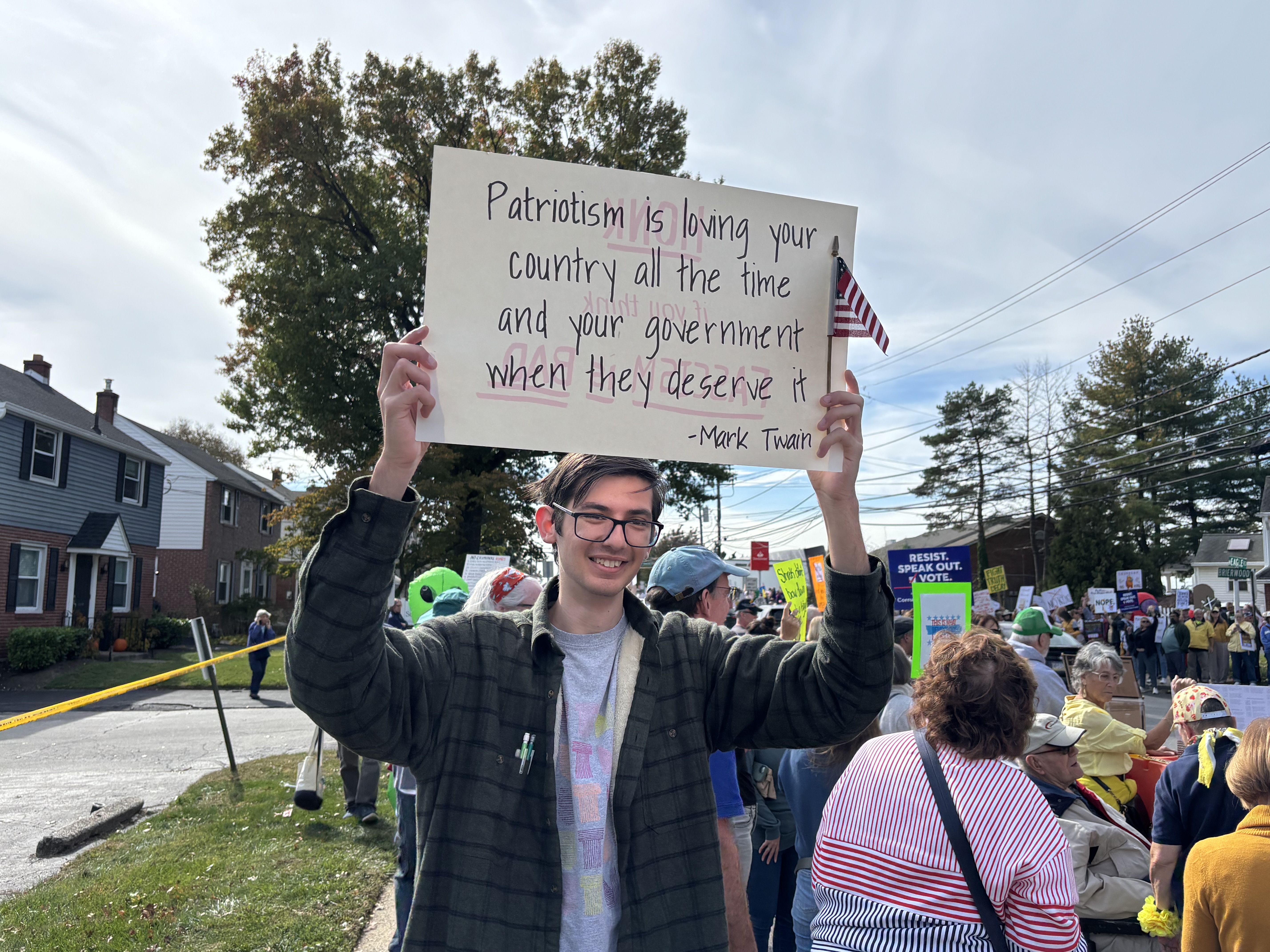
Someone like Emilio Ovalle ― a lanky 19-year-old student from West Chester University waving a sign with a Mark Twain quotation — stood out in the crowd on Saturday. The son of an immigrant from Guatemala, Ovalle also cited the deportations as his No. 1 issue, and while he said many of his friends oppose Trump, he also understands their reluctance to protest.
“Part of it has to be the Democrats — they’re not good at getting the young vote,” he said. “The right is very good at appealing to a lot of the insecurities, especially in younger men.”
This would seem to be the next mission for “No Kings” going forward: to build a bigger network with groups such as Gen Z teens and 20-somethings or African Americans. Those groups also have major issues with the Trump presidency, but feel them in different ways and express them in different venues than the ones like Facebook or MSNBC that are popular with the first wave of protesters.
That said, it’s impossible to ignore what the “No Kings” movement has accomplished in a matter of months. By raising their voices, protesters have encouraged Democrats in Washington to at least slightly stiffen their backbones, as shown by the current budget battle. They are winning new converts from the disaffected middle by exposing the depths of Trump’s unpopularity.
And they are reassuring their friends and neighbors to keep the faith in a dark moment — that there are far more Americans who want democracy than dictatorship. “It makes you feel good that you are not alone, that a lot of people feel the same way,” Michael Tempone, a 73-year-old from Upper Darby, waving American flags with his wife, Stephanie, told me.
There were thousands of American flags across the nation Saturday, and no reported violence, and close to no arrests — zero in New York City (where the New York Police Department is not known for its restraint) or San Diego or fearmongered Austin. That is driving the Trump regime bat-guano crazy, because it has not crushed the resistance, and it knows its days are numbered. As I walked back to my car, I heard one protester chuckle to his partner, “This is the best ‘hate America’ rally that I’ve ever been to.”
This week’s Shackamaxon is about field trips, political systems, and state budget shenanigans.
Perspective vs. parochialism
Five members of City Council, several Council staffers, three state representatives, and the head of the Philadelphia Parking Authority are taking a field trip up to Hoboken, N.J., next week, with the aim of learning more about how that city managed to eliminate traffic deaths. Hoboken hasn’t just done so forone year or two — the Mile Square City has gone without a vehicular fatality since 2017. Council President Kenyatta Johnson deserves credit for being willing to learn from other places, something Council has traditionally been hostile to.
Still, if our local legislators want to truly have their minds blown, they should head farther north. No, not Boston. The city they should learn from is Montreal, where my wife and I spent last weekend.
The city known as “Le Belle Ville” shares a lot in common with Philadelphia. Unlike Hoboken, which is ultimately a satellite city of Manhattan, Montreal is the center of its own metropolitan area, and the biggest city in Quebec. While there are zip codes in Philadelphia that have more residents than the North Jersey hamlet, Montreal has over 1.7 million inhabitants. It also has a riverside Old City, a park named for Marconi, an often contentious relationship with their state provincial government, a plethora of Second Empire architecture, a storied Chinatown, an expansive urban park that’s a bit of a hike to get to, and they call their downtown “Centreville,” or Center City.
Unlike Philadelphia, however, Montreal’s leaders embrace being a city, rather than trying to plug their square suburban preferences into a round metropolitan hole. The difference in quality of life is easy to see, even on a short trip.
People gather next to the Lachine Canal on a warm spring day in Montreal in 2021.
As my colleague Stephanie Farr pointed out, Philadelphia lacks even a single regularly pedestrianized corridor, while in Montreal, you’ll find them all over the place. Montreal’s mayor, Valerie Plante, credits its pedestrianization program with attracting additional tourists and boosting the local economy. There are more cyclists in Montreal than here in Philadelphia, and yet, you were less likely to encounter them speeding past you on the sidewalk, with even older riders and parents of small children feeling comfortable and safe riding in the street, thanks to traffic calming in residential areas and abundant paths elsewhere.
Additionally, their embrace of city life means a much more pleasant transit experience. In the four hours I spent riding the rails in Montreal, I did not notice a single person smoking cigarettes or marijuana on board a train or inside a metro station. I smelled both on my first trip back on SEPTA. Many Montrealers smoke. You’ll even find a recreational cannabis dispensary along Rue Saint-Paul, their historic thoroughfare, but they respect their transit system enough to refrain while on board. Imagine that!
Real choices
It would be easy to cite cultural differences as the primary reason why things seem to work better up north. But culture is not stagnant; it interacts with politics and policy. There are differences in electioneering between the City of 100 Steeples and the City of Brotherly Love, as well.
Since Philadelphia enacted the 1951 Home Rule Charter, the Democratic Party has dominated city politics. Many Council members are reelected without facing a credible challenge. Local Republicans stand little chance, especially with their colleagues in Washington and Harrisburg routinely demonstrating their contempt for our city.
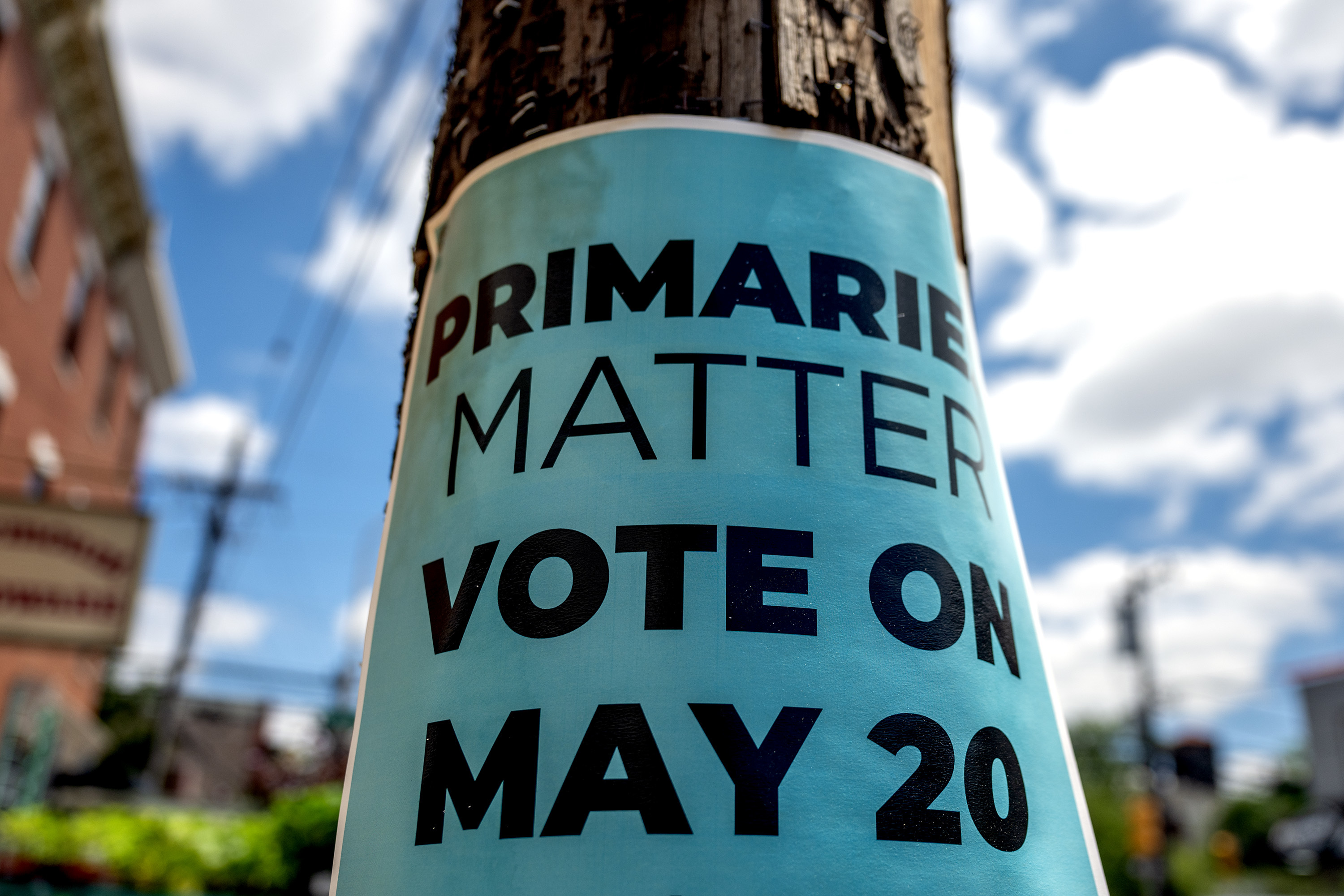
A sign in the Fairmount neighborhood in May.
The city’s new, progressive opposition, the Working Families Party, is often more focused on national issues than things city government has direct control over. In fact, it urged people to vote for it in order to stop Donald Trump. Neither opposition party has been willing to tackle local good government priorities like councilmanic prerogative or eliminating row offices. This makes achieving change in this city feel impossible, which probably contributes to what former Inquirer columnist Helen Ubiñas famously called “the Philly Shrug.”
In Montreal, however, voters have a real choice. They even have municipal political parties, meaning voters have to form their own opinions about local issues.
Budget blame game
Harrisburg Democrats are increasingly convinced state Senate Republicans are holding up the budget to boost state Treasurer Stacy Garrity’s chances in next year’s governor’s race. Garrity is currently behind by about 16 points in the polls. Republican consultant Chris Nicholas, one of the more reasonable members of his party, insists this is not the case, claiming that if it were, the treasurer would have unveiled her loan program earlier for Pre-K Counts programs and groups that provide rape and domestic violence prevention and response services.
State Treasurer and Republican candidate for governor Stacy Garrity holds a rally in Bucks County at the Newtown Sports and Events Center in September.
Still, it is hard to avoid thinking a Josh Shapiro landslide in 2026 could have an adverse effect on the campaigns of Republicans who are up for reelection next year.
Of course, holding up needed state cash might only make things worse. The county commissioners in state Senate President Pro Tempore Kim Ward’s Westmoreland County canceled their public meetings because there’s no money to spend. As Spotlight PA’s Stephen Caruso has outlined, nonprofit service providers are already feeling the pain, taking on debt that will hurt their ability to provide care for years to come.
It’s too bad that kind of pain has not been felt by our representatives.
Clashes between U.S. Immigration and Customs Enforcement agents and members of targeted communities continue to intensify as the Trump administration gleefully condones a dangerous mix of heavy-handed enforcement tactics and zero accountability.
Recent examples of intimidation, harassment, and excessive use of force by ICE and U.S. Customs and Border Protection agents have been piling up, ranging from a praying minister being shot in the head with a pepper ball to a woman allegedly taunted to “do something” before an officer opened fire.
Americans who care about the rule of law — whether they support mass deportations or not — must speak out against the inhumane theater of cruelty put on by Donald Trump’s secret police.
Yet, beyond the daily outrage of immigrants being disappeared off the street, or citizens detained without reason by jeering masked thugs, there is another insidious level to the administration’s anti-immigrant efforts.
From the moment Trump came into office, he has shut down or obstructed the country’s legal immigration pathways. No shots have been fired in this cold war, but the long-term economic damage will leave most Americans worse off.
Starting in January, the administration froze the U.S. Refugee Admissions Program, leaving more than 100,000 highly vetted immigrants who had already been approved for resettlement stuck in limbo.
According to reports, the program will restart in 2026, but the cap will be lowered from the 125,000 set under President Joe Biden to 7,500. Not only that, but many of those limited slots will be reserved for white South Africans.
You have to give it to white supremacists in the administration; they are not subtle.
The refugee freeze may not be the largest cut to legal immigration, but it is the most significant, said David J. Bier, director of immigration studies at the libertarian Cato Institute.
“All these people who would have been here with a path to permanent residence and citizenship — it’s just gone,” he told me. “Over the next four years, it’s basically the equivalent of half a million people who are going to be lost as a result of that decision.”
Refugees are fleeing from persecution, have gone through extensive background checks, and likely waited for years for a chance to come to the U.S. — all of which is meaningless to an administration for whom a foreigner is just an “illegal” who hasn’t overstayed their visa yet.
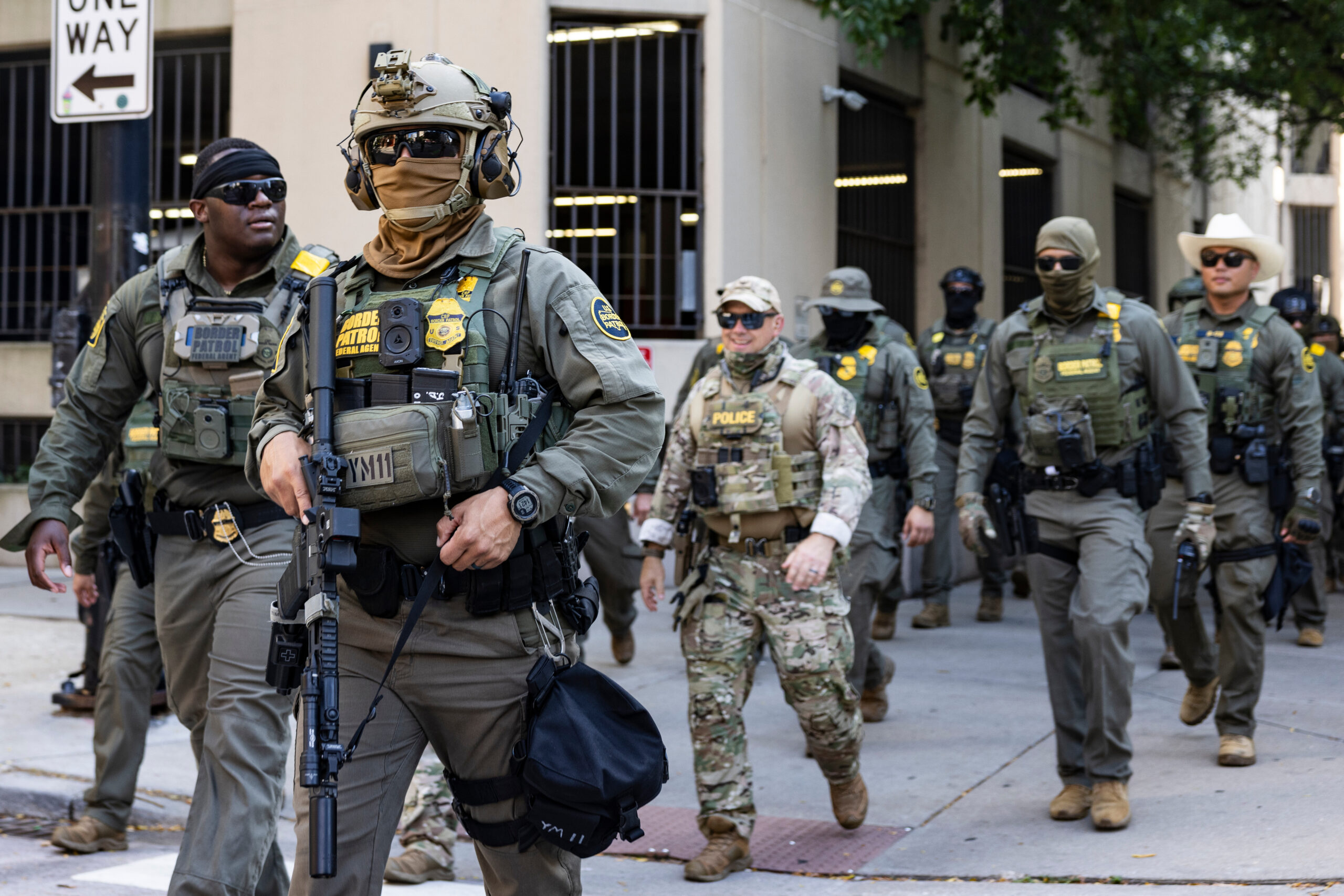
Federal agents from U.S. Immigration and Customs Enforcement and U.S. Customs and Border Protection walk north on North Clark Street in the River North neighborhood of Chicago in September.
And, if and when Trump leaves office, the system itself will be damaged, atrophied after years of disuse and partner agencies that have moved on.
The administration has also ended all humanitarian parole initiatives launched during the Biden years, which allowed some immigrants who had a sponsor in the U.S. and who passed a background check to come to America for a period of two years to live and work lawfully.
International students, long a wellspring for high-skilled workers in the U.S. and a major revenue driver for colleges and universities, have also been targeted by the administration. As the new academic year began in August, the number of international students declined by almost 20% from 2024. Difficulties getting visas, fears of getting caught up in the wider immigration crackdown, or ending up in jail for saying the wrong thing played a part in the drop, according to reports.
These are no idle concerns. The best and brightest around the world can quickly find validation for their worries in what happened to Columbia graduate student Mahmoud Khalil, who was detained after leading pro-Palestinian protests, or Tufts doctoral candidate Rumeysa Öztürk, who spent six weeks in custody over an op-ed she wrote for her student newspaper.
There are also travel bans targeting 19 countries and a proposal to charge a $100,000 fee for H-1B visas for skilled workers. Meanwhile, U.S. Citizenship and Immigration Services — the agency tasked with overseeing legal immigration, including legal permanent residence and citizenship applications — is being weaponized against the people it’s meant to serve.
The agency will now have armed special agents engaged in immigration enforcement, even as its backlog hits an all-time high and fee-paying applicants face worsening delays for USCIS services.
It’s going to be some time before the full economic effects of mass deportation, plus legal immigration being throttled so aggressively, manifest themselves, but the math is clear. The consequences of Trump’s legal immigration crackdown will not play out in the streets, but around people’s kitchen tables.
“It’s going to mean less economic growth for the United States,” the Cato Institute’s Bier said. “You’re reducing business creation and entrepreneurship and innovation, which drives improvements in economic growth over the long term.”
With less economic growth, it means lower living standards for the U.S. population, Bier added. “It’s a bleak picture.”
Much as the reality of who’s being targeted for deportation puts the lie to the administration’s claims that they are focusing on “criminal” immigrants and “the worst of the worst.” So the gutting of legal immigration removes all doubt over what this is really about, or for whom it’s really for.
With a government shutdown looming, Jimmy Kimmel coming back, and former FBI Director James Comey being indicted, it would be easy to miss that the Trump administration has promised billions in taxpayer money to bail out one of the president’s buddies after he got in trouble down south.
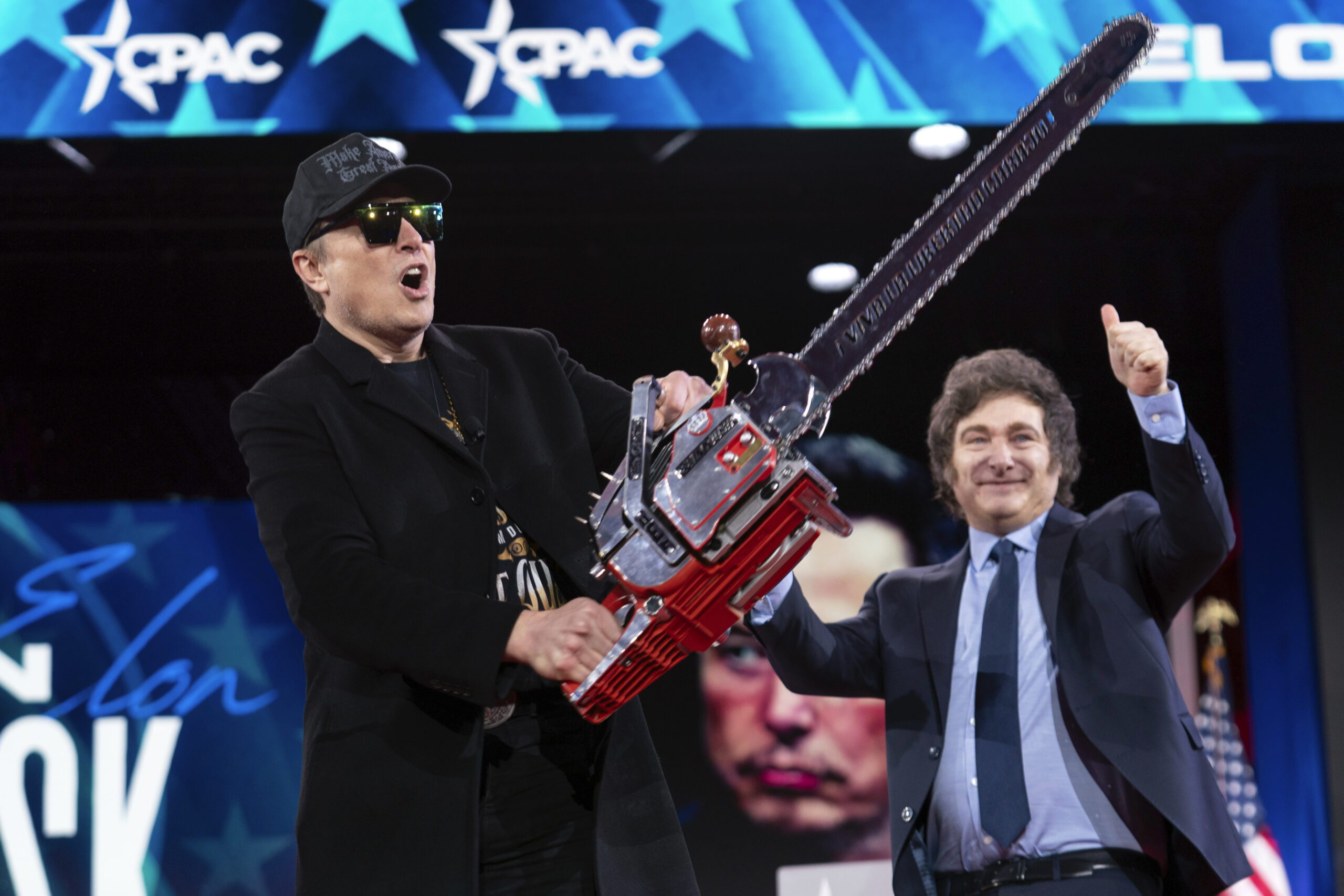
Argentine President Javier Milei, who you may remember gave Elon Musk a “bureaucracy chain saw” onstage at the Conservative Political Action Conference in February, has put the power tools down and brought out the collection plate.
“As President [Donald] Trump has stated, we stand ready to do what is needed to support Argentina and the Argentine people,” Treasury Secretary Scott Bessent posted on X Wednesday. “The Treasury is currently in negotiations with Argentine officials for a $20 billion swap line with the Central Bank.”
That influx of cash is, of course, timed to the forthcoming midterm elections, as Milei is challenged over his poor handling of the economy and other political woes. Elected in 2023, the brash self-proclaimed anarcho-capitalist has cut a Trumpian path, governing by decree and force of personality. But corruption allegations surrounding his sister, growing wage stagnation, and rising unemployment have him on the ropes.
Now, helping a neighbor facing hard times is not a bad thing. I was in Mexico when President Bill Clinton took it upon himself to approve a $20 billion loan in 1995 to help stabilize the peso after that country’s economic collapse. But helping the nation next door was also in America’s best interest.
Elon Musk holds up a chain saw he received from Argentina’s President Javier Milei (right) as they arrive to speak at the Conservative Political Action Conference in February at the Gaylord National Resort and Convention Center in Oxon Hill, Md.
The U.S. had just entered into a trade agreement, and there were American jobs dependent on exports. Clinton also pragmatically argued that a broke Mexico would likely lead to more illegal immigration and destabilize the southern border.
The gamble worked. Mexico ended up paying back the loan, along with half a billion dollars in interest, ahead of schedule. The country also continued down the road to true democracy, with an opposition party winning the presidency in 2000 for the first time in more than 70 years. But Argentina is not Mexico.
The country is hardly a top export destination for American goods (imports from China almost double what U.S. producers sell there), and Milei has already burned through $15 billion in International Monetary Fund money. Not to mention Argentina owes another $45 billion from an IMF loan taken out in 2018.
Those are a lot of hopes and dreams riding on the right-wing Milei. As U.S. Rep. French Hill, the GOP chairman of the House Committee on Financial Services, wrote after a trip to Argentina recently, if Milei’s policies are successful, they could “reverse 150 years of macro financial disappointment to creditors.” I believe in long shots, but I’m not taking that bet.
Oh, wait. As a taxpayer, I guess I am.
Scott Bessent, U.S. Treasury secretary, (left) and Argentine President Javier Milei during the Atlantic Council Global Citizen Awards in New York on Wednesday.
What’s maddening about this situation is that it’s part of the cronyism that defines Trump’s second term. The president has made no secret, as usual, of what his motivations are, calling Milei “a very good friend, fighter, and winner” on Truth Social, and telling Argentines their president has his complete and total endorsement and “will never let you down!”
We can argue on the merits of propping up Argentina’s economy, but this is no way to run foreign policy in Latin America.
Not while the U.S. cozies up to the “world’s coolest dictator” (and America’s jailer) Nayib Bukele in El Salvador. Nor when we’re imposing 50% tariffs on Brazil — a country with an economy more than three times the size of Argentina’s — for convicting former president (and Trump pal) Jair Bolsonaro over a coup attempt after his electoral defeat in 2022.
Nor when Trump continues to order the extrajudicial killings of Venezuelans — at least 17 people — the White House claims were drug running in the Caribbean.
The little Republican pushback over the administration’s efforts to rescue Milei’s political career has come from U.S. Sen. Chuck Grassley, who objects to Argentina’s undercutting of U.S. farmers trying to sell to China. “Why would USA help bail out Argentina while they take American soybean producers’ biggest market???” Grassley posted to X on Thursday.
Not exactly a clarion call to action, but it’s a start. Maybe if we put soybeans on those Venezuelan boats the U.S. keeps blowing up, we’ll get some needed outrage from the right.
Too many people in this country think free speech comes with no consequences. A constitutionally protected free pass to say whatever you want with zero repercussions. But that’s not true. There is a cost to speaking out.
On the left, think Colin Kaepernick being blackballed by the NFL for taking a knee during the national anthem. On the right, think every yahoo who’s ever been fired from their job over some racist/sexist Facebook post.
If you think that’s an unfair comparison, write about it. Yell at me about it. That’s how free speech works. I say something, and you can say something back. How it definitely does not work is when the government steps in. The courts have been very clear that the First Amendment protects us from government censorship.
That means calls to boycott comedian Tony Hinchcliffe after he called Puerto Rico a “floating island of garbage” at a Donald Trump rally? Legal. ABC firing comedian Bill Maher for insensitive comments after 9/11? Legal. However much you or I can loathe so-called cancel culture, it’s legal.
What happened to Jimmy Kimmel is something else.
On Wednesday, Disney-owned ABC put the late-night talk show Jimmy Kimmel Live! on indefinite hiatus. This happened soon after Nexstar Communications Group said it would pull the program from its 23 ABC-affiliated stations over a joke Kimmel had made Monday about the MAGA reaction to the killing of Charlie Kirk. The leaders of the conservative-leaning Sinclair Broadcast Group also announced they would be preempting the show.
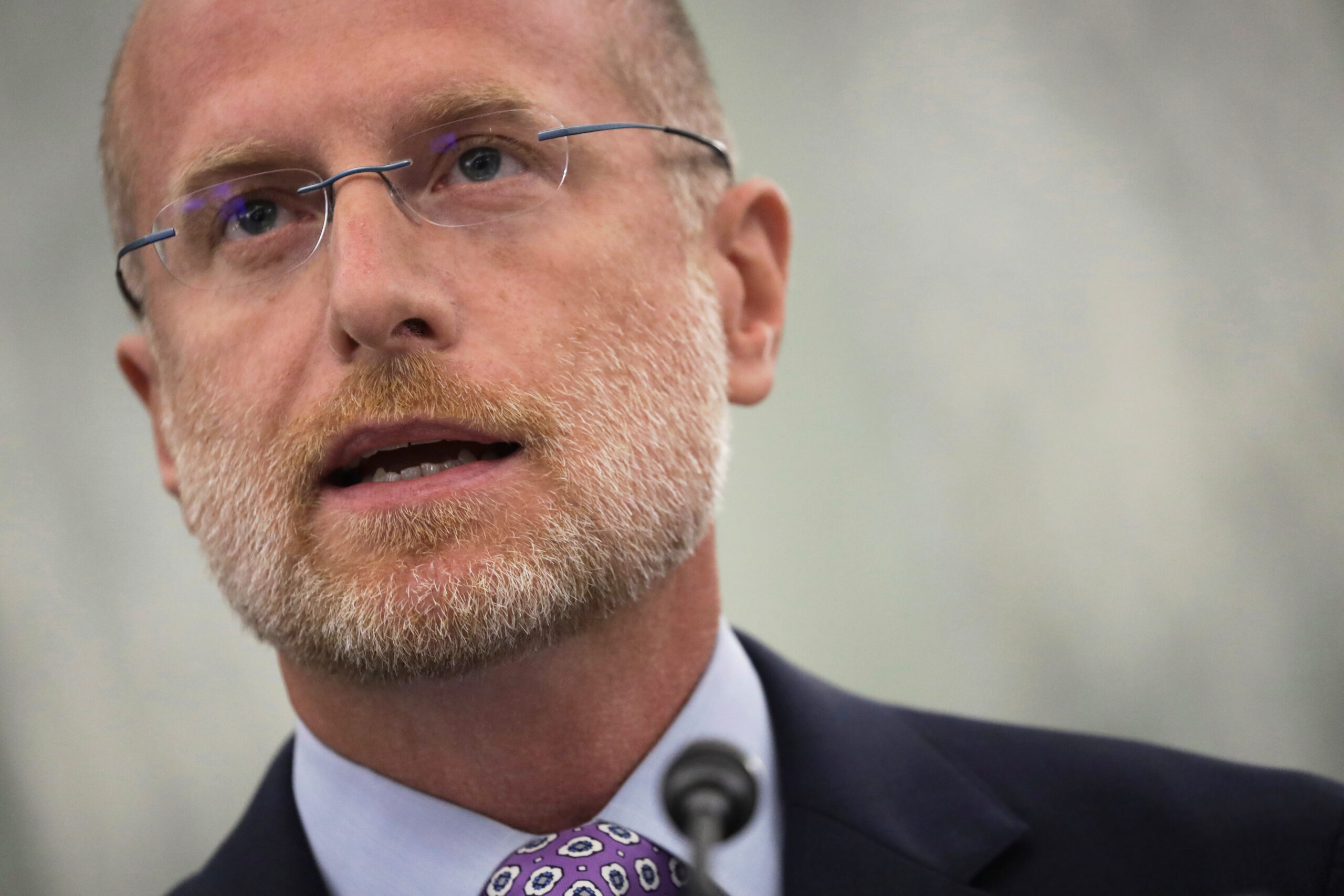
So far, so wrong, but within these private companies’ rights. The problem is that also on Wednesday, the head of the Federal Communications Commission, Brendan Carr, went on the right-wing podcast The Benny Show and laid out how the government could go after those who gave the late-night comedian his platform.
“There’s calls for Kimmel to be fired. You can certainly see a path forward for suspension over this. And again, the FCC is going to have remedies that we could look at,” Carr told host Benny Johnson. “Disney needs to see some change here, but the individual licensed stations that are taking their content, it’s time for them to step up.”
Now, the FCC cannot go after ABC because, like the other national networks, it does not hold a broadcast license to transmit over the public airwaves (although Disney owns a few stations), but it can absolutely go after local affiliates.
Not only that, but much like in the case of CBS’s cancellation of The Late Show with Stephen Colbert — which put the Trump-mocking show on the chopping block after the network’s parent company needed government approval for a merger — Nexstar is also in merger talks.
Brendan Carr, then a Federal Communications Commission commissioner, speaks during a Senate Commerce, Science, and Transportation committee hearing on Capitol Hill in Washington, in 2020.
With The Late Show, CBS executives could at least make the case (transparent as it was) that their decision was justified because ratings were down, and they would allow the show to run until the end of the host’s contract next year.
But for Kimmel, there hasn’t been even an attempt at that kind of pretense. He’s been suspended following a barely veiled threat by the guy in charge of allowing TV stations to do business. Now, I think what Nexstar did is cowardly, but it is by no means nonsensical.
Add it to the list of companies, universities, and law firms that have sold out American principles and are fully on board with endangering democracy by enabling Trump’s worst instincts — all for the sake of doing business.
Also, add this incident to the long list of examples of hypocrisy from the Trump administration and the right-wing commentariat. Unsurprisingly, back in 2023, Carr posted on X that “Free speech is the counterweight — it is the check on government control. That is why censorship is the authoritarian’s dream.” The same day Kimmel was suspended, Trump criticized England’s laws limiting speech (he’s right) while praising ABC’s decision.
The president has repeatedly threatened networks over their news coverage, and raged against late-night comedians like Kimmel and Colbert for making fun of him. Of the Big Three networks (sorry, kids, I’m old), Comcast-owned NBC has so far stood its ground.
This is important because Saturday Night Live alone has produced some definitive presidential portraits that have stood the test of time. In my late-night TV-watching lifetime, we’ve seen George H.W. Bush as awkward and out of touch (Dana Carvey), Bill Clinton as hungry horndog (Phil Hartman), George W. Bush as clueless bro (Will Ferrell), Barack Obama as professorial but cool (Jay Pharoah), and Donald Trump as game cue card reader desperate for love and attention (Donald J. Trump).
The show may want to amend Trump’s portrayal, though, to a thin-skinned demagogue who lost his sense of humor about the same time he found love and attention among the vilest peddlers of right-wing vitriol and hate on his way to authoritarianism.
As to what those of us who consider free speech one of the vital ingredients in the American Experiment can do, well, that’s easy.
Speak out, loudly and often — ideally respectfully, but the Constitution doesn’t say you need to be nice. What’s happening is not right, and we need to say so. Damn the consequences.
As Vladimir Putin blocks peace talks, Kyiv wants to share with the U.S. and Europe how to counter the AI-driven weapons of the future.
Betsyk, commander for the 3rd Separate Assault Brigade's special battalion for intercepting enemy drones, sits beside downed Russian reconnaissance drones.3rd Separate Assault Brigade
DIRECTION POKROVSK, Ukraine — In a warren of rooms filled with computers, 3D printers, colorful wires, and drone frames, the atmosphere was casual, but the intentions were deadly.
The young men in their 20s and 30s, dressed in cargo pants and T-shirts, wouldn’t have looked out of place at a Silicon Valley start-up. Except they were fighting for their lives — and their country’s survival.
In the basement command center, three of the soldier-techies stared at multiple screens with dozens of views delivered by Ukrainian-made surveillance drones. They were looking for Russian targets in a war that had lasted for three and a half years.
As I peered over their shoulders during a June visit to the rear of the front lines, a moving car was spotted.
Orders were quickly passed to a frontline drone navigator and pilot in a trench or basement who would make the final call as to whether the target was clearly visible and worth destroying — at which point the pilot’s goggles would let him watch the little exploding drone descend until a flash signaled another kill.
It was a slow day, and everyone’s attention had turned to other screens before I could learn the fate of the car. But there were always more targets to find.
By my side, the 31-year-old commander of an elite drone battalion of the 59th Assault Brigade, call sign Condor, told me there are up to 300 targets a day, which can range from a single fighter in the grass to a moving motorcycle to a small Russian dugout covered with branches or nets.
“The orcs outnumber us, and they don’t care about loss of lives,” Condor said, using the name of the grotesque enemy warriors in the Lord of the Rings series to refer to the Russians. “In this new way of war, infantry and artillery and mortars still matter, but everything is controlled by air. Now, a military is just a way of supporting drones.”
For Ukraine, drones are an essential part of why the country has been able to hold out so long against an army four times its size.
Source: Institute for the Study of War and AEI's Critical Threats Project.John Duchneskie/Staff Artist
The technology of unmanned weaponry is advancing at a pace that appears revolutionary — from aerial drones to drones that move by sea, robotic land drones, and long-range drones carrying missiles — all increasingly directed by artificial intelligence.
Sea drones drove Russian ships out of the Black Sea along the Ukrainian coast, and continue to strike at the critical Kerch Bridge connecting Russia to Crimea. In June, Ukrainian security services conducted the amazing Operation Spiderweb, which damaged or destroyed up to 40 Russian warplanes worth billions of dollars, deep inside Russia — all with 117 small drones costing $500 each.
But Russia is catching up. Ukraine needs the funds to massively scale up drone production.
That’s why the most important moment of President Donald Trump’s Monday meeting with Ukraine’s president and top European leaders may have been when Volodymyr Zelensky proposed to share his country’s breakthrough drone technology with the Pentagon.
Kyiv would sell tens of billions of dollars’ worth of advanced Ukrainian-made drones to America, and, in return, would buy double that dollar amount of U.S. weapons systems, financed by Europe. Both countries would then be far better equipped for the challenges of modern conflict.
The success of that proposal could bolster American preparedness for future tech wars, while helping Ukraine survive as a free, sovereign state.
More on Ukraine
Trump’s deference to Putin means only more bloodshed in Ukraine
The president could have used America’s power to force Vladimir Putin to negotiate seriously. Instead, he opened the door to blaming Ukraine for any failed "peace" talks.
Why so? Peace talks are going nowhere. Vladimir Putin has no interest in peace. He thinks he’s winning.
The Russian dictator “has no reason to compromise so long as the president refuses to apply any pressure on Moscow,” as former Russian political prisoner Vladimir Kara-Murza bluntly told MSNBC. “You cannot make peace by placating Russia.”
Despite the effusive red-carpet welcome Trump gave Putin at their recent Alaska summit, the Russian leader has rejected every one of the president’s proposals to end the war.
story continues after advertisement
No ceasefire. No strong security guarantees for Kyiv, as the naive White House negotiator Steve Witkoff claimed Putin had accepted. The Kremlin has already rebuffed a possible bilateral meeting between Putin and Zelensky that Trump has been touting.
Peace talks will become plausible only if the U.S. joins Europe in putting maximum pressure on Russia, convincing Putin he can’t win and can’t afford to fight any longer.
But that would require Trump to recognize what the Europeans already know: Ukraine has been able to hold off the Russians until now because it has pioneered a revolutionary new way of warfare — the war of drones.
So Zelensky’s proposal is in both countries’ interests. The U.S. is way behind in small drone production, but it has weapons systems crucial to Ukraine. A swap would signal to Putin that Trump is not a pushover.
If Trump wants to be a peacemaker, he must recognize that the Ukraine war is about far more than real estate. It is a battle over freedom, geopolitics — and who will win the tech wars of the future.
As I was told by former Ukrainian Minister of Strategic Industries Oleksandr Kamyshin: “This war started like the Second World War with drones. But it will finish as the First World Drone War.”
A pilot with the elite drone unit for HUR, the Ukrainian Defense Ministry’s intelligence service, demonstrates drone control.Trudy Rubin/Staff
In the air
My latest Ukraine visit — my fifth since the fighting began in February 2022 — showed me what it means when unmanned drones take over the battlefield.
Last year, I could still visit artillery emplacements and destroyed villages near the front where army units lived, showered outdoors, and ate outdoors. I could drive on roads to and from towns near the Donetsk front line inside the contested parts of the eastern Donbas region that Ukraine still controls. Military vehicles still sped along those roads.
Those days are over.
The 15 kilometers (roughly nine miles) on each side of the front line have become a kill zone where almost nothing moves on land because it is at risk of being hit by the other side’s drones.
The size of the kill zone keeps expanding.
Tanks are sitting ducks. So are medical evacuation vehicles. Indeed, military vehicles of any kind. No longer are the soldiers who man frontline positions or drone pilots rotated every day or two; they stay in place for days because the roads in and out are so risky.
Supplies are brought in and the wounded taken out by unmanned robotic carts, known as land drones. These robots also lay mines, and some are equipped with machine guns or rockets.
As for Ukraine’s cities, Putin is demonstrating how drones can be used as a cheap, terrifying tool of terror against civilians.
During my stay in Kyiv, the nightly Russian barrage of Shaheds — drones designed in Iran and gifted by the thousands to Putin by the ayatollahs — rained down nightly on civilian targets. I was lucky to be in a hotel with a comfortable basement shelter, but my Ukrainian friends and contacts were up each night huddled in their hallways or bathrooms. They still are.
Natalya Dubchek stands next to a minibus destroyed by a Shahed drone. The fire from the explosion torched her home in Odesa, Ukraine.Trudy Rubin / Staff
In Odesa one morning, I visited a neighborhood where a family of three was incinerated when a Shahed sheared off the top floor of their apartment building in a residential neighborhood. I spoke with a woman whose bungalow burned to its concrete walls, and who barely escaped the flames.
Even after my return to the U.S., I have kept the air raid alerts on my iPhone, which can be set to any city or region. My phone buzzes every time Russia launches another swarm of Shaheds (along with cruise and ballistic missiles) against Kyiv. For hours, the alerts go off every 20 minutes.
Each buzz means Ukrainian civilians, including the elderly and mothers with small children, must decide whether to descend to an underground shelter and spend miserable hours or the entire night there.
The Shaheds, which give off a chilling whine as they fly, are now copied and manufactured inside Russia with Tehran’s technical help. They have been made more lethal with the addition of jet engines, which enable them to fly higher and faster and elude countermeasures. They are meant to terrorize, exhaust, and kill civilians in Ukrainian schools, hospitals, markets, and apartment buildings.
The number of Shaheds in the skies has jumped dramatically since Putin concluded that Trump will never be serious about punishing Russia for its refusal to accept a ceasefire or engage in serious peace talks. And they are affecting morale. If the Russian barrage continues, more Ukrainians may try to leave for abroad.
A Ukrainian officer shows a thermobaric charge from a downed Shahed drone in a research laboratory in an undisclosed location in Ukraine in 2024.Efrem Lukatsky
Yet, despite the daily Shahed carnage and recent Russian gains on long stalemated front lines, Moscow is still not winning this war.
A prime reason is that Ukraine’s war of technology has so far enabled Kyiv to hold its defensive line, but not to take back territory.
Former Ukrainian commander in chief, now ambassador to the U.K., Valerii Zaluzhnyi, told a video forum in Kyiv that the only war Ukraine can wage is a “high-tech war of survival” until it destroys Russia’s military and economic ability to keep fighting over the long run.
The bad news is that Russia is learning from Ukraine and receiving large-scale tech aid, components, and ready-made drones not only from Iran, but from its other allies, China and North Korea.
This alliance of dictators is growing stronger, and its members are watching the Ukraine war for lessons in future drone warfare with the West. Think China and Taiwan.
story continues after advertisement
To shake up the Kremlin, Kyiv needs to vastly scale up its drone production and race to outdo the Russians with innovation, especially interceptors that can destroy Shaheds and fiber-optic drones.
European governments and private companies are entering agreements to jointly produce drones, both in Ukraine and in Europe. They are studying Kyiv’s technological advances, including on the front lines.
Ukraine wants to share its invaluable battle-tested knowledge with Washington, yet Trump still appears hung up on the vain hope that Putin “wants a peace deal,” which he mistakenly believes would entitle him to a Nobel Peace Prize.
So long as he refuses to recognize Kyiv’s importance as a strategic ally, the president undermines not only Ukraine’s security but ours.
A Ukrainian serviceman of 57th motorised brigade controls an FPV drone at the frontline in Kharkiv region, Ukraine in August.Andrii Marienko
Drone expansion
In June 2024, when I first met with then-infantry commander Condor of the 59th Assault Brigade in one of the hottest combat zones in eastern Ukraine, he was struggling to arm his depleted battalion. They were suffering through a terrible “shell hunger,” he told me, after the U.S. Congress had frozen military aid for six months. His men were often reduced to firing one artillery shell for every 10 fired by the Russians.
“Every day of [congressional] delay cost broken lives and deaths,” the former history teacher turned soldier said bitterly, as we sat in a dark, virtually empty cafe in the countryside near Pokrovsk. “So, we had no other choice but to be creative.”
To fend off a brutal Russian adversary with four times their population and massive industrial might, the nation’s techies and grunts turned their front lines and hidden basements into a tech incubator for modern war.
Desperate fighters, like Condor’s unit, were already using simple Chinese-made commercial drones to spy on Russian forces in 2023 and 2024.
Every unit I visited near the front during those years had guys working on benches in abandoned farmhouses or workshops, putting together drones from parts purchased on Amazon with their own salaries, or donated by families, friends, or private charitable foundations.
While Ukraine was well known in peacetime for talented engineers and a deep tech sector, many of those early do-it-yourself builders had no such background, but figured things out as they went.
By the summer of 2024, the men of Condor’s unit had come up with how to turn small commercial or DIY drones into little exploding drones.
Call sign Condor, commander of the UAV Forces Battalion of the 59th Assault Brigade.Trudy Rubin / Staff
“We cut sewage pipes and stuffed them with explosives,” Condor explained. “We did the same with energy drink cans.”
These makeshift mini bombs were then affixed to UAVs, the shorthand for unmanned aerial vehicles, mostly small Chinese DJI MAVIC quadcopters, the kind Americans use to record panoramic overhead views of weddings. The Ukrainians launched them at Russian tanks, artillery positions, and trenches.
“This is the art of war,” Condor said, with a grim smile. “When you have no supplies, you have to innovate.”
The turning point came in 2024, when the U.S.-induced shell hunger spurred a massive expansion of drone use to save Ukraine’s army. The goal was to protect and preserve precious frontline man power in a war in which Russia treats soldiers like cannon fodder — and to do so with weapons far cheaper than what they destroy.
Government and private companies produced two million drones in 2025, and are set to manufacture more than four million next year. They could produce eight million to 10 million, Zelensky has said, if they had enough funds.
Other weaponry still plays an important role, especially air defenses. While drones can hold the defensive line, taking territory still requires infantry. But 80% or more of the Ukrainian strikes on the front line are now made by drones.
More on Ukraine
A funeral for a tattoo artist-turned-soldier shows why Ukraine won’t capitulate to Moscow
The friends of Roman Tarasyuk vow to keep fighting despite Trump's support for Putin.
Those early exploding drones have evolved into larger attack drones with bigger payloads, including sea drones that resemble large rowboats filled with electronics and sometimes carrying rockets. Robotic ground drones are now mounted with machine guns, and larger long-distance drones can carry small missiles. All of these drones are unmanned and directed by pilots and navigators using goggles and tablets.
Anything that can be viewed by FPVs — first-person view drones in which pilots wearing special goggles can see exactly what the drone sees — is now vulnerable to drone attacks, including men, artillery, ships, helicopters, and low-flying planes.
story continues after advertisement
In the process, Ukraine has rewritten the rules of ground, sea, and air conflict.
As the war continues, artificial intelligence is certain to take on more of the piloting responsibilities (although target decisions will still be made by pilots and commanders, for now).
So crucial have drones become to modern warfare that the Ukrainian military has a new branch up and running whose task is coordinating drone warfare, called the Unmanned Systems Forces.
“We are the first country with an unmanned forces command,” I was told by Hanna Gvozdiar, deputy minister for Ukraine’s Ministry for Strategic Industries. She estimated Ukraine now produces 300 different varieties of drones.
Moreover, special drone units within most Ukrainian battalions have become central to every element of the conflict. Not only do many of them design their own drones, but they also provide constant updates to private drone manufacturers so they can stay ahead of Russian defenses.
As for Condor, he moved from commanding infantrymen to leading the UAV Forces Battalion of the same 59th Assault Brigade, one of the top drone units in the country. By the time I saw him in June, he was fighting a totally different war.
A worker inspects a combat drone at Fire Point's secret factory in Ukraine in August.Efrem Lukatsky
Advantage Ukraine
In the “genesis space” of a modern, glass-fronted office building in Kyiv, a group of start-up Ukrainian tech entrepreneurs has come to pitch their products to guests from the European Union — and to anyone who might fund them to scale up.
The program is sponsored by Brave1, a government-supported tech incubator that helps connect drone start-ups with investors and provides seed money for promising new projects.
“We are in a race with the Russian drone ecosystem,” I was told by Artem Moroz, Brave1’s head of international investment. “The Russians don’t need to fundraise for drone production,” he noted, with bitter irony.
“We want to win the war with the help of technology because we can’t compete with man power,” he continued. “Most of the innovation comes from the private sector. We unite 1,500 companies, some in apartments, some operating at a huge scale, providing thousands of drones.”
Before the show-and-tell, I listened to Oleksiy Babenko, one of Ukraine’s best drone producers, make his pitch to foreign investors. Babenko’s company, Vyriy — named for a paradise in pre-Christian Slavic mythology — makes a small FPV drone called Molfar, which can function in swarms and evade Russian electronic jamming.
“Practically every Ukrainian university has a polytech [division] that graduates a lot of talent. We are a technical hub for software development, and young tech entrepreneurs are migrating to the battlefield,” he told the group.
A technician prepares a Shrike drone at the Skyfall military technology company in Ukraine.Andrew Kravchenko
“But this brilliant talent needs investment, domestic or foreign, to scale up production. If we don’t do this, we will die.”
After Babenko came the young entrepreneurs with slide decks and videos: Bravo Dynamics promotes a radio-based mesh network that can connect drones, but could also have civilian uses. Farsight Vision produces software that digests visual data, which could help drone targeting or serve business uses. VMP has a robot model “that will be the main tool for logistics on the front line,” but could be used for civil defense.
There is both pride and a sense of frustration in the room. Ukraine is a start-up nation. These talented innovators, not Ukrainian government bureaucrats, have sparked the drone revolution.
Right now, Ukraine produces 94% of its own drones and is reducing its dependence on Chinese parts. Kyiv is also manufacturing 40% of its other weapons inventory.
But Ukrainian factories are operating at only one-fourth of capacity, according to Kamyshin, the former government minister. “We need $10 billion to $15 billion of necessary capital to produce what is needed,” he told me as we fast-walked through a park near his office so he could work off some of the daily tension. “We are much better innovators than the Russians, but we need to scale up.”
More on Ukraine
Ukraine’s drone attack was more than a morale booster, it showed the new face of modern war
Operation Spiderweb illustrated the brilliance of Ukraine’s technological skills and the flaws of the Russian military.
Private Ukrainian firms lead Europe and the U.S. in producing battle-tested drones, from mass-produced FPVs to highly secret deep strike missile drones. Ukraine seeks not only to intensively scale up its own drone production but to become an international hub for dual-use technology.
However, unlike Russia, which can draw on billions from its (dwindling) sovereign wealth fund, Ukrainians must raise funds to increase government and private drone production to keep up with Russian drone output — which has now expanded to industrial scale.
“Our only chance is to become our own arsenal and the arsenal for Europe,” argued former Ukrainian Defense Minister Andriy Zagorodnyuk over coffee. “The question is, how to organize that.”
European governments are seriously addressing this question of scaling up Ukrainian production, and some private investors are hovering. The question is whether they can act quickly enough to fund joint projects inside Ukraine or based in Europe. Especially now that Trump has decreed Washington will no longer give military aid to Kyiv, but will let Europeans buy weapons to transfer.
There’s no time to waste, as Russia is scaling up its drone output at a frightening rate.
In this photo taken from a video distributed by the Russian Defense Ministry Press Service in May, Russian servicemen train to operate military drones in an undisclosed location.Russian Defense Ministry Press Service via AP
Advantage Russia
Putin has rallied Russia’s entire state-run industrial machine behind the war effort, and the total drone output of its state-run industrial machine now exceeds Ukraine’s. Long-range drone production more than doubled from 2023 to 2025, and has increased fivefold since then.
Prodded by Ukraine’s success in drone technology, Moscow is rushing to build a drone empire, even introducing school curriculums about the development and operations of drones.
Moreover, while Russia receives support from its ever-tightening alliance with China, North Korea, and Iran, Trump is too transactional to see the broader geopolitical threat this drone quartet poses to the United States.
Tehran was the first to partner with Moscow by sending thousands of its long-range Shaheds to Russia in 2022. Since then, Shaheds have become the go-to UAV for terrorizing Ukrainian cities.
Iran also helped Russia set up its own production facilities in Tatarstan (now spread out over the whole country), which mass-produce the killer drones, along with decoy copies to confuse Ukrainian air defenses.
In this photo taken from a video distributed by the Russian Defense Ministry Press Service in August, a soldier launches a reconnaissance drone in an undisclosed location in Ukraine.Russian Defense Ministry Press Service via AP
Equally dangerous, Russia is giving North Korea the technology and production skills to start producing the Russian variants of Iran’s Shaheds, according to Ukraine’s head of military intelligence, Kyrylo Budanov. This will enable the North to strike targets across South Korea, changing the balance of power between the two nations, Budanov warned in an interview with the military news site the War Zone.
Meantime, China, despite its denials, is actively enabling Russia’s drone production, providing basic drones and many critical components. “China uses Russia as a research base,” I was told by Yehor Cherniev, deputy chairman of the Ukrainian parliament’s National Security Committee. “China watches aspects of the new warfare. It is about geopolitical vision on both sides.”
story continues after advertisement
Without Beijing’s aid, Russia would probably be unable to rapidly scale up its production of long-range UAVs.
Moreover, top experts on Russia and China warn that the quartets’ mutual interest in undermining the West should shatter any Trump illusions of splitting Russia from China.
Trump’s coddling of Putin only speeds Russia’s advancement in the new global drone wars, which could boomerang against Washington all too soon.
“The U.S. will be drawn in,” insisted former defense minister Zagorodnyuk. “China and Russia want to destroy Western dominance, starting with Europe and NATO, and leading to a clash with the United States.
“This war is not going to end, but is going to get worse.”
Prime Minister of Denmark Mette Frederiksen lays a wreath during a memorial ceremony, as her husband Bo Tengberg and Ukrainian President Volodymyr Zelenskyy, right, stand behind her at the Field of Mars at Lychakiv Cemetery in Lviv, Ukraine, in 2024.Mads Claus Rasmussen
What Europe understands
On Aug. 3, as Denmark took over the rotating European Union presidency, Danish Prime Minister Mette Frederiksen called on Europeans to “change our mindset” about helping Kyiv.
“Instead of thinking we are delivering weapons to Ukraine,” she stated bluntly, “we have to think of it as a part of rearming ourselves — because right now it is the army of Ukraine that is protecting Europe. I see no signs that Putin’s imperial dreams stop with Ukraine.”
The tough-minded Frederiksen, who stood up to Trump when he threatened to seize Greenland, is now echoed by most other European leaders, none of whom harbor illusions about Putin’s aims. They understand that Ukraine’s army is defending the line between Western democracies and Eurasian adversaries, as Europe’s NATO members struggle to beef up their weak defenses.
Russia has been conducting assassinations, sabotage, and cyberwarfare against European nations for the past several years. The Kremlin clearly seeks to militarize and control the Arctic, which impacts the Nordic states, and to exert its power in the Baltic Sea and the North Atlantic.
The three Baltic states — Estonia, Latvia, and Lithuania — along with other European nations that suffered under Soviet domination, all worry that Putin’s first move should Ukraine fall would be to move on them, perhaps using drones.
The aim would be to prove NATO was a paper tiger and would not come to its members’ defense, leading to the collapse of the alliance.
NATO Secretary General Mark Rutte, left, shakes hands with Ukrainian President Volodymyr Zelensky during their briefing in Kyiv, Ukraine, on Friday.Efrem Lukatsky
Mark Rutte, the former Dutch prime minister and current secretary-general of NATO, has gone one step further, warning that “Russia is reconstituting itself at an incredible pace, and the U.S. is not secure if the Atlantic, Europe, and the Arctic are not secured.”
Rutte has also cautioned that if China’s Xi Jinping attacks Taiwan, the Chinese leader might ask Putin to open a new front in Europe to distract NATO and the United States.
With Trump favoring Putin, the Europeans are moving to bolster Kyiv’s military production, including drones. They know they need Ukraine’s army as a buffer against Moscow. As Zelensky said at the Munich Security Conference in Germany in February, referring to the Russians: “Right now, Ukraine stops them. If not, who will stop them?”
Good question.
story continues after advertisement
Europe is far from ready to defend against drones or other Russian mischief now that the United States has turned its back. “The Europeans are really changing. They are buying time for themselves,” said Zagarodnyuk. “They realize they will be next.”
With that in mind, Frederiksen has pioneered the “Danish model,” a framework whereby Europeans fund drone production by private Ukrainian manufacturers, with Copenhagen vetting the contracts and effectiveness.
Germany, Norway, the Netherlands, Britain, and the European Union are following suit, as is a special fund set up by NATO. Private European weapons manufacturers are looking into joint production and sending representatives to Ukraine to test drones and components. Ukraine, meanwhile, has offered its front line for companies to “Test in Ukraine.”
Ukrainian drone units near the front line tell me they often host European military or civilian manufacturers looking to test drones or components. Few Americans come, they said, and U.S. special forces no longer visit. If Europe coordinates its efforts, that may suffice to fund Ukraine’s drone scale-up and block Russia’s push to dominate drone warfare.
But that goal will be Herculean if Trump continues to back Putin over Europe and Ukraine.
President Donald Trump meets with Ukraine's President Volodymyr Zelensky in the Oval Office at the White House on Aug. 18 in Washington. (AP Photo/Julia Demaree Nikhinson)Julia Demaree Nikhinson
What Trump doesn’t understand
Last fall, the former chairman of the Joint Chiefs of Staff, Mark Milley, and former Google CEO Eric Schmidt sounded the alarm over America’s lack of readiness for the wars of the future.
Writing in Foreign Affairs, the two men warned: “Future wars will no longer be about who can mass the most people or field the best jets, ships and tanks. Instead, they will be dominated by increasingly autonomous weapons systems (largely drones) and powerful algorithms. Unfortunately, this is a future for which the United States remains unprepared.”
Five days after Ukraine’s Operation Spiderweb garnered huge international publicity, Trump signed an executive order calling for “continued American development, commercialization and export of drones.” He called for American “drone dominance.”
What the president did not do was turn to Ukraine, which has extensive combat experience with drones that the U.S. military and its nascent drone manufacturers lack.
To understand whether that makes sense, I turned to Michael Horowitz, director of the University of Pennsylvania’s Perry World House, who served in the Biden administration as U.S. deputy assistant secretary of defense for force development and emerging capabilities. Translated, that means he is an expert on the new drone warfare, where large masses of relatively cheap unmanned drones can deliver precise and deadly strikes.
“The Ukraine war has been transformative to the U.S. military in a couple of ways,” he told me. “It showed how attack drones are now a ubiquitous part of warfare, and ready to scale up today.”
A Ukrainian serviceman operates a drone on the front line in the Zaporizhzhia region of Ukraine in 2024.Andriy Andriyenko
While the Pentagon has used thousands of drones against militants such as the Yemeni Houthis, the new warfare will demand millions, which “requires the U.S. to find a different model than the war on terrorism … drawing from the lessons from Ukraine,” Horowitz said.
There is another lesson at hand. The Pentagon is a slow-moving bureaucracy that normally deals with only a handful of defense contractors that take years to produce small numbers of very expensive ships, tanks, and planes — most (not all) of which are now vulnerable to cheap drones.
Moreover, the U.S. military structure generally emphasizes a rigid top-down command when it comes to weapons, which can make change difficult.
Ukraine, out of necessity, has cast aside this inflexible model, as small military units now do critical drone R&D and modify drones daily to adjust to changes in battlefield conditions. Moreover, private drone firms and their brilliant techies interact directly with the military and test on the battlefront.
More on Ukraine
How Ukraine can still beat Russia — even with Trump getting in the way
The president has spread dangerous myths about Ukraine that obscure that country's importance to our security and global standing. Trudy Rubin is in Ukraine to debunk those myths.
These are lessons yet to be absorbed by a Pentagon roiled by internal politics and reluctant to commit sufficient funds to scaling up small, inexpensive drones and robots that will be at the forefront of new wars.
Yet, lo and behold, a U.S. change agent has entered the picture.
Schmidt, the former Google CEO, has signed an agreement in Denmark with the Ukrainian government to produce hundreds of thousands of AI-enhanced drones this year, and more next year — particularly the desperately needed Shahed interceptors.
Schmidt’s secretive firm, Swift Beat, has already been supplying Ukraine with drones that have downed many Shaheds. Ukraine will have priority on the interceptors, which will be sold at cost.
This major project by a big name like Schmidt may give other U.S. drone firms — and even U.S. investment funds — the needed encouragement to take advantage of the talent and testing opportunities in Ukraine.
Unfortunately, Trump’s blindness to Putin’s motives will probably deter the U.S. military from making use of Ukrainian expertise in confronting Russia’s strategic army of drones. If he rejects cooperation with Ukraine and Europe — including giving a thumbs-down to any form of Zelensky’s proposed drone deal — it will help Russia surge ahead of the U.S. in drone dominance.
Should this course remain unchanged, sooner rather than later, Americans, Europeans, and Ukraine will pay a very high price.