Category: Education

  • It’s an open secret that some charter schools push out kids with behavioral problems, Philly principals say

    It’s an open secret that some charter schools push out kids with behavioral problems, Philly principals say

    The trickle begins in the fall, some principals say: Students with a history of behavior or disciplinary problems or other issues show up in Philadelphia School District schools, often from city charters.

    Students switch schools after the start of the school year for many reasons — and changing schools is fairly common in Philadelphia.

    But at times, it seems like some students are off-loaded from charters because they’re tough to educate, according to interviews with a dozen district administrators. In district schools, administrators cannot remove students for such issues.

    Advocates at the Education Law Center have noted that trend, as has the head of the district’s principals union — all of whom call it concerning, especially in a school system with large numbers of needy students and not enough resources to educate them.

    “In October, in November, in December, that’s when we see the counseling out, the threats of expulsion that say, ‘We’re going to expel you, but you can go to a district school and then you won’t be expelled,’” said Margie Wakelin, a lawyer with the Philadelphia-based Education Law Center-PA.

    Cassandra St. Vil, chief executive officer of a group that represents a large number of Philadelphia charters, said she is not aware of any data to support those anecdotal claims.

    “For years, opponents of charter schools have tried to use this message and yet there has never been any evidence to back it up,” said St. Vil, of Philadelphia Charters for Excellence. “And conversely, we hear from charter school leaders the exact same thing, that students come to them.”

    District data show that over the last three years, there has been a steady flow of charter students transferring to district schools throughout the school year. In the 2024-25 school year, for instance, 161 students transferred from brick-and-mortar charters to district schools in September. By June, it was 843 students, just a fraction of the total charter sector.

    window.addEventListener(“message”,function(a){if(void 0!==a.data[“datawrapper-height”]){var e=document.querySelectorAll(“iframe”);for(var t in a.data[“datawrapper-height”])for(var r,i=0;r=e[i];i++)if(r.contentWindow===a.source){var d=a.data[“datawrapper-height”][t]+”px”;r.style.height=d}}});

    Charters educate more than 64,000 Philadelphia students; there are about 114,000 in district schools.

    “While this is not an issue across the entire charter sector, the district is looking at the data, and working with the Charter Schools Office,” Christina Clark, a district spokesperson, said in a statement. “The district is working to analyze enrollment trends across all sectors.”

    Robin Cooper, president of Commonwealth Association of School Administrators, Teamsters Local 502, said many district schools get a stream of students beginning in the fall, after district schools’ budgets are locked in on Oct. 1, then another in the spring, just before state testing. (Students’ scores count for the schools they attended on Oct. 1, even if they switch schools after that date.)

    “They’re not sending the kids who get A’s, the good kids, they’re sending you the kids who might have problems,” said Cooper, who was a longtime district principal before assuming the union presidency. “It negatively impacts your climate, and the charter is getting the money for the student.”

    One district principal, who declined to be named for fear of reprisal, said they recently stopped in a hallway to talk to a student who had just transferred to the district school from a charter.

    “She said, ‘They kicked me out for fighting,’” the principal said. “Here, we can’t kick a student out for fighting. I said, ‘Welcome to our school. I’m in the business of growing children.’”

    Students ‘counseled out’ of charters

    Charter schools — which are publicly funded but privately managed, though authorized by local boards of education — have transformed Philadelphia’s educational landscape since they first came to Pennsylvania in 1997.

    Charters are funded by per-student payments from the school district, but are paid only for the number of days enrolled.

    By law, charters are open to all students, and most operate on citywide lotteries — though some are neighborhood schools.

    A 2017 Education Law Center analysis of the enrollment of special education students in Pennsylvania charters found that “while a number of individual charter schools equitably serve all students, the charter school sector taken as a whole generally underserves these vulnerable student populations.”

    Anecdotally, district principals say in some cases, they see students with behavior problems or learning differences accepted to some charters, but then some of them are “counseled out.” That means they are not officially expelled or forced to leave, but strongly encouraged or pressured to do so after a disciplinary issue crops up.

    In district schools, the bar for expulsion is much higher — for incidents such as using a weapon, or threatening mass violence.

    Wakelin, of the Education Law Center, said she recently spoke to a parent whose child has a significant disability. The parent had multiple conversations with the charter school about the child’s needs. She said the school kept telling the family: We’ll help.

    “And then very recently, the charter school said, ‘You know, you might be better served in a district school that has more resources for a student with autism,’” said Wakelin, who declined to name the school in question.

    ‘It’s no secret’

    After the start of the school year, another district principal said, comes a bump in charter transfers.

    “We see an increase every year,” said the principal, who, like other current and former district administrators who spoke to The Inquirer, asked not to be identified for fear of reprisal. “It’s not talked about, but in the schools, it’s no secret.”

    When new students transfer in, an administrator often asks why they left their old school.

    “Most of them say it’s because they were kicked out of whatever charter school they were at — they got into a fight, or whatever,” the principal said. “And most of the times, it’s things that we can’t move students for in the Philadelphia School District.”

    Lawrence Jones, longtime chief executive officer of the Richard Allen Preparatory Charter School in Southwest Philadelphia, said there is “an urban myth” that charters off-load problem students to district schools and then benefit financially for doing so. (There is a common perception that charters get paid for students based on their Oct. 1 enrollment counts, and keep the money if students go elsewhere, but charters actually get paid for the number of days students are enrolled.)

    “The gain that you could potentially get for dropping those kids, financially and other funding, would be less than if you held onto those students,” said Jones.

    But a third district principal called the issue a particular challenge for neighborhood schools, which already typically tend to have higher concentrations of children with complicated needs. Public schools often get needy students midyear, but no additional funding. Their budgets are projected in the spring, but finalized in the fall.

    “It’s just not fair,” said the third principal. “We’re not getting their best kids.”

    That principal is currently experiencing what they call “the season when we get charter kids,” they said. “They send them to us for discipline issues, uniform violations.”

    ‘A sword that cuts both ways’

    The practice engenders deep frustration, principals say.

    “Public schools can’t turn kids away. It’s not like the charter world where you can say, ‘No, I’m full, have a nice day.’ In public school, you take the kid, crowded or not, and figure it out,” a fourth principal said.

    St. Vil, of Philadelphia Charters for Excellence, which represents 64 schools, disputes that characterization. She noted that nearly 80% of the city’s charter students are Black or Latino, and many have special needs or are English learners.

    “These schools are achieving real success stories for students who too often haven’t thrived in one-size-fits-all settings,” St. Vil said.

    Jones, of Richard Allen Preparatory Charter School, said that while there may be some isolated instances where a charter counsels out a student with difficulties, “it’s a sword that cuts both ways.” Students sometimes come to charters from district schools with inadequate special-education plans, he said.

    Parents enrolling their children at Richard Allen have told him that they were told his school “could provide better services,” Jones said. “I asked, ‘By who?’ And they said, ‘By staff at the former school, the district school.’”


  • Northeast Philly gets another new school: The $88 million Thomas Holme will open in January

    Northeast Philly gets another new school: The $88 million Thomas Holme will open in January

    It’s school-opening season for the Philadelphia School District.

    On Tuesday, officials cut the ribbon on a brand-new Thomas Holme Elementary, a K-8 school in the Northeast. That celebration came exactly a week after the district opened a new middle-school building, AMY at James Martin, in Port Richmond.

    The $88 million Holme building, on Academy Road, will house 800 students beginning in January. It’s the district’s seventh new building in 10 years.

    “I see a place where students will have access to a 21st century education,” Holme principal Micah Winterstein said during a ceremony attended by students, school district officials, and community members. “A place where they feel like school is where they belong, a place where they will have moments each day that inspire.”

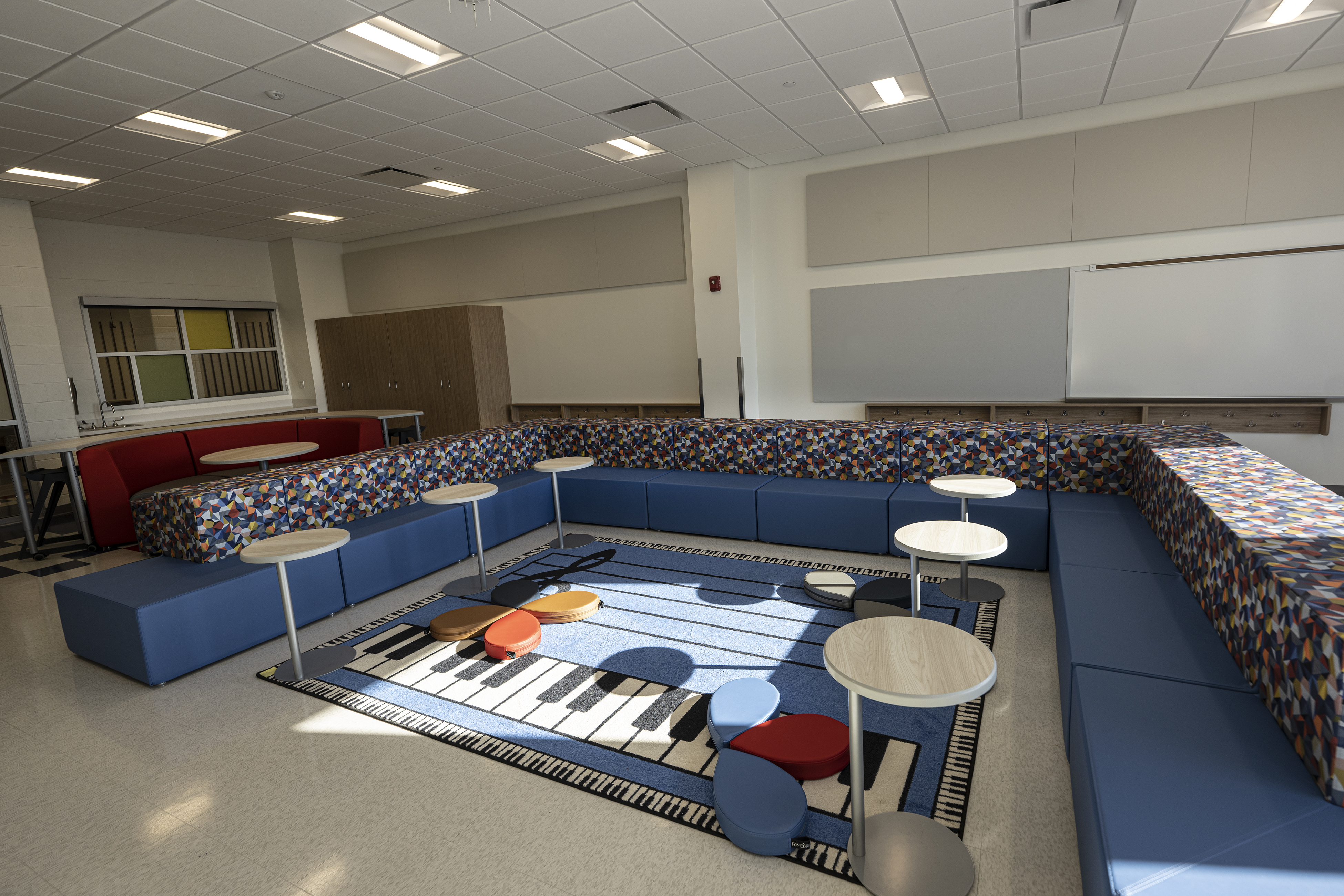
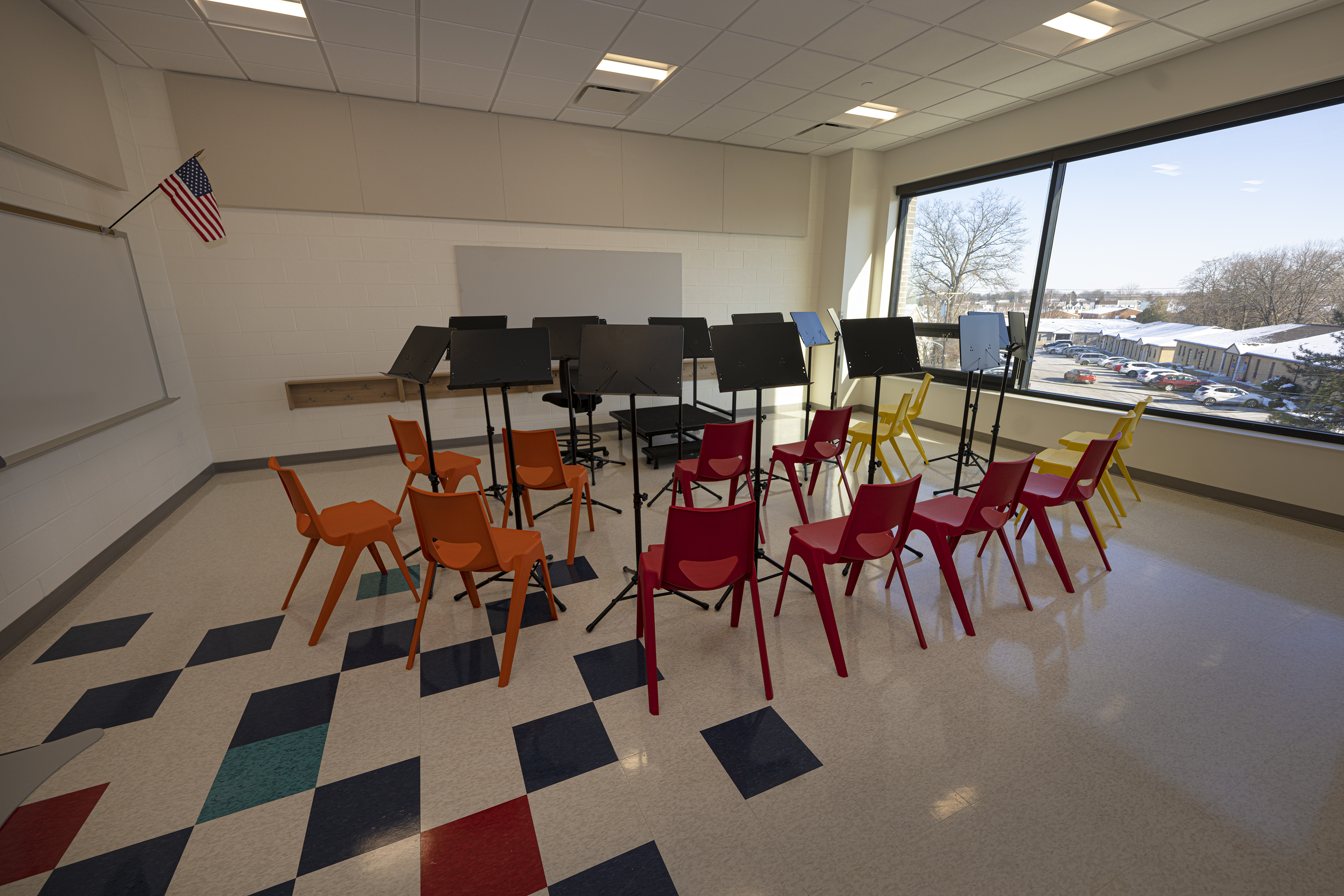
    New furniture at the new Thomas Holme Elementary School.

    Unlike many other sections of the city, where the district’s enrollment is shrinking, the Northeast’s school population is booming — its schools are overcrowded.

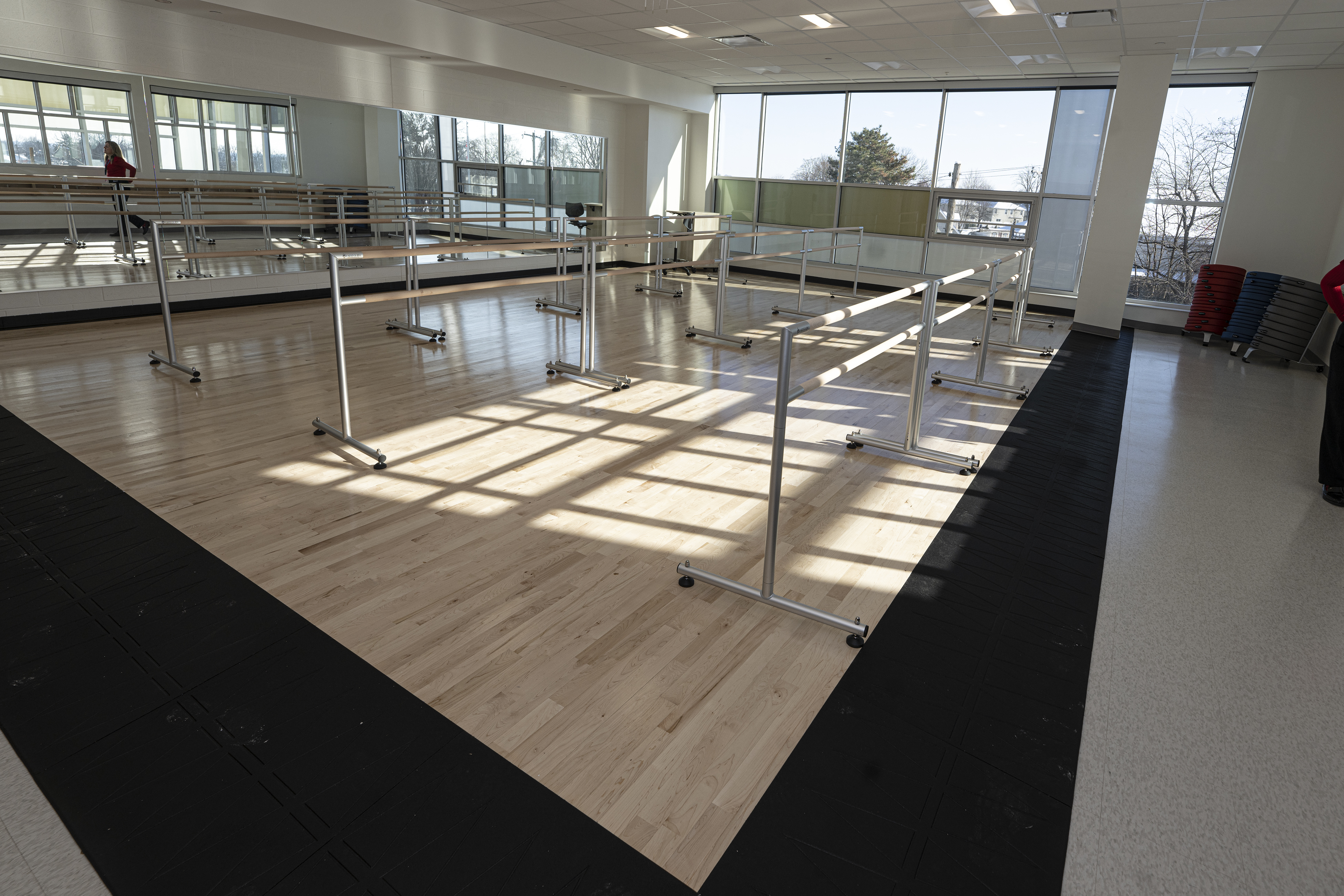
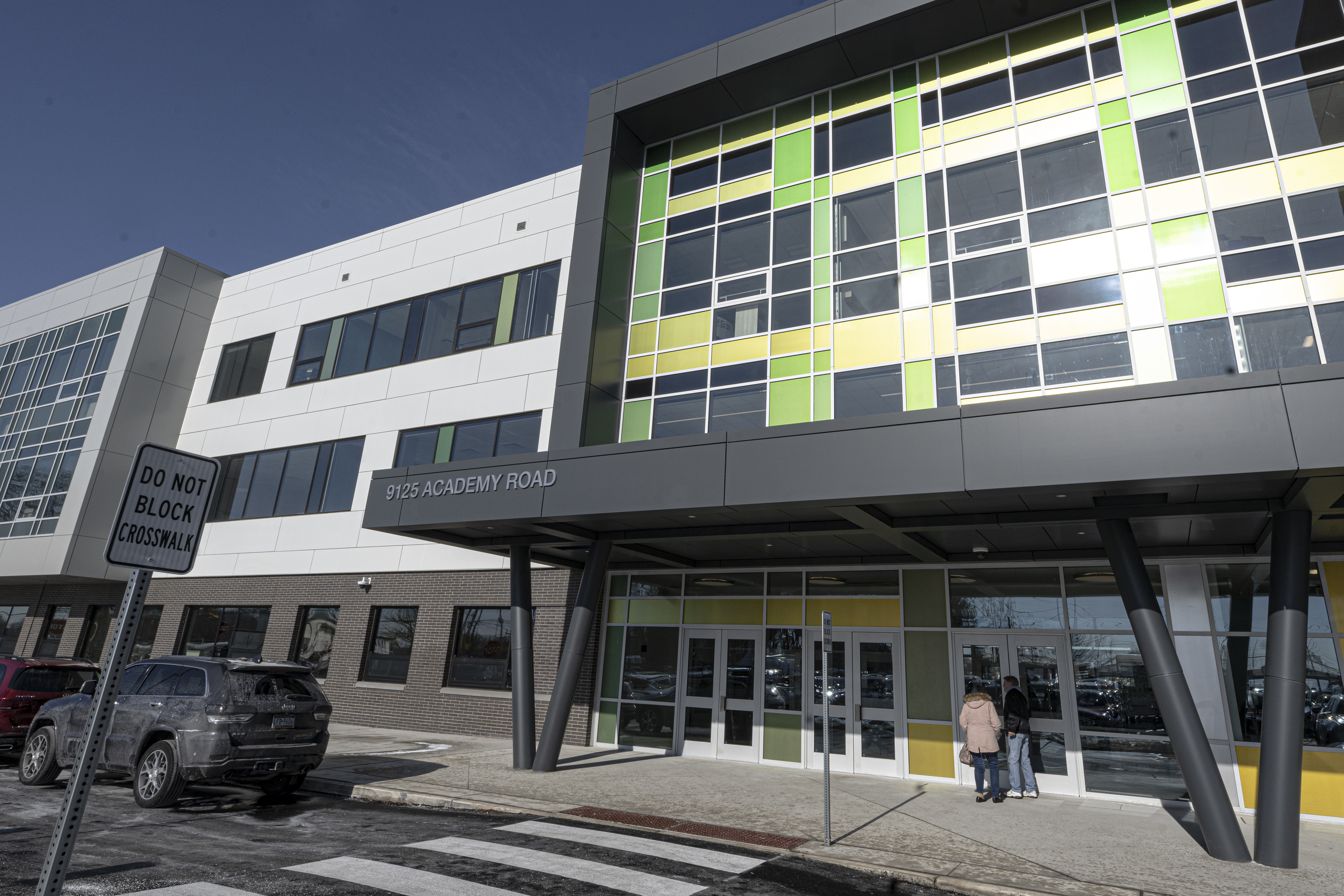
    Holme, named for Pennsylvania’s first surveyor general, outgrew its old building, which was razed to make way for the new 141,000-square-foot structure. Designed with flooding natural light, welcoming learning spaces, and flexible spaces and furniture for more conversational teaching environments, the school includes state-of-the-art music rooms, a bright new gymnasium and stage, science classrooms, an interactive media commons, and a dance studio with a real hardwood dance floor.

    A dance studio at the new Thomas Holme Elementary School has a real hardwood dancefloor.

    “This is the shining star of the school,” said April Tomarelli, an educational facilities planner, during a tour of the sunlit dance studio.

    Smaller details, like the dragon-shaped tiles in the cafeteria to match the school mascot, offer a homey touch, said April Tomarelli, an educational facilities planner, during a tour.

    “Everything was done with intention,” Tomarelli said.

    A music room at the new Thomas Holme School.

    Students had a hand in the design of the new building — they weighed in on the facade, the playground, and the stormwater management system.

    “This school comes from you,” said architect Troy Hill, who helped design the building for Blackney Hayes, adding that the students’ input included more learning spaces, outdoor classrooms, and a space for designing murals.

    The outside of Thomas Holme School in Northeast Philadelphia.

    The new Holme will open as the district nears completion of its long-awaited facilities master plan, which officials have said will call for some school closings and co-locations, as well as building renovations and new construction.

    That plan, once promised by the end of this calendar year, is now expected to be made public in the next few months.

    The average district school building was built 73 years ago, said Reginald L. Streeter, president of the board of education.

    “Most Philadelphia children walk into schools older than their grandparents,” he said.

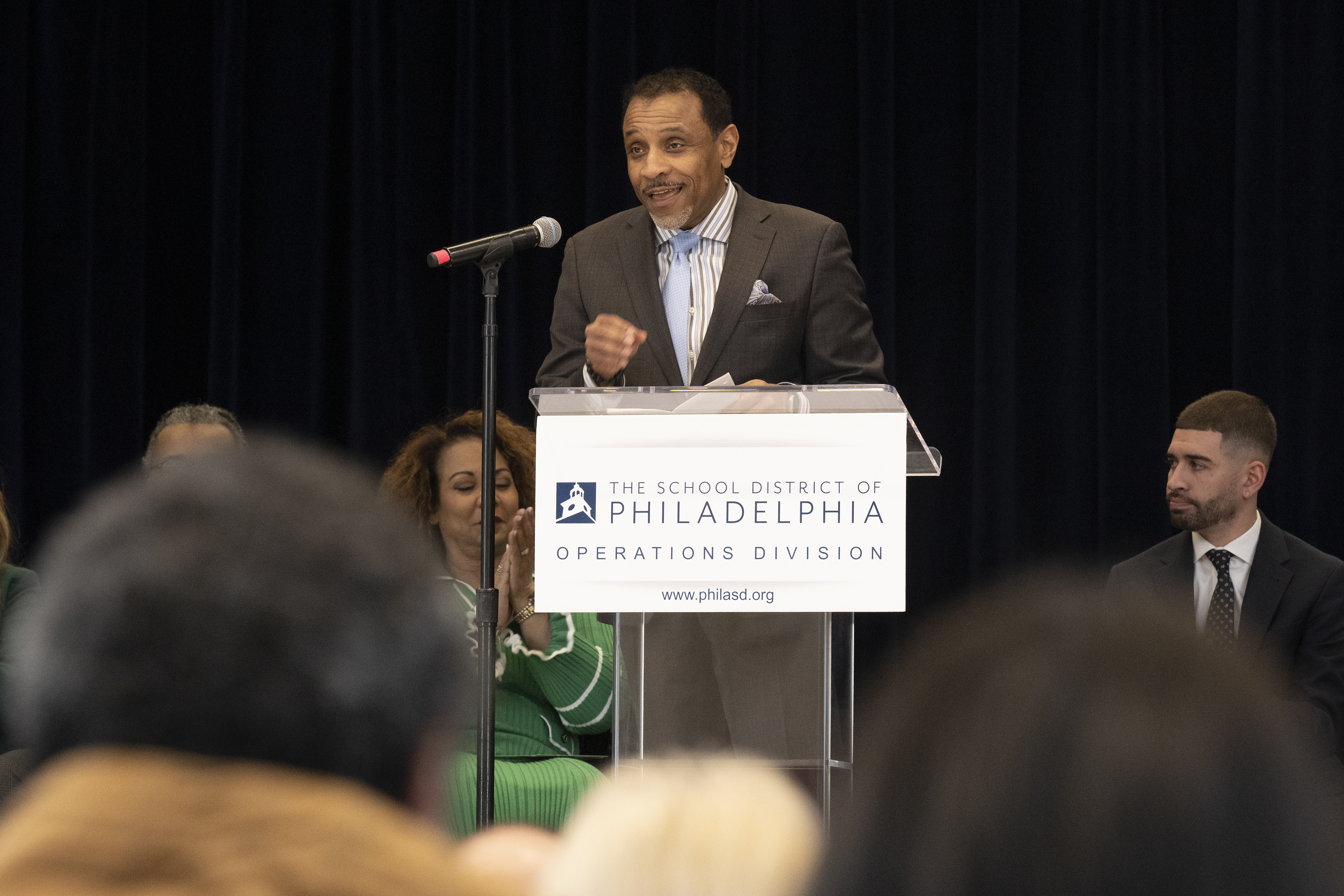
    Philadelphia School District Superintendent Tony B. Watlington speaks during opening ceremonies for the new Thomas Holme Elementary School on Tuesday.

    At the ribbon cutting, Superintendent Tony B. Wallington Sr. celebrated the fact that, like AMY at James Martin, the new Thomas Holme school was completed on time — and on budget.

    “You’re in a school district that’s been excellent stewards of federal, state, and local tax dollars,” he said, adding that the district has its best investment-grade credit rating in 50 years.

    The school library at the new Thomas Holme Elementary School.

    The state-of-the-art school represents a step towards the district’s aspiration to be the “fastest-improving, large school district in the country,” he said.

    “Not for bragging rights,” he said. “But because the children of Philadelphia deserve it so.”

    Mike Greco, president of Penn Academy Athletic Association, which helped shepherd the project through the community, said he has two grandchildren who will be attending the new school in January. His two children had previously graduated from the old Thomas Holme, which was built in 1950.

    “We needed this,” he said. “We need good things to happen everywhere in this city.”

    A music room at Thomas Holme Elementary School.
  • Montco school in shadow of toxic landfill finds PFAS in its water

    Montco school in shadow of toxic landfill finds PFAS in its water

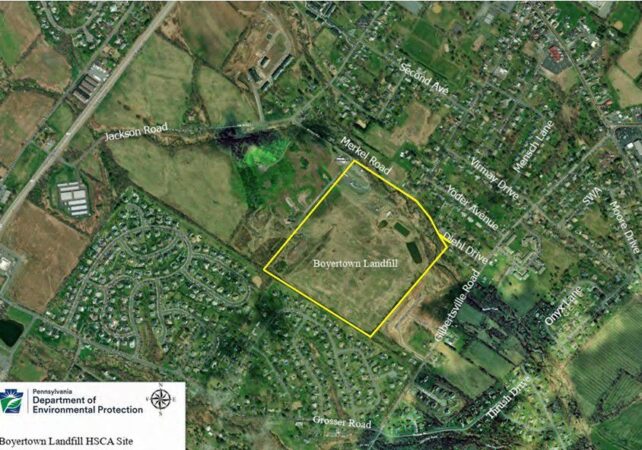
    Residential waste, construction and demolition debris, as well as sewage treatment plant sludge, were dumped for decades at the 30-acre Boyertown Sanitary Landfill in northern Montgomery County until it was capped in 1987.

    As state and federal officials mull whether to add the landfill to the national Superfund list, a well used by nearby Gilbertsville Elementary School has tested positive for human-made polyfluoroalkyl substances, known as PFAS.

    The school is about 3,000 feet from the landfill property border and is within the Boyertown Area School District. Minister Creek passes through the property, and two residential neighborhoods are nearby.

    Scott Davidheiser, the district’s superintendent, sent a letter to staff and students’ families Monday alerting them to the test results, which were made known during a Pennsylvania Department of Environmental Protection (DEP) public information session on the landfill on Dec. 10.

    Gilbertsville Elementary tested at an annual average of 6.7 parts per trillion (ppt) for PFAS. That falls under acceptable limits by current state standards of 14 ppt.

    However, it would exceed federal maximum contaminant level standards of 4 ppt set to go into effect in 2031 if not addressed.

    Davidheiser’s letter said the district “remains committed to safety in all areas, including water safety.” The district has hired Suburban Water Technology Inc. to develop a water safety plan to lower annual average PFAS levels to within federal standards.

    District officials plan in January to discuss a plan to lower the levels.

    <iframe title="Boyertown Sanitary Landfill and PFAS contamination" aria-label="Locator map" id="datawrapper-chart-1kgam" src="https://datawrapper.dwcdn.net/1kgam/1/" scrolling="no" frameborder="0" style="width: 0; min-width: 100% !important; border: none;" height="581" data-window.addEventListener(“message”,function(a){if(void 0!==a.data[“datawrapper-height”]){var e=document.querySelectorAll(“iframe”);for(var t in a.data[“datawrapper-height”])for(var r,i=0;r=e[i];i++)if(r.contentWindow===a.source){var d=a.data[“datawrapper-height”][t]+”px”;r.style.height=d}}});

    What are PFAS?

    PFAS are a group of chemicals manufactured by industry for use in consumer products since the 1940s. There are thousands of different PFAS, some of which have been more widely used and studied than others.

    Exposure to them has been shown to impact the health of humans and lab animals, but the extent is still being studied.

    Standards for maximum acceptable levels of the compounds in drinking water have created confusion in recent years.

    The EPA was slow to set standards, so states began setting their own. Pennsylvania set different levels to start in 2024 for various types of PFAS: 14 ppt for perfluorooctanoic acid (PFOA) and 18 ppt for perfluorooctane sulfonic acid (PFOS).

    However, the EPA, under the Biden administration, then set the first federal standards, which would supersede state standards. The rule said that PFOA and PFOS can’t exceed 4 ppt. And, it set standards for other compounds within the PFAS family. The regulations were set to go into effect in 2027.

    However, the EPA, under the Trump administration, rolled back some provisions by announcing it would keep the standards for PFOA and PFOS, but delay enforcement until 2031. And, it said it would reconsider the limits on the other compounds.

    As a result, the PFAS level at Gilbertsville Elementary School’s current level would exceed the federal level if not brought down by 2031.

    What’s the Boyertown Landfill?

    Officials with the state Department of Environmental Protection and U.S. Environmental Protection Agency have been deciding since 2023 whether the Boyertown Landfill, in Douglass Township, should be named a Superfund site after test samples showed PFAS in nearby private wells.

    The landfill and surrounding property are owned by the Boyertown Sanitary Disposal Co. It is set on a wider 60-acre parcel at 300 Merkel Road in Gilbertsville. The property contains raw and pretreated leachate storage lagoons, buildings housing leachate pretreatment facilities, and stormwater management basins and swales.

    The unlined landfill stopped accepting solid waste in 1985. It had accepted municipal waste, office trash, and construction debris. It took in significant amounts of municipal sewage treatment plant sludge and industrial waste.

    In last week’s informational session, the DEP said water sampling around the area of the landfill in 2024 and 2025 showed multiple locations containing various PFAS compounds.

    State officials said they have installed carbon-activated filtration systems in residential wells within a half-mile of the landfill that tested above 4 ppt, according to an account of the meeting in Pottstown’s local newspaper, The Mercury.

    The newspaper reported that the DEP, however, will not provide similar assistance to Gilbertsville Elementary School because it is part of a small public water system and is required to remediate contamination.

  • Roberta Fallon, artist, writer, and Artblog cofounder, has died at 76

    Roberta Fallon, artist, writer, and Artblog cofounder, has died at 76

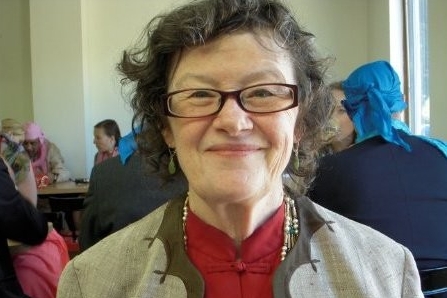
    Roberta Fallon, 76, of Bala Cynwyd, cofounder, editor, and longtime executive director of theartblog.org, prolific freelance writer for The Inquirer, Daily News, and other publications, adjunct professor at St. Joseph’s University, artist, sculptor, mentor, and volunteer, died Friday, Dec. 5, at Thomas Jefferson University Hospital of injuries she suffered after being hit by a car on Nov. 24.

    Ms. Fallon’s husband, Steven Kimbrough, said the crash remains under investigation by the police.

    Described by family and friends as empathetic, energetic, and creative, Ms. Fallon and fellow artist Libby Rosof cofounded the online Artblog in 2003. For nearly 22 years, until the blog became inactive in June, Ms. Fallon posted commentary, stories, interviews, reviews, videos, podcasts, and other content that chronicled the eclectic art world in Philadelphia.

    The site drew more than 4,500 subscribers and championed galleries and artists of all kinds, especially women, LGBTQ and student artists, and other underrepresented innovators. “I think we have touched base with every major arts organization in Philadelphia at one point or another, and many of the smaller ones,” Ms. Fallon told The Inquirer in May. “We became part of the arts economy.”

    She earned grants from the Knight Foundation and other groups to fund her work. She organized artist workshops and guided tours of local studios she called art safaris.

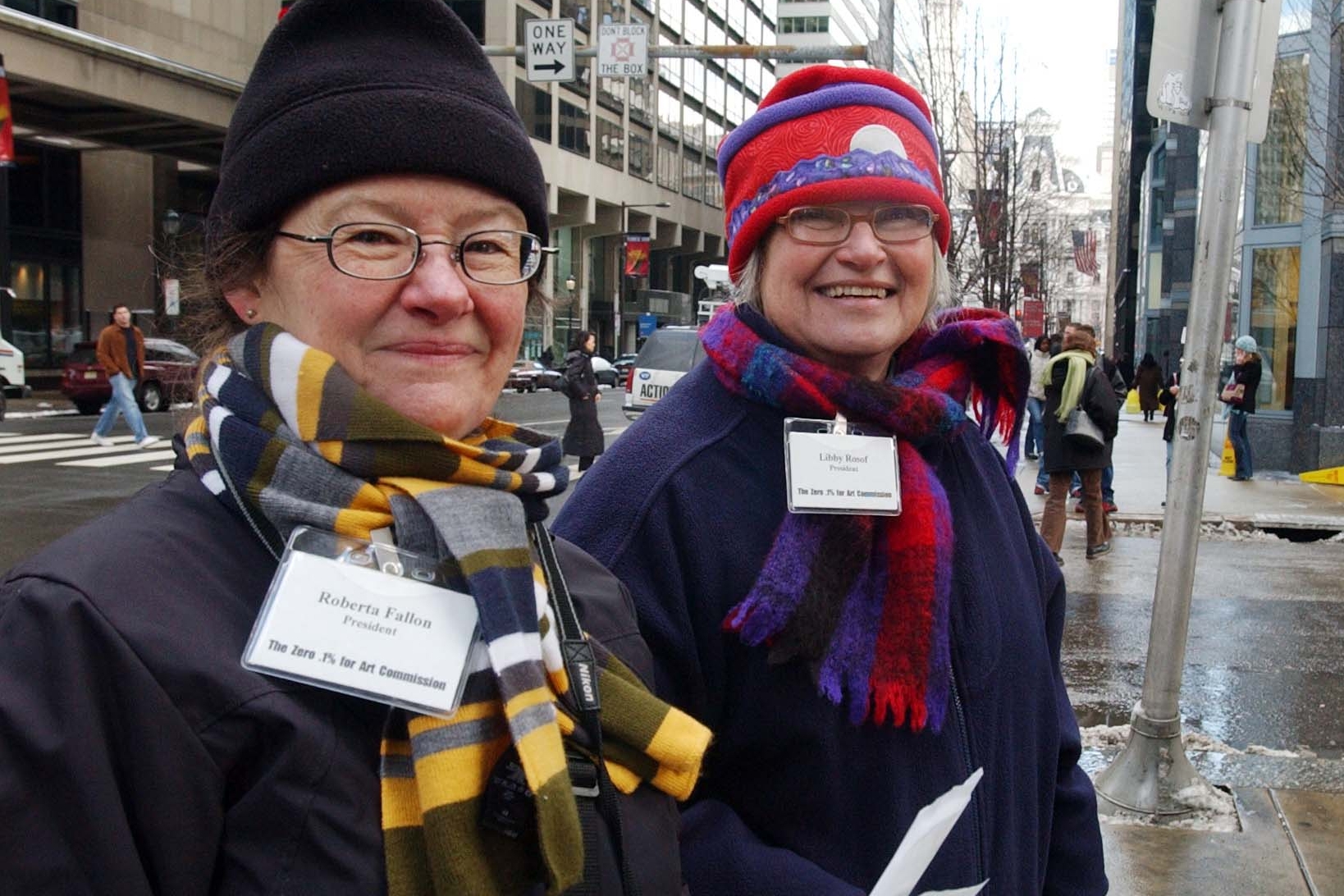
    For years, she and Rosof raised art awareness in Center City by handing out miniatures of their artwork to startled passersby. She said in a 2005 Inquirer story: “We think art needs to be for everyone, not just in galleries.”

    She mentored other artists and became an expert on the business of art. “She was so generous and curious about people,” Rosof said. “She was innovative and changed the way art reached people.”

    Artist Rebecca Rutstein said Ms. Fallon’s “dedicated art journalism filled a vacuum in Philadelphia and beyond. Many of us became known entities because of her artist features, and we are forever grateful.” In a 2008 Inquirer story about the city’s art scene, artist Nike Desis said: “Roberta and Libby are the patron saints of the young.”

    Ms. Fallon never tired of enjoying art.

    Colleague and friend Gilda Kramer said: “The Artblog for her was truly a labor of love.”

    In November, Ms. Fallon and other art writers created a website called The Philly Occasional. In her Nov. 12 article, she details some of her favorite shows and galleries in Philadelphia and New York, and starts the final paragraph by saying: “P.S. I can’t let you go without telling you about what I just saw at the Barnes Foundation.”

    She worked at a small newspaper in Wisconsin before moving to West Philadelphia from Massachusetts in 1984 and wrote many art reviews and freelance articles for The Inquirer, Daily News, Philadelphia Weekly, Philadelphia Citizen, and other publications. In 2012, she wrote more than a dozen art columns for the Daily News called “Art Attack.”

    She met Rosof in the 1980s, and together they curated exhibits around the region and displayed their own sculptures, paintings, and installations. Art critic Edith Newhall reviewed their 2008 show “ID” at Projects Gallery for The Inquirer and called it “one of the liveliest, most entertaining shows I’ve seen at this venue.”

    Ms. Fallon stands in front of a mural at 13th and Spruce Streets. She is depicted as the figure profiled in the lower left in the white blouse.

    Most often, Ms. Fallon painted objects and sculpted in concrete, wood, metal, textiles, and other material. She was a founding member of the Philadelphia Sculptors and Bala Avenue of the Arts.

    She studied at the Pennsylvania Academy of the Fine Arts and Temple University’s Tyler School of Art and Architecture, and later taught professional practice art classes at St. Joseph’s. Moore College of Art and Design, which will archive Artblog, awarded her an honorary doctorate.

    “Roberta was an exceptional creative artist” and “a force,” artist Marjorie Grigonis said on LinkedIn. Artist Matthew Rose said: “Robbie was a North Star for many people.”

    Her husband said: “Her approach to life was giving. She succeeded by adding value to wherever she was.”

    Ms. Fallon (second from right) enjoyed time with her family.

    Roberta Ellen Fallon was born Feb. 8, 1949, in Milwaukee. She went to the University of Wisconsin-Madison to study sociology after high school and dropped out to explore Europe and take art classes in Paris. She returned to college, changed her major to English, and earned a bachelor’s degree in 1974.

    She met Steven Kimbrough in Wisconsin, and they married in 1980, and had daughters Oona and Stella, and a son, Max. They lived in West Philadelphia for six years before settling in Bala Cynwyd in 1993.

    Ms. Fallon was a neighborhood political volunteer. She enjoyed movies and reading, and she and her husband traveled often to museums and art shows in New York and elsewhere.

    They had a chance to relocate to Michigan a few years ago, her husband said. But she preferred Philadelphia for its art and culture. “She was like a local celebrity in the art scene,” her daughter Stella said.

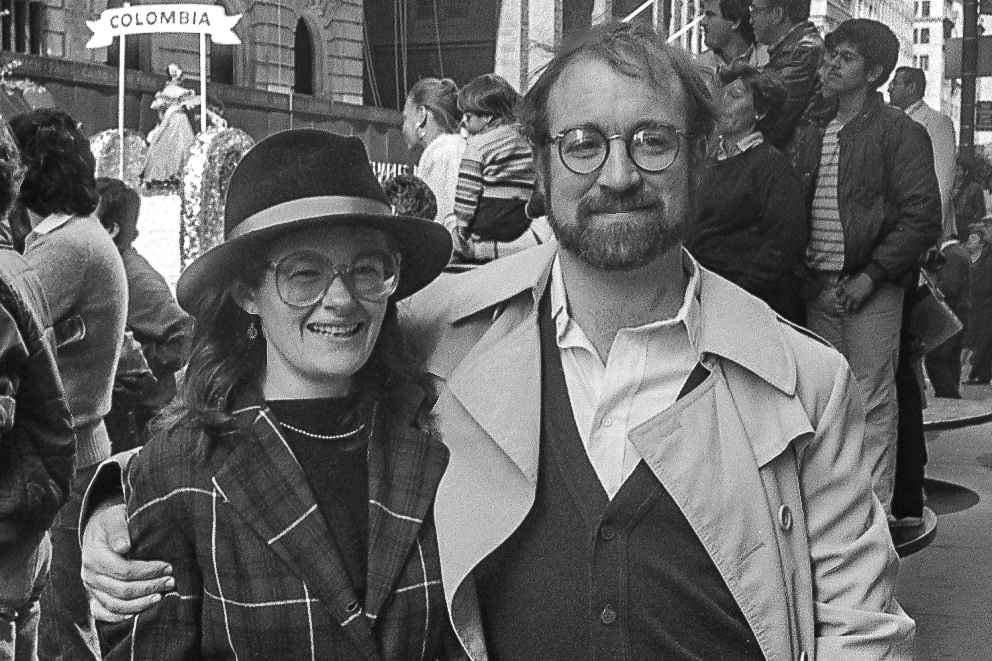
    Ms. Fallon and her husband, Steven Kimbrough, visited New York in 1982.

    Her husband said: “Everybody likes her. Everybody wants to be around her. She made a difference for a lot of people.”

    Her daughter Stella said: “The world would be a better place if we all tried to be like my mom.”

    In addition to her husband and children, Ms. Fallon is survived by four grandchildren, a sister, a brother, and other relatives.

    A memorial service is to be held later.

    Donations in her name may be made to Moore College of Art and Design, 1916 Race St., Philadelphia, Pa. 19103.

    Ms. Fallon (left) and Libby Rosof hand out free art at 17th and Market Streets in 2005.
  • UPenn launches a $10 million fund for seed investments in companies founded by Penn researchers

    The University of Pennsylvania launched a fund backed by $10 million from the university to make seed investments in companies founded by Penn researchers, officials announced Monday.

    The fund, called StartUP, will invest up to $250,000 in companies founded by Penn researchers and based on innovations created at the university. Any profits will be put back into the fund, Penn said.

    “This new fund addresses the critical need for seed investment capital at the earliest stages of company formation and will further accelerate innovation across the university,” Penn’s vice provost for research, David Meaney, said in a statement. Meaney is on the faculty at Penn’s School of Engineering and Applied Science.

    The university’s Office of the Chief Innovation Officer will manage the fund. The innovation office will evaluate applicants with the help of external advisers. Factors in investment decisions include overall feasibility and commercial potential.

    The new investment fund builds on efforts already underway at the Penn Center for Innovation, the Wharton School, and Penn Medicine, which in 2018 started a fund to invest $50 million in biotech companies.

    Penn has led the nation recently in licensing revenue from faculty inventions, thanks largely to revenue from COVID-19 vaccines that were based on mRNA technology developed 20 years ago by Penn researchers Drew Weissman and Katalin Karikó.

  • Philly schools will open late Monday

    Philly schools will open late Monday

    With snow on the ground and temperatures below freezing, Philadelphia schools will open two hours late Monday.

    “The safety and well-being of our students are our top priorities,” Superintendent Tony B. Watlington Sr. said in a message to district families. “We are encouraging students, families and staff to travel safely tomorrow morning.”

    Students who arrive late because of weather challenges won’t be marked late, and weather-related absences will be excused if a parent or guardian sends a note.

    All outdoor activities are also canceled, Watlington said.

    “Parents and guardians should plan for possible delays with the district’s yellow bus services and on SEPTA’s subway, trolley and bus routes,” Watlington wrote. “If you anticipate delays or have questions or concerns, please reach out to your child’s principal or school.”

    Archdiocesan high schools and parish and regional Catholic elementary schools in the city will also operate on a two-hour delay. (Catholic schools in suburban counties generally follow their local districts’ lead.)

    Frigid temperatures and stiff winds are expected to follow the season’s first snowstorm, complicating the Monday morning commute with possible ice and slush.

    Other area school districts that are opening on delayed schedules include, in Pennsylvania: Bensalem Township, Cheltenham, Coatesville Area, Downington Area, Great Valley, Lower Merion, Lower Moreland Township, Marple Newtown, Neshaminy, Norristown Area, North Penn, Pennridge, Perkiomen Valley, Pottsgrove, Southeast Delco, Souderton Area, Spring-Ford Area, Tredyffrin-Easttown, Unionville Chadds Ford, Upper Merion Area, Upper Moreland Township, Upper Perkiomen, West Chester Area, William Penn, and Wissahickon.

    Area school with delays in New Jersey include: Bellmawr, Black Horse Pike Regional, City of Burlington, Burlington Township, Camden City, Clearview Regional, Clementon, Deptford Township, Eastampton, Lenape Regional High, Logan Township, Mantua Township, Medford Township, Mount Holly Township, National Park, Pemberton Township, Pitman, Rancocas Valley Regional High, Riverside Township, Shamong Township, Swedesboro-Woolwich, Washington Township, Westampton Township, and Winslow Township.

  • This Philly charter awarded a big contract to a board member’s friend, then punished the official who reported it, a lawsuit says

    This Philly charter awarded a big contract to a board member’s friend, then punished the official who reported it, a lawsuit says

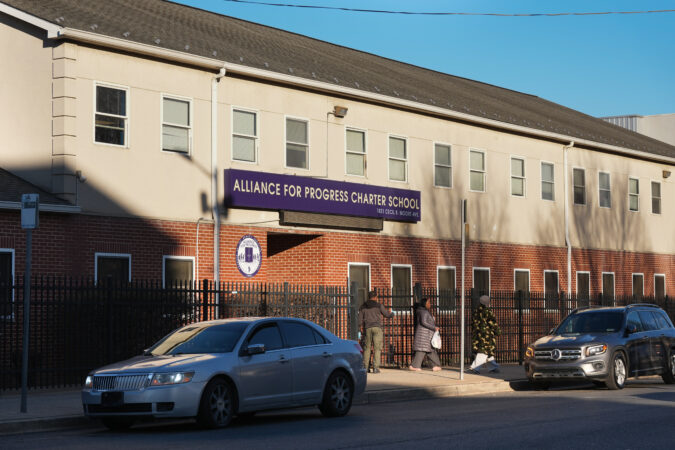
    When Raheem Harvey discovered possible improprieties at his new employer, Alliance for Progress Charter School in North Philadelphia, he sounded the alarm.

    Harvey, the director of business and compliance, notified officials earlier this year about what he saw as significant issues, he said: violations of state and local bidding requirements, a contract issued without board approval, and board members’ failure to disclose personal relationships with potential vendors.

    He flagged a student enrollment problem and skipped payroll taxes.

    Alliance for Progress’ leader and its board brushed him off, Harvey said in a recently filed whistleblower lawsuit. Ultimately, they disciplined him and, after threatening to demote him, he resigned.

    School officials say Harvey’s story is untrue.

    “We categorically deny all the allegations asserted by this disgruntled former employee,” Stacey Scott, CEO of Alliance for Progress, said in a statement.

    Officials from the Philadelphia School District’s charter school office had no comment.

    What are the allegations?

    Harvey started working at Alliance for Progress, on Cecil B. Moore Avenue, in February.

    By August, he began raising issues to his bosses, Harvey’s lawyers said in a lawsuit filed in Philadelphia Common Pleas Court.

    They included a contract issued to a vendor for services related to a school playground — worth more than $75,000 — that was awarded without competitive bidding.

    Alliance for Progress, Harvey said, “directly awarded the contract to a vendor whose principal is a personal friend of one of the AFPCS board members. The board member did not recuse himself from discussions or decisions related to the contract, despite the clear conflict of interest created by his close relationship with the vendor” — a violation of ethics rules, he said.

    Harvey also said the school failed to follow state rules around enrollment procedures. Alliance for Progress says it provides enrollment preference for siblings of students. But, Harvey said, the school ignored him “and failed to apply its own sibling-preference policy to the sibling of a currently enrolled student. Instead, AFPCS placed the sibling on a waitlist and later pressured the child’s parents to withdraw the enrollment application.”

    Scott, Harvey said, also violated federal privacy laws by providing someone outside the organization access to a student’s educational records — including academic and disciplinary records — without parental consent.

    School officials also used Alliance for Progress credit cards to purchase food and other items through their personal accounts, according to the lawsuit complaint, “allowing them to aggregate rewards points and loyalty benefits that they did not return to AFPCS.”

    Alliance for Progress also paid a retired employee for work with a paper check instead of going through its payroll system, the complaint alleges.

    The school “issued payments in this manner to enable the retired employee to avoid paying taxes on the wages she received,” the lawsuit said.

    ‘Hostile and retaliatory’

    According to Harvey, once he reported the compliance problems, Scott and other officials began targeting him — suggesting he was opening packages addressed to the school without authorization and purchasing office supplies without proper authorization.

    Harvey was shut out of leadership meetings, the suit said, then reprimanded for failing to show up to a meeting, entering Scott’s office without permission, and placing an unauthorized order.

    “Increasingly hostile and retaliatory conduct” was directed toward him, Harvey said. He was suspended for 10 days, and had his keys to the administrative offices taken away.

    In September, a human resources official told Harvey “that he should forget about the compliance issues he had raised because they had been resolved” but provided no evidence. Harvey said she told him Alliance for Progress planned to demote him.

    The school’s “wholesale failure to remediate the compliance concerns” and its “refusal to implement safeguards to protect him” from retaliatory treatment ultimately caused Harvey to resign on Sept. 30, according to the lawsuit.

    Harvey is demanding reinstatement, plus back pay, benefits, seniority rights, and damages.

  • Lincoln University is facing pressure from its Chester County neighbors after homecoming shooting

    Lincoln University is facing pressure from its Chester County neighbors after homecoming shooting

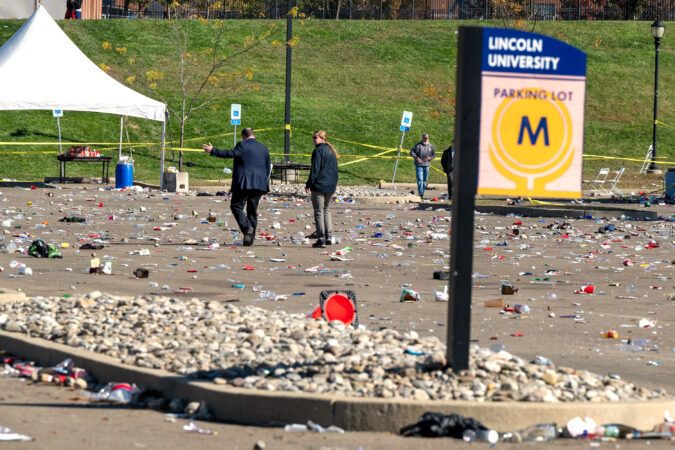
    After Lincoln University’s homecoming in October ended with seven people shot, including one killed, the rural Chester County township where the school is located plans to pass new regulations on large events.

    Several officials in Lower Oxford Township said there have been ongoing problems with parking, trash on neighbors’ lawns, disturbances and, in some cases, crime when the 1,650-student university hosts events. After the Oct. 25 shooting, when thousands of people gathered for homecoming, emergency personnel had to use all-terrain vehicles to transport patients on stretchers because ambulances could not access the campus, given how many cars were parked around the venue, they said.

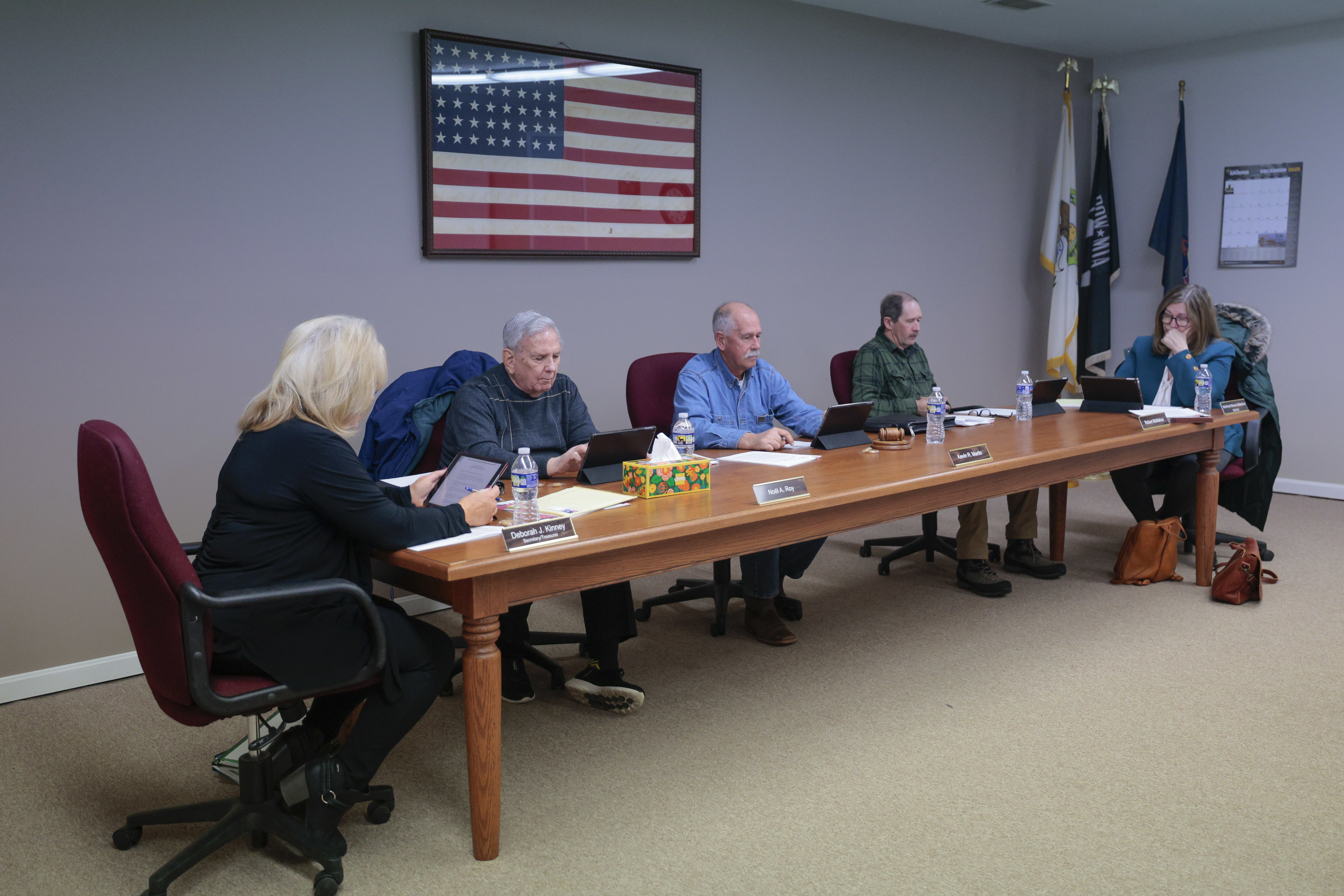
    “We have had meetings with people at Lincoln,” said township supervisor Noel Roy, who oversees emergency management. “They’ve been somewhat reluctant to do what needs to be done to try and control the situation.”

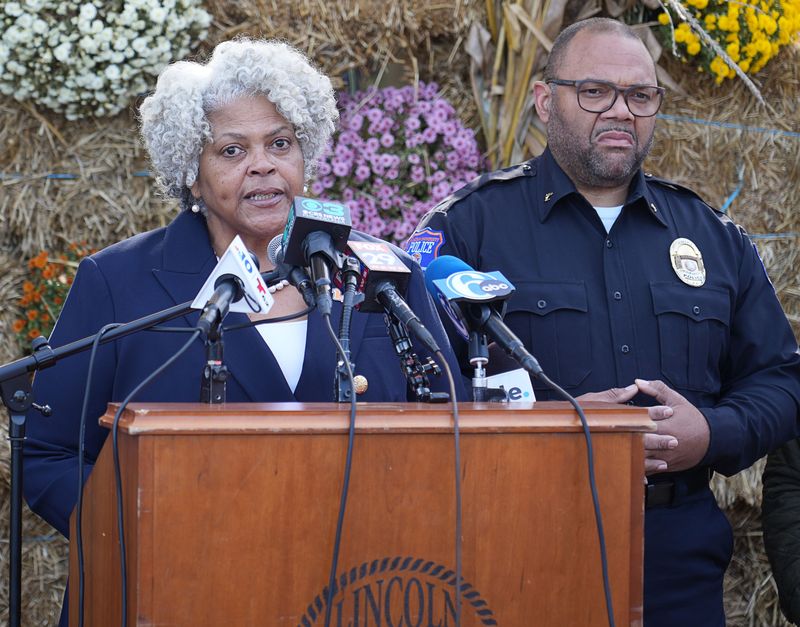
    Lincoln University has declined to answer specific questions from The Inquirer, but President Brenda Allen at a board of trustees meeting last month acknowledged that changes were needed, especially around the school’s large events, and that the school has to do a better job of collaborating with the township.

    “Our top priority remains the safety of our students, faculty, staff, alumni, and community,” the school said in a statement to The Inquirer Thursday. “The university continues to refine our safety measures and protocols.”

    At a township supervisors meeting this week, university officials pledged to work with the township.

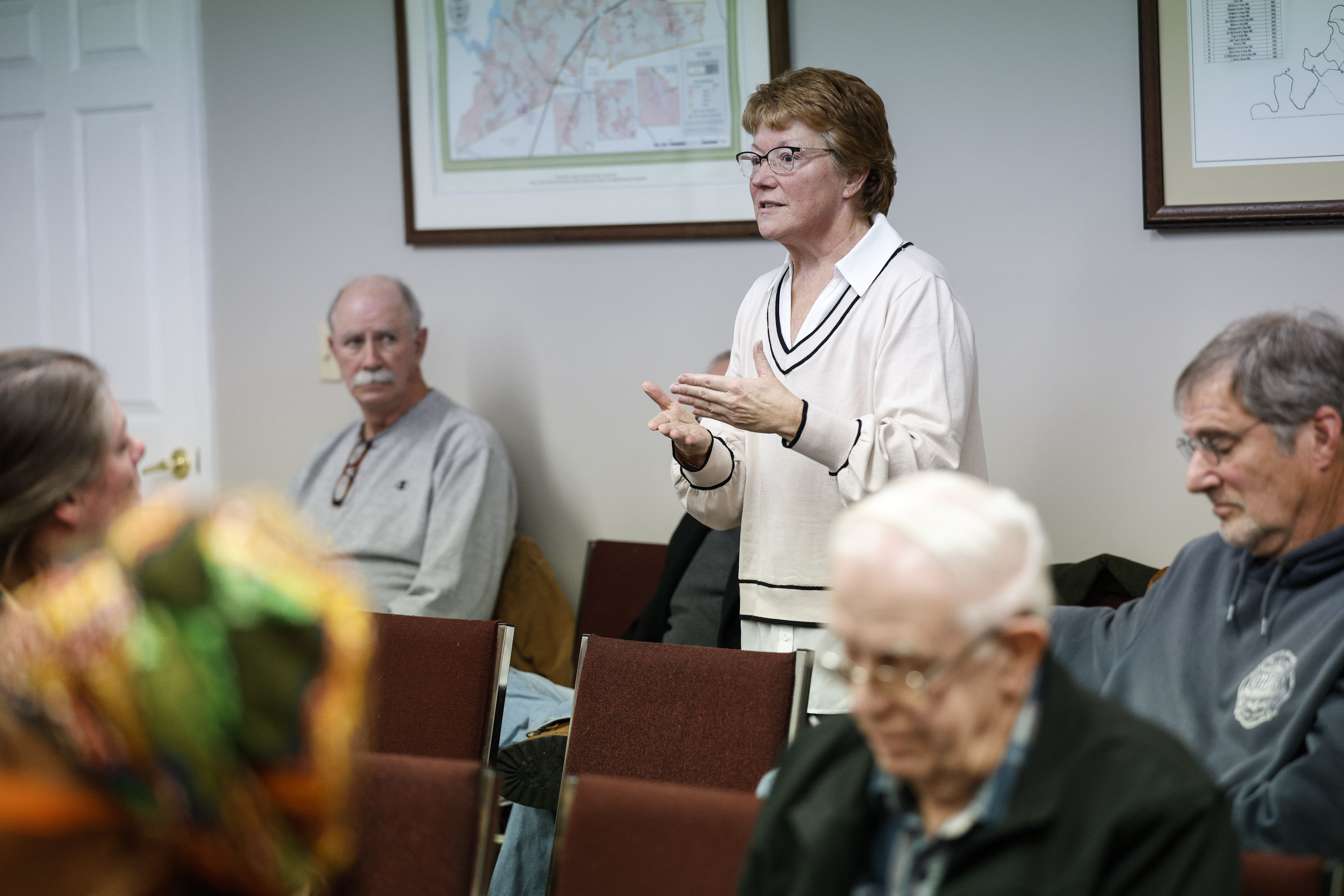
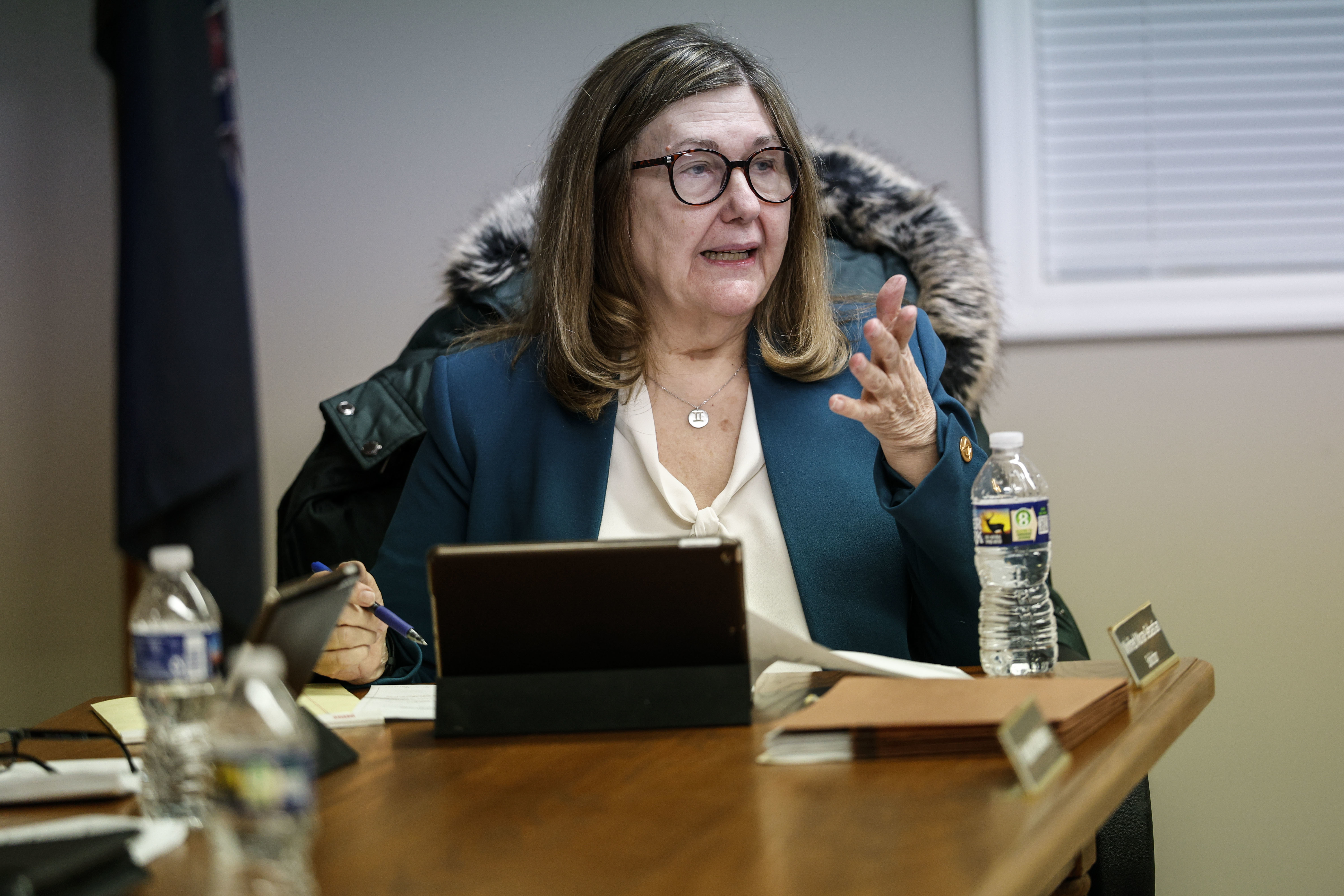
    Lower Oxford Township officials meet and discuss a potential large event ordinance following the homecoming shooting at Lincoln University.

    “We want to come together because we are a part of this community as well,” said Venus Boston, Lincoln’s general counsel.

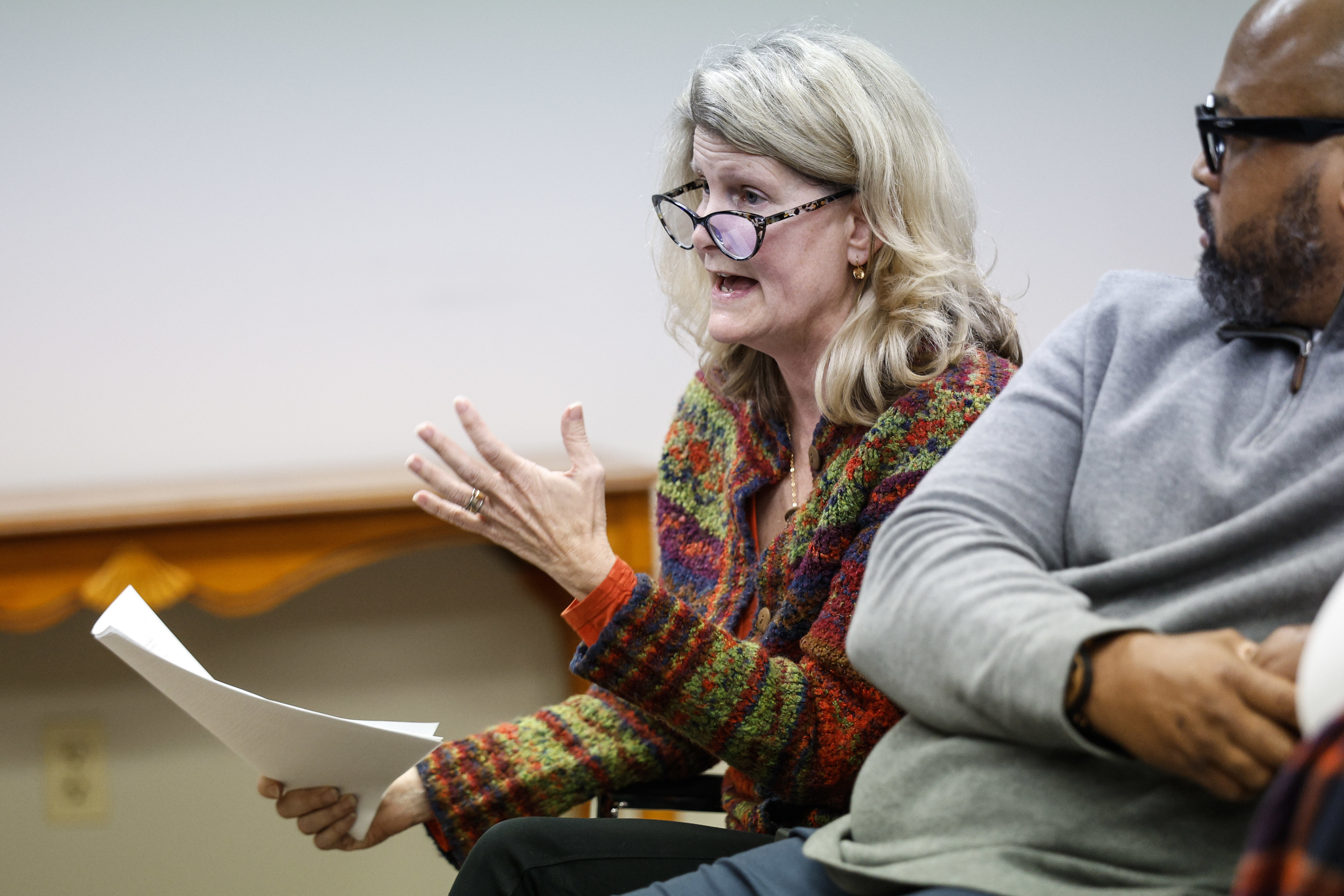
    Yeda Arscott, Lincoln’s associate vice president of facilities and program management, told supervisors the university is considering several steps to improve safety, including ending all outside events at dusk, eliminating open invitations, requiring guest registration, and canceling large events such as Spring Fling. The school also is looking at parking and safety protocols, she said.

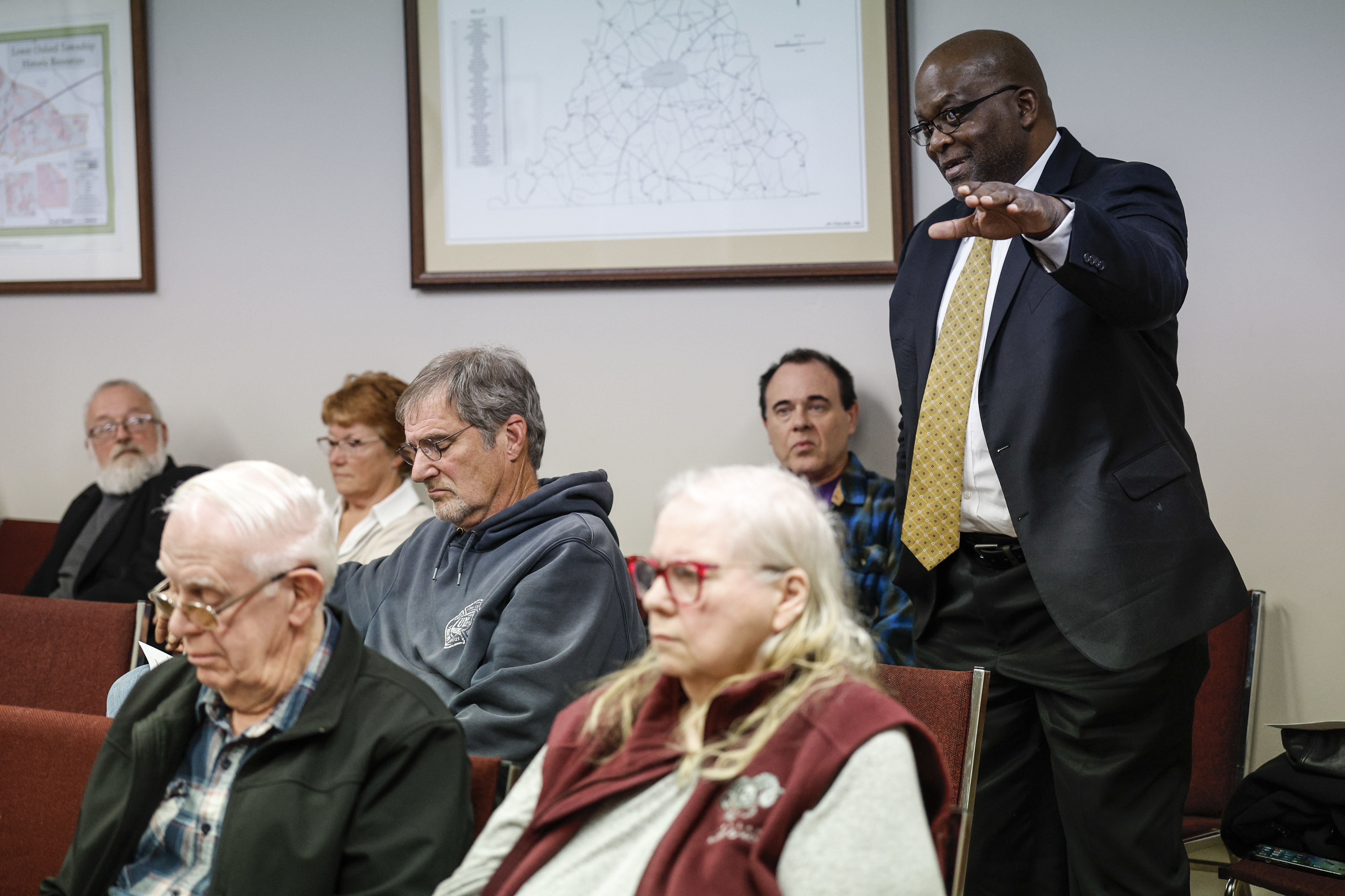
    Yeda Arscott, associate vice president director of facilities and program management at Lincoln, speaks at the Lower Oxford Township meeting and shares actions the university is considering following the homecoming shooting.

    “This shows real commitment,” said Arscott, who lives five minutes from Lincoln, “but real safety requires joint planning between the township, Lincoln, other major businesses, our neighbors, and emergency services.”

    Township and Lincoln officials said they plan to meet privately to discuss solutions.

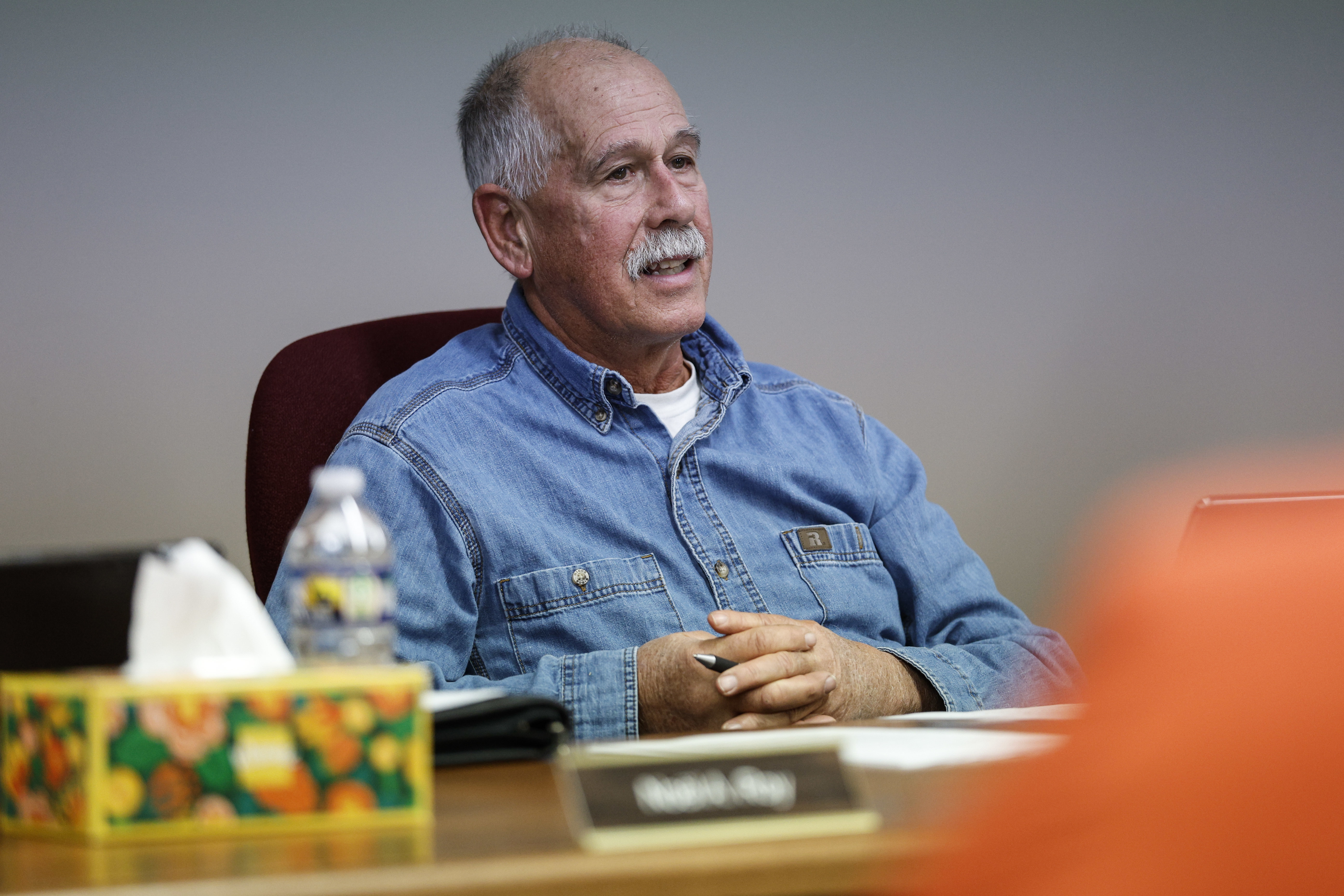
    “Our goal is to work with Lincoln to make this better,” said Kevin R. Martin, chairman of the board of supervisors. “We need to think this through, but we also have a sense of urgency because it does affect our community.”

    Kevin R Martin, chairman of the township supervisors, said the township wants to work with Lincoln on improvements.

    Chester County Commissioner Josh Maxwell said county officials and the university also will meet in January to discuss best practices for emergency services and student and community safety.

    “It’s important that the kids feel safe,” said Maxwell, who also is an adjunct professor at Lincoln. “No one wants this to ever happen again.”

    The shooting remains under investigation. Jujuan Jeffers, 20, of Wilmington, was killed, and six others, ages 20 to 25, including a student, were also shot. Zecqueous Morgan-Thompson, 21, of Wilmington, was charged with possessing a concealed firearm without a license. Neither Jeffers nor Morgan-Thompson have any known connection to Lincoln.

    Arscott also urged township leaders to “broaden the conversation beyond event permits” and look to address the problem of gun violence.

    “We were a victim, too,” Boston said.

    “We were a victim, too,” said Venus Boston, Lincoln University’s general counsel.

    Tensions with neighbors

    The proposed township ordinance would require those seeking to hold special events to apply for a permit 30 days in advance and outline how they will control the number of guests, traffic, alcohol, and security, said township solicitor Winifred Moran-Sebastian. The township could approve or reject applications.

    Township supervisors last spring passed a parking ordinance to cope with access problems created during past large events at Lincoln, but parking at homecoming still led to issues for emergency responders.

    Several residents who attended this week’s meeting were skeptical of Lincoln’s intent to make improvements and called for larger fines than the $1,000 proposed in the ordinance.

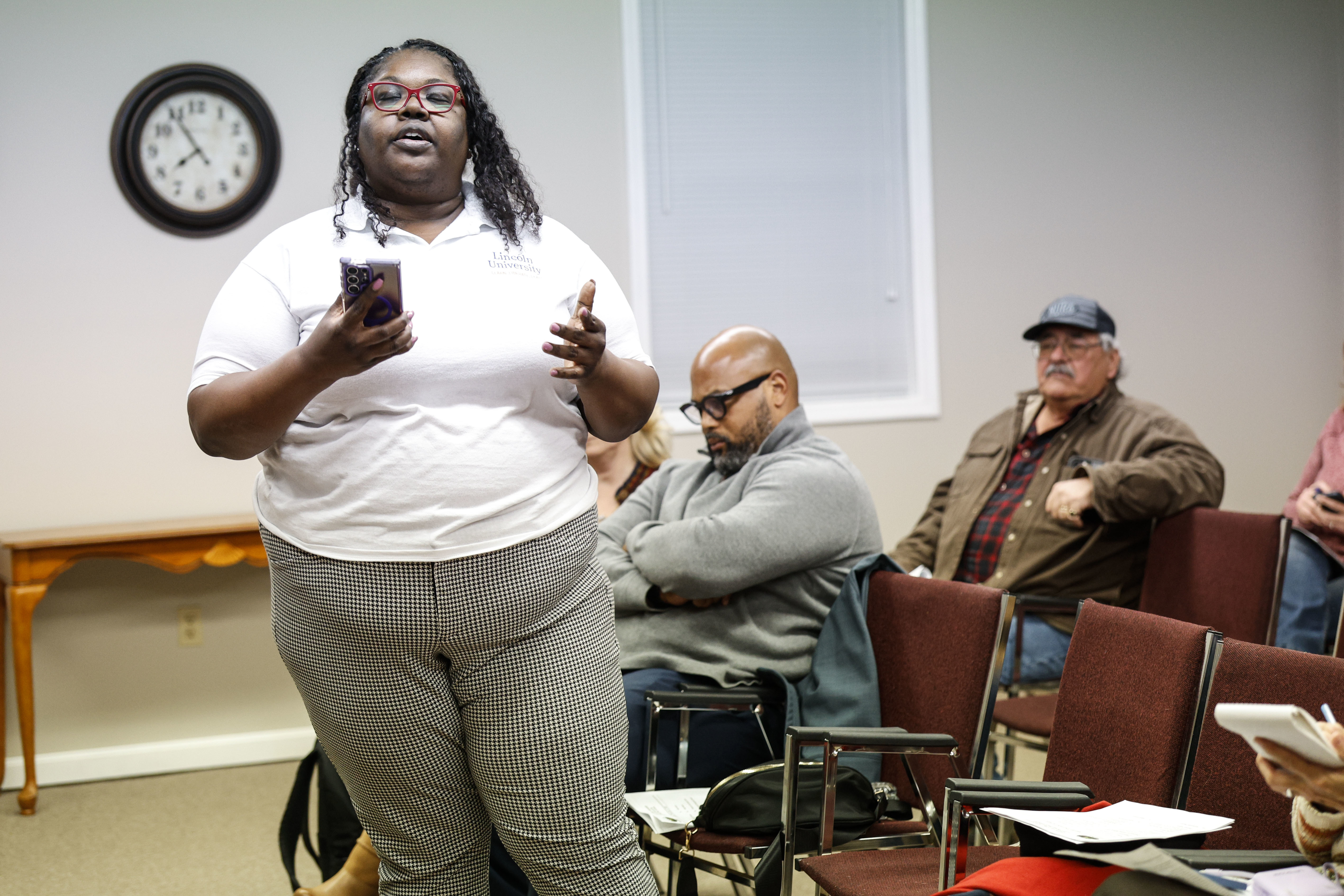
    Vanessa Ross lives about a half a mile from campus and said she was afraid for her family the night of the homecoming shooting. She spoke at the Lower Oxford Township supervisors meeting.

    “I feel my life is in jeopardy with how things are being currently managed,” said Lincoln neighbor Celestine Getty, fearing what could happen if vehicles were unable to get to her house in the event of an emergency.

    Vanessa Ross, who has lived about a half mile from Lincoln for 14 years, said crime and disruption have happened at large Lincoln events for half those years.

    “There is no excuse whatsoever why the college cannot increase their police force and install the metal detectors that are necessary,” she said. “I can’t even go see Barry Manilow in Philadelphia without going through a metal detector.”

    Founded in 1854, Lincoln is known as the first degree-granting historically Black university in the nation. Its 429 acres are nestled in a township of farm fields with a little over 5,000 residents, the majority of them white. Racial tensions have come into play over the years, with township residents saying they have been unfairly accused of racism for raising safety issues.

    Allen, the Lincoln president, has not pointed to racism as a factor in the conversations about safety, said Boston, the university’s solicitor.

    A storied institution with recent safety issues

    Lincoln has a storied history. The first presidents of both Nigeria and Ghana are Lincoln graduates, as are Philadelphia Mayor Cherelle L. Parker, former U.S. Supreme Court Justice Thurgood Marshall, and poet Langston Hughes.

    The school has received $45 million in gifts from philanthropist MacKenzie Scott, ex-wife of Jeff Bezos. And Allen, who in 2020 had survived an internal battle to oust her and had her contract extended to 2030, was named a top historically Black college leader by a national nonprofit in 2021.

    But over the last decade, the university has struggled with safety issues.

    In spring 2023, two women were shot and injured on Lincoln’s campus during its annual Spring Fling event. In 2022, a student was fatally stabbed during a fight inside a dorm by the sister of a student. During an on-campus dance in 2018, 15 students were taken to the hospital following a brawl in which a security officer was assaulted. In 2016, there was a robbery and shooting on Lincoln’s campus following homecoming. And in 2015, Lincoln tightened security after shots were fired in a dorm.

    Some residents said it’s time for the township to put in additional controls.

    “We can no longer wait and see or hope the university will simply do the right thing,” said Andrew Cope, who lived near Lincoln for nearly two decades and still owns property there. “The pattern is too long, the consequences too severe, and the community’s trust too damaged.”

    Carmina Taylor, former president of Lincoln parents association, addresses the Lower Oxford Township supervisors.

    Carmina Taylor, who led Lincoln’s parent association from 2013 to 2016, said she has had longstanding safety concerns.

    When a student was killed in the dorm in 2022, Taylor told The Inquirer she had previously sounded the alarm: “I had said, ‘If Lincoln doesn’t do something, we’re going to have a death on campus.’”

    The university’s response to the homecoming shooting, said Taylor, who got a master’s degree from Lincoln in 2011 and whose son graduated from Lincoln in 2016, is “beyond fluff.”

    “Until someone does something from the outside to bind them,” she said, nothing will change.

    Security expert Brian Higgins said measures, including controlled entrances and screening of guests with hand-held wands, metal detectors or bag checks, are typically used for large crowd events. He acknowledged that imposing strict guest screening may not create the welcoming, upbeat environment characteristic of college homecomings.

    “But in light of what happened, it’s very prudent to do so,” said Higgins, president of Group 77, a public safety and security consulting firm, based in the New York metro area.

    Higgins, whose company has colleges among its clients, said drones increasingly are being used as part of safety monitoring at large events. Traffic control measures and the setting of crowd size limits are other issues the school should consider, he said.

    Anthony Floyd, a former police chief at Lincoln and a Philadelphia city police officer for about 20 years, said the university’s police chief and president should attend every township meeting and work more closely with the township on addressing safety issues.

    Anthony Floyd Jr., who was police chief at Lincoln in 2013 and also had been a Philadelphia city cop, told the supervisors at the meeting that better coordination is needed between the community and the university. The school’s police chief and president should attend the supervisor meetings every month, give updates on safety and security, and be held accountable, he said.

    Lincoln says it’s working on changes

    Last month at a Lincoln board of trustees meeting, Allen, the president, said the campus had been focused on restoring a sense of safety for students and making sure they and staff had counseling support. Allen, a 1981 Lincoln graduate who has led the school since 2017, said the university was examining “safety protocols, parking, traffic, registration for guests,” and the process for inviting guests as part of its review process.

    Lincoln University President Brenda A. Allen (left) announces plans for an after action review following the homecoming shooting.

    Allen said the university is seeking feedback from the student government association and faculty and staff.

    Roy, one of the township supervisors, said parking restrictions put into place earlier this year were not heeded, and the township had to tow 60 cars the night of the homecoming shooting.

    “Every time they towed a car, another car would pull into that space,” he said.

    An event that would draw 10,000 people to a township with half that population and no police force is concerning, said Moran-Sebastian, the township solicitor. Lower Oxford relies on Pennsylvania State Police for law enforcement. For the homecoming event, the university requested state police, but only got two, Arscott, the facilities’ head, said.

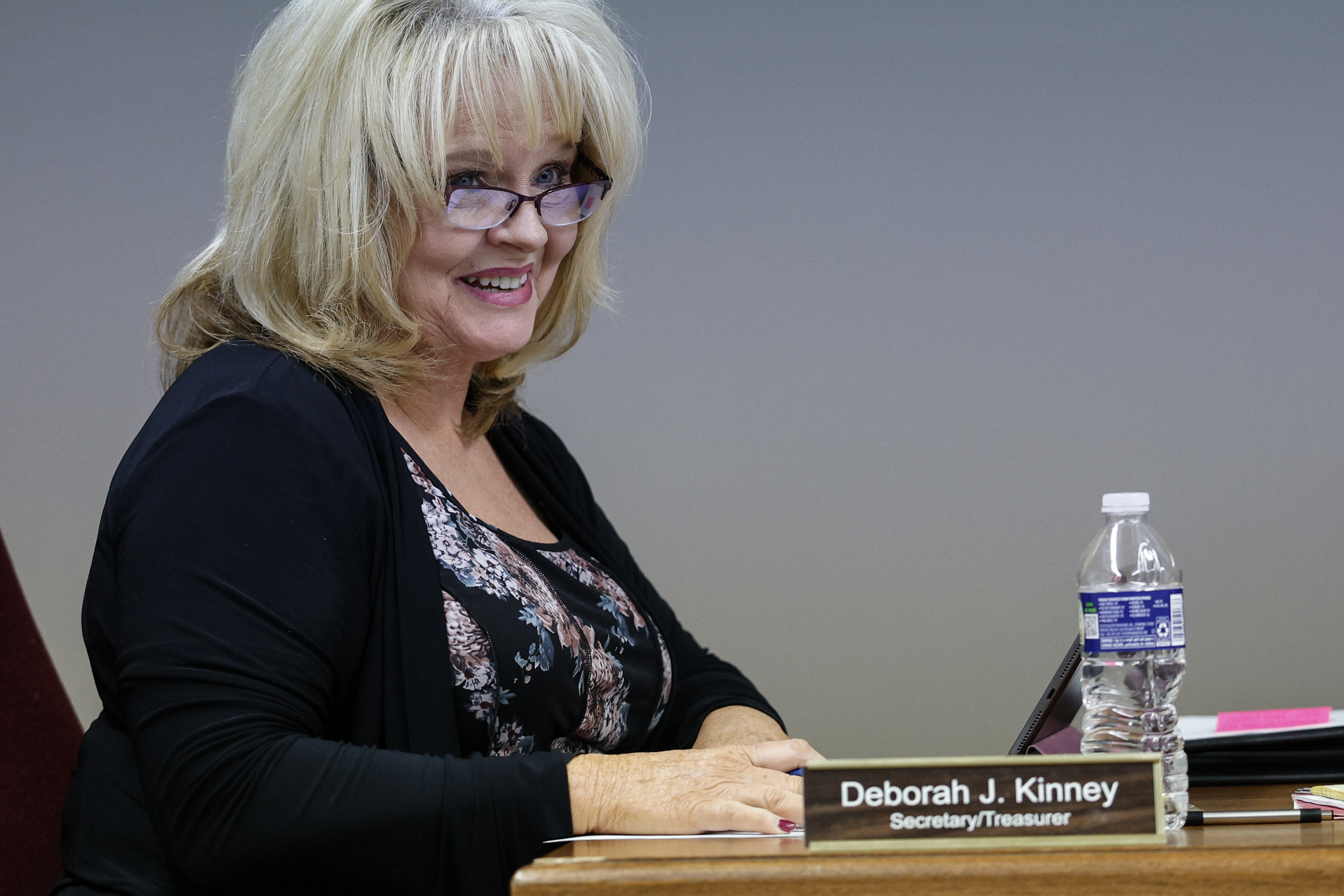
    Deborah J Kinney, secretary/treasurer and code enforcement officer, listens during the Lower Oxford Township supervisors meeting.

    Township officials have been frustrated with the responses from Lincoln in the past. When a meeting was held in November 2024 to discuss parking-related problems during the previous Spring Fling event, Allen said she didn’t need the township’s help, said Deborah Kinney, township secretary/treasurer and codes enforcement officer. Kinney said she had suggested an event process that would have included a plan for parking.

    “So we decided we needed to be proactive on our end, not just for our residents but for their students,” Kinney said. “It’s not the students. It’s the outside influences that are coming in to these events.”

    She also said that in 2024, Lincoln accounted for 183, or 26%, of the township’s emergency calls.

    Winfred Moran-Sebastian, Lower Oxford Township solicitor, outlines the proposed ordinance to regulate large events in the township. The ordinance is still under draft.

    Veronica Carr, a 2016 Lincoln alumna, said she had been concerned about safety when she was a student, and conditions seem to have gotten worse. She did not attend homecoming.

    Carr, who works for an African American heritage consulting firm and lives in North Carolina, said she is concerned that two people have been killed on the campus in less than four years.

    “Obviously, something is lacking,” she said.

  • Archbishop Ryan High School students were held hostage on this week in Philly history

    Archbishop Ryan High School students were held hostage on this week in Philly history

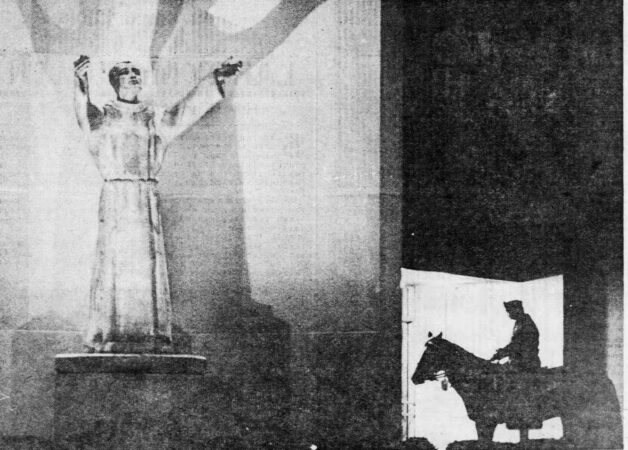
    A lanky man wearing a long, dark coat walked into a high school disciplinarian’s office ready to really make America great again.

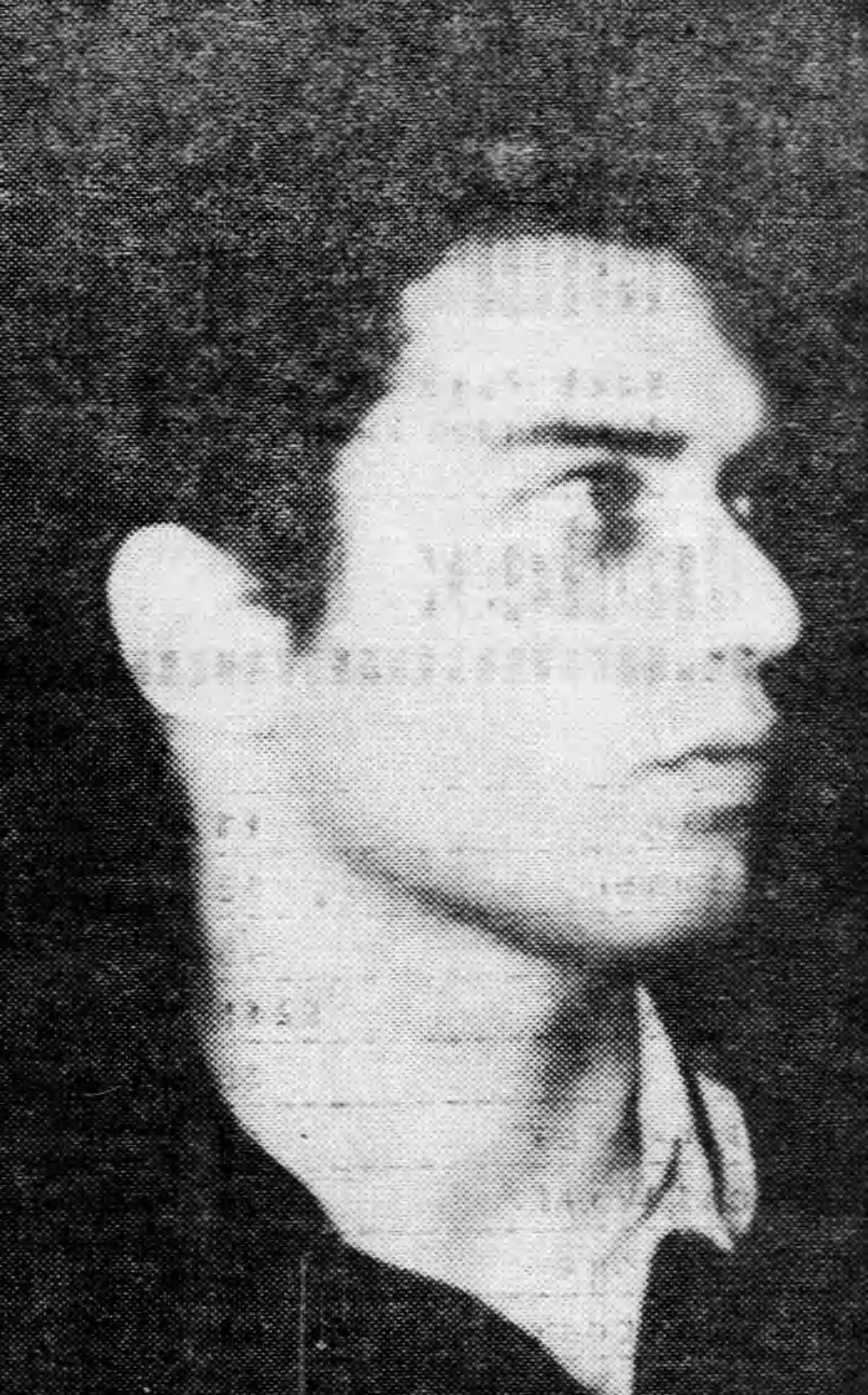
    Around 1 p.m. on Dec. 9, 1985, 22-year-old Steven Gold entered Archbishop Ryan with a knife and a gun.

    And he quickly took seven hostages — five students, a secretary, and the assistant dean of students.

    Twenty minutes later, he sent one of the students to get him a soda, and the student actually thought about going back before the police nabbed him.

    Steven Gold

    Around 2 p.m. Gold spoke with police by phone, and demanded President Ronald Reagan — who first ran on the Make America Great Again campaign slogan — resign from office.

    And turn over leadership of the country to Gold, who said he wanted to be called the Antichrist.

    In a statement that was read to the press, Gold wrote:

    “Either choose my leadership, or accept the death of America.”

    Back then, the Catholic high school was separated into two segregated schools: the boys’ school in the south wing, and the girls’ school in the north wing.

    Gold took the hostages in the boys’ wing. Shortly afterward, the 1,950 male students were dismissed. They walked out just as the 2,150 female students were leaving for the day on a shortened schedule. Together, boys and girls filed calmly out of the massive, three-story school building at Academy Road and Chalfont Drive.

    About an hour into the standoff, Gold let the secretary go after learning she was a mother of four. Shortly afterward, he traded the assistant dean for a food order, leaving only three male students as hostages.

    Around 7 p.m., a police negotiator briefly entered the disciplinarian’s office.

    Gold, who had recently stopped taking medication for paranoid delusions, held his pistol to the head of one student and threatened to kill all of the students if his demands were not met.

    Around 8:30 p.m., those students had had enough.

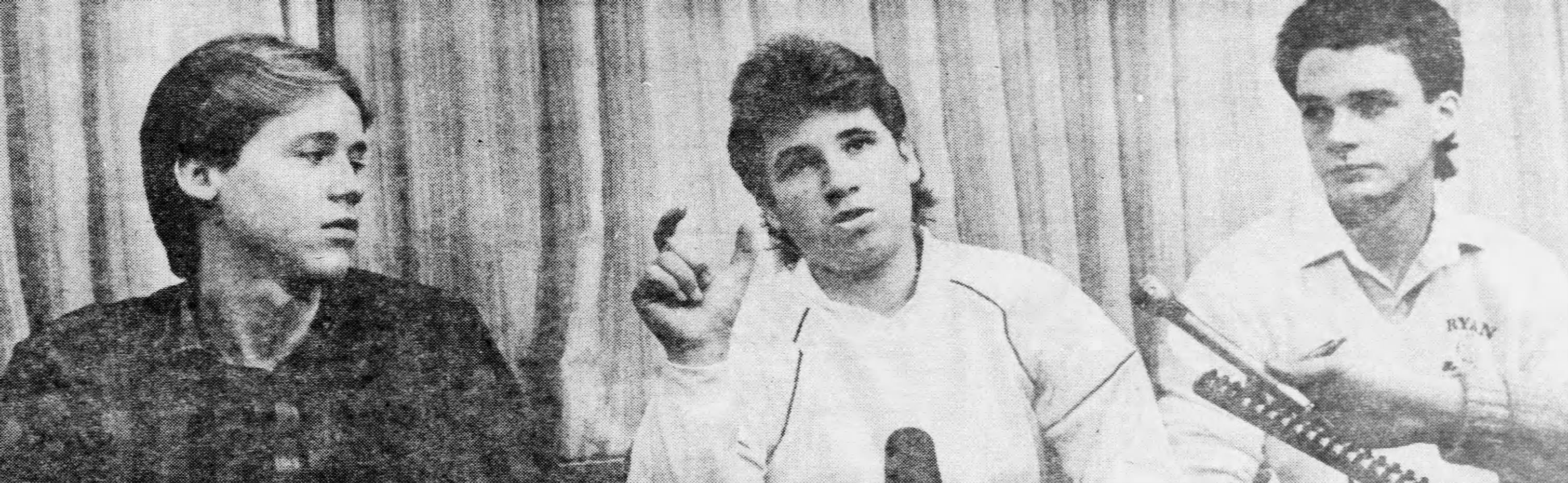
    As student hostages (from left) Patrick Hood, 15, Raymond Smith, 16, and Mike Wissman, 17, meet the press, Smith estimates the size of the captor’s knife.

    Gold told the negotiator on the phone that he would let two of the students go, and then the officer heard “a commotion and a lot of screaming” on the other end of the phone.

    The students decided the gun Gold was brandishing was a fake.

    So in good, old-fashioned Northeast Philly fashion, they jumped him. And it turned out they were right: The gun was a starter’s pistol, and it was loaded with blanks.

    The students overpowered Gold, and held him down until the stakeout officers rushed in and put an end to the more than seven-hour standoff.

  • Philly’s school board will explore giving its vacant schools to the city, though some object

    Philly’s school board will explore giving its vacant schools to the city, though some object

    Philadelphia’s school board voted Thursday night — over some objections — to explore giving its surplus buildings to the city.

    The vote does not bind the district to hand anything over, but it certainly opens the door to transferring properties in accordance with the wishes of Mayor Cherelle L. Parker, who has promised her administration will build or restore 30,000 units of housing during her first term.

    Exactly how many vacant buildings the district is contemplating giving to the city is not clear; the board did not vote on a list of schools, though officials have said in prior months the number of surplus schools is about 20. A school board spokesperson has said the list is still subject to internal discussion.

    The resolution only covers the district’s current closed buildings, not any that might be closed in the upcoming facilities master planning process expected to wrap up before the end of the school year.

    Board president Reginald Streater has said the city partnership makes sense, and would allow the district to focus on education, while relying on the city’s real estate expertise. The buildings all have carrying costs too, which the city would assume.

    Six board members voted for the resolution authorizing Superintendent Tony B. Watlington Sr. and the district’s legal department to begin talks with the city. Two board members — Crystal Cubbage and ChauWing Lam — voted no.

    Lam’s hesitation came, she said at Thursday’s special action meeting, because of the district’s budget issues.

    The vacant-building portfolio was recently valued at $80 million, Lam said.

    The mayor’s housing goals are laudable, Lam said, but “given the district’s structural budget deficit, which includes spending nearly half of our fund balance this year to balance our budget, I encourage consideration of additional opportunities before rushing into an agreement as set forth in this resolution.”

    Cubbage, too, said she worried that the resolution “limits us to exploring the conveyance of our school buildings to the city without financial compensation when we are facing a $300 million structural deficit and are constantly underresourced.”

    Instead, Cubbage said, she wished the board would delve into actions that could give short- and long-term revenue and still accomplish Parker’s housing goals by selling the properties “with deep restrictions and affordability requirements.”

    Board member Wanda Novalés supported the resolution, but noted that the district needs to get the whole picture — including enrollment projections and long-term capital priorities — before it moves forward.

    “I support the resolution as long as it calls for a thorough business plan that clearly outlines the benefit to the School District of Philadelphia,” said Novalés.

    Watlington, in a statement issued after the vote, supported the move.

    “By responsibly evaluating how to put these unused properties back into productive use, the district can stay focused on educating children while supporting broader city efforts that ultimately aim to strengthen neighborhoods,” Watlington said. “This exploration aligns with our commitment to both fiscal stewardship and community partnership.”

    Parker, in a statement issued earlier this week, said the transfer would mean the buildings would improve residents’ quality of life.

    Officials “cannot let blighted buildings in the middle of residential neighborhoods lie vacant — many of which have been vacant for many years — from two years to over 30,” Parker said in the statement. “It’s unconscionable to me that we are in the middle of a housing crisis and we have government buildings sitting vacant for years or even decades. That cannot continue.”

    Chief Deputy Mayor Vanessa Garrett Harley said in a statement that the city looks forward to working with the board on this issue.

    “This action will help the city to more effectively move blighted properties to productive use, addressing a longstanding concern of neighborhood leaders and residents across the city, and contribute to the mayor’s goal of creating or preserving 30,000 units of housing,” Garrett Harley said.

    A potential buyer for at least one vacant school

    Several speakers suggested it was a bad move to simply give buildings to the city.

    Cecilia Thompson, a former school board member, said she’s OK with selling schools to the city. But “can we sell it to the city for market value, and not a dollar or something nominal, just to say it was a sale? Just to be respectful … for the worth of the properties?”

    Several members of the community made it clear that there are potential buyers.

    Angela Case, a staffer at West Oak Lane Charter, indicated that the school wants to buy Ada Lewis Middle School in East Germantown.

    (Lewis is a prominent part of the potential portfolio — a large building on a sprawling campus and, this fall, the site where Kada Scott’s body was discovered.)

    “Our school is growing, but our current space is limited,” Case said. “Ada Lewis would give our students safe classrooms, outdoor areas and room for strong academic enrichment programs. It would also return a vacant property to a productive use, and benefit the surrounding community.”