Category: Entertainment

Entertainment news and reviews

  • How to have a Perfect Philly Day, according to ‘RuPaul’s Drag Race’ star Mandy Mango

    How to have a Perfect Philly Day, according to ‘RuPaul’s Drag Race’ star Mandy Mango

    Local fans of RuPaul’s Drag Race are bummed this morning after seeing Philadelphia drag queen Mandy Mango — just the second contestant to represent the city in the show’s history — get eliminated last night.

    For the third week in a row, Mango landed in the bottom. She failed to impress the judges with her sketch comedy act playing an Amish woman competing in a butter churning competition; her overly sexual take wound up being a bit too outlandish, and her runway look as a dashing deer couldn’t save her.

    “I can’t say I’m too surprised, I’m not delusional,” Mango said on Untucked: RuPaul’s Drag Race following the episode. “I accept this with grace but I’m extremely sad.”

    Despite the loss, of course, Mango remains a star at home in Philadelphia.

    An HIV nurse by day, Mango (aka Sigfried Aragona) grew up in Lansdale and attended West Chester University before moving to Center City, where she lives with a roommate and their four cats named Wasabi, Miso, Soy, and Sriracha. The 29-year-old performer frequently appears at Frankie Bradley’s, her home bar.

    Competing on Drag Race was an exciting challenge for Mango, who says she’s received an outpouring of support from fans in Philly and as far as the Philippines, where her family is from. She’s thrilled to spotlight Philly’s drag scene for a national audience, following Season 16 runner-up and Miss Congeniality winner Sapphira Cristál. (Cristál helped Mango prepare her audition tapes.)

    “Especially in the context of Drag Race, Philly hasn’t been [seen much]. I feel like we’re kind of on the up-and-up of people really recognizing our drag and seeing what we’re about,” said Mango. “Hopefully I got to show off that Philly is full of fighters. We’re full of performers, and we all have a little bit of quirkiness and silliness to us.”

    We asked Mango about her perfect Philly day.

    9 a.m.

    I’d probably start off by going to Planet Fitness, ideally, to get my little morning workout in. That’s all I need. And then I will get breakfast, probably over at the Reading Terminal. I love Beiler’s Doughnuts, a great post-workout meal [laughs], or honestly, Miller’s Twist with the pretzels.
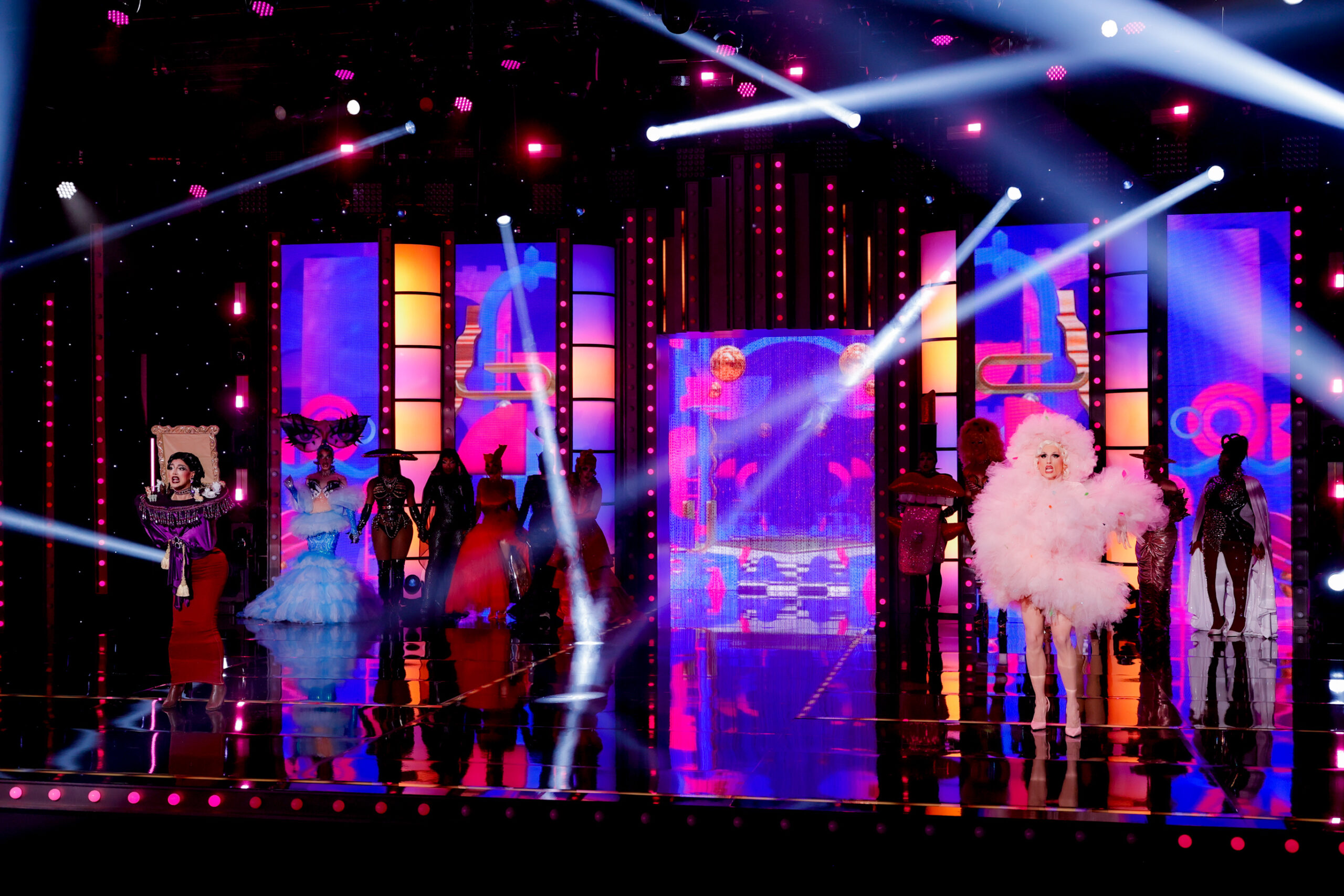
    Mandy Mango and DD Fuego face off in a lip synch battle on episode two of ‘RuPaul’s Drag Race’ Season 18. Mango stunned the judges with her energetic dance skills.

    Noon

    Come home and watch TV, catch up on my day, take a nap. Love a nap. But a lot of my friends are foodies, so on a nice day we like to be out and about.

    1 p.m.

    Just walk around Chinatown and get bubble tea. Tea Do is my usual spot. I like to get a little taro bubble tea, but if I need a pick-me-up, I’ll get the Zen’s Awakening. It’s a little chocolatey, really sweet, with coffee in it.

    We like to explore the little cute shops in Chinatown, like Ebisu and Little Seven House. Check out the little toys, see if my friend needs another Labubu.
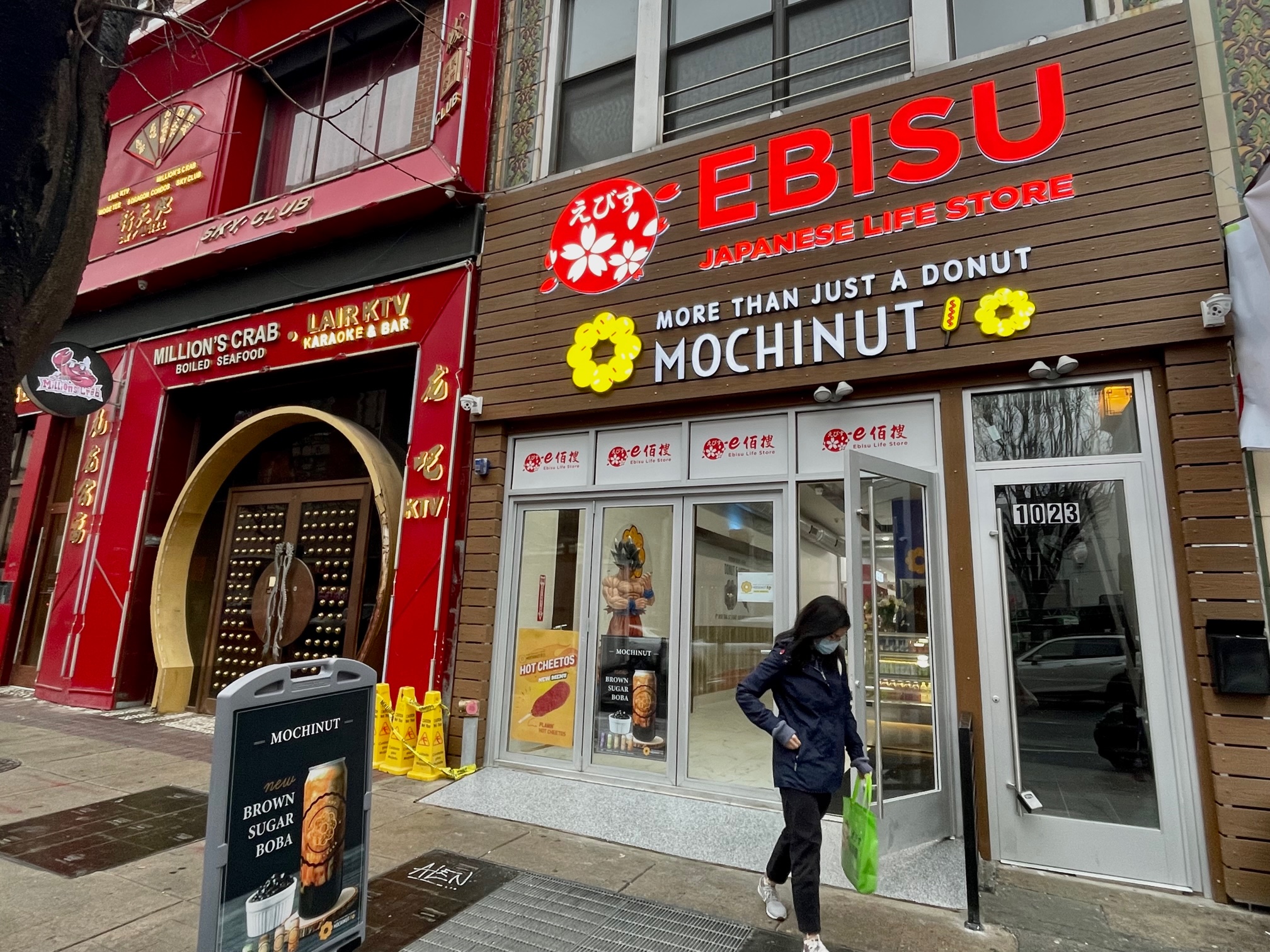
    Ebisu Life Store in Chinatown.

    Then we’ll probably eat somewhere in Chinatown. We’re always checking out different spots, but a go-to for us is definitely Ocean Harbor for dim sum and Pho 20. There’s something about pho restaurants, when it’s just “pho” and the number after it, you know it’s legit. Also Pho 75 in South Philly is one of our faves. Philly has some of the best Vietnamese food.

    3 p.m.

    I probably will go ahead and get back home, go over the little pictures that I took with my friends around the city and make sure we post those, and then take a nap.
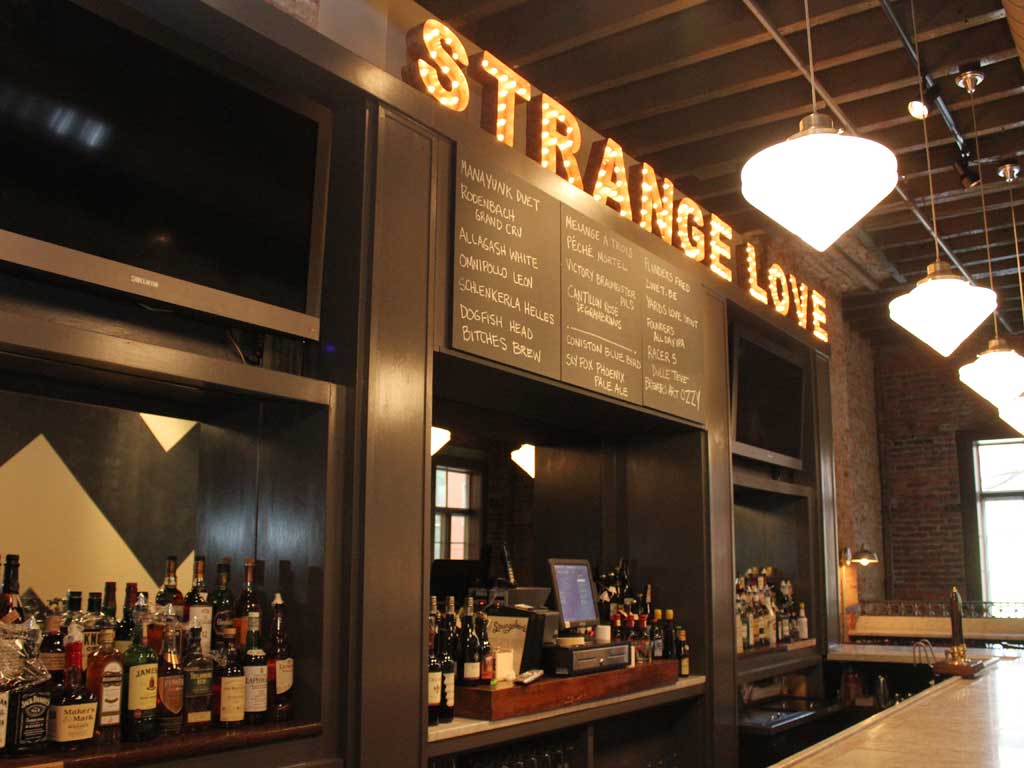
    Upstairs bar at Strangelove’s, 216 S. 11th St.

    6 p.m. to midnight

    I like to go out in drag sometimes, if I have the time. So I probably get mug and get ready to go out. I really love Strangelove’s, that’s probably where I start and get a drink and some food. They have arcade games in the back, which I recently played — I got into a really heated Mortal Kombat tournament. I made it past the first round then one of my designer friends [who helped with my Drag Race submission] Elias [Gurrola] surprisingly hustled me! I will come back and avenge myself.
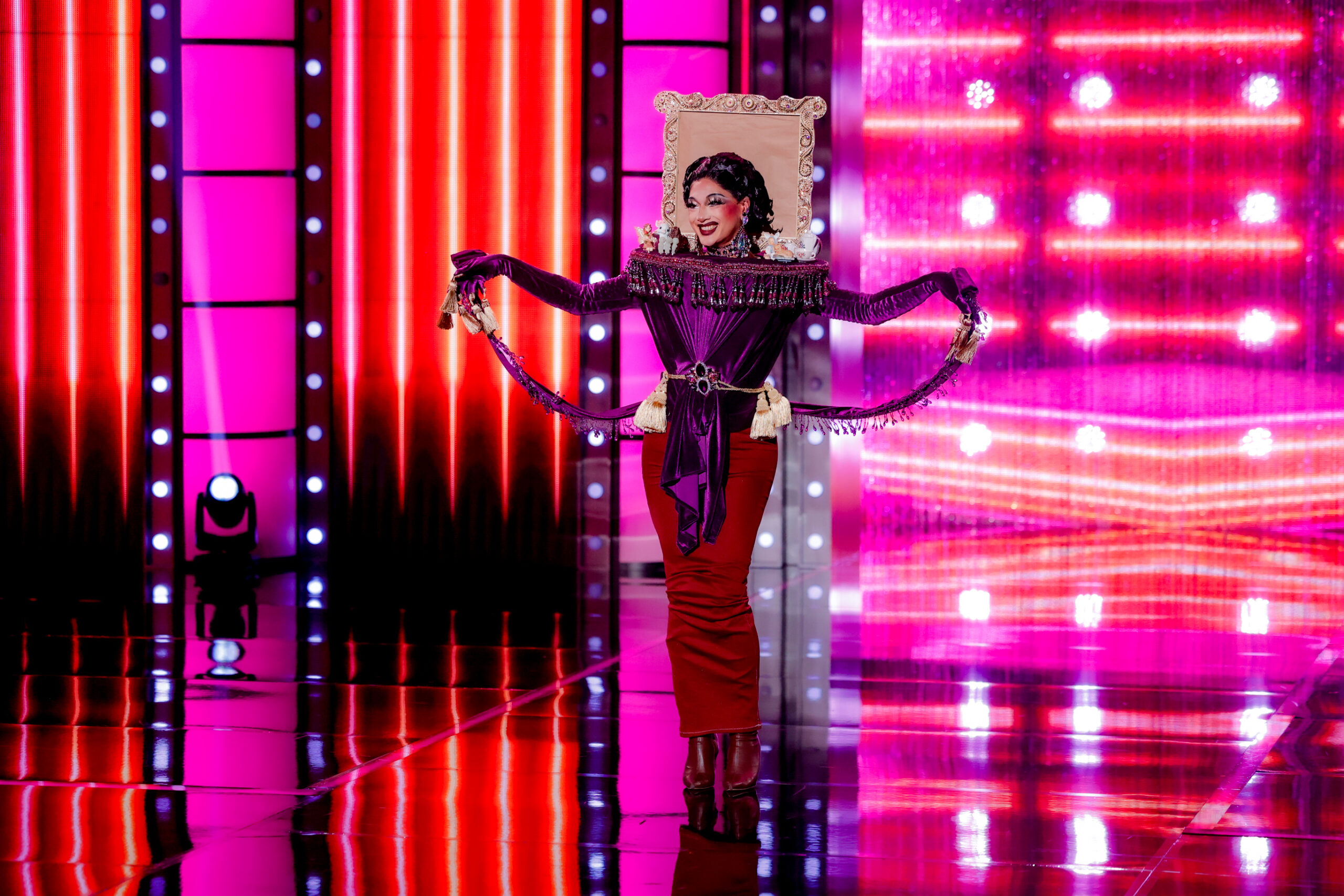
    Mandy Mango on the runway on ‘RuPaul’s Drag Race’ Season 18, episode two.

    I’ll eat dinner at Strangelove’s, get some of the flatbread. I love a finger food when I’m in drag, so pizzas or chicken tenders are great. It’s gonna sound basic but their fries are actually so good.

    Then I’ll bop around to U Bar, it’s a nice place to get another little drink. Then we’ll make our way down the alley to Tavern [on Camac] to really get dancing and start the night. You can usually catch me on the upper floor. I love it especially if Carl Michaels or Chris Urban are DJing.

    Midnight

    Around midnight, we move to Frankie Bradley’s, and check out the disco side and the upstairs club side. Catch [DJs] Drootrax or Gina. I usually end up dancing a little too hard because they’re always killing it.
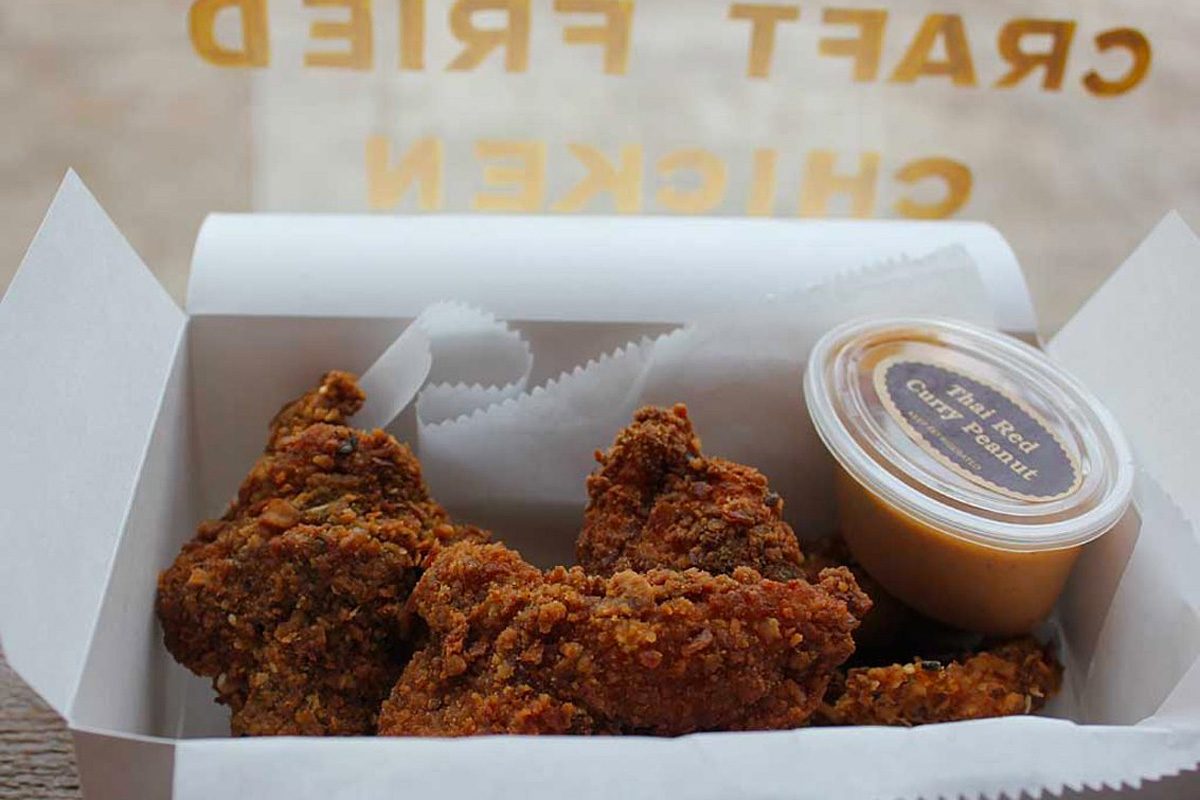
    Boneless, skinless, pretzel-encrusted chicken from Wishbone.

    2 a.m.

    I get my little post, post-club meal at Wishbone. They’re open till 4 a.m. They have pretzel-breaded chicken and baked mac and cheese. I get one white, one dark, half a pound of mac, and a biscuit.

    My schedule sounds chaotic, but it’s sort of ideal for me.


    “RuPaul’s Drag Race” airs every Friday on MTV.
  • An 11-year-old said the Eagles should fire Kevin Patullo. Then they did. Coincidence? | Weekly Report

    An 11-year-old said the Eagles should fire Kevin Patullo. Then they did. Coincidence? | Weekly Report

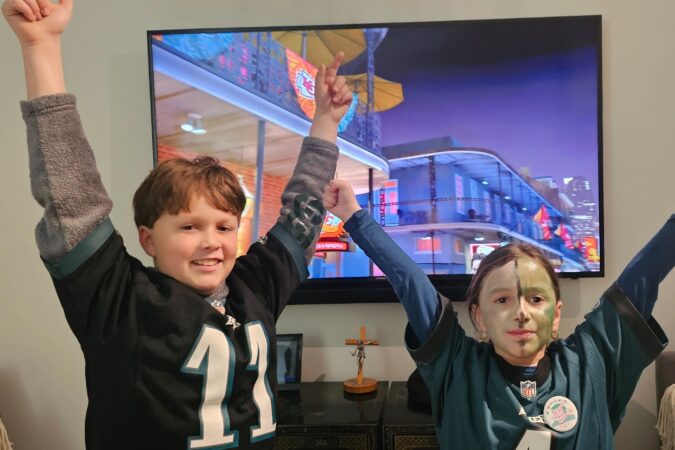
    An 11-year-old Eagles fan accidentally runs the coaching search: A+

    Philadelphia spent months debating offensive schemes, internal hires, and whether continuity was actually just stubbornness. Then an 11-year-old was handed a microphone and solved it in one sentence.

    Sam Salvo didn’t deliver a nuanced breakdown of route trees or personnel groupings. He didn’t cite EPA or All-22 tape. He simply announced — with the confidence of someone who has never had to answer a follow-up question — that Kevin Patullo should be flipping burgers at McDonald’s. Philly nodded in unison.

    The funniest part isn’t that it went viral. It’s that a day later, Patullo was gone, and the city collectively decided the kid deserved at least partial credit. In a town where people once egged an offensive coordinator’s house (too far), this somehow felt like the healthier outlet.

    Sam’s rant worked because it was pure, unscripted Philly logic: blunt, emotional, metaphor-heavy, and somehow accurate. “One-half cooked, one-half raw” is not just a roast, it’s a season recap. And when he popped back up afterward saying, “I just wanted to say anything that could get him fired. And it worked,” it sounded less like a joke and more like a performance review.

    The follow-up reactions only added to the lore. Fans celebrated. Former players debated scapegoating. Someone somewhere probably floated Big Dom calling plays. And the Eagles, intentionally or not, let the internet believe that an 11-year-old helped nudge a major coaching decision.

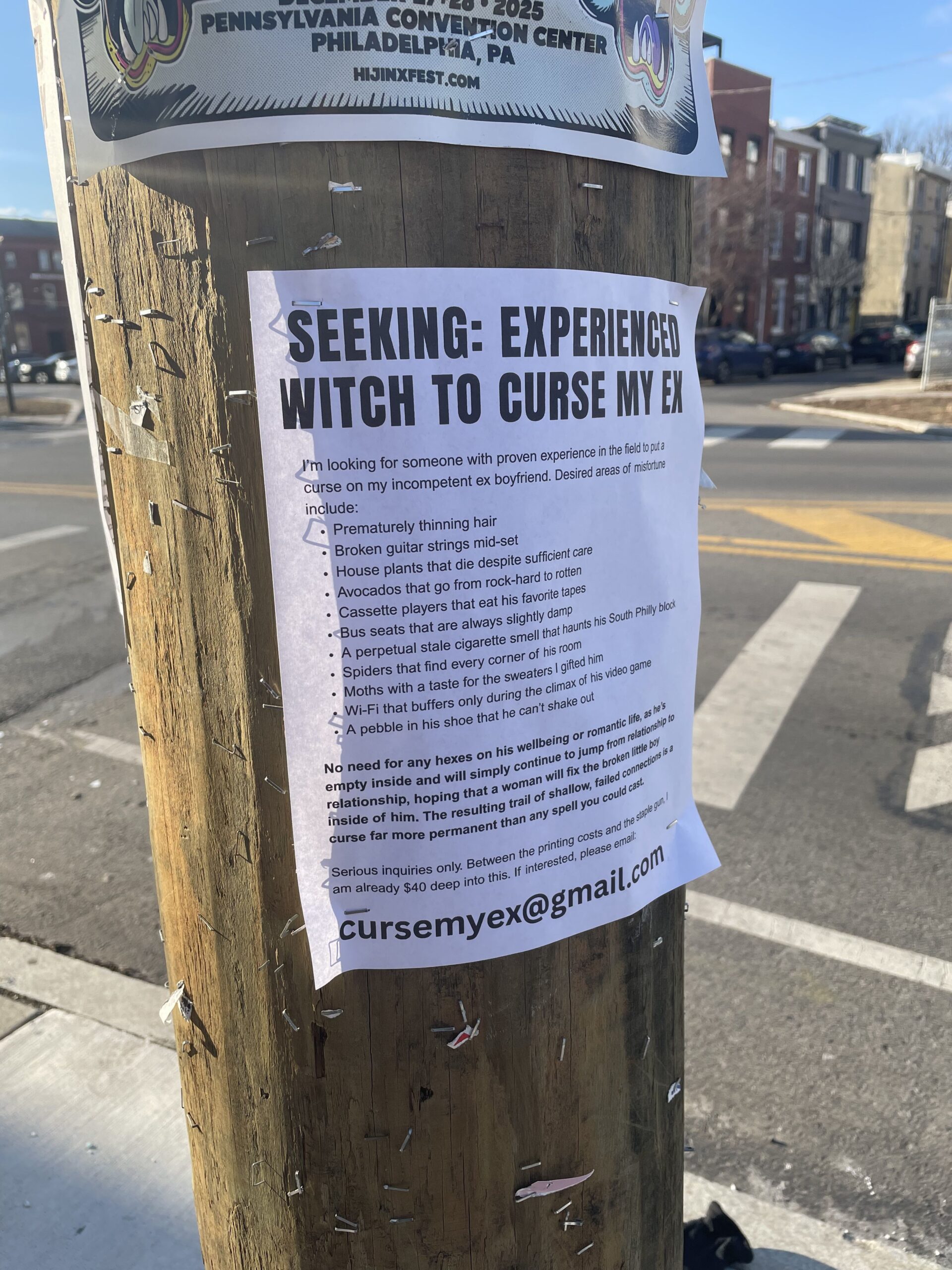
    One of the witch-seeker’s fliers hangs in Fishtown on Sunday, Jan. 4. After ending a two-year relationship, a Philadelphia woman posted the fliers around the city and in Phoenixville as a way to channel her emotions over the breakup.

    Philly collectively supports hexing an ex (with rules): A

    At some point this winter, Philadelphia decided that asking a witch to curse your ex (politely, creatively, and without touching his health or love life) was not only acceptable, but deeply relatable.

    The flier itself did most of the heavy lifting. “Seeking: Experienced Witch to Curse My Ex,” stapled to poles from Phoenixville to Fishtown, with a list of curses so specific and mild they felt less like dark magic and more like emotional Yelp reviews: thinning hair, damp bus seats, buffering Wi-Fi, eternally pebbled shoes. Nothing fatal. Nothing irreversible. Just inconvenience with intention.

    Instead of pearl-clutching, the city leaned in. The flier spread through neighborhood Facebook groups and socials, where strangers did what they do best: offered commentary, solidarity, jokes, and unsolicited advice. Some people cheered her on. Some defended the ex. Others asked how it ended. And plenty of women recognized the feeling immediately: that moment after you’ve done the therapy, the journaling, the “being mature,” and still need somewhere for the anger to go. This wasn’t about actually ruining someone’s life. It was about yelling into the city and having the city yell back, “Yeah, that sucks.”

    The rules mattered, too. No curses on his health. No messing with his love life. Philly rage has boundaries. Even our hexes come with ethics.

    Wawa learns Philly does not want a vibes-only convenience store: C-

    Philadelphia has many hard rules, but one of the hardest is this: If you remove the shelves from a Wawa, you are no longer operating a Wawa.

    The 34th and Market Street location near Drexel didn’t close because people stopped loving hoagies. It closed because Wawa tried to outthink the entire point of its existence. The fully digital, order-only format asked customers to interact with a screen for everything. No wandering, no impulse grabs, no staring at the Tastykake rack while deciding whether you’re hungry or just bored.

    And in Philly, that’s not innovation. That’s friction.

    This was once one of the company’s highest food-service locations before the pandemic, which makes the experiment feel even more puzzling in hindsight. People weren’t avoiding this store because they didn’t want Wawa. They were avoiding it because it stopped functioning like one. A convenience store that requires commitment, planning, and patience defeats the entire concept.

    The grade isn’t lower because this wasn’t malicious or careless. It was a genuine attempt to test something new. But Philly answered clearly, quickly, and repeatedly: We don’t want a Wawa that feels like an airport kiosk. That’s what will get your store closed.

    Phillies pitcher Ranger Suárez throws against the Cincinnati Reds on Saturday, July 5, 2025, in Philadelphia.

    Saying goodbye to Ranger Suárez hurts, even if it makes sense: B+

    This one lands softly and hard at the same time.

    Ranger Suárez leaving Philadelphia was never shocking, just quietly devastating. Signed by the Phillies as a teenager, developed patiently, trusted in big moments, and forever tied to the pitch that sent the city to the World Series in 2022, Suárez felt less like a roster spot and more like a constant. You looked up in October and there he was, calm as ever, getting outs without drama.

    Now he’s on the Red Sox.

    The Phillies weren’t wrong to hesitate on a five-year, $130-million deal for a pitcher with mileage, injury history, and a fastball that succeeds more on craft than velocity. Andrew Painter is coming. The rotation math is real. This is how smart teams stay competitive.

    But Philly doesn’t grade purely on spreadsheets.

    Suárez embodied a certain Phillies ideal: unflashy, durable when it mattered, unfazed by the moment, and always a little underestimated. He wasn’t the loud ace. He was the steady one. The guy you trusted to calm everything down when the season felt like it might tip.

    That’s why this stings. Not because it was reckless to let him go, but because losing someone who felt like a Phillie is different than losing someone who just wore the uniform. Watching him head to Boston is one of those reminders that the version of the team you emotionally commit to is always a few contracts behind the one that actually exists.

    OpenTable adds a 2% fee, and Philly sighs deeply: C

    Philadelphia understands restaurant math. We’ve lived through inflation menus, pandemic pivots, staffing shortages, reservation deposits, and the great “please cancel if you’re not coming” era. What we don’t love is when the bill quietly grows another line item after we thought we were done reading it.

    That’s why OpenTable adding a 2% service fee to certain transactions (no-show penalties, deposits, prepaid dining experiences) landed with more fatigue than outrage. Not rage. Just tired acceptance.

    The logic isn’t wrong. No-shows are brutal for small dining rooms, especially in places like South Philly where a missed table can knock a whole service sideways. Restaurants can absorb the fee or pass it on, and in many cases, the platform is genuinely helping places protect their bottom line.

    But from a diner’s perspective, this is yet another reminder that convenience now comes with micro-costs layered so thin you barely notice them, until you do. The reservation is free … unless you’re late. Or cancel. Or book a special dinner. Or blink wrong. It’s another reminder that each new surcharge chips away at the simple joy of making dinner plans without feeling like you’re navigating airline baggage rules.

    Philly draws the line at selling dinner reservations: A-

    Philadelphia has tolerated a lot in recent years: prix-fixe creep, credit card holds, cancellation windows measured in hours, and now, yes, platform fees (see above). But selling a free dinner reservation for profit? That’s where the city finally says no.

    The attempted resale of coveted tables at Mawn didn’t just irritate the restaurant’s owners, it offended a basic Philly value system. You can love a place. You can hustle for a table. You can brag that you got one. What you can’t do is turn access into a side hustle and expect people to shrug.

    The reaction was swift and very local: public call-out, canceled reservations, and a clear message that this isn’t New York, Miami, or a StubHub-for-dinner experiment. Yes, reservation scalping exists elsewhere, powered by bots and platforms like Appointment Trader. And yes, Philly has passed laws trying to shut that down. But what made this moment resonate wasn’t legislation. It was cultural enforcement. A collective agreement that making money off a free reservation crosses from clever into gross.

    Put simply: Waiting your turn is still the rule here. And if you try to flip your way around it, don’t be surprised when the city flips right back.

    Amanda Seyfried gives Colbert a very real Allentown community calendar: A

    Stephen Colbert has a recurring bit where he asks celebrity guests to promote actual events from their hometowns. When Amanda Seyfried, who grew up in Allentown, took her turn this week, she didn’t try to punch up the material.

    She didn’t have to.

    Seyfried read through a lineup of events that sounded exactly like a Lehigh Valley bulletin board: all-you-can-eat pasta night, speed dating for seniors, board games at a funeral home, a pirate-themed murder mystery, and Fastnacht Day donuts heavy on lard and tradition. No setup. No apology. Just listings.

    That restraint is what made it land. Seyfried treated the segment like she was helping out a neighbor, not auditioning for a tourism campaign.

    For viewers around Philly and the surrounding counties, it was immediately recognizable. This is the kind of stuff you scroll past in a local Facebook group or see taped to a coffee shop door without a second thought. Put it on national TV, though, and suddenly it becomes comedy.

  • Despite earlier DOGE cuts, Philadelphia groups receive $3 million in new NEH grants

    Despite earlier DOGE cuts, Philadelphia groups receive $3 million in new NEH grants

    Despite recent cuts and an uncertain future, the National Endowment for the Humanities has awarded about $3 million in new grants to Philadelphia groups. The local awards are part of $75.1 million in new grants announced this month by the NEH for 84 projects across the nation.

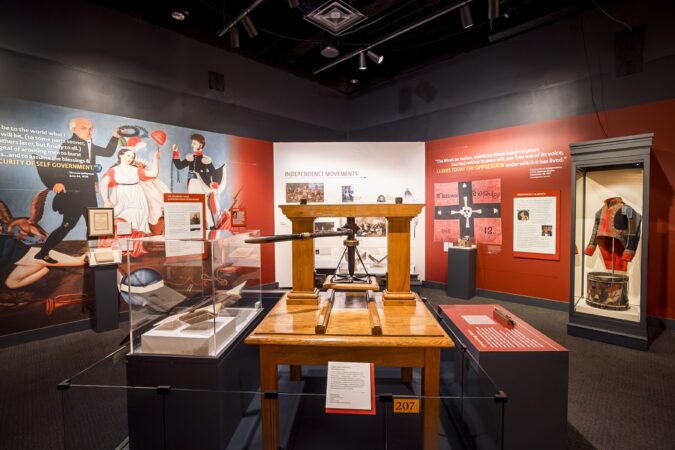
    The biggest local award went to the Museum of the American Revolution, which is receiving $2,247,435 for the planning and production of a conference, podcast series, exhibition catalog, digital interactive, and activities related to the museum’s current exhibition about the Declaration of Independence, “The Declaration’s Journey.”

    The NEH’s latest round of grants reflects the federal agency’s ongoing ideological shift to align with President Trump’s agenda. In April, the NEH announced that “future awards will, among other things, be merit-based, awarded to projects that do not promote extreme ideologies based upon race or gender.” Critics say grants canceled by the Trump administration last year were revoked because they represented viewpoints such as diversity, equity, and inclusion.

    U.S. Rep. Chellie Pingree (D., Maine) raised the concern in a November letter to acting NEH chairman Michael McDonald that the agency is now making awards in some cases without peer review, giving “massive grants through questionable non-competitive processes.”

    “Moving forward,” the NEH’s April statement said, the agency is “especially interested in projects on the nation’s semiquincentennial and U.S. history more generally.”

    That directive connects to projects of all six of the new recipients in Philadelphia.

    The Conservation Center for Art and Historic Artifacts is receiving $349,927 over two years to fund its preservation field services for small- to mid-sized organizations around the country. The program provides assessments and education to groups like museums, libraries, archives, and historical societies — as well as individuals — on how to care for their collections.

    A $200,210 NEH grant to the American Philosophical Society will help fund “These Truths: The Declarations of Independence,” an exhibition at the society’s museum opening in April. It explores the first 50 years of the document and its evolution from “a pronouncement of news, [to] political tool, [to] national symbol,” says an exhibition description.

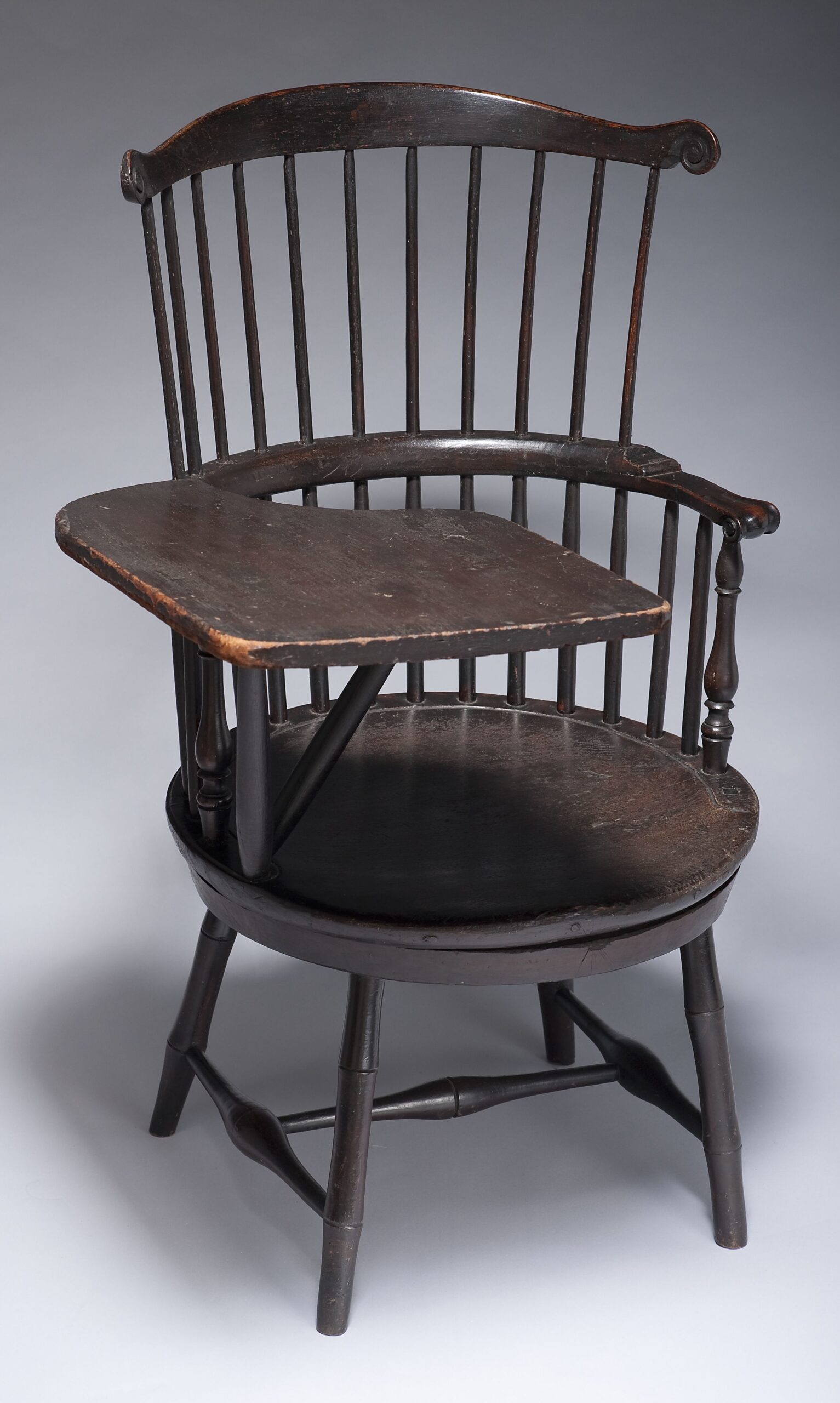
    The Windsor chair Thomas Jefferson used while drafting the Declaration of Independence at the 7th and Market Sts. house he was renting.

    The show includes 19 early printings of the Declaration from 1776 through 1824 and the Windsor chair in which Thomas Jefferson sat while writing the document. The NEH grant will go toward the exhibition, its catalog, and a related conference in June.

    The NEH was among the federal agencies whose budgets and staffs were slashed last year by the Department of Government Efficiency, headed by billionaire Elon Musk. Arts and culture groups in Philadelphia and across the country had grants revoked from the NEH, National Endowment for the Arts, and Institute for Museum and Library Services.

    Some grants were restored without explanation. A $750,000 IMLS grant to the Woodmere Art Museum was rescinded, and, a little more than a week after the Woodmere filed a lawsuit against the Trump administration, was reinstated.

    In this new round of funding, three other NEH grants were awarded locally, each for $100,000: to Eastern State Penitentiary, the National Liberty Museum, and the Weitzman National Museum of American Jewish History.

  • Will Shortz is moving the American Crossword Puzzle Tournament to Philadelphia

    Will Shortz is moving the American Crossword Puzzle Tournament to Philadelphia

    In nearly five decades of directing puzzle competitions, New York Times crossword editor and NPR puzzle master Will Shortz has encountered a cheater only once, at a Sudoku championship in Philadelphia.

    Luckily, Shortz doesn’t hold it against us. That came across loud and clear when he recently announced he’s moving the American Crossword Puzzle Tournament from Connecticut down to Philly next year.

    “Philadelphia has a cultured audience,” Shortz said when we spoke this week. “It’s just a great city to have a major literary event at.”

    The first time I heard of the ACPT was while watching Wordplay, a 2006 documentary about crossword puzzles featuring Shortz; the latter half of the movie is set at his annual tournament. I loved the movie when it came out and on a rewatch 20 years later, it’s still as quirky and delightful as ever.

    In the film, the late puzzle constructor Merl Reagle, who crafted crosswords for the Times, The Inquirer, and other papers across the country, calls the ACPT an “orgy of puzzling,” which is a fantastic phrase that I’m guessing he never got into a puzzle and one that’s probably responsible for the film’s perplexing PG rating.

    The play-by-play

    Shortz — who designed his own major in enigmatology (the study of puzzles) at Indiana University — founded the ACPT at the Marriott in Stamford, Conn., in 1978 when he was just 25.

    “There had not been a crossword tournament in the country since the 1930s, so we were starting fresh,” he said.

    The first tournament attracted 149 contestants. This year, there are 926 competitors, with a long wait list, and after 48 years at the Stamford Marriott (aside from a few years the tournament was held in Brooklyn), the ACPT has just outgrown the space. The tournament will be held there for the last time in April.

    Shortz and his team looked for new venues around the Northeast and settled on the Liberty Ballroom at the Sheraton Philadelphia Downtown, where they can accommodate up to 1,250 contestants.

    The tournament will be held there from April 30 to May 2 next year.

    “I’m hoping with 1,250 seats we won’t have to turn anyone away next year,” Shortz told me. “My goal is for everyone to come who wants to.”

    The ACPT is held over three days and consists of eight rounds of puzzles. All contestants compete in the first seven rounds, which, much to this Luddite’s delight, are still done with pencil and paper.

    “I want everyone to compete equally,” Shortz said. “Some people are very fast with their fingers so I wouldn’t want the tournament to depend on your computer literacy.”

    Contestants are scored based on accuracy and completion time. There are multiple divisions, with an eighth round of playoffs held for the top three divisions.

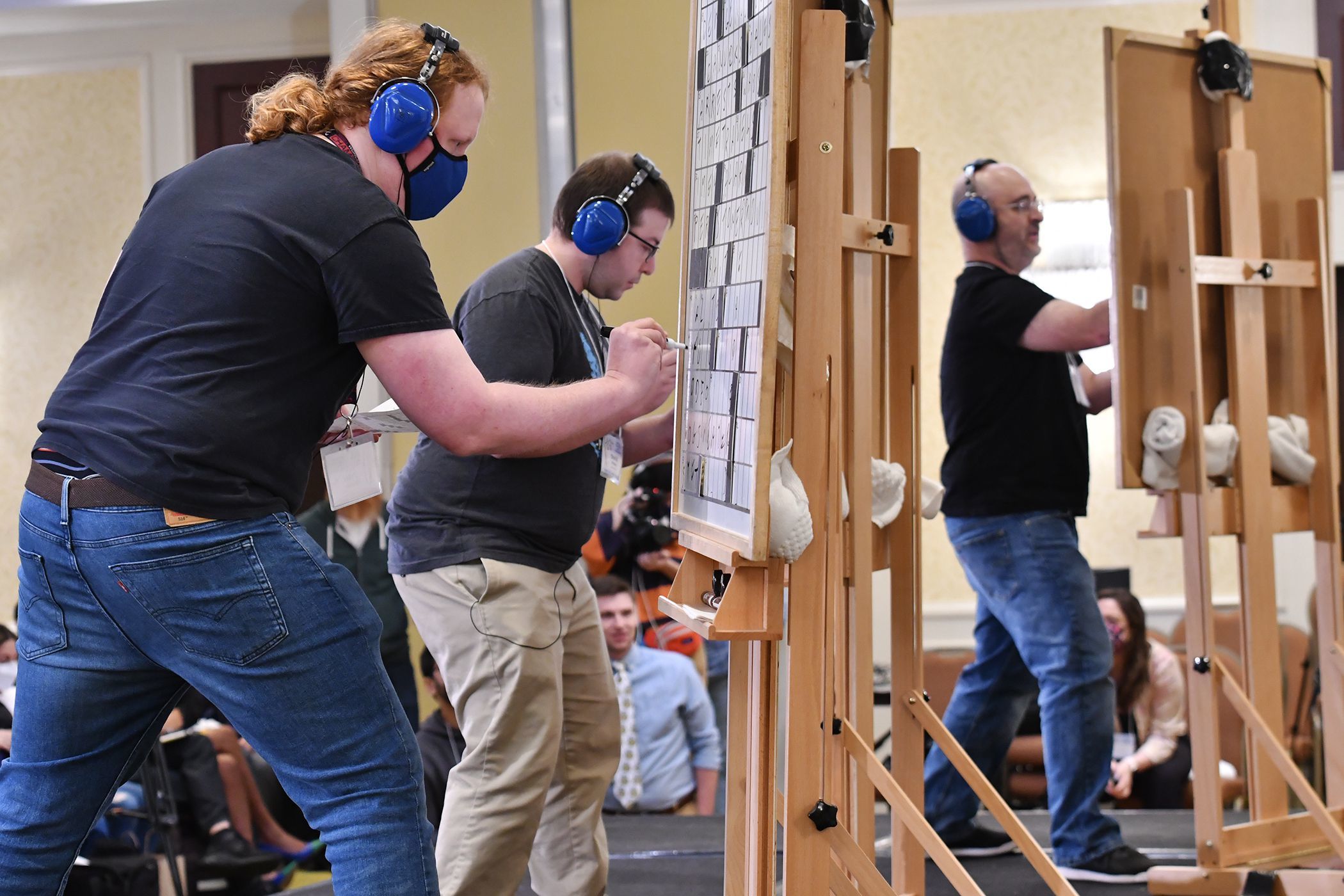
    From left: Frequent top finishers Tyler Hinman, David Plotkin, and Dan Feyer compete live on stage during a championship round of the American Crossword Puzzle Tournament. Play-by-play announcers even call the games, so competitors must wear noise-canceling headphones.

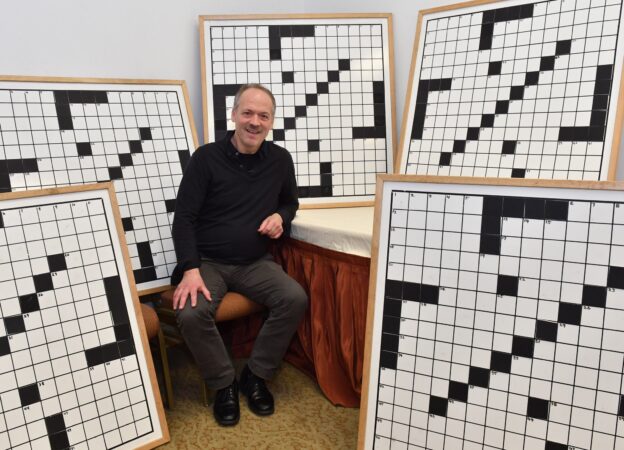
    The A and B division playoffs are held on stage, with top three contestants working on giant crossword puzzle white boards before a live audience (and you thought completing a Saturday Times puzzle by yourself was intimidating!). Play-by-play announcers even call the games, so competitors must wear noise-canceling headphones.

    The division A winner gets a $7,500 prize and crossword glory for a year. The last two tournaments were won by Paolo Pasco, a 24-year-old crossword puzzle constructor and seven-time Jeopardy! winner who’s competing in the quiz show’s Tournament of Champions this month.

    Aside from the competitive games, there are also informal word games, a puzzle market, and a contestant talent show.

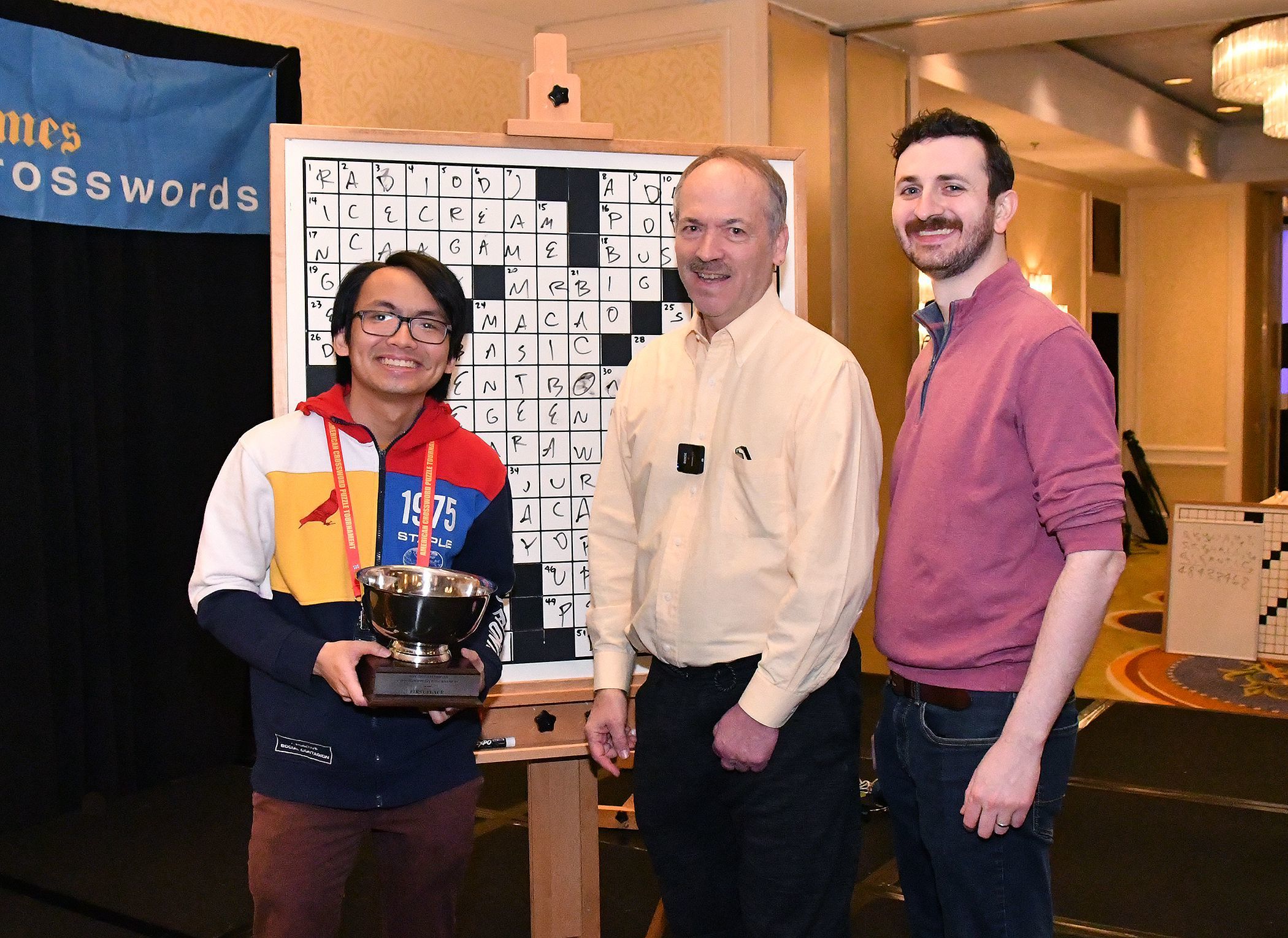
    Paolo Pasco, (left), winner of the 2025 American Crossword Puzzle Tournament, with tournament director Will Shortz, (center), and puzzle constructor Ryan McCarty.

    ‘No judgments’

    Shortz has never missed a tournament, except for when it was canceled in 2020 due to COVID. Even after suffering a stroke in 2024, he showed up to the tournament, just two months later.

    “I was in a subacute rehab center and everyone was advising me not to leave the center, but there was no way I was going to miss the tournament,” he told me. “When I came in a wheelchair, everyone stood up and applauded and that brought tears to my eyes.”

    Donald Christensen, who has attended the ACPT since the 1980s and serves as the event photographer, said the contestants are “a microcosm of society.”

    “When you attend one of the tournaments, you are among a group of about 1,000 people who make no judgments about you or your abilities, and who are often very willing to share their secrets to successful solving with anyone who is interested,“ he said via email.

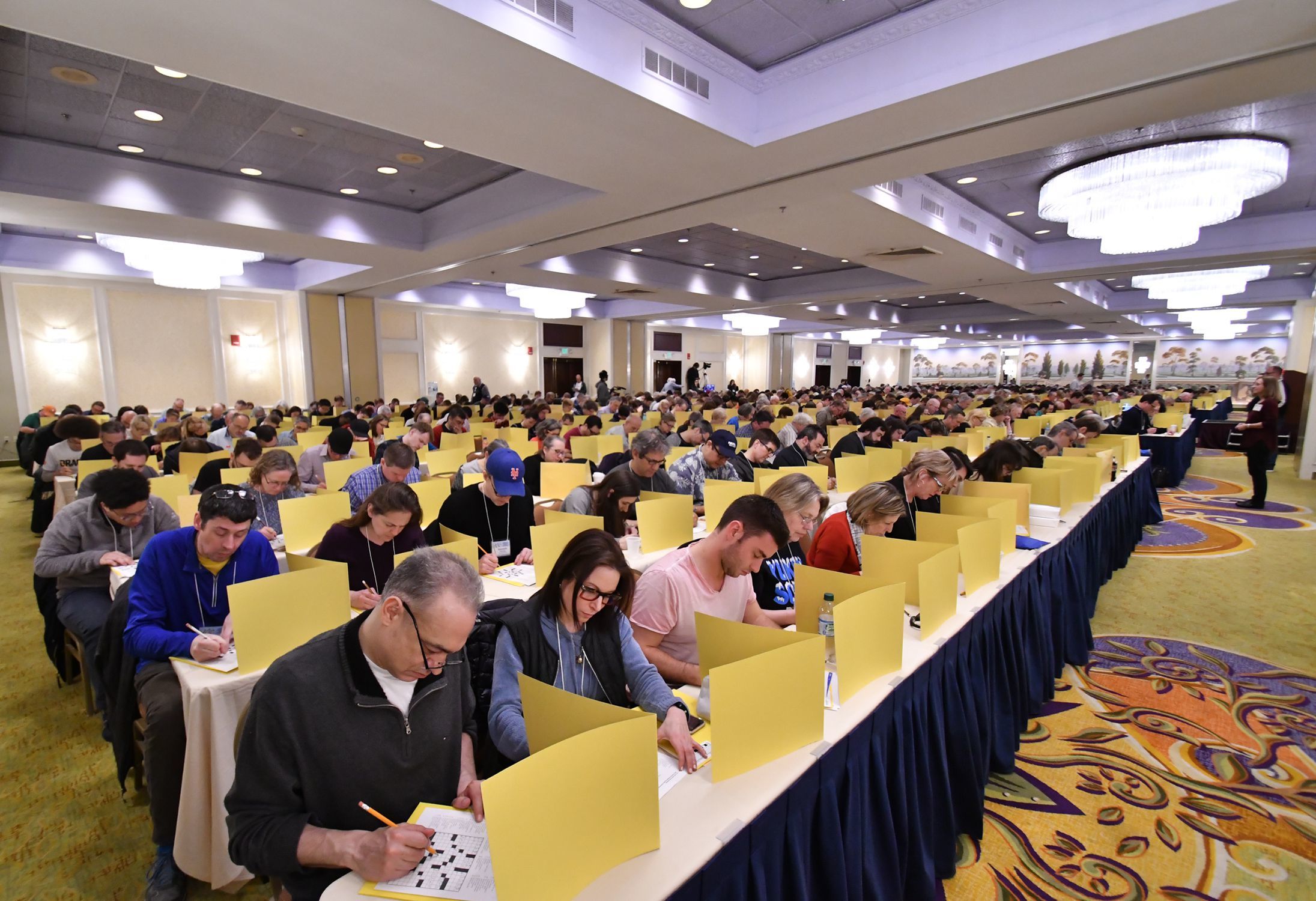
    Contestants work on solving puzzles at the Stamford Marriott during the American Crossword Puzzle Tournament.

    I enjoy crossword puzzles, but I’m absolutely terrible at them, so much so that I question my college majors (nonfiction writing and communications), my career, and whether I actually speak the English language. But there’s even room for someone like me at the tournament — a noncompetitor option, where you can play but your solutions aren’t scored. Spectator-only tickets are available for the Sunday playoffs, too.

    Contestants aren’t allowed outside help, but they’re not required to hand over their cellphones either. Shortz said referees would see any cheating and looking something up on a phone would just slow down a good contestant.

    “It’s not a group that would cheat anyway,” Shortz said.

    The Sudoku swindler

    And that brings me back to the stupefying Sudoku scandal of 2009. For three years beginning in 2007, The Inquirer sponsored the National Sudoku Championship at the Pennsylvania Convention Center, with Shortz serving as host (The Inquirer and Shortz also partnered to host the World Sudoku Championship here in 2010).

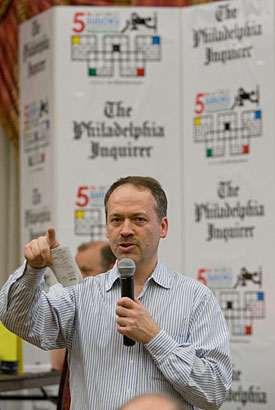
    Will Shortz explains the rules of the 2010 World Sudoku Championship, which was held in Philadelphia and sponsored by The Inquirer.

    During the 2009 competition, a before-unknown player, Eugene Varshavsky of Lawrenceville, N.J., qualified for the finals in lightning time. But when he got on stage with his hoodie up for the championship round, he froze.

    “It was a challenging puzzle but not crazy hard and he was utterly unable to finish it,” Shortz said. “It was kind of embarrassing for someone who’d solved the previous puzzle quickly.”

    Still, Varshavsky was awarded third place, which came with a $3,000 prize. But puzzlers raised suspicions and the money was frozen while officials conducted an investigation.

    Varshavsky was asked to come to The Inquirer to complete additional puzzles to prove his ability.

    “We gave him the round-three puzzle he whipped through in the competition, which he was now unable to do,” Shortz recalled.

    He was subsequently stripped of his title and the prize money. Shortz said officials believed he was getting help through an earpiece during the competition, though that was never proven. Coincidentally, a man by the same name was suspected of cheating in 2006 at the World Open chess championship in Philadelphia.

    United by words

    Philadelphia’s puzzle history isn’t all sordid though. We were home to the oldest known Times crossword puzzle contributor, the late Bernice Gordon, who constructed puzzles for decades and was the first centenarian to have a puzzle published in the Times.

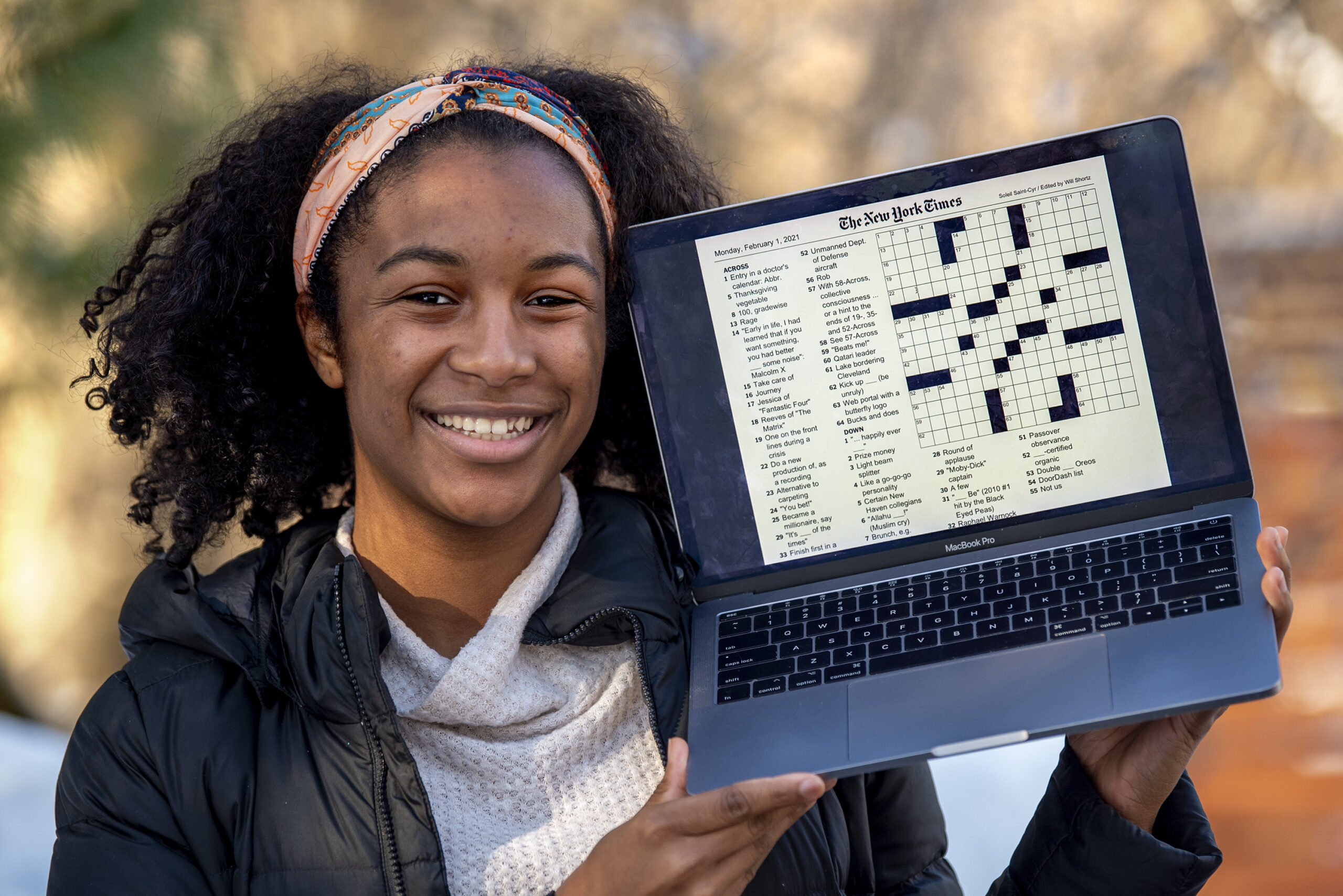
    And in 2021, Soleil Saint-Cyr, 17, of Moorestown, became the youngest woman to have a puzzle published in the Times.

    Cruciverbalist Soleil Saint-Cyr poses at her Moorestown home in 2021.

    With all of the talk around AI today, I asked Shortz if humans are still better at crafting crossword puzzles than computers.

    “Of course, computers can create crosswords now, but it takes a human mind to create a brilliant crossword,” he said. “Only humans can still come up for a clever idea for a new theme and only a human can write a good, original crossword clue.”

    Perhaps there is no better place for the American Crossword Puzzle Tournament than right here in Philadelphia, where words birthed our country into existence. We’re still writing the story of our nation and trying to figure out if this puzzle can be solved, but as in Shortz’s tournament, people are still united by words and creating small moments of order amid the chaos.

    “We’re faced with so many challenges every day in life and we just muddle through and do the best we can and we don’t know if we have the best solution,” Shortz said. “But when you solve a crossword puzzle … it gives you a tremendous feeling of accomplishment. You put the world in order.”


    For more information on the ACPT and how to add your name to the 2027 contact list, visit crosswordtournament.com.

  • Dilys E. Blum, senior curator emeritus at the Philadelphia Art Museum, has died at 78

    Dilys E. Blum, senior curator emeritus at the Philadelphia Art Museum, has died at 78

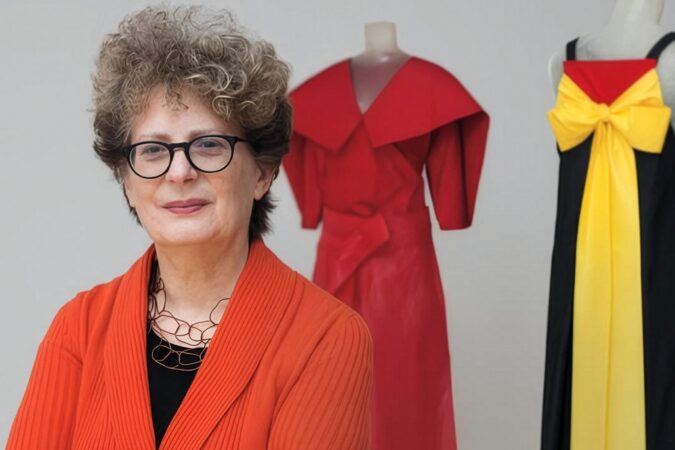
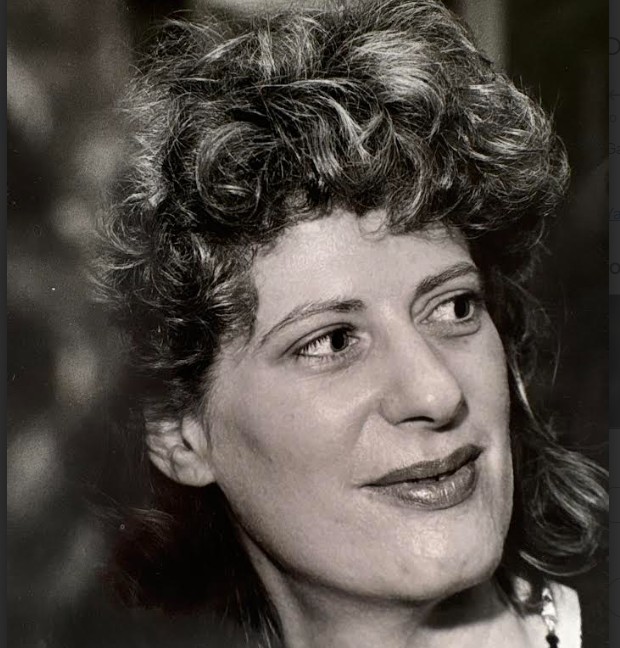
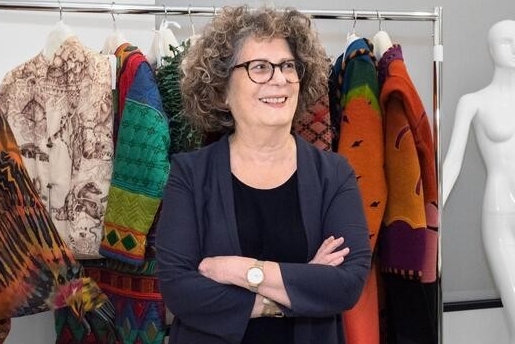
    Dilys E. Blum, 78, of Philadelphia, senior curator emeritus of costume and textiles at the Philadelphia Art Museum, author, lecturer, mentor, and world traveler, died Saturday, Dec. 27, of complications from cancer at Thomas Jefferson University Hospital.

    For 38 years, from 1987 to her retirement in 2025, Ms. Blum served as the museum’s curator of costume and textiles. In that role, she organized the museum’s vast treasure trove of textile artifacts, traveled the world to research noted fashion designers and eclectic collections, and created more than 40 memorable exhibitions about Renaissance velvets, contemporary fashion, Asian textiles, carpets, African American quilts, and dozens of other curios.

    Among her most popular presentations were 1997’s “Best Dressed: 250 Years of Style,” 2011’s “Roberto Capucci: Art into Fashion,” and 2025’s “Boom: Art and Design in the 1940s.” She organized two displays simultaneously in 2007, and The Inquirer said: “One exhibit is elegant, one’s eccentric, both are impressive.”

    She was cited as the world’s foremost authority on avant-garde Italian fashion designer Elsa Schiaparelli, and her 2003 exhibition “Shocking! The Art and Fashion of Elsa Schiaparelli” drew 83,000 visitors. Francesco Pastore, the heritage and cultural projects manager at the House of Schiaparelli in Paris, said: “Her remarkable research, her generosity in sharing knowledge, and her contribution to fashion studies have deeply enriched our field.”

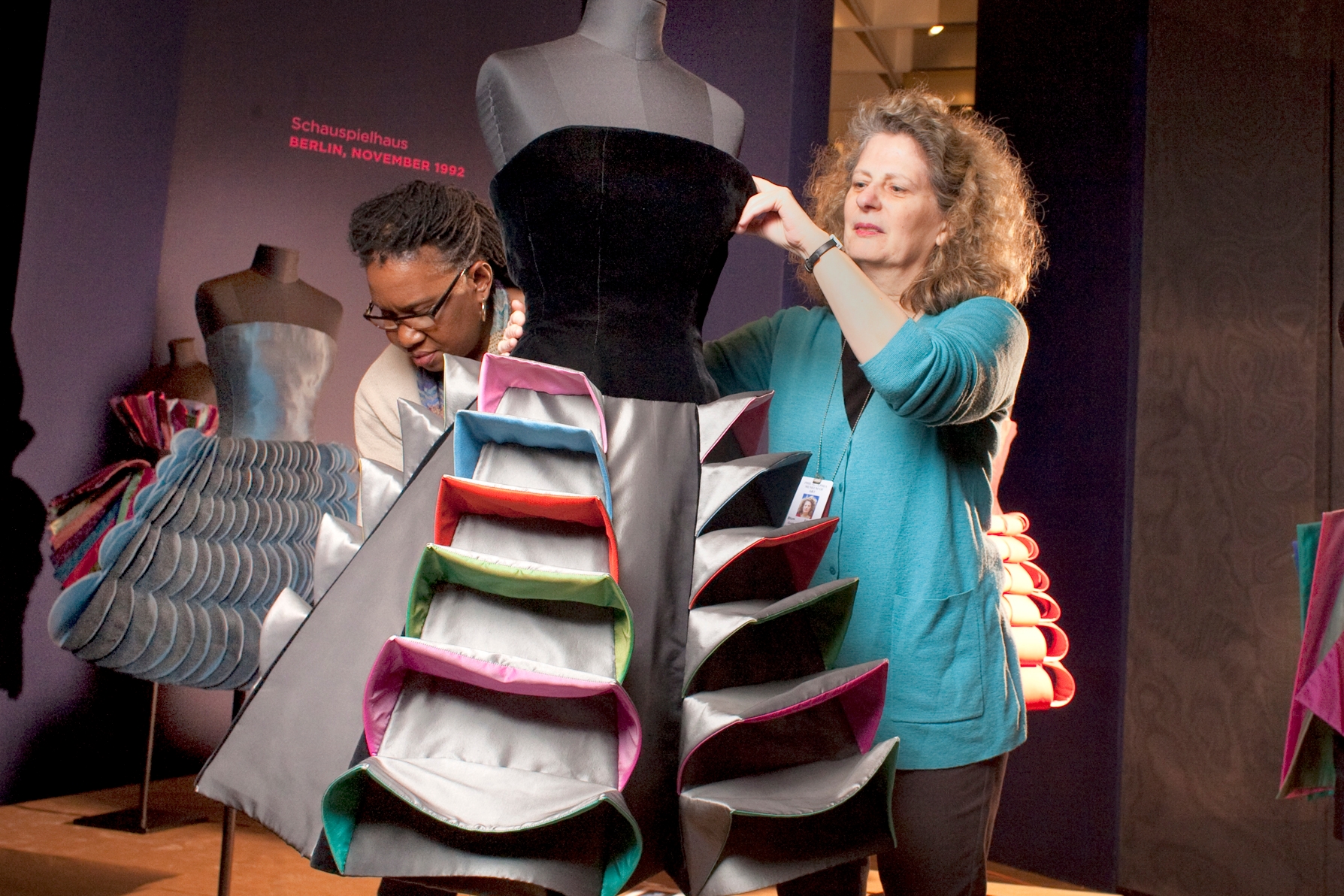
    Ms. Blum (right) and colleague Monica Brown tend to a museum exhibit in 2011.

    In a recent tribute, former museum colleagues marveled at her “technical expertise and cultural insight,” and credited her for reinvigorating the once-neglected textiles collection. Daniel Weiss, director and chief executive officer of the museum, said: “She transformed this museum’s costume and textiles department into a program respected around the world.”

    She told The Inquirer in 1990: “We wanted to remind them that we were here.”

    Before Philadelphia, Ms. Blum was a textile conservator at the Chicago Conservation Center and the Brooklyn Museum, and senior assistant keeper of the costume and textile department at the Museum of London. She earned a bachelor’s degree in art history at Connecticut College and studied afterward at the University of Manchester in England and the Courtauld Institute of Art at the University of London.

    “She was fearless in her pursuit of perfection in her work,” said her sister Galen. Her sister Sydney said: “She was dedicated to her craft and scholarship.”

    Ms. Blum (left) was close to her sisters Sydney (center) and Galen.

    An avid reader and writer, Ms. Blum wrote and cowrote several books about textiles and designers, and 2021’s Patrick Kelly: Runway of Love, coauthored with former colleague Laura L. Camerlengo, earned a 2023 honorable mention publication award from the Costume Society of America. She also wrote essays for exhibition catalogs, served on editorial boards for journals, lectured around the world, and was active with the International Council of Museums, the Association of Art Museum Curators, and other groups.

    In 2025, to celebrate Ms. Blum’s retirement, Camerlengo praised her “deep knowledge, creative vision, and contagious passion for the field.” She said: “Dilys is one of the most influential figures in the world of fashion and textile arts.”

    Ms. Blum’s work and fashion viewpoints were featured often in The Inquirer. In 1997, she said: “People don’t dress up anymore.” In 1999, she said: “I think we’ve lost the joy in dressing. There’s this trend away from clutter in dress and decorating. It’s pared down to the point of visual boredom.”

    In 2001, she said it was easy to differentiate between New Yorkers and Philadelphians. “New Yorkers,” she said, “will invariably be wearing the accessory of the moment, a pashmina shawl, a Kate Spade bag, a Prada loafer.”

    Ms. Blum left “an enduring legacy woven through the art museum and the generations of scholars and visitors who now see costumes and textiles as central to the story of art,” former museum colleagues said.

    Dilys Ellen Blum was born July 11, 1947, in Ames, Iowa. She and her parents moved to Hamilton, N.Y., when she was 1, and the family traveled with her father, an economics professor at Colgate University, on teaching sabbaticals abroad. When she was 12, Ms. Blum spent a year with her parents and sisters living in Norway and touring Europe in a Volkswagen Beetle.

    Her mother was an artist and seamstress, and she and Ms. Blum spent many nights poring over clothes patterns on their dining room table. She enjoyed reading murder mysteries and traveling the world in search of new museum-worthy artifacts.

    She lived in South Philadelphia, was diagnosed with cancer three years ago, and talked often with her sisters on the telephone. “I admired her seriousness and humility,” Sydney said. Galen said: “From my perspective, I was in awe of her.”

    In addition to her sisters, Ms. Blum is survived by a niece, Juniper, and other relatives.

    A memorial service is to be held later.

    Former museum colleagues said Ms. Blum’s writing “consistently amplified the makers and wearers of extraordinary objects, and their intertwined relationships.”
  • ⭐ MLK Day, Restaurant Week deals, and new Mummers band competition|Things to do

    ⭐ MLK Day, Restaurant Week deals, and new Mummers band competition|Things to do

    I’ll be candid. The Eagles’ loss to the San Francisco 49ers was a sting to my winter plans. I looked forward to the crazed tailgates outside the Linc and the wave of excitement each tush-push touchdown generated among our rabid fanbase.

    We were all hoping for a back-to-back Super Bowl run, even when the glaring holes in our offense signaled something far different. Unfortunately, we’ll have to see how things shake up next season. But that doesn’t mean our winter plans should be in the gutter. There are still plenty of things to do this weekend (and beyond) to mend our broken hearts and fill our typical Eagles Sundays.

    Along with Martin Luther King Jr. celebrations throughout the city, restaurant week specials will be in full swing, plus the return of a Wilma Theater favorite, a toast to Ben Franklin’s 320th birthday, and more.

    Read below to see what’s in store this week and beyond.

    — Earl Hopkins (@earlhopkins_, Email me at thingstodo@inquirer.com)

    If someone forwarded you this email, sign up for free here.

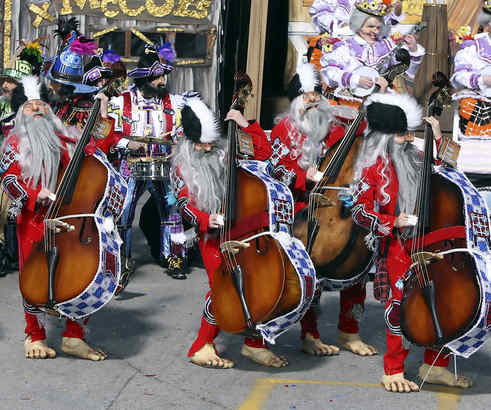
    Sporting a face that sums up the magnetism of mummery Robbie Reid (top), a member of the Froggy Carr comic club, pauses for a moment along the parade route yesterday. At left, the Fralinger String Band performs during the competition judging – it won – at City Hall. And at right, Mayor Nutter appears to be doing a version of the mummers’ strut as he kicks off the string band division yesterday with the Greater Overbrook String Band leading off.

    Mummers string band competition will duke it out at the Linc

    Thirty to 60 mph winds led to a postponement of the Mummers’ string band competition, and put a momentary damper on what was otherwise an extraordinary New Year’s Day. But the string bands may have gotten an even sweeter prize out of the ordeal, according to my colleague Henry Savage.

    The judged string band competition will now take place at 2 p.m. on Jan. 31 at the Linc, parade officials announced last week. The annual competition is still open to the public, with tickets available on Ticketmaster for $12 to $25. It will also be broadcast on WFMZ-TV.

    The best things to do this week

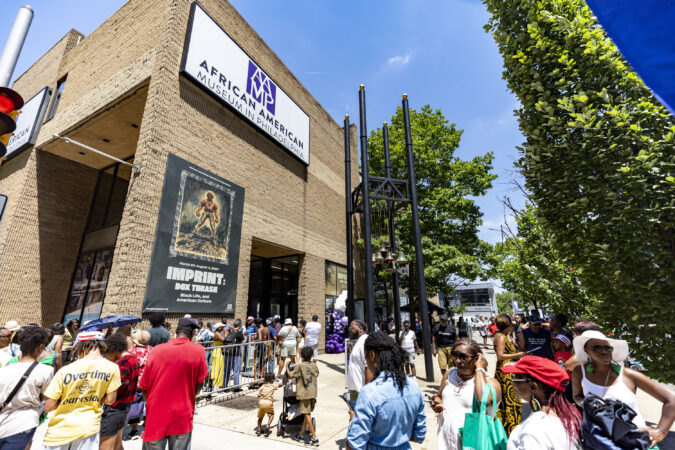
    ⭐ Celebrate MLK: Celebrate civil rights icon, and my dear fraternity brother, Dr. Martin Luther King Jr., at the African American Museum in Philadelphia starting Saturday. AAMP’s “Celebrating MLK 2026: Radical Peace and Public Memory” offers a screening of Selma, art-making, gallery talks, and other family-friendly activity through Jan 19.

    🎉 Ben’s Birthday Bash: Stop by the Franklin Institute to celebrate Ben Franklin’s 320th birthday. The birthday bash for the founding father will be packed with games, music, and a few surprises. Visitors can even hear the song “Happy Birthday” being played on one of Franklin’s own inventions: the glass harmonica.

    🦸🏼‍♂️ Unleash your inner superhero: The Bingo Verifying Divas will step out donning superhero ensembles for Superhero Smash GayBINGO at the Congregation Rodeph Shalom. The crew will bring its typical brand of entertainment and laugh-out-loud comedy, plus some prizes between each round.

    🔍 A watchful eye on this famed detective: For theater-lovers and inquiring minds, Sherlock Holmes: The Great Detective, directed by Bill Van Horn, now runs through Feb. 15 at Walnut Street Theatre.

    📅 My calendar picks this week: Trestle Night Fever Happy Hour Dance Party and Tramp Stamp: Trashy 2000s Party at Kung Fu Necktie.

    Pig Iron Theatre Company’s ‘Poor Judge’ premieres at the 2024 Fringe Festival, running Sept. 11-22 at the Wilma Theater.

    The thing of the week: ‘Poor Judge’ is back

    The brainchild of beloved performer Dito Von Reigersberg (aka Martha Graham Cracker) is now back on stage.

    Pig Iron Theatre Company’s Poor Judge, a story of love, Hollywood ambition, and the darkness of the American success story, returns to Wilma Theater for the first time since its debut two years ago.

    The show, brought to life by the music of Aimee Mann, is running through Jan. 25. Tickets are available at wilmatheater.org.

    Winter fun this week and beyond

    🎭 Final curtain call: Catch the Tony Award-winning musical Suffs, a story chronicling women’s struggles for the right to vote, at the Academy of Music before it closes on Jan. 18.

    🍜 Restaurant Week in Center City: Center City District Restaurant Week returns with a bevy of prix-fixe dinner menus, ranging from $45-$60 at select restaurants, plus two-course lunches for $20 at other nearby eateries. Visit the official website for the full list of participants.

    🥘 Bucks County bites: New Hope and Lambertville join forces for a PA-NJ-style restaurant week through Jan. 25, which includes two dozen restaurants along both sides of the Delaware River.

    🍻 Philly Flurry in Fairmount: Small business in Fairmount, Brewerytown, Francisville, and Spring Garden are offering limited-time promos and discounts on drafts, cocktails, ice cream pints, and food orders through Feb. 1. Here’s a full list of participants.

    Staffer picks

    Pop music critic Dan DeLuca lists the top concerts this weekend and a few holiday pop-up jams happening this month.

    🎸 Thursday: Singer and guitarist Bill Kirchen, best known for their 1972 hit “Hot Rod Lincoln, stops at Sellersville Theater on Thursday. He will perform one set with his band Commander Cody and His Lost Planet Airmen, and another set with his Bob Dylan tribute band.

    🎤 Friday: Long-time soul balladeer Peabo Bryson is on tour, 35 years since his Grammy-winning duet with Celine Dion on the title song for 1991’s Beauty and the Beast. He will be at City Winery on Friday.

    🎤 Saturday: Chuck D and Flavor Flav will be joined by fellow hip-hop legends and R&B acts on Saturday at the Jim Whelan Boardwalk Hall in Atlantic City. Other veteran performers include Montel Jordan of “This Is How We Do It” fame, KRS-One, Sugarhill Gang, Philly’s Schoolly D, and the Furious Five – minus the group’s leader Grandmaster Flash.

    Thanks for sticking with me for another newsletter entry. As I said at the top of the year, some amazing things are happening in 2026, even if our Birds came up short in the playoffs. I’ll do my best to capture the highlights. so tay tuned for more.

    – Earl Hopkins

    Courtesy of Giphy.com
  • Press freedom advocates worry that raid on Washington Post journalist’s home will chill reporting

    Press freedom advocates worry that raid on Washington Post journalist’s home will chill reporting

    If the byproduct of a raid on a Washington Post journalist’s home is to deter probing reporting of government action, the Trump administration could hardly have chosen a more compelling target.

    Hannah Natanson, nicknamed the “federal government whisperer” at the Post for her reporting on President Donald Trump’s changes to the federal workforce, had a phone, two laptops, and a Garmin watch seized in the Wednesday search of her Virginia home, the newspaper said.

    A warrant for the raid said it was connected to an investigation into a government contractor accused of illegally retaining classified government materials, said Matt Murray, the Post’s executive editor, in an email to his staff. The Post was told that Natanson and the newspaper are not targets of the investigation, he said.

    In a meeting Thursday, Murray told staff members that “the best thing to do when people are trying to intimidate you is not be intimidated — and that’s what we did yesterday.”

    The Reporters Committee for Freedom of the Press said Thursday it has asked the U.S. District Court in Virginia to unseal the affidavit justifying the search of Natanson’s home.

    Attorney General Pam Bondi said that the search was done at the request of the Defense Department and that the journalist was “obtaining and reporting classified and illegally leaked information from a Pentagon contractor.”

    “If the attorney general can describe the justification for searching a reporter’s home on social media, it is difficult to see what harm could result from unsealing the justification that the Justice Department offered to this court,” the Reporters Committee said in its application.

    Government raids to homes of journalists highly unusual

    Jameel Jaffer, executive director of the Knight First Amendment Institute at Columbia University, has been working on press freedom issues for a decade and said a government raid on a journalist’s home is so unusual he couldn’t remember the last time it happened. He said it can’t help but have a chilling effect on journalism.

    “I strongly suspect that the search is meant to deter not just that reporter but other reporters from pursuing stories that are reliant on government whistleblowers,” Jaffer said. “And it’s also meant to deter whistleblowers.”

    In a first-person piece published by the Post on Christmas Eve, Natanson wrote about how she was inundated with tips when she posted her contact information last February on a forum where government employees were discussing the impact of Trump administration changes to the federal workforce.

    She was contacted by 1,169 people on Signal, she wrote. The Post was notably aggressive last year in covering what was going on in federal agencies, and many came as a result of tips she received — and was still getting. “The stories came fast, the tips even faster,” she wrote.

    Natanson acknowledged the work took a heavy toll, noting one disturbing note she received from a woman she was unable to contact. “One day, a woman wrote to me on Signal, asking me not to respond,” she wrote. “She lived alone, she messaged, and planned to die that weekend. Before she did, she wanted at least one person to understand: Trump had unraveled the government, and with it, her life.”

    Natanson did not return messages from the Associated Press. Murray said that “this extraordinary, aggressive action is deeply concerning and raises profound questions and concern around the constitutional protections for our work.”

    The action “signals a growing assault on independent reporting and undermines the First Amendment,” said Tim Richardson, journalism and disinformation program director at the advocacy group PEN America. Like Jaffer, he believes it is intended to intimidate.

    Sean Spicer, Trump’s press secretary at the beginning of his first term, said the concerns are premature. If it turns out that Natanson did nothing wrong, then questions about whether the raid was an overreach are legitimate, said Spicer, host of the political news show The Huddle on streaming services.

    “If Hannah did something wrong, then it should have a chilling effect,” he said.

    A law passed in 1917 makes it illegal for journalists to possess classified information, Jaffer said. But there are still questions about whether that law conflicts with First Amendment protections for journalists. It was not enforced, for example, when The New York Times published a secret government report on U.S. involvement in Vietnam in 1971.

    “It’s the government’s prerogative to pursue leakers of classified material,” the Post said in an editorial. “Yet journalists have First Amendment rights to gather and publish such secrets, and the Post also has a history of fighting for those freedoms.”

    Not the first action taken against the press

    The raid was made in context of a series of actions taken against the media during the Trump administration, including lawsuits against The New York Times and the BBC. Most legacy news organizations no longer report from stations at the Pentagon after they refused to sign on new rules restricting their reporting set by Defense Secretary Pete Hegseth. Funding for public broadcasting has been choked off due to Trump’s belief that its news coverage leaned left.

    Some news outlets have also taken steps to be more aligned with the administration, Jaffer said, citing CBS News since its corporate ownership changed last summer. The Washington Post has shifted its historically liberal opinion pages to the right under owner Jeff Bezos.

    The Justice Department over the years has developed, and revised, internal guidelines governing how it will respond to news media leaks. In April, Bondi issued new guidelines saying prosecutors would again have the authority to use subpoenas, court orders and search warrants to hunt for government officials who make “unauthorized disclosures” to journalists.

    The moves rescinded a policy from President Joe Biden’s Democratic administration that protected journalists from having their phone records secretly seized during leak investigations.

    “Leaking classified information puts America’s national security and the safety of our military heroes in serious jeopardy,” White House press secretary Karoline Leavitt said in a post on X. “President Trump has zero tolerance for it and will continue to aggressively crack down on these illegal acts moving forward.”

    The warrant says the search was related to an investigation into a system engineer and information technology specialist for a government contractor in Maryland who authorities allege took home classified materials, the Post reported.

    The worker, Aurelio Perez-Lugones, is accused of printing classified and sensitive reports at work, and some were found at his Maryland home, according to court papers. He was arrested last week on a charge of unauthorized removal and retention of classified documents.

    Perez-Lugones made a brief appearance in a Baltimore courtroom on Thursday. His attorney said they weren’t prepared to proceed with a hearing to determine whether he should remain jailed until a trial.

  • David Lynch called Philadelphia one of ‘the sickest, most corrupt, fear-ridden’ cities. That’s what makes it Lynchian.

    David Lynch called Philadelphia one of ‘the sickest, most corrupt, fear-ridden’ cities. That’s what makes it Lynchian.

    When filmmaker David Lynch moved to Philadelphia in 1965 to attend the erstwhile Pennsylvania Academy of the Fine Arts, he was instantly moved by the city. Though not exactly charmed.

    The city’s crime, corruption, and urban blight impressed themselves on the young artist’s mind and lent to his uncanny vision combining the sinister and the absurd. The Twin Peaks creator, however, only spent a short time living in the city.

    By 1970, he had decamped to Los Angeles to study at the American Film Institute and work on his first feature, the cult classic Eraserhead.

    But Lynch’s relatively abridged tenure as a Philadelphian has had an outsized impact. Consider him the Terrell Owens of Philly weirdo transplant artists.

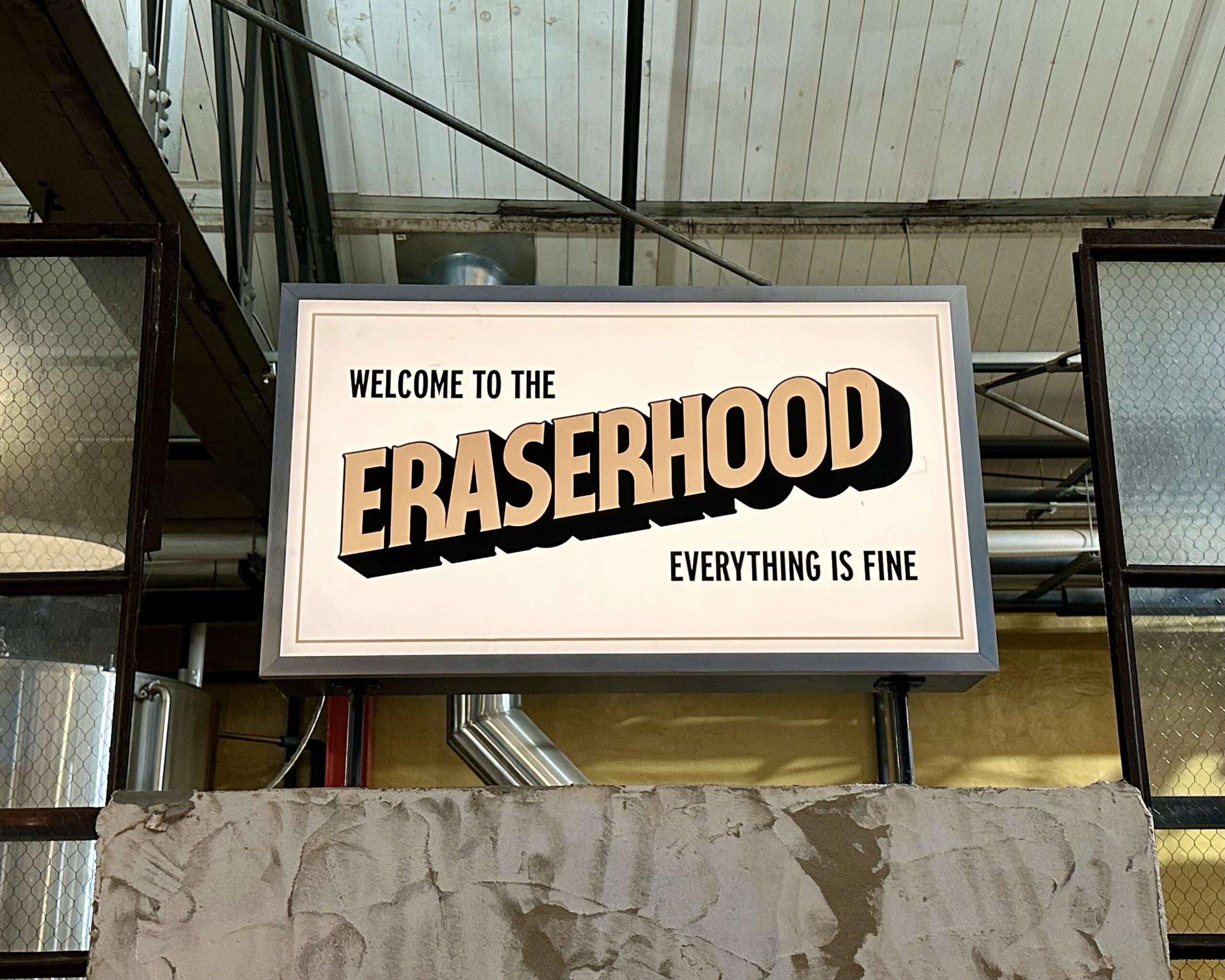
    A sign at Callowhill’s Love City Brewery nods to David Lynch’s film “Eraserhead.”

    In the year since his passing, retrospectives of his films have dominated programming at Philadelphia rep cinemas and art houses, Callowhill (where Lynch used to live and work) got a makeover as “Eraserhood,” and the neighborhood’s Love City Brewing’s hazy “Eraserhood IPA” grew in popularity.

    Now, a new podcast is digging deeper into Lynch’s influence on Philadelphia, exploring the extent to which the city impressed itself upon his life and work — from PAFA to Hollywood to the soapy subterfuges of the Twin Peaks universe.

    Launched Jan. 15 (the first anniversary of the filmmaker’s passing), Song of Lynchadelphia explores, in the words of host Julien Suaudeau, “the encounter of the 1950s American innocence with a place where the dream had already, and very concretely, turned into a nightmare.”

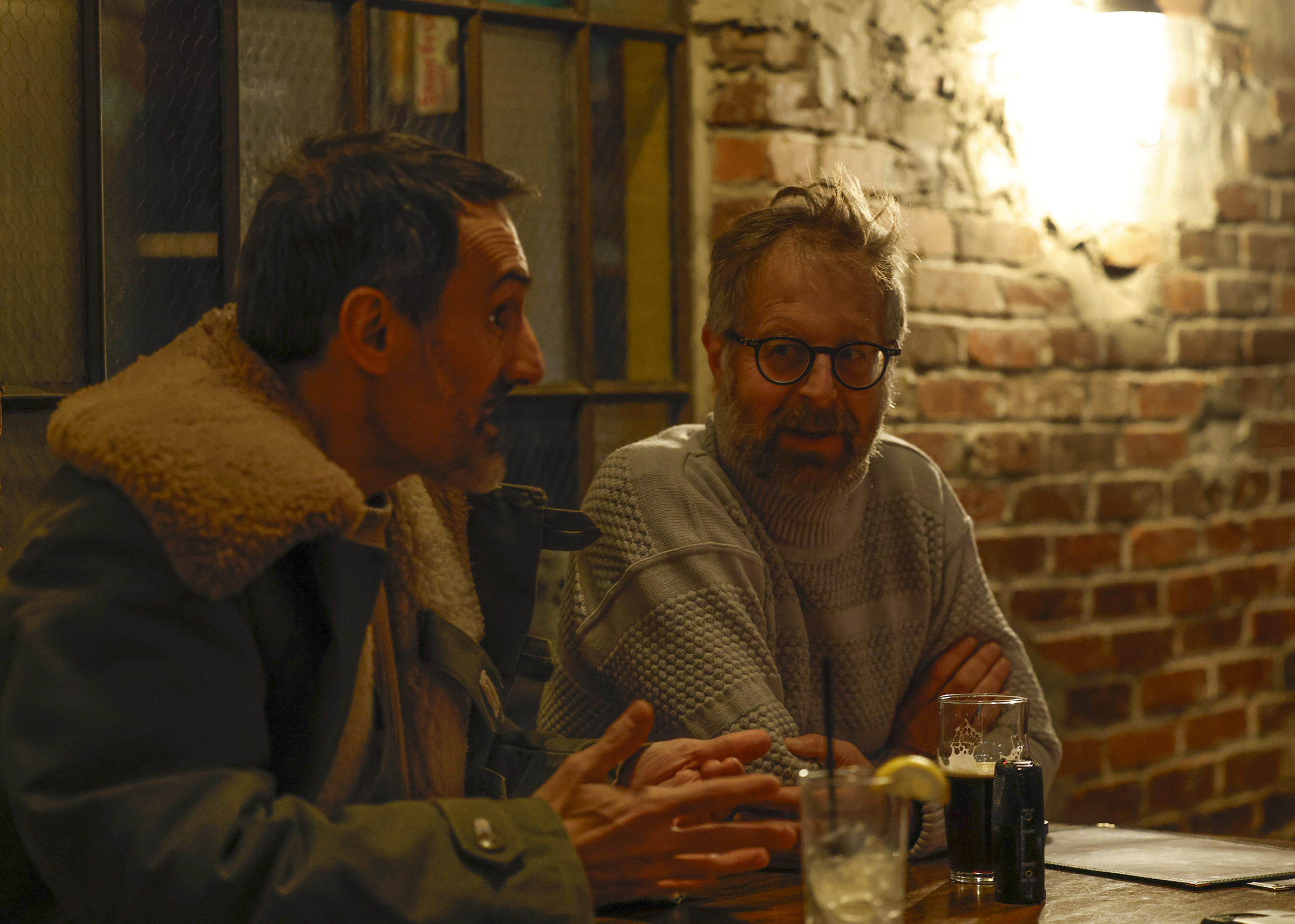
    Hidden City supervising producer Nathaniel Popkin (right) and Julien Suaudeau discuss their podcast investigating how David Lynch invented a “cinematic language of fear and strangeness in Philadelphia” on Monday, December 15, 2025.

    For Suaudeau, a writer and scholar who teaches film at Bryn Mawr College, Philadelphia served as a creative catalyst for Lynch. Many great cities inspire, whether in their beauty, their scale, or deep history. Philadelphia, which Lynch called “one of the sickest, most corrupt, decadent, fear-ridden cities that exists.” The filmmaker was enamored with its crime and filth in the mid-1960s.

    “He was traumatized by Philly,” Suaudeau said, over drinks at Love City Brewing. “And he turned that trauma into art, something both beautiful and strange.”

    A Parisian native who moved to the region to teach, Suaudeau felt drawn to Philadelphia, and to Lynch, early in life. As an adolescent living in France, he responded to the anxious, hysterical, at-times deeply disturbing depiction of teenage life offered by Twin Peaks.

    At the same time, he fell in love with the ‘70s Philly Soul sound, and admired (then) 76er Charles Barkley. (Suaudeau played power forward in high school and, like Barkley, was also considered undersized.)

    “I didn’t know about Lynch’s foundational years in Philly,” he said, “but that convergence feels so meaningful to me today.”

    Song of Lynchadelphia grows out of Song of Philadelphia, a podcast produced by the local public history project Hidden City, which curates the “Eraserhood Tours” in Callowhill.

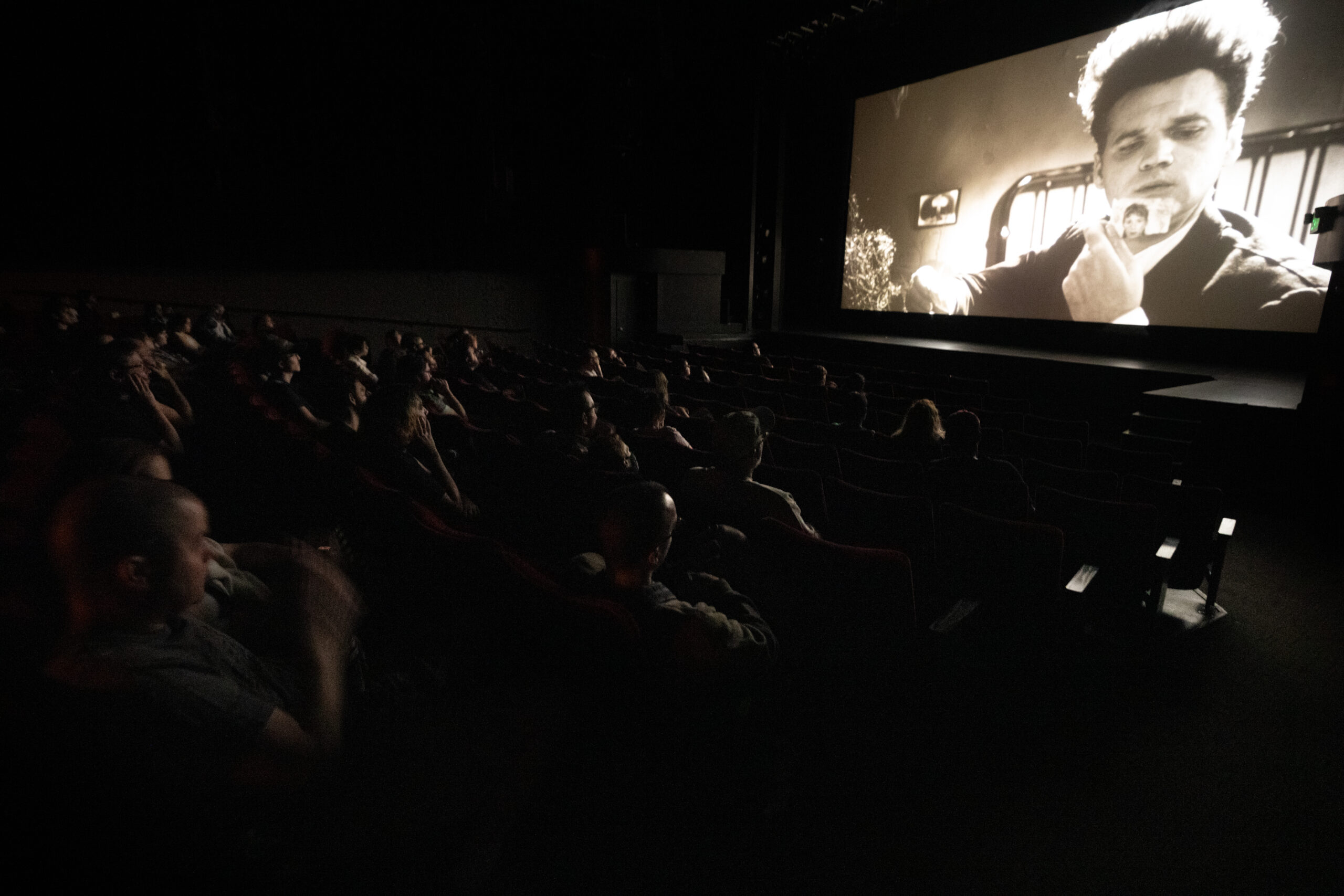
    Audience members watch “Eraserhead” by David Lynch at the Film Society Center, in Philadelphia, Oct. 5, 2025.

    The new series explores the city’s secret stories through a distinctly warped Lynchian lens.

    The first episode looks into Lynch’s rather despairing comments on the Philadelphia of his artistic adolescence, a place of “insanity” possessed by a “beautiful mood.” Through interviews with local fans, historians, and Lynch’s collaborators (including production designer Jack Fisk, one of Lynch’s longtime collaborators and a PAFA classmate), archival clips, and distinctly Lynchian soundscapes, Suaudeau guides the listener through Lynch’s relationship with the city.

    “We’re always interested in origins, especially among creative people,” said author and Hidden City cofounder Nathaniel Popkin, who serves as Song of Lynchadelphia’s supervising producer. “There is a darkness that is particularly important [in Philadelphia]. It was a place imagined to have brought light in the 18th century. And it got dark, real fast.”

    A historian interviewed in the series’ first episode cites deindustrialization, white flight, racism, rioting, and rising crime as sources of that creeping darkness.

    This curdling of the so-called American dream, so key to Lynch’s filmography, also defines Philadelphia in the period of the director’s artistic awakening. Popkin notes Lynch was living in Philly around the same time as Ira Einhorn, the rabble-rousing environmental activist who was arrested after his former girlfriend’s remains were found decomposing in a suitcase in his closet.

    In this Jan. 9, 2017, file photo, filmmaker David Lynch attends the “Twin Peaks” panel at the Showtime portion of the 2017 Winter Television Critics Association press tour in Pasadena, Calif. (Photo by Richard Shotwell/Invision/AP, File)

    Einhorn would claim he was set up by the CIA, because he knew too much about their top secret paranormal mind-control experiments, a defense that could be ripped from a Twin Peaks episode.

    This very “Philly” feeling of weirdness and unease, Suaudeau said, permeates Lynch’s work, well beyond the early shorts he made here.

    A character in Twin Peaks calling a cadaver a “smiling bag” dates back to a late-night tour a young Lynch took of a Philadelphia morgue. Visions of soot-covered buildings reveal themselves, decades later, in a particularly nightmarish encounter in Mulholland Drive. Laura Dern’s hard-drinking, no-nonsense character Dianne in The Return lives in Philly and, as Suaudeau puts it, “is the kind of person you would meet in a Philadelphia bar.”

    In Twin Peaks, Suaudeau believes that Lynch reveals the city as a kind of dreamscape. In the series and accompanying 1992 feature film, Lynch casts himself as a good-natured (and doornail-deaf) FBI director, operating out of the bureau’s Philadelphia offices.

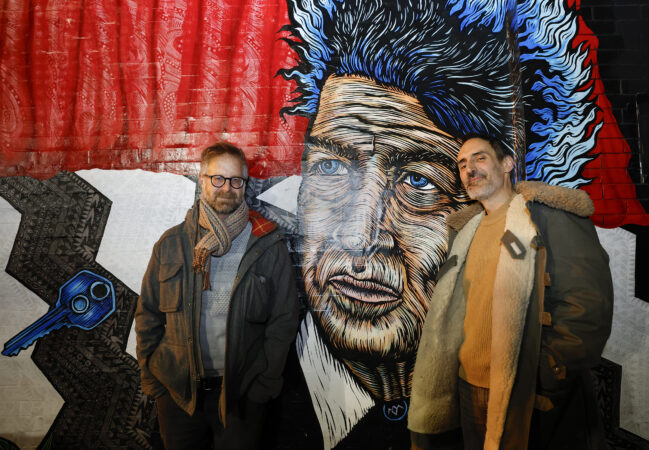
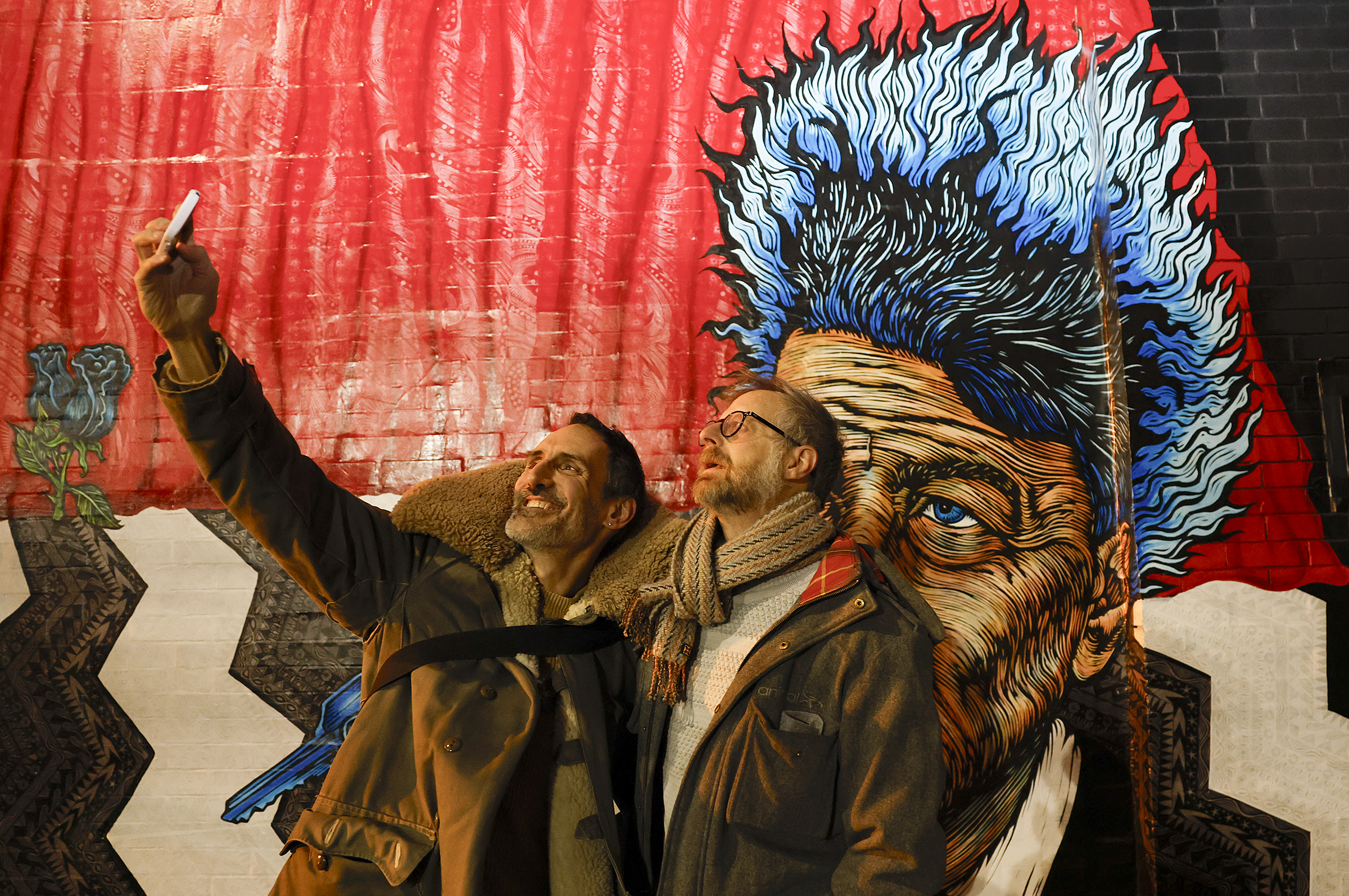
    Julien Suaudeau (left) takes a selfie with Hidden City supervising producer Nathaniel Popkin at the David Lynch mural outside of Love City Brewing on Monday, December 15, 2025.

    “Philadelphia is the head space of the director,” Suaudeau said. “It’s the room to dream.”

    The idea of Philadelphia as a great American city, once shining like a beacon-on-the-hill, that had gone to seed by the time of Lynch’s arrival, is itself Lynchian, as a metropolis perched on the porous boundary between dream and nightmare.

    “He’s interested in crawling beneath the veneer, beneath the surface,” Suaudeau said. “It’s a mood, it’s an atmosphere, it’s an aura in his work.”

    “Song of Lynchadelphia” launched Jan. 15. “Dreams & Nightmares: A David Lynch Marathon,” an eight-hour Lynch marathon will take place in Phoenixville’s Colonial Theatre on Jan. 18, 11 a.m., thecolonialtheatre.com. A screening of “Eraserhead” followed by a talk-back with Julien Suaudeau is Feb. 21 at the Bryn Mawr Film Institute, 824 W. Lancaster Ave., Bryn Mawr. brynmawrfilm.org

  • All-you-can-eat pasta, speed dating for seniors, Fastnacht Day, and more: Allentown’s Amanda Seyfried introduces Stephen Colbert to the best of her hometown

    All-you-can-eat pasta, speed dating for seniors, Fastnacht Day, and more: Allentown’s Amanda Seyfried introduces Stephen Colbert to the best of her hometown

    Actor Amanda Seyfried put a major spotlight on her hometown of Allentown during her appearance on The Late Show with Stephen Colbert this week.

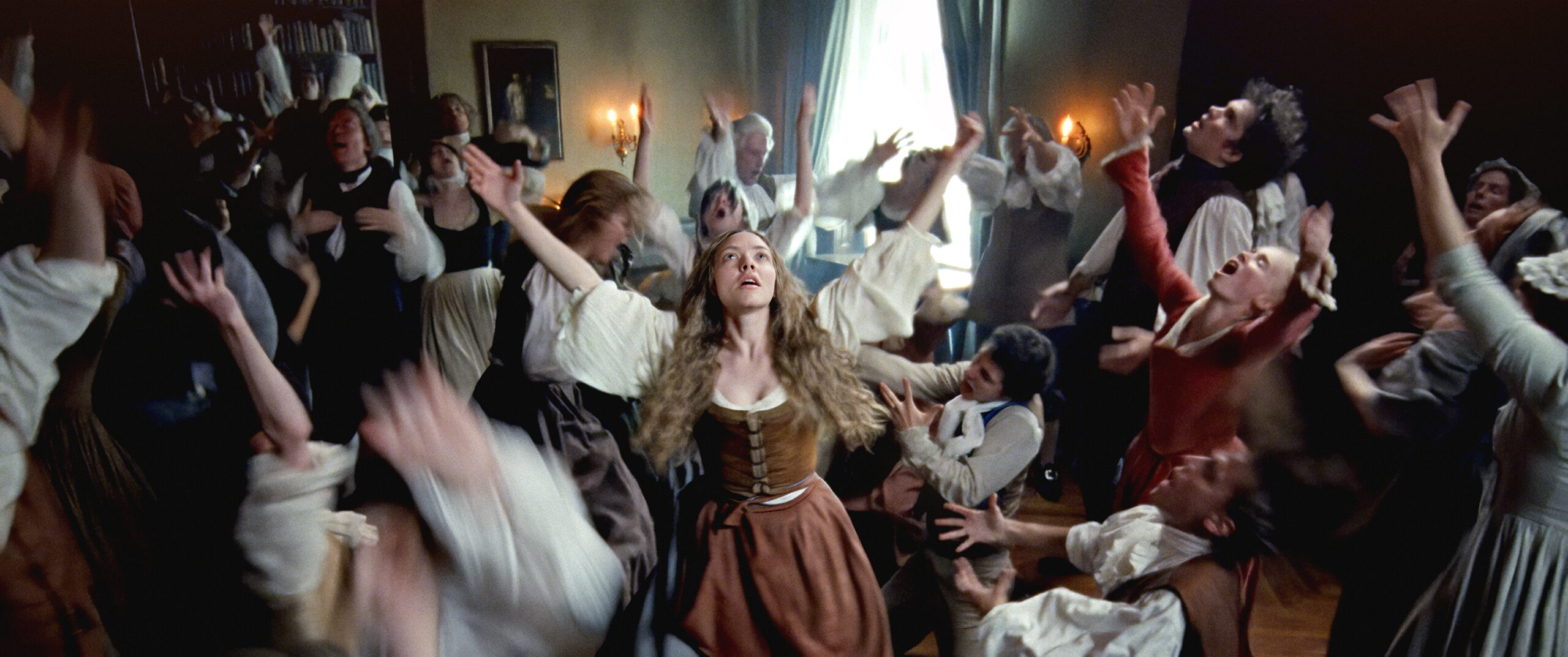
    Following the Golden Globes — where she was nominated for best actress in a mini-series for Kensington-set show Long Bright River and best actress in a musical or comedy movie for her recent film, The Testament of Ann Lee — Seyfried discussed the real-life historical figure she played. Lee founded the Shakers religious group in the 18th century.

    But before that, she spent a few minutes joking about Allentown.

    Colbert’s recurring Community Calendar segment invites celebrity guests from small towns to advertise “actual events that are actually happening in and around their actual hometowns,” the host explained. Previous featured guests were Nick Offerman, Melissa McCarthy, Adam Driver, and Wilmington native Aubrey Plaza.

    Seyfried joined Colbert on a set reminiscent of old talk show sets from public access TV (complete with grainy camera quality) to hype happenings in Allentown and greater Lehigh County.

    “As we like to say, you’ll be ‘all in’ on All-entown,’ said Seyfried.

    As Ann Lee, Amanda Seyfried portrays a woman at the center of the Shaker religious movement in America. William Rexer/Searchlight Pictures

    The pair highlighted several local businesses and quirky events, including Colonial Pizza Easton’s all-you-can-eat pasta Wednesdays, a board game night at Quakertown’s Naugle Funeral & Cremation Service, speed dating for seniors at Tipsy’s Bar & Lounge, and a pirate-themed murder mystery at Stony Run Winery.

    “As always, the killer is scurvy,” Seyfried quipped.

    At Easton’s State Theatre, Seyfried added, audiences can see the Naked Magicians next month. “Come for the jokes about a ‘magic wand,’ stay to see where they pull a rabbit out of,” she said.

    The Mamma Mia star also shouted out the Pennsylvania Dutch tradition Fastnacht Day.

    “Celebrate the last day before Lent by heading to Mary Ann Donut Kitchen for Fastnacht Day, where you can enjoy some traditional Pennsylvania Dutch treats made with lard, sugar, fat, butter, and sometimes potatoes — which is why all the items come with the warning, ‘May contain trace amounts of vegetable,’” she said.

    “Well it’s not everyday that we are mentioned on national television!” wrote the bakery on Facebook. “Thank you and we love you, Amanda!”

    Seyfried concluded the segment with another funny fictional saying: “As we like to say, you don’t have to be high to love Lehigh. But it doesn’t hurt!”

  • She moved home and started whispering about Wawa. Then she went viral.

    She moved home and started whispering about Wawa. Then she went viral.

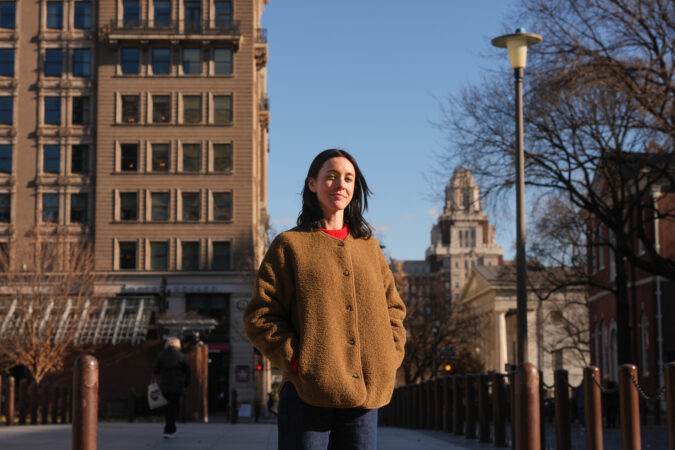
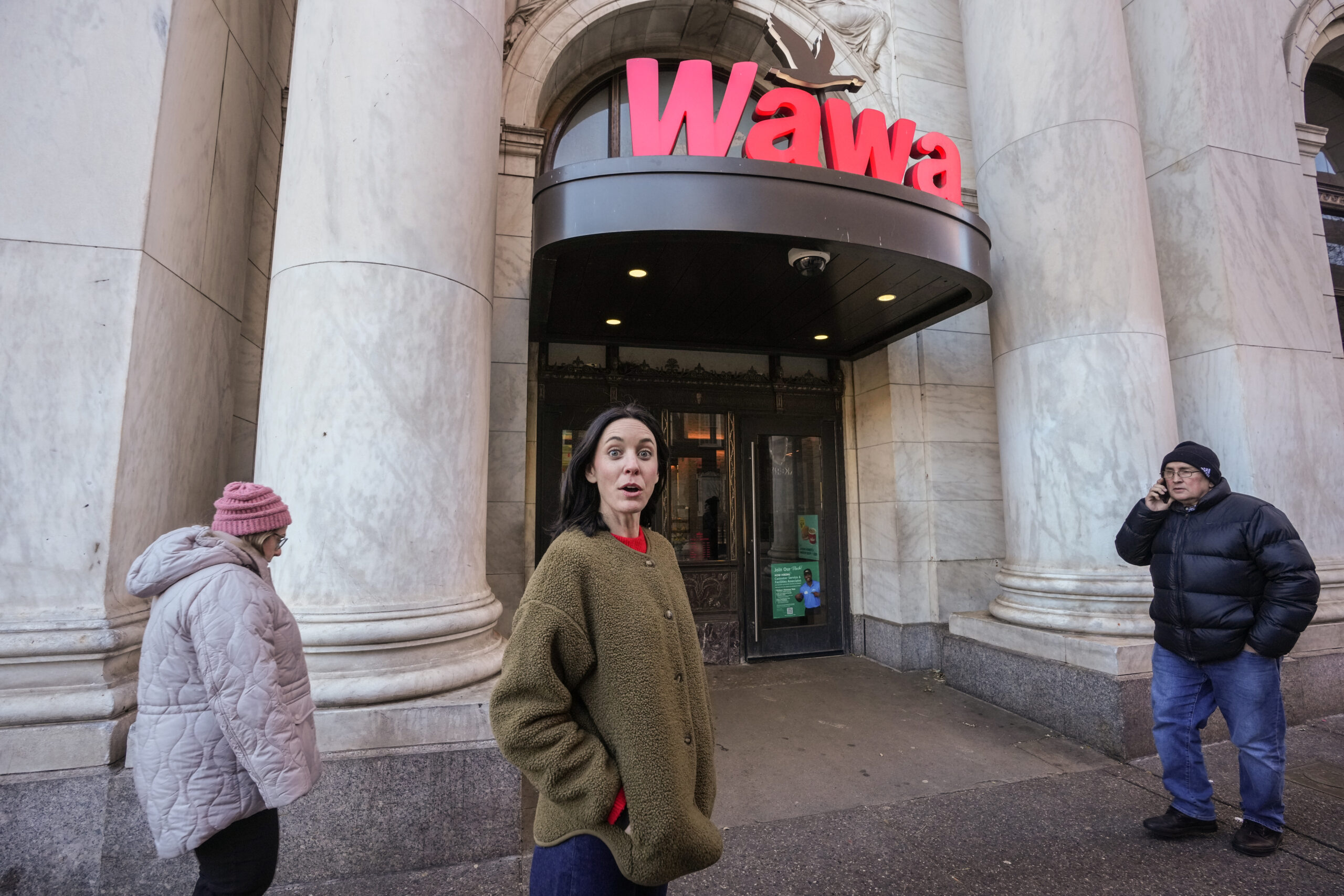
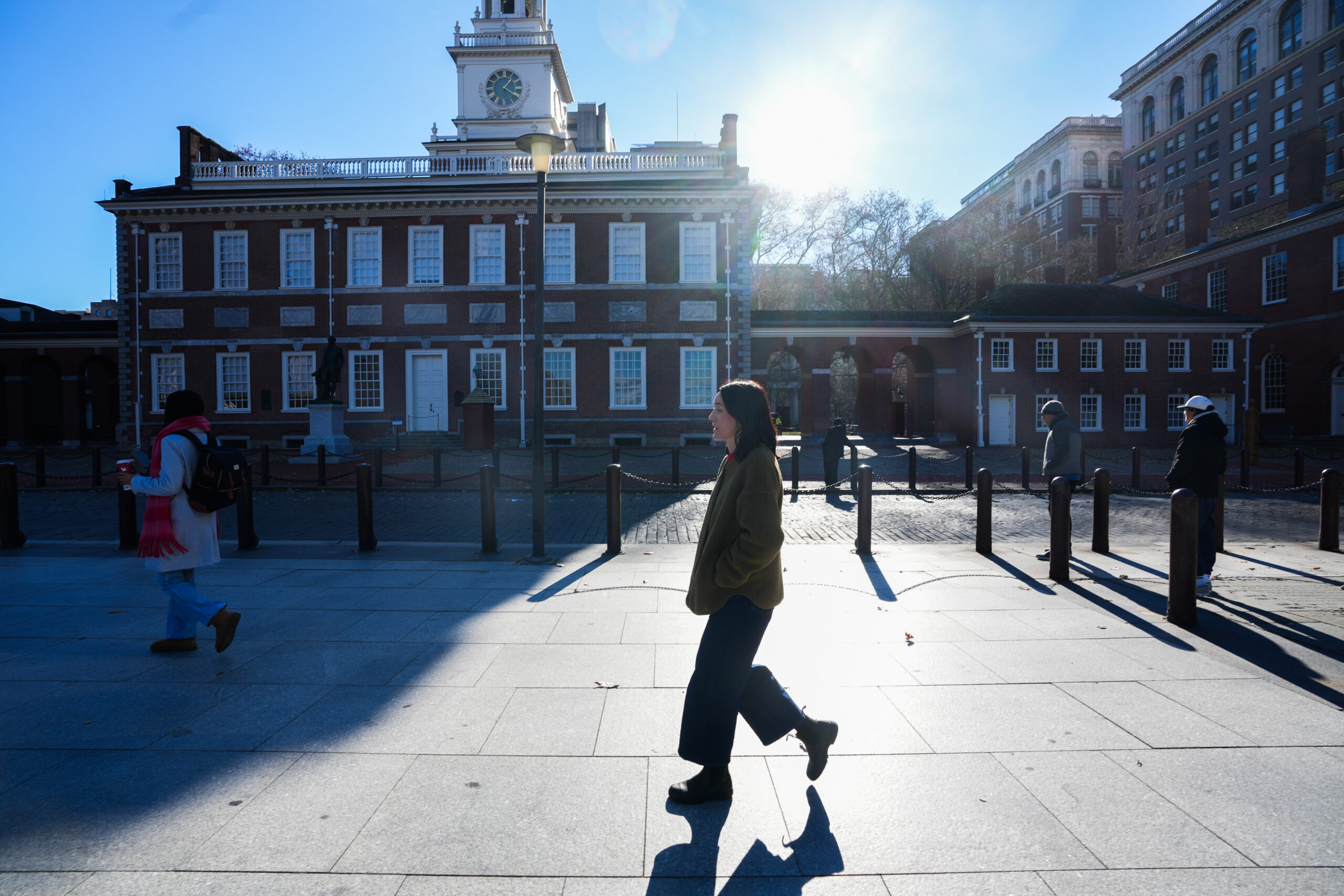
    Of all the things Betsy Kenney thought she might go viral for, whispering about Wawa wasn’t one of them. But the 38-year-old comedian’s Philly “ASMR” videos have taken off on TikTok and Instagram, turning Kenney — who spent more than a decade pursuing a comedy career in New York City — into an unlikely local celebrity.

    If you aren’t familiar with ASMR, which stands for Autonomous Sensory Meridian Response, it’s a relaxing sensation triggered by soft sounds or repetitive patterns. People watch ASMR videos of soft tapping, scratching, whispering, or crinkling to unwind. A video of someone getting a scalp massage? Pure bliss. A video of someone with a strong Philly accent asking if you know their cousin while scraping a spoonful of Rita’s water ice? Less so. And therein lies the joke. “People find the Philly accent to be like nails on a chalkboard,” Kenney said. “And I thought it would be funny to combine the two.” The contrast clicked immediately.

    Kenney’s videos have racked up millions of views, circulating through group chats and comment sections thick with recognition and debate. They’ve drawn fans far beyond the region and even earned an endorsement from Kylie Kelce, who rated Kenney’s Philly accent an 11. For Kenney, the sudden attention has been somewhat surreal, considering it only arrived after she stopped chasing it.

    Betsy Kenney, the woman behind Philly ASMR, in Philadelphia, December 11, 2025.

    For years, she had been grinding through the familiar comedy circuit in New York. She took improv classes at the Upright Citizens Brigade, acted in commercials to stay afloat, and wrote constantly. “I really wanted to do comedy as a living,” Kenney said. “And it turns out it’s really hard.” There were moments of traction. Kenney and her writing partner had a short film debut at the Tribeca Film Festival. They created a web series that was acquired by IFC. They hosted a podcast that found a sizable audience. “That was big,” she said. But none of it added up to stability. Then came COVID, two babies, and a move to Kenney’s hometown of Philadelphia, a return that quietly reshaped how she worked.

    Back home, the pressure shifted. Kenney was no longer measuring every idea against an imagined career outcome. She was tired, busy, and short on time, and that looseness made room for something new. In September, she posted her first TikTok: an impression of “Phillies Karen,” aka the lady who stole a baseball from a kid at a Phillies game. It went viral. Before that, she said, she’d always been too self-conscious to post comedy online. Now, with less to prove and less time to overthink, she kept going.

    She began posting whenever inspiration struck. Ideas surfaced in the slivers of time she had to herself, like in her car after school drop-off, or before pickup. Some of her best brainstorming happens in the shower, which is why her hair is often still wet in her videos. “I’m not trying to do a soaking wet Kim K thing,” Kenney said. “It’s literally the only time I have.” (Kenney is a full-time parent.)

    A few days after “Phillies Karen” took off, she posted her first Philly ASMR video. Then came her impression of Ms. Rachel if she were from Philly. She tried non-Philly bits, too, but they didn’t land the same way. Viewers were clearly responding to the specificity of her hometown voice.

    Betsy Kenney, the woman behind Philly ASMR, in Philadelphia, December 11, 2025.

    Kenney isn’t the only creator to build a fan base on the back of the Philly accent. There’s also Olivia Herman, whose no-nonsense impression of a Philly mom has attracted over 200,000 followers and a brand deal with Burlington Coat Factory. But where Herman leans into parody, Kenney aims for recognition. The humor doesn’t come from exaggerating the accent, but from treating it as ordinary. That’s no small task considering how difficult the Philly accent is to fake. “It has one of the most complex vowel systems of American English dialects,” said Betsy Sneller, a professor of linguistics at Michigan State University, which makes it difficult to imitate if you didn’t grow up with it.

    Kenney did. She was born and raised in Northeast Philadelphia by two parents from the area. “Philly is all I knew,” she said. Sneller said that familiarity is evident in Kenney’s use of Philly-specific phrasing — “it’s so expensive anymore,” “youse” — and regional slang and cultural references like Mom-moms, bo-bos, and the Roosevelt Mall. “There’s such an identifiable feeling of place,” Sneller said. “It feels so specific.”

    In fact, Kenney has found that the more specific she is, the more people connect with her work. In the comments section of a video where she asks which parish “Father John ended up at,” viewers pile on with recognition. “Wow, so we all had a Father John then, lol,” wrote one. “We all Father John in eastern PA,” wrote another. Even the Eagles chimed in: “My kinda ASMR.”

    Now that she’s back in Philadelphia, the specific details her audience loves are easier to access. Kenney improvises most of her videos, following associations as they surface. So a trip to Franklin Mills might trigger a memory about a childhood birthday, which turns into a video about Stock’s pound cake. Her family is another steady source of material, especially her father, who works in a Philly courtroom as a stenographer and comes over every week with fresh stories. “If I ever need inspiration,” Kenney said, “there it is.”

    Back home, surrounded by the people and places that fuel the work, Kenney isn’t in a hurry to turn her TikTok success into something bigger. She isn’t chasing the next step the way she once did in New York. “This is the first time in my comedy career that I’m just having fun,” she said. “And now that I’m back in Philly, and that’s what’s blowing up, I’m just really happy.”