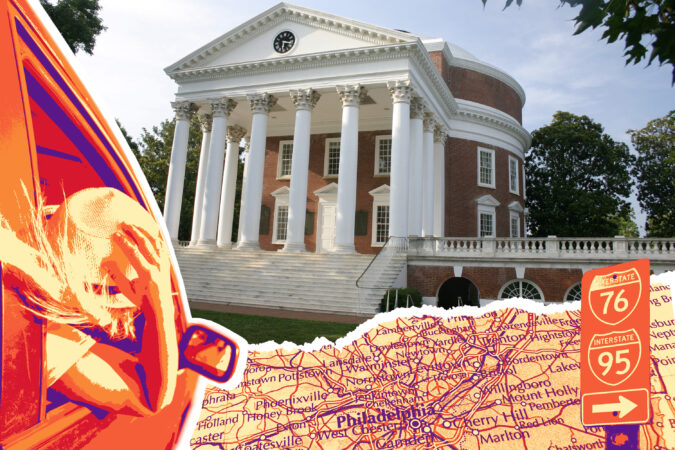
Nestled in the foothills of the Blue Ridge Mountains, Charlottesville is ready for spring. The season there comes a little earlier than ours — cherry blossoms popping, birds trilling — so those planning a March getaway should consider the Virginian city, where the weather is often mild enough to spend serious time outside. Rails and walking paths wind like shoelaces through downtown and into the surrounding countryside. As a university town, C’ville is also packed with arts, music, shopping, and dining, and Thomas Jefferson’s Monticello estate sits just on the outskirts of town, high on a hill.
The first stop in town, Oakhurst Cafe, announces you’ve arrived in the South with a house-baked buttermilk biscuits layered with country ham, apple butter and mustard. There’s also strawberry shortcake French toast, sweet potato hash with chorizo and fresh-fried beignets, served in a sunny room whose generous windows make the tangerine walls and hardwood floors gleam.
📍 1616 Jefferson Park Ave, Charlottesville, Va. 22903
Stay: Graduate Charlottesville
Charlottesville is a college town, with the University of Virginia’s idyllic and historic campus right downtown. Lean into it and stay at the Graduate, a newer property from the collegiate-themed brand under the Hilton umbrella. Opened in 2015, the hotel is still super fresh, with a game room, scenic rooftop, and rooms dressed in soothing blue walls, Cavalier-print curtains, and bolster pillows embroidered with “Wah-hoo-wa,” the university’s sports cheer.
A short walk from the Graduate, Charlottesville’s pedestrian Downtown Mall offers a solid orientation to the city’s commercial core. Visit shops like C’Ville Arts, a co-op gallery representing over 50 Virginia artists, or catch a show at the historic Paramount Theater, which opened in 1931, closed in 1974, and reopened after a $17-million restoration in 2004. When the biscuit craving returns, hit Miller’s Downtown for lunch. It’s famous for the Charlottesville Nasty chicken biscuit, but the pimento-cheese BLT is the actual move.
📍 East Main Street, between Second Street NW and Ninth Street NE, Charlottesville, Va.
Whether you think history is a snooze or can quote Hamilton from memory — “Thomas Jefferson’s coming home!”— Monticello is must-visit. Set on 2,500 bucolic acres, the estate features multiple exhibits inside, outside, and even beneath the mansion, with thoughtful attention paid to the enslaved people who worked Jefferson’s plantation, including Sally Hemings, with whom he fathered six children.
Beyond the landscaped gardens of Monticello proper, the fairytale woods and meadows of the estate beg for exploring. The Saunders-Monticello Trail is an easy lift for all activity levels, with a maximum 5% incline and two miles of wheelchair-accessible paved paths and boardwalks winding through forest and over ravines. Stop at Carter Overlook for panoramic views of Charlottesville and the Blue Ridge Mountains.
📍 Parking: 503 Thomas Jefferson Pkwy., Charlottesville, Va. 22902
Drink: Blenheim Vineyards
Dave Matthews Band got its start in Charlottesville, gigging at Miller’s on the mall and other stages around town. Though the singer now lives in Seattle, he maintains a strong connection to Virginia. One touchpoint is his winery, Blenheim Vineyards, situated on 32 acres of rolling chartreuse hills stitched with sauvignon blanc, chardonnay, and albarino vines. Giant windows in the wood-clad A-frame frame the landscape during guided tastings of five wines (just $25). Consider this your predinner drinks.
Back downtown, Smyrna’s oysters with ramp mignonette, hamachi crudo with anise-compressed melon, and manti dumplings dabbed with garlic yogurt earned chef Tarik Sengul a semifinalist nod from the James Beard Foundation this year. You’ll have to wait till April to find out if he advances to the finalist round of the awards — making right now an ideal time to check this sharp Aegean restaurant out for yourself.
MILAN, Italy — A popular stop for Winter Olympics spectators when they’re not at a sporting venue is an opera house.
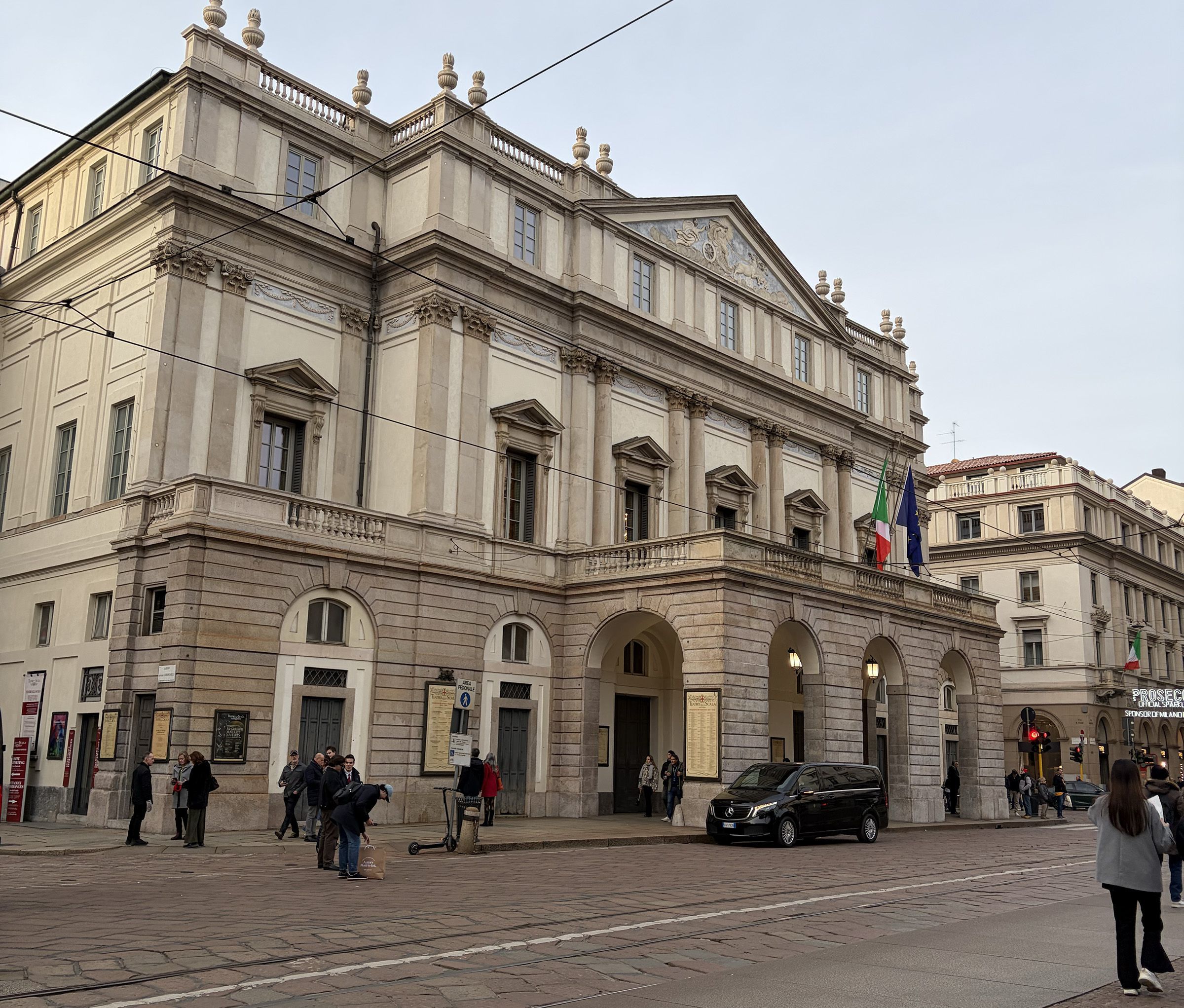
Teatro alla Scala, better known as La Scala, is one of the most famous ones in the world. Maria Callas rose to fame there; Franz Liszt’s piano is in its museum. The opera house, which opened in 1778, is the heart of Italian opera.
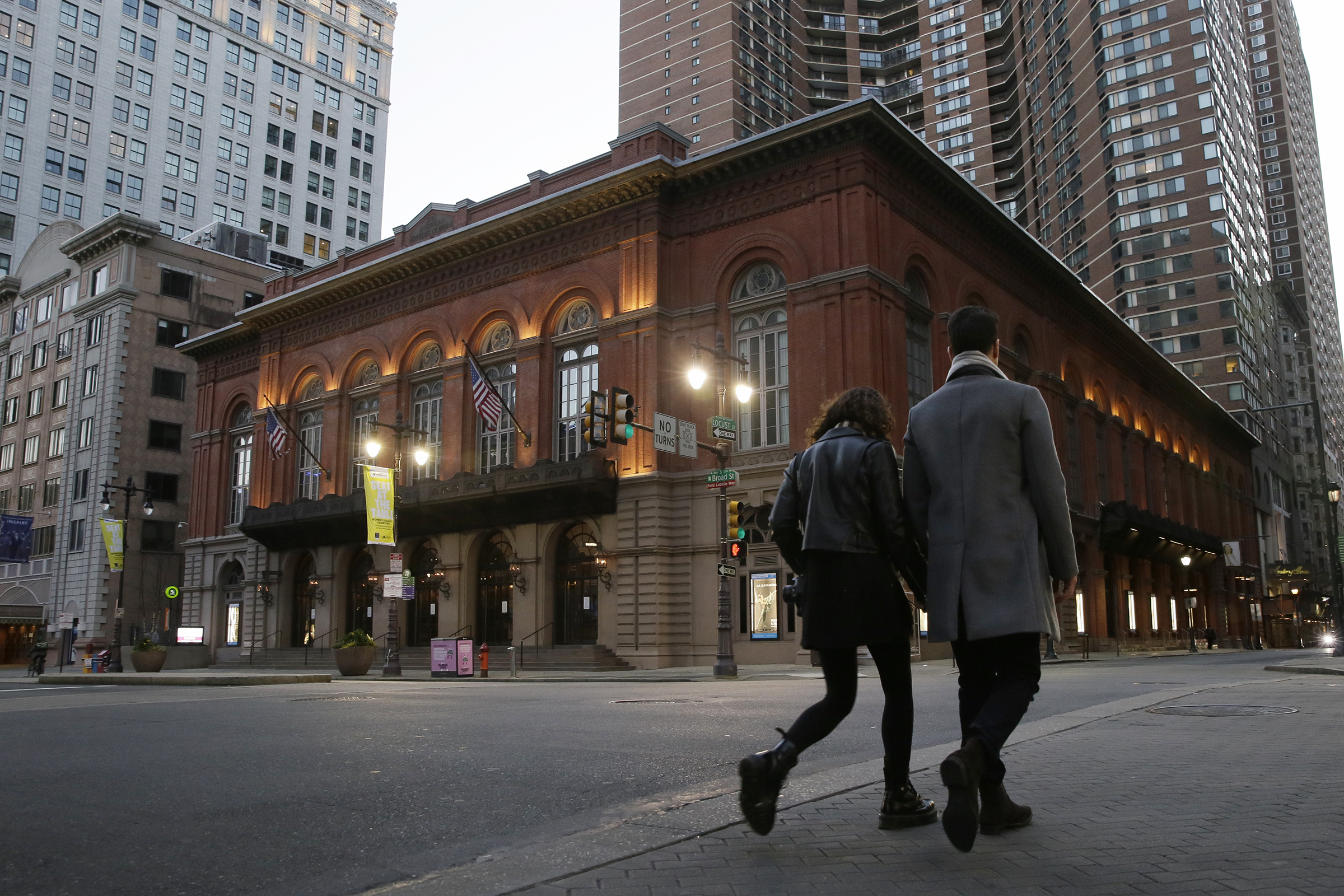
And it may feel especially familiar to visitors from Philadelphia: La Scala was the inspiration for the city’s Academy of Music.
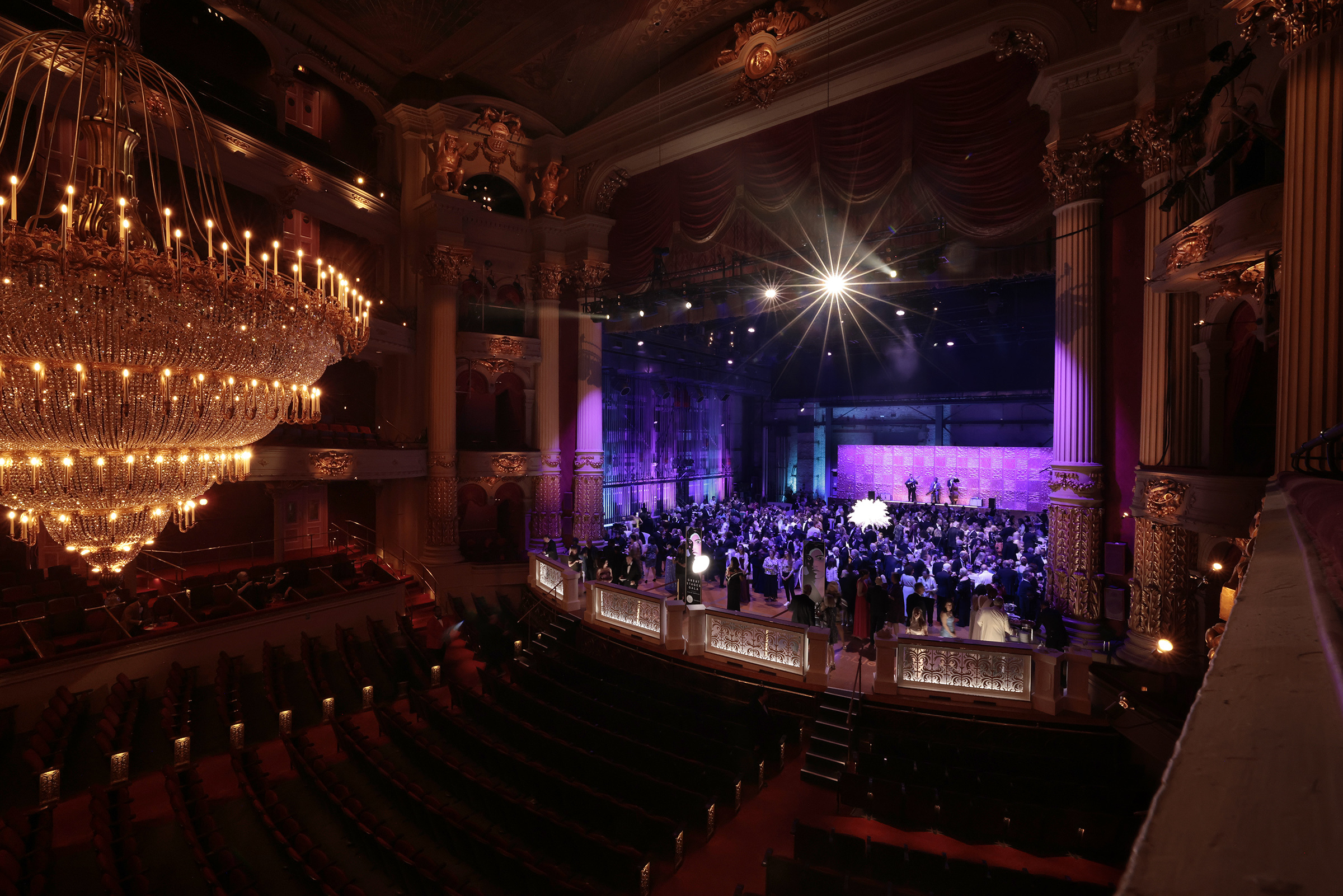
The Great Stages Gala reception honoring Marian Anderson was held on the Academy of Music stage in Philadelphia on Saturday, June 8, 2024.
In 1854, a building committee invited architects to submit plans for an opera house in Philadelphia, John Francis Marion wrote in his book, Within These Walls: A History of the Academy of Music. The next year, the committee chose Napoleon LeBrun and Gustav Rungé to design what would become the Academy. LeBrun was sent to Milan to sketch La Scala just four months before ground would be broken on Broad Street.
From the outside, the two buildings look very different.
La Scala is somewhat modest because there were originally homes across the street that a grander building would overwhelm. The Academy of Music was also designed humbly, in the Rundbogenstil (round arch style), inspired by Runge’s German roots, reserving most of the budget for the interior.
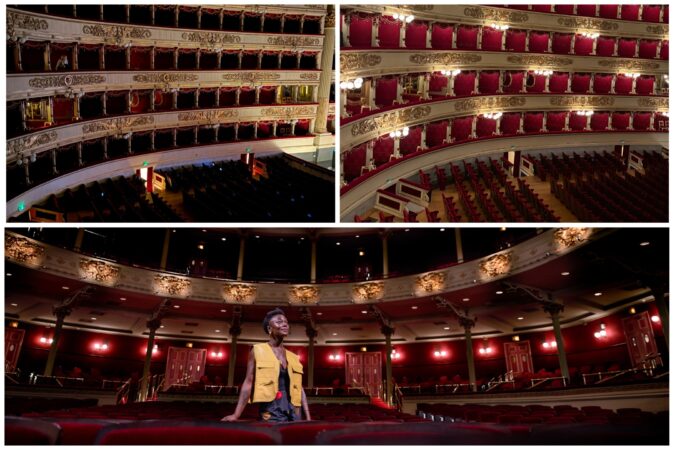
Inside both buildings, a red-and-gold-tiered jewel box of an auditorium awaits.
“It’s kind of like an event to go to La Scala,” said Philadelphia Ballet artistic director Angel Corella, who famously danced Romeo and Juliet with Alessandra Ferri in that opera house in 2000. (Their performance was filmed for TV and is available on YouTube.)
“People would go just to see anything, pretty much [at La Scala] because it’s not only the event to go to see ballet or hear opera and see opera,” Corella said, “but it’s also the fact that you’re going to an opera house that has so much history in it.”
Francine Garino, a La Scala tour guide who coaches opera singers in French pronunciation, agrees.
“Some people don’t know anything about opera or ballet. They don’t mind. They want to live this experience.” Sometimes they will leave after the first intermission, saying they feel fulfilled just having experienced the theater.
Philly’s version, which opened in 1857, is equally beautiful but less imposing.
“The great thing about the Academy of Music is that it’s still a big opera house,” Corella said, “but it feels very intimate and close to you when you’re on stage. So it’s a perfect theater.”
The outside of La Scala, the world-famous opera house in Milan, Italy, is fairly humble. But the inside reveals a red-and-gold tiered jewel box. The Academy of Music was designed after La Scala.
Horseshoe shapes and other similarities
The similarities between the two theaters lie “in the position of the theater, the position of the seats, the acoustics,” Corella said.
LeBrun and Rungé replicated La Scala’s horseshoe-shaped seating areas, but they closed it up more for better sight lines.
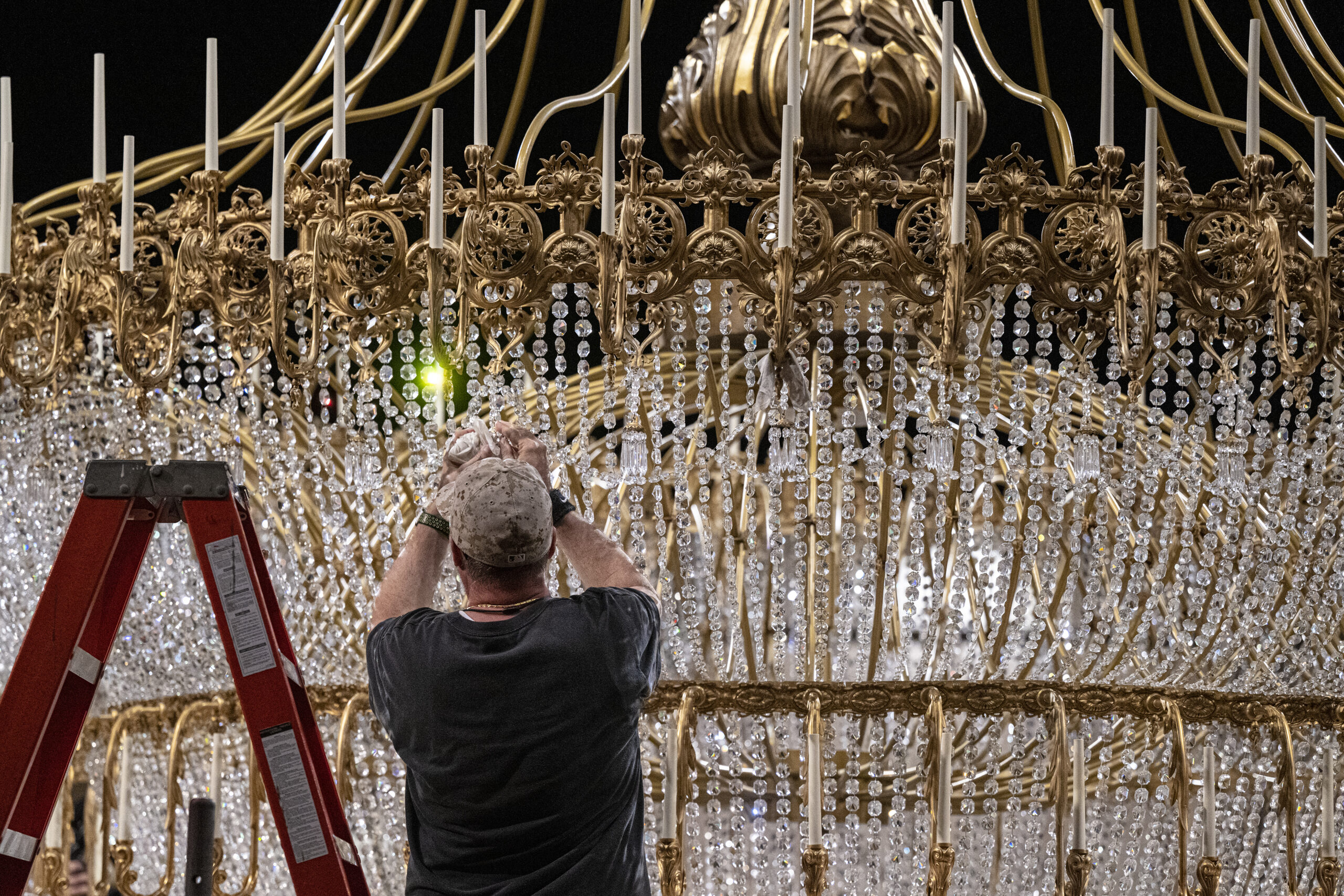
Like the Academy, La Scala has a huge central chandelier. But the Italian theater is a neoclassical design and somewhat grander than the Philly version. It has six levels above the orchestra to the Academy’s four.
The Academy has more seats (2,800 in Philadelphia and 2,030 in Milan), thanks to its full mezzanine and balconies with boxes on the sides.
The outside of the Academy of Music was designed to look like a marketplace.
At La Scala, the first four levels above the orchestra are made up of lots of small individual boxes that were originally purchased by members of the aristocracy.
They were said to be more expensive than buying an apartment and owners would decorate the boxes as they wished. They’d bring in servants and could come any time they wanted. Here, they’d take business meetings, eat dinner, and go down to where the orchestra seats are now and dance to the music.
“If you owned a box,” Garino said, “it was home for you.”
Today all seats are individually sold as in any theater, with prices going from €10 to €300. Fans stalk the website to buy tickets as soon as they go on sale. They sell out extremely quickly.
La Scala was damaged when it was bombed during World War II.
Paul Miers lowers the chandelier to clean it and replace light bulbs on May 29, 2024, at the Academy of Music in Philadelphia. The large crystal chandelier measures 16 feet in diameter and weighs 5,000 pounds.
Rake vs. no rake
At the time the Academy of Music was built, there were similar academies in other American cities.
“There was an Academy of Music in New York that predated the Metropolitan Opera. The Brooklyn Academy of Music was something that was founded in 1859, inspired by what we had done,” said Ryan Fleur, president and CEO of the Philadelphia Orchestra and Ensemble Arts, which runsthe Academy of Music.
Brooklyn Academy of Music’s original building burned down and was replaced by a Broadway-style theater.
Because of that, “the Academy of Music is truly unique,” Fleur said. “As far as I know, it not only is an oldest continuously operating Opera House [in the country], but it’s the only opera house that still has this configuration of spaces.”
For American dancers, La Scala, and most European opera houses, are a challenge, because they have raked stages. The stage slopes downhill from back to the front, improving the view for audiences.
The Academy is “a perfect venue” for Philadelphia Ballet, said Corella. “Because all the ballets, especially the [older full-length ballets], fit incredibly well, because it’s almost like a continuation from the house into the stage.”
In the United States, he said, the rakes have been fixed and made flat.
“In Europe, there’s a lot of theaters that are still in rake. For the dancers, it’s great for jumping, because when you going down the hill, you feel like you’re flying … but it’s much harder for turning.”
La Scala Ballet étoile Nicoletta Manni thinks the opera house she regularly performs on is the best of both worlds.
“In La Scala, we have a good rake,” Manni said. “It’s not too much. It’s very good for jumps, because it’s helping us to jump even higher. You have to be careful with turns, because you might lose your balance, but you just need to get used to it.”
This month, Manni, 34,
was chosen to be an Olympic torch bearer. Then, she was told she would be the last one and would light the cauldron.
“It’s history, and so being there and have the privilege of doing that was very [much] something to remember. I will have it in my memory forever.”
Another thing she’d like to do is dance on our side of the Atlantic.
The former “Jersey Shore” star said in a video posted to TikTok that a biopsy had revealed the stage one cancer.
“Obviously not the news that I was hoping for,” she said, sitting in her car between medical appointments. “But also not the worst news, just because they caught it so early, thank freaking God.”
She urged her followers to get Pap smears, and said she is likely to have a hysterectomy after her initial treatment.
“So 2026 is not panning out how I wanted it to,” she said.
Polizzi became one of the breakout stars of “Jersey Shore” from its debut on MTV in 2009. She was on the reality show for six seasons and appeared in the later spinoffs “Snooki & JWoww” and “Jersey Shore: Family Vacation.”
Now 38, she still lives in New Jersey, has been married for 11 years and has three children.
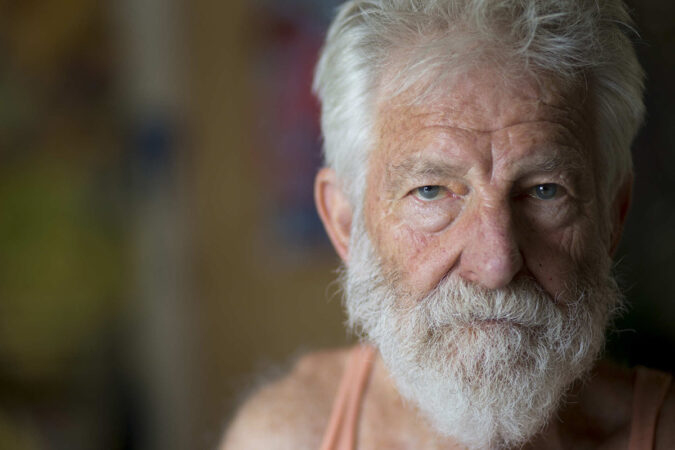
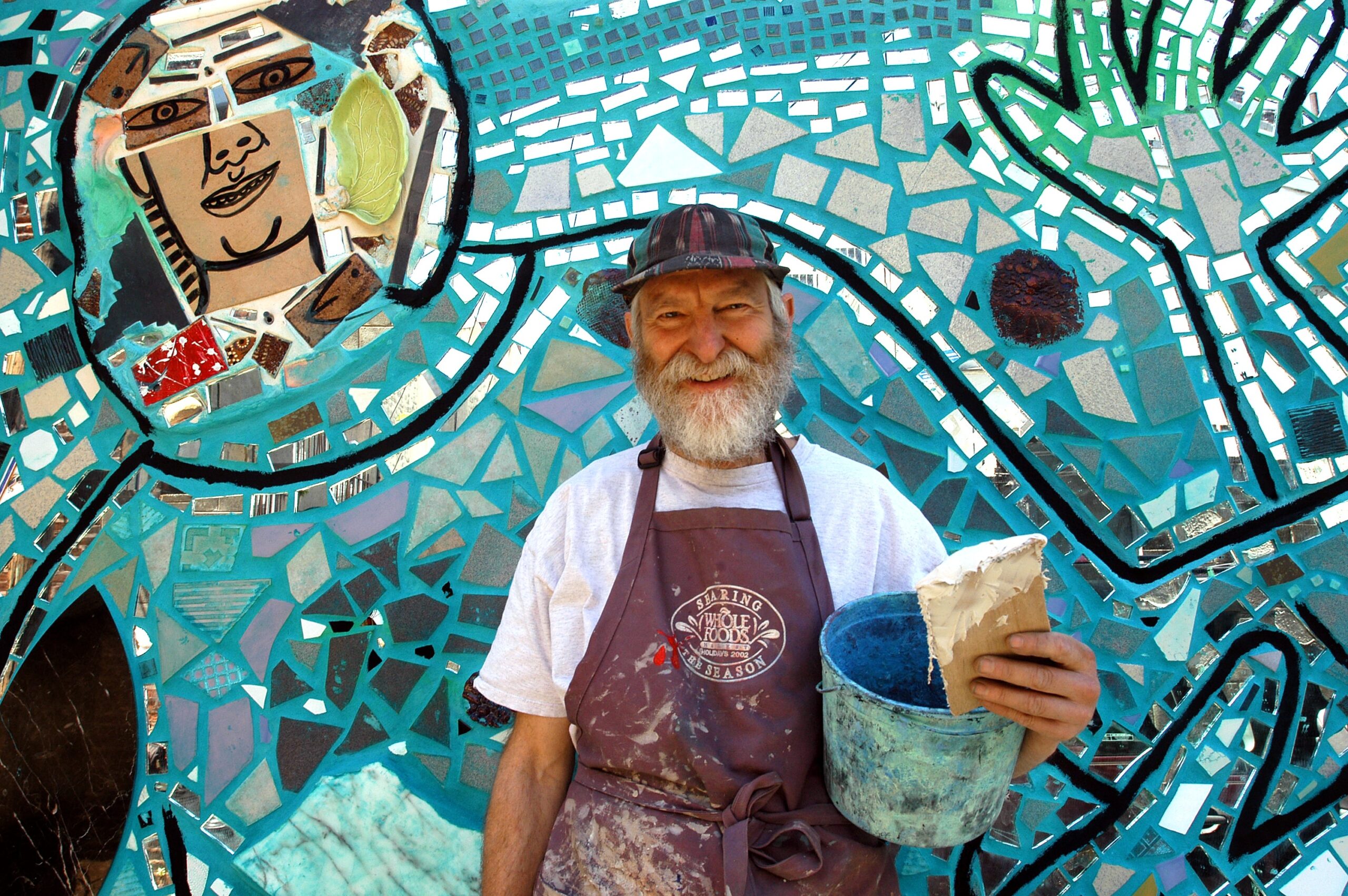
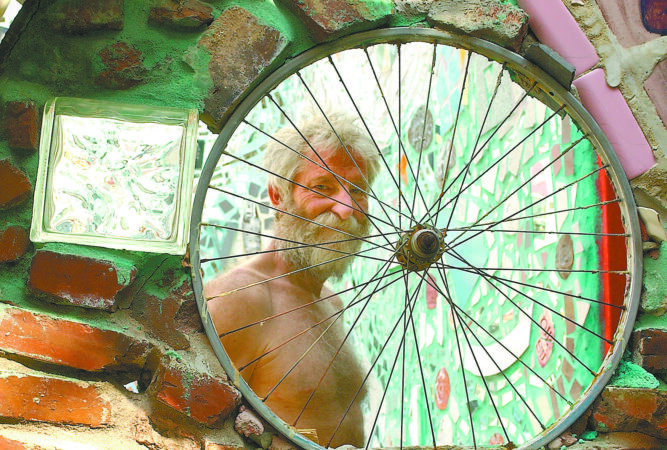
Isaiah Zagar, 86, of South Philadelphia, the renowned mosaic artist who crafted glittering glass art on 50,000 square feet of walls and buildings across the city and founded Philadelphia’s Magic Gardens, has died.
Mr. Zagar died Thursday of complications from heart failure and Parkinson’s disease at his home in Philadelphia, the Magic Gardens confirmed.
“The scale of Isaiah Zagar’s body of work and his relentless artmaking at all costs is truly astounding,” said Emily Smith, executive director of the Magic Gardens. “Most people do not yet understand the importance of what he created, nor do they understand the sheer volume of what he has made.”
His art, Smith said, “is distinctive and wholly unique to Philadelphia, and it has forever changed the face of our city.”
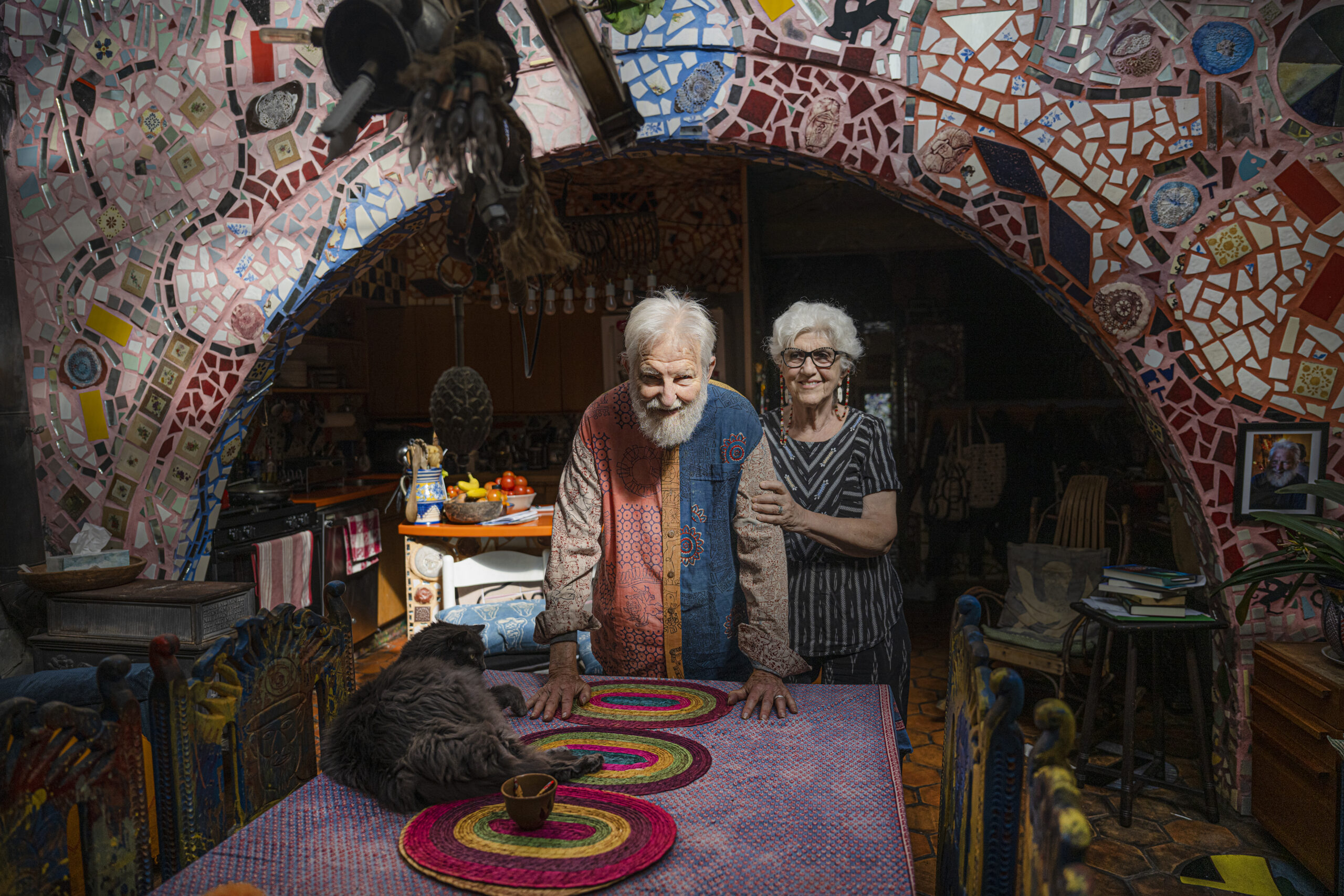
saiah and Julia Zagar in their mosaic-adorned home in South Philadelphia in October 2024. The couple married in 1963 and moved to South Philly in 1968 after serving in the Peace Corps in Peru.
Mr. Zagar was born in Philadelphia in 1939, grew up in Brooklyn, N.Y., and received a bachelor of fine arts degree in painting and graphics at the Pratt Institute of Art in New York. He met his wife, artist Julia Zagar, in 1963. The couple married the same year and moved to South Philadelphia in 1968 after serving in the Peace Corps in Peru. Together, they founded Eye’s Gallery at 402 South St., focusing on Latin American folk art.
In the 1970s, the Zagars were part of a group of artists, activists, and business owners who pushed back against development of a Crosstown Expressway that would have demolished South Street. Their contributions helped lead to a neighborhood revitalization later called the South Street Renaissance.
“Philadelphia’s iconic South Street area has become inseparable from Isaiah Zagar’s singular artistic vision,” said Val Gay, chief cultural officer and executive director of Creative Philadelphia, the city’s arts office. “His mosaics redefine the very framework of the public space they inhabit. Isaiah Zagar reshaped the visual identity of Philadelphia, and his legacy will endure through all that he transformed.”
A self-taught mosaicist, Mr. Zagar used broken bottles, handmade tiles, mirrors, and other found objects to cover walls across the city, particularly in South Philly. The artist, who struggled with mental health over many years, found that creating mosaics was a therapeutic practice. He was inspired by artists Pablo Picasso, Jean Dubuffet, Kurt Schwitters, and Antonio Gaudí.
“He worked with found objects that he found everywhere and put them to use. So, [he thought], ‘Why is the thing a piece of trash? Well, it doesn’t have to be a piece of trash. It could be a piece of art, too, and still be a piece of trash,’” said longtime friend Rick Snyderman, 89, a renowned Philadelphia gallerist based in Old City. An object “in the hands of the right person changes your perspective about it. That’s, I think, what the greatest gift of Isaiah was — to change your perspective.”
Mr. Zagar’s son, the filmmaker Jeremiah Zagar, documented his father’s life in a 2008 documentary, In a Dream. Jeremiah Zagar recently directed episodes of the HBO miniseries Task. His father came to the show’s New York City premiere last September carrying a mosaicked cane.
Snyderman remembers Mr. Zagar as a big reader and world traveler who was “eternally curious” and created artwork to make people smile. They first met in the 1960s and their families were part of the South Street community of “creative thinkers” who bonded “because they were misfits in some other world, perhaps.”
“He was a man who just didn’t pay attention to his own world, he paid attention to the larger world. One of his favorite sayings was that ‘Philadelphia is the center of the art world, and art is the center of the real world,’” Snyderman said.
More than 200 of Mr. Zagar’s mosaics adorn public walls from California and Hawaii to Mexico and Chile. His artwork is in the permanent collections of the Philadelphia Museum of Art and the Pennsylvania Academy of the Fine Arts, among other museums, and has been shown in solo exhibitions at cultural institutions including Washington’s Hinckley Pottery Gallery and New York’s Kornblee Gallery.
“Isaiah Zagar was devoted to mosaic work and the creation of immersive art environments. Internationally recognized, he is proudly claimed by Philadelphia as our own,” said Elisabeth Agro, the Nancy M. McNeil curator of modern and contemporary craft and decorative arts at the Philadelphia Museum of Art. “Although his death is a profound loss to our city’s culture and creative economy, Zagar’s indelible imprint remains inextricably linked to Philadelphia’s soul.”
Synonymous with Philadelphia’s public art
Mr. Zagar’s colorful and eclectic mosaic murals have become synonymous with Philadelphia’s public art scene.
After arriving in the city, Mr. Zagar soon set about modifying Eye’s Gallery, which was then also his home. The building, the Daily News reported in 1975, was dilapidated when he took possession of it, and at one point lacked plumbing and had a wood-burning stove.
Several years into his ownership, the Daily News wrote, Mr. Zagar had evolved the rowhouse into a “womb-like living space with undulating cement walls.” Materials for its decoration were largely scavenged, and included thousands of pieces of broken glass and mirrors.
Changes, the People Paper reported, started with the cementing of a stairway wall that had become wet. Lacking experience in carpentry, plastering, and home repairs, Mr. Zagar said, he and a fellow artist cemented the wall to hide the leak, and covered it in mirrors to disguise the issue. That didn’t fix the leak, but it did inspire a kind of operating logic for his home repairs.
“We would do something artistic to hide a fault, then have to correct the fault to save the artwork,” Mr. Zagar said in 1975.
Isaiah Zagar in May 2004, in front of a wall he was working in Bella Vista, on Clifton Street between Fitzwater and Catharine.
His process included embedding everything from broken teapots and cups to plates and crystal into the cement while it was still wet. Mirrors, however, were an early favorite of Mr. Zagar’s.
That idea, he told the Daily News, came from Woodstock, N.Y.-based artist Clarence Schmidt, who covered the outside of his home in broken mirrors embedded in tar.
“Mirrors intercept space, they keep poking holes in things,” Mr. Zagar said. “If they’re in the sun, they throw prisms around. You can’t fashion a mirror into an anatomical human being. It freed me from the concept of what things were supposed to look like.”
Preservation challenges
New development in Philadelphia in recent decades has led to the demolition of many of Mr. Zagar’s mosaic murals, most of which have been on private property.
By the turn of the century, Mr. Zagar had covered about 30 buildings in the city — largely then in Old City and on South Street — in his distinctive mosaic work, according to reports from the time. Among his largest passions in that medium, he told The Inquirer in 1991, were the colorful mirror and tile murals that today dot the city.
“These materials have a lasting quality,” he said at the time. “I have never seen an ugly piece of tile, it’s all beautiful.”
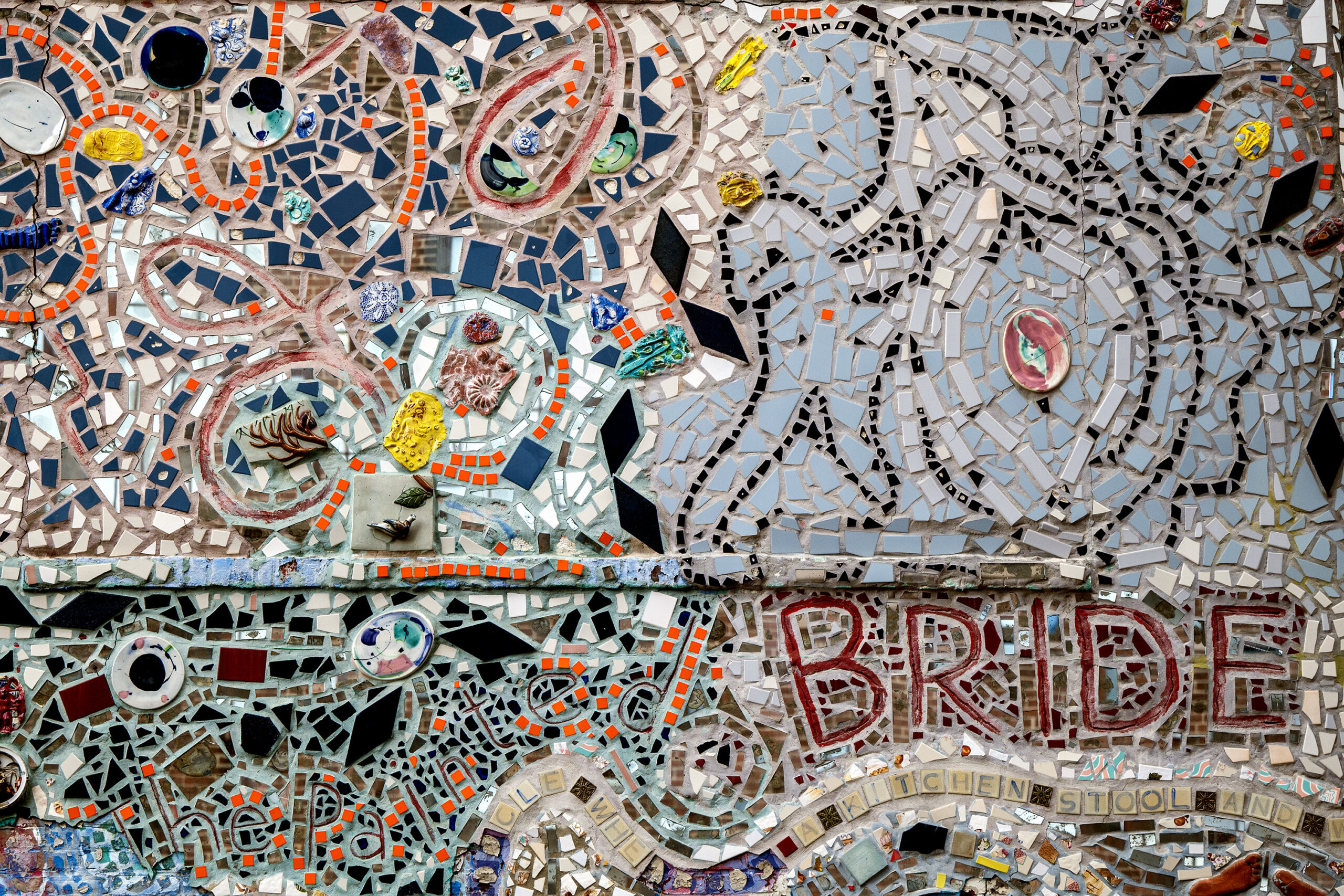
Detail of the wall of the former home of the Painted Bride Art Center at 230 Vine St. on Oct. 19, 2025. The building is covered by “Skin of the Bride,” a mosaic by Philadelphia artist Isaiah Zagar, created between 1991 and 2000.
Mr. Zagar held grand ambitions for Philadelphia as the home of his mosaics by the mid-1990s. As he told the Daily News in 1993, he hoped to see Philly changed “into a city of the imagination.”
“My dream is [to] turn all of Philadelphia into tile city — to turn all these ugly old brick and stucco walls into a manifesto of magic,” he said.
(function() {
var l2 = function() {
new pym.Parent(‘zagar_pmg’,
‘https://media.inquirer.com/storage/inquirer/projects/innovation/arcgis_iframe/zagar_pmg.html’);
};
if (typeof(pym) === ‘undefined’) {
var h = document.getElementsByTagName(‘head’)[0],
s = document.createElement(‘script’);
s.type = ‘text/javascript’;
s.src = ‘https://pym.nprapps.org/pym.v1.min.js’;
s.onload = l2;
h.appendChild(s);
} else {
l2();
}
})();
Perhaps the prototypical example of that dream was the Painted Bride Art Center, which once was home to Mr. Zagar’s Skin of the Bride — a massive, 7,000-square-foot mosaic work that came to envelop the exterior of the building. Demolition of the Painted Bride began in December after a lengthy legal battle, but members of the Magic Gardens Preservation Team had been able to remove about 30% of the tiles for reuse in new mosaics in 2023.
Mr. Zagar’s work on the Painted Bride began in 1991 and carried on for about nine years. The work was exhausting, and his wife recalled Mr. Zagar working up to 12 hours a day for years to create what he viewed as his masterpiece.
In 1993, however, he took some creative liberties with the number of tiles, mirrors, and pieces of pottery involved with its creation.
“I’ve counted them,” he jokingly told the Daily News. “There are exactly 3,333,333.”
In summer 2022, a fire at Jim’s Steaks damaged the neighboring Eye’s Gallery, requiring lengthy restoration work that Julia Zagar spearheaded. She called the space a landmark “for the creative spirit of South Street.” The fire eventually uncovered a hidden mural by Mr. Zagar from the 1970s that had been covered up by drywall.
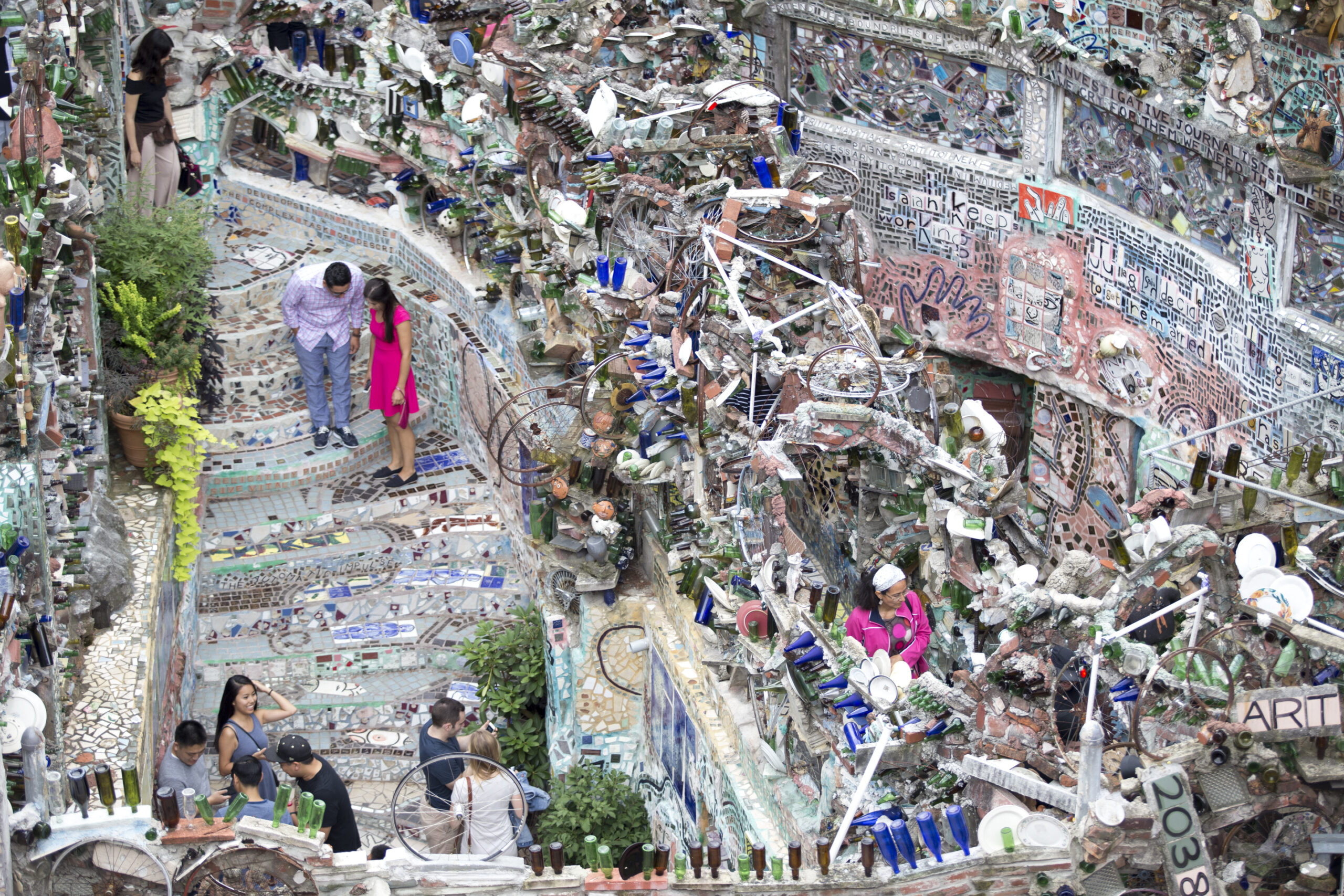
Tourists at Philadelphia’s Magic Gardens in July 2017. The Magic Gardens has become a Philadelphia landmark, attracting about 150,000 visitors a year to walk through the immersive, labyrinthine indoor and outdoor spaces.
The Magic Gardens
In the late 1990s, Mr. Zagar expanded his sculpture and mosaic art into two empty lots neighboring his South Street home. The lots were owned by a group of Boston businessmen who had abandoned them, so with permission from the owners’ agent, Mr. Zagar cleared and transformed the space.
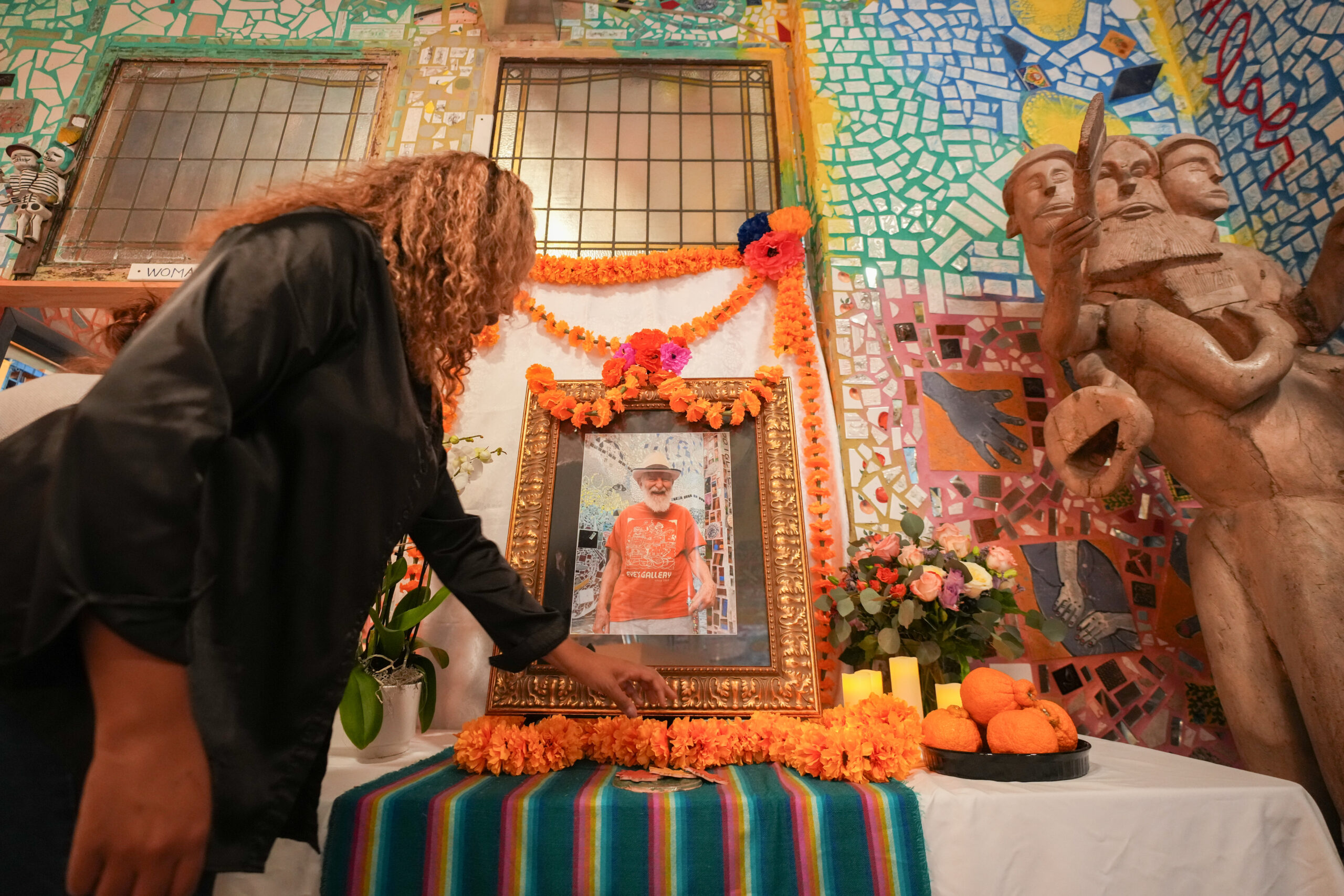
Chelsey Luster, Exhibition Manager at Philadelphia’s Magic Gardens, places flowers on an Ofrenda that friends and staff members are putting together in honor of artist Isaiah Zagar who passed earlier today, at Philadelphia’s Magic Garden, in Philadelphia, Thursday, Feb. 19, 2026, in Philadelphia
It would go on to become Philadelphia’s Magic Gardens, but it took a legal battle in the 2000s to keep it there.
In 2004, about a decade after Mr. Zagar started building in the space, the owners of the land ordered the artist to dismantle and remove the work ahead of plans to market the property for sale.
Mr. Zagar and a group of volunteers formed the nonprofit organization known as Philadelphia’s Magic Gardens and, with help from an anonymous benefactor, purchased the lot for $300,000, The Inquirer reported that year. The nonprofit had begun collecting donations and was tasked with raising a majority of the funding, and, if successful, the benefactor planned to donate $100,000 to the cause.
“Why it’s so important for me to save the garden is that it’s not finished,” Mr. Zagar told The Inquirer in late 2005. “The too-muchness of it is the artist’s life.”
Isaiah Zagar in April 2007, applying colored cement to his mosaic on the 300 block of Christian Street. He was perched in a cage of a 90-foot boom truck reaching to the top of a 60-foot wall.
By that time, the garden was open on a limited basis for visitors to help with fundraising efforts, and adopted a more regular schedule several years later. A swing-top trash can was placed just inside the property’s front fence to collect donations from passersby, collecting about $100 a month in its early days, The Inquirer reported.
“I make art voluminously,” Mr. Zagar told The Inquirer in 2005. “The common man is clear about it: This is art.”
The Magic Gardens has become a Philadelphia landmark, attracting about 150,000 visitors a year to walk through the immersive, labyrinthine indoor and outdoor spaces.
In 2020, after allegations of sexual harassment were leveled against Mr. Zagar, the Magic Gardens issued a statement from its board and staff reacting to concerns raised over “inappropriate past behavior.”
“Though the Gardens were originally created by Isaiah Zagar, he does not own the Gardens or have a vote on its Board of Directors,” the statement read before clarifying that the Magic Gardens operated as an independent nonprofit with its own staff and board of directors.
The allegations, the statement said, left the staff and board “hurt, angry and confused as we confronted a reality that was in every way the opposite of what we stood for.”
When asked if there was a formal investigation into Mr. Zagar’s behavior, Leah Reisman, board member of Gardens said on Friday, “Isaiah Zagar experienced mental health struggles throughout his life. While this experience often propelled his artmaking, it also at times led to challenges and repercussions in his personal and professional relationships.”
In 2020, she said, the Gardens’ staff and board “brought these concerns directly to Isaiah and assisted him in accessing professional support to address these concerns.” Mr. Zagar’s presence on site, she added, was “carefully scaffolded through the years.”
In 2023, the Zagars donated his Watkins Street Studio to Philadelphia’s Magic Gardens to open a secondary space — also entirely covered in mosaics, of course — to host arts workshops and educational programming.
Famed mosaic artist Isaiah Zagar left a legacy shaped by the glimmering murals and large-scale tile works he created throughout Philadelphia.
Zagar, who died at 86 on Thursday due to complications of heart failure and Parkinson’s disease, will be remembered for his striking works and unrelenting mission to beautify the city he called home for more than five decades.
Zagar’s nearly 200 works can be found throughout the country but the bulk of his famed mosaics are within city lines.
Here’s some of the largest and boldest works the iconic artist handcrafted in Philadelphia.
(function() {
var l2 = function() {
new pym.Parent(‘ZAGARMAP.html’,
‘https://media.inquirer.com/storage/inquirer/projects/innovation/arcgis_iframe/ZAGARMAP.html’);
};
if (typeof(pym) === ‘undefined’) {
var h = document.getElementsByTagName(‘head’)[0],
s = document.createElement(‘script’);
s.type = ‘text/javascript’;
s.src = ‘https://pym.nprapps.org/pym.v1.min.js’;
s.onload = l2;
h.appendChild(s);
} else {
l2();
}
})();
Philadelphia’s Magic Gardens
1020 South St.
Tourists visit Philadelphia’s Magic Gardens, which was built by Isaiah Zagar, in 2017.
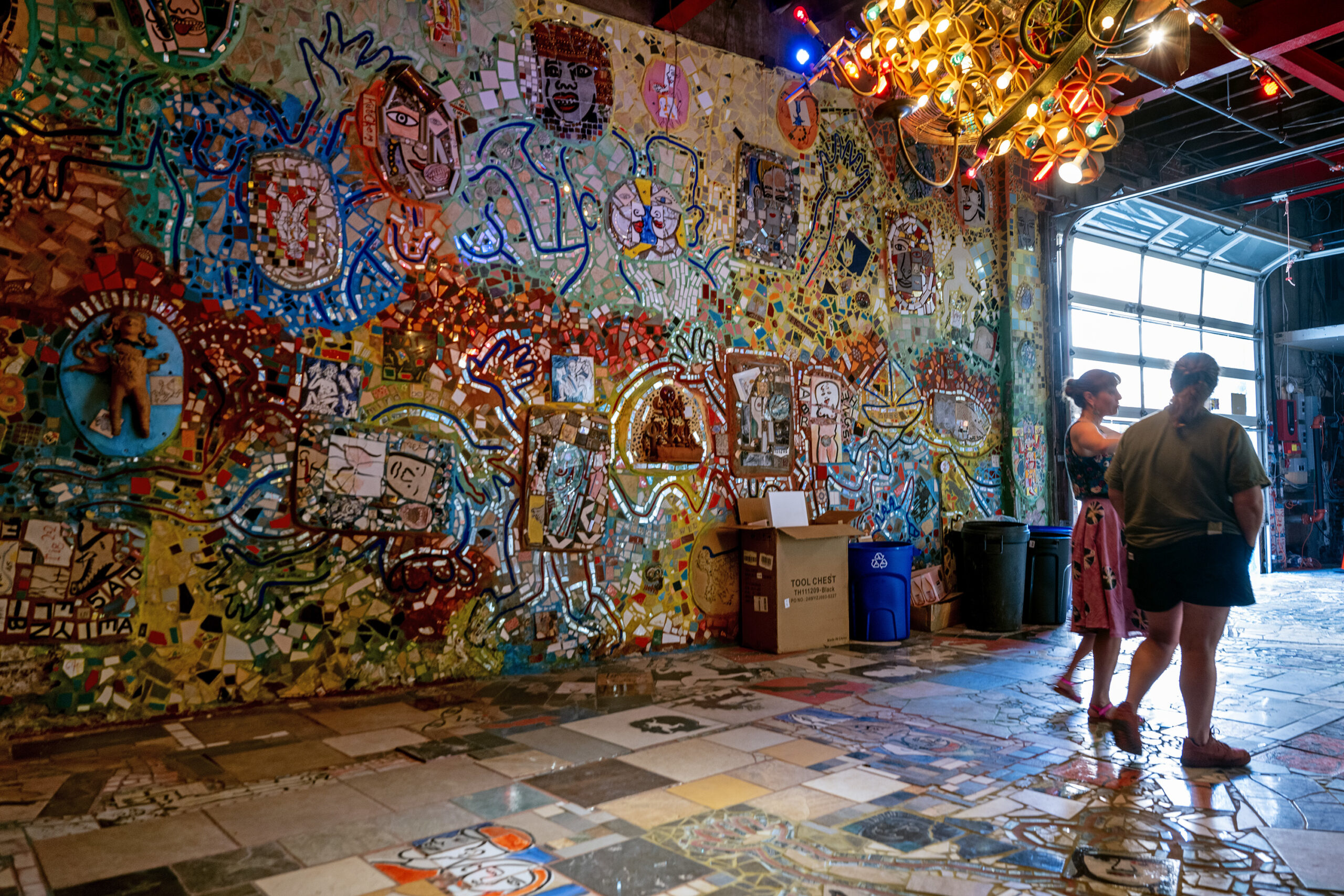
As inescapable as Zagar’s work is in Philadelphia, the Magic Gardens serves as the artist’s grandest, most well-known project. Dating back to 1994, it consists of thousands of square feet of entirely mosaicked space stretched across three city lots, showcasing what Zagar once referred to as his “voluminous” output of art.
Magic Gardens Studio
1002 Watkins St.
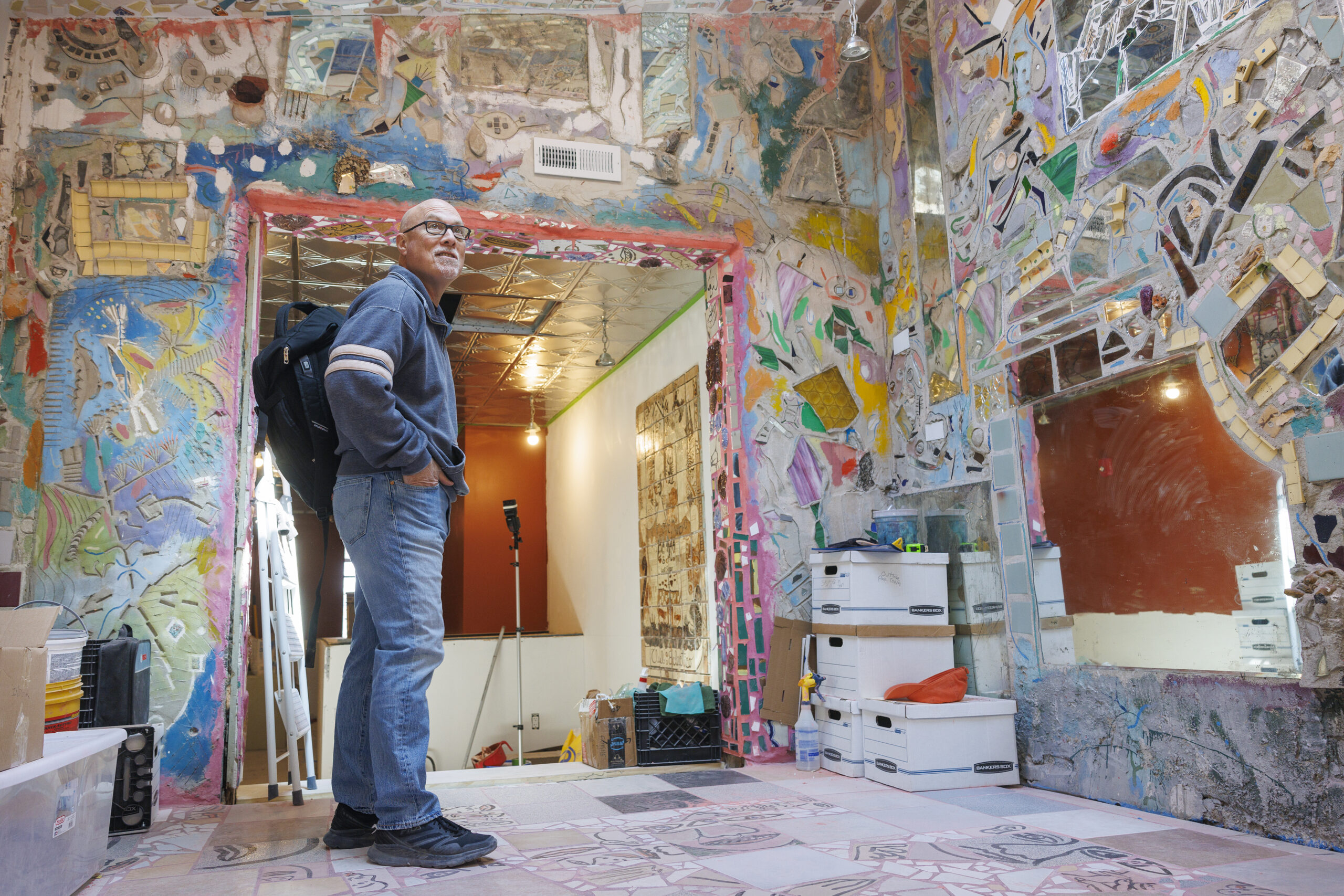
Philadelphia’s Magic Gardens executive director Emily Smith (left) and Preservation and Facilities manager Stacey Holder stand in the former studio of mosaic artist Isaiah Zagar in 2024.
If the Magic Gardens is the heart of Zagar’s output, his Magic Gardens Studio is the brain. Purchased in 2007, this 10,000-square-foot South Philly warehouse stands virtually covered — inside and out — in Zagar’s mosaics, and long served as his studio and storage space.
Home of Isaiah and Julia Zagar
826 South St.
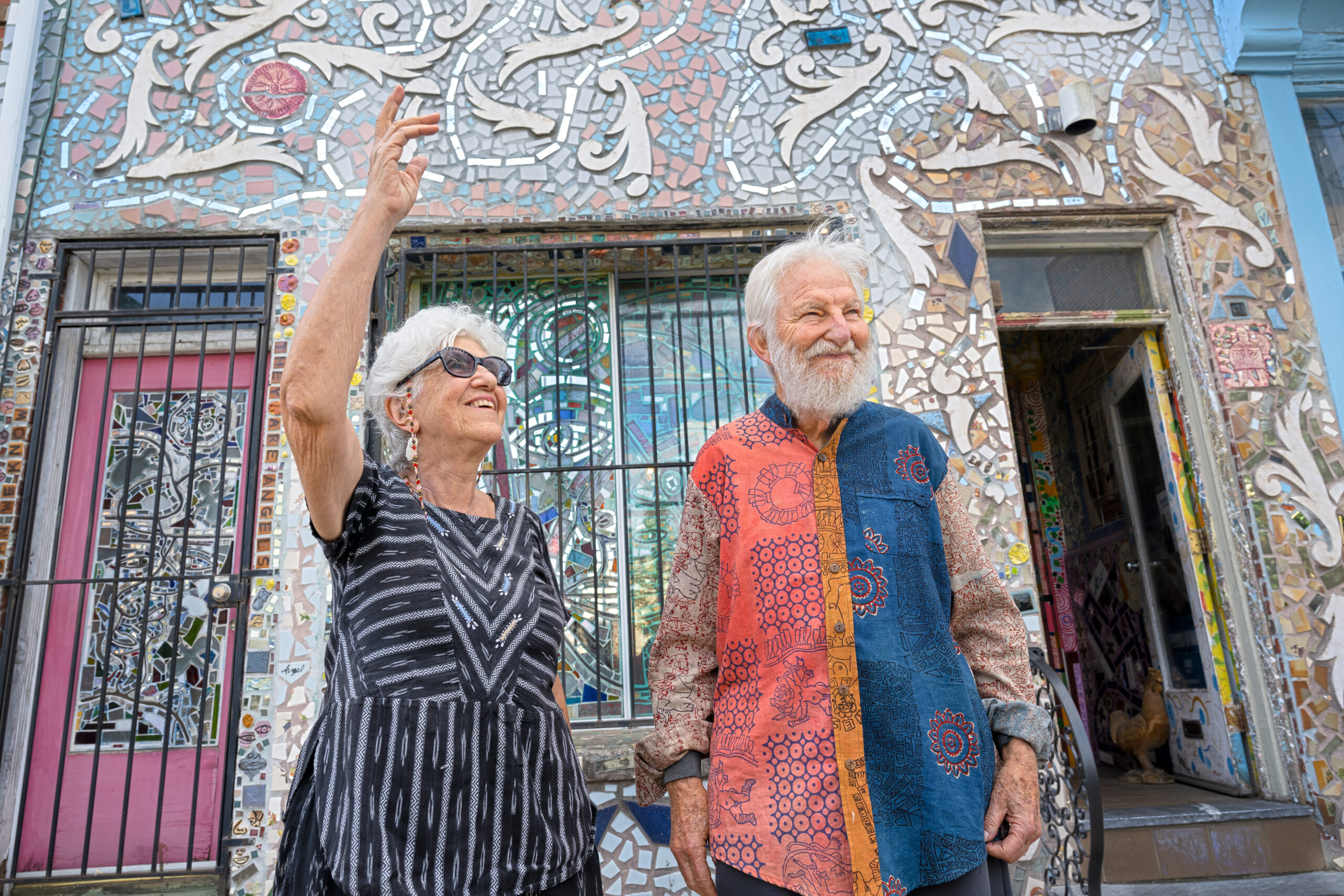
Isaiah and Julia Zagar are photographed in front of their home in South Philadelphia in 2024.
It doesn’t get much more personal than the Zagar’s home, where he and his family lived for about 40 years. Similar to his South Philly studio, the space is mosaicked inside and out in Zagar’s signature style, including a roughly 544-square-foot piece across the building’s façade.
‘This Is the Day, Jesus Journey’
1036 South St.
Just steps from the Magic Gardens sits the Waters Memorial African Methodist Episcopal Church, its side showcasing the 2006 mosaic Jesus Journey. At more than 400 square feet, it uses excerpts from the Bible detailing the life of Jesus Christ. Across the street, another similarly sized installation titled Bilal From Pakistan was completed in 2012 alongside artist Bilal Khan.
‘Rose and the Firefighters’
600 block of Alder Street
Among Zagar’s most iconic murals, this piece stretches some 6,000 square feet along Alder and Kater Streets, just east of the Magic Gardens. Completed in 2004, this piece adorns the former headquarters of Engine Company 11, a celebrated Black fire company in Philadelphia between 1919 and 1952.
Jim’s Steaks
400 South St.
Ken Silver, owner of Jim’s Steaks, in a room filled with mosaic tile by Philadelphia artist Isaiah Zagar in the former Eyes Gallery, run by Julia Zagar for decades.
Blocks from Zagar’s home, Jim’s Steaks showcases the artist’s mosaic work in a space formerly occupied by the Eyes Gallery, which Julia Zagar ran for decades. A 2022 fire damaged both the gallery and the neighboring original Jim’s building, prompting the cheesesteak shop to expand next door — revealing a treasure trove of interior artwork that had long been covered.
Schell Street Walls
600 S. Schell St.
Vacant lots, rowhouses, and cheesesteak shops weren’t Zagar’s only canvasses — he also covered entire side streets in his mosaics. Completed over nearly 30 years, the 600 block of Schell Street showcases the artist’s work on both sides of the street. Many pieces were created during community workshops Zagar held there over the years.
Fitness Works
714 Reed St.
There are better known murals than the one that occupies the lower facade and parking lot of this South Philly gym, but few are as large. At roughly 1,500 square feet, this piece was completed in 2014 as part of a mosaic mural workshop, and has since come to serve as a landmark.
‘Homage to Mike Mattio, Master Plumber’
700 block of Reese Street
Occupying the side of a number of rowhouses, this Zagar mosaic serves as a tribute to its eponymous Mike Mattio, a former plumber of the artist’s. The piece, with Mattio’s portrait included, is something of a high-brow installation, thanks to references calling out artists ranging from William Blake to Duke Ellington.
‘Hip Hop Café’
705 Passyunk Ave.
This building has housed quite a few businesses over the years. At least since 2002, it has showcased Zagar’s Hip Hop Café mosaic mural. The piece covers the structure’s 500-square-foot front, which today is home to Momoka Ramen Skewers’ Queen Village location.
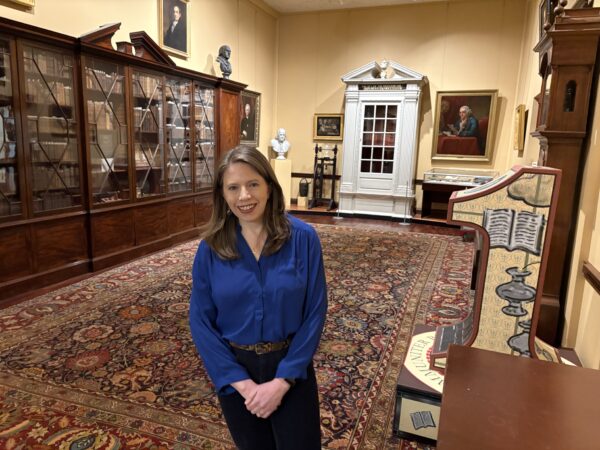
The Library Company of Philadelphia has lined up its next chief. Jessica Choppin Roney will take over the 295-year-old institution as soon as its merger with Temple University is approved by Philadelphia Orphans’ Court, leaders said this week.
Roney has existing ties to both Temple and the Library Company, as director of the program in early American economy and society at the Library Company and as an associate professor of history at Temple. She is also chair of the “integration council” that has been set up to help facilitate the amalgamation of the two groups.
“She’s been working very closely with us, so she was the obvious choice to take on the new role,” said current Library Company director John C. Van Horne, who will continue in his post until Roney takes over. Director and director-designate are already working together on the transition, he said.
Roney said this week that even with the merger, the Library Company’s mission won’t change.
“It continues to be a center of scholarly research and public-facing programming, so we’ve got work in history, in literature, science, and dance and music, and art, and on and on. That all continues and will grow and amplify with our relationship with Temple.”
The group, founded by Benjamin Franklin in 1731, owns more than 500,000 rare books, manuscripts, prints, photographs, works of art, ephemera, and other objects, mostly from the 17th through 19th centuries.
“It has always been America’s library, even before it was America,” Roney said.
The collection will continue to acquire new items, and will explore opportunities for Temple students to “make use of our collections in new ways,” she said.
Roney noted that even though the Library Company has often been powered by women — staff, trustees, shareholders, and donors — it has never had a woman at the helm.
“It’s exciting at a time of change that one of those changes is to have the first woman in charge,” she said.
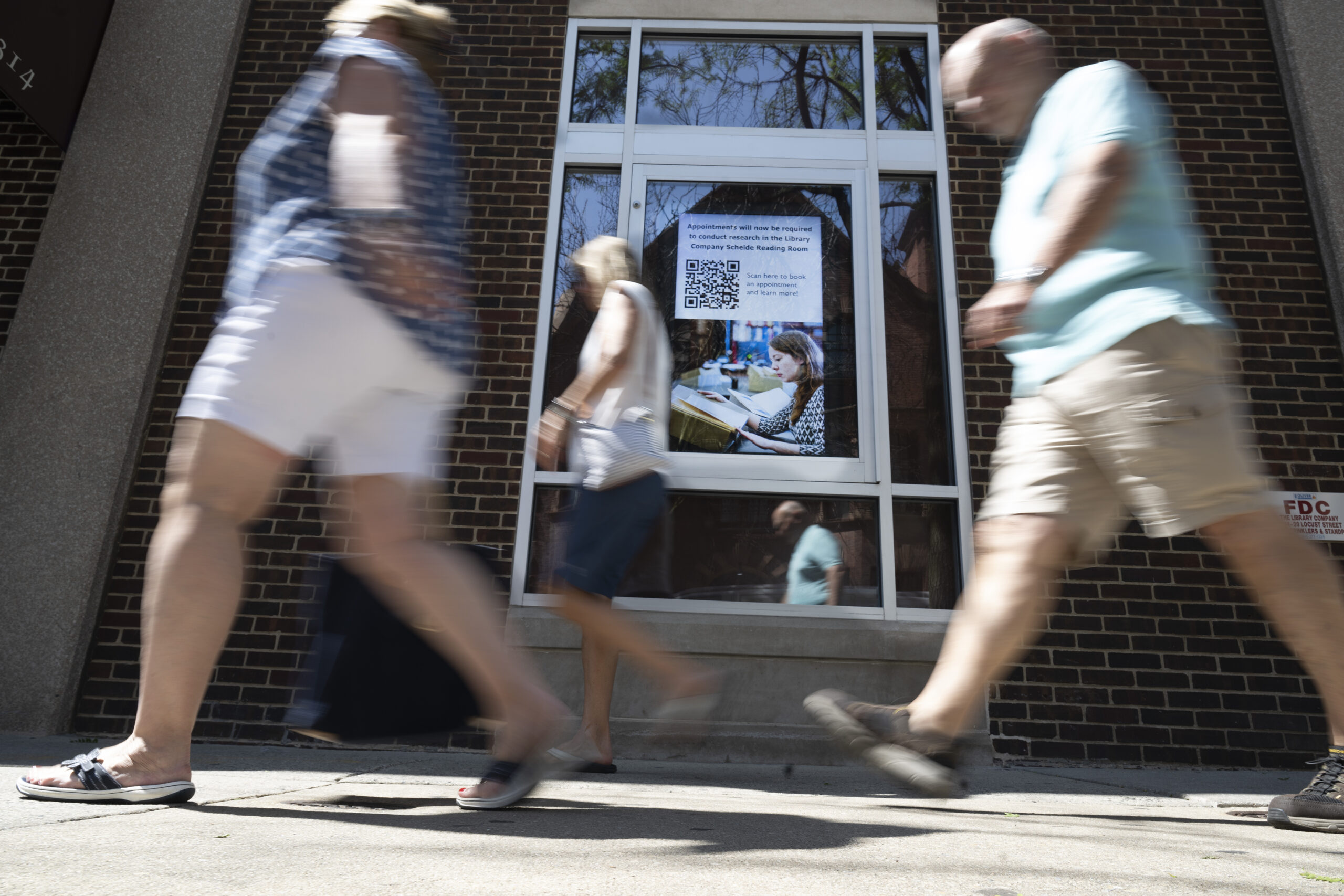
Pedestrians passing the Library Company of Philadelphia in Center City, June 25, 2025.
Facing a string of projected operating deficits, the library began to explore merger opportunities with other groups in 2024. Talks with Temple became public this past June. The boards of both organizations have approved the deal, and in December Library Company shareholders voted 174 to 33 in favor of the merger.
A potential Orphans’ Court approval — which could take weeks to years to receive, said Van Horne — would end nearly three centuries of independence for the library, whose home is on Locust Street just east of Broad, where it will remain.
Roney started as director-designate Jan. 9, and was approved for the post by the Library Company board on Jan. 22, a Temple spokesperson said. Her appointment, however, was not publicly announced until it was included in a newsletter from the group this week. Van Horne said she was chosen without a search, and no other candidates were considered.
“We thought it would be good initially since we’re just getting this relationship off the ground to have a Temple faculty person as the first director [of the merged organization], and it was fortuitous that the early Americanist at Temple was on our payroll,” said Van Horne. “She already had a foot in both camps.”
Roney, 47, earned a bachelor’s degree from Swarthmore College, a master’s from the College of William and Mary, and a Ph.D. from Johns Hopkins University. It was at the Library Company that she conducted research for her first book, Governed by a Spirit of Opposition: The Origins of American Political Practice in Colonial Philadelphia.
Van Horne was director of the Library Company from 1985 until 2014, and then returned in 2024 to help manage its financial difficulties. He has been a strong proponent of the merger, as he was for Roney’s appointment.
“She’s energetic, imaginative, and she has ideas about what we can do with Temple and others,” he said. “I’m very hopeful for the future. I think she’s going to be terrific, and I wasn’t so hopeful for the future a year ago.”
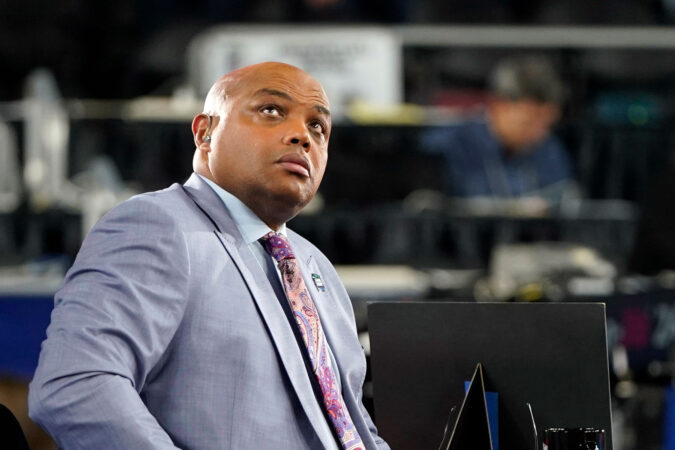
Charles Barkley is about to get his wish to work more this season.
The former Sixers star and his longtime Inside the NBA colleagues Shaquille O’Neal, Kenny Smith, and Ernie Johnson return to ESPN Friday night to cover a doubleheader beginning at 7:30 p.m. Philly time.
Since making the jump to ESPN this season, Inside the NBA’s schedule hasn’t been as orderly as it was on TNT, where it aired every Thursday night as part of an NBA doubleheader (outside of the first few months of the year, where it avoided going head-to-head with Amazon’s Thursday Night Football).
Or as frequent. Entering Friday night, Inside the NBA has only aired on ESPN or ABC nine times this season, something Barkley has complained about on various platforms.
“I wish we’d have been on more during the first half of the season,” Barkley said on The Dan LeBatard Show last month. “We only worked one day in December.”
But as ESPN always planned, Inside the NBA’s schedule will ramp up in the final third of the season leading into the playoffs. This week alone the show is scheduled to air three straight nights and six times over the next 10 days. It will also air during ESPN’s coverage of the Eastern Conference finals and the NBA Finals.
The back-loaded schedule was actually requested by TNT Sports, according to ESPN president of content Burke Magnus, who said their deal included a provision that called for the majority of Inside the NBA episodes to air after Jan. 1.
“I’m not entirely sure what was behind that,” Magnus said on the SI Media with Jimmy Traina podcast in November, adding he’s “confident” they can figure out a way to make the schedule more consistent throughout the entire season.
Fans are certainly tuning in. Inside the NBA is averaging 1.34 million viewers per show across ABC and ESPN, according to Nielsen numbers. Their TNT numbers weren’t immediately available, but NBA games themselves on TNT averaged 1.25 million viewers last season.
Here’s the full Inside the NBA schedule on ESPN and ABC for the rest of the season:
Friday: ESPN
Saturday: ABC
Sunday: ABC
Fri, Feb. 27: ESPN
Sat., Feb. 28: ABC
Sun, Mar. 1: ABC
Fri, Mar. 6: ESPN
Sat., Mar. 7: ABC
Sun, Mar. 8: ABC
Sat., Mar. 14: ABC
Sun, Apr. 12: ESPN
As ESPN takes over NFL Network, Ian Rapoport’s future uncertain
NFL Network insider Ian Rapoport during Super Bowl week in San Francisco.
Ian Rapoport is used to breaking news, but the longtime insider at the NFL Network hasn’t yet gotten the scoop on his own future.
Last month, regulators approved ESPN’s deal to take over control of the NFL Network as part of its billion-dollar acquisition of NFL Media, with the NFL receiving a 10% ownership stake in the Disney-owned sports network. ESPN is expected to take full control of the network in April, and Rapoport’s contract expires in May.
In case you’d forgotten, ESPN already has its own NFL news breaker: Adam Schefter. But the network also has a history of employing multiple NFL insiders, pairing Chris Mortensen and Schefter for years. Prior to that, Mortensen worked breaking NFL news alongside John Clayton
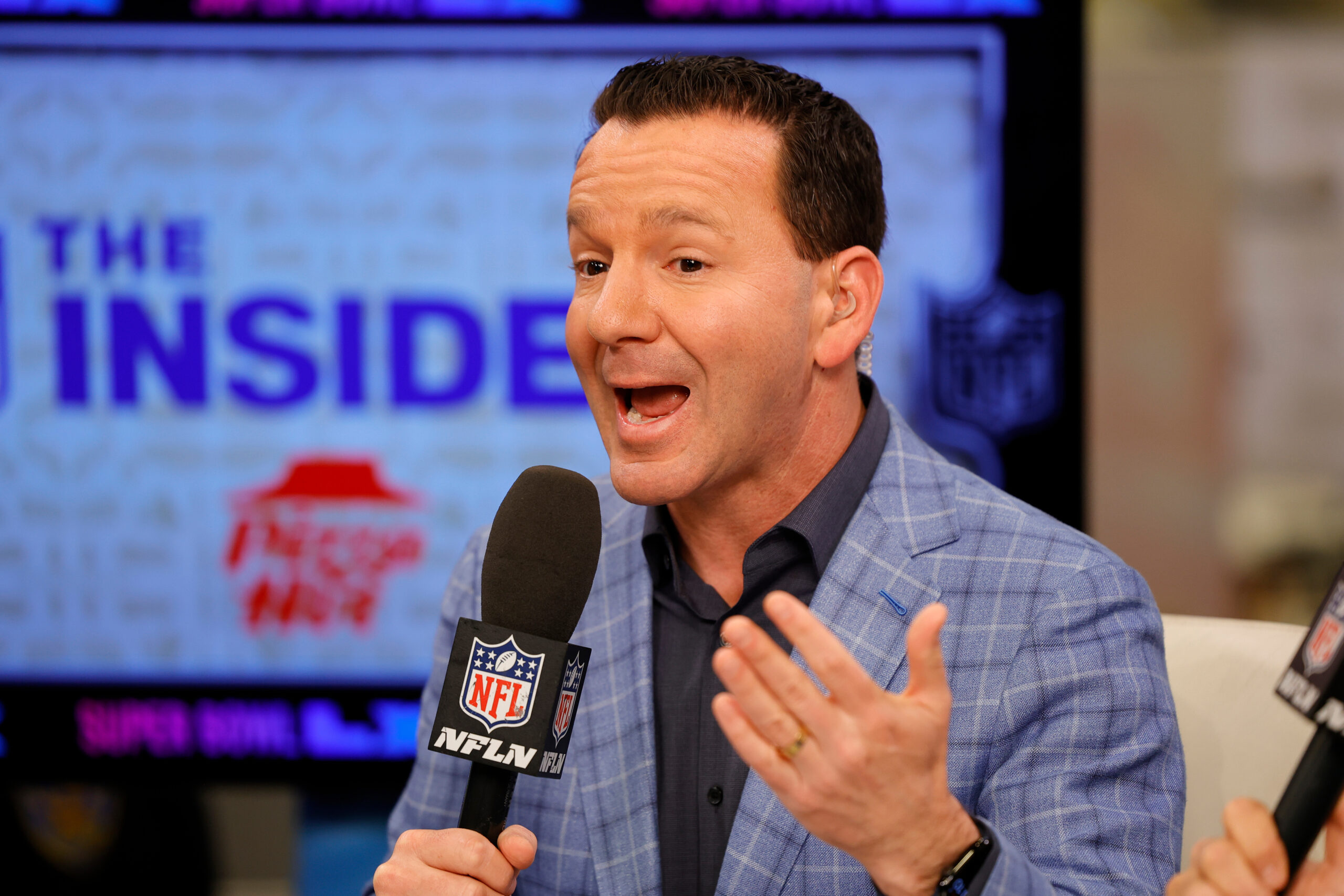
Rapoport isn’t the only NFL insider at the NFL Network. Philly native Mike Garafolo and Tom Pelissero also cover the league’s moves, and the three cohost a show on the NFL Network appropriately called The Insiders.
ESPN has been quiet about its plans for the NFL Network. Rapoport said, from his understanding, “it’s going to be more football, more coverage, investing in NFL Network, and making it as best as it can possibly be.”
Quick hits
Jim Salisbury, seen here in 2018 alongside former Comcast SportsNet anchor and reporter Leslie Gudel.
Jim Salisbury is returning to NBC Sports Philadelphia to cover the Phillies’ spring training. The former Inquirer reporter previously covered the team for the network from 2009 through the 2022 season, going back to the Comcast SportsNet days. Salisbury also cohosts The Phillies Show podcast with Rubén Amaro Jr. and MLB.com’s Todd Zolecki.
One of Salisbury’s former colleagues also has a new gig covering the Phillies. Corey Seidman, who left NBC Sports Philadelphia last year, is joining digital start-up PHLY, where he’ll cohost the site’s daily Phillies video podcast alongside Jamie Lynch. PHLY launched in 2023, and while parent company ALLCITY has raised at least $25 million since 2022, they’ve hit some bumps in the road. Earlier this month the company shifted away from newsletters, costing PHLY’s Rich Hofmann and Tyler Zulli their jobs.
Versatile CBS host and former NFLer Nate Burleson will host coverage during the first two weeks of the NCAA men’s basketball tournament. Ernie Johnson, who has previously announced he’d be taking a step back this year, will return for the Final Four and NCAA men’s tournament final.
NBC is taking over Sunday Night Baseball this season from ESPN. In its place this summer, ESPN plans to air top-tier WNBA and NWSL games in what its calling “Women’s Sports Sundays.” But plans to highlight Caitlin Clark and other stars will depend how the WNBA’s labor issues shake out — right now a fight between the league and players union over a new collective bargaining agreement threatens to delay the start of the 2026 season, scheduled to begin April 25.
After a cold, snow-filled winter in Philadelphia, the city is finally getting its first glimpse at spring, thanks to the Phillies.
The Phillies’ 2026 spring training schedule kicks off Saturday afternoon against the Toronto Blue Jays in Dunedin, Fla., followed by their Clearwater debut Sunday at BayCare Ballpark, their Sunshine State home since 2004.
Fans will be able to tune in to more spring training games than ever. Between NBC Sports Philadelphia, the MLB Network, 94.1 WIP, and the Phillies themselves, there will be a broadcast for all but three games of this year’s 30-game Grapefruit League schedule.
There’s also Aidan Miller, the No. 23 prospect in baseball. The 22-year-old shortstop is expected to start the season in Triple-A, but will get some playing time at third base during spring training, according to my colleague Scott Lauber. That would set up Miller for an early promotion if Alex Bohm gets off to a slow start.
As far as new faces, the most prominent is outfielder Adolis García, who is replacing Nick Castellanos and is just two seasons removed from hitting 39 home runs for the Texas Rangers.
Here’s everything you need to know to watch or stream Phillies spring training games:
What channel are Phillies spring training games on?
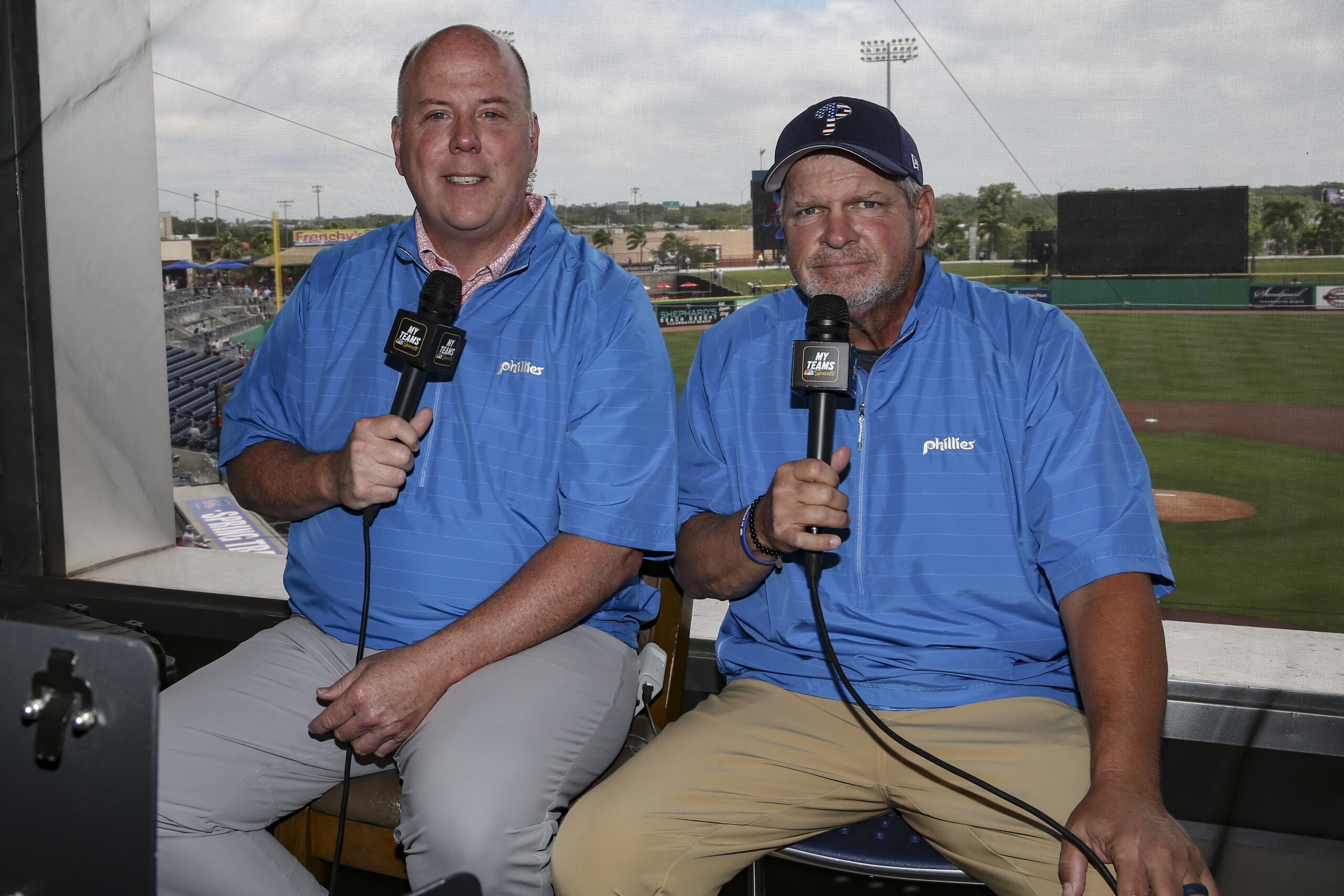
Phillies broadcasters Tom McCarthy (left) and John Kruk will be back again for NBC Sports Philadelphia.
The bulk of the Phillies’ televised spring training games will air on NBC Sports Philadelphia, which plans to broadcast 17 games — nine on the main channel and eight on NBC Sports Philadelphia+. That’s a big jump from last year, when it aired 12 games.
The schedule includes an exhibition game against Team Canada on March 4 serving as a warm-up for this year’s World Baseball Classic. The multicountry tournament begins on March 5 in Tokyo, and the Phillies will be well-represented — 11 players, including Bryce Harper and Kyle Schwarber, will leave spring training early to participate.
Returning for his 19th season as the TV voice of the Phillies is play-by-play announcer Tom McCarthy, who will be joined in the booth by a familiar cast of analysts that includes Rubén Amaro Jr., Ben Davis, and John Kruk.
MLB Network will broadcast six Phillies spring training games (though just two will be available in the Philly TV market due to blackout rules). ESPN won’t be airing any — the network is broadcasting just four spring training games on their main channel, and six more on its ESPN Unlimited subscription service.
Radio listeners can tune into 94.1 WIP to hear 10 weekend games. Play-by-play announcer Scott Franzke is back for his 21st season calling the Phillies, joined once again by a rotation featuring veteran analyst Larry Anderson and Kevin Stocker.
Cole Hamels will be back, but not Taryn Hatcher
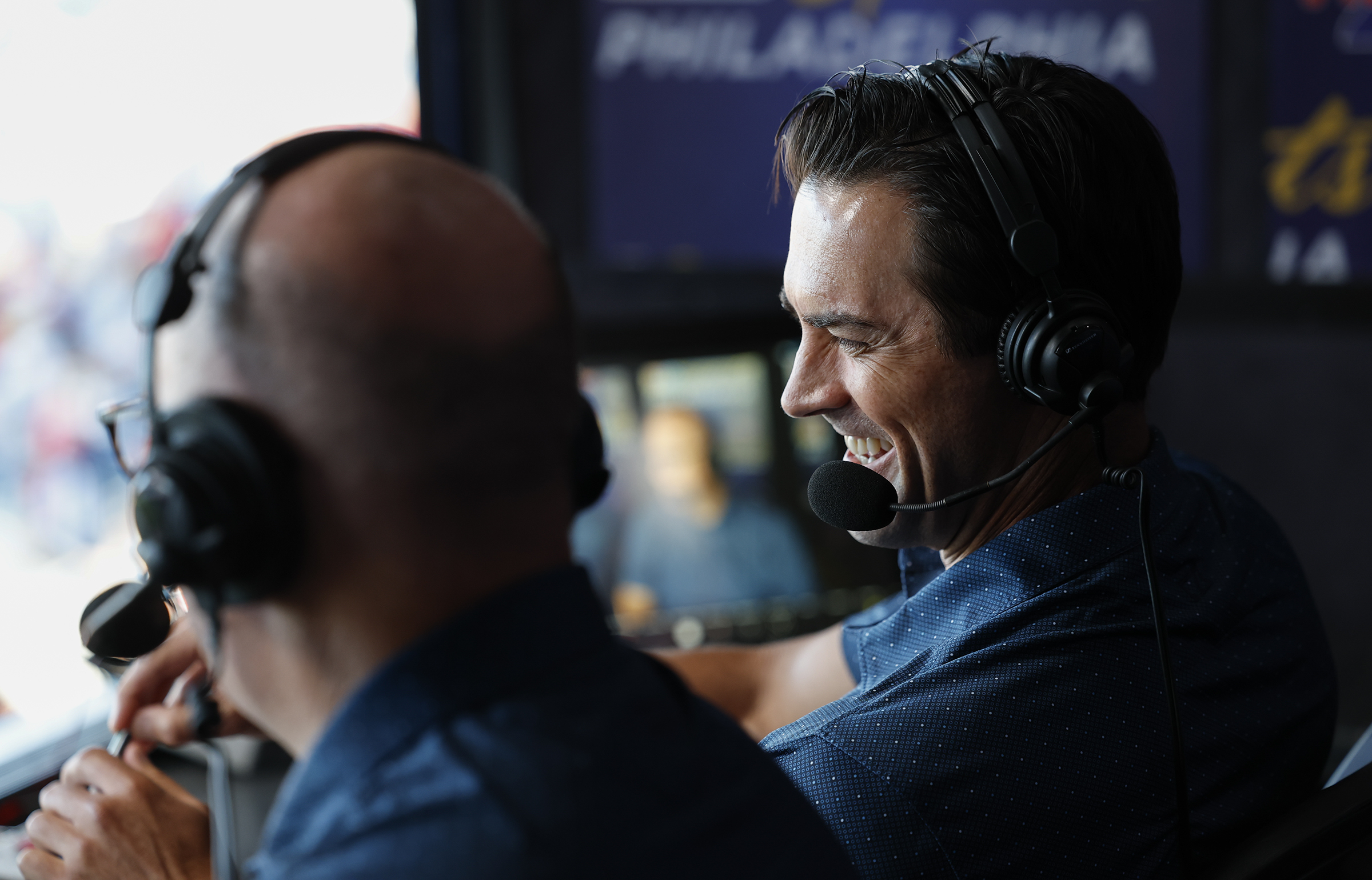
Former Phillies pitcher Cole Hamels (right) called nine games last season for NBC Sports Philadelphia.
A little bit of Hollywood will be back in the Phillies booth this season.
2008 World Series MVP Cole Hamels will call a few spring training games for the second straight season, beginning in the middle of March. Hamels was something of a natural in the booth last season, calling the nine regular-season games he worked a “crash course” in broadcasting.
“I tried to tell myself, ‘Don’t overtalk. Don’t be long-winded. Don’t just talk to talk,’” Hamels told The Inquirer in September. “I start watching the game and enjoying it, and I forget sometimes I have to talk.”
Taryn Hatcher, seen here during a 2019 media softball game.
One NBC Sports personality who won’t be back is Taryn Hatcher, who joined the network in 2018 and spent the past few seasons covering the game as an in-stadium reporter.
Hatcher’s contract wasn’t renewed at the end of the year and NBC Sports Philadelphia eliminated the position, according to sources.
You can also stream NBC Sports Philadelphia on Hulu + Live TV and YouTube TV, which will soon roll out a skinny sports bundle. And NBC Sports Philadelphia will stream its games on the NBC Sports app, but a subscription to a cable service is required.
One streaming service where you won’t find the network is Fubo, which hasn’t broadcast any NBC channels since November due to a carriage dispute. NBC Sports Philadelphia is also not available on Sling TV or DirecTV Stream.
For the third straight season, the Phillies will also exclusively stream a handful of spring training games from BayCare Ballpark for free on the team’s website.
The team will also provide an audio-only feed for a few midweek road games that aren’t airing on WIP.
Are there any new MLB rules in spring training?
Umpires will have their balls and strikes face challenges this season.
There aren’t any new rules in play during spring training, but MLB is fully rolling out its automatic ball-strike (ABS) challenge system ahead of its launch in the regular season. The Phillies plan on giving it a healthy test drive.
The rules are pretty straightforward. Pitchers, catchers, or batters can challenge a ball or strike by taping their head immediately after the umpire’s call.
Each team starts the game with two challenges, which they only lose when a challenge is unsuccessful. If a team has no challenges remaining and the game goes into extra innings, they’re awarded one per inning until the game is over.
Phillies news and spring training updates
Trea Turner fields a ground ball during spring training Wednesday.
Trea Turner was still the fastest man in the league at 32. Here’s his secret.
The Phillies will open the season against the Texas Rangers at Citizens Bank Park.
The Phillies are scheduled to open the 2026 season on March 26 against the Texas Rangers at Citizens Bank Park, where the team will hang its 2025 NL East pennant.
Ben Vaughn is a man of many moods, and an equal number of career twists.
The Camden County native and radio host’s hourlong show The Many Moods of Ben Vaughn — “broadcasting weekly from the Relay Shack, from parts unknown” — airs Saturdays at 6 p.m. on WXPN-FM (88.5). It’s also heard on 19 other stations in the U.S. and one in France.
The singer-guitarist has released 20 albums, starting with his 1986 debut, also called The Many Moods of Ben Vaughn, and including one, 1997’s Rambler ’65, recorded entirely in his car.
His collaborative album with Providence, R.I.-based band and Ben Vaughn fanboys Deer Tick is due in October, and his first U.S. tour in nearly three decades will follow. (He plays regularly in Spain, France, and Italy.)
In the 1990s, the Mount Ephraim-native moved to Los Angeles and worked as a music composer for the hit TV sitcoms 3rd Rock From the Sun and That ‘70s Show. His credits as a record producer include legends and eccentrics such as Charlie Feathers, Alex Chilton, Los Straitjackets, Nancy Sinatra, and New Hope duo Ween.
Along the way, he’s accumulated a lifetime of stories, from his encounter with Billy Joel’s hippie band Attila in Philly head shop 13th Street Conspiracy to playing harmonica with Lynyrd Skynyrd at the Spectrum in the 1980s.
Ben Vaughn’s new podcast with Laura Pochodylo is “Straight From the Hat.”
This week’s episode of the pod, which debuted in January with episodes released every other Thursday, concerns a subject dear to Vaughn’s heart. Philly DJ Jerry Blavat — the Geator with the Heater, the Boss with the Hot Sauce — was Vaughn’s “mentor without knowing it” for years until the two became close friends and then collaborators late in the life of Blavat, who died in 2023 at 82.
Straight From the Hat took shape because Sonny Bono brought Vaughn and Pochodylo together.
In 2022, Vaughn was digging into the Sun vaults to curate a compilation for the storied label’s 70th anniversary. With songs by Feathers, Harmonica Frank, and the Prisonaires, it shows the flair for unearthing musical gems that Vaughn displays in the 552 Many Moods episodes that have aired since launching on Valentine’s Day 2009. (Over 300 are available on podcast platforms.)
Speaking from Many Moods headquarters near Joshua Tree in California’s Mojave Desert, Vaughn says that “even though she’s a lot younger than me” — he’s 70, Pochodylo is 33 — “her record collection is almost identical to mine.”
They bonded over “non-ironic appreciation” of Bono, the late singer, actor, and politician famed for his work with his wife Cher. Bono also wrote songs recorded by Sam Cooke, Jackie DeShannon, and the Rolling Stones. Pochodylo calls herself “a Sonny Bono evangelist.”
Vaughn told Pochodylo stories about musicians in Sun Records’ collection who he had worked with.
“And then we came up with the idea to write all these names down and throw them in a hat. She picks one out, and I say whatever comes to mind. No preparation, no planning.”
In this week’s episode, Pochodylo pulls out Blavat’s name, and Vaughn has plenty to say about the Philadelphia life force he first felt at age 10 in 1965, when he tuned into Blavat’s afternoon TV show The Discophonic Scene.
“I started going to these dances he would put on at gymnasiums and Knights of Columbus Halls,” Vaughn said. “The first song I ever played lead guitar on in front of an audience was ‘Sheba’ by Johnny and the Hurricanes because the Geator was using it as a theme song.”
Jerry “The Geator” Blavat with Ben Vaughn in 1997.
Vaughn played drums in his first band when he was 12, and got a South Jersey musical education at Blavat package shows seeing vocal groups like the Dells and Delfonics.
A Four Tops performance at the Steel Pier in Atlantic City “spoiled me,” he said, “because the Four Tops were one of the most professional acts in the history of entertainment. So everything was perfect.
“And then I saw Canned Heat [at the Pier], and I remember they were very high, and couldn’t keep their guitars in tune because of the salt air. I remember thinking: ‘There are several ways to go as an entertainer, and this is one way I will never go!’”
The free-form nature of The Many Moods, which last week featured songs under two minutes by artists like Francoise Hardy, Bob Dylan, and Nina Simone, was shaped not by Blavat but by early 1970s Philly DJs like David Dye and Michael Tearson on WMMR-FM (93.3).
Ben Vaughn in Philadelphia in the summer of 1970.
But the unstoppable self-confidence and business acumen of Blavat, who Vaughn got to know in the 1980s, shaped Vaughn’s career.
“There was a way the rest of the world did things, and a Geator way,” Vaughn said. “He told me I should own my own show, which I do.” Blavat emphasized self-belief. Whatever Vaughn did would have value, as long as it was truly unique.
“The Geator would buy time on the radio, and sell ads himself. I would drive around with him to pizzerias and shoe stores and car dealerships and watch him. And then we’d drive away with a car with his name on the side. The Geatormobile!”
Philly musicians in future Straight episodes include “Mashed Potato Time” singer Dee Dee Sharp and rock and roller Charlie Gracie, who befriended Vaughn in the 1970s at the Mount Ephraim club Capriotti’s, where Gracie was nightly entertainment and Vaughn a dishwasher.
“I watched it and you can hardly hear me. But I show up in the close captions and they spell my name right. So that’s a victory.”
In 2021, Vaughn helped Blavat move out of his office on East Market Street and found unopened letters from 1964 with song requests to play on Blavat’s WCAN-AM (1320) radio show. Blavat and Vaughn opened them on air on XPN in 2021 in a show called The Lost Dedications.
“The Geator created something that never existed before,” Vaughn said. “Geatordelphia! It was a subculture. The way he talked, the kind of records he played, the way he had of communicating with the audience.
“He connected so many human beings, and made everybody feel good. He made us all feel like we were better looking than we really were. Only South Philly could have produced a guy like him. It didn’t make sense to anyone outside of a 90-mile radius. The Jersey Shore, Trenton, Wilmington, that’s it.
“That was the great thing about doing the podcast. Laura is originally from Detroit, and she didn’t know anything about the Geator. And trying to explain the Geator to an outsider is an amusing thing.”
“Straight From the Hat” episodes are at straightfromthehat.com and on all podcast platforms.
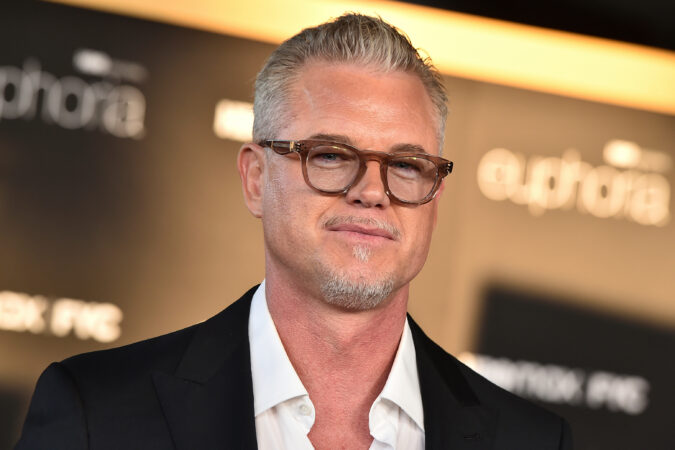
Eric Dane, the celebrated actor best known for his roles on Grey’s Anatomy and Euphoria and who later in life became an advocate for ALS awareness, died Thursday. He was 53.
His representatives said Mr. Dane died from amyotrophic lateral sclerosis, known also as Lou Gehrig’s disease, less than a year after he announced his diagnosis.
“He spent his final days surrounded by dear friends, his devoted wife, and his two beautiful daughters, Billie and Georgia, who were the center of his world,” said a statement that requested privacy for his family. “Throughout his journey with ALS, Eric became a passionate advocate for awareness and research, determined to make a difference for others facing the same fight. He will be deeply missed, and lovingly remembered always. Eric adored his fans and is forever grateful for the outpouring of love and support he’s received.”
Mr. Dane developed a devoted fan base when his big break arrived in the mid-2000s: He was cast as Dr. Mark Sloan, aka McSteamy, on the ABC medical drama Grey’s Anatomy, a role he would play from 2006 until 2012 and reprise in 2021.
Although his character was killed off on the show after a plane crash, Mr. Dane’s character left an indelible mark on the still-running show: Seattle Grace Hospital became Grey Sloan Memorial Hospital.
In 2019, he did a complete 180 from the charming McSteamy and became the troubled Cal Jacobs in HBO’s provocative drama Euphoria, a role he continued in up until his death.
Mr. Dane also starred as Tom Chandler, the captain of a U.S. Navy destroyer at sea after a global catastrophe wiped out most of the world’s population, in the TNT drama TheLast Ship. In 2017, production was halted as Mr. Dane battled depression.
In April 2025, Mr. Dane announced he had been diagnosed with ALS, a progressive disease that attacks nerve cells controlling muscles throughout the body.
ALS gradually destroys the nerve cells and connections needed to walk, talk, speak, and breathe. Most patients die within three to five years of a diagnosis.
Mr. Dane became an advocate for ALS awareness, speaking a news conference in Washington on health insurance prior authorization. “Some of you may know me from TV shows, such as Grey’s Anatomy, which I play a doctor. But I am here today to speak briefly as a patient battling ALS,” he said in June 2025. In September of that year, the ALS Network named Mr. Dane the recipient of their advocate of the year award, recognizing his commitment to raising awareness and support for people living with ALS.
Mr. Dane was born on Nov. 9, 1972, and raised in Northern California. His father, who the actor said was a Navy veteran and an architect, died of a gunshot wound when Mr. Dane was 7. After high school, he moved to Los Angeles to pursue acting, landing guest roles on shows like Saved by the Bell, Married … With Children, Charmed, and X-Men: the Last Stand, and one season of the short-lived medical drama Gideon’s Crossing.
A memoir by Mr. Dane is scheduled to be published in late 2026. Book of Days: A Memoir in Moments will be released by Maria Shriver’s The Open Field, a Penguin Random House imprint. According to Open Field, Mr. Dane’s memoir covers key moments in his life, from his first day at work on Grey’sAnatomy to the births of his two daughters and learning that he had ALS.
“I want to capture the moments that shaped me — the beautiful days, the hard ones, the ones I never took for granted — so that if nothing else, people who read it will remember what it means to live with heart,” Mr. Dane said in a statement about the book. “If sharing this helps someone find meaning in their own days, then my story is worth telling.”
Mr. Dane is survived by his wife, actor Rebecca Gayheart, and their two teen daughters, Billie Beatrice and Georgia Geraldine. Gayheart and Mr. Dane wed in 2004 and separated in September 2017. Gayheart filed for divorce in 2018, but later filed to dismiss the petition. In a December essay for New York magazine’s The Cut reflecting on Mr. Dane’s diagnosis, Gayheart called their dynamic “a very complicated relationship, one that’s confusing for people.” She said they never got a divorce, but dated other people and lived separately.
“Our love may not be romantic, but it’s a familial love,” she said. “Eric knows that I am always going to want the best for him. That I’m going to do my best to do right by him. And I know he would do the same for me. So whatever I can do or however I can show up to make this journey better for him or easier for him, I want to do that.”