Category: Food

  • How did The Inquirer review Michelin’s top Philadelphia picks in the past?

    How did The Inquirer review Michelin’s top Philadelphia picks in the past?

    On Tuesday night, Philadelphia won big with three Michelin stars, 10 Bib Gourmands, and 21 Recommended winners.

    One of the world’s most prestigious restaurant awards, Michelin deploys anonymous inspectors to assess restaurants and designate the honorees. Not too much is known about these inspectors — decision-making is made by a globally diverse group, not an individual, and most have several years’ experience in the restaurant or hospitality industry, according to Gwendal Poullennec, international director of the Michelin Guide. They use changing names and phone numbers and visit a restaurant multiple times to evaluate its full merit.

    While the 34 Michelin-recognized restaurants were presumably all-new to the guide’s inspectors, The Inquirer has written about all of them before — in a few cases, not entirely favorably. Here’s how the food desk has covered Philly’s Michelin-starred and Bibbed restaurants in the past. (For a breakdown of Michelin Guide hierarchy, read more here.)
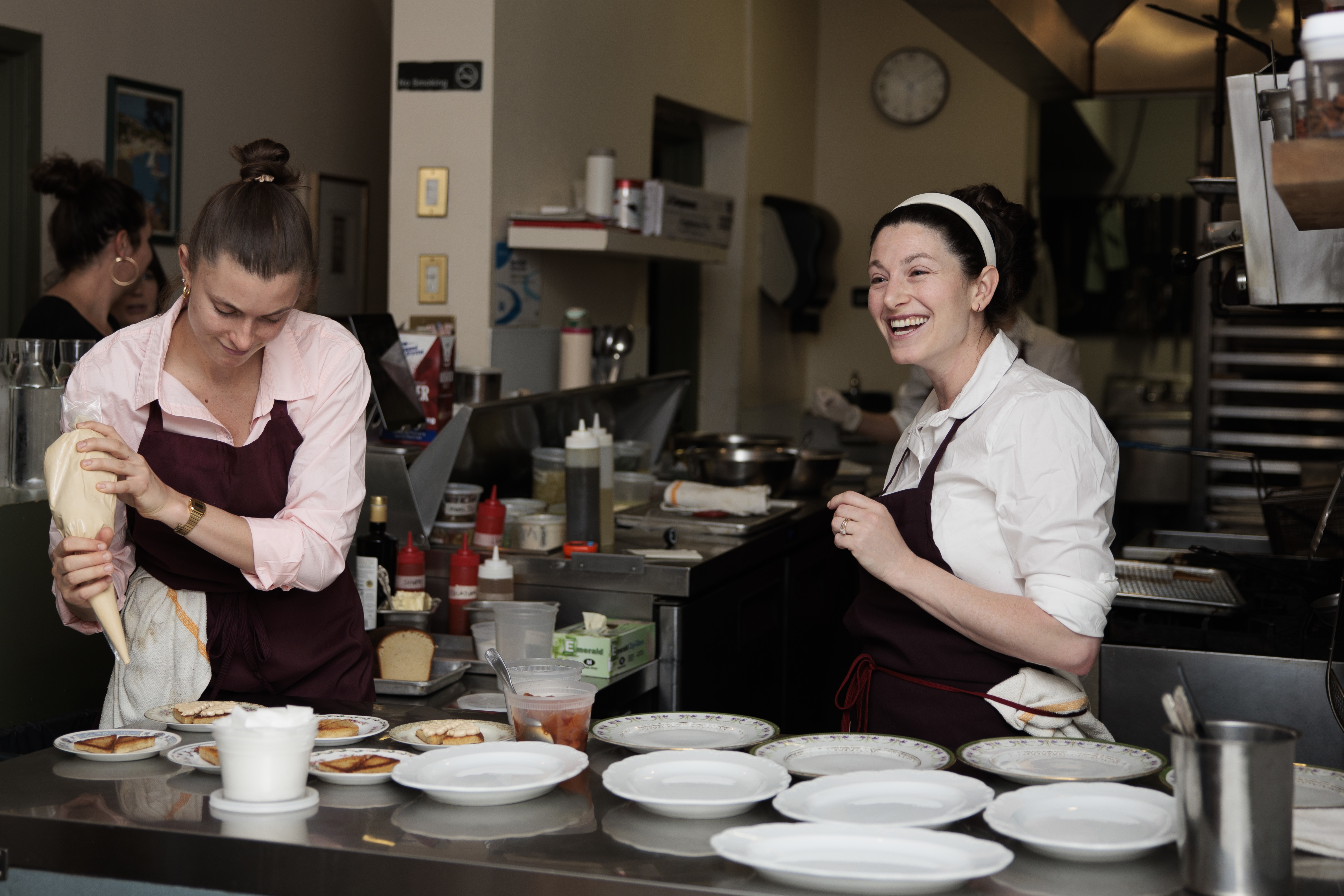
    Chef Amanda Shulman (right) greets attendees at Her Place Supper Club on May 12.

    Philly’s Michelin-starred restaurants

    • Her Place Supper Club: Amanda Shulman’s dinner party-as-a-restaurant was born out out of her cooking on Penn’s campus, transitioned to a residency in a former Slice pizza shop in Rittenhouse, and has bloomed into a full-on restaurant — now Michelin-starred — that still manages to be endearingly idiosyncratic. When Inquirer critic Craig LaBan first reviewed Her Place, the cooking was so good, “I needed to do yet another double-take to remind myself that Shulman was producing this feast for two dozen diners nearly single-handedly,” he wrote in 2021. These days, the kitchen is led by chef de cuisine Ana Caballero and sous-chef Santina Renzi, whose skill and energy landed Her Place in LaBan’s Top 10 last year and this year’s edition of The 76.
    • Friday Saturday Sunday: Another 76 pick, Chad and Hanna Williams’ “townhouse oasis off Rittenhouse Square, already the most exciting fine dining experience in Philly, has only gotten better,” LaBan wrote after its Outstanding Restaurant James Beard win in 2023. When the couple first opened the restaurant in 2016 — using the same name as the building’s 42-year predecessor — they created some ripples. “At last … the most normal thing on the menu!” LaBan overheard during one of his earliest review dinners there. His reaction was very different: The restaurant has routinely appeared in his annual Top 10 lists in the years since.
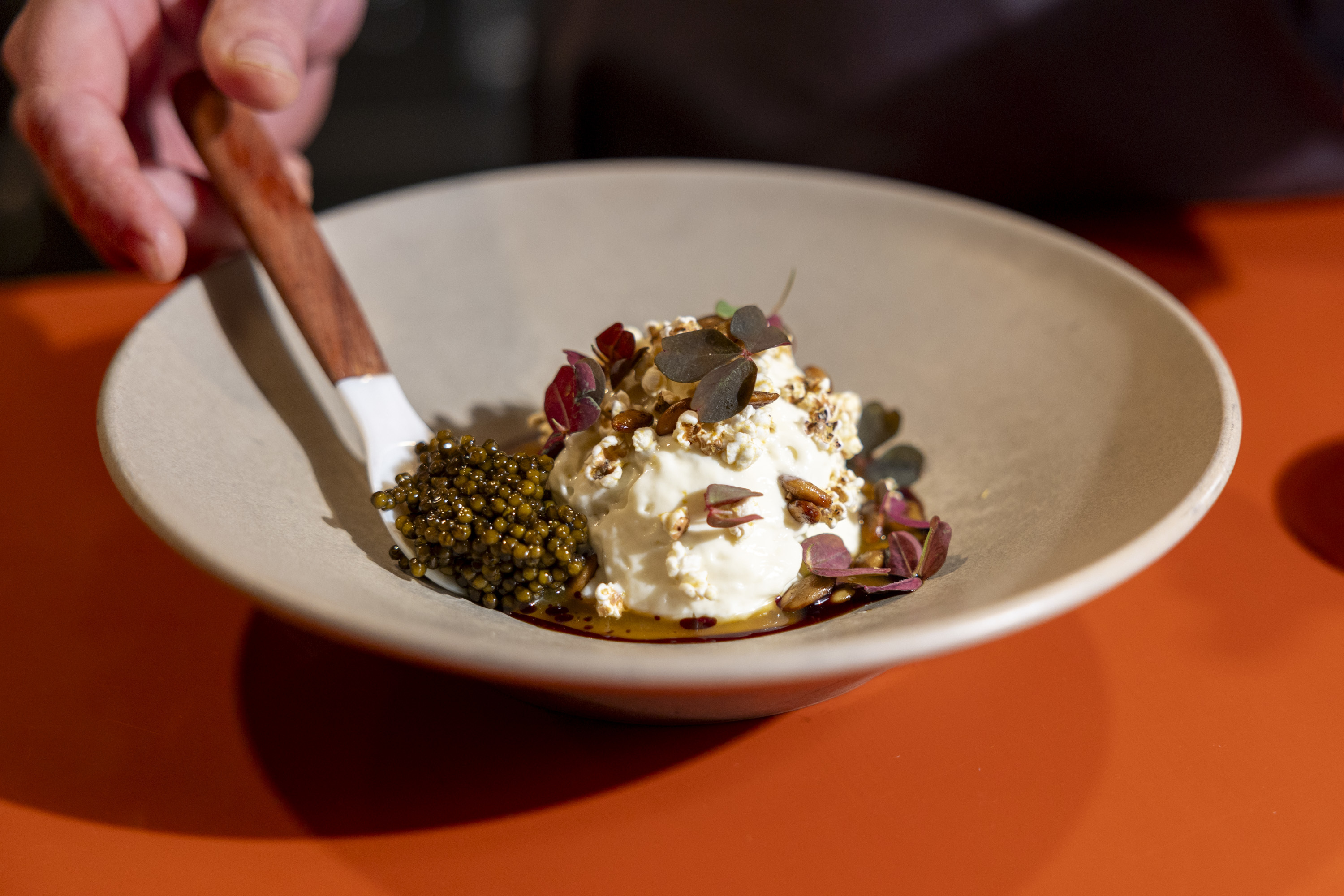
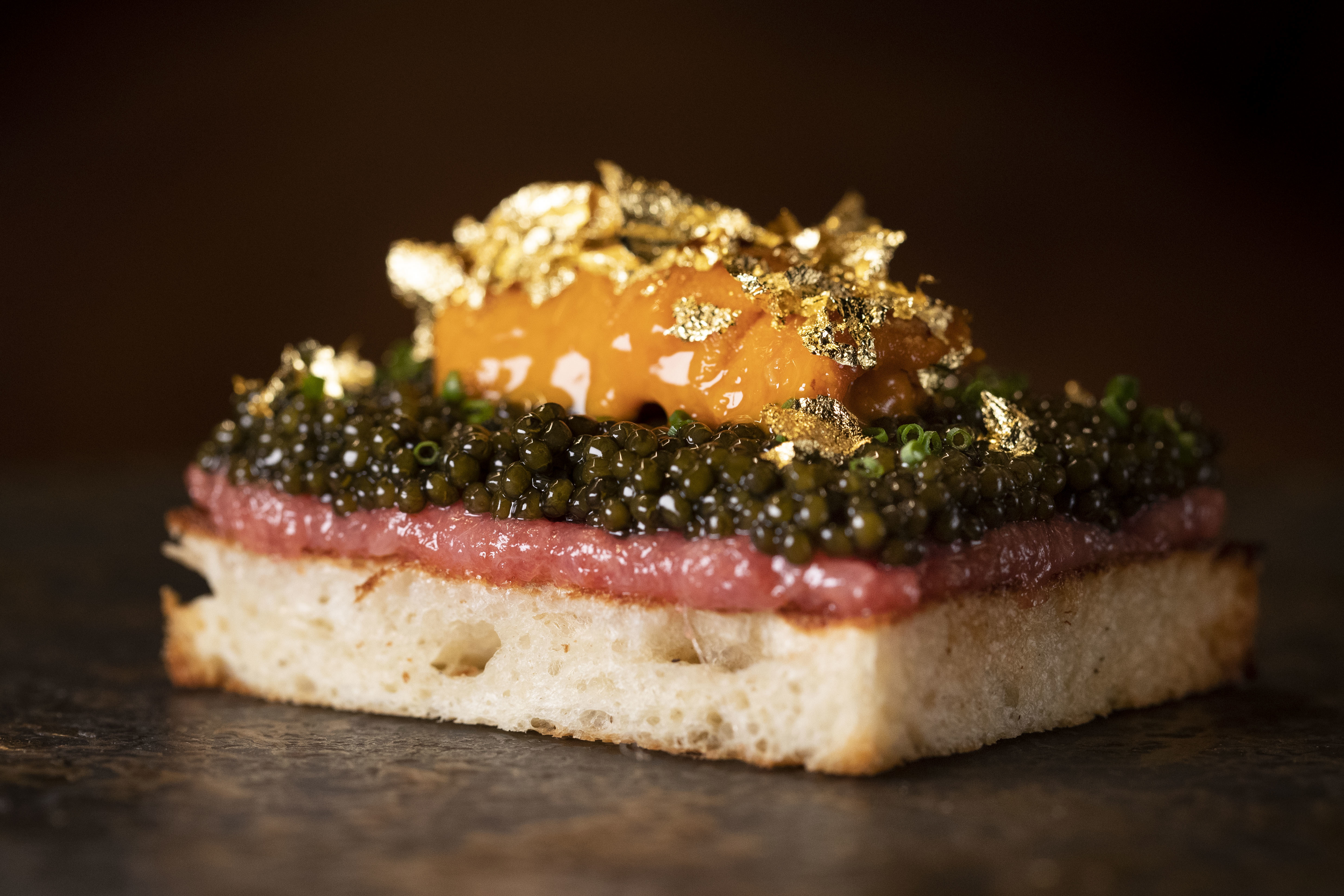
    Chef Nicholas Bazik of Provenance is making the golden ossetra with squash and tofu at Provenance on Nov. 7.
    • Provenance: While Michelin awarded chef Nicholas Bazik and his finely tuned team a coveted star, LaBan found flaw in Philly’s recent most ambitious French fine-dining project, which he reviewed last October: “When you’re paying $225 to sit down for a 2½-hour dinner (figure between $700 or $800 for two all-in with tip and tax, depending on what you drink), there isn’t much room for error. And there are still too many menu missteps at Provenance, where only about half of the 47 compositions I tasted over two meals were a complete success.” (Ed. note: I sense a followup review in the future…)

    Green star

    • Pietramala: Chef Ian Graye also scored a Green star for Pietramala, his sustainability-minded vegan restaurant. In his 2023 review — which the NoLibs restaurant shared with Primary Plant Based (now closed) and Miss Rachel’s Pantry — LaBan found lots of bright spots and a disappointment or two, concluding of Graye’s cooking: “I’d rather someone swung big than timidly struck out.“ The swings are connecting even more these days: Pietramala was in LaBan’s Top 10 last year.

    Bib Gourmand

  • Mama’s Pizzeria on the Main Line will close its doors this week

    Mama’s Pizzeria on the Main Line will close its doors this week

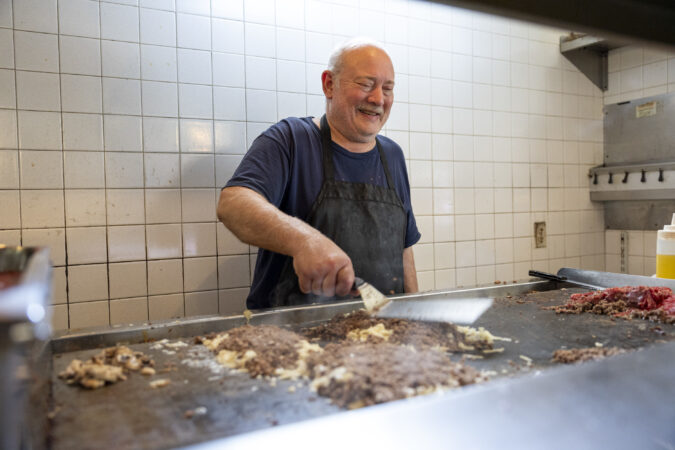
    Mama’s Pizzeria, which has served its signature cheesesteak with a three-cheese blend twisted throughout finely chopped sirloin on the Main Line since 1960, is closing its doors next week.

    Second-generation owner Paul Castellucci Sr. said the last day will be either Nov. 28 or Nov. 29, depending on how much meat and bread remain.

    Castellucci had planned to close up the Bala Cynwyd shop after his son, Paul Jr., earned his accountant’s license. He is slated to graduate from St. Joseph’s University in 2026.

    But the timeline was moved up with the elder Castellucci’s recent health issues. The 65-year-old grill man is set to have triple bypass surgery in January, but will start preoperative assessments the first week of December.

    Paul Castellucci Sr., who has two stents from previous heart issues, was complaining to his cardiologist about shortness of breath. The doctor asked if he had any shoulder pain.

    “Do you know what? I do,” he responded. “I’ve had shoulder pain for 40 years.”

    Over the years, the entire Castellucci family was put to work at Mama’s: kids, grandkids, spouses, cousins.

    Paul Castellucci Sr. started working the grill in 1974 at age 14. Fast-forward to 2025, and “I’m the only one who stayed,” he said in March.

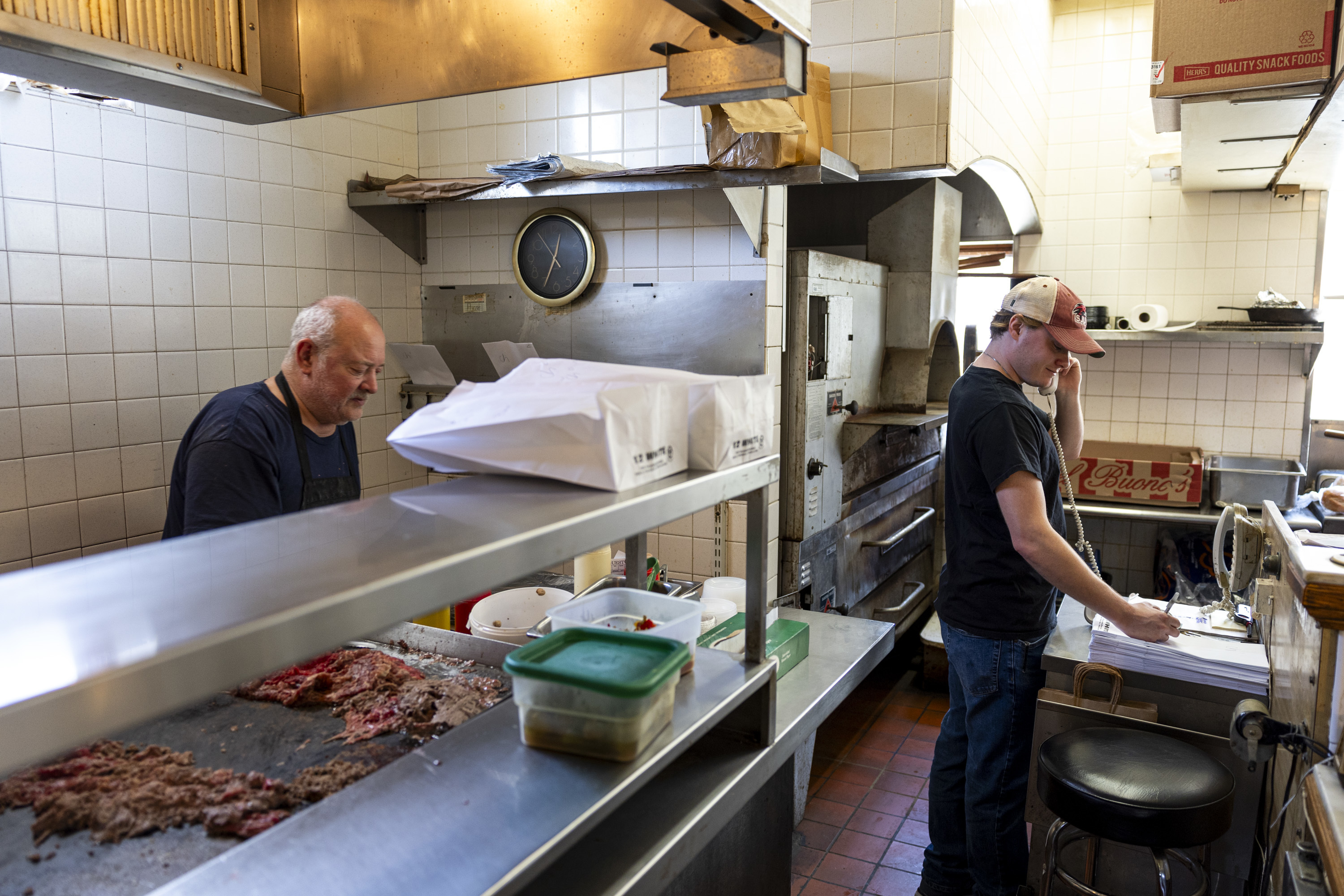
    Paul Castellucci Jr. (right) takes an order from a customer while his dad, Paul Sr., runs the grill at their family restaurant, Mama’s Pizzeria.

    Since word of the closing began to spread on social media, business has picked up.

    Store hours are traditionally 11 a.m. to 6 p.m., Wednesday through Saturday. But on Saturday morning, orders started rolling in around 10:30 a.m. By 12:30 p.m., the phone was ringing incessantly, orders were piling up, and there was an hour wait for walk-ins.

    The restaurant was even concerned about running out of rolls.

    “I’m feeling it,” Castellucci said.

    Customers who ordered by phone or in person on Saturday took turns wishing him good luck with his surgery and good health in the new year.

    That all has to make me him feel good, right?

    He thought for a second.

    “It really does,” he said.

  • Michelin Guide honored this Philly cheesesteak shop, but apparently botched the order

    Michelin Guide honored this Philly cheesesteak shop, but apparently botched the order

    Stephanie Maslanik was sitting on her couch Tuesday night when her phone dinged with a text message from a friend. But she was doing something with the kids and didn’t look at it right away.

    “Then I opened it up and I was like, ‘Whaaaat?’ It took me a minute to put two and two together and I gave it to my husband,” she said. “I told him, ‘Does it say what I think it says?’”

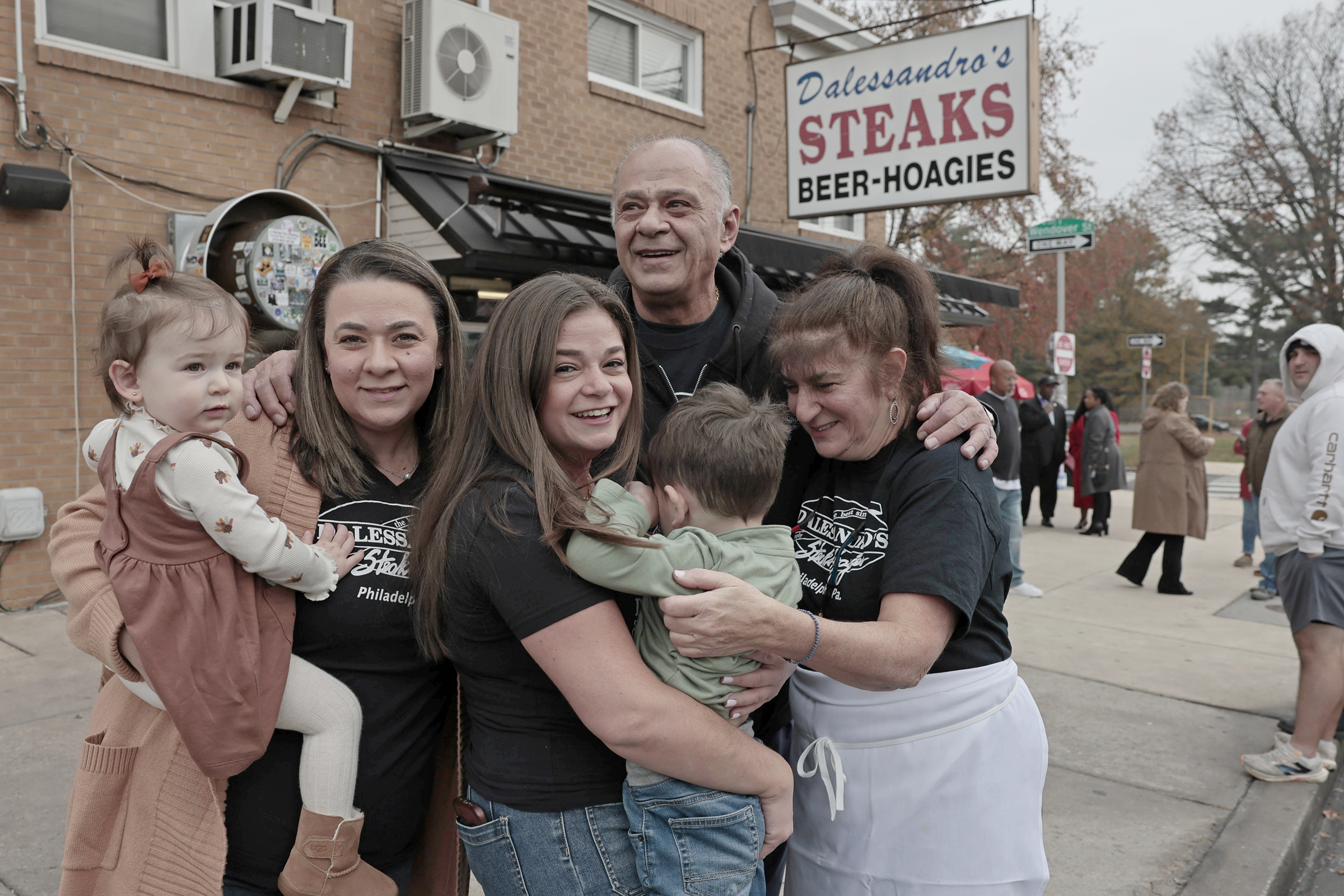
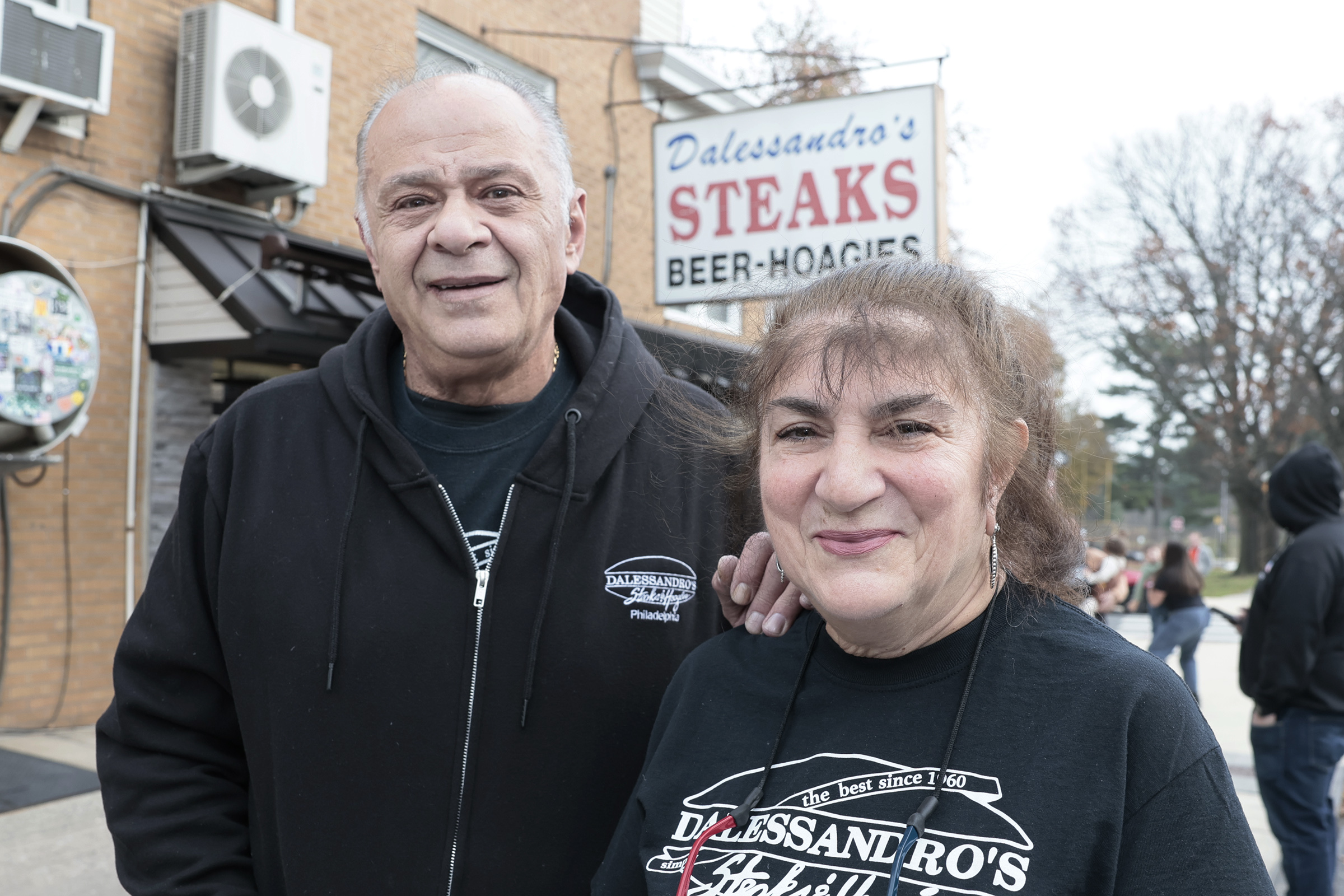
    Steve and Margie Kotridis (right) with their daughters, Stephanie Maslanik (left) and Christina Kotridis (middle), and grandchildren Charlotte, 1, and a very bashful Steven, 4, outside Dalessandro’s.

    It was exactly what she thought it said: It was a video clip of that evening’s Michelin Guide Northeast Cities ceremony, where Dalessandro’s — the family’s cheesesteak shop in Roxborough — had been among the recipients of an award.

    Their old-school corner shop was officially Bib Gourmand royalty — Michelin’s category for great food at a great value. Dalessandro’s was one of three cheesesteak shops that impressed arguably the world’s fussiest food critics.

    Maslanik blew up the family group chat: her parents, Steve and Margie Kotridis, and her younger sister, Christina.

    “I’ve been in the food business for 50 years, and this is a dream,” said Steve Kotridis, 63, who with his wife, 67, bought Dalessandro’s from the founding family in 2008. William Dalessandro opened in 1961 at Henry Avenue and Wendover Street, a year after its founding on nearby Ridge Avenue.

    Michelin is living up to its reputation of international mystery. As of Saturday, the Kotridises said they had not heard from Michelin (though Dalessandro’s is listed on its website, accompanied by an unrelated photo). It is also not clear why the Kotridises apparently never received an invitation to the gala. The owners of the other Bib Gourmand cheesesteak shops, Nish Patel of Del Rossi’s and Danny DiGiampietro of Angelo’s, were seated in Marian Anderson Hall that night.

    Steve Kotridis was doing paperwork and knocking around the house that night — Margie was in Florida for a niece’s shower — and he didn’t read his daughter’s text until the next day.

    He had never realized that a cheesesteak place could even be eligible for a Michelin award, “but certainly if one would be, this would be the place,” he said. “It’s validation.”

    Steve and Margie Kotridis at their Dalessandro’s Steaks in Philadelphia on Friday, Nov. 21, 2025.

    The Dalessandro’s scene

    On Friday afternoon, the line at the ordering window was just as long as on any other chilly Friday afternoon in late November. Inside, the spatulas slapped and the rib eye sizzled on the flattop. The crew cheered in unison at each tip left by a customer.

    “I’ve been getting a lot of people telling us it’s their first time coming, but it’s mostly our really good customers who are saying, ‘Everybody knows now,’” Margie Kotridis said.

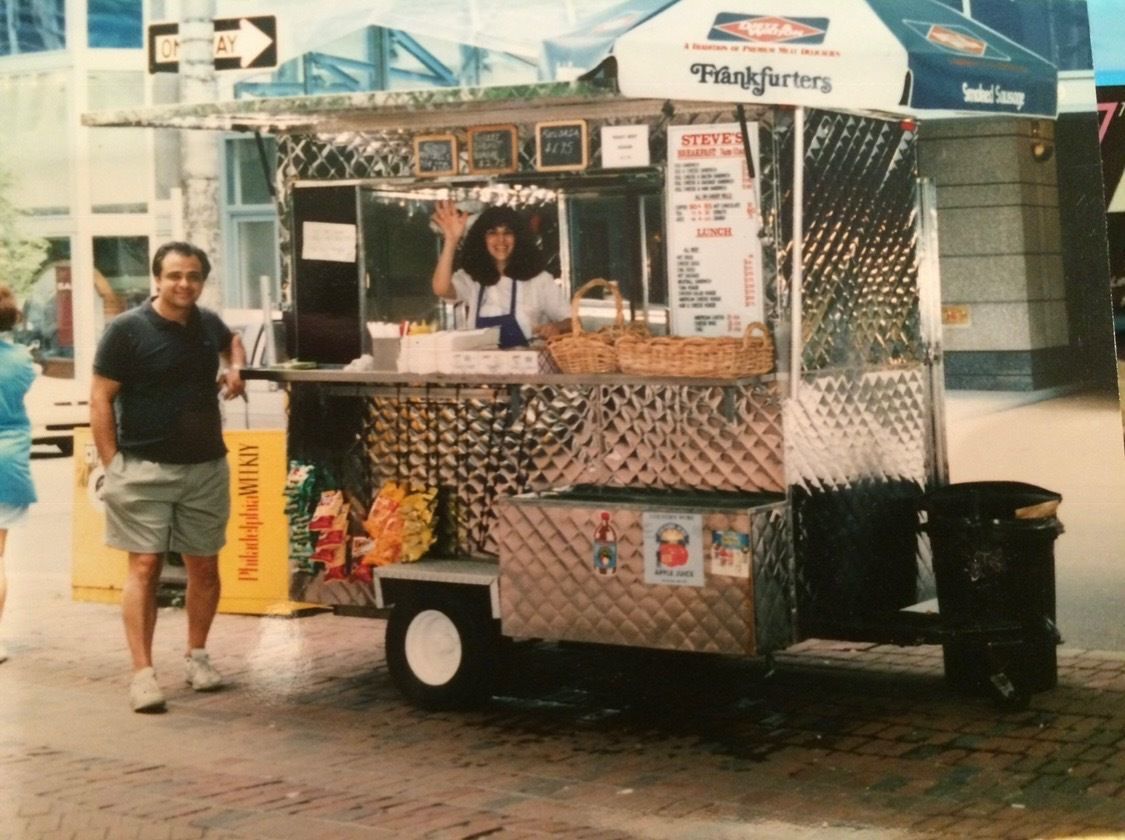
    Steve and Margie Kotridis at their food cart on 17th Street in the early 1990s.

    Steve and Margie come from food families. Her late father, George Tsihlas, owned Towne Pizza at 19th and Pine Streets from 1967 to 1994. Steve’s mother, Antigoni, now 92, still oversees a series of food carts in Center City — including the cart outside the United Engineers Building at 30 S. 17th St. that Steve ran for 30 years.

    Soon after they were married in 1982, they bought a building in Lafayette Hill and opened a diner, Stefano’s Restaurant & Pizza. After two years, “we had to get rid of it,” Margie said. “We were throwing plates at each other.” They went back to vending but kept the building, now home to the Persian Grille.

    Meanwhile, Steve had been a Dalessandro’s customer. “I sat down at that counter and I’d put two cheesesteaks down like it was nothing,” he said. “I’ve lost weight since then.” (His go-to is a cheesesteak with American cheese, fried onions, salt, black pepper, and long hots.)

    In 2008, five years after William Dalessandro’s death, the Kotridises bought the shop and kept it much as it was.

    They shut down for 10 weeks at the start of the pandemic in March 2020. The setup, where takeout customers were smushed against people eating at the counter, could not continue in the new social-distancing world.

    The Kotridises installed two windows — one for ordering, one for pickup — and locked the front door. (Regulars can ask to come inside to eat, especially when the patio is full or the weather is bad.) A friend set them up with an ordering system that displays wait times and names on a monitor outside and provides text alerts. There’s no yelling. An electronic voice calls out customers’ names and directs them to the correct window. It’s still cash-only.

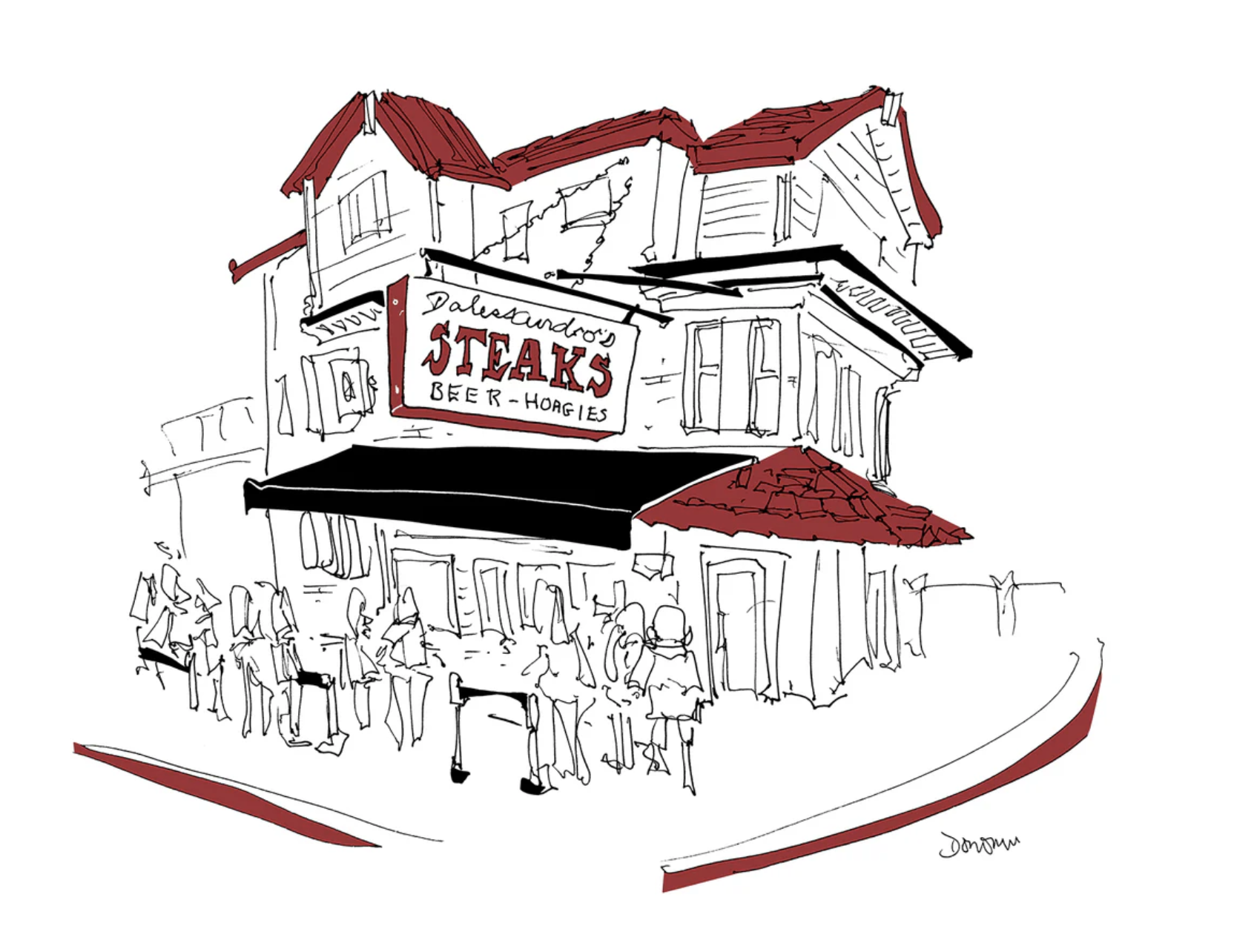
    This sketch of Dalessandro’s Steaks by John Donohue was part of a recent show called “The Art of Philly Dining” at Gleaner’s Cafe and Gallery.

    The typical wait is 10 to 15 minutes during the week, but an hour Friday, Saturday, and Sunday, as the line wends along the sidewalk and traffic snarls on Henry Avenue.

    About the Dalessandro’s steak

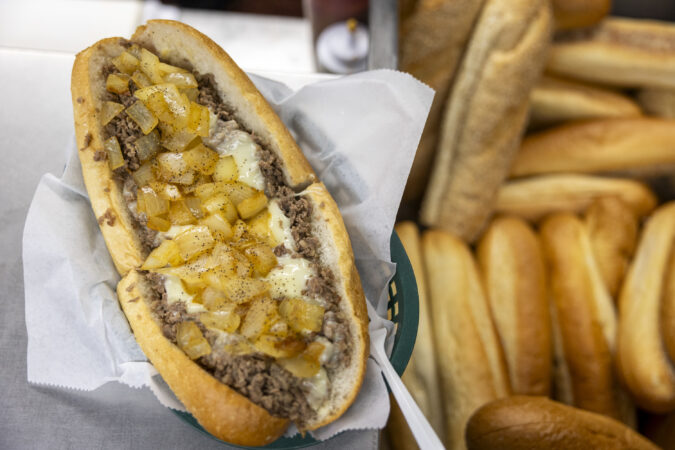
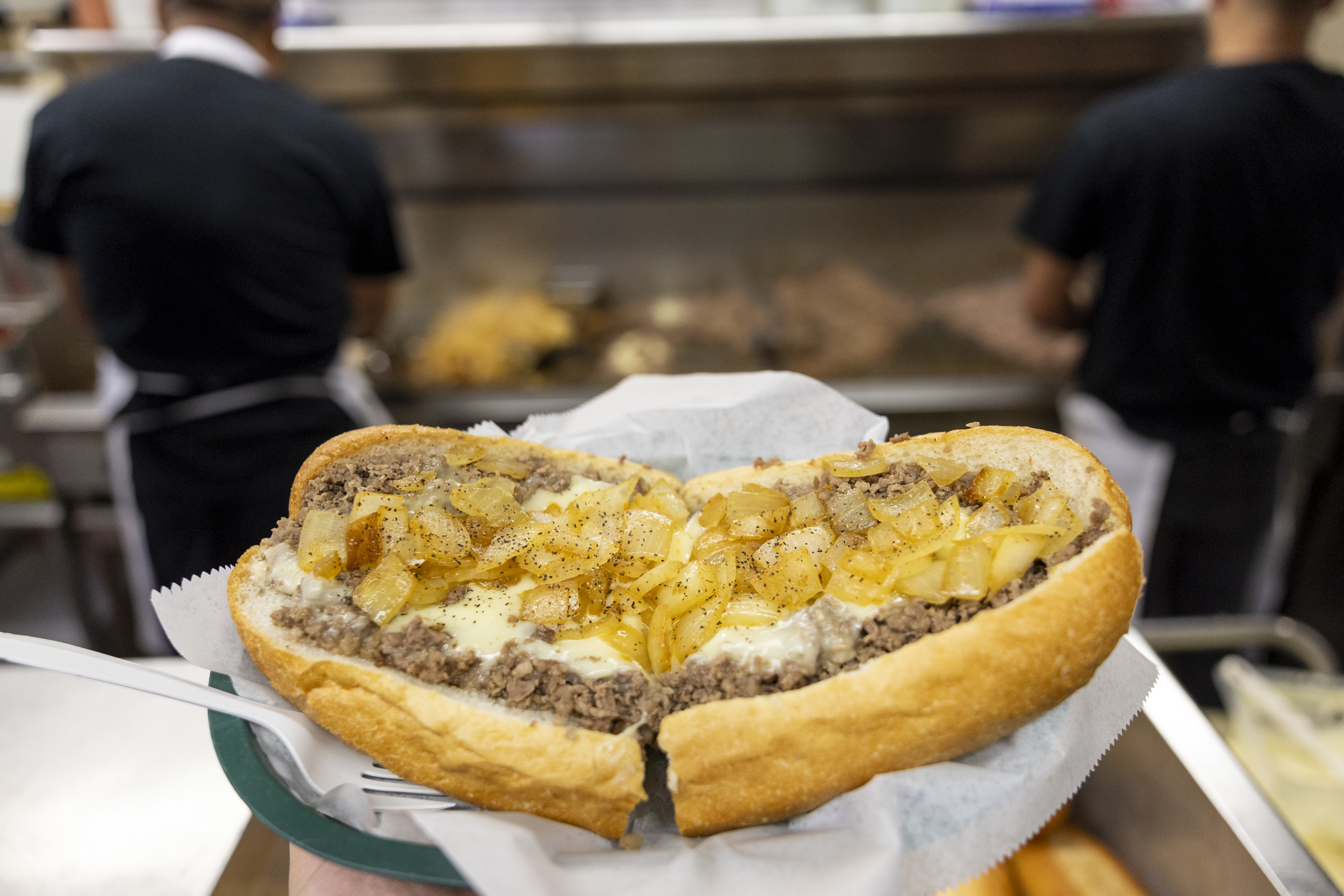
    Dalessandro’s serves an old-school sandwich: The rib eye is chopped fine — almost minced. The cheese is layered atop the beef, not mixed. The Amoroso’s roll is softer than the crispy-crusted, house-baked breads from such newer-generation shops as Del Rossi’s and Angelo’s. Dalessandro’s chops its fried onions in a huge, toothsome dice.

    A cheesesteak from Dalessandro’s in Philadelphia, on Friday, Nov. 21, 2025.

    Dalessandro’s flatly resists the recent industry move to Cooper Sharp American cheese. “We brought it in like a year ago and we tasted it,” Margie said. “All Cooper Sharp is, is sharp American cheese. We already use sharp American cheese. We made [test] cheesesteaks. Nobody could tell the difference.”

    Asked what made their steaks stand out to Michelin, Steve said: “I’m not sure. We just do it the right way and we make food the way we would like to eat it. We slice fresh rib eye all day long. Our rolls get here at 11. We fry our own peppers.”

    Margie said she routinely drops an order slip, anonymously, into the queue and samples the sandwich.

    “Consistency is very important,” she said. “I go out to eat somewhere and I find something I love and it’s so delicious. You go back the next time and it’s like a whole different sandwich or a different meal than what you ate last time.”

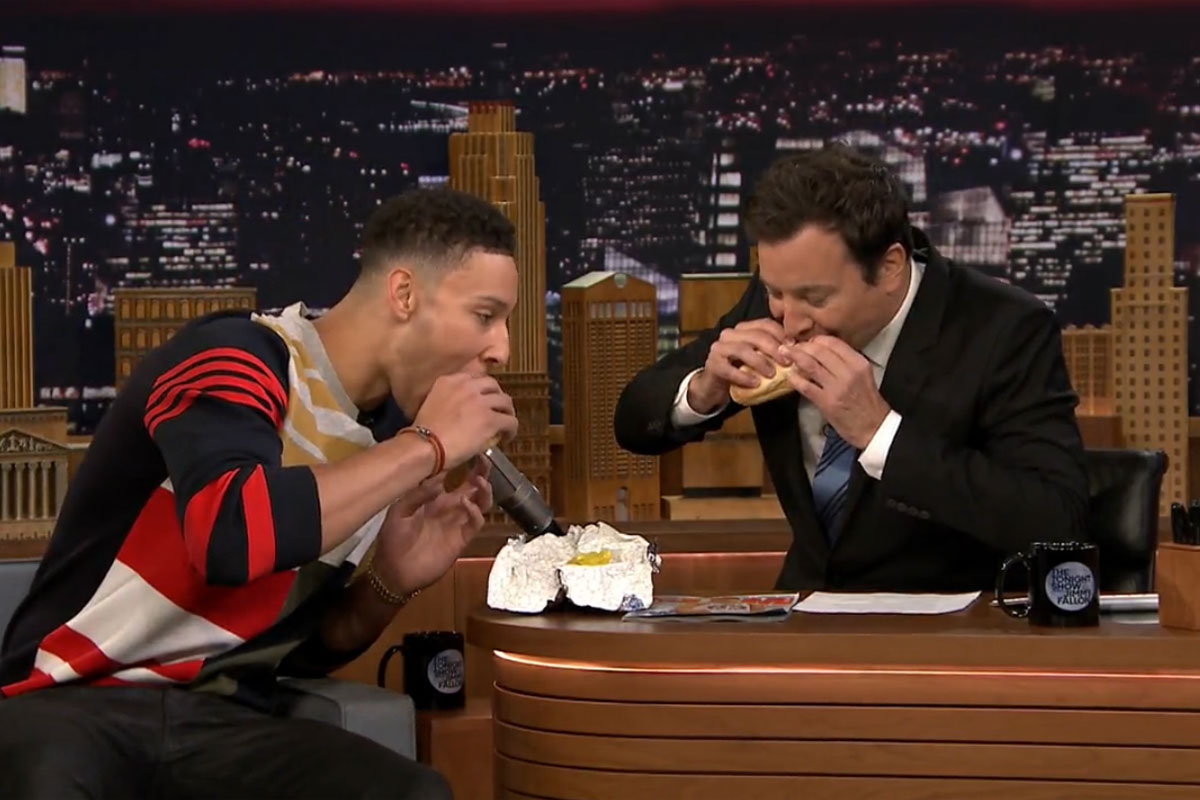
    Former Sixers player Ben Simmons and Jimmy Fallon sampling a Dalessandro’s cheesesteak on the “Tonight” show.

    “One of the four of us is always here,” Margie said.

    This is why Steve said he has resisted offers to open additional locations. “At this age, I’m not interested. The problem today is you can’t be everywhere. To run a good place, you have to be on top of it, so you could wind up killing the name.”

    Dalessandro’s has won plenty of awards, including an Inquirer reader poll in 2023.

    “I think the people that pay attention to Michelin and … the foodies — it’s going to make a big difference,” Steve said. “They’re all going to come and try it, and they’ll all have their own opinions of what they like and what they don’t like, and hopefully everybody will love it and come back again.”

    Margie said: “But then, everybody has a favorite, right? Some people like vanilla, some people like chocolate, and some people like strawberry ice cream. You can’t please everybody.”

  • Another thing Philly has over Dallas: Michelin acclaim

    Another thing Philly has over Dallas: Michelin acclaim

    On the eve of another Eagles-Cowboys game, let me tell you a few ways Philadelphia is superior to Dallas.

    The sports teams, of course. There’s the downtown walkability, the history, and the overall gritty culture (as in “this might be the best show of my life in a room that’s maybe not up to code” energy)

    Philly’s food scene is superior, too. And now we have proof.

    The Michelin Guide’s awards for Texas were announced last month, and Dallas — how do we put this? — underperformed, not only against Philly but even against the rest of Texas.

    Tatsu, an omakase experience, retained its one star from last year’s Michelin awards. This year, Mamami, a French-Italian bistro, scored a star. That’s two stars total for the Big D, compared with Austin’s seven, Houston’s six, and San Antonio’s three.

    Philly was awarded three one-stars on Nov. 18 in its very first showing: Friday Saturday Sunday, Her Place Supper Club, and Provenance. (Boston received only one, but that’s another rivalry for another day.)

    Apparently, everyone in Dallas seems to know that the food scene is lacking — even D Magazine, which headlined its Michelin predictions story: “Dallas, prepare to be underwhelmed.”

    While the post-Michelin food mood in Philadelphia has been generally celebratory, they’re crying in their beer in Dallas. Drew Stephenson, an observer of the Metroplex food scene who says he has eaten at all 18 Texas Michelin-starred restaurants, addressed the local shock, indignation, and outrage over Michelin’s selections on his Instagram, @drewthefoodguy.

    According to Stephenson, the reactions show that Dallas diners and Michelin inspectors speak different languages. Dallasites prioritize vibes, service, decor, portions, and price, while Michelin judges ingredient quality, technique, cuisine personality, fair value, and consistency. “We’re just new to Michelin’s framework,” he said.

    For the record, Stephenson — who calls himself “a very big Cowboys but not a proud one” because of the ownership — thinks the Eagles will win a close one Sunday.

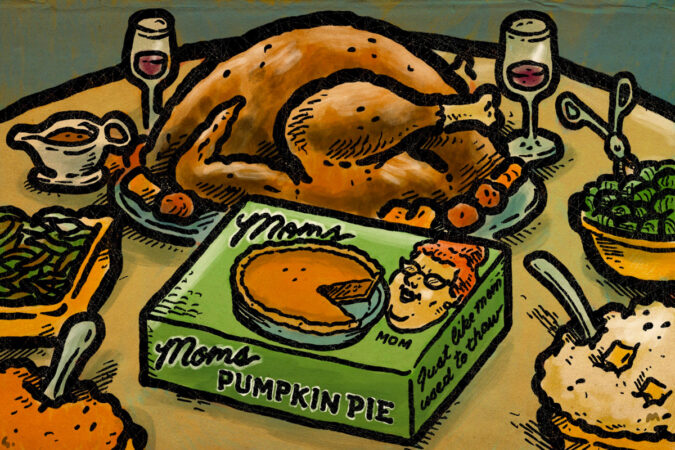
  • Is it rude to bring a store-bought Thanksgiving dish when everyone else is cooking from scratch?

    Is it rude to bring a store-bought Thanksgiving dish when everyone else is cooking from scratch?

    It’s almost Thanksgiving and maybe you’re not the cooking type. Or maybe you just have too much on your … plate. I invited two Inquirer journalists to answer the age-old holiday conundrum. We do get to the bottom of it.

    Evan Weiss, deputy features editor: OK, the question is …

    Is it rude to bring a store-bought Thanksgiving dish when everyone else is cooking from scratch?

    Margaret Eby, food editor: I feel very strongly about this! The answer is no, of course not! Unless you said you were bringing a homemade casserole and show up with a bag of half-eaten Doritos or something, it’s not rude.

    Sam Ruland, features planning and coverage editor: I think it comes down to how much you like these people.

    Margaret Eby: Oooh OK so homemade is only for people you like? Or vice versa?

    Sam Ruland: If they’re the relatives you adore, put in the effort. Make something, even if it’s simple.

    If they’re the relatives who fight over politics and ask why you’re still single? Pay $12.99 for a pie, pop it on a plate, and walk in confidently.

    Margaret Eby: Hahahah that’s a spicy take. To me, I appreciate someone bringing something. I love cooking! But I don’t always have the energy.

    I also have a weird problem, which is that people don’t like cooking for food editors and writers. I think they assume I’ll judge them in the same way we review restaurants, and that’s not true at all. I find it to be a huge compliment whenever anyone cooks me anything, down to a grilled cheese.

    But maybe that’s part of why I feel like it’s fine to let yourself and other people off the hook. Plus, restaurants and bakers and other professionals are great at cooking! It’s fine to let them cook for you!

    Sam Ruland: I totally get that — cooking for food people does feel like a high-stakes audition.

    Margaret Eby: That’s just because you can’t see us behind the screen eating string cheese for lunch.

    Sam Ruland: And this is where my chaotic Thanksgiving philosophy kicks in: I’m a huge fan of buying something and quietly placing it in your own dish like you spent hours on it. If it saves your sanity, do it.

    Margaret Eby: I support that entirely.

    It is not anyone’s business who made those potatoes.

    Evan Weiss: OK, what’s the best thing to buy and pass off as your own?

    Margaret Eby: A whole pizza.

    No, just kidding. But bringing a whole pizza to a party — it’s kind of a baller move.

    Bring a Johnny’s Pizza from Bryn Mawr?

    Sam Ruland: Honestly, I’m more offended not by someone buying it from the store, but by not even trying to hide it. At least commit to the bit! Put it in a real dish!

    Margaret Eby: I think if you’re attempting to pass it off as your own, you do have to be a little realistic. Like that beautifully crafted hand-latticed pie is a great thing to bring. But if you don’t bake pie, your cover is going to be blown pretty quickly.

    The homemade thing people are always impressed by no matter how “rustic” it looks is bread, I’ve found. I’ll bring over a really complicated dish and bread as an appetizer, and people are always more impressed by the bread

    Sam Ruland: Right, the pie lie has limits. This is why I fully endorse buying something like lobster mac and cheese, putting it in your casserole dish, and sighing deeply like it took you hours. Play to your strengths: commitment and presentation.

    Margaret Eby: Feigning struggle is an important part of Thanksgiving!

    Sam Ruland: The sigh, the smudge of flour on your shirt that you did not earn — it’s all part of the illusion.

    Evan Weiss: Also, so many great restaurants around here do great Thanksgiving takeout. You might get some cred if you say where you got it. (Also, bonus because then you don’t have to lie.)

    Sam Ruland: That’s true, restaurant flexing is its own kind of prestige. But I maintain: the quiet dignity of transferring it to your own dish and pretending you suffered for it? Iconic.

    Margaret Eby: I think if you put the thought into picking up a fabulous pie from The Bread Room or a whole bundle of goodies from Zig Zag, for example, people will be just as impressed by that effort as if you made it your own.

    Or I would be, anyway.

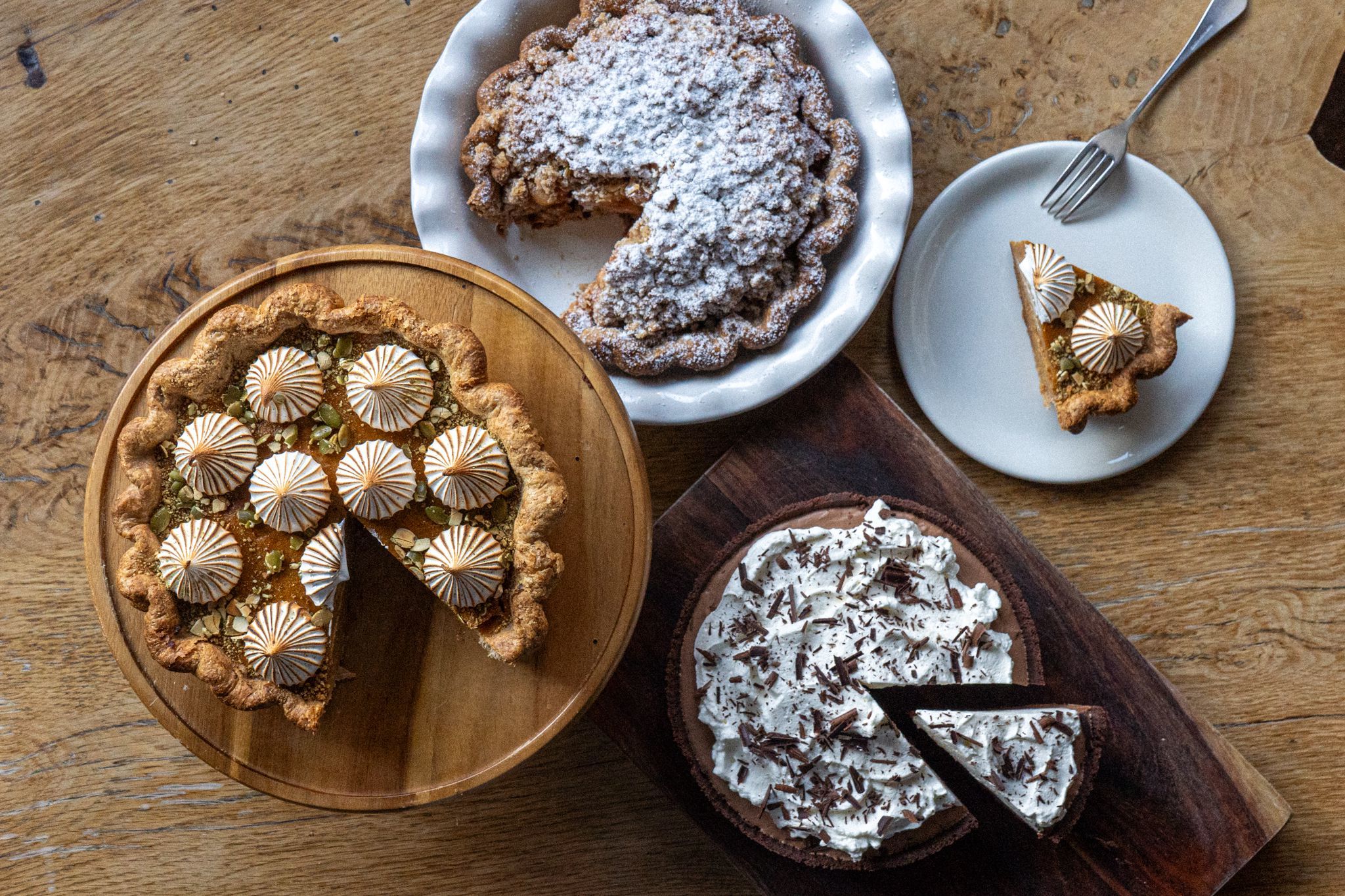
    The Bread Room by High Street Hospitality’s line up of Thanksgiving treats, clockwise from right to left: miso caramel apple pie, dirty chai chocolate pie, and basque pumpkin cheesecake.

    Sam Ruland: True! Like my family loves the cannolis from Isgros, so that’s something that would be a crowd pleaser no matter what and wouldn’t get grumbles.

    Margaret Eby: Picking up cheese from DiBruno’s is also a great move. And you don’t have to pretend that you have a secret cheese cave in your basement.

    However, I believe that the holidays are all about long-running bits with your friends and family. And passing off a dish as your own instead of purchased is a classic bit.

    So maybe DO pretend you made the cheese, why not.

    Evan Weiss: “Yes, I made this wine in Sonoma in 2013!”

    Margaret Eby: “It was a great year, thanks!”

    Evan Weiss: So the answer is: No, it’s not rude to bring prepared food. But either commit to the bit or get it from somewhere good.

    Margaret Eby: Yep, we solved it.

    And don’t be like my friend in college who would bring a ziplock bag of whiskey to parties.

    No one appreciates that.


    Have a question you’d like us to answer? Email us!

  • The best things we ate this week

    The best things we ate this week

    A gobbler at Dolores’ 2Street

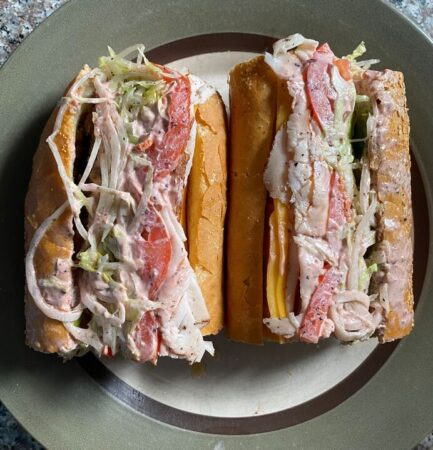
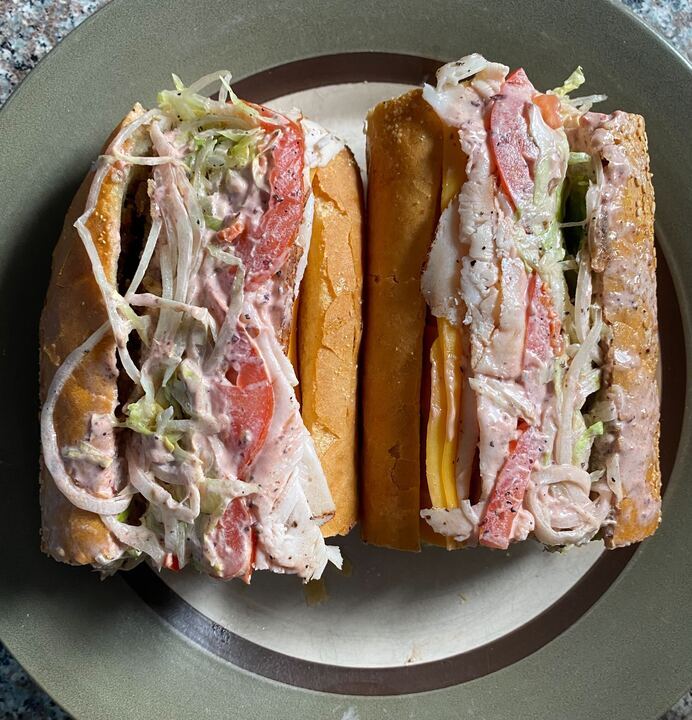
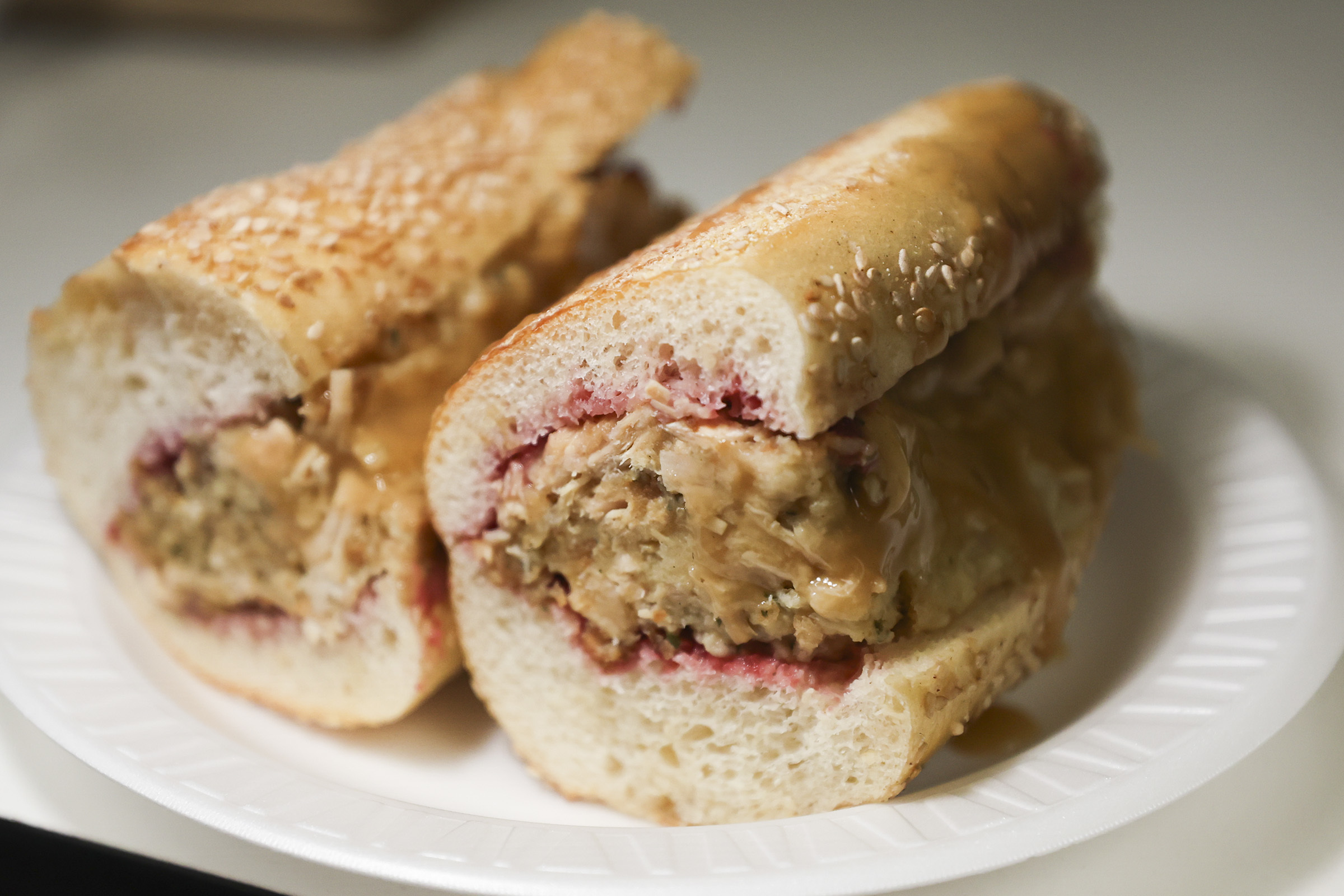
    The Gobbler has seen some bougie updates in the years since Wawa made it a thing. But the offering from Dolores’ 2Street isn’t fancy, and that’s to its credit. It’s built with solid ingredients, on a seeded Sarcone’s roll. Owners Peter Miglino and wife Victoria Rio lean hard into the leftover motif by offering a mostly cold sandwich made with cold cuts: thick slices of oven-roasted turkey and squares of orange-colored cheddar cheese. The little bit of heat (and crunch) comes from the house-made stuffing, carefully crafted by Miglino’s mother, Maria, a Philly restaurant veteran.

    Adding stuffing to a hoagie shouldn’t work. But this isn’t just any stuffing. This is Maria’s family recipe, which she prepares for almost an entire day so it’s just right. This Gobbler is as inclusive as a big Italian family, marrying the cold cuts and stuffing with a nice tang from a cranberry mayo that doesn’t overpower the palate, rings of raw onion, a confetti of lettuce, small slices of tomato, and a splash of olive oil. It’s a heavyweight sandwich, clocking in at just under a half-pound; you will most definitely need a nap afterward. As Rio compiled my sandwich on a mid-November afternoon, she said I ordered the first Gobbler of the season. They got it right from the jump. Dolores’ 2Street, 1841 S. Second St., 267-519-3212, facebook.com/Dolores2Street

    — Tommy Rowan

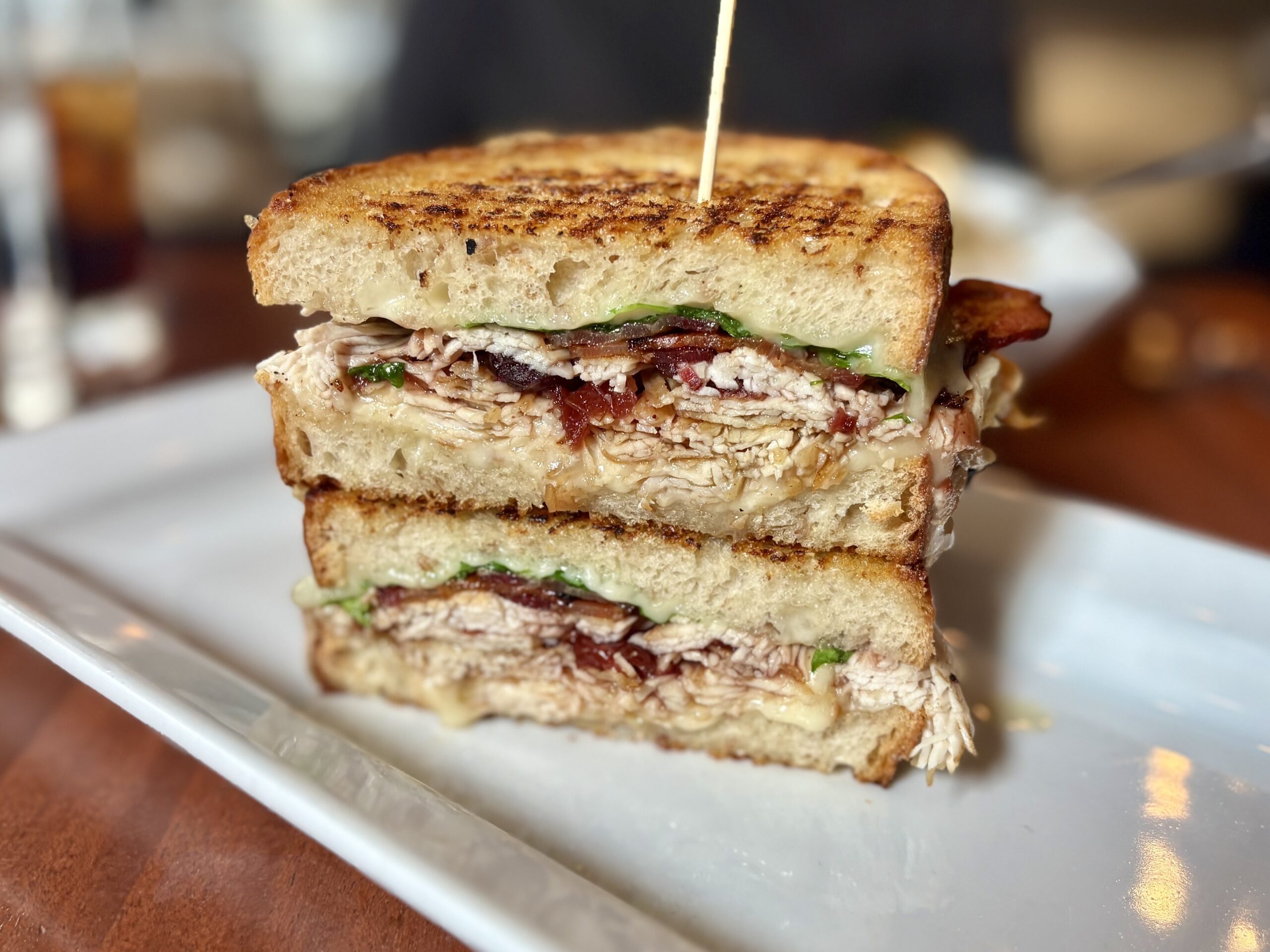
    A grilled Swiss cheese with turkey, bacon and cranberry chutney at Marathon Grill comes with a cup of soup. This “special” is so popular it hasn’t left the menu in over a year.

    Turkey-cranberry grilled cheese special at Marathon Grill

    By this time next week, most people will likely be in turkey leftover sandwich overload. But right now still I’m pre-gaming for Thanksgiving hard, and I could not resist this seasonally appropriate special at Marathon Grill. It’s essentially a grilled Swiss cheese on excellent sourdough bread, with turkey, cranberry chutney and bacon also tucked inside. That can potentially be an overwhelming mess. But I was impressed by how carefully the sandwich was built, with no particular ingredient overwhelming the others. The grilled bread’s buttery crisp and moist interior hit all the right savory and sweet notes for a preview of the feast to come. It’s served alongside a cup of tomato-basil soup for extra value (I swapped mine out for Marathon’s excellent matzo ball soup), so it’s no surprise it’s been a hit. In fact, Marathon’s regulars love it so much it’s been a “special” since they put it on the menu additions an entire year ago. Marathon Grill, 1839 Spruce St., 215-731-0800, eatmarathon.com

    — Craig LaBan

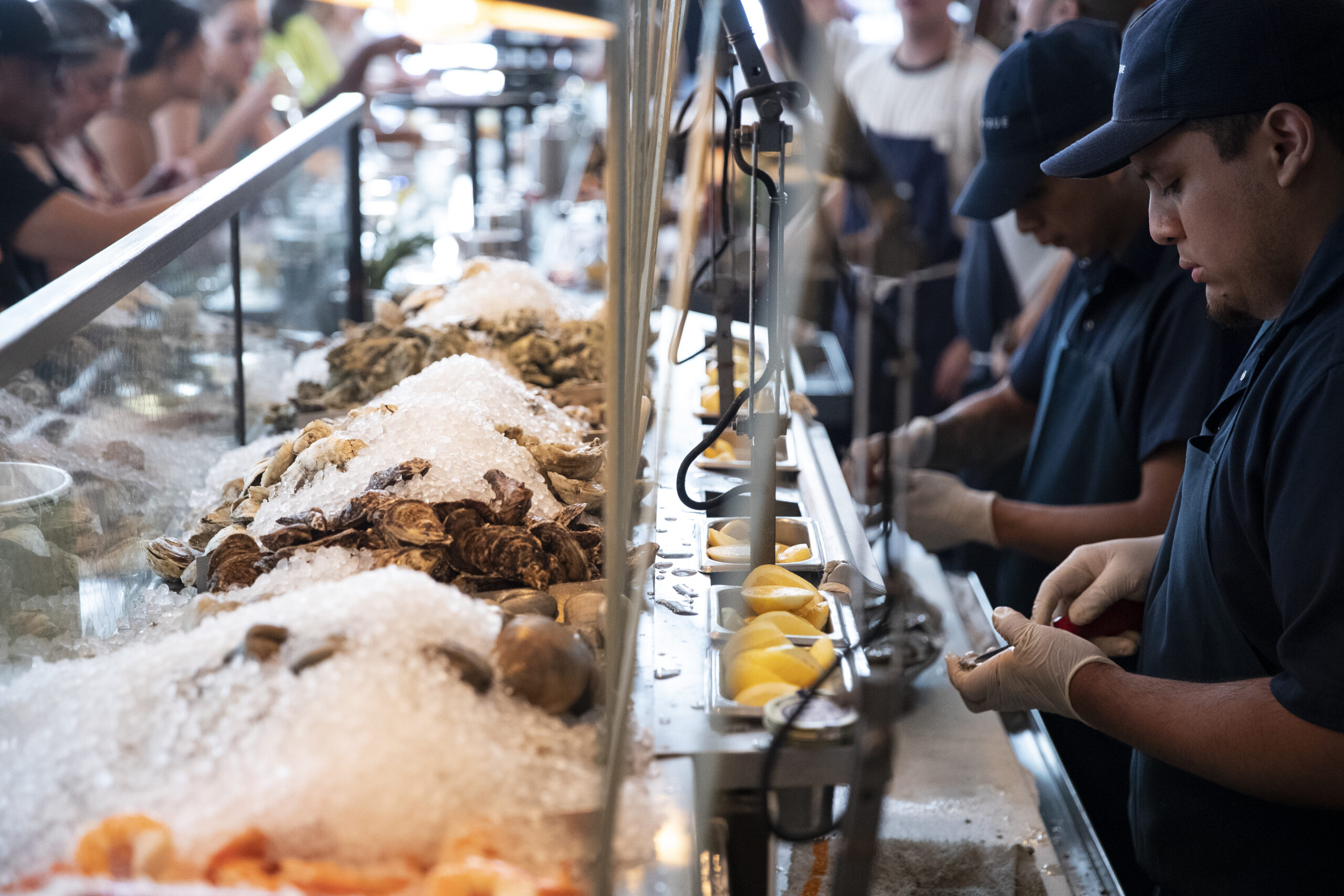
    Oysters rest on ice as shuckers work nearby at Pearl & Mary.

    Fish and chips at Pearl & Mary

    To quell the anxiety of a visit to the phone store, I found myself at Pearl & Mary, Michael Schulson’s Center City raw bar. My companion dove right into the Savage Blonde and Pink Moon oysters, both from Prince Edward Island. Oysters aren’t my thing, but my soul was soothed by the aroma wafting from the broth of my shrimp dumplings — a perfect small plate on this brisk Sunday morning. But my main highlight was the traditional fish and chips, with an especially succulent piece of cod and a buttery crust with a robust tartar sauce that leaned into its zest. The french fries are thin-cut and extra salty, as they should be. Pearl & Mary, 114 S. 13th St., 215-330-6786; pearlandmary.com

    — Henry Savage

  • Jersey bagel shop sued by D.C.’s Call Your Mother in branding dispute

    Jersey bagel shop sued by D.C.’s Call Your Mother in branding dispute

    The adage goes, “If mom says, ‘No,’ call grandma.” So if grandma says, “No,” do you call a lawyer?

    Popular D.C. bagel chain Call Your Mother is doing just that after claiming that a shop in Long Branch, N.J., is cramping their style, filing a trademark lawsuit within the U.S. District Court for the District of New Jersey.

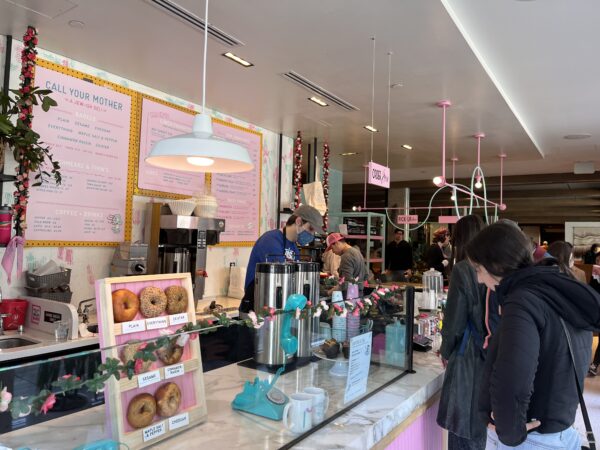
    Call Your Bubbi, a beach town cafe and kosher-certified bagel shop, opened last year within the Wave Resort and offers your classic bagel fare.

    Andrew Dana and Daniela Moreira, the married couple behind Call Your Mother, say the Jersey cafe is intentionally using a “confusingly similar” name and branding, which can harm their nearly six-year-old company that has about 25 locations, in the Washington area and six in Colorado. The dispute has quickly gone viral within the food scene and bagel-loving communities.

    “I cannot believe how this has blown up,” Dana said. “It has taken on a life we never expected.”

    Call Your Bubbi owner David Mizrahi did not respond to multiple requests for comment from The Inquirer.

    Dana said the couple first found out about the Long Branch cafe when a neighbor texted a photo of its storefront, asking if Call Your Mother had expanded to New Jersey. From there, they looked at Call Your Bubbi’s online and social media presence.

    Dana and Moreira own the trademark for the phrase call your mother for use as a deli, cafe, or restaurant, according to court documents. They’ve also trademarked their logo, a rotary phone (which mimics the shape of a bagel). In its branding suite, the Call Your Mother text often circles around the rotary graphic.

    Call Your Bubbi also uses a round image with its name similarly circling around its bagel logo. According to the Washingtonian, the cafe also at one point used a rotary phone motif on its merch. Both shops use hues of pink and blue in their branding.

    “People might think we’re sort of hunting this stuff out — that’s not the case at all,” Dana said. “It looks just like our logo. We tried for months and months to get in touch with the owner. We got hung up on. We didn’t know what else to do.”

    At one point, Dana told the Washington Post that he noticed a tagline on the top of Call Your Bubbi’s website: If Mom says, “No,” call your Bubbi.” He told the Post, “I just felt like they were goading us.”

    In August, the couple sent Mizrahi a cease-and-desist letter, court documents show. They say they never heard back or saw a change in the cafe’s branding. Last Tuesday, they officially filed the lawsuit.

    Call Your Mother is being represented by Philadelphia-based attorney Matthew Homyk, a partner in the intellectual property group of Blank Rome LLP. Homyk didn’t respond for comment as of publication time.

    “In Jewish culture, the terms ‘mother’ and ‘bubbi’ both denote a caring and nurturing Jewish matriarch,” the lawsuit says. “Both marks evoke the same core idea — a warm and loving (but also somewhat instructive or scolding) prompt to call your mother or grandmother, and to go grab some coffee and bagels while you’re at it.”

    The suit noted that Mizrahi‘s original incorporation in March 2024 was for “Bubbies Bagels,” but that “sometime thereafter,” he began using the Call Your Bubbi label instead.

    The Jersey Shore cafe appears to use a blend of both names as of publication time. On Yelp, it’s Call Your Bubbi. On Google Maps, it’s billed as “Bubbi Bagels @ Wave Resort,” but its phone line and merch still identify it as “Call Your Bubbi.”

    The shop’s web domain is bubbibagels.com, but the top of its website says Call Your Bubbi. Similarly, its Instagram username is @bubbibagels, but its icon is the contested Call Your Bubbi round logo.

    Dana said they saw no issue with the cafe going by “Bubbi Bagels,” or something similar.

    “He can call it Bubbi’s, he can call it Mother’s, I don’t really care. But Call Your Bubbi is so close, we had to sort this out,” Dana said. Still, Dana says, Mizrahi won’t return his calls.

    Josh Gerben, a trademark attorney not affiliated with the litigation, says the suit makes for a captivating case study. He posted his own analysis of the brand dispute on LinkedIn and says he believes Call Your Mother has a strong case for trademark infringement.

    “As a trademark attorney who grew up in a Jewish family, I can tell you that those two names draw from the same emotional well,” he said. “If this case goes to trial, the judge or jury will have to determine whether an average consumer would think these brands are owned by the same company.”

    Restaurant-related trademark disputes aren’t new. In Philly, Chickie’s & Pete’s has a grip on the use of crabfries thanks to owner Pete Ciarrocchi registering the phrase as a trademark back in 2007. Since then, his lawyers have sent cease-and-desist letters to restaurants nationwide for using the phrase.

    (It has also sparked some cheeky clapbacks, like Betty’s Seafood Shack in Margate, which now calls its version of the fries “For ‘Pete’s’ Sake.“)

    The lawsuit is asking for the court to rule that Call Your Bubbi illegally used Call Your Mother’s trademark materials and engaged in unfair competition and to order that they permanently stop using the name or anything similar.

    They also want all infringing materials destroyed, a report proving compliance, and financial remedies, including Call Your Bubbi’s profits, along with damages, interest, attorney fees, and other appropriate penalties.

    “We want him to be able to have his business and us to have ours,” Dana said. “The last thing we want to do is spend money on legal or focus on this. We want to focus on making bagels — and figure out how to finish this quickly.”

  • Is Michelin’s Bib award for Royal Sushi a snub? Chef Jesse Ito takes the izakaya’s honors in stride.

    Is Michelin’s Bib award for Royal Sushi a snub? Chef Jesse Ito takes the izakaya’s honors in stride.

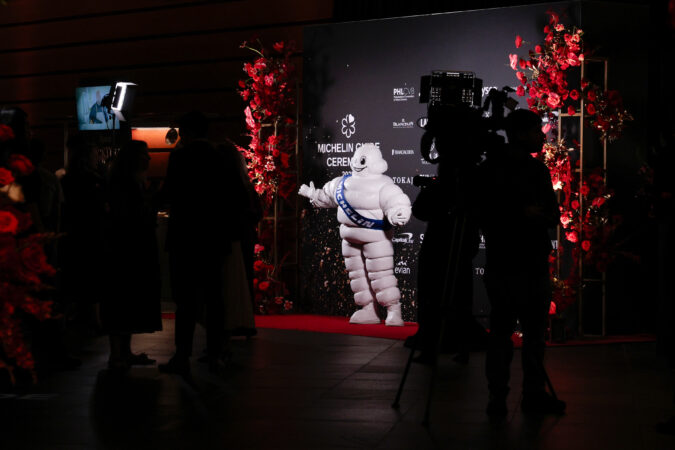
    There were chef tears of joy, stunned looks from some unexpecting winners, and the silent sting of award-show snubs as the Michelin Guide announced its first-ever round of accolades for the Philadelphia restaurant scene Tuesday night.

    But there was also some lingering confusion that followed the much-anticipated Kimmel Center ceremony. One of the biggest gasps of baffled surprise rippled through the crowd when Royal Sushi & Izakaya, a favorite predicted by many to earn a star, was instead awarded a Bib Gourmand.

    The Bibs are widely coveted as Michelin’s nod to restaurants with “exceptionally good food at moderate prices.” Ten Philly restaurants were awarded Bib Gourmands, including Angelo’s, Dizengoff, and Pizzeria Beddia.

    But how does Royal Sushi & Izakaya — where a seat at chef Jesse Ito’s omakase counter now clocks in at a city-high $355 — qualify? Is it now the world’s most expensive Bib Gourmand?

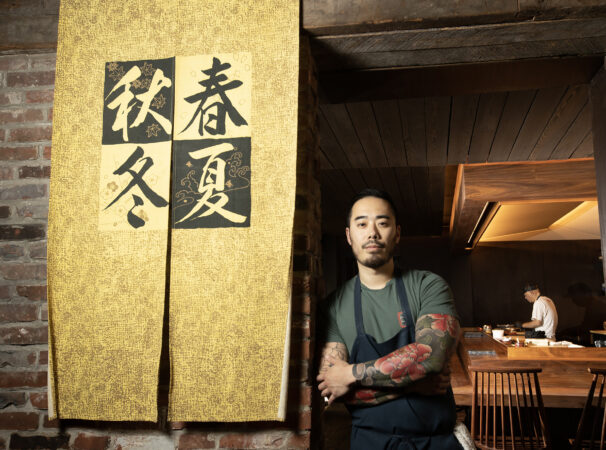
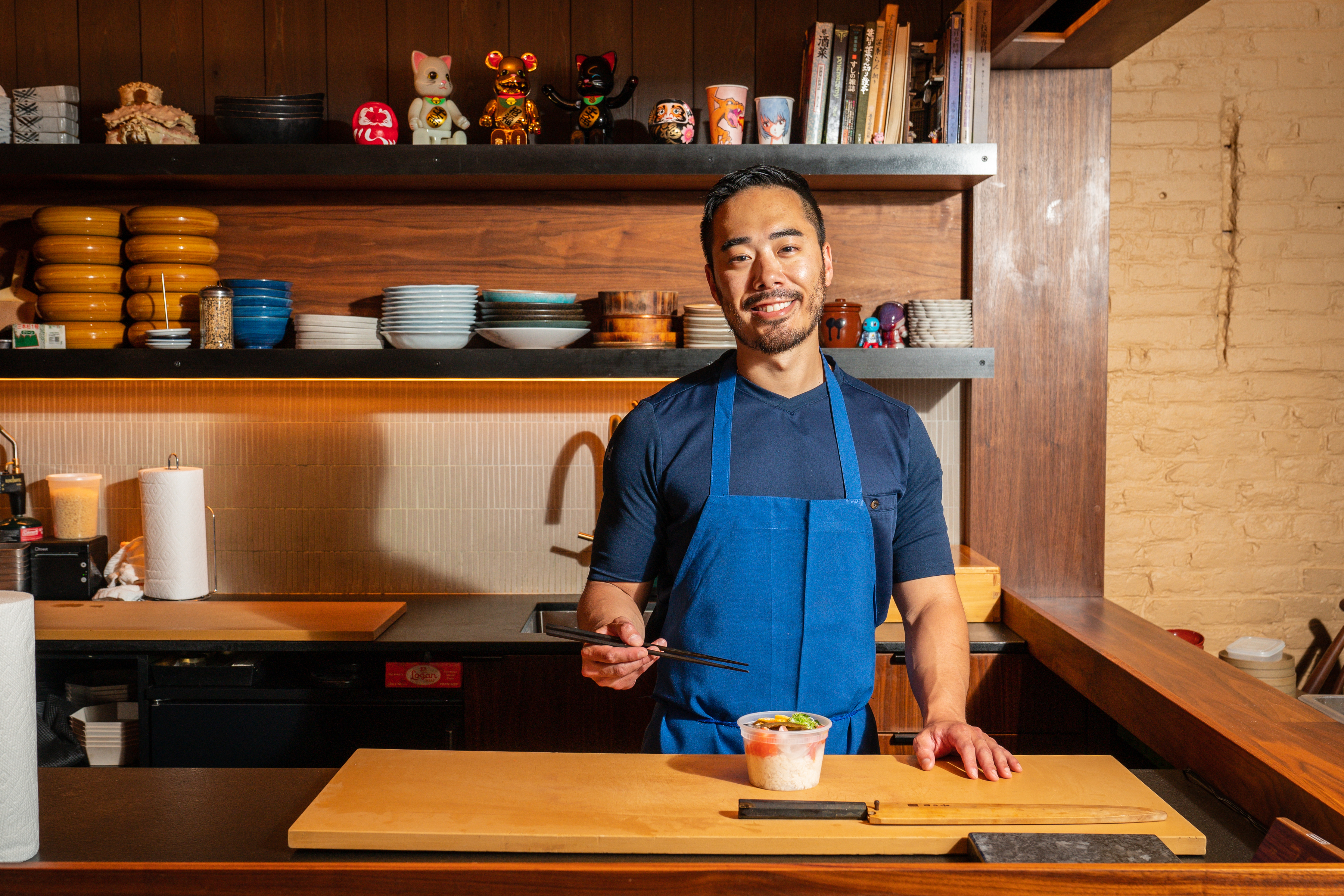
    Chef-owner Jesse Ito at Royal Sushi & Izakaya on Aug. 11, 2023.

    Michelin, which is renowned for secrecy, would not clarify its reasoning: “The Michelin Guide doesn’t reveal specifics,” said spokesperson Carly Grieff.

    The answer, most logically, is that Royal has always been two distinct restaurants under a single name and roof, and the Bib most logically applies to the more casual one: the lively izakaya-style tavern that anchors the front of the Queen Village building, where a relatively affordable a la carte menu of cooked Japanese classics and sushi is served to a walk-ins-only crowd, with cooked items ranging from $6 to $38.

    Ito’s luxury sushi tasting counter, meanwhile, hums along in a separate room in back, where Ito handcrafts every bite with artistry using some of the world’s most expensive ingredients. Such omakase counters are prime candidates for Michelin stars, including at least two (Boston’s one-star 311 Omakase and New York’s three-star Sushi Sho) that picked up accolades at the recent ceremony in Philadelphia.

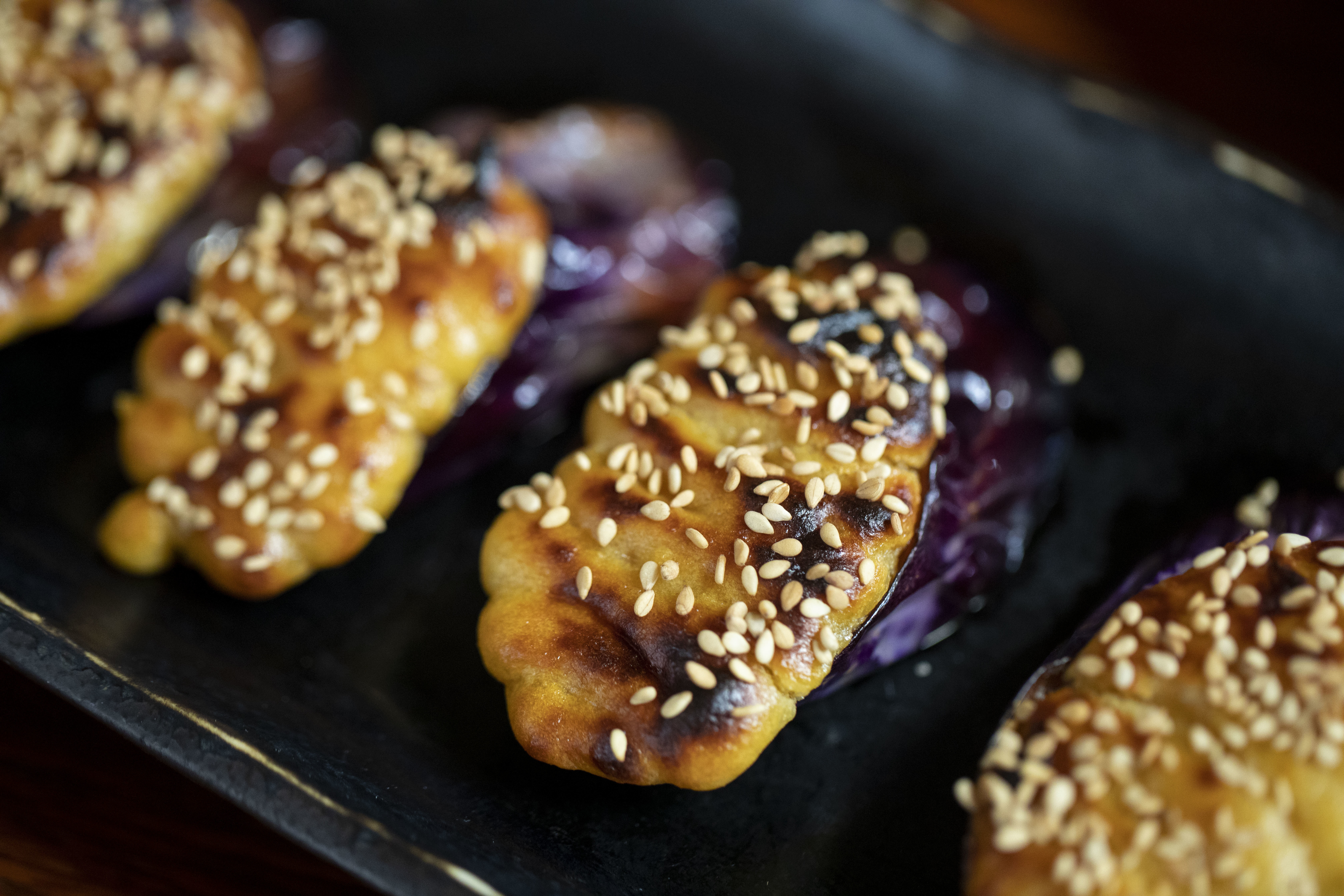
    The sesame-crusted eggplant at Royal Izakaya on Aug. 18, 2022. Royal Izakaya is located at 780 South 2nd St.

    But the 16 nightly seats of Ito’s omakase counter are so locked down with devoted regulars — who can rebook their seats for another meal before leaving their dinner — that even Michelin’s anonymous inspectors, it appears, could not score a reservation.

    “They only ate at the izakaya,” surmises Ito from Michelin’s review, a glowing assessment of the izakaya’s menu range and high-quality ingredients, with only a passing mention acknowledging its “exclusive” omakase counter.

    Ito was hardly a loser at the Michelin ceremonies, even if he didn’t win a star, because he was thrilled with the Bib acknowledgment: “I’m super-proud of the izakaya and this is very fitting for what it does … The stars are really great and obviously every chef wants that, but the Bibs will also prove useful once tourists come, especially next year for the FIFA World Cup and Philadelphia’s 250th anniversary.”

    Diners inside Royal Izakaya on Aug. 18, 2021.

    Nonetheless, the uncertainty of how Michelin might handle his dual-concept space has weighed on the chef, who knows the roller-coaster emotions and anxiety of awards program recognition more than most.

    He’s experienced tremendous highs, such as this fall when his restaurant was named the 32nd best restaurant in North America by World’s 50 Best. He’s also repeatedly dealt with the disappointment of coming up just short with the James Beard Foundation, being named a finalist eight times — only to miss out every year, including once again this spring.

    Ito said he’s considered various ways to more clearly separate the two concepts, or at least make the reservation process for the omakase more accessible.

    “But I wouldn’t even know how to do that,” said Ito, who’s worked through some alternatives and fears that bots would ultimately snap up seats for scalping. “I’m able to have regulars this way, and we have the best guests with whom we’ve created real relationships over time. But I love having new people, too, and that definitely still happens.”

    The exclusive nature of the omakase, and the unintended fallout from such limited reservations — especially with hopeful guests, including possibly judges for potential awards — was never intended. It just happened.

    Chef Jesse Ito and Mia Colona at the Michelin Guide announcements at the Kimmel Center on Nov. 18.

    “I didn’t think about any of this award stuff when I was opening this restaurant nine years ago at age 27 on limited resources,” said Ito, whose initial goals were to support his parents and create something for himself.

    As the restaurant continued to evolve and garner national attention, however, he’s had to learn to cope with the anxiety of increasing acclaim. And no matter how veteran the chef, the nerves always tighten the gut at an awards ceremony, when the announcement draws near. He’s learned the hard way to find a silver lining in whatever the results.

    “Just because you’re not [ultimately] a winner doesn’t mean you’re not deserving,” says Ito. “That’s part of losing the Beard award eight times! You come away with the ability to enjoy the moment of just being recognized.”

    The Royal Toast from the Royal Sushi Omakase at Royal Izakaya on Aug. 18, 2022.

    Ito says he owes much of his current attitude to getting sober five years ago.

    “Beforehand, I used to always crave that external hit, that numbing sensation of having fun. But now in my life, I find happiness in my routine and relationships, my business and personal journey. The awards? I’m happy to be a part of them — but they are not what defines us.”

    What drives Ito is his passion for turning raw fish into edible art for the devoted customer base he values, and “to improve myself and the omakase a little bit each day,” he says, citing the Japanese philosophy of kaizen.

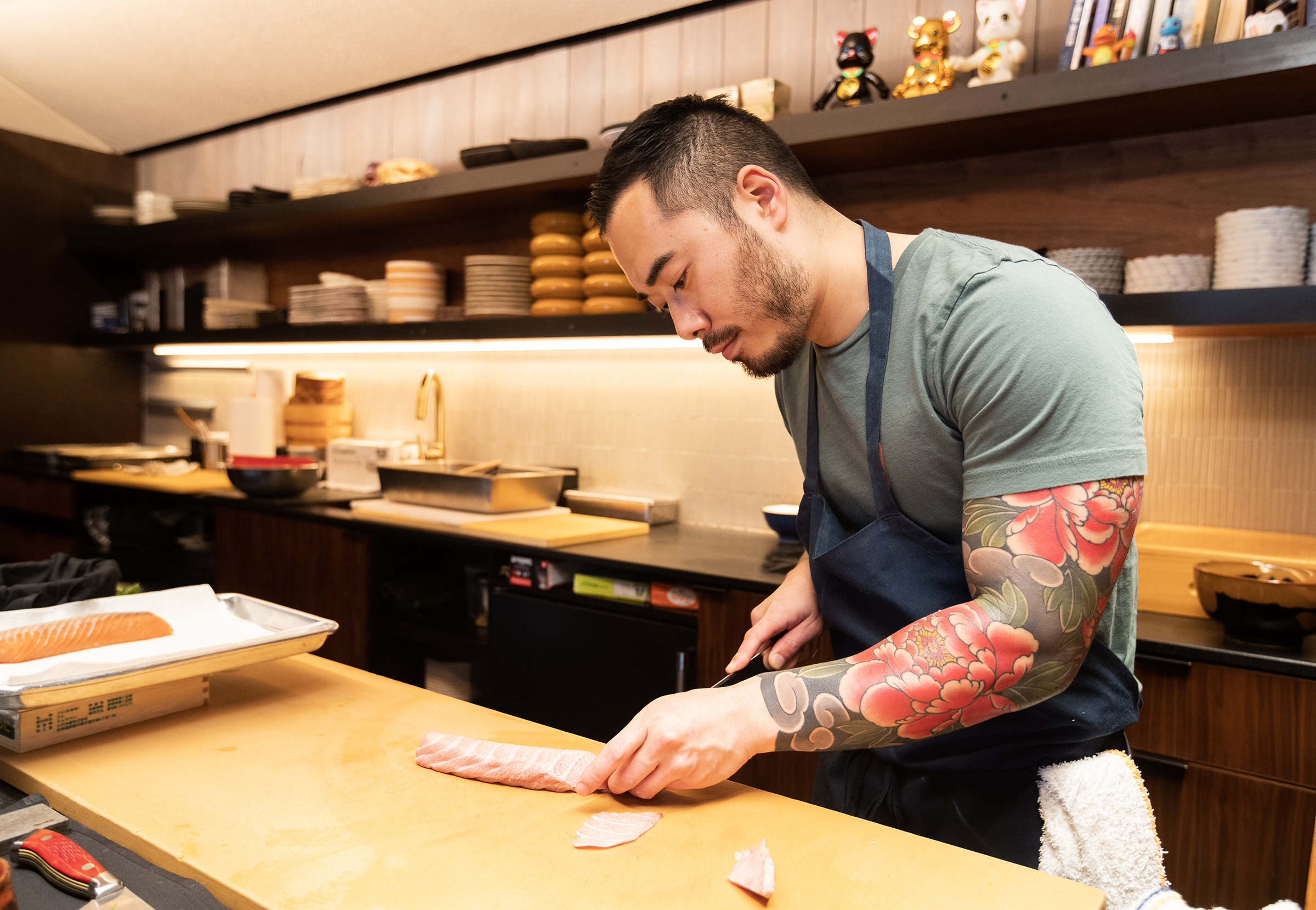
    Chef-owner Jesse Ito at work at Royal Sushi & Izakaya on May 31, 2024.

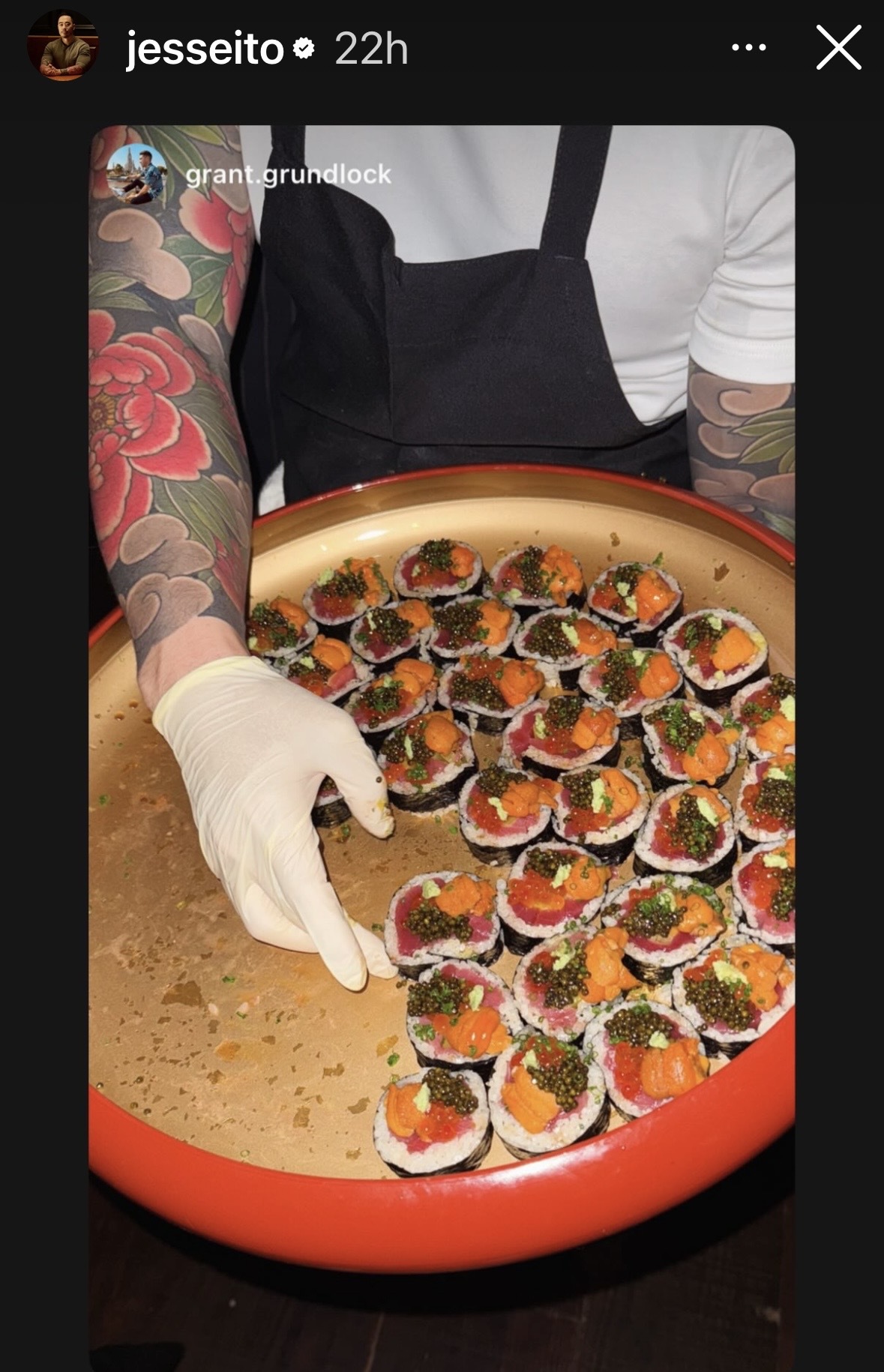
    So, once the Michelin ceremony concluded — “a weight was lifted from my shoulders,” he says — and it was back to what he loves most. He went straight to dancerobot, his new restaurant in Rittenhouse Square where a Resy-sponsored after-party was in full bloom. He put on his apron and immediately busted out the premium uni and caviar to top hundreds of aka-taka toro rolls brought in from the izakaya, and strolled through the crowd with a tray, handing out $75 bites for free.

    “Everyone was so relieved [it was over], we were just celebrating and having fun,” he said.

    And then out came his secret weapon: the karaoke mic, an important Ito ritual for every post-awards party, no matter the result.

    “I sang ‘Creep‘ by Radiohead,” he said, his usual song. “Then I left when the party was still bumping, because I didn’t want to go to bed too late.”

    He had another busy day to prep for service at Royal Sushi & Izakaya ahead.

    Chef Jesse Ito of Royal Sushi & Izakaya hands out aka-taka tuna belly and pickled radish rolls topped with salmon roe, uni, and caviar to guests at an afterparty for the Michelin awards held at his new restaurant, dancerobot.
  • The boozy business of the American Revolution went down in Philly bars

    The boozy business of the American Revolution went down in Philly bars

    The Founding Fathers never suffered sobriety. When they weren’t sweating out independence at Independence Hall, they were bending elbows at City Tavern — pretty much around the clock.

    George Washington developed such a hankering for a rich, malty, Philly-brewed Robert Hare’s porter, he had kegs of the stuff shipped to Mount Vernon.

    John Adams, once virulently anti-tavern, effusively extolled the Philly bar scene in letters to his wife, Abigail. At one “most sinful feast,” Adams recalled sipping what would become his favorite Philly cocktail, the “Whipped Sillabubs.” A popular choice of the colonial-era Philly cocktail set, the boozy, creamy concoction was made from sherry, wine, and lemons.

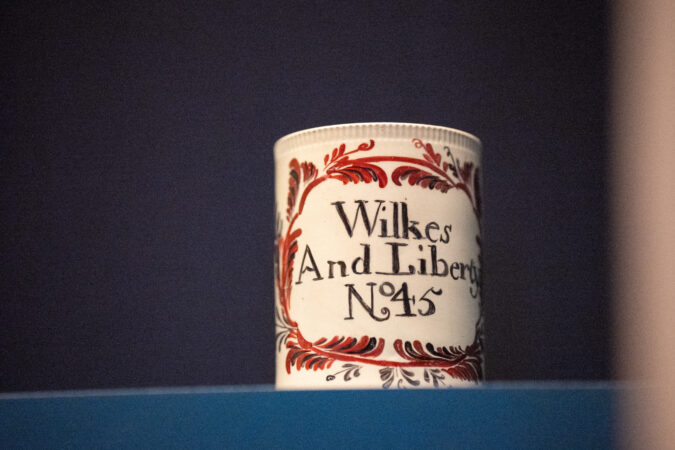
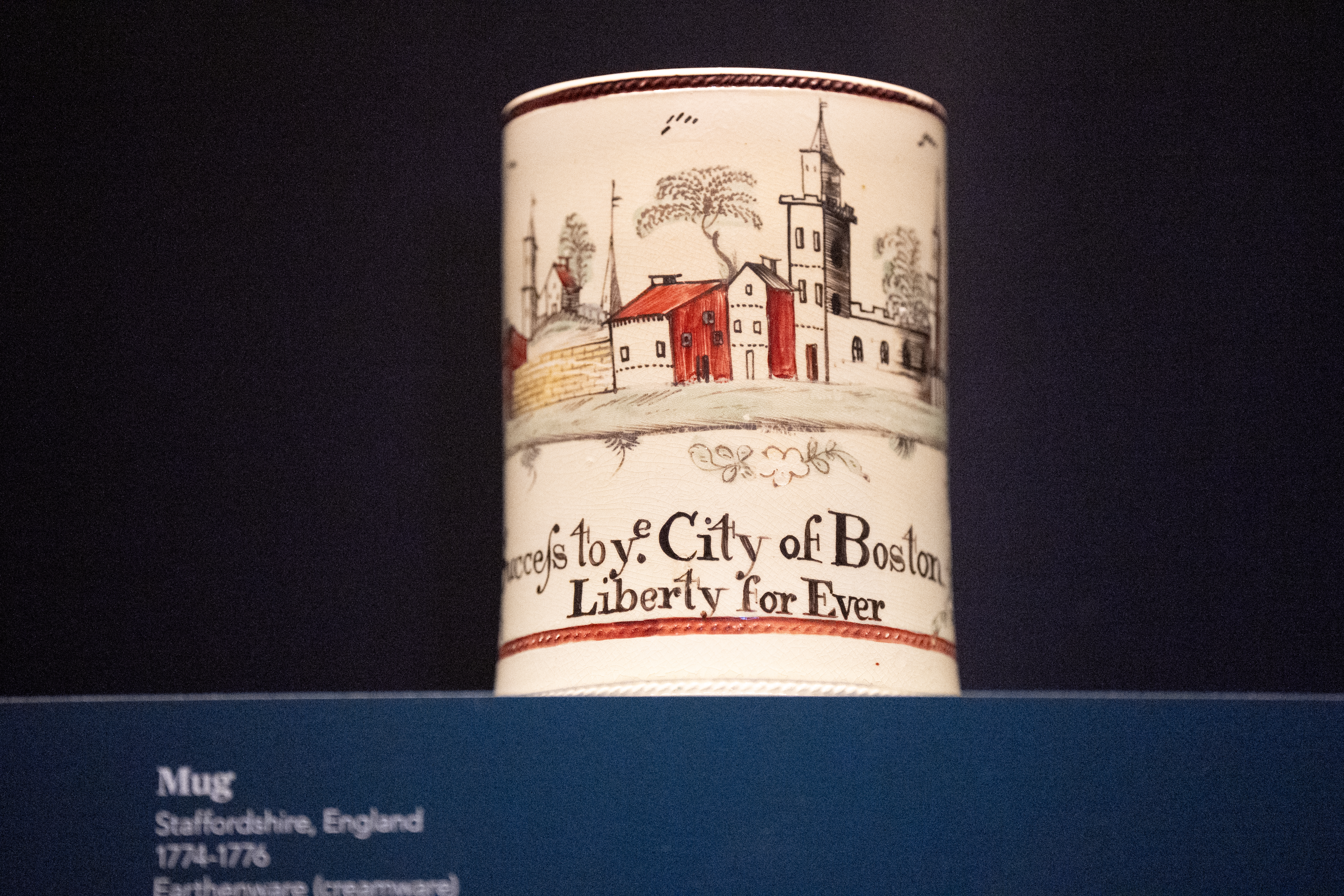
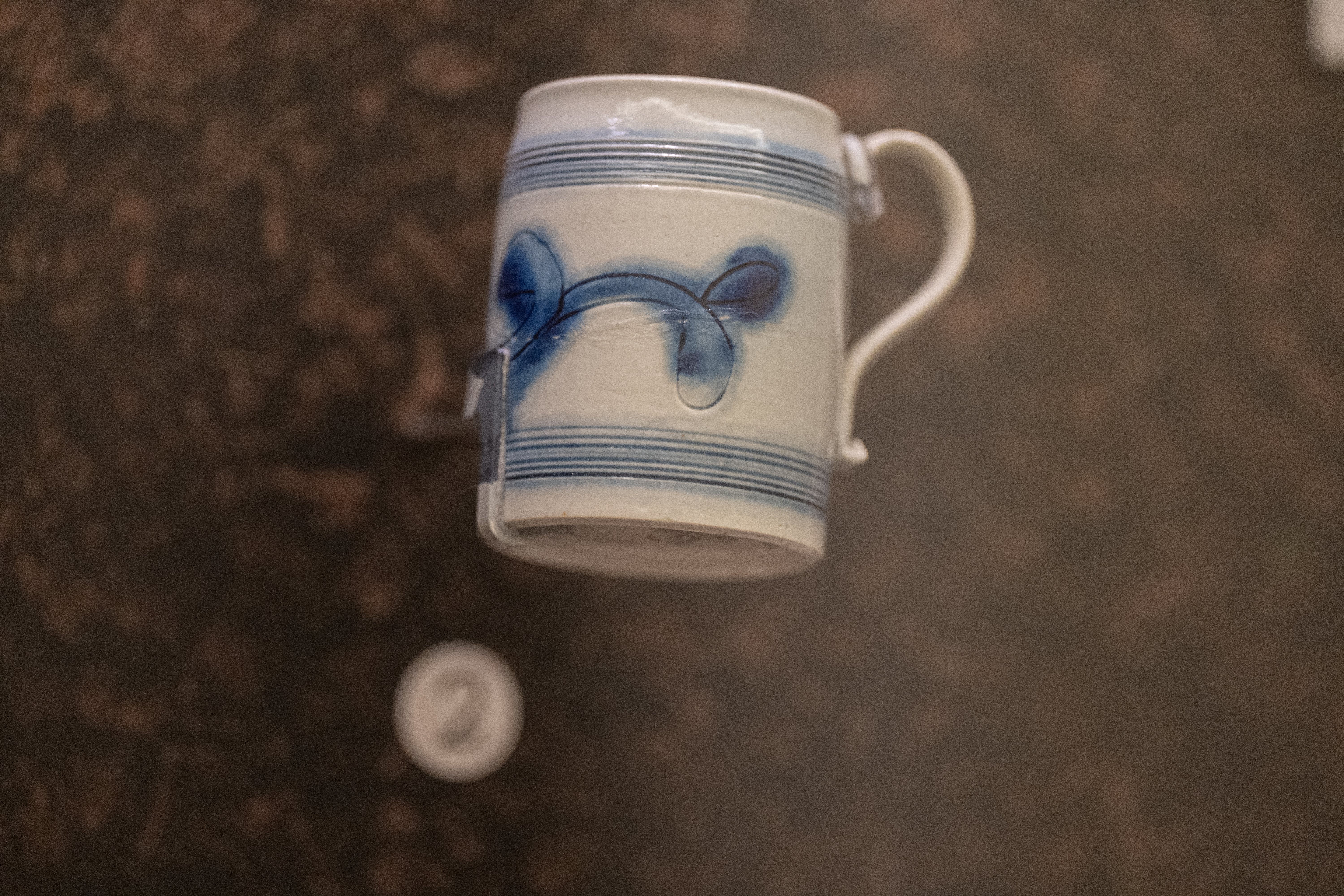
    Items related to drinking at the Museum of the American Revolution, in Philadelphia, PA, November 18, 2025,

    Thomas Paine, the working-class poet, whose thunderous pamphlet Common Sense helped roar in a revolution, oiled up his writing hand with Philly rum.

    It has long been accepted that Thomas Jefferson spent those sweltering summer weeks of 1776 drafting the Declaration from the favored Windsor chair of his Market Street lodgings. But records show he actually spent more time than ever at City Tavern at Second and Walnut. A minor, if tantalizing, historical development, which hints that perhaps the world’s most famous freedom document came fortified by fortified wine.

    Benjamin Franklin, polymath of the Revolution, inventor, scientist, printer, statesman, and lover of French wine (if in moderation), affectionately penned a Drinker’s Dictionary. The tippling tome contained 229 of Franklin’s favorite phrases for drunkenness, including buzzy, fuddled, muddled, dizzy as a goose, jambled, halfway to Concord, and Wamble Cropped.

    ‘Boozy business of revolution’

    Franklin and his ilk were not ringing up 18th-century expense accounts for the hurrah of it. They were doing the boozy business of revolution.

    Revolutionary-era Americans consumed staggering amounts of alcohol compared with today, said Brooke Barbier, historian and author of the forthcoming book Cocked and Boozy: An Intoxicating History of the American Revolution.

    By the end of the 18th century, when beer and spirits were a staple of daily life, the average colonist swilled about 3.7 gallons of hard liquor per year. A dizzying amount, not counting beer and cider, that must’ve set many a patriot’s tricorn hat spinning.

    By comparison, Americans now consume about 2.5 gallons of all alcohol, from beer to whiskey to wine, per year, said Barbier.

    Historians believe booze and bar life played an outsize role in stoking the embers of insurrection.

    Items related to drinking at the Museum of the American Revolution, in Philadelphia, PA, November 18, 2025,

    “Tavern culture was essential to the American Revolution,” said Barbier. “It was not a part of the sideshow. It was part of where the discussions about revolutionary ideas happened. Where spies met. And where others, who weren’t directly involved in politics, gathered to discuss the growing political crisis. Opinions were formed in taverns.”

    Nowhere was this work done more than in Philadelphia.

    By 1776, Philadelphia boasted roughly 200 licensed and illegal watering holes — or about one for every 150 citizens, said Tyler Putman, senior manager for gallery interpretation at the Museum of the American Revolution.

    Revolution with a twist

    The fare of colonial-era drinking spots was as diverse as the budding port town.

    There were posh spots like the newly constructed City Tavern, located blocks from the waterfront, and where the delegates of the First and Second Constitutional Congress drank nightly like fish. Ensconced in an upstairs space, known as the “Long Room,” the Founding Fathers debated liberty over libations late into the night, while imbibing copious amounts of Madeira, whiskey, punch, and everybody’s favorite Robert Hare porter.

    There were taverns and flophouses, where tradesmen and sailors learned of Britain’s newest outrage from newspapers read aloud, or the latest traveler. And there were scores of unlicensed disorderly houses, grungy forebears of the modern dive bar.

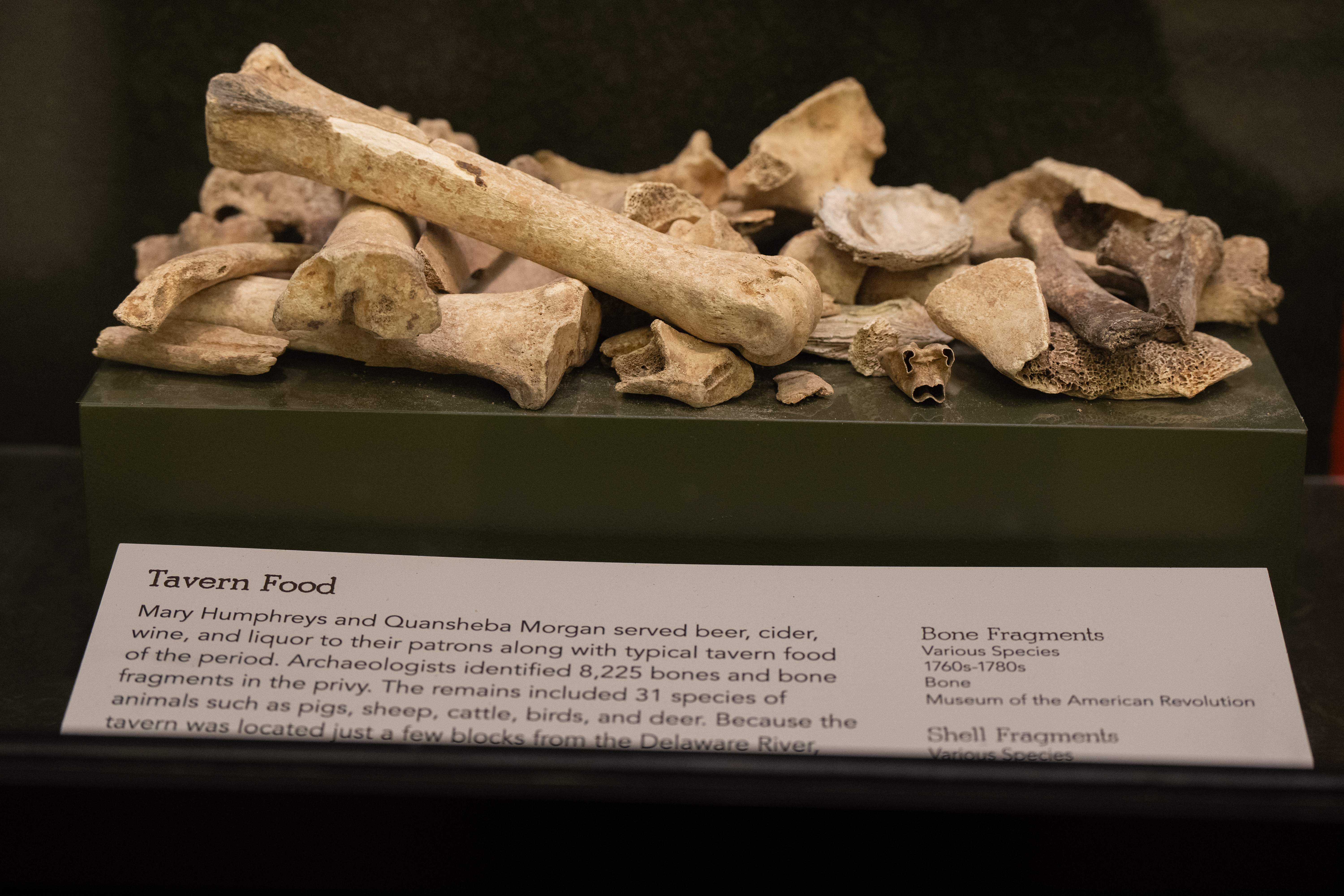
    In 2014, three years before opening, the Museum of the American Revolution conducted a large archaeological dig, discovering thousands of artifacts from a Revolutionary-era disorderly house buried beneath its future Old City home. Among the mounds of mutton bones, glassware, and broken bottles unearthed from the privy of Benjamin and Mary Humphreys’ living room tavern was a broken windowpane inscribed with the initials and names of customers.

    Bones from Tavern food at the Museum of the American Revolution, in Philadelphia, PA, November 18, 2025,

    In what can only be the earliest example of Philly barroom graffiti, one dreamy patriot etched a quote attributed to the ancient Roman senator Cato into the clouded glass: “We admire riches and are in love with idleness.” The etching was meant as a barb toward the British, Putman said.

    “They were obsessed with ancient Rome,” he said, of the American revolutionaries. “They were thinking a lot about, ‘How do you go back to some sort of idealized republic?’”

    A nation born in taverns

    Just as the nation strived to become democratic, its taverns became more undemocratic.

    “In Philadelphia, the elites who are cooking up one version of the revolution are not drinking with the rabble who are cooking up what maybe would become a different version,” Putman said.

    The newly-renovated Man Full of Trouble Tavern in Society Hill on Saturday Dec. 7, 2024.

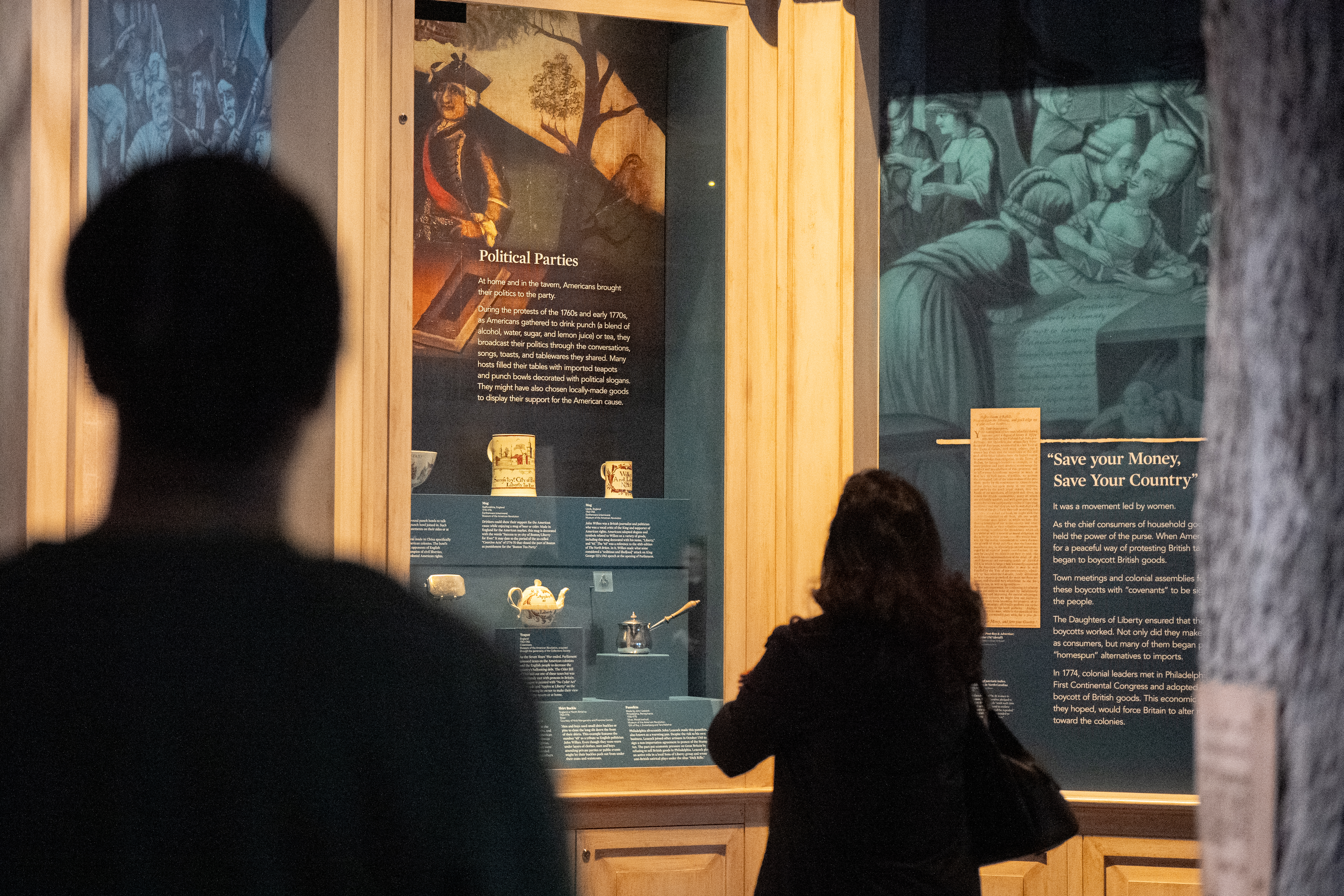
    Revolutionary-era drinking and tavern life, and its role in America’s founding 250 years ago, will be explored in full at a Nov. 21 after-hours event at the Museum of the American Revolution. Dubbed “Tavern Night,” the sold-out cocktail reception and boozy symposium serves as a twist to the museum’s grand exhibition celebrating the national milestone, also known as the Semiquincentennial, “The Declaration’s Journey.”

    “Unlike today’s bars, taverns were meeting places at a time when few others were available,” said Dan Wheeler, who last year reopened Philly’s only remaining colonial-era tavern, A Man Full of Trouble, and will join Barbier in speaking at the event. “Revolutionary thoughts were conceived and refined in taverns, and a nation was born.”

    Colonial keggers and the bonds of liberty

    Booze was the social lubricant of the Revolution, said Barbier, a Boston-based historian who also runs tours of Revolutionary-era taverns, who pored over the Founding Fathers’ diaries and account books in recreating their raucous time in Philly.

    The historical record provides no evidence that the nation’s founders were fully loaded — or “cock-eyed and crump-footed,” as Franklin might’ve said — as they went about forming the republic, she said.

    “When you hear someone accusing someone of being drunk, it’s in an overly negative way,” she said.

    Still, she was surprised by just how much the Founding Fathers drank.

    Items related to drinking at the Museum of the American Revolution, in Philadelphia, PA, November 18, 2025.

    Hard cider and small beer, the 18th-century version of light beer, more or less, accompanied breakfast, she said. The midday meal, known as dinner, boasted cider, toddy, punch, port, and various wines. When their workday wrapped up in the late afternoon, the delegates’ drinking began in earnest.

    “There’s certainly a lot of drinking happening in these taverns,” said Barbier, whose book includes recipes of the Founding Fathers’ preferred aperitifs. “I don’t drink and not eventually feel tipsy. Certainly the same would be true for people in the past.”

    Barbier notes the downside of all the drinking, like booze-fueled mob violence that spilled into the streets. And neither will she say that Jefferson, who kept all his receipts, actually penned the Declaration at City Tavern.

    “He was there more frequently than ever during this time,” she said. “Maybe he needed to take a break from his writing, and go there. And sometimes when you’re on break, you develop your best ideas.”

    The Founders’ endless toasting of tankards — including a rager for the ages marking Paul Revere’s arrival in Philly, and held in 1774, the night before a critical vote toward independence — provided crucial trust-building, Barbier said.

    The men who founded America arrived in Philly as strangers, agreeing on little. After so much boozing, they bonded as brothers in liberty, and left a new nation in their wake.

    “Ultimately, this comradery and social bonding leads to the consensus that leads to the Declaration of Independence,” Barbier said.

  • Gobbler season is upon us

    Gobbler season is upon us

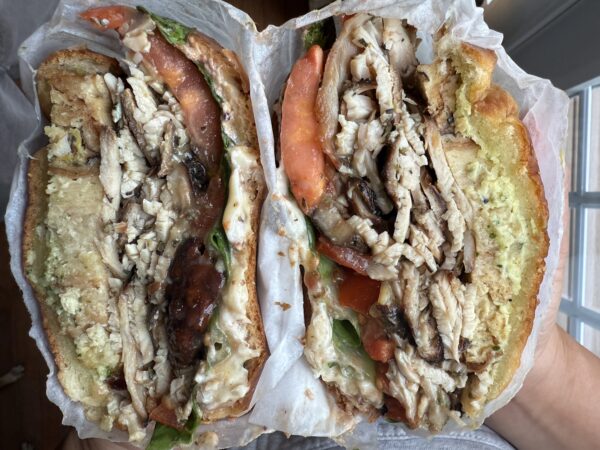
    The rest of the country may know gobblers as Thanksgiving leftover sandwiches, but here in Philly, they’re far more than that. Philly restaurants start serving gobblers long before Thanksgiving leftovers are on the horizon. The sandwiches are both a form of sculptural art — some of them defying gravity — as well as a month-long (or even two-month-long) Thanksgiving tailgate. Here are some places to explore Philly’s devotion to the sandwich.

    Porco’s Porchetteria

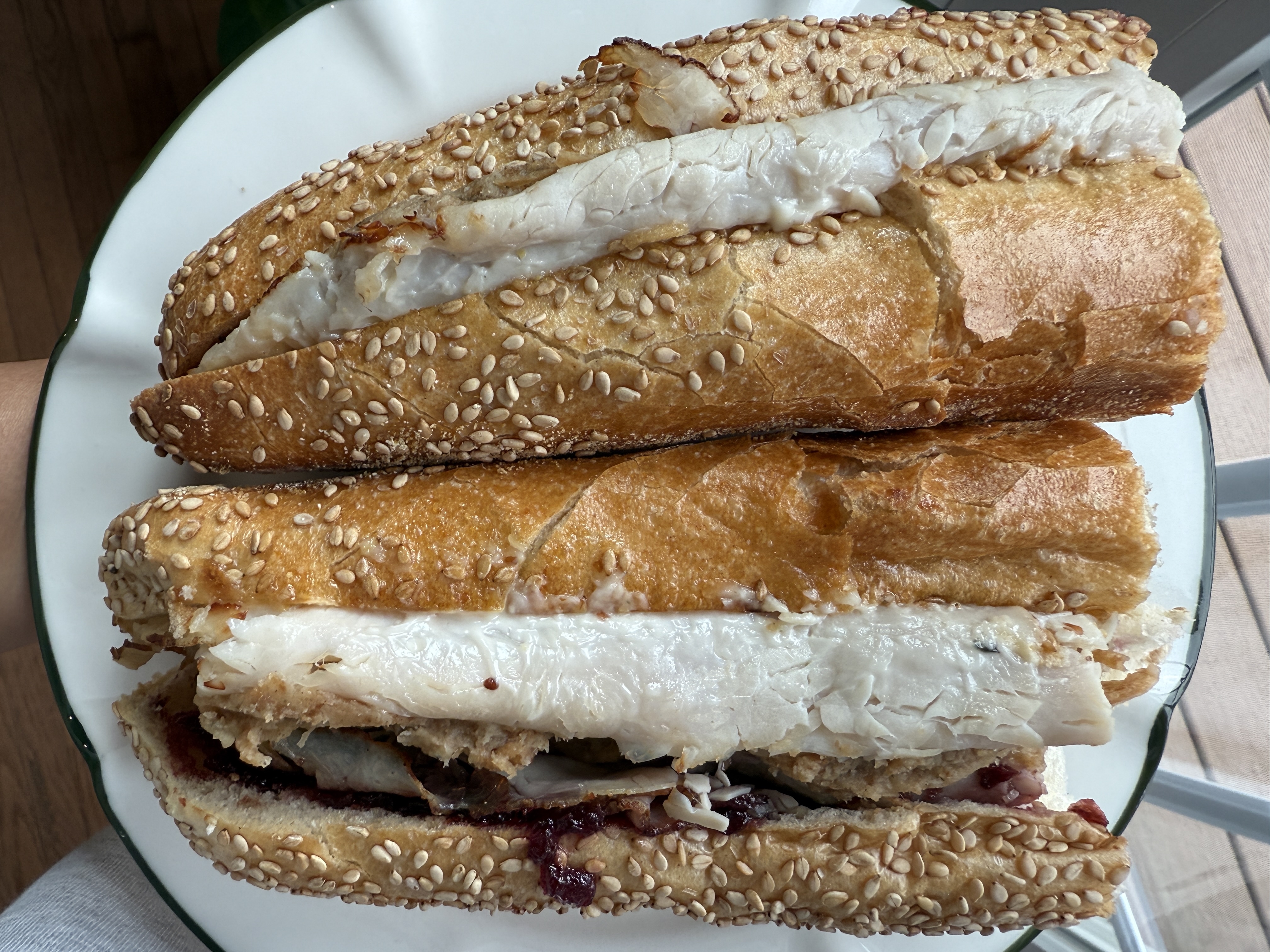
    Mercifully lighter than one might expect from the king of sandwiches, Porco’s Turketta Sammie, aka their riff on a gobbler, has its abundant fillings stuffed into a soft, slim brioche bun. It’s layered with slices of herbaceous smoked turkey breast, savory bread pudding (a fluffy take on stuffing), a thick slice of heirloom tomato, and a touch of green lettuce. It’s painted with a thin lacquer of cranberry mostarda and gently sauced with turkey gravy. Add Cooper Sharp and one of their aiolis (I love the roasted garlic aioli in the sandwich) for even more flavor. Pickup or delivery is available from their Washington Avenue window. The $16 gobbler is on the menu all November long; add-ons are $1 extra each.

    Small Oven Pastry Shop & Porco’s Porchetteria, 2204 Washington Ave., 215-545-2939, smallovenpastryshop.com

    The Liberty Kitchen turkey gobbler via delivery.

    Liberty Kitchen

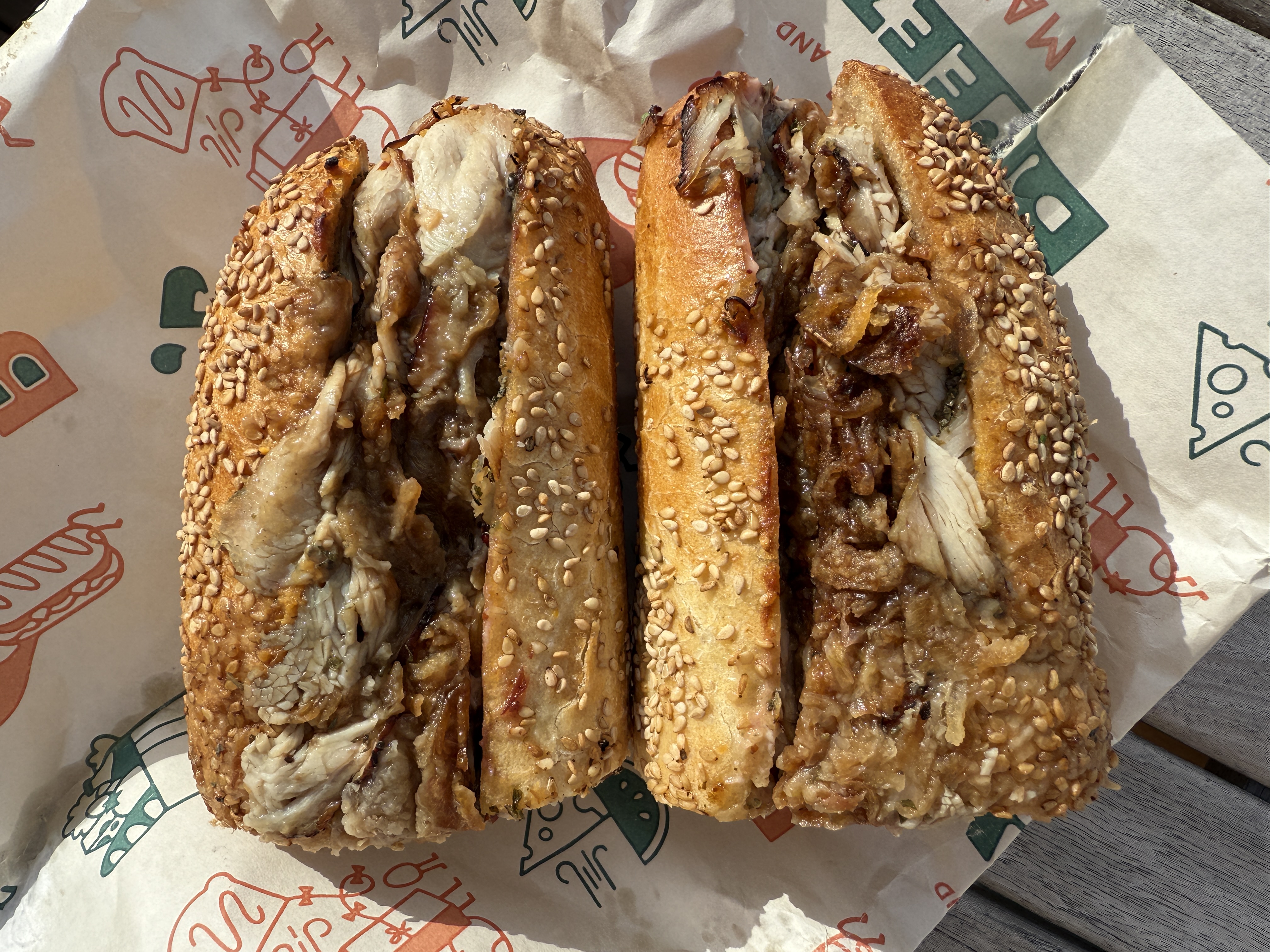
    Liberty Kitchen may be located in Fishtown (and Chestnut Hill and University City), but their LK Gobbler ($23) tastes so very South Philly. It’s served on a crusty foot-long seeded hoagie roll and comes with a side of turkey gravy for dipping. It’s filled with sliced deli turkey and a sage stuffing speckled with spicy — but not too spicy — long hots and fried shallots. Instead of cranberry sauce, Liberty Kitchen’s version relies on a sour cherry spread for citrusy sparkle and dijonnaise for creaminess. It’s the perfect marriage of Thanksgiving dinner and a hoagie. I appreciate that it’s not piled too high — I’m never a fan of an unwieldy sandwich — and that its crusty roll squishes down nicely upon each bite.

    Liberty Kitchen, 1400 N. Front St., 215-309-2241, libertykitchenphl.com

    Triangle Tavern

    The vegan turkey gobbler sandwich from Triangle Tavern.

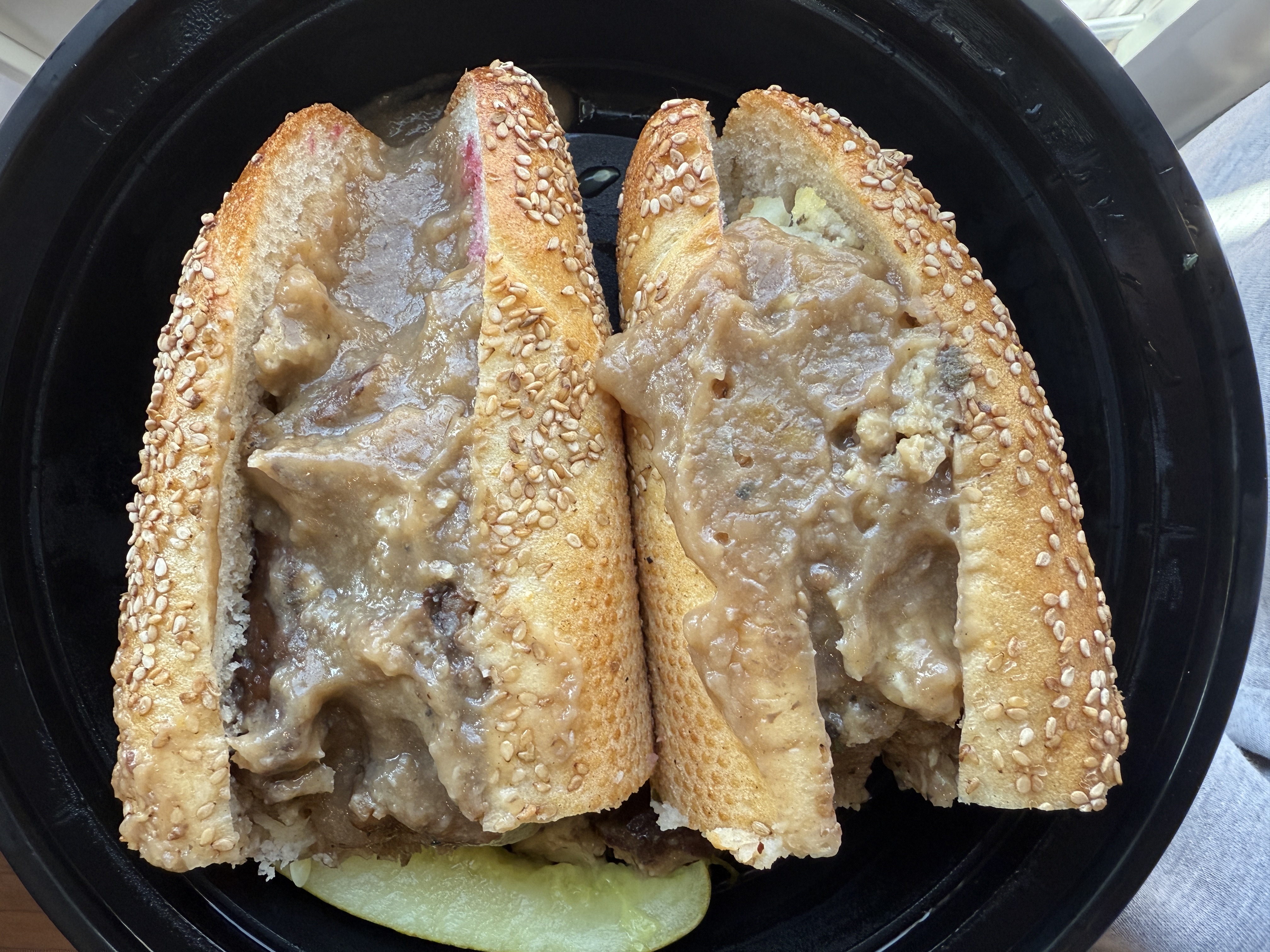
    Triangle Tavern’s gobbler ($17.50) truly tastes as if I had gone to my mother-in-law Phyllis’ for Thanksgiving dinner, fallen asleep, then woken up and made myself a sandwich with all the leftovers, including mashed potatoes. The Baker Street hoagie roll (barely) contains those potatoes, plus cranberry sauce, stuffing, and either vegan seitan turkey or actual roasted turkey. It is sealed in a generous layer of thick mushroom gravy and served with a pickle spear.

    Triangle Tavern, 1338 S. 10th St., 215-800-1992, triangletavernphilly.com

    Breezy’s Gobble Til’ You Wobble Hoagie

    Breezy’s Deli and Market

    The Gobble Til’ You Wobble Hoagie ($17) — made up of smoked turkey, cranberry mayo, sweet potato casserole, roasted Brussels sprouts, turkey gravy, crispy shallots, and balsamic reduction — is one of my absolute favorites on this list and more than any other, really makes me long for it to be Thanksgiving. Also the work of Porco’s owner Chad Durkin, who opened Breezy’s last year, the sandwich was piping hot and heavy when I picked it up. The sweet potato bound everything together beautifully, the sprouts are roasted until they’re wilted. The hoagie is creamy, hot, well-balanced, and you can really discern the different layers between the crusty seeded roll. There are some choices here: Select a 10-inch seeded long roll or a 4-inch wrap (regular or gluten-free); you can also add various meats, from roast beef to mortadella, as well as an array of cheeses.

    Breezy’s Deli and Market, 2235 Washington Ave., 215-305-4090, breezysdeli.com

    Dreamworld Bakes

    Dreamworld’s savory croissant riff on a gobbler, the I Should Call Her ($9) is a whole pastry stuffed with turkey, dashi gravy, cranberry sauce, and crowned with a handful of pancetta-flecked stuffing. It’s impossibly flaky and buttery on the outside, with the best bites of Thanksgiving dinner woven together inside.

    Dreamworld Bakes, 2400 Coral St., 856-390-0502, dreamworldbakes.com

    McCrossen’s Tavern

    This gobbler ($18) is the most classic of gobblers, and really one for the stuffing lovers. It’s basic and straightforward and very, very hefty but done well, with large, succulent chunks of roasted turkey on a hoagie roll with cornbread sausage stuffing and cranberry aioli, plus a creamy gravy for dipping both sandwich and the accompanying fries.

    McCrossen’s Tavern, 529 N. 20th St., 215-854-0923, mccrossens.com

    Other gobblers recommended by gobbler scholars

    It was no small feat, running around Philadelphia collecting gobblers. Admittedly, some gobblers eluded me. Middle Child Clubhouse only serves its Turkey Dip during the day (though it’s available at both locations). There are several others that I did not try firsthand, but came recommended by other gobbler scholars.

    Deli-style gobbler sandwich from Dolores’ 2Street.

    Inquirer reporter Tommy Rowan said that Dolores’ 2Street “hits every major food group, and then it hits the spot.” Theirs is a deli-style sandwich, served mostly cold, with thick slices of roasted turkey and cheddar cheese.

    “The little bit of warmth (and crunch) comes from the house-made stuffing, carefully crafted by owner Peter Miglino’s mother, Maria. It’s coupled with a nice tang from cranberry mayo and complemented by rings of raw white onion, a confetti of lettuce, and small slices of tomato on a Sarcone’s roll,” Rowan writes.

    The Finksgiving hoagie from Fink’s Hoagies in Tacony.

    Two years ago, Inquirer columnist Stephanie Farr sampled seven Philly-area Thanksgiving hoagies and sandwiches in a single day in the name of journalism. “I felt like a stuffed turkey afterward but I did waddle away with two favorites: the ‘Finksgiving’ from Fink’s Hoagies in Tacony and ‘The Bobbie’ from Capriotti’s, a Wilmington-based hoagie chain with locations in the Philly suburbs. Both hoagies had shredded turkey, tasty rolls that held up in the face of impossible odds, and the perfect ratio of turkey, cranberry sauce, and stuffing. The Finksgiving hoagie more fully intertwined the turkey and stuffing, whereas ‘The Bobbie’ layered them as separate ingredients.”

    Philly-based food influencer Amanda Barr recently went on her own gobbler crawl and was entranced by Zig Zag BBQ’s Gooblerr ($16), made of the “same smoked turkey that Zig Zag has year-round. It’s moist and delicious and a massive portion. It comes on a sesame-seeded burger bun with a base of sweet potato that contrasts with cranberry and savory turkey without making it sweet.” Barr also reports that the sandwich is cohesive, rather than unwieldy, and “you would definitely get everything in one bite.”