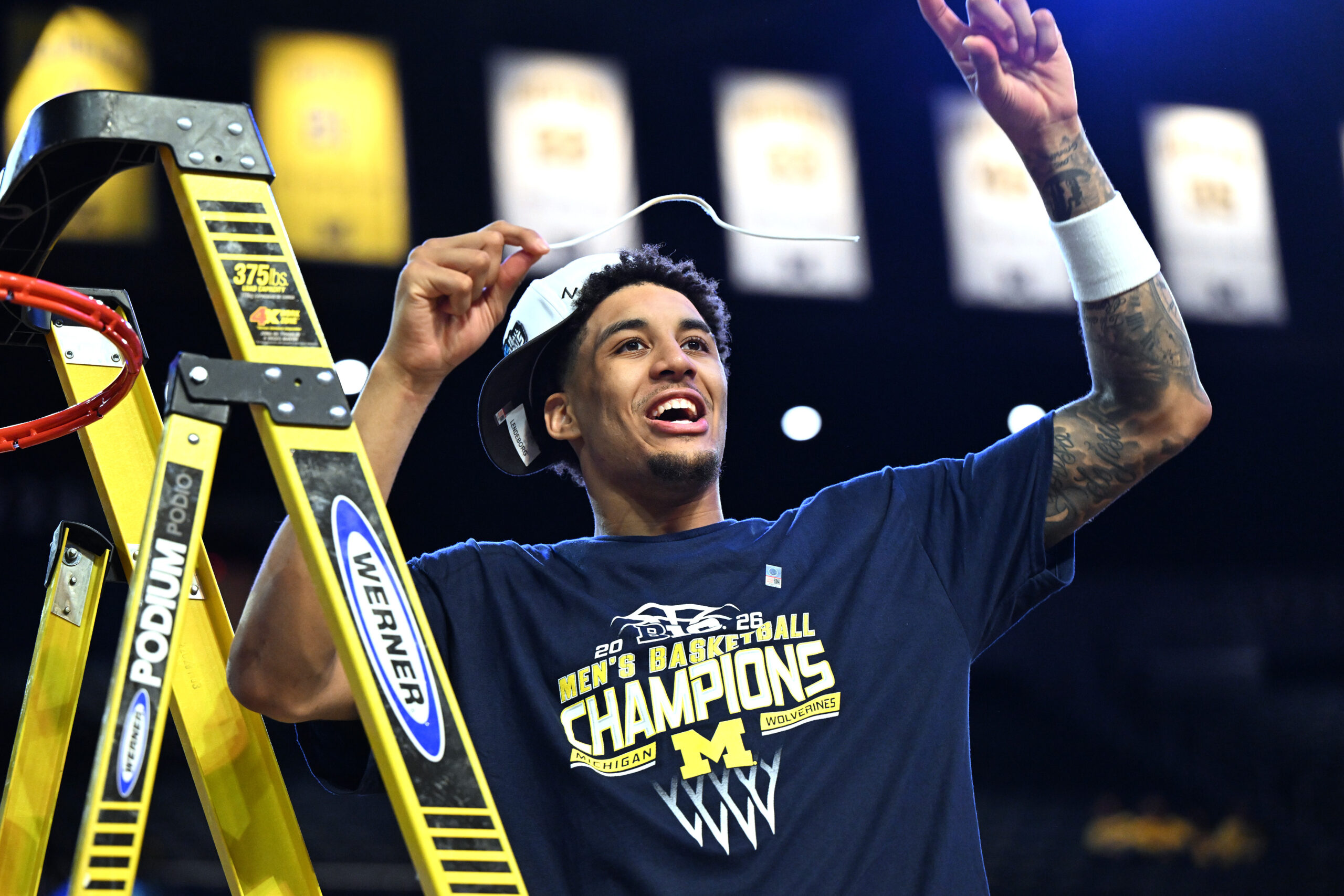
Yaxel Lendeborg went from playing one varsity season at Pennsauken High School to an NBA lottery pick.
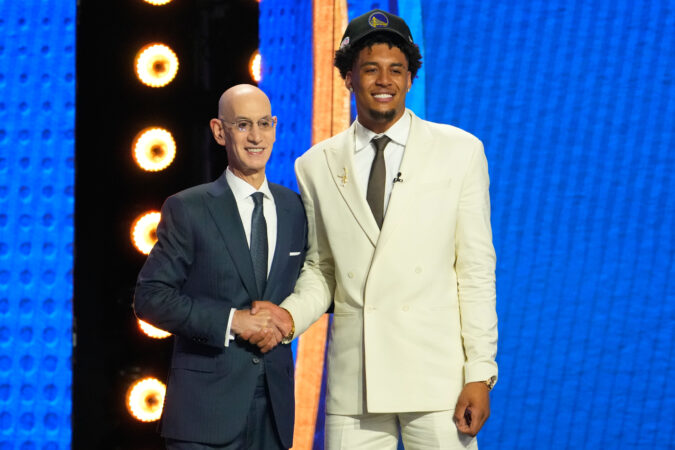
The 23-year-old forward, who was the Big Ten Player of the Year this season at national champion Michiganwas picked No. 11 by Golden State in the first round on Tuesday night.
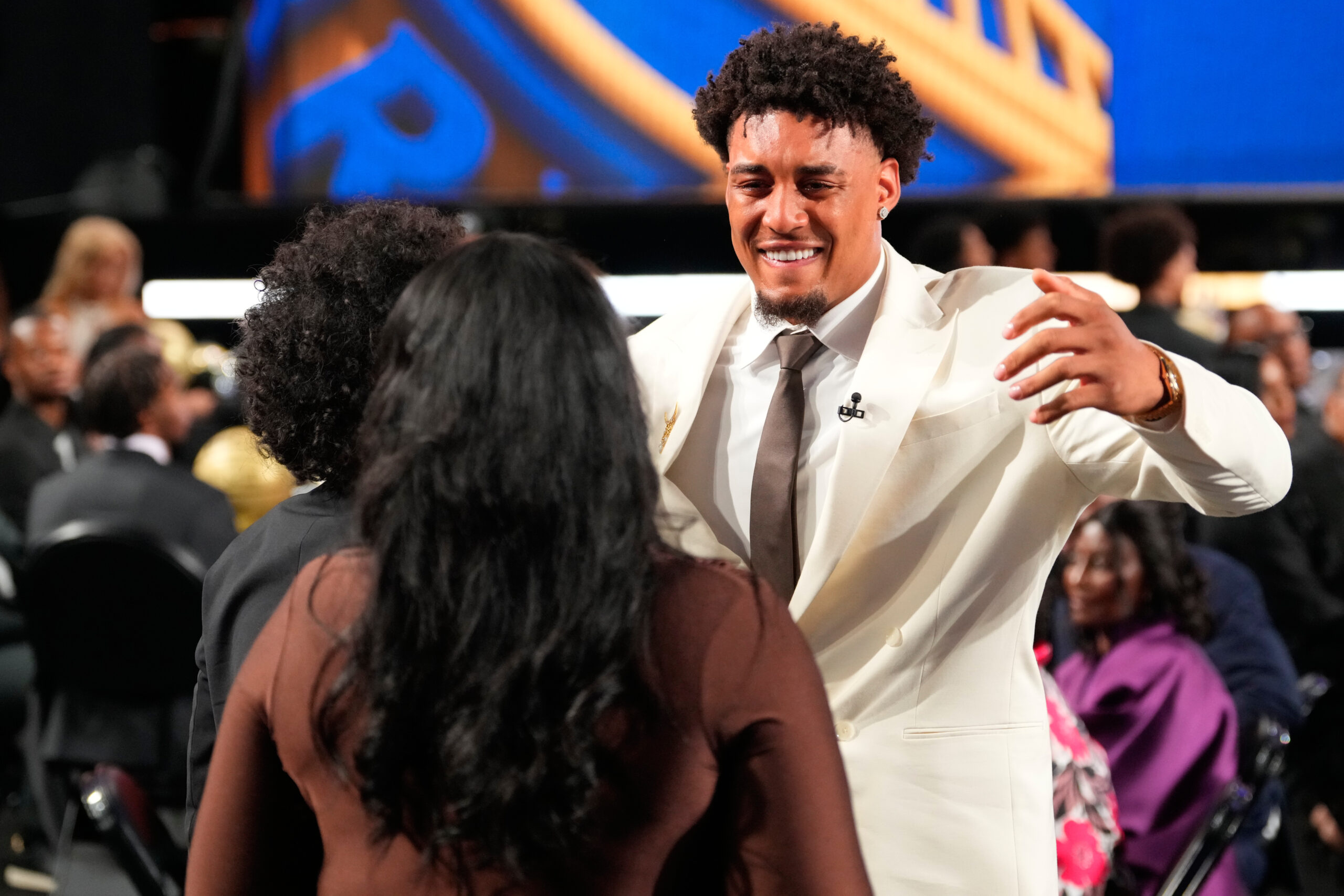
Expressing emotion when hearing his name called at the Barclays Center in Brooklyn, Lendeborg embraced his mother, Yissel, in tears.
He said on the ESPN telecast that “I don’t deserve to be here right now. I didn’t have the traditional path. … I can’t believe it.”
Lendeborg thought his basketball career was over in high school. He played in just 11 games his senior year after being academically ineligible to play for his sophomore and junior seasons.
That was until an opportunity arose — thanks to his mother — at the junior college level with Arizona Western College.
“That kid got here because of her,” Lendeborg said on the telecast. “She pushed a dream, forced me to go out there and become a man.”
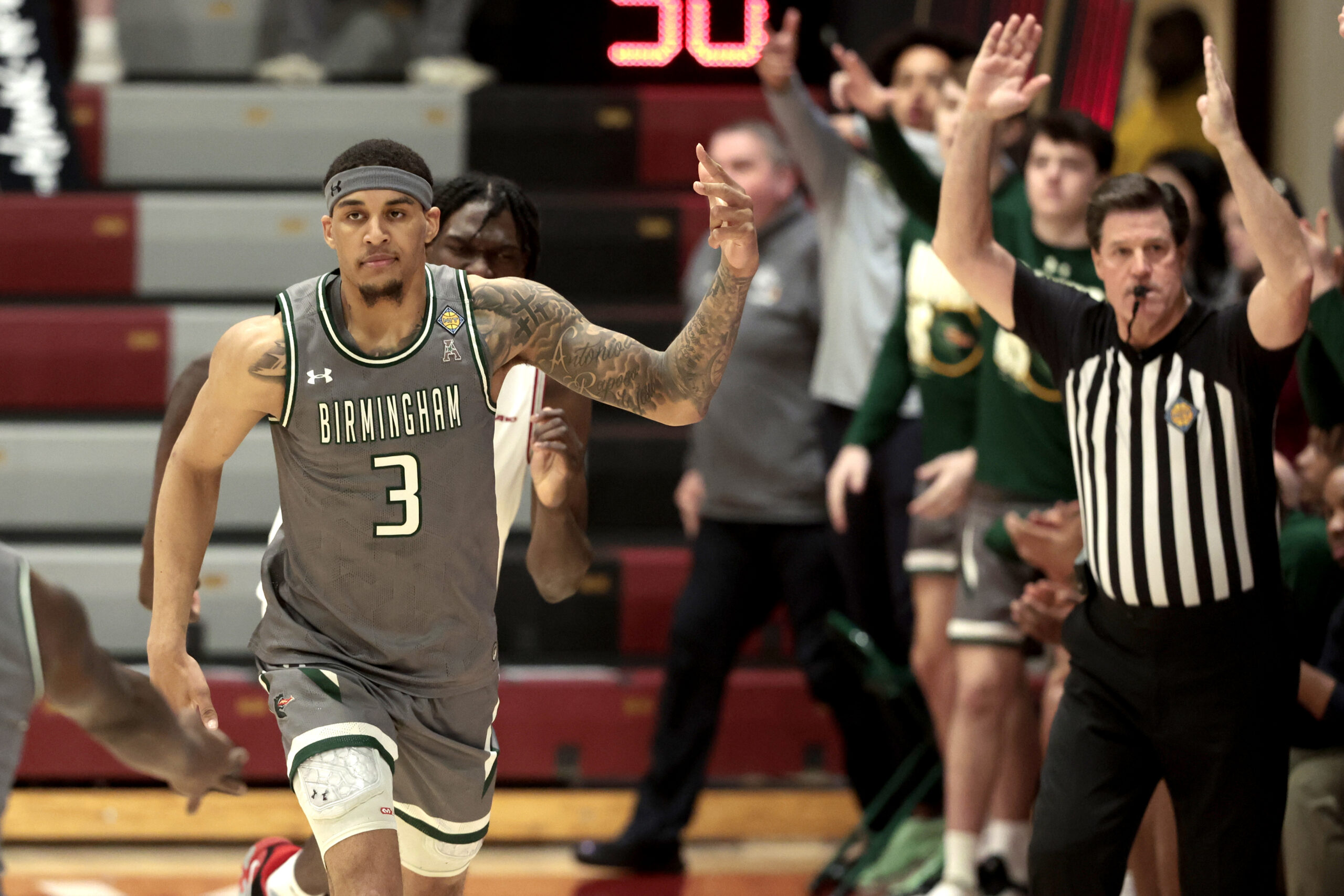
He spent three seasons at Arizona Western, including a COVID-19 season, where he emerged in his third year, averaging 17.2 points and 13 rebounds. In 2023, he transferred to Alabama-Birmingham and played two seasons with the Blazers.
Yaxel Lendeborg celebrates with his family after being selected by the Golden State Warriors.
In his final season at UAB, he averaged 17.7 points and 11.4 rebounds. He also was named the American Conference’s Defensive Player of the Year and an all-conference selection twice.
Lendeborg, who is 6-foot-9, graduated from UAB in 2025 and entered the transfer portal for his final year of eligibility, which brought him to Michigan. Lendeborg averaged 15.1 points and 6.8 rebounds in 40 games for the Wolverines.
Tuesday was the second time in Michigan program history that three players were drafted in the first round.
Center Aday Mara was picked by the Oklahoma City Thunder at No. 12 after forward Morez Johnson Jr. went ninth overall to the Mavericks, reuniting with his college coach, Dusty May, who on Tuesday was named Dallas’ head coach.
After he was selected, Lendeborg said his mother told him, “We did it. All the sacrifice we made, we finally accomplished it — you did it.”
He’ll join a Golden State team that finished 10th in the Western Conference, with a 37-45 record this season.
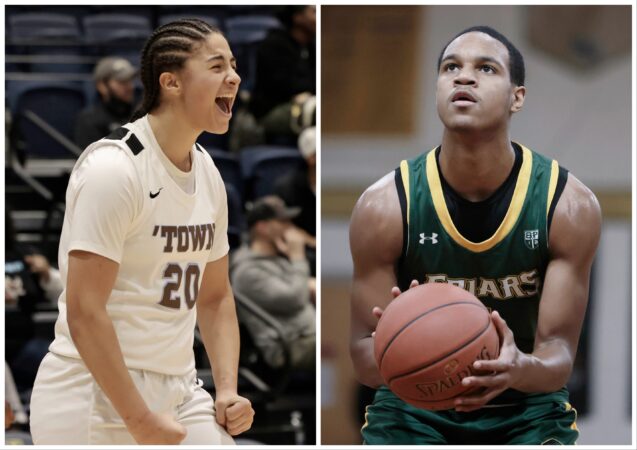
Bonner-Prendergast’s Korey Francis and Westtown’s Jordyn Palmer were named Mr. and Miss Basketball for the 2025-2026 season.
The award honors the best male and female high school players in Pennsylvania. Fans, coaches, and the media vote on the awards.
Francis, a junior guard, averaged 21.5 points, 7.4 rebounds, 3.4 assists, and 1.7 steals, while shooting 52.1% from the field, including 35.3% from the three-point line. Bonner-Prendie went 24-6 and won its first-ever state championship in basketball.
Palmer, a junior forward who’s considered one of best players in the nation, averaged 23.2 points, 13.2 rebounds, and 6.4 assists. She led Westtown to a 28-2 record last season.
Other local finalist included junior guard Silas Graham (Haverford School), sophomore forward Colton Hiller (Coatesville), and senior Sammy Jackson (Roman Catholic).
Palmer’s teammate Atlee Vanesko, a senior forward, and junior guard Ryan Carter (Friends’ Central) were also finalists.
On Tuesday night, Yaxel Lendeborg will likely be a first-round pick in the NBA draft.
But the Pennsauken High graduate’s basketball career nearly ended after playing just 11 varsity games. If not for his mom, Yissel, Lendeborg might not ever have played Division I basketball, much less become a lottery pick.
“Seeing him, and seeing his mother, and how much she has [meant] to him, and how much work she’s done to be able to help guide him mentally, and obviously on the court, it’s been the honor of my coaching career,” Pennsauken coach Harrison Carsillo said.
Lendeborg wasn’t academically eligible to play basketball for a large portion of high school. He played on Pennsauken’s freshman team, but was held out for his sophomore and junior seasons, and most of senior year. He trained in the summer with coaches and friends from Pennsauken, but watched from the sidelines during the school year.
In a Players’ Tribune article, Lendeborg said that the turning point for him was during his senior year. One night, after staying out late with his friends playing video games, his mom confronted him and told him that he needed to focus to even graduate from Pennsauken, much less play basketball.
“This is no joke right now,” Lendeborg said in the article. “Nobody is smiling here. You have your mom up in this minivan crying her eyes out because you don’t know how to be a good son. Your own mom! Who does everything for you. Works two jobs. Shows you love no matter what. And this is how you’re being?!?!?!”
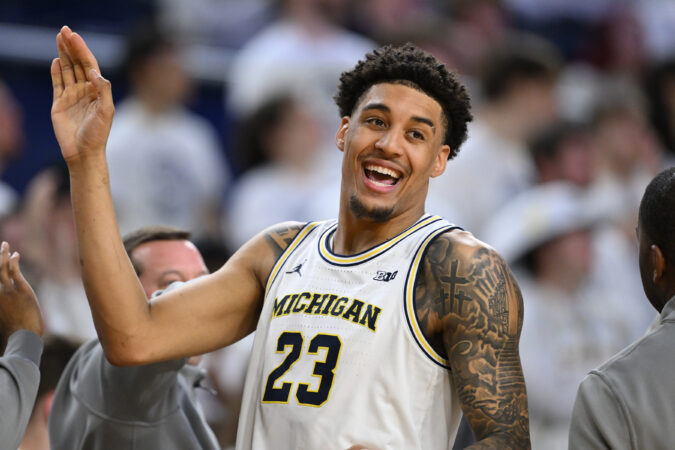
Yaxel Lendeborg averaged 15.1 points and 6.8 rebounds in 40 games for Michigan last season.
During that final year, Lendeborg improved his grades enough to play the final 11 games of the high school season, even competing in the NJSIAA playoffs. But he thought his basketball career was over, until his mom set him up to attend junior college at Arizona Western College. Lendeborg wrote that she planned the going-away party without even telling him he was going, because she knew he needed that push.
From there, Lendeborg had one of the most improbable rises to the draft, transferring to Alabama-Birmingham in 2023 and then Michigan before last season, where he won Big Ten Player of the Year and an NCAA title. Lendeborg, a 6-foot-9 forward, averaged 15.1 points and 6.8 rebounds in 40 games for the Wolverines.
Lendeborg was always talented, Carsillo said. His biggest problem was not believing in himself. Carsillo and Lendeborg’s mom forced him to pick up the phone after Division I schools started calling him about transferring, because he wasn’t sure if that was the right fit for him.
“He didn’t answer the phone, and I said to him, ‘If you don’t answer that phone call, I’m going to take your phone, and I’m going to smash it, or rip your sneakers.’ I [was] going to be so upset, because he didn’t believe in himself that he could actually do what we knew he could do, if he put his mind to it,” Carsillo said.
“It was a really funny moment. I obviously wasn’t going to rip his sneakers or smash his phone, but I was very upset, because it was almost just a mental thing going into it, because he had so much potential that he didn’t even see himself.”
After two years at UAB, Lendeborg was a fringe first-round prospect. He could have ended his college career there, but instead spent another year in college to develop further, and prove to himself and to NBA draft scouts that he could succeed at that highest level. Carsillo said that Lendeborg’s year at Michigan has him more confident and aware of his sky-high potential.
But what’s stood out the most to Carsillo over the years is Lendeborg’s selflessness, on and off the court. In the Final Four, Lendeborg suffered an MCL and ankle sprain. Some advised him not to play to protect his draft stock, but Lendeborg insisted on helping his teammates see it through and vowed, “I’m playing no matter what.”
At halftime of the national championship game on April 6, he said he felt “awful,” but still gritted out a 13-point, 36-minute performance in the 69-63 win over UConn.
Yaxel Lendeborg spent two seasons at UAB after attending Arizona Western College.
“That’s him,” Carsillo said. “He could have easily just said, ‘No, I’m good.’ He knows he’s going to get drafted. He knows he’s changed his family’s life. It’s amazing. That’s exactly who he is, 100%, and he was like that at Pennsauken, just much lower stakes.”
Lendeborg even has a chance to reunite with his college coach, Dusty May, who reportedly accepted the Dallas Mavericks’ head coaching job on Monday. The Mavericks hold the No. 9 pick in the draft, slightly above where Lendeborg has been projected, but Lendeborg joked Monday that he’s “going to tell him he better pick me up. If he doesn’t, I’m going to be mad. I might block him.”
The forward has grown up a lot since high school. He’s one of the oldest prospects in the draft, but he’s played only about six seasons of organized basketball. He grew up playing baseball, and told ESPN that he first learned how to play basketball through the NBA 2K video game.
“He still has so much room to grow, and he’s still learning how to become a better basketball player; it’s remarkable,” Carsillo said. “He has a little bit of self doubt, but not much anymore. This whole process with the NBA and Michigan turned his eye and turned his mindset around to be able to prove to himself, like, ‘I can do what my mother has always told me I could do.’”
Lendeborg’s mom can’t attend as many games as she used to. She’s currently nearing the end of her treatment cycle for appendix cancer, which she initially kept hidden from Lendeborg to keep him focused on his season at Michigan. But planned to be in Brooklyn on Tuesday to watch her son’s NBA journey begin — a journey he’d never have come close to if not for her pushing him every step of the way.
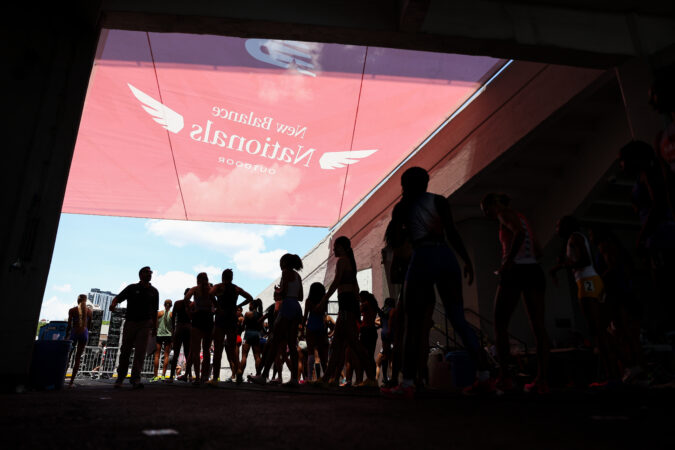
Franklin Field played host to the New Balance Nationals Outdoors Championship this weekend, where it brought some of the most talented high school track and field athletes in the country to Philadelphia.
The keyword is some. Two other high school track competitions were happening at the same time. The Nike Outdoor Nationals were held in Eugene, Ore., and the Adidas track nationals came to Greensboro, N.C.
This is not a new occurrence. There has long been an overlap between open, registration-based national championships. Besides medaling, these meets serve as a massive marketing opportunity for their sponsors. Famously, competitors at all three meets are given free backpacks with the title sponsor’s logo on them. Penn’s Rockwell Gym was converted into a pop-up New Balance store this past weekend.
What is semi-new to the landscape — and high school sports — is the role that name, image, and likeness deals are playing in these three championship meets. If a student-athlete is signed with Nike or New Balance, he or she would compete at their respective meets.
For example, Eastern Regional senior runner Natalie Dumas, who’s heading to Arkansas, is one of only 20 female high school track and field athletes signed to Nike Elite. Because of this, Dumas competed this past weekend in Eugene a day after running in the USATF U20s on the same track. At the Nike Nationals, she ran a 52.21-second time in the 400-meter dash, placing first.
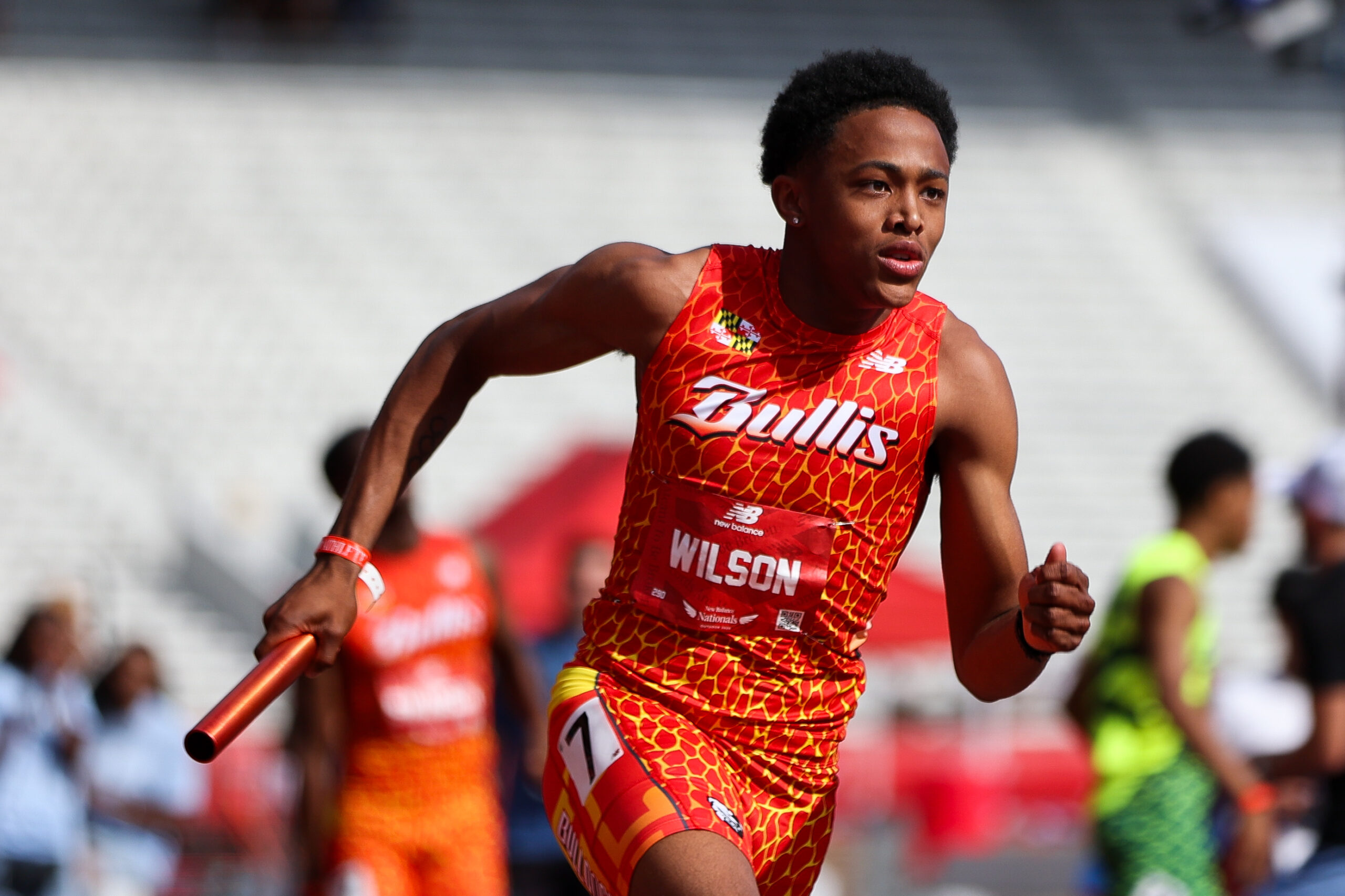
Meanwhile, 18-year-old Olympian Quincy Wilson, of the Bullis School in Potomac, Md., is signed to New Balance. Wilson also ran in the USATF U20s, clocking a second-place finish of 44.84 seconds on Friday to qualify for the World U20 Championships.
But shortly after, Wilson got on a flight back to the East Coast to compete at Franklin Field due to the meet’s title sponsor. He ran the final leg in the 4×400-meter boys’ championship on Sunday and led his school to a second-place finish.
Outside of NIL deals, New Balance Nationals’ prestige seemed to play the biggest role in winning over competitors from Nike and Adidas.
“I’ve always had just like a natural draw to the New Balance Nationals,” said senior Blake Cook, who attends Corry Area High School in Erie County and placed sixth in the boys’ 110-meter hurdles championship. “It was the first nationals I ever watched knowing that Nike and Adidas did it, they just never appealed as much to me. Just knowing how grand that this meet makes everyone feel. Even if you’re dead last in your heat, you feel elite just walking in and being able to say that you got your [backpack].”
The New Balance Nationals have only operated since 2022, following a split from the National Scholastic Athletic Foundation, a nonprofit that operates and supports high school track competitions. New Balance had partnered with the NSAF from 2010 to 2019 as the national meet’s title sponsor. Then, it was New Balance that called Greensboro home — not Adidas. Nike has been partnered with the NSAF since the nonprofit split from New Balance. Today, many see Nike and New Balance as the “premier” national meets with Adidas trailing behind.
“In general, I think New Balance has the most competition,” said Patrick Logan, who attends Grafton High School in Virginia and ran in the boys’ 400-meter dash. “Nike has some big names, but I think, in general, New Balance is just a more competitive meet and it’s on the East Coast, so it’s easier for me to get to.”
Bullis School’s Quincy Wilson competes in the 4×400-meter relay on Sunday.
‘Bring it back to Jersey’
The weekend brought competition from all over the country, but two runners from South Jersey showed out.
On Friday, Pennsauken senior Sianni Wynn won the 100-meter girls’ championship with a personal-best 11.27 seconds. To finish out Friday, Wynn anchored Pennsauken to a first-place finish in the 4×200-meter championship relay. Then, on Sunday, Wynn finished third in the 200-meter championship.
“It’s been a super long weekend,” said Wynn, who is committed to Florida. “I’m happy to cap it off now, and you know, it’s been a great last high school track for me.”
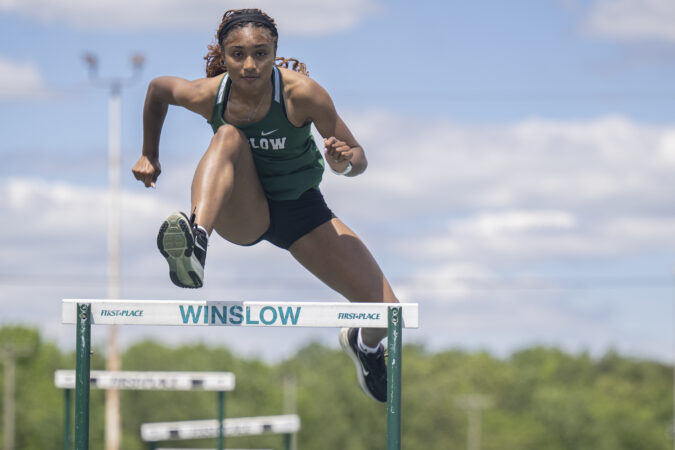
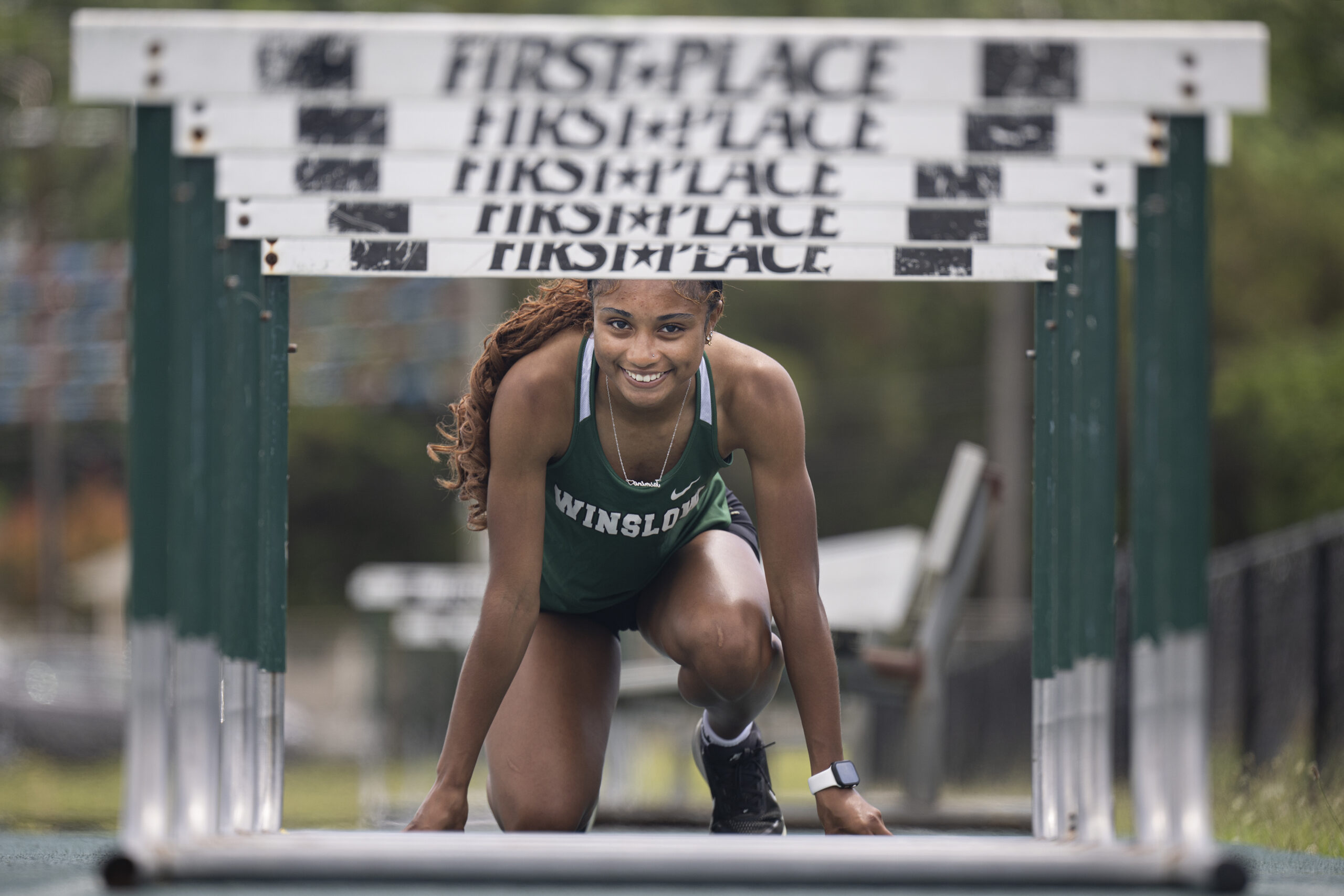
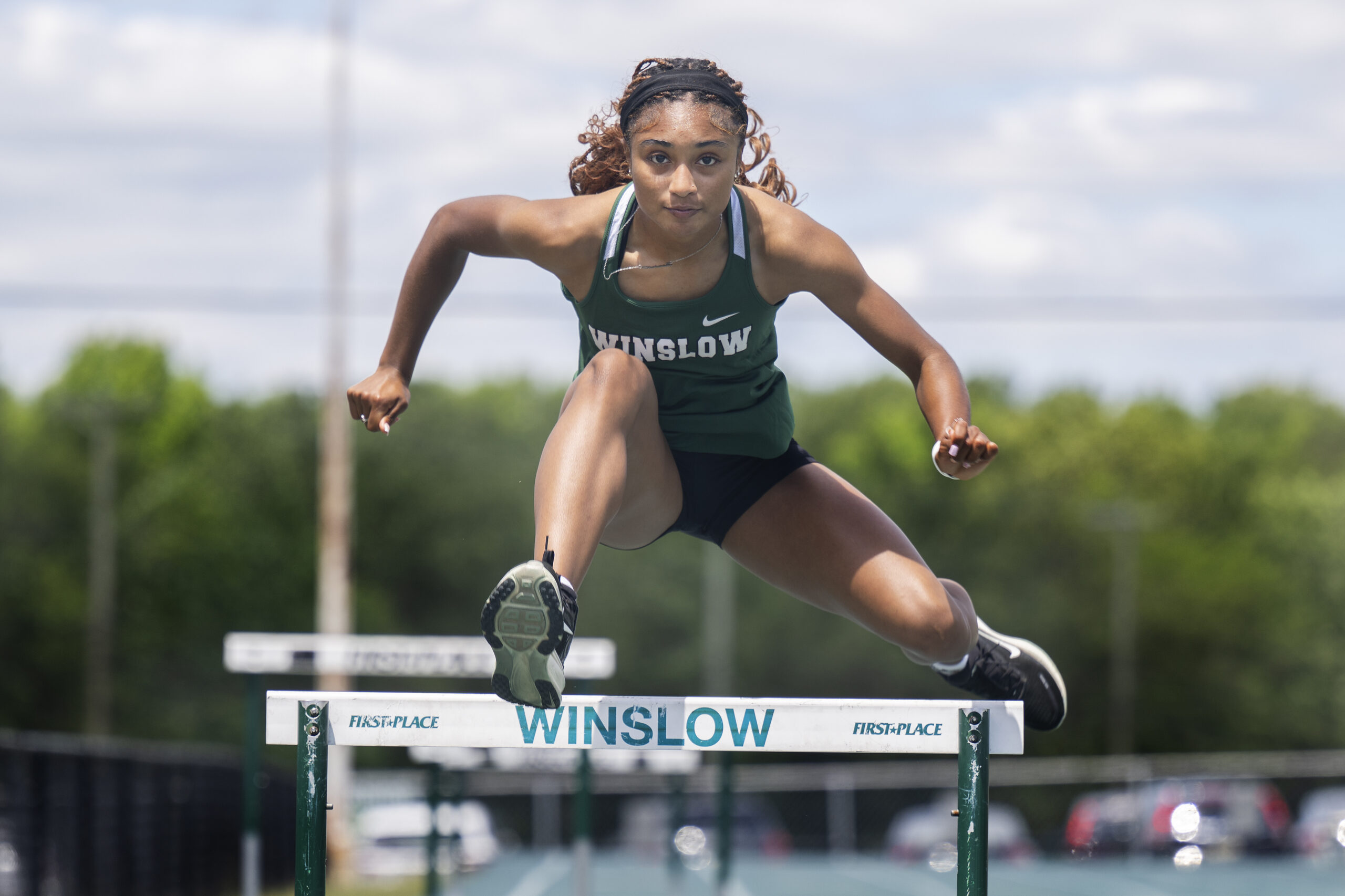
Sunday was Jasmine Jackson’s day. The Winslow Township High sophomore shattered her personal-best in the 100-meter hurdles, clocking in at 13.04 seconds to place first in the girls’ championship.
South Jersey’s Jasmine Jackson poses after winning the 100m hurdles at the New Balance Nationals.
“I’m feeling great,” Jackson said. “I woke up today, I said, ‘I’m not losing.’ I lost indoor, I got second, I got second in middle school, I got second as a freshman. So today I just knew I was not losing. That was not an option.”
Jackson’s finish also beat the New Jersey state record of 13.18 seconds, which was held by Union Catholic’s Taylor Cox. After the race, Jackson made sure to show love to Cox, who now runs at Georgia.
“Taylor dominated New Balance when she was still in high school,” said Jackson. “I knew I had to bring it back to Jersey.”
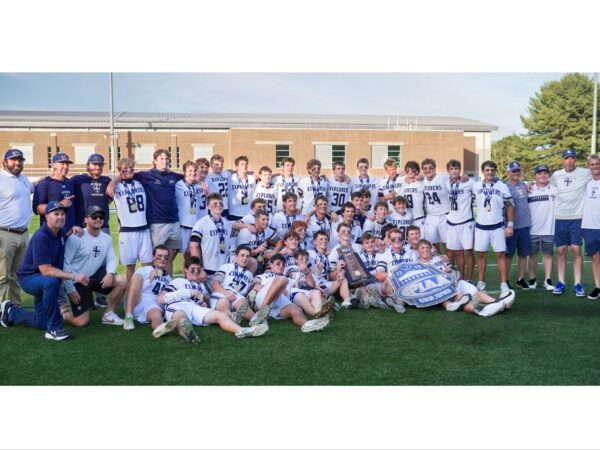
Two years ago, La Salle College High School fell to Radnor in the PIAA 3A boys’ lacrosse championship. Just last Saturday, the Explorers flipped the script.
La Salle earned its first state crown since 2019 and sixth overall title after defeating Radnor, 16–9. The Raptors were making their sixth consecutive championship appearance. The victory, however, was the culmination of a season that hardly began according to plan.
La Salle opened the year 1–2 after losses to St John’s College High School in Washington, D.C, and Malvern Prep. While head coach Jack Forster understood that his team was up against tough competition, he knew they were leaving a ton on the table, especially with a roster consisting of seven seniors who are committed to Division I schools.
“I remember Coach Forster in the locker room before the [next] game was like, ‘I’m sick of telling people that we almost had them. Let’s go out there and win, and put all those little things together,’” said senior long-stick midfielder Johnny Wachs, who will play at Jacksonville University.
The Explorers went on go undefeated in Catholic League play and won 21 of 22 games en route to a state final victory.
“I think we kind of just took [the losses] as learning opportunities,” said senior attacker Will Trymbiski, who scored five goals in the championship game. “We saw the cracks in the sidewalk and knew how to fill them.”
Forster also believes that his team’s transformation occurred during their spring break trip to Bradenton, Fla. While there, the Explorers picked up a decisive 9-5 win over IMG Academy, but lacrosse was secondary to the relationships developed across the team.
“Just being around each other all week — and guys getting to know everybody and not just their class, and [upperclassmen] bringing the freshmen and sophomores along. … [The trip] was a big turning point for our team,” Wachs said.
“Some of the kids I talk to most are underclassmen. I feel like that made us a better team, because there was no separation between classes.”
This year’s senior class made sure to savor their last season playing together. Trymbiski and midfielder Dylan Malone, who’s heading to Duke in the fall, had played together since second grade, when the two were on the same club lacrosse team.
“It was super special to finish off the season with him and finish off the season in that way with him,” Trymbiski said.
This year’s seniors are most proud of the legacy they’ll leave behind.
La Salle has consistently been a dominant program and hasn’t dropped a Catholic League game in four years.
Before last weekend, the Explorers last won a state title in 2019, which marked their longest drought since winning their first in 2004. After going the distance this season, the seniors believe that they’ve left behind a structure that will return La Salle to the championship, even without their presence.
“Leaving a blueprint behind for underclassmen to follow, having leadership where you’re not too strict and not too lenient is where we had a great balance, and we found equilibrium between the two,” said Malone.
Trymbiski added, “I’m most proud of how the senior leaders handled this team, and hopefully for years to come, we can have a huge [winning] streak for La Salle.”
Santino Harwood was set on playing baseball at a Division I school but his chances were dimming when he started his senior year at Roman Catholic without a college offer. He had chances to play at Division II and Division III schools but the infielder from Mayfair always dreamed of Division I.
“Kids these days want to hear that they’re a D-I player and going to a D-I institution,” said his father, Edgar. “I said, ‘That really does not matter.’ You need to go where you fit in and where you like the program. They feel like they’re disfigured if they’re D-II or D-III and they don’t have that status symbol next to them.”
Santino played like a Division I player in high school, but he was just 5-foot-11, causing college coaches to overlook the shortstop. Finally, an assistant at Delaware State noticed. They didn’t have a scholarship for him but told him he could walk on. Deal, he said. And then the coach made sure Harwood knew that the school was a historically Black college and university.
“He said, ‘You have to understand that you’re going to be a minority’,” said Edgar, as his son is white.
Santino didn’t mind. He just wanted a chance. He was in. The shortstop hit .296 this season, played crisp defense, and stole bases with ease for Delaware State, which reports its student body as 76% Black. Harwood grew up playing baseball with kids of various races — “Being from Philly, my friend group is mostly Black,” he said — so being a white kid at an HBCU was nothing new.
“It’s a great environment to be around,” Santino said of Delaware State. “It’s a great energy. They make you feel comfortable … I feel like baseball has the most diverse community. We have a lot of Hispanic, Black kids, white kids. Everyone comes together and is here for the same reason. That’s why we all get along.”
And next month, he will represent Delaware State at Citizens Bank Park days before the All-Star Game when he plays in the HBCU Swingman Classic on July 10.
The event was developed by Hall of Famer Ken Griffey Jr. to give players from HBCU schools — overlooked guys like Harwood — a chance to showcase their skills. Jimmy Rollins will manage a team, Griffey will be there, and Harwood will get his chance to star in a big-league park.
“Our president Dr. [Tony] Allen, his goal is to create the most diverse HBCU at Delaware State University,” baseball coach Pedro Swann said. “If you walk around campus, you’ll see all types of shade. There’s a mixture of everything. Plus, Santino has a little drip and a little swag to him. So he fits right in and has no problem blending in with the HBCU culture. That’s what I love about him. He’s friends with everyone.”
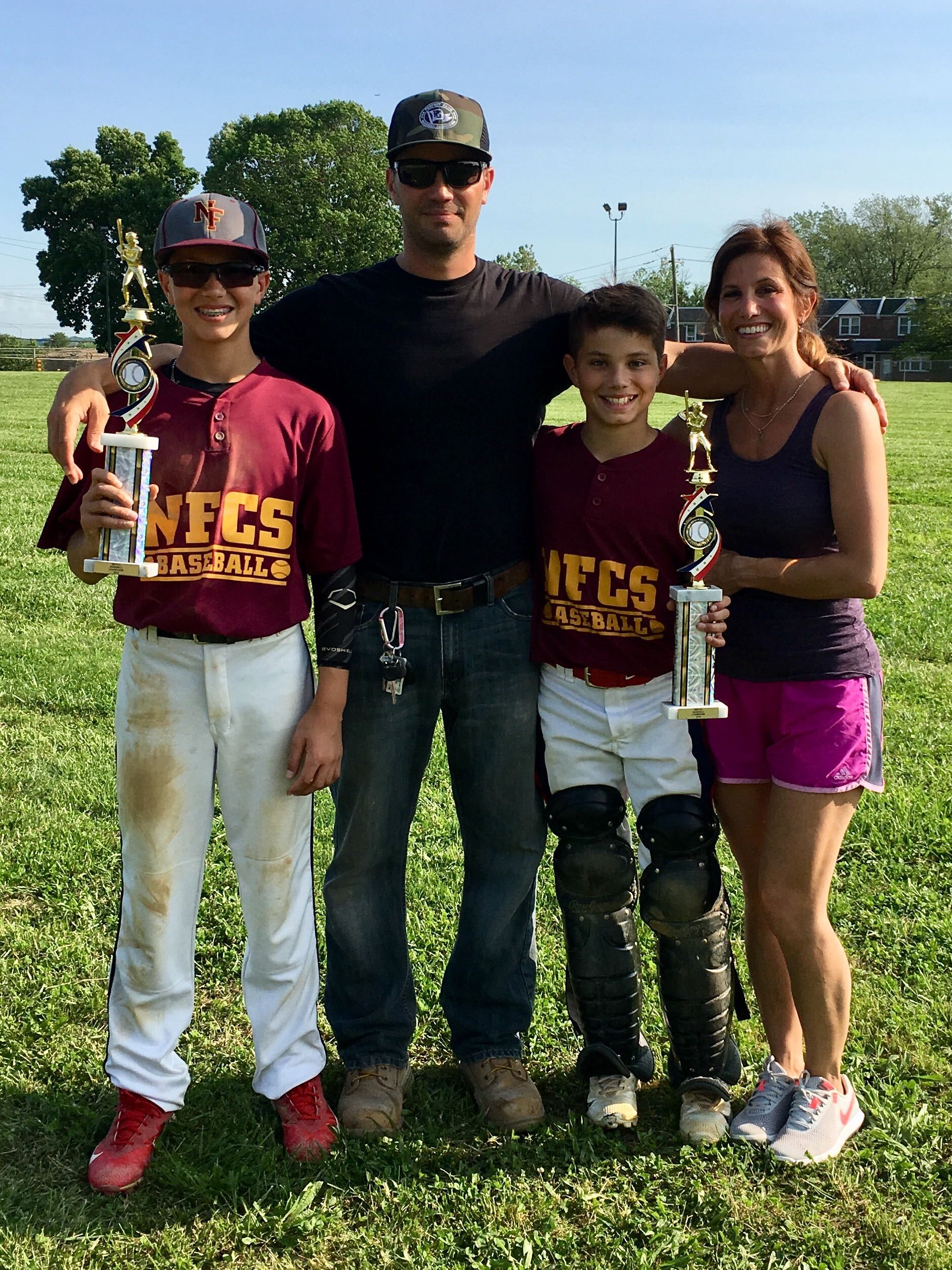
Santino Harwood (second from right) and his brother, Edgar; father, Edgar, and mom, Michelle after a game at New Foundations Charter School.
The Santino Rule
The 8- and 9-year-olds from Holy Terrors were called to the stage at the end-of-season banquet years ago when a table in the catering hall started to boo. Edgar looked around and saw it was another team from Northeast Philly that played in the age group above his son’s team. Fine, he thought. We’ll play up in age and beat them.
Holy Terrors — a youth organization at Brous and Princeton Avenues — won the Department of Recreation title against 11- and 12-year-olds despite 8-year-old Santino batting leadoff. Opposing teams were livid.
“I said, ‘Why are you mad? He’s 8 years old,’” Edgar said. “‘He’s my leadoff hitter. Just strike him out if you can. But that’s probably not going to happen.’”
A year later, Edgar said the league instituted a new rule that banned players from playing up in age.
“The Santino Rule,” Edgar said. “The pamphlet came out, and, boy, they put that sucker in boldface lettering. It was really weird. For me, playing up is a bonus if you can do it and you can hold your water.”
Edgar soon started a travel team called Falcons Baseball that practiced for three to four hours at fields in the Northeast. Even that wasn’t enough for his son, as the coach often would cap practice by driving his car up to the cage and turning on the headlights so Santino could get more swings after dark.
“There was always that want and desire,” Edgar said.
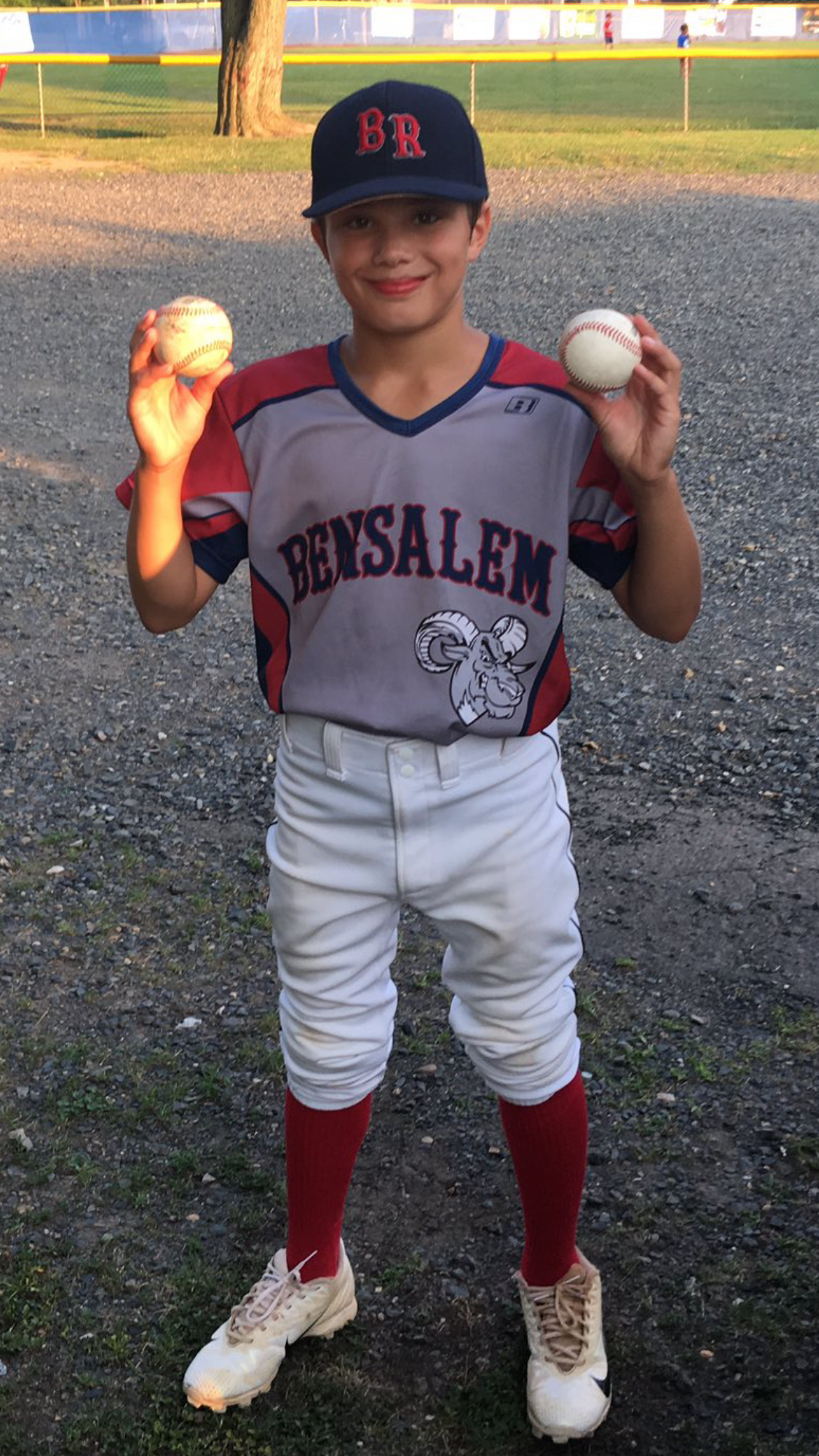
Santino Harwood after a game with the Bensalem Ramblers.
Those Falcons teams were diverse — “Black, white, Hispanic,” Edgar said — and the players became more than teammates. They hung out at the Harwoods’ home, barbecued, and bonded like “brothers” over their love of baseball.
“You have a melting pot of identities in the United States now,” Edgar said. “You have to get an understanding and learn to love one another and understand each other. Just like brothers, you’re going to bump heads. Everyone bumps heads whether you’re at work or on the baseball field or with your neighbor.
“But you have to learn these things now that you have to understand each other. You have to have a respect for different attitudes, different thought processes, different identities, cultural or national.”
Santino Harwood went to Delaware State without a scholarship.
Earning his way
The Delaware State baseball team is full of players like Santino, who were overlooked by other programs before finding their way to the Hornets. The roster is racially diverse, just like that Falcons team.
“Last season, we had a guy from Idaho,” Swann said. “You pair him with someone from like Teaneck, N.J., and it’s polar opposites. But the guys got along. When you get out on that field, it’s not about what color you are. It’s about how you catch and throw the ball.”
Santino went to Delaware State without a scholarship, but his dad told him not to worry.
“You need to be prepared for the opportunities that can get you to that scholarship,” Edgar said. “Whether or not you think someone in front of you doesn’t deserve it, that’s irrelevant. When you have your opportunities, can you showcase to the point where you get that same bonus or package?”
He hit .296 as a freshman in 2025, and his coach called him into the office after the season. He was no longer a walk-on. Harwood called home and told his parents. They were thrilled.
He stole 15 bases last season as a sophomore with a .413 on-base percentage in 44 games. Swann told him early in the season that he was building a case to be picked in the Swingman game.
“I said, ‘Man, that would be cool. You’d get to play in your hometown. That would be awesome,’” Swann said. “Then he ended up getting selected. He took the lead role in the infield this season and was our quarterback out there. He never backed down from any battle. He’s a Philly kid, so he has that fighting spirit and chip on his shoulder. I love the way he plays the game.”
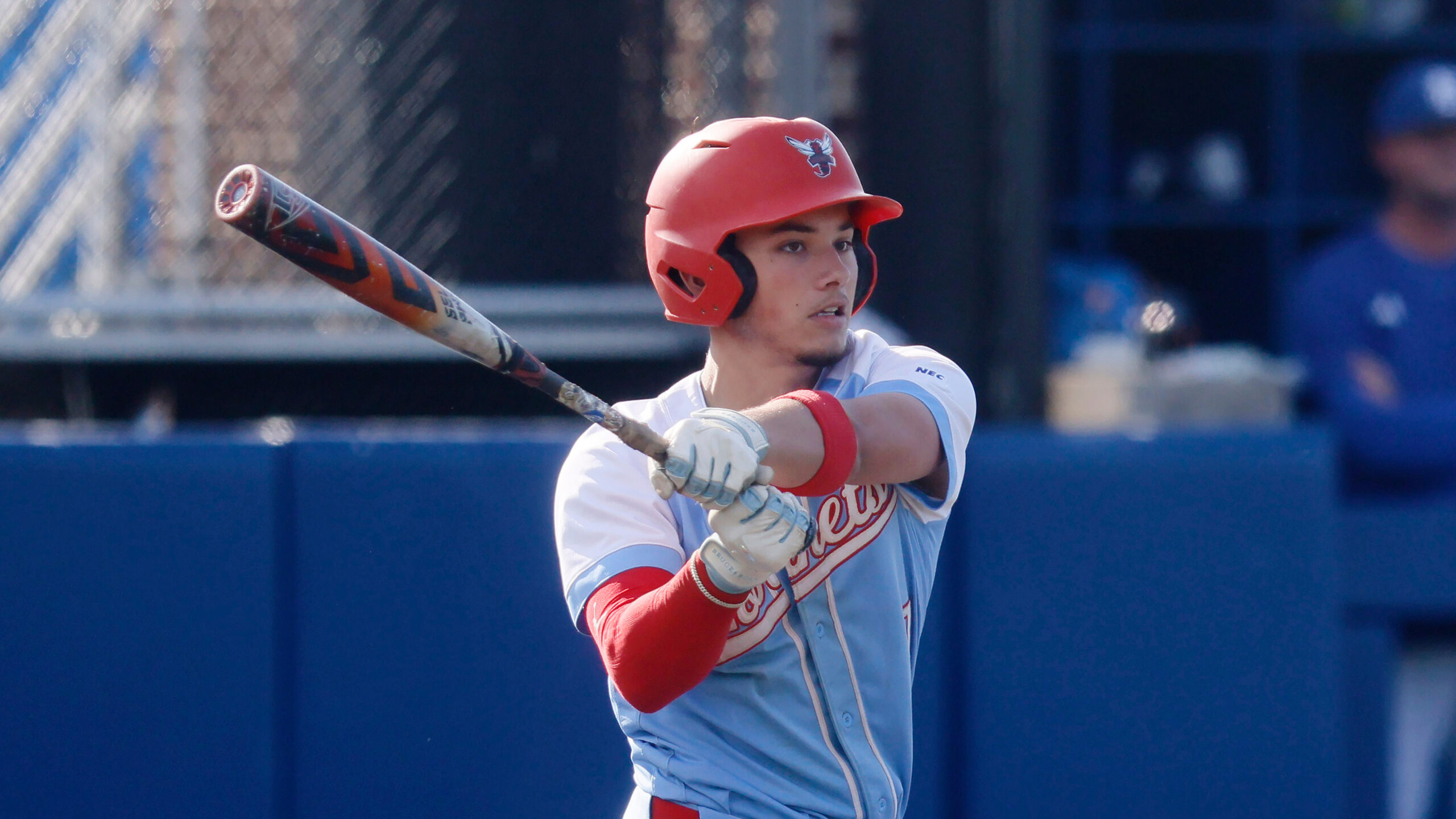
Delaware State shortstop Santino Harwood had a .409 on-base percentage and 15 stolen bases in 45 games last season.
Santino grew up an Atlanta Braves fan — his dad is from Georgia — but still is honored to play at Citizens Bank Park.
“This is a once-in-a-lifetime experience,” he said. “It’s a privilege to play there. I feel like that’s every kid’s dream. For me to get a taste of it in the Swingman is nothing more than a blessing.”
Santino dreamed of playing Division I baseball but had to wait for his opportunity. Even then, he had to earn a scholarship. First, his coach had to make sure he would be comfortable. Santino didn’t think twice about it. The HBCU, he said, has felt like home. And he’ll represent it next month on a big stage.
“I’m so happy to see him get an opportunity that he’s really worked so hard for,” Edgar said. “No one knows the hours and the days that we’ve been out there trying to get him better at this sport. And it doesn’t really matter if anyone knows or not, right? It’s an opportunity that me and his mom are going to enjoy.”
Jasmine Jackson sat on her couch at her home in Winslow Township, watching a broadcast of the nation’s fastest high school hurdlers competing at the 2025 Brooks PR Invitational. As she watched, she made it her goal to be on that track, competing in the race.
After a year of training and dropping time, her invitation arrived in the mail, making her the first athlete in Winslow Township history to earn a spot in the prestigious event.
“It was a big accomplishment when I got the invitation,” she said. “I was ecstatic. To know I was the first to do this showed it was a stepping stone to something even greater.”
And something greater came at this year’s Brooks PR Invitational on June 7 in Renton, Wash.
The Winslow Township High School sophomore claimed the 100-meter hurdles title with a time of 13.33 seconds. It came days after winning the New Jersey Meet of Champions and running a personal-best 13.28 seconds.
Jasmine Jackson set a personal record in the 100-meter hurdles at the New Jersey Meet of Champions.
Her personal record currently ranks No. 3 in state history, No. 3 all-time on the wind-legal list for sophomores, and No. 3 in the nation this season. Jackson continues to climb the ranks as one of the nation’s fastest hurdlers and wants to accomplish more.
Her love for hurdling began at a young age. Jackson grew up going to the track with her dad, Tyree Jackson, who was a sprinter and relay runner at Camden High School and Rowan. He is now a track-and-field coach at Pennsauken.
When she was 5, she saw a hurdle on the track and asked her dad if she could try to jump over it. Tyree initially said no, worried she might hurt herself, but she persistently asked, so he finally gave in.
She cleared the hurdle with her right leg leading and left leg trailing, the form she still uses today.
“It was perfect,” Tyree said.
Starting out, however, he wasn’t convinced that hurdles would become her event.
“There were a lot of times where I thought that maybe hurdles weren’t for her because she was too timid and scared to actually run through the hurdles,” he said.
Tyree scoured the internet for drills and training ideas to help his daughter develop as a hurdler. His former teammates offered advice on technique and form, and they soon progressed from wickets to smaller hurdles. She joined Winslow Elite Track and Field at age 8 to keep improving.
By 14 years old, Jasmine broke the national record for the 100-meter hurdles with a time of 13.72 seconds at the 58th AAU Junior Olympic Games in Greensboro, N.C. That race gave her a newfound confidence.
“That race pushed her over the edge as far as her demeanor and her confidence level because in order for her to win and break the record, she had to beat some really talented athletes she had never beaten before,” Tyree said.
And as her confidence has grown, her times have dropped.
Part of that growth has come from racing against the nation’s best, including one of her biggest competitors, Nia Armstrong from Tampa, Fla. The hurdlers have developed a friendly rivalry over the years since they typically compete in the same races and push each other to faster times.
“Whenever those two compete against each other, it’s like I don’t care who else is on the track, the race is going to be between them,” Tyree said.
Before the Meet of Champions earlier this month, Jasmine was nervous. The meet featured the toughest competition she faced all season. But as she set up on the line, she reminded herself that she belongs here and is built for the moment.
“I just tell myself I’ve been here before. It’s just a track. I know how to run. I know how to hurdle. I know what I’m capable of,” she said. “I believe in myself, I’m ready for this moment, and not to let an opportunity pass by because you might not get it again.”
Developing self-belief in a mentally challenging sport, Jasmine says, has been one of her biggest areas of growth.
“She’s always been good. She just didn’t have the confidence to know that she’s good,” said Shawnnika Brown, Jasmine’s high school coach. “Now, she is running with a purpose.”
That purpose is reflected in her daily routine. Jasmine trains with her team after school, goes to the gym to lift weights, and does additional hurdle sessions with her dad on the weekends.
Having Tyree as her coach has also been an important part of her success.
“I try not to let the coach interfere with the father,” Tyree said. “I’ve learned how to talk to her and get her motivated to the best of my ability without her being upset with the father.”
After Jasmine won at Brooks, Tyree let his daughter enjoy the moment before turning their attention to the next race.
“She knows I’m going to focus on the flaws first before I celebrate her and give her roses because I sometimes have to be the coach first and then dad second,” he said.
That approach is shaping one of the nation’s fastest high school hurdlers, but Jasmine’s goals go beyond state titles and national championships.
Jasmine Jackson will compete at the New Balance Nationals at Franklin Field this weekend.
“The ultimate goal is to go to the Olympics,” Jasmine said. “Knowing I have that goal in mind, no matter how I feel, I know I have to work for it. It’s not going to be given to me. I have to earn it.”
For now, the 15-year-old can check the Brooks PR Invitational off her list. Up next is the New Balance Nationals running until Sunday at Franklin Field. Jasmine will run the 100-meter hurdles and 4×400-meter relay championship. She is looking to earn her first national title at the event.
“I’m tired of being second at this event,” she said, laughing. “I’m going up against pretty tough girls, so it’s going to take a lot to win. I believe I can do it if I put my mind to it.”
Seth Friedman was watching the NBA Finals on Saturday night in Graduate Hospital when he heard a familiar refrain.
It came from Leon Rose, the mild-mannered architect of the New York Knicks. His team had just won its first title since 1973.
Rose, 65, was asked how he felt knowing he’d built a roster that had ended a 53-year-drought. The Knicks president shook his head, shrugged his shoulders, and pivoted to his players.
He praised their brotherhood, their grit, their empathy. He talked about their care for one another, and their selflessness, and how it allowed them to reach new heights.
Friedman, sitting on his couch next to his wife, began to tear up.
“It sounded like he was talking to us,” he said, “back when we were 13 or 14 years old.”
The setting was vastly different. Instead of holding two-a-days for high schoolers, Rose was standing on a platform in San Antonio, Texas, with a sparkling trophy beside him.
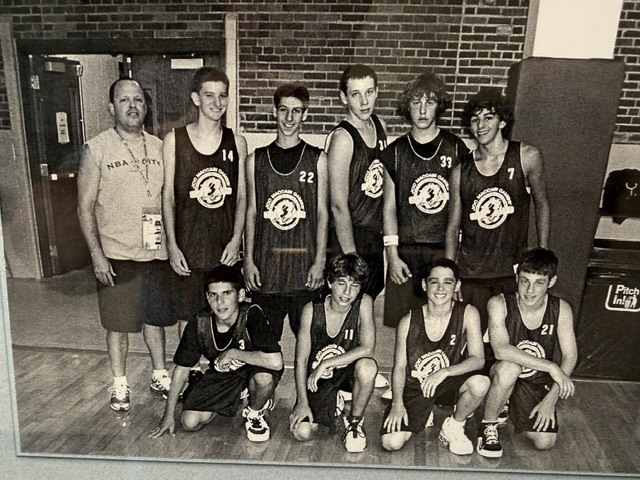
But the message was nearly identical. Friedman listened to it himself when he played for Rose in the mid-2000s at his local Jewish community center.
“He literally preached that same mentality,” Friedman said. “That family mentality.”
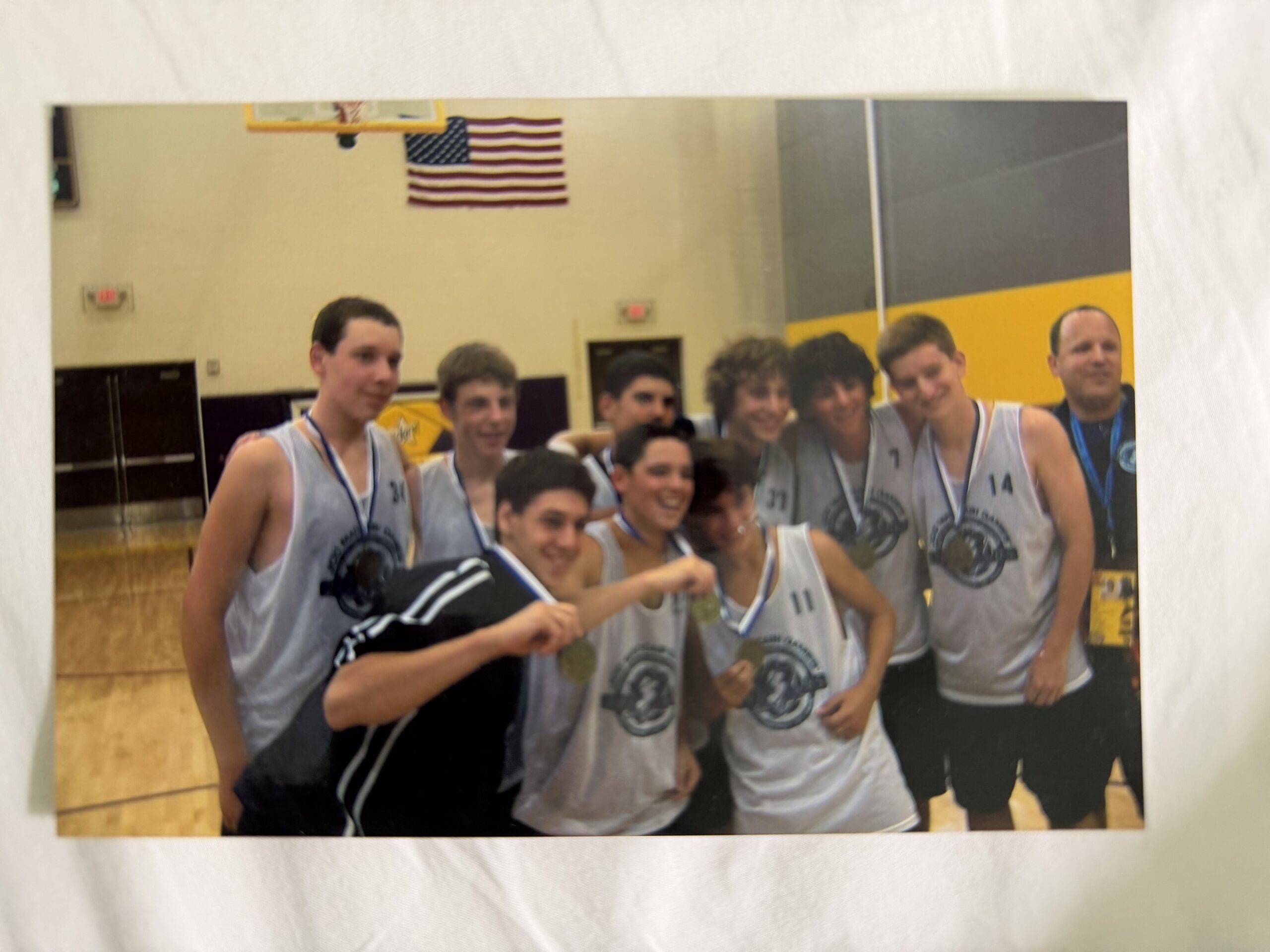
Leon Rose coaching at the Katz JCC in 2005. Seth Friedman is pictured in the bottom row, second from the right.
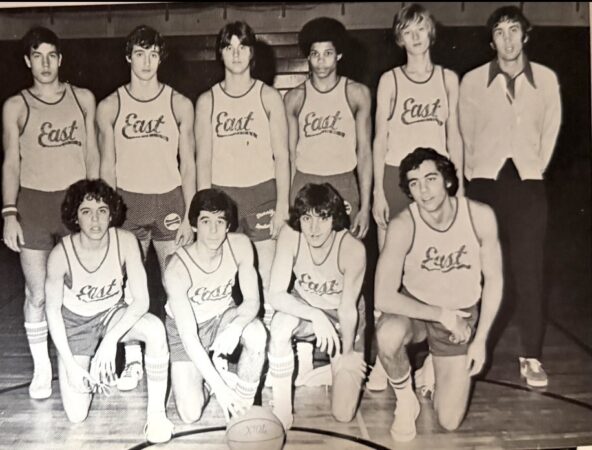
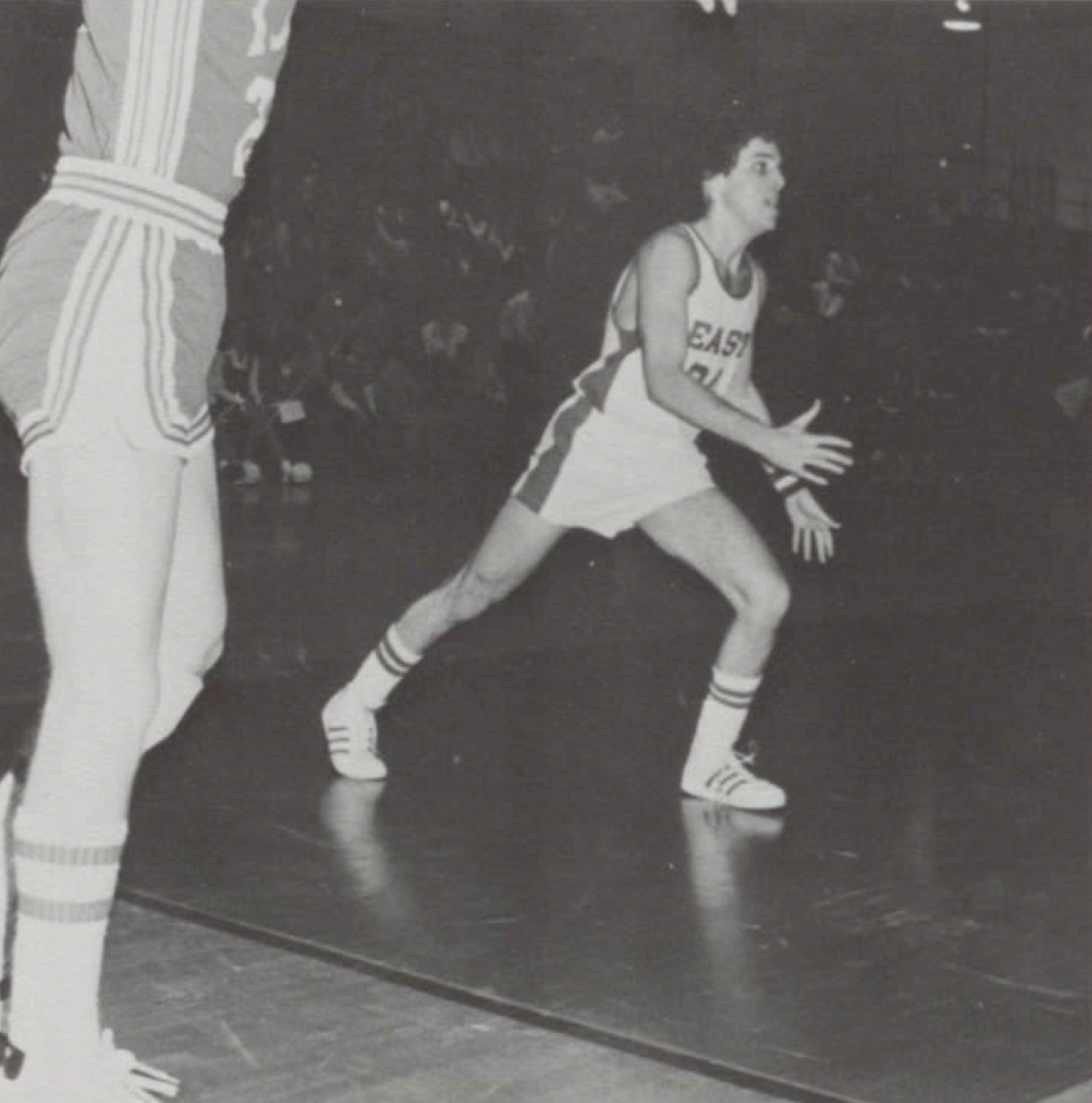
For decades, the future Knicks president was a mainstay in his Cherry Hill basketball community. He played under head coach John Valore at Cherry Hill East from 1975 to 1979 and joined Valore’s staff in the early 1980s while studying atTemple’s law school.
He moved on to work as an assistant coach through the late 1980s at Rutgers-Camden, a short commute from his day job at the Camden County prosecutor’s office.
He’d leave collegiate coaching in 1988, but Rose would always find time for the sport, even as he ascended the ranks of the NBA. In the 1990s, while he transitioned to sports management, Rose often could be found playing pickup hoops at the Katz JCC in Cherry Hill.
By the mid 2000s, he’d assembled a Rolodex of star-studded clients, including Allen Iverson and LeBron James. But that didn’t keep him away from the gym. For the better part of a decade, Rose served as a volunteer coach at the Katz JCC, preparing teams to compete in the Maccabi Games.
The Knicks executive has achieved a lot since then. But those who know him best say he is the same understated guy who’d wear baggy sweatshirts and run his team through tap drills and sprints.
“He was Coach Leon,” Friedman said. “He was one of us. Even now, you see him down the Shore, and you’d never know that he’s the person that he is.”
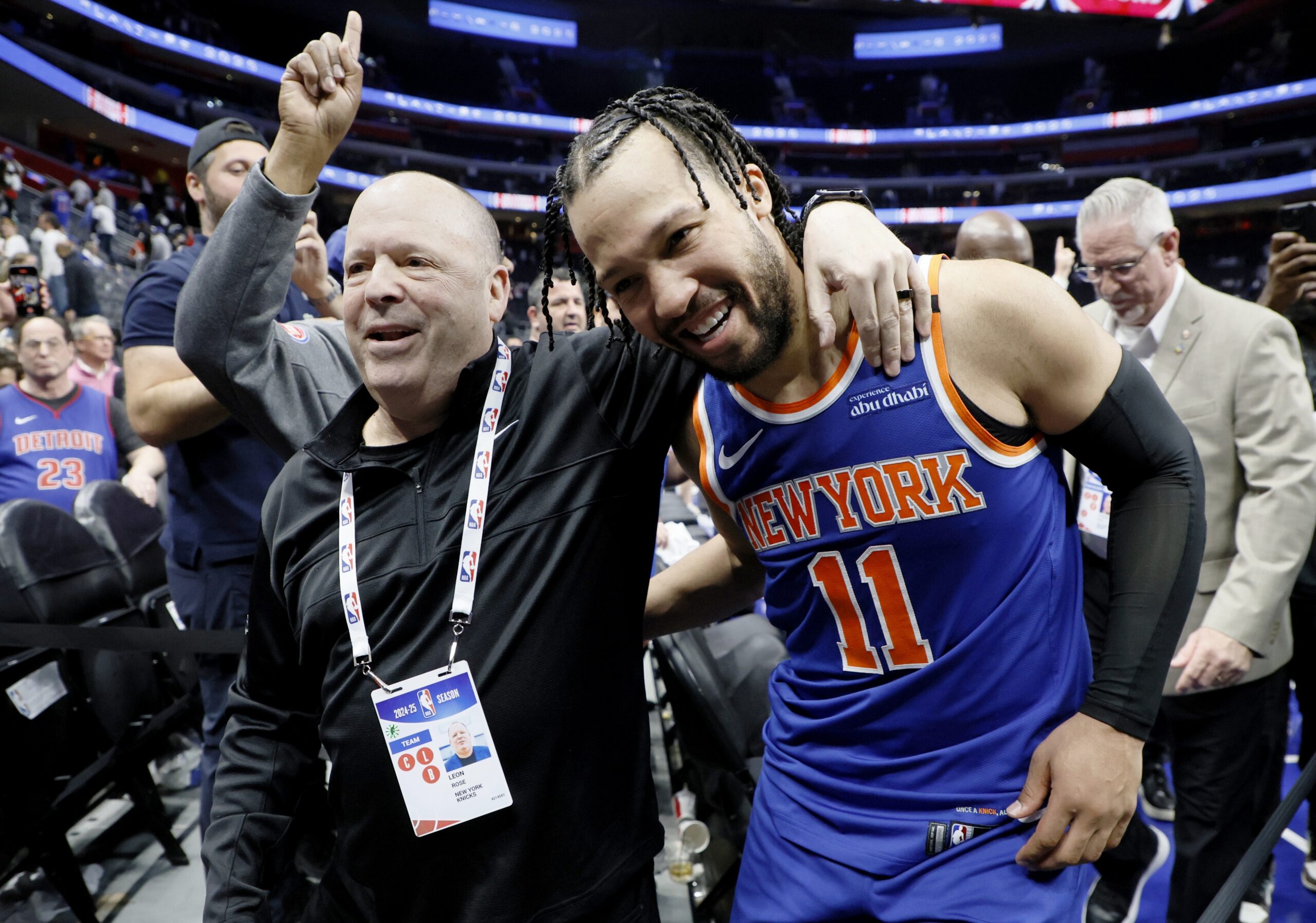
New York Knicks Leon Rose (left) hugs guard Jalen Brunson (11) as they leave the court following a Game 6 win against the Pistons in the 2025 playoffs.
‘A gym rat’
Valore met Rose in 1975 when he was coaching junior varsity at Cherry Hill East. The freshman was undersized compared to his teammates, but he played above his stature.
If there was a loose ball, the point guard would dive for it. If there was a charge, he would take it. Valore admired his toughness. So when he got the varsity job in 1976-77, he decided to bring Rose with him.
The sophomore made the most of his opportunity. Cherry Hill East was a relatively new program at the time and largely was viewed as a “doormat,” in Valore’s words. Rose helped change that, building an unselfish culture from the ground up.
He wasn’t a vocal leader, but he showed interpersonal skills that would serve him later on. The future NBA executive was direct and honest. He could have difficult conversations with teammates if he needed to about roles and behavior on and off the court.
Rose also set a standard through his style of play. Cherry Hill East was up against stiff competition in South Jersey from teams like Camden and Haddon Heights, which boasted players who were 6-foot-2, 6-3.
The point guard was unafraid to battle them.
“He was a player that had to compete harder and tougher than the person he competed against,” Valore said, “because he was 5-7, 5-8, 5-9. That shows you the toughness he had within him.”
Leon Rose at Cherry Hill East.
Cherry Hill East’s culture quickly translated into wins. When Rose arrived, the varsity team finished just above .500. By the time he graduated, it was one of the best teams in its conference.
But above all, Valore was most impressed by his pupil’s character. During a practice in 1979, the coach called his co-captain over. Valore’s wife, Joyce, had just given birth to their first child, J.C.
The coach wanted Rose to be the boy’s godfather.
“[Leon] was 17 years old,” he said, “and I saw everything I wanted to see. He was an exceptional person with relating to other people. He was something special.
“He went back to his dad and explained the situation, and his dad gave the thumbs-up. And the rest is history.”
After a few years studying and playing basketball at Dickinson College, Rose rejoined his high school team as an assistant coach in 1983. The 22-year-old was just as impactful on the bench as he’d been as a point guard.
Over Rose’s three seasons with Cherry Hill East, the program produced four Division I players. One of those four, Nick Katsikis, ended up contributing to Seton Hall’s run to the 1989 NCAA championship game.
Valore can see similarities in what Rose accomplished with the Knicks. When the agent was hired by James Dolan in 2020, the team was en route to its seventh straight losing season; “a doormat,” just like Cherry Hill East.
Then Rose came along, and everything changed.
“He was a gym rat,” Valore said. “He just loved the game.”
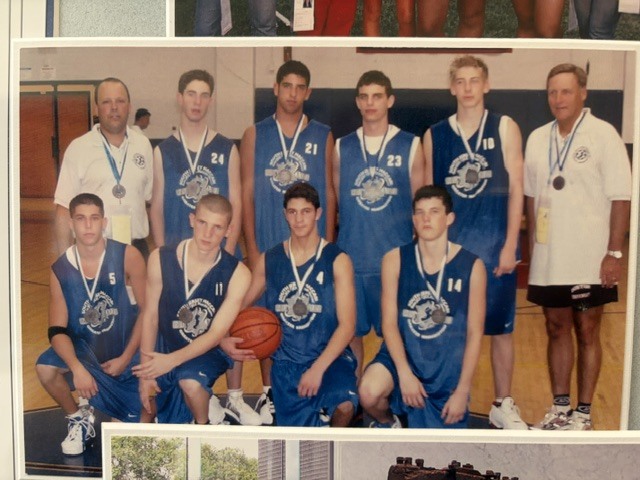
Leon Rose coaching for the Katz JCC in 2004. Ed Vernick is pictured on the far right.
From Maccabi gold to an NBA title
Ed Vernick moved from Philadelphia to South Jersey in the early 1980s, the same time Rose was coaching with Valore.
Unsurprisingly, the men became friends at the gym. Vernick was about to go on a trip to Ocean City and wanted a good place to work out. Rose overheard him talking, ripped off a piece of paper, and scribbled down an address.
Vernick had no idea who the young lawyer was, but he took him up on his suggestion. A few days later, while he was running on a treadmill in that Ocean City gym, he saw Rose walking by.
“He goes, ‘I just wanted to make sure you got here,’” Vernick said. “What a nice guy. I’m thinking, ‘Who does that?’ It was just one of those things that caught me.”
About two decades later, when Rose was starting to coach basketball at the Katz JCC, he asked Vernick to be his assistant. Together, they spent the summer of 2004 preparing Cherry Hill-area kids for the Maccabi Games, a youth athletic competition for Jewish athletes from all over the world.
Parents and players said Rose took this as seriously as the NBA Finals. He’d carefully craft his rosters, thinking hard about how each piece would fit.
Once the team was constructed, he’d spend July running them into the ground with many of the methods Valore used at Cherry Hill East: switch drills, sprints, tap drills.
Leon Rose coaching at the Katz JCC in 2005.
The week before the Games was by far the toughest. Players would be required to train twice a day and would arrive at the gym at 6:30 a.m. and return at 2 p.m.
“He got into us,” Friedman said. “But it got us ready. It got us prepared. It got us in shape. I hated it during it, but, looking back, those were memories I’ll never forget.”
This was a major time investment for one of the most high-powered agents in the NBA, but Rose was deeply involved. He continued to coach before and after his son, Sam, and daughter, Brooke, were eligible to play.
And he went far beyond what was expected of a volunteer. One year, Friedman said Rose took the team up to the Poconos for an exhibition game at Pine Forest Camp, which was known for its basketball program.
“He’s driving us up to play an exhibition game like it’s an NBA team,” Friedman said. “He didn’t have to do that as a coach. But he did whatever he could to get us prepped and ready to win a gold medal.”
About “80% of the team” came from Cherry Hill East, in Vernick’s estimation, and Rose often would be on the phone with Valore, asking about certain players.
Like his former coach, Rose gravitated toward toughness, and that style emanated from the teams he built. In 2004, South Jersey’s 16-and-under Maccabi team faced Washington, D.C., for the gold medal.
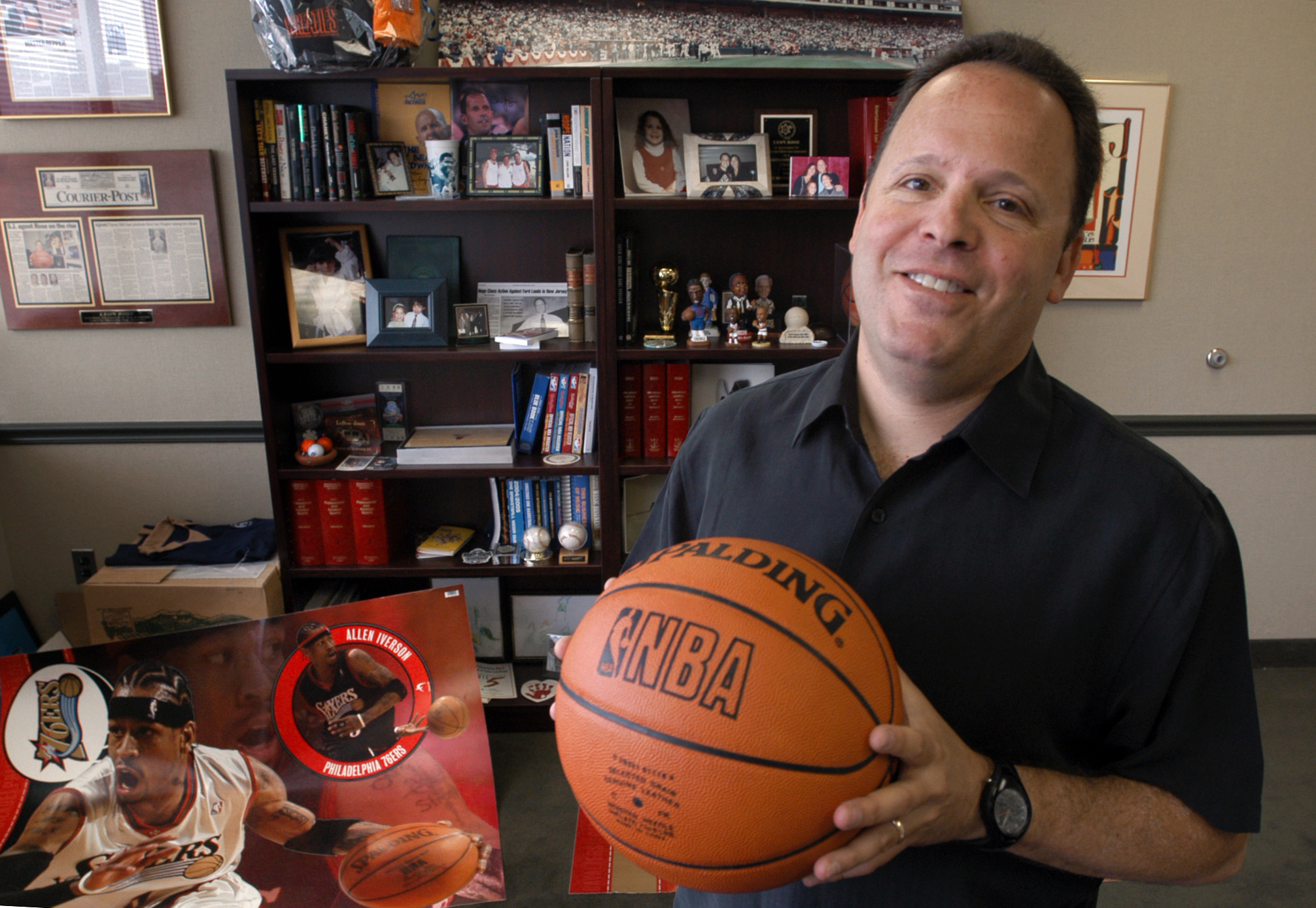
Leon Rose (in 2006) made his name as a superagent to the likes of Allen Iverson and LeBron James, but he did not flaunt that status to his young players.
It was a low-scoring game, one that came down to the buzzer. Washington was bigger and more talented, but Rose’s group challenged every bucket.
“I remember I could hear sneakers squeaking the whole game,” Vernick said, “and I just smiled. And I thought, ‘This is the way you play defense.’”
South Jersey fell, 42-40, but it won gold the following year in Minneapolis.
Rose spent six summers coaching at the JCC throughout the 2000s, winning two gold and two silver medals. He looked and acted like any other coach, donning Cherry Hill East basketball gear and sweatpants.
He rarely — if ever — talked about who he represented, or what he did for work, but the players occasionally got a glimpse.
When Friedman was a senior at Cherry Hill East, Rose arranged a surprise for his alma mater.
It was March 2010. The Cleveland Cavaliers were in town. After practice, their coach swung by to talk to the high school basketball team and answer any questions they might have.
It ended up being the coach who would lead the Knicks to a championship 16 years later.
“He had Mike Brown come over,” Valore said. “He was fantastic. Off the cuff, not scripted. He gave a wonderful speech to the kids.”
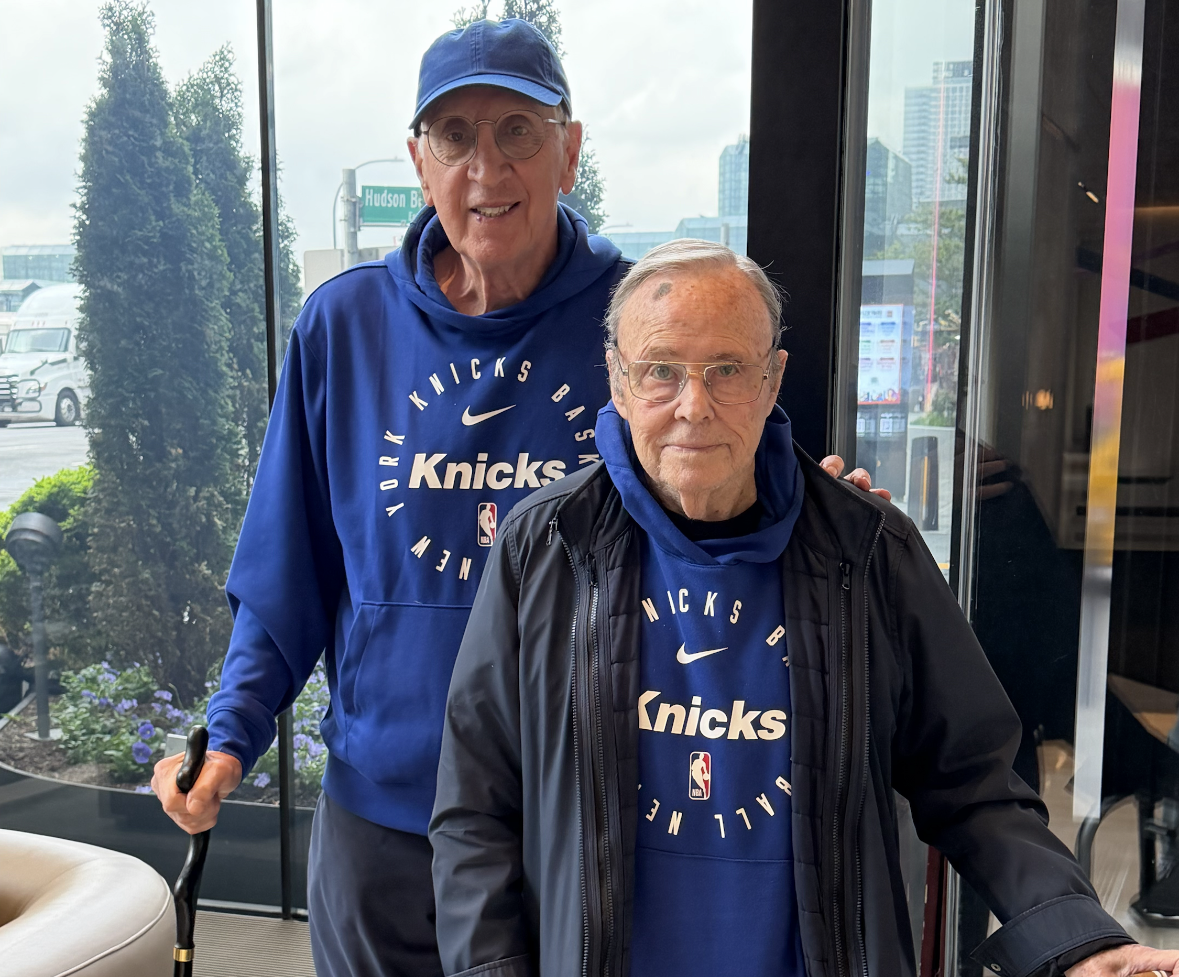
John Valore (left) and Zev Rose before a Knicks game in the early part of their 2026 playoff run.
Cherry Hill at the Garden
Rose and his family now live in New York, but they’re never too far from Cherry Hill. His 88-year-old father, Zev, still resides in the area, and is a regular at the Katz JCC.
Every once in a while, his son will send a limo to drive him and the 81-year-old Valore to Madison Square Garden. They were in the building for Game 4, sitting near the team president.
At first, it looked bleak for New York. The Knicks fell behind early and trailed by 29 points in the third quarter. But they came storming back in the fourth and completed the comeback on an OG Anunoby tip-in.
Headwinds on the Schuylkill River made it challenging to race on Saturday, but St. Joseph’s Prep has been navigating choppy waters all season long.
Despite being in the midst of a coaching change, St. Joe’s Prep repeated in the senior eight event at the 99th annual Stotesbury Regatta, with a finish of 4 minute, 51 seconds, which was just a little over two and a half seconds over the second place Montclair High School of New Jersey. St. Joe’s Prep also won the most medals overall (42 overall, 32 gold, 10 silver).
St. Joe’s Prep interim head coach Thomas Wedgwood said he was impressed with the boys’ ability to row upstream. Wedgwood, who has coached in four countries, said the development of junior rowing in the United States over the past decade has allowed for great competition on this level, which was on display this weekend at the Stotesbury Regatta.
“What you’ve seen in the past decade at the club level, is that it has really blossomed, and now you’re starting to see the Scholastic [level] really catch up too,” Wedgwood said. “Now those two merging together is creating some of the most competitive junior rowing that I’ve ever seen.”
The regatta, which takes place in St. Joe’s Prep’s backyard on the Schuylkill River, with the high school’s boathouse on path with the course, on Kelly Drive.
With high schools coming from all over the country, and even some from Canada, St. Joe’s had an outpouring of support from its community.
“We train every day, and so we feel very privileged that we have an opportunity to actually race all these crews from around the country in our backyard and be able to host them here,” Wedgwood said.
Edith Eglin, the 90-year-old great-granddaughter of Edward Stotesbury, who is the namesake of the regatta and of the boy’s senior eight trophy, was in attendance for the event.
She made the trip down from her summer house in Watchhill, R.I., to present the Prep with the Edward T. Stotesbury Cup. Wedgwood said it was a “privilege and an honor” to have Eglin there to present the trophy, especially as St. Joe’s Prep crew celebrated its 100th year while the regatta celebrated its 99th anniversary.
St. Joseph’s Preparatory School celebrates at the finish line after winning the Boys Senior Eight Saturday, May 16, 2026.
Eglin, whose late husband, Thomas Wilson Eglin, was dean of students at The Lawrenceville School in Lawrenceville, N.J., said she has a love for high school sports. And St. Joe’s Prep, who has won the boys senior eight in five of the last six Stotesbury Regatta’s.
“It’s a fabulously exciting event every year,” Eglin said. “The number of participants, the number of schools involved, the excitement of the families, and the and all the people who are watching it is infectious.”
But St. Joe’s Prep wasn’t the only repeat winner. On the girl’s side, Montclair won the senior eight with open water to claim the Robert Engman Trophy with a 5 minutes, 29 seconds showing. Mount St. Joseph’s High School came in second (05:35.14) with almost six seconds elapsed between the two boats.
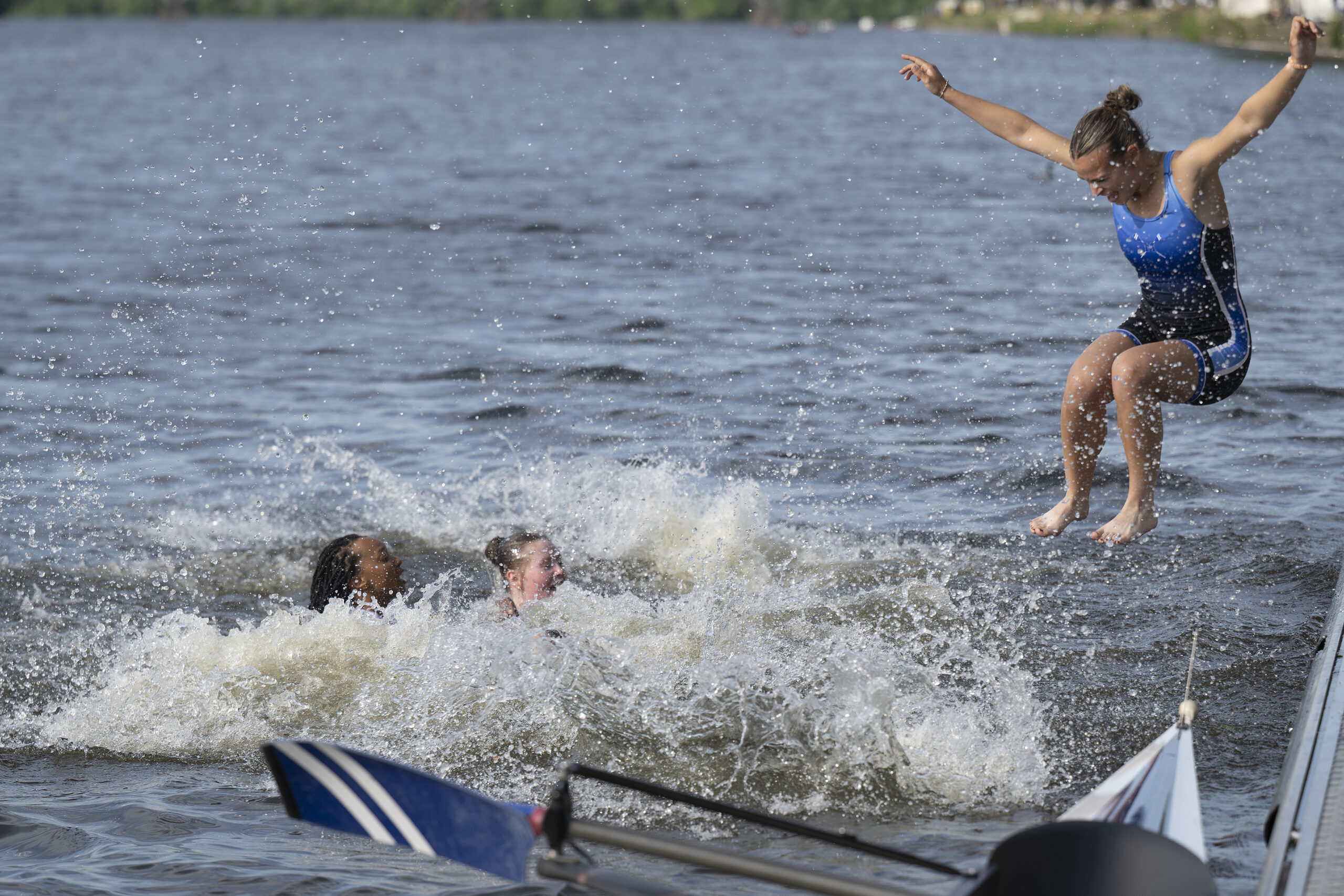
Montclair High School girls jump into the river after winning the Girls Senior Eight race during the Stotesbury Cup Regatta.
Montclair dominated the competition through time trials and semifinals as well. While head coach Lorna Rundle knew she had a strong boat coming in and expected them to win, she didn’t expect it to happen in such a dominating fashion. She had a young group in the boat, with only three seniors. The seats were also filled with almost entirely different rowers from the Montclair boat that won the girls senior eight last year.
But once Rundle, who found it difficult to watch in person, saw her team come through the bridge on the livestream, she knew the girls “found the right rhythm.”
“It takes a lot of maturity to [race like that],” Rundle said. “I told them that it was the most beautiful race that I watched in a very long time. It was beautifully executed”
Montclair finished third in overall medal count with 32 overall, with the girls accounting for 14 of those.
“We’re a very, very small public high school,” Rundle said, “and to be competing at this level with all these huge programs, it makes us really proud.”
Villanova is the only school representing the Big 5 in the women’s NCAA Tournament. The Wildcats, a No. 10 seed, are set to play No. 7 seed Texas Tech on Friday (8:30 p.m.) in Baton Rouge, La.
But players connected to the Philadelphia area are competing on rosters across this year’s March Madness bracket.
Here are the local women’s basketball players to watch:
While many know graduate guard Olivia Miles as one of the nation’s top players with No. 3 seed TCU, Miles got her start with the Philadelphia Belles, an AAU team. The Phillipsburg, N.J., native is a three-time All-American who spent her first four years of college at Notre Dame.
Several Catholic League standouts will also be taking the court during March Madness.
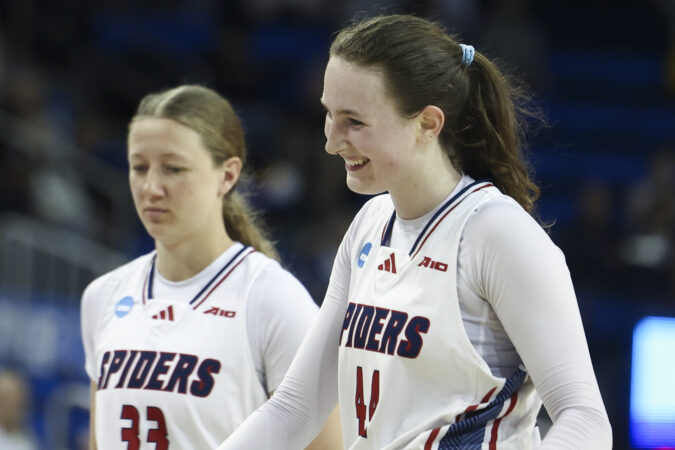
Three players will represent Cardinal O’Hara: senior forward Annie Welde of Villanova, Richmond senior forward Maggie Doogan, and Fairfield’s Sydni Scott, a senior guard. From Archbishop Wood, sophomore guard Ava Renninger will compete with Fairleigh Dickinson and senior guard Ryanne Allen with Villanova.
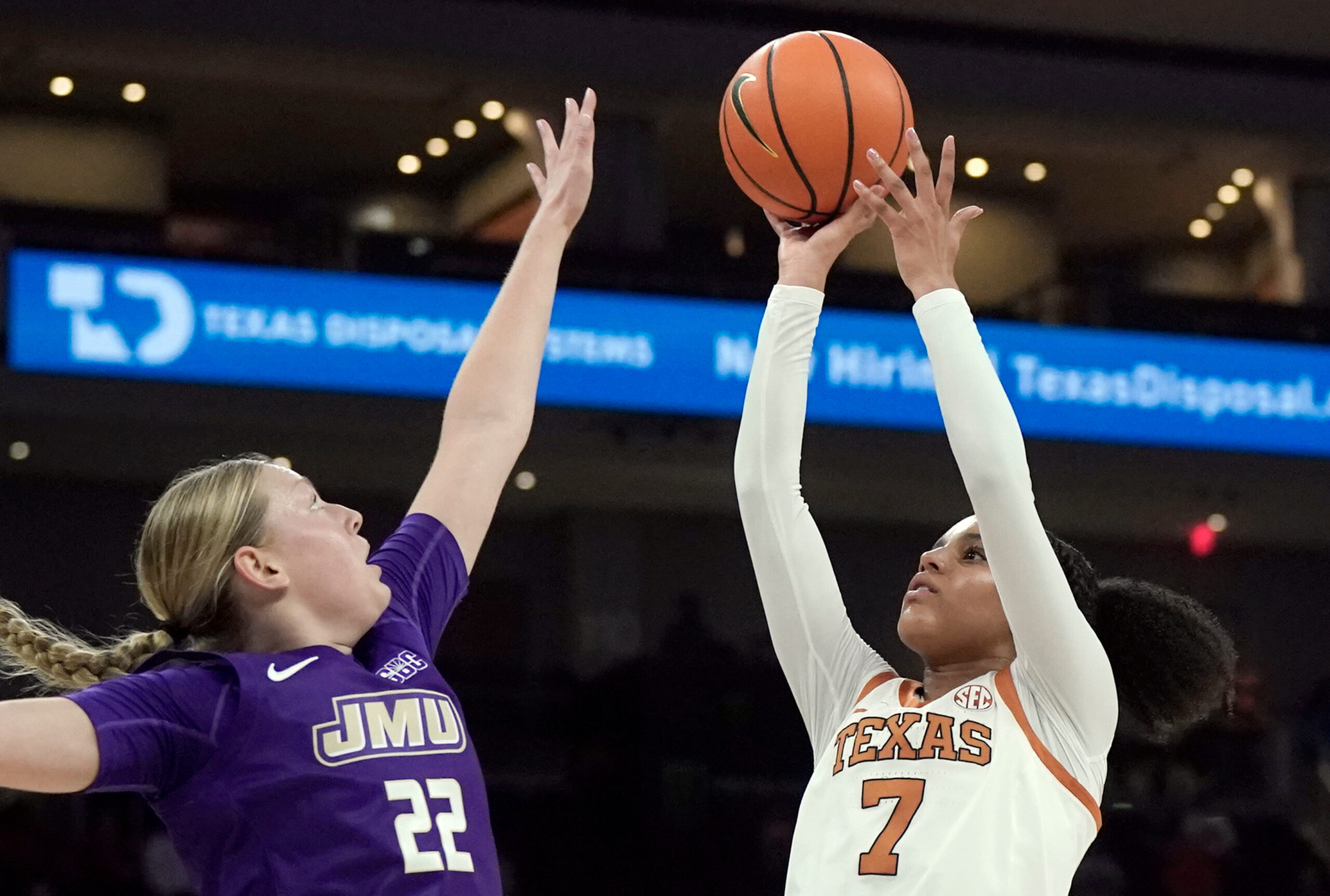
James Madison forward Grace McDonough was a standout at Lansdale Catholic.
Also for Villanova, senior guard Maggie Grant is an Archbishop Carroll graduate. And freshman forward Grace McDonough, who attended Lansdale Catholic, will compete with James Madison.
No. 1 seed Connecticut looks to defend last year’s national championship with Tonya Cardoza on staff as an assistant coach. Cardoza was Temple’s head coach from 2008 to 2022.