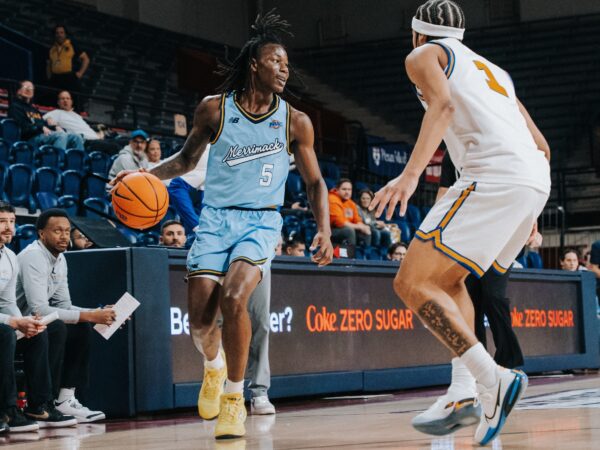
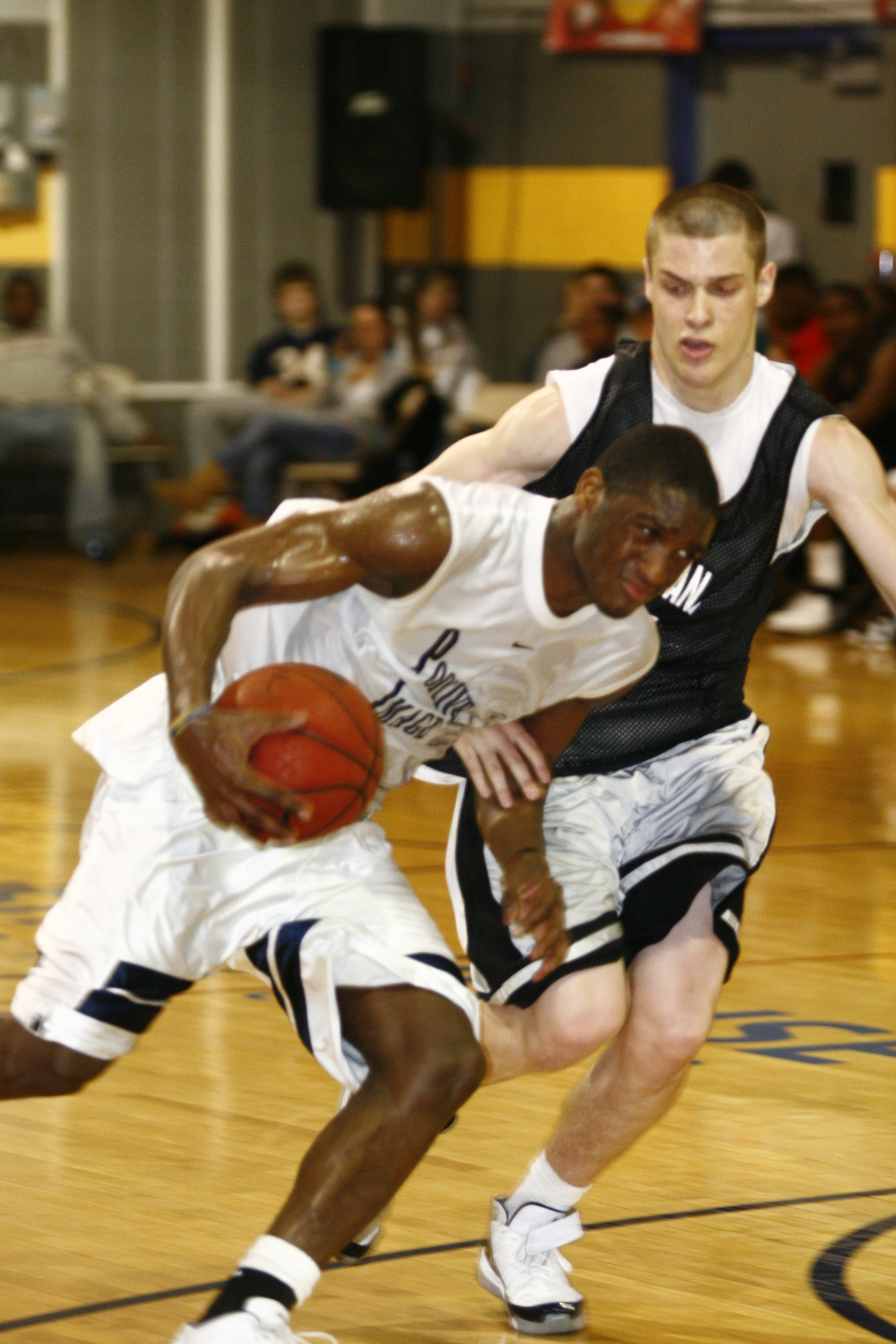
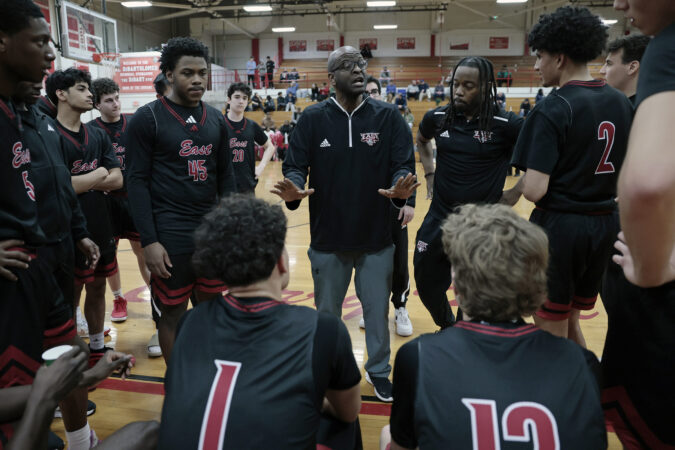
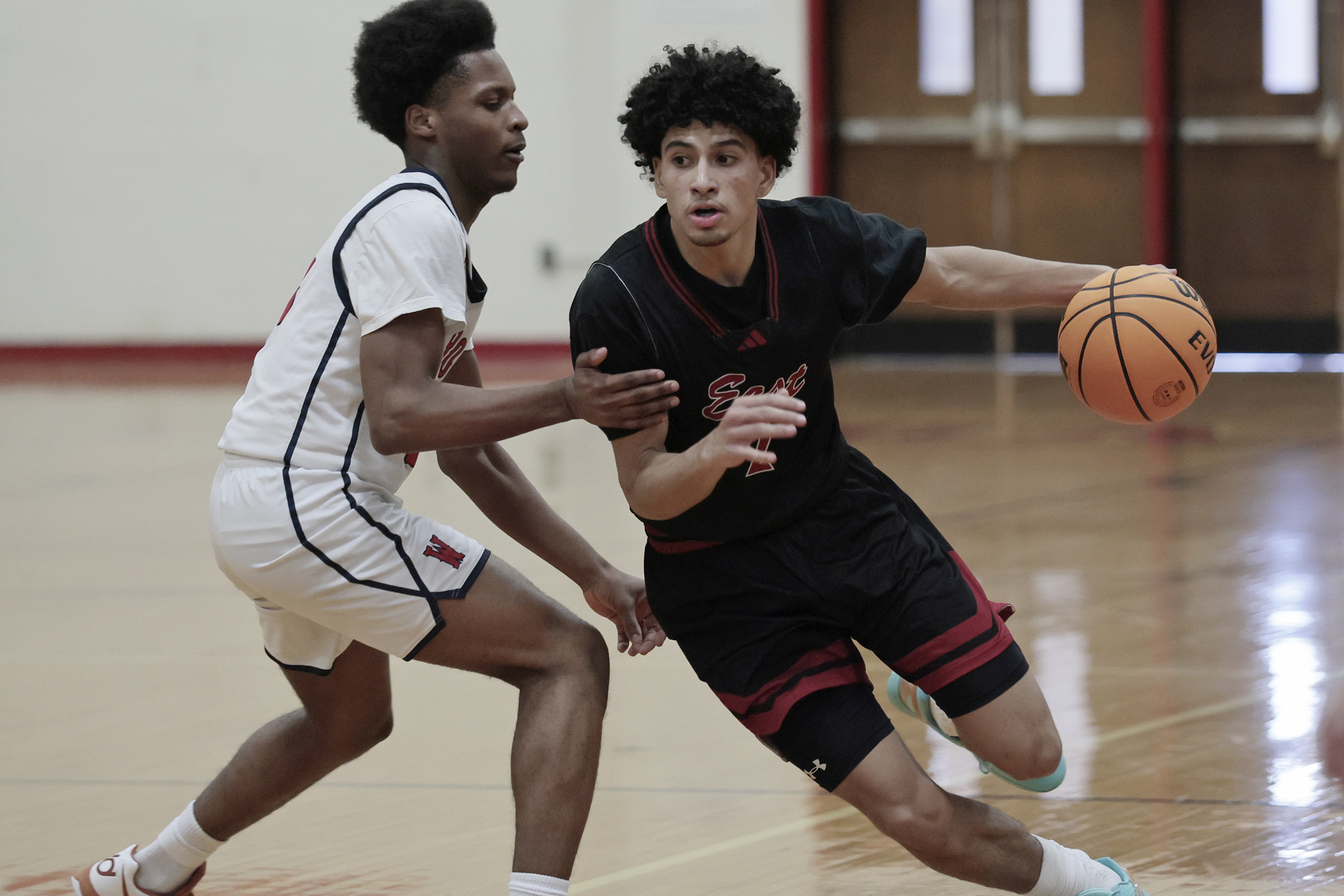
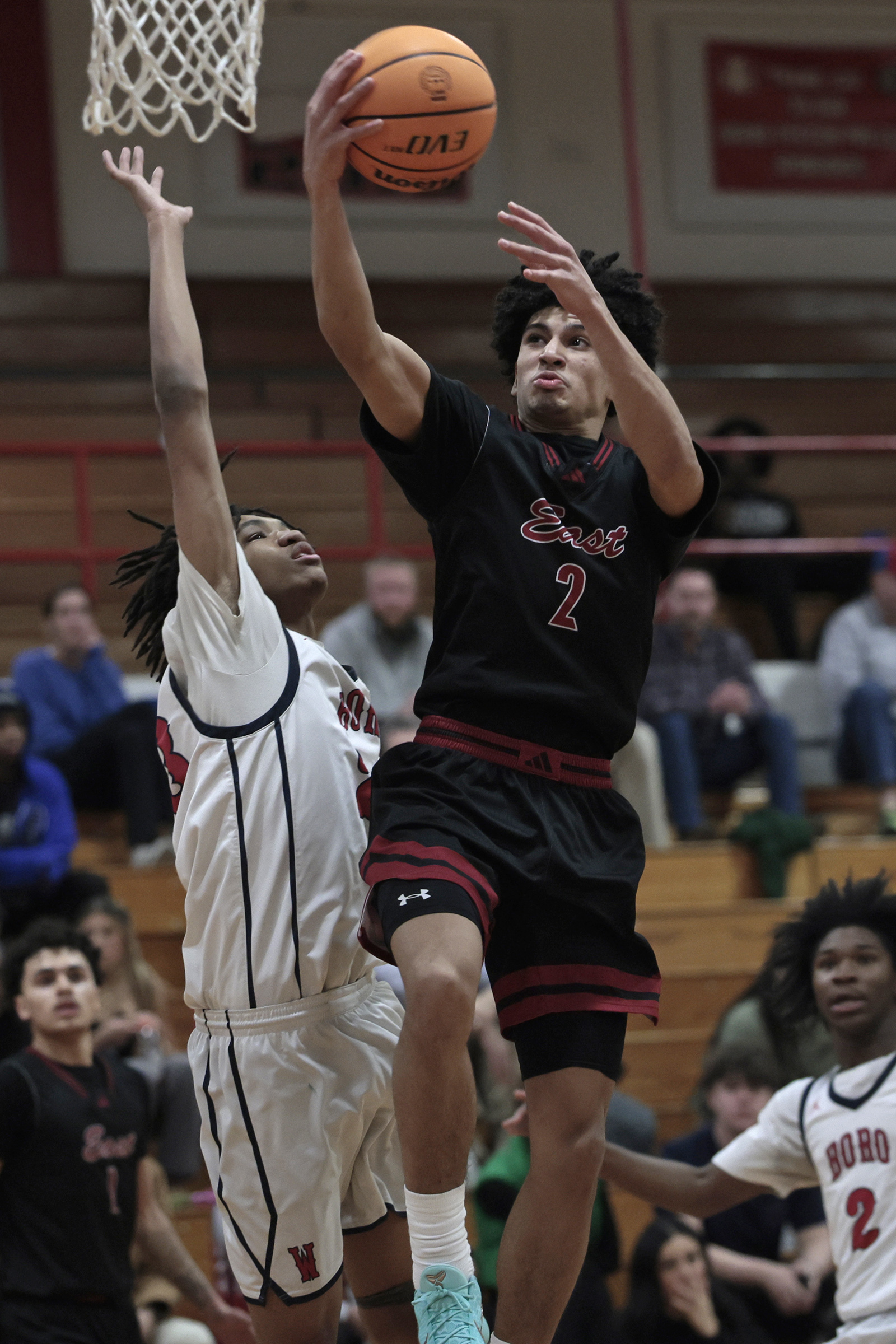
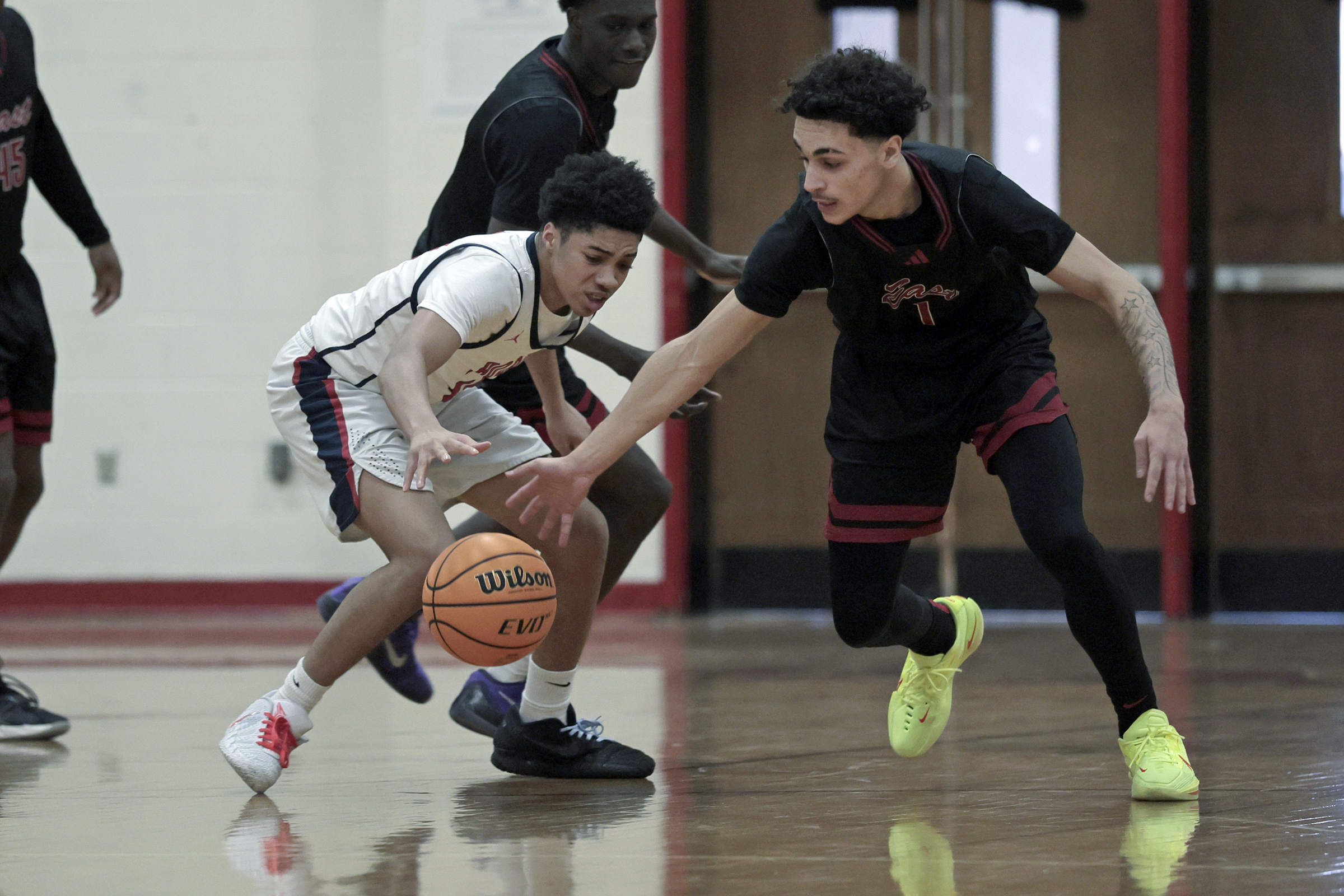
Merrimack guard Kevair Kennedy was unanimously named the Metro Atlantic Athletic Conference Player of the Year on Wednesday.
Kennedy, a former Father Judge standout, is the first freshman to win the honor. He led the MAAC with 18.5 points per game, while averaging 4.2 assists, which ranks fourth in the conference. He helped lead Merrimack (21-10) to the MAAC regular-season title, as the Warriors went 17-3 in its conference slate.
Merrimack finished the regular season with the conference’s third-best scoring defense, allowing 67.5 points per contest and forcing the third-most turnovers. Kennedy leads the team in steals (1.9) and is averaging 4.6 rebounds.
The Philadelphia native started all 31 games and scored at least 20 points in 15 games. Kennedy finished with a career-high 32 points in a 79-72 overtime win over Siena on Feb. 20.
He won MAAC rookie of the week seven times and was named conference player of the week twice. Kennedy also was named freshman of the year and became the first player to win both awards in the same season.
Kennedy won a Catholic League championship last season. He also propelled the Crusaders to a state title while averaging 16.1 points, 7.3 assists, and 6.6 rebounds.
The Neumann Goretti girls’ basketball team bus was almost as quiet as the church the players were in a day earlier. Everyone sat in their usual places.
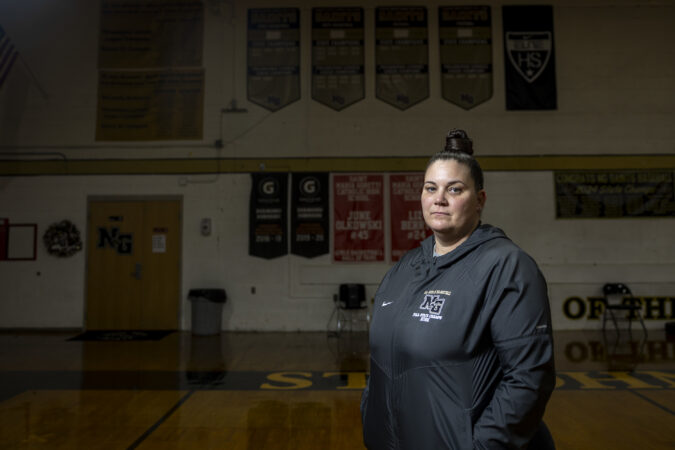
Saints coach Andrea “Petey” Peterson was in the front right seat, her hair in its familiar bun, her head resting on her outstretched arm across the windowsill, her AirPods in, a way to insulate herself from the world that Saturday morning in early December. The day before had been her mother’s funeral.
In the back, the Neumann Goretti team whispered, the volume down from the blaring noise that typically wends through the bus during chartered away trips. None of Peterson’s players were surprised that their coach was on the bus with them, traveling to their season opener against St. Mary’s on Long Island in New York.
“I remember that trip,” said Saints senior guard Kamora Berry. “I remember seeing Coach Petey’s hair bun in the back of the bus and thinking we have to do this for her. There was no doubt in my mind she would be there that day. She is so strong. I would be a mess. Anyone would be.
“Think about it. Coach Petey is on a bus with us going to a game the day after her mother’s funeral. Who does that?”
Apparently, Andrea Peterson.
She is in her 12th season as Neumann Goretti’s head coach. She is the most accomplished girls’ high school basketball coach in the area, with six state championships, including last season’s first Class 4A title in school history (plus two in Class 2A and three in 3A), two Catholic League championships, and six District 12 titles.
In 2015, Peterson was named the national Naismith Coach of the Year, guiding the Saints to a 30-0 finish and a No. 1 ranking nationally by USA Today. Her team will compete in the first round of the state Class 4A playoffs on Saturday against Susquenita of Perry County.
Somehow, she manages to run her childcare business, Christopher’s Footprints, in Norwood, Delaware County, coaches Neumann Goretti, which is really a 12-month long responsibility, runs her AAU Philly Legacy program, all while raising her sibling’s three children on her own, and easily working between 70 to 80 hours a week during the four-month high school basketball season.
Who does that?
Apparently, she does.
Peterson says she derives her wrought-iron will power from her parents, Thomas and Alice, who were in ill health and died within 133 days of each other last year, though in many ways she channels old-world coaches like the raspy-voiced John Chaney and towering John Thompson.
Her friends and family joke there is a cuddly side to her, you just have to peel away the prickly cactus thorns. She has no filter. What she says, she means. She is demanding. Unbending. Stubborn. And incredibly loyal and giving.
The loyal and giving side, Peterson says, comes from her mom, who temporarily fostered three children one Christmas after their family house burned down. The diamond-hard edges, she laughs, comes from Thomas, a Vietnam veteran who fought PTSD most of his adult life and worked countless hours in baggage claim at Philadelphia International Airport.
Her players say that if you do not know Coach Petey, she can be intimidating and cold. Peterson will also be the first to acknowledge that she is not looking to be anyone’s buddy, because no one comes between her and her players. And she wins. She has won many times with players from hard, sometimes unimaginable backgrounds.
Legendary Westtown coach Fran Burbidge has known Peterson since she was 11, a pigtailed stubby little girl who played tackle football for the Brookhaven Jets. She’s the sixth of seven children and wanted to be like her older brothers, Joey and Chris.
Burbidge remembers when his daughter Chrissy played for the AAU Comets and Cardinal O’Hara and Peterson was playing for the Philadelphia Belles and Archbishop Carroll. Burbidge became good friends with her father and followed Peterson’s path to Carroll, where she won two Catholic League championships, one time canning a free throw with 5.3 seconds left to win the 2003 PCL title over O’Hara.
Burbidge, who has known Peterson for 30 years, now coaches against her.
“Through coaching AAU and here at Westtown, I have coached a lot of different kids, from a lot of different backgrounds, and there are certain things that you have to deal with as a coach, and with Andrea, she coaches great kids at Neumann Goretti, but she coaches kids who take the train home at night and kids that are homeless,” Burbidge said.
“She coaches kids who come from some rough situations. I don’t think a lot of people understand that about Andrea and what she does, because she’s been so successful as a basketball coach.
“Because Neumann Goretti, under her, has been so successful, they have the misconception Neumann Goretti is a basketball factory with talented kids that flock to them. It’s a lot more complicated than that.”
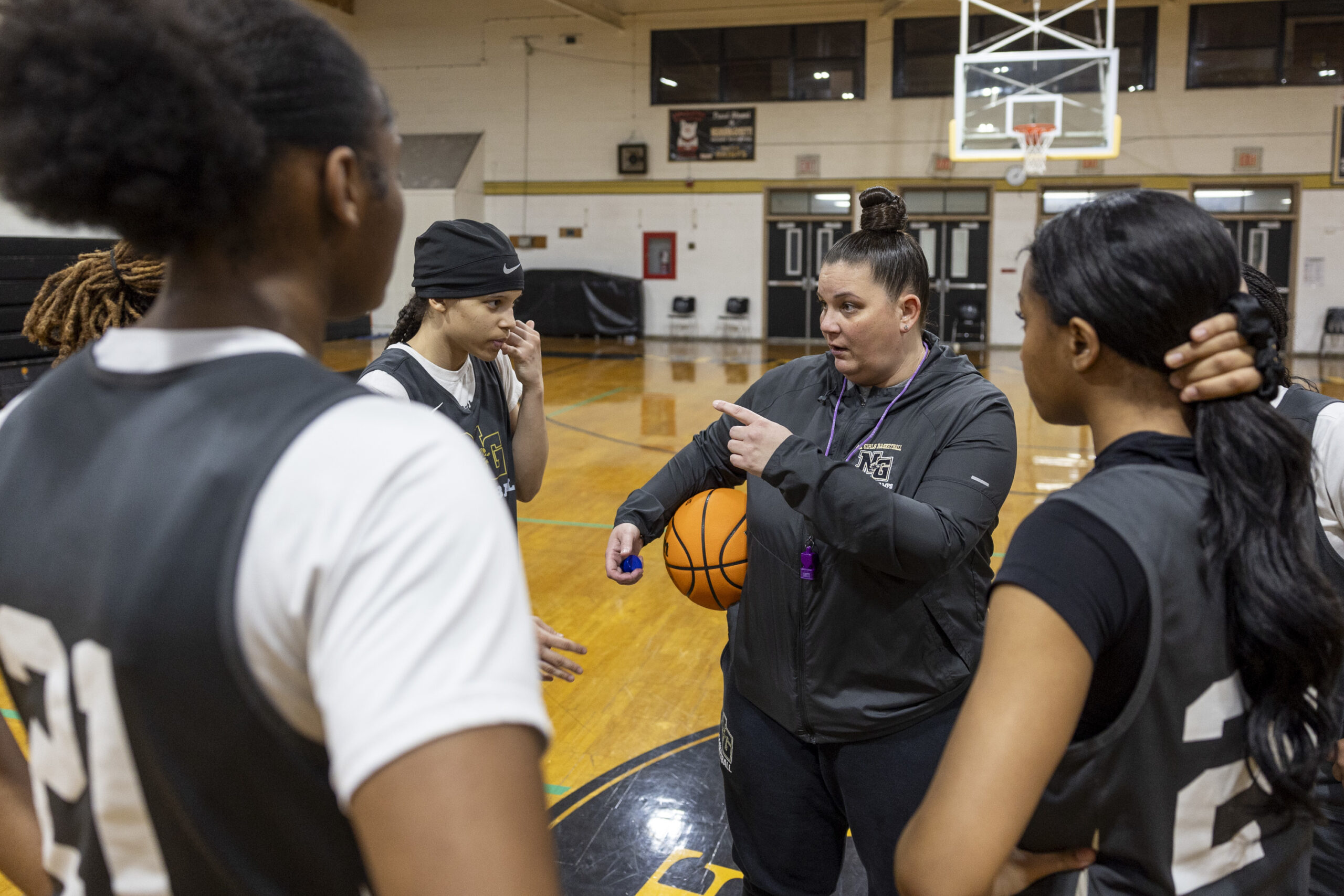
Andrea Peterson coaches her team during practice in January.
Peterson had players, according to many associated with the program, who were from broken backgrounds, some homeless and some abused, and a few survivors of domestic abuse.
She was a four-year starter at Carroll for Hall of Fame coach Barry Kirsch. How Peterson maintains everything she does is beyond him. Kirsch knew of her tireless work ethic as a player, which she continues as a coach.
She has an ability to relate to city players, because in many ways, she comes from the same rowhouse working-class existence as they do.
“Andrea always understood the game beyond her years,” Kirsch said. “You never had to explain anything to her. She was like having a coach on the court in high school. Her teammates respected her and loved her. You could see then Andrea was going to be a great coach. The relationship she has with her players is beyond reproach.
“She does not want the attention on her. She wants it on her team. Andrea has always been incredibly hard on herself, because I had her as a student. Maybe it’s why she takes on Neumann Goretti, because no one in the Catholic League has a harder job than her. Look at Carroll, O’Hara, [Archbishop] Wood, they get players from solid homes, and she is dealing with kids with challenging situations.”
‘Focused on the moment’
Peterson originally grew up in Brookhaven and moved to Norwood. She was one of seven in a three-bedroom home, with the five girls sleeping in bunk beds, and Joey in a separate room. After her older brother Christopher passed away on Mother’s Day 1994 in a car accident, when Peterson was 10, their mother, Alice, began sleeping by the door.
Alice, one of 10 children with South Philadelphia roots, would get so nervous watching Andrea play at Carroll she would rock back and forth in her seat. She did not know much about basketball, so she would yell, “Score that touchdown,” at Andrea’s games. Alice and Thomas more than a few times put up the family rent so Andrea could play summer AAU basketball.
“Seeing my mom at my games, knowing I was her baby girl in these big games, made me happy. My parents always made sure I had what I wanted, and that is what drives me today,” Peterson said. “I was spoiled. We never wanted for anything. But as you get older, you realize how life really is, and what your parents sacrificed. We knew we weren’t living in a mansion.”
Growing up, Joey would take “Angie,” as her family calls her, to Norwood Park to play with grown men when she was 13 on the asphalt courts. Peterson would get knocked around, and Joey never ran to pick her up.
“That’s where Angie got her toughness, and we weren’t about to help her up,” Joey said. “I think it’s why Angie was able to get on that bus the next day after our mother’s funeral. That tells you who she is, and about her commitment.
“I have to tell her to slow down sometimes. Our whole family tells her that. It is nonstop, between the basketball, the daycare, taking on our dad a few years ago, and now my sister’s kids. She is able to get focused on the moment in the moment.”
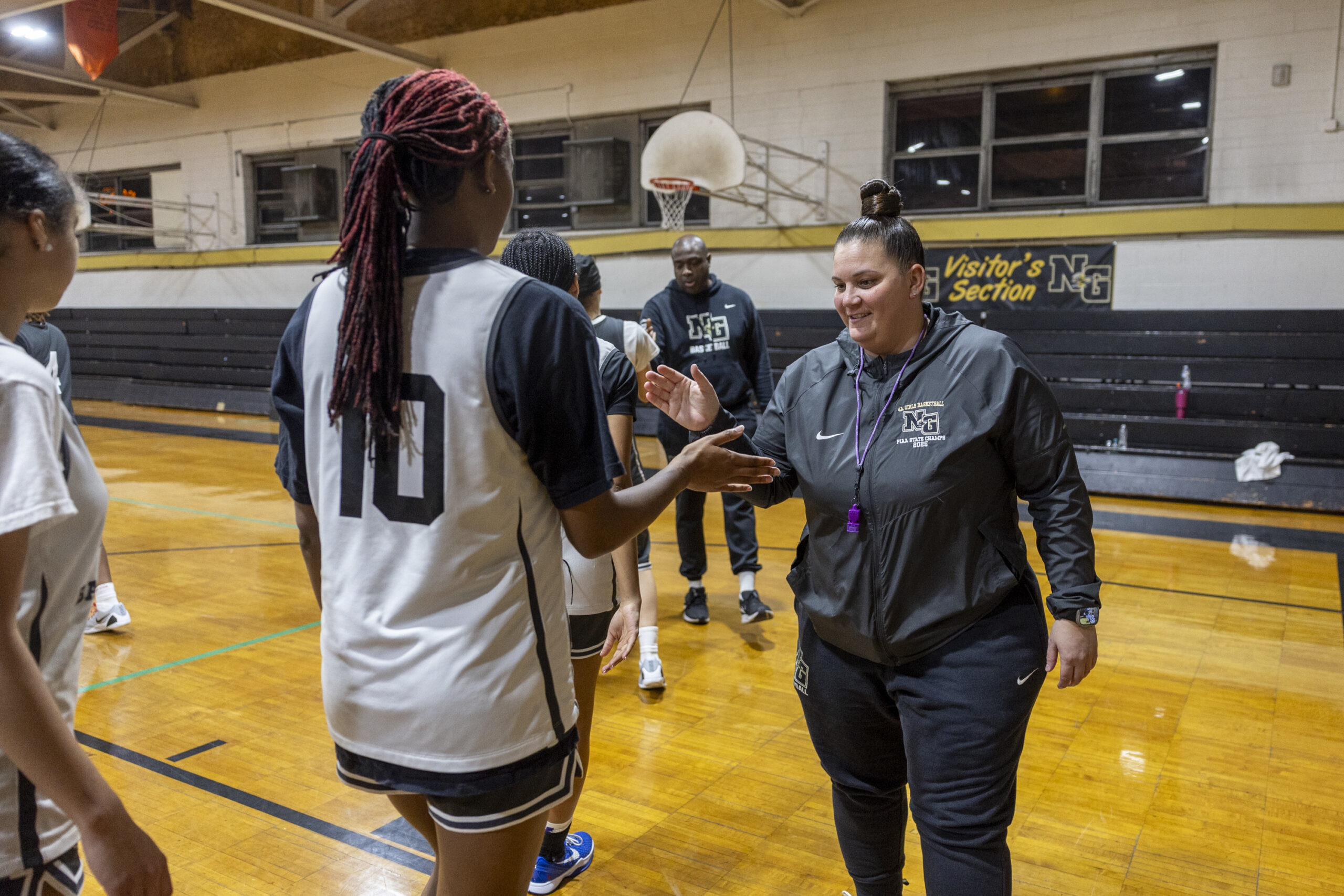
Andrea Peterson ends practice with a line up, doing special hand shakes with her players on Jan. 14.
Peterson first went to St. John’s University out of Carroll but decided to come home to care for her parents, who were in ill health. She transferred to Drexel, where she received her undergraduate in sports management and graduate degree in higher education, becoming the first college graduate in her family.
One time Peterson quit basketball while in grade school, because she felt that her father was living too vicariously through her and that nothing was good enough in his eyes.
They had a heart-to-heart to settle their differences. Peterson felt that was a coming-of-age moment.
“I was always stubborn, like my dad, and if that conversation doesn’t take place, I don’t know if I would have left basketball, but I wanted to show him I could do this on my own,” said Peterson, who wore the No. 22 because it was Christopher’s birthday and her daycare business is named after him.
“I knew what I had to do to get a college scholarship. I knew I was in love with basketball, and I knew that was where my path would go. I was told I wouldn’t make it at St. John’s. I was considered too small, too slow. I love being told I can’t do something. You can tell me 10 things, nine positive and one negative. I’ll hear the one negative and turn that into a positive.
“I hear it every year that Neumann Goretti isn’t good enough. You do not have to like us, but you have to respect my kids and our program, and the culture that we built.”
Thomas wanted more for his daughter, and he was even coaching her while she was coaching. Thomas would keep the articles written about his little “Angie” tucked under his bed.
During the last months of her father’s failing health, Peterson was his sole caretaker. Before he died, she said, he told her, “Thank you for making me proud.”
Andrea Peterson won her second PCL title as Neumann Goretti’s head coach on Feb. 23, 2025.
After each practice this season, her players have made it a habit to hug Peterson and tell her they love her.
“We know what Coach Petey has been through,” Berry said. “It’s why we dedicated this season to her. She buried both her parents last year and never missed a practice or training session. She was always there for us. We have to be there for her.
“I think high school players take for granted what their coaches do. We don’t. Coach Petey was on the bus with us going to a game the day after she buried her mother. I mean, who does that?”
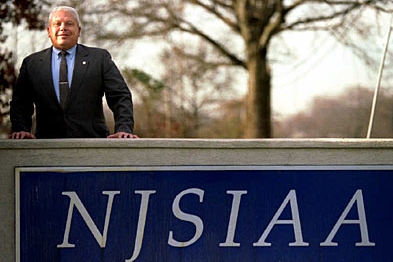
Boyd Sands, 88, formerly of Glassboro, Gloucester County, retired teacher, coach, principal, and superintendent of the Delsea Regional School District, and Hall of Fame former executive director of the New Jersey State Interscholastic Athletic Association, died Saturday, Jan. 17, of complications from a stroke at Cape Canaveral Hospital in Florida.
An All-Star football player in high school and college, and a longtime baseball umpire and basketball referee, Mr. Sands directed the NJSIAA from 1993 to his retirement in 2006. He and the association’s executive committee organized hundreds of statewide championship playoff tournaments, hired thousands of game officials, and enforced eligibility and sportsmanship rules for high school athletes in more than 30 sports at more than 400 public and private high schools.
He was an expert on all kinds of rules and a champion of the state’s expanded football playoff format and more programs for girls. He oversaw ever-changing conference alignments and supervised the association’s multimillion dollar budget.
He attracted dozens of corporate sponsorships to fund new initiatives regarding improved officiating, violence at sports events, and drug education. He forged working relationships with the state’s Sports and Exposition Authority, Boardwalk Hall in Atlantic City, the NHL’s New Jersey Devils, and other organizations.
Overall, Mr. Sands served more than three decades as a member of the NJSIAA advisory committee and executive committee, and executive director. In an online tribute, former colleagues there called him “a respected leader in education and sport. A consummate professional.”
Steve Timko, his successor as executive director, told the Times of Trenton in 2005: “He has taken the association to the next level.” In 2003, Mr. Sands told the Record of Hackensack: “I really just enjoy high school athletics.”
He joined Delsea in 1966 as assistant principal, was promoted to principal, and served as district superintendent from 1971 to 1994. Before school, he was known to greet students as they exited the buses in the morning. After school, he handed out programs at events, prowled the sidelines at Delsea, and officiated games at other high schools.
He taught social studies and coached football for six years at two high schools in North Jersey before going to Delsea. He oversaw the building of the district’s middle school in the 1970s, and colleagues named the entrance road leading to the new building after him.
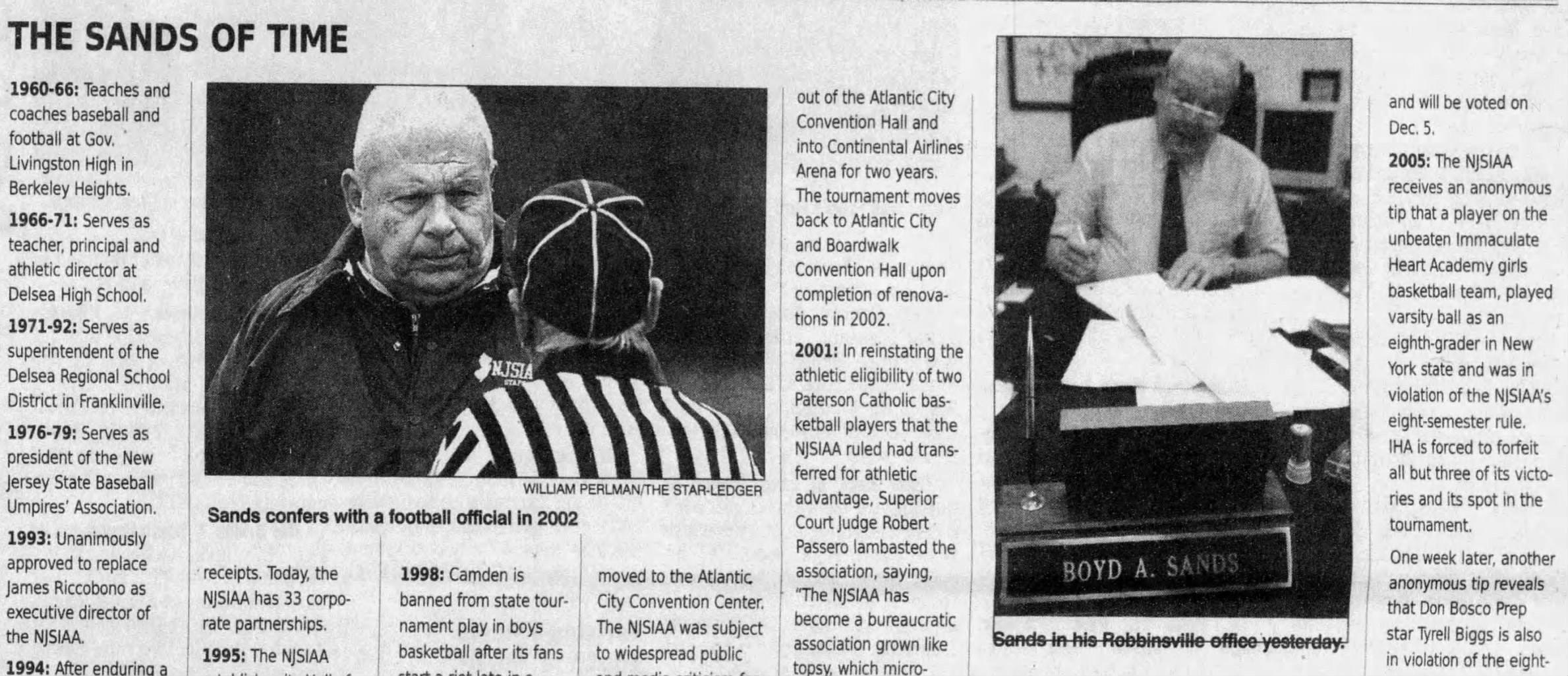
The Star-Ledger of Newark featured Mr. Sands when he announced his retirement from the NJSIAA in 2005.
“His influence lives on in the students he inspired, the educators he mentored, and the community he helped shape,” Delsea superintendent Fran Ciociola said in a tribute.
Mr. Sands was onetime president of the Camden County chapter of the New Jersey Baseball Umpires Association. He won achievement awards from the NJSIAA, the National Federation of Interscholastic Athletic Officials, and the Union County Interscholastic Athletic Conference.
He was an executive committee member of the National Federation of State High School Associations and lifetime member of the International Association of Approved Basketball Officials. “His spirit, kindness, and dedication will be remembered always,” colleagues at the IAABO said in a tribute.
Mr. Sands was inducted into the Gloucester County Sports Hall of Fame in 1989, the NJSIAA Hall of Fame in 2007, and the South Jersey Baseball Hall of Fame in 2009. He attended many continuing education classes and earned certifications at Rowan, Rutgers, and Seton Hall Universities, and elsewhere.
Mr. Sands liked nothing more than attending a football game.
He never changed his signature flattop crew cut. “Bear of a man, great guy,” a former student said in a Facebook tribute. A friend said online: “Boyd was a wonderful man and terrific mentor.”
Boyd August Sands was born Feb. 16, 1937, in Newark, N.J. He played football and basketball in high school, and earned a bachelor’s degree in education at Colby College in Maine and a master’s degree in administration at what is now Kean University in New Jersey.
He met Frances Curto at a New Year’s Eve party, and they married in 1958. They lived in North Jersey, moved to Glassboro when he worked at Delsea, and had daughters Susan, Nancy, Karen, and Lori, and a son, Michael. His son died earlier.
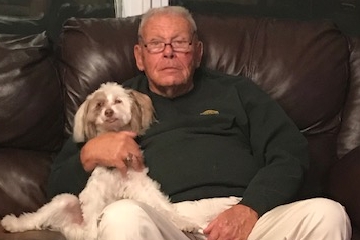
Mr. Sands studied history and enjoyed road trips to family reunions in Florida and stops at historical sites along the way. He loved his dogs, followed the Eagles and Phillies closely, and was sure to be greeted by former students and old colleagues whenever the family went out.
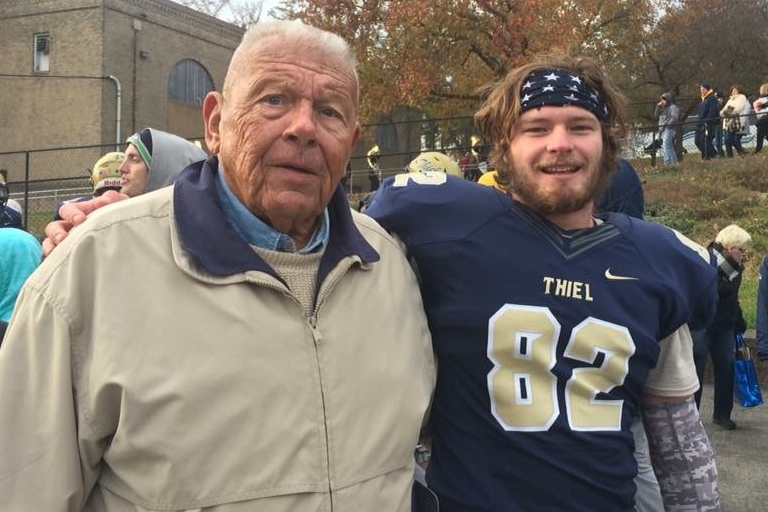
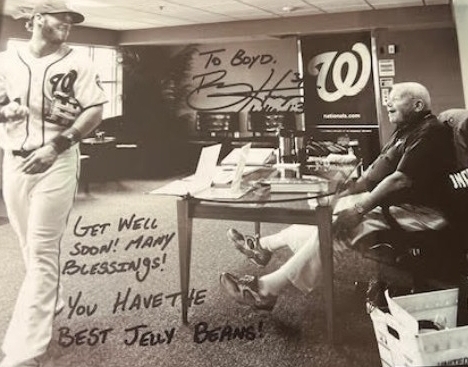
Mr. Sands (right) became friendly with baseball star Bryce Harper when he worked at the Washington Nationals’ spring training complex in Florida.
He and his wife moved to Cape Canaveral in 2006, and he helped run spring training for the Washington Nationals baseball team and worked security for a cruise line. He had bypass surgery in 2015.
“My father was a man who found joy in two of life’s greatest gifts: family and sports,” said his daughter Nancy. “My dad was a man who always showed up and pushed us hard to do our best.”
His daughter Susan said: “He saw everyone as a person.”
Nearly everyone has a memorable umpiring story about Mr. Sands, like the time he got drilled by a line drive down the first base line. In 1994, he told The Inquirer that he enjoyed officiating high school baseball and basketball games more than anything.
“It was my hobby and outlet,” he said. “I tried golf, and I figured I’d rather get hit by a hard ball.”
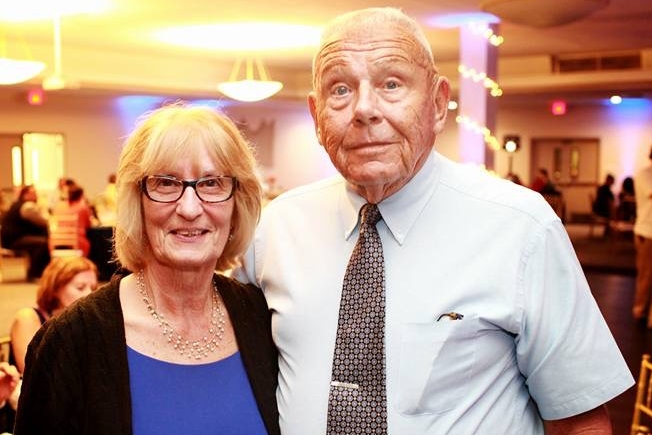
Mr. Sands and his wife, Frances, married in 1958.
In addition to his wife and daughters, Mr. Sands is survived by 16 grandchildren, 28 great-grandchildren, a brother, and other relatives. A brother died earlier.
When Friends’ Central’s Ryan Carter limped off the court with 3 minutes, 40 seconds left in the PAISAA girls’ basketball championship game at Hagan Arena on Friday night, it felt like history was repeating itself.
Carter, a junior guard who spent last season at Archbishop Wood, went down with an injury in the 2025 PIAA Class 5A championship. She played through the pain but was unable to lead Wood to a win.
But this time, in a different jersey and a different state championship game, Carter got back on the floor and helped upset Westtown, 62-54.
“These girls, I didn’t want to let them down,” Carter said. “This is the one team where I’ve felt like people have always had my back, no matter what. It’s a true family.”
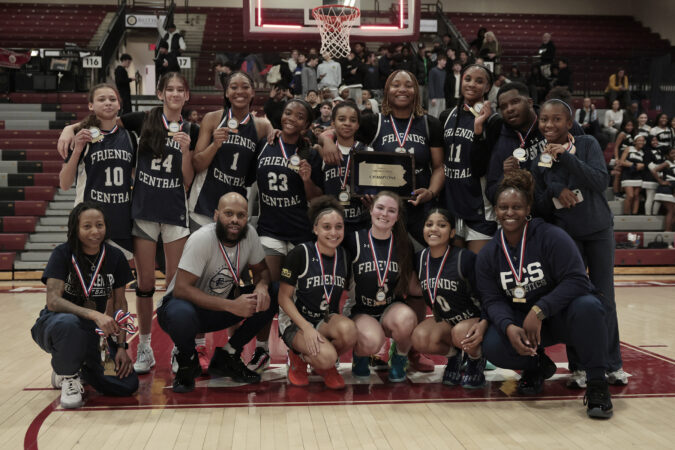
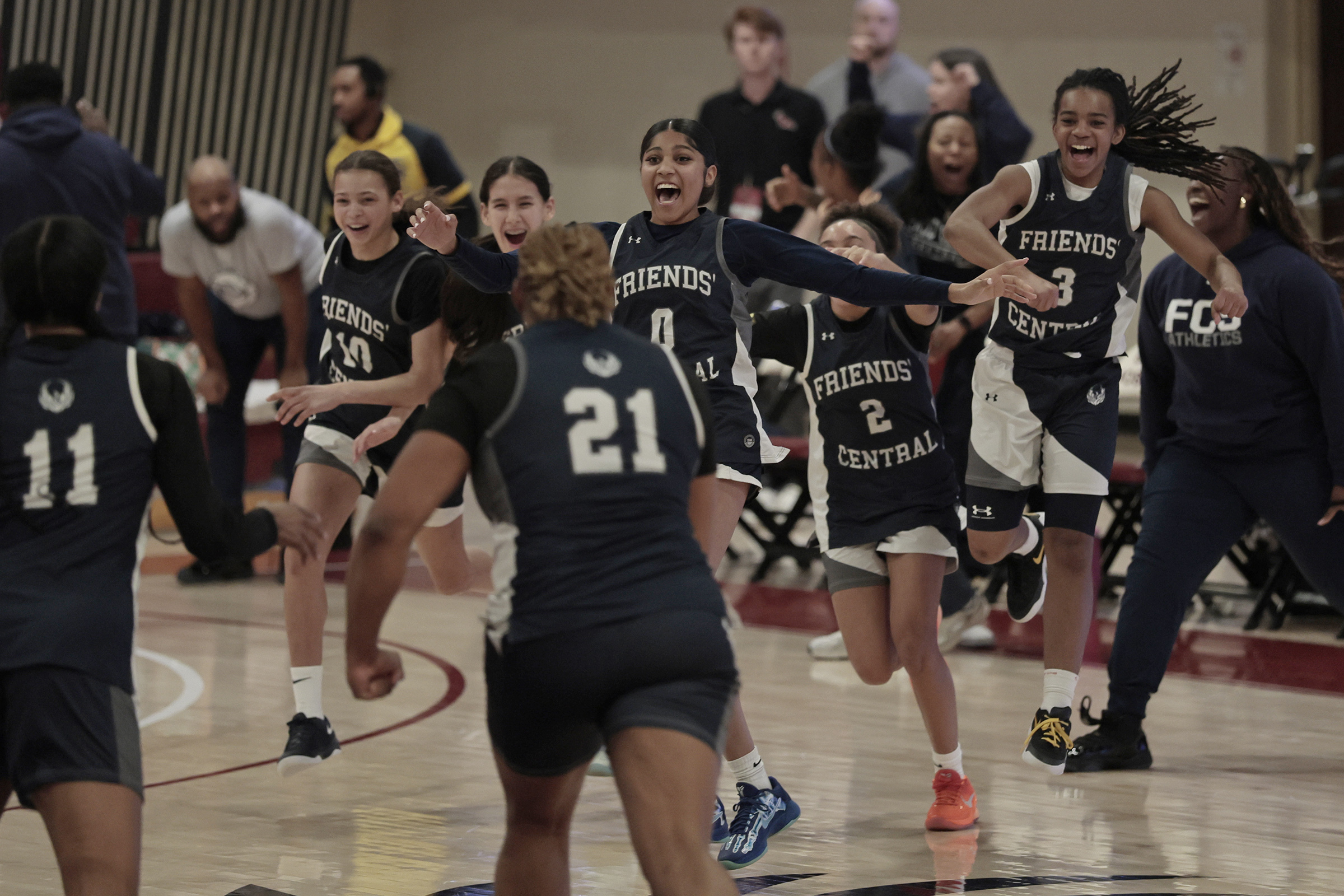
The Friends’ Central girls celebrate after winning the PAISAA state title against Westtown on Friday.
Zya Small led the Phoenix (27-6) with 18 points as they claimed their first PAISAA state title in program history. Kayla Snyder and Carter added 14 and 12 points, respectively.
“This group of girls, they just work so hard,” Friends’ Central coach Vinny Simpson said. “And they believe. That’s the difference in this year’s group. They believe, they work hard. … That’s how we figured it out.”
Westtown (28-2) entered Friday night’s game having won four consecutive PAISAA titles. It beat Friends’ Central in the state title game in 2024 and 2025, as well as in the regular season and Friends League championship this year.
“That’s a ton [of times] to lose to a team,” said Faith Watson, a sophomore center who scored 10 points for the Phoenix. “So this feels great.”
Jordyn Palmer led Westtown with 27 points. The junior forward is ranked as the sixth best prospect by ESPN. Friends’ Central’s Carter (No. 12) and Small (No. 47) also are among the top 60 prospects in the 2027 class.
Friday night’s loss was the final game of Atlee Vanesko’s Westtown career. The senior guard, who’s No. 74 in the 2026 class and will play at Ohio State next season, scored six points and fouled out with 1 minute, 49 seconds remaining.
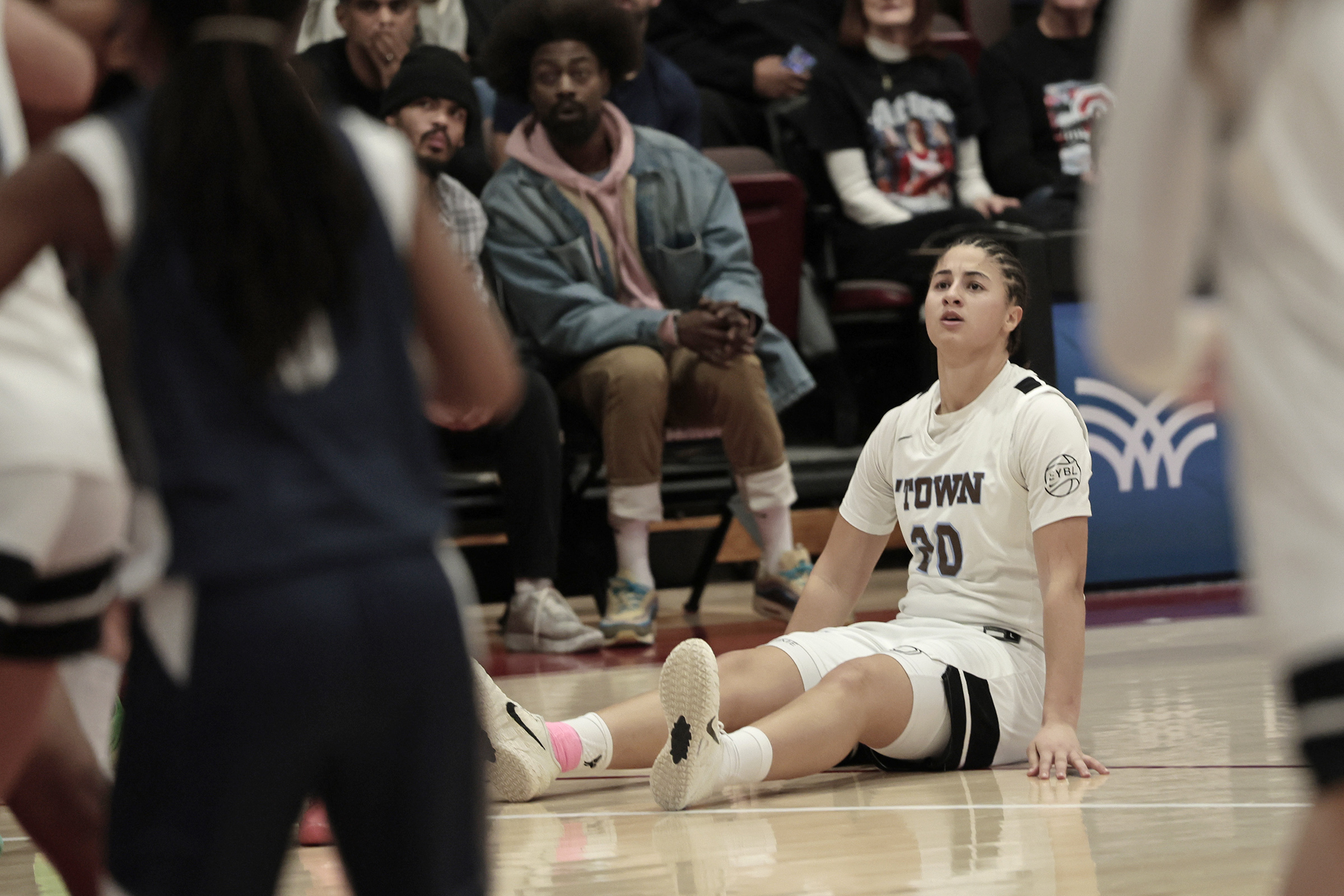
Westtown’s Jordyn Palmer watches the ball from the floor after taking a shot in the PAISAA girls’ basketball final on Friday.
Friends’ Central will continue its season in The Throne, a single-elimination national tournament run by the National Basketball Players Association. The seventh-seeded Phoenix will face second-seeded Princess Anne (Va.) in East Rutherford, N.J., in the tournament’s first round on March 19.
Natal, a fifth-year guard, scored 21 points , while Johnston, a senior guard who will play at Marquette next season, added 22. The pair of guards helped to lift the Hill School (24-9) to its first state title since 2018.
Johnston scored 13 of his 22 in the third quarter. The Hill School outscored Phelps, 27-9, in the third, which gave the Rams a 28-point lead entering the fourth.
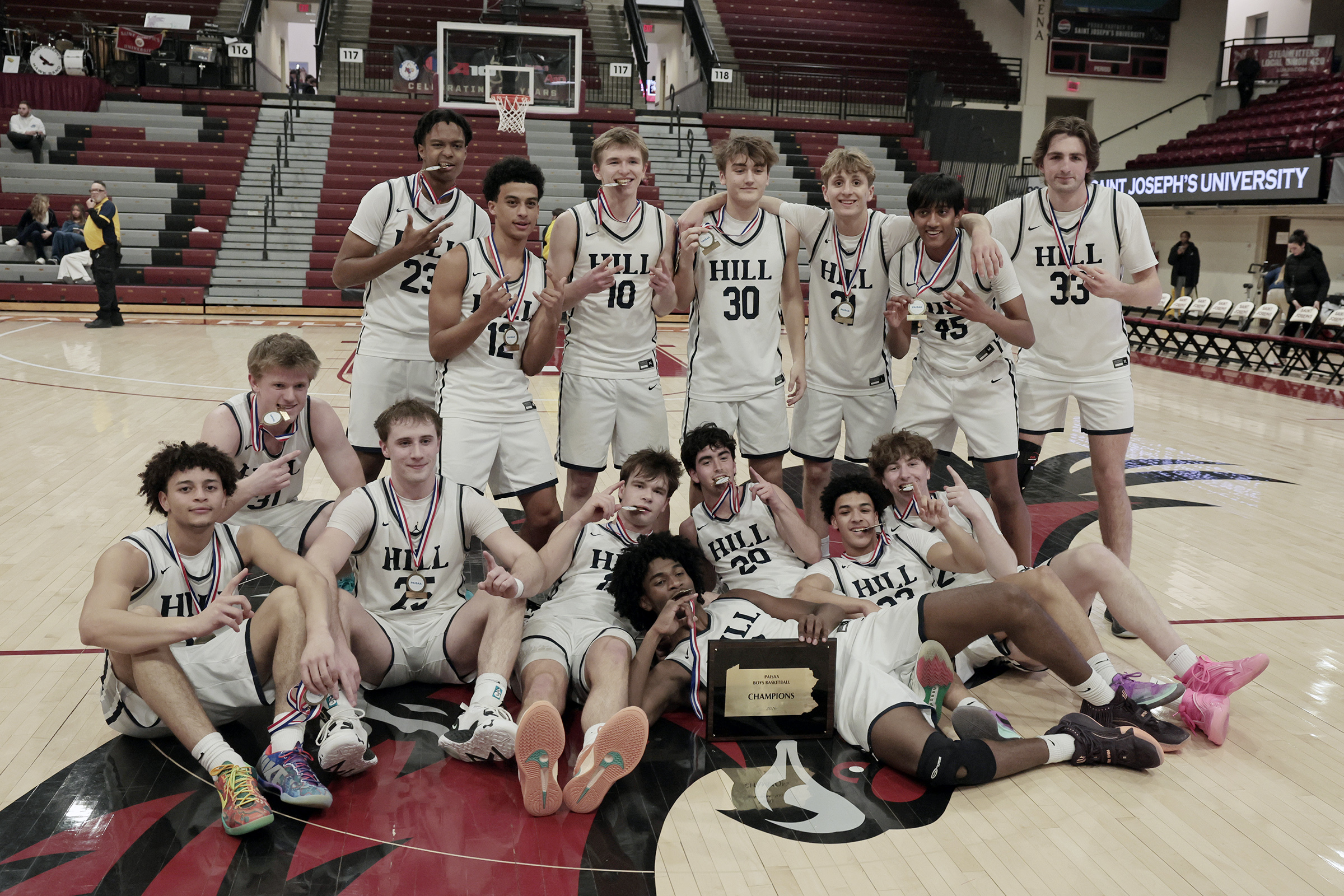
The Hill School players pose for a photo after it won the PAISAA boys’ basketball final against Phelps School on Friday.
“Last year, we didn’t play a complete game,” Johnston said. “We didn’t execute late. I think this year we took more of an initiative to execute late and just stay together.”
The Hill School coach Seth Eilberg began to empty his bench with three minutes remaining. The team has eight players graduating, including Natal, Johnston, and Zane Conlon, who scored 11 on Friday.
“We’ve played a really tough schedule,” Eilberg said. “We’ve taken a couple of hits here and there. They stayed together, and we kept getting better, and we kept having fun with it.”
Jahrel Vigo led Phelps (24-12) with 19 points. The senior guard, who will play at Buffalo next season, was the only Phelps player to reach double figures in scoring.
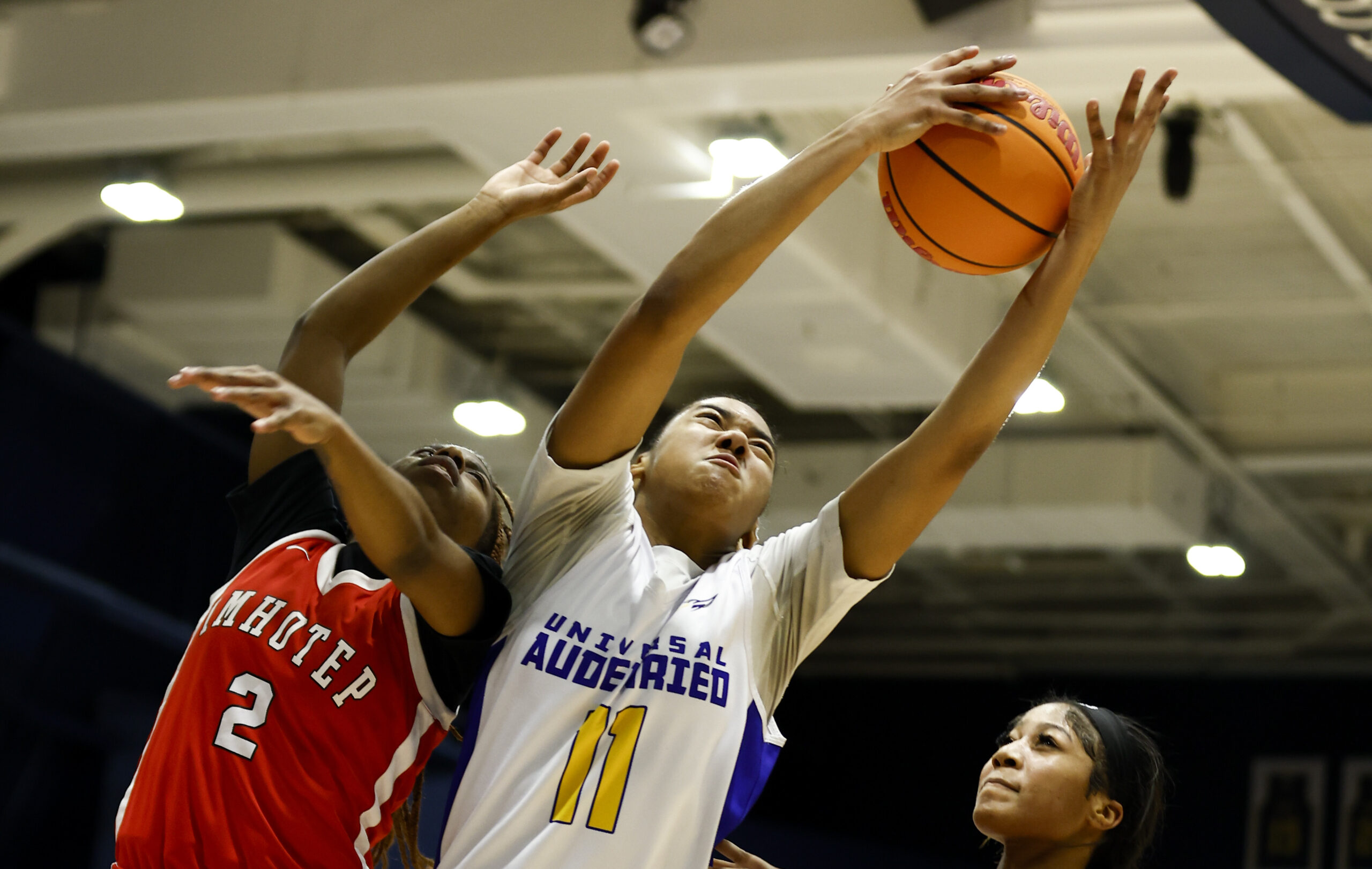
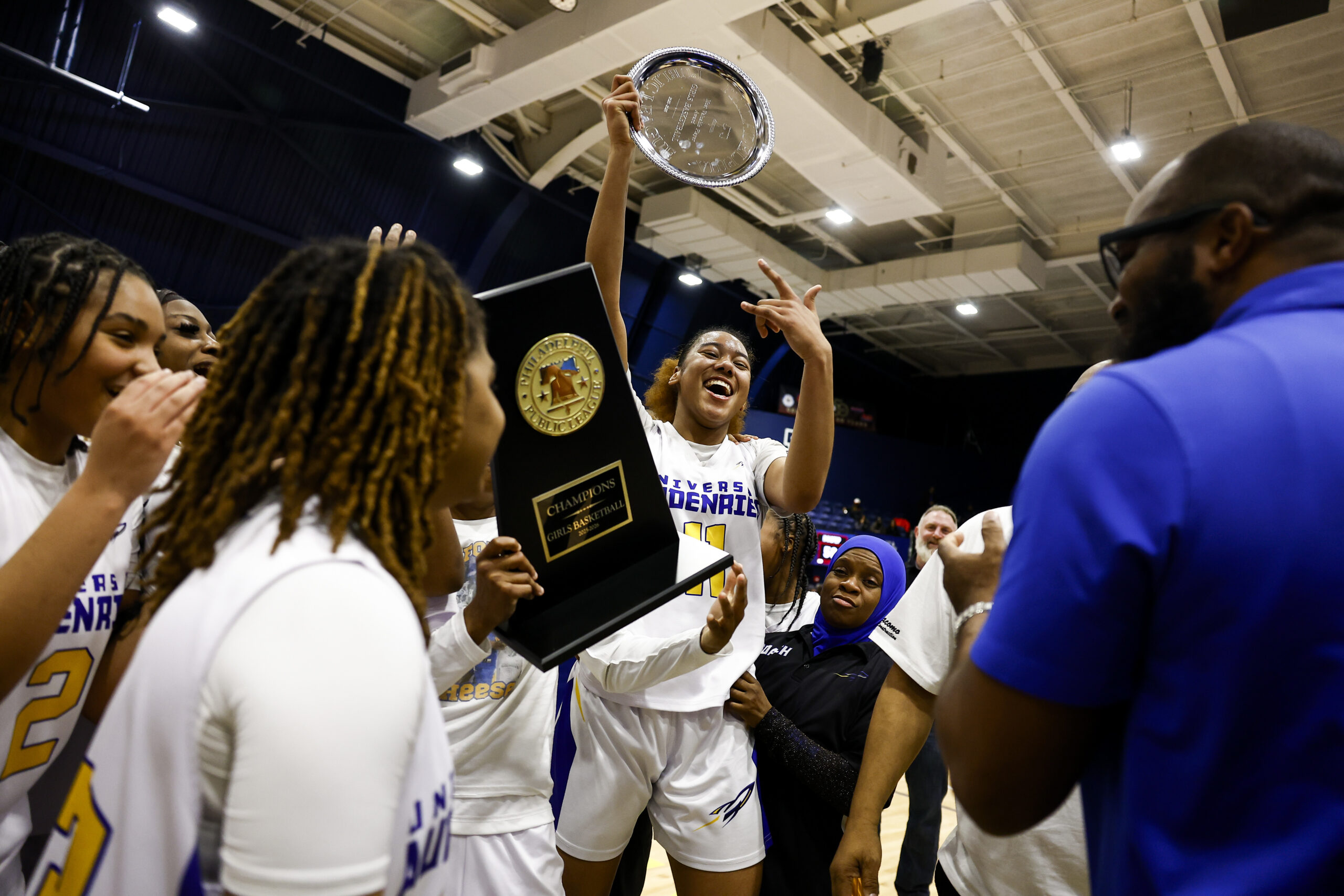
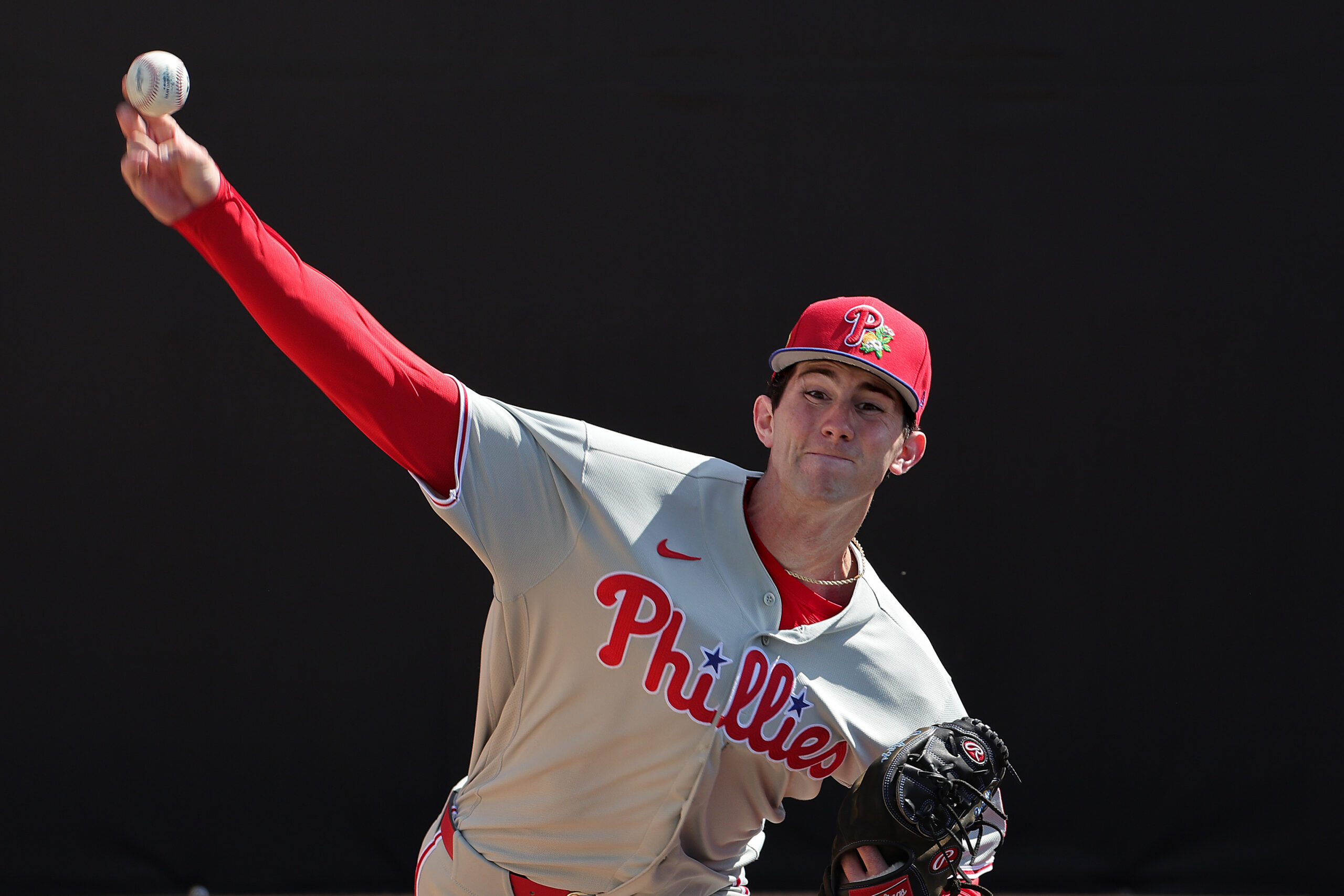
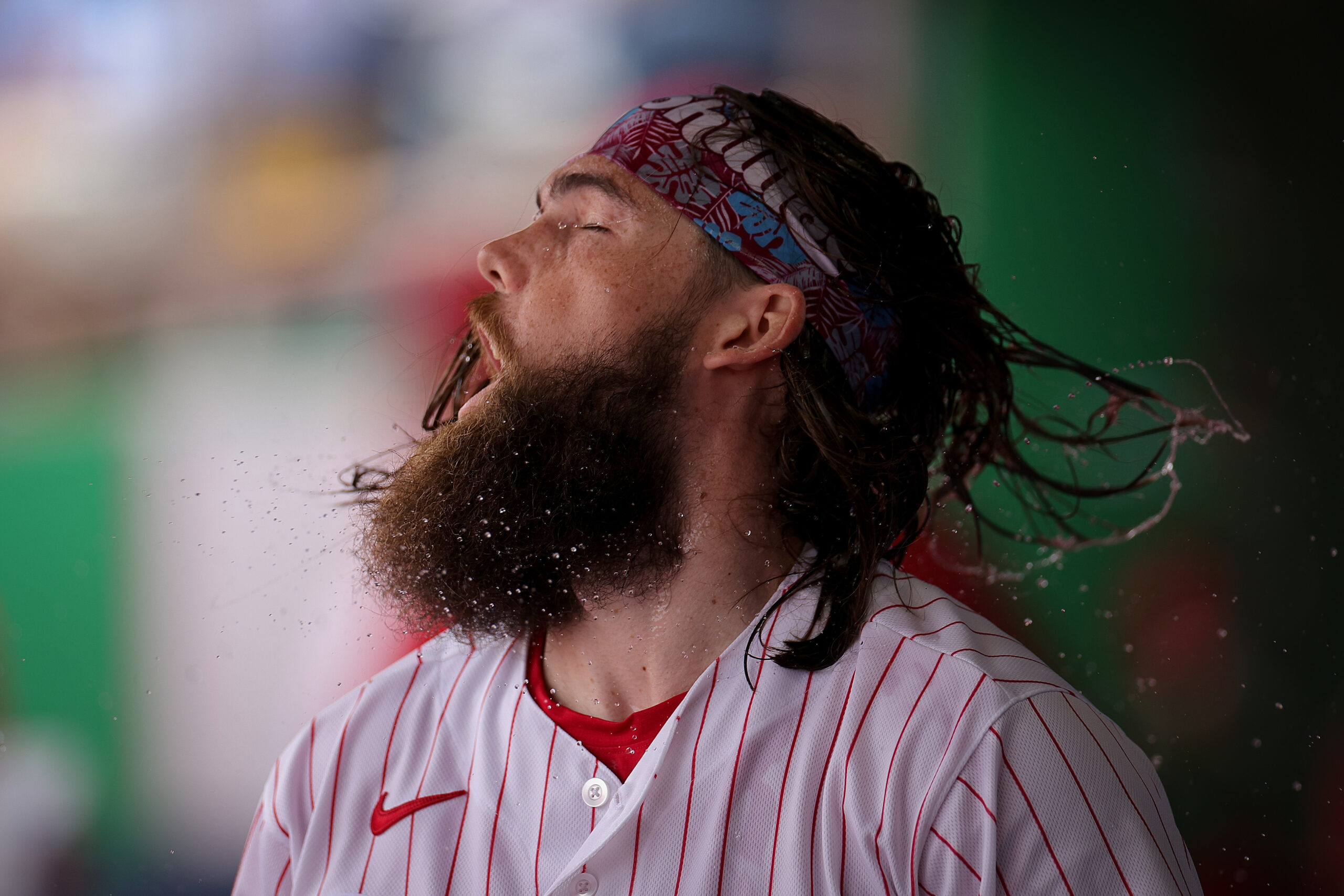
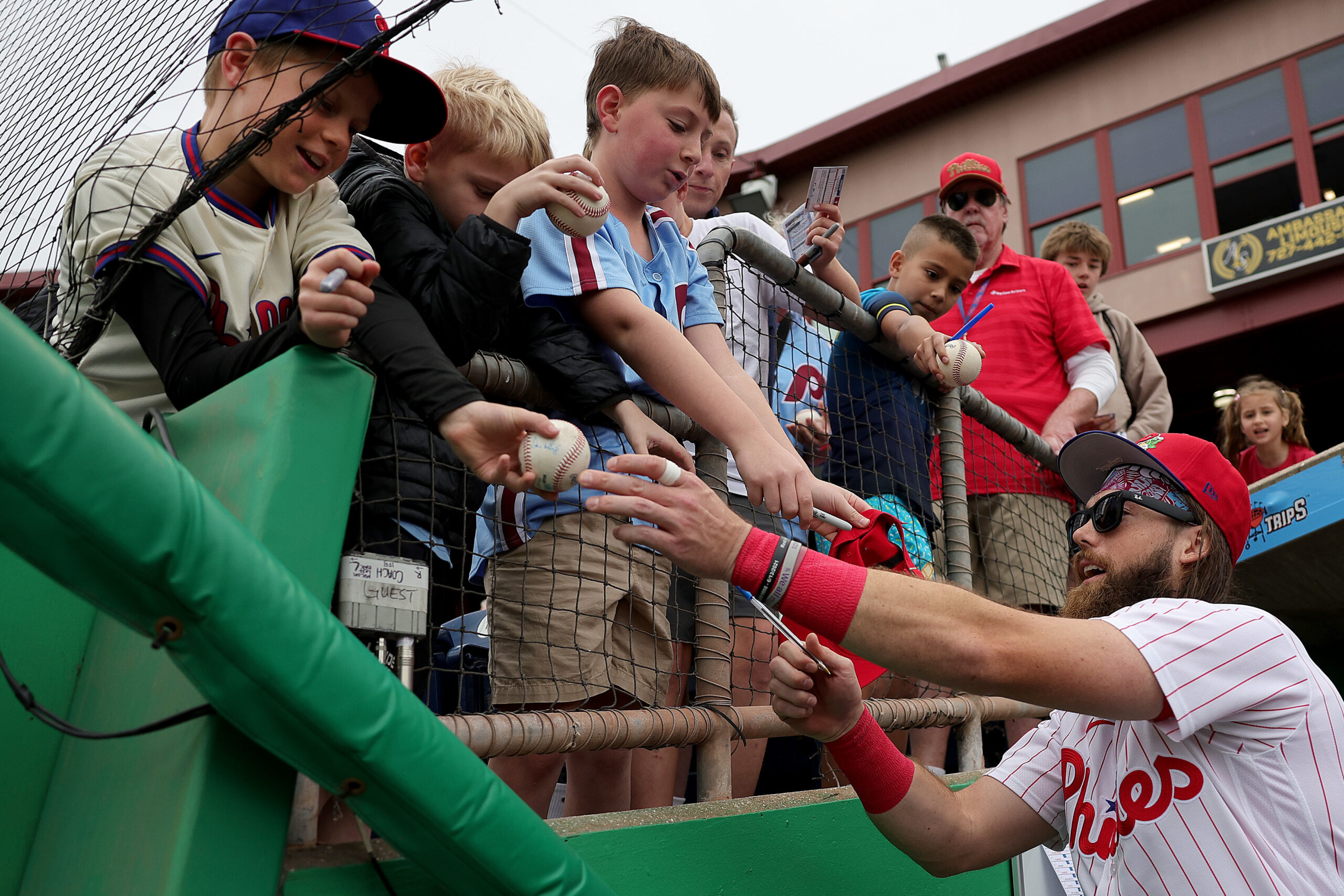
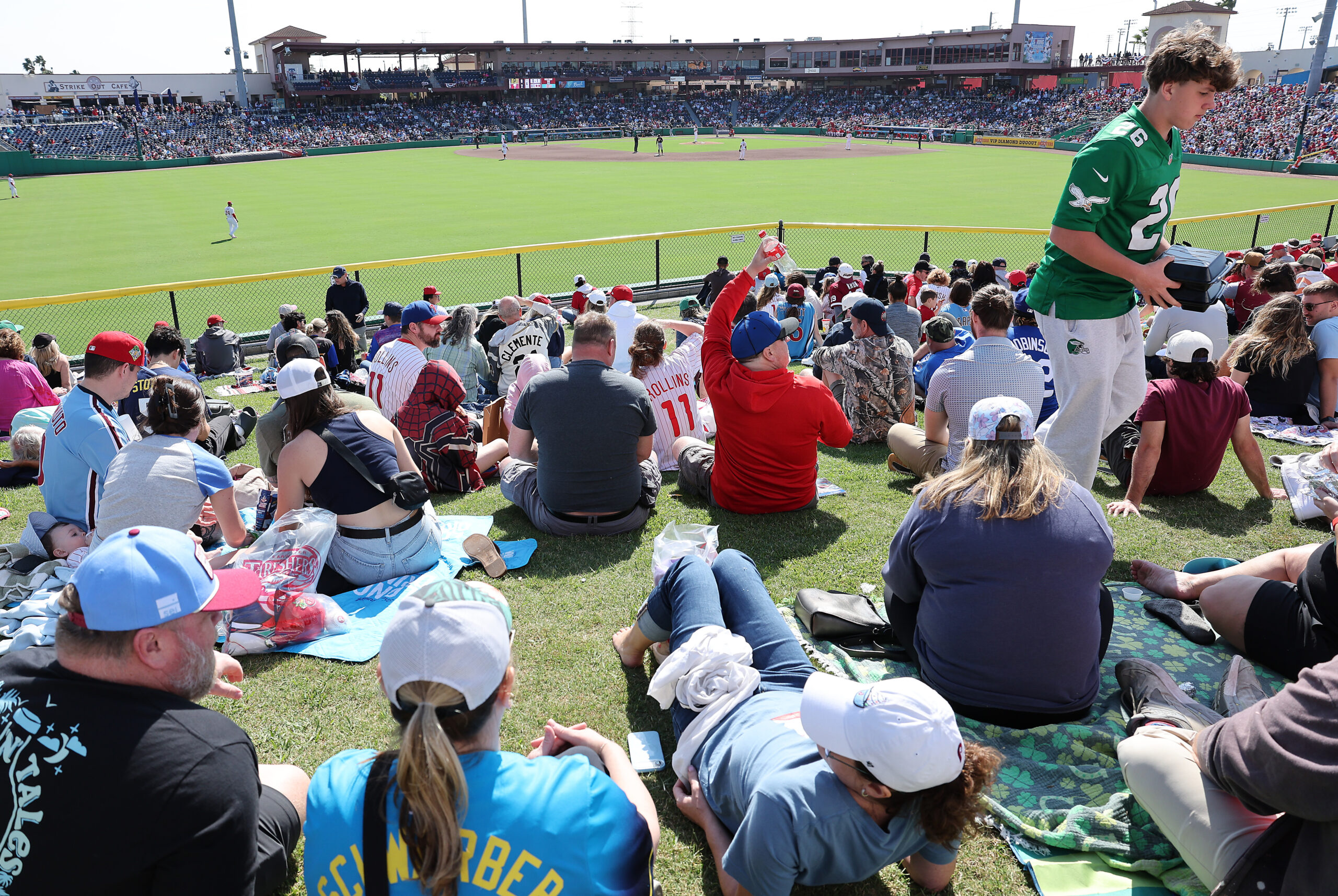
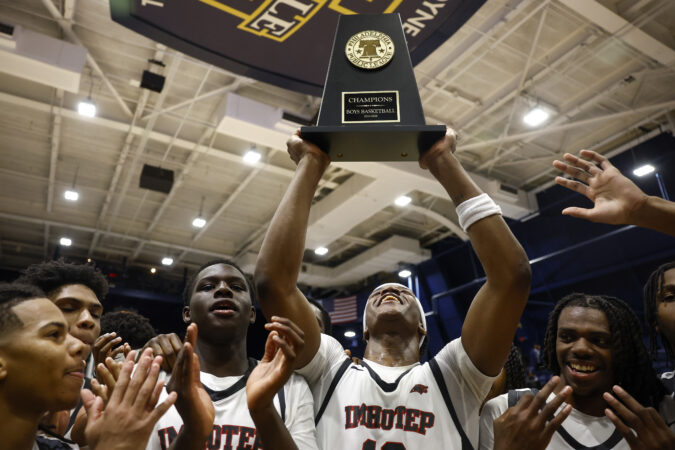
Each Friday, Inquirer photo editors pick the best Philly sports images from the last seven days. This week, the Philadelphia Public and Catholic League basketball playoffs were decided, with three of the four champions — Imhotep and Father Judge on the boys’ side and Audenried on the girls’ — picking up where they left off last year. In the case of Imhotep, it was the sixth straight Public League title, while Audenried captured its fourth. Meanwhile, the Archbishop Carroll girls won their first title since 2019. Down at spring training in Clearwater, the Phillies’ Grapefruit League schedule began, giving fans their first taste of baseball in more than four months.
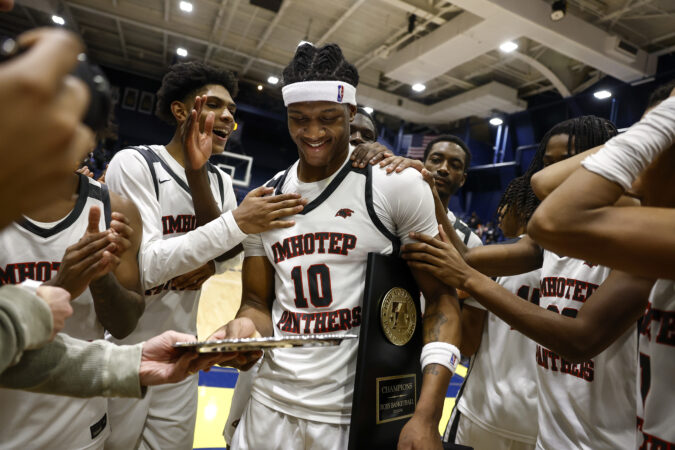
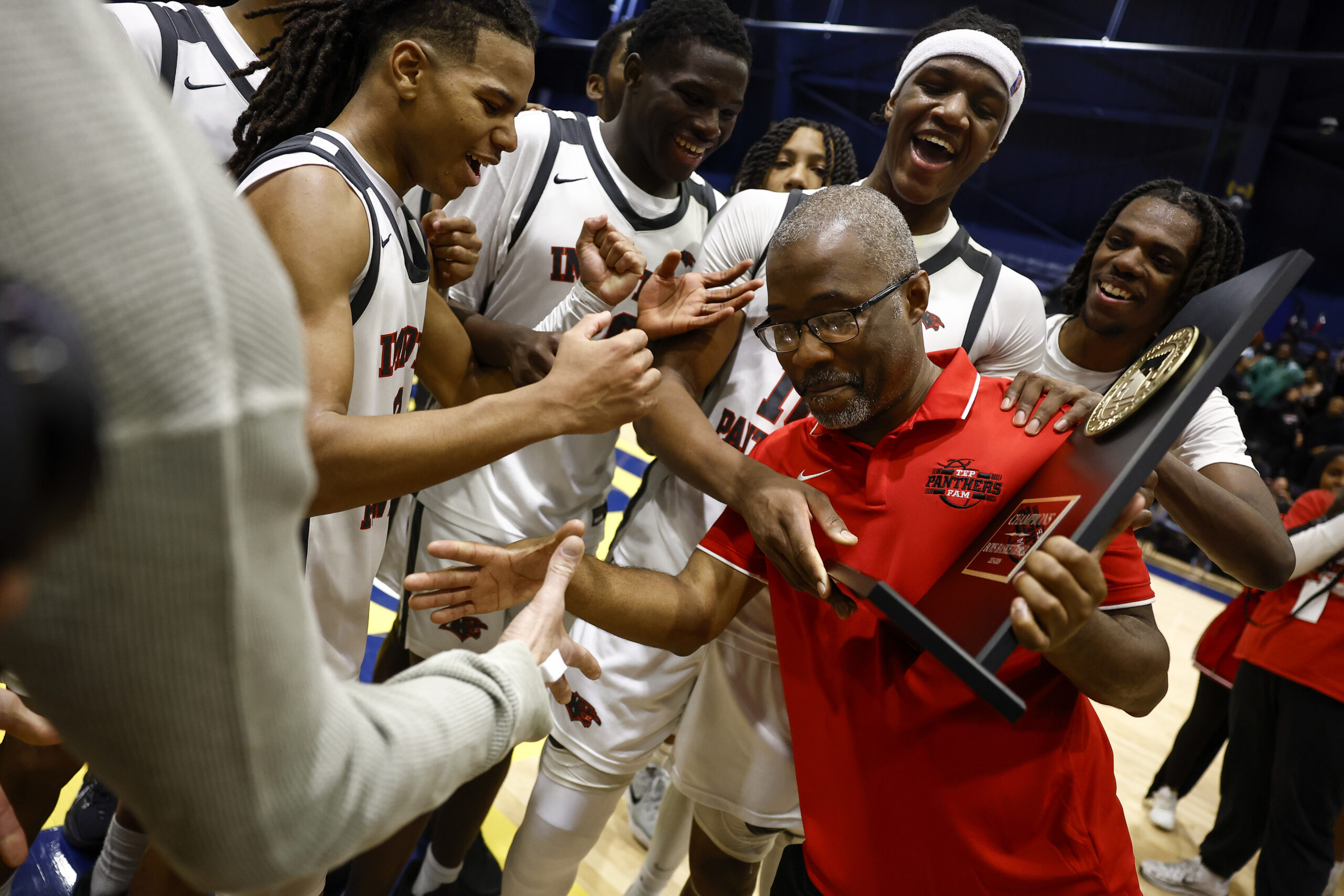
Imhotep Institute Charter players celebrate their sixth straight Philadelphia Public League boys basketball title with head coach Andre Noble (red shirt). They beat West Philadelphia High School, 39-35, on Sunday at La Salle University’s John E. Glaser Arena.
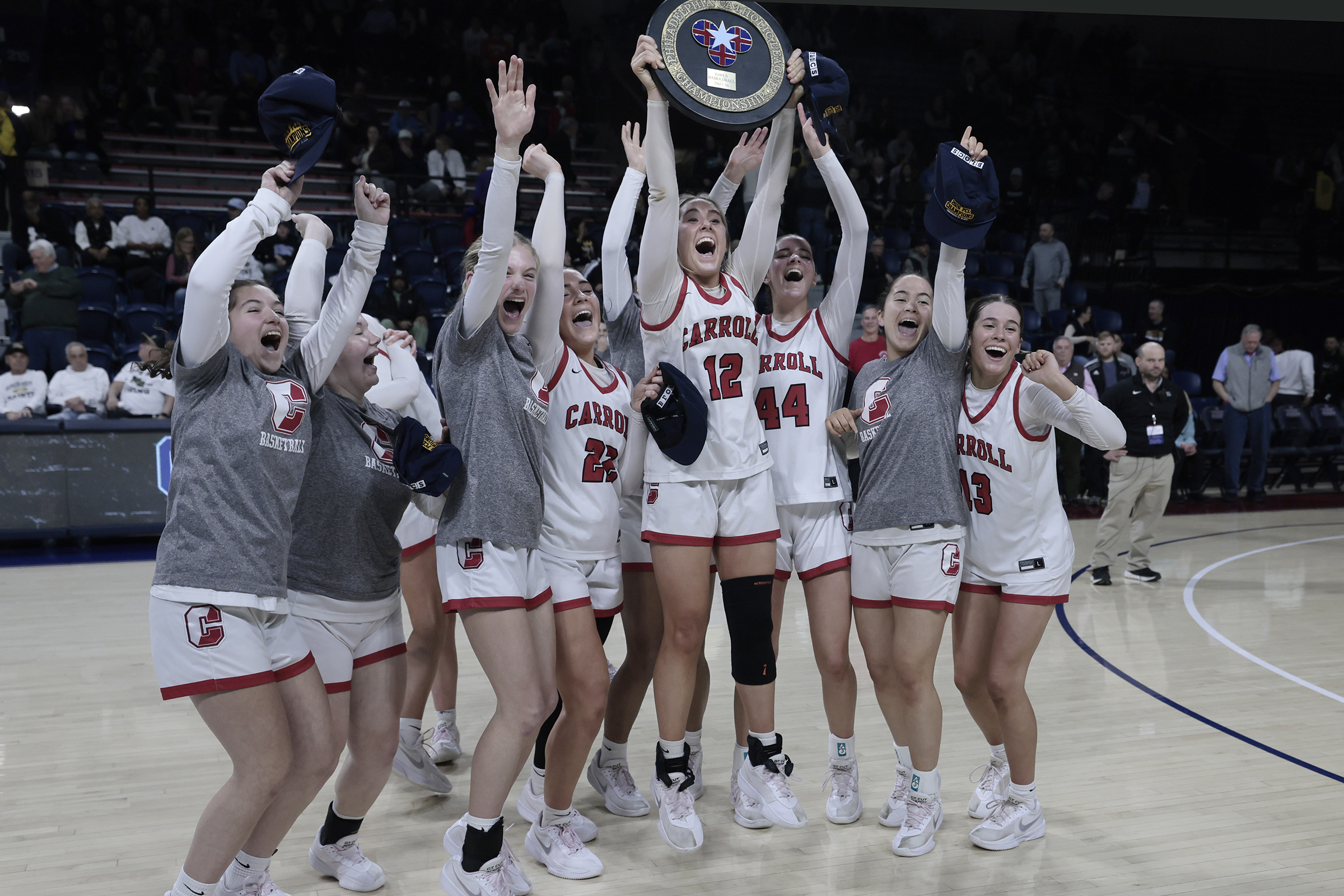
Archbishop Carroll won the Philadelphia Catholic League girls’ championship behind the trio of senior Alexis Eberz (holding trophy), and her sisters, sophomores Kayla and Kelsey Eberz.
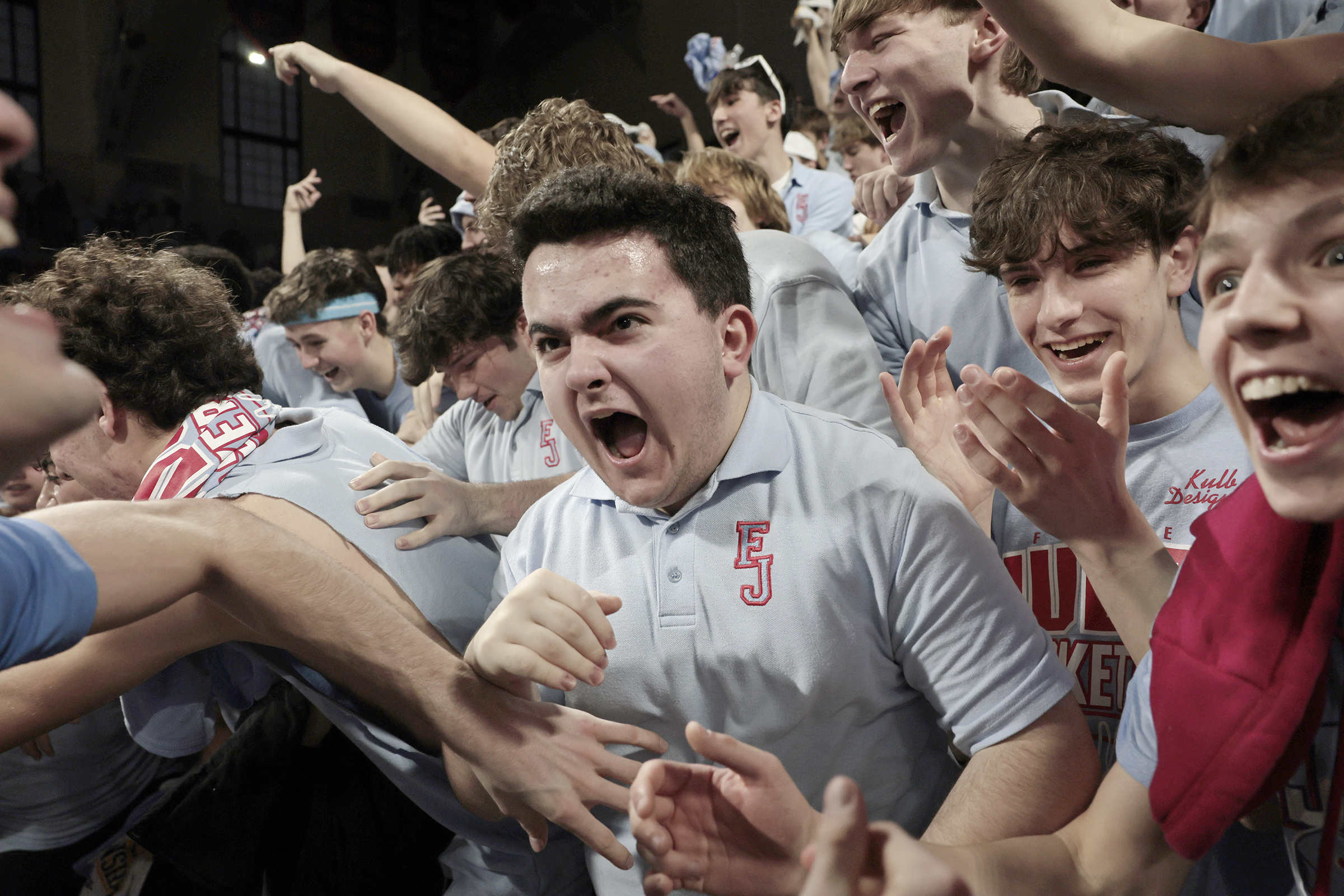
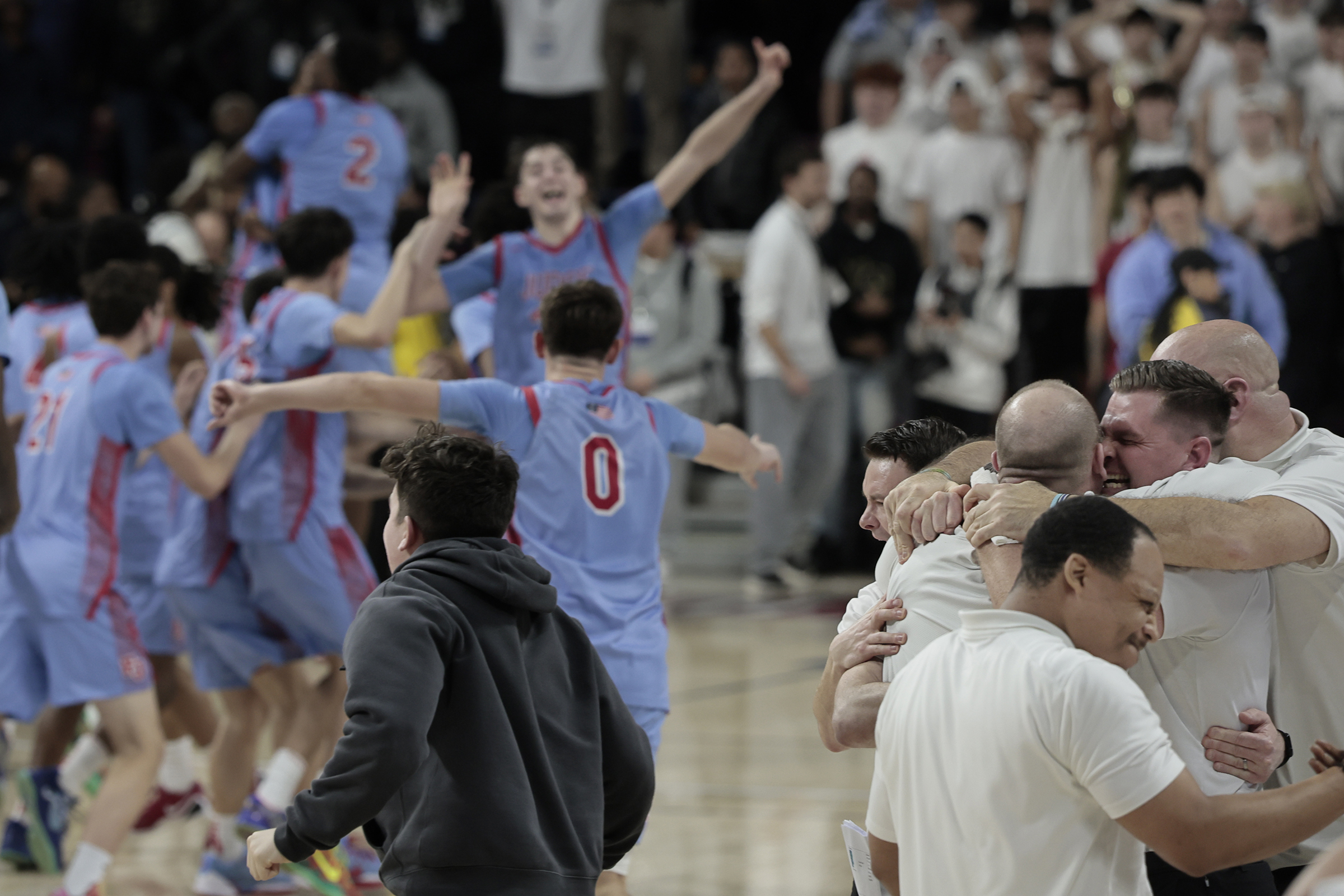
Father Judge fans celebrate after their team won its second straight Catholic League boys’ championship. Last year, the Crusaders followed it up with a state title.
Imhotep had a chance to win both the boys’ and girls’ titles, but Universal Audenried Charter and junior Nasiaah Russell took home the school’s fourth straight crown Sunday at John E. Glaser Arena.
Andrew Painter spent most of last season in Lehigh Valley with the IronPigs, where he was selected to represent the Phillies at the 2025 All-Star Futures Game. He’s expected to be a part of the big-league rotation this season.
Phillies shortstop Edmundo Sosa hugs new outfielder Adolis García during Wednesday’s 5-3 win over the Detroit Tigers in Clearwater. The victory was the Phillies’ first of spring training.
Even on the berm at BayCare Ballpark in Clearwater, Eagles fans aren’t hard to find, including this one in a kelly green Saquon Barkley jersey. It was Sunday.
Bill Koch was in a hospital bed for 10 days, imagining this to be how his coaching career would finally end. A doctor sent him immediately to Fox Chase Cancer Center in the fall of 2019 after an annual colonoscopy. Koch had colon cancer. They operated on Koch the next day, stitched his stomach, and left him planning for rounds of chemotherapy and radiation.
Koch (pronounced “Cook”) has been an assistant on Father Judge’s basketball staff since 1979 and has helped the football team even longer. He worked at Judge for more than 30 years as a nonteaching assistant, doing everything from monitoring the lunch periods and substitute teaching to helping kids find a college.
And the 76-year-old is still at the all-boys school in Holmesburg nearly every day, washing the basketball uniforms and making sure everything is just right before another practice begins.
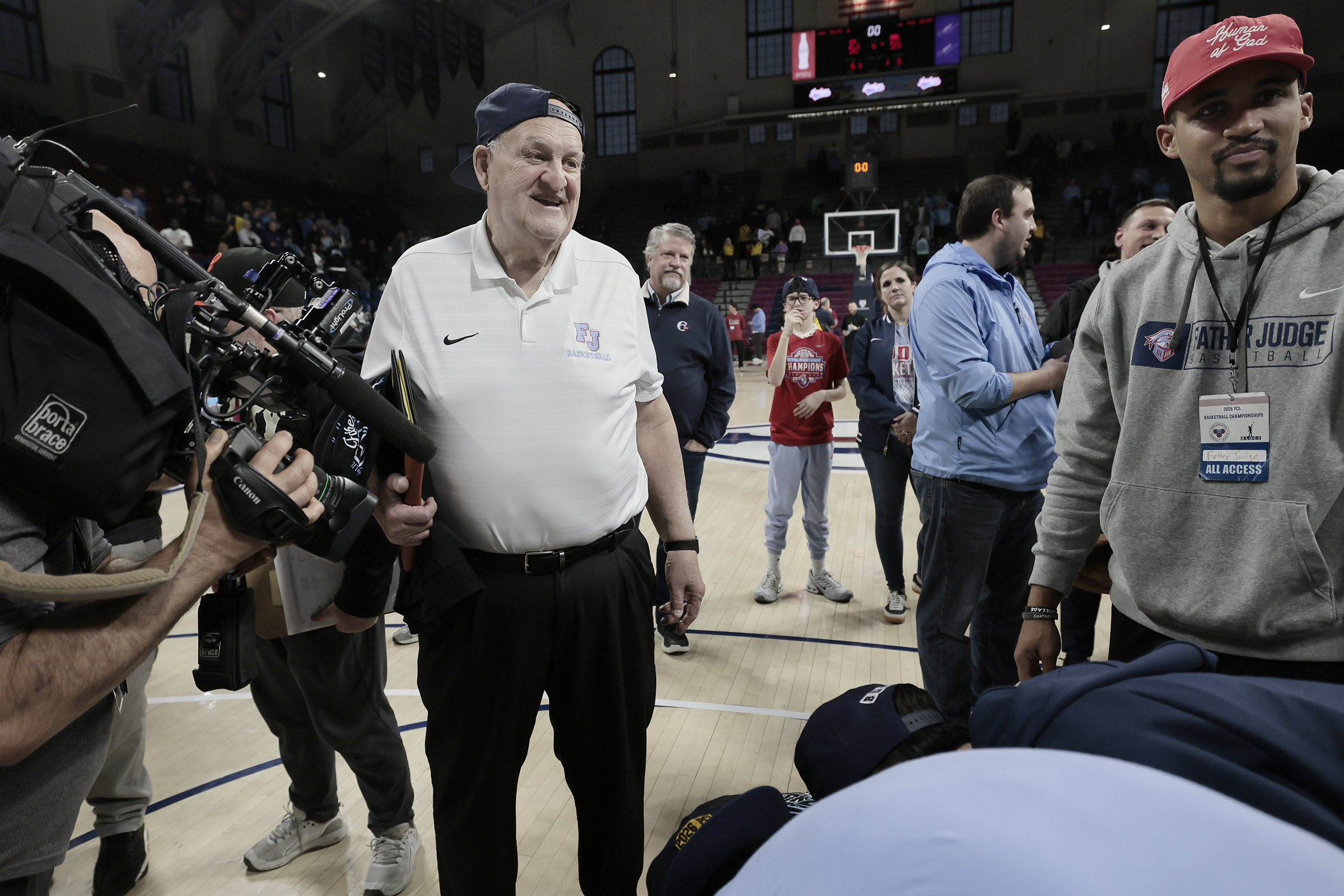
Koch graduated from Judge in 1967, grew up near Holme Circle, and still lives in the Northeast. He helps the football team in the fall and the basketball squad in the winter. Koch was there Sunday when Judge won a second straight Catholic League boys’ title, sitting on the bench as an assistant coach just like he has for the past 47 years.
But for 10 days, Koch wondered whether his time on the sideline was up. Then the doctor returned to his room and sent him home. No chemo. No radiation. It was rare, the doctor told Koch, but the cancer was gone.
“I almost got stopped,” Koch said.
Judge’s mascot is the Crusader, but it can be argued that the school’s symbol is Mr. Koch.
“He’s a lifer,” said basketball coach Chris Roantree. “People associate Mr. Koch with Father Judge and Father Judge with Mr. Koch. He’s been a part of Father Judge for 50-plus years. He’s the ultimate Judge Guy in my eyes in terms of everything he’s done for kids.”
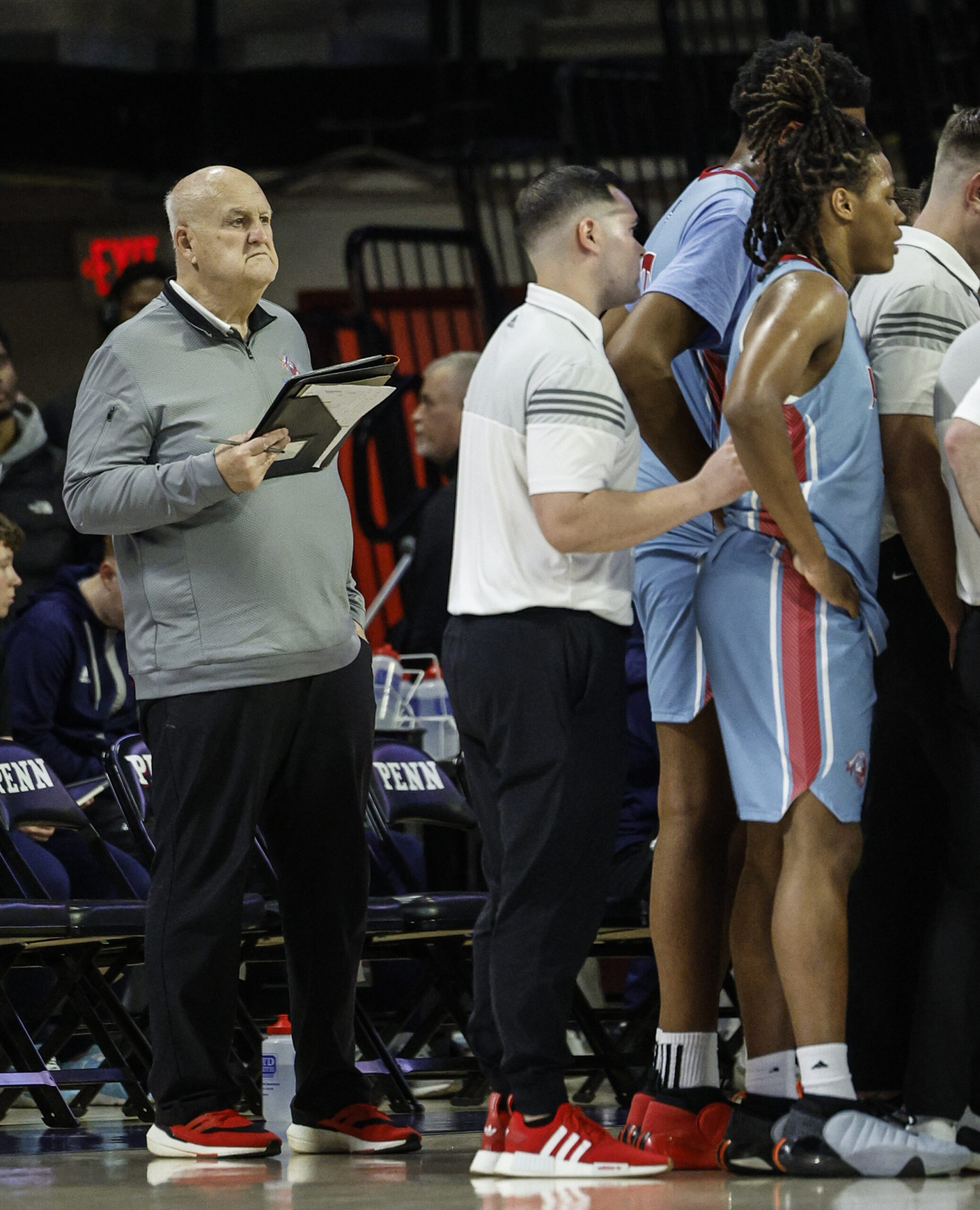
Father Judge assistant coach Bill Koch (left) during a timeout against Roman Catholic during the Catholic League boys’ semifinals on Saturday at the Palestra.
Home on Solly Avenue
Koch didn’t play football at Judge, but he did know how to tape ankles, which was enough for football coach John “Whitey” Sullivan to ask Koch in 1974 to coach the freshman team. Five years later, Bill Fox — often Koch’s teammate in two-on-two at Pollock Playground — added him to the basketball staff.
Koch coached JV hoops for 30 seasons, won 606 games, and never thought about going elsewhere. A basketball program usually changes JV coaches every few years, but not Judge.
Fox, who died of ALS in 2021, once told the Daily News that Koch “bleeds Father Judge blue.” Koch worked basketball camps every summer with the top college coaches and had chances to be an assistant somewhere. He was at home on Solly Avenue.
Judge had more than 3,000 boys when Koch was a student — “If you turned the wrong way, you got bounced,” he said — so there wasn’t any room on the basketball team for a 5-foot-11 kid.
“What are you going to do? I thought I was going to make it,” Koch said.
He hit a growth spurt in college and played on a team at St. Francis in Loretto, Pa., with future NBA players Kevin Porter and Norm Van Lier. He played in the summer with guys from La Salle and St. Joseph’s and said his 50 points at Pollock are still a playground record. He worked after college as a machinist and a roofer before going to work at Judge. He has never left.
“I gave up all the other jobs and I was making good money back then,” Koch said. “But this is something I love. Some people think I’m crazy, but hey, you can’t look back.”
Bill Koch is “the ultimate Judge Guy in my eyes in terms of everything he’s done for kids,” says Father Judge basketball coach Chris Roantree.
Where’s Mr. Koch?
Judge’s basketball team was in San Diego last season when someone stopped the coaches. The man said he was a graduate and then asked to see Koch.
“We always run into someone who says, ‘Where’s Mr. Koch?’” said Jim Reeves, one of the team’s assistants. “The list is endless of people he knows.”
Reeves played a season of JV ball for Mr. Koch, who called the big man “Crazy George” — a reference to an old basketball trickster — every time Reeves grabbed a rebound and started dribbling. Koch kept things loose, let his players play, and made sure they hustled.
“My big thing is it doesn’t take talent to hustle,” Koch said. “So my kids hustle.”
Koch coached Roantree in the 1990s and helped him land a football scholarship to Lycoming College. So of course, Roantree planned to keep Koch as an assistant in 2021 when he took over the program. But Roantree didn’t really have a choice.
Koch keeps stats during games, logs the minutes each player plays, oversees the student managers, and makes sure the practice uniforms are ready. He does the things people often don’t see, Reeves said.
The players — some of whom are more than 60 years younger than Koch — call him “Pop Pop” and develop secret handshakes with him. They put him on TikTok earlier this season and sit with him before practice at the scorer’s table.
“He might not be showing them how to do a drop step, but it’s about the relationships that he forms,” Reeves said. “People couldn’t believe that Chris kept Mr. Koch on. It’s like, ‘Why wouldn’t we leave Mr. Koch on?’ You can see the bond he creates. It gives you a past and present. It bridges the gap from the old Judge to the new Judge.”
Koch said the only time he gets in trouble is if he messes up the clock during practice.
“I think sometimes he dozes off when he’s doing the clock,” Roantree said. “He still does a lot for the program. He’s there every day.”
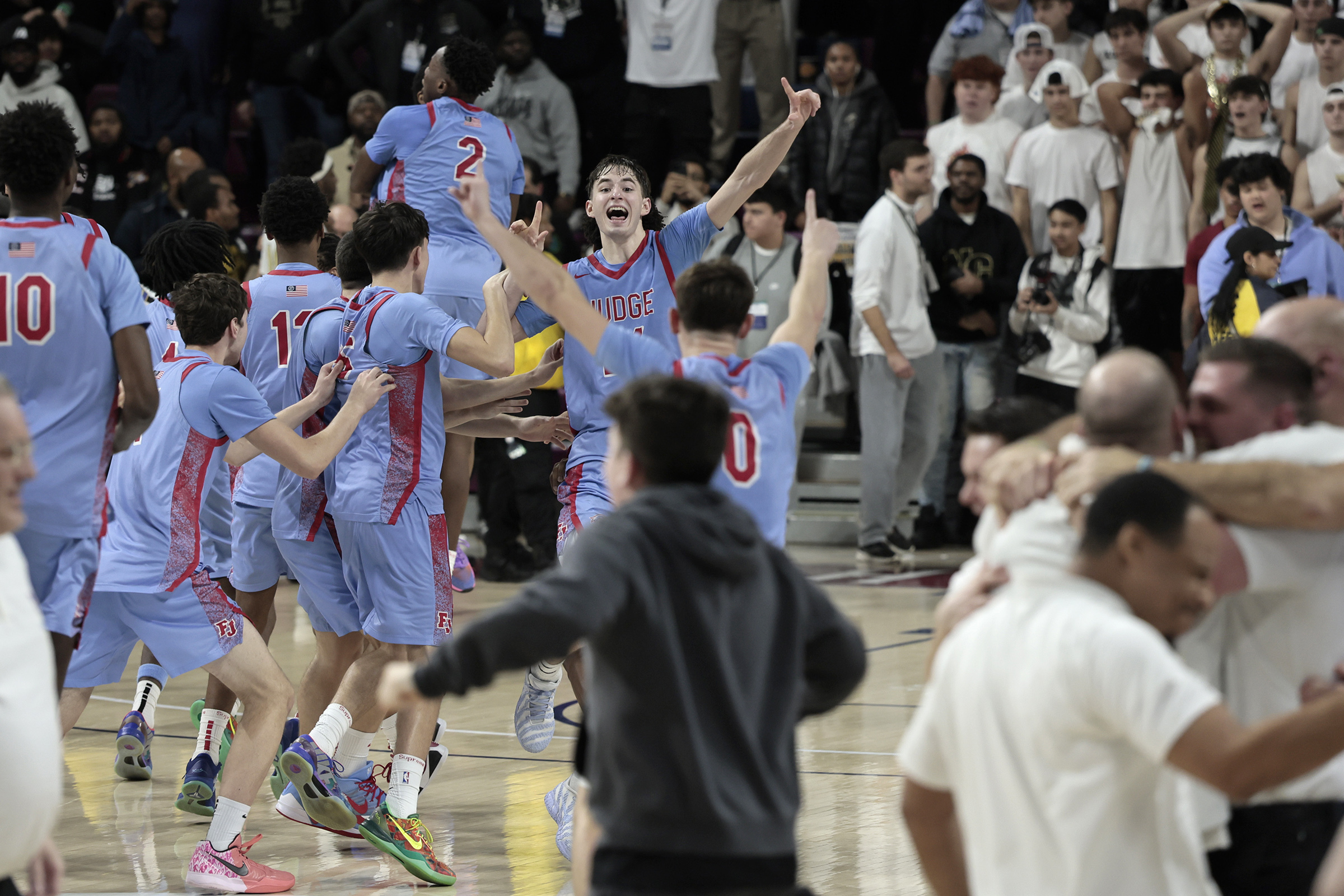
Father Judge celebrates winning the Catholic League championship over Neumann Goretti on Sunday.
Not done yet
Judge once relied solely on nearby parishes like St. Matthew’s, St. Timothy’s, and St. Jerome’s for enrollment. The basketball team was a bunch of kids from Northeast neighborhoods. But that’s no longer the case as students can now come to Judge from anywhere. Some basketball players, Roantree said, leave their home at 6:30 a.m. to get to school.
The roster isn’t constructed the same way it was in 1998 when Roantree, Reeves, and current assistant Brian Bond won it all.
But they played Sunday against Neumann Goretti in the Catholic League final like a bunch of hard-nosed kids from Mayfair. They hustled after loose balls, grabbed offensive rebounds, and did the little things to hold on to a lead down the stretch. The Crusaders, who play Saturday against Public League champ Imhotep for the city title, are still a team of Judge Guys. And maybe that’s because they have a coaching staff full of former players and a lifer on the bench.
“A lot of the kids we have, it’s almost like their parents would fit in in Northeast Philly because that’s what they are,” Reeves said. “They are from out of the neighborhood, but they have that same mentality.”
Koch eventually got out of his hospital bed during his 10-day stay, walked around Fox Chase Cancer Center, bumped into people he knew, and stopped in the chapel.
“There were people a lot worse off than I was,” Koch said. “I was grateful that I didn’t have to go through what other people have to go through. I’m thankful. I guess a lot of people said prayers for me.”
The doctor told him to return every six months for the next five years to make sure he was cancer free. Five years later, Koch was good. Ring the bell, the doc said.
“But they didn’t have a bell where his office was,” Koch said. “So it was make believe.”
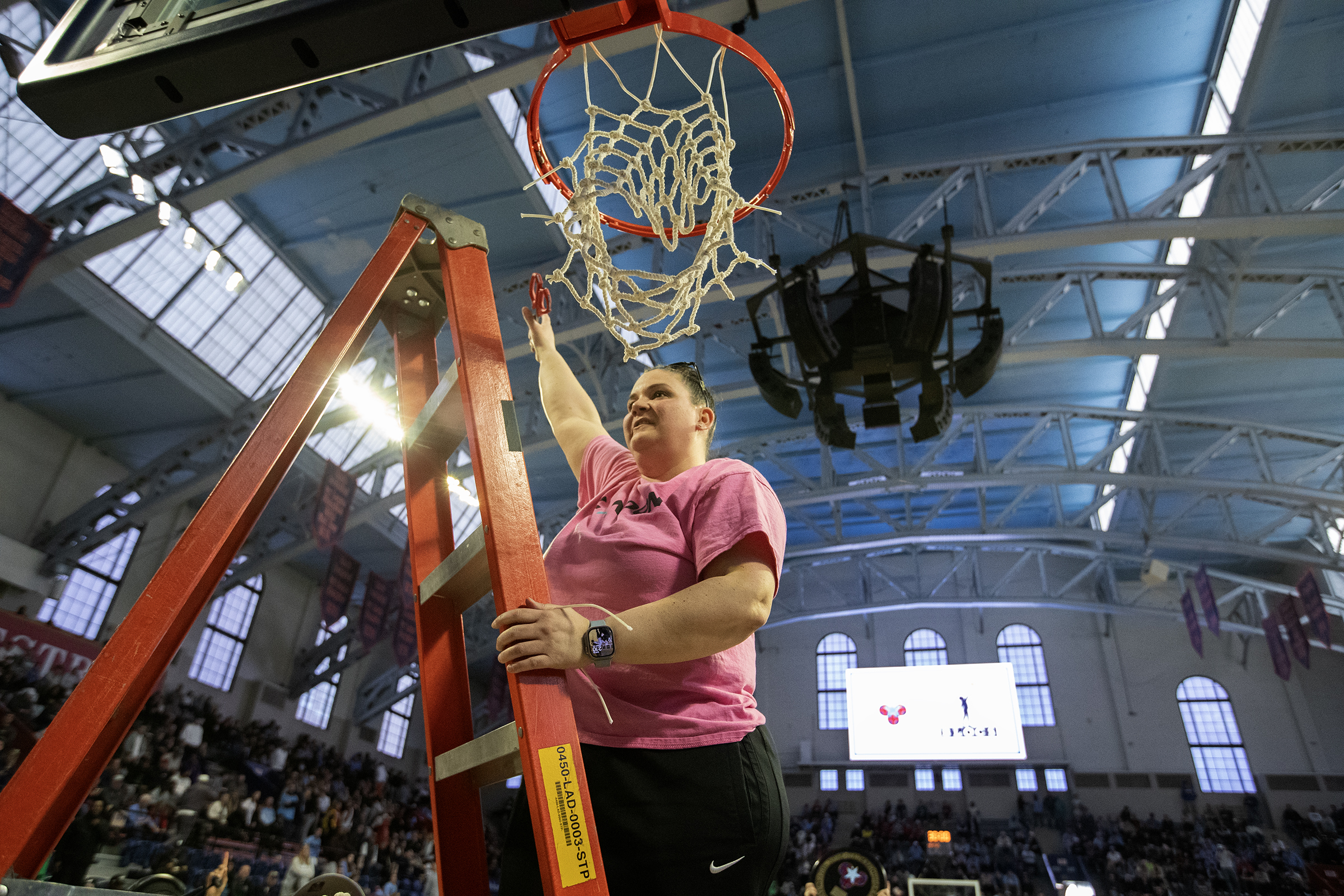
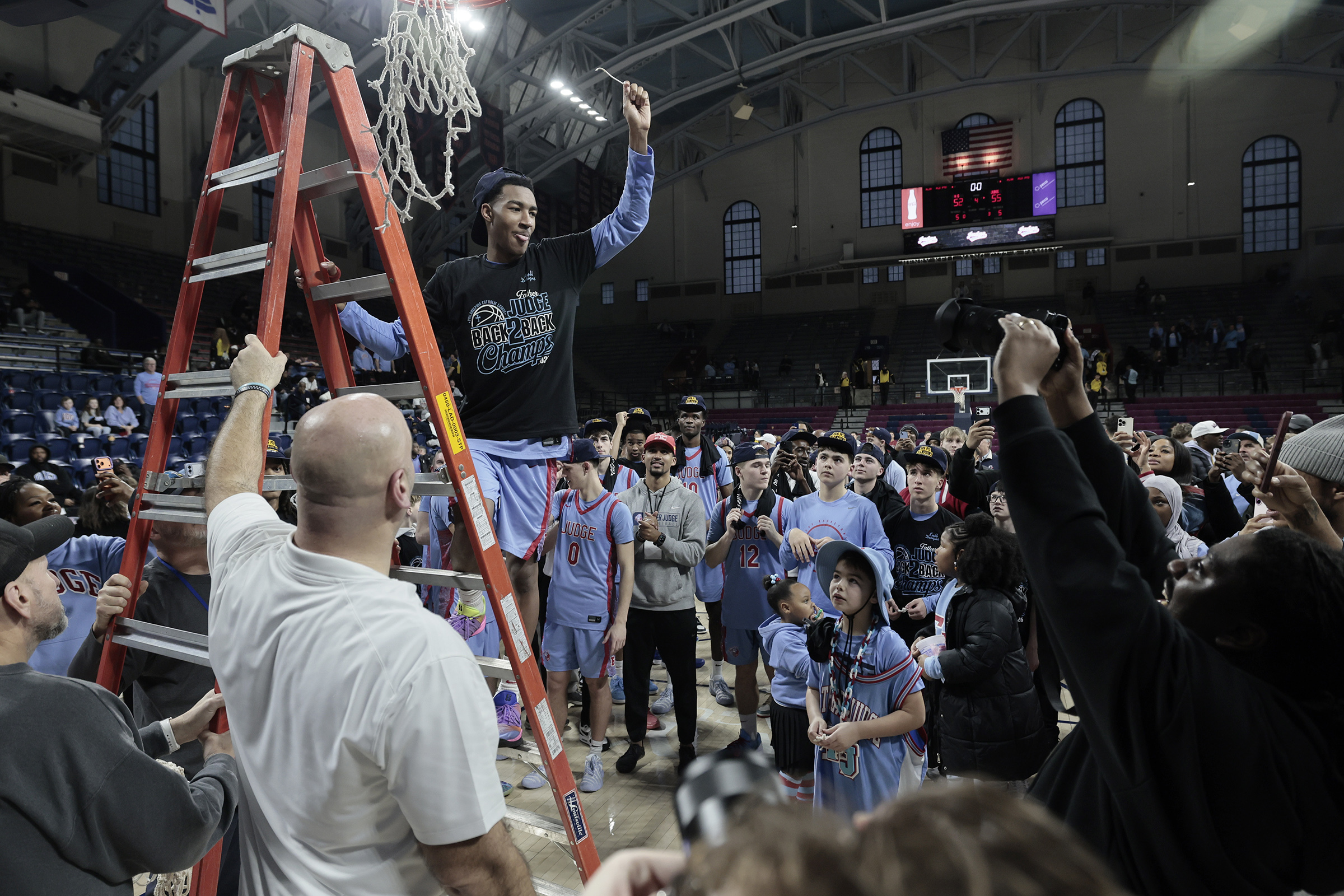
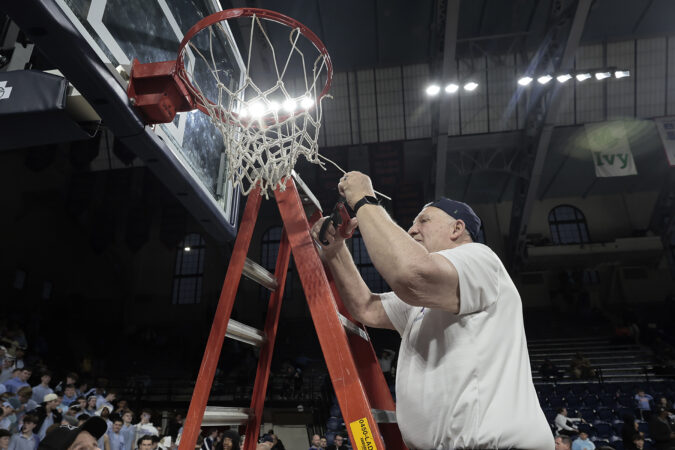
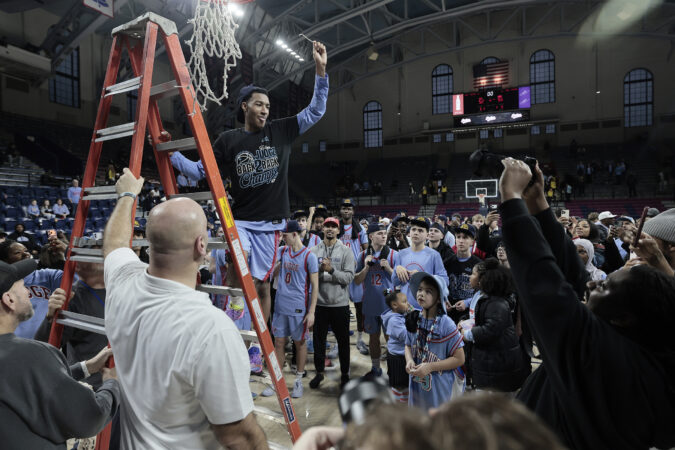
He climbed a ladder on Sunday at the Palestra after Judge — the school he has devoted his life to — won it all. It may have felt like make-believe as Judge won one game in the season before Roantree was hired and went 27 years without a title before winning the last two. But this was real.
The Judge Guy cut down a piece of the net as the other Judge Guys cheered. He’s not done yet.
About once a month, Brian Wanamaker drives toa cancer treatment center near his home in Crowley, Texas. He sits on a hospital bed as nurses inject needles into his arm and stomach; one for chemotherapy, the other to boost his immune system.
He can be there anywhere from one to four hours.Wanamaker is asleep throughout, but he doesn’t wake up rested. His stomach burns. His body feels fatigued.
After it’s over, he often goes straight to the gym at Texas WesleyanUniversity, where the North Philadelphia native coaches the NAIA men’s basketball program. Sometimes, he even beats his players to practice.
Since 2022, when Wanamaker was diagnosed with multiple myeloma, he has been balancing his job with the limitations of an incurable cancer. It is not easy. The head coach takes six pills a day to keep the disease in remission for as long as possible.
His doctors advise him not to engage in stressful activities (even if running a college basketball team is antithetical to this). Then, there is the matter of his schedule. Texas Wesleyan plays games mostly on Thursdays and Saturdays.
It doesn’t allow much time to undergo chemotherapy and fully recover. But the coach has an answer for that, too. He receives treatment early on Mondays, so he doesn’t feel sick later in the week.
If the Rams are on the road, he’ll reschedule.
“It’ll come back,” Wanamaker said of multiple myeloma. “But right now, I do maintenance.”
The 36-year-old doesn’t talk like someone who is worried about the future. If anything, his job has helped him stay grounded in the present. Coaching was a lifelong goal of Wanamaker’s, ever since he was a boy playing in the Sonny Hill League.
This is where he and his twin brother, Brad, first saw how basketball could change a life. Their coach, Rasool Hajj, was an alumnus of and former volunteer assistant coach at Roman Catholic High School. He helped the twins connect with the program, and they enrolled in 2003.
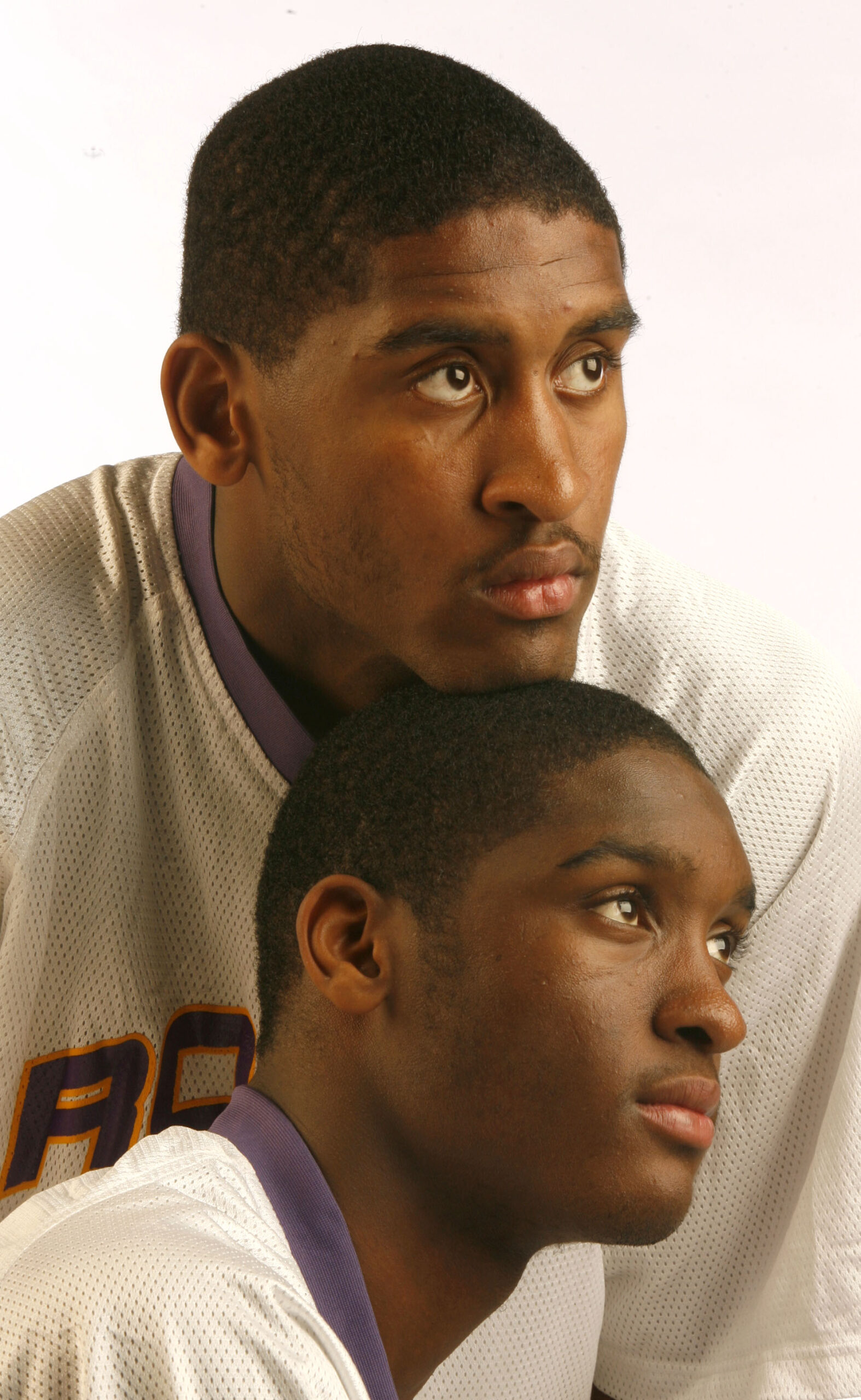
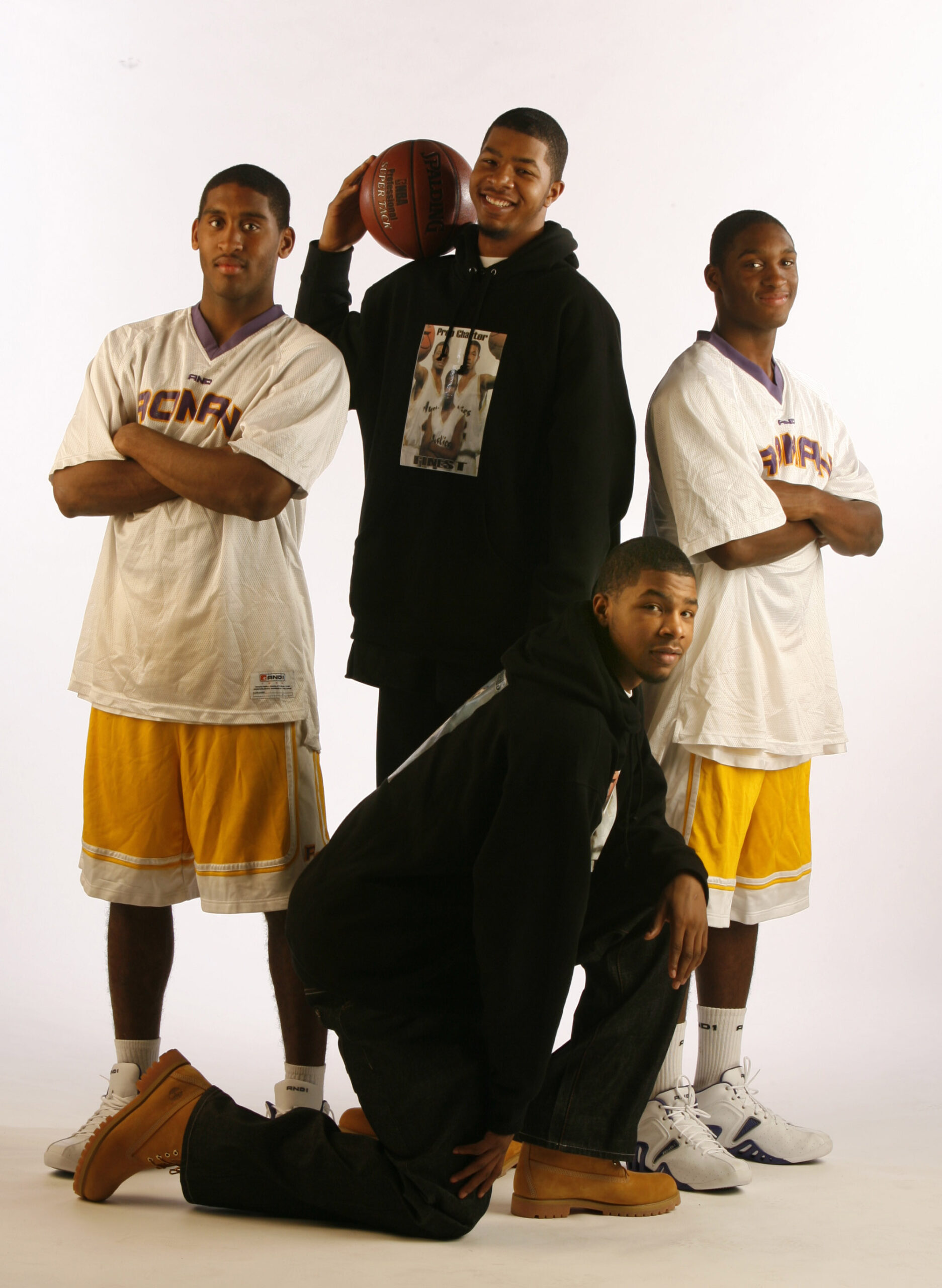
Brad and Brian Wanamaker (bottom) were stars at Roman Catholic High School and went on to play professional basketball.
The Wanamaker brothers quickly became standout players. In 2007, they led Roman to a Catholic League championship under coach Dennis Seddon. After that, their careers took divergent paths.
Brad starred in college at Pittsburgh en route to a seven-year stint in Europe, followed by a four-year stretch in the NBA. Brian struggled with injuries in college and bounced around, eventually finding a permanent home as a player at Texas Wesleyan.
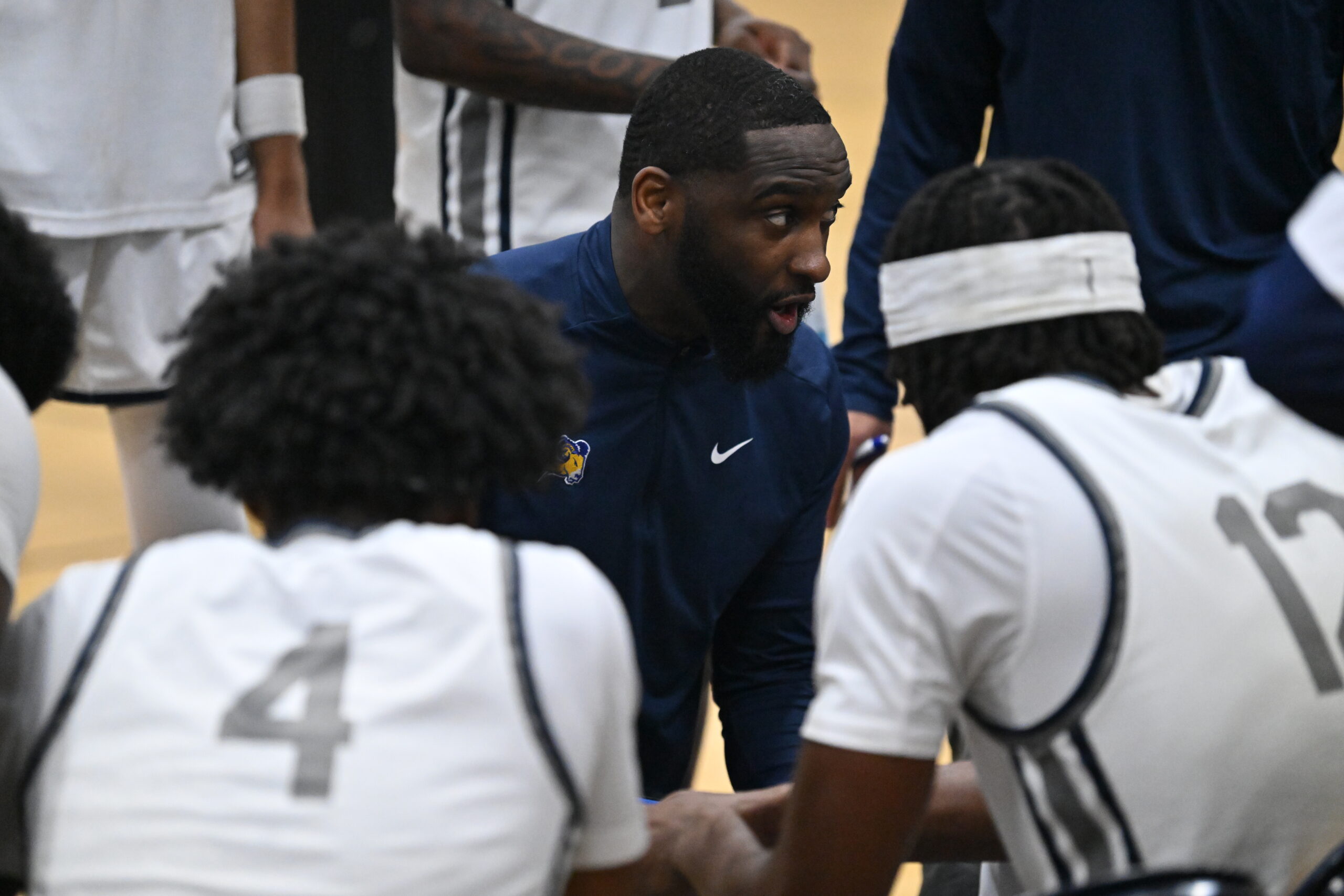
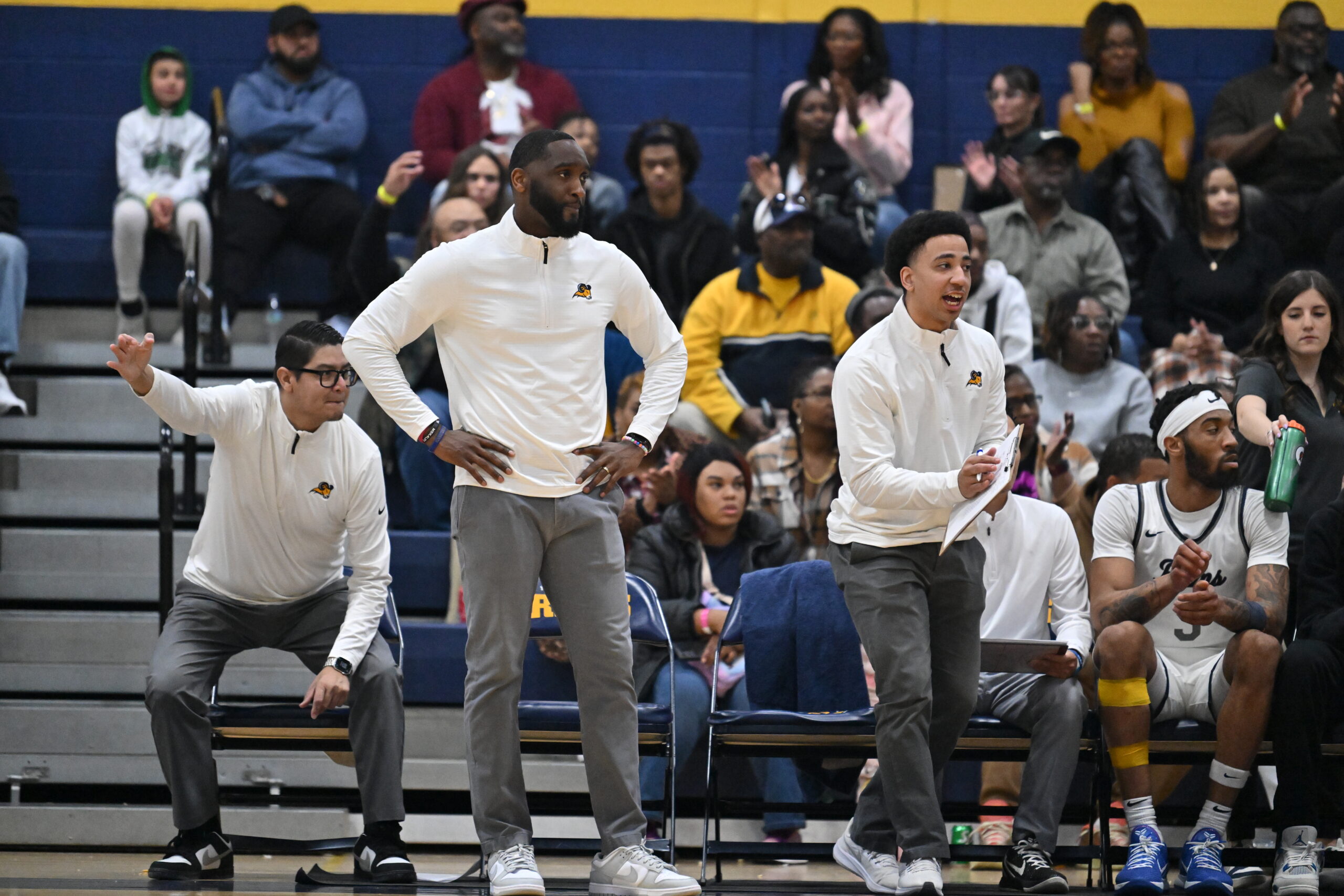
He spent a few years playing overseas but returned to the school as an assistant coach in 2019. The Philadelphia native was named head coach in 2024 and has made an immediate impact, leading the Rams to a 38-20 record since taking over.
He models his approach after Hajj’s. He checks on players’ mental health before berating them for a mistake. He routinely asks how things are going at home and at school.
The team is encouraged to be vulnerable and learn from one another, rather than to react in real time. Wanamaker tells the players to focus on “the person,” because everyone is going through something.
“But I also talk to them about reality,” Wanamaker said. “Yes, everybody wakes up with an excuse they can use, and it’s real. But you can either use it or you can fight through it. You know?”
Brad (left) and Brian (right) Wanamaker with fellow basketball-playing twins, Markieff (top center) and Marcus Morris (kneeling) of Prep Charter in 2006.
A North Philly upbringing
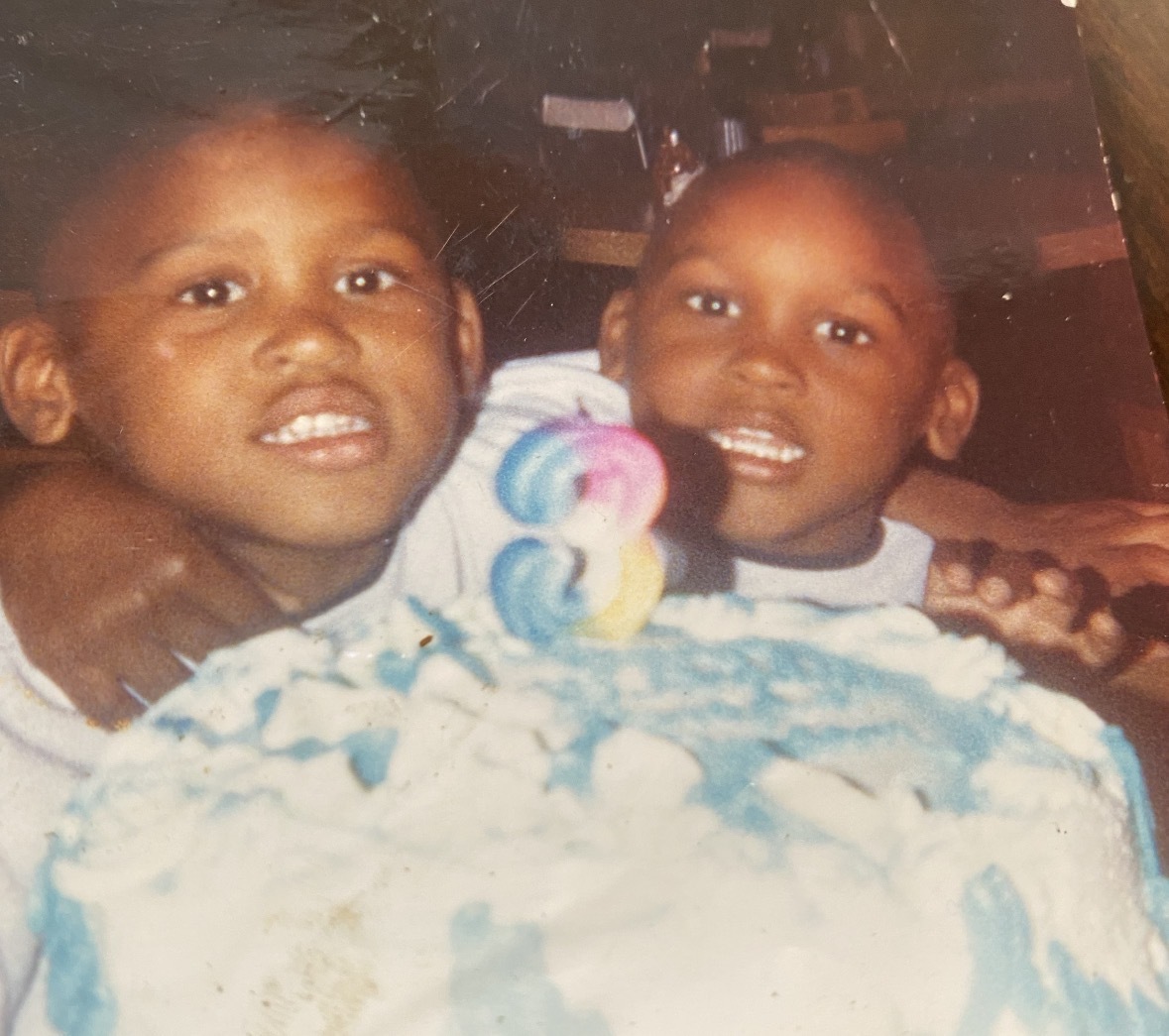
Brian and Brad grew up in a three-story house on 19th Street between Norris and Diamond. They were the second and third of five siblings — Brad is 1 hour, 11 minutes older than Brian — and shared a bedroom on the top level.
This had its shortcomings. The roof had holes, so when it rained, the boys put pots on the floor. Their neighborhood was perilous at times, and from an early age, they became aware of the poverty, gun violence, and drug use around them.
But their childhood was still full of joy. Nineteenth Street was home to a lot of young kids, many of them Brian and Brad’s age. They rode bikes, played tag, and staged impromptu football games outside.
Basketball was their favorite sport. The twins ventured to courts all over the city in search of the fiercest pickup battle: 16th and Berks, 16th and Susquehanna, 25th and Diamond, 22nd and Norris.
They’d shoot hoops before and after school. Local elders would organize basketball tournaments between blocks with trophies for the winners. In seventh grade, a friend, Saleem Elam, asked if they played AAU basketball.
Neither brother knew what that was. But they soon attended a tryout, held their own against more experienced players, and made the team. Before long, they were playing in leagues throughout the area — Gustine Lake, Sonny Hill, Belfield.
The Sonny Hill League was where they met Hajj, who seemed to be part basketball coach, part social worker. He allowed the twins to reimagine the bounds of what a coach could do, a template they’d lean on later in their careers.
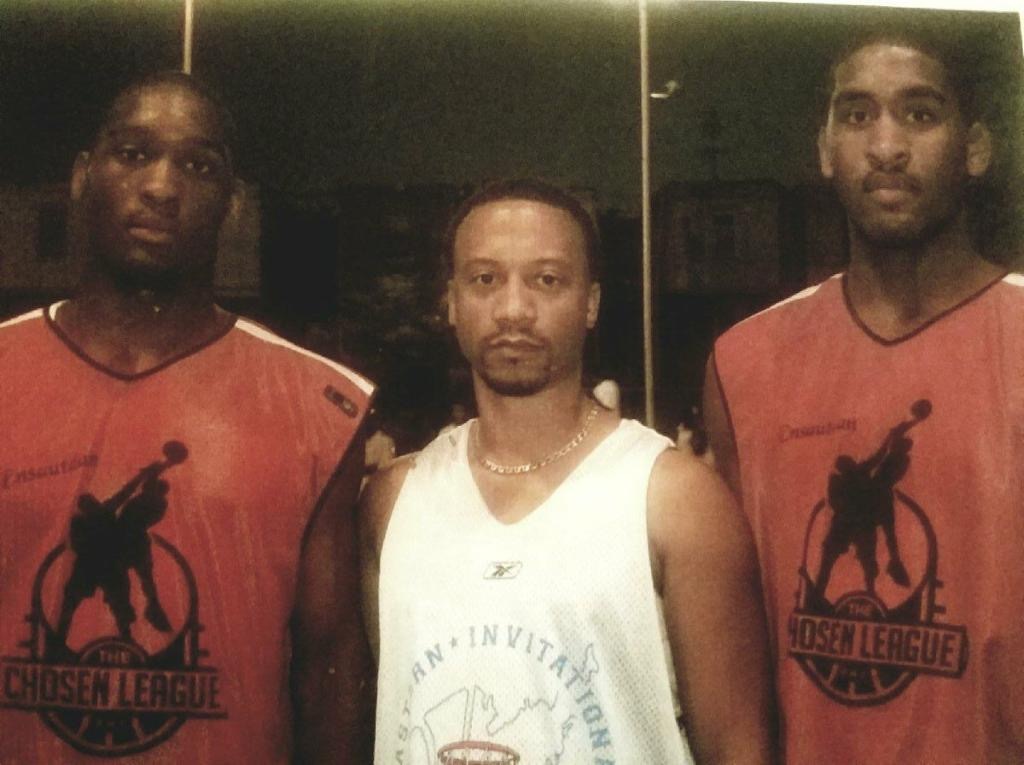
The Wanamaker Brothers looked to Rasool Hajj (center) as a coach and mentor.
“He helped a lot of kids, but also a lot of families,” Brian said. “He helped parents get jobs. He would give people money if they needed it for something. He was always there. He was almost like a big brother to us.”
Hajj became a mentor to the twins. At the time, they were attending Gillespie Junior High School, which closed in 2011. Brian and Brad seemed to learn all the wrong lessons, like how to cut class and replace it with extra gym time.
Teachers wouldn’t enforce the rules, so to the twins, there was no reason to follow them.
“There wasn’t a lot of learning,” Brad said. “Not a lot of structure. I’d go to one class — Ms. Brown, because she knew my dad. So, I’m like, ‘I got to make sure I go to her class.’
“I’d go to homeroom and get marked absent for the day. Then I’m in my brother’s class, I’m at his lunch, I’m playing cards [with him].”
Hajj, who recognized the twins’ untapped potential, introduced them to Seddon and the other Roman Catholic coaches. That break altered their lives.
The high school brought a level of discipline that the Wanamakers weren’t used to. And when they arrived as freshmen, it was a tough adjustment.
Brian walked through the doors in September 2003 and looked at the students around him.
“We wanted to leave because we didn’t know it was an all-boys school,” Brian said. “We was like, ‘What? There’s no girls in the school?’ We were so confused.”
Brian Wanamaker and his brother were standout AAU players who had to adjust to Roman Catholic on and off the court.
They racked up demerits for every conceivable offense, from untucked shirts to facial stubble. Both brothers failed a class in their first semester and were ruled ineligible for the first half of the basketball season.
Because they were on academic probation, they had to go to summer school, wearing slacks, long-sleeved collared shirts, and ties in the sweltering heat. The lesson stuck.
“It just was like, ‘We got to be doing the right thing,’” Brad said.
In sophomore year, Brad started on varsity, and Brian on JV (with some varsity appearances mixed in). They fed off each other in practice and in games.
The players had different strengths. Brian, a 6-foot-2 combo guard, was a better defender and three-point shooter. Brad, a 6-4 shooting guard, was a “laid-back killer” who could score from midrange.
Brian showed all of his emotion. He wasn’t above “mugging a player,” in Brad’s telling, and wasn’t afraid of getting a technical foul. He’d scream and yell. Brad, by contrast, was quiet.
But occasionally, he would give his brother some in-game feedback.
“He’d be like, ‘Hey, play your role!’” Brian said. “He’d be like, ‘Pass it to me. Pass me the ball, and you play defense!’”
Added Brad: “He’d go, ‘Shoot the ball!’ And I’d tell him, ‘Calm down! I need you out here!’ Because sometimes he gets too emotional. And I’m like, ‘Before you get a technical foul, I need you to calm down.’”
Brian Wanamaker helped Roman win the Catholic League title.
The brothers racked up accolades, especially in 2006-07, their senior season. Brian was named second-team All-Catholic and All-City, as well as Defensive Player of the Year. Brad was named the Daily News’ Player of the Year, and was first-team All-State, All-City and All-Catholic as well.
The Cahillites parlayed this success into a historic campaign. The twins led Roman Catholic to a 28-3 record and its first Catholic League championship since 2000.
Rival Neumann Goretti, the No. 1 seed from the Catholic League South, came into the final favored. And the game, played at the Palestra, was close until the very end.
Brad had to sit for a stretch midway through the third quarter after picking up his fourth foul. Without its best player, Roman was at a disadvantage. Brian made sure everyone knew their defensive assignments, so the undermanned Cahillites could stay within striking distance.
His brother returned early in the fourth quarter, and spurred his team to a 17-4 run. With just over a minute remaining in the game, Brian hit a layup to widen Roman’s lead to 58-54. It finished with a 59-56 comeback win.
“I think [Brian] pointed to our student section,” said Brad, now the head coach at Roman Catholic. “We still have the picture at my mom and dad’s house. It was in the newspaper. It was a moment.”
Brian Wanamaker coaching at Texas Wesleyan University.
Coaching through chemo
After graduating, Brad played for Pitt when it was one of the top men’s basketball programs in the country. Brian bounced around; first to Central Connecticut State, then to Lon Morris Junior College in Jacksonville, Texas, and, finally, to Texas Wesleyan in 2009.
He struggled with foot injuries almost every year of his college career. This made it difficult to get steady playing time. But at Wesleyan, he found a fit.
A former coach had recommended the school to him, and Wanamaker initially was skeptical. He’d never heard of it. The campus was in Fort Worth, Texas, about 1,500 miles away from home.
“I didn’t know what Texas Wesleyan was,” he said. “My first semester, I played basketball, stayed in my room, and didn’t talk to teammates, coaches, anyone. I was just like, ‘Why am I here?’”
By his second semester, he realized this would be his last opportunity to play in college. So he decided to embrace the program and was happy he did. Wanamaker felt he could be himself in a way he couldn’t at his previous two stops.
During the summer of 2010, Brian visited Brad at Pitt and trained with him and his teammates. He returned to campus in the fall more confident than ever.
That season, he was named a first-team NAIA All-American and Red River Athletic Conference Player of the Year, averaging 19.1 points, 5.7 rebounds, and 5.0 assists.
The combo guard was drafted into what then was the NBA D-League and ended up playing six seasons in Germany and Lithuania.He returned to Texas Wesleyan in 2019 to finish his degree and work as an assistant coach.
Brian Wanamaker returned to Texas Wesleyan as a coach and has endured a trying off-court experience while leading the Rams program.
In late 2021, during his second season coaching, Wanamaker started to feel back pain. At first, he thought it was workout-related. Maybe he’d pulled or strained a muscle.
But the pain worsened, to the point where he had to stop exercising. He couldn’t sleep in a bed anymore because it would hurt his back, so he would lie flat on the floor.
Wanamaker underwent all sorts of testing, but the doctors didn’t find anything. They hypothesized that his pain was stress-related.
“And I would tell them,” he said, “‘I’m not stressed.’”
In September, after a litany of visits, his primary care doctor received MRI results that showed tumors all over Wanamaker’s back. He went to the hospital for further testing, and was told he had multiple myeloma, a cancer formed in plasma cells that is treatable but has no known cure.
He was a statistical anomaly. The disease is predominantly diagnosed in people 65 years or older. According to the American Cancer Society, only 1% of cases are found in those younger than 35.
Wanamaker was 33.
“That was really hard,” he said. “Because, obviously, when you hear cancer, you think death. And then you hear, ‘No cure.’ It was hard for me to process.”
Brian Wanamaker will lead Texas Wesleyan in the Sooner Athletic Conference Tournament starting Wednesday.
The next day, the coach started seven months of chemotherapy. Many on the team assumed he would be out for the rest of the year.
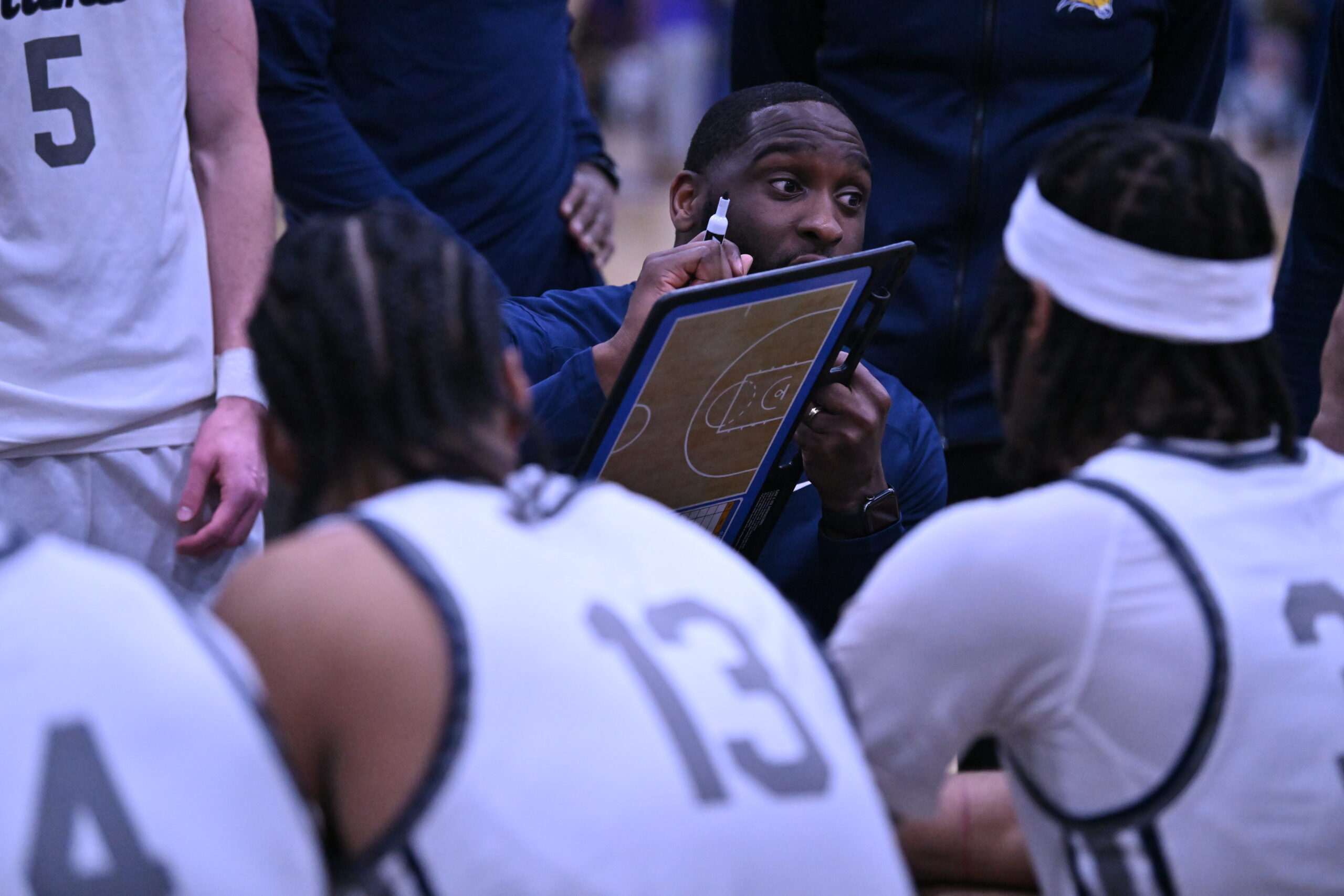
But Wanamaker was back in the gym that week, helping at practice and eventually sitting on the bench during games.
He had little energy and often felt sick. His immune system was at a higher risk than usual. But Wanamaker felt he needed to do it. So every day, he’d drive to Texas Oncology for his treatment, and would head to Texas Wesleyan afterward.
“I was probably more than half-asleep,” he said. “I was going through what I was going through, but I knew as a coach, players are going through stuff, too. It was just being there for them.”
Guard Akili Vining had recently lost his father to cancer. Point guard Matthias Nero had gotten into a severe car accident, which led to the death of his close friend.
Wanamaker was acutely aware of their struggles and those of other players. He decided to pour himself into his team.
“Coach B would probably text me every day,” Nero said. “He would make sure I was in the right headspace, to see if I needed help. He’d pull me aside and just tell me, ‘If you need anything — this isn’t about basketball. This is about the future and your mental health.’”
Wanamaker received a blood transfusion in May 2023. His father and brother visited him in the hospital shortly after. Seeing him hooked up to a cluster of machines was difficult.
“It was like, ‘I can’t lose my brother,’” Brad said. “‘Not the person I came into this world with.’”
Brad Wanamaker (left) has had to monitor his twin brother’s condition from afar.
Eventually, Brian’s chemotherapy schedule was reduced from daily to monthly treatments. Through it all, he rarely missed a practice or a game, which became a source of inspiration for his team.
The players could see their coach had changed. He’d lost hair and weight, and his skin looked dull. Sometimes, he’d arrive with a bandage on his arm to cover a needle mark.
But he was showing up, just like they were.
“If he can fight though chemo,” Vining told a local TV affiliate, “I can fight through practice.”
Brian Wanamaker has won the respect of his players by caring about them as players and people.
‘People are going to say I cared’
In April 2024, Wesleyan’s head coach, Brennen Shingleton, resigned to work for a business in Fort Worth. Wanamaker was named interim coach but also applied for the full-time job.
He wasn’t alone. Athletic director Ricky Dotson said he received “a ton” of applications, from former NBA assistants to former Division I head coaches. He narrowed it down to four finalists, interviewing them throughout the spring.
Despite the high caliber of candidates, Wanamaker still set himself apart. It wasn’t just that he was familiar with the team. It was that the players respected him, and looked to the Philadelphia native as a role model.
Dotson knew the coach’s character. He could see that this would not be a surface-level job for him. By the end of the interviews, he was convinced that Wanamaker was the best choice, even with the uncertainty about his health.
“I just never really doubted that he would be able to do it,” Dotson said. “And he’s moved right on through.”
That June, Wanamaker was officially named head coach. He immediately got to work, targeting bigger, more athletic players in hopes of building a hard-nosed, physical team.
One such player was Khalil Turner, a 6-8 guard from Northeast Philly who had shuffled through four colleges before taking a two-year hiatus. Like Wanamaker, Turner was a Hajj disciple in need of a new home.
The former Sonny Hill coach was confident that Wesleyan would be the right fit.
“Listen, man, I got a place for you,” Hajj told him. “It’s a Philly coach. He’s going to treat you like family. All you’ve got to do is just go out there and put the work in, and everything is going to fall into place.”
The two initially butted heads, usually over inconsequential things. Turner said that one day, in practice, they almost got into a physical fight. But Wanamaker never gave up on him. He didn’t suspend Turner or revoke his scholarship.
Brian Wanamaker connected with another former Philly star, Khalil Turner, who arrived in Fort Worth.
Eventually, the guard began to open up about his personal struggles. He had a family member who was sick at home. He told the coach that he needed a job to make some extra money. Wanamaker found him one at a local laundromat.
Now, Turner says they are “best buds.” Last year, when the incoming freshmen arrived on campus, the senior guard was the first to explain Wanamaker’s predicament.
“We told them, ‘Hey, Coach is dealing with this,’” Turner said. “‘So from time to time, he might be a little moody. But this is why he’s moody. He’s worried about his chemo. So don’t stress him out too much.’
“The vets feel like if Coach is giving his all, with his chemo, we should give it our all every day in practice,” Turner added, “and every day on the court. He’s going above and beyond for us, so we should do the same.”
After consecutive losing seasons, the Rams now look like a different team. They have adopted some of Wanamaker’s characteristics, playing a faster, tougher brand of basketball.
They set hard screens and make hard cuts. They dive on the floor for loose balls and swarm opposing offenses. And they are seeing results.
In 2024-25, Texas Wesleyan went 19-11, earning an NAIA National Tournament berth. This year, it is 19-9.
But Wanamaker isn’t just focused on the numbers.
He knows his players have changed as people, too. They are more emotionally available. They are better able to communicate their feelings. They are less reactionary than when they first arrived.
And to the Philadelphia native, that is more valuable than anything.
“It gives me my purpose,” he said. “And no matter what happens, I know that, when it’s all said and done, people are going to say I cared.”
Dave Allen knows how to cultivate a winning culture.
With stops at Eastern and Cherry Hill West, Allen, now in his 13th season as the Cherry Hill East boys’ basketball coach, has amassed 400 career wins at the helm, earning 28 playoff victories and two Group IV championships in the process.
This year’s Cougars look like a direct extension of Allen’s winning ways.
East ended the regular season 21-3, winning seven of its eight Olympic Conference matchups. The Cougars are slated to host Toms River North (9-17, 3-7 Shore) in the first round of the NJSIAA South Jersey Group IV Tournament on Thursday at 4 p.m.
The Cougars are looking to build off last season’s playoff run, in which they fell to Lenape, 48-47, in the Group IV championship — just a point away from raising their third championship banner in program history.
Allen, however, would be the first to say that this year’s team is different.
“Traditionally, we’ve always been a three-point shooting team,” Allen said. “We push in transition but also play some control-tempo basketball, but this year, we’ve been more of a pressing team, more of a team trying to play transition more so than we had in the past. At some points in the year, we were averaging over 70 points a game.”
Cherry Hill East junior Chris Abreu is averaging 16.8 points, 6.3 assists, and 6.1 rebounds this season.
The catalyst for this change, Allen says, has been the team’s “really good guard play.”
This backcourt effort is led by junior Chris Abreu. The 6-foot-1 guard transferred to East after his freshman season at Paul VI and has been a constant triple-double threat. He’s averaging 16.8 points, 6.3 assists, and 6.1 rebounds this season.
“We’re a fast-paced team,” Abreu said. “Push the ball a lot and push it in transition.
“I’m really excited for the playoffs, actually.”
Thursday will mark the second meeting between East and Toms River North this season. On Dec. 20, the Cougars trounced the Mariners, 91-38, behind Abreu’s triple-double (14 points, 11 assists, and 10 rebounds.)
Allen indicated that his team will look to key in on the Mariners’ Jake Greenberg. The sophomore guard is averaging 13.5 points and is known to get hot from deep.
“[Greenfield is] solid,” Allen added. “He was solid against us the first time, and he’s having a good year for them, so we’re going to have to try to keep up what we’re doing defensively.”
‘Reshift some things’
To start the season, Abreu had a running mate in sophomore Jamieson Young. Against the Mariners, Young totaled 23 points. The combo guard was the Cougars’ leading scorer, averaging 21.8 points through the team’s first 12 games.
However, on Jan. 17 against St. Rose, Jameson went to save the ball from going out of bounds, landing awkwardly on his right ankle, which he had previously tweaked in the summer. This time, it required surgery. He was ruled out for the remainder of the season.
“[Young] gave us a lot in terms of his ability on the floor,” Allen said “He was our secondary ball handler and also our leading scorer. … We had to then kind of reshift some things to make up for those 22 points [per game].”
Chris Abreu says East is a “fast-paced team” this season.
First, Allen’s eyes turned to Abreu, challenging the junior to take over the scoring load and “make people better” around him. He did just that, as East won five straight following Young’s injury.
“[The message was] to just stay focused, stay disciplined,” Abreu said. “It’s hard with injuries and us being hurt, but you’ve obviously just got to push through it.”
Allen also turned to senior guard Chris Delgado. The four-year starter scored a career-high 28 points in the Cougars’ first game without Young, while surpassing 1,000 career points in the process.
“The best thing I can say about [Delgado] is that he’s a kid we want our younger players to emulate. That’s it,” Allen said. “He’s a kid who is a program kid who sacrifices. All he wants to do is win.”
This year, Delgado is averaging 11.5 points, 1.5 assists, and 2.25 rebounds, while being tasked to guard the other team’s best player. The senior has seen two deep playoff runs with the Cougars: a Group IV semifinal loss in his freshman year and last year’s final loss.
Cherry Hill East senior Chris Delgado is averaging 11.5 points, 1.5 assists, and 2.25 rebounds this season.
This will be the senior captain’s final chance to earn a championship. Consistent messaging is important for Allen, but winning is not the only thing the coach wants his players to focus on.
“Win or lose, the process is what’s going to be lasting for players,” Allen said. “Even when you win, that’s not what’s lasting. … What happens is, when you win, you change the goalpost — you start thinking about competing again.”
Jim Reeves, scissors in hand, directed traffic Sunday afternoon as each Father Judge player climbed the ladder at the Palestra to cut the net twine by twine after the Crusaders won their second straight Catholic League boys’ basketball title.
Finally, the net was hanging by just a few threads.
“Where’s Coach?” Reeves shouted over the crowd still buzzing from a 55-52 win over Neumann Goretti.
And there he was: Chris Roantree, the former Judge power forward and linebacker who played college football and got his start coaching basketball by shepherding fifth graders at the Rhawnhurst Recreation Center.
Roantree promised Judge’s president in 2021 that the Crusaders — who often just felt like a team on the schedule — would win a Catholic League title in five years if he was hired. Judge had not won since 1998, but Roantree had a plan. The job was his.
Roantree followed through last February in season No. 5 and climbed the ladder on Sunday to cut the nets down for a second time, proving that last year was more than just a good story.
Father Judge’s Max Moshinski (center) begins the celebration with teammates after the win over Neumann Goretti.
The Catholic League has long been dominated by schools like Roman Catholic and Neumann Goretti, which Roantree called Sunday “the blue bloods.” But the team dressed in Columbia Blue — the same program that won just one Catholic League game the season before Roantree arrived — is suddenly at the head of the table.
“Our goal was to try to be one of those programs like Neumann and Roman and build a legacy,” senior Max Moshinski said. “We’re at the top of the mountain now. When we first got here, we knew it would be a tough climb, but we knew if we showed up every day and put the work in, then we’d eventually get there. I think you can say we did that. We’re at the top of the mountain and now we need to stay here and keep getting back here.”
A five-year plan
Father Judge was looking for a new head coach in the spring of 2021 when Reeves pushed Roantree, his teammate on the 1998 championship squad, to go for it.
They met with Judge’s president, Brian King, at Reeves’ home in the Far Northeast and Roantree detailed his plan at the dining room table. In four years, the Crusaders would play at the Palestra in the Catholic League semifinals. In five years, they’d win a title. Both of those came true.
But not even Roantree could promise that Year 6 would bring a second straight title for a program that was often an afterthought.
“We said we could do it, but to do it is different,” said Reeves, now an assistant coach. “To go back-to-back is just crazy. People go back-to-back, but to be where we were to where we are now is crazy. It’s unheard of.”
The Father Judge coaches (right) celebrate winning a second straight PCL title.
A 1998 Catholic League championship shirt hung behind the register for years at Marinucci’s on Brous Avenue, the deli owned by Reeves’ mother. It hung almost as proof that Judge did actually win a title before.
The Crusaders had some moments since that 1998 championship, but it was hard to ever group Judge with teams like Roman and Neumann Goretti. The Crusaders were in a different tier. But the new coach believed.
“It’s the players, man,” Roantree said. “Everyone talks about coaches and what makes you a good coach. But at the end of the day it’s about Jimmys and Joes. Them buying into our culture. When we first got here, we talked about the Palestra and everyone thought we were crazy. The players thought we were crazy. But then it continued to build. Then guys came through, accepted the culture, and accepted being coached hard. We coach these guys hard and they buy in. It’s not easy.”
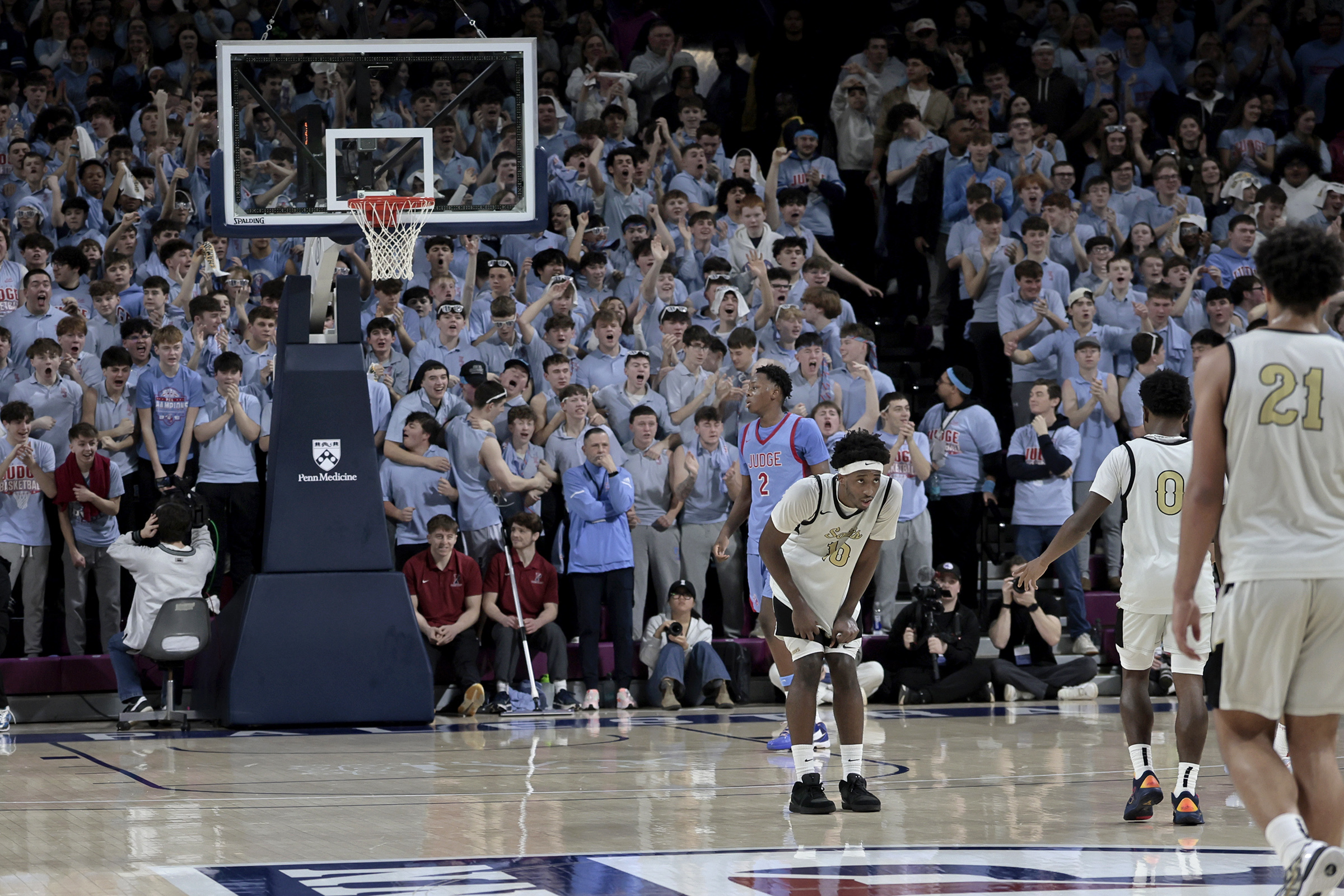
Father Judge fans after their team won the Catholic League final at the Palestra.
Winning back-to-back titles was not the plan when Roantree returned home from Lycoming College and started coaching at the rec center. But he quickly fell in love with coaching, realizing he can have an impact on kids like Bill Fox did for him at Judge in the 1990s.
He soon started coaching AAU and then joined Archbishop Wood’s staff as an assistant for eight seasons to John Mosco. He coached Collin Gillespie and helped navigate the underdog’s journey to Villanova. Roantree was back at Judge in June 2021 with a five-year plan. But he still needed his Jimmys and Joes.
He swayed Derrick Morton-Rivera, the Temple-bound guard who lives in Mayfair but could have gone to Neumann Goretti like his father. He spotted Moshinski at a St. Albert the Great CYO game and asked him to give Judge a chance. Rocco Westfield’s parents went to Archbishop Ryan and he can walk to that school from his home in Morrell Park. But Westfield went to Judge to play for Roantree, who seemed to attend all of his youth games.
“I really trusted them,” Westfield said. “Now we’ve won back-to-back titles. Why not come to Judge?”
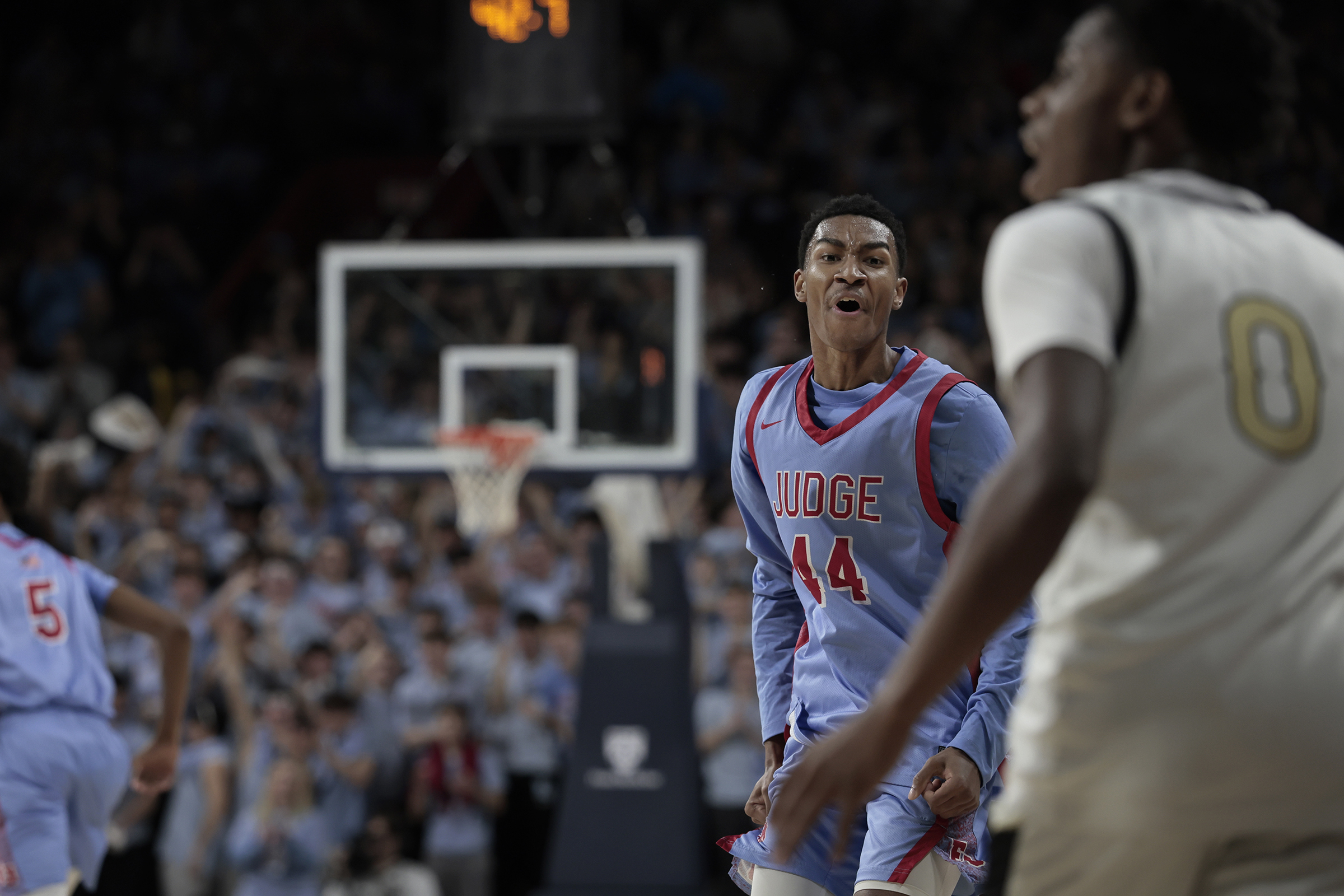
Father Judge’s Derrick Morton-Rivera reacts after hitting a three-pointer on Sunday.
Judge’s win total increased in each of Roantree’s first five seasons before the Crusaders broke through last year for their first title in 27 years. Their rise to the top of the league was not an overnight sensation — “A lot of roller-coaster rides,” Reeves said — but there’s no denying now that the school on Solly Avenue long known for soccer players is now a basketball power.
“There’s some guys who are waking up at 6:30 a.m. to get to school on time,” Roantree said. “They want to be a part of something special and I think we have something special. … These dudes will live on forever and rely on these friendships for the rest of their lives.”
Chicken and rice
The gatherings started with just a few players as the teenagers needed a place to hang on Friday afternoons before they played a game that night. Soon, Margaret Westfield was cooking for the whole team.
“Chicken and rice,” her husband John said.
The players ate on Fridays in the Westfields’ kitchen and then sprawled out around the house for their pregame nap as the rowhouse became like a hostel.
“We have people on the couches, upstairs, downstairs,” John Westfield said.
The players who came to Judge to play for Roantree bonded over chicken and rice, coming together to become the unlikely kings of the Catholic League.
“It’s a special bond,” Rocco Westfield said. “We’re always with each other. I mean, I love these guys.”
Neumann Goretti’s Marquis Newson (10) pauses after Father Judge halted the Saints on a possession.
This season wasn’t easy — Morton-Rivera was on crutches in the start of the season and the Crusaders lost to Neumann Goretti earlier this month — but Judge was there on Sunday at a sold-out Palestra.
The postseason included wins over Roman, Wood, and Neumann Goretti to capture the title. The Crusaders won their second straight title by knocking off the class of the Catholic League, leaving no doubt that they are for real.
“That class that Chris brought in was the turning point,” John Westfield said. “That was the turning point to put it on the map. There was a guy tonight who said something to me: ‘Thanks for sending your son to Judge and helping put Father Judge basketball back on the map.’ Just a random fan. That’s what it means to people.”
The net fell from the rim Sunday afternoon after Roantree trimmed the final threads. He waved it over his head as the student section — a few hundred crazies dressed in blue — roared.
The coach tossed the net to Morton-Rivera, who will likely be remembered as Judge’s all-time player. A second title was complete. And then the student section turned the page to next season, chanting, “Three-peat.” That’s what happens when you become the king.
“We have a bunch of dudes who bought into one common goal,” Roantree said. “We always talk about team success drives individual success. We bought into that one goal. You look into everyone’s goal sheet at the beginning of the year and there was one goal on there for our team goal: Cut the nets down at the Palestra.”
With less than a minute remaining in Sunday’s boys Public League championship game, West Philadelphia High School’s Tamir Lett drilled a three-pointer to give the Speedboys a one-point edge.
While the fans at La Salle’s John E. Glaser Arena were sent into a frenzy, Imhotep head coach Andre Noble stayed calm and composed on the sideline.
He and the Panthers had been in this position before. In fact, they entered the game as the five-time defending champions and showed why to close out the game. Imhotep forced two turnovers as forward Zaahir Muhammad-Gray and guard Ian Smith’s late-game free throws polished off a 39-35 win.
“If everyone is rattled and nervous, then we’re not going to be able to execute,” Noble said. “But credit to our guys for just getting our best player the ball and him making plays to get us where we need.”
Noble’s Panthers (20-6, 9-1) have now won six consecutive Public League championships, etching themselves into history in Philadelphia high school basketball lore. Muhammad-Gray won MVP honors after scoring 15 points, while West Philadelphia (21-6, 7-3) guard Khabir Washington had 17.
The first few minutes of Sunday’s matchup began slowly, with both teams attempting to establish control. The Panthers initially got that control behind Muhammad-Gray’s efforts, especially on the glass. The junior, who missed last year’s championship due to a torn ACL, flew in for rebounds time and time again as Imhotep mounted an early 5-1 lead.
But then, West Philadelphia stormed back behind its hustle. Guard Jayden Mckie forced multiple steals while forward Isaiah Smith established control in the paint to spur a 9-0 run and give the Speedboys a 10-5 lead after forward Souleymane Bagaga knocked down a three to end the quarter.
The momentum quickly flipped back to the Panther side after the Speedboys went into halftime up by one. Muhammad-Gray poured in seven straight points to tie the game before forward Daouda Niare hammered down a dunk to give the Panthers a 21-18 lead and put West Philadelphia on its heels.
After briefly losing the lead, Imhotep rattled off an 8-0 run, which Muhammad-Gray punctuated with back-to-back steals, including one he turned into a fastbreak layup to give the Panthers a five-point advantage heading into the fourth quarter.
Andre Noble’s Imhotep Panthers were pushed to the limit by West Philadelphia but found a way behind their defense late.
“Proud of Zaahir,” Noble said. “[He] worked really hard on his recovery, worked really hard as a young man, so really proud that he gets to have this moment.”
Washington led a Speedboy surge to help West Philadelphia creep back into the game during the fourth quarter. He had West Philadelphia’s first eight points in the quarter before Lett drilled his go-ahead three-pointer with under a minute remaining. Mckie poked away two steals in the frame to stifle the Panthers’ offense as the Speedboys generated momentum.
At the end of the day, it wasn’t enough as Imhotep eventually retook the lead and pulled out a win.
“You have to show more character than the blowouts,” Noble said. “So that this game was tight and we were able to still pull it out. Even got down with under a minute to go and for us to pull it out and win the game, [that] showed a lot of character and poise from our squad.”
Noble’s team is now etched in history after recording a sixth consecutive Public League championship and his 13th overall as Panthers coach. For him, it speaks to the players and also the legacy of the program in a league and tradition that spans beyond them.
“Proud of the legacy of this program,” Noble said. “These guys and the five teams before them. This league is over 100 years old and the Imhotep Panthers are the first to win six in a row. So that speaks a lot.”