Category: History

  • A new streaming series tells the story of America through the lens of Philadelphia

    A new streaming series tells the story of America through the lens of Philadelphia

    By 2019, after a decade of producing dozens of documentaries about Philadelphia history, the filmmakers at History Making Productions realized they had more than just the story of a city.

    They had the story of America.

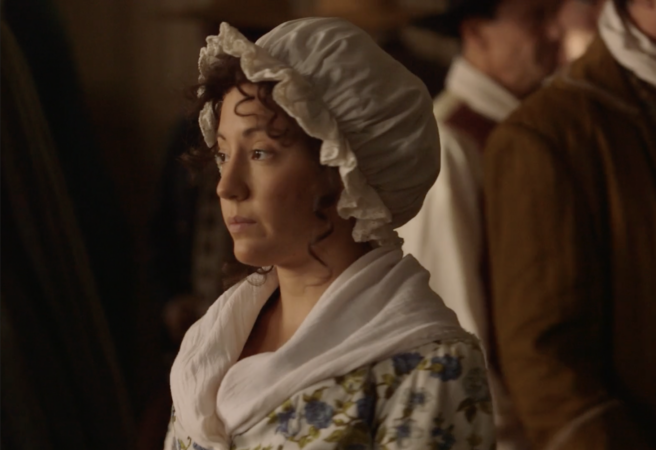
    On Friday, the studio released its epic, new telling of that 400-year-old story: In Pursuit: Philadelphia and the Making of America. Directed by documentary filmmaker Andrew Ferrett and written by author and historian Nathaniel Popkin — and mixing modern footage with historical recreation and more than 600 on-camera interviews — the 10-episode series explores the history of America through the lens of Philadelphia, its birthplace.
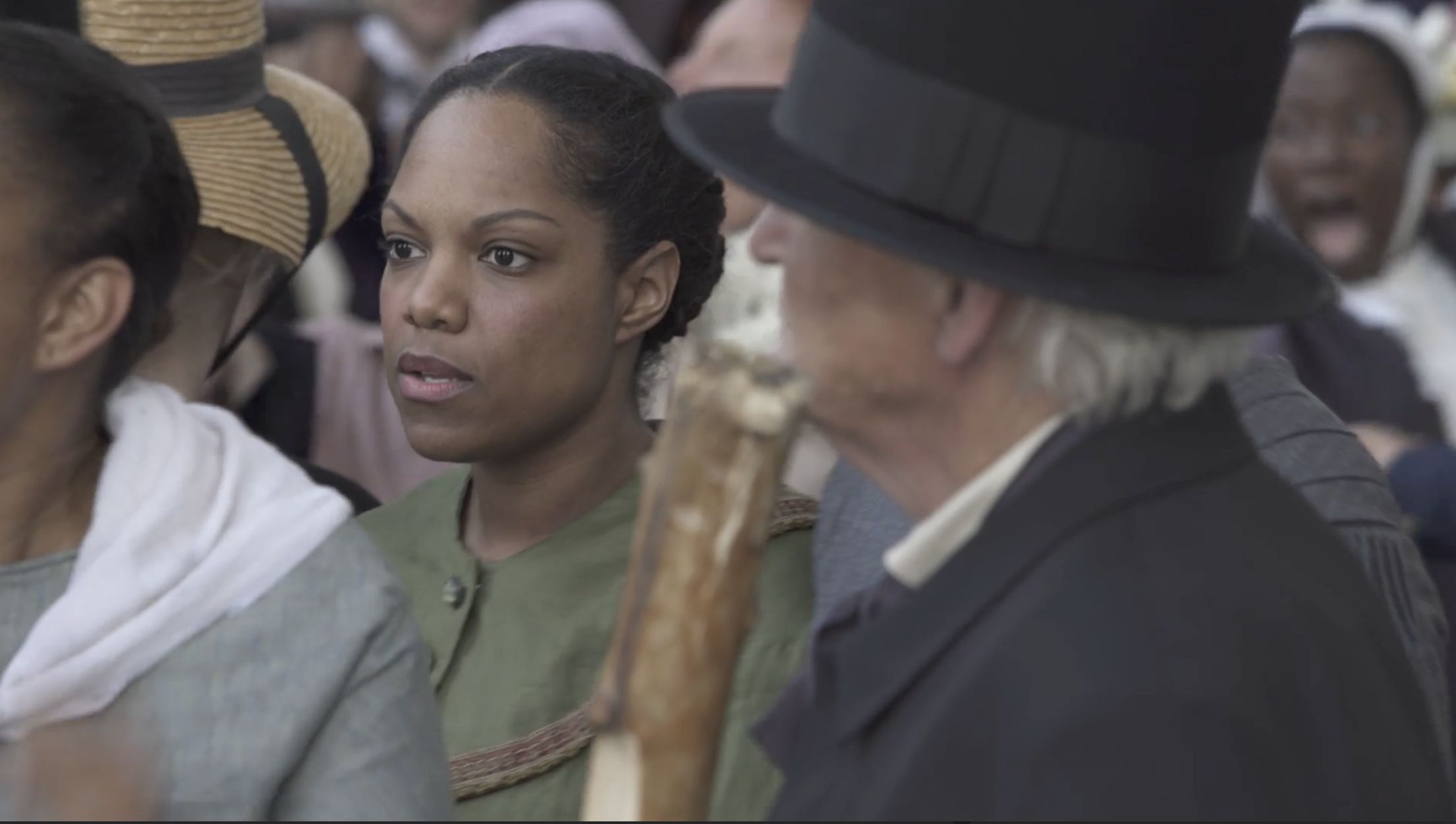
    Belinda Davis as Sarah Forten in “In Pursuit: Philadelphia and the Making of America.”

    Timed to coincide with the 250th anniversary of the Declaration of Independence in 2026, known as the Semiquincentennial, the series provocatively grapples with urgent questions, like how did the American experiment actually unfold? And how can it endure?

    “Philadelphia is not just the birthplace of American democracy — it has been its proving ground,” said Sam Katz, series creator, executive producer, and founder of History Making Productions. “This series looks honestly at how ideals were formed, challenged, expanded, and sometimes betrayed, and why that history matters so urgently.”

    ‘A national moment’

    Spanning 400 years of Philadelphia history, from its indigenous roots to the MOVE Bombing the series is equal parts entertainment and civic project. Funded by Katz and philanthropies like Pew Center for Arts & Heritage, Penn Medicine, and Lindy Communities, the series premiered at the National Constitution Center on Thursday.

    Episode One is now streaming online. Katz and the filmmakers will host screenings and community conversations at Pennsbury Manor in Bucks County on Sunday, and another screening Feb. 26 at the Bok Building in South Philadelphia.

    Throughout 2026, as the city and country celebrate the national milestone, a citywide “In Pursuit of History Film Festival” will promote each new installment with monthly screenings and public events. 6ABC will also air monthly hourlong shows to highlight new episodes.
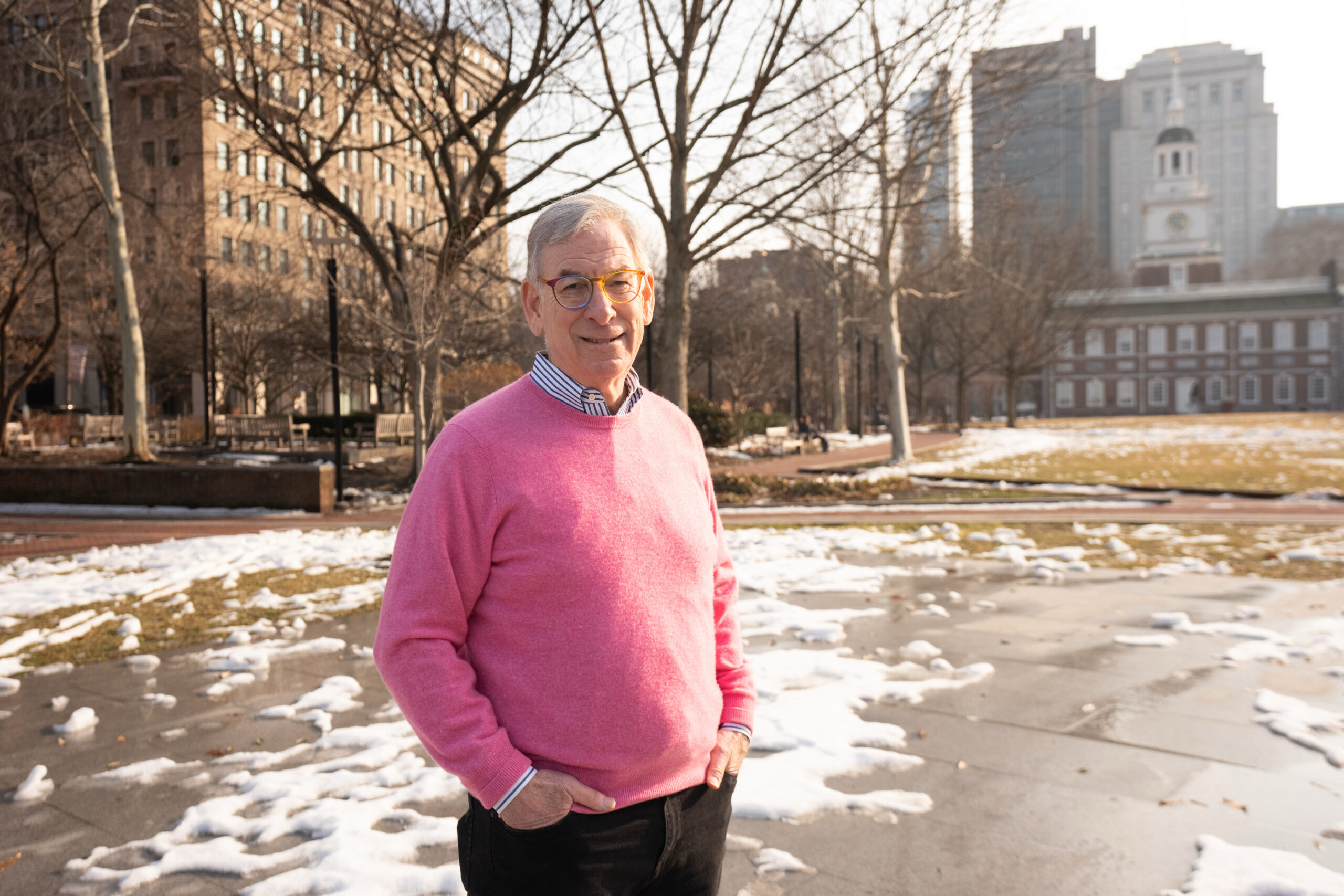
    Sam Katz at Independence Hall, in Philadelphia, Tuesday, Feb. 17, 2026, in Philadelphia

    From the beginning, the project was meant to get people talking about the true meaning of the American experience, and those it has left behind.

    “We’re going to get partners all over the city, and we’re going to have screenings all over the place,” said Katz, the civic-leader-turned-producer. “We’re going to create opportunities for people to come and meet the filmmakers, or meet a historian or an artist, who will then lead a conversation. It really is an opportunity for Philadelphia to take stock of itself.”

    Popkin, who co-founded Hidden City Daily, said the project tells the story of events that shaped a city and a country founded on ideals not yet fully realized — and now divided and tested as they’ve been in decades.

    “The timing is perfect,” he said. “I think a film can really launch a lot of conversations. This is a moment for us as a nation.”

    Fresh portals

    Ferrett, who grew up in Bucks County, and has been directing and producing films at History Making Productions for more than 15 years, said the project revealed itself.

    For earlier Philly projects — including The Great Experiment, an Emmy-award winning, 14-part docuseries spanning 500 years of Philly history, and Urban Trinity: The Story of Catholic Philadelphia — the filmmakers had amassed hundreds of unused hours of interviews with local and national historians, artists, and cultural leaders.

    Over the years, much of it had to be left on the cutting room floor, including magical moments that he said opened fresh portals to Philly history, said Ferrett.

    “We talked to pretty much anyone you can imagine who was either involved with studying Philadelphia history, or in the case of 20th-century history, a lot of witnesses to it,” he said.
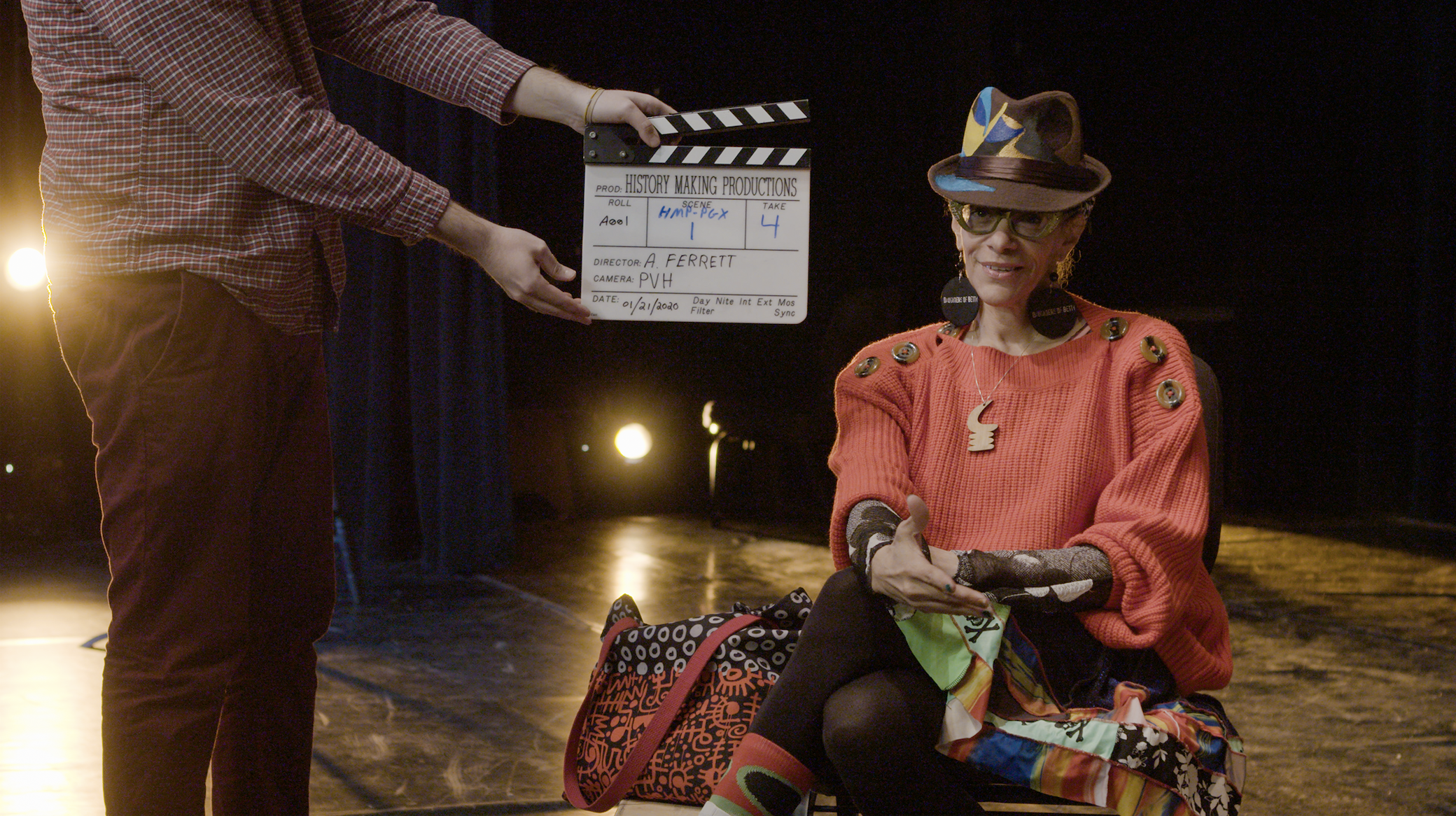
    Poet Ursula Rucker during filming of “In Pursuit: Philadelphia and the Making of America.” The new 10-part docuseries examines the history of America, through the story of Philadlephia.

    Besides, he said, nowhere else could hold a better mirror to America, than the place of its birth.

    “It really became obvious to us that what we have here is much more than a local history,” he said. “It’s a history of the whole United States because so many consequential moments that shaped the country’s history went through Philadelphia.”

    History that feels alive

    Setting out to tell the story anew, Katz raised money to shoot updated interviews and fresh historical recreations.

    Meanwhile, history did not slow down, from the COVID-19 pandemic, to the killing of George Floyd, and the Black Lives Matter movements, to Trump, and immigration crackdowns.

    “We were asking how do we deal with history while all this is happening,” Katz said. “We were writing about it right now.”
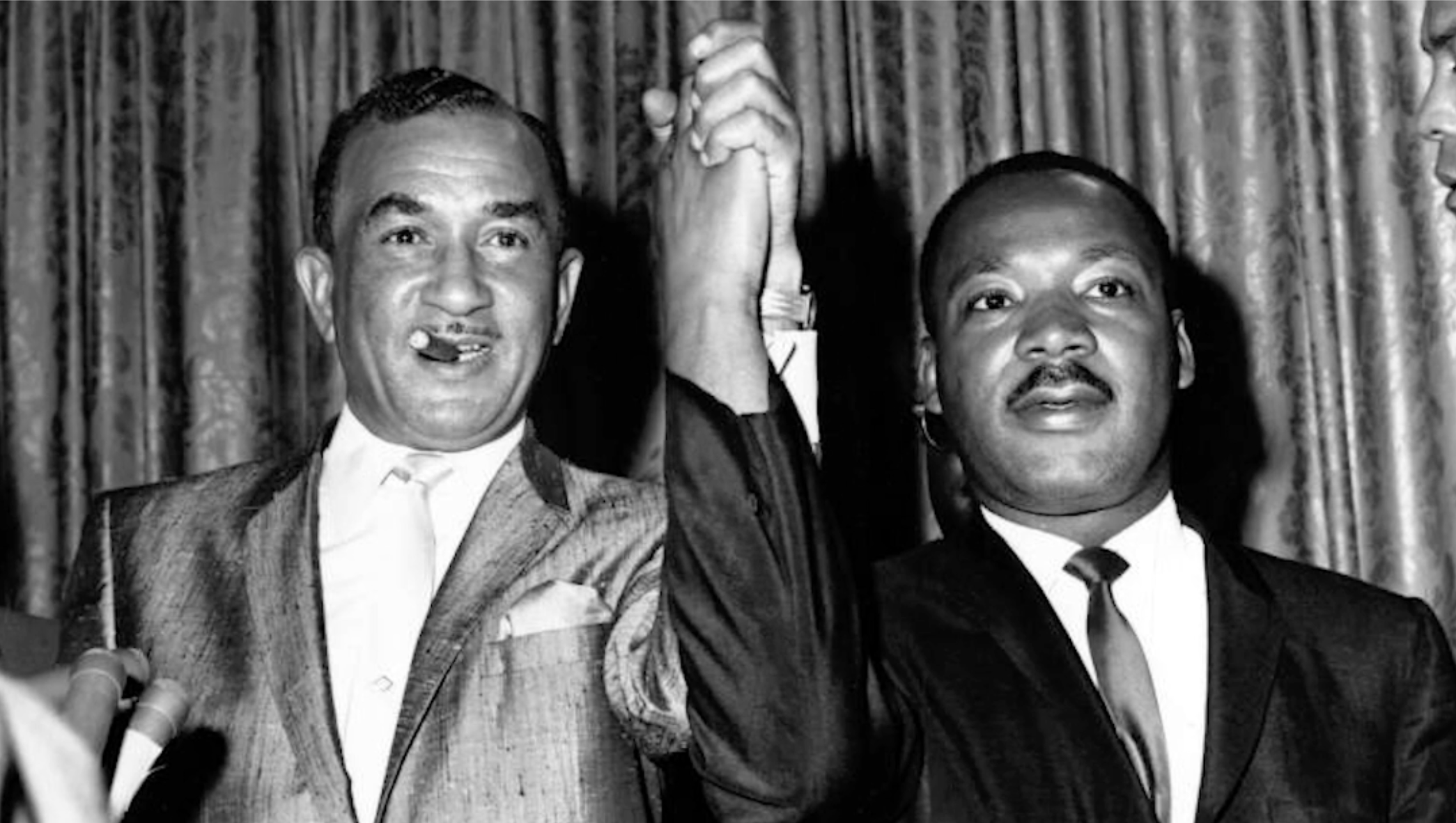
    Cecil B. Moore and Martin Luther King, Jr in footage from “In Pursuit: Philadelphia and the Making of America.”

    Narrated in a warm, resonant baritone by actor Michael Boatman, known for roles in shows Spin City and The Good Wife, In Pursuit is no dull, black-and-white history. The city feels alive, the stakes serious and undecided.

    Threading modern day footage of bustling Philly streetscapes and soaring neighborhood shots with commentary and historical recreations imprints the series with a powerful immediacy.

    The story stretches far beyond 1776, though the dramatic details of that sweltering summer in Philadelphia are recounted in episode three in gripping scenes of refreshingly believable historical recreations.

    “We were able to shoot these lush and full reenactments,” said Ferrett, of all 10 episodes. “Sam was always like, ‘Where’s the dirt? I don’t want to see people with perfect teeth and smiling.’”

    The start

    Episode One, “Freedom (to 1700),” begins at the beginning, pulling no punches as it tells the story of the Lenape people, Philadelphia’s earliest Indigenous settlers — and of the generations of Dutch and other European colonists’ efforts to eradicate them through violence and disease.

    It surprises even in the telling of William Penn, recounting how the rebellious aristocrat’s non-conformist ways landed him in jail more than once, before he founded a City of Brotherly Love meant to be a better world, and a testing ground of the most advanced ideals in Europe.

    The episode also showcases what Ferrett describes as “deepeners,” when the story cuts away from the arc of history for moments of reflection from modern Philly voices.

    “We all feel it here … it’s all in our bloodstream,” poet Ursula Rucker says in the episode. “What does this city mean to me? Everything. Everything.”
  • A nearly 250-year-old hospital’s closure was announced on this week in Philly history

    A nearly 250-year-old hospital’s closure was announced on this week in Philly history

    In the wake of the U.S. Bicentennial, in which Philadelphia was at the center of a yearlong celebration of the country’s 200th birthday, one of the city’s contributions to public health was put on the chopping block.

    On Feb. 15, 1977, city officials confirmed that Mayor Frank Rizzo was closing Philadelphia General Hospital.

    The poorhouse

    Philadelphia General Hospital traced its lineage back to 1729, predating even the revered Pennsylvania Hospital, which was founded in 1751 and is generally considered the nation’s first chartered hospital.

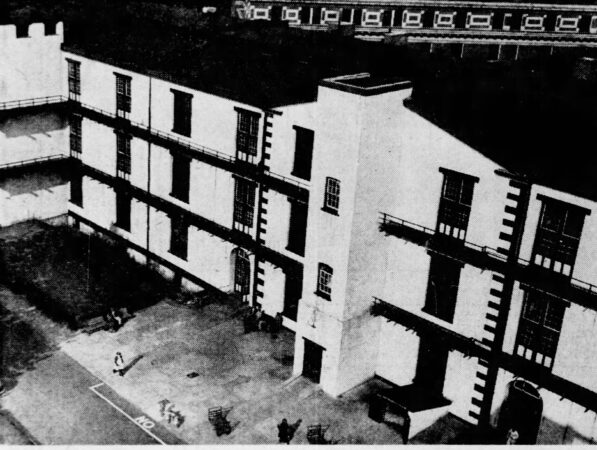
    Philadelphia General Hospital was originally established at 10th and Spruce Streets as an almshouse, also known as an English poorhouse.

    “The institution reflected the idea that communities assume some responsibility for those unable to do so themselves,” Jean Whelan, former president of the American Association for the History of Nursing, wrote in 2014.

    The almshouse was used as housing for the poor and elderly, as well as a workhouse. It also provided some psychiatric and medical care.

    It moved in the mid-1800s into what was then Blockley Township, at what is now 34th Street and Civic Center Boulevard, and began offering more traditional medical services. The Blockley Almshouse’s barrage of patients and their variety of maladies helped it naturally grow into a teaching tool for nursing and medical students.

    And by turn of the 20th century, it had become a full-blown medical center, made official by its new name: Philadelphia General Hospital.

    But it held onto its spirit.

    Its doors were open to anyone who needed care, no matter that person’s race, ethnicity, class, or income.

    Healthcare was a given. Workers saw it as a responsibility.

    Even if it wasn’t always the best care.

    Poor health

    The hospital relied on tax dollars, and as a result was often short on staffing and low on supplies. It was a source of political corruption, scandal, and discord among its melting pot of patients.

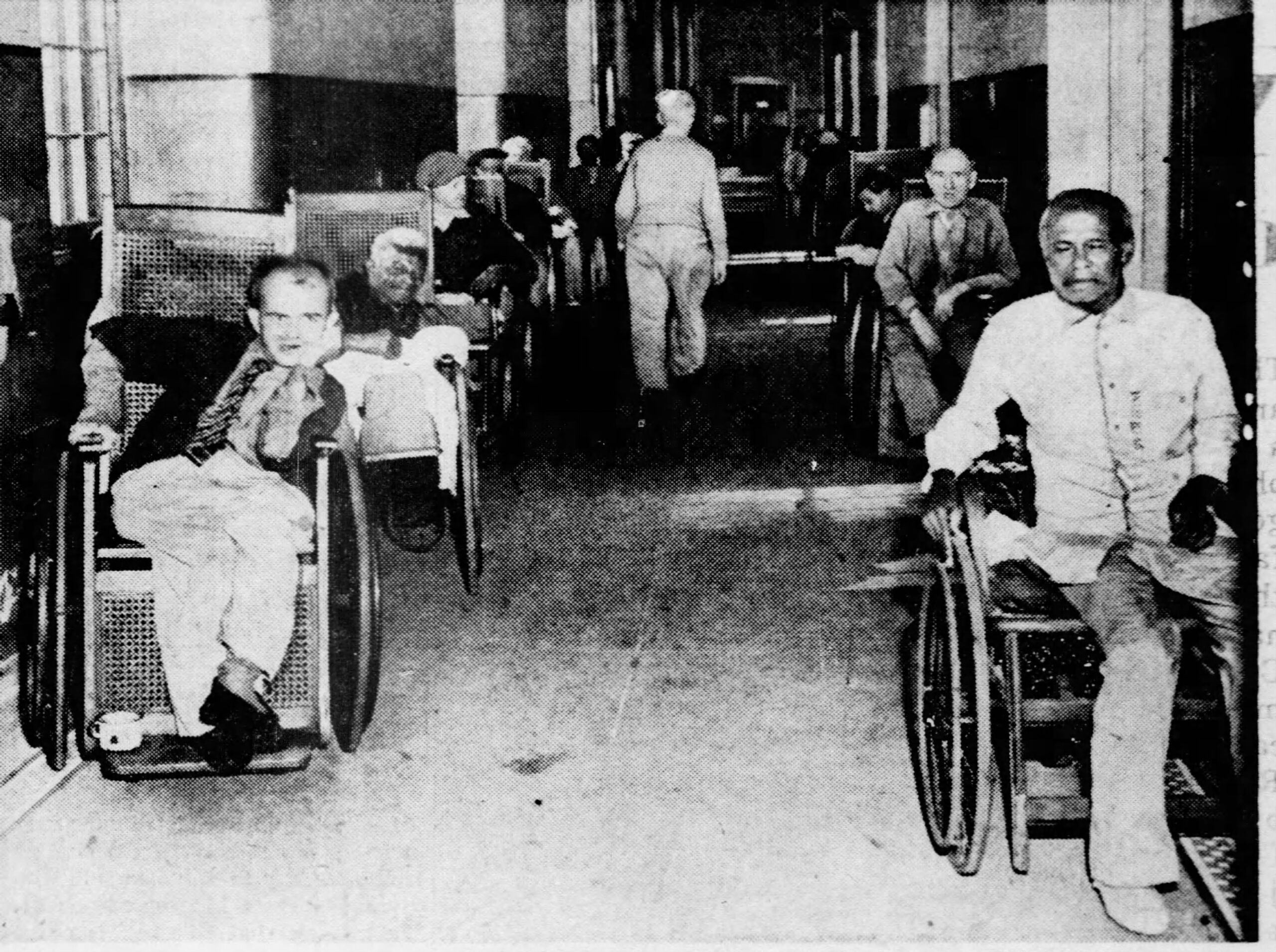
    Patients in the hallways of Philadelphia General Hospital in the 1940s.

    Eventually, it collapsed under the weight of its mission.

    Its facilities became outdated, its services could not keep up, and its role as educator was outsourced to colleges and universities.

    Philadelphia General Hospital’s closure left a gaping hole in available services in West Philadelphia. It was no longer there to help support the uninsured.

    Before it officially closed in June 1977, it was considered the oldest tax-supported municipal hospital in the United States.

    “There’s a common misunderstanding that PGH recently has become a poor people’s hospital,” said Lewis Polk, acting city health commissioner, in 1977. “It’s always been a poor people’s hospital. The wealthy never chose to go there.”

    Its old grounds are now occupied by several top-rated facilities, including Children’s Hospital of Philadelphia and the University of Pennsylvania medical campus.

    A historical marker there notes Philadelphia General Hospital’s nearly 250 years of service to the community.

  • In the 1940s, she was denied service at a Delco restaurant. She spent the rest of her life bridging racial divides in Media.

    In the 1940s, she was denied service at a Delco restaurant. She spent the rest of her life bridging racial divides in Media.

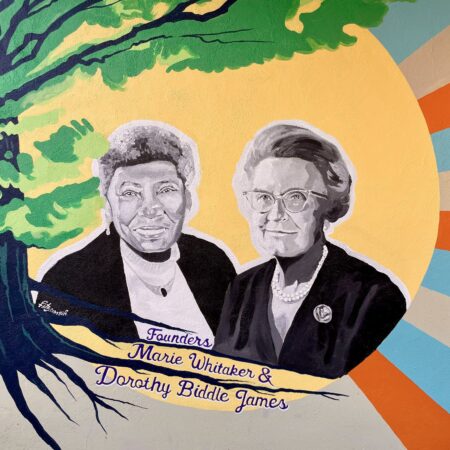
    When the Media-area NAACP was selecting a few Black figures to spotlight throughout Black History Month, adding Marie Whitaker to the list was a no-brainer, said Cynthia Jetter, president of Media’s NAACP chapter.

    Within the community, “I think most people know the story,” Jetter said.

    The story, that is, of when Whitaker sat down for a meal at the Tower Restaurant at the corner of State and Olive Streets with her baby in her arms and her sister by her side in 1943.

    No one waited on them.

    This bothered Dorothy James, a white Quaker woman who was dining at the restaurant. So she approached a worker there who explained that the waitresses did not serve Black people, James recounted in a letter she wrote a few days after the incident.

    Whitaker soon left the restaurant with her baby and sister and went elsewhere. Soon, James joined them, she wrote.

    Whitaker and James became fast friends and cofounded Media Fellowship House the following year. The goal was to bring together Media residents of all races and religions for events and meals. It grew over the course of its first decade, and in 1953, they raised enough money from community members to buy a property on South Jackson Street, where the organization flourished.

    Whitaker died in 2002, but the fellowship house lived on. In its 82 years, it has gone from hosting sewing circles and childcare events to helping Black people buy homes in restricted neighborhoods to now offering assistance to first-time homebuyers and helping those facing foreclosure.

    For Amy Komarnicki, who now runs the Media Fellowship House, the values Whitaker championed — inclusion, resilience, and courage — are always guiding her.

    “I think you have to move toward the injustice that you see and not ignore it,” Komarnicki said.

    That is especially difficult to do when you’re on the receiving end of the injustice, she added.

    “Being willing to accept an invitation to talk about it takes enormous bravery and trust,” Komarnicki said. “It’s good to be uncomfortable. It’s good to make people uncomfortable for the greater good. It opens up space for dialogue.”

    Whitaker’s legacy stretches beyond the bounds of Media. Her daughter, Gail Whitaker, once the infant with her at the restaurant where she did not get served, became the first Black woman to practice law in Delaware County and served on the Media Borough Council. She died in 2024. Her son, Bill Whitaker, is a 60 Minutes correspondent for CBS.

    Living in Media and going to Fellowship House growing up exposed him to people from all kinds of demographics and religions, Bill Whitaker said. And that was no accident; it was something his mother and Fellowship House helped lay the groundwork for.

    “She was resolute and knew what she wanted, not just for her family, but for her community and for her world,” Whitaker said. “She had a vision of what Fellowship House stands for, bringing people together and having people speak across what seems now to be a chasm of our differences — she wanted people to speak across that, to reach across that and come together.”

    As long as Fellowship House stands, that work, just as important now as then, will continue, Bill Whitaker said.

  • History and conservation groups are suing the Trump administration over censorship at national parks

    History and conservation groups are suing the Trump administration over censorship at national parks

    A new lawsuit filed by a group of conservation and history organizations is challenging President Donald Trump’s executive order to remove historic information from national parks.

    It comes a day after a federal judge ordered restoration of the slavery exhibits at the President’s House in Philadelphia and marks the latest chapter in a showdown between historical transparency versus censorship.

    On Tuesday, the National Parks Conservation Association filed a lawsuit in Massachusetts federal court against the Department of Interior, challenging Trump’s 2025 executive order that forced national parks to change or strip displays tied to topics ranging from slavery and racism to LGBTQ+ rights and climate change.

    “Plaintiffs are organizations committed to protecting the national parks, preserving history, promoting access to high quality scientific information, and providing high quality interpretive materials — including exhibits, signs, brochures, and other educational materials — that bridge the gap between physical objects and human understanding for park visitors,” the lawsuit says.

    “They and their members — including avid users of national parks and historians whose research is being erased — have been injured by these actions and seek to ensure that the administration does not wash away history and science from what the National Park Service has recognized is ‘America’s largest classroom.’ ”

    The coalition, which includes the American Association for State and Local History, the Association of National Park Rangers, the Coalition to Protect America’s National Parks, the Society for Experiential Graphic Design, and the Union of Concerned Scientists, is asking the court to declare Trump’s executive order unlawful and to order removed materials to be restored.

    “In filing this litigation together, we are taking a stand for the soul of our national parks,” Alan Spears, senior director of cultural resources at the National Parks Conservation Association, said. “Censoring science and erasing America’s history at national parks are direct threats to everything these amazing places, and our country, stand for.”

    In Philadelphia, U.S. District Judge Cynthia M. Rufe issued a ruling Monday requiring the federal government to restore the President’s House site to its original state. The removed exhibits paid tribute to the enslaved people who lived in George Washington’s home during his presidency.

    In her 40-page opinion, Rufe — who is a George W. Bush appointee — does not mince words. She compared the federal government’s argument that it can unilaterally control the exhibits in national parks to the dystopian totalitarian regime in George Orwell’s 1984.

    The plaintiff’s group for the Massachusetts suit is being represented by Democracy Forward, a progressive nonprofit that challenges government actions it views as harmful.

    “You cannot tell the story of America without recognizing both the beauty and the tragedy of our history,” Skye Perryman, Democracy Forward’s president and CEO said in a statement. “The president’s effort to erase history and science in our national parks violates federal law, and is a disgrace that neither honors our country’s legacy nor its future.”

    Beyond Philadelphia, the lawsuit also mentions other examples of Trump’s executive order in action, including the removal of an interactive display mentioning climate change at Fort Sumter in South Carolina, short films on labor history being scrapped at Lowell’s National Historical Park in Massachusetts, and the removal of displays discussing negative impacts tourists, settlers, and cattle ranchers have on the Grand Canyon National Park.

    The lawsuit goes on to point out the irony of Trump’s executive order aiming to avoid “disparaging Americans,” despite the president’s own new signage at the White House, which takes jabs at former President Joe Biden and others along his West Wing “Walk of Fame.”

    The parties are asking a judge to order that national parks must be allowed to present the full historical and scientific picture without censorship and for their court costs to be paid for.

  • Inaugural NFL draft was held at the Ritz-Carlton Hotel on this week in Philly history

    Inaugural NFL draft was held at the Ritz-Carlton Hotel on this week in Philly history

    More than 20 men crowded into a hotel room at the Ritz-Carlton on South Broad Street in the winter of 1936.

    They faced a blackboard listing 90 names of college football players from around the country.

    They took seats on the bed and on the bureau and passed around bottles as they kicked off the first draft in NFL history.

    Philly’s other famous Bell

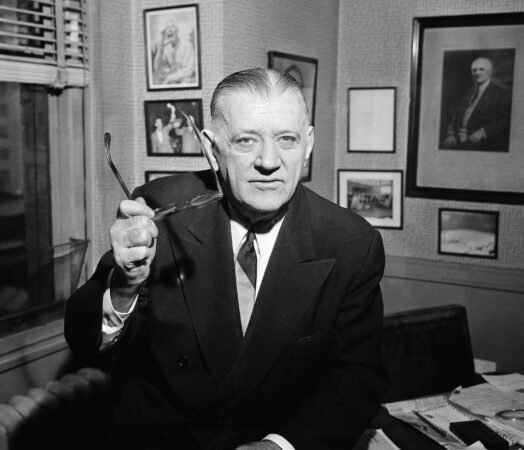
    Bert Bell pulled the defunct Frankford Yellow Jackets out of bankruptcy, and started a new NFL franchise in Philadelphia in 1933.

    His wife, actress Frances Upton Bell, paid her husband’s share of $2,500 (more than $60,000 in today’s money) to seal the deal.

    Bell spotted a billboard for Franklin D. Roosevelt’s New Deal, which included the insignia of a bald eagle, and decided this new team should be called the Philadelphia Eagles.

    The NFL back then was a nine-team league. And for players it was a free market. The best and brightest could join whichever team they saw fit.

    Teams in Green Bay, Chicago, New York, and Washington were the winningest franchises, so that’s where the best players usually signed.

    The Eagles were the worst. And in 1935, Bell tried to sign Stan Kostka, a 6-foot-2 fullback from the University of Minnesota. After failing to close the deal, he decided there had to be another way.

    Bell came up with an idea whereby each team had a fair shot at the top players. His solution was a draft, in which teams would select from a pool of new players entering the league.

    And the key idea: The order of player selection would be in reverse order of the previous year’s standings. So the worst-performing franchise would pick first, and the league champions would pick last.

    They called it “the selection of players.” And the first iteration would be held during the owners’ meetings, Feb. 8 and 9, 1936.

    It made sense to hold the event in Philadelphia. It was a midway point among the nine cities, and Bell’s father owned the hotel.

    On the clock

    The Eagles held the first-ever pick in the NFL draft.

    They selected Jay Berwanger, Heisman Trophy-winning halfback from the University of Chicago. But his salary demands were high, reported at $1,000 per game. (That would be $25,000 per game today.)

    So immediately the team traded him to the Bears for veteran tackle Art Buss.

    Berwanger, unimpressed with the Bears’ contract offer, took a job with a rubber company instead.

    He never played a minute in an NFL game.

    In that hotel room, the nine owners drafted 81 players over nine rounds, kicking off what would become an industry unto itself and the league’s third marquee event, behind the NFL’s opening weekend and the Super Bowl.

  • They grew up correcting everyone about their last name. Years later, they discovered the deep Philly history behind it.

    They grew up correcting everyone about their last name. Years later, they discovered the deep Philly history behind it.

    Twin brothers Larry and Kelly Ganges grew up outside of Trenton with people constantly mispronouncing their last name. “Grange, Grain, Ganger,” they’ve heard it all.

    So they developed a standard reply: “It’s Ganges like the river [in India].”

    Decades on, they’d find out the deep Philadelphia story behind it.

    When the brothers, now 72, got older and traveled, they’d grab the phone book in whatever town they were in to see if anybody with their last name was listed. Then they’d call and ask if they knew anybody in their family; they often did.

    “So we all thought, no matter where we were,” said Larry, “we were connected with somebody,”

    But they were also connected with something — a ship, a travesty, and a providence.

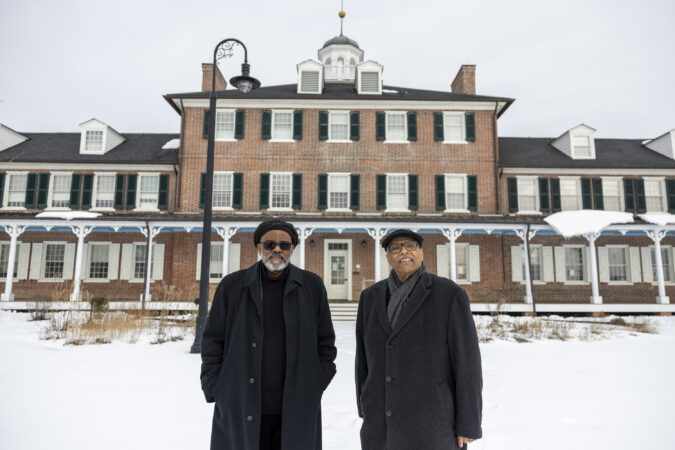
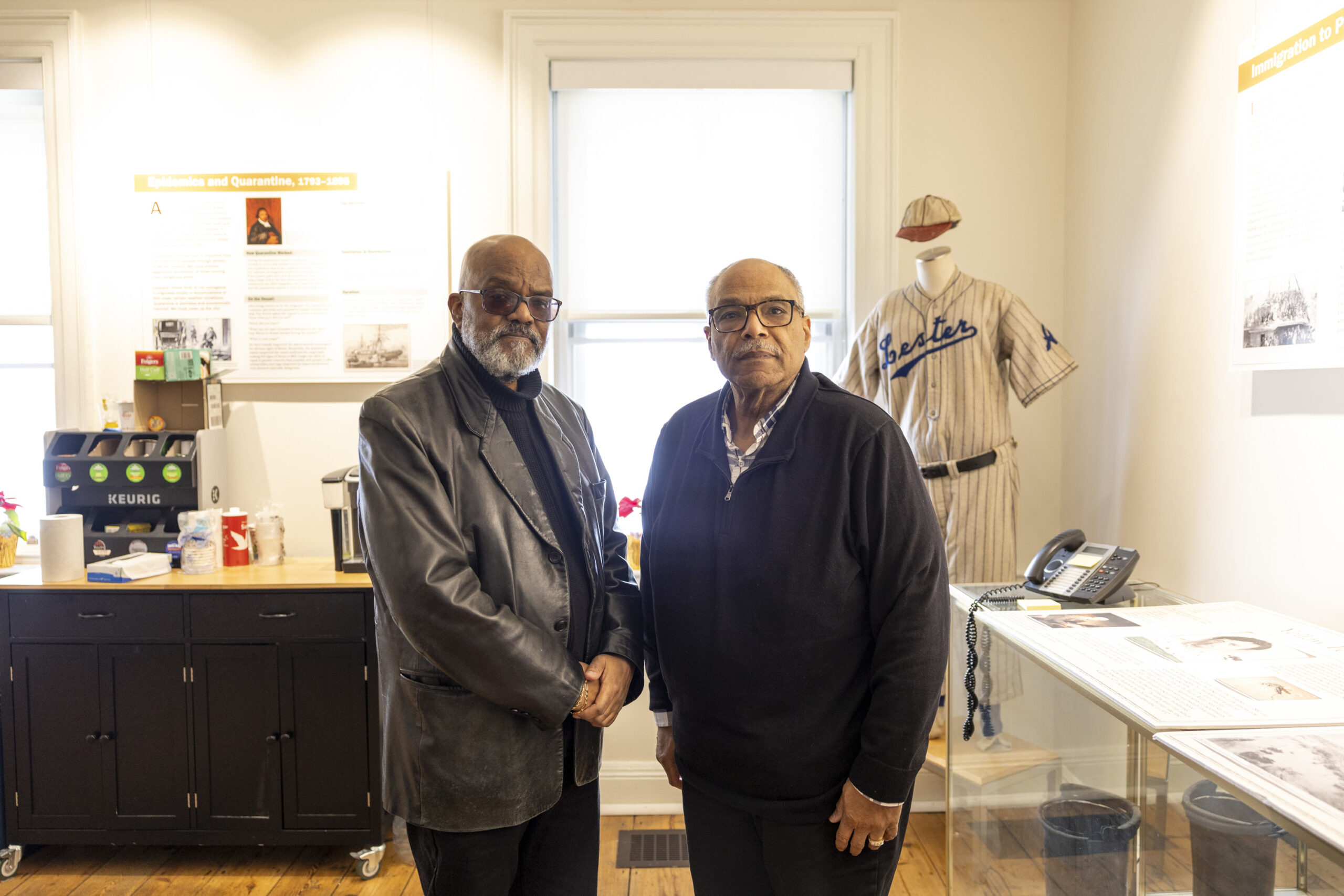
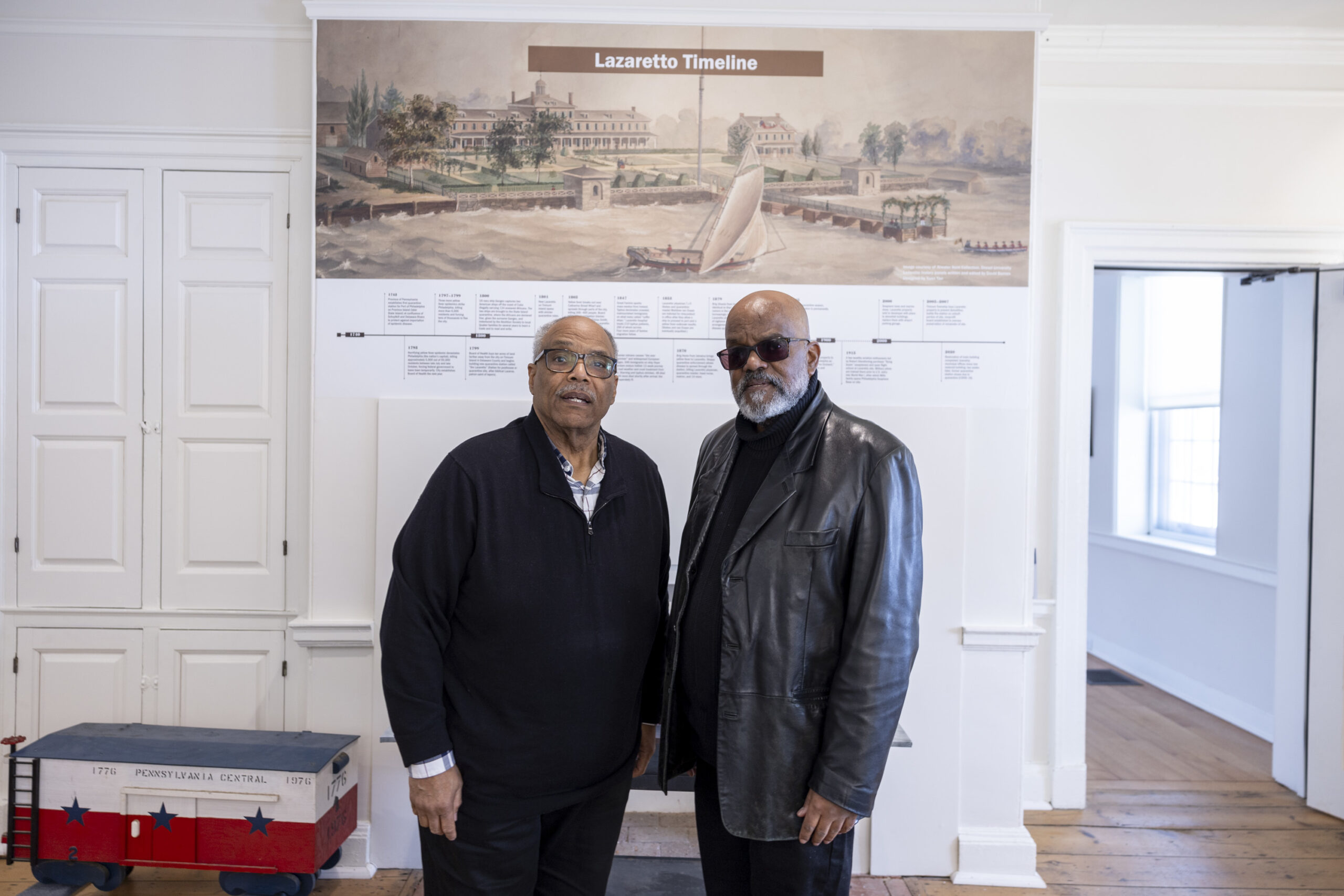
    (From left to right) Twin brothers Larry Ganges, and Kelly Ganges, pose for a portrait at the Lazaretto in Tinicum, Pa., on Friday, Feb. 6, 2026. “It allows us to view and experience Black history,” Kelly said. “Pride in knowing our family was in this journey.”

    The brothers’ first clue of their extended heritage arrived in 1975, when Kelly, was a student at Trenton State College. His journalism teacher, familiar with Bucks County cemeteries, asked if Kelly knew about the gravestones of two soldiers buried there.

    Torbert and William Ganges had fought in the Civil War’s colored regiment, but Kelly couldn’t be sure if they were his relatives.

    Nearly 30 years later, the brothers still don’t know if they are related to the soldiers, but they have discovered that their heritage is, as Kelly describes, “bigger than us, [it] extends beyond the continental United States and involves potentially the world.”

    That information came in a phone call.

    In the early aughts, Larry was working as the New Jersey Department of Health’s assistant commissioner for the HIV/AIDS division. His secretary told him that David Barnes, a University of Pennsylvania professor of history and the sociology of science, was on the line to talk about a different epidemic.

    72-year-old twin brothers Kelly Ganges (left) and Larry Ganges, pose at the Lazaretto in Tinicum, Pa., on Friday, Feb. 6, 2026.

    Barnes, who was seeking anyone with the Ganges name, had found Larry by chance in a New Jersey state employees directory. He wanted to discuss the 135 Africans who arrived in Philadelphia in 1800 and were detained at the old Lazaretto along the Delaware River.

    At the time, every vessel arriving in Philadelphia was required to stop and be inspected at the Lazaretto — a hospital and quarantine station — where patients with yellow fever were treated.

    Later, a brick facility replaced the old Lazaretto. Downriver from the original, the “new” Lazaretto, operational from 1801-1895, stands near present day Tinicum. It is the oldest surviving quarantine station in the Western Hemisphere and one of the 10 oldest in the world.

    By the call’s end, Larry had learned not just the origin of his name but how his ancestors arrived in America.

    “Wow, we had never heard about it. We just didn’t know,” he said.

    The story goes: In 1800, the United States naval ship Ganges intercepted two schooners (the Phoebe and the Prudence) off the coast of Florida, near Cuba. Despite a new federal law banning the carrying of human beings for enslavement, the schooners, which experts believe disembarked from near Sierra Leone, contained 135 people from Africa, imprisoned as slaves, bound for the New World.

    Ganges’ naval officers boarded the schooners — the Phoebe on July 19, 1800, and the Prudence on July 21, 1800 — took the enslaved into custody, and delivered them to the Ganges’ home port: Philadelphia.

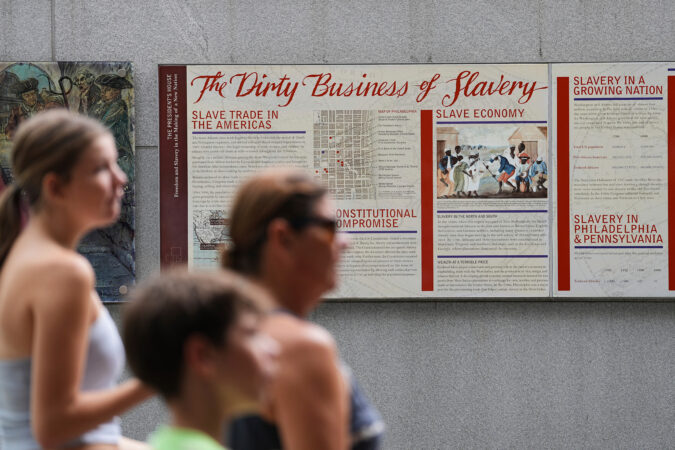
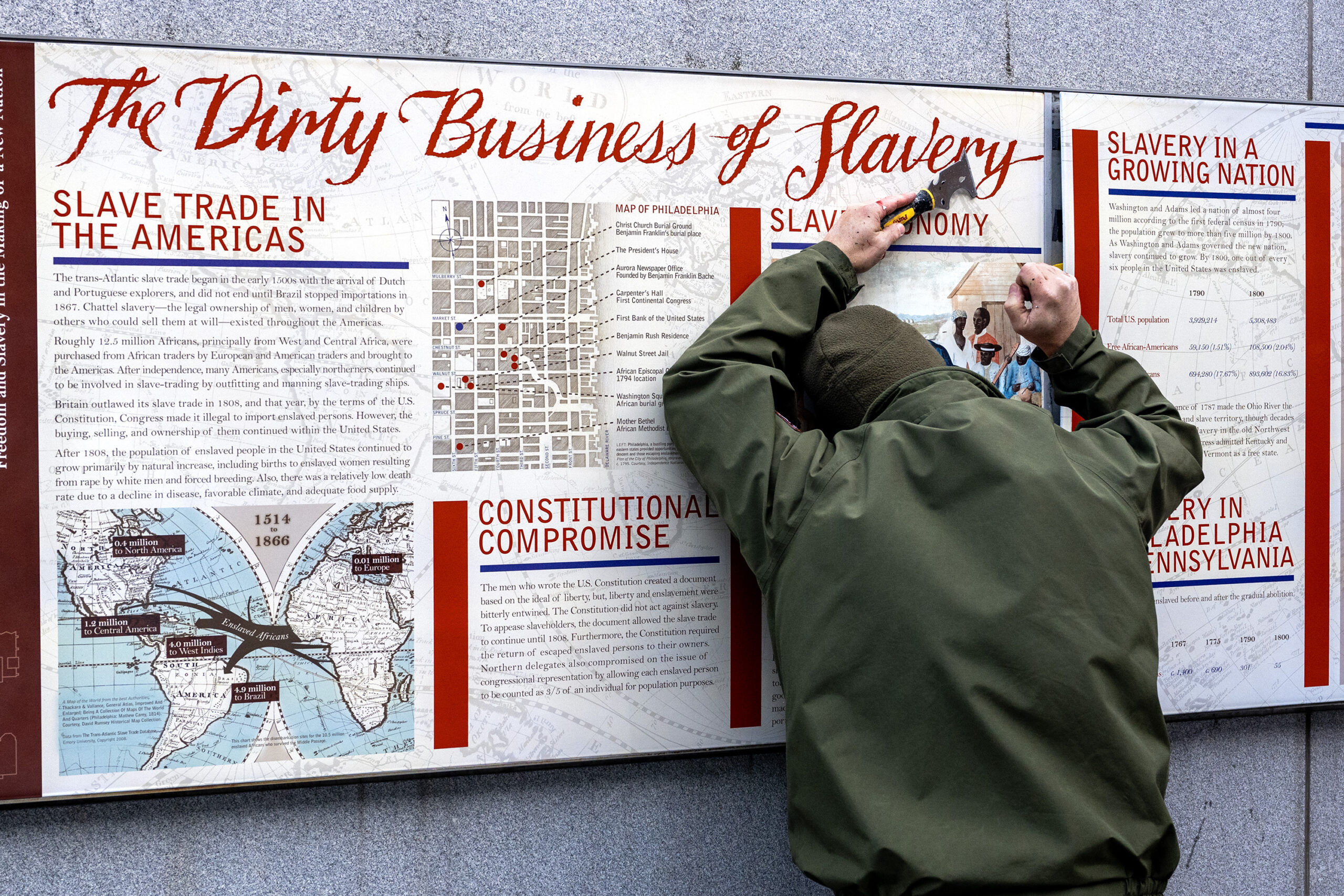
    A NPS worker removes an interpretive panels – “The Dirty Business of Slavery” – at the President’s House site in Independence National Historical Park Thursday, Jan. 22, 2026.

    When the schooners’ owners sued to reclaim their “property,” a Philadelphia judge ruled that the 135 aboard were people (not property) and ordered them freed. The Africans were remanded to the old Lazaretto for quarantine where they remained for up to three months.

    Subsequently Sambo, Milnor, Yelle, and Culico Ganges and the rest of the 123 survivors were indentured to Pennsylvania Abolition Society members and others.

    After Barnes’ phone call, the twins and their (late) older brother, Tendaji Ganges, visited the Lazaretto. At that time, the dilapidated building was locked. But Kelly returned with Barnes and gained access inside.

    “I saw all of the little rooms … it was interesting to touch a piece of history, and know that that’s the genesis of how our family came to the United States,” he said.

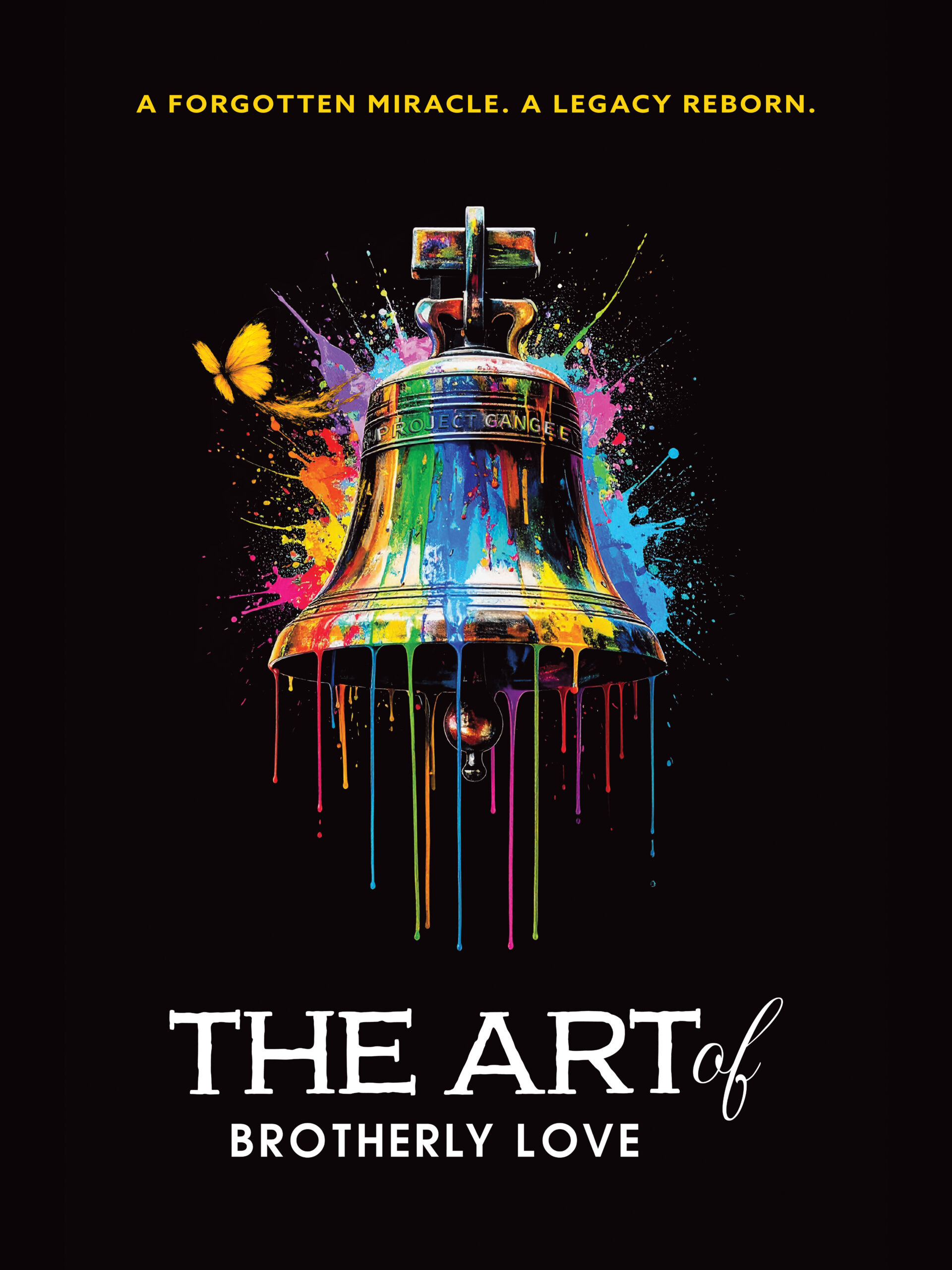
    “These modern-day heirs carry the legacy of resistance and survival into today’s conversations around justice, identity, and belonging,” said filmmaker Rah Crawford, whose documentary The Art of Brotherly Love focuses on the Ganges’ story.

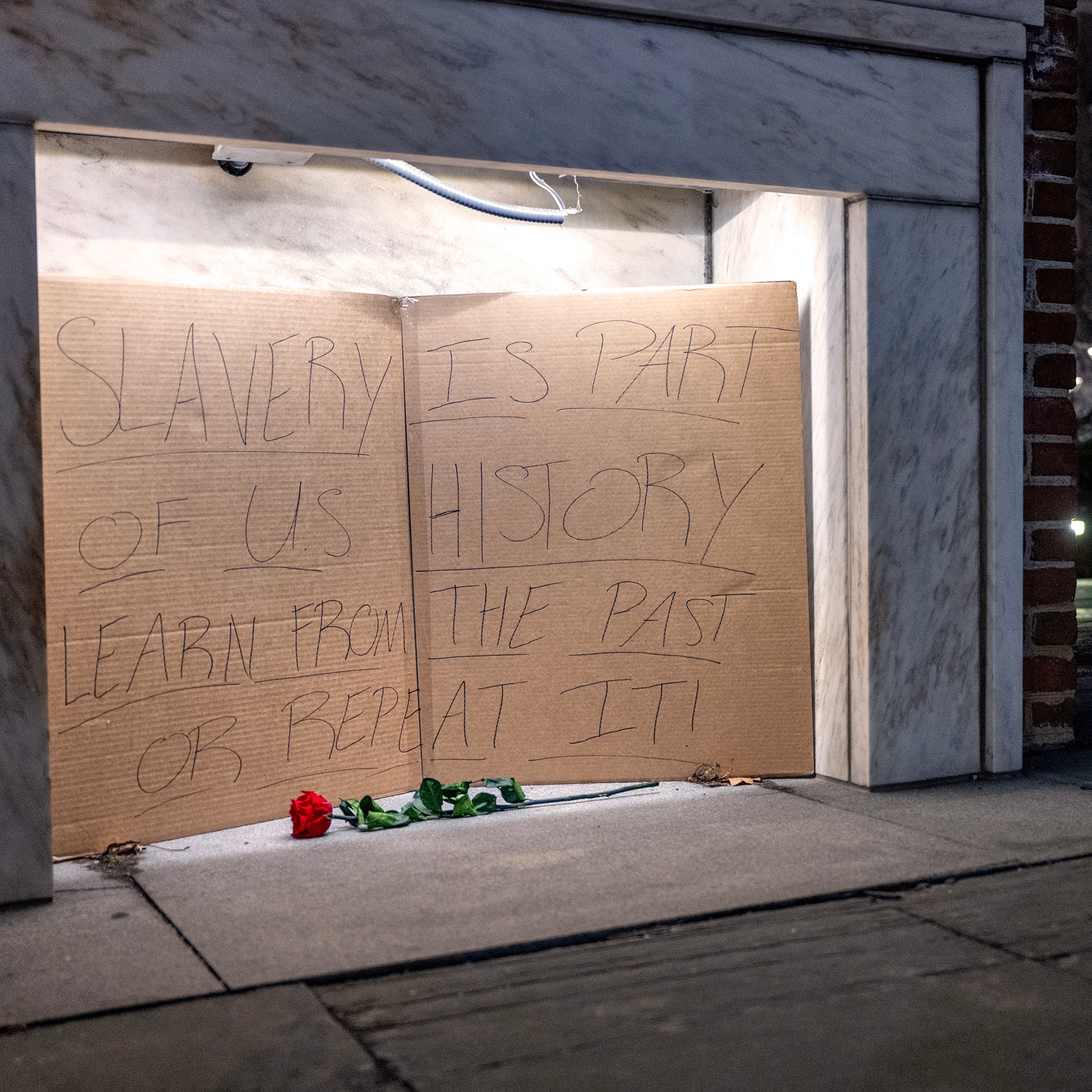
    A single rose and a handwritten cardboard sign (“Slavery is part of U.S. history learn from the past or repeat it”) are inside an empty hearth at the President’s House site in Independence National Historical Park late Thursday, Jan. 22, 2026 after workers removed display panels about slavery.

    When the film premiered in Brooklyn last year, Larry said that as he sat in the audience watching, he was shaking, almost in tears. His wife asked, “Are you OK? Are you cold?”

    He was overcome with emotions: “I was sad, I was happy, I was mad.”

    Although, as the brothers say, “we’ve got the generic connection to the name,” they don’t have a connection to identify individual family members that came through the old Lazaretto; they can’t yet determine how their bloodline was carried to them.

    But thanks to the efforts of family historian Michael Kearney, who is tracking descendants of the Ganges’ survivors, Larry is confident that “my children and my children’s children [are going] to know what the story is, and to know how to access it, and know who the players are …. And hopefully this movie is not the last of what’s going to occur.”

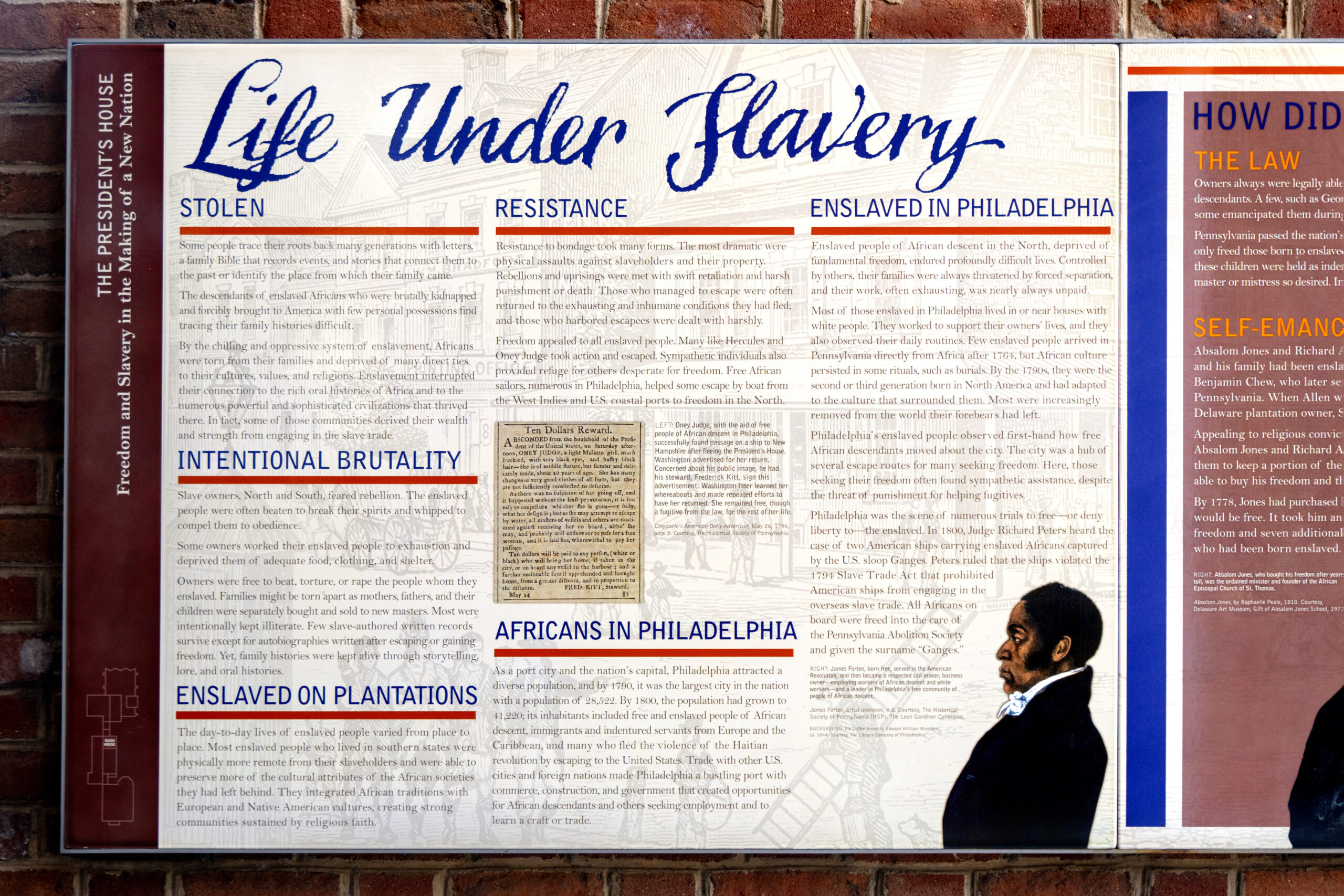
    The “Life Under Slavery” sign at the President’s House in the Independence National Historical Park. The sign has since been removed. Photo from Sunday, Aug. 3, 2025.

    Despite federal efforts to mute the history of enslavement in America — history panels at the President’s House referencing the Ganges story were removed from the site last month — the Ganges brothers know it’s important to share their story.

    “People made it through the troubled journey, the Middle Passage, and landed on American soil and contributed to make America a great nation,” said Kelly, “And nobody can ever deny that, and people can try and whitewash it and try to erase it, but it’s not going to work, because it’s real. Our contribution is documented.”

    Prior to the opening of the President’s House in 2010, filmmaker Crawford was commissioned to create storyboards for a video installation at the site. Through his research, he first learned of the Ganges’ story, launching a 15-plus-year journey to produce the documentary.

    Filmmaker Rah Crawford’s documentary “The Art of Brotherly Love” documents the story of the long-forgotten rescue of 135 enslaved Africans by the “Ganges” in the 1800s,

    The Art of Brotherly Love, presented in partnership with Creative Philadelphia, is both a documentary and a trailer for a forthcoming animated feature. The Philadelphia premiere is slated for Feb. 14 at Ritz Five.

    After the documentary screens, Kelly Ganges hopes that, “it just continues to cascade out — to inspire more genealogists and historians, and to reach more descendants and the next generation.”

    “The Art of Brotherly Love,” Feb. 14, 11:30 a.m., Landmark’s Ritz Five, 214 Walnut St., eventbrite.com

  • The history of Philly’s Joe Frazier statue, from inception to a move to the Art Museum

    The history of Philly’s Joe Frazier statue, from inception to a move to the Art Museum

    The blank space that our famed Rocky statue is slated to soon leave at the base of the Philadelphia Museum of Art’s steps will be filled by a monument to someone a whole lot less fictional — and it has been a long time coming.

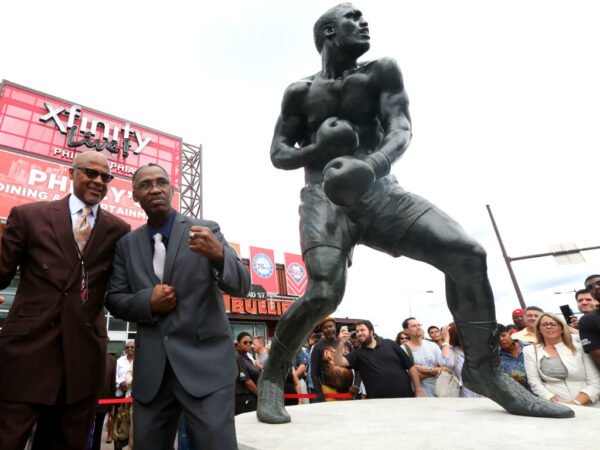
    After just over a decade standing outside of what is now known as Stateside Live!, the city’s statue of Philly’s own “Smokin’” Joe Frazier will be the newest Philly boxer to call the Art Museum home. The Philadelphia Art Commission on Wednesday approved a plan detailing the move presented by Creative Philadelphia, the city’s office for the creative sector.

    That plan is the latest development in a saga that began before Frazier’s death from liver cancer in 2011. Frazier’s statue was unveiled in 2015 after years of work and advocacy. Fans and supporters considered the lack of a statue an injustice, given that the statue of Rocky Balboa has been in the city for more than 40 years and he’s not even a real person.

    Rocky, in fact, has been stationed at the base of the Art Museum steps since 2006. That lengthy run follows installations not only at the top of the steps, but also at the sports complex in South Philadelphia, where the Frazier statue has been located since its inception. And Rocky has been in its current home twice as long as the Frazier statue has existed.

    Still, Philly’s Frazier statue has a storied history of its own. Here is how The Inquirer and the Daily News covered it:

    https://www.newspapers.com/article/the-philadelphia-inquirer/191021228/

    Article from Nov 12, 2011 The Philadelphia Inquirer (Philadelphia, Pennsylvania) <!— –>

    Early advocacy

    Frazier’s supporters had long lamented that Philadelphia lacked a memorial to the boxer. In fact, in a June 2011 Daily News poll, nearly 21% of respondents said Smokin’ Joe should be the next Philadelphia legend honored with a statue — second only to Flyers great Bob Clarke, who himself got a statue in 2013.

    Calls for a statue intensified after Frazier’s death in November 2011. His loved ones and fans — including fellow Philly boxing great Bernard Hopkins — leaned on the city to memorialize the fallen legend. As Hopkins that year told the Daily News, the city ought to “build the biggest statue in appreciation for all the heart and love” Frazier gave to Philadelphia.

    Following his death, Frazier lay in state at the Wells Fargo Center to allow friends, family, and fans to grieve. At Frazier’s funeral, the Rev. Jesse Jackson admonished the city for its lack of respect to Frazier.

    “Tell them Rocky was not a champion, Joe Frazier was,” Jackson said to cheers. “Tell them Rocky’s fists were frozen in stone. Joe’s fists were smokin’.”

    https://www.newspapers.com/article/philadelphia-daily-news/191021343/

    Article from Mar 9, 2012 Philadelphia Daily News (Philadelphia, Pennsylvania) <!— –>

    Building momentum despite challenges

    In March 2012, two months after what would have been Frazier’s 68th birthday, boxing promoter Joe Hand — a longtime Frazier supporter — publicized plans for a life-size statue of Frazier that would be placed near what was then Xfinity Live! Hand pledged a memorial, at a cost of $200,000, would be built.

    Divisions among family members, friends, and business partners emerged, but by that September, Frazier’s family — led by daughters and estate executors Weatta Collins and Renae Martin — took over efforts for a statue.

    Hand later bowed out of the proceedings, leaving the memorial up to Frazier’s family with backing from the city via the Fund for Philadelphia. Plans later shifted to a $150,000 funding goal for the statue, with support from the city under then-Mayor Michael Nutter, who was a longtime Frazier fan dating back to his childhood.

    “[This is] a very personal moment for me to be in this position and make this announcement about someone I truly admire,” Nutter told The Inquirer in 2012.

    https://www.newspapers.com/article/philadelphia-daily-news/191021483/

    Article from Apr 25, 2013 Philadelphia Daily News (Philadelphia, Pennsylvania) <!— –>

    Setbacks and continued effort

    In April 2013, Frazier’s family and the city selected New Hampshire-based sculptor Lawrence J. Nowlan to helm the project. An Overbrook Park native, Nowlan homed in on an image of Frazier knocking down fellow legend Muhammad Ali in the famed 1971 “Fight of the Century” as the statue’s inspiration.

    But in late July, Nowlan unexpectedly died at the age of 48. The city proceeded with its Frazier statue plans, and roughly three months later selected Fishtown-based sculptor Stephen Layne as Nowlan’s replacement.

    “We all deeply regret the passing of sculptor Lawrence Nowlan and the loss of his artistry in this project,” Nutter said at the time. “But Mr. Nowlan’s untimely passing will not deter us from honoring a great Philadelphian.”

    Layne largely stuck with Nowlan’s plan, and in December 2013, the Philadelphia Art Commission approved designs for a statue depicting Frazier during the iconic Ali fight. It was, The Inquirer reported, expected to stand nine feet tall, plus a three-foot base, ultimately to be cast in bronze.

    https://www.newspapers.com/article/the-philadelphia-inquirer/191021607/

    Article from Sep 13, 2015 The Philadelphia Inquirer (Philadelphia, Pennsylvania) <!— –>

    Frazier’s unveiling

    Among the most ardent supporters of the Frazier statue ahead of its unveiling in September 2015 was boxer Hopkins, who donated hundreds of thousands of dollars to see it erected. In April 2014, he told the Daily News that Frazier “has a rightful place in Philadelphia history and that should be honored.”

    Sculptor Layne, meanwhile, plugged away at the statue for months. The pose, he told the Daily News ahead of its unveiling, showed a “pivotal moment” in Frazier’s career, which itself showed a “blue-collar mentality” that showcased his connection to Philadelphia perfectly.

    And finally, on Sept. 12, 2015, Philly finally got its first look at the statue with its unveiling on the corner of 11th Street and Pattison Avenue. Family and friends pulled a green shroud off the statue in front of several hundred onlookers.

    “I am very happy to know Joe is being honored and memorialized in the city he loved, something that is long overdue,” Ali, Frazier’s longtime arch-nemesis, told the Daily News. “Joe was a great boxer and a worthy opponent in the ring. He always brought his best whenever he stepped inside the ropes. My only regret is that Joe won’t be there to share in the celebration.”

  • Philly is not dumping snow in the Schuylkill, but it has in the past

    Philly is not dumping snow in the Schuylkill, but it has in the past

    Many Philadelphians are continuing to deal with snow-clogged, slushy, ice-laden streets nearly two weeks after a winter storm produced the city’s biggest snowfall in a decade.

    To deal with the snow, the city has deployed roughly 1,000 workers and 800 pieces of snow-removal equipment, and instituted programs to break up ice at crosswalks and streets in residential neighborhoods, among other efforts. But to some Inquirer readers, the solution has been right in front of us all along.

    “I know we used to toss snow into the river,” one reader wrote via Curious Philly, The Inquirer’s forum for questions on all things local. “What happens to it now?”

    » ASK US: Have something you’re wondering about the Philly region? Submit your Curious Philly question here.

    In the past, the city has dumped snow into the Delaware River and the Schuylkill on various occasions. But in recent decades, that practice has been used rarely — if at all — primarily over environmental concerns. Here is what we know:

    An old practice

    Newspaper archives show references to dumping snow in the Delaware and Schuylkill dating back at least to the late 19th century — during a storm colloquially known as the “Great Arctic Outbreak of 1899.” That storm dumped 19 inches of snow on Philadelphia around Valentine’s Day.

    In the aftermath, the city sought permission from its Board of Port Wardens to dump snow in the rivers surrounding Philadelphia, but there were concerns over the “considerable amount of dirt” that would be thrown into the water.

    The practice was utilized in the winter of 1909, when 21 inches of snow fell. Initially, snow was dumped into the rivers at three points, but officials later expanded approved dumping sites to be “at any point and from any wharf” along either river.

    “It was contended that this was perfectly proper, since snow is not refuse, but will readily melt after it is thrown into the water,” The Inquirer reported at the time.

    https://www.newspapers.com/article/philadelphia-daily-news/190719291/

    Article from Jan 10, 1996 Philadelphia Daily News (Philadelphia, Pennsylvania) <!— –>

    The blizzard of ’96

    Perhaps the most well-known modern use of Philadelphia’s rivers as a snow dump came in 1996, when a debilitating 30.7 inches of snow fell in early January. The city was left with few options, and got a permit from state environmental officials to dump snow in the rivers, Inquirer reports from the time indicate.

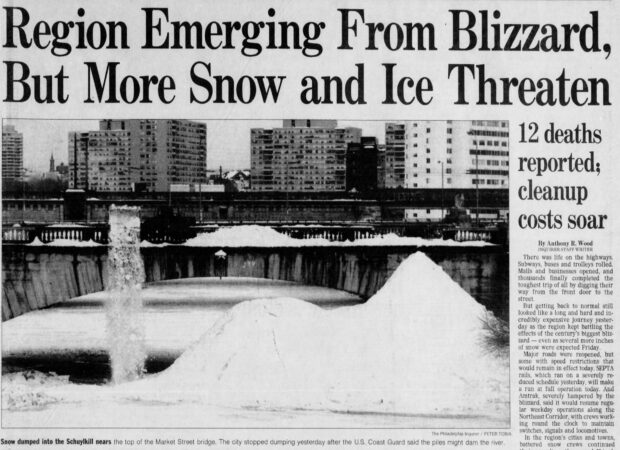
    Within days, roughly 500 tons of snow were dumped into the rivers, and that total would grow into the thousands. Famously, city trucks were spotted dumping snow into the Schuylkill from the Market Street Bridge — until being asked to stop by the U.S. Coast Guard.

    “We did advise the city to stop dumping snow into the Schuylkill. Our concern was the accumulation of ice in the river,” a Coast Guard spokesperson said at the time. The piles of snow in the river ran the risk of forming dams that could cause flooding.

    The piles became so severe they had to be beaten back down. By mid-January, one Inquirer report noted, wrecking balls were sent in to break up at least one mountain of snow that threatened to clog the Schuylkill.

    https://www.newspapers.com/article/the-philadelphia-inquirer/190719516/

    Article from Feb 22, 2003 The Philadelphia Inquirer (Philadelphia, Pennsylvania) <!— –>

    An ‘option of last resort’

    The city again in 2003 dumped snow into Philadelphia’s rivers, this time in an attempt to mitigate the impacts from a February storm that left about 19 inches of the white stuff. This time, though, city officials seemed to at least feel bad about it, calling it an “option of last resort.”

    For this storm, roughly 400,000 pounds of snow was dumped into the Schuylkill. But along with it went road salt, antifreeze, trash, and other pollutants, prompting concerns from regional environmental groups. That pollution, they said, could harm marine life and devastate the riverbanks.

    “All the stuff that’s on the road surface goes into the water,” Delaware Riverkeeper Network head Maya van Rossum told The Inquirer that year. “This is not the appropriate way to deal with the snow. There are plenty of places on the land to put it.”

    The dumping, Streets Commissioner Clarena Tolson said, was limited. And the Pennsylvania Department of Environmental Protection said it asked the city to only dump “virgin snow” into the rivers.

    https://www.newspapers.com/article/the-philadelphia-inquirer/190719722/

    Article from Feb 12, 2010 The Philadelphia Inquirer (Philadelphia, Pennsylvania) <!— –>

    No more dumping, officially

    By 2010, the city appeared to have officially abandoned the practice of dumping snow into city riverways. That February, one storm caused more than 28 inches of snow to fall, but Mayor Michael A. Nutter’s administration declined to pour it into the rivers.

    “We’re going to take some of that down to the Navy Yard. We will not dump in the river,” Tolson said. “There are environmental concerns with placing snow in the river. The snow accumulates pollutants and salt, and dumping it in the river would be a very extreme measure.”

    The Center for Environmental Policy at the Academy of Natural Sciences applauded the Nutter administration’s decision, writing in a letter to The Inquirer that the move would “prevent serious environmental damages to the river.”

    “Urban precipitation, including snow, acquires a witch’s brew of contaminants such as oil, grease, litter, road salt, and lawn fertilizer,” director Roland Wall wrote. “We salute the city for making a commonsense decision that will protect one of Philadelphia’s natural treasures.”

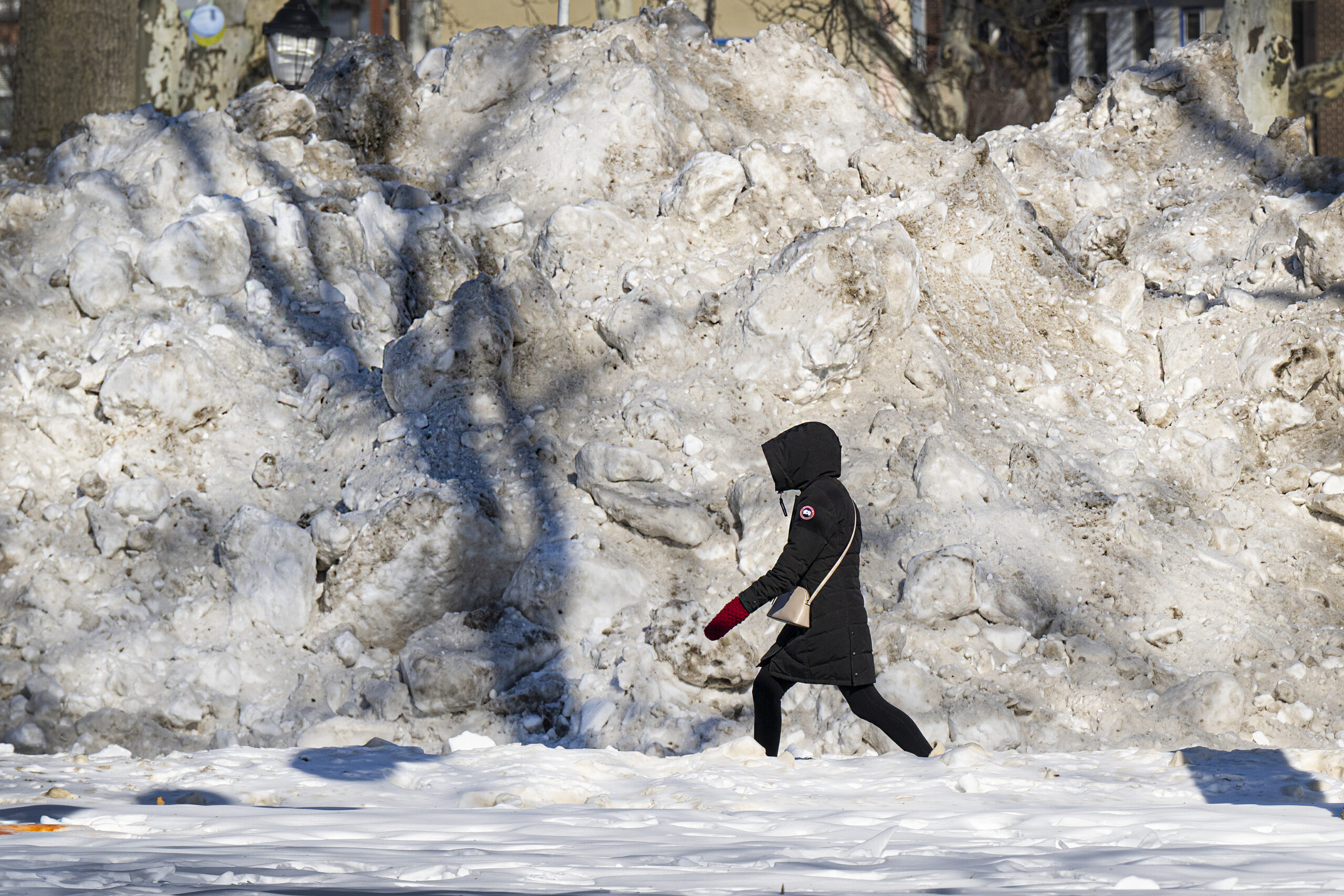
    A pedestrian walks past a large pile of snow and ice along the Benjamin Franklin Parkway days after a fierce winter storm dropped up to 9 inches of snow and sleet, with freezing temperatures leaving large banks of ice and snow on streets and sidewalks in Philadelphia, Monday, Feb. 2, 2026.

    So what do we do now?

    On Wednesday, Carlton Williams, the city’s director of clean and green initiatives, said the city does not dump snow in Philadelphia’s rivers, as that practice is “not an EPA standard.” Instead, the city has gravitated toward removing the snow from city streets and placing it at 37 snow dump sites around Philadelphia.

    The city did not respond to a request for comment regarding those dump sites’ locations. Some of them contain mounds of snow up to 12 feet high that stretch for blocks, Williams said Wednesday. Officials also brought in a snow-melting machine from Chicago.

    Pennsylvania Department of Environmental Protection guidelines, meanwhile, recommend municipalities push snow at least 100 feet away from surface waters, where it will be able to melt with less environmental impact.

    “Dumping of snow directly into a stream carries with it the shock of loading de-icing chemicals and anti-skid agents,” the agency said in a recent recommendations document. “Allowing a natural melt provides a slow release of the water, dilutes the chemicals, and provides filtration of the solids through the soil.”

  • America’s oldest warship, sunk in 1776, is getting a 250th-birthday makeover

    America’s oldest warship, sunk in 1776, is getting a 250th-birthday makeover

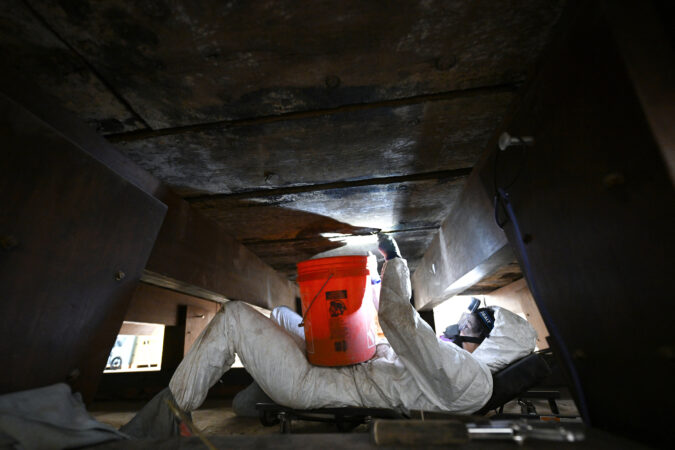
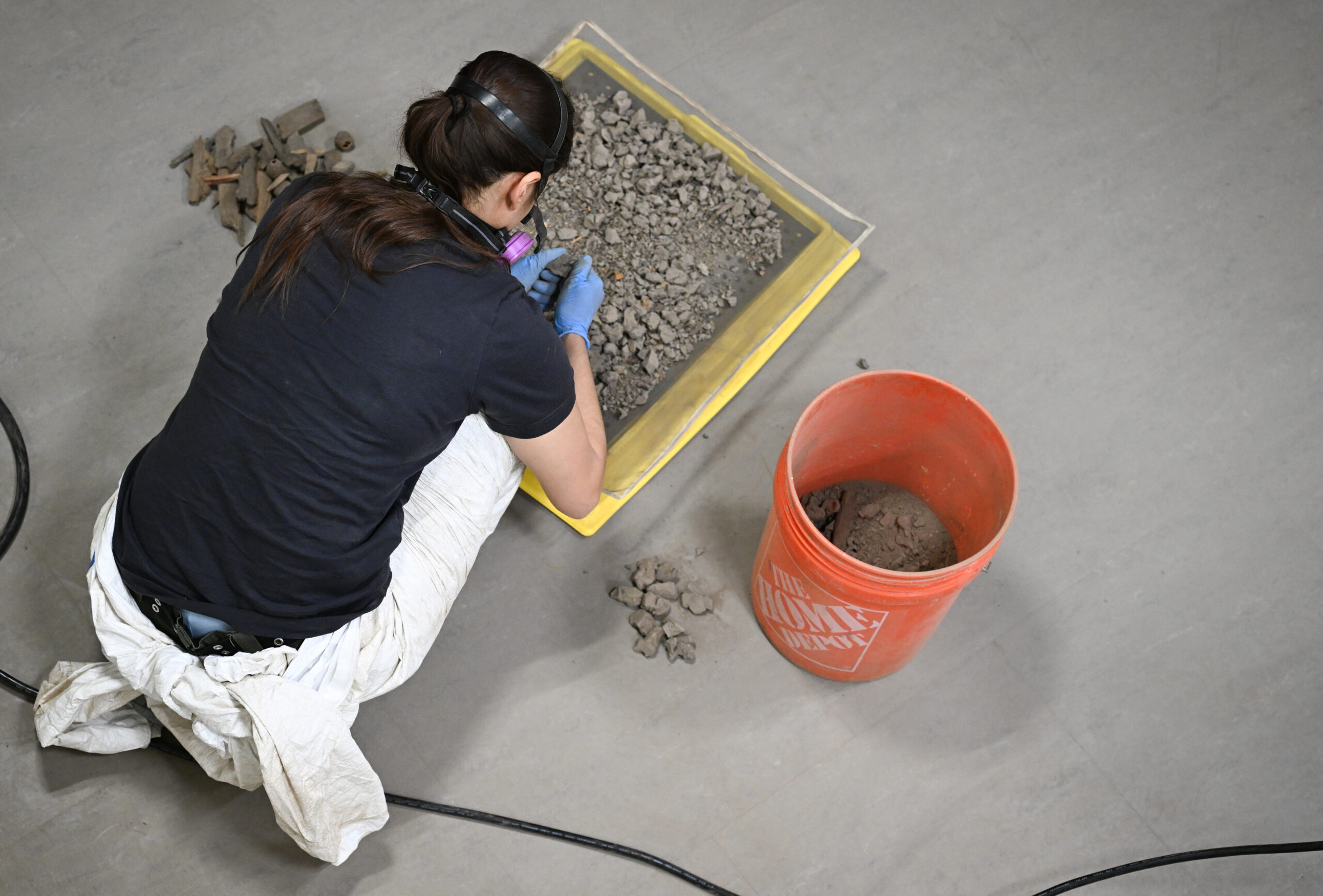
    Conservator Angela Paola is lying on her back under the 16-ton gunboat, picking debris from between its nearly 250-year-old planks. She is wearing blue surgical gloves, grimy white coveralls, and a half-face respirator.

    Dust floats in the beam of her headlamp, and the light reveals bits of the original oakum and pitch used to seal the bottom of the Philadelphia before it was sunk in battle by the British in 1776.

    As she pokes a tool between the planks, clumps of hardened sediment fall on her. “It’s dirty,” she says. “But it is really satisfying work. And it’s really exciting to see it slowly start to show itself through all the mud and the years.”

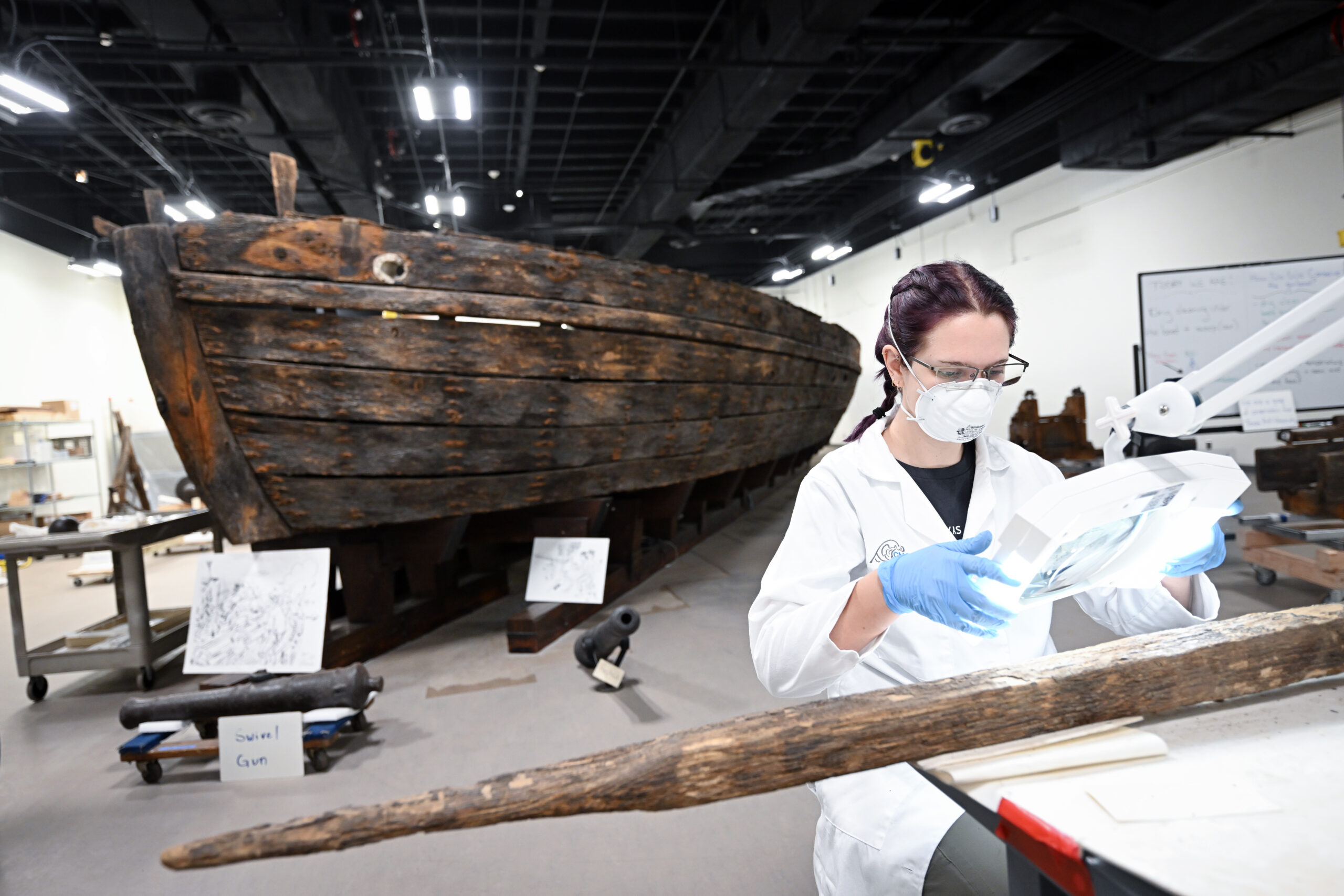
    Texas A&M University research assistant Marissa Agerton works on the project to preserve the gunboat Philadelphia at the Smithsonian National Museum of American History in Washington on Jan. 13.

    The Philadelphia is the country’s oldest surviving intact warship, according to the Smithsonian Institution. It was launched on July 30, 1776, a few weeks after the Declaration of Independence was adopted. And as the nation prepares for its 250th birthday this summer, experts are grooming the old vessel for its place in the celebration.

    “It’s one of the most important objects — movable objects — of the Revolution, flat out,” Anthea M. Hartig, director of the Smithsonian’s National Museum of American History, said in an interview at the museum this month.

    The gnarled boat has survived battle, sinking, the elements, wood-eating bacteria, rodents, misguided attempts at preservation, tourists, and almost 250 years in the country it helped found.

    It’s “one in a million,” Paola, the conservator from Texas A&M University, said through her respirator last week.

    The 53-foot-long boat, hastily built of green oak, was sunk by British cannon on Oct. 11, 1776 at the Battle of Valcour Island, on Lake Champlain. But historians say the small fleet it was part of helped thwart British plans to invade the colonies from the north, and furthered the cause of independence.

    The boat, powered by oars and sails, spent 159 years sitting upright in 60 feet of water at the bottom of the lake until it was raised in 1935. It then became a tourist attraction: admission 50 cents, according to an old advertising poster, and was carried from place to place on a barge.

    After almost 30 years, it came to Washington in 1961 as one of the early arrivals at what was then the National Museum of History and Technology. It was hoisted inside while the building was still under construction and has been there ever since.

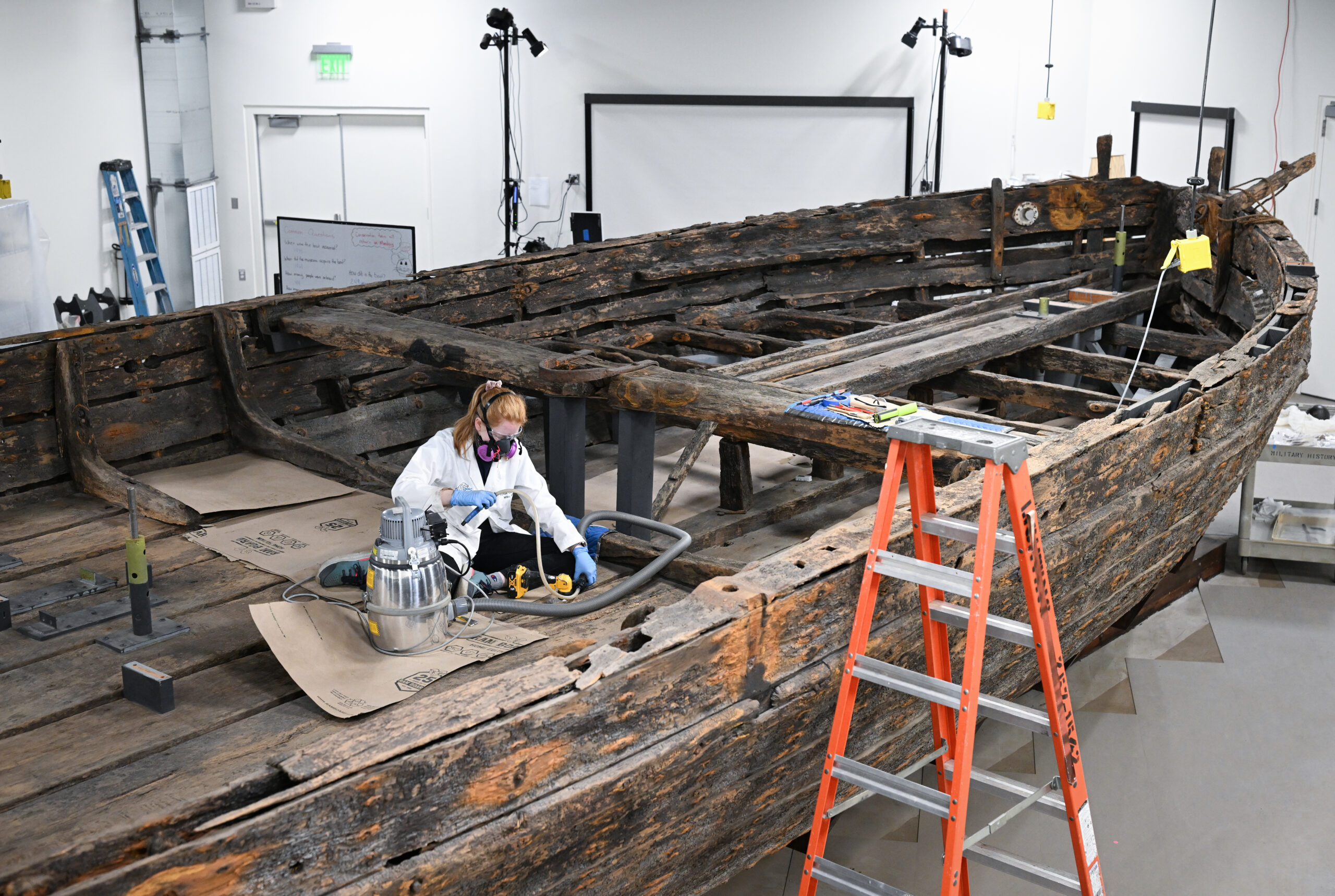
    Since July, the museum has had the Philadelphia partially cordoned off in a special conservation lab on the third floor of the East Wing.

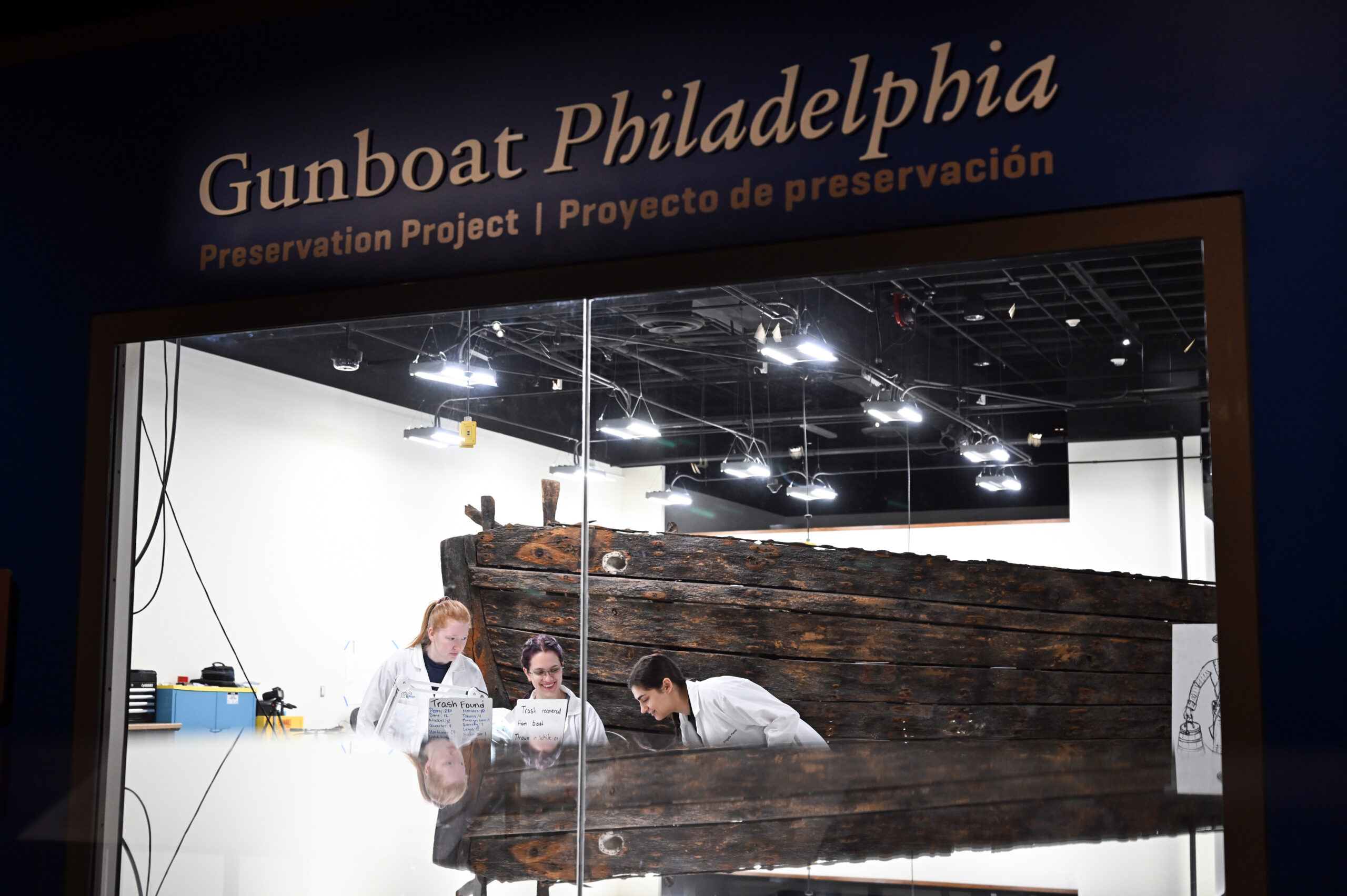
    There, experts from the Smithsonian and Texas A&M are working with vacuums, brushes and dental tools to give it a state-of-the art cleaning and look for lost artifacts in areas they said have never been probed before. Visitors can watch the work through a large viewing window.

    A portion of the Philadelphia.

    The vessel rests in a huge cradle. Arrayed around it are its lower mast, rudder, two anchors, three big cast-iron guns, gun carriages, swivel guns, and the 24-pound British cannon ball that helped sink it.

    The Philadelphia’s biggest weapon was an 8-foot-long, 3,800-pound cannon made in Sweden. It sat on a wooden rail at the front of the boat and fired a 12-pound iron ball. The gun still had a projectile in its mouth when it was discovered.

    The boat was raised on Aug. 9, 1935 by history enthusiast and salvage engineer Lorenzo F. Hagglund and yachtsman J. Ruppert Schalk. When it came up, it contained a trove of more than 700 artifacts, according to John R. Bratten’s 2002 book, The Gondola Philadelphia & the Battle of Lake Champlain.

    It also had a handful of human bones.

    According to salvage reports, “there were a couple of arm bones … some teeth and a partial skull that were found on board the boat itself,” said Jennifer L. Jones, director of the museum’s Philadelphia gunboat preservation project.

    “We know there were a lot of injuries,” she said in an interview at the museum this month.

    Angela Paola goes through debris as she works on the Philadelphia.

    The Oct. 11 battle was a daylong shootout with both sides firing iron cannon balls that could sink a ship or tear off a limb.

    Less than two years after the start of the Revolutionary War, the British had been planning an attack from Canada south along the lake between New York and Vermont to try to split the colonies.

    They quickly assembled a fleet of about two dozen vessels near the lake in Canada for the task.

    The Americans countered, building and gathering a fleet of 16 vessels, including the flat-bottom Philadelphia and seven others like it, said Peter D. Fix, of Texas A&M, the lead conservator on the gunboat preservation project.

    The two sides met in a narrow channel of the lake between the New York shore and Valcour Island, about five miles south of Plattsburgh, N.Y.

    “It was a very bloody battle,” Jones said.

    From the American hospital ship, “Enterprise,” crewman Jahiel Stewart wrote in his journal: “The battel was verryey hot [and] the Cannon balls & grape Shot flew verrey thick.”

    “I believe we had a great many [killed] … Doctors Cut off great many legs and arm and … Seven men [were thrown] overbord that died with their wounds while I was abord,” he wrote.

    Each side suffered about 60 men killed and wounded, Bratten wrote.

    Jones said it is possible the limbs found on the ship had been amputated. Their whereabouts are unknown, she said.

    The Philadelphia was commanded by a young Pennsylvania army officer, Benjamin Rue. He had 43 men from many walks of life under him.

    “We have a wretched, motley crew in the fleet,” American Gen. Benedict Arnold wrote before the battle. “The refuse of every regiment, and the seamen, few of them, ever wet with salt water.”

    Texas A&M University research assistant Alyssa Carpenter works on the Philadelphia this month in D.C.

    Arnold, who commanded the patriot fleet, later deserted the American cause and went to fight for the British in 1780. He died in England in 1801. One of the crewmen on the Philadelphia, Joseph Bettys, also switched sides. He was later captured and hanged.

    The Oct. 11 battle was a stalemate. The British withdrew; the Americans, bottled up in the channel, escaped that night. But two days later, the British force tracked down the Americans and destroyed most of their fleet.

    Only a handful of American ships survived the fight. The Philadelphia was not one of them.

    The ship is now “heavily degraded,” said Fix, the lead conservator,

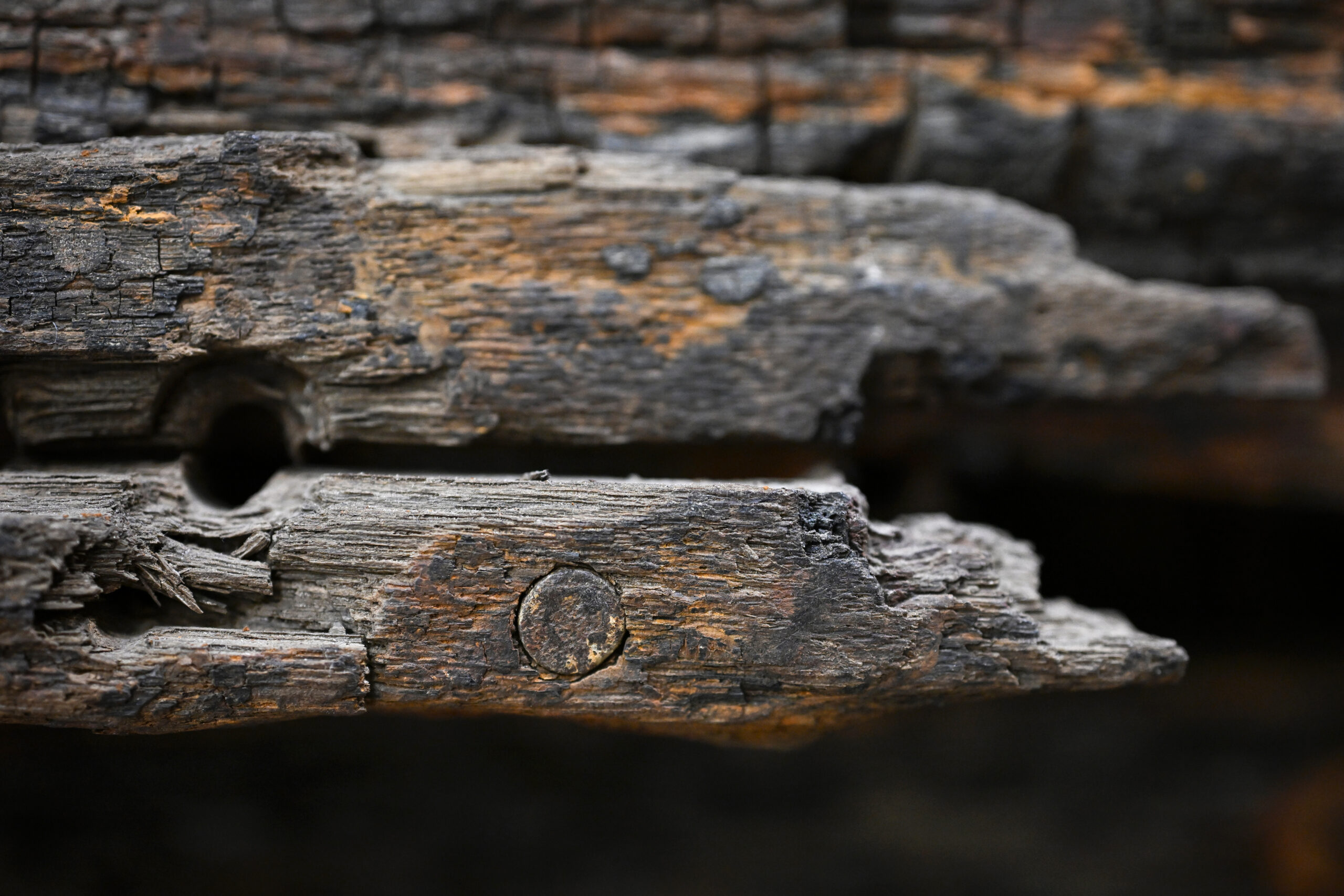
    The hull still bears three holes made by British cannon balls. A wooden cross piece near where the mast stood is charred, probably from the ship’s brick fireplace. The hull planks have lost about three-quarters of an inch in thickness to bacteria, Fix said.

    Care of the boat “is a huge undertaking, of which the conservation is one part,” he said. “The conservation, the preservation, is kind of the avenue to learn all this other extra stuff, which has been great.”

    “Our main task, as we were assigned, was ‘let’s make sure we make it last for another 250 years,’ ” he said.

    Back under the vessel recently, conservator Paola put chunks of fallen debris in an orange bucket, to be sifted for artifacts later. She said it was amazing that the Philadelphia had survived.

    “She lasted,” she said. “We’re really lucky.”

    Texas A&M University research assistants Alyssa Carpenter, Marissa Agerton, and Angela Paola work on the gunboat Philadelphia, preparing it for the United States’ 250th birthday celebration this summer.
  • John du Pont shot and killed Olympic wrestler Dave Schultz on this week in Philly history

    John du Pont shot and killed Olympic wrestler Dave Schultz on this week in Philly history

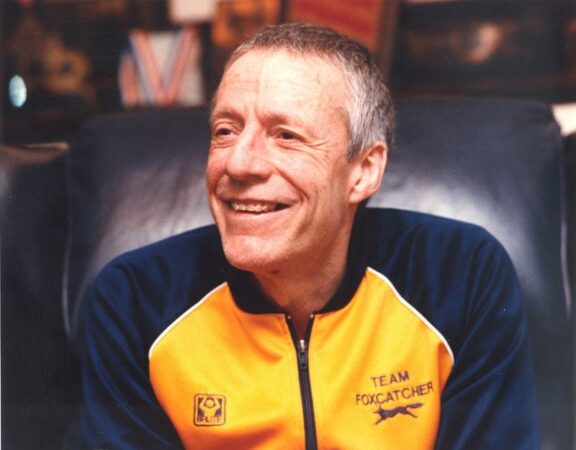
    The multimillionaire became a murderer on Jan. 26, 1996. That part is known.

    But why John du Pont shot and killed Dave Schultz, an Olympic champion freestyle wrestler who was living and working on du Pont’s Newtown Square estate, is still a mystery.

    Foxcatcher

    John Eleuthere du Pont was not a captain of industry, but he was a descendant of one.

    His great-great-great-grandfather was Eleuthere Irenée du Pont de Nemours, who founded the Wilmington chemical giant.

    The most notable title of the du Pont heir’s life was sports enthusiast.

    He transformed his 800-acre estate, known as Foxcatcher Farm, into a world-class athletic training facility. He opened the facility to athletes and their families so they had a place to stay while wrestlers, like Schultz, could prepare for major competitions.

    In 1996, Schultz, a 1984 Olympic gold medalist, and his family stayed there while he trained for that year’s Summer Olympics.

    But even before the run-up to the Summer Games, du Pont’s behavior had become increasingly strange.

    Conviction

    His sister-in-law, Martha du Pont, said they expected something like this to happen.

    Foxcatcher’s overseer had been abusing cocaine and alcohol, and had been walking around with loaded guns for several years.

    During angry outbursts, he would even threaten athletes with guns.

    But why he pointed a .44-caliber revolver at the 36-year-old Schultz during an argument on the estate’s grounds and fired three times will forever be a mystery.

    Du Pont holed up in his mansion for two days before surrendering to police after his heat was cut off during an especially cold weekend.

    On Feb. 25, 1997, he was ruled guilty but mentally ill, and convicted of third-degree murder.

    He offered no explanation for his behavior, only excuses.

    He was sentenced to 13 to 30 years in prison.

    Du Pont died in prison at age 72 on Dec. 9, 2010, four years before an award-winning film starring Steve Carell about the incident would hit theaters.

    Nearly 30 years after his conviction, he is the only member of the Forbes 400 richest Americans to have been convicted of murder.

    Nancy Schultz, who witnessed the shooting, said she never understood why her husband was killed. And she was struck by something du Pont never did.

    “He never just said, ‘I’m sorry.’”