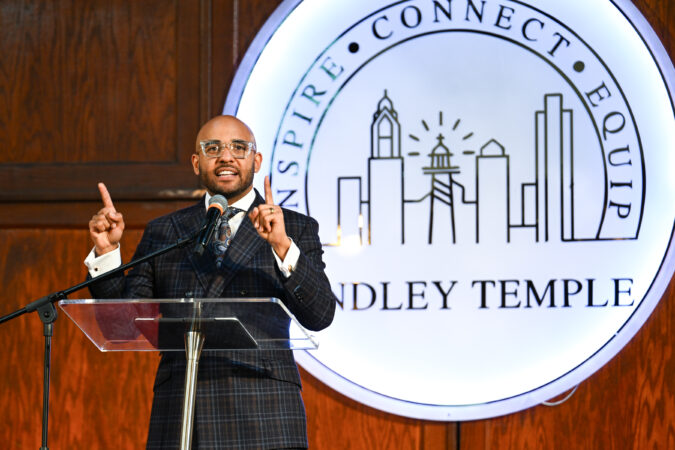
Amid the fight to maintain exhibits about enslaved people at the President’s House Site, congregants gathered Saturday at Tindley Temple United Methodist Church — a site with significant history of its own — to celebrate Black History Month.
“We are celebrating Black history because it’s not just cultural, it is protective,” said John T. Brice, lead pastor at the church in South Philadelphia. “When there is pressure to erase or water down our story, remembering becomes our resistance and resilience.”
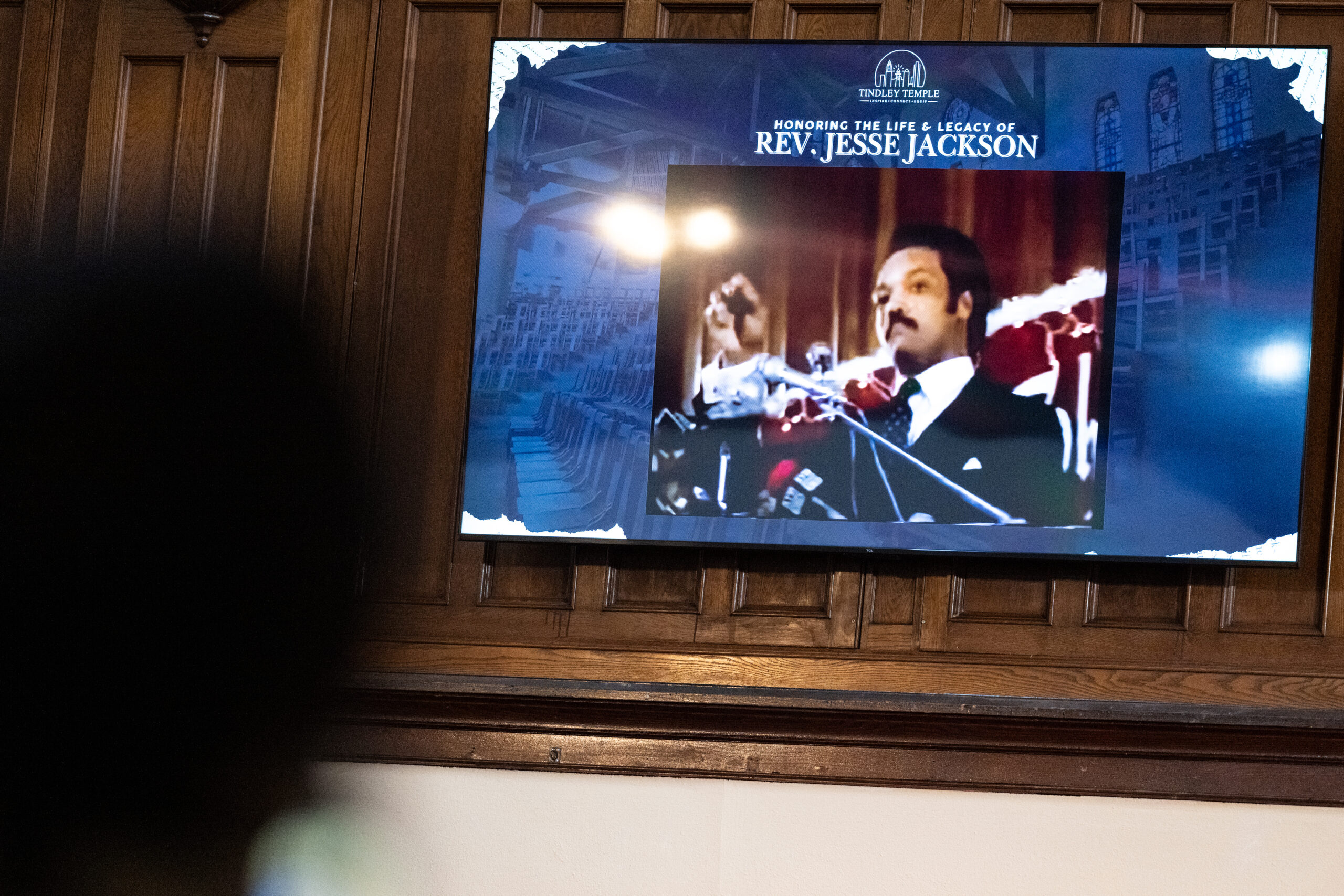
Congregants watch a video of Rev. Jesse Jackson at the Citywide Black History Celebration at Tindley Temple United Methodist Church on South Broad Street in Philadelphia on Saturday, Feb. 21, 2026. Tindley is where “We Shall Overcome,” an anthem of the Civil Rights Movement, was written.
Tindley Temple United Methodist Church was founded by the Rev. Charles Albert Tindley, writer of an early version of the civil rights anthem “We Shall Overcome.”
For Brice, the nation’s story can be told in full only if it includes the contributions, struggles, and leadership of Black Americans not only in February, but every month of the year.
“Our contributions are too often minimized or left out of textbooks, public policy, and even Fifth and Market,” the site of the President’s House slavery exhibits that were removed earlier this month, Brice said. Many of the displays have been restored while litigation continues.
Timothy Welbeck, director of the Center for Anti-Racism at Temple University, said remembering painful history is a way of honoring the contributions of ancestors.
“In the birthplace of America, it is important to acknowledge that the first family owned people,” Welbeck said. “It’s important to honor this legacy because we had to fight for our humanity to be recognized. To tell America’s story completely, you have to acknowledge that history.”
Philadelphia-born Shakara Wilson-Fernandez, 22, sees the acknowledgment of Tindley’s contributions as a way of empowering younger generations.
“It warms my heart,” Wilson-Fernandez said Saturday during the service at the church.
“There are many things going on right now, and although not all of us might be Black, we all need empowerment.”
PJ Thomas agreed. To her, celebrating Black history in 2026 feels like celebrating and honoring the diversity of the country she loves.
“Despite what’s going on, we are still the United States of America,” Thomas said.
“We are still a country that celebrates our people’s history, the people that came through immigration and the people forced to come in distress, because we are all American and we all build this country together.”
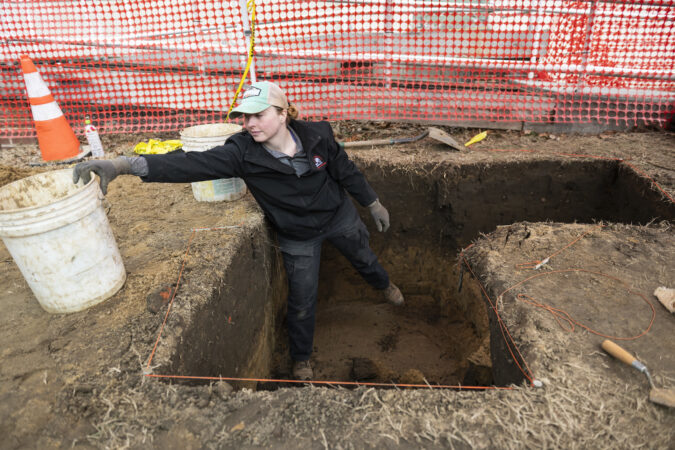
To the casual observer, it’s just an L-shaped hole in the ground, about 40 inches deep, showing two distinct layers of dirt.
But to the archaeologists who dug the hole, it’s a portal into the past going back thousands of years.
Croft Farm is a national historic site. Its owners during the mid-1800s helped Black people escape from slavery. The farmhouse, outbuildings, and 80 acres of the farm are now owned by Cherry Hill Township, part of a recreational and educational space for the public.
The darker brown top layer of “silty sand” contains artifacts from the last 300 years, an era when both enslavers and those dedicated to emancipation lived on the site, according to Matt Kraemer, 27, an archaeologist from Summit, N.J.
Below it, the lighter-colored layer has revealed artifacts from a time when the Lenni-Lenape Indigenous people lived on the land along the Cooper River, in what is now Cherry Hill.
“It’s a very significant site for the fact that it has a Native American component, plus everything the Evans family left behind,” Kraemer said Saturday.
Alanna-Corinne Konkisre (center), 9, of Gloucester County, sifts through dirt to find artifacts at Croft Farm in Cherry Hill, N.J. on Saturday, Feb. 21, 2026. Croft Farm, listed on the National Register of Historic Places, is now an active archaeological site due to the farm’s role during the time of the Underground Railroad.
The Evans family was part of the Quaker religious movement, and like many area Quakers of the time, owners Thomas Evans and his son Josiah were part of the New Jersey Abolition Society, “a group that advocated an end to slavery and also helped to maintain the Underground Railroad,” according to a history of Croft Farm provided by Cherry Hill Township.
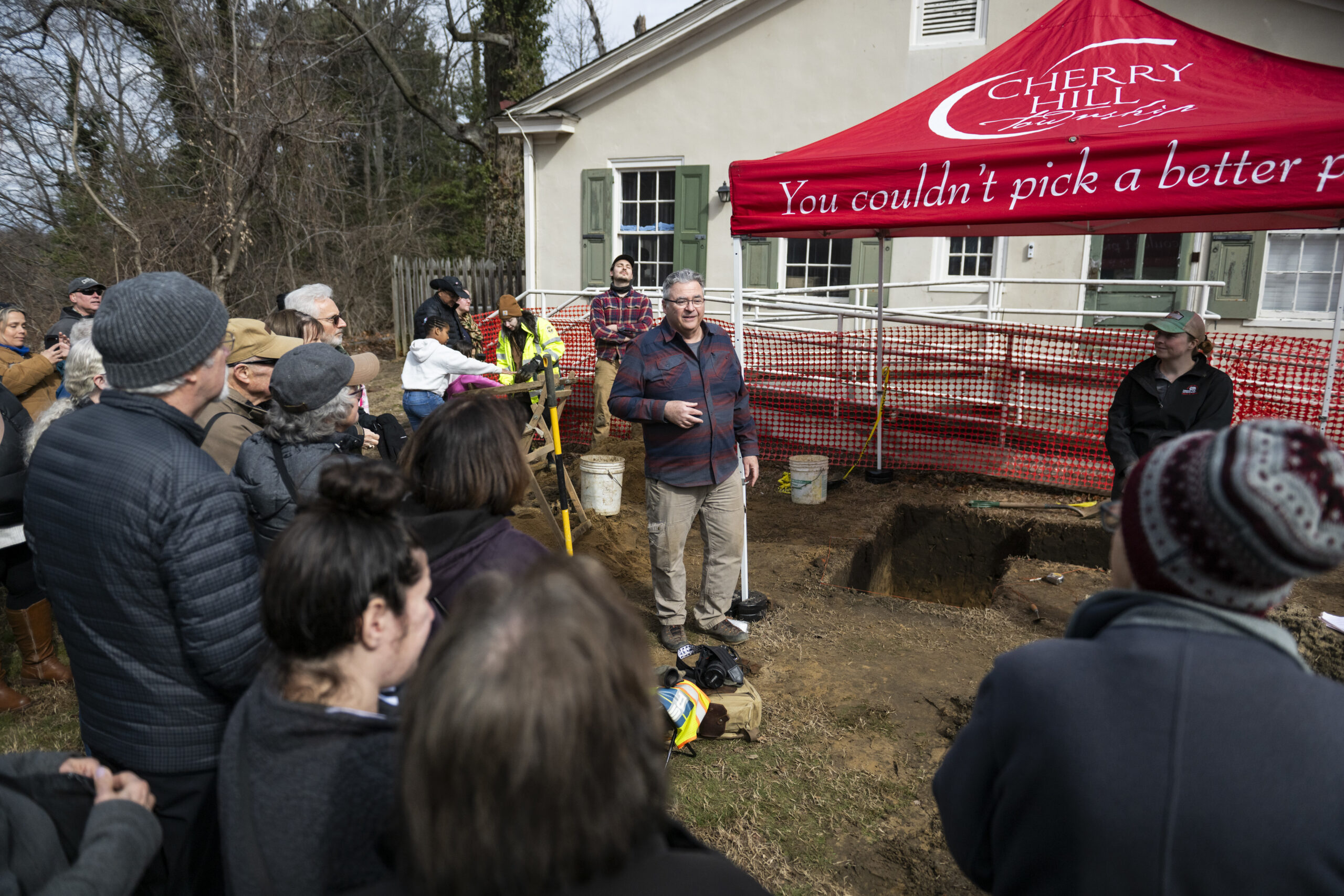
Matthew Tomaso, senior director of cultural resource practices at PS&S, speaks to a crowd of people before the start of an archeological dig at Croft Farm in Cherry Hill, N.J.m on Saturday, Feb. 21, 2026. Croft Farm, listed on the National Register of Historic Places, is now an active archaeological site due to the farm’s role in the Underground Railroad.
The farm’s historical significance presents a great learning opportunity, said Matthew Tomaso, the archaeologist leading the project for PS&S, an architecture and engineering firm with a location in Warren Township.
A year ago, PS&S was brought in to oversee cultural resource management as the township sought to stop groundwater from entering the basement of the brick house on the property, Tomaso said.
That gave Tomaso and his team a chance to see what they might find that would shine a light on the property’s role as a station on the Underground Railroad.
Animal bones, pieces of pottery, and other artifacts help tell that story, Tomaso said, by showing the dietary patterns, habits, and traditions of the people living there at the time.
Nolan Arcinese (left) and Aaron Arcinese (right) look through dirt to find artifacts at Croft Farm in Cherry Hill, N.J., on Saturday, Feb. 21, 2026. Croft Farm, listed on the National Register of Historic Places, is now an active archaeological site due to the farm’s role during the time of the Underground Railroad.
That includes previously enslaved people known to have lived there, such as Joshua Sadler, as well as others who worked and lived on the farm, he said. Sadler went on to found nearby Sadlertown, a Black settlement located in what is now Haddon Township.
What they learn could be especially important since the Underground Railroad was not well documented at the time it was in operation, due to the need to maintain secrecy, Tomaso said.
Mostly, though, they have found bones, said Chelsea Carriere, 29, an archaeologist who called herself “the bone lady.”
Carriere explained that she was looking closely at cow, pig, and bird bone fragments — and the ways the animals were butchered nearly 200 years ago.
To her, the rough cuts on the bones show that these animals likely were raised on the farm or hunted, and were likely butchered on-site, rather than through a butcher shop.
“They were doing it themselves, and that suggests lower socioeconomic status,” Carriere said. Her team is still in the early stages of examining the artifacts.
To her, some of the most amazing finds so far were discovered deeper down in the dirt and would date back 2,000 or more years. These include a piece of argillite that she surmised was a spear point, and a basalt biface, an ancient tool that would have been used for cutting.
“This is a really good site,” Carriere said.
It was also a great experience Saturday for learners of all ages who listened to demonstrations and, with archaeologists’ guidance, used a sifter to search for artifacts in the dirt.
“I love to know what people were doing hundreds of years ago,” said Cherry Hill resident Debbie Kilderry, 71, as she watched children sift the soil.
She came to the site with two artifacts she had obtained — a small porcelain container and a stone — hoping that the archaeologists might have insights into their origins. Tomaso’s professional analysis: She had a real arrowhead, likely from the American West, and a cup once used for coffee cream.
To Kilderry, it is exciting to connect with those who came before her.
“I’m excited to see what they were doing, because they were people just like us — just with different inconveniences.”
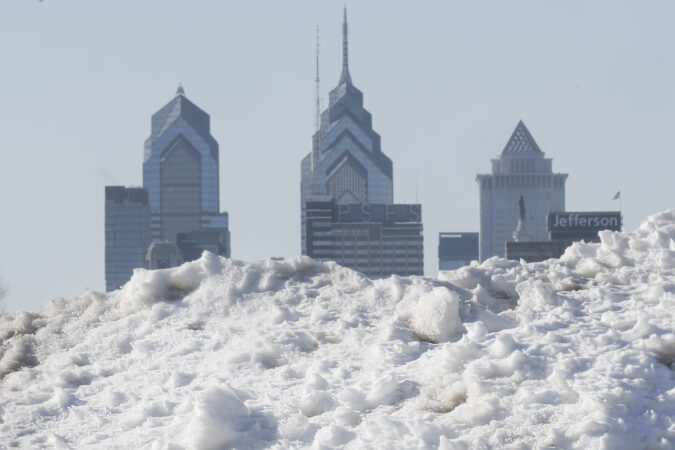
Philadelphia and its suburbs are forecast to receive 14 to 18 inches of snow beginning Sunday and continuing into Monday, with weather prediction models sharpening their focus as the storm approaches.
When all is said and done, the total snowfall may be close to 14 inches in the city, and could surpass 18 inches at the Jersey Shore, where high winds are forecast to create blizzard conditions, according to the National Weather Service. The weather service has issued a winter storm warning for the Philly region and a blizzard warning for the Shore.
“It does look like it’s going to be quite an impactful storm for the whole [I-]95 corridor and further east,” said Sarah Johnson, warning coordination meteorologist at the weather service’s Mount Holly office.
This will lead to potentially dangerous driving conditions starting Sunday into Monday. And the Shore and Delaware Bay could experience flooding during high tide Sunday evening.
While forecasters saw trouble brewing for several days, it was not clear how heavily the storm would affect Philadelphia, Johnson said.
“Pretty much throughout the week, we were aware that there was going to be this storm system off the coast. The question was just going to be how close to the coast it came,” she said.
The storm is expected to begin with a mix of snow and rain Sunday morning, with the potential for only rain falling before dawn. By early to midafternoon, that is forecast to change over entirely to snow, Johnson said.
The winter storm warning is in effect from 7 a.m. Sunday to 6 p.m. Monday.
“We are also going to be seeing some gusty winds with the heaviest snow amounts,” Johnson said. Wind speeds of up to 40 mph late Sunday and early Monday have the potential to cause blowing and drifting snow that may make it difficult to keep roads clear, according to the weather service.
Gusts at the Shore could reach 50 mph, with the blizzard warning there in effect from 1 p.m. Sunday to 6 p.m. Monday.
Johnson emphasized that whatever the storm brings, it will be significant for Philadelphia.
“The period that we are most concerned about in terms of both snow rates and wind is Sunday evening through the morning on Monday,” she said.
<iframe src="https://media.inquirer.com/nws-snow-map/inq-snow-map.html" scrolling="no" frameborder="0" width="100%"></iframe><script type="text/javascript">(function () {window.addEventListener('message', function (e) { var message = e.data; var els = document.querySelectorAll('iframe[src*="' + message.id + '"]'); els.forEach(function(el) { el.style.height = message.height + 'px'; }); }, false); })();</script>
And in contrast to the very low temperatures for days after the Jan. 25 storm that dumped a foot of snow in areas around Philly, temperatures are expected to rise above freezing on Monday afternoon.
Higher temperatures later in the week may help melt the snow, as opposed to the long-lasting snowpack after the January storm.
Pennsylvania Gov. Josh Shapiro and New Jersey Gov. Mikie Sherrill urged residents in their states to stay off the roads during the storm.
On social media, Shapiro said state agencies are prepared to respond to the weather in Eastern and Southeastern Pennsylvania.
Our teams at @PEMAHQ, @PennDOTNews, and @PAStatePolice are prepared to respond to snow and winter weather across much of East and Southeast Pennsylvania beginning tomorrow afternoon and continuing through the overnight hours into Monday morning.
Sherrill on Saturday declared a state of emergency ahead of the storm.
She said at an afternoon news conference that it was the first time since 2022 that the National Weather Service had issued a blizzard warning along the coastline.
The state of emergency will go into effect at noon Sunday.
“I know we just got through a historic winter storm just a few weeks ago — we all did it together by heeding warnings, staying off the roads, and taking public safety seriously,” Sherrill said. “Now we have another serious winter storm on our hands, and my top priority is your safety.”
Officials urged people to stock up on essentials ahead of the storm, keep electronics like cell phones charged, and avoid driving once the snowfall begins.
NEWS: In preparation for the severe winter storm, I am declaring a State of Emergency across all 21 counties in New Jersey – effective at 12:00 PM on Sunday, February 22.
I urge New Jerseyans to use caution, stay off the roads, and follow all safety protocols during the storm.
Sherrill advised New Jerseyans to stay home and suggested watching the U.S. men’s Olympic hockey team play for gold Sunday, doing a puzzle, and eating chili.
Staff writer Stephen Stirling contributed to this article.
Trump administration officials have struggled to figure out how to increase U.S. military spending by a whopping $500 billion in their forthcoming budget, slowing the overall White House spending plan, four people familiar with the matter said.
President Donald Trump last month agreed to a roughly 50% funding boost sought by Pete Hegseth, the defense secretary, in the White House’s annual budget proposal. The idea ran into internal criticism from several other officials, including White House budget chief Russell Vought, who warned about its potential impact on the widening federal deficit, said the people, who spoke on the condition of anonymity to reflect internal deliberations.
Since Trump agreed to the higher number, White House aides and defense officials have run into logistical challenges surrounding where to put the money, because the amount is so large, the people said. The White House is more than two weeks behind its statutory deadline to send its budget proposal to Congress, in part because it is unclear how precisely to spend the additional $500 billion, according to the people familiar with the matter.
Senior Pentagon officials have consulted with former senior defense officials as they grapple with the challenge, said one person familiar with the matter. Part of the discussion centers on how much emphasis should go into buying weapons the military already uses versus investing in high-end technologies, such as artificial intelligence, that the Pentagon envisions as part of its future.
The roughly $900 billion defense budget approved last year was the largest in U.S. history. While other nations have also increased their military spending, the United States already spends more on defense than the next nine countries combined, according to 2023 data from the Peter G. Peterson Foundation, a nonpartisan think tank.
“I’m not surprised they’re having difficulty doing that,” said G. William Hoagland, senior vice president at the Bipartisan Policy Center, a nonpartisan think tank. “That’s an awful lot of money in one year.”
Spokespeople for the White House and the Defense Department declined to comment.
Trump, Hegseth, and many congressional Republicans have defended the proposed increase in the military budget as necessary to pay for an array of new priorities and confront foreign adversaries. Hegseth has said that the money would be spent “wisely” and that the larger budget would send “a message to the world.”
The forthcoming White House budget for fiscal 2027 will spell out the administration’s proposed spending levels across the government. It requires congressional approval to be enacted and faces long odds.
“This will allow us to build the ‘Dream Military’ that we have long been entitled to and, more importantly, that will keep us SAFE and SECURE, regardless of foe,” Trump said in a Truth Social post this month confirming his support for the $1.5 trillion budget number.
The Pentagon has been grappling with how to rapidly replenish expensive munitions that it has relied on heavily, including Tomahawk cruise missiles, Patriot missile-defense interceptors, and ship-launched munitions known as Standard Missile-6s, or SM-6s.
It also is wrestling with how to upgrade its Cold War-era nuclear weapons program with expensive next-generation systems like the B-21 bomber and the Columbia-class submarine. The aircraft, with an estimated cost of about $700 million each, is expected to replace the Air Force’s fleet of B-1 and B-2 bombers. The Columbia-class submarines are expected to cost at least $9 billion each.
Hegseth, upon taking office, directed each military service to look for budget reductions of 8%; the money could then be invested in other Pentagon priorities better aligned with Trump’s agenda. Hegseth bristled at the suggestion that such reprogramming should be considered cuts, saying he would be “reorienting” about $50 billion in defense spending that the Biden administration had planned.
More recently, Hegseth has called for “supercharging” the U.S. industrial base, seeking to speed up how quickly the military can field new weapons and other capabilities, in part by not relying as heavily on traditional defense contractors.
With such a significant jump in spending planned, it now appears that the Pentagon budget is detached from a new national defense strategy that Hegseth’s team released in January, said Mark Cancian, a retired Marine Corps colonel and senior adviser with the Center for Strategic and International Studies. That strategy calls for the Pentagon to focus first on defense in the Western Hemisphere, with less emphasis on Europe, Africa, and the Middle East.
It’s a “head-scratcher” that the Pentagon wants to spend so much money while also cutting back in those areas, Cancian said.
“If you’ve got a 50% budget increase, you don’t have to do any of that,” he said. “You’d be talking about all the new places you’d be making investments.”
The federal deficit, or the gap between what the government spent and what it collected in tax revenue, was $1.8 trillion last year. That number was down from the surges of red ink during the COVID years but up significantly from the standard deficit before the pandemic.
Vought, a deficit hawk, has long called for reducing federal spending while also supporting Trump’s general goal of rebuilding the American military. He was instrumental in securing additional funding for the military last year in the GOP’s tax bill, which bypassed the typical bipartisan process for setting military spending.
The increase in military spending alone would amount to one of the biggest federal programs. One Democratic plan to expand Medicare to cover dental, vision, and hearing benefits would cost $350 billion over the next decade, by comparison. If Congress were to spend an additional $500 billion every year on the military, the cost would be $5 trillion over the next decade. It is unclear if the Trump administration’s proposal is for an additional $500 billion just for next year, or $500 billion each year for a decade.
“I’m sure there are very difficult conversations happening right now. Obviously, it would have a huge impact,” said Charles Kieffer, who spent several decades across administrations in the White House Office of Management and Budget and working for Democrats on the Senate Appropriations Committee. “A 50% increase requires a completely different formulation for your priorities.”
Some experts in military spending panned the proposed increase as likely to increase fraud and waste. Julia Gledhill, a research analyst for the national security reform program at the nonpartisan Stimson Center, pointed to failed audits at the Pentagon and a lack of clear guardrails on much of the new military spending approved last year in the GOP’s One Big Beautiful Bill, which she said has been used like a “slush fund.”
“We don’t know what we’re already spending money on. We don’t have details on how the Pentagon is using its trillion-dollar budget,” Gledhill said. “How are you supposed to make educated, informed decisions about the military budget if you don’t know where it’s already going?”
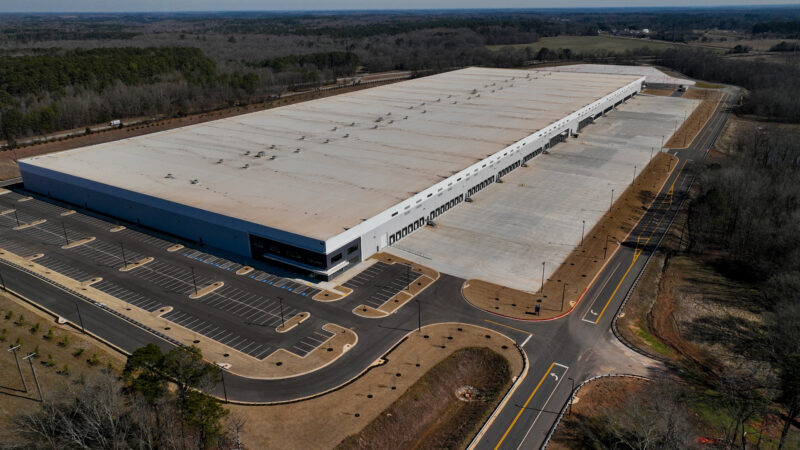
SOCORRO, Texas — In a Texas town at the edge of the Rio Grande and a tall metal border wall, rumors swirled that federal immigration officials wanted to purchase three hulking warehouses to transform into a detention center.
As local officials scrambled to find out what was happening, a deed was filed showing the Department of Homeland Security had already inked a $122.8 million deal for the 826,000-square-foot warehouses in Socorro, a bedroom community of 40,000 people outside El Paso.
“Nobody from the federal government bothered to pick up the phone or even send us any type of correspondence letting us know what’s about to take place,” said Rudy Cruz Jr., the mayor of the predominantly Hispanic town of low-slung ranch homes and trailer parks, where orchards and irrigation ditches share the landscape with strip malls, truck stops, recycling plants, and distribution warehouses.
Socorro is among at least 20 communities with large warehouses across the U.S. that have become stealth targets for Immigration and Customs Enforcement’s $45-billion expansion of detention centers.
As public support for the agency and President Donald Trump’s immigration crackdown sags, communities are objecting to mass detentions and raising concerns that the facilities could strain water supplies and other services while reducing local tax revenue. In many cases, mayors, county commissioners, governors, and members of Congress learned about ICE’s ambitions only after the agency bought or leased space for detainees, leading to shock and frustration even in areas that have backed Trump.
“I just feel,” said Cruz, whose wife was born in Mexico, “that they do these things in silence so that they don’t get opposition.”
Communities scramble for information
ICE, which is part of DHS, has purchased at least seven warehouses in Arizona, Georgia, Maryland, Pennsylvania, and Texas, signed deeds show. Other deals have been announced but not yet finalized, though buyers scuttled sales in eight locations.
DHS objected to calling the sites warehouses, stressing in a statement that they would be “very well structured detention facilities meeting our regular detention standards.”
The process has been chaotic at times. ICE this past week acknowledged it made a “mistake” when it announced warehouse purchases in Chester, N.Y., and Roxbury, N.J. Roxbury then announced Friday that the sale there had closed.
DHS has confirmed it is looking for more detention space but hasn’t disclosed individual sites ahead of acquisitions. Some cities learned that ICE was scouting warehouses through reporters. Others were tipped off by a spreadsheet circulating online among activists whose source is unclear.
It wasn’t until Feb. 13 that the scope of the warehouse project was confirmed, when the governor’s office in New Hampshire, where there is backlash to a planned 500-bed processing center, released a document from ICE showing the agency plans to spend $38.3 billion to boost detention capacity to 92,000 beds.
Since Trump took office, the number of people detained by ICE has increased to 75,000 from 40,000, spread across more than 225 sites.
ICE could use the warehouses to consolidate and to increase capacity. The document describes a project that includes eight large-scale detention centers, capable of housing 7,000 to 10,000 detainees each, and 16 smaller regional processing centers. The document also refers to the acquisition of 10 existing “turnkey” facilities.
Those contracts allow a lot of secrecy and for DHS to move quickly without following the usual processes and safeguards, said Charles Tiefer, a professor emeritus of law at the University of Baltimore Law School.
Socorro facility could be among the largest
In Socorro, the ICE-owned warehouses are so large that 4½ Walmart Supercenters could fit inside, standing in contrast to the remnants of the austere Spanish colonial and mission architecture that defines the town.
At a recent city council meeting, public comments stretched for hours. “I think a lot of innocent people are getting caught up in their dragnet,” said Jorge Mendoza, an El Paso County retiree whose grandparents immigrated from Mexico.
Many speakers invoked concerns about three recent deaths at an ICE detention facility at the nearby Fort Bliss Army base.
Communities fear a financial hit
Even communities that backed Trump in 2024 have been caught off guard by ICE’s plans and have raised concerns.
In rural Pennsylvania’s Berks County, commissioner Christian Leinbach called the district attorney, the sheriff, the jail warden, and the county’s head of emergency services when he first heard ICE might buy a warehouse in Upper Bern Township, 3 miles from his home.
No one knew anything.
A few days later, a local official in charge of land records informed him that ICE had bought the building — promoted by developers as a “state-of-the art logistics center” — for $87.4 million.
“There was absolutely no warning,” Leinbach said during a meeting in which he raised concerns that turning the warehouse into a federal facility means a loss of more than $800,000 in local tax dollars.
ICE has touted the income taxes its workers would pay, though the facilities themselves will be exempt from property taxes.
Georgia center could house twice the population of town
In Social Circle, Ga., which also strongly supported Trump in 2024, officials were stunned by ICE’s plans for a facility that could hold 7,500 to 10,000 people after first learning about it through a reporter.
The city, which has a population of just 5,000 and worries about the infrastructure needs for such a detention center, only heard from DHS after the $128.6 million sale of a 1-million-square-foot warehouse was completed. Like Socorro and Berks County, Social Circle questioned whether the water and sewage system could keep up.
ICE has said it did due diligence to ensure the sites don’t overwhelm city utilities. But Social Circle said the agency’s analysis relied on a yet-to-be built sewer treatment plant.
“To be clear, the City has repeatedly communicated that it does not have the capacity or resources to accommodate this demand, and no proposal presented to date has demonstrated otherwise,” the city said in a statement.
And in the Phoenix suburb of Surprise, Ariz., officials sent a scathing letter to Homeland Security Secretary Kristi Noem after ICE without warning bought a massive warehouse in a residential area about a mile from a high school. Arizona Attorney General Kris Mayes, a Democrat, raised the prospect of going to court to have the site declared a public nuisance.
Crowds wait to speak in Socorro
Back in Socorro, people waiting to speak against the ICE facility spilled out of the city council chambers, some standing beside murals paying tribute to the World War II-era Braceros Program that allowed Mexican farmworkers to be guest workers in the U.S. The program stoked Socorro’s economy and population before President Dwight D. Eisenhower’s administration in the 1950s began mass deportations aimed at people who had crossed the border illegally.
Eduardo Castillo, formerly an attorney for the U.S. Department of Justice, told city officials it is intimidating but “not impossible” to challenge the federal government.
“If you don’t at least try,” he said, “you will end up with another inhumane detention facility built in your jurisdiction and under your watch.”
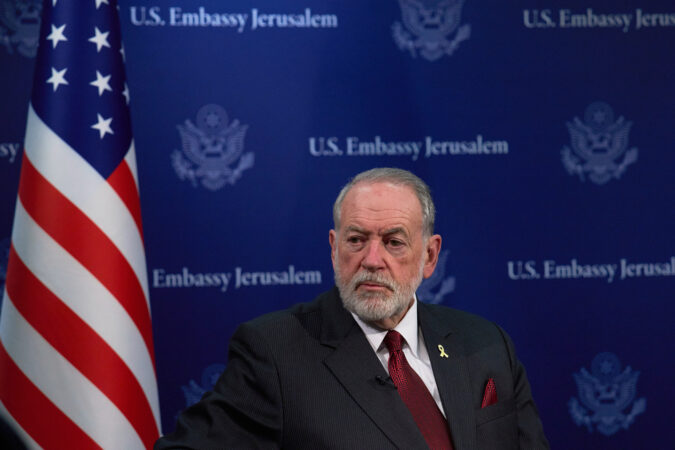
TEL AVIV, Israel — Arab and Muslim nations on Saturday sharply condemned comments by the U.S. ambassador to Israel, Mike Huckabee, who said Israel has a right to much of the Middle East.
Huckabee made the comments in an interview with conservative commentator Tucker Carlson that aired Friday. Carlson said that according to the Bible, the descendants of Abraham would receive land that today would include essentially the entire Middle East, and asked Huckabee if Israel had a right to that land.
Huckabee responded: “It would be fine if they took it all.” Huckabee added, however, that Israel was not looking to expand its territory and has a right to security in the land it legitimately holds.
His comments sparked immediate backlash from neighboring Egypt and Jordan, the Organization of Islamic Cooperation, and the League of Arab States, which in separate statements called them extremist, provocative, and not in line with the U.S. position.
Egypt’s foreign ministry called Huckabee’s comments a “blatant violation” of international law, adding that “Israel has no sovereignty over the occupied Palestinian territory or other Arab lands.”
“Statements of this nature — extremist and lacking any sound basis — serve only to inflame sentiments and stir religious and national emotions,” the League of Arab States said.
There was no immediate comment from Israel or the United States.
Since its establishment in 1948, Israel has not had fully recognized borders. Its frontiers with Arab neighbors have shifted as a result of wars, annexations, ceasefires, and peace agreements.
During the six-day 1967 Mideast war, Israel captured the West Bank and east Jerusalem from Jordan, Gaza and the Sinai Peninsula from Egypt, and the Golan Heights from Syria. Israel withdrew from the Sinai Peninsula as part of a peace deal with Egypt following the 1973 Mideast war. It also unilaterally withdrew from Gaza in 2005.
Israel has attempted to deepen control of the occupied West Bank in recent months. It has greatly expanded construction in Jewish settlements, legalized outposts, and made significant bureaucratic changes to its policies in the territory. U.S. President Donald Trump has said he will not allow Israel to annex the West Bank and has offered strong assurances that he’d block any move to do so.
Palestinians have for decades called for an independent state in the West Bank and Gaza with east Jerusalem its capital, a claim backed by much of the international community.
Huckabee has long opposed the idea of a two-state solution for Israel and the Palestinian people. In an interview last year, he said he does not believe in referring to the Arab descendants of people who had lived in British-controlled Palestine as “Palestinians.”
In the latest interview, Carlson pressed Huckabee about his interpretation of Bible verses from the book of Genesis, where he said God promised Abraham and his descendants land from the Nile to the Euphrates.
“That would be the Levant, so that would be Israel, Jordan, Syria, Lebanon. It would also be big parts of Saudi Arabia and Iraq,” Carlson said.
Huckabee replied: “Not sure we’d go that far. I mean, it would be a big piece of land.”
Israel has encroached on more land since the start of its war with Hamas in Gaza.
Under the current ceasefire, Israel withdrew its troops to a buffer zone but still controls more than half the territory. Israeli forces are supposed to withdraw further, though the ceasefire deal doesn’t give a timeline.
After Syrian President Bashar Assad was ousted at the end of 2024, Israel’s military seized control of a demilitarized buffer zone in Syria created as part of a 1974 ceasefire between the countries. Israel said the move was temporary and meant to secure its border.
And Israel still occupies five hilltop posts on Lebanese territory following its brief war with Hezbollah in 2024.
WASHINGTON — President Donald Trump said Saturday that he was raising the global tariff he wants to impose to 15%, up from 10% he had announced a day earlier.
Trump said in a social media post on that he was making the decision “Based on a thorough, detailed, and complete review of the ridiculous, poorly written, and extraordinarily anti-American decision on Tariffs issued yesterday,” by the U.S. Supreme Court.
After the court ruled he didn’t have the emergency power to impose many sweeping tariffs, Trump signed an executive order on Friday night that enabled him to bypass Congress and impose a 10% tax on imports from around the world. The catch is that those tariffs would be limited to just 150 days, unless they are extended legislatively.
Trump’s post significantly ratcheting up a global tax on imports to the U.S. yet again was the latest sign that despite the court’s check, the Republican president was intent on continuing to wield in an unpredictable manner his favorite tool to for the economy and to apply global pressure. Trump’s shifting announcements over the last year that he was raising and sometimes lowering tariffs with little notice jolted markets and rattled nations.
Saturday’s announcement seemed to a be a sign that Trump intends to use the temporary global tariffs to continue to flex.
“During the next short number of months, the Trump Administration will determine and issue the new and legally permissible Tariffs, which will continue our extraordinarily successful process of Making America Great Again,” Trump wrote on his Truth Social media network.
Under the order Trump signed Friday night, the 10% tariff was scheduled to take effect starting Feb. 24. The White House did not immediately respond to a message inquiring when the president would sign an updated order.
In addition to the temporary tariffs that Trump wants to set at 15%, the president said Friday that he was also pursuing tariffs through other sections of federal law which require an investigation by the Commerce Department.
Trump made an unusually personal attack on the Supreme Court judges who ruled against him in a 6-3 vote, including two of those he appointed during his first term, Justices Neil Gorsuch and Amy Coney Barrett. Trump, at a news conference on Friday, said of the two justices: “I think it’s an embarrassment to their families.”
He was still seething Friday night, posting on social media complaining about Gorsuch, Coney Barrett, and Chief Justice John Roberts, who ruled with the majority and wrote the majority opinion. On Saturday morning, Trump issued another post declaring that his “new hero” was Justice Brett Kavanaugh, who wrote a 63-page dissent. He also praised Justices Clarence Thomas and Samuel Alito, who were in the minority, and said of the three dissenting justices: “There is no doubt in anyone’s mind that they want to, MAKE AMERICA GREAT AGAIN!”
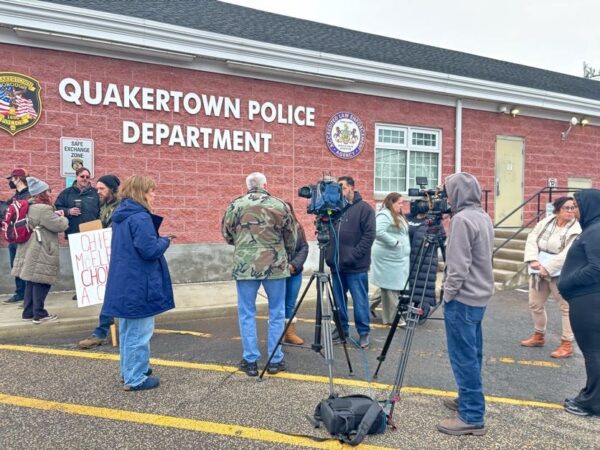
The Bucks County District Attorney’s Office is investigating the Quakertown Borough Police Department’s response to a high school student protest against federal immigration enforcement.
On Friday, a Quakertown High School student walkout protesting U.S. Immigration and Customs Enforcement (ICE) escalated into a confrontation with adults that left at least one teenager bloodied and in handcuffs.
“Our office is conducting an independent investigation into the police response during this incident,” said Manuel Gamiz Jr., a spokesperson for Bucks County District Attorney Joe Khan. “To ensure a thorough and transparent review, we are seeking the community’s assistance and encourage anyone with information, including video footage or photos, to contact the Bucks County detectives at 215-348-6354.”
Bystander video footage showed police, adults, and what appear to be teenagers, at times fighting, on a sidewalk along Front Street. In a widely shared video, teens were seen scuffling with a man who put a girl in a chokehold. Several news organizations have reported that the man, who was not wearing a police uniform, was Quakertown Police Chief Scott McElree. Quakertown police and McElree did not respond to requests for comment Saturday morning.
Quakertown police said Friday that five or six minors and one adult were taken into custody. Police have not provided details on who was arrested and said that the students had been acting violently.
Standing outside the Quakertown police station Saturday morning, parents and leaders from local civil rights groups called on police to provide answers.
Adrienne King, president of the Bucks County NAACP, said that when young people are involved in a police encounter, “the standard for care, restraint, and adherence to policy are high and must be adhered to.”
“Video circulating publicly has raised serious questions in our community,” King said. “Those questions deserve answers, and we are here to ask for those answers today. Transparency is not optional in situations like this.”
Family members of one of the girls in police custody provided a written statement Saturday.
“We are looking for answers and accountability from the Quakertown police department and school district as well as justice for our daughter and the other children. We offer solidarity with the other families affected and hope to have our children home immediately.”
A winter storm warning is in effect for Sunday — a blizzard warning for the Jersey Shore — and Sunday into Monday Philly’s snow has a shot at doubling the amount that fell on Jan. 25, the National Weather Service says.
“At this point, that’s certainly possible,” Zachary Cooper, meteorologist with the National Weather Service said Saturday. The official forecast is calling for just over a foot in the city, with the potential for the total reaching 18 inches.
Blizzard warnings up for the Shore, where onshore winds are forecast to howl past 35 mph, with moderate to major flooding possible.
While it wasn’t in the official language, the weather service on a Saturday morning might well have included a supermarket stampede warning.
The actual winter storm warning is in effect from 7 a.m. Sunday until 6 p.m. Monday.
Witha surprising level of agreement computer models and their interpreters Saturday were seeing the storm as being inevitable. It was forecast to affect the I-95 corridor from Washington to Boston — a rarity in recent winters.
The weather service listed a 25% chance that totals could approach two feet in the city.
“It’s going to be a long-duration event,” said Cody Snell, meteorologist with NOAA’s Weather Prediction Center in College Park, Md.
On the plus side, this will not have the staying power of the 9.3 punitive inches that accumulated on Jan. 25 and spent a three-week vacation in the region. No ice is in the forecast, and daytime temperatures above freezing and the February sun likely will erase most it by the end of the workweek.
(function () {window.addEventListener(‘message’, function (e) { var message = e.data; var els = document.querySelectorAll(‘iframe[src*=”‘ + message.id + ‘”]’); els.forEach(function(el) { el.style.height = message.height + ‘px’; }); }, false); })();
What time would the snow begin in Philly?
Precipitation is expected to begin Sunday morning, said Snell, possibly as a mix of snow and rain that becomes all snow.
Snow may have a hard time sticking during the day, said Tom Kines, senior meteorologist with AccuWeather Inc., since temperatures will be near or slightly above freezing and the late-winter sun will be a factor, even it’s just a rumor in the sky.
Plus the ground won’t be especially cold after a Saturday in which the temperature may approach 50 degrees.
However, the upper air is going to be quite cold, Snell said, and when the snow is falling heavily, as it is expected to do Sunday night, “it will cool the column.”
He said areas that get caught in heavy snow “bands” would see the highest amounts.
What would be so different about this storm?
The storm is forecast to mature into a classic nor’easter, so named for the strong winds generated from the Northeast.
Nor’easters are the primary source of heavy snows along I-95, but the ones that produce heavy snow from Washington to Boston have been scarce lately.
“Over the past several years, they’ve been few and far between,” Kines.
The Jan. 25 storm was not a nor’easter per se, said Snell, but more of a case of the “overrunning” of warm air over cold air producing the snow and sleet.
John Gyakum, an atmospheric scientist at McGill University in Montreal and a winter storm specialist, said he anecdotally has seen a trend of coastal storms intensifying too far north to have much of an impact on the Philly region.
If that were the case, it could be a symptom of global warming, said Steve Decker, meteorology professor at Rutgers University. Storms form where cold and warm meet, and that may have been happening farther north lately.
In any event that evidently won’t be the case Sunday.
What could go wrong with the forecasts?
Are you new around here?
The storm consists of multiple moving parts, and as it bounds off the Southeast coast, it is due to intensify rapidly over the warm Atlantic waters.
Meteorologists advised it was still unclear precisely how intense it would become and what path it would take.
Forecast busts have been known to happen, including a famous one 25 years ago. On a Friday, the weather service warned of a storm of “historic” proportions to begin that Sunday.
What Philly got was about an inch of snow that fell over three uneventful hours.
In 2015, the head of the Mount Holly weather service office publicly apologized for a busted forecast.
However, in recent years, the region hasn’t had all that many serious snow scares.
In this case, expect details to jump around even as the precipitation is falling, but Snell said “confidence is growing” that substantial snow is going to happen.
Inquirer staff writer Stephen Stirling contributed to this article.
We’ll show you a photo taken in the Philly-area, you drop a pin where you think it was taken. Closer to the location results in a better score. This week is all about Lunar New Year of the Horse! Good luck!
Round #21
Question 1
Where is this lion grazing?
Loading…
ClickTap on map to guess the location in the photo
ClickTap again to change your guess and hit submit when you're happy
You will be scored at the end. The closer to the location the better the score
Margo Reed / Staff Photographer
Pretty good/Not bad/Way off! Your guess was from the location.Spot on! Your guess was exactly at the location. Here's also where a random selection of Inquirer readers guessed.
The lion dance, most often performed by two dancers in a single costume, is a traditional Chinese ceremonial dance performed during festive occasions such as Lunar New Year. The dance, along with firecrackers and fireworks that are set off during the celebrations, is thought to bring prosperity and ward off malevolent spirits.
Quiz continues after ad
Question 2
Another lion! Where’s this one?
Loading…
Jessica Griffin / Staff Photographer
Pretty good/Not bad/Way off! Your guess was from the location.Spot on! Your guess was exactly at the location. Here's also where a random selection of Inquirer readers guessed.
These lion dancers were performing outside Bo De Temple, a Vietnamese Buddhist temple at 13th and Washington that is a center of Vietnamese life in South Philadelphia. Lunar New Year is celebrated by many East and Southeast Asian cultures, including but not limited to the Chinese, Vietnamese, and Korean communities across Philadelphia.
Quiz continues after ad
Question 3
Not a lion but a horse! Where is it?
Loading…
Steven M. Falk / Staff Photographer
Pretty good/Not bad/Way off! Your guess was from the location.Spot on! Your guess was exactly at the location. Here's also where a random selection of Inquirer readers guessed.
It’s the Year of the Horse, after all! The Chinese zodiac follows a 12-year cycle based on the lunar calendar, with each year represented by a different animal. This horse is Freeway, who lives at the Fletcher Street Urban Riding Club in Strawberry Mansion. Freeway made news two years ago when he escaped his residence and ended up galloping down I-95.
Your Score
ARank
🧨 A crackling job! A result worth celebrating.
BRank
🧧 B is a job well done. An auspicious start of the year.
CRank
🐎 C is a passing, stable grade, but you could do better.
DRank
🐴 D isn’t great, best saddle up to do better next time!
FRank
We don’t want to say you failed, but you were definitely horsing around.
You beat % of other Inquirer readers.
We’ll be back next Saturday for another round of Citywide Quest.