Category: Nation & World

  • Bettors wagered $54 million on Khamenei’s death. Now they’re not getting paid.

    Bettors wagered $54 million on Khamenei’s death. Now they’re not getting paid.

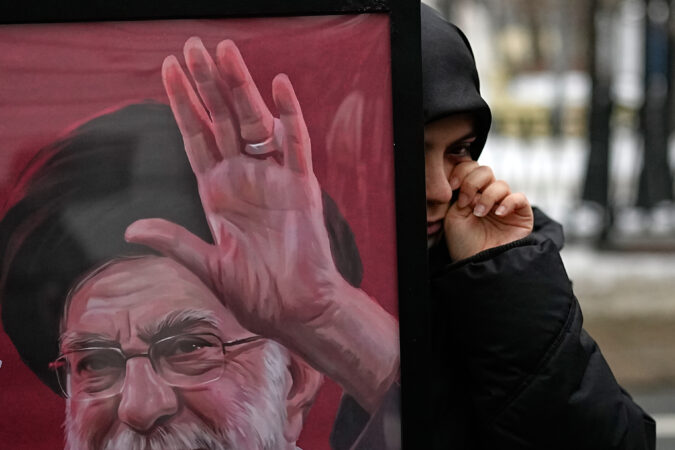
    When he learned last weekend about the killing of Iran’s Ayatollah Ali Khamenei, the Israeli American business executive in New York was excited to cash in.

    On the prediction-market site Kalshi, the executive — who spoke on the condition of anonymity due to concern over what his friends would think — had placed two bets, totaling $3,460, that Khamenei would be “out as Supreme Leader” by March or April 1. His Kalshi app placed green check marks next to his bets, indicating he had won payouts worth more than $63,000.

    Minutes later, however, Kalshi froze the $54 million trade for everyone who bet on that scenario, saying the site does not allow transactions “directly tied to death.” The change triggered an online uproar, as Kalshi users flooded social media to argue the site had unfairly robbed them of winning bets.

    “I was booking my trip to Courchevel,” the French Alps ski resort, he said jokingly to the Washington Post. “Then they changed the rules … and everybody got screwed.”

    The outrage has intensified scrutiny into the explosive rise of prediction markets, which run like traditional sportsbooks but allow people to gamble on elections, international affairs, and real-world events.

    Supporters of Kalshi and its biggest competitor, Polymarket, have defended the sites as game-like platforms for following and perhaps profiting off the news. But critics like Sen. Chris Murphy (D., Conn.) have said they are creating a more “dystopian world” by helping people gamble on life-and-death crises and military assaults in a way that could incentivize political violence.

    “This is American commercial immorality on steroids,” Murphy said in an interview. “Once events that involve good and evil simply become a financial product, I don’t know how right and wrong matters any longer. … People shouldn’t be rooting for people to die because they placed a bet.”

    Kalshi heavily promoted the trade to bettors on its home page and app and in push notifications before Khamenei’s death was publicized. Kalshi also tweeted the morning of the strike that the odds “Khamenei is out as Supreme Leader have surged to 68%,” along with a disclaimer that Kalshi did not broker trades that “settle on death.” In a follow-up, the company said the post was “grammatically ambiguous” and offered to reimburse traders’ lost value.

    Murphy said in an interview he is drafting legislation that would broadly ban prediction-market trades related to government actions, saying they could corrupt public decision-making by allowing military or government officials to profit off secret information.

    Polymarket said in August that the president’s eldest son, Donald Trump Jr., had joined its advisory board, and a handful of recent bets on the administration’s moves have sparked public accusations of insider trading.

    The analytics firm Bubblemaps said it found six “suspected insiders” on Polymarket that had made $1.2 million by betting that the U.S. would hit Iran by Feb. 28, the date that Operation Epic Fury began. All of the accounts were made last month and bet exclusively on Iran-strike timing; some of the bets were made within hours of the first explosions in Tehran. One account bet $60,000 and won $560,000.

    Murphy said in an online post that the trades indicated “people around Trump are profiting off war and death.” Davis Ingle, a White House spokesperson, said on Monday that “the only special interest guiding the Trump administration’s decision-making is the best interest of the American people.”

    Polymarket did not respond to questions about whether it knew or would help investigate whether the account holders had internal knowledge of the military campaign. Donald Trump Jr. did not respond to requests for comment.

    A similar debate played out in January when an anonymous Polymarket trader won roughly $400,000 after successfully predicting, within a few hours, the timing of Venezuelan President Nicolás Maduro’s capture. The Defense Department said then that it prohibited personnel from using classified information for personal gain.

    In the case of Khamenei, Kalshi has argued that the trade, known as an “event contract,” was not specifically a bet on his demise. The company’s chief executive, Tarek Mansour, said on X that long-standing rules ban people “from profiting from death” but that he believed the trade was still “important because leadership changes in Iran have major impact on the world order,” including on oil prices and geopolitical relations.

    “It’s always possible for a ruler to step down or transition power without death, even in autocracies. It just happened in Venezuela,” Mansour said.

    Furious Kalshi bettors have since flooded social media to argue that the site’s rules were muddled and that they believed they would be paid out upon his death. In one video, the cryptocurrency-content creator Gabriel Haines mocked Kalshi by saying, “We meant a peaceful transition or riding off on a unicorn to kiss [Israeli Prime Minister Benjamin] Netanyahu on a cheek.”

    Some users have vowed to close their Kalshi accounts and take their money elsewhere, with one posting, “You owe me $2,500+ & you owe many innocent, casual traders millions more.”

    Amanda Fischer, a former chief of staff at the Securities and Exchange Commission who now works as a policy director at the financial advocacy group Better Markets, said the trade offered a “really good mini-model of just how problematic this business is.”

    “How is an 86-year-old theocratic leader supposed to lose his power other than through death?” Fischer said. “All of the Kalshi users who placed bets on this believed they were voting on a death market, and many are very angry at how Kalshi broke the trades.”

    Lawmakers have worried that allowing death-related trades could offer fatal incentives; an assassin, for instance, could plan and then profit off the date of a victim’s death. “There’s a reason we don’t let people take fire insurance policies out on [other people’s homes] — because it would incent arson,” Fischer said.

    The Commodity Futures Trading Commission, which regulates prediction markets, bans any bets that involve or reference terrorism, assassination, or war, and six Democratic senators sent a letter last month voicing concern about any bet that “resolves upon or closely correlates to an individual’s death.”

    Dustin Gouker, a gaming-industry consultant and the publisher of Event Horizon, a newsletter about prediction markets, said Kalshi could have a financial incentive to keep the rules vague. It could have specified that the bet would pay out only in the case of a peaceful regime change, but that might have reduced bettors’ interest — and the ensuing fees Kalshi earns from every transaction.

    “They could have easily made the title ‘by way other than death,’ but that’s obviously not as exciting to trade, and that’s why they didn’t do it,” Gouker said.

    Kalshi has sought to quiet the firestorm by reimbursing any bets, fees, or losses from the trade, which Mansour said led the company to incur “a substantial loss to make users whole.” A person familiar with Kalshi discussions, who spoke on the condition of anonymity to detail internal deliberations, said the payments have cost the company roughly $2.2 million.

    Mansour said that the company did not change the trade rules after the incident but that a disclaimer on the listing noting the company’s “death carveout” exception has been overly confusing and will be revised for future bets. Some bettors have pointed out that, after former President Jimmy Carter died, the company paid users who had bet that Carter would not attend President Donald Trump’s inauguration.

    For some in the industry, the episode has triggered a moment of self-reflection. Aaron Courtney, the cofounder of market-tracking firm Kalshinomics, said in an online essay that war-related trades are “simultaneously one of the most important and most uncomfortable things prediction markets have produced” and have raised big questions. “Is it morally acceptable to profit from correctly predicting that bombs will fall on people?” he asked.

    Polymarket, however, has trumpeted its war-related bets, saying in a note that prediction markets’ ability to create forecasts for world affairs is “particularly invaluable in gut-wrenching times like today” and can give people “the answers they needed in ways TV news and X could not.”

    While Kalshi is regulated in the United States, Polymarket operates under different trade rules overseas, and its users have bet more than $500 million on trades related to the timing of American strikes against Iran, according to platform data. Unlike Kalshi, Polymarket has not frozen trades for bettors wagering that Khamenei would be “out as Supreme Leader” by the end of this month; its trading volume now stands at more than $61 million.

    On the first morning of the assault, Polymarket posted a meme image of a man with five screens laying out bets about Khamenei’s ouster and the caption, “Can’t right now babe, I’m monitoring the situation.”

    But Polymarket now faces its own questions around potential insider trading. Murphy said in an interview on Monday that he was horrified by the “corrupt and immoral” trades, adding, “It doesn’t smell right to people that these markets are rigged and people inside know the answers … making thousands off whether we send their kids to war.”

    Emily Austin, a conservative influencer and sports podcaster who has promoted Polymarket online, said she had friends and siblings who were upset about lost winnings on Kalshi’s Khamenei bet. Despite the scandal, however, she said her love of prediction-market betting remains as strong as ever. She said she sees the bets as a “social community” and a way to keep in touch with friends.

    “I’ve been a huge sports bettor since I was allowed to legally bet, but I never thought you’d be able to bet on world leaders being out,” she said. “And if I’m being totally honest, I find it so fun.”


  • U.S. soldiers who died in the Iran war remembered for their service and devotion to their families

    U.S. soldiers who died in the Iran war remembered for their service and devotion to their families

    WEST DES MOINES, Iowa — Sgt. Declan Coady had been checking in with his family from Kuwait every hour or two after the U.S. and Israel launched their military campaign against Iran, even as Tehran launched retaliatory strikes against Israel and Persian Gulf Arab states that host U.S. armed forces.

    When he didn’t respond to messages Sunday, “most of us started to wonder,” Coady’s father, Andrew, told the Associated Press. “Your gut starts to get a feeling.”

    A drone strike at a command center in Kuwait killed Coady, 20, of West Des Moines, Iowa, and five other members of the U.S. Army Reserve who worked in logistics and kept troops supplied with food and equipment.

    The other soldiers identified Tuesday by the Pentagon were: Sgt. 1st Class Nicole Amor, 39, of White Bear Lake, Minn.; Capt. Cody Khork, 35, of Winter Haven, Fla.; and Sgt. 1st Class Noah Tietjens, 42, of Bellevue, Neb. U.S. Army base Fort Knox wrote on Facebook that the names of the other two will be released once next-of-kin notifications are complete.

    The soldiers were assigned to an Army Reserve unit headquartered in Des Moines, Iowa, which is temporarily operating under the 1st Theater Sustainment Command at Fort Knox in Kentucky.

    “Sadly, there will likely be more, before it ends. That’s the way it is,” President Donald Trump said of the deaths. Trump will attend the dignified transfers of the soldiers when they arrive in the U.S., the White House said Wednesday. The ritual honors service members killed in action.

    Defense Secretary Pete Hegseth said the military “ensured that the maximum possible defense and maximum possible force protection was set up before we went on offense.”

    “The terms of this war will be set by us at every step,” Hegseth said Wednesday.

    Nicole Amor and Joey Amor in an undated photo.

    A mother of two who loved gardening

    Amor, 39, was an avid gardener who enjoyed making salsa from the peppers and tomatoes in her garden with her son, a senior in high school. She also enjoyed roller-blading and bicycling with her fourth-grade daughter.

    A week before the drone attack, Amor was moved off-base to a shipping container-style building that had no defenses, Joey Amor said.

    “They were dispersing because they were in fear that the base they were on was going to get attacked and they felt it was safer in smaller groups in separate places,” he said.

    He last spoke to her about two hours before she was killed. He said she was working long shifts and they had been messaging about her tripping and falling the night before.

    “She just never responded in the morning,” he said.

    Childhood friend Natalie Caruso wrote on Facebook that she was “absolutely heartbroken” about Amor’s death.

    “Nicole was always up for an adventure and she had such a contagious laugh!” Caruso wrote Wednesday. ”Growing up next door to you was some of my fondest childhood memories!”

    ‘He loved being a soldier’

    Coady had just told his father last week that he had been recommended for a promotion from specialist to sergeant, a rank he received posthumously.

    He was among the youngest people in his class, trained to troubleshoot military computer systems, but he impressed his instructors, Andrew Coady said Tuesday.

    “He trained hard, he worked hard, his physical fitness was important to him. He loved being a soldier,” Coady said. “He was also one of the most kindest people you would ever meet, and he would do anything and everything for anyone.”

    Coady trained as an information technology specialist with the Army Reserves and was studying cybersecurity at Drake University in Des Moines. He was taking online classes while in Kuwait and wanted to become an officer.

    “I still don’t fully think it’s real,” his sister Keira Coady said. “I just remember all of our conversations about what he was going to do when he came back.”

    A calling to serve his country

    Khork was very patriotic and drawn from a young age to serving the U.S., his family said in a statement Tuesday.

    He enlisted in the Army Reserve and joined Florida Southern College’s ROTC program.

    “That commitment helped shape the course of his life and reflected the deep sense of duty that was always at the core of who he was,” said his mother, Donna Burhans, father, James Khork, and stepmother, Stacey Khork, in a statement.

    Khork also loved history and had a degree in political science.

    His family described him as “the life of the party, known for his infectious spirit, generous heart, and deep care for those who served alongside him and for everyone blessed to know him.”

    Abbas Jaffer posted Monday on Facebook about his friend of 16 years.

    “My best friend, best man, and brother gave his life defending our country overseas,” Jaffer said.

    A loving father and husband

    Tietjens lived with his family in the Washington Terrace mobile home park in the Omaha suburb of Bellevue, Neb. He was married with a son, according to a Facebook page.

    Tietjens earned a black belt in Philippine Combatives and Taekwondo and was “an instructor who gave his time, discipline, and leadership to others,” the Philippine Martial Arts Alliance said in a Facebook post.

    On the mat and as a soldier, “he carried the same values: honor, discipline, service, and commitment to others,” the organization said.

    Army Staff Sgt. Jeff Coleman said Tietjens was his mentor.

    “You could call him day or night,” Coleman told KETV. “He always took the time, you know, he made you feel important. And that’s hard to find sometimes in the military.”

    Nebraska Gov. Jim Pillen on Wednesday ordered U.S. and state flags flown at half-staff until the evening of Tietjens’ burial. State lawmakers held a moment of silence Wednesday to honor the fallen soldier.

    “Noah stepped up to serve and defend the American people from foreign enemies around the world — a sacrifice we must never forget,” Pillen wrote in a tribute Tuesday.

    “We are holding the Tietjens family close in our hearts during this unbelievably difficult time and will keep them in our prayers,” he said.

    Tietjens’ cousin Kaylyn Golike asked for prayers, especially for Tietjens’ 12-year-old son, wife, and parents, as they navigate “unimaginable loss.”

    “We lost a brave soldier this weekend and many hearts are broken,” Golike wrote on Facebook Tuesday.

  • Senate to vote on forcing Trump to end Iran strikes; John Fetterman says he’ll oppose it

    Senate to vote on forcing Trump to end Iran strikes; John Fetterman says he’ll oppose it

    The Senate is scheduled to take an initial vote Wednesday on blocking President Donald Trump from ordering further strikes on Iran, offering the first test of Congress’s support for a campaign that Trump launched without its consent.

    Democrats — along with Sen. Rand Paul (R., Ky.) — are forcing a vote on a war powers resolution over the opposition of most Republicans, who control the Senate. Democrats are imploring a handful of Republicans to break with their party to end the conflict and reassert Congress’s control over declaring war.

    At least four Republicans besides Paul would need to support the resolution for it to pass if every senator is voting. One Democrat, Sen. John Fetterman of Pennsylvania, has said he will oppose it.

    “I pray so hard for my colleagues to exercise the judgment that this is not the right time for more war,” Sen. Tim Kaine (D., Va.) said Monday on the Senate floor.

    But the resolution faces tough odds.

    Congress has voted on seven other war powers resolutions since June, all of which failed. Most Republicans support the U.S. and Israeli air campaign that started Saturday, which has killed Ayatollah Ali Khamenei and other top Iranian leaders, and they are working to defeat the resolution.

    “We should let him finish the job,” Sen. Lindsey Graham (R., S.C.) told reporters, referring to Trump. “We should cheer him on, in my view.”

    The House is set to vote Thursday on a similar war powers resolution, which Speaker Mike Johnson (R., La.) said he believes he has the votes to defeat.

    “The idea that we would take the ability of our commander in chief … to finish this job is a frightening prospect to me,” Johnson told reporters. “It’s dangerous, and I am certainly hopeful — and I believe we do — have the votes to put it down.”

    Even if the resolution passes the Senate and the House, Trump could veto it. Overriding Trump’s veto would require a two-thirds majority in both chambers. No war powers resolution has ever overcome a veto.

    The Senate vote Wednesday is an initial procedural vote to advance the resolution, and any Republicans who support it could still oppose its final passage.

    That’s what happened in January, when five Republicans — Sens. Lisa Murkowski of Alaska, Susan Collins of Maine, Josh Hawley of Missouri, Todd Young of Indiana, and Paul — voted with Democrats to advance the resolution blocking strikes on Venezuela. But Hawley and Young flipped days later after Trump wrote on social media that they “should never be elected to office again,” though they extracted some concessions.

    Democrats wanted to force a vote on the Iran resolution before the strikes, which Kaine said last week would increase its odds of passing. But they did not do so, in part because negotiations between the Trump administration and Iran were still underway.

    Some Democrats have compared Trump’s strikes on Iran to the Iraq War, although President George W. Bush sought and received authorization from Congress before the U.S. invasion in 2003. Trump has not asked for authorization to strike Iran.

    “I pray that my colleagues will vote to end this dangerous and unnecessary war that has already resulted in the loss of six servicemembers and injured others,” Senate Minority Leader Chuck Schumer (D., N.Y.) said in as statement. “We owe it to those in uniform, their families, and all Americans to not make the same mistakes that we made in Iraq and Afghanistan.”

    The U.S. invaded Afghanistan in the aftermath of the Sept. 11, 2001, attacks and occupied the country for nearly 20 years. While U.S. forces succeeded in killing Osama bin Laden, the architect of the attacks, in Pakistan in 2011, they never defeated the Taliban, which had sheltered bin Laden. The Taliban overthrew the American-supported Afghan government weeks before U.S. forces withdrew and remains in power.

    The War Powers Resolution, which Congress passed in 1973 in response to the Vietnam War, allows a single lawmaker to force a vote to withdraw U.S. forces from a conflict or to block strikes when hostilities are imminent. It also requires the president to withdraw forces after 60 days — or 90 days if the president seeks an extension — unless Congress declares war or authorizes the use of military force.

    Senate Majority Leader John Thune (R., S.D.) said Tuesday that he does not believe the Trump administration needed to seek authorization to continue the Iran campaign even if it lasts for longer than 90 days.

    “I think the president has the authority that he needs to conduct the activities, the operations that are currently underway there,” Thune told reporters.

    Secretary of State Marco Rubio, Defense Secretary Pete Hegseth, and other administration officials held briefings for lawmakers Tuesday, which Sen. Chris Murphy (D., Conn.) said convinced him that the campaign could last a long time.

    “I think they have contempt for Congress,” Murphy told reporters. “They have no plans to come to Congress for any authorization, even if they were to insert ground forces.”

  • U.S. sinks Iranian warship as Iran vows to destroy military and economic infrastructure in Mideast

    U.S. sinks Iranian warship as Iran vows to destroy military and economic infrastructure in Mideast

    DUBAI, United Arab Emirates — A U.S. submarine sank an Iranian warship in the Indian Ocean, as Washington and Israel intensified their bombardment Wednesday of Iran’s security forces and other symbols of power. Iran launched more missiles and drones and warned of the destruction of military and economic infrastructure across the Middle East.

    The tempo of the strikes on Iran was so intense that state television announced the mourning ceremony for Iranian Supreme Leader Ayatollah Ali Khamenei, who was killed at the start of the conflict, would be postponed. Millions attended the funeral of his predecessor, Ayatollah Ruhollah Khomeini, in 1989.

    The U.S. and Israel launched the war Saturday, targeting Iran’s leadership, missile arsenal, and nuclear program while suggesting that toppling the government is a goal. But the exact aims and timelines have repeatedly shifted, signaling an open-ended conflict.

    President Donald Trump praised the U.S. military Wednesday for “doing very well on the war front, to put it mildly.” Later in the day, fellow Republicans in the U.S. Senate stood with Trump on Iran as they voted down a resolution seeking to halt the war.

    Israel also traded fire with the Iranian-backed Hezbollah insurgent group in Lebanon, while Iran fired on Bahrain, Kuwait, and Israel. As the conflict spiraled, Turkey said NATO defenses intercepted a ballistic missile launched from Iran before it entered Turkey’s airspace.

    The war has killed more than 1,000 people in Iran, more than 70 in Lebanon, and around a dozen in Israel, according to officials in those countries. It has disrupted the supply of the world’s oil and gas, snarled international shipping, and stranded hundreds of thousands of travelers in the Middle East.

    Both sides are unrelenting

    Defense Secretary Pete Hegseth said a torpedo from an American submarine sank an Iranian warship Tuesday night in the Indian Ocean.

    Sri Lankan authorities said 32 people were rescued from the ship, which they said had 180 people on board and sank outside Sri Lanka’s territorial waters. The country’s navy said it recovered 87 bodies.

    Israel said it hit buildings associated with Iran’s Basij, the all-volunteer force of the paramilitary Revolutionary Guard that conducted a bloody crackdown on protesters in January. Thousands of people were killed and tens of thousands detained.

    The Israeli military hit buildings associated with Iran’s internal security command. Israel and the U.S. have said they want to see Iranians overthrow the country’s theocracy, and strikes against Iran’s internal security forces may be aimed at hastening that.

    However, Iranian Foreign Minister Abbas Araghchi said over the weekend that its forces have decentralized leadership, with units acting largely on their own according to general orders, which could blunt the effect of attacks on top command and control hubs.

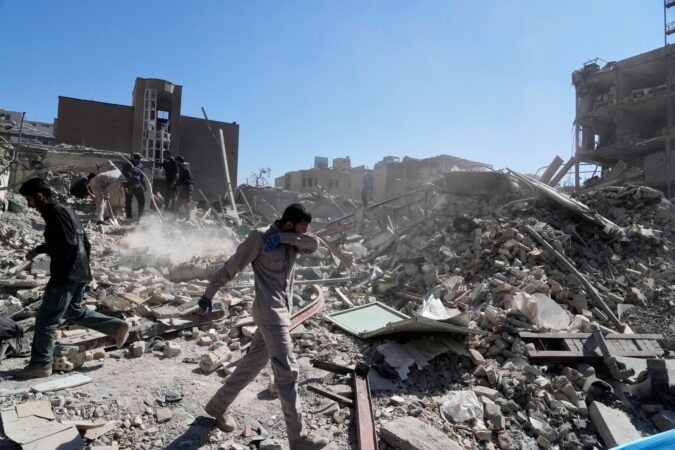
    Iranian state television showed the ruins of buildings in Tehran, with interviewees saying the attacks damaged their homes. Strikes have also been reported in the Shiite seminary city of Qom targeting a building associated with a clerical panel set to pick Iran’s next supreme leader. Iranian media said it was empty at the time.

    Shifting timelines for U.S. operations

    During his Pentagon briefing, Hegseth did not give a definitive timeline for U.S. operations.

    “You can say four weeks, but it could be six. It could be eight. It could be three,” he said. “Ultimately, we set the pace and the tempo. The enemy is off-balance, and we’re going to keep them off-balance.”

    Adm. Brad Cooper, the top U.S. military commander in the Middle East, said American forces have damaged Iran’s air defenses and taken out ballistic missiles, launchers, and drones. Israeli military spokesperson Brig. Gen. Effie Defrin said such damage has led to a decline in launches from Iran.

    U.S. and Israeli military officials say launches from Iran have declined as the war has progressed. Israel’s Homefront Command announced it was easing restrictions that closed workplaces nationwide. It said workplaces could reopen Thursday if there is a shelter nearby. Schools were to remain closed.

    Still, air-raid sirens and explosions could be heard across central and northern Israel on Wednesday. Israel’s military said Iran launched missiles toward the country. Hezbollah also fired rockets, as Israel pounded targets in the suburbs of the Lebanese capital, Beirut.

    Iran has also struck around the region, and air sirens sounded Wednesday across Bahrain, home to the U.S. Navy’s 5th Fleet.

    At least 1,045 people have been killed in Iran, the country’s Foundation of Martyrs and Veterans Affairs said Wednesday. Eleven people have died in Israel. Six U.S. troops have been killed.

    The death toll has exceeded 70 in Lebanon, where the health ministry said Wednesday that three people died when drone strikes hit two vehicles on a Beirut highway. The Israeli military said it was targeting a Hezbollah member.

    Israel says its offensive had been planned for midyear

    Israeli Defense Minister Israel Katz said the offensive against Iran had originally been planned for mid-2026, but “the need arose to bring everything forward to February.”

    He listed events inside Iran, Trump’s positions, “and the whole possibility of creating a combined operation here” as reasons.

    The protests in Iran put unprecedented pressure on its leadership. Trump threatened military action in response to the crackdown before shifting his attention to Iran’s disputed nuclear program.

    White House press secretary Karoline Leavitt said Wednesday that the U.S. launched its operation partly out of concern Iran might strike American personnel and assets in the region first. A phone call between Trump and Israeli Prime Minister Benjamin Netanyahu before the airstrikes began was also “important with respect to the timeline,” she said.

    Energy supplies in the crosshairs

    Iran’s paramilitary Revolutionary Guard issued its most intense threat yet, saying the strikes against it would result in “the complete destruction of the region’s military and economic infrastructure.”

    A Maltese-flagged container ship was attacked Wednesday while passing through the Strait of Hormuz, the narrow mouth of the Persian Gulf through which about a fifth of the world’s oil is shipped. The ship was hit by two missiles, sparking a fire, according to Malta’s transport minister, Chris Bonett. Its 24 crew members were rescued.

    Tanker traffic through the strait has fallen by about 90% compared with prewar levels, shipping tracker MarineTraffic.com said Wednesday.

    Oil prices have soared as Iranian attacks have disrupted traffic through the strait, and global stock markets have been hammered over worries that the spike in oil prices may grind down the world economy.

    Iran’s clerics are choosing a new supreme leader

    Iran’s leaders are scrambling to replace Khamenei, who ruled the country for 37 years. This is only the second time since the 1979 Islamic Revolution that a new supreme leader is being chosen.

    Potential candidates range from hard-liners committed to confrontation with the West to reformists who seek diplomatic engagement. Mojtaba Khamenei, Khamenei’s son, has long been considered among them, though he has never been elected or appointed to a government position.

    In a sign that Iran’s leadership will seek to consolidate its power as it faces its biggest crisis in decades, the head of the judiciary warned that “those who cooperate with the enemy in any way will be considered an enemy.”

    The Israeli defense minister threatened whomever Iran picks to be the country’s next supreme leader.

    “Every leader appointed by the Iranian terror regime to continue and lead the plan to destroy Israel, to threaten the United States and the free world and the countries of the region, and to suppress the Iranian people — will be a target for elimination,” Katz wrote on X.

  • U.S. soldiers killed in Iranian drone strike on operations center had little protection

    U.S. soldiers killed in Iranian drone strike on operations center had little protection

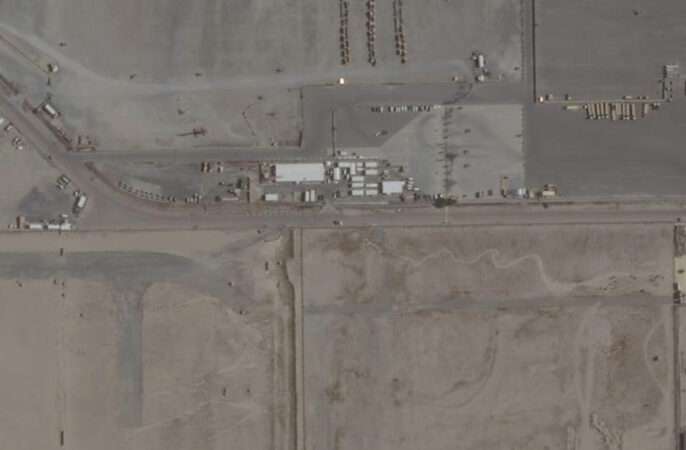
    WASHINGTON — An operations center targeted by an Iranian drone strike that killed six American soldiers on Sunday was located in the heart of a civilian port in Kuwait, miles away from the main Army base, according to satellite images and a U.S. official.

    The husband of one of the slain soldiers, who was part of a supply and logistics unit based in Iowa, told the Associated Press on Tuesday that the hub was a shipping container-style building and had no defenses.

    The development, reported earlier by CNN and CBS News, raises questions about the safety precautions that the U.S. military had in place as it, along with Israel, launched an attack on Iran, which has responded with retaliatory strikes against several countries in the region, including Kuwait. President Donald Trump and top defense leaders say more American casualties are likely.

    Defense Secretary Pete Hegseth said Monday that the six soldiers were killed in a “tactical operations center” when a projectile made its way past air defenses. A day later, the Pentagon confirmed it was a drone strike in Port Shuaiba when announcing the names of four of the soldiers who were slain.

    A satellite image taken Monday and reviewed by the AP showed the main building in the complex destroyed, with a trail of black smoke rising from it. It is located in the heart of Port Shuaiba, a working seaport and industrial area just south of Kuwait City. The U.S. official, who spoke on condition of anonymity to discuss a matter under active investigation, confirmed the image depicted the location of Sunday’s attack.

    The Army base, Camp Arifjan, is more than 10 miles to the south. The operations center was just a little over a mile from some of the piers where merchant ships would offload cargo containers and was surrounded by oil storage tanks, refineries, and a power plant.

    Joey Amor, husband of Sgt. 1st Class Nicole Amor, said his wife had been moved off-base to what he described as a shipping container-style building a week before the Iranian strike. The 39-year-old from White Bear Lake, Minn., was one of the soldiers killed in the attack.

    “They were dispersing because they were in fear that the base they were on was going to get attacked, and they felt it was safer in smaller groups in separated places,” he said.

    After news reports about the operations center emerged, chief Pentagon spokesperson Sean Parnell said on social media that the “secure facility was fortified with 6-foot walls.” He said the military has “the most extensive Air Defense umbrella in the world over the Middle East right now and control of the skies is increasing with every wave of airpower.”

    Parnell’s office did not respond to questions about what role the walls would have played in defending against a drone attack or what air defenses were present in range of the command center at the port.

    Capt. Tim Hawkins, a spokesperson for U.S. Central Command, said “it would be inappropriate to comment given the incident is under investigation.”

  • Israel steps up airstrikes in Tehran, as Iran widens its response across the region

    Israel steps up airstrikes in Tehran, as Iran widens its response across the region

    DUBAI, United Arab Emirates — Israel said it launched airstrikes against Iranian missile launchers and a nuclear research site Tuesday, and Iran struck back against Israel and across the Gulf region, targeting U.S. embassies and disrupting energy supplies and travel.

    Four days into a war that President Donald Trump suggested would last several weeks or perhaps longer, nearly 800 people have been killed in Iran, including some Trump said he had considered as possible future leaders of the country.

    Explosions rang out Tuesday in Tehran and in Lebanon, where Israel said it retaliated against Hezbollah militants. The American embassy in Saudi Arabia and the U.S. consulate in the United Arab Emirates came under drone attacks. Iran has fired dozens of ballistic missiles at Israel, though most of the incoming fire has been intercepted. Eleven people in Israel have been killed since the conflict began.

    In other developments, the Pentagon identified four U.S. Army Reserve soldiers who were killed in a drone strike at a command center in Kuwait. The strike also killed two other service members.

    The spiraling nature of the war raised questions about when and how it would end.

    The administration has offered various objectives, including destroying Iran’s missile capabilities, wiping out its navy, preventing it from obtaining a nuclear weapon, and ensuring it cannot continue to support allied armed groups.

    While the initial U.S.-Israeli strikes killed Iranian Supreme Leader Ayatollah Ali Khamenei and Trump urged Iranians to overthrow their government, senior administration officials have since said regime change was not the goal.

    Trump on Tuesday seemed to downplay chances of the war ending Iran’s theocratic rule, saying that “someone from within” the Iranian regime might be the best choice to take power once the U.S.-Israel campaign is finished.

    Trump says people the U.S. had in mind to lead Iran are dead

    Speaking Tuesday from the Oval Office, Trump said Reza Pahlavi, the exiled son of Iran’s toppled shah, is not someone that his administration has considered in depth to take over.

    As far as possible leaders inside Iran, “the people we had in mind are dead,” Trump said.

    “I guess the worst case would be do this, and then somebody takes over who’s as bad as the previous person, right? That could happen,” Trump said. ”We don’t want that to happen.”

    Iran’s leaders are scrambling to replace Khamenei, who ruled the country for 37 years. It’s only the second time since the 1979 Islamic Revolution that a new supreme leader is being chosen. Potential candidates range from hard-liners committed to confrontation with the West to reformists who seek diplomatic engagement.

    Israel and U.S. strike nuclear facilities and other targets in Iran

    Information coming out of Iran has been limited because of poor communications, round-the-clock airstrikes, and tight restrictions on journalists. But across Iran’s capital, aircraft were heard overhead, and explosions rang out.

    The Israeli military said it conducted a wave of airstrikes on sites that produce and store ballistic missiles, in Tehran and Isfahan. It also said it destroyed what it called Iran’s secret, underground nuclear headquarters. Without providing evidence, it said the site was used for scientific research “to develop a key component for nuclear weapons.”

    “The regime attempted to rebuild its efforts and conceal them, thinking we wouldn’t notice. They were mistaken,” said Israeli military spokesman Brig. Gen. Effie Defrin.

    There was no immediate public comment from the U.S. or Iran about the site Israel named.

    Iran has said it has not enriched uranium since June, though it has maintained its right to do so and says its nuclear program is peaceful.

    The United Nations’ nuclear watchdog said Iran’s Natanz nuclear enrichment site had sustained “some recent damage,” though there was “no radiological consequence expected.” The U.S. hit Natanz during the 12-day war in June, when Israeli and American strikes greatly weakened Iran’s nuclear program.

    Fears rise in Tehran as bombardment of capital intensifies

    New rounds of U.S. and Israeli airstrikes rattled Iran.

    “Since midnight, I and my wife are hearing sound of explosions,” said Ali Amoli, an engineer living in north Tehran.

    Satellite images published Tuesday by Colorado-based company Vantor showed the domed roof of Iran’s presidential complex in Tehran had been destroyed, supporting Israel’s claim of an overnight strike. Iran did not acknowledge the damage or report any casualties.

    A north Tehran resident who spoke on condition of anonymity for fear of retaliation described growing fears in the capital as it comes under heavy bombardment. The resident said most stores in the normally bustling area of Tajrish were closed, though bakeries and supermarkets remained open.

    Iran hits the U.S. Embassy in Riyadh and Washington pulls out staff

    An attack from two drones on the U.S. Embassy in Riyadh caused a “limited fire,” according to the Saudi Arabian Defense Ministry, and the embassy urged Americans to avoid the compound.

    An Iranian drone struck a parking lot outside the U.S. consulate in Dubai, sparking a small fire, Secretary of State Marco Rubio said in Washington. He said all personnel were accounted for.

    The United Arab Emirates said it has intercepted the vast majority of more than 1,000 Iranian missile and drone attacks against it.

    U.S. embassies in Saudi Arabia, Kuwait, and Lebanon said they were closed to the public.

    The U.S. State Department ordered the evacuation of non-emergency personnel and family in Kuwait, Bahrain, Iraq, Qatar, Jordan, and the United Arab Emirates. The U.S. also urged its citizens to leave more than a dozen Middle Eastern countries, though with much of the airspace closed, many were stranded.

    The State Department said Tuesday it’s preparing military and charter flights for Americans who want to leave the Middle East. Several other countries also arranged evacuation flights for their citizens.

    The U.S.-Israeli strikes have killed at least 787 people in Iran, according to the Red Crescent Society. In Lebanon, where Israel launched retaliatory strikes on the Iranian-supported militant group Hezbollah, 50 people were killed, including seven children, Lebanon’s health ministry said.

    The U.S. military has confirmed six deaths of American service members. In addition, three people were killed in the United Arab Emirates, and one each in Kuwait and Bahrain.

    The four dead American soldiers who were identified Tuesday were assigned to the 103rd Sustainment Command in Des Moines, lowa. Killed were Capt. Cody A. Khork, 35, of Winter Haven, Fla.; Sgt. 1st Class Noah L. Tietjens, 42, of Bellevue, Neb.; Sgt. 1st Class Nicole M. Amor, 39, of White Bear Lake, Minn.; and Spc. Declan J. Coady, age 20, of West Des Moines, Iowa.

    Turkish Foreign Minister Hakan Fidan on Tuesday criticized Iran’s attacks against Gulf neighbors that had worked to prevent war as an “incredibly flawed strategy” that threatened to widen the war if those states decide to retaliate.

  • Commerce Secretary Lutnick to appear before House panel investigating Epstein

    Commerce Secretary Lutnick to appear before House panel investigating Epstein

    Commerce Secretary Howard Lutnick, a former Manhattan neighbor of Jeffrey Epstein, has agreed to voluntarily testify before the House Oversight Committee as part of its investigation into the convicted sex offender, the panel’s chairman announced Tuesday.

    Lutnick has faced growing bipartisan pressure to testify about his ties to Epstein following the Justice Department’s release of a tranche of documents that suggested Lutnick maintained contact with Epstein years after claiming to have distanced himself from him.

    “Secretary Lutnick has proactively agreed to appear voluntarily before the House Committee on Oversight and Government Reform,” Rep. James Comer (R., Ky.), the committee’s chairman, said in a statement. “I commend his demonstrated commitment to transparency and appreciate his willingness to engage with the Committee. I look forward to his testimony.”

    Lutnick’s connection to Epstein also has caused controversy at Haverford College, where president Wendy Raymond is considering convening a committee that would review whether the mega donor’s name should remain on the campus library.

    Lutnick will soon become the latest participant in a series of high-profile interviews conducted by the committee for its Epstein probe — the most recent of which included former President Bill Clinton and former Secretary of State Hillary Clinton. They took part in a pair of contentious, closed-door depositions in New York last week.

    The Department of Commerce did not immediately respond to a request for comment about Lutnick’s interview.

    “I look forward to appearing before the committee. I have done nothing wrong and I want to set the record straight,” Lutnick said in a statement to Axios, which first reported his planned appearance.

    Testifying before Congress last month, the commerce secretary said he recalled meeting with Epstein three times over the course of 14 years. Lutnick also said he and his family had lunch with Epstein on his Caribbean island in 2012 — after previously claiming that he and his wife had distanced themselves from Epstein around 2005.

    The exchanges made public by the Justice Department show that Lutnick, a former chairman of the financial services firm Cantor Fitzgerald, and Epstein kept communicating years after Epstein pleaded guilty to two charges of soliciting prostitution, including one involving a minor, and was sentenced to 13 months in jail.

    Their last known exchange in the Justice Department documents came in 2018, when Lutnick reached out to Epstein about the Frick Collection, a museum near their neighboring homes, planning construction.

    “Are you aware as to them building to block our park views,” Lutnick wrote in an email that his assistant forwarded to Epstein, “What should we do about it? Time is of the essence.” Lutnick also urged Epstein to involve a lawyer, to which Epstein replied, “Will do.”

    The following year, Epstein was arrested on federal sex trafficking charges and later died in federal custody. His death was ruled a suicide.

    Some lawmakers, including Rep. Robert Garcia of California — the top Democrat on the House Oversight Committee — as well as Rep. Thomas Massie (R., Ky.), have called for Lutnick to step down over his connection to Epstein. But President Donald Trump last week signaled he remained confident in Lutnick.

    “Howard would go in and do whatever he has to say,” Trump told reporters on Friday about possible Epstein testimony. “He’s a very innocent guy. He’s doing a good job.”

    The Oversight Committee has already scheduled depositions for Darren Indyke and Richard Kahn, the co-executors of Epstein’s estate, this month. And Rep. Anna Paulina Luna (R., Fla.) has said she plans to ask the committee to bring in “some of the [Epstein] co-conspirators that were given lesser sentences that were known to have trafficked young girls.”

    Garcia told the Washington Post that if Democrats retake the House in November and become the majority next year, they will “absolutely” pursue an interview with Trump regarding Epstein. “There’s a long list of subpoenas that we will be engaged in,” Garcia added.

  • Pentagon dispute bolsters Anthropic reputation but raises questions about AI readiness in military

    Pentagon dispute bolsters Anthropic reputation but raises questions about AI readiness in military

    Anthropic’s moral stand on U.S. military use of artificial intelligence is reshaping the competition between leading AI companies but also exposing a growing awareness that maybe chatbots just aren’t capable enough for acts of war.

    Anthropic’s chatbot Claude, for the first time, outpaced rival ChatGPT in phone app downloads in the United States this week, a signal of growing interest from consumers siding with Anthropic in its standoff with the Pentagon, according to market research firm Sensor Tower.

    The Trump administration on Friday ordered government agencies to stop using Claude and designated it a supply chain risk after Anthropic CEO Dario Amodei refused to bend his company’s ethical safeguards preventing the technology from being applied to autonomous weapons and domestic mass surveillance. Anthropic has said it will challenge the Pentagon in court once it receives formal notice of the penalties.

    And while many military and human rights experts have applauded Amodei for standing up for ethical principles, some are also frustrated by years of AI industry marketing that persuaded the government to apply the technology to high-stakes tasks.

    “He caused this mess,” said Missy Cummings, a former Navy fighter pilot who now directs the robotics and automation center at George Mason University. “They were the No. 1 company to push ridiculous hype over the capabilities of these technologies. And now, all of a sudden, they want to be for real. They want to tell people, ‘Oh, wait a minute. We really shouldn’t be using these technologies in weapons.’”

    Anthropic didn’t immediately respond to a request for comment. The Defense Department declined to comment on whether it is still using Claude, including in the Iran war, citing operational security.

    Cummings published a paper at a top AI conference in December arguing that government agencies should prohibit the use of generative AI “to control, direct, guide or govern any weapon.” Not because AI is so smart that it could go rogue, but because the large language models behind chatbots like Claude make too many mistakes — called hallucinations or confabulations — and are “inherently unreliable and not appropriate in environments that could result in the loss of life.”

    “You’re going to kill noncombatants,” Cummings said in an interview Tuesday with the Associated Press. “You’re going to kill your own troops. I’m not clear whether the military truly understands the limitations.”

    Amodei sought to emphasize those limitations in defending Anthropic’s ethical stance last week, arguing that “frontier AI systems are simply not reliable enough to power fully autonomous weapons. We will not knowingly provide a product that puts America’s warfighters and civilians at risk.”

    Anthropic, until recently, was the only one of its peers to have approval for use in classified military systems, where it has partnered with data analysis company Palantir and other defense contractors. President Donald Trump said Friday, around the same time he was approving Saturday’s military strikes on Iran, that the Pentagon would have six months to phase out Anthropic’s military applications.

    Cummings, a former Palantir adviser, said it’s possible that Claude has already been used in military strike planning.

    “I just fundamentally hope that there were humans in the loop,” she said. “A human has to babysit these technologies very closely. You can use them to do these things, but you need to verify, verify, verify.”

    She said that’s a contrast to the messaging from AI companies that have suggested that their technology is evolving to the point where it is “almost sentient.”

    “If there’s culpability here, I’d say half is Anthropic’s for driving the hype and half is the Department of War’s fault for firing all the people that would have otherwise advised them against stupid uses of technology,” Cummings said.

    One social media commentator this week described Anthropic’s government problems as a “Hype Tax” — a message that was reposted by President Donald Trump’s top AI adviser, David Sacks, a frequent critic of the company.

    And while it has caused legal hassles that could jeopardize Anthropic’s business partnerships with other military contractors, it has also bolstered its reputation as a safety-minded AI developer.

    “It’s applaudable that a company stood up to the government in order to maintain what it felt were its ethics and were its business choices, even in the face of these potentially crippling policy responses,” said Jennifer Huddleston, a senior fellow at the libertarian-leaning Cato Institute.

    Consumers have already spoken, leading to a surge of Claude downloads that made it the most popular iPhone app starting on Saturday and for all phone systems in the U.S. on Monday, according to Sensor Tower. That’s come at the expense of OpenAI’s ChatGPT, which saw its consumer reputation damaged when it announced a Friday deal with the Pentagon to effectively replace Anthropic with ChatGPT in classified environments.

    In the Apple store, the number of 1-star reviews — the worst rating — of ChatGPT grew by 775% on Saturday and continued to grow early this week, forcing OpenAI to do damage control.

    “We shouldn’t have rushed to get this out on Friday,” OpenAI CEO Sam Altman said in a social media post Monday. “The issues are super complex, and demand clear communication. We were genuinely trying to de-escalate things and avoid a much worse outcome, but I think it just looked opportunistic and sloppy.”

    Altman was planning to gather employees for an “all-hands” meeting on Tuesday to discuss next steps.

    “There are many things the technology just isn’t ready for, and many areas we don’t yet understand the tradeoffs required for safety,” Altman said. “We will work through these, slowly, with the [Pentagon], with technical safeguards and other methods.”

  • Who leads Iran now? An uncertain path to new supreme leader after Khamenei’s death.

    Who leads Iran now? An uncertain path to new supreme leader after Khamenei’s death.

    Iran announced the first step in a succession process that remains opaque and fraught with uncertainty Sunday after the government confirmed the killing of Supreme Leader Ayatollah Ali Khamenei in U.S. and Israeli attacks.

    What comes next is uncertain. Iran’s constitution calls for an assembly of experts to choose the next supreme leader, but that may not be possible in wartime. And with so many of the country’s top leadership reportedly targeted in the U.S. and Israeli strikes, it is unclear who remains among the country’s power brokers and those considered candidates to replace Khamenei.

    “The martyrdom of the Supreme Leader at the hands of Israel and the criminal America was a great disaster for our country,” said Iranian President Masoud Pezeshkian in an address to the nation Sunday, his first since the conflict erupted.

    An interim leadership council assumed its duties and began leading the country, Pezeshkian said. “With the power of God, we will continue the path of the Imam, the path of the dear leader, and the path of all those who seek justice in the world with power,” he said.

    Long anticipated, the succession of Iran’s 86-year-old supreme leader was always expected to bring with it a degree of regime instability. But now, that will likely be magnified, with various rivals and factions jockeying for wartime power amid vastly diminished popularity and perhaps support among Iran’s military establishment.

    Iran has only held one other supreme leader succession, that which brought Khamenei to power in 1989 after the death of Ayatollah Ruhollah Khomeini, the founder of the Islamic Republic. Though the process is outlined in the country’s constitution and the Iranian system has had years to prepare, experts caution that a smooth process is nearly impossible.

    “Irrespective of what the guidelines say and what the politics may have been, it was always going to be improvisational,” said Suzanne Maloney, a vice president at the Brookings Institution who has advised both Democratic and Republican administrations on Iran policy.

    “Under the circumstances of an existential conflict, the succession process is going to be very much dictated by the context of the moment,” Maloney said. In the near term, she expects Iran to keep the temporary council in place.

    The supreme leader is both the head of state in Iran and a religious figure, believed to be a representative of God by his Shiite followers. Khamenei served in the position for 37 years, during which time he greatly expanded the power and scope of rule over the democratically elected civilian government. As supreme leader, Khamenei had the last say on all matters in the country, but often only arrived at decisions after a lengthy consultative process.

    Iran’s former president, Ebrahim Raisi, had long been considered the next in line to Khamenei. But after Raisi’s death in a 2024 helicopter accident, the question of succession has remained open, creating a kind of power vacuum. Several names have been considered front-runners, but most lack a significant public profile.

    One of the top contenders on the interim council appointed Sunday is Ayatollah Alireza Arafi, who has deep ties to the Iranian system and security establishment. He is a member of the guardian council and the assembly of experts, the body that chooses the next supreme leader.

    After Raisi’s death, one of Khamenei’s sons, Mojtaba, was widely expected to be the favored successor, but Khamenei was reportedly against the idea of transferring the position along hereditary lines. Others in Iran feared such a move would echo the very ruling system — the shahs of the Pahlavi dynasty — that the Islamic republic under Khomeini toppled in 1979.

    It’s unclear how many figures from Khamenei’s inner circle were killed alongside him or elsewhere during U.S. and Israeli strikes. The status of his son Mojtaba remains unclear, but state media confirmed Khamenei’s son-in-law and daughter-in-law were killed Saturday.

    “The structure of the Islamic Revolution has been designed in such a way that after the martyrdom of any commander, at any rank or level, qualified and capable individuals immediately replace them,” read a report Saturday from the state-run Fars News Agency.

    As long as the war continues, the succession process could remain a secondary concern to Iran’s remaining leadership, according to Alex Vatanka, an Iran analyst with the Middle East Institute.

    “The succession process is not key in the short term because they’re going to try and fight on. Firing off missiles does not require a supreme leader,” he said. But if Iran’s regime survives war with the United States and Israel, the supreme leader’s role could be critical to holding the system together in a weakened state.

    Already this year, Iran faced massive nationwide protests that began in response to economic grievances but quickly morphed into thundering calls for an end to the regime. The protests plunged the country into crisis and Iran’s leadership chose to respond to the unrest with overwhelming violence, killing thousands of people in a matter of days.

    In the aftermath of the protests, many Iranians reached by the Washington Post described deep, simmering anger toward their government. And some said they were eagerly anticipating a U.S. attack as President Donald Trump threatened Iran with an expanding military buildup over the past month.

    Celebrations broke out in Tehran and other parts of the country after news of Khamenei’s death Saturday night. Amid the ongoing near-total internet blackout it was impossible to determine how widespread the celebrations were. But Iranians reached inside the country by the Post reported that security forces were deployed Saturday night to break up the revelers.

    When Trump announced the initial waves of U.S. and Israeli attacks against Iran he issued a direct call to the Iranian people.

    “Bombs will be dropping everywhere. When we are finished, take over your government. It will be yours to take,” Trump said. “This will be probably your only chance for generations.”

    Prominent members of Iran’s opposition are hoping Khamenei’s death will build momentum for protests and demonstrations. Reza Pahlavi, the son of Iran’s deposed shah and a prominent opposition exile, has repeatedly called on Iranians to rise up against the regime. After Khamenei’s death he issued a renewed call to the country’s security forces to defect.

    “Any attempt by the remnants of the regime to appoint a successor to Khamenei is doomed to fail from the outset,” he wrote. Though he has lived in exile for most of his life, Pahlavi is Iran’s most prominent opposition leader, and in recent mass protests inside the country Iranians chanted for his return.

    “To the military, law enforcement, and security forces: any effort to preserve a collapsing regime will fail,” he said in a social media post.

  • New York’s congestion toll into Manhattan upheld by a federal judge over Trump’s objections

    New York’s congestion toll into Manhattan upheld by a federal judge over Trump’s objections

    NEW YORK — A federal judge has blocked President Donald Trump’s administration’s efforts to halt New York’s first-in-the-nation congestion fee meant to reduce traffic and pump revenue into the region’s aging transit system.

    U.S. District Judge Lewis Liman on Tuesday ruled that the U.S. Department of Transportation lacked the authority to unilaterally rescind approval of the $9 toll, which former Democratic President Joe Biden initially green-lit.

    Instead, he sided with the Metropolitan Transportation Authority, which had argued that the department’s reversal was “unlawful” because the agency had not adequately explained its reasoning.

    “The Secretary’s actions were arbitrary and capricious, an abuse of discretion, and not in accordance with law,” Liman wrote in his 149-page ruling, referring to Trump’s Transportation Secretary Sean Duffy.

    The judge noted that New York’s legislature passed the toll, which its governor signed into law and received the necessary federal approvals before launching.

    “The democratic process worked,” Liman wrote, even as he left the door open for future attempts by Trump and other opponents to kill the program, which took effect on Jan. 5, 2025.

    Gov. Kathy Hochul said the decision vindicates a “once-in-a-lifetime success story” that’s “yielded huge benefits” in its first year of operation, including reducing gridlock and unlocking critical funding for mass transit.

    “The judge’s decision is clear: Donald Trump’s unlawful attempts to trample on the self-governance of his home state have failed spectacularly,” the Democrat said in a statement. “Congestion pricing is legal, it works, and it is here to stay.”

    The U.S. DOT said it’s reviewing its legal options, including appealing.

    “Once again, working-class Americans are being sidelined under Governor Kathy Hochul’s policies, which impose a massive tax on every New Yorker,” the agency said in a statement.

    New York’s congestion toll is imposed on most vehicles driving into Manhattan south of Central Park.

    The toll varies depending on vehicle type and time of day, and is added to tolls drivers already pay to cross bridges and tunnels into Manhattan, but generally costs about $9.

    Congestion pricing schemes aimed at reducing traffic pollution and encouraging public transit use have long existed in other global cities, including London, Stockholm, Milan, and Singapore, but not in the U.S.

    But Trump, whose namesake Trump Tower and other properties are within the congestion zone, has strongly opposed the idea. During his presidential campaign, he vowed to kill New York’s plan as soon as he took office.

    Then last February, Duffy rescinded the toll’s federal approval, calling the fee “a slap in the face to working-class Americans and small business owners.” He threatened to withhold federal funding for projects in New York if the toll weren’t discontinued.

    But Liman temporarily blocked the administration from following through on those threats until he issued a final decision. The Manhattan judge previously dismissed a series of lawsuits brought by local opponents, including New Jersey’s governor, unionized teachers in New York City, a trucking industry group, and local suburban leaders.

    Hochul had been a vocal supporter of the toll but paused its planned rollout in 2024, a move widely seen as an attempt to help suburban Democrats in congressional races where the toll was divisive. She then reinstated the fee after the election, but lowered it from $15 to $9.

    As the program marked its first anniversary in January, Hochul, who is up for reelection, joined the MTA in touting the toll’s benefits.

    According to a recent MTA report, the toll has led to some 27 million fewer vehicles coming into the heart of Manhattan, resulting in 22% less air pollution and 23% faster commute times for those opting to drive and pay the fee.

    The toll has also generated more than $550 million in revenue for the region’s creaky and cash-strapped transit system — exceeding projections, the MTA has said.

    Sales tax revenues, office leases and foot traffic in the congestion zone have all increased since the toll took effect, disproving concerns it would hurt the local economy, according to the agency.

    “Traffic is down, business is up, and we’re making crucial investments in a transit system that moves millions of people a day,” Janno Lieber, the MTA’s CEO, said Tuesday. “New York is winning.”