The United Arab Emirates has sold itself to foreigners for years as a sunny, safe, tax-free oasis.
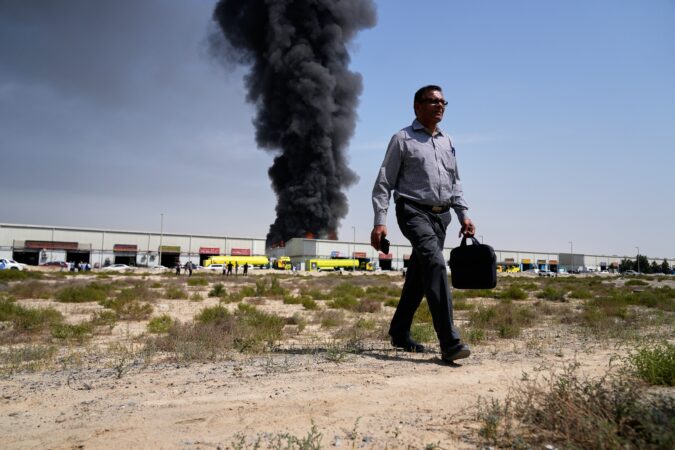
That peaceful image was shattered Saturday as Iranian weaponry rained down on Dubai, setting fire to a five-star resort, threatening the world’s tallest building, and killing one person and injuring seven others at the airport in the capital city of Abu Dhabi.
“This is Dubai’s ultimate nightmare, as its very essence depended on being a safe oasis in a troubled region,” Cinzia Bianco, an expert on the Persian Gulf at the European Council on Foreign Relations wrote on X. “There might be a way to be resilient, but there is no going back.”
Officials tried to reassure residents and visitors that the country’s air defense system was among the best in the world, blasting down drones and missiles.
“I know it’s a scary time for a lot of the residents,” Reem Al Hashimy, minister of state for international cooperation, told CNN. “We don’t hear these types of loud sounds. But at the same time, those are sounds of interception. And where there has been damage — that has been primarily debris.”
Fallout from the attacks has undermined the Emirates’ efforts to de-escalate tensions with Iran despite longtime suspicions of its neighbor across the Gulf. The UAE closed its embassy in Tehran on Sunday.
The oil-rich federation of seven sheikhdoms has relied on its image as a place of serenity to lure wealthy tourists, businesspeople, and future residents who want to live largely tax-free in luxury in the desert by the sea. Nearly 90% of the estimated 11 million residents are foreigners.
Real estate firms sell glimmering high-rises and poolside villas to rich Europeans and Americans by promoting a welcoming climate and business-friendly policies, and touting it as one of the safest places on earth.
Hundreds of drone and missile attacks later, though, that reputation has been rocked.
“Last night was pretty surreal,” said British racehorse trainer Jamie Osborne, who was in Dubai for the Emirates Super Saturday. “You’re standing in the paddock watching missiles get shot through the sky.”
The Ministry of Defense said Sunday that air defenses had dealt with 165 ballistic missiles, two cruise missiles, and more than 540 Iranian drones over two days.
While officials said they intercepted all air attacks Saturday, debris from the knocked-down weapons sparked blazes at some of Dubai’s most iconic locations.
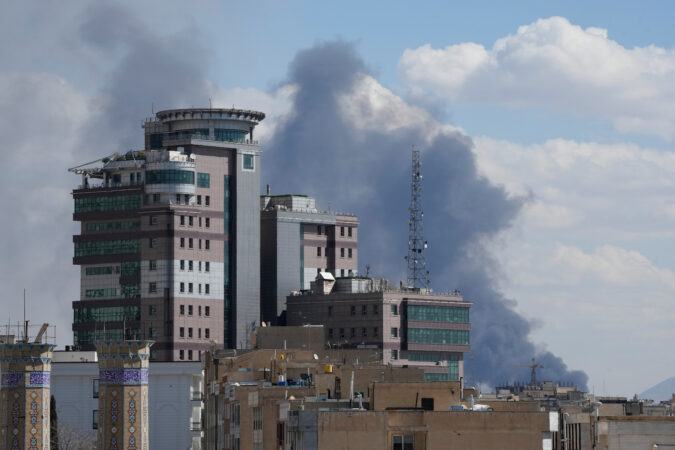
Social media videos and photos showed a fire outside the Fairmont hotel on the prestigious human-made Palm Jumeirah island, flames licked at the facade of the famous Burj Al Arab hotel, and smoke rose into the sky near Burj Khalifa, the 2,723-foot skyscraper.
There also was a fire at Dubai’s Jebel Ali Port, the city’s main sea terminal and a major shipping hub, and the Dubai International Airport was damaged and four employees were injured, according to the Dubai Media Office.
Kristy Ellmer, who was on a business trip from New Hampshire, said she was staying away from the windows of her hotel but felt relatively safe despite the numerous blasts.
“You hear a lot of explosions at times, you know, there’s hundreds of them,” she said. “It’s unsettling. We’re not used to hearing bombs, right, or missiles.”
Louise Herrle, an American tourist whose flight home with her husband from Dubai was scrapped, said it was her third time trying to visit the area. Previous trips were canceled by the COVID-19 pandemic and the Hamas attack on Israel in October 2023.
With their current Abu Dhabi and Dubai tour over, she is less likely to return to the Emirates or the region.
“I would probably be inclined to avoid this part of the world when there’s increased tensions, it just explodes so quickly,” Herrle said.
Maybe, she said, “the universe was trying to tell us something.”
JEFFERSON CITY, Mo. — To receive Medicaid health coverage, some adults will soon have to show they are working, volunteering, or taking classes. But to gather that proof, many states first will have to spend millions of dollars improving their computer systems.
Across the nation, states face an immense task and high costs to prepare for the Jan. 1 kickoff of new Medicaid eligibility mandates affecting millions of lower-income adults in the government-funded healthcare program.
The first half of a $200 million federal allotment has already begun flowing to states to help implement the new requirements. But the tab for the needed technology improvements and additional staff is likely to exceed $1 billion, according to an Associated Press analysis of budget projections in more than 25 states. That extra cost will be borne by a mixture of federal and state tax dollars.
The task is not as simple as pushing through a software update on your smartphone or personal computer. That’s because each state has its own system for managing Medicaid, often requiring experts to make customized changes.
“Our current eligibility systems are pretty old, and the ability to change them is very, very difficult,” said Toi Wilde, chief information officer for the Missouri Department of Social Services.
New requirements affect millions, but not all
The big tax-cut law signed last year by Trump is financed, in part, by sweeping Medicaid changes intended to cut government spending. Two of the most prominent will apply in four-fifths of the states, affecting Medicaid enrollees ages 19 through 64, without young children, whose incomes are above the typical eligibility cutoff.
Those Medicaid participants will have to work or do community service at least 80 hours a month, or enroll at least half-time as a student. They also will face eligibility reviews every six months, instead of annually, meaning they could lose coverage more quickly when their circumstances change.
The two provisions together are projected to save the federal government $388 billion over the next decade, resulting in 6 million fewer people with health insurance, according to the Congressional Budget Office.
But states first must update their online portals used by Medicaid participants, their aging computer systems used by state workers, and their methods of verifying information through various databases.
Most will have to turn to private contractors to meet the time crunch. At least 10 companies have agreed to offer discounted services, according to the federal Centers for Medicare and Medicaid Services.
Making those technology upgrades “is going to be a lift. It’s not something straightforward. It’s not easy,” said Jason Reilly, a partner at Guidehouse, a firm that is advising several states on the Medicaid requirements.
Most states don’t currently collect employment or education information about Medicaid participants. So states are looking to tap into outside sources to verify job and school data. But there’s no database of community volunteers.
And states are still waiting on federal rules — not due until June — to define some of the exceptions to the work requirements, such as how to determine who qualifies as “medically frail.”
States face extra pressure to get it right because the federal government will start penalizing states with too many Medicaid payment errors in October 2029.
States will be angling for extra federal money
Congress guaranteed all states a share of the $200 million allotted for Medicaid work and eligibility changes. But states must apply for additional federal money. The federal government covers up to 90% of states’ costs to develop systems for determining Medicaid eligibility, 75% of costs to maintain those systems, and half of most other administrative costs.
Missouri won early approval for the 90% federal funding rate. State lawmakers now are fast-tracking a $32 million appropriation needed to solicit bids for vendors to start upgrading technology platforms and improving a chatbot for Medicaid participants. Over the next year, the state’s social services agency expects to need about 120 additional workers — at a cost of $12.5 million — to handle the extra administrative workload.
Other states also project large costs. Maryland expects to spend over $32 million in federal and state funds to implement the Medicaid changes, Kentucky more than $46 million, and Colorado over $51 million. Arizona estimates it could cost $65 million — and require 150 additional staff — to implement the new federal requirements.
Some states surveyed by the AP reported even higher expected costs, though they didn’t always provide a breakdown for how much is due to new Medicaid mandates and how much pertains to Supplemental Nutrition Assistance Program changes also contained in Trump’s big law.
Several states, including Arkansas, said they are still working on cost estimates for the Medicaid changes. Arkansas instituted a Medicaid work requirement in 2018-2019, and thousands of people were dropped from the rolls before a federal court ended it. Many of the technology changes required by the new federal mandates could be covered under an existing vendor contract and have “a minimal financial impact on our Medicaid budget,” the Arkansas Department of Human Services said in an email.
Nebraska has said it plans to launch Medicaid work requirements in May, seven months ahead of the federal deadline. But the state has not detailed any associated costs and did not respond to inquiries from the AP.
Georgia’s work requirement prompts concerns
Georgia is currently the only state requiring some Medicaid recipients to work, after receiving special federal approval several years ago to expand coverage to some adults not otherwise eligible.
The Georgia Pathways to Coverage program racked up more than $54 million of administrative costs from 2021 through the first part of 2025 — twice the amount of medical assistance paid out over that same period, according to the U.S. Government Accountability Office. Almost all of those costs came from technology changes to its eligibility and enrollment system.
Some Medicaid analysts point to Georgia’s costs and Arkansas’ enrollment losses as reasons for caution as work requirements roll out in other states.
“A huge amount of funding is going to go to vendors to construct these complicated red-tape systems that prevent people who need it from getting healthcare,” said Joan Alker, executive director of the Center for Children and Families at Georgetown University. “In my view, that is a big, big risk.”
BRUSSELS — Three close allies of the United States said Sunday they are ready to join forces to defend their interests in the Middle East and stop Iran’s retaliatory missile and drone strikes following the killing of Supreme Leader Ayatollah Ali Khamenei, as others around the world raised concerns that the conflict sparked by coordinated U.S.-Israel attacks could spread into a wider war.
Britain, France, and Germany said they were prepared to work with the United States.
“We will take steps to defend our interests and those of our allies in the region, potentially through enabling necessary and proportionate defensive action to destroy Iran’s capability to fire missiles and drones at their source,” their statement said. “We have agreed to work together with the US and allies in the region on this matter.”
Massive explosions rocked the Iranian capital for a second day as Israel’s military said it was targeting the “heart” of Tehran. Iran pressed on, targeting Israel and U.S. military bases in Gulf states.
Iranian officials hurried to plan a future after the death of Khamenei, who had no designated successor, as some Iranians who had long suffered from political repression celebrated.
On streets around the world, there were protests in outrage or bursts of celebration.
Allies will work with U.S. to defend interests
The statement by British Prime Minister Keir Starmer, French President Emmanuel Macron, and German Chancellor Friedrich Merz said they are “appalled” by Iran’s “reckless” strikes on their allies, which threaten their service members and citizens in the region.
A drone strike damaged a hangar at a French naval base at the port of Abu Dhabi, France’s defense minister said. British Defense Minister John Healey said Iranian missile and drone strikes came within a few hundred yards of a group of 300 British military personnel in Bahrain.
Healey also said two missiles were fired in the direction of Cyprus, where the U.K. has bases, though a Cyprus government spokesperson said on social media those reports were not valid.
Top diplomats from the 27 European Union nations were holding an emergency meeting to discuss the situation and next steps for the bloc.
“The death of Ali Khamenei is a defining moment in Iran’s history. What comes next is uncertain,” EU foreign policy chief Kaja Kallas said. “But there is now an open path to a different Iran, one that its people may have greater freedom to shape.”
Pope Leo XIV said he was “profoundly concerned” about the U.S. and Israeli strikes on Iran and urged both sides to “stop the spiral of violence before it becomes an irreparable abyss.”
Iran is urged to ‘return to your senses’
Perhaps cautious about upsetting already strained relations with U.S. President Donald Trump, many nations, including several in the Middle East, refrained from commenting directly or pointedly on the joint strikes but condemned Tehran’s retaliation.
The 22-nation Arab League called the Iranian attacks “a blatant violation of the sovereignty of countries that advocate for peace and strive for stability.” That coalition of nations has historically condemned both Israel and Iran for actions it says risk destabilizing the region.
“Return to your senses … and deal with your neighbors with reason and responsibility before the circle of isolation and escalation widens,” Anwar Gargash, an adviser to the United Arab Emirates’ president, told the Iranian theocracy.
The UAE closed its embassy in Iran and announced the withdrawal of its diplomatic mission after Iranian strikes hit the country.
Russia and China criticize the killing of Khamenei
Russian leader Vladimir Putin blasted Khamenei’s killing, which he called “a cynical violation of all norms of human morality and international law.”
“The blatant killing of the leader of a sovereign state and the incitement of regime change are unacceptable,” China’s Foreign Minister Wang Yi said in a phone call with his Russian counterpart Sergey Lavrov, according to China’s official Xinhua News Agency. “These actions violate international law and the basic norms governing international relations.”
Wang said attacking a sovereign state without U.N. Security Council authorization undermines the foundation for peace established after World War II.
Some protest and others celebrate
At least 22 people were killed in clashes with police in northern Pakistan and in the southern port city of Karachi after hundreds of protesters stormed the U.S. Consulate there, authorities said.
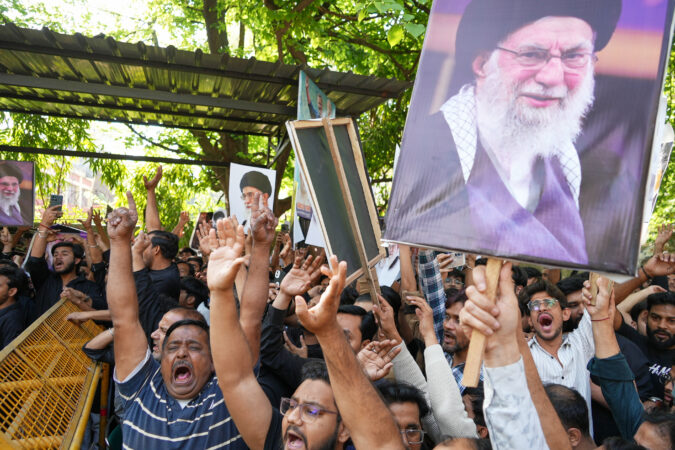
In Iraq, hundreds wore black and waved flags belonging to Iran-backed Iraqi militias and red flags that symbolize vengeance in the Shiite Muslim faith as they marched across Sadr City to decry the killing of Khamenei.
Anger flashed at protests in Istanbul and among Shiite Muslims in India.
Demonstrations were also held in cities including New York, Berlin, Paris, and Vienna by members of the Iranian diaspora and their supporters, celebrating the end of Khamenei’s rule. Some demonstrators waved flags of the Iranian monarchy, with Israeli and U.S. flags also on display.
WASHINGTON — A senior White House official said Sunday that Iran’s “new potential leadership” has suggested it is open to talks with the United States after American and Israeli forces launched a major attack against Tehran, killing the country’s supreme leader and other high-ranking officials.
The official, who spoke on condition of anonymity to discuss internal administration deliberations, said President Donald Trump says he is “eventually” willing to talk but that for now the military operation “continues unabated.” The official did not say who the potential new Iranian leaders are or how they made their alleged willingness to talk known.
Trump told the Atlantic on Sunday that he planned to speak with Iran’s new leadership.
“They want to talk, and I have agreed to talk, so I will be talking to them,” he said, declining to comment on the timing.
The potential future diplomatic opening comes as new details are emerging about the detailed planning that went into the U.S.-Israeli strikes and some of the targets that were hit in Iran.
U.S. Central Command said that B-2 stealth bombers struck Iran’s ballistic missile facilities with 2,000-pound bombs. That mirrors the approach that the military took in June, when Trump agreed to deploy B-2 bombers to attack three key Iranian nuclear sites.
Trump claimed in his State of the Union speech last week that Iran had been building ballistic missiles that could reach the U.S. homeland — a justification he repeated again Saturday as he announced that the bombardment of Iran was underway.
Iran has not acknowledged that it is building or seeking to build intercontinental ballistic missiles. The U.S. Defense Intelligence Agency, however, said in an unclassified report last year that Iran could develop a militarily viable intercontinental ballistic missile by 2035 “should Tehran decide to pursue the capability.”
Before the attacks, the CIA had for months tracked the movements of senior Iranian leaders, including Supreme Leader Ayatollah Ali Khamenei, according to a person familiar with the operation.
The intelligence was shared with Israeli officials, and the timing of the strikes was adjusted in part because of that information about the Iranian leaders’ location, according to the person, who was not authorized to comment publicly and spoke on condition of anonymity.
The intelligence sharing between U.S. and Israel reflects the preparation that went into the strikes, which continued for a second day Sunday after Khamenei’s killing threw the future of the Islamic Republic into uncertainty and raised the risk of escalating regional conflict.
The New York Times earlier reported about the CIA’s efforts before the Israeli-U.S. strikes.
Sen. Tom Cotton, chairperson of the Senate Intelligence Committee, declined to discuss details Sunday when asked on CBS’ Face the Nation about intelligence sharing with Israel. But he said tracking the movements of the supreme leader and the heads of other adversarial nations “is obviously one of the highest priorities of our intelligence community.”
“Clearly, this operation is driven by intelligence collected by Israel and the United States that has once again proven that our nations have capabilities that no other nation on Earth has,” said Cotton (R., Ark.).
The U.S. regularly shares intelligence with allies including Israel. Those partnerships, and the accuracy of the intelligence they yield, is often critical not only to the success of a military operation but also to the public’s support for it.
Virginia Sen. Mark Warner, the senior Democrat on the committee, told the Associated Press that historically, “our working relationship with the Mossad and Israel is really strong.” Mossad is the Israeli spy agency.
Warner said he has serious concerns about the justification for the strikes, Trump’s long-term plans for the conflict, and the risks that U.S. service members will face. The military announced Sunday that three American troops had been killed and five were seriously wounded in the Iran operation.
“No tears will be shed over their leadership being eliminated but always the question is: OK, what next?” Warner said.
Barely an hour after the first U.S. and Israeli missiles struck Iran, President Donald Trump made clear he hoped for regime change. “Now is the time to seize control of your destiny,” he told the Iranian people in a video. “This is the moment for action. Do not let it pass.”
Doesn’t sound complicated. After all, with Iran’s fundamentally unpopular government weakened by fierce airstrikes, some of its top leaders dead or missing and Washington signaling support, how hard could it be to overthrow a repressive regime?
Possibly very hard. So says history.
Washington has a long, complicated past when it comes to regime change. There was Vietnam in the 1960s and 70s, and Panama in 1989. There was Nicaragua in the 1980s, Iraq and Afghanistan in the years after 9/11, and Venezuela just weeks ago.
There was also Iran. In 1953, the CIA helped engineer a coup that toppled Iran’s democratically elected leader and gave near-absolute power to Shah Mohammad Reza Pahlavi. But as with the shah, who was overthrown in Iran’s 1979 Islamic Revolution after decades of increasingly unpopular rule, regime change rarely goes as planned.
Attempts to usher in U.S.-friendly governments often start with clear intentions, whether hope for democracy in Iraq or backing an anti-Communist leader in Congo at the Cold War’s height. But often those intentions stumble into a political quagmire where democratic dreams turn into civil war, once-compliant dictators become embarrassments, and American soldiers return home in body bags.
That history has long been a Trump talking point. “We must abandon the failed policy of nation building and regime change,” he said in 2016.
“In the end, the so-called ‘nation-builders’ wrecked far more nations than they built,” he said in a 2025 speech in Saudi Arabia, deriding U.S. efforts in Afghanistan and Iraq. The “interventionists were intervening in complex societies that they did not even understand.”
Now, after Saturday’s actions, a key question emerges: Does today’s U.S. government understand what it’s getting into?
It’s unclear what regime change would even mean
Iran’s economy is in shambles and dissent remains strong even after a brutal January crackdown on protests left thousands of people dead and tens of thousands under arrest. Many of the nation’s key military proxies and allies — Hamas in Gaza, Hezbollah in Lebanon, the Assad government in Syria — have been weakened or eliminated. And early Sunday, Iranian state media confirmed that Israel and the United States had killed Supreme Leader Ayatollah Ali Khamenei.
The United States hasn’t laid out a postwar vision and doesn’t necessarily even want a complete overthrow of the Iranian leadership. As in Venezuela, it may already have potential allies in the government willing to step into a power vacuum.
“But there’s a lot that needs to happen between now and a possible scenario along these lines,” said Jonathan Schanzer, executive director at the Foundation for Defense of Democracies, a Washington think tank that is deeply critical of the Iranian government. “There needs to be a sense that there is no salvation for the regime as such, and that they will need to work with the United States.”
In a country where the core leaders are deeply united by ideology and religion, that may be extremely difficult.
“The question to my mind right now is have we been able to penetrate the ranks of the regime that are not true believers that are more pragmatic,” Schanzer said. “Because I don’t believe that the true believers will flip.”
It’s simply too early to know if — or how much — the political winds are shifting in Tehran. The leaders who come next could turn out to be equally repressive or seen domestically as illegitimate U.S. stooges.
“We’ll see whether elements of the regime start moving against each other,” said Phillips O’Brien, professor of strategic studies at the University of St. Andrews in Scotland. “Air power can damage a leadership,” he said. “But it can’t guarantee that you’ll bring in something new.”
U.S. intervention in Latin America has a long history
In Latin America, Washington’s history of intervention goes back a long way — to when President James Monroe claimed the hemisphere as part of the U.S. sphere of influence more than 200 years ago.
If the Monroe Doctrine began as a way to keep European countries out of the region, by the 20th century it was justifying everything from coups in Central America to the failed Bay of Pigs invasion of Cuba in 1961. Very often, historians say, that intervention led to violence, bloodshed, and mass human rights violations. Therein, they say, lies a lesson.
Direct U.S. involvement has rarely “resulted in long-term democratic stability,” said Christopher Sabatini, a senior fellow for Latin America at the London think tank Chatham House. He points to Guatemala, where U.S. intervention in the 1950s led to a civil war that didn’t end for 40 years and left more than 200,000 people dead.
Or there’s Nicaragua, where backing of the Contra rebels against the Sandinista government in the 1980s contributed to a prolonged civil conflict that devastated the economy, caused tens of thousands of deaths and deepened political polarization.
While large-scale, overt U.S. involvement in the region mostly petered out after the Cold War, Trump has rekindled the legacy.
Since assuming office last year, Trump launched boat strikes against alleged drug traffickers in the Caribbean, ordered a naval blockade on Venezuelan oil exports, and got involved in electoral politics in Honduras and Argentina. Then, on Jan. 3, U.S. forces captured Venezuelan strongman leader Nicolás Maduro, flying him to the U.S. to face drug and weapons charges.
What followed in Caracas may signal what the White House hopes will happen in Tehran. Many observers thought the U.S. would back María Corina Machado, who has long been the face of political resistance in Venezuela. Instead, Washington effectively sidelined her and has repeatedly shown a willingness to work with President Delcy Rodríguez, who had been Maduro’s second-in-command.
“There are those who could claim that what we did in Venezuela is not regime change,” said Schanzer, at the Foundation for Defense of Democracies. “The regime is still in place. There’s just one person that’s missing.”
PALM BEACH, Fla. – President Donald Trump’s major attack on Iran has rattled parts of the coalition that twice delivered him the White House, a fracture that could spell trouble for a divided GOPas the midterm elections approach.
The strikes, which killed Iran’s supreme leader, followed a visible buildup of U.S. forces in the Middle East. But Trump’s decision to carry them out nonetheless surprised some of his supporters, who had expected the self-described anti-interventionist president to stop short of a direct attack.
Nineteen-year-old Cooper Jacks said his phone lit upSaturday with messages from fellow Republicans in “disbelief” at the U.S. attack on Iran — a reaction that reflected not just surprise at Trump’s decision, but anxiety about what a new conflict could demand of younger Americans.
“We often have politicians that are way past the age to be able to fight these wars being all ready to say, yeah, go fight it, and then that burden falls on my generation,” said Jacks, an officer with the Walker County Republican Party in Georgia.
For some voters, Trump’s decision marked a clear break from the isolationist posture that once defined his political appeal. While the more hawkish wing heralded the opening salvo, others in the partyaccused Trump of betraying the populist ideology that propelled him to power. In interviews and on social media, many Trump supporters — both prominent conservatives and rank-and-file voters — were careful to withhold final judgment until seeing whether the president could swiftly end the conflict he started. Others reaffirmed their support for Trump.
Ultimately, the Iran strike poses a test of how much warTrump’s coalition will tolerate from a president who promised to end them —particularly if a prolonged fight brings economic pain to everyday Americans.
“The base is solid with President Trump, and they want him to succeed,” said John McLaughlin, a longtime Trump pollster. “It’s about national security and stopping Iran, a terrorist state, from getting nuclear weapons and killing any more Americans.”
The political stakes of the military action are heightened by the approaching midterm elections, when the party of a sitting president often faces stiff headwinds. Polls show Trump’s approval ratings are at 39%, the lowest since the Jan. 6, 2021, attack on the U.S. Capitol. Republicans are worried they could lose control of Congress.
Beyond the immediate electoral math, the Iran strike has also sharpened a longer-running debate inside the party over what a post-Trump identity might look like — and which faction of a divided GOP will ultimately dominate.
Blake Neff, the producer of The Charlie Kirk Show, wrote on X that right-leaning friends were messaging him in dismay about Iran:
“This is extremely depressing.”
“Never voting in a national election again.”
Neff warned: “If this war is a swift, easy, and decisive victory, most of them will get over it. But if the war is anything else, there will be a lot of anger.”
Trump told Axios on Saturday that he had several “off-ramps” to the conflict. But in a Truth Social post later that afternoon, he said the bombing “will continue, uninterrupted throughout the week or, as long as necessary to achieve our objective of PEACE THROUGHOUT THE MIDDLE EAST AND, INDEED, THE WORLD!”
Hours later, he warned of further escalation.
“Iran just stated that they are going to hit very hard today, harder than they have ever hit before,” he wrote on Truth Social. “THEY BETTER NOT DO THAT, HOWEVER, BECAUSE IF THEY DO, WE WILL HIT THEM WITH A FORCE THAT HAS NEVER BEEN SEEN BEFORE!”
Last week, a Washington Post-ABC News-Ipsos poll found that 46% of Trump voters supported Trump using the U.S. military to force changes in other countries, while 22% opposed this and 30% had no opinion.
Trump won his first term by attacking the foreign policy of former President George W. Bush and calling the U.S. war in Iraq a “big fat mistake.” He clinched a second term promising to expel “the warmongers” from government and warning that his Democratic opponent, Vice President Kamala Harris, would get the U.S. entangled in another costly conflict abroad. He told supporters he could end the war in Ukraine in 24 hours.
“I will stop the chaos in the Middle East,” Trump told the crowd at his final rally before the 2024 election in Grand Rapids, Michigan. “I will prevent World War III.”
On the campaign trail, he also stressed that Iran must not get a nuclear weapon.
Trump has repeatedly cast himself in his second term as the peacemaker the world needs, claiming credit for ending or averting conflicts abroad and arguing that his leadership will accomplish what traditional international institutions, such as the United Nations, have not.
He swept into office under the banner of “America First” isolationism but has adopted a muscular foreign policy approach, “peace through strength.” He bombed nuclear sites in Iran in the summer, toppled Venezuelan President Nicolás Maduro in January, and now has unleashed a barrage in the Middle East that he said is aimed at regime change.
MAGA allies long skeptical of foreign intervention have so far largely stuck by the president,even as many questioned his evolution. Trump officials cast the strikes on Iran last summer as a limited intervention meant to take out a nuclear threat — and pushback within his coalition faded as the conflict ended without morphing into a broader war.
But each conflict has threatened more entanglement abroad than the last, testing the movement’s tolerance.
“Trump, who is very news-cycle savvy, is addicted to the glamour and the attention that foreign interventions engender him and his administration, even though they are not making him more popular,” Curt Mills, executive director of American Conservative, a right-wing magazine that is skeptical of neoconservative foreign policy, said in an interview Saturday with the Washington Post.
Natalie Winters, a co-host for Stephen K. Bannon’s podcast War Room, criticized the Trump administration for failing to adequately justify the strikes.
“The messaging, much like the Epstein files, is all over the place. I would think they would know their base better,” she told the Post. “Some of his donors are probably happy so congratulations to them.”
Meanwhile, many of Trump’s most loyal supporters have echoed his “peace through strength” arguments. Nearly 6 in 10 Trump voters who identified with the MAGA movement supported using the U.S. military to force changes in other countries, compared with fewer than 3 in 10 who didn’t support MAGA, the Washington Post-ABC News-Ipsos poll found.
“I changed my view on MAGA a little bit. In order for us to be what we once were, we’ve got to support the rest of the world,” said Robert Pratt, 70, a veteran who self-identifies as part of the MAGA movement. “We’ve got to protect our allies, and I think MAGA is now a part of that. It’s not just about us.”
Pratt said his feelings could change if the conflict in Iran lasts for too long; he doesn’t want a repeat of the war in Iraq.
“My concept of war is a lot like Trump’s is: If you’re going to do it, do it and get it over with,” he said. “I don’t want stuff where we get mixed up in some conflict that goes on for years and years.”
On Saturday, as Trump continued to direct attacks in Iran, Jacks saw on social media an old tweet from Vice President JD Vance urging the U.S. to learn from the failures of its war in Iraq. His former congressional representative, Marjorie Taylor Greene, a Trump ally turned critic, accused the president of abandoning his “America First” movement and campaign promises to stay out of far-flung conflicts.
“Now, America is going to be force fed and gas lighted all the ‘noble’ reasons the American ‘Peace’ President and Pro-Peace administration had to go to war once again this year, after being in power for only a year,” Greene wrote in a blistering post on X. “Head-spinning, but maga.”
Then Jacks read in the news that Iran’s supreme leader, Ayatollah Ali Khamenei, was killed — a major blow against an oppressive regime, he thought.
The U.S. strike could be a big success, he said — “if we’re not entering a long-term military conflict that’s going to result in the deaths of Americans that don’t really want to fight it.”
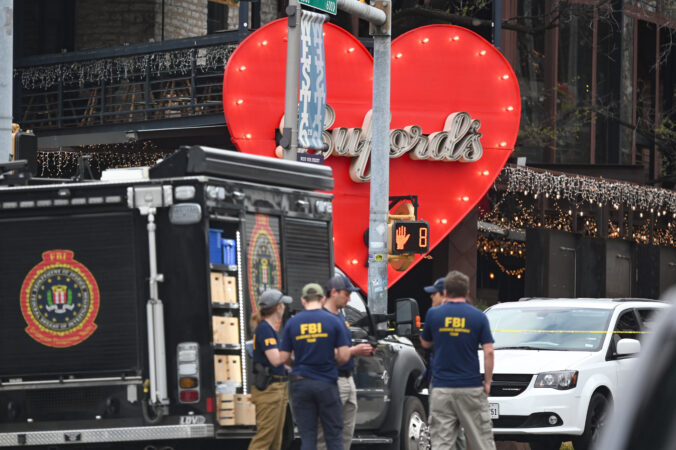
AUSTIN, Texas — The gunman who killed two people at a bar in Texas early Sunday in a mass shooting being investigated by the FBI as a potential act of terrorism was wearing a sweatshirt that said “Property of Allah,” and another shirt with an Iranian flag design, a law enforcement official told the Associated Press.
The shooting, which also left 14 wounded, erupted a day after the United States launched an attack on Iran with Israel that killed Ayatollah Ali Khamenei.
The gunman was identified as 53-year-old Ndiaga Diagne, the Department of Homeland Security said in a statement.
He first entered the U.S in 2000 on a B-2 tourist visa and became a lawful permanent resident six years later after marrying a U.S. citizen, according to DHS. He became a naturalized U.S. citizen in 2013, the department said. Diagne was originally from Senegal, according to multiple people briefed on the investigation who spoke on the condition of anonymity because they were not authorized to publicly discuss the investigation.
Officers in Austin shot and killed the gunman, who used both a pistol and a rifle to carry out the attack, police said.
The suspect drove past the bar several times before stopping and shooting a pistol out the window of his SUV at people on a patio and in front of the bar, according to Austin Police Chief Lisa Davis.
The gunman then parked the vehicle, got out with a rifle and began shooting at people walking in the area before officers who rushed to the intersection shot him, Davis said. Three of those injured were in critical condition Sunday morning, police said.
Authorities found “indicators” on the gunman and in his vehicle leading the FBI to look into the possibility of terrorism, said Alex Doran, the acting agent in charge of the FBI’s San Antonio office.
“It’s still too early to make a determination on that,” Doran said Sunday morning.
The White House said President Donald Trump had been briefed on the shooting.
Texas Gov. Greg Abbott warned that the state would respond aggressively to anyone trying to “use the current conflict in the Middle East to threaten Texas.”
“We will not be intimidated, and we will not be terrorized,” he said in a statement.
The shooting happened outside Buford’s Backyard Beer Garden just before 2 a.m. along Sixth Street, a nightlife destination filled with bars and music clubs and only a few miles from the University of Texas.
The school’s president said on social media that some of those impacted included “members of our Longhorn family.”
“Our prayers are with the victims and all those impacted,” said university President Jim Davis.
The entertainment district has a heavy police presence on weekends, and officers were able to confront the gunman within a minute of the first call for help, Davis said.
Austin Mayor Kirk Watson praised the fast response by police and rescuers.
“They definitely saved lives,” he said.
One of the victims was found in the street between two parked cars. Inside the multistory bar, there were overturned tables and drinks left behind by fleeing customers.
There have been at least two other high-profile shootings in Austin’s Sixth Street entertainment district within the past five years, including one in the summer of 2021 that left 14 people wounded. Although this weekend’s shooting doesn’t meet the definition of a mass killing, there have been five of those so far this year.
DUBAI, United Arab Emirates — The U.S. and Israel pounded targets across Iran on Sunday, dropping massive bombs on the country’s ballistic missile sites and wiping out warships as part of an intensifying military campaign following the killing of Supreme Leader Ayatollah Ali Khamenei.
Blasts rattled windows across the country and sent plumes of smoke high into the sky above Tehran. More than 200 people have been killed since the start of the strikes that killed Khamenei and other senior leaders, Iranian leaders have said.
Iran vowed revenge, firing missiles at Israel and Gulf Arab states in a counteroffensive that the U.S. military said resulted in the deaths of three service members — the first known American casualties from the conflict. Israeli rescue services said strikes had hit several locations, including Jerusalem and a synagogue in the central town of Beit Shemesh, where nine people were killed and 28 wounded, bringing the overall death toll in the country to 11. Eleven people were still missing after the strike, police said.
But the attacks on Iran showed no signs of relenting as the U.S. and Israel took aim at key military, political, and intelligence targets in what appeared to be a widening war that carried the potential for a prolonged conflict that could envelop the Middle East and destabilize it. The strikes, the second time in eight months that the U.S. and Israel had combined against Iran, represented a startling show of military might for an American president who swept into office on an “America First” platform and vowed to keep out of “forever wars.”
U.S. President Donald Trump said the U.S. would “avenge” the deaths of the service members and that “there will likely be more” killed before the conflict ends.
In a video he posted on social media, Trump called the three service members “true American patriots who have made the ultimate sacrifice for our nation, even as we continue the righteous mission for which they gave their lives.”
He added: “Sadly, there will likely be more, before it ends. That’s the way it is. Likely be more.”
Israel, which had pledged “nonstop” strikes, said it was increasing its attacks, with 100 fighter jets simultaneously striking targets in Tehran, Brig. Gen. Effie Defrin told reporters at a briefing. The targets included buildings belonging to Iran’s air force, its missile command, and its internal security force, which violently quashed anti-government protests in January.
The U.S. military, meanwhile, said B-2 stealth bombers struck Iran’s ballistic missile facilities with 2,000-pound bombs. Trump said on social media that nine Iranian warships had been sunk and that the Iranian navy’s headquarters had been “largely destroyed.”
Europe has mostly stayed out of the war and pressed for diplomacy, but in an indication that the conflict could draw in other nations, Britain, France, and Germany said Sunday they were ready to work with the U.S. to help stop Iran’s attacks.
Prime Minister Keir Starmer said Britain would allow the United States to use its bases to strike Iranian missile sites. The U.K. maintains nearby bases on Cyprus and the Chagos Islands, a British archipelago in the Indian Ocean.
In the 12-day war last June, Israeli and American strikes greatly weakened Iran’s air defenses, military leadership, and nuclear program. But the killing of Khamenei, who ruled Iran for more than three decades, creates a leadership vacuum, increasing the risk of regional instability.
Trump, who a day earlier had encouraged Iranians to “take over” their government, signaled Sunday that he was open to dialogue with Iran’s new leadership.
“They want to talk, and I have agreed to talk, so I will be talking to them,” he told the Atlantic.
Streets of Tehran are largely deserted
In Tehran, there was little sign that Iranians had heeded Trump’s call for an uprising against the government.
The streets were largely deserted as people sheltered during heavy airstrikes, witnesses told the Associated Press, speaking anonymously for fear of retribution. The paramilitary Basij, which has played a central role in crushing protests, set up checkpoints across the city, they said.
Two powerful explosions were heard in Tehran’s Niavaran neighborhood late Sunday.
An eyewitness in the city told AP that the windows of their apartment shook violently, and residents came out onto the streets fearing it was too dangerous to stay inside. The witness spoke on condition of anonymity for fear of reprisals. Video footage from Tehran showed plumes of smoke filling the skyline, and the official IRNA news agency reported that parts of the building of the Islamic Republic of Iran Broadcasting were struck Sunday.
In southern Iran, at least 165 people were killed Saturday when a girls’ school was struck, and dozens more were wounded, IRNA reported. The Israeli military said it was not aware of strikes in the area. The U.S. military said it was looking into the reports.
The U.S. military did not provide details about the three service members who were killed or about five others who were seriously wounded. It said several others suffered minor injuries and concussions.
Iran says new leadership is in place
As supreme leader, Khamenei had final say on all major policies since 1989. He led Iran’s clerical establishment and the Revolutionary Guard, the two main centers of power in the governing theocracy.
The CIA had been tracking the movements of senior Iranian leaders, including Khamenei, for months, according to a person familiar with the operation who was not authorized to comment publicly and spoke on condition of anonymity. The intelligence was shared with Israeli officials, and the timing of the strikes was adjusted in part because of that information, the person said.
Iranian President Masoud Pezeshkian said in a prerecorded message that a new leadership council had begun its work. The country’s foreign minister, Abbas Araghchi, said a new supreme leader would be chosen in “one or two days.”
Iran vows revenge for Khamenei killing
As word spread of Khamenei’s death, some in Tehran could be seen cheering from rooftops, witnesses said. Others mourned as a black flag was raised over the Imam Reza shrine in Mashhad.
An Iranian medical professional in northern Iran said he and colleagues spent the early hours of Sunday celebrating Khamenei’s death indoors because armed security forces are still heavily deployed in his city.
There were forces stopping and interrogating people celebrating in their cars, but there was no gunfire, said the doctor, who spoke on condition of anonymity for fear of reprisal.
“It was one of the best nights, if not the best night of our lives,” the doctor said in a voice message from the city of Rasht. In fact, “it was actually my first time ever smoking a cigarette. It was a very, very nice time. We didn’t sleep at all. And we don’t even feel tired.”
Araghchi, Iran’s foreign minister, blamed the U.S. and Israel for starting the war. He said he had spoken to his counterparts in the Gulf countries and urged them to pressure the U.S. and Israel to end it.
“You have crossed our red line and must pay the price,” Iran’s parliamentary speaker, Mohammad Bagher Qalibaf, said in a televised address. “We will deliver such devastating blows that you yourselves will be driven to beg.”
Trump warned against any retaliation.
“THEY BETTER NOT DO THAT,” he said in a social media post. “IF THEY DO, WE WILL HIT THEM WITH A FORCE THAT HAS NEVER BEEN SEEN BEFORE!”
Strikes planned for months, feared for weeks
Tensions have escalated in recent weeks as the Trump administration built up the largest force of American warships and aircraft in the Middle East in decades. The president insisted he wanted a deal to constrain Iran’s nuclear program while the country struggled with growing dissent following nationwide protests.
An Israeli military official described Saturday’s mission as the result of months of “extremely high coordination” with the U.S. The official, speaking on condition of anonymity to discuss a covert operation, said a variety of factors created a “golden opportunity” to take out much of Iran’s leadership. Those factors included weeks of training and monitoring the movements of senior figures, along with “real time intelligence” that the targets were gathered together.
The results, the official said, were near-simultaneous strikes, within 60 seconds of one another, in three locations 1,000 miles from Israel that killed Khamenei and some 40 senior figures, including the head of the Revolutionary Guard and the country’s defense minister.
President Donald Trump launched Saturday’s wide-ranging attack on Iran after a weekslong lobbying effort by an unusual pair of U.S. allies in the Middle East — Israel and Saudi Arabia — according to four people familiar with the matter, as Israeli and U.S. forces teamed to topple Iranian Supreme Leader Ali Khamenei after nearly four decades in power.
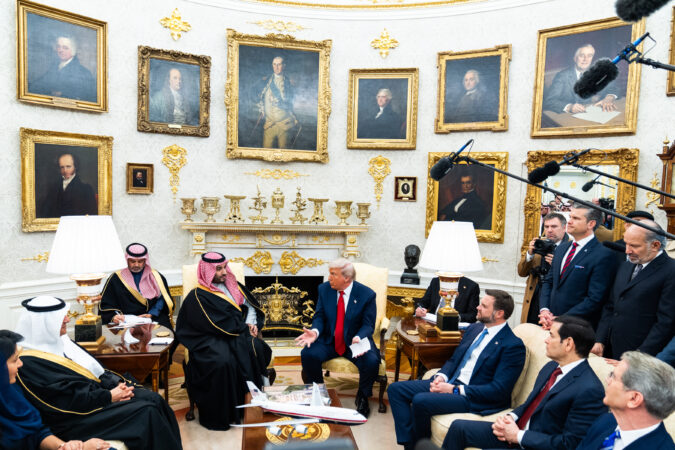
Saudi Crown Prince Mohammed bin Salman made multiple private phone calls to Trump over the past month advocating a U.S. attack, despite his public support for a diplomatic solution, the four people said. Israeli Prime Minister Benjamin Netanyahu, meanwhile, continued his long-running public campaign for U.S. strikes against what he views as an existential enemy of his country.
The combined effort helped lead Trump to order a massive aerial campaign against Iran’s leadership and military, which in its initial hour led to the death of Khamenei and several other senior Iranian officials.
The attack came despite U.S. intelligence assessments that Iran’s forces were unlikely to pose an immediate threat to the U.S. mainland within the next decade. Saturday’s attack on Iran was a break from decades of U.S. decision-making to hold back from a full-scale effort to depose the regime of a country of more than 90 million people. It also marked a stark shift from Trump’s own previous military forays, which until now have been far narrower in scope.
Now Trump will bear the risk of the bet he has placed: that a major military operation conducted from the air can achieve political goals on the ground.
“No president was willing to do what I am willing to do tonight,” Trump told Iranians in a video address posted as U.S. bombs rained down on targets across Iran. “Now you have a president who is giving you what you want, so let’s see how you respond.”
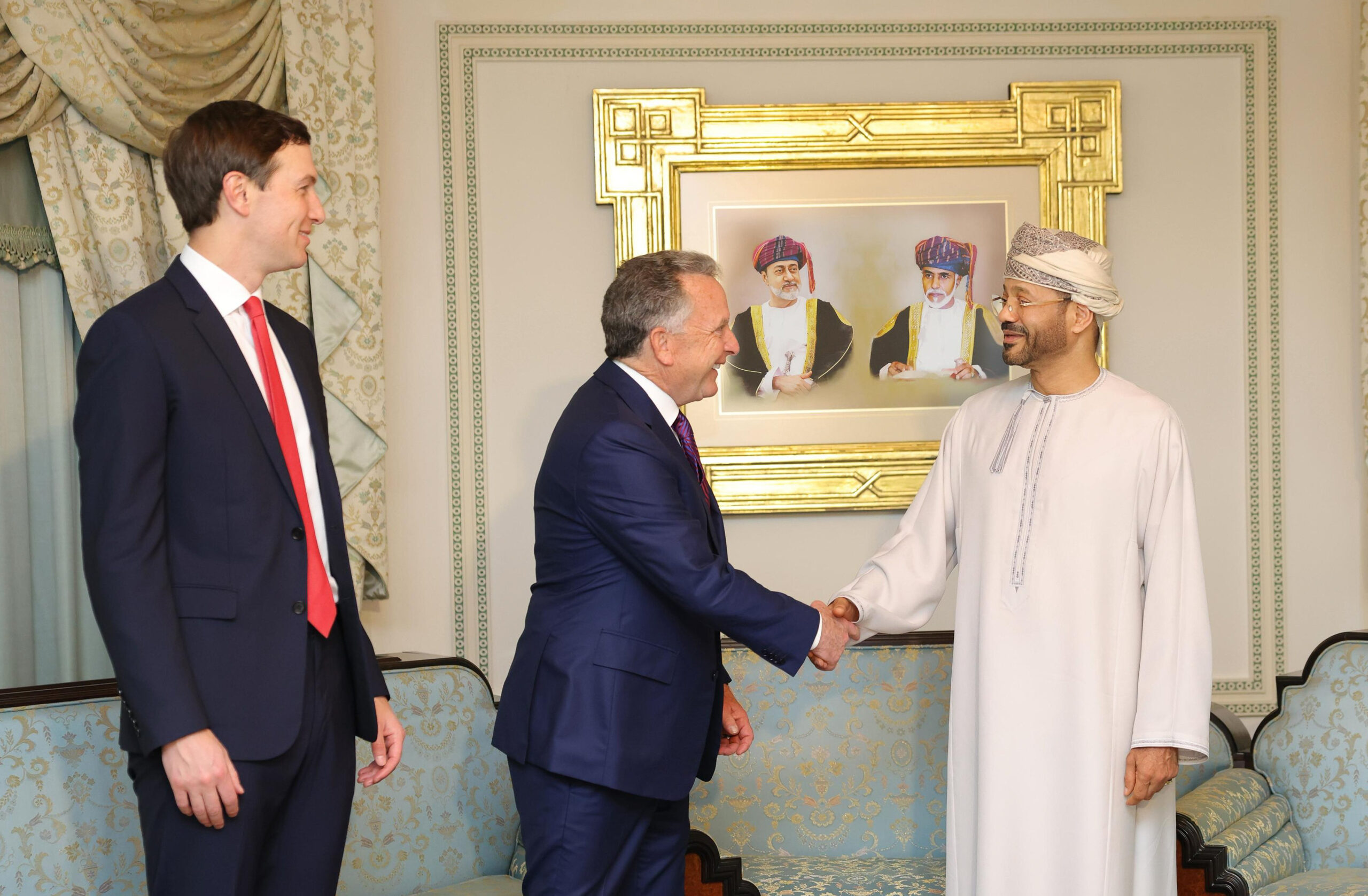
The Saudi push for an attack came as presidential envoy Steve Witkoff and Trump’s son-in-law Jared Kushner pursued negotiations with Iranian leaders over the country’s nuclear and missile programs.
In this photo released by the Oman’s Foreign Ministry, Steve Witkoff, White House special envoy, centre, shakes hands with Oman’s Foreign Minister Sayyid Badr Albusaidi as Jared Kushner, left, looks on during their meeting prior to Iran and the U.S. negotiations, in Muscat, Oman, Friday, Feb. 6, 2026. (Oman Foreign Ministry via AP)
As those talks proceeded, Riyadh issued a statement, following a phone call between the crown prince and Iranian President Masoud Pezeshkian, that Mohammed would not allow Saudi airspace or territory to be used in an attack on Iran.
In his discussions with U.S. officials, however, the Saudi leader warned that Iran would come away stronger and more dangerous if the United States did not strike now, after amassing the largest military presence in the Middle East since the 2003 invasion of Iraq, said the people, who, like others, spoke on the condition of anonymity to discuss the sensitive situation.
Mohammed’s position was reinforced by his brother, Saudi Defense Minister Khalid bin Salman, who held closed-door meetings with U.S. officials in Washington in January and warned about the downsides of not attacking, the people said.
The Saudi leader’s complicated position probably reflected his desire to avoid Iranian retaliation against his country’s vulnerable oil infrastructure, weighed against his view of Tehran as Riyadh’s ultimate foe in the region, said those familiar with his thinking. Iran, dominated by Shiite Muslims, and Saudi Arabia, led by Sunnis, have long had an intense rivalry that has generated proxy wars in the region.
Following the initial U.S. attack on Saturday, Iran did retaliate against Saudi Arabia. Riyadh issued a furious statement condemning the attack and calling on the international community to “take all necessary and decisive measures” to confront Iran.
The Saudi Embassy did not respond to a request for comment.
Witkoff and Kushner had their final contacts with Iranian officials in Geneva on Thursday, their third high-level encounter since early February. They walked away believing that Tehran was playing games with them about its need for nuclear enrichment, according to a senior Trump administration official.
“It was very clear that the intent for them was to preserve their ability to do enrichment so that, over time, they could use it for a nuclear bomb,” the official said.
By Friday afternoon, when Trump arrived in Corpus Christi, Texas, for a campaign rally ahead of Tuesday primaries there, the president’s frustration — and his rhetoric — was escalating. He repeatedly declared himself “not happy” with Iranian negotiators.
“I’ve got a lot of things going on now,” he told the crowd toward the end of a rambling speech ostensibly focused on energy policy. “We have a big decision to make, you know that. Not easy, not easy. We have a very big decision to make.”
Later, he flew to Palm Beach for the weekend, where he mingled with supporters at his Mar-a-Lago resort Friday evening, looking tired but otherwise in good sprits before exiting to his private quarters to record a speech he would give announcing the attack, according to one person who was there and interacted with him.
The decision to launch the attack was in some ways foretold by the massive buildup of U.S. forces over the past two months. But there was little in Trump’s record to suggest that he would embrace a war of choice in the Middle East with the goal of regime change.
In explaining his decision, Trump on Saturday reached all the way back to Iran’s 1979 revolution. He described the U.S. attacks as payback for decades of conflict with Iran. He cited the 52 Americans held hostage for more than a year after the 1979 takeover of the American Embassy in Tehran; the deaths of 241 U.S. service members in 1983 bombing of their barracks in Beirut by Iran-backed Hezbollah during a Lebanese civil war; and the 2000 attack on the USS Cole, a naval destroyer docked in a Yemen, which Trump said Iran “probably” was involved in, although the United States has long attributed the suicide bombing to al-Qaeda.
Earlier Saturday, Trump said that the United States had faced “imminent threats from the Iranian regime.” Tehran was continuing to work toward producing a nuclear weapon and development of “long-range missiles that … could soon reach the American homeland.”
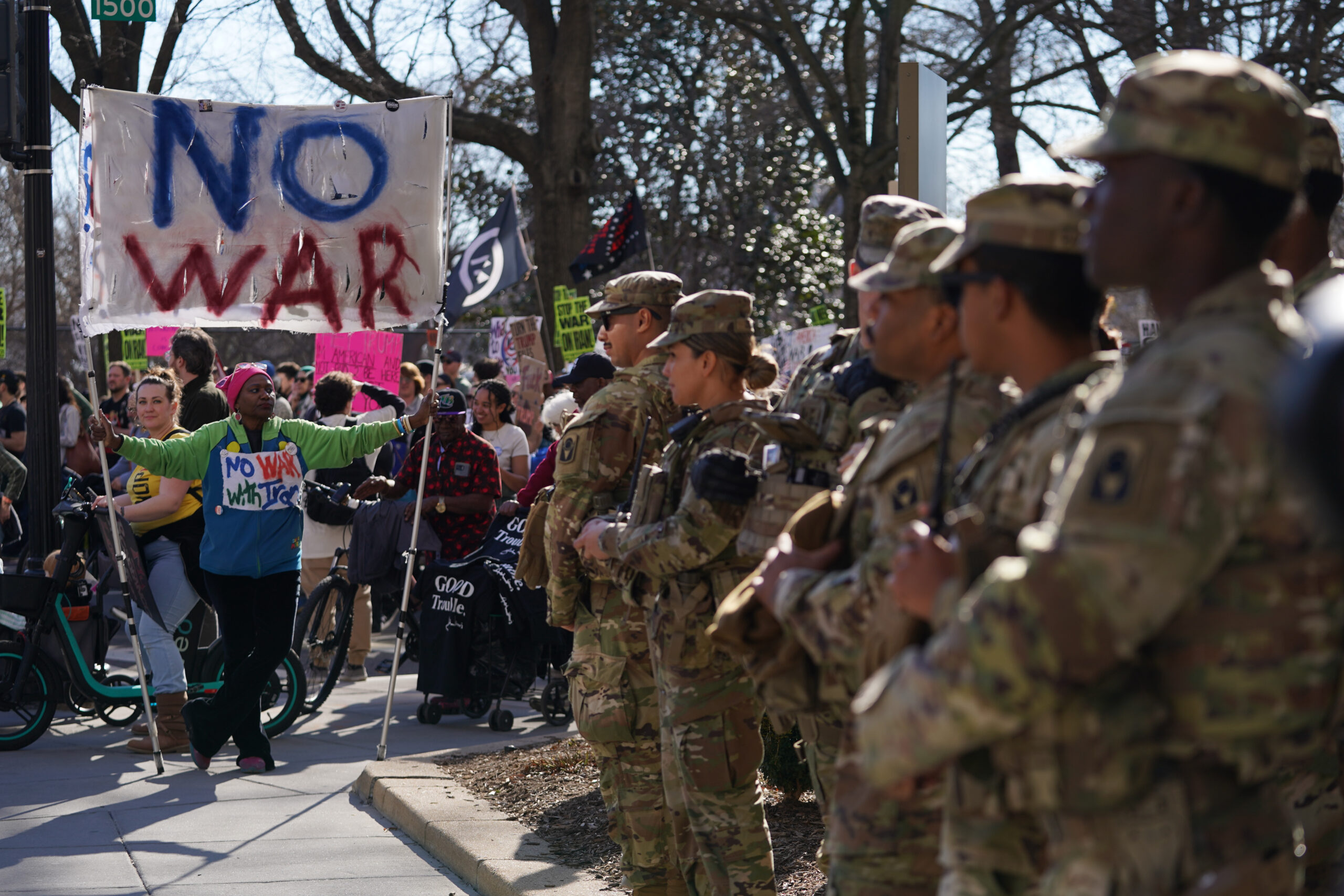
National Guard members watch as people protest near the White House against U.S. and Israeli strikes on Iran, Saturday, Feb. 28, 2026 in Washington. (AP Photo/Allison Robbert)
Both of those assertions have been challenged. Trump himself has vehemently maintained that the U.S. “obliterated” Iran’s nuclear program with airstrikes this past summer. The International Atomic Energy Agency has said there is no evidence Iran has restarted its uranium enrichment program following those strikes or that it has an active bomb-building plan. In an assessment last year, the U.S. Defense Intelligence Agency cited no indication that Iran was embarking on development of an intercontinental ballistic missile. If it decided to do so, the DIA said, it would take a decade to produce.
Trump directed anti-government Iranians to “take over” their government, but his call included no details. He declared that those within Iran’s extensive military and security infrastructure would be given “complete immunity” but provided no explanation how or by whom that would be done.
During both his first and second terms, Trump has said consistently there would be no American boots on the ground in military operations that he launched. Since taking office again, while launching air and missile attacks on seven countries — Nigeria, Syria, Yemen, Somalia, Venezuela, Iraq and Iran — he largely has kept that promise.
But it remains unclear whether aircraft and missile strikes can achieve his ever-expanding goals — among them new, U.S.-friendly regimes in Iran and Venezuela; an end to Iran-backed militant operations in Yemen; and the defeat of Islamic terrorist operations in Nigeria and Somalia.
“History is not kind to efforts to fundamentally alter and restructure the internal politics of a country using the air power alone,” said Aaron David Miller, a former U.S. diplomat who worked on Middle East issues for both Republican and Democratic administrations.
“This is very much Trumpian, in the sense that he’s tried to split the difference between getting bogged down in an interminable conflict which will undermine the American economy and cost Americans their lives, on one hand, and yet bringing to bear the power of the American military in a sort of roll-the-dice operation,” Miller said.
Months of planning for the 2003 U.S. toppling of Iraqi leader Saddam Hussein included thousands of invading American forces that remained there for nearly a decade and a large cadre of civilian U.S. officials on the ground to organize a new government.
Top Trump officials — some of whom have been sharp critics of the Iraq effort and other U.S. forays into the Middle East — have insisted in recent days that this time will be different.
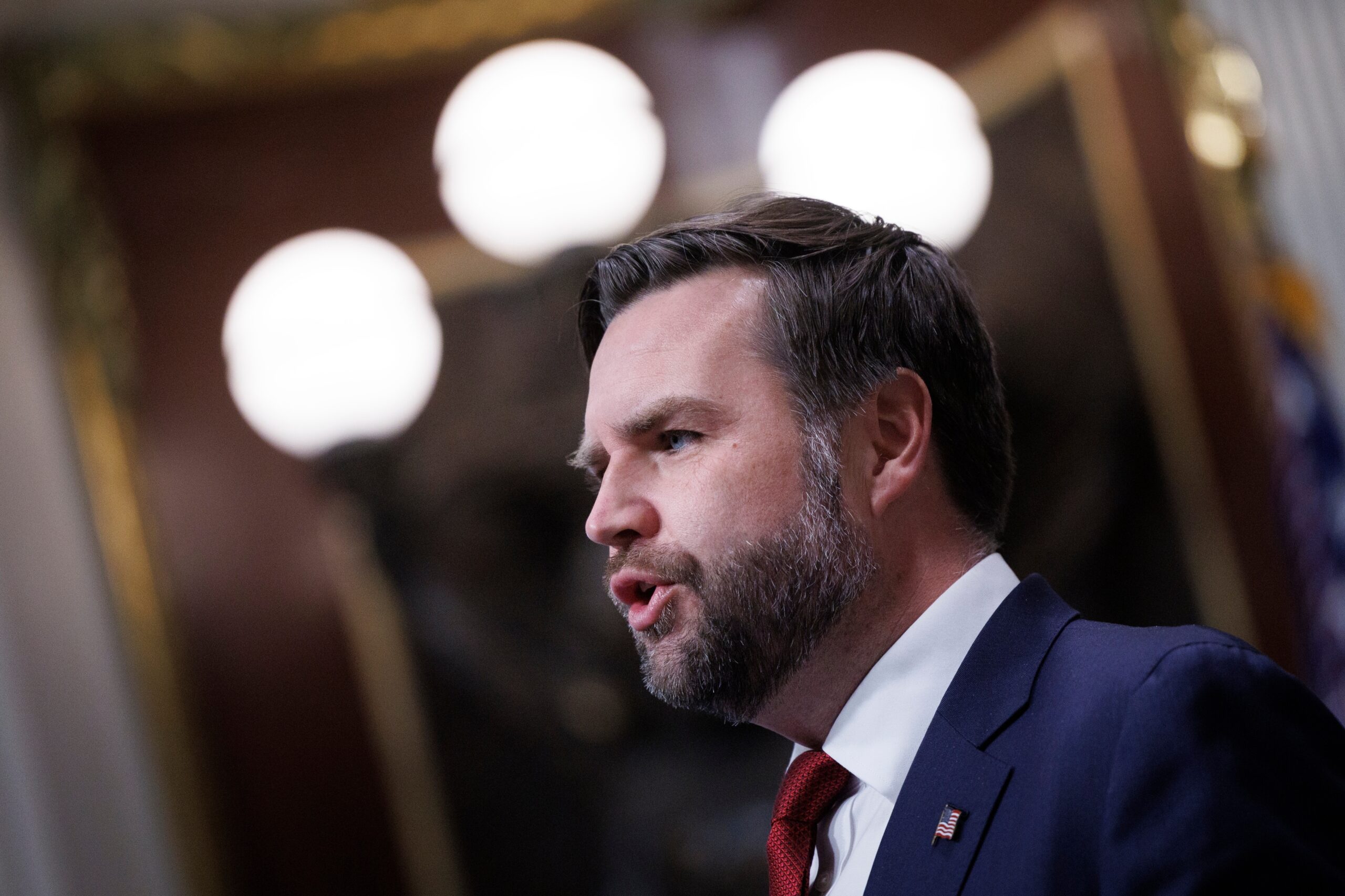
Vice President JD Vance speaks during a news conference in the Old Eisenhower Executive Office Building on the White House campus Wednesday, Feb. 25, 2026, in Washington. (AP Photo/Tom Brenner)
Vice President JD Vance on Thursday told the Washington Post that he still considers himself a “skeptic” of foreign military interventions — a description he said still applied to Trump, too. He said there was “no chance” any military operation by the U.S. in Iran would lead to a drawn-out war involving the Trump administration.
Vance on Saturday watched the military operation from the Situation Room at the White House, while dialed into a conference line that connected him to the president and his national security team, who were tracking Iran from Mar-a-Lago, according to a person with knowledge of the events. Vance was joined at the White House by Tulsi Gabbard, the director of national intelligence, who has long campaigned against war with Iran. Energy Secretary Chris Wright and Treasury Secretary Scott Bessent were in the Situation Room too, the person said.
Apart from Trump’s Saturday’s statements once the attack already started, the president has devoted little time to publicly justifying or explaining war with Iran, a break from previous practice of U.S. leaders.
Democrats on Saturday pushed Trump to explain his case to the American people.
“What was the imminent threat to America?” said Sen. Mark R. Warner (D., Va.), the senior Democrat on the Senate Intelligence Committee, in an interview. “I don’t know the answer.”
Warner, who participated in a classified briefing on Tuesday with Secretary of State Marco Rubio and CIA Director John Ratcliffe, said that senior lawmakers were given a “fair description of options” the administration was considering, but that he saw no threat that “would literally be worthy of putting our troops in harm’s way.”
In the briefing on Tuesday for the Gang of Eight, which consists of the leaders of the House, the Senate and each chamber’s intelligence committees, Secretary of State Marco Rubio indicated to lawmakers that the mission’s timing and goals were shaped by the fact that Israel was going to attack with or without the United States, according to a person familiar with the administration’s outreach to lawmakers.
“So the only debate that seemed to be remaining was whether the U.S. would launch in concert with Israel or if the U.S. would wait until Iran retaliated on U.S. military targets in the region and then engage,” the person said.
Now the question is what comes next.
For now, Trump says that he hopes that in the face of the death of Khamenei, Iran’s security forces and police “will peacefully merge with the Iranian Patriots, and work together as a unit to bring back the Country to the Greatness it deserves.” In January, those security forces killed thousands of Iranian protesters.
He vowed that “the heavy and pinpoint bombing, however, will continue, uninterrupted throughout the week or, as long as necessary to achieve our objective of PEACE THROUGHOUT THE MIDDLE EAST AND, INDEED, THE WORLD!”
LONDON — America and Israel’s attack on Iran disrupted flights across the Middle East and beyond Saturday as countries around the region closed their airspace and three of the key airports that connect Europe, Africa, and the West to Asia halted operations.
Hundreds of thousands of travelers were either stranded or diverted to other airports after Israel, Qatar, Syria, Iran, Iraq, Kuwait, and Bahrain closed their airspace. There also was no flight activity over the United Arab Emirates, flight tracking website FlightRadar24 said, after the government there announced a “temporary and partial closure” of its airspace.
That led to the closure of key hub airports in Dubai, Abu Dhabi, and Doha, and the cancellation of more than 1,800 flights by major Middle Eastern airlines. The three major airlines that operate at those airports — Emirates, Qatar Airways, and Etihad — typically have about 90,000 passengers per day crossing through those hubs and even more travelers headed to destinations in the Middle East, according to aviation analytics firm Cirium.
Then later on Saturday officials at Dubai International Airport — the largest in the United Arab Emirates and one of the busiest in the world — said four people were injured as the Emirates condemned what it called a “blatant attack involving Iranian ballistic missiles.” Strikes were also reported at other commercial airports in the region, including Kuwait International.
“For travelers, there’s no way to sugarcoat this,” said Henry Harteveldt, an airline industry analyst and president of Atmosphere Research Group. “You should prepare for delays or cancellations for the next few days as these attacks evolve and hopefully end.”
Airlines that are crossing the Middle East will have to reroute flights around the conflict with many flights headed south over Saudi Arabia. That will add hours to those flights and consume additional fuel, adding to the costs airlines will have to absorb. So ticket prices could quickly start to increase if the conflict lingers.
The added flights will also put pressure on air traffic controllers in Saudi Arabia who might have to slow traffic to make sure they can handle it safely. And the countries that closed their airspace will miss out on the overflight fees airlines pay for crossing overhead.
But Mike McCormick, who used to oversee air traffic control for the Federal Aviation Administration before he retired and is now a professor at Embry-Riddle Aeronautical University, said over the next few days these countries might be able to reopen parts of their airspace once American and Israeli officials share with the airlines where military flights are operating and how capable Iran remains of firing missiles.
“Those countries then will be able to go through and say, OK, we can reopen this portion of our space but we’ll keep this portion of our airspace closed,” McCormick said. “So I think what we’ll see in the next 24 to 36 hours how the use of airspace evolves as the kinetic activity gets more well defined and as the capability of Iran to actually shoot missiles and create additional risk is diminished due to the attacks.”
But it is unclear how long the disruption to flight operations could last. For comparison, the Israeli and U.S. attack on Iran in June 2025 lasted 12 days.
‘No one knows’
The situation was changing quickly and airlines urged passengers to check their flight status online before heading to the airport.
Some airlines issued waivers to affected travelers that will allow them to rebook their flight plans without paying extra fees or higher fares.
Jonathan Escott and his fiancé had arrived at the airport in Newcastle, England, on Saturday only to find out that his direct flight to Dubai on Emirates airline was canceled, leaving everyone on the flight stuck there.
Escott left to go back to where he was staying with family, about an hour from the airport, but has no idea when he may be able to travel.
“No one knows,” Escott said. “No one really knows what’s going on with the conflict, really. Not Emirates, Emirates don’t have a clue. No one has a clue.”
At least 145 planes that were en route to cities like Tel Aviv and Dubai early Saturday were diverted to airports in cities like Athens, Istanbul, or Rome, according to FlightAware. Others turned around and returned to where they had taken off. One plane spent nearly 15 hours in the air after leaving Philadelphia and getting all the way to Spain before turning around and returning to where it started.
Numerous airlines canceled international flights to Dubai through the weekend, as India’s civil aviation agency designated much of the Middle East — including skies above Jordan, Saudi Arabia, and Lebanon — as a high security risk zone at all altitudes.
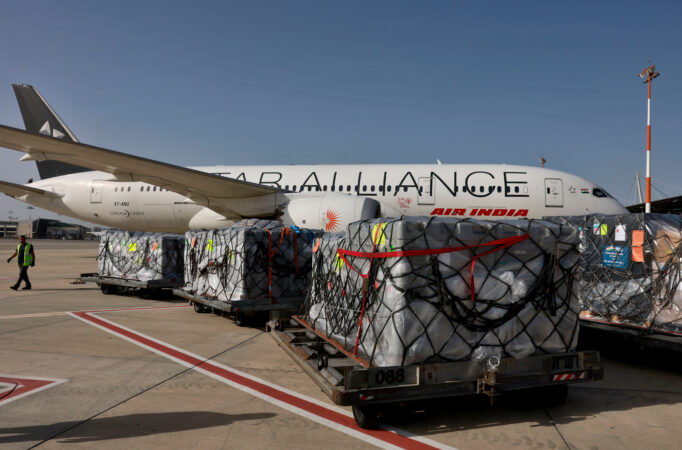
Air India canceled all flights to Mideast destinations. Turkish Airlines said flights to Lebanon, Syria, Iraq, Iran, and Jordan were suspended until Monday and flights to Qatar, Kuwait, Bahrain, the United Arab Emirates, and Oman were suspended.
The airline said additional cancellations may be announced, and many other airlines were suspending flights into the region through the weekend.
Travelers advised to be ‘very creative’
U.S.-based Delta Air Lines and United Airlines suspended flights to Tel Aviv at least through the weekend. Dutch airline KLM had already announced earlier in the week that it was suspending flights to and from Tel Aviv.
Airlines including Lufthansa, Air France, Transavia, and Pegasus canceled all flights to Lebanon, while American Airlines suspended flights from Philadelphia to Doha.
Virgin Atlantic said it would avoid flying over Iraq, meaning flights to and from India, the Maldives, and Riyadh could take slightly longer. The airline already was not flying over Iran and said all flights would carry appropriate fuel in case they need to reroute on short notice.
British Airways said flights to Tel Aviv and Bahrain will be suspended until next week, and flights to Amman, Jordan, were canceled Saturday.
“Travelers should anticipate that there will be a lot of disruptions,” Harteveldt said. “To be honest, if you haven’t left home, chances are you won’t be leaving home if you’re supposed to travel to or through these destinations for at least several days, if not longer. And if you are returning home, you will have to be very creative about how you get home.”