Category: Nation & World

  • Republicans are pushing to drastically change the way you cast ballots

    Republicans are pushing to drastically change the way you cast ballots

    As President Donald Trump calls for sweeping changes to election law — including saying that Republicans should “take over the voting” — Republicans in Congress are planning to vote this week on the SAVE America Act, which would make massive changes to how Americans vote ahead of November’s midterms.

    They want to require all Americans to prove they are citizens when registering to vote, and to show an ID when voting in person or by mail, as well as make mail voting more difficult.

    Trump and Republicans say this would make voters feel more confident there’s no fraud in federal elections. “We need elections where people aren’t able to cheat,” Trump told NBC News. “And we’re gonna do that. I’m gonna do that. I’m gonna get it done.”

    But there’s no evidence of widespread election fraud. There is evidence, say some nonpartisan elections experts, that this bill could disenfranchise millions of eligible voters by requiring new voters to provide documents that tens of millions of U.S. citizens lack immediate access to.

    The nonpartisan Campaign Legal Center asserts the bill “is harmful to our democracy and a threat to the freedom to vote for all Americans. … Its extreme documentation requirements would actually amount to one of the harshest voter suppression laws nationwide.”

    Here’s how the SAVE Act could dramatically change elections and its chance of becoming law.

    3 major changes

    1. You’d have to provide a proof of citizenship to register to vote: Millions of Americans register to vote every year, and they are already required to verify they are citizens when they do. Under this bill, they’d have to prove it.

    For example, those who change states, or are newly eligible to vote would have to provide proof of their citizenship, like a passport, a military ID submitted with proof of place of birth, or — when submitted alongside other documents — a birth certificate. Newly married voters who change their last name would have to reregister to vote with all of these documents — plus provide proof as to why their current name doesn’t match their birth certificate.

    But about half of Americans don’t have passports, and not all Americans have a copy of their birth certificate.

    “Our research shows that more than 21 million Americans lack ready access to those documents,” writes the nonpartisan Brennan Center for Justice.

    Even some Republican election experts have questioned whether all this documentation is necessary.

    “The premise of the SAVE Act is we need to ensure there are processes that confirm citizenship,” says Matt Germer, director of the governance program at the R Street Institute, a conservative think tank. “But I think much of the burden of citizenship verification should be on the government, which holds much of this data in the first place.”

    2. It requires IDs to vote nationwide: Strong majorities of Americans, including Democrats, support voters presenting a photo ID to cast ballots.

    Only government (state, tribal, or federal) IDs would be accepted.

    3. It would probably make voting by mail more difficult: Mail-in voting is popular and safe, say election experts. Almost all states offer some form of it. Trump has voted by mail, and Republicans certainly use it too.

    But this bill would put strict restrictions on who can vote by mail without providing valid identification. Some disabled voters and active duty troops would be exempt from the new rules.

    Some Republican election officials have expressed concern this takes away from states’ constitutional right to run their own elections how they best see fit. Mail-in voting first became popular among rural conservatives in Western states.

    “When I was in office,” former Kentucky secretary of state Trey Grayson said in a recent interview, “the number one principle of election administration was that the states run elections and Congress should be minimally involved. On the Republican side, we really believed that. It was really, really important.”

    Democrats adamantly oppose

    The bill could pass the Republican-controlled House this week, but in the Senate, Democrats plan to block the legislation by filibustering it.

    “It’s Jim Crow 2.0,” Senate Minority Leader Charles E. Schumer (D., N.Y.) told MS NOW recently. “What they’re trying to do here is the same thing that was done in the South for decades to prevent people of color from voting.”

    This isn’t the first time Republicans have tried to pass some version of the bill, and Trump has been increasingly vocal about election reform. Some of his ideas appear blatantly unconstitutional. But that hasn’t stopped the president from arguing for them.

  • Commerce Secretary Howard Lutnick acknowledges meetings with Epstein that contradict previous claims

    Commerce Secretary Howard Lutnick acknowledges meetings with Epstein that contradict previous claims

    WASHINGTON — Under questioning from Democrats Tuesday, Commerce Secretary Howard Lutnick acknowledged that he had met with Jeffrey Epstein twice after his 2008 conviction for soliciting prostitution from a child, reversing Lutnick’s previous claim that he had cut ties with the late financier after 2005.

    Lutnick once again downplayed his relationship with the disgraced financier who was once his neighbor in New York City as he was questioned by Democrats during a subcommittee hearing of the Senate Appropriations Committee. He described their contact as a handful of emails and a pair of meetings that were years apart.

    “I did not have any relationship with him. I barely had anything to do with him,” Lutnick told lawmakers.

    But Lutnick is facing calls from several lawmakers for his resignation after the release of case files on Epstein contradicted Lutnick’s claims on a podcast last year that he had decided to “never be in the room” with Epstein again after a 2005 tour of Epstein’s home that disturbed Lutnick and his wife.

    The commerce secretary said Tuesday that he and his family actually had lunch with Epstein on his private island in 2012 and he had another hour-long engagement at Epstein’s home in 2011. Lutnick, a member of President Donald Trump’s Cabinet, is the highest-profile U.S. official to face bipartisan calls for his resignation amid revelations of his ties to Epstein. His acknowledgement comes as lawmakers are grasping for what accountability looks like amid the revelations contained in what’s known as the Epstein files.

    In countries like the United Kingdom, the Epstein files have triggered resignations and the stripping of royal privileges, but so far, U.S. officials have not met the same level of retribution.

    Senators want to dig into Lutnick’s ties to Epstein

    Sen. Chris Van Hollen, the Democrat who questioned Lutnick, told him, “There’s not an indication that you yourself engaged in any wrongdoing with Jeffrey Epstein. It’s the fact that you believe that you misled the country and the Congress based on your earlier statements.”

    Van Hollen, (D., Md.) stopped short of calling for Lutnick’s resignation on Monday, but requested documentation from Lutnick on any of his ties to Epstein.

    “It’s absolutely essential that he provide Congress with those documents, given the misrepresentations he’s made, and then we’ll go from there,” he said.

    Lutnick during the Senate hearing said he would give that request some thought, adding, “I have nothing to hide.”

    However, several Senate Republicans were also questioning Lutnick’s relationship with Epstein. Sen. Roger Wicker, (R., Miss.) said the visit to Epstein’s private island “would raise questions.” And Sen. Thom Tillis, (R., N.C.) told reporters, “It’s something I’m concerned with.”

    Tillis stayed away from calling for Lutnick to leave his post, but added that “he would do himself a service by just laying exactly what and what did not happen over the course of what seems to be an interesting relationship that included business entanglements.”

    House members call for resignation

    Meanwhile, House members who initiated the legislative effort to force the release of the files are calling for Lutnick to resign. Republican Rep. Thomas Massie of Kentucky called for that over the weekend after emails were released that alluded to the meetings between Lutnick and Epstein.

    Rep. Ro Khanna, a California Democrat, joined Massie in pressuring Lutnick out of office on Monday.

    “Based on the evidence, he should be out of the Cabinet,” Khanna said.

    He added, “It’s not about any particular person. In this country, we have to make a decision. Are we going to allow the rich and powerful people who are friends and (had) no problem doing business and showing up with a pedophile who is raping underage girls, are we just going to allow them to skate?”

  • Trump set to gut U.S. climate change policy and environmental regulations: White House official

    Trump set to gut U.S. climate change policy and environmental regulations: White House official

    WASHINGTON — The Trump administration is expected this week to revoke a scientific finding that long has been the central basis for U.S. action to regulate greenhouse gas emissions and fight climate change, according to a White House official.

    The Environmental Protection Agency will issue a final rule rescinding a 2009 government declaration known as the endangerment finding. That Obama-era policy determined that carbon dioxide and other greenhouse gases endanger public health and welfare.

    A White House official, speaking on condition of anonymity because they were not authorized to speak publicly ahead of an official announcement, confirmed the plans, which were first reported by The Wall Street Journal.

    “This week at the White House, President Trump will be taking the most significant deregulatory actions in history to further unleash American energy dominance and drive down costs,” White House press secretary Karoline Leavitt said in a statement Tuesday.

    The endangerment finding is the legal underpinning of nearly all climate regulations under the Clean Air Act for motor vehicles, power plants, and other pollution sources that are heating the planet. It is used to justify regulations, such as auto emissions standards, intended to protect against threats made increasingly severe by climate change — deadly floods, extreme heat waves, catastrophic wildfires, and other natural disasters in the United States and around the world.

    Legal challenges would be certain for any action that effectively would repeal those regulations, with environmental groups describing the shift as the single biggest attack in U.S. history on federal efforts to address climate change.

    An EPA spokesperson did not address when the finding would be revoked but reiterated that the agency is finalizing a new rule on it.

    Brigit Hirsch said via email that the Obama-era rule was “one of the most damaging decisions in modern history” and said EPA “is actively working to deliver a historic action for the American people.”

    President Donald Trump, who has called climate change a “hoax,” previously issued an executive order that directed EPA to submit a report on “the legality and continuing applicability” of the endangerment finding. Conservatives and some congressional Republicans have long sought to undo what they consider overly restrictive and economically damaging rules to limit greenhouse gases that cause global warming.

    Lee Zeldin, a former Republican congressman who was tapped by Trump to lead EPA last year, has criticized his predecessors in Democratic administrations, saying they were “willing to bankrupt the country” in an effort to combat climate change.

    Democrats “created this endangerment finding and then they are able to put all these regulations on vehicles, on airplanes, on stationary sources, to basically regulate out of existence … segments of our economy,″ Zeldin said in announcing the proposed rule last year. ”And it cost Americans a lot of money.”

    Peter Zalzal, a lawyer and associate vice president of the Environmental Defense Fund, countered that the EPA will be encouraging more climate pollution, higher health insurance and fuel costs, and thousands of avoidable premature deaths.

    Zeldin’s push “is cynical and deeply damaging, given the mountain of scientific evidence supporting the finding, the devastating climate harms Americans are experiencing right now and EPA’s clear obligation to protect Americans’ health and welfare,” he said.

    Zalzal and other critics noted that the Supreme Court ruled in a 2007 case that planet-warming greenhouse gases, caused by burning of oil and other fossil fuels, are air pollutants under the Clean Air Act.

    Since the high court’s decision, in a case known as Massachusetts v. EPA, courts have uniformly rejected legal challenges to the endangerment finding, including a 2023 decision by the U.S. Court of Appeals for the District of Columbia Circuit.

    Following Zeldin’s proposal to repeal the rule, the National Academies of Sciences, Engineering, and Medicine reassessed the science underpinning the 2009 finding and concluded it was “accurate, has stood the test of time, and is now reinforced by even stronger evidence.”

    Much of the understanding of climate change that was uncertain or tentative in 2009 is now resolved, the NAS panel of scientists said in a September report. “The evidence for current and future harm to human health and welfare created by human-caused greenhouse gases is beyond scientific dispute,” the panel said.

  • Trump threatens to block opening of bridge between U.S. and Canada

    Trump threatens to block opening of bridge between U.S. and Canada

    President Donald Trump has threatened to block the opening of a bridge between Michigan and Ontario, claiming Canada is trying to “take advantage of America” and calling for compensation in the latest flash point in the simmering tensions between the United States and its northern neighbor.

    The Gordie Howe International Bridge — a six-lane bridge between Detroit and Windsor, Ontario, that has cost about $4.7 billion to build — has been under construction since 2018 and is due to open early this year, according to the organization behind it.

    On Monday, Trump said he “will not allow” it to open in a post on Truth Social, saying Canada had treated the U.S. “very unfairly for decades” and that the U.S. would not benefit from the project.

    “I will not allow this bridge to open until the United States is fully compensated for everything we have given them, and also, importantly, Canada treats the United States with the Fairness and Respect that we deserve,” he said. It was unclear how Trump would be able to delay or block the project from opening.

    “We will start negotiations, IMMEDIATELY. With all that we have given them, we should own, perhaps, at least one half of this asset,” he said, adding that the revenue generated from the project “will be astronomical.”

    The bridge, named after Canadian ice hockey legend Gordie Howe, who played for the Detroit Red Wings, has been labeled a “once-in-a-generation undertaking” by the Windsor-Detroit Bridge Authority, the Canadian government entity responsible for delivering it. It is set to have U.S. and Canadian entry ports and an interchange connecting to Michigan’s road network.

    The bridge is financed by the Canadian government but is publicly owned by the governments of Canada and Michigan, with terms outlined in a 2012 Crossing Agreement. The agreement stated all iron and steel used in the project must be produced in the U.S. or Canada.

    Canada will recoup the costs of funding the bridge from toll revenue, the Canadian government said in 2022.

    Candace Laing, president and CEO of the Canadian Chamber of Commerce, said regardless of whether Trump’s threat is real or an attempt at creating uncertainty, “blocking or barricading bridges is a self-defeating move.”

    “The path forward isn’t deconstructing established trade corridors, it’s actually building bridges,” she said in an emailed statement.

    The complaint is the latest in a string of blows he has leveled at Canada and Prime Minister Mark Carney, rupturing the traditionally close relationship between the two allies.

    Last month, Trump threatened to decertify and impose tariffs on Canadian-built aircraft in a move that sparked fears of wide ramifications for U.S. air travel. He also traded barbs with the Carney on the world stage at the World Economic Forum in Davos, and later revoked his invitation for Canada to join the Board of Peace, an entity that Trump has claimed will resolve global conflicts.

    The latest comments mark a sharp contrast to Trump’s previous support for the project. In a February 2017 statement with then-Canadian Prime Minister Justin Trudeau, Trump highlighted the closeness of the two countries and praised the bridge as a “vital economic link.”

    The Gordie Howe International Bridge is set to absorb traffic from the nearby Ambassador Bridge between Detroit and Windsor, which is owned by Detroit’s Moroun family and responsible for about a quarter of all trade between the U.S. and Canada. The owners have appealed to Trump to stop construction of the new bridge and sued the Canadian government for approving it, claiming it will infringe on their right to collect revenue.

    Windsor Mayor Drew Dilkens told the Canadian Broadcasting Corporation that Trump’s post was “insane,” noting that U.S. steel was used in construction on the Michigan side of the bridge.

    “I really can’t believe what I’m reading,” Dilkens said. “The faster we can get to the midterms and hopefully see a change, the better for all of us.”

    He also mocked Trump’s suggestion — made in the social media post without any supporting evidence — that if Canada makes a trade deal with China, China would “terminate” Canadian ice hockey and eliminate the Stanley Cup.

    “Thankfully the bridge was named after Gordie Howe before China terminates hockey and eliminates the Stanley Cup!” Dilkens quipped on X.

    U.S. Sen. Elissa Slotkin (D., Mich.) said Trump’s threats to tank the bridge project meant he was “punishing Michiganders for a trade war he started.”

    “The only reason Canada is on the verge of a trade deal with China is because President Trump has kicked them in the teeth for a year,” she wrote in a post on X.

    “The President’s agenda for personal retribution should not come before what’s best for us. Canada is our friend — not our enemy. And I will do everything in my power to get this critical project back on track.”

    The Canadian government, the Windsor-Detroit Bridge Authority and the White House did not immediately respond to requests for comment early Tuesday.

  • U.K. leader Keir Starmer has averted a leadership challenge for now but remains damaged by the Jeffrey Epstein fallout

    U.K. leader Keir Starmer has averted a leadership challenge for now but remains damaged by the Jeffrey Epstein fallout

    LONDON — Keir Starmer fights another day.

    After indirect fallout from the Jeffrey Epstein files sparked a dramatic day of crisis that threatened to topple him, the U.K. prime minister was saved by a pugnacious fightback and hesitation among his rivals inside the governing Labour Party about the consequences of a leadership coup.

    Energy Secretary Ed Miliband said Tuesday that Labour lawmakers had “looked over the precipice … and they didn’t like what they saw.”

    “And they thought the right thing was to unite behind Keir,” Miliband told the BBC.

    He might have added: For now.

    Mandelson blowback

    Starmer’s authority over his center-left party has been battered by aftershocks from the publication of files related to Epstein — a man he never met and whose sexual misconduct hasn’t implicated him.

    But it was Starmer’s decision to appoint veteran Labour politician Peter Mandelson, a friend of Epstein, as U.K. ambassador to Washington in 2024 that has led many to question the leader’s judgment and call for his resignation.

    Starmer has apologized, saying Mandelson had lied about the extent of his ties to the convicted sex offender. And he vowed to fight for his job.

    “I will never walk away from the mandate I was given to change this country,” Starmer said Tuesday as he visited a community center in southern England. “I will never walk away from the people that I’m charged with fighting for and I will never walk away from the country that I love.”

    Starmer’s risky decision to appoint Mandelson – who brought extensive contacts and trade expertise but a history of questionable ethical judgment – backfired when emails were published in September showing that Mandelson had maintained a friendship with Epstein after the financier’s 2008 conviction for sex offenses involving a minor.

    Starmer fired Mandelson, but a new trove of Epstein files released last month by the U.S. government contained more revelations. Mandelson is now facing a police investigation for potential misconduct in public office over documents suggesting that he passed sensitive government information to Epstein. He’s not accused of any sexual offenses.

    Simmering discontent

    The Mandelson scandal may be the final straw that finishes Starmer’s premiership. But it follows discontent that has built since he led Labour to a landslide election victory 19 months ago.

    Some of Starmer’s problems stem from a turbulent world and a gloomy economic backdrop. He has won praise for rallying international support for Ukraine and persuading U.S. President Donald Trump to sign a trade deal easing tariffs on U.K. goods. But at home, he has struggled to bring down inflation, boost economic growth and ease the cost of living.

    Despite a huge parliamentary majority that should allow the government easily to implement its plans, Starmer has been forced to make multiple U-turns on contentious policies including welfare cuts and mandatory digital ID cards.

    Starmer has been through two chiefs of staff, four directors of communications and multiple lower-level staff changes in Downing Street. The prime minister’s powerful chief of staff, Morgan McSweeney, resigned Sunday over the decision to appoint Mandelson. Communications director Tim Allan left the next day.

    Scottish Labour leader Anas Sarwar then held a news conference on Monday and called for Starmer to resign. If other senior party figures had followed, the pressure would have been impossible for Starmer to resist.

    But none did. Instead, Starmer’s Cabinet and parliamentary colleagues posted apparently choreographed messages of support. They included former Deputy Prime Minister Angela Rayner and Health Secretary Wes Streeting, considered the two most likely challengers for the top job.

    Then, came a highly charged meeting with Labour members of Parliament, where Starmer impressed many with his sense of resolve. Lawmakers in the room said that the mood, initially skeptical, became supportive.

    “It was clear he was up for the fight,” said Chris Curtis, one of more than 200 Labour lawmakers elected in the 2024 Starmer landslide.

    Temporary reprieve

    Starmer appears to have more political lives than Larry the cat, who has outlasted five prime ministers during 15 years as “chief mouser” in Downing Street.

    But his respite is likely to be temporary. Many Labour lawmakers remain worried about their reelection chances if the party’s dire opinion poll ratings don’t improve.

    Some female party members feel particularly disappointed by Mandelson’s appointment. The Labour leader of Wales, First Minister Eluned Morgan, called revelations about Mandelson “deeply troubling, not least because, once again, the voices of women and girls were ignored.

    “That failure must be acknowledged and confronted honestly,” she said, while offering support for Starmer.

    Labour faces potential electoral setbacks at a Feb. 26 special election in what was once a party stronghold in northwest England, and in May’s elections for legislatures in Scotland and Wales and local councils in England.

    And rivals are still plotting. The Guardian reported that an “Angela for leader” website backing Rayner briefly went live last month by accident. Streeting, whose genial relationship with Mandelson is now a weakness, released messages he’d exchanged with Mandelson before and after the ambassadorial appointment, seemingly in an attempt to show the men weren’t close friends.

    The exchanges include implicit criticism of Starmer, with Streeting writing that the government had “No growth strategy at all.”

    Tim Bale, professor of politics at Queen Mary University of London, said that Starmer had “bought himself some time” and challengers were “keeping their powder dry” for the moment.

    “It’s very difficult to image after the shellacking that the party will presumably face in May, him continuing to lead the party much beyond this summer,” Bale said.

    Though in British politics, nothing is impossible.

    “There are problems with the other candidates,” Bale said. ”It’s never an ideal situation for any party to be choosing a prime minister in midterm, and it may be that the Labour Party decides, better the devil you know. I suspect that Keir Starmer will go, but who knows?”

  • Congressional leaders say ICE deal is still possible despite divisions

    Congressional leaders say ICE deal is still possible despite divisions

    WASHINGTON — Congressional leaders said Tuesday that a deal was still possible with the White House on Homeland Security Department funding before it expires this weekend. But the two sides were still far apart as Democrats demanded new restrictions on President Donald Trump’s immigration crackdown.

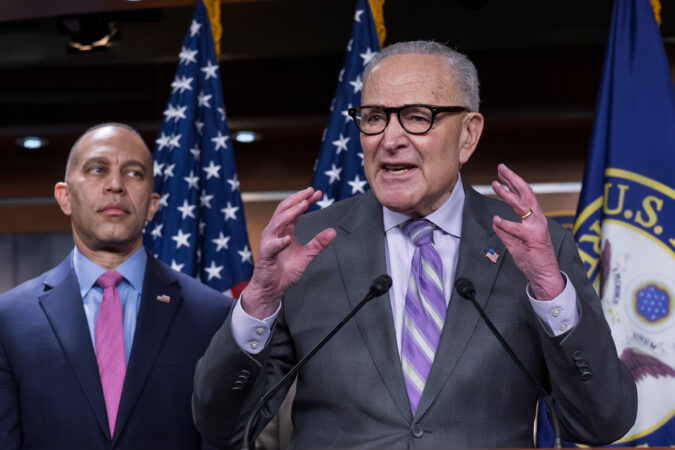
    After federal agents fatally shot two protesters in Minneapolis last month, Democrats say U.S. Immigration and Customs Enforcement needs to be “dramatically” reined in and are prepared to let Homeland Security shut down if their demands aren’t met. On Tuesday, Senate Democratic Leader Chuck Schumer and House Democratic Leader Hakeem Jeffries said they had rejected a White House counteroffer that “included neither details nor legislative text” and does not address “the concerns Americans have about ICE’s lawless conduct.”

    “We simply want ICE to follow the same standards that most law enforcement agencies across America already follow,” Schumer said Tuesday. “Democrats await the next answer from our Republican counterparts.”

    The Democrats’ rejection of the Republican counteroffer comes as time is running short, with a shutdown of the Homeland Security Department threatening to begin Saturday. Among the Democrats’ demands are a requirement for judicial warrants, better identification of DHS officers, new use-of-force standards and a stop to racial profiling.

    Finding agreement on the charged, partisan issue of immigration enforcement will be exceedingly difficult. But even as lawmakers in both parties were skeptical, a White House official said that the administration was having constructive talks with both Republicans and Democrats. The official, granted anonymity to speak about ongoing deliberations, stressed that Trump wanted the government to remain open and for Homeland Security services to be funded.

    Senate leaders also expressed some optimism.

    “There’s no reason we can’t do this” by the end of the week, Senate Democratic Leader Chuck Schumer said after meeting with his caucus on Tuesday.

    Senate Majority Leader John Thune, R-S.D., said there have been “some really productive conversations.”

    Democratic demands

    Schumer and Jeffries have said they want immigration officers to remove their masks, to show identification and to better coordinate with local authorities. They have also demanded a stricter use-of-force policy for the federal officers, legal safeguards at detention centers and a prohibition on tracking protesters with body-worn cameras.

    Among other asks, Democrats say Congress should end indiscriminate arrests, “improve warrant procedures and standards,” ensure the law is clear that officers cannot enter private property without a judicial warrant and require that before a person can be detained, it’s verified that the person is not a U.S. citizen.

    Democrats made the demands for new restrictions on ICE and other federal law enforcement after ICU nurse Alex Pretti was shot and killed by a U.S. Border Patrol officer in Minneapolis on Jan. 24, and some Republicans suggested that new restrictions were necessary. Renee Good was shot by ICE agents on Jan. 7.

    Many Democrats said they won’t vote for another penny of Homeland Security funding until enforcement is radically scaled back.

    “Dramatic changes are needed at the Department of Homeland Security before a DHS funding bill moves forward,” Jeffries said. “Period. Full stop.”

    Republican counterproposal

    Jeffries said Tuesday that the White House’s offer “walked away from” their proposals for better identification of ICE agents, for more judicial warrants and for a prohibition on excessive use of force. Republicans also rejected their demand for an end to racial or ethnic profiling, Jeffries said.

    “The White House is not serious at this moment in dramatically reforming ICE,” Jeffries said.

    Republican lawmakers have also pushed back on the requests. Oklahoma Sen. Markwayne Mullin, a close ally of Trump, said Tuesday that he’s willing to discuss more body cameras and better training — both of which are already in the Homeland spending bill — but that he would reject the Democrats’ most central demands.

    “They start talking about judicial warrants? No. They start talking about demasking them? No, not doing that. They want them to have a photo ID with their name on it? Absolutely not,” Mullin said.

    Republicans have said ICE agents should be allowed to wear masks because they are more frequently targeted than other law enforcement officials.

    “People are doxing them and targeting them,” said House Speaker Mike Johnson, R-La., on Monday. “We’ve got to talk about things that are reasonable and achievable.”

    Some Republicans also have demands of their own, including the addition of legislation that would require proof of citizenship before Americans register to vote and restrictions on cities that they say do not do enough to crack down on illegal immigration.

    At a House hearing on Tuesday, the acting director of ICE, Todd Lyons, said his agency is “only getting started” and would not be intimidated as his officers carry out Trump’s mass deportation agenda.

    Trump deals with Democrats

    Congress is trying to renegotiate the DHS spending bill after Trump agreed to a Democratic request that it be separated out from a larger spending measure that became law last week and congressional Republicans followed his lead. That package extended Homeland Security funding at current levels only through Feb. 13, creating a brief window for action as the two parties discuss new restrictions on ICE and other federal officers.

    But even as he agreed to separate the funding, Trump has not publicly responded to the Democrats’ specific asks or suggested any areas of potential compromise.

    White House press secretary Karoline Leavitt said late last week that the Trump administration is willing to discuss some items on the Democrats’ list, but “others don’t seem like they are grounded in any common sense, and they are nonstarters for this administration.”

    Thune said Tuesday that “there are certain red lines that I think both sides have, things they are not going to negotiate on, but there are some things they are going to negotiate on, and that’s where I think the potential deal space is here.”

    It was, so far, unclear what those issues were.

    “We are very committed to making sure that federal law enforcement officers are able to do their jobs and to be safe doing them,” Thune said of Republicans.

    Consequences of a shutdown

    In addition to ICE and U.S. Customs and Border Protection, the homeland security bill includes funding for the Federal Emergency Management Agency and the Transportation Security Administration, among other agencies. If DHS shuts down, Thune said last week, “there’s a very good chance we could see more travel problems” similar to the 43-day government closure last year.

    Thune has said Republicans will try to pass a two- to four-week extension of the Homeland Security funding while negotiations continue.

    Many Democrats are unlikely to vote for another extension. But Republicans could potentially win enough votes in both chambers from Democrats if they feel hopeful about negotiations.

    “The ball is in the Republicans’ court,” Jeffries said Monday.

  • Somalia welcomes its first bowling alley as the middle class and diaspora returnees grow

    Somalia welcomes its first bowling alley as the middle class and diaspora returnees grow

    MOGADISHU, Somalia — In a city long defined by conflict, Somalia‘s capital of Mogadishu now echoes with the crash of pins at the country’s first modern bowling alley.

    It’s the latest sign of revival in the once-thriving Indian Ocean port shaped by 35 years of civil war and militant bombings. Millions of people were forced to flee what became one of the world’s most dangerous cities. Those who remained avoided public spaces as the al-Qaeda-linked group al-Shabab waged an insurgency against the Somali state.

    In recent years, improved security measures against al-Shabab, an expanded government presence and growing private investment have allowed daily life to reemerge. Cafes line newly reopened streets, beaches draw evening crowds, and traffic congestion, once unimaginable, now clogs key intersections.

    The Feynuus Bowling Center opened last year and draws many locals and Somalis returning from the diaspora, who bring investment and business ideas after years of sending billions of dollars in remittances from abroad.

    On a recent evening, young Somalis gathered in groups, laughing and filming each other on their phones while music played. Many from the diaspora are visiting Mogadishu for the first time in years, or the first time ever.

    “I couldn’t believe Mogadishu has this place,” said Hudoon Abdi, a Somali-Canadian on holiday, as she prepared to take her turn to bowl.

    “I’m enjoying it. Mogadishu is actually safe,” she said, urging others to visit.

    Mogadishu remains vulnerable to militant attacks, however, with security measures like checkpoints and heavily guarded zones part of daily life. Non-Somalis remain largely confined to a compound at the international airport.

    But residents say the ability to gather for recreation signals an important psychological shift. Such venues provide a welcoming environment for a younger generation eager for safe spaces to socialize.

    Abukar Hajji returned from the United Kingdom on holiday after many years away and found the difference between what he imagined and what he experienced eye-opening.

    “When I was flying from the U.K., I believed it was a scary place, like a war-torn country,” he said. “Everyone told me, ‘Good luck,’ but when I came and saw it with my own eyes, I didn’t want to leave.”

    Sadaq Abdurahman, the manager of the bowling center, said the idea for the business emerged from a growing demand among young people for recreational facilities.

    “It has created employment opportunities for at least 40 youths,” he said.

    According to the Somali National Bureau of Statistics, Somalia’s unemployment rate stands at 21.4%.

    The bowling alley has private security guards, bag checks, and surveillance cameras, reflecting the precautions common at public venues in Mogadishu.

    Urban planners and economists say businesses like the bowling alley signal a broader shift in Mogadishu’s recovery, as private sector growth increasingly complements international aid and government-led rebuilding efforts.

    Ahmed Khadar Abdi Jama, a lecturer in economics at the University of Somalia, said innovative businesses are responding to the needs of diaspora returnees and the growing middle class, “which in turn adds to the expected increase in Somalia’s GDP.”

    Outside the bowling alley, traffic hummed and neon signs flickered, other reminders of Mogadishu’s fragile transformation.

  • Vance is in Armenia, a country no sitting U.S. president or vice president has visited before

    Vance is in Armenia, a country no sitting U.S. president or vice president has visited before

    YEREVAN, Armenia — Vice President JD Vance landed in Armenia on Monday — a country that no sitting U.S. vice president or president has visited before — as the Trump administration offered economic opportunities while it works to advance a U.S.-brokered deal aimed at ending a decades-long conflict with Azerbaijan.

    Vance and Armenian Prime Minister Nikol Pashinyan signed an agreement to push forward negotiations on a civil nuclear energy deal, and Vance said the U.S. was ready to export advanced computer chips and surveillance drones to Armenia, and invest in the country’s infrastructure.

    The visit comes after Pashinyan joined a deal at the White House in August with Azerbaijani President Ilham Aliyev where the leaders signed agreements reaffirming their commitment to signing a peace treaty. The text of the treaty was initialed by foreign ministers, which indicates preliminary approval. But the leaders have yet to sign the treaty and parliaments have yet to ratify it.

    “Peace is not made by cautious people,” said Vance, who planned to travel to Azerbaijan on Tuesday. “Peace is not made by people who are too focused on the past. Peace is made by people who are focused on the future.”

    The August deal between the two former Soviet republics calls for the creation of a major transit corridor dubbed the Trump Route for International Peace and Prosperity. It is expected to connect Azerbaijan and its autonomous Nakhchivan exclave, which are separated by a 20-mile-wide patch of Armenian territory.

    The land bridge had been a sticking point in resolving a conflict that lasted for nearly four decades over control of the Karabakh region, known internationally as Nagorno-Karabakh. The region had been under the control of ethnic Armenian forces backed by Armenia since 1994. A six-week war in 2020 resulted in Azerbaijan regaining control of parts of the region and the surrounding areas. In September 2023, Azerbaijan launched a blitz that forced the separatist authorities to capitulate. After Azerbaijan regained full control of Karabakh, most of its 120,000 Armenian residents fled to Armenia.

    Vance said that the Armenian prime minister had his endorsement in upcoming elections and he emphasized that the country was among the oldest to have identified as Christian.

    Pashinyan expressed his gratitude toward President Donald Trump and Vance, noting that he had accepted an invitation to participate in the first meeting of Trump’s Board of Peace on Feb. 19 in Washington. The group, founded by Trump, is overseeing the ceasefire plan in Gaza.

    He said Vance’s visit was “of truly historic and symbolic importance” and it “reflects the depth of the strong and strategic partnership forged between the Republic of Armenia and the United States of America.”

    The vice president and his wife, Usha, arrived in Yerevan after spending four days in Milan at the Winter Olympics with their family. They were greeted with a red carpet, an honor guard, and a delegation of officials. Armenian and American flags hung from poles from as the delegation drove to the vice president’s meeting, with some demonstrators on the side of the road, including one with a sign that said, “Does Trump support Devils?”

  • Trump set off a surge of AI in the federal government. Here’s what happened.

    Trump set off a surge of AI in the federal government. Here’s what happened.

    As the Trump administration seeks to sweep away obstacles to developing artificial intelligence, the president’s team has brought its zeal for the new technology to the federal government itself.

    Orders came down from the White House budget office in April urging every corner of the government to deploy AI. “The Federal Government will no longer impose unnecessary bureaucratic restrictions on the use of innovative American AI in the Executive Branch,” the White House said in a statement announcing the push.

    Officials across the government answered the call, according to a Washington Post analysis of more than two dozen recent agency disclosures on AI use. On top of automating rote tasks, government agencies have launched hundreds of artificial intelligence projects in the past year, many of them taking on central and sensitive roles in law enforcement, immigration, and healthcare.

    The Department of Homeland Security has adopted new, more sophisticated facial recognition tools. The FBI has purchased novel systems to sift through reams of images and text to generate leads for investigators. And the Department of Veterans Affairs is developing an AI program to predict whether a veteran is likely to attempt suicide.

    Revoking — even scorning — the Biden administration’s caution, the White House has directed government departments to cut through any red tape that might slow the adoption of AI. “Simply put, we need to ‘Build, Baby, Build!’” the Trump administration’s AI action plan says.

    Federal agencies are doing just that: The 29 that had posted data last week listed 2,987 active uses for AI by the end of 2025, up from 1,684 the year before. The disclosures are required by the budget office and provide basic details about each use of AI. Hundreds of those uses were marked as “high impact,” meaning they are being used as the main basis for making significant decisions or have implications for people’s rights or their safety, according to federal standards.

    The White House argues the technology is a way to make the government vastly more efficient, though it’s impossible to tell from the disclosures how well used any of the thousands of tools are.

    The practical value of many of these tools remains uncertain. The public, meanwhile, remains deeply skeptical of the technology.

    The administration’s focus on speed may come at the expense of ensuring the tools are being used safely, said Suresh Venkatasubramanian, a Brown University computer science professor. AI could spit out erroneous information, leading officials to make bad decisions, or a facial recognition tool could lead to someone being wrongfully placed on a watch list, he said. Venkatasubramanian, who worked on AI safety in the Biden administration, argued that officials previously placed a greater emphasis on oversight and managing risks.

    “It’s not the use case itself that raises the question, it’s do you have the guardrails in place to use what can be very noisy and powerful tools in the right way,” he said. “Any particular use case — even the most innocuous sounding ones — could backfire.”

    The White House Office of Management and Budget, which is overseeing the government’s AI rollout, did not respond to a request for comment. Its April memo directs agency leaders to ensure “that rapid AI innovation is not achieved at the expense of the American people or any violations of their trust.”

    Turbocharged law enforcement

    As the administration has dramatically ramped up its deportation efforts, DHS has increasingly turned to advanced technology to turbocharge its work. The department’s disclosures reveal a suite of facial recognition tools deployed in the past year and another system to help identify people to deport. In all, 151 AI use cases mention either “immigration” or “border” or were filed by immigration and customs agencies.

    Immigration and Customs Enforcement, which is part of DHS, reported adding new facial recognition functions, including the Mobile Fortify app, which is used to scan individuals’ faces in the field. It also disclosed its use of an unspecified system to identify “vulnerable populations,” which the agency defined as including “unaccompanied minors who have crossed the border.”

    ICE also said it began in June using a new generative AI system from the defense contractor Palantir that trawls through handwritten records such as rap sheets and warrants, to automatically extract addresses to aid Enforcement and Removal Operations, the agency’s deportation division. The AI-powered system, called Enhanced Leads Identification and Targeting for Enforcement (ELITE), is not supposed to serve as a “primary basis for enforcement actions,” the agency said. Officers manually review the data and make decisions, it added.

    Another Palantir system helps quickly review ICE’s tip line, summarizing and categorizing each tip, whatever language it is submitted in.

    “Employing various forms of technology in support of investigations and law enforcement activities aids in the arrest of criminal gang members, child sex offenders, murderers, drug dealers, identity thieves and more, all while respecting civil liberties and privacy interests,” DHS previously said in a statement.

    The Justice Department disclosed multiple tools designed to generate leads for investigators, including a facial recognition system at the FBI and another to prioritize tips coming into bureau offices around the country. But many of the department’s descriptions are vague: The output of one FBI tool is described merely as “text.”

    Valerie Wirtschafter, a fellow at the Washington-based think tank Brookings, said a lack of detail in some agency disclosures makes it difficult to fully judge some of their more sensitive uses of AI.

    The Justice Department and Palantir did not respond to requests for comment.

    A Veterans Affairs boom

    The Department of Veterans Affairs listed more high-impact uses of AI than any other agency, disclosing 174 such tools either in development or operation to revamp how it provides healthcare and benefits. The department said it is developing AI helpers to prepare patients for surgery, use computer vision to more precisely measure wounds, and identify potential suicide risks that human clinicians might have missed.

    Another system is designed to help veterans claim their benefits. “This project harnesses the power of artificial intelligence to analyze vast amounts of data, providing personalized recommendations and streamlined access to a wide array of veteran benefits,” the department said in its disclosure.

    Pete Kasperowicz, a VA spokesperson, said those four systems “are still being assessed for their viability and have not been tested or deployed.” He said the department uses AI only as a “support tool,” leaving final healthcare and benefits decisions to agency staff.

    Chris Macinkowicz, an official at Veterans of Foreign Wars, a service group, said that while VA’s use of AI promises to help the agency serve millions of veterans more efficiently, it needs to be carefully overseen.

    “Our experience has shown that, although AI can be a valuable tool, it is not infallible,” Macinkowicz said in an email. “Human judgment is essential to ensure accuracy, fairness, and accountability in decisions that have a direct and lasting impact on veterans and their families.”

    The Department of Health and Human Services disclosed an additional 89 projects connected to medical care. They include using AI to oversee clinical trials and to track the availability of vaccines. The department did not respond to a request for comment.

    Chatbots

    Many government uses are similar to those available to the general public. Agencies operate at least 180 chatbots designed to not only help federal employees complete mundane tasks such as scheduling travel and IT help, but also support them in more sensitive work like understanding labyrinthine internal rule books. Several agencies are using similar tools to help with writing federal rules and deciding how to award contracts.

    In a year that saw hundreds of thousands of federal employees laid off or take buyouts under cuts engineered by the Trump administration, a Defense Department official described at a conference last month how one team was able to use AI to still get a mandatory report finished despite losing the help of a team of about 20 contractors.

    “There’s four people, and guess what?” said Jake Glassman, a senior Pentagon technology official. “They generated the report, and I would dare anyone to see any type of difference on that.”

    National security

    The Pentagon is exempt from the disclosure process, but other government records show how it is aggressively accelerating its AI experimentation. Defense Secretary Pete Hegseth ordered officials to avoid being hamstrung by undue concerns of risks in a memo issued last month. Future AI contracts with vendors must allow for “any lawful use,” he wrote, without further usage constraints.

    “We must eliminate blockers to data sharing,” the memo said. “… We must approach risk tradeoffs … and other subjective questions as if we were at war.” The Pentagon told vendors in recent weeks that it is seeking to acquire cutting-edge “agentic” AI systems that exhibit “decision-making capabilities” and “humanlike agency” for its elite Special Operations forces. One potential use for such systems is to weigh various “constraints” that govern when units can initiate or continue combat and the risk of killing or injuring civilians.

    “These constraints overlap and sometimes include conflicting guidance,” the department said in a request for industry input, adding that the AI agents should understand how certain constraints have priority over others.

    The request said the tools are expected to adapt and learn in real time, though they will be prohibited from “online” learning in contexts such as “kinetic fires” — the use of live ammunition — “since it may lead to undesired behavior.”

    The Defense Department did not respond to a request for comment.

    Science and research

    Government scientists are experimenting with using AI to solve problems in hundreds of niche areas, including eight related to whales and dolphins. Some at the National Oceanic and Atmospheric Administration are working on “Automated whale blow detections” — part of a population-tracking effort. (Some of these biologists are having fun, titling one project “Artificial Fintelligence: Automating photo-ID of dolphins in the Pacific Islands.”) Some 49 other projects use AI to evaluate satellite and aerial imagery to detect ice seals, track invasive species, estimate soybean yields, and locate cooling towers that might be vectors for the spread of Legionnaires’ disease.

    NOAA did not respond to a request for comment.

    Federal archivists have also turned to AI to help make the nation’s history more accessible.

    Jim Byron, a senior adviser at the National Archives and Records Administration, said the agency launched an AI-powered tool last month to let the public search through newly digitized records. They include documents related to the assassinations of President John F. Kennedy and Martin Luther King Jr., as well as the disappearance of pioneering aviator Amelia Earhart.

    Byron said in a statement that the agency plans to build on its work, calling the tool a “giant leap into the present.”

  • Palace says King Charles III will support police assessing former Prince Andrew’s Epstein links

    Palace says King Charles III will support police assessing former Prince Andrew’s Epstein links

    LONDON — King Charles III is ready to “support’’ U.K. police examining claims that the former Prince Andrew gave confidential information to convicted sex offender Jeffrey Epstein, Buckingham Palace said on Monday.

    The statement came after Thames Valley Police said Monday that they were ”assessing” reports that the former prince, now known as Andrew Mountbatten-Windsor, sent trade reports to Epstein in 2010. The department, which serves an area west of London that includes Mountbatten-Windsor’s former home, previously said it was evaluating allegations that Epstein flew a young woman to Britain to have sex with Andrew, also in 2010.

    “The King has made clear, in words and through unprecedented actions, his profound concern at allegations which continue to come to light in respect of Mr. Mountbatten-Windsor’s conduct,’’ the palace said in a statement. “While the specific claims in question are for Mr. Mountbatten-Windsor to address, if we are approached by Thames Valley Police we stand ready to support them as you would expect.’’

    The statement is just the latest effort by the palace to distance the royal family from Mountbatten-Windsor as the U.S. Justice Department’s release of more than 3 million pages of documents from its investigation into Epstein reveal more embarrassing details about the relationship between the two men. Earlier in the day, Prince William and Princess Catherine released their own statement saying they have been “deeply concerned” by recent revelations.

    The palace also reiterated Charles and Queen Camilla’s concern for the victims of Epstein’s abuse.

    “As was previously stated, Their Majesties’ thoughts and sympathies have been, and remain with, the victims of any and all forms of abuse,’’ the palace said.

    The jeopardy faced by the royal family could be seen Monday when Charles visited Lancashire, in northwest England. While most of the crowd clapped, cheered, and waved flags, one person shouted, “How long have you known about Andrew?”

    Concerns about Mountbatten-Windsor’s links to Epstein have dogged the royal family for more than a decade.

    The late Queen Elizabeth II forced her second son to give up royal duties and end his charitable work in 2019 after he tried to explain away his friendship with Epstein during a catastrophic interview with the BBC. After more details about the relationship emerged in a book published last year, Charles stripped him of the right to be called a prince and ordered him to move out of a royal residence close to Windsor Castle.

    But the Justice Department documents have brought new attention to Mountbatten-Windsor as reporters home in on dozens of email exchanges between Epstein and the former prince, many of which took place after the financier was convicted of soliciting a minor for prostitution in 2008.

    Correspondence unearthed in recent days appears to show that Mountbatten-Windsor sent Epstein copies of his reports from a 2010 tour of Southeast Asia, which he undertook as Britain’s envoy for international trade. An earlier email appears to show Andrew sharing his itinerary for the two-week trip to Hanoi, Saigon, Singapore, Kuala Lumpur, and Hong Kong with Epstein.

    “We can confirm receipt of this report and are assessing the information in line with our established procedures,” Thames Valley police said in a statement released on Monday.

    Adding to the storm, a U.S.-based attorney said on Feb. 1 that he represented a woman who alleges Epstein flew her to Britain to have sex with Mountbatten-Windsor. The encounter took place at Royal Lodge, the former prince’s longtime home in Windsor, the attorney said in an interview with the BBC.

    Police previously said they were assessing this report.

    The king last week forced Mountbatten-Windsor to move out of Royal Lodge months ahead of schedule. Anger over Mountbatten-Windsor’s living arrangements had grown amid concern that he was still reaping rewards from his status as a royal even though he is no longer a working member of the royal family.

    Mountbatten-Windsor is now living on the king’s Sandringham estate in eastern England. He will live temporarily at Wood Farm Cottage while his permanent home on the estate undergoes repairs. Unlike Royal Lodge, which is owned by the crown and managed for the benefit of taxpayers, Sandringham is owned privately by the king.

    Thames Valley Police began its latest inquiry after Graham Smith, chief executive of the antimonarchy group Republic, reported Mountbatten-Windsor for suspected abuse of public office and violations of Britain’s Official Secrets Act.

    Smith, whose group seeks to replace the king with an elected head of state, compared Mountbatten-Windsor’s correspondence with Epstein to earlier revelations about Peter Mandelson, Britain’s former ambassador to the U.S., who is already the subject of a police investigation into whether he shared sensitive information with Epstein. Those communications were also revealed in the Justice Department documents.

    “I cannot see any significant difference between these allegations and those against Peter Mandelson,” Smith said on social media.