It may be a while before the drought advisories disappear, but since Monday Philadelphia has had more rain than in any entire month since March 2025. And the city of Camden has been clocked well over a half-foot of rain.
In both instances, if it seemed like most of that came in a hurry, it did.
On Thursday, for the second time in a week, downpours set off a flood of warnings in the city, the neighboring counties and Delaware.
And more showers are possible Friday and Saturday, but the atmosphere isn’t expected to upstage its performance since it turned off last weekend’s 100-degree heat.
Thursday’s downpours wrung out 2 and 3 inches of rain in several towns across the region.
Flooding was reported along numerous roads, with vehicles stranded, including in the vicinity of the Ben Franklin Bridge, the National Weather Service said. The rains could continue until 7 or 8 p.m. Thursday, said Alex Staarmann, meteorologist inthe Mount Holly office.
Multiple water rescues have been reported in Wilmington.
Philadelphia broke a 74-year-old record for a July 9 with 2.61 inches of rain measured officially, according to the weather service.
At one point flood warnings had been posted for the city and in all seven neighboring counties.
But the rain lately has been random. And in the grand casino of the atmosphere, that was the case Thursday, and not every place got the soakings.
The drought conditions are likely to persist despite the storms
In the weekly inter-agency U.S. Drought Monitor update posted Thursday, some degree of drought conditions persisted in all of New Jersey, Philly, and the neighboring Pennsylvania counties.
The drought monitor has most of the region was in “moderate drought,” with some improvement in Burlington, Camden, and Gloucester Counties.
But all of Chester County and most Montgomery County were in “severe drought.” Southeastern New Jersey, including the Shore towns, were in “extreme drought.”
Soil moisture levels will remain significantly below normal during the next week, according to the National Oceanic and Atmospheric Administration’s Climate Prediction Center.
(function(){function e(){window.addEventListener(`message`,function(e){if(e.data[`datawrapper-height`]!==void 0){var t=document.querySelectorAll(`iframe`);for(var n in e.data[`datawrapper-height`])for(var r=0,i;i=t[r];r++)if(i.contentWindow===e.source){var a=e.data[`datawrapper-height`][n]+`px`;i.style.height=a}}})}e()})();
And it appears the atmospheric faucets are going to shut after Saturday.
Said Joseph DeSilva, meteorologist at the weather service’s Mounty Holly office, “Next week looks pretty dry.”
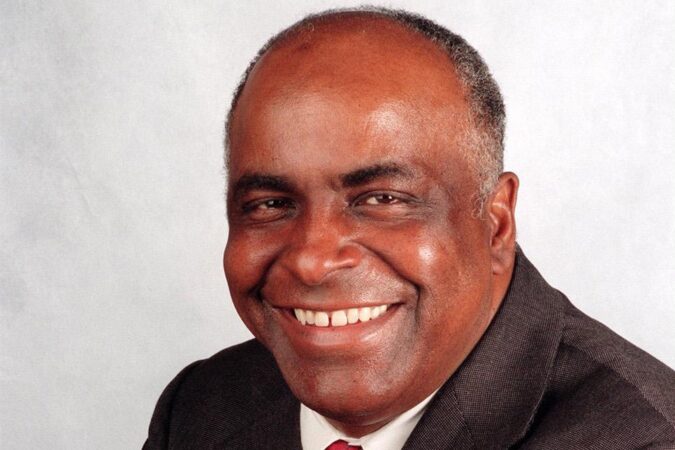
Richard H. Glanton, 79, formerly of Philadelphia, longtime lawyer, onetime executive deputy counsel to former Gov. Dick Thornburgh, business entrepreneur, former Lincoln University trustee, and innovative former president of the Barnes Foundation, died Sunday, June 21, of a heart attack at his home in Princeton.
Born and reared in rural Georgia and one of the first Black graduates of what is now the University of West Georgia, Mr. Glanton went on to become a prominent Philadelphia lawyer, state government policy and administration expert, corporate vice president, and indefatigable president of the Barnes Foundation’s collection of Impressionist, post-Impressionist, and modern art.
He was elected president of the Barnes Foundation in 1990, served until 1998, and championed a series of controversial initiatives to finance extensive gallery renovations and the operation of its art collection and related educational programs. To raise the money, he suggested, among other things, selling 15 of the collection’s hundreds of paintings, charging million-dollar fees for a worldwide lending tour of 83 paintings, extending visiting hours, increasing admission, building a new parking lot, selling a coffee-table catalog, and renting out its art studios.
All of his ideas, several of which did not take place, drew supporters and critics, and Mr. Glanton, also a Barnes trustee, spoke often of his policy discussions with other Barnes officials, art experts around the world, politicians, and neighbors of the foundation building in Lower Merion Township. In 1990, he told The Inquirer. “I never purported to know anything about art. But I can lead.”
His most successful project turned out to be a two-year world lending tour of 83 foundation paintings that raised about $20 million and drew raves from museum leaders in Washington, Paris, Tokyo, Fort Worth, Toronto, and Philadelphia. The exhibition in Paris drew a then-record 1.5 million visitors, and Mr. Glanton was feted at every stop.
“Richard is somebody who started out by wanting to do something good and important and substantial, and persevered to do it despite a great deal of criticism,” Glenn D. Lowry, then director of the Art Gallery of Ontario, told The Inquirer in 1995.
Some critics said Mr. Glanton and others valued the foundation’s commercial success over its original educational role and what The Inquirer’s Edward J. Sozanski called “the Barnes mystique.” When the lending tour ended at the Philadelphia Art Museum in 1995, Mr. Glanton told The Inquirer: “I never realized or understood that it could be controversial to make available to the public a collection that is a public trust.
“But I think if you think something’s right, you should do it, whether or not people disagree, and whether it is popular or not. … You have to think not only in terms of your lifetime, but in 100 years, 1,000 years. And when you do, these little slings and arrows don’t really matter that much.”
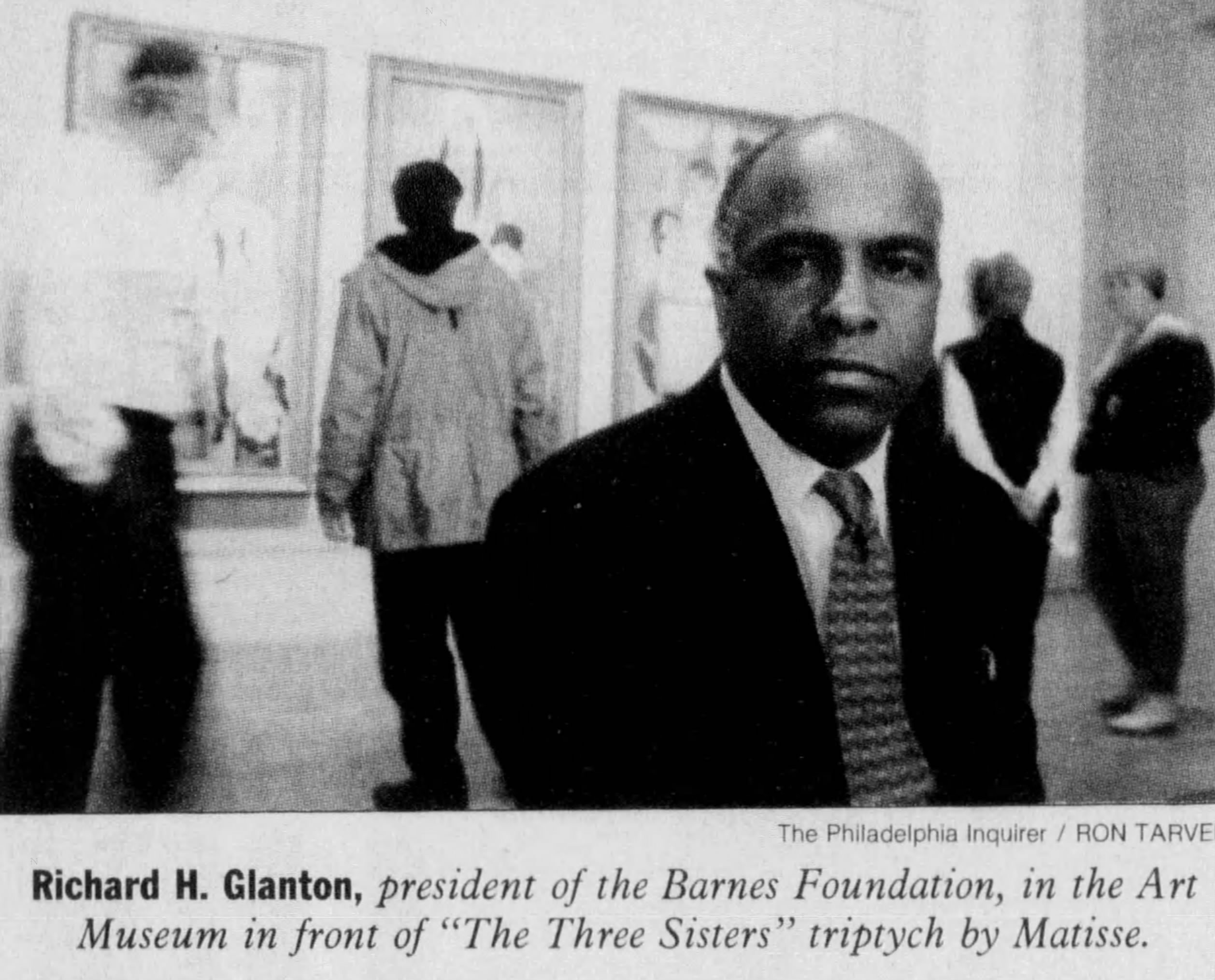
A story and this photo of Mr. Glanton appeared in The Inquirer in 1995.
Mr. Glanton was executive deputy counsel to Gov. Thornburgh from 1979 to 1983, and he met often with constituents and helped fill judicial vacancies. “Richard is a political animal,” Ted Pillsbury, then director of the Kimbell Art Museum in Fort Worth, told The Inquirer in 1995. “He understands politics. He understands what makes politics work, and he understands people. And he does not take certain things personally.”
Mr. Glanton earned his law degree at the University of Virginia School of Law in 1972 and spent several years with the Equal Employment Opportunity Commission, United Airlines, and other companies. In Philadelphia, he represented politicians and other notable clients, and specialized in energy, insurance, and real estate cases for firms known now as WolfBlock, and Reed Smith.
He was also senior vice president of corporate development at Exelon Corp., founder of a local TV station, social media company, and consulting firm, and board member at Aqua America, the Morris Arboretum, Children’s Hospital of Philadelphia, and other groups. He ended a workplace sexual harassment suit with a private settlement in the early 1990s and had public policy spats with local government officials and former Lincoln president Niara Sudarkasa.
He considered running for mayor in 1995. Former Gov. Ed Rendell said: “He was exceptionally bright, courageous, and never afraid to challenge the status quo in pursuit of what he believed was right.”
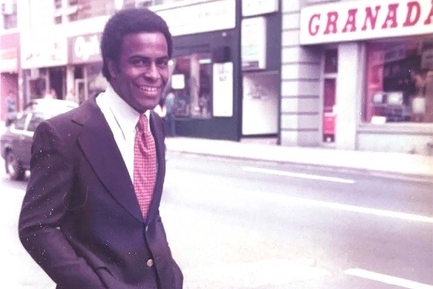
Mr. Glanton was at home in a suit jacket and tie.
One of 11 children, Richard Howard Glanton was born Nov. 21, 1946. He was reared in rural Villa Rica, Ga., didn’t start school until the fourth grade, and he and his siblings worked for years on the family farm.
He earned a bachelor’s degree in English and, in 2005, was awarded an honorary doctorate from West Georgia. He married Scheryl Williams, and they had a daughter, Morgan, and a son, David.
After a divorce, he married Eileen Candia, and they had a daughter, Georgia. They lived in Philadelphia and Chicago, and moved to Princeton in 2009.
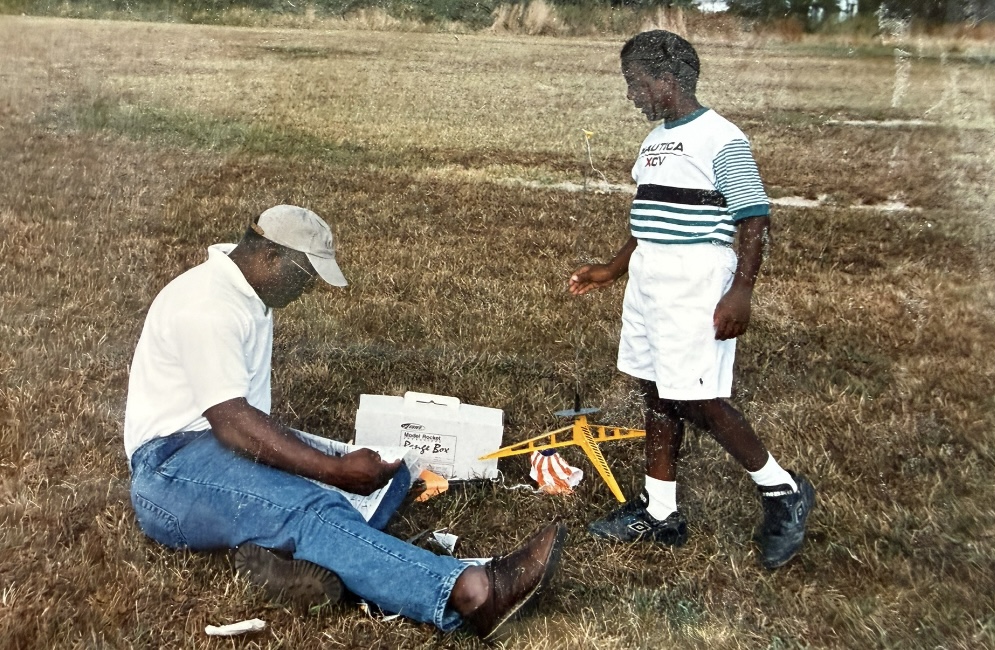
Mr. Glanton was a doting father, his family said. He taught his children to ride bikes and read Shakespeare. “He taught me that there was no room in which I didn’t belong or couldn’t strive to enter,” his daughter Morgan said. “I love him for that.”
Mr. Glanton was an avid reader and golfer.
Nearly everyone he met remembered his laugh and perpetual suit jacket and tie. He played golf, was an avid reader, and would talk politics for hours.
“He was fearless in his conviction to do what he believed was necessary and proper to achieve his goals and provide for his family,” his son said. His wife said: “He was kind and generous. He made everyone he spoke to feel special. He was always bringing you in.”
In addition to his wife, children, and former wife, Mr. Glanton is survived by two sisters, four brothers, and other relatives. One sister and four brothers died earlier.
Memorial services are to be held at noon Saturday, July 18, at Pleasant Hill United Methodist Church, 119 Thomas Dorsey Dr., Villa Rica, Ga. 30180, and at 11 a.m. Friday, Sept. 18, at the Union League, 140 S. Broad St., Philadelphia, Pa. 19102.
An Oregon man on Thursday was ordered to spend 30 years in prison for fatally stabbing a beloved South Jersey veterinarian at the vet’s Cherry Hill home.
During Custodio-Aquino’s sentencing before Camden County Superior Court Judge Judith Charny, Anthony’s family members spoke tearfully of late veterinarian, who they described as kind, wickedly funny, and a devoted father to his sons.
Above all, they grappled for answers as to why Custodio-Aquino murdered Anthony that morning on his front lawn.
“You took all of the future moments that should have belong to him,” said Patricia Anthony Gershefski, one of Anthony’s sisters.
Anthony Gershefski said her brother was warm and sensitive, even moving his veterinarian practice just to be closer to his children.
The brutal nature of the crime confounds the family to this day.
In her career as a professional psychologist, Anthony Gershefski said, she has found “no diagnostic category for the deliberate destruction of another person’s life in this savage and grotesque manner.”
Kyle Bartsch, Anthony’s partner, said in a statement read by prosecutors that Anthony had filled their home on Sharrowvale Road with love and laughter.
His death, Bartsch said, leaves “a permanent void in the lives of those who knew him.”
While Custodio-Aquino’s attorneys had previously suggested that prosecutors did not have enough evidence to convict their client of murder, they were mum throughout the proceeding.
In addition to the eyeglasses investigators linked to the Peru native, license plate readers captured Custodio-Aquino’s car entering and exiting Anthony’s neighborhood that morning, and forensic experts later recovered a sample of the veterinarian’s blood from the vehicle.
Prosecutors believe Custodio-Aquino traversed the country in a fit of jealousy that fall before killing Anthony.
He had previously dated Anthony’s partner, Bartsch, and once lived with the man in Haddon Township before the couple separated in 2021 after a domestic dispute, according to prosecutors.
Custodio-Aquino, given the opportunity to address the court, spoke so softly that Charny asked that he repeat himself.
Raising his voice, he said: “I do agree that the world is less than without Michael Anthony.”
He was sentenced to 30 years in a state correctional facility without parole. Charny offered few words on the ruling beyond wishing Custodio-Aquino good luck.
It was Henry Anthony, Anthony’s teenage son, who saved some of the most biting remarks for his father’s killer.
“Your life is officially over,” Anthony said, turning to look at Custodio-Aquino. “I honestly wonder what your reason for living will be for the next 30 years.”
Mount Laurel public schools will start the next academic year with a new leader at the helm.
Neil Burti will take over as superintendent of schools starting Aug. 1, succeeding George Rafferty, who is retiring after leading the district for a decade.
After an extensive search, “Dr. Burti distinguished himself as the candidate whose experience, leadership style, and vision best aligned with the needs of the Mount Laurel School District,” Danielle Stuffo, president of the Mount Laurel Board of Education, said in an email.
Burti has more than 25 years of experience as an educator and administrator and is a longtime employee of the Cherry Hill Public Schools. While there, he served at all levels of leadership and was most recently the director of secondary education for the district.
Earlier this year, Burti also stepped in to handle the principal responsibilities during the second half of the school year at Cherry Hill High School East following a period of administrative upheaval in the school district.
The shake-up came after a lawsuit filed last September alleged that East’s former principal, alongside the Cherry Hill Board of Education and two other top administrators, subjected a former assistant principal to discrimination and retaliation.
“We are confident [Burti] will build upon the district’s many strengths, work collaboratively with our staff and community, and continue our focus on providing an exceptional educational experience for every student,” Stuffo said.
Stuffo said the district’s goals will largely remain the same under new leadership.
Like other districts, Stuffo said, Mount Laurel will work to continuously improve student experience and outcomes while adapting to evolving educational needs — and doing so within an increasingly limited budget.
“Fortunately, Mount Laurel is well positioned, with excellent staff and strong systems already in place. As Dr. Burti becomes familiar with the district, he will have the opportunity to evaluate our organizational structure and administrative leadership and, if appropriate, make recommendations to the Board for consideration,” she said in the email.
Burti was named the 2024 New Jersey Secondary School Principal of the Year during his time leading Cherry Hill’s John A. Carusi Middle School.
Burti holds a bachelor’s degree in movement studies and exercise science from East Stroudsburg University, a master’s degree in educational leadership from Temple University, and a doctorate in innovation and leadership from Wilmington University.
Here we are, Fourth of July in the rearview mirror. Hang on, make those beach plans because it’ll be Labor Day before you know it.
It was a long holiday weekend that had towns and beaches bursting at the seams (also my house, with guests). But the heat that descended on Philly — and the towns just over the bridge from the Shore — never made it to the beach.
Nights cooled off for fireworks, and the daytime breezes stayed blissfully cool off the ocean. Sorry if you missed it, but the Shore was mostly just lovely.
Which I guess made those ridiculous lines you all waited in — for coffee, for doughnuts, for subs, for ice cream — a bit more bearable?
What is it about being on vacation that makes it tolerable to wait an hour for coffee in Ventnor, for doughnuts in Margate, for ice cream in Stone Harbor?
We asked our ever-ready group of Shore Line texters (sign up here) about these wild waits, and while some swore they’d never partake, or only go on off-hours, or find a way to circumvent, others made the case that those lines have actually become a sentimental, even enjoyable, part of their Shore journey. Here’s a sampling:
I’ll wait in a longer line down the shore. It’s tradition and fun to meet people in line.
It is akin to vacation time. No schedule; fun time. You just want go enjoy and socialize. Standing in line is a part of that experience and considered acceptable for that reason.
Only for Springer’s Ice Cream or The Lobster House. Hanging out on the wharf waiting for The Lobster House is as much fun as eating at The Lobster House!
Welcome to summers at the shore. The one thing you can count on is lines at the ice cream establishments. I often kid that, at a certain time on the weekends, an imaginary bell goes off and people rush out to get ice cream. No way around it.
Standing in line for ice cream is a social event as well as eating the ice cream. Also, the ice cream is usually special.
There’s just certain things we have to have for tradition’s sake and willing to wait 1-2 times a year.
OK, if you all say so! Glad you’re enjoying the lines, and so no need for me to share my avoid-the-line secrets!
📮 What are some essential Shore traditions you have to do no matter how long the wait? What memories or moments stick with you over the years of coming down the Shore? Keep scrolling for one of my essential Shore memories below, recreated this weekend for a new generation. Plus, send me yours here for a chance to be featured in this newsletter!
Have ideas or news tips about the Shore or this newsletter? Send them to me here.
⛅ After a couple of rainy days, some beautiful weather appears to be on the way.
🍴 Craig LaBan has food recs from LBI to Margate. He seemed especially fond of the deep-fried green tomato tots at Ellis’ Chicken & Crab Cakes in Beach Haven and the spicy Oaxacan chorizo meatballs from the newly reopened Iron Room in A.C.
🧘🏽♀️Try free yoga in Atlantic City’s O’Donnell Park.
🎹 Angeloni’s Club Madrid is hosting Sunday piano bar karaoke with Joe McGinty, former keyboardist for the Psychedelic Furs and Atlantic City native.
Elena D’Angelo and Dre Cook, of the Scranton area, dance during the annual Team 62 fundraising event for the Eagles Autism Foundation at the outdoor Paddy’s Green, in Sea Isle City, Wednesday, June 24, 2026.
🧠 Trivia time
In 2001, this city’s fireworks over the ocean led to a real show: The barge caught fire and burned out of control for hours, forcing the rescue of seven workers and a cascade of exploding shells.
Was this city:
A. Ocean City
B. Atlantic City
C. Avalon
D. Seaside Heights
If you think you know the answer, click on my pal Brendan Shur’s story from the wee hours of July 5 that year to find out (I went home to put my daughter to bed, what can I say).
Your thoughts on: Wonderland Pier
Ocean City’s City Council finally made it official: The old Wonderland Pier site was designated as being in need of rehabilitation. Let the negotiations over the hotel begin!
Here are your thoughts:
Bruce Sauerwine: It’s time to move on and build a hotel at the site. Mita proposed a nice looking hotel but some people want to live in the past and pretend that an amusement arcade was still a viable option at this time.
Kerri McGinley Kistler: There is absolutely no need or justification for Mita’s hotel plan. … “Hey kids, let’s go see the hotel”- said nobody ever!
Jeremy Maziarz: It is time for the Wonderland Pier to be re-developed. An amusement park use for this property is no longer a viable option. A mixed-use plan including a luxury hotel may actually be the best use for the site. If the height restrictions are an issue, then start the negotiation process with the developer. If he wants zoning relief, then he should offer up significant concessions to Ocean City to make it a win-win scenario.
Debbie Federico: We love Playland’s Castaway Cove, but it is now too small to accommodate all of the young children, strollers and families that use it. It would be very beneficial to reopen Wonderland.
Your Shore memory
This week’s Shore memory is my own.
For years, I had a toddler bike seat on an old green bike we’d bought for the boardwalk, and loved riding with one of my daughters on the back. I kept that bike seat on for much longer than they used it, sometimes sticking groceries into it. The rides were so special, so much fun, our way to wave to people we knew, pass the years, that I couldn’t bear to remove it, but finally took it off and stashed it in the basement.
I kept riding that bike though, a Specialized hybrid which was already used in 1995, and extremely used now, decades of sea air rust swirling through it. But let me tell you, that bike has good bones (better not to try to switch gears).
This past week, we dusted off the old bike seat, replaced the brake cables on the beloved bike, figured out how to replace the missing straps on the seat, and clipped it right there onto the back of the same green bike. And who wriggled happily into it under his new green toddler helmet, ready to do the obligatory “touch the end” at both the Margate and Atlantic City sides of the Boardwalk but my 2-year-old grandson.
Send us your Shore memory! In 200 words, tell me how the Shore taps into something deep for you, and we will publish them in this space during the summer.
By submitting your written, visual, and/or audio contributions, you agree to The Inquirer’s Terms of Use, including the grant of rights in Section 10.
Tackling what local officials called “one of the most significant matters” facing the Medford community, township council approved four redevelopment projects Tuesday night that will bring hundreds of affordable units to the township.
All of the projects are part of Medford’s effort to meet their state-mandated affordable housing requirements. The housing obligations stem from a 1975 New Jersey Supreme Court ruling requiring that all municipalities develop a certain amount of affordable housing.
Every 10 years, each municipality in the state is given a specific quota of affordable units to plan for over the next decade based on considerations that include population, income, and land capacity.
The U.S. Department of Housing and Urban Development generally follows the 30% rule to determine affordability — any dwelling that costs 30% or less of a household’s gross income is deemed affordable.
In New Jersey, affordable housing is restricted to households with earnings that must be at or below 80% of the area median income for the area. In Medford, the median household income is $157,969, according to the most recent data from the U.S. Census Bureau. That would mean any household earning less than roughly $126,375 per year would be eligible for the new affordable units.
The state most recently determined Medford must build a total of 240 affordable units by 2035.
The four development proposals that were approved would collectively add 226 affordable housing units as part of approximately 1,067 total new residential units within the township. All of the projects also plan for some type of on-site recreational amenity like playgrounds, pavilions, or picnic areas.
As part of the agreements, builder D.R. Horton will pay the township a $3 million redeveloper’s fee and a $1.7 million recreational and community benefit contribution that will be split between local nonprofits and the Medford Youth Athletic Association.
While the township has enough water infrastructure capacity for the new developments, D.R. Horton has also agreed to construct a water tower through the use of a $5 million special assessment bond with no cost to the township if it’s determined that water pressure is insufficient, Township Solicitor Patrick Varga said.
Large housing developments are often contentious in South Jersey, especially in places like Medford where residents value open space and are concerned more families will overburden an already cash-strapped school district.
In response to resident concerns about overbuilding, Medford Mayor Mike Czyzyk said Tuesday that the only residential communities that the township has approved in recent memory were related to the township’s affordable housing requirements.
“Medford has had a history of not building residential unless it’s required by the state,” Czyzyk told attendees during the meeting. “So as it stands today, there are no large or small-scale residential tracts being developed. There may be parcels being developed for residential use, like on Mill Street and in different areas, but there’s no communities coming to Medford outside of the ones required to be built to satisfy our affordable housing need.”
During Tuesday’s meeting, one resident questioned the township’s need to move forward with all of the projects at once, especially given that it is still so early in the 10-year window. But officials said that the timeline was out of their hands and they had a state deadline to meet.
“Every town in the state of New Jersey was required to adopt and finalize how it was going to comply with its Housing Element and Fair Share Plan for the Fourth Round by March 15,” Varga said. “The Township of Medford was one of a handful of towns that received an extension.”
Now that council has approved the redevelopment agreements, the township will be taking the plans before a judge who will determine if Medford is in compliance with their housing requirements.
Here’s what’s included in each of the redevelopment plans:
The Reserve at Ironbridge
Located on a 64-acre parcel at the intersection of Church and Eayrestown Roads, the Reserve at Ironbridge will include up to 287 total units, 48 of which will be designated as affordable.
Landing at Kirby’s Mill
Not far away, a 61-acre lot at Church and Fostertown Roads will become the 198-unit Landing at Kirby’s Mill. Forty of these units will be affordable.
Trollinger-Stonebridge
The largest of the four projects, the Trollinger-Stonebridge project will total more than 164 acres northeast of Church Road and County Route 541. The project includes up to 48 affordable units out of a total of 300 new residences. This project also includes plans for a bike trail to be constructed and paid for by the builder, pending state approval.
Flying W
Planned for a 114-acre lot on Fostertown Road, Flying W includes the greatest affordable housing contribution among the four projects. With 90 affordable units, 31% of the 282 total units will be set aside for low-income residents. All market-rate units in the development will be age-restricted.
With Philadelphia’s Fourth of July festivities for the United States’ 250th birthday having come and gone, this weekend will mark a celebration for a newly minted centenarian. And with any luck, that party won’t run so late.
The party will feature interactive historical displays, food trucks, music, and other activities. It’s open to the public and free to attend, and while not required, advance registration via the DRPA website is encouraged, officials said.
“For 100 years, the Ben Franklin Bridge has stood as more than a crossing over the Delaware River. It is a public promise,” John T. Hanson, DRPA chief executive officer, said in a statement. “We are proud to invite the public to celebrate its past, recognize those who have preserved it, and look ahead to the next 100 years.”
Here is what you need to know:
Closed to cars
Due to the event, the bridge will be closed to vehicular traffic in both directions from 8:30 a.m. to 4 p.m. Saturday, DRPA officials said in a statement.
Road closures around the Benjamin Franklin Bridge, officials said, should be expected during the event. However, the Walt Whitman and Betsy Ross Bridges will remain open for motorists.
While the bridge travel lanes will be open to foot traffic, the pedestrian walkway will be closed during the event. It will reopen at 2:30 p.m., and continue to operating until 9 p.m., the usual closing time.
Additionally, PATCO trains will continue to operate across the bridge Saturday, with enhanced service instituted to allow trains to run every 15 minutes throughout the bridge celebration.
How to get there
For those looking to get to the Camden side’s main party area, DRPA officials advise using the PATCO option from Philadelphia, which can get you to Camden’s City Hall station nearby.
There will also be a complimentary shuttle service operating continuously throughout the event. One shuttle route runs between the Camden City Hall station and the event entrance, and another from PATCO’s Franklin Square Station at 7th and Race Streets in Philly to the event site in Camden, DRPA spokesperson Mike Williams said.
And, of course, from Philly, you could just get to the Jersey side by walking across the bridge. Starting from the main event area in Camden is not required
“The bridge walk is really the centerpiece of the celebration, and we hope attendees take advantage of this rare opportunity,” Williams said.
Bikes are permitted on the roadway but are not permitted in the main party area.
For those who plan on driving, parking areas will be available on the Jersey side. They include free lots at Rutgers University, on-street metered parking, and a paid parking garage at Camden Technology Center, DRPA said.
What if it rains?
Saturday’s event will go on rain or shine, and there is no rain date, Williams said.
Officials had announced a rain date of July 12, but the event logistics made a rain date impractical, Williams said.
Things to do
In addition to the food trucks and vendors, the event will feature dance performances and special guests.
A “Winged Victory” statue, one of four that originally sat atop the bridge at its opening in 1926, will also be on display.
A family fun zone will offer an inflatable obstacle course and oversized yard games, as well as face painting and other entertainment, organizers said. And attendees will also be able to get up-close views of the vehicles that work on the bridge, such as a barrier mover known as a “zipper machine,” as well as front-end loaders, and dump trucks.
A sergeant with the Salem County Sheriff’s Office has been charged in connection with the deaths of two K-9 dogs who were left for seven hours in an unattended hot patrol vehicle, prosecutors said Wednesday.
Cody Henderson, 41, was charged Tuesday with two counts of recklessly causing bodily injury to a living animal, and related offenses, including unnecessary cruelty to animals, Salem County Prosecutor Kristin J. Telsey said.
According to the complaint filed against Henderson, surveillance video showed the K-9 handler arriving to work on May 29 shortly before 8:30 a.m. in his county issued 2023 Chevrolet Tahoe with Rip, a 4-year-old Belgian Malinois, and Boomer, a 6-year-old springer spaniel.
Henderson did not return to the vehicle until just after 3:30 p.m. and found both dogs dead in his patrol vehicle, prosecutors said.
He then transported the two dogs to an animal hospital in Delaware, prosecutors said.
Later that evening, the sheriff’s office notified the Salem County Prosecutor’s Office about the K-9 deaths.
Necropsies conducted on both dogs determined that they likely died from heat stroke with no evidence of other causes, prosecutors said.
There was no evidence that a K-9 heat alarm “Hot-N-Pop” device in the vehicle malfunctioned, and that it was “presumably turned off on the above date,” the complaint said.
The “Hot-N-Pop” device lowers windows and triggers sirens and flashing lights if the interior of a vehicle is too hot.
Henderson could be reached for comment.
In a statement posted on social media, Salem County Sheriff Charles M. Miller wrote that Henderson had been charged in connection with the “deaths of his assigned canine partners.”
Rip and Boomer “exemplified the highest standards of service, loyalty, and dedication. Their contributions to public safety and their commitment to duty will not be forgotten. The loss of these loyal partners has had a profound impact on our agency, our law enforcement community, and the citizens they faithfully served,” Miller said.
“We continue to honor the memory and service of Rip and Boomer and extend our thoughts to all those affected by this tragic loss,” Miller said.
The EMR scrap metal recycling plant will reopen afterCamden suspended its operations following a late May fire, the latest in a string of fires in recent years.
The decision fell to Camden Superior Court Judge Stephen J. Polansky on Wednesday after the Camden City Council voted unanimously on Tuesday against a settlement that would have allowed EMR to reopen under certain safety precautions. EMR had sued Camden for suspending its junkyard license last month for the facility, where Camden officials say there have been more than a dozen fires in the last six years.
Shortly after the hearing,New JerseyGov. Mikie Sherrill’s office announced that she signed a bill into law aimed at increasingsafety in thescrap metal industry led by Assembly member Bill Moen, a Camden County Democrat. He introduced the bill after a four-alarm fire in February 2025 at EMR.
The court fight to open EMR
The judge said EMR can open its doors only if it follows a list of safety precautions. The company’s legal team told The Inquirer that it had already fulfilled those requirements and is ready to open as soon as the judge submits his order.
“We intend to open and operate in accordance with the judge’s order, which directly incorporates the recommendations of EMR’s third-party fire expert,” Joe Balzano, CEO of EMR USA, told The Inquirer after the hearing Wednesday. “EMR is the only scrap metal recycling facility in the state of New Jersey that has a facility-wide fire suppression system installed and operating.”
Among therequired precautions are a 24-7 fire watch, fire suppression system testing, and procedures for scanning material coming into the facility and responding to fires.
In court, EMR’s legal team argued that the city did not have the authority to suspend its license without proper hearing or notice, and that the company has undergone irreparable harm as a result. It has lost millions of dollars, endured tainted industry relationships, and, as of Wednesday morning, sent more than 300 layoff notices, said Kathleen Campbell, a lawyer for EMR.
The fire took place on May 29, at which point EMR voluntarily shut down its operations. The city issued an immediate suspension notice days later, on June 4. A big question in the courtroom was whether there was enough of an emergency at that point that the city could circumvent its normal due process.
“The city can regulate,” Campbell said in court. “What it can’t do is continue an emergency shutdown when there is no basis for it. The fire is over. The testing that this court authorized is complete.”
She argued that the city is more worried about a “desire to keep EMR closed” than an actual immediate danger.
William Tambussi, the city’s lawyer, argued that the possibility of another fire was enough to present an emergency.
Camden Fire Chief Jesse Flax talks with people during a community meeting for residents, affected by a 2025 fire at EMR, at MJD Fieldhouse Gym on Broadway in Camden on Sunday, February 23, 2025.
“The city is required and has the right to protect its citizens from the harms that come,” he said in court.
Tambussi said after the hearing that the judge’s decision is still a win for the city because the safety precautions EMR has to follow overlap with what the city wants from the company.
“The judge found that the city rushed the process, which the city doesn’t apologize for,” he said in an interview.
Camden and EMR will meet again in court in August, where they will assess whether EMR has complied. The city can also attempt to shut down EMR through a full hearing process if it finds that the company has violated its terms of opening. The city cannot, however, just shut the company down.
A new law stemming from a Camden County legislator’s fight against EMR
The law Sherrill signed on Wednesday, which goes into effect in a year, will require heat detection equipment, publicly accessible fire safety plans developed with local fire officials, and compliance with certain fire prevention standards. It also requires fire suppression systems that can be remotely operated and limits the height allowed for piles of material.
The legislation is part of a four-bill package Moen has been pushing for in Trenton, but is the only one to make it to the governor’s desk before the summer recess.
“We were met at every step of the way with opposition from a well-funded industry,” Moen said in an interview Wednesday.
Balzano, the CEO of EMR USA, said in an interview Wednesday that he believes his Camden site is mostly in line with what the new law requires. But he said the height limit would be “very detrimental to the industry and probably to the environment,” arguing that it is too broad and applies to scrap metal that is not prone to fires. He said that could have “unintended consequences” by having scrap metal spread out across more space.
Moen emphasized that while the issue of scrap metal fires has become particularly important in Camden, it is not restricted to the city’s borders. Scrap metal sites in Vineland and Newark, for example, have also seen fires in recent years.
“This will be the first step in hopefully many of the state bringing greater transparency, accountability, and an expected level of responsibility for these scrap facilities,” Moen said.
New Jersey officials have given three public colleges $3.5 million in state funding to train aviation professionals, amid a national shortage of certified air traffic controllers that has led to mounting safety concerns and flight delays.
The state Office of the Secretary of Higher Education announced Tuesday that Kean University and Atlantic Cape Community College got $1.5 million each, and Warren County Community College received $500,000 under a grant program intended to grow New Jersey’s pipeline of aerospace professionals.
Those schools offer curricula aligned with the Federal Aviation Administration’s Air Traffic-Collegiate Training Initiative, which gets graduates to on-the-job training faster by allowing them to bypass some standard FAA Academy requirements.
School administrators will use the money to expand aviation and aerospace programs.
Kean plans to create a new FAA-aligned bachelor of science degree in aviation management, expand its drone minor into a drone operations major, house a Center for the Study of Unidentified Aerial Phenomena, create a similar center focused on drones at its Skylands campus, and partner with K-12 schools to develop a pre-college aviation and drone pipeline program, according to the Office of the Secretary of Higher Education.
Atlantic Cape Community College plans to expand its FAA-aligned curriculum, add advanced simulation training, and expand teaching staff. Warren County Community College plans to develop an air traffic control certificate program and add an airport management and operations course.
“By supporting institutions to build programs and enhance training opportunities that feed into FAA certification pathways, we are developing routes into well-paying, stable careers for residents who will serve New Jersey and the nation over the decades to come,” Acting Secretary of Higher Education Margo Chaly said in a statement.
The funding came from former Gov. Phil Murphy’s final budget and was distributed last month.
The Trump administration announced a plan last year to “supercharge” hiring to reduce a shortage of 3,000 air traffic controllers nationally. The move came after a deadly air crash in Washington, D.C., and chaos from coast to coast, including at Newark Liberty International Airport.
The number of applicants spiked, but the shortage persists due to an increase in flights, high workforce attrition, difficult and lengthy training requirements, and the lingering impact of pandemic and government shutdowns, the U.S. Government Accountability Office found in January.