A 36-year-old man was hospitalized in stable condition after he was found with a gunshot injury inside a building used as a recording studio late Thursday afternoon in Cherry Hill, authorities said.
Shortly before 4:15 p.m., Cherry Hill police responded to a report of a shooting on the 1200 block of South Union Street and found the injured man, authorities said.
The man was transported to Cooper University Hospital.
Police reported no arrests and no other details were released.
A grand jury decided not to charge a police officer in Burlington County for fatally shooting a 57-year-old man who was firing a rifle during a confrontation a year ago, the New Jersey Attorney General’s Office said Thursday.
Marvin Taylor was shot by Pemberton Township Officer Kyle McQueen on Oct. 19, 2024, in a wooded area behind a residence on Woodland Avenue in the township’s Browns Mills section.
“Marvin, we are here to help you! Put the gun down now!” McQueen can be heard on bodycam video yelling at Taylor.
McQueen again orders Taylor two more times to drop his weapon. Then a single gunshot can be heard, and McQueen yells to his fellow officers, “Shots fired! Shots fired!” McQueen then fires four times at Taylor.
McQueen and other officers approach the fallen Taylor and McQueen is seen in the bodycam video picking up a rifle lying on the ground next to Taylor.
“Gun secured, suspect down,” McQueen announces.
Earlier that afternoon, volunteer firefighters and police responded to a 911 call reporting smoke coming from the residence.
A firefighter went to the backyard and encountered Taylor, who pointed a rifle at him, according to the attorney general’s statement. Responding firefighters retreated as police arrived, and a single gunshot was heard coming from the backyard.
Police used a loudspeaker to attempt to speak with Taylor, but he did not respond and officers lost sight of him, the statement said.
Pemberton Township police waited for the arrival of a crisis negotiator and tactical specialists from the New Jersey State Police. McQueen and another township officer positioned themselves in the wooded area behind the residence. Taylor was seen behind the residence armed with a rifle, the statement said.
After Taylor was shot, he was taken to Cooper University Hospital in Camden, where he was pronounced dead early that evening.
A black bolt-action rifle was found next to Taylor’s body, as well as two spent shell casings that were fired from the rifle.
The Bureau of Alcohol, Tobacco, Firearms and Explosives and state authorities investigated the initial fire and concluded that it was started after gasoline was ignited at various locations inside the residence.
Winslow Township interim Superintendent Mark Pease had been on the job for a week when he received an urgent message.
A burst pipe in September at the Winslow Middle School had flooded the sprawling complex. Crews were frantically trying to manage the leak that left most sections under several inches of water.
It was the first major challenge for Pease, who stepped into the role toreplace Superintendent H. Major Poteat, who is on medical leave.
Pease shut down the middle school for three days while experts assessed the damage. The school enrolls about 740 seventh and eighth graders.Since then, students have had a hybrid schedule, with two days in person and three virtual learning days per week because the school can accommodate only half its students at one time.
Winslow Middle School will be closed for 30 days after a pipe burst.
Experts determined that the water damage was massive and would require extensive repairs to about 28 classrooms, two gyms, the library, the main office, and the entrance area.
Initially, the project was expected to take about a month, but that timeline has been extended. The repairs, done by All-Risk Property Damage Experts Inc., which specializes in school restoration, could take until January or February to complete, Pease said.
After removing standing water, contractors had to dry out the building and environmental specialists inspected it for mold damage and air quality, Pease said. They had to rip out drywall and flooring.
Pease said the project is expected to cost more than $1 million. Most of it will be covered by insurance after a $5,000 deductible, he said.
“Things are moving. They’re progressing,” Pease said in a recent interview. “We’re pushing really hard.”
A damaged floor in a science classroom at Winslow Township Middle School.
It has not been determined what caused the water main break, Pease said. Custodians were in the building when the leak occurred, he said.
“This wasn’t your normal sink or toilet overflowing,” Pease said. “This was a serious emergency.”
On a recent morning, contractors were making repairs in the art room. Supplies were stockpiled in hallways. Pease said contractors have been working overtime and he hopes the work will be completed ahead of schedule.
Hybrid learning
About half of the building was not damaged by the water main break, so classes are held in that area, Pease said. The cafeteria was not affected, so meals are served to students on their in-person learning days. To-go meals are available on virtual days.
Some parents wanted the district to move the students to another school, but Pease said there was not adequate space. The district enrolls about 5,000 students and has nine schools.
The school day feels different with students only in person two days a week, said parent Mary Kelchner. They especially miss socializing with friends, she said.
“The kids are struggling with it,” said Kelchner, whose daughter, Kathryn, is an eighth grader. “I feel so bad for these kids.”
Pease said the district was able to quickly implement hybrid learning for students and staff using the model introduced during the pandemic, when schools nationwide were shut down by the coronavirus.
The New Jersey Department of Education approved the plan but required the district to make up the three missed days. Other schools in the district remain on their normal schedule.
Winslow interim Superintendent Mark Pease (right) beside subfloor and new hardwood for gymnasium. With him are school principal William Shropshire III and Assistant Superintendent Sheresa Clement.
Parents picked up Chromebooks for students to use for the virtual learning days. Students follow an A-B schedule, with half reporting in person on Mondays and Thursdays and the other half on Tuesdays and Fridays.
The current middle school students were first and second graders when the pandemic upended education around the country and some schools were closed for months.
“These kids are resilient,” said Assistant Superintendent Sheresa Clement.
“It’s definitely setting kids back,” Robinson said. Her daughter, a seventh grader, has adjusted well, she said.
Pease said the district plans to carefully monitor students’ academic performance. Tutoring and remediation will be available if needed, he said.
“Nothing will replace students being in a building in the face of a teacher,” Pease said. “We want them back in school.”
Kelchner said her daughter, a straight-A student, has fallen behind in math. She said her daughter has had technical issues and difficulty hearing the teacher.
“She absolutely hates it,” Kelchner said. “She’s having a hard time keeping up.”
Principal William Shropshire said the school has maintained most of its extracurricular activities but had to forfeit a few home sporting events. Winter sports, which began this week, will be held at other district schools, he said.
An educator for 32 years, Pease said this has been one of the biggest challenges in his career. He previously was employed in the Somerdale and Palmyra school districts. His contract in Winslow runs through June 2026.
“We’re doing our best to get them back in school,” he said.
The longest ever federal government shutdown is now in the rearview mirror, but not for federal workers.
With their jobs back to normal, some local federal employees said worries created by the shutdown remain — one said their credit score suffered, others noted their Thanksgiving tables will be less festive. And for many, another shutdown in a matter of weeks is a real concern.
Federal employees — whether furloughed or required to work during the shutdown — missed paychecks during the 43-day lapse in federal appropriations, the longest ever in United States history. Workers sought out food pantries, delayed payments on bills, and tried to make ends meet for their families ahead of the holidays.
“I will be paycheck to paycheck for the next couple of months maybe, before I can start accumulating my savings again,” said a Philadelphia Veterans Benefits Administration employee, who was working without a paycheck during the shutdown.
The Inquirer agreed to withhold the names of federal employees interviewed due to their fear of retaliation for speaking out. Despite workers beginning to receive retroactive paychecks from the shutdown, they spoke of lingering financial damage and worries that yet another lapse in funding could happen in just a couple of months.
The bill to end the shutdown, signed into law by President Donald Trump on Nov. 12, funds the government through Jan. 30. It includes protections for federal employees such as reversing layoffs that took place during the shutdown, and ensures back pay for all government workers throughout that time, which had been put into question by the Trump administration. And certain government agencies, such as Veterans Affairs, the Department of Agriculture, and the Food and Drug Administration, have been allocated a year’s worth of funding.
But after Jan. 30, if lawmakers once again fail to agree on keeping the government open, some federal workers could once again face a lapse in their pay.
“We’re bracing for Jan. 30,” said Philip Glover, national vice president of the American Federation of Government Employees District 3, the union that represents federal employees in Pennsylvania.
Philip Glover, AFGE District 3 national vice president, speaks at a news conference focused on federal workers amid the government shutdown, near the Liberty Bell on Oct. 7.
Federal workers have been “dealing with a layer cake of trauma,” said Max Stier, founding president and CEO of the Partnership for Public Service, a federal government management organization.
“This is not simply one incident, but it’s one on top of a bunch of them that this administration has put in their way,” Stier said.
The financial strain
At the Social Security Administration in Philadelphia a benefit authorizer said Monday that she and her coworkers had started getting their back pay, but she had already felt the impact of missing checks.
“We assumed we could just call and everybody would place everything on hold, and that was not the case,” said the Social Security employee.
The benefit authorizer had put her mortgage and car payments on hold, but some banks and utility companies weren’t as accommodating, and she accumulated overdraft fees from a credit union.
Her role required her to work through the shutdown without pay. (In Pennsylvania, furloughed workers may apply for unemployment benefits, but those who continue to work, even without pay, may not.) The benefit authorizer looked for additional work, unsure how long the shutdown would last. Some of her colleagues in Philadelphia picked up gigs with Uber, DoorDash, and Instacart, she said.
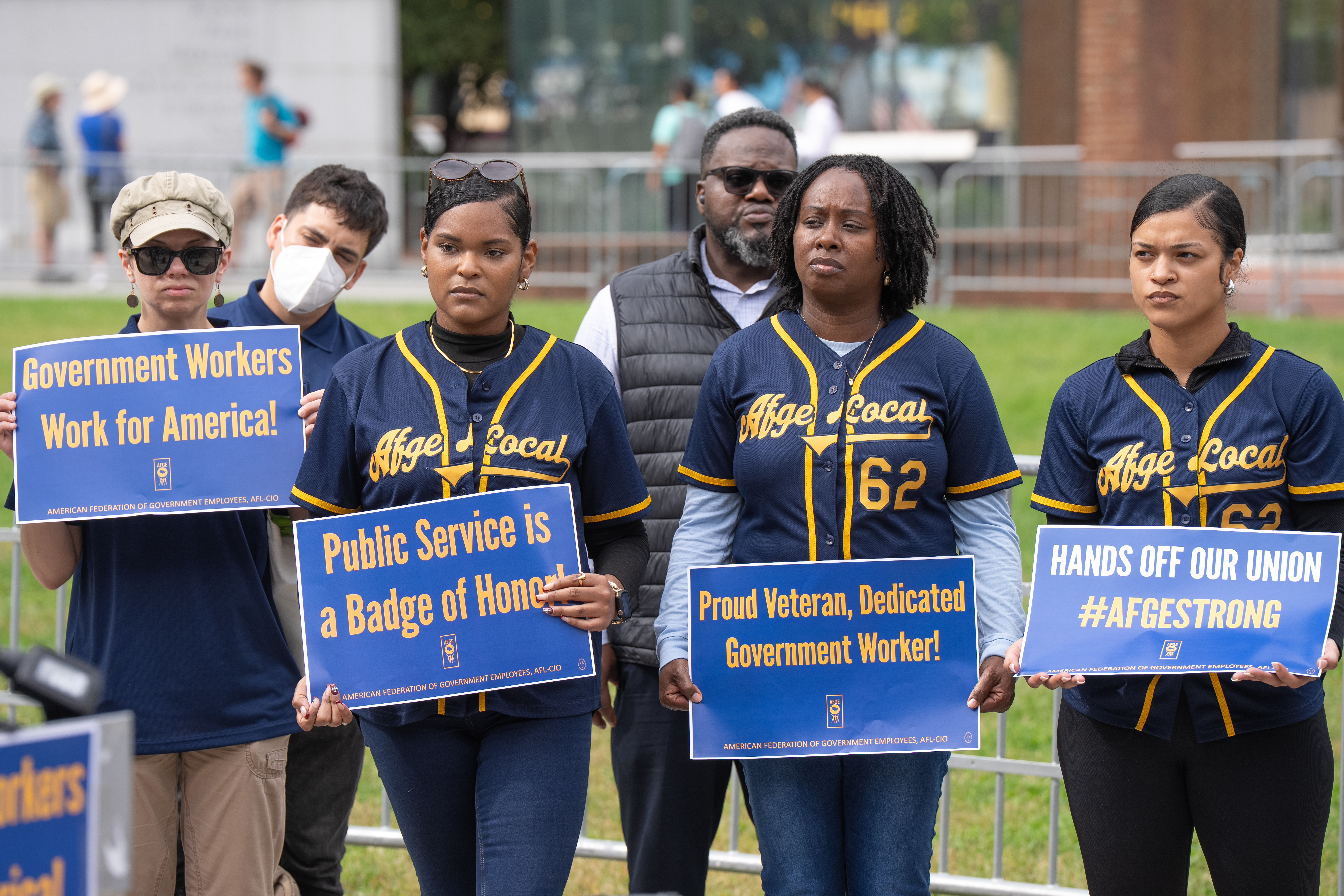
Union officials from AFGE gathered on Oct. 7 in front of Independence Hall to protest the government shutdown.
Another Philadelphia Social Security employee, who has been with the agency for 15 years, noted that some colleagues picked up night shifts at Amazon or work in home healthcare.
“People living paycheck to paycheck, they needed something to pay those bills that were absolutely essential that they had to pay,” the 15-year Social Security employee said.
For one federal employee from Central Jersey, 2025 already came with an unexpected career turn when they lost their job at U.S. Housing and Urban Development, as part of a mass layoff of probationary employees. They found a job at the U.S. Department of Commerce, in Virginia, which allowed them to support their mother and three kids back in New Jersey.
Wary of permanently moving to Virginia during such a volatile time in the federal workforce, the Commerce employee commutes eight hours by Amtrak twice a week and stays in a $200 per night hotel on workdays.
During the federal shutdown, the Commerce employee had to work without a paycheck. They used up their savings paying for the commute, hotel, and other expenses. Ultimately, they took out a bank loan to cover their expenses.
The government shutdown exemplifies a lack of stability in the workforce, the Commerce employee said. “To be honest, you feel unsafe all the time, and you feel like you’re not deserving that.”
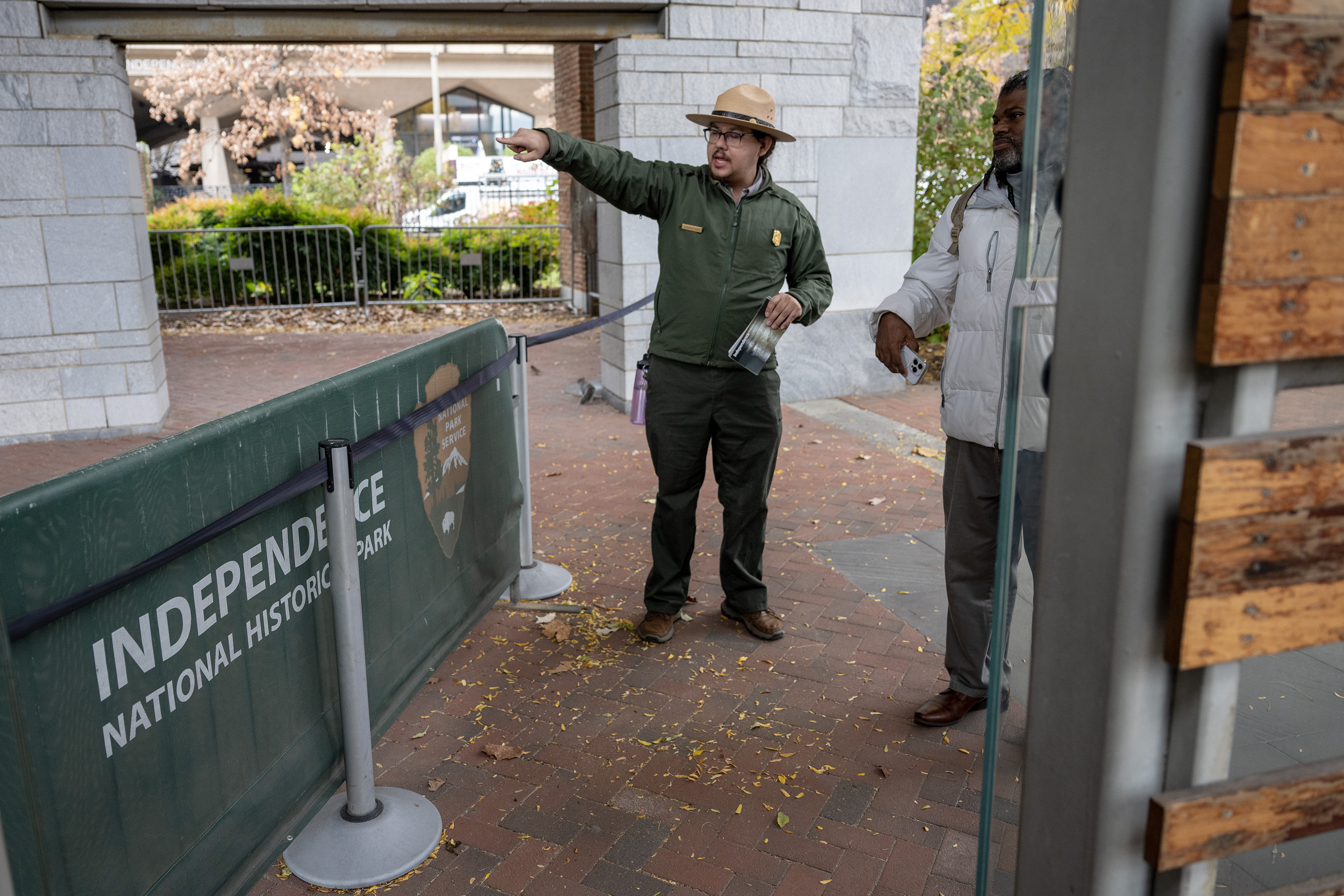
National Park Service ranger Christopher Acosta talks with tourists outside the Liberty Bell Center on Nov. 13 after returning to work from the shutdown.
Worries remain ahead of the holiday season
The Philadelphia VBA employee, who worked without pay during the shutdown, received their back pay Monday. The single parent said they were one more missed paycheck away from turning to food pantries and living off credit cards.
“Usually I’m the one donating around this time,” the employee said last week. “I usually adopt a family and provide them with the meal and then their gifts and stuff from our local community churches and outreach programs.”
Thanksgiving is the time they “splurge,” but now the shutdown has made them contemplate their finances. “I haven’t even thought about the process of even having a Thanksgiving dinner on the table because I didn’t want to spend the money,” the VBA employee said. By Christmas, they hope to be caught up on payments.
It’s a similar story for one Philadelphia VA Medical Center employee who worked without pay through the shutdown. Speaking days before the shutdown’s end, the employee said their credit score had taken a hit. They reached out to creditors and got some of their payments deferred, but relief won’t set in until the employee can catch up on their water, electric, gas, mortgage, and car bills.
A “big feast” for Thanksgiving is off the table. “You can’t do that now because you don’t have the funds,” they said.
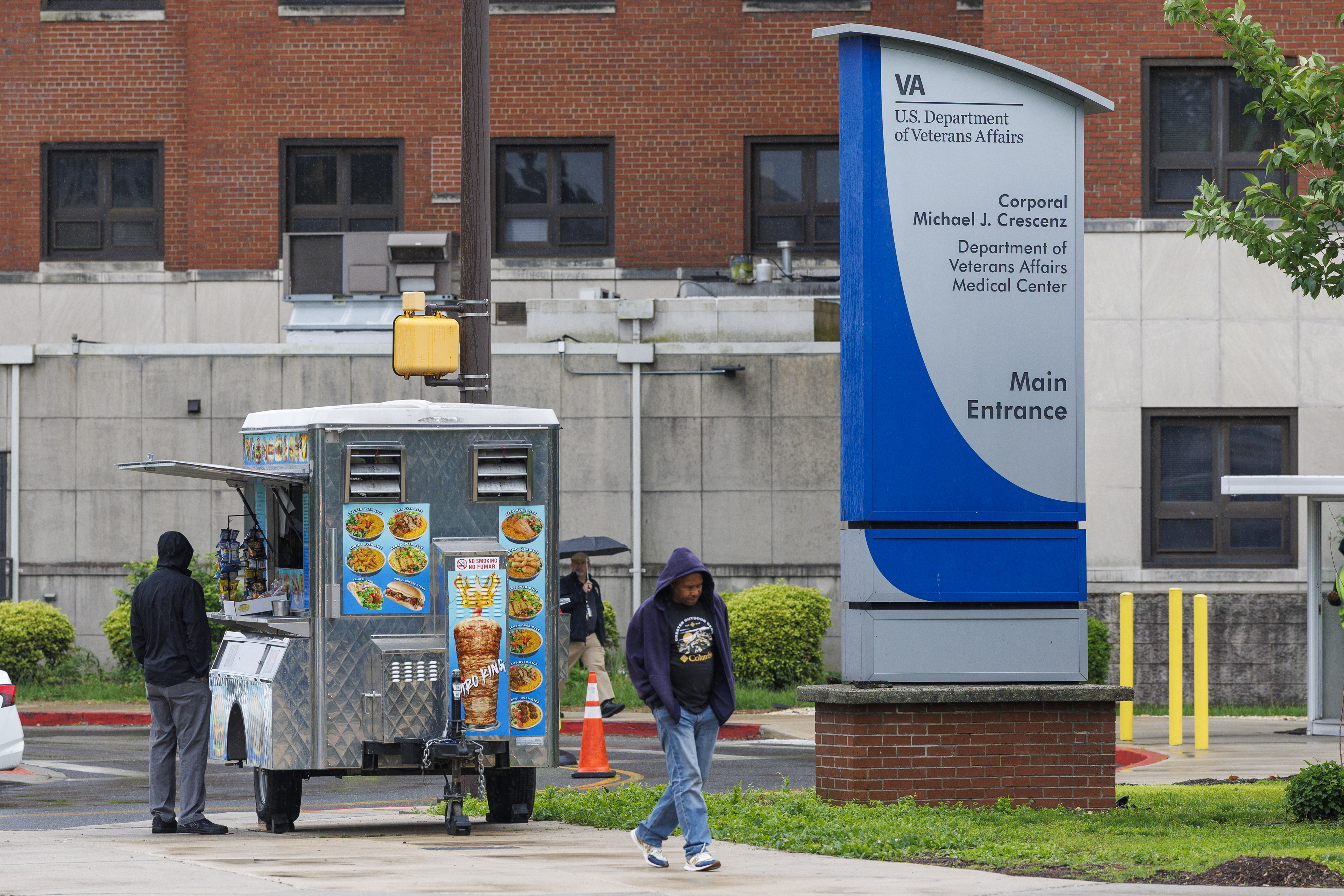
The Corporal Michael J. Crescenz Department of Veterans Affairs Medical Center in Philadelphia.
‘Fear of what’s to come’
Throughout the funding impasse, Philadelphia’s federal workers turned to each other for assistance.
At the VBA, supervisors set up a small food pantry several weeks into the shutdown. The VBA employee said that didn’t feel especially helpful. “That was our second paycheck missed, and that was the best that they could come up with,” the employee said.
“It’s business as usual in the eyes of the VA, and they expect us to work like nothing’s going on in our real lives.”
At the Social Security Administration, workers banded together to start an impromptu food pantry, the Philadelphia benefit authorizer said.
“Everything was taken. People needed it. People were really pinching pennies,” she said.
The national office of AFGE, the largest federal workers’ union, backed the deal to end the government shutdown. “Government shutdowns not only harm federal employees and their families, they also waste taxpayers’ dollars and severely diminish services depended on by the American people,” AFGE national president Everett Kelley said in a statement on Nov. 10.
But some thought it should have ended differently.
In the days leading up to the deal, dozens of AFGE Local 3631 members, who are employed at the Environmental Protection Agency, said in a local union survey that they did not want their local to support budget legislation such as what passed. Their concerns were with an expected rise in healthcare expenses across the country.
The union local had polled members at the end of October, according to local union officer Hannah Sanders. The survey got more than 100 responses, and over85% said the local should only support a deal if it preserved subsidies for Affordable Care Act healthcare plans and avoided cuts to Medicaid.
EPA workers and supporters gathered outside their office for a solidarity march around Philadelphia’s City Hall in March.
Sanders said there are few changes between the recently passed deal and the bill that could have averted the shutdown back in September. “We would have not had this shutdown, and people wouldn’t have, you know, gone without pay or gone without SNAP benefits and all these things. So it’s super frustrating to see that this is how it all resolved,” said Sanders.
Now, the benefit authorizer at the Social Security Administration says, people are concerned that another shutdown could be on the horizon come Jan. 30.
“We are in complete fear of what’s to come,” she said.
The New Jersey Attorney General’s Office on Wednesday identified Jose M. Martinez, 42, of Lindenwold, as the man killed in a crash caused after another man allegedly fled from police in West Deptford Township early last week.
Prosecutors also identified the police officer, West Deptford Police Patrolman Conor Goggin, involved in the attempted stop and the man, George Linard, 28, of Waltham Cross, a town north of London, England, who allegedly caused the crash. Linard initially had been identified by authorities with a different name.
On the evening of Nov. 9, Goggin was driving a marked police vehicle when he turned on his emergency lights in an attempt to stop a vehicle, prosecutors said.
Linard allegedly drove away at high speed and collided in the area of Hessian and Red Bank Avenues with a third vehicle driven by Martinez, who also was known as José M. Martínez Peguero, according to his funeral home obituary.
Martinez died and a passenger in the back seat sustained a leg fracture.
Linard, who also was injured in the crash, was charged with second-degree death by automobile, fourth-degree assault by automobile, and fourth-degree fraudulent possession of a government license.
A 26-year-old Ocean City woman who worked for U.S. Rep. Jeff Van Drew was charged with falsely reporting that she had been seriously lacerated across her upper body in a politically motivated attack when she actually paid a Pennsylvania body modification artist $500 to cut her, according to a federal criminal complaint released Wednesday by the U.S. Attorney’s Office.
Natalie Greene was charged with one count of conspiracy to convey false statements and hoaxes and one count of making false statements to federal law enforcement, acting U.S. Attorney Alina Habba said.
In a statement provided Wednesday evening, Van Drew’s office said: “We are deeply saddened by today’s news, and while Natalie is no longer associated with the Congressman’s government office, our thoughts and prayers are with her. We hope she’s getting the care she needs.”
Greene’s lawyer, Louis M. Barbone of the Jacobs & Barbone law firm in Atlantic City, said in a statement released Thursday: “At the age of 26, my client served her community working full time to assist the constituents of the Congressman with loyalty and fidelity. She did that while being a full-time student. Under the law, she is presumed innocent and reserves all of her defenses for presentation in a court of law.”
On July 23, a coconspirator called 911 shortly after 10:30 p.m. to report that Greene had been attacked by three unknown men who knew her name and that she worked for Van Drew, according to the criminal complaint, which identifies him only as “Federal Official 1.”
“They were attacking her. They were like talking about politics and stuff. They were like calling her names,” the coconspirator told 911, reporting that the attack occurred at the Egg Harbor Township Nature Preserve, the complaint said.
The coconspirator, who was not named in the criminal complaint, allegedly said the attackers claimed they had a gun. “They said that if we don’t be quiet they were going to shoot us,” the coconspirator allegedly said, also explaining that she was able to flee the men but they still had Greene.
Egg Harbor Township police arrived with a K9 dog and located Greene just off a nature trail lying on the ground with her feet and hands bound together with black zip ties, the complaint said.
Greene’s shirt was pulled over her head and the words “Trump Whore” were written with black marker on her stomach, and “[Federal Official 1] is Racist” was written on her back, the complaint said.
She had long crisscrossing lacerations on her upper chest, shoulder, back, neck, and lower right side of her face, the complaint showed with included photos.
Greene was transported to a hospital, and then later transferred to a second hospital for treatment.
Before Greene was taken to the first hospital, she was interviewed by police and asked to recount what happened. When police asked to check Greene’s Maserati SUV, her coconspirator became agitated and said she didn’t think the police needed to search the vehicle, the complaint said.
However, Greene consented to a search and police found two black zip ties similar to the zip ties used on Greene, as well as a roll of duct tape, the complaint said.
Investigators later found that location data from Greene’s phone showed that on the day of the alleged attack, she had traveled to the scarification artist’s studio in Pennsylvania, then to Ventnor, where the coconspirator lived, the complaint said.
Two days earlier, someone using the coconspirator’s phone did a Google search for “zip ties near me,” the complaint said.
Investigators later reviewed surveillance video from a Dollar General store in Ventnor that showed the coconspirator at the store 40 minutes after the Google search was made, the complaint said. The store sold black zip ties similar to what was used on Greene and the same duct tape, though the video did not show her purchasing zip ties while she did purchase other items. The surveillance video only showed the cash register area and not other parts of the store, the complaint said.
On July 25, Greene was interviewed by agents from the FBI Joint Terrorism Take Force and Egg Harbor Township police detectives, and she again reported that she was attacked and cut up by three men, the complaint said.
She also was asked to describe any threats made to Van Drew’s office.
“There’s so many. I mean. Yeah, racist um. Windmills belong on your grave. Like stupid, I mean like there, they have a bunch of little things on there that they’ll write on there. We have them all, you can look at all of them. But um. Yeah we keep em just. We keep all of our hate mail. We recently got like, a letter with like powder in it and stuff,” she said, according to the complaint
Greene was asked if the powder incident was recent.
“Yeah very recent. Like maybe a week ago. And are to the point where our Chief of Staff was like you guys need to be using gloves to open the mail. Stuff like that,” she allegedly said.
A review of phone records showed that Greene had a Reddit account that followed communities for “bodymods” and “scarification,” the complaint said.
On July 30, the FBI visited the studio in Pennsylvania and obtained a consent form signed by Greene with a copy of her New Jersey driver’s license that she allegedly provided the day of the reported attack, according to the complaint.
The FBI also obtained the receipt showing that Greene allegedly paid the studio $500 cash, as well as photos the artist took of his work on Greene’s body.
The photos showed the cuts made by the artist matched the cuts photographed at the hospital, the complaint said.
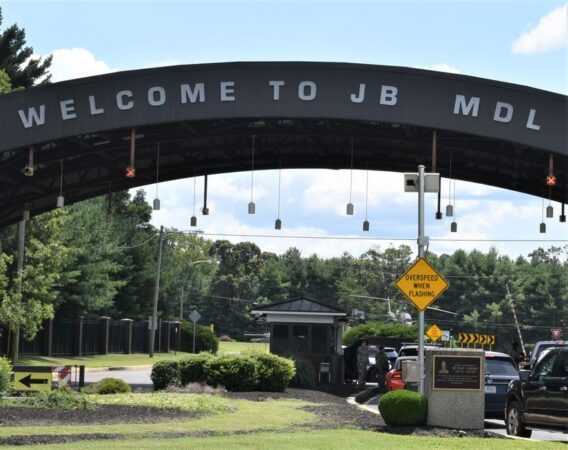
It doesn’t look like the Trump administration will begin holding undocumented immigrants at a South Jersey military base anytime soon.
Democratic elected officials said Wednesday that they received a letter from the administration saying there is currently no approved construction plan, nor a timeline, for confining people at Joint Base McGuire-Dix-Lakehurst.
Estimates are that the base, which spans parts of Burlington and Ocean Counties, could hold 1,000 to 3,000 detainees. Specifics surrounding the when, where, and how of that undertaking remain unknown.
New Jersey U.S. Reps. Donald Norcross and Herb Conaway, Democratic members of the House Armed Services Committee, announced that they received a response earlier this week from the Department of Homeland Security after requesting more information about the administration’s plans.
“The Trump Administration’s ongoing disregard for due process and humane treatment of undocumented immigrants has required us to press repeatedly for answers and fulfill our congressional oversight responsibilities,” the lawmakers said in a joint statement. “While we acknowledge that the Department of Homeland Security has finally responded to our questions, we will continue to monitor for any further developments.”
Their priority, the lawmakers said, is to uphold standards of human rights to ensure that plans to detain immigrants do not interfere with military readiness.
The administration’s response said the government’s need for more detention space “reflects the Trump administration’s commitment to restoring the rule of law and ending the catch-and-release policies of prior years that jeopardized American communities.”
Trump administration officials earlier named the base as one of two sites in the country now certified to assist in the president’s plan to remove millions of immigrants. The other is Camp Atterbury in Indiana.
SNAP benefits are restored, and the program is funded through next year. But the Trump administration is now looking to “completely deconstruct the program,” its top USDA official said.
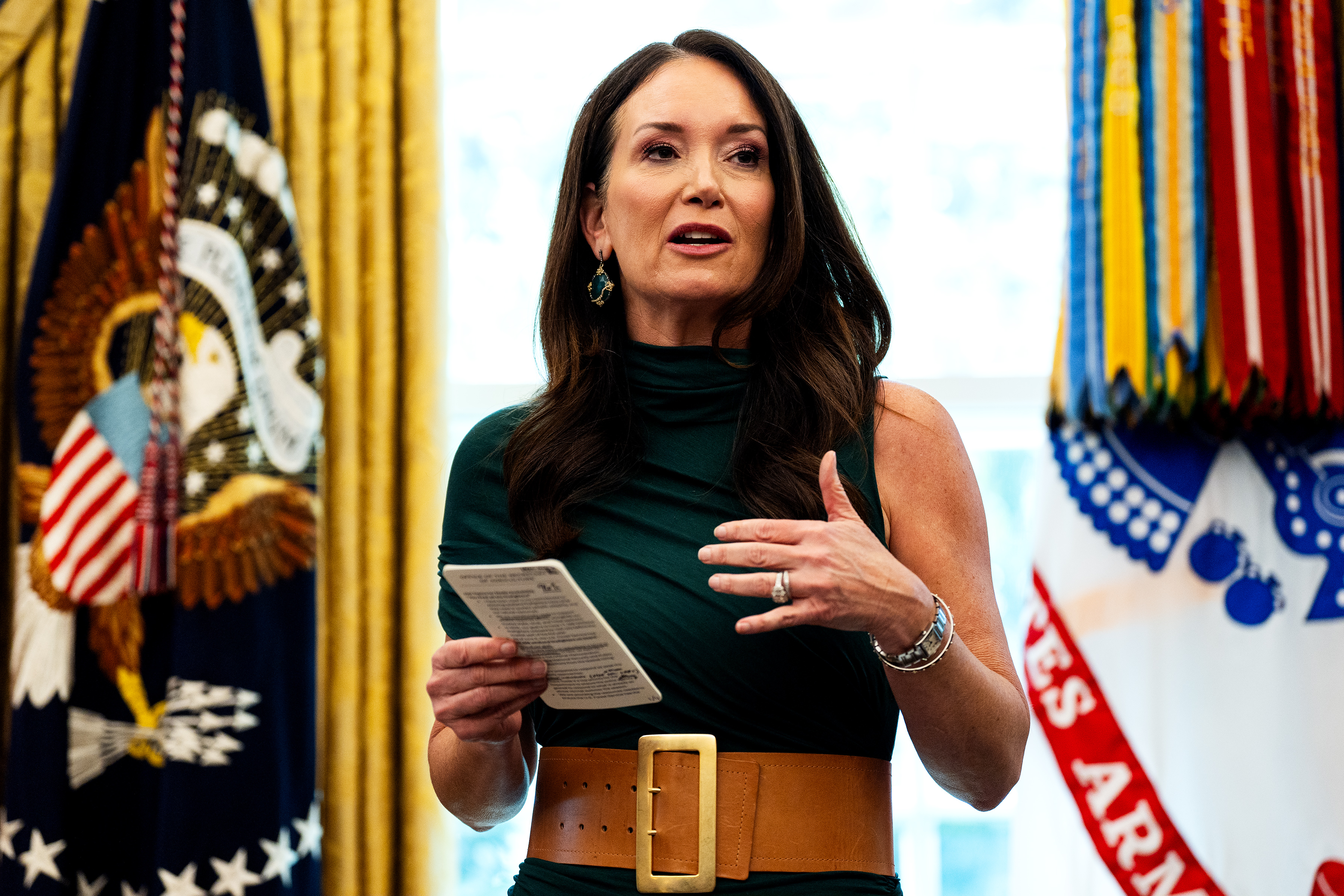
Agriculture Secretary Brooke Rollins said that millions of low-income Supplemental Nutrition Assistance Program recipients will have to reapply for their benefits as part of an effort to crack down on “fraud.”
“It’s going to give us a platform and a trajectory to fundamentally rebuild this program, have everyone reapply for their benefit, make sure that everyone that’s taking a taxpayer-funded benefit through SNAP or food stamps, that they literally are vulnerable, and they can’t survive without it,” she told Newsmax last week.
On Tuesday, Rollins told Fox Business that her plan is for the U.S. Department of Agriculture to “completely deconstruct” SNAP.
Agriculture Secretary Brooke Rollins speaks to the media in the Oval Office of the White House in June. Rollins had various roles in the first Trump administration.
However, there is no official guidance from USDA on the plans Rollins spoke of and the rules have not changed, said Community Legal Services staff attorney Mackenzie Libbey.
“Most SNAP recipients in Pennsylvania are already required to reverify household and income information every six months. SNAP recipients should continue submitting their semiannual reports and annual renewals as the current rules require,” Libbey said.
In a statement, the USDA did not confirm the existence of new changes to SNAP. Instead, a spokesperson for the agency said the “standard recertification processes for households is a part of that work.”
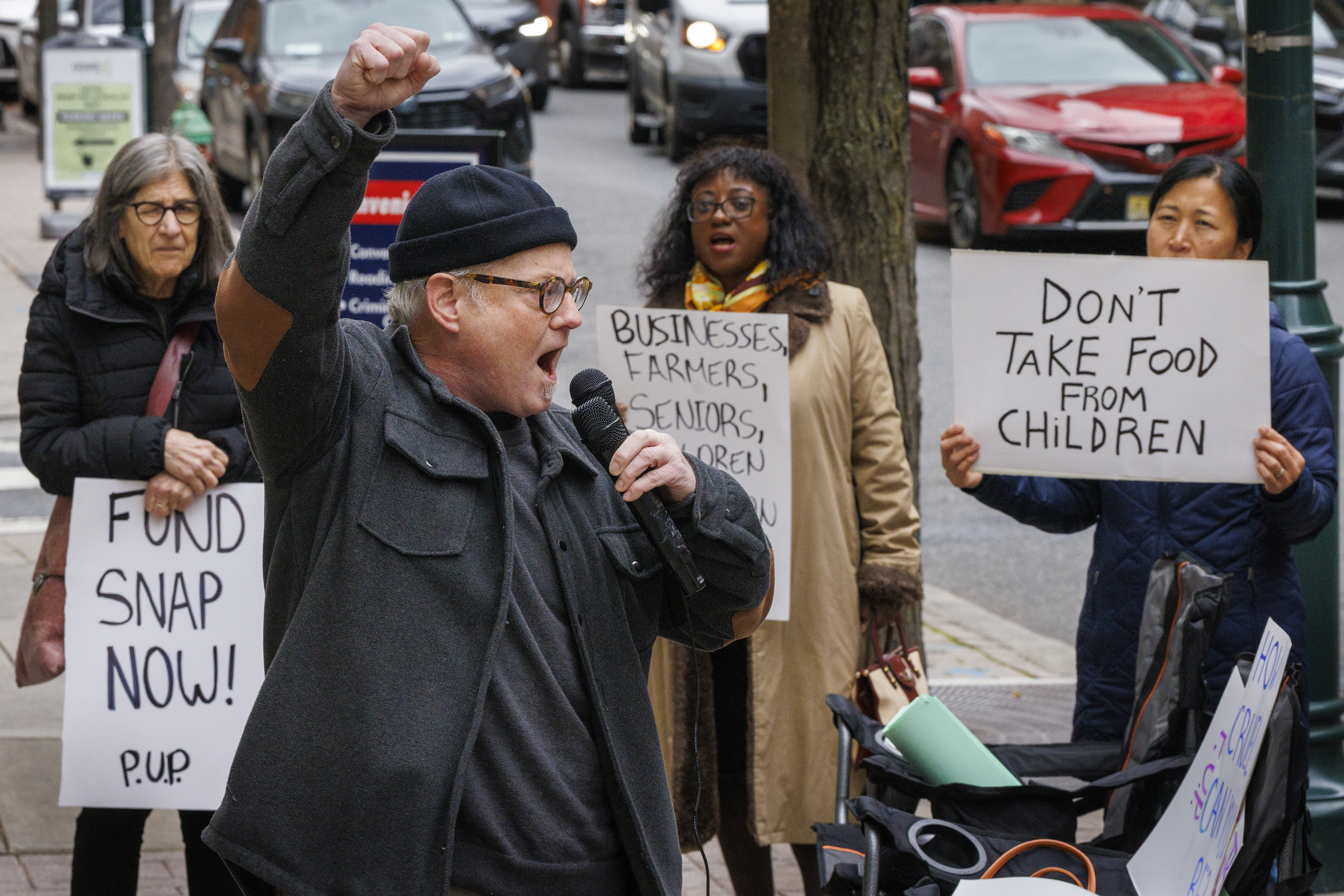
Jeff Garis, Outreach and Patnership Director, Penn Policy chants during rally along side SNAP recipients, clergy members, and other advocates at a rally and news conference outside of Reading Terminal Market, to urge the Trump administration to restore full SNAP funding, Wednesday, November 12, 2025.
Are SNAP benefits changing?
There are a few changes to SNAP work requirements that were implemented on Sept. 1 and Nov. 1.
On Nov. 1, some older low-income Americans were forced back to work when Congress and Trump passed additional work requirements, raising the maximum working age cap from 54 to 64 years old.
Parents with dependents age 14 and over also must go back to work or lose benefits. Previously, SNAP recipients with dependents under 18 did not have to meet work requirements. Veterans and former foster youth ages 18 through 24 are no longer exempt from work requirements either, under new federal law.
Do you have to reapply for SNAP benefits?
SNAP recipients do not currently need to reapply to the program. SNAP recipients should continue filing their semiannual reports every six months to recertify their income and household.
Lisa Mellon, 59, of Bridesburg, Pa., is walking her groceries to her friends car, who was kind enough to driver her around 40 minutes to the Feast of Justice at St. John’s Lutheran Church and back home on Tuesday, Nov. 11, 2025.
Will snap benefits be issued in December?
Yes. The SNAP program is funded through Sept. 30, 2026, after Congress reached an agreement on a spending deal last week. Most other federal government agencies and programs are funded only through Jan. 30.
Congress will need to strike another spending deal before the January deadline; otherwise the federal government could be shut down again.
However, SNAP benefits have been guaranteed through next September regardless of another shutdown.
How do you qualify for SNAP benefits?
SNAP requirements are based on your work hours and income. Other factors, like whether a member of your household is disabled, elderly, or a veteran, can provide households with additional benefits.
SNAP recipients must be working, volunteering, or participating in an education or training program for at least 20 hours a week (or 80 hours a month). They also must report those work hours.
These rules apply to you if you:
Are ages 18 through 64.
Do not have a dependent child under 14 years old.
Are considered physically and mentally able to work.
Income requirements
Households cannot exceed these monthly income limits to be eligible for SNAP benefits.
Cherry Hill will be doing a needs assessment to determine what makes older residents want to stay.
One-third of Cherry Hill’s residents are 55 or older. As the township’s population continues to grow, local leaders want to understand what makes its older residents stick around.
“For those that have the means, it’s a conscious decision to stay,” said Mayor Dave Fleisher. “They want to stay close to their kids, close to their grandkids.”
Cherry Hill will be using a $70,000 grant from the New Jersey Department of Human Services to do a needs assessment, including focus groups, listening sessions, and a survey. The goal of the grant, given to 17 communities in total, is to “make communities more welcoming and livable for people of all ages.”
The Cherry Hill Public Library is facing “disruptions” after one of the largest library book distributors in the country announced it’s shutting down operations. CHPL used Baker & Taylor almost exclusively as its vendor for books, audiobooks, and DVDs, and while some of those orders have been canceled, librarians said they are working with another provider to get new inventory.
Randy Fenoli of Say Yes to the Dress fame will be in town this weekend for the grand opening of bridal and formalwear shop Dress 2 Impress’ second location on Route 38. Started in Linwood, the shop is hosting an appointment-only trunk show featuring a selection of Fenoli’s “Keepsake Collection” gowns.
Still in search of a fresh turkey for Thanksgiving? We’ve rounded up where you can buy them locally, including Arnie’s Gourmet Butcher Shop & Culinaria. The Haddonfield-Berlin Road store sells farm-raised whole turkeys, turkey breast, and even turducken. For kosher options, Ravitz Family Markets’ ShopRites in Garden State Pavilions and on Evesham Road have birds that meet Glatt Kosher standards.
Morton also last week released a report on the first quarter of the school year. It outlined key actions, currents challenges, and next steps across five areas, including academic achievement, the school’s climate, and staffing.
Reminder to families: There will be an early dismissal next Wednesday to kick off Thanksgiving break. See the district’s full calendar here.
Inspire A Learner, a new Islamic youth education and daycare center, has received zoning approval to operate in a converted office building on Marlkress Road. (70 and 73)
🍽️ On our Plate
The owners of Cherry Hill’s Old World-style Italian restaurant Il Villaggio have an agreement to buy popular Haddon Township pub Keg & Kitchen. It will remain a pub, but undergo a few changes, including to its name, menu, and decor.
Bombay Express, an Indian restaurant that recently closed its Marlton location, is heading to Cherry Hill. The eatery, which offers chicken, lamb, and vegetable dishes, in addition to biryanis and tandoori, will open in the Centrum Shoppes on Haddonfield-Berlin Road, though an exact timeline has not yet been shared.
Umai Ramen is one of the 20 best ramen shops in the Garden State, according to BestofNJ.com. The food outlet noted the Brace Road restaurant “brings a taste of authentic Japanese street food to Cherry Hill,” suggesting diners try the classic miso, tonkotsu, or the black garlic ramen.
🎳 Things to Do
🎅🏻 Coca‑Cola Holiday Caravan: The bright red touring truck is making a stop in Cherry Hill tonight, where you can take photos with Santa, enjoy seasonal activities, and purchase Coca-Cola-themed gifts. ⏰ Wednesday, Nov. 19, 5:30-7:30 p.m. 💵 Pay as you go 📍 Roy Rogers
🛍️ Eyez on U Pop-Up Market: Beat the Black Friday rush and shop local businesses at the mall’s Grand Court. ⏰ Friday, Nov. 21-Sunday, Nov. 23, times vary 💵 Pay as you go 📍 Cherry Hill Mall
🎄 Holiday House: See Barclay Farmstead decked out for the holidays. ⏰ Friday, Nov. 21-Sunday, Nov. 23, times vary 💵 $5.49 for adults, $3.49 for children 10 and under📍 Barclay Farmstead
🤖 Philcon 2025: Science fiction, fantasy, and horror buffs will gather to celebrate the genres in books, film, television, and more. This year’s principal speaker is writer Charles Gannon, who is known for his Caine Riordan series. ⏰ Friday, Nov. 21-Sunday, Nov. 23, times vary 💵 $35-$75 📍 DoubleTree by Hilton
🎧 R&B Night: Drinksgiving: Three DJs will play tunes during this R&B-themed event. ⏰ Friday, Nov. 21, 9 p.m.-2 a.m. 💵 $13.34 📍 Vera
💎 Holiday Gift Bazaar: Over 40 vendors will be selling everything from accessories and beauty products to home goods at this event. ⏰ Sunday, Nov. 23, 9 a.m.-2 p.m. 💵 Pay as you go 📍 Congregation Kol Ami
🎁 Holiday Craft Fair: Browse an array of vendors selling items like jewelry, scrapbooking supplies, and pottery. ⏰ Sunday, Nov. 23, 1-4 p.m. 💵 Pay as you go 📍 Cherry Hill Public Library
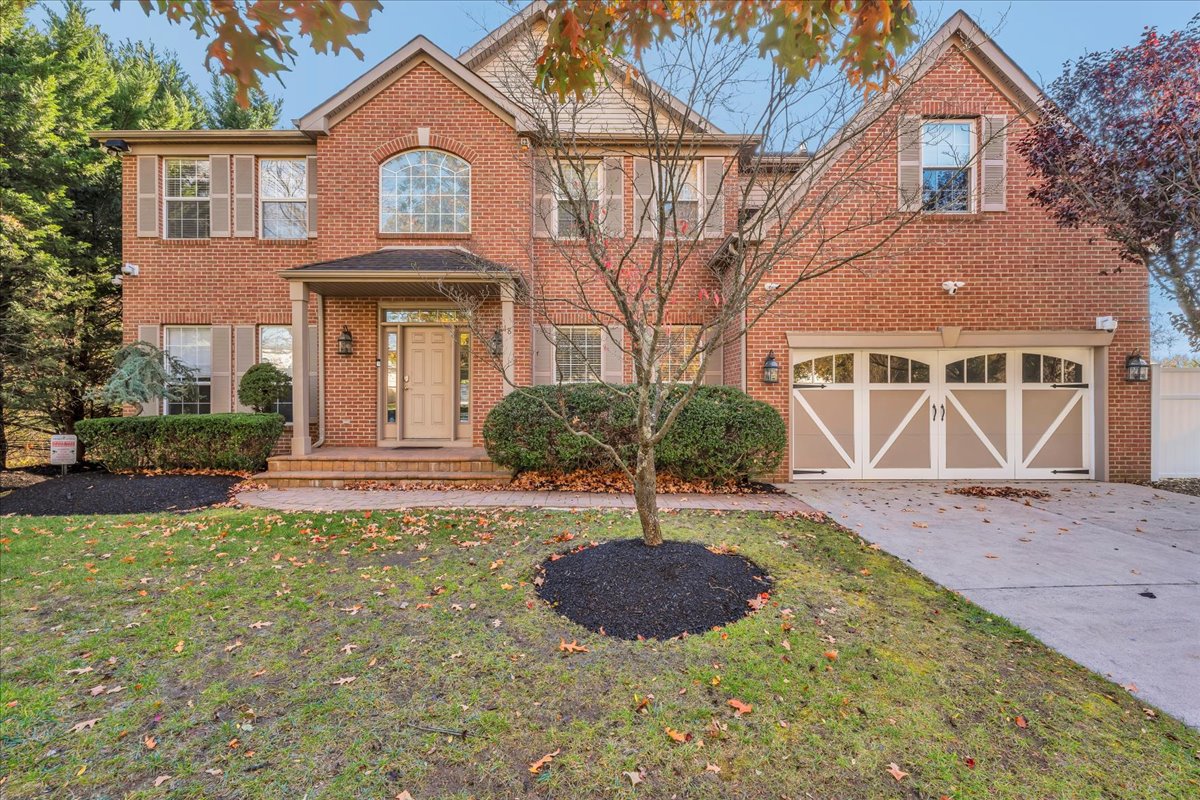
The four-bedroom home spans more than 5,100 square feet.
Built in 1999, this spacious brick-fronted Short Hills home has a variety of unique features. Its first floor features a two-story foyer; a living room; an office; a family room with a fireplace set into a stone accent wall and vaulted ceilings; a dining room with a quartz waterfall island in lieu of a table; and a kitchen with granite countertops and high-end appliances. It has four bedrooms, including a primary suite, with a massive walk-in closet, a fireplace, a spa-like bathroom, and a balcony. The finished basement has a full bathroom and a home gym. Outside, there’s a heated covered patio and a saltwater fiberglass pool with a rock waterfall.
By submitting your written, visual, and/or audio contributions, you agree to The Inquirer’s Terms of Use, including the grant of rights in Section 10.
This suburban content is produced with support from the Leslie Miller and Richard Worley Foundation and The Lenfest Institute for Journalism. Editorial content is created independently of the project donors. Gifts to support The Inquirer’s high-impact journalism can be made at inquirer.com/donate. A list of Lenfest Institute donors can be found at lenfestinstitute.org/supporters.
While East Coast retirees have a reputation for decamping to places like Florida for warm weather and lower taxes, many of Cherry Hill’s older residents have stuck around.
One-third of Cherry Hill’s residents are 55 or older.
“Cherry Hill is a wonderful place to raise a family and to live, so people don’t want to leave,” Mayor Dave Fleisher said.
Cherry Hill prides itself on its work with older residents — from tax-preparation assistance to social events, Fleisher said. Yet as the township continues to grow, local officials want to zero in on what its older community needs and how they can best deliver it.
Using a $70,000 grant from the New Jersey Department of Human Services, the township is embarking on a multipronged needs assessment to better understand and serve its older residents.
Why does Cherry Hill have such a large population of older residents?
Cherry Hill officials say varied housing options, tax-rebate programs like Stay NJ, and multigenerational ties have helped the township’s older population flourish.
“For those that have the means, it’s a conscious decision to stay,” Fleisher said. “They want to stay close to their kids, close to their grandkids.”
“It’s a very multigenerational community,” said Beth Segal, interim executive director of Cherry Hill’s Katz JCC, a watering hole for local older residents.
The JCC runs regular lunches, fitness classes (think pickleball and water aerobics), and programs on politics, literature, and art. Segal said she works with families who have been involved in the JCC for as many as four generations. Though Cherry Hill kids often leave the nest in search of big cities and new experiences, Segal said, many come back to raise their own kids alongside their parents and grandparents.
Fleisher said Cherry Hill’s relatively diverse housing stock has allowed residents to stay in the township without being forced to remain in the large — and, at times, expensive — single-family homes they raised their families in.
Around 20% of homes in Cherry Hill are multiunit. That’s higher than neighboring communities like Haddonfield (13%) and Moorestown (13%). Around 40% of homes in Voorhees are multifamily.
Fleisher also credits tax-relief programs. Stay NJ, a statewide property tax benefit for New Jerseyans 65 and older, allows eligible homeowners to be reimbursed for up to 50% of their property tax bill, up to $13,000.
In 2023, Cherry Hill’s property taxes were around $1,600 higher than the county average. That year, Cherry Hill residents paid an average of $8,851, compared with the countywide average of $7,222.
What will the assessment entail?
There will be two phases. The qualitative phase, which is ongoing, includes focus groups and listening sessions with facilitators (the township has contracted with market research firm 18 Stones). The first phase will wrap up in December.
The quantitative phase will involve a survey that residents will be able to complete via email or paper mail, online, or over the phone. The survey, which is currently being formulated, will be translated into Spanish and Simplified Chinese.
The assessment is funded by a $70,000 grant from the New Jersey Department of Human Services. The department awarded grants to 17 municipal governments in March to “make communities more welcoming and livable for people of all ages” and to implement recommendations from the state’s 2024 Age‐Friendly Blueprint. Cherry Hill was the only municipality in Camden County to receive a grant. The assessment is to be finished by July 1, 2026.