The U.S. Department of Education has opened a civil rights investigation into the Great Valley School District in Chester County for a policy allowing transgender girls to participate in girls’ sports teams.
The probe — one of 18 investigations announced last week into transgender sports policies in K-12 districts and colleges nationally — comes after President Donald Trump threatened last year to strip federal funding from schools that recognize transgender students.
“Time and again, the Trump Administration has made its position clear: violations of women’s rights, dignity, and fairness are unacceptable,” Assistant Secretary for Civil Rights Kimberly Richey said in a statement. “We will leave no stone unturned in these investigations to uphold women’s right to equal access in education programs — a fight that started over half a century ago and is far from finished.”
District officials said at a school board meeting Tuesday that they’re cooperating with the investigation and working with lawyers to prepare a response.
Numerous Philadelphia-area school districts have policies allowing transgender students to play on sports teams aligned with their gender identities, including Philadelphia. But Great Valley appears to be the first on the administration’s radar.
Great Valley was one of the first Pennsylvania school districts to pass a policy supporting the rights of transgender students in 2016 — seeking to provide those students “equal opportunity to achieve their maximum potential,” including by participating in sports “in a manner that is consistent with their consistently asserted gender identity.”
It was unclear whether any transgender girls currently play sports at Great Valley. A district spokesperson provided a statement Wednesday saying the district was “committed to serving all students in our community with dignity and respect” but declined to comment further.
After declaring the country would “recognize two sexes, male and female,” Trump issued an executive order in February seeking to end the participation of transgender women in women’s sports.
The president invoked Title IX, the landmark civil rights law prohibiting sex-based discrimination in programs that receive federal funding.
But how that law applies to transgender students and their rights has been hotly debated. The U.S. Supreme Court last week heard two cases challenging laws in West Virginia and Idaho requiring that participation on sports teams for girls be based on “biological sex.”
In Pennsylvania, meanwhile, the Human Relations Act specifies that discrimination based on gender identity is a form of prohibited sex-based discrimination.
Courts have also protected the rights of transgender students. In 2018, judges in the U.S. Third Circuit Court of Appeals ruled against students in the Boyertown Area School District who said their privacy rights were violated by sharing bathrooms with transgender students.
Last year, a U.S. District Court judge in Philadelphia rejected a lawsuit from a Quakertown student who said her equal protection rights were violated by having to race against a transgender female student in the Colonial School District.
Great Valley “takes its obligations under Title IX and all federal civil rights laws seriously,” the district’s school board president, Rachel Gallegos, said at a board meeting Tuesday. “We also take our responsibility to comply with the legal rulings from federal courts in this jurisdiction and to provide the protections afforded our students by Pennsylvania statutes just as seriously.”
Much of the Trump administration’s focus on transgender issues to date has been at the collegiate level. The NCAA last year announced it would ban transgender women from competing, and the University of Pennsylvania struck a deal with the administration over the past participation of transgender athlete Lia Thomas on its women’s swim team.
The Great Valley investigation appears to have been triggered by a former school board president, Bruce Chambers, who filed a complaint with the Office for Civil Rights last March, objecting to the policy.
Chambers, who served on the board from 2009 to 2012, said Wednesday that OCR notified him last week that his complaint was under investigation, the same day it made its public announcement.
The district’s policy “discriminates against girls, because the trans people can use whatever bathroom they want, use whatever locker room they want … join any team they want, or activity,” Chambers said. He said he “gave the board three chances” before filing the OCR complaint.
If the board rescinds the policy, “that will solve the whole thing,” Chambers said.
Kristina Moon, senior attorney with the Education Law Center, a Philadelphia-based group that advocates for transgender students, said the Trump administration appears to be trying “to intimidate school districts” into complying with its policy goals.
Moon pointed to a recent OCR investigation into gender neutral bathrooms that was criticized by Denver Public Schools, which said the office didn’t independently verify claims and “issued conclusions using an approach that departs from established investigative practice.”
“If they actually cared about protecting girls … they would not have dismantled the Department of Education and Office for Civil Rights,” Moon said.
In a letter this week to the Great Valley board, the LGBT Equality Alliance of Chester County said there was “no clear federal law or Supreme Court ruling that makes inclusive policies for transgender students unlawful.”
“Great Valley’s current policy reflects a reasonable, lawful approach that protects students from discrimination, aligns with local and state civil rights standards, and has been reviewed with legal counsel,” the alliance said in the letter. “Supporting students’ dignity and safety is not political. It is consistent with our legal obligations and the district’s duty of care to all students.”
Two residents who spoke at Tuesday’s meeting also urged the board to maintain the policy.
“I understand there is a need for all students and not just a minority to feel safe, but I feel assured the board can and will handle all concerns from parents and students with great care,” Christi Largent said. “I look forward to seeing the board stand up for all the students.”
Yvonne St Cyr strained her body against police barricades, crawled through a broken Senate window, and yelled “push, push, push” to fellow rioters in a tunnellike hallway where police officers suffered concussions and broken bones.
She insisted she did nothing wrong. A federal judge sentenced her to 30 months in prison and imposed $2,270 in financial penalties for her actions at the U.S. Capitol on Jan. 6, 2021, declaring: “You have little or no respect for the law, little or no respect for our democratic systems.”
St Cyr served only half her sentence before President Donald Trump’s January 2025 pardon set her and almost 1,600 others free.
But her story doesn’t end there. St Cyr headed back to court, seeking a refund of the $2,270. “It’s my money,” the Marine Corps veteran from Idaho said in an interview with the Washington Post. “They took my money.” In August, the same judge who sentenced her reluctantly agreed, pointing to a legal quirk in her case.
“Sometimes a judge is called upon to do what the law requires, even if it may seem at odds with what justice or one’s initial instincts might warrant. This is one such occasion,” U.S. District Judge John D. Bates wrote in an opinion authorizing the first refund to a Jan. 6 defendant.
The ruling revealed an overlooked consequence of Trump’s pardon for some Jan. 6 offenders: Not only did it free them from prison but it emboldened them to demand payback from the government.
At least eight Jan. 6 defendants are pursuing refunds of the financial penalties paid as part of their sentences, according to a Post review of court records; judges agreed that St Cyr and a Maryland couple should be reimbursed, while five more are appealing denials. (St Cyr and the couple are still waiting to receive their payments, however.) Others are filing lawsuits against the government seeking millions of dollars, alleging politically tainted prosecutions and violations of their constitutional rights. Hundreds more have filed claims accusing the Justice Department, the FBI and other law enforcement agencies of inflicting property damage and personal injuries, according to their lawyer.
People walk from the Ellipse to the Capitol Building in Washington, D.C., last Jan. 6, the fifth anniversary of the Capitol attack.
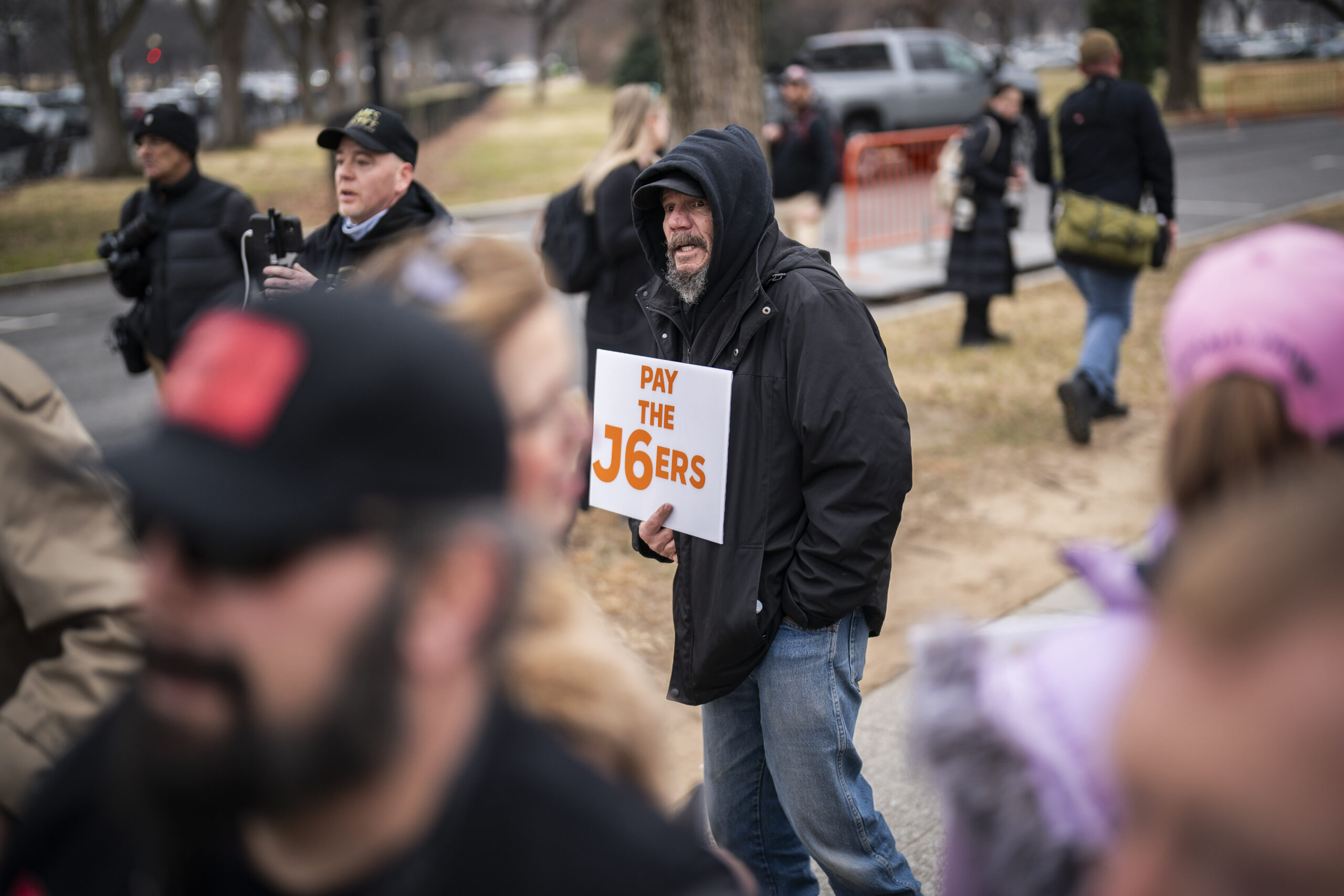
The efforts are the latest chapter in an extraordinary rewriting of history by the president and his allies to bury the facts of what happened at the Capitol, sustain the false claim thatthe 2020 election was rigged, and recast the Jan. 6 offenders as victims entitled to taxpayer-funded compensation.
“Donald Trump and the DOJ want taxpayers to reimburse a violent mob for the destruction of the U.S. Capitol. The Jan. 6 nightmare continues,” said Rep. Joe Morelle (D., N.Y.), the top Democrat on the House Administration Committee, which oversees the Capitol’s security and operations.
The pro-Trump mob that ransacked the Capitol caused almost $3 million in damage, according to a 2022 estimate by the Justice Department. The losses included smashed doors and windows, defaced artwork, damaged furniture, and residue from gas agents and fire extinguishers.Defendants were sentenced to more than $1.2 million in restitution and fines, according to a tally by the Post.
But the government recovered less than $665,000 of those court-ordered payments, according to a source with firsthand knowledge who spoke on the condition of anonymity because of fear of retaliation. Sen. Alex Padilla (D., Calif.) and Sen. Sheldon Whitehouse (D., R.I.) are pushing legislation — backed by some law enforcement officers who defended the Capitol on Jan. 6 — to block government payouts to rioters. Without any Republican cosponsors, the legislation is not expected to proceed.
“The audacity of them to think they didn’t do anything, or to think that they’re right and then get their money back,” said former Capitol police officer Harry Dunn, who attended the sentencing of St Cyr and other Jan. 6 offenders. “It’s frustrating and it should not happen. They should have to pay more.”
‘It’s a principle thing’
Stacy Hager, a 62-year-old former warehouse supervisor, made his first trip to Washington, D.C., for the Jan. 6 rally. The lifelong Texan wasn’t that interested in politics before, but he was certain that Donald Trump was the rightful winner of the 2020 election.
Wearing a Trump hat and waving the Texas flag, Hager took photos and videos of himself roaming through the Capitol. He was convicted on four misdemeanor charges related to disorderly conduct and trespassing; he paid $570 in penalties and served seven months in prison, a punishment he describes as totally unjust and “a living hell.”
Hager still believes, fervently, that fraud marred the 2020 vote and that Trump won, though no new evidence has surfaced to contradict the findings of Justice Department officials, cybersecurity experts, and dozens of judges appointed by Democrats and Republicans alike.
Hager spent seven months in prison for his role in the Jan. 6, 2021, attack. Now that he has been pardoned, he is seeking a refund of the $570 in court-ordered penalties he paid.
“You tell me why I shouldn’t be entitled to getting my money back,” Hager said. “The government took money from me for doing the right thing, for standing up for the people’s vote. That’s the reason we were there — for a free and fair election.”
About one month after Trump’s pardon in January 2025, Hager was the first of the Jan. 6 defendants to ask for his money back, court records show. “It’s a principle thing,” Hager said. Among the other defendants seeking refunds: A Utah man who forfeited almost $63,000he made from selling videos recording some of the worst violence at the Capitol. A Georgia teenager who paid $2,200 in fines after heshoved a police officer and sat in Vice President Mike Pence’s chair in the Senate chamber.
While the charges and punishments vary, the defendants seeking refunds share one legal quirk: All of them were appealing their convictions when Trump pardoned them on Jan. 20, 2025. After the pardon, courts vacated their convictions and dismissed their indictments following requests from federal prosecutors, as the Justice Department that once prosecuted the Jan. 6 defendants now takes their side.
It’s routine for a criminal defendant who has paid financial penalties to get the money back if the conviction is vacated and the case is dismissed. But the attack halting the peaceful transfer of power for the first time in American history pushed the criminal justice system into uncharted territory.
And now, the legal debate over whether certain Jan. 6 defendants should receive refunds is forcing courts to weigh two obscure Supreme Court decisions — 140 years apart — involving a pardoned Confederate sympathizer and a woman convicted but later acquitted of sexually assaulting her children.
Judges who have denied refunds have all referenceda case brought by John Knote, whose West Virginia property was confiscated and sold for $11,000 under a law empowering the Union to seize Confederate property. Citing President Andrew Johnson’s pardon of former Confederates on Christmas Day 1868, Knote asked the court to reimburse him $11,000. The Supreme Court ruled in 1877 that money deposited in the U.S. treasury could not be returned without an act of Congress.
People walk from the Ellipse to the Capitol Building in Washington, D.C., last Jan. 6, the fifth anniversary of the Capitol attack. The pro-Trump mob that ransacked the Capitol caused almost $3 million in damage, according to a 2022 estimate by the Justice Department.
Jan. 6 defendants, however, are looking to a much more recent Supreme Court opinion — written by liberal icon Ruth Bader Ginsburg — to bolster their argument that the government owes them money. In that 2017 case, Colorado resident Shannon Nelson paid about $700 in penalties before her sexual assault conviction was overturned on appeal. At a later trial, she was acquitted of the alleged crimes against her children. The high court said Nelson was now “presumed innocent” and entitled to a refund.
In approving St Cyr’s request for reimbursement, Bates referred to the Nelson case 39 times. The other D.C. District Court judge who has ruled in favor of refunds for Jan. 6 defendants, Chief Judge James E. Boasberg, also cited the Nelson case in December. “When a conviction is vacated, the Government must return any payments exacted because of it,” he wrote.
Hager returned to Washington this month to gather with other Trump supporters to mark the fifth anniversary. He and other Jan. 6 defendants stay in close touch online.
“We’re like a family,” Hager said, wearing a weathered baseball cap celebrating America’s 250th birthday and a T-shirt proclaiming his love for Jesus Christ. “We have a great bond, the kind that political persecution forms.”
Had gun, would travel
Andrew Taake’s journey through the criminal justice system illustrates one of the most dramatic twists in a Jan. 6 case. He attacked police officers with bear spray and a “whiplike weapon,” according to a plea agreement he signed in 2023. Now he is suing the federal government for $2.5 million, claiming his civil rights were violated by a wrongful prosecution and mistreatment in prison.
Taake was on pretrial release on a pending charge of online solicitation of a minor when he traveled from Houston to Washington, D.C., in January 2021. He attended the “Stop the Steal” rally headlined by Trump and was among the first to breach the restricted area around the Capitol. One of the police officers who said Taake assaulted him with bear spray, Nathan Tate, filed a statement in court that said the experience left “a lifelong scar.”
“He came to the Capitol with multiple weapons,” Tate wrote. “He was not there for peaceful protest. He was there to be violent. He should not be allowed to claim victimhood today.”
Taake pleaded guilty to one count of assaulting, resisting or impeding law enforcement officers using a dangerous weapon. He was sentenced in 2024 to 74 months in prison.
His prison time was cut short by Trump’s pardon. Two weeks later, he was taken into custody by Houston-area law enforcement on the 2016 child solicitation charge. He pleaded guilty to a second-degree felony, was sentenced to three years in prison and was ordered to register as a sex offender.
But because Taake had already served more than three years in the Jan. 6 case, he got credit for time served and did not return to prison, records show. In September, he filed a lawsuit against the federal government that tells a very different story than the plea deal.
In the suit filed in D.C. District Court, Taake claims he used the bear spray to protect a fellow protester and that another officer disfigured his hand by stomping on it. He accuses prosecutors of using false evidence and manipulating him into the plea deal. In prison, he said he was mistreated by medical staff and assaulted by other inmates. “He should be compensated for his pain and suffering because it doesn’t get much worse than that,” said Taake’s lawyer, Peter Ticktin, a longtime Trump ally.
Tate, who now who works as a social studies teacher in La Plata, Md., was shocked to hear about Taake’s lawsuit. “He can say my allegations are false but it’s documented, you can literally see what took place,” he said. “It was real for me.”
In the most far-reaching effort on behalf of Jan. 6 offenders, Missouri lawyer Mark McCloskey is trying to build support for a government-backed compensation panel, similar to the fund that has distributed billions of dollars to families of victims in the Sept. 11, 2001, attacks. McCloskey attracted national attention in 2020 when he and his wife pointed guns at Black Lives Matter protesters marching past their home; they pleaded guilty to firearms charges but were pardoned by the Missouri governor.
McCloskey said he has advocated for the Jan. 6 fund in four meetings with Justice Department officials, including Ed Martin, the director of a unit tasked with investigating Trump’s political opponents.
Martin, who helped plan and finance Trump’s rally that preceded the rampage through the Capitol, has said publicly that he supports “reparations” for Jan. 6 defendants.
Trump also has expressed support for government payouts. Asked about compensating Jan. 6 offenders in a March 2025 Newsmax interview, Trump said, “Well, there’s talk about that. … A lot of the people in government really like that group of people. They were patriots as far as I was concerned.”
But McCloskey is still waiting for the Justice Department to act. “We have had all positive responses but until President Trump pulls the trigger, it isn’t going to happen,” McCloskey said. “The president needs to take a position on it.”
In December, McCloskey sought to build momentum by posting a photo of himself on social media that he said showed him delivering claims to federal law enforcement agencies from about 400 Jan. 6 clients. The property damage and personal injury claims — a prerequisite to filing lawsuits against the government under the Federal Tort Claims Act — describe homes ransacked during arrests, lost jobs, and broken families, McCloskey said.
The White House and the Justice Department declined to comment on McCloskey’s efforts.
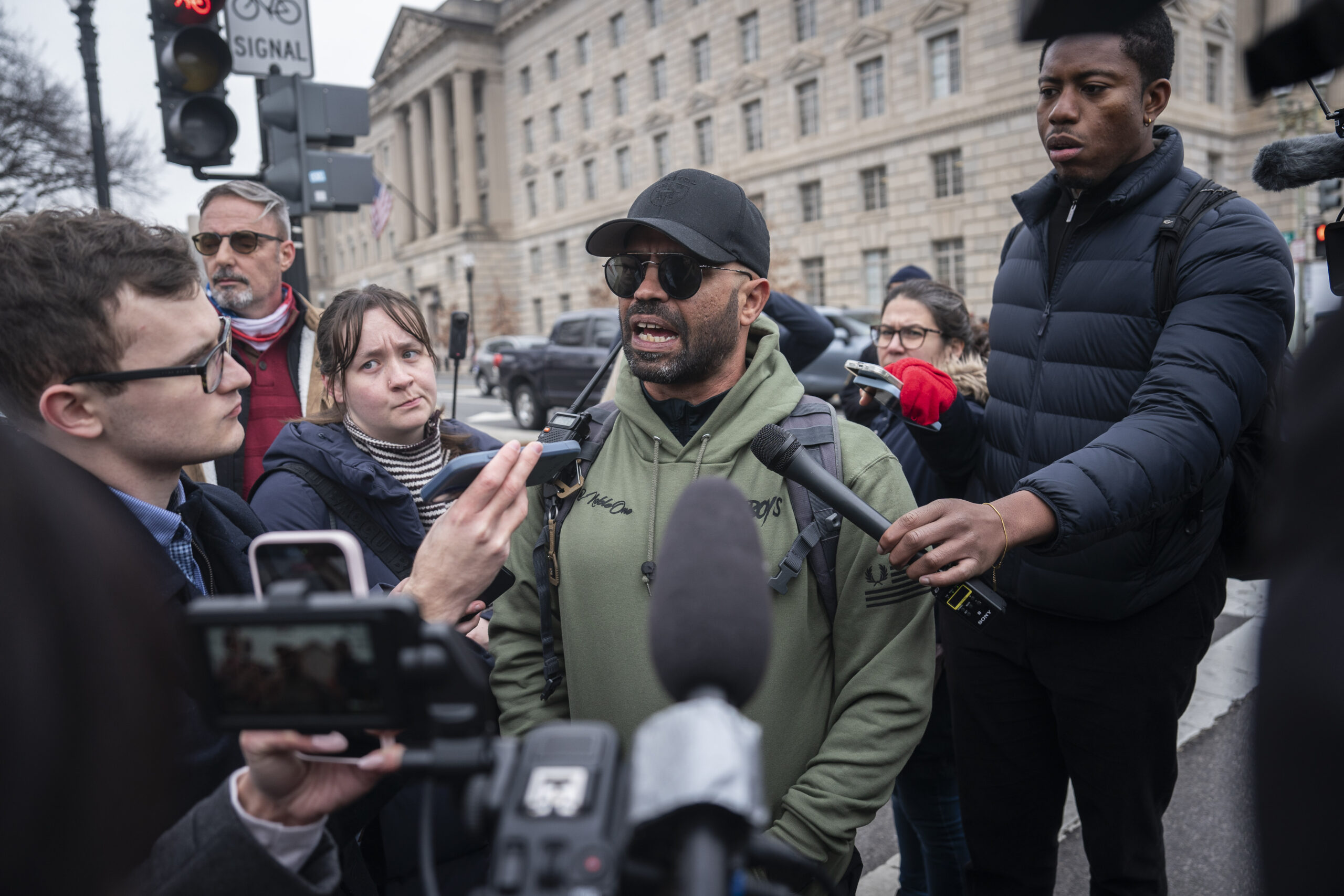
Another Jan. 6-related lawsuit against the federal government comes from several leaders of the Proud Boys who were found guilty of engaging in a seditious conspiracy to keep Trump in power despite his electoral defeat. The suit seeking $100 million, filed in federal court in Florida last year, echoes Trump’s claims that the investigation into the Jan. 6 attack was illegitimate and politically motivated.
Former Proud Boys leader Henry “Enrique” Tarrio speaks at the Jan. 6 anniversary rally this month.
The lead plaintiff, Henry “Enrique” Tarrio, called for charges against Jan. 6 prosecutors when he addressed the gathering in Washington, D.C., to mark the fifth anniversary this month. “The thing I am searching for,” Tarrio said, “is retribution, retaliation.”
Since Trump returned to office one year ago, many Jan. 6 prosecutors have been fired or resigned. Hager’s prosecutor, Adam Dreher, was demoted to Superior Court last year, he said, in retaliation for his work on Jan. 6 cases. He left the department a few months ago to return to his home state of Michigan and practice law. The Justice Department declined to comment on Dreher’s record.
Dreher was an administrative law judge in Detroit on Jan. 6, 2021. The riot at the Capitol inspired him to come to Washington as a federal prosecutor, he said, just as years earlier, the Sept. 11, 2001, terrorist attack moved him to join the military.
“It made me want to be part of trying to help things get back to normal, to hold people accountable and make sure the rule of law was something we could rely on,” he said. “That all we did is being unraveled has been very difficult to watch.”
Hours before leaving office, New Jersey Gov. Phil Murphy on Tuesday signed legislation that could make it easier for commercial real estate projects in Camden to qualify for hundreds of millions of dollars in state tax incentives.
One planned development that could benefit is the Beacon Building, a proposed 25-story office tower downtown on the northwest corner of Broadway and Martin Luther King Boulevard, The Inquirer previously reported.
Murphy approved the bill and dozens of others on the final day of his second term, shortly before fellow Democrat Mikie Sherrill was sworn in as governor. Another newly signed law authorizes up to $300 million in tax breaks to renovate the Prudential Center in Newark, home of the New Jersey Devils. The hockey team is owned by Harris Blitzer Sports & Entertainment, which also owns the Philadelphia 76ers.
The Camden-focused law makes changes to the state’s gap-financing program, known as Aspire, which authorizes up to $400 million in corporate tax credits over 10 years for “transformative” redevelopment projects that have a total cost of $150 million and meet other requirements.
To qualify for the incentives, most commercial projects must generate a net positive benefit to the state, based on the Economic Development Authority’s economic modeling. The new law exempts certain projects from that “net benefit test.”
The law applies to redevelopment projects located in a “government-restricted municipality” — as described in the Aspire program’s statute — “which municipality is also designated as the county seat of a county of the second class.” In addition, the project must be located in “close proximity” to a “multimodal transportation hub,” an institution of higher education, and a licensed healthcare facility that “serves underrepresented populations.”
A rendering of the 25-story Beacon Building proposed for the northwest corner of Broadway and Martin Luther King Boulevard in Camden. It would be the tallest building ever constructed in the city.
The site of the proposed Beacon Building is across the street from the Walter Rand Transportation Center and Cooper University Hospital. Rutgers’ Camden campus is also nearby. Lawmakers said projects in New Brunswick and Trenton could also qualify for exemptions under the law.
Development firm Gilbane is leading the project with the Camden County Improvement Authority. Gilbane has yet to announce any commitments from tenants.
Assembly Majority Leader Louis Greenwald (D., Camden), who sponsored the legislation, has said it wasn’t written with a specific project in mind but rather to remove a barrier to investment in South Jersey.
Critics said that the law removes a key safeguard meant to protect taxpayers and that it represented an about-face for Murphy, who earlier in his tenure sought to reform corporate incentive programs.
“Just in terms of the governor signing the bill, this is a massive disappointment,” said Antoinette Miles, state director of the New Jersey Working Families Party.
“Broadly, if there’s a so-called transformative project that can’t pass the net benefit test, maybe it isn’t so transformative,” she said.
Murphy’s office announced the bill signing without commenting on it, though he has previously cheered state investment in Camden. Any Aspire tax incentives must be approved by the state’s Economic Development Authority.
Computer models continue to insist with a rather uncharacteristic certainty that the Philadelphia region and much of the Mid-Atlantic can expect a significant snowstorm during the weekend.
On Wednesday, models were in general agreement that Philly had a high likelihood of a snowfall of at least 6 inches, the National Weather Service said, with the potential for substantially more.It listed Sunday’s snow probability at 80%, unusually high for an event at least four days away.
Whatever does or does not happen from here, the likes of Acme, Giant, Wegmans, Whole Foods, and Trader Joe’s thank you.
“All the tools we have are starting to point toward something is going to happen,” said Mike Lee, a lead meteorologist at the weather service office in Mount Holly.
“We know it’s going to get more people uneasy, but we want people to be aware.”
It’s too early to make a guess on snow totals, his colleague, Alex Staarmann said.
“We’re definitely going to get some snow. It could be a significant storm for most of the region. That’s all we can say at this point.”
He added that it wouldn’t melt quickly with temperatures remaining below freezing for several days. Wind chills Monday night could fall below zero, he said.
As for the chances that snow will snub the region this weekend (it’s been known to happen), Bob Oravec, lead forecaster with the National Oceanic and Atmospheric Administration’s Weather Prediction Center, said that’s highly unlikely. “Given the very good agreement in the numerical models, this has a very low chance of being a bust overall.”
Early estimates for snow amounts vary from the prodigious to the prosaic.
The big commercial services, AccuWeather Inc. and the Weather Channel, also are on board. In fact, although the storm remains a virtual concept, the Weather Channel already has affixed a name to it.
When might snow arrive in the Philly area?
Forecasters said the snow could begin as early as late Saturday, and continue into Monday.
The snow would spread south to north.
In the early going, it was uncertain which areas would receive the very heftiest amounts.
The snow machine would be set off by dry polar air interacting with copious moisture to the south, which is likely to encounter resistance to the north.
The big snows would occur between that dry wall to the north and a wall of ice and rain to the south, said Matt Benz, a senior meteorologist with AccuWeather.
Whatever does fall in Philly likely would all snow, but it’s possible sleet could mix in south of the city.
After temperatures moderate the next two days and climb into the mid-40s Thursday, the cold air is expected to pour into the region Friday. High temperatures Saturday through Monday may struggle to get past 20, with or without a snow cover.
Some of the key west-to-east moving features that will power the system have not yet made landfall, and thus have not been observed by land-based instruments.
One piece of energy is over the Pacific, and another somewhere over Siberia, Benz said.
“The pieces just aren’t moving that quickly,” he said. They may not make landfall over North America until Thursday, he added, and that could be present real issues for the machines and their human interpreters.
Said Oravec: “Historically, when these features can better be identified by the weather balloon network across North America, the models forecasts improve and converge on a common solution.”
Benz said it may take until Friday for computers to sort it all out with newly ingested data.
Recall that the snow forecasts last weekend bedeviled forecasters on both Saturday and Sunday.
Oravec said computer models are marvels and “do a great job at identifying large-scale patterns that are conducive for major winter storms.”
But “some of the smaller details that can enhance the impacts are harder to model.”
Perhaps the most important data point to consider: The prospective first flakes may not be in evidence until the very beginning of next week.
Some of the members of the cast of “Steel Magnolias” have known each other for decades.
People’s Light in Malvern kicked off its latest performance on Sunday with the debut of Steel Magnolias, which runs through Feb. 15. Much like the characters in the show, the cast and director bringing them to life have surprisingly long and deep connections.
Some have known each other for 50 years and have overlapped in at least a dozen shows recently. They believe those connections are an asset on stage as they portray women who show both vulnerability and support for one another, something they imagine will strike a chord with today’s audiences.
PennDot is nearing completion of a new design for proposed changes along a 7.5-mile stretch of U.S. 30 impacting the communities of Caln, East Brandywine, Easttown, West Brandywine, Uwchlan, and Downingtown. The plan calls for widening the road by up to 35 feet and introducing flexible use lanes. Construction on the $874 million project isn’t expected to start until spring 2034.
The Chester County Economic Development Council held its 22nd annual economic outlook last week, analyzing the local, national, and global economic landscape. With generally low consumer sentiment across the nation, experts advised local businesses that there could be an uptick come tax refund time. The Inquirer’s Brooke Schultz has several other key takeaways from the event, including on affordability, and recent job and population growth.
Dozens of Philadelphia Police Department employees live in Chester County, according to a new Inquirer analysis, which shows about a third of full-time staff live outside the city. The largest concentrations in Chesco are in Coatesville (18), West Grove (13), West Chester (eight), Avondale, Downingtown, and Phoenixville (six each), and Malvern (five). See a map of where employees live here.
West Chester nonprofit Friends Association is marking the opening of its new family shelter and office today. The new facility, located at 825 Paoli Pike in West Chester, will provide emergency housing for families in need. It has 10 apartments consisting of two- and three-bedroom units, which more than doubles the organization’s housing capacity from six families to 16.
💡 Community News
Developer Stonewall Capital has closed on its purchase of a 187-acre tract of land in New Garden Township, making way for it to build a $300 million mixed-use project with 622 residential units and 115,000 square feet of commercial space. While there has been pushback from some residents, Township Manager Christopher Himes said the development will add more affordable housing to the region. (Philadelphia Business Journal)
On Friday, Rendell Hoagland, 54, of West Caln, pleaded guilty to first-degree murder in the death of his daughter, Malinda, who died in May 2024 from severe malnutrition. Hoagland and his fiancee, Cindy Marie Warren, allegedly tortured the 12-year-old for months before her death. Hoagland will be confined in prison for life without the possibility of parole, while Warren, who is also charged with first-degree murder and related crimes, is scheduled for a pretrial hearing in May.
Herman “Pluck” McMullen of Coatesville was sentenced earlier this month to nine to 18 years in state prison for drug dealing. McMullen was arrested in 2024 in connection with the so-called “Bad Bunny” drug ring, helping transport fentanyl-laced heroin that led to multiple fatal overdoses from Philadelphia to Coatesville.
Municipalities throughout Chester County were recently awarded over $6 million from the state’s Department of Conservation and Natural Resources Community Conservation Partnerships Program Grants, which will go toward land acquisitions, park improvements, and plenty of pickleball courts. Some notable fund allocations will go to: Natural Lands to help it pay for over 21 acres of passive recreation and open space in Newlin Township ($1.2 million); Caln Township to develop the next phase of the planned 3-mile Beaver Creek Trail ($472,500); rehabilitation and development of Towpath Park in East Coventry Township ($330,000); additional development of East Fallowfield Township Community Park, including pickleball courts and pedestrian walkways ($250,000); work on Nichol Park in London Britain Township, including pickleball courts and pedestrian walkways ($121,600); new play equipment at Kenilworth Park in North Coventry Township ($119,900); construction of pickleball courts, a dog park, and a pedestrian walkway at Layton Park in West Caln Township ($250,000); and construction of pedestrian walkways, a pavilion, and pickleball courts at West Nantmeal Park ($250,000). Westtown Township also received $75,000 to help it develop a comprehensive plan for Crebilly Preserve and the county received $500,000 toward the rehabilitation design of the Downingtown Trestle.
Two other parcels of land are being preserved in the county. Nonprofit Natural Lands has preserved 23.4 acres in East Bradford Township under a conservation easement. And Schuylkill Township recently completed its $17 million purchase of the 64.7-acre Sedgley Farm property, bringing a nearly 20-year effort to preserve the land, which is also home to the historic William Reeves House, to a close. The township will embark on plans for the property, which is not currently open to the public.
Pocopson Township is gearing up to form a Comprehensive Plan Task Force and is seeking two community members to provide input throughout the process. The township’s most recent comprehensive plan was adopted in 2014.
The Oxford Area Historical Association is planning to purchase its longtime home at 119 S. 5th St. in Oxford, the former site of the Union School building, after getting a $700,000 investment from the state. The organization plans to continue developing the location into a “gateway for regional tourism.”
Chester Road between South Fairfield and South Waterloo Roads in Easttown Township will be closed to regular traffic tomorrow, Friday, and Monday from 8 a.m. to 4 p.m. for sewer work. Residents will be asked by the inspector to limit water usage during work on their section.
Friday is the last day for Malvern Borough residents to submit a request to have a shade tree planted this spring.
Claranda Tay Candles Co. has opened a brick-and-mortar at 9 N. 2nd Ave. in Coatesville. The brand sells elaborate candles that look like desserts and will offer candle-making classes and events at its new shop.
Nightingale Materials, the art supply and gift store on North High Street in West Chester, plans to close its doors on March 15.
🏫 Schools Briefing
Kennett Consolidated School District’s board of school directors approved the 2026-27 instructional calendar last week, which you can see here. Classes will start about a week later, on Aug. 31, but end around the same time. The district has also done away with one October closure and an in-service day.
West Chester Area School District has released course selection and course guides for next school year for students in sixth through 12th grade.
🍽️ On our Plate
A new dim sum joint has opened in West Chester. Located at 127 W. Gay St., Dim Sum Taste specializes in Shanghai cuisine and offers an array of dumplings, stir-fries, and other dishes.
Consumers’ dining habits have changed in recent years, whether for financial reasons or because of the growing use of GLP-1 drugs. Stove & Co. is seeing smaller tabs at some of its more casual spots (it operates Al Pastor in Exton, Stove & Tap in West Chester, and Revival Pizza Pub in Chester Springs), with diners foregoing things like appetizers, a second drink, and dessert. That’s not the case at its steakhouse Joey Chops, though.
🎳 Things to Do
🎤 Sugar Mountain: Musicians will pay tribute to Neil Young by performing some of his most iconic songs. ⏰ Friday, Jan. 23, 7:30 p.m. 💵 $41-$60 📍 Uptown Knauer Performing Arts Center, West Chester
🎶 Name That Tune Trivia Night: Test your musical knowledge at this trivia night, where individuals and teams of four can compete. There will also be music from The Holts. ⏰ Saturday, Jan. 24, 6 p.m. 💵 $12 for individuals, $40 for teams 📍 Steel City Coffeehouse & Brewery, Coatesville
🧘 Beer & Yoga: Start your morning with this all-levels yoga class, followed by a beer. ⏰ Sunday, Jan. 25, 10-11 a.m. 💵 $20 📍 Victory Brewing Downingtown
The home has an outdoor living space complete with a TV, gas fireplace, and motorized screens.
This spacious Kennett Square home provides plenty of room to spread out. The first floor features an open-concept dining and living area complete with a fireplace, a formal living room, and a modern kitchen with a waterfall quartz island. An adjoining breakfast room leads to one of the home’s most impressive features: an outdoor living space with motorized screens, a TV, a gas fireplace, and heat lamps. There are four bedrooms on the upper level, including a primary suite with a walk-in closet and sitting room, while the walk-out lower level, which has a bar and theater room, has space for another suite.
By submitting your written, visual, and/or audio contributions, you agree to The Inquirer’s Terms of Use, including the grant of rights in Section 10.
This suburban content is produced with support from the Leslie Miller and Richard Worley Foundation and The Lenfest Institute for Journalism. Editorial content is created independently of the project donors. Gifts to support The Inquirer’s high-impact journalism can be made at inquirer.com/donate. A list of Lenfest Institute donors can be found at lenfestinstitute.org/supporters.
What would you do to find a long-lost piece of a parent’s past? One Cherry Hill teen has spent four years on such a quest. Here’s why. Also this week, work is underway for a 64-unit affordable apartment project, plus there are more changes at the mall.
Cherry Hill High School East junior Charlotte Astor is on the hunt for a copy of her mom’s long-lost demo.
A Cherry Hill teenager has embarked on an unlikely journey to find a demo tape her mom recorded with her hardcore band more than 30 years ago.
Charlotte Astor, a 16-year-old East student, has gone down something of a rabbit hole in search of a tangible connection to her mom’s youth, turning up leads across the country.
Everything Astor knows about her 47-year-old mom is from stories, but she wants something more. Astor’s quest has connected her with hundreds of people who have tried to help locate one of just a few dozens copies of the tape, made shortly before the group broke up.
Township tax bills for the first half of 2026 will be sent out Friday, and residents will have extra time to pay them due to the delayed mailing. There will bean extended grace period until Feb. 18.
Work is underway to clear a vacant former residential property at 1991 Route 70 East near Wexford Leas Swim Club. A developer plans to build 64 affordable apartments, including 52 senior independent-living apartments and 12 units for those needing supportive care. (70 and 73)
A few mall updates: The Dick’s House of Sport is starting to take shape, with steel framing now rising at the site of the former One Cherry Hill office building. The 120,000-square-foot store is slated to open sometime this year. And inside the mall, plus-size women’s clothing brand Torrid and accessories and apparel retailer Michael Kors recently closed their doors. (42 Freeway)
The township is hosting two meetings in the next week where residents 55 and older can provide feedback on the ongoing senior needs assessment. About a third of the township’s residents are 55 and older, so officials want to understand their specific needs. The meetings will take place at the library tomorrow from 11 a.m. to 2 p.m. and Tuesday from 6 to 8:30 p.m.
🏫 Schools Briefing
There’s a preschool information session tonight at 6:30 p.m. at West’s new auditorium. And on Tuesday, the Board of Education will host a meeting at 6:30 p.m. See the district’s full calendar here.
The school district is currently looking to expand its experiential learning program for seniors and is seeking businesses to offer internship-like experiences. Juniors apply and interview for positions and the program runs from September to March. Learn more about the program here.
🍽️ On our Plate
Multinational bakery chain Paris Baguette is targeting a March 15 opening for its Garden State Park location. Known for its pastries, breads, and cakes, the cafe will be located at 951 Haddonfield Rd. next to Nordstrom Rack. (South Jersey Food Scene)
🛼 Soda Pop Boba Skate Party: K-Pop fans won’t want to miss this themed skate party, which will feature the popular Korean music, along with Top 40 hits. Popping boba flights will also be available for $9. ⏰ Friday, Jan. 23, 6:30-9:30 p.m. 💵 $14 admission, plus $6 skate rental 📍Hot Wheelz
☪️ Create and Celebrate: Kids ages 7 to 12 can make crafts inspired by Muslim culture and traditions as part of the library’s Muslim Heritage Month for Kids series. Registration is required. ⏰ Saturday, Jan. 24, 10 a.m.-noon 💵 Free 📍Cherry Hill Public Library
🎶 Wicked Drag Brunch: Performers will dress as characters from the iconic Broadway show-turned-movie and belt out favorite tunes. ⏰ Sunday, Jan. 25, 2:30-5 p.m. 💵 $19.03 📍Vera
This five-bedroom Voken Tract home has undergone a full makeover, giving it a sleek and bright interior offset by black accents. The home has a living room with a wood-burning fireplace and a wine bar, and an open-concept dining and sitting area that flows into the kitchen, which features a 12-foot island, white cabinetry, quartz countertops, a stone-tiled backsplash, and professional-grade appliances. There are five bedrooms, including a primary suite with a walk-in closet, soaking tub, and double vanity. Other features include a finished basement, an in-ground pool, and outdoor dining and entertaining areas.
By submitting your written, visual, and/or audio contributions, you agree to The Inquirer’s Terms of Use, including the grant of rights in Section 10.
This suburban content is produced with support from the Leslie Miller and Richard Worley Foundation and The Lenfest Institute for Journalism. Editorial content is created independently of the project donors. Gifts to support The Inquirer’s high-impact journalism can be made at inquirer.com/donate. A list of Lenfest Institute donors can be found at lenfestinstitute.org/supporters.
With a flick of his pen, outgoing Gov. Phil Murphy signed a bill Monday that makes New Jersey one of the most restrictive states for e-bikes, much to the dismay of cycling enthusiasts within and beyond the Garden State’s borders.
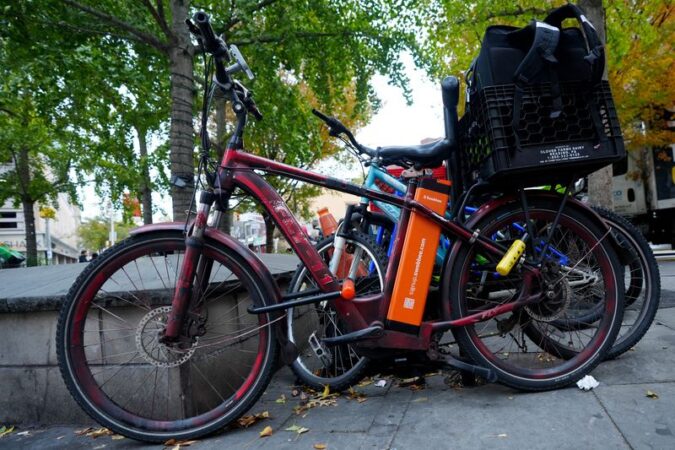
Under the new regulations, all e-bikes must be registered and insured, whether they are low-speed e-bikes, which require pedaling and cannot exceed 20 mph, or high-speed bikes, called motorized bicycles or e-motos, that can go up to 28 mph.
Riders will need to be at least 15 years old and they will need a motorized bicycle license to ride. People 17 and older can ride an e-bike using a driver’s license.
The New Jersey law treats all e-bikes as the same, whereas most other states that regulate e-bikes tend to focus on e-motos when it comes to license and insurance requirements. The slower pedal-assist bikes face a patchwork of regulations across the country, with some restrictions on where they can go. By requiring insurance for the pedal-assist bikes people use for exercise and commuting, New Jersey now has some of the toughest regulations in the country for e-bikes, and cycling enthusiasts across the country fear their states might follow suit.
The new regulations mark a dramatic shift in how New Jersey sees e-bikes. It was only in 2019 that state leaders, including Murphy, touted them as an alternative to cars with the potential to cut emissions and congestion in the state, allowing them to operate on streets, highways, and bicycle paths.
Introduced in the legislature in November, the bill with e-bike restrictions traveled quickly across both chambers as lawmakers felt moved to action by fatalities in the state, including that of a Scotch Plains 13-year-old boy who collided with a landscaping truck while riding his e-bike in September and died.
“It is clear that we are in an age of increasing e-bike use that requires us to take action and update regulations that help prevent tragedies from occurring,” Murphy said Monday.
This is a point that even the most ardent critics of the new law have long agreed with. It had been six years since the last update to e-bike laws, and they agree that reckless riders abound.
If New Jersey Facebook groups are any indicator, the law has plenty of supporters, sick of fast e-bikes taking up sidewalk space and e-motos zipping through residential neighborhoods.
Ocean City Mayor Jay A. Gillian said in a statement Tuesday that the city had long called for the change.
“Nobody likes more red tape, but the benefits of the new law far outweigh the inconvenience of the new registration requirements,” he wrote.
Still, cycling advocates maintain the law is creating an unnecessary insurance requirement on a slew of people, such as tourists going down the Shore with their low-speed e-bikes, delivery drivers, and people who use pedal-assist bikes for exercise.
Critics worry the law is not addressing some of the main issues plaguing the industry, such as misleading advertisements marketing e-motos as e-bikes and the sale of modification hardware that makes bikes go faster.
State Sen. President Nicholas Scutari, a Democrat whose district includes Scotch Plains, introduced the bill in November, arguing that the increase in e-bikes created dangers for riders, motorists, and pedestrians.
“Requiring registration and licensing will improve their safe use, and having them insured will protect those injured in accidents,” he said Monday.
The 2019 e-bike laws did include insurance requirements for e-motos, which had to be registered and titled with the New Jersey Motor Vehicle Commission, but cycling advocates say these have never been enforced.
Debra Kagan, executive director of the New Jersey Bike Walk Coalition, said she has asked for state data on e-moto registration and there does not seem to be any.
The MVC did not immediately respond to a request asking for e-moto registration data.
A fiscal analysis by the New Jersey Office of Legislative Services anticipated an increase in administrative costs for the MVC to update its technology systems, for communications, and to prepare an annual registration report for all e-bike classes. It did not give an estimate of how much that could cost the state. The law comes with no money attached.
“Now this new legislation will require that all e-bikes, even the lowest speed e-bikes that don’t have throttles, would require licensing and registration, and there is no system and no funding to implement that across the state there,” Kagan said.
The new law, critics add, will also carry a negative economic impact for the state, despite the expected fees the OLS says will be collected through registrations and eventual penalties for violations.
While low-speed e-bikes can exceed $2,000, budget models can start at around $400, making them a suitable affordable transportation alternative.
Patrick Cunnane, who sits on the board of directors of the trade organization People for Bikes and is an adviser to a bike shop in Gloucester County, worries that may no longer be the case for many with the new added costs of registration and insurance.
Shore town boosters and small bike-rental businesses also feel threatened, Cunnane said. He said it was not out of the realm of possibility that the ability to travel on e-bikes could be what tips the scales between a stay in Ocean City, N.J., or one in Ocean City, Md., or at the Delaware beaches.
“It’s just crazy for New Jersey to isolate themselves from an activity that’s really a lot of fun and safe,” he said.
Niclas Elmer, owner of Tuckahoe Bike Shop, which has a handful of locations in Atlantic and Cape May Counties, said even as the threat of added regulation loomed, parents balked at buying their children low-speed e-bikes.
“It was hard for us because we couldn’t give a straight answer [regarding regulations],” said Elmer, who has been in the retail business for more than 20 years.
Further worrying Elmer is the status of bike rentals, a key part of his business model. He doesn’t know if these will be exempt from the new laws.
To Elmer and others, cycling advocates say the fight over e-bike regulations is not over.
Cunnane said People for Bikes has already been in touch with the administration of new Gov. Mikie Sherrill on the matter. The hope is that in the year the state has to set its new registration framework, advocates will be able to influence new legislation that walks back some of the restrictions.
Cunnane was encouraged by the comments of the legislators who supported the law. They clearly want to tackle what they perceive to be a large problem, he said. Cycling advocates are not against all regulation; they simply want more targeted ways to address safety concerns.
“We think we can really help make it better,” he said.
Weeks before she had made the team, South Jersey figure skater Isabeau Levito was confidently saying, “when I go to the Olympics …”
Levito, 18, who lives and trains in Mount Laurel, wasn’t being cocky. She knew; she had done the math.
Qualifying for the 2026 Milan Cortina Olympics was “definitely a realistic goal for me for the past three years,” said Levito, the 2023 U.S. champion and 2024 world silver medalist. “But I felt like I had to prove myself again after missing a bit of last season with an injury.
“But when the season was going the way it was going, score-wise, internationally, I just had to skate the way I can skate at nationals and have it solidified.”
Isabeau Levito performs during the women’s free skating competition at the U.S. Figure Skating Championships in St. Louis. She won the bronze medal.
Indeed, with two clean programs and the bronze medal at the 2026 U.S. Figure Skating Championships earlier this month, combined with strong results throughout the season and last year, that spot was hers.
So when she met with Justin Dillon, chief high performance officer for U.S. Figure Skating, who told her reality show-style that she was on the team, Levito seemed happy but not surprised. Her head coach, Yulia Kuznetsova, however, was flooded with tears.
Kuznetsova skated pairs while growing up in Russia and later in Disney on Ice, where she performed with her now-husband and another of Levito’s coaches, Slava Kuznetsov. But she never made it to that top frozen stage — until now as a coach.
Kuznetsova also knew it was within reach. But the duo knew what they needed to do.
Isabeau Levito performs during the women’s free skating competition at the U.S. Figure Skating Championships in St. Louis. She won the bronze medal.
They opted this season for a triple flip combination instead of a triple Lutz. They thought the flip had a better chance of being called clean. (This worked out, but her individual triple Lutz also has been getting better results lately.)
“Next season, I really want to switch things around and do new things and have more fun with it,” Levito said, “because this season it was a matter of doing all the skills that I honed, all the things that are the most comfortable and the most reliable. But next season, let’s just start risking things.”
She’s looking forward to being fully immersed in the Olympic experience and having her family see her skate. The opening ceremony is Feb. 6.
“I am going to run this [Olympic] village,” she said. “This is going to be so fun.”
She’s read about the village and watched TikToks from the Summer Games.
“But I really have no idea what the Olympic Village is going to look like. That’s why I’m so excited to get there and explore it,” she said.
Most of the ice sports, including figure skating, will be in Milan. The snow and sliding sports, plus curling, will be 250 miles away in Cortina and other mountain regions. This Olympics will be held in six villages across northern Italy.
Before nationals, Levito had a lot of obligations. There were days when film crews came into the rink and stayed all day, cutting into her training time.
The results were viral social media videos for sponsors such as Red Bull (she compares skills with a hockey player) and Everlane (she answers rapid-fire questions while getting ready to get on the ice at the Igloo Ice Rink in Mount Laurel).
Now she’s back to a more typical schedule of skating for hours every day.
“Everything’s exactly the same,” she said of her days on the ice. “What’s different, though, is how exciting it is going to the rink every day, being that I’m actually training for the Olympics right now.”
Does Olympic prep include getting a tattoo of the rings, as so many athletes do?
“I just don’t know if I would get a tattoo in general,” Levito said. “I think I’m going to start with the Olympic necklace,” which many Olympians sport.
“If I did get a tattoo, it would be in such a hidden place, and it would be so tiny and microscopic. And I’m thinking to myself, ‘If that’s the circumstances I would get a tattoo under, maybe I should think about it for a while.’”
Meanwhile, time is ticking, meaning she needs to shop for some formal dresses to wear at Olympic banquets and choose things to pack for any downtime.
Levito said she likely will bring a couple of books as well as her bedazzling kit. Besides all the sparkles she wears on the ice, she enjoys adding rhinestones to her various makeup cases and a comb.
“It’s so soothing,” she said.
Isabeau Levito skates her short program at the Grand Prix de France in October.
There is a lot of talk of extra bling: The three American women have a good chance of earning medals at the Olympics. But Levito isn’t thinking about that.
“The village is what I’m focused on,” she said. “And obviously skating my best, but I can already feel like I will.”
The pressure also is off a bit. With Glenn winning her third consecutive national title and Liu as the reigning world champion, Levito feels she’s less in the spotlight than she was a couple of years ago, when she won nationals and the silver medal at worlds.
But it’s all good.
“Honestly to me right now my life feels like perfect,” she said. “Dare I say I love everything that’s in my life, like personal life, and just like my goals that I’ve achieved, whether I’m under the radar or not?
“I’m just so happy right now. I feel like I really achieved my dream life that I had in mind maybe five or some years ago. I feel like I’m really living what I was wishing for or envisioning for myself, so I’m just beyond proud.”
The Philadelphia School District is poised to announce soon which of its aging buildings it will fix up and which it might close, or consolidate, or reimagine in the coming years.
But teachers and parents at one South Philadelphia elementary school say they cannot wait for help and have appealed to Superintendent Tony B. Watlington Sr., Mayor Cherelle L. Parker, and others.
“Southwark School is desperately in need of changes,” a letter signed by 300 people and sent to Watlington and Parker on Friday read. “Our children are learning in an unhealthy environment that no child should have to experience.”
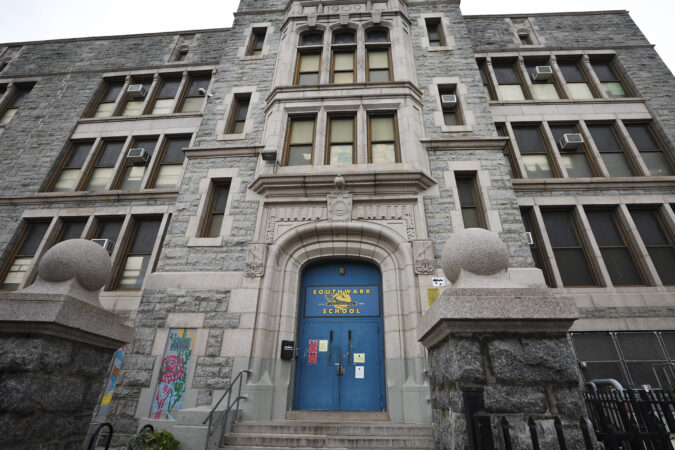
In many ways, Southwark, a K-8 facility constructed in 1905, is a thriving school — it has strong academics, a diverse student body of about 900, a dual language immersion program, and a robust complement of activities. Southwark is a community school, with city-paid resources including free before- and after-school care.
Mayor Cherelle Parker and Superintendent Tony B. Watlington Sr. visit a classroom at Southwark Elementary to discuss the city’s extended day extended year programming in this 2024 file photo.
But it also has issues including bathrooms that “break down nearly every day,” the letter said. “The plumbing has gotten so bad that sewage comes dripping down from the ceiling into classrooms.”
The letter outlined other issues including a rampant bug and rodent problem, a stairwell covered in graffiti and trash, dank hallways, a lack of adequate ventilation, and more.
“Our children tell us that classrooms feel like prisons because the windows can’t be opened fully and they have opaque coverings,” the letter read.
Nyera Parks, a Southwark second-grade teacher, said she doesn’t think the community is asking for too much.
“These conditions are affecting the children’s health, their focus, their sense of safety,” Parks said. “It’s the bare minimum — we’re asking for a clean and safe school.”
Responding to teacher and parent concerns, district chief operating officer Teresa Fleming said in a letter sent Monday the school system “has already taken concrete action to address conditions at Southwark while continuing to plan for sustained improvement.”
Fixes Fleming cited include “mass”trapping, plaster and plumbing work, and adjustments to the cleaning staff.
Some staff have reported “visible improvement in cleanliness and operational response,” Fleming wrote in the letter to State Rep. Elizabeth Fiedler (D., Philadelphia). “At the same time, we recognize that some of Southwark’s challenges are rooted in aging infrastructure and require longer-term planning. My team is developing an actionable plan that includes feasibility reviews of plumbing systems, HVAC needs, and cafeteria kitchen capacity, with attention to major shared spaces, including the gymnasium, cafeteria, and auditorium.”
Southwark, according to data released by the district this summer, is in “poor” building condition. It is also operating at 104% of its building capacity.
Fleming said the school “will likely receive facility enhancements” through the forthcoming facilities master planning process.
‘It shouldn’t have to be like this’
The first thing Jennifer O’Shaughnessy, a teacher and part of the morning care staff, does when she gets to Southwark early is pick up trash. Then, when she gets to the cafeteria, where kids will eat breakfast, she grabs wipes to clear the mouse droppings that have accumulated overnight.
At least once a week, O’Shaughnessy said, “the kids are eating breakfast and we see a mouse come out, and then they’re standing up, screaming. We tell them it’s going to be OK, but it shouldn’t have to be like this.”
O’Shaughnessy has worked at Southwark for 15 years and is now the upper school coordinator, teaching writing and a elective and supporting other educators. She loves the school so much she sends her own daughter to Southwark.
But it troubles her that because of the old heating system, the school’s classrooms are either freezing or so hot students sometimes get nosebleeds.
“I’ve had teachers take their kids into the hallway because it’s too hot in their classrooms,” O’Shaughnessy said. “It’s 80, 90 degrees in there, and you can’t think. And when the heat is not on, it’s freezing and you have students with winter jackets on.”
City demographics and Southwark’s burgeoning popularity have brought new life to the school, but have also strained the building.
Bathrooms are a particular issue. The restrooms that get the most use are in the basement, near the cafeteria. But those bathrooms are frequently closed because of plumbing issues and other problems.
Last month, a student told O’Shaughnessy they couldn’t use the bathroom because no toilets were working. There had been no news of a closure, so O’Shaughnessy went in to investigate.
“Every toilet was running over,” she said. “I went in there and almost lost my lunch. They had taped off half the stalls because flood water was running over. The other toilets were clogged.”
O’Shaughnessy had the bathroom shut down, leaving a common problem — there are a few other bathrooms, but not enough to accommodate the large student population’s needs.
‘It’s still a mess’
Appealing to the superintendent and mayor was not the teachers’ and parents’ first move. They worked within the system, staff said, putting in countless work orders and making more direct appeals to district officials.
Southwark recently got a permanent building engineer — that has helped some, said Justin Guida, the school’s STEM teacher, but the problems can never be rectified by one employee.
“We get a little Band-Aid here and there, it looks like they helped, but it’s still a mess,” said Guida, who lives in the neighborhood and has worked at Southwark for 10 years. “When the kids complain because of the bathrooms or the food or the bugs or mice, it breaks my heart. The kids say, ‘I love Southwark, but it’s dirty.’”
Southwark teachers say that school material often get ruined by rodents.
“We’re growing plants as a science experiment, and the plants get destroyed because they’re getting eaten by the mice,” Guida said.
Guida knows the district has billions in unmet facilities needs, but the changes Southwark needs are not all costly, he said.
“Can the windows get uncovered so we can see out them and have natural light come in? Can we clean the fire towers that our kids have to walk through?” he asked.
Parks, the second-grade teacher, is frustrated by air filters that do not get changed, especially given the high rates of asthma among Southwark children.
In 2023, Southwark was temporarily closed because of damaged asbestos, with the school split between South Philadelphia High and Childs Elementary. The damaged asbestos was removed, but Parks and others worry about the asbestos that remains in the building.
Parks attended Southwark as a child and is dismayed that her second graders may not be having the same experience she had as a student. She never had sewage leaking from bathrooms into her classroom, or had lessons interrupted by a mouse scurrying across the floor.
“I remember feeling safe there,” she said. “Some of the things that I’m seeing in the building now are not how I saw and experienced it when I was there. How are they able to learn and feel comfortable in these types of conditions?”
Parks and others who signed the letter to Watlington and Parker have asked for fixes including repainting hallways, ensuring every classroom has a working lock, and guaranteeing that stairways and outdoor areas will be regularly cleaned, that every room has air-conditioning and regular air filter changes, and that there are specific plans for long-term bathroom repairs.
Fiedler said that she appreciated Fleming’s response, but that Southwark’s conditions generally “are a major concern.”
“We know that there’s many years of deferred maintenance in the School District of Philadelphia and across the commonwealth,” Fiedler said. “I think this is a really good, really sad, and scary example of a place where more needs to be invested.”
WASHINGTON — President Donald Trump’s plane, Air Force One, returned to Joint Base Andrews about an hour after departing for Switzerland on Tuesday evening.
White House press secretary Karoline Leavitt said the decision to return was made after takeoff when the crew aboard Air Force One identified “a minor electrical issue” and, out of an abundance of caution, decided to turn around.
A reporter on board said the lights in the press cabin of the aircraft went out briefly after takeoff, but no explanation was immediately offered. About half an hour into the flight reporters were told the plane would be turning around.
Trump will board another aircraft and continue on with his trip to the World Economic Forum in Davos.
The two planes currently used as Air Force One have been flying for nearly four decades. Boeing has been working on replacements, but the program has faced a series of delays. The planes are heavily modified with survivability capabilities for the president for a range of contingencies, including radiation shielding and antimissile technology. They also include a variety of communications systems to allow the president to remain in contact with the military and issue orders from anywhere in the world.
Last year, the ruling family of Qatar gifted Trump a luxury Boeing 747-8 jumbo jet to be added into the Air Force One fleet, a move that faced great scrutiny. That plane is currently being retrofitted to meet security requirements.
Leavitt joked to reporters on Air Force One Tuesday night that a Qatari jet was sounding “much better” right now.
Last February, an Air Force plane carrying Secretary of State Marco Rubio to Germany had to return to Washington because of a mechanical issue. In October, a military plane carrying Defense Secretary Pete Hegseth had to make an emergency landing in United Kingdom due to a crack in the windshield.