Rinal Parikh poses in her Media studio with a few of her paintings.
It’s not every day that you come across a biochemist who is also an artist, but that’s the case for Rinal Parikh.
Born in India, Parikh has lived in the U.S. for 20 years, and from her home in Media blends several traditional styles of Indian art, drawing on observations from her own backyard.
The 43-year-old delved into art after her son was born with health complications, stepping away from the lab to focus on him. She soon found inspiration and an artistic community, including at the Creative Living Room in Swarthmore, The Inquirer’s Denali Sagner reports.
Today, her work, which spans the traditional Indian folk formsWarli, Madhubani, and Kalamkari, adorns her family’s home and has been exhibited throughout the region.
This week marked a new era for a number of municipal and countywide roles, as recently elected officials took office. On Monday evening, Joi Washington was sworn in as the new mayor of Media, making her the first woman and first person of color to hold the office. And in Swarthmore, Conlen Booth was sworn in as mayor, succeeding Marty Spiegel. Booth is Swarthmore fire chief and previously worked for Crozer-Keystone Health System and its successor, Crozer Health. (The Swarthmorean)
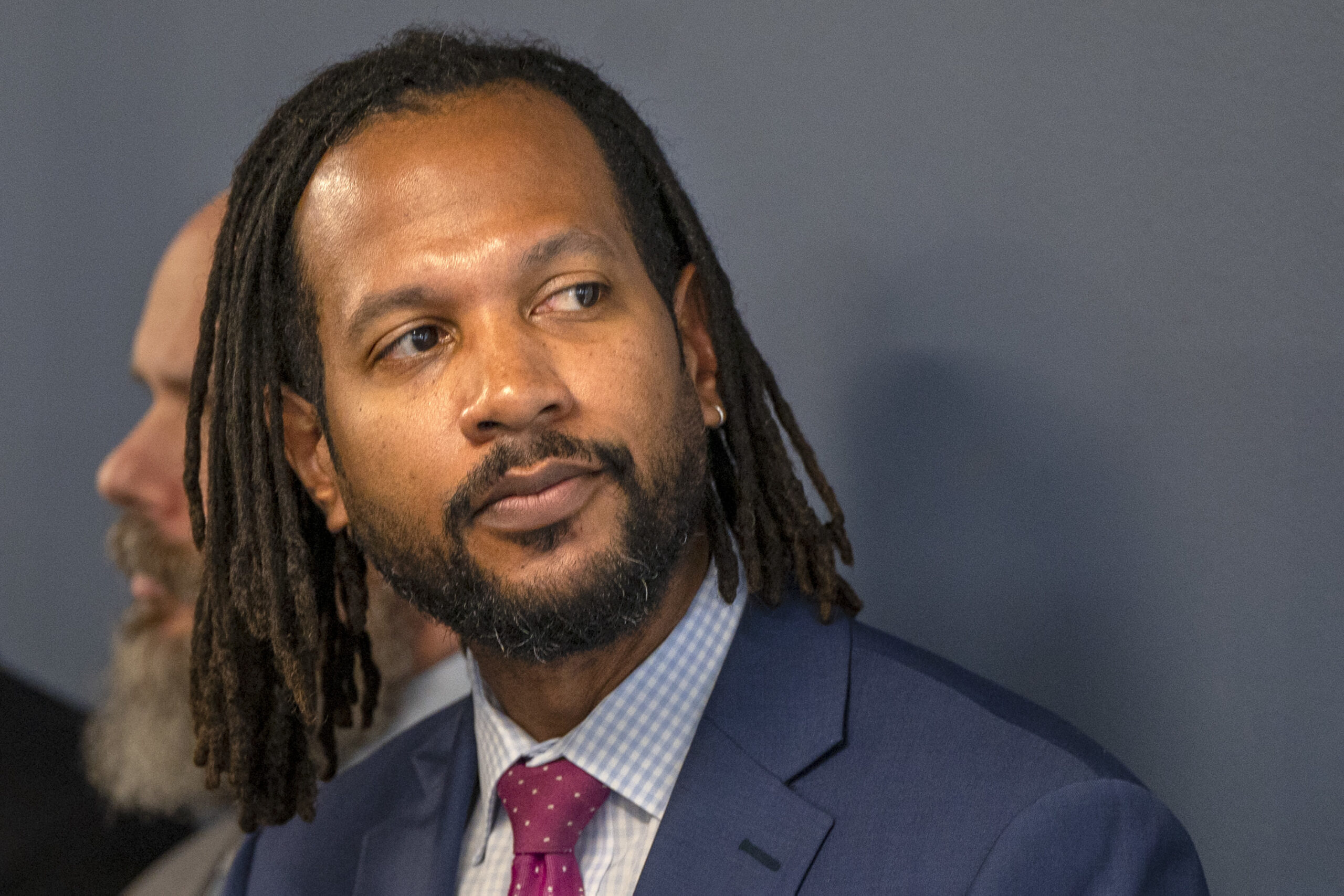
Also at the county level, Siddiq Kamara has been sworn in as sheriff. Just 30 years old, Kamara is the youngest sheriff in the U.S., according to the county, and the first Liberian-American to hold the office in Delco. (NBC10)
Pennsylvania State Police are investigating a sexual assault that was reported last month on the Chester Creek Trail in Middletown Township. A 24-year-old woman from Chester was allegedly raped shortly after midnight on Dec. 5. No additional details have been released. See the report on Page 8 here.
Have a Christmas tree to dispose of? Middletown Township is collecting them through Jan. 16. Trees should be placed curbside by 8 a.m. Swarthmore Borough will conduct a final round of curbside pickups next week. See your schedule here. Media will collect trees wherever you put your trash out throughout the month. And Nether Providence township is collecting trees curbside through Jan. 30.
🏫 Schools Briefing
Rose Tree Media has a school board work session tonight at 6:30 p.m. at Springton Lake Middle School. See the district’s full calendar here.
In Wallingford-Swarthmore, there’s a Strath Haven High School Home and School Association meeting tonight at 6:30 p.m. and parent-teacher organization meetings for Wallingford and Nether Providence Elementary Schools on Tuesday evening. See the district’s full calendar here.
🍽️ On our Plate
In case you missed it, The Inquirer’s Michael Klein reflected on the most notable restaurant openings of 2025. Among them is Maris, Loïc Barnieu’s Mediterranean eatery on West State Street in Media that opened late last year. See the full list here.
Santucci’s Original Square Pizza, which has a location in Media, is among the best takeout pizza spots in the Philadelphia suburbs, according to The Keystone, which noted the plain pie is served with cheese on the bottom and a generous coating of garlicky sauce on top.
🎳 Things to Do
❄️ Snowy Songs, Stories & Sparkly Art: In this month’s Second Saturday Family Fun Series, kids ages 18 months to 5 years old can explore music, art, and stories with their caregivers. Registration is recommended. ⏰ Saturday, Jan. 10, 10:30-11:30 a.m. 💵 Free 📍Park Avenue Community Center, Swarthmore
🌱 Winter Gardening: Seed Starting for Pollinators: It’s never too early to start preparing for spring. Learn how and what seeds you can start sowing now. ⏰ Sunday, Jan. 11, 1-2:30 p.m. 💵 $21.25 for members, $25 for non-members 📍Tyler Arboretum, Media
🖼️ January 2026 Artists Reception: Explore the latest artwork on display at the Community Arts Center, including pieces from Carolyn Kline-Coyle and Jennifer Domal. ⏰ Monday, Jan. 12, 2-4 p.m. 💵 Free 📍Community Arts Center, Wallingford
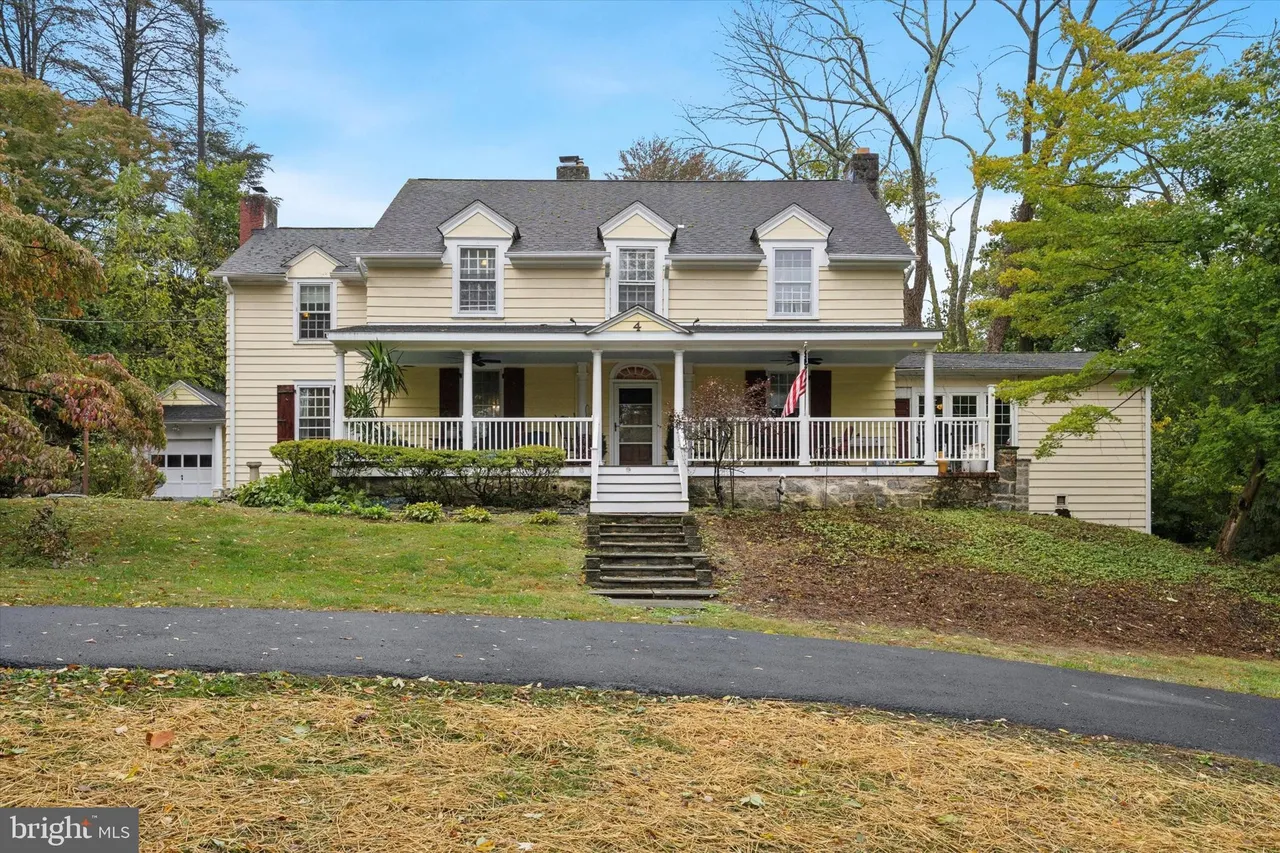
The Rose Valley home spans over 3,600 square feet.
Built in 1937, this five-bedroom Colonial in Rose Valley exudes charm thanks to a covered front porch, dormers, and exposed stone along the front façade. Some of its features include a living room that has an ornate fireplace with handmade inlays; a dining room with a large brick fireplace; an updated kitchen; and a family room with another fireplace. The primary suite has its own bathroom as well as built-in wardrobes.
By submitting your written, visual, and/or audio contributions, you agree to The Inquirer’s Terms of Use, including the grant of rights in Section 10.
This suburban content is produced with support from the Leslie Miller and Richard Worley Foundation and The Lenfest Institute for Journalism. Editorial content is created independently of the project donors. Gifts to support The Inquirer’s high-impact journalism can be made at inquirer.com/donate. A list of Lenfest Institute donors can be found at lenfestinstitute.org/supporters.
As the fog lifted on Jan. 1, 1901, four Fancy Dress Clubsand 16 Comic Clubs gathered at the corner of Broad and Reed Streets for the first ever Mummers Parade.
“Kings, emperors, knights and jesters, clothed in purple royal or tinkling tensel [sic], wended their way up the broad thoroughfare …” reads a front-page story from the Jan. 2, 1901, Philadelphia Inquirer. “In the throng of merry makers, no tribe no nation, scarcely an individual was neglected.”
That inaugural Mummers Parade was America’s first folk parade. It also marks the first time an American city hosted a New Year’s Day procession.
It will be remembered Saturday at the Firstival in the Mummers Museum. Firstivals are the Philadelphia Historic District’s weekly day parties celebrating historic events that happened in Philadelphia before anywhere else in America, and often the world. They are part of a yearlong celebration of America’s 250th birthday.
Artist Anh Ly’s No. 1 highlights the Mummers Parade’s vibrant costumes, instruments and playful traditions.
That first Mummers Parade began 125 years ago at 9 a.m. on a chilly overcast morning, said Mark A. Montanaro, the Mummers Museum’s curator. It took participants just two hours to march up Broad Street and around City Hall to Girard Avenue.
Three hundred dollars — $11,575 in today’s money — was awarded to the parade’s two first-place winners: the Elkton Association, part of the Fancy Dressed Club; and the White Cap Association, belonging to the Comic Club.
Revelers partied all day and into the night.
The boisterousness remains to this day. So much so that the Philadelphia Historic District did not want to start the Firstival celebrations with the parade, even though that was the initial plan. Why? Because they assumed the Mummers would still be recovering from their parade.
The word mummer is derived from Momus, the Greek god of satire and mockery. Mommer is the Old French word for mime.
Philadelphia’s 17th century English and Swedish immigrants dressed in elaborate regalia during the days between Christmas and New Year’s, knocked on their neighbors’ doors, and demanded treats of sweets and nuts. Over the decades, the door-to-door tradition turned into rambunctious neighborhood parties as Dutch, Irish, and Italian immigrants joined in on the fun.
In November of 1900, Philadelphia Evening Bulletin reporter and theatrical promoter H. Bart McHugh and City Councilman John H. Baizley asked Mayor Samuel Ashbridge if the city would consolidate the block parties into one big parade.
Plans were finalized by mid-December.
The Mummers Parade remains one of Philadelphia’s most enduring traditions. It’s only been canceled three times: during the 1919 Spanish Flu, 1934 during the Great Depression, and 2021 during COVID. (This year, the String Band Division called off its competition due to strong winds.)
The Jokers perform during the Fancy Brigade Finale at the Pennsylvania Convention Center during the 2026 Mummers Parade in Philadelphia on Thursday, Jan. 1, 2026.
Parade routes have changed; today it starts at City Hall and ends at Washington Avenue. At times its been fraught with racial controversy, as some members have appeared in blackface as recently as 2020.
That’s all in the past, Montanaro stressed.
“The Mummers are striving for inclusivity,” Montanaro said. “We are a little bit of Mardi Gras, a little bit of Carnival, and a whole lot of Philly.”
This week’s Firstival is Saturday, Jan. 9, 11 a.m. — 1 p.m., at the Mummers Museum, located at 1100 S. 2nd Street. The Inquirer will highlight a “first” from Philadelphia Historic District’s 52 Weeks of Firsts program every week.
Gov. Josh Shapiro officially announced his widely expectedreelection bid for Pennsylvania governor Thursday, as speculation over a 2028 run for president continues to build. The question now: How will the Democrat’s rumored presidential ambitions bolster or detract from his must-win election at home in 2026?
Shapiro will kick off his reelection campaign with not one but two rallies— first stopping in Pittsburgh, then in Philadelphia. In a campaign video posted to social media Thursday morning, he touted his three years of leading a divided legislature and his bipartisan achievements in a politically split state, via a campaign that has already amassed a record $30 million war chest.
He coasted to victory in 2022, elevating his profile within the national Democratic Party, and is not expected to face a primary challenger. In the general election, he will likely face Republican State Treasurer Stacy Garrity, who largely consolidated GOP support early.
But that’s not the only race on the line in November.
As Shapiro looks to potential parallel runs, he’ll need to continue to build a national profile without outwardly focusing too much on the presidential picture.
Gov. Josh Shapiro is interviewed by TV news in the spin room at the Convention Center following the debate between former President Donald Trump and Vice President Kamala Harris Tuesday, Sept. 10, 2024.
“The challenge, of course, is you have to take care of your next election first,” said Christopher Borick, a pollster at Muhlenberg College. “Of anything he does, he knows this is the most important thing for his potential success in 2028 if he was to run.”
In the governor’s race, Shapiro will likely face a more formidable opponent in Garrity than he did in state Sen. Doug Mastriano (R., Franklin) in 2022, but he’ll also be running in a far more favorable political atmosphere for Democrats amid souring attitudes toward President Donald Trump and the GOP. If he can retain the governor’s mansion decisively and bring a ticket of Democrats vying for the statehouse and Congress to victory with him, that’s a narrative that could be strong in a Democratic presidential primary.
“Having a win, and maybe an impressive one in Pennsylvania, the key swing state heading into that cycle, is about as big of a boost as any that you can have,” Borick added.
Running local
The 2028-curious Democrats include several other sitting governors generating buzz: California’s Gavin Newsom, Kentucky’s Andy Beshear, Maryland’s Wes Moore, Michigan’s Gretchen Whitmer, and Illinois’ JB Pritzker. Shapiro has formed alliances with several of them.
But unlike some of his peers, Shapiro hasn’t been a frequent guest on cable news or podcasts with national reach.
On Oct. 4, 2024, nearly a month before Harris lost the presidential election to Trump, Shapiro confidentially requested that the state ethics commission determine whether he would violate any state ethics laws for accepting royalties from a book about his life in public service, according to the filing.
Pennsylvania Gov. Josh Shapiro (right) and Michigan Gov. Gretchen Whitmer before the Eagles played the Detroit Lions at Lincoln Financial Field on Sunday, Nov. 16, 2025, in Philadelphia, PA.
His book, Where We Keep the Light, will publish later this month, recounting his political upbringing, his vice presidential vetting, and the firebombing of his home last year. He’s not alone. Harris published a memoir about the 2024 election last year, and Newsom is due out with Young Man in a Hurry: A Memoir of Discovery in February.
But in the coming months, several Democratic strategists predict Shapiro will be squarely focused on the governor’s race he has to win in Pennsylvania — simultaneously proving he has what it takes to capture the vote of the nation’s most important swing state.
“He’s such a careful politician. He’s not taking anything for granted,” said former Gov. Ed Rendell, a Democrat who also once faced scrutiny for having potential presidential ambitions.
Shapiro is likely to follow the same campaign playbook in Pennsylvania as he did in 2022: Stump in every region of the state, including areas where Democrats don’t usually show up. That helped him run down the margins in longtime GOP strongholds like Lancaster or Schuylkill Counties toward his resounding victory over Mastriano. Those stops in most of Pennsylvania’s 67 countieswon’t give him as much time to visit South Carolina, Iowa, and New Hampshire, as the other Democratic presidential hopefuls start their sojourns.
Pennsylvania Governor Josh Shapiro waves goodbye to the crowd after speaking during graduation ceremonies at Pennsbury High School in Fairless Hills on Thursday, June 12, 2025.
“The No. 1 caveat is stay focused on the race you’re running,” echoed Alan Kessler, a national fundraiser based in Philadelphia who has supported and fundraised for Shapiro.
Still, the campaign is likely to generate attention beyond the Keystone State.
Shapiro will still court donors in blue states as he fundraises for reelection, Kessler added.
Come November, he will be the only governor with rumored 2028 aspirations up for reelection in a swing state. And his brand as a popular, moderate Democratic governor trying to restore trust in government — as well as his potential to help boost Democrats down ballot — will easily capture a wider audience and bring national media into Pennsylvania.
As Democrats seek to flip control of the U.S. House in 2026, targeting several congressional districts in the state, the election may once again come down to Pennsylvania, and in turn, increase the spotlight on Shapiro. The governor is widely seen as someone who can boost the congressional Democratic candidates also on the ballot, having won three of the four districts that Democrats are targeting in the state by double digits in 2022.
Republicans have targeted several weaknesses to try to erode Shapiro’s popularity in Pennsylvania and boost Garrity. They point to a lack of rigorous electoral challengers in his past. They question his record of “getting stuff done” — his oft-repeated motto — including three late state budgets. And they’ve harped on a lack of transparency as governor, including claims he used tax dollars for political benefitas well as a sexual harassment scandal involving a former top aide. They’ve also criticized his support for Minnesota Gov. Tim Walz, who recently dropped his third gubernatorial bid following a fraud scandal among the state’s Somali refugee population totaling $1 billion, according to federal prosecutors.
Among the emerging attacks: Republicans want to highlight Shapiro’s presumed presidential ambitions, as they try to cast him as an opportunist more interested in a future White House bid than the problems of everyday Pennsylvanians.
“Josh Shapiro is more concerned with a promotion to Pennsylvania Avenue than serving hardworking Pennsylvanians,” Garrity said in a statement, noting the state fared poorly in U.S. News and World Report rankings on the economy and education. “In the military, I learned the importance of putting service before self. Pennsylvanians are the hardest-working, most compassionate, strongest people in the nation, and together we will return Pennsylvania to our rightful place as a national and global leader.”
State Treasurer and Republican candidate for governor Stacy Garrity holds a rally in Bucks County Sept. 25, 2025 at the Newtown Sports & Events Center.
Mastriano, the far-right Republican state senator who announced Wednesday he won’t run for governor, said in a statement earlier this week that Shapiro “owes [Pennsylvanians] straight answers” over his use of the state plane, security updates to his personal home in Abington Township, and more.
“Pennsylvanians deserve accountability, not ambition,” he added, making a nod to Shapiro’s potential longer-term plans.
House Speaker Joanna McClinton, back center left, Gov. Josh Shapiro, front center, and State Rep. La’Tasha D. Mayes, right, celebrate the signing of the CROWN Act, which prohibits discrimination based on a person’s hair type, during a press conference at Island Design Natural Hair Studio, in West Philadelphia, November 25, 2025.
Borick, the pollster, was skeptical that attacks on Shapiro’s potential wider ambitions could reverse hislargely positive public sentiment.
“If that’s all they got, they don’t got a lot.”
Republicans insist they see a path to victory for Garrity in a politically divided state with months to go until the election. But behind the scenes, some Republicans are already acknowledging the goal is to lose by less and prevent big losses in state legislature or congressional races.
If Shapiro does look poised to cruise to victory, it might mean less media attention on the race, and it could mean he’s less vetted ahead of a much bigger stage.
“I think Josh is better served if the [Republican Governors Association] puts $100 million into this race because then it’s nationalized,” said a Democratic political strategist based in Pennsylvania who did not want to be named speculating on Shapiro’s presidential run. “If it’s a cakewalk, CNN’s not gonna cover it …If he wants to be governor for another four years, he should pray for a cakewalk. If he wants to be president, he should pray for a difficult campaign.”
Florida Gov. Ron DeSantis, for example, the strategist noted, cleaned up in his 2022 reelection, but failed to gain traction in the GOP presidential primary that Trump dominated.
Beyond 2026
Shapiro speaks Pennsylvanian very well. Raised in Montgomery County, he’s lived here almost all of his life, and has built an image as a popular moderate focused on problem-solving in a purple state. That’s earned him the support of about 30% of Trump voters in the state.
But winning a general election in Pennsylvania is different than winning a Democratic presidential primary.
He’s tried not to alienate the MAGA base, focusing on issues with bipartisan appeal like funding for apprenticeship and vocational-training programs. He’s taken on Trump in court, but has picked his personal battles with the president more carefully.
But being a strategic, self-described “progressive pragmatist” can end up alienating voters on both sides.
Gov. Josh Shapiro leaves after an event at the Port of Philadelphia Thursday, Apr. 10, 2025, the day after President Trump paused some tariffs.
Becky Carroll, a Democratic political consultant in Chicago who has worked with Pritzker, said Shapiro seems less on the radar of voters in the Midwest. As she’s followed Shapiro’s career, she said she sees a “damn fine governor,” but someone who’s taken a more muted approach to Trump than blue state governors like Pritzker and Newsom.
When it comes to a Democratic primary, candidates may be judged in part on their pushback to Trump, she said. “I think we’re in a moment where you can sulk in a corner and hope it’ll all go away or fight …,” Carroll said. “And if you’re gonna put yourself out there for a primary battle, you better show you have battle scars to prove you can fight for the most vulnerable in the country right now.”
Gov. Josh Shapiro is interviewed by TV news in the spin room at the Convention Center following the debate between former President Donald Trump and Vice President Kamala Harris Tuesday, Sept. 10, 2024.
But other national strategists see Shapiro’s moderate appeal as a potential asset in 2028. Jared Goldberg-Leopold, a former communications director for the Democratic Governors Association, thinks Shapiro’s biggest asset is his electoral track record in a state the nation knows is critical on the path to the White House. Primaries have previously been won by moderates whom the party thinks have the best chance at winning the general.
But the first step, Goldberg-Leopold stressed, is the governor’s race ahead.
“It would be easy for the Eagles to look past the 49ers to the next week of playoffs, but they’ve gotta focus on only one thing. And the same is true for the governor,” he said. “You can only prepare for what’s ahead of you, and the way people get in trouble in politics is planning too many steps ahead.”
Staff writer Katie Bernard contributed to this article.
The number of federal government employees in the Philadelphia region plunged in October, according to new employment data that appear to reflect the departure of thousands who opted into President Donald Trump’s resignation program.
Trump’s cuts to the federal workforce over his first year in office became clearer Wednesday with the release of new employment data from the U.S. Bureau of Labor Statistics (BLS). Across Pennsylvania and New Jersey, thousands of federal jobs were cut from September to October.
It was the first time the government’s deferred resignation program has been reflected in local employment data. First offered in January 2025, this program allowed federal employees to resign from their jobs while continuing to receive pay. For many, the program ended Sept. 30. While it may have been months since they had completed duties related to their federal jobs, the end of the deferred resignation period is when they officially stopped being employed by the government for purposes of employment data.
window.addEventListener(“message”,function(a){if(void 0!==a.data[“datawrapper-height”]){var e=document.querySelectorAll(“iframe”);for(var t in a.data[“datawrapper-height”])for(var r,i=0;r=e[i];i++)if(r.contentWindow===a.source){var d=a.data[“datawrapper-height”][t]+”px”;r.style.height=d}}});
“The federal workforce is …in communities like Philadelphia, and we are part of the economy,” said Philip Glover, a union leader with AFGE District 3, which represents federal workers in Pennsylvania and Delaware. The recent local job loss will have ripple effects, he said. It “affects stores, transit, it affects tax bases, all of those things are affected,” he said.
Federal agencies in the Philadelphia metro area — a region that includes Camden and Wilmington — shed about 2,900 jobs in October, down 5.3% from September. It was the steepest month-over-month decline since July 2010 and the fourth biggest since at least 1990.
Pennsylvania lost overall about 4,800 federal jobs in October, a 4.8% drop and the largest month-over-month decrease since October 2020.
New Jersey lost about 1,200 federal jobs in October.
In nearly five years, employment overall has grown 12.6% in the Philadelphia metro area, but regional gains in federal employment have now been completely wiped out by job losses in the past year.
window.addEventListener(“message”,function(a){if(void 0!==a.data[“datawrapper-height”]){var e=document.querySelectorAll(“iframe”);for(var t in a.data[“datawrapper-height”])for(var r,i=0;r=e[i];i++)if(r.contentWindow===a.source){var d=a.data[“datawrapper-height”][t]+”px”;r.style.height=d}}});
The handful of larger prior declines in federal employment for Pennsylvania and Philadelphia came during the recessions of the early 1990s and 2000s, the Great Recession and its aftermath, or the COVID-19 pandemic — periods during which economic activity slowed and the federal government experienced a decline in tax revenue.
The deferred resignation would have been reflected in a November release, but it was delayed because of the federal government shutdown, which stretched through early November.
The federal employment figures include all full- and part-time civilian employees, including those of the Postal Service. But it does not include armed forces and intelligence agencies such as the CIA and NSA.
Why federal workers resigned
Paul Kenney spent almost 30 years at the National Park Service in Philadelphia — more than two decades in the Northeast Regional Office on Market Street in river protection and six years at Independence National Historical Park.
All that came to a halt in March 2025. Kenney decided the Trump administration’s efforts to significantly reduce the federal workforce was too much. He felt demoralized and also concerned that a bill in Congress at the time would impact his pension.
The 59-year-old decided to retire three years early, despite wanting to stay in the workforce. He had just scored some highly coveted grants for restoration efforts in the parks. He remains involved with his union, AFGE Local 2058, as a vice president.
By the end of May, five people from Kenney’s 11-person team at the Northeast Regional Office left; almost all had opted to take an early retirement.
“The pressure really was all DOGE,” Kenney said, referring to the Department of Government Efficiency Trump launched soon after taking office. It was a “grim” experience for those in the federal workforce, he added.
Beyond layoffs earlier in 2025, the Trump administration sent termination notices during the government shutdown that started on Oct. 1. Those firings were ordered to be reversed under the deal to end the shutdown.
Where are federal workers employed?
In Pennsylvania, federal employment represented about 1.52% of all jobs as of November, down from around 1.69% for the same month in 2024, according to the new data.
In New Jersey, federal workers represented about 1.05% of jobs overall as of November, down from around 1.13% in November 2024.
The most recent BLS data are not broken down by agency or department, but data from March 2025 from Pennsylvania’s Department of Labor and Industry indicate that in Southeastern Pennsylvania, the largest employers of federal workers are the U.S. Postal Service, the Department of Defense, and the Department of the Treasury.
window.addEventListener(“message”,function(a){if(void 0!==a.data[“datawrapper-height”]){var e=document.querySelectorAll(“iframe”);for(var t in a.data[“datawrapper-height”])for(var r,i=0;r=e[i];i++)if(r.contentWindow===a.source){var d=a.data[“datawrapper-height”][t]+”px”;r.style.height=d}}});
Nationally, the federal government shed about 162,000 jobs in October, down 5.6% from September and 8.7% from the previous October. The government lost a further 6,000 jobs in November.
There were about 2.74 million federal employees nationwide as of November, compared with about 3.02 million at the start of 2025. The country experienced a loss of 271,000 federal jobs from January through November.
That’s not far off the 300,000 federal jobs that the Trump administration had said would be cut by the end of 2025. Data for the remainder of the year will be available later this month.
“What it’s doing is putting a strain on the remainder of the workforce to continue operations,” said Glover. “That increases stress levels, it doesn’t increase efficiency.”
And with that in mind, Glover said, additional federal workers may be thinking about quitting. “I think people are making decisions now whether they’re gonna stay if that happens again.”
In Kensington, a program to mitigate street violence was hitting its stride.
After joining the New Kensington Community Development Corporation in 2023, outreach coordinators with Cure Violence began responding to shootings in the neighborhood, connecting folks with mental health services and other wellness resources.
They hosted men’s therapy groups, safe spaces to open up about the experience of poverty and trauma, and organized a recreational basketball league at residents’ request. Their team of violence interrupters even intervened in an argument that they said could have led to a shooting.
Cure Violence Kensington was funded by a $1.5 million federal grant from the Department of Justice, part of a Biden-era initiative to combat the nation’s gun violence epidemic by awarding funds to community-based anti-violence programs rather than law enforcement agencies.
One year after a political shift in Washington, however, federal grants that Philadelphia’s anti-violence nonprofits say allowed them to flourish are disappearing.
In the spring, New Kensington CDC received a letter from the Justice Department, saying that under the leadership of Attorney General Pam Bondi it had terminated the grant that would have funded Cure Violence for the next three years.
The work, the letter said, “no longer effectuates the program goals or agency priorities.” In the future, it said, the department would offer such grants exclusively to local law enforcement efforts.
“It was a heavy hit,” said Bill McKinney, the nonprofit’s executive director.
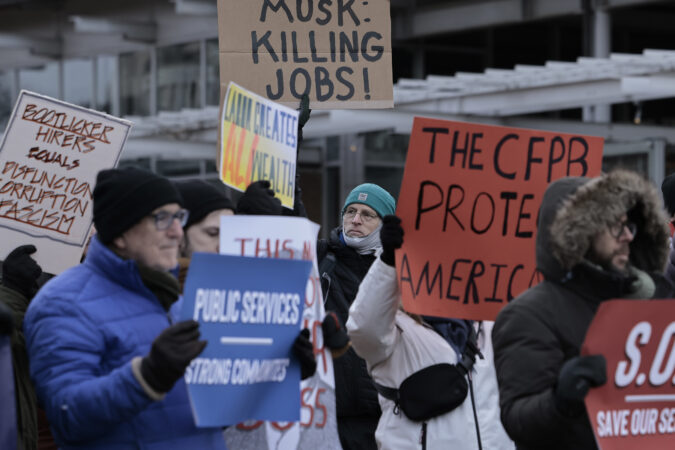
The cuts come amid a Trump administration crackdown on nonprofits and other organizations it views as either wasteful or focused on diversity and DEI.
It spent 2025 slashing funds for programs that supplied aid abroad, conducted scientific research, and monitored climate change. At the Justice Department, cuts came for groups like McKinney’s, which aim to target the root causes of violence by offeringmental health services, job programs, conflict mediation, and other alternatives to traditional policing.
In Philadelphia, organizations like the Antiviolence Partnership of Philadelphia and the E.M.I.R. Healing Center say they, too, lost federal funding last yearand expect to see further reductions in 2026 as they scramble to cover shortfalls.
A Justice Department spokesperson said changes to the grant program reflect the office’s commitment to law enforcement and victims of crime, and that they would ensure an “efficient use of taxpayer dollars.”
“The Department has full faith that local law enforcement can effectively utilize these resources to restore public safety in cities across America,” the spokesperson said in an email.
Nonprofits may appeal the decisions, the spokesperson said, and New Kensington CDC has done so.
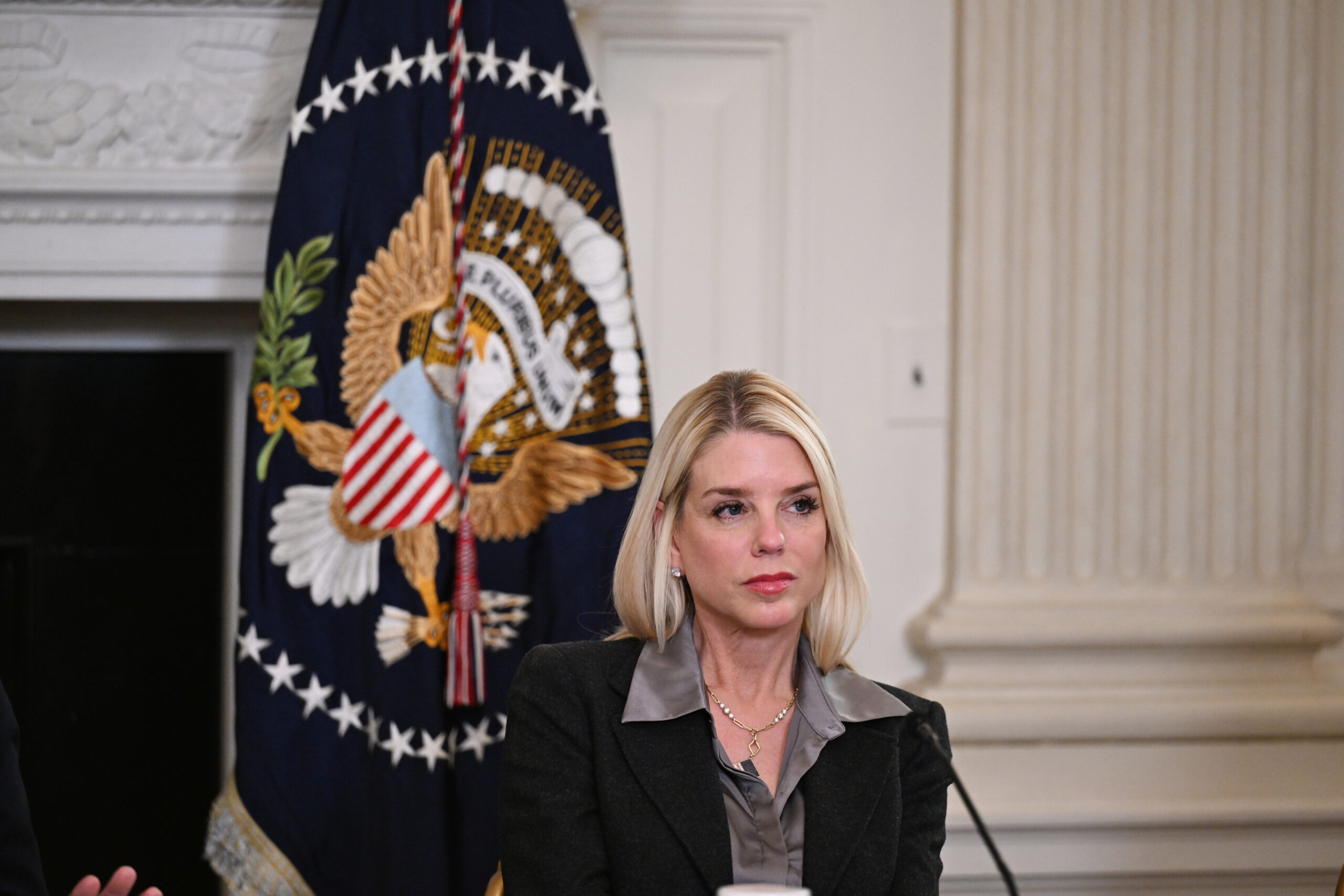
Attorney General Pam Bondi takes part in an event at the White House on Oct. 23.
Philadelphia city officials, for their part, say they remain committed to anti-violence programs, in which they have invested tens of millions of dollars in recent years.
“There are always going to be things that happen externally that we have no control over as a city,” said Adam Geer, director of the Office of Public Safety.
The reversal in federal support comes at a time when officials like Geer say the efforts of anti-violence programs are beginning to show results.
Violent crime in Philadelphia fell to historic lows in 2025, a welcome relief after the sharp upturn in shootings and homicides that befell the city at the height of the pandemic.
In 2021, the city announced a large-scale campaign to combat gun violence that,in the past year, included nearly $24 million for anti-violence programs.
That was on top of the Biden administration’s Community Based Violence Intervention and Prevention Initiative. Since launching in 2022, the DOJ program awarded more than $300 million to more than 120 anti-violence organizations nationwide.
In April, many of those groups, including New Kensington CDC, lost funds. And in September, a larger swath learned they were now barred from applying for other Justice Department grants that would have arrived this spring.
“We’ve seen enormous dividends” from the work of such groups, said Adam Garber, executive director of CeaseFirePA, a leading gun violence prevention group in the state. “Pulling back now puts that progress at risk — and puts lives on the line.”
Philadelphia feels the squeeze
Federal grants helped Natasha McGlynn’s nonprofit thrive.
McGlynn, executive director of the Antiviolence Partnership of Philadelphia, said a DOJ grant called STOP School Violence allowed her organization to launch a counseling program for young people who had been victims of violence or otherwise exposed to it in some of the city’s most violent neighborhoods.
The nonprofit used the grant to hire therapists to help students develop healthier attitudes around conflict and trauma, she said.
The $997,000 grant was cut in April, and when McGlynn went to apply for another round of funding in the fall, she learned that nonprofits were no longer eligible. The lost funding means some services, like counseling, could now be eliminated, she said.
“I would say several positions are in question,” McGlynn said. “I would say the program is in question.”
Chantay Love, the director of Every Murder is Real, said her Germantown-based victim services nonprofit also lost Justice Department funding in 2025.
Federal grants are not the nonprofit’s only source of income, Love said, but she along with other nonprofit leaders in the city are considering whether they’ll need to cut back on programs this year.
Record-setting investment
The decade before the pandemic saw gun-related deaths in the state climb steadily, spiking during the lockdown as social isolation, school closures, shuttered community services, and higher levels of stress contributed to a spate of gun homicides and shootings that began to ease only in 2024.
Two years earlier, the state began dispersing more than $100 million to community-based anti-violence programs, much of the money coming from the American Rescue Plan, a sweeping Biden administration pandemic recovery package that also sought to reduce rising gun violence. And when those funds expired, state lawmakers continued to invest millions each year, as did Philadelphia city officials.
Garber, of CeaseFirePA, said those efforts “get a lot of heavy-lifting credit” for Philadelphia’s historic decrease in violence.
A report compiled by CeaseFirePA cites studies that found outreach programs like Cure Violence helped reduce shootings around Temple University, as well as in cities like New York and Baltimore, where homicides and shootings in some parts of the city fell by more than 20%.
While it’s too early for data to provide a full picture on how such funding has contributed to overall violence reduction, officials like Geer, the Philadelphia public safety director, agreed that programs like Cure Violence have helped crime reach record lows.
Philadelphia acting chief public safety director Adam Geer attends a news conference on Jan. 30, 2024, about a shooting that left an officer wounded and a suspect dead.
Outreach workers with the city-supported Group Violence Intervention program made more than 300 contacts with at-risk residents in 2025, according to data provided by Geer’s office, either offering support or intervening in conflicts.
And they offered support to members of more than 140 street groups — small, neighborhood-oriented collectives of young people that lack the larger organization of criminal gangs — while more than doubling the amount of service referrals made the previous year.
In practice, a program’s success looks like an incident in Kensington in which Cure Violence workers intervened in a likely shooting, according to members of New Kensington CDC.
In April, a business owner called on the nonprofit after seeing a group of men fighting outside his Frankford Avenue store and leaving to return with guns. Members of the outreach team spoke with both parties, de-escalating the conflict before it potentially turned deadly.
“Each dollar cut is ultimately a potential missed opportunity to stop a shooting,” Garber said.
Cutting off the ‘spigot’
Even as community-based anti-violence programs have risen in popularity, they are not without their critics.
While some officials champion them as innovative solutions to lowering crime, others say the programs can lack oversight and that success is difficult to measure.
In 2023, an Inquirer investigation found that nonprofits with ambitious plans to mitigate gun violence received millions in city funds, but in some cases had no paid staff, no boards of directors, and no offices.
A subsequent review by the Office of the Controller found some programs had not targeted violent areas or had little financial oversight. But by the next round of funding, the city had made improvements to the grant program, the controller’s office found, adding funding benchmarks and enhanced reporting requirements.
Meanwhile, as Philadelphia continued its support these programs, President Donald Trump’s Justice Department began a review of more than 5,800 grants awarded through its Office of Justice Programs. It ultimately made cuts of more than $800 million that spring.
Among programs that lost funding, 93% were “non-governmental agencies,” including nonprofits, according to a letter DOJ officials sent to the Senate explaining the decision.
The balance of remaining funds in the violence prevention grant program — an estimated $34 million — will be available for law enforcement efforts, according to a DOJ grant report. In addition to fighting crime, the money will help agencies improve “police-community relations,” hire officers, and purchase equipment, the document says.
Agencies conducting immigration enforcement are also eligible for grants, the report says, while groups that violate immigration law, provide legal services to people who entered the country illegally, or “unlawfully favor” people based on race are barred.
One group lauding the cuts is the National Rifle Association, which commended the Trump administration in November for cutting off the “spigot” to anti-violence nonprofits.
‘[T]he changes hopefully mean that nonprofits and community groups associated with advocating gun control will be less likely to do it at the expense of the American taxpayer and that real progress can occur on policing violent criminals,” the NRA’s legislative arm wrote in a blog post that month.
Nate Riley disagrees.
Riley, an outreach worker with Cure Violence Kensington, said the cuts threaten to reverse the progress New Kensington CDC has made since he joined the program early last year.
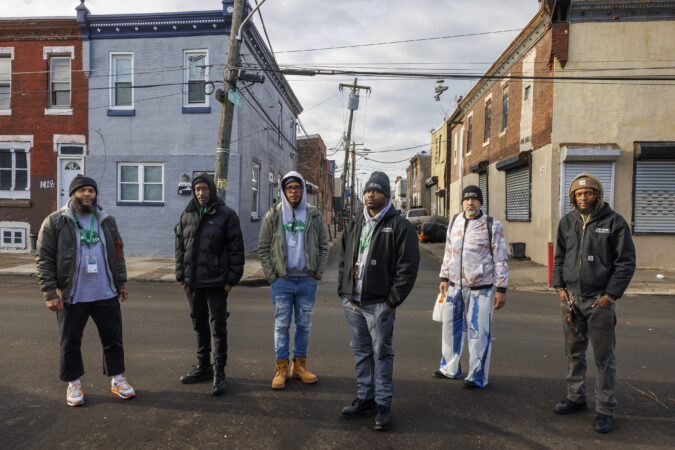
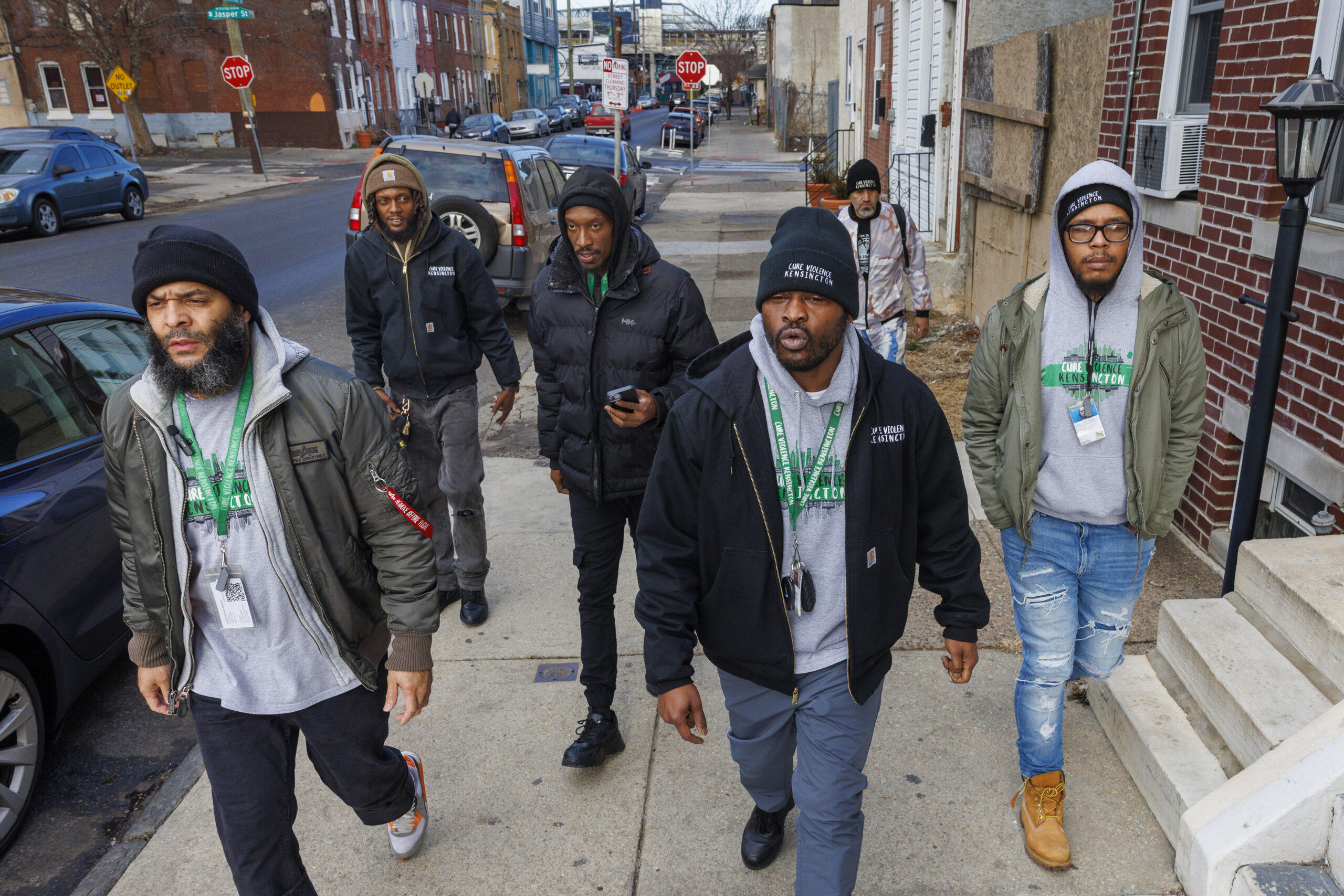
Nate Riley (from left), Tyree Batties, Dante Singleton, Tyreek Counts, Ivan Rodriguez, and Jamall Green-Holmes, outreach workers with New Kensington Community Development Corporation, making their rounds on Wednesday.
Cure Violence’s six-person outreach team is made up of people like Riley, who grew up in North Philadelphia and says he is well-versed in the relationship between poverty, trauma, and violence and brings that experience to Kensington.
“This is a community that’s been neglected for decades,” Riley said. “For lack of a better term, you’ve got to help them come in outside of the rain.”
In a recent month, Cure Violence outreach workers responded to 75% of shootings in the Kensington area within three days, a feat Riley is particularly proud of.
He said the program is not meant to supplant the role of police.
Instead, Riley sees street outreach as another outlet for those whose negative experiences with authorities have led them to distrust law enforcement.
Those people may alter their behavior if they know police are present, he added, giving outreach workers embedded in the community a better chance at picking up on cues that someone is struggling.
From Kensington to Washington
McKinney, with New Kensington CDC, said the group was still expecting about $600,000 from the Justice Department when the grant was cut short.
The nonprofit has since secured a patchwork of private donations and state grants that will keep Cure Violence running through much of 2026, he said.
After that, the program’s future is uncertain.
In the wake of the cuts, national organizations like the Community Justice Action Fund are advocating for federal officials to preserve funding for community-based anti-violence programs in future budgets. Adzi Vokhiwa, a federal policy advocate with the fund, said the group has formed a network of anti-violence nonprofits dubbed the “Invest in Us Coalition” to do so.
The group petitioned congressional leadership in December to appropriate $55 million for anti-violence organizations in the next budget — a figure that both Democrats and Republicans in the Senate have previously agreed on and that Vokhiwa views as a sign of bipartisan support for such programs.
McKinney, with New Kensington CDC, said it was impossible to ignore that the nonprofit and others like it provide services to neighborhoods where residents are overwhelmingly Black and brown. In his view, the cuts also reflect the administration’s “war on cities.”
He was bothered that the Justice Department did not seem to evaluate whether New Kensington CDC’s program had made an impact on the neighborhood before making cuts.
“We’re in a situation where the violence isn’t going away,” he said. “Even if there’s been decreases, the reality is that Kensington still leads the way. As those cuts get deeper, we are going to see increases in violence.”
OCEAN CITY, N.J. — Once again, the football was yanked away from would-be Ocean City boardwalk hotel developer Eustace Mita just as he was about to kick it.
Ocean City’s planning board unexpectedly deadlocked Wednesday night on a request to declare the old Wonderland Pier site “in need of rehabilitation,” dealing a significant setback to Mita’s plan to build a luxury hotel on the boardwalk property.
The vote is the second time Ocean City has thwarted Mita’s attempts to move his project forward (though, in loop-the-loop fashion, an earlier no vote by City Council was later reversed.)
Mita, who has proposed turning the property into Icona in Wonderland, called Wednesday’s vote an “incredibly serious roadblock.” He said he indeed felt a bit like Charlie Brown to the city government’s Lucy, and revived thoughts of selling the property.
A rendering of the proposed new Icona in Wonderland Resort, to be built on the site of the old Wonderland Pier. The proposal for a 252-room resort includes saving the iconic Ferris wheel and carousel.
The board was split 4-4 with half the members agreeing that the property was significantly deteriorated and underutilized, two legal criteria needed for the designation.
But half the board, including chair John Loeper, said they did not believe the criteria had been met, and noted some businesses were open last summer at the front of the property.
The matter still will go back to City Council for a final vote on the designation, but Mita said if Council waits too long, he will unload the property.
The “in need of rehabilitation” designation has been long sought by Mita, who wants to build a $150 million luxury hotel at 600 Boardwalk.
The designation would allow site-specific zoning changes and possible tax breaks. The site is currently zoned for amusements.
After the meeting, Mita said he was shocked by the failure of the board to recommend the designation. “It’s been deteriorated for decades before I bought it,” he said. “I’m very very disappointed. This is the poster child for rehabilitation. ”
Gillian’s Wonderland Pier closed in October 2024, ending nearly a century of amusement ride ownership by the Gillian family in Ocean City. Mayor Jay Gillian had sold the property to Mita and leased it back from him, but said he could not make the enterprise profitable.
Gillian recently declared Chapter 11 personal bankruptcy, listing nearly $6 million in debt.
Wednesday’s vote brought about 150 people out to another iconic boardwalk structure, the Music Pier, on a pleasantly warm January evening.
About three dozen members of the public spoke, including Mita himself, who said the city would benefit “tenfold” from his development plans. The speakers were evenly divided in their views.
A visit from Will Morey
Will Morey came up from Wildwood to lay bare what many in Ocean City did not want to hear — reviving Wonderland Pier as an amusement park would be next to impossible.
“Starting from the ground up, it is not financially feasible,” Morey, the CEO of Morey’s Piers, told the city’s planning board. “It’s a very challenging lift.”
The board could not agree that the property met the legal criteria for the designation: that it was significantly deteriorated and showed a pattern of vacancy and underutilization.
“It’s an enormous piece of property that’s literally falling apart on the oceanfront,” said board member Dean Adams.
But Loeper, the chair, called the abandonment “self-inflicted” and said he would need more proof of the deterioration.
Engineering and other studies put the cost of repairing the carousel, Ferris wheel, and log flume at $6.5 million, and the cost of fixing the site’s concrete foundation and pilings at $3.9 million.
The matter will still go back to Ocean City’s City Council, which is also awaiting a report from a boardwalk subcommittee.
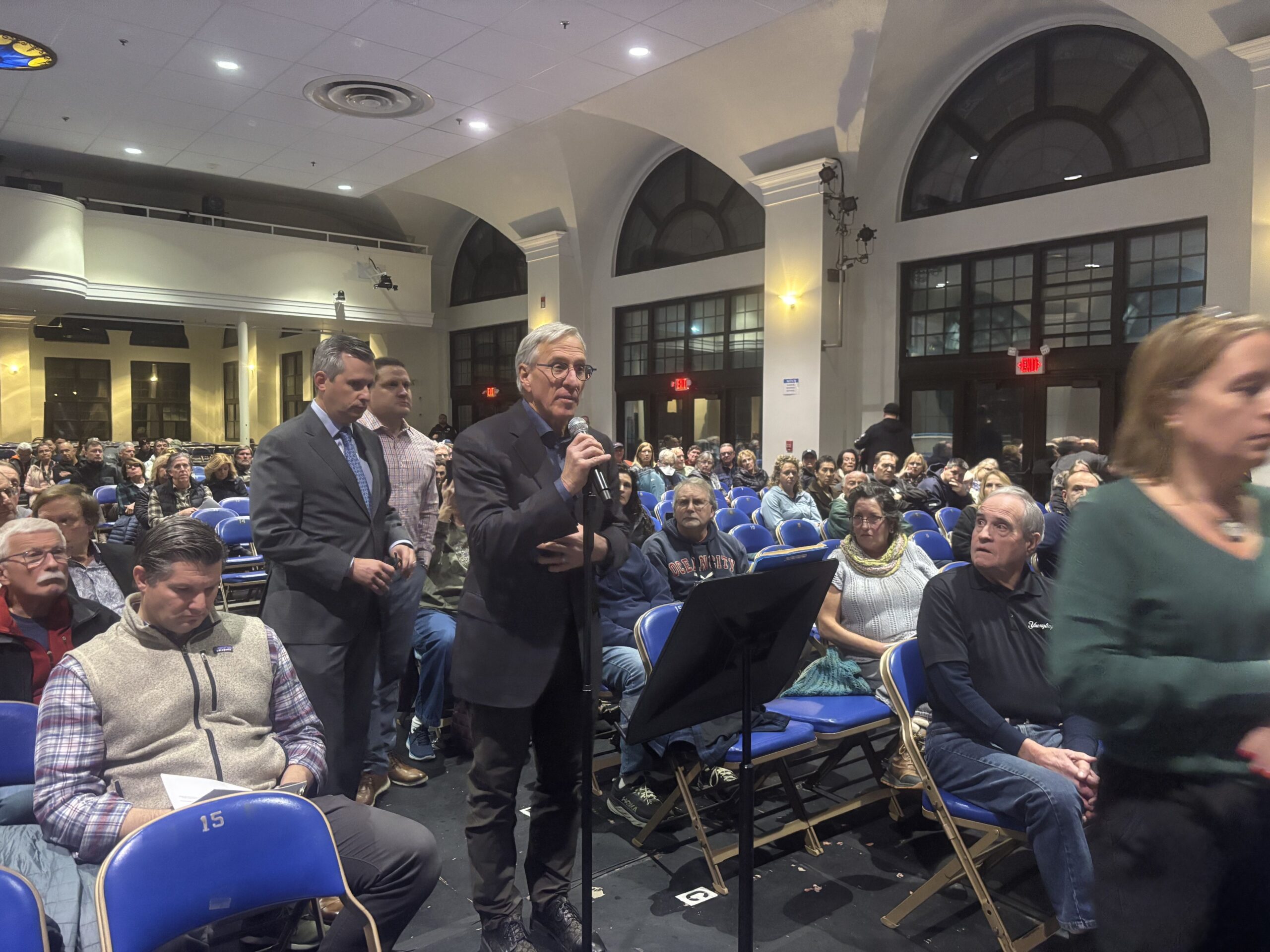
Eustace Mita arriving at the Ocean City Music Pier for a city planning board meeting on Wednesday. He was seeking a recommendation that the old Wonderland Pier site he owns be declared “in need of rehabilitation,” which he described as “Step 2” in his plan to build a luxury hotel.
‘The boardwalk is not thriving.’
Opponents asked board members to deny the “in need of rehabilitation” designation. They scoffed when Jody Arena, a construction expert who testified about the property’s deteriorated state, acknowledged that Mita was a partner in his firm, Caritas Construction.
They surmised that similar photos of deterioration could be taken of the Music Pier, where the meeting was held. One resident, Jim Tweed, said the designation would threaten “decades of restraint.”
Business owners, including the owners of Manco’s, George’s Candies, Cousin’s Restaurant, Barefoot Trading, and Ocean City Bikes, asked the board to approve the designation to avoid further closures of businesses. They described a devastating impact from the closure of Wonderland Pier.
Boardwalk property owner Mark Raab said three of his tenants had decided to close their shops. “People don’t know what’s been going on,” he told the board. “The boardwalk is not thriving. It’s going down piece by piece.”
“We are a city based on tourism,” said Cousin’s Restaurant owner Bill McGinnity. “We’d appreciate a vote of ‘yes’ tonight so that we can move forward quickly,”
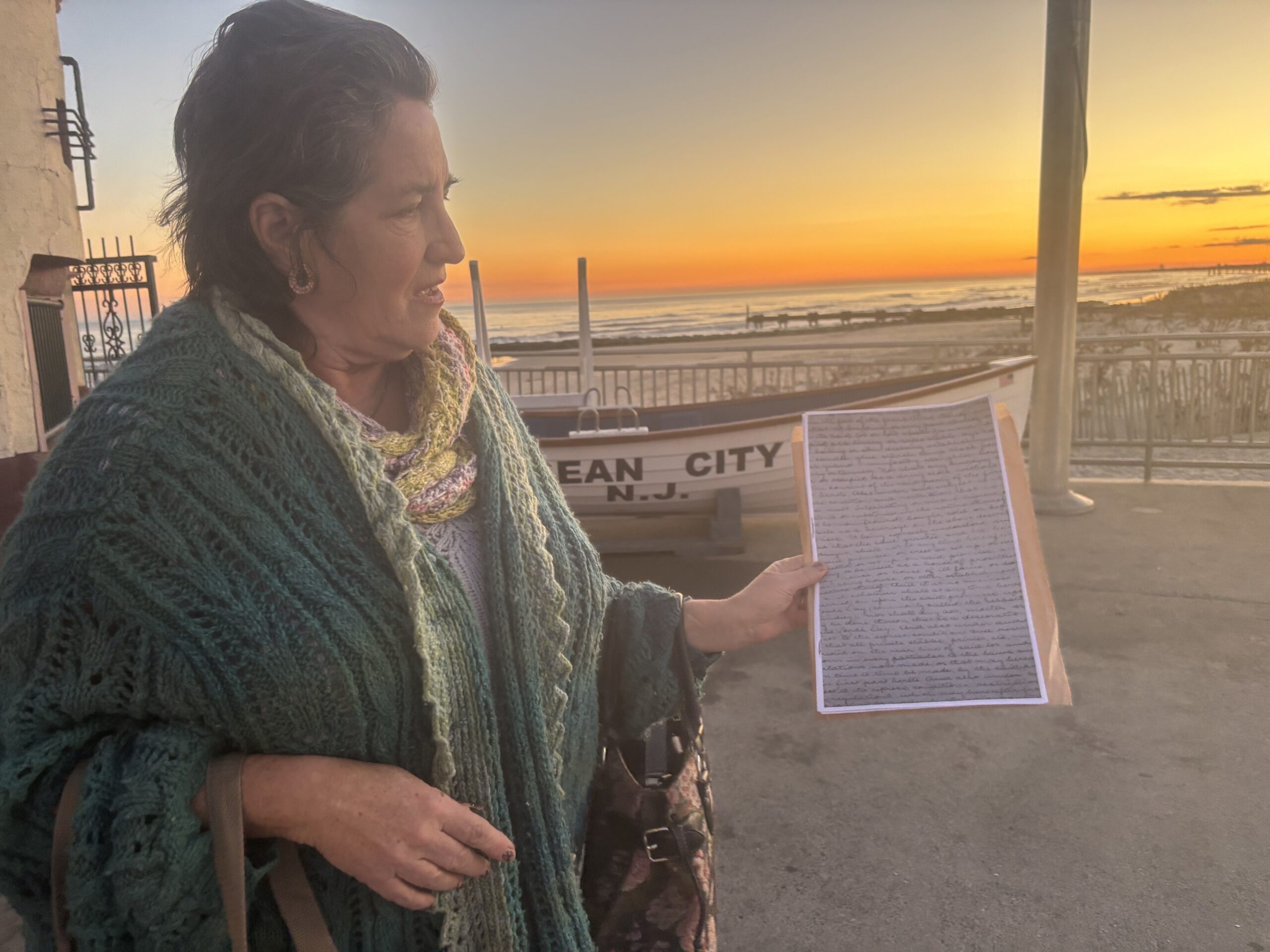
Others resisted any fast-tracking of development. Donna Saber, owner of Here Comes the Bride shop, brought along a copy of the original 1881 deed that she said sought to preserve its original intent as a place for child amusements.
“It was deeded as an amusement park,” she said.
Donna Saber, owner of Here Comes the Bride bridal shop in Ocean City, holds a copy of the original 1881 deed to the property that was the Wonderland Pier. She’s opposed to a plan to build a luxury hotel.
Marie Hayes, a full-time resident for 22 years, worried the designation would set a “dangerous precedent,” that would result in the town resembling Ocean City, Md., with high-rises along its oceanfront.
The planning board was given reports submitted by Mita back in August, when council stunned some, especially Mita, by voting not to ask the board to study the site’s future. Mita immediately said he would sell the property.
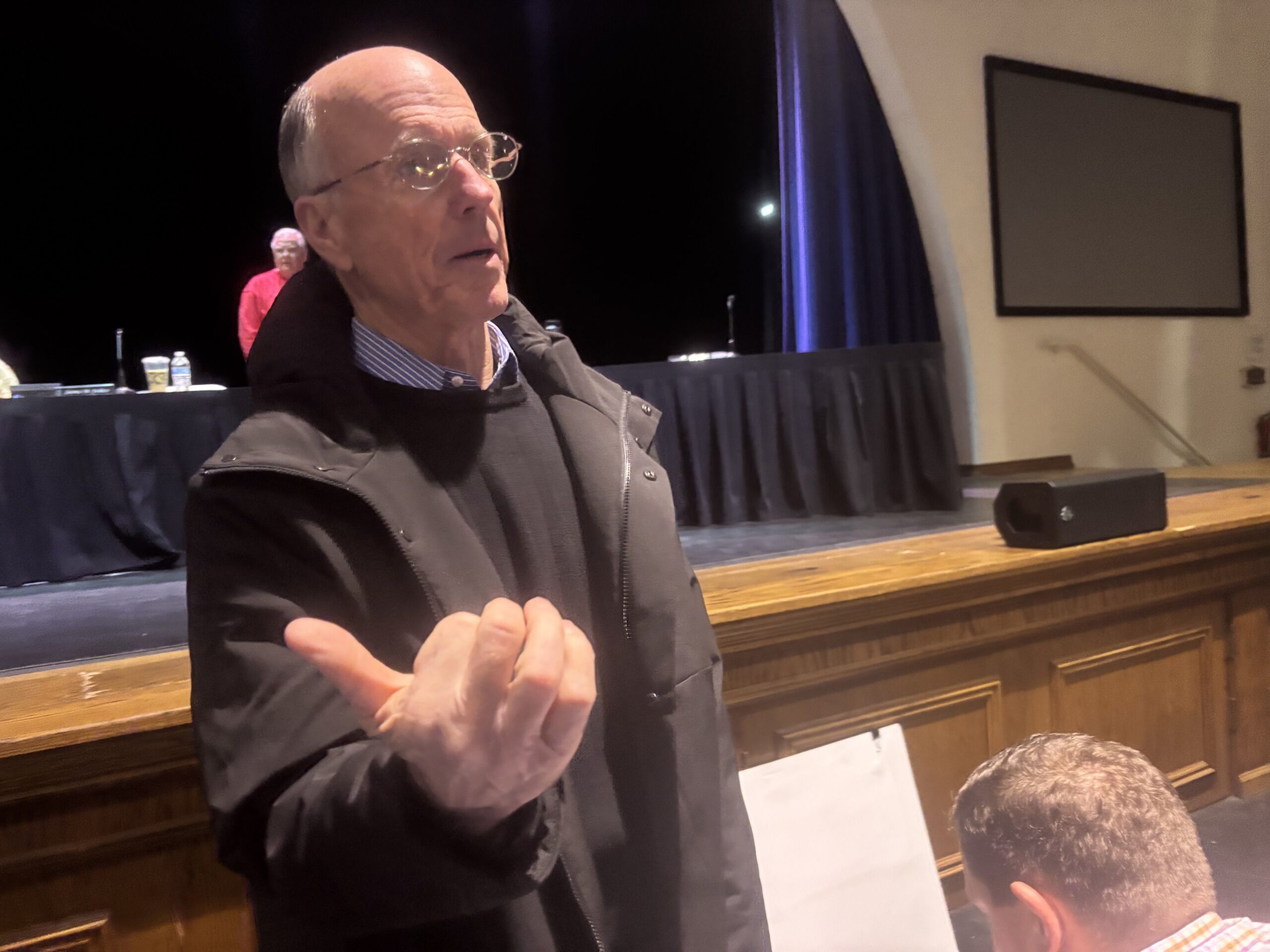
John Loeper, chair of Ocean City’s planning board, on stage at the Ocean City Music Pier. The planning board was set to vote on whether to recommend that the old Wonderland Pier site be declared in need of rehabilitation, a designation that could lead to a luxury hotel on the site.
Sean Barnes, the city councilman liaison to the planning board, questioned Wednesday whether the rides should even be considered part of the property.
“Amusement rides are not structures,” said Helen Struckmann, a resident who has opposed the hotel idea and vowed to save Wonderland Pier. She said the historic carousel was in better shape than the reports stated. “They don’t justify the need for rehabilitation designation for the property. Different amusement rides have been swapped out.”
She and others questioned why Mita had not addressed deterioration of the property since purchasing it in 2021. Mita is “now requesting a benefit from his purposeful underutilization of the property,” said resident Bob Duffy.
But Mita said he’d waived rent on the property so that Jay Gillian could try to make a go of the amusement pier. He said he’d put in $500,000 last summer to open the front portion of the property as an arcade, coffee and pizza shop, and bike shop.
Engineer Matt Mowrer told the planning board the property was “heavily deteriorated,” with “concrete spalling” — chunks of concrete breaking off from the foundation. He said corrosion from salt air would get only worse.
Board planner Randall Scheule told the board Wednesday he believed the structural deterioration of the property itself and the underutilization of the property met the standards. There was some debate as to whether the rides themselves should be included in any analysis.
The board looked at whether the site met the legal criteria needed for the designation, which will allow City Council to rezone the site for a hotel and grant tax abatements.
Will Morey, president and CEO of Wildwood’s Morey’s Piers, testifies in Ocean City at a planning board meeting to determine the future of the old Wonderland Pier.
The board did not discuss Mita’s specific hotel plans, which have included the carousel and Ferris wheel and some kiddie rides.
The old Wonderland Pier site on the boardwalk in Ocean City, N.J., as seen from Wayne Avenue on Jan. 6. The beloved amusement pier shut down in October 2024. A developer wants to build a luxury hotel. A report put the cost of repairing the Ferris wheel, carousel, and log flume at as much as $6.5 million.Five minutes before the 6 p.m. scheduled closing all but one of the gates are shut on the Boardwalk, on the final day for the beloved Wonderland Pier in Ocean City Sunday, Oct. 13, 2024.
Last summer, four businesses operated on the site: Ocean City Pizza Company, Dead End Bakehouse, Wonderland Pier Arcade, and OC Bikes and Rentals. Mita entertained several offers to sell, including one from the Norcross brothers, who envisioned residential development.
Planner Tiffany Morrissey told the planning board that showed the property was underutilized.
The property is assessed at $15.8 million, which translates to an estimated market value of about $29 million.
Saving the site as an amusement park has been the focus of much despair among community members and others with generations of memories at Wonderland Pier.
But the reports lay out the deterioration of the pier’s marquee attractions.
The report states that the carousel, which dates to the 1920s, would require as much as $1.5 million in repairs, including a new electrical system and repair or replacement of the telescopes, the poles that support the horses.
The Ferris wheel is also in need of substantial repair, costing as much as $2.5 million, including replacing or repairing the lights, and rebuilding the spokes and “spreader bars,” which connect the spokes and form the arc.
The Log Flume Ride, built in 1992, would need substantial repairs estimated at between $2.5 and $4 million, including rebuilding the upper troughs.
No company has stepped forward with a plan to keep the site solely an amusement park.
Another lawsuit has been filed on behalf of victims of the explosion at a Bucks County nursing home just before Christmas that left three dead and about 20 people injured.
The plaintiffs, Joseph Juhas Sr. and MaryAnn Schnepp, were residents of Bristol Health and Rehab Center when an explosion just after 2:15 p.m. on Dec. 23 ripped through the main building and caused an intense fire. The spouses of the victims also are named as plaintiffs.
The lawsuit, filed Wednesday in Philadelphia Common Pleas Court, names as the defendants PECO Energy Company and its parent company, Exelon Energy, and Bristol Health and Rehab Center LLC, and its parent company, Saber Healthcare Group. The former operators of the nursing home also are named as defendants.
“Joe and Maryann suffered serious life-changing injuries because of the negligence of the defendants,” said Brian Fritz, the lead attorney representing the plaintiffs. “We plan on holding all of them responsible for their lack of action in dealing with the well-documented gas leak and conditions that led to this tragic event.”
On Monday, a lawsuit was filed alleging negligence in the nursing home explosion.
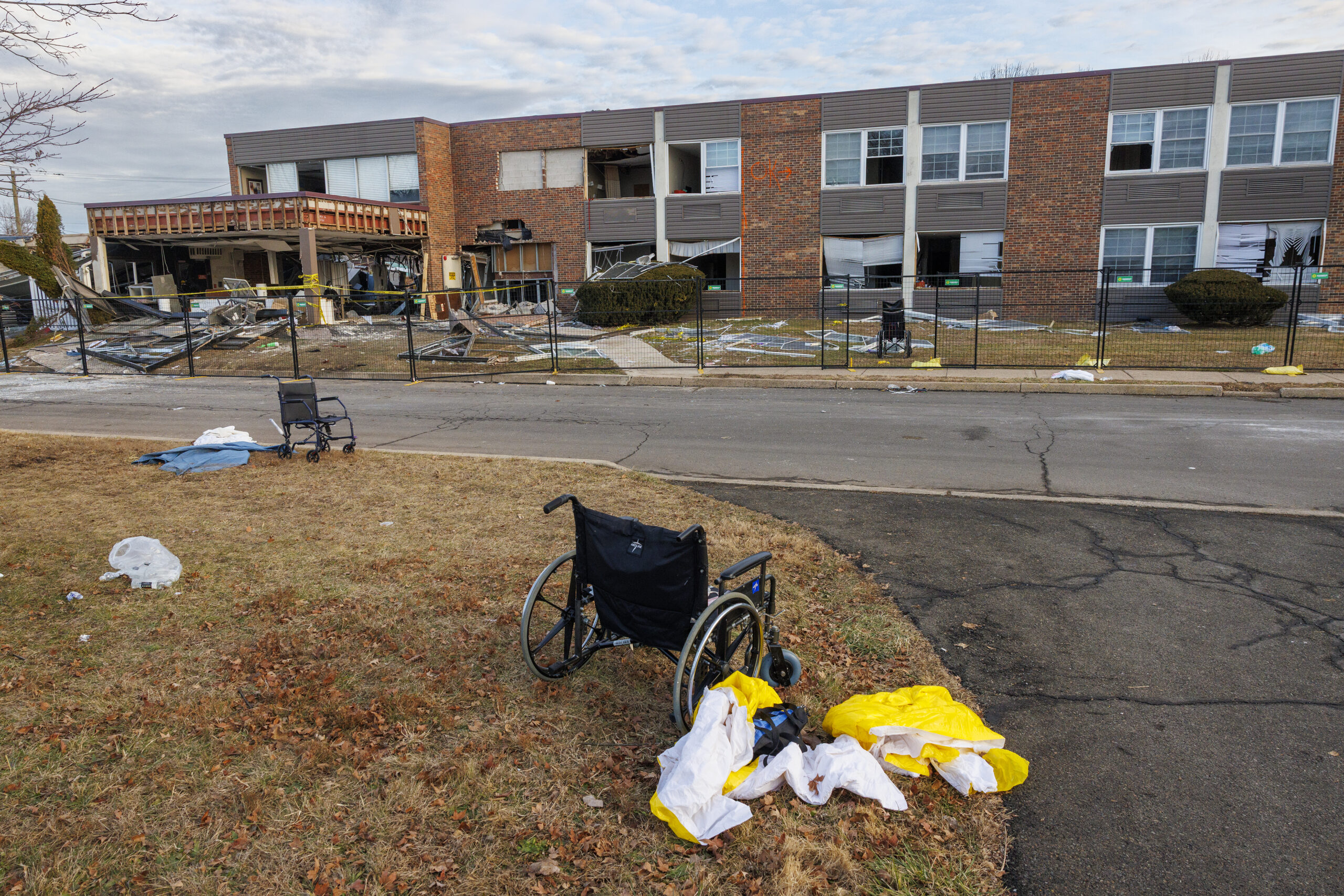
Exterior of Bristol Health & Rehab Center after the Dec. 23 fatal explosion. The photograph taken Christmas morning, Thursday, December 25, 2025.
The cause of the explosion is under investigation — including by the National Transportation Safety Board, which investigates pipeline accidents.
The lawsuit alleges that the nursing home defendants “proceeded as business as usual in the face of a natural gas leak, which presented a clear and obvious threat to the safety and well-being” of the residents.
The nursing home defendants “recklessly and with callous disregard continued to supply cigarettes and lighters to the residents during the scheduled smoking sessions throughout the day while they knew or should have known that such activity could cause any gas manifestation from the gas leak to explode,” the lawsuit alleges.
In an interview with the Inquirer, Susie Gubitosi, 71, a resident who is blind and uses a wheelchair, said that just after 2 p.m. that day, she returned inside the building after joining several other residents on the patio for a cigarette break. Gubitosi said she was waiting inside for a staffer to help her with a task when the explosion occurred.
According to the lawsuit, MaryAnn Schnepp suffered traumatic brain injury, intracranial bleeding, laceration to her scalp requiring staples, a collapsed lung, and broken bones, including broken ribs.
Joseph Juhas Sr. also suffered traumatic brain injury, intracranial bleeding, and bone fractures, according to the lawsuit.
The scene at Bristol Health and Rehab Center on Wednesday, Dec. 24, 2025, in Bristol Township, Pa.
Zach Shamberg, chief of government affairs for Saber Healthcare Group, said in an email: “We continue to cooperate with the ongoing investigation, and we cannot comment on pending litigation.”
A spokesperson for Peco said in an email: “We are a party to the National Transportation Safety Board investigation. We are fully cooperating with the NTSB and according to the NTSB rules, we are not permitted to comment on this matter.”
The age and condition of the gas line running to the nursing home remain unclear, but Peco has said that it has about 742 miles of substandard gas lines across the state that need to be replaced — accounting for roughly 5% of its gas service, but 82% of leaks, according to a report from the Pennsylvania Public Utility Commission.
WASHINGTON — The State Department said Wednesday that it has suspended all U.S. assistance to Somalia’s federal government over allegations that Somali officials destroyed an American-funded warehouse belonging to the World Food Program and seized 76 metric tons of food aid intended for impoverished civilians.
“The Trump Administration has a zero-tolerance policy for waste, theft, and diversion of life-saving assistance,” the department said in a statement.
“The State Department has paused all ongoing U.S. assistance programs which benefit the Somali Federal Government,” it said. “Any resumption of assistance will be dependent upon the Somali Federal Government, taking accountability for its unacceptable actions and taking appropriate remedial steps.”
It was not immediately clear how much assistance would be affected by the suspension because the Trump administration has slashed foreign aid expenditures, dismantled the U.S. Agency for International Development and not released new country-by-country data.
The U.S. had provided $770 million in assistance for projects in Somalia during the last year of Democratic President Joe Biden’s administration, but only a fraction of that went directly to the government.
The Trump administration made the move after authorities at the Mogadishu Port demolished the WFP warehouse at the direction of President Hassan Sheikh Mohamud “with no prior notification or coordination with international donor countries, including the United States,” according to a U.S. official familiar with the alleged incident.
The official spoke on condition of anonymity to discuss private reporting from American diplomats in the region.
WASHINGTON — The U.S. population is projected to grow by 15 million in 30 years, a smaller estimate than in previous years, due to President Donald Trump’s hard-line immigration policies and an expected lower fertility rate, the Congressional Budget Office said Wednesday.
The nonpartisan budget office projected that the U.S. population will grow from 349 million people this year to 364 million people in 30 years, a 2.2% smaller gain than it had predicted in 2025. In September, the office issued a revised demographics report that showed Trump’s plans for mass deportations and other strict immigration measures would result in roughly 320,000 people removed from the United States over the next 10 years.
The country’s total population is projected to stop growing in 2056 and remain roughly the same size as in the previous year, the CBO said. But without immigration, the population would begin to shrink in 2030 as deaths start to exceed births, making immigrants an increasingly important source of population growth, according to the report.
Even if the limits on immigration and increased deportations end with the Trump administration in three years, “it’s still a demographic shock,” said William Frey, a demographer at the centrist Brookings Institution.
Social Security and Medicare, which are already buckling under an aging population, will be under increasing pressure with even fewer than expected people in the labor force paying taxes. By the end of the decade, all of the nation’s baby boomers, born between 1946 and 1964, will be over age 65.
With fewer immigrants in the labor force and projections for U.S. fertility rates showing a long-term decline below replacement levels, “that reduces the number of kids who are going to be born in that four-year period” of the second Trump administration, Frey said.
The latest numbers come as Trump has pushed for the largest mass deportation campaign in history. The CBO’s numbers account for the success of those efforts in the first year of his second term in office.
Trump’s tax and spending law, passed by Congress and signed in July, included roughly $150 billion to ramp up his deportation agenda over the next four years. This includes money for extending the U.S.-Mexico border wall, building detention centers and adding thousands of law enforcement staff.
When it comes to estimating the nation’s population and future growth, immigration is always the wild card because it varies much more year to year than the number of births and deaths. Immigration has fueled U.S. population growth this decade because of an aging population and fertility lower than the replacement rate. For a generation to replace itself in the absence of immigration, the fertility rate needs to be 2.1 births per woman. But it was expected to be 1.58 in 2026 and is projected to drop to 1.53 in 2036 where it will remain over the next two decades.
The U.S. Census Bureau said that immigration increased by 2.8 million people in 2024 over the previous year.
Since Trump returned to office in January 2025, though, demographers and economists have struggled to decipher the impact of his policies on immigrant growth in the United States.
The bureau’s population estimates for last year have not been released yet, but the Current Population Survey estimated that the number of adult immigrants fell by 1.8 million people from January to November 2025. But those numbers have come under scrutiny, with some experts claiming they may reflect a decline in participation by immigrants in the survey rather than a dramatic drop in immigrant numbers.
Last September, the CBO reduced its immigration estimate for 2025 by 1.6 million people, and it said Wednesday that the U.S. added 410,000 immigrants last year. Immigration is projected to gradually increase through 2030, and then grow more slowly through 2036 because of fewer international students and temporary workers, before jumping up to an average of 1.2 million people a year from 2037 to 2056, the CBO said.
“These immigrants bring both themselves and the potential for children in the near term,” Kenneth Johnson, a senior demographer at the University of New Hampshire, said in an email. “They contribute both to the labor force through their arrival but also to the potential future growth of the US population through their potential to have children in the near term.”
LOS ANGELES — The high-profile private attorney for Nick Reiner resigned from his case Wednesday for reasons he said he could not reveal, and he later told reporters that under California law his client is definitely not guilty of murder in the killing of his parents, Rob Reiner and Michele Singer Reiner.
“Circumstances beyond our control and more importantly circumstances beyond Nick’s control have dictated that, sadly, it’s made it impossible to continue our representation,” lawyer Alan Jackson said as he stood with his team outside a Los Angeles courthouse.
But, Jackson added, after weeks of investigation, “what we’ve learned, and you can take this to the bank, is that pursuant to the laws of this state, pursuant to the law of California, Nick Reiner is not guilty of murder. Print that.”
Jackson would not specify what he meant and took no questions at the brief news conference, but it was the first direct statement from a Nick Reiner representative about his guilt or innocence in the 3 1/2 weeks since the killings.
He spoke after a hearing where Reiner was supposed to be arraigned and enter a plea to two charges of first-degree murder. Instead, after meeting with the Judge Theresa McGonigle in chambers, Jackson, at his own request, was replaced by a public defender and the plea hearing was postponed to Feb. 23.
Jackson does not say why he has to quit case
Jackson said that for legal and ethical reasons, he could not reveal why he had to resign. He first appeared in court representing Nick Reiner at a hearing a few days after the beloved actor-director and his wife of 36 years were found dead with stab wounds in their home in the upscale Brentwood section of Los Angeles. Jackson did not say how he was hired — or who hired him. Generally, defendants use public defenders when they can’t pay for a private attorney.
Jackson has become one of the most prominent defense attorneys in the nation in recent years after his defense of clients including Harvey Weinstein, Kevin Spacey and Karen Read at her intensely followed trials in Massachusetts.
Deputy Public Defender Kimberly Greene took over as Reiner’s attorney during the hearing.
“The Public Defender’s Office recognizes what an unimaginable tragedy this is for the Reiner family and the Los Angeles community,” LA County Public Defender Ricardo D. Garcia said in a rare public statement on a case from the office. “Our hearts go out to the Reiner family as they navigate this difficult time. We ask for your patience and compassion as the case moves through the legal process.”
A Reiner family spokesperson said in a statement after Wednesday’s hearing that “They have the utmost trust in the legal process and will not comment further on matters related to the legal proceedings.”
Nick Reiner appears in jail clothes, without suicide prevention smock
During Wednesday’s hearing, Reiner stood behind glass in a custody area of the courtroom wearing brown jail garb and with his hair shaved. Two deputies stood behind him. Jackson and his team stood in front of him on the other side of the glass. At one point, Reiner stood on his tiptoes to peer over the lawyers’ heads to look at the audience. He spoke only to agree to the delayed arraignment.
McGonigle approved the use of cameras inside the courtroom but said photos and video could not be taken of the defendant. Reiner did not wear the suicide prevention smock he had on at his initial court appearance on Dec. 17.
Reiner, 32, the third of Rob Reiner’s four children, has been held without bail since his arrest hours after his parents were found dead on Dec. 14.
Jackson says he ‘dropped everything’ to represent Reiner
Jackson, a former LA County prosecutor, had given no indication of the plans for his defense.
He said that just hours after Nick Reiner’s arrest, he and his team were in New York when they got a call about representing him. He did not say who called him.
“We dropped everything,” Jackson said. “For the last three weeks, we have devoted literally every waking hour to protecting Nick and his interests. We’ve investigated this matter top to bottom, back to front.”
He said they remain “deeply, deeply committed” to him and said, “We’re not just convinced; we know that the legal process will reveal the true facts.”
Rob Reiner, 78, and Michele Singer Reiner, 70, were killed early on the morning of Dec. 14, and they were found in the late afternoon, authorities said. The LA County Medical Examiner said in initial findings that they died from “multiple sharp force injuries.” A court order has prevented the release of more details. Police have said nothing about possible motives.
Prosecutors have said they have not yet decided whether to seek the death penalty for Nick Reiner.
Rob Reiner was a prolific director whose work included some of the most memorable and endlessly watchable movies of the 1980s and ’90s. His credits included “This is Spinal Tap,” “Stand By Me,” “A Few Good Men,” and “When Harry Met Sally …,” during whose production he met Michele Singer, a photographer, and married her soon after.
A decade ago, Nick Reiner publicly discussed his struggles with addiction and mental health after making a movie with his father, “Being Charlie,” that was very loosely based on their lives.