Category: News

Latest breaking news and updates

  • A cow beauty pageant honors rural Pennsylvania’s shrinking dairy industry

    A cow beauty pageant honors rural Pennsylvania’s shrinking dairy industry

    TOWANDA, Pa. — Her full name was Cashells Jry Shakira-Red-ET — Shakira to keep it simple — and like her namesake, the big red and white Holstein had 6-foot hips that didn’t lie as she hoofed down Main Street.

    Shakira is a showgirl accustomed to winning, one of the few cows that allowed judges to place a floral crown on her head at the Bradford County dairy cow beauty pageant in Towanda on June 20, about 100 years after their last one.

    “The most beautiful dairy cow in Bradford County, folks,” said Duane Naugle, Bradford County’s community planner and the day’s emcee.

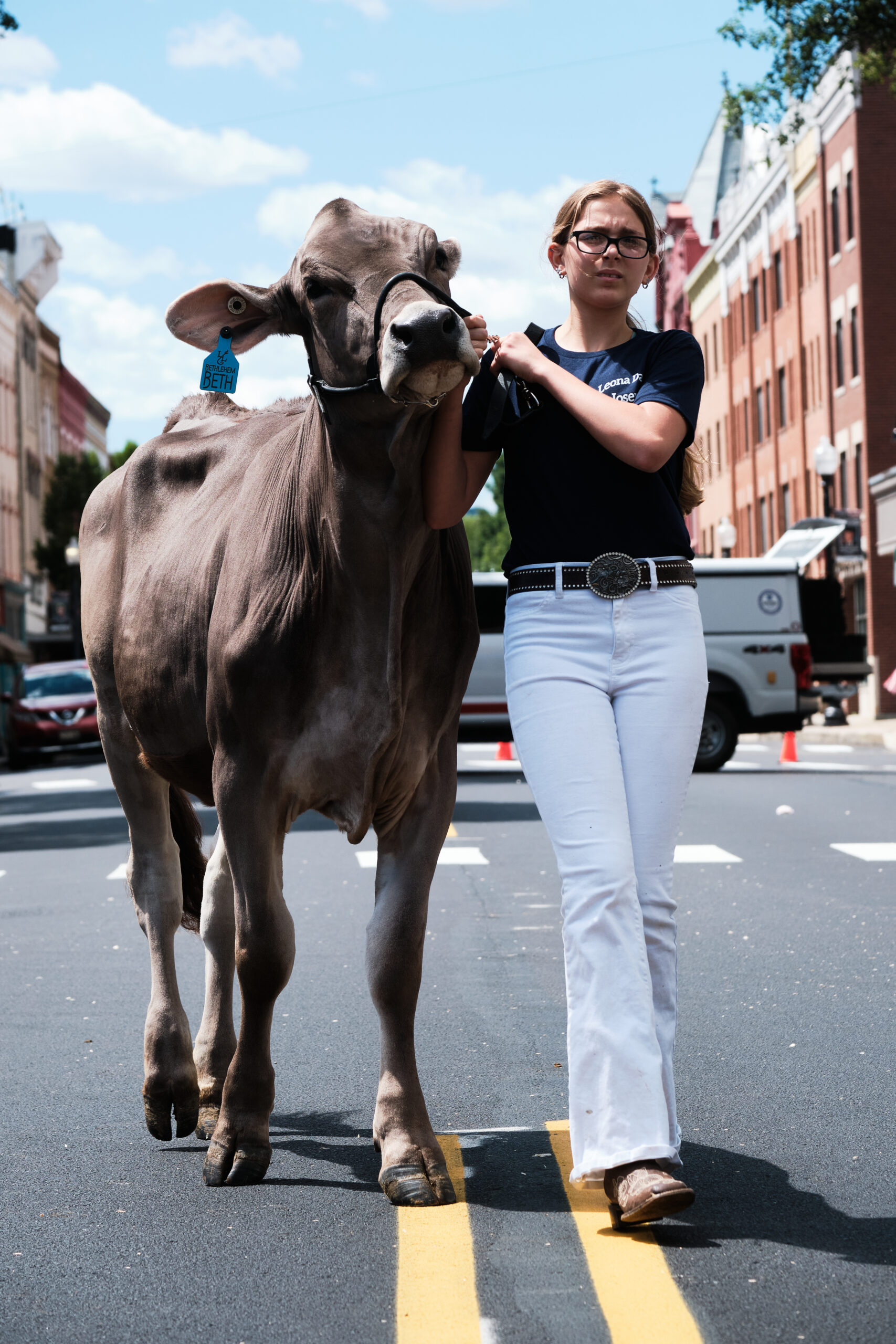
    A heifer is walked down Main St. in front of the County Courthouse in Towanda, Pa., for a cow beauty contest held on Saturday, June 20, 2026.

    Other winners were Skylar, a Lineback heifer, and Camo, a doe-eyed Brown Swiss calf.

    “They’re my favorite breed. They’re just so dopey and docile,” Miranda Neville, a dairy farmer out of Warren Center, said of Camo. “I mean, just look at her.”

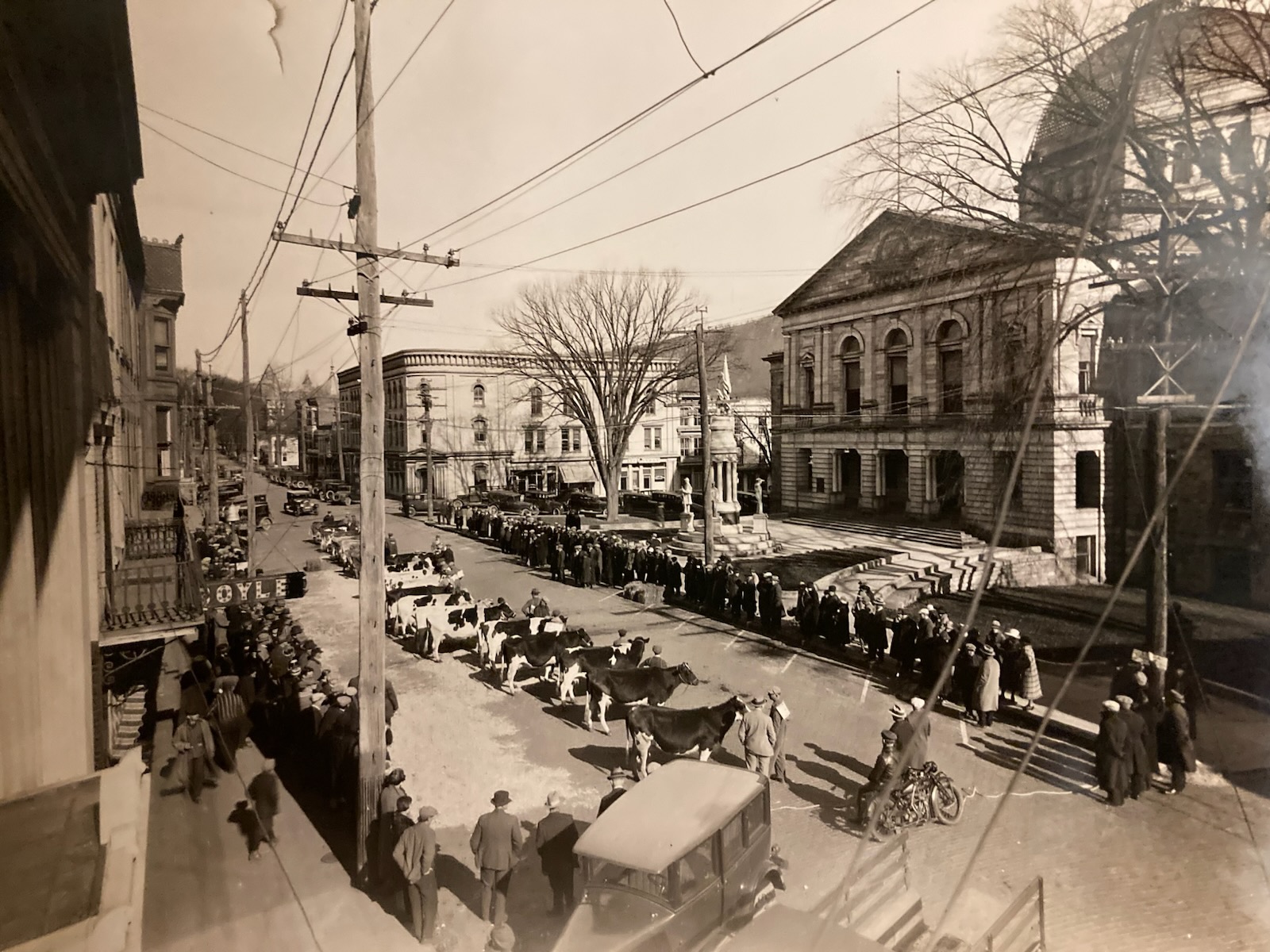
    Bradford County, population 59,600, sits about 175 miles northwest of Philadelphia in North Central Pennsylvania. County officials said they found an old, black-and-white photo of a similar beauty pageant from 1926 in the county courthouse recently.

    The 1926 event in Bradford County.

    The purpose of that contest a century ago, organizers said, was to highlight the county’s bustling dairy industry.

    “Getting down to the main idea, it may be stated that the Chamber of Commerce has seized upon this opportunity of giving recognition to the basic industry of Bradford County — dairying,” The Daily Review newspaper wrote in 1926.

    Officials figured that old photo was a sign, a good-enough reason to get cows on Main Street as part of the county’s ongoing celebration of America’s 250th. There was also free ice cream, a cow milking contest, and other livestock to pet.

    Dixie Joseph leads her heifer down Main Street in Towanda, Pa., for a cow beauty contest in front of the Bradford County courthouse on June 20.

    A lot has changed in dairy over the decades, as dairy farms have shuttered by the thousands, nationwide. In 2025, the USDA reported 23,609 dairy farms across the country, a 70% decrease in just 20 years.

    Earlier this year, The Inquirer chronicled the plight of a longtime dairy farm in New Jersey’s most rural county. Owners there were denied a variance to install solar panels and stopped milking shortly after.

    “We have been losing money for the last 10 years,” a young farmer there told The Inquirer.

    Henry Farley, the mayor of Sayre, Bradford County, said there were 41,311 dairy cows in the county in 1920. That number is down to 10,059 dairy cows today, he said.

    “We remain an agricultural county, and dairy is still a big part of it,” he said. “This is still rural America, and this was a great way to showcase that.”

    A cow owner glances back in front of a crowd gathered at the Bradford County courthouse for a cow beauty contest in Towanda, Pa., on June 20.

    Top employers in Bradford County include medical facilities, a mill, Walmart, and Cargill, a beef-processing plant in Wyalusing, where most major league baseballs are made from dairy cow hides.

    Many of the farmers in Towanda on June 20 owned small farms, which are the hardest to keep afloat. Most of the owners couldn’t depend on dairy as a full-time income and worked other jobs as a result.

    Many dairy farms in Bradford County have transitioned to beef, poultry, or swine.

    “Well, it’s pretty simple. Dairy prices are down, and beef is up,” said dairy farmer McKenzie Slater.

    Neville said she still milks 60 cows at her dairy, Vin-Deb Farms, but it’s not her only source of income. She also works for Bradford County’s conservation district.

    Sheyann of Campbell Farm rests on top of her calf, Norma, ahead of Bradford County’s cow beauty contest in Towanda, Pa., on June 20.

    “We all have full-time jobs, too, along with farming,” Neville said. “That’s normal around here.”

    Even Shakira, the showgirl, still milks, producing more than 11 gallons per day. She’s just preened and washed a bit more. Her udders hung low on Main Street.

    “She’s milking pretty heavy right now,” said owner Hannah Watson, of Columbia Crossroads, Bradford County. “It’s whole milk, straight from the cow.”

    A judge scores the cows on their beauty in front of the Bradford County courthouse in Towanda, Pa., on June 20.
  • Your guide to South Jersey’s mini golf courses

    Your guide to South Jersey’s mini golf courses

    Mini golf is an underrated nostalgic summer staple. The rainbow array of golf balls, the sun-bleached artificial turf, the tilting windmills, and fiberglass volcanoes will transport you right back to childhood, melting ice cream cones and all.

    It’s easy to find putt-putt courses dotted up and down the boardwalks of the Jersey Shore, but South Jersey has its fair share of miniature fareways, too. Many offer more than just mini golf, with homemade ice cream, arcade games, amusement park rides, and driving ranges for adults. Two courses are indoors, for big fun even when the sun isn’t shining.

    Tee up a great summer on these miniature links:

    Big Swing Golf Center

    Open year-round, weather permitting

    Big Swing boasts not one but two mini golf courses. (For the second, “Go left at the volcano,” the attendant tells me.) Both are light on props and heavy on banks, curves, hills, elevation gains, and drops, making for some genuinely tricky shots.

    Best hole: Number eight on the waterfall course starts at the top of a hill, with three options to get to the bottom, including two mystery chutes — one that could land a hole in one, and another that spits out on a separate landing.

    Other amenities: Golf simulator, golf lessons, driving range

    Price: $7 per adult for both courses, $6 for children 12 and under

    📍312 Salina Rd., Sewell N.J. 08080, 📞 856-553-6723, 🌐 bigswinggolfcenter.com

    Monster Mini Golf

    Inside Monster Mini Golf in Cherry Hill, N.J.

    Year-round

    Don’t let a rainy day (or a brutally hot one) stop you from hitting the links. Monster Mini Golf offers 18 holes of spooky-themed, indoor, glow-in-the-dark golf, with locations in Cherry Hill and Turnersville. Black light illuminates the dark interior, which is decked out with weird Jersey scenes rendered in glowing paint, and monstrous animatronics that come to life as you move around the course.

    Best hole: Tie between hole number eight, which is presided over by an enormous, glowing, talking skull and number nine, where players can spin a wheel to add an random, extra challenge to their turn, like playing with one arm behind their back or with their eyes closed.

    Other amenities: Arcade, mini-bowling alley, laser maze, laser tag (at Turnersville location only)

    Price: $10-14 for mini golf

    📍2040 Springdale Road, Suite 300, Cherry Hill, N.J. 08003, 📞 856-393-5500, 🌐 monsterminigolf.com/locations/us/nj/cherry-hill

    📍 1 Shoppers Lane, Blackwood, N.J. 08012, 📞 856-302-5240, 🌐 monsterminigolf.com/locations/us/nj/turnersville

    Pleasant Valley Miniature Golf

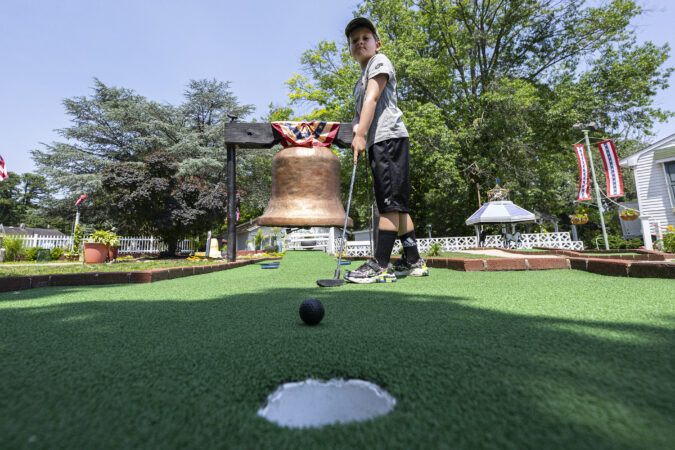
    Players play rounds at Pleasant Valley Miniature Golf on Route 73 in Voorhees, N.J. on Tuesday, June 30, 2026.

    April 1 to Halloween

    Opened in 1972 and now run by the son of the original owner, Pleasant Valley is a throwback mini golf course with all the whacky obstacles you could dream of. The fiberglass Liberty Bell and giant sombrero, built by the owner, have been there since the 1970s. Guest-favorite hole number 12 features three gophers driving classic cars in circles. Conveniently located on the way to Atlantic City, it’s got a classic charm you won’t find at every course.

    Best hole: “The sombrero,” owner Brian Whelan says. “It’s very difficult, very easy to have the ball fly out of the sombrero. Big risk, big reward there.”

    Other amenities: Ice cream and water ice

    Price: Before 6 p.m., $10 for adults, $9 for kids 10 and under and seniors; after 6 p.m., $12.50 for adults, $10 for kids and seniors

    📍 93 Rt 73, Voorhees, N.J. 08043, 📞 609-314-1214, 🌐 pvminigolf.com

    Voorhees Golf Land

    March 1 to the weekend after Thanksgiving

    Previously known as The Golf Farm, Voorhees Golf Land reopened last year under new ownership after a year-long closure. In addition to 18 holes of mini golf, Golf Land sports the region’s only pitch-and-putt course. That’s 18 holes of golf that are just 20 to 50 yards long, “not quite the size of a par three,” owner Diana Hennefer says, so it’s a great option for people who don’t have the time or mobility to play a full round of golf, or who just want to practice their short game.

    Best hole: Number 18 has a wishing well in the middle. “It’s probably the trickiest one,” Hennefer says. “It’s also the prettiest, most picturesque one.”

    Other amenities: Pitch-and-putt course

    Price: Mini golf: $8 for adults, $6 for kids; pitch and putt: $15 for adults, $10 for kids

    📍 801 Haddonfield Berlin Road, Voorhees, N.J. 08043, 📞 856-630-0977, 🌐 voorheesgolfland.com

    Serene Custard and Miniature Golf

    A water feature at Serene Custard and Miniature Golf in Vineland, N.J.

    Come for the challenging, hilly course, and stay for the vintage custard stand serving homemade ice cream. Built in 1959, Serene Custard still boasts its original mid-century signage and is celebrating its 67th season this year. The 18-hole mini golf course is a newer addition, featuring tough terrains and lush landscaping. “You sort of don’t even feel like you’re in South Jersey when you’re on the course,” owner Ari Dendrinos says.

    Best hole: Number nine takes place entirely within a huge man-made cave.

    Other amenities: Custard stand serving ice cream, water ice, and some savory snacks

    Price: $6 for children, $8 for adults

    📍 2336 N. West Blvd, Vineland, N.J. 08360, 📞 856-692-1104, 🌐 serenecustardandgolf.com

    The Funplex Mt. Laurel

    Spring break to mid-October

    The Funplex at Mt. Laurel has way more than just mini golf. There’s a waterpark, indoor and outdoor rides, a bowling alley, and more. But don’t sleep on the two mini golf courses, Adventure Cave and Lost Lagoon, both of which offer 18 holes of obstacles, including a few multi-level designs.

    Best hole: At number 19, if you get a hole-in-one, your next game is free.

    Other amenities: Waterpark, indoor and outdoor rides, bowling, arcade games

    Price: $42 on weekdays and $49 on weekends for access to all attractions; $46 and $54 when purchasing at the gate

    📍 3320-24 NJ-38, Mount Laurel, N.J. 08054, 📞 856-273-9666, 🌐 thefunplex.com

    Jersey Devil Golf & Fun Center

    May to October, honor system all year round

    The Jersey Devil wants to ensure you never have to miss a mini golf fix. Despite their posted hours, this course operates on the honor system, making their putters and golf balls available every day, all year round, so you can play even when no one is working. Just drop $5 in the box at the first hole to enjoy putting on these long greens, which provide a challenge to kids and adults alike.

    Best hole: Hole number 12 features a sharp bend and splits in two before converging.

    Other amenities: Driving range, picnic area with cornhole, and fire pits

    Price: $8 for adults, $7 for 6 to 16-year-olds, free for 5 and under

    📍 276 Rte 73 S, Hammonton, N.J. 08037, 📞 609-704-9007, 🌐 jerseydevilgolf.com

    Pleasant Valley Miniature Golf is shown on Route 73 in Voorhees, N.J. Tuesday, June 30, 2026.
  • Sharon Hill police killed his cousin. Now he is Delaware County’s new reform-minded sheriff

    Sharon Hill police killed his cousin. Now he is Delaware County’s new reform-minded sheriff

    Siddiq Kamara remembers standing side by side with his aunt outside of the Delaware County courthouse and calling for changes in how police are trained after a stray bullet fired by Sharon Hill police officers killed his cousin Fanta Bility.

    Three years later, his office is inside that same building.

    Kamara, 30, became the youngest sheriff in Delaware County history when he cruised to victory in November with 63% of the vote. The son of Liberian immigrants, Kamara turned his family’s tragedy into a platform for improving the way community policing is carried out in his home county.

    “The people in Delaware County, I’m here to work with them, and my office is going to do that every single day,” he said.

    “This is the greatest country in the world. Being 30, being Muslim, being a first-generation immigrant and being the sheriff of one of the biggest counties in Pennsylvania, it’s unheard of. And I don’t take that lightly.”

    In his first six months in office, Kamara equipped all of his deputies with body cameras and beefed up recruiting efforts, including open fitness tests throughout the county, to help fill the 35 vacancies he inherited. He’s mandated de-escalation and regular firearms training for his deputies, in memory of his cousin.

    Siddiq Kamara (left) stood by his aunt, Tenneh Kromah, in January 2025 as they renamed a park in Sharon Hill after his cousin Fanta Bility.

    Delaware County Council President Monica Taylor said Kamara is bringing a fresh perspective to a row office that often gets overlooked.

    “He doesn’t just talk. He does the work,” Taylor said. “That’s what makes him a great public servant. He’s bringing everyone to the table to make these improvements.”

    That’s notable for a county sheriff, given the role traditionally, doesn’t require officials to stray too far beyond the county courthouse. But Kamara wants to change that, making sure he and his deputies are a frequent presence in the towns they serve.

    That desire comes from Kamara’s own experience. After serving six years in the Army National Guard, Kamara became a police officer in Yeadon. He later took a job in the state Attorney General’s Office, working in various roles including narcotics and the personal protection detail for then-Attorney General Josh Shapiro.

    Kamara’s cultural background and linguistic skills — he speaks African dialects including Mandingo and Fula, as well as French — were called upon by federal investigators as they built their case against Laye Sekou Camara, a Liberian war criminal.

    He said he became a police officer because so many people in his community in Upper Darby, drawing on their experiences in their home countries, were distrustful of police.

    “We interact with the public every single day, and sometimes these individuals, we’re not getting them at their happiest time. It’s their most vulnerable time, and you have to use empathy,” he said. “So we’ve been sending some of our supervisors to trainings so they can understand the tools when they’re out there in the community and they can teach their fellow colleagues how to de-escalate situations.”

    But when Fanta Bility was gunned down in August 2021, Kamara’s professional ambitions changed. The 8-year-old was struck by a stray bullet after three Sharon Hill officers opened fire toward a crowd leaving a high school football game. They were aiming at a car they mistakenly believed was the source of a nearby shooting.

    Those officers were later fired and pleaded guilty to reckless endangerment. But Kamara knew something had to change.

    “If you understand what happened that day to my cousin, cops, unfortunately, we can’t make mistakes. It costs people’s lives,“ he said. ”And, that day, it cost my cousin’s life, so I wanted to make sure that in my capacity, as the sheriff, our officers are properly trained.”

    Siddiq Kamara speaks during a backpack giveaway at Sharon Hill Elementary School in August 2023 held in memory of Fanta Bility.

    State Sen. Anthony Hardy Williams, a Democrat who sponsored a bill nicknamed “Fanta’s Law” that would require all Delaware County police departments to be accredited and receive annual use-of-force training, has been a mentor and friend to Kamara for years.

    “Back then, he was annoying,” Williams joked. “But he learned from my team, and it grew from him just being unapologetically persistent and curious, to him understanding he has a real value.”

    From Kamara’s early days of volunteering at political events, it was clear to Williams that he was dedicated to public service. “Fanta’s Law,” Williams said, is their latest collaboration.

    “He’s here to improve things, not just here to say ‘I have a title and have a position,’” Williams said. “It’s clear he wants to find out how to use this position to improve the office and also improve the lives of people who don’t even know about the office.”

    Kamara, for his part, said he’s thankful for the opportunity to enact change in the county that raised him.

    “When you’re in an office, and I teach my deputies this all the time, is that we do the protection part, but we’ll forget sometimes about serving,” he said. “And serving goes a long way.”

  • Philly’s delayed late-night fireworks were prompted by safety and weather concerns, city says

    Philly’s delayed late-night fireworks were prompted by safety and weather concerns, city says

    Philadelphia’s late-night fireworks display was prompted by concerns over safety and a poor long-range weather outlook, city officials said Sunday morning, as work crews were busy cleaning up Philadelphia’s Benjamin Franklin Parkway from the July Fourth celebration.

    A massive Liberty Bell display still hung over the stage near the Philadelphia Art Museum, where hours earlier Meek Mill, Will Smith, and backing band the Roots were the last to perform at the One Philly: Unity Concert for America. Gone were the fireworks and revelers, but the white tents, chain-link fencing, and long rows of porta-potties were reminders of a concert that lasted until nearly 2:45 a.m.

    It wasn’t supposed to go that long. But a summer storm around 9 p.m. rolled in with intense wind gusts, rain, and lightning, leading the city to evacuate the Parkway.

    The city didn’t have an official number, but estimated that “thousands” of concertgoers returned, just after midnight, to get the party started again. So did the performers, with the exception of Christina Aguilera.

    Items from last night’s festivities on the Ben Franklin Parkway wait to be picked up in Philadelphia on Sunday, July 5, 2026.

    Mayor Cherelle L. Parker said she trusted the experts and welcomed people back to the concert venue once it was safe.

    “I want to thank the Roots and all of their incredible guests for their relentless energy and for delivering an incredibly inspiring performance worthy of America’s 250th birthday,” Parker said in a Sunday news release.

    The decision to proceed with the fireworks was made by city experts, led by Managing Director Adam K. Thiel, and the mayor was informed, said Parker spokesperson Joe Grace.

    The weather forecast factored into the decision, Grace said. The city will be under a flood watch starting at 2 p.m., and rain and storms are likely over the next 10 days, so postponing the fireworks to another day did not make sense, he said.

    “Once fireworks are loaded, they cannot be safely unloaded,” Grace said. “From a safety and operational standpoint, completing the fireworks display was the right decision.”

    Some detractors of the late fireworks display turned to online forums to complain about the noise.

    “Ok so I wasn’t dreaming. I was actually awakened by an officially sanctioned fireworks display at 2:30 a.m.,” one Reddit user wrote.

    Comment
    by
    u/southphillydadbar from discussion

    in
    philadelphia

    Mykola Kosyk of Fairmount said it was disappointing that the city waited until nearly 3 a.m. — far too late for children — for a show that lasted only about 10 minutes.

    “It was the worst fireworks display ever,” Kosyk said. He called it a “basic display” that wasn’t on par with the historical significance of the Semiquincentennial.

    Kosyk says he collects fireworks memorabilia dating back to the 1800s, and he and his wife travel the state visiting fireworks displays. He said the company putting on the show, Pyrotecnico, is “well-renowned,” and he blamed the city for not planning a better show.

    As the smoke from the fireworks show settled around 3 a.m., the city’s Department of Sanitation sent out approximately 100 laborers and 50 trucks to clean up the Ben Franklin Parkway and the surrounding area, the city said in the news release.

    By morning, much of the mess was gone. Security magnetometers sat in a pile, ready to be picked up and taken away, while dozens of staff from Imperial Events Services worked to keep runners and curious onlookers out of what was supposed to be a secure area.

    “The joggers are mad at us,” said one staffer, as his team found a gap in the fence that allowed people into the closed-off area.

    Workers dismantle the stage from last night’s concert along the Ben Franklin Parkway in Philadelphia on Sunday, July 5, 2026.

    One visitor was disappointed that the stage breakdown temporarily blocked the front of the Art Museum.

    “We want to see the Rocky steps, but we can’t,” said Angelika Gamez, who flew in from Bogota, Colombia, for the France-Paraguay soccer match Saturday.

    Still, Gamez said her visit to Philly was amazing, weather aside.

    “It was very hot. In Colombia, we don’t have seasons like this.”

  • Peco contract negotiations continue as union members remain on strike

    Peco contract negotiations continue as union members remain on strike

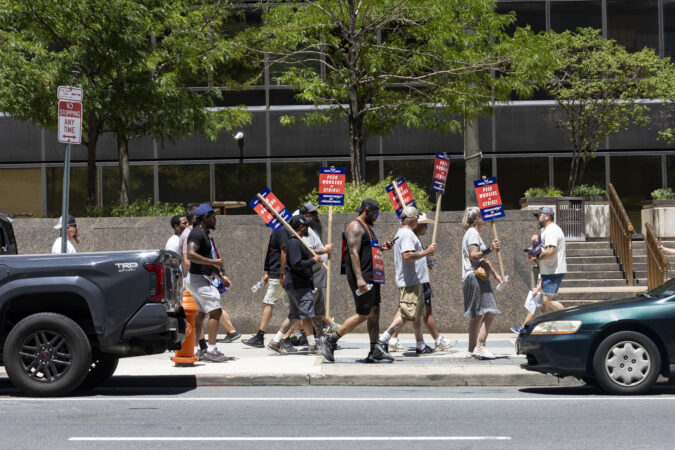
    Peco and its striking unionized workers continued contract negotiations on Sunday, the second day of a strike that occurred as the region was affected by power outages caused by severe storms.

    A dozen striking workers were picketing at Peco’s Philadelphia office on the 2300 block of Market Street, as the company and the International Brotherhood of Electrical Workers Local 614 continued talks.

    The two sides have differed over wages and benefits, with the union seeking to have all of its roughly 1,500 members covered by pensions — 600 of them currently are not.

    It is the first strike in the company’s history.

    Peco has said its contingency plan should prevent customers from experiencing delays or interruptions in service. The company has also said that its contract offer is competitive and fair for employees and customers, adding that it has also offered improved retirement benefits.

    Bargaining was expected to continue through Sunday, according to Melissa McCleery, a union spokesperson.

    Peco’s latest offer, according to Larry Anastasi, president and business manager of IBEW Local 614, would give call center workers a lower wage increase than the rest of the union members. According to the union, 98% of call center workers are women.

    “We will not accept a contract that undercuts the women of our union,” Anastasi said in a statement.

    The company’s current offer, the union said, would bring an average annual wage increase of 3.5% for non-call center workers, between 2027 and 2031. Call center workers would receive 3% annual wage increases in the same time frame.

    To Anastasi, that is unacceptable.

    “Any deal that leaves the call center behind is a deal that will not be signed,” he said in a statement. “PECO’s proposal is an attempt to drive a wedge between our members and that’s not going to work.”

    The company rejected the union’s characterization of its offer.

    “To suggest that PECO would undercut the women of our union is ridiculous,” said a company spokesperson in a statement. “PECO values the contributions of all represented employees, including our customer care professionals, and we reject any suggestion that our goal during negotiations was to diminish the importance of any employee group.”

    The company said that its customer service workers’ average hourly pay is $45.12, well above regional benchmarks of $23.80 for customer consultants and $30.91 for specialized consultants.

    The striking workers in Philadelphia spent a long day in the sun on Sunday, bringing water bottles, coolers, and lawn chairs. They arrived on Market Street as early as 6 a.m., the union said.

    Pulling a megaphone he said he found in his children’s room, union member Tom Jarozynski yelled: “Peco, can you hear us?”

    As cars drove by beeping in support, Jarozynski continued: “What do we want?”

    “A contract,” the crowd replied.

    “When do we want it?”

    “Now.”

    On Saturday, the company said that federal mediation had been offered for the talks. Peco said it had accepted the offer for mediation, but the union did not. An IBEW spokesperson said union negotiators were busy bargaining and not available to answer questions about mediation.

    The union said workers plan to picket at different Peco locations until a contract is reached.

  • Victoria Cruz, veteran of the trans rights movement, dies at 79

    Victoria Cruz, veteran of the trans rights movement, dies at 79

    Victoria Cruz, a matriarchal figure in the New York transgender community who was at the Stonewall Inn in 1969 when a police raid set in motion the gay liberation movement, and who later worked as an advocate for survivors of antitrans violence, died on June 25 in New York City. She was 79.

    Her partner, Charles Wright, confirmed the death, in a hospital, and said the cause was liver cancer.

    Ms. Cruz spent 17 years working for the New York City Anti-Violence Project, which provides counseling and other services for LGTBQ+ and HIV-affected survivors of violence. There, she focused on domestic abuse, but her role in the organization — and in the community — extended far beyond her official duties.

    She understood the intersectional threats that trans people faced in areas like housing discrimination and workplace harassment — expertise that made her a unique resource to thousands of trans New Yorkers.

    “People would come into the office and just ask for Miss Vicky,” Catherine Shugrue-Dos Santos, a former deputy executive director at the organization, said in an interview. “They wouldn’t give their names; they wouldn’t talk to anybody else. She really had the trust of the community.”

    She was especially effective because she came to the group as a survivor herself: In 1996, while working at a nursing home in Brooklyn, she was repeatedly harassed and assaulted by four co-workers.

    “I was very angry. Very angry,” she told Vanity Fair in 2017. “The worst part of it is that I couldn’t feel the ground beneath me.”

    One day she brought a knife to work, intent on fighting back, but then thought better of it. A friend suggested she contact the Anti-Violence Project, which at the time was run by Christine Quinn, who later became the first female and first openly gay speaker of the New York City Council.

    The group helped her file police reports and led protests outside the nursing home. Eventually, two of the four co-workers were convicted of harassment — one of the first times that someone was held legally accountable for antitrans violence in New York State.

    Quinn brought Ms. Cruz on as a volunteer, then hired her to manage the front desk. The job also had her answering the organization’s hotline, a task that connected Cruz with countless at-risk New Yorkers.

    “She was perhaps the strongest person I have ever met,” Quinn said in an interview. “She was part of the birth of the modern LGBT rights movement in New York, and therefore across the country. She was someone who had survived a terrible sexual assault and transformed that horrible moment into beaconlike strength that you felt whenever you were around her.”

    Ms. Cruz was a central figure in David France’s 2017 documentary, The Death and Life of Marsha P. Johnson, about the 1992 death of a trans activist that police ruled a suicide, but many, including Ms. Cruz, suspected was murder.

    The documentary tracks her search for answers and ends with her conclusion that Johnson was murdered by the mafia.

    Ms. Cruz did not know Johnson, but their lives overlapped. Both were at the Stonewall Inn on the night of June 28, 1969, when police conducted one of their routine raids at the bar. This time, though, the largely transgender clientele inside fought back, and a riot ensued.

    Ms. Cruz had been outside with her boyfriend, one of the bar’s bouncers. As the violence escalated, he told her to go home. When she returned in the morning, she found the bar in ruins. She grabbed a beer sign and other memorabilia, and also took home the bar’s dog, Rusty.

    The Stonewall riot sparked the beginning of the gay liberation movement, which had a strong trans presence. Johnson and another well-known community figure, Sylvia Rivera — a friend of Ms. Cruz’s — became particularly active, ensuring that trans people had a place within the movement.

    Ms. Cruz played a quieter role, but over time she became a central figure as well — and a recognizable one, with her homemade outfits topped with a headband adorned with feathers and cowrie shells, in honor of her heritage as a descendant of the Taíno people of Puerto Rico.

    “She was an elder in that community,” France said in an interview. “She was a transgender woman of color who had lived into old age, which is so rare.”

    Victoria Cruz was born on Sept. 19, 1946, in Guánica, on Puerto Rico’s southwestern coast. When she was 4, her family moved to the Red Hook section of Brooklyn, where her father worked as a longshoreman; her mother was a seamstress.

    She identified as female from an early age, and her family was strongly supportive. Her mother made her dresses, and her father, who affectionately called her “El Negro,” on account of her dark skin, switched to using the word’s feminine form, “La Negra.”

    She studied cosmetology in high school and worked as a model, but soon found both routes closed to her because she was trans.

    After high school, she found a doctor in Coney Island who provided her with the medical treatment to help her transition.

    Through the 1970s she was a sex worker and a dancer in West Village clubs. She also developed an addiction to crack cocaine, though she eventually became sober.

    She enrolled at Brooklyn College in 1978 and graduated four years later with a degree in theater.

    But she continued to struggle financially, and ended up on public assistance. The program required her to work, which is how she ended up on the staff at the Brooklyn nursing home.

    Her survivors include Wright and her sister Hedye Cruz. A complete list of survivors was not immediately available.

    In 2012, Ms. Cruz received the National Crime Victims’ Service Award from the U.S. Department of Justice.

    In an interview for the Anti-Violence Project in 2022, Ms. Cruz explained why she committed her life to counseling.

    “If you have been in that situation — everybody’s situation is different but similar,” she said. “If you have the empathy to help out people, that’s half the ordeal. Just having the empathy and letting them know that you’re there to help them, not to judge them.”

    This article originally appeared in the New York Times.

  • Supreme Court’s dramatic moves will reshape elections — and give the GOP a midterm boost

    Supreme Court’s dramatic moves will reshape elections — and give the GOP a midterm boost

    The Supreme Court dramatically reshaped elections in recent months, sharply limiting a law that has been a cornerstone of minority voter empowerment, allowing states to gerrymander maps, and loosening campaign finance regulations.

    The conservative majority says the series of decisions helps correct an election system that has run afoul of the Constitution. In rulings, they cite ideas they have long championed — undoing programs that advantage minorities, allowing partisan redistricting, and eliminating restrictions that impinge on free speech rights.

    Most of the rulings, which have rolled out as the country heads toward pivotal midterm elections, benefit Republicans. That’s led critics — starting with some of the court’s liberal justices — to complain the court’s conservative majority has gone beyond enunciating broad legal principles and put a thumb on the scale in upcoming races.

    What is clear is that the Supreme Court has tilted this fall’s electoral landscape toward Republicans as they struggle with voter discontent.

    In one of the most consequential rulings of the term, the conservative majority in April significantly weakened the Voting Rights Act’s last pillar, which required states to draw congressional districts to ensure the voting power of minorities under certain circumstances. In its opinion, the court said the protection was no longer needed by a country that has made “great strides in ending entrenched racial discrimination.” That decision touched off a push by Republican-controlled states to eliminate districts mostly held by Black Democrats across the South.

    Other rulings cleared the way for specific voting maps preferred by Republicans. And one loosened campaign finance limits — a change that brings the most immediate boost to Republican candidates.

    Democrats notched few outright victories, but they avoided some outcomes that they would have viewed as particularly disruptive. In one case, the court allowed states to continue to tally mail-in ballots even if they arrive after Election Day. Mail voting in recent years has become more popular among Democrats than Republicans.

    Legal experts said the justices’ intervention amid an election cycle and the pace at which the court is moving to implement changes that largely benefit one party is all but unprecedented in recent years.

    Richard L. Hasen, an expert in election law and political science at UCLA, said Chief Justice John G. Roberts Jr., who is known for his slow, methodical approach, lately appears to be a justice “in a rush.”

    “The court has been moving toward weakening voting rights, freeing up campaign money, and letting partisan actors run loose — that’s not a new trend,” Hasen said. “But the speed with which things are happening is much faster.”

    The decisions represent a dramatic coda to more than a decade of work by the justices, who have rewritten election law under Roberts in ways that one analysis found have pushed it to the right of any other court over the past 70 years.

    Republicans face an uphill battle in November’s contests because the president’s party historically loses seats in the midterms, and Trump’s low approval rating, the high price of gas, and the unpopular conflict in Iran have been a drag on GOP candidates.

    Democrats have a shot at taking the House and Senate, but the Supreme Court’s moves have erected a higher hurdle. Today, Republicans control 219 seats to Democrats’ 212 in the House, while Republicans enjoy a more solid advantage in the Senate, with 53 seats to 47.

    Earlier this year, the nonpartisan Cook Political Report had rated 217 House seats out of 435 as leaning Democratic, and projected Democrats needed to win only one of the tossups in November to capture the House.

    Cook recalibrated after the Supreme Court’s landmark Voting Rights Act ruling sparked the push to redistrict. It now lists 206 House seats as leaning toward Democrats, meaning Democrats need to win at least 12 of 18 tossups to gain control.

    “The fundamental question for 2026 is whether or not the structural firewall that Republicans have built up around their majority is strong enough to withstand what is shaping up to be a punishing political environment,” said Amy Walter, the publisher and editor of Cook.

    Democrats have issued bitter recriminations over the rulings as polling shows many in their base believe the court’s rulings are motivated by politics.

    “This is the most partisan Supreme Court in the history of the nation,” Sen. Ruben Gallego (D., Ariz.) recently posted on X.

    Roberts publicly addressed such criticisms at an appearance in early May, denying politics was a factor in the court’s rulings.

    “I think at a very basic level, people think we’re making policy decisions. … We’re saying we think this is what things should be as opposed to this is what the law provides,” Roberts said. “I think they view us as truly political actors, which I don’t think is an accurate understanding of what we do.”

    In its latest ruling, the court struck down limits on political parties spending money in coordination with candidates, finding they violated parties’ constitutional free-speech rights. Justice Brett M. Kavanaugh, writing for the majority, said the ruling ”treats all political parties equally” and will allow them to “participate more freely and compete more fully in the political process.”

    It’s unclear which party will benefit long term, but there’s one clear winner for the midterms: the GOP.

    Republican party committees have amassed a more than $100 million advantage over their Democratic counterparts, some of whom have struggled to raise money.

    Several of the high court’s other rulings have centered around how officials split their states into voting districts, creating maps that can give either political party an edge.

    In one of its earlier cases of the term, the high court greenlit Texas Republicans’ unusual move to redraw the state’s congressional maps between censuses, an effort that touched off a nationwide redistricting war. The decision could net the GOP up to five additional congressional seats in Texas alone.

    The justices later blocked New York from redrawing the district of Republican Rep. Nicole Malliotakis. That reversed the mandate of a state court, which had ordered officials to include more Black and Latino voters, a change that could have likely flipped the seat to Democrats.

    And in May, the court rejected a longshot emergency bid by Virginia Democrats to revive a gerrymandered voting map that would have allowed the party to pick up as many as four seats in the House in November.

    In its most sweeping decision of the term related to voting, the high court pared back a key part of the Voting Rights Act known as Section 2 that required states to draw maps that help minority communities elect candidates of their choice under certain circumstances. In the process, the court struck down a second Black-majority district in Louisiana, saying it was an unconstitutional racial gerrymander.

    With the help of the ruling, Republicans have drawn 16 districts with more favorable lines since last year, compared to six for Democrats.

    In the wake of the VRA ruling, a complicated fight over Alabama’s congressional map has raised questions about what room remains for minority communities to pursue claims that discriminatory redistricting violates the Constitution, possibly signaling even greater gains for Republicans.

    In June, the high court allowed Alabama to revert to a map with one Black-majority congressional district instead of two, a move that will likely flip a Democrat-controlled seat to the GOP.

    The decision came over a lower court finding that Alabama intentionally discriminated against the state’s Black voters in creating the map and then defied a court order to remedy the racial bias. In its ruling, the high court’s majority rejected that finding, citing “our colorblind Constitution.”

    The ruling was notable because the conservative majority held its Voting Rights Act ruling did not disturb the Constitution’s protections for minorities from “present-day intentional racial discrimination regarding voting.”

    But voting rights and minority advocates said the Alabama ruling indicates that protection might be a dead letter. Deuel Ross, director of litigation at the Legal Defense Fund, which advocates for racial justice, said in a statement he worries minority groups will lose political power.

    “The Supreme Court’s decision gives cover to Alabama and others to deliberately and openly discriminate against Black voters without fear of any consequence,” Ross said.

    Not every case went Republicans’ way. The Supreme Court dealt the GOP a setback when it upheld a Mississippi law that allows mail-in ballots to arrive up to five days after polls close. The ruling could have affected 13 other states with similar laws. Voting by mail is particularly popular with Democrats.

    Nevada Secretary of State Cisco Aguilar (D), who oversees elections in his battleground state, praised the Watson v. Republican National Committee case on mail ballots, but said the decision meant less in light of other rulings this term.

    “The fact that they destroyed the Voting Rights Act is detrimental to the fundamental foundation of our democracy,” he said. “Yes, they may have done something with Watson, but in the totality of it, the Supreme Court has become politically active in the overall administration of our election.”

    The clearest win for Democrats came when the court allowed California to gerrymander its voting maps to give Democrats up to five additional House seats. The California push came in response to Texas’ move to redraw its maps.

    The court’s liberals and some legal scholars have not just taken issue with the substance of the court’s decisions, but how the justices have arrived at them.

    The Supreme Court has regularly invoked the Purcell principle, a doctrine that holds federal courts should not change election law too close to elections because it can create confusion among voters.

    In the Texas redistricting case in December, with primary elections a few months away, the conservative majority referenced Purcell in allowing the use of redrawn maps favoring Republicans. A lower court had blocked the maps.

    “The District Court improperly inserted itself into an active primary campaign, causing much confusion and upsetting the delicate federal-state balance in elections,” the majority wrote of the primary scheduled for March.

    But in April during an active primary, the conservative majority struck down Louisiana’s second majority-Black congressional district in the Voting Rights Act decision. The seat is held by a Democrat.

    The decision came after thousands of voters had already returned mail-in ballots in the contest. The Supreme Court then expedited the ruling, paving the way for Louisiana Republicans to quickly redraw the district to favor Republicans.

    Liberal Justice Ketanji Brown Jackson issued a sharp rebuke, saying the conservative majority was willing to employ the Purcell principle in the Texas case when it favored Republicans, but ignore it in Louisiana when it did not.

    “The Court unshackles itself from both constraints today and dives into the fray,” Jackson wrote in a dissent. “And just like that, those principles give way to power.”

    Conservative Justice Samuel A. Alito Jr. shot back in a concurrence that the claim the court was acting in a partisan manner was “a groundless and utterly irresponsible charge” and it needed to act to prevent an election in Louisiana from going forward with an unconstitutional map.

    The court’s liberals have also accused conservatives of misusing Purcell in the Alabama and New York redistricting cases.

    Legal scholars differ over whether the court was employing Purcell in an evenhanded fashion. Edward B. Foley, who specializes in election law at Ohio State University, said the rulings were hard to square.

    “They may think they are being principled and consistent, but it sure doesn’t look that way,” he said of the court’s use of Purcell. “This principle seems to favor Republican partisan results.”

    Derek Muller, a Notre Dame law professor who specializes in election law, said he saw a legal logic to the court’s moves.

    “The Supreme Court is stepping back from cases in Alabama and Louisiana. It’s not issuing a rule to alter the rules of the election,” Muller said. “It’s allowing the legislatures to issue the rules they want.”

    The way the court handled the New York redistricting case also became an issue of contention. Liberal Justice Sonia Sotomayor accused the conservative majority of carrying out an “unprecedented” power grab by ruling before a state Supreme Court had a chance to weigh in.

    Sotomayor said the move trampled precedent against federal courts intervening in state court cases while litigation is still ongoing.

    “The Court’s 101-word unexplained order can be summarized in just 7: ‘Rules for thee, but not for me,’” Sotomayor wrote.

    Alito wrote in a concurring opinion that the intervention was necessary because New York courts approved a map that “blatantly discriminates on the basis of race.”

    Justin Riemer, former chief counsel at the Republican National Committee, rejected the notion the court is making partisan rulings, saying it had issued rulings favoring Democrats in recent years.

    He highlighted decisions dismissing a challenge to Trump’s 2020 election loss and rejecting arguments put forward by Republicans in 2023 that state legislatures could set election rules without interference from state courts.

    “I really don’t think that they’re in the tank one way or the other,” said Riemer, president of the group Restoring Integrity and Trust in Elections. “I think they have a judicial philosophy that they apply … that works for the types of claims we bring.”

    The redistricting and campaign finance decisions may provide immediate benefits to Republicans, but they may not last for long, said New York University law professor Richard Pildes.

    Democrats will have opportunities to redraw congressional districts in states they control after the midterms and political parties typically adapt to campaign finance rulings to keep up with their opponents, he said.

    Democratic anger over the decisions is intense, and it could fuel efforts to ban mid-decade redistricting, limit partisan gerrymandering, and pack the Supreme Court with more justices, he said. One Democratic congressman went so far as to introduce articles of impeachment against Roberts.

    “This is a real sort of avalanche that’s kind of been unleashed,” Pildes said.

    Legal experts said the court’s decisions this term are of a piece with its rulings on voting rights and campaign finance over the last 15 years.

    Those include the 2010 Citizens United decision that loosened campaign finance restrictions on corporations and unions, the 2013 Shelby County ruling that knocked down a section of the Voting Rights Act that required states with a history of racial discrimination to get federal pre-clearance to change voting laws, and the 2019 Rucho decision that found federal courts could not hear partisan gerrymandering claims.

    Guy-Uriel Emmanuel Charles, a Harvard law professor who focuses on political power and race, said regardless of which party benefits, this term’s cases could supercharge the era’s bare-knuckle politics.

    “This Court is sending a clear message: It will not impose many limits,” Charles wrote in an email. “The Court is incentivizing political parties to push the boundaries as far as possible to gain an advantage.”

  • Justice Department defends dropping charges against Indian billionaire

    Justice Department defends dropping charges against Indian billionaire

    The Justice Department on Saturday forcefully argued that an offer from India’s richest man, Gautam Adani, to invest billions of dollars in the United States played no role in the department’s decision to abandon criminal charges against him.

    In a letter filed Saturday, Trent McCotter, the principal associate deputy attorney general, defended the Justice Department’s decision after a federal judge demanded that the government explain its move. McCotter accused people within the department of leaking to media outlets about the case and acting “unethically.”

    The New York Times reported in May that Robert J. Giuffra Jr., a lawyer for Adani, had met privately with Justice Department officials to argue why the case should be abandoned. He asserted that prosecutors lacked basic evidence, and said that Adani could invest $10 billion in the United States and create tens of thousands of jobs, if the charges were dropped.

    McCotter appeared to acknowledge the existence of such an offer, but said that the decision to end the criminal case had been reached before the offer was made.

    “Before that topic first arose, I had already firmly concluded I would seek dismissal of the securities charges no matter what,” McCotter wrote in a letter to Judge Nicholas G. Garaufis of the Eastern District of New York.

    McCotter assailed Justice Department lawyers, current or former, whom he accused of leaking information in hopes of preventing a flawed case from being dismissed.

    Giuffra declined to comment. The Justice Department did not respond immediately to a request for comment.

    Adani, an industrial titan in India and a close ally of Prime Minister Narendra Modi, was indicted along with seven co-defendants in November 2024, in the last weeks of the Biden administration. Federal prosecutors in Brooklyn said that he had paid hundreds of millions of dollars in bribes to Indian officials to secure lucrative solar energy contracts for his company, Adani Green Energy.

    Although the bribes took place in India, Adani and his co-conspirators were subject to American law because his company had sought investments from people in the United States, prosecutors said at the time.

    Adani’s lawyers and McCotter have vigorously disputed that reasoning. On Saturday, McCotter wrote that no harm was done to U.S. investors and that the case was fundamentally about Indians bribing other Indians, which the Justice Department had no interest in litigating.

    McCotter wrote that if someone searched for the word “India” in the indictment, it would appear more than 200 times.

    Yet the trajectory of the case against Adani — particularly the investment proposal — has highlighted the highly transactional approach to justice during President Donald Trump’s second term.

    In May, days after federal prosecutors wrote that they had chosen “not to devote further resources” to the criminal case, multiple Justice Department lawyers withdrew from the case, signaling internal disagreement over the move.

    The next month, Sens. Elizabeth Warren (D., Mass.) and Richard Blumenthal (D., Conn.) wrote in a letter to Todd Blanche, the acting attorney general, that the department’s decision “gives the appearance that the DOJ is an equal partner in corrupt behavior.”

    Federal prosecutors cannot unilaterally decide to end a case. Garaufis, who will ultimately decide whether to drop charges, ordered prosecutors to provide a more detailed explanation for their decision.

    Judges have little ability under federal law to stop the government from abandoning criminal cases. But experts say that increasingly, under Trump, judges have scrutinized the rationale behind such decisions.

    After the Justice Department in 2025 moved to dismiss federal bribery charges against Eric Adams, then the mayor of New York City, the judge overseeing the case, Dale E. Ho, called the government’s rationale — that the case was harming Adams’ ability to help with Trump’s immigration crackdown — “unprecedented and breathtaking in its sweep.”

    On Saturday, McCotter chided Garaufis for what he called a “judicial inquisition.” Such queries, he argued, risked exposing “privileged internal debates” within the Justice Department.

    This article originally appeared in the New York Times.

  • Trump administration rolls back dozens of gun regulations

    Trump administration rolls back dozens of gun regulations

    The Trump administration is scrapping more than three dozen firearms regulations, abandoning a crackdown on illegal sales, restoring gun rights to some people with mental illness, and loosening oversight of private weapons transactions.

    The drastic retrenchment at the Bureau of Alcohol, Tobacco, Firearms, and Explosives, the federal agency responsible for enforcing the nation’s gun laws, was not entirely unexpected: President Donald Trump campaigned as a champion of gun rights.

    In the view of critics and even some ATF veterans, the agency, in closely mirroring the demands made by gun owners and manufacturers to lighten their regulatory burden, is enacting changes at the expense of public safety. The moves, they worry, come as the bureau has already been weakened, with hundreds of its officials diverted to immigration enforcement.

    Proponents of the changes point out that some of the reversals would return regulations to what they were only a few years ago, before President Joe Biden took office. After a series of deadly mass shootings, Biden signed into law gun control measures, ending nearly three decades of gridlock over whether and how to regulate firearms.

    The divisiveness illustrates the complicated landscape for gun policy.

    “With the Biden regulations that we got and put in place, we advanced the ball,” said Kris Brown, the president of the Brady Campaign to Prevent Gun Violence, one of the country’s biggest gun control organizations.

    But the Trump administration’s approach “takes us back 100 years,” she said. “It’s really decimating ATF’s ability to regulate this industry.”

    A White House official said the administration’s policies reflected Trump’s commitment to ensuring that Americans could exercise their Second Amendment rights, accusing the Biden administration of bypassing Congress and using the regulatory process to restrict gun rights.

    Mark Oliva, a spokesperson for the National Shooting Sports Foundation, the firearms industry’s trade association, said the changes were meant to clarify gun regulations.

    “We want clarity to know how we’re going to be able to conduct business,” he said, “to be able to produce and to be able to sell firearms in accordance with the laws and regulations that govern our industry.”

    Already, the administration has done away with major policies, including a zero-tolerance approach toward gun dealers who repeatedly broke the law. The more than three dozen rules that it has moved to eliminate would raise the legal threshold for revoking a dealer’s license; extend gun rights to buyers who had faced restrictions because of mental illness or inability to manage their own finances; and end extra scrutiny of stabilizing braces, gun accessories that have been used in mass shootings to lethal effect.

    The administration is now targeting gun regulations that Democrats have passed at the state and local levels. It has challenged bans on semiautomatic rifles in Colorado, the District of Columbia, and Virginia. On Wednesday, it sued California for its restrictions on the sale of Glock and Glock-style handguns, and Virginia for limits on the sale of semiautomatic rifles, hours after both laws went into effect.

    Since his first run for office, Trump has positioned himself as an ardent supporter of gun rights. In the run-up to the 2024 election, he vowed to be “the best friend gun owners have ever had in the White House.” Days after being inaugurated, he signed an executive order instructing the attorney general to scrutinize what he described as “ongoing infringements of the Second Amendment rights of our citizens.”

    By May 2025, the ATF had overturned its “zero-tolerance” policy, which had empowered its inspectors to revoke the licenses of federal gun dealers who were known to have broken the law. Pam Bondi, then the attorney general, said it had “unfairly targeted law-abiding gun owners and created an undue burden.” The policy increased the chances that dealers who had falsified business records, skipped background checks, or otherwise sold guns to people prohibited from owning them would face consequences. The agency ultimately revoked more than 600 licenses. But critics say that the new standards seriously curb the agency’s ability to do so.

    It is a part of a broader bid across government to enact changes in line with the president’s directive. The Veterans Affairs Department in February removed the requirement that veterans who require a fiduciary to manage their benefits be prohibited from buying firearms, and veterans who were previously reported to the FBI were being removed from its list. The Health and Human Services Department slashed funding for research into gun violence prevention. The U.S. Postal Service has proposed allowing people to ship handguns in the mail, upending a nearly century-old law.

    In realigning the Justice Department’s priorities to bolster Trump’s agenda, the agency said in December that it would balance defending the right to own a gun with ensuring the public’s safety.

    But when the ATF announced in April nearly three dozen changes, the administration’s own analyses acknowledged the pitfalls to public safety.

    The ATF’s director, Rob Cekada, defended the agency’s approach. In a statement, he said that it reflected an effort to be as explicit as possible about “the full range of costs and benefits, including even remote scenarios.”

    “This was an honest attempt to fully and transparently inform the public and is exactly the kind of analysis the comment period exists to test,” he said.

    In unveiling more changes on Friday, including eliminating fingerprinting requirements for certain firearms applications, Cekada again asserted that the agency was committed to public safety, pointing to a news release that heralded how its shift in priorities had led to the seizure of nearly 50,000 firearms and the handling of nearly 950,000 gun trace requests. Still, the data is far from a complete picture because it does not reflect all the policies the Trump administration has rolled back and because many of its proposals have yet to go into effect.

    Todd Blanche, the acting attorney general, in announcing the proposals in April, said that the moves struck a careful balance between the interests of the gun industry and gun owners, as well as public safety. “For too long, regulations were written without any real understanding of how firearms businesses operate, how lawful gun owners actually handle their firearms, or what truly improves public safety,” he said.

    One proposed change allowing more people with a history of mental illness to have a gun would mean that the public safety risk could range from minimal to considerably greater, “up to and including potential mass casualty events,” according to a cost analysis by the agency. For instance, people involuntarily committed to a mental health institution would still be barred from owning a gun, whereas those who voluntarily enter those facilities would not. The rule also seeks to extend the Veterans Affairs Department’s policy to ensure that all Americans unable to manage their financial affairs, not just veterans, are not automatically prohibited from buying a gun.

    In the analysis of another proposal, seeking to undo a Biden-era rule intensifying scrutiny of the use of stabilizing braces, the agency acknowledged that the gun accessory to create “dangerous, easily concealed weapons would pose an increased public safety problem.”

    The agency is also proposing a higher bar to revoke a federal gun dealer’s license, instead requiring evidence that the dealer knew that it was violating the law. The agency said in its analysis that it expected the number of federal firearms licenses it revoked to drop “considerably” both under the new rule and “shifting enforcement priorities.”

    Another rule would end the so-called gun show loophole, which required background checks for gun shows and certain private sales as a way to crack down on straw purchasers, or people who illegally buy guns on behalf of another.

    Critics warned of the potential consequences. The rapid changes under the Trump administration flew in the face of its vow to be tough on crime, they said, crediting the Biden-era measures for helping to bring down the murder rate after coronavirus pandemic highs, though experts have suggested that a number of factors could have contributed to the drop.

    “These guns are going to start to percolate back out into the community over the next couple of years,” said Marianna Mitchem, a former ATF official who now advises Everytown for Gun Safety, a nonprofit advocacy group founded by Michael Bloomberg, the former mayor of New York.

    She added, “I sadly expect that we will see an increase in violent crime.”

    Even as the proposals have yet to take effect, some supporters of gun rights are pushing for the regulations to be loosened even further.

    Erich Pratt, the senior vice president of Gun Owners of America, one of the country’s largest gun advocacy groups, said it was not enough to simply revert to regulatory standards on the books before the Biden administration.

    His group, for instance, opposes the Justice Department’s approach to a 2022 rule directing federal licensed gun dealers to hold on to records indefinitely, reducing the amount of time that gun dealers have to keep records of sales. It has argued that the administration should eliminate the requirement altogether.

    “The ATF proposals are a mixed bag,” he said, adding, “Gun owners would expect better from our Republican Justice Department.”

    This article originally appeared in the New York Times.

  • The Big Boy locomotive display in Philadelphia was shuttered early due to the heat

    The Big Boy locomotive display in Philadelphia was shuttered early due to the heat

    Philadelphia’s heatwave has claimed another casualty: the Big Boy.

    Union Pacific’s Big Boy No. 4014 — the world’s largest operating steam locomotive — closed early to the public Sunday afternoon, due to the oppressive heat, according to a Facebook bulletin.

    The Navy Yard had been bustling Sunday with fans clad with wide brim hats lathered in sunscreen, hoping to snag a view of the Big Boy. The locomotive was scheduled to be on display until 3 p.m.

    But by 1:30 p.m., when the temperature neared 90, police were turning the train enthusiasts around.

    “They’re not even letting people get close,” a dejected man in red, white, and blue grumbled to others headed in the direction of the locomotive.

    A spokesperson for Union Pacific, Robynn Tysver, said the difficult decision was made as crews began running out of bottled water for the estimated 65,000 visitors — more than double Saturday’s crowd, Tysver said.

    “We just had to make this call for safety,” she said.

    The Big Boy arrived at Intrepid Avenue and League Island Boulevard for July Fourth, as part of Union Pacific’s coast-to-coast tour commemorating the Semiquincentennial. The Port of Philadelphia also hosted a public viewing on Independence Day, when the temperature eclipsed 100 degrees.

    As of 2 p.m. Sunday, conditions were slightly cooler, but the region remained under a heat advisory.

    Reactions to the Big Boy’s reduced hours on social media were mixed: “This decision is regrettable and puzzling,” one person commented on the Facebook announcement.

    Spectators await the arrival of Union Pacific’s Big Boy No. 4014 at Reading Outer Station on Thursday, July 2, 2026, in Reading, Pa.

    “It was hotter yesterday and you stayed open makes no sense,” noted another.

    Others were more understanding: “Safety first for guests and especially crew,” a user wrote.

    The Big Boy is scheduled to depart Philly on Monday morning and head back West.

    It’s expected to be on display in Altoona’s Railroaders Memorial Museum July 9-10.