It was something of a lucky confluence of factors in West Bradford Township that led to residents seeing a reduction in their property taxes going into the new year, as other communities in the state see hikes.
A number of loans that were refinanced during record-low interest rates at the height of the COVID-19 pandemic in 2020, plus long-term lease agreements that brought the municipality more money, eventually equaled “substantial savings,” said Justin Yaich, town manager.
Savings in hand, the township decided they’d give it back to residents, he said, rather than funding “another pet project or another program.”
In the budget, passed last month by the town’s board of supervisors, West Bradford set its property tax millage for a 0.25 mill — a 50% reduction in the tax for residents. For a home worth roughly $300,000, residents will now pay $75 a year, down from $150.
It’s unusual, John Brenner, executive director of the Pennsylvania Municipal League, said of West Bradford’s reduction.
“There have been increases, and I’ve seen a number of them from municipal leaders throughout the Commonwealth — cities, boroughs, townships,“ Brenner said. ”You’re seeing counties raise taxes that haven’t in a long, long time. So that tells you the environment we’re in.”
Local governments are fairly limited in how they can levy taxes under state law, with the biggest portion of revenue coming from “the beleaguered property tax,” Brenner said. Schools and the county take from that same source, with local municipalities usually taking far less.
“Local government is not a business,” Brenner said. “It’s a provider of services, and those services cost money, and somebody has to pay for it.”
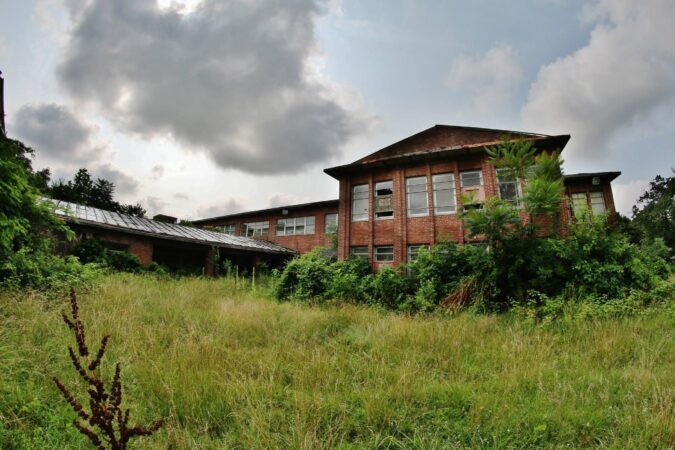
But in West Bradford, it was years of planning and a flurry of factors, Yaich said. It started in 2019, when the town purchased the former Embreeville State School and Hospital, an abandoned 900,000-square-foot psychiatric hospital that had been deteriorating for more than two decades. A developer had sought to transform the property into a high-density residential complex, which saw community pushback and years of litigation.
To purchase the site for roughly $23 million to turn it into 200 acres of open space, the township — for the first time — levied a real estate tax. (Residents already paid property tax to Downingtown Area School District and the county but previously did not pay the town.)
But early in 2020, West Bradford refinanced its outstanding debts, renegotiated some lease terms, and began to hold other costs consistent. Over the years, it culminated in the township being able to reduce the real estate tax, Yaich said.
The board’s philosophy is to do its core responsibilities — taking care of roads and infrastructure, caring for the open spaces and parks, running trash and recycling programs — and make sure there’s enough leftover for new programs or capital improvements, Yaich said. But anything beyond that, return it to the taxpayers, rather than figure out how to spend it, he said.
It is easier to spend money than it is to trim, Yaich added, noting that the township faces rising costs and shrinking revenue sources: Cable providers, who once were paying $300,000 to the township in a year to put their lines in, are dwindling as people turn to streaming services. With more electric vehicles, fewer people are filling up at the pumps, meaning less liquid fuels money for the township, too. It’s rare, and unlikely to be replicated in a few years, to cut costs for residents like this, he acknowledged.
As other town managers call and ask Yaich how to emulate him, he tries to dispel the magic.
“We’re in a unique situation that we were able to do it,” Yaich said. “There’s no magic sauce or magic potion that we’re doing here that other places aren’t doing. It’s just that we were set up at the right time in the right place, and we acted when things were favorable to us and we were fortunate.”
This suburban content is produced with support from the Leslie Miller and Richard Worley Foundation and The Lenfest Institute for Journalism. Editorial content is created independently of the project donors. Gifts to support The Inquirer’s high-impact journalism can be made at inquirer.com/donate. A list of Lenfest Institute donors can be found at lenfestinstitute.org/supporters.
Something about the phrase “Do what makes you happy” struck Faridah Ismaila. It became the title of, and inspiration behind, one of her art pieces. It’s printed onto the back of her T-shirt. It’s something the 15-year-old artist lives her life by.
“When I do art, it’s because it makes me happy, and when I can give my art to other people or spread the joy of art, it’s making them happy,” she said.
Following that guiding light of happiness, Ismaila, a digital artist and a sophomore at Great Valley High School, recently launched her nonprofit, A Paint-full of Promise, which offers free monthly art classes for kids in her school district in kindergarten through gradesix.
Working with educators in the district, Ismaila devises themed art projects and provides supplies and classroom time to teach young artists how to express themselves. The first club is slated for mid-January, with a winter wonderland theme. Children will make snowflakes and paint winter-themed coasters.
Ismaila has been recognized for her art nationally: She was the state winner and a national finalist in the 2022 Doodle for Google competition, where young artists compete for their work to be featured as the Google homepage design. That recognition helped give her the confidence to pursue big dreams, like her nonprofit and club.
“It makes me feel I can still do this. Because sometimes I’ll doubt myself. … I can’t be having all these big dreams,” she said. “But if people want to vote for me and I am recognized nationally, I feel on top of the world. I can do anything.”
The first brushes of the nonprofit — which she hopes one day will grow to multiple sessions a month — started years ago, when Ismaila began making YouTube videos, teaching the fundamentals of art. She showed viewers how to make a gradient, how to depict a sunrise. She circulated the videos around her Malvernneighborhood, and she thought: Why not hold a class for younger kids?
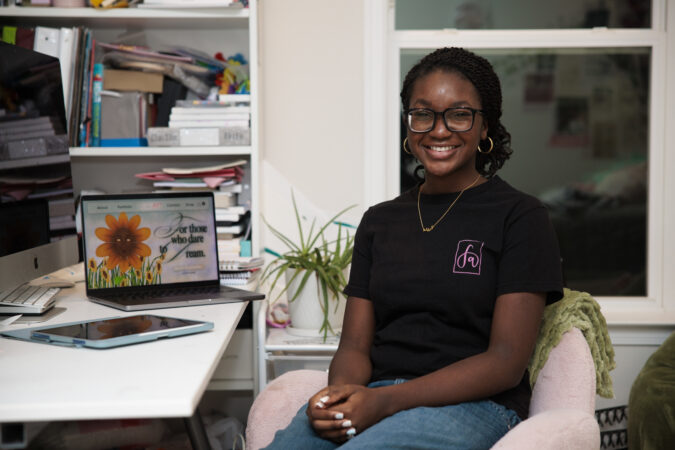
Faridah Ismaila, 15, poses for a portrait at her home on Wednesday, Dec. 17, 2025, in Malvern. Ismaila started a kids art nonprofit called A Paint-full of Promise. She also sells her art online.
Over a summer, in her garage, she set up two art projects — painting and colored pencils — and led about eight kids through a lesson. She called it Faridah’s Art Crafty Corner.
Holding the class made her happy. So she did it again, but bigger, turning it into a summer camp, under the new name: A Paint-full of Promise.
“Then I decided, why not actually make this a club, so not only my community can get this, my entire district can?” she said.
And now, the teenager has a nonprofit under her belt. She officially launched the organization last month at an event in Malvern, where she raised money by auctioning off prints of her work and selling T-shirts with her designs.
Anne Dale, an art teacher at Great Valley High School who is an adviser for the club, said she was impressed with Ismaila’s ability to get other high school students involved in running the club.
“A lot of students have big ideas for clubs, but there’s not always follow-through. With her, it’s definitely different, and I knew that when she approached me with it,” Dale said.
Giving kids the tools and opportunity to create artwork was essential to Ismaila, who gravitates to art to process her emotions.
“It’s just the best thing ever,” she said. “Once you start doing art as a kid, it’s just a great way to get your feelings out there and express yourself, even if you can’t use words to describe it.”
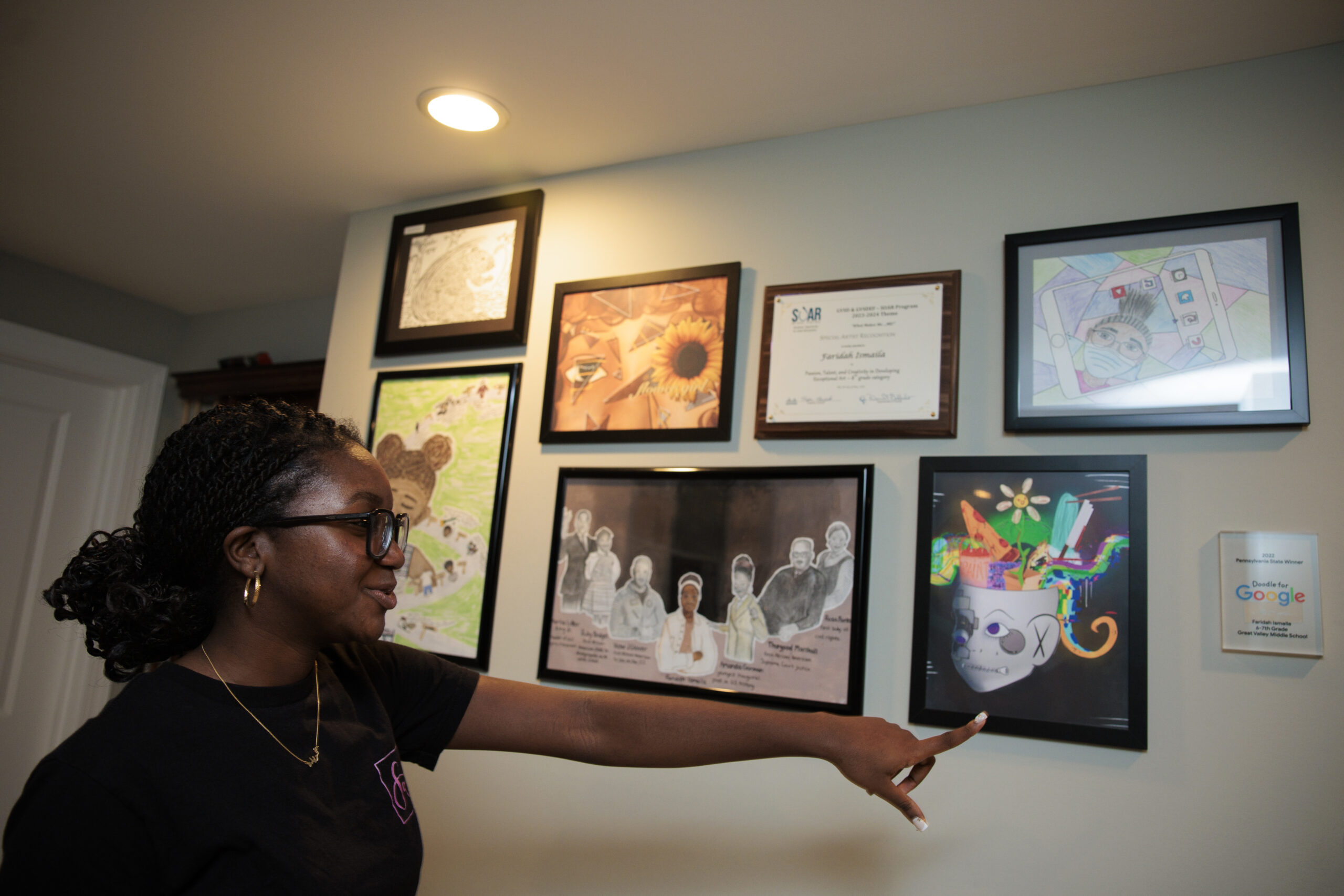
One of her pieces, Beauty Within, depicts a skeletal hand holding a white mask, a tear running down its cheek. Behind the mask, flowers bloom. It came from a feeling of constantly analyzing herself, the feeling that what you show people is not necessarily what’s on the inside.
Another piece, made when she was “seriously sleep-deprived,” shows a face with an assortment of pixels, pizza, stick figures, and paint pouring out.
Faridah Ismaila, 15, talks about some of her early works at her home on Wednesday, Dec. 17, 2025, in Malvern. Ismaila started a kids art nonprofit called A Paint-full of Promise. She also sells her art online.
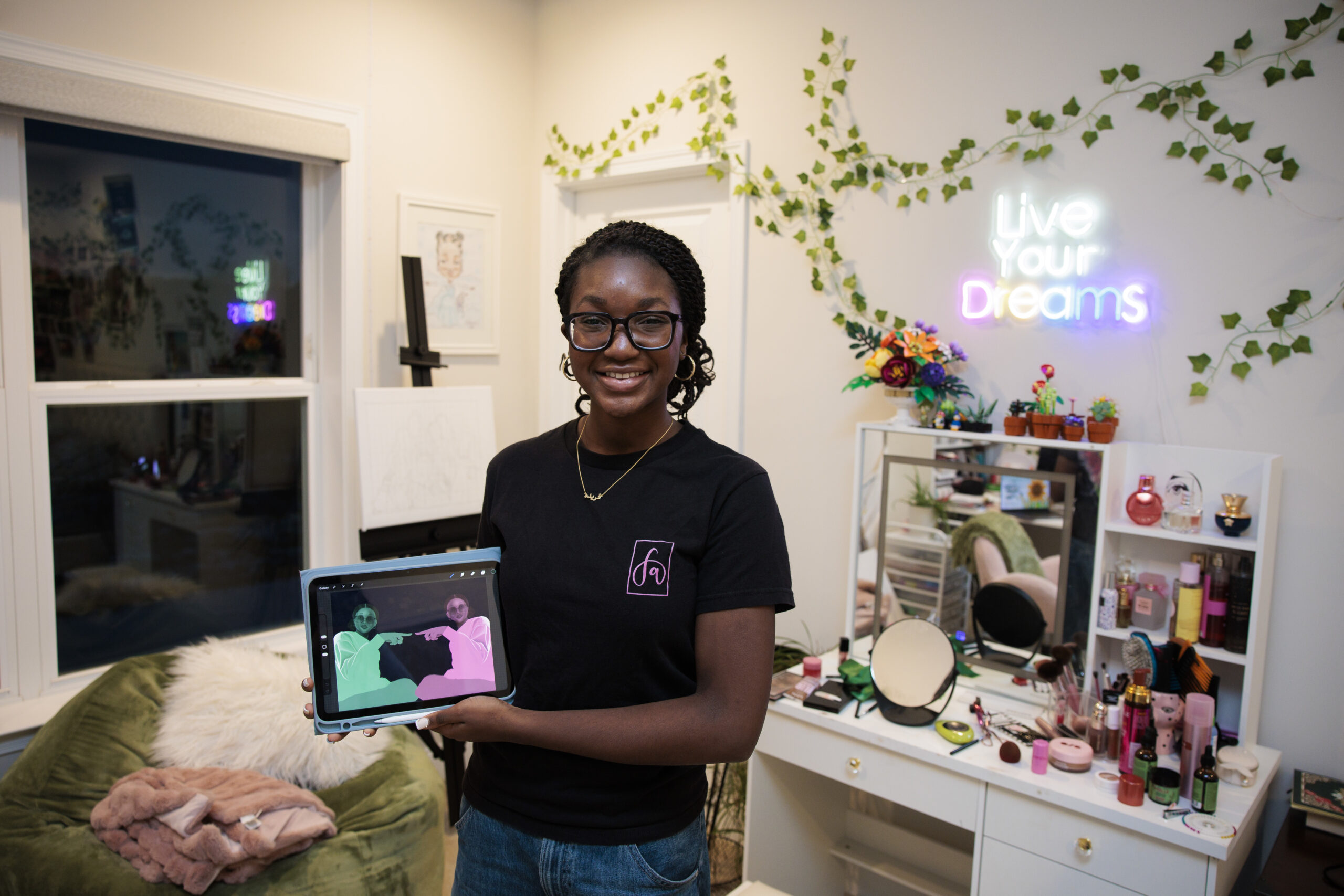
A piece she is working on now shows herself, in vibrant colors, pointing to her reflection. She wanted to capture the feeling of two versions of the self — one confident, the other fragile.
Sometimes, her mother Nofisat Ismaila said, her parents feel as if they are holding her back.
“I don’t know how I’m gonna keep keeping up with this girl, because she’s just taking us to places, keeping us busy, keeping us on our toes,” she said. “She’s turning out to be a really young, determined adult.”
Faridah Ismaila, 15, poses for a portrait at her home on Wednesday, Dec. 17, 2025, in Malvern. Ismaila started a kids art nonprofit called A Paint-full of Promise. She also sells her art online.
But to Faridah Ismaila, it’s about finding happiness, and giving it to others, too.
“I really hope the kids just do what makes them happy. … It’s also just not being afraid to get out there, because when I was a kid-kid, I wasn’t afraid of anything,” she said. “I think middle school really kicks some kids in the butt, and getting up out of that — at least for me, art was a way to do that. I just want to give that to kids.”
This suburban content is produced with support from the Leslie Miller and Richard Worley Foundation and The Lenfest Institute for Journalism. Editorial content is created independently of the project donors. Gifts to support The Inquirer’s high-impact journalism can be made at inquirer.com/donate. A list of Lenfest Institute donors can be found at lenfestinstitute.org/supporters.
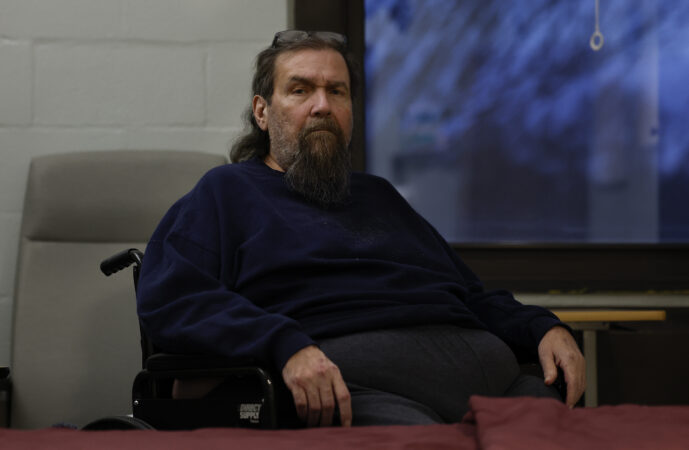
Robert Flesch was sitting in his first-floor room at the Bristol nursing home shortly after 9 a.m. on Dec. 23 when a staffer poked her head in to tell him he should go to the activity room. There was a gas leak near his room, the staffer told him, and Peco had been notified.
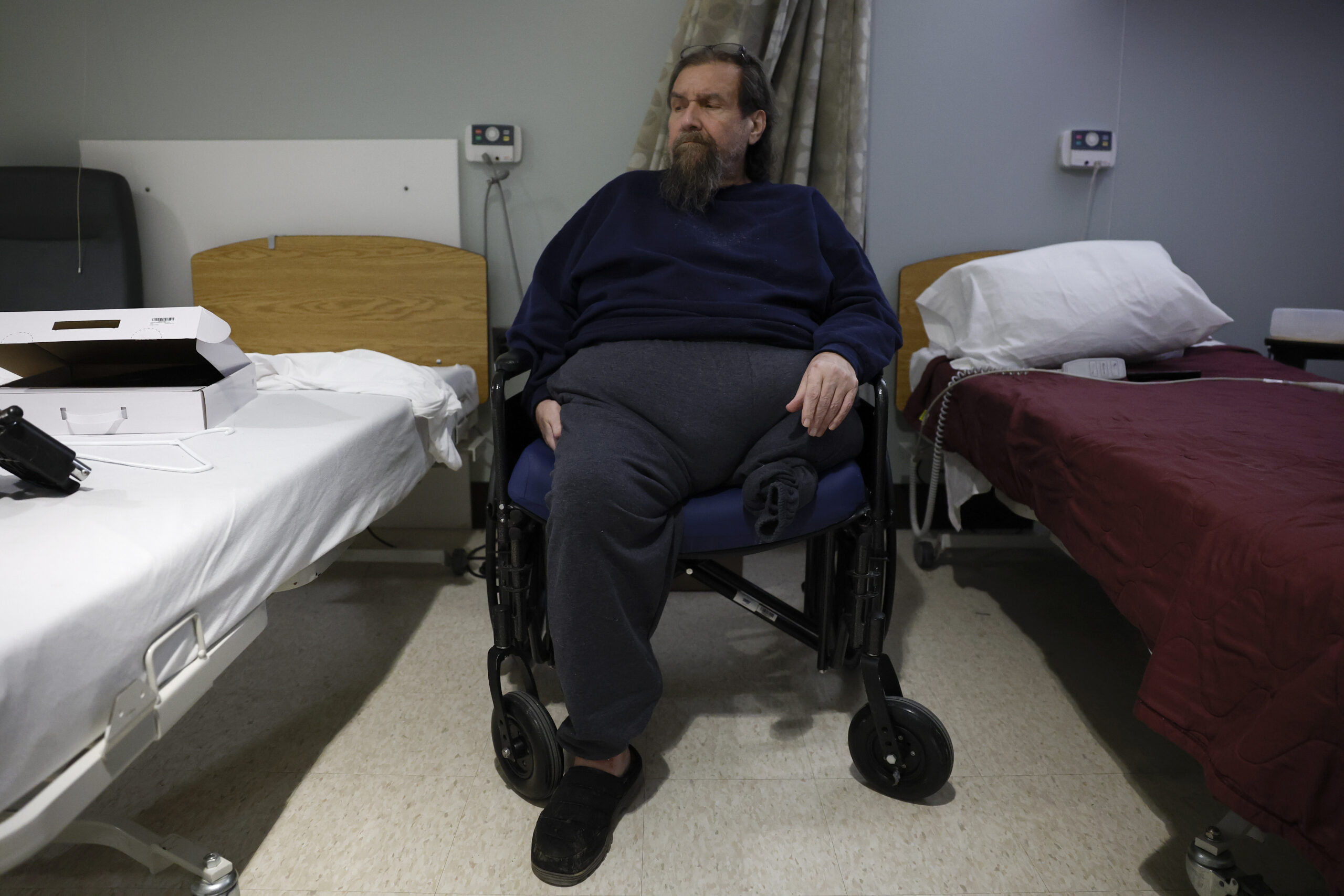
Flesch, who is 64 and an amputee, rolled his wheelchair into the hallway. “The whole hall smelled like gas,” he recalled.
Peco workers had already arrived, but nobody mentioned the possibility of needing to evacuate the 174-bed facility, Flesch said. Staffers did not seem concerned about the gas smell, and it was otherwise a typical Tuesday at the Bristol Health & Rehab Center, formerly known as Silver Lake Nursing Home.
Around 1:30 p.m., Flesch said he was told Peco had fixed “a pretty big leak” and that he could go back to his room. But the hallway outside his room had the same strong odor. “I’m telling you I still smell gas,” he said he told three staffers. He was reassured that it was just residual odor from the repaired leak.
Just after 2 p.m., another resident, Susie Gubitosi, was back inside after joining several other residents on the patio for a cigarette break. Gubitosi — known to friends as Susie Q — had become blind three years ago from glaucoma and was waiting for a staffer to help her remove old nail polish.
That’s when the place exploded.
“Suddenly I heard this loud boom,” Gubitosi, 71, said.
The blast knocked her out of her wheelchair, and debris slammed against her “as fast and hard as it could,” she said. “Next thing I’m on the floor, and I’m laying on my right-hand side, and I’m like, ‘Oh my God.’”
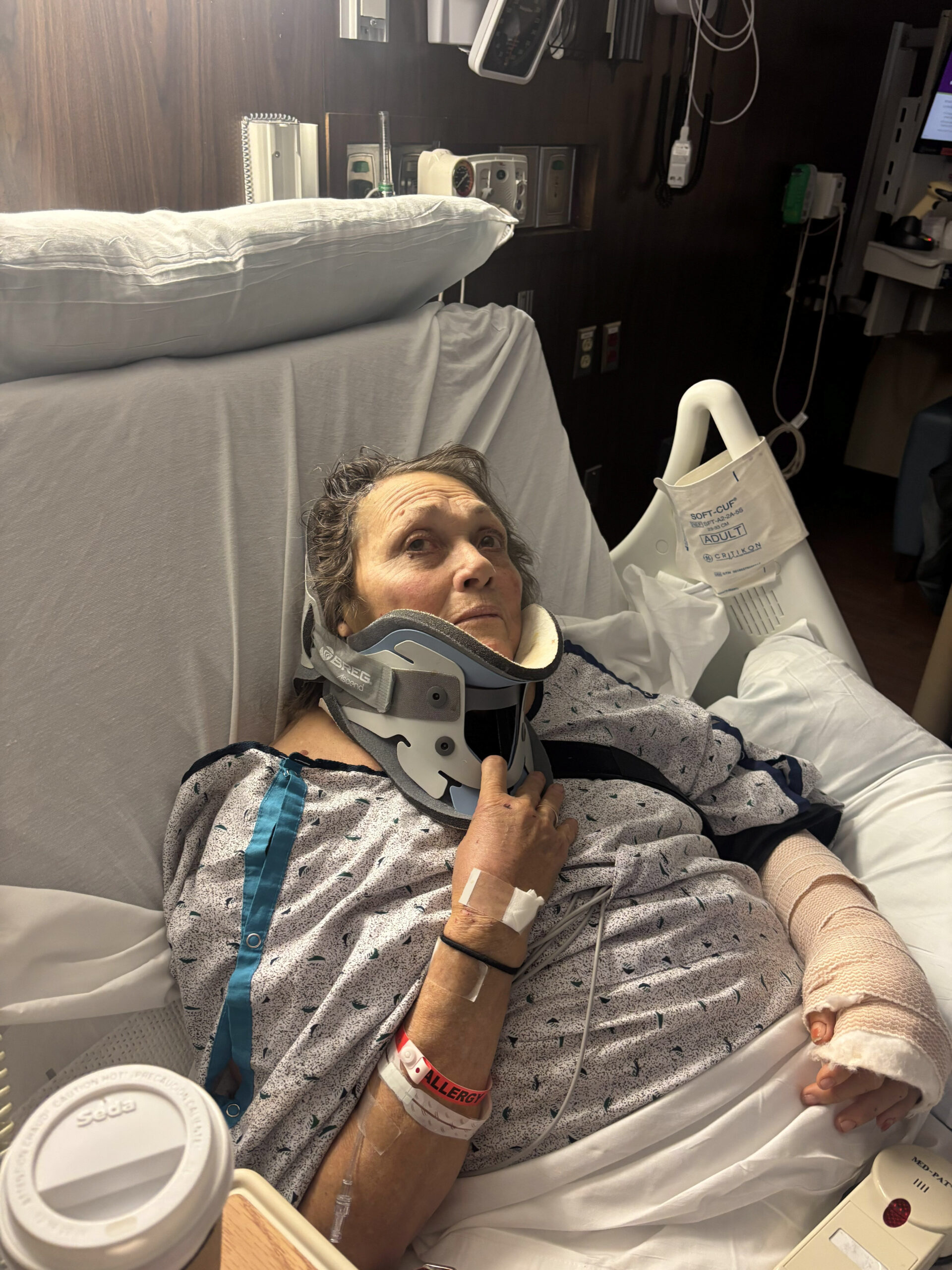
Susie Gubitosi was severely injured in a gas explosion and fire at the Bristol Health & Rehab Center in Bristol Township Dec. 23. She has staples in her head from where a brick fell on her. Her back, sternum, neck, elbow, and hand were broken.
The explosion, just after 2:15 p.m., killed Muthoni Nduthu, a 52-year-old nurse at the facility and mother to three sons. A second person who died, a resident, has not been identified. Twenty others were injured.
Flesch’s and Gubitosi’s accounts, told to The Inquirer in interviews over the last few days, give an expanded timeline of events before two explosions rocked the center. Their recollections underscore the key questions facing investigators from multiple agencies as they seek to determine the cause of the explosion and assess whether Peco, the nursing home, or both may have been negligent.
Robert Flesch at the Gracedale Nursing Home in Nazareth.
On Friday, Peco said in a statement that since the National Transportation Safety Board (NTSB) is leading the investigation, “we are not permitted to comment on this matter.”
The NTSB said it didn’t have any additional information but expects to release a preliminary report in about three weeks. In an earlier statement, it said investigators would test the natural gas service line that runs from the street to the basement of the impacted building, gather records, and interview witnesses, first responders, nursing home staff, and Peco employees.
Saber Healthcare Group, a privately run for-profit company that acquired the Bristol nursing home three weeks before the explosion and rebranded it, did not respond to requests for comment Friday. Saber has relocated about 120 residents to local hospitals and other assisted living facilities. It says it is reevaluating its evacuation procedures.
The previous owners, Ohio-based CommuniCare Health Services, had received numerous citations for unsafe building conditions and substandard care.
‘Am I dying?’
Recuperating in St. Mary’s Medical Center in Langhorne, Gubitosi said she felt as if her life was over.
Immediately, the former Bethlehem resident knew it was a gas explosion. “I heard shouting, screaming, moaning, and sirens,” she said.
“This place just blew up. And I thought, ‘Am I dying?’ I didn’t know,” she said. She was relieved when she could wiggle her toes. “I think I’m all in one piece,” she thought.
“Because I’m blind, it scared me even more. I felt ice cold water on me. The sprinkler system must have come on and I was drenched. But I was glad because I had dust, cement dust, soot all in my mouth, on my face, in my eyes and nose. And I was just trying to breathe.”
She cried repeatedly for help. “I heard all these voices and things moving. It was pandemonium. I could hear the EMT guys saying, ‘They’re in here! We’ve got to get them out! The building is going to collapse!’”
She heard one EMT, as he lifted her up, say, “This is the first patient that’s been crushed.”
Doctors in the hospital used staples to close a gash on her hairline. Her back, neck, and sternum are broken. She had surgery last week to repair fractures in her elbow and hand.
The pain, she said, is at times unbearable, even with medication. “It’s hard to breathe,” she said, lying in her hospital bed with her neck in a large brace, bandages that run from her hand to elbow, and IVs.
“It feels literally like an elephant put his foot on me and crushed me,” she said. “I was probably this close to death.”
She doesn’t know yet how long she’ll be hospitalized or where she will be placed next.
“Lawsuits are coming,” said Jordan Strokovsky, an attorney representing Gubitosi. ”There will be answers. There will be accountability.”
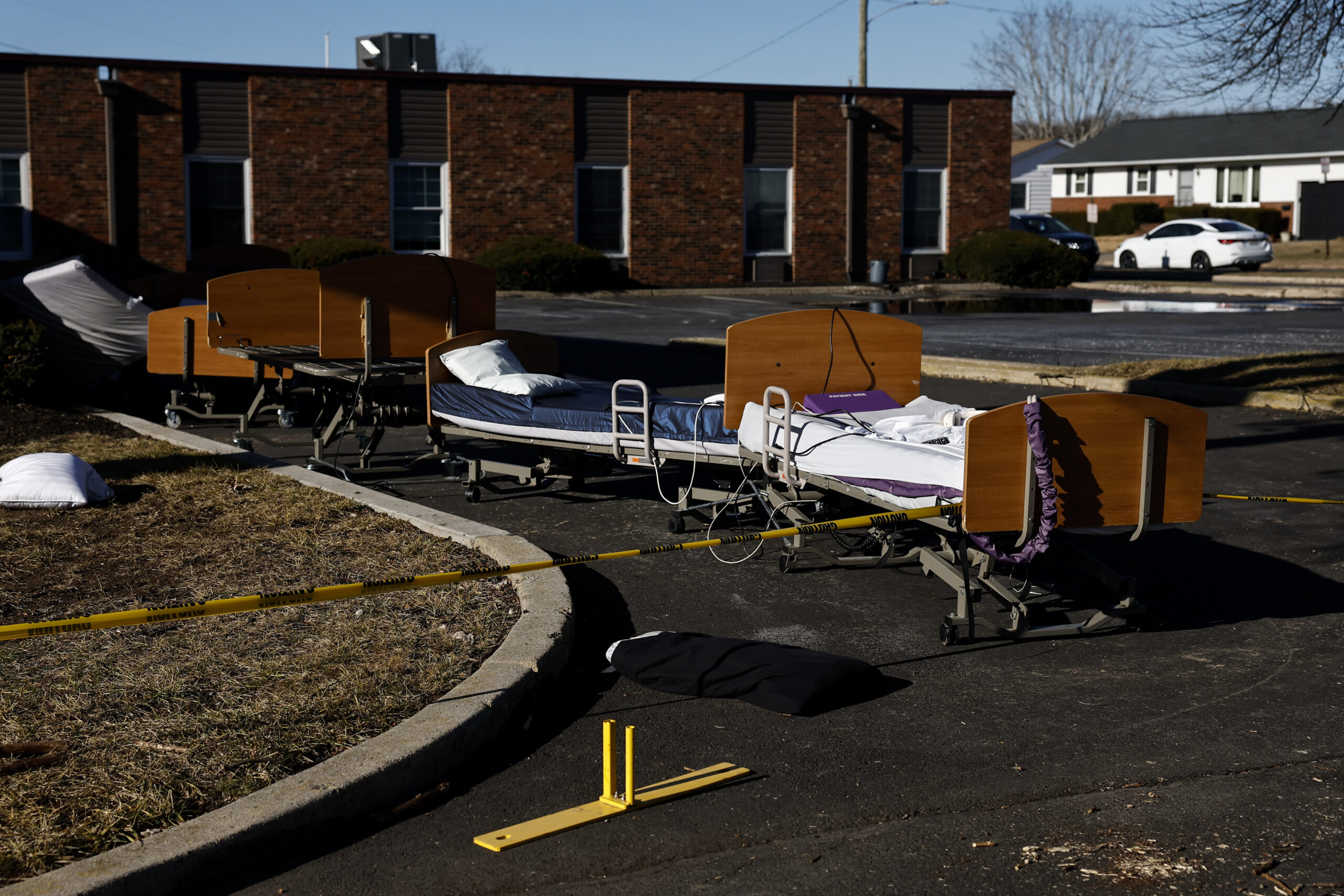
Hospital beds remain outside at Bristol Health & Rehab Center on Wednesday, Dec. 24, 2025, in Bristol Township, Pa. Two people were killed and 20 were injured in the explosion on Dec. 23.
‘The wall was coming down’
Flesch, who lost his left leg from a brown recluse spider bite, said he doesn’t understand why he was given the green light to return to his room.
A former pool and spa tradesman from Levittown, he had been a Bristol resident a short time, sifting through a file he kept of apartments he could possibly call his next home.
“Suddenly, there was this loud boom!,” he recalled.
“I’ve never been in anything like that in my life,” he said. “I was in shock because all the glass from my windows came flying out. Then the ceiling was coming down. The wall was coming down.”
Glass shards piled a foot deep in his room, even deeper in the hallway. Crumpled furniture was hurtled everywhere. Flesch maneuvered his wheelchair through glass to check on the bedridden man across the hall. He was OK.
The facility’s part-time psychologist helped Flesch and many others get outside safely.
“It was complete chaos,” he said.
The explosion left Flesch, now staying in a nursing home in Nazareth, Pa., with nothing more than scratches on his arms.
“I am still asking myself how I survived,” he said. “It must be God. I can’t explain it any other way.”
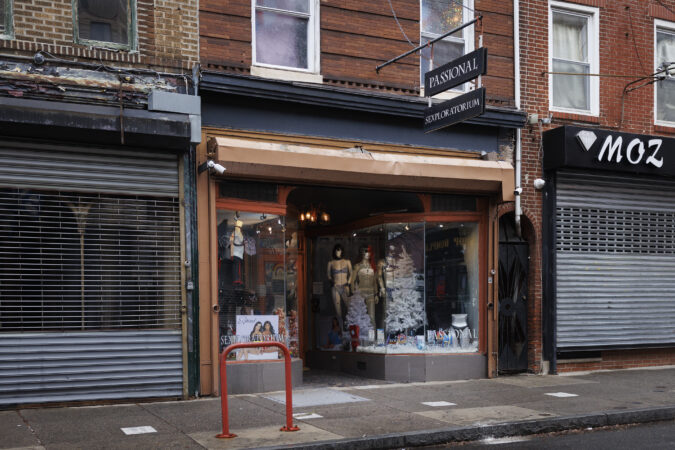
Passional Boutique & Sexploratorium displays mannequins in leather handcuffs, vibrators, and posters of women in lingerie in its storefront windows along one of Philadelphia’s main shopping drags.
But the adult store — a South Street staple of fetish and fantasy fashion and sex toys for about two decades — is now under scrutiny by President Donald Trump’s administration for selling an undergarment tucked away on the shop’s second floor: breast binders.
On Dec. 16, the U.S. Food and Drug Administration sent a warning letter to Passional stating it was illegally selling breast binders. Most purchasers are trans men — individuals who are assigned female at birth but identify as male.
The FDA classifies breast binders, which compress chest tissue, as a medical device. Businesses that distribute them in the United States must be registered with the FDA or face fines and other enforcement action.
Passional’s operations manager, Ashly Booth, said it’s “a paperwork issue” that pertains to the overseas manufacturer, not to the Center City retailer. Passional will continue to sell those breast binders in its store but not online, she said.
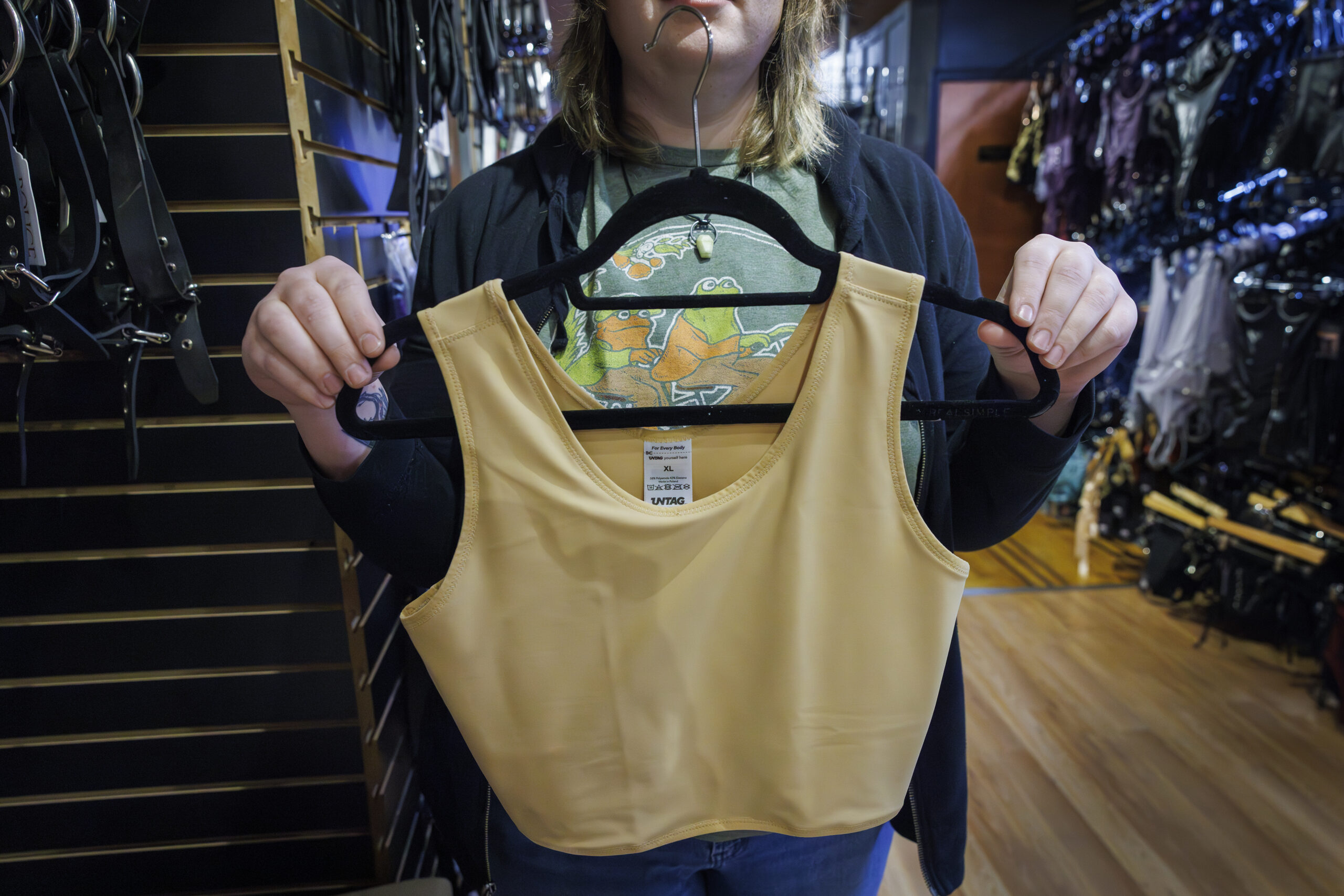
An employee at Passional Boutique displays a breast binder for sale at the South Street store. Breast binders are garments that compress chest tissue.
The FDA’s warning sparked outrage within the region’s transgender community.
Naiymah Sanchez, 42, who described herself as “a proud woman of transgender experience,” said she believes the Trump administration wants to ban gender-affirming care for everyone, not just children and teens.
Breast binders can help treat gender dysphoria, a medical condition in which a person’s body does not match their gender identity.
“This is an adult store, so now you’re attempting to restrict our access — adult access — to the things we need so that we can exist‚” said Sanchez, a senior organizer for the ACLU’s Pennsylvania chapter. “They are trying to double down on making it illegal to be trans in the United States.”
Protecting ‘children’?
Passional was one of only 12 businesses across the nation and overseas, including companies in Singapore and the Netherlands, that received a warning letter. All 12 companies sell, distribute, or manufacturer breast binders to buyers in the United States, primarily through online sales. They included Seattle-based Tomboyx, which uses the tagline “Be Exactly Who You Were Born to Be — No Apologies,” and Manhattan-based For Them, a queer and trans-owned company.
The language in each FDA letter was largely boilerplate.
During a Dec. 18 news conference, FDA Commissioner Martin Makary said the 12 companies were illegally marketing breast binders for children as treatment of gender dysphoria.
“Pushing transgender ideology in children is predatory, it’s wrong, and it needs to stop,” Makary said.
However, none of the violation letters specifically mention children or marketing of breast binders to minors. The FDA declined to comment Friday, referring a reporter to the letter sent to Passional.
Passional employees said they do not market breast binders to minors. Customers must be 18 or older to shop there. A teen may enter and try on a breast binder, but only when accompanied by a parent or guardian, they said.
Makary’s comments were part of a Trump administration announcement of proposed rules to cut off federal Medicaid and Medicare funding from hospitals that provide gender-affirming care to children. The administration wants to restrict the use of puberty blockers, hormone therapy, and surgical interventions for transgender people under the age of 18.
“It’s based on a medical dogma, sadly, that the normal, sometimes stressful experiences of boys and girls growing up is a pathology that requires medical intervention,” Makary said.
Several states have prohibited gender-affirming care for minors, but it remains legal in Pennsylvania, New Jersey, and Delaware. The American Academy of Pediatrics and other major medical associations, citing research, widely accept such care as safe, effective, and medically necessary for the patients’ mental health.
“These binders are not benign,” he said. “Long-term usage has been associated with pain and compromised lung functions.”
‘A paperwork issue’
Passional carries a line of breast binders distributed by UNTAG, originally Trans-Missie B.V., a company based in the Netherlands. UNTAG says on its website that “chest binding plays a vital role in reducing gender dysphoria” and it offers “kids binders.” Passional does not sell child sizes.
“We offer a selection of domestic and imported binders from sizes XS through 3XL,” Passional’s website says. “Whether you are binding for gender identity, cosplay, drag performance or nonsurgical body sculpting, we offer a range of styles and price points to help you achieve your desired expression.”
Under FDA regulations, manufacturers and distributors of Class 1 — generally meaning low risk — medical devices must register annually with the government. The regulation is designed to help the FDA track devices and quickly respond to safety concerns or recalls.
The FDA defines medical devices, including breast binders, as “intended for use in the diagnosis of disease or other conditions or in the cure, mitigation, treatment, or prevention of disease, or to affect the structure or any function of the body.”
The FDA issued warning letters to both Passional and the Dutch company. The letters say separate government reviews of Passional and UNTAG’s websites found “various breast binders for sale” with claims to help “reduce gender dysphoria” in violation of the Federal Food, Drug, and Cosmetic Act.
The letters gave each 15 business days to respond and provide corrective measures.
In an email to The Inquirer on Wednesday, UNTAG, based in Amsterdam, replied that it would keep a reporter informed of any next steps.
Booth, Passional’s operations manager, said the regulations do not apply to in-store retail sales. However, Passional will stop selling UNTAG breast binders on its website, she said.
“One specific producer of the binders that we have here in Passional now did not register themselves as a medical device company,” Booth said. “It was more of a paperwork issue on the side of the manufacturer.”
Passional, she added, would not pull breast binders from its brick-and-mortar store “for the simple fact that there is a need for them.”
Teens need parental consent
Passional customers must be 18 or older to enter the store. Employee Aizlyn Kraus said she will ask for identification if a patron looks under age.
However, teens who want to get fitted for a breast binder and possibly purchase one may come in, but they must be accompanied by a parent or guardian. In those cases, Passional temporarily closes the store so the teen can quickly get upstairs, where there’s a dressing room. Typically, parents call or email ahead of time to set up an appointment, according to Kraus and Booth.
“We can get them up there without them seeing anything they don’t need to see, without them knowing anything they don’t need to know, and they walk out with something that helps them in their lives,” Kraus said.
Kraus, who is transgender and identifies as a woman, said “dysphoria affects everyone differently. Some people know at a really early age and when they begin to go through puberty, it’s really distressing. There are so many trans kids who either think about self-harm or engage in self-harm. It’s disheartening.”
In the last six months, “two or three parents” have come in separately with their teens to try on breast binders, Booth said.
Kraus said Passional does not market or advertise breast binders to minors, and the majority of purchasers are adults. Passional employees are trained how to properly fit people in breast binders, making sure they are not too tight and advising customers not to wear them for longer than eight hours a day.
Kraus, 33, said breast binders offer an alternative to top surgery. “It’s a whole lot cheaper and easier to do, rather than just jump right into surgery,” Kraus said.
Passional, known for its queer and trans inclusivity, sells many items to help people “feel better about their body,” including waist-tightening corsets, penis “extenders,” and “tucking” or “gaff” undergarments to minimize penile bulge — all forms of gender-affirming care, Kraus said.
Kraus added that some men with gynecomastia, or an enlargement of breast tissue in males due to hormone imbalance, will buy breast binders.
‘It’s just insane’
Prior to undergoing top surgery, 34-year-old Simon Parsons wore a breast binder for a flattened appearance, likening it to Spanx body-sculpting wear.
Parsons, who identifies as a nonbinary transgender Philadelphian, said: “This is going to create a chilling effect for anyone who needs a breast binder. It’s all just to open the door to eventually say, ‘Trans people are not allowed to exist.’”
Parsons said after breast-removal surgery, the hospital provided a chest compression vest to reduce swelling, but it looked nothing like the ones sold by Passional. It had a padded front zipper and Velcro shoulder straps for easy release.
Passional’s breast binders look like sports bras or nylon crop tops.
Parsons and others described the FDA action as a government overreach at best and erosion of civil rights at worst.
“It’s just insane,” said Corie Bosman, 34, of Bensalem.
Bosman, who is nonbinary transgender and whose stage name is “Mister Right,” has worn breast binders while performing as a drag king. Bosman was the 2025 winner of Mr. Philly Drag King, or Mr. PDK, a pageant-style competition organized by the Philly Dyke March.
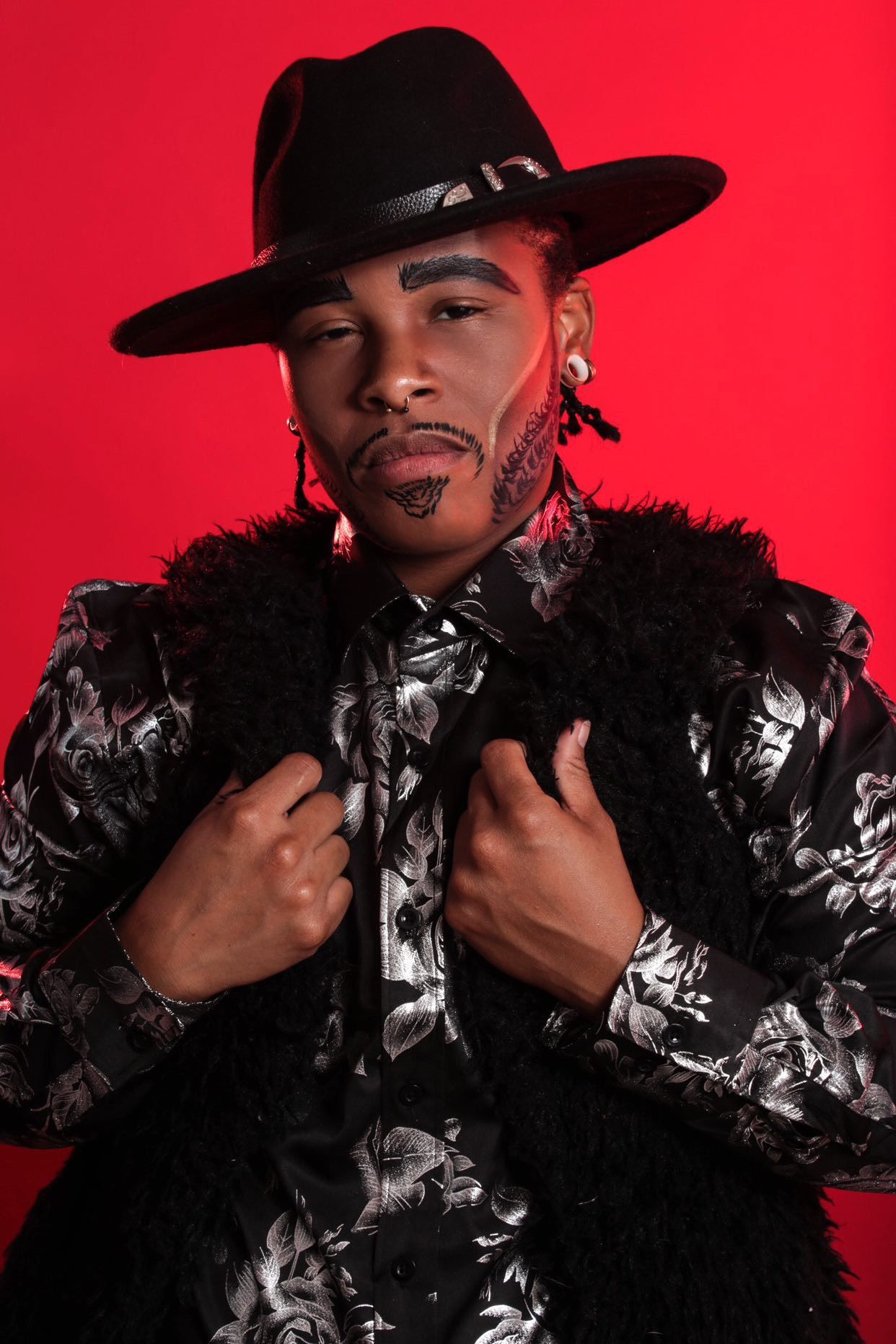
Corie Bosman, whose stage name is “Mister Right,” was the 2025 winner of the Mr. Philly Drag King (Mr. PDK) pageant competition, organized by Philly Dyke March. Bosman uses breast binders or special “trans tape” for chest flattening.
Bosman and Parsons, who had purchased their breast binders online, said they are concerned that transgender people, especially minors, will resort to potentially harmful practices, like binding their chests with duct tape, if the Trump administration restricts access to breast binders.
“It opens up the window for people to hurt themselves by just trying to be themselves,” Bosman said.
Venezuelans in the Philadelphia region had mixed reactions to the U.S. strike against their home country over the weekend, which removed Nicolás Maduro from power and left the future of the South American country unclear.
But some Ukrainian Americans in the region felt an uneasy sense of déjà vu as they watched events in Venezuela unfold — and are concerned about what it could mean for relatives and compatriots 6,000 miles away from Caracas, in Ukraine.
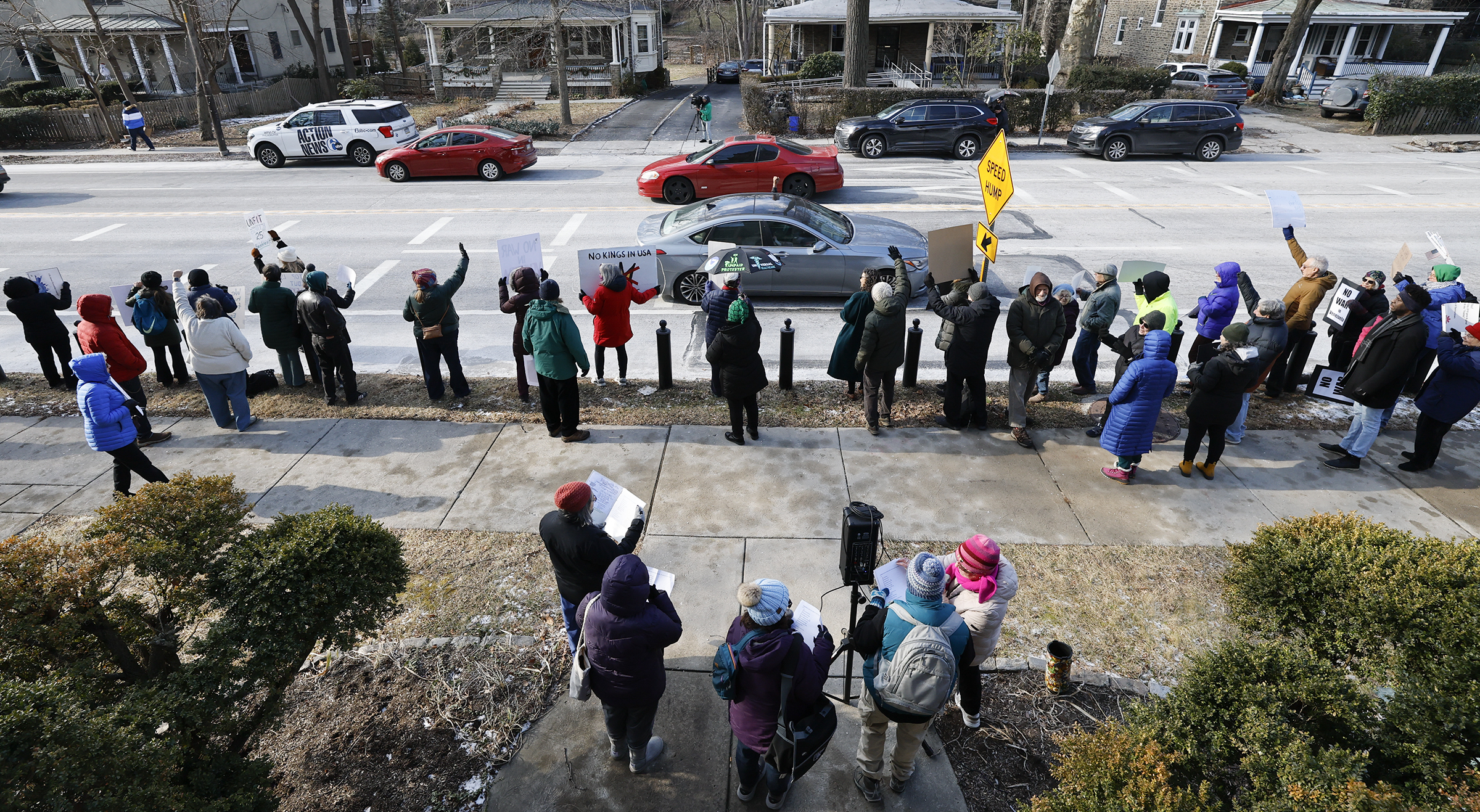
“This action, which is an illegal action, gives the light to people like [Russian President Vladimir Putin] and other dictators to do whatever they like,” Ukrainian American activist Mary Kalyna said Sunday amid a 60-person anti-war rally outside the Unitarian Society of Germantown in West Mount Airy. “Why should he not invade Ukraine or Poland or Lithuania, when the U.S. is invading Venezuela?”
The Trump administration’s unilateral action sends a message to other countries, like Russia, that the United States may no oppose a larger nation meddling in a smaller country’s political affairs, said Paula Holoviak, a political science professor at Kutztown University, in an interview.
“It just doesn’t set a good precedent,” said Holoviak, who is a Ukrainian American.
‘We have been waiting for this for 26 years’
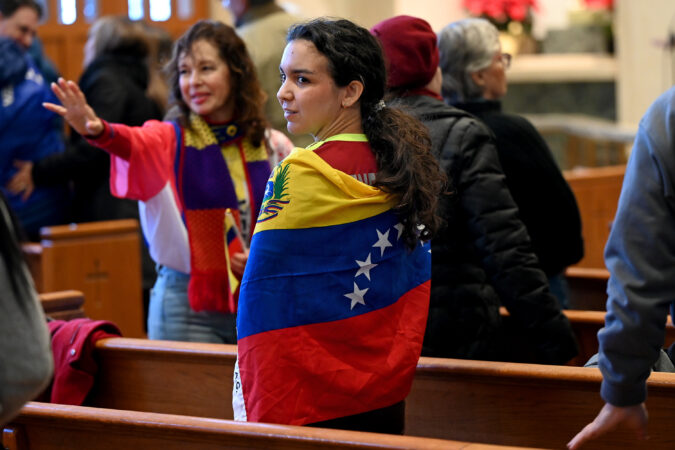
Venezuelan flag in hand, Diana Corao Uribe, 53, and her family drove from Media to the Cathedral Basilica of SS. Peter and Paul to attend a Sunday vigil for the future of Venezuela, organized by local groups Casa de Venezuela Philadelphia, Casa de Venezuela Delaware, and Gente de Venezuela Philadelphia.
Hundreds of people hugged, cried, and prayed as they waited inside with flags and apparel, brightening the basilica with yellow, red, and blue. Members of the crowd were largely critical of the rule of Maduro and his predecessor, Hugo Chávez.
“We have been waiting for this for 26 years; you cannot imagine the feeling, the joy, the happiness, the hope that we feel right now,” Corao Uribe said.
But Corao Uribe said that as the hours passed, her feelings have grown more complicated. Until President Donald Trump announced the U.S.’s intentions to “run” Venezuela until a “safe, proper and judicious transition” could be completed, Corao Uribe had hoped Edmundo González Urrutia, who faced Maduro at the polls in the 2024 Venezuelan presidential election, would become the next president.
The announcement was unexpected and a bit concerning, she said, but it wasn’t enough to shake her sense of happiness.
Philadelphia resident Astrid Da Silva, 32, said it felt bittersweet.
“The amount of joy that seeing the dictator out of Venezuela brings — it’s immeasurable; it’s normal when there has been torture and pain for so long,” Da Silva said. “But without a democratic transition of power, fear starts slipping in.”
Hearing Trump say that opposition leader Maria Corina Machado lacked support in Venezuela clouded her feelings.
“People don’t want the U.S. there; we want the opposition or at least a free election,” Da Silva said, adding that the country’s political turmoil forced her to emigrate to the U.S. at age 7.
Ongoing power struggles have at times made her feel like people view Venezuela as a pawn, forgetting there are real lives at stake, she said.
‘It could be very destabilizing’
The U.S. has a long history of intervening in other countries, Holoviak noted, but that hasn’t always gone well. “We do have an extremely powerful military, but we might not want the aftermath of this,” Holoviak said. “It could be very destabilizing.”
Residents of Northwest Philadelphia voice their opposition to the Trump administration’s strike against Venezuela in a vigil outside the Unitarian Society of Germantown on Sunday, Jan. 4, 2026.
Ukrainian leaders have largely welcomed the liberation of Venezuelans from Russian-allied Maduro’s regime. Speaking with reporters in Kyiv, President Volodymyr Zelensky said, “Well, what can I say? If dictators can be dealt with in this way, then the United States of America knows what it should do next.”
Eugene Luciw, a Ukrainian American who lives in Montgomery County, said in an interview that he interpreted Zelensky’s comments to mean that he believes the U.S. should arrest Putin — and Luciw agrees.
Luciw said that he has no problem with Trump removing Maduro, whom he called “a dictator who slaughters people.”
However, Luciw questioned Trump’s motives and said his actions were inconsistent.
“If we want to do away with a real dictator, with absolute evidence that he’s a genocidal maniac,” then the U.S. should be tougher on Putin, he said.
At the Cathedral Basilica, Fernando Torres, 45, said he has struggled with what the future may hold for Venezuela after Trump’s actions.
“Even if we don’t like Trump, we have to separate things. It’s like if you were drowning and someone threw you a life buoy,” Torres said. “You don’t care who threw it or what their intentions were; you just care about saving your life. What people don’t understand is that Venezuelans needed their life buoy and now for the first time we have hope.”
As political decision-making continues to unfold, Corao Uribe, Da Silva, and Torres agree on one thing: the importance of listening to what Venezuelans want for their future.
“Venezuelans have suffered for so long, don’t try to understand our pain; this isn’t about politics, it’s about the suffering of the Venezuelan people,” Corao Uribe said.
This article contains information from the Associated Press.
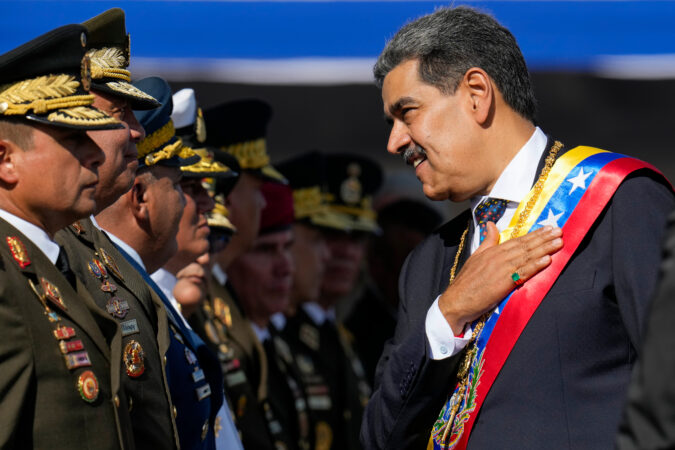
MIAMI — When deposed Venezuelan leader Nicolás Maduro makes his first appearance in a New York courtroom Monday to face U.S. drug charges, he will likely follow the path taken by another Latin American strongman toppled by U.S. forces: Panama’s Manuel Noriega.
Maduro was captured Saturday, 36 years to the day after Noriega was removed by American forces. And as was the case with the Panamanian leader, lawyers for Maduro are expected to contest the legality of his arrest, arguing that he is immune from prosecution as a sovereign head of foreign state, which is a bedrock principle of international and U.S. law.
It’s an argument that is unlikely to succeed and was largely settled as a matter of law in Noriega’s trial, legal experts said. Although Trump’s ordering of the operation in Venezuela raises constitutional concerns because it wasn’t authorized by Congress, now that Maduro is in the U.S., courts will likely bless his prosecution because, as was the case with Noriega, the U.S. doesn’t recognize him as Venezuela’s legitimate leader.
“There’s no claim to sovereign immunity if we don’t recognize him as head of state,” said Dick Gregorie, a retired federal prosecutor who indicted Noriega and later went on to investigate corruption inside Maduro’s government. “Several U.S. administrations, both Republican and Democrat, have called his election fraudulent and withheld U.S. recognition. Sadly, for Maduro, it means he’s stuck with it.”
Noriega died in 2017 after nearly three decades in prison, first in the U.S., then France, and finally Panama. In his first trial, his lawyers argued that his arrest as a result of a U.S. invasion was so “shocking to the conscience” that it rendered the government’s case an illegal violation of his due process rights.
Justice Department opinion allows ‘forcible abductions’ abroad
In ordering Noriega’s removal, the White House relied on a 1989 legal opinion by then-Assistant Attorney General Bill Barr, issued six months before the invasion. That opinion said the U.N. Charter’s prohibition on the use of force in international relations does not bar the U.S. from carrying out “forcible abductions” abroad to enforce domestic laws.
Supreme Court decisions dating to the 1800s also have upheld America’s jurisdiction to prosecute foreigners regardless of whether their presence in the United States was lawfully secured.
Barr’s opinion is likely to feature in Maduro’s prosecution as well, experts said.
Drawing parallels to the Noriega case, Barr on Sunday pushed aside criticisms that the U.S. was pursuing a change of government in Venezuela instead of enforcing domestic laws. As attorney general during the first Trump administration, Barr oversaw Maduro’s indictment.
“Going after them and dismantling them inherently involves regime change,” Barr said in a Fox News Sunday interview. “The object here is not just to get Maduro. We indicted a whole slew of his lieutenants. It’s to clean that place out of this criminal organization.”
Key differences between Noriega and Maduro
There are differences between the two cases.
Noriega never held the title of president during his six-year de facto rule, leaving a string of puppets to fill that role. By contrast, Maduro claims to have won a popular mandate three times. Although the results of his 2024 reelection are disputed, a number of governments — China, Russia, and Egypt among them — recognized his victory.
“Before you ever get to guilt or innocence, there are serious questions about whether a U.S. court can proceed at all,” said David Oscar Markus, a defense lawyer in Miami who has handled several high-profile criminal cases, including some involving Venezuela. ”Maduro has a much stronger sovereign immunity defense than did Noriega, who was not actually the sitting president of Panama at the time.”
For U.S. courts, however, the only opinion that matters is that of the State Department, which considers Maduro a fugitive and has for months been offering a $50 million reward for his arrest.
The first Trump administration closed the U.S. Embassy in Caracas, the capital of Venezuela, and broke diplomatic relations with Maduro’s government in 2019 after he cruised to reelection by outlawing most rival candidates. The administration then recognized the opposition head of the National Assembly as the country’s legitimate leader.
The Biden administration mostly stuck to that policy, allowing an opposition-appointed board to run Citgo, a subsidiary of Venezuela’s state-owned oil company, even as the U.S. engaged in direct talks with Maduro’s government that were aimed at paving the way for free elections.
“Courts are so deferential to the executive in matters of foreign policy that I find it difficult for the judiciary to engage in this sort of hairsplitting,” said Clark Neily, a senior vice president for criminal justice at the Cato Institute in Washington.
U.S. sanctions are a hurdle for Maduro’s defense
Another challenge that Maduro faces is hiring a lawyer. He and his wife, Cilia Flores, who also was captured, have been under U.S. sanctions for years, making it illegal for any American to take money from them without first securing a license from the Treasury Department.
The government in Caracas now led by Maduro’s vice president, Delcy Rodríguez, may want to foot the bill, but it is similarly restricted from doing business in the United States.
The U.S. has indicted other foreign leaders on corruption and drug trafficking charges while in office. Among the most noteworthy is Juan Orlando Hernández, former president of Honduras, who was convicted in 2024 for drug trafficking and weapons charges and sentenced to 45 years in prison.
Trump pardoned Hernández in November, a move that drew criticism from even some Republicans who viewed it as undercutting the White House’s aggressive counternarcotics strategy centered against Maduro.
The U.S. had requested Hernández’s extradition from Honduras a few weeks after he left office. After the arrest of Noriega, who had been a CIA asset before becoming a drug-running dictator, the Justice Department implemented a new policy requiring the attorney general to personally sign off on charging of any sitting foreign president, due to its implications for U.S. foreign policy.
Maduro may have a slightly stronger argument that he is entitled to a more limited form of immunity for official acts he undertook as at least a de facto leader, since that question would not turn on whether he is a head of state recognized by the U.S.
But even that defense faces significant challenges, said Curtis Bradley, a University of Chicago Law School professor who previously served as a counselor of international law at the State Department.
The indictment accuses Maduro and five other co-defendants, including Flores and his lawmaker son, of facilitating the shipment of thousands of tons of cocaine into the U.S. by providing law enforcement cover, logistical support, and partnering with “some of the most violent and prolific drug traffickers and narco-terrorists in the world.”
“The government will argue that running a big narcotrafficking operation … should not count as an official act,” Bradley said.
The Secret Service has launched one of the most ambitious hiring efforts in its history, seeking to bring on thousands of agents and officers to ease strain on its overstretched workforce and prepare for multiple major events in 2028, including the presidential election and the Olympics.
Service leaders say they want to hire 4,000 new employees by 2028 — a surge that law enforcement experts say has no clear precedent and reflects mounting concerns about staff burnout, a loss of experienced agents, and a relentless operational tempo. The added staff would make up for expected retirements and increase the size of the agency by about 20%, to more than 10,000 for the first time.
Under a plan led by Deputy Director Matthew Quinn, the service aims to expand its special agent ranks from about 3,500 to about 5,000. Officials also want to add hundreds of officers to the Uniformed Division, for a total of about 2,000, and hire additional support staff. The figures have not been previously reported.
The agency faces serious obstacles, however, including a shortage of qualified candidates; competition with other law enforcement agencies, especially in immigration enforcement; and bottlenecks in hiring and training, according to former service officials.
A previous attempt to reach 10,000 employees over a roughly 10-year period ending in 2025 failed as the agency struggled with leadership turnover and disruptions from the coronavirus pandemic, among other issues. The service fell far short of recruitment and retention goals despite offering some of the biggest financial incentives of any federal law enforcement agency.
“Our mindset is, we aren’t going to pay our way out of this,” said Quinn, a longtime Secret Service official who returned to the agency in May after several years in the private sector. “We can’t create enough incentives to negate the fact that we’re working our people very, very hard.”
Quinn said he and Secret Service Director Sean Curran, the former head of President Donald Trump’s protective detail, have set out to make hiring a top priority, second only to protection. Senior administration officials have backed them, he said.
“The protective mission has expanded,” he said. “Our numbers are low to meet those needs. We have to achieve what we said we were going to do 10 years ago. We’ve got to achieve it now.”
Agency officials want to improve the quality of life in the service by shortening hours and reducing time on the road for officers and agents, many of whom spend months each year traveling on protective assignments.
A larger staffcould also allow the Secret Service to lean less on other law enforcement agencies for help securing high-profile events, giving it tighter control over venues. Poor communication with other agencies played a major role in the service’s most publicized failure in recent years, the attempted assassination of Trump in 2024 at a campaign rally in Butler, Pa.
Some former officials questioned whether the service can achieve its goal.
“They are going to have to eliminate all the management and red-tape barriers,” said Janet Napolitano, a former secretary of the Department of Homeland Security, the service’s parent agency. “They have to be able to swiftly recruit, maintain quality, and train that number of new agents. They’re going to have to turn headquarters into a hiring machine.”
In 2024, Napolitano helped lead a bipartisan investigation of the Secret Service failures that led up the Butler assassination attempt, the first time a president or former president had been fired upon since 1981.
Others said even more modest hiring targets could be a stretch on such a short timeline. Getting hired and trained for a job in the Secret Service is a long, strenuous, and heavily bureaucratic process, even by federal government standards. It involves multiple rounds of interviews, an intensive background check, and a notoriously tough polygraph test that officials say screens out some otherwise strong candidates.
All of those steps place heavy demands on already understaffed field offices, according to a former Secret Service executive familiar with the process, who like others spoke on the condition of anonymity due to concerns about retaliation. The former executive said it was difficult to see how the agency could clear those hurdles while significantly expanding the workforce.
“I hope they have success in getting those numbers as much as anybody, but it’s not realistic,” said another former senior official, who retired recently. “There’s no part of law enforcement that’s not struggling to hire.”
Service leaders are adamant that they are not lowering standards to meet their goals.
Some service officials had floated the possibility of curtailing or suspending the investigative portion of agent training, focusing only on the protective portion of the service’s mission, according to people familiar with the discussions. But Quinn said that was out of the question. “Investigations are the lifeblood of this organization,” he said.
Instead, officials say, they have found ways to speed the process.
In November, the service held the first of what officials expect to be multiple accelerated hiring events in which candidates complete assessments over several days, including a physical fitness test, a security interview, and a full polygraph.
Historically, those assessments have taken months, according to Delisa Hall, the Secret Service’s chief human capital officer. About 350 candidates out of nearly 800 who attended the first event advanced to the next phase, she said.
“It’s becoming evident that this may be our new normal to push applicants through,” she said.
Agency officials say they have compressed the timeline for a job offer down to less than a year from the previous 18 months or more and hope to cut the timeline by roughly another four months. The long wait in the past has led some candidates to withdraw or take positions with other agencies that moved more quickly.
Hall said the agency is recruiting from the military, college athletes, and law enforcement, and it’s staying more engaged with applicants to keep from losing people along the way.
Getting new hires trained and field-ready on time could also present challenges as the Secret Service races to staff up.
Officials say the service has secured 42 classes at the federal government’s main training center for law enforcement agents in Glynco, Ga., for the 2026 fiscal year. All the service’s new agents and officers must undergo basic criminal investigator training at the facility, known as FLETC, for about three months alongside recruits from other agencies.
The campus is expected to remain packed for the foreseeable future with recruits from Immigration and Customs Enforcement and other immigration agencies hired as part of the Trump administration’s crackdown. Secret Service leaders say they have not had to compete for space. But several former officials said they worry the service’s recruits could take a back seat to training for ICE or the Border Patrol, both of which are hiring aggressively.
The pressure on the agency will only mount as 2028 approaches. Some in the Secret Service have privately referred to the year as “Armageddon” because of the extraordinary security demands posed by the election and other major gatherings, including the Los Angeles Olympics, the first Summer Games in the United States since Atlanta in 1996.
The workforce carrying out the mission could look dramatically different from the last election cycle. Many experienced agents have departed for other agencies or jobs in the private sector in recent years. Others from a large cohort hired in the years surrounding the Sept. 11, 2001, terrorist attacks may not stay for another breakneck campaign.
“About a third of the workforce will be retirement-eligible before the start of 2028,” said Derek Mayer, a former deputy special agent in charge of the Secret Service’s Chicago field office. “That’s definitely a cause for concern. There were periods during hiring freezes in the 2010s when we didn’t hire anyone. When that happens, it does hurt, but it hurts five or 10 years later.”
With Trump term-limited, both major parties are expected to have competitive primaries, raising the number of people the service will have to protect. The eventual nominees, their running mates and their spouses will receive full-time Secret Service details.
The agency is also tasked with coordinating protection around the 2028 Summer Olympics and Paralympics, scheduled during the last two weeks of July and the last two weeks of August, respectively.
“No matter what, I don’t care how successful we are,” Quinn said, “it’s still going to be a rough summer.”
The United States will “run” Venezuela — a country of 30 million people spread over hundreds of thousands of square miles — for the foreseeable future, President Donald Trump said Saturday just hours after the shocking, early morning U.S. military assault that captured its head of state and left Latin America and much of the rest of the world reeling.
“We’re going to stay until … the proper transition takes place,” Trump said in a Florida news conference that glanced past details of how exactlythat would be done.
Two side benefits, he indicated, were that hundreds of thousands of Venezuelans who had fled to the United States would now go home and that the U.S. would now be able to take over the Venezuelan oil industry.
On social media, Trump posted a photograph of shackled and blindfolded Venezuelan President Nicolás Maduro aboard the amphibious assault ship USSIwo Jima. Maduro and his wife, both under U.S. indictment for drug trafficking and corruption, were snatched from a safe house by U.S. Special Operations forces in what senior administration officials insisted was not regime change but a law enforcement operation for which the military provided security.
The Maduros, officials said, were read their rights by an FBI official on the ground before being whisked away in a helicopter. Asked if U.S. forces were prepared to kill Maduro if he resisted, Trump said, “It could have happened.”
Trump made no distinction between law enforcement and overthrow, seeming to exult in what he called a “spectacular” operation, the likes of which had not been seen “since World War II … one of the most stunning, effective, and powerful displays of American military might and competence in American history.”
“American dominance in the Western Hemisphere will never be questioned again,” Trump said. “Under the Trump administration we are reasserting American power in a very powerful way in our home region.”
Asked who would run Venezuela, Trump said, “largely the people behind me,” pointing to Secretary of State Marco Rubio and Defense Secretary Pete Hegseth. “They’re going to be a team that’s working with Venezuela to make sure it’s working right,” he said.
The vagueness of what happens next recalls the 2003 U.S. takeover of Iraq after the invasion ousting Saddam Hussein. Trump initially supported the Iraq operation, before saying he was against it as it stretched into a yearslong battle with disaffected Iraqis, gave rise to the Islamic State, and left thousands of American troops dead before the formal U.S. withdrawal in 2011.
Trump made no commitment to María Corina Machado, the leader of the Venezuelan opposition and Nobel Peace Prize laureate, or to Edmundo González, whom the United States and others recognized as the legitimate president after an election last year that Maduro was widely believed to have stolen. Rubio, he said, had spoken by phone with Venezuelan Vice President Delcy Rodríguez, who “said ‘we’ll do whatever you need.’ I think she was quite gracious.”
Trump said Rodríguez had been sworn in as interim president, although she told Venezuela’s state television Saturday night that “There is only one president here, and his name is Nicolás Maduro.”
The 20th century was marked with numerous U.S. military interventions and occupations in Central America and the Caribbean, but Saturday’s assault on Venezuela was Washington’s first direct and openly acknowledged military strike in history against a South American government. A strategic gamble with an unpredictable outcome in a deeply divided region, it dramatically alters the security dynamic across the continent.
In a flash, to both American foe and ally alike, the strikes have made the threat of U.S. military power indisputably real.
“This is one of the most dramatic moments in modern South America history,” said Oliver Stuenkel, an analyst of international affairs at the Brazilian university, the Getulio Vargas Foundation. “The United States now represents the biggest security threat for the simple fact that it just militarily attacked a South American country with an unclear rationale.”
Others were more direct. “For most Latin Americans, it’s insulting,” said a senior South American diplomat who spoke on the condition of anonymity so as not to draw Trump’s ire to his own country.
“Of course we understand that the might of the United States is that it can intervene in any Latin American countries in any way they want,” the diplomat said. “But this will lead to complete destruction of any kind of international law, and to a growing antipathy toward the United States” throughout the Western Hemisphere.
By Saturday morning, reaction to the strikes was already breaking along ideological lines in a region deeply polarized over security, crime, and corruption. Many on the right cheered the intervention, calling the removal of the self-described socialist Latin American strongman an advancement for liberty and a blow against drug trafficking.
Argentine President Javier Milei, whose government has received a $20 billion currency swap from the United States to stabilize his country’s troubled economy, lauded the strikes. So did Ecuadorian President Daniel Noboa Azin, who has allied himself with Trump and offered to reopen a U.S. air base closed by one of his predecessors.
“For all narco-Chavista criminals, your time has come,” Noboa wrote on social media, referring to Maduro’s predecessor, Hugo Chávez. “Your structure will end up falling across the entire continent.”
Those on the left decried what they called an illegal act of military aggression. Few came directly to the defense of Maduro, who had been left increasingly isolated as his authoritarian and illiberal practices have bankrupted Venezuela, unleashed a refugee crisis, and given drug traffickers increasingly free rein. But they said the unilateral strikes and his removal set a new and dangerous precedent for the region.
“The bombing of Venezuelan territory and the capture of its president crosses an unacceptable line,” Brazilian President Luiz Inácio Lula da Silva said. “The action recalls the worst moments of interference in Latin American and Caribbean politics and threatens the regional preservation as a zone of peace.”
Some analysts, however, said it would be a mistake to interpret the strikes as the continuation of U.S. military actions in other Latin American nations, whether the CIA-sponsored overthrow of Guatemala’s government in 1954, the 1983 U.S. invasion of Grenada, or the 1989 capture of Panama leader Manuel Antonio Noriega following a 25,000-troop invasion.
“This is not going to be a unified Latin American rejection of the action, like you may have seen in the ‘60s or the ‘70s,” when interventions were often influenced by the Cold War, said Eric Farnsworth, a senior associate at the Center for Strategic and International Studies think tank. “This is happening in a divided region, where nobody wanted this to happen, but where many recognized that there was no alternative to this unless you were ready to live with Maduro forever.”
Several governments and leaders in the region already have an affinity with the Trump administration — ties the White House has sought to expand and exploit over the past year.
The Trump administration has solidified relations with El Salvador’s president, Nayib Bukele, who accepted millions of dollars to imprison U.S. deportees and whom Trump called a “great friend” and “one hell of a president.” It has promised new trade and security cooperation with Ecuador and Paraguay, whose leaders are also Trump admirers. And it threw an economic lifeline to Milei, whom U.S. Treasury Secretary Scott Bessent called a “beacon” for South America.
But few disagreed over the significance of the strikes. For decades, the United States has focused its military might elsewhere, in theaters much further away. The attacks have returned Washington to a policy of unabashedinterventionism in the region.
“The reaction in the rest of Latin America will be mixed between euphoria, anger, and fear,” said Brian Winter, an analyst with the Americas Society and Council of the Americas.
Those in the region who condemn the strikes — most notably Lula, Mexican President Claudia Sheinbaum and Colombian President Gustavo Petro — will have to watch their backs. While Trump last year had what he called a productive meeting with Lula, he repeated at the news conference an earlier warning that Petro, whose country is a major producer of cocaine, had better “watch his ass.”
In the case of Mexico, “the fact of the matter is that large swaths of the country are under the control of narco-terror organizations,” a senior administration official said, speaking on the condition of anonymity under rules imposed by the White House.
“This is not a president that just talks,” the official said. “He will take action eventually. … I think the president always retains the option to take action against threats to our national security.’’
While Petro has called Trump a “murderer” for U.S. military strikes against alleged drug boats in the Caribbean and eastern Pacific, it’s unlikely that either Lula or Sheinbaum will want to risk a lengthy diplomatic dispute with the White House, said Matias Spektor, a Brazilian political scientist at the Getulio Vargas Foundation.
Referring to Cuba, which has depended on Venezuela for energy supplies and economic and security backing, Rubio said at the news conference Saturday, “If I lived in Havana now and I was in the government, I’d be concerned.” Venezuelan oil, he said, would not be allowed to go there.
Since he began ratcheting up public threats against Maduro last summer, Trump has offered an evolving list of charges to justify his removal through exile or force, from allowing China, Russia, and Iran to gain a toehold in the hemisphere, to illegal U.S. immigrants that he charged Maduro had released from Venezuelan prisons and “insane asylums,” while asserting Venezuelan “terrorist”drug gangs were engaged in “armed conflict” with the United States.
Most recently, he has charged that Venezuela “stole” oil and land belonging to the United States when it, like many other countries, nationalized its petroleum resources decades ago.
In his news conference, Trump said he now plans to take back those assets. Asked how long he planned to run Venezuela, Trump said, “I’d like to do it quickly, but it takes a period of time.”
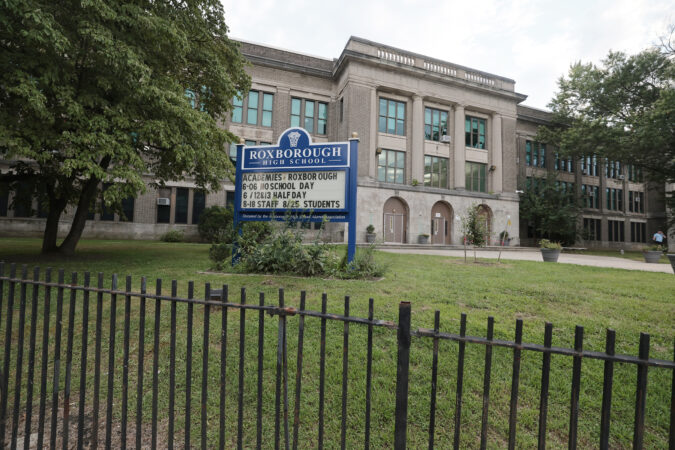
Vandals scrawled racist and antisemitic graffiti outside Roxborough High School over the weekend.
Philadelphia Police Department officials and State Rep. Tarik Khan (D., Philadelphia) confirmed the existence of the graffiti, which included a swastika and a racial epithet written multiple times.
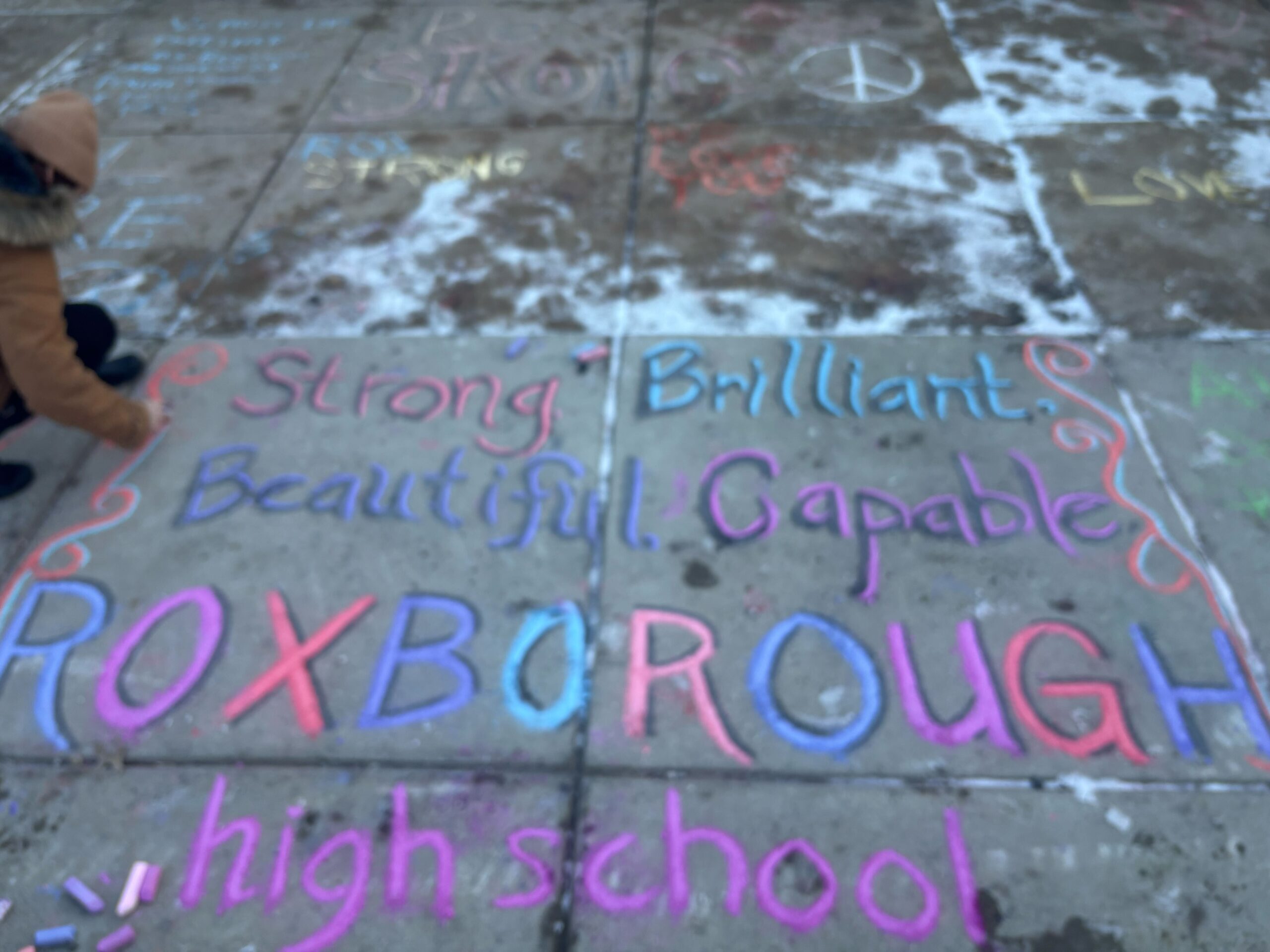
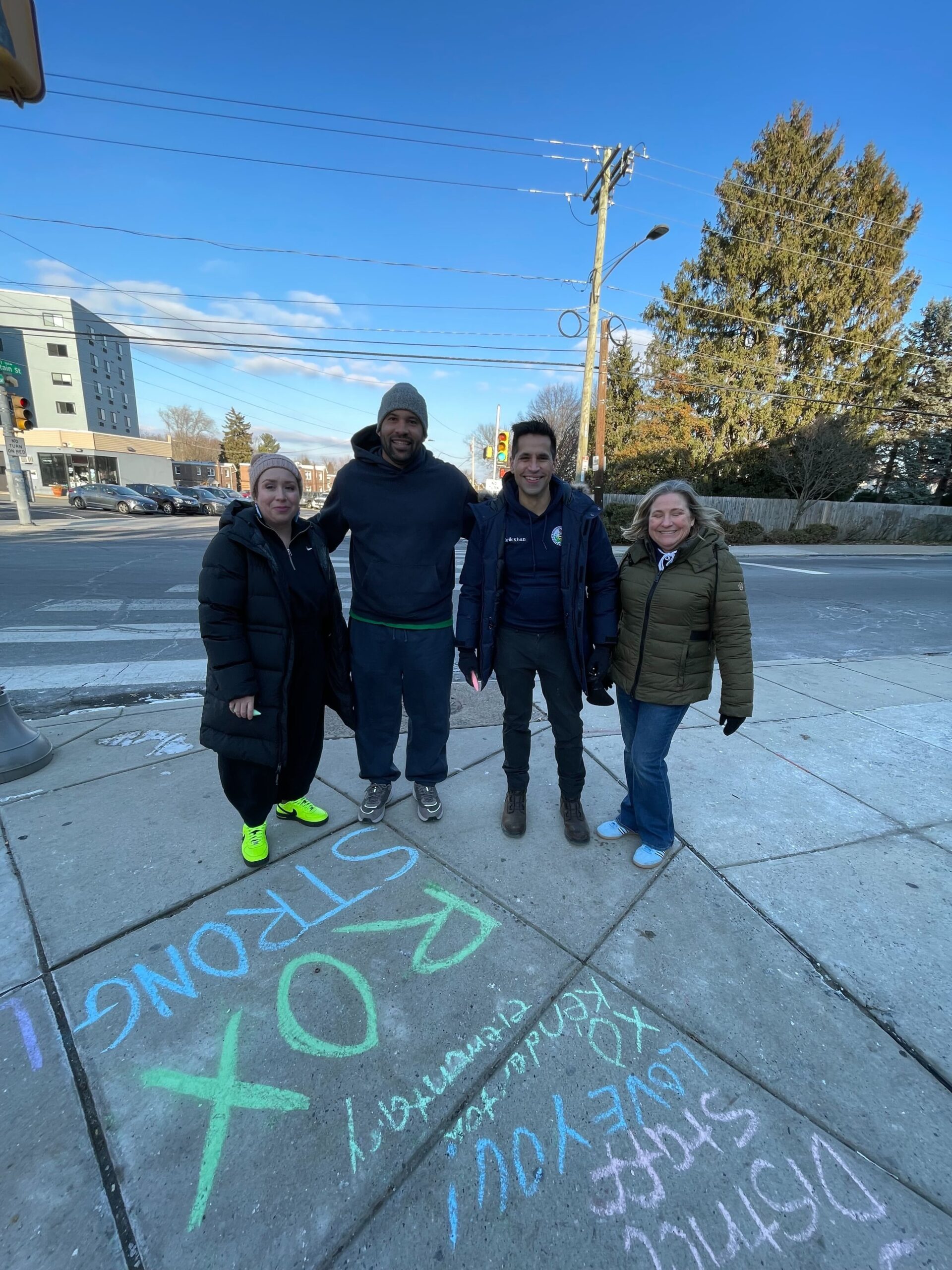
After officials painted over the messages on Sunday, school administrators and community members gathered to counter the hate, chalking positive messages onto the sidewalk.
“Welcome. Peace. Love. RHS,” people wrote in blue and yellow chalk Sunday afternoon. “Strong. Brilliant. Beautiful. Capable.”
Several members of the group said they also plan to be outside Roxborough High on Monday morning, welcoming students back to school after a long winter break.
“Let me be clear: targeting students in the middle of the night is cowardice, and it does not define us,” Khan wrote in a message shared on social media Sunday. He also came to the school to chalk messages. “Our community is bigger than a racist. … Our students are bigger. … Every student deserves to feel safe and respected when they walk into school, not have to deal with hate meant to scare and intimidate them.”
Kristin Williams Smalley, Roxborough’s principal, informed the school community about the graffiti in a letter sent Sunday afternoon.
“We are deeply disappointed by these actions,” Williams Smalley wrote. “We wish to remind everyone that we have a zero-tolerance policy for harassment or hate speech of any kind, and we will investigate all matters involving racist remarks and other hate speech.”
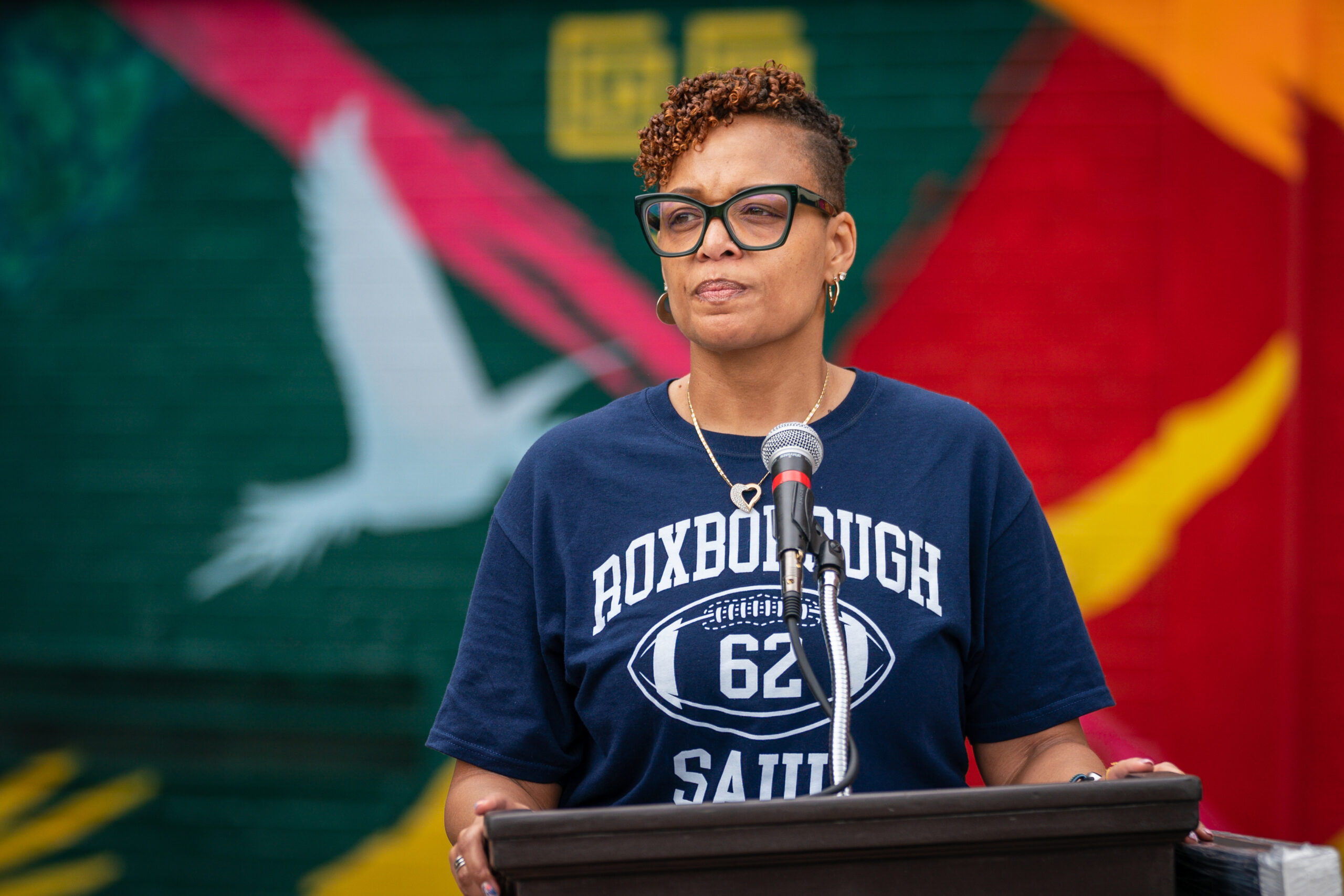
Kristin Williams Smalley, principal at Roxborough High School, is shown in this 2023 file photo speaking at a mural dedication for Nicholas Elizalde.
Roxborough — and the district — are diverse communities, and that’s a point of pride, Williams Smalley said.
“We all play a role in supporting a positive and supportive school culture. We encourage you to speak with your children and have conversations about the seriousness and potential consequences of these unacceptable behaviors.”
Students — whether alleged victims or not — should report bullying, harassment or discrimination, the principal said.
“Please keep in mind that the young people around you are watching and listening,” Williams Smalley wrote. “We encourage all of us to be the role models they deserve. Words are powerful and we truly believe that if you work to build bridges of empathy and understanding, and demonstrate respect, our young people will follow and will create a community where everyone feels valued, seen and heard.”
‘No person needs to see that’
Marge LaRue, whose grandson, Nicholas Elizalde, was shot and killed outside Roxborough in 2022, was also among the group that gathered. She and her daughter Meredith Elizalde, Nicholas’ mother, have remained involved with Roxborough staff and students since Nick’s murder.
Members of the Roxborough High community chalked positive messages outside the school on Ridge Avenue after racist and antisemitic graffiti was scrawled at the school.
LaRue and Elizalde’s immediate concern was making sure the mural, memorial garden, and scoreboard dedicated to Nick were not defaced. They were not.
But they also wanted to show up for the students and staff.
“That’s Nick’s community, the Roxborough community,” said LaRue. “Those hateful messages — I don’t know where they came from. No school, no person needs to see that, on their school, in their community.”
Roxborough High supporters, including Meredith Elizalde, Eric Chappelle, State Rep. Tarik Khan, and Megan McCarthy-May, the school’s assistant principal, stand outside the school after chalking positive messages to counter racist and antisemitic graffiti.
Police responded to the vandalism Sunday, a spokesperson confirmed, but no further information was available. School officials said city police and the district’s school safety office were investigating the incident.
SEOUL, South Korea — North Korea launched multiple ballistic missiles toward its eastern waters Sunday, its neighbors said, just hours before South Korea’s president left for China for talks expected to cover North Korea’s nuclear program.
South Korea’s Joint Chiefs of Staff said in a statement it detected several ballistic missile launches from North Korea’s capital region around 7:50 a.m. It said the missiles flew about 560 miles and that South Korea and U.S. authorities were analyzing details of the launches.
South Korea’s Defense Ministry noted the launches violated U.N. Security Council resolutions that ban any ballistic activities by North Korea. It urged North Korea to cease provocative actions immediately and respond to South Korea’s push to restart talks and restore peace on the Korean Peninsula.
Japanese Defense Minister Shinjiro Koizumi said that at least two missile launches by North Korea have been confirmed. “They are a serious problem, threatening the peace and security of our nation, the region, and the world,” Koizumi told reporters.
The U.S. military said in a statement on social media that the missile launches did not “pose an immediate threat to U.S. personnel or territory, or to our allies.”
“The United States remains committed to the defense of the U.S. homeland and our allies in the region,” the military said.
North Korea ramps up weapons display
The launches were the latest weapons demonstration by North Korea in recent weeks. Experts say North Korea is aiming to show off or review its achievements in the defense sector ahead of its upcoming ruling party congress, the first of its kind in five years. Observers are watching the Workers Party congress to see whether North Korea will set a new policy on the U.S. and resume long-stalled talks between the two countries.
North Korea has been focusing on testing activities to enlarge its nuclear arsenal since its leader Kim Jong Un’s summitry with U.S. President Donald Trump fell apart in 2019. Kim has also boosted his diplomatic credentials by aligning with Russia over its war in Ukraine and tightening relations with China. Observers say Kim would believe his leverage has sharply increased to wrest concessions from Trump if they sit down for talks again.
North Korea hasn’t announced when it will hold the congress, but South Korea’s spy service said it will likely occur in January or February.
Launches comes before South Korean leader’s trip
Sunday’s launches also came hours before South Korean President Lee Jae Myung departed for China for a summit with President Xi Jinping. During the four-day trip, Lee’s office said, he would request China, North Korea’s major ally and biggest trading partner, to take “a constructive role” in efforts to promote peace on the Korean Peninsula.
South Korea and the U.S. have long asked China to exercise its influence on North Korea to persuade it to return to talks or give up its nuclear program. But there are questions on how much leverage China has on its socialist neighbor. China, together with Russia, has also repeatedly blocked the U.S.‘s and others’ attempts to toughen economic sanctions on North Korea in recent years.
Later Sunday, South Korea convened an emergency national security council meeting to discuss the North Korean missile launches. The council reported details of the launches and unspecified South Korean steps to Lee, according to the presidential office.
North Korea condemns U.S. operation in Venezuela
The launches followed Saturday’s dramatic U.S. military operation that ousted Venezuelan leader Nicolás Maduro from power and brought him to the U.S. to face narco-terrorism conspiracy charges. It represented America’s most assertive action to achieve regime change in a country since the nation’s 2003 invasion of Iraq.
North Korea’s Foreign Ministry on Sunday slammed the U.S. operation, saying it again shows “the rogue and brutal nature of the U.S.” A ministry statement said it denounces the U.S. act as “the most serious form of encroachment of sovereignty.”
“Kim Jong Un may feel vindicated about his efforts to build a nuclear deterrent, as he likely did after Trump’s strikes on Iran,” said Leif-Eric Easley, professor of international studies at Ewha Womans University in Seoul. “However, leaders of hostile regimes will probably live with greater paranoia after seeing how quickly Maduro was extracted from his country to stand trial in the United States.”
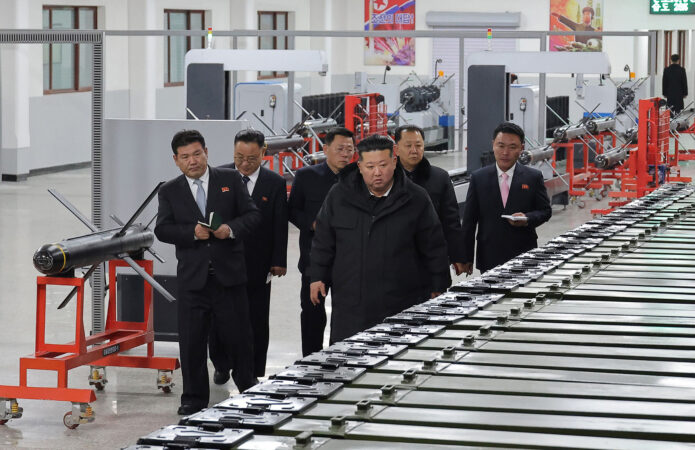
The official Korean Central News Agency said Sunday Kim visited a weapons factory on Saturday to review multipurpose precision guided weapons produced there. KCNA cited Kim as ordering officials to expand the current production capacity by about 2.5 times.
Last Sunday, North Korea test-fired what it called long-range strategic cruise missiles. On Dec. 25, North Korea released photos showing apparent progress in the construction of its first nuclear-powered submarine.