Category: News

Latest breaking news and updates

  • Winter rain floods Gaza camps as Netanyahu heads for U.S. meeting

    Winter rain floods Gaza camps as Netanyahu heads for U.S. meeting

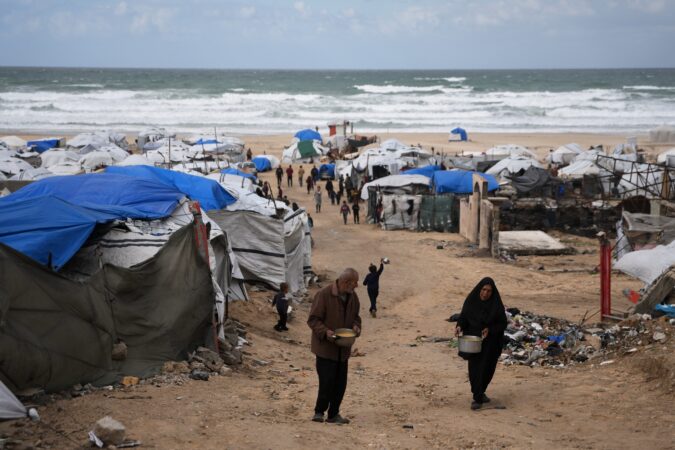
    KHAN YOUNIS, Gaza Strip — Winter rain lashed the Gaza Strip over the weekend, flooding camps with ankle-deep puddles as Palestinians displaced by two years of war attempted to stay dry in tents frayed by months of use.

    Israeli Prime Minister Benjamin Netanyahu traveled for an expected meeting on Monday with U.S. President Donald Trump in Florida about the second phase of the ceasefire. The first phase that took effect on Oct. 10 was meant to bring a surge in humanitarian aid for Gaza, including shelter.

    Netanyahu made no public statement as he departed.

    Nowhere to escape

    In the southern city of Khan Younis, blankets were soaked and clay ovens meant for cooking were swamped. Children wearing flip-flops waded through puddles. Some people used shovels or tin cans to remove water from tents. Others clawed at the ground to pry collapsed shelters from the mud.

    ““Puddles formed, and there was a bad smell,” said Majdoleen Tarabein, displaced from Rafah in southern Gaza. ”The tent flew away. We don’t know what to do or where to go.”

    She and family members tried to wring muddy blankets dry by hand.

    “When we woke up in the morning, we found that the water had entered the tent,” said Eman Abu Riziq, also displaced in Khan Younis. “These are the mattresses. They are all completely soaked.”

    She said her family is still reeling from her husband’s death less than two weeks ago.

    “Where are the mediators? We don’t want food. We don’t want anything. We are exhausted. We just want mattresses and covers,” said Fatima Abu Omar as she tried to prop up a collapsing shelter.

    At least 12 people, including a 2-week-old infant, have died since Dec. 13 from hypothermia or weather-related collapses of war-damaged homes, according to Gaza’s Health Ministry, part of the Hamas-run government.

    Emergency workers have warned people not to stay in damaged buildings, because they could collapse. But with much of the territory in rubble, there are few places to escape the rain. In July, the United Nations estimated that almost 80% of buildings in Gaza have been destroyed or damaged.

    Since the ceasefire between Israel and Hamas began, 414 people have been killed and 1,142 wounded in Gaza, according to the Health Ministry. The overall Palestinian death toll from the war is at least 71,266. The ministry, which does not distinguish between militants and civilians in its count, is staffed by medical professionals and maintains detailed records viewed as generally reliable by the international community.

    The Israel-Hamas war began with the Hamas-led attack in southern Israel on Oct. 7, 2023 that killed about 1,200 people and saw 251 taken hostage,

    Aid groups call for more help

    Humanitarian deliveries into Gaza are falling far short of the amount called for under the U.S.-brokered ceasefire, according to aid organizations and an Associated Press analysis of the Israeli military’s figures.

    The Israeli military body in charge of humanitarian aid said in the past week that 4,200 trucks with aid entered Gaza, plus eight garbage trucks to assist with sanitation, as well as tents and winter clothing. It refused to elaborate on the number of tents. Aid groups have said the need far outstrips the number that have entered.

    Since the ceasefire began, around 72,000 tents and 403,000 tarps have entered, according to Shelter Cluster, an international coalition of aid providers led by the Norwegian Refugee Council.

    “People in Gaza are surviving in flimsy, waterlogged tents and among ruins,” Philippe Lazzarini, commissioner-general of the top U.N. group overseeing aid in Gaza, wrote on social media. “There is nothing inevitable about this. Aid supplies are not being allowed in at the scale required.”

    Ceasefire’s next phase

    Though the ceasefire agreement has mostly held, its progress has slowed.

    Israel has said it refuses to move to the next phase while the remains of the final hostage are still in Gaza. Hamas has said the destruction in Gaza has hampered efforts to find remains.

    Challenges in the next phase include the deployment of an international stabilization force, a technocratic governing body for Gaza, the disarmament of the Hamas militant group, and further Israeli troop withdrawals from the territory.

    Both Israel and Hamas have accused each other of truce violations.

  • Netanyahu’s ties with Trump to be tested amid differences ahead of visit

    Netanyahu’s ties with Trump to be tested amid differences ahead of visit

    JERUSALEM — Three months ago, Israeli Prime Minister Benjamin Netanyahu hailed Donald Trump as the “greatest friend Israel has ever had in the White House.” But that friendship — and Netanyahu’s powers of persuasion — will be tested on Monday at Trump’s Mar-a-Lago estate, where the Israeli leader will meet a U.S. president with increasingly diverging views on practically every Middle East hot spot.

    For Netanyahu, the trip to Florida offers a crucial opportunity to convince Trump to take a tougher stance on Gaza and require that Hamas disarm before Israeli troops further withdraw as part of the second phase of Trump’s 20-point peace plan, Israeli officials say. On Iran, Netanyahu is seeking a green light for another strike against the Islamic Republic’s ballistic missile program, possibly as part of a joint operation with the United States — even though Trump forcefully demanded an end to the 12-day Israel-Iran war in June and declared that Iran’s nuclear program had been “totally obliterated” by U.S. stealth bombers.

    On Syria, the Trump administration has bristled at actions by the Israeli military inside the country that undermine efforts by the new president, Ahmed al-Sharaa, to consolidate control, with Trump publicly warning Israel this month against doing anything “that will interfere with Syria’s evolution into a prosperous State.” And in Lebanon, Israel has repeatedly bombed Hezbollah targets while demanding that the militant group disarm in accordance with a U.S.-brokered ceasefire, but the strikes have threatened to tip the region into another conflagration on Trump’s watch.

    As they meet Monday for the fifth time this year, Netanyahu’s hawkishness will butt up against a U.S. president who has staked his own image and legacy on promoting peace, and Netanyahu may struggle to win Trump’s backing given how the relationship has deteriorated, according to people familiar with the thinking of the two leaders and political observers.

    “This is an emergency summit,” said Dan Diker, president of the Jerusalem Center for Security and Foreign Affairs think tank. “The context is a need to clear or purify the air, because there’s been tensions between the two sides. They have different timelines to get to the same destination, which is a Middle East that is liberated from the Iranian regime and its terror proxies, particularly Hamas.”

    In recent months, Netanyahu has often appeared to undercut Trump’s self-congratulations for making peace in the region. Israel carried out additional airstrikes on Iran after the president had declared the 12-day war with Israel over last summer, prompting an expletive-laden warning from Trump on television.

    Then, following Israel’s airstrike against Hamas negotiators in Qatar as the Gaza peace deal was being hammered out in September, Trump strong-armed Netanyahu into apologizing. “I think he felt like the Israelis were getting a bit out of control in what they were doing and that it was time to be very strong and stop them from doing things that he felt were not in their long-term interests,” Jared Kushner, Trump’s son-in-law and U.S. negotiator, said on CBS’s 60 Minutes in October.

    Now, Israeli officials have indicated that Netanyahu wants to discuss what Israel sees as a dangerous expansion of Iran’s ballistic missile capabilities and the possibility of new joint strikes by Israel and the U.S. This week, the prime minister’s office released an AI-generated video showing Netanyahu and Trump sitting side by side, co-piloting a B-2 bomber — the iconic stealth aircraft that the United States used in June to strike Iran’s nuclear facility at Fordow at Netanyahu’s urging.

    But while Trump continues to see Iran near or at the top of his regional concerns, his administration has launched another attempt to negotiate with Tehran and first wants to see the effort play out, according to several people familiar with the president’s thinking, who spoke on the condition of anonymity about the sensitive issue. Morgan Ortagus, Trump’s deputy special envoy to the Middle East, told a meeting of the U.N. Security Council on Tuesday that Washington “remains available for formal talks with Iran,” while repeating U.S. insistence that “there can be no [uranium] enrichment.”

    Other Trump concerns include Lebanon, where a truce with Israel, brokered by the U.S. and France late last year, is teetering as Netanyahu’s government continues to carry out almost daily bombardments and maintains an army deployment in the southern part of the country, amid charges that Hezbollah has failed to disarm.

    “There are mixed policy currents,” said another person familiar with U.S. administration deliberations. “There are those who believe only Israel [is capable of doing] something that can even begin to change Hezbollah’s calculations. … There are others that think you cannot trust what Israel might do as exploding the situation and creating broader chaos.”

    Gaza takes center stage

    For both Trump and Netanyahu, the most contentious issue will likely be Gaza, not only because of security implications but also its political significance for both leaders. Three months after Trump hailed the peace deal between Israel and Hamas as a “new dawn” for the region, implementation of his 20-point plan has bogged down after the first phase of a ceasefire plan, which has so far seen the release of hostages and prisoners and an increase in humanitarian aid.

    Amid contentious conversations between the two governments over who will have final word on what happens in Gaza, none of the main elements of a second phase — a supervising Board of Peace, a committee of Palestinian technocrats to govern Gaza’s internal affairs, and an International Stabilization Force to oversee in part the demilitarization of Hamas — is yet in place, even as Israel frequently strikes at Hamas targets inside Gaza despite the ceasefire agreement.

    Israel has been reluctant to advance to the deal’s second phase, which could also see Israel eventually withdraw further from the enclave’s interior, without Hamas first disarming. Israeli officials have also balked at the prospect that Turkey — a bitter rival of Israel but an ally of the U.S. — may gain a foothold in Gaza by deploying its troops there as part of the International Stabilization Force.

    On Tuesday, tensions with Washington spiked after Netanyahu’s defense minister, Israel Katz, appeared to flout Trump’s peace plan by declaring that Israel will establish Jewish settlements inside the Gaza Strip, drawing a rebuke from U.S. officials. Two days later, Katz doubled down and reiterated that Israel would never fully withdraw from the Strip.

    Earlier, after Israeli forces killed the Hamas commander Raed Sa’ad in Gaza on Dec. 13, Trump told reporters he was “looking into” whether Israel had violated the ceasefire agreement. U.S. officials, meanwhile, warned Netanyahu that “we won’t allow you to ruin President Trump’s reputation after he brokered the deal in Gaza,” Axios quoted a U.S. official as saying.

    “I’m not sure the Americans will like [the Israeli perspective on] Gaza because it’s not working according to their plan,” said an Israeli government adviser who spoke on the condition of anonymity to discuss internal deliberations. “But for Israel, it has to be total demilitarization, no weapons, no [Hamas] tunnels. And it could take years. We cannot withdraw now.”

    For Netanyahu, the trip to Palm Beach, Fla., is further complicated by his political need ahead of the 2026 Israeli elections to project strength and victory on every front, particularly Gaza. Since Oct. 7, 2023, when a Hamas attack left more than 1,200 Israelis dead and 250 taken hostage, Netanyahu has been lambasted by his political opponents for failing to protect Israel. He has also been criticized by Israel’s far right for not doing enough to destroy Hamas, even though the Israeli military carried out a withering, two-year campaign that left more than 70,000 Palestinians dead in Gaza and much of the Strip in ruins.

    “There’s the potential for a significant clash on Gaza, because for both of them, it’s the most central issue,” said Daniel Shapiro, a former U.S. ambassador to Israel. “For Trump, he wants to show that this grand deal he struck actually gets implemented, even if he has cut some corners. For Bibi, it’s a serious political risk to go into the election with an arrangement in Gaza that looks like Hamas will survive in some form.”

  • ICE shift in tactics leads to soaring number of at-large arrests, data shows

    ICE shift in tactics leads to soaring number of at-large arrests, data shows

    The Trump administration’s mass deportation campaign has led to a significant change in strategy, as federal officers shift away from focusing on arresting immigrants already held in local jails to tracking them down on the streets and in communities, according to a Washington Post analysis of government data.

    The result has been a huge surge of such at-large arrests, with Immigration and Customs Enforcement tallying about 17,500 in September and on pace to exceed that in October. (The data the Post examined had been updated through the middle of that month.) That was far more than any other month included in the data, which dated back to October 2011.

    Before this year, the highest number of at-large arrests came in January 2023, when the Biden administration made more than 11,500. ICE is making more than four times as many at-large arrests per week as it did in President Donald Trump’s first term, the analysis found.

    The Post’s analysis highlights a broader pattern in how the Department of Homeland Security is approaching enforcement, even as authorities insist that immigration officers are focusing on violent criminals who they describe as “the worst of the worst.” Government data shows that more than 60% of the people detained in at-large arrests since June did not have criminal convictions or pending charges.

    Former DHS officials said the effort demonstrates a less targeted approach and reflects mounting pressure from senior White House and DHS officials to boost deportation totals.

    “That is consistent with their mandate to remove anybody in the country who doesn’t have authorization,” said Sarah Saldaña, who served as ICE director under President Barack Obama. “To me, that is a waste of resources.”

    The administration’s new approach began to take shape in June, when federal immigration agents launched a large-scale enforcement operation in Los Angeles. In the ensuing five months, ICE’s at-large arrests in communities nationwide totaled 67,800, more than twice the total number during the previous five months.

    In June, September, and October, such arrests — which include people detained in their homes, at work sites, during immigration check-ins, or in other public spaces — accounted for more than half of ICE’s total number of monthly arrests for the first time since April 2023.

    Administration officials have set a goal of 1 million deportations in Trump’s first year of his second term, and deputy chief of staff Stephen Miller has pressed for 3,000 immigration arrests per day.

    Daily arrests are lagging well behind that number. The highest number of single-day arrests by ICE took place when its officers detained more than 1,900 on June 4.

    The total number of overall arrests, however, rose by 60% in the period from June through mid-October, compared with the first five months of the Trump administration, the data showed. In September, ICE had 21 days in which it made 1,000 or more arrests, the highest number of such days in any month this year.

    “The shift in tactics is related to the ongoing process from the White House to up numbers, and the easiest way to do that is to do broader-brush approaches,” said Claire Trickler-McNulty, a former senior ICE official in the Biden administration.

    ICE is the lead federal agency in charge of immigration enforcement inside the United States, while U.S. Customs and Border Protection (CBP) typically focuses on the border. Historically, ICE officers have detained most immigrants inside prisons or jails after they have been charged with a crime or completed their sentences.

    Many local jails flag undocumented immigrants for removal and contact ICE directly. ICE also has the authority to monitor local arrests through a fingerprint-sharing program. The agency often files a detainer requesting that jails hold potential deportees for up to 48 hours for federal officers to take custody.

    By comparison, at-large arrests typically require more human and financial resources to carry out, immigration experts said. ICE’s website says that such arrests “are unpredictable and can be dangerous to the public.”

    In a statement, DHS spokesperson Tricia McLaughlin said 70% of the immigrants arrested by ICE have criminal convictions or pending criminal charges in the United States and that some have convictions or charges in their home countries.

    The Post’s examination found that from Jan. 20, when Trump took office, through Oct. 15 about 36% of ICE detainees had criminal convictions and 30% had pending charges.

    “This story only reveals how the media manipulates data to peddle a false narrative that DHS is not targeting the worst of the worst,” McLaughlin said. “Nationwide our law enforcement is targeting the worst of the worst criminal illegal aliens — including murderers, rapists, gang members, pedophiles, and terrorists.”

    The DHS data for this story was obtained through a public records request filed by the Deportation Data Project, a group of academics and lawyers that collects and releases immigration enforcement data. The Post used to the data to conduct its own analysis.

    The data does not include information on immigration arrests made by other federal departments, including CBP, whose Border Patrol division has taken on an increasingly prominent role in the Trump administration’s enforcement strategy in recent months. In Chicago, Border Patrol agents came under federal court scrutiny for the deployment of tear gas in response to protesters.

    As the overall number of arrests increased nationally, the number of people without a criminal record arrested by ICE since June nearly tripled, according to the Post’s analysis. (That includes both at-large arrests and arrests at jails.) Since September, more than 40% of those arrested by ICE had no criminal records.

    That trend is continuing. Nearly half of the 79,000 people ICE arrested and placed in detention between Oct. 1 and the end of November did not have criminal convictions or pending criminal charges, according to separate government data obtained by the Post. (Those arrests included CBP arrests, which make up a small percentage of the total.) Of the migrants who do have criminal convictions, nearly a quarter were traffic offenses, that data showed.

    Julia Gelatt, associate director of the U.S. Immigration Policy Program at the Migration Policy Institute, said that the data showing relatively few detainees have committed serious crimes is not surprising.

    “ICE is getting the worst of the worst,” she said. “But they’re also picking up a lot of people who either have no criminal charge … or convictions — or they have relatively minor convictions.”

    Federal data suggests that the administration’s goal of boosting detentions was aided by high-profile targeted enforcement operations that lasted for weeks in large cities, including Los Angeles; Boston; Washington, D.C.; and Chicago; many of which drew significant public protests.

    The District of Columbia experienced the largest spike in arrests, with the number increasing fivefold from June through October as compared with the previous five months, the federal data showed.

    In Illinois, 428 people were arrested between Jan. 20 and May 31 who had no criminal records. That number more than tripled to 1,408 from June 1 through Oct. 15, a period that included a targeted enforcement campaign in Chicago titled Operation Midway Blitz.

    Jason Houser, former ICE chief of staff in the Biden administration, said that the Trump administration is “trying to find the lowest bar of calling somebody a criminal.”

  • Brigitte Bardot, 1960s French sex symbol turned militant animal rights activist, has died at 91

    Brigitte Bardot, 1960s French sex symbol turned militant animal rights activist, has died at 91

    PARIS — Brigitte Bardot, the French 1960s sex symbol who became one of the greatest screen sirens of the 20th century and later a militant animal rights activist and far-right supporter, has died. She was 91.

    Ms. Bardot died Sunday at her home in southern France, according to Bruno Jacquelin, of the Brigitte Bardot Foundation for the protection of animals. Speaking to the Associated Press, he gave no cause of death, and said that no arrangements had been made for funeral or memorial services. She had been hospitalized last month.

    Ms. Bardot became an international celebrity as a sexualized teen bride in the 1956 movie And God Created Woman. Directed by her then husband Roger Vadim, it triggered a scandal with scenes of the long-legged beauty dancing on tables naked.

    At the height of a cinema career that spanned more than two dozen films and three marriages, Ms. Bardot came to symbolize a nation bursting out of bourgeois respectability. Her tousled blond hair, voluptuous figure, and pouty irreverence made her one of France’s best-known stars, even as she struggled with depression.

    Such was her widespread appeal that in 1969 her features were chosen to be the model for “Marianne,” the national emblem of France and the official Gallic seal. Bardot’s face appeared on statues, postage stamps, and coins.

    ‘’We are mourning a legend,’’ French President Emmanuel Macron said in an X post.

    Ms. Bardot’s second career as an animal rights activist was equally sensational. She traveled to the Arctic to blow the whistle on the slaughter of baby seals. She also condemned the use of animals in laboratory experiments, and she opposed Muslim slaughter rituals.

    “Man is an insatiable predator,” Ms. Bardot told the Associated Press on her 73rd birthday, in 2007. “I don’t care about my past glory. That means nothing in the face of an animal that suffers, since it has no power, no words to defend itself.”

    Her activism earned her compatriots’ respect and, in 1985, she was awarded the Legion of Honor, the nation’s highest recognition.

    Turn to the far right

    Later, however, she fell from public grace as her animal protection diatribes took on a decidedly extremist tone. She frequently decried the influx of immigrants into France, especially Muslims.

    She was convicted and fined five times in French courts of inciting racial hatred, in incidents inspired by her opposition to the Muslim practice of slaughtering sheep during annual religious holidays.

    Ms. Bardot’s 1992 marriage to fourth husband Bernard d’Ormale, a onetime adviser to far-right National Front leader Jean-Marie Le Pen, contributed to her political shift. She described Le Pen, an outspoken nationalist with multiple racism convictions of his own, as a “lovely, intelligent man.”

    In 2012, she supported the presidential bid of Marine Le Pen, who now leads her father’s renamed National Rally party. Le Pen paid homage Sunday to an “exceptional woman” who was “incredibly French.”

    In 2018, at the height of the #MeToo movement, Ms. Bardot said in an interview that most actors protesting sexual harassment in the film industry were “hypocritical,” because many played “the teases” with producers to land parts.

    She said she had never had been a victim of sexual harassment and found it “charming to be told that I was beautiful or that I had a nice little ass.”

    Privileged but ‘difficult’ upbringing

    Brigitte Anne-Marie Bardot was born Sept. 28, 1934, to a wealthy industrialist. A shy child, she studied classical ballet and was discovered by a family friend who put her on the cover of Elle magazine at age 14.

    Bardot once described her childhood as “difficult” and said that her father was a strict disciplinarian who would sometimes punish her with a horse whip.

    Vadim, a French movie producer who she married in 1952, saw her potential and wrote And God Created Woman to showcase her provocative sensuality, an explosive cocktail of childlike innocence and raw sexuality.

    The film, which portrayed Ms. Bardot as a teen who marries to escape an orphanage and then beds her brother-in-law, had a decisive influence on New Wave directors Jean-Luc Godard and François Truffaut, and came to embody the hedonism and sexual freedom of the 1960s.

    The film was a box-office hit, and it made Ms. Bardot a superstar. Her girlish pout, tiny waist and generous bust were often more appreciated than her talent.

    “It’s an embarrassment to have acted so badly,” Ms. Bardot said of her early films. “I suffered a lot in the beginning. I was really treated like someone less than nothing.”

    Ms. Bardot’s unabashed, off-screen love affair with co-star Jean-Louis Trintignant eradicated the boundaries between her public and private life and turned her into a hot prize for paparazzi.

    Ms. Bardot never adjusted to the limelight. She blamed the constant media attention for the suicide attempt that followed 10 months after the birth of her only child, Nicolas. Photographers had broken into her house two weeks before she gave birth to snap a picture of her pregnant.

    Nicolas’ father was Jacques Charrier, a French actor who she married in 1959 but who never felt comfortable in his role as Monsieur Bardot. Ms. Bardot soon gave up her son to his father, and later said she had been chronically depressed and unready for the duties of being a mother.

    “I was looking for roots then,” she said in an interview. “I had none to offer.”

    In her 1996 autobiography Initiales B.B., she likened her pregnancy to “a tumor growing inside me,” and described Charrier as “temperamental and abusive.”

    Ms. Bardot married her third husband, West German millionaire playboy Gunther Sachs, in 1966, and they divorced three years later.

    Among her films were A Parisian (1957); In Case of Misfortune, in which she starred in 1958 with screen legend Jean Gabin; The Truth (1960); Private Life (1962); A Ravishing Idiot (1964); Shalako (1968); Women (1969); The Bear and the Doll (1970); Rum Boulevard (1971); and Don Juan (1973).

    With the exception of 1963’s critically acclaimed Contempt, directed by Godard, Ms. Bardot’s films were rarely complicated by plots. Often they were vehicles to display Ms. Bardot in scanty dresses or frolicking nude in the sun.

    “It was never a great passion of mine,” she said of filmmaking. “And it can be deadly sometimes. Marilyn [Monroe] perished because of it.”

    Ms. Bardot retired to her Riviera villa in St. Tropez at the age of 39 in 1973 after The Woman Grabber. As fans brought flowers to her home Sunday, the local St. Tropez administration called for “respect for the privacy of her family and the serenity of the places where she lived.”

    Middle-aged reinvention

    She emerged a decade later with a new persona: An animal rights lobbyist, her face was wrinkled and her voice was deep following years of heavy smoking. She abandoned her jet-set life and sold off movie memorabilia and jewelry to create a foundation devoted exclusively to the prevention of animal cruelty.

    Depression sometimes dogged her, and she said that she attempted suicide again on her 49th birthday.

    Her activism knew no borders. She urged South Korea to ban the sale of dog meat and once wrote to U.S. President Bill Clinton asking why the U.S. Navy recaptured two dolphins it had released into the wild.

    She attacked centuries-old French and Italian sporting traditions including the Palio, a free-for-all horse race, and campaigned on behalf of wolves, rabbits, kittens, and turtle doves.

    “It’s true that sometimes I get carried away, but when I see how slowly things move forward … my distress takes over,” Ms. Bardot told the AP when asked about her racial hatred convictions and opposition to Muslim ritual slaughter,

    In 1997, several towns removed Bardot-inspired statues of Marianne after the actor voiced anti-immigrant sentiment. Also that year, she received death threats after calling for a ban on the sale of horse meat.

    Environmental campaigner Paul Watson, who was beaten on a seal hunt protest in Canada alongside Ms. Bardot in 1977 and campaigned with her for five decades, acknowledged that “many disagreed with Brigitte’s politics or some of her views.”

    “Her allegiance was not to the world of humans,” he said. “The animals of this world lost a wonderful friend today.”

    Ms. Bardot once said that she identified with the animals that she was trying to save.

    “I can understand hunted animals, because of the way I was treated,” Ms. Bardot said. “What happened to me was inhuman. I was constantly surrounded by the world press.”

  • One killed, another critically injured after helicopters collide in Atlantic County

    One killed, another critically injured after helicopters collide in Atlantic County

    One person died after two helicopters collided midair Sunday in Atlantic County, according to authorities.

    The Enstrom helicopters collided about 11:25 a.m. near Hammonton Municipal Airport, the Federal Aviation Administration said. One helicopter was engulfed in flames near U.S. Routes 30 and 206, the Hammonton police department said in a Facebook post.

    Only the pilots were aboard each aircraft, the FAA said; police said one person died, and another was taken to a hospital with life-threatening injuries. Their identities were not immediately made public.

    A video posted to social media showed a helicopter spinning rapidly to the ground.

    The FAA and National Transportation Safety Board are investigating, police said, and no additional details about what caused the collision were immediately available.

    The crash drew responses from the state’s U.S. senators on social media.

    “Reports of this morning’s fatal helicopter crash over South Jersey are horrifying and tragic,” Sen. Cory Booker wrote on X. “My heart is with those impacted and their families.”

    Booker said his office was in contact with the NTSB, requesting more information on the crash.

    “I’m heartbroken to learn of the fatal helicopter crash that occurred in Hammonton, NJ earlier this morning,” Sen. Andy Kim also posted to X. “I know our community will rally behind the family of the individual who lost their life as we navigate this terrible tragedy.”

    Hammonton is about 30 miles northwest of Atlantic City.

    This is a developing story that will be updated

  • Winter storm threatens to bring blizzards and ice to parts of the U.S., hampering holiday travel

    Winter storm threatens to bring blizzards and ice to parts of the U.S., hampering holiday travel

    A powerful winter storm was sweeping east from the Plains on Sunday, driven by what meteorologists describe as an intense cyclone, setting off a chain reaction of snow, ice, rain, and severe weather expected to affect much of the country.

    Snow and strengthening winds spread across the Upper Midwest on Sunday, where the National Weather Service warned of whiteout conditions and possible blizzard conditions that could make travel impossible in some areas. Snowfall totals were expected to exceed a foot across parts of the upper Great Lakes, with up to 2 feet possible along the south shore of Lake Superior.

    In the South, meteorologists warn of severe thunderstorms expected to signal the arrival of a sharp cold front — sometimes referred to as a “Blue Norther” — bringing a sudden temperature drop and strong north winds that will end days of record warmth across the region.

    The snowy holiday season in the Upper Midwest and Northeast comes as springlike warmth continues in much of the nation’s midsection and South, where record high temperatures had Santa sweating in recent days.

    The high temperature in Atlanta was forecast to be around 72 degrees Fahrenheit on Sunday, continuing a warming trend after climbing to 78 F to shatter the city’s record high temperature for Christmas Eve, the National Weather Service said. Numerous other record high temperatures were seen across the South and Midwest on the days after Christmas.

    But that record heat is quickly coming to an end, forecasters say.

    A cold front was expected to bring rain to much of the South late Sunday night into Monday, bringing much colder weather on Tuesday. The abrupt change will drop the low temperature in Atlanta to 25 F by early Tuesday morning. The colder temperatures in the South are expected to continue through New Year’s Day.

    Over the next 48 hours, the cyclone is expected to produce heavy snow and blizzard conditions in the Midwest and Great Lakes, freezing rain in New England, thunderstorms across the eastern U.S. and South, and widespread strong winds.

    The storm is expected to intensify as it moves east, drawing energy from a sharp clash between frigid air plunging south from Canada and unusually warm air that has lingered across the southern United States, according to the National Weather Service.

    It follows thousands of flight delays and cancellations across the Northeast and Great Lakes regions over the weekend due to snow, as thousands took to the roads and airports during the busy travel period between Christmas and New Year’s.

    On the other side of the country, California was experiencing a fairly dry weekend after powerful storms battered the state with heavy rains, flash flooding, and mudslides. At least four people were killed including a man who was found dead Friday in a partially submerged car near Lancaster, the Los Angeles County Sheriff’s Department reported.

  • Residents were unable to request plowing services via Philly 311’s online portal during weekend’s wintry weather

    Residents were unable to request plowing services via Philly 311’s online portal during weekend’s wintry weather

    Philadelphians were unable to request street plowing online earlier this weekend, as wintry precipitation Friday gave way to a slippery Saturday.

    The link to request plowing on Philly 311’s online portal became “inoperable and experienced technical difficulties” officials learned during Friday’s ice and sleet storm, Philadelphia Managing Director Adam Thiel said in a statement. Residents can call 311 for basic city services — from graffiti cleanup to pothole removal — on weekdays, 8 a.m. to 8 p.m., but the portal is available after-hours.

    It’s unclear how long the link was offline, but the issues have since been resolved, Thiel said, and options to request salting and plowing appeared on the portal Sunday. Crews continued to treat the city’s thruways during the inclement weather, despite the downed site.

    “Our Streets Department is on the front lines of responding to any weather event, including this one,” Thiel said, “and Streets crews, along with many other city workers, have been working 24/7 since [Friday], treating and clearing all roadways in every neighborhood. That critical work continues.”

    Warming temperatures forecast Sunday and Monday should thaw any remaining ice, sleet, and snow remnants.

  • The Pennsylvania Turnpike’s restaurant offerings can feel like a trip back in time

    The Pennsylvania Turnpike’s restaurant offerings can feel like a trip back in time

    Driving west on the Pennsylvania Turnpike, Mary Wright was hoping for a Chick-fil-A. But as she watched the limited options on road signs pass, fond memories of roast beef sandwiches lured her to Roy Rogers.

    “My mother liked Roy Rogers,” said Wright, who is in her 60s and from Collingswood. “That’s how long it’s been around.”

    That’s pretty typical of the food offerings on the Pennsylvania Turnpike, where old-school brands such as Auntie Anne’s, Baskin-Robbins, and Sbarro dot many of the 17 service plazas.

    That puts the turnpike behind the times compared with similar toll roads in New Jersey and New York, where travelers can hold out for newer brands like Chick-fil-A, Pret a Manger, and Shake Shack.

    “I think the older generation likes Roy Rogers and all that, but younger people are more likely to like Shake Shack, for example,” said John Zhang, professor of marketing at the University of Pennsylvania’s Wharton School of Business.

    Once on the toll road, people are faced with dining options decided almost entirely by one company. It’s what Zhang called a “captive consumer” environment. The reasons for this involve state policy, a corporate contract, and a little business history.

    Mary Wright and Rich Misdom of Collingswood consider their options at the Roy Rogers located in the Peter J. Camiel Service Plaza on the Pennsylvania Turnpike in late November.

    ‘Applegreen determines the food concepts’

    The commercial stakes are significant: More than 550,000 people drive on the turnpike every day, according to the Pennsylvania Turnpike Commission, and about 7.4 million travelers are expected to have used the toll road around the Christmas and New Year’s holidays.

    Though the turnpike commission oversees the operation, a company called Applegreen primarily decides which restaurants fill the state’s 17 service plazas, according to turnpike commission spokesperson Marissa Orbanek.

    Applegreen runs travel plazas in 12 states, including New Jersey and New York. The company, based in Ireland, was taken private for $878 million in 2020 and is majority-owned by the large private equity firm Blackstone Inc. Applegreen did not respond to requests to comment for this story.

    For access to the service plazas, Applegreen pays the turnpike commission 4% of its gross food and beverage sales, amounting to about $2.4 million per year, Orbanek said.

    “Applegreen determines the food concepts and seeks approval from the commission,” Orbanek said. “So the turnpike is certainly involved in this process.”

    Of the 15 restaurant chains Applegreen lists on its website, nine appear on the Pennsylvania Turnpike. There are nine Auntie Anne’s, eight Burger Kings, one Cinnabon, seven Dunkin’s, two Popeyes, seven Roy Rogers restaurants, four Sbarros, 10 Starbucks outposts, and one Subway restaurant, according to the turnpike commission website. Pennsylvania also has six Baskin-Robbins locations, it shows.

    In other states, Applegreen’s brands include Chick-fil-A, Nathan’s Famous Hot Dogs, Panda Express, Panera, Pret a Manger, and Shake Shack.

    The service plaza contract dates back to 2006, when the turnpike commission signed a 30-year lease agreement with HMS Host Family Restaurants, giving the company “exclusive rights” to food and drink sales, Orbanek said.

    Seven Dunkin’ locations dot the Pennsylvania Turnpike.

    In 2021, Applegreen acquired HMS Host for $375 million and took over its lease. The lease will expire in August 2036, Orbanek said.

    Until then, Applegreen decides which eatery goes where.

    What’s with all the Roy Rogers restaurants?

    When Applegreen bought HMS Host, it became the franchisee of the Roy Rogers restaurants on the turnpike, said Jim Plamondon, who co-owns the Frederick, Md.-based Roy Rogers brand with his brother.

    Plamondon wants to keep the restaurants on the turnpike past 2036 — a decision that will depend in part on whether Applegreen sticks with the restaurants it acquired when it bought HMS Host.

    “It’s all about developing relationships and hoping to grow with our operators,” Plamondon said.

    As for Roy Rogers’ prominent position on the turnpike, that dates back to the 1980s, when Marriott Corp. managed the service plazas, Plamondon said. Back then, the restaurant was owned by Marriott — it had a licensing agreement with the showbiz cowboy of the same name — and Plamondon’s dad was an executive in the company.

    These days, Plamondon said, nostalgia and curiosity for something a bit different have driven the restaurant chain’s modest growth: It has opened a few new locations in recent years, including one in Cherry Hill, and has a devoted fan base.

    Fast-food restaurants are facing a number of challenges in the current economic climate. Wages and tariffs have pushed prices up, and low-income consumers in particular have started to reduce spending. Even McDonald’s, the largest fast-food chain in the U.S., has seen nearly double-digit decreases in traffic among low-income Americans, the company said in its third-quarter earnings report last month.

    McDonald’s CEO Christopher Kempczinski told investors on a call announcing the third-quarter results that low-income consumers were having to absorb significant inflation, which was affecting spending behavior.

    Roy Rogers has seen some of these challenges as well, Plamondon said. Costs have gone up, margins are thin, and people’s tastes are always changing. People are eating more chicken and want spicier options, he added. .

    “It’s a really good menu, it’s great quality food, and I think our brand absolutely has a future to it, because at the end of the day, it’s about the food.”

    Changing tastes

    The Wharton School’s Zhang agreed that consumers’ tastes have shifted. “People increasingly want ethnic foods, and younger people want spicier food,” he said. “And people want to go upscale nowadays.”

    Zhang noted a number of older brands on the Applegreen roster, such as Sbarro, the pizza restaurant that has faced two bankruptcies in the years since the turnpike commission approved the 30-year lease.

    In terms of market forces, Zhang said, turnpike service plazas are “an aberration.” Unlike those in most suburban or urban areas, service plaza customers are willing to settle for what’s available, and pay more to get in and out, he said.

    “If you’re a traveler on a holiday, you tend to be less price sensitive,” Zhang said. “You just want to have your food very quickly.”

    A sign at the Peter J. Camiel service plaza on the Pennsylvania Turnpike.

    That puts turnpike service stops at odds with the shifting consumer preferences that have bedeviled the fast-food industry over the last couple of decades, Zhang said, including the addition of food delivery services like DoorDash and GrubHub.

    Zhang said that the lack of order-ahead options at turnpike eateries is puzzling. For people traveling down a strip of highway, it seems like calling ahead would make sense.

    “For them, the customers just pass by once,” he said.

    For Mary Wright and her traveling companion, Rich Misdom, their recent Roy Rogers visit did not exactly ignite enthusiasm.

    “This is, like, old-school kind of stuff,” Misdom said, adding he was disappointed that this Roy Rogers restaurant was not serving roast beef. He settled for a cheeseburger, while Wright got a chicken sandwich.

    “We don’t come here to fine dine,” Misdom said, between bites. “Let’s put it that way.”

  • Seeing culture ‘under attack,’ Philadelphians gathered in Germantown to celebrate Kwanzaa

    Seeing culture ‘under attack,’ Philadelphians gathered in Germantown to celebrate Kwanzaa

    In the roughly 20 years that Pamela “PJ” Johnson-Thomas and her husband, Weller Thomas, have celebrated Kwanzaa, they have usually marked the holiday at their home or the homes of friends.

    This year, they wanted to expand their celebration. So they gathered about two dozen people at the Omega Psi Phi Fraternity Inc. House in Germantown on Saturday, the second night of Kwanzaa.

    This holiday “focuses on culture,” and “culture’s under attack,” Johnson-Thomas said. For example, this year, the Trump administration has targeted programs focused on diversity, equity, and inclusion; aimed to sanitize the history of American slavery; and disparaged Black immigrants and their home countries.

    “It’s up to us,” Johnson-Thomas said, to continue cultural traditions.

    Children and adults dressed in fine clothes with African prints lined up in the fraternity house’s meeting hall to light the seven candles of the kinara and talk about the seven principles of Kwanzaa: unity, self-determination, collective work and responsibility, cooperative economics, purpose, creativity, and faith. Traditionally, families light one additional candle each night of the seven-day holiday.

    PJ Thomas dances during the Kwanzaa ceremony at Omega Psi Phi Fraternity Inc. on Saturday, Dec. 27, 2025, in Philadelphia.

    Since Friday, families across the Philadelphia region and the world have been celebrating the annual African American and Pan-African holiday created in 1966 with the goal of uplifting people of African descent. The nonreligious holiday honors culture, community, and family.

    On the south side of City Hall, the candles of a Kwanzaa kinara are lit each day of the holiday, which ends on Jan. 1. Each year since 2017, Boathouse Row has been lit in Kwanzaa colors — red, green, and dark purple, which represents black — to celebrate.

    State Sen. Sharif Street, who is running to represent Philadelphia in Congress, told the people gathered in Germantown that “community is built from culture.”

    “This year I think we’ve seen more robust Kwanzaa programs than in any year in recent history,” Street said. “The purpose of Kwanzaa was to have a cultural celebration that united our people across religious, regional boundaries. … It’s great that we continue to have spaces and places where people can celebrate it.”

    Attendees of the celebration talked, laughed, danced, sang, ate, and played games together. They honored ancestors by calling out the names of family members and Black activists and cultural icons who have died.

    Vincenteen Paige, a friend of the hosts’, usually has yearly Kwanzaa gatherings at her house but was happy to join the broader celebration.

    “With all the things that are going on in politics and all the things that are being changed, you need something to hold. What did we have? What has meaning? I think people are looking for that,” she said.

    Thomas told the crowd that Kwanzaa is about unity. “It’s about bringing us all together and pulling together,” he said.

    He and Johnson-Thomas own a travel company called Pathfinders Tours & Travel, which formed out of the publication they ran for 25 years called Pathfinders Travel Magazine for People of Color. They regularly travel with groups to places inside and outside the United States.

    On a future trip, they want to return to Egypt with some young people, Johnson-Thomas said, because “I think they need to see their greatness.”

    “Everything we do,” she said, “we want to highlight the culture as it relates to African American people.”

    Brynne and Tai Elmore light the kinara during the Kwanzaa celebration at Omega Psi Phi Fraternity Inc. on Saturday, Dec. 27, 2025, in Philadelphia.

  • SEPTA officials: Man fatally struck by Trenton Line train

    SEPTA officials: Man fatally struck by Trenton Line train

    A man died after being hit by a Trenton Line train Saturday afternoon, SEPTA officials said.

    The Regional Rail train was traveling inbound about 12:30 p.m. when it struck the “trespasser” between the Croydon and Bristol stations, a SEPTA spokesperson said.

    Service along the line was suspended for about three hours, and operations resumed about 3:40 p.m.

    No additional information about the crash, including the man’s name or age, was immediately available Saturday evening.