Category: News

Latest breaking news and updates

  • Ann Harnwell Ashmead, renowned classical archaeology researcher and writer, has died at 96

    Ann Harnwell Ashmead, renowned classical archaeology researcher and writer, has died at 96

    Ann Harnwell Ashmead, 96, of Haverford, renowned classical archaeology researcher, writer, museum curator, volunteer, and world traveler, died Saturday, Jan. 17, of chronic congestive heart failure at her home.

    Dr. Ashmead was an archaeological specialist in Greek vase painting, the depiction of cats on classical and Near Eastern artifacts, and the history of other ancient ceramics. She traveled to Greece, Italy, Turkey, France, and elsewhere around the world to examine, analyze, and research all kinds of ceramics collections.

    She consulted with hundreds of other archaeologists and curators, and wrote extensively about the ongoing international research project to document ancient ceramics and the extensive collections at Haverford and Bryn Mawr Colleges, the Penn Museum, the Rhode Island School of Design, the Louvre Museum in Paris, and other places. She did archaeological field work in Greece during her college years at Bryn Mawr and served as a classical archaeology graduate teaching assistant.

    She was onetime curator of Bryn Mawr’s 6,000-piece Ella Riegel Memorial Museum and a research associate at the Penn Museum. She partnered for years with Bryn Mawr professor Kyle Meredith Phillips Jr. to research and write articles and books about ancient vases, cups, jars, pots, Etruscan images of cats, and other classical antiquities.

    Dr. Ashmead visited many archaeological sites in Greece and elsewhere.

    Some of her colleagues lovingly called her “the cat lady.”

    Dr. Ashmead often reassembled broken ancient objects for curators and created visual and oral presentations to augment her printed catalogs, articles, and books. “She was indefatigable,“ her family said in a tribute.

    She shared her research at conferences, meetings, and exhibitions around the globe, and most recently collaborated with Ingrid M. Edlund-Berry, professor emerita at the University of Texas at Austin, on a project that scrutinized cats as shield devices on Greek vases.

    “Ann was very modest, humble, and self-deprecating about her publications and academic achievements,” her family said. Her son Graham said: “She was a role model who inspired me with her curiosity on all subjects and issues, and a love of world travel, reading, and lifelong learning.”

    Dr. Ashmead spoke English, Japanese, Greek, Chinese, French, Danish, and Italian.

    Dr. Ashmead was active with the Archaeological Institute of America, and her research was published by the American Journal of Archaeology, the journal of the American School of Classical Studies at Athens, and other groups.

    She married Haverford College English professor John Ashmead Jr. in 1949, and they spent the next two decades traveling the world while he completed Fulbright Scholar teaching assignments. They lived in Japan, Taiwan, and India, and later in Paris, Athens, and Florida.

    She spoke English, Japanese, Greek, Chinese, French, Danish, and Italian. “Her learning never stopped,” her family said.

    Ann Wheeler Harnwell was born Oct. 7, 1929, in Princeton, N.J. Her family moved to Wynnewood in 1938 after her father, Gaylord P. Harnwell, became chair of the physics department at the University of Pennsylvania. He became president of Penn in 1953.

    Dr. Ashmead had many articles, catalogs, and books published over her long career.

    She graduated from Lower Merion High School in 1947 after spending the previous three years with her family in California. She earned bachelor’s and master’s degrees and a doctorate in classical archaeology at Bryn Mawr, and her 1959 doctoral thesis was titled: “A Study of the Style of the Cup Painter Onesimos.”

    On page 2, she wrote: “Such attributions of vases to an artist are a delicate business, the outcome of a long and intricate process of observation and analysis, often of tentative nature.”

    She and her husband had sons John III, Graham, and Gaylord, and daughters Louisa and Theodora. They divorced in 1976 but remained close friends until he died in 1992.

    Having grown up during the stock market crisis in the 1930s, Dr. Ashmead followed the market closely as an adult, and was thrifty and frugal, her family said.

    Dr. Ashmead married English professor John Ashmead Jr. in 1949.

    She was an avid letter writer and reader, and her personal library featured more than 5,000 books. She volunteered for years at Bryn Mawr’s old Owl Bookstore and especially enjoyed reading to her children and grandchildren.

    She was on the board of the Haverford College Arboretum and a member of the Hardy Plant Society, the Henry Foundation for Botanical Research, and the Philadelphia Skating Club. She enjoyed dancing, organizing Easter egg hunts, and hosting birthday parties and family events.

    A fashionista in the 1960s and ’70s, she was adept at needle crafting, quilting, and sewing. She bred cats, painted, collected antiques, and researched her genealogy.

    She always made time for family no matter where in the world they were, and they said: “She was concerned if she was ever separated from a child and distraught if they were distraught.”
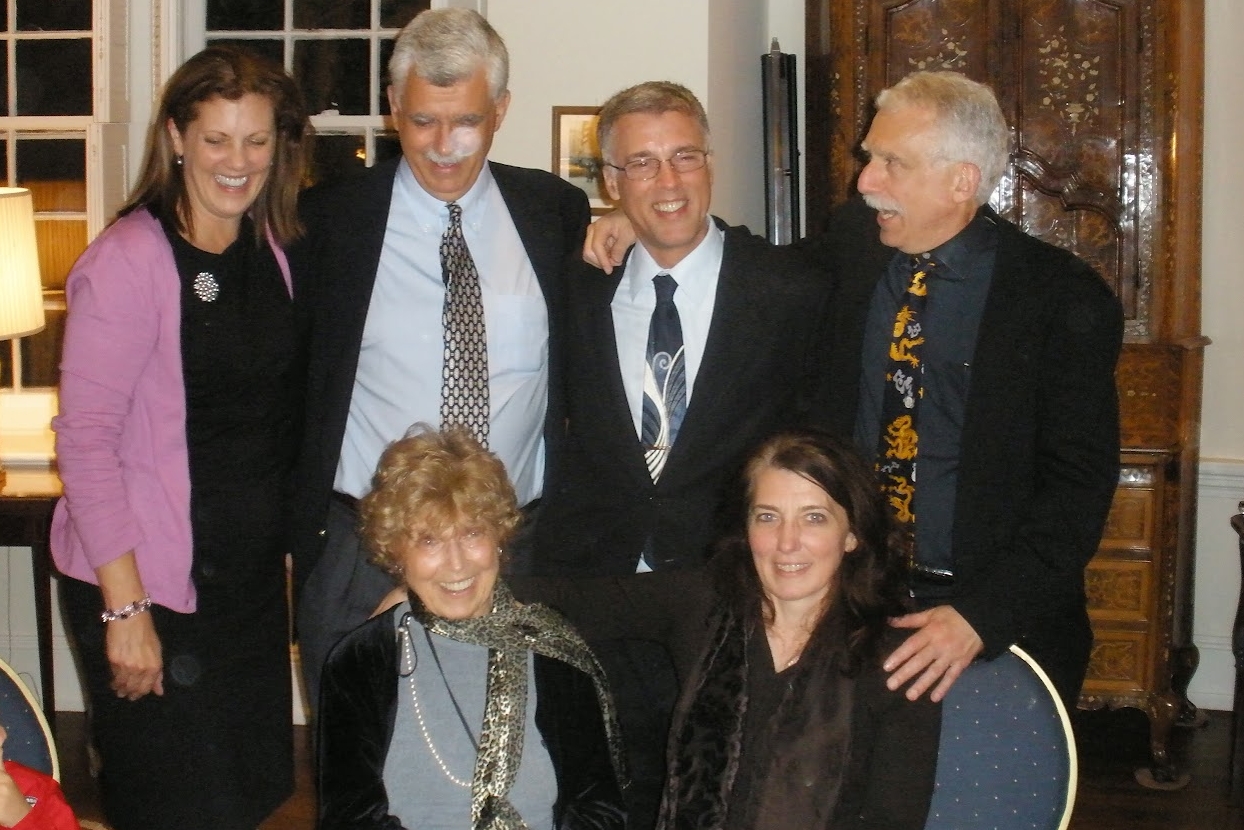
    Dr. Ashmead (front left) always made time for her family.

    She lived in Denmark for a few years and finally settled for good in Haverford in 1983. “She was interesting, smart, capable, strong, articulate, and fun to be around,” her daughter Theodora said. “She was solution-oriented. She sparkled.”

    In addition to her children, Dr. Ashmead is survived by six grandchildren, a sister, and other relatives. A brother died earlier.

    She requested that no services be held and donated her body to the Humanity Gifts Registry through Penn’s Perelman School of Medicine.

    Donations in her name may be made to the Haverford College Arboretum, 370 Lancaster Ave., Haverford, Pa. 19041.
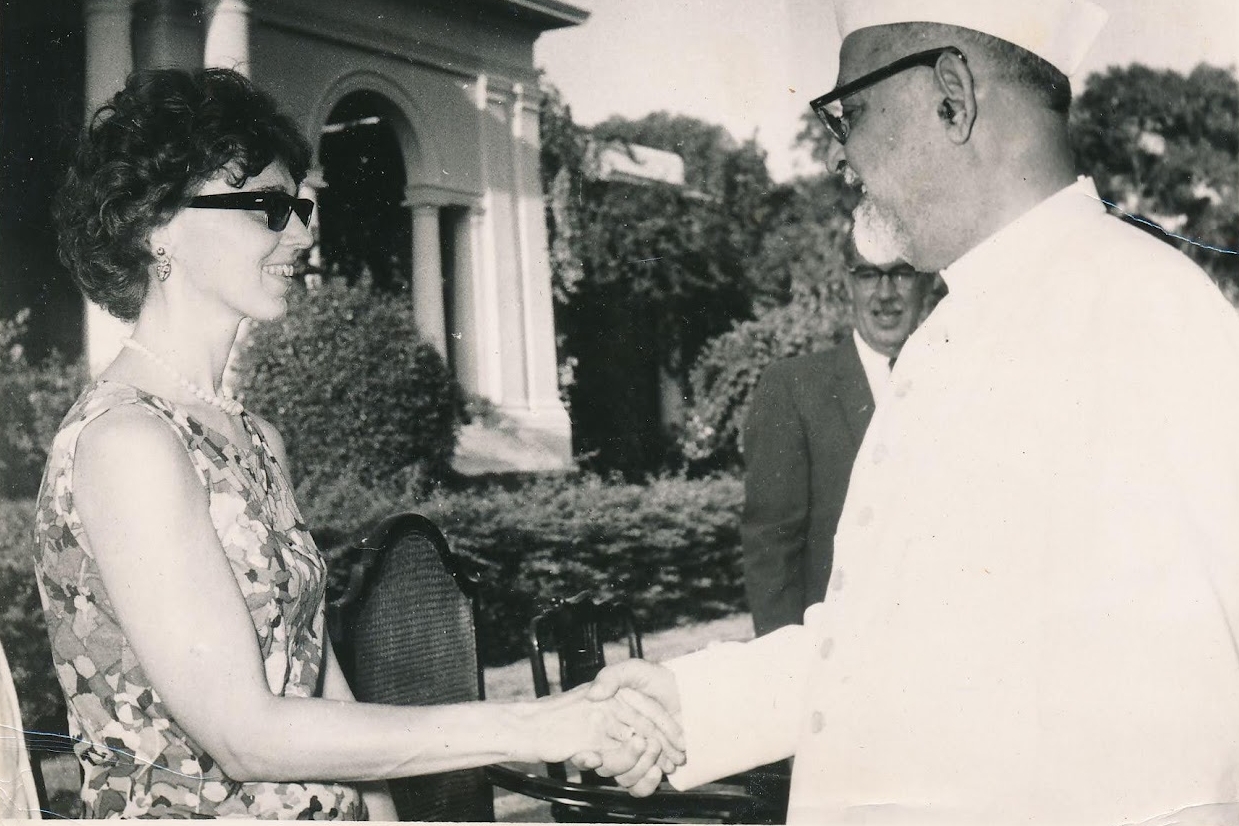

    Dr. Ashmead (left) met many dignitaries during her worldwide travels.
  • The Schuylkill is frozen, but that doesn’t mean you can ice fish on it

    The Schuylkill is frozen, but that doesn’t mean you can ice fish on it

    Have you been looking longingly at your fishing gear during the Philadelphia winter? Are Deadliest Catch reruns not hitting the same?

    With the surface of the Schuylkill River still frozen solid and frigid temperatures returning this weekend, a reader asked through Curious Philly, The Inquirer’s outlet for answering questions, whether they were allowed to ice fish on it.

    Ice fishing, after all, is a practice that began with subarctic Indigenous peoples thousands of years ago, well before the advent of the modern fishing rod in the late 1700s. Fishing along the Schuylkill is accepted and celebrated in warmer temperatures, so what about its frozen cousin?

    Unfortunately for those Philadelphians dreaming about an Arctic lifestyle, the answer is no.

    “Ice fishing is illegal in Philly,” Philadelphia Police Department spokesperson Sgt. Eric Gripp said by email. The practice is not explicitly outlawed, but walking out onto the ice in order to carve a hole and cast a line underneath violates city rules.

    A pedestrian walks past a large pile of snow and ice along the Benjamin Franklin Parkway on Monday.

    “You can’t walk, swim, or be in/on the waterway — unless in a vessel — regardless as to whether or not it’s frozen,” Gripp said.

    Philadelphia police began spreading the message to not venture out onto the frozen Schuylkill this week, after local CBS News video captured several adults and children walking across it Sunday. The Police Department’s directive on code violation notices lists ice skating, skiing, and sledding in some areas of Fairmount Park as potential offenses.

    Ice fishing could put you in violation of a few city ordinances, too. While you would likely be subject only to a summary offense and a $25 fine for each violation, police say you would be breaking rules about using areas managed by Parks and Recreation outside of their approved use, and risk violating the ban on “swimming” or wading out onto any Philadelphia creek, lake, river, or stream.

    » ASK US: Have something you’re wondering about the Philly region? Submit your Curious Philly question here.

    Even though the Schuylkill’s frozen surface may be several inches thick in certain locations, ice’s integrity can’t be judged based upon only how it looks, how fresh it is, or the temperature outdoors, according to the Pennsylvania Fish and Boat Commission. Ice’s strength is also informed by several other factors, including the depth of the water underneath the ice, and nearby fish activity.

    “Anyone that walks onto the Schuylkill River, … they’re taking their life into their own hands. It’s not a smart thing to do,” said commission spokesperson Mike Parker. Parker said the commission highly advises against walking on top of or fishing on the frozen surface of any moving body of water, like a river.

    “There’s no such thing as safe ice,” in those cases, he said.

    A fisherman sits in the sun outside a pop up shelter while ice fishing on frozen Lake Wentworth in Wolfeboro, N.H.

    But ice fishing can be relatively safe on still bodies of water, like lakes and ponds. As general guidelines, the fish and boat commission advises that anglers fish only on those bodies of water when ice is at least five inches thick, and never to go out onto ice alone.

    If you are still interested in ice fishing during the region’s cold spell, the Fish and Boat Commission offers a map of approved ice fishing destinations across the state.

    The closest ones to Philadelphia include Deep Creek Dam in Montgomery County; Marsh Creek Lake, in Chester County; and Lake Galena in Bucks County.

  • Government lawyer yanked from immigration detail in Minnesota after telling judge ‘this job sucks’

    Government lawyer yanked from immigration detail in Minnesota after telling judge ‘this job sucks’

    WASHINGTON — A government lawyer who told a judge that her job “sucks” during a court hearing stemming from the Trump administration’s immigration enforcement surge in Minnesota has been removed from her Justice Department post, according to a person familiar with the matter.

    Julie Le had been working for the Justice Department on a detail, but the U.S. attorney in Minnesota ended her assignment after her comments in court on Tuesday, the person said. The person spoke on the condition of anonymity to discuss a personnel matter. She had been working for U.S. Immigration and Customs Enforcement before the temporary assignment.

    At a hearing Tuesday in St. Paul, Minn., for several immigration cases, Le told U.S. District Judge Jerry Blackwell that she wishes he could hold her in contempt of court “so that I can have a full 24 hours of sleep.”

    “What do you want me to do? The system sucks. This job sucks. And I am trying every breath that I have so that I can get you what you need,” Le said, according to a transcript.

    Le’s extraordinary remarks reflect the intense strain that has been placed on the federal court system since President Donald Trump returned to the White House a year ago with a promise to carry out mass deportations. ICE officials have said the surge in Minnesota has become its largest-ever immigration operation since ramping up in early January.

    Several prosecutors have left the U.S. Attorney’s office in Minnesota amid frustration with the immigration enforcement surge and the Justice Department’s response to fatal shootings of two civilians by federal agents. Le was assigned at least 88 cases in less than a month, according to online court records.

    Blackwell told Le that the volume of cases isn’t an excuse for disregarding court orders. He expressed concern that people arrested in immigration enforcement operations are routinely jailed for days after judges have ordered their release from custody.

    “And I hear the concerns about all the energy that this is causing the DOJ to expend, but, with respect, some of it is of your own making by not complying with orders,” the judge told Le.

    Le said she was working for the Department of Homeland Security as an ICE attorney in immigration court before she “stupidly” volunteered to work the detail in Minnesota. Le told the judge that she wasn’t properly trained for the assignment. She said she wanted to resign from the job but couldn’t get a replacement.

    “Fixing a system, a broken system, I don’t have a magic button to do it. I don’t have the power or the voice to do it,” she said.

    Homeland Security Assistant Secretary Tricia McLaughlin said Le was a probationary attorney.

    “This conduct is unprofessional and unbecoming of an ICE attorney in abandoning her obligation to act with commitment, dedication, and zeal to the interests of the United States Government,” McLaughlin said in a statement.

    Le and the U.S. Attorney’s office in Minnesota didn’t immediately respond to emails seeking comment.

    Kira Kelley, an attorney who represented two petitioners at the hearing, said the flood of immigration petitions is necessary because “so many people being detained without any semblance of a lawful basis.”

    “And there’s no indication here that any new systems or bolded e-mails or any instructions to ICE are going to fix any of this,” she added.

  • Police ‘buried’ footage that showed a teen didn’t kill his friend at a SEPTA station, lawsuit says

    Police ‘buried’ footage that showed a teen didn’t kill his friend at a SEPTA station, lawsuit says

    A teenager who faced charges that were later dropped in the killing of his friend, and spent 49 days in jail before video evidence established his innocence, has sued Philadelphia and SEPTA police officers who were involved in his prosecution.

    Zaire Wilson, 18, is accusing law enforcement officers of hiding and ignoring evidence showing he did not shoot and kill Tyshaun Welles on a platform at the City Hall station on Jan. 11, 2024.

    Welles, 16, was hit in the head and his family decided to take him off life support less than a week later. The Frankford High School sophomore was not the target of the shooting, detectives said.

    Tyshaun Welles, 16, was struck in the head by a stray bullet on the subway platform at SEPTA’s City Hall station.

    Wilson and Quadir Humphrey, 20, were arrested the night of the shooting. Police said Wilson pulled out a gun and Humphrey used it to open fire at the group of teens. After Welles died, Wilson was charged with murder and held without bail at the Juvenile Justice Services Center.

    The Philadelphia District Attorney’s Office dropped the charges against Wilson in late February 2024 after prosecutors received surveillance footage from SEPTA.

    “The SEPTA surveillance video of the incident, which was not available to the DA’s Office at the time of Wilson’s arrest, shows that he was clearly not involved in the shooting and murder of Welles‚” the office said in a statement.

    Law enforcement did not share the footage with prosecutors until Feb. 26, 2024, and the district attorney’s office charged Wilson based on a criminal complaint that was riddled with errors and omissions, according to the lawsuit, which was filed last month in the Eastern District of Pennsylvania.

    It is “shocking” that “critical video evidence” was not available to prosecutors at the time of Wilson’s arrest, said Jon Cioschi, a Wiseman, Schwartz, Cioschi & Trama attorney who filed the complaint.

    “It is our view that the video footage conclusively establishes Zaire’s innocence, and that no reasonable officer, taking the evidence seriously, would or could have concluded otherwise,” Cioschi said.

    The city’s law department declined to comment on active litigation. SEPTA did not respond to a request for comment.

    Humphrey pleaded guilty to third-degree murder, aggravated assault, and related crimes, and was sentenced to 17 to 45 years in prison in July.

    What the surveillance footage shows

    Wilson and Welles spent the evening of Jan. 11 with a group of friends at LevelUp, a neighborhood organization in West Philadelphia, the complaint says.

    Surveillance footage reviewed by The Inquirer shows the group, which included the two teens and Wilson’s teenage brother, arriving at the westbound Market-Frankford Line platform at the City Hall SEPTA station around 9:15 p.m.

    As the group waited for the train, the teens chatted and played on the platform as at least four SEPTA officers stood near them.

    Wilson playfully chased a girl in an orange shirt to the east end of the platform. He saw Humphrey, who arrived to the platform separately from the teens, and the two chatted and paced together for a few seconds. As Wilson began to walk back toward the group, a train approached, and Humphrey pulled out a gun and opened fire. Wilson ran to the staircase and got off the platform while Humphrey continued to shoot.

    The teens dispersed during the pandemonium, but one dropped to the ground. After the shooting ended and Humphrey ran away, officers picked up Welles and took him off the platform.

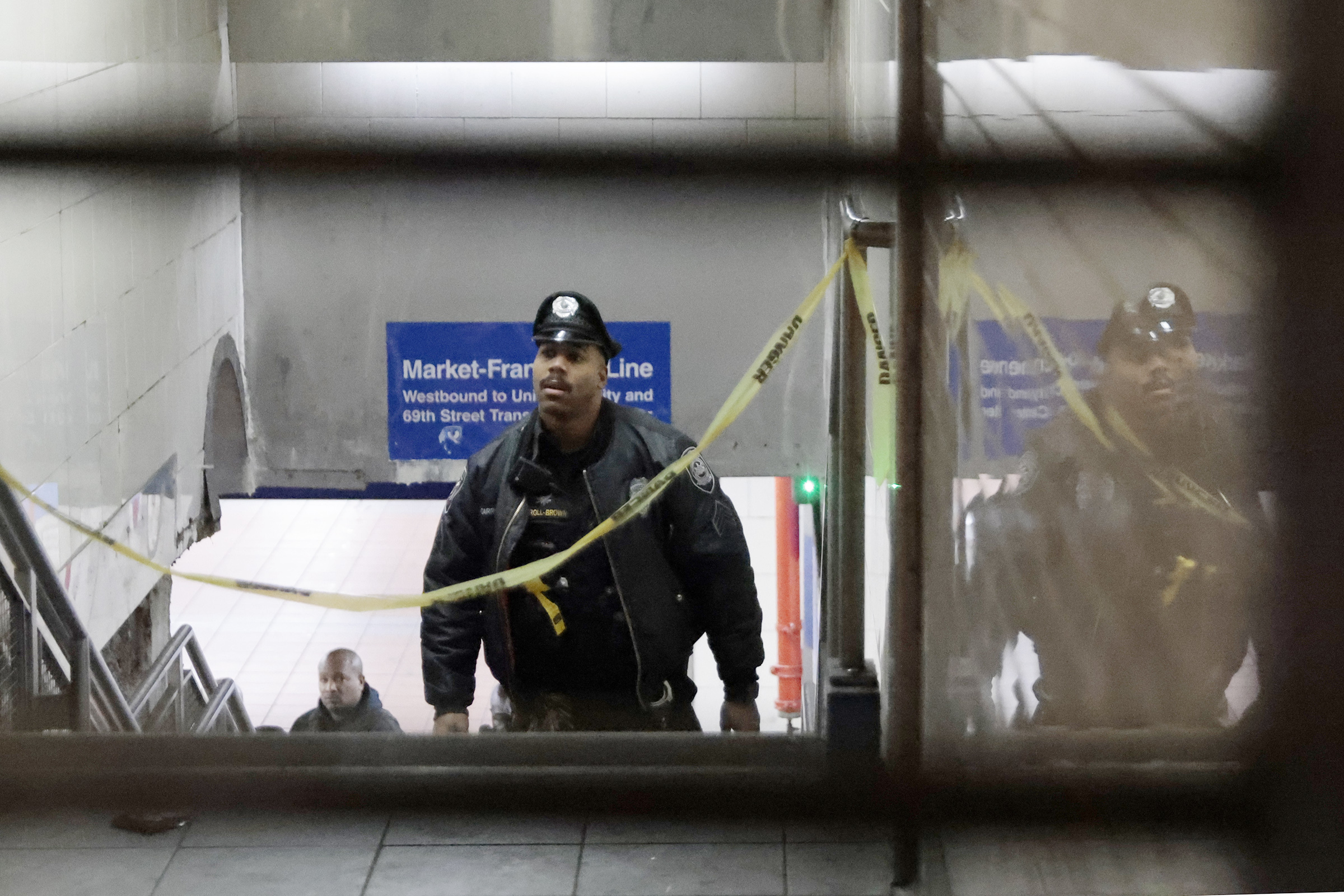
    A SEPTA law enforcement officer walks up stairs from a platform where earlier a SEPTA transit police officer reported a shooting and a victim down on the westbound platform at 15th Street Station near City Hall in Philadelphia on Thursday, Jan. 11, 2024.

    Moments after the shooting, Wilson returned to the platform. He raised his hands as officers with guns drawn rushed to him, pinned him to the ground, frisked him, and let him go. Wilson then walked down the platform where he met his brother and another teen. The three abruptly ran upstairs.

    The footage contradicts police statements that Wilson brandished a gun. That Wilson returned to the scene, where he knew a group of officers were standing, while Humphrey ran away, should have indicated his “consciousness of innocence,” the suit says.

    Humphrey himself told staff at the Juvenile Justice Services Center that Wilson had nothing to do with the shooting, according to the lawsuit, and wrote a letter to a judge on Jan. 16, 2024, days after the shooting, that said “the person I was arrested and detained with has no connection whatsoever.”

    “Rather than follow the facts,” the suit says, “defendants buried them.”

  • Judge appears skeptical of Trump’s latest bid to nix his hush money conviction

    Judge appears skeptical of Trump’s latest bid to nix his hush money conviction

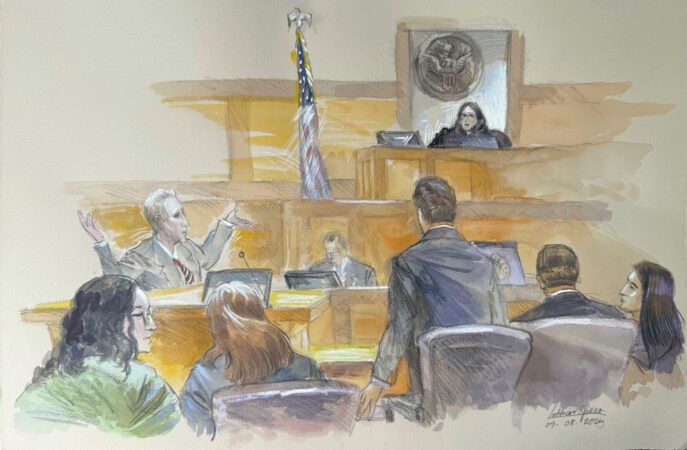
    NEW YORK — A federal judge appeared poised to again reject President Donald Trump’s bid to erase his hush money conviction, slamming his lawyers Wednesday for legal maneuvers he said amounted to taking “two bites at the apple.”

    Directed by an appeals court to take a fresh look at the matter, Judge Alvin K. Hellerstein was at turns inquisitive and incredulous in nearly three hours of arguments in Manhattan federal court. Sparring with Trump lawyer Jeffrey Wall throughout, he suggested the whole exercise was moot because the president’s legal team had waited too long after the historic verdict to seek federal court relief.

    The 2nd U.S. Circuit Court of Appeals in November ordered Judge Hellerstein to reconsider his earlier decision to keep the New York case in state court instead of moving it to federal court, where Trump can seek to have it thrown out on presidential immunity grounds.

    A three-judge panel ruled Hellerstein erred in his September 2025 ruling by failing to consider “important issues relevant” to Trump’s request to move the case to federal court. But they expressed no view on how he should rule.

    Trump, a Republican, did not attend Wednesday’s arguments.

    Hellerstein heard from Wall and Steven Wu, a lawyer from the Manhattan district attorney’s office, which prosecuted the case and wants it to remain in state court.

    Hellerstein thanked both men for their “very provocative arguments” and said he would issue a ruling at a later date.

    Trump was convicted in state court

    Trump was convicted in May 2024 of 34 felony counts of falsifying business records to conceal a hush money payment to adult film actor Stormy Daniels, whose allegations of an affair with Trump threatened to upend his 2016 presidential campaign. He was sentenced to an unconditional discharge, leaving his conviction intact but sparing him any punishment.

    Trump denies Daniels’ claim and said he did nothing wrong. He has asked a state appellate court to overturn the conviction.

    Hellerstein interrupted Wall almost as soon as Wednesday’s arguments began, injecting his thoughts and questions and telling the lawyer “I think I have to quarrel with you a bit” about the sequence of events that followed Trump’s conviction in May 2024.

    The judge took issue with the Trump legal team’s decision making after the verdict and a subsequent U.S. Supreme Court ruling that presidents and former presidents cannot be prosecuted for official acts.

    Instead of immediately seeking to move the case to federal court, Trump’s lawyers first asked the trial judge, Juan Merchan, to throw out the verdict on immunity grounds.

    Wall argued that Trump’s lawyers were in a time crunch after the Supreme Court’s July 1, 2024, ruling because Trump’s sentencing was scheduled for just 10 days later. Had Trump’s lawyers sought to bring the case to federal court at that point, the district attorney’s office, which prosecuted the case, may have criticized that as premature, Wall said.

    Trump’s lawyers did not ask Hellerstein to intervene until nearly two months later. The judge on Wednesday called that a “strategic decision” and suggested that by going to the state court first, Trump’s lawyers cost him the right to pursue remedies in federal court.

    “No, your honor,” Wall said. “It is what any sensible litigant would do” in that situation.

    “Not so,” Hellerstein replied.

    “That is a decision on your part,” the judge added. “You didn’t have to do that. You could have come right to the federal court. Just by filing a notice of removal, there would be no sentencing.”

    Trump’s lawyers “made a choice,” Hellerstein said, ”and you sought two bites at the apple.”

    Normally, such a request must be made within 30 days of an arraignment, but a federal appeals court in Washington, D.C. has ruled that exceptions can be made if “good cause” is shown.

    Wu concurred that Wall’s argument “confirms this was a strategic choice by the defendants.”

    He also said Trump’s lawyers knew they could have simultaneously submitted arguments or a letter to Merchan and still sought to transfer the case to federal court. Past rulings have made clear that “you cannot go to state court and when you’re unhappy, then go to federal court,” Wu said.

    Previous requests to move the case were denied

    Hellerstein, who was nominated by Democratic President Bill Clinton, has twice denied Trump’s requests to move the case. The first was after Trump’s March 2023 indictment; the second was the post-verdict ruling at issue at Wednesday’s hearing.

    In that ruling, Hellerstein said Trump’s lawyers had failed to meet the high burden of proof for changing jurisdiction and that Trump’s conviction for falsifying business records involved his personal life, not official actions that the Supreme Court ruled are immune from prosecution.

    The 2nd Circuit panel said Hellerstein’s ruling, which echoed his pre-trial denial, “did not consider whether certain evidence admitted during the state court trial relates to immunized official acts or, if so, whether evidentiary immunity transformed” the hush money case into one that relates to official acts.

    The three judges said Hellerstein should closely review evidence Trump claims relate to official acts.

    If Hellerstein finds the prosecution relied on evidence of official acts, the judges said, he should weigh whether Trump can argue those actions were taken as part of his White House duties, whether Trump “diligently sought” to have the case moved to federal court and whether the case can even be moved to federal court now that Trump has been convicted and sentenced in state court.

  • Legal fight escalates over Georgia voting records as Trump says he wants to ‘take over’ elections

    Legal fight escalates over Georgia voting records as Trump says he wants to ‘take over’ elections

    ATLANTA — Officials in Georgia’s Fulton County said Wednesday they have asked a federal court to order the FBI to return ballots and other documents from the 2020 election that it seized last week, escalating a voting battle as President Donald Trump says he wants to “take over” elections from Democratic-run areas with the November midterms on the horizon.

    The FBI had searched a warehouse near Atlanta where those records were stored, a move taken after Trump’s persistent demands for retribution over claims, without evidence, that fraud cost him victory in Georgia. Trump’s election comment came in an interview Monday with a conservative podcaster and the Republican president reaffirmed his position in Oval Office remarks the next day, citing fraud allegations that numerous audits, investigations and courts have debunked.

    Officials in heavily Democratic Fulton County referenced those statements in announcing their legal action at a time of increasing anxiety over Trump’s plans for the fall elections that will determine control of Congress.

    “This case is not only about Fulton County,” said the county chairman, Robb Pitts. “This is about elections across Georgia and across the nation.”

    In a sign of that broader concern, Sen. Mark Warner (D., Va.) said this week that he once doubted Trump would intervene in the midterms but now “the notional idea that he will ask his loyalists to do something inappropriate, beyond the Constitution, scares the heck out of me.”

    The White House has scoffed at such fears, noting that Trump did not intervene in the 2025 off-year elections despite some Democratic predictions he would. But the president’s party usually loses ground in midterm elections and Trump has already tried to tilt the fall races in his direction.

    Democratic state election officials have reacted to Trump’s statements, the seizure of the Georgia election materials and his aggressive deployment of federal officers into Democratic-leaning cities by planning for a wide range of possible scenarios this fall. That includes how they would respond if Immigration and Customs Enforcement officers were stationed outside polling places.

    They also have raised concerns about U.S. Department of Justice lawsuits, mostly targeting Democratic states, seeking detailed voter data that includes dates of birth and partial Social Security numbers. Secretaries of state have raised concerns that the administration is building a database it can use to potentially disenfranchise voters in future elections.

    Trump and his allies have long fixated on Fulton County, Georgia’s most populous, since he narrowly lost the state to Democrat Joe Biden in 2020. In the weeks after that election, Trump called Georgia’s secretary of state, Republican Brad Raffensperger, urged him to help “find” the 11,780 ballots that would enable Trump to be declared the Georgia winner of the state and raised the prospect of a “criminal offense” if the official failed to comply.

    Raffensperger did not change the vote tally, and Biden won Georgia’s 16 electoral votes. Days later, rioters swarmed the U.S. Capitol on Jan. 6, 2021, and tried to prevent the official certification of Biden’s victory. When Trump returned to the presidency in January 2025, he pardoned more than 1,000 charged in that siege.

    “The president himself and his allies, they refuse to accept the fact that they lost,” Pitts said. “And even if he had won Georgia, he would still have lost the presidency.”

    Pitts defended the county’s election practices and said Fulton has conducted 17 elections since 2020 without any issues.

    A warrant cover sheet provided to the county includes a list of items that the agents were seeking related to the 2020 general election: all ballots, tabulator tapes from the scanners that tally the votes, electronic ballot images created when the ballots were counted and then recounted, and all voter rolls.

    The FBI drove away with hundreds of boxes of ballots and other documents. County officials say they were not told why the federal government wanted the documents.

    The county is also asking the court to unseal the sworn statement from a law enforcement agent that was presented to the judge who approved the search warrant.

    The Justice Department declined to comment on the county’s motion.

    “What they’re doing with the ballots that they have now, we don’t know, but if they’re counted fairly and honestly, the results will be the same,” Pitts said.

    Tulsi Gabbard, Trump’s director of national intelligence, was at the Fulton search last week, and Democrats in Congress have questioned the propriety of her presence because the search was a law enforcement, not intelligence, action.

    In a letter to top Democrats on the House and Senate Intelligence committees Monday, Gabbard said Trump asked her to be there “under my broad statutory authority to coordinate, integrate, and analyze intelligence related to election security.”

    White House spokeswoman Karoline Leavitt said Tuesday that the president’s “take over” remarks, which included a vague reference to “15 places” that should be targeted, were a reference to the SAVE Act, legislation that would tighten proof of citizenship requirements. Republicans want to bring it up for a vote in Congress.

    But in his remarks that day, Trump did not cite the proposal. Instead, he claimed that Democratic-controlled places such as Atlanta, which falls mainly in Fulton County, have “horrible corruption on elections. And the federal government should not allow that.”

    The Constitution vests states with the ability to administer elections. Congress can add rules for federal races. One of Trump’s earliest second-term actions was an executive order that tried to rewrite voting rules nationwide. Judges have largely blocked it because it violates the Constitution.

    Trump contended that states were “agents of the federal government to count the votes. If they can’t count the votes legally and honestly, then somebody else should take over.”

    Sen. Thom Tillis (R., N.C.) said Wednesday said he supported the SAVE Act but not Trump’s desire for a federal takeover. “Nationalizing elections and picking 15 states seems a little off strategy,” Tillis told reporters.

  • U.S. wants to create a critical minerals trading bloc with its allies to counter China

    U.S. wants to create a critical minerals trading bloc with its allies to counter China

    WASHINGTON — The Trump administration announced Wednesday that it wants to create a critical minerals trading bloc with its allies and partners, using tariffs to maintain minimum prices and defend against China’s stranglehold on the key elements needed for everything from fighter jets to smartphones.

    Vice President JD Vance said the U.S.-China trade war over the past year exposed how dependent most countries are on the critical minerals that Beijing largely dominates, so collective action is needed now to give the West self-reliance.

    “We want members to form a trading bloc among allies and partners, one that guarantees American access to American industrial might while also expanding production across the entire zone,” Vance said at the opening of a meeting that Secretary of State Marco Rubio hosted with officials from several dozen European, Asian, and African nations.

    The Republican administration is making bold moves to shore up supplies of critical minerals needed for electric vehicles, missiles and other high-tech products after China choked off their flow in response to President Donald Trump’s sweeping tariffs last year. While the two global powers reached a truce to pull back on the high import taxes and stepped-up rare earth restrictions, China’s limits remain tighter than they were before Trump took office.

    The critical minerals meeting comes at a time of significant tensions between Washington and major allies over President Donald Trump’s territorial ambitions, including Greenland, and his moves to exert control over Venezuela and other nations. His bellicose and insulting rhetoric directed at U.S. partners has led to frustration and anger.

    The conference, however, is an indication that the United States is seeking to build relationships when it comes to issues it deems key national security priorities.

    While major allies like France and the United Kingdom attended the meeting in Washington, Greenland and Denmark, the NATO ally with oversight of the mineral-rich Arctic island, did not.

    A new approach to countering China on critical minerals

    Vance said some countries have signed on to the trading bloc, which is designed to ensure stable prices and will provide members access to financing and the critical minerals. Administration officials said the plan will help the West move beyond complaining about the problem of access to critical minerals to actually solving it.

    “Everyone here has a role to play, and that’s why we’re so grateful for you coming and being a part of this gathering that I hope will lead to not just more gatherings, but action,” Rubio said.

    Vance said that for too long, China has used the tactic of unloading materials at cheap prices to undermine potential competitors, then ratcheting up prices later after keeping new mines from being built in other countries.

    Prices within the preferential trade zone will remain consistent over time, the vice president said.

    “Our goal within that zone is to create diverse centers of production, stable investment conditions and supply chains that are immune to the kind of external disruptions that we’ve already talked about,” he said.

    To make the new trading group work, it will be important to have ways to keep countries from buying cheap Chinese materials on the side and to encourage companies from getting the critical minerals they need from China, said Ian Lange, an economics professor who focuses on rare earths at the Colorado School of Mines.

    “Let’s just say it’s standard economics or standard behavior. If I can cheat and get away with it, I will,” he said.

    At least for defense contractors, Lange said the Pentagon can enforce where those companies get their critical minerals, but it may be harder with electric vehicle makers and other manufacturers.

    U.S. turns to a strategic stockpile and investments

    Trump this week also announced Project Vault, a plan for a strategic U.S. stockpile of rare earth elements to be funded with a $10 billion loan from the U.S. Export-Import Bank and nearly $1.67 billion in private capital.

    In addition, the government recently made its fourth direct investment in an American critical minerals producer, extending $1.6 billion to USA Rare Earth in exchange for stock and a repayment deal. The Pentagon has shelled out nearly $5 billion over the past year to spur mining.

    The administration has prioritized the moves because China controls 70% of the world’s rare earths mining and 90% of the processing. Trump and Chinese President Xi Jinping spoke by phone Wednesday, including about trade. A social media post from Trump did not specifically mention critical minerals.

    Heidi Crebo-Rediker, a senior fellow in the Center for Geoeconomic Studies at the Council on Foreign Relations, said the meeting was “the most ambitious multilateral gathering of the Trump administration.”

    “The rocks are where the rocks are, so when it comes to securing supply chains for both defense and commercial industries, we need trusted partners,” she said.

    Japan’s minister of state for foreign affairs, Iwao Horii, said Tokyo was fully on board with the U.S. initiative and would work with as many countries as possible to ensure its success.

    “Critical minerals and (their) stable supply is indispensable to the sustainable development of the global economy,” he said.

    How the strategic reserve would work

    The Export-Import Bank’s board this week approved the largest loan in its history to help finance the setup of the U.S. Strategic Critical Minerals Reserve, which is tasked with ensuring access to critical minerals and related products for manufacturers.

    The bank’s president and chairman, John Jovanovic, told CNBC that manufacturers, which benefit the most from the reserve, are making a long-term financial commitment, while the government loan spurs private investments.

    David Abraham, a rare earths expert who has followed the industry for decades and is author of “The Elements of Power,” said that while the Trump administration has focused on reinvigorating critical minerals production, it also is important to encourage development of manufacturing that will use those minerals.

    He noted that Trump’s decisions to cut incentives for electric vehicles and wind turbines have undercut demand for these elements in America.

  • Myra MacPherson, trailblazing Washington Post journalist, has died at 91

    Myra MacPherson, trailblazing Washington Post journalist, has died at 91

    Myra MacPherson, a wide-ranging feature writer for the Washington Post’s Style section and an author whose books included a study of the competing demands of politics and marriage among power couples in Washington and a volume on the enduring traumas of the Vietnam War, died Feb. 2 in hospice in Washington. She was 91.

    The cause was congestive heart failure, said her son, Michael Siegel.

    When Ms. MacPherson applied for her first journalism job in 1956, with ambitions to cover major news stories, an editor at the Detroit Free Press informed her that he had no openings on the women’s page.

    “I said I wasn’t considering the women’s department,” she recalled, “and he looked at me as if I had said I just shot my mother or something. He said, ‘We have no women in the city room.’”

    She spent the early 1960s relegated to women’s issues and society coverage at the Washington Star and the New York Times before the Post’s top editor, Ben Bradlee, poached her in 1968 for a new features section called Style. She was promised a freewheeling mandate to cover contemporary affairs and personalities with the irreverent verve of a glossy magazine.

    Assigned to cover the New York Mets in 1969, the year the team won the World Series for the first time, Ms. MacPherson was denied the full access granted to her male colleagues, and she wrote a scathing story about “being treated like a non-eunuch in a harem.”

    As she recounted decades later in a letter to the Times, a columnist griped to her: “The next thing, you girls are going to want to get into the locker room.”

    “We don’t want to use the urinals,” Ms. MacPherson said she replied, “just the typewriters.”

    Her first book, The Power Lovers (1975), was an unblinking look at the pressures of Washington marriages. “I am his mistress,” Marian Javits, the wife of Sen. Jacob K. Javits (R., N.Y.) told her. “His work is his wife.”

    Ms. MacPherson conceived her book about Vietnam after watching the 1979 TV movie Friendly Fire. As a mother, she said, she was deeply moved by Carol Burnett’s performance as the grief-stricken parent of a dead Vietnam War soldier.

    “When I watched the show, I realized that I didn’t know anyone in Washington who had a son in combat,” she recalled in an interview with California’s Riverside Press-Enterprise. “The sons I knew were mostly those who had escaped to college, gone into the National Guard or who had protested the war.”

    The damage done by the Vietnam War was still fresh and in many circles was not a welcome subject for discussion when Ms. MacPherson began writing what became Long Time Passing: Vietnam and the Haunted Generation (1984).

    Long Time Passing examined the war and its aftermath through the lives of hundreds of people profoundly affected by the conflict.

    Ms. MacPherson included the perspectives of nurses, mothers, and wives as well as servicemen — some of whom said they were proud of what they did and some who said they were ashamed of it or traumatized by it. Some said they were deserters.

    She also interviewed historians and psychologists, and she helped bring the concept of posttraumatic stress disorder to wider attention. In its best passages, author Donald Knox wrote in his Times review, the book “sings, soars, explodes with feeling” and “shines a powerful light on the differences that divide this generation.”

    Myra Lea MacPherson was born in Marquette, Mich., on May 31, 1934, and grew up in Belleville, a town of 800 between Detroit and Ann Arbor. Her father worked for the camera company Argus, and her mother was a homemaker.

    Ms. MacPherson was editor in chief of her high school newspaper, and she became night city editor of the student newspaper at Michigan State University in East Lansing. She graduated in 1956 with a degree in journalism.

    After compiling the TV listings at the Free Press, she left for the Detroit News, where her professional experience improved, to a point. Assigned to cover the Indianapolis 500 in 1960, she said, she was the only female reporter at the race. She was denied access to the press box and the speedway’s Gasoline Alley, where drivers and their crews worked, and had to conduct interviews through chain-link fences along the track’s periphery.

    Her first marriage, to Washington sportswriter Morris Siegel, ended in divorce. In 1987, she married Jack Gordon, a liberal Democratic state senator from Miami Beach whom she met years earlier when covering an Equal Rights Amendment convention in Tallahassee. She and Gordon moved to Palm Springs, Calif., in 2001, but maintained a home in Washington. He died four years later after being struck by a car.

    Her daughter, Leah Siegel, a sports producer at ESPN, died of breast cancer in 2010. Survivors include her son, Michael Siegel, and three grandchildren.

    Ms. MacPherson, who left the Post in 1991, spent years contributing articles to Vanity Fair and other publications. Her books included She Came to Live Out Loud (1999), a look at dying and grief from the viewpoint of a woman diagnosed with breast cancer at 37; All Governments Lie (2006), a biography of the left-wing independent journalist I.F. Stone; and The Scarlet Sisters (2014), a dual biography of two fiercely independent 19th-century siblings, Victoria Woodhull and Tennessee Claflin.

    “I would definitely like to think I would have been out blazing a trail in Victorian times, probably in the liberal wing of the suffragist movement and also in journalism,” Ms. MacPherson told the website Edwardian Promenade, reflecting on her last book.

    “When I sought my first newspaper job, there were no women covering anything but society news, fashion,” she added. “I fought my way out of that niche and was one of the few women covering regular news. I don’t know if I could take the pummeling the sisters [Woodhull and Claflin] did, but in a much lesser way, women in the ’60s and ’70s were breaking new ground and I was among them.”

  • Man who tried to shoot Trump at a Florida golf course gets life in prison

    Man who tried to shoot Trump at a Florida golf course gets life in prison

    FORT PIERCE, Fla. — A man convicted of trying to assassinate President Donald Trump on a Florida golf course in 2024 was sentenced Wednesday to life in prison after a federal prosecutor said his crime was unacceptable “in this country or anywhere.”

    U.S. District Judge Aileen Cannon pronounced Ryan Routh’s fate in the same Fort Pierce courtroom that erupted into chaos in September when he tried to stab himself shortly after jurors found him guilty on all counts.

    “American democracy does not work when individuals take it into their own hands to eliminate candidates. That’s what this individual tried to do” Assistant U.S. Attorney John Shipley told the judge.

    Routh’s new defense attorney, Martin L. Roth, argued that “at the moment of truth, he chose not to pull the trigger.”

    The judge pushed back, noting Routh’s history of arrests, to which Roth said, “He’s a complex person I’ll give the court that, but he has a very good core.”

    Routh then read from a rambling, 20-page statement. Cannon broke in and said none of what he was saying was relevant, and gave him five more minutes to talk.

    “I did everything I could and lived a good life,” Routh said, before the judge cut him off.

    “Your plot to kill was deliberate and evil,” she said. “You are not a peaceful man. You are not a good man.”

    She then issued his sentence: Life without parole, plus 7 years on a gun charge. His sentences for his other three crimes will run concurrently.

    Routh’s sentencing had initially been scheduled for December, but Cannon agreed to move the date back after Routh decided to use an attorney during the sentencing phase instead of representing himself as he did for most of the trial.

    Routh was convicted of trying to assassinate a major presidential candidate, using a firearm in furtherance of a crime, assaulting a federal officer, possessing a firearm as a felon and using a gun with a defaced serial number. “Routh remains unrepentant for his crimes, never apologized for the lives he put at risk, and his life demonstrates near-total disregard for law,” the prosecutors’ sentencing memo said.

    His defense attorney had asked for 20 years plus the mandatory seven for the gun conviction.

    “The defendant is two weeks short of being sixty years old,” Roth wrote in a filing. “A just punishment would provide a sentence long enough to impose sufficient but not excessive punishment, and to allow defendant to experience freedom again as opposed to dying in prison.”

    Prosecutors said Routh spent weeks plotting to kill Trump before aiming a rifle through shrubbery as the Republican presidential candidate played golf on Sept. 15, 2024, at his West Palm Beach country club.

    At Routh’s trial, a Secret Service agent helping protect Trump on the golf course testified that he spotted Routh before Trump came into view. Routh aimed his rifle at the agent, who opened fire, causing Routh to drop his weapon and run away without firing a shot.

    In the motion requesting an attorney, Routh offered to trade his life in a prisoner swap with people unjustly held in other countries, and said an offer still stood for Trump to “take out his frustrations on my face.”

    “Just a quarter of an inch further back and we all would not have to deal with all of this mess forwards, but I always fail at everything (par for the course),” Routh wrote.

    In her decision granting Routh an attorney, Cannon chastised the “disrespectful charade” of Routh’s motion, saying it made a mockery of the proceedings. But the judge, nominated by Trump in 2020, said she wanted to err on the side of legal representation.

    Cannon signed off last summer on Routh’s request to represent himself at trial. The U.S. Supreme Court has held that criminal defendants have the right to represent themselves in court proceedings, as long as they can show a judge they are competent to waive their right to be defended by an attorney.

    Routh’s former federal public defenders served as standby counsel and were present during the trial.

    Routh had multiple previous felony convictions including possession of stolen goods, and a large online footprint demonstrating his disdain for Trump. In a self-published book, he encouraged Iran to assassinate him, and at one point wrote that as a Trump voter, he must take part of the blame for electing him.

  • Trump’s border czar announces 700 immigration officers to immediately leave Minnesota

    Trump’s border czar announces 700 immigration officers to immediately leave Minnesota

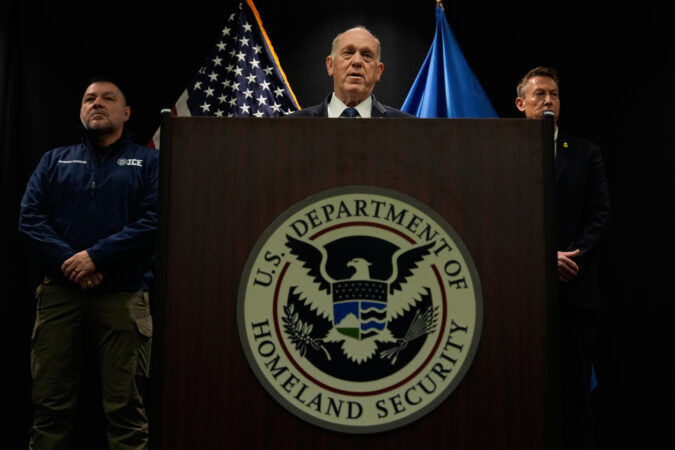
    The Trump administration is reducing the number of immigration officers in Minnesota but will continue its enforcement operation that has sparked weeks of tensions and deadly confrontations, border czar Tom Homan said Wednesday.

    About 700 federal officers — roughly a quarter of the total deployed to Minnesota — will be withdrawn immediately after state and local officials agreed over the past week to cooperate by turning over arrested immigrants, Homan said.

    But he did not provide a timeline for when the administration might end the operation that has become a flashpoint in the debate over President Donald Trump’s mass deportation efforts since the fatal shootings of U.S. citizens Renee Good and Alex Pretti in Minneapolis.

    About 2,000 officers will remain in the state after this week’s drawdown, Homan said. That’s roughly the same number sent to Minnesota in early January when the surge ramped up, kicking off what the Department of Homeland Security called its ” largest immigration enforcement operation ever.”

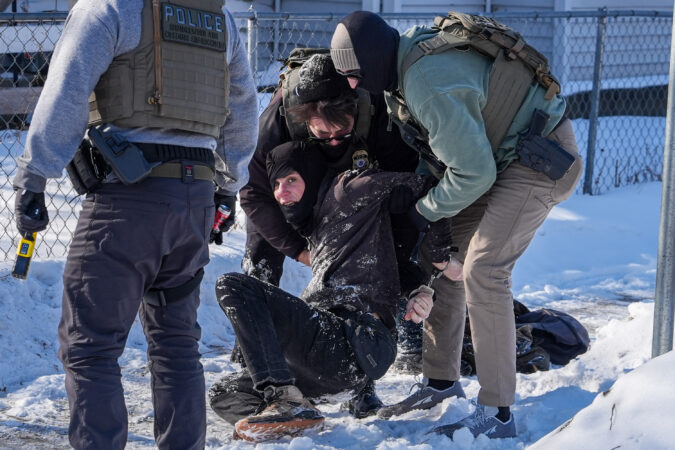
    Since then, masked, heavily armed officers have been met by resistance from residents who are upset with their aggressive tactics.

    A widespread pullout, Homan said, will occur only after protesters stop interfering with federal agents carrying out arrests and setting up roadblocks to impede the operations.

    Gov. Tim Walz and Minneapolis Mayor Jacob Frey, both Democrats who have heavily criticized the surge, said pulling back 700 officers was a good first step but that the entire operation should end quickly.

    “We need a faster and larger drawdown of forces, state-led investigations into the killings of Alex Pretti and Renee Good, and an end to this campaign of retribution,” Walz posted on social media.

    Vice President JD Vance said the officers being sent home were mainly in Minneapolis to protect those carrying out arrests. “We’re not drawing down the immigration enforcement,” Vance said in an interview on The Megyn Kelly Show.

    Trump administration has pushed for cooperation in Minnesota

    Trump’s border czar took over the Minnesota operation in late January after the second fatal shooting by federal officers and amid growing political backlash and questions about how the operation was being run.

    Homan said right away that federal officials could reduce the number of agents in Minnesota, but only with the cooperation of state and local officials. He pushed for jails to alert Immigration and Customs Enforcement about inmates who could be deported, saying transferring those inmates to ICE is safer because it means fewer officers have to be out looking for people in the country illegally.

    Homan said during a news conference Wednesday that there has been an “increase in unprecedented collaboration” resulting in the need for fewer public safety officers in Minnesota and a safer environment, allowing for the withdrawal of the 700 officers.

    He didn’t say which jurisdictions have been cooperating with DHS

    The Trump administration has long complained that places known as sanctuary jurisdictions — a term applied to local governments that limit law enforcement cooperation with the department — hinder the arrest of criminal immigrants.

    Minnesota officials say its state prisons and nearly all of the county sheriffs already cooperate with immigration authorities.

    But the two county jails that serve Minneapolis and St. Paul and take in the most inmates had not previously met ICE’s standard of full cooperation, although they both hand over inmates to federal authorities if an arrest warrant has been signed by a judge.

    The Hennepin County Sheriff’s Office, which serves Minneapolis and several suburbs, said its policies have not changed. The Ramsey County Sheriff’s Office in neighboring St. Paul did not immediately respond to a request for comment.

    Border czar calls Minnesota operation a success

    Homan said he thinks the ICE operation in Minnesota has been a success, checking off a list of people wanted for violent crimes who were taken off the streets.

    “I think it’s very effective as far as public safety goes,” he said Wednesday. “Was it a perfect operation? No.”

    He also made clear that pulling a chunk of federal officers out of Minnesota isn’t a sign that the administration is backing down. “We are not surrendering the president’s mission on a mass deportation operation,” Homan said.

    “You’re not going to stop ICE. You’re not going to stop Border Patrol,” Homan said of the ongoing protests. “The only thing you’re doing is irritating your community”

    Schools ask court to block immigration operations

    Two Minnesota school districts and a teachers union filed a lawsuit Wednesday to block federal authorities from conducting immigration enforcement at or around schools.

    The lawsuit says actions by DHS and its ICE officers have disrupted classes, endangered students and driven families away from schools.

    It also argues that Operation Metro Surge has marked a shift in policy that removed long-standing limits on enforcement activity in “sensitive locations,” including schools.

    Homeland Security officials have not responded to a request for comment.