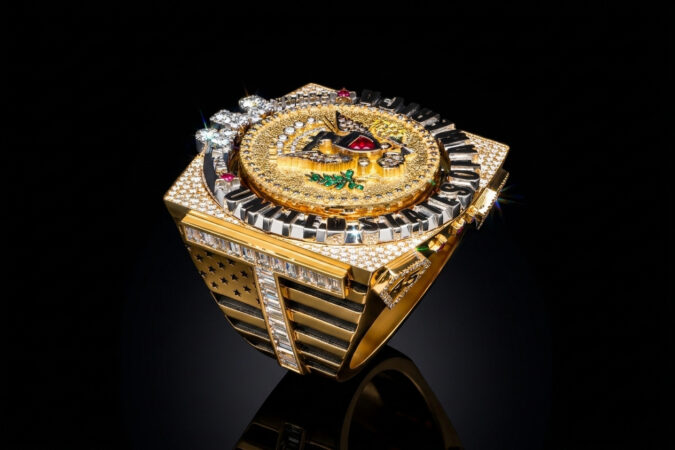
BRUSSELS — Dozens of diamonds spell out two giant letter T’s next to the Stars and Stripes and “1776” and “2026.” Dozens more frame the numbers 45 and 47 in the shape of Superman’s logo. A diamond-winged eagle carries a ruby shield and clutches an olive branch of emeralds, below a radiant “250” and atop the phrase “250 YEARS USA” etched in 18-karat gold.
All told, 321 diamonds, 56 sapphires, 13 emeralds and six rubies encrust the watch-sized gold ring presented this week to Bill White, the U.S. ambassador to Belgium, to give to President Donald Trump.
“A very special thank you to my friends from Antwerp for the magnificent Freedom 250 ring,” Trump said in a prerecorded video message during an event marking America’s 250th birthday in Brussels.
Isidore Mörsel, president of the Antwerp World Diamond Center, or AWDC, gifted the ring on behalf of the centuries-old diamond community in the Belgian port city, a central node in the worldwide trade of the precious stones that found itself struggling last year under the weight of Trump’s sweeping trade war.
“May this ring serve as a lasting reminder that true partnership like the finest natural diamonds are formed under pressure, endure the test of time, and shine brightest when built on trust,” Mörsel said. The ring’s interior is engraved with the phrase “Crafted in Antwerp for Donald John Trump.”
In dollar terms, the ring’s value pales beside gifts like the $400 million plane donated by Qatar that Trump ordered converted into a new Air Force One. But it’s a glitzy window into the role that ostentatious – and almost always gilded — gifts are playing for those seeking to curry favor with the U.S. president.
A White House official, speaking on the condition of anonymity to discuss the matter, said Thursday that the ring has not been presented to Trump yet.
Ring is latest in Trump’s break with White House custom
The gift comes months after Belgium’s diamond industry won the removal of U.S. tariffs on diamond imports. In September, AWDC said it had “succeeded in securing a zero percent import tariff” on Antwerp’s annual export of more than $2 billion of polished diamonds to the U.S. A spokesperson for the group said on Thursday that the AWDC provided “input” to the European Commission as it negotiated with Trump on a broad deal on tariffs in 2025, but did not itself lobby the administration.
U.S. presidents have considerable discretion to accept gifts from domestic and foreign sources and may determine themselves whether a gift was meant for them personally or the nation. The exception is those from foreign governments, which are prohibited by the foreign emoluments clause of the Constitution without congressional assent, though presidents could use personal funds to reimburse the Treasury for the full value of an official gift if they wish to retain it.
Personal gifts are also supposed to be registered on the president’s annual financial disclosure. Trump’s 2025 disclosure, released this week, revealed a $250,000 gift of a sculpture depicting his triumphal gesture after surviving a 2024 assassination attempt at a campaign rally in Butler, Pa., and tickets to 10 sporting events, including 10 to the upcoming World Cup final in New Jersey from FIFA’s Gianni Infantino, valued at a collective $15,000.
Four U.S. ethics experts told the Associated Press that Trump has broken with decades-old custom in the White House to avoid accepting such gifts.
Ring’s value estimated at $25,000-$35,000
To forge the ring, the AWDC turned to David Gotlib, an Antwerp-based high-end jeweler whose cufflinks can sell for more than 15,000 euros ($17,000).
Neither AWDC nor Gotlib would provide a valuation of the ring, but two independent jewelers told AP they estimated the value between $25,000 and $35,000.
Paris- and London-based jewelry consultant Alexander Levinson calculated the cost at $25,928, while David Saad, a third-generation luxury jeweler in Canada, priced the ring between $33,000 and $35,000. Both said half the cost was in materials, half in labor.
After the ring was presented on a star-spangled stage in Brussels, musician Alexis Wilkins, the girlfriend of FBI Director Kash Patel, sang the U.S. national anthem to more than 8,000 people drinking Budweiser and bourbon from Tennessee and Kentucky.
White said he raised more than $5.5 million for the 250th anniversary event from corporate sponsors like defense industry titans Lockheed Martin and Northrop Grumman and tech firms like Intel, Google, and Meta, as well as the European chocolate companies Leonidas and Ferrero. AWDC said it contributed funds, too.
“The media was asking, ‘Why does it have to be so big?’” White said of the event. “Because we are the United States of America!”
Meanwhile, the fate of the ring is not currently clear.
On Wednesday, White posted a photo online of himself wearing the ring and giving a thumbs-up. The post has since been deleted.
Addressing a Philadelphia crowd live from the Vatican, Pope Leo XIV called for a “recommitment” to American ideals.
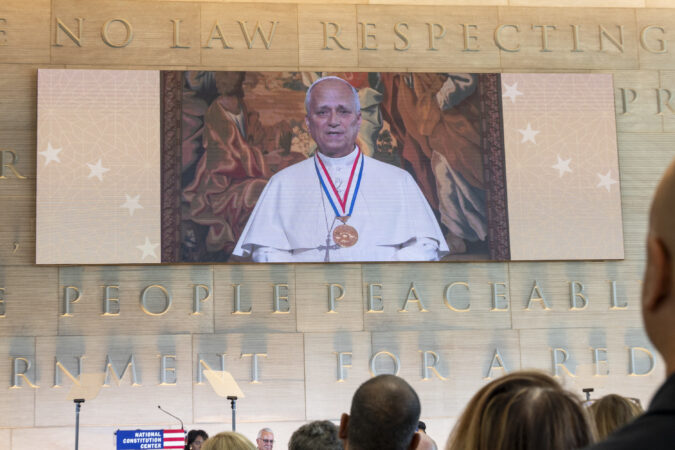
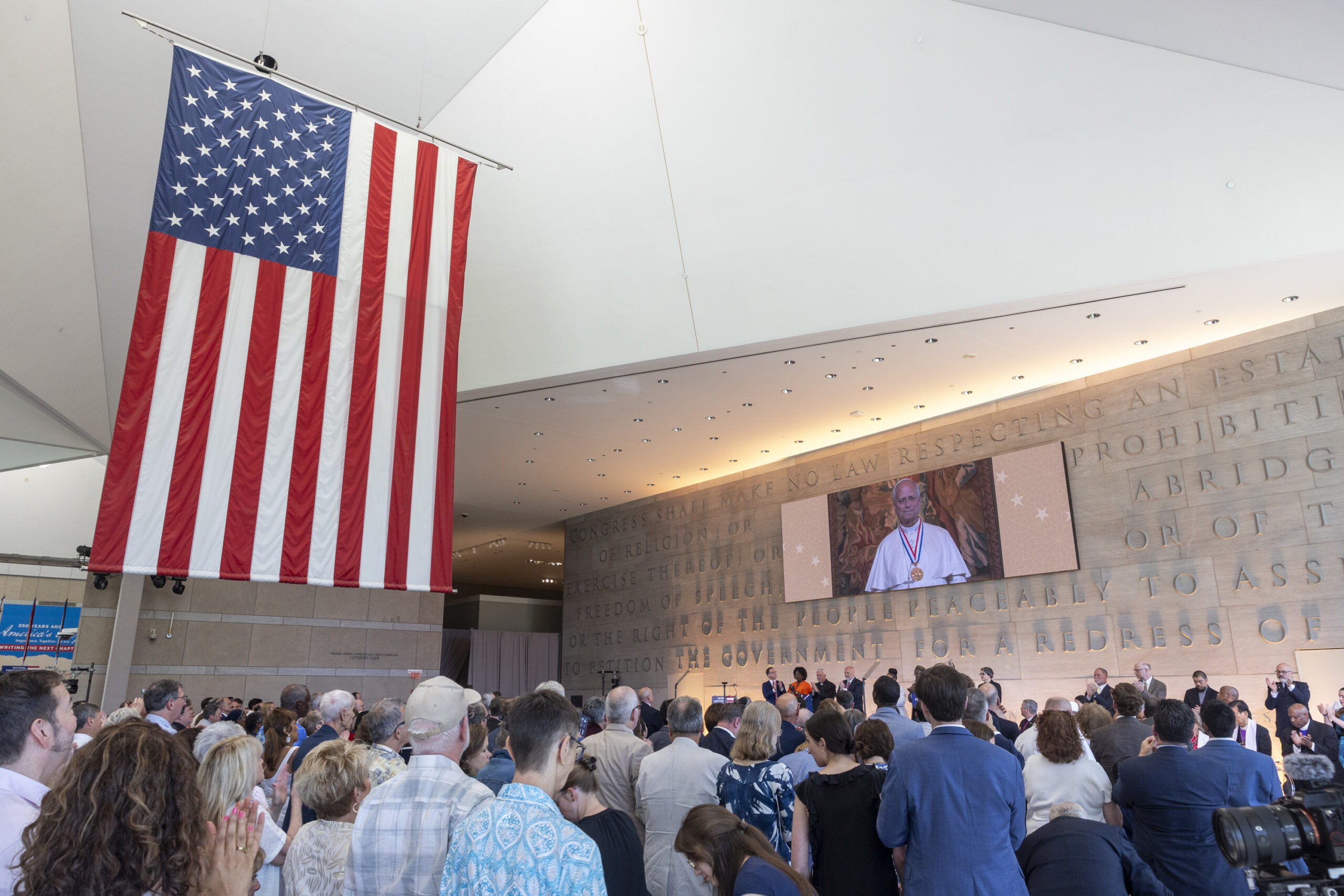
The first U.S.-born pope delivered remarks virtually at an interfaith ceremony inside Philadelphia’s National Constitution Center on the eve of the United States’ 250th birthday to accept the center’s prestigious Liberty Medal.
Facing a screen showing the live, cheering Philadelphia audience, the pontiff wore his Liberty Medal along with a cross around his neck.
Leo, who grew up in Chicago and attended Villanova University, quickly pointed out his American roots, calling himself “a son of this great country.”
“I join you in asking God’s blessings upon America’s future that the lofty ideals enshrined at the beginning of the Declaration of Independence may continue to guide the flourishing of the nation in unity, justice, and peace,” he said.
Leo, who was elected pope last year, spent years servingthe church in Peru and has been outspoken about calling for international peace. That’s landed him at odds with President Donald Trump’s administration on the issue of migrants, the war in Iran, and more.
The pope leaned into some of those themes in his speech, even though he did not refer to the president directly.
He nodded to his advocacy for humane treatment of immigrants and noted that the founders of the United States “made America a byword for freedom, as the country opened its doors to successive waves of immigrants, enabling them and their children to play their part in shaping the future of the nation.”
He said the “love of freedom” in the United States has inspired the country “to look beyond itself and at great sacrifice to champion the cause of freedom beyond its own borders.” But he acknowledged that mission hasn’t been straightforward, noting that building a society that embodies such ideals “was not always easy and, in many respects, is still a work in progress.”
The pontiff’s speech comes the day before he plans to visit Lampedusa, an Italian island known as a stop for migrants making the dangerous journey across the Mediterranean Sea from North Africa to Europe. His predecessor Pope Francis made his first official visit outside of Rome in 2013 to the same island and condemned the “globalization of indifference” toward migrants.
Pope Leo XIV speaks at the Liberty Medal Ceremony at the National Constitution Center in Philadelphia on Friday.
Julie Silverbrook, the chief content and learning officer for the National Constitution Center, emphasized in a Friday interview that Leo is a “global leader who has been uniquely shaped by American ideals.”
“He has brought together people of different faith traditions, and through his ministry really reflected his belief in the inherent dignity of all human beings,” she said.
Leo declined an invitation from Trump to the United States to celebrate the country’s 250th birthday on July Fourth, the New York Times reported. The first American-born pope opting to visit migrants instead sends a stark message as the president pursues his mission of mass deportations.
But the pontiff’s participation in the Philadelphia program highlights his connections to the region, which isn’t lost on the National Constitution Center.
The Philadelphia-based private nonprofit organization chose Leo for the award due to “his lifelong work promoting religious liberty and freedom of conscience and expression around the world — ideals enshrined by America’s founders in the First Amendment to the U.S. Constitution.” That, and also because he is the first pope born in the United States, and has connections to Philadelphia, Silverbrook said.
“He was shaped by those freedoms … in much the same way that the Declaration of Independence was shaped by the city of Philadelphia, and of course a reflection of American values that have been carried globally,” she said.
When a delegation from Philadelphia’s National Constitution Center met with Leo at the Vatican in April to present him with the medal in person, they also bore a few local goodies: a bundle of Villanova swag, a replica of George Washington’s Acts of Congress, and a Wawa tote bag filled with Tastykakes.
“I think he very much so feels a connection to Philadelphia, both having been educated here, and I think in this semiquincentennial moment, I think the eyes of the world are on Philadelphia, and we’re thinking about the ideals that have emanated from this place for 250 years,” Silverbrook said.
Leo, a 1977 Villanova alum, recently passed on a surprise message to graduates of his alma mater. Vince Stango, the interim president and CEO of the National Constitution Center, also went to the Augustinian university on the Main Line, which co-sponsored the NBC10 broadcast of the event along with the archdiocese and Malvern Prep.
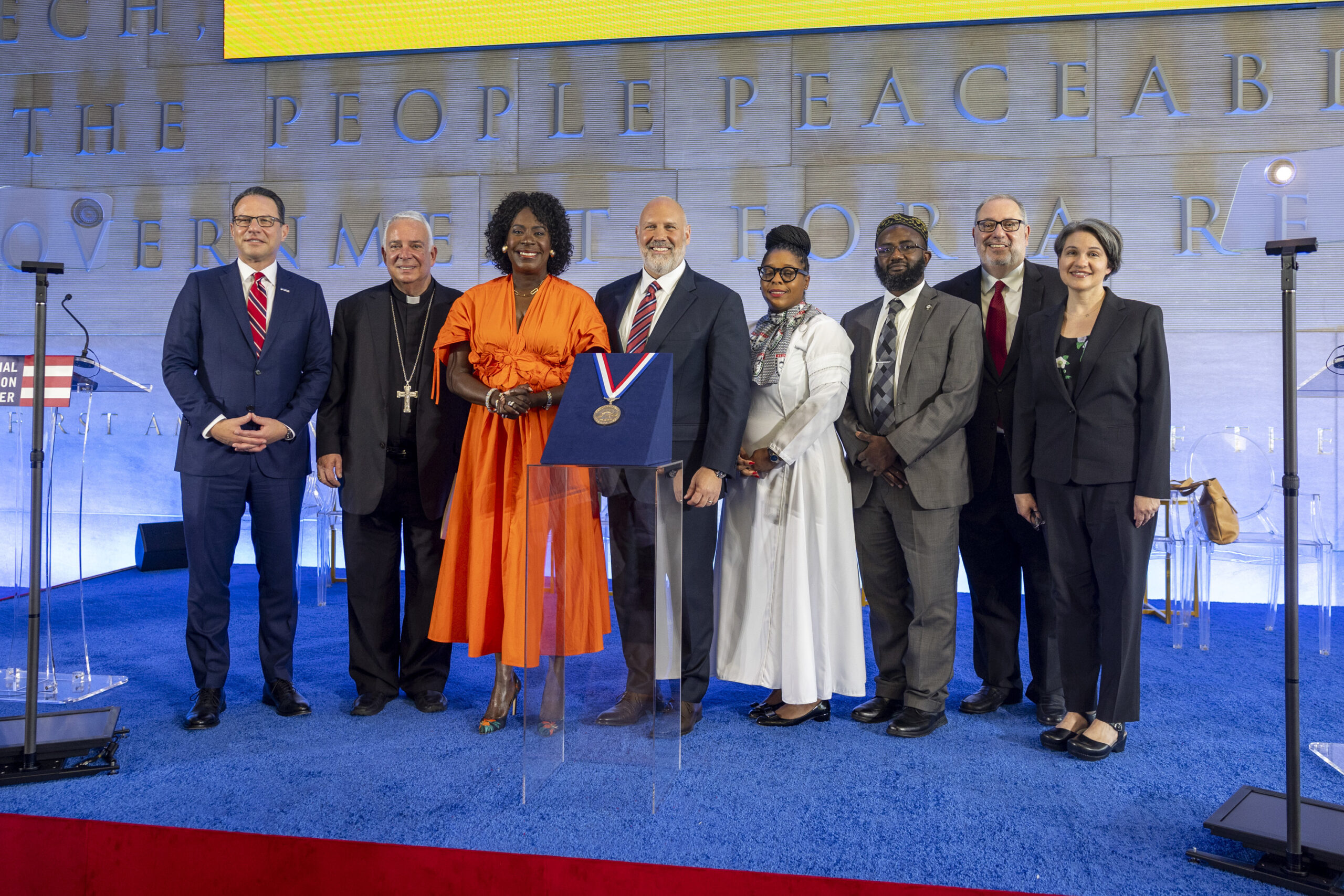
(From left to right) Gov. Josh Shapiro, Rev. Nelson J. Pérez, Mayor Cherelle L. Parker, Interim President & CEO of National Constitutional Center Vince Stango, Rev. Carolyn C. Cavaness, Imam Quaiser D. Abdullah, Rev. Luis A. Cortés Jr., and Rabbi Jill L. Maderer, pose for a photo at the Liberty Medal Ceremony at the National Constitution Center in Philadelphia, Pa., on Friday.
Clashing with Trump
The pope has contended that it’s up to each country to determine how they want to accept migrants while also denouncing the Trump administration’s “extremely disrespectful” treatment of them.
He has also spoken out against Trump’s threats against Iran, and declined to participate in the president’s “Board of Peace” for Gaza’s reconstruction.
In an April social media rant, Trump complained that he doesn’t “want a Pope who criticizes the President of the United States.” The president called the Catholic leader weak and accused him of “catering to the Radical Left.”
Leo told reporters that month that he has “no fear, neither of the Trump administration, nor of speaking out loudly about the message in the Gospel, and that’s what I believe I am called to do, what the church is called to do.”
In his Friday remarks, the pope made a call for unity but warned that a country should come together with “ideals that do not fade with the passing of time.”
He called on the United States to recognize its values of “peace and prosperity, a country characterized by generosity and nobility of heart,” and said the values of “shared human dignity, equality, and the rights laid out in the Declaration of Independence” can help unite and guide the nation.
The Liberty Medal
The Liberty Medal was created in 1988 and has been hosted by the National Constitution Center since 2006.
The award has gone to storytellers, philanthropists, civil rights leaders, and politicians on both sides of the aisle, such as Ukrainian President Volodymyr Zelenskyy, former Supreme Court Justice Ruth Bader Ginsberg, the Bushes, Malala Yousafzai, and Thurgood Marshall.
The center describes its recipients as individuals who “strive to secure the blessings of liberty to people around the globe.”
The process of selecting Leo began about a year ago, Silverbrook said.
The speech was initially going to be projected on Independence Mall, but the event was moved indoors due to the extreme heat and livestreamed by the center online.
Rich Russo, 63, a Fishtown resident who attended the event in person, called the experience “once in a lifetime.”
“How many times do you get the pope talking to you?” said Russo, who works for a bank.
Gov. Josh Shapiro, who is Jewish, and Mayor Cherelle L. Parker, a Baptist — bothDemocrats who have been outspoken about their own faiths — joined Philadelphia Archbishop Nelson J. Pérez and other religious leaders who made remarks on stage prior to the pope’s speech. Pennsylvania Attorney General Dave Sunday, a Republican, rang a replica Liberty Bell outside.
“Philly is proud that the pope is a graduate of Villanova University who spent time living and working in our region,” Pérez said on stage. “Pope Leo knows us, and we feel like we know him, too.”
“His influence, however, extends beyond Philadelphia,” the archbishop added.
CARABALLEDA, Venezuela — Hope came in the strangest of places: a Venezuela McDonald’s.
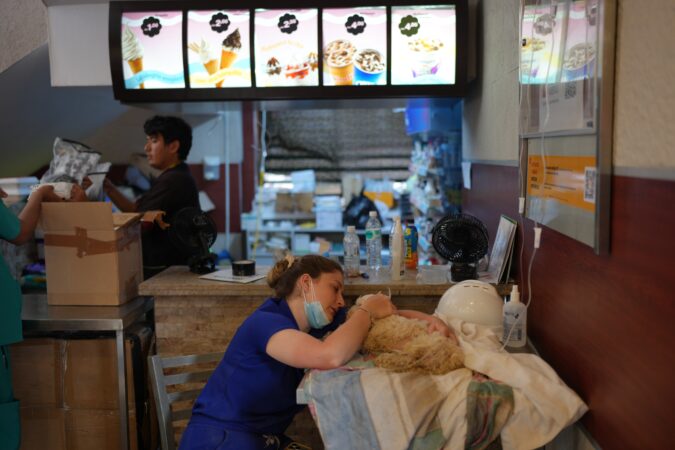
Gabriela Alves found herself embracing her 6-year-old dog Buddy on Thursday in the fast-food outlet after a week of searching for the white pup that went missing when two earthquakes devastated the South American nation on June 24.
The restaurant, next to the ruins of collapsed state housing complexes, has become a de facto hospital for earthquake victims, as well as a center for locating and treating missing pets in the seaside city of Caraballeda, which was devastated by the natural disaster. Neighbors call it “Hospital McDonald’s.”
“This is a miracle,” Alves said, arms wrapped around the dog with an IV in one of his legs on a table next to restaurant workers selling soft-serve ice cream. “We’ve lost everything material, but at least we’re both alive.”
The makeshift hospital was born one day after the back-to-back earthquakes killed at least than 2,295 people and wounded 11,000, according to Venezuelan officials. Many more families were left scrambling to find their missing loved ones, including cats and dogs lost in the rubble.
Angel Matute and 70 other veterinarians, students, doctors, and civilian volunteers traveled from the western city of Barquisimeto. The team was looking for a place to sleep, store equipment, and shelter from heavy tropical rain when they found one of the only operational facilities within the chaos. The Golden Arches.
They set up shop in the restaurant, which still had running air-conditioning, and began distributing medical supplies and treating human patients while also becoming a place for treating injured pets and seeking dogs and cats that were still missing.
“For us, a pet is one more human life,” said Matute, who coordinates rescue efforts in the McDonald’s where the volunteers also sleep. “There are animals that are more human than humans themselves.”
Matute was among dozens of bustling volunteers on Thursday treating dogs and cats alongside search teams ordering hamburgers and french fries. His group, which has rescued 140 animals and treated 60 more, plans to continue reuniting owners with missing pets until their assistance is no longer needed.
Alves turned to Hospital McDonald’s when she was desperately searching for her beloved dog.
Alves was at a family member’s house when the quakes shook northern Venezuela. Hours later, she jumped on her motorcycle and frantically rushed to her home to save Buddy, but all she found were ruins.
The 36-year-old Venezuelan said she heard the McDonald’s had become a place to look for lost pets and began making daily laps. She would swing by the restaurant to check if the volunteers had found any white dogs before returning home to yell, “Buddy, Buddy,” hoping to hear a bark. For more than a week, she was met with silence.
“We’re all living one day at a time,” she said Thursday. “Today, I returned and I truly can tell you I had lost all hope.”
She persisted, though, and picked through the ruins, pulling clothes from her mother’s room, the only area of the home still accessible. Then she heard a distant bark, looked down and saw Buddy’s white ear through a crack in the concrete.
Alves screamed for help and nearby rescuers ran to her. They broke a hole in the wall and pulled the dust-covered dog from the debris. Alves sobbed as she cradled Buddy, swaddled in a pink blanket and licking her arm. Hours later, veterinarians at Hospital McDonald’s checked Buddy for injuries after eight days trapped in the rubble.
“Right now, with all the tragedy of the earthquake, it’s one positive thing in all the bad,” Alves said, still embracing her dog. “He’s like my doggie Band-Aid.”
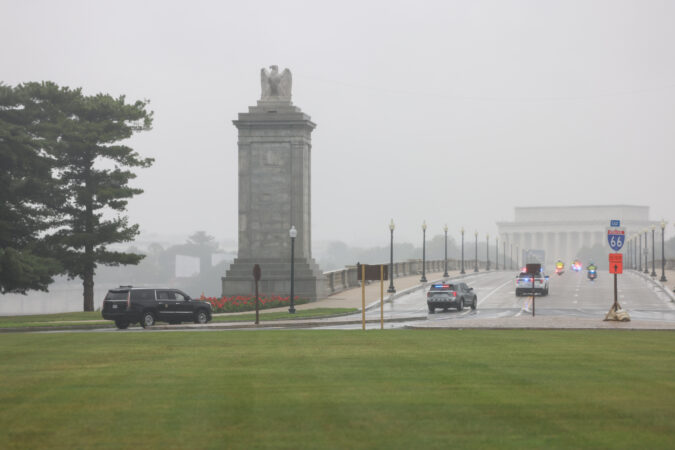
The Trump administration should pick an “alternative site” for President Donald Trump’s planned 250-foot-tall triumphal arch, a Washington, D.C., official told the administration last month, warning that Trump’s plan to build the structure by Arlington National Cemetery would be “divisive.”
David Maloney, the city’s historic preservation officer, said the plan to build in Memorial Circle — a traffic roundabout across the river from the Lincoln Memorial — would “severely damage an exceptional cultural landscape and one of the most important symbolic places in the nation.”
Maloney instead suggested a different spot that he said would be a better fit for the towering arch: an empty traffic oval located on South Capitol Street between Nationals Park and Audi Field.
“It would create an energizing focal point for a still-emerging neighborhood, suitable for a celebratory crowd,” Maloney wrote to the National Park Service in a June 26 letter posted by a federal commission reviewing the project. An arch located there could become a symbol of “sports triumph” linked with the nearby stadiums, he said, “and importantly, it would enhance the historic L’Enfant Plan and the city’s monumental landscape rather than detracting from it.”
Rodney Mims Cook Jr., a Trump appointee who chairs the U.S. Commission of Fine Arts, had previously identified that site as a prospective location to build a triumphal arch.
Washington Mayor Muriel E. Bowser’s office declined to comment on the proposal from Maloney, who has served as the city’s historic preservation officer since 2007. The historic preservation office does not always speak for the mayor and has some degree of autonomy in its work, city officials said.
Bowser has sought to strike a balance with Trump as he attempts to remake parts of Washington, encouraging him to tend to long-delayed repairs to local fountains. She has avoided public battles with the president over some of his more controversial changes to the city and its historic buildings, such as Trump’s demolition of the East Wing to build an expansive White House ballroom.
Trump last year proposed building a triumphal arch to honor the nation’s 250th anniversary, arguing that it was an overdue addition to Washington.
“We’re the only important and major city that doesn’t have one,” Trump said in the Oval Office in May. He also touted his plan to make it bigger than the 164-foot-tall Arc de Triomphe in Paris.
“We have to do slightly larger … otherwise you’d all be disappointed in me,” the president said, alluding to his propensity for large construction projects. “But it’s even far more beautiful.”
Historic preservationists and advocacy groups have opposed the project, warning that the large arch — Trump’s most significant effort to change Washington’s skyline — would alter the city’s historic views.
Military veterans also have sued to block it, warning that the towering structure would harm their experience of visiting the nearby national cemetery. A federal judge is weighing the case.
The Commission of Fine Arts, which Trump has packed with allies, has approved the project. A second federal panel, the National Capital Planning Commission, is scheduled to weigh the proposal Thursday.
Federal officials have also laid out an aggressive timetable to potentially complete work on the arch before Trump’s term ends, which would involve 20 hours per day of construction on the arch, year-round.
Maloney, who declined an interview, has also questioned the Trump administration’s process to build the arch, criticizing the 10-day window for public comment. He also said that outside experts had been wrongly excluded from a federally required process, known as a Section 106 review, to consider the arch’s potential effects on historic properties.
Trump officials have declined to include a half-dozen historic preservation and advocacy groups in the process. All of the excluded organizations, which have historically offered input on past federal projects, have sued the Trump administration over the president’s construction and renovation projects.
The review process “is clearly an exercise designed to shield this controversial project from genuine public and expert scrutiny, rather than to reduce its harmful impacts on our shared heritage, which is owned by the public,” Rebecca Miller, the executive director of the DC Preservation League, wrote in a June 15 letter to the Park Service.
Maloney also warned that Memorial Circle is somewhat removed from Washington’s downtown, limiting potential visitors if an arch is built there. He compared it to the sites of other major memorials — such as the Arc de Triomphe in Paris and the 9/11 Memorial in New York City — that are better woven into their city’s fabric.
“The location does not suggest a likelihood of success for a celebratory monument,” Maloney wrote in his June 26 letter to the Park Service.
Shirley Jennett, a retired nurse, loves her spacious ranch-style house in Denver, with its big backyard and gazebo.
“I want to stay here,” she vowed. “And die here.”
She might pull that off. In relatively good health, Jennett still drives to lunch with friends, does her own housekeeping and grocery shopping, and plows through a book a day, usually a mystery. But her children worry about her living alone at 89, especially since she has had a couple of falls.
Enter her new housemate, Susan Beese. Despite working four days a week in retail, Beese could no longer afford her nearby one-bedroom apartment as the rent topped $1,500 a month. She moved out, first staying with friends and then in what she delicately called “a senior women’s facility.”
Now Beese, who is 79, pays Jennett $800 monthly for a bright two-bedroom space, with a bath and a kitchen, on the lower level of her house. As part of the agreement the housemates worked out, she helps plant and water Jennett’s garden, takes out the trash, and cooks occasional meals.
“It’s been a lifesaver,” Beese said. Jennett even welcomed her dog.
Meet the real-life Golden Girls. In the much-loved 1980s sitcom, still in perpetual reruns, the four wisecracking women who share a house in Miami met through an ad on a supermarket bulletin board.
In Denver, the housing matchmaker was Sunshine Home Share Colorado, a local nonprofit that Alison Joucovsky, a senior services administrator, founded in 2016 when the problem became urgent. “My phone was ringing off the hook,” she said, recalling anxious pleas from older residents spending most of their Social Security checks on rising rent or facing yearslong waiting lists for subsidized senior housing.
Home sharing “is a really efficient way to create affordable housing and to support older people who want to age in place,” Joucovsky said. Carefully vetting both “home providers,” who may be rattling around in family houses now too big and too empty, and “home sharers” seeking reasonable rents, Sunshine facilitated 31 shares last year, a record for the nonprofit.
“The cost of developing and building new housing is astronomical, and so is the length of time it takes,” said Laura Fanucchi, president of the National Shared Housing Resource Center and an administrator with HIP Housing, a home-share organization in San Mateo County, Calif. “Why not make use of existing housing stock?”
About 55 organizations around the country offer these services — and demand is growing, driven by housing shortages, rising rents, and sales prices that affect both the old and the young. Legislators in several states are working to promote home sharing as an option. (Personal care is not part of these arrangements.)
The need is acute. About one-third of households headed by someone 65 or older were “cost-burdened” in 2024, according to an analysis by the Harvard Joint Center for Housing Studies. That means they spent more than 30% of their income on housing.
Although nearly 80% of those people were homeowners, the center found, an increasing proportion are still paying off mortgages or home equity loans, and most contend with higher taxes, utility and maintenance costs, and insurance premiums.
“A lot of the people calling me to complain about property taxes and inflation are senior citizens on fixed incomes whose children have left, and maybe their spouse has died,” said Pennsylvania state Rep. Abby Major, a Republican, who has co-sponsored a bill that would facilitate home sharing. “They’re a single older adult living in a four-bedroom house.”
Yet most don’t want to relocate. Even if they do, many older adults will find that downsizing has also become prohibitively expensive, as home prices rise and very low interest rates become a memory.
Younger people are similarly cost burdened, including 37% of those aged 25 to 34, and 31% of those 35 to 44, the Joint Center has reported. Home sharing can benefit both older homeowners who need income and people of any age in search of lower-cost housing.
To help increase their reach, some home-share programs now supplement or replace the traditionally labor-intensive matching process with online platforms. (For-profit companies like Nesterly or Roommates.com also facilitate shared housing.)
“It’s like online dating, except that people who have rooms can meet people who need rooms,” said Candice Smith, executive director of HomeShare Oregon. “And it’s a lot more secure.” HomeShare’s online platform has drawn close to 7,000 providers and seekers over five years.
Further support has come from the city of Portland, which this year announced a pilot program to pay $1,000 to homeowners who make a spare room available (or $1,500 for two rooms) through qualified home-share programs.
In addition, legislators in several states have introduced or passed bills that prohibit municipalities from unduly restricting homeowners who want to rent spare rooms to nonfamily members. Sponsors in Pennsylvania and Connecticut actually call them Golden Girls bills, and they’ve drawn bipartisan support.
“So many young people have basically given up on buying a home,” said Colorado state Rep. Manny Rutinel, a Democrat. He helped pass a 2024 law prohibiting cities and counties from limiting the number of unrelated people who could live together in a single dwelling.
In Pennsylvania, state Rep. Tarik Khan steered a similar bill through the House in June; it awaits a Senate vote. “It doesn’t make sense that your cousin can move in but someone unrelated to you can’t,” said Khan, a Democrat.
The Pennsylvania bill caps the number of nonfamily occupants in a home at five; Connecticut’s limit would be three. That bill passed the Senate in April, and then died without a vote in the House. But the bill sponsors plan to reintroduce it next session.
Home sharing can’t solve the housing crisis, its fans acknowledge. But it could make a dent, potentially unlocking thousands of spare bedrooms across the country without requiring new construction that would change the character of neighborhoods.
Admittedly, matching homeowners with those who want to rent a room becomes a delicate process. Home-share staff members typically interview the individual parties, run background checks, verify incomes, coordinate initial phone calls and meetings, and mediate if problems later arise.
They also help applicants sift through the myriad lifestyle preferences that can torpedo a match. “Living together isn’t easy,” Fanucchi said. Will the home provider accept smokers, pets, visitors? Does the sharer work from home? Or need to park a car? Who sets the thermostat?
Sometimes the agreement includes a “service exchange,” in which the newcomer does a few hours of chores such as snow shoveling, shopping, or some meal preparation in return for reduced rent.
Jenlyn and Larry Boyer, for instance, have lived in their ranch house in suburban Broomfield, Colo., for 31 years and never want to leave. But Jenlyn Boyer, who is 80, has “gotten unsteady” and uses a walker. Her husband, 70, suffers chronic fibromyalgia pain and needs a wheelchair.
Because they now pay for tasks that they used to undertake themselves, and because inflation has undermined their finances, “I had an epiphany,” Jenlyn Boyer said. “We need more help and we need more money.”
Six months ago, through Sunshine Home Share, they met a 46-year-old graduate student whose monthly rent had doubled to an unmanageable $2,000.
The student moved into their furnished downstairs bedroom/family room with a bathroom, a small refrigerator and a microwave. In exchange for about 10 hours of dishwashing a month, she pays a reduced rent of $600.
The additional income has helped the Boyers cover expenses like van repairs and wheelchair batteries. But they also enjoy chatting with their new housemate.
“She turns out to be just a gem,” Boyer said. “We laugh together a lot.”
While some Facebook users understood the expected over 100 degree weather could put people at risk, others felt strongly about the lack of celebration.
“What a disappointment for not only those of us who had hoped to watch, but also for the bands and other marchers who have come from all across the U.S.” one user commented. ”I get it — no one wants the liability. But are we just going to cancel everything?”
Another added, “It’s the 250th in the Birthplace of Freedom, and we’re just canceling parades because it’s warm,” leaving people to argue and point out that it wasn’t simply a warm day in Philadelphia, but a dangerous heat advisory.
Friday’s high is expected to break records in Philadelphia, with the anticipated minimum high of 104 last met in 1966 — when the nation was a mere 190 years old.
Experts say this is different and riskier than warm days in past Julys.
Over the past 85 years, Julys in Philadelphia are running on average 4.4 degrees warmer than in 1940, based on an analysis of historical weather data. That translates to an increase of about 0.52 degrees per decade.
The city on Tuesday declared a “heat health emergency” in effect from 1 p.m. Wednesday through 8 p.m. Saturday. Across the Northeast, outdoor events are being rescheduled or canceled, citing the heat. Those events range from other America 250 events to local farmers’ markets.
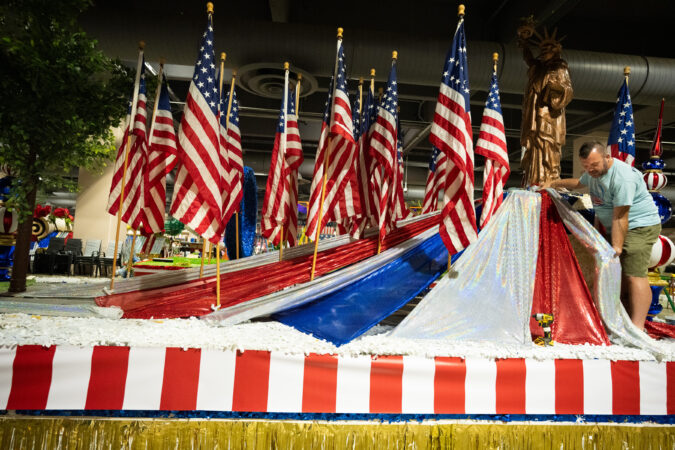
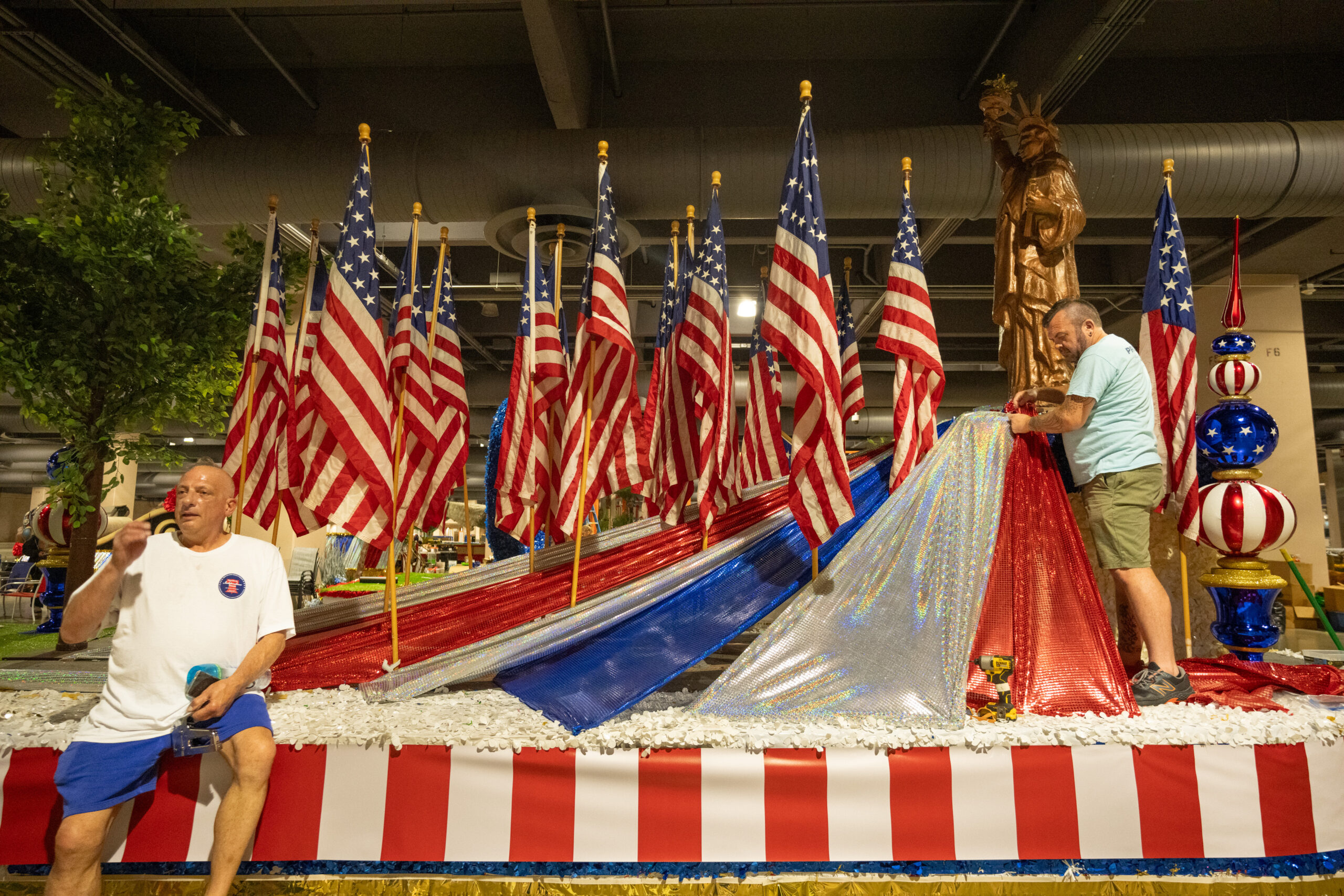
Friday’s parade would have featured elaborate, giant floats paying tribute to America, including larger-than-life recreations of Martin Luther King Jr. and Harriet Tubman, a peace dove, and a Liberty Bell.
Inquirer staff writer Anthony R. Wood contributed to this report.
Impromptu pageantry replaced Philly’s official parade as extreme heat mars the nation’s 250th
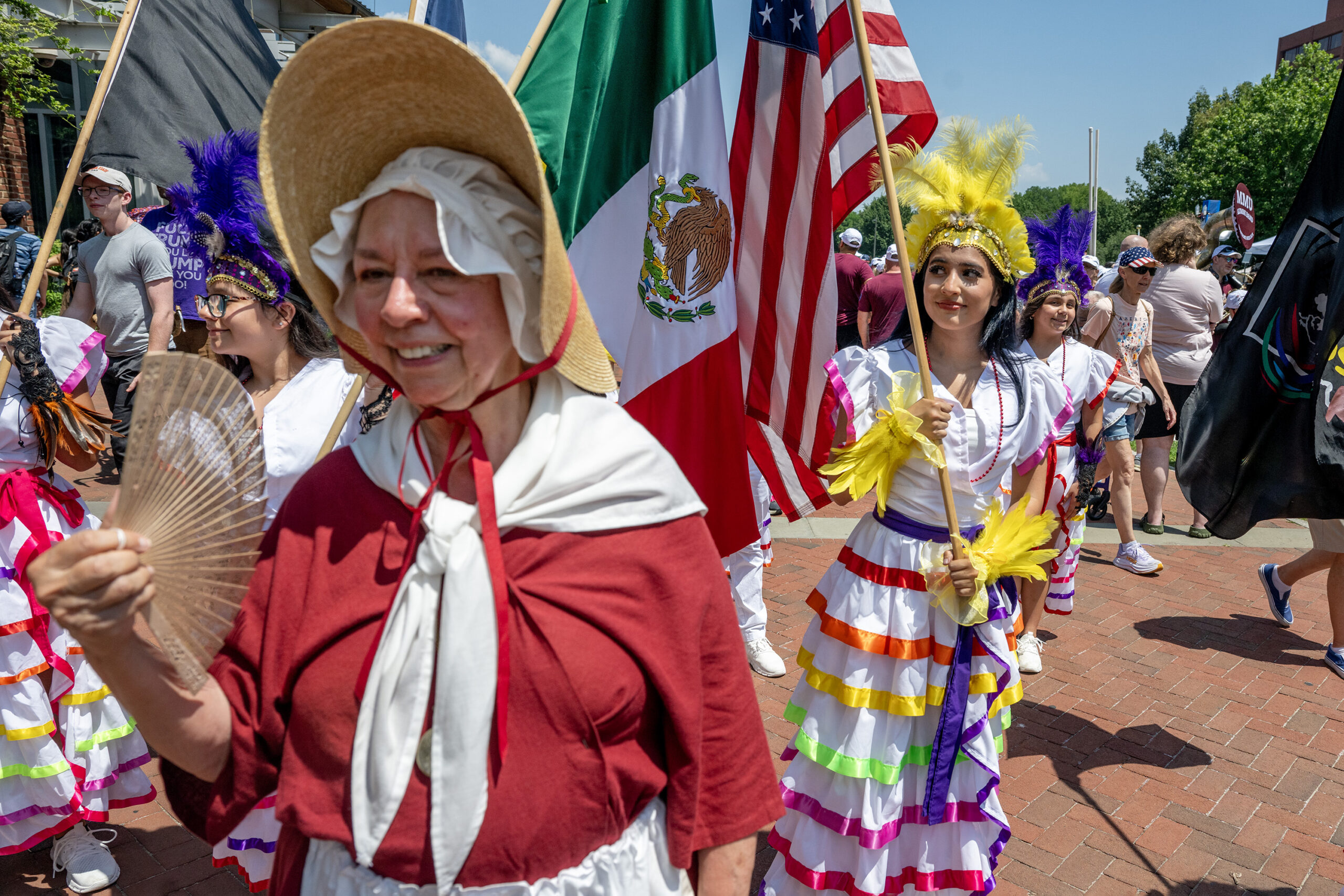
Historical interpreter for the American Revolution Diane Jost with the Sudbury (Mass.) Companies of Militia & Minute, walks with members of the Ballet Folklorico Mosaicos, dancers fro a Mexican cultural organization in Indianapolis, Ind. as groups not marching mingle on Independence Mall as Philadelphia celebrates America’s 250th birthday Friday, July 3, 2026 even after the Wawa Salute to Independence Semiquincentennial Parade was canceled amid a declared heat emergency with 100-degree temperatures.
The eve of the United States’ 250th birthday in Philadelphia was less celebration and more chagrin, as oppressive heat left swaths of tourists and revelers in an aimless search of pomp and circumstance.
On Friday, Wawa’s Salute to Independence Semiquincentennial Parade was canceled because of 100-plus-degree temperatures and aperilous heat index. It was one of numerous events called off or shortened this holiday weekend, as the scorching weather has thwarted events across the region, and potential storms could impact more.
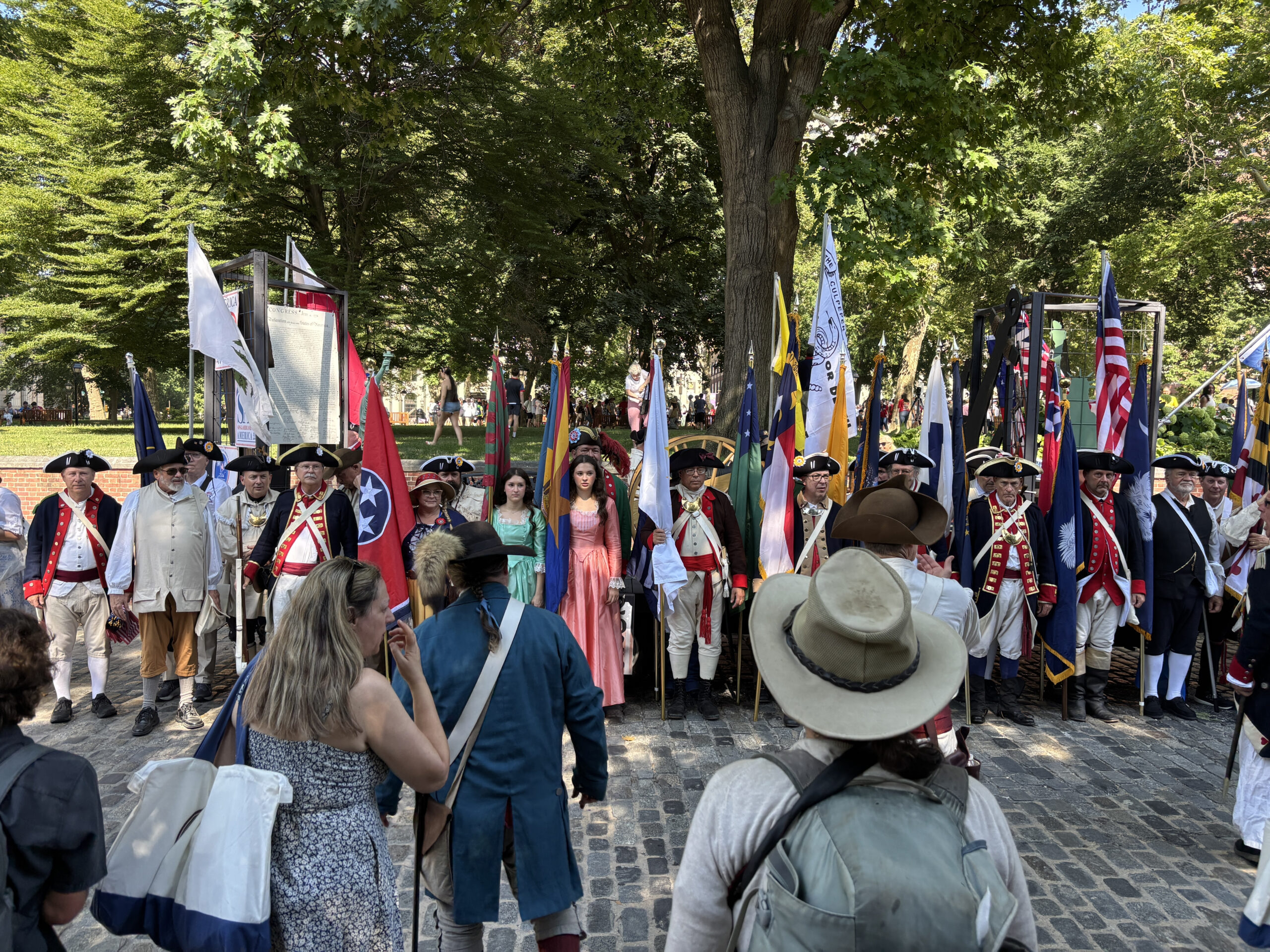
The cancellation left scores of sweat-soaked performers, musicians, and historical reenactors in wool garb stranded near Independence Hall and around Center City. There might not have been the sort of “shews, games, sports, guns, bells, bonfires and illuminations” that John Adams prophesied in a July 3, 1776, letter to his wife, but there was still an air of importance — and some impromptu pageantry.
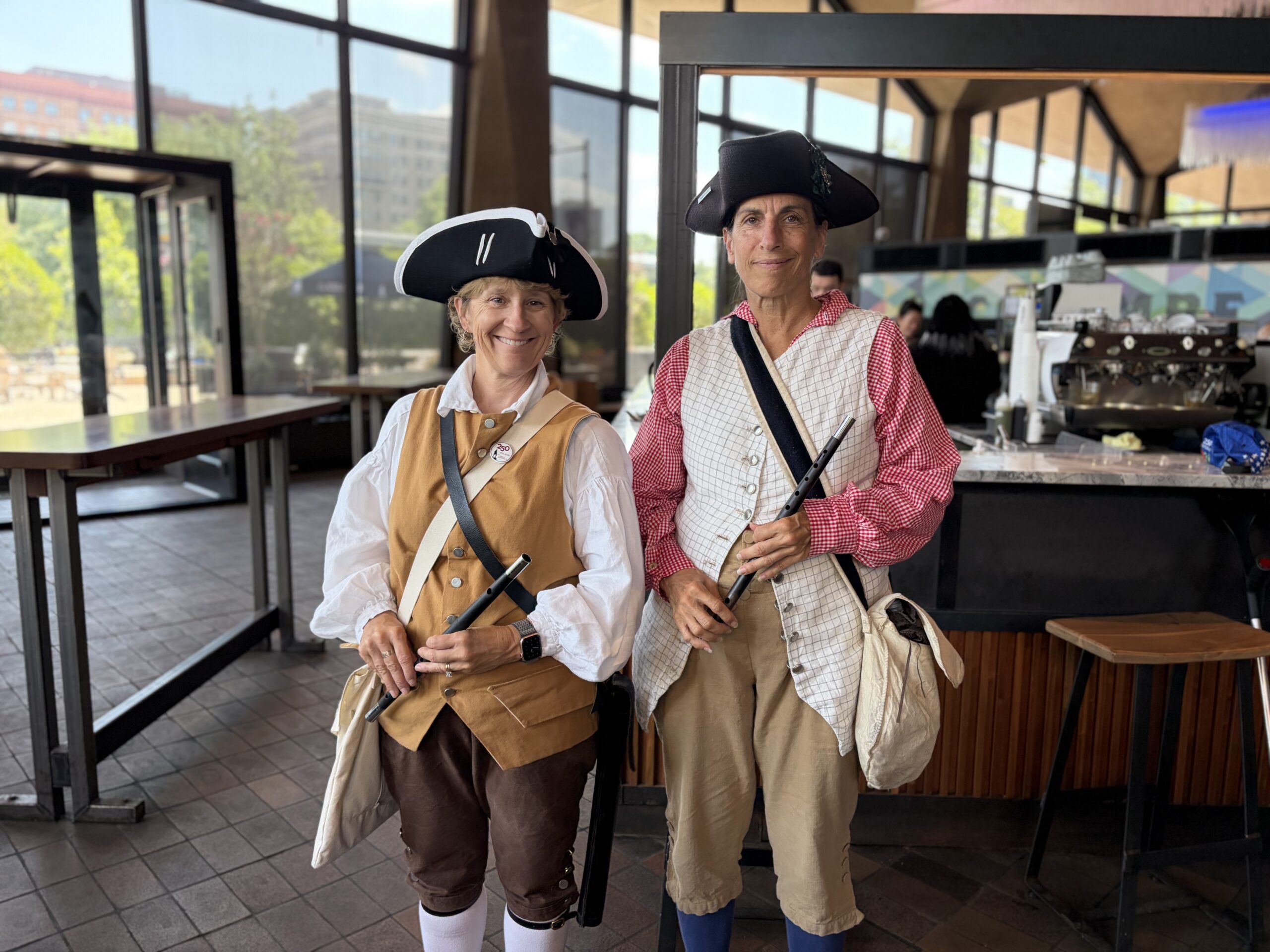
“We won’t be around for the 300th, so we really wanted to come for the 250th,” said war re-enactor Kathy Touzjian, 61. Touzjian and Laurie Pelletier were among a 75-person Massachusetts Army of 1775 troupe, who traveled six hours by bus to be in Friday’s parade.
“At least we still have cheesesteaks,” Touzjian said.
To the pair, the 250th anniversary of the signing of the Declaration of Independence and the fledgling country’s split from Great Britain felt different — and not just because of the heat. Now more than ever, Pelletier said, it was important to return to the country’s bedrock: liberty and independence for all.
“Today is still special,” saidPelletier, 60. “It’s a chance to recognize what our ancestors gave us, because the world is falling apart and this brings people together.”
No agreement between IBEW Local 614 and Peco as midnight strike looms
With no agreement between Peco and the union and negotations coming down to the wire, leaders from IBEW Local 614, Peco’s workers union, said members would walk off the job and begin a strike at 12:01 a.m. Saturday.
“We have marginally made some progress,” IBEW Local 614 president Larry Anastasi said at a Friday night news conference. “However, nothing close to a settlement has been reached.”
Stuart Davidson, the union’s general counsel, said IBEW Local 614 would continue negotiations with Peco until the deadline at midnight. But if no contract agreement could be reached by that time, workers would begin a strike.
“We are determined to find a solution to this problem,” Davidson said. “We understand how serious a strike will be for the communities that we serve, as well as our members.”
Union members are seeking better wages and healthcare benefits, as well as a uniform retirement plan for all members. Their previous contract expired on March 31, and wages and benefits have been a sticking point throughout negotiations.
If the strike happens, it would be a first for Peco. Candice Womer, Peco’s spokesperson, earlier this week said that weather conditions have not played into the bargaining process, and the energy provider proposed a nearly 20% increase in wages over five years, as well as improved benefits.
The company has also said that should a strike occur, customers should not expect service delays or interruptions, as Peco has “comprehensive contingency plans in place.”
The potential strike comes as the Philadelphia region remains under a heat wave that has pushed temperatures up to or just past 100 degrees, with possible thunderstorms on Saturday. Many of the union’s 1,500 members repair outages, which can happen during extreme weather.
“The system that we work on is in disrepair and takes constant maintenance and repair,” Anastasi said Friday. “And if we’re not around during good conditions, it’s difficult.”
Thousands gather for Philly Pops concert on Independence Mall
With Independence Hall as a backdrop, thousands gathered Friday evening to hear the Philly Pops as part of Philadelphia’s celebration of the nation’s 250th. While the heat led to the cancellation of other events during the day, the temperature by 8 p.m. had fallen to a pleasant 89 degrees, and the orchestra played on.
“Tonight we celebrate with one of our most universal languages — music,” Steven Sims, superintendent of Independence National Historical Park, told the audience stretched out on Independence Mall. “There is something especially fitting about gathering here, surrounded by the places where the nation was born.”
Music, he said, “has always brought people together.”
Last year’s Pops on Independence concert was cut short by rain. Friday night, the sky held dark clouds and some lightning flashes, but as of 8:45 was rain-free as the audience roared with the appearance of actress and singer Idina Menzel.
About an hour into the concert, with the lightning continuing, Menzel bid the crowd goodnight. Concerned by possible heavy weather, organizers ended the concert early with several more scheduled pieces to go, a Pops spokesperson said. A Wawa Welcome America spokesperson estimated a crowd of about 12,000 was on hand.
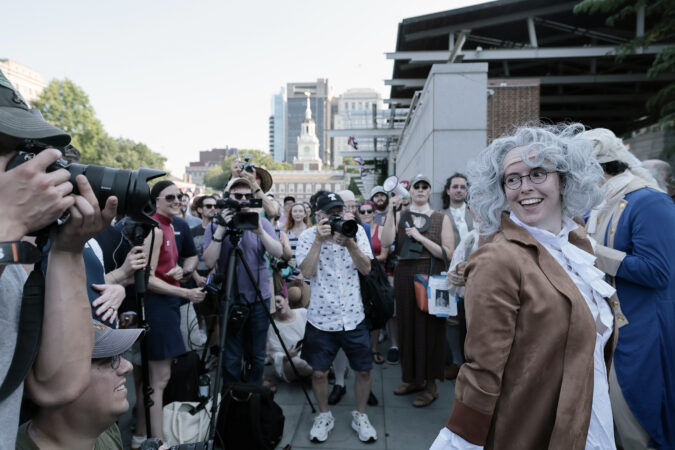
Ben Franklin look-alike contest crowd demands an encore: ‘One more Ben!’
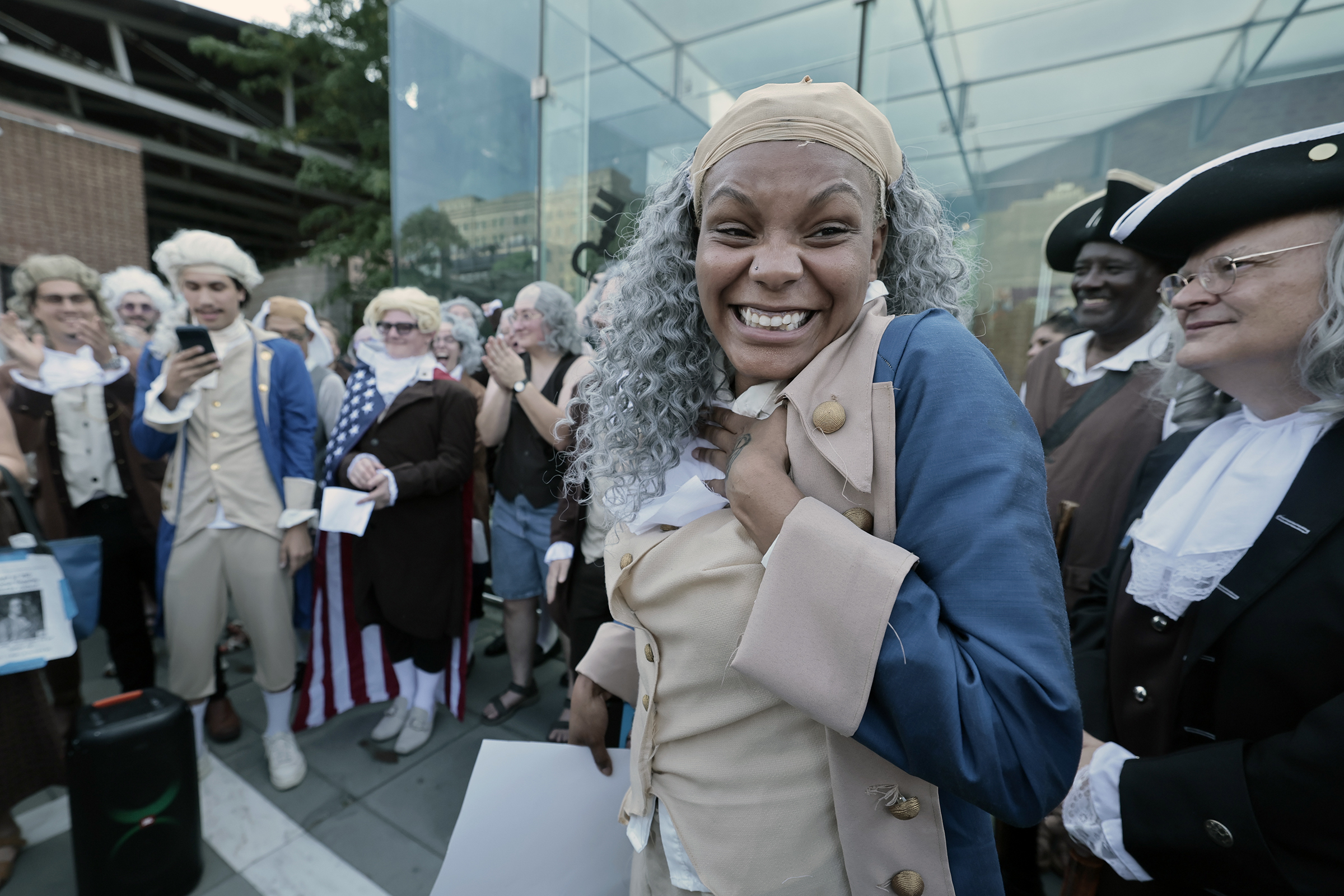
Kiya Burgess, of Philadelphia, wins the Ben Franklin look-alike contest that was held behind the President’s House on Independence Mall on Friday.
At the Benjamin Franklin look-alike contest at Independence Hall, which was supposed to end early, the crowd enthusiastically shouted, “One more Ben, one more Ben.” Latecomers — men and women dressed like the famed Founding Father — walked through the crowd to the front. It wasn’t a catwalk, per se, but the Franklin stroll.
Elena Jackendoff, 32, a student at Johns Hopkins University studying public health, organized the event.
“You have to make the event you want to see in the world,” she said.
She organized the event on a lark, making the flyers after her last final exam and pasting them across the city. She expected to see a few of her friends, not hundreds of people.
Many of the Franklins — like Kara Peterschmidt, 25, Kyra Feinauer, 25, and Lauren Zwetzig, 24 — didn’t even have to go out to buy a costume. The friend group had hosted a Constitution-themed housewarming a while back and came dressed in the same white whigs and tops. Asked about the truest Ben Franklin expression, Peterschmidt said, “It’s definitely a mog.”
Despite possible storms, holiday World Cup game still on
A break in the intense heat that has blanketed the region could arrive with a chance of thunderstorms on Saturday evening, but according to a FIFA official, as of now, there are no plans to modify the start of Saturday’s round-of-16 World Cup match between France and Paraguay.
Gates are scheduled to open at 2 p.m. for the 5 p.m. kickoff. Storms are forecast to potentially hit the region sometime in the evening. However, with the unpredictability of these summer storms, FIFA has taken steps to help fans deal with the intense heat, but as of now appear to be playing it by ear as they keep an eye on the forecast.
Coincidentally, the last time France played in Philadelphia, on June 22 against Iraq, that match was subjected to a two-hour, 10-minute rain delay because of a torrential downpour that covered the region, sending two intense bands of rain, wind, and thunder over Philadelphia Stadium.
Tips for making it through a scorching 4th of July
With another scorcher on tap for July Fourth, here are some tips for surviving the heat.
Avoid activity in the peak heat of the day and stay hydrated, said Jonathan Bar, director of emergency preparedness at the University of Pennsylvania’s department of emergency medicine.
“The best way to know if you are hydrated is to monitor your pee,” he said. “No urine or very dark is a sign of dehydration.”
Water is good for hydration, but for prolonged exertion or spending more than an hour in the extreme heat, it’s better to add a drink with electrolytes, like a commercial sports drink, he said.
Check on the very young and very old because they are the most susceptible to heat-related issues, Bar said.
“If you are feeling overheated, seek shade or move into AC,” he said.
‘Take care of one another’: Arizona high school band finds lessons amid parade cancellation
The teens of Sahuarita High School’s marching band came a long way from their Arizona homes to not be allowed to perform at the Semiquincentennial parade because of the heat. Still, it taught them a valuable lesson about being an American, said band director Ben Garland.
“An American value is community,” Garland said, surrounded by his 87 students at Reading Terminal Market. “We should do our best to take care of one another even if we have different ideas or values, and that’s what the city did.”
Despite the cancellation, Garland praised Philadelphia authorities and organizers for still making parade participants feel part of the 250th celebrations by letting them perform in different areas of Old City.
“Most of my students have never even been on a plane before and coming here was their opportunity to see the East Coast and engage with history they wouldn’t see otherwise,” he said. “For us, the trip was worth it for what they have been able to learn and the camaraderie they have built here.”
Reading Terminal Market bustling amid 250th celebrations: ‘This is the corner to be’
Although Reading Terminal Market historically closes on the Fourth of July, it’s open and bustling for the United States’ 250th birthday.
“This is the corner to be,” said Dina Pretti, who just ordered an iced coffee from Old City Coffee (the best in the city, she says) and pointed toward Famous 4th Street Cookies (also the best in the city, she says). This Fourth of July feels especially exciting. Although she usually leaves the city, she wanted to stay for the World Cup fan festival and the holiday celebrations.
Charles Shipper, who works at Contessa’s French Linens, said he usually gets irritated when he has to walk what feels like half a mile through Reading Terminal to find a coffee. This year, with the influx of tourists for the World Cup, he has come to appreciate the space through visitors’ eyes.
“The size, the fact that it’s air-conditioned,” now seems amazing, he said.
The shop has almost sold out of its America 250 towels, designed and created by Garnier Thiebaut, a French linen company. The design is a small testament to the historic relationship between France and the United States.
Costumed Yorkies celebrate at Liberty Bell despite cancellations
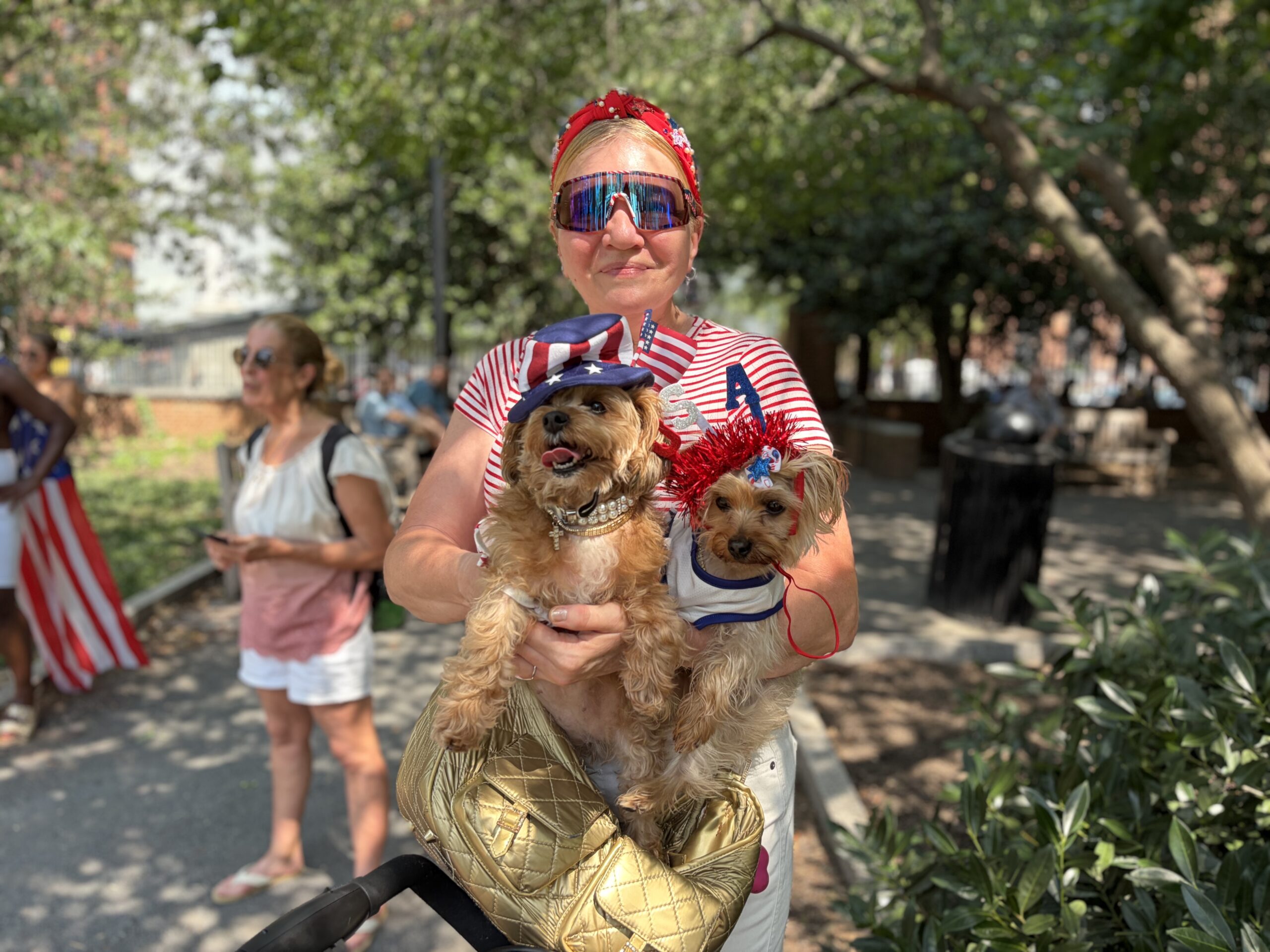
Lori Ney, of Wynnewood, with Yorkie poodles Ella and Eva at the Liberty Bell on Friday in Philadelphia.
At Lori Ney’s home, humans weren’t the only ones whose Fourth of July plans changed. Yorkie poodles Ella and Eva were left with their costumes on waiting for a celebration.
“We knew it was canceled, but we still wanted to come to see what else was happening,” said Nay, 60. “We wanted to be part of history.”
Without a fixed plan, but wanting to celebrate her country, Nay packed up her pups, a couple of cooling pads, and a stroller, and drove from Wynnewood to the Liberty Bell.
“This year feels different,” Nay said, as people approached to take photos of her pups and their holiday attire. “ A lot of events were canceled, but as Americans, we are making the best of it.”
The trio planned on remaining in the city for the Philly Pops concert, and coming back Saturday for the Fourth of July celebrations.
“I know it’s hot, but it’s important to celebrate that we live in the best country in the world no matter who the president is,” Nay said. “We have flaws and we need to do better, but it’s wonderful to be here.”
As of 4:08 p.m., Friday’s Philly Pops concert on Independence Mall is on, a Wawa Welcome America spokesperson said. A later start time of 8 p.m. was announced for the concert earlier this week.
Philly’s hottest space is Swann Memorial Fountain at Logan Square
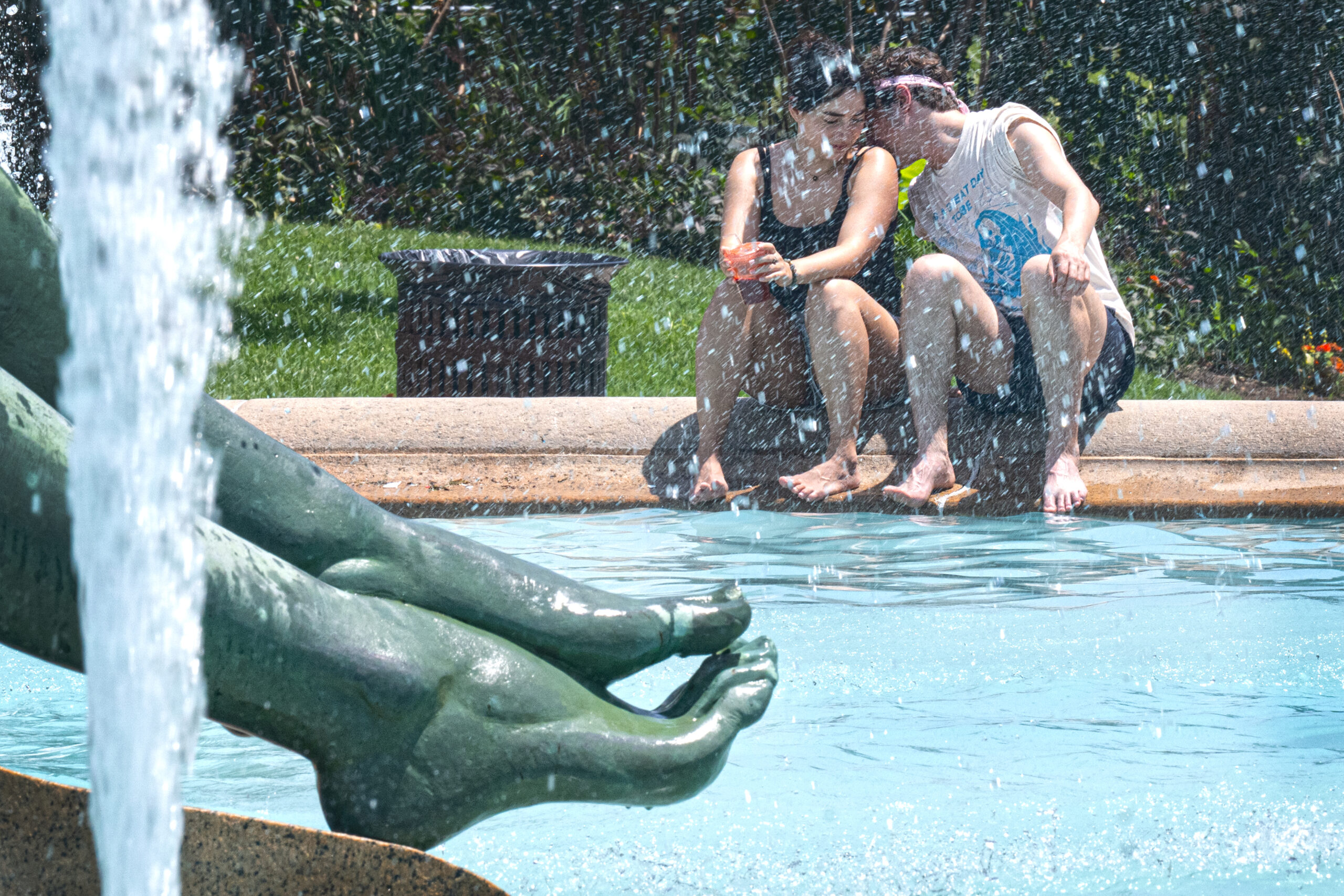
Danny Yarnall (right) and Ray Rodriguez cool off Friday beside the Swann Memorial Fountain at Logan Square, a popular spot where Philadelphia residents seek relief from the summer heat. City officials canceled the Wawa Welcome America Salute to Independence Parade, part of the nation’s 250th anniversary celebrations as an extreme heat warning remained in effect.
It’s hot enough to see the shimmer of heat on the asphalt of Benjamin Franklin Parkway.
Although most rush from museums to other scraps of shade, some pouring water down the backs of their necks, a large, happy crowd gathers in the fountain of Logan Square.
Dozens of children and their families swim through the streams of water. More and more join in as the sun blares down intensely on this spacious, elegant boulevard.
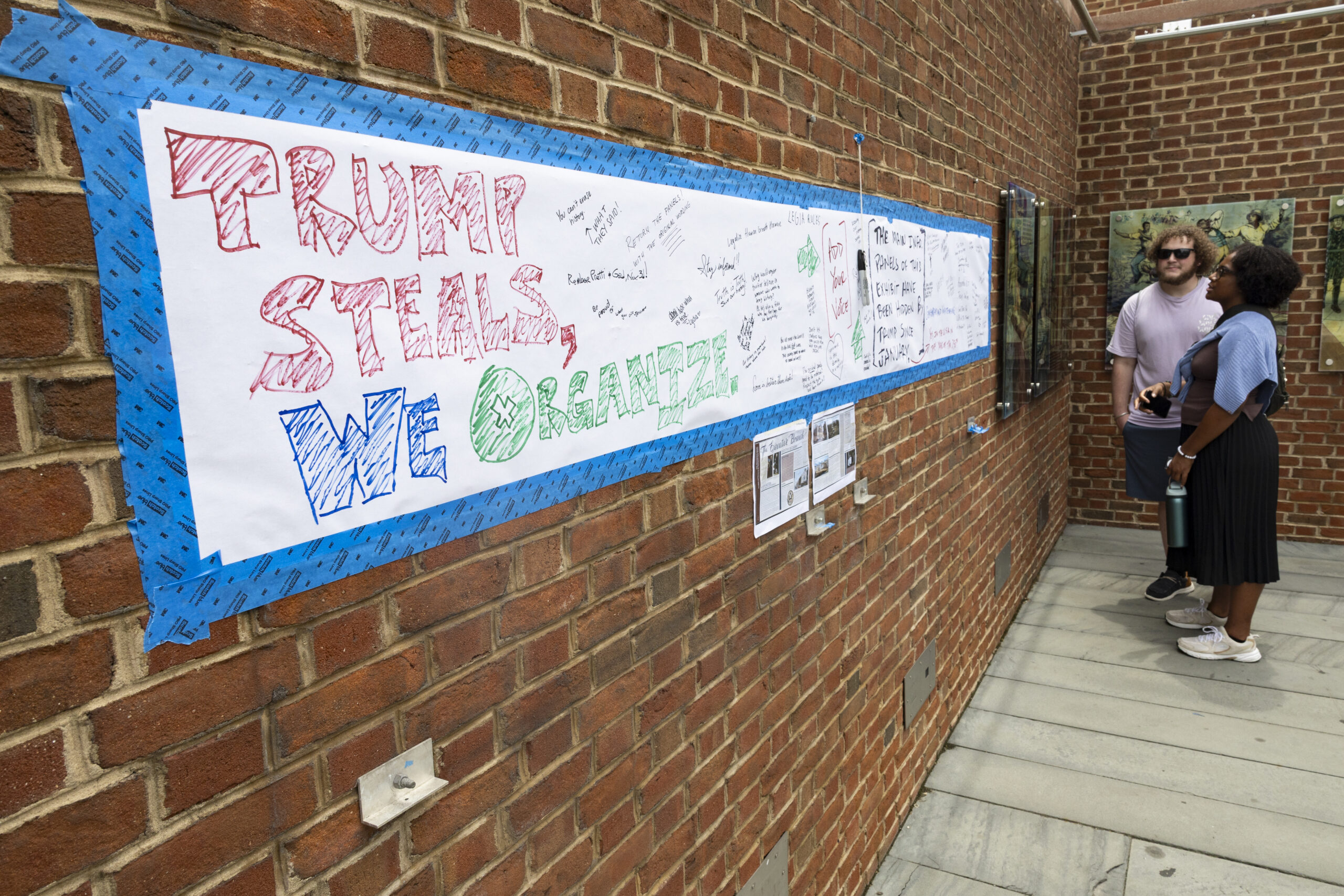
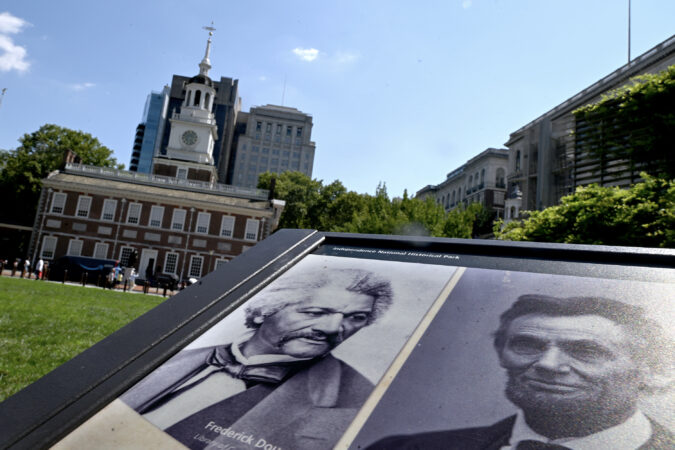
At the President’s House on Friday, a man taped sheets of paper to the wall where the exhibits were previously on display.
The papers said: “Trump has hidden the main info panels of this exhibit since January.”
The man, who declined to be named citing fear of retaliation, accused President Donald Trump’s “authoritarian administration” of “neglecting to tell the story of those who actually fought for the liberties and freedoms we all celebrate.”
Susan Lemonick, 66, of Old City, wasn’t in a festive mood for the nation’s 250th, either.
“What we are right now is not something to celebrate, in my opinion,” she said, adding that the censorship at the President’s House was with the goal of having “a white nationalist country.”
Lemonick is a volunteer with Old City Remembers, a group that takes shifts standing at President’s House reading text from the removed panels in an effort to “bear witness to the history of slavery in our nation.”
Allison Utain and her husband came to the Philadelphia Museum of Art after the parade was canceled. There, they say, they came across a form of patriotism no less festive than what they were hoping to find outside.
“You see a culmination of so many cultures that make the tapestry of what American is … Far from perfect, but it’s great,” Utain said. “The museum is a great snapshot, not only of American artists but artists around the world.”
In the cool, long hallways of the museum, visitors can take the “A Nation of Artists” tour, which showcases Charles Willson Peale’s “Washington at Princeton,” often considered the best portraiture artist of his time, and other celebrated painters like Henry Ossawa Tanner. Tanner’s “Annunciation” is hung in the museum. He was an African American painter whose mother escaped slavery in 1859. Tanner grew up in Philadelphia and attended the Pennsylvania Academy of the Fine Arts.
Asian American Dragon Lion Dance outside Independence Hall today. “I feel immense pride to be able to show the love for our country,” said group founder Henry Lee. pic.twitter.com/2WLv1ErZej
The collegiate performers in Asian American Dragon & Lion Dance troupe, led by Henry Lee, performed Friday afternoon outside Independence Hall.
“I feel immense pride to be able to show the love for our country,” Lee said.
The group boasts more than 20 years of experience performing for audiences around the Northeast. They broke into dance, carrying the long puppet dragon to the pulsing beat of a drum.
Especially as the line to get inside Independence Hall continued to wind, visitors gathered around the pop-up performances, taking photos and videos.
‘At least we still have cheesesteaks,’ lament Massachusetts Army reenactors
Kathy Touzjian and her friend Laurie Pelletier were among 75 members of the Massachusetts Army of 1775 who rode on a bus for six hours to be in the parade Friday morning.
Two Massachusetts war reenactors sipped on iced coffee to cool off amid the heat wave, saddened that the Semiquincentennial Parade was called off.
“We won’t be around for the 300th, so we really wanted to come for the 250th,” said Kathy Touzjian, 61. “At least we still have cheesesteaks.”
Touzjian and her friend Laurie Pelletier were among 75 members of the Massachusetts Army of 1775 who rode on a bus for six hours tobe in the parade Friday morning.
The cancellation didn’t immediately send the performers home. Instead, the fife — a wooden instrument similar to a piccolo — players chose to stay for the day and perform through Old City.
“Today is still special,” said Pelletier, 60. “It’s a chance to recognize what our ancestors gave us, because the world is falling apart and this brings people together.”
To them, the 250th anniversary feels different, not just because of the heat, but because now more than ever, Pelletier said, it’s important to remember what the United States stands for: liberty and independence for all.
As the pair readied to head out and perform, fixing their three-layer historic attire, Touzjian hopes future generations learn from this celebration: “No matter how hot it is, do not cancel the 300th independence parade.”
A dance group from Indianapolis drove 10 hours and arrived in Philadelphia around 9 p.m. Thursday night, ready to perform in the city’s parade on Friday.
The heat dashed those plans, but that didn’t stop Ballet Folklorico Mosaicos from dancing outside Independence Hall Friday afternoon.
Their dance is inspired by an annual carnival in Veracruz, Mexico, said director Jesus Hernandez.
They perform every year at the Indianapolis 500, and were “very honored” to be invited to Philly, he said. Hernandez said the group was disappointed that the parade was canceled but added that they’ve still had a great experience. “I’m so grateful to be here,” said one of the dancers, Tiffany Castillo, 25.
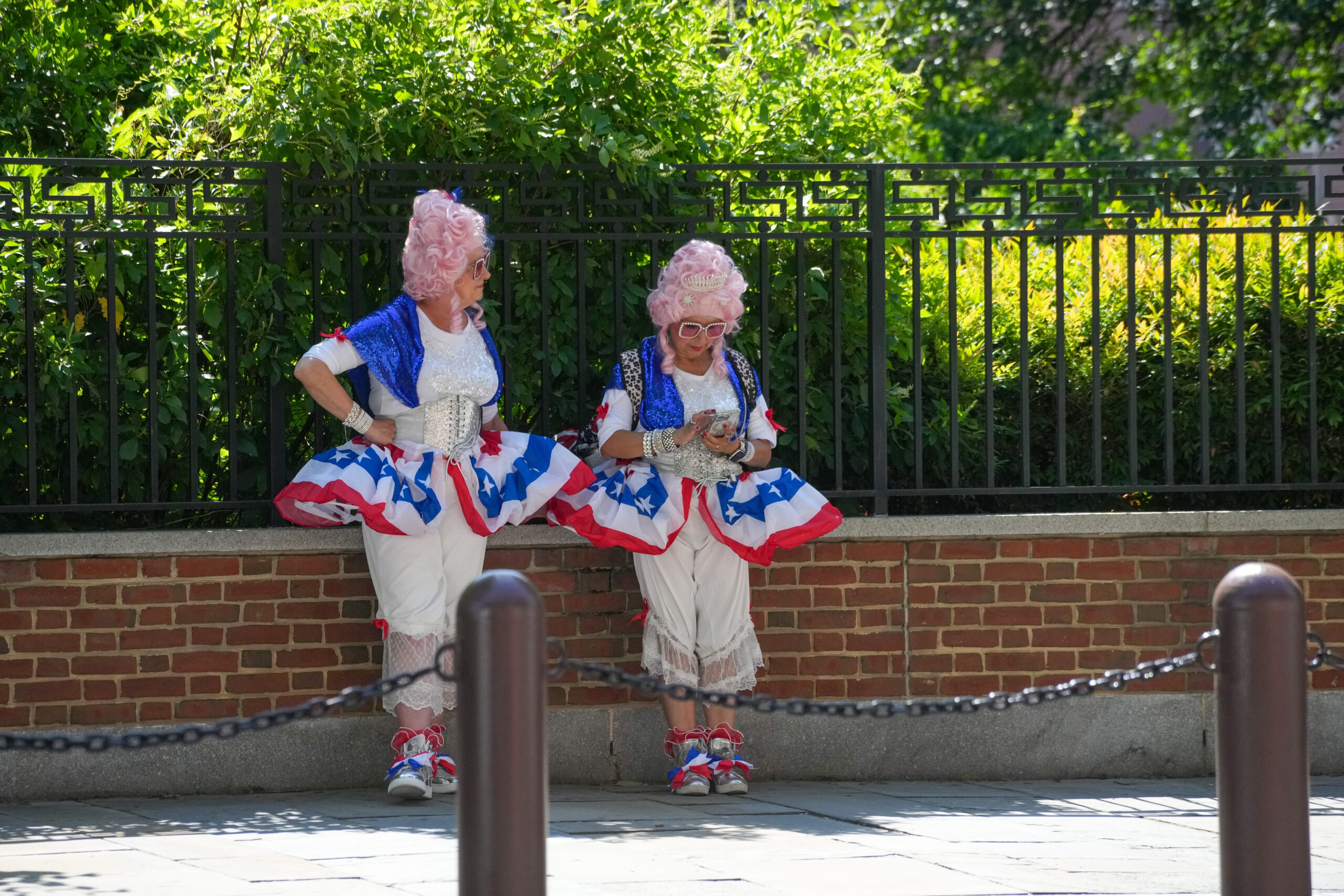
The Texas Glammas, a group of older adults and seniors who dance with walkers, made the trip to Philadelphia for America 250 festivities.
Sporting pink wigs, white breeches and sequin vests, the Texas Glammas traveled from their home Lone Star State, to Philadelphia to dance in the parade.
The group of 23 ranges in age from 55 to 79. Their founder, Christina Rodriguez, said that the group started because they were “a group of women who just wanted to keep moving.”
Scenes from the cancellation of the parade, at Independence Hall, July 3, 2026.
The group has a flash mob interpretation of “Party in the USA” by Miley Cyrus planned for later Friday afternoon, which they planned to perform outside of Liberty Hall. It’s one of several impromptu pop-up performances taking place across the Historic District in light of the parade’s cancelation.
The walkers they use as part of their performance, which were decorated in patriotic tinsel, will be donated before they head to DC tomorrow for the city’s parade.
Trump administration gets final go-ahead from the courts to install its own exhibits at the President’s House
Visitors read the original panels at the President’s House Pa alongside unofficial signage where visitors are encouraged to write down their reactions regarding the missing panels.
A Philadelphia-based federal appeals court gave President Donald Trump’s administration the final go-ahead to install its own exhibit at the President’s House.
The new panels, which historians criticized for whitewashing George Washington’s role in enslaving nine people, have been manufactured and stand ready to install, the Justice Department told the court.
The procedural step, which the U.S. Court of Appeals for the Third Circuit took on an observed federal holiday, followed a Thursday request by Justice Department attorneys to allow the National Park Service to “begin work immediately and install its new exhibits.”
“The President’s House is an important national historical site, and the Government submits that the President’s House exhibits should be fully installed without further delay,” the government’s filing said.
The Department of the Interior did not immediately respond to requests for comment.
Mayor Cherelle L. Parker vowed to “pursue every legal action possible” in an effort to reverse last month’s Third Circuit ruling, which held the city has no rights over the President’s House.
Experts say none of the city’s appeal options are a slam dunk.
The city appealed quickly and asked the Third Circuit court to recall the Friday morning order, saying it didn’t have time to respond to the Justice Department’s Thursday request.
And while the federal government asked to install the exhibits “immediately,” the request did not identify a reason for the rush.
“That is not an emergency,” the city’s filing said, “it is a preference for speed.”
The city also repeated the argument, which found no purchase with the appellate judges so far, that allowing the Trump administration to install its own exhibit would cause the city and public irreparable harm.
The city’s motion does not automatically pause the court’s previous order.
The biggest question remaining is whether the Trump administration will attempt to install the panels during this historic July Fourth weekend marking the nation’s 250th anniversary.
Semiquincentennial parade acts will do pop-up performances across Old City
And, we’re pivoting!
Despite the Semiquincentennial Parade’s cancelation, some groups who have traveled far and wide to Philadelphia will get to perform anyway.
Organizers just announced that starting at noon and stretching across the day, marching bands, color guards, and dance troupes from across the country will do informal pop-up performances throughout the Historic District.
“The performances honor the commitment of the participating groups, many of whom traveled significant distances to be part of today’s celebration, while providing an opportunity for residents and visitors to experience the spirit of the Semiquincentennial festivities in a safe, flexible format,” organizers said in a statement. “Amenities including air conditioning, restrooms, and water are available to the public at Independence Visitor Center.”
The pop-up performances will take place at locations including:
Independence Visitor Center
Behind Independence Hall
City Tavern
Franklin Square
Liberty Garden
Betsy Ross House
Carpenters’ Hall
Outside the Weitzman National Museum of American Jewish History
Performers will include:
Alter High School Lancerettes and Sound Truck
Asian American Dragon and Lion with Cart
Ballet Mosaicos Dancers
Betsy Daily Dancers
Cheryl Chicken All American Performing Arts Center
Sights from Independence Mall: ‘I’m walking where the Founding Fathers were’
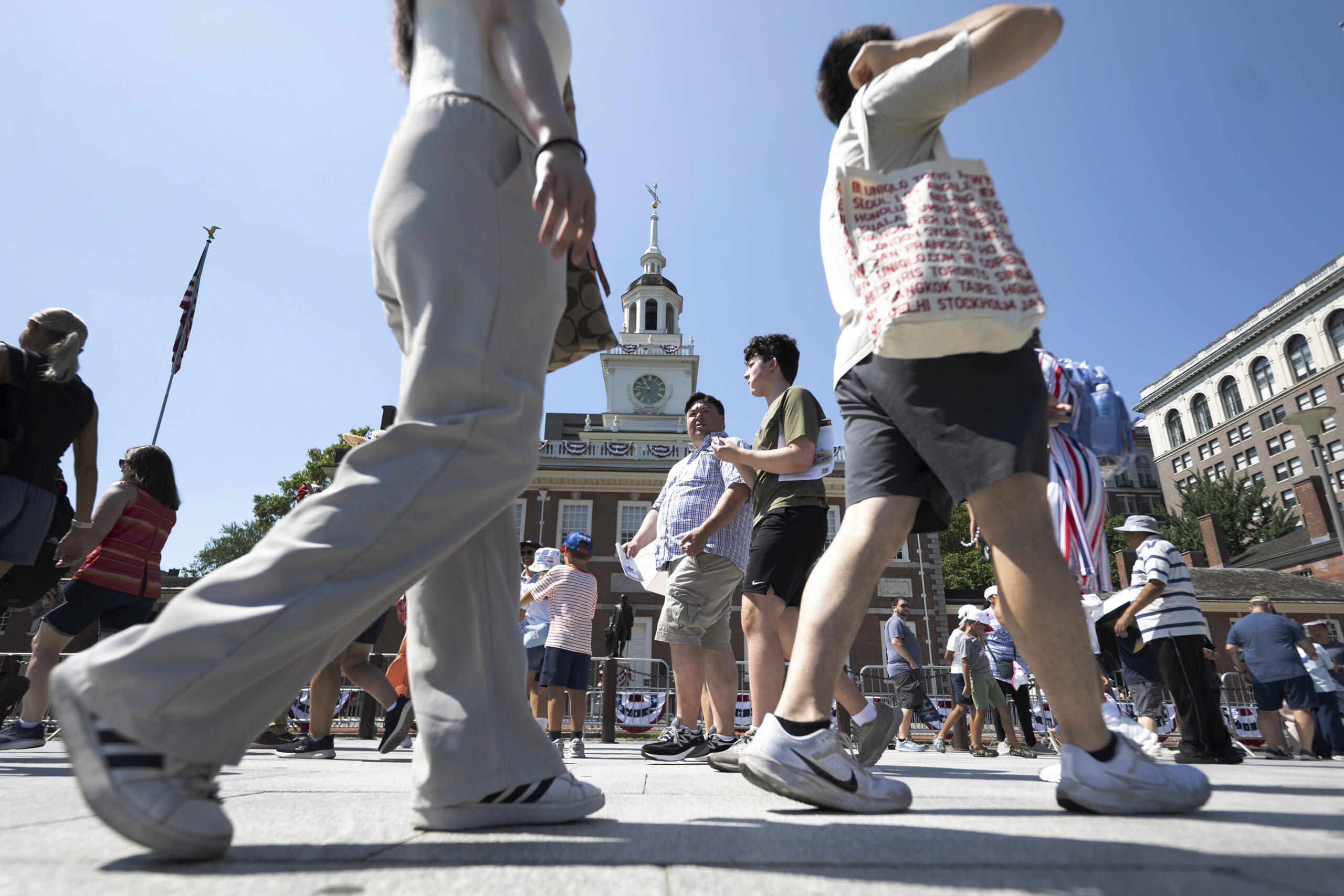
Large crowds walk along the sidewalk in front of Independence Mall during Philadelphia’s 250th anniversary celebrations on Friday.
Lines snake through the exterior courtyard of Independence Hall. Although entries have been paused as the building has surged at capacity, history buffs dressed in colonial costume — hats and wigs on, despite the heat —give mini lectures on the country’s founding.
“It feels important to follow the footsteps of our founding fathers these days,” says Alex Bergstedt, who travelled from Idaho with his wife. They came to Philadelphia because they “knew Fourth of July would be big.”
Nicholas Roth came to Philadelphia from upstate New York with two friends. The 26-year-old reflects, “I’m walking where the Founding Fathers were.”
Inside the National Constitution Center, Wilda and Thad Waites traveled from Hattiesburg, Miss., to celebrate America’s 250th birthday and hear from Pope Leo XIV.
“I’ve never seen such patriotism in one place,” said Thad Waites, 81, a cardiologist and sponsor of the National Constitution Center. “It’s been wonderful walking through the parks.”
The Waiteses didn’t mind the heat, either. In Mississippi, “We have the added humidity,” Wilda Waites said.
Andrew McLaughlin, 68, of West Chester, recently returned from a trip to Chicago. “The energy here compared to there is just incredible,” he said. “Everywhere you go you can just feel it.”
Ron Crofoot traveled to Philadelphia to be with his granddaughter as she was supposed to perform with her marching band at the parade. He says this Fourth of July made him reflect on when he celebrated America’s 200th birthday.
“I can picture myself in the fireworks 50 years ago; how quickly fifty years go by,” he said. “I won’t see the next. It gets more meaningful as you get older. You come to appreciate the uniqueness of the United States.”
Live from the Vatican, Pope Leo wears his Liberty Medal and addresses Philly crowd
Facing a screen showing the cheering Philadelphia audience, Pope Leo XIV wore his Liberty Medal along with his cross around his neck, live from the Vatican.
Leo, who grew up in Chicago and attended Villanova University, pointed to his roots in the United States.
“As a son of this great country, founded by courageous men and women who dreamed of liberty and of a better life for themselves and for their children, I join you in asking God’s blessings upon America’s future that the lofty ideals enshrined at the beginning of the Declaration of Independence may continue to guide the flourishing of the nation in unity, justice, and peace,” he said.
Ahead of the pope’s speech, the Constitution Center played video clips from a Philadelphia delegation’s April trip to the Vatican in which they presented Leo with the Liberty Medal — and some distinctly Philly gifts.
Those included Villanova swag and a Wawa tote bag — prompting a smile from Leo and applause from the audience in Philadelphia.
Pope Leo XIV nodded to his advocacy for humane treatment of immigrants, which he’s been particularly outspoken about given President Donald Trump’s mass deportation policies. Leo will visit a migration crossing in the Mediterranean Sea for Independence Day in lieu of coming to the United States.
“In these past 250 years, for so many peoples throughout the world, it was the firm resolve to achieve the noble vision of the nation’s founders that made America a byword for freedom, as the country opened its doors to successive waves of immigrants, enabling them and their children to play their part in shaping the future of the nation,” Leo said in his remarks.
He said that same “love of freedom” that inspired the nation “to look beyond itself and at great sacrifice to champion the cause of freedom beyond its own borders.”
The path to building a society that embodies such American ideals, he said, “was not always easy and, in many respects, is still a work in progress.”
Pope Leo XIV provided a message of unity in his remarks and called for a “recommitment” to the core beliefs behind the United States’ founding.
He said that to flourish, a country should be united by “ideals that do not fade with the passing of time.”
Leo, who has called for international peace and criticized President Donald Trump’s war in Iran, called on the country to recognize its values of “peace and prosperity, a country characterized by generosity and nobility of heart.”
He said the Declaration of Independence and the values of “shared human dignity” could help unite and guide the country.
Gov. Josh Shapiro and archbishop tout Pope Leo’s Philly ties
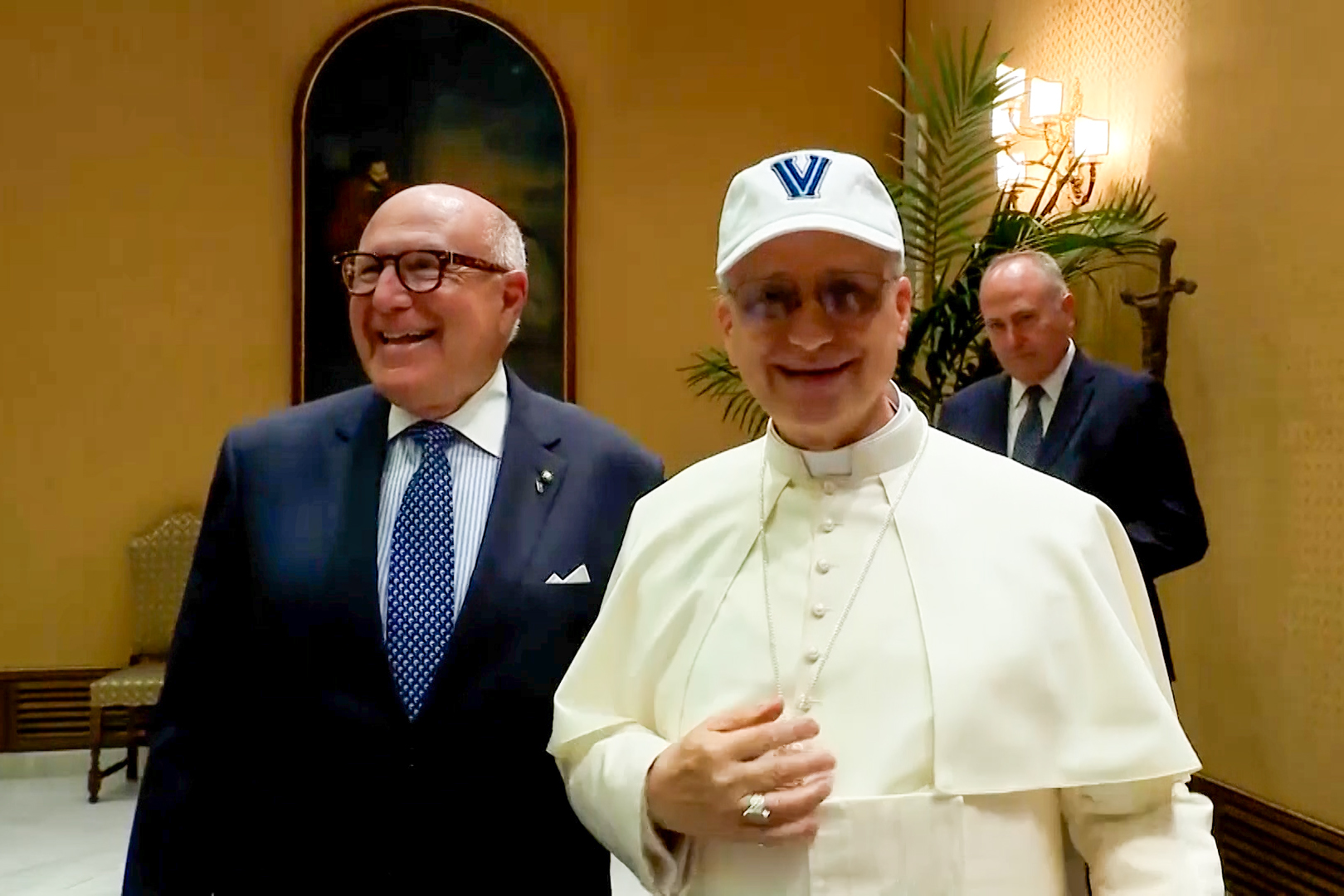
This video screen grab shows Pope Leo XIV wearing a Villanova hat gifted to him during a meeting with an Italian heritage group.
Pope Leo XIV’s ties to the Philadelphia area and Pennsylvania could not be ignored on Friday.
In his remarks, Pennsylvania Gov. Josh Shapiro highlighted the history of the nation’s founding in Pennsylvania and said he was proud the pope was educated in the state.
Shapiro, a Democrat, said his own Jewish faith calls him to service, and to him, “it means that each of us has a responsibility to get off the sidelines.”
“I believe that work is needed, especially at this particular moment in time,” said Shapiro, a critic of President Donald Trump.
He said Leo has “exemplified that spirit of service” throughout his life, from Villanova to the Vatican.
Philadelphia Archbishop Nelson J. Pérez also highlighted the pope’s local ties while speaking.
“Philly is proud that the pope is a graduate of Villanova University,” he said. “Pope Leo knows us, and we feel like we know him too.”
Then known as Robert Francis Prevost, he began his academic journey at Villanova that would lead him to seminary, then priesthood, then through the ranks of the Catholic Church, ascending to cardinal and, this week, becoming Leo XIV, the first pope from the United States.
He went by “Bob” from Chicago in his college days and earned a bachelor of science in mathematics. He’s a confirmed Wildcats basketball fan.
Since taking on his new title, Pope Leo has continued to highlight his ties to the school, addressing Villanova’s Class of 2026 via video at their commencement ceremony.
“His influence, however, extends beyond Philadelphia,” the archbishop said.
The President’s House controversy mentioned at Pope Leo event
Rabbi Jill L. Maderer, of Congregation Rodeph Shalom, cited the nearby President’s House site, a federal park site that highlighted how President George Washington enslaved people, until President Donald Trump’s administration ordered much of the exhibit to be taken down. She was among Christian, Muslim, and Jewish faith leaders who spoke ahead of the pope’s speech.
Amid a legal fight between Philadelphia and the Trump administration, many of the walls of the President’s House site remain bare as tourists flood Independence Mall for the United States’ 250th anniversary. But protesters have hung up signs at the exhibit pointing people to news coverage and other information about the exhibit.
Maderer said Washington’s home, “where he enslaved human beings,” lay just west of the event. And to the east is a museum exhibit that has a letter from Washington to a Jewish community in 1790 assuring they would have religious liberty.
“Words that I pray are meant for all people,” she added.
Ahead of Pope Leo’s speech, city leaders gather for interfaith discussion
Gov. Josh Shapiro, Mayor Cherelle L. Parker, Philadelphia Archbishop Nelson J. Pérez, and other interfaith religious leaders sat on stage ahead of Pope Leo XIV’s speech at the National Constitution Center.
Democrats Parker, a Baptist, and Shapiro, who is Jewish have each been outspoken about their own faiths.
“My faith has carried me through every season of my life, and serving as your 100th mayor has only strengthened my belief that we are strongest when we come together in service of something that is greater than ourselves,” Parker said in remarks ahead of the pope’s speech.
Pope Leo’s speech is to be broadcast against the backdrop of a 100-foot tablet of the First Amendment in the Kenneth C. Griffin Great Hall Overlook at the National Constitution Center. The hall features flags from all 50 states. A giant American flag hangs from the 60-foot ceiling.
Hundreds of people gathered at the hall, many of them National Constitution Center sponsors, members, VIPs, and local religious leaders.
Pennsylvania Attorney General Dave Sunday rang a replica Liberty Bell outside with National Liberty Museum CEO Alaine K. Arnott and Lauren Sylling, the vice president of development at the National Constitution Center, as well as Sylling’s daughters.
“May the sound of this bell inspire all of us to continue building strong communities, serving one another with integrity, and ensuring the promises of liberty,” Sunday said.
Sunday, a Republican, said the country’s Constitution is the nation’s “instruction manual.”
Organizers say tomorrow’s One Philly: Unity Concert for America is still on
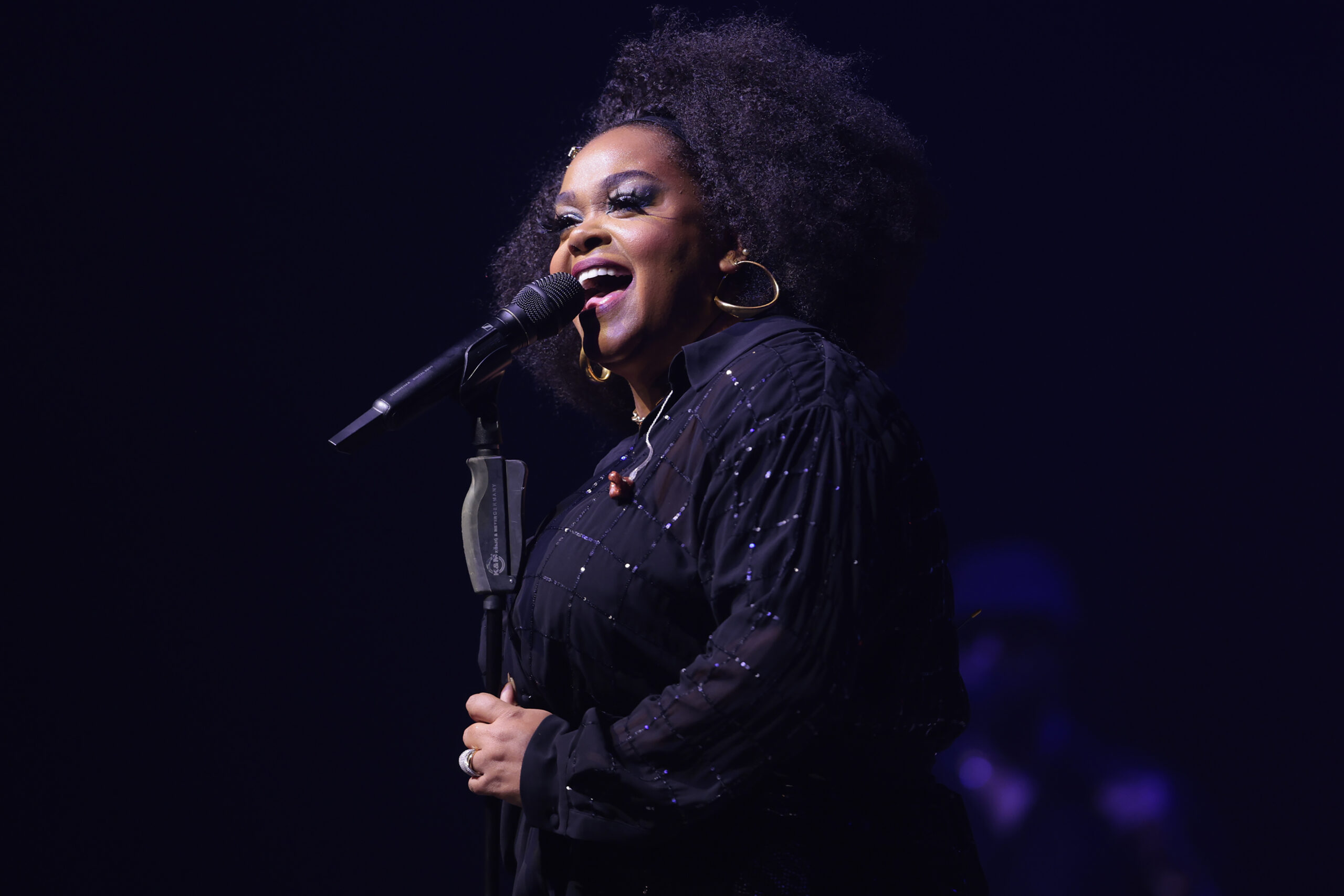
Jill Scott performs at The Met on March 16, 2023.
The city’s free major Fourth of July concert featuring Jill Scott, Christina Aguilera, The Roots, Will Smith, Freeway, and many more on Saturday is still a go.
That’s according to city organizers, who reiterated Friday that the event is rain-or-shine.
“The city is implementing water misting stations along the Ben Franklin Parkway, and there will be water refilling stations for anyone who needs one,” organizers told The Inquirer. “Fans are encouraged to bring a clear empty 20-ounce water bottle for refilling throughout the evening.”
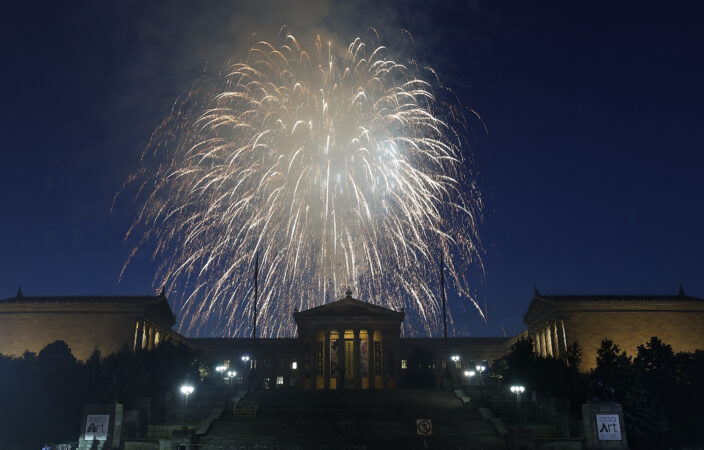
Gates to the One Philly concert open at 3 p.m. Saturday and events conclude with a fireworks finale at 11:45 p.m. over the Philadelphia Museum of Art.
Watch Live: 2026 Liberty Medal Ceremony Honoring Pope Leo XIV
Pope Leo XIV will accept the National Constitution Center’s Liberty Medal on Friday, delivering remarks live from the Vatican that will be broadcast inside the Sixth and Arch building.
His speech will be particularly anticipated in Philadelphia given the Semiquincentennial and Leo’s deepties to the Philly area.
It’s not just Philly: Dozens of 250th events canceled due to heat wave
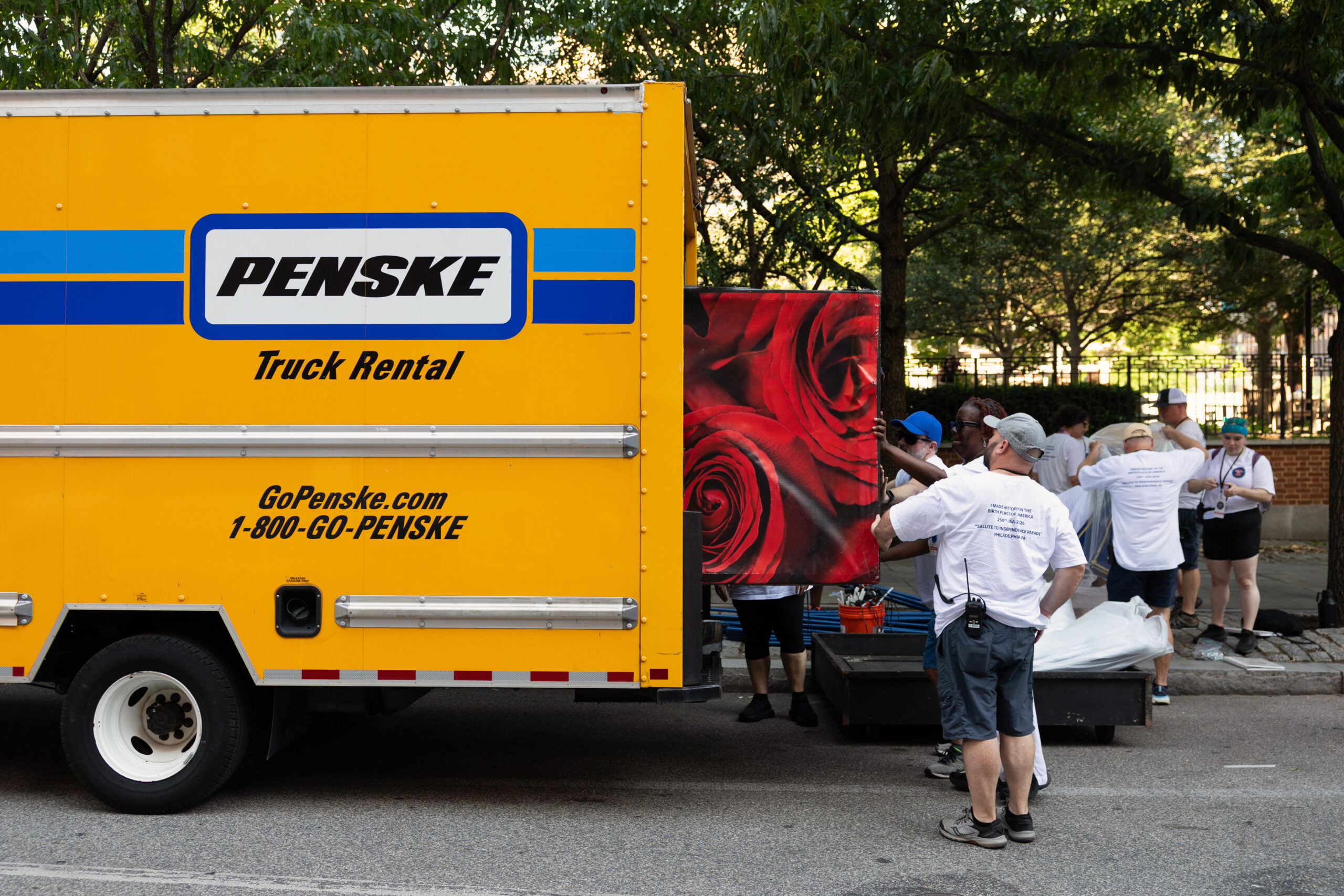
Event staff pack away floats that were to be part of an Independence Day parade, now cancelled due to extreme heat, in Philadelphia on Friday, July 3, 2026.
The major heat wave has certainly impacted events for the nation’s 250th anniversary locally, including today’s parade and yesterday’s Salute to Service concert with Queen Latifah.
But this isn’t just a Philly thing.
Dozens of parades, celebrations, and fireworks shows have been postponed, re-imagined, or cancelled entirely because of the dangerous heat conditions.
That’s according to Newsweek, which is keeping a list of the rolling cancellations, which stretch from Delaware to Southern Colorado so far.
The extreme weather is pushing temperatures of over 100 degrees across the Northeast throughout the long holiday weekend.
Gente de Venezuela president reflects on months of work leading up to parade
Alex Moreno woke up to a call from the Semiquincentennial Parade organizers early Friday, announcing the cancellation of the event.
As the president of Gente de Venezuela, Moreno was one of 50 people scheduled to march with the Venezuelan coalition in the celebration of the United States’ 250th anniversary.
“We’re sad because it took months of hard work to set up the float, the attire, and schedule the guests from other cities to come,” Moreno said.
The group’s float featured a giant acoustic guitar in the colors of the Venezuelan flag alongside pink and orange flowers.
Gente de Venezuela has been working with neighboring coalitions on their float since late last year. Venezuelan dancers and singers from D.C., Atlantic City, and Wilmington were scheduled to travel to Philadelphia to join the non-profit in the parade.
“I managed to call them right before they began their travels,” Moreno said.
The sadness doubled for Gente de Venezuela as they saw the parade a way to honor both the country that has become their home and the workers in Venezuela currently rescuing people from under the rubble after the two earthquakes that ravaged the country.
“The cancellation is a reminder that life is more important,” Moreno said. “Heat can have consequences even worse than just feeling sad, and safeguarding people’s health is very important.”
No parade, but floats and reenactors roll on through historic district
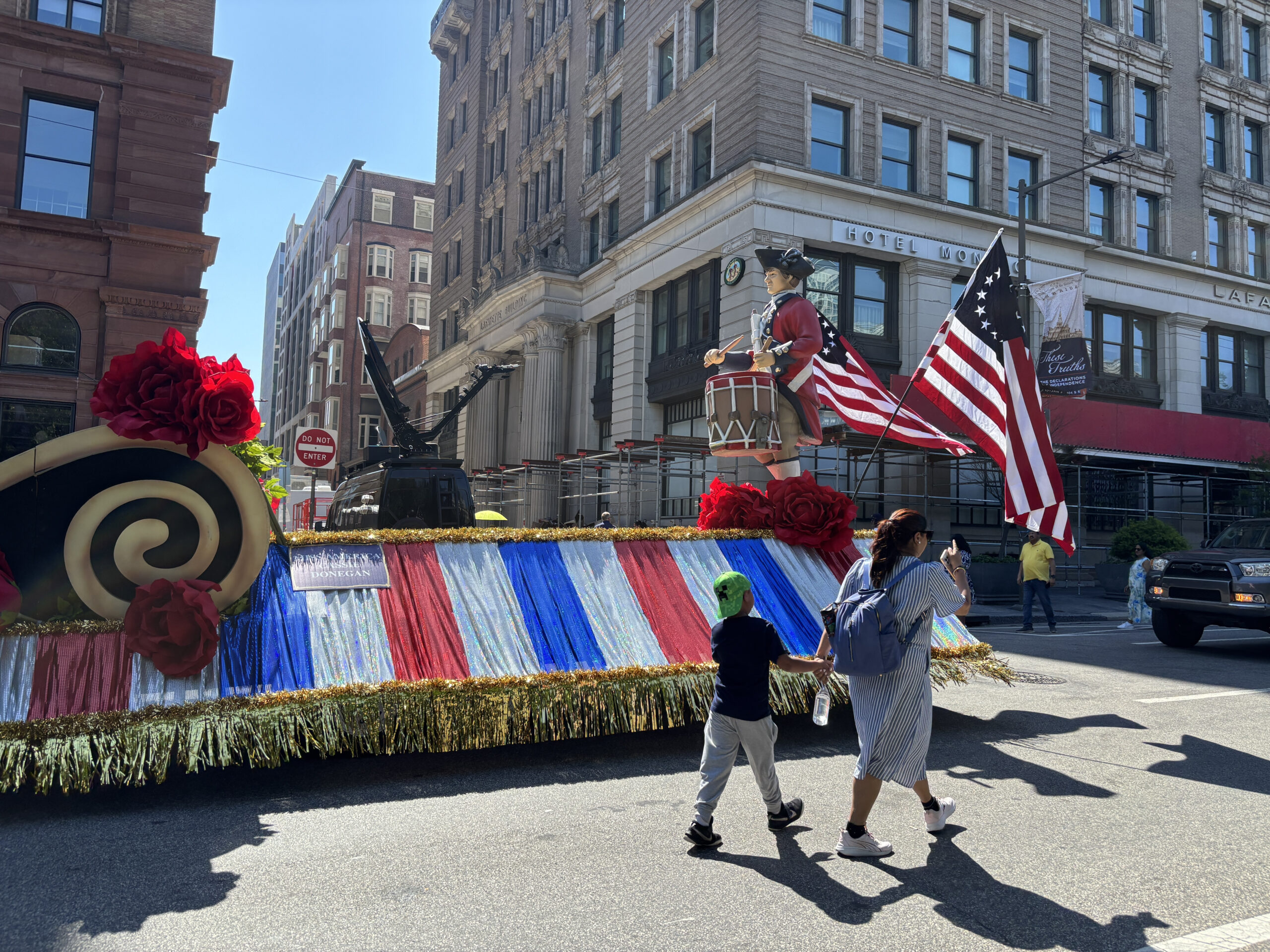
With the Salute to Independence Semiquincentennial Parade cancelled, Floats are parked near Independence Mall, Friday, July 3, 2026, in Philadelphia.
While the formal Salute to Independence Parade was canceled citing the extreme temperatures, spectators were still catching a glimpse of the floats before they retire.
On Friday morning, the larger-than-life elaborate floats could be seen proceeding down Arch and Fifth Streets, then to Chestnut Street.
The floats were anticipated to make a pit stop in front of Independence Mall this morning in lieu of their big route.
With the Salute to Independence Semiquincentennial Parade cancelled reenactors gather near Independence Hall, Friday, July 3, 2026, in Philadelphia.
Dressed in Revolutionary War regalia, reenactors hoisted musical instruments and flags across Liberty Bell Pavilion for a bit of an impromptu parade.
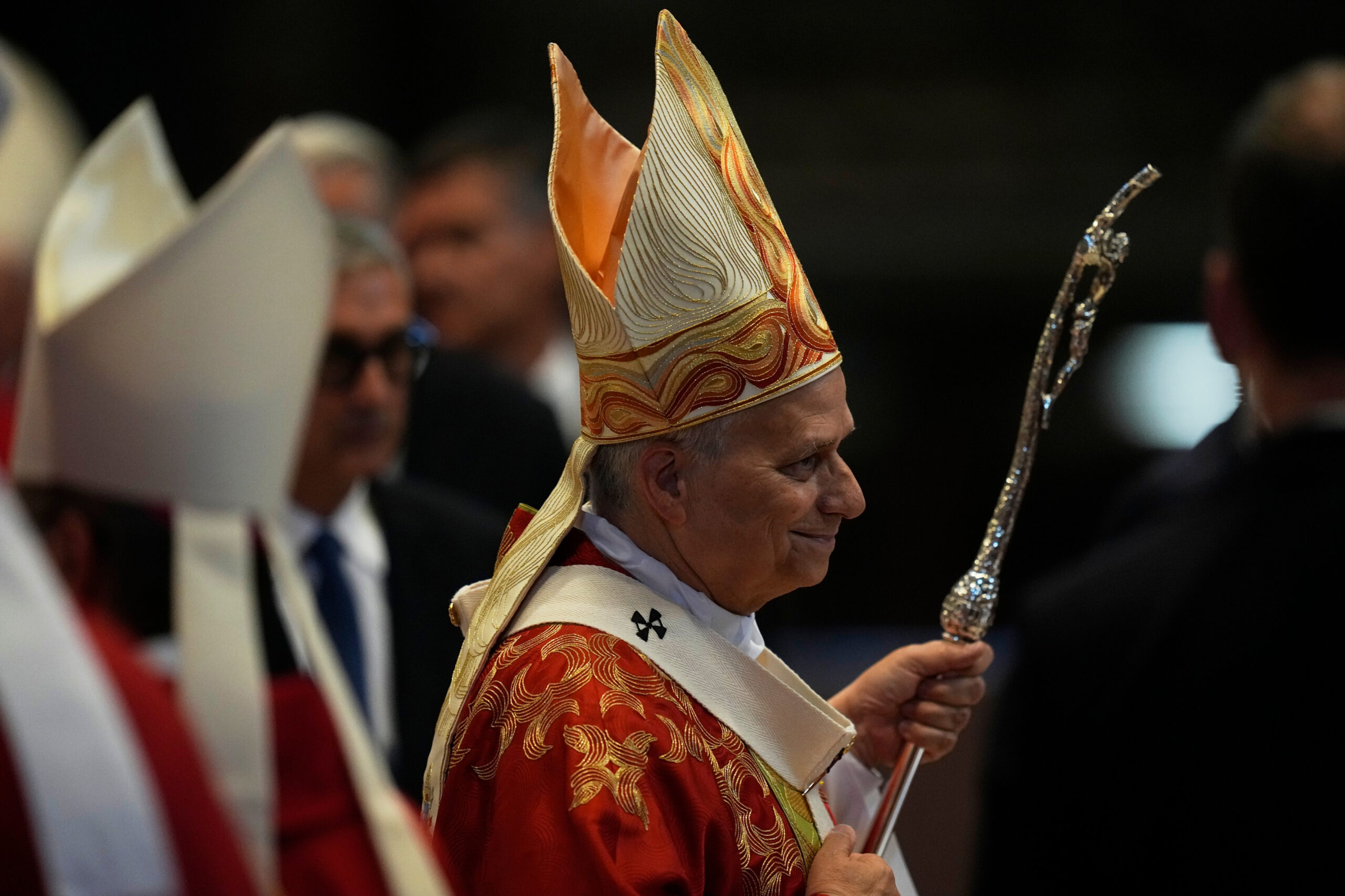
Pope Leo XIV leaves after a Mass where he conferred the pallium on newly appointed metropolitan archbishops, in St. Peter’s Basilica, at the Vatican, last month.
Pope Leo XIV is being honored for “his commitment to religious liberty and freedom of conscience,” so he’ll likely speak on those themes, Julie Silverbrook, the chief content and learning officer for the National Constitution Center, said in an interview Friday morning ahead of his speech.
What does that mean, anyway?
The freedom of conscience, she said, is the right to “believe, think, feel, of every human being.”
“The ability to think freely for oneself,” she added.
She also said he’ll likely provide reflections on the significance of the Declaration of Independence given that it’s the eve of America’s 250th anniversary.
The pope was shaped both by the values of the United States and of Philadelphia as a former Villanova student, Silverbrook added.
In her eyes, the pope’s message will resonate regardless of people’s faiths or if they have no faith at all. She said he is “a global leader who has been uniquely shaped by American ideals and who is now reflecting those ideals across the world.”
Record warmth and showers now ‘likely’ Saturday night
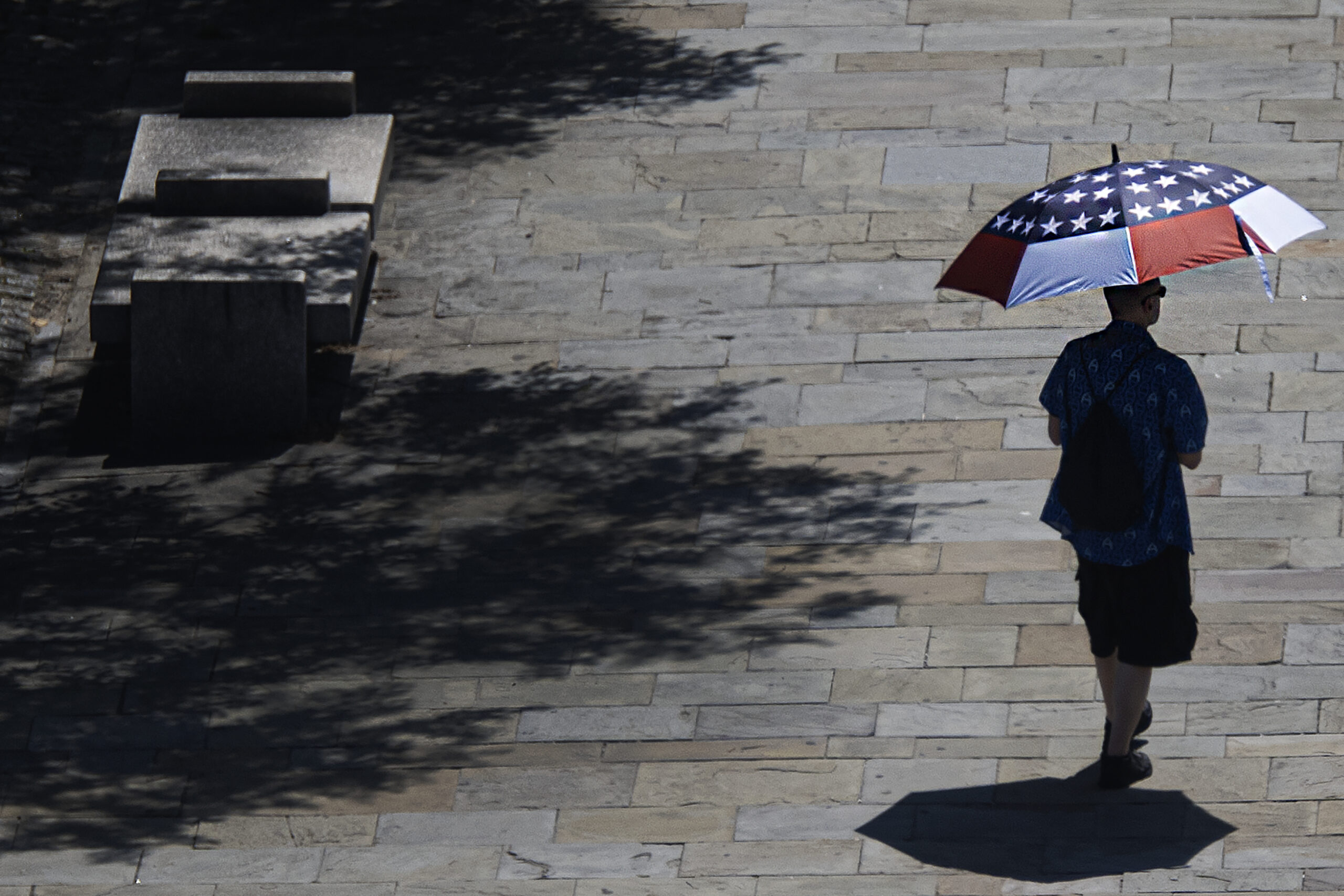
A pedestrian shields from the sun with an umbrella resembling the American flag during an extreme heat wave on Friday, July 3, 2026, in Philadelphia. Philadelphia officials canceled the Wawa Welcome America Salute to Independence Semiquincentennial Parade because of an Extreme Heat Warning, but visitors continued to gather in the historic district.
The day after tying a record high for the date, 103, the temperature didn’t get below 82 overnight, which would be a record-high minimum temperature for July 3 if it holds until midnight.
An encore is expected Saturday morning. (We will eschew saying “hotter than a firecracker.”)
The record for both dates is 77 and 79, respectively.
Saturday may be more problematic, but for a record-high minimum and maximum, 104 as thunderstorms knock down the temperatures late in the day or at night.
The National Weather Service this morning upped the probability of showers during the FIFA World Cup Round of 16 showdown between Paraguay and France and Wawa Welcome American festivities to 60%
‘Heartbreaking for all of us’: Read Welcome America CEO’s letter to parade participants this morning about the cancellation
In a letter sent Friday morning to parade participants, Welcome America, Inc. President and CEO Michael DelBene wrote that he was saddened by the decision to cancel the Salute to Independence Semiquincentennial Parade, but it came down to safety.
“If we can’t do it safely, we simply won’t do it,” DelBene wrote.
DelBene said the decision was not reached by just parade organizers, but a mix of parade leadership, local offices, and agencies.
Participants were notified a little after 1 a.m. Organizers had already developed contingency plans for the parade, including a shorter route and earlier start time, but ultimately determined to cancel entirely for safety.
Fifty bands, 19 floats, and a mix of other cultural showcases were set to head down today’s parade route.
“On behalf of our entire team, I sincerely apologize for the devastating news just hours before the parade,” he said. “But I remain optimistic that we may someday be lucky enough to welcome you back to a future parade.”
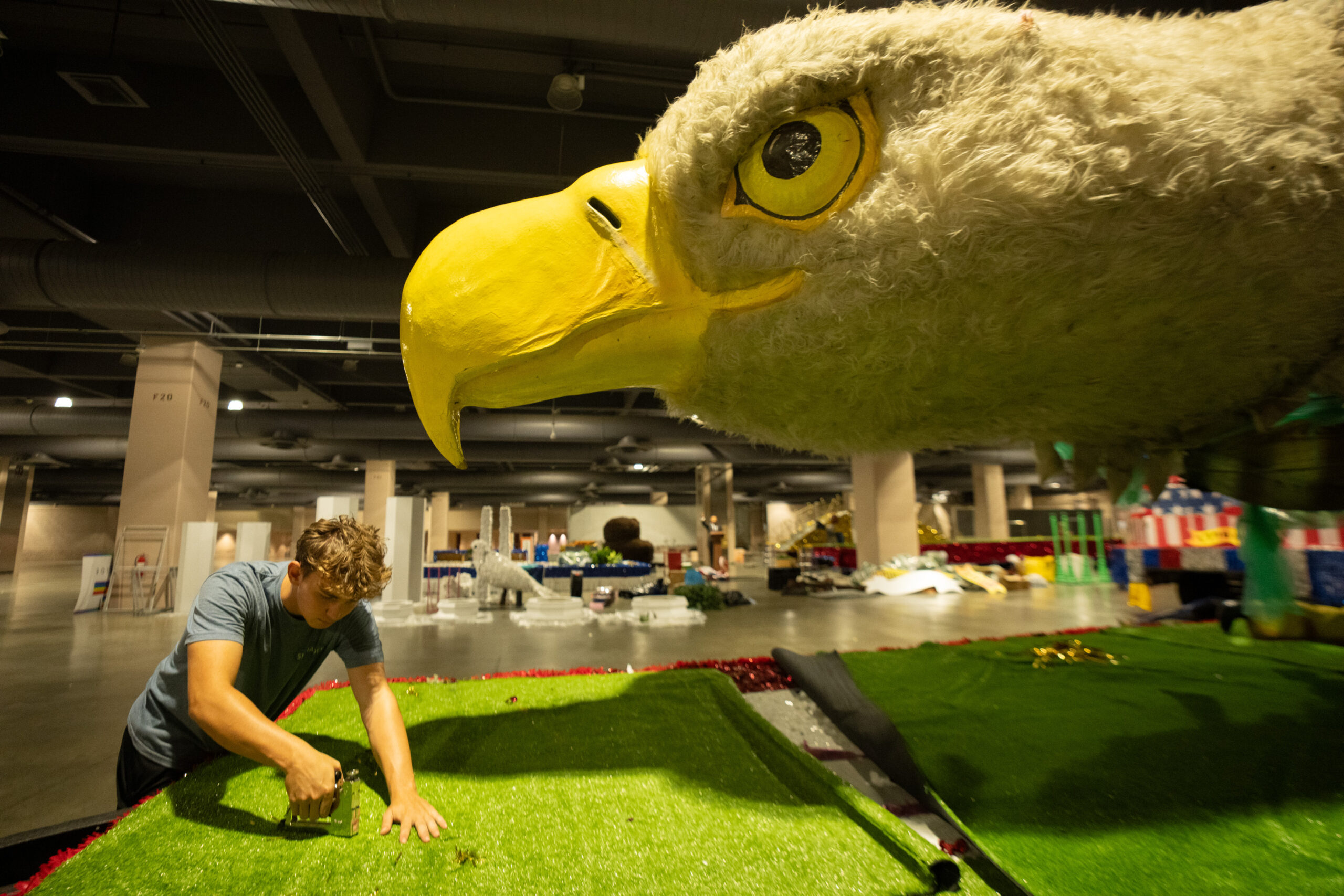
Landon Shaw works on a float that will be in the Fourth of July the parade and festival, at the Convention Center in Philadelphia, June 29, 2026.
Here’s the full letter:
Dear Parade Participants,
My name is Michael DelBene and I am the President & CEO of Welcome America, Inc. I am writing to share the very difficult news that the Salute to Independence Semiquincentennial Parade scheduled for today in Philadelphia has been canceled due to the extreme heat in the forecast. Today’s temperatures are expected to be well over 100 degrees with heat indexes reaching over 110. As much as this decision pains everyone inside our organization, we simply cannot host an event of this size and scale under these conditions.
I cannot begin to express how sad I am having to make this decision. Todd Marcocci and Under the Sun Productions have been working tirelessly with each of you to design something truly historic, and having to cancel it at the last minute is heartbreaking for all of us. Todd and his team at the Under the Sun did not make this decision, rather it resulted from a collaborative discussion among Welcome America leadership and the various Philadelphia offices and agencies tasked with public safety. While large-scale celebrations and community events may be our mission, our first responsibility will always be to the safety and security of our staff, our guests, and our event participants. If we can’t do it safely, we simply won’t do it.
I know how much time and effort you have invested to get here: the countless hours of rehearsal, travel time, and the financial burden of participating in this event. I am humbled by your commitment and remain in awe of your passion and dedication to your craft. On behalf of our entire team, I sincerely apologize for the devastating news just hours before the parade, but I remain optimistic that we may someday be lucky enough to welcome you back to a future parade.
Thank you again for your willingness to be part of our celebration. Safe travels and best of luck,
Michael
__________________________________________
Michael DelBene (he/him/his)
President & CEO
Welcome America, Inc.
// Timestamp 07/03/26 8:43am
National Weather Service: Extreme heat warning remains in effect
The National Weather Service doesn’t anticipate this extreme heat backing off for the sake of the Nation’s big birthday.
Sunny and hot, with a high near 104 and heat index values as high as 111, the Philadelphia region remains under two hazardous weather conditions, including an extreme heat advisory and an air quality alert, advising that pollution could affect people with respiratory and heart conditions.
The hope is that things temper down by tonight, with Idina Menzel’s Pops Orchestra appearance being pushed back an hour to 8 p.m. to accommodate the severe weather.
NWS expects mostly clear skies, a low of around 82 and the chance of isolated showers or thunderstorms before midnight.
The string of record-breaking high temperatures coincides with a slate of events and celebrations scheduled across town, including Fourth of July activities and a highly anticipated FIFA World Cup Round of 16 showdown between Paraguay and France.
FIFA Fan Festival in Lemon Hill, which has been hosting free watch parties since the start of the World Cup, announced shortened hours because of the heat.
On Saturday, the festival will open at noon for the 1 p.m. match between Canada and Morocco, then the grounds will close. The Philly match between Paraguay and France will not be broadcast at the festival.
The NWS recommends staying hydrated and out of the sun as much as possible and checking on relatives and neighbors. Young children, pets, and seniors are especially vulnerable.
The Semiquincentennial parade is canceled because of heat
Todd Marcocci (left) and Jeremy Williams work on a float back stage with the crews of the now-canceled Semiquincentennial parade.
Wawa’s Salute to Independence Semiquincentennial Parade is canceled due to high temperatures, according to organizers.
The parade was set to start Friday at noon after a delay was already announced Thursday.
The Pops concert Friday night, featuring Idina Menzel, is still on, according to Wawa Welcome America. A later start time of 8 p.m. was announced earlier this week.
While some Facebook users understood the expected over-100-degree weather could put people at risk, others felt strongly about the lack of celebration.
“What a disappointment for not only those of us who had hoped to watch, but also for the bands and other marchers who have come from all across the U.S.,” one user commented. “I get it — no one wants the liability. But are we just going to cancel everything?”
Another added, “It’s the 250th in the Birthplace of Freedom, and we’re just canceling parades because it’s warm,” leaving people to argue and point out that it wasn’t simply a warm day in Philadelphia, but a dangerous heat advisory.
Friday’s high is expected to break records in Philadelphia, with the anticipated minimum high of 104 last met in 1966 — when the nation was a mere 190 years old.
Experts say this is different and riskier than warm days in past Julys.
Over the past 85 years, Julys in Philadelphia are running on average 4.4 degrees warmer than in 1940, based on an analysis of historical weather data. That translates to an increase of about 0.52 degrees per decade.
The city on Tuesday declared a “heat health emergency” in effect from 1 p.m. Wednesday through 8 p.m. Saturday. Across the Northeast, outdoor events are being rescheduled or canceled, citing the heat. Those events range from other America 250 events to local farmers’ markets.
Pope Leo XIV is speaking to the National Constitution Center live from the Vatican
Pope Leo XIV will accept the National Constitution Center’s Liberty Medal on Friday at 11 a.m., delivering remarks live from the Vatican that will be broadcast inside the Sixth and Arch building.
The U.S.-born pontiff’s speech is a major addition to Philadelphia’s already extensive lineup of activities and events on the eve of the United States’ 250th birthday on July Fourth.
His speech will be particularly anticipated in Philadelphia given the Semiquincentennial and Leo’s deepties to the Philly area.
The Catholic leader has garnered attention for clashing with President Donald Trump’s administration, which will be further exemplified by his visit with migrants on Independence Day.
His award acceptance speech also comes just two days after traditionalist Catholics in Switzerland defied him by consecrating bishops without his consent, which Leo called “a sin of extreme gravity,” the Associated Press reported.
His Friday remarks were initially going to be broadcast on Independence Mall but it was moved inside due to extreme heat.
Events in Philly today include free museums and Pops on Independence
America’s 250th birthday is finally here, and organizations throughout Philadelphia have planned a full itinerary of celebrations for the weekend.
For those seeking historical enrichment, live music from national headliners, or even a patriotic pet parade, look no further.
Here is a schedule of the activities and events happening in the city Friday:
Free Museum Day: Fireman’s Hall Museum
In a renovated 1898 firehouse, the Fireman’s Hall visitors can learn about the history of firefighting in Philadelphia, the birthplace of volunteer fire companies.
10 a.m., 147 N. 2nd St.
Free Museum Day: Science History Institute
The museum will feature a new exhibition on fireworks, exploring the art, chemistry, and craft behind the colorful emblem of the holiday.
10 a.m., 315 Chestnut St.
38th annual Liberty Medal ceremony
In a public ceremony, the National Constitution Center will award the 38th annual Liberty Medal to Pope Leo XIV, who will deliver live acceptance remarks virtually from the Vatican.
10:45 a.m., 525 Arch St.
Free Museum Day: Historic St. George’s Museum and Archives
Celebrating traditional craftsmanship, the museum will offer hands-on workshops where participants can create their own wax seals and try out water marbling.
11 a.m., 235 N. 4th St.
Free Museum Day: Historic Waynesborough
Located in Paoli, this National Historic Landmark was once the home of Revolutionary War hero Gen. Anthony Wayne. Free tours of the Georgian-style property will be available for visitors.
Noon, 2049 Waynesborough Road, Paoli, Pa.
Pops on Independence
Enjoy a live orchestral show with the Philly Pops, headlined by Tony Award-winning performer Idina Menzel.
Friday’s high is expected to challenge the reigning champ, the 104 set during a blistering heat wave in 1966, when the nation was a mere 190 years old.
On Saturday, when Philly celebrates the nation’s 250th birthday, the high may fall just short of 100, said Matt Benz, senior meteorologist with AccuWeather, as the high pressure “heat dome” covering much of the nation loses some of its protective power over Philly.
That also could be a window for “ring of fire” thunderstorms that could be nasty. The federal Storm Prediction Center sees a 15% chance that any storms on Saturday could become “severe,” with wind gusts up to 60 mph.
By Sunday, highs will be backing off to the 90s, however the sequence of warm nights probably will persist, at least in areas of Philadelphia most affected by the urban heat island effect.
John Adams wanted ‘pomp and parade’ to mark July 2. For the 250th, Philly tried, despite the heat.
As the mercury climbed above 100 degrees in the Philadelphia region two days before the nation’s 250th birthday, it was, it seemed, too hot for liberty as originally planned.
Thursday marked the start of the Red White & Blue To-Do — Philadelphia’s third-annual celebration of the day the Second Continental Congress voted to adopt a resolution of independence here on July 2, 1776. Though many events honoring that anniversary were planned, several highly anticipated gatherings were canceled or postponed due to the heat.
And yet, despite the oppressive temperatures on a particularly toasty July day in the cradle of the nation’s founding, the celebration started early Thursday.
At 7 a.m., some 250 revelers, clad in red, white, and blue clothing, gathered at Independence Mall to make a living Liberty Bell — a representation of a symbol that has defined Philadelphia for centuries, and a touchstone for Americans nationwide. The human formation even captured the bell’s signature crack through an outline of participants wearing blue.
// RelatedLink Text: Ben Franklin contest URL: https://www.inquirer.com/news/philadelphia/a/ben-franklin-look-alike-contest-philadelphia-july-4th-20260703.html
As the country moves toward the 250th celebration, the official directive from the Trump administration is clear: be proud, be grateful, and rejoice in our great nation. This rosy narrative overlooks the global political conflicts, fractured economy, and longstanding racial and gendered inequalities that have shaped our country from its founding. These difficult realities are not footnotes to American history but a reminder of all of the ways that our nation continues to fail to live up to its espoused values. This is why one of the greatest speeches in American history resonates this time of year and especially on the eve of our nation’s 250th birthday: Frederick Douglass’s “What to the Slave is the Fourth of July?”
Born into slavery, Frederick Douglass escaped from bondage to become the foremost African American abolitionist, orator, and intellectual of the nineteenth century. His famous “Fourth of July” speech is a profound declaration of faith in the promise of America and its “saving principles.” In this speech, delivered pointedly on July 5, 1852, not July 4, in Rochester, New York, Douglass argues that the foundations of American democracy are not fundamentally rotten, just mistaken in their implementation, and that the values enshrined in the founding mythology and documents might yet redeem America from its sins. It is a galvanizing and patriotic text, and it anticipates what W.E.B. Du Bois would say in 1935 in Black Reconstruction in America: that “democracy died save in the hearts of Black folk.”
But this year, a different piece by Douglass resonates: “The Reason Why the Colored American is Not in the World’s Columbian Exposition,” written in 1893, just two years before he died. In that pamphlet, Douglass criticizes another national commemoration that asked Americans to set aside painful realities in favor of a more flattering narrative. His argument—that the struggle against racial injustice must continue not because success is guaranteed, or even likely, but because it is the right thing to do when confronted with injustice—continues to matter today.
The pamphlet, “The Reason Why: The Colored American is not in the World’s Columbia Exhibition,†had to be distributed and discussed from the Haitian exhibition space at 1893 World Fair in Chicago because African Americans were denied any real role in the Fair.
In this pamphlet, Douglass protested the World’s Fair in Chicago, a grand celebration of the 400th anniversary of Christopher Columbus’s 1492 arrival in the “New World.” The fair, Douglass argued, distorted American history by erasing the contributions of Black Americans whose labor and suffering had made that very “progress” possible. By this time, Douglass had witnessed the Emancipation Proclamation and Reconstruction and the violent undoing of Reconstruction. He had seen the Supreme Court strike down the Civil Rights Act of 1875. As white Americans imposed the brutal logic of Jim Crow across the nation, Douglass came to believe that the consciences he had spent his life appealing to had been so corrupted by white supremacy that they could no longer be relied on to redeem America.
And yet, in the closing passages of the pamphlet, Douglass did not embrace despair or advocate for retreat. Instead, he offered the metaphor of a ship that must embrace the dangers of the open sea. The ship might remain safely anchored in harbor but this safety, he argued, is deceptive. The ship must weather the storm. And he followed it up with something even more profound: “Next to victory is the glory and happiness of…contending for it. Therefore, contend, contend! That we should have to contend and strive for what is freely conceded to other citizens without effort or demand may indeed be a hardship, but there is compensation here as elsewhere. Contest is itself ennobling. A life devoid of purpose and earnest effort is a worthless life. Conflict is better than stagnation.” For Douglass, the act of contending itself is meaningful. The struggle testifies to the injustice it intends to repair.
Made By History sponsors. FOR USE ON MADE BY HISTORY STORIES ONLY.
The origins and reception of the pamphlet reveal the fault lines in American society at the end of the 19th century. Douglass had appealed to Black communities across the nation for funds to print the pamphlet and had received almost nothing. Discouraged, he told his collaborator, Ida B. Wells, that he wanted to abandon the effort. It was Wells who insisted otherwise, organizing with many Black women’s organizations to raise the necessary resources. Ironically, the man who would close his pamphlet urging Black Americans to “contend, contend” had to be persuaded to continue contending himself.
The reception of the pamphlet was divided and harsh. Many prominent white journalists called Douglass a complainer. Even within the Black press, there was hardly consensus. Some Black journalists endorsed his indictment of the fair while others argued that Black economic and educational enfranchisement were more important than another lament of prejudice. This was a broader debate within the Black community that Douglass did not settle in the pamphlet. What he offered instead was something harder and arguably more important today: the argument that we must continue to fight even when we are not winning the war.
This is an extraordinary argument coming from Douglass at the end of his life. He had every reason to give up the fight. He had spent decades working to change America, and America had proven far more resistant to that change than he had originally hoped. And yet he insisted: contend, contend.
At this moment of democratic fracture and racial retrenchment in America, Douglass’s argument deserves a second hearing. The Supreme Court has dismantled affirmative action, executive orders have unraveled federal civil rights commitments, and disparities in housing, education, healthcare, and criminal justice persist and deepen. The fight against racial injustice must continue not because we can be assured of our triumph but because our commitment to America’s “saving principles” should not falter even when those principles seem out of reach. Douglass’s refusal to abandon the fight—his willingness to steer into the storm—is not merely a biographical detail about an American at the end of his life. It is an argument about what it means to celebrate America and her saving principles.
Happy 250th birthday, America. Contend, contend.
Dr. Amy Gais is a Lecturer in the Department of Political Science and Comparative Literature and Thought at Washington University in St. Louis. She is the author of The Coerced Conscience (Cambridge University Press, 2024) and is currently working on a book project on dissimulation, resistance, and freedom in African American political thought.
Made by History takes readers beyond the headlines with articles written and edited by professional historians. Opinions expressed do not necessarily reflect the views of The Inquirer.
Fairmount residents are accustomed to annual July Fourth fireworks; it comes with the territory of living near Benjamin Franklin Parkway, where the city stages its major celebrations. With the United States’ 250th birthday, this July Fourth is no different — except that the fireworks will start closer to midnight.
“We have the whole family coming to our home, all on their way right now,” said Fairmount resident Margo DelliCarpini. “But 11:30, midnight is just too late for some families with children. I understand that it’s the Fourth of July, but the late start for fireworks is decidedly not a family-friendly decision.”
DelliCarpini will have her children and grandchildren visit to experience the Semiquincentennial in the city where the country began. But with young children in tow, parents along for the trip were hoping to have them in bed by midnight, she said. Instead, the large group is looking to catch one of the fireworks shows at Valley Forge or across Montgomery County, which start around 9 p.m.
Fans react to the music as the Wawa Welcome America Festival concluded July 4, 2023, with a free concert on Benjamin Franklin Parkway.
Philadelphia’s July Fourth concert and fireworks show, the One City: Unity Concert for America, is expanding its lineup from two to three acts like in years past, to 10 artists, including Christina Aguilera, Will Smith, Meek Mill, and Seal. The show will also start earlier and end later, spanning into July 5 by the time people head home.
The city did not respond to request for comment.
Other cities, like New York, Boston, and Los Angeles, are keeping their 9-9:30 p.m. start times, while Washington, D.C. is among the cities pushing back its fireworks show to 10:30 p.m. or even 11 p.m. to allow for its expanded America 250 showcase.
Mykola Kosyk, 36, a lifelong Fairmount resident, has been witnessing the Parkway fireworks for years. Usually he’ll catch some of the concert with his wife, head back home, have time to set off some fireworks of his own with family, and then all head back to the Parkway for the city’s grand finale. Kosyk said he’ll still likely watch the midnight fireworks on Saturday, but feels disappointed that younger Philadelphians may not get to experience itas children during 1976’s Bicentennial, Kosyk’s father recalled.
“It is the 250th, so if there is a time to do something big, I’m open to the idea,” Kosyk said of the later show. “But I also feel bad for the youngsters coming out, because 9 p.m. is usually a pretty good time for kids to watch the show. Midnight is pushing it a little for kids.”
For residents like Kosyk and DelliCarpini, the nuisance is less with the noise of fireworks which most Fairmount residents are used to by now, but how late the show will run, limiting access to younger kids and delaying vehicle and pedestrian traffic later into the morning.
The Inquirer reported that this year’s event will cost more to operate after Mayor Cherelle L. Parker decided to change the management of the festival from its previous nonprofit partner to a for-profit production company. Parker defended that decision at a news conference Wednesday: Philadelphia needed to meet the moment and host a celebration that is “fitting to and for our historical significance and prominence.”
Jason Derulo performs during the Wawa Welcome America July 4th Concert on the Parkway in 2022.
Moving an expected 300,000 attendees and their vehicles
Besides the hurdles for parents with younger children, there’s also the headache of moving an expected 300,000 people from the Parkway back home after the show.
SEPTA has covered most of its bases for getting people home. Regional Rail lines will have extended service on all lines, but the Landsale/Doylestown, Paoli/Thorndale, Manayunk/Norristown, Trenton, and West Trenton lines are the only lines that will run their last train between 1 a.m. and 1:10 a.m. All other Regional Rail lines stop running before 1 a.m., and in some cases before midnight, so people traveling in from the suburbs should plan accordingly.
Subways and trolleys will run overnight for those heading back home within the city, and bus service will run on a Sunday schedule, which usually stops operating around 2 a.m. for some routes.
But vehicle and pedestrian traffic could use some city intervention, said Dustin Dove, president of the Fairmount Civic Association, as there is concern among local civic leaders and some residents about how the city is handling traffic leaving the Parkway.
“It’s usually a bit of a mess near the Parkway after the fireworks and can lead to some reckless driving nearby as people are stuck,” Dove said. “Historically, after the fireworks, there are thousands of pedestrians and cars that come into the neighborhood.”
A police presence is seen in Eakin’s Oval as people wait for the fireworks to start at the Wawa Welcome America Festival on Tuesday, July 4, 2023.
Dove and others are hoping to see an increased police presence and traffic direction, as the event will be much later with more people this year, Dove said.
Additionally, residents hope police manage safety accordingly on Saturday.
“There’s going to be problems when you live in a city; it’s not like it’s the middle of nowhere with no neighbors, but this week … you’re now having people walk back home at midnight, 12:30 a.m.,” DelliCarpini said. “There needs to be a safe environment after the show.”
Think you know your news? There’s only one way to find out. Welcome back to our weekly News Quiz — a quick way to see if your reading habits are sinking in and to put your local news knowledge to the test.
Question 1 of 10
President Donald Trump quietly removed mentions of slavery from a panel accompanying a portrait of this historic figure from Independence Hall:
CorrectIncorrect. XX% of other readers got this question right.
President Donald Trump’s administration has wiped almost all mentions of slavery from a panel accompanying a portrait of Thomas Jefferson at the Second Bank of the United States. The Inquirer's discovery of these changes come as Philadelphians are grappling with the Trump administration's attacks on the President's House site.
Question 2 of 10
Thirty years since its release, Big Night — the ultimate Jersey Shore movie that pays tribute to Italian American food — is still inspiring local chefs, including this restaurateur who calls the film and its food “magic”:
CorrectIncorrect. XX% of other readers got this question right.
Philadelphia chef and restaurateur Marc Vetri is a fan of the film. “In 1996, chefs were in this kind of zone,” said Vetri, who watched the film shortly after it came out. “We all made the menus, and we had our visions, and we didn’t want to alter anything, and [said] ‘this is how we do it’.”
story continues after advertisement
Question 3 of 10
A local ceramicist, whose dishware can be seen at restaurants ranging from Provenance to Zahav, is rebuilding following bankruptcy and a kiln disaster. What are they called?
CorrectIncorrect. XX% of other readers got this question right.
The vibrant, paint-flecked, confetti-esque glazed bowls are Philly icons. But at the end of January, these and hundreds of other ceramic dishes lay in ruins inside Felt and Fat’s kiln. Now, they’re reorganizing.
Question 4 of 10
In what year did classic South Philly Italian restaurant Saloon start serving its signature cocktail, a water ice martini?
CorrectIncorrect. XX% of other readers got this question right.
Anthony Cardullo — the current owner of John's Water Ice — invented the water ice martini when he was just a bartender at Saloon in 2002 by combining John's lemon water ice with vodka and limoncello. Now nearly 25 years later, the cocktail is inspiring dupes down the Shore and elsewhere in Philly.
Question 5 of 10
Broadway legend Idina Menzel returns to Philadelphia this week to perform her biggest hits from musicals and beyond, joining the Philly Pops for a free concert on Independence Mall on July 3. The California resident loves her visits to Philly. She says she always does this one thing when she makes the trip:
CorrectIncorrect. XX% of other readers got this question right.
Outside of touring, the Tony Award winner is no stranger to the city: As a former New Yorker, Menzel visited often, and in college she once spent a Christmas in town with two of her New York University roommates from Philadelphia. There’s one thing she loves to do whenever she stops in Philly — run up the Art Museum steps. “I make it a point to, with my son, because he’s such an athlete, we run the steps. I call them the Rocky steps,” she said.
Subscribe to The Philadelphia Inquirer
Our reporting is directly supported by reader subscriptions. If you want more journalism like this story, please subscribe today.
Perhaps a recession indicator, Fountain Porter has raised the price of its burger from $6 to $7. The East Passyunk neighborhood bar made the nearly 17% price increase official last Wednesday, citing ingredient prices. About how many burgers does Fountain Porter say it makes weekly?
CorrectIncorrect. XX% of other readers got this question right.
Fountain Porter makes upward of 800 burgers a week with the three cooks alone dedicated just to grilling and flipping patties.
Question 7 of 10
The world’s largest steam locomotive is coming to Philly for July 4, traveling from the West Coast. What’s the train called?
CorrectIncorrect. XX% of other readers got this question right.
Union Pacific’s Big Boy No. 4014 will arrive in Philadelphia in time for Fourth of July celebrations, completing its journey from the West Coast. The legendary locomotive has already drawn thousands to tracks across Pennsylvania, according to the railroad.
Question 8 of 10
A 14-year-old Phillies fan went viral after he grabbed a Mets home run ball and did this:
CorrectIncorrect. XX% of other readers got this question right.
When Josh Kirsch got his hands on a ball hit by the Mets’ Carson Benge on Sunday at Citizens Bank Park, he kept it, throwing back a ball he brought from home instead that he’d Sharpied “not the home run ball” onto.
Question 9 of 10
This public bridge turned 100 on Wednesday. It will celebrate on July 11, closing for vehicles and inviting the public to walk it freely.
CorrectIncorrect. XX% of other readers got this question right.
The Benjamin Franklin Bridge was opened to the public a century ago, on July 1, 1926, just in time for the United States’ Sesquicentennial. To celebrate, it will be closed to vehicles for public use for the first time since Pope Francis’ visit in 2015.
Question 10 of 10
Following years of planning, a statue commemorating this Philly figure has moved to the base of the Philadelphia Museum of Art:
CorrectIncorrect. XX% of other readers got this question right.
“Smokin’” Joe Frazier is finally in his new home, just in time for the 250th birthday of the United States. City officials, alongside Frazier’s family, friends, and fans, on Monday unveiled the real-life heavyweight boxing champion’s statue at the base of the Philadelphia Museum of Art. Intended to be the statue’s new location in perpetuity, the spot was occupied by a monument to fictional boxer Rocky Balboa for two decades.
Your Results
You have skipped .
You scored XX out of 10.
The average reader scored XX out of 10
Seems like you’ve been skimming more than reading there, buddy. There’s always next week.
You’ve read some articles (or made some educated guesses) but we wouldn’t come to you first for our local news recaps. Better luck next week!
Do you work here? You’re a local news stan with the latest updates on Philly happenings. Your friends definitely ask you for summaries on what’s going on and it shows.