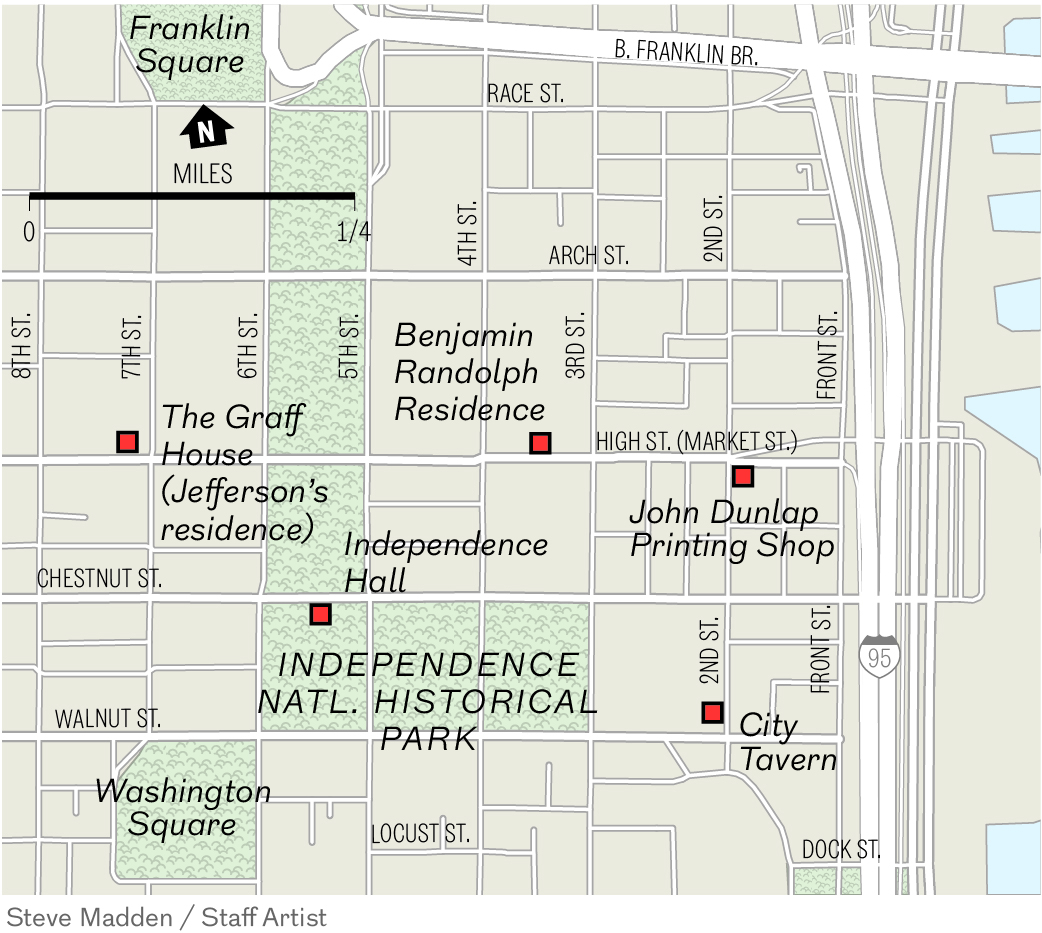
John Dunlap, 29, an immigrant from Northern Ireland who operates a printing shop at Second and High Streets, a short stroll from the Pennsylvania State House, where the rebels conspire, has watched with keen attention the epochal events of the preceding days.
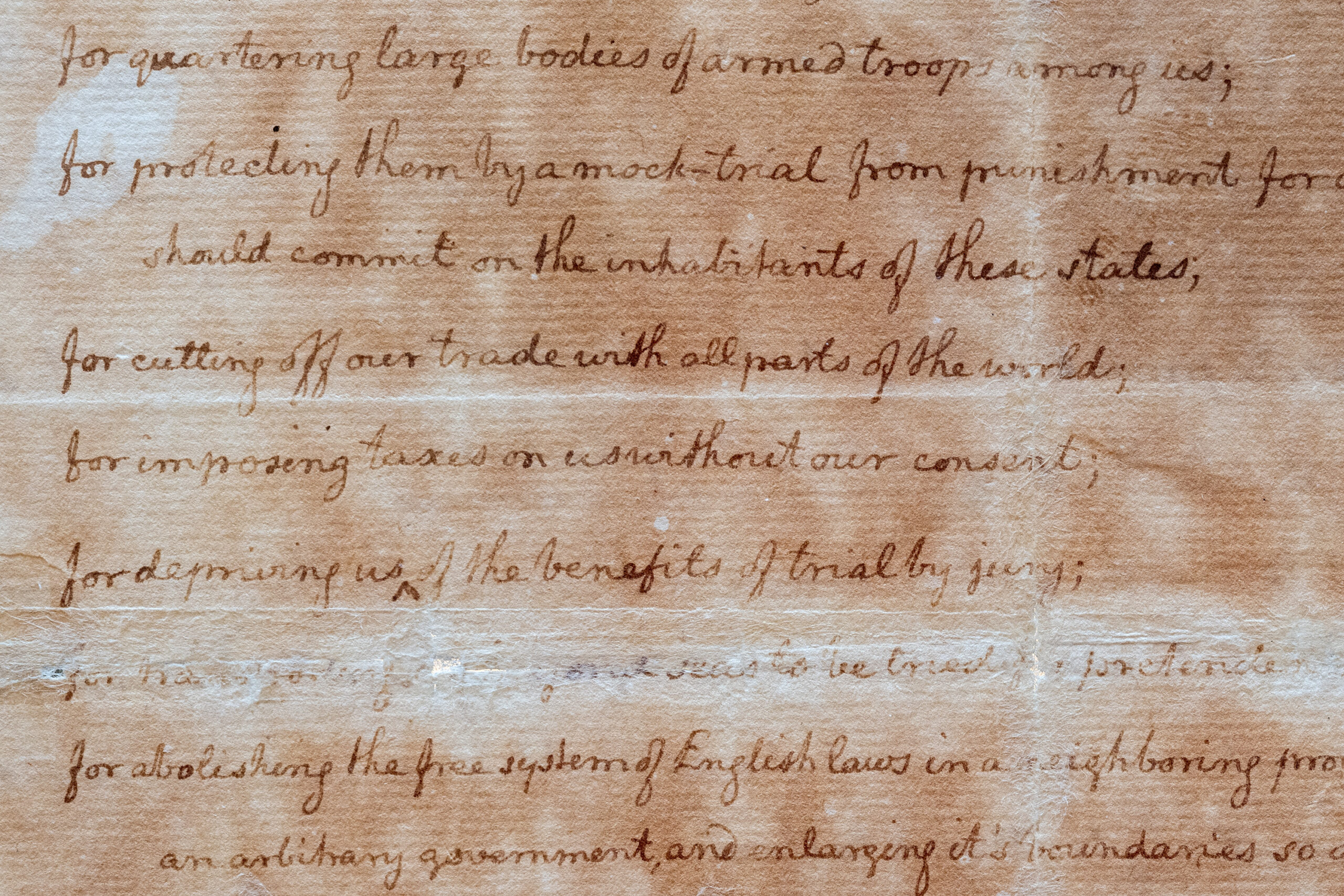
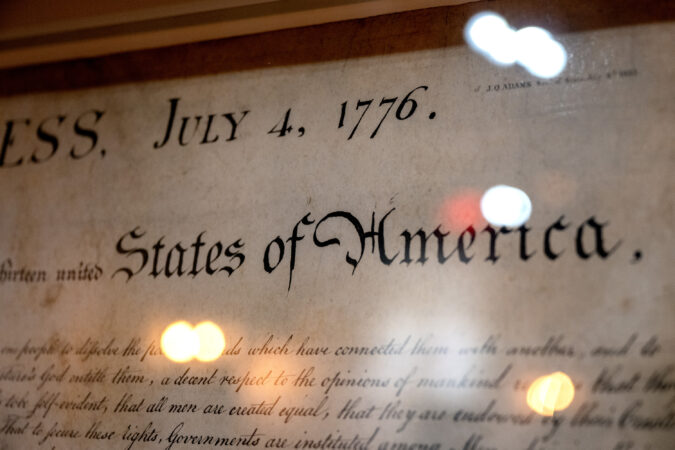
A faded copy of a draft of the Declaration of Independence handwritten by Thomas Jefferson.
The exultant patriots and curiosity seekers who braved suffocating summer heat to stand watch outside the State House on July 1, when the 56 delegates of the Second Continental Congress finally commence their locked-door debate on independence. The rapture that seems to ring out from every Philly tavern and tippling joint, coffee house, and street corner on July 2, when word that Congress voted to sever ties with King George III spreads through America’s largest and wealthiest city, like a bolt from one of Dr. Franklin’s electricity experiments. The joy. Hope.
And now, as an unusually mild morning gives way to rain-laden clouds, Philadelphia holds its breath upon the brink of a mighty happening.
Cloistered inside their chambers, the delegates fiercely debate and painstakingly parse Thomas Jefferson’s draft of America’s founding creed. Its passage will formalize independence.
The ink-stained Irishman with the whipcord build of a jockey prepares the shop for the Herculean task he knows is coming. The delegates will desire to thunder out the news of American independence before the iron gall ink even dries on the Dutch paper. John Hancock, 40, charismatic president of the Congress, will want as many broadsides as Dunlap can muster by dawn. Printing broadsides by hand in sweltering, trembling candlelight — meticulously setting the type, carefully rolling the ink, and pulling the heavy presses — is messy, demanding work, the hardened printer knows. He’ll plan to toil until morning’s light.
Outside, citizens collect in High Street. Soon, the print shop door pushes open. A man, his face obscured by the sun, darkens the doorway. He holds something close. A rag paper manuscript written in fine hand, still wet from fresh changes, and borne by delicate hand to the expectant printer. Words upon which a nation now rests. A declaration.
At the Second Street boarding house of Mrs. Sarah Yard, John Adams, 40, awakes before dawn. The unyielding lawyer and farmer from Massachusetts has become accustomed to the city’s morning clarion cry of crowing roosters, ringing bells, clanking ships, and cursing sailors. But not its heat.
Behold this atlas of independence at his breaking point. Exhausted. Homesick. Hot. Beyond cantankerous that any rational being could yet flinch at the surety and necessity of American independence. For weeks, Adams answers angry letters from citizens demanding to know why Congress stalls.
“The only question is concerning the proper time for making a specific declaration in words,” Adams writes, barely concealing his own impatience. “But remember you can’t make thirteen clocks strike precisely alike at the same second.”
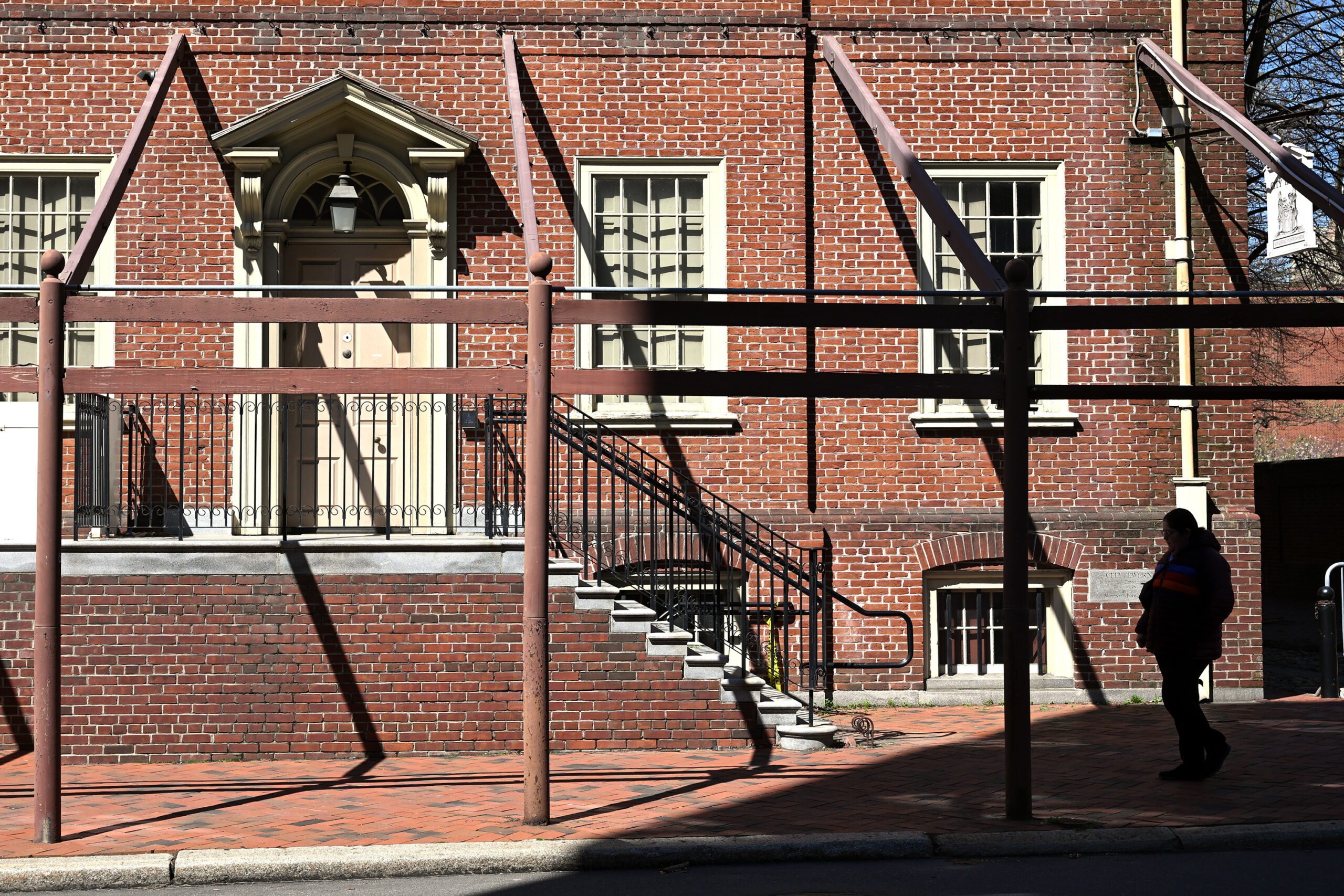
John Adams and his cousin, Samuel, shared a boarding house near the City Tavern in July 1776. This reconstruction of the original tavern was built in 1975.
For nearly two years, John Adams has fought for liberty like a bruising prizefighter, while his less refined older cousin, Samuel, 53, conducts a campaign of persuasion in the shadows. No one has done more than John Adams for independence. On this morning, John Adams dresses in the twilight, wishing that he had been blessed with the graces and gifts of ancient orators.
“This morning is assigned the greatest debate of all,” Adams writes before leaving for the State House. “A declaration, that these colonies are free and independent states, has been reported by a committee some weeks ago for that purpose, and this day or tomorrow is to determine its fate. May heaven prosper this newborn republic.”
At 9 a.m. on July 1, 1776, Andrew McNair, old and gray bellman of the State House, pulls shut the chamber’s heavy doors. Hancock gavels history to order.
In the silence, rises Pennsylvania’s reluctant rebel, John Dickinson. His writings once rallied American farmers against British taxes. Now, ghostly and gaunt from illness, he remains a dogged dissenter against independence. Summoning his strength, he abides his conscience, arguing America is not yet ready.
To proceed with a declaration during an uncertain struggle would be “to brave the storm in a skiff made of paper,” he tells his colleagues, before sitting.
Outside, the heat breaks. Rain beats against the chamber’s tall windows. Thunder booms. Lightning flashes.
Adams stands. He speaks over the stormy din. His precise words are lost to posterity. He speaks for two hours. John Adams moves men.
Adams speaks “with a power of thought and expression that moves us from our seats,” Jefferson, remaining characteristically mum at his table, will later recall.
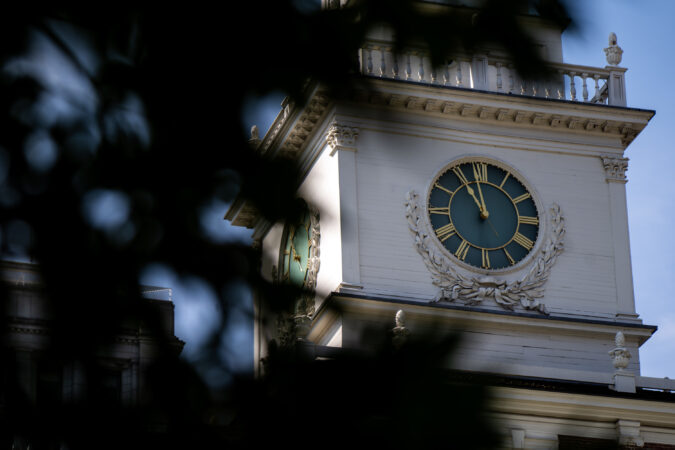
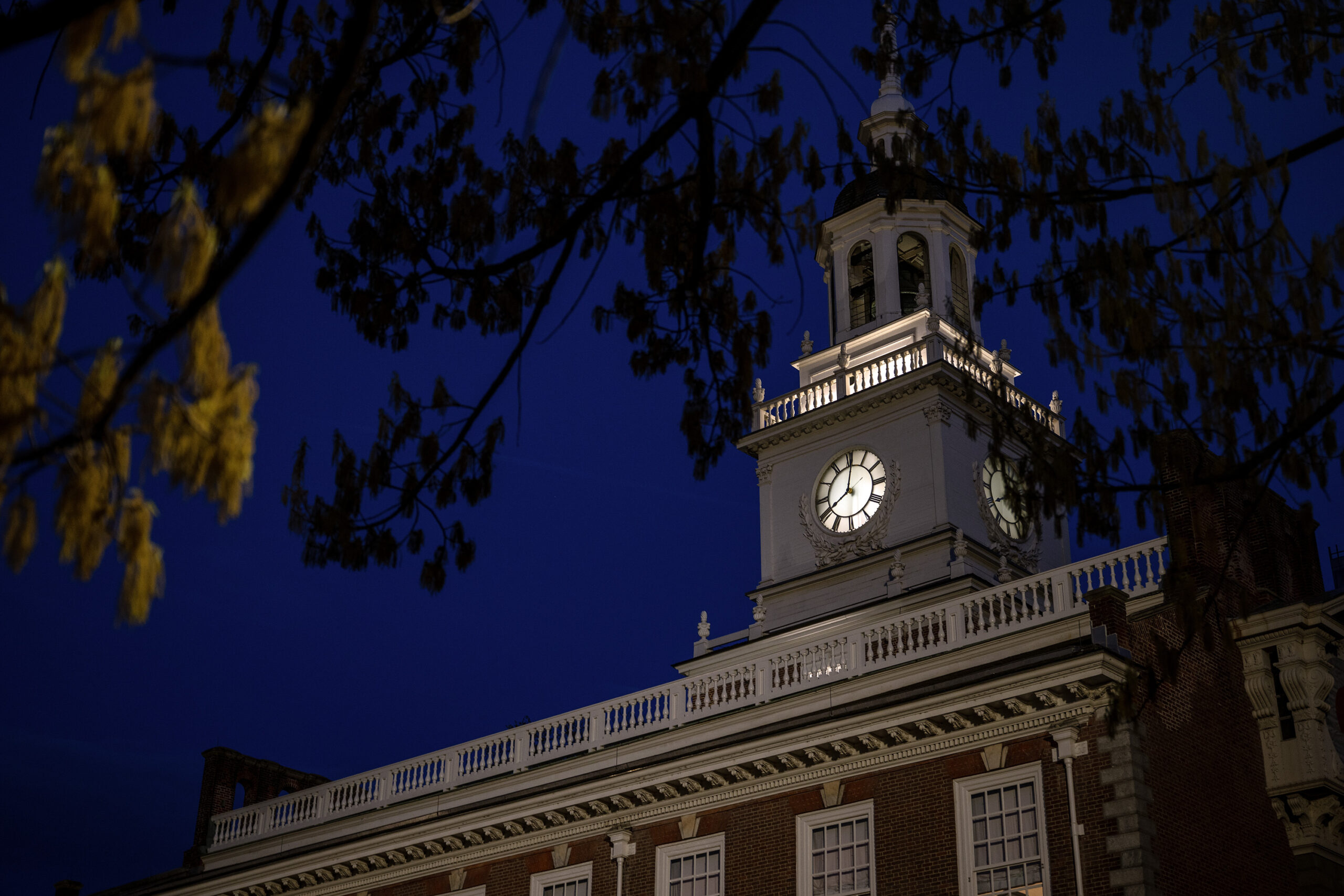
Recreating the daily hub of the Revolutionary City in 1776. You can hear the cannons from the bell tower of the Pennsylvania State House at Sixth and Chestnut Streets, where the rebels conspire. Now, it’s Independence Hall, photographed April 14, 2026.
A preliminary vote is taken by candlelight. Despite popular opinion, four colonies — including four members of Pennsylvania’s critical seven-man delegation — vote no.
Late into the night, at the City Tavern, the delegates drink upon tenterhooks.
July 2, 1776
The second day of debate begins with a prosperous portent. Caesar Rodney, of Delaware, mud-splattered boots and spurs, arms akimbo, bursts in before the doors to Congress close. The gravely ill delegate rode 80 miles through the tempest to cast his vote for independence.
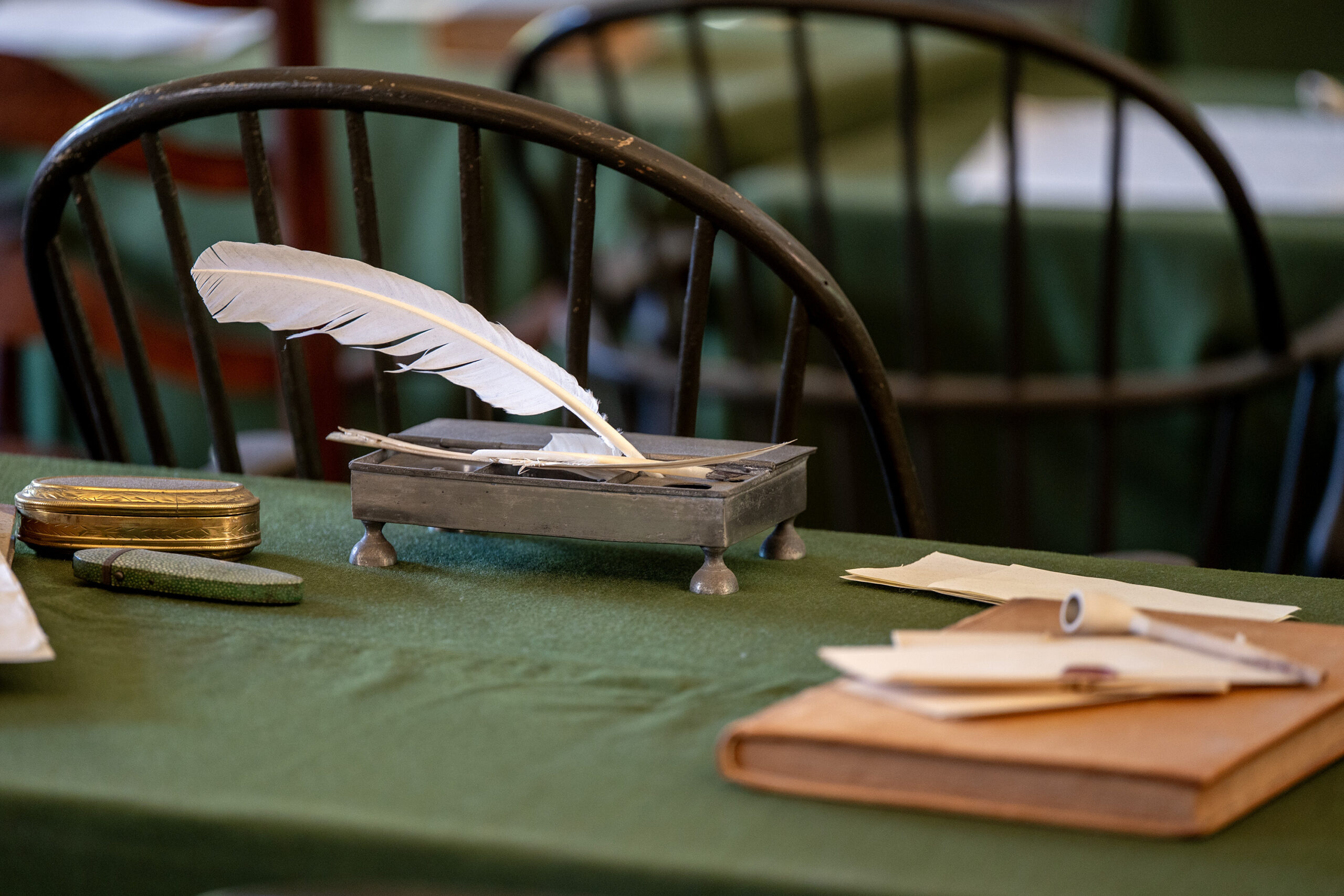
Replica desks in the Assembly Room in Independence Hall, known as the Pennsylvania State House in 1776. This is the exact space where the Second Continental Congress met and the Declaration of Independence was adopted.
Better still are the two conspicuously empty chairs at the Pennsylvania table. Unable to vote for independence, but unwilling to thwart unanimity, Dickinson and fellow delegate, Robert Morris, voluntarily abstain. Despite his feelings, Dickinson will soon join the rebel militia — to fight for his country.
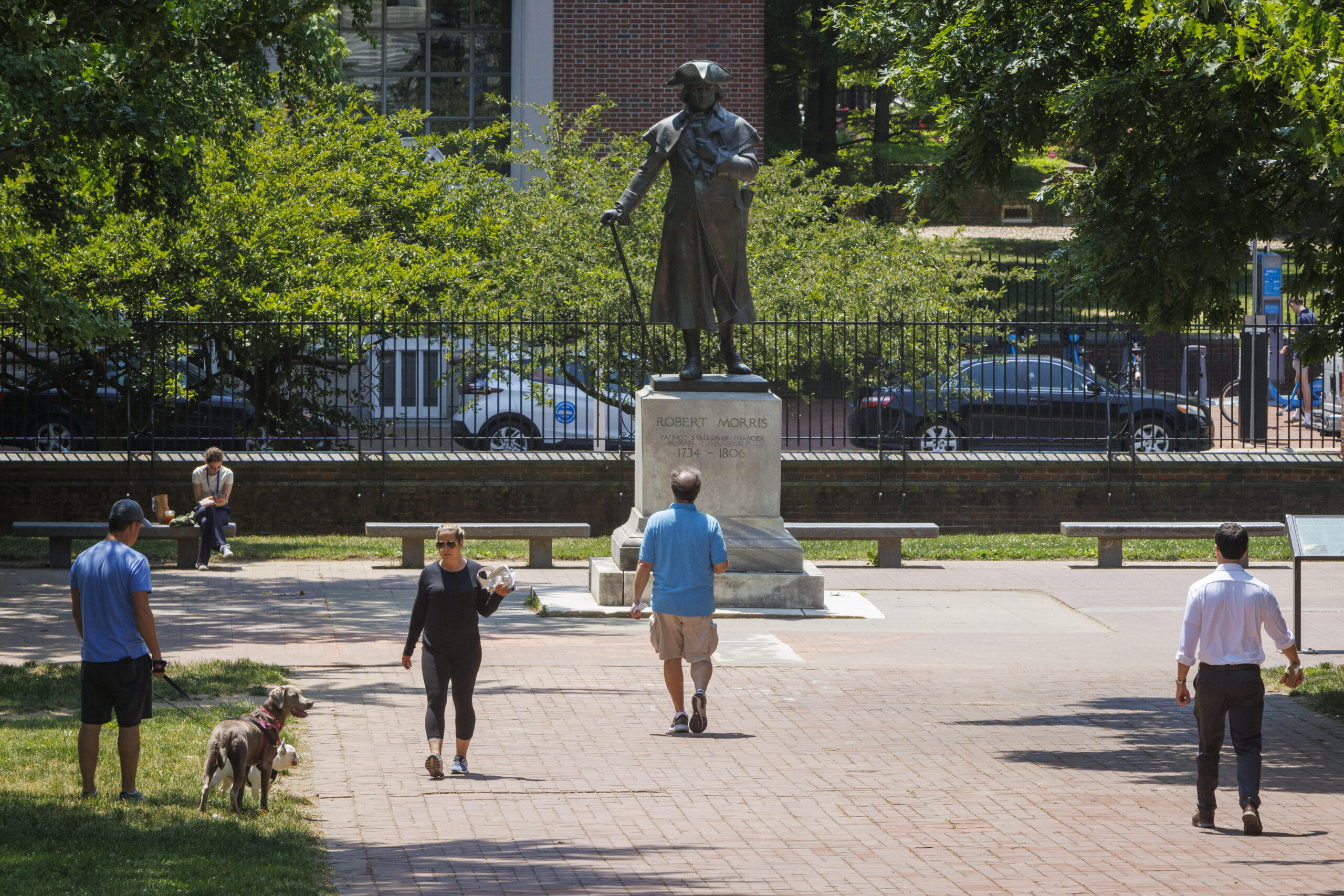
The statue of Robert Morris in Independence National Historical Park on May 31, 2023.
Again, the skies open up, raindrops drumming upon the glass.
With New York abstaining — and Pennsylvania swinging toward independence — the vote goes quick.
It is done.
Independence.
July 3, 1776
The Congress continues without a break.
Days earlier, before handing in his draft of the Declaration of Independence, Thomas Jefferson turned to Benjamin Franklin for one last look.
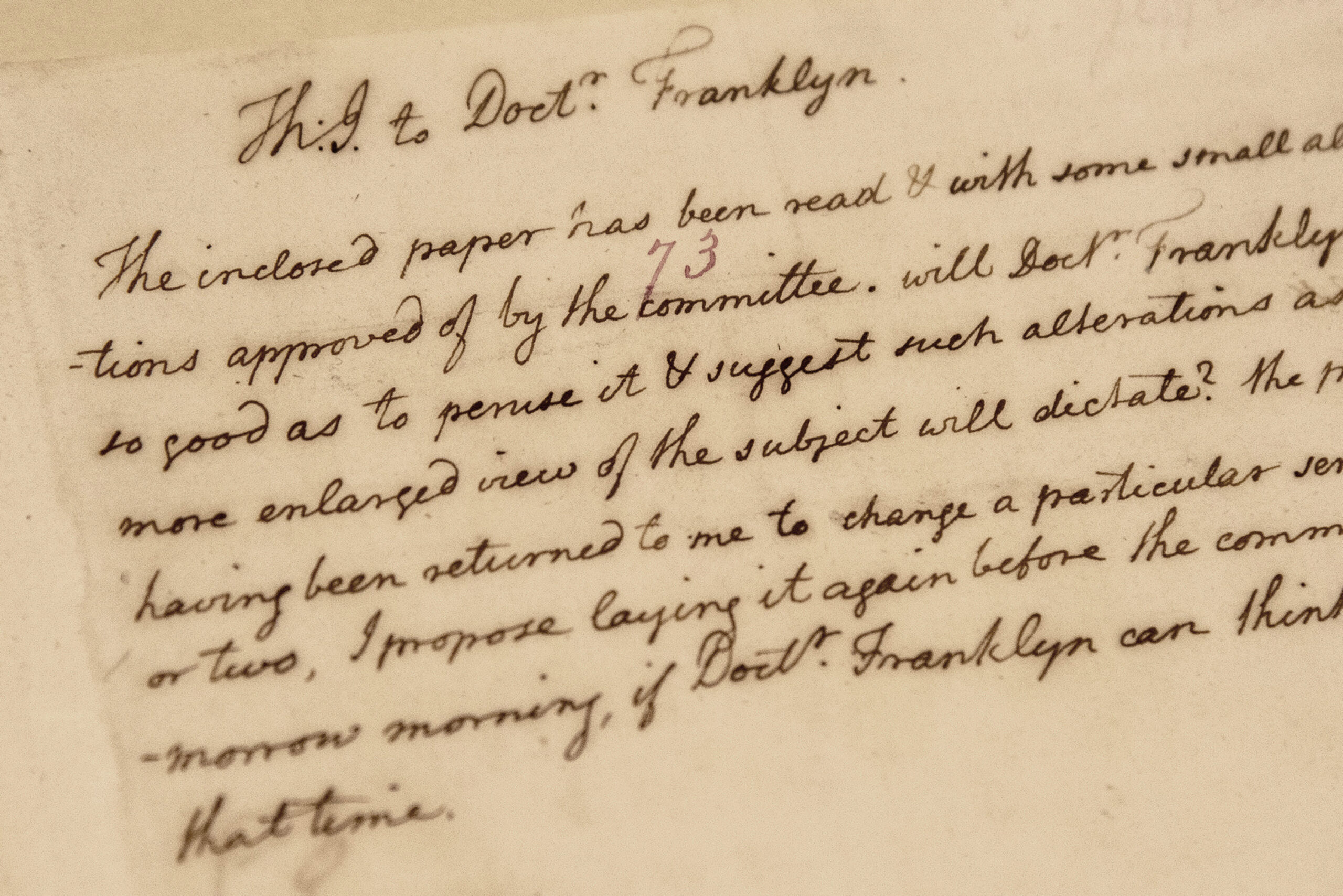
A letter from Thomas Jefferson to “Doct. Franklyn” (Benjamin Franklin) in June 1776 asking for suggestions on the Declaration of Independence.
“Will Doctr. Franklyn be so good as to peruse it and suggest such alterations as his more enlarged view of the subject will dictate?” Jefferson inquires, in a note delivered to the silver-haired statesman’s High Street home.
It’s Franklin, sly satirist, homespun philosopher — grand auteur of America’s self-made aura — who possibly suggests, the inspiring “self-evident” phrasing, replacing Jefferson’s initial “sacred and undeniable truths.”
And it is Franklin, 70, spectacled lion of liberty, sage of Philadelphia, tamer of lightning, dean of American charm and wit, wooer of women, broad of bow and frame, portly of paunch and plain of coat, a winsome spark dancing across his gray-blue eyes, who comforts the young writer as delegates slash away at his declaration. The winking newspaperman unspools a tale about an enterprising hatmaker who wishes to advertise his wares. By the time the hatter’s friends finish their edits, all that remains is the man’s name, and a photo of a hat, Franklin jokes.
The delegates trim Jefferson’s harsher language about King George. They excise completely his evisceration of the slave trade. Jefferson does not publicly protest.
July 4, 1776
At 11 a.m., debate is closed.
The moment will eventually be memorialized in painting. The towering trio — Adams, Jefferson, Franklin — presenting America’s credo for approval. Imagine them, these Founding Fathers. These imperfect men for the ages who hazard everything to chance a republic, and change a world.
There is little ceremony. Horseflies from a nearby stable buzz. One after another, a chorus of “Ayes.”
Delegates break the tension with gallows humor about whose necks will snap the swiftest.
History does not record the face of the man who darkens the doorway of John Dunlap’s print shop. Perhaps it was Adams, unable to yield his obsession even in its ultimate realization. Perhaps, it was Franklin, delivering the declaration with a deliciously wry aphorism. Or Jefferson, solemn and silent with the weight of his words.
Dunlap works all night to the thumping groan of the presses. By morning, roughly 200 broadsides start to spread America’s newly minted founding document far beyond Philadelphia. Breathless riders herald the news in town squares.
In the trenches in New York, Washington orders the declaration read aloud. Bells ring. Troops parade. Bonfires alight. Candles burn. Prayers are whispered, for those sons and fathers who will die in the bloody conflict ahead.
By July 6, the Pennsylvania Evening Post, a paper published near Dunlap’s shop, prints the declaration word for word. Its previous issue had been put to press too early to capture the momentous events.
Instead, the July 4, 1776 edition included usual fare.
“To be sold,” read one back-page ad. “A NEGRO BOY, about four or five years of age.”
Crowds pack the State House yard, where the rebels had long conspired. A military officer reads the manifesto to the hushed masses.
Words that birth the American experiment on an ideal — and the sin of slavery. Words that will endure Civil War and oppression. Words that beckon centuries of American promise and possibility, triumph and failure. Words that inspire new revolutions, new freedoms, new fights. Words that transform. Words that twist. Words that promise a pursuit of happiness — but withhold so much from so many. Words that stand tested still.
Words written in Philadelphia.
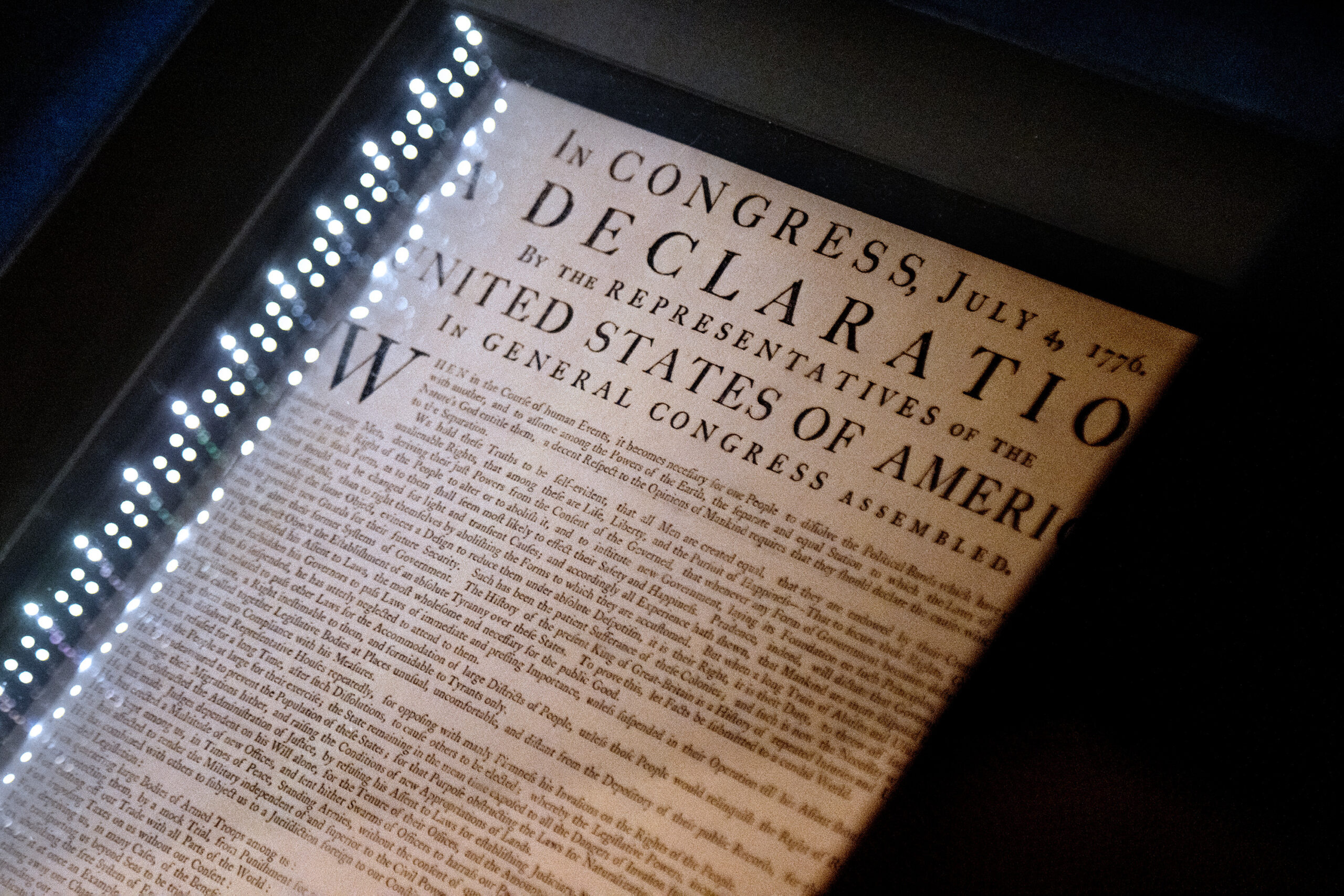
An original broadside copy of the Declaration of Independence printed by John Dunlap on display in the “Great Essentials” exhibit in the West Wing of Independence Hall on July 29, 2025.
It’s a common sound in Philadelphia’s historic district during the summer. I was photographing tourists in front of Independence Hall on Wednesday when the beat of a single snare drum a block away achieved its intended purpose.
Just like when the fife and drum corps would relay tactical commands over the noise of the battlefield, or regulate a soldier’s daily routine, I stopped what I was going and headed in the direction of the beating pulse.
It was coming from the normally quiet Signer’s Garden pocket park, across 5th Street.
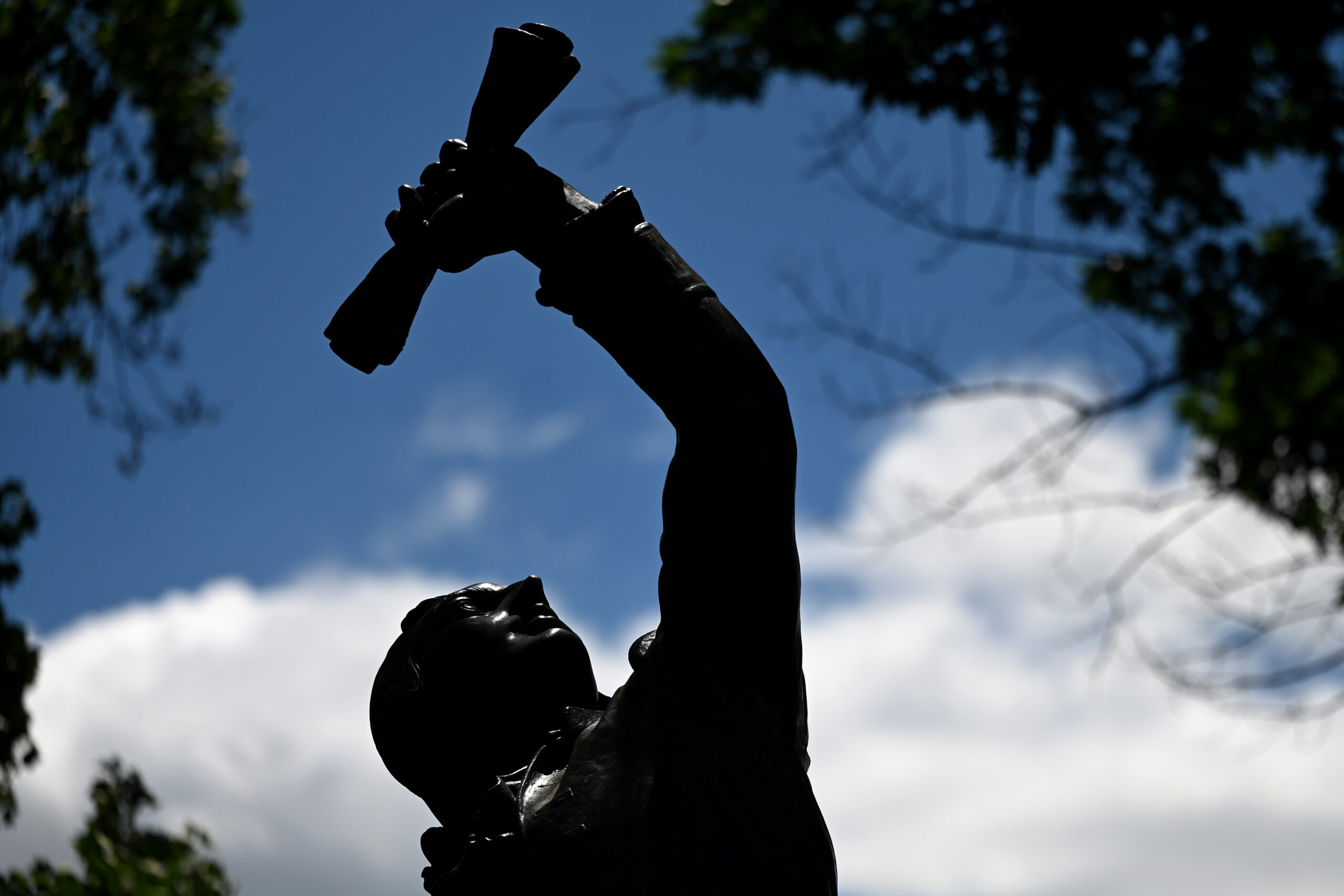
I had intended to go there anyway to photograph the statue — “The Signer” — as I am working with present-day descendants of the signers of the Declaration of Independence on a photo essay that will be posted online this Fourth of July weekend.
The statue was inspired by George Clymer, a Philadelphia merchant, statesman, and signer of both the Declaration of Independence and the U.S. Constitution. A National Park Service plaque at the entrance reads “it commemorates the courage of those who altered their lives, and ours, by affixing their names to these documents.”
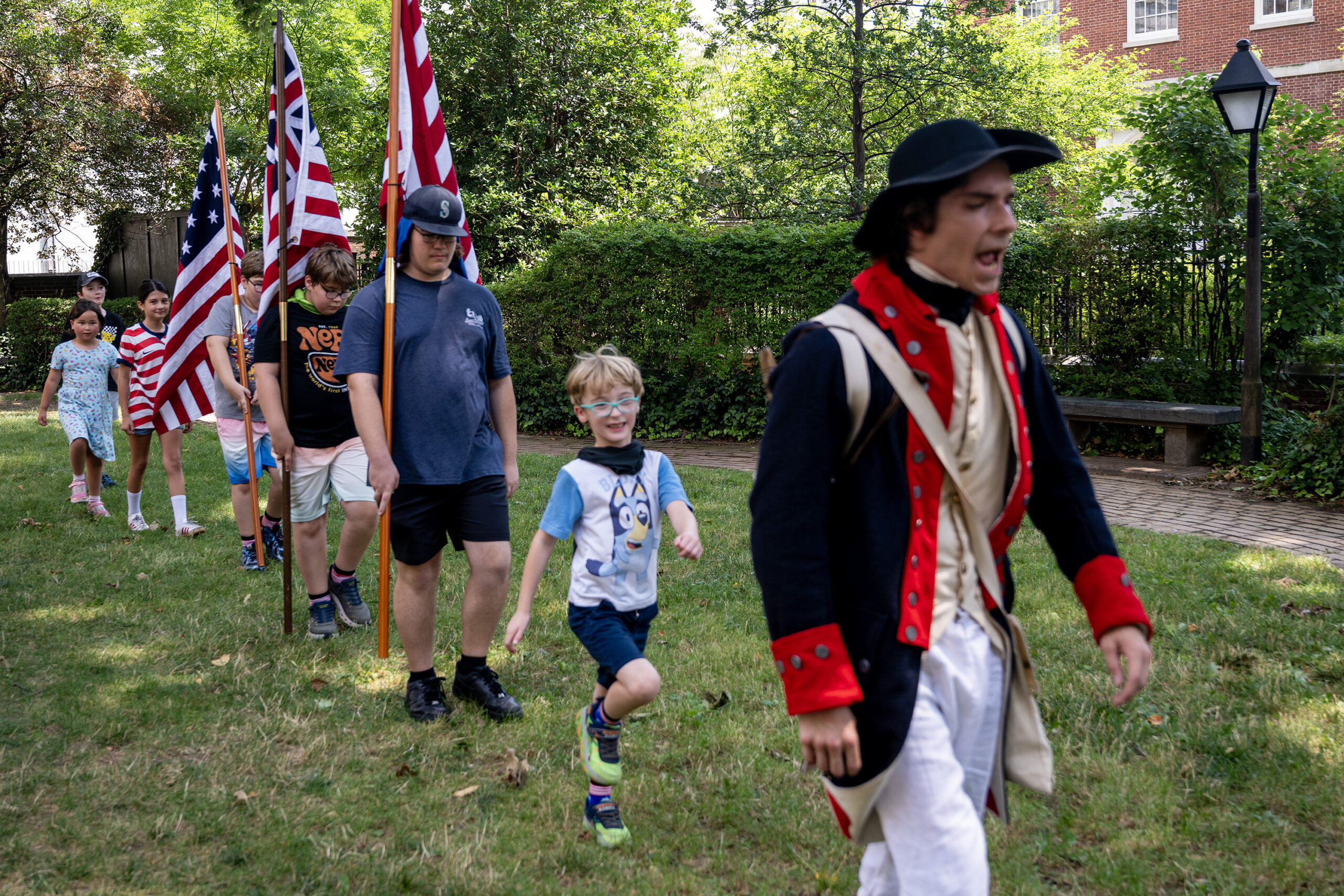
The drum was mustering holiday week visitors for a presentation by two costumed actors from Historic Philadelphia portraying continental soldiers. I watched as the tourists watched them “draft” youngsters into their performance and found myself smiling more than once at how they engaged the kids — and the rest of us in the crowd — with some of their one-liners.
Historic Philadelphia actor Lane Norris portraying Continental soldier Conrad Frye leads a contingent of young tourists in Independence National Historical Park Wednesday, July 1, 2026.
Did I say, smile? I might have had a slightly more sentimental reaction. I have written before that Independence Day has always been my favorite holiday. My dad, who passed away a few years ago, was born on the Fourth of July.
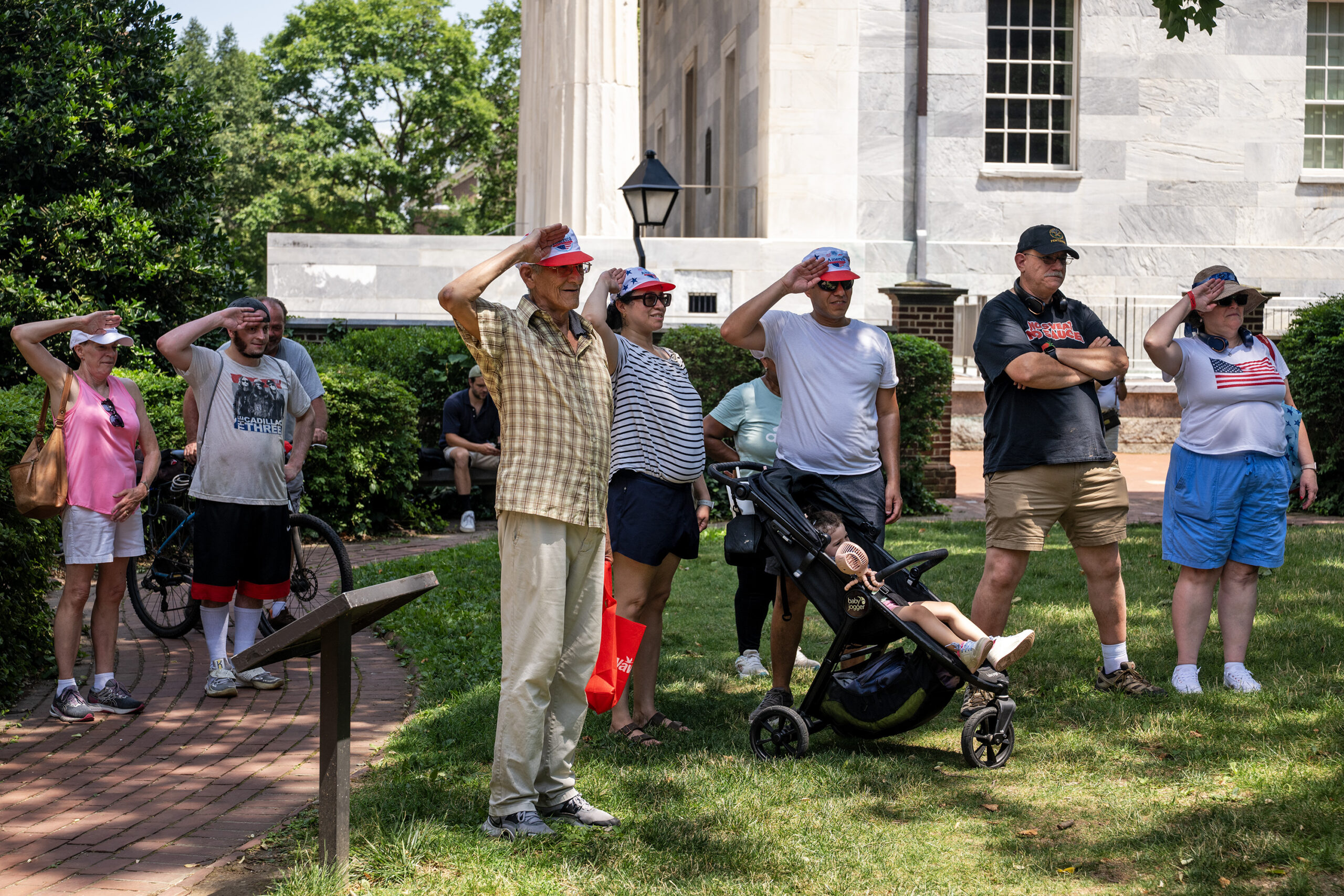
As I looked around at the crowd I could tell everyone else was also getting into the interactive and engaging program. I photographed saluting adults who I assumed were parents, mirroring the actions of their kids doing the marching drills.
Afterward, I learned they weren’t. They had a toddler still in a stroller. They were immigrants from Venezuela, and just happy to be here. Like me.
We’re still in the middle of Philly’s celebration of America’s 250th birthday (with canceled events in a declared heat emergency with 100-plus degree temperatures!). Here are more of my Fourth of July photos and those of my colleagues:
Since 1998 a black-and-white photo has appeared every Monday in staff photographer Tom Gralish’s “Scene Through the Lens” photo column in the print editions of The Inquirer’s local news section. Here are the most recent, in color:
Happy 250th, America! We’ll show you a July Fourth-themed photo taken in the Philly-area, you drop a pin where you think it was taken. Closer to the location results in a better score. Good luck!
Round #40
Question 1
Where are these fireworks?
Loading…
ClickTap on map to guess the location in the photo
ClickTap again to change your guess and hit submit when you're happy
You will be scored at the end. The closer to the location the better the score
Charles Fox / Staff Photographer
Pretty good/Not bad/Way off! Your guess was from the location.Spot on! Your guess was exactly at the location. Here's also where a random selection of Inquirer readers guessed.
Fireworks over the Philadelphia Museum of Art and the statue of George Washington at Eakins Oval during the Wawa Welcome America Festival on July 4, 2023.
Quiz continues after ad
Question 2
Where is this crowd?
Loading…
David Maialetti/ Staff Photographer
Pretty good/Not bad/Way off! Your guess was from the location.Spot on! Your guess was exactly at the location. Here's also where a random selection of Inquirer readers guessed.
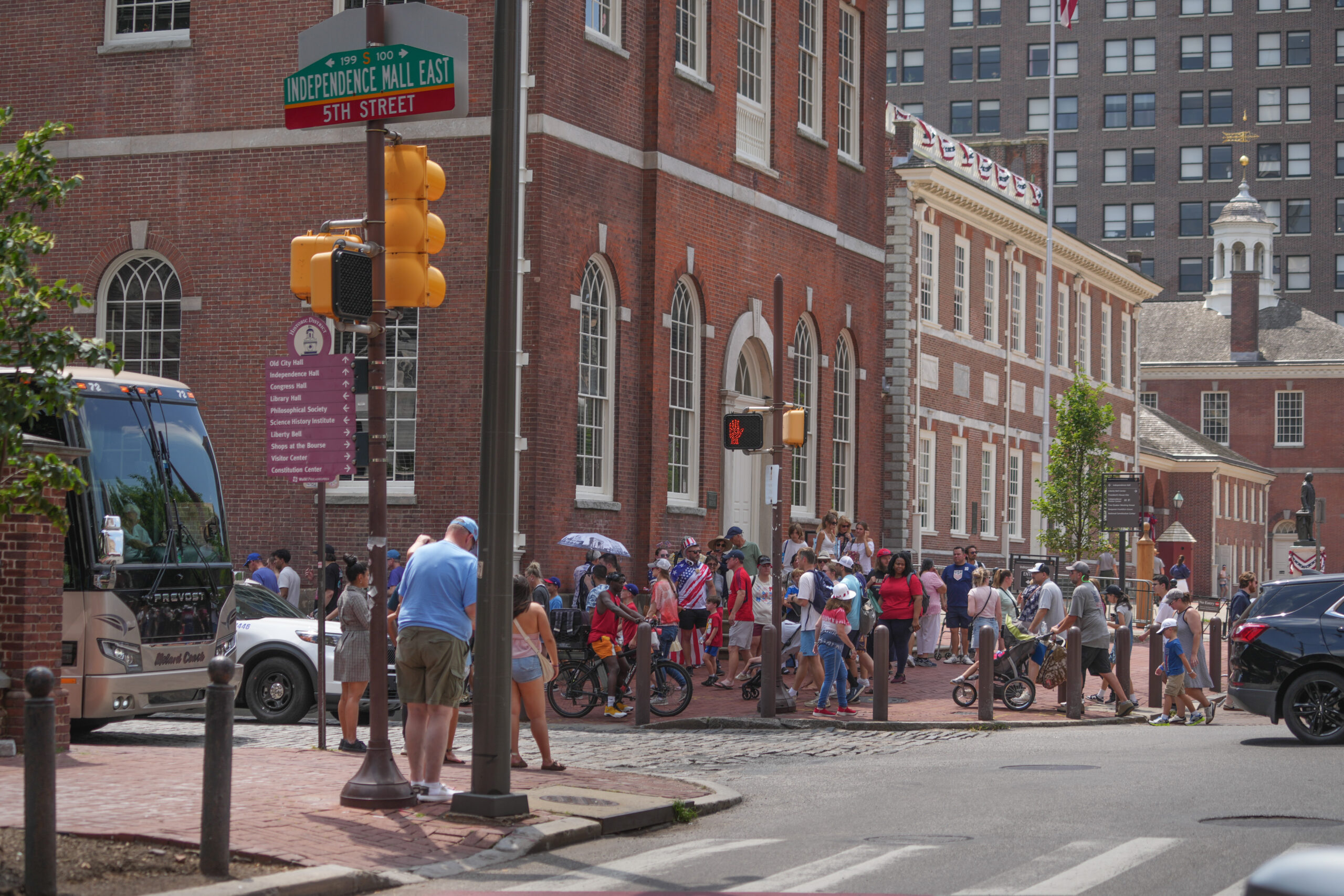
The crowd gathered at Independence Hall is seen through the “O” in the OY/YO sculpture across the street during the Wawa Welcome America Salute to Independence Day Parade on July 4, 2023.
Quiz continues after ad
Question 3
Where is this ceremony?
Loading…
Tyger Williams / Staff Photographer
Pretty good/Not bad/Way off! Your guess was from the location.Spot on! Your guess was exactly at the location. Here's also where a random selection of Inquirer readers guessed.
Thirteen Immigrants are sworn in as American citizens at the Betsy Ross House on July 15, 2021.
Your Score
ARank
🇺🇸 Amazing work. A star-spangled success.
BRank
📜 Good stuff. Your knowledge is self-evident.
CRank
📝 C is respectable, but you might need a few amendments.
DRank
🗽 D isn’t great. Life, Liberty, and the pursuit of improvement.
FRank
🪶 We don’t want to say you failed, but maybe back to the drafting board.
You beat % of other Inquirer readers.
We’ll be back next Saturday for another round of Citywide Quest.
With Philadelphia’s final World Cup game Saturday, the city’s international soccer tourists, who have created generational memories for weeks here, will be heading home.
And there’s no better place in the world to celebrate fandom than in Philly, said Côte d’Ivoire-born Philadelphian Ahmadou Dia, who moved to the city a decade ago.
“This is wonderful for Philadelphia and wonderful for America, welcoming everybody into this beautiful country,” Dia said. “The World Cup, the football itself, brings every country, every single person, together regardless of color. It doesn’t matter what you look like, because on the field or in that stadium, we’re family.”
The World Cup is one of those global events where fans save thousands of dollars for years to make their way across the world to watch their favorite team.
Ecuadorian native Francisca Castellanos traveled 14 hours to meet her father and other family in Quito, before heading to Philadelphia in time for the World Cup. Her father, Francisco, has attended the last 10 World Cup tournaments, including the 2022 World Cup in Qatar. When the United States was announced as a World Cup host, the Castellanoses were overjoyed.
“A World Cup in the U.S is a lot more accessible to Ecuadorians because a lot of our population already lives in the U.S., and the currency is the same,” Castellanos said. “There is also language accessibility because people speak English here, unlike in Qatar, where communication was harder.”
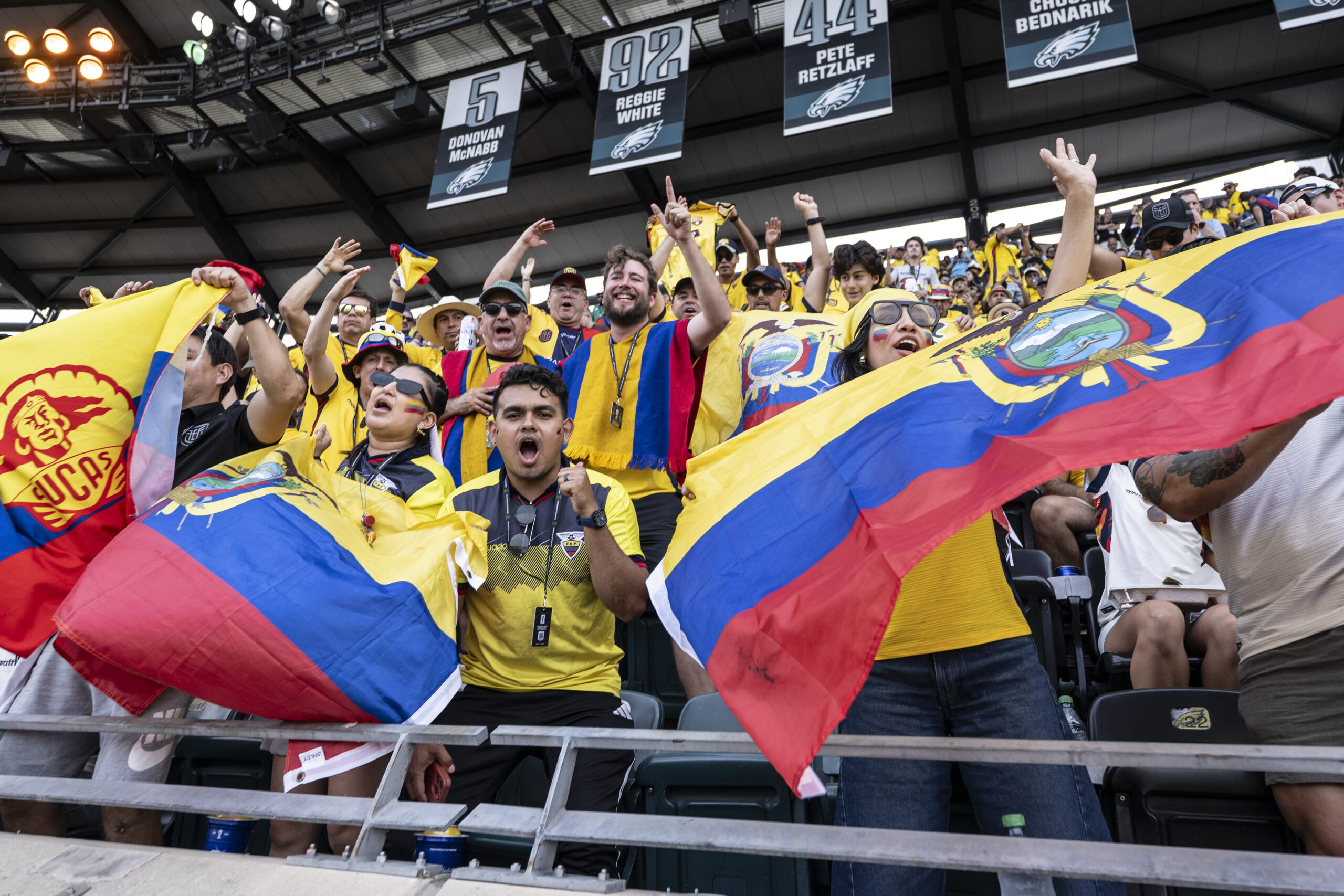
Ecuador national team fans cheer during the national anthems before the FIFA World Cup Group E match between Ecuador and Côte d’Ivoire on June 14, 2026, at Lincoln Financial Field in Philadelphia. The match marked the first FIFA World Cup game played in Philadelphia.
The six matches played in Philadelphia brought tourists from Brazil, Côte d’Ivoire, Croatia, Curaçao, Ecuador, France, Ghana, Haiti, and Iraq, but where Philly’s World Cup and America’s 250th tourists are coming from spans the globe.
Fraser McNaughton, a Scot visiting Philadelphia with family, couldn’t believe how inviting Philadelphians have been as he took photos with the Rocky statue last week.
“Everywhere we’ve went, everyone’s been so friendly, so welcoming, helping us out when we need it,” McNaughton said. “It’s just a brilliant city.”
“They go out of their way to say ‘Hello’ or ‘Welcome to Philly’ here,” said fellow Scot Michelle Thomson. “We’ve really loved it.”
Here are the main takeaways, based on flight data shared by Sojern,a hospitality marketing platform that provides travel data to hotels, airlines, and tourism boards.
(function () {window.addEventListener(‘message’, function (e) { var message = e.data; var els = document.querySelectorAll(‘iframe[src*=”‘ + message.id + ‘”]’); els.forEach(function(el) { el.style.height = message.height + ‘px’; }); }, false); })();
Ecuadorian travelers surged this World Cup
Ecuadorians don’t make up a sizable chunk of the international travelers coming to Philadelphia this summer. Canada, the United Kingdom, and Italy take that crown, in that order.
However, Ecuadorian travelers, like the Castellanoses, were so pumped to experience a World Cup in person that the number of flights booked from Ecuador to Philadelphia surged by 622% compared to the year prior. Philadelphia hosted Ecuador’s first group match in the World Cup, convincing many Ecuadorians to make the 2,760-mile trip to the City of Brotherly Love.
“It was the first game for Ecuador, so a lot of the Ecuadorians from Ecuador and the U.S. had to be here because there was a lot of expectation,” Carrión said.
To the Ecuadorian-American who lives in New York, the influx of people was facilitated by an ease of travel between the South American country and the U.S.
“It’s easier for us to travel to the States than to Europe or Qatar,” Carrión said. “And there are direct flights to LaGuardia and New York.”
Ecuadorians require visas to enter Europe, Canada, and the United States. Even traveling to Mexico can involve visa procedures if they don’t have a U.S. visa first, a formality that has become more complex since Ecuador and Mexico broke international relationships in 2024, Carrión said.
(function(){function e(){window.addEventListener(`message`,function(e){if(e.data[`datawrapper-height`]!==void 0){var t=document.querySelectorAll(`iframe`);for(var n in e.data[`datawrapper-height`])for(var r=0,i;i=t[r];r++)if(i.contentWindow===e.source){var a=e.data[`datawrapper-height`][n]+`px`;i.style.height=a}}})}e()})();
Dutch Caribbean islands show up for Curaçao
The small autonomous nations of Curaçao, Aruba, and Sint Maarten, all part of the Kingdom of the Netherlands, have seen a huge surge in flights this summer.
Curaçao had the largest increase, almost 240%, despite being the smallest nation ever, with a population of 158,006 people, to qualify for the FIFA World Cup.
“When we won tickets through the FIFA lottery for the Curaçao versus Ivory Coast in Philadelphia, we knew we had to make it happen, especially since the Curaçao match falls on my husband’s birthday,” said Vanessa Santine-Vinck, who traveled here from Curaçao with her partner and two sons.
Travel from Sint Maarten and Aruba are also up — 193% and 117% respectively.
Croatia and Hungary aren’t missing Philly’s World Cup
Croatia claimed victory over Ghana at Philadelphia Stadium on June 27, and flights from the European country have jumped almost 100%.
Neighboring Hungary has also seen a dramatic increase. There are almost 200% more flights from Hungary this summer than last summer.
Dominican Republic shows steady growth
Philadelphia’s Dominican community has grown in recent years, helping drive population growth in the city.
With the World Cup in Philly this summer, travel from the Caribbean nation has increased 34%. While DR is not in the World Cup, their neighbor, Haiti, faced Brazil on June 19, losing 3-0.
Philly’s French connection brings throngs of tourists
This summer has brought a notable uptick in French tourism to Philadelphia, with 33% more flights. The cross-cultural connection runs deep, Parisian aesthetics have long influenced the city’s architecture.
Throngs of Francophones across the city cheered on their national team to a 3-0 victory against Iraq on June 22.
(function(){function e(){window.addEventListener(`message`,function(e){if(e.data[`datawrapper-height`]!==void 0){var t=document.querySelectorAll(`iframe`);for(var n in e.data[`datawrapper-height`])for(var r=0,i;i=t[r];r++)if(i.contentWindow===e.source){var a=e.data[`datawrapper-height`][n]+`px`;i.style.height=a}}})}e()})();
France also ranks fourth in terms of total foreign travel this summer after Canada, the U.K.I, and Italy. Between the architecture, the French cuisine, and the fact that two of his family’s favorite teams, France and Côte d’Ivoire, would play in Philadelphia, traveling to the city was an easy choice for Frenchman Elias Pierson.
He had already heard of the comparisons between the city and Paris, and as he walked through Independence Hall with his family last week, much of the architecture he saw reminded him of home.
“We have a good relationship with the people of Philadelphia. We were just in the train station with a Philadelphian, and she explained to us where we needed to go and where the best French restaurants are,” Pierson said. “My favorite part of Philadelphia so far is City Hall and Old City because of the very beautiful buildings.”
Now, before Pierson heads home, he said he hopes to get a coveted seat at Philly’s world-famous French bistro, Parc.
So The Inquirer’s Dugan Arnett, previously of the Boston Globe, went north to investigate. What followed was less a travel story and more a historical audit.
The Battle of Bunker Hill wasn’t actually fought on Bunker Hill. Plymouth Rock probably wasn’t where the Pilgrims first stepped ashore. Paul Revere never completed the ride he’s famous for. Even Ben Franklin’s grave turned out to be a replica. That’s a tough box score.
None of this is to say Boston isn’t one of America’s great historic cities. It is. The Freedom Trail is worth walking, and the city has every right to celebrate its place in the nation’s founding.
But if you’re going to challenge Philadelphia to a history contest, your greatest hits probably shouldn’t come with so many asterisks.
Meanwhile, Philadelphia is just over here with the Declaration of Independence, the Constitution, the Liberty Bell, Independence Hall, and enough actual founding history that Nicolas Cage based an entire movie around stealing it.
Philadelphia didn’t have to make a case for itself; Boston made it.
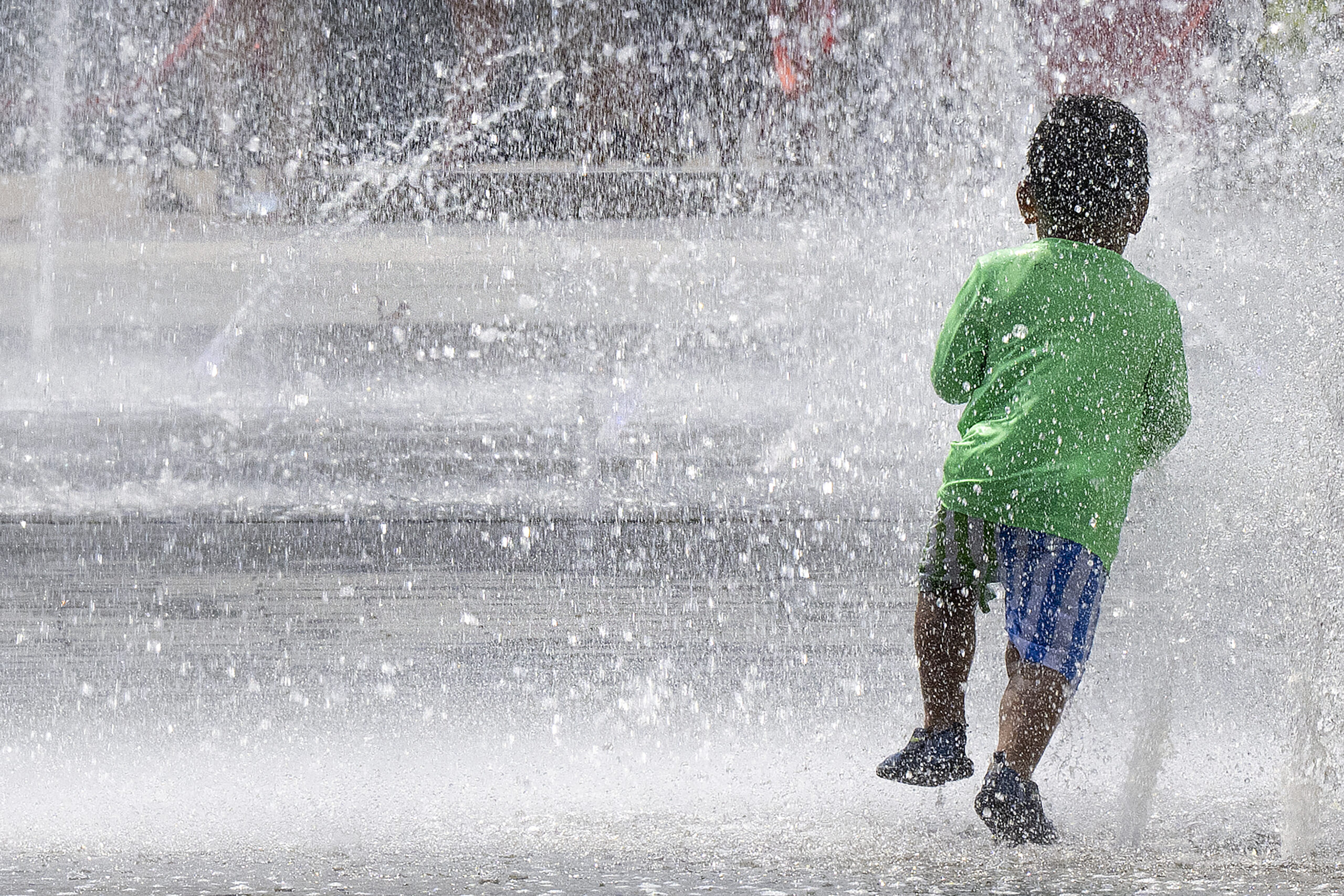
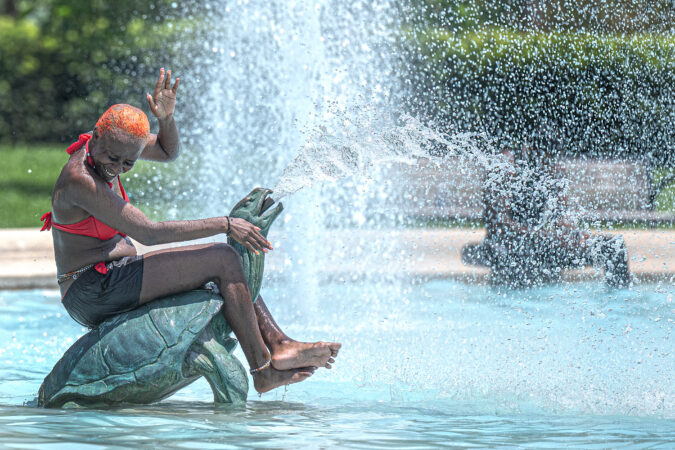
A young boy runs through the spray from the fountains at LOVE Park on a hot summer day on July 1. Temperatures are expected to break a bit Saturday into Sunday as the heat wave finally moves out of the region.
The Fourth of July heat: D-
If there were ever a week for Philadelphia to catch a break from the weather, this was it.
Philadelphia has spent years preparing for this once-in-a-generation celebration. The city can’t control the weather, but the weather doesn’t particularly care about 250 years of planning.
Hopefully, the forecast proves just pessimistic enough to keep everyone safe without putting too much of a damper on the festivities. Because nobody wants to spend America’s birthday wondering whether it’s too hot to light the grill.
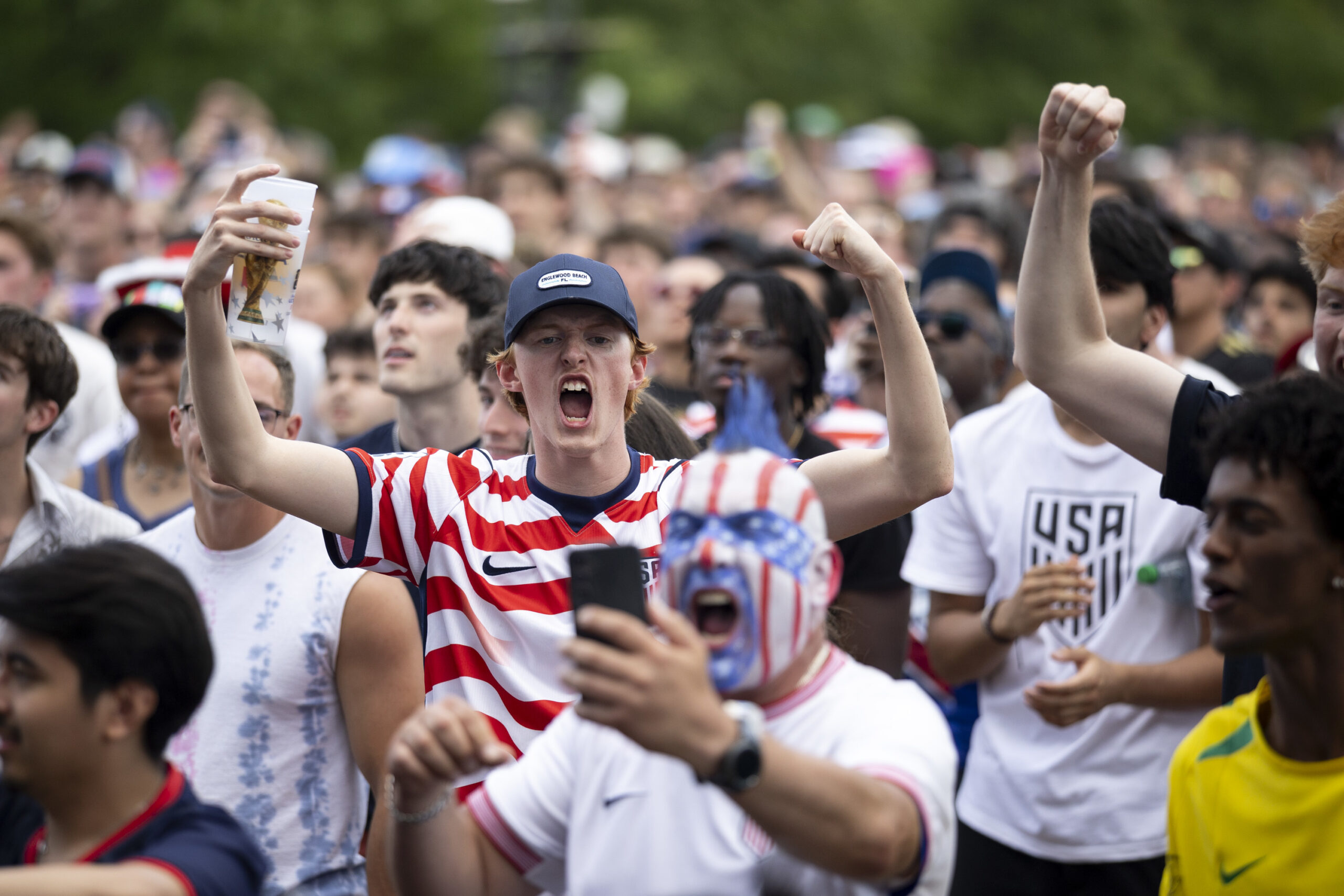
Cam Gorman, 23, of Gilbertsville, Montgomery County, cheers with Philly Sports Guy at the FIFA Fan Festival on June 19 as the USA beats Australia.
To be fair, Boston only ever planned to keep the festival open through the group stage. Meanwhile, we’re still going.
As the tournament moves into the knockout rounds, Philadelphia still has a Fan Festival, another World Cup match, and America’s 250th birthday celebration all packed into the same week.
So for one more week, Philadelphia still feels like the center of the soccer world.
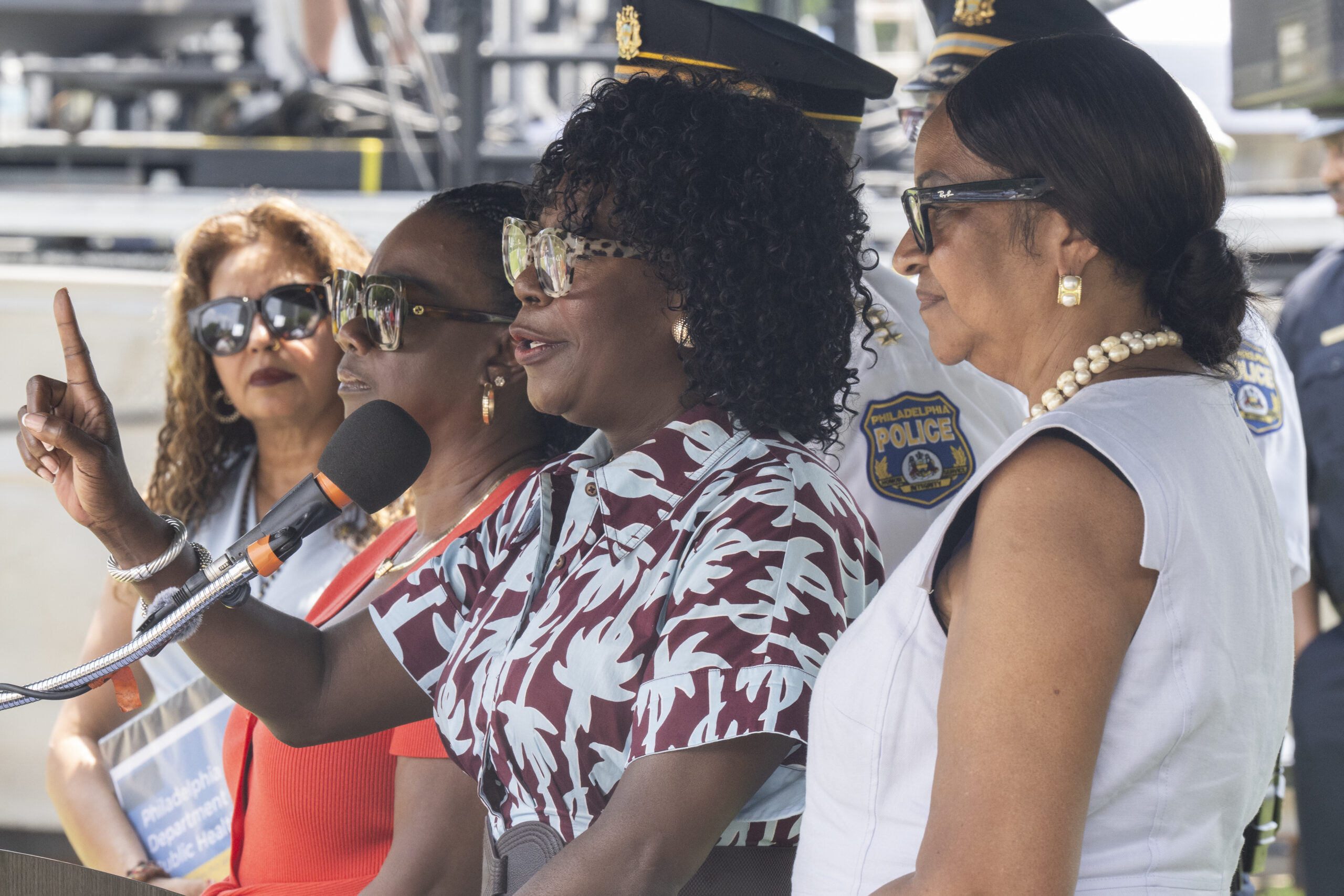
At a Wednesday news conference, Philadelphia Mayor Cherelle Parker outlines public safety and transportation plans for the July 4 concert expected to draw thousands to the Benjamin Franklin Parkway.
If it wasn’t broken: C-
Philadelphia didn’t need to reinvent its Fourth of July celebration.
You can spend years planning a wedding, but you can’t plan for 300 Croatian soccer fans.
A Philadelphia couple stepped outside City Hall for the classic wedding photos last week and instead found themselves in the middle of a sea of red-and-white checkered print, singing and dancing. The celebration quickly became one of the most joyful viral moments of the World Cup.
The funny part is that the newlyweds weren’t the ones who got crashed. They were the ones who accidentally wandered into Croatia’s party.
The fans serenaded the couple, posed for photos, declared them honorary Croatians, and are now trying to raise money to send them to Croatia for a future trip, Billy Penn reported.
It’s hard to imagine a better advertisement for Philadelphia hosting the World Cup.
The eve of the United States’ 250th birthday in Philadelphia was less celebration and more chagrin, as oppressive heat left swaths of tourists and revelers in an aimless search of pomp and circumstance.
On Friday, Wawa’s Salute to Independence Semiquincentennial Parade was canceled because of 100-plus-degree temperatures and aperilous heat index. It was one of numerous events called off or shortened this holiday weekend, as the scorching weather has thwarted events across the region, and potential storms could impact more.
The cancellation left scores of sweat-soaked performers, musicians, and historical reenactors in wool garb stranded near Independence Hall and around Center City. There might not have been the sort of “shews, games, sports, guns, bells, bonfires and illuminations” that John Adams prophesied in a July 3, 1776, letter to his wife, but there was still an air of importance — and some impromptu pageantry.
“We won’t be around for the 300th, so we really wanted to come for the 250th,” said war re-enactor Kathy Touzjian, 61. Touzjian and Laurie Pelletier were among a 75-person Massachusetts Army of 1775 troupe, who traveled six hours by bus to be in Friday’s parade.
“At least we still have cheesesteaks,” Touzjian said.
To the pair, the 250th anniversary of the signing of the Declaration of Independence and the fledgling country’s split from Great Britain felt different — and not just because of the heat. Now more than ever, Pelletier said, it was important to return to the country’s bedrock: liberty and independence for all.
“Today is still special,” saidPelletier, 60. “It’s a chance to recognize what our ancestors gave us, because the world is falling apart and this brings people together.”
The cancellation didn’t immediately send the performers home; instead, the duo stayed to play the fife, a wooden instrument similar to a piccolo, throughout Old City. As they readied their three-layer historic attire, Touzjian hoped future generations would heed her advice:
“No matter how hot it is, do not cancel the 300th independence parade.”
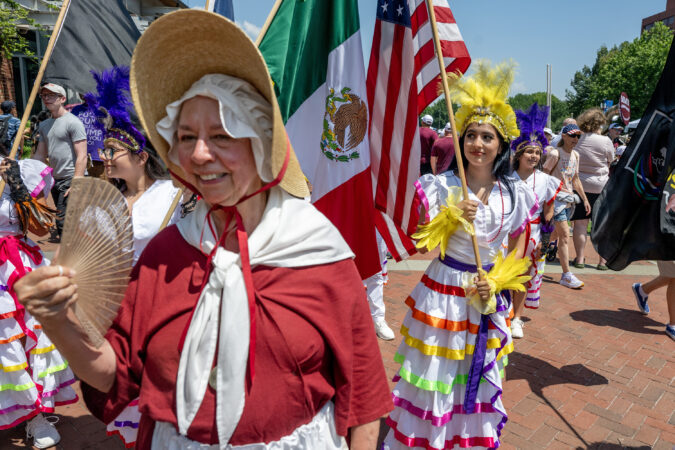
At Independence National Historical Park, people clamored for respite in the tree-lined periphery, in the sliver of shade by the Liberty Bell, or the air-conditioned Independence Hall. Around noon, the line to see the historic site of the Second Continental Congress snaked through the courtyard. While entries were paused as the building surged to capacity, history buffs dressed in colonial costume gave mini lectures, and a few marooned groups didn’t let the weather dampen their dancing. Indianapolis-based squad Ballet Folklorico Mosaicos performed their routine inspired by an annual carnival in Veracruz, Mexico, while Asian American Dragon & Lion Dance artisans carried a long puppet dragon to the beat of a drum.
“I feel immense pride to be able to show the love for our country,” said Henry Lee, founder and director of Asian American Dragon & Lion Dance.
Asian American Dragon Lion Dance outside Independence Hall today. “I feel immense pride to be able to show the love for our country,” said group founder Henry Lee. pic.twitter.com/2WLv1ErZej
Teens from Sahuarita High School’s band came a long way from their Arizona homes only to not be able to march through Center City. But, director Ben Garland said it taught his 87 students a valuable lesson about being an American: community. Garland praised organizers for making the parade participants feel included in the 250th.
“Most of my students have never even been on a plane before and coming here was their opportunity to see the Wast coast and engage with history they wouldn’t see otherwise,” he said. “For us the trip was worth it for what they have been able to learn and the camaraderie they have built here.”
Across the city, Allison Utain and her husband found a form of patriotism at the Philadelphia Museum of Art no less festive than what they were hoping for in the parade.
“You see a culmination of so many cultures that make the tapestry of what American is,” Utain said, “far from perfect, but it’s great.”
Despite a rocky start, city leaders and tourism officials have postured Philadelphia’s Semiquincentennial celebrations as the country’s defining 250th party. And there’s immense pressure for the city to meet its moment, as commemorative events — from George Washington’s Mount Vernon estate to the Boston Harbor — and the American royal wedding between Pennsylvania’s own Taylor Swift and Eagles-adjacent Travis Kelce compete for the nation’s attention.
Alex Bergstedt and his wife traveled from Idaho to Philadelphia because they “knew Fourth of July would be big.” Nicholas Roth and two friends came from upstate New York to walk where the Founding Fathers were.
Just this week, Mayor Cherelle L. Parker reiterated the gravity of the grandeur: “We won’t get a second chance to do this over again, Philadelphia. We only turn 250 years old once in a lifetime.” The mayor defendedthe city’s July Fourth concert planned for Saturday, amid concerns about the dangerously high temperatures and revelations that the event will cost taxpayers more.
As of late Friday afternoon, the concert was still on. Misting stations and water-refilling stations will be available along the Benjamin Franklin Parkway during the seven-hour billing, featuring acts such as Jill Scott, Christina Aguilera, The Roots, Will Smith, and Freeway, the city said. Officials pleaded with attendees to prepare accordingly.
On the Parkway Friday, it was hot enough to see the shimmering heat on the asphalt. Most people rushed from museums to other scraps of shade, while some poured water down the backs of their necks, and dozens of children and their families streamed through the Swann Memorial Fountain at Logan Circle.
Yet, this isn’t Philadelphia’s first brush with a foiled fete. In 1976, the city’s grand plans for its Bicentennial were dashed — not by weather, but rather unmeetable expectations. The blunder of ‘76 was an unrivaled level of municipal malaise, according to contemporaneous reports.
Visitors to Independence Hall, in Philadelphia, July 3, 2026.
This year,Ron Crofoot traveled to Philadelphia to be with his granddaughter as her marching band was supposed to perform at the parade. He reflected on what it was like to have celebrated the Bicentennial.
“How quickly 50 years go by,” he said. “I won’t see the next — it gets more meaningful as you get older — you come to appreciate the uniqueness of the United States.”
The rupture at the President’s House is just one part of the Trump administration’s ongoing campaign to purge history it says “inappropriately disparage[s] Americans past or living.”
It wasn’t immediately known if federal authorities would attempt to install the panels during this historic weekend.
In a video address, a block north at the National Constitution Center, Pope Leo XIV called for a “recommitment” to the nation’s ideals as he accepted the center’s prestigious Liberty Medal. The first U.S.-born pope has been outspoken about calls for international peace, which have landed him at odds with Trump’s immigration policies and the war with Iran.
“I’ve never seen such patriotism in one place,” said Thad Waites, 81, who traveled from Hattiesburg, Miss., for the Semiquincentennial — and hear from Pope Leo XIV.
Andrew McLaughlin, 68, of West Chester, recently returned from a trip to Chicago.
“I think it brings back pride in the country,” McLaughlin said of the 250th anniversary.
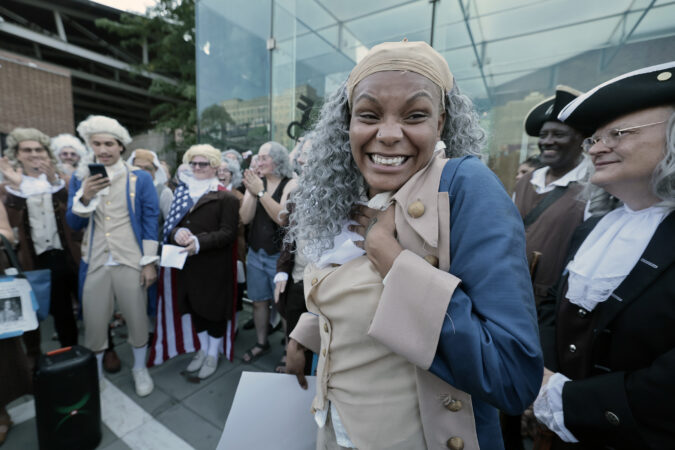
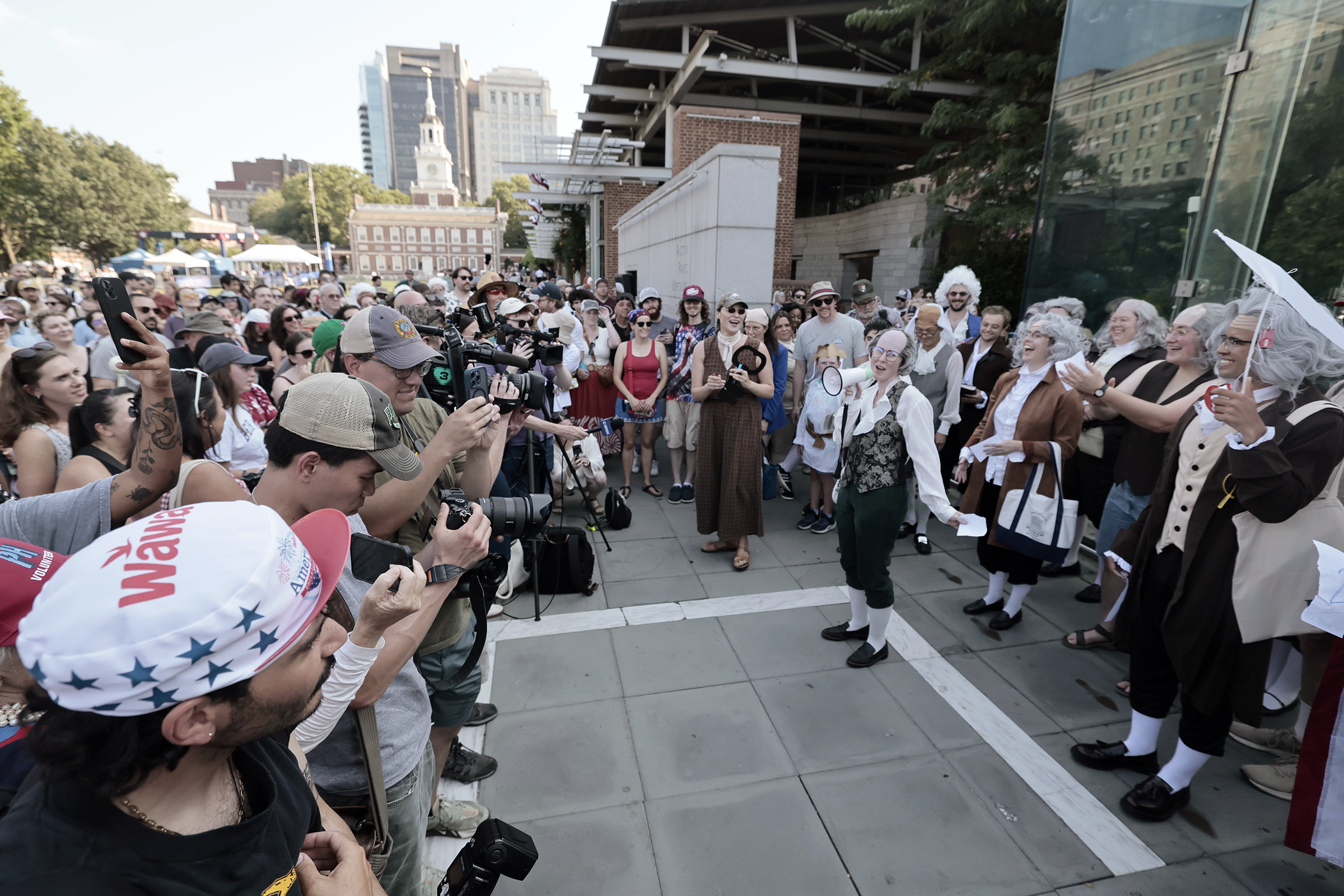
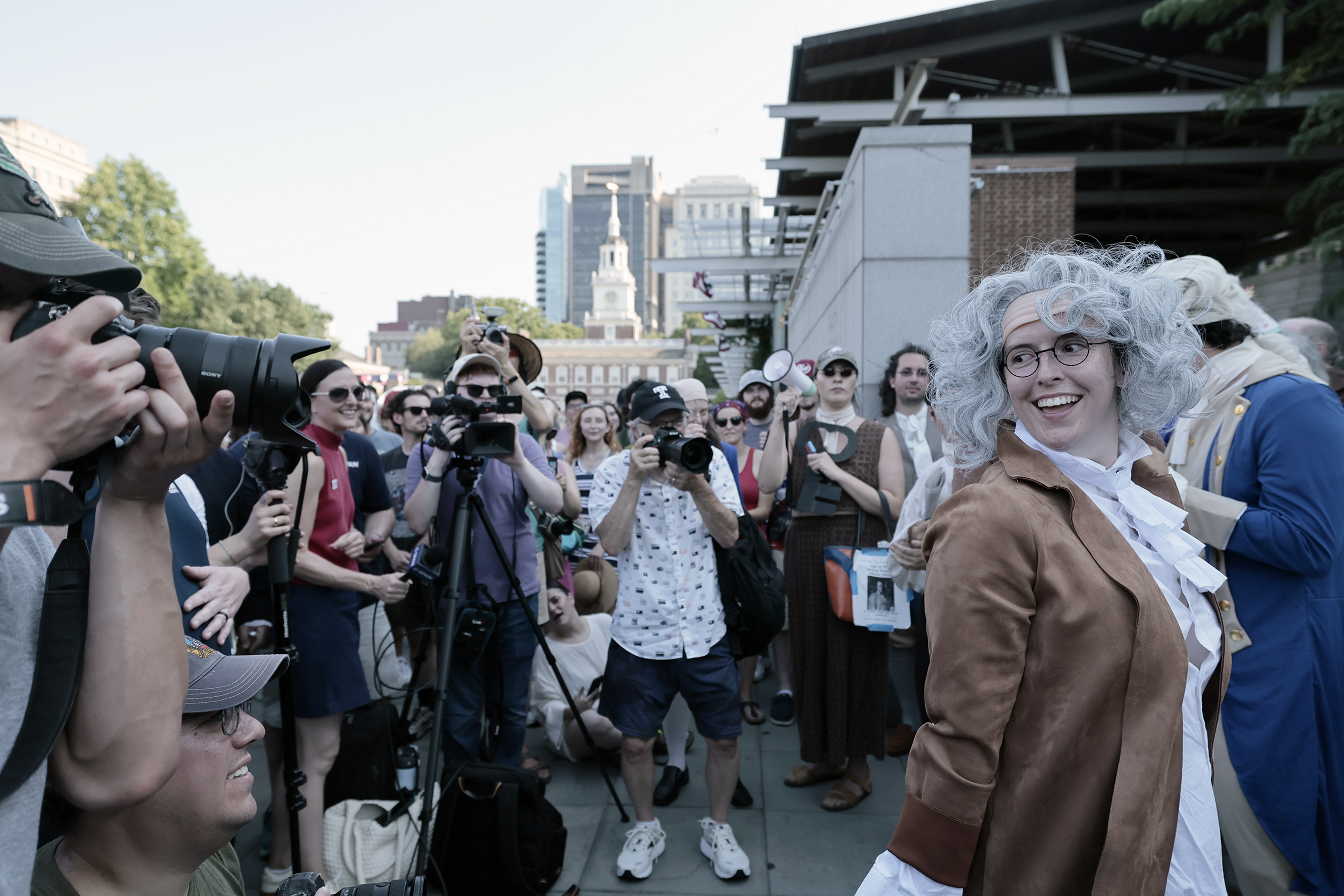
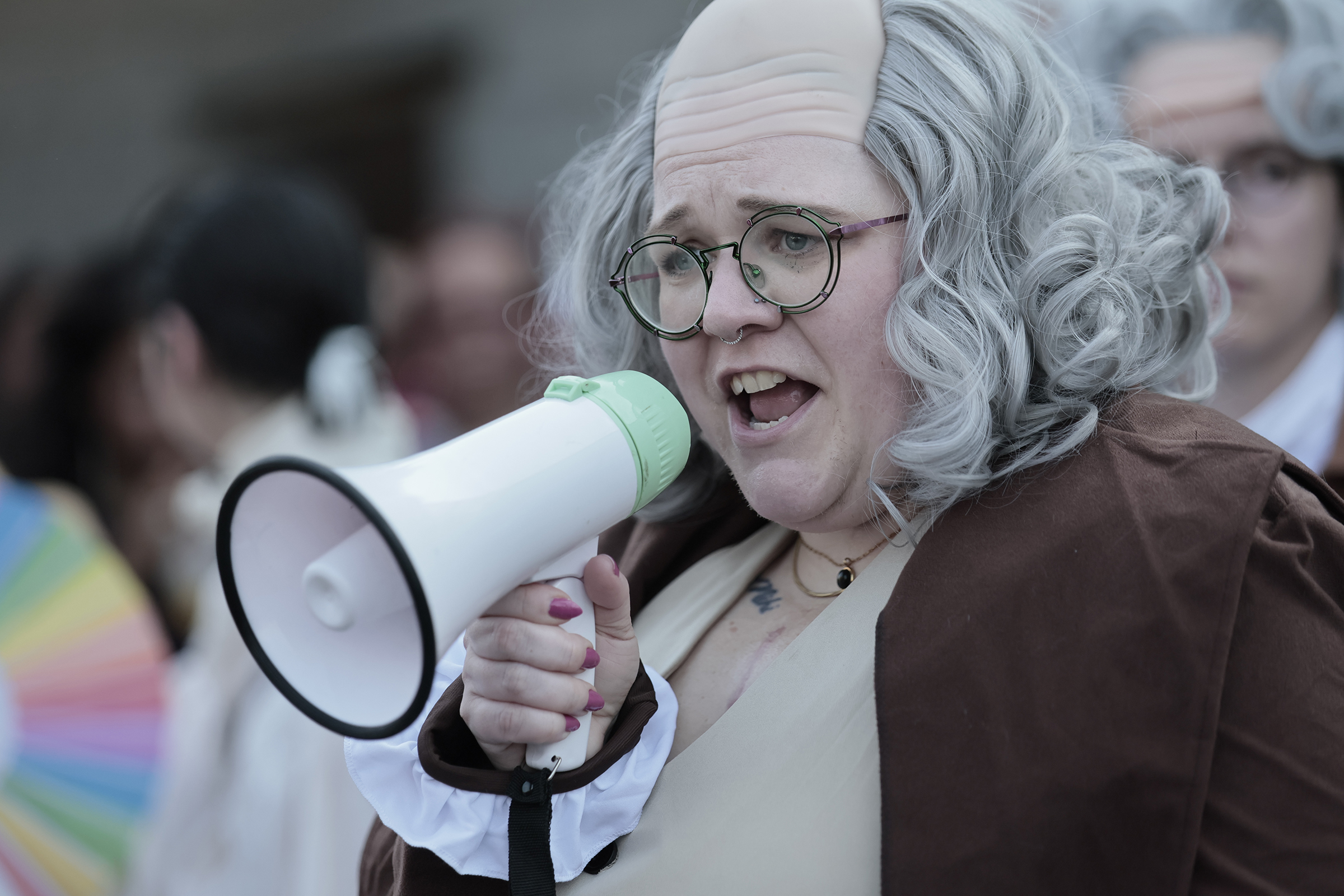
By Friday evening, Philly’s proclivity for wackiness was on full display when a crowd formed on Independence Mall, shouting “one more Ben, one more Ben” as men and women dressed like Benjamin Franklin walked through the plain-clothed masses.
It wasn’t a catwalk, per se, but rather the Franklin stroll. The mob had gathered to find the Founding Father’s best doppelganger.
“You have to make the event you want to see in the world, said organizer Elena Jackendoff, 32, who is a student at Johns Hopkins University. “I wanted to see 250 bald caps.”
Opposite Market Street, thousands gathered to hear Pops on Independence. By the delayed-8 p.m. start time, the temp had fallen to a pleasant 89 degrees and the orchestra played on with featured Broadway star Idina Menzel.
Last year’s Pops concert was cut short by rain. This year, the sky held dark clouds and some flashes of lightning, but the precipitation stayed at bay as Menzel made her appearance to a roaring audience.
“There is something especially fitting about gathering here, surrounded by the places where the nation was born,” said Steven Sims, superintendent of Independence National Historical Park, told spectators stretched out on the lawn.
Music, he said, “has always brought people together.”
Staff writers Peter Dobrin and Nick Vadala contributed to this article.
NEW YORK — Taylor Swift and Travis Kelce married Friday night at Madison Square Garden, where actor Adam Sandler was the surprising officiant at a star-packed ceremony.
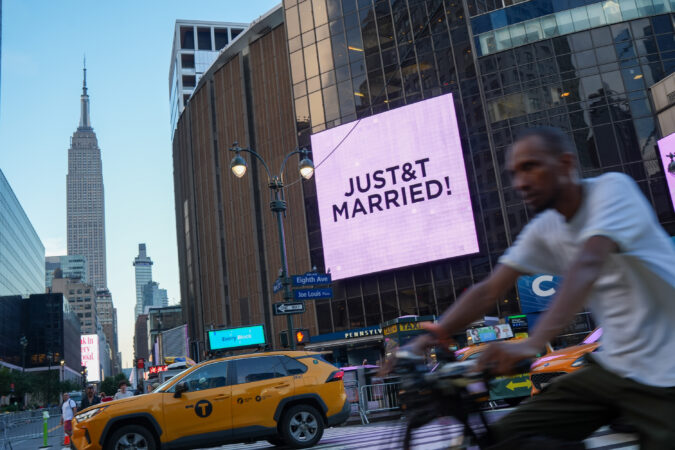
The super-secretive buildup to the nuptials culminated when a marquee outside the Midtown Manhattan arena proclaimed “JUST&T MARRIED” once the deed was done.
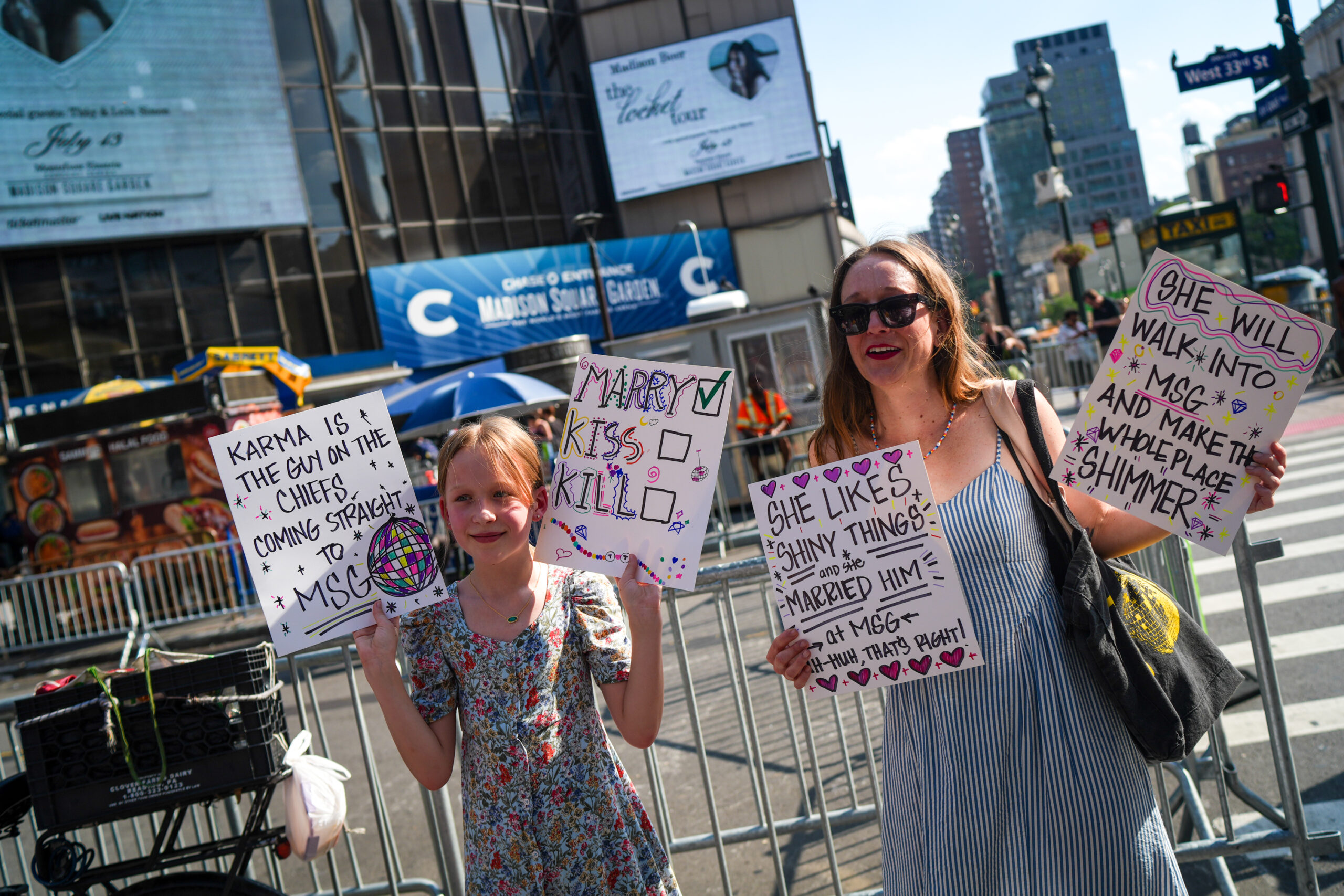
Taylor Swift fans hold signs outside Madison Square Garden ahead of the Taylor Swift-Travis Kelce wedding on Friday.
The couple did not have bridesmaids or groomsmen, instead opting for Swift’s brother to serve as her man of honor and Kelce’s brother, longtime Eagles great Jason Kelce, serving as his best man, Swift’s publicist Tree Paine said in an email.
The bride and groom’s outfits were designed by Christian Dior Haute Couture and its designer Jonathan Anderson with shoes custom-made by Christian Louboutin. She wore Cartier jewelry.
The wedding between the superstar singer and NFL star took place as fans and spectators gathered outside MSG in the blistering heat, eager to be part of the occasion, even though the event was almost entirely hidden.
The long anticipated union of sports and song brought hype to new heights at a venue made more for historic NBA games and bucket-list concerts.
Singer Camila Cabello, actors Hugh Grant, Ethan Hawke, and Jason Sudeikis, and model Karlie Kloss were among those who arrived. Running back Kareem Hunt was among Kelce’s Chiefs teammates in attendance. Seattle Seahawks receiver and recent Super Bowl champ Cooper Kupp, New York Giants receiver JuJu Smith-Schuster, NFL announcer Joe Buck, and Jenny Han, author of the The Summer I Turned Pretty series, also entered the arena.
In a culture obsessed with famous couplings, it may be the apex celebrity wedding, with perhaps only royal unions getting more attention. Holding such a ceremony in a huge, iconic space that sits at the center of the U.S. media universe while keeping all the details secret made for a surreal scene, but it was a mix of hype and hush that is not out of character for Swift.
An Associated Press camera outside the arena showed a long line of black SUVs dropping off wedding-goers in tuxedos and evening gowns, surrounded by New Yorkers in shorts and Swifties amassing for the occasion.
Celebrities, athletes, and friends were posting on social media about getting ready or about to leave for a black-tie event, including Brandon Borders, producer of the New Heights podcast starring Kelce and his brother Jason; Beau Allen, a retired defensive lineman for the Eagles; and actress Jessica Chastain.
There was a notable lack of social media posts from guests once they had entered the arena, after reports that phones would not be allowed. Rain began falling soon after the marriage was announced.
Weddings have been a constant subject in Swift’s songs since she was a teenager, and her actually walking the aisle for the first time at age 36 adds to the drama. It would also be a first marriage for the 36-year-old three-time Super Bowl champ Kelce, who could have been one of the jock characters in Swift’s early hits.
Sandler, star of The Wedding Singer and many other hit comedies, can’t have been high on anyone’s betting list for who would marry the couple, though he’s become an increasingly warm and paternal cultural figure with age. The email announcing the marriage described him as “a friend” of the couple. Kelce was one of the many athletes who appeared in Sandler’s recent sequel Happy Gilmore 2.
Outside the arena, some frazzled tourists joked that it was a bad weekend to visit as they navigated strict road and sidewalk closures, but others appeared happy to sneak a peak at the spectacle. Police cut off most access where guests were being dropped off, but a few patrons gathered in nearby businesses and peered out windows.
Diana Warshavsky, who lives in New York, decided to head over to MSG on Friday to celebrate Swift and Kelce’s wedding with fellow Swifties and “send her good vibes.”
“We’re relatively the same age, I’m a year older than her and I just got married this year as well,” Warshavsky said. “I’m just so happy for her.”
The relationship of the pop star and the football player has continued to thrill and fascinate millions around the world — particularly the Swifties, the pop star’s enormous and ardent fan base — ever since the pair first started dating in 2023.
No question, it’s hot, hot, hot. But the city fell short of setting a record-high temperature on Friday for that date.
Another record, however, appears likely: A new warmest low temperature for July 3. The record is 77 degrees, hit three times, most recently in 2002. The low on Friday as of nearly 8 p.m. was 82 degrees, which would be a record-setter.
But there was still the potential for storms to knock that record down before the day is out.
“We are still in the running for our new record warmest low temperature,” said Patrick O’Hara, meteorologist at the National Weather Service office at Mount Holly.
The record high temperature for a July 3 stands at 104 degrees, set in 1966. As of about 4 p.m., the temperature had reached 102, the National Weather Service said.
The Atlantic City Airport, however, hit 105 degrees, setting a new record there, O’Hara said.
The temperature on Saturday is expected to reach a high of 100, O’Hara said. The record for that date is 103.
Just because Philadelphia didn’t break a high-temperature record doesn’t mean the heat hasn’t had a big impact. The Wawa’s Salute to Independence Semiquincentennial Parade, scheduled for Friday, was canceled due to heat concerns.
Storms also posed a risk. A severe thunderstorm watch was issued for the entire region on Friday, and on Saturday, the risk looked even greater.
“Any storm could be strong to severe,” said Ray Martin, meteorologist at the National Weather Service office in Mount Holly.
The risk on Friday was more to the north and west of the city, said Matt Benz, senior meteorologist with AccuWeather.
On Saturday, Benz said there was about a 65% chance of thunderstorms in the evening when Philadelphia’s July Fourth concert is scheduled to be underway on the Benjamin Franklin Parkway.
“At this point, it’s difficult to promise dry weather for fireworks,” he said.
Philadelphia, where fireworks aren’t scheduled to start until close to 12 a.m., might have the best shot of not being impacted by weather, he said.
“As we get close to midnight, we might start to dry out,” he said.
Concern about lightning strikes could be more widespread than storms, Benz said.
Meanwhile, AccuWeather said Philadelphia was forecast to only drop to 83 degrees overnight Friday into Saturday, which would tie the city’s all-time record for a high minimum temperature.
The good news is both SEPTA and Peco reported no major weather-related problems Friday afternoon.
Regional Rail trains were traveling 10 miles slower to alleviate stress on the overhead wire and tracks, which can be impacted by the heat, said Andrew Busch, spokesperson for SEPTA. The slower speed has led to some delays.
Peco recommends that customers keep their thermostats between 75 and 78 during the day and shades drawn, said spokesperson Izamarie Camacho. All unnecessary lights and devices also should be turned off, Camacho said.
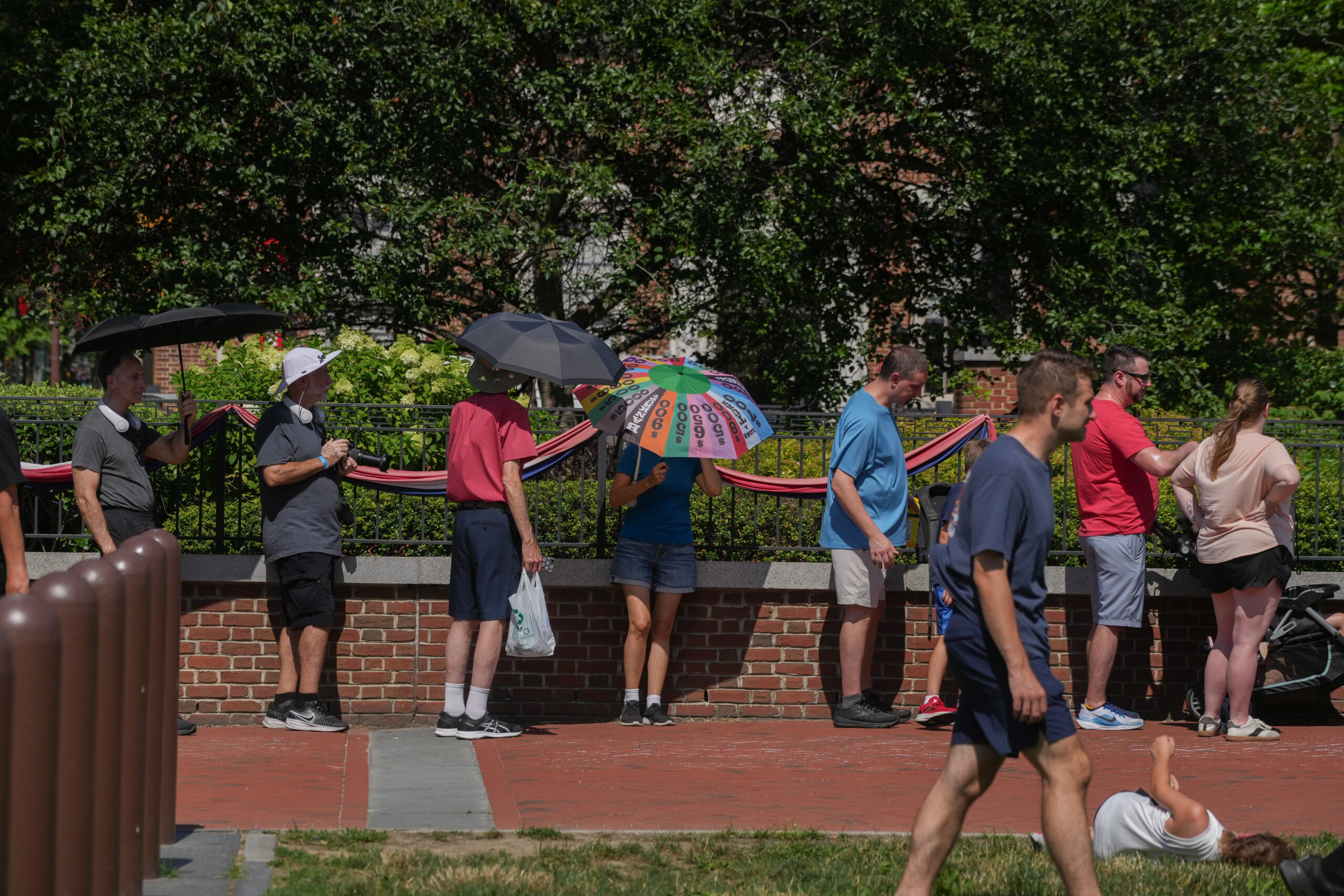
Visitors in Philadelphia shade themselves from the sun, July 3, 2026.
Local hospitals contacted didn’t report an uptick in heat-related illnesses or injuries. Temple University Hospital’s main campus had five heat-related cases on Friday as of 4:30 p.m., according to a spokesperson. No other information about the cases or whether it was an increase from prior days was available.
The Philadelphia Fire Department has seen “a marked increase in calls” over the last few days, said Rachel Cunningham, communications director. There were more than 1,000 calls on Wednesday and Thursday, but the department didn’t have a breakdown on how many were heat-related.
The number of calls on Friday was not available.
The number of people seen at the department’s medic tents at Lemon Hill, where the FIFA World Cup Fan Festival is occurring, and Lincoln Financial Field, where the games are held, has remained relatively low. Just four people came in on Thursday, with two becoming patients and no one requiring transport to a hospital, Cunningham said. On Wednesday, five people came in, one becoming a patient and no one requiring transport. And on Tuesday, 14 people came in, with five becoming patients and two requiring transport to a hospital.
The coolest spot in the region looks to be the Jersey Shore, Benz said. The Atlantic City boardwalk was 82 degrees at about 3 p.m. Friday.
“You almost have to be touching the water to feel that kind of temperature,” he said.
A sea dip is one sure way to get cool — ocean water temperatures are in the low 60s, he said.
But for those celebrating the holiday in Philadelphia, Benz said “stay hydrated, take it easy, enjoy the Fourth, and keep an eye on the sky.”
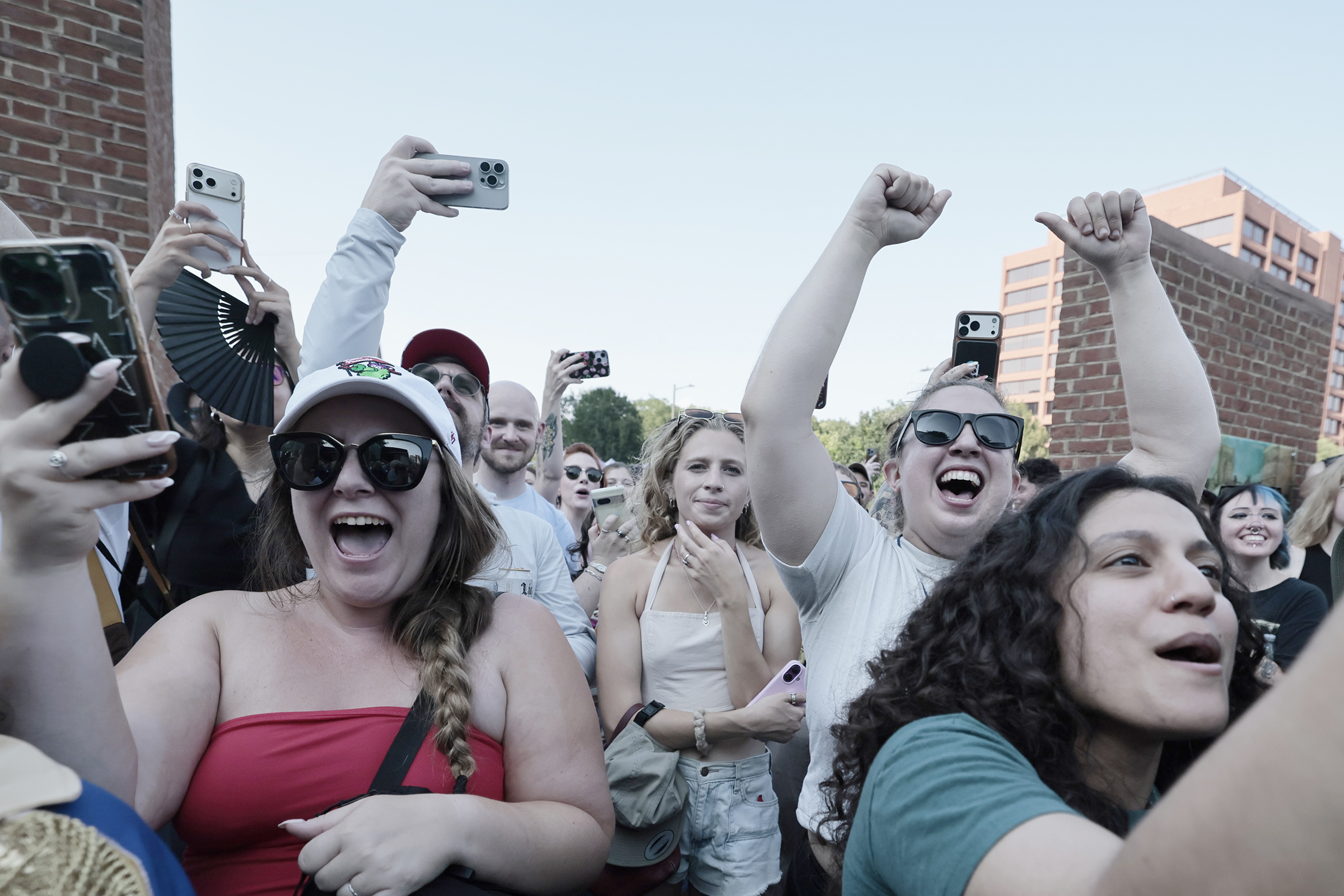
At the Benjamin Franklin look-alike contest at Independence Hall, which was supposed to end early, the crowd enthusiastically shouted, “One more Ben, one more Ben.” Latecomers — men and women dressed like the famed Founding Father — walked through the crowd to the front.
It wasn’t a catwalk, per se, but the Franklin stroll.
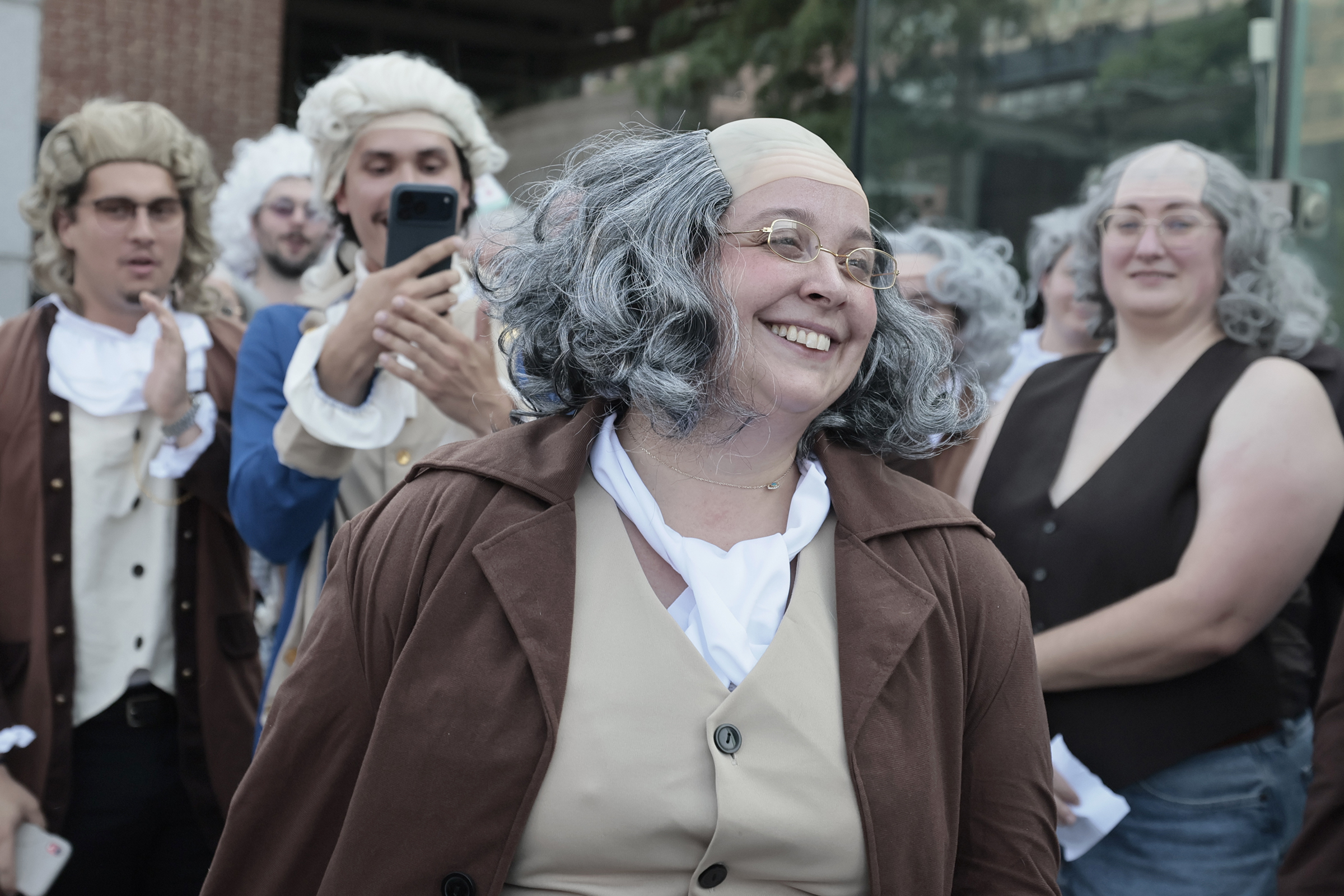
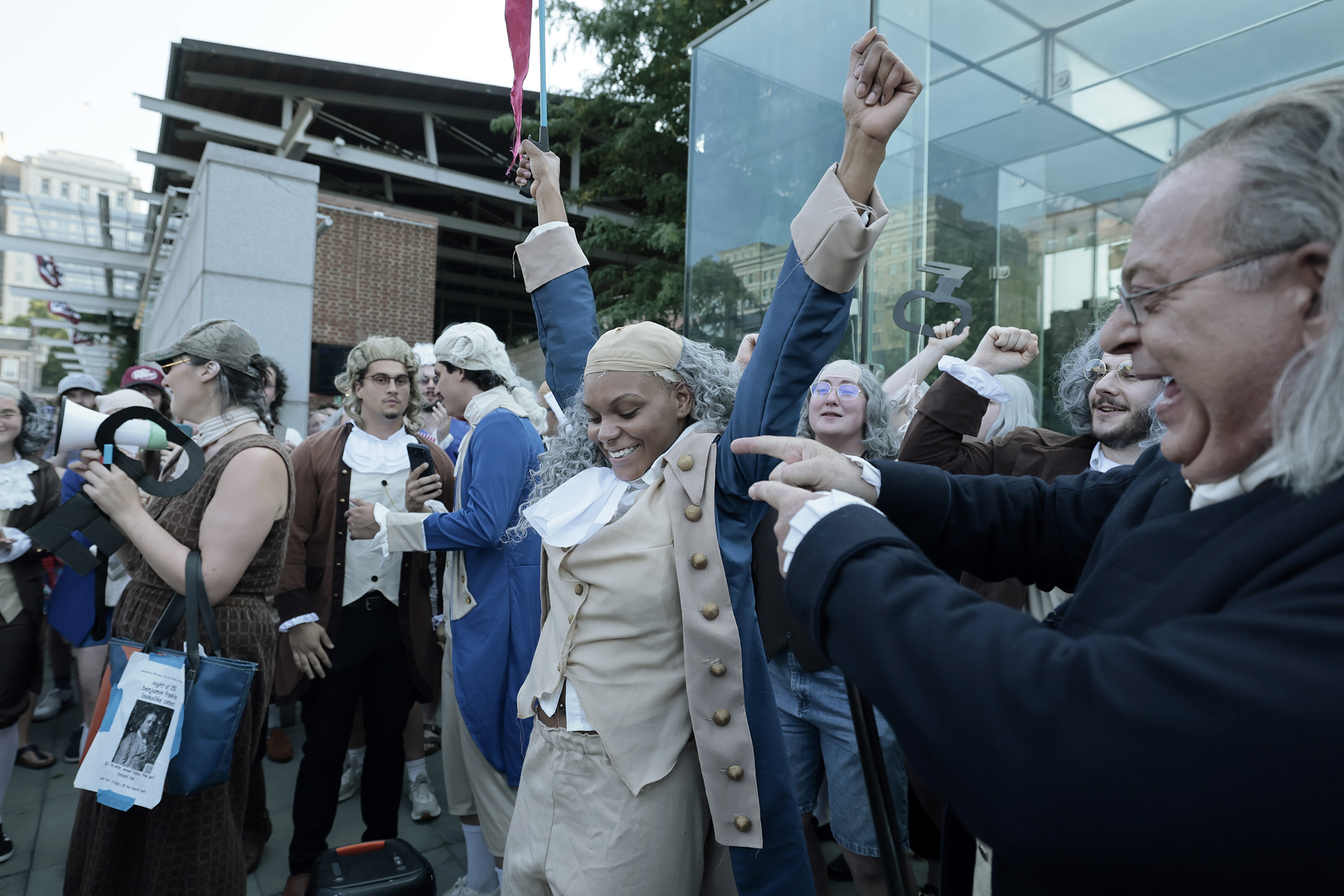
Kiya Burgess, 25, was crowned the victor of the Franklin free-for-all.
Elena Jackendoff, 32, a student at Johns Hopkins University studying public health, organized the event.
“You have to make the event you want to see in the world,” she said.
She organized the lookalike on a lark, making the flyers after her last final exam and pasting them across the city. She expected to see a few of her friends, not hundreds of people.
Many of the Franklins — like Kara Peterschmidt, 25; Kyra Feinauer, 25; and Lauren Zwetzig, 24 — didn’t even have to go out to buy a costume. The friend group had hosted a Constitution-themed housewarming a while back and came dressed in the same white wigs and tops.
Asked about the truest Ben Franklin expression, Peterschmidt said, “It’s definitely a mog.”
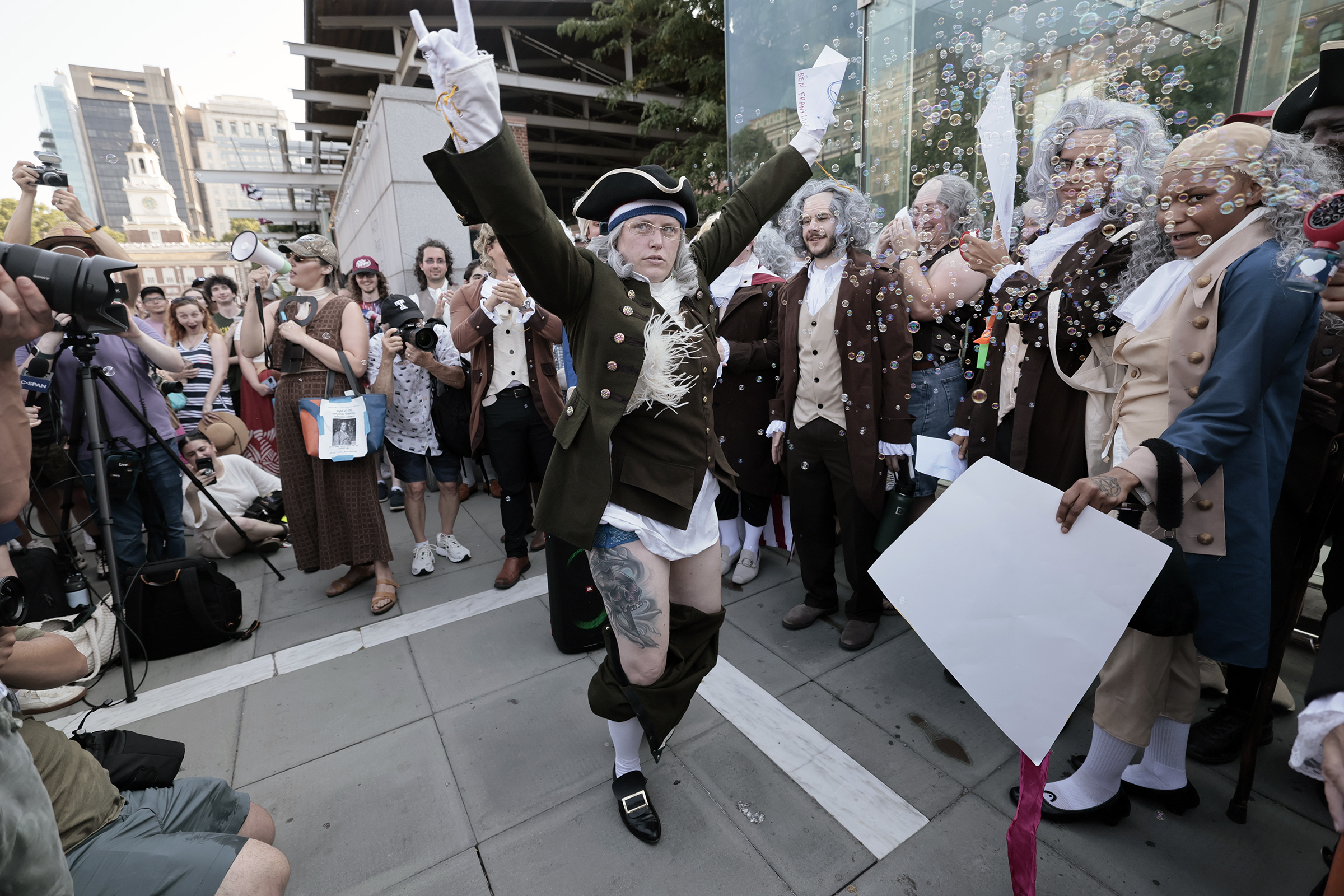
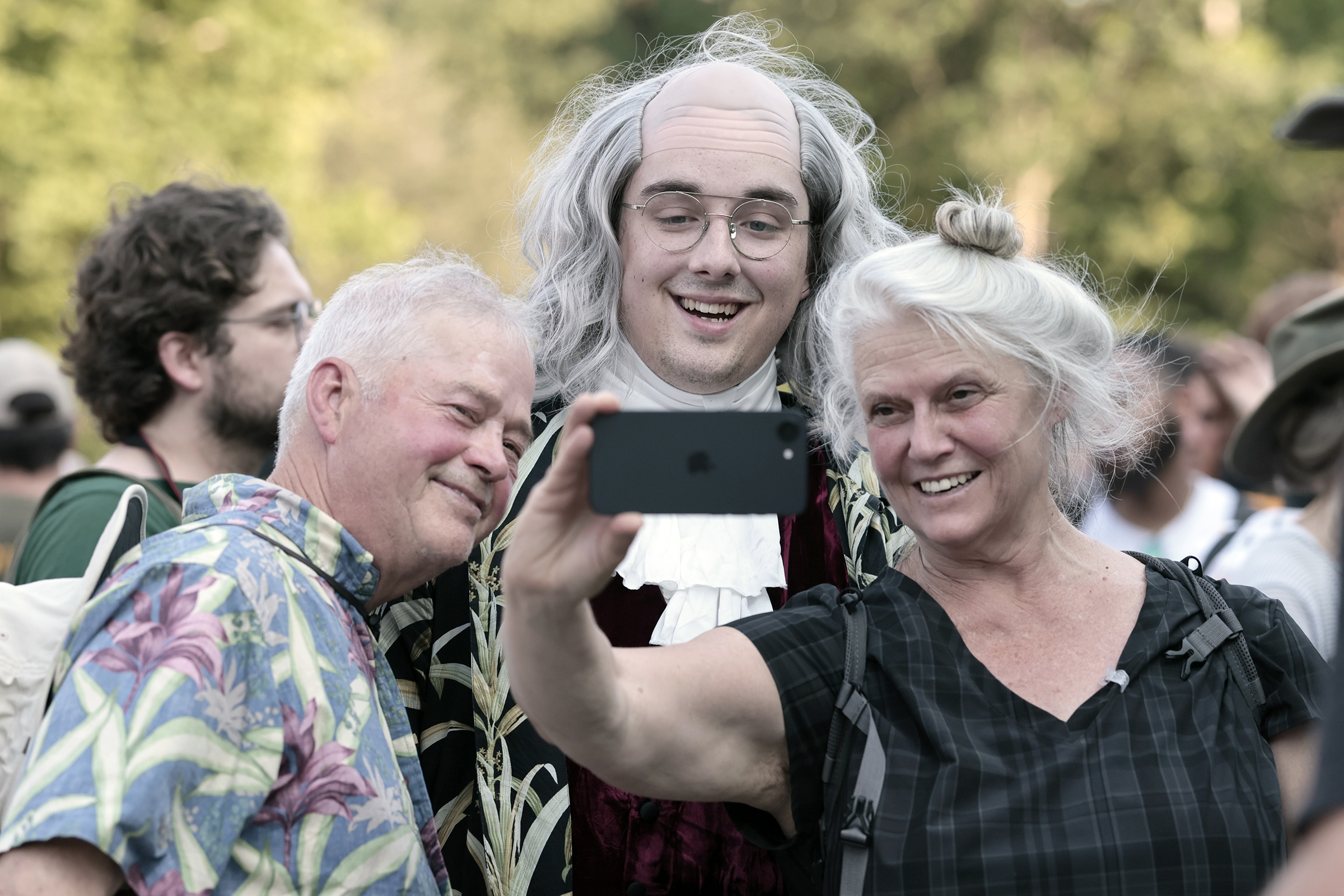
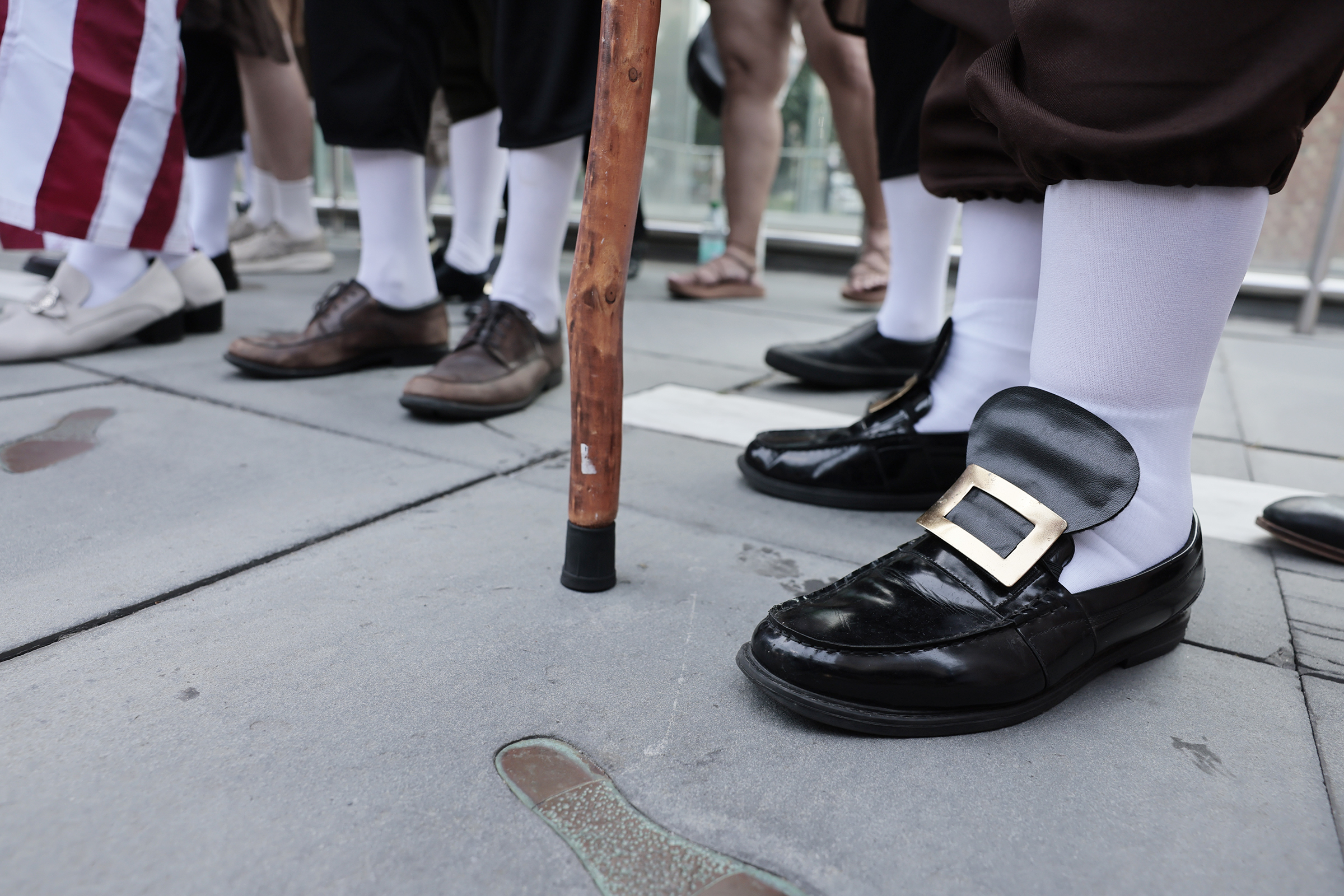
One of the contestants shows off their legs.Each contestant had to say why they were the best Ben Franklin.Gene Backus (left) and Maria D’Agostino (right) of Anchorage, Alaska take a selfie with Ben Franklin (Gabriel Meyer) of Levittown.Contestants pose for the cameras. Contestants are all smiles in the Ben Franklin lookalike contest.Footwear worn by some of the contestants.Contestants explain why they were the best Ben Franklin.The crowd cheers for the contestants.Mitchell Kramer holds up the arm of contest winner Kiya Burgess of Philadelphia.
Those attending the FIFA World Cup game at Philadelphia Stadium on July Fourth will be treated to more than just soccer.
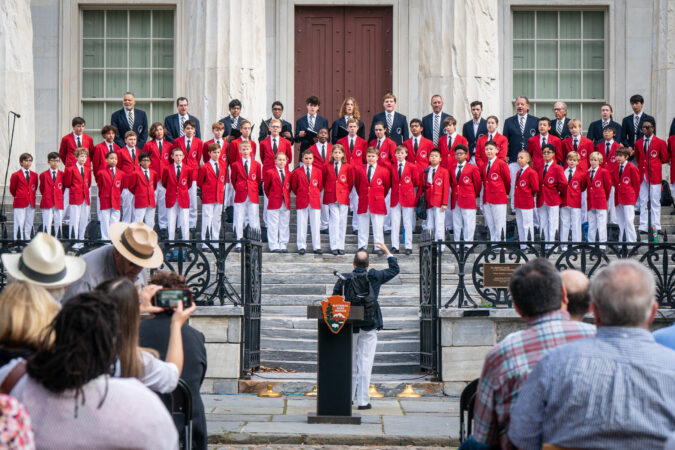
The Roots and the Philadelphia Boys Choir are among those who will perform at the event, marking both Independence Day and the 250th anniversary of the nation, according to a spokesperson for FIFA.
Before the match, Tony Award-winner Idina Menzel will sing the national anthem, while the Philadelphia Boys Choir & Chorale will offer “America the Beautiful.” The Roots, a Grammy Award-winning hip-hop band founded in Philadelphia, also will perform.
Miss Pennsylvania Stephanie Skinner will be on hand to join the celebration, and the VFA-11 and VFA-81 squadrons from Naval Air Station Oceana in Virginia Beach, Va., will do a flyover.
At halftime, Grammy Award-winner DJ Jazzy Jeff will entertain the crowd.
The Roots and DJ Jazzy Jeff are also slated to play the One Philly: Unity Concert for America on the Benjamin Franklin Parkway on Saturday night, which will be broadcast on NBC10.