ALBANY, N.Y. — President Donald Trump’s effort to install political loyalists as top federal prosecutors has run into a legal buzz saw lately, with judges ruling that his handpicked U.S. attorneys for New Jersey, eastern Virginia, Nevada, and Los Angeles were all serving unlawfully.
On Thursday, another federal judge heard an argument by New York Attorney General Letitia James that the administration also twisted the law to make John Sarcone the acting U.S. attorney for northern New York.
James, a Democrat, is challenging Sarcone’s authority to oversee a Justice Department investigation into regulatory lawsuits she filed against Trump and the National Rifle Association. It’s one of several arguments she is making to block subpoenas issued as part of the probe, which her lawyers say is part of a campaign of baseless investigations and prosecutions of Trump’s perceived enemies.
Her attorney Hailyn Chen argued in court that since Sarcone lacks legitimate authority to act as U.S. attorney, legal steps taken by him in that capacity — like the subpoenas — are unlawful. In response to a question from U.S. District Judge Lorna G. Schofield, Chen said Sarcone should be disqualified from the investigation and the office.
“Sarcone exercised power that he did not lawfully possess,” Chen told the judge.
Justice Department lawyers say Sarcone was appointed properly and the motion to block the subpoenas should be denied. Assistant U.S. Attorney Richard Belliss argued that disqualifying Sarcone would be “drastic and extreme.”
“We don’t think that’s a proper remedy,” Belliss said.
Schofield, after peppering both attorneys with questions, did not say when she would rule.
The fight in New York and other states is largely over the legality of unorthodox strategies the Trump administration has adopted to appoint prosecutors seen as unlikely to get confirmed by the U.S. Senate.
The hearing came a week after a federal judge in Virginia dismissed indictments brought there against James and former FBI Director James Comey. That judge concluded that the interim U.S. attorney who brought the charges, Lindsey Halligan, was unlawfully appointed. The Justice Department is expected to appeal.
On Monday, a federal appeals court ruled that Alina Habba, Trump’s former personal lawyer, is disqualified from serving as New Jersey’s top federal prosecutor.
Under federal law, the president’s nominees for U.S. attorney must be confirmed by the Senate. If a position is vacant, the U.S. attorney general can appoint someone temporarily, but that appointment expires after 120 days. If that time period elapses, judges in the district can either keep the interim U.S. attorney or appoint someone of their own choosing.
Sarcone’s appointment didn’t follow that path.
Trump hasn’t nominated anyone to serve as U.S. attorney for the Northern District of New York. U.S. Attorney General Pam Bondi appointed Sarcone to serve as the interim U.S. attorney in March. When his 120-day term elapsed, judges in the district declined to keep him in the post.
Bondi then took the unusual step of appointing Sarcone as a special attorney, then designated him first assistant U.S. attorney for the district, a maneuver federal officials say allows him to serve as an acting U.S. attorney.
Chen called it an abuse of executive power.
The New York subpoenas seek records related to a civil case James filed against Trump over alleged fraud in his personal business dealings and records from a lawsuit involving the National Rifle Association and two senior executives.
Belliss argued in court that the U.S. attorney general has broad authority to appoint attorneys within her department and to delegate her functions to those attorneys. Belliss said that even if Sarcone is not properly holding the office of acting U.S. attorney, he can still conduct grand jury investigations as a special attorney.
Sarcone was part of Trump’s legal team during the 2016 presidential campaign and worked for the U.S. General Services Administration as the regional administrator for the Northeast and Caribbean during Trump’s first term.
Habba also served as an interim U.S. attorney. When her appointment expired, New Jersey judges replaced her with a career prosecutor who had served as her second-in-command. Bondi then fired that prosecutor and renamed Habba as acting U.S. attorney.
A similar dynamic is playing out in Nevada, where a federal judge disqualified the Trump administration’s pick to be U.S. attorney there. And a federal judge in Los Angeles disqualified the acting U.S. attorney in Southern California from several cases after concluding he had stayed in the job longer than allowed by law.
Authorities have charged two men in connection with a double fatal shooting outside a Bordentown convenience store, prosecutors said Thursday.
Justford Doe, 23, and Giovanni Varanese, 21, are charged with first-degree murder, first-degree robbery, and other offenses stemming from the Nov. 5 killing outside a 7-Eleven and Valero gas station at the intersection of Route 130 North and Farnsworth Avenue.
The shooting left Daniel Patterson, 22, and Mason Knott, 21, dead.
Bordentown Township police were called at about 11:30 p.m. to the convenience store after Patterson, a Philadelphia resident, came into the store suffering from gunshot wounds and asked for help. He was pronounced dead at the scene, according to the Burlington County Prosecutor’s Office. Knott, of Wrightstown, was transported to a hospital in Trenton, where he died.
Police said the men shot Knott in the back of the head, then stole marijuana that was in his vehicle. They shot Patterson three times and stole his Jeep, police said.
The assailants fled but crashed in Florence Township, the prosecutor’s office said.
Authorities did not say Thursday how they connected Doe and Varanese to the killings.
The men are being held in the Philadelphia Department of Prisons, but will be extradited to New Jersey to face the charges, according to the prosecutor’s office.
The transit agency says it will miss Friday’s federal deadline to finish outfitting all 223 Silverliner IV Regional Rail cars with a new heat-detection system. The reason: It needs to wait for 7,000 additional feet of thermal wire.
About 30 of the 50-year-old cars have not yet had the safety feature installed, officials said. The wire required to finish the job is on back order.
“I don’t think the suppliers expected one agency to raid their entire stockpile,” spokesperson Andrew Busch said.
SEPTA needed about 39,000 feet of the thermal wire to outfit the entire fleet of Silverliner IV cars, he said. “It was an unusual demand on the supply chain,” Busch said. SEPTA has worked with two manufacturers and four distributors.
The missing link is expected to arrive next week, and the installations should be finished the following week, Busch said.
SEPTA worked with two manufacturers and distributors to get the large rolls of wire.
The thermal wire is made of spring steel, separated by a polymer that melts at high temperature, allowing the steel conductor to touch and connect the electric circuit. That allows it to provide earlier warning of a potential problem so cars can be pulled from service.
Delays, cancellations, station skips, and overcrowded trains running with fewer than the normal number of cars have been regular challenges for riders during the work, which started in October.
Meanwhile, SEPTA is leasing 10 passenger coaches from Maryland’s commuter rail system, MARC, which Amtrak is scheduled to deliver late Friday night at 30th Street Station. They will be towed to SEPTA’s nearby Powelton yard.
President Donald Trump will visit Northeast Pennsylvania on Tuesday to promote his economic agenda, including efforts to lower inflation, the White House confirmed to The Inquirer on Thursday.
The trip will kick off what is expected to be anationaltour of Trump touting his economic policies ahead of the 2026 midterms, when Democrats and Republicans will battle for control of Congress.
The specific location for Trump’s visit has not yet been made public, but Northeast Pennsylvania will be a major battleground in next year’s midterms.
Democrats believe that they can oust freshman Republican U.S. Rep. Rob Bresnahan, of Lackawanna County, threatening the GOP’s slim House majority. Democrats are also specifically targeting the districts of U.S. Reps. Brian Fitzpatrick, of Bucks County; Ryan Mackenzie, of Lehigh County; and Scott Perry, of York County.
Trump endorsed Bresnahan and most of Pennsylvania’s GOP delegation on his social media platform, Truth Social, last month. Scranton Mayor Paige Cognetti, a Democrat, is mounting a campaign to unseat Bresnahan, who won by roughly a percentage point last election.
Affordability — which Trump called a “fake narrative” used by Democrats — has been a top issue for voters, including during November’s blue wave when Democrats won local contests throughout Pennsylvania, in addition to the gubernatorial races in Virginia and New Jersey.
The board unanimously approved the new contract for the principals union. A deal with the union had been struck last week after the principals spent three months working without a new contract in place.
Board approves the rest of its agenda and adjourns the meeting
And the board approved the rest of its agenda unanimously, too.
Goals and Guardrails happens this time next week, but this is the last action meeting of the year. That’s a wrap!
// Timestamp 12/04/25 6:50pm
Board member Lam requests more information from the district on controls in place to prevent cost overrun with vendors
ChauWing Lam said she’ll support a $43,390 contract with Mothers in Charge for violence prevention services, but has concerns about the cost overrun and controls in place to prevent that.
Superintendent Tony B. Watlington Sr. said there are controls in place, and promises more information.
// Timestamp 12/04/25 6:47pm
Board unanimously approves new contract for principals union
The board also approved CASA’s new contract, also with a 9 to 0 vote.
Board unanimously approves meeting schedule for 2026
Ultimately, the board decides to move forward with its schedule as written: separate action meetings and Goals and Guardrails meetings for 2026.
The vote was unanimous.
// Timestamp 12/04/25 6:35pm
Board moves from speakers into its agenda for voting
That’s the end of the speakers list. Now we’re onto voting.
The board is voting on its 2026 meeting schedule.
Board member ChauWing Lam has concerns about keeping the board’s “Goals and Guardrails” meetings separate from action meetings. She’d like more progress monitoring as part of the board’s action meetings.
Board member Crystal Cubbage says Goals and Guardrails should remain separate. She appreciates Goals and Guardrails happening in a space that’s separate, where she can think about them with a fresh mind.
Board member Whitney Jones concurs with Cubbage, and says perhaps it’s possible to pilot some Goals and Guardrails in one meeting.
Joyce Wilkerson, who was president when Goals and Guardrails was developed, said she supports keeping Goals and Guardrails separate. The board often starts its work at 9 a.m. on board days, she said, and it’s better for them to approach Goals and Guardrails with fresh eyes on a different day.
// Timestamp 12/04/25 6:28pm
Clouden family speaks to the board about the state of Philly schools
Horace Clouden, a retired district employee, wants to know the true number of underperforming district and charter schools.
“Families have no confidence” in district schools, Clouden said. Clouden is a proponent of traditional junior high schools, and believes that K-8 schools are leading to poor academic outcomes.
Mama Gail Clouden (who is married to Horace Clouden) said the district “needs to stop ignoring what we know is happening.”
“We have too many schools where people don’t know how to teach our children,” Mama Gail said.
Mama Gail suggests that the superintendent not just go out to schools for photo opportunities. Go into struggling schools, she said.
Leah Clouden, Mama Gail and Horace Clouden’s daughter, says the district is “warehousing students.”
// Timestamp 12/04/25 6:22pm
Retired teacher speaks in support of Keziah Ridgeway and Ismael Jimenez
Barbara Dowdall, a retired district teacher, said her mother was denied a job as a school librarian because she was Jewish.
She asks: “What is the school district’s lesson to students” when it mistreats educators Keziah Ridgeway and Ismael Jimenez?
// Timestamp 12/04/25 6:20pm
Retired teacher and activist tells board to stop renewing ‘substandard charters’
“More than half of district charter schools are underenrolled,” said Lisa Haver, a retired district teacher and founder of the Alliance for Philadelphia Public Schools.
“It’s not right for this board to renew substandard charter schools” but close neighborhood public schools, Haver said.
// Timestamp 12/04/25 6:17pm
District school psychologist asks the board to halt the facilities planning process
Paul Brown, a district school psychologist, asks for a re-examination of community engagement around the facilities planning process.
The current survey does not “truly capture the needs of Philadelphia,” Brown suggests.
“I’m asking the district to halt the process,” Brown said.
// Timestamp 12/04/25 6:15pm
Schools need more time for student relaxation, parent says
Toya Diggs-Clay, a district parent, says schools need more time for student relaxation and movement. They need better breakfasts and lunches, hygiene bundles going home with kids, and more.
// Timestamp 12/04/25 6:13pm
District speech language pathologist sounds the alarm on lack of pathologists
Tamara Sepe, a district speech language pathologist and parent, sounds the alarm about a lack of speech language and pathologists in the district, and asks for more transparency around the number of SLP positions in the district.
// Timestamp 12/04/25 6:10pm
Teacher wants the board to ‘resist’ the congressional investigation ‘as strongly as you can’
Freda Anderson, a district teacher, said the congressional investigation “is a witch hunt” and “does nothing to protect Jewish people.”
Anderson suggests the board and district “resist as strongly as you can.”
// Timestamp 12/04/25 6:07pm
Teacher tells the board to ‘look closely at which schools have high turnover’
Philip Belcastro, a teacher at Hill-Freedman World Academy, tells the board: “Teachers aren’t leaving students. In some cases, they’re leaving administrators.”
Belcastro: “I’m asking you again to look closely at which schools have high turnover,” and to make it publicly available.
// Timestamp 12/04/25 6:05pm
District educator calls the congressional investigation ‘political theater’
Volin Avelin, an observant Jew, said: “Don’t waste time complying with a redundant investigation.”
In the 1950s, the House Un-American Activities Committee dismissed 26 teachers for alleged Communism. “Learn from this shameful history and stand up for teachers teaching critical content,” Volin Avelin said.
// Timestamp 12/04/25 6:03pm
Schools became underenrolled because of disinvestment, parent tells the board
Melanie Silva, a district parent, tells the board: Schools became underenrolled because of your disinvestment.
Families aren’t ignoring middle schools because of transitions, Silva said, continuing: We’re ignoring them because you under-resourced them.
“We expect investment, not displacement,” Silva said.
// Timestamp 12/04/25 6:00pm
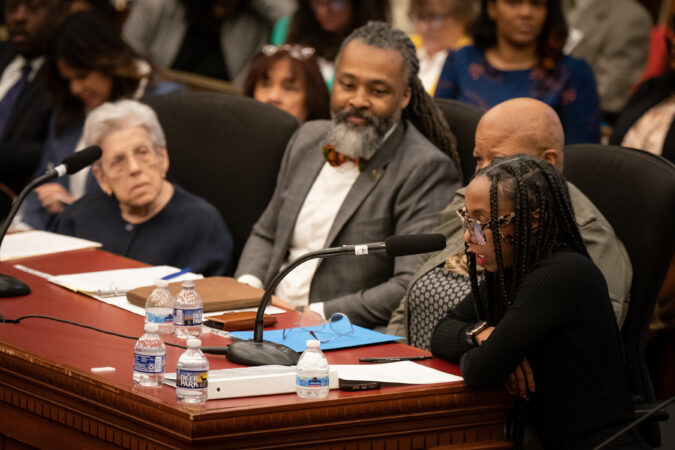
Teacher Keziah Ridgeway tells the board: ‘You are at a crossroads right now, with a national spotlight on you’
“All I’ve ever wanted is to protect students in the ways that I wasn’t protected from the racism that permeates the SDP schools,” Ridgeway said.
“Being a teacher should be heart work,” Ridgeway said. “It’s December and I probably spent $2,000 of our own money on our babies — because they are our babies.”
“You are at a crossroads right now, with a national spotlight on you,” Ridgeway said, asking if the district will “capitulate to McCarthyism.”
Keziah Ridgeway, a district teacher, speaks to the Philadelphia School Board during meeting on Dec. 4, 2025.
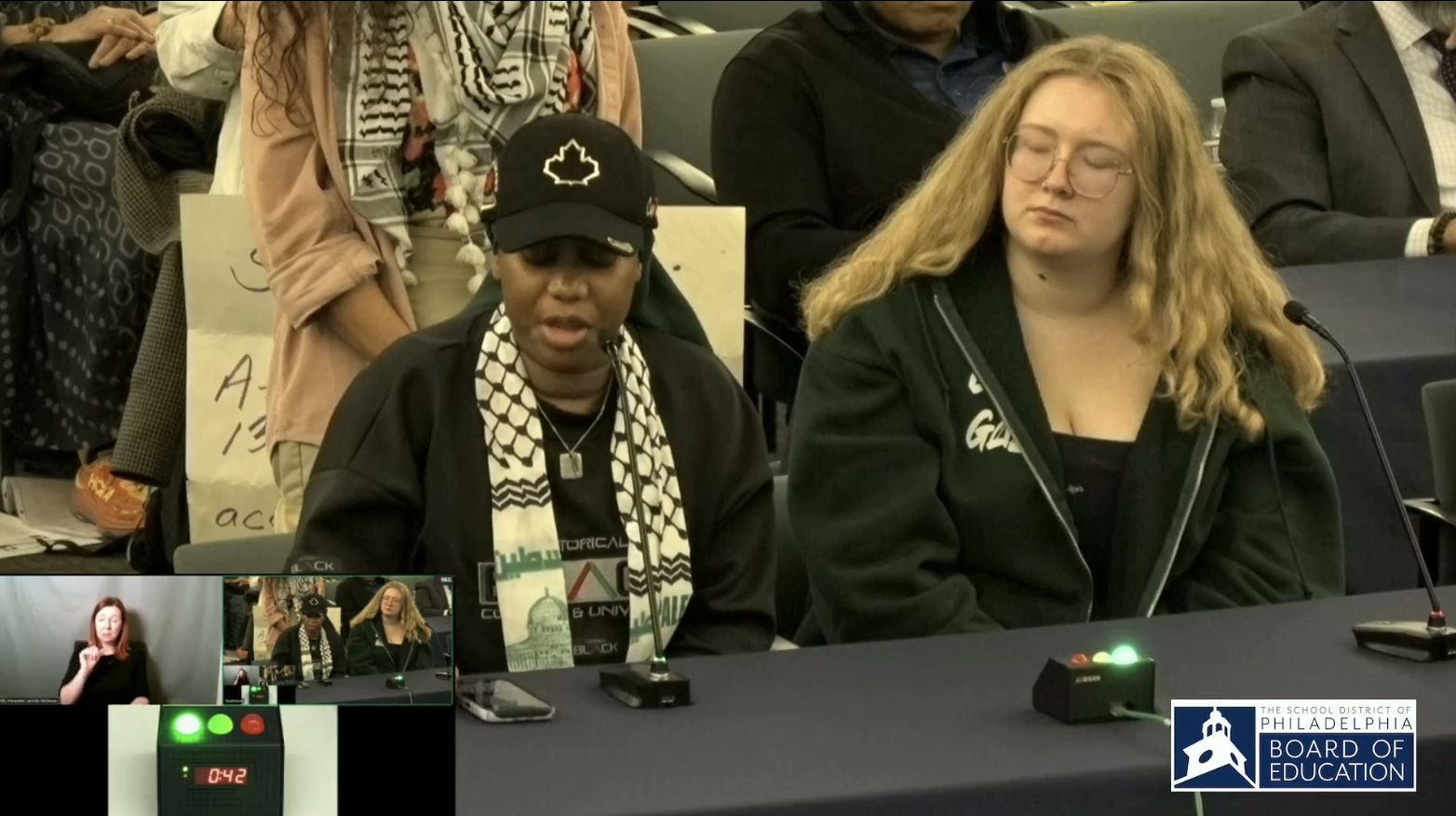
Hannah Gann, a district staff member, then spoke to the district about Ridgeway and other educators: “The baseless attacks on some of Philly’s best Black teachers” is meant to distract them, Gann said.
Allegations of Islamaphobia are just as serious as antisemitism, Gann said. “The district has far more culpability to act when its staff harms students than when its employees feel uncomfortable when they see the word Palestine on a T-shirt,” Gann said.
// Timestamp 12/04/25 5:52pm
District teacher and former teacher each testify in opposition to any school closures
Julian Prados-Frank, a district teacher, is testifying “to oppose any plan that would close schools.”
Schools represent a safe haven for students — sometimes the only place where they get nutritious meals and get social services, Prados-Frank said.
“Our students rely on their schools as a stable refuge,” Prados-Frank said. In his first period math class, many kids miss because of transportation issues. “These kids can’t miss more math,” he said.
Jess Morris-Horowitz, a former district teacher, also tells the board: “The anxiety-inducing phrase ‘school closures’ has been coming for months now.”
The district has spent millions on unnecessary changes, and let buildings languish, she said.
“I’m here to advocate for a focus on human-centered processes and decision-making,” Morris-Horowitz said. School closures will “critically disrupt” students’ and families’ lives.
// Timestamp 12/04/25 5:50pm
KIPP North parent speaks to the board in support of the charter
Pro bono librarian tells the board: ‘School librarians are not expendable.’
Deborah Herskovitz, a district parent who acts as the pro bono librarian at Vare-Washington, which has one of a clutch of “small guerrilla libraries” around the district, wants the board to know that what she provides is not the same has having a certified school librarian. “The district only has about three of those.”
“School librarians are not expendable. They are not extras,” Herskovitz said.
Suburban schools all have school librarians, she said, and these are the schools parents are leaving Philly for.
“Our library is a signal to perspective parents — we value reading here,” Herskovitz said.
// Timestamp 12/04/25 5:41pm
Another Mastery charter parent speaks in support of the school
Amberia Perkins, a parent at Mastery Charter Wister, said her kids love the school, and asks the board to support it.
// Timestamp 12/04/25 5:37pm
There is too much anti-Blackness and racism and not enough consequences, retired teacher says
Kristin Luebbert, a retired district teacher, says she witnessed many instances of racism, anti-Islamic, and anti-Palestinian behavior in the district.
“No consistent effort has been made to make white teachers interrogate their whiteness” and confront racism, Luebbert said.
“This leads to too many teachers and staff upholding racist and anti-Black attitudes,” said Luebbert, who is white.
There is too much anti-Blackness and racism, and not enough consequences, Luebbert said. The district must ensure that the staff that should be nurturing students “is not harming them instead,” she said.
// Timestamp 12/04/25 5:35pm
Teacher shares concerns about ‘politically motivated attacks’ on educators
Thomas Quinn, a district teacher, tells the board: “Right now, Philly schools are under politically motivated attacks.”
Another parent speaks in support of Mastery schools
Shavon Almodovar, a parent with children at Mastery schools, is also praising her kids’ schools. Mastery has pushed her kids to grow, given them challenging and fun content, and has developed her kids in all areas.
// Timestamp 12/04/25 5:30pm
Parent urges the board to consider standing behind KIPP North, rather than nonrenew it
“Our children … [should] be in schools where teachers truly love the work, and not just show up to do the work,” Hazel said.
“If we truly believe in equity … then we have to stand behind the places that are already doing that,” Hazel said. She asks the board to keep KIPP North open. (The board has moved to nonrenew KIPP over academic concerns.)
// Timestamp 12/04/25 5:27pm
Parents speak in support of two Mastery Charter schools
Yolanda Williams, a grandparent at Mastery Charter Clymer, says the school has done wonders for her granddaughter.
“Me, I don’t worry when I drop her off at school because she’s at Mastery. I know she’s fine, I know they’ll treat her right, and I know she’ll get her education,” Williams said.
Joyletta White, a parent at Mastery Charter Gratz, has had a positive experience at Gratz, where her son is thriving.
// Timestamp 12/04/25 5:20pm
Principals union president expresses gratitude to the board for their newly ratified contract
“It was very clear from actions over the weekend that we were heard loud and clear,” Cooper said. “Any time that men will meet with you on a Sunday — on a football Sunday — you know that a contract is in the making.”
There were no raises in the 2016 contract (though principals became 12-month employees again, as opposed to the 10-month employees they had been.) There were just bonuses.
But the board was listening this time, Cooper said. Over half of CASA’s 1,000 members voted on the contract, and 97% voted for it.
“We are partners with the district,” Cooper said. “We try to lead by example.”
“We didn’t get everything that we wanted, but we are leaving feeling heard, and we are leaving with a fair contract,” Cooper said.
Robin Cooper, president of CASA, the principals’ union, speaks to the Philadelphia school board at a meeting on Dec. 4, 2025.
// Timestamp 12/04/25 5:16pm
Public speakers begin
We’re onto public speakers now.
There’s lots of written testimony defending Keziah Ridgeway and Ismael Jimenez, district educators who were alluded to in an order for a congressional investigation into alleged antisemitism in the district.
Sarah-Ashley Andrews is unanimously reelected as vice president
Andrews is unanimously reelected vice president, 9-0.
Andrews thanks her fellow board members “for your continued trust and support, and the push. I really appreciate the push. Thank you for the opportunity to serve again.”
Streater also responds to his reelection: “This was not a box-checking moment,” and he appreciates that the board still has confidence in him.
Sarah-Ashley Andrews speaks at City Hall on April 2, 2024.
// Timestamp 12/04/25 5:04pm
Board moves on to election of vice president
Sarah-Ashley Andrews is renominated as board vice president.
Cheryl Harper speaks out for her as a hard worker and steadying force, someone who works with students and community members especially well.
Crystal Cubbage says: “She has a great sense of the city and her dedication to the residents of the city in all neighborhoods is admirable. I’d like to see her play an expanded role as our vice president if elected.”
ChauWing Lam, who joined the board at the same time as Andrews, said she admires “the proudness with which she represents this board, her hardworking nature, and the style in which she welcomes those around her, brings people in.”
Streater is now praising Andrews. “It’s been a blessing to see a young powerful Black woman show up in spaces,” he said. Streater said he sees Andrews as a future president. “I’ve seen you in action and I know you’re ready to take it to the next level,” he said.
// Timestamp 12/04/25 5:03pm
Streater is reelected as board president
Streater is reelected 8-0.
But there was a bit of a suprise: Board member Crystal Cubbage abstained from voting.
Reginald Streater spoke at City Hall on April 2, 2024.
// Timestamp 12/04/25 4:57pm
Board prepares to elect its president and vice president for 2026
We’re into the board reorg now. As secretary, Watlington presides. Reginald Streater is renominated quickly.
Streater accepted the nomination “humbly,” he said. He praises the whole board for its work in the past year. “We have demonstrated that steady leadership, not reactionary swings, produces real results,” Streater said.
The board has an enormous job in front of it in the next year: the facilities master planning process, which will bring school closures that will surely be unpopular.
“The responsibility is not lost on me,” Streater said, “and I gratefully accept.”
// Timestamp 12/04/25 4:45pm
Board members respond to superintendent’s report
Board member Cheryl Harper applauds the CASA contract. Principals, Harper said, “are the backbones pushing education in the schools…you deserve the contract, and I’m so happy that you have it.”
Lots of praise for CASA from the board, generally.
Board president Reginald Streater on district principals: “You are first in our line fighting for our babies,” he said.
// Timestamp 12/04/25 4:43pm
The district has made improvements to the school selection process, Watlington says
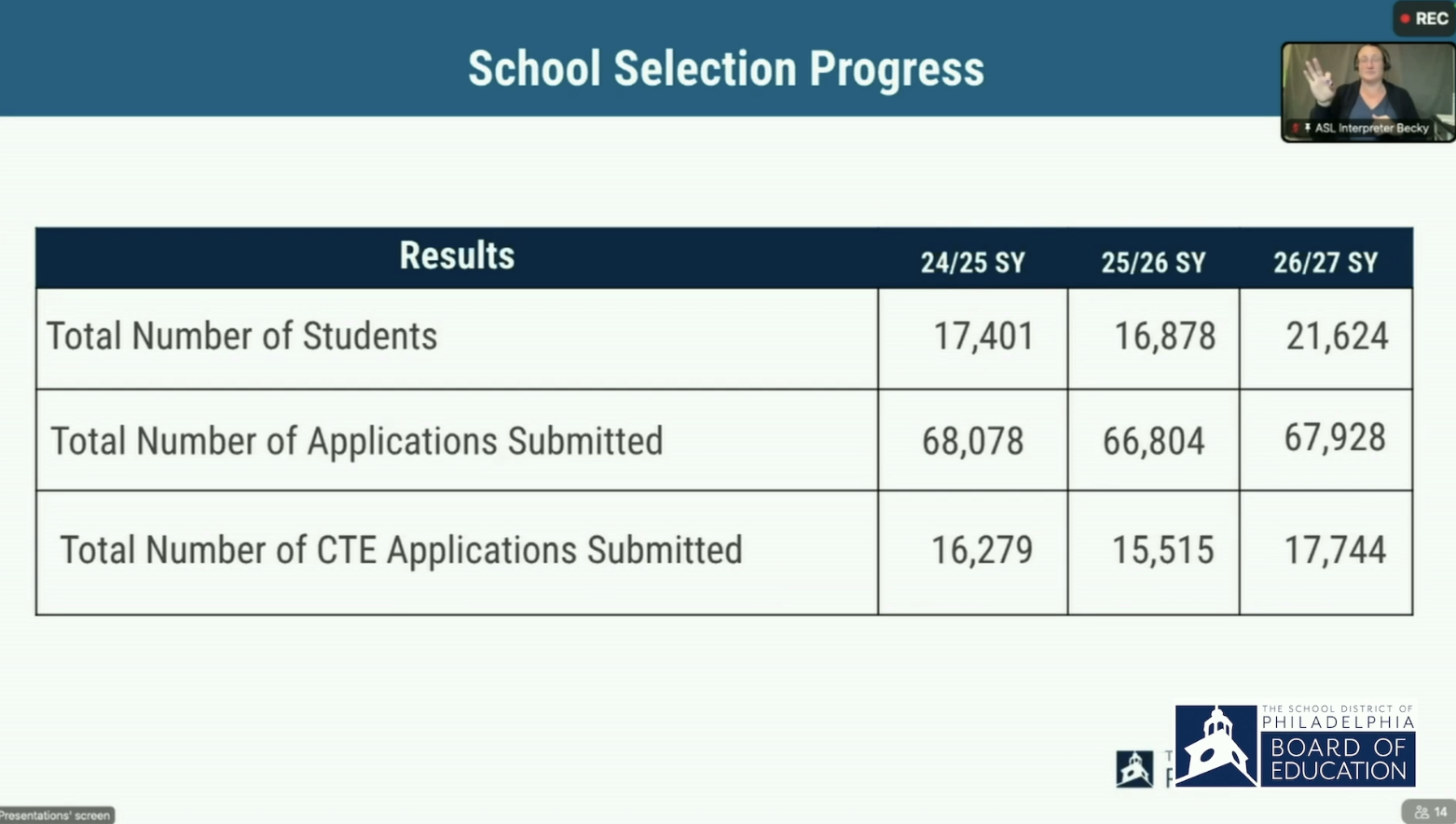
An update on school selection: The superintendent says the district has made improvements to the process, changes recommended by an outside consultant including optimizing the lottery, ranking and waitlist features, and enabling schools more leeway to select criteria for their best-fit students.
This year, 21,624 students applied to criteria-based schools, up from 16,878 students last school year. There were 67,928 total applications submitted, and 17,744 career and technical education applications submitted (that number is also up).
Superintendent Tony Watlington shared this slide on progress with the district’s school selection process during a school board meeting on Dec. 4, 2025.
// Timestamp 12/04/25 4:37pm
5,000 people have taken the facilities planning survey so far, Watlington shares
An update, now, on the facilities planning process: 5,000 people have responded to the district’s new facilities survey.
“It’s been an honor to work with Teamsters Local 502,” Watlington said, noting principals’ key role in student learning. “We ask the board for your favorable adoption of the contract tonight.”
// Timestamp 12/04/25 4:22pm
Two students share their love for KIPP North
Student speakers are up now.
First is Jovahni Hazel, a student at KIPP North. Jovahni said he never got help at his old school, but he gets lots of help at KIPP. His sister used to hate school, but she loves school at KIPP.
“Kids like me work hard, we try, we show up, we push through things most people never see … Please keep [KIPP] open.” (The board has moved to nonrenew KIPP over academic concerns.)
Timothy Fontaine, another KIPP North student, loves his school. Timothy loves music.
“At KIPP North, they’re really the ones who let me grow with it.”
A drummer, Timothy has had chances to lead music class. The staff has helped him in many ways.
“This school is more than a school to me. It’s my home.”
// Timestamp 12/04/25 4:17pm
Attendance taken as the meeting begins
All nine board members are present at tonight’s meeting.
// Timestamp 12/04/25 4:09pm
Seniors and teacher of the month are honored
Seniors of the month are Juan Aquino of Olney High School and Andre Carter of Parkway Northwest High School for Peace and Social Justice.
Teacher of the month is Cynthia Carr from Swenson Arts and Technology High School.
// Timestamp 12/04/25 4:06pm
Final school board meeting of the year begins
School board meeting, here we go!
The final school board meeting of 2025 is the annual re-organizational meeting, when officers will be elected for 2026.
School board president Reginald Streater kicks the meeting off.
Philly school board to host its monthly action meeting
// Timestamp 12/04/25 3:45pm
The Philadelphia school board is set to host its monthly action meeting — the last of 2025 — starting at 4 p.m.
Among the topics on the agenda is the election of the board’s president and vice president for the coming calendar year.
President Donald Trump has replaced the architect he handpicked to design his White House ballroom, according to three people familiar with the project, ending the involvement of a boutique firm whose selection raised questions from the start about whether it had the capacity to complete the massive, high-profile endeavor.
For more than three months, James McCrery II and his architecture firm led the effort to design Trump’s $300 million ballroom building — until late October, when he stopped working on the project, one of the people said. It is unclear whether McCrery stepped back voluntarily, but the men parted on good terms and remain so, according to one of the people familiar with the project, all of whom spoke on the condition of anonymity to discuss internal conversations.
Trump and McCrery had clashed over the president’s desire to keep increasing the size of the building, but it was the firm’s small workforce and inability to hit deadlines that became the decisive factor in him leaving, one of the peoplesaid.
Trump has chosen architect Shalom Baranes, who’s been designing and renovating government buildings in Washington for decades, to pick up the mantle, according to two of the people. Baranes’ firm has handled a number of large Washington projects dating back decades, including projects involving the main Treasury building near the White House and the headquarters of the General Services Administration.
“As we begin to transition into the next stage of development on the White House Ballroom, the Administration is excited to share that the highly talented Shalom Baranes has joined the team of experts to carry out President Trump’s vision on building what will be the greatest addition to the White House since the Oval Office — the White House Ballroom,” White House spokesman Davis Ingle said in a written statement. “Shalom is an accomplished architect whose work has shaped the architectural identity of our nation’s capital for decades and his experience will be a great asset to the completion of this project.”
The White House and McCrery’s representative have continued to say that McCrery remains involved in the project in a “consulting” role.
The ballroom building — at 90,000 square feet and estimated to hold nearly 1,000 guests and cost $300 million — was from the start a herculean task for McCrery, said people familiar with his firm’s operations. That might have been true for any firm given Trump’s rushed timeline, but it was especially difficult for the head of a small firm better equipped to design churches, libraries, and homes.
Trump’s selection of the firm raised eyebrows of architects and planning experts worried that a shop as small as McCrery’s couldn’t complete such a large project in little more than three years. One architect said federal officials tasked with awarding contracts would normally consider only firms four times bigger than McCrery’s to take on projects of that scale.
Those concerns grew almost immediately, according to one of the people, who spoke on the condition of anonymity about the project.
“Everybody realized he couldn’t do it,” the person said.
McCrery’s spokesman did not respond to requests for an interview.
The renovation represents one of the biggest changes to the White House in its 233-year history, and has yet to undergo any formal public review. The administration has not publicly provided key details about the building, such as its planned height. The structure also is expected to include a suite of offices previously located in the East Wing. The White House has also declined to specify the status of an emergency bunker located beneath the East Wing, citing matters of national security.
In the weeks since the switch from McCrery to Baranes, crews of dozens of workers have continued to prep the site for construction, driving piles, stockpiling materials such as reinforced concrete pipes and amassing an array of cranes, drills and other heavy machinery, photos obtained by The Post show. On Wednesday, they erected a towering crane anchored into a concrete paddock.
On Tuesday, Trump said during a Cabinet meeting that the pile drivers operate “all night” and have created a disagreement in his marriage. The president said he loves the sound while first lady Melania Trump has asked him to make the constant pounding stop, a request he’s denied.
“Sorry, darling, that’s progress,” Trump said he told her.
In her early 20s, Nala Ray had it all. Or so she thought.
She lived in a $4.3 million home in California. She frequently drove luxury cars, including Ferraris, Bentleys and Lamborghinis. Her closet dripped with designer labels — Givenchy, Dior, Prada. Her favorite? A lamb-skin Chanel bag — red, with gold chains. Even her dogs, she says, sported Louis Vuitton collars.
All the luxury, however, came at a cost, she says. Ray made her fortune posting explicit content of herself on OnlyFans. In fact, she says she was one of the first to ever do so. In the early years of the website, when she made her account, no one quite knew what the fledgling, subscription-based platform would become. Maybe it’d be full of cooking classes. Or fitness tutorials. But, Ray says, because of early adopters like her, it became a de facto porn site, where anyone can upload content of themselves in exchange for cash from paying subscribers. Though not everyone on OnlyFans makes porn, the site has become known for it.
Most OnlyFans creators make next to nothing. A lucky few make millions. Ray was one of them. Over the course of her five years on the site, she estimates she made $14 million total, averaging $300,000 a month.
But after what she describes as a spiritual awakening, Ray left OnlyFans and has since become an outspoken critic of the platform. Now, she says, she wants to see OnlyFans — the very website she helped turn into a porn empire — destroyed.
Her plan? By shedding light on what she describes as the hidden cost of pornography, she hopes to change the hearts and minds of those still on OnlyFans, one person at a time. She wants to see a day when no one frequents the platform anymore.
“I was so deep in the industry,” Ray says. “I was bold enough to take so many crazy, radical steps into it. And now, I’m just on the opposite spectrum. It’s crazy. That shows God’s glory.”
How Nala Ray found OnlyFans
Ray’s upbringing was tumultuous.
When she was 8, a tornado wiped out her family’s home in small-town Missouri. Her dad had an affair, leading to her parents’ divorce, but they remarried each other two years later. After that, Ray says, her dad took on a newfound religious intensity, becoming a minister. Frequent in-fighting in her Baptist community led her family to hop from church to church. She never felt like she had a spiritual home.
“You get to see a dark side of religion,” Ray says. “People will kick you out of their church, and that’s so hard to see from people that you kind of fell in love with. So it was kind of major divorces, over and over and over again.”
Things worsened when her dad took pity on a wayward 16-year-old boy, letting him live in their home. The boy molested Ray when she was 13, she says, and the abuse continued for months until he ran away one night. Ray says neither she nor her family have heard from him since.
After that, Ray began acting out. She’d sneak out of the house at 2 a.m. to meet boys. She longed for the day she could finally move out and become independent. At around age 20, she found herself in Florida, working for an orthopedics company. She wasn’t sure where to go next.
Then, she got the Instagram DM.
“A random guy on Instagram − he was verified − he reached out,” she says. “And he was like, ‘Hey, you’d be so good at OnlyFans.’”
‘I couldn’t feel much at all’
OnlyFans skyrocketed in popularity during the COVID-19 pandemic. Ray caught the wave at the perfect time, she says, joining the site in February of 2020. Her first month, she made $87,000.
It became her new full-time job — and she took it seriously.
Ray acquired a manager. She read books on men’s psychology, so she could learn how best to appeal to their fantasies. She studied popular porn trends — and adjusted her content accordingly. She went on podcasts and made outrageous statements about sex that would go viral — whatever it took to drive more people to her page. At her peak on the site, she had 270,000 subscribers.
As the earnings ramped up, so did the pressure to make more gratuitous content, she says. She relied on marijuana and alcohol to get through particularly tough filming days. Anything, she says, to numb herself.
“Honestly, I couldn’t feel much at all. I could feel angry, but I didn’t cry for years. It felt like I didn’t feel sorry for anybody,” she says. “Anytime I would have to do major scenes, I’d have to drink myself into oblivion to just do it.”
Then, Ray met Jordan Giordano, a Christian influencer, on TikTok in 2023. He didn’t know who she was. They started talking.
Giordano treated her as a person, not as as sex object. It was his compassion and gentle nudging, she says, that ultimately got her to see the life she was living differently.
In January 2024, Ray quit OnlyFans. She and Giordano wed that March.
“There was this tear inside of me. I had built this whole life. I was so independent. I didn’t need a man. I made my bag. I could have anything I wanted. I could go anywhere I wanted, even though I didn’t have a lot of friends or anything. I felt so unique, and OnlyFans had given me that kind of freedom,” Ray says.
“To cross over into this very unknown world was terrifying to me. I thought so many times, ‘I can’t do this. I can’t do this. It’s too scary for me. I don’t know if I’m courageous enough to cross this line.’ And so what happened was, I continued to just talk to Jordan. I continued reading my Bible. I continued to pray. And then Jordan’s mom was actually the one that really helped me make the decision. She was like, ‘You’re on the right path, but you still have this door of darkness open, which is OnlyFans. You cannot have both.’”
‘Someone just wants someone else to listen to them’
Since leaving OnlyFans, Ray’s received tons of backlash online − much of it not from OnlyFans models, but from fellow Christians.
They call her a grifter. They call her faith a sham. They say she’ll be back on OnlyFans any day now.
The noise used to bother her. Now, she says, she’s better at tuning it out.
“The hate got to me for sure,” she says. “It got to my husband. I felt utterly alone some days, just being like, ‘Wow, the whole world hates me.’ And that’s a tough pill to swallow, honestly.”
Ray still has empathy for the women who do OnlyFans. Though she disagrees with their actions, she knows many have struggles few will ever understand.
“I have a heart for the OnlyFans girls, not only because I was one, but I saw it,” she says. “So many girls were like, ‘Oh, my dad abused me.’ ‘My stepdad tried to do things with me.’ ‘I don’t have a dad.’ ‘My dad ran away.’ ‘My mom hates me.’ I heard it all … Behavior is a symptom of what’s really going on underneath, right? Hurt damages people so bad, and shame will lead you into things that you never thought you would do.”
When they ask for it, Ray helps guide people through the process of quitting OnlyFans. She recalls one model who deleted her account after flying to Tennessee to have a heart-to-heart with Ray in person.
When someone like that contacts her, Ray says she listens to them, without judgment. It’s what her husband did for her − and it’s what she believes makes a real difference.
“The biggest thing I realized is someone just wants someone else to listen to them,” Ray says. “She just wanted to talk, and I let her. And she just told me everything that was going on in her life with her family and her relationship and how she felt about OnlyFans. And I didn’t pass one word of judgment. That’s it. We just can’t judge other people, because we have no idea what it’s like to walk a day in their shoes.”
Ray’s life looks quite different than it did a year ago. Her financial situation looks different, too. The OnlyFans money dried up fast, she says. The website took 20% of it. Her manager, 45%. Not to mention the hefty California taxes she owed.
Although her life hasn’t gotten easier, she says she doesn’t regret her decision. Being honest about her current life is also something that’s important to her, as she charts this new path. She plans on launching a podcast to continue sharing her story.
“The kind of Christian I want to portray is like, yeah, life freaking sucks,” Ray says. “I mess up. I’m not always modest. I still cuss sometimes. Yes, I want a joint sometimes. That is the Christian walk. I hate it when I see Christians online who just seem so perfect, but yet aren’t real with the fact that life is so hard sometimes.”
David E. Loder, 71, of Flourtown, longtime attorney at Duane Morris LLP, multifaceted trustee and board member, education advocate, mentor, and volunteer, died Thursday, Oct. 23, of complications from lymphoma and scleroderma at his home.
A graduate of Germantown Friends School and what is now the University of Pennsylvania’s Carey Law School, Mr. Loder spent 43 years, from 1982 to his retirement in 2024, as an associate, partner, and chair of the health law group at the Duane Morris law firm. He became partner in 1989 and helped the health law practice gain national recognition for its success.
Mr. Loder and his team represented the Hospital and Healthsystem Association of Pennsylvania, the Pennsylvania Trauma Systems Foundation, and other medical providers in all kinds of consequential litigation. In 2006, he helped local hospitals win a multimillion-dollar settlement with an insurance company. In 2010, he supervised a case that successfully revived a state abatement program that alleviated medical malpractice costs for physicians and hospitals.
In a tribute, former colleagues at the Pennsylvania Trauma Systems Foundation praised “his ability to see both the legal complexities and the human dimensions of every situation.”
Mr. Loder stands with Blanka Zizka , the Wilma Theater’s artistic director, at an event in 2018.
He was adept in vendor contract law, board governance, policy development, and human relations issues. He took special interest in doctor-patient relations and told the Daily News in 2016: “While it is critical that the healthcare provider convey necessary and accurate information to patients concerning their health condition, it is also important to remain sensitive to the patient’s interest and willingness to hear such information.”
Matthew A. Taylor, chair and chief executive officer at Duane Morris, said in a tribute: “He was one of the nation’s most respected healthcare lawyers.”
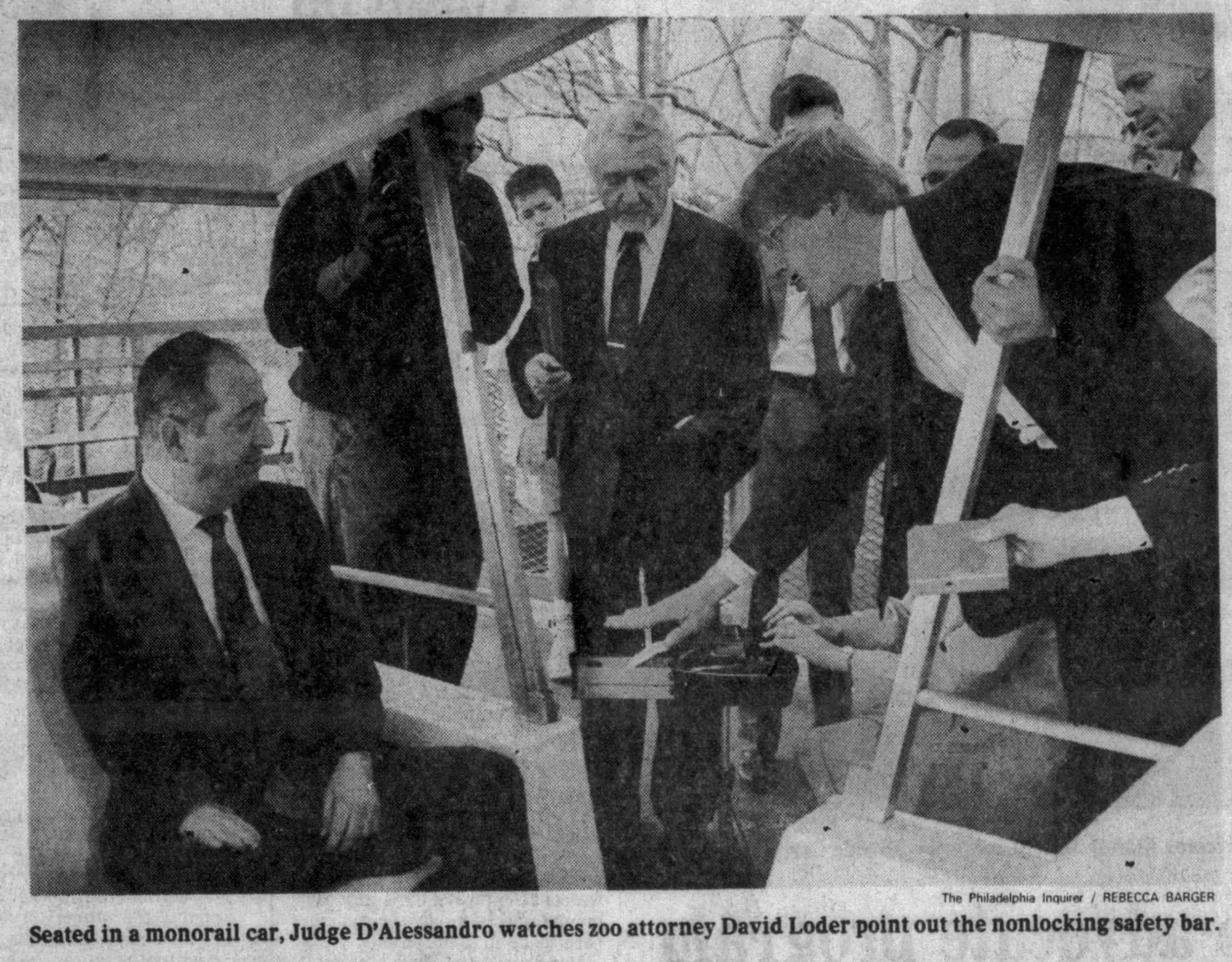
Mr. Loder also represented the Philadelphia Zoo, homeowners fighting increased property assessments, participants in gestational-carrier programs, and other clients. “He was a shrewd judge of character,” said his son Kyle. “He was thoughtful and strategic. He became a confidant and adviser to many of his clients.”
John Soroko, chair emeritus at Duane Morris, said in a tribute: “Dave had a unique ability to turn friends into clients. But, even more importantly, to turn clients into friends.”
This photo of Mr. Loder (right) representing the Philadelphia Zoo appeared in The Inquirer in 1989.
Away from the law firm, Mr. Loder was chair of the board for the Wilma Theater and served on boards at Germantown Friends, the old University of the Sciences, the World Affairs Council of Philadelphia, and other groups. He was a trustee at the Dolfinger-McMahon Foundation and the Christian R. and Mary F. Lindback Foundation, and represented the Lindback regularly at its annual distinguished educators awards ceremony.
“There’s a firm belief in the importance of excellence in education in the public schools,” he told The Inquirer at the 2016 Lindback ceremony. In 2017, he said: “All of us need to recognize that the Philadelphia public schools are serving an incredibly important function.” In 2018, he said: “People need to know that there are some exceptional educators in Philadelphia public schools.”
He mentored many other lawyers and volunteered to help students in need. In online tributes, friends noted his “kind advice,” “voice of reason and compassion,” and “sense of humor, keen intellect, love of sports, and limitless knowledge on so many topics.”
In 1998, he was featured in an Inquirer story about the challenges parents face when dealing with young children stuck inside during the cold winter months. He said: “I find that if you can get the kids down by 6 p.m. and have a glass of wine in front of the fireplace, it gets you through.”
Mr. Loder enjoyed sports and the outdoors.
His family said in a tribute: “He took life seriously but never too seriously, and his warmth, humor, guidance, and generosity will be remembered.”
David Edwin Loder was born April 22, 1954, in Yalesville, Conn. His father, noted theologian Theodore Loder, moved the family to West Mount Airy when Mr. Loder was a boy, and he graduated from Germantown Friends in 1972.
He starred in football, basketball, and baseball in high school, and went on to play basketball and earn a bachelor’s degree in political science at Wesleyan University in Connecticut in 1977. He worked briefly after college as a high school history teacher, served an independent study fellowship in Poland, earned his law degree at Penn in 1981, and studied international law at the London School of Economics and Political Science.
He married Nadya Shmavonian, and they had sons Marek and Kyle, and a daughter, Julya, and lived in Philadelphia and Flourtown. After a divorce, he married Jennifer Ventresca and welcomed her children into the family.
Mr. Loder liked hiking in New York’s Adirondack Mountains and relaxing at his getaway home on Long Beach Island.
Mr. Loder enjoyed tennis, squash, and golf at the Philadelphia Cricket Club. He liked hiking in New York’s Adirondack Mountains and relaxing at his getaway home on Long Beach Island, N.J.
He doted on his family and Labrador, and played cards every month for years with an eclectic group of old friends.
“David embodied the values of faith, service, and integrity,” his family said. His son Kyle said: “He was magnetic, gracious, thoughtful, and curious. He was easy to talk to.”
In addition to his wife, children, and former wife, Mr. Loder is survived by a granddaughter, a sister, two brothers, and other relatives.
Mr. Loder “was magnetic, gracious, thoughtful and curious,” his son Kyle said.
A memorial service and celebration of his life were held earlier.
Donations in his name may be made to the Penn Medicine Scleroderma Center, Attn: Amanda Hills, 3535 Market St., Suite 750, Philadelphia, Pa. 19104.
Uri Monson, Gov. Josh Shapiro’s longtime confidant and Pennsylvania’s budget secretary, is the new executive director of the $80 billion-asset Pennsylvania school pension and investment system, known as PSERS.
The move puts Monson, a former top finance officer for the School District of Philadelphiaand for Montgomery County government while Shapiro was its top elected official, atop the agency responsible for paying retirement checks to half a million current and retired school employees.
Monson has shown “exceptional financial leadership and integrity,” Shapiro said in a statement, citing Monson’s bond refinancing work that shaved state interest costs and helped boost its credit ratings so they are no longer among the lowest of the 50 states.
Zachary Reber, a deputy secretary in Monson’s office with 30 years of state government experience, will become the state’s new budget secretary. Shapiro credited Reber as a top negotiator for the 2025-26 budget, helping clinch the deal with legislators.
At PSERS, Monson will lead a staff of 350. The board picked Monson “because of his extensive public-sector financial experience,” board chair Richard Vague said in a statement that also said Monson’s hiring followed “a nationwide search.”
The new executive director “understands both the financial demands of a pension system and the responsibility” to school staff and retirees, said vice chair Sue Lemmo, a retired teacher.
Monson pledged to work with the board, staff, and other stakeholders — who include taxpayers and pension system members — to ensure “retirement security.”
He holds both a master’s degree in public policy and a bachelor’s degree from Columbia University and a second bachelor’s from the Jewish Theological Seminary of America.
PSERS is one of the most expensive state programs, consuming $5.5 billion directly from public revenues last year, including both state and local property tax funds, plus $1.2 billion routed through school workers’ paychecks.
The system also collects profits from its wide-ranging investments, totaling $5.7 billion last year.
The switch will likelymean a significant pay raise for Monson, who earned $211,000 a year as budget czar, the most of any Pennsylvania cabinet officer and more than the lieutenant governor.
While working as the top budget officer in the state since 2023, Monson oversaw Shapiro’s annual state budget proposals, which guide spending for the next five years.
Republican lawmakers criticized Shapiro’s 2025-26 budget proposal for counting on new revenue streams, such as marijuana taxes, that had yet to be approved by the General Assembly.
Monson’s predecessor at PSERS, Terrill Savidge Sanchez, was paid $317,000 in fiscal 2024. A longtime PSERS employee who also headed the smaller Pennsylvania state workers’ pension system (SERS), Sanchez announced her retirement earlier this year. Chief investment officer Ben Cotton stepped in as interim director after she left.
Sanchez was tapped for the top PSERS job in 2022 after the departure of Glen Grell, a former state representative and lawyer who tripled his legislative paycheck by joining PSERS in 2015.
Grell and other top staffers retired during a federal investigation into the system’s exaggerated earnings and secretive land deals, which was followed by changes in pension investment, financial reporting, audit, and travel practices.
As governor, Shapiro has not attempted such a purge, either at PSERS, where he controls three of 15 trustee seats, or at the SERS state employee pension system, where the governor appoints six of the 11 trustees.
PSERS trustees on their own have scrapped hedge funds and cut back on private-equity funds in recent years, citing high fees and poor returns compared to the rising U.S. stock market.
PSERS, like the state workers’ pension system, was among the first state pension systems to invest heavily in private assets in the late 1990s and 2000s.
PSERS’s private investments underperformed U.S. stocks during the 2010s bull market. Those investment returns, plus rising retirements and pension underfunding in the early 2000s, required higher taxpayer payments in recent years to keep the fund from growing less solvent.
Pennsylvanians now pay 34 cents into the PSERS plan for every $1 in school staff wages.
Some owners of private money managers who solicit top leaders of PSERS and other state pension funds for investments are major political donors at the national level, though an SEC rule has barred them from collecting state and local pension fees after donating to state or local candidates.
U.S. Sen. David McCormick (R., Pa.) was chief executive of hedge fund Bridgewater Associates when it was PSERS’s largest money manager. It oversaw about one-tenth of the state’s investments and collected more than $750 million in Pennsylvania investment fees over the 20 years before PSERS trustees voted to drop hedge funds in 2021.
Staff writer Gillian McGoldrick contributed to this article.
NEW YORK — Minutes after police approached Luigi Mangione in a Pennsylvania McDonald’s, he told an officer he didn’t want to talk, according to video and testimony at a court hearing Thursday for the man charged with killing UnitedHealthcare CEO Brian Thompson.
Although some video and accounts of police interactions with Mangione emerged earlier in this week’s hearing, Thursday’s proceedings shed new light on the lead-up to and aftermath of his Dec. 9, 2024, arrest in Altoona, Pa.
Mangione, 27, appeared to follow the proceedings intently, at times leaning over the defense table to scrutinize papers or take notes. He briefly looked down as Altoona Police Officer Tyler Frye was asked about a strip-search of Mangione after his arrest. Under the department’s policy, that search wasn’t recorded.
It happened after police were told that someone at the McDonald’s resembled the much-publicized suspect in Thompson’s killing. But Frye and Officer Joseph Detwiler initially approached Mangione with a low-key tone, saying only that someone had said he looked “suspicious.” Asked for his ID, he gave a phony New Jersey driver’s license with a fake name, according to prosecutors.
Moments later, after frisking Mangione, Detwiler stepped away to communicate with dispatchers about the license, leaving the rookie Frye by Mangione’s table.
“So what’s going on? What brings you up here from New Jersey?” Frye asked, according to his body-camera video.
Mangione answered in a low voice. Asked what the suspect had said, Frye testified Thursday: “It was something along the lines of: He didn’t want to talk to me at that time.”
Mangione later added that “he was just trying to use the Wi-Fi,” according to Frye.
During the roughly 20 minutes before Mangione was told he had the right to remain silent, he answered other questions asked by the officers, and also posed a few of his own.
“Can I ask why there’s so many cops here?” he asked shortly before being informed he was being arrested on a forgery charge related to his false ID. By that point, roughly a dozen officers had converged on the restaurant, and Mangione had been told he was being investigated and had been handcuffed.
Mangione has pleaded not guilty to state and federal murder charges. Before any trials get scheduled, his lawyers are trying to preclude the eventual jurors from hearing about his alleged statements to law officers and items — including a gun and a notebook — they allegedly seized from his backpack.
The evidence is key to prosecutors’ case. They have said the 9 mm handgun matches the firearm used in the killing, that writings in the notebook laid out Mangione’s disdain for health insurers and ideas about killing a CEO at an investor conference, and that he gave police the same fake name that the alleged gunman used at a New York hostel days before the shooting.
Thursday’s proceedings came on the anniversary of the killing, which UnitedHealthcare marked by lowering the flags at its headquarters in Minnetonka, Minnesota, and encouraging employees to engage in volunteering.
Thompson, 50, was shot from behind as he walked to an investor conference. He became UnitedHealthcare’s CEO in 2021 and had worked within parent UnitedHealth Group Inc. for 20 years.
The hearing, which started Monday and could extend to next week, applies only to the state case. But it is giving the public an extensive preview of some testimony, video, 911 audio and other records relevant to both cases.
After encountering Mangione, Detwiler and Frye tried to play it cool and buy time by intimating that they were simply responding to a loitering complaint and chatting about his sandwich. Still, they patted Mangione down and pushed his backpack away from him. About 15 minutes in, officers warned him that he was being investigated and would be arrested if he repeated what they had determined was a fake name.
After he gave his real one, he was read his rights, handcuffed, frisked again and ultimately arrested on a forgery charge related to his fake ID.
Mangione’s lawyers argue that his statements shouldn’t be allowed as trial evidence because officers started questioning him before reading his rights. They say the contents of his backpack should be excluded because police didn’t get a warrant before searching it.
Manhattan prosecutors haven’t yet detailed their arguments for allowing the disputed evidence. Federal prosecutors have maintained that the backpack search was justified to ensure there was nothing dangerous inside, and that Mangione’s statements to officers were voluntary and made before he was under arrest.
Many criminal cases see disputes over evidence and the complicated legal standards governing police searches and interactions with potential suspects.