An East Germantown man admitted he struck and killed a woman in a wheelchair with his car in Lower Merion last year, then fled without helping her or calling police.
Jamal McCullough, 38, pleaded guilty to accidents involving death for hitting Tracey Carey outside the Taco Bell restaurant on City Avenue in November of last year.
McCullough entered the plea Tuesday — the day he was expected to go to trial — as Carey’s relatives looked on. The family later expressed frustration at their belief that the man who killed her showed little remorse.
McCullough will serve three to six years in state prison, the mandatory minimum sentence for the crime to which he pleaded guilty.
McCullough’s attorney, Michael Parkinson, did not immediately respond to a request for comment.
McCullough struck Carey, 61, with his Toyota Camry on Nov. 11, 2024, as she attempted to cross the highway in her wheelchair. And while prosecutors noted that McCullough was not at fault in the fatal collision because Carey was crossing outside of a posted crosswalk, they said his actions after the crash constituted a crime.
Surveillance footage taken from the scene showed that McCullough hit Carey with enough force to send her body into the air and push it several feet away, according to the affidavit of probable cause for his arrest.
The collision occurred around 2:14 a.m., as McCullough was on his way to begin his shift as a sanitation worker with Waste Management. Afterward, surveillance cameras recorded him pulling into a nearby parking lot to assess the damage to his vehicle and then walking back to the scene of the crash.
Investigators said McCullough walked within feet of Carey’s body, but did not stop to help her.
Another driver who witnessed the crash called 911 and used his vehicle to block traffic and protect Carey, the affidavit said.
She was later pronounced dead at Lankenau Medical Center.
Investigators identified McCullough’s vehicle through broken pieces of the vehicle that were left at the scene, as well as the surveillance footage from the area, according to the affidavit
McCullough’s coworkers told police that in explaining the visible damage to his car, he initially said the vehicle had been hit while it was parked. After his photo was included in news reports about the crash, McCullough told his coworkers he hit a person in a wheelchair and promised to turn himself in.
When detectives came to interview him at his workplace, McCullough said he wanted to take full responsibility for his actions, the affidavit said, and was making arrangements to surrender his vehicle to police.
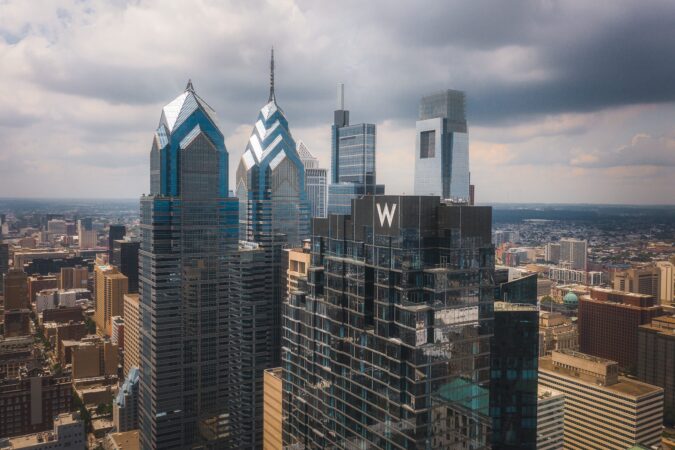
When a Marriott representative visited the construction site of the W Philadelphia hotel in Center City in January 2019, months after the project should have been completed, the concrete floors were so uneven that a pen placed on the ground rolled downhill.
The construction of Philadelphia’s largest hotel, home of the W and the Element, both part of the Marriott umbrella, began in 2015 and had a strict 2018 deadline for completion. Delays led to an avalanche of nearly 30 lawsuits with the site’s owner, construction contractor, and design company pointing fingers at each other.
The W, which comprises 295 rooms of the 51-story building, eventually opened in 2021, roughly three years late.
Bringing to a close 25 of the lawsuits, a Philadelphia judge issued a 69-page memo last weeklaying out the saga and finding the construction company responsible for the project going “off the rails.”
Common Pleas Court Judge James Crumlishfound that the construction contractor, Tutor Perini Building Corp., subcontracted the concrete work to a company that botched the job. And despite knowing about the problems, which were detrimental to the entire project, Tutor denied the issues for months.
The judge’s finding comes after trial testimonies that took five months as the parties “turned this litigation into a challenging behemoth that made any effort at resolution impossible,” Crumlish wrote.
A yearslong saga
The saga began when Chestlen Development LP, the owner of the site, picked Tutor as the construction manager. The agreement capped the cost of construction at $239 million and required completion within 1,017 days after April 2015.
An attorney for Tutor did not respond to a request for comment.
From the outset, Tutor suffered “chronic turnover of its personnel,” the judge wrote, resulting in the loss of “institutional knowledge of key decisions.”
Tutored subcontracted the concrete work to Thomas P. Carney Inc. Construction, a Bucks County company.
When a different subcontractor, Ventana DBS LLC, began installing the wall-window systems, they immediately noticed a “big problem,” according to the judge’s memo. In many places the concrete wasn’t level or did not meet the elevation requirements in the design.
Tutor pushed back, denying that there was a problem, while quietly attempting to grind the edges of the concrete slabs to address the issue.
While denying the problem, Tutor hired outside advisers to evaluate the concrete work. But they confirmed the problem too.
Finally, in March 2018, Tutor shared the outside reports that acknowledgedCarney’s shoddyconcrete work with Chestlen’s representative for the project.
As summer 2018 began, it was clear that the project would not be completed on deadline.
In September 2018 Tutor asked Chestlen for an extension, which the owner rejected, saying the request came “months if not years after some of the concrete issues started to become apparent,” according to Crumlish’s memo.
The remediation of the floor began in April 2019 andwas completed in October.
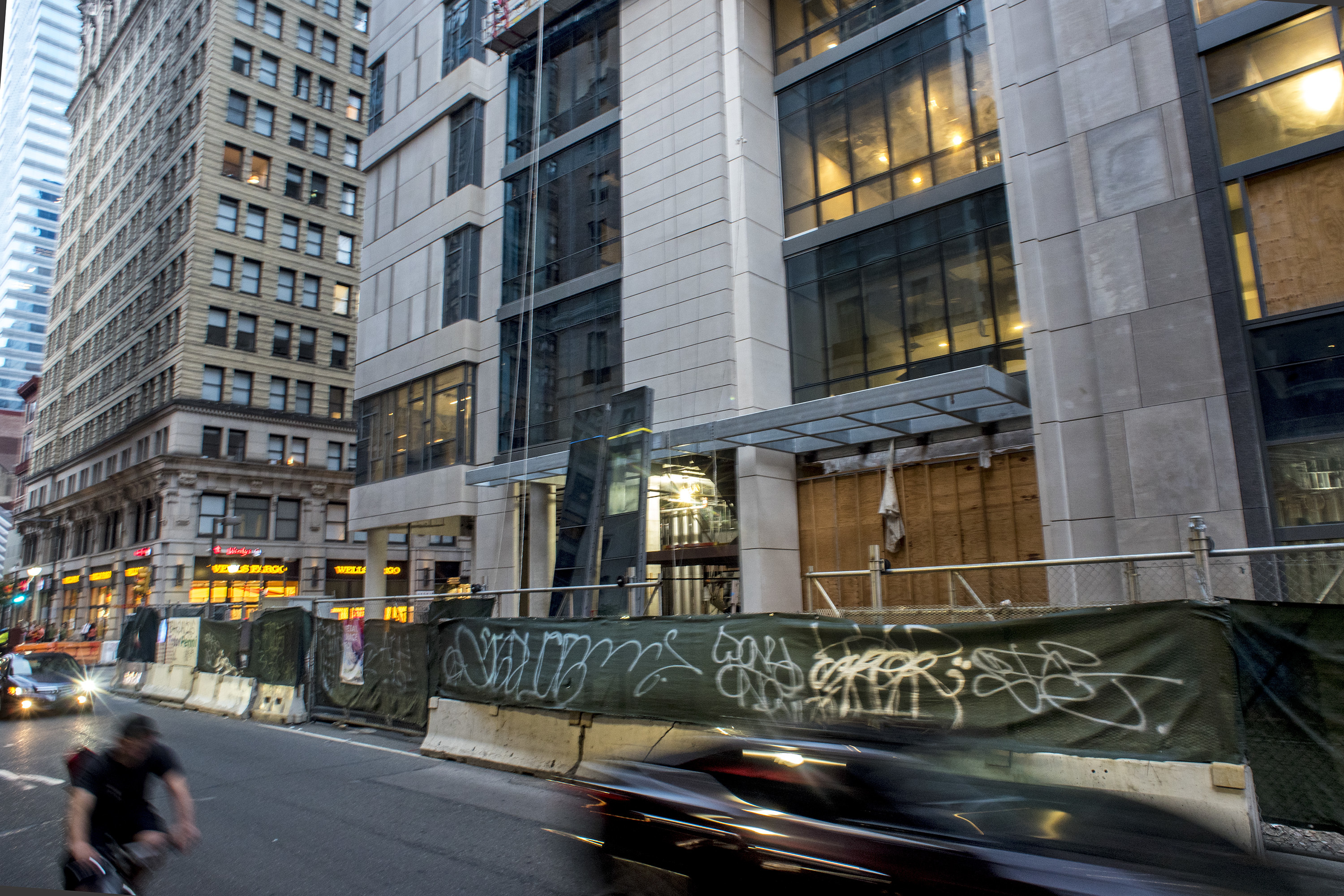
The sidewalk area of W Philadelphia and Element Philadelphia Hotel under construction, looking northwest along the 1400 block of Chestnut Street July 2, 2019.
The building finally obtained a certificate of occupancy in April 2021. But Marriott couldn’t open the W until August because over a hundred window vents were inoperable because Tutor failed to follow the design.
“Tutor knew that the floors did not meet specifications but did not timely disclose its knowledge to Chestlen or consult with it,” Crumlish wrote. The judge further found that Tutor refused to work with contractors to remediate the problems in 2017 and 2018, and proceeded to install interiors over the deficient concrete floors.
The blame game
Throughout the litigation, the parties all blamed one another for various problems and aspects of the delay.
Costs and liens piled up.
Chestlen paid Tutor $239 million for the construction, accrued over $40 million in damages as set in its contract with Tutor, and paid tens of millions to remediate the floors. The property is “clouded with over $155 million in liens,” according to the judge’s memo.
Crumlish concluded that Tutor breached its contract when it failed to oversee the concrete work and the window-wall installation, and generally didn’t fulfill its obligations.
“Every delay in the performance and completion of the project is the responsibility of Tutor and Carney,” the judge said. The judge will decide on the amount of damages following hearings scheduled for January.
Chestlen’s attorney was unavailable to provide comment. Carney did not respond to a request for comment.
The W hotel is located where One Meridian Plaza used to be, before that building suffered a devastating fire in 1991 and was finally demolished in 1999.
Filling the vacant lot, a mere block from City Hall, became a top priority for policymakers during Mayor Michael Nutter’s time in office. The hotel proposal eventually received $75 million in taxpayer support across local, state, and federal funding sources in addition to other legislative assistance.
The project was developed by Brook Lenfest, son of the former Inquirer owner H.F. “Gerry” Lenfest, whose foundation continues to own the newspaper today.
A former West Philadelphia ward leader and onetime staffer for State Sen. Vincent Hughes was sentenced Wednesday to one year in federal prison for stealing more than $140,000 from his ward and a church where he served as a deacon.
Willie Jordan, 68, had pleaded guilty to two counts of wire fraud over the summer. During his sentencing hearing Wednesday before U.S. District Judge Harvey Bartle III, Jordan said that he was sorry and that there were no excuses for his misconduct.
“It was a bad decision,” Jordan said. “It was just wrong.”
Bartle agreed, telling Jordan that although he appeared to have lived an otherwise noble life — dedicating his time and career to serving the public — stealing from institutions that sought to help people was inexcusable.
“What’s so disappointing is you had a position of trust … and you abused that position of trust,” Bartle said. “And the amount of money you took were not insignificant sums.”
Jordan for years was the unpaid leader of the 44th Ward in West Philadelphia and also a deacon at Mount Calvary Baptist Church in North Philadelphia. Prosecutors said that he had near-total control over the finances of both organizations, and that from 2020 to 2024 he took advantage of that status by writing checks to himself to cover personal expenses, including credit card and utility bills, purchases from airlines and furniture stores, and costs associated with a relative’s funeral.
In all, prosecutors said, he stole more than $57,000 from the church and $85,000 from the ward, and often claimed the money was to reimburse the organizations for expenses they never incurred. To further conceal his wrongdoing, prosecutors said, he sometimes wrote false entries on checks’ memo lines, saying they were to pay for items such as Easter baskets or summer youth programs.
Much of the fraud occurred while Jordan was working in Hughes’ office, prosecutors said, where he was a longtime top aide and had a six-figure state salary.
Jordan’s attorney, Sam Stretton, said that Jordan retired from that job earlier this year amid the federal investigation into his crimes, and that he also is no longer a ward leader.
Assistant U.S. Attorney Louis Lappen said in court that the repeated nature of Jordan’s wrongdoing, and his status as a well-paid public employee, made his crimes stand out.
“He’s somebody who should have known better,” Lappen said.
Stretton said Jordan “made a terrible mistake but is an otherwise good person.” He said Jordan has already repaid the $57,000 he stole from the church and is continuing to donate hundreds of dollars per month to help cover its bills and other expenses. Jordan also is continuing to make restitution payments to the ward, Stretton said.
Several of Jordan’s relatives wept in the courtroom after Bartle imposed his sentence. The judge then paused and addressed Jordan again before adjourning the hearing.
“You’re going to have to pay the price of your crimes, but there is life after prison, and I hope you will continue to be a useful and productive citizen,” Bartle said. “There is redemption.”
Lower Merion’s board of commissioners is set to put multiple new ordinances on the books next month, including policies raising parking meter rates for the first time since 1999, lowering the speed limit on parts of Lancaster Avenue, and regulating where smoke and vape shops can open in the township.
The smoke and vape shop regulation movedaheadlast month, and the commissioners advanced the parking meter and speed limit changesWednesday evening. Lower Merion’s assistant township manager, Brandon Ford, said the commissioners are poised to formally vote on all three proposals in December. Here’s everything you need to know.
Parking meter rate may go up
Commissioners on Wednesday moved forward an ordinance that would raise parking meter rates across Lower Merion for the first time in more than 25 years.
Under the proposed ordinance, parking would increase from 50 cents per hour to $1 per hour across the township, with the exception of six locations in Ardmore. Parking would go up to $1.50 per hour at Rittenhouse Place, Cricket Avenue, Cricket Terrace, and township-owned parking lots five (Cricket Terrace) and six (Schauffele Plaza). The Cricket Avenue Parking Garage would stay at 50 cents per hour.
Township staff say the proposed meter rate increase would generate around $900,000 annually and would likely drive quicker turnover in Lower Merion’s commercial corridor, generating more economic activity for local businesses.
“The rates that we are charging have not kept up with the overall cost for maintaining those parking meters, as well as our overall parking services program,” Ford said during a Nov. 5 meeting.
The ordinance, if passed, would not change how parking meter fees are collected. The township collects parking fees through meters, kiosks, and a mobile app.
Commissioner Scott Zelov, who represents Bryn Mawr, Haverford, and Gladwyne, said: “It certainly is time to do this.”
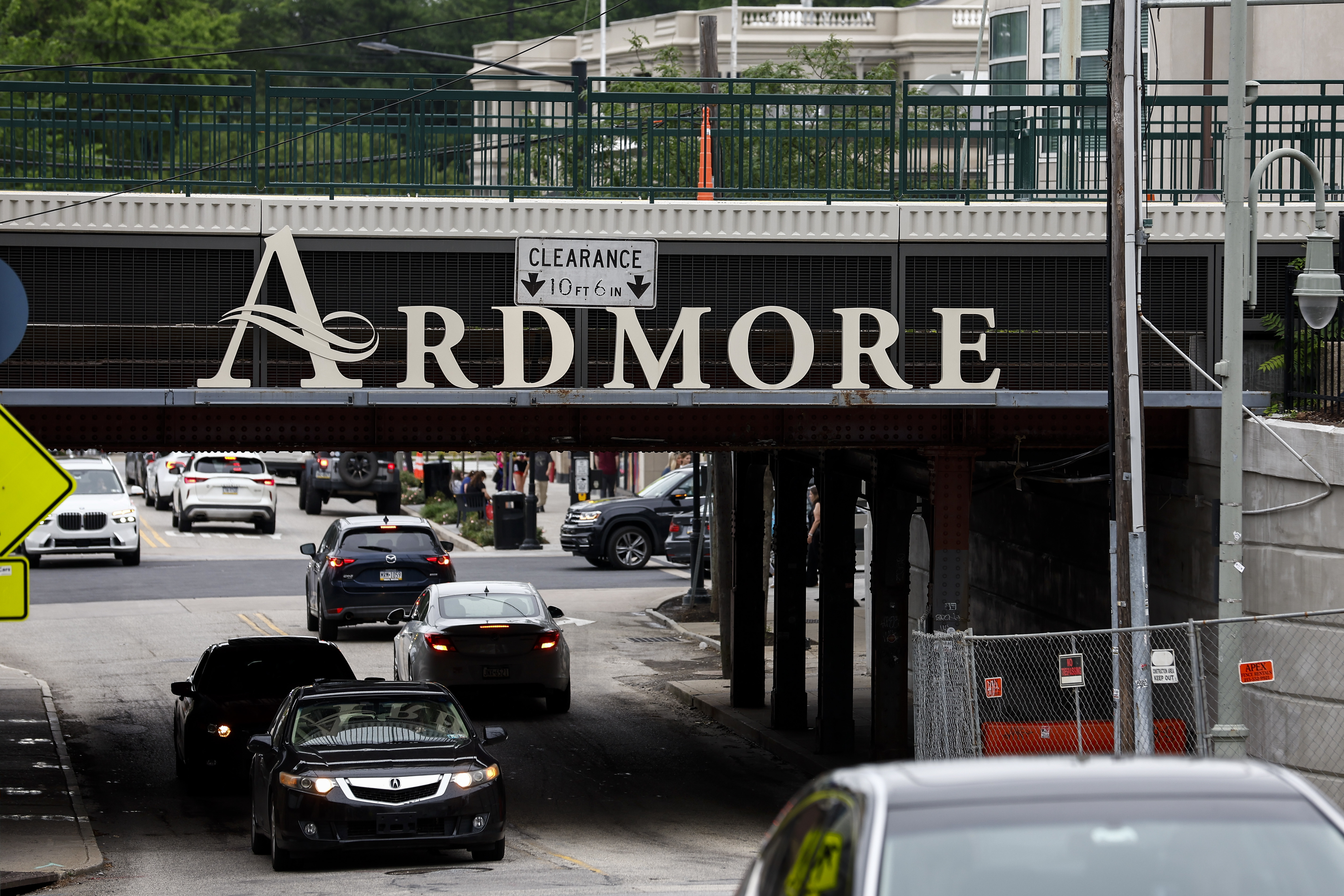
Anderson Avenue near Suburban Square on June 8. A proposed Lower Merion ordinance would increase parking meter rates across the township in hopes of raising revenue and spurring economic activity in places like downtown Ardmore.
Lancaster Avenue speed limit reduction
Lower Merion is set to reduce the speed limit on parts of Lancaster Avenue from 40 mph to 35 mph, bringing township code in compliance with an earlier speed limit change by the Pennsylvania Department of Transportation.
PennDot has already placed 35-mph speed limit signs on the selected strip of Lancaster Avenue. The board’s approval will bring the township in line with the state and allow township police to start enforcing the reduced speed limit. The speed limit change is the latest development in a major redesign of Lancaster Avenue by the state and the township.
A study conducted by PennDot earlier this year found that, out of nearly 20,000 vehicles traveling on Lancaster Avenue between Wynnewood Road and City Avenue during a 24-hour period, only 57% were driving at or below the 40-mph speed limit. PennDot considers the intersection of Lancaster Avenue and Remington Road to be a “high crash location.”
The ordinance, approved for advertisement on Wednesday, also bans right turns on red at three intersections: Lancaster Avenue and Remington Road for eastbound traffic, Lancaster Avenue and Haverford Station Road for westbound traffic, and Montgomery Avenue and Airdale Road for east-west traffic.
The township aims to place automated red-light cameras at all three intersections. The first red-light camera, at Remington Road and Lancaster Avenue, is in the process of being installed. Andy Block, Lower Merion’s superintendent of police, said the camera should be up and running by the end of the year.
Following a lengthy discussion that stretched across two meetings, the board of commissioners on Oct. 22 moved forward an ordinance that would decide where tobacco and vape shops can operate in Lower Merion.
Under the proposed ordinance, if a tobacco or vape shop wanted to open in Lower Merion, it would have to be situated at least 1,000 feet from any other tobacco or vape shop and 1,000 feet from any public or private school. The rule would also apply to hookah lounges.
Township staff said the 1,000-foot buffer would dramatically decrease the opportunity for smoke shops to operate in Lower Merion. Ford said there are currently around 1,000 properties in Lower Merion where smoke shops could operate. If the buffer ordinance were to be implemented, that number would drop to 300.
While some commissioners inquired about creating a larger buffer, officials said doing so would likely zone smoke shops out of Lower Merion entirely, which would give smoke shop owners the legal claim to build anywhere in the community.
During an Oct. 17 discussion of the ordinance, Commissioner Anthony Stevenson, who represents Ardmore and Haverford, said: “We need to avoid the continuation of making our township, and particularly in the Ardmore area, a vape central.”
This suburban content is produced with support from the Leslie Miller and Richard Worley Foundation and The Lenfest Institute for Journalism. Editorial content is created independently of the project donors. Gifts to support The Inquirer’s high-impact journalism can be made at inquirer.com/donate. A list of Lenfest Institute donors can be found at lenfestinstitute.org/supporters.
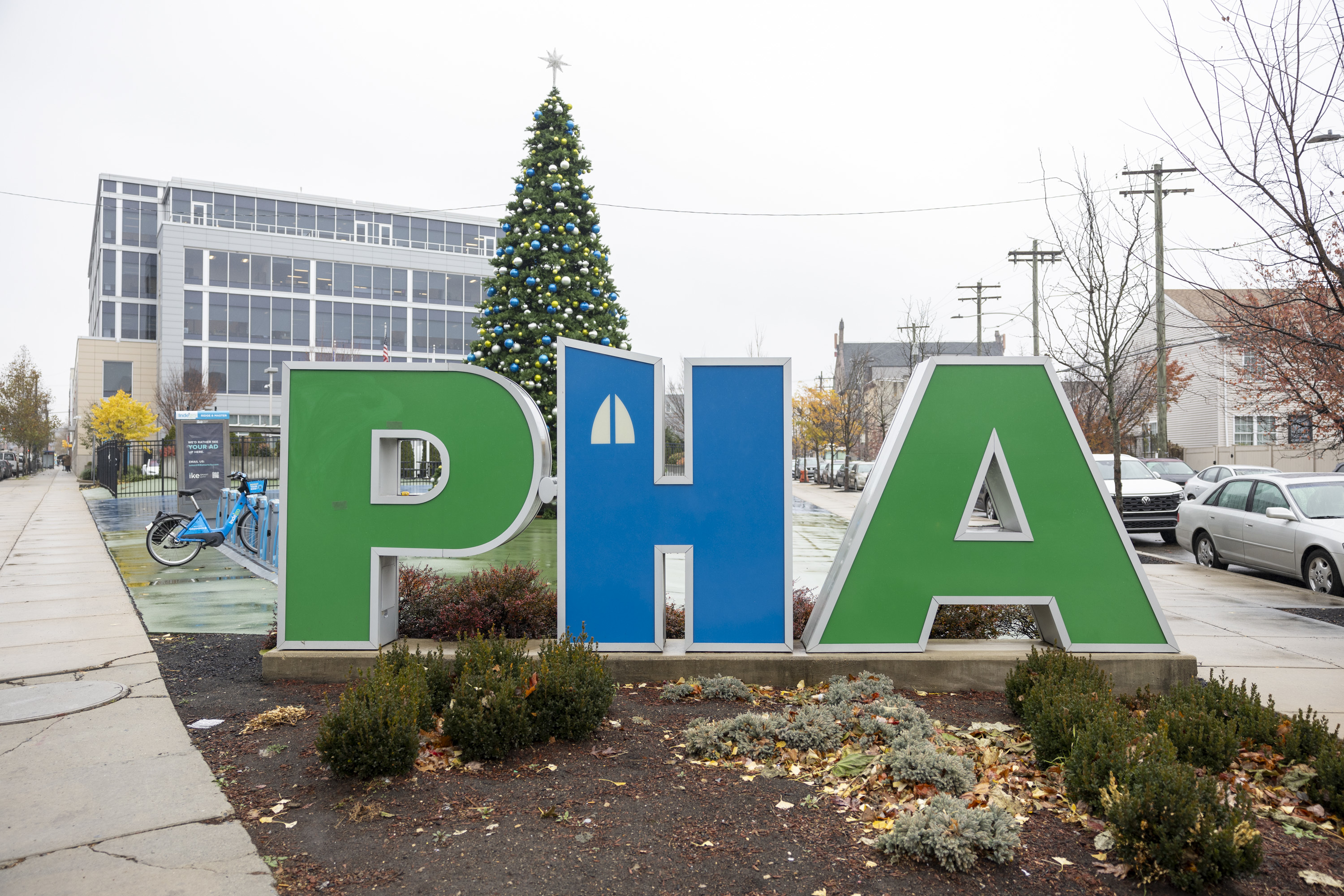
The Philadelphia Housing Authority (PHA) is planning sweeping layoffs that will affect almost 300 of the agency’s 1,200 employees, beginning in January 2026.
The cutbacks are the result of dramatic changes in how PHA, which provides affordable housing to thousands of families across the city, does maintenance and repair work. Instead of directly employing union electricians, carpenters, and other workers, beginning next year, the agency will contract out for those jobs as needed.
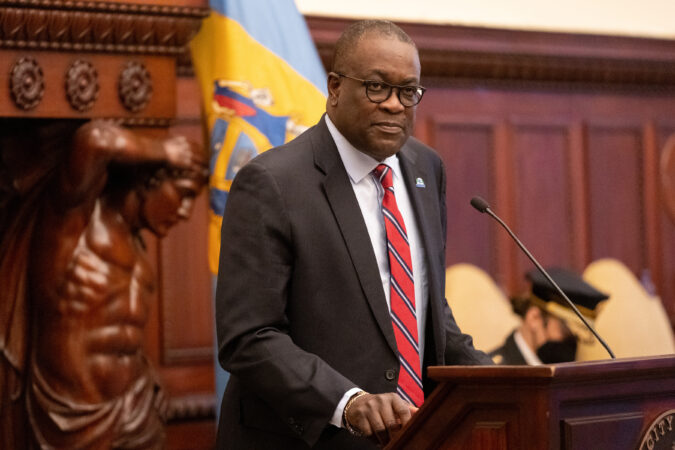
“This is a housing program, it is not a jobs program,” said Kelvin Jeremiah, the president and CEO of PHA, in an interview.
“Do I use the resources that we have to protect residents, to advance the availability of affordable housing to the families that are most in need? Or do I use those limited resources to fund positions that I don’t need?” Jeremiah said.
There are 620 members of the Philadelphia Building and Construction Trades Council employed full-time by the agency as maintenance staff. Jeremiah estimates that by almost halving that number PHA will see a cost savings of $24 million annually.
The agency said it currently costs $15,500 to maintain a single unit of traditional public housing annually, due to the agency’s complex work rules, which require many different union workers to make repairs. Most other multifamily providers have dramatically lower per-unit maintenance costs.
“PHA has engaged the unions throughout this process and can proceed with this policy decision without additional approvals,” an agency spokesperson said in an emailed statement.
Although in-house building trades workers will constitute the majority of lost jobs, other positions will also be affected, including 33 managerial roles in PHA headquarters. Overall, PHA’s workforce will shrink by about 20%.
“We are going to talk and try to offer some alternatives, but this is an issue of price sensitivity and we have to understand, given the new environment, that there are less funds to do the same mission with,” said Ryan Boyer, business manager for the Philadelphia Building and Construction Trades Council, whose unions represent many of the affected workers.
The Philadelphia Housing Authority Headquarters is planning sweeping layoffs that will affect almost 300 of the agency’s 1,200 employees, beginning in January 2026 in Philadelphia, on Wednesday, Nov. 19, 2025.
More with less?
The cutbacks come amid an aggressive $6.3 billion plan unveiled earlier this year, through which the agency hopes to expand its housing portfolio by 7,000 units while rehabbing the 13,000 units it already owns.
Jeremiah said that the staff reduction should not be seen as PHA doing more with less, and that it will not limit the agency’s ability to execute his planned expansion.
“We will not be doing less than what we’re doing now, but we have been doing too little with too much,” Jeremiah said. He said other market-rate and affordable housing multifamily operators are able to do unit repairs for far less than what PHA pays.
“My colleagues have all been doing this at substantially less cost,” Jeremiah said. “The only difference between us is that they have an operating model that does not require six different trades to do a single thing.”
Kelvin A. Jeremiah, PHA President & Chief Executive Officer, at PHA headquarters, in Philadelphia, May 21, 2025.
Because PHA’s layoffs will affect hundreds of members of Philadelphia’s influential building trades unions,Jeremiah said, he has been negotiating with Boyer on the work-rule changes.
“My reaction is one of disappointment. However, we remain partners with PHA and we will still build most of the stuff on the capital side,” Boyer said. “I don’t want it to be lost that when they build stuff, they will still be members of the Philadelphia building trades working, and there will still be members doing maintenance work.”
Jeremiah said maintenance technicians, laborers, and painters will be the only trades that remain directly employed with the agency after the work-rule changes go into effect.
The electricians union, IBEW Local 98, said it is still studying PHA’s new policy.
PHA will also still work with the trades for discrete repair and maintenance jobs within the agency’s housing portfolio but will no longer directly employ as many workers full-time, Jeremiah said.
The Trump effect?
PHA’s layoffs, and its expansion plan, are unfolding during a period of uncertaintynationwide for affordable housing policies and organizations like PHA.
Nearly all of PHA’s funding — 93% — comes from the federal government, according to the agency.
“If Congress and the administration coughs, it impacts us,” Jeremiah said. “If there is a reduction [in funding], it impacts us.”
Jeremiah said he is seeking to operate within the mandates set by Trump’s administration while continuing to support PHA’s tenant base and plans.
“Subsidizing employment … is just not the way to go at a time when we’re looking at less funding on the horizon,” Jeremiah said. “Where am I to get the funds not only to do more developments, acquire more, and preserve what we have at the same time[that] we have a workforce that is, quite frankly, I will dare to use the word bloated?”
Waves of layoffs
Despite the layoffs, Jeremiah believes the agency will still be a rich source of jobs for the building trades unions as the $6.3 billion plan unfolds. He points to an analysis of PHA’s 10-year plan byeconomic consulting firm Econsult Solutions, which said it would create 4,900 jobsannually in the city.
The first round of 260 job losses will hit in mid-January 2026, although Jeremiah says 93 of those workers will be retained in new positions as maintenance aides, laborers, and painters. A further 116-position reduction will occur next summer.
A vice president of development, Greg Hampson, also recently left PHA, although the agency declined to comment on that case. Jeremiah said that several vice president and director-level positions will be among the coming layoffs.
The last major round of layoffs at PHA was in 2016, when 14% of the staff was cut. Those positions were mostly administrative roles.
Editor’s note: A previous version of this story misstated the number of employees impacted.
“We will sing, dance, and celebrate in the way Pierre would have wanted us to,” said Chuck Damico, WMMR’s program director.
The concert will take place at the Fillmore on Dec. 17. Tickets will cost $50 and go on sale Friday at 10 a.m. through Ticketmaster on the Fillmore’s website. A portion of the proceeds will go to MANNA, the Metropolitan Area Neighborhood Nutrition Alliance.
The show will feature bands and musicians near and dear to the former WMMR host’s heart, including The Hooters, Brent Smith and Zach Meyers of Shinedown, Lizzy Hale and Joe Hottinger of Halestorm, and Ed Roland of Collective Soul.
A poster for a concert honoring former WMMR host Pierre Robert, who died unexpectedly last month.
Robert, 70, was found dead in his Gladwyne home on Oct. 29 after failing to show up for his midday show. The cause of Robert’s death was not disclosed and officials don’t plan to release additional information. Caroline Beasley, the CEO of WMMR’s parent company, Beasley Media Group, said foul play was not suspected.
“Everything seemed to be natural,” Preston Elliot said on air following Robert’s death. “It just appears he passed overnight.”
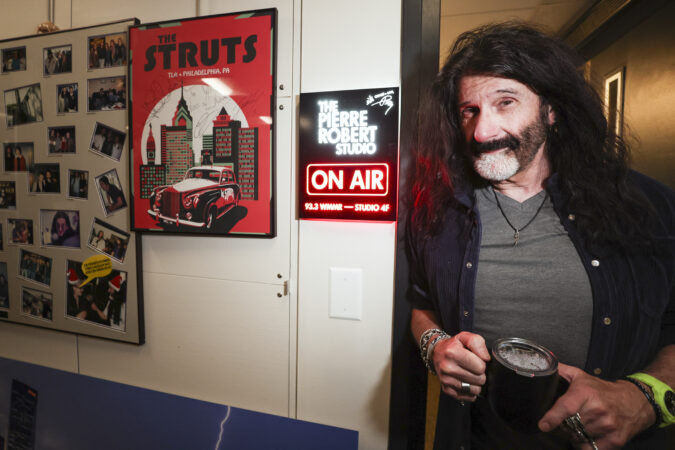
Robert was a musical institution in Philadelphia, where he spent 44 years on the air sharing his deep love of classic rock and expressing a humanity that touched musicians and listeners across the county.
“He was truly irreplaceable and his passing will leave a big hole especially in the local music community,” Hooters singer and cofounder Rob Hyman said. “Pierre was that ‘good citizen’ who will be missed by all.”
Pierre Robert’s annual Thanksgiving Day show will continue this year, hosted by his former producers.
With Thanksgiving approaching, WMMR plans to keep Robert’s annual Turkey Day show alive with a midday show anchored by Ryan Shuttleworth and featuring a collection of the rock host’s former producers — Kevin Gunn, Michael Anthony Thompson, Nick McIlwain, Jason Fehon, and Chris “Pancake” Ashcraft.
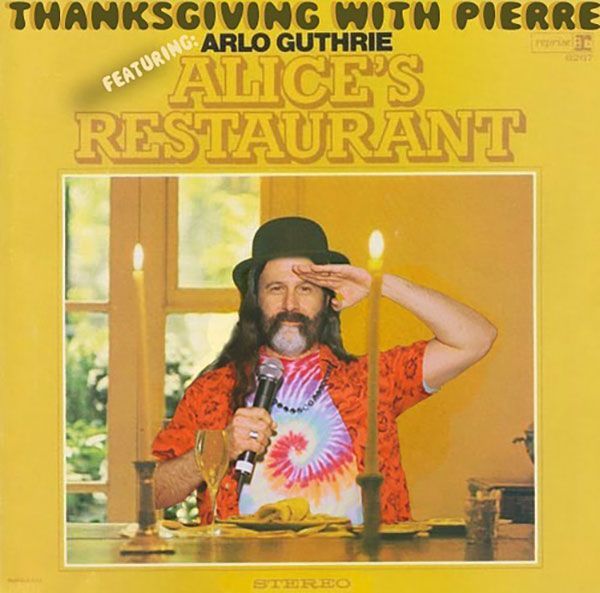
And yes, that means a heaping spoonful of Arlo Guthrie’s “Alice’s Restaurant Massacree,” the folk singer’s 18-minute opus. Expect to hear three versions of the song, including the even-longer 25th anniversary edition, which will be played at noon.
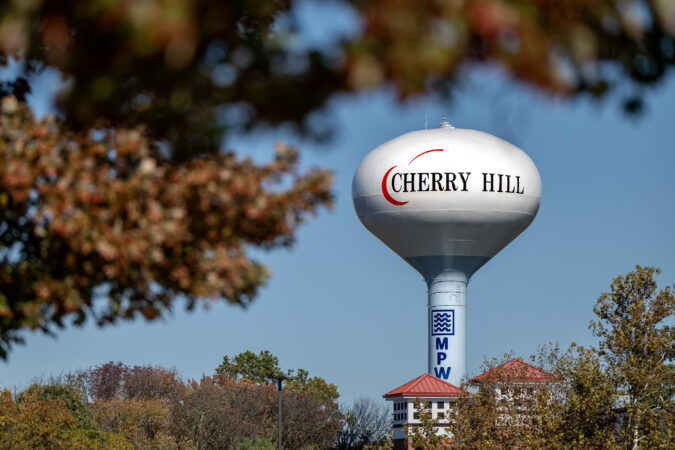
Cherry Hill will be doing a needs assessment to determine what makes older residents want to stay.
One-third of Cherry Hill’s residents are 55 or older. As the township’s population continues to grow, local leaders want to understand what makes its older residents stick around.
“For those that have the means, it’s a conscious decision to stay,” said Mayor Dave Fleisher. “They want to stay close to their kids, close to their grandkids.”
Cherry Hill will be using a $70,000 grant from the New Jersey Department of Human Services to do a needs assessment, including focus groups, listening sessions, and a survey. The goal of the grant, given to 17 communities in total, is to “make communities more welcoming and livable for people of all ages.”
The Cherry Hill Public Library is facing “disruptions” after one of the largest library book distributors in the country announced it’s shutting down operations. CHPL used Baker & Taylor almost exclusively as its vendor for books, audiobooks, and DVDs, and while some of those orders have been canceled, librarians said they are working with another provider to get new inventory.
Randy Fenoli of Say Yes to the Dress fame will be in town this weekend for the grand opening of bridal and formalwear shop Dress 2 Impress’ second location on Route 38. Started in Linwood, the shop is hosting an appointment-only trunk show featuring a selection of Fenoli’s “Keepsake Collection” gowns.
Still in search of a fresh turkey for Thanksgiving? We’ve rounded up where you can buy them locally, including Arnie’s Gourmet Butcher Shop & Culinaria. The Haddonfield-Berlin Road store sells farm-raised whole turkeys, turkey breast, and even turducken. For kosher options, Ravitz Family Markets’ ShopRites in Garden State Pavilions and on Evesham Road have birds that meet Glatt Kosher standards.
Morton also last week released a report on the first quarter of the school year. It outlined key actions, currents challenges, and next steps across five areas, including academic achievement, the school’s climate, and staffing.
Reminder to families: There will be an early dismissal next Wednesday to kick off Thanksgiving break. See the district’s full calendar here.
Inspire A Learner, a new Islamic youth education and daycare center, has received zoning approval to operate in a converted office building on Marlkress Road. (70 and 73)
🍽️ On our Plate
The owners of Cherry Hill’s Old World-style Italian restaurant Il Villaggio have an agreement to buy popular Haddon Township pub Keg & Kitchen. It will remain a pub, but undergo a few changes, including to its name, menu, and decor.
Bombay Express, an Indian restaurant that recently closed its Marlton location, is heading to Cherry Hill. The eatery, which offers chicken, lamb, and vegetable dishes, in addition to biryanis and tandoori, will open in the Centrum Shoppes on Haddonfield-Berlin Road, though an exact timeline has not yet been shared.
Umai Ramen is one of the 20 best ramen shops in the Garden State, according to BestofNJ.com. The food outlet noted the Brace Road restaurant “brings a taste of authentic Japanese street food to Cherry Hill,” suggesting diners try the classic miso, tonkotsu, or the black garlic ramen.
🎳 Things to Do
🎅🏻 Coca‑Cola Holiday Caravan: The bright red touring truck is making a stop in Cherry Hill tonight, where you can take photos with Santa, enjoy seasonal activities, and purchase Coca-Cola-themed gifts. ⏰ Wednesday, Nov. 19, 5:30-7:30 p.m. 💵 Pay as you go 📍 Roy Rogers
🛍️ Eyez on U Pop-Up Market: Beat the Black Friday rush and shop local businesses at the mall’s Grand Court. ⏰ Friday, Nov. 21-Sunday, Nov. 23, times vary 💵 Pay as you go 📍 Cherry Hill Mall
🎄 Holiday House: See Barclay Farmstead decked out for the holidays. ⏰ Friday, Nov. 21-Sunday, Nov. 23, times vary 💵 $5.49 for adults, $3.49 for children 10 and under📍 Barclay Farmstead
🤖 Philcon 2025: Science fiction, fantasy, and horror buffs will gather to celebrate the genres in books, film, television, and more. This year’s principal speaker is writer Charles Gannon, who is known for his Caine Riordan series. ⏰ Friday, Nov. 21-Sunday, Nov. 23, times vary 💵 $35-$75 📍 DoubleTree by Hilton
🎧 R&B Night: Drinksgiving: Three DJs will play tunes during this R&B-themed event. ⏰ Friday, Nov. 21, 9 p.m.-2 a.m. 💵 $13.34 📍 Vera
💎 Holiday Gift Bazaar: Over 40 vendors will be selling everything from accessories and beauty products to home goods at this event. ⏰ Sunday, Nov. 23, 9 a.m.-2 p.m. 💵 Pay as you go 📍 Congregation Kol Ami
🎁 Holiday Craft Fair: Browse an array of vendors selling items like jewelry, scrapbooking supplies, and pottery. ⏰ Sunday, Nov. 23, 1-4 p.m. 💵 Pay as you go 📍 Cherry Hill Public Library
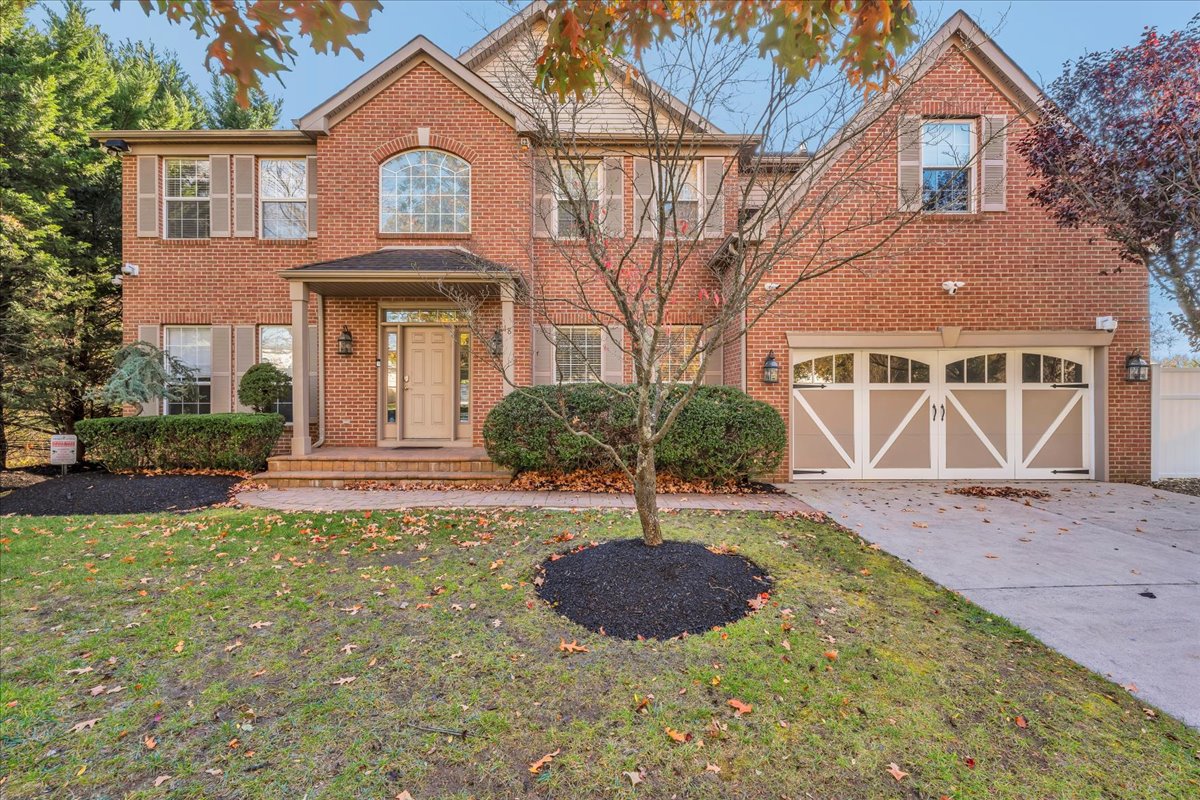
The four-bedroom home spans more than 5,100 square feet.
Built in 1999, this spacious brick-fronted Short Hills home has a variety of unique features. Its first floor features a two-story foyer; a living room; an office; a family room with a fireplace set into a stone accent wall and vaulted ceilings; a dining room with a quartz waterfall island in lieu of a table; and a kitchen with granite countertops and high-end appliances. It has four bedrooms, including a primary suite, with a massive walk-in closet, a fireplace, a spa-like bathroom, and a balcony. The finished basement has a full bathroom and a home gym. Outside, there’s a heated covered patio and a saltwater fiberglass pool with a rock waterfall.
By submitting your written, visual, and/or audio contributions, you agree to The Inquirer’s Terms of Use, including the grant of rights in Section 10.
This suburban content is produced with support from the Leslie Miller and Richard Worley Foundation and The Lenfest Institute for Journalism. Editorial content is created independently of the project donors. Gifts to support The Inquirer’s high-impact journalism can be made at inquirer.com/donate. A list of Lenfest Institute donors can be found at lenfestinstitute.org/supporters.
While East Coast retirees have a reputation for decamping to places like Florida for warm weather and lower taxes, many of Cherry Hill’s older residents have stuck around.
One-third of Cherry Hill’s residents are 55 or older.
“Cherry Hill is a wonderful place to raise a family and to live, so people don’t want to leave,” Mayor Dave Fleisher said.
Cherry Hill prides itself on its work with older residents — from tax-preparation assistance to social events, Fleisher said. Yet as the township continues to grow, local officials want to zero in on what its older community needs and how they can best deliver it.
Using a $70,000 grant from the New Jersey Department of Human Services, the township is embarking on a multipronged needs assessment to better understand and serve its older residents.
Why does Cherry Hill have such a large population of older residents?
Cherry Hill officials say varied housing options, tax-rebate programs like Stay NJ, and multigenerational ties have helped the township’s older population flourish.
“For those that have the means, it’s a conscious decision to stay,” Fleisher said. “They want to stay close to their kids, close to their grandkids.”
“It’s a very multigenerational community,” said Beth Segal, interim executive director of Cherry Hill’s Katz JCC, a watering hole for local older residents.
The JCC runs regular lunches, fitness classes (think pickleball and water aerobics), and programs on politics, literature, and art. Segal said she works with families who have been involved in the JCC for as many as four generations. Though Cherry Hill kids often leave the nest in search of big cities and new experiences, Segal said, many come back to raise their own kids alongside their parents and grandparents.
Fleisher said Cherry Hill’s relatively diverse housing stock has allowed residents to stay in the township without being forced to remain in the large — and, at times, expensive — single-family homes they raised their families in.
Around 20% of homes in Cherry Hill are multiunit. That’s higher than neighboring communities like Haddonfield (13%) and Moorestown (13%). Around 40% of homes in Voorhees are multifamily.
Fleisher also credits tax-relief programs. Stay NJ, a statewide property tax benefit for New Jerseyans 65 and older, allows eligible homeowners to be reimbursed for up to 50% of their property tax bill, up to $13,000.
In 2023, Cherry Hill’s property taxes were around $1,600 higher than the county average. That year, Cherry Hill residents paid an average of $8,851, compared with the countywide average of $7,222.
What will the assessment entail?
There will be two phases. The qualitative phase, which is ongoing, includes focus groups and listening sessions with facilitators (the township has contracted with market research firm 18 Stones). The first phase will wrap up in December.
The quantitative phase will involve a survey that residents will be able to complete via email or paper mail, online, or over the phone. The survey, which is currently being formulated, will be translated into Spanish and Simplified Chinese.
The assessment is funded by a $70,000 grant from the New Jersey Department of Human Services. The department awarded grants to 17 municipal governments in March to “make communities more welcoming and livable for people of all ages” and to implement recommendations from the state’s 2024 Age‐Friendly Blueprint. Cherry Hill was the only municipality in Camden County to receive a grant. The assessment is to be finished by July 1, 2026.
This weekend – on Sunday, Nov. 23 – 15,000 runners will participate in the sold-out 2025 Philadelphia Marathon. Thousands of spectators are expected to join them.
Whether you’re going to support someone or just want to understand why thousands of people would voluntarily run 26.2 miles, here’s what you need to know if you’re watching this year’s marathon.
Loading…
Regional rail
Subway
Indego
Road closures
Marathoners will start from 6:55 a.m, in waves, beginning at 22nd Street and Benjamin Franklin Parkway, near the Philadelphia Museum of Art.
The course, the same as previous years, loops through Center City before crossing the Schuylkill River to Fairmount Park. Runners will then go over the Girard Avenue Bridge and head up to Manayunk. From there, they’ll turn around for the final stretch down Kelly Drive towards the finish back at the museum.
If you want to cheer with a crowd, head to Chestnut Street at Mile 1. And if you’re trying to support a specific runner, you can see them again at Mile 5. “[You’d] probably have to hustle a little bit, but you could potentially see somebody four times,” said Kathleen Titus, race director for the Philadelphia Marathon.
Another popular place to watch the marathon is on Manayunk’s Main Street between Mile 19 and Mile 21. “Manayunk is a party and a half. The cheering [there] is top notch,” said Gary Brown Jr., founder and co-leader of Chasing Trail Philadelphia, a running group that meets on Sunday mornings at the Valley Green Inn.
Mile 20 is also when the runners turn around to head to the finish line. “[It’s] when you're questioning your life choices and deciding whether or not you can and want to finish this race,” said Craig Polak, leader of Manayunk Running Club. “Having all of that excitement and energy greeting you is just a really powerful statement for the runner.”
If you’d rather go somewhere a little more quiet or support runners through a lonelier stretch of the course, Mile 22 to Mile 24 on Kelly Drive might be for you.
“It’s always desolate,” said Brown of Chasing Trail Philadelphia. “We need people on Kelly Drive.”
story continues after advertisement
Getting around on race day can be tricky but is doable if you’re willing to walk. You can take SEPTA or the Regional Rail to the start line. Manayunk also has a Regional Rail station near its Main Street.
You can also get around using either your own bike or Indego, the city’s bikeshare program. There are 90 Indego stations within walking distance.
If you plan to use Indego – especially along Kelly Drive – Titus recommends looking up a few stations to pick up or return a bike. “You want to just be mindful of how far apart [the stations] are in case a dock is full or empty.”
Road closures often result in more traffic on race day, so walking or using public transit might be easier. But if you’re going to drive on race day, Kasey Manwaring – owner of GoalsFit, a fitness studio in Manayunk – suggests parking near Fairmount.
All streets, except for Eakins Oval and the Parkway, are scheduled to reopen by 3 p.m. Sunday.
story continues after advertisement
Use the toggles in the top-left corner to explore the course.
Runners rely on the spectator energy to finish the race, so it’s important that you have what you need to keep your own spirits high. “Invite your friends. Involve people,” said Brown Jr., leader of Chasing Trail Philadelphia. “I like to say, ‘Bring the party.’”
What to bring (besides the party)
Layers. The weather forecast for Sunday is a high of 55 but with strong winds making it feel colder.. “Dress warmer than you think you're going to need,” said Polak. He suggests packing at least one pair of gloves, some hand warmers, and a scarf.
Snacks and something to drink. Staying hydrated is critical for both runners and spectators, especially if you plan to cheer for a long time. “Bring water,” said Manwaring of GoalsFit. And don’t forget to pack snacks for yourself. Alternatively, you can check out these family-friendly restaurants that will be open on race day.
A cowbell. Yelling encouraging things at strangers can be fun, but it does take a toll on your voice. When you want to take a break from cheering, consider using a different instrument. “Anything, any type of noise maker, you know – cow bells, the inflatable tubes that you can bang together – those types of things,” said Polak.
Your phone with the Philadelphia Marathon app downloaded. Race weekend director Titus recommends downloading the app – which is available to download on iOS and Android – beforehand. If you’re supporting a runner, the app can show you the weekend’s schedule, explore the course map, and help you keep up with their location in real -time “It's a great way to track runners, especially if you're trying to see them at multiple points.”
A fun sign. “[For runners], there are so many places through the marathon where you kind of want to just forget about your goal,” said Manwaring. Signs can help inspire and motivate runners – or at least make them crack a smile. If you need ideas for what to write, check out our sign suggestion generator.
What to not to bring
Large umbrellas or coolers are not allowed by the event organizers.
Animals are also not allowed, except ADA service dogs.
Large blankets, backpacks, or cameras are discouraged by the marathon.
Runners appreciate cheers of all kinds but are especially grateful when spectators call them out by name – or even by outfit. “When you call out someone's name [on their bib], you really see them perk up,” said Polak. “Anytime you can root for somebody specifically, you know, call out what they're wearing. Or see somebody wearing an Eagles shirt, you know, you go crazy.”
No matter how or where you cheer this weekend, know that it matters. “You can actually see that it does help [runners], whether you get a nod or a quick little smile or picking up the pace or a message afterwards,” said Manwaring. And who knows? Spectating this year’s marathon just might inspire you to run it next year.
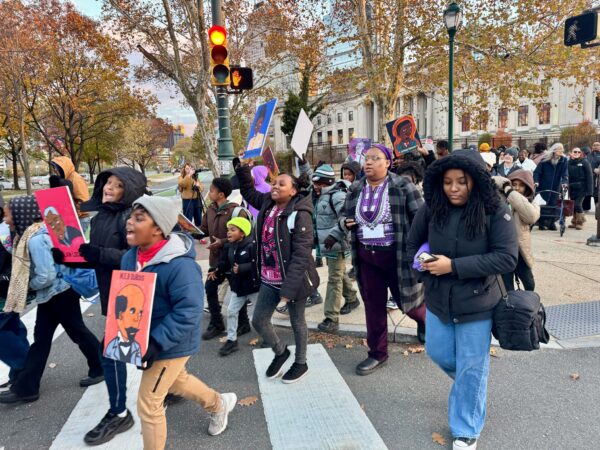
The students walked together, chanting over the hum of Center City traffic, holding a homemade sign and shouting into a chilly November sky.
“Hey hey!” they yelled. “Ho ho! Black history will never go!”
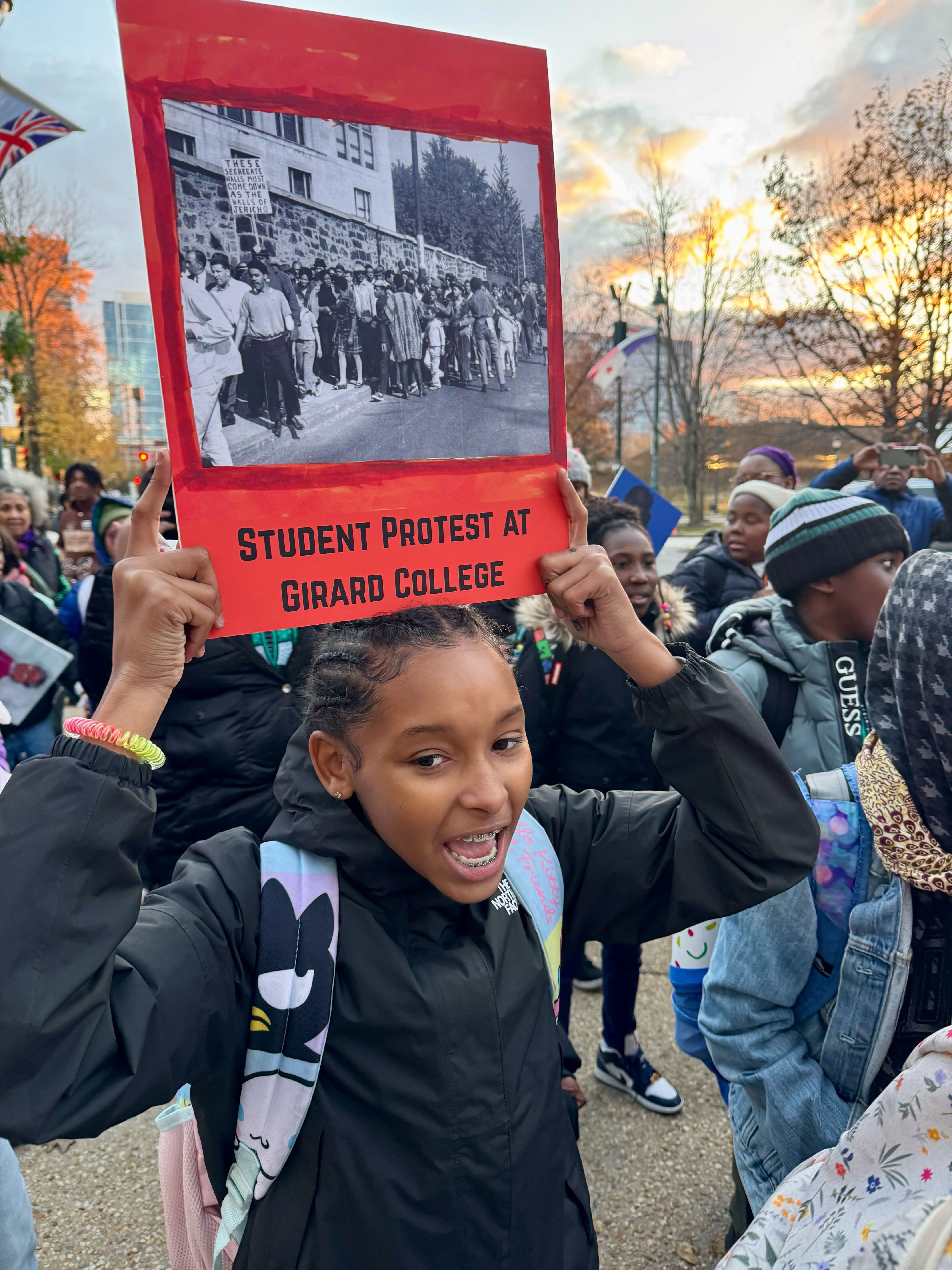
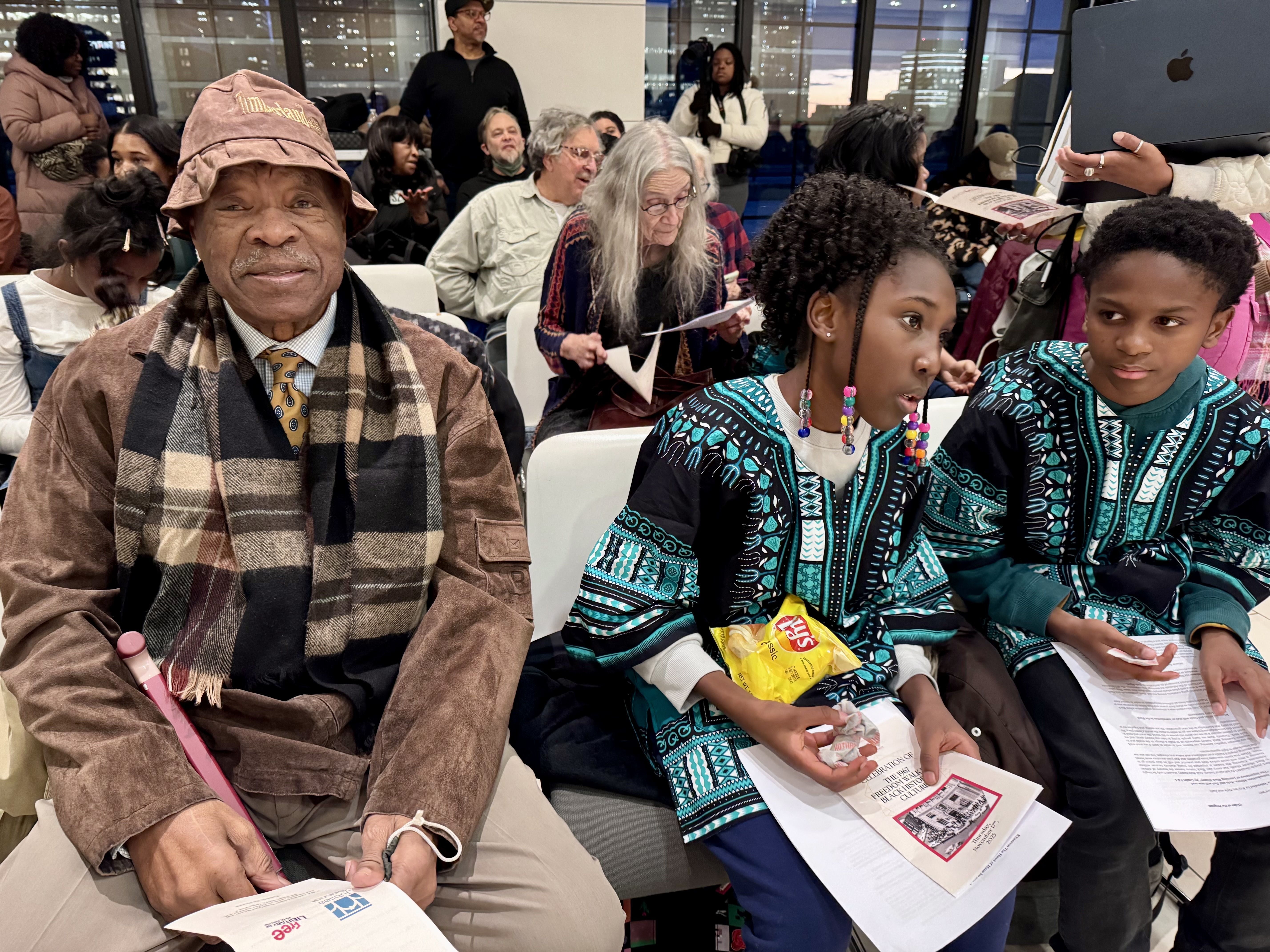
Fifty-eight years to the day after 3,000 youth and their supporters walked out of Philadelphia School District schools to protest conditions for Black students, a clutch of kids from the Jubilee School held a march Monday to commemorate that landmark action, which historians say was a seminal moment both for the city and school integration across the country.
Miles Matti, a fifth grader at Jubilee, a private school in West Philadelphia, walked with his brother, Theo, a third grader.
“We’re doing it because those kids had every right to be heard,” said Miles, 10.
Students from the Jubilee School walk to commemorate the 1967 Philadelphia student walkout, where thousands of Philadelphia School District students demanded better treatment of Black students.
The timing of the celebration was important, organizers said — not just on the anniversary of the demonstration, but 20 years after Philadelphia became the first district in the United States to implement African American history as a graduation requirement.
For months, Jubilee students studied the walkout. They conducted research, wrote poetry, made plans for honoring participants in the demonstration, and mapped a route — from the old School District of Philadelphia headquarters at 21st and the Benjamin Franklin Parkway, to the Free Library’s central branch, where there would be music and stories.
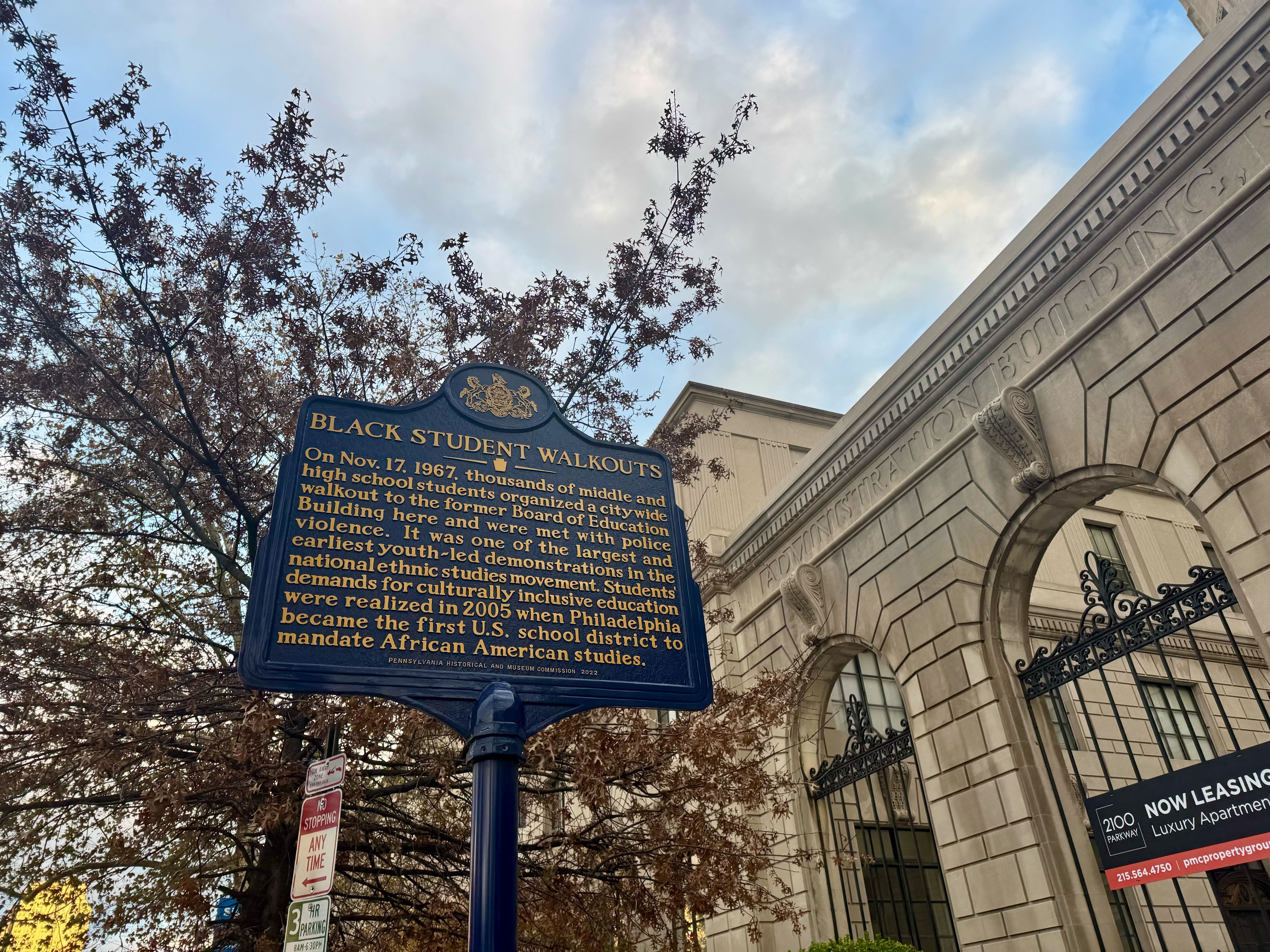
The group honored four former Masterman students who, in 2020, won approval from the city’s Historical Commission to have a marker permanently erected outside the old district building noting the 1967 walkouts.
Khaseem Bailey, a sixth grader with a strong voice and energy to spare, led the chants as the group, flanked by teachers, parents, and supporters, made its way down the Parkway.
It was important to remember, Khaseem said.
“They were marching for Black rights and student rights,” he said. “And so are we.”
‘It was not a flash mob’
The Nov. 17, 1967, walkout took 10 years to plan, said Walter Palmer, now 91, and one of the chief architects of the event — a decade spent organizing, teaching nonviolent strategies, training students, pairing them with elders.
Walter D. Palmer, who helped organize the 1967 Philadelphia student walkout, was honored at a program by students from the Jubilee School, sitting next to him.
The time seemed right that November. By that point, Black students made up the majority of the district’s pupils, and they attended integrated schools, but conditions were unequal.
“Black students were harmed for using African names, wearing African clothing,” said Palmer.
Organizers came up with a list of 25 demands — from allowing students to wear their hair in Afros to infusing Black history in the district curriculum.
“It was not a mistake,” said Palmer. “It was not a flash mob. There were no cell phones; there were no microphones. These young people, they were just hungry.”
A historical marker commemorating the 1967 Philadelphia student walkout stands outside the former offices of the School District of Philadelphia, at 21st and Benjamin Franklin Parkway.
Students pulled fire alarms and poured out of their schools, with many meeting at the School District of Philadelphia headquarters. Representatives were chosen to speak to then-Superintendent Mark Shedd, who took their requests seriously.
Newspaper accounts described the demonstration as being like a “picnic,” but then-Police Commissioner Frank Rizzo called in 100 officers in riot gear. They began swinging at students and releasing police dogs.
Fifty-seven people were arrested, and dozens injured, some seriously. The event made national headlines.
Marilyn Kai Jewett, another walkout participant, told the students their celebration was especially timely.
“We cannot let anyone whitewash our history,” Jewett said. “We are under attack. We cannot stop — we’ve got to fight until we die. The evil will not prevail. Goodness always prevails. Just keep doing what you’re doing.”