The undergraduateclass at the University of Pennsylvania vigorously discussed the use of affirmative action in college admissions, half the room charged with arguing one side and half the other.
Their task, informed by the 2023 U.S. Supreme Court decision that ended the use of race-conscious college admissions, was to brief and advise a popular governor of a swing state who had not yet taken a position on the issue.
“Guess who is the governor?” said their professor, Amy Gutmann. “I am the governor.”
And for 90 minutes, the entirety of the class period, Gutmann guided a lively discussion in which students talked as much as she did.
While never a governor, Gutmann has quite the leadership portfolio. She was president of Penn for a record 18 years, leaving in 2022 to become U.S. ambassador to Germany under former President Joe Biden, a post she held until 2024. She is also a Harvard-educated political scientist who cowrote the book The Spirit of Compromise and in 2018 was called one of the world’s 50 greatest leaders by Fortune magazine.
Now, for the first time in about 25 years — since she was a politics professor at Princeton — Gutmann is back in the classroom teaching a full course this semester in the Annenberg School for Communication. Sarah Banet-Weiser, dean of Annenberg, who initially came up with the idea for the course, is her co-teacher.
For students, the professorial star power was hard to pass up. There was a waiting list for the class.
“It’s kind of a power duo,” said Evan Humphrey, 21, a senior communications major from Seattle. “Got to take that class.”
Senior Evan Humphrey said she was drawn to enroll in the class because of the two professors and their distinguished careers.
Focusing on teaching — the heart of a university — has been especially meaningful to Gutmann, and to Banet-Weiser, too, at a time when higher education has had its federal funding threatened and its approaches attacked.
“It literally gives me life every week,” Banet-Weiser said.
Gutmann, 75,who said she aspired to be a teacher since she was 5, said it has made her feel productive “in a way that goes to the heart of what a university is about.”
“We should never lose sight of that heart of the university and how valuable it is,” she said.
The goal of the class, called “The Art and Ethics of Communication in Times of Crisis,” is “to learn how and why to communicate with greater insight and understanding across differences,” while creating space “for free and open dialogue about controversial issues.”
Seniors Luiza Louback (left) and Sarah Usandivaras (right) participate in the class discussion.
It could be a primer for the politically divided nation.
“My pitch is that you can’t really know what you believe if you don’t know what people who disagree with you believe and what their reasons are,” Gutmann said in an interview. “I always say I don’t care what your position is. I care that you can give reasons for it and understand the strongest arguments on the other side.
“That’s the method to search for truth, and it’s the way we serve a democracy.”
Bringing experience to the classroom
During class, Gutmann frequently drew on her experiences as a first-generation college student, a young professor at Princeton, a college president, and an ambassador.
When she got her first teaching job, a male colleague congratulated her, but later she learned he told someone she got the job because she was a woman.
“Did I take that as a compliment? Mm-mm,” Gutmann told the class.
Humphrey said she especially likes hearing about Gutmann’s vast experiences.
“She’s like, ‘Well, when I was the president here, this is something I dealt with,’” Humphrey said. “It’s really interesting knowing the experience she has and her background and the perspective she brings.”
Amy Gutmann (center), president emerita of the University of Pennsylvania and former U.S. ambassador to Germany, is presented with the Weitzman National Museum of American Jewish History’s Only in America® Award during a gala at the museum this month. The award recognizes “Jewish Americans who have made enormous contributions to our world … often despite facing antisemitism and prejudice.” Among those posing with her are Ramanan Raghavendran (far right), chair of Penn’s board of trustees, veteran journalist Andrea Mitchell (next to Raghavendran), Penn President J. Larry Jameson, (to the immediate left of Gutmann), and David Cohen, former Penn board chair, (next to Jameson.)
Gutmann’s life outside class continues to be full, too. After class Wednesday, Gutmann, whose father fled Nazi Germany, flew to Berlin to receive the Prize for Understanding and Tolerance from the Jewish Museum Berlin.
Having returned to Philadelphia to live after leaving Germany, Gutmann said it wasn’t hard to find her stride again in the classroom. She had given one-off lectures as Penn’s president.
“I have a lot of muscle memory on teaching,” she said.
Her style has changed from her early days at Princeton, where she worked from 1976 to 2004. She said readinga student’s notebook left behind and open after one of her ethics and public policy lectures was a major turning point.
“‘That’s not what I said,’” Gutmann thought. “And I realized it’s not what you teach them, it’s what they learn. At that point, I realized I needed feedback.
“So I changed from doing the 45-minute [lecture] thing to doing five or 10 minutes, max, and then asking them questions. Then I got them to argue with one another, and once I found that, I found what I really discovered worked for learning.”
Amy Gutmann talks with sophomore Brian Barth (right) at the end of class she co-teaches at Penn’s Annenberg School for Communication.
Gutmann said she spends Fridays and weekends preparing for the class, which meets twice a week.
“It’s a ton of work,” she said. “I’m really delighted to be doing it.”
The class comes against the backdrop of fraught times for colleges. Penn earlier this year scrubbed its website of diversity initiatives after President Donald Trump’s administration threatened funding to schools employing diversity, equity, and inclusion efforts. In the summer, the school struck an agreement with the administration over the past participation of former transgender swimmer Lia Thomas, and Penn was one of nine schools originally asked to sign a compact that would have given the school preferential consideration for federal funding in exchange for complying with certain mandates affecting admissions, hiring, and other university operations. Penn declined.
‘One-of-a-kind’ discussions
Gutmann and Banet-Weiser do not allow laptops, phones, or any electronic devices in class so that students completely focus on the conversation. To prepare for the affirmative action discussion, students were assigned related readings and review of the court cases.
The two professors interacted with each other and prompted discussion among students with deep questions: Is treating people equal the same as treating them equally? Is it right to use affirmative action for only one racial group? What about other forms of affirmative action or preference, including for athletes, low-income students, and legacies whose parents attended the university?
The approach resonated with students.
“I wanted to take a class where I would really be encouraged to step out of my comfort zone and be able to learn not only how to understand my own beliefs and values but understand the beliefs and values of others,” said Sarah Usandivaras, 21, a senior communications and political science major who was born in New York and grew up in Paraguay.
She found it in Gutmann and Banet-Weiser’s classroom.
“It’s a one-of-a-kind,” she said.
Ariana Zetlin, a doctoral student in Penn’s Graduate School of Education, is auditing the class to observe its approach.
“The discussion and the debates are so much deeper and stronger than what I’m seeing in classrooms that don’t necessarily have these structures,” said Zetlin, 30, who is from New York.
During class, those on both sides found common ground.
Senior Angele Diamacoune said she was learning from the day’s lesson.
“So I’m hearing agreement that diversity is a good thing but disagreement on how you get it,” Gutmann said.
She asked students how many believed that having low-income and racially diverse students in class contributed to their learning. Every hand went up.
“That to me is really striking,” Gutmann said. “There aren’t that many things that we can get unanimity on.”
She asked students how they would advise colleges to teach the issue.
“It would be good to teach with activities like this,” said Angele Diamacoune, 21, a senior communications major from Allentown.
On Oct. 16, Rian Andrianzah walked into a Philadelphia office of U.S. Citizenship and Immigration Services for what he thought was a routine biometrics appointment. He expected to be fingerprinted and photographed and sent on his way.
Instead, while his wife waited in an outer room, he was arrested by ICE ― and now faces deportation in a case that has angered the city’s Indonesian community.
Andrianzah, 46, is among a growing number of immigrants whose families say they showed up for in-person appointments or check-ins, only to be suddenly handcuffed and spirited into detention.
Green-card applicants, asylum-seekers, and others who have ongoing legal or visa cases have been unexpectedly taken, part of a Trump administration strategy, lawyers and advocates say, to boost the number of immigration arrests and to deport anyone who can possibly be deported.
“ICE was waiting for him,” said Philadelphia immigration attorney Christopher Casazza, who represents Andrianzah and his family. “In 15 years, I have never once seen somebody arrested at their biometrics appointment ― except in the past few months.”
Andrianzah legally entered the United States on a visitor’s visa in February 2000, but did not return to Indonesia. He was placed in removal proceedings in 2003, and a judge issued a final order of deportation in November 2006. His appeal was denied two years later.
The removal order was never enforced, as had been common for what the government thensaw as low-priority immigration violators. Some people with final orders have lived in the U.S. for decades.
In the ensuing years, Andrianzah worked factory and warehouse jobs ― and married Siti Rahayu, 44, also of Indonesia. They made a home in South Philadelphia, parents to two U.S.-citizen children, a son, age 8, and a daughter, 15.
Andrianzah and his wife went to USCIS that day as part of her application for a T visa, available to people who have been victims of human trafficking. In an interview with The Inquirer,Rahayu said she was sent to the U.S. in 2001 by relatives who saw her as a means to pay off a debt, delivering her to an underground organization that puts people in low-paying jobs, then keeps them working indefinitely.
Siti Rahayu of Philadelphia, here on Thursday, November 6, 2025. Her husband Rian Andrianzah walked into United States Citizenship and Immigration Services office for a routine visit but he was sent to Moshannon detention center to await deportation.
Casazza, of the Philadelphia firm Palladino, Isbell & Casazza LLC, said Rahayu has a strong case for a T visa, which offers permission to live in the U.S. and a path to permanent residency and citizenship.
As her husband, Andrianzah would receive those same benefits under her visa.
That’s why, Casazza said, it makes no sense for ICE to confine and deport him. Once his wife’s visa was approved, Andrianzah would be able to legally live in the United States, the attorney said.
Asked about Andrianzah’s arrest and the couple’s situation, a U.S. Immigration and Customs Enforcement spokesperson in Philadelphia said in a statement: “Due to privacy issues, we are not authorized to discuss this case.”
Andrianzah is being held at the Moshannon Valley Processing Center, an ICE detention facility in Clearfield County, Pa.
As President Donald Trump presses his deportation agenda, what were routine meetings with federal authorities have now become risky for immigrants. Advocates say many of those arrested were following the rules and doing what the government asked:
On May 27, the wife of a Marine Corps veteran was detained in Louisiana after meeting with USCIS about her green-card application, CBS News reported. Paola Clouatre, 25, said she came to the U.S. as a child with her mother, but was abandoned as a teenager and unaware that the government had ordered them deported. She spent about eight weeks in custody before being fitted with an ankle monitor and released.
On June 3, federal agents in New York City arrested at least 16 immigrants who showed up for check-ins, after a private contractor working with ICE summoned them to urgent appointments, The City, a news organization, reported.
On Oct. 22, a 21-year-old California college student was arrested by ICE at an appointment at a USCIS office in San Francisco, Newsweek reported. Government officials said Esteban Danilo Quiroga-Chaparro, a Colombian national and green-card applicant, had missed mandatory meetings, though his husband said that was untrue.
On Oct. 23, a Venezuelan couple pursuing asylum were arrested during a check-in at the ICE office in downtown Milwaukee, Urban Milwaukee reported. Diego Ugarte-Arenas and Dailin Pacheco-Acosta sought protection after fleeing their homeland in 2021. An ICE spokesperson told the news agency that “all aliens who remain in the U.S. without a lawful immigration status may be subject to arrest and removal.”
“There’s a lot of risks right now,” said Ana Ferreira, who serves on the executive board of the Philadelphia chapter of the American Immigration Lawyers Association.
Some clients went intoimmigrationappointments knowing there was a possibility they could be detained, she said. Others were shocked to be taken.
“None of this would have happened years ago,” Ferreira said. “It’s a completely different landscape.”
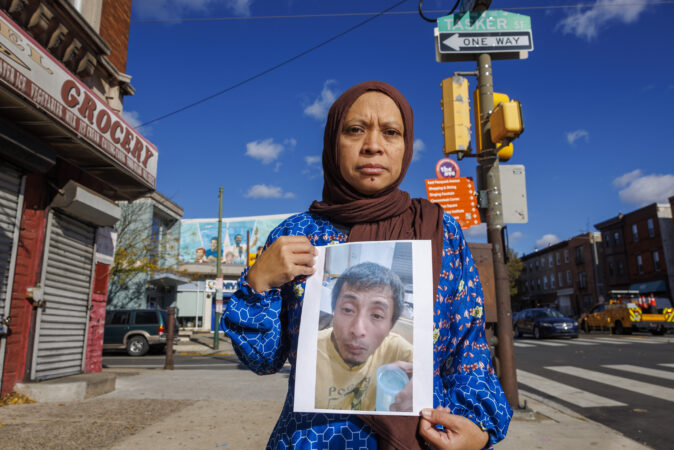
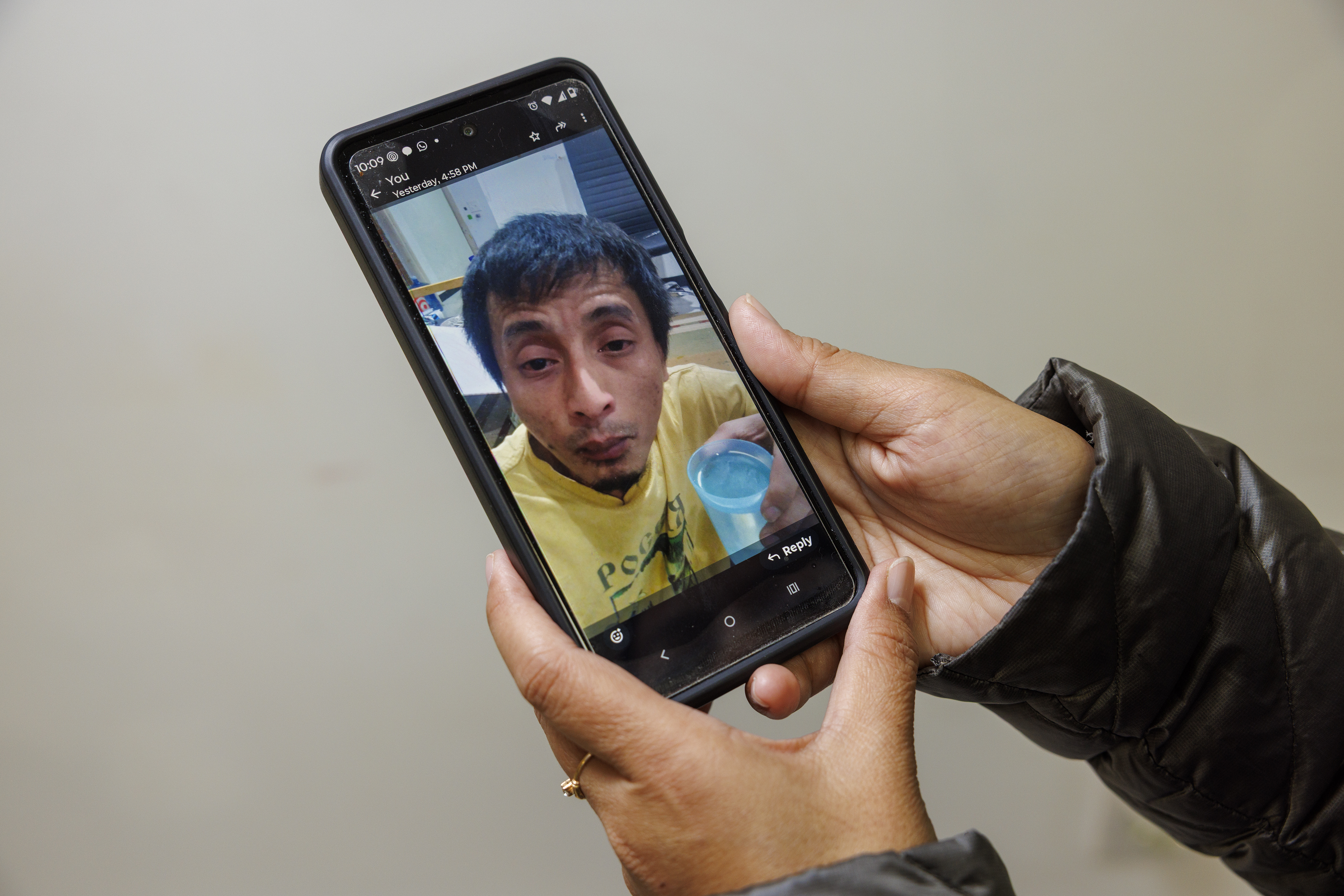
Siti Rahayu of Philadelphia holds a photograph of her husband, Rian Andrianzah. He walked into a United States Citizenship and Immigration Services office for what he thought would be a routine visit but was sent to the Moshannon detention center to await deportation. Photograph taken on Thursday, November 6, 2025.
Rahayu said that on Oct. 16, she completed her own biometrics appointment, then grew concerned when her husband did not appear. She asked the staff what was happening.
“They [said they] don’t know anything, and they say this is new for them,” Rahayu said.
Finally someone told her: He’s gone. Rahayu fears for her husband’s health in custody because he suffers from diabetes, which impairs his vision.
The local Indonesian American community reacted immediately, supported by Asian Americans United, the advocacy group. An estimated 2,000 Indonesians live in Philadelphia, the 10th-largest community in the nation.
Andrianzah said through his wife that he wished to thank everyone who has tried to help him and his family, that he is grateful for their care and concern. Supporters have raised about $13,000.
Each year thousands of people physically report to ICE or related immigration agencies for mandatory check-ins.
Some immigrants are required to appear every couple of weeks, some once a month, others once a year. The appointments help immigration officials keep track of people who in the past have been low priorities for deportation, allowed to live freely as they pursue legal efforts to stay in the United States.
Biometrics appointments are usually brief sessions, perhaps half an hour, at which the government captures fingerprints, a passport-style photo, and a signature. The immigrant may also be asked to provide information like height and weight.
Despite the fresh risk of being arrested on the spot, immigrants have little option except to show up. Many types of immigration applications require in-person appearances. And failure to appear for a required ICE appointment can by itself result in an order for removal.
“They’re trying to grab everybody, wherever they can,” and that included Andrianzah, Casazza said. “ICE is going to do their best to deport him.”
Late in the afternoon on Nov. 7, a Friday, the Philadelphia Police Department announced that nine current and former police officers had been charged with conspiring to defraud the city by using a grant-funded youth boxing program to pad their salaries.
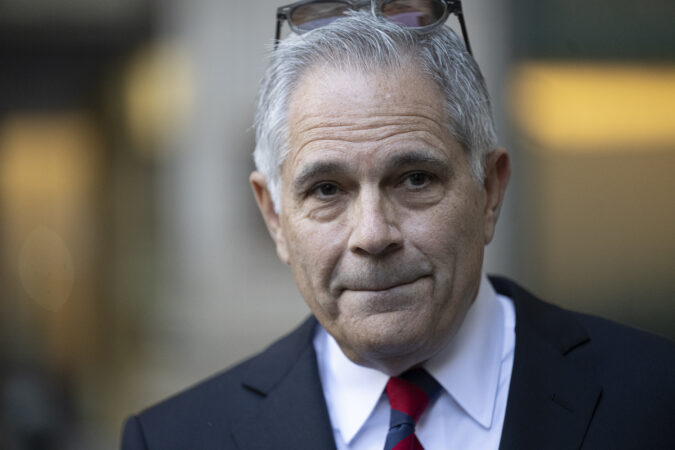
It was the largest number of Philly officers charged together with misconduct in nearly 40 years — a seemingly splashy case for District Attorney Larry Krasner, a progressive prosecutor who has made charging cops a cornerstone of his two terms in office.
Yet Krasner has been unusually quiet about it.
The district attorney was traveling in Switzerland for a conference when the charges became public. His office declined to comment, held no news conference, and issued no public statements — in stark contrast to his trumpeting of police misconduct cases in the past.
Krasner has charged dozens of police officers since taking office in 2018. But he did not publicly acknowledge his largest booking to date until The Inquirer approached him at an unrelated news conference, nearly a week after these most-recent charges were filed.
And even then, he was reluctant to talk about it.
“We had probable cause that they committed the crimes,” Krasner said Thursday. “Having said that, I wanna be very clear: There are a lot of great cops in the city. … I don’t think that this group of nine should in any way taint the rest of them.”
Prosecutors accuse Nashid Akil, former captain of the 22nd District in North Philadelphia, and eight of his officers of stealing $44,576 in taxpayer-funded anti-violence grant money between January and September 2022, according to charging documents.
Those funds came from a $392,000 city grant awarded to Epiphany Fellowship Church to support Guns Down, Gloves Up, a boxing and youth mentorship program that Akil founded at his nearby district building. No one from the church was charged, and Krasner said Thursday the church should not be “tainted” by the allegations against police.
Former Captain Nashid Akil, shown here while at the boxing program Guns Down Gloves Up, at the 22nd District, in Philadelphia, Friday, October 7, 2022.
City employees are prohibited from receiving grant dollars. Yet after vowing in the grant application that police time would be volunteered, Akil, using the church as a pass-through, allegedly paid himself and eight district officers for their work as boxing instructors, an arrangement that came to light through an Inquirer investigation in 2023.
Police now say some officers were paid during their scheduled shift hours.
A law enforcement source familiar with the case said the district attorney’s office concluded its probe into the grant scheme months ago. Krasner did not approve the charges until Oct. 31, according to a police department spokesperson. That was days before the Nov. 4 election, when Krasner was handily reelected to a third term. The defendants began surrendering to authorities three days later.
Police Commissioner Kevin Bethel issueda statement after the arrests saying he was “deeply troubled” by the officers’ alleged actions and “particularly disappointed by the involvement of a former commanding officer.”
But neither Krasner nor his spokesperson responded at the time to repeated requests for comment.
On Thursday, Krasner attributed the timing of the charges to logistical issues with bringing in the nine codefendants.
Akil was forced to resign in February 2023 after The Inquirer’s reporting on the boxing program, and three other officers who allegedly took the money had since resigned. Bethel has moved to fire the five active officers.
Only one of the nine officers listed an attorney in court records, and that lawyer could not be reached for comment.
Officials at Epiphany Fellowship Church did not respond to a request for comment.
An unusual silence
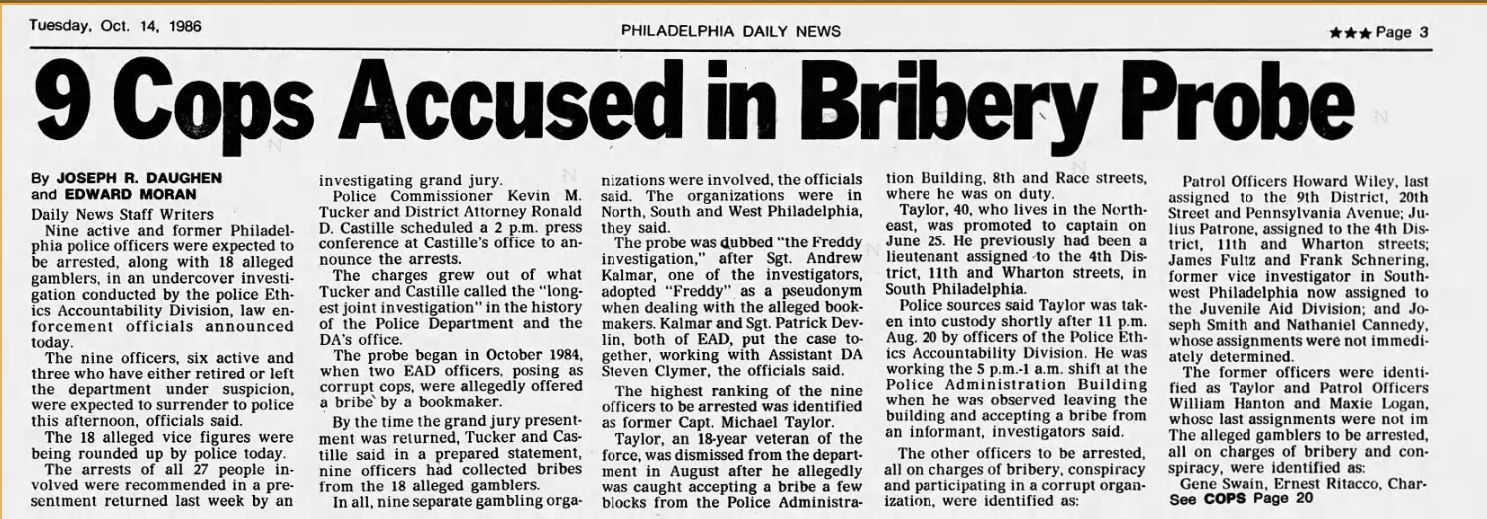
The last time nine officers were charged together in Philadelphia was in 1986, for taking bribes to conceal an underground gambling ring.
An Oct. 14, 1986 article in the Philadelphia Daily News shows the last time nine current and former Philadelphia police officers were charged following a single investigation.
Since the charges were filed in the boxing program scandal, Krasner’s office has put out ninenews releases — but nothing on the nine officers charged.
It’s a departure from how the typically loquacious district attorney has handled previous allegations of police misconduct.
In 2021, for example, when The Inquirer was reporting on widespread abuse of the department’s injured-on-duty program, Krasner said he believed some officers were “gaming the system, and in my opinion, committing crimes by engaging in fraudulent practices to stay home.” The disability system was reformed and hundreds of officers returned to work, but no criminal charges were filed.
The next year, Krasner issued a lengthy news release after the arrest of Officer Daniel Levitt on perjury and related charges, stemming from an allegedly illegal search that led to the recovery of a handgun. The charges against Levitt were initially dismissed but have since been refiled.
In 2023, Krasner was again out front in announcing the arrest of former Officer Patrick Henon for sexually assaulting young girls. Henon pleaded guilty.
In May, Krasner called a news conference after a jury convicted two former detectives convicted of making false statements about DNA evidence.
A month later, when Donald Suchinsky, a former homicide detective, was sentenced to prison for sexually assaulting relatives of murder victims, Krasner appeared outside the Criminal Justice Center to condemn Suchinsky’s conduct and urge any other victims to come forward.
And in July, Krasner again held a news conference to criticize what he called a lenient sentence of former Officer Mark Dial, who was paroled following his voluntary manslaughter conviction in the shooting of Eddie Irizarry.
“I am deeply disappointed with a verdict that I think makes people lose faith in the criminal justice system,” Krasner said.
A sensitive issue
In contrast, when approached by reporters Thursday, Krasner requested an advance list of questions about the alleged grant misappropriation, then huddled privately with two of his top prosecutors for several minutes before offering littlecomment.
Asked about his reticence toward this case compared with past cases, Krasner alluded to outside concerns.
“We have to do certain things in court in a certain kind of way, and we have to operate with our partners, and that’s what we’re going to do,” he said.
He declined further questions.
Krasner’s uncharacteristic silence has not gone unnoticed by nearly a dozen communications consultants, lawyers, and law enforcement officials, who spoke with The Inquirer on the condition that they not be named.
They speculated that Krasner might be downplaying the arrests due to political sensitivities or because — unlike in cases of wrongful arrests and shootings — there is not a clear victim in this case, outside of city taxpayers. Some acknowledged that there could also be legal reasons why Krasner would decline to draw additional attention to the arrests.
Carl Day, a pastor who runs Culture Changing Christians, noted that Krasner is allied with Black clergy members who have supported his political campaigns. Day suggested that the district attorney might be trying to avoid further scrutiny into the church that was in charge of the grant.
“My hope and belief is that it’s a level of respect,” Day said. “In this work, you become scrutinized a ton and placed under microscopes, especially when you are a Black-led organization and getting government money.”
The boxing program scandal is one of several incidents that have raised concern about the city’s oversight of millions of anti-violence grants, scores of which have been awarded to small nonprofits in the Black community.
Day said nonprofit leaders need to be held accountable for misspent funds, but he argued that Black-led nonprofits, many of which do not have the financial resources of large organizations that typically get city grants, face heightened scrutiny.
If that is the case, Day said, he is puzzled why Krasner wouldn’t come out and say so.
First they were roommates, and then they were friends. But after Jessica Yang and Nicole DeNardo couldn’t agree on who should keep Gary — the exotic shorthair that Yang bought and DeNardo had been taking care of — it took a Common Pleas Court judge to decide.
The two former roommates say they disagreed over whether Yang had given Gary to DeNardo or whether it was a temporary arrangement. In December 2024, Yang sued DeNardo to make her return the cat.
“She said I was unfit to be a pet parent,” Yang said. “She said I was childish and selfish for even wanting Gary back. She kept asking me to consider the feelings and preferences of Gary.”
Two lawyers contacted for this story say that situations like this one are on the rise, though the money spent on such a case — Yang spent $20,000, DeNardo, $5,000 — is a bit remarkable.
“People love their animals, and people are willing to spend a lot of money in legal fees to reclaim their animals,” said Rebecca Glenn-Dinwoodie, a Doylestown-based family and animal lawyer not involved in the case.
But for the two women, the fight over the small, cuddly cat with blue eyes became a catastrophe that dragged on for a year.
“She just didn’t want me to have him,” DeNardo said. “It was personal. It was about beating me.”
Nicole DeNardo at her home in Center City.
How it started
Yang, 33, purchased Gary for $1,000 when she was living in Pittsburgh in 2018. She named him after the SpongeBob SquarePants TV show character Gary the Snail.
In the spring of 2022, Yang moved from New Mexico to Philadelphia. She said that with a new contract as a nurse anesthetist, she expected to travel for work every two weeks, making a roommate situation ideal.
She and DeNardo, 31, met on a Facebook group for people seeking roommates and soon moved into an apartment together in Graduate Hospital. DeNardo, who works in finance, often worked from home, spending a lot of time with Gary.
Yang and DeNardo each said they became friends and travel buddies. They took snowboarding trips to Vermont and Colorado and hiked at Lake Havasu, Ariz.
They even got matching alien tattoos together. Yang said hers was a nod to her time living near Roswell, the UFO tourist town in New Mexico. DeNardo said the alien paired well with her tattoo of Saturn, a planet linked to her zodiac sign of Capricorn.
Yang said as the apartment’s lease was coming to an end around March 2024, she was going through a difficult time. She and her long-term boyfriend had just broken up. She had just changed jobs. And, she had just bought a house in Passyunk Square that needed extensive renovations.
That was when, as she remembers it, DeNardo offered to take the cat. “I was like, how convenient for Gary,” Yang said. “And I thought it would be good for her, too.”
That summer, Yang commissioned a portrait of Gary, surrounded by snowboards, trekking poles, and other symbols of the two women’s friendship. There were two prints, both framed, one for each of them.
A detail shot of a piece of art Jessica Yang commissioned featuring her cat, Gary, and mementos from her friendship with Nicole DeNardo. She gave a second copy of the art to DeNardo.
Going to court
Things began to go south when Yang said she learned that DeNardo had changed Gary’s last name at the vet — from Yang to DeNardo — and added her name to the cat’s microchip. DeNardo, Yang said, considered the cat hers.
It’s one of several details DeNardo remembers differently. DeNardo said the vet’s office changed the cat’s last name, not her. As for the microchip, which would help people identify Gary’s owner if he were to get lost, she said she added her name for practical reasons — she was the one who was around.
DeNardo said she was often the one who took care of Gary. She fed him, she said, and took him to the vet. She even “cleaned his eyeballs” every day — something shorthair cats often need.
“He was always in my life, always on the windowsill next to me,” DeNardo said.
She provided a timeline showing she’d spent more time with Gary than Yang. She offered lists of friends who would attest Gary was her cat — a fact many people in her lifefound mildly amusing, since her father and her brother are also both named Gary.
Jessica Yang holds her cat, Gary, at her home Sunday, Nov. 9, 2025.
DeNardo said she believes that somehow, the issue became personal after a 2023 incident where she told Yang they needed to take the cat to the vet.
“I think she viewed that more as a personal attack,” DeNardo said. “For me, this was always only about Gary’s well-being.”
After a yearlong process that involved a hearing and a bench trial, the court ruled in Yang’s favor. Yang proved she had purchased the cat, and DeNardo had to give him up.
DeNardo blames the Pennsylvania legal system, which views animals as property. “You can spend years scooping litter, cleaning his eyeballs, and the court tells you none of that matters, because pets are property,” she said.
The law
A few other states, such as New York, do define pets the way DeNardo had hoped the court would view Gary, said Daniel Howard, an associate family law attorney at Petrelli Previtera in Center City.
“Some states have pet custody statutes that look similar to what we see in child custody, looking at the welfare of the animal,” Howard said.
Howard pointed out that in September the Pennsylvania House of Representatives passed a bill that would change how pets are recognized in divorce proceedings. (The bill would have to pass the state Senate and get the governor’s approval for enactment).
However, even if this bill were to pass, it would not apply to cases where the two people aren’t married, Howard said.
Gary, an exotic shorthair, relaxes on the couch Sunday, Nov. 9, 2025.
Still, he said, attitudes are changing around the ways animals should be viewed by the courts. Laws that worked well for farm animals don’t fit as neatly for cats or dogs.
“For a lot of people, their pets really are their children,” Howard said. “And I think there needs to be some kind of an update to look at that.”
Glenn-Dinwoodie said the situation also speaks to the need for people — even if they’re just roommates, or friends — to put things in writing when they enter a living arrangement.
“Just have clear conversations, clear expectations, but also [take] that extra step so that, if ownership is ever disputed … you have enough proof. Because the court needs proof,” she said.
For Yang, the whole episode felt like a misuse of time and resources. It left her wanting to raise money for animals, “because $25,000 could save a lot of cats.”
DeNardo said the dispute showed her that doing what you think is right doesn’t always lead to the outcome you want. At her apartment, she gestured toward the window, where she said Gary spent countless hours watching the birds that would perch outside.
“He’s just a really playful, sweet, cat,” DeNardo said. ”He was my buddy… I just hope he’s OK and has all the things he needs, and is living a good life. If he’s happy, I’m happy.”
Clarification: This article has been updated to reflect DeNardo’s assertion that she took care of Gary even when Yang was home.
For the Nowell family, the outlets are an annual tradition.
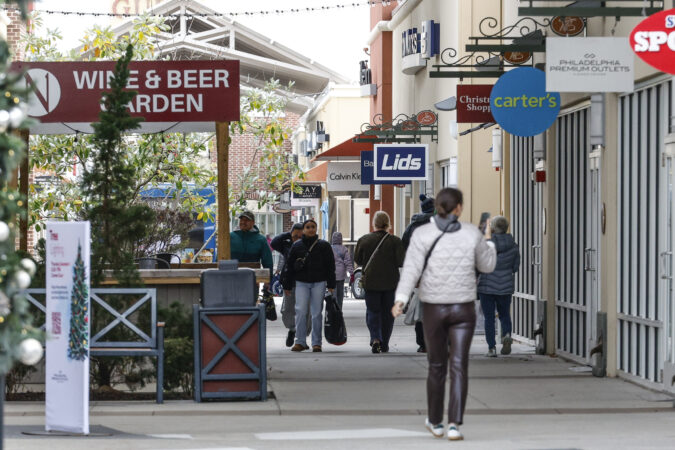
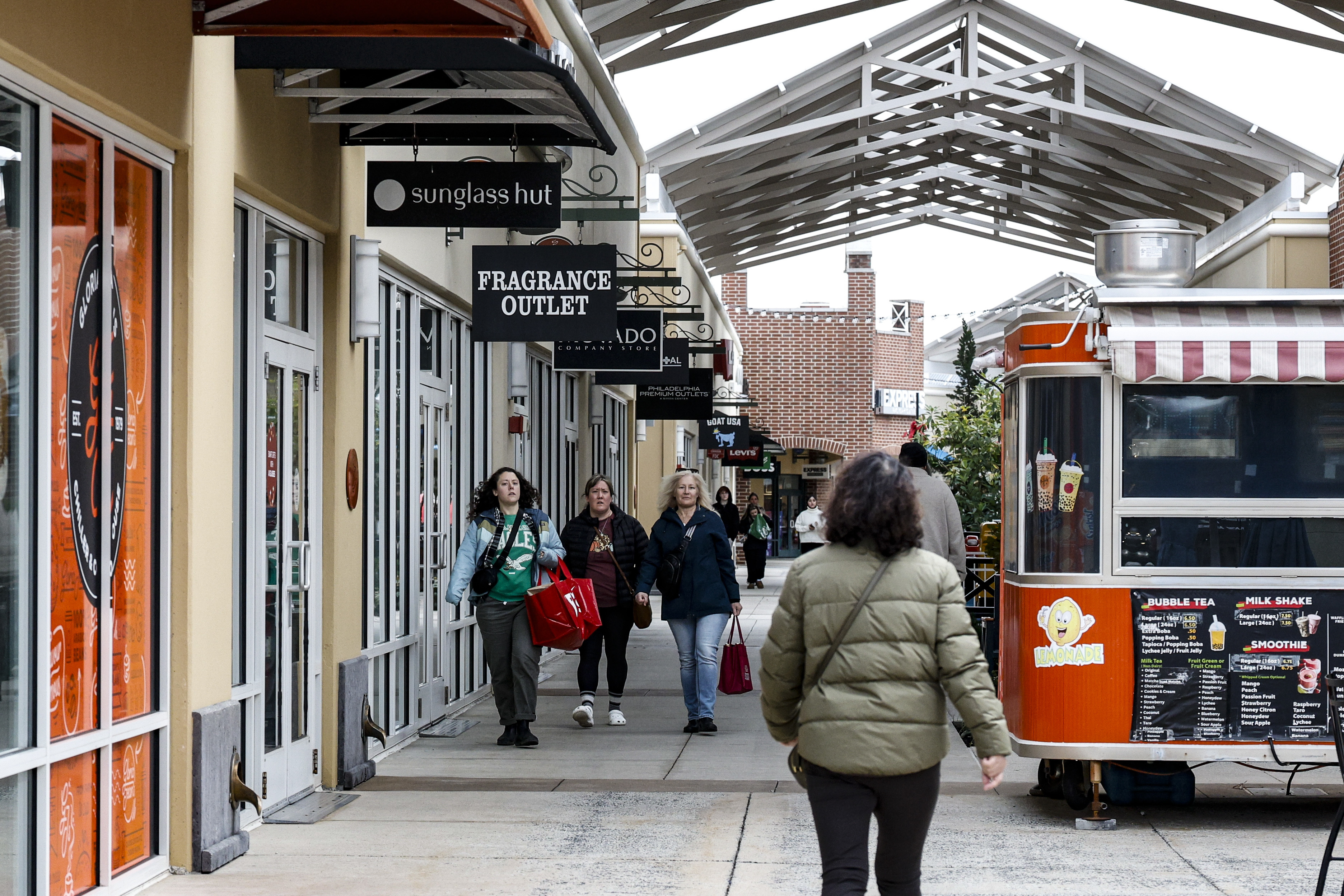
Every Veterans Day, a dozen relatives venture to Limerick Township in Montgomery County, where they kick off their holiday shopping at the Philadelphia Premium Outlets.
Even this year, as bitter winds whipped through the outdoor plaza, the family was undeterred.
After a morning of shopping, the multigenerational group, which included two veterans, warmed up with their yearly food-court lunch, courtesy of matriarch Geri Nowell, 77, of Telford. Then, the men returned to the cars and dropped off dozens of shopping bags, which they’d been carting around in a wagon. The women walked on, hunting for their next find among the more than 130 shops.
The Nowell family poses in front of a holiday backdrop during their annual outing to the Philadelphia Premium Outlets.
“It’s super fun,” said Ann Blaney, 47, of Drexel Hill.
“We get great deals,” added Kim Woodman, 55, of Hatboro.
The tradition is an experience they say can’t be replicated online. The fact that the complex is open-air and contained in a 550,000-square-foot plaza somehow adds to the fun, they said.
As Kathy Nelson, 48, of Broomall, browsed the outlets with her friends, she said she also shops at the nearly 3 million-square-foot King of Prussia Mall, less than 20 miles away. But otherwise, she said, “there aren’t many indoor malls left” with the variety of stores she prefers.
Outlets have always accounted for a fraction of the in-person retail market, which is partly why there have been few headlines about dying outlet malls. But some of the country’s roughly 200 outlet malls seem to be downright thriving, with full parking lots on weekends, few vacant stores, and relatively strong revenue.
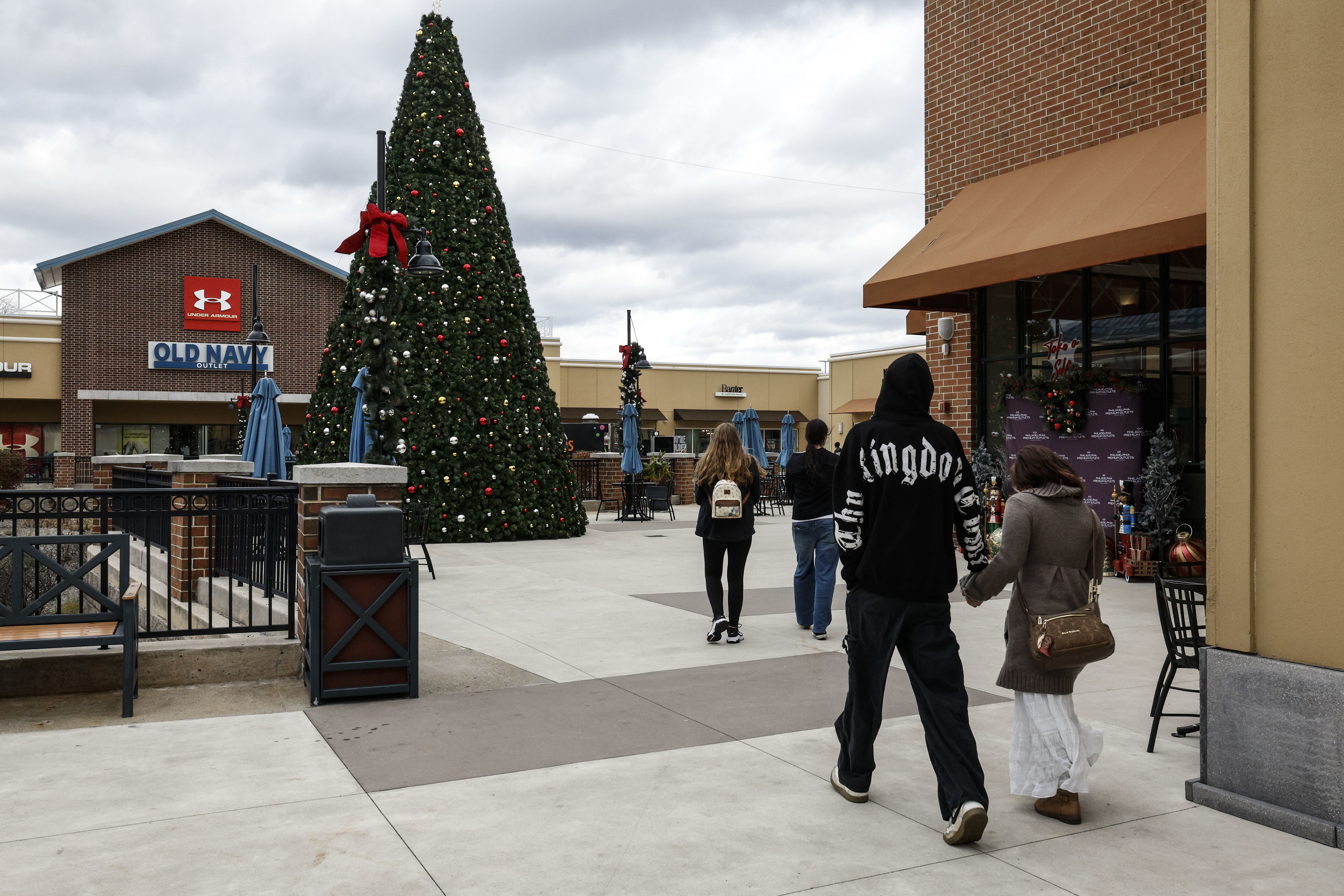
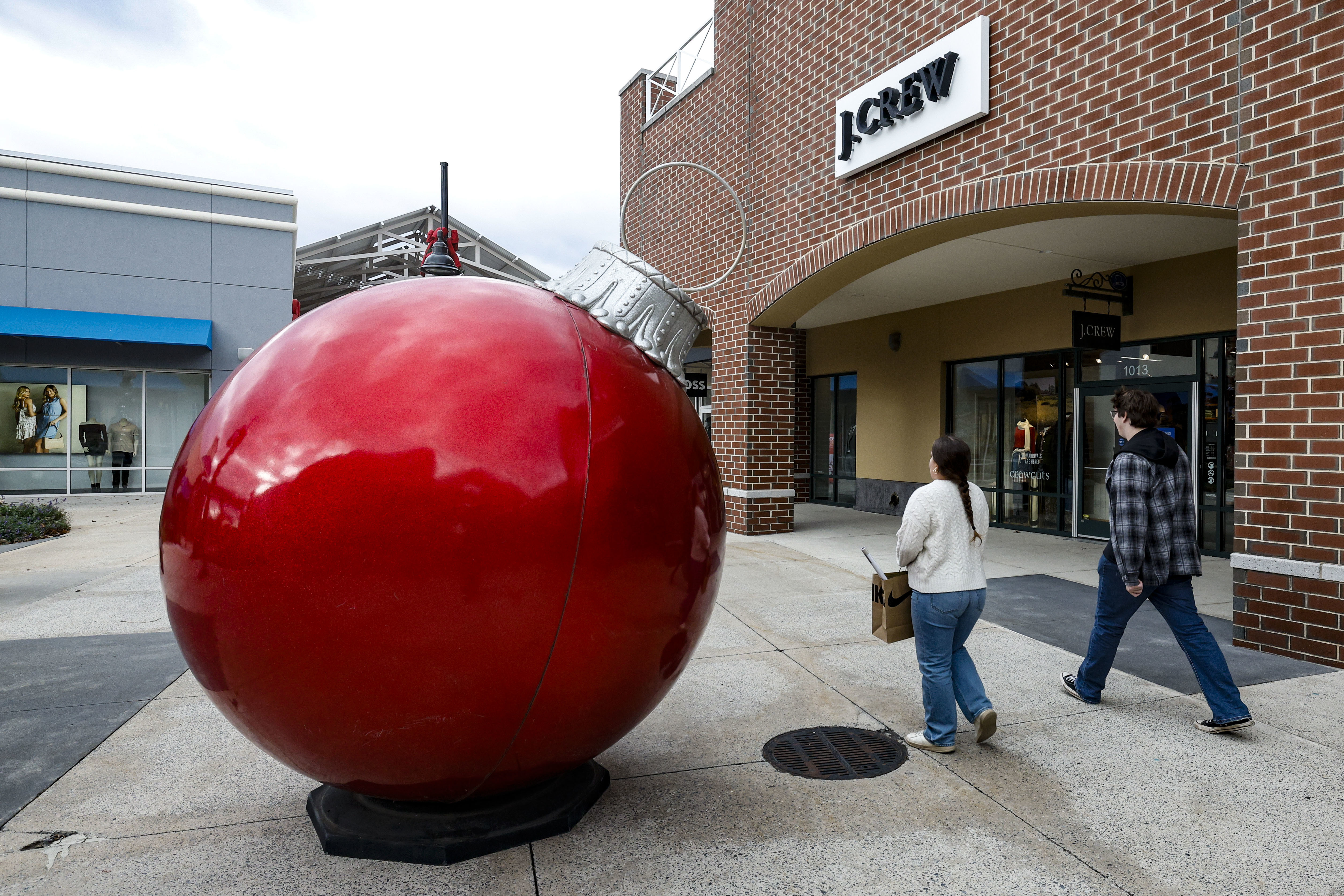
Shoppers walk by the tree at the Philadelphia Premium Outlets on Nov. 11.
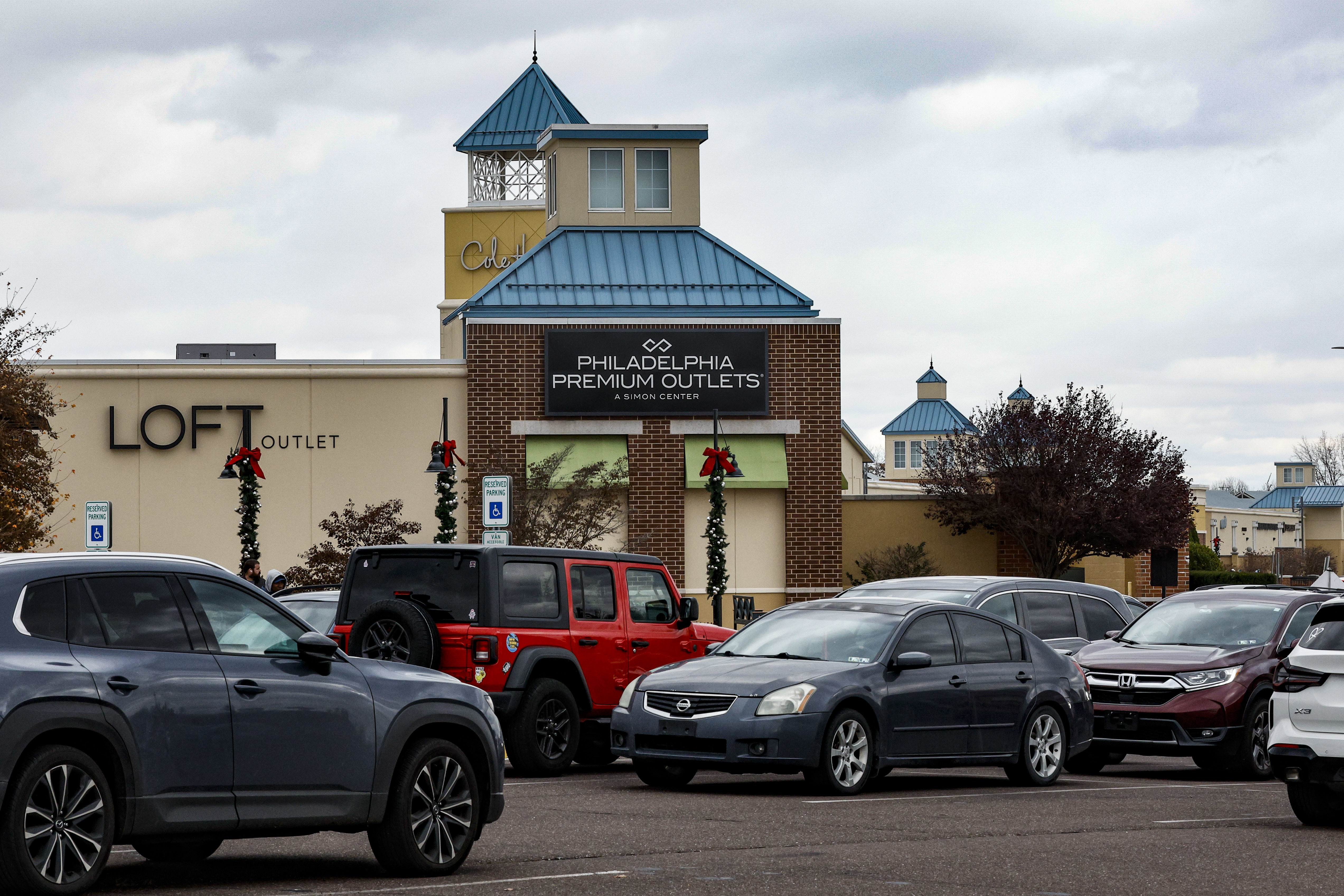
The Philadelphia region’s two major outlet malls — the Philadelphia Premium Outlets in Limerick Township and the Gloucester Premium Outlets, both owned by Simon Property Group — are more than 92% occupied, according to a count by The Inquirer during visits to each location this month. Both outlets have found success despite being less than 20 miles from thriving indoor malls in King of Prussia and Cherry Hill.
Tanger Outlets, which has locations in Atlantic City and Lancaster, recently reported more than 97% occupancy across its 39 open-air centers and an increase in average tenant sales per square foot.
“Outlets do good in good times and great in bad times,” said Lisa Wagner, a longtime consultant for outlets, repeating a common refrain in the industry.
The centers have evolved amid the broader push toward more experiential retail and most now have a mix of discount stores and full-price retailers. But they have done so while embracing their reputation as the go-to destination for snagging deals, said Wagner, a principal at the Outlet Resource Group.
“Honestly no one knew what was going to happen after COVID, but [the outlets] came out incredibly strong,” she said. More recently, the retail industry has been rattled by tariffs and economic uncertainty. The outlets have not been immune to those challenges, but they have held strong despite them.
“People want value right now,” Wagner said. “They need it.”
The Philadelphia Premium Outlets has more than 130 stores in its 500,000-square-foot complex.
Outlet malls become one-stop shops
On a rainy, early November Sunday, hundreds of people descended on the Gloucester Premium Outlets.
Shoppers pulled up hoods and huddled under umbrellas as they made their way from store to store. Many balanced several large bags bearing brand names like Columbia and Kate Spade, Rally House and Hey Dude shoes. Some munched on Auntie Anne’s pretzels or sipped Starbucks from holiday cups. An acoustic version of Jingle Bells played over the speakers.
For some, the dreary, drizzly weather was even more reason to spend their afternoon at the 86-store complex in Blackwood, Camden County, about 15 miles outside Philadelphia.
With two young children in tow, Jessica Bonsu, 30, of Sicklerville, was on a mission.
“We came out to go to the indoor playground,” called Stay & Play, Bonsu said, pointing to her rambunctious kids. “Just to get some energy out.”
“And then we can also get some shopping done,” added her cousin, Taneisha Laume, 30, who was visiting from D.C. She needed a gift for her uncle. “Kill two birds with one stone.”
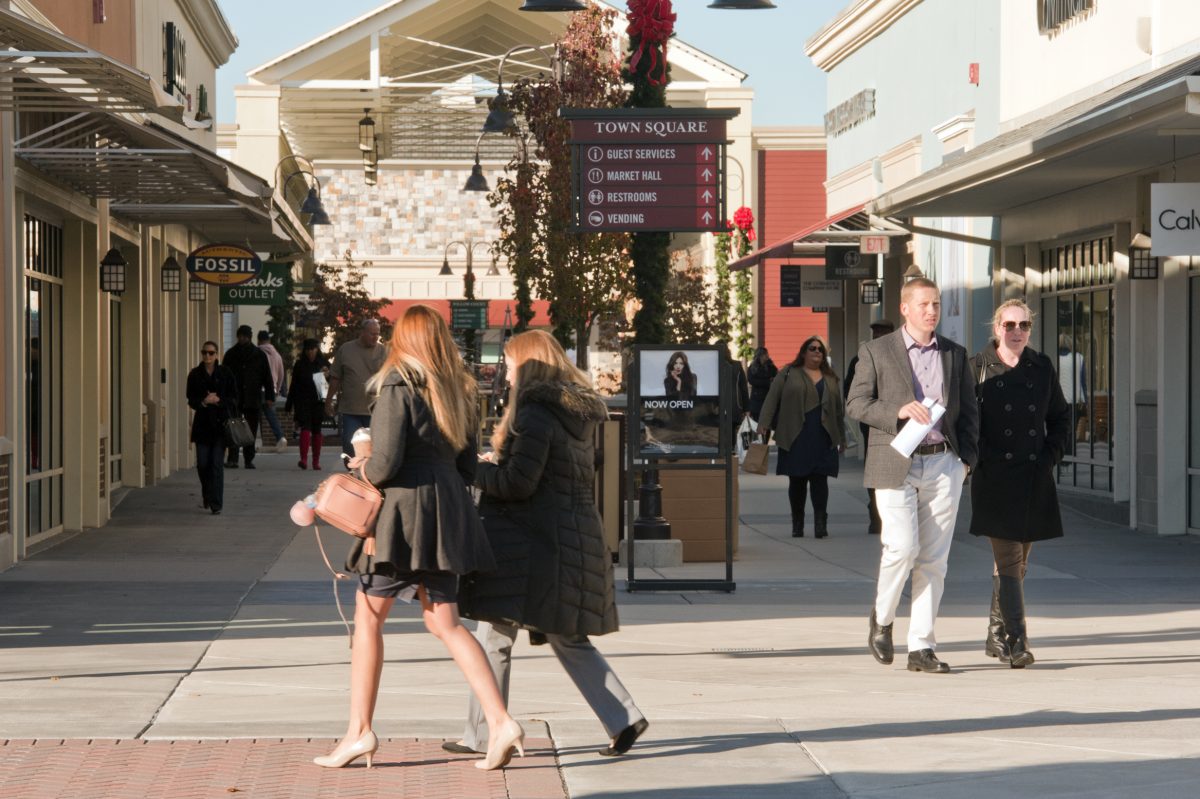
Shoppers peruse the stores at the Gloucester Premium Outlets in this 2019 file photo.
These kind of multipurpose visits are buoying outlet malls, which are increasingly becoming mixed-use destinations for dining, drinking, entertainment, and shopping.
“You’re coming for a little bit of everything,” said Gerilyn Davis, director of marketing and business development at Philadelphia Premium Outlets.
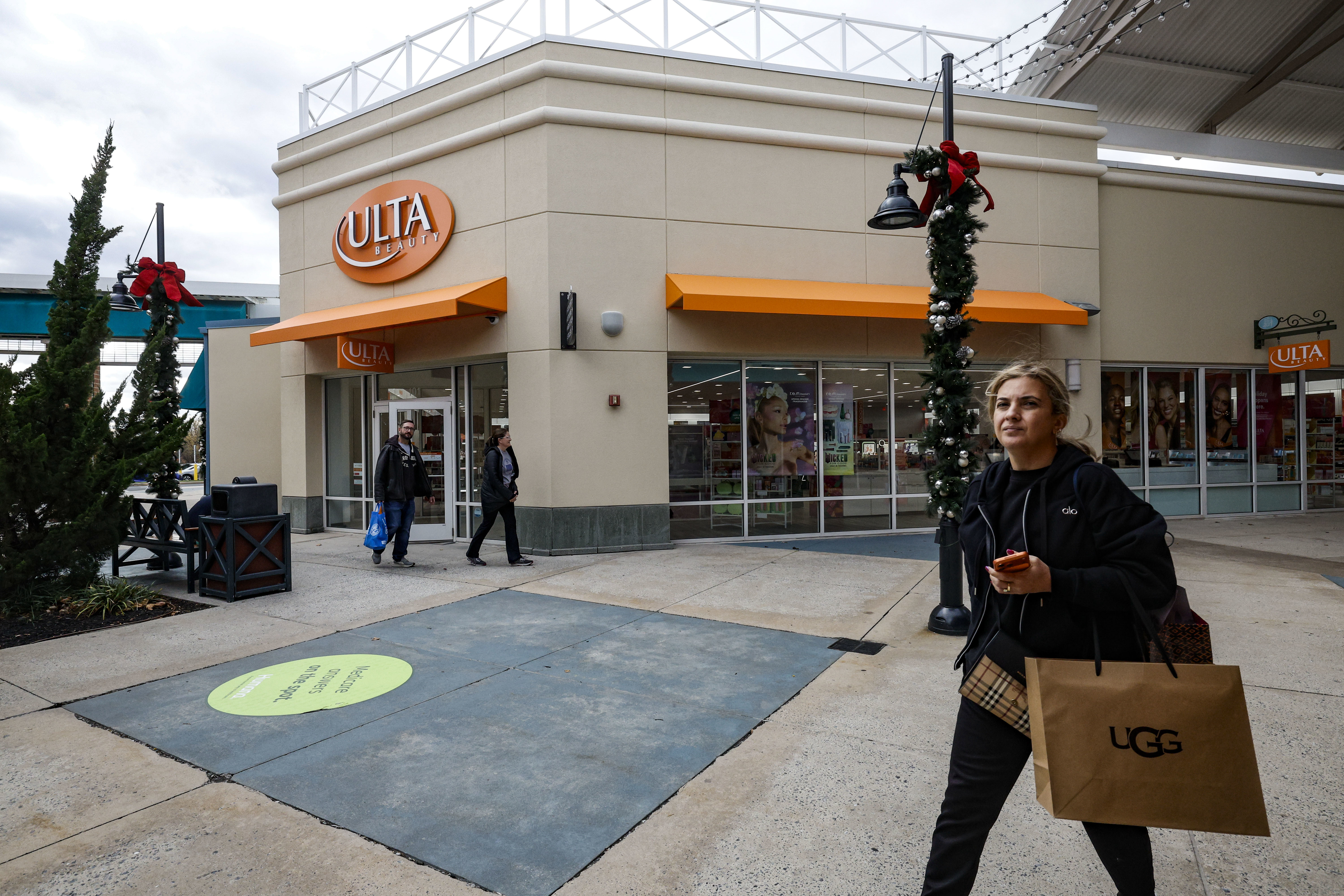
The Limerick Township complex recently welcomed a slate of new tenants, including Marc Jacobs’ first Pennsylvania outlet store, a BOSS outlet, an Ulta Beauty, and an outpost of central Pennsylvania’s Nissley Vineyards, which has an outdoor seating area.
Shoppers walk by the Nissley Vineyards store at the Philadelphia Premium Outlets.
New Balance, whose shoes are trendy again, is also opening stores in both the Philadelphia and Gloucester outlets.
Justin Stein, Tanger’s executive vice president of leasing, said the North-Carolina-based company is focused on adding more food, beverage, and entertainment options.
While overall occupancy at its Atlantic City center is lower than others, the complex has a Dave & Buster’s and a Ruth’s Chris steakhouse. The Simpson, a Caribbean restaurant and bar, is also set to open there in early 2026.
In Lancaster, Tanger is looking to add food and beverage options, Stein said. But that center is still performing well, with a 97% occupancy rate, according to an online map, and only two vacancies.
When there are places to eat and drink at the outlets, “people stay longer,” Stein said, “and when they stay longer, they spend more.”
Philadelphia Premium Outlets had a steady crowd on a bitter cold Veterans Day.
From ‘no frills’ to outlets of the future
Today’s outlet malls look vastly different from what Wagner calls the “no frills” complexes of the 1990s.
At the time, an outlet mall served as “a release valve for excess goods,” Wagner said. “There were some stores that had really broken merchandise.”
To comply with branding rules and avoid competition with department stores, outlet malls were often located along highways between two major metro areas, she said.
“What became clear is that customers loved it,” Wagner said. Soon, brands started overproducing to supply these outlet stores with products in an array of a sizes and colors.
This effort to bulk up outlet offerings was “a roaring success,” she said, with companies finding that more than a third of outlet customers went on to buy their products at full price at other locations.
Philadelphia Premium Outlets, which opened in 2007, has very few vacant storefronts.
As their popularity rose, more outlet malls were built across the country.
As the centers look to the future, their executives are continuing to hone their identity as “not just a discount-and-clearance center,” said Deanna Pascucci, director of marketing and business development at Gloucester Premium Outlets.
Center leaders are bringing in food trucks, leaning into rewards programs, and promoting community events, such as Gloucester’s holiday tree lighting,which took place Saturday. Starting Black Friday, the Philadelphia Premium Outlets will offer Santa photos after a successful pilot program last year.
And the complexes are finding new ways to attract and retain shoppers, online and in real life.
Tanger recently announced an advertising partnership with Unrivaled Sports, which operates youth sports complexes, including the Ripken Baseball Experience in Aberdeen, Md., an hour drive from its Lancaster outlets. Stein said the company hopes to attract families looking to pass the time between tournament games.
Tanger is also using AI and data analytics to email specific deals to customers based on where they’ve previously shopped, Stein said.
“We want you to start your experience online and end it in the store,” Stein said.
Shoppers walk by a new Ulta store at the Philadelphia Premium Outlets.
At Simon outlets, customers can search a store’s inventory online before they make the trip, Davis said.
“Online shopping at this point, it’s a complement,” Davis said. “It’s not viewed as competition.”
Wagner, the outlet consultant, said she thinks even more centers will be built in the coming years, with a focus on urban and close-in suburban locations that are accessible by public transit.
As for existing centers, she sees them thriving for the foreseeable future.
“As long as outlets continue to emphasize a value message and use their loyalty programs to reward customers,” Wagner said, “I think they will hold their own.”
Philly now has the second-highest package-theft rate in the country, reported the Citizen. According to a USPS Inspector General report, we lost $450 million in deliveries last year, which is a staggering amount of missing moisturizer, dog treats, and whatever-impulse-purchase-you-didn’t-need-anyway.
The stories are peak Philly: Thieves in fake Amazon vests dragging trash cans down Northern Liberties like a pack of Grinches, neighbors negotiating with porch pirates over stolen head-and-neck massagers, and whole blocks swapping Ring footage like they’re running a CSI unit. And still, hardly anyone reports it — because calling 911 over a missing package feels unhinged, and most people assume nothing will happen.
Police say they can’t crack down because no one files reports. Prosecutors won’t release data. Delivery companies quietly eat the losses to keep customers from rioting. And the state’s shiny new anti-porch piracy law can’t do much when the entire system for tracking thefts amounts to a collective shrug.
For now, the only real accountability is getting roasted on someone’s community Facebook group.
Herr’s previous campaign had customers voting on these three chip options.
Solid choices, sure. But if you asked Philly what those ideas actually taste like in 2025, it definitely wouldn’t be “cheesy crab dip.” It’d be stuff like:
Freedom: Tastes like finding a parking spot on the first try, crossing the Walt Whitman without traffic, or walking out of Wawa and realizing your hoagie was marked as a Shorti but they accidentally made you a Classic.
Liberty: Tastes like SEPTA showing up early and empty, getting a roofer to text you back the same day, or a neighbor finally taking the parking cone inside because the snow melted… three weeks ago.
Unity: Tastes like a whole block yelling “Go Birds!” at the same stranger, the collective rage of everyone on I-76 when a phantom jam clears, or 20 people on your street stepping outside at once because they all heard the same weird bang.
Voting runs through Dec. 10, and whatever wins hits shelves in June for the city’s 250th birthday party. Silly? Extremely. But honestly, if Philly wants to turn civic values into snack-seasoning discourse, that feels about right.
McCormick recruiting New Yorkers — C
Sen. Dave McCormick put out the world’s most Pennsylvania campaign commercial this week, inviting New Yorkers terrified of their new mayor — and “tired of losing football teams” — to pack up and head west on I-80. And look, we get the appeal. New York is expensive, the Giants and Jets are tragic, and Pennsylvania can brag about producing at least one functioning football franchise at any given time.
But if he’s talking about Philly? Dave… babe… have you seen this place lately? We’re full. Try finding a parking spot in Fishtown after 6 p.m. Or a house in the suburbs that doesn’t get 12 offers in 24 hours. Even our potholes are standing shoulder-to-shoulder. Also, telling New Yorkers to “come on down” because Pennsylvania has mountains and freedom is a bold pitch when most of them can’t even merge onto the Schuylkill without bursting into tears.
So if folks really want to take him up on this offer, maybe start by checking out Pittsburgh. Lovely city. Plenty of room. Great bridges.
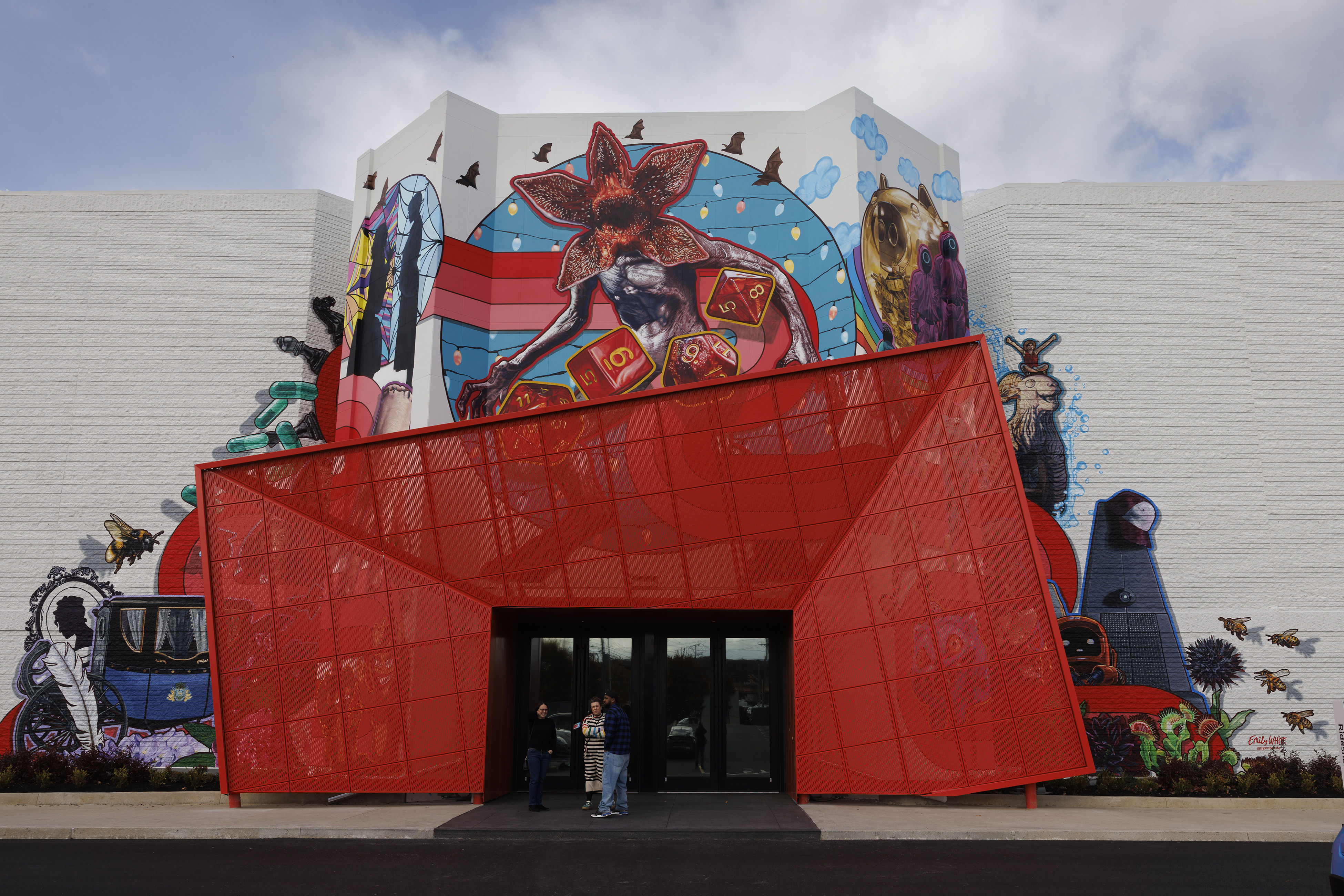
Exterior entrance to Netflix House, King of Prussia Mall, Tuesday, November 11, 2025.
Netflix House — B-
Netflix House finally opened in King of Prussia — because nothing says “immersive fantasy world” like the mall you swore you’d never drive to again. And look, the place is legitimately impressive: Squid Game VR that feels a little too real, a Wednesday carnival, a One Piece escape-room adventure, and photo ops for days.
But here’s the plot twist: the price. Doing all four experiences at the cheapest rate runs $118 a person before taxes. That’s nearly $500 for a family of four. For that kind of money, the golden piggy bank in Squid Game better not be just a prop.
Credit where it’s due: the VR slaps, the staff is Disney-level committed, and superfans will eat it up. But between the Schuylkill, the prices, and the mall chaos, Netflix House might be best for people who already love the shows.
The Sixers released their city edition jerseys.
Sixers City Edition jerseys — C-
The Sixers’ new City Edition jerseys dropped, and the reaction across Philly has been one collective shrug. Navy blue, gold stripe down the side shaped like the Liberty Bell crack, “Philadelphia” in script — all perfectly fine if your goal is to make something no one could possibly argue about. Which, ironically, is the most un-Philadelphia idea imaginable.
Let’s be honest: This jersey didn’t stand a chance. Not in the year of the AI throwbacks — those black 2001 uniforms walked into the room and immediately made everything else look like background décor. The City Edition is basically the jersey equivalent of a supportive friend holding everyone’s coat.
Reddit nailed it. People called them: “Mid.” “It’s just the 2019 one but navy.” “Should’ve said Philly.” “I like them… but I’ll wait until they’re $39.99 in June.” And my personal favorite: “This feels like Nike forgot about us until the last minute.”
Wearing them only three times feels right. This is a jersey designed to quietly exist. Inoffensive. Reasonable. Mildly attractive. Something you nod at and say, “Yeah, that’s nice,” before immediately remembering you’re only here for the throwbacks.
These aren’t bad. They’re just beige-but-navy — the basketball equivalent of choosing a sensible sedan when everyone knows you really wanted the sports car.
The basement goldfish at the Navy Yard have respawned — and Philly has reacted with the kind of unhinged civic joy usually reserved for Gritty sightings. A year after their murky little pond dried up, the fish have returned, proving once again that in this city, nature not only heals… it adapts to runoff water and becomes indestructible.
Reddit went feral: “Philly’s koi pond.” “Koi jawn.” “Nature is healing.” “This needs to be a protected landmark before it’s turned into condos.” And the best lore drop: “Behind that door is a kingdom… nay, a WORLD of basement fish.”
There are paintings now. Fan art. People offering to dump in buckets of water like it’s a community service project. Someone even called them the “unofficial city mascot,” which feels about right — unexpected, slightly alarming, surviving on vibes and stormwater alone. This is the kind of hyperlocal nonsense that unites the city more than any mayor ever has.
How to pronounce “Camac” — B+
Only in Philly could a three-block alley spark a full-blown identity crisis. Someone on Reddit innocently asked how to pronounce Camac — “K’mack? Kay-mick? Kay-mack?” — and within minutes, the city did what it always does: turned a vocabulary question into a referendum on our collective sanity.
The consensus (if you can even call it that) is “kuh-MACK.” But this being Philadelphia, you also get k’MACK, Kuh-MAK, Cum-ACK, and at least one person who decided all the letters are silent, which honestly feels spiritually correct.
Then, naturally, the thread devolved into arguments about other names no one can agree on — Bouvier, Sepviva, Greenwich — because this city will never miss an opportunity to question its own language like it’s a group project we all forgot to do.
It’s extremely on-brand, and reminiscent of The Inquirer’s big Passyunk investigation — the one where lifelong South Philadelphians confidently pronounced it four different ways in the same grocery store aisle. After 400 years, even linguists basically shrugged and said: “Multiple answers are correct, good luck out there.”
So yes, the “right” way to say Camac is probably kuh-MACK. But this is Philly. Pronounce it however you want — someone will correct you, someone else will correct them, and eventually the whole block will be involved.
Inquirer reporter Tom Fitzgerald has become Philly’s most unlikely breakout star — by calmly explaining the absolute chaos of SEPTA and Greyhound. His latest video on the city’s bus terminal and the PPA had people lining up to be “president of the Tom fan club,” begging for “another Tom vid, expeditiously,” and declaring, “Idk what it is about this guy, but I’d trust him with my life.”
And this wasn’t a one-off — the first “what the f— happened to SEPTA” video is where the cult really formed. That comment section was essentially a love letter: “Tom is the GOAT,” “protect this man at all costs,” “cordially inviting this guy to my family Thanksgiving,” and my personal favorite: “I like this guy, would get a French dip with him.” Philly affection comes in many forms, but that might be the purest.
What’s wild is how united everyone is about him. It’s rare for any city to agree on anything — let alone a soft-spoken transit reporter explaining budget failures and bus equity. But Tom did it. He looked into the camera, delivered the grim truth with perfect dad-energy calm, and the entire region collectively said: King.
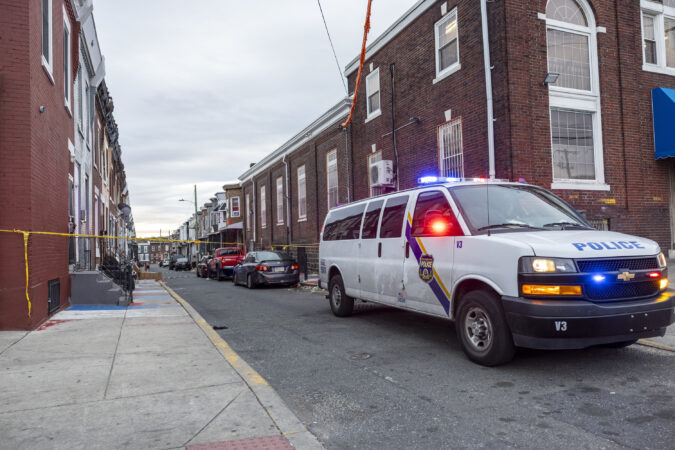
Three weeks after Philadelphia police and federal agents raided Kensington’s Weymouth Street and arrested more than 30 people in what they called the takedown of a decade-old drug-trafficking gang, residents and neighbors are still feeling the constant presence of law enforcement.
That’s because Philadelphia police officers have since been stationed at either end of the narrow block 24 hours a day — asking anyone who wants to pass through to show identification, and declining to let people walk or drive through if they don’t live there.
Deputy Police Commissioner Pedro Rosario said the strategy was part of an attempt to ensure that the block — which had long been a hub of open-air drug dealing — not fall back under control of a new or rival drug organization. Officials who announced the takedown effort last month, including FBI Director Kash Patel, said the case was an attempt to “dismantle” the gang that controlled the 3100 block of Weymouth, and Rosario said he wanted to ensure the results of that investigation had time to take root.
Although limiting public access to a street is unusual, Rosario said that the neighbors he has heard from have been supportive, and that he viewed the effort as an attempt “to stabilize the neighborhood.” Mayor Cherelle L. Parker’s administration has made addressing crime and living conditions in Kensington a priority, employing a variety of sometimes-controversial strategies to combat issues including drug dealing and homelessness.
“This is the department just trying to give the neighborhood a chance to catch its breath,” Rosario said. “I want the power of that investigation to linger. That way, people can really take into account, ‘Should I be doing [drug] business here in Kensington, or is it finally changing?’”
A spokesperson for Parker referred all comments to the police department.
City Councilmember Quetcy Lozada, who represents the area, said that she, too, has received primarily positive feedback from residents about the situation, and that she viewed the heavy police presence as a way to help ensure the block be given a chance to move forward.
“Everyone knows when one operation is broken down and moved out of the way, there’s always someone looking to move in and replace that,” Lozada said. “I think it’s very important for the police to stay around and for the new norm to stay successful.”
Inquirer reporters visited the block on three days this week seeking to interview residents about the aftermath of the raids, but were denied access by officers sitting in patrol cars at either end of the street.
In phone interviews conducted afterward, three residents said they were either indifferent about, or fine with, the ongoing restrictions.
“I’m either going to be for trying to fix this problem or against it,” said one resident, who requested anonymity to discuss a sensitive issue affecting his block. “And if this is what [police] have to do right now, I think I’d rather have the police there than drug [users] running up and down the street.”
Another resident, who also asked not to be named, said he believed police were “keeping people safe.”
“People appreciate it, that we have somebody doing something about it,” he said.
Jimmy Townsend disagreed. The 51-year-old said that he has lived on the block for three years, and that being questioned on the way to his house amounted to “harassment” and a way to impose consequences on an entire block for the actions of others.
“God forbid I forget my mail or ID, I might get stopped from coming to my own house,” Townsend said. “I was not part of that crime.”
Witold J. Walczak, legal director for the American Civil Liberties Union of Pennsylvania, said government agencies generally have “a significant burden” to justify prohibiting access to areas like public streets or sidewalks. And while police can — and often do — limit access to public places in the middle of major operations, Walczak said he was unsure why police in this instance felt the need to place such restrictions on the block if officers were also stationed there in patrol cars.
“If the police are there anyway, I don’t understand how [not] letting people in and out of the area is going to advance their interests,” he said. “The fact that they’re there should do that without restricting access.”
Rosario, the deputy commissioner, said any time police place a heavy emphasis on one patrol area, they will scale back their presence over time as conditions improve. In this case, he said, “I want to be strategic in how we do that.”
In the meantime, he said, police were continuing to allow delivery trucks and other essential vehicles to access the block, even as officers sought to divert most passersby elsewhere.
“This is us really being deliberate,” he said, “to let this sink in for a second.”
Across the Philadelphia suburbs, county leaders are tightening their budgets, and looking toward potential tax increases.
Counties are required by law to complete their budget for next year by Dec. 31. But they entered this year’s budget season facing uncertainty withfederal funding and a lack of clarity over state dollars as lawmakers remained locked in a monthslong budget impasse that ended only Wednesday when the Pennsylvania General Assembly and Gov. Josh Shapiro approved a $50.1 billion budget.
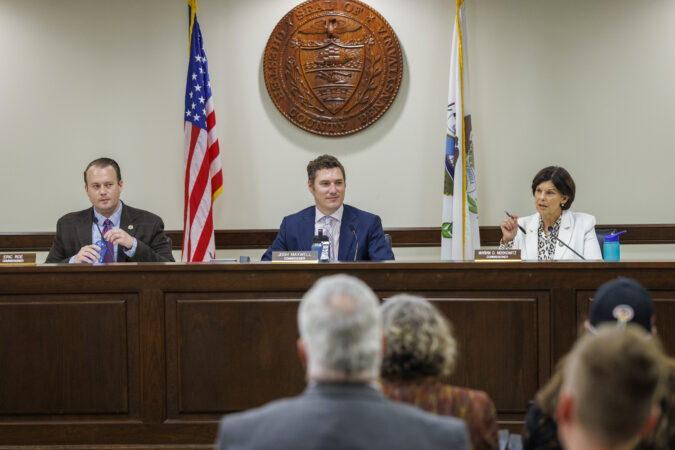
“We were preparing for more needs and less money,” said Josh Maxwell, a Democrat who chairs the Chester County Board of Commissioners. And even as Washington and Harrisburg resolved their budget woes this week, they did little to resolve concerns at the county level.
“I don’t think if the General Assembly had sent us a gold-plated demand or invitation to raise property taxes it could have been any clearer,” said Delaware County Council member Christine Ruether, a Democrat.
Counties in Pennsylvania can only increase their revenue by raising property taxes. By failing to provide additional funds for social services, county officials argued, the state had created a situation where counties would immediately or eventually have to raise property taxes.
“The people we serve … all their problems don’t suddenly go away because there’s a lack of funding to address the problem,” said Bob Harvie, a Democrat who chairs the Bucks County Board of Commissioners and is running for Congress.
“It will likely mean that this county will have to consider a tax increase because we need to meet the needs of those people.”
Bucks County has not yet released its proposed budget for 2026. But residents in Montgomery and Delaware Counties are likely facing tax increases.
Delaware County’s executive director Barbara O’Malley told the all-Democratic council last week that the county would need to increase property taxes 19% to eliminate the county’s structural deficit. A healthy financial setting, she argued, was especially important as state and federal funding streams have become less reliable.
Both budgets were crafted before the state budget was released but county officials said they wrote the documents assuming stagnant funding from the state despite inflation.
“We kept it status quo,” said Dean Dortone, Montgomery County’s chief financial officer.
Chester County officials said they’ve taken a similar approach. The county, Maxwell said, had also lookedfor budget cuts throughout the year as federal grant cancellations created uncertainty.
“We’ve been cutting all year because we know that the federal and state governments are going to be flat or less funding,” Maxwell said, but if the state continues to leave funding flat for social services it will eventually have an impact.
“Over time it’s going to mean property taxes are … going to go up more than they would have otherwise.”
Meanwhile, counties have spent the last several months backfilling for state funds that didnot come during the impasse.
In Montgomery County, officials estimated the county had spent between $40 and $50 million from budget reserves to maintain services. Chester County officials estimated the county spent $40 million, while Delaware County officials reported spending $12 million monthly until October when the county was forced to reduce payments to social services providers.
Counties expect to be reimbursedby the state for those expenses, but it’s unclear how quickly those payments will come.
Delaware County declared a state of emergency Wednesday allowing them to more quickly distribute funds to local food pantries while the organizations wait for state and federal dollars to come through.
“It’s going to take a while for the money to trickle down and in the meantime if somebody can’t get food on the table it’s an issue,” Reuther said during the county’s board meeting.
This suburban content is produced with support from the Leslie Miller and Richard Worley Foundation and The Lenfest Institute for Journalism. Editorial content is created independently of the project donors. Gifts to support The Inquirer’s high-impact journalism can be made at inquirer.com/donate. A list of Lenfest Institute donors can be found at lenfestinstitute.org/supporters.
Think you know your news? There’s only one way to find out. Welcome back to our weekly News Quiz — a quick way to see if your reading habits are sinking in and to put your local news knowledge to the test.
Question 1 of 10
Hip Hop, the Sixers’ retired mascot, made his triumphant return during a game last week and was honored at halftime. What animal/character is the mascot supposed to be?
CorrectIncorrect. XX% of other readers got this question right.
Bill Roth, who played Sixers former mascot Hip Hop — a rabbit — was honored during halftime of Saturday's game against the Toronto Raptors.
Question 2 of 10
Seaforest Bakery in Graduate Hospital is a new spot for baked goods and coffee that pays homage to this type of cuisine:
CorrectIncorrect. XX% of other readers got this question right.
The bakery menu features riffs on classic Korean dishes, like gochujang scallion buns and doenjang caramel rolls. Seaforest is the English translation of owner Suerim Lee’s first name.
Subscribe to The Philadelphia Inquirer
Our reporting is directly supported by reader subscriptions. If you want more journalism like this story, please subscribe today.
There are two competing campaigns to rebuild and restore the Old City bar where the Marines were historically established 250 years ago. What was the bar called?
CorrectIncorrect. XX% of other readers got this question right.
The Marines, famously, were established at the Tun Tavern in 1775, a brewery and watering hole that once sat, roughly, where the southbound lanes of I-95 are now.
Question 4 of 10
This Hall of Fame quarterback recently said he’s on the Eagles’ side when it comes to the Tush Push:
CorrectIncorrect. XX% of other readers got this question right.
Peyton Manning made the Tush Push the subject of a Peyton's Places episode on ESPN, defending the controversial play's existence. "I'm on the Eagles’ side," he said.
Question 5 of 10
Sasha Suda, the recently ousted director and CEO of this institution, recently sued her former employer for wrongful termination:
CorrectIncorrect. XX% of other readers got this question right.
Suda is suing the Philadelphia Art Museum. Her suit says there was no "valid basis" for her dismissal, and seeks two years' worth of compensation and other damages.
story continues after advertisement
Question 6 of 10
James Vaughen, a 26-year-old Curtis grad, has won the Philadelphia Orchestra’s principal trumpeter spot. How many times had he previously auditioned for the gig without success?
CorrectIncorrect. XX% of other readers got this question right.
The hunt for a permanent principal trumpeter has been going, off and on, for several years. Vaughen, in fact, had auditioned for the position three times before without success. It was the fourth time that was the charm, said the 2023 Curtis grad.
Question 7 of 10
Bucks County native Sabrina Carpenter is up for six Grammy awards this year, including Song of the Year for this track:
CorrectIncorrect. XX% of other readers got this question right.
Carpenter is competing for song and record of the year, pop solo performance and best video for “Manchild,” as well as pop vocal album for Man’s Best Friend. Earlier this year, she won Grammys for her breakout album Short n’ Sweet and hit “Espresso.”
Question 8 of 10
The vacant building on East Passyunk Avenue that most recently housed Bing Bing Dim Sum will become the home to this new restaurant:
CorrectIncorrect. XX% of other readers got this question right.
Tako Taco, an amalgam of Japanese (tako is octopus) and Mexican cuisines, is one of two new projects in the works by chefs Biff Gottehrer and Kenjiro Omori — from Main Line destinations Refectory, the Ripplewood, and Izzy’s.
Question 9 of 10
The Philadelphia-based Freeman’s auction house will auction off this prized item owned by Marquis de Lafayette:
CorrectIncorrect. XX% of other readers got this question right.
Showered with gifts on both sides of the Atlantic, the hero of Yorktown was awarded a timekeeper for the ages by the people of France. Embossed with images of Greek mythical figures Orpheus and Eurydice, the 18-karat tricolor gold pocket watch was engraved with Lafayette’s full name and image. A hidden image inside depicted Lafayette’s return to France from America. Now it’s up for sale.
Question 10 of 10
A new law going into effect next year will require Philadelphia shoppers to pay this much per paper bag:
CorrectIncorrect. XX% of other readers got this question right.
Philadelphia shoppers will soon have to pay 10 cents per paper bag after Mayor Cherelle L. Parker on Thursday allowed a bill imposing the fee to become law without her signature. The law is expected to go into effect in January.
Your Results
You have skipped .
You scored XX out of 10.
The average reader scored XX out of 10
Seems like you’ve been skimming more than reading there, buddy. There’s always next week.
You’ve read some articles (or made some educated guesses) but we wouldn’t come to you first for our local news recaps. Better luck next week!
Do you work here? You’re a local news stan with the latest updates on Philly happenings. Your friends definitely ask you for summaries on what’s going on and it shows.
Dorothea Cathell, 77, of Philadelphia, longtime community volunteer, retired hospitality worker, three-time cancer survivor, expert tailor, and mother of four, died Friday, Sept. 26, at Lankenau Medical Center of injuries she sustained as a victim of a hit-and-run at 54th Street and Lancaster Avenue.
Ms. Cathell was walking home from a shopping trip with Halloween decorations on Sept. 26 when she was struck by a speeding car. The driver left the scene in a damaged vehicle, and a suspect was arrested later and charged with homicide by vehicle-DUI and other charges. The case is pending.
“She was an awesome woman and mother,” said her son Ralph. “She was a real big light for the universe.”
Born and reared in South Philadelphia, Ms. Cathell lived in West Philadelphia as an adult and treated her neighbors like family, her son said. She volunteered at local free meal programs and youth activities and “opened her door to the homeless and anyone else in need,” her son said.
“She valued education first and promoted so much positivity in the neighborhood,” he said. “She had an extraordinary personality. Her heart was so huge.”
Ms. Cathell survived two bouts of stomach cancer and a case of colon cancer, and was “as tough as 30 gorillas,” her son said. She championed order and cleanliness in the community, worked in housekeeping for a hotel, and was an expert tailor.
Ms. Cathell was an avid storyteller, her son Ralph said. “She was a poetic person.”
“She made my sixth-grade graduation suit,” her son said. “Jacket, vest, shirt, pants, and tie. My friends said, ‘Wow.’ I said, ‘My mom did it.’”
Dorothea Elizabeth Cathell was born Dec. 25, 1947. She grew up with three brothers and three sisters, her son said, and graduated from South Philadelphia High School.
She married Charles Carter in the early 1980s, and they divorced later. He died earlier.
She had sons Ralph, Dwight, and Erik, and a daughter, Samiyah. Erik died earlier.
Ms. Cathell was an avid storyteller, her son said. “She was a poetic person,” he said. A friend said on Facebook: “She loved the hell out of her children and grandchildren. Amazing woman, heart of gold.”