Category: News

Latest breaking news and updates

  • She was found dead under a pallet in Frankford last year, and was unidentified for months. Her family wants you to know her story.

    She was found dead under a pallet in Frankford last year, and was unidentified for months. Her family wants you to know her story.

    Police found the body of the woman with the crystal pendant necklace stuffed beneath a wooden pallet in an overgrown lot in Frankford one night last June. She had been shot once between the eyes, and wore only a sports bra, with her pants and underwear tangled around her ankles.

    Days in the stifling heat had left her face unrecognizable, nearly mummified.

    Still, Homicide Detective Richard Bova could see traces of the beautiful young woman she had been. She was small, about 100 pounds, with long dark hair tinted red at the ends. Her nails were painted pale pink. She wore small gold hoops in her ears.

    But he didn’t know her name. And for 90 days, the absence of that essential fact stalled everything.

    A victim’s identity is the foundation on which a homicide case is built. Without it, detectives cannot retrace a person’s final moments or home in on who might have wanted them dead and why. For three months, Bova and his partner scoured surveillance footage, checked missing-persons reports, and ran down every faint lead, eager to put a name to the woman beneath the pallet.

    At the same time, in a small house in Northeast Philadelphia, a family was searching, too.

    Olga Sarancha hadn’t heard from her 22-year-old daughter, Anastasiya Stangret, in weeks and was growing worried. Stangret had struggled with an opioid addiction in recent months, but never went more than a few days without speaking to her mother or sister.
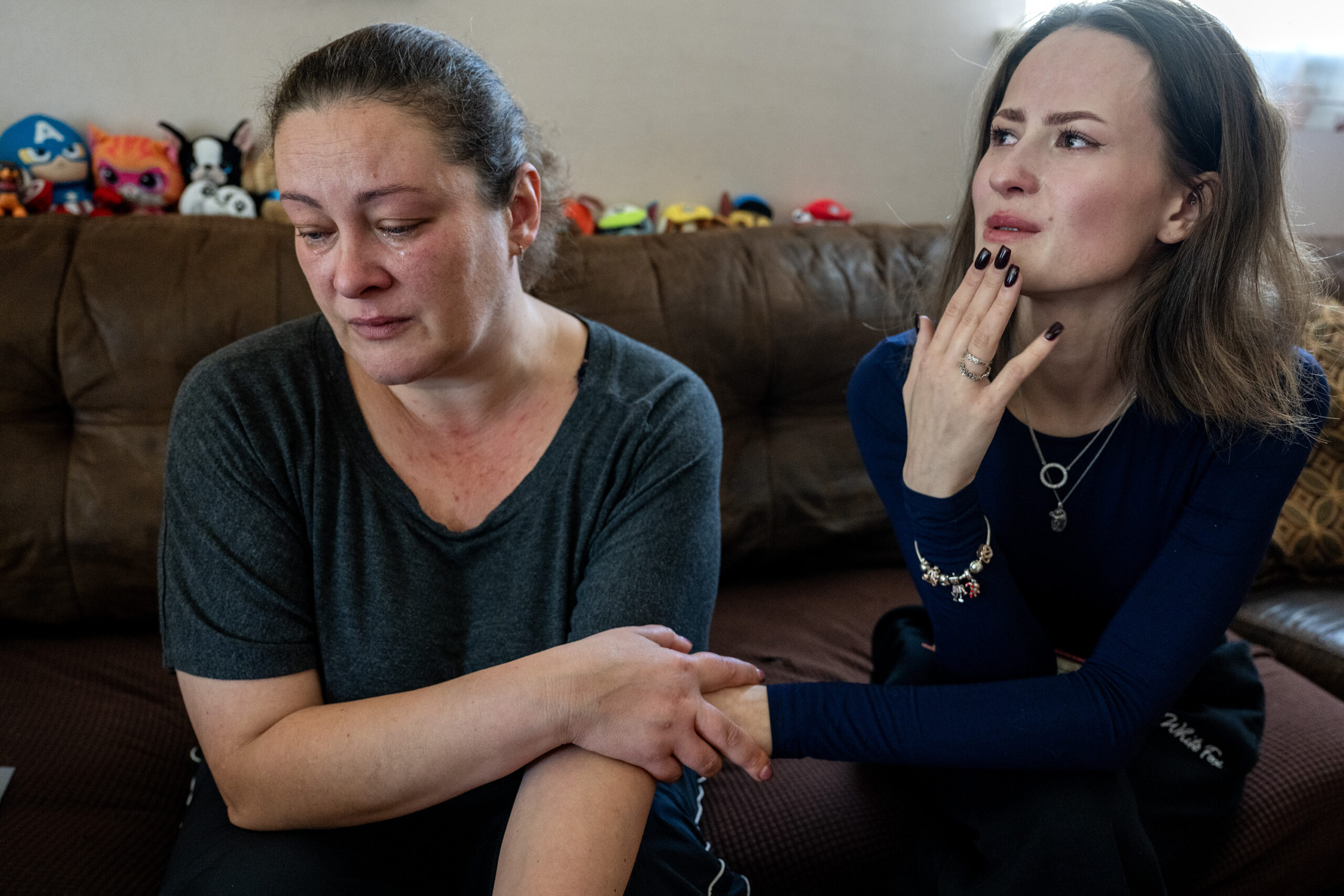
    Olga Sarancha (left) and her daughter, Dasha Stangret, speak of the pain of the death of her eldest daughter, Anastasiya, at their Northeast Philadelphia home. Dasha wears a bracelet featuring Pandora charms gifted by her sister.

    Through July and August that summer, Sarancha and her youngest daughter, Dasha, tried to report Stangret missing, but they said they were repeatedly rebuffed by police who turned them away and urged them to search Kensington instead.

    So they kept checking hospitals, calling Stangret’s boyfriend, and driving through the dark streets of Kensington — looking for any sign that she was still alive.

    It was not until mid-September that the family was able to file a missing-persons report. Only then did Bova learn the name of his victim.

    But by then, he said, the crucial early window in the investigation had closed — critical surveillance footage, which resets every 30 days, was gone. Cell phone data and physical evidence were harder to trace.

    Still, for 18 months, Bova has worked to solve the case, and for 18 months, Stangret’s mother and younger sister have grieved silently, haunted by the horrors of her final moments and the fear that her killer might never be caught.

    Philadelphia’s homicide detectives this year are experiencing unprecedented twin phenomena: The city is on pace to record its fewest killings in 60 years, and detectives are solving new cases at a near-record high.

    But those gains do not erase the reality that hundreds of killings in recent years remain unresolved — each one leaving families suspended in despair, and detectives asking themselves what more they could have done.

    In this case, extensive interviews with Bova and Stangret’s family offer a window into how a case can stall even when a detective puts dozens of hours into an investigation — and what that stall costs.

    Bova has a suspect: a 58-year-old man with a lengthy criminal record who he believes had grown infatuated with Stangret as he traded drugs for suboxone and sex with her. But the evidence is largely circumstantial. He needs a witness.

    And Stangret’s family needs closure — and reassurance that the life of the young woman, despite her struggles, mattered.

    “Everybody has something going on in their life,” said Dasha Stangret, 23. “It doesn’t make her a bad person, and it’s not what she deserved.”

    Anastasiya Stangret, left, celebrated her 20th birthday with her mother in 2022.

    Becoming Anna

    Anastasiya Stangret was born in Lviv, Ukraine, on Nov. 15, 2001. Her family immigrated to Northeast Philadelphia when she was 8 and Dasha was 7.

    The sisters were inseparable for most of their childhood. They cuddled under weighted blankets with cups of tea. They put on fluffy robes and did each other’s eyebrows and nails.

    Anna was bubbly, polite, and gentle, her family said. She enjoyed working with the elderly, and after graduating from George Washington High School, she earned certifications in phlebotomy and cardiology care. She volunteered at a nearby food bank, translated for Ukrainian and Russian immigrants, and later worked at a rehabilitation facility, where she gave patients manicures in her free time.


    Sisters Dasha, left, and Anastasiya Stangret were inseparable as children. They dressed up as princesses for Halloween in 2008.
    Dasha, left, and Anastasiya Stangret at their first day of school in Philadelphia after emigrating from Ukraine.

    “Anna always worked really hard,” Dasha Stangret said. “I looked up to her.”

    But her sister was also quietly struggling with a drug addiction.

    Her challenges began when she was 12, her mother said, after she was hit by a car while crossing the street to catch the school bus. She suffered a serious concussion, Sarancha said, and afterward struggled with PTSD, anxiety, and depression.

    About a year later, as her anxiety worsened, a doctor prescribed her Xanax, her mother said. Not long after, she started experimenting with drugs with friends, her sister said — first weed, then Percocet.

    She hid her drug use from her family until her early 20s, when she became addicted to opioids.

    She sought help in January 2024 and began drug treatment. But her progress was fleeting. She returned to living with her boyfriend of a few years, who they later learned also used drugs, and she became harder to get in touch with, her mother said.

    When Sarancha’s birthday, June 18, came and passed in 2024 without word from her daughter, the family grew increasingly concerned.

    Anastasiya Stangret was kind, gentle, and polite.

    They checked in with Stangret’s boyfriend, they said, but for weeks, he made excuses for her absence. He told them that she was at a friend’s house and had lost her phone, that she was in rehab, that she was at the hospital.

    On July 27, Sarancha and her daughter visited the 7th Police District in Northeast Philly to report Anna missing, but they said an officer told them to go home and call 911 to file a report.

    Two officers responded to their home that day. The family explained their concerns — Stangret was not returning calls or texts, and her boyfriend was acting strange. But the officers, they said, told them they could not take the missing-persons report because Stangret no longer lived with them. They recommended that the family go to Kensington and look for her.

    Through August, the family visited a nearby hospital looking for Stangret, only to be turned away. Sarancha, 46, and her husband drove through the streets of Kensington without success. They continued to contact the boyfriend, but received no information.

    They wanted to believe that she was OK.

    On Sept. 12, they visited Northeast Detectives to try to file a missing-persons report again, but they said an officer said that was not the right place to make the report. They left confused. Dasha Stangret called the district again that day, but she said the officer on the phone again told her that she should go to Kensington and look for her sister.

    That the family was discouraged from filing a report — or that they were turned away — is a violation of Philadelphia police policy.

    “When in doubt, the report will be taken,” the department’s directive reads.

    Finally, on the night of Sept. 12, Dasha Stangret again called 911, and an officer came to the house and took the missing-persons report. For the first time, they said, they felt like they were being taken seriously.

    A few days later, Dasha Stangret called the detective assigned to the case and asked if there was any information. He asked her to open her laptop and visit a website for missing and unidentified persons.

    Scroll down, he told her, and look at the photos under case No. 124809.

    On the screen was her sister’s jewelry.
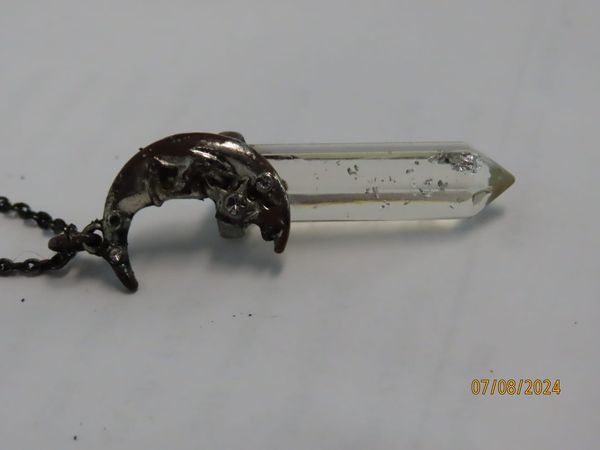
    Dasha Stangret gifted this necklace to her sister for her birthday one year. Police released the image after Anastasiya’s body was found last June, in a hope that someone would recognize it and identify her. Dasha did not see the photo until September 2024.
    Olga Sarancha gifted these gold earrings, handmade in Ukraine, to her eldest child on her birthday a few years ago. Police released this image after they recovered the earrings on Anna’s body, hoping it could lead them to her identity.

    A detective’s hunch

    Three months into Bova’s quest to identify the woman under the pallet — of watching hundreds of hours of surveillance footage and chasing fleeting missing-persons leads — dental records confirmed that the victim was Stangret.

    After meeting with her family, Bova questioned the young woman’s boyfriend.

    He told the detective he and Stangret had met a man under the El at the Arrott Transit Center in Frankford sometime in June, Bova said, and that the man gave them drugs in exchange for suboxone and, later, sex with Stangret.

    But the man had grown infatuated with Stangret, he said, and after she left his house, he started threatening her in Facebook messages, ordering her to return and saying that if anybody got in his way, he would hurt them.

    The man lived in a rooming house on Penn Street — almost directly in front of the overgrown lot where Stangret’s body was found. Surveillance video showed Stangret walking inside the rowhouse with him just before 7 p.m. on June 18, Bova said, but video never showed her coming back out.

    Police searched the man’s apartment but found nothing to link him to the crime — no blood, no gun, no forensic evidence that Stangret had ever been inside. The suspect had deleted most of the texts and calls in his phone from June, July, and August, Bova said, and because nearly four months had passed, they could no longer get precise phone location data.

    He said that, at this point, he does not believe the boyfriend was involved with her death, and that he came up with excuses because he was afraid to face her family.

    Surveillance cameras facing the lot where Stangret was found didn’t show anyone entering the brush with a body. Neighbors and residents of the rooming house said they didn’t know or hear anything, he said. And a woman seen on camera pacing the block and talking with the suspect the night they believed Stangret was killed also said she had no information.

    The detective is stuck, he said.

    “Is it enough for an arrest? Sure,” Bova said of the circumstantial evidence against the suspect. “But our focus is securing a conviction.”

    Bova’s theory is that the man, angry that Stangret wanted to leave, shot her in the head. Because the house has no back door, he believes the man then lowered her body out of the second-floor window, used cardboard to drag her through the brush, and then hid her under a pallet.
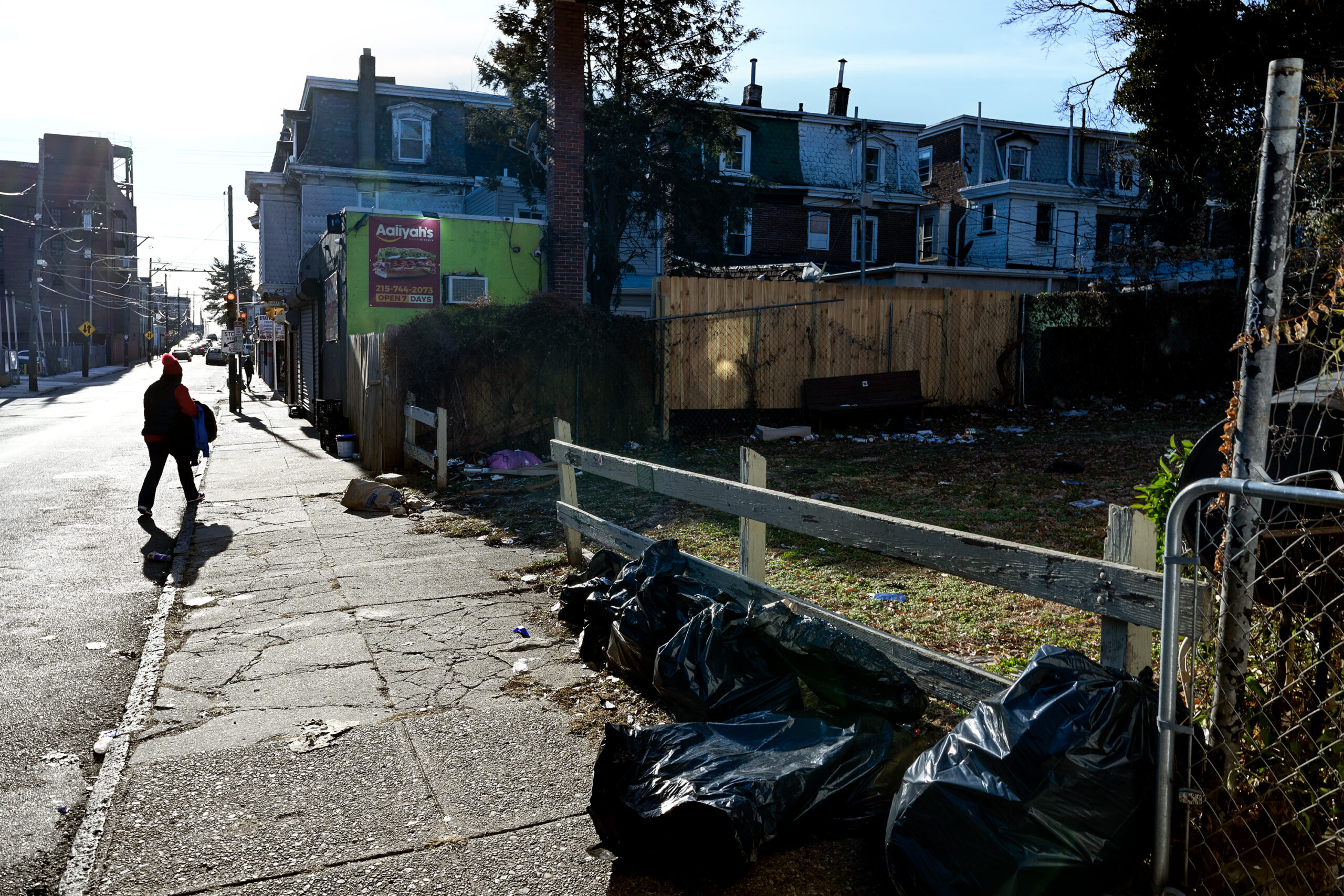
    Anastasiya Stangret’s body was found in the back of this vacant lot, on the 4700 block of Griscom Street, in June 2024.

    He is sure that someone has information that could help the case — that the suspect may have bragged about what happened, that a neighbor heard a gunshot or saw Stangret’s body being taken into the lot.

    There is a $20,000 reward for anyone who has information that leads to an arrest and conviction.

    “The hardest part is patience,” he said. “I’m looking for any tips, any information.”

    Bova has worked in homicide for five years. As with all detectives, he said, some cases stick with him more than others. Stangret’s is one of them.

    “Anna means a lot,” he said. “This is a young girl. We all have children. I have daughters. For her to be thrown in an empty lot and left, to see her life not matter like that, it’s horrifying to me and to us as a unit.”

    “It eats me alive,” he said, “that I don’t have answers for them and I’m not finishing what was started.”
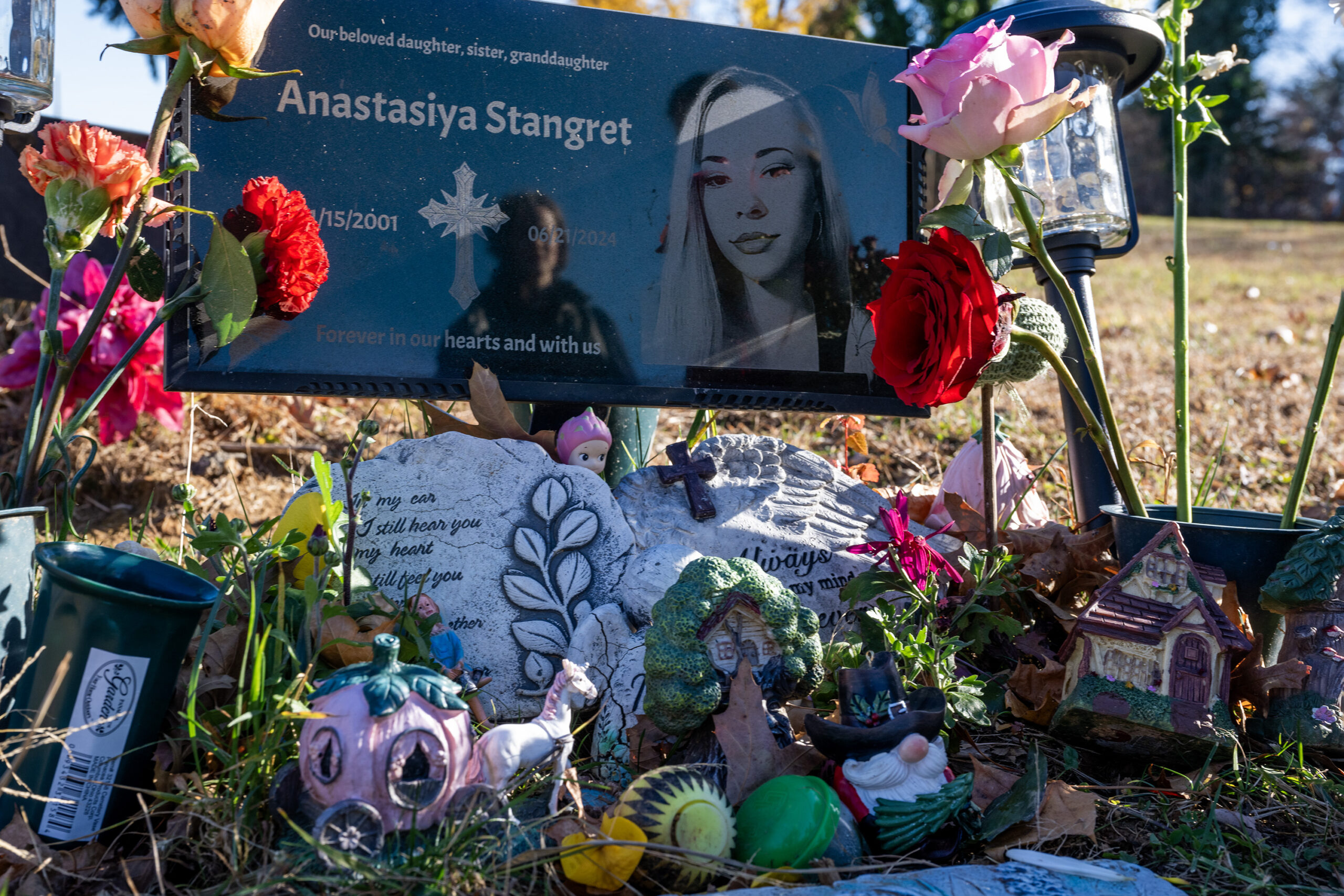
    Dasha Stangret is reflected in the memorial at the grave of her sister, Anastasiya, in William Penn Cemetery.

    ‘I love you. I miss you’

    Stangret’s family suffers every day — the guilt of wondering whether they could have done more to get her help, the anger that her boyfriend didn’t raise his concerns sooner, the fear of knowing the man who killed her is still out there.

    Dasha Stangret, a graphic design student at Community College of Philadelphia, finds it difficult to talk about her sister at length without trembling. It’s as if the grief has sunk into her bones.

    In July, she asked a police officer to drive her to the lot where her sister’s body was found. She sat for almost an hour, crying, placing flowers, searching for a way to feel closer to her.
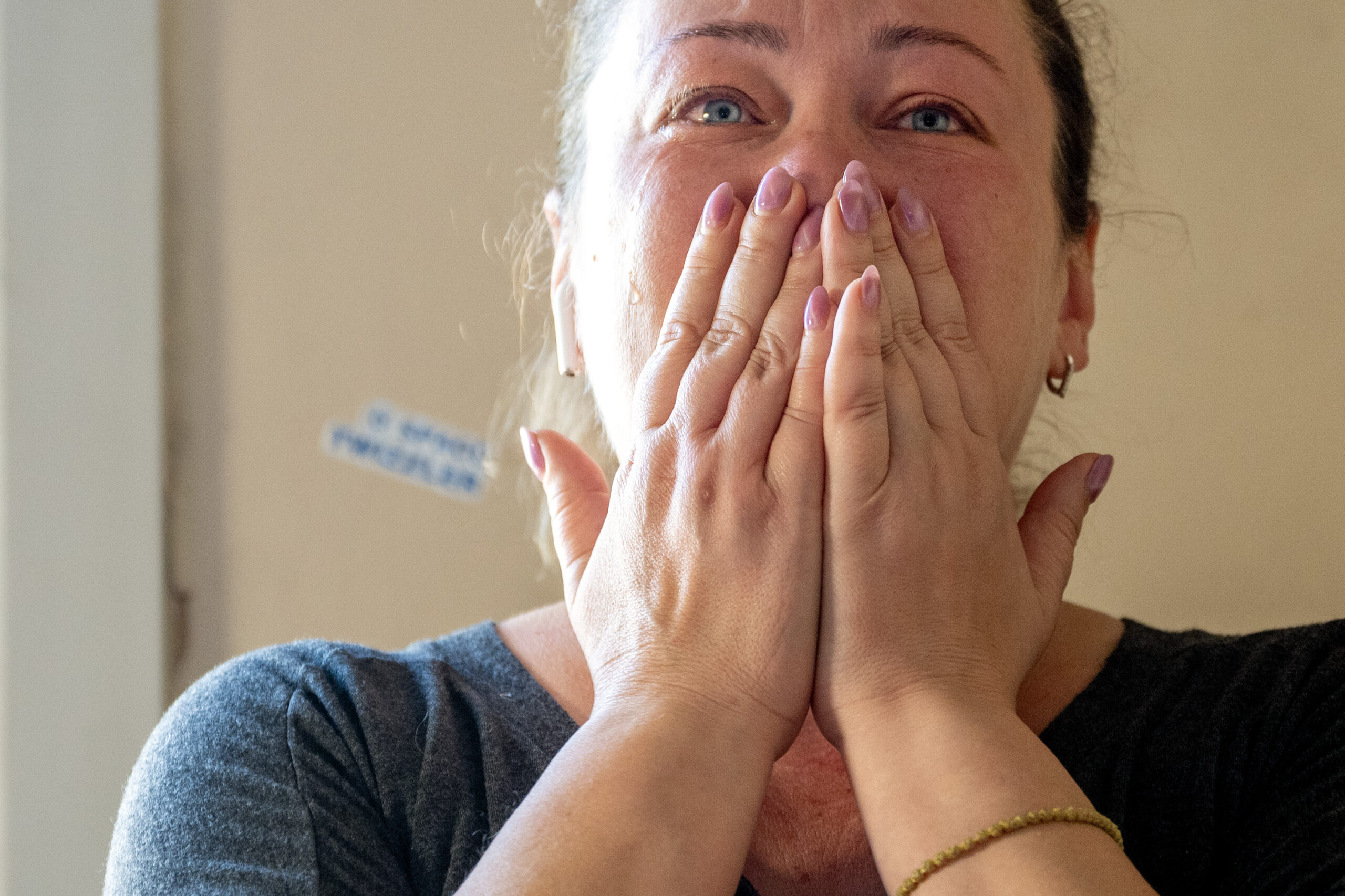
    “I cannot sleep, I cannot live,” Olga Sarancha said of the pain of losing her daughter.

    Sarancha struggles to sleep. She wakes up early in the mornings and rereads old text messages with her daughter. She pulls herself together to care for her 6-year-old son, Max, whose memories of his oldest sister fade daily.

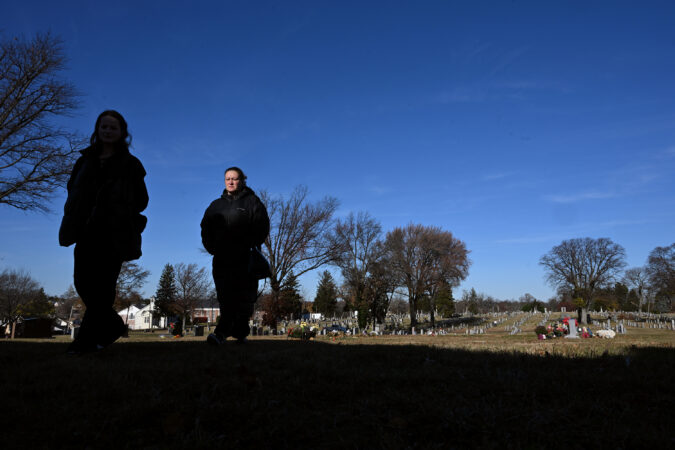
    On a recent day, Dasha Stangret and her mother visited her sister’s grave at William Penn Cemetery. They fluffed up the fresh roses, rearranged the tiny fairy garden around her headstone, and lit a candle.

    Stangret began to cry — and shake. Her mother took her arm.

    “I love you. I miss you,” Stangret told her sister. “I hope you’re happy, wherever you are.”

    And nearly 20 miles south, inside the homicide unit, Bova continues to review the files of the case, waiting for the results of another DNA test, hoping for a witness who may never come.

    If you have information about this crime, contact the Homicide Unit at 215-686-3334 or submit a confidential tip by texting 773847 or emailing tips@phillypolice.com.
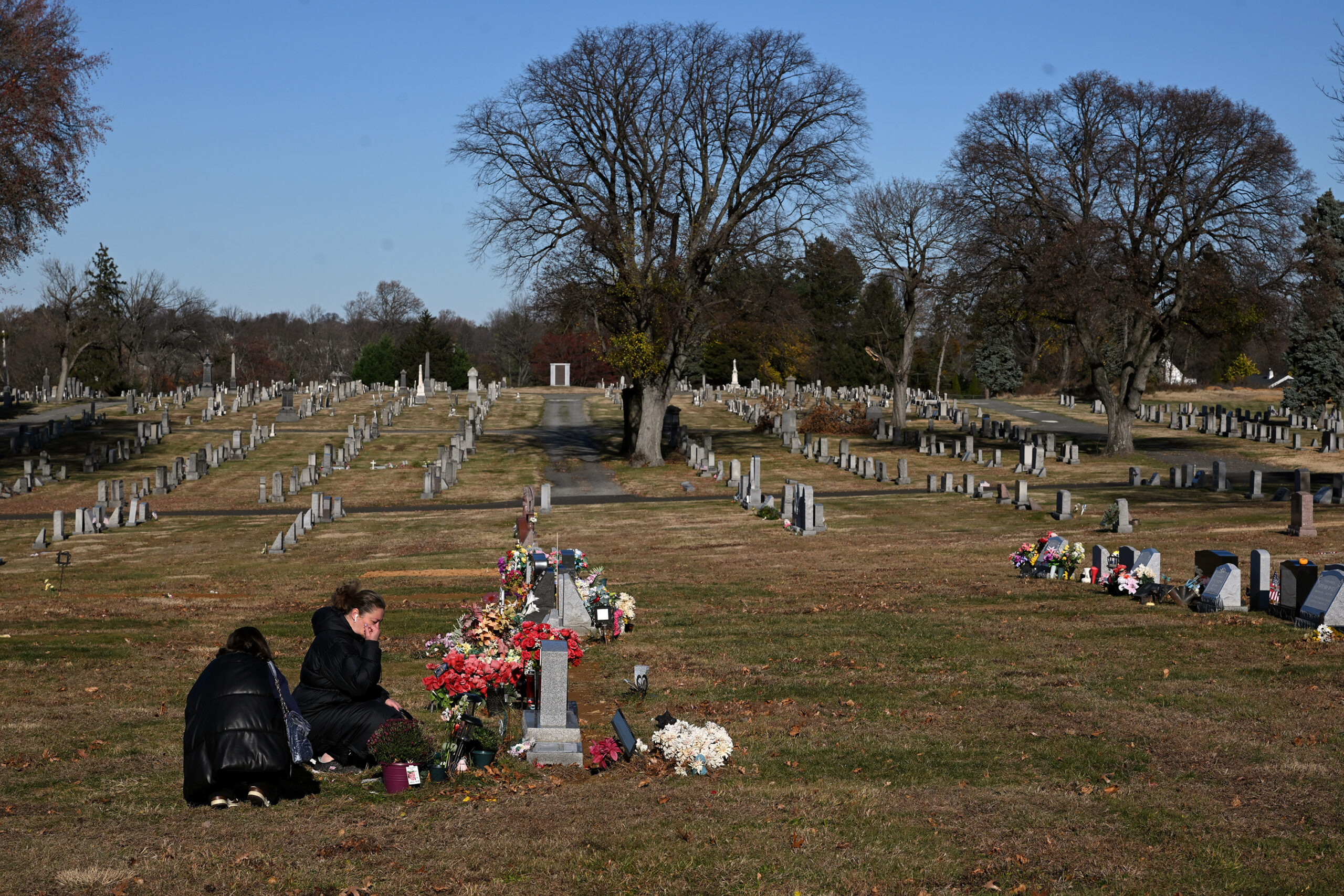

    Olga Sarancha (right) and her daughter Dasha visit the grave of her older daughter Anastasiya Stangret in William Penn Cemetery. “It feels out of body. Like a dream, a movie, like it’s not real,” Dasha said of losing her sister.
  • South Jersey students learn mushroom cultivation while getting a lesson in civics

    South Jersey students learn mushroom cultivation while getting a lesson in civics

    Science teacher Michael Green wasn’t sure how his students would feel about the new assignment. Growing mushrooms for South Jersey restaurants had, after all, never been in his curriculum before.

    They loved it, and three years later, the operation at Rancocas Valley Regional High School in Mount Holly is thriving. The project produces more than 1,000 pounds of mushroom varieties annually.

    “It’s super fun,” said sophomore Lilly Sell, 16, an aspiring pediatric nurse or welder. “You don’t really get bored.”

    In the classroom, Green teaches students in his biology and environmental science classes the fundamentals of a mushroom, the fleshy, spore-bearing fruiting body of a fungus. They learn about genetics, cell division, and the growing process.

    “My goal is to do real science,” Green said.

    Students are also learning about the farm-to-table movement by selling the harvest to local eateries and public service by donating mushrooms to a nearby soup kitchen and serving meals to the less fortunate.

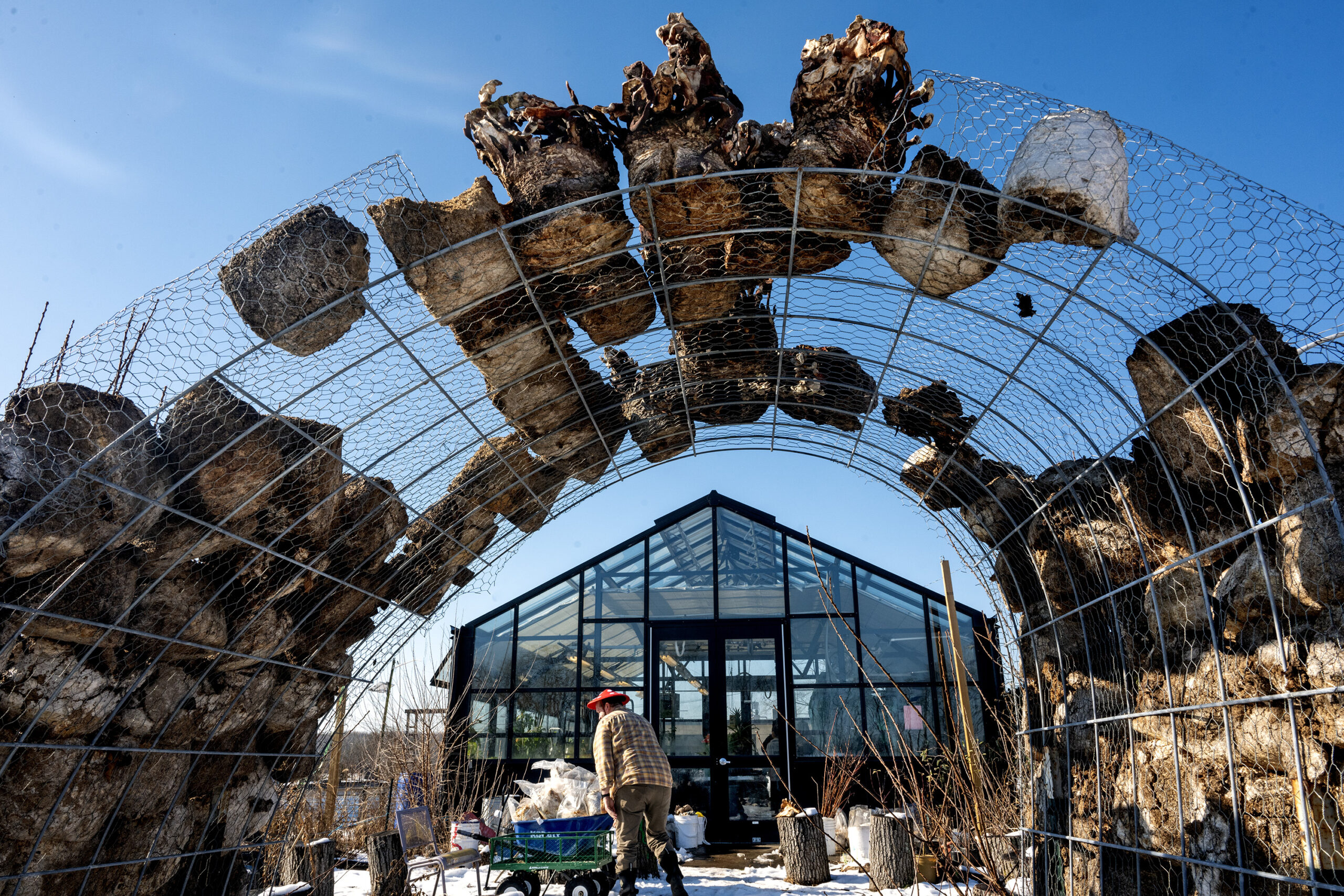
    Green makes use of mushroom farming waste – spent mushroom substrate (SMS) – to decorate an archway by the greenhouse. They are producing 1,000 pounds of mushroom varieties – and almost that much waste, which they use for composting in their gardens and orchard and plan someday to sell as compost.

    Outside, the students get hands-on mushroom harvesting experience inside a greenhouse located behind the annex that houses the RV PREP (Personalized Readiness and Education Program). There are also coops on the property for about 19 chickens and a handful of quail also tended by students.

    The student mushroom farmers harvest edible fungi varieties such as lion’s mane, blue oyster, chestnut, black pearl oyster, comb tooth, and shiitake. Their produce has become part of the supply chain for several nearby restaurants and the students’ own families, who are gifted the fungi.

    Green said the operation began several years ago, when the Mycopolitan Mushroom Co. in Philadelphia was looking for a way to get rid of waste — the blocks of mycelium-laced agricultural waste where mushrooms grow. They forged a partnership and Green agreed to regularly pick up a truckload.

    Three weeks after Green picked up the first load of blocks in 2022, students harvested about 20 to 30 pounds of mushrooms. The operation has grown steadily since then, Green said.

    The blocks are stored in plastic bags on shelves in the greenhouse, which is temperature-controlled for the best growing conditions. After a few weeks, the bags are cut open to let in oxygen to grow the mushrooms.

    Green said the blocks sit in the greenhouse in a fruiting chamber during the pinning, or growing, period. Each load of blocks yields about 200 bags of edible mushrooms, he said.

    The bulk of the harvest is sold wholesale to the Robin’s Nest restaurant in Mount Holly and the Vincentown Diner in Southampton Township, Green said.

    The classroom-to-table operation has been profitable for the school. It generates about $7,000 annually, which is reinvested in the school’s environmental science and biology programs, Green said.

    “We use a ton of mushrooms at the restaurant,” said Robin Winzinger, who runs the family-owned Robin’s Nest. “The quality of their mushrooms are fantastic, really top-notch.”

    The mushrooms are featured on the menu as “RV mushrooms,” said Winzinger, a culinary chef. They are used in the restaurant’s wild mushroom soup, quiche, and risotto, among other dishes, she said.

    The school also donates about three pounds weekly to the First Presbyterian Church in Mount Holly for its community lunch program, said Jan Delgado, the director. The program serves about 300 free meals twice a week.

    Delgado said the program’s chef prepares the mushrooms as a side dish sauteed with herbs. The church would not be able to offer the dish otherwise, she said.

    “It’s strictly a delicacy that we are able to serve because of the school,” Delgado said. “We would never purchase mushrooms — that would be too expensive.”

    Students occasionally volunteer at the church to help serve the meals prepared with the fungi — an experience Sell described as “heart-warming.”

    “They love the mushrooms,” Sell said. “They go through the pans in seconds.”

    After donning plastic gloves, Sell and classmate Jordan Griffin, 18, a senior, stepped into the humid greenhouse on a recent morning to inspect the latest batch of shrooms.

    They pointed out different mushroom varieties that typically grow from October to March or April. Students in the school’s Environmental Club also assist with harvesting after school.

    Griffin, who plans to attend a trade school to study welding or HVAC repair, said the hands-on experience piqued his interest. He’s not too fond of sampling mushroom dishes, however.

    “I’m not the biggest fan of them,” Griffin said. “I won’t go crazy over them.”

    Green has asked Winzinger to conduct cooking demonstrations in class, hoping to whet students’ appetites with dishes like chicken mushroom Alfredo and mushroom soup.

    “I don’t know how many students would want to eat a mushroom entree,” Green said.

    Sell said that while she is no fungi fanatic, she enjoys her mother’s mushrooms sauteed with garlic butter.

    “There are many ways to make it to your taste,” she said.

    After opening the plastic bags, Griffin and Sell carefully cut a small harvest and packaged the mushrooms in brown paper bags. The bags would be offered that day free to students and staff.

    After harvest, the spent mushroom blocks are composted on site and applied to the school’s Outdoor Learning space, which includes fruit trees, rain gardens, vegetable plants, and honeybees.

    Lilly Sell harvests enoki mushrooms.

    Green said most of the mushrooms are harvested in bigger quantities and sold to the local restaurants. Whatever is left over is given to the community, he said.

    “My goal is just to get the mushrooms out,” Green said. “The goal is to get mushrooms into people’s hands.”

    Students also get to take home the chicken eggs, Green said. The quail have yet to produce any eggs, he said.

    “Those are a hot commodity,” he said.

  • ‘I’m thankful’: A decade-long quest to be paid by NFL concussion settlement program ends in million-dollar award

    ‘I’m thankful’: A decade-long quest to be paid by NFL concussion settlement program ends in million-dollar award

    In May, Donald Frank packed a bag and left his home in Wake Forest, N.C. His destination sat about 390 miles to the south, in Georgia, where he was scheduled to undergo a series of grueling medical evaluations.

    Doctors spent two days testing his memory, attention span, language comprehension, and visual-spatial perception skills, to gauge the extent of a neurocognitive illness that had gradually eroded the contours of his everyday life.

    A separate consultation with a neurologist resulted in a new diagnosis: Frank, a 60-year-old former San Diego Chargers defensive back, had Parkinson’s disease.

    Frank believes that his health woes can be traced to the countless brain-rattling collisions that he absorbed during his six-year professional football career. But over the last seven years, the NFL’s controversial concussion settlement program has on four occasions denied Frank’s quest to be paid for the brain trauma that he sustained.

    Nevertheless, he decided to make the case once more. Frank included the results of the May neuropsychological tests, and the Parkinson’s diagnosis, in a claim that he submitted to the settlement program.

    Then he waited. And worried.

    Donald Frank and his girlfriend, Deirdre Brown, learned in early November that the NFL’s concussion settlement program had agreed to pay Frank $1.4 million as he battles Parkinson’s disease.

    The settlement program has doled out more than $1.6 billion, yet not every former football player who applies for a payment is compensated. Some, including members of the 1980 Philadelphia Eagles, have faced long delays and demoralizing denials.

    The Inquirer found that Frank’s case is an extreme outlier. More than 4,400 ex-NFL players have submitted claims with the program, but only two others have received as many as four rejections.

    On Nov. 4, Frank’s girlfriend, Deirdre Brown, opened an email from the settlement program’s claims department.

    “Notice of monetary award claim determination,” read the first line.

    Her eyes traced familiar details about Frank’s case and his medical history, then arrived at something new: an award for $1.4 million.

    “It was a breath of fresh air,” Frank said, “considering all the years I’ve gone through this.”

    From a small college to the pros

    Frank followed an unlikely path to the NFL.

    As a strong safety at a Division II college, North Carolina’s Winston-Salem State University, he attracted little attention from scouts. He had a bodybuilder’s physique, though, and could run the 40-yard dash in 4.4 seconds.

    Those attributes persuaded the Chargers to take a flier on Frank in 1990 and sign him as an undrafted free agent. That same year, the team selected linebacker Junior Seau with their No. 1 pick in the NFL draft.

    Frank made the team and quickly impressed coaches with his knack for game-changing interceptions, prompting the Los Angeles Times to liken his rise — from relative obscurity to an NFL roster — to a fairy tale.

    Frank, like so many players from prior generations, didn’t realize that the violent collisions he experienced each year — during practices and in training camp, throughout the regular season and playoffs — could cause long-term neurological harm.

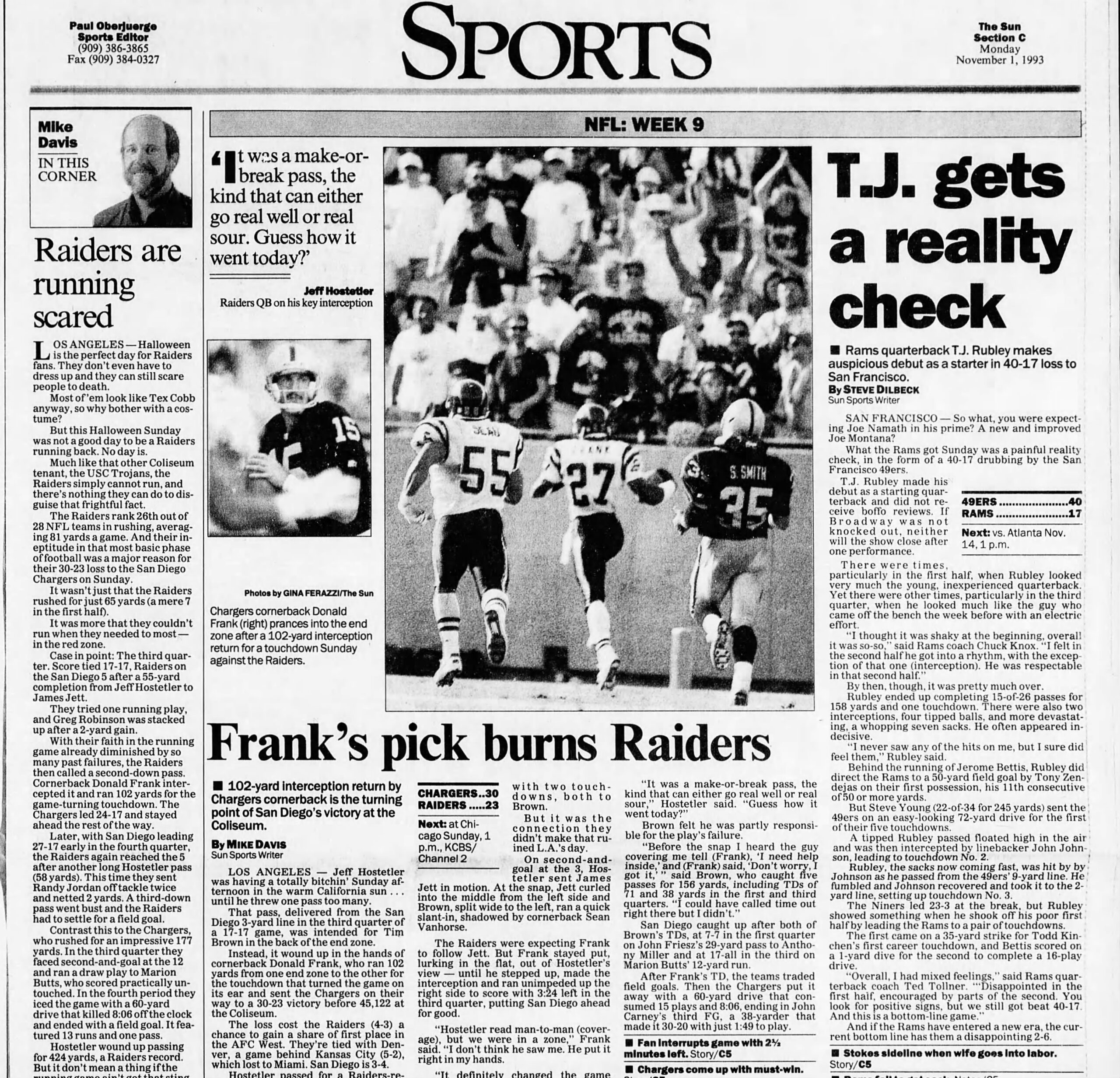
    Donald Frank’s 102-yard interception return for a touchdown helped the Chargers defeat the Los Angeles Raiders on Oct. 31, 1993.

    “When you got knocked out, or got your bell rung, they would put smelling salts to your nose to wake you up,” Frank previously told The Inquirer. “I don’t even remember there being an attempt to evaluate you. It was always, ‘OK, just let him sit on the bench for a minute to clear his head.’”

    By 1993, Frank earned a role as a starting cornerback. That season, during a Halloween game against the Los Angeles Raiders, Frank intercepted a pass from Raiders quarterback Jeff Hostetler and returned it 102 yards for a touchdown.

    For an undrafted athlete, it was a moment of remarkable personal triumph.

    Just two years later, Frank reached the end of his NFL career. He was hindered by a back injury and had grown wary of hitting his head.

    But there was another nagging problem that Frank initially kept to himself: On even simple defensive plays, he could no longer remember what he was supposed to do.

    Confusion, then clarity

    Frank’s memory problems began to deepen in 2008, according to medical records previously viewed by The Inquirer, and he grappled with depression and unpredictable mood swings.

    He stopped driving and had to rely on Brown to help care for him on a daily basis.

    In 2012, Seau, Frank’s old Chargers teammate, died by suicide at age 43. Researchers discovered that he had the degenerative brain disease chronic traumatic encephalopathy (CTE), which has been found in the brains of hundreds of former football players, including former Eagles Andre Waters, Max Runager, Frank LeMaster, Guy Morriss, and Maxie Baughan.

    Dozens of ex-players had sued the NFL a year earlier in California and Pennsylvania, accusing the league of downplaying the risks of repeated brain injuries. The number of plaintiffs climbed into the thousands — Frank among them — and the cases were consolidated in Philadelphia federal court.

    Three years later, the NFL settled the case.

    The league admitted no wrongdoing but agreed to fund, for 65 years, a program that would pay retired players who developed neurocognitive impairment, Alzheimer’s disease, Parkinson’s disease, or amyotrophic lateral sclerosis (ALS, also known as Lou Gehrig’s disease).

    Donald Frank signed with the Chargers as an undrafted free agent in 1990. “My attitude, coming from where I came from, was basically, ‘You got to do everything you can to stay here,’” said Frank, 60. “And I was a physical player.”

    In 2016, the chair of Duke University’s Department of Neurology evaluated Frank and determined that he had a “major neurocognitive disorder,” according to the medical records.

    That same year, the NFL awarded Frank a benefit through the league’s 88 Plan, which provides financial reimbursements for medical care for players who have dementia, Alzheimer’s disease, or Parkinson’s. (The league spends more than $20 million a year on such reimbursements.)

    Despite the seemingly widespread agreement that Frank suffered from a serious illness, he found little success navigating the concussion settlement program.

    Retired players are required to be evaluated by doctors who belong to a network managed by a third-party company, BrownGreer LLC, and to have a diagnosis that meets the settlement program’s three tiers of cognitive impairment: level 1.0 for moderate decline; level 1.5 for early dementia; level 2.0 for severe cognitive decline.

    Frank submitted three claims for a diagnosis of Alzheimer’s, but an appeals panel rejected each, noting that his test results were not consistent with the disease.

    The denials sank Frank into depressive spirals and made him question whether he should abandon his crusade to be paid by the settlement program.

    “It felt like a big confusion,” Frank said. “[The doctors] couldn’t get a grip on what was going on with me.”

    Clarity finally arrived earlier this year, when his attorney asked Frank if he had ever experienced any tremors or shakes.

    “I said, ‘Yes, I do,’” Frank recalled. “I told Dee a year ago, maybe two years, that I experienced some tremors in my right hand. I just never paid it no mind.”

    After a neurologist and a movement disorder specialist each confirmed that Frank had Parkinson’s, he began taking medication meant to alleviate symptoms.

    “It felt like an immediate release of pressure off my brain,” he said. “I felt like the tremors weren’t bothering me as much.”

    Frank has noticed something else, too: a sense of optimism and gratitude that has pierced the frustration and uncertainty that had clouded his life for so long.

    The concussion settlement program is scheduled to deliver its payment to him in January, and his daughter and 6-year-old grandson have moved in with him, filling his house with the welcome sound of busy lives and laughter.

    “I’m looking forward to more hours with my grandson. I’m looking forward to the future,” Frank said. “I’m thankful.”

  • 25 years after Philly’s largest mass murder, a community reflects

    25 years after Philly’s largest mass murder, a community reflects

    Twenty-five years after Calvin Helton was killed in what remains the deadliest mass shooting in Philadelphia history, his mother, Veronica Conyers, feels frozen in time.

    Her son, forever 19 in the West Philly rowhouse where he was killed execution-style with six other people ranging from 15 to 54 years old. And Conyers, left to spend the years since fighting to keep his memory alive.

    “I’m not healed,” she said of losing her firstborn, who had dreamed of being a Navy SEAL. “I want everybody to know the truth behind this massacre.”

    These days, that truth is shared with anyone who will listen and at annual vigils that celebrate the victims’ lives. There are Samuel “Malik” Harris Jr., 15; Tyrone Long, 18; George “Jig” Porter, 18; Ronnette Abrams, 33; Edward Sudler, 44; and Alfred Goodwin, 54.

    Despite the notoriety of what came to be known as the Lex Street massacre, Conyers remains hurt by how the deaths never garnered protests, and how the interest in the homicides came in the form of sensational headlines.

    The shooting, after all, took place in a house known for drug activity during a turbulent period in the neighborhood, when residents complained of rampant drug dealing and concerns over safety.

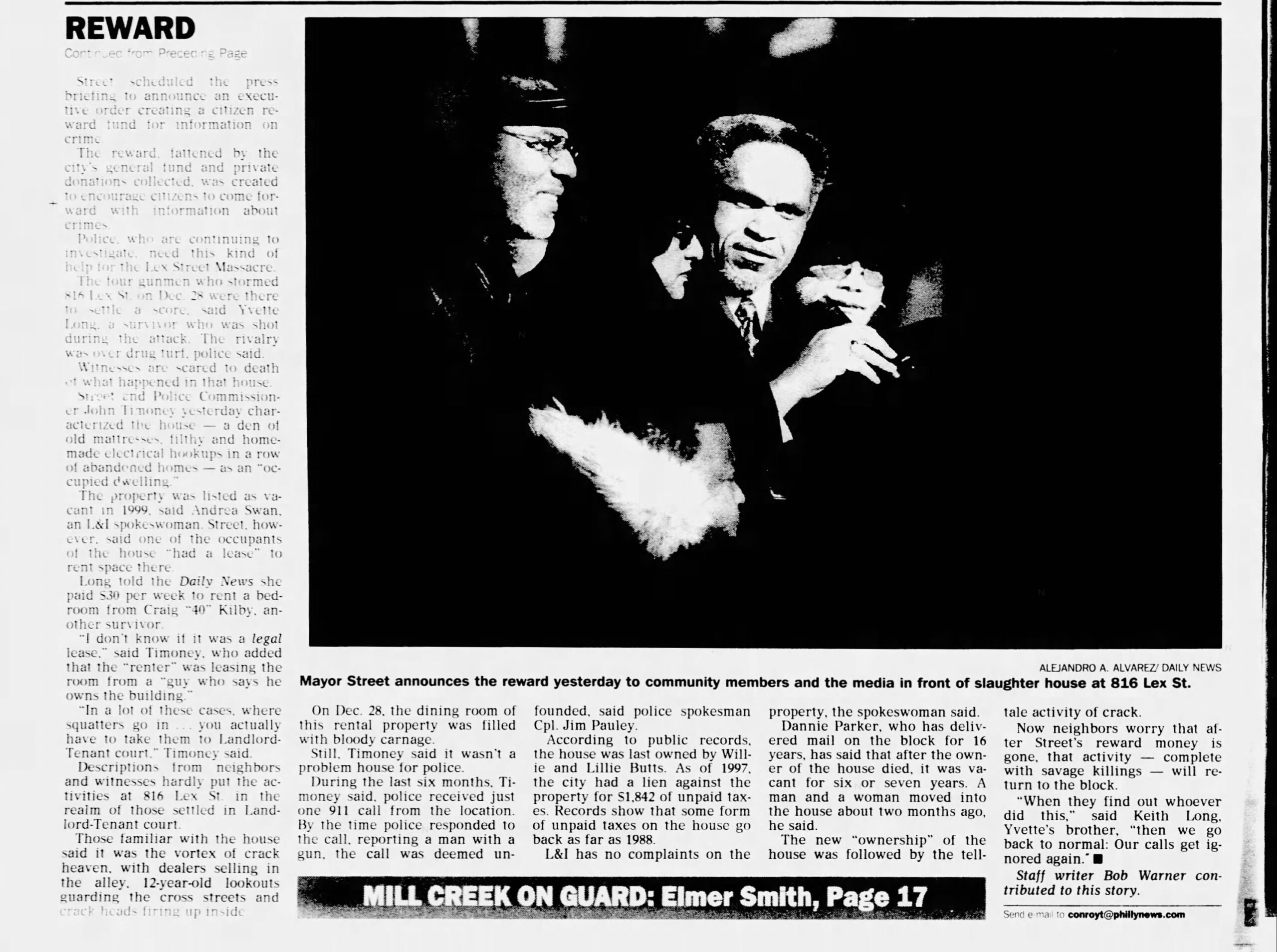
    Coverage of the Lex St. Massacre in Jan. 2001.

    Conyers felt public sentiment regarding the homicide was sealed, doomed to be forgotten, once police and prosecutors attributed the shooting to a drug-turf dispute.

    It would later turn out the killings stemmed from a dispute over the trade of a car and a broken clutch. But Conyers felt the damage had been done by police and media reports.

    “They slandered my son’s name, saying he a kingpin and he was drug dealer,” she said, adding he was a good student and never gave her any trouble.

    Coverage of Lex St. case in 2002.

    The initial bungle in the investigation, which involved allegations of coerced confessions by police, also stunned legal minds at the time. Four men spent 18 months in jail and faced a possible death sentence, only for charges to begin to be dropped just as the first trial was set to begin. Those men would go on to successfully sue the city for $1.9 million over their imprisonment.

    Police arrested brothers Dawud Faruqi and Khalid Faruqi in late 2002, as well as Shihean Black and getaway driver Bruce Veney, in connection to the killings.

    In the various trials, it was revealed Black traded his Chevrolet Corsica for Porter’s Dodge Intrepid. But Porter blew the Corsica’s clutch, and when Black would not trade the cars back, Porter used his spare key and took back the Intrepid.

    Black found Porter on the 800 block of North Lex Street and an argument escalated into a shooting.

    Black pleaded guilty to first-degree murder and the brothers were convicted of seven counts of that charge. All three received seven consecutive life sentences. Veney, the getaway driver, pleaded guilty to third-degree murder, receiving 15 to 30 years in prison.

    Tameka Porter, George’s sister, has led the vigils that take place every Dec. 28. She feels a lot of hurt from how public sentiment placed blame on the victims for being in that house.

    Coverage of the Lex Street massacre in 2002.

    “No one is at fault but the killers,” she said.

    Even so, Porter tries not to think about what people might say. “It doesn’t matter how he died or who did it, he’s gone.”

    Her brother and Helton were best friends, she said, recalling that both were smart and charming, and loved to flirt with girls. Her brother never got in trouble or was arrested for drugs, she said. That’s what she wants people to know.

    On Sunday, Porter held the annual vigil at the Lucien Blackwell Community Center. The neighborhood looks drastically different after a Philadelphia Housing Authority effort in the aughts to revitalize the area, building 18 new homes.

    It was an intimate affair, though it did not set out to be so.

    Porter and one of Helton’s cousins talked about how they wanted to celebrate all that the victims meant to them. Councilmember Jamie Gauthier echoed the sentiment.

    “Today is about honoring them,” she said. “It is about holding space for the survivors, and it is about standing with families and with our community members here in Mill Creek and across our city who continue to carry the weight of gun violence.”

    Conyers stayed quiet, holding back tears. She wore a sweatshirt that read “Lex St. Fallen Soldiers.” On it was the now-very faded photo of her son.

  • Trump says Ukraine and Russia are ‘closer than ever’ to peace after talks with Zelensky

    Trump says Ukraine and Russia are ‘closer than ever’ to peace after talks with Zelensky

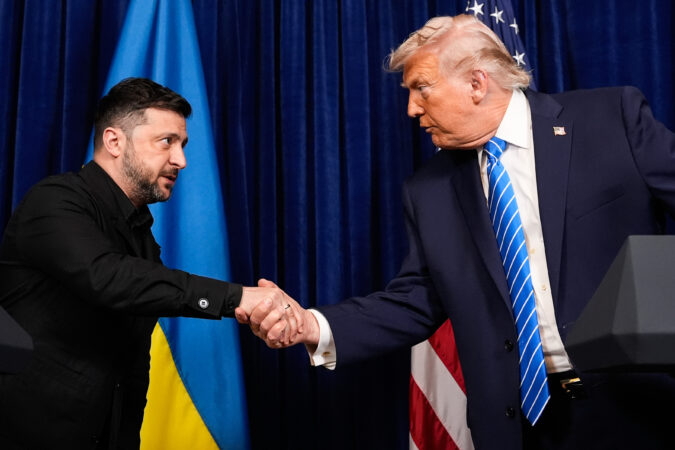
    PALM BEACH, Fla. — President Donald Trump on Sunday insisted Ukraine and Russia are “closer than ever before” to a peace deal as he hosted Ukrainian President Volodymyr Zelensky at his Florida resort, but he acknowledged that negotiations could still break down and leave the war dragging on for years.

    The president’s statements came after the two leaders met for a discussion that took place after what Trump described as an “excellent” 2½-hour phone conversation with Russian President Vladimir Putin, whose invasion of Ukraine launched the war four years ago. Trump insisted he believed Putin still wants peace, even as Russia launched another round of attacks on Ukraine while Zelensky flew to the United States for the latest round of negotiations.

    “Russia wants to see Ukraine succeed,” Trump said during a late afternoon news conference following a meeting with Zelensky, whom he repeatedly praised as “brave.”

    Trump and Zelensky both acknowledged thorny issues remain, including whether Russia can keep Ukrainian territory it controls. After their discussion they called a wide group of European leaders, including Ursula von der Leyen, president of the European Commission, and the leaders of Finland, France, Germany, Great Britain, and Poland.

    Zelensky thanked Trump for his work. “Ukraine is ready for peace,” he said.

    Trump and Putin will speak again

    Trump said he’d follow the meeting with another call to Putin. Earlier Sunday, Putin’s foreign affairs adviser Yuri Ushakov said the Trump-Putin call was initiated by the U.S. side, lasted over an hour, and was “friendly, benevolent and businesslike.” Ushakov said Trump and Putin agreed to speak again “promptly” after Trump’s meeting with Zelensky.

    But Ushakov added that a “bold, responsible, political decision is needed from Kyiv” on the fiercely contested Donbas region in eastern Ukraine and other matters in dispute for there to be a “complete cessation” of hostilities.

    In overnight developments, three guided aerial bombs launched by Russia struck private homes in the eastern city of Sloviansk, according to the head of the local military administration, Vadym Lakh. Three people were injured and one man died, Lakh said in a post on the Telegram messenger app.

    The strike came the day after Russia attacked Ukraine’s capital with ballistic missiles and drones on Saturday, killing at least one person and wounding 27, Ukrainian authorities said. Explosions boomed across Kyiv as the attack began in the early morning and continued for hours.

    Trump said, however, that he still believes Putin is “very serious” about ending the war.

    “I believe Ukraine has made some very strong attacks also,” Trump told reporters as Zelensky stood by his side. “And I don’t say that negatively. I think, you probably have to. I don’t say that negatively. But I think, he hasn’t told me that, but there have been some explosions in various parts of Russia. It looks to me, like, I don’t know. I don’t think it came from the Congo.”

    Trump noted that it was possible that the negotiations will fall apart. “In a few weeks, we will know one way or the other, I think. … But it could also go poorly.”

    The face-to-face sit-down between Trump and Zelensky underscored the apparent progress made by Trump’s top negotiators in recent weeks as the sides traded draft peace plans and continued to shape a proposal to end the fighting. Zelensky told reporters Friday that the 20-point draft proposal negotiators have discussed is “about 90% ready” — echoing a figure, and the optimism, that U.S. officials conveyed when Trump’s chief negotiators met with Zelensky in Berlin earlier this month.

    During the recent talks, the U.S. agreed to offer certain security guarantees to Ukraine similar to those offered to other members of NATO. The proposal came as Zelensky said he was prepared to drop his country’s bid to join the security alliance if Ukraine received NATO-like protection that would be designed to safeguard it against future Russian attacks.

    “Intensive” weeks ahead

    Zelensky also spoke on Christmas Day with U.S. special envoy Steve Witkoff and Jared Kushner, Trump’s son-in-law. The Ukrainian leader said they discussed “certain substantive details” and cautioned “there is still work to be done on sensitive issues” and “the weeks ahead may also be intensive.”

    The U.S. president has been working to end the war in Ukraine for much of his first year back in office, showing irritation with both Zelensky and Putin while publicly acknowledging the difficulty of ending the conflict. Long gone are the days when, as a candidate in 2024, he boasted that he could resolve the fighting in a day.

    After hosting Zelensky at the White House in October, Trump demanded that both Russia and Ukraine halt fighting and “stop at the battle line,” implying that Moscow should be able to keep the territory it has seized from Ukraine.

    Zelensky said last week that he would be willing to withdraw troops from Ukraine’s eastern industrial heartland as part of a plan to end the war, if Russia also pulls back and the area becomes a demilitarized zone monitored by international forces.

    Putin wants Russian gains kept, and more

    Putin has publicly said he wants all the areas in four key regions that have been captured by his forces, as well as the Crimean Peninsula, illegally annexed in 2014, to be recognized as Russian territory. He also has insisted that Ukraine withdraw from some areas in eastern Ukraine that Moscow’s forces haven’t captured. Kyiv has publicly rejected all those demands.

    The Kremlin also wants Ukraine to abandon its bid to join NATO. It warned that it wouldn’t accept the deployment of any troops from members of the military alliance and would view them as a “legitimate target.”

    Putin also has said Ukraine must limit the size of its army and give official status to the Russian language, demands he has made from the outset of the conflict.

    Ushakov told the business daily Kommersant this month that Russian police and national guard would stay in parts of Donetsk — one of the two major areas, along with Luhansk, that make up the Donbas region — even if they become a demilitarized zone under a prospective peace plan.

    Ushakov cautioned that trying to reach a compromise could take a long time. He said U.S. proposals that took into account Russian demands had been “worsened” by alterations proposed by Ukraine and its European allies.

    Trump has been somewhat receptive to Putin’s demands, making the case that the Russian president can be persuaded to end the war if Kyiv agrees to cede Ukrainian land in the Donbas region and if Western powers offer economic incentives to bring Russia back into the global economy.

  • Myanmar holds first election since military seized power but critics say the vote is a sham

    Myanmar holds first election since military seized power but critics say the vote is a sham

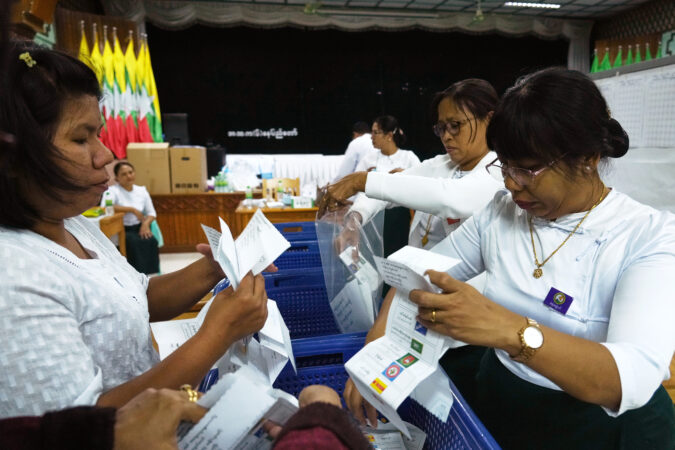
    YANGON, Myanmar — Voters went to the polls Sunday for the initial phase of Myanmar’s first general election in five years, held under the supervision of its military government while a civil war rages throughout much of the country.

    Final results won’t be known until after two more rounds of voting are completed later in January. It’s widely expected that Senior Gen. Min Aung Hlaing, who has governed Myanmar since an army takeover in 2021, will then assume the presidency.

    The military government has presented the vote as a return to democracy, but its bid for legitimacy is marred by the absence of formerly popular opposition parties and reports that soldiers used threats to force voters’ participation.

    Military-backed party favored

    While more than 4,800 candidates from 57 parties are competing for seats in national and regional legislatures, only six are competing nationwide with the possibility to gain political clout in parliament. The military-backed Union Solidarity and Development Party is by far the strongest contender.

    Voting is taking place in three phases, with Sunday’s first round held in 102 of Myanmar’s 330 townships. Subsequent phases will take place on Jan. 11 and Jan. 25, but 65 townships won’t participate in the election because of ongoing armed conflicts.

    Final results are expected to be announced by February. It wasn’t clear if or when the authorities would release aggregate figures of Sunday’s voting, although counts were publicly announced at local polling stations.

    Critics of the current system say that the election is designed to add a facade of legitimacy to the status quo. Military rule began when soldiers ousted the elected government of Aung San Suu Kyi in February 2021. It blocked her National League for Democracy party from serving a second term despite winning a landslide victory in the 2020 election.

    They argue that the results will lack legitimacy because of the exclusion of major parties and government repression.

    “Theater of the absurd”

    The expected victory of the military-backed Union Solidarity and Development Party makes the nominal transition to civilian rule a chimera, say opponents of military rule and independent analysts.

    “An election organized by a junta that continues to bomb civilians, jail political leaders, and criminalize all forms of dissent is not an election — it is a theater of the absurd performed at gunpoint,” Tom Andrews, the U.N.-appointed human rights expert for Myanmar, posted on X.

    However, the election may provide an excuse for neighbors like China, India, and Thailand to say that the vote represents progress toward stability. Western nations have maintained sanctions against Myanmar’s ruling generals because of the military’s anti-democratic actions and the brutal war against opponents.

    According to a count carried out at one polling station in Yangon after the polls closed, only 524 of 1,431 registered voters — just under 37% — cast their ballots.

    Of those, 311 voted for the pro-military Union Solidarity and Development Party, suggesting that opposition calls for a voter boycott may have been heeded.

    Khin Marlar, 51, who cast her ballot in Yangon’s Kyauktada township, said that she felt that she should vote, because she hoped that peace would follow afterward. She explained that she had fled her village in the town of Thaungta in the central Mandalay region because of the fighting.

    “I am voting with the feeling that I will go back to my village when it is peaceful,” she told the Associated Press.

    Voter intimidation reports

    A resident of southern Mon state, who asked to be identified only by her first name, Khin, for fear of arrest by the military, told the AP that she felt compelled to go to a polling station because of pressure from local authorities.

    “I have to go and vote even though I don’t want to, because soldiers showed up with guns to our village to pressure us yesterday,” Khin said, echoing reports from independent media and rights groups.

    Suu Kyi, Myanmar’s 80-year-old former leader, who received the Nobel Peace Prize in 1991, and her party aren’t participating in the polls. She is serving a 27-year prison term on charges widely viewed as spurious and politically motivated. Her party, the National League for Democracy, was dissolved in 2023 after refusing to register under new military rules.

    Other parties also refused to register or declined to run under conditions they deem unfair, and opposition groups have called for a voter boycott.

    Amael Vier, an analyst for the Asian Network for Free Elections, noted a lack of genuine choice, pointing out that 73% of voters in 2020 cast ballots for parties that no longer exist.

    Violence and repression

    According to the Assistance Association for Political Prisoners, more than 22,000 people are currently detained for political offenses, and more than 7,600 civilians have been killed by security forces since 2021.

    Armed resistance arose after the army used lethal force to crush nonviolent protests against its 2021 takeover. The ensuing civil war has left more than 3.6 million people displaced, according to the U.N.

    A new Election Protection Law imposes harsh penalties and restrictions for virtually all public criticism of the polls.

    There were no reports of major interference with the polls, though opposition organizations and armed resistance groups had vowed to disrupt the electoral process.

    Both the military and its opponents believe power is likely to remain with Min Aung Hlaing, who led the 2021 seizure of power.

    “I am the commander in chief. I am a civil servant. I cannot say that I want to serve as a president. I am not the leader of a political party,” he told journalists after casting his vote. “There is a process for electing a president from parliament only when it is convened. I think it is appropriate to speak about it only then.”

  • China expands nuclear warhead manufacturing capacity, research finds

    China expands nuclear warhead manufacturing capacity, research finds

    China is rapidly overhauling a network of secret facilities used to manufacture warhead components as it expands its nuclear stockpile faster than any other country, according to an analysis of satellite imagery.

    These changes are taking place as Beijing intensifies efforts to be able to retaliate more quickly against an attack, according to expert assessments of official publications — dramatically raising the stakes of any nuclear standoff.

    “The levels of changes that we’re seeing since around 2019 to today are probably more extensive than anything we’ve ever seen,” said Renny Babiarz, who led analysis of half a dozen key sites for a project by the Vienna-based Open Nuclear Network (ONN) and the London-based Verification Research, Training, and Information Centre (VERTIC).

    China’s rapid expansion of weapons-production facilities continues, even as a Pentagon report last week shows nuclear warhead production has slowed since 2024, with totals in the low 600s, though it’s on track to surpass 1,000 by decade’s end.

    President Donald Trump recently said, when discussing plans to restart U.S. nuclear weapons testing, that China could catch up with U.S. nuclear capabilities within five years.

    Analysts say it’s unlikely that China could match the estimated 3,700 warheads in the U.S. arsenal in the foreseeable future. But the dramatic changes Beijing has made to almost every part of its nuclear weapons program suggest the People’s Liberation Army is preparing for an all-out arms race, they said, even as it claims it does not want one.

    The ONN/VERTIC satellite imagery and expert analysis, shared exclusively with the Washington Post, show that Beijing has sharply accelerated activity at key sites involved in producing nuclear warheads — a burst of expansion since 2021 that could supercharge China’s nuclear ambitions.

    The construction includes major upgrades at facilities thought to design and manufacture plutonium pits — the cores of nuclear warheads — as well as plants that produce the high explosives used to trigger nuclear reactions.

    Chinese military textbooks, internal publications, and articles by military-affiliated scholars further suggest that nuclear brigades are being placed at higher alert levels and might be shifting toward a launch-on-warning posture, meaning that China would be prepared to retaliate as soon as a missile attack were detected. This is a significant departure from Beijing’s strategy of prioritizing its ability to retaliate after an attack, analysts said.

    Together, these changes show how Beijing is developing more versatile munitions and tactics that give it options to threaten the U.S. and its allies, even if it cannot match the size of the U.S. nuclear warhead stockpile.

    Infrastructure surge

    China’s fast-growing arsenal remains one of the world’s most opaque: Detailed glimpses into how Beijing is positioning itself as a leading nuclear power are rare.

    Attention has largely focused on hundreds of missile-silo fields carved into its remote northern deserts since 2021. But satellite imagery of less-scrutinized facilities linked to warhead production indicates that China made significant upgrades across its nuclear weapons supply chain as it built the silos.

    Analysts track these sites by matching reports, including declassified government documents and academic papers, with places that have specific structures — such as blast chambers and specialized chemical storage sites — and comparing them to similar facilities elsewhere in the world. They also review military vehicle movement patterns at the Chinese sites.

    Nuclear warheads thought to be under construction in China contain a core of fissile material — typically weapons-grade plutonium — manufactured into a spherical shape known as a pit and surrounded by conventional high explosives. When detonated, these explosives compress the fissile core and trigger a chain reaction that releases enormous energy in a nuclear explosion.

    Production of pits and high‑explosive components is likely separated across multiple facilities, which have expanded in parallel with testing sites and missile silo fields since around 2020.

    In a mountainous area of China’s Sichuan province near the city of Pingtong, a facility to be used for the production of fissile material pits has undergone vast changes in the past five years, according to Babiarz’s analysis. New security fencing has more than doubled the site’s secured footprint, alongside building upgrades and construction across at least 10 locations, including near the core facility where the pits are thought to be produced, the images show.

    Pingtong is the only publicly identified plant linked to China’s plutonium pit production.

    In research published in the U.S. Air Force-affiliated Journal of Indo-Pacific Affairs, one analyst describes the site as similar to the Pantex plant in Texas, which assembles and maintains U.S. nuclear warheads — but China’s site has additional plutonium pit production capabilities.

    A separate facility in the supply chain — which analysts and previous U.S. government assessments say is probably the primary site for producing the high‑explosive components used to trigger nuclear pits — has also undergone rapid changes. Located in a remote area of Zitong County in Sichuan province, the site has expanded significantly since 2019, according to Babiarz’s analysis of satellite imagery.

    There are sweeping changes across the multisite complex. In one area alone, Babiarz identified an extensive security wall under construction since about 2021, a possible new storage area, and large, newly cleared tracts for additional facilities, probably beginning in 2023. The construction is concentrated near sites that appear to be built for testing explosions, including dome-shaped high-explosive test chambers and a shock-tube test site — a roughly 2,000-foot-long tube used to simulate blasts and assess vulnerabilities in new nuclear warhead designs.

    At Zitong, Babiarz’s team identified a 430,000-square-foot facility, completed last year, that they assess could be used to assemble, handle, and prepare warhead components, possibly for transport to other locations in China for storage and assembly.

    “Based on all the changes that we’re seeing that show a huge investment in these locations, that altogether indicates an improved capability to produce nuclear warheads for the nuclear program,” Babiarz said. While the increased production capacity at the facilities could equate to more warheads, he said it could also mean Beijing is upgrading and modernizing existing warheads.

    China’s main nuclear test site, Lop Nur in far western Xinjiang, has also expanded in recent years, with new underground tunnels and large shafts that might be preparations for renewed nuclear testing.

    Beijing conducted only 46 tests from 1964 to 1996 — the year it signed, but never ratified, the Comprehensive Nuclear-Test-Ban Treaty — far fewer than the 1,000 carried out by the U.S. and Russia.

    China’s initial tests likely resulted in a far greater ability to build a variety of warheads — including smaller and lighter bombs — than was previously recognized, according to a new book by Hui Zhang, a senior research associate at the Project on Managing the Atom at Harvard University, based on little-known accounts from Chinese nuclear scientists.

    Faster retaliation

    At the same time as these production facilities were upgraded, Beijing has gradually signaled its ambitions to field a far more diverse nuclear force at higher alertness levels, giving it more tools to pressure the U.S. in an escalating standoff.

    The Pentagon report last week said Beijing has made significant strides in developing rapid counterstrike capabilities similar to the U.S. Launch on Warning (LOW) system, which can detect ballistic missiles thousands of miles away and launch a counterstrike before they detonate. It also said China has probably loaded more than 100 solid-propellant ICBMs into silos to support the system and refined the ability to launch multiple missiles simultaneously after late-2024 tests.

    Chinese military publications covering the period of the buildup through last year, recently unearthed by Western analysts, suggest that China is readying its nuclear brigades to retaliate as soon as an incoming attack is detected.

    China has already built out infrastructure and command structures to support a launch-on-warning posture, although some of its capabilities remain rudimentary, according to analysis of China’s evolving early warning architecture published by the Pentagon’s Defense Threat Reduction Agency last month.

    “This is one of the most significant and overlooked aspects of ongoing shifts in China’s nuclear forces,” said David Logan, an assistant professor at Tufts University and one of the authors of the analysis. “What states do with their weapons and how they posture them often matters much more than … how many they field.”

    The PLA Rocket Force has “adjusted its nuclear warhead storage and handling practices and training to support regular high alert status” and has now standardized “combat readiness duty” for brigades, according to articles in Rocket Force News, an internal publication, seen by Logan and Phillip Saunders, an expert on the Chinese military at National Defense University.

    It is unclear what this duty involves but it might mean that China has more warheads attached to missiles in peacetime, instead of its traditional practice of keeping most warheads in storage. This change would be “a big deal because it’s a big change from how China operated similar forces in the past,” Logan said. “It’s also much riskier.”

    Beijing now has a sufficient number of early warning satellites and radars to detect incoming missiles, analysts said. It has a command structure designed to quickly disseminate orders — by fiber-optic cables, microwaves, radios, and satellites — to ensure that nuclear-armed intercontinental ballistic missiles can be launched within minutes.

    These changes come as Chinese leader Xi Jinping has overseen a massive purge of top generals, including from the Rocket Force, in an attempt to ensure political loyalty and accelerate military modernization, including of the nuclear forces.

    Recent Chinese military textbooks have described launch-on-warning systems as essential for national security in peacetime and war and for nuclear and conventional conflicts.

    These publications often praise the U.S.’s advanced early warning systems as having strengthened American deterrence and argue that China needs similar capabilities to ensure Washington takes its nuclear forces seriously.

    “Strategic early warning is among decisive factors reflecting a nation’s military strength,” said a textbook published by China’s National University of Defense Technology last year. The text also warned that the systems must be exceptionally accurate to avoid an accidental launch.

    Another textbook, published in 2023, described advanced early warning systems as allowing a country to use “strategic offensive weapons to gain the initiative in combat” and added that a “powerful, responsive, and globally covered strategic early warning system can create a strong deterrent effect on the opposing side.”

    But that ability to deter adversaries comes with additional risks. Throughout the Cold War, technical glitches and human errors in American and Soviet early warning systems created multiple false alarms that nearly ended in disaster.

    “For China to abandon its traditional policy of delayed retaliation and move toward rapid response could significantly increase the risk of misunderstanding, overreaction and even incidental nuclear war,” said Tong Zhao, an expert on China’s nuclear weapons program at the Carnegie Endowment of International Peace, a Washington think tank.

  • Thai and Cambodian top diplomats meet in China to solidify ceasefire

    Thai and Cambodian top diplomats meet in China to solidify ceasefire

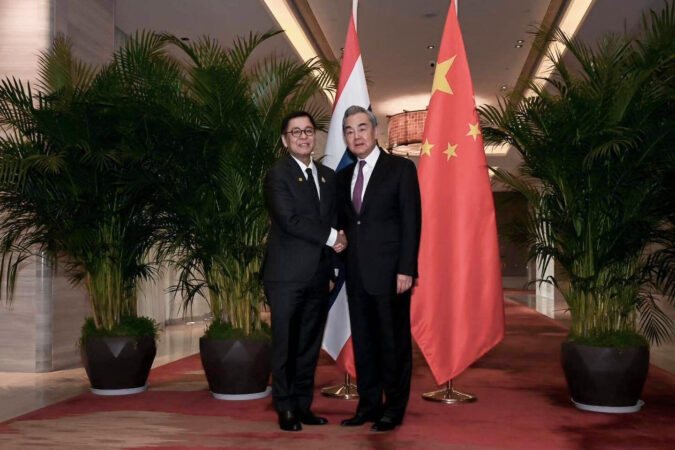
    BEIJING — Top diplomats from Thailand and Cambodia kicked off two days of talks in China on Sunday as Beijing seeks to strengthen its role in mediating the two countries’ border dispute, a day after they signed a new ceasefire.

    The ceasefire agreement calls for a halt to weeks of fighting along their contested border that has killed more than 100 people and displaced over half a million in both countries.

    Thai Foreign Minister Sihasak Phuangketkeow and Cambodian Foreign Minister Prak Sokhonn were set to meet in China’s southwestern Yunnan province for talks mediated by their Chinese counterpart, Wang Yi.

    China has sought to position itself as a mediator in the crisis, along with the United States and Malaysia.

    U.S. President Donald Trump, who threatened to withhold trade privileges unless Thailand and Cambodia agreed to a July ceasefire, suggested Sunday that the fighting between Thailand and Cambodia “will stop momentarily” and boasted that the U.S. “has become the REAL United Nations.”

    In a post on his social media site from his Mar-a-Lago estate in Florida, where he’s been spending the winter holidays, Trump wrote that both sides “will go back to living in PEACE” and referenced his past comments about helping to broker a ceasefire that largely hasn’t held.

    “I want to congratulate both great leaders on their brilliance in coming to this rapid and very fair conclusion. It was FAST & DECISIVE, as all of these situations should be!” Trump wrote.

    The talks in China aim to ensure a sustained ceasefire and promote lasting peace between the countries, according to a statement by Sihasak’s office.

    Wang was scheduled to join both bilateral meetings with each of the diplomats and a trilateral talk on Monday.

    China has welcomed the ceasefire announcement, which freezes the front lines and allows for displaced civilians to return to their homes near the border.

    “China stands ready to continue to provide (the) platform and create conditions for Cambodia and Thailand to have fuller and more detailed communication,” a Chinese Foreign Ministry statement read.

    The ceasefire agreement comes with a 72-hour observation period, at the end of which Thailand agreed to repatriate 18 Cambodian soldiers it has held as prisoners since earlier fighting in July. Their release has been a major demand of the Cambodian side.

    Prak Sokhonn, in a statement after his meeting with Wang, expressed deep appreciation for China’s “vital role” in supporting the ceasefire.

    China also announced 20 million yuan ($2.8 million) of emergency humanitarian aid for Cambodia to assist the displaced.

    The first batch of Chinese aid, including food, tents, and blankets, arrived in Cambodia on Sunday, Wang Wenbin, Chinese ambassador to Cambodia, wrote on Facebook.

    Sihasak said Sunday he hoped the meetings would convey to China that it should both support a sustainable ceasefire and send a signal to Cambodia against reviving the conflict or attempting to create further ones.

    “Thailand does not see China merely as a mediator in our conflict with Cambodia but wants China to play a constructive role in ensuring a sustainable ceasefire by sending such signals to Cambodia as well,” he said.

  • Winter rain floods Gaza camps as Netanyahu heads for U.S. meeting

    Winter rain floods Gaza camps as Netanyahu heads for U.S. meeting

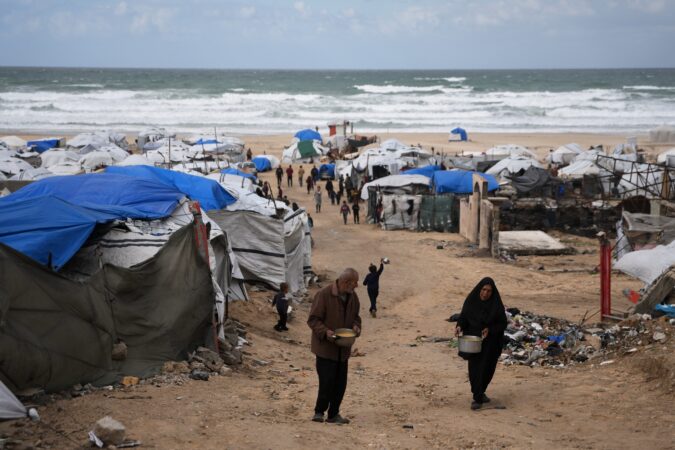
    KHAN YOUNIS, Gaza Strip — Winter rain lashed the Gaza Strip over the weekend, flooding camps with ankle-deep puddles as Palestinians displaced by two years of war attempted to stay dry in tents frayed by months of use.

    Israeli Prime Minister Benjamin Netanyahu traveled for an expected meeting on Monday with U.S. President Donald Trump in Florida about the second phase of the ceasefire. The first phase that took effect on Oct. 10 was meant to bring a surge in humanitarian aid for Gaza, including shelter.

    Netanyahu made no public statement as he departed.

    Nowhere to escape

    In the southern city of Khan Younis, blankets were soaked and clay ovens meant for cooking were swamped. Children wearing flip-flops waded through puddles. Some people used shovels or tin cans to remove water from tents. Others clawed at the ground to pry collapsed shelters from the mud.

    ““Puddles formed, and there was a bad smell,” said Majdoleen Tarabein, displaced from Rafah in southern Gaza. ”The tent flew away. We don’t know what to do or where to go.”

    She and family members tried to wring muddy blankets dry by hand.

    “When we woke up in the morning, we found that the water had entered the tent,” said Eman Abu Riziq, also displaced in Khan Younis. “These are the mattresses. They are all completely soaked.”

    She said her family is still reeling from her husband’s death less than two weeks ago.

    “Where are the mediators? We don’t want food. We don’t want anything. We are exhausted. We just want mattresses and covers,” said Fatima Abu Omar as she tried to prop up a collapsing shelter.

    At least 12 people, including a 2-week-old infant, have died since Dec. 13 from hypothermia or weather-related collapses of war-damaged homes, according to Gaza’s Health Ministry, part of the Hamas-run government.

    Emergency workers have warned people not to stay in damaged buildings, because they could collapse. But with much of the territory in rubble, there are few places to escape the rain. In July, the United Nations estimated that almost 80% of buildings in Gaza have been destroyed or damaged.

    Since the ceasefire between Israel and Hamas began, 414 people have been killed and 1,142 wounded in Gaza, according to the Health Ministry. The overall Palestinian death toll from the war is at least 71,266. The ministry, which does not distinguish between militants and civilians in its count, is staffed by medical professionals and maintains detailed records viewed as generally reliable by the international community.

    The Israel-Hamas war began with the Hamas-led attack in southern Israel on Oct. 7, 2023 that killed about 1,200 people and saw 251 taken hostage,

    Aid groups call for more help

    Humanitarian deliveries into Gaza are falling far short of the amount called for under the U.S.-brokered ceasefire, according to aid organizations and an Associated Press analysis of the Israeli military’s figures.

    The Israeli military body in charge of humanitarian aid said in the past week that 4,200 trucks with aid entered Gaza, plus eight garbage trucks to assist with sanitation, as well as tents and winter clothing. It refused to elaborate on the number of tents. Aid groups have said the need far outstrips the number that have entered.

    Since the ceasefire began, around 72,000 tents and 403,000 tarps have entered, according to Shelter Cluster, an international coalition of aid providers led by the Norwegian Refugee Council.

    “People in Gaza are surviving in flimsy, waterlogged tents and among ruins,” Philippe Lazzarini, commissioner-general of the top U.N. group overseeing aid in Gaza, wrote on social media. “There is nothing inevitable about this. Aid supplies are not being allowed in at the scale required.”

    Ceasefire’s next phase

    Though the ceasefire agreement has mostly held, its progress has slowed.

    Israel has said it refuses to move to the next phase while the remains of the final hostage are still in Gaza. Hamas has said the destruction in Gaza has hampered efforts to find remains.

    Challenges in the next phase include the deployment of an international stabilization force, a technocratic governing body for Gaza, the disarmament of the Hamas militant group, and further Israeli troop withdrawals from the territory.

    Both Israel and Hamas have accused each other of truce violations.

  • Netanyahu’s ties with Trump to be tested amid differences ahead of visit

    Netanyahu’s ties with Trump to be tested amid differences ahead of visit

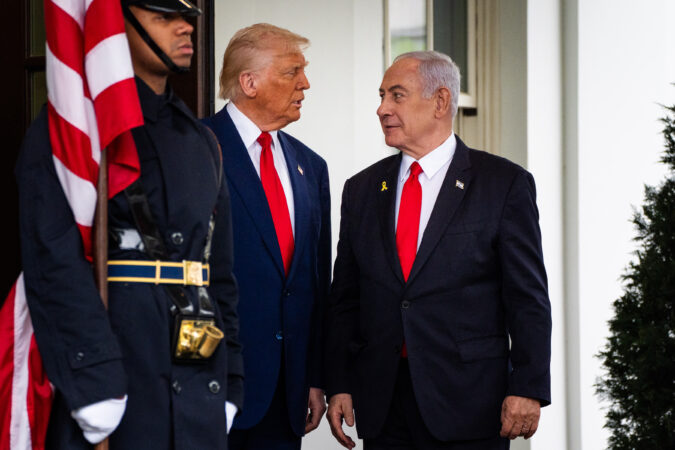
    JERUSALEM — Three months ago, Israeli Prime Minister Benjamin Netanyahu hailed Donald Trump as the “greatest friend Israel has ever had in the White House.” But that friendship — and Netanyahu’s powers of persuasion — will be tested on Monday at Trump’s Mar-a-Lago estate, where the Israeli leader will meet a U.S. president with increasingly diverging views on practically every Middle East hot spot.

    For Netanyahu, the trip to Florida offers a crucial opportunity to convince Trump to take a tougher stance on Gaza and require that Hamas disarm before Israeli troops further withdraw as part of the second phase of Trump’s 20-point peace plan, Israeli officials say. On Iran, Netanyahu is seeking a green light for another strike against the Islamic Republic’s ballistic missile program, possibly as part of a joint operation with the United States — even though Trump forcefully demanded an end to the 12-day Israel-Iran war in June and declared that Iran’s nuclear program had been “totally obliterated” by U.S. stealth bombers.

    On Syria, the Trump administration has bristled at actions by the Israeli military inside the country that undermine efforts by the new president, Ahmed al-Sharaa, to consolidate control, with Trump publicly warning Israel this month against doing anything “that will interfere with Syria’s evolution into a prosperous State.” And in Lebanon, Israel has repeatedly bombed Hezbollah targets while demanding that the militant group disarm in accordance with a U.S.-brokered ceasefire, but the strikes have threatened to tip the region into another conflagration on Trump’s watch.

    As they meet Monday for the fifth time this year, Netanyahu’s hawkishness will butt up against a U.S. president who has staked his own image and legacy on promoting peace, and Netanyahu may struggle to win Trump’s backing given how the relationship has deteriorated, according to people familiar with the thinking of the two leaders and political observers.

    “This is an emergency summit,” said Dan Diker, president of the Jerusalem Center for Security and Foreign Affairs think tank. “The context is a need to clear or purify the air, because there’s been tensions between the two sides. They have different timelines to get to the same destination, which is a Middle East that is liberated from the Iranian regime and its terror proxies, particularly Hamas.”

    In recent months, Netanyahu has often appeared to undercut Trump’s self-congratulations for making peace in the region. Israel carried out additional airstrikes on Iran after the president had declared the 12-day war with Israel over last summer, prompting an expletive-laden warning from Trump on television.

    Then, following Israel’s airstrike against Hamas negotiators in Qatar as the Gaza peace deal was being hammered out in September, Trump strong-armed Netanyahu into apologizing. “I think he felt like the Israelis were getting a bit out of control in what they were doing and that it was time to be very strong and stop them from doing things that he felt were not in their long-term interests,” Jared Kushner, Trump’s son-in-law and U.S. negotiator, said on CBS’s 60 Minutes in October.

    Now, Israeli officials have indicated that Netanyahu wants to discuss what Israel sees as a dangerous expansion of Iran’s ballistic missile capabilities and the possibility of new joint strikes by Israel and the U.S. This week, the prime minister’s office released an AI-generated video showing Netanyahu and Trump sitting side by side, co-piloting a B-2 bomber — the iconic stealth aircraft that the United States used in June to strike Iran’s nuclear facility at Fordow at Netanyahu’s urging.

    But while Trump continues to see Iran near or at the top of his regional concerns, his administration has launched another attempt to negotiate with Tehran and first wants to see the effort play out, according to several people familiar with the president’s thinking, who spoke on the condition of anonymity about the sensitive issue. Morgan Ortagus, Trump’s deputy special envoy to the Middle East, told a meeting of the U.N. Security Council on Tuesday that Washington “remains available for formal talks with Iran,” while repeating U.S. insistence that “there can be no [uranium] enrichment.”

    Other Trump concerns include Lebanon, where a truce with Israel, brokered by the U.S. and France late last year, is teetering as Netanyahu’s government continues to carry out almost daily bombardments and maintains an army deployment in the southern part of the country, amid charges that Hezbollah has failed to disarm.

    “There are mixed policy currents,” said another person familiar with U.S. administration deliberations. “There are those who believe only Israel [is capable of doing] something that can even begin to change Hezbollah’s calculations. … There are others that think you cannot trust what Israel might do as exploding the situation and creating broader chaos.”

    Gaza takes center stage

    For both Trump and Netanyahu, the most contentious issue will likely be Gaza, not only because of security implications but also its political significance for both leaders. Three months after Trump hailed the peace deal between Israel and Hamas as a “new dawn” for the region, implementation of his 20-point plan has bogged down after the first phase of a ceasefire plan, which has so far seen the release of hostages and prisoners and an increase in humanitarian aid.

    Amid contentious conversations between the two governments over who will have final word on what happens in Gaza, none of the main elements of a second phase — a supervising Board of Peace, a committee of Palestinian technocrats to govern Gaza’s internal affairs, and an International Stabilization Force to oversee in part the demilitarization of Hamas — is yet in place, even as Israel frequently strikes at Hamas targets inside Gaza despite the ceasefire agreement.

    Israel has been reluctant to advance to the deal’s second phase, which could also see Israel eventually withdraw further from the enclave’s interior, without Hamas first disarming. Israeli officials have also balked at the prospect that Turkey — a bitter rival of Israel but an ally of the U.S. — may gain a foothold in Gaza by deploying its troops there as part of the International Stabilization Force.

    On Tuesday, tensions with Washington spiked after Netanyahu’s defense minister, Israel Katz, appeared to flout Trump’s peace plan by declaring that Israel will establish Jewish settlements inside the Gaza Strip, drawing a rebuke from U.S. officials. Two days later, Katz doubled down and reiterated that Israel would never fully withdraw from the Strip.

    Earlier, after Israeli forces killed the Hamas commander Raed Sa’ad in Gaza on Dec. 13, Trump told reporters he was “looking into” whether Israel had violated the ceasefire agreement. U.S. officials, meanwhile, warned Netanyahu that “we won’t allow you to ruin President Trump’s reputation after he brokered the deal in Gaza,” Axios quoted a U.S. official as saying.

    “I’m not sure the Americans will like [the Israeli perspective on] Gaza because it’s not working according to their plan,” said an Israeli government adviser who spoke on the condition of anonymity to discuss internal deliberations. “But for Israel, it has to be total demilitarization, no weapons, no [Hamas] tunnels. And it could take years. We cannot withdraw now.”

    For Netanyahu, the trip to Palm Beach, Fla., is further complicated by his political need ahead of the 2026 Israeli elections to project strength and victory on every front, particularly Gaza. Since Oct. 7, 2023, when a Hamas attack left more than 1,200 Israelis dead and 250 taken hostage, Netanyahu has been lambasted by his political opponents for failing to protect Israel. He has also been criticized by Israel’s far right for not doing enough to destroy Hamas, even though the Israeli military carried out a withering, two-year campaign that left more than 70,000 Palestinians dead in Gaza and much of the Strip in ruins.

    “There’s the potential for a significant clash on Gaza, because for both of them, it’s the most central issue,” said Daniel Shapiro, a former U.S. ambassador to Israel. “For Trump, he wants to show that this grand deal he struck actually gets implemented, even if he has cut some corners. For Bibi, it’s a serious political risk to go into the election with an arrangement in Gaza that looks like Hamas will survive in some form.”