Category: News

Latest breaking news and updates

  • Medicare coverage for telehealth suspended as result of government shutdown

    Medicare coverage for telehealth suspended as result of government shutdown

    Steve Hirst relies on virtual visits with his urologist, whose office is an hour away from his Broomall home, to stay on top of his treatment plan and renew medications.

    But earlier this month Hirst, 70, got a notice from his doctor’s office informing him that it could no longer schedule telemedicine visits for patients like him who have Medicare because of new federal policy changes.

    Medicare began covering telemedicine services during the COVID-19 pandemic and has maintained the popular offering through temporary waivers approved by Congress since. But the most recent of those waivers expired at the end of September when Congress failed to reach a budget deal and the government shut down.

    The change specifically affects traditional Medicare, which is administered by the government for people 65 and older and some with disabilities. People with Medicare Advantage plans, which are administered by private insurers, should check with their plan.

    Medicare coverage for virtual visits for mental health was made permanent after the pandemic and are not affected by the shutdown.

    Some of the Philadelphia area’s leading health systems, including Temple Health and Penn Medicine, have said they are continuing to provide telehealth services to people with Medicare and temporarily suspending billing for those services, with hope that coverage will be reinstated when a budget deal is eventually reached.

    But smaller provider practices may not have the luxury of delaying payment for thousands of dollars in services for an indefinite period of time.

    With the government shutdown in its third week, Republicans and Democrats seem no closer to reaching a deal. The next vote is scheduled for Monday evening, though no deal is expected.

    Another health policy issue — tax credits for people who buy insurance through Affordable Care Act marketplaces, including Pennie in Pennsylvania — has been a major sticking point in the ongoing federal budget debate. Democrats want the enhanced subsidies extended permanently as part of the budget deal, and Republicans have refused, arguing that lawmakers could address the issue separately, before the subsidies expire at the end of the year.

    Meanwhile, the waiver’s expiration has left Hirst and others who are covered by Medicare unsure how they will access needed health services.

    Telehealth’s rise

    Telehealth rose in popularity during the COVID-19 pandemic, when people were urged to avoid hospitals unless they were having an emergency and when most routine procedures were canceled.

    The approach was especially helpful to older adults and people with disabilities, who needed to stay in contact with doctors for ongoing treatment and who were considered particularly vulnerable to severe illness from COVID-19.

    After the pandemic ended, many private insurers, Medicaid, and Medicare permanently adopted telehealth coverage for certain services, such as mental health, because of its popularity during the pandemic.

    Medicare has used temporary waivers to continue telehealth coverage for other types of doctors’ visits.

    Beyond patient popularity, research has found that telehealth visits can be as effective as in-person visits for certain types of care, such as palliative care for cancer patients, while improving access to patients with transportation challenges.

    Philadelphia health systems respond

    Philadelphia’s largest health systems said they are optimistic that coverage will be reinstated — either by a new temporary waiver or a permanent change — when Congress reaches a new budget agreement and the shutdown ends.

    Temple Health will continue to provide telehealth services to Medicare patients for the next three weeks, in anticipation of Congress reaching a deal.

    Penn Medicine has not billed Medicare patients for telehealth visits since the shutdown began and has paused its process for filing claims until the government reopens, a spokesperson said.

    “Congress has been vocal in its support of telehealth and its value, and we are hopeful that legislation will be passed to ensure permanent Medicare telehealth coverage and flexibilities once the government reopens,” Penn said in a statement.

    Main Line Health has been reaching out to affected patients to help them change previously scheduled virtual visits into in-person appointments or reschedule virtual visits that can be put off.

    Jefferson Health did not respond to a request for comment in time for publication.

    Patients in limbo

    Hirst drives into Philadelphia to see his urologist in person once a year. Every three months, he has a virtual visit to check in and renew prescriptions.

    Driving to Philadelphia for every appointment would be inconvenient, but Hirst will probably do it “for now,” he said.

    But he worries about older adults and people with disabilities who can’t safely drive to the doctor’s office, and for whom virtual care is a lifeline. They could end up putting themselves or others at risk being on the road when they shouldn’t be. Or they may end up skipping needed care because they don’t have a ride.

    “It makes no sense,” Hirst said.

  • Lessons must be learned after criminal justice system fails Kada Scott | Editorial

    Lessons must be learned after criminal justice system fails Kada Scott | Editorial

    The killing of Kada Scott is tragic on many levels, but hopefully, some lessons can be learned to honor her life.

    Scott’s death is all the more painful for her family and friends because it could have been prevented. That’s because it appears District Attorney Larry Krasner and the Philadelphia court system failed her.

    The man accused of abducting Scott had been previously charged with assaulting an ex-girlfriend twice in the last year, but prosecutors withdrew the charges after the victim did not show up for court.

    After Scott’s disappearance, Krasner’s office admitted its handling of the earlier cases was a mistake. If the district attorney’s office had instead prosecuted Keon King, 21, then perhaps Scott, 23, would still be alive.

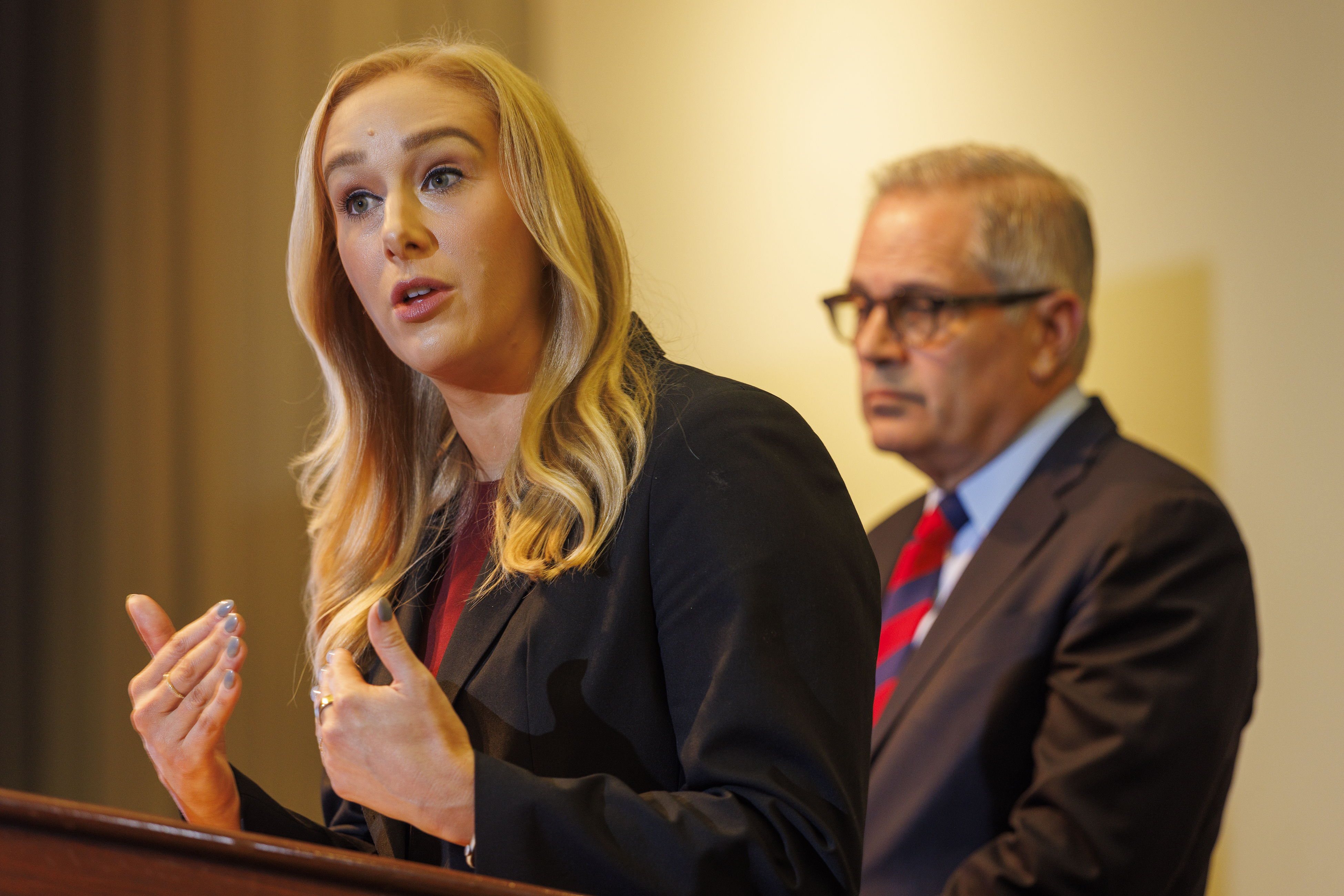
    “We could’ve done better,” Krasner said at a news conference Monday, echoing earlier comments from Assistant District Attorney Ashley Toczylowski, who said last week, “Everyone involved at this point, including the [initial prosecutor], agrees that we wish this happened differently.”

    To be sure, hindsight is 20/20. But a review of King’s legal entanglements indicates a series of miscues may have enabled Scott’s death.

    The case also offers a window into the challenges of filing domestic abuse charges, and underscores the need for prosecutors to be more aggressive in going after the accused while doing more to ensure the safety of victims.

    For starters, King’s initial assault charges last November were handled by an inexperienced assistant district attorney who was juggling multiple cases. During that incident, prosecutors said, King grabbed an ex-girlfriend by the neck and tried to strangle her after she refused to lie on the bed with him, according to the affidavit.

    But after initially cooperating with the authorities, King’s accuser stopped responding to calls from prosecutors. After she failed to appear at three court hearings, the district attorney’s office withdrew the case.

    In January, King tried to break into the woman’s home, but fled before police arrived, according to an affidavit. He returned later in the day and dragged the woman by her hair, shoved her in a car, and drove away before dropping her off on the side of the road.

    This time, the woman and her friend captured video of King trying to get into her home. He was arrested again and charged with kidnapping, strangulation, and other charges.

    But once again, the victim and her friend refused to cooperate with prosecutors, so the charges were withdrawn in May.

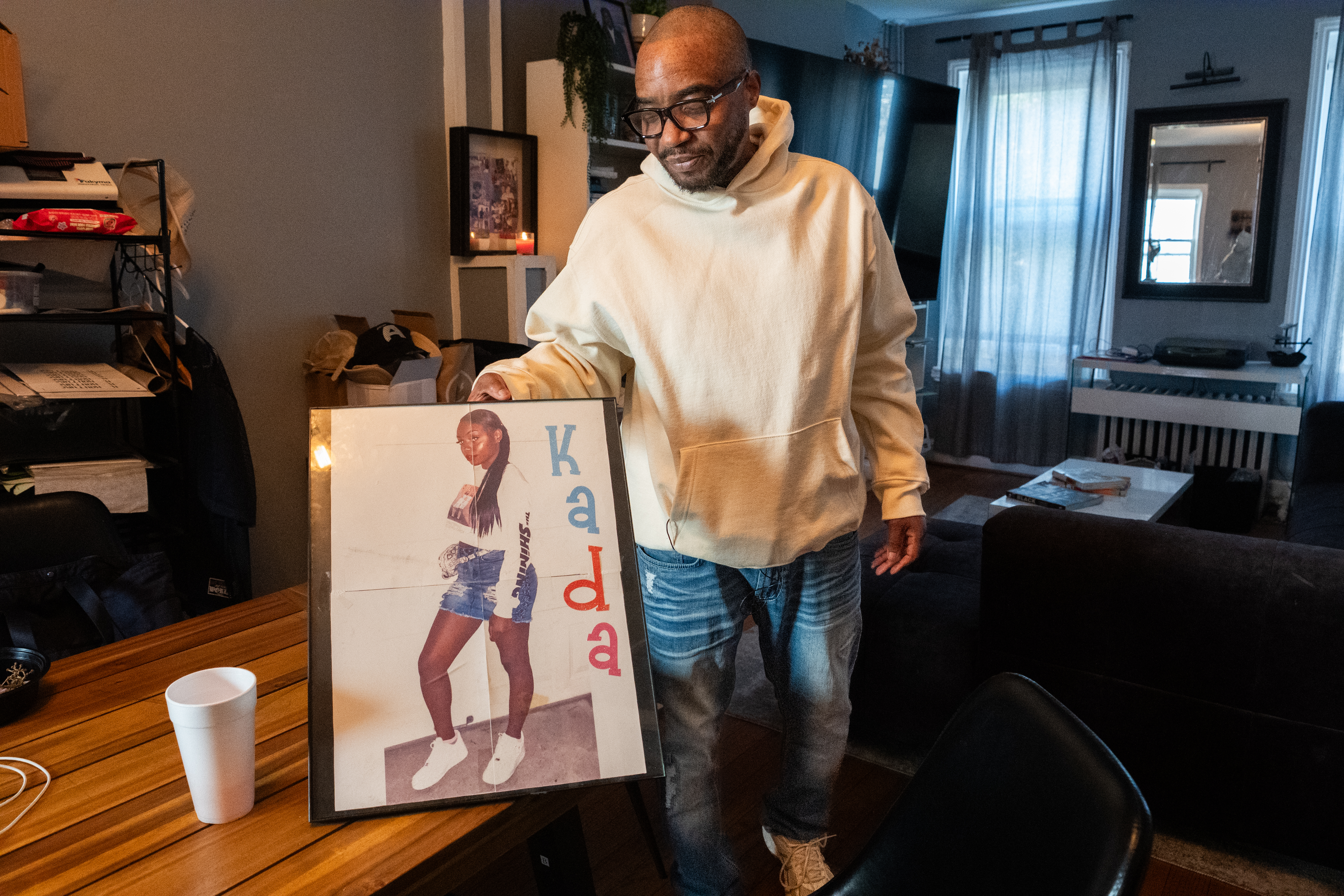
    Kevin Scott, Kada Scott’s father, with a photo of his daughter.

    This is not unusual, as victims of domestic violence often live in fear of the perpetrators. Reviewing the period between 2010 and 2020, researchers at the University of Pennsylvania found that 70% of victims of domestic violence cases failed to appear in Philadelphia’s courts.

    A big part of the problem is that the accused are often out on bail and still threatening the victims. In King’s case, after the second set of assault charges, prosecutors requested bail of $1 million, but the magistrate lowered it to $200,000.

    King posted the necessary 10% — or $20,000 — and was released in April.

    Krasner blamed the magistrate for lowering the bail, but his office could have appealed the ruling.

    There is a fine line in detaining suspects accused of crimes for months on end until a trial. But in domestic violence cases, the current system is not working and needs to be revamped.

    Prosecutors and judges must do everything possible to guarantee the safety of victims. Victims need more support within the criminal justice system to ensure their safety.

    More broadly, additional preventive steps are needed to reduce violence against women, including standing up to rape culture, empowering women, and teaching boys to respect women.

    Black women disproportionately experience higher rates of domestic abuse, including rape and homicides, studies show, further underscoring the need for more awareness, training, and preventive measures.

    In this instance, given that King had been charged once before, the magistrate and Krasner’s office dropped the ball.

    And although the victim refused to testify, the district attorney’s office could have used the video evidence to move forward with King’s prosecution — though not having the witnesses testify certainly would have made for a tougher case.

    To his credit, Krasner, a former defense attorney who faces reelection next month and has been criticized for being soft on crime, admitted his office was ultimately to blame.

    “The buck stops here,” he said.

    Sadly, a young, vibrant woman full of promise has died, and another woman was previously assaulted and traumatized. Krasner said the public played an enormous role in Scott’s case, and asked for anyone with information to call 215-686-TIPS.

    The only positive outcome will be to ensure justice is served, and a broken legal system in which victims are afraid to testify is fixed, so others do not experience the same horrific outcome.

  • Massive Amazon cloud outage has been resolved after disrupting internet use worldwide

    Massive Amazon cloud outage has been resolved after disrupting internet use worldwide

    LONDON — Amazon says a massive outage of its cloud computing service has been resolved as of Monday evening, after a problem disrupted internet use around the world, taking down a broad range of online services, including social media, gaming, food delivery, streaming and financial platforms.

    The all-day disruption and the ensuing exasperation it caused served as the latest reminder that 21st century society is increasingly dependent on just a handful of companies for much of its internet technology, which seems to work reliably until it suddenly breaks down.

    About three hours after the outage began early Monday morning, Amazon Web Services said it was starting to recover, but it wasn’t until 6 p.m. Eastern that “services returned to normal operations,” Amazon said on its AWS health website, where it tracks outages.

    AWS provides behind-the-scenes cloud computing infrastructure to some of the world’s biggest organizations. Its customers include government departments, universities and businesses, including The Associated Press.

    Cybersecurity expert Mike Chapple said “a slow and bumpy recovery process” is “entirely normal.”

    As engineers roll out fixes across the cloud computing infrastructure, the process could trigger smaller disruptions, he said.

    “It’s similar to what happens after a large-scale power outage: While a city’s power is coming back online, neighborhoods may see intermittent glitches as crews finish the repairs,” said Chapple, an information technology professor at the University of Notre Dame’s Mendoza College of Business.

    Amazon blames domain name system

    Amazon pinned the outage on issues related to its domain name system that converts web addresses into IP addresses, which are numeric designations that identify locations on the internet. Those addresses allow websites and apps to load on internet-connected devices.

    DownDetector, a website that tracks online outages, said in a Facebook post that it received over 11 million user reports of problems at more than 2,500 companies. Users reported trouble with the social media site Snapchat, the Roblox and Fortnite video games, the online broker Robinhood and the McDonald’s app, as well as Netflix, Disney+ and many other services.

    The cryptocurrency exchange Coinbase and the Signal chat app both said on X that they were experiencing trouble related to the outage.

    Amazon’s own services were also affected. Users of the company’s Ring doorbell cameras and Alexa-powered smart speakers reported that they were not working, while others said they were unable to access the Amazon website or download books to their Kindle.

    Many college and K-12 students were unable to submit or access their homework or course materials Monday because the AWS outage knocked out Canvas, a widely used educational platform.

    “I currently can’t grade any online assignments, and my students can’t access their online materials” because of the outage’s effect on learning-management systems, said Damien P. Williams, a professor of philosophy and data science at the University of North Carolina at Charlotte.

    The exact number of schools impacted was not immediately known, but Canvas says on its website it is used by 50% of college and university students in North America, including all Ivy League schools in the U.S.

    At the University of California, Riverside, students couldn’t submit assignments, take quizzes or access course materials, and online instruction was limited, the campus said.

    Ohio State University informed its 70,000 students at all six campuses by email Monday morning that online course materials might be inaccessible due to the outage and that “students should connect with their instructors for any alternative plans.” As of 7:10 p.m. Eastern, access was restored, the university told students.

    Record of past outages

    This is not the first time issues with Amazon cloud services have caused widespread disruptions.

    Many popular internet services were affected by a brief outage in 2023. AWS’s longest outage in recent history occurred in late 2021, when a wide range of companies — from airlines and auto dealerships to payment apps and video streaming services — were affected for more than five hours. Outages also happened in 2020 and 2017.

    The first signs of trouble emerged at around 3:11 a.m. Eastern time, when AWS reported on its “health dashboard” that it was “investigating increased error rates and latencies for multiple AWS services in the US-EAST-1 Region.” Later, the company reported that there were “significant error rates” and that engineers were “actively working” on the problem.

    Around 6 a.m. Eastern time, the company reported seeing recovery across most of the affected services and said it was seeking a “full resolution.” As of midday, AWS was still working to resolve the trouble.

    Sixty-four internal AWS services were affected, the company said.

    Just a few companies provide most internet infrastructure

    Because much of the world now relies on three or four companies to provide the underlying infrastructure of the internet, “when there’s an issue like this, it can be really impactful” across many online services, said Patrick Burgess, a cybersecurity expert at U.K.-based BCS, The Chartered Institute for IT.

    “The world now runs on the cloud,” Burgess said.

    And because so much of the online world’s plumbing is underpinned by so few companies, when something goes wrong, “it’s very difficult for users to pinpoint what is happening because we don’t see Amazon, we just see Snapchat or Roblox,” Burgess said.

    “The good news is that this kind of issue is usually relatively fast” to resolve, and there’s no indication that it was caused by a cyberattack, Burgess said.

    “This looks like a good old-fashioned technology issue. Something’s gone wrong, and it will be fixed by Amazon,” he said.

    There are “well-established processes” to deal with outages at AWS, as well as rivals Google and Microsoft, Burgess said, adding that such outages are usually over in “hours rather than days.”

  • Trump says he’s doubtful Ukraine can win the war with Russia as he prepares for Putin meeting

    Trump says he’s doubtful Ukraine can win the war with Russia as he prepares for Putin meeting

    KYIV, Ukraine — President Donald Trump said Monday that while he thinks it is possible that Ukraine can defeat Russia, he’s now doubtful it will happen.

    The comments from Trump added a fresh layer of skepticism toward Kyiv as he plans to meet again in the coming weeks with Russian President Vladimir Putin for face-to-face talks in Budapest, Hungary, on ending the war.

    “They could still win it. I don’t think they will, but they could still win it,” Trump told reporters on Monday at the start of a White House meeting with Australian Prime Minister Anthony Albanese.

    Trump last month reversed his long-held position that Ukraine would have to concede land and could win back all the territory it has lost to Russia.

    But after a lengthy call with Putin last week followed by a meeting with Ukrainian President Volodymyr Zelenskyy, Trump made another reversal and called on Kyiv and Moscow to “stop where they are” and end their brutal war.

    Asked on Monday about his whiplashing opinion on Kyiv’s position, Trump offered the dour assessment about Ukraine’s chances. He added, “I never said they would win it. I said they could. Anything can happen. You know war is a very strange thing.”

    Earlier Monday, Zelenskyy said that during the White House meeting Trump informed him that Putin’s maximalist demand — that Ukraine cede the entirety of its eastern Donetsk and Luhansk regions — was unchanged.

    Still, Zelenskyy described the meeting as “positive,” even though Trump also rebuffed his request for long-range Tomahawk cruise missiles.

    In public comments in the weeks leading up to his meeting with Zelenskyy, Trump had appeared to warm to the possibility of sending the Tomahawks, which would allow Ukrainian forces to strike deeper into Russian territory.

    But the U.S. leader’s tone changed after his latest call with Putin and he made clear that he was reluctant to send Ukraine the missile system, at least for the time-being.

    “In my opinion, he does not want an escalation with the Russians until he meets with them,” Zelenskyy told reporters on Sunday. His comments were embargoed until Monday morning.

    Zelenskyy also expressed skepticism about Putin’s proposal to swap some territory it holds in the Kherson and Zaporizhzhia regions if Ukraine surrenders Donetsk and Luhansk, saying the proposal was unclear. The Donetsk and Luhansk regions make up the Donbas.

    Ukraine’s leader said Trump ultimately supported a freeze along the current front line.

    “We share President Trump’s positive outlook if it leads to the end of the war,” Zelenskyy said, citing “many rounds of discussion over more than two hours with him and his team.”

    Zelenskyy was diplomatic about his meeting with Trump despite reports that he faced pressure to accept Putin’s demands. The meeting followed the disastrous Oval Office spat on Feb. 28 when the Ukrainian president was scolded on live television for not being grateful for U.S. support.

    Zelenskyy said he hopes that Trump’s meeting in the coming weeks with Putin in Hungary — which does not support Ukraine — will pave the way for a peace deal.

    Zelenskyy said he has not been invited to attend but would consider it if the format for talks were fair to Kyiv.

    He also took a shot at Hungarian Prime Minister Viktor Orban, saying he does not believe that a prime minister “who blocks Ukraine everywhere can do anything positive for Ukrainians or even provide a balanced contribution.”

    Zelenskyy said he thinks that all parties have “moved closer” to a possible end to the war.

    “That doesn’t mean it will definitely end, but President Trump has achieved a lot in the Middle East, and riding that wave he wants to end Russia’s war against Ukraine,” he added.

    Ukraine is hoping to purchase 25 Patriot air defense systems from U.S. firms using frozen Russian assets and assistance from partners, but Zelenskyy said procuring them would require time because of long production waits. He said he spoke to Trump about help procuring them more quickly, potentially from European partners.

    Zelenskyy said the United States is interested in bilateral gas projects with Ukraine, including the construction of an LNG terminal in the southern port city of Odesa. Other projects of interest include those related to nuclear energy and oil.

  • U.S. appeals court lets Trump send troops to Portland

    U.S. appeals court lets Trump send troops to Portland

    A divided U.S. appeals court ruled on Monday that Donald Trump can send National Guard troops into Portland, Oregon, despite objections by the leaders of the city and state, giving the Republican president an important legal victory as he dispatches military forces to a growing number of Democratic-led locales.

    A three-judge panel of the 9th U.S. Circuit Court of Appeals granted the Justice Department’s request to put on hold a judge’s order that had blocked the deployment while a legal challenge to Trump’s action plays out.

    The court said that sending in the National Guard was an appropriate response to protesters, who had damaged a federal building and threatened U.S. Immigration and Customs Enforcement officers.

    The unsigned majority opinion was joined by Circuit Judge Bridget Bade and Circuit Judge Ryan Nelson, who were both appointed by Trump in his first term. Nelson also wrote a concurring opinion saying that courts have no ability to even review the president’s decision to send troops.

    Circuit Judge Susan Graber, an appointee of Democratic President Bill Clinton, dissented. She said that allowing troops to be called in response to “merely inconvenient” protests was “not merely absurd” but dangerous, and she said the full 9th Circuit should overturn the ruling before Trump has a chance to send troops.

    White House spokeswoman Abigail Jackson welcomed the ruling, saying Trump had exercised his lawful authority to protect federal assets and personnel from protesters.

    Portland’s city attorney did not immediately respond to a request for comment.

    On October 4, Portland-based U.S. District Judge Karin Immergut, who Trump appointed during his first term as president, ruled that Trump likely acted unlawfully when he ordered troops to Portland. She had blocked Trump from sending any National Guard troops to Portland at least until the end of October, and has scheduled a non-jury trial set to begin on October 29 to determine whether to impose a longer-term block.

    DEMOCRATIC-LED STATES SEEK TO HALT DEPLOYMENTS

    In an extraordinary use of the U.S. armed forces for domestic purposes, Trump has sent National Guard troops into Los Angeles, Washington, D.C., and Memphis, and announced plans for deployments to Portland and Chicago.

    Democratic-led states and cities have filed lawsuits seeking to halt the deployments, and courts have not yet reached a final decision on the legality of Trump’s decisions to send the National Guard to U.S. cities.

    Trump has asked the U.S. Supreme Court to weigh his authority to send troops to Democratic-led cities, after another U.S. appeals court ruled against his decision to send troops to Chicago.

    City and state officials sued the administration in a bid to stop the Portland deployment, arguing that Trump’s action violates several federal laws that govern the use of military forces as well as the state’s rights under the U.S. Constitution’s 10th Amendment.

    The lawsuit accused Trump of exaggerating the severity of protests against his immigration policies to justify illegally seizing control of state National Guard units.

    Trump on September 27 ordered 200 National Guard troops to Portland, continuing his administration’s unprecedented use of military personnel in U.S. cities to suppress protests and bolster domestic immigration enforcement. Trump called the city “War ravaged” and said, “I am also authorizing Full Force, if necessary.”

    Police records provided by the state showed that protests in Portland were “small and sedate,” resulting in only 25 arrests in mid-June and no arrests in the 3-1/2 months since June 19.

    A federal law called the Posse Comitatus Act generally restricts the use of the U.S. military for domestic law enforcement purposes. In ordering troops to California, Oregon and Illinois, Trump has relied on a law – Section 12406 of Title 10 of the U.S. Code – that allows a president to deploy state National Guard to repel an invasion, suppress a rebellion or allow the president to execute the law.

    The National Guard serves as state-based militia forces that answer to state governors except when called into federal service by the president.

    During arguments in the case on October 9, the two Trump-appointed judges suggested that Immergut had focused too closely on protests in the city in September without fully considering more serious protests two months before the troop deployment. Circuit Judge Ryan Nelson said that courts should not engage in a “day by day” review of whether troops were needed at any given time.

    Immergut issued decisions against the administration on October 4 and October 5, first ruling that Trump could not take over Oregon’s National Guard and then ruling that he could not circumvent that decision by calling in National Guard troops from other states.

    The judge said there was no evidence that recent protests in Portland rose to the level of a rebellion or seriously interfered with law enforcement, and she said Trump’s description of the city as war-ravaged was “simply untethered to the facts.”

    Immergut is one of three district court judges who have ruled against Trump’s use of the National Guard, and no district court judge has yet ruled for Trump in the National Guard cases.

    Appeals courts have split over the issue so far, with the 9th Circuit previously backing Trump’s use of troops in California and the 7th Circuit ruling that troops should stay out of Chicago for now.

  • White House hits road block in effort to get top colleges to sign deal

    White House hits road block in effort to get top colleges to sign deal

    Despite strong pressure from the Trump administration, including a call with the White House on Friday, colleges and universities are largely rejecting the president’s offer of preferential treatment for funding in exchange for compliance with his ideological priorities.

    Six of nine universities offered the deal earlier this month had publicly said no to the White House request by Monday’s deadline.

    The administration has said it is seeking to make sure the country’s schools are merit-based, but many universities and higher education advocates said the White House’s proposed agreement would undermine the merit-based process currently utilized to award research grants.

    The “Compact for Academic Excellence in Higher Education” is a new attempt by the administration to get schools to eliminate diversity, equity and inclusion policies and ensure more conservative viewpoints and values are integrated into campus life.

    The Trump administration offered it to nine colleges earlier this month, casting it as a means to gain competitive advantage for federal and philanthropic benefits and invitations to White House events in return for what the administration described as compliance with civil rights law and “pursuing Federal priorities with vigor.”

    The ideological tension was reflected during a call on Friday, which the White House organized and presented as a chance to workshop the terms of the compact in partnership with colleges and universities that had not yet responded, according to a person close to the situation, who spoke on the condition of anonymity because of the sensitivity of the matter.

    From the Trump administration, Education Secretary Linda McMahon; White House Domestic Policy Director Vincent Haley, Special Assistant Eric Bledsoe and adviser May Mailman; Josh Gruenbaum of the General Services Administration; and billionaire Marc Rowan were on the call, the person said.

    But within a day of the call, University of Virginia and Dartmouth College rejected the compact, joining ranks with MIT, Brown University, the University of Pennsylvania and the University of Southern California. The University of Texas at Austin was invited to sign on and the chair of the University of Texas System Board of Regents expressed enthusiasm. The University of Arizona and Vanderbilt University have not publicly responded.

    Echoing a term that has been often used by the Trump administration, U-Va.’s president said the agreement violated the merit-based nature of the competition for federal research funding. The federal government currently awards billions of dollars in research grants based on peer reviews and scientific merit.

    On Saturday, Dartmouth President Sian Beilock wrote to McMahon, Mailman and Haley that she welcomed further engagement on enhancing the partnership between the federal government and research universities and ensuring that higher education “stays focused on academic excellence.” But, she wrote, “I do not believe that the involvement of the government through a compact-whether it is a Republican- or Democratic-led White House-is the right way to focus America’s leading colleges and universities on their teaching and research mission.”

    White House spokeswoman Liz Huston described the Friday call as “productive.”

    “The Administration hosted a productive call with several university leaders. They now have the baton to consider, discuss, and propose meaningful reforms, including their form and implementation, to ensure college campuses serve as laboratories of American greatness,” Huston said in a statement. “These leaders are working steadfastly to improve higher education and have been invited to the table to share ideas with the Administration, and we look forward to discussing transparent ways that, together, we will produce future generations of American excellence.”

    A White House official, speaking anonymously to discuss private conversations, said universities will not lose their federal funding because they decided not to engage in the compact.

    The sweeping terms of the compact called on schools to adopt the administration’s priorities, including pledging to freeze tuition for five years, cap international enrollment at 15 percent of a college’s undergraduate student body, and bar the consideration of factors such as gender, race and political views in admissions and other areas.

    Some legal scholars said the terms were unconstitutional. Trump administration officials have insisted they are protecting free speech by compelling universities to reject a culture that suppresses far-right thought.

    Officials asked for “limited, targeted feedback” in writing no later than Oct. 20, with hopes of a signed agreement by Nov. 21.

    As schools turned it down, citing similar concerns – Christina H. Paxson, Brown’s president, wrote in a letter to the White House that provisions in the compact restricting the university’s academic freedom and institutional autonomy would impede its mission – the Trump administration invited more universities to participate. Washington University in St. Louis, the University of Kansas and Arizona State University joined Friday’s call.

    In a Monday statement, Washington University Chancellor Andrew Martin said he had not endorsed or signed on to the compact but agreed to discuss it with the Trump administration. “We believe it is in the best interest of our university, and higher education more broadly, for us to participate constructively, share our experience and expertise, and help inform policies that strengthen the nation’s research and education ecosystem,” Martin said.

    Some of the wording in the compact is vague. But the magnitude of the stakes is clear: The Trump administration has frozen billions of dollars of federal research funding at multiple colleges that it has accused of violating federal civil rights laws for issues such as having diversity, equity and inclusion policies and allegedly not doing enough to prevent antisemitism.

    At Harvard University, which has filed two lawsuits to fight the government’s actions, the administration has tried to bar international students and scholars from campus, threatened to revoke the university’s tax-exempt status and has begun an effort to block the school from receiving any federal grants.

    Faculty, alumni and students at many of the nine schools urged university leaders not to sign. Rallies against the compact occurred on multiple campuses, and student leaders from seven of the nine original schools issued a joint statement opposing it. More than 30 higher education associations issued a statement of opposition Friday, saying “the conditions it outlines run counter to the interests of institutions, students, scholars, and the nation itself.” A coalition formed of alumni groups opposed to the compact.

    President Donald Trump wrote on social media that the administration would continue efforts to swiftly enforce federal law at universities that “continue to illegally discriminate based on Race or Sex,” but that “those Institutions that want to quickly return to the pursuit of Truth and Achievement” were “invited to enter into a forward looking Agreement with the Federal Government to help bring about the Golden Age of Academic Excellence in Higher Education.”

  • Community College of Philadelphia is poised to select its next president Tuesday

    Community College of Philadelphia is poised to select its next president Tuesday

    The Community College of Philadelphia’s Board of Trustees is preparing to select a new president, possibly as soon as Tuesday morning.

    A special meeting has been scheduled for 8 a.m. on Zoom “to approve an offer of employment to a presidential candidate,” according to the board’s website.

    The selection follows daylong interview sessions with the four finalists, who came to campus earlier this month and met with faculty, staff, students, and board members.

    “Each comes with their strengths and weaknesses,” said Sandra Gonzalez-Torres, CCP’s director of articulation and transfer, who attended meetings to hear all four candidates. “At this time, the college really needs strong leadership that will guide us to a strong future. The college needs strong fundraising and ways to support our students in retention and graduation.”

    Two have limited experience as a college president, including the interim CCP president. Three are candidates of color. One candidate has extensive fundraising experience, and another is a native Philadelphian who once worked at the college and has a background in counseling.

    Candidates addressed the college’s low morale and said they had the skills to help it heal following the forced departure of former president Donald Guy Generals after 11 years in the post.

    Here’s a look at the four candidates:

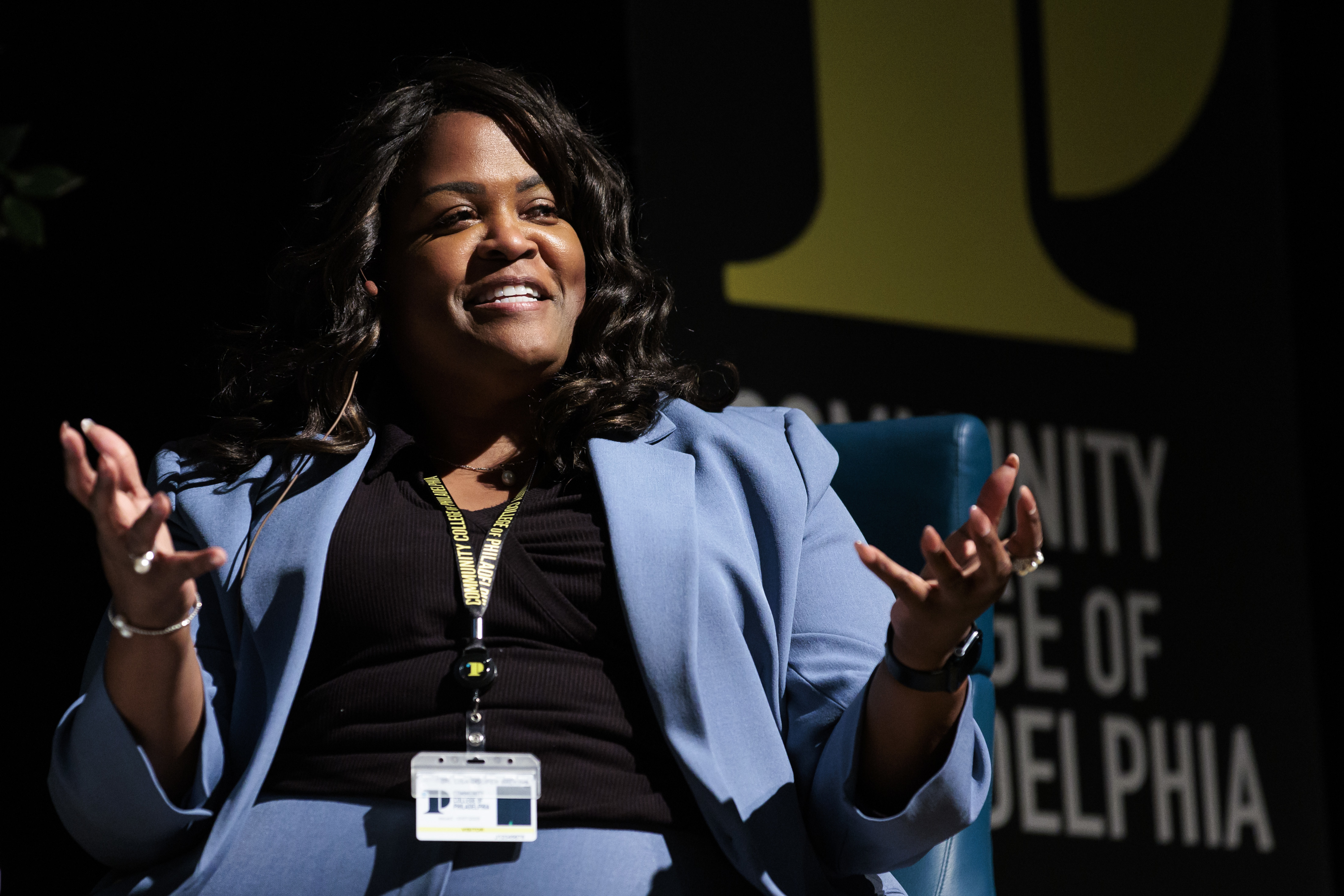
    Lisa Cooper Wilkins

    Lisa Cooper Wilkins, a finalist in the Community College of Philadelphia’s search for a president, speaks at an interview forum last week.

    Lisa Cooper Wilkins touted more than 25 years of higher education experience, from faculty member to dean to her current position as vice chancellor of student affairs at City College of San Francisco — where she has worked since 2020.

    “I consider myself to be a very collaborative leader and one that leans into communication as one of the primary strategies to work effectively across constituencies,” said Cooper Wilkins, a first-generation college student who grew up in a single-parent home.

    Cooper Wilkins, who previously worked at San Joaquin Delta College and the University of the Pacific, cited her background in counseling as a plus. She described herself as a “very calming presence,” which could be helpful in leading CCP out of a tumultuous time.

    She is the only candidate who is a native of the Philadelphia region, having attended the Philadelphia High School for Girls and later CCP.

    Cooper Wilkins also served as a dean at CCP from 2008 to 2010, during which time she said she made a point of visiting the regional centers. She said she would continue to devote time to them if she became president.

    “I’ve worked at institutions where, unfortunately more often than not, they feel like an afterthought,” she said.

    She also was assistant director and senior counselor for student support services at Drexel University in the mid-1990s.

    Cooper Wilkins acknowledged that her fundraising experience has been “limited” but that she had some experience during her time at CCP.

    She received her bachelor’s degree from Goucher College, master’s degrees from Marymount College and Villanova University, and her doctoral degree in higher education administration from George Washington University.

    Alycia Marshall

    Community College of Philadelphia interim President Alycia Marshall speaks at commencement in May.

    Alycia Marshall, who has been serving as interim president since Generals’ departure, leaned heavily on her experience in the role and how she stepped in to keep the college running smoothly just weeks before commencement.

    “Having someone who is understanding about the particular state that the institution is in, who sees where the opportunities are, who is supportive and about ensuring a culture of inclusivity, of collaboration … would be a critical piece” for the next president, she said during an interview session.

    Marshall, who was the college’s provost and vice president for academic and student success for nearly three years before becoming interim president, said she would lead both internally and externally, focusing on faculty and staff satisfaction as well as building relationships with funders and donors.

    She said she has already met more than 20 City Council members and state legislators.

    She acknowledged that an employee satisfaction survey that she commissioned when she became interim president showed low morale and promised to address it.

    “Things that would be a priority to me [are] insuring transparency and frequent communication,” she said.

    A native of Maryland, Marshall started her career as an adjunct professor at Anne Arundel Community College in Maryland, near Annapolis, and later became a full tenured professor and chair of the mathematics department. She was promoted to associate vice president at the Maryland community college, where she spent 23 years and founded the African American Leadership Institute.

    Marshall said that over the last six months she learned to be comfortable not knowing what will happen next. After a board meeting earlier this month, a consultant who is the liaison to the presidential search committee said on a still-active microphone that Marshall had not been well-received on campus.

    Marshall said at the interview session that she did not agree with that and that she has developed relationships with people across the college.

    “If you have worked directly with me, you will know I am here for the students and I am here to support faculty and staff,” she said.

    Marshall received her bachelor’s in mathematics from the University of Maryland, Baltimore County, her master’s in teaching from Bowie State University, and her doctorate in mathematics education from the University of Maryland.

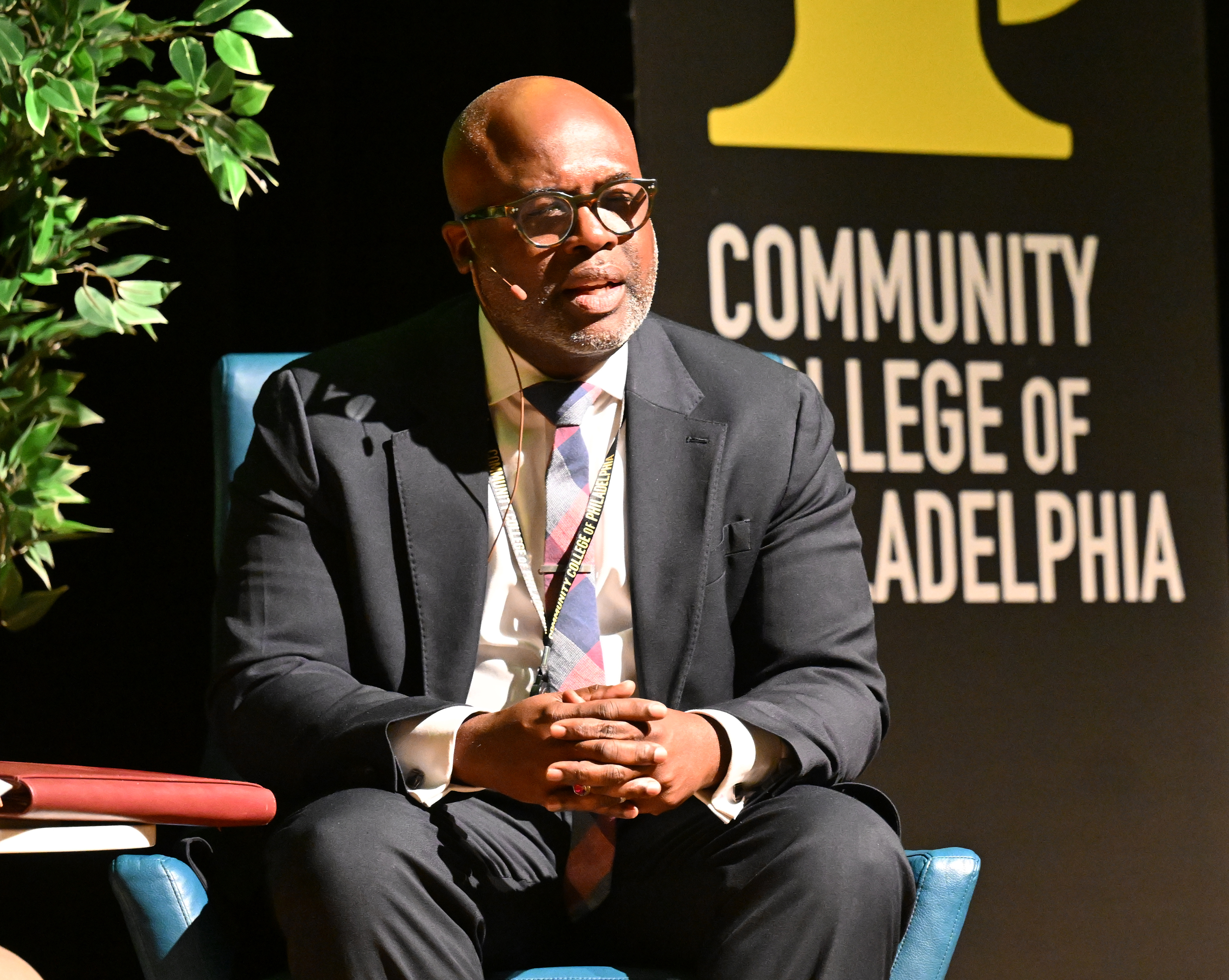
    Jesse Pisors

    Jesse Pisors, a finalist applying to be president of the Community College of Philadelphia, speaks at an interview forum on Oct. 9.

    Jesse Pisors most recently served as president of the 10,000-student Pasco-Hernando State College, a community college in the Tampa Bay area, but resigned after less than 18 months on the job.

    His resignation came after Florida Gov. Ron DeSantis’ Department of Government Efficiency found that the college was doing poorly in student retention and the board accused Pisors of hiding information, according to news reports.

    “The political situation in Florida had devolved to a point where I felt I would not be able to continue to be effective as president,” Pisors told the audience at one campus meeting.

    He acknowledged about a half percentage point drop in retention.

    “That is exactly why one of our top 10 priorities in the strategic plan … had improving retention,” he said. “We were working on that.”

    But he said he’s still proud of his time there, noting the creation of a strategic plan and an increase of more than 8% in full-time equivalent enrollment.

    Citing the need for CCP to bring in more money at a time when public funding is tight, Pisors touted his experience in fundraising and marketing, noting his previous positions as a vice president at Texas A&M University-San Antonio and the University of Houston. He also had served as executive director of development and alumni relations at the University of Pittsburgh.

    Though he is the lone white candidate, he noted that he had served as a principal of a school in Mexico is fluent in Spanish, and is married to a native of Mexico.

    Pisors has 27 years of educational leadership experience, from kindergarten through the college level, which he said gives him “wide exposure” and broad “understanding.”

    “Community colleges kind of live in the middle,” said Pisors, who got his bachelor’s in history from Oral Roberts University, a master’s from Oral Roberts, and his doctoral degree in higher education administration from Texas Tech University. “They reach back into high school. They reach forward into universities.”

    Jermaine Wright

    Jermaine Wright, a finalist for the presidency of the Community College of Philadelphia, speaks during his interview session with faculty, staff, students, and board members on Oct. 13.

    Jermaine Wright, who is vice president for student affairs at City University of New York-Herbert H. Lehman College, said he was drawn to CCP by its mission and its students who have a similar background to his.

    He said he’s a first-generation college student and an immigrant who became a naturalized citizen. His father worked as a porter. and his mother and grandmother cleaned office buildings.

    “I am CCP,” said Wright, who has worked at Lehman for five years and previously held administrative positions at Southern Connecticut State University and City University of New York. “CCP is me.”

    He cited his experience in workforce development and work in programs that help underrepresented students succeed.

    Asked to describe his vision for the college, he cited increasing enrollment, finding different funding streams, ensuring academic excellence, and creating a more inclusive campus environment.

    But he cautioned that any new vision would have to be developed with faculty and staff to get full support.

    He also cited experience in fundraising and said success can be achieved by knowing where people are and meeting them there.

    “We need to have constant face time,” he said.

    Wright said he wouldn’t mind if members of the board of trustees showed up at the college a lot.

    “That means they care just as much as I do,” he said.

    Once an adjunct lecturer at Rutgers-Newark, Wright got his bachelor’s degree from Binghamton University, a master’s from CUNY, and his doctoral degree in public administration from Rutgers-Newark.

  • A Montco woman who let her son waste away in her apartment sentenced to decades in prison

    A Montco woman who let her son waste away in her apartment sentenced to decades in prison

    A Montgomery County judge sharply rebuked a Dresher woman Monday before sentencing her to 25 to 50 years in state prison in the murder of her son, telling her that she failed in her fundamental duties as a parent by allowing him to waste away to just 59 pounds.

    During the hearing before Judge Wendy Rothstein, Sherrilynn Hawkins, 43, wept, calling Tylim Hatchett her “first love” and best friend while pleading guilty to third-degree murder, neglect, and related crimes in his September 2024 death.

    She described how the 21-year-old fought all his life to overcome cerebral palsy, blindness and other debilitating medical issues, and required constant care to, among other things, feed himself.

    “I made Tylim a promise to keep him safe, and after 21 years, I failed and broke that promise,” Hawkins said. “And I will always be sorry for that.”

    Despite Hawkins’ professed remorse, prosecutors said, in the last three weeks of her son’s life, she frequently left him alone in her apartment, sometimes for 24 hours at a time.

    All the while, she accepted funding from Aveanna, a home healthcare agency, to work as her son’s primary caregiver. She also included Lorretta Harris, one of her friends, on that payroll to receive a portion of the money to care for him part-time.

    In reality, neither woman spent much time with Hatchett and falsified their records with the agency, despite being paid more than $48,000 combined, according to evidence presented in court Monday.

    Prosecutors said Tylim Hatchett weighed just 59 pounds when he died last September.

    Harris, 49, pleaded guilty to neglect of a care-dependent person earlier this year. Her sentencing is scheduled for December.

    In handing down Hawkins’ sentence Monday, Rothstein said Hawkins had betrayed her son’s trust and, even worse, had prioritized scamming Aveanna for financial gain.

    “You utilized state funding and let your child die,” she said, telling Hawkins that her conduct was despicable. “And you did all this while driving around in a Mercedes.

    “I’d like to say more, but I’m left speechless that a parent could do this.”

    Hatchett was found dead Sept. 18, 2024, inside his mother’s apartment at the Residences at the Promenade, according to investigators. Police were called to the apartment by the man’s father. An autopsy found that he was severely malnourished and dehydrated.

    Evidence pulled from Hawkins’ phone by detectives showed that in the weeks leading up to her son’s death, she spent the majority of her time with her younger son, whom she brought with her to her boyfriend’s house in Philadelphia, according to the affidavit or probable cause for her arrest.

    During this time, she texted Vernon Hatchett, her son’s father, telling him “this might be it” for their son, and later that she would let him know when to make funeral arrangements.

    The elder Hatchett, 40, has been charged with neglect, abuse, and conspiracy. However, he has been a fugitive from justice for more than a year and is currently being sought by the U.S. Marshals Service.

    Hawkins also lied to concerned family members, saying she had taken her son to a nearby hospital for treatment, according to prosecutors.

    But First Assistant District Attorney Ed McCann said Monday that the only time Hawkins sought medical care for her son in 2024 was at the beginning of the year, when he weighed 90 pounds.

    Hatchett, McCann said, had lost more than third of his body weight between then and his death and had been “left alone in that apartment to die.”

    “It’s horrific. It doesn’t have anything to do with being a parent; it has everything to do with being a human being,” he said. “I think the defendant failed at the fundamentals of being a human being by allowing this to happen.”

    Hawkins’ family members and friends took turns Monday imploring Rothstein to be lenient. They told the judge that Hawkins had struggled with fertility issues in her youth and that she had endeavored to keep her son healthy and happy through his many medical issues.

    They said that she had frequently asked for assistance in caring for Hatchett and that those pleas had been ignored.

    Hawkins’ attorney, Joseph Schultz, said she is a caring and loving mother that had simply become overwhelmed.

    “Today, she took responsibility, and she’s going to have to live with this the rest of her life,” Schultz said.

  • Keon King charged with arson for setting car on fire connected to Kada Scott’s kidnapping, prosecutors say

    Keon King charged with arson for setting car on fire connected to Kada Scott’s kidnapping, prosecutors say

    Prosecutors on Monday charged Keon King, the man accused of kidnapping Kada Scott from her workplace earlier this month, with arson — and said they soon intend to charge him with murder for allegedly killing Scott, then setting on fire the car they say he used to abduct her last week.

    District Attorney Larry Krasner said that he expects to charge King with murder in connection with Scott’s death but that officials are awaiting additional information from the Medical Examiner’s Office and are working to “precisely confirm everything we need” to do that.

    Prosecutors also said that they “have reason to believe that other people may have been involved” or helped King conceal evidence after Scott, 23, was killed and that investigators are working to identify additional suspects.

    Scott’s cause of death remains under investigation.

    Philadelphia District Attorney Larry Krasner said he intends to charge Keon King with murder, but awaits additional information before formally filing the charges.

    King, 21, turned himself in to police last week to face charges of kidnapping, stalking, and related crimes after investigators linked him to the Oct. 4 disappearance of Scott. Cell phone data showed King was the last person in touch with Scott before she walked out of the Chestnut Hill nursing home where she worked and never returned, officials said.

    After a two-week search for the Mount Airy woman, police on Saturday found Scott’s body, buried in a shallow grave in the woods behind the abandoned Ada H.H. Lewis Middle School in East Germantown.

    “There will be additional charges that are coming,” Krasner said at a news conference Monday.

    In the meantime, Krasner said his office would charge King with arson, conspiracy, and related crimes for setting a black Hyundai Accent on fire near 74th Street and Ogontz Avenue on Oct. 7.

    Assistant District Attorney Ashley Toczylowski said investigators believe that King used that car — which had been stolen from the 6600 block of Sprague Street in East Mount Airy on Oct. 3 — to kidnap Scott on the night of Oct. 4.

    Investigators believe Scott was likely killed within about 30 minutes of leaving work and ending up in King’s car, said law enforcement sources who spoke on the condition of anonymity to discuss an ongoing investigation.

    The extent of her relationship with King remains unclear, officials said.

    Surveillance footage recovered late last week showed that the Hyundai Accent arrived at the Awbury Recreation Center around 10:30 p.m. the night Scott disappeared, the sources said.

    Julius Peden, 5, and Jaihanna Williams Peden (right), 14, pause at a memorial for Kada Scott at the Ada H. Lewis Middle School on Oct. 20, not far from where her body was found on Saturday. The siblings were brought by their grandmother Deborah Peden who said she felt the need to come. “My heart is broken. I feel like I lost someone in my family,” she said. “My daughter is a young Black woman. They are being targeted.”

    King left the car in the parking lot, the sources said, then returned two days later — when video appears to show him moving what detectives believe was Scott’s body from the vehicle. Her corpse was buried at least 100 yards away in the woods behind the school next door.

    The next day, Toczylowski said, King set the car ablaze.

    Toczylowski said King’s cell phone location data shows he was at the recreation center when the car arrived Oct. 4 and again when he returned two days later. It also shows him in the area where the car was burned three days later, she said.

    Detectives learned of the torched car last week after police received a tip that a car connected to her disappearance had been set on fire on the West Oak Lane block, she said. The car had already been towed, crushed, and sent to a junkyard when authorities learned of it, she said.

    Assistant District Attorney Ashley Toczylowski will lead the prosecution again Keon King.

    When investigators recovered video from the recreation center, she said, it confirmed that the car was used in the crime.

    Krasner asked for the public’s continued help with the investigation, which he said “is developing almost hourly.”

    “The community has already done tremendous work in aiding progress with this investigation,” he said. “We are simply asking for more.”

    Scott’s family on Monday released their first statement since her body was found, thanking the public for its help in the investigation and asking for privacy as they grieve.

    “Our hearts are shattered, yet we are deeply grateful for the outpouring of love, support, and prayers from people across the nation and around the world,” her parents wrote.

    “Kada was deeply, deeply loved. Her light, kindness, and beautiful spirit will forever remain in our hearts,” they said.

    They said they trust that the police department and district attorney’s office will get justice for their daughter, and that they are thankful for the “unity, leadership, and love” that has surrounded them so far.

    “Please honor Kada’s memory by showing kindness and care to one another,” they wrote, “just as she did every day of her life.”

    City Councilmember Anthony Phillips said his office is collecting donations to support Scott’s family, including toiletries, self-care and comfort products, and gift cards for grocery and meal delivery services.

    Items can be dropped off at his office at 1514 Wadsworth Ave. from Tuesday through Friday, 8:30 a.m. to 4:30 p.m., and Saturday from 9 a.m. to noon. For questions, he said, call 215-686-3454.

    Community members gather for a candlelight vigil in memory of Kada Scott on Monday. Neighborhood residents said they want the abandoned school torn down.
  • The wooded Malvern-area home of a famous Main Line builder is for sale for nearly $2 million

    The wooded Malvern-area home of a famous Main Line builder is for sale for nearly $2 million

    A Chester County home full of beautiful woodwork and secluded on five acres of land is for sale for nearly $2 million.

    Advertised as the “McElroy House” in an ode to the late builder Robert McElroy, the 4,300-square-foot property near Malvern hit the market last week for $1.99 million.

    This Willistown Township home, for sale for nearly $2 million, was designed by Robert McElroy and has a wing that was devoted to his wife Annamaria’s art studio.

    McElroy, who is credited with building more than 200 homes around the Main Line, designed and built this home for his own family in 1975, according to Marion Dinofa, Compass RE Realtor and modern home specialist.

    Tucked far off Rabbit Run Road in Willistown Township, McElroy’s three-bedroom, 3½-bath home features a contemporary design and floor-to-ceiling windows that let in abundant natural light.

    “I see a lot of really cool houses, but this one, almost more than any other house, is truly like you’re living in a work of art, between the craftsmanship of the woodworking, the views through the windows that are ever changing with the seasons, and the design of the home itself,” Dinofa said.

    Wooden details make Robert McElroy’s former home in Willistown Township unique, said Realtor Marion Dinofa.

    Almost every piece of wood in the home was crafted by Horace Hartshaw, who collaborated with the renowned sculptural furniture maker Wharton Esherick. This includes everything from the wood doors to the custom kitchen cabinets to the staircases, including a spiral one at its center.

    McElroy wasn’t the only artist who resided in the home: His wife, Annamaria, a painter and sculptor, also left her mark, showcasing her artwork on the walls and using a wing of the home as her studio.

    Dinofa noted that the house also includes a detached two-story garage that could be converted into more creative space.

    The secluded home features custom wood features that were crafted by renowned artist Horace Hartshaw and lots of windows.

    Between Robert’s vision and Annamaria’s artistic touches, their home “was a labor of love,” Dinofa said. “And it’s really well preserved. You can tell it hasn’t changed much.”

    Annamaria and Robert lived at the home into their 90s, Dinofa said. They died in 2023 and 2024, respectively. Dinofa said the home is being sold by their daughter, Loretta.

    Dinofa said she could see the property being bought by artists or by adventurous young parents who want to raise their children amid nature.

    “It would be such a fun place for kids to play outside,” with a stream in the backyard and plenty of space to run around, Dinofa said. “I can only imagine the wildlife that they have viewed from that house.”