Category: News

Latest breaking news and updates

  • Mayor Parker defends decision to host July 4th Parkway concert despite dangerous heat and high price tag

    Mayor Parker defends decision to host July 4th Parkway concert despite dangerous heat and high price tag

    Mayor Cherelle L. Parker on Wednesday defended the city’s upcoming July Fourth concert, a seven-hour outdoor spectacle featuring performances from Christina Aguilera, Jill Scott, The Roots, and more, amid concerns over the nearly 100-degree forecast and revelations that the event will cost taxpayers millions more than in years past.

    The city has dealt with high temperatures before and has battle-tested personnel and protocols prepared for the evening, Parker told reporters at a news conference in front of the stage at the foot of the Philadelphia Museum of Art steps.

    She also addressed the detractors head on.

    “I do not apologize to anyone about making sure that the city of Philadelphia, as the sixth-largest city in the nation, the birthplace of democracy, we were going to have a celebration that is fitting to and for our historical significance and prominence,” Parker said. “One that could be seen, respected, and honored, not just in our city and commonwealth and nation but in the world.”

    Parker described the concert as the largest July Fourth concert in the city’s history. For an occasion as momentous as the nation’s 250th anniversary in the city that bills itself the birthplace of America, Parker said Philadelphia must rise to the occasion and prove it can achieve ambitious undertakings.

    Parker said her administration scaled up the experience, including moving the stage back to accommodate an estimated 300,000 concertgoers, and made the stage larger.

    “We won’t get a second chance to do this over again, Philadelphia,” Parker said. “We only turn 250 years old once in a lifetime.”

    Ground crews set up speakers on the stage on Wednesday in preparation for the July 4 concert expected to draw thousands to the Benjamin Franklin Parkway.

    Parker recalled feeling the mounting pressure to prove Philadelphia could rise to the occasion of honoring the nation’s 250th anniversary shortly after the start of her tenure as mayor.

    “‘Philadelphia lacks ambition. They’re thinking too small. We need a leader. Where is the legacy project?’” Parker recalled from the discourse of the time. “The critics were right. Philadelphia, as the birthplace, we couldn’t do what every other city was doing. We couldn’t just do something that was average, something that was mediocre. What we did had to be a reflection of this moment and our history.”

    Parker’s news conference came hours after The Inquirer reported online that this year’s July Fourth concert will cost taxpayers millions more than in years past because the mayor’s administration hired ESM Productions, a for-profit company, to put on the annual show. For years, the concert has been produced by Welcome America, a nonprofit established by the city.

    The Inquirer reported that the city is set to pay ESM $15.5 million to put on the show, and that last year’s iteration of the Welcome America concert cost the organization about $3 million.

    Parker defended ESM and its founder, Scott Mirkin, as “the gold standard in planning large-scale global events, not just in America but across the world.” And she vowed that the city would produce a “fiscal impact report” after the event to account for how much money the city spent on this year’s festivities.

    Mayor of Philadelphia Cherelle L. Parker speaks during a news conference under a tent Wednesday, July 1, 2026, in Philadelphia, outlining public safety and transportation plans ahead of a July 4 concert expected to draw thousands to the Benjamin Franklin Parkway.

    She also noted that former Mayor Jim Kenney put his own stamp on the annual July Fourth concert when he took office in 2016 — and took some heat for it. The Roots had headlined the concert since 2009, but Kenney’s administration went a different direction and The Roots were sidelined.

    Roots drummer Ahmir “Questlove” Thompson didn’t mince words at the time, writing on Facebook that the decision was “arrogance in the HIGHEST order courtesy of your new leader.”

    When Parker took office, she knew she wanted the spotlight back on the beloved local hip-hop group.

    “I’m proud to have The Roots back home,” Parker said.

    In terms of weather and safety, the city has proven this summer that it can host large-scale events in the heat seamlessly, said Philadelphia Police Commissioner Kevin J. Bethel.

    The city has already hosted five World Cup games, which have gone off without a hitch, Bethel said. For the July Fourth event, the department will be executing one of its largest deployments since the papal visit in 2015. That will include hundreds of officers across Center City and many more at the stadium and along the Parkway.

    “I want everybody to come and have a good time. Don’t mess up the party,” Bethel said.

    In order to keep people cool, the city will run 40 air-conditioned cooling centers, 150 pools and spray grounds, enhanced homeless service outreach, and extra fire department medics, said Dominick Mireles, Philadelphia’s deputy managing director for community safety. Along the Parkway, there will be misting fans and shade structures, he added.

    Parker said she’s confident every Philadelphian interested in participating will be able to do so safely and will look back on the day fondly.

    “I want people to remember where they were when America turned 250 years old and what we did here in the place when it all happened,” Parker said.


  • At Hoagie Day, visitors embrace free sandwiches — and the crowds

    At Hoagie Day, visitors embrace free sandwiches — and the crowds

    The hoagie, it seems, not only can be a meal but a civic instrument: pretext and reason to bring huge crowds of people together ahead of July 4th during Wawa Welcome America festivities.

    Organizers said 30,000 turkey hoagies were distributed in front of the National Constitution Center Wednesday for the annual event. The promise of a free sandwich prompted that particular American phenomenon — one of the physical vestiges of the public commons — the manifestation of the free-food zeitgeist.

    Dion Clark said, succinctly, what many in line seemed to be saying in one form or another: “I want to be with the people.”

    Attendees relax and enjoy their free hoagies at Independence Mall during the Wawa Hoagie Day.

    Clark and her husband, who is vegetarian — Wawa was offering only turkey hoagies — had traveled from North Carolina to spend July Fourth in Philadelphia. Asked why they had come, Clark gestured around her: the National Constitution Center in front of her, the Liberty Bell nearby, the city’s founding monuments all around.

    For others, like Jim Elliott, the answer was simpler. He lives nearby, and had come for the free hoagies, although, he added, “the hoagies are not the best.”

    Sheylin Walker has been coming to Wawa Hoagie Day for seven years. Every year, she said, she makes sure to wake up by 9 a.m. so she can arrive by 10 before the noon hoagie distribution. “I love the crowd,” she said. “I love the sight — all of these people that are here.”

    For some recent transplants to Philadelphia, the festival seemed to promise not just a free sandwich, but a kind of initiation. Getza Solana, who is 19, and recently moved from Houston to study at Thomas Jefferson University, said that to know Philadelphia, she felt she had to know the hoagie.

    Outside the National Constitution Center, where lines of hoagie tents had been set-up, there is a contained but lush stretch of field: bunches of summer flowers, vines climbing the Visitor Center, a little green relief from the asphalt and the July heat.

    There, people opened their red Wawa bags; some put on the red, white, and blue baseball hats and ate their hoagies. Pop music played from the speakers. The heat felt more bearable. And away from the crush of the line, it became clearer what many had come for: not only the sandwich, but an American picnic of sorts — friends, family, strangers, and the brief pleasure of being among fellow hoagie-eaters.

  • 31 people arrested for running drug ring in Camden County Jail, prosecutors say

    31 people arrested for running drug ring in Camden County Jail, prosecutors say

    Thirty-one people were arrested for trafficking fentanyl and other illegal drugs inside the Camden County Jail, authorities said Wednesday, ending what they called a “complex and potentially far-reaching criminal enterprise.”

    The investigation, dubbed Operation Paper Trail, began in October 2025, prosecutors said, and led to the arrests of suspects both inside and outside the jail.

    “The takedown of Operation Paper Trail disrupted a dangerous network responsible for distributing illicit substances and facilitating criminal activity,” Camden County Prosecutor Grace C. MacAulay said in a statement.

    “This operation not only enhanced public safety but also helped prevent further harm, protecting our communities and sparing countless individuals from the devastating effects of substance abuse,” she said.

    The drug ring operations. prosecutors said, were run in part by Howard Dunns of Millville, N.J.

    Dunns, 50, who was incarcerated at the Cumberland County jail, was a lead organizer of the drug ring, coordinating with Camden inmates who peddled fentanyl, synthetic marijuana, PCP, and cocaine at the facility, prosecutors said.

    Dunns was charged with two counts of conspiracy to possess with the intent to distribute a controlled dangerous substance. It was not immediately clear whether he had hired an attorney.

    Two Camden County Jail inmates, Wilfredo Santiago, 31, of Vineland, and Kyle Jones, 31, of Millville, were also accused of participating in the scheme by selling illegal substances to other inmates.

    That included at least 58 grams of synthetic marijuana, which investigators seized in March, according to prosecutors.

    The men were each charged with one count of conspiracy to possess with the intent to distribute a controlled dangerous substance.

    The remaining 28 people were charged with drug crimes, many for possessing illegal substances.

    Prosecutors said Santiago and Jones managed to sneak the drugs into the jail using paper that had been laced with the substances and marked as confidential legal correspondence between inmates and attorneys.

    Detectives with the Camden County Department of Corrections learned of the drug ring in late 2025 after intercepting an envelope addressed to a 21-year-old man who was incarcerated in the jail, prosecutors said.

    Detectives found that the supposed legal correspondence was inauthentic, and the letter later tested positive for traces of cocaine.

    In addition to charging the inmate with a drug offense, detectives arrested the sender, a 32-year-old Camden man, and charged him with similar crimes.

    He was later placed in custody in the Camden County Jail, and within months, prosecutors said, he had instructed an associate to traffic drugs into the facility through similar means.

  • Camden is a winner in New Jersey’s $60.7B budget. Who are the losers?

    Camden is a winner in New Jersey’s $60.7B budget. Who are the losers?

    Gov. Mikie Sherrill signed the New Jersey budget for fiscal year 2027 Tuesday night, shortly before the clock ran out on the constitutionally mandated deadline.

    The budget ranks as the largest in state history, but Sherrill also contends it is the most “fiscally responsible” in decades in part because it fully funds the state pension program and doesn’t come with widespread tax increases for residents.

    Lawmakers approved the budget on Tuesday after adding millions in legislative add-ons Sunday night, a move that countered Sherrill’s earlier vows to change the culture in Trenton. But she softened her stance as the deadline neared and she conceded that lawmakers know their districts best.

    South Jersey Democrats defended the spending, which Republican lawmakers criticized as “pork.”

    “I know sometimes it gets disparaging names, but I think one of our responsibilities as elected officials is to be responsive to the needs of our communities,” said Sen. Troy Singleton, a Burlington County Democrat.

    But the last-minute shuffle didn’t result in the transparency Sherrill originally promised, with some legislators saying they weren’t sure of the details they were voting on. The budget passed mostly along party lines in the Democratic-dominated legislature. Sherrill and legislative leaders touted record funding for schools and property tax relief programs.

    “I know the process needs work,” Sherrill said at a Tuesday night news conference. “It takes too long. It could be much more transparent, but we took steps in the right direction this year.”

    Here are some of the winners and losers in the budget.

    Camden County Commissioner Director Louis Cappelli, Jr., left, with Gov. Mikie Sherrill and Camden Mayor Victor Carstarphen, right, at SoccerFest26, the World Cup fan fest at Wiggins Waterfront Park in Camden on Friday.

    Winner: Camden City and County

    South Jersey obtained funding for projects across the region with Camden scoring one especially big-ticket item: $9 million for property acquisition and demolition. The funding is for a county-run program focused on removing vacant, unusable, or otherwise deemed dangerous properties in the city.

    Louis Cappelli Jr., the director of the Camden County Commissioners, said in an interview that the county has demolished more than 1,200 residential and commercial buildings over the past decade as part of this effort, mostly with state money. He said the program’s mission is to encourage the city’s redevelopment.

    “The city is in desperate need of new housing, especially market-rate housing, and by creating opportunities for development on these properties, we believe we will draw the interest of residential developers to build in Camden City,” he said.

    The city of Camden was also allocated $250,000 for a statue of Martin Luther King Jr., which Sherrill promised the city ahead of her inauguration. This project was a priority for the governor, who systematically struck a pen through legislative projects but dedicated funding to the statue in her proposal earlier this year.

    Several organizations that serve Camden city and county received hundreds of thousands of dollars in the budget.

    The Camden Coalition of Healthcare Providers received $500,000 for a program that connects emergency department patients to outpatient behavioral care and $750,000 for a program that helps people experiencing homelessness obtain housing. Joseph’s House, a homeless shelter in the city of Camden, received $600,000, and a separate spending bill also sends $650,000 to a new construction homeownership project.

    The budget also allocates $300,000 for job training for youth and young adults, $75,000 for a program dedicated to improving school attendance in the city of Camden, and $25,000 for a new county program that supports formerly incarcerated people reentering their community.

    It also includes $3.2 million for structural improvements for a bridge at Route 30 and Somerdale Road and $12.1 million for the Camden County LINK Trail, a planned 34-mile multiuse trail.

    Loser: High-income seniors

    Senior homeowners who earn between $200,000 and $500,000 a year will no longer qualify for the nascent Stay NJ property tax credit program under the new income cap. They just began receiving checks for the program this year.

    Sherrill proposed scaling back the expensive program in her budget proposal earlier this year, which caused some tension because the new program was championed by Assembly Speaker Craig Coughlin, a Middlesex County Democrat and a key budget negotiator.

    But Sherrill and legislative leaders found a compromise by giving higher payments than she proposed for those who make less money, and an even lower income limit than she proposed for the program.

    Qualifying taxpayers will get refunded up to half their property tax bill up with maximum refunds ranging from $4,000 to $6,500, depending on their income, with those earning more getting less.

    Rowan University’s Shreiber School of Veterinary Medicine Tuesday, April 14, 2026.

    You win some, you lose some: Rowan University

    Rowan University is receiving less money than it did this year, but significantly more money than Sherrill initially proposed. At the end of the day it’s a win for the university, which saw significant cuts reversed.

    Sherrill’s initial proposal included about $125 million, but legislators brought the total up to nearly $135 million — a drop from the $155 million the state gave the school this year.

    Sherrill zeroed out funding for Rowan’s new veterinary school but legislators successfully got $6.2 million for the program — still less than the $8 million it received this year and a far cry from the $20 million the school requested.

    State Sen. John Burzichelli, a Gloucester County Democrat, said the money is enough for the school to at least “keep the lights on,” for the veterinary school and the medical school funding is “sound.”

    Sherrill also proposed cutting all state funding for Virtua Health College of Medicine and Life Sciences. Legislators restored $2 million to the program — half of what it received this year and much less than the requested $12 million.

    The Rowan-Virtua Child Abuse Research Education and Service Institute (CARES) program, which provides medical and mental healthcare to children who have experienced abuse, had all its $1.85 million funding restored after Sherrill initially zeroed it out.

    In anticipation of the governor’s proposed cuts, Rowan sent employees layoff notices and announced the closure of its Vineland office. A union representing CARES employees has called on Rowan to reverse these changes.

    But Rowan spokesperson Jose Cardona said the university “will evaluate next steps and very soon determine the most responsible path for operations, staffing, and long‑term sustainability.”

    The bill that passed alongside the budget with funding from this fiscal year sent nearly $15 million going to Cooper Medical School of Rowan University and support to Cooper University Hospital. That bill also sends $5 million to Cooper University Healthcare’s South Jersey cancer program, which got an additional $27.4 million in the new budget.

    Winner: Parents

    Legislative leaders secured a 25% increase in the state’s child tax credit program, which is claimed by 217,000 tax filers with children, according to the governor’s office.

    The expansion, which will be in place over the next three tax years, bumps each tax credit tier by 25%. So, for example, a household that previously got the highest tier of $1,000 will receive $1,250 and households that got $800 will get $1,000.

    Sherrill, a former member of Congress and mother of four, said she saw positive impacts of the national tax credit, “giving parents more money for childcare and summer camps, so their kids can thrive while they’re at work.”

    Gov. Mikie Sherrill talks with state Sen. Troy Singleton (D., Burlington) as she arrives to meet with the South Jersey business community for a fireside chat event hosted by the Chamber of Commerce of Southern New Jersey in Mt. Laurel Monday, March 16, 2026.

    Loser: Businesses

    What Sherrill touted Tuesday night as closing “corporate loopholes” and asking employers “to pay their fair share in healthcare,” the business community saw as an attack.

    The budget includes Sherrill’s proposals to introduce new fees for businesses with at least 50 employees on Medicaid, an effort that was led in part by Assembly member Carol Murphy, a Burlington County Democrat, in the legislature. It also imposes limits on two methods businesses use to deduct losses from their taxes.

    Hilary Chebra, the director of governmental affairs for Chamber of Commerce Southern New Jersey, criticized these policies, as well as a bill passed by the legislature that bans food surveillance pricing as it’s written.

    “Employers aren’t reacting to a single tax increase or one new regulation,” she said. “They’re responding to all of it at once.”

    She said these measures will have more severe consequences in South Jersey for small and family-owned businesses that compete with businesses in Pennsylvania and Delaware.

    Tom Bracken, the president & CEO of the New Jersey Chamber of Commerce, said businesses were given “minimal support” and that the budget did not focus on supporting economic growth. He said the policies Sherrill championed in the budget “send the wrong message” to employers that New Jersey should be working to attract.

    “The negative financial and reputational consequences of these policies will make it more difficult for New Jersey to be competitive — and competitiveness is essential if the state economy is going to grow,” he said.

  • South Jersey school board again rejects $27K merit pay for its embattled superintendent

    South Jersey school board again rejects $27K merit pay for its embattled superintendent

    Embattled Washington Township school Superintendent Eric Hibbs has lost another battle with the South Jersey school system to get $27,000 in merit pay.

    A motion to award Hibbs the bonus pay for performance failed by a 4-3 vote with two abstentions at a contentious meeting Tuesday night. Five favorable votes are needed for adoption.

    This was the third time since August that the nine-member board has not approved the merit pay, likely setting up another legal showdown between Hibbs and the board. He has a pending whistleblower lawsuit against several board members.

    Hibbs has said he had met four of the five goals approved by the board and listed with his contract for the 2024-25 school year. He earned $220,375 during the 2023-24 school year.

    The board voted on the request, with little public discussion. Hibbs did not comment at the meeting. He did not respond to a message seeking comment Wednesday.

    In order to vote, the board had to invoke a rarely used “doctrine of necessity” because it otherwise would not have a quorum. Six of nine members have a conflict of interest with Hibbs, whom they suspended last year until he was reinstated by a judge. The board remains roiled by infighting over its superintendent.

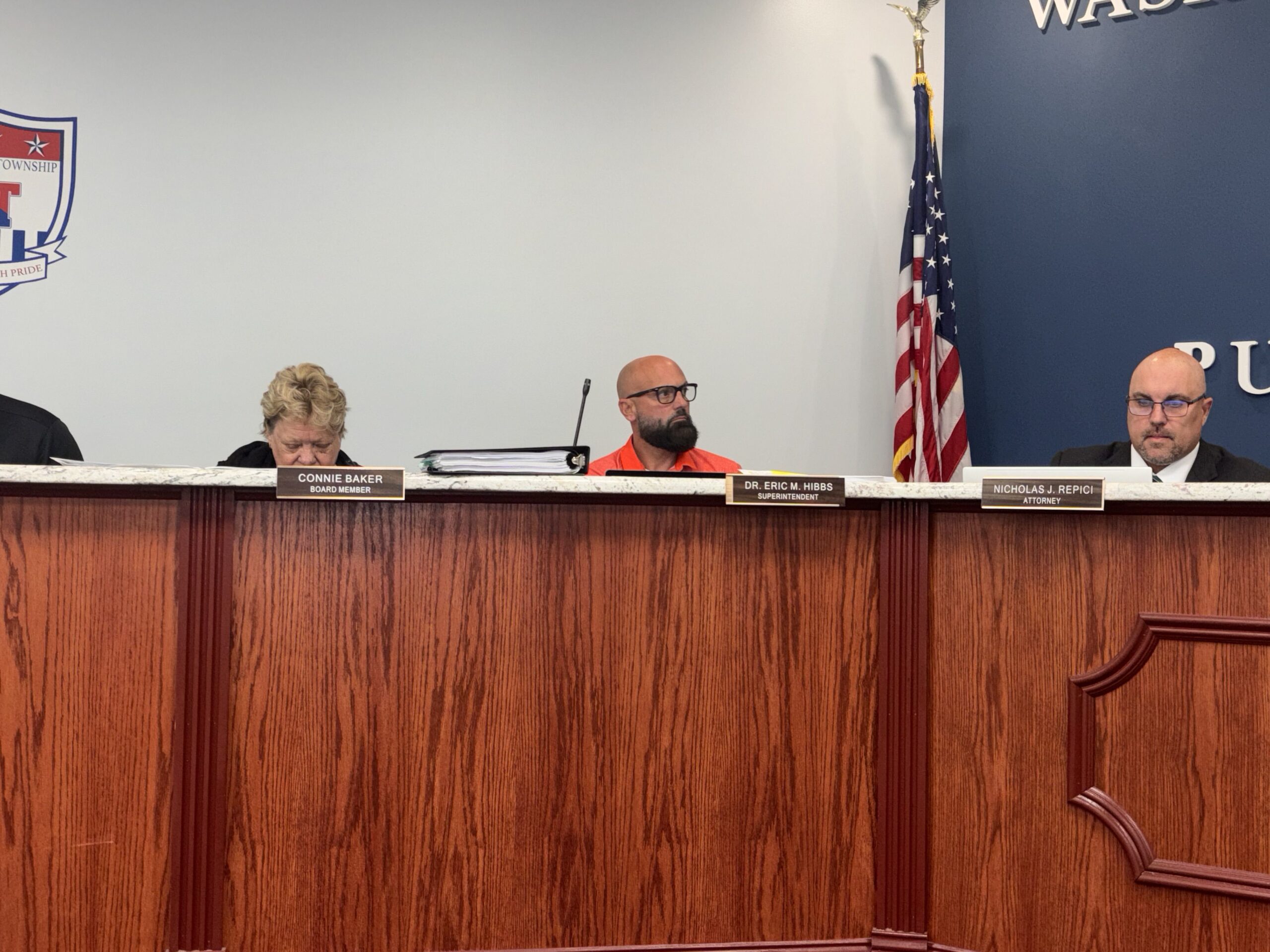
    Washington Township School Superintendent Eric Hibbs (middle) listens during a school board meeting Tuesday night.

    Here’s what’s to know about the situation:

    Why is Hibbs seeking merit pay?

    Hibbs initially requested the merit pay last August, five months after he was suspended by the board with pay. He was reinstated in July after a judge found that the board had violated the Open Public Meetings Act when it suspended him.

    According to his contract, if he meets goals set by the board, Hibbs is entitled to an annual merit bonus of up to 14.99% of his salary. Hibbs is among the highest-paid school chiefs in South Jersey.

    Interim Executive Gloucester County Superintendent Robert Bumpus approved the merit pay, as required by state law. The board must also give its approval to disburse the funds.

    Tuesday’s motion also would have allowed Hibbs to carry over up to 20 unused vacation days in addition to receiving a $27,000 bonus.

    Hibbs has been superintendent in the Washington Township district since 2023. His contract runs through 2027.

    What were the merit goals?

    Hibbs’ goals, approved by a previous board, include completing Google training presentations, taking online professional development courses, and beefing up security processes.

    He received $25,000 in merit pay for similar goals for the 2023-24 school year, according to district records obtained by The Inquirer under N.J.’s Open Public Records Act.

    The merit pay has been an ongoing issue between Hibbs and the board and has escalated since last year. The dispute has raised questions about his fate when his contract expires. The board must notify Hibbs by December if his contract will not be renewed; otherwise, the contract automatically renews for four years.

    Why was the doctrine of necessity necessary?

    Six board members were deemed ineligible to discuss Hibbs’ employment because of conflicts, board solicitor Nicholas J. Repici said. They either have family members who work for the district or are named defendants in Hibbs’ lawsuit against the district, he said.

    The doctrine of necessity allowed the conflicted board members to participate in the vote. But they were barred from any deliberations in executive session or public discussions.

    Board vice president Terri Schechter chaired a special committee of the board members without conflicts that discussed the Hibbs matter. She brought forward the motion to approve the merit pay.

    “Any discussion?” Schechter asked.

    “We’re not allowed,” board member Julie Kozempel said. She abstained along with board President Pat Blome.

    A petition launched by a parent called for the board to invoke the doctrine and vote on Hibbs’ contract renewal. It asked those who “agree that the district needs a clean break and less expensive contract for its superintendent” to consider signing the petition, which a community member spoke about at the board meeting Tuesday night.

    What is the dispute between Hibbs and the board?

    A complaint filed by local union leaders against Hibbs with the New Jersey School Ethics Commission alleged that the superintendent provided preferential treatment to a board member’s relative by changing a failing grade in September 2023.

    The board suspended Hibbs and hired a conflict lawyer to investigate the allegations. Hibbs was eventually cleared of any wrongdoing.

    In his own ethics complaint, Hibbs accused Kozempel and board member Elayne Clancy of not following procedures when the board hired Insurance Consulting Services LLC in 2021, prior to his tenure as superintendent.

    Hibbs filed a whistleblower lawsuit in May 2025, alleging his suspension was in retaliation for raising questions about the insurance contract. He alleged that the selection procedure was “procedurally flawed.”

    His employment has remained a point of contention among school board members.

    Here are other takeaways from Tuesday’s meeting

    During public comment Tuesday, there were also emotional appeals to the board to reinstate three guidance counselor positions that were cut to help balance the budget for the 2026-27 school year.

    Several school nurses and a student also expressed concern that the district has reduced the workday for several nursing assistants in cost-saving moves. They cited health and equity concerns.

    Board members were surprised to learn that first-level French and German classes were being cut at the high school due to the budget. They were told that the classes would resume next year.

    Hibbs said the district, which enrolls about 7,200 students, faced a $10 million deficit for the upcoming school year. More cuts are likely in future years without additional revenue, he said.

    “This is the reality of where we are,” Hibbs said. “We have no other place to go.”

  • Teen accused of South Philly shooting death of Penn State student was captured in Colorado, 2nd teen remains at large

    Teen accused of South Philly shooting death of Penn State student was captured in Colorado, 2nd teen remains at large

    A teen wanted in the shooting death of Penn State student William “Billy” Schmidt in South Philadelphia last month was apprehended in Colorado, the U.S. Marshals Service said Wednesday night.

    Azzubair Outen-Fleming, 16, was taken into custody in Colorado Springs at the home of a distant relative, the U.S. Marshals Service said. The teen was being housed at the Zebulon Pike Youth Center awaiting extradition to Philadelphia.

    Earlier on Wednesday, District Attorney Larry Krasner announced the arrest of Outen-Fleming’s stepfather for allegedly hindering the police investigation into the slaying of Schmidt.

    Donte Abdulmalik, 35, was charged with hindering apprehension, obstruction of justice, tampering with evidence, and related crimes, Krasner said Wednesday.

    Authorities continue to search for Kaiseem Smith, also 16, who allegedly participated in the robbery and shooting of Schmidt, 22, just steps from his family’s South Philadelphia home on June 6.

    Prosecutors said Abulmalik helped his stepson leave the city. He is not accused of participating in the homicide.

    The teens will face charges of murder, robbery, criminal conspiracy, illegal possession of a firearm, and related offenses, Krasner said.

    He suggested that the investigation could involve others, describing the charges against the two teenagers and Abdulmalik as “a smaller part of a bigger picture.”

    “I am not telling you that these are the only people involved,” Krasner said during a news conference Wednesday. “I’m not telling you that this investigation is over or that we have all the answers yet.”

    Philadelphia police have said Schmidt was walking home when two masked people approached him. During what investigators say was an attempted robbery, one of the suspects — whom Krasner identified as Smith — shot Schmidt.

    Surveillance camera footage shows that one suspect took Schmidt’s phone, prosecutors said Wednesday, then rifled through his pockets before knocking him to the ground.

    Additional footage later shows Schmidt walking behind the suspects, before one throws a phone down the block and the other fires a bullet into Schmidt’s chest.

    Krasner declined to say whether the gun used to kill Schmidt had been recovered.

    Investigators say surveillance cameras captured the suspects before and after the shooting. One was wearing a gray hooded sweatshirt with a hand-drawn “KONFUSED” logo and a skull-and-crossbones sketched in black marker on the front, according to the footage. After the shooting, police said, both suspects fled wearing white T-shirts.

    Philadelphia police and the U.S. Marshals Service Fugitive Task Force are searching for the remaining teenager. Both agencies have offered rewards for information leading to the arrests of both teens. Krasner said Smith has ties to Philadelphia’s Point Breeze neighborhood and Delaware.

    Anyone with information may contact the U.S. Marshals Service at 1-866-865-8477 or submit a tip online through its website: usmarshals.gov. Tips can also be provided to Philadelphia police at 215-686-3334 or 215-686-8477.

  • SEPTA restores Regional Rail service after derailment caused major delays

    SEPTA restores Regional Rail service after derailment caused major delays

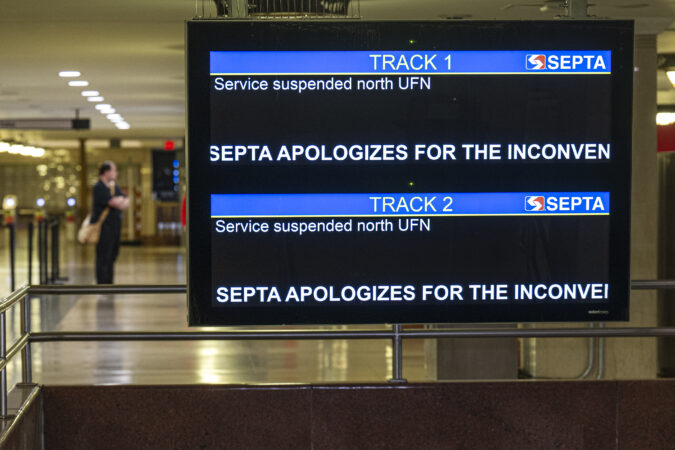
    SEPTA restored Regional Rail service at 3 p.m. Wednesday after major disruptions caused by the midnight derailment of a Manayunk/Norristown train in North Philadelphia.

    Residual delays were expected as the system recovered.

    No injuries were reported when the outbound train went off the rails at the 16th Street Interlocking shortly after midnight, according to SEPTA.

    The incident is under investigation. Crews repaired track damaged in the incident, transit agency spokesperson Andrew Busch said.

    Three suspended lines reopened: Manayunk/Norristown, with 7,779 average daily riders; Fox Chase (2,473 riders) and Chestnut Hill East (3,042 riders).

    On other lines where service was reduced, trains resumed serving all stations, Busch said.

    The accident

    The four-car train was traveling less than 15 mph and carrying 47 passengers and three crew members when the rear axle of the third car derailed just after midnight. Busch said the people aboard declined medical treatment.

    A nearby train brought the passengers to Wayne Junction Station. A shuttle bus pulled out shortly after 1 a.m. and completed the rest of the stops along the Manayunk/Norristown line, Busch said.

    SEPTA crews got the train back on the track and moved around 7 a.m.

    Rail workers also were checking the components of the interlocking, a linked system of signals and switches that allows trains to move from one set of rails to another at a junction.

    Given that the derailment happened in the overnight hours, officials so far do not think that heat was a factor, Busch said. Extreme heat can warp railroad tracks.

    Elsewhere

    The Wednesday delays came on a particularly challenging day for traversing the region. In Old City, road closures abounded as the city celebrated Wawa Welcome America’s Hoagie Day, beginning at noon.

    This is the second train derailment in as many days. A CSX freight train derailed in Bucks County Tuesday evening, causing SEPTA delays that were later resolved. There were no injuries reported.

  • Never-opened Amazon Fresh in Havertown set to become a Sprouts Farmers Market

    Never-opened Amazon Fresh in Havertown set to become a Sprouts Farmers Market

    A long-empty retail space in Havertown is set to become a Sprouts Farmers Market.

    The organic grocery chain has signed a lease for a 29,500-square-foot store in the Llanerch Shopping Center on the 400 block of West Chester Pike, according to Fred Snow, president of Brandolini Cos., which owns the complex.

    David McGlinchey, chief development officer of Sprouts, confirmed in a statement that the chain signed a lease at the site and is planning for an early 2027 opening.

    Sprouts is taking over a parcel that Amazon Fresh had rented for the past six years but never opened as a grocery store, Snow said. In February, the tech conglomerate abruptly closed all its physical Amazon Fresh locations, providing an opportunity for the landlord to terminate its lease in Havertown, Snow said.

    “It’s never really been vacant very long, but it’s looked vacant,” Snow said of the space, which was previously occupied by an LA Fitness that relocated before the pandemic.

    Once the property became available earlier this year, Snow said, Sprouts was “very aggressive,” and showed great interest in moving into such a densely populated, well-to-do area of Delaware County.

    In 10 square miles, Haverford Township has nearly 51,000 residents, with a median household income of more than $130,000, according to U.S. Census data. The township is surrounded by other populous, affluent suburbs, including Lower Merion and Radnor.

    The Havertown store is primed to be Sprouts’ first location in Philadelphia’s Western suburbs.

    A view inside the Sprouts in South Philadelphia, as seen in 2018.

    “We’re just excited that they are going to provide offerings that aren’t in the area right now,” Snow said.

    Sprouts markets sell organic, gluten-free, and plant-based products, including private-label items, as well as vitamins, supplements, natural toiletries, and bulk nuts, coffee, and baking ingredients.

    Based in Phoenix, Sprouts opened its first Pennsylvania location in South Philadelphia in 2018, and has been expanding in the region.

    Sprouts now operates two Montgomery County stores in Upper Dublin and Montgomeryville; three South Jersey outposts in Haddon Township, Marlton, and West Deptford; and four city locations, including Roosevelt Mall in the Northeast and the new Rivermark complex in Northern Liberties.

    Sprouts has more local spots in the works, too, with stores under construction in Limerick and Washington Township.

    The extensive supplement section at Sprouts in South Philadelphia, as seen in 2018

    Sprouts reported $163.7 million in net income in the first quarter of 2026, beating analysts expectations. While profits were down year-over-year, sales increased slightly, and the company opened six new stores.

    Sprouts plans to open at least 40 stores by the end of 2026, for a total of more than 500 markets nationwide, according to the report.

    “We’re seeing a great reaction as we enter new communities,” CEO Jack Sinclair said on the recent earnings call. “We’re sharpening site selection as we scale, expanding access to healthy foods.”

    Sprouts’ expansion comes amid uncertainty in the larger grocery industry. The market has appeared relatively resilient despite tariff pressure, continued inflation, and more competition.

    Yet some stores have struggled. After the Amazon Fresh shutdown in February, Grocery Outlet bargain market closed dozens of stores, including eight in the Philadelphia area.

    Sprouts executives said on the earnings call that they’re aware of customers’ financial pressures and are taking steps to make their products more affordable. They mentioned store promotions like $5 Sushi Wednesday, and said they recently reduced prices on some basics like coffee, which has become exorbitantly expensive amid extreme weather and global conflict.

    “We take the responsibility for affordability really seriously,” Sinclair said. “There’s a real opportunity for us to help people live and eat better.”

  • Historic St. Peter’s Village is going up for auction. It prompts the question: Will it be preserved, or developed?

    Historic St. Peter’s Village is going up for auction. It prompts the question: Will it be preserved, or developed?

    Roughly 83 acres of the historic St. Peter’s Village in Chester County will go up for auction this fall to the highest bidder, opening up potential for massive development of the land. And it already has seen thousands of interested parties.

    The auction, scheduled for Sept. 30 at The Desmond Malvern, will put on offer the entirety of the Warwick Township village, in what auction and preservationist experts call an “unusual” type of sale.

    On the table: 121 homes, which consist of 33 single-family homes, 33 twins, 34 townhomes, and 21 two-acre home sites; a wastewater treatment plant that serves the existing buildings; and 13 historic and commercial village buildings — including The Inn at St. Peter’s — which total about 43,500 square feet.

    The new owner could also clinch iron ore deposits on site, “adding a rare investment dimension,” the auction website notes.

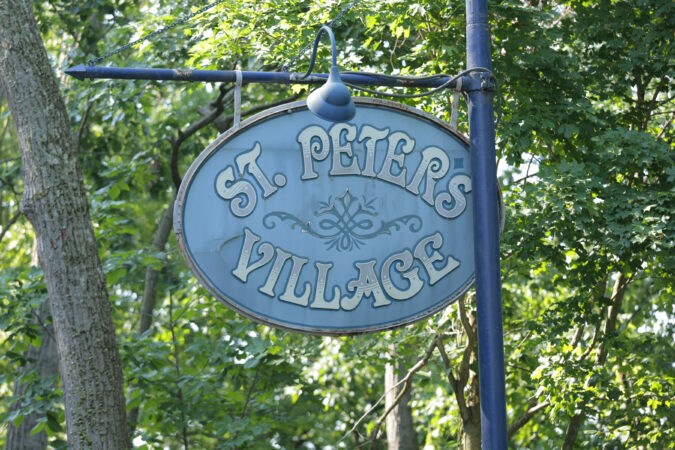
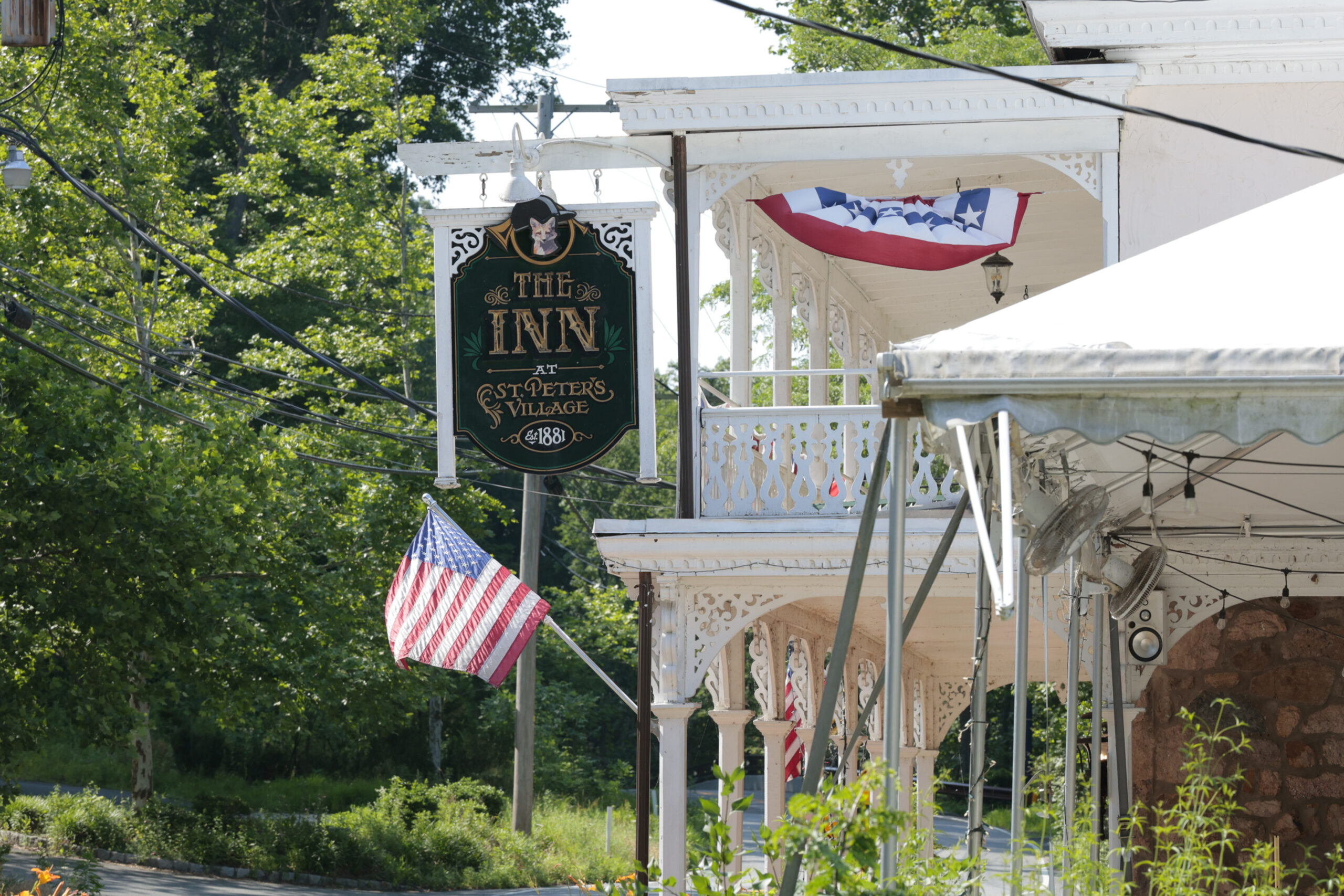
    The 83-acre St. Peter’s Village — a historic destination in Chester County — will be sold at an absolute public auction to the highest bidder in September. The Inn and various shops on the main drag. Wednesday, July 1, 2026

    The property is being sold as one unit. The buyer will have to improve the existing wastewater treatment plant for a full build out. The land is zoned for residential and neighborhood business uses.

    It is definitely an “unusual property” and the auction is unusually large as well, said Doug Clemens, chief executive officer of the Traiman Real Estate Auction Company, which is overseeing the sale. Clemens said the property is owned by one entity. The Piazza family, which runs the Piazza Management Co. and owns multiple Main Line car dealerships, is listed on associated parcels. A spokesperson declined to comment.

    “We’ve sold properties that were thousands of acres, but they weren’t builder properties, so this is a large property for a builder,” Clemens said.

    Its good reputation, long history, and the sheer size of the parcel are why Clemens suspects they’ve seen remarkably high interest. The auctioneers put out a news release about the upcoming sale last week. They’ve received 14,000 responses since, he said.

    St. Peter’s Village sprung up because of its nearby natural assets: the French Creek, timber, good soil – and resources like iron ore, copper and black granite.

    Bidders must register at the auction with $150,000 guaranteed funds, but the bids will start wherever they’re comfortable.

    “At the conclusion, we’ll know what the bidders were willing to pay for it,” Clemens said.

    Following the curves of the French Creek, the village was established in the 1880s during the Gilded Age — a point in history where America was going through “growing pains” of both capital and labor, as well as whether it would be an “industrialized or agrarian nation,” said Jared Frederick, a history professor at Penn State Altoona.

    Like many a small village or hamlet in Pennsylvania, St. Peter’s sprung up because of its nearby natural assets: the French Creek, timber, good soil – and resources like iron ore, copper and black granite.

    Its economy flourished, thanks to those natural resources, which it transported to Philadelphia. It’s a “fascinating little enclave that demonstrates how some places were caught in the middle” of semi-ruralness and proximity to the big city, Frederick said.

    Alongside that growing economic engine was also leisure, though. St. Peter’s Village became a recreational getaway due to its beautiful, scenic vista — something considered a “majestic retreat for commoners,” Frederick said. And while Chester County places high value on its green spaces now, it was even more essential for people living in urban areas to have access to such places in the 1880s through the 1900s, Frederick said.

    St. Peter’s Village is on the National Register of Historic Places, but that may not safeguard it from development after it is auctioned off.

    Its sale has prompted concern about what it could become, with the auction site touting it as “suitable for major builders, venture capitalists, historic preservationists, and entrepreneurs.”

    Places like this are increasingly rare, Frederick said. And while the village is on the National Register of Historic Places, that doesn’t necessarily safeguard it, Frederick said. There’s a “fairly lengthy list” of places that have earned such recognition, but been bulldozed or neglected.

    And while development and other attractions could help revive the village by drawing in tourism, he believes it’s a careful balancing act.

    “Something that I always impart to my students in the classroom when we talk about the power and the need to preserve historical places, is that regret only goes one way,” he said. “When a place is gone, it’s gone forever, and that is something that very much needs to be kept in mind when pondering the fate of places like this.”

    This suburban content is produced with support from the Leslie Miller and Richard Worley Foundation and The Lenfest Institute for Journalism. Editorial content is created independently of the project donors. Gifts to support The Inquirer’s high-impact journalism can be made at inquirer.com/donate. A list of Lenfest Institute donors can be found at lenfestinstitute.org/supporters.

  • Immaculata University’s president will retire next year

    Immaculata University’s president will retire next year

    Longtime Immaculata University president Barbara Lettiere said she will retire next summer, following a decade at the helm of the Catholic school.

    Lettiere, an Immaculata alumna, donor, and former board chair, was named the first lay president of the Chester County university in 2017.

    “The time has come in my life and the life of Immaculata for the next chapter,” Lettiere, 76, said in a statement. “I did not make this decision easily, and it comes with some very mixed emotions.”

    The university, which is affiliated with the congregation Sisters, Servants of the Immaculate Heart of Mary, enrolled nearly 2,800 students last academic year, and plans to do a national search for her replacement.

    “The board accepts her decision with deep gratitude for her outstanding leadership and dedicated service over the past ten years,” Peggy Behm, board chair, and Sister Mary Ellen Tennity, IHM’s general superior, said in a statement. “Her deep dedication to Immaculata, its students, faculty and staff, and her love for the mission of the IHM Congregation have left a lasting and meaningful impact on the University community.”

    Lettiere, a 1972 graduate, had previously served as vice president for finance and administration at Trinity Washington University.