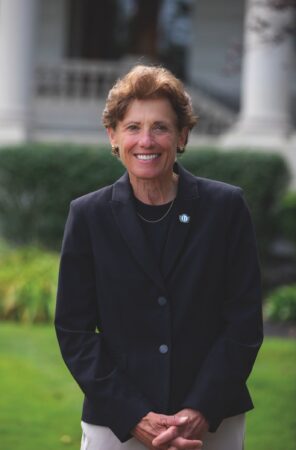
Longtime Immaculata University president Barbara Lettiere said she will retire next summer, following a decade at the helm of the Catholic school.
Lettiere, an Immaculata alumna, donor, and former board chair, was named the first lay president of the Chester County university in 2017.
“The time has come in my life and the life of Immaculata for the next chapter,” Lettiere, 76, said in a statement. “I did not make this decision easily, and it comes with some very mixed emotions.”
The university, which is affiliated with the congregation Sisters, Servants of the Immaculate Heart of Mary,enrolled nearly 2,800 students last academic year, and plans to do a national search for her replacement.
“The board accepts her decision with deep gratitude for her outstanding leadership and dedicated service over the past ten years,” Peggy Behm, board chair, and Sister Mary Ellen Tennity, IHM’s general superior, said in a statement. “Her deep dedication to Immaculata, its students, faculty and staff, and her love for the mission of the IHM Congregation have left a lasting and meaningful impact on the University community.”
Lettiere, a 1972 graduate, had previously served as vice president for finance and administration at Trinity Washington University.
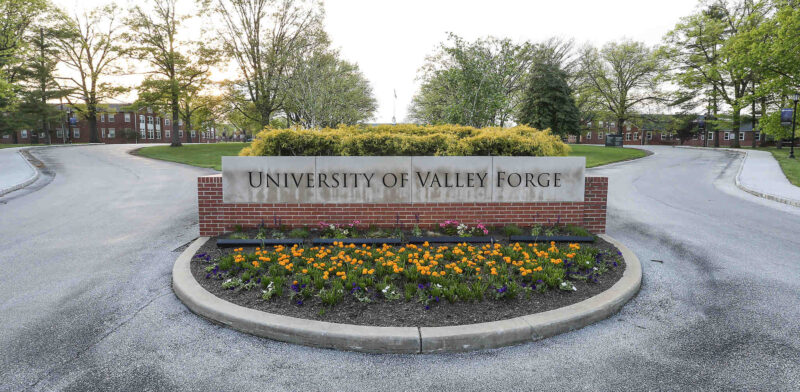
The University of Valley Forge, a small Christian school that prepares students for leadership in the church and the world, has been given a serious warning that it is in danger of losing its accreditation.
The Phoenixville-based college has until Sept. 1 to “show cause” to justify why it should not lose accreditation, according to the Middle States Commission on Higher Education, which posted the action on its website this week. Colleges need accreditation to keep their students eligible for federal aid.
The “show cause” action is the most serious that the commission issues. Others include warning and probation.
The commission cited “insufficient evidence that the institution is in compliance” with standards involving planning, resources, and institutional improvement, and governance, leadership, and administration.
The university must document in its show-cause report “financial resources, funding base, and plans for financial development to support its educational purposes and programs and to ensure financial stability,” the commission said. The school also must provide information on long-range financial planning that includes “realistic enrollment projections and the assumptions on which they are based,” the commission said.
The university did not immediately return a call for comment Wednesday, and when asked for the current enrollment, an employee said she was not permitted to disclose any information and hung up. The school enrolls 589 students, according to the National Center for Education Statistics.
Under the action, the school is required to immediately notify its community of Middle States’ action.
The university started in 1939 as the Eastern Bible Institute, which was aimed at training pastors, evangelists, missionaries and Christian educators, and lay workers, according to the school’s website. It became a college in 1975 and the University of Valley Forge in 2014. The university is part of an international network of Assemblies of God colleges and universities and offers more than 60 degree programs, according to its website.
Medford Township is facing a lawsuit from former Township Manager Daniel Hornickel, who is seeking to nullify his firing and reinstate himself in the role.
Hornickel, an attorney representing himself in the case, filed a complaint in Burlington County Superior Court on April 30, two days after the five-member council passed a resolution approving his removal as manager, the Courier Post first reported.
In the lawsuit, Hornickel, who lives in Bordentown Township, alleges that council denied him his employee due-process rights and violated the Open Public Meetings Act during his firing.
The legal filing comes less than two months after Medford Township formally initiated the process to fire Hornickel on March 13 by sending hima legally mandated notice that his employment was in discussion.
According to the lawsuit, Hornickel then proposed a separation agreement on March 16 that stipulated that if the offer were rejected, council would hold a public discussion about their intention to seek Hornickel’s removal from the role,which pays between $100,000 and $190,000, according to the salary range approved by council.
The next morning, Township Solicitor Gregory McGuckin indicated that the settlement likely would not be accepted, to which Hornickel reiterated his ultimatum for public discussion during that night’s council meeting, the lawsuit alleges.
But that night, council immediately entered closed session after the start of the meeting and upon returning, adopted a resolution to suspend Hornickel and move forward with the firing process. Council did not discuss or deliberate the resolution in public during the March 17 meeting.
In the resolution, council offered 10 reasons for seeking Hornickel’s dismissal, including that “council has lost confidence” in him, particularly as it relates to both the 2025 and 2026 budgets, the latter of which they said was delivered “late and above the cap legally allowed.”
They also allege that Hornickel has not implemented council policies and directions, does not communicate with council members, and has failed to properly advise council on various matters during his 18-month tenure as manager.
On April 28, council held a special hearing where they approved the resolution authorizing Hornickel’s firing.
During the hearing, Hornickel responded to each of council’s points, noting that three current council members were not on council in 2025 and therefore did not participate in the budget process while the two others voted to approve it.
“Your statement that ‘the 2026 budget was late and above the cap legally allowed’ is an invalid statement,” he said. “For the record, you introduced a 2026 budget that is substantially similar to the budget I sent you on March 9.”
In response to many of the other charges outlined in the resolution, Hornickel argued that he couldn’t adequately defend himself because council would not publicly release details.
“Don’t respond to me just because I’m asking, tell the public,” Hornickel told council. “If I’ve done this, give the public some concrete examples.”
Hornickel also argued that council was misinterpreting their role as the legislative branch for Medford’s government. The manager runs daily operations as the executive officer, he said, not township council.
“Your job is to set policy,” Hornickel said. “I looked at every single agenda this year through March 17. So what purported policy or direction did you as a legislative body issue that I failed to implement?”
“There’s nothing,” he said.
Hornickel declined to provide any additional comment Wednesday while the township solicitor did not immediately respond to requests for comment.
Medford’s Fire and EMS Chief Robert Dovi, Jr. is serving as the interim manager with assistance from Southampton Township Administrator Brandon Umba through a shared services agreement.
Council originally appointed Hornickel manager by resolution on July 16, 2024, an appointment made effective the following September.
Prior to his time in Medford, Hornickel served as the business administrator of Pemberton Township for more than five years. Before that, Hornickel spent nine years as the human resources director for Burlington County.
A remote proceeding for the case is scheduled at 9:30 a.m. on Sept. 8 before Superior Court Judge Terrance Cook.
As the nation celebrates its 250th birthday this weekend, the legislative branch has momentarily called it quits.
The House leadership on Tuesday abruptly canceled votes and sent lawmakers home early for the holiday recess, Speaker Mike Johnson ‘s majority once again ground to a standstill by a Republican revolt over their own party’s agenda.
In this case, it’s a standoff blocking the annual defense bill — with pay raises for the troops and other matters at a time of war — as the renegade Republicans push to include President Donald Trump’s own priority, the SAVE America Act, a strict voter ID bill. Last week, the Senate similarly shuttered after Trump’s demands.
The emptying Capitol provides another snapshot of the imbalance of power in Washington as a headstrong executive confronts a weakened Congress.
For the second time in as many weeks, the House has simply given up.
“It’s a relatively bad time in Congress,” Republican Rep. Dusty Johnson of South Dakota said recently. “A lot of my colleagues have forgotten how to govern.”
The scene is far different than last year’s Fourth of July
A year ago this weekend brought a wholly different scene in Washington, as Trump gathered Republican lawmakers outside the White House for an ebullient July Fourth ceremony to sign what they called the “One, Big, Beautiful Bill” of tax breaks and spending cuts.
It was a celebratory moment for Trump and the slim Republican majority — and for Johnson, who many doubted could pass the bill over the objections of Democrats who viewed it as tax giveaway at the expense of billions of dollars in cuts to health care and food stamps for Americans in need.
Johnson was so reliant on Trump’s power to help push the bill to approval that he gifted the president a speaker’s gavel, which Democrats and others saw as a worrisome symbol of the transference of power from one branch of government to the other.
“We’re not dealing with Speaker Mike Johnson,” Democratic Rep. Pete Aguilar of California, the caucus chairman, said in a recent interview. “Unfortunately, Speaker Donald Trump does not want us in this week.”
Trump makes conflicting demands on his party in Congress
As Johnson works to keep Trump close, the president’s demands seem to grow in ways the Republican speaker can’t always deliver.
The president’s insistence on the SAVE America Act, which doesn’t have enough support in the Senate to pass, has interrupted almost all other business in Congress. Trump has refused to sign a popular bipartisan housing bill that cleared both chambers until the voting bill is also approved. He calls the housing bill a “yawn.”
Johnson spent four hours last week at the White House and said he spent another two hours with the president this week on a path forward.
“I told him, ‘Mr. President, I don’t have any tattoos, but if I did, it’d say SAVE America on my shoulder,’ OK?” Johnson said over the weekend on Fox News.
“We passed it three times in the House already. We’re going to pass it again.”
But by Tuesday, a House vote to advance the legislation collapsed. Republicans led by Rep. Anna Paulina Luna of Florida argued that Johnson’s plan to attach the voting bill to the defense bill was essentially a doomed strategy that would be rejected in the Senate.
“That’s disappointing,” acknowledged Republican Majority Leader Steve Scalise of Louisiana, who insisted the GOP would try again.
“We’re going to keep trying because we have to,” he said. “We’re not done doing big things.”
As America celebrates its 250th birthday, Congress is adrift
The founders of the new democracy clearly had aspirations for the Congress, putting it first in the Constitution as the Article One branch of government, ahead of the executive and judicial branches.
But as lawmakers face voters this fall, they will have to answer for these dwindling days on their calendar.
House Democratic Leader Hakeem Jeffries said the problem is not the Congress, it’s the GOP.
“Donald Trump is fighting with Senate Republicans, Senate Republicans are fighting with House Republicans, and House Republicans are fighting with each other,” said Jeffries, who is in line to become House speaker if Democrats win control in fall.
“It’s not the Congress that’s struggling. It’s House Republicans who are struggling,” he said.
Jeffries said Democrats are fighting “to make life more affordable for the American people.”
As they left the Capitol for an extended recess, lawmakers voiced frustration with the House’s dysfunction.
Rep. Kevin Kiley, who left the Republican Party to become an independent earlier this year, said the situation in the House is “frustrating.”
“It’s just like déjà vu where many times now we run into some sort of obstacle,” he said, “then the solution is just to go home.”
WASHINGTON — A pair of federal judges struck down a Trump administration overhaul to a public service forgiveness program for student loans, ruling Tuesday in separate cases in favor of advocates who said the program risked becoming a tool for political retribution.
U.S. District Judge Myong Joun in Massachusetts vacated the U.S. Education Department’s changes, saying they overstepped the agency’s power and threatened to violate First Amendment protections for free speech. The ruling came in response to a pair of lawsuits filed by more than 20 states along with a coalition of nonprofit groups and cities.
In Washington, D.C., District Judge Amir Ali in Washington issued a similar ruling in a case brought by nonprofit organizations. The rulings came a day before the new rules were set to take effect.
Under Secretary of Education Nicholas Kent said the department was evaluating next steps.
“The Department stands behind this commonsense policy to ensure that taxpayer dollars are never used to subsidize illegal activities,” Kent said in a written statement.
Congress created Public Service Loan Forgiveness in 2007 to encourage college graduates to work in government and nonprofit jobs. It promised to forgive their federal student loans after they worked in public service jobs for 10 years.
Last year, the Trump administration moved to add new eligibility rules that would strip the benefit from workers whose employers are deemed to have a “substantial illegal purpose.”
The overhaul targeted nonprofits and government organizations that support causes at odds with the Trump administration’s priorities.
It gave the education secretary power to exclude groups from the program if they engage in the trafficking or “chemical castration” of children, illegal immigration or supporting terrorist organizations. Its definition of “chemical castration” included using hormone therapy or drugs that delay puberty.
The overhaul amounted to a major reworking of a program that has canceled loans for more than 1 million Americans. Nonprofits and government groups said it undercut an important benefit that helped attract college graduates to jobs that traditionally pay less than the private sector.
“This decision is a win for the communities that depend on local nonprofits and for the workers who serve them,” said Diane Yentel, president and CEO of the National Council of Nonprofits, one of the plaintiffs in the Massachusetts case.
One of the plaintiffs in the Washington case, Student Defense, said the judge’s ruling is a victory for student loan borrowers.
“Public servants should not have to worry that the federal government will punish them because of their employer’s mission or perceived political views,” said Aaron Ament, Student Defense’s president.
Joun said the new rules threatened to impose the administration’s policy views on employers. The judge also faulted the department for failing to connect its definitions of illegal activity to criminal statutes.
“The Department cannot create new criminal prohibitions through rulemaking,” he wrote.
The judge also questioned the department’s stated rationale for proposing the new rules, drawing on its own estimates that fewer than 10 employers would be barred from the program per year.
“The Department offers no explanation for why a Final Rule with such sweeping consequences is necessary to address the possibility that, at most, ten employers each year may be engaging in illegal activity,” Joun wrote.
In his ruling, Joun noted that more than 100 supporting briefs were filed on behalf of the groups challenging the rules, while none were filed in support of the Trump administration’s change.
Since its founding in 2021, the educational advocacy group Moms for Liberty has been mobilizing conservative mothers across the country against school curriculum they deem indoctrinating, un-American, anti-Christian and antithetical to their understanding of family values.
They’ve targeted books that explore LGBTQ themes, transgender athletes and curriculum they deride as critical race theory or as too focused on diversity, equity and inclusion. More broadly, they claim to be fighting to protect their parental rights to control what their children learn.
Members of Moms for Liberty have earned seats on school boards, garnered national media attention and infiltrated the highest levels of conservative policymaking. According to cofounder and CEO Tina Descovich, she has visited President Donald Trump’s White House more than a dozen times.
Moms for Liberty has also made waves in the Philadelphia suburbs, especially in Bucks County, which boasted the largest leadership team of any chapter in the country by April 2025. At a Harrisburg-area event last October, Descovich said, “I am very familiar with Bucks County. Before I knew it existed, I knew the [Bucks County] Beacon existed because they were writing trash pieces about us.”
Groups like Moms for Liberty have proved effective at making political noise — and even notching some policy wins, at least temporarily. Yet, the group is really just a continuation of a decades-long crusade by conservative white women to weaponize public education in the service of a right wing agenda. While it has largely failed to transform American curriculum, this push has turned these women into key figures in Republican politics who have made fighting the culture wars a GOP priority.
The modern conservative movement since World War II owes much of its success to the work of grassroots education warriors.
These women proudly embraced traditional gender roles. They saw them as a marker of success because many women in their mothers’ generation had to work outside of the home to make ends meet in the Great Depression and wartime years.
Even as some of these conservative women became full-time political activists, they claimed the mantle of traditional homemakers and mothers — which aroused charges of hypocrisy from critics. Yet, they argued that their advocacy work in the traditionally male world of politics and education policy was wholly consistent with traditional gender roles because protecting innocent children from worldly dangers was a natural role for women and mothers.
At their kitchen tables and in PTA meetings across the country, these “suburban warriors” launched far-reaching campaigns against sex education, multicultural curriculum and other aspects of schooling they deemed antithetical to traditional American values.
In the 1970s and 1980s, as the political parties realigned, these conservative education warriors emerged as a crucial Republican constituency and a core part of the New Right coalition. These white women were galvanized by the recent gains of the civil rights movement, the Supreme Court’s Roe v. Wade decision — which provided a right for women to have legal abortions under certain circumstances — and debates over the proposed Equal Rights Amendment to the U.S. Constitution, which they claimed (without evidence) would decimate the female homemaking role.
These recent changes threatened to disrupt what the conservative women argued were divinely inspired gender roles, which were embodied by the “traditional” nuclear family of a working male breadwinner, a female homemaker and kids. They feared that big government-backed forces might take away this ideal life, which many had only recently achieved.
Increasingly, these women looked to public schools as the place to fight their crusade. Taxpayers funded the schools and they were responsible for shaping the next generation of Americans outside of parental control.
In 1974, the education wars burst onto the national stage in Kanawha County, W.Va., thanks to an ugly and violent struggle over school textbooks. The controversy began after Alice Moore, a 29-year-old mother and the lone woman on the county school board, objected to a newly adopted language arts curriculum she deemed indoctrinating, racially divisive and steeped in “secular humanism.”
This latter concept wasn’t new. It dated to the late 19th century, and argued that people could gain knowledge through reason, intellect and logic rather than relying upon religious teaching.
Yet in the 1970s conservatives thrust it into the spotlight, because they needed a fresh villain. Tried-and-true messaging on anticommunism had grown stale. But pushing secular humanism as the latest liberal conspiracy aligned with the New Right’s renewed focus on faith, family and traditional gender roles, while energizing Christian conservatives.
Moore and her allies saw secular humanism as increasingly influential in education — and as incredibly hostile to Christianity and their narrow definition of divinely inspired traditional family values. It further alarmed them because they saw secular humanism as teaching students to challenge their parents’ authority. Within a few years, the once obscure concept would become the New Right’s star bogeyman.
Made By History sponsors. FOR USE ON MADE BY HISTORY STORIES ONLY.
Throughout the fall of 1974, Moore read excerpts from the textbooks before the school board. She singled out Black nationalist Eldridge Cleaver, whose writings allegedly produced “racial hatred” toward white people. She also took issue with “dialectology,” a study of dialects that included lessons on African American vernacular — what she called “ghetto dialect” — that she believed to be antithetical to American speech.
By October, the controversy had produced two shootings, dozens of arrests and multiple rounds of bombings, boycotts and school bus blockades.
Moore’s crusade against secular humanism in West Virginia quickly caught the attention of national conservative organizations. The Heritage Foundation featured Kanawha County in its 1976 study, “Secular Humanism and the Schools: The Issue Whose Time Has Come.” Phyllis Schlafly — the country’s most famous antifeminist at the time — jumped into the fray, claiming that public education promoted “a tolerance of violence, theft, adultery, obscenity, profanity, and blasphemy.”
In part because organizations like the Heritage Foundation and Schlafly’s Eagle Forum highlighted Moore’s activism for like-minded conservative women, it inspired conservative mothers across the country to wage their own crusades against dirty textbooks. In the ensuing years, they launched repeated battles against seemingly subversive curriculum.
In 1983, in rural East Tennessee, fundamentalist mother Vicki Frost waged her own legal battle against the Hawkins County school board after discovering objectionable material in her daughter’s reading textbook, including alleged depictions of telepathy, witchcraft and black magic that violated her religious beliefs.
In Mozert v. Hawkins County Board of Education — a case that became known as “Scopes II” because of Hawkins County’s proximity to the original Scopes Trial — Frost and her fellow plaintiffs alleged that the school board’s policies violated the First Amendment’s Free Exercise Clause. Their legal counsel came courtesy of Concerned Women for America, whose founder Beverly LaHaye took Frost on a national speaking tour to publicize the alleged dangers of modern textbooks. Although the plaintiffs lost their case on appeal, LaHaye deemed the case a “PR success” that “identified us as a friend of the family.”
The result epitomized the outcome of the broader education wars. Fighting against offensive school curricula turned many conservative women into key figures in the culture wars, with substantial reach and political impact. They quickly become politically astute grassroots organizers who leveraged their identities as white Christian homemakers and mothers to argue for an educational system rooted in Christianity, the traditional nuclear family and American exceptionalism.
The impact of these organizers, however, hasn’t necessarily come in the classroom. Most of Moore’s “dirty books” found their way into the Kanawha County curriculum. Frost and the plaintiffs in Hawkins County ultimately lost their case on appeal. In recent years, the majority of school board candidates backed by Moms for Liberty have similarly suffered defeat.
Yet, these organizers have been able to mobilize thousands of culturally conservative women — particularly other white Christian mothers — and bring them into the Republican Party. Their involvement has driven the GOP to make the culture wars a key component of the party’s identity.
These earlier crusaders also created a language that remains a staple of conservative critiques of public education to the present day. More than five decades after Moore’s war, conservative organizations continue to emphasize “parental rights,” “family values” and “school choice” in their efforts to influence American education.
When groups like Moms for Liberty claim that public schools are indoctrinating children with “woke” ideologies such as critical race theory, they rely upon a well-established playbook that conservative women have drawn upon for more than half a century. Despite mixed results in America’s actual classrooms, their political activism has proved a tried-and-true means for both enflaming public opinion and solidifying the role of self-proclaimed traditional mothers and homemakers within modern conservatism.
Allen Fletcher is a public historian and journal editor with research interests in Appalachia, gender and the history of American education. His current book, Building Schools, Building Communities: Appalachian Women and the Struggle for Educational Change, is under contract with LSU Press.
Made by History takes readers beyond the headlines with articles written and edited by professional historians. Opinions expressed do not necessarily reflect the views of The Inquirer.
NEW YORK — President Donald Trump took in nearly $1.2 billion from his crypto businesses last year, a federal filing released Tuesday shows, locking in profits while his investors were socked with losses.
Mere startups when he took the oath of office, the new ventures have now eclipsed in revenue much of his vast property portfolio that took him decades to accumulate. Fueling their rise were billionaire investors and Trump’s own move to quash a federal crackdown on the industry.
Trump got more than $500 million from his World Liberty Financial business selling new crypto products, including “governance tokens,” according to the required annual disclosure report with the Office of Government Ethics. It also showed another crypto business, CIC Digital LLC, took in more than $600 million from sales of souvenir-type “meme” coins stamped with his face.
Both the tokens and the coins have plunged in value since the sales.
Trump also took in millions last year from selling Trump-branded Bibles, sneakers and other small items in another unprecedented move for the presidency. The sale of Trump-branded watches alone brought in $4.7 million.
The 927-page disclosure form paints a stark, if incomplete picture of the massive growth of the president’s wealth since taking office last January through a web of business interests — many of which have benefited from the policy moves of Trump’s own government. Trump has insisted that his sons direct his finances but the arrangement rejects the conflict of interest protections that his recent predecessors in office had instituted.
Forbes estimates Trump’s net worth at $6 billion, up from $2.3 billion in 2024.
The Trump business is growing abroad
The rise of crypto relative to Trump’s property is especially noteworthy because he first rode to office boasting of his property wins. It’s also remarkable because that mainstay business also boomed last year. Trump took in tens of millions in fees from a flurry of new hotel, resort and condo deals overseas that amounts to the biggest property expansion ever in the century since the family business was founded.
Many of those countries were negotiating with the U.S. over tariffs, military aid and other important matters while the family business was striking the deals.
A property in the United Arab Emirates generated $10.4 million for the Trump business last year. One in Saudi Arabia being built by a real estate developer close to the ruling family sent the president’s company $9 million. And one in Bucharest, Romania, and another in Qatar sent him $5 million each.
One of his prominent domestic properties, Mar-a-Lago in Florida, notched big growth last year, too.
Trump took in $77 million from the property, a 50% jump from the year earlier when he was just another citizen, as heads of state and business people flocked to it in his new term.
The disclosure report doesn’t give profit figures, just revenue, so it’s impossible to know how much he is earning.
Trump is now the billion-dollar crypto man
After taking office last year, Trump reversed the Biden administration’s tough stance on the crypto industry and pushed policies friendly to the industry.
But regulators still had some concerns. Before Trump’s World Liberty began selling “governance tokens,” they issued warnings about this new kind of crypto asset, saying that unlike stocks, the tokens offer no ownership stake in the issuing company, just voting power on certain corporate policies, and are difficult to value.
Buyers pounced anyway, including a Chinese billionaire who spent $75 million on the tokens and $200 million on the souvenir coins. In February last year, a federal lawsuit charging him with duping investors was paused before being settled for a $10 million fine.
The billionaire, Justin Sun, has repeatedly denied his spending on Trump businesses had anything to do with his federal case, while World Liberty has dismissed the notion of a conflict of interest.
Meanwhile, investors have seen the value of their Trump-tied holdings drop significantly.
The price of World Liberty tokens has fallen 80% since they started trading in September. And the Trump souvenir coins that spiked to more than $74 in the days after launching in January 2025 now sell for $1.68.
The White House says Trump only acts in the public interest
The White House has repeatedly said Trump put his business in a trust managed by his sons and is not involved in its decisions and that there are no ethics issues to discuss.
“Neither the President nor his family has ever engaged — or will ever engage — in conflicts of interest,” spokeswoman Anna Kelly said. “All actions by President Trump and his administration are taken in the best interest of the American people.”
The Trump umbrella company, the Trump Organization, has said its deals overseas were with private companies, not with governments.
Still, it is difficult to know what is truly private in countries ruled by authoritarians, royal families and one-party governments.
For a new Trump resort in Vietnam, the report shows Trump took in $5 million last year after the ruling Communist Party sent its deputy prime minister to sign off on the deal and, according to The New York Times, pushed farmers off the land to make way for the construction.
Whether the deals played any role in changing U.S. policies in ways these countries sought is nearly impossible to know, but the countries did get what they wanted.
Vietnam got tariff relief. Qatar got access to advanced U.S. technology previously off limits, and Saudi Arabia got U.S. fighter jets it had coveted for years.
The insurgent progressive movement jolting the Democratic Party rolled through Colorado on Tuesday evening in the latest test of the left’s ability to oust establishment politicians and usher in generational change.
In two primary battles between mainstream figures and candidates running to their left as Washington outsiders, the more liberal candidates prevailed. Melat Kiros, a 29-year-old lawyer and democratic socialist, toppled a veteran congresswoman in Denver, while Phil Weiser, the state attorney general, stopped Sen. Michael Bennet’s bid to move from Congress to the governor’s mansion.
But in a third key primary race, Sen. John Hickenlooper staved off a progressive challenger.
Here are five takeaways from the night in Colorado, where Democrats will be favored in all three races in November.
Even older progressives are falling to young left-wing challengers
Rep. Diana DeGette, who lost to Kiros, sported legitimate progressive credentials. She was a strong backer of “Medicare for All,” and she ran a television advertisement featuring prior praise from Rep. Alexandria Ocasio-Cortez, D-N.Y., who did not pick a side in Tuesday’s primary.
Nevertheless, she met her match in Kiros, who centered her campaign on calls for generational change — DeGette, 68, was first elected to Congress the year before Kiros, 29, was born — and on opposition to Israel over the war in the Gaza Strip.
DeGette said last year that she opposed the sale of “offensive weapons” to Israel, but in the past she had called herself a “strong supporter of Israel.” Kiros was far more outspoken in her opposition to the war and her calls to end U.S. military aid to Israel.
Socialists are racking up victories around the country
Kiros adds to a growing number of socialist candidates expected to enter Congress next year, including Claire Valdez and Darializa Avila Chevalier of New York and Chris Rabb of Pennsylvania.
Running in a deep-blue Denver district, Kiros did not shy away from her socialist label. She welcomed support from the Democratic Socialists of America and Hasan Piker, a provocative left-wing livestreamer who is popular with young progressives but controversial with the party establishment.
Her victory is likely to further embolden the ascendant movement, which has aspirations beyond deep-blue cities.
In Wisconsin, a candidate for governor, Francesca Hong, will test whether socialism can appeal to voters in a swing state. And two battleground Senate candidates who do not identify as socialists but also have left-wing, populist politics — Abdul El-Sayed in Michigan and Graham Platner in Maine — are on similar missions.
One establishment veteran wasn’t caught flat-footed
On the surface, Colorado’s Democratic primary for Senate mirrored the kinds of races that have been ripe for upset victories this year: A 74-year-old moderate incumbent who had spent 20 years in state politics faced a younger progressive who was once a DSA member.
But toppling a U.S. senator in a statewide race remains considerably more difficult than ousting a House member, at least on the Democratic side. And Hickenlooper turned back his challenge from Julie Gonzales, a state senator, by nimbly moving to the left and drastically outspending her.
Hickenlooper focused his campaign pitch on liberal priorities like overhauling the Immigration and Customs Enforcement agency. He also earned some support from labor and activist groups, preventing Gonzales from consolidating progressives.
Perhaps most significantly, he raised nearly $8 million, while she had less than $1 million at her disposal.
Trump loomed large in an upset in the governor’s race
Colorado’s other senator was not so fortunate.
Bennet lost his bid to become the state’s next governor to Weiser, who had trailed by 30 percentage points in polls last year but managed to make the race a referendum on how forcefully the two candidates were opposing President Donald Trump.
Pointing to his lawsuits against the administration, and to Bennet’s votes to confirm a few of Trump’s Cabinet members, Weiser won that metric.
And although Weiser does not profile as a typical insurgent progressive — he is a former federal lawyer who served in the Obama administration and as dean of a law school — he successfully portrayed himself as an outsider running to Bennet’s left.
Democrats keep picking progressives in key House races
In swing districts from California to Pennsylvania this year, Democratic voters have bucked the conventional wisdom of running centrist candidates who can peel off independent voters against Republicans. Instead, they have backed left-wing candidates.
Coloradans took a similar approach Tuesday, choosing Manny Rutinel, a progressive state lawmaker, over Shannon Bird, a more moderate legislator, in the Democratic primary race to face Rep. Gabe Evans, a vulnerable Republican in a district north of Denver.
The general election will also be a test of whether Democrats can regain support from Latino voters. Rutinel, who is Dominican American, will need a sizable chunk of them in a district that is nearly 40% Latino to beat Evans, who is Mexican American.
HARRISBURG — Pennsylvania enters the new fiscal year on Wednesday without a state budget in place for a fifth consecutive year, while top leaders in the politically split legislature publicly disagreed over whether a deal was near.
Lawmakers in the Republican-controlled Senate and the Democratic-led House have known for months that Pennsylvania faces fiscal straits, as the state is on a path to spend more than it brings in in revenue in fiscal 2027. Top negotiators have spent weeks meeting behind closed doors about how the state should spend more than $50 billion in taxpayer dollars, in hopes of avoiding another drawn-out budget impasse.
Under first-term Democratic Gov. Josh Shapiro’s proposed $53.2 billion budget, Pennsylvania would spend $4.8 billion more than its $48.6 billion in projected revenue and would require lawmakers to create new revenue streams, cut spending, or raise taxes — or dip into the state’s reserves.
Senate Republicans on Tuesday recessed until legislators have a final budget deal to vote on, with Senate Majority Leader Joe Pittman (R., Indiana) saying that there is “no reason we cannot conclude our work early next week” and that lawmakers “have a very good trajectory in front of us.”
Pittman — a top negotiator in the closed-door talks — made those remarks just one day after a Senate committee voted to gut the main spending bill in Shapiro’s budget proposal, which was approved by the House in April, from $53.1 billion to $25 million.
State Senate Majority Leader Joe Pittman (R., Indiana) during a press conference at the Capitol in Harrisburg in February.
In a news conference Tuesday, House and Senate Democratic leaders offered a different picture: Despitelawmakers traditionally staying in Harrisburg in the days leading up to July Fourth in hopes of hashing out a deal, Senate Republicans are already packing up for the holiday weekend, the Democrats said, and are politically motivated to hold up the state budget. (House Democrats later canceled their scheduled legislative session on Thursday.)
“[Senate Republicans are] going to tell you that progress is being made, and that it’s important that we allow time for members to go home for the weekend. And by the way, it’s Tuesday,” said Senate Minority Leader Jay Costa (D., Allegheny).
“The bottom line is they’re not serious about getting a budget done, they’re slow-walking this process for weeks and weeks, and we’re calling them on it,” Costa said.
Shapiro echoed the same frustration with Senate Republicans in an interview Tuesday, adding that the Senate “decided to go home on vacation” when lawmakers are due to deliver a budget bill to him for his signature.
“I think it’s disrespectful to the people of Pennsylvania,” Shapiro said, noting that Pennsylvania has a revenue surplus. “They should be here, and they should be working. And instead, they ran away.”
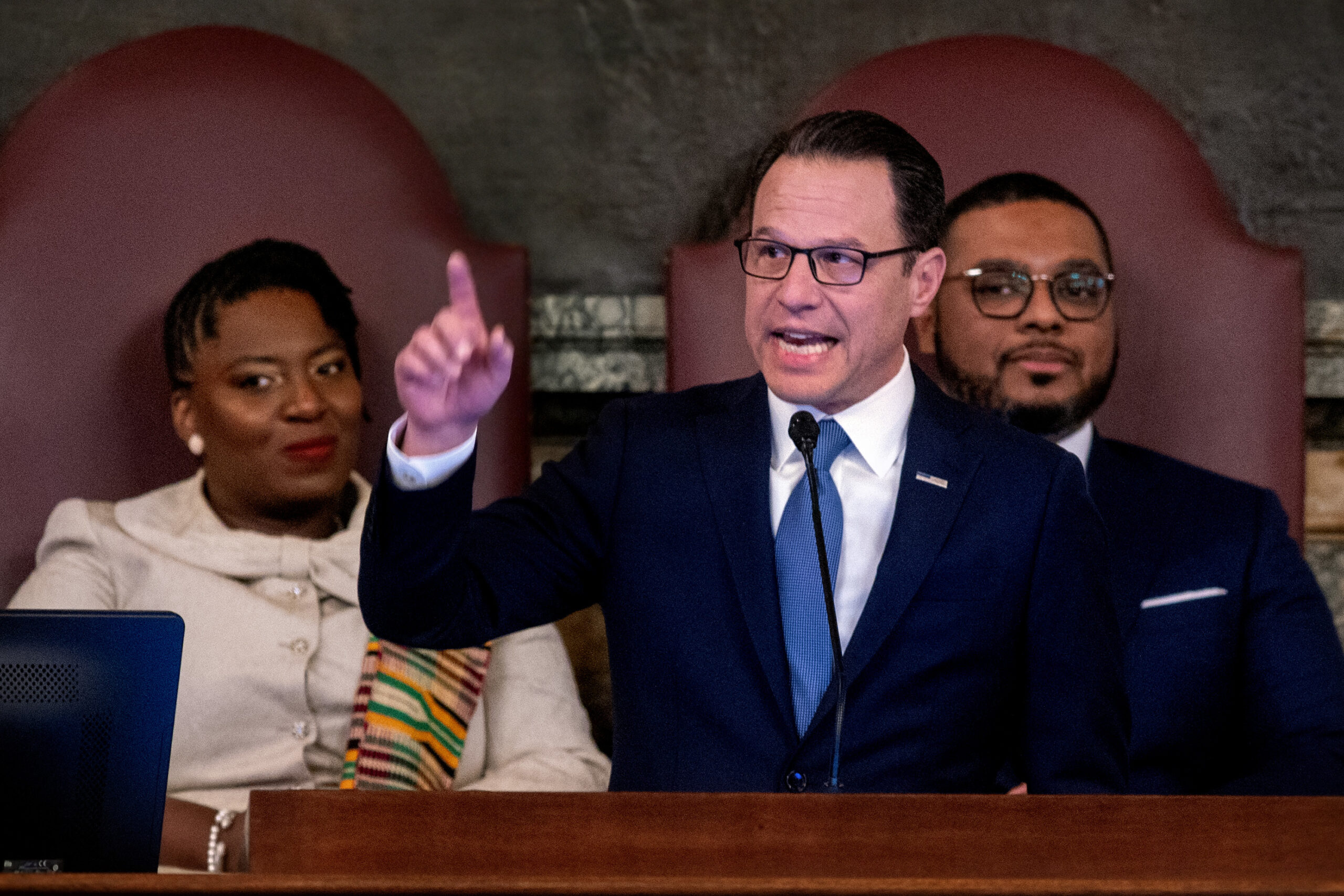
Speaker of the House Joanna McClinton (left) and Lt. Gov. Austin Davis are seated behind Gov. Josh Shapiro as he delivers his third budget address to a joint session of the state House and Senate at the state Capitol on Feb. 4.
Senate GOP leaders, in a statement following their recess Tuesday, said they believe they are “well on our way to effectuating a full budget agreement in the days.”
House Minority Leader Jesse Topper (R., Bedford) told reporters that legislative leaders have been constantly in contact “over the past month” no matter if members are in the building.
“At the end of the day, the talks continue,” Topper said. “This kind of stunt feels a lot like politics.”
Top legislative leaders have been tight-lipped about what the remaining sticking points are in budget talks.
Pennsylvania is constitutionally required to deliver a balanced budget by the start of the new fiscal year on July 1, releasing state funds which are then sent to school districts, county governments, and nonprofit organizations that offer critical services to residents.
The true impact of the missed deadline won’t be felt by local governments and schools for weeks. However, these entities are often required by law to submit their own budgetsdespite inaction by the state, often leaving them unable to predict how much state money to budget. State employees and lawmakers continue to receive pay during a state budget impasse.
Last year, a nearly five-month budget impasse required schools, counties, and service providers to cut jobs, take out high-interest loans, or stop services altogether. The School District of Philadelphia, the state’s largest school district, borrowed $1.5 billion to pay its bills, resulting in $30 million in interest and borrowing costs that weren’t repaid when the state approved its annual spending plan.
Lawmakers were at a bitter standstill about whether to allocate a new, reliable funding stream for public transit, reviving the state’s long-held rural-urban divide. Members also couldn’t agree on how much to spend, until ultimately reaching a $50.1 billion budget deal in November 2025.
This year, both chambers have slim margins for budget votes: House Democrats hold a one-seat majority, while Senate Republicans have a three-seat majority with several conservative members who rarely support spending increases. This often means legislative leaders must work with the minority parties to come to a final deal.
On Monday, Senate Republicans leaders did not show up to a scheduled meeting with Shapiro and Democratic leaders, Costa said, signaling potential discord.
Legislators still need to reach agreements on a number of issues, including whether to tax and regulate so-called skill games differently from slot machines and whether the state should overhaul existing school choice programs.
Democrats have wholly backed Shapiro’s budget proposal, which included legalizing recreational marijuana and raising the state minimum wage. Republicans have emphasized a need to slow down spending, citing the state’s structural deficit.
The leaders will also trade a number of legislative priorities in closed-door meetings unrelated to state spending as part of an overall deal, such as data center oversight proposals.
In Pennsylvania, the state budget topped $50 billion for the first time last year. It had increased by 25% — about $10 billion — over a five-year period.
Union Pacific’s Big Boy No. 4014 will arrive in Philadelphia in time for Fourth of July celebrations, completing its journey from the West Coast. The legendary locomotive has already drawn thousands to tracks across Pennsylvania, according to the railroad.
The Big Boy is scheduled to arrive in Philadelphia for a Fourth of July display at Intrepid Avenue and League Island Boulevard in the Navy Yard, where the Port of Philadelphia will host a public viewing from 8 a.m. to 2 p.m. Saturday and again on Sunday from 9 a.m. to 3 p.m. before heading west. Admission is free.
The stop is part of Union Pacific’s coast-to-coast tour marking the nation’s 250th anniversary, a commemoration neatly suited to the locomotive itself: enormous, industrial in purpose, and now preserved as national memory.
On Thursday, the locomotive is scheduled to stop shortly in Reading (1:30 to 2:15 p.m.) and Pottstown (3:30 to 3:45 pm.) for public viewing before traveling to King of Prussia, from where it will depart at 9 a.m. Friday for Philadelphia. It will leave Philly at 9 a.m. Monday.
(function() {
var l2 = function() {
new pym.Parent(‘BIGBOY2.html’,
‘https://media.inquirer.com/storage/inquirer/projects/innovation/arcgis_iframe/BIGBOY2.html’);
};
if (typeof(pym) === ‘undefined’) {
var h = document.getElementsByTagName(‘head’)[0],
s = document.createElement(‘script’);
s.type = ‘text/javascript’;
s.src = ‘https://pym.nprapps.org/pym.v1.min.js’;
s.onload = l2;
h.appendChild(s);
} else {
l2();
}
})();
The Big Boys — 133 feet long and weighing 1.2 million pounds — are the world’s-largest steam locomotives. Big Boy No. 4014 was part of a fleet of 25 locomotives designed to haul heavy freight over the mountains between Ogden, Utah, and Cheyenne, Wyo., as rail traffic surged around World War II.
“There is something romantic about it,” said Robynn Tysver, a spokesperson for Union Pacific.“It echoes back to a time that you and I do not remember. Maybe it’s just the size of it.”
The restoration project that put Big Boy 4014 back on the track has been called one of the most significant locomotive restoration projects in recent memory by railroad experts. The restoration began in 2013. The locomotive was taken down to its bolts and rebuilt using graphics from 1941, according to Union Pacific.
Union Pacific’s history reaches back to the Pacific Railway Act of 1862, when President Abraham Lincoln chartered the railroad to help build the eastern portion of the first transcontinental line. Built largely by immigrant labor, the railroads that followed connected markets and cities, transformed the West, and made the country feel physically continuous.
Big Boy No. 4014 carries some of that history with it. It is both machine and symbol: of movement, expansion, industry, memory, and the complicated national faith that bigger could mean better.
Union Pacific reports that crowd sizes have increased as the locomotive has traveled from California to the East Coast. Though modern locomotives are more durable and have enhanced safety features — for example, AI software to scan tracks for debris — something inarticulable draws people to the Big Boy.
“You just have to see it to understand what captivates people,” Tysver said. “When you see it, you’ll understand what captivates people. It’s a living, breathing piece of history.”