Category: News

Latest breaking news and updates

  • Rubio is hopeful about Russia-Ukraine and Gaza peace efforts but clear about the challenges

    WASHINGTON — Secretary of State Marco Rubio was hopeful but clear about the challenges facing the Trump administration’s Russia-Ukraine and Israel-Hamas peace efforts and defended increasing U.S. military pressure on Venezuela during a marathon end-of-year news conference Friday.

    In a freewheeling exchange with reporters running more than two hours, Rubio offered no predictions for timing or success on any of those three issues. He also said he was proud of President Donald Trump’s radical overhaul in foreign assistance and that the administration was working to reach a humanitarian ceasefire in Sudan in time for the new year.

    Rubio’s rare and lengthy appearance in the State Department briefing room came as key meetings on Gaza and Russia-Ukraine are being held in Miami on Friday and Saturday after a tumultuous year in U.S. foreign policy. Rubio has assumed the additional role of national security adviser and emerged as a staunch defender of Trump’s “America First” priorities on issues ranging from visa restrictions to a shakeup of the State Department bureaucracy.

    Talks on Ukraine and Gaza are planned

    Rubio spoke about peace efforts as national security officials from Britain, France, and Germany were taking part in talks in Florida with Ukraine’s lead negotiator, Rustem Umerov, and envoys Steve Witkoff and Jared Kushner to discuss the latest iteration of Trump’s Ukraine-Russia peace proposal.

    A White House official, who spoke on condition of anonymity because of the sensitivity of the matter, said Witkoff and Kushner, who is Trump’s son-in-law, also would see Egyptian, Turkish, and Qatari officials Friday for talks on how to get to the next phase of Trump’s plan to end the Israel-Hamas war in Gaza.

    Progress on Trump’s Gaza ceasefire plan has moved slowly since it was announced in October. U.S. officials have been pushing to get the plan implemented by setting up a “Board of Peace” that would oversee the territory after two years of war and create an international stabilization force that would police the area.

    “I think we owe them a few more answers before we get there,” Rubio said when asked about contributions to the stabilization force. After establishing the Board of Peace and a Palestinian technocratic group to govern Gaza, “that will allow us to firm up the stabilization force, including how it’s going to be paid for, what the rules of engagement are, what their role will be in demilitarization.”

    In a whirlwind of diplomacy, Witkoff and Kushner are also set to meet Saturday with Russian President Vladimir Putin’s adviser Kirill Dmitriev in Miami, officials said. Rubio, who will be at his home in Florida for the holidays, said he would probably attend the meeting.

    But he said there would be no peace deal unless both Ukraine and Russia can agree to the terms, making it impossible for the U.S. to force a deal on anyone. Instead, the U.S. is trying to “figure out if we can nudge both sides to a common place.”

    “We understand that you’re not going to have a deal unless both sides have to give, and both sides have to get,” Rubio said. “Both sides will have to make concessions if you’re going to have a deal. You may not have a deal. We may not have a deal. It’s unfortunate.”

    The U.S. proposal has been through numerous versions with Trump seesawing back and forth between offering support and encouragement for Ukraine and then seemingly sympathizing with Putin’s hard-line stances by pushing Ukrainian President Volodymyr Zelensky to agree to territorial concessions. Kyiv has rejected that concession in return for security guarantees intended to protect Ukraine from future Russian incursions.

    Rubio defends U.S. policy toward Venezuela

    On Venezuela, Rubio has been a leading proponent of military operations against suspected drug-running vessels targeted in the Caribbean Sea and eastern Pacific Ocean since early September. The actions have ramped up pressure on leftist Venezuelan President Nicolás Maduro, who has been charged with narcoterrorism in the U.S.

    Rubio defended Trump’s prerogatives on Venezuela and said the administration believes “nothing has happened that requires us to notify Congress or get congressional approval or cross the threshold into war.” He added, “We have very strong legal opinions.”

    In an NBC News interview Friday, Trump would not rule out a war with Venezuela. Rubio and Defense Secretary Pete Hegseth have publicly maintained that the current operations are directed at “narcoterrorists” trying to smuggle deadly drugs into the United States. Maduro has insisted the real purpose is to force him from office.

    Rubio sidestepped a direct question about whether the U.S. wants “regime change in 2026” in the South American country.

    “We have a regime that’s illegitimate, that cooperates with Iran, that cooperates with Hezbollah, that cooperates with narcotrafficking and narcoterrorist organizations,” Rubio said, “including not just protecting their shipments and allowing them to operate with impunity, but also allows some of them to control territory.”

    Other peacemaking efforts at risk

    Trump has spoken of wanting to be remembered as a “peacemaker,” but ceasefires his administration helped craft are already in trouble due to renewed military action between Cambodia and Thailand as well as Rwanda and Congo. Rubio, however, said those deals created a list of commitments that can now be used to push the parties back to peace.

    “Those commitments today are not being kept,” Rubio said of the Thailand-Cambodia conflict, which now threatens to reignite following Thai airstrikes. “The work now is to bring them back to the table.”

    In a departure from his predecessors who often limited questions to just four, Rubio responded to queries, including a handful in Spanish, from nearly every reporter seated in the 59-seat briefing room, which has not been used since the State Department ended its twice-weekly press briefings in August.

    Since taking over the department, Rubio has moved swiftly to implement Trump’s “America First” agenda, helping dismantle the U.S. Agency for International Development and reducing the size of the diplomatic corps through a significant reorganization. Previous administrations have distributed billions of dollars in foreign assistance over the past five decades through USAID.

    Critics have said the decision to eliminate USAID and slash foreign aid spending has cost lives overseas, although Rubio and others have denied this, pointing to ongoing disaster relief operations in the Philippines, the Caribbean and elsewhere, along with new global health compacts being signed with countries that previously had programs run by USAID.

    “We have a limited amount of money that can be dedicated to foreign aid and humanitarian assistance,” Rubio said. “And that has to be applied in a way that furthers our national interest.”

  • Kennedy Center adds Trump’s name to building

    Kennedy Center adds Trump’s name to building

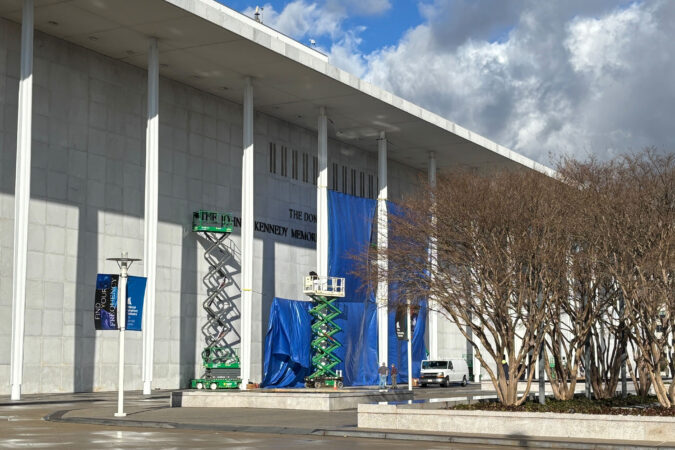
    The Kennedy Center began updating signage on the exterior of the building Friday morning, a day after its board voted to rename the institution “The Donald J. Trump and The John F. Kennedy Memorial Center for the Performing Arts.”

    A blue tarp was stretched across a portion of the building as a small team on scaffolding started the work. Loud drilling could be heard nearby. Inside the building, large letters spelling “Trump” could be seen on the floor of the entry hall, according to a photograph obtained by the Washington Post. Signage elsewhere around the exterior of the institution remained unchanged.

    Thursday’s vote by the board of trustees marked a dramatic change to a building established as a “living memorial” to a slain president. The announcement drew swift condemnation from Kennedy family members and Democratic leaders, who called it illegal and said only Congress could change the center’s name.

    For months, Trump had repeatedly joked about the name change, including at the Kennedy Center Honors earlier this month. The center has seen a year of upheaval since Trump overhauled the institution in February, sparking a wave of firings and resignations. Ticket sales have fallen sharply, according to an October analysis by The Post, and many artists have said they will no longer perform there. The new leadership has boasted of hefty fundraising tallies and has begun to ramp up bookings for Christian and right-wing events.

    “The Trump Kennedy Center shows a bipartisan commitment to the Arts,” Kennedy Center President Richard Grenell wrote Thursday on X. Officials did not cite an authority for the board’s ability to change the institution’s name.

    The current board consists of loyalists to Trump following a purge of trustees appointed by former President Joe Biden. They met Thursday in Palm Beach, Florida.

    This is not the only building to which Trump’s name has been added in recent weeks in Washington. Earlier this month, his administration renamed the building that houses the U.S. Institute of Peace downtown, emblazoning “Donald J. Trump” in several areas of the structure.

    “Boy, that is beautiful,” Trump said at the time, thanking Secretary of State Marco Rubio for putting his name on the building.

  • Hunger monitor says Gaza is still seeing acute malnutrition but not famine

    Hunger monitor says Gaza is still seeing acute malnutrition but not famine

    JERUSALEM — The Gaza Strip is no longer facing famine in any of its regions after humanitarian and commercial food deliveries surged following an October ceasefire between Israel and Hamas, but more than three-quarters of the population, or 1.6 million people, still experience acute food insecurity and malnutrition, the global authority on hunger said Friday.

    The report from the Integrated Food Security Phase Classification (IPC) was the first to be published since the international group of experts declared in August that the Gaza City region was experiencing “man-made” famine as a result of two years of war, displacement, and harsh Israeli restrictions on food and other aid. Although the IPC had projected that by September, more than 600,000 people would experience Phase 5, or “catastrophic” levels of starvation and malnutrition, that figure dropped to 100,000 by the end of November after Israel began loosening the flow of aid as part of an Oct. 10 ceasefire agreement brokered by the United States, according to the latest report.

    Israel has come under intense international criticism this year for choking the flow of humanitarian aid, which Israeli officials said was being stolen by Hamas fighters and resold, prolonging the conflict. In a statement Friday, the Israeli government said the latest report showed “even the IPC had to admit that there is no famine in Gaza” and criticized the group’s findings as based on incomplete data.

    Between “600 and 800 aid trucks enter the Gaza Strip every day, 70% of them carrying food — nearly five times more than what the IPC itself said was required for the Strip,” the Israeli Foreign Ministry said in a statement that criticized the latest IPC report as “deliberately distorted.”

    The IPC said that although the nutrition situation has improved since its August report, acute malnutrition is considered “critical,” or Phase 4 in its five-tier classification, in Gaza City and “serious,” or Phase 3, in the Deir al-Balah and Khan Younis regions. North Gaza is also believed to be suffering from malnutrition, the report warned, adding that conditions remain severe for the most vulnerable populations.

    “Over the next 12 months, across the entire Gaza Strip, nearly 101,000 children aged 6-59 months are expected to suffer from acute malnutrition and require treatment, with more than 31,000 severe cases,” the report found. “During the same period, 37,000 pregnant and breastfeeding women will also face acute malnutrition and require treatment.”

  • Trump’s predecessors would be unsettled by his naming obsession

    Trump’s predecessors would be unsettled by his naming obsession

    It is becoming increasingly clear that Donald Trump and his most ardent supporters view the U.S. presidency as a golden opportunity for branding.

    On Thursday, the White House announced that the John F. Kennedy Center for the Performing Arts would be renamed the Trump Kennedy Center, after what was reported to be a unanimous vote by the board of trustees that the president himself installed there. Trump is the board’s chairman.

    The move was roundly denounced by Democrats and by members of the Kennedy family.

    “Perhaps the board isn’t aware that the Kennedy Center is THE memorial to the president of the United States, John F. Kennedy,” JFK’s nephew Tim Shriver wrote on Instagram. “Would they rename the Lincoln Memorial? The Jefferson? That would be an insult to great presidents. This too is an insult to a great president.”

    Workers install Donald J. Trump above the current signage on the Kennedy Center on Friday, Dec. 19, 2025, in Washington. (AP Photo/Jacquelyn Martin)

    It is also questionable whether it could be done without Congress’s approval, given that the center was established by statute. But the new name was already being affixed to the building on Friday — a move very much in line with other actions taken recently by the Trump administration.

    It freshly rechristened the U.S. Institute of Peace to be the Donald J. Trump Institute of Peace. Tax-deferred investment vehicles for children that are coming in 2026 will be called “Trump accounts.” And a new government website to help people shop for lower-priced drugs can be found at TrumpRx.com.

    This month, the National Park Service added Trump’s June 14 birthday to its list of free-admission days. The president’s birthday coincides with Flag Day. But the Park Service simultaneously dropped its policies of not charging admission on Martin Luther King Jr. Day and Juneteenth, which unlike Flag Day are federal holidays.

    U.S. Treasurer Brandon Beach confirmed in October that the U.S. Mint was drafting $1 coins featuring the image of Trump on both sides to commemorate the 250th anniversary of the nation’s founding.

    Trump’s image is not among the designs for the semiquincentennial coins and medals coin unveiled by the Mint thus far, however — the idea possibly impeded for now by a law that presidents cannot appear on coins until two years after their deaths.

    In 2003, there was a move among Republicans in Congress to replace Franklin D. Roosevelt on the dime with an image of Ronald Reagan. The former president was suffering from Alzheimer’s disease and unable to speak for himself, but his wife, Nancy, put a stop to the effort.

    “While I can understand the intentions of those seeking to place my husband’s face on the dime, I do not support this proposal and I am certain Ronnie would not,” she said. “When our country chooses to honor a great president such as Franklin Roosevelt by placing his likeness on our currency, it would be wrong to remove him and replace him with another.”

    Though the impulse of a real estate developer is to slap his name on everything around him, the nation’s past chief executives, with rare exceptions, have refrained from doing so while in office.

    Perhaps the most notable of those exceptions was naming the capital city in 1791 after George Washington, the nation’s first president, who had selected the site for the federal district. The decision on what to call it was made by a three-member commission to oversee the city’s development that was appointed by Washington.

    Moves to christen institutions and landmarks after history’s most well-regarded presidents have often risen from the ground up and reflected the wishes of local communities. Across the map, there are countless counties and towns, schools and libraries, streets and squares called George Washington, Thomas Jefferson, and Abraham Lincoln.

    Sometimes, the way former presidents have been honored for their historic achievements has gone against their wishes. In 1941, Roosevelt put his hand on his presidential desk in the Oval Office, where he had signed the legislation that made the New Deal a reality, and told Supreme Court Justice Felix Frankfurter precisely what kind of monument he would like to see to his presidency.

    “If any memorial is erected to me, I know exactly what I should like it to be. I should like it to consist of a block about the size of this and placed in the center of that green plot in front of the Archives Building,” Roosevelt said. “I don’t care what it is made of, whether limestone or granite or whatnot, but I want it plain without any ornamentation, with the simple carving, ‘In Memory of ____’.”

    Indeed, that modest block of stone was put into place on Pennsylvania Avenue in 1965. But a little more than three decades later, the largest and most grandiose of all presidential monuments was dedicated in Roosevelt’s honor. It stretches across 7.5 acres along the southwest side of the Tidal Basin.

    And there is irony in the gargantuan Ronald Reagan Building and International Trade Center — a federal building eclipsed only by the Pentagon in size — given the 40th president’s aversion to big government.

    A special poignancy led to the naming of the Kennedy Center. The concept of a national cultural center had been kicking around for decades and was a project embraced by Kennedy’s Republican predecessor, Dwight D. Eisenhower. Kennedy and first lady Jacqueline Kennedy were enthusiasts, and helped raise money, but still couldn’t get it off the ground.

    In a speech at Amherst College less than a month before his 1963 assassination, Kennedy said: “If sometimes our great artists have been the most critical of our society, it is because their sensitivity and their concern for justice, which must motivate any true artist, makes him aware that our nation falls short of its highest potential.”

    “I see little of more importance to the future of our country and our civilization than full recognition of the place of the artist,” he added.

    After his death, his widow asked that the center become a reality and a “living memorial” to her husband. There was still a furious fight in Congress over appropriating government money to the project — $15.5 million in federal dollars to match private donations. Republicans in particular decried it as frivolous.

    But where patronage of the arts has usually been the province of the wealthy, this idea caught on with ordinary Americans.

    “A great number of people throughout the United States have sent in small contributions to the Treasury and to the White House, in denominations of $1 to $25,” Rep. James C. Auchincloss of New Jersey, one of the few Republicans to support providing federal funds for the center, argued on the House floor.

    The measure passed two months after Kennedy’s assassination, on Jan. 23, 1964. President Lyndon B. Johnson broke ground for the center in December.

    “Pericles said, ‘If Athens shall appear great to you, consider then that her glories were purchased by valiant men, and by men who learned their duty,’” Johnson said. “As this center comes to reflect and advance the greatness of America, consider then those glories were purchased by a valiant leader who never swerved from duty — John Kennedy. And in his name I dedicate this site.”

  • Drug companies line up to make deals with Trump after initial hesitation

    Drug companies line up to make deals with Trump after initial hesitation

    When President Donald Trump declared in May that he wanted drug companies to voluntarily cut their prices, few pharmaceutical executives wanted to go first. Now, no one wants to be last — and risk the wrath of the president.

    Nine drug companies announced price cuts with Trump at the White House on Friday, touting discounts on medication to treat diabetes, heart disease, HIV, hepatitis B, and other conditions. The deals will offer discounts on drugs sold to the government and to Americans through a new website, TrumpRx.gov, in exchange for tariff relief and other incentives, including faster FDA reviews for future approvals.

    The program, known as the Most Favored Nation initiative, is an effort to link U.S. drug prices to lower costs abroad.

    “Every president for a generation has promised to reduce drug prices, but … I am the only one of them to ever even think in terms of ‘favored nations,’” Trump boasted Friday, flanked by drug-company executives and health officials.

    Friday’s announcements follow similar deals with five other companies, beginning in September when Pfizer CEO Albert Bourla joined Trump to unveil price cuts. Since then, other drug-company executives have joined Trump to announce discounts on fertility and GLP-1 drugs and other offerings. In return, the administration has lifted the threat of tariffs and offered the companies other benefits, such as priority vouchers to expedite FDA reviews, which can lead to hundreds of millions of dollars in additional revenue for a company if a new drug is quickly approved.

    Amgen, Boehringer Ingelheim, Bristol Myers Squibb, Genentech, Gilead Sciences, GSK, Merck, Novartis and Sanofi all announced new price cuts Friday. Three of the 17 pharmaceutical companies initially targeted by the Trump administration — AbbVie, Johnson & Johnson and Regeneron — have yet to appear with the president to tout price cuts, but officials said that those companies are set to make their own announcements soon.

    Trump has heralded his initiative — which he attempted to pursue in his first term — as one of his most significant achievements this year, arguing that even small savings matter amid the difficulty of curbing drug prices. The deep-pocketed pharmaceutical industry has repeatedly blocked most major efforts at reform for decades, and U.S. drug spending continues to rise, outpacing other wealthy countries.

    “This is the biggest thing ever to happen on drug pricing and on healthcare,” Trump claimed. He also criticized other countries for relying on high drug prices in the United States to subsidize the cost of pharmaceutical research and development, saying that global prices needed to be more equitable.

    “We were subsidizing the entire world. We’re not doing that anymore,” the president said.

    Democrats and outside experts have credited the deals as potentially helping some patients but said the initiative’s overall savings to the U.S. health system will be negligible and dismissed Trump’s hyperbole.

    “It’s a bit laughable to call this ‘the biggest thing ever’ in health policy. I’m not even sure this cracks the top 10 health policy changes,” said Craig Garthwaite, director of healthcare at Northwestern University’s Kellogg School of Management. “Giving Most Favored Nation prices to Medicaid, particularly for older drugs, likely won’t save that much.”

    The president has sought to make regular announcements about his drug-price deals, aiming to show progress and counter voter frustration over rising healthcare costs entering a midterm year that favors Democrats. Trump is timing Friday’s event to be one of his final White House events of the year, before he heads to North Carolina for a rally on affordability and then to his Mar-a-Lago resort.

    Pharmaceutical companies also touted their willingness to cut U.S. prices. A Bristol Myers Squibb executive said the company would provide its blood-thinning drug Eliquis, its most-prescribed medicine, to Medicaid free. Merck said it would offer discounts on its drugs Januvia, Janumet, and Janumet XR, which are used to treat Type 2 diabetes.

    “I reflect on your goal, driving affordability and access to Americans, but equally getting prices up outside the United States,” Merck CEO Robert Davis told Trump. “We’re 100 percent supportive of your actions.”

    Democrats have questioned whether Trump’s dealmaking with the companies is creating a quid pro quo, with pharmaceutical executives striking agreements to give the president a political win in exchange for potential profit.

    “Congress and the American people remain in the dark about the contours of your agreement with the Trump Administration,” Sen. Ron Wyden (D., Ore.) and Reps. Richard E. Neal (D., Mass.), Frank Pallone Jr. (D., N.J.) and Robert C. “Bobby” Scott (D., Va.) wrote in letters sent this week to pharmaceutical executives participating in the initiative. The lawmakers are the top Democrats on four congressional committees that oversee aspects of the U.S. health system.

    Several former FDA officials — including two physicians who recently oversaw the agency’s drug-regulation center — have warned that the voucher program may be illegal and risk undermining public health by streamlining reviews. While the agency’s drug reviews can traditionally take about a year, as scientists pore over safety and effectiveness data, Trump officials have said that the voucher program can guarantee a review within one or two months. The administration has defended the program, saying that safety and effectiveness remain priorities despite the accelerated timetable.

    Trump officials have used other levers, too. The administration has relied on the Centers for Medicare and Medicaid Services’s innovation center, which allows officials to pilot payment changes without seeking congressional approval, to pressure drug companies that do not voluntarily lower prices. Several drug-payment pilots have already been announced, and more are expected on Friday, the people said.

    Wall Street analysts say the companies have incentives to strike quick deals with the administration, rather than tempt Trump’s ire. Medicaid represents a relatively small portion of their business, and many companies are agreeing to price cuts similar to discount programs they have begun.

    Pfizer’s announcement with Trump also sent a signal to the rest of the industry, several pharmaceutical executives and industry analysts have told reporters.

    “When you saw the lack of impact to earnings of the initial companies’ deals, for most coming after, it’s a no-brainer,” said Chris Meekins, a managing director at Raymond James.

    Trump officials have said that the initial negotiations were tough, and securing concessions has become easier over time.

    “I think the first five companies that came through the pipeline were some of the hardest ones to get through,” CMS Administrator Mehmet Oz said in an interview on Dec. 7, pointing to the size of companies like Pfizer, AstraZeneca, and Eli Lilly, which were among the first companies to agree to deals.

    Trump officials have leaned on the healthcare companies’ civic responsibilities, in addition to applying pressure through tariffs and the CMS innovation center.

    Chris Klomp, the head of the Medicare program and a lead negotiator on the drug-price cuts, said he stressed “duty and patriotism” in a conversation with one prominent CEO.

    “And when we got done, he said, ‘I didn’t get into this business for [quarterly earnings],” Klomp said in remarks at last month’s MAHA Action summit. “I have children. I want to make them proud. I understand this is important to you and the president. We will show up.’”

  • How brokers gamed the ACA marketplace, roiling subsidy debate in Congress

    How brokers gamed the ACA marketplace, roiling subsidy debate in Congress

    The Florida insurance brokers offered an enticing deal to unemployed and homeless people: Enroll in a Healthcare.gov health plan they weren’t eligible for in exchange for gift cards, food, alcohol, or cash. They coached them to lie about their income to qualify for heavily subsidized coverage, according to court documents. Sometimes they enrolled people without their knowledge.

    A federal jury convicted Cory Lloyd and Steven Strong last month of collecting millions of dollars in commissions between 2018 and 2022 through a widespread plot to defraud the federal insurance marketplace. People earning at least the federal poverty level can get income-based subsidies to help them afford monthly premiums for plans sold through the Affordable Care Act. Under Lloyd and Strong’s scheme, the federal government paid at least $180 million in ineligible subsidies.

    Many more agents and brokers — likely thousands, according to two career staffers at the Centers for Medicare and Medicaid Services, who spoke on the condition of anonymity because they weren’t authorized to speak to press — are gaming the marketplace where 24 million Americans get health insurance.

    Corruption among Healthcare.gov agents and brokers had emerged as a sticking point in Washington as Congress failed to reach a deal to halt the year-end expiration of enhanced subsidies for insurance premiums, which will drive up the cost of plans for millions of Americans. Republicans invoked the fraud to argue against extending the subsidies while Democrats said the solution is better enforcement rather than withholding assistance from Americans who need it.

    Last year, the Biden administration temporarily suspended 850 insurance agents and brokers suspected of fraudulent or abusive conduct. CMS hasn’t terminated any agents or brokers this year — although spokesman Christopher Krepich said the agency has “initiated terminations” even as it sets up stricter enrollment rules for customers amid Administrator Mehmet Oz’s promises to root out fraud.

    Around 100,000 agents and brokers are authorized by Healthcare.gov. They facilitate more than three-quarters of enrollments. For each person enrolled, insurers pay them a small monthly commission, typically between $5 and $20. Florida, where Lloyd and Strong operated, offers the largest commissions in the country, averaging $28 per enrollee, according to the nonpartisan health policy organization KFF.

    A new government report underscored how easy it is to game the marketplace.

    When the Government Accountability Office, which evaluates federal programs and spending, submitted 20 fraudulent applications to Healthcare.gov for coverage this year, 19 were initially approved even though the agency didn’t submit documents requested to prove income, citizenship, and Social Security numbers. The marketplace terminated one enrollee for insufficient documentation. The government is still paying more than $10,000 a month in subsidies for 18 remaining enrollments.

    Investigators also discovered misuse of Society Security numbers — in one case, a single number was used for 125 policies in 2023 — and identified serious shortcomings in how CMS assesses marketplace fraud.

    Stopping marketplace fraud is “not a priority” for CMS, said Seto Bagdoyan, a director at GAO who worked on the report.

    Krepich said the agency has undertaken “a thorough investigation into improper agent and broker activity” and is committed to “ensuring consumers are never enrolled in coverage without their knowledge or consent.”

    Democrats complain the Trump administration is doing little to fix the problem despite its bluster about waste, fraud, and abuse in federal health programs.

    Rep. Lloyd Doggett (Texas), the top Democrat on a subcommittee overseeing CMS, wrote a letter to Oz last week requesting closer scrutiny of the reinstated agents and brokers. “The remedy is not to deny a mother access to care for her sick child,” Doggett said in a statement. “What we need is effective law enforcement.”

    Like brokers for Lloyd and Strong, who did not return requests for comment, many have enrolled people without their knowledge, switched their plan without their consent or created fake enrollments to maximize commissions.

    The GAO concluded that the enhanced subsidies worsened fraud in recent years as bad actors seized upon the beefier assistance to lure new customers. As enrollments on Healthcare.gov skyrocketed under the extra subsidies, fraudulent sign-ups grew too. The Congressional Budget Office estimated those misstating their incomes to get more subsidies nearly doubled from 1.3 million to 2.3 million between 2023 and 2025.

    “We believe that the expansion of the subsidies — which put more money in the pool — invigorated the financial incentive to sign up as many people as possible,” Bagdoyan said.

    The GAO’s findings were among the hurdles to Republicans in Congress agreeing to extend extra subsidies for a marketplace they’ve accused of failing to sufficiently police from bad actors.

    “These findings validate long-standing Republican warnings: Obamacare’s subsidy system lacks even the most basic guardrails and has created an environment where criminals, identity thieves, and unscrupulous brokers can exploit taxpayers with ease,” House Speaker Mike Johnson (R., La.) said in a statement last week.

    Democrats say the proper response isn’t to let the extra subsidies expire but to go after the brokers.

    “I’ve always said any fraud is too much,” said Sen. Ron Wyden (Oregon), the top Democrat on the Senate Finance Committee, which has oversight of healthcare issues.

    Wyden introduced a bill to create new civil penalties for brokers who commit fraud. He said Republicans haven’t signed onto his bill or offered similar measures.

    After receiving hundreds of thousands of complaints about fraud, the Biden administration started requiring customers to hold a three-way call with their broker and the marketplace call center in July 2024. But the new policy left plenty of loopholes, agents told GAO. The rule didn’t apply to new enrollees. And the marketplace took only “limited steps to verify the identity of the consumer on the three-way call,” the report says.

    Oz has been vowing to root out the abuse, slamming the prior administration for rules he said were too lenient and touting stricter enrollment rules CMS released in June. Those rules don’t include any direct, new restrictions on agents and brokers but could indirectly make fraud harder by ending year-round enrollment for people earning less than 150% of the federal poverty level, roughly $23,000 for an individual.

    “The past administration prioritized achieving big program enrollment numbers over protecting program integrity,” Oz said in a video posted recently to X.

    CMS is also preparing to implement stricter verification requirements laid out in Trump’s sweeping tax-and-spending law he signed this summer. That legislation bans the marketplaces from awarding subsidies before verifying a customer’s personal information, including their income and legal status, before awarding any subsidies, which could make it harder for bad actors to sign people up.

  • Head of workplace rights agency urges white men to report discrimination

    Head of workplace rights agency urges white men to report discrimination

    The head of the U.S. agency for enforcing workplace civil rights posted a social media call-out urging white men to come forward if they have experienced race or sex discrimination at work.

    “Are you a white male who has experienced discrimination at work based on your race or sex? You may have a claim to recover money under federal civil rights laws,” U.S. Equal Employment Opportunity Commission Chair Andrea Lucas, a vocal critic of diversity, equity and inclusion, wrote in an X post Wednesday evening with a video of herself. The post urged eligible workers to reach out to the agency “as soon as possible” and referred users to the agency’s fact sheet on “DEI-related discrimination” for more information.

    Lucas’ post, viewed millions of times, was shared about two hours after Vice President JD Vance posted an article he said “describes the evil of DEI and its consequences,” which also received millions of views. Lucas responded to Vance’s post saying: “Absolutely right @JDVance. And precisely because this widespread, systemic, unlawful discrimination primarily harmed white men, elites didn’t just turn a blind eye; they celebrated it. Absolutely unacceptable; unlawful; immoral.”

    She added that the EEOC “won’t rest until this discrimination is eliminated.”

    A representative for Vance did not respond to a request for comment. Lucas said Thursday evening that “the gaslighting surrounding what DEI initiatives have entailed in practice ends now. We can’t attack and remedy a problem if we refuse to call it out for what it is — race or sex discrimination — or acknowledge who is harmed.”

    She added that “the EEOC’s doors are open to all,” and Title VII of the Civil Rights Act of 1964 “protects everyone, including white men.”

    Since being elevated to acting chair of the EEOC in January, Lucas has been shifting the agency’s focus to prioritize “rooting out unlawful DEI-motivated race and sex discrimination,” aligning with President Donald Trump’s own anti-DEI executive orders. Trump named Lucas as the agency’s chair in November.

    Earlier this year, the EEOC along with the Department of Justice issued two “technical assistance” documents attempting to clarify what might constitute “DEI-related Discrimination at Work” and providing guidance on how workers can file complaints over such concerns. The documents took broad aim at practices such as training, employee resource groups and fellowship programs, warning such programs — depending on how they’re constructed — could run afoul of Title VII of the Civil Rights Act, which prohibits employment discrimination based on race and gender.

    Those documents have been criticized by former agency commissioners as misleading for portraying DEI initiatives as legally fraught.

    David Glasgow, executive director of the Meltzer Center for Diversity, Inclusion, and Belonging at the NYU School of Law, said Lucas’s latest social media posts demonstrate a “fundamental misunderstanding of what DEI is.”

    “It’s really much more about creating a culture in which you get the most out of everyone who you’re bringing on board, where everyone experiences fairness and equal opportunity, including white men and members of other groups,” Glasgow said.

    The Meltzer Center tracks lawsuits that are likely to affect workplace DEI practices, including 57 cases of workplace discrimination. Although there are instances in which it occurs on a case-by-case basis, Glasgow said he has not seen “any kind of systematic evidence that white men are being discriminated against.”

    He pointed out that Fortune 500 CEOs are overwhelmingly white men, and that relative to their share of the population, the demographic is overrepresented in corporate senior leadership, Congress, and beyond.

    “If DEI has been this engine of discrimination against white men, I have to say it hasn’t really been doing a very good job at achieving that,” Glasgow said.

    Jenny Yang, a former EEOC chair and now a partner at law firm Outten & Golden, said it is “unusual” and “problematic” for the head of the agency to single out a particular demographic group for civil rights enforcement.

    “It suggests some sort of priority treatment,” Yang said. “That’s not something that sounds to me like equal opportunity for all.”

    On the other hand, the agency has done the opposite for transgender workers, whose discrimination complaints have been deprioritized or dropped completely, Yang said.

    The EEOC has limited resources, and must accordingly prioritize which cases to pursue. But treating charges differently based on workers’ identities goes against the mission of the agency, she said.

    “It worries me that a message is being sent that the EEOC only cares about some workers and not others,” Yang said.

  • Turning Point USA’s Erika Kirk backs Vice President JD Vance’s potential 2028 presidential bid

    Turning Point USA’s Erika Kirk backs Vice President JD Vance’s potential 2028 presidential bid

    PHOENIX — Erika Kirk, widow of Turning Point USA founder Charlie Kirk and the organization’s new leader, endorsed a potential presidential bid by Vice President JD Vance on the opening night of the conservative youth group’s annual conference.

    After telling the cheering crowd that Turning Point would help keep Congress in Republican hands next year, she said, “We are going to get my husband’s friend JD Vance elected for 48 in the most resounding way possible.”

    Vance would be the 48th president if he takes office after President Donald Trump.

    Kirk’s statement on Thursday is the most explicit backing of Vance’s possible candidacy by a woman who has been positioned as a steward to her late husband’s legacy. Charlie Kirk had become a powerbroker and bridge builder within the conservative movement before he was assassinated in September.

    Vance was close with Charlie Kirk, whose backing helped enable his rapid political rise. After the assassination, Vance and his wife joined Erika Kirk in Utah to fly her husband’s remains home to Arizona aboard Air Force Two.

    Vance is set to speak to Turning Point on Sunday, the conference’s last day. The convention has featured the usual spectacle and energy that have characterized the organization’s events, but the proceedings have also been marred by intense infighting among conservative commentators and estranged allies who have turned on each other in the wake of Kirk’s death.

    As Trump’s vice president, Vance is well-positioned to inherit the movement that remade the Republican Party and twice sent Trump to the White House. But it would be no small task for him to hold together the Trump coalition, which is built around personal loyalty to him more than shared political goals.

    Various wings of the conservative movement already are positioning to steer the party after Trump’s presidency, a skirmish that’s becoming increasingly public and pointed.

    Turning Point, with its thousands of young volunteers, would provide a major boost for Vance in a fractious primary. Now 41, Vance would be the first Millennial president if elected, a natural fit for the organization built around mobilizing youth.

    Trump has repeatedly mused about running for a third term despite a constitutional prohibition. However, he’s also speculated about a 2028 ticket featuring Vance and Secretary of State Marco Rubio.

    Although Rubio previously ran for president in 2016, he has said he would support Vance as Trump’s successor.

  • Putin says Europe out of step with an increasingly Moscow-friendly U.S.

    Putin says Europe out of step with an increasingly Moscow-friendly U.S.

    MOSCOW — Russian President Vladimir Putin told Europe it was out of step with the new priorities of the United States and painted a picture of the world in which America was closer to Russia than its traditional Western allies, during his marathon year-end call-in show Friday.

    Over the course of several hours, Putin answered questions from journalists and the public, playing up the economy, expressing confidence on the Ukraine war and denying responsibility for the massive human casualties taking place. He also blamed the West for the invasion.

    He ridiculed NATO Secretary General Mark Rutte’s warning this month that Russia could attack a NATO country in the next five years by saying such sentiment contradicted the new U.S. National Security Strategy, which does not identify Russia as an adversary to the U.S. and instead seeks “strategic stability.”

    “The United States is the creator of NATO, its main sponsor. All the main resources come from the U.S. — money, military technology, weapons, ammunition, everything,” Putin said. “And in the new U.S. National Security Strategy, Russia is not named as an enemy or a target. Yet the NATO secretary general is preparing for war with us. What is that? Can’t you read?”

    The Kremlin said earlier this month that the security document, which alarmed U.S. allies in Europe, was “largely consistent” with Russia’s vision.

    Putin said that the conflict between U.S. President Donald Trump and European leaders was because “European political elites openly supported the Democratic Party” and its 2024 presidential candidate Kamala Harris, and said these same elites were hoping Republican losses in the midterm elections would put pressure on Trump.

    The combined-format event, blending a large news conference with a “Direct Line” call-in from citizens that often runs for four hours, marks Putin’s most significant public address this year and one of his rare moments of engagement with the public. He skipped the traditional state-of-the-nation speech, normally held in the spring.

    While Putin did say he was ready for peace with Ukraine and would compromise to end the conflict, he still repeated his well-worn lines blaming Kyiv for refusing to end the war — although it was Russia that invaded Ukraine. He also said Ukrainian forces were retreating “in all directions.”

    Putin, who has taken a hard line on peace negotiations in recent days, said that Russia was ready for peace — on terms suitable to Moscow that eliminated what the Kremlin calls “the root causes” of the conflict, which would see a Ukraine subservient to its Russian neighbor.

    Putin denied responsibility for human casualties in the war, “as we did not start that war.”

    He said that he had told Trump that Russia was willing to compromise in peace talks when he met him in Alaska in August, although the Russian leader this week insisted that Russia would take more Ukrainian territory — which he called Russia’s “historical lands” — through military force if it failed to gain these through negotiations.

    “When I arrived in Anchorage, I said these would not be easy decisions for us. But we agree to the compromises being proposed,” Putin said, adding that “to say that we reject anything is absolutely incorrect and has no basis.”

    “The ball is entirely in the court of our opponents, so to speak, and, first and foremost, the leaders of the Kyiv regime and their, in this case, and above all, European sponsors,” Putin said.

    Asked by the BBC whether there would in future be new “special military operations,” the Kremlin’s euphemism for the war — Putin said: “Western leaders created this situation themselves and continue fanning the flames by saying they are preparing for war with Russia,” adding it was “nonsense” that Russia wanted to go to war with Europe.

    During the conference questions from Russians flashed up on screens in the hall, including one that suggested that Russian elections were “a fiction” and another that asked why ordinary Russians lived so badly.

    “When you will return the ‘normal internet?’ It’s impossible to even send a question to the president!” one asked. Another asked, “Are you going to nominate yourself to run for president in 2030?”

    When the Levada Center independent polling agency asked Russians last month what questions they had for Putin, 21% wanted to know when the war would end, and 16% wanted to ask when pensions and benefits would increase.

    Putin adopted a triumphalist tone, boasting that Russia would have new military successes before year’s end. “I have no doubt that you and I will witness new successes of our armed forces, our troops on the contact line before the end of this year. That’s the plan.”

    Putin also rolled out a list of statistics to show the economy was doing well, including an unemployment rate of just 2.2% and a national debt that he boasted is among the lowest of developed countries. While growth this past year was only 1%, he maintained it was deliberate.

    “This was done in the course of targeting inflation,” he said. Inflation has dropped from nearly 10 percent down to 5.7%, he said. He added that an increase in sales tax on Jan. 1 from 20% to 22% was needed to balance the budget and would not be permanent.

    But in a sign that Western sanctions are taking a real toll on Russia’s economy, questions addressed high prices of chicken and other essential items, as well as a shortage of fish.

    “Stop price increases!” said a message from one Russian displayed on the screens in the hall.

    “There really isn’t enough fish on people’s tables. We’re not meeting the standard here,” Putin admitted.

    A question from a child was read out asking, “Why the pastries in the cafeteria rise but my parents salary does not?”

    The press marathon comes amid a burst of diplomatic activity as Trump pushes for a deal to settle the conflict in Ukraine. Trump’s special envoy, Steve Witkoff, and his son-in-law Jared Kushner are expected in Miami this weekend for talks with Kirill Dmitriev, Putin’s key investment envoy and a central figure in back-channel discussions, Axios and Politico reported.

    On Thursday, the Kremlin confirmed Russia is preparing for American contacts to clarify details from recent U.S. consultations with Ukraine and Europeans held in Berlin earlier this week.

    Putin’s address comes after European leaders agreed Friday to give Kyiv nearly $105 billion in a loan backed by the bloc’s budget, after the failure of a last-ditch effort to tap Russia’s $246 billion in frozen assets to finance Ukraine’s state and army. Putin called the attempt to tap the assets “open robbery” during the event.

    Moscow had stepped up anti-European rhetoric and vowed retaliation against any seizure, warning that without fresh funding, Kyiv’s resources could dry up within months.

    The Kremlin said about 3 million questions had been received by Friday, according to spokesman Dmitry Peskov. Putin’s approval rating remains steady at 84%, according to a Levada poll in October and November published last month.

    But as the Ukraine war — planned by the Kremlin to last just a few days — approaches its fourth year, war fatigue has set in, with casualties skyrocketing as Russia presses on with limited territorial gains.

    More than 65% of people surveyed by Levada in mid-November believed it was time for peace talks instead of continued military action, a four-percentage-point increase over the previous month. Tellingly, 55% in a separate Levada poll the previous month said they would not want a family member to sign a military contract to fight in Ukraine, 14% higher than in May 2023.

    According to the recent Levada poll, 65% of Russians believe the country is heading in the right direction, down from 74% in March, while 21% feel Russia is on the wrong path, compared with 16% in March.

    With Russia’s economy under intense pressure amid sanctions, declining oil prices and high interest rates, dozens of Russian companies have laid off workers or cut wages, while residents grapple with inflation and a rising cost of living. According to the poll, 25% said their life had gotten worse in the past year.

    In the lead-up to Putin’s question session, residents in villages and towns across Russia recorded videos complaining of local issues: a lack of heating in their homes; terrible roads; public transport failures; odorous smoke from local landfills; and other matters that will probably be featured during the event.

    Dixon reported from Riga, Latvia. Natalia Abbakumova in Riga, Latvia contributed to this report.

  • Motive still unknown after suspect in the Brown attack and MIT professor’s killing is found dead

    Motive still unknown after suspect in the Brown attack and MIT professor’s killing is found dead

    A frantic search for the suspect in last weekend’s mass shooting at Brown University ended at a New Hampshire storage facility where authorities discovered the man dead inside and then revealed he also was suspected of killing a Massachusetts Institute of Technology professor.

    Claudio Neves Valente, 48, a former Brown student and Portuguese national, was found dead Thursday night from a self-inflicted gunshot wound, said Col. Oscar Perez, the Providence police chief.

    Investigators believe he is responsible for fatally shooting two students and wounding nine other people in a Brown lecture hall last Saturday, then killing MIT professor Nuno F.G. Loureiro two days later at his home in the Boston suburbs, nearly 50 miles (80 kilometers) from Providence. Perez said as far as investigators know, Neves Valente acted alone.

    Portugal’s top diplomat said Friday that the government was taken aback by revelations that a Portuguese man is the main suspect in the mass shooting at Brown and the killing of an MIT professor who was of the same nationality. Police said they were contacted by U.S. authorities Thursday once Neves Valente was named.

    Foreign Minister Paulo Rangel said Portugal has provided “very broad cooperation” in the case. He said in comments to the national news agency Lusa that “the investigation is far from over.”

    Brown University President Christina Paxson said Neves Valente was enrolled there as a graduate student studying physics from the fall of 2000 to the spring of 2001.

    “He has no current affiliation with the university,” she said.

    Neves Valente and Loureiro attended the same academic program at a university in Portugal between 1995 and 2000, U.S. attorney for Massachusetts Leah B. Foley said. Loureiro graduated from the physics program at Instituto Superior Técnico, Portugal’s premier engineering school, in 2000, according to his MIT faculty page. The same year, Neves Valente was let go from his temporary student support and faculty liaison position at the Lisbon university, according to an archive of a termination notice from the school’s then-president in February 2000.

    Neves Valente, who was born in Torres Novas, Portugal, about 75 miles (121 kilometers) north of Lisbon, had come to Brown on a student visa. He eventually obtained legal permanent resident status in September 2017, Foley said. It wasn’t immediately clear where he was between taking a leave of absence from the school in 2001 and getting the visa in 2017. His last known residence was in Miami.

    After officials revealed the suspect’s identity, President Donald Trump suspended the green card lottery program that allowed Neves Valente to stay in the United States.

    There are still “a lot of unknowns” in regard to motive, Rhode Island Attorney General Peter Neronha said. “We don’t know why now, why Brown, why these students and why this classroom,” he said.

    Tip helps investigators connect the dots

    The FBI previously said it knew of no links between the Rhode Island and Massachusetts shootings.

    Police credited a person who had several encounters with Neves Valente for providing a crucial tip that led authorities to him.

    After police shared security video of a person of interest, the witness — known only as “John” in a Providence police affidavit — recognized him and posted his suspicions on the social media forum Reddit. Reddit users urged him to tell the FBI, and John said he did.

    John said he encountered Neves Valente about two hours before the attack in a bathroom in the engineering building, which was where the shooting occurred, and noticed he was wearing inappropriate clothing for the weather, according to the affidavit. Still before the attack, he again bumped into Neves Valente a couple blocks away and saw him suddenly turn away from a Nissan sedan when he saw John.

    “When you do crack it, you crack it. And that person led us to the car, which led us to the name,” Neronha said.

    His tip pointed investigators to a Nissan Sentra with Florida plates. That enabled Providence police to tap into a network of more than 70 street cameras operated around the city by surveillance company Flock Safety. Those cameras track license plates and other vehicle details.

    After leaving Rhode Island, Providence officials said Neves Valente stuck a Maine license plate over his rental car’s plate to help conceal his identity.

    Investigators found footage of Neves Valente entering an apartment building near Loureiro’s in a Boston suburb. About an hour later, Neves Valente was seen entering the Salem, New Hampshire, storage facility where he was found dead, Foley said. He had with him a satchel and two firearms, Neronha said.

    Victims include renowned physicist, political organizer and aspiring doctor

    Loureiro, a 47-year-old physicist and fusion scientist, joined MIT in 2016 and was named last year to lead the school’s Plasma Science and Fusion Center, one of its largest laboratories. The scientist from Viseu, Portugal, had been working to explain the physics behind astronomical phenomena such as solar flares.

    In Lisbon, he was remembered as a highly regarded researcher and instructor for “all the contributions he gave and what he could still have given, all the equations left unwritten,” said Professor Bruno Gonçalves, head of the Institute for Plasmas and Nuclear Fusion at Instituto Superior Técnico.

    Gonçalves added, “It is difficult to imagine in what context someone would want to harm someone that works in this field.”

    The two Brown students killed during a study session for final exams were 19-year-old sophomore Ella Cook and 18-year-old freshman MukhammadAziz Umurzokov. Cook was active in her Alabama church and served as vice president of the Brown College Republicans. Umurzokov’s family immigrated to the U.S. from Uzbekistan when he was a child, and he aspired to be a doctor.

    As for the wounded, three had been discharged and six were in stable condition Thursday, officials said.

    Although Brown officials say there are 1,200 cameras on campus, the attack happened in an older part of the engineering building that has few, if any, cameras. And investigators believe the shooter entered and left through a door that faces a residential street bordering campus, which might explain why the cameras Brown does have didn’t capture footage of the person.

    ___

    Associated Press reporters Barry Hatton and Helena Alves in Lisbon, Portugal, Mark Scolforo in Harrisburg, Pennsylvania, Audrey McAvoy in Honolulu, Hallie Golden in Seattle and Matt O’Brien in Providence contributed.