Category: News

Latest breaking news and updates

  • Trump’s July 4 fireworks to start much later and last much longer

    Trump’s July 4 fireworks to start much later and last much longer

    The July Fourth fireworks show on the National Mall will start later, last longer, and have far more pyrotechnics than any held previously on Independence Day, according to officials in charge of producing the event.

    Typically, the Fourth of July fireworks at the core of the nation’s capital begin a little before 9:30 p.m. and last 17 to 25 minutes. This year, the show won’t begin until after 10:30 p.m. and may not start until 11 p.m., a spokesperson for Freedom 250, the public-private partnership aligned with President Donald Trump that has taken over much of the programming for America’s semiquincentennial, said in an email.

    The show is expected to last approximately 40 minutes.

    No reason has been publicly provided for why the fireworks will start so late, but Trump has described the event as a “rally” and said he will begin speaking at 9 p.m. The duration of the fireworks is longer — about twice the average length — because of the administration’s goal of setting a record for the world’s largest fireworks display.

    Danielle Alvarez, an adviser to Freedom 250, did not specifically address the late time but called the July 4 event a “once-in-a-generation milestone.”

    “This isn’t just another Independence Day. It’s America’s 250th,” Alvarez said in a statement. “And history only comes around once.”

    The late start, as well as rules prohibiting attendees from bringing coolers, lawn chairs, bags, and more than one bottle of water, drew criticism on social media and elsewhere, particularly because organizers have recommended people arrive early Saturday, when temperatures could surpass 100 degrees.

    A Freedom250 spokesperson said there will be four free hydration stations on the Mall.

    “We’re closely monitoring conditions and will keep adjusting as needed to make sure everyone stays safe and has a great time,” the spokesperson said in a statement.

    D.C. Mayor Muriel E. Bowser (D) urged anyone attending the fireworks show on the Mall to stay hydrated and be cautious.

    “The thing to remember, especially with this heat, is that’s a long, long day,” Bowser said at a news conference Monday to discuss safety measures for Independence Day. “I’m expecting … that families with small children are going to decide that the children should watch on TV or watch at a neighborhood event.”

    The current record for a single display is about 810,000 fireworks, launched at a New Year’s event in the Philippines in 2016, according to Guinness World Records. That display lasted a little over an hour and took place in a driving rain.

    Pyrotecnico, the Pennsylvania-based company putting on this year’s show, plans to set off more than 850,000 fireworks from 10 locations including West Potomac Park, the Reflecting Pool, and barges in the Potomac River, Pyrotecnico CEO Stephen Vitale said in an interview Monday.

    Vitale said he hopes the weather will cooperate and that there will be a slight breeze to clear the smoke and keep all of the fireworks visible.

    A typical July Fourth fireworks show on the Mall in D.C. features about 20,000 fireworks, Vitale said. While this year’s show is about 10 times bigger than any previous show his company has produced, he hopes viewers will remember the show for more than just setting a record.

    “Size always helps, but it’s about the beauty and the memories that people will have for generations,” Vitale said. “Fireworks are magical to people, and we help people walk away believing that’s the best fireworks display that they have seen or ever will see.”

  • Olney man charged with unlawful sexual contact with Cheltenham teen inside high school

    Olney man charged with unlawful sexual contact with Cheltenham teen inside high school

    An Olney man posing as a teenager groomed an underage student into a relationship, police said Tuesday, and persuaded her to enter Cheltenham High School after hours and have sexual contact.

    Jamaal Raheem, 21, has been charged with unlawful sexual contact with a minor, corruption of minors, and related crimes for the incident, which came to light late last week after Raheem’s preliminary hearing when administrators at Cheltenham School District sent a letter to parents about the case.

    Raheem was released on $100,000 unsecured bail. His attorney, Kenneth Carlton Edelin Jr., did not immediately return a request for comment.

    The letter to parents about the incident came days after Abington School District announced a review of its security protocols following the arrest of a man who, in a nearly identical case, repeatedly gained unauthorized access to the district’s high school from a female student.

    Cheltenham investigators say Raheem and a female Cheltenham High student were found inside the school on April 29. The two gained access to the building and walked throughout it until stopping at a stairwell, where the girl performed oral sex on him, according to the affidavit of probable cause for Raheem’s arrest

    District officials found them and asked them to leave, according to a letter from Cheltenham Superintendent Dr. Brian W. Scriven. The district filed a report with the state Department of Human Services ChildLine system and contacted local police as well as the girl’s parents.

    “While it’s unfortunate that this incident occurred, we are reassured that our recently updated building safety protocol prompted administration to respond in a timely manner,” Scriven said in his letter.

    Two days later, the girl’s parents met with Cheltenham Police, the affidavit said. In an interview with detectives, the girl said that she met Raheem through Snapchat and that he told her he was 17. He had sent her explicit images and asked her to send some of herself, which she declined to do.

    The two continued to talk through social media and eventually agreed to meet. Police found that Raheem also attempted to get a job at the restaurant where the girl worked but that his application was denied.

    After they were caught in the school, the girl tried to arrange a meeting between Raheem and her parents, according to the affidavit. He asked her whether they knew the two were dating.

    Later, when the girl’s mother texted Raheem using her daughter’s cell phone, telling him she was contacting the police, he lied and said he was 18, “is also a child,” and is still in high school.

    In the Abington case reported last week, Raeem Grange-Allen, 25, met a female Abington Senior High School student online and later asked the girl to let him into the school “and requested she perform oral sex on him behind a stairwell,” according to the affidavit of probable cause for his arrest.

    The girl told police that she “saw him or let him into the school approximately three to four times.”

    Grange-Allen later tried to rape the girl inside her home, according to police. His criminal trial on attempted rape by force and attempted statutory sexual assault is pending.

  • Trump begins construction of unannounced White House helipad

    Trump begins construction of unannounced White House helipad

    President Donald Trump has begun construction on a new White House helipad, his latest change to the historic grounds, according to three people who spoke on the condition of anonymity because they were not authorized to discuss the project publicly.

    Construction crews worked into the night Monday on the White House’s South Lawn, with the project blocked off by a large fence. The helipad will be located near the South Portico, the traditional landing site for Marine One, the call sign for whichever helicopter is transporting the president, the people said.

    The new helipad, which the White House has yet to announce, is intended to address a long-running problem: The new generation of Marine One helicopters runs the risk of burning the lawn. The VH-92A Patriot, manufactured by Sikorsky Aircraft, has exhaust vents that aim heat down, making grass-scorching likely.

    Lockheed Martin, which owns Sikorsky Aircraft and has spent years trying to develop a solution to the scorching problem, will donate $5 million to help cover the cost of the helipad, according to a company official familiar with the project.

    The Washington Post reported last month that a helipad was under consideration and reported earlier this month that the administration was moving forward with the project and would rely on a $5 million donation to help fund it.

    The White House and the Marine Corps, which operates the presidential helicopter program, did not immediately respond to questions about the project, its timing or total cost.

    Trump has faced criticism for his recent alterations to the White House, such as his plan to build an expansive ballroom, add gilding to the Oval Office, and create a “Presidential Walk of Fame” that mocked past Democratic presidents. Current and former officials characterized the helipad as a different type of project, driven by security and operational priorities.

    Past administrations had also considered building a permanent helipad on the White House grounds, but the idea had been dismissed for several reasons, including that it would alter an iconic image — the U.S. president boarding a helicopter on the White House’s grassy lawn — that has persisted across administrations for nearly seven decades.

    That was not a concern for Trump, who has made significant changes to the White House in his second term, including demolishing the building’s East Wing and paving over the Rose Garden. Trump also has been an avid helicopter user for much of his professional life, dating back to his time as a real estate magnate when he relied on a Trump-branded helicopter.

    Ray L’Heureux, a retired Marine Corps colonel who previously oversaw the Marine Helicopter Squadron One, said it appears the installation of the White House helipad was determined to be operationally necessary.

    “The new [Marine One] program is a costly one and not using the capability is bad optics all around for many reasons,” he said, adding that having helicopters to ferry the U.S. president to and from the White House is “paramount for seamless operations and security concerns.”

    L’Heureux added that while he believes changing the aesthetics of the White House’s South Lawn is a negative, he hopes the impact of the helipad can be mitigated — perhaps by using green concrete, he suggested — to help it better blend in.

    The VH-92A has been envisioned for more than a decade as the full-time presidential helicopter. The Marine Corps received the final VH-92A in its 23-aircraft presidential fleet nearly two years ago at a cost of about $4.95 billion, or about $215 million each, according to a 2019 report by the independent Government Accountability Office. But the helicopters have yet to ferry a president to and from the South Lawn.

    Trump has used the new VH-92A Patriot for other travel, such as his recent trip to New York City for the NBA Finals, with the new helicopter ferrying the president to a helipad in Manhattan. Trump has continued to rely on older Marine One models when landing in grassy fields, including during his trip to the Group of Seven summit in France earlier this month.

  • Supreme Court lifts spending limits on political parties and candidates

    Supreme Court lifts spending limits on political parties and candidates

    WASHINGTON — The Supreme Court lifted limits Tuesday on how much political parties can spend on advertising and other expenses in coordination with candidates.

    The 6-3 decision, divided along ideological lines, is a major victory for Republicans and could undercut one of the Democrats’ financial advantages going into the midterms.

    The question before the justices was whether current federal limits on such spending — called coordinated party expenditures — violate the First Amendment. During oral arguments, Noel J. Francisco, a lawyer for the National Republican Senatorial Committee, which brought the legal challenge, told the justices that such limits were “at war” with previous decisions by the court that have found that restricting how money can be spent in politics amounts to limiting speech.

    The Republican groups had argued that such spending is necessary to allow political parties to spread their message.

    The Trump administration had supported the Republican groups, asserting in court filings that the federal law “abridges the freedom of speech” under the court’s “recent First Amendment and campaign finance precedents.”

    The coordinated spending case is the latest in a series of efforts to chip away at campaign finance regulations that were enacted after Watergate to lessen the influence of money in elections. In 2010, the Supreme Court struck down limits on independent spending by corporations and unions in Citizens United v. Federal Election Commission. That decision cleared the way for a flood of new money to enter politics and set the stage for further challenges to spending limits.

    The coordinated spending case had been closely watched as the midterm elections approached.

    Experts said the decision would immediately cut into one of the Democratic Party’s critical financial advantages in television advertising. That’s because federal law requires that television broadcasters give political candidates low advertising rates, but extends no such requirement to super political action committees, which are often charged double, triple, and even four times as much for the same television time.

    Republicans in recent election cycles have been more reliant on super PACs and national party committees than Democrats, whose candidates have tended to outraise Republicans and who therefore often have been able to take advantage of the lower television ad rates.

    Allowing unlimited coordinated spending between candidates and parties would essentially permit both to take advantage of the lower rates.

    The case began in 2022, when JD Vance, then a candidate for the Senate in Ohio, sued to challenge the campaign coordination limits. He was joined by several Republican groups. The Biden administration defended the limits, and a panel of federal judges agreed they were legal.

    After President Donald Trump returned to office, the federal government flipped sides in the case and backed the Republicans challenging the spending caps.

    With the government no longer defending the spending limits, the justices appointed veteran Supreme Court litigator Roman Martinez to argue on their behalf. He argued the justices should dismiss the case as moot because Vance is no longer running for office.

    Democratic groups intervened in the case, urging the court to uphold the spending limits. They warned that overturning the law would create a system in which political parties would pay candidates’ expenses for everything from flower arrangements to electric bills.

    This article originally appeared in the New York Times.

  • Road closures for Philly’s July 4th concert and other events are announced

    Road closures for Philly’s July 4th concert and other events are announced

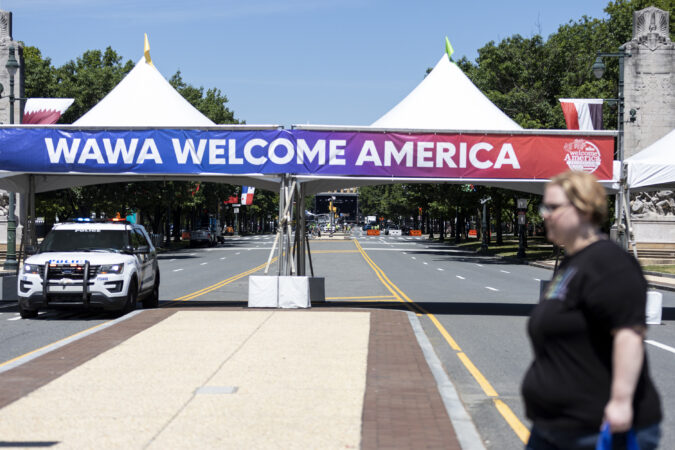
    Between concerts at Independence Mall, block parties, Wawa Hoagie Day, fireworks, and a parade, Philly streets will be booked and busy in early July.

    For folks planning ahead, these are roads that will be closed as Philly celebrates the nation’s 250th with the Wawa Welcome America Festival:

    Thursday, June 25

    Starting at 8 a.m., the north traffic lane on Market Street (between Fifth and Sixth Streets) is closed to accommodate the stage buildup for the Independence National Historical Park concert.

    The north lane should reopen to traffic by 10 p.m.

    Friday, June 26

    The stage buildup continues. The north lane on Market Street (between Fifth and Sixth Streets) will be shut down once again from 8 a.m. to 6 p.m.

    Reservoir Drive in front of Smith Playground is also scheduled to be closed for Kidchella. Between noon and 11 p.m. the drive will be shut down to accommodate the free music festival with art stations.

    Saturday, June 27

    Starting at 6 a.m., three roads will close for Concilio’s Hispanic Fiesta:

    • The Benjamin Franklin Parkway from 16th Street to 17th Street
    • Arch Street between 15th and 16th Streets
    • 16th Street from John F. Kennedy Boulevard to Arch Street

    All streets are expected to reopen at midnight.

    Sunday, June 28

    Market Street and its north sidewalk (from Fifth to Sixth Streets) are scheduled to be closed from 6 p.m. to 9 p.m. for the gospel concert at Independence Hall.

    The north traffic lane on Market Street will also be shut down for the concert between 8 a.m. to 9 p.m.

    Tuesday, June 30

    The inner lanes of the Benjamin Franklin Parkway from 20th Street to Binswanger Triangle will close starting at 6 a.m. in preparation for the One Philly: Unity Concert for America July 4th concert and fireworks. Closures will remain in place through Monday at 6 a.m.

    Wednesday, July 1

    Wednesday brings six street shutdowns, some as early as 5 a.m., for the Wawa Hoagie Day (free hoagies at noon) and U.S. Air Force Heritage Band:

    Closing from 5 a.m. to 6 p.m.

    • Arch Street from Fourth to Sixth Streets
    • Fifth Street between Market and Race Streets
    • Sixth Street from Market Street to Race Street

    Closing from 9 a.m. to 9 p.m.

    • Market Street north traffic lane from Fifth to Sixth Streets
    • Market Street between Fifth and Sixth Streets

    Closing between 1 p.m. to 4 p.m.

    • North sidewalk on Market Street from Fifth to Sixth Streets

    Thursday, July 2

    Two days before the 250th, road closures are ramping up for the Red, White, and Blue To Do celebration, the All American Block Party, and the Salute to Service: United States Army Field Band and Soldiers Chorus.

    Closing between 5 a.m. to 11 p.m.

    • Arch Street from Fourth to Sixth Streets

    Closing between 7 a.m. to 6 p.m.

    • Third Street between Chestnut and Walnut Streets
    • Dock Street between Third and Walnut Streets
    • Walnut Street between Second and Third Streets

    Closing between 9 a.m. to 11 a.m.

    • Market Street north traffic lane from Fifth to Sixth Streets

    Closing between 11 a.m. to 1 p.m.

    • Walnut Street from Second to Fourth Streets

    Closed between 11 a.m. until the parade ends or passes

    • Chestnut Street between Second and Fifth Streets
    • Market Street at Fifth Street
    • Chestnut Street at Fifth Street closure starts at 11:15 a.m.

    Closing between 3 p.m. to 9 p.m.

    • Market Street between Fifth and Sixth Streets
    • Sixth Street between Arch and Market Streets
    • Market Street north sidewalk from Fifth to Sixth Streets

    Closing July 2 and July 3

    • Fifth Street from Race Street to Chestnut Street is closed from July 2 at noon to July 3 at 5 p.m.

    Friday, July 3

    With the Salute to Independence Parade the Philly Pops concert at Independence Mall, and the Parkway concert and fireworks, Friday brings more road closures. Expect some streets to close as early as 4 a.m.

    Closing between 4 a.m. to 1 p.m.

    Three streets will be closed between Spruce and Arch Streets:

    • Third Street
    • Fourth Street
    • Fifth Street

    Closing between 6 a.m. and 9 p.m.

    • Market Street from Fifth to Sixth Streets

    Closing from 6 a.m. Friday to 6 a.m. on Monday

    • 1900 block of Race Street 
    • 1800-1900 Vine Street 
    • I-676 off-ramp at 22nd Street 
    • I-676 on-ramp at 22nd Street 
    • I-76 eastbound off-famp at Spring Garden Street 
    • Spring Garden Tunnel 
    • Park Towne Place between 22nd and 24th Streets 
    • 20th Street between Arch Street and Pennsylvania Avenue 
    • 19th Street between Callowhill and Cherry Streets 
    • Benjamin Franklin Parkway from 17th Street to Eakins Oval (all lanes) 
    • Eakins Oval (all lanes) 
    • Kelly Drive between Eakins Oval and Fairmount Avenue (Kelly Drive inbound closed at Fountain Green Drive beginning at about 5 p.m.) 
    • Rear of Art Museum – Anne d’Harnoncourt Drive 
    • 2000-2100 Winter Street 
    • MLK Drive from Falls Bridge to Eakins Oval 
    • Spring Garden Street between Pennsylvania Avenue and 31st Street 
    • 23rd Street between Pennsylvania Avenue and Eakins Oval 
    • 22nd Street between Winter Street and Pennsylvania Avenue 
    • 21st Street between Winter Street and Pennsylvania Avenue 
    • All roads from Arch Street to Spring Garden Street, 18th to 22nd Streets (local access maintained for residents) 
    • All roads from Arch Street to Fairmount Avenue, 22nd to Corinthian Streets (local access maintained for residents) 
    • 16th and 17th Streets, between Arch and Spring Garden Streets will be closed only if conditions warrant in the interest of public safety 
    • 1600-1700 Benjamin Franklin Parkway will be closed only if conditions warrant in the interest of public safety 

    Closing from 11:30 a.m. until the parade ends

    • Market Street from Sixth to 17th Streets
    • Seventh Street between Arch and Walnut Streets
    • Eighth Street between Arch Street and Walnut Streets
    • Ninth Street between Arch and Walnut Streets
    • 10th Street between Arch and Walnut Streets
    • 11th Street between Arch and Walnut Streets
    • 12th Street between Arch and Walnut Streets
    • 13th Street between Arch and Walnut Streets
    • John F. Kennedy Boulevard between Juniper and 17th Streets
    • North Broad Street between John F. Kennedy Boulevard and Arch Street
    • 15th Street between Cherry and Chestnut Streets
    • Benjamin Franklin Parkway between Arch and 20th Streets
    • 16th Street between Cherry and Chestnut Streets
    • 17th Street between Race and Arch Streets
    • 18th Street between Vine and Cherry Streets
    • 19th Street between Vine and Cherry Streets
    • 20th Street between Vine and Race Streets
    • Chestnut Street between 11th and 16th Streets

    Closing between 1 p.m. to 9 p.m.

    • Sixth Street from Market to Race Streets
    • North sidewalk on Market Street from Fifth to Sixth Streets

    Saturday, July 4

    Sealing the 250th festivities, the Celebration of Freedom Ceremony brings few more road closures. Closures related to the Parkway concert and fireworks continue.

    Closing between 8 a.m. to noon

    • Market Street between Fifth and Sixth Streets
    • Market Street north sidewalk from Fifth to Sixth Streets

    Closing between 8 p.m. and 1 a.m. on Sunday, July 5

    • Kelly Drive from Fairmount Avenue to Fountain Green Drive 
    • Waterworks Drive 
  • ‘You just feel proud’: Ecuadorians in Philadelphia find respite during World Cup celebrations

    ‘You just feel proud’: Ecuadorians in Philadelphia find respite during World Cup celebrations

    For Ecuadorians in Philadelphia, seeing their country in the World Cup is not just a chance to watch good soccer but also a way to embrace their culture and community in the face of heightened scrutiny under the Trump administration.

    As Ecuador went head-to-head with Germany last week, some Ecuadorian Philadelphians gathered in bars across the city, donning yellow and cheering on their team.

    “It’s been nice to be able to see how all the community has come together,” Yvonne Cedeno said at a watch party at Tradesman’s in Center City. “Whether you’re Mexican, Colombian, Ecuadorian, just seeing people in our community getting together, especially within this political environment, is just so great. It makes me happy to be Ecuadorian.”

    Though Philadelphia is a sanctuary city with some of the nation’s toughest restrictions on ICE, immigration arrests have still surged in the city and state. In January 2026 alone 802 arrests were made in Pennsylvania, more than tripling the amount just a year prior. Raids have often targeted predominantly Latino communities in both the city and suburbs.

    Cathryn Miller-Wilson, executive Director of HIAS Pennsylvania, said these raids have created intense anxiety in the community, with some clients telling staff they have opted to stay home during World Cup celebrations, fearing running into ICE agents at games or events.

    “They’re absolutely only watching from home because it’s too scary otherwise,” Miller-Wilson said. “It’s definitely a problem, really since 2025, but especially now, where there’s this confluence of joyful celebration, but also of the threat of increased ICE presence.”

    Still, many Latinos, who make up 16% of the city’s residents, have embraced the chance to celebrate their community during the World Cup, which has featured nine Latin American countries. Tuesday evening, Ecuador will face Mexico in a knockout match after last week’s 2-1 win over Germany secured the nation’s spot in the elimination round.

    Cedeno, 37, said the World Cup has always given her family a way to express their love for their culture by making traditional Ecuadorian dishes and coming together to cheer for their country.

    “Last game we woke up at 6 a.m. just to make a traditional Ecuadorian dish called encebollado, which takes hours to make,” Cedeno said, referring to the traditional stew often made with tuna and yuca. “And we all got together and we watched the game and rooted for Ecuador, so it definitely brings the World Cup definitely brings our family closer”

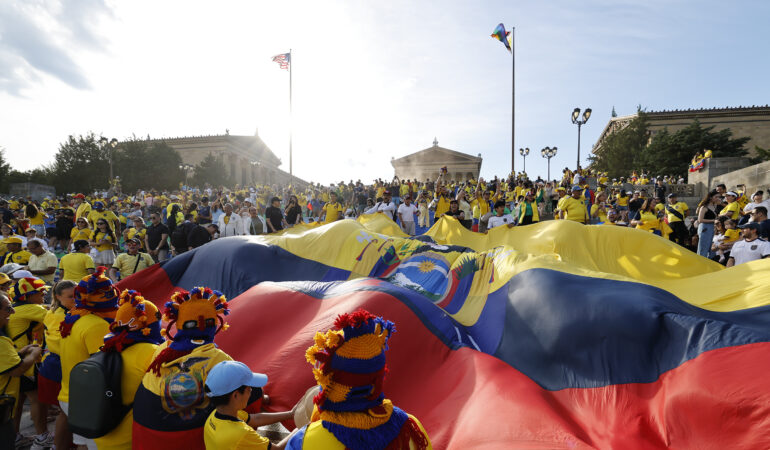
    Ahead of Ecuador’s math against Côte d’Ivoire at Lincoln Financial Field on June 14, a sea of yellow jerseys flooded around the Rocky statue in front of the Philadelphia Museum of Art.

    Rowan Teran, 24, said the scene filled him with pride — even if the team fell short that game.

    “I grew up Latino in a very Jewish-dominated community. I kind of wasn’t proud of who I was,” said Teran, who grew up Lower Merion after his father immigrated from Ecuador. “And then growing up, I became much more proud. And then one day you see thousands of Ecuadorians wearing your jersey, singing the national anthem that you wanted to sing when you were younger, and you just feel proud to be who you are.”

    Teran, who also attended the watch party at Tradesman’s, highlighted that the joy surrounding the World Cup feels like an act of resistance against the Trump administration.

    ”See what we are,“ Teran said. ”You don’t want any of us here, and now there are hundreds of thousands of us here, and the city’s even better.”

    Soccer fans watch Ecuador take on the Ivory Coast during a World Cup soccer watch party at Brauhaus Schmitz on Sunday, June 14, 2026.

    Christina Barradas, 44, is Mexican but came out to Tradesman’s to cheer on Ecuador alongside her Ecuadorian husband. She said while the World Cup has been great for the community, it’s a temporary respite from the struggles they’re facing.

    “It’s an opportunity to put on your jersey, to put on the colors, but we still don’t feel 100 percent free and safe,” Barradas said.

    On South Street, Nina Cueva-Castillo, 41, sat with the only other two yellow jerseys among a sea of Germany fans at Brauhaus Schmitz.

    Cueva-Castillo said the games give Philly’s Ecuadorian community visibility it usually does not have.

    “I love how people now know us,” Cueva-Castillo said. “They know our jersey, they know our colors, they know our flag. It’s a breath of fresh air to be ourselves, to be accepted, to be welcome, and for people to be like, ‘You know what, they are just like us’.”

  • Trump is using a $500M no-bid contract to build his White House ballroom

    Trump is using a $500M no-bid contract to build his White House ballroom

    White House officials last year secretly awarded a no-bid contract worth up to $500 million for the construction of the East Wing ballroom in an unusual arrangement that sidestepped typical contracting procedures designed to control costs, according to a copy of the agreement obtained by the Washington Post.

    The White House routed the contract through the Executive Residence, the document shows, an office that is exempt from rules that require federal agencies to solicit competitive bids and disclose details to the public. The office is typically responsible for routine repairs, entertainment expenses, and the purchase of furniture, art, and other items for the executive mansion.

    The confidential contract with Clark Construction, along with related correspondence and records obtained by the Post, reveal for the first time how the Trump administration bypassed norms last summer as it set the ballroom project in motion.

    Records also show that President Donald Trump was directly involved in negotiating some costs for the East Wing project.

    The East Wing contract is the latest example of the administration turning to no-bid deals to hasten a Trump-style makeover of the nation’s capital, which has included handpicking firms to upgrade Lafayette Square next to the White House and to renovate the Lincoln Memorial Reflecting Pool.

    Competitive bidding is generally required at most federal agencies. Experts said the Executive Residence is exempt from those rules, and the president has legal authority to hire companies of his choosing to make changes to the executive mansion and the surrounding grounds. Those experts said soliciting bids would have ensured the best price for taxpayers, especially given the size and cost of the East Wing project.

    “I would certainly expect them to compete a project of this size and complexity,” said Anthony Costa, a former General Services Administration official who oversaw complex government real estate projects during a career that spanned four presidential administrations.

    The estimated East Wing construction cost has tripled since last July, when the project was first announced, with half expected to come from taxpayers, the Post previously reported.

    Trump has repeatedly claimed that the ballroom would be paid for by private donors and once said that Clark executives offered to build it for free.

    “They said: ‘Sir, we’ll do it for nothing. This is the greatest honor,” Trump told the New York Times in January.

    Clark’s internal cost projections show the McLean, Virginia-based company, the largest general contractor in the D.C. metro area, stands to make tens of millions of dollars from the work.

    Clark charged a 3% profit for its early work on the East Wing, records show, a rate that experts said was typical for large government construction projects.

    The records reviewed by the Post do not break out Clark’s estimated profit margin for the entire project, but a March document shows the company projected it would receive a total of $65 million in combined profit, overhead, and daily rates for on-site staff and other costs.

    A White House official said in a statement that the East Wing contract was issued through the Executive Residence because that office “will be the primary support of the facility.” The Executive Residence is a division of the Executive Office of the President, which the statement said “consistently executes contracts following the law.”

    A Clark spokesperson said in a statement that the firm has been a federal contractor for more than 80 years, adding: “We follow established procurement and contracting processes for each project and execute the work consistent with schedule, budget, delivery, and contractual requirements.”

    The Trump administration tasked Clark with site preparation and other preliminary work last July, months before the East Wing was demolished, records show. That work was performed under a separate, existing Executive Residence contract the company had won in 2024, during the Biden administration.

    The Biden-era contract covered “a wide variety of maintenance, repair, alteration, and construction type tasks” that might arise at the White House over five years. It was awarded to Clark after a competitive bidding process and had a ceiling of $500 million, according to a copy of the agreement obtained by the Post.

    The White House official told the Post that Clark’s Biden-era contract was “missing various clauses necessary for construction contracts.”

    By mid-August, records show, Trump administration officials began negotiating the new, no-bid agreement for Clark to “fully demolish the East Wing and East Colonnade and construct a modernized East Wing facility.”

    In an email exchange in early September, White House officials explained that they could award the no-bid contract to Clark because the Executive Residence is not bound by competitive bidding requirements, although it often follows them.

    The email cited a federal law that authorizes the president to freely spend for the “care, maintenance, repair, alteration, refurnishing, improvement, air-conditioning, heating, and lighting” of the White House residence.

    In a court case challenging the legality of the ballroom project, the Trump administration has cited the same law as the basis for its authority to undertake the project. The litigation has not surfaced the fact that the contract was awarded without competitive bidding.

    A federal judge rejected the administration’s position, concluding in March that the president’s authority to make changes to the White House does not include demolishing the East Wing and building the ballroom. The administration has appealed the ruling.

    The Justice Department acknowledged in court filings in the case that the Executive Residence is overseeing contracts for the project, claiming it was “best-positioned” to do so in part because of its expertise in the use of White House for official ceremonies.

    Experts told the Post that the GSA or National Park Service are better equipped to handle contracting for large construction projects at the White House, and an internal White House document shows that is the norm.

    Major repairs and structural changes to the White House’s East Wing and East Colonnade are the responsibility of the GSA and Park Service, according to the document, a 2024 memorandum of understanding for the maintenance and operations of the White House obtained by the Post.

    The role of the Executive Residence “does not include maintenance or repair involving structural building elements or major utility systems for those areas, which are handled by GSA or NPS,” according to the memorandum, which expires in 2029.

    An Interior Department spokesperson, responding to questions sent to the Park Service, said in a statement that the Executive Residence is “best positioned to coordinate with all agencies that have equities regarding planning for and implementation of the project.” The GSA referred questions to the White House.

    On Sept. 22, Clark signed the White House contract for the East Wing, which included a range of work the company would provide over a five-year period and a nondisclosure agreement.

    Joshua Fisher, the director of the White House Office of Administration, indicated on the contract that the administration did not solicit bids for the East Wing work because “the disclosure of the executive agency’s needs would compromise the national security.”

    In recent months, Trump has said rebuilding the East Wing is a national security issue, describing an underground military bunker and a rooftop “drone empire … to protect Washington.”

    The Trump administration continued to issue work orders to advance the East Wing project under both the 2024 and 2025 agreements with Clark, records show. Clark’s internal construction cost estimates rose from $200 million in July 2025 to $600 million by March 2026, the Post previously reported.

    After signing the East Wing contract, Clark officials notified the White House that the company planned to award no-bid deals to at least 11 subcontractors for demolition, abatement, excavation, fencing, and other services, according to copies of correspondence obtained by the Post. Two of those subcontractors are Clark subsidiaries.

    On March 4, days after the start of the war with Iran, Trump personally negotiated the price of concrete to be provided by one of Clark’s wholly owned subsidiaries, according to a summary of the terms that notes his involvement. The summary indicates the price, initially more than $47 million, dropped $2.3 million during the negotiation.

  • The first Jewish American to serve the government was a Philadelphian. A letter he carried to Paris for Thomas Jefferson just sold for $108,000.

    The first Jewish American to serve the government was a Philadelphian. A letter he carried to Paris for Thomas Jefferson just sold for $108,000.

    In the early 1780s, Revolutionary War era Jewish patriot and Philadelphian Lt. Col. David S. Franks had a desperate work situation in hand.

    He had served as one of Benedict Arnold’s high-ranking personal assistants, and after Continental militiamen discovered Arnold’s intentions to sell America out to the British in 1780, it became nearly impossible for Franks to find a job with the United States government.

    Franks was cleared of wrongdoing. But working with Arnold made the Founders wary of employing Franks.

    But not Thomas Jefferson, who hired Franks as his secretary. By the time the Treaty of Paris ending the Revolution was ratified in January 1784 in Annapolis, Md., then America’s capital, Franks had been Jefferson’s secretary for almost a year.

    It was Franks who carried at least one official copy of the finalized treaty to Benjamin Franklin — who was in Paris at the time — and other officials in Britain and France.

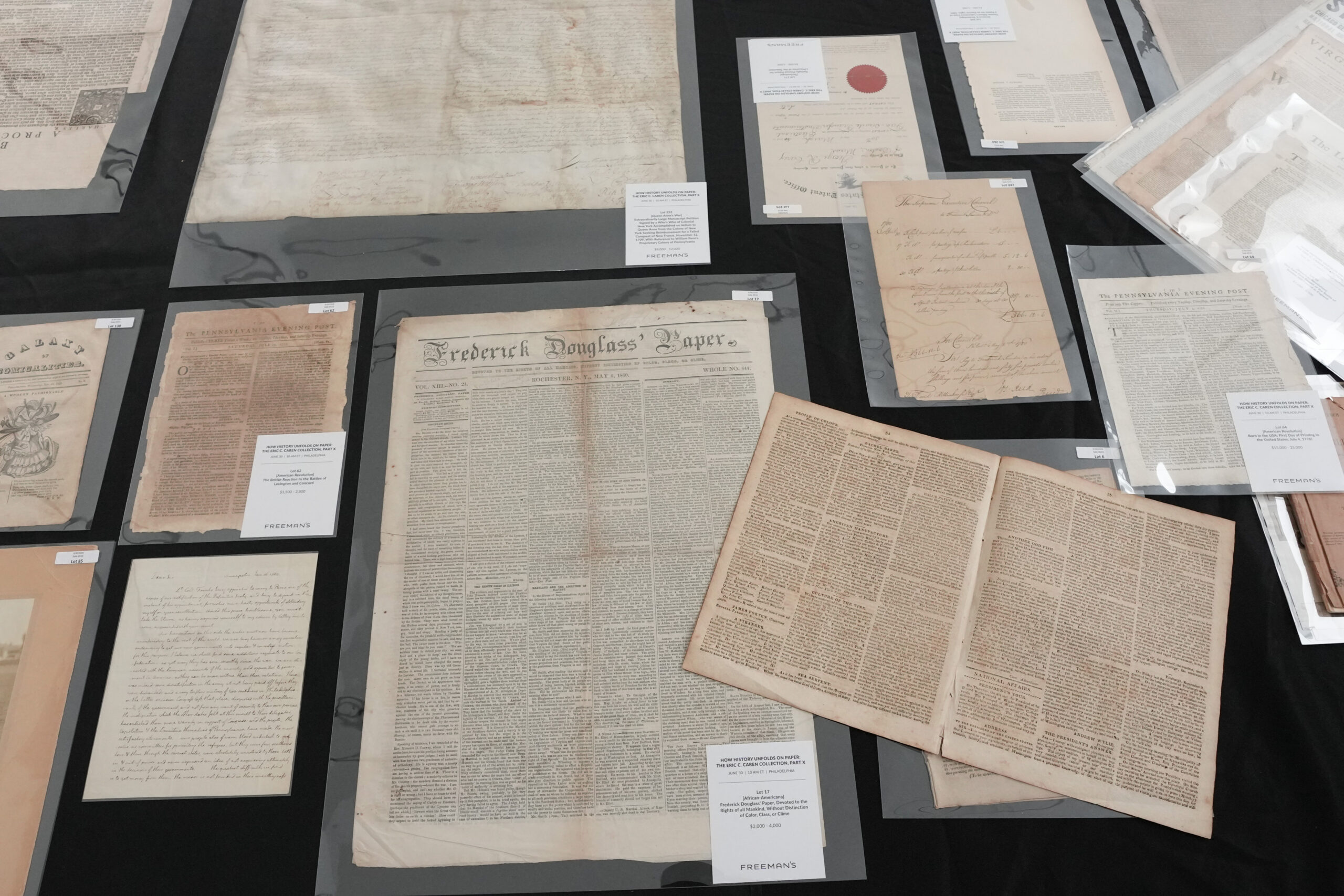
    Frederick Douglass’ Paper (front center) and other documents, part of the collection “How History Unfolds on Paper: Important Americana from the Eric C. Caren Collection,” which boasts more than 320 rare newspapers, books, pamphlets, and ephemera tracing the development of printing and publishing in America, an enterprise that started in Philadelphia in1690 with the first paper mill.

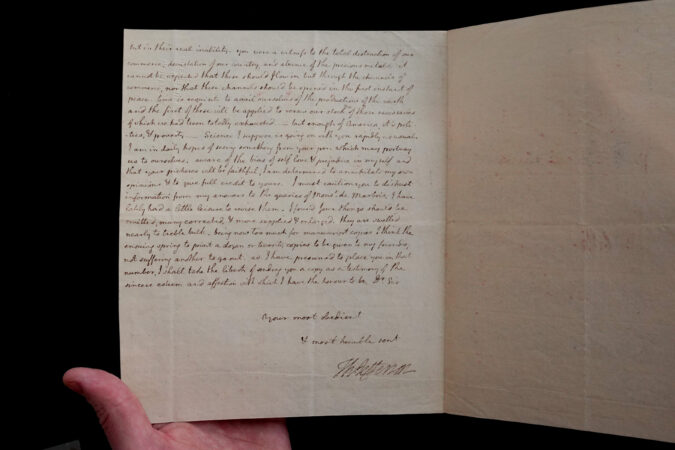
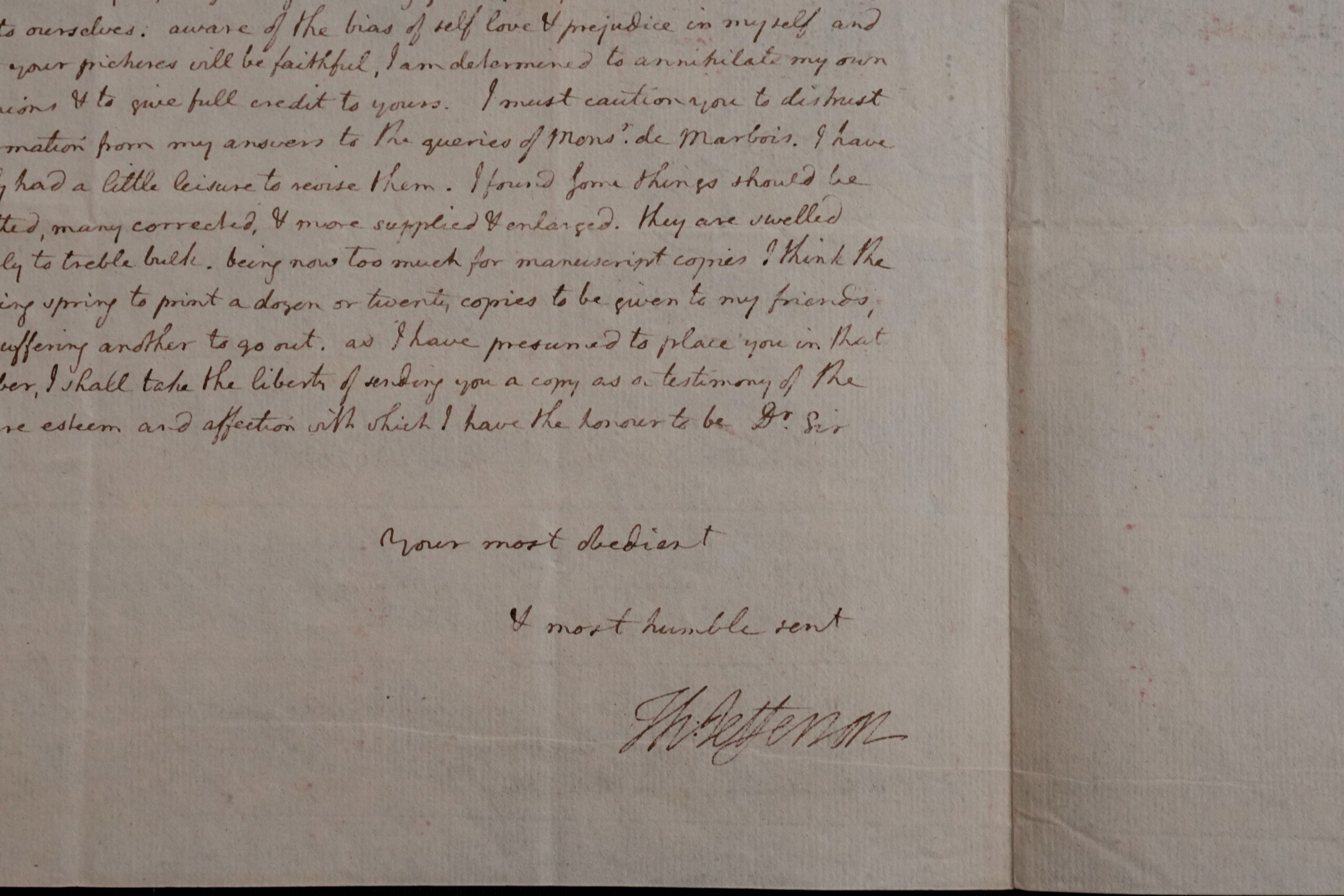
    Franks also carried a two-page letter written in Jefferson’s customary neat hand for Francois Jean de Beauvoir, Chevalier de Chastellux. It was a friendly message between the longtime acquaintances, in which Jefferson wrote to the French noble about how America was progressing as a sovereign nation and about his forthcoming book Notes on The State of Virginia.

    That letter sold for $108,000 Tuesday as part of an online and in-person auction presented by Philadelphia’s Freeman’s auction house.

    “How History Unfolds on Paper: Important Americana from the Eric C. Caren Collection, Part X” boasted more than 320 rare newspapers, books, pamphlets, and ephemera tracing the development of printing and publishing in America, an enterprise that started in Philadelphia in 1690 with the first paper mill.

    Books from the collection “How History Unfolds on Paper: Important Americana from the Eric C. Caren Collection,” which boasts more than 320 rare newspapers, books, pamphlets, and ephemera tracing the development of printing and publishing in America.

    “Caren goes where the history leads him. His collection reflects that,” said Darren Winston, Freeman’s senior vice president and head of the books and manuscripts department. “When he asked us to host a sale in honor of the 250th, we immediately said yes.”

    18th century news treasures

    The vast sepia-hued collection of aged newspapers and bound volumes was heaven sent for primary-source junkies who can afford to plop down a few hundred or several thousand dollars for the kinds of historical gems usually found only on microfilm. It’s also a gold mine for those who think hundred-year-old newspapers in near mint condition are frame-worthy.

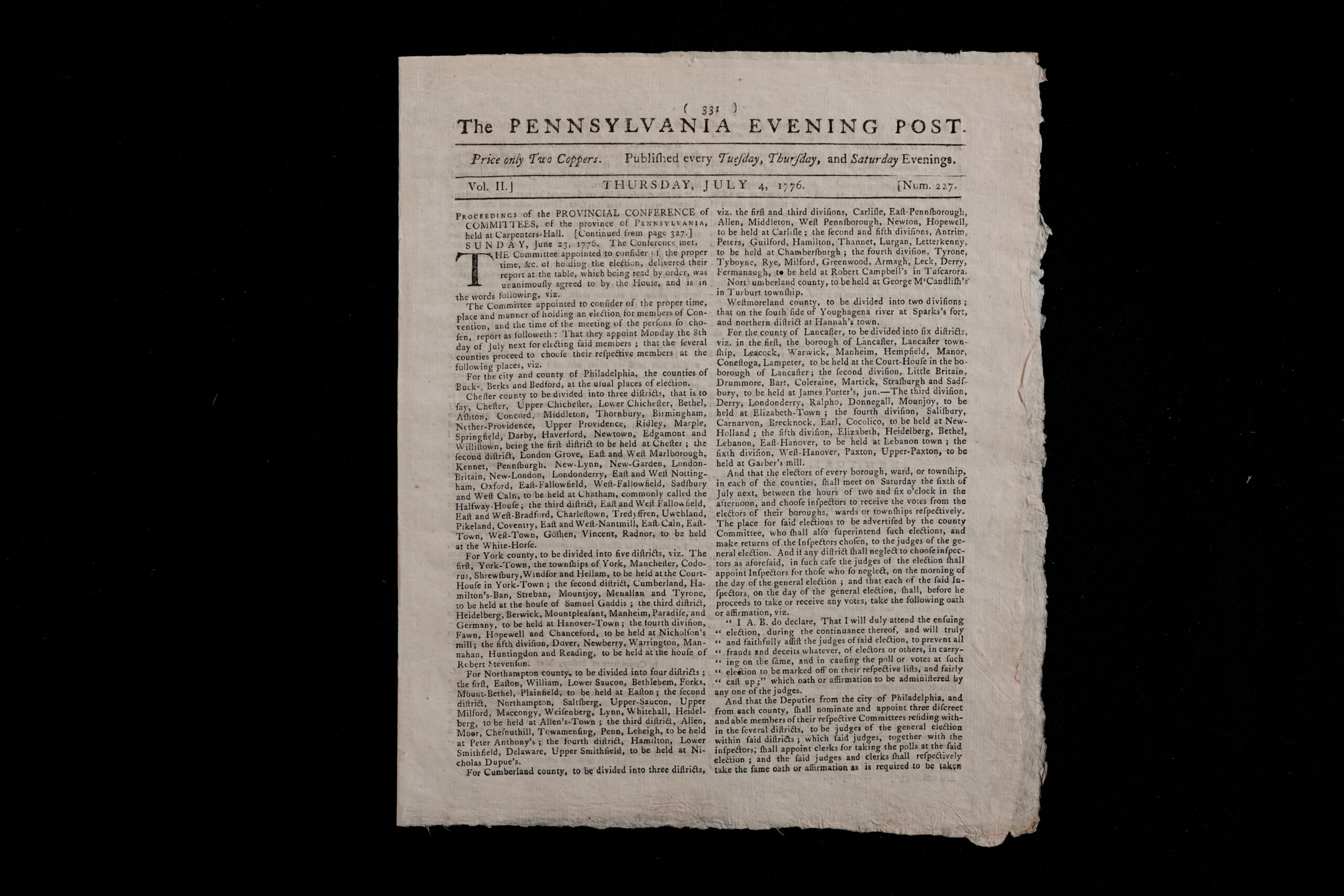
    One such memento was a four-page Pennsylvania Evening Post printed on July 4, 1776, believed to be the first daily newspaper printed on North American soil just declared free of the monarchy.

    A four-page Pennsylvania Evening Post printed on July 4, 1776, believed to be the first daily newspaper printed on North American soil just declared free of the monarchy.

    The Evening Post, founded by printer Benjamin Towne in 1775, was published just a few blocks from the Pennsylvania State House on Tuesday, Thursday, and Saturday evenings.

    The July 4 edition contains a short mention that the Continental Congress declared the United Colonies free and Independent States earlier in the day. And “the day before, we had a King in charge,” Winston said.“How History Unfolds on Paper” included five 18th century newspaper editions, including one printed in Scotland, that published the Declaration of Independence in full.

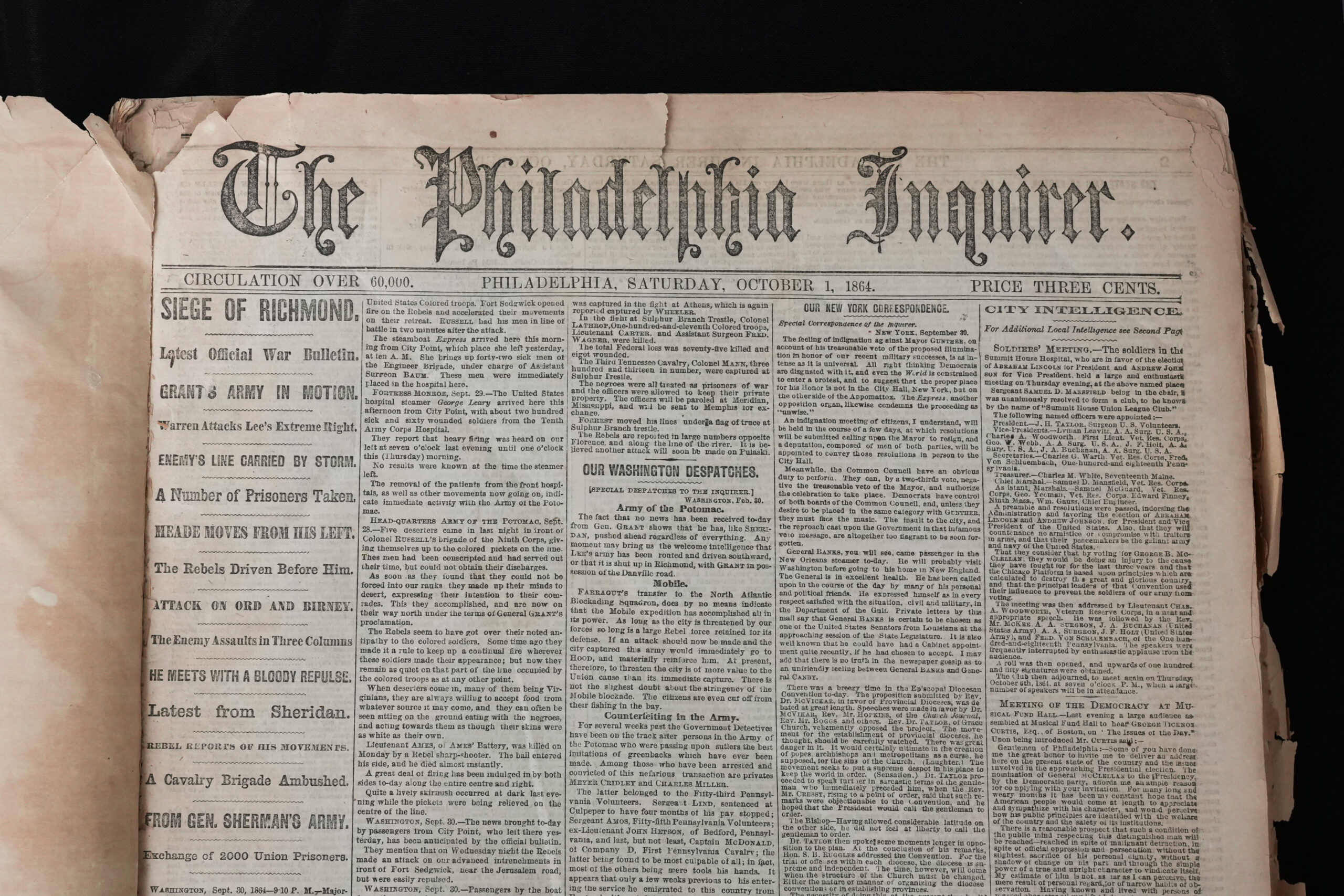
    Other archival gems included a copy of the Frederick Douglass Paper from 1860; copies of the Emancipation Proclamation as they appeared in the Daily Globe, the New York Tribune, the Evening Journal Almanac, and The Philadelphia Inquirer; Abraham Lincoln’s second inaugural address as printed in the New York Times in 1865; and more than 70 issues of Civil War-era Philadelphia Inquirers.

    A copy of the Philadelphia Inquirer, part of the collection “How History Unfolds on Paper: Important Americana from the Eric C. Caren Collection,” which boasts more than 320 rare newspapers, books, pamphlets, and ephemera tracing the development of printing and publishing in America, an enterprise that started in Philadelphia in 1690 with the first paper mill.

    But Caren’s collection is more than weathered newspapers.

    The auctioned collection bubbled with relics, collectibles, and keepsakes that speak to the economy, such as a note signed by first director of the U.S. Mint, David Rittenhouse — for whom Rittenhouse Square is named — ordering payment of 350 pounds to a doorkeeper employed at the Pennsylvania State House. (That’s about $107,000 in today’s money.)

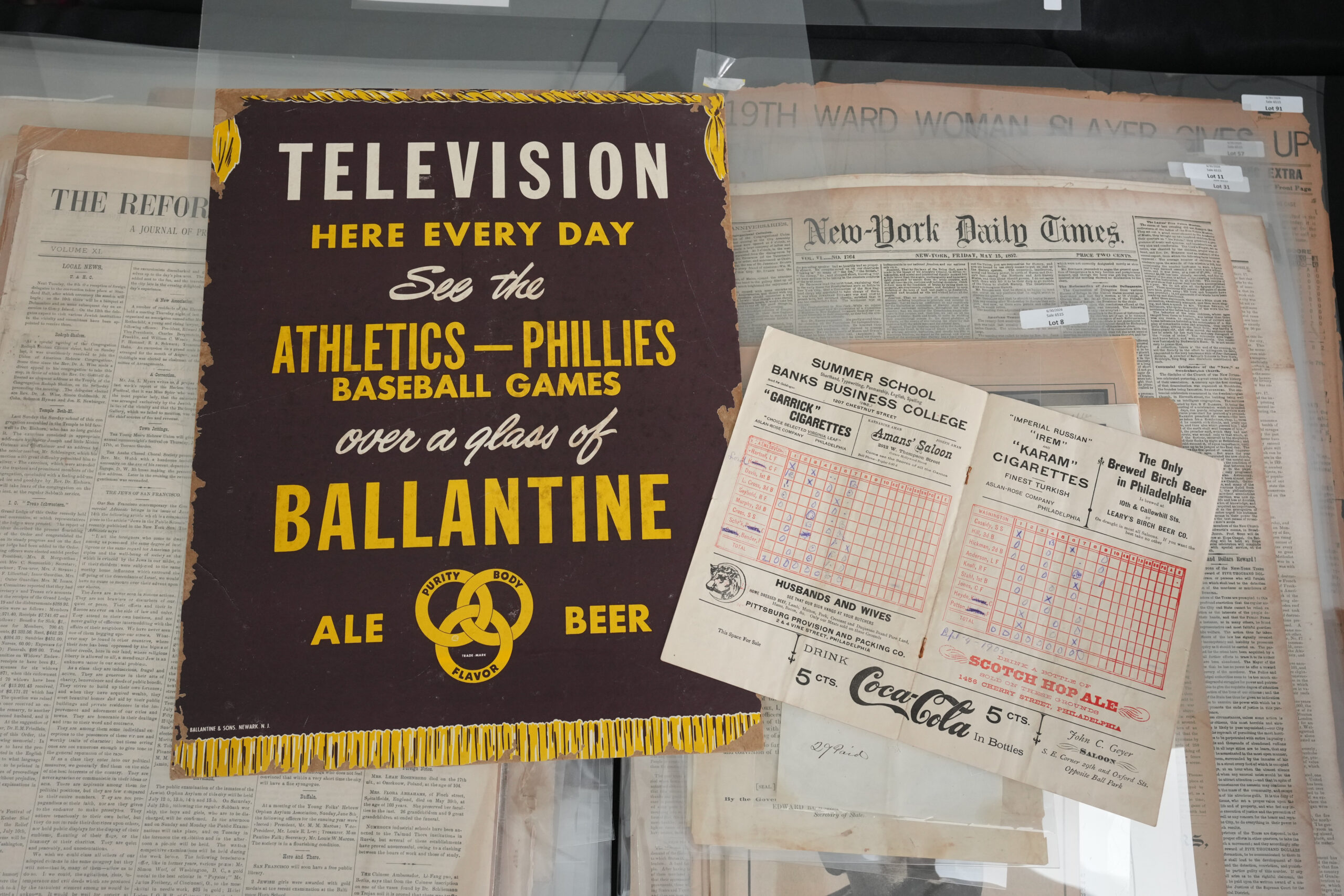
    An 1874 advertisement for Levi Strauss & Co. that appeared in a Montana newspaper was among the cool finds, as was a 1905 Phillies Athletics score card. An 1869 letter signed by Susan B. Anthony and a 1772 volume of poetry including works from Phillis Wheatley are priceless, but their bidding started at $900 and $400 respectively.

    “Freeman’s is America’s oldest auction house, and Philadelphia is the birthplace of the United States,” Caren said. “So for the 250th anniversary [of America], I thought this sale would be quite fitting.”

    Some of the sports memorabilia featured in “How History Unfolds on Paper: Important Americana from the Eric C. Caren Collection”

    50 years of collecting

    Caren, 66, is a New Yorker and said he came out of his mother’s womb collecting — starting with comic books, stamps, coins, and baseball cards.

    In 1970, he learned that a few of his friends were going rummaging through an abandoned house in Rockland County and that they had found newspapers from the turn of the 20th century.

    “I asked them to try and find me a sports page with Babe Ruth, and they brought me one from 1913 and I was mesmerized,” Caren said.

    After some cajoling, Caren convinced his friends to reveal their secret treasure trove. There, he discovered periodicals going back to the 1890s and was hooked.

    Caren spent the next 50-plus years collecting the printed and written word. He has traveled the world to estate sales, garage sales, rare book shops, and antique shows. He’s one of the founders of the Ephemera Society of America and a member of the American Antiquarian Society and the Grolier Club.

    He owns hundreds of thousands of paper items, and pieces of his collection have been sold at the auction houses Christie’s and Sotheby’s. “How History Unfolds on Paper” was his 10th auction and first in Philadelphia.

    “If ever there was a Philadelphia item, this is it”

    In his travels, Caren has come across many of Jefferson’s letters. The one written to Chastellux, he says, is particularly noteworthy because Jefferson wrote it himself, as opposed to dictating it to a secretary, like Franks.

    Long-time ephemera collector Eric C. Caren, his collection “How History Unfolds on Paper: Important Americana from the Eric C. Caren Collection, Part X” went to auction at Freeman’s in Philadelphia.

    The letter had been in the Chastellux family for centuries before landing at an auction a few years ago. Caren passed it over a few times before recognizing Frank’s name in the first paragraph.

    “It was a great example of how even great things can slip by,” Caren said.

    The Treaty of Paris was signed in September 1783. The following January, legislators ratified it in Annapolis.

    Dated Jan. 16, 1784, Jefferson’s letter reads like a chatty blog of late 18th century American happenings. In the five months since the war’s end, news traveled to Europe that Americans were behaving badly. One of the reasons Jefferson penned this missive, Caren said, was to “dispel [this] fake news.”

    “There was indeed some dissatisfaction in the army at not being paid off before they were disbanded and a very trifling mutiny of 200 souldiers in Philadelphia,” Jefferson wrote, playing down the Pennsylvania Mutiny of 1783, during which a few Continental Army soldiers rioted in Philadelphia streets when they weren’t paid.

    Thomas Jefferson’s signature on a letter to Francois Jean de Beauvoir, Chevalier de Chastellux, a part of the auction at Freeman’s.

    He also mentions his yet-to-be published book Notes on The State of Virginia and encouraged Chastellux to write one of his own. He did.

    Voyages de M. le Marquis de Chastellux dans l’Amerique septentrionale, published at the turn of the 20th century, is what rare book dealer Wright Howes described as “the first trustworthy record of life in the United States.”

    Franks, the first Jewish American to serve in the early American diplomatic corps, did not fare as well as Jefferson or Chastellux. Lingering rumors from his association with Arnold continued to follow him, and in 1786, he was fired from the government.

    He spent years trying to restore his name. During his first term, President George Washington helped Franks secure a job as an assistant cashier at the Bank of the United States of America, but Franks was no longer accepted in the Founding Father’s circle.

    He died in 1793 during Philadelphia’s yellow fever epidemic.

    “If ever there was a Philadelphia item, this is it,” Caren said. “This letter is the intersection between the history of Philadelphia and the history of our nation.”

    The headline and article have been updated to include the winning bid at the auction on Tuesday morning.

  • Supreme Court upholds state laws banning transgender girls and women from school athletic teams

    Supreme Court upholds state laws banning transgender girls and women from school athletic teams

    The Supreme Court on Tuesday upheld bans in Idaho and West Virginia on transgender athletes playing on girls’ and women’s sports teams, the latest in a string of legal setbacks for the LGBTQ+ community before the high court.

    In a decision led by the court’s six conservatives — but joined in parts by its three liberals — the justices found that states can separate teams based on “biological sex” without offending the Constitution’s guarantee of equal protection and Title IX, a landmark 1972 antidiscrimination law involving education.

    “Separate sports teams for biological males and biological females are reasonable: Given the inherent physical differences between the sexes, allowing only biological females to play on women’s and girls’ teams can reduce the risk of physical injury and ensure fair competition,” Justice Brett M. Kavanaugh, who coached his daughter’s youth basketball team, wrote for the majority.

    The court’s three liberals, led by Justice Sonia Sotomayor, agreed that West Virginia’s ban did not violate Title IX. But they disagreed with the majority on several fronts, especially the conclusion that the West Virginia law withstands scrutiny under the Constitution’s guarantee of equal protection for all.

    Sotomayor wrote that a lower court should have the chance to sort out a question central to the case of the teenage plaintiff from West Virginia, Becky Pepper-Jackson: whether trans girls who have not undergone male puberty have physical advantages in sports.

    “Because of the Court’s decision today, West Virginia, and any other state actor, can deny B.P.J. and others like her these experiences simply because it thinks they have an inherent athletic advantage, even if the facts show that they do not,” Sotomayor wrote.

    The court did not address what is arguably the flip side of its ruling — whether schools and states can adopt policies allowing transgender athletes to compete on girls’ and women’s teams, as some liberal states and communities do.

    “That question is currently the subject of litigation in some lower courts,” Kavanaugh wrote in a footnote. “Nothing in this opinion is intended to decide that question.”

    The ruling is among several in recent terms that are consequential for the LGBTQ+ movement. The Supreme Court in March ruled a Colorado law banning “conversion therapy” for gay and transgender youths probably violated the free-speech rights of a religious counselor who wants to counsel such young people according to biblical teachings.

    Earlier that month, the court sided with Christian parents in blocking, for now, California policies that discourage schools from informing parents of a student’s sexual orientation or gender identity without the student’s consent. Last year, the court upheld bans on gender transition treatment for minors.

    Questions over whether transgender girls and women should play on girls’ and women’s sports teams has been a particular flash point in a broader conversation about transgender rights. Dozens of states have bans amid intense public debate about fairness at all levels of competition.

    The debate over the allowance of transgender women in collegiate athletics gained national attention in 2022 after Penn swimmer Lia Thomas won the national title in the women’s 500-yard freestyle. Thomas, who is a transgender woman, competed for the Quakers men’s team during the 2018-19 season before medically transitioning.

    In July 2025, Penn struck a deal with the Trump administration regarding Thomas’ participation. According to the deal, Penn agreed to ban transgender athletes, vacate Thomas’ records, release a statement in support of Title IX “as interpreted by the Department of Education,” and send personalized letters of apology to Thomas’ former women’s teammates. The deal came after the White House had paused $175 million in federal funding to Penn because of Thomas’ participation on the Quakers’ women’s team in 2021-22. The federal funding was restored following the agreement.

    The issue came to the high court in a pair of cases, brought separately by Pepper-Jackson, a teen from West Virginia, and Lindsay Hecox, a Boise State University student in Idaho. Both argued that the bans in their states discriminated on basis of sex and violated the Constitution’s equal protection clause. In January, the justices appeared sympathetic to arguments for keeping the bans in place as the cases were argued back-to-back.

    LGBTQ+ activists said the decision would be devastating for some young people.

    “This is a heartbreaking ruling for our clients and transgender girls like them who’ve asked for nothing more than the same opportunities afforded to their peers,” said Joshua Block, senior counsel for the American Civil Liberties Union’s LGBTQ & HIV Rights Project, who argued the case for Pepper-Jackson.

    Sasha Buchert, director of nonbinary and transgender rights at Lambda Legal, said the decision was upsetting but also narrow.

    The ruling is “a serious loss — we’re not minimizing that,” she said. But noting that the court did not impose a national ban on transgender athletes in female sports, Buchert added, “This ruling says, sure, a state may discriminate, not that they must discriminate.”

    Twenty-seven states have passed laws banning transgender student-athletes from competing on women’s or girls’ sports teams. Supporters of the bans say they are necessary to ensure fairness and safety because of inherent physical differences between males and females. Opponents say the laws discriminate against trans people and should be struck down.

    President Donald Trump early last year signed an executive order aimed at keeping transgender women out of women’s sports. The administration has argued that there are only two sexes — male and female — and that they “are not changeable.”

    Soon after the executive order on sports, the NCAA and the U.S. Olympic and Paralympic Committee updated their policies to bar trans women from playing on women’s sports teams. Since then, the administration has aggressively investigated schools that allow trans girls to participate in girls’ and women’s sports.

    Education Secretary Linda McMahon welcomed the court’s decision Tuesday.

    “For years, ideologues distorted Title IX to advance a radical transgender agenda, subjecting women to immeasurable harm,” she said in a statement.

    Nicole Neily, founder and president of Defending Education, a conservative advocacy group, called the decision an “exercise in judicial humility” and noted that it may be disappointing to conservatives in liberal states that allow transgender athletes to participate.

    “Although it’s certainly not as sweeping as parent activists would have liked, it means that the action shifts to the states and is now a persuasion game,” she said in a statement.

    Views among Americans on transgender issues are nuanced. A Pew Research Center survey published in February 2025 showed 56% of adults support policies aimed at protecting transgender people from discrimination in jobs, housing, and public spaces.

    But over the past few years, Americans also have become more supportive of restrictions for transgender people, according to the Pew survey. Fifty-six percent of Americans supported bans on providing gender transition care for minors, up 10 percentage points from 2022, the study found.

    But athletics have always stood out.

    The Pew survey found that 66% favored laws that require trans athletes to compete on teams that match their sex assigned at birth, up eight points from 2022. Even before the general shift in public opinion, a majority of Americans opposed allowing trans women to compete against other women at all levels of sports, according to a Washington Post-University of Maryland poll.

    The science concerning biological advantages of transgender girls and women in sports is evolving and remains hotly debated. The case featured competing evidence about whether transgender girls are inherently better at sports. The transgender plaintiffs presented evidence that transitioning before puberty prevents them from building enough body mass to have an advantage in high school and college sports.

    Lawyers for the states countered with studies that showed that nontransgender boys and men perform better at all ages. The study found that boys between the ages of 7 and 12 ran about 4% faster and jumped about 7% farther than girls in the same age group.

    “The legislatures and the schools are better equipped — and under the Constitution, are the more appropriate entities — to assess the competing medical and scientific considerations and draw appropriate lines,” Kavanaugh wrote in the majority opinion. “Of course, no line that the States draw will satisfy everyone.”

    While there’s no comprehensive tally of trans athletes nationally, an estimated 300,100 transgender youths between the ages of 13 and 17 live in the United States, according to the Williams Institute at the UCLA School of Law. The Human Rights Campaign, an LGBTQ+ advocacy group, has estimated that 14% of trans boys and 12% of trans girls play on a sports team.

    Inquirer Staff Writer Conor Smith contributed to this article.

  • Kean set to speak at the Capitol after mysterious absence

    Kean set to speak at the Capitol after mysterious absence

    WASHINGTON — Rep. Tom Kean Jr., the New Jersey Republican who disappeared from Congress and the campaign trail in March with almost no explanation, is set to return to the Capitol on Tuesday and address the mysterious health condition he says has kept him away.

    Kean, a 57-year-old seeking a third term in a competitive district, has missed more than 100 votes since he was last seen in public more than 100 days ago. His reemergence will be closely watched after months during which he and his staff refused to disclose anything about where he was or what was keeping him away.

    Their silence has built Tuesday’s return into a major reveal after a prolonged cliffhanger. Even last week, when a reporter for The New York Times found Kean at his home in Westfield dressed in a suit and tie around 8:45 p.m., he declined to offer any explanation, saying: “I’ll talk to you next week.”

    In the absence of official information, his own colleagues have speculated wildly about Kean’s condition, privately raising an array of possibilities for his long and unexplained absence.

    Could it be rehab for a stroke, heart condition or addiction issue? Was it a case of plastic surgery gone awry? Might he reappear on Capitol Hill as a woman? (His brief appearance at home last week put at least some of that speculation to rest.)

    Kean has said only that he is dealing with a “personal medical issue,” and until recently offered no timeline on his return, only vague assurances that when he did come back, he would be fully recovered and transparent about what he had been through.

    Kean’s office also did not provide any detail Monday about his return, though CNN reported that he planned to give a speech on the House floor. He also was scheduled to participate in a fundraising reception Tuesday evening in Washington, according to an email obtained by the Times that confirmed an earlier report by Politico.

    His chief of staff, Dan Scharfenberger, did not respond to calls and emails about the congressman’s planned schedule for Tuesday. A spokesperson for Speaker Mike Johnson said they were leaving the details of Kean’s return to him.

    Kean has invited some Republican officials to participate in a 2 p.m. conference call Tuesday, according to multiple people who were invited. The people said they expected he would have to address the health issue in some way.

    With an election in five months, Kean’s months of mysterious silence have tested the limits of what the public will tolerate in terms of privacy for its leaders.

    Presidents traditionally release the results of their annual physicals and disclose what medications they are taking, although they are not legally required to do so. But members of Congress typically provide no information to the public about the state of their health or their fitness to fulfill their duties.

    Voters tend to be forgiving about the health ailments of their leaders. And some lawmakers in the past have tried to turn their own medical challenges or experiences with mental health, alcohol or addiction into a way to relate to voters who may be struggling themselves.

    So Kean’s decision to keep his constituents and his colleagues in the dark for so long has largely been viewed as inexplicable.

    This article originally appeared in The New York Times.