Category: News

Latest breaking news and updates

  • This teen fled war in Ukraine for a new life in Philly. Now she’s at the top of her class.

    This teen fled war in Ukraine for a new life in Philly. Now she’s at the top of her class.

    Kateryna Sobolevska’s life is full: classes, homework, and activities at George Washington High School, managing an ambitious college search, serving as her mother’s English translator, sometimes picking her younger brother up from school.

    But part of the 17-year-old’s mind is often 4,500 miles from Philadelphia — in her former home along the Stryi River in Western Ukraine, in Zhydachiv, where Sobolevska’s father and extended family still cope with the realities of a yearslong war.

    She speaks to her father daily.

    Emergency services personnel work to extinguish a fire following a Russian attack in Kyiv, Ukraine, Tuesday, Nov. 25, 2025. (AP Photo/Dan Bashakov)

    “He’s at risk every single day,” said Sobolevska, now a 12th grader. “They keep bombing the power plant, so he doesn’t have electricity all the time. He has to do laundry at a certain time. He has difficulties with work; it’s really overwhelming. There’s sirens every day.”

    Still, Sobolevska is more than managing in her new home.

    Less than four years after arriving in the United States, Sobolevska is at the top of her class at George Washington, with an Ivy League summer program under her belt, waiting to hear from a bevy of stellar colleges — and recently named to a select list of Philadelphia School District students.

    When Sobolevska arrived in the U.S. at 14, American traditions were unfamiliar — something from a story or a book. She had never celebrated Thanksgiving.

    This year, she’ll be sitting down to a turkey dinner with family, a little incredulous at the recognition that is beginning to come her way.

    “But,” she said, “I am very thankful.”

    ‘Everything is so different’

    In 2022, as war closed in, Sobolevska’s parents made a quick decision: Things were too dangerous in Ukraine. Sobolevska, her mother, Oleksandra, and her brother, Oleh, had to flee.

    Her father, Rostyslav, could not join them — men between the ages of 18 and 60 were forbidden from leaving the country.

    “All of us hoped that it would only be a couple of months,” Sobolevska said.

    The three traveled first to Prague, then to New York, then on to Philadelphia. Every move felt unsettling, Sobolevska said.

    Sobolevska had been a strong student in Zhydachiv — class president three times, a member of her student government, chosen to represent her school at language competitions.

    But she had to start over at age 14. She began ninth grade at George Washington High in sheltered English classes, learning the language with other newcomers.

    George Washington High School on Monday, Nov. 24, 2025 in Philadelphia.

    With more than 1,800 students, George Washington is imposing; it felt forbidding. It was tough to navigate, and her class schedule was changed three times.

    “Everything is so different here,” Sobolevska said. “In ninth grade, it was really hard to get used to the language, to expectations, to all those processes. Ninth and 10th grade were really difficult for me.”

    One of her teachers flagged Sobolevska to Billy Marchio, the coordinator of George Washington’s International Baccalaureate program, a rigorous academic course of study.

    “She told me, ‘She’s really bright, she’s really improved her English. Give her a shot, I think she can do it,’” said Marchio, who agreed.

    Making an impression

    Entering IB in her 11th-grade year was a revelation for Sobolevska.

    “I was excited,” she said. “IB is more close to what is expected from students in my country. It just gives me more stability — it’s very difficult courses, and a lot of expectations.”

    Sobolevska met the expectations and then some. She was one of just 14 students nationwide — chosen from a pool of hundreds — who won a place in a summer journalism program at Princeton University.

    Living on a college campus and learning from top professionals and peers from around the country provided more challenges that Sobolevska slayed. She published two stories, one about her frustration with comparisons between the conflicts in Ukraine and Gaza, a call for global solidarity. She felt at home in the Ivy League environment.

    Senior year has been a blur — applying to a laundry list of colleges, including Harvard, a top choice, and, most recently, being honored as one of the district’s seniors of the month, singled out for her “courage, perseverance, and quiet strength” as well as for her academic skills.

    Teacher Billy Marchio in his classroom on Monday, Nov. 24, 2025 at George Washington High School in Philadelphia.

    Marchio has been wowed by Sobolevska — both as a student and as a leader, serving as an IB officer, tutoring peers in the National Honor Society.

    “Through all of her anxieties and all of her stress, she produces spectacular work,” Marchio said. “She’s so critical and analytical. She makes an impression on everyone.”

    Shouldering significant responsibility

    Sobolevska is quiet, unassuming. When she talks about her college search, she mentions that she’s applying to schools in “Boston, Connecticut, New York,” not Harvard, Yale, and Columbia.

    She grows more animated when she talks about her family: her father, who works in sales management, her mother, who works at a grocery store, and even her brother — they argue, as siblings do, but are still very close.

    “We’re really close with my mom, especially since she moved here,” said Sobolevska, who has significant responsibility on her shoulders. “I’m the main translator in the family. I help her with English; all the doctor’s appointments are on me.”

    When she won the district’s Senior of the Month honor, her mother bragged to relatives and coworkers. Thousands of miles away, her father “was really excited. He was just so proud. But it was weird for him, difficult to understand because I’m very far away.”

    Sobolevska, who now goes by Kate, longs to be reunited with her father, the rest of her family, and the friends she left behind, but living and learning in the U.S. have changed her, she said.

    Here, “I think people here are not as stressed,” Sobolevska said. “They’re just more easygoing. It’s really warming to see how people can listen to music outside or talk loudly outside, or just say hi to everyone. In Ukraine, we don’t really have that. It’s nice to see how people are really friendly here.”

    Her father “doesn’t want us to go back” home now, she said. “It’s not safe; it’s really stressful.”

    Looking ahead to her future, “I would like to visit” Ukraine, Sobolevska said. “I’m not sure if I would want to live there. When I grow up, I would love to travel a lot — I don’t want to stay in place.”

    Sobolevska’s rise is remarkable, but that’s who she is, Marchio said.

    “She’s just trying to make her father proud, to make her father’s sacrifice worth it,” Marchio said. “She’s putting a lot on her plate to make everyone happy and proud of her, and I couldn’t respect that more.”


  • Not just a Gobble Wobble: How a Montco amputee hopes to use a 1-mile walk to qualify for a running blade prosthetic

    Not just a Gobble Wobble: How a Montco amputee hopes to use a 1-mile walk to qualify for a running blade prosthetic

    Stephanie Dunn, who at first introduction has the warm disposition and positivity of someone who has never had a bad day, will tell you that a life-threatening, flesh-eating infection in her foot and the subsequent amputation of her left leg are not the hardest challenges she’s had in life.

    That distinction she reserves for motherhood.

    But the recovery from the mysterious illness that struck Dunn in September 2022 has had its share of brutal moments.

    Through the near-death experience, the onslaught of medical bills, and coming to terms with the fact that some aspects of her life would never be the same, the 52-year-old Schwenksville mom has worked to become as mobile as feasibly possible.

    In a matter of years, she has upgraded to a prosthetic meant for high-impact use and more mobile amputees. It’s a cumbersome process that involves proving to insurers the patient is active enough to qualify for the prosthetics that offer a broader range of motion and shock absorption. Amputee forums are filled with stories of red tape and insurance rejections, telling patients the advanced prosthetics are not “medically necessary.”

    “If I didn’t have two kids, I don’t know if I would have pushed myself to do it,” she said of the daily workout routines she has adopted in the years since her amputation. “I knew I had a responsibility to them and you can’t give up.”

    This Thanksgiving, Dunn, who never considered herself athletic before she lost her limb, hopes to put her current prosthetic to the test, walking in her local Gobble Wobble.

    Stephanie Dunn had to have her leg amputated because of a rare bacterial infection two years ago. She credits the Spring Valley YMCA, in Royersford, where Dunn was using a weight machine with her prosthetic legs on Monday.

    Hosted by the Greater Philadelphia YMCA, the Spring Valley event offers a 5k event and a mile walk. For her first Gobble Wobble with a prosthetic, in 2023, Dunn cut some sections of the walk. Last year, she finished the loop but came in last. Dunn believes she can beat that performance this year. She also hopes it will serve as a milestone on her way to an even more ambitious goal: qualifying for a running blade along with a grant to pay for it.

    And while Dunn doesn’t see herself as an amputee advocate or role model — she reserves that designation, perhaps incorrectly, to the “super-fit people out there running marathons” — she hopes her story will let people in similar situations know the journey to mobility is hard but possible with the right support system.

    This year’s Gobble Wobble is as much of a personal test for Dunn as it is a bit of an ode to the wheelchair-accessible Spring Valley YMCA, which has been a lifeline and refuge in the years following her amputation.

    “When [the amputation] first happened, I thought, ‘Oh, my God, I’m on the periphery of society now. I’ll never be able to do anything normal,’” she said, remembering how she avoided grocery stores at first. “But I did. I could come here.”

    Stephanie Dunn had to have her leg amputated because of a rare bacterial infection two years ago. She credits the Spring Valley YMCA, in Royersford, where Dunn was working out on the treadmill Monday.

    The challenges facing America’s growing number of amputees

    More than 2 million Americans live with limb loss, according to a 2024 study partially funded by the nonprofit Amputee Coalition. The reasons behind amputations vary. Johns Hopkins Medicine reports that about 45% of limb loss occurs after a traumatic injury, such as a car crash. Other people lose limbs amid complications from diabetes, gangrene, cancer, or blood vessel diseases.

    For Dunn, a throbbing left foot and waves of bile vomit ended up being necrotizing fasciitis, source unknown.

    The flesh-eating bacteria gnawed away at her limb in a matter of days, led to sepsis, and nearly reached her chest. Dunn said the amputation saved her life.

    Yet there is much more to an amputation than the operation itself.

    The Amputee Coalition says 36% of people living with limb loss experience depression. Many find themselves physically unable to return to demanding jobs that require fast movement or heavy lifting. Dunn, who had been a speech pathologist for 19 years, has come to terms that she cannot do the job full-time without risking an injury, even with her prosthetic.

    And while a Government Accountability Office report expects the number of people living with limb loss to double by 2050, online forums remain full of people looking for advice on how to get their insurers to pay for prosthetics that will help with mobility.

    Dunn’s experience navigating healthcare is only a snapshot of the challenges facing amputees.

    After the amputation, she faced a growing mountain of medical bills and paperwork. As Dunn managed pain and the care of her two young children, she had to go from her home in Schwenksville, Montgomery County, to South Philly to “prove” she had actually had her limb amputated in order to apply for disability benefits.

    Then there was the process of qualifying for a prosthetic.

    The most basic below-the-knee prosthetics cost $3,000. There is no secondhand market because each is molded to the person. Even so, as limbs naturally change size and swell or contract throughout the day, users will have to adjust. It’s why amputees sometimes stuff socks in their prosthetics.

    The more advanced prosthetics provide more mobility but easily run into the tens of thousands of dollars. Private insurance runs the gamut in terms of coverage, with many amputees reporting better luck through Medicare or Medicaid. But going with public insurance comes with other considerations, such as income limits.

    “You can’t financially get ahead at all,” said Dunn, who was making a six-figure salary before her amputation. “You can just barely make ends meet.”

    In the early post-op days, Dunn said, lying in bed and sitting in a chair were her biggest temptations — they often are for recent amputees. But skipping the at-home workouts assigned by her physical therapist risked muscle spasms and stiff muscles in the remaining part of the limb. To lose flexibility in the limb makes it harder to move with a prosthetic.

    Determined to become mobile, Dunn headed to her local Y branch.

    Dunn said in those early post-op days, lying in bed and sitting in a chair were her biggest temptations — they often are for recent amputees.

    A gym offers refuge and resources

    To walk alongside Dunn at the Spring Valley Y is to accompany a minor celebrity. Dunn jokes that it’s the prosthetic leg, though that feels like she’s selling herself short. She is at the gym every day for anywhere between 30 minutes and three hours.

    “You must’ve had a good night’s sleep,” shouts a lifeguard taking his perch after Dunn completed several laps in the pool. One of the many greetings thrown over the hum of the pool machinery.

    Part of the Greater Philadelphia YMCA, the Spring Valley branch was familiar to Dunn before her injury because of the programming her children took part in, which only became more important during her two-month stay at the hospital.

    The children participated in the branch’s before- and after-school care, which Dunn credits with giving the boys a routine as she regained her strength.

    But the facility was also primed to aid in her recovery in small ways that added up.

    Before Dunn renovated her bathroom to be wheelchair-accessible, the Spring Valley Y was the only place she could shower.

    Soon, Dunn was navigating the gym equipment and pool. She could park her wheelchair along the pool’s edge and get in the water, where she enjoyed what she described as a weightlessness.

    Dunn still had days when she cried in the parking lot or the bathroom, but she kept coming to get on the sit-up machines and for the aquatic dance classes. Not once did she feel out of place, she said.

    The mental boosts served to buoy her physical gains and vice versa. It’s a rhythm she longs for other amputees to find.

    “I maintained the range of motion in my limb, so that when I did get measured for a prosthetic to see what kind of prosthetic I could qualify for, as far as insurance and what I could use … I got a higher-level prosthetic than if I hadn’t come here,” she said.

    That said, a robust support network or gym can’t fix the healthcare system, and Dunn continues to navigate the logistics of getting the prosthetics she needs to live the life she wants with her children.

    Dunn said she had to travel to New York City in order to get a one-step procedure that would allow a rod to be embedded in what is left of her femur. Approvals took six months.

    And even as Dunn gets more comfortable with her prosthetic, there is tweaking to be done. She has been dealing with pain that is constantly in the background.

    Still, Dunn characterizes these as small bumps along the way, as she does with many of the challenges she has navigated postamputation.

    She said going through fertility treatments to have her boys and the quandaries of raising them as a single mom by choice weighed much more heavily on her.

    Back then, when things felt particularly dire, she would tell herself: If at any time you want to stop, just stop.

    In the case of her mobility journey, as with conception, Dunn has yet found a reason to call it.

  • National Guard soldiers shot in ‘targeted’ attack near White House

    National Guard soldiers shot in ‘targeted’ attack near White House

    WASHINGTON – Two National Guard soldiers were shot on Wednesday near the White House in what officials described as a targeted ambush, and the suspect was in custody after suffering gunshot wounds during the attack.

    Investigators identified the suspect as Rahmanullah Lakanwal, a 29-year-old Afghan national from Washington State, according to a Justice Department official who spoke on condition of anonymity. The attack is being investigated as an act of terrorism, the official said.

    Lakanwal came to the U.S. in 2021 on a special visa program for Afghans who assisted the U.S. during the Afghanistan war and were vulnerable to reprisals from the ruling Taliban after the U.S. withdrawal, the official said. But he overstayed his visa and is in the country illegally, according to the official.

    President Donald Trump was in Florida at the time of the attack, which prompted the White House to go into lockdown as law enforcement from multiple federal and city agencies swarmed the area.

    The two soldiers, members of the West Virginia National Guard, were part of a “high-visibility patrol” around 2:15 p.m. ET (1915 GMT) near the corner of 17th and I streets, a few blocks from the White House. The suspect came around a corner and “ambushed” them, Metropolitan Police Assistant Chief Jeff Carroll said at a press briefing.

    After an exchange of gunfire, other National Guard troops were able to subdue the shooter, he said. The two wounded soldiers were in critical condition at local hospitals, FBI Director Kash Patel said.

    “This is a targeted attack,” Washington Mayor Muriel Bowser said at the briefing.

    The shooter appeared to have acted alone, officials said.

    Trump is at his resort in Palm Beach ahead of Thursday’s Thanksgiving holiday, while U.S. Vice President JD Vance is in Kentucky.

    In a social media post, Trump called the suspected shooter an “animal” who would “pay a very steep price” and praised the National Guard.

    He also ordered 500 more guard soldiers deployed to Washington, Secretary of Defense Pete Hegseth told reporters, joining about 2,200 already in the city as part of the president’s contentious immigration and crime crackdown targeting Democratic-led cities.

    Witnesses describe chaotic scene

    The shooting unfolded near Farragut Square, a popular lunch spot for office workers just a few blocks from the White House. The park, where light posts are wrapped in wreaths and bows for the holiday season, is flanked by fast-casual restaurants and a coffee shop, as well as two metro stops.

    Witnesses described a chaotic scene after shots were fired, with pedestrians fleeing.

    Mike Ryan, 55, said he was on his way to buy lunch nearby when he heard what sounded like gunfire. He ran half a block away and heard another round of apparent gunfire.

    When he made his way back to the scene, he saw two National Guard soldiers on the ground across the street, with people trying to resuscitate one of them. At the same time, other guard troops had pinned someone on the ground, Ryan said.

    Another witness, Emma McDonald, said she saw one of the soldiers carried away on a stretcher minutes after the shooting, his head covered in blood and an automated compression system attached to his chest.

    National Guard soldiers have been in Washington since Trump’s initial deployment in August, a move that was opposed by local officials and criticized by Democrats. The guard troops in the city include contingents from the District of Columbia as well as Louisiana, Mississippi, Ohio, South Carolina, West Virginia, Georgia and Alabama.

    Trump, a Republican, has suggested repeatedly that crime has disappeared from the capital as a result of the deployment, an assertion at odds with the police department’s official crime statistics.

  • Campbell’s exec loses job after alleged racist comments and claims of 3D-printed chicken, company says

    Campbell’s exec loses job after alleged racist comments and claims of 3D-printed chicken, company says

    Campbell’s Co. said on Wednesday that a vice president reportedly caught on an audio recording disparaging the Camden-based soup giant’s products — claiming the company uses bioengineered meat, which Campbell’s denies — and allegedly making racist comments is no longer an employee.

    The allegations emerged after Robert Garza, another former employee, filed a lawsuit last week claiming that he was fired for reporting in January to his manager that Martin Bally, who had a position at Campbell’s as chief information security officer, had made problematic comments to him during a meeting in November 2024.

    According to the five-page lawsuit, Bally “made several racist comments about Indian workers at the company.”

    Bally also told Garza that Campbell’s products were highly processed food for “poor people,” according to the lawsuit, which was filed in Michigan, where both Garza and Bally live and worked for the company.

    Garza, who worked as a cybersecurity analyst for Campbell’s, did an interview last week with WDIV-TV, an NBC affiliate in Detroit, and provided at least some portions of secretly recorded audio of the meeting to the station for broadcast.

    The audio recording is not mentioned in the lawsuit. However, it is legal in Michigan for one party in a conversation to make a recording without the consent of the other party.

    The person in the recording, alleged to be Bally, says: “We have s— for f— poor people.” The speaker then acknowledges rarely buying Campbell’s products, saying they are unhealthy.

    The voice says that Campbell’s uses “bioengineered meat. I don’t wanna eat a piece of chicken that came from a 3D printer.” The speaker then goes on to make racist comments about coworkers.

    “After a review, we believe the voice on the recording is in fact Martin Bally,” Campbell’s Co. said in a statement on Wednesday.

    “The comments were vulgar, offensive and false, and we apologize for the hurt they have caused. This behavior does not reflect our values and the culture of our company, and we will not tolerate that kind of language under any circumstances,” the company said.

    “As of November 25, Mr. Bally is no longer employed by the company,” Campbell’s said.

    Bally could not be reached for comment on Wednesday.

    Campbell’s said in its statement that the company makes food from high-quality ingredients, including real chicken meat.

    “We’re thankful for the millions of people who buy and enjoy our products and we’re honored by the trust they put in us,” the company said.

    Campbell’s has a new page on its website to answer questions about its food that were raised by the former vice president’s alleged comments.

    One section responds to the question: “Is Campbell’s chicken 3D printed?”

    “No. We do not use 3D-printed chicken, lab-grown chicken, or any form of artificial or bioengineered meat in our soups,” the website said.

    On Monday morning, James Uthmeier, the attorney general of Florida, responded to a post on X from an account apparently based in Ohio raising concerns about “FAKE MEAT that comes from a 3-D printer.”

    Uthmeier said: “Florida law bans lab-grown meat. Our Consumer Protection division is launching an investigation and will demand answers from Campbell’s.”

  • Is a vacant lot better than a decrepit building? Inside Philly’s latest debate over aging buildings

    Is a vacant lot better than a decrepit building? Inside Philly’s latest debate over aging buildings

    Mayor Cherelle L. Parker unveiled her planning process for the future of Market East earlier this month to a room packed with many of the city’s top developers, lobbyists, and business leaders.

    Her news conference followed the announcement that the alliance between the Philadelphia 76ers and Comcast had plans to demolish buildings on the 1000 block of Market Street, without saying what they plan to do with the soon-to-be vacant space.

    A Comcast executive’s promise to “turbocharge” development on the beleaguered corridor did not quiet dissent in the packed room from a group of historic preservationists who stood solemnly holding signs reading “No More Holes On Market Street” and “No Plan, No Demo.”

    The moment captured a recurring dynamic in modern Philadelphia, a city where over 70% of buildings reportedly date to before 1960 but only 4.4% of them have a degree of protection from demolition by the Historical Commission.

    Preservationists have long called for stronger protections against demolition, and neighborhood groups have condemned developers for leaving vacant lots in their midst when projects fail, as Toll Brothers did on Jewelers Row.

    Now two bills in City Council would require property owners to get a building permit for a new structure before they move forward with demolition.

    “This bill is about putting commonsense guardrails in place,” said Councilmember Jeffery “Jay” Young, who represents much of North Philadelphia and part of Center City.

    His bill, which covers his entire district, requires a building permit before a property owner can demolish a structure, with exceptions for dangerous buildings.

    “It ensures property owners are prepared to move forward responsibly and that residents aren’t stuck living beside another empty lot with no timeline or plan,” Young said in a statement.

    “This isn’t about slowing down development; it’s about preventing speculative demolition that destabilize blocks. This is about preserving communities,” Young said.

    Councilmember Jamie Gauthier’s bill would enact similar rules for parts of University City, where higher education institutions are dominant, as part of a larger package of land-use regulations.

    Builder and developer advocacy groups say the legislation is a potential new burden on a key economic sector that’s been flagging in recent years.

    The Building Industry Association (BIA), the trade association for residential developers, cautioned that new regulations were especially unwelcome in a time of higher interest rates and high construction material prices, especially as Parker makes housing a centerpiece of her agenda.

    “I’m not sure why Council would create more barriers for delivering new homes,” said Sarina Rose, president of the BIA and an executive with the Post Brothers development firm. “It’s a really bad time to do that. Unfortunately, some old buildings simply are not good fits for adaptive reuse.”

    The BIA and its allies are backing legislation that would make it easier to demolish some older buildings for new construction.

    Councilmember Mark Squilla introduced legislation the week before Thanksgiving that would weaken protections for structures nominated to the Philadelphia Register of Historic Places.

    At the same time, Parker promises to pursue legislation in the next year to prompt adaptive reuse or demolition of underused buildings by offering a 20-year property tax abatement.

    Demolition policy in other cities

    In a city as old as Philadelphia, razing buildings is often a fraught process.

    Currently the only safeguards against demolition come with a successful nomination to the Philadelphia Register of Historic Places, and in the handful of neighborhoods protected by conservation zoning overlays, property owners have to get building permits before demolition (a template for Gauthier and Young’s bills).

    But given the city’s economic and demographic doldrums in the second half of the 20th century, municipal government enacted most of the demolitions of unsafe and abandoned buildings, usually in lower-income neighborhoods.

    Mayor John F. Street’s Neighborhood Transformation Initiative, the centerpiece of his administration, spent half its $300 million (in George W. Bush-era dollars) on demolishing thousands of buildings in the early 2000s.

    That dynamic changed in the last decade, as low interest rates and a surge of new residents juiced real estate development to levels not seen in the city for generations. The private sector began to regularly outpace city government in demolition permits, as developers cleared the way for new projects.

    Preservationists pushed back. Under Mayor Jim Kenney’s administration (2016-24), the movement demanded new policies such as a demolition review requirement. Before an applicable building could be razed, municipal authorities reviewed its historic merits and adaptive potential.

    Similar policies of varying strength exist in cities from Santa Monica, Calif., to Chicago. In the latter case, it applies to buildings from before 1940 that were included in a citywide survey of historic places.

    Demolition of New Light Beulah Baptist Church at 17th and Bainbridge Streets, a block below South Street.

    During Kenney’s administration, a preservation task force called for a survey and demolition delay as in Chicago, but no elected officials championed the ideas.

    Laws like the ones Gauthier and Young are proposing are less common but are used in municipalities like Spokane, Wash., and Pasadena, Calif. Similar regulations exist for properties in Philadelphia’s conservation districts.

    In Spokane, the regulations apply to buildings in the downtown core, those along commercial corridors and buildings on the National Register of Historic Places, which is more of an honorary designation that affords protections.

    “You have to have that building permit in hand, plus you have to show us that you have the financial backing to build that replacement building,” said Megan Duvall, Spokane’s historic preservation officer. “If you also can’t show us that you have the construction loan in hand, we won’t allow you to demolish that building.”

    Why City Council is acting now

    The sudden renewal of interest in demolition policy began when St. Joseph’s University sold much of its West Philadelphia campus, acquired through a merger with University of the Sciences in 2022, to a charter school operator founded by student housing mogul Michael Karp.

    After the sale, Gauthier proposed placing controls on the sprawling higher education footprint in her district.

    As higher education comes under acute financial and demographic pressure, she fears that building sales by struggling universities could result in demolition and resale of newly vacant lots to developers without the wherewithal to complete projects or speculators with no desire to build quickly.

    “The safety and quality-of-life in our neighborhoods should not be disrupted by incomplete or uncertain projects,” Gauthier said in a statement. “I believe requiring responsible development practices is a commonsense approach in today’s uncertain development market.”

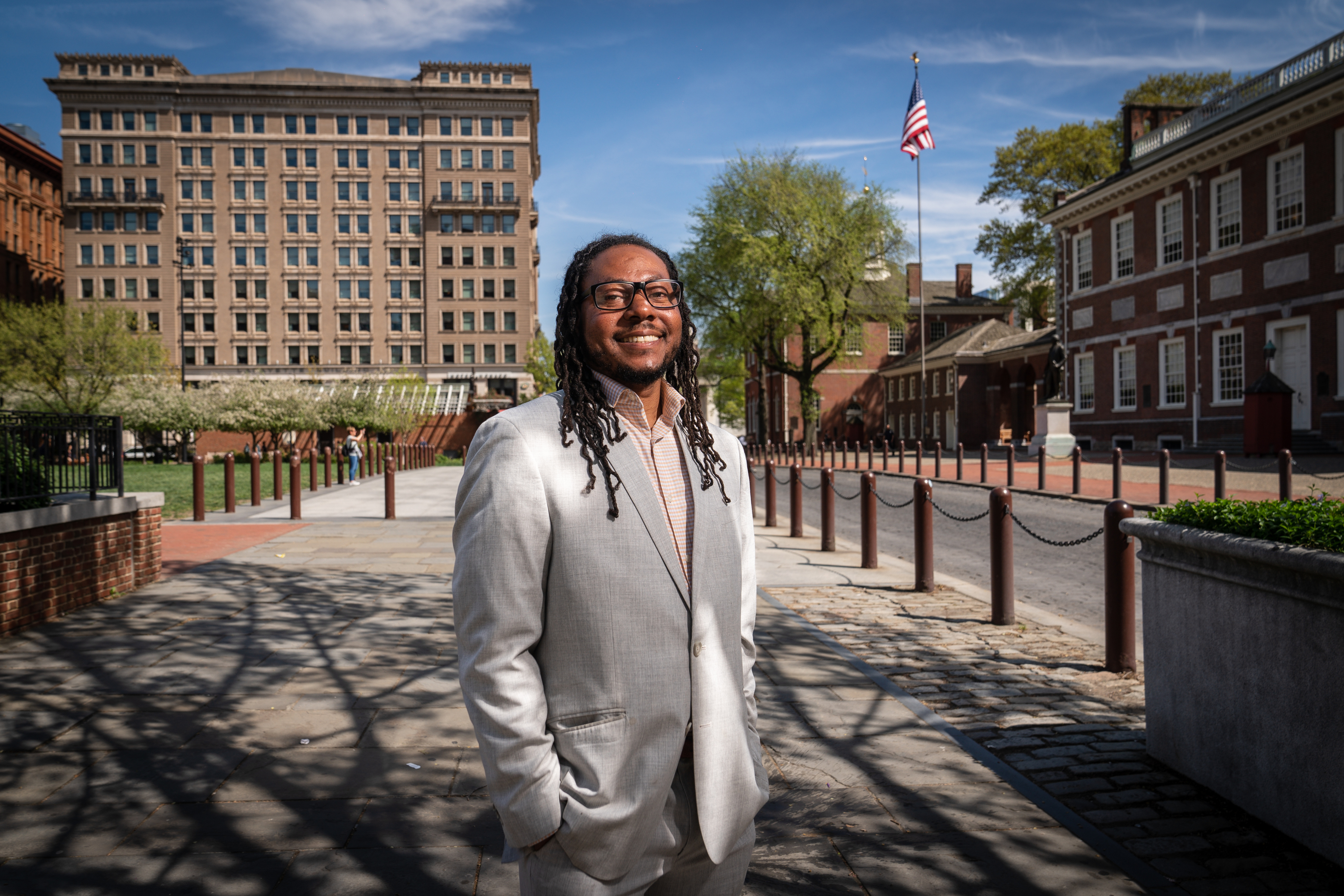
    Jeffery “Jay” Young outside Independence Hall.

    Young’s bill covering much of North Philadelphia and parts of Center City followed the introduction of Gauthier’s legislation. Neither bill has been passed by City Council.

    According to the Philadelphia Planning Commission, from January 2022 through November 2025 approximately 580 demolition permits were issued in Young’s district. The Department of Licenses and Inspections said that with a few tweaks, his proposed bill would be enforceable.

    Young says his legislation was inspired by frequent calls from constituents who hate the vacant lots that dot their neighborhoods and are frustrated with promised development that never comes to fruition. Both bills exempt buildings in poor condition that are considered dangerous.

    While welcoming this spate of demolition regulation, preservationists would prefer citywide policies, not district by district.

    “These bills are important first steps, and this is the moment to build them into a modern, citywide framework consistent with approaches already used in several peer cities,” said RePoint, the preservation advocacy group that protested the mayor’s Market East announcement, in an unsigned statement.

    Real estate industry backlash

    At the same time, Philadelphia’s development industry is embarking on its own campaign to ease existing preservation rules and to push back against these new bills. Both Gauthier’s and Young’s bills have been critiqued by business groups and by the zoning lawyers who often represent developers.

    “This is one-tenth of the city of Philadelphia, just based upon a political subdivision [that] changes every 10 years,” Matthew McClure, a prominent zoning attorney, said in testimony about Young’s bill before the Planning Commission. “It’s the exact opposite of planning.”

    Groups including the Building Industry Association are backing a new bill from Squilla that the Preservation Alliance for Greater Philadelphia fears will stoke more demolitions.

    It would require a new 30- to 60-day window before a building nominated to the local register of historic places could be given protection, which critics believe will incentivize owners to tear down empty buildings quickly.

    The mayor’s proposed 20-year property tax abatement proposal for adaptive reuse projects also allows room for demolition if buildings are considered unadaptable, which preservationists fear will bring back the wrecking ball-forward incentives of the city’s earlier abatement policies.

    In the last week, groups like the Preservation Alliance have pivoted from thinking about new demolition regulations to playing defense.

    “We’re still trying to wrap our heads around it all,” said Paul Steinke, the Preservation Alliance’s executive director. “It’s a lot to take in, and it’s happening after a decade or so of a building boom where we lost a chunk of the historic fabric.”

  • Former Fox exec urges FCC to reconsider petition to revoke Fox 29 license

    Former Fox exec urges FCC to reconsider petition to revoke Fox 29 license

    A former Fox broadcasting executive submitted a letter to the Federal Communications Commission on Tuesday asking the agency to reconsider a petition seeking to terminate the license of the network’s Philadelphia-area affiliate, Fox29.

    Preston Padden, who worked as a senior executive at the broadcasting network controlled by Rupert Murdoch and his family in the 1990s, has been a vocal critic of Fox News and its coverage of the 2020 election and an early supporter of the petition.

    In his letter to the FCC, Padden writes that Fox and the Murdochs lied to the American people by reporting that the 2020 election was stolen, despite knowing that it was untrue.

    He cites court findings in the defamation case brought against Fox News by Dominion Voting Systems, which resulted in a $787 million settlement.

    “Fox and the Murdochs’ lies to the American people had consequences,“ Padden wrote. ”Those lies undermined public confidence in the electoral process.”

    Neither Padden nor Fox’s attorneys responded to requests for comment.

    Padden’s letter urged the FCC to respond to an appeal of the order denying the challenge to Fox29’s license.

    The FCC dismissed in January a challenge to Fox29’s license renewal that was brought by the Media and Democracy Project, a self-described nonpartisan nonprofit. The petition, originally filed in July 2023, accused Fox of broadcasting “knowingly false narratives about the 2020 election” on the cable-based Fox News Channel.

    Former FCC chairperson Jessica Rosenworcel, who was appointed by President Joe Biden, said in a statement accompanying the dismissal of the petition, alongside three other complaints targeting local TV stations, that the order was intended to direct the agency to “take a stand on behalf of the First Amendment.”

    “We draw a bright line at a moment when clarity about government interference with the free press is needed more than ever,” she said.

    The challenge is not based on materials broadcast on Fox29, or the local channel’s journalism. Instead, character requirements for broadcast license owners that include a prohibition on “broadcasting false information that causes substantial ‘public harm.’”

    The examples in the FCC’s consumer guide are related to a crime or a catastrophe.

    Fox said in its filings with the FCC that revoking Fox29’s license would be “fundamentally incompatible with the First Amendment.”

    The Media and Democracy Project’s appeal is still pending, and is now in the hands of FCC chair Brendan Carr, a President Donald Trump appointee who has been criticized for interfering in broadcasters’ editorial decisions.

    In September, ABC temporarily removed Jimmy Kimmel’s late-night show from broadcast after a threat Carr made on a conservative podcast.

    “We can do this the easy way or the hard way,” Carr said following remarks Kimmel made about the assassination of conservative commentator and activist Charlie Kirk. “These companies can find ways to change conduct, to take action, frankly, on Kimmel, or there is going to be additional work for the FCC ahead.”

    Carr also reopened previously dismissed complaints of ABC’s moderation of a 2020 presidential debate and CBS’s 60 Minutes interview of then-Vice President Kamala Harris.

    He also blasted news organizations over their coverage of the deportation of the immigrant Kilmar Abrego García.

    Arthur Belendiuk, the attorney for the Media and Democracy Project, said he expects to “grow old and die” before Carr issues a response. Even if Carr denies the appeal, he would open the possibility of an appeal to court.

    Belendiuk believes that’s a risk the FCC chair will not take.

    “If you, Brendan Carr, think you are right, issue a decision and defend it in court,” the attorney said. “Be a man.”

    Staff writers Rob Tornoe and Nick Vadala contributed to this article.

  • Trail project planned near King of Prussia Mall gets new funding

    Trail project planned near King of Prussia Mall gets new funding

    A trail planned in Montgomery County is getting new funding to take the project to the next step.

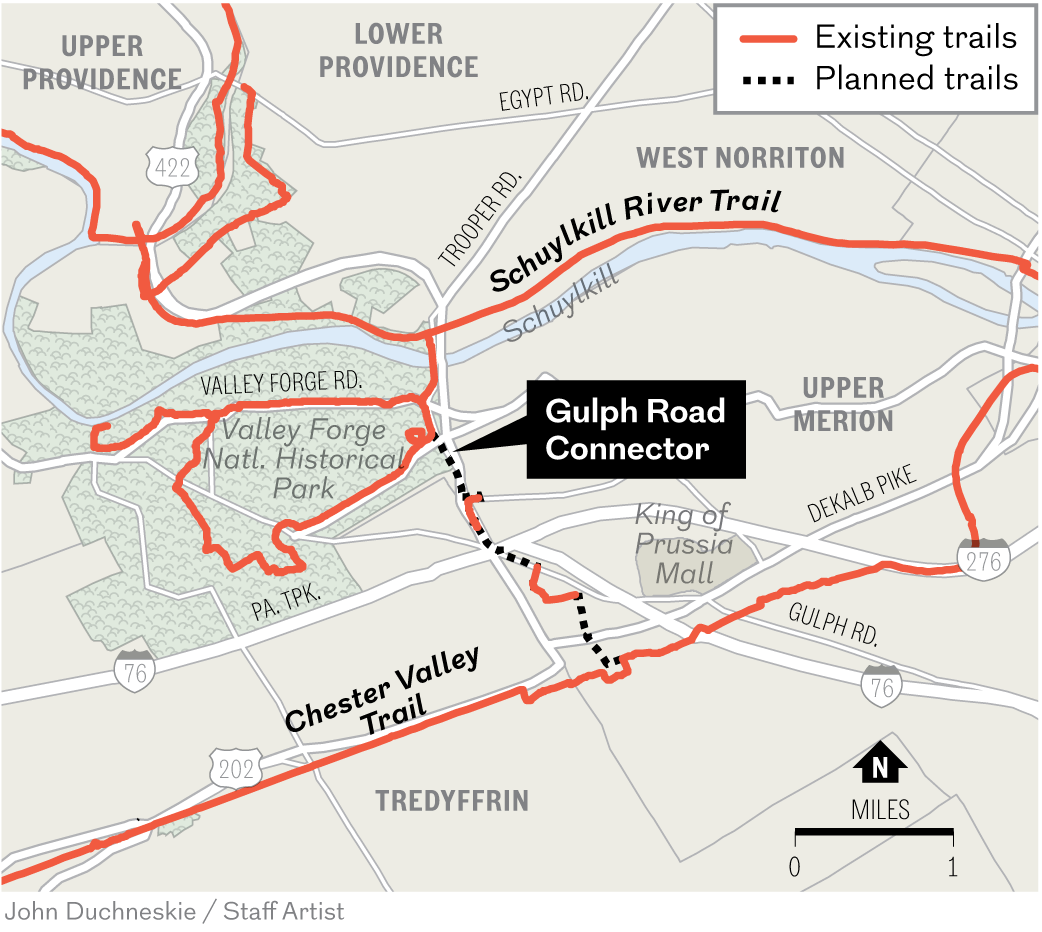
    The “Gulph Road Connector,” as it is currently called, is slated to connect to the Chester Valley Trail near the King of Prussia Mall, cross through Valley Forge National Historical Park, and link with the Schuylkill River Trail when completed.

    The project was recently awarded a three-year $326,900 grant from the William Penn Foundation, which will begin in January, said Eric Goldstein, president and CEO of the King of Prussia District, which is leading the project. The official name of the trail has not been determined.

    The influx of funds is slated for education, advocacy, and marketing, said Goldstein, who noted that the foundation is supporting “efforts to build a coalition of advocates” for the trail. The money will not be used for design or construction.

    Segments of the planned 2.8-mile trail connector are in stages of design and construction, with some already built, Goldstein said.

    “What we’re trying to do is ultimately fill in the blanks to make the 2.8-mile section complete,” he said.

    Goldstein said the new funds will allow the King of Prussia District to work with different partners along the trail. The aim is to build a coalition and raise awareness of the proposed trail, which ideally would lead to more grant money down the line for design and construction, he said.

    Map of the planned Gulph Road Connector trial near King of Prussia.

    The new funding is “the impetus for this trail to start moving toward completion,” said Molly Duffy, executive director of the Valley Forge Park Alliance, a partner organization in the trail’s development.

    There is no estimate yet for the total cost of the project, Goldstein said.

    The project is part of the Circuit Trails, a regional network that aims to have more than 850 miles of trails through nine counties. Once the trail is built out, Goldstein said, he expects it will be managed by multiple entities, depending on the section.

    He hopes to be able to complete the trail in the next 10 years.

    Some parts of the trail are “enormously complex,” he noted, adding that pedestrian bridges over sections of highway would require complex engineering and be costly — which requires raising funds.

    While the trail is expected to be used for recreation, it could also be an option for commuting to work.

    “The second audience of this proposed trail network is employees that work in Upper Merion Township that are seeking alternative modes of transportation to get to and from work,” he said.

    The trail also could make Valley Forge National Historical Park more accessible by ways other than driving, Duffy said.

    “We want people to be able to get here,” Duffy said. “Knowing where this is — in this super densely populated suburban area — we know that there’s this missing link, really, between these two major trails that, once built, will literally connect thousands and thousands of people who live in the area, work in the area, are visiting the area.”

  • Philly’s new unarmed volunteer ‘auxiliary police’ unit could launch in 2026

    Philly’s new unarmed volunteer ‘auxiliary police’ unit could launch in 2026

    The Philadelphia Police Department is forming an “auxiliary” unit that may be ready as early as next year, according to a department spokesperson, adding to its ranks volunteer members who will assist officers at large public gatherings.

    Auxiliary police will not carry weapons and will not be assigned typical law enforcement duties, according to Sgt. Eric Gripp, a department spokesperson. They will not be authorized to make arrests.

    But the department wants the unit to act as a link between the public and police, participating in community engagement and, according to Gripp, serving as additional “eyes and ears” for officers on the ground.

    As Philadelphia prepares to host a series of widely attended events in 2026 — the country’s 250th July Fourth anniversary celebration, FIFA World Cup matches, and more — the police department will be tasked with maintaining order amid an influx of visitors.

    An auxiliary unit would assist police during those types of events, according to Gripp. He said the department had tasked its academy recruits with similar duties during citywide celebrations after the Eagles’ Super Bowl victory in February.

    It is unclear whether the auxiliary unit will be ready in time for the summer.

    The department does not have an official estimate on when it plans to introduce the unit; the idea is still in the planning stages and targeted for 2026, Gripp said. The only confirmed requirement is that recruits must be 18 years old to apply.

    Police departments in municipalities large and small have used auxiliary units, sometimes called reserve units, for years.

    The New York Police Department has maintained its auxiliary unit for more than half a century; major cities like Baltimore also have reserve officers, as do smaller townships like Cranford, N.J.

    Criminologists and former law enforcement officers say police departments use these units to assist with traffic management, crowd control, and community engagement, and for reporting more serious issues to officers who have the authority to intervene.

    Experts say the units are a boon to departments facing recruitment and retention issues, providing unpaid assistance from those who are already curious about life as a police officer and who often hail from the communities they are assigned to.

    But departments must invest time, money, and adequate training into auxiliary units for them to be successful.

    Joseph Giacalone, a retired NYPD sergeant and criminal justice instructor at Pennsylvania State University’s Lehigh Valley campus, said the New York department often uses its 3,700-member auxiliary unit for crowd control during “fun events” like parades and street fairs.

    Most importantly, Giacalone said, departments should not view their auxiliary unit as a crime-fighting tool; members should be provided uniforms that are recognizable to the public, he said, distinct from those of actual police officers.

    “We’re not talking riots,” Giacalone said of situations in which auxiliary officers are useful. “We don’t want them really identifying things such as drug dealing, dens of prostitution, things like that. We can get that from ordinary intelligence — we don’t want ordinary citizens doing that.”

    Still, auxiliary members may help officers with other duties.

    During Giacalone’s tenure with the department, the NYPD’s auxiliary unit proved beneficial when members reported quality-of-life issues such as abandoned vehicles and broken traffic lights, he said.

    Given the potential danger that accompanies police work, Giacalone said, he hopes the Philadelphia department’s plan includes extensive training for auxiliary recruits — as well as protective gear.

    The former sergeant still recalls a harrowing day in 2007 when two unarmed New York auxiliary officers were shot and killed by a gunman in the city’s Greenwich Village neighborhood while out on patrol.

    Gripp, the Philadelphia department spokesperson, said the city’s auxiliary unit would not conduct foot patrols. He said members would be trained by the department’s internal staff.

    Meanwhile, New York auxiliary officers must pass hours of training courses in first aid, self-defense, and patrol technique; in Giacalone’s experience, those trainings require more experienced officers to sacrifice time and energy to the project.

    By the former sergeant’s estimate, for Philadelphia, “it’s going to take a while to get this up and running.”

  • Hong Kong building blaze kills at least 36 people, hundreds missing

    Hong Kong building blaze kills at least 36 people, hundreds missing

    HONG KONG – At least 36 people were killed and 279 were missing on Wednesday after Hong Kong’s deadliest fire in three decades ripped through high-rise residential towers sheathed in flammable bamboo scaffolding, authorities said.

    More than 10 hours after the fire started in the northern Tai Po district, flames and thick smoke still engulfed the 32-story towers as rescue workers swarmed the site and shocked inhabitants watched nearby.

    The cause of the blaze was not immediately known, but it was fanned by green construction mesh and bamboo scaffolding which the government began phasing out in March for safety reasons.

    Firefighters work to extinguish a blaze that broke out at Wang Fuk Court in Hong Kong on Wednesday.

    Working through the night, firefighters were struggling to reach upper floors of the Wang Fuk Court housing complex, which has 2,000 apartments in eight blocks, due to the intense heat.

    One 71-year-old resident surnamed Wong broke down in tears, saying his wife was trapped inside.

    A firefighter was among the 36 killed, and 29 people were in hospital, Hong Kong leader John Lee told reporters. Some 900 people were in eight shelters.

    “The priority is to extinguish the fire and rescue the residents who are trapped. The second is to support the injured. The third is to support and recover. Then, we’ll launch a thorough investigation,” Lee told reporters. Harry Cheung, 66, who has lived at Block Two in one of the complexes for more than 40 years, said he heard a loud noise about 2:45 p.m. (6:45 GMT) and saw fire erupt in a nearby block.

    “I immediately went back to pack up my things,” he said.

    “I don’t even know how I feel right now. I’m just thinking about where I’m going to sleep tonight because I probably won’t be able to go back home.”

    A firefighter was among those killed, the director of Fire Services said.

    China’s XI urges ‘all-out’ effort against fire

    Frames of scaffolding were seen tumbling to the ground as firefighters battled the blaze, while scores of fire engines and ambulances lined the road below the development.

    From the mainland, China’s President Xi Jinping urged an “all-out effort” to extinguish the fire and to minimize casualties and losses, China’s state broadcaster CCTV said.

    Hong Kong’s sky-high property prices have long been a trigger for social discontent in the city and the fire tragedy could stoke resentment towards authorities ahead of a city-wide legislative election in early December.

    The cause of the blaze was not immediately known, but it was fanned by green construction mesh and bamboo scaffolding which the government began phasing out in March for safety reasons.

    Hong Kong’s Transport Department said that due to the fire, an entire section of the Tai Po road, one of Hong Kong’s two main highways, had been closed and buses were being diverted.

    At least six schools will be closed on Thursday due to the fire and traffic congestion, the city’s Education Bureau said.

    It was Hong Kong’s worst fire since 41 people died in a commercial building in the heart of Kowloon in November 1996.

    That fire was later found to be caused by welding during internal renovations.

    A public inquiry yielded sweeping updates to building standards and fire safety regulations in the city’s high-rise offices, shops and homes.

    Dozens of shocked residents and onlookers in Hong Kong watched from nearby walkways as smoke funneled up from the complex.

    Bamboo scaffolding being phased out

    Hong Kong is one of the last places in the world where bamboo is still widely used for scaffolding in construction.

    The government moved to start phasing that out in March, citing safety. It announced that 50% of public construction works would be required to use metal frames instead.

    Wang Fuk Court is one of many high-rise housing complexes in Hong Kong, one of the most densely populated areas in the world. Tai Po, located near the border with mainland China, is an established suburban district with some 300,000 residents.

    Occupied since 1983, the complex is under the government’s subsidized home ownership scheme, according to property agency websites. According to online posts, it has been undergoing renovations for a year at a cost of HK$330 million ($42.43 million), with each unit paying between HK$160,000 and HK$180,000.

    Owning a home is a distant dream for many in Hong Kong, one of the world’s most expensive housing markets and where residential rents are hovering around record highs.

    ($1 = 7.7779 Hong Kong dollars)

  • Owner of failed Philly real estate firm ABC Capital fined $350k by AG

    Owner of failed Philly real estate firm ABC Capital fined $350k by AG

    Editor’s note: An earlier version of this story included a photograph of a woman who had been a victim of the scheme and she was identified as such in the caption. The photo was removed because the juxtaposition of the headline and the image made it appear as the victim was the perpetrator.

    The Pennsylvania attorney general has issued a six-figure fine to the former CEO of ABC Capital, a failed real estate firm behind an $82 million scheme that saw overseas investors snap up hundreds of homes in the city’s poorest neighborhoods — only to leave them to rot.

    During the 2010s, ABC facilitated the sales of over 1,900 distressed homes billed as “turnkey rental” opportunities to investors in Asia, Europe, and South America. The company promised to purchase, renovate, and manage the rentals in exchange for up-front cash, but often reneged — bilking investors out of their money and sometimes stranding tenants in crumbling rental homes.

    Tenants rights advocates and lawsuits from investors later described the business as a “scam” or “Ponzi scheme.”

    Attorney General Dave Sunday said on Tuesday that former ABC Capital CEO Jason “Jay” Walsh had violated the terms of a 2024 settlement agreement negotiated by the attorney general’s office in response to these complaints.

    That agreement, which described ABC’s business practices as “deceptive and unfair,” prohibited Walsh from managing and maintaining rental properties in Pennsylvania. But a Common Pleas Court judge earlier this week ruled that Walsh violated the agreement by continuing to perform “management services for a property he owned,” communicating with tenants, and providing “inaccurate information” to the attorney general’s office.

    Sunday issued a $350,000 fine in response.

    “We are grateful that the Court recognized blatant breaches of this agreement, and imposed a serious penalty against Mr. Walsh,” Sunday said in a prepared statement. “We will continue to hold Mr. Walsh accountable under this agreement that clearly prohibits him from managing properties in the Commonwealth.”

    Walsh could not be reached for comment. His attorney did not immediately respond to requests for information or comments.

    Walsh’s crumbling empire was chronicled in 2022 reports by The Inquirer and the Baltimore Banner. His company decamped to the latter city as rising property values made the City of Brotherly Love less attractive to investors seeking cheap real estate.

    But during the 2010s, ABC facilitated more than $82 million in property sales involving 600 different companies in Philadelphia alone, Inquirer reporting showed. Walsh and his partners — Israeli expats Yaron Zer and Amir Vana — later faced numerous lawsuits filed by investors alleging the company left units unfinished or fell far short of promised 40% returns on investment, leaving them saddled with debt.

    Some of the homes that were ostensibly renovated, leased, or managed by ABC eventually became uninhabitable, due to either shoddy work or poor maintenance, according to tenants, investors, and the attorney general.

    “It’s almost always in poor communities, with high rates of people of color,” Karla Cruel, a former staff attorney at Tenant Union Representative Network, told The Inquirer in 2022. “But they were screwing over the tenants and the investors at the same time. It was just a big old scam.”

    Last September, the Banner reported, Walsh was convicted of acting as an unlicensed contractor in Baltimore and ordered to pay $20,500 in restitution — the only criminal action brought against him to date.

    The Pennsylvania civil settlement — brokered by Pennsylvania Attorney General Michelle Henry in 2024 — banned Walsh and his wife, Blanca, from acting as landlords without the use of a third-party property manager. The duo, who appeared to have decamped to Aruba by 2024, were also not to have any contact with tenants for periods of 25 and 15 years, respectively.

    But court filings show that Walsh violated that agreement by continuing to directly lease out and manage two properties not far from the company’s defunct headquarters in Northern Liberties.

    One was his former residence, and another was a property he acquired under the moniker Nolo Investments LLC. Walsh had reported to the attorney general that while he and his wife co-owned both properties, they were managed by an outside company called “My Mega Realty.”

    While Walsh did discuss such an arrangement, the company’s owner said he never completed the deal. Former tenants also reported to the attorney general that Walsh and his wife were directly managing the property and collecting rent.